


Abstract
Population growth and rapid urbanization have significantly increased construction activities and the demand for building materials. It is estimated that approximately 39% of global CO2 emissions are associated with the construction sector, with nearly 8% directly attributed to Portland cement production. In addition to greenhouse gas emissions, the cement industry is responsible for substantial environmental impacts, including natural resource depletion, soil degradation, and air and water pollution. In this context, the development of alternative and more sustainable binder systems has become a global research priority. Geopolymers have emerged as promising materials produced through either alkaline or acid activation routes, offering advantages such as a reduced carbon footprint, high durability, and rapid strength development. Among these systems, acid-activated materials, particularly phosphate-based geopolymers, differ fundamentally from conventional alkali-activated binders in terms of reaction chemistry and binding phases. The formation of aluminum phosphate (AlPO4) networks plays a key role in governing the mechanical performance and microstructural stability of these materials. This mini-review provides a critical overview of the fundamental principles of acid activation applied to alternative cementitious materials, with emphasis on dissolution mechanisms, polycondensation reactions, and the nature of binding phases in phosphate-based systems. Unlike previous reviews, this study integrates recent findings on reaction mechanisms with a comparative analysis between acid and alkaline activation routes, highlighting underexplored aspects of precursor reactivity and binder formation. The main types of acids used as activators, the influence of precursor chemical composition, and the conceptual differences between acid and alkaline activation are discussed. In addition, recent advances, current challenges, and future perspectives of acid activation are addressed, highlighting its potential as a viable low-carbon binder route for sustainable construction materials, with strong prospects for partially replacing Portland cement, particularly in high-performance applications requiring enhanced chemical resistance and thermal stability.
1. Introduction
Population growth is a driving force behind the construction of new buildings, and Portland cement, one of the most widely used materials worldwide, follows this trend. To keep pace with sustainable development goals, the construction sector has become more responsive to the impacts it generates, making it necessary to develop structures that not only support population growth but also ensure efficiency and sustainability [1,2,3]. Therefore, a growing concern has emerged regarding the overexploitation of non-renewable resources and emission of greenhouse gases [4,5,6]. Portland cement, for instance, is responsible for approximately 6% to 8% of global anthropogenic CO2 emissions, making it the main industrial source of carbon dioxide emissions [2,7,8]. In this context, materials commonly referred to as geopolymers have emerged. This material may present a lower environmental footprint than Portland cement, since geopolymerization requires less energy and can occur at lower temperatures than cement production [7,8,9].
Geopolymers are inorganic binders composed of aluminate [AlO4] and silicate [SiO4] tetrahedra, originating from the mixture of aluminosilicates with alkaline or acidic activating solutions [1,10,11]. It is noteworthy that the literature discusses the difference between geopolymers and alkali-activated materials, in some contexts using them as synonyms. However, this article will consider the definition established by Joseph Davidovits, in which geopolymers are considered amorphous to semi-crystalline aluminosilicate networks formed through polycondensation reactions [12,13]. When activated with phosphoric acid (H3PO4), geopolymers also contain phosphate tetrahedral units ([PO4]), with aluminum phosphate (AlPO4) as the main component [14], forming, among others, phospho-sialate-type structures (-P-O-Si-O-Al-O-P-O-) [10]. According to Allaoui et al. [15], aluminum phosphate (AlPO4) is one of the phases responsible for the mechanical properties of phosphoric acid-activated geopolymers. Furthermore, according to Dihaji et al. [1], compared to alkaline activation, phosphoric activation promotes a less aggressive dissolution process, preserving the aluminosilicate structural integrity and enabling the formation of a highly cross-linked network. This higher degree of cross-linking is generally associated with enhanced chemical stability and durability, due to the formation of a more compact and resistant network, although it may also result in increased brittleness and reduced strain capacity at early ages. In addition, H3PO4-activated geopolymers benefit from high chemical stability, creating opportunities for applications in chemically aggressive environments [11].
Considering the potential of phosphoric acid-activated geopolymers, this mini-review connect the main concepts of alkali and acid-based geopolymers. Although numerous studies have presented reviews on geopolymers [16,17,18,19,20,21,22], only a few have explored phosphate-based geopolymers in terms of their structure, properties, and applications [11,23,24]. Even fewer studies have provided comprehensive overviews on the use of solid wastes in the development of new construction materials as a strategy to reduce CO2 emissions and optimize resource use [25,26].
Therefore, this paper differs from previous studies by placing greater emphasis on waste systems, synthesizing key opportunities for resource valorization. Additionally, particular attention is given to the potential roles of waste materials (reactive precursors, fillers, micro-reinforcements, foaming agents and immobilization matrix) and on how their morphology influences the final microstructure and compressive strength of phosphate-based geopolymers. The objective is to synthesize recent advances, provide practical guidelines, and contribute to the body of knowledge of phosphate-based geopolymers, which, according to Meng et al. [27], remains insufficiently understood. Thus, this paper reviews the principles related to alkaline-activated geopolymer in Section 2, followed by a discussion of phosphate-based geopolymerization mechanism and the influence of cure and molar concentration in Section 3. Section 4 highlights how solid wastes are being used to improve mechanical properties of phosphate geopolymers. Finally, Section 5 concludes the main discussions related to the development of acid-activated geopolymers and waste valorization.
2. Alkali-Activated Geopolymer
2.1. Definition and Chemistry
Geopolymers were introduced by the French scientist Joseph Davidovits in the 1970s, when it was reported that aluminosilicates could be transformed into three-dimensional polymers at room temperature. Since then, the material, its reaction mechanisms, and its properties have been extensively studied and improved, and the term “geopolymer” has gradually been accepted and established within the scientific community [14,28]. Geopolymers are inorganic binders composed of aluminate [AlO4] and silicate [SiO4] tetrahedra interconnected by shared oxygen atoms. They originate from the mixture of precursors rich in Al2O3 and SiO2 (aluminosilicates) with alkaline or acidic activating solutions [1,10,11]. In the case of alkali-activated geopolymers, negatively charged tetrahedra are linked through oxygen bridges to form highly connected networks, with alkali metal ions such as Na+ or K+ balancing the negative charge. In contrast, in acid activation, phosphate tetrahedra ([PO4]) are formed, enabling structural charge balance without the need for additional cations [29].
After mixing the precursor with the chemical activator, geopolymer formation begins through reaction mechanisms analogous to polymerization, involving dissolution, rearrangement, condensation, and resolidification [8,14,18,30]. Unlike traditional Portland cement, which relies on hydration to develop strength, geopolymers undergo polycondensation [20]. The precursors used in geopolymer production are fine powders rich in aluminosilicates, which may have low calcium content, such as fly ash or metakaolin, or higher calcium content, such as blast furnace slag [31]. Alkali-activated binders with low calcium content are commonly classified as geopolymers, whereas those with higher calcium contents are classified as alkali-activated cements [32]. In contrast, phosphoric acid-activated systems are classified as phosphate-based geopolymers [20]. Many solid wastes are composed of silica and alumina, making them suitable for geopolymer production and offering a promising opportunity for reuse and recycling [8].
The selection of precursors requires a tailored approach based on their chemical and mineralogical composition, as well as their physical properties. The Si/Al ratio, particle size distribution, and phase composition determine their reactivity within the system. Geopolymeric matrices in which part of the material remains undissolved after activation may indicate a high crystallinity of the precursor. This occurs because the amorphous phase tends to react while the crystalline portion remains inert, acting as a filler [9]. Activators, in turn, are typically composed of hydroxides, silicates, aluminates, and carbonates in alkaline systems, and phosphoric acid in acid activation systems. These materials generate a solution capable of accelerating the dissolution of the solid precursor, resulting in the formation of new reaction products [20,31]. In addition to the use of solid wastes as precursors, there are also opportunities for their use in the development of alternative activators, particularly agro-industrial ashes, which are commonly rich in K2O and CaO and can generate a highly alkaline medium when reacted with water [31].
2.2. Alkali-Activated Geopolymerization Mechanism
According to Dihaji et al. [1], when activated under alkaline conditions, the geopolymerization mechanism begins with the dissolution of the aluminosilicates present in the raw materials, as summarized in Equation (1).
aluminosilicate + alkaline solution → n(OH)3-Si-O-Al-(OH)3
This step is responsible for breaking the aluminosilicate framework, due to the high pH of the alkaline solution that produces a colloidal phase, leading to the formation of free silicate and aluminate tetrahedral monomer units into the solution [1,32,33]. Subsequently, these units are rearranged and undergo condensation, forming three-dimensional network structures containing Si-O-Si and Si-O-Al linkages [10,14], as summarized in Equation (2) [1].
n(OH)3-Si-O-Al-(OH)3 → (Si-O-Al-O-Si-O)n
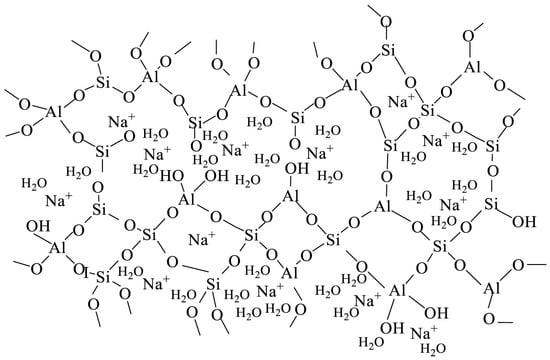
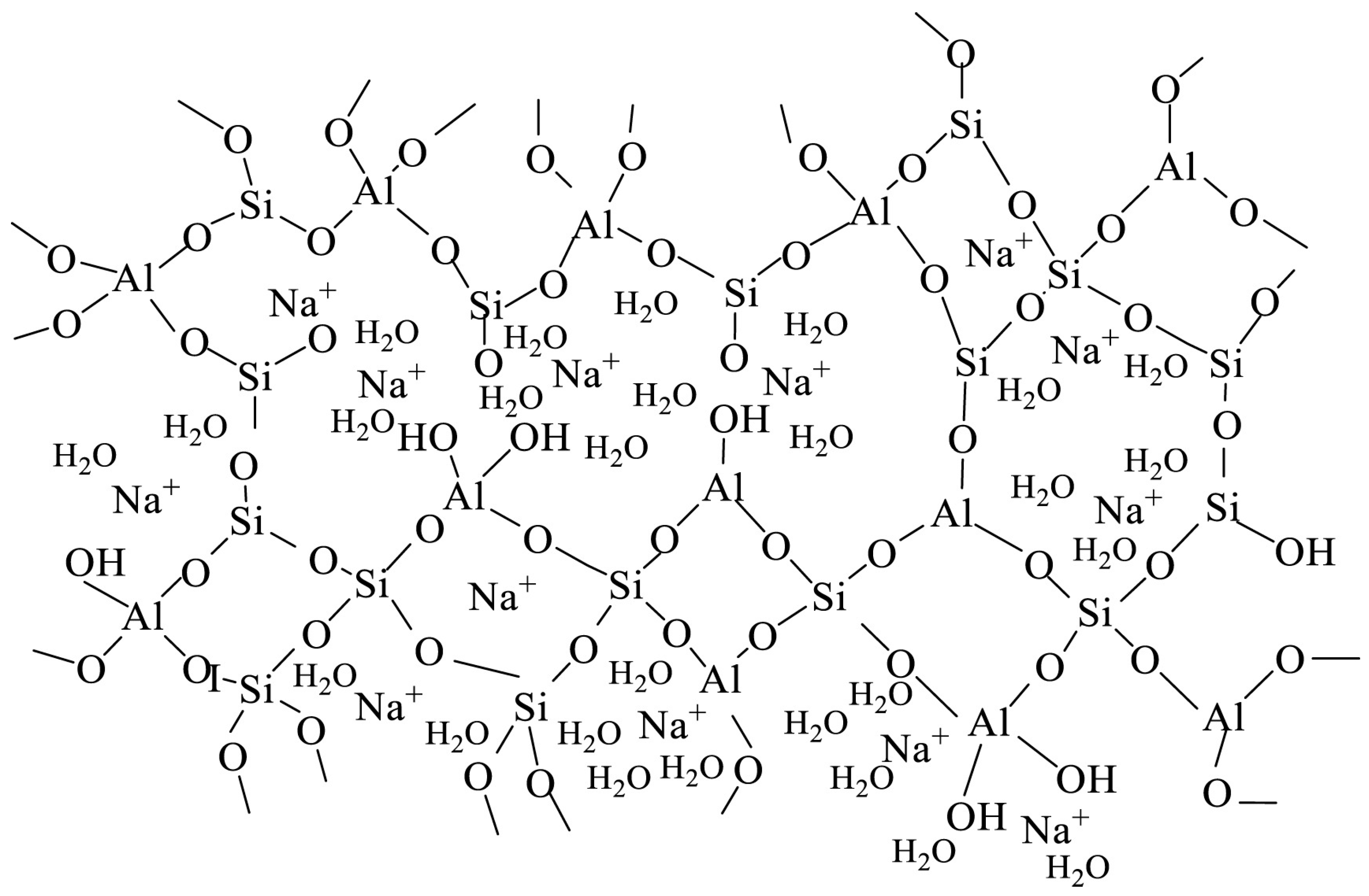
At this stage, the Si-O-Si(-Al)-O frameworks are formed by the orientation of the previously dissolved monomers and the development of a condensed structure [33,34]. Finally, during the resolidification stage, precipitation of the main geopolymerization product occurs, forming an amorphous gel with cementitious properties, namely N-A-S-H (sodium aluminosilicate hydrate) or C-A-S-H (calcium aluminosilicate hydrate), depending on the amount of Ca incorporated into the system [32]. According to Yang et al. [33], all these steps occur almost simultaneously, making it challenging to address them individually. Figure 1 illustrates a schematic model of chain formation in an alkali-activated geopolymer [20].
Figure 1.
Schematic model of the geopolymeric network under alkaline activation [20].
The Si/Al ratio plays a significant role in the compressive strength of alkali-activated geopolymers. Silica enhances the structural bonding of alumina, resulting in denser and more compact matrices, thus becoming essential for the mechanical behavior of the geopolymer [20]. According to Moujoud et al. [22], a balanced ratio promotes geopolymerization by contributing to Si-O-Si and Si-O-Al linkages and, consequently, optimizing gel formation. However, an excessively high Si/Al ratio may lead to the accumulation of unreacted particles within the geopolymer matrix.
3. Phosphate-Based Geopolymer
3.1. Acid-Activated Geopolymerization Mechanism
In addition to aluminate and silicate tetrahedral units present in alkaline activation, phosphate-based geopolymers contain phosphate tetrahedra ([PO4]) and aluminum phosphate (AlPO4) as their main component. These units preferentially bond with aluminum octahedra ([AlO6]). Besides being the most stable coordination state of Al, [AlO6] provides more oxygen atoms for bonding compared to [AlO4], the main coordination structure in alkali-activated geopolymers. This results in a more highly cross-linked structure in acid-activated geopolymers, potentially enhancing compressive strength [14,35]. In this scenario, the reaction begins with acidic protons (H+) attacking the aluminosilicate structure and causing dealumination. This occurs through the breaking of Al-O-Al and Si-O-Al bonds, leading to the formation of Si-O units and the release of Al3+ ions into the system [1,10,20,36], as illustrated in Equation (3) [1].
aluminosilicate + H+ → Si(OH)4 + Al(OH)3
This step describes the acid-driven dissolution of the aluminosilicate framework, where the original structure is broken down into soluble silica and alumina species. Following this, reactions occur between: (i) dealuminated metakaolinite and [PO4], derived from phosphoric acid, forming -Si-O-P- and -Al-O-P- bonds within an amorphous structure, and (ii) leached aluminum species and [PO4], leading to the formation of the berlinite phase (AlPO4) [10,20,37], as shown in Equation (4) [15].
Al2O3 + 2H3PO4 → 2AlPO4 + 3H2O
This reaction represents the formation of aluminum phosphate (AlPO4), a key binding phase that contributes to the mechanical strength and thermal stability of the geopolymeric matrix. According to Allaoui et al. [15] and Oubaha et al. [38], AlPO4 plays a key role in reinforcing the amorphous geopolymeric matrix under phosphoric activation. It improves its mechanical properties and provides high thermal resistance, withstanding temperatures of up to 1500 °C without signs of melting. AlPO4 may appear in geopolymer systems either as an amorphous phase [14] or as a stable crystalline phase [4,10,15,38,39]. Bernasconi et al. [35] further reported that the amorphous phase consists of two distinct systems: aluminophosphate and amorphous silica. According to the authors, these two phases are highly interconnected, making their morphological distinction difficult while contributing to a highly cross-linked structure.
Finally, through the polycondensation of the resulting units, a stable polymeric network is formed with polyphosphate (-P-O-) linkages, consisting of crystalline components dispersed within the amorphous geopolymeric matrix [1,20], as shown in Equation (5) [1]. This step illustrates the polycondensation process, where dissolved species reorganize into a continuous network through Si-O-P linkages, leading to the formation of the geopolymeric structure.
Si(OH)4 + H2PO4− → Si-O-P-O-Si + H2O
Phosphate-based geopolymers may exhibit either crystalline or amorphous characteristics, depending on the reactivity of their components [20]. Oubaha et al. [38] and Xu et al. [40] reported that the presence of an amorphous halo between 20° and 40° (2θ) in X-ray diffraction (XRD) patterns is an indicator of successful geopolymerization, reflecting the dissolution of Si and Al sources by phosphoric acid. This indicates the formation of a three-dimensional amorphous network composed of Si-O-P-O-Si or Si-O-P-O-Al linkages, with interspersed berlinite units. Quartz may still be observed in H3PO4-activated geopolymer diffractograms due to the partial solubility of this phase in acidic environments [40].
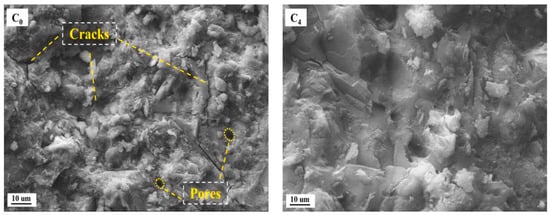
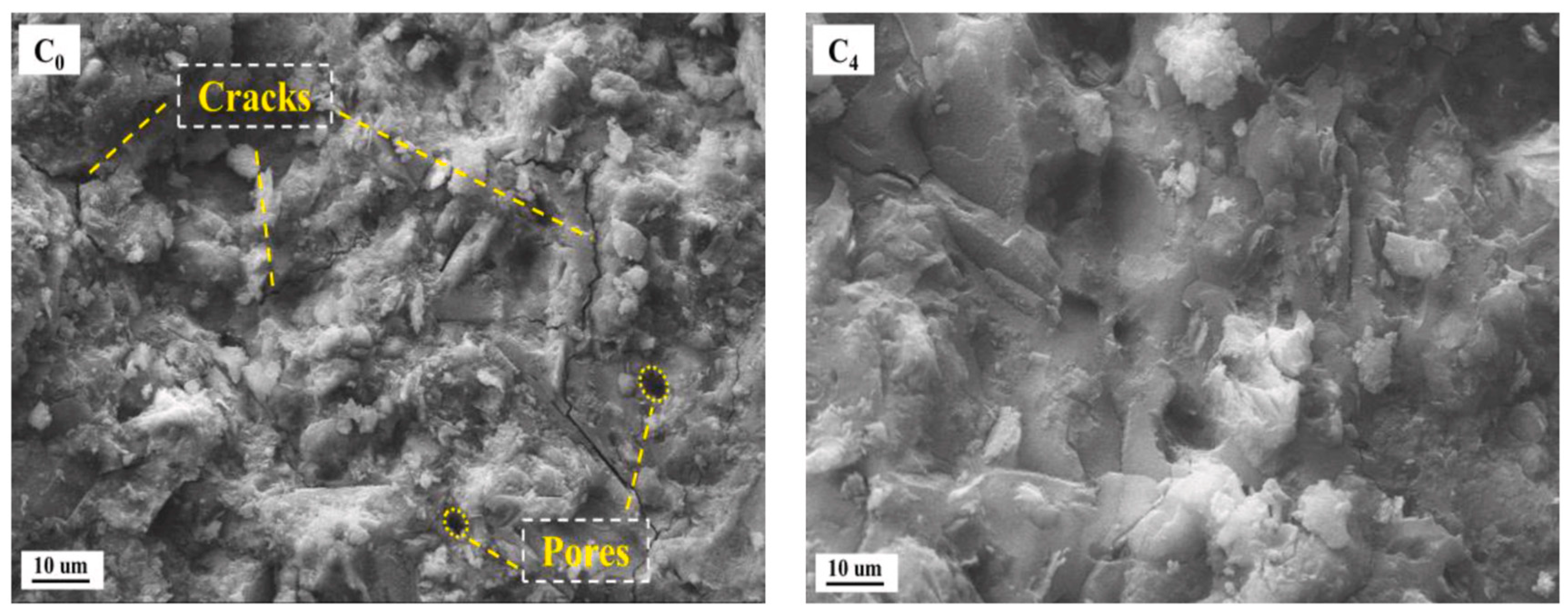
The success of geopolymerization is directly associated with the final microstructure and mechanical behavior of the material. Pu et al. [41] used Fe3O4 as an additive, a high-strength compound formed by the reaction of phosphoric acid with iron oxides. The authors reported that additions of up to 15% improved the compressive strength of the geopolymer, leading to the formation of both aluminum phosphate crystalline phases and an iron–phosphorus gel phase. Similarly, Xu et al. [40] encapsulated radioactive liquid waste in a phosphoric acid-activated geopolymer, using Fe3O4 as an additive, to optimize the geopolymeric structure. Figure 2 illustrates the effect of this addition on matrix formation. Sample C0, without Fe3O4, exhibited a rough surface with pores and cracks, whereas sample C4 showed an improved microstructure. The formation of amorphous gel increased in C4, due to the additive incorporation, resulting in a more cohesive and denser structure. This improvement is reflected in compressive strength, with C0 reaching 13.13 MPa, while C4 achieved 37.15 MPa with 8% replacement of the precursor by the additive.
Figure 2.
Microstructure: (C0) geopolymeric matrix without additive and (C4) geopolymeric matrix with additive [40].
To understand the significance of phosphate-based geopolymers, it is crucial to understand the principles of their alkaline counterpart. Alkali-activated geopolymers may achieve satisfactory performance within 1 day, whereas acid-activated geopolymers typically require approximately 21 days to solidify at room temperature. This difference is attributed to the time required to complete the geopolymerization reaction, which is slower under acidic conditions, directly influencing the setting time [7]. On the other hand, acid activation promotes a less aggressive dissolution process compared to alkaline activation, preserving the aluminosilicate structural integrity and enabling the formation of a highly cross-linked network [1]. Furthermore, the lower dissolution of silicon in acidic environments [4], combined with the high chemical stability of acid geopolymerization, creates opportunities for applications requiring durable components operating in chemically aggressive environments [11]. These characteristics provide phosphoric geopolymers with enhanced thermal stability at high temperatures [15,28] and improved dielectric properties [20,42]. Table 1 summarizes the main differences between alkali-activated and acid-activated geopolymers.
Table 1.
Key differences between geopolymers based on activation.
3.2. Influence of Activation and Curing Temperature
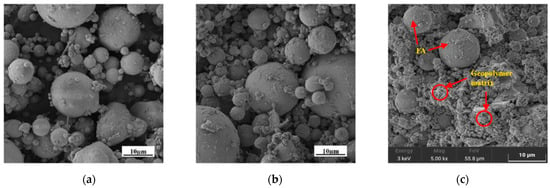
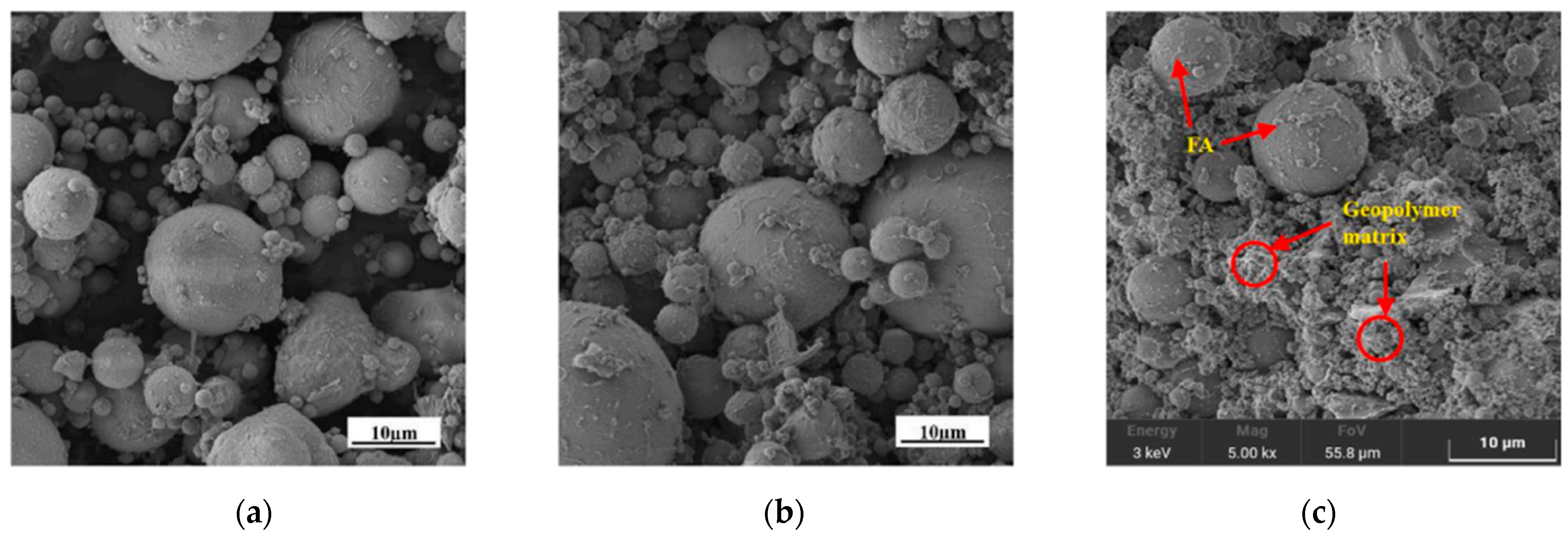
The concentration of H3PO4 and the curing method are crucial factors influencing the final behavior of geopolymers [7]. Curing temperatures between 60 °C and 80 °C may lead to the formation of internal cracks due to exothermic reactions occurring during the process. Moreover, inadequate acid concentration can hinder the dissolution of aluminosilicates, directly impairing geopolymerization [4]. He et al. [51] investigated the microstructure of phosphoric acid-activated fly ash geopolymers under different concentrations and temperatures. Figure 3 presents SEM micrographs of geopolymers with a liquid-to-solid (L/S) ratio of 0.35, cured at 60 °C. It can be observed that as the molar concentration increases from 1 mol/L to 3 mol/L, the geopolymeric gel becomes more developed, as a greater amount of precursor particles is dissolved and more Si and Al species participate in the reaction.
Figure 3.
Microstructure of geopolymer (GP) at different concentrations: (a) 1 M; (b) 2 M; (c) 3 M (adapted from [51]).
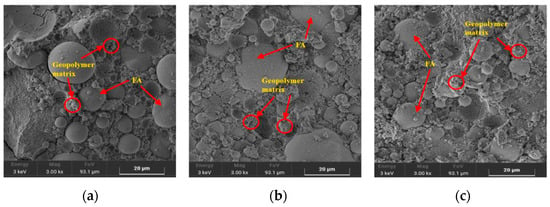
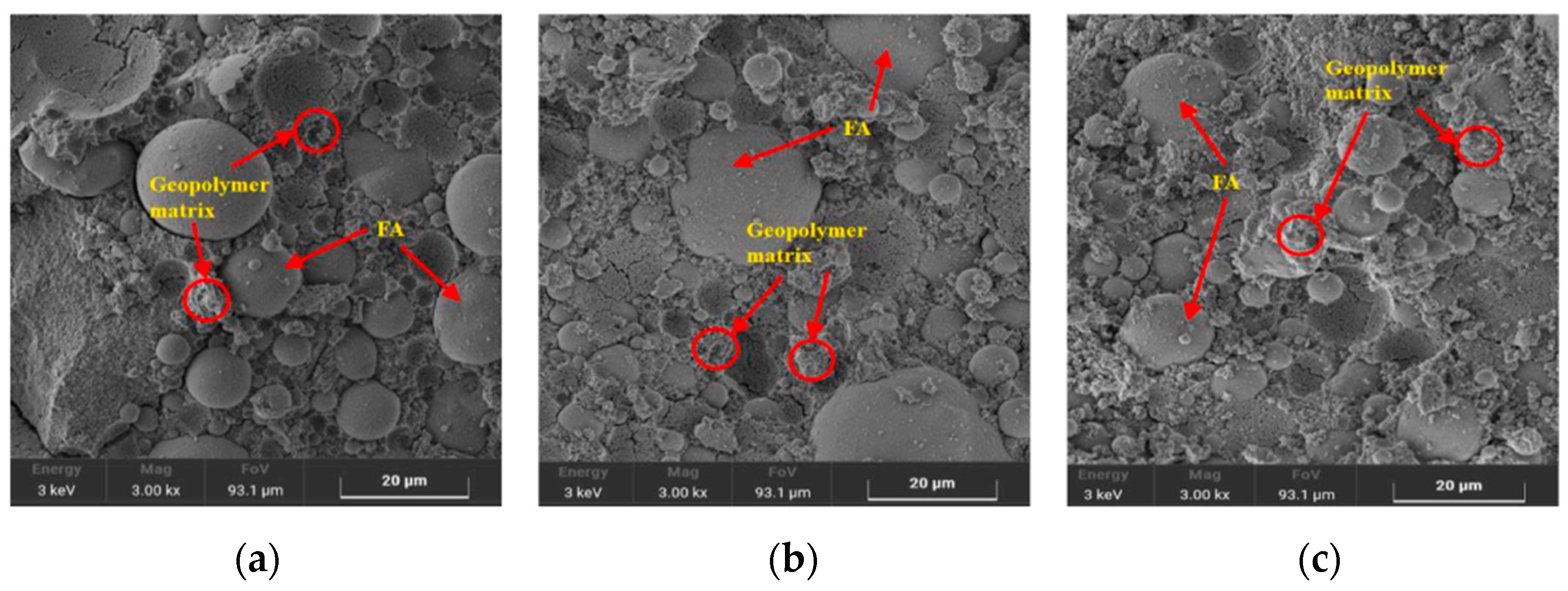
Regarding temperature, samples with a molarity of 4 mol/L and an L/S ratio of 0.35 cured at 60 °C exhibited a denser geopolymeric matrix due to accelerated reaction kinetics compared to the sample cured at 25 °C. In contrast, when compared to the sample cured at 90 °C, accelerated water loss was observed, which hindered the continuation of the reaction, directly affecting the compressive strength of the material, as shown in Figure 4 [51].
Figure 4.
Microstructure of geopolymer (GP) at different temperatures: (a) 25 °C; (b) 60 °C; (c) 90 °C (adapted from [51]).
Pantongsuk et al. [7] evaluated the influence of different H3PO4 concentrations (6 M, 8 M, and 10 M) and curing temperatures (50 °C and 70 °C) on metakaolin-based acid-activated geopolymers. The authors observed that at a concentration of 6 M, the higher water content in the solution promoted the formation of larger and more numerous pores, resulting in lower matrix homogeneity. At 10 M, the geopolymers exhibited partially reacted metakaolin (MK) particles, due to the interruption of the reaction caused by the rapid formation of a hardened AlPO4 gel. This gel encapsulated MK particles and hindered further dissolution, impairing geopolymerization and matrix homogeneity [7]. A similar behavior was reported by Cao et al. [45], who used not only phosphoric acid but also aluminum dihydrogen phosphate. Although this compound accelerates geopolymerization due to the release of reactive aluminum ions, it may also block unreacted MK particles through rapid hardening and gel formation, hindering the dealumination process [45]. Ultimately, a H3PO4 concentration of 8 M was found to be optimal for compressive strength. This molarity balanced the dealumination process, active species, and water content, resulting in a denser, more homogeneous matrix with fewer unreacted MK particles. Regarding temperature, 50 °C provided the best mechanical performance, whereas 70 °C led to crack formation and premature amorphous gel formation, which covered unreacted MK particles, hindering the continuation of geopolymerization and significantly reducing compressive strength [7].
Alvi et al. [4] investigated 14 liquid-to-solid (L/S) ratios (1; 1.5; 2; 5; 10; 20; 50; 100; 200; 500; 1000; 2000) in metakaolin-based geopolymers activated with phosphoric acid (H3PO4). A staged curing process was employed to avoid internal cracking due to exothermic reactions, consisting of pre-curing at 35 °C for 24 h followed by curing at 55 °C for an additional 24 h. At higher L/S ratios, the formation of stable crystalline products was inhibited, resulting in predominantly amorphous gel formation. This behavior can be attributed to two main factors: (i) excess H3PO4 remains unreacted due to the rapid formation of an amorphous gel that coats MK particles and prevents their dissolution and further geopolymerization, or (ii) crystalline phases, such as berlinite, may initially form but are subsequently damaged or dissolved by the excess acid. As a result, only samples with L/S ratios ≤ 2 achieved solidification, with L/S = 1 identified as the optimal ratio. Although it presented lower workability compared to higher L/S ratios, it exhibited superior structural and chemical stability, with the presence of both amorphous gel and AlPO4 phases.
Meng et al. [27] investigated phosphoric acid activation of MK with MgO addition, aiming to utilize the heat generated from the reaction between MgO and phosphoric acid to enhance aluminosilicate dissolution. The authors observed that when the P/Al ratio was too high, the release of water vapor—originating from excess unreacted phosphoric acid—was hindered by the high matrix density, promoting the formation of microcracks. Conversely, at lower P/Al ratios, insufficient amorphous gel was formed, negatively affecting compressive strength. Regarding the L/S ratio, lower values favored improved gel formation while maintaining sufficient workability in the fresh state. Optimal conditions for microstructural development were identified as P/Al = 0.8, L/S = 0.9, and MgO = 4%, while for samples without MgO, optimal conditions were P/Al = 0.8 and L/S = 1. Both systems were cured at 40 °C for 2 days, followed by curing at 60 °C for 1 day, and then maintained at room temperature until 28 days. The authors also concluded that the relative influence of parameters on compressive strength follows the order: L/S > P/Al > MgO content.
Ren et al. [52] developed geopolymers aimed at adsorbing tetracycline hydrochloride, a pollutant originating from the animal protein industry that accumulates in wastewater. It was observed that at P/Al ratios greater than 0.7, excess acid disrupted the charge balance of [PO4]3− units, hindered curing, and promoted the presence of unreacted precursor. Conversely, when the ratio was below 0.7, the aluminum content was insufficient to bond with tetrahedral units and form an adequate amorphous gel. Therefore, a P/Al ratio of 0.7 was identified as optimal for geopolymerization. Similarly, Tan et al. [53] controlled the activation of MK-based geopolymers by varying the H3PO4/Al2O3 ratio from 1 to 2.4. It was observed that within the range of 1 to 1.8, increasing the ratio enhanced geopolymerization, as phosphoric acid provided more H+ ions to break Al-O bonds and promote MK dissolution. However, at ratios between 1.8 and 2.4, excess phosphate tetrahedra ([PO4]) and H+ ions accelerated gel formation, prematurely coating unreacted MK particles, inhibiting further gel formation and impairing matrix development. Thus, the optimal H3PO4/Al2O3 ratio was found to be 1.8, with curing at 50 °C for 24 h.
In phosphoric acid-activated geopolymers produced via 3D printing, prolonged curing for 72 h at a moderate temperature of 20 °C enhanced compressive strength, with values exceeding 40 MPa—higher than those typically reported for alkali-activated geopolymers under similar conditions (10–20 MPa). In contrast, higher temperatures induced cracking and reduced compressive strength [36]. Zawrah et al. [10] investigated metakaolin-based phosphate geopolymers prepared at room temperature and 75 °C, with molarities of 8 M, 10 M, and 12 M. Table 2 summarizes the main findings reported by the authors.
Table 2.
Compilation of the main effects of curing conditions and molarity on geopolymers (adapted from Zawrah et al. [10]).
Therefore, activation and curing temperature must be carefully controlled to prevent, among other consequences: (i) rapid formation of an amorphous gel that coats precursor particles and prevents their dissolution and further geopolymerization; (ii) crack formation; (iii) insufficient amorphous gel formation; and (iv) crystalline phases damaged by acid in excess. Table 3 summarizes this discussion, outlining optimal and suboptimal reaction conditions.
Table 3.
Optimal and sub-optimal conditions for geopolymerization.
3.3. Limitations of Phosphorus Use in Geopolymer Production
Although the use of phosphoric acid-activated geopolymers presents several advantages, as evidenced in the previous sections, some limitations need to be resolved before the material can be applied on an appropriate scale. Phosphorus is a finite and critical resource, essential for agricultural production and global food security, which may limit its large-scale application in construction materials due to competition with fertilizer demand [54,55,56]. In this context, the use of virgin phosphorus-based chemicals in geopolymer production can be questioned from a circular economy perspective.
Some solutions to address this problem would be: (i) the use of secondary phosphorus sources derived from waste streams, such as sewage sludge ash, bone ash, waste from the phosphate fertilizer industry, phosphate rock tailings, and phosphorus-rich biomass ash [54,57], and (ii) emerging applications of phosphate-based geopolymers as multifunctional materials, such as porous systems for controlled nutrient release, potentially offering a synergistic solution by integrating construction materials with agricultural functionality and avoiding phosphorus waste as a nutrient [58,59]. These approaches contribute to closing the phosphorus cycle and reducing dependence on primary raw materials.
Although using waste as a source of phosphorus is an important solution to avoid wasting this important nutrient, some technical and environmental challenges must be carefully evaluated. First, these materials often exhibit significant variability in chemical composition and phosphorus content, which can affect the reproducibility of geopolymerization reactions and the resulting mechanical and durability properties. In addition, certain waste streams, such as sewage sludge ash and phosphate industry waste, may contain potentially hazardous elements, including heavy metals and naturally occurring radioactive materials, which raises concerns about their safety for use, especially in residential applications [58,60].
However, there are viable ways to deal with these limitations, as seen in the work found in the literature. Solutions include complete physicochemical characterization of raw materials, pretreatment processes to stabilize or remove contaminants, and trace optimization to accommodate compositional variability. Another important issue is the analysis of the environmental performance of these wastes through standardized leaching tests and long-term durability assessments to ensure the immobilization of potentially harmful elements in the geopolymer matrix [61]. These best practices are essential to ensure the safe and sustainable implementation of waste-based phosphate geopolymers.
4. Reuse of Solid Waste in the Development of Phosphate-Based Geopolymers
The use of solid wastes in the development of construction materials, such as acid-activated geopolymers, has gained increasing attention within the scientific community due to its potential for cleaner production [14]. Depending on their chemical, physical, and morphological properties, these waste materials may perform different roles during the reaction, acting, among others, as reactive precursors [14,62], fillers [15,63], micro-reinforcements [39,64], foaming agents [50,65,66] and an immobilization matrix [40,53,67]. Certain solid wastes may even perform multiple roles. This is evidenced by Liu et al. [68], who reported that recycled cement powder, obtained from construction and demolition waste, functioned both as a filler and as a reactive precursor. Another example is reported by Faraji et al. [69], who showed that waste bamboo powder acted as a filler and micro-reinforcement for the geopolymer.
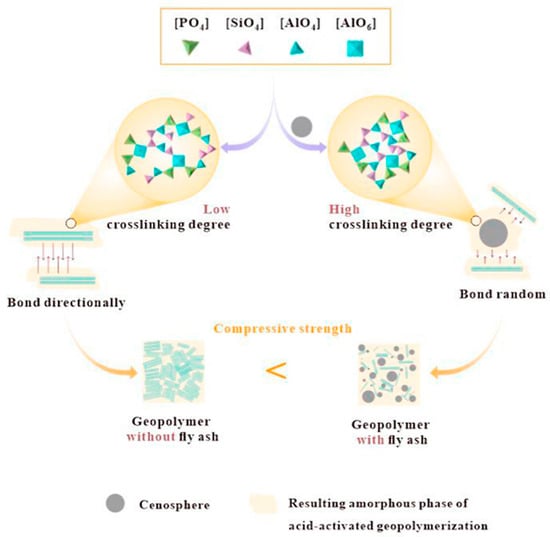
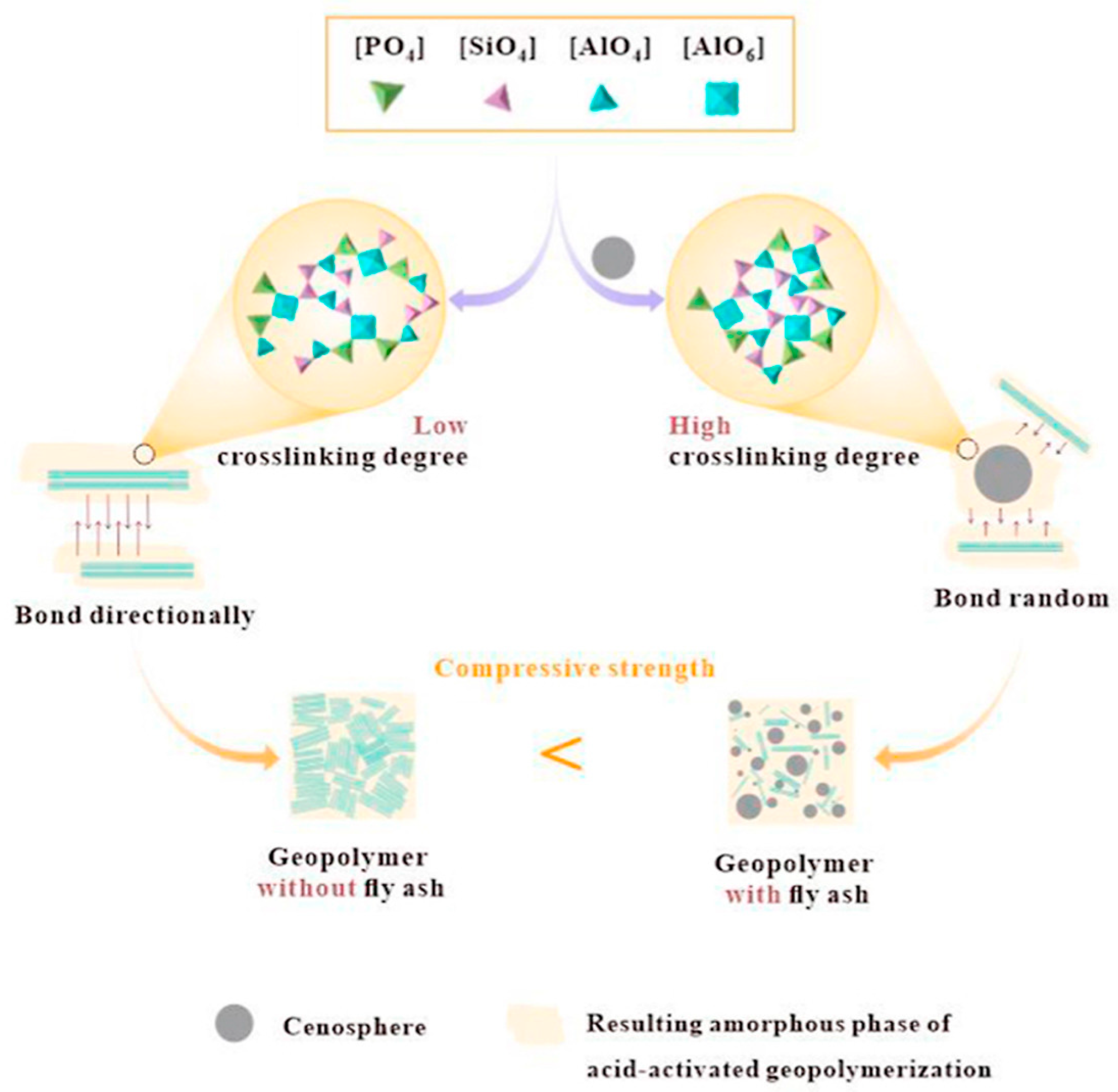
Guo et al. [14] discussed the role of cenospheres, aggregates of Si- and Al-rich minerals forming spherical particles, present in fly ash, in the phosphoric acid activation of metakaolin (MK)-based geopolymers. Cenospheres prevented MK from bonding exclusively in plate-like structures, promoting a more randomly connected network that enhanced the cross-linking of the Si-O-Al-O-P structural framework and improved compressive strength. Figure 5 illustrates the role of cenospheres in the geopolymer matrix.
Figure 5.
Schematic diagram of the crosslinking degree influenced by the cenospheres of fly ash [14].
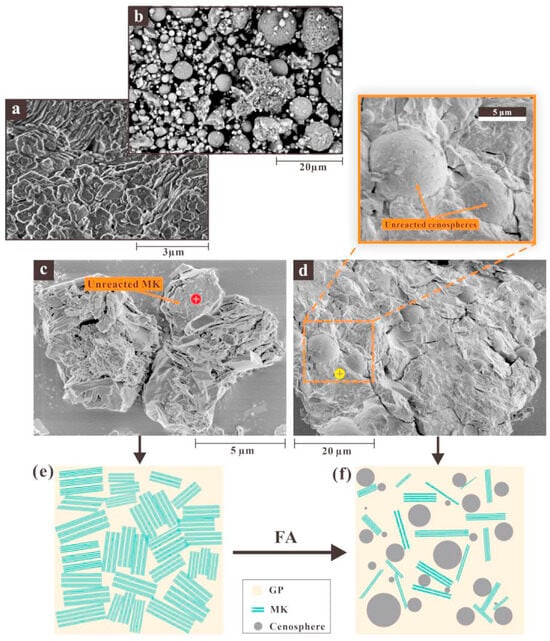
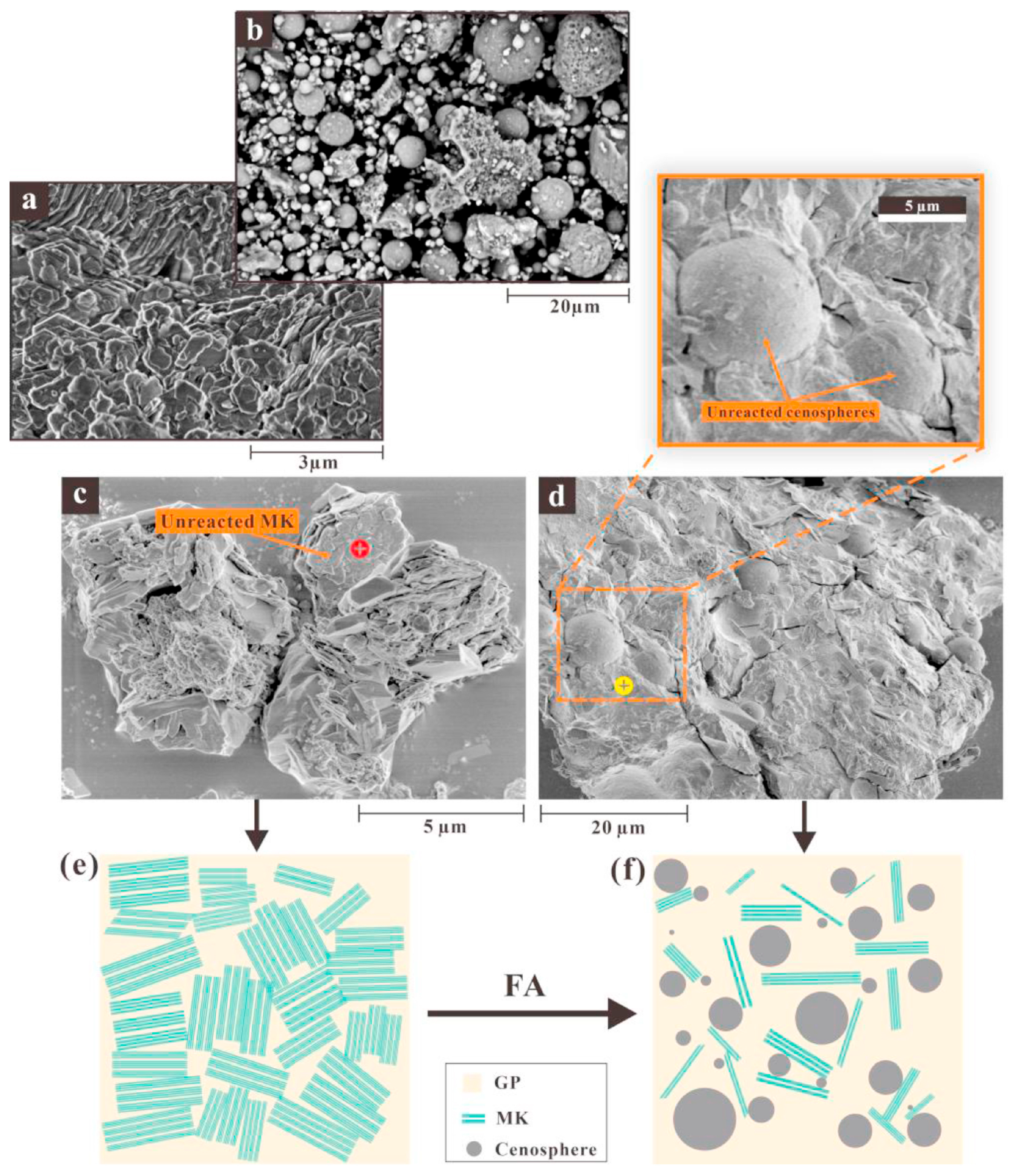
In Figure 6, the authors present scanning electron microscopy (SEM) images obtained using secondary electrons: (a) metakaolin; (b) fly ash, highlighting its cenospheres; (c) the geopolymer produced solely with MK, without fly ash (FA) incorporation, where unreacted lamellar MK particles can be observed; and (d) the geopolymer with 30% replacement of MK by FA, emphasizing the unreacted FA cenospheres, which contribute to increased structural cross-linking.
Figure 6.
Microstructure: (a) MK; (b) CV; (c) 100% MK geopolymer; (d) 70% MK and 30% CV geopolymer; graphical representation: (e) 100% MK geopolymer; (f) 70% MK and 30% CV geopolymer [14].
The authors also provided schematic representations of the material behavior: (e) the geopolymer without FA, in which bonding is predominantly directional due to the two-dimensional morphology of MK particles, potentially leading to fracture due to its less flexible structure, and (f) the effect of FA on the final material behavior, where the geopolymer incorporates and binds unreacted particles, forming a more compact structure as a result of the presence of cenospheres [14].
Overall, the morphology of precursor particles plays a crucial role in defining the microstructure and mechanical performance of geopolymer systems. Plate-like particles, such as those found in metakaolin, tend to promote more directional bonding, which may result in less flexible and more brittle structures. In contrast, spherical particles, such as cenospheres from fly ash, contribute to a more isotropic and randomly connected network, enhancing cross-linking and improving mechanical strength. Additionally, elongated or irregular particles, such as those observed in certain ceramic wastes or phosphogypsum, may influence packing density and interfacial bonding, further affecting the compactness and durability of the matrix. Therefore, the interplay between particle morphology and geopolymerization mechanisms is a key factor in tailoring the final properties of these materials.
Allaoui et al. [15] investigated the influence of sanitary ceramic waste incorporation in phosphoric acid (H3PO4)-activated metakaolin-based geopolymers. The authors observed that the waste particles acted as fillers, enhancing particle packing and improving the mechanical strength of the geopolymeric matrix. However, this behavior was strongly dependent on the optimization of particle size distribution.
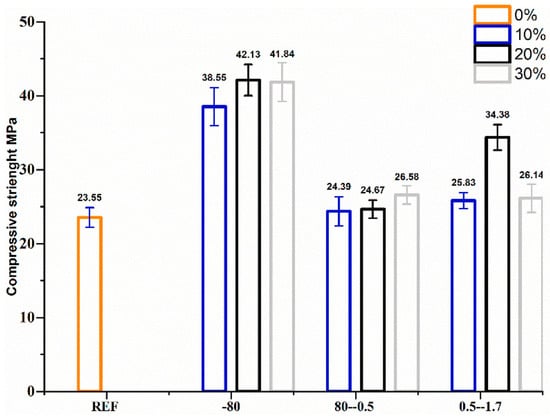
Three different particle size ranges were evaluated (gr1 < 80 μm; 80 μm < gr2 < 0.5 mm; 0.5 mm < gr3 < 1.7 mm), and the finest fraction (gr1 < 80 μm) resulted in the highest compressive strength when compared to the reference (REF), composed solely of MK and activating solution, as shown in Figure 7. For geopolymers incorporating sanitary ceramic waste with particle sizes below 80 μm, a compressive strength of 38.55 MPa was achieved after 28 days with 10% waste content (40% MK and 50% solution). This was followed by 42.13 MPa and 41.84 MPa for mixtures containing 20% waste (30% MK and 50% solution) and 30% waste (20% MK and 50% solution), respectively. In contrast, the reference sample exhibited a compressive strength of 23.55 MPa, meaning that the incorporation of sanitary ceramic waste improved strength by at least 64%.
Figure 7.
Compressive strength of phosphate-based geopolymers incorporating sanitary ceramic waste [15].
Waste material can be incorporated into an acid-activated geopolymer without directly participating in the geopolymerization process. Nevertheless, it can still play a reinforcing role in the geopolymeric matrix by limiting microcrack propagation, increasing density, and improving compressive strength. Majdoubi et al. [39] demonstrated this effect through the valorization of phosphogypsum waste, originating from H3PO4 production, in the development of metakaolin-based geopolymers activated with 10 mol/L phosphoric acid.
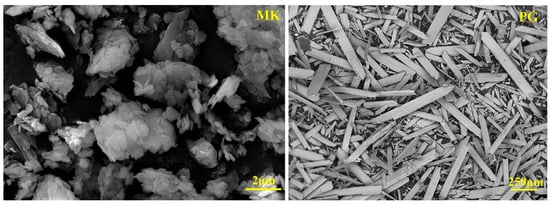
The waste, which exhibits a rod-like morphology as shown in Figure 8, remained stable after the reaction, becoming embedded within the geopolymeric matrix and acting as microfibers, thereby enhancing the final microstructure of the geopolymer. As a result, after 28 days, the reference geopolymer reached a compressive strength of 40.14 MPa, whereas the geopolymer containing 70% waste achieved the highest strength at the same age, reaching 48.43 MPa, an increase of approximately 20% compared to the waste-free sample.
Figure 8.
Microstructure of (MK) metakaolin and (PG) phosphogypsum waste [39].
Mechanical Behavior of Waste-Based Geopolymers
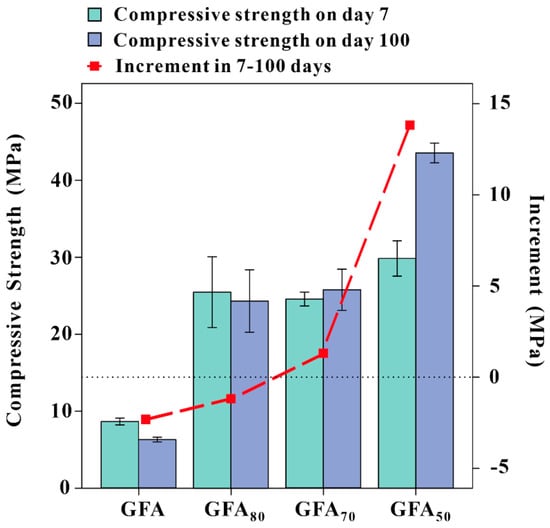
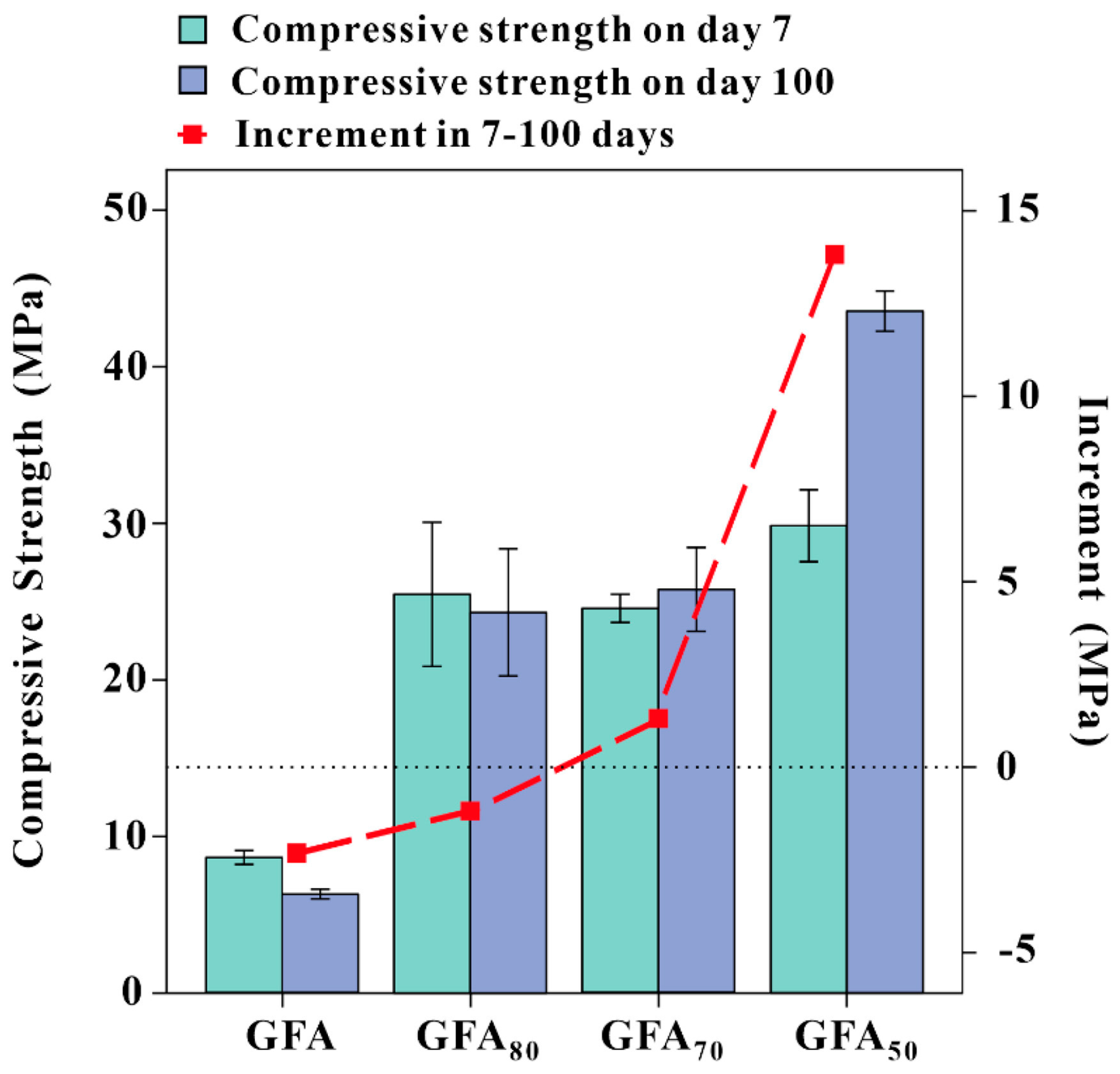
Phosphoric acid-activated metakaolin-based geopolymers with high fly ash contents were investigated by Guo et al. [47] at curing ages of 7 and 100 days. In samples with higher fly ash content (GFA and GFA80, containing 100% and 80% FA, respectively), the higher calcium (Ca) content resulted in a faster setting time compared to mixtures with a higher MK content. However, these samples exhibited a deterioration in compressive strength due to the formation of amorphous calcium phosphate, an intermediate product resulting from the reaction between Ca and [PO4]. This behavior highlights the dual role of calcium in phosphate-based systems: while moderate Ca contents may accelerate early reactions and contribute to initial strength development, excessive Ca promotes the formation of amorphous calcium phosphate phases, which hinder the development of a well-connected binding network and impair long-term mechanical performance.
In contrast, geopolymers with a higher MK content (GFA70 and GFA50, containing 70% and 50% FA, respectively) showed slower polycondensation. Nevertheless, the formation of the silico-alumino-phosphate (S-A-P) gel was more effective, involving the bonding between [AlO6] and [PO4] units, which prevented calcium phosphate formation and promoted the development of a more compact and resistant quartz-like isostructural network. As shown in Figure 9, compressive strength increased with a higher MK content: the geopolymer with 100% FA (GFA) reached 6.3 MPa, whereas the geopolymer with 50% FA and 50% MK (GFA50) achieved 43.5 MPa in 100 days.
Figure 9.
Compressive strength of metakaolin–fly ash-based geopolymers activated with phosphoric acid [47].
Other authors have also detected deterioration in compressive strength due to the presence of calcium [70], but according to Djobo and Stephan [71], its nature and percentage are determining factors in its effect on phosphate geopolymers. Wang et al. [72] investigated the use of high- and low-calcium coal fly ash replacing metakaolin, and found different results for each precursor. The authors concluded that low-calcium coal fly ash achieved lower compressive strength compared to the control mix at both early ages (1 and 3 days) and at 28 days, with 10%, 20% and 30% replacements and 0.46, 0.92 and 1.38 Ca/P molar ratios, respectively. On the other hand, with high-calcium coal fly ash, the geopolymers achieved higher compressive strength at early ages in all three replacements of 10%, 20% and 30% with Ca/P of 1.17, 2.34 and 3.51, respectively. At 28 days, the only Ca/P ratio that surpassed the control mix was 2.34 (20%), with a 6.4% increase in compressive strength.
The authors attributed the high-calcium result to the induction of available calcium species to produce calcium phosphate compounds like brushite and monetite, and to the S-A-P gel formation. In contrast, the decrease in compressive strength of the low-calcium replacement could be due to the lower reactivity of the aluminosilicate phase in the coal fly ash compared to metakaolin [71]. Furthermore, Tchakouté et al. [73] concluded that the use of dicalcium phosphate dihydrate, obtained from oyster shell, with an Ca/P ratio of 1.00, increases compressive strength at replacement levels of 2%, 4% and 6% of the metakaolin. At percentages of 8% and 10%, the compressive strength decreases. The use of hydroxyapatite from the same source, with a 1.65 Ca/P ratio, improves compressive strength only with a 2% replacement, and decreases it at percentages of 4%, 6%, 8% and 10%. Finally, Djobo and Stephan [71] indicated that replacing calcium hydroxide with metakaolin up to 6% was beneficial for compressive strength. Values above 6% hindered the subsequent dissolution of the metakaolin. The use of calcium silicate as a calcium source did not show benefits in any of the substitutions in proposed by the authors, from 0% to 9%.
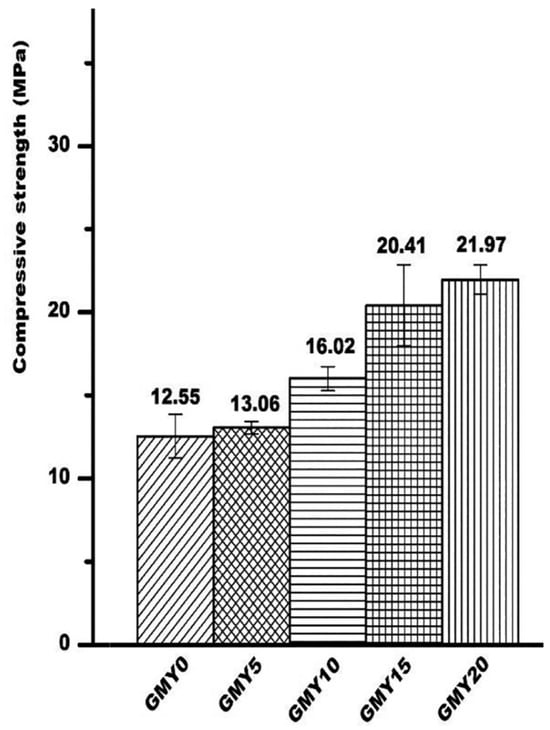
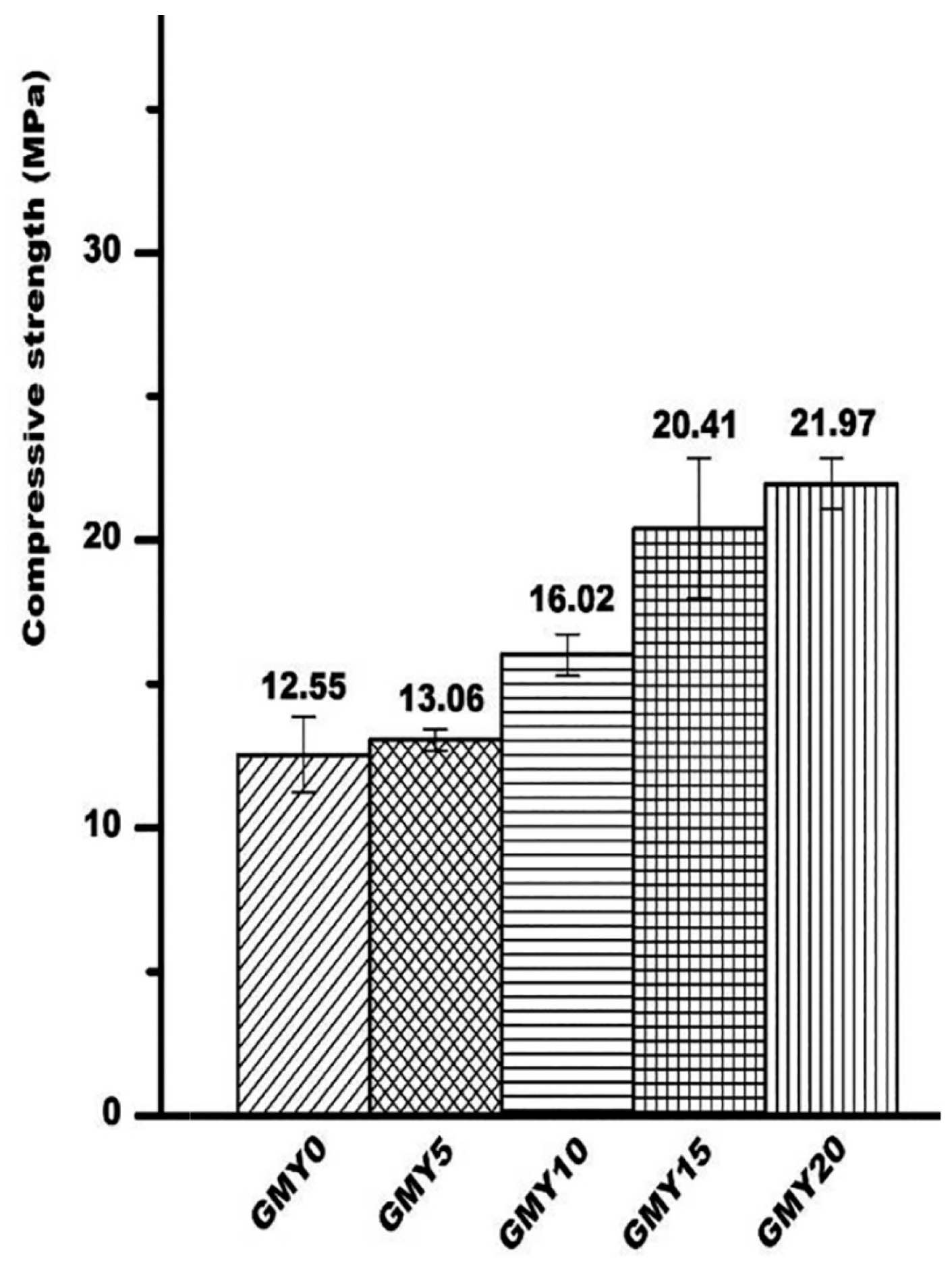
Another example of acid activation was investigated by Tchakouté et al. [48], involving metakaolin-based geopolymers activated with phosphoric acid (10 M) and incorporating 0%, 5%, 10%, 15%, and 20% calcined bauxite (at 600 °C) as an alumina source. The authors reported that the compressive strength of the geopolymers increased with increasing bauxite content and decreasing metakaolin content, reaching a maximum of 21.97 MPa at 20% replacement, compared to 12.55 MPa for the geopolymer composed solely of MK, as shown in Figure 10. This improvement in strength was attributed to the formation of aluminum phosphate (AlPO4), which acted as a filler material, similarly to quartz.
Figure 10.
Compressive strength of metakaolin–calcined bauxite-based geopolymers activated with phosphoric acid (adapted from [48]).
Pu et al. [43] demonstrated that sludge powder waste enhances the compressive strength of geopolymers, prepared using aluminum dihydrogen phosphate as a phosphoric activator. The strength gradually increases with curing time due to the progressive formation of AlPO4 and an amorphous matrix, with the development of Si-O-P, Si-O-Al-O-P, and Al-O-P bonds, particularly at a replacement level of 10% of fly ash by the waste.
The use of solid waste in the development of new materials not only promotes sustainability-related benefits, but can also positively influence their properties and mechanical performance [2,5,6,74,75]. Table 4 presents different studies addressing phosphoric acid-activated geopolymers incorporating waste materials for applications in civil construction (e.g., precast blocks, pavements, bricks) [38,46,76], thermal insulation materials [50,65,77], contaminant encapsulation [40,53,67], and wastewater pollutant adsorption [52].
Table 4.
Examples of research using waste products in acid-based geopolymers.
5. Conclusions
This paper presents an overview on the fundamental principles of acid activation compared to alkaline activation, its geopolymerization mechanism, the influence of cure and molar concentration on the reaction, and how solid wastes are being used to impact geopolymers’ sustainability and mechanical properties. The following conclusions are presented:
- I.
- The advances of phosphate-based geopolymers are being explored for many different applications, such as civil construction utilization, thermal insulating materials, encapsulation of contaminants and adsorption of wastewater pollutants.
- II.
- Aluminum phosphate (AlPO4) occurs during geopolymerization, and it is presented on both crystalline (berlinite) and amorphous phases. It is associated with phosphate-based geopolymers’ mechanical properties and thermal stability, reinforcing the amorphous matrix, acting as a filler isostructural to quartz, increasing their compressive strengths. In opposition, phosphate-based geopolymers developed with precursors containing calcium in their composition may exhibit amorphous calcium phosphate, which can decrease the compressive strength, thus deteriorating the microstructure of the resulting geopolymer.
- III.
- Optimizing geopolymers’ cure and molarity is one of the most critical steps of geopolymerization. When not optimized, the process can be interrupted by the premature formation of a hardened amorphous gel, resulting in a coating of partially reacted precursor particles, hindering the continuity of the dissolution and development of crystalline phases. Furthermore, in cases with excess phosphoric acid, the crystalline products of the reaction may be produced, but they may be damaged or dissolved.
- IV.
- Solid waste used in the development of geopolymers not only contributes to a sustainable approach in the construction field, but can also have a positive impact on their mechanical behaviour. Solid waste can act as a reinforcement to the geopolymer matrix, through its morphology, even when it does not participate in geopolymerization, limiting microcrack propagation, or even acting on the orientation of the microstructure bounds. It may also act as a filler, helping to improve the packing density of the geopolymer matrix when its particle size is optimized.
The limitations of phosphate-based geopolymers include environmental and cost impacts of the material. The following recommendations are presented for future research:
- I.
- Life cycle and economic assessment. Future studies should incorporate life cycle assessment (LCA), techno-economic analysis, and other sustainability metrics to evaluate the environmental and economic feasibility of phosphate-based geopolymers on an industrial scale. These assessments should also consider how curing conditions, activator molarity, and precursor composition influence the overall environmental footprint.
- II.
- Development of alternative or hybrid activators. Research should focus on the development of alternative activator systems capable of reducing the consumption of phosphoric acid, such as hybrid activators combining phosphates with other chemical systems, or the use of waste-derived phosphorus sources.
- III.
- Exploration of new waste-derived precursors. Although several solid wastes have already been investigated, additional research is required to evaluate the potential of other industrial, mining, and agricultural residues rich in aluminosilicates or phosphates as precursors for phosphate-based geopolymers.
- IV.
- Durability and long-term performance. More comprehensive studies on durability are required, including resistance to chemical attack, thermal cycling, moisture variations, and long-term mechanical stability, particularly for structural or infrastructure applications.
- V.
- Microstructural evolution and reaction mechanisms. Advanced characterization techniques, such as nuclear magnetic resonance (NMR), synchrotron-based X-ray diffraction, and in situ spectroscopic methods, could provide deeper insights into the geopolymerization mechanisms and the role of different phases in the development of the material properties.
Author Contributions
Conceptualization, C.M.F.V., L.V.R., A.R.G.d.A. and M.T.M.; methodology, L.V.R. and C.M.F.V.; formal analysis, C.M.F.V., L.V.R. and M.T.B.; investigation, C.M.F.V. and L.V.R.; data curation, C.M.F.V. and L.V.R.; writing—original draft preparation, L.V.R.; writing—review and editing, A.R.G.d.A., M.T.B. and M.T.M.; visualization, C.M.F.V. and L.V.R.; supervision, A.R.G.d.A. and M.T.M.; project administration, A.R.G.d.A.; funding acquisition, not applicable. All authors have read and agreed to the published version of the manuscript.
Funding
This research received no external funding. The participation of A.R.G.A. was sponsored by FAPERJ through the research fellowships proc. no: E-26/211.293/2021, E-26/210.643/2025, E-26/210.711/2025 and E-26/204.424/2024 by CNPq through the research fellowship PQC 305304/2024-0.
Data Availability Statement
No new data were created or analyzed in this study. Data sharing is not applicable to this article.
Acknowledgments
The authors would like to acknowledge the institutional support provided by their respective universities and research groups that contributed to the development of this study.
Conflicts of Interest
The authors declare no conflicts of interest.
References
- Dihaji, H.; Azerkane, D.; Bih, L.; Essaddek, A.; Haily, E.M. Comparative Study of Geopolymers Synthesized with Alkaline and Acid Reactants at Various Liquid-to-Solid Ratios Using Moroccan Kaolin Clay. Constr. Build. Mater. 2025, 468, 140453. [Google Scholar] [CrossRef] [Scilit]
- Günel, G.; Alakara, E.H.; Demir, I.; Sevim, O. Thermal Behavior and Mechanical Performance of Glass Waste-Based Geopolymer Composites: Influence of Elevated Temperatures and Cooling Regimes. Constr. Build. Mater. 2025, 494, 143405. [Google Scholar] [CrossRef] [Scilit]
- Oliveira, L.B.; Marvila, M.T.; Fediuk, R.; Vieira, C.M.F.; Azevedo, A.R.G. Development of a Complementary Precursor Based on Flue Gas Desulfurization (FGD) for Geopolymeric Pastes Produced with Metakaolin. J. Mater. Res. Technol. 2023, 22, 3489–3501. [Google Scholar] [CrossRef] [Scilit]
- Alvi, I.H.; Hu, H.; Li, Q.; Ma, Y.; Onyekwena, C.C. Exploring the Formation of Phosphoric Acid-Based Metakaolin Geopolymer and Underlying Mechanisms under Various Liquid-to-Solid Ratios. J. Solid State Chem. 2026, 353, 125607. [Google Scholar] [CrossRef] [Scilit]
- Sabbrojjaman, M.; Liu, Y.; Tafsirojjaman, T. A Comparative Review on the Utilisation of Recycled Waste Glass, Ceramic and Rubber as Fine Aggregate on High Performance Concrete: Mechanical and Durability Properties. Dev. Built Environ. 2024, 17, 100371. [Google Scholar] [CrossRef] [Scilit]
- Yadav, B.; Rusia, S.; Pandey, J.S.; Singh, H.S.; Maurya, A.D.; Chauhan, A.; Mathur, U.; Pal, K. Statistical Modeling and Optimization of Waste Glass-Based Paver Block Properties. Next Mater. 2025, 9, 101236. [Google Scholar] [CrossRef] [Scilit]
- Pantongsuk, T.; Zhang, B.; Yu, T.; Luo, J.; Liu, H.; Fahimizadeh, M.; Liu, D.; Li, L.; Jamnongkan, T.; Wisawapipat, W.; et al. Optimizing Acid-Based Geopolymer Performance by Controlling the Critical Humidity Factor in Initial Curing Conditions. Constr. Build. Mater. 2025, 493, 143152. [Google Scholar] [CrossRef] [Scilit]
- Zhang, B.; Feng, Y.; Zhou, X.; Lai, D.; Zhong, H.; Yu, T.; Liang, J.; Xie, J. Dynamic Mechanical Behaviour and Life Cycle Assessment of Rubberised Solid Waste-Based Geopolymer Concrete. J. Clean. Prod. 2025, 501, 145247. [Google Scholar] [CrossRef] [Scilit]
- Borçato, A.G.; Casali, J.M.; Betioli, A.M.; Medeiros-Junior, R.A. Development of Eco-Friendly Brick Waste-Based Geopolymers: Effect of Calcium Incorporation on Rheology, Compressive Strength, Microstructure, and Eco-Efficiency. J. Build. Eng. 2025, 111, 113101. [Google Scholar] [CrossRef] [Scilit]
- Zawrah, M.F.; Ata, M.B.H.; Abdelrahman, H.S. Effect of Acid Concentration and Curing Conditions on Microstructure, Mechanical and Electrical Properties of Phosphate Geopolymers. Next Mater. 2025, 9, 100990. [Google Scholar] [CrossRef] [Scilit]
- Tochetto, G.; Goulart Oliveira, K.; D’Agostini, M.; Franchin, G.; Elsayed, H.; Hotza, D.; Nagel-Hassemer, M.E.; Colombo, P. A Comprehensive Review of Phosphate-Based Acid Geopolymers: Production, Properties, and Applications. J. Phys. Chem. Solids 2026, 211, 113489. [Google Scholar] [CrossRef] [Scilit]
- Marvila, M.T.; de Azevedo, A.R.G.; Vieira, C.M.F. Reaction Mechanisms of Alkali-Activated Materials. Rev. IBRACON De Estrut. E Mater. 2021, 14, e14309. [Google Scholar] [CrossRef] [Scilit]
- Provis, J.L. Geopolymers and Other Alkali Activated Materials: Why, How, and What? Mater. Struct. 2014, 47, 11–25. [Google Scholar] [CrossRef] [Scilit]
- Guo, H.; Yuan, P.; Zhang, B.; Wang, Q.; Deng, L.; Liu, D. Realization of High-Percentage Addition of Fly Ash in the Materials for the Preparation of Geopolymer Derived from Acid-Activated Metakaolin. J. Clean. Prod. 2021, 285, 125430. [Google Scholar] [CrossRef] [Scilit]
- Allaoui, D.; Majdoubi, H.; Haddaji, Y.; Nadi, M.; Mansouri, S.; Oumam, M.; Tamraoui, Y.; Alami, J.; Hannache, H.; Manoun, B. Valorization of Ceramic Sanitary Waste into Resilient Phosphoric Acid-Based Geopolymers for Sustainable Construction: Thermal, Mechanical, and Microstructural Properties. Ceram. Int. 2024, 50, 8875–8889. [Google Scholar] [CrossRef] [Scilit]
- Matsimbe, J.; Dinka, M.; Olukanni, D.; Musonda, I. Geopolymer: A Systematic Review of Methodologies. Materials 2022, 15, 6852. [Google Scholar] [CrossRef] [Scilit] [PubMed]
- Almutairi, A.L.; Tayeh, B.A.; Adesina, A.; Isleem, H.F.; Zeyad, A.M. Potential Applications of Geopolymer Concrete in Construction: A Review. Case Stud. Constr. Mater. 2021, 15, e00733. [Google Scholar] [CrossRef] [Scilit]
- Cong, P.; Cheng, Y. Advances in Geopolymer Materials: A Comprehensive Review. J. Traffic Transp. Eng. (Engl. Ed.) 2021, 8, 283–314. [Google Scholar] [CrossRef] [Scilit]
- Jwaida, Z.; Dulaimi, A.; Mashaan, N.; Othuman Mydin, M.A. Geopolymers: The Green Alternative to Traditional Materials for Engineering Applications. Infrastructures 2023, 8, 98. [Google Scholar] [CrossRef] [Scilit]
- Madirisha, M.M.; Dada, O.R.; Ikotun, B.D. Chemical Fundamentals of Geopolymers in Sustainable Construction. Mater. Today Sustain. 2024, 27, 100842. [Google Scholar] [CrossRef] [Scilit]
- Jiang, T.; Liu, Z.; Tian, X.; Wu, J.; Wang, L. Review on the Impact of Metakaolin-Based Geopolymer’s Reaction Chemistry, Nanostructure and Factors on Its Properties. Constr. Build. Mater. 2024, 412, 134760. [Google Scholar] [CrossRef] [Scilit]
- Moujoud, Z.; Sair, S.; Ait Ousaleh, H.; Ayouch, I.; El Bouari, A.; Tanane, O. Geopolymer Composites Reinforced with Natural Fibers: A Review of Recent Advances in Processing and Properties. Constr. Build. Mater. 2023, 388, 131666. [Google Scholar] [CrossRef] [Scilit]
- Zribi, M.; Baklouti, S. Phosphate-Based Geopolymers: A Critical Review. Polym. Bull. 2022, 79, 6827–6855. [Google Scholar] [CrossRef] [Scilit]
- Ma, S.; Zhang, Z.; Liu, X. Comprehensive Understanding of Aluminosilicate Phosphate Geopolymers: A Critical Review. Materials 2022, 15, 5961. [Google Scholar] [CrossRef] [Scilit] [PubMed]
- Zhang, Y.; Li, P.; Yu, T.; Zhou, Y.; Huang, Y.; Pei, Y. A State-of-the-Art Review on the Application of Geopolymerization/Geopolymer in Environmental Fields. Buildings 2025, 15, 4054. [Google Scholar] [CrossRef] [Scilit]
- Krishna, R.S.; Mishra, J.; Zribi, M.; Adeniyi, F.; Saha, S.; Baklouti, S.; Shaikh, F.U.A.; Gökçe, H.S. A Review on Developments of Environmentally Friendly Geopolymer Technology. Materialia 2021, 20, 101212. [Google Scholar] [CrossRef] [Scilit]
- Meng, L.; Ouyang, F.; Cheng, J.; Wang, Z.; Li, B.; Xu, X.; Duan, P.; Zhu, Y.; Zhang, Z.; Chen, M.; et al. Mix Proportion Design of Phosphoric Acid-Activated Cementitious Materials and Microstructure Evolution at High Temperature. Cem. Concr. Compos. 2025, 159, 106003. [Google Scholar] [CrossRef] [Scilit]
- Wei, Q.; Liu, Y.; Le, H. Mechanical and Thermal Properties of Phosphoric Acid Activated Geopolymer Materials Reinforced with Mullite Fibers. Materials 2022, 15, 4185. [Google Scholar] [CrossRef] [Scilit]
- Occhicone, A.; Graziuso, S.G.; De Gregorio, E.; Montagnaro, F.; Ricciotti, L.; Tarallo, O.; Roviello, G.; Ferone, C. Synthesis and Characterization of New Acid-Activated Red Mud-Metakaolin Geopolymers and Comparison with Their Alkaline Counterparts. J. Clean. Prod. 2024, 435, 140492. [Google Scholar] [CrossRef] [Scilit]
- de Matos Riscado, A.L.L.; Vieira, C.M.F.; Monteiro, S.N.; de Azevedo, A.R.G.; Marvila, M.T. Parameter Optimization for Fly Ash Geopolymer Mixtures: Molarity, Silica Modulus, and Solution/Binder Influence. Sci. Rep. 2025, 15, 20355. [Google Scholar] [CrossRef] [Scilit]
- Silva, A.A.S.; Pereira, B.C.F.; Batista, J.P.B.; Gomes, T.C.F.; Moraes, J.C.B. Study of a New Potassium Phosphate-Based Waste as an Alkaline Activator in Alkali-Activated Binders: The Açai Seed Ash. Constr. Build. Mater. 2023, 408, 133757. [Google Scholar] [CrossRef] [Scilit]
- de Oliveira, L.B.; de Azevedo, A.R.G.; Marvila, M.T.; Pereira, E.C.; Fediuk, R.; Vieira, C.M.F. Durability of Geopolymers with Industrial Waste. Case Stud. Constr. Mater. 2022, 16, e00839. [Google Scholar] [CrossRef] [Scilit]
- Yang, D.; Wang, P.; Chen, W.; Liu, L.; Huang, Y.; Xiang, X.; Wang, G.; Wu, J. Effects of Red Mud, Desert Sand, and Ground Granulated Blast Furnace Slag on the Mechanical Properties and Microstructure of Fly Ash-Based Geopolymer. Constr. Build. Mater. 2025, 468, 140471. [Google Scholar] [CrossRef] [Scilit]
- Luo, X.; Tian, X.; Wu, J.; Yang, X.; Liu, Z.; Jiao, Z.; Peng, H. Molecular Simulations of the Initial Stage’s Induction and Formation Process of N-A-S-H Gel Based on NaOH-Activated Metakaolin. J. Non. Cryst. Solids 2024, 626, 122804. [Google Scholar] [CrossRef] [Scilit]
- Bernasconi, D.; Viani, A.; Zárybnická, L.; Mácová, P.; Bordignon, S.; Caviglia, C.; Destefanis, E.; Gobetto, R.; Pavese, A. Phosphate-Based Geopolymer: Influence of Municipal Solid Waste Fly Ash Introduction on Structure and Compressive Strength. Ceram. Int. 2023, 49, 22149–22159. [Google Scholar] [CrossRef] [Scilit]
- Tochetto, G.; D’Agostini, M.; de Oliveira, K.G.; Hotza, D.; Nagel-Hassemer, M.E.; Colombo, P. Development and Characterization of Phosphoric Acid-Activated Geopolymers for Extrusion-Based Additive Manufacturing. J. Eur. Ceram. Soc. 2026, 46, 118031. [Google Scholar] [CrossRef] [Scilit]
- Li, J.S.; Zhang, W.; Lang, L.; Dong, C.X.; Huang, K. Preparation and Properties of Geopolymer Containing Phosphoric Acid-Activated Fly Ash and Mechanically-Milled Kaolinite: Experiments and Density Function Theory. J. Clean. Prod. 2024, 441, 140992. [Google Scholar] [CrossRef] [Scilit]
- Oubaha, S.; Charai, M.; Beniddar, H.; Mabroum, S.; El Machi, A.; Mghazli, M.O.; Taha, Y.; Hakkou, R. Phosphate’s Second Life: Upcycling Phosphogypsum and Clay by-Product through Acid Geopolymer Technology. Constr. Build. Mater. 2024, 451, 138829. [Google Scholar] [CrossRef] [Scilit]
- Majdoubi, H.; Makhlouf, R.; Haddaji, Y.; Nadi, M.; Mansouri, S.; Semllal, N.; Oumam, M.; Manoun, B.; Alami, J.; Hannache, H.; et al. Valorization of Phosphogypsum Waste through Acid Geopolymer Technology: Synthesis, Characterization, and Environmental Assessment. Constr. Build. Mater. 2023, 371, 130710. [Google Scholar] [CrossRef] [Scilit]
- Xu, Z.; Li, C.; Peng, X. Immobilization of Radioactive Borate Liquid Waste Using Calcined Laterite–Phosphoric Acid–Fe3O4-Based Geopolymer Waste Forms. Ceram. Int. 2024, 50, 48164–48173. [Google Scholar] [CrossRef] [Scilit]
- Pu, S.; Li, H.; Cai, G.; Mei, G.; Duan, W.; Wu, Z. Improving the Early Performance of Fly Ash Phosphate Acid−based Geopolymer Using Fe3O4 Powder. J. Build. Eng. 2025, 116, 114732. [Google Scholar] [CrossRef] [Scilit]
- Douiri, H.; Louati, S.; Baklouti, S.; Arous, M.; Fakhfakh, Z. Enhanced Dielectric Performance of Metakaolin–H3PO4 Geopolymers. Mater. Lett. 2016, 164, 299–302. [Google Scholar] [CrossRef] [Scilit]
- Pu, S.; Xu, B.; Duan, W.; Yao, H.; Wu, Z.; Mei, G.; Cai, G. A Green Phosphate-Based Geopolymer Adsorbent or Binder with High Specific Surface Area for Environmental Applications. Constr. Build. Mater. 2023, 408, 133738. [Google Scholar] [CrossRef] [Scilit]
- Fattori, F.; Magugliani, G.; Marinelli, G.; Comboni, D.; Gatta, G.D.; Girella, A.; Milanese, C.; Santi, A.; Galluccio, F.; Moschetti, I.; et al. Thermal and Chemical Parameters Controlling Phase Stability and Caesium Immobilisation in Phosphate-Based Geopolymers, Using a Chabazite-Rich Volcanic Tuff. Ceram. Int. 2025, 51, 63441–63452. [Google Scholar] [CrossRef] [Scilit]
- Cao, Y.; Wang, X.; Ding, L.; Liu, J.; Sun, Y.; Xia, T.; Huang, H.; Wei, X.; Wu, Z. Acceleration Mechanisms of Curing and Strength Development in Silico-Aluminophosphate Geopolymers with Aluminum Dihydrogen Phosphate. Constr. Build. Mater. 2025, 490, 142395. [Google Scholar] [CrossRef] [Scilit]
- de Carvalho, A.R.; da Calderón-Morales, B.R.S.; Borba Júnior, J.C.; de Oliveira, T.M.; Silva, G.J.B. Proposition of Geopolymers Obtained through the Acid Activation of Iron Ore Tailings with Phosphoric Acid. Constr. Build. Mater. 2023, 403, 133078. [Google Scholar] [CrossRef] [Scilit]
- Guo, H.; Zhang, B.; Deng, L.; Yuan, P.; Li, M.; Wang, Q. Preparation of High-Performance Silico-Aluminophosphate Geopolymers Using Fly Ash and Metakaolin as Raw Materials. Appl. Clay Sci. 2021, 204, 106019. [Google Scholar] [CrossRef] [Scilit]
- Tchakouté, H.K.; Bewa, C.N.; Fotio, D.; Dieuhou, C.M.; Kamseu, E.; Rüscher, C.H. Influence of Alumina on the Compressive Strengths and Microstructural Properties of the Acid-Based Geopolymers from Calcined Indurated Laterite and Metakaolin. Appl. Clay Sci. 2021, 209, 106148. [Google Scholar] [CrossRef] [Scilit]
- Valizadeh Kiamahalleh, M.; Gholampour, A.; Yoo, D.Y. Synthesis of Ambient-Cured Geopolymer with Recycled Glass as Binder and Fine Aggregate: Enhancing Mechanical and Durability Performance. Constr. Build. Mater. 2025, 502, 144488. [Google Scholar] [CrossRef] [Scilit]
- Majdoubi, H.; Haddaji, Y.; Bourzik, O.; Nadi, M.; Ziraoui, J.; Alomayri, T.S.; Oumam, M.; Manoun, B.; Alami, J.; Tamraoui, Y.; et al. Enhancing Thermal Insulation with Phosphate Washing Sludge Waste as an Inorganic Foaming Agent in Porous Acid-Based Geopolymers: Formulation and Processing Optimization. Constr. Build. Mater. 2023, 407, 133486. [Google Scholar] [CrossRef] [Scilit]
- He, M.; Yang, Z.; Li, N.; Zhu, X.; Fu, B.; Ou, Z. Strength, Microstructure, CO2 Emission and Economic Analyses of Low Concentration Phosphoric Acid-Activated Fly Ash Geopolymer. Constr. Build. Mater. 2023, 374, 130920. [Google Scholar] [CrossRef] [Scilit]
- Ren, Z.; Zhang, C.; Zhao, F.; Meng, J.; Han, X.; Liang, J. Synthesis of Phosphoric Acid-Based Mesoporous Geopolymers from Tourmaline Tailings for Effective Adsorption of Tetracycline Hydrochloride in Aqueous Environment. Microporous Mesoporous Mater. 2023, 362, 112786. [Google Scholar] [CrossRef] [Scilit]
- Tan, G.; Liu, Z.; Ma, X.; Zheng, Z.; Zhang, G.; Wu, B.; Zhang, L.; Liu, L. Phosphoric Acid-Activated Metakaolin-Based Geopolymer: Optimizing P/A Molar Ratio to Solidify Cs+ and Sr2+ in Nuclear Waste. Nucl. Eng. Des. 2024, 424, 113300. [Google Scholar] [CrossRef] [Scilit]
- Yu, H.; Lu, X.; Miki, T.; Matsubae, K.; Sasaki, Y.; Nagasaka, T. Sustainable Phosphorus Supply by Phosphorus Recovery from Steelmaking Slag: A Critical Review. Resour. Conserv. Recycl. 2022, 180, 106203. [Google Scholar] [CrossRef] [Scilit]
- Walsh, M.; Schenk, G.; Schmidt, S. Realising the Circular Phosphorus Economy Delivers for Sustainable Development Goals. Npj Sustain. Agric. 2023, 1, 2. [Google Scholar] [CrossRef] [Scilit]
- Cordell, D.; Drangert, J.-O.; White, S. The Story of Phosphorus: Global Food Security and Food for Thought. Glob. Environ. Change 2009, 19, 292–305. [Google Scholar] [CrossRef] [Scilit]
- Egle, L.; Rechberger, H.; Krampe, J.; Zessner, M. Phosphorus Recovery from Municipal Wastewater: An Integrated Comparative Technological, Environmental and Economic Assessment of P Recovery Technologies. Sci. Total Environ. 2016, 571, 522–542. [Google Scholar] [CrossRef] [Scilit]
- Hamidi, R.M.; Siyal, A.A.; Luukkonen, T.; Shamsuddin, R.M.; Moniruzzaman, M. Fly Ash Geopolymer as a Coating Material for Controlled-Release Fertilizer Based on Granulated Urea. RSC Adv. 2022, 12, 33187–33199. [Google Scholar] [CrossRef] [Scilit] [PubMed]
- Yan, H.; Zhu, X.; Dai, F.; He, Y.; Jing, X.; Song, P.; Wang, R. Porous Geopolymer Based Eco-Friendly Multifunctional Slow-Release Fertilizers for Promoting Plant Growth. Colloids Surf. A Physicochem. Eng. Asp. 2021, 631, 127646. [Google Scholar] [CrossRef] [Scilit]
- Chilian, A.; Bancuta, O.-R.; Bancuta, I.; Popescu, I.V.; Irina Gheboianu, A.; Tănase, N.-M.; Tuican, M.; Zaharia, M.; Zinicovscaia, I. Extraction of Heavy Metals and Phosphorus from Sewage Sludge with Elimination of Antibiotics and Biological Risks. Chem. Eng. J. 2022, 437, 135298. [Google Scholar] [CrossRef] [Scilit]
- Yao, X.; Chang, Y.; Chen, S.; Chen, M.; Li, Z.; Zhou, B.; Xu, L. Analysis of Mechanical Properties and Microscopic Mechanism of Multi-Source All-Solid Waste Geopolymer Mortar. Constr. Build. Mater. 2026, 518, 145803. [Google Scholar] [CrossRef] [Scilit]
- Zhao, X.; Wang, H.; Wang, X.; Zhao, X.E. Sustainable Application of Waste Eggshell as Fillers in Alkali-Activated Solid Waste-Based Materials: Varying Treated Methods and Particle Sizes. Constr. Build. Mater. 2024, 425, 136040. [Google Scholar] [CrossRef] [Scilit]
- Qureshi, M.; Li, J.; Wu, C.; Sheng, D. Mechanical Strength of Rubberized Concrete: Effects of Rubber Particle Size, Content, and Waste Fibre Reinforcement. Constr. Build. Mater. 2024, 444, 137868. [Google Scholar] [CrossRef] [Scilit]
- Rashad, A.M.; Gharieb, M.; Shoukry, H.; Mokhtar, M.M. Valorization of Sugar Beet Waste as a Foaming Agent for Metakaolin Geopolymer Activated with Phosphoric Acid. Constr. Build. Mater. 2022, 344, 128240. [Google Scholar] [CrossRef] [Scilit]
- Lee, J.; Nam, M.; Park, D.; Wi, K. Recycling Municipal Solid Waste Incineration Fly Ash as a Functional Foaming Agent in Slag-Based Geopolymer. Constr. Build. Mater. 2025, 492, 142839. [Google Scholar] [CrossRef] [Scilit]
- Pu, S.; Shen, Z.; Duan, W.; Lang, L.; Liu, Y.; Xu, B.; Yao, H.; Mei, G. Discussion on the Applicability and Mechanism of Phosphate-Based Geopolymers Used for Cadmium and Cadmium-Lead Heavy Metals Solidification/Stabilization. J. Environ. Chem. Eng. 2024, 12, 113846. [Google Scholar] [CrossRef] [Scilit]
- Liu, X.; Lan, S.; Zhang, X.; Li, J.; Elmaasrawy, M.; Gao, X. Synergistic Enhancement of Mechanical Properties, Durability, and Microstructure of Phosphogypsum-Slag-Based All-Solid-Waste Binder Materials with Recycled Cement Powder and Red Mud. Constr. Build. Mater. 2026, 521, 146047. [Google Scholar] [CrossRef] [Scilit]
- Faraji, M.F.; Kara, H.O.; Raazi, M.; Ahıskalı, M.; Eskici, C.; Bayraktar, O.Y.; Kaplan, G.; Aydın, A.C.; Ozbakkaloglu, T. Development of High-Performance One-Part Geopolymer Foam Concrete Using Ground Granulated Blast Furnace Slag, Waste Concrete Sludge, and Bamboo Powder for Sustainable Construction. Constr. Build. Mater. 2026, 506, 144827. [Google Scholar] [CrossRef] [Scilit]
- Judicaël Geferson, O.O.; Placide Desire, B.B.; Serge, E.J.; Odogu, A.N.; Nsami, N.J.; Antoine, E. Sustainable and Cleaner Production of a Porous Geopolymer Support Based on Metakaolin and Natural Calcium Oxide. J. Build. Eng. 2024, 96, 110638. [Google Scholar] [CrossRef] [Scilit]
- Djobo, J.N.Y.; Stephan, D. The Reaction of Calcium during the Formation of Metakaolin Phosphate Geopolymer Binder. Cem. Concr. Res. 2022, 158, 106840. [Google Scholar] [CrossRef] [Scilit]
- Wang, Y.S.; Alrefaei, Y.; Dai, J.G. Influence of Coal Fly Ash on the Early Performance Enhancement and Formation Mechanisms of Silico-Aluminophosphate Geopolymer. Cem. Concr. Res. 2020, 127, 105932. [Google Scholar] [CrossRef] [Scilit]
- Tchakouté, H.K.; Fotio, D.; Rüscher, C.H.; Kamseu, E.; Djobo, J.N.Y.; Bignozzi, M.C.; Leonelli, C. The Effects of Synthesized Calcium Phosphate Compounds on the Mechanical and Microstructural Properties of Metakaolin-Based Geopolymer Cements. Constr. Build. Mater. 2018, 163, 776–792. [Google Scholar] [CrossRef] [Scilit]
- Jin, Z.; Liang, K.; Liu, C.; Yang, G.; Cui, K.; Mao, S. Mechanical Properties and Life Cycle Assessment (LCA) of Waste Glass Reinforced Concrete. J. Build. Eng. 2024, 96, 110643. [Google Scholar] [CrossRef] [Scilit]
- Mirindi, D.; Sinkhonde, D.; Bezabih, T.; Mirindi, F.; Oshineye, O.; Mirindi, P. Prediction of Flexural and Split Tensile Strength of Waste Glass-Concrete Composite Using Machine Learning Algorithms. Green Technol. Sustain. 2026, 4, 100275. [Google Scholar] [CrossRef] [Scilit]
- Nana, A.; Tchummegne, I.K.; Tome, S.; Adesina, A.; Alomayri, T.; Singla, R.; Kaze, R.C.; Kamseu, E.; Kumar, S.; Leonelli, C. Comparison of Feldspar and Meta-Halloysite Geopolymers by Alkaline and Acidic Activation. Constr. Build. Mater. 2024, 424, 135953. [Google Scholar] [CrossRef] [Scilit]
- Jouin, J.; Nouping Fekoua, J.N.; Ouamara, L.; Piolet, E.; Gharzouni, A.; Rossignol, S. Insulating Phosphoric Acid-Based Geopolymer Foams with Water and High Temperature Resistance. Constr. Build. Mater. 2023, 398, 132406. [Google Scholar] [CrossRef] [Scilit]
- Almeida, M.M.; Gonçalves, N.P.F.; Gameiro, T.; Labrincha, J.A.; Novais, R.M. Synergistic Enhancement of Hydroxyapatite-Phosphoric Acid-Activated Metakaolin-Based Geopolymers for Sustainable and Efficient Removal of Toxic Metal Ions in Wastewater Treatment: An Experimental Study Supported by Density Functional Theory Insights. Process Saf. Environ. Prot. 2026, 206, 108270. [Google Scholar] [CrossRef] [Scilit]

Disclaimer/Publisher’s Note: The statements, opinions and data contained in all publications are solely those of the individual author(s) and contributor(s) and not of MDPI and/or the editor(s). MDPI and/or the editor(s) disclaim responsibility for any injury to people or property resulting from any ideas, methods, instructions or products referred to in the content. |
© 2026 by the authors. Licensee MDPI, Basel, Switzerland. This article is an open access article distributed under the terms and conditions of the Creative Commons Attribution (CC BY) license.