1. Introduction
Titaniferous magnetite, often referred to as titanomagnetite, is a mineral resource that can supply three valuable elements: iron (Fe), titanium (Ti), and vanadium (V). Deposits of this mineral occur globally, with major economically viable reserves located in China, Russia, and South Africa. It represents the principal feedstock for vanadium production worldwide and is also widely used as a source of iron in steel manufacturing. However, it is generally not exploited directly for titanium production [
1].
Vanadium recovery from titanomagnetite is typically achieved through two main processing routes: primary vanadium extraction and integrated vanadium–steel co-production. The primary route is based on a roast–leach approach, in which the ore is roasted with a sodium-based reagent to transform vanadium into water-soluble sodium metavanadate (NaVO
3). This compound is subsequently leached, commonly using water as the lixiviant. The resulting vanadium-bearing solution is purified and treated to precipitate ammonium metavanadate (NH
4VO
3), which is then calcined to remove volatile components such as ammonia and moisture, yielding high-purity vanadium pentoxide (V
2O
5) [
2].
In contrast, the co-production route involves smelting titanomagnetite with a carbonaceous reductant and appropriate fluxes in either electric arc or blast furnaces. This process produces vanadium-containing pig iron along with a titanium-rich slag, commonly known as titaniferous slag [
3]. The composition of such slags varies depending on the operation, but they often contain significant concentrations of both TiO
2 and V
2O
5 as shown in
Table 1. Major producers of titaniferous slag include New Zealand Steel, Panzhihua Iron and Steel, and EVRAZ Nizhny Tagil Iron and Steel [
4,
5,
6]. In South Africa, similar material was historically generated by EVRAZ Highveld Steel and Vanadium.
These slags are increasingly viewed as secondary resources due to their relatively high titanium and vanadium contents. For example, slag produced by the former South African operation contains around 0.9% V
2O
5, which is significantly higher than the vanadium content in many primary ores [
7]. Additionally, large stockpiles have accumulated over time, with estimates exceeding 100 million tonnes at Panzhihua and approximately 45 million tonnes associated with the South African operation.
Titaniferous slags are seldom subjected to further processing for the recovery of TiO
2, V
2O
5, or other valuable constituents. This is largely due to the complex and refractory mineralogical phases present within these materials, which hinder efficient extraction. Nevertheless, a number of studies have explored alternative approaches for valorising titaniferous slags to recover both Ti- and V-bearing products [
8,
9,
10,
11,
12,
13,
14,
15]. For example, Van Vuuren and Tshilombo (2011) proposed a beneficiation route involving high-temperature treatment under strongly reducing conditions in a nitrogen atmosphere to form titanium nitride, followed by chlorination to produce titanium tetrachloride—an important precursor for titanium metal and pigment production [
10]. In another approach, Zhang et al. (2007) introduced aeration of molten Pangang slag to promote the formation of a perovskite phase [
13], which Wang et al. (2010) later processed via alkaline roasting and leaching to recover TiO
2 while removing calcium and other impurities [
16]. Additionally, Hassell et al. (2016) [
4], Liu et al. (2008) [
12], and Becker and Dutton (2002) [
15] proposed modifications of the conventional sulfate process used in titania pigment production to treat titaniferous slags. Despite these efforts, large-scale implementation has been limited due to challenges such as insufficient TiO
2 grades in the final product and low overall recoveries [
4,
12,
15].
Goso et al. (2016) [
9] demonstrated that slag from the former EHSV operation could be upgraded from approximately 35% to 75% TiO
2 using a modified Upgraded Slag (UGS) process. This approach is based on a commercially applied process at Rio Tinto Fer et Titane (RTFT) situated in Sorel-Tracy Quebec, Canada for treating SORELSLAG
® derived from Allard Lake ilmenite, which typically contains elevated levels of alkaline earth impurities [
9]. Residual impurities in the upgraded material were primarily Al
2O
3 and MgO, present within a chemically stable alumina–magnesia spinel phase. Building on this, Goso et al. (2021) [
9] showed that further modification of slag chemistry during primary smelting enables the production of synthetic rutile containing more than 90% TiO
2, particularly through improved removal of Al
2O
3 and MgO [
8].
In independent investigations, Tawane et al. (2021) [
17] and Lekobotja et al. (2017) [
18] examined vanadium recovery from EHSV slag using sulfation roasting and adapted primary vanadium processing routes, respectively. Both approaches yielded relatively low vanadium recoveries, generally below 30% [
17,
18]. Notably, the process proposed by Lekobotja et al. (2017) [
18] showed greater potential. The use of excess sodium reagent promoted the progressive breakdown of the otherwise stable spinel phase into nepheline, which enhanced vanadium liberation. This transformation not only improved vanadium extraction but also produced leach residues more amenable to further upgrading into a commercially viable titania product [
18].
Recent work on vanadium–titanium recovery has increasingly focused on reducing the energy intensity and reagent cost associated with conventional salt-roasting and long-duration leaching processes. Studies have reported the use of modified or alternative roasting additives that promote vanadium conversion of up to 90% at substantially lower temperatures than traditional sodium carbonate systems, while simultaneously limiting alkali consumption and gaseous emissions [
19]. In parallel, advances in hydrometallurgical processing have demonstrated that carefully designed leaching environments—such as reductive or synergistic reagent systems using H
2SO
4-Na
2SO
3 systems—can significantly improve vanadium dissolution kinetics and overall extraction efficiency to >95%, under milder operating conditions. These approaches not only shorten processing times but also enhance selectivity, reducing impurity co-dissolution and simplifying downstream purification [
20]. Emerging work also includes low-temperature leaching and solvent media strategies such as deep eutectic solvents and ionic liquids, which have achieved high extraction efficiencies for vanadium (97.6%) and titanium (76.1%) under milder conditions, offering environmentally friendlier alternatives to conventional processes [
21].
Advances in vanadium recovery from titaniferous and steelmaking slags have diversified beyond conventional high-temperature roasting–leaching processes. For example, electro-oxidation combined with ultrasound cavitation has been demonstrated as a clean leaching route capable of achieving up to ~94.6% vanadium extraction from vanadium slag without a roasting step, leveraging electric field-enhanced cavitation to disrupt silicate encapsulation and accelerate dissolution kinetics in acidic media [
22]. Other novel hydrometallurgical strategies include mechanochemical activation coupled with alkaline leaching, which have yielded leaching efficiencies approaching ~98% under atmospheric conditions, highlighting alternatives to energy-intensive roasting–leaching cycles [
23]. Research on multi-stage and calcium-assisted leaching from steel slags also illustrates pathways that reduce or avoid high thermal inputs and offer enhanced selectivity, addressing sustainability concerns associated with traditional processing [
24]. These developments align with a broader shift toward lower-temperature, lower-emission extraction technologies.
Titaniferous slags represent a relatively scarce and underexplored class of vanadium-bearing secondary resources, formed only during the smelting of titanomagnetite ores under specific metallurgical conditions. In contrast to more widely distributed vanadium sources such as stone coal, vanadium-bearing shales, and basic oxygen furnace (BOF) slags—which often occur in large quantities but are characterised by low vanadium grades, complex impurity matrices, and significant environmental processing challenges—titaniferous slags typically contain higher concentrations of both vanadium and titanium, albeit locked within refractory mineral phases. Their global occurrence is geographically constrained to a limited number of integrated operations, primarily in South Africa, China, and Russia, further underscoring their scarcity. The slag investigated in this study is a legacy material generated from historical smelting operations that are no longer active, enhancing its research significance as a chemically mature and weathered residue of substantial scale. Consequently, the investigation of such titaniferous slag provides a unique opportunity to evaluate vanadium recovery strategies that are not readily transferable from studies on primary ores or more conventional metallurgical wastes, thereby justifying the specific focus of this work within the broader context of critical raw material supply and circular economy development. Vanadium is widely regarded as a critical material, as reflected by its inclusion on major international raw materials lists. For instance, the European Union identified vanadium in its 2023 Critical Raw Materials list as one of 34 substances considered essential due to both supply vulnerability and its significance to the green and digital transitions. This classification has driven increased global interest in improving recovery technologies and expanding recycling initiatives [
25]. National and regional policies, such as Canada’s critical minerals strategies, similarly prioritise vanadium for its dual role in steelmaking and energy storage applications, encouraging resource diversification and secondary resource utilisation through recycling and slag valorisation [
26]. Incorporating these recent technological advances and policy frameworks into the review situates our process development within the current landscape of vanadium recovery research and global supply chain imperatives.
Process optimisation of the EHSV-derived titaniferous slag led to an improvement in vanadium recovery, reaching 74.7% [
27]. In a subsequent investigation, the solid residue remaining after vanadium leaching was further treated through sequential hydrochloric acid (HCl) and sodium hydroxide (NaOH) leaching steps to enhance its titanium content. This approach increased the TiO
2 grade from approximately 23% (following dilution with sodium reagents) to about 68.7%, producing an intermediate-grade titania material. Additional purification would still be required to eliminate residual impurities, including Na, Al, Ca, Fe, Mg, and Si.
Building on this work, the present study evaluates the economic viability of the proposed process flowsheet by applying a Discounted Cash Flow (DCF) modelling framework.
2. Overview of the Proposed Process
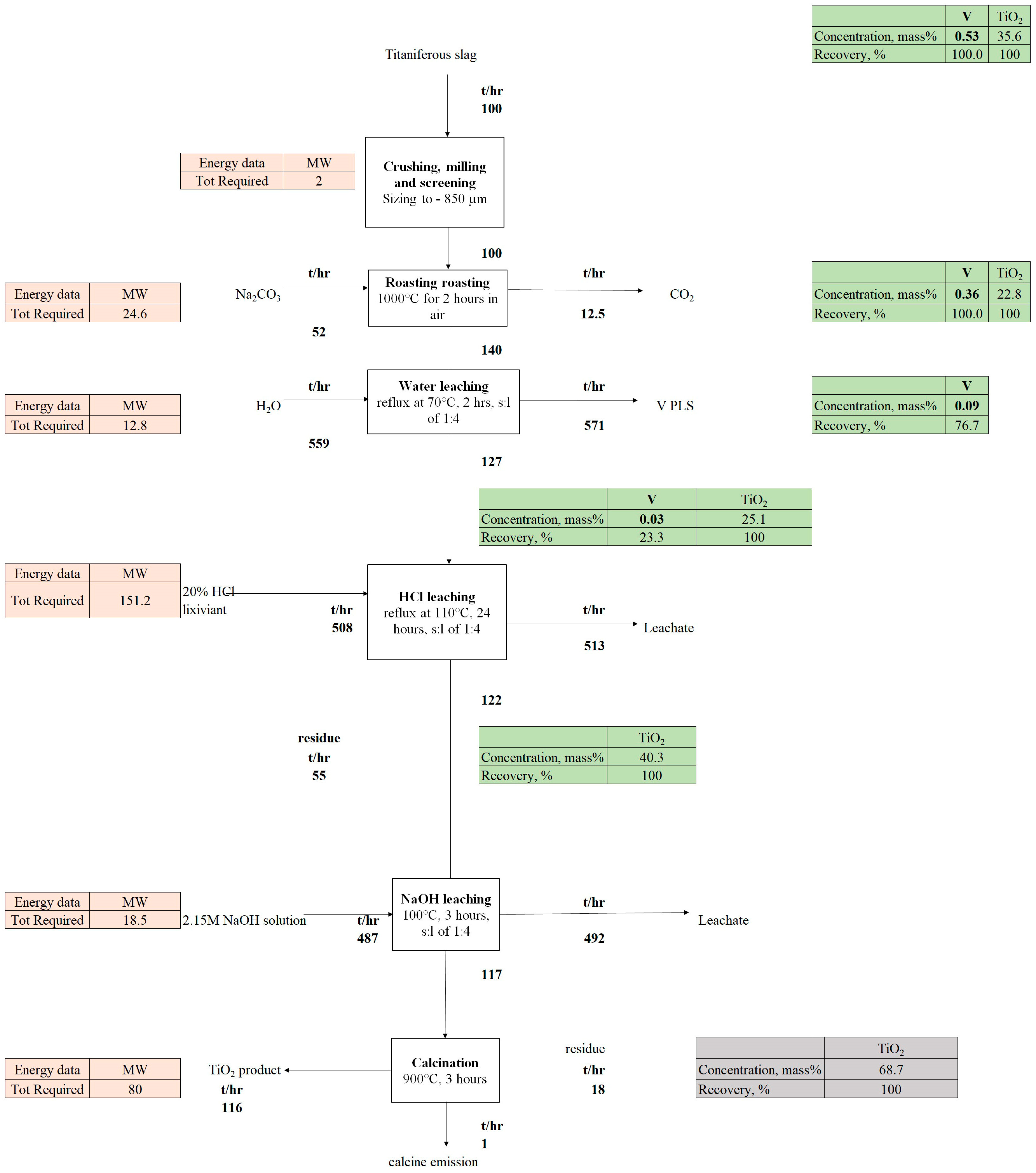
Figure 1 presents a conceptual process flowsheet for the recovery of vanadium and the upgrading of TiO
2 from titaniferous slag through a combination of roasting and sequential leaching steps. The key stages in the process include roasting, followed by water leaching, acid leaching, and caustic leaching.
The mass balance results based on the process flowsheet formulated from the data attained from empirical testwork are summarized in
Table 2. Roasting 100 t/h of titaniferous slag containing V
2O
5 with 52 t/h of Na
2CO
3 produced a roasted material of 140 t/h with 12 t/h lost as CO
2 by-product. The produced roast was then leached in 559 t/h of deionised H
2O to produce a residue of 127 t/h. The water leaching process resulted in 571 t/h of PLS. Further leaching of the H
2O leach residue using HCl resulted in 513 t/h and 122 t/h of leachate and HCl leach residue, respectively. Upgrading the TiO
2 through caustic leaching resulted in 492 t/h of leachate and 117 t/h NaOH residue. Calcination of the NaOH leach residue resulted in 116 t/h of intermediate TiO
2 material containing 68.7% TiO
2.
It is important to note that, although Na2CO3 is introduced at a rate of 52 t/h, only a fraction is assumed to directly react with vanadium-bearing phases to form sodium vanadates. Consequently, CO2 generation is lower than that predicted by complete carbonate decomposition.
The UGS process was modified in this study; hence, the process was a multi-stage leaching process. The UGS process and the proposed multi-stage leaching route differ fundamentally in their approach to titania upgrading. The UGS process relies on high-temperature smelting and controlled oxidation–reduction to selectively partition iron and enrich TiO2, resulting in high-grade products (>90 wt.% TiO2) but at the expense of significant energy input and capital-intensive pyrometallurgical infrastructure. In contrast, the HCl–NaOH leaching sequence employed in this study is primarily hydrometallurgical in nature, operating at substantially lower temperatures and avoiding energy-intensive smelting steps. While the leaching route requires higher reagent intensity—particularly in terms of acid and alkali consumption—it offers greater flexibility in impurity targeting and is more amenable to integration with vanadium recovery. Consequently, the TiO2 grade produced in this study is lower than that commonly achieved through UGS. Nevertheless, the proposed approach offers a lower-energy, modular route for upgrading, yielding an intermediate-grade titania concentrate that is appropriate for subsequent downstream processing. This trade-off between reagent intensity, energy consumption, and product quality underpins the technological choice adopted in the present study.
The detailed stages used for processing titaniferous slag for the extraction of V2O5 and upgrading of TiO2 are explained in detail in the following sections.
2.1. Roasting of Titaniferous Slag
The as-received slag was first reduced in size using a jaw crusher. The crushed material was then blended with sodium carbonate (Na
2CO
3) at 200% of the stoichiometric requirement to drive the reactions outlined in Equations (1)–(3) [
27]. The use of excess Na
2CO
3 follows the recommendation of Lekobotja et al. (2017), who showed that higher sodium additions facilitate the breakdown of refractory mineral phases [
18].
The slag–reagent mixture was combined with a saturated Na2CO3 solution under stirring to form a slurry, which was subsequently dried overnight at 105 °C. After cooling to ambient temperature, the agglomerated solids were disintegrated using a ceramic rod. The prepared material was then roasted in a rotary kiln at 1000 °C for two hours, after which it was removed and allowed to cool in air.
2.2. H2O Leaching of Roasted Material
Vanadium extraction from the roasted solids was carried out using deionised water, following established procedures [
19]. A solid-to-liquid (s:l) ratio of 1:4 was maintained by adding water at four times the mass of the roasted slag. The leaching was conducted in a stirred reactor equipped with an overhead agitator, operating at 350 rpm and heated to 70 °C for a duration of two hours. At the end of the leaching stage, the slurry was filtered to separate the vanadium-rich solution from the solid residue, which retained most of the titania content. The residue was dried overnight at 105 °C and analysed using inductively coupled plasma optical emission spectroscopy (ICP-OES).
2.3. HCl Leaching of H2O Leach Residue
The purpose of the acid leaching stage was to dissolve and remove impurities such as Mg, Al, Ca, and Fe from the residue. The operating conditions were adapted from conventional hydrochloric acid leaching steps used in the Upgraded Slag (UGS) process [
8,
28,
29]. Key parameters included 20% HCl concentration, a leaching duration of 24 h, an s:l ratio of 1:4, a reflux temperature of 110 °C, and agitation at 350 rpm.
In practice, the required volume of HCl solution was added to the reactor containing the residue. The slurry was heated using an oil bath while being continuously stirred and maintained under reflux. Upon completion, the mixture was cooled to room temperature and filtered. The solids were then re-slurried with deionised water equivalent to the initial acid volume, followed by filtration and thorough washing. A representative sample of the cleaned solids was dried at 105 °C for subsequent ICP-OES analysis, while the remainder was retained for further processing.
2.4. Caustic Leaching of HCl Residue
The final leaching stage aimed to remove silica and any remaining impurities from the acid-treated solids. This step was conducted under standard conditions reported in the literature [
8,
28,
29], using a NaOH solution with a concentration of 2.15 M (approximately 8.6%), a temperature of 100 °C, a leaching time of three hours, an s:l ratio of 1:4, and agitation at 350 rpm. Post-leaching treatment followed the same procedure as in the acid leaching stage, including filtration, washing, drying, and ICP-OES analysis of the final solid product.
3. Economic Evaluation of the Conceptual Process Flowsheet
Recent advances in extractive metallurgy increasingly integrate data-driven and predictive modelling frameworks to support process optimisation and economic forecasting. Several studies demonstrate that machine learning and hybrid modelling approaches can improve prediction of key process variables in high-temperature metallurgical systems, such as blast furnace heat indicators and hot metal composition, with high accuracy using ensemble learning and feature-selection methods, thereby enhancing dynamic control over smelting operations beyond traditional static models (e.g., data-driven blast furnace heat prediction models achieving >92% predictive hit rates) [
30]. Moreover, hybrid frameworks that combine thermodynamic modelling with machine learning have been developed for critical metal recovery from complex secondary resources, enabling prediction of recovery efficiencies and interaction effects between feed properties and operational parameters [
31]. Reviews of intelligence applications in mineral processing and high-temperature unit operations further articulate the growing role of predictive analytics, digital twins, and AI in optimising roasting, leaching, and related extractive steps [
32]. In parallel, mechanistic studies on multi-stage leaching (e.g., high-pressure alkaline and ultrasonic acid leaching of refractory concentrates) elucidate impurity removal pathways and kinetics that support assumptions made on recovery efficiencies and phase behaviour in complex residues [
33]. Together, these developments underscore the potential for integrating historical and operational data into process and economic models to enhance robustness, adaptability, and uncertainty quantification in techno-economic evaluations.
3.1. Preliminary Economic Evaluation of the Conceptual Flowsheet
Techno-economic analysis, often referred to as process economics, is applied to estimate the potential return on investment for a given process. This type of assessment integrates process data with market assumptions and input cost structures to evaluate financial performance. In addition to determining overall viability, it helps highlight stages within a process that may require further optimisation or research to improve economic outcomes.
Two primary approaches are commonly used in the economic evaluation of process technologies: the single-year costing (SYC) method and the discounted cash flow (DCF) method. The SYC approach converts all costs into an equivalent annual value and assumes steady or averaged revenue streams. Under this framework, a process is considered economically feasible if the market price exceeds the calculated breakeven cost [
34].
By contrast, the DCF method is widely used in engineering and project evaluation, particularly for assessing the profitability of new process flowsheets [
35]. In this study, the economic evaluation of the conceptual process for producing vanadium and titanium products from titanomagnetite was conducted using DCF principles. This approach involves projecting cash flows over a defined period—20 years in this case—and calculating key performance indicators such as the internal rate of return (IRR) and net present value (NPV).
The IRR represents the rate at which the project’s net cash flows break even over time, providing a measure of investment efficiency. However, it is limited by its focus on internal cash flows and does not explicitly account for external economic factors such as inflation [
36]. The NPV, on the other hand, determines the difference between the present value of expected inflows and outflows, and is generally regarded as a more robust indicator of profitability. The payback period (PP) is also often used as a supplementary metric, indicating the time required to recover the initial capital investment, with the advantage of being straightforward to interpret.
Compared with SYC, the DCF approach provides a more realistic representation of project economics because it accounts for variations in costs and revenues over time. However, this added accuracy comes with increased complexity. In the present work, NPV, IRR, and payback period were calculated using the DCF framework. Furthermore, a sensitivity analysis was conducted to evaluate how variations in capital expenditure (CAPEX), operating expenditure (OPEX), and revenue influence overall project feasibility. This analysis is essential for identifying the parameters that most strongly impact the economic performance of the proposed process.
3.2. Equipment Sizing and Evaluation of Utility Demand
Material and energy balances are essential in determining the required information for equipment size and estimating utility demand.
Table 3 provides a detailed summary of the key equipment concerning the operational stage/step of the process; this is used for equipment sizing. The practice of equipment sizing facilitates the ability to establish calculations about utility usage. The overall power requirement covers the collective power use associated with several components, such as pump systems, conveyor systems, compressor systems, air conditioning systems, ball mills, and rotating kilns for roasting and calcination.
3.3. Process Conditions
Process conditions refer to the specific parameters and variables that are controlled or adjusted during a manufacturing or treatment process. These parameters are critical in influencing both the process outcome and the quality of the final product.
Table 4 illustrates the process conditions, which were determined through experimentation, modelling, and simulation to achieve the desired outcome efficiently and safely.
While alternative technologies such as molten salt roasting or electrooxidation have reported higher vanadium recoveries under laboratory conditions, the present study adopts a conventional roast–leach–purification route to ensure industrial comparability and economic modelling reliability. The operating parameters employed are based on laboratory-scale optimisation and have not yet undergone pilot validation, which introduces scale-up uncertainty. Furthermore, recycle integration and reagent recovery were conservatively treated in the economic model, potentially overstating operating costs and capital requirements. Accordingly, the results should be interpreted as scoping-level techno-economic indicators rather than definitive feasibility outcomes.
3.4. Development of Techno-Economic Assessment Model
The techno-economic model developed for the vanadium recovery plant incorporated a detailed assessment of both process performance and economic considerations. This analysis encompassed an extensive examination of technical parameters, such as capital and operating costs, as well as economic parameters, including income from co-products and by-products, and estimations of vanadium recovery costs. Developing a Techno-Economic Assessment (TEA) model for the vanadium extraction from the titaniferous slag process entails comprehensively evaluating the project’s economic viability. This necessitates the consideration of capital expenditure, operating expenses, revenue forecasts, and other financial variables that are unique to this extraction method.
3.4.1. Capital Cost
The capital expenditures associated with establishing a vanadium extraction facility are contingent upon many aspects, including the size of the enterprise, geographical placement, technology preferences, and prevailing market circumstances, which are listed in
Table 5. Conducting a comprehensive feasibility analysis and involving engineering and procurement specialists is necessary to get precise cost estimates for individual components. Furthermore, it is important to include provisions for unanticipated expenditures within the estimation of capital costs to accommodate any budgetary excesses.
The capital allocation for the off-gas system reflects a fully integrated emission control train comprising cyclones, high-temperature baghouse filters, waste heat recovery units, wet acid-gas scrubbers, induced draft fans, and continuous emission monitoring systems. Given the high roasting temperature (~1000 °C) and significant CO2 generation from Na2CO3 decomposition, large volumetric gas flows are expected, necessitating substantial gas handling infrastructure. The design assumes conservative compliance with industrial emission standards for particulate matter and acid gases. Consequently, the off-gas system represents a significant capital component, consistent with comparable high-temperature metallurgical facilities.
3.4.2. Operating Costs
Operating costs include a range of elements, namely the feedstock, consumables, utilities, labour, maintenance, operating supplies, laboratory services, insurance, and plant overheads. Pricing for consumables was obtained from multiple suppliers, while electricity and natural gas costs were based on typical industrial tariffs in South Africa. Estimates for cooling water and water treatment were drawn from published sources. A summary of the utility costs and other operating expenditures considered in this study is provided in
Table 6.
The water cost represents the effective cost of treated process water, including purification, pumping, recycling, and wastewater treatment requirements associated with the hydrometallurgical circuit. The unit cost reflects the relatively low net water consumption, but high treatment intensity required for the process.
3.4.3. Vanadium Recovery Costs
The cost of recovering vanadium was estimated using a discounted cash flow (DCF) model. Projected cash flows were developed by accounting for increases in operating expenses over time, while also incorporating revenue streams from both co-products and by-products. Market prices for these outputs were sourced from suppliers; however, it was assumed that actual sales would occur at a reduced rate. For this analysis, a selling price equivalent to 20% of the prevailing market value was applied (
Table 7). The resulting vanadium recovery cost was defined as the price required to achieve a specified internal rate of return (IRR). Key assumptions underpinning the techno-economic evaluation are summarised in
Table 8.
In the base-case economic model, titaniferous slag is assumed to be available at zero cost, reflecting its current status as a discard by-product at several smelting operations, where it is stockpiled primarily for disposal rather than sale. However, it is recognised that increased interest in slag valorisation, coupled with its titanium and residual vanadium content, could result in the slag acquiring a non-zero market value over the project lifetime.
3.4.4. Sensitivity and Uncertainty Analysis
Sensitivity analysis is an effective method for evaluating how changes in input parameters influence model outputs. It provides insight into which variables require more accurate estimation to reduce uncertainty in the results. This is particularly important for models that depend on literature or industry data rather than experimental measurements, as well as for economic assessments that are affected by fluctuating costs of consumables, utilities, and other price-sensitive inputs.
In this study, the Morris method was applied to assess the influence of key variables on the vanadium recovery cost. The upper and lower bounds for these inputs were selected based on typical ranges reported in the literature [
37,
38,
39,
40,
41,
42]. The analysis also incorporated economic parameters, including the selling prices of co-products and by-products, as well as the costs associated with consumables and utilities. These economic inputs were varied by ±30% relative to the base case to capture potential market fluctuations. This range was chosen to reflect historical price variability observed over the past decade.
Given that the model is based on several assumptions, a degree of uncertainty is inherently present. One approach to further address this uncertainty is the application of Monte Carlo simulation, which allows for probabilistic evaluation of the model outcomes.
4. Results and Discussion
Based on the mass balance presented in
Table 2, the vanadium concentration in the pregnant leach solution (PLS) is approximately 0.27 g/L V (equivalent to 0.49 g/L V
2O
5), assuming near-complete dissolution of vanadium during the water leaching stage. Although the PLS is relatively dilute, vanadium concentrations in the range of 0.5–2 g/L V are commonly reported for sodium-roasted titaniferous slag systems, where high liquid-to-solid ratios are used to maximise vanadium recovery while limiting the co-dissolution of impurities. Although wastewater treatment contributes to operating costs, preliminary estimates indicate that it represents a modest fraction of total Opex relative to reagents and energy, and reasonable variation in treatment costs does not materially alter the economic conclusion.
Such dilution has direct implications for the size and cost of downstream concentration and purification units. Acidic and alkaline leachates are generated in smaller volumes but require neutralization before discharge or reuse. In this study, wastewater treatment was considered at a conceptual level, assuming neutralisation, precipitation of metal hydroxides, and partial water recycling. Associated costs were incorporated within operating expenditure allowances. Preliminary estimates indicate that wastewater treatment may contribute on the order of 2–3 million $ per year to Opex, highlighting the importance of detailed water management design in future feasibility studies.
4.1. Discounted Cash Flow
The economic viability of the proposed vanadium recovery process was assessed using a discounted cash flow (DCF) model over a 20-year project life, with the key outcomes presented in
Table 9. The model incorporates capital investment, operating costs, and inflation-adjusted revenue projections to evaluate performance using metrics such as net present value (NPV), internal rate of return (IRR), and payback period.
For the base-case scenario, the DCF analysis (
Table 9) indicates a positive NPV of
$5.3 billion at a real discount rate of 7.0%. The calculated IRR is 35.3%, significantly exceeding the assumed discount rate, which suggests strong profitability relative to the required return threshold. Furthermore, the estimated payback period is 2.74 years, demonstrating that the initial capital outlay is recovered early in the project lifecycle.
Overall, these results indicate that, under the assumptions applied in the model, the proposed process is economically attractive, with investment recovery achieved well within the operational lifespan of the project.
4.2. Capital and Operating Cost Structure
The cash flow model reflects a large upfront capital commitment (project capital and ongoing sustaining capital) associated with establishing and maintaining the roasting–leaching–precipitation–flaking flowsheet. Although the initial investment is significant, the short payback period (2.74 years) and high IRR (35.3%) demonstrate that the project’s revenue-generating capability is sufficient to recover capital rapidly under the base-case assumptions.
Operating expenditure is dominated by variable costs that scale with throughput and escalate with inflation. Within the variable cost structure, additives/consumables contribute the largest cost share, followed by blend/ore-related costs, labour, and power. This cost composition is important because it indicates that long-term value retention is driven less by minor reductions in upfront capital and more by improvements in operating efficiency, particularly reductions in consumable intensity and reagent demand.
4.3. Cumulative Cash Flow Behaviour and Payback
The model’s real cash flow series used for NPV/IRR calculations shows a substantial negative cash flow during the investment phase, followed by strong positive cash flows once operations commence. The cumulative real cash flow becomes positive within the first few operating years, consistent with the 2.74-year payback period. After payback, cumulative cash flow continues to rise, demonstrating sustained value creation over the remaining project horizon.
This profile is favourable from an investment-risk perspective because it indicates that project viability is not dependent on distant long-term cash flow alone; instead, a large portion of value is created relatively early in the operating life once production stabilizes. Based on the projected cash flow, the net profit margin in the first full year of operation (2023) is estimated at 14.4%. Profitability improves steadily during the early years of operation, driven primarily by the amortisation of capital expenditure and increasing revenue under inflation-adjusted pricing. The net profit margin reaches a maximum around 2034, after which increasing operating and sustaining capital costs gradually erode profitability.
The delayed transition to positive NPV, combined with a discounted payback period of approximately nine years, indicates that the project is characterised by high up-front capital intensity and back-loaded returns. Such a profile may be less attractive to purely financial investors but could be acceptable to strategic investors prioritising resource security, waste reduction, or long-term value creation.
4.4. Sensitivity Analysis
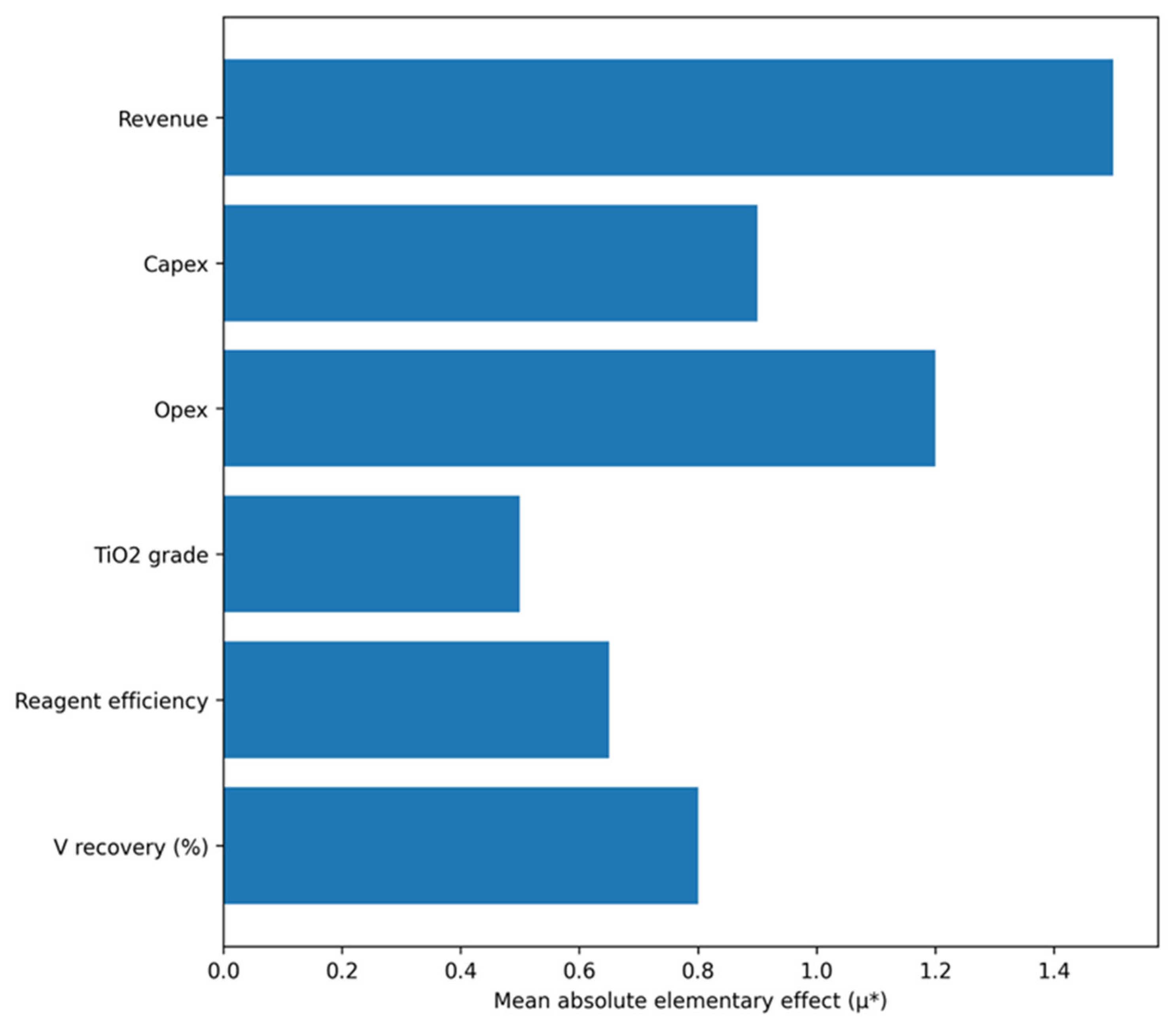
Figure 2 shows the Morris sensitivity analysis results for the proposed process flowsheet. The Morris sensitivity analysis indicates that project economics are most strongly influenced by revenue-related variables, driven primarily by the selling price of V
2O
5 and the achievable vanadium recovery. Operating expenditure emerges as the next most influential factor, reflecting the reagent- and energy-intensive nature of the process, followed by capital expenditure associated with the high upfront investment. In comparison, individual technical parameters such as vanadium recovery, reagent efficiency, and the achieved TiO
2 grade exhibit a lower direct impact on net present value. Nevertheless, these technical variables play a critical enabling role, as they fundamentally determine product yields, operating costs, and product marketability, thereby indirectly shaping the dominant financial drivers identified in the analysis.
For the conceptual flowsheet, potential risks and uncertainties were acknowledged, particularly regarding the model’s reliability, as several inputs were derived from historical data and simulation rather than direct experimentation. To address this, a sensitivity analysis was performed to evaluate how selected process variables influence the overall economics. The assessment framework focused on determining how variations in key parameters affect process feasibility, which is commonly evaluated using the NPV. A positive NPV indicates an economically viable process, a value of zero reflects a break-even condition, and a negative NPV suggests that the process is not financially attractive. In this study, the effects of capital expenditure (CAPEX), operating expenditure (OPEX), and revenue on the NPV, and thus on overall economic viability, were systematically examined.
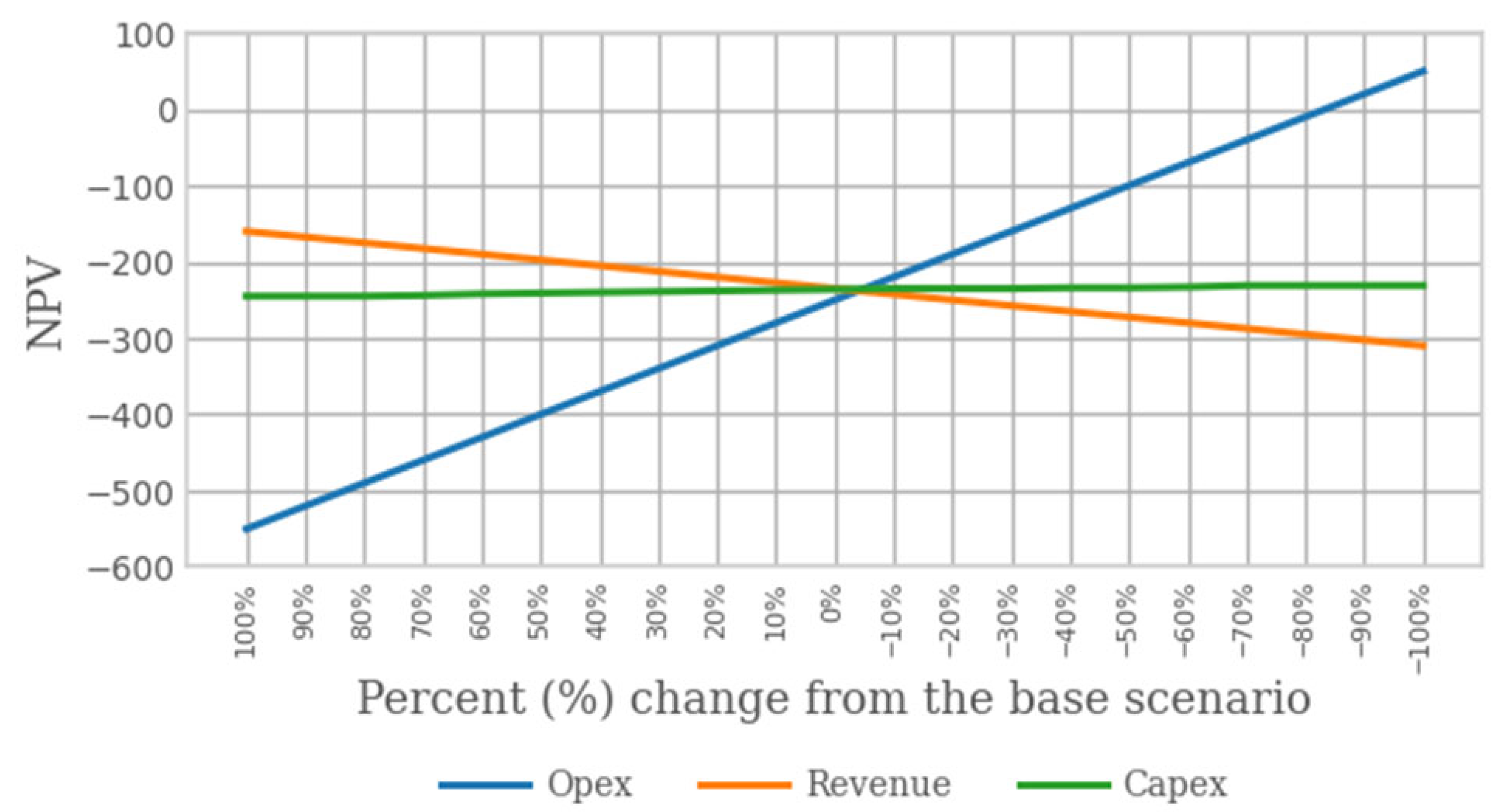
A sensitivity analysis was performed to assess how variations of ±10%, ±25%, and ±30% in capital expenditure (CAPEX), operating expenditure (OPEX), and revenue influence the project’s net present value (NPV). The findings show that NPV is most strongly affected by fluctuations in operating costs and revenue, with operating costs exerting the greatest influence. This is largely due to the significant contribution of variable expenses—particularly consumables and additives—to the overall cost structure. In contrast, changes in capital costs have a relatively smaller effect on project viability, supported by robust operating cash flows and a relatively short payback period.
The sensitivity spider plot (
Figure 3) reinforces this outcome by showing the steepest response of NPV to opex changes. These results highlight that the key economic risk is not only the size of the initial capital outlay, but the process’s ability to maintain tight control over reagent consumption, consumable pricing exposure, and operating efficiency over time. The outcomes of the sensitivity analysis, illustrating the effects of operating expenditure (OPEX), revenue, and capital expenditure (CAPEX) on net present value (NPV), are presented in the spider diagram in
Figure 3. The analysis indicates that the economic performance of the conceptual flowsheet, as evaluated through the DCF model, is particularly sensitive to variations in OPEX and revenue. Notably, even a modest 10% change in OPEX can shift the project from economically viable to unviable. These findings highlight the need for further process optimisation, especially targeting the major contributors to operating costs. In particular, additional work is required to better understand and potentially reduce the cost of additives. It is also important to recognise that these costs may currently be overestimated, as the conceptual flowsheet, and consequently the DCF model, does not yet account for potential recycling streams, which could significantly lower overall reagent consumption and operating expenses.
In the discounted cash flow analysis, fixed selling prices were assumed for V2O5 and TiO2 corresponding to baseline commercial-grade specifications. No price premiums for higher purity, nor penalties for off-spec material, were applied. As such, the economic results represent a conservative estimate of project viability. Variations in product quality would directly impact revenue and could be incorporated in future work through price–purity sensitivity analysis. If the upgraded TiO2 product fails to achieve market acceptance at the assumed grade (e.g., 68.7% TiO2), revenue would be derived solely from V2O5 sales. Under such a scenario, total project revenue would decrease substantially, given that the TiO2 by-product contributes a significant fraction of gross income in the base case. Preliminary assessment indicates that reliance on V2O5 alone would significantly reduce NPV and could render the project uneconomic under conservative vanadium price assumptions. The economic rationale of the process, therefore, relies on co-product valorisation, with TiO2 acting as an important risk-mitigating revenue stream rather than a guaranteed income source. Market acceptance of the TiO2 feedstock is thus a critical assumption underpinning the economic viability of the process.
Operating expenses (opex) sensitivity results showed:
Increasing opex led to a progressively more negative financial outcome.
A 100% increase in opex results in a decrease of approximately $546.1 million.
A 100% decrease in opex results in an increase of approximately $53.5 million.
Revenue sensitivity results showed:
Increasing revenue led to a less negative financial outcome.
A 100% increase in Revenue results in a decrease of approximately $160.4 million.
A 100% decrease in Revenue results in a decrease of approximately $311.2 million.
Capital expenditures (capex) sensitivity results showed:
Increasing capex leads to a progressively more negative financial outcome.
A 100% increase in capex results in a decrease of approximately $243.6 million.
A 100% decrease in capex results in an increase of approximately $227.9 million.
Overall observations of the results:
Higher opex and capex negatively impact the financial outcome, while higher revenue has a positive impact.
There are diminishing returns in sensitivity changes; that is, the impact of 10% change is not exactly one-tenth of a 100% change.
Considerations:
Increasing opex might lead to higher revenue, but it needs to be carefully managed to ensure profitability.
Understanding the sensitivity to opex, revenue, and capex is crucial for risk assessment and decision-making.
Given the tight economic margins observed in the base-case analysis, the project is inherently sensitive to feedstock pricing. Even a modest positive slag price would increase operating expenditure and reduce net present value, potentially rendering the project uneconomic under a conservative price scenario.
4.5. NPV Profile and Investment Robustness
The NPV profile indicates that the project remains value-accretive under a range of discount rates around the base assumption, with NPV remaining positive beyond the 7.0% real discount rate applied in the base case. This, combined with an IRR of 35.3%, demonstrates a strong margin between the project’s return and the required rate of return. In practical terms, this implies a degree of resilience against moderate increases in the cost of capital, provided that operating cost performance remains within expected ranges.
4.6. Discussion of Economic Implications
The combined DCF results demonstrate that valorization of titaniferous slag through the proposed process route can be economically attractive, as shown by the positive NPV (≈ $ 5.3 billion), high IRR (35.3%), and short payback period (2.74 years). These indicators confirm that the process has the capacity to generate substantial value over project life, despite requiring significant initial and sustaining capital. These results are consistent with the cash flow evolution discussed above and confirm that the original capital investment is recovered during the first half of the assumed 20-year project life.
However, the results also indicate that project value is strongly contingent on operating performance, particularly those operating costs linked to consumables and additives. Accordingly, the most effective pathway for strengthening project economics is to prioritise process optimisation aimed at lowering reagent intensity, improving consumable efficiency, and incorporating recycling opportunities where feasible. These measures would reduce the project’s sensitivity to operating cost escalation and enhance robustness under fluctuating input prices and inflationary conditions.
5. Conclusions
This study employed a comprehensive discounted cash flow (DCF) approach to assess the economic viability of producing vanadium pentoxide (V2O5) from titaniferous slag via an adapted primary vanadium extraction process. The assessment was conducted over a 20-year project life and incorporated inflation-adjusted (real) cash flows, capital expenditure (capex), operating expenditure (opex), revenue generation, and sensitivity analysis to provide a robust evaluation of project viability.
The reported vanadium recovery of 76.7% and TiO2 upgrading of 68.7% were calculated from closed mass balances expressed in t/h of V2O5 and TiO2, respectively. These values are consistent with prior Mintek testwork on EHSV slag under comparable roasting and leaching conditions. It is noted that these results represent best-case laboratory performance; minor deviations (±3%–5%) may arise from analytical uncertainty and incomplete phase decomposition.
The DCF results demonstrate that the proposed process is economically viable under the base-case assumptions. At a real discount rate of 7%, the project yields a positive net present value (NPV) of approximately $5.3 billion, an internal rate of return (IRR) of 35.3%, and a discounted payback period of approximately 2.74 years. These indicators confirm that the discounted value of future after-tax cash inflows substantially exceeds the initial capital investment and that the project generates returns well above the assumed risk-adjusted hurdle rate.
Although the process requires a substantial upfront capital investment, primarily incurred prior to the commencement of operations, the results indicate that capex is not the dominant determinant of long-term economic performance. The relatively short, discounted payback period and strong IRR demonstrate that the initial capital outlay is recovered early in the project life, after which the operation generates sustained positive real cash flows. The initial negative cash flow reflects upfront capital investment and elevated start-up operating costs. The break-even point, corresponding to full recovery of the initial investment, occurs after approximately nine years of operation. Beyond this point, the project generates positive cumulative cash flow, indicating a transition into sustained profitability.
Sensitivity analysis confirms that variations in opex have a significantly larger impact on NPV than equivalent proportional changes in either capex or revenue. Even moderate increases in operating costs result in a pronounced reduction in project value, highlighting the importance of effective operating cost control.
Revenue generation in the base-case scenario is driven by the production and sale of V2O5 flake, with revenues increasing steadily over the project life in line with inflation assumptions. Despite rising operating and capital maintenance costs, the revenue trajectory remains sufficiently strong to sustain positive operating margins and cumulative real cash flows over most of the operating period. The decline in profitability observed in the later years of the project is primarily attributable to escalating operating and sustaining capital costs rather than insufficient revenue generation.
Overall, the techno-economic assessment confirms that the valorisation of titaniferous slag for vanadium recovery can be economically feasible, particularly in contexts where the slag is available as a low-cost or no-cost by-product. However, the long-term robustness of the project is highly contingent on rigorous control and optimisation of operating expenditure. Future work should therefore prioritise process optimisation strategies aimed at reducing consumable usage, improving reagent efficiencies, and implementing recycle and recovery streams, as these interventions offer the greatest potential to enhance economic resilience and reduce sensitivity to operating cost escalation.





 ,
,