Article

Geology, Mineralogy, and Age of Li-Bearing Pegmatites: Case Study of Alday Area (Eastern Kazakhstan)


by
Natalya A. Zimanovskaya
1,
Indira E. Mataibayeva
1,*,
Gulizat B. Orazbekova
2,
Seib Nadine
3 and
Arailym Zh. Amrenova
1
1
Earth Sciences School, D. Serikbayev East Kazakhstan Technical University, Ust-Kamenogorsk 070000, Kazakhstan
2
Department of Civil Engineering and Geodesy, Shakarim University of Semey, Semey 071410, Kazakhstan
3
Kepler Group Ltd., Astana 010000, Kazakhstan
*
Author to whom correspondence should be addressed.
Minerals 2026, 16(2), 148; https://doi.org/10.3390/min16020148
Submission received: 28 November 2025 / Revised: 13 January 2026 / Accepted: 14 January 2026 / Published: 28 January 2026

Abstract

This study investigates the geological, mineralogical, and geochemical features of the Alday ore occurrence (Central Kalba, East Kazakhstan) and aims to identify indicators of rare-metal mineralization, with lithium considered to be one of its principal components. In this study, the structural–stratigraphic position of the occurrence is refined; three series of albite–spodumene pegmatites are identified; the compositions of the ore-bearing schists and the granitoids of the Kunush and Kalba complexes are compared; and the role of metasomatic alteration in the concentration of Li, Ta, Nb, Be, and Sn is established. The plagiogranites and dikes of the Kunush complex are characterized by Li anomalies (up to 306 g/t), Ta (up to 64 g/t), and a fractionated REE spectrum (La/Yb up to 108). In addition, the following predictive criteria are formulated: the presence of tectonically disrupted dikes in the Kunush complex with Na2O/K2O > 4, the presence of albite and muscovite alteration zones, and the presence of ladder-type spodumene-bearing pegmatites controlled by northwest-trending faults. The 40Ar/39Ar muscovite age of the Alday pegmatites (~292 Ma) aligns with the age range of the Kalba granite complex. Based on the main principles of rare-metal pegmatite generation, it is determined that the Tochka pegmatites were formed during the fluid–magmatic fractionation of magma in large granitic reservoirs of the Kalba complex. The Karagoin–Saryozek zone—located between several large granite massifs of the Kalba complex, where host rocks function as a roof—may be promising for investigating rare-metal pegmatite mineralization.

1. Introduction

The Central Asian Orogenic Belt (Altaids) contains extensive granitoid batholiths formed during the Phanerozoic [1,2,3,4,5,6,7,8,9]. The magmatism that produced these granites is associated with mineralization of various metals, such as Rb, Be, Mo, and W, as well as the more economically significant Li, Cs, Ta, Nb, and Sn [10,11,12,13]. Notably, rare-metal pegmatites—particularly those of the lithium–cesium–tantalum (LCT) family—are commonly found to have a spatial and genetic connection to large granitoid intrusions. These pegmatites typically form fields or swarms of veins located along the margins or in the roof zones of the parent plutons.
In addition to lithium and other rare metals sensu stricto (Li, Ta, Nb, Sn), the evolution of rare-metal pegmatite systems is commonly recorded by accessory mineral assemblages enriched in Ti, Th, and REE, such as monazite, xenotime, zircon, ilmenite, and rutile. Although these minerals are not ore phases themselves, they represent sensitive indicators of magmatic differentiation, fluid involvement, and redistribution of incompatible elements during the late stages of granitoid evolution. Therefore, the study of Ti–Th–REE-bearing accessory minerals provides important constraints on the petrogenetic type of magmatism and the conditions favorable for rare-metal mineralization.
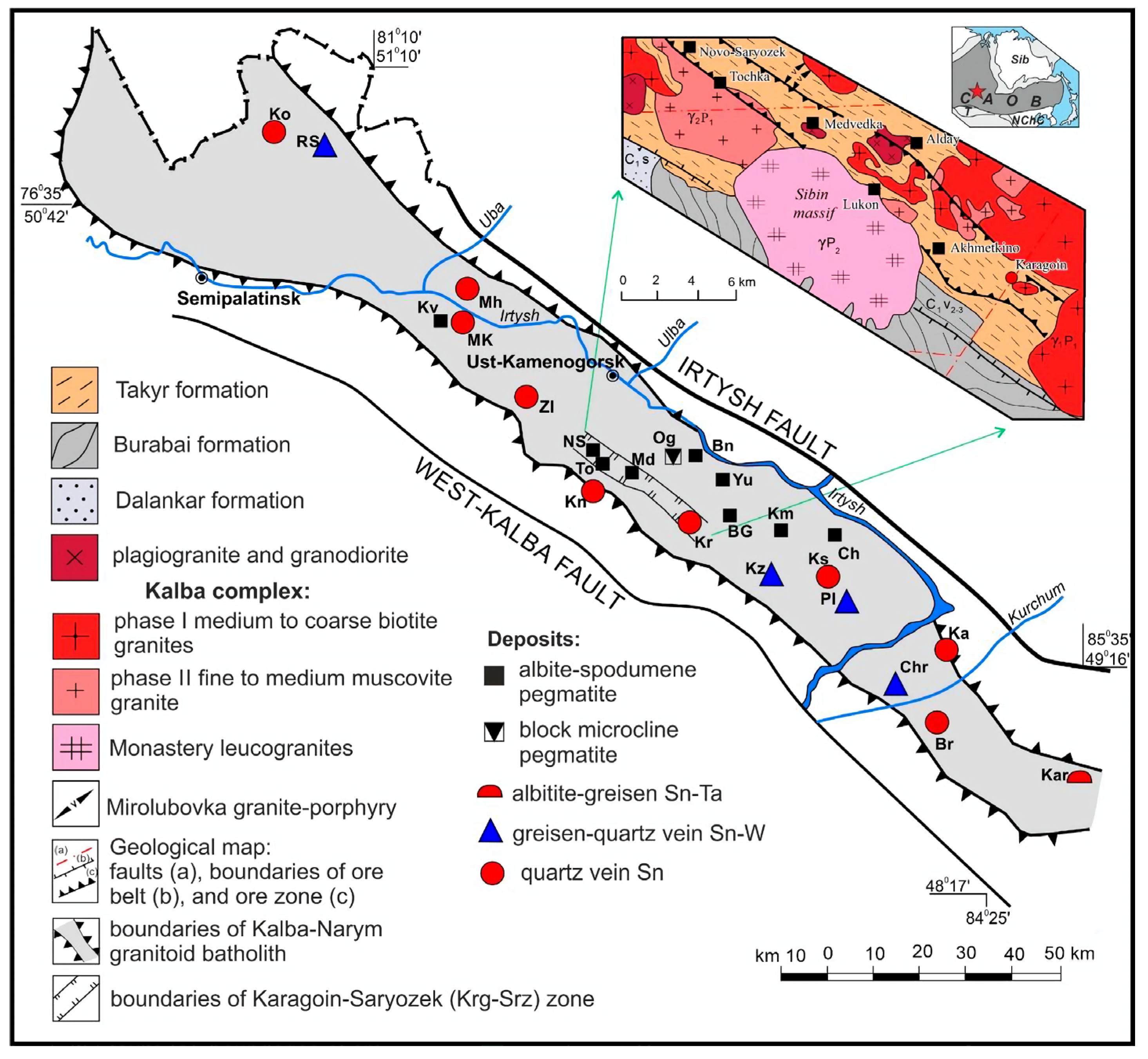
East Kazakhstan, situated along a Late Paleozoic collisional suture between the Siberian and Kazakhstan cratons, hosts abundant mineralized rare-metal pegmatite of the LCT family, associated with granitic magmatism [14,15,16,17]. The most intensive magmatic activity occurred during the Early Permian, forming large batholiths such as those found in Kalba and Zharma. This large-scale magmatism took place in a post-collisional extensional setting, likely driven by heat from the Tarim plume. The region, characterized by multiple juxtaposed igneous complexes, contains vast amounts of base, noble, and rare metals [15,18,19,20]. Rare-metal deposits are primarily concentrated within the Kalba–Narym belt, bounded by the West Kalba and Irtysh shear zones (Figure 1). Significant pegmatite, albitite–greisen, greisen–quartz-vein, and hydrothermal mineralization is found within the Early Permian granitoids of the Kalba batholith. This includes economic spodumene pegmatites in the Asubulak ore district, which contain Ta, Nb, Be, Li, Cs, and Sn and are located along the margins of the Kalba granite complex [13,21,22].
Within the Greater Altai structure, the Kalba–Narym zone is bounded by the Kalba–Narym and Terektinsky deep faults and is linearly elongated in the northwest direction for 500 km, with an average width of 35–40 km.
Several intrusive complexes have been identified in the structure of the Kalba–Narym granitoid belt.
The Kunush Complex (C3) comprises small hypabyssal intrusions of plagiogranites and granodiorites, as well as dikes of granodiorite porphyries, plagiogranite porphyries, granite porphyries, and quartz porphyries [23]. They were formed during the Hercynian cycle in a collisional geodynamic setting, associated with strike-slip deformation and the suturing of the Kazakh and Siberian lithospheric plates, giving rise to fault-related intrusive-dike belts with a northwest orientation. Magmatic sources originated in the lower crust and possibly in the upper mantle [24,25].
In the Kalba–Narym zone, the small intrusions and dikes of the Kunush Complex (C3) are truncated and metamorphosed by the Permian granites of the Kalba Complex, and in some cases undergo contact–metasomatic alterations (graphitization, greisenization, silicification, etc.) accompanied by the superimposed formation of ore components (Ta, Nb, Sn, W, etc.) [26]. Pegmatite and greisen–quartz-vein occurrences with superimposed rare-metal mineralization occur as dike- and vein-like bodies developed primarily within the contact zones of the Permian granites of the Kalba Complex (Medvedka, Tochka, Novo-Saryozek, Cherdoyak, etc.) [13,21,27,28,29].
The Kalba Complex (P1) is represented by large granite massifs of the Kalba–Narym pluton (Priirtyshsky, Belogorsky, Mirolyubovsky, Kaindinsky, etc.) [23,30]. As a result of its formation conditions and material composition, it is subdivided into two intrusive phases of similar age, each accompanied by its own vein rocks, metasomatic formations, and rare-metal deposits [23,31].
In this study, for the first time for rare-metal objects of the Kalba–Narym belt, 40Ar/39Ar dating was performed on muscovite extracted from spodumene pegmatites of the Chudskaya vein at the Tochka deposit [13] and from the Alday area. The results (ages of 293–290 Ma) made it possible to refine the timing of spodumene pegmatite formation and to clarify the relationship of muscovite age with the granitoid complexes of the Kalba series [32,33,34]. These findings complement the geological–geochemical and mineralogical–petrographic criteria established in this study and provide a basis for constructing a geochronological model of the evolution of rare-metal systems in East Kazakhstan.

2. Geological Background

The Kalba–Narym structural–metallogenic zone represents a large metallogenic belt characterized by rare-metal-bearing granites of the Kalba Complex and a wide range of rare-metal, tin, and tungsten ore formations. Within this zone, several industrial and prospective ore districts and nodes have been identified, including rare-metal pegmatites of tantalum–niobium, beryllium, and lithium specialization, as well as quartz-vein and quartz–greisen formations of Sn–W affinity. The formation of rare-metal mineralization in the Kalba–Narym zone is closely related to granitoids of the Kalba Complex and is structurally controlled by systems of deep-seated and sublatitudinal faults that govern the distribution of ore nodes and pegmatite fields.
To date, studies on the Kalba–Narym zone have primarily focused on large and industrially significant deposits, such as Bakennoye, Belaya Gora, Yubileynoye, and Verkhne-Baimurzin, where pegmatite-body morphology, mineral composition, and ore specialization have been studied in detail. For these deposits, it has been established that albite and albite–spodumene pegmatites play a dominant role in the concentration of tantalum, niobium, beryllium, tin, and lithium, and structural control has proven important, including that of sublatitudinal faults and dikes of the Kunush Complex. In addition, smaller occurrences confined to the Karagoin–Saryozek ore node, including the Alday occurrence, are comparatively under-studied, and available data on their geological structure, mineral composition, and rare-metal mineralization potential are fragmentary [21,23,29,35].
The Alday area is located in the Ulan District of East Kazakhstan Region, near the village of Besterek. It lies within the Central Kalba ore district, inside the Karagoin–Saryozek zone, and is represented by lithium-bearing albite–spodumene pegmatites. The Alday ore occurrence has been the subject of several previous geological investigations. In the present study, the authors investigate the geological structure and material composition of the ore-bearing rocks and rare-metal pegmatite veins to clarify whether the occurrence contains lithium raw materials.
The Alday area is situated on the northeastern flank of the Karagoin–Saryozek ore zone, which also includes deposits of lithium-bearing albite–spodumene pegmatites such as Novo-Saryozek, Tochka, Lukon, and Akhmetkino [35,36].
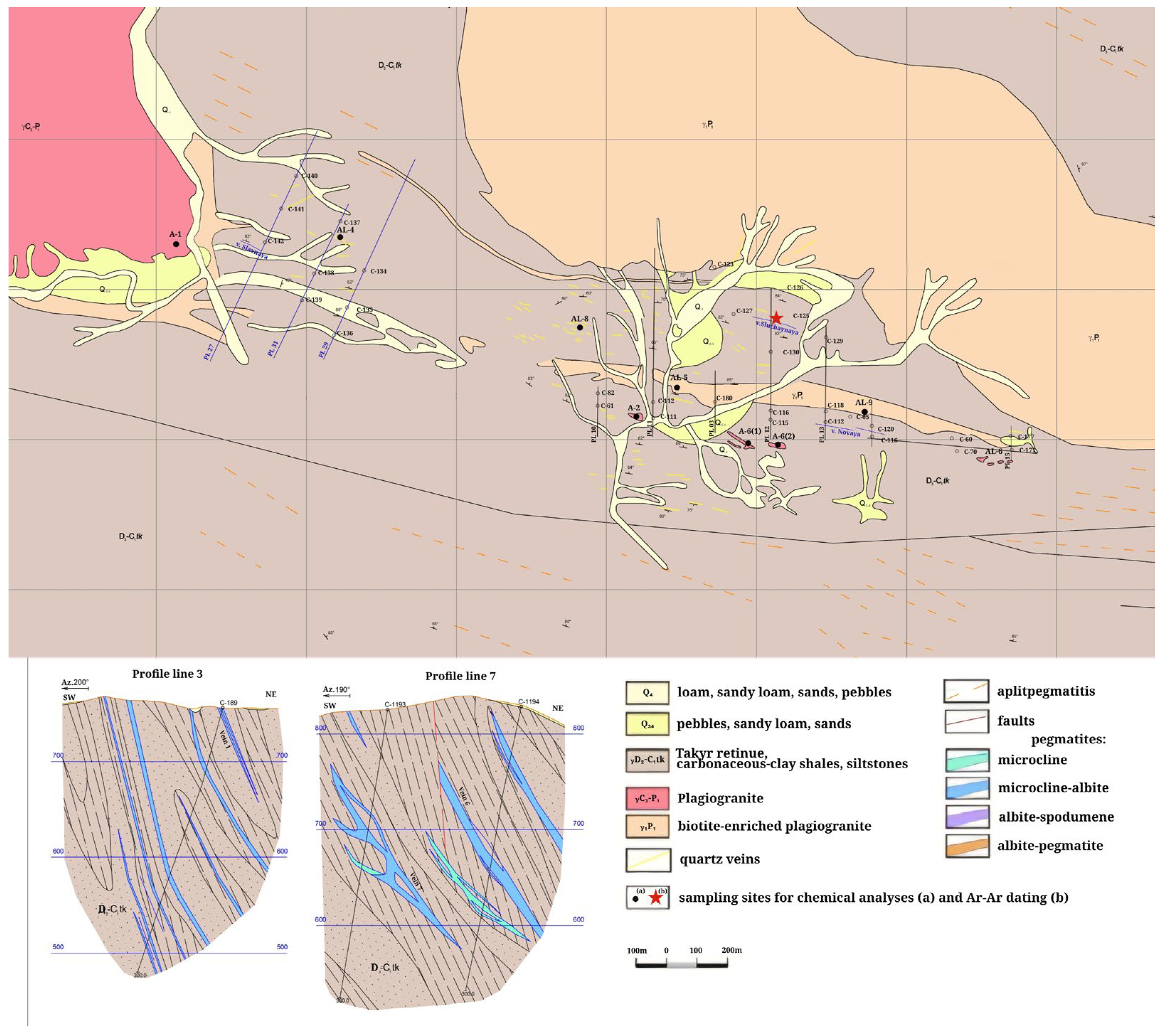
From a geological–structural perspective, the ore-controlling feature comprises a system of latitudinal (east–west-trending) faults along which the Tochka and Medvedka deposits and the Alday occurrence are sequentially arranged (Figure 2).
The occurrence is characterized by Takyr Formation sedimentary rocks, which are well developed in the area [23,36].
The Takyr Formation consists of packages of thin, rhythmically interbedded carbonaceous–argillaceous siltstones and fine-grained sandstones. In certain areas, small isoclinal folds of northwest strike are observed, with rocks dipping northeast at angles of 80–850°. Over large areas, they are overlain by a cover of unconsolidated deposits. The intrusive bodies are represented by two complexes: (1) the Kunush Complex (C3) and (2) the Kalba Complex (P1).
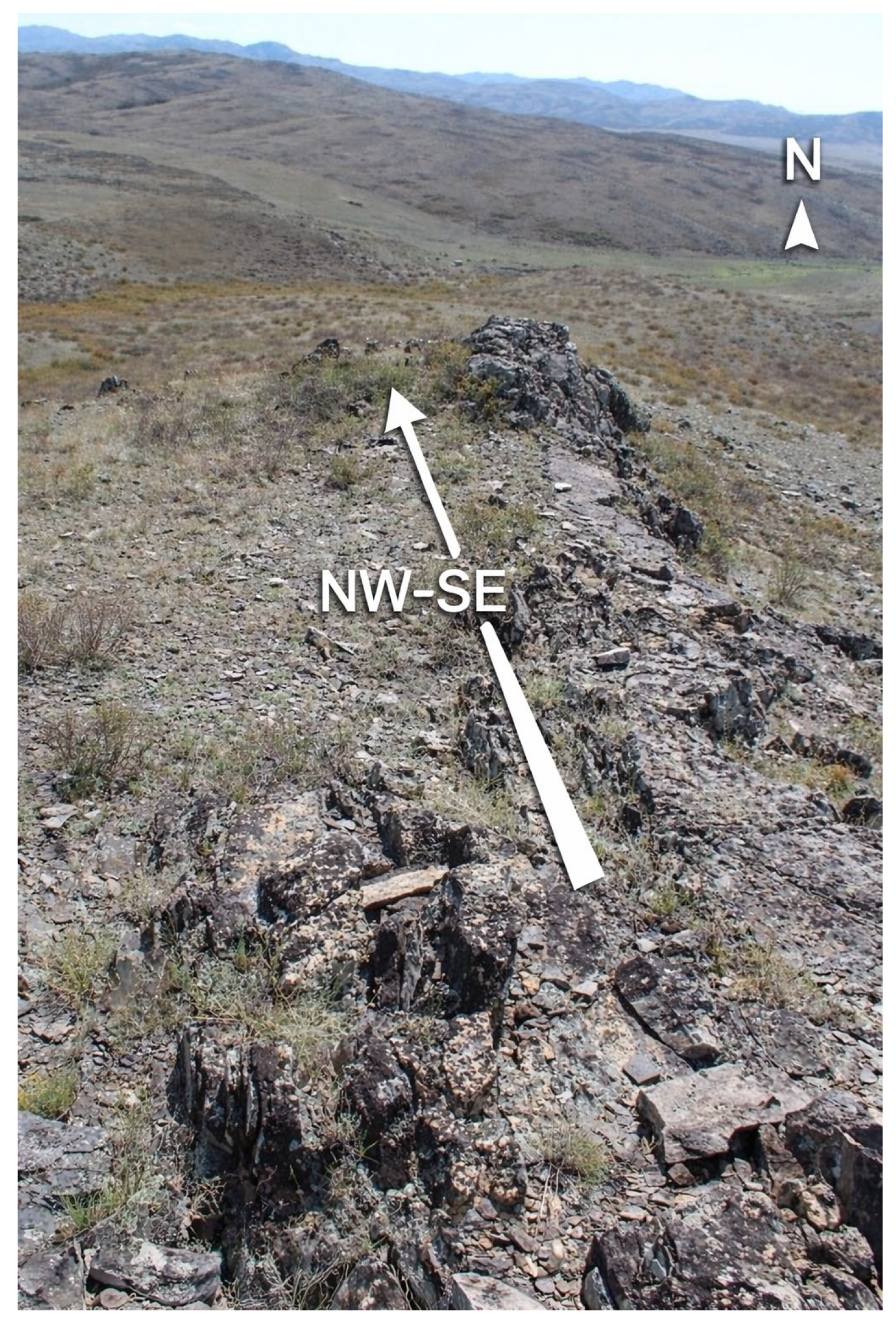
The ore-bearing schists in fault zones are characterized by increased fracturing, with numerous pegmatite and quartz veins localized within them (Figure 3).
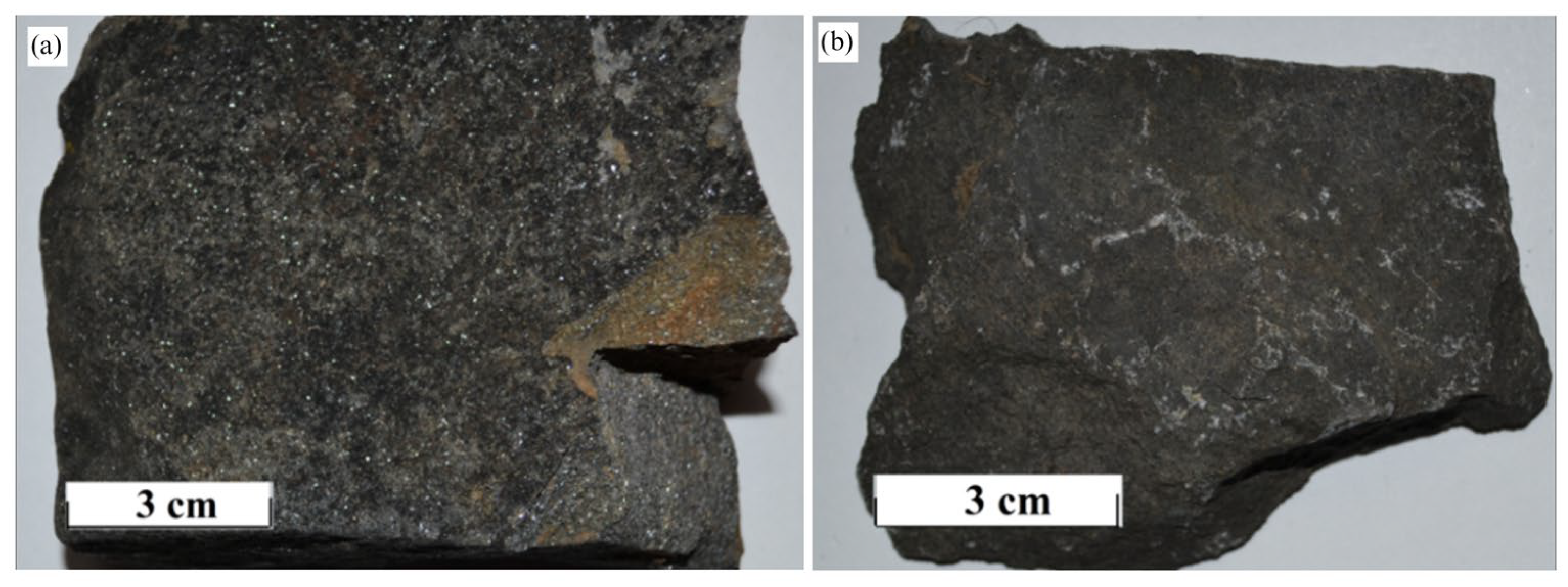
In the exocontact of the granite massif, the schists have undergone hornfelsing and silicification, with andalusite-bearing hornfels developed in the carbonaceous siltstones. At the contacts with pegmatite veins, greisenized and silicified varieties of hornfels are present. Externally, these are dark-gray-to-black rocks of quartz–feldspar–muscovite composition, sometimes containing andalusite and tourmaline (Figure 4).

3. Materials and Methods

This study included field observations and an analysis of published data. The author performed observations of the geological sections of the Alday area; three series of pegmatite veins were documented (northern, southern, and western), and their thickness (0.3–6.2 m), length (up to 150 m), and dip angle (82° to the NE) were recorded.
In addition, samples of ore-bearing schists, granitoids of the Kunush and Kalba complexes, pegmatites, and metasomatic rocks were collected.
The research was carried out at the VERITAS Center of Excellence of D. Serikbayev East Kazakhstan Technical University (Ust-Kamenogorsk, Kazakhstan). Rock and mineral compositions were determined using inductively coupled plasma mass spectrometry (ICP-MS) on an Agilent 7500cx instrument (Agilent Technologies, Santa Clara, CA, USA), [37] and via electron probe microanalysis (EPMA) under standard conditions using a Cameca MS-46 system (Cameca, Gennevilliers, France), which enabled precise measurement of seventy-three elements, including Au, Ag, Pt, Cd, In, Ir, Y, REE, and U. To analyze micrometer-scale inclusions of metallic and vein minerals, scanning electron microscopy and energy-dispersive X-ray spectroscopy (SEM-EDS) were performed using a Jeol-100C microscope (JEOL, Tokyo, Japan) equipped with a Kevex-Ray detector (Kevex Corporation, Foster City, CA, USA) and a Jeol ISM-6390 LV microscope (JEOL, Tokyo, Japan) fitted with an Oxford INCA Energy system [38].
Isotope analysis was carried out at the Isotope-Analytical Geochemistry Laboratory of the Institute of Geology and Mineralogy, Siberian Branch of the Russian Academy of Sciences. The 40Ar/39Ar dating of muscovite was carried out using the stepwise heating technique [39,40]. The concentrations of petrogenic elements were determined by X-ray fluorescence analysis (XRF) using an SRM-25 spectrometer (Institute of Geology and Mineralogy SB RAS, Novosibirsk, Russia).
The accessory-mineral paragenesis of granites and pegmatites was studied using scanning electron microscopy on double-polished thin sections, and analyses were conducted in both high- and low-vacuum modes. Secondary and back-scattered electron images were obtained with a spatial resolution of 2–10 nm. Phase identification was performed using EDS on a MIRA 3 LMU (TESCAN ORSAY Holding, Brno, Czech Republic) scanning electron microscope equipped with INCA Energy 450+/Aztec Energy XMax 50+ and INCA Wave 500 (Oxford Instruments Nanoanalysis) microanalysis systems.
Monomineralic fractions for isotope dating were separated using standard magnetic and density separation techniques from crushed material, with fraction purity monitored under a LEICA EZ4 binocular microscope (Leica Microsystems, Wetzlar, Germany).

4. Field Occurrence and Sample Description

The Kunush Complex is represented by a large tabular body of plagiogranites, developed in the central part of the occurrence (the Alday dike).
This dike is controlled by a system of northwest-trending faults, along the margins of which smaller vein-like dikes of plagiogranite porphyries, granodiorite porphyries, quartz porphyries, and quartz albite-porphyries, as well as quartz veins, are localized [21,23,35]. Their lengths range from tens to hundreds of meters, their thickness varies from 1 to 4 m, and their attitude is generally subparallel to the sedimentary strata. Of particular note is a large plagiogranite-porphyry dike measuring almost 4 km long, located in the southern exocontact of the Korzhimbay granite massif.
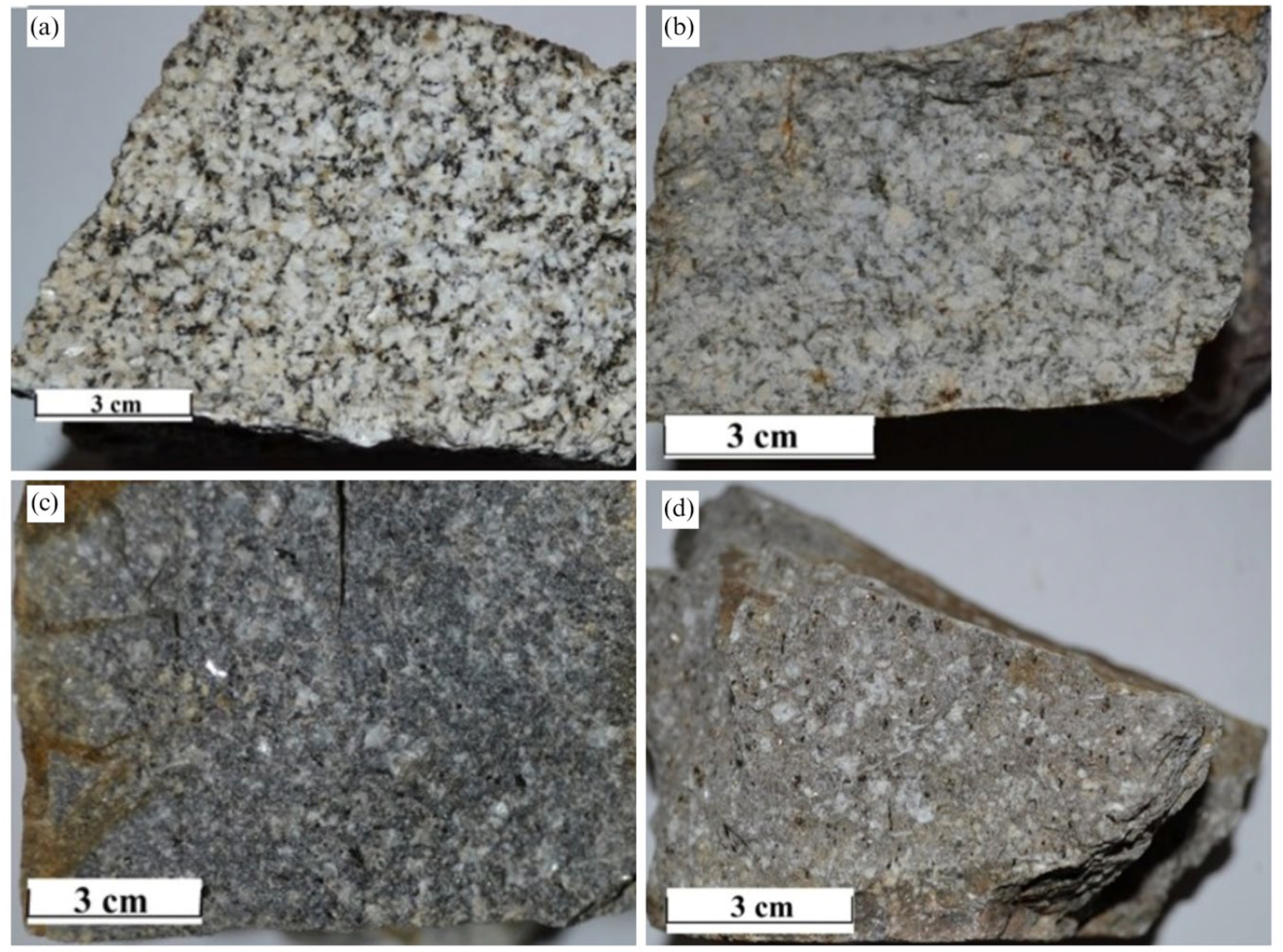
The Alday dike consists primarily of light-gray plagiogranites, in which white plagioclase grains and biotite flakes are clearly distinguished. Varieties with higher biotite content have a similar composition to plagiogranodiorites and granodiorites (Figure 5a,b). Small granodiorite-porphyry dikes are dark gray with a porphyritic texture containing plagioclase phenocrysts (Figure 5c). Plagiogranite porphyries are lighter in color, with fine-grained matrix containing porphyritic inclusions of plagioclase, quartz, and biotite flakes (Figure 5d).
In the Alday area, the pegmatite veins are grouped into three series.
The Northern series is located at the southern exocontact of the Korzhimbay massif and includes microcline–albite and albite–spodumene veins (thicknesses of 0.3–4.9 m, lengths of 100–150 m, dip of 82° NE). The most prospective is the Sluchaynaya vein, with a Ta2O5 content of 0.0142%. The thickness of the pegmatite veins increases with depth.
The Southern series of rare-metal pegmatites, together with the Kunush dikes, frames the southern exocontact of the Alday dike and is characterized by thicker microcline–albite and albite–spodumene pegmatite veins (up to 6.2 m), including the Novaya vein, some of which are blind (buried).
The Western series is traced to the western part of the occurrence and is dominated by albite–spodumene veins up to 2 m thick, while stair-step-type veins are observed in the Kunush dikes.
Ore zoning is expressed in the transverse bundle distribution of pegmatite veins, with albite–spodumene pegmatites located on the hanging side of the bundle (cross-sections). In addition, the thickness of microcline–albite veins increases at depths of 200–300 m.
Thus, the geological characteristics of the Alday occurrence were determined by establishing a systematic description of albite–spodumene pegmatites and hornfels affected by contact alterations. The samples analyzed by ICP-MS (Figure 6 and Figure 7) were collected specifically from these rock types, ensuring clear geological context and eliminating any impression of random selection.
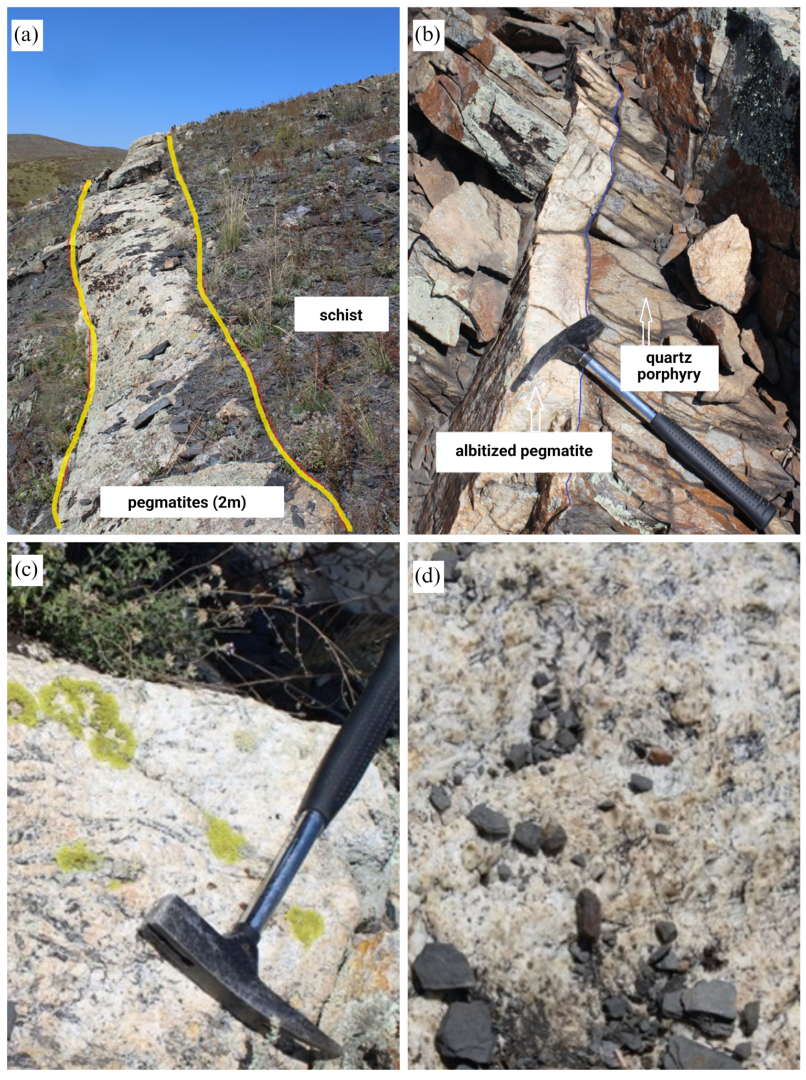
In the Alday area, the ore bodies are predominantly represented by microcline–albite and albite–spodumene pegmatites. Microcline–albite pegmatites primarily occur within the shale sequence and are characterized by a tabular shape with sharp contacts with the host rocks (Figure 6a), while individual albite-altered pegmatite veins crosscut the Kunush dikes (Figure 6b). Pegmatites contain relics of sedimentary rocks in the form of shadow spots and streaks (Figure 6c) and are characterized by a coarse-grained texture (Figure 6d).
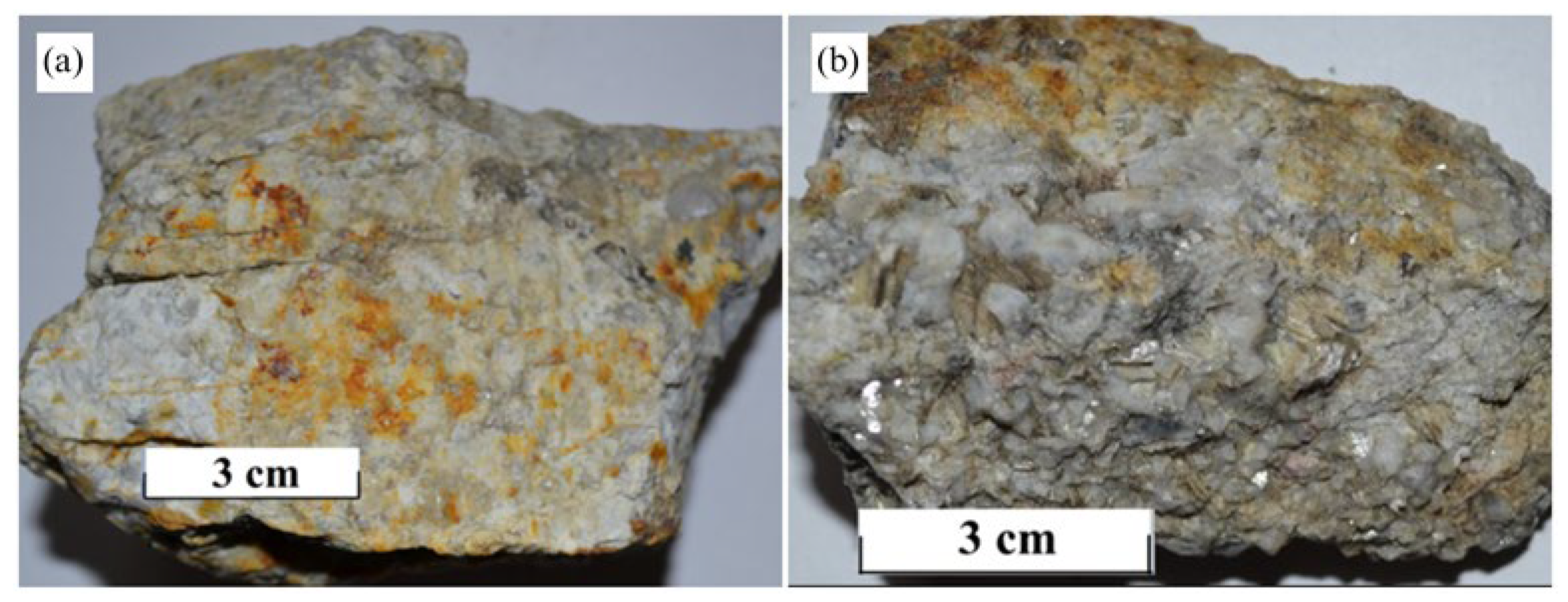
The pegmatites exhibit intense and uneven albitization, and compositionally, veins of quartz–microcline–albite–muscovite dominate (Figure 7a,b). According to exploration and evaluation studies, the average contents of valuable components (in g/t) are as follows: Ta2O5—87, Nb2O5—120, Sn—113, BeO—206, Li2O—140.
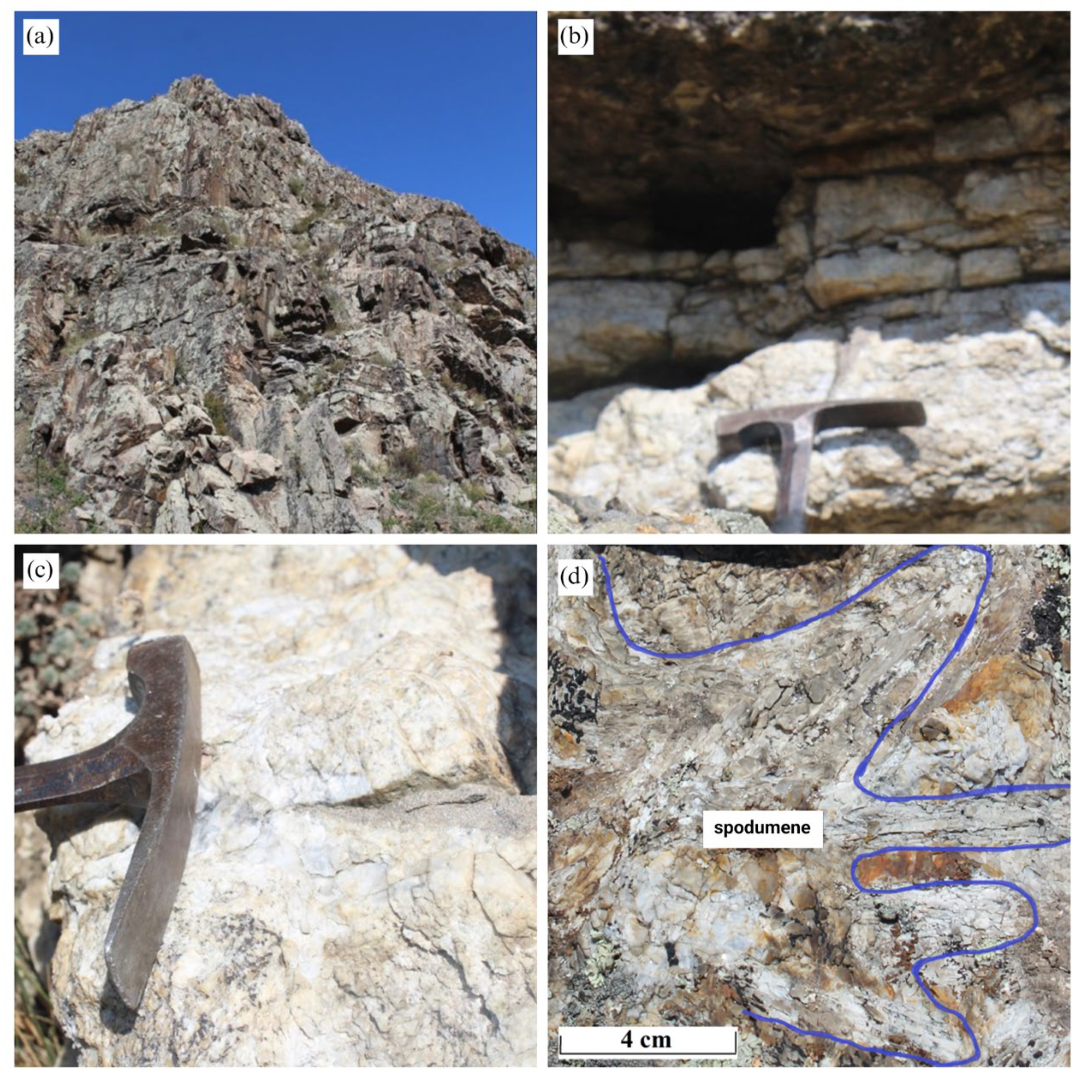
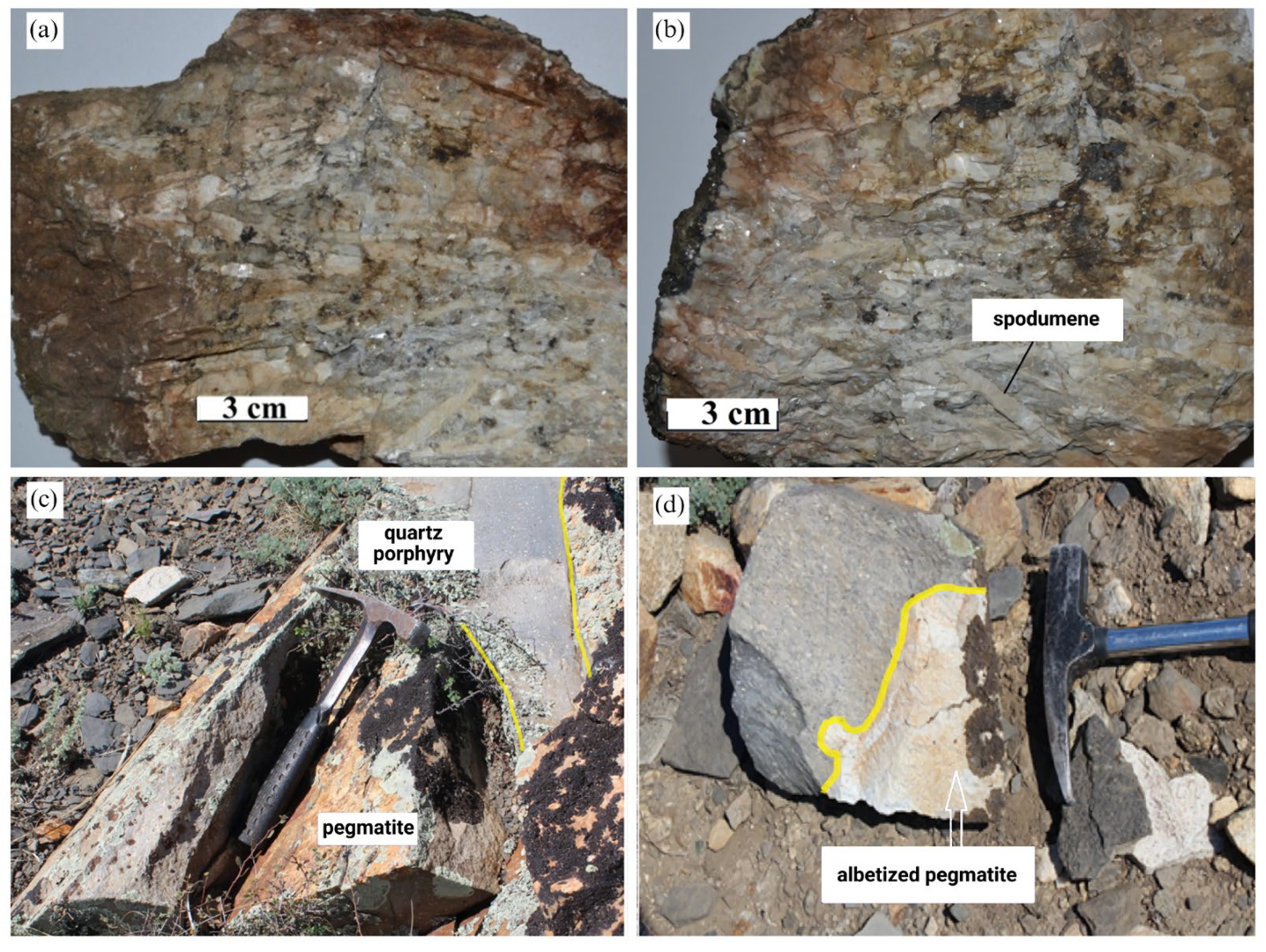
Albite–spodumene pegmatite veins also occur within the shale sequence, but a significant portion is localized in dike-like bodies of the Kunush complex, forming ladder-type structures. On the southeastern flank of the occurrence, large intensely deformed and fractured stock-like bodies of granodiorite porphyries host pegmatite veins with albite–spodumene mineralization (Figure 8a). In addition, there are steeply and gently dipping veins of irregular tabular shape that exhibit apophyses and sharp contacts with the host granodiorite porphyries (Figure 8b). The veins exhibit replacement structures, represented by zones of albitization and quartzification, and nests of spodumene crystals (Figure 8c,d).
The oriented arrangement of spodumene crystals and microfolds may suggest that pegmatite formation processes were influenced by directed tectonic compression [18,41,42] (Figure 9a,b). Multistage albitization appears to play a major role in ore formation, as it is strongly manifested both in pegmatites and in associated dikes (Figure 9c,d).
Spodumene (LiAl [Si2O6]) is identified as the principal ore mineral of lithium-bearing pegmatites in the Alday area. Its crystal length reaches 10–15 cm, and it is replaced by the secondary minerals cymatolite and eucryptite.

5. Results and Discussion

5.1. Mineralogy

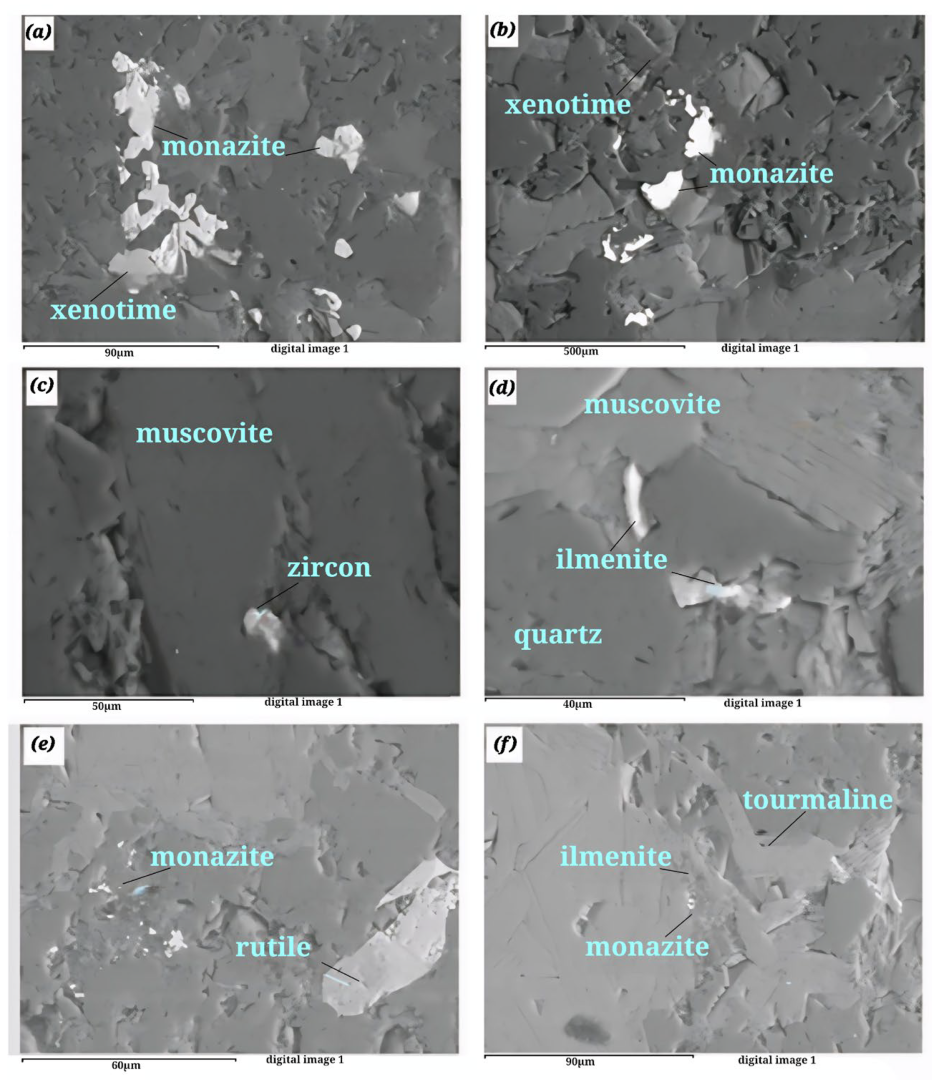
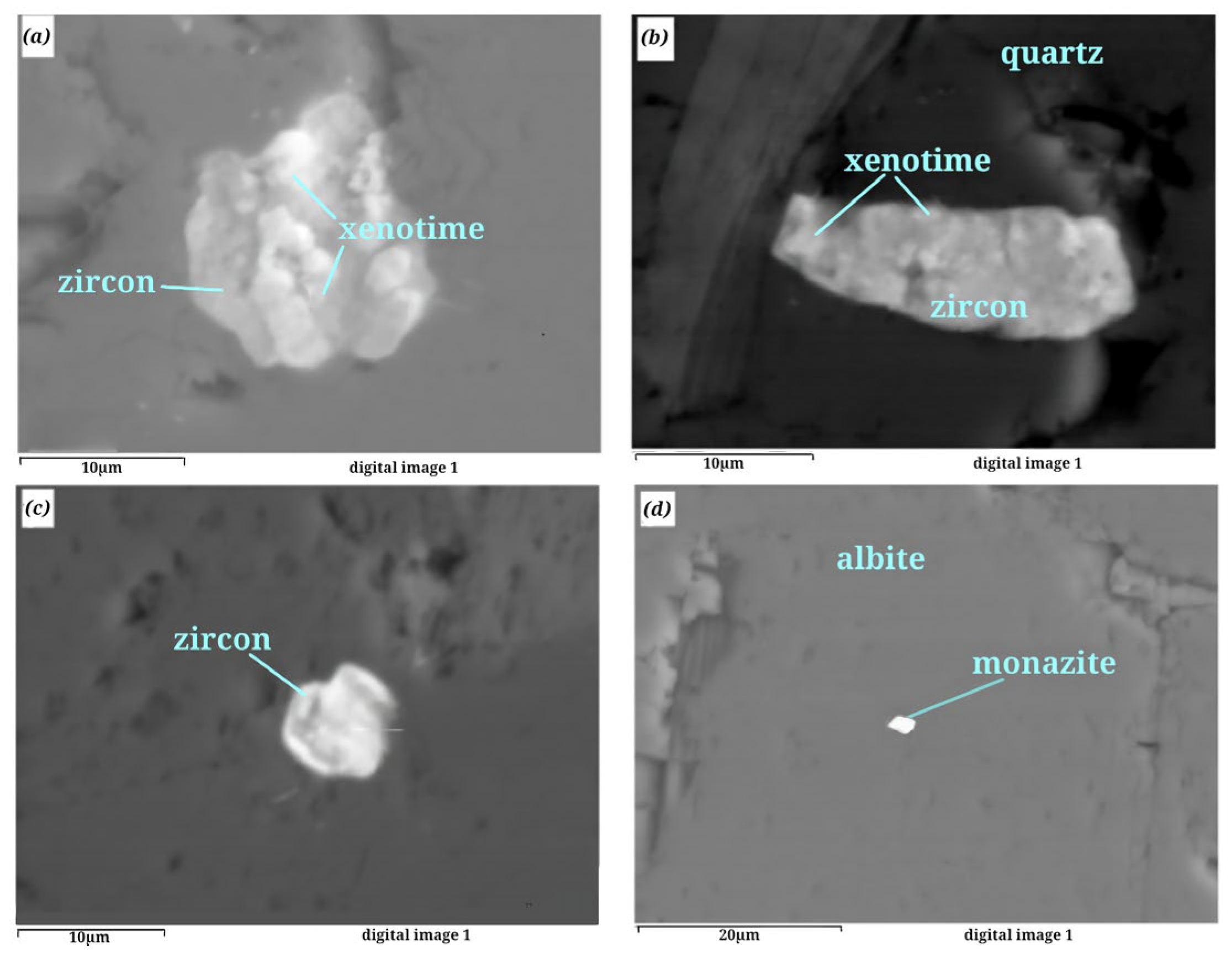
Rare-earth minerals—including monazite, xenotime, zircon, ilmenite, rutile, and tourmaline—were identified at the microscale within the greisenized and silicified hornfels (Figure 10). Monazite forms nest-like xenomorphic aggregates with grain sizes ranging from a few micrometers to several tens of micrometers, and also occurs as submicroscopic, cloud-like inclusions composed of La, Ce, Nd, Th, and P (Figure 10a,b,e). Xenotime is represented by individual micrograins of nodular morphology (Y 19.48 wt.%, P 8.34 wt.%), as shown in Figure 10c, and crystalline micrograins of ilmenite are observed within quartz (Figure 10f).
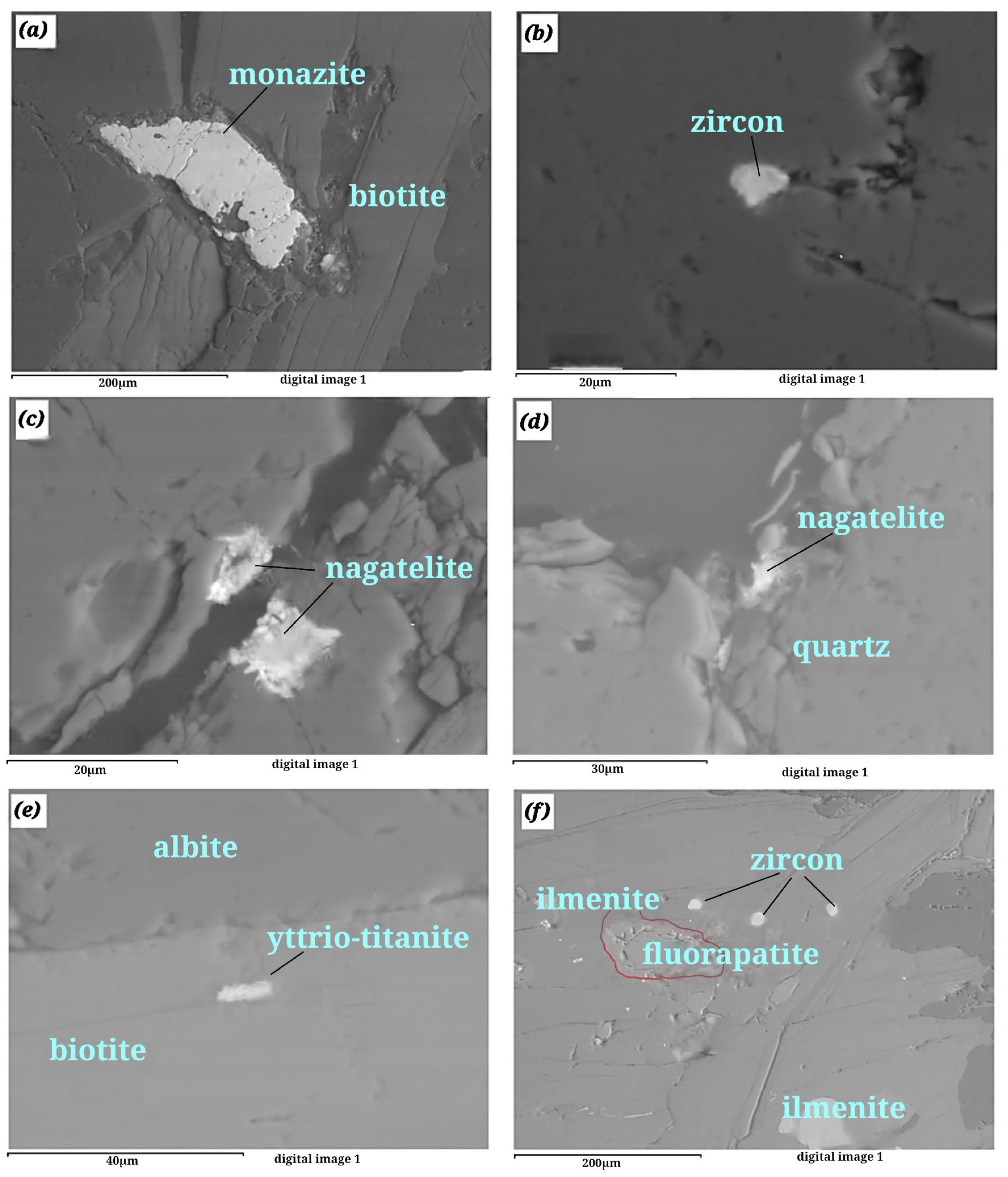
On the SEM images, plagiogranites predominantly contain micrograins of monazite, zircon, fluorapatite, and ilmenite ranging in size from tens up to 200 μm (Figure 11). The largest grains are represented by high-relief monazite, containing the following (in wt.%): La (8.50), Ce (18.56), Nd (7.10), Th (1.53), P (8.73). In this study, for the first time at the micro-scale, Ce-rich rare-earth minerals were identified in plagiogranites, with Ce content up to 36.77 wt.% they also contained the following (in wt.%): Fe—3.54; P—3.17; Si—37.93; Al—1.85; Ca—1.30 (Figure 11c,d). Their composition is similar to that of the rare-earth mineral nagatelite, (Ca,Ce)2(Al,Fe)3(Si,P)3O12[O,OH]. A rare Ti-bearing iridiosomite mineral was also observed in biotite in the form of inclusions measuring a few micrometers (Figure 11e). Its composition (in wt.%) includes Ti—13.76, Fe—13.76, Y—4.92, Nd—3.24, Sm—2.37, Gd—2.60, Ca—0.59, and other elements. This mineral has compositional similarities to yttrio-titanite (Ca,Y,Ce)Ti [SiO4]O, though it differs from yttrio-titanite in terms of its rare-earth-element content.
In the quartz albite-porphyry dikes, submicroscopic inclusions of Ti-bearing zircon with gray coloration and a zoned internal structure were identified, indicated by fine inclusions of white xenotime (P 6.53, Y 10.80, Si 21.64, O 55.27 wt.%) and submicroscopic monazite crystals (Figure 12).
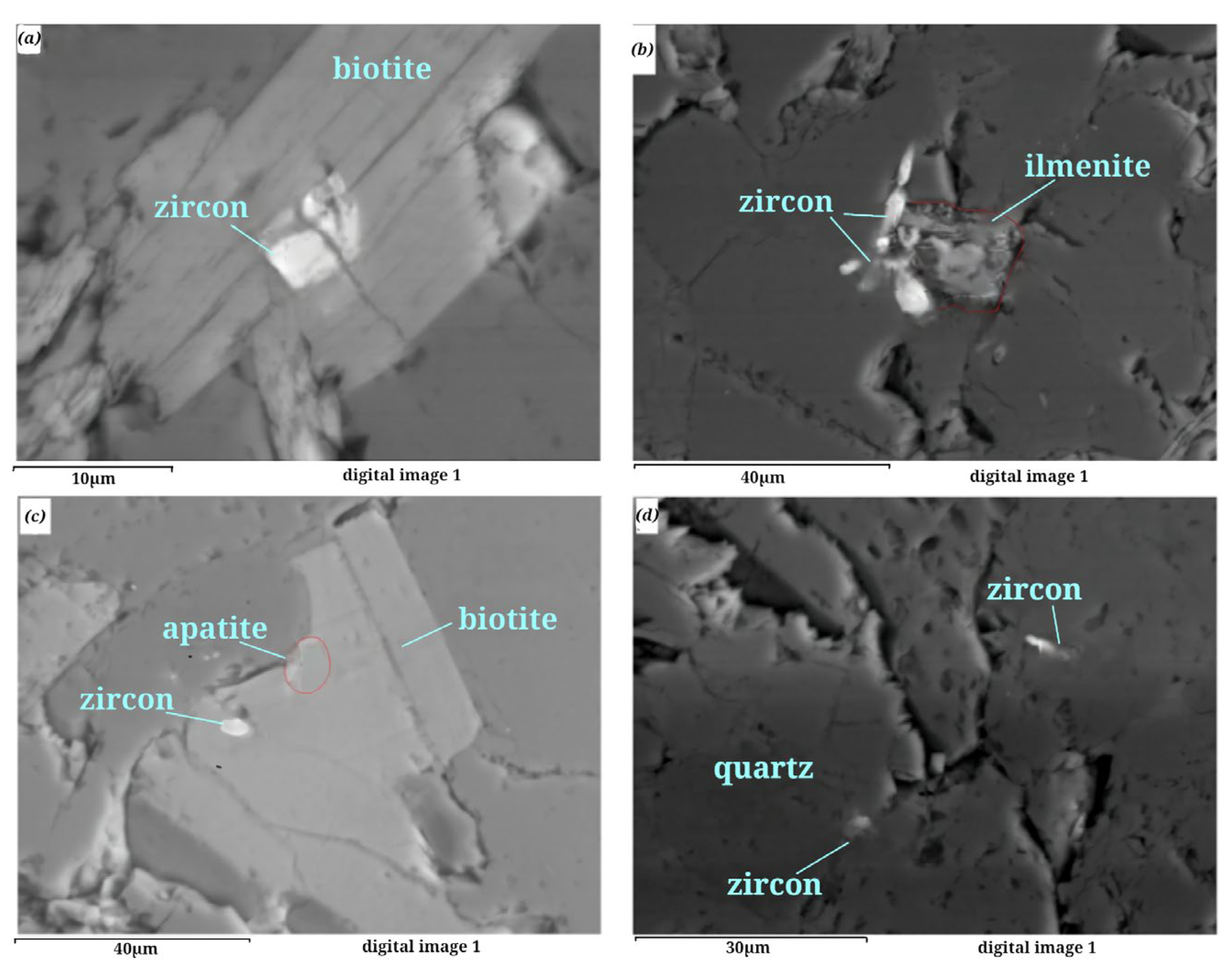
In the biotitized plagiogranite-porphyry dike, inclusions of apatite and nest-like aggregates of low-relief ilmenite were observed (Figure 12a–c). In addition, zircon micrograins, likely of an early generation, were found to be fixed in the quartz of the main mass.
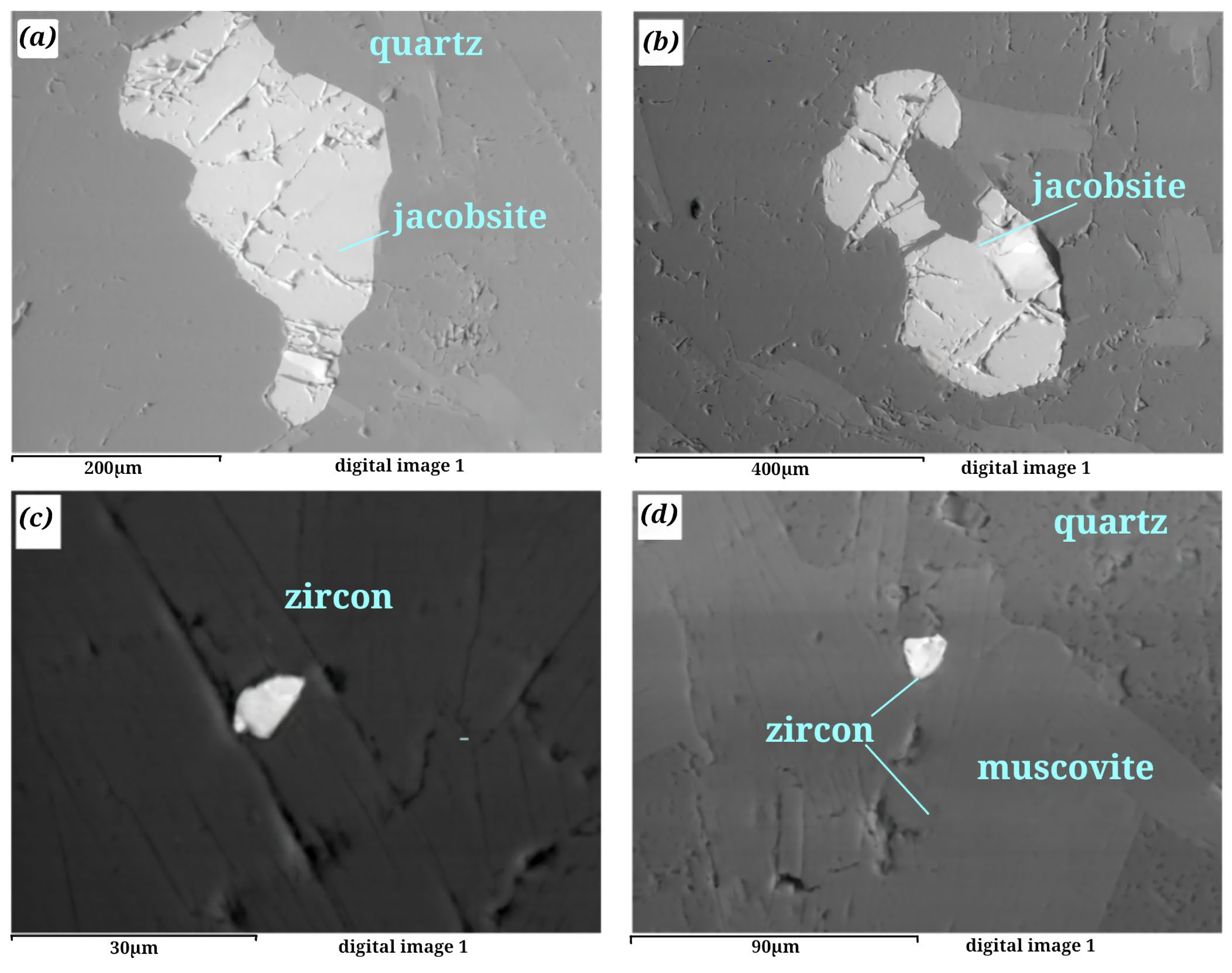
In metamorphosed quartz porphyries subjected to muscovitization, micrograins of manganese minerals that were compositionally close to jacobsite (MnFe2O4) were identified (Mn—10.95, Fe—9.24, O—47.89 wt.%). These minerals occur as relatively large, complex-shaped grains (up to 400 μm) localized in quartz and in the surrounding matrix, containing zircon inclusions (Figure 13a,b). In addition, idiomorphic zircon micrograins are fixed in quartz (Figure 14c,d).
Thus, according to the SEM analysis, in the plagiogranites and dikes of the Kunush Complex, fluid inclusions are predominantly represented by zircon, monazite, xenotime, apatite, and ilmenite. These minerals are localized in the rock matrix and in rock-forming minerals (quartz, albite, biotite, and muscovite). Morphologically, primary idiomorphic crystals of monazite, zircon, and xenotime are distinguished, and zoned zircon crystals containing submicroscopic xenotime inclusions are found. For the first time in plagiogranites, rare Ce-bearing REE minerals (nagatelite?) and Ti-iridiosomite (yttrotitanite?) are identified, developed in rock defects and likely of secondary origin. A noteworthy feature is the occurrence of a manganese mineral (jacobsite?) in the plagiogranite porphyries.
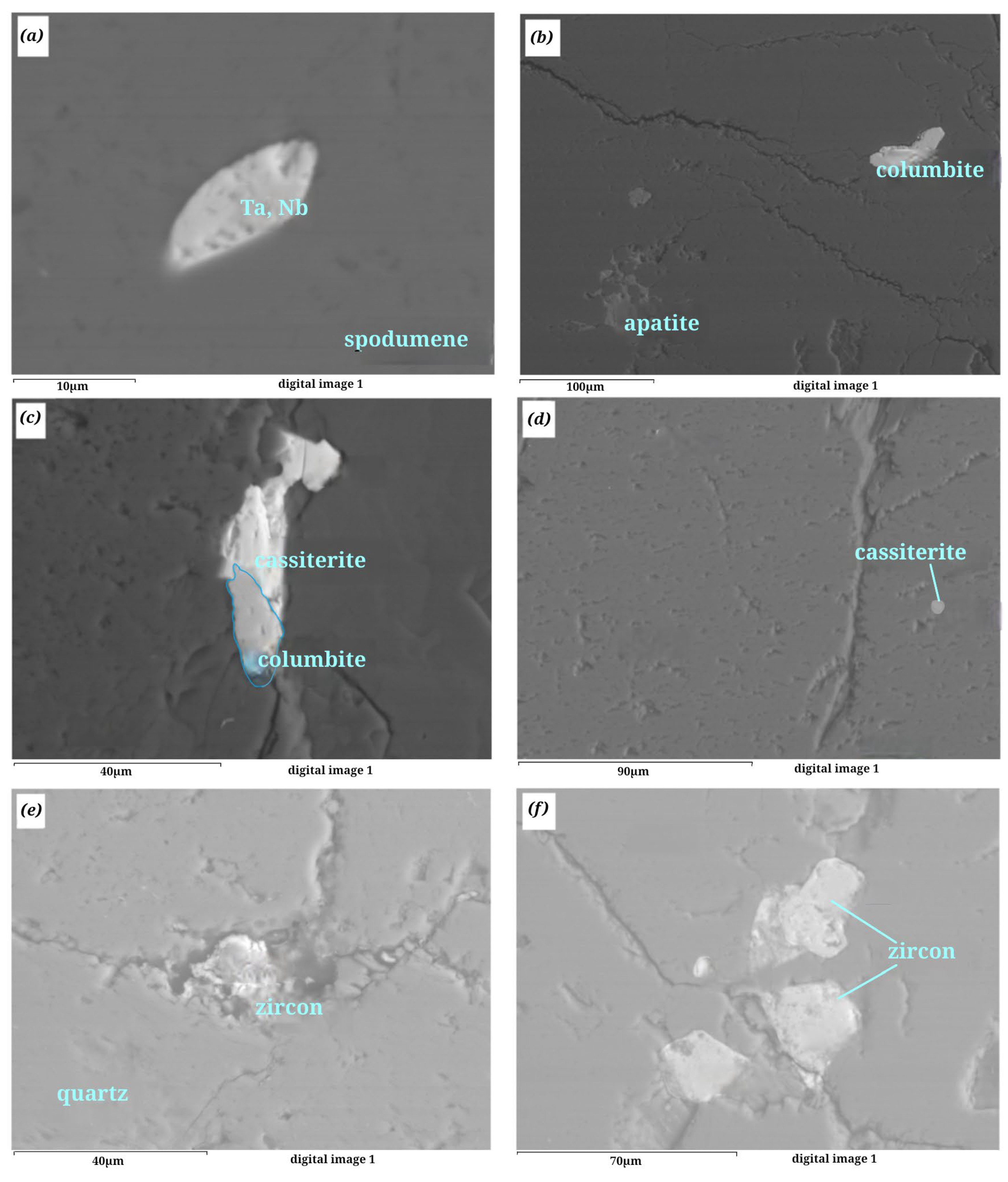
According to ICP-MS data, spodumene is characterized by high sodium-specific alkali content (in g/t) (Na—22,230, K—3243 (Na/K = 6.8)); elevated Al (54,100) and P (1983); and low Fe (90.32) and Mn (674), as well as lithium enrichment (1417 g/t) and relatively low Rb and Cs contents. Elevated concentrations (in g/t) of rare elements are also observed (Ta—15.27, Nb—108.92, Be—127.37, Sn—80). These data are corroborated by scanning electron microscopy results, which reveal microinclusions of rare-metal minerals (columbite–tantalite, columbite, and cassiterite) and associated apatite and zircon within the spodumene (Figure 15).
The widespread occurrence of Ti–Th–REE-bearing accessory minerals (monazite, xenotime, REE-rich zircon, ilmenite, rutile) in granitoids, dikes, and contact-metasomatic rocks of the Alday area reflects advanced magmatic differentiation and active fluid–magmatic interaction. Such mineral assemblages are typical of evolved granitoid systems approaching rare-metal specialization and record the enrichment of incompatible elements during late-stage melt and fluid evolution.
Although Ti–Th–REE minerals do not constitute economic mineralization in the Alday occurrence, their textural position and chemical composition indicate the same magmatic–hydrothermal system that ultimately generated lithium-bearing albite–spodumene pegmatites. The presence of monazite and xenotime, together with fractionated REE patterns and low Nb/Ta ratios, supports a genetic link between late granitoid differentiation, fluid activity, and the formation of Li–Ta–Nb–Sn mineralization. These accessory minerals therefore complement, rather than replace, the information provided by major rare-metal carriers such as cassiterite and columbite–tantalite.

5.2. Geochemistry

According to ICP-MS results, the elements with the highest concentrations (in g/t) in muscovitized hornfels are siderophile elements (Fe—26,780; Ti—5511) and petrogenic elements (Mg (13,356), Na (18,265), K (34,740), Ca (8225), P (1483), and Al (84,610)), primarily associated with muscovite. Chalcophile elements exhibit the following anomalous values: Cu—227.8, Pb—265.2, Zn—128.3. Among the rare-earth elements, the light REE group predominates (Ce—34.89, La—17.7, and Nd—13.16), which is consistent with the SEM data, which show monazite inclusions. The weighted concentrations of noble metals (in g/t) are as follows: Ag—1.24, Au—0.31, Pt—0.134, Pd—0.210. Hornfels are also characterized by elevated concentrations of alkali elements (Li—121.4–674.6; Rb—128.28; Cs—37.28) and rare metals (Ta—47.56, Sn—32.34, Nb—36.10), with measurable contents of Be, W, and Mo. This is likely due to the hornfels enrichment in muscovite, which acts as a concentrator of lithium and rare elements. The concentrations of dispersed elements (Ba, Y) are equal to their Clarke values.
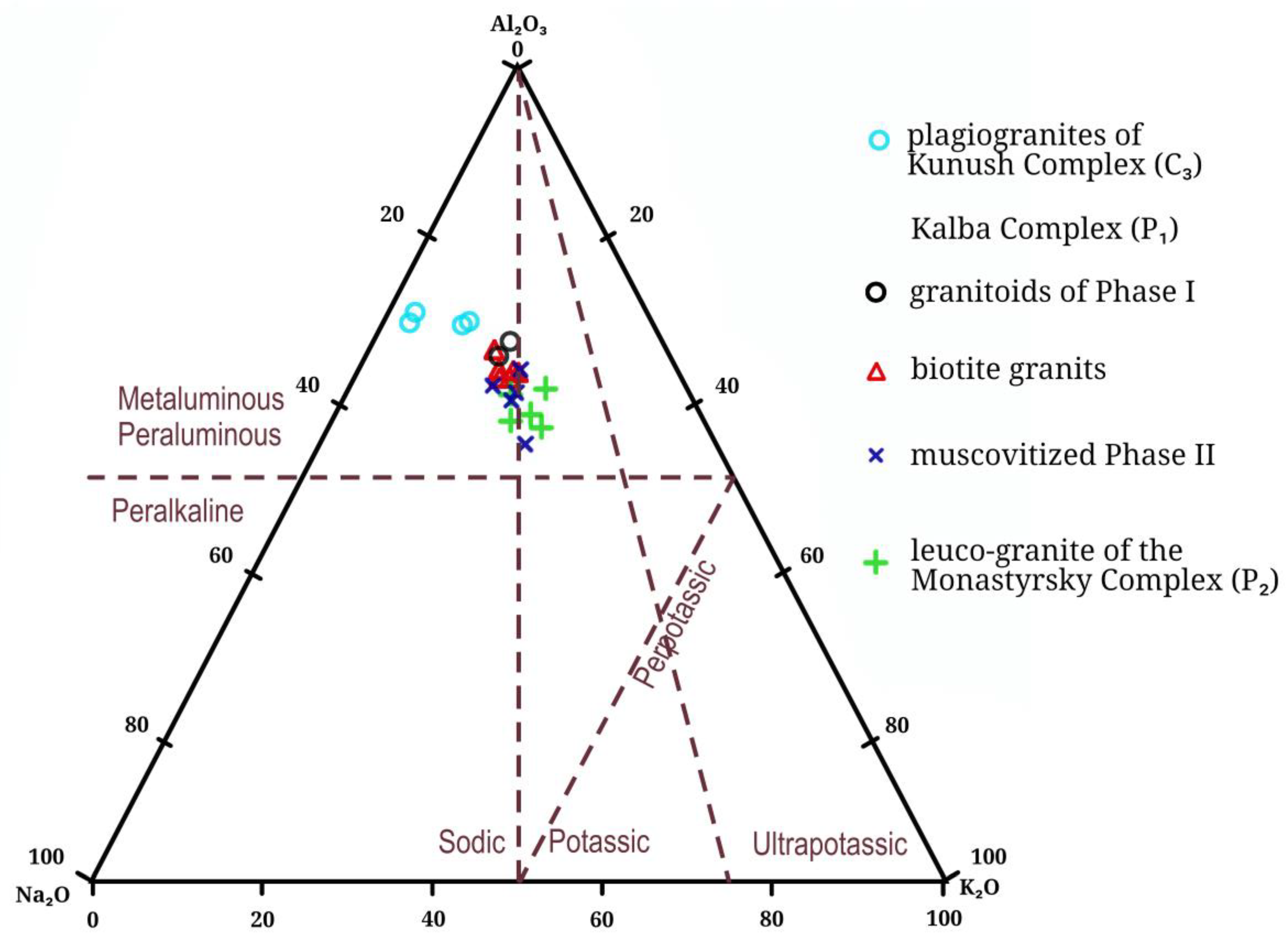
According to petrochemical data, the plagiogranites are characterized by low alkalinity, with a strong predominance of Na2O over K2O (Na2O/K2O > 4). In Figure 16, which presents a silica–alkalinity classification diagram, these rocks are plotted in the upper part of the granodiorite field. The nomenclature and general classification of igneous rocks follow widely accepted principles [43].
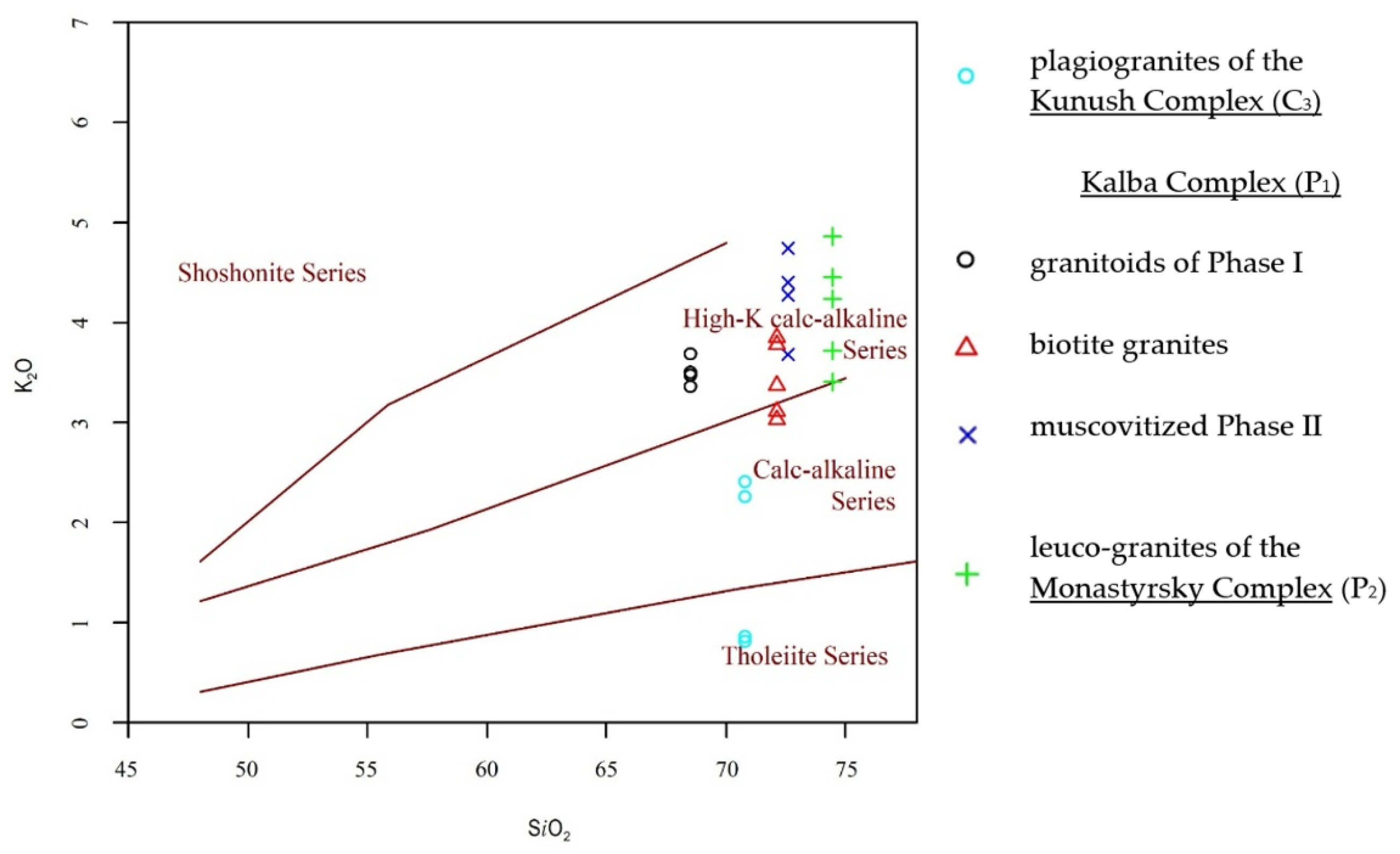
The diagram in Figure 17 presents the results of our whole-rock analyses of plagiogranites and related rocks, and the reference fields are taken from published classifications [46,47,48]. Identical SiO2 values in several samples reflect analytical rounding and averaging, rather than data duplication.
In the SiO2–K2O diagram presented in Figure 17, SiO2 and K2O correspond to the calc-alkaline and tholeiitic series. Plagiogranites also exhibit meta-aluminous characteristics and occupy a separate position in the diagram relative to the granitoids of the Kalba and Monastyrsky complexes [49,50].
In the SiO2–K2O diagram presented in Figure 17, our samples correspond to the calc-alkaline and tholeiitic series, and the reference fields are plotted according to Peccerillo and Taylor (1976) [46].
According to ICP-MS data, rare-earth elements in plagiogranites and dike formations exhibit a fractionated distribution with a predominance of lanthanide-group elements (La/Yb = 3.73–108.52). The sum of raress-earth elements reaches a value of 137.83 g/t, and elevated contents of Ce and La are observed in plagiogranites, plagiogranite-porphyry dikes, and quartz albite-porphyries (samples 1–4, 8), and the rocks are characterized by sodium-dominated alkalis (Na > K by 3–5 times) and elevated contents of petrogenic components (Ca, Al, Mg, P).
The distribution of rare metals and rare-earth elements is uneven. All rocks display anomalously high Li concentrations relative to the Clarke values in EC, reaching 208.30–306.00 g/t. In addition, elevated concentrations of Ta, Nb, and Sn are found in quartz porphyries and quartz albite-porphyries, which geochemically aligns them with the Ongonite dikes of Kalba [12,13], and the contents of Be, W, and Mo slightly exceed their Clarke values [12].
Table 1 presents the absolute concentrations of rare elements determined by ICP-MS in granitoid samples, which represent the baseline geochemical characteristics of different rock types. Table 2 summarizes indicative ratios and selected elements that are critical for tracing magmatic evolution. Unlike Table 1, which reports absolute concentrations, Table 2 emphasizes the geochemical parameters (K/Rb, Nb/Ta) used to classify granitoid groups into evolutionary stages (I–III).
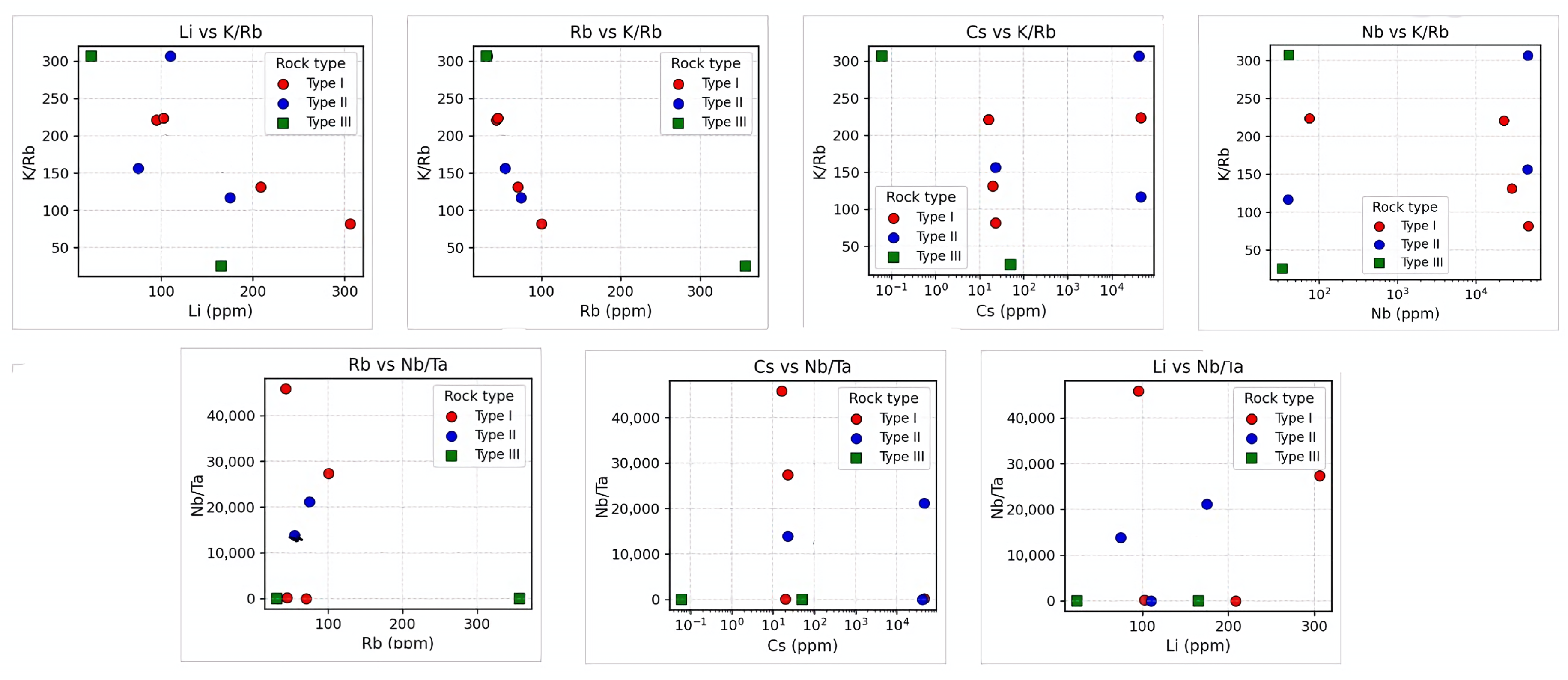
Based on the analysis of rocks from the Alday occurrence, the K/Rb–Li; K/Rb–Rb; K/Rb–Cs; and Nb/Ta–Li, Rb, and Cs diagrams show a clear evolutionary sequence from basic plagiogranites to quartz porphyries and albite-porphyries (Figure 18) [50].
Group I (plagiogranites and plagiogranodiorites; samples 1, 3, 4, and 5) rocks are characterized by relatively high K/Rb values (81.7–223.7) and a wide Nb/Ta range (1.7–176), which reflects an early, weakly evolved stage of granitoid magmatism [47,50]. The lithium and rubidium contents are moderate, while the cesium content reaches 20 ppm. The presence of Nb-enriched samples (e.g., sample A-6 (2), Nb/Ta = 176) indicates cumulative niobium accumulation in the melt prior to the onset of crystallization.
Group II (plagiogranite porphyries, samples 2, 6, 7) is characterized by K/Rb values ranging from 116 to 306, accompanied by a sharp decrease in Nb/Ta (0.05–1.6). A distinct redistribution of tantalum relative to niobium is observed, indicating the transition to more evolved magmatic conditions. Elevated cesium contents (up to 22.8 ppm) and the presence of samples with anomalously low Nb/Ta (e.g., AL-9 = 0.05) reflect active fluid involvement and the onset of rare-metal specialization.
Group III (quartz porphyries and albitophyres, samples 8, 9) rocks are distinguished by minimal K/Rb values (down to 25), as well as a sharp increase in Rb (up to 357 ppm), Cs (up to 50.7 ppm), and Ta (up to 64 ppm). Nb/Ta remains low (0.65–0.77), reflecting active redistribution of niobium and tantalum during magmatic–hydrothermal evolution, while high tin contents (up to 88 ppm) confirm late hydrothermal overprinting. Collectively, these features make this group the most promising in terms of lithium–rare-metal mineralization [47,50].
The evolution of rocks at the Alday ore occurrence can be traced from plagiogranites with high K/Rb and Nb/Ta to porphyries with reduced Nb/Ta and elevated Cs to albitophyres and quartz porphyries, which exhibit maximum enrichment in Li, Rb, Cs, and Ta at minimal Nb/Ta values. This reflects the transition of the system to a magmatic–hydrothermal stage and the establishment of conditions favorable for rare-metal mineralization.
The rare-earth element (REE) contents of the granitoids of the Kunush Complex in the Alday area are shown in Table 3.
Among the chalcophile elements, elevated concentrations of Cu, Zn, and Pb are observed, exceeding their Clarke values by 2–4 times (Table 4). In plagiogranodiorites, the anomalous Pb concentration reaches 565.70 g/t, and in the noble-metal group, significant contents of Sb, Ag, Au, and Pd, as well as As (1.85–3.12 g/t) and Bi (up to 12.54 g/t), are detected, reflecting the geochemical specialization of plagiogranites of the Kunush Complex for gold mineralization. Another feature of these plagiogranites is their anomalously high strontium content (Sr up to 718.4 g/t, Sr/Y = 38.2–101.9 g/t), which is typical of rocks of the Kunush Complex and comparable to the strontium content of adakite-type granites.
The spodumene enrichment observed in lithium and rare elements (Ta, Nb, Be, Sn) is consistent with data from other pegmatite deposits in the Kalba region (Bakennoe, Yubileynoe, Tochka, etc.) as well as international occurrences, indicating that this mineral can serve as an indicator of the main productive stage of pegmatite mineralization and should be considered during exploration.

5.3. Geochronology

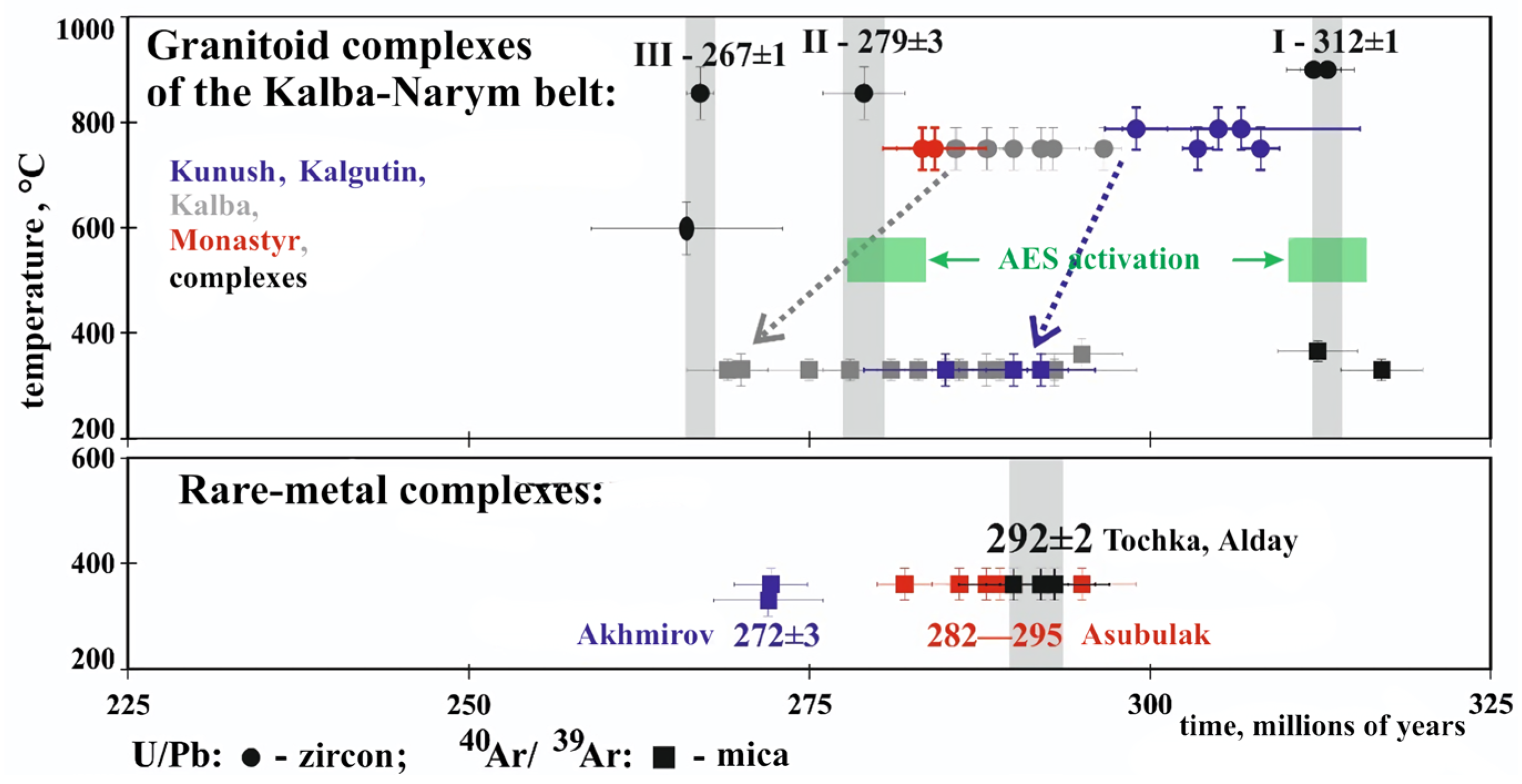
40Ar/39Ar dating was performed on muscovite extracted from spodumene pegmatites of the Chudskaya vein of the Tochka deposit (3 samples) and the Alday area (Figure 19). All spectra show well-defined plateaus with concordant ages of 293 ± 4, 293 ± 4, 292 ± 4, and 290 ± 4 Ma. These ages are consistent with geochronological data reported for rare-metal pegmatite systems in other regions [51].
These results indicate that the spodumene pegmatites are significantly younger than the Kunush Complex plagiogranites (Figure 19). Assuming that the formation of spodumene pegmatites was associated with the Kunush Complex plagiogranites, and that emplacement of later intrusive complexes caused partial re-setting of the muscovite isotopic system (whose closure temperature is approximately 370 °C), one would expect the ages of spodumene pegmatites to correspond to the youngest of the nearby intrusions—the Sibinsky massif of the Monastyrsky Complex (284 Ma). Furthermore, it seems unlikely that, under superimposed thermal events, deposits located at different distances from intrusions would yield such similar ages.
Considering this, it is reasonable to assume that the 40Ar/39Ar dating results correspond to the actual formation age of the spodumene pegmatites. Thus, the rare-metal deposits of the Karagoin–Saryozek ore zone formed synchronously with the emplacement of granodiorites and granodiorite–granites of the first phase of the Kalba Complex.
In several Hercynian provinces, LCT-type pegmatites are temporally decoupled from the emplacement of the last peraluminous granites, with age gaps of up to 10–15 Ma—as documented, for example, in the French Massif Central [52]. In such settings, it has been proposed that pegmatite formation results from later partial melting of fertile crustal sources or from remobilization processes independent of nearby granitic intrusions. In contrast, geochronological data available for the Alday area indicate that spodumene-bearing pegmatites crystallized at ~292–293 Ma, contemporaneous with Late Paleozoic magmatism of the Kalba complex. This temporal coincidence suggests a closer genetic relationship between pegmatite formation and regional granitic magmatism in the Alday area than in some other Hercynian domains. Nevertheless, this comparison highlights that multiple genetic pathway of pegmatite formation may operate within Hercynian belts, depending on the local geodynamic and thermal conditions.

6. Conclusions

The Alday ore occurrence is characterized by the evolution of granitoid magmatism from plagiogranites to quartz porphyries and albite-porphyries.
The K/Rb and Nb/Ta indicator ratios clearly indicate a transition from early magmatic stages (high K/Rb and Nb/Ta) to late magmatic–hydrothermal stages (low K/Rb and Nb/Ta).
During the late stages, the rocks exhibit intensive Li, Rb, Cs, Sn, and Ta enrichment, reflecting fluid involvement and indicating favorable conditions for lithium–rare-metal mineralization [53,54,55].
The most prospective lithologies for mineralization are quartz porphyries and albite-porphyries, which display low Nb/Ta (<1) and high concentrations of rare metals.
The obtained data allow a set of predictive criteria to be established for Alday: the presence of rocks with low K/Rb and Nb/Ta; enriched in Li, Rb, Cs, and Sn; and associated with late phases of granitoid magmatic evolution.
Morphological criteria. At the Alday occurrence, the main indicators of the productive stage are albite–spodumene pegmatite veins, localized within dike-like bodies of the Kunush Complex and forming ladder-type structures. Their thickness increases with depth, indicating potential for further mineralization at deeper horizons.
Mineralogical criteria. The main ore mineral is spodumene, enriched in Li (up to 1417 g/t), which contains microinclusions of rare-metal minerals (tantalite–columbite, cassiterite, zircon). The presence of these inclusions suggests that rare-metal associations were formed specifically during the productive stage of pegmatite formation.
Geochemical criteria. Spodumene and pegmatites are characterized by high concentrations of Ta, Nb, Be, and Sn, as well as low Rb and Cs with elevated Li, indicating a sodium-specific system. The K/Rb and Nb/Ta ratios mark the transition from early granitoids to the magmatic–hydrothermal phase with rare-metal enrichment.
Structural–geological criteria. Zonation is expressed in the transverse, bundle-like distribution of pegmatite veins: albite–spodumene bodies are located in the hanging side of the bundle, whereas microcline–albite veins thicken with depth. This systematic vein distribution serves as a key guide for exploration.
Tectonic factor. The formation of ore bodies occurred under directed tectonic compression, as evidenced by parallel-oriented spodumene crystals and their micro-folds. This factor created conditions for multi-stage albitization, which acts as the principal ore-forming process.
The combination of morphological, mineralogical, geochemical, and structural features allows a comprehensive set of predictive criteria to be established for Alday that are fully consistent with data from other rare-metal pegmatites of the Kalba area (Bakennoe, Yubileinoe, etc.) and international analogs [21,23]
40Ar/39Ar dating of muscovite from spodumene pegmatites of the Alday area yielded concordant ages of 293–290 Ma, indicating that these rare-metal objects formed synchronously with granodiorites and granodiorite–granites of the first phase of the Kalba Complex. These results refine the staging of rare-metal magmatism and confirm the genetic link of pegmatite mineralization with the late pulses of Kalba magmatism.

Author Contributions

Conceptualization, N.A.Z.; methodology, N.A.Z., I.E.M. and S.N.; software, A.Z.A. and S.N.; validation, N.A.Z. and I.E.M.; sampling, preconditioning of samples, and analytical work, N.A.Z., I.E.M. and G.B.O.; illustrations, I.E.M. and A.Z.A.; data curation, N.A.Z. and S.N.; writing—original draft preparation, I.E.M., S.N. and G.B.O.; writing—review and editing, N.A.Z.; project administration, N.A.Z. All authors have read and agreed to the published version of the manuscript.

Funding

This work was supported by the Committee for Science of the Ministry of Science and Education of Kazakhstan (registration No. AP 23484205).

Data Availability Statement

The data presented in this study are available on request from the corresponding author.

Acknowledgments

We thank the analysts from the VERITAS Engineering Laboratory and from the V.S. Sobolev Institute of Geology and Mineralogy (Alexey Travin) for their assistance with the analytical work.

Conflicts of Interest

Author Seib Nadine was employed by the company Kepler Group Ltd. The remaining authors declare that the research was conducted in the absence of any commercial or financial relationships that could be construed as potential conflicts of interest.

References

  1. Jahn, B.-M.; Wu, F.; Chen, B. Granitoids of the Central Asian Orogonic Belt and continental growth in the Phanerozoic. Earth Environ. Sci. Trans. R. Soc. Edinb. 2000, 91, 181–193. [Google Scholar] [CrossRef]
  2. Kozakov, I.K.; Kovach, V.P.; Bibikova, E.V.; Kirnozova, T.I.; Zagornaya, N.Y.; Plotkina, Y.V.; Podkovyrov, V.N. Age and sources of granitoids in the junction zone of the Caledonides and Hercynides in southwestern Mongolia: Geodynamic implications. Petrology 2007, 15, 126–150. [Google Scholar] [CrossRef]
  3. Zhang, S.H.; Zhao, Y.; Kröner, A.; Liu, X.M.; Xie, L.W.; Chen, F.K. Early Permian plutons from the northern North China Block: Constraints on continental arc evolution and convergent margin magmatism related to the Central Asian Orogenic Belt. Int. J. Earth Sci. 2009, 98, 1441–1467. [Google Scholar] [CrossRef]
  4. Yarmolyuk, V.V.; Kuzmin, M.I.; Kozlovsky, A.M. Late paleozoic-Early Mesozoic within-plate magmatism in North Asia: Traps, rifts, giant batholiths, and the geodynamics of their origin. Petrology 2013, 21, 101–126. [Google Scholar] [CrossRef]
  5. Tsygankov, A.A. Late Paleozoic granitoids in western Transbaikalia: Sequence of formation, sources of magmas, and geodynamics. Russ. Geol. Geophys. 2014, 55, 153–176. [Google Scholar] [CrossRef]
  6. Khromykh, S.V.; Tsygankov, A.A.; Kotler, P.D.; Navozov, O.V.; Kruk, N.N.; Vladimirov, A.G.; Travin, A.V.; Yudin, D.S.; Burmakina, G.N.; Khubanov, V.B.; et al. Late Paleozoic granitoid magmatism of Eastern Kazakhstan and Western Transbaikalia: Plume model test. Russ. Geol. Geophys. 2016, 57, 773–789. [Google Scholar] [CrossRef]
  7. Tsygankov, A.A.; Burmakina, G.N.; Khubanov, V.B.; Buyantuev, M.D. Geodynamics of Late Paleozoic batholith-forming processes in western Transbaikalia. Petrology 2017, 25, 396–418. [Google Scholar] [CrossRef]
  8. Şengör, A.; Natal’in, B.; Burtman, V. Evolution of the Altaid tectonic collage and Palaeozoic crustal growth in Eurasia. Nature 1993, 364, 299–307. [Google Scholar] [CrossRef]
  9. Sengör, A.C.; Sunal, G.; Natal’In, B.A.; van der Voo, R. The Altaids: A review of twenty-five years of knowledge accumulation. Earth Sci. Rev. 2022, 228, 104013. [Google Scholar] [CrossRef]
  10. Yarmolyuk, V.V.; Kuzmin, M.I. Late Paleozoic and Early Mesozoic rare-metal magmatism of Central Asia: Stages, provinces, and formation settings. Geol. Ore Depos. 2012, 54, 313–333. [Google Scholar] [CrossRef]
  11. Zagorsky, V.; Vladimirov, A.G.; Makagon, V.M.; Kuznetsova, L.G.; Smirnov, S.Z.; D’yachkov, B.A.; Annikova, I.; Shokalsky, S.P.; Uvarov, A.N. Large fields of spodumene pegmatites in the settings of rifting and postcollisional shear-pull-apart dislocations of continental lithosphere. Russ. Geol. Geophys. 2014, 55, 237–251. [Google Scholar] [CrossRef]
  12. Kotler, P.; Khromykh, S.; Kruk, N.; Sun, M.; Li, P.; Khubanov, V.; Semenova, D.; Vladimirov, A. Granitoids of the Kalba batholith, Eastern Kazakhstan: U–Pb zircon age, petrogenesis and tectonic implications. Lithos 2021, 388–389, 106056. [Google Scholar] [CrossRef]
  13. Zimanovskaya, N.; Oitseva, T.; Khromykh, S.; Travin, A.; Bissatova, A. Geology, Mineralogy, and Age of Li-Bearing Pegmatites: Case Study of Tochka Deposit (East Kazakhstan). Minerals 2022, 12, 1478. [Google Scholar] [CrossRef]
  14. Dyachkov, B.A.; Maiorova, N.P.; Shcherba, G.N.; Abdrakhmanov, K.A. Granitoid and Ore Formations of the Kalba–Narym Belt (Rudny Altai); Nauka: Almaty, Kazakhstan, 1994; p. 208. [Google Scholar]
  15. Dyachkov, B.A.; Bissatova, A.Y.; Mizernaya, M.A.; Khromykh, S.V.; Oitseva, T.A.; Kuzmina, O.N.; Zimanovskaya, N.A.; Aitbayeva, S.S. Mineralogical Tracers of Gold and Rare-Metal Mineralization in Eastern Kazakhstan. Minerals 2021, 11, 253. [Google Scholar] [CrossRef]
  16. Vladimirov, A.G. Granitoid Magmatism of the Central Asian Orogenic Belt. Petrology 2003, 11, 368–388. (In Russian) [Google Scholar]
  17. Kuibida, M.L.; Dyachkov, B.A.; Vladimirov, A.G.; Kruk, N.N.; Khromykh, S.V.; Kotler, P.D.; Rudnev, S.N.; Kruk, E.A.; Kuibida, Y.V.; Oitseva, T. Contrasting Granitic Magmatism of the Kalba Fold Belt (East Kazakhstan): Evidence for Late Paleozoic Post-Orogenic Events. J. Asian Earth Sci. 2019, 175, 178–198. [Google Scholar] [CrossRef]
  18. Khromykh, S.V.; Oitseva, T.A.; Kotler, P.D.; D’yachkov, B.A.; Smirnov, S.Z.; Travin, A.V.; Vladimirov, A.G.; Sokolova, E.N.; Kuzmina, O.N.; Mizernaya, M.A.; et al. Rare-Metal Pegmatite Deposits of the Kalba Region, Eastern Kazakhstan: Age, Composition and Petrogenetic Implications. Minerals 2020, 10, 1017. [Google Scholar] [CrossRef]
  19. Dyachkov, B.A. Granitoids of Eastern Kalba and Associated Post-Magmatic Formations. In Geology, Geochemistry, and Mineralogy of Rare-Element Deposits of Kazakhstan; Transactions of KazIMS; Nauka: Alma-Ata, Kazakhstan, 1966; pp. 69–79. (In Russian) [Google Scholar]
  20. D’yachkov, B.A.; Titov, D.V.; Sapargaliev, E.M. Ore belts of the Greater Altai and their ore resource potential. Geol. Ore Depos. 2009, 51, 197–211. [Google Scholar] [CrossRef]
  21. Lopatnikov, V.V.; Izokh, E.P.; Ermolov, P.V.; Ponomareva, A.P.; Stepanov, A.S. Magmatism and Ore Potential of the Kalba–Narym Zone of Eastern Kazakhstan; Nauka: Moscow, Russia, 1982; p. 248. (In Russian) [Google Scholar]
  22. Oitseva, T.A.; D’yachkov, B.A.; Kuzmina, O.N.; Bissatova, A.Y.; Ageyeva, O.V. Li-Bearing Pegmatites of the Kalba–Narym Metallogenic Zone (East Kazakhstan): Mineral Potential and Exploration Criteria. Ser. Geol. Tech. Sci. 2022, 1, 83–90. [Google Scholar] [CrossRef]
  23. Shcherba, G.N.; Bespaev, X.A.; Dyachkov, B.A.; Mysnik, A.M.; Ganzhenko, G.D.; Sapargaliev, E.M. Big Altai: Geology and Metallogeny; Book 2. Metallogeny; RIO VAK RK: Almaty, Kazakhstan, 2000; p. 400. [Google Scholar]
  24. Vladimirov, A.G.; Kruk, N.N.; Kotler, P.D.; Khromykh, S.V.; Travin, A.V.; Murzintsev, N.G.; Navozov, O.V.; Karavaeva, G.S. Granitoid Magmatism of the Kalba–Narym Batholith (Eastern Kazakhstan): Age and Geodynamic Interpretation. Petrology 2013, 21, 1–17. (In Russian) [Google Scholar]
  25. Rybina, L.P.; Volovikov, S.A.; Giptev, S.S. Reappraisal and Grading of Discovered Rare-Metal Occurrences in the Central Kalba Area, 1992–1994; Report of the Geological Survey/Institute, East Kazakhstan; Geological Survey/Institute East Kazakhstan: Almaty, Kazakhstan, 1994. [Google Scholar]
  26. Travin, A.V.; Vladimirov, A.G.; Khromykh, S.V.; Kotler, P.D.; Sokolova, E.N.; Smirnov, S.Z.; Gavryushkina, O.A.; Oitseva, T.A.; Annikova, I.Y.; Murzintsev, N.G. Stages and Duration of Formation of the Kalguty Mo–W Ore–Magmatic System (Altai): Thermochronology and Mathematical Modeling. Russ. Geol. Geophys. 2019, 60, 890–910. [Google Scholar] [CrossRef]
  27. Osipova, G.F.; Tupicyn, A.V.; Ksijashko, P.L.; Rassolov, S.M. Exploration in the Area of Tochka Deposit, 1988–1990; Technical Report; Vostkazgeologiya Production Geological Association: Ust-Kamenogorsk, Kazakhstan, 1990. (In Russian) [Google Scholar]
  28. Annikova, I.Y.; Vladimirov, A.G.; Smirnov, S.Z.; Oitseva, T.A.; Mikheev, E.I.; Jes, E.N.; Travin, A.V.; D’yachkov, B.A.; Maslov, V.I.; Gertner, I.F. Geology and mineralogy of the Novo-Akhmirovskoe deposit of lithium topaz-zinnwaldite granites (East Kazakhstan). Lithosphere 2019, 19, 304–326. [Google Scholar] [CrossRef][Green Version]
  29. Ermolin, V.T. Report on Detailed Exploration Works by Asubulak GEP in 1974–1975 (Apogranitny, Medvedka, Tochka Sites); Vostkazgeologiya Production Geological Association: Ust-Kamenogorsk, Kazakhstan, 1976; p. 136. (In Russian) [Google Scholar]
  30. Dyachkov, B.A.; Oitseva, T.A.; Zimanovskaya, N.A.; Bissatova, A.Y.; Agalieva, B.B.; Ageeva, O.V. East Kazakhstan Rare Earths Deposits Formation. Asp. Min. Miner. Sci. AMMS 2021, 7, 785–786. [Google Scholar] [CrossRef]
  31. Dyachkov, B.A.; Mizernaya, M.A.; Khromykh, S.V.; Bissatova, A.Y.; Oitseva, T.A.; Miroshnikova, A.P.; Frolova, O.V.; Kuzmina, O.N.; Zimanovskaya, N.A.; Pyatkova, A.P.; et al. Geological history of the Great Altai: Implications for mineral exploration. Minerals 2022, 12, 744. [Google Scholar] [CrossRef]
  32. Kuibida, M.L.; Kruk, N.N.; Vladimirov, A.G.; Polyanskii, N.V.; Nikolaeva, I.V. U-Pb isotopic age, composition, and sources of the plagiogranites of the Kalba range, Eastern Kazakhstan. Dokl. Earth Sci. 2009, 424, 72–76. [Google Scholar] [CrossRef]
  33. Kotler, P.D.; Khromykh, S.V.; Vladimirov, A.G.; Travin, A.V.; Kruk, N.N.; Murzintsev, N.G.; Navozov, O.V.; Karavaeva, G.S. New Data on the Age and Geodynamic Interpretation of the Kalba–Narym Granitic Batholith, Eastern Kazakhstan. Dokl. Earth Sci. 2015, 462, 565–569. [Google Scholar] [CrossRef]
  34. Khromykh, S.V.; Kotler, P.D.; Izokh, A.E.; Kruk, N.N. A review of Early Permian (300–270 Ma) magmatism in Eastern Kazakhstan and implications for plate tectonics and plume interplay. Geodyn. Tectonophys. 2019, 10, 79–99. [Google Scholar] [CrossRef]
  35. Kashcheev, V.F.; Butko, A.R.; Distryanov, V.M.; Sinishin, P.I. Report on Results of Exploration Works in Karagoyn-Saryozek Zone in 1956; Vostkazgeologiya Production Geological Association: Ust-Kamenogorsk, Kazakhstan, 1957; p. 190. (In Russian) [Google Scholar]
  36. Dyachkov, B.A.; Oitseva, T.A.; Frolova, O.V.; Mataibaeva, I.Y.; Kuzmina, O.N. Geotectonic position and ore potential of intrusivedyke belts in East Kazakhstan. In Proceedings of the 17th International Multidisciplinary Scientific Geoconference, Albena, Bulgaria, 27 June–6 July 2017; pp. 239–246. [Google Scholar] [CrossRef]
  37. Agilent Technologies. 7500cx ICP-MS Hardware Manual; Agilent Technologies: Santa Clara, CA, USA, 2012. [Google Scholar]
  38. JEOL, Ltd. JSM-6390LV Scanning Electron Microscope Instruction Manual; JEOL, Ltd.: Tokyo, Japan, 2010. [Google Scholar]
  39. Travin, A.V.; Yudin, D.S.; Vladimirov, A.G.; Khromykh, S.V.; Volkova, N.I.; Mekhonoshin, A.S.; Kolotilina, T.B. Thermochronology of the Chernorud granulite zone, Ol’khon Region, Western Baikal area. Geochem. Int. 2009, 47, 1107–1124. [Google Scholar] [CrossRef]
  40. Baksi, A.K.; Archibald, D.A.; Farrar, E. Intercalibration of 40Ar–39Ar dating standards. Chem. Geol. 1996, 129, 307–324. [Google Scholar] [CrossRef]
  41. Černý, P.; London, D. Granite Pegmatites: The State of the Art. Ore Geol. Rev. 2019, 113, 493–523. [Google Scholar]
  42. Bradley, D.; Schulz, K.J. Critical Mineral Resources of the World—Lithium, Tantalum, Niobium; U.S. Geological Survey: Reston, VA, USA, 2022; p. 85. [Google Scholar]
  43. Middlemost, E.A.K. Naming Materials in the Magma/Igneous Rock System. Earth-Sci. Rev. 1994, 37, 215–224. [Google Scholar] [CrossRef]
  44. Frost, B.R.; Barnes, C.G.; Collins, W.J.; Arculus, R.J.; Ellis, D.J.; Frost, C.D. A Geochemical Classification for Granitic Rocks. J. Petrol. 2001, 42, 2033–2048. [Google Scholar] [CrossRef]
  45. Maniar, P.D.; Piccoli, P.M. Tectonic discrimination of granitoids. Geol. Soc. Am. Bull. 1989, 101, 635–643. [Google Scholar] [CrossRef]
  46. Peccerillo, A.; Taylor, S.R. Geochemistry of Eocene Calc-Alkaline Volcanic Rocks from the Kastamonu Area, Northern Turkey. Contrib. Mineral. Petrol. 1976, 58, 63–81. [Google Scholar] [CrossRef]
  47. Rollinson, H. Using Geochemical Data: Evaluation, Presentation, Interpretation, Updated ed.; Routledge: London, UK, 1993; p. 352. [Google Scholar]
  48. Bradley, D.C.; Stillings, L.L.; Jaskula, B.W.; Munk, L.A.; McCauley, A.D. Lithium, Chapter K of Critical Mineral Resources of the United States—Economic and Environmental Geology and Prospects for Future Supply; Schulz, K.J., DeYoung, J.H., Jr., Seal, R.R., II, Bradley, D.C., Eds.; U.S. Geological Survey Professional Paper 1802; U.S. Geological Survey: Reston, VA, USA, 2017; pp. K1–K21. [Google Scholar] [CrossRef]
  49. Boynton, W.V. Cosmochemistry of the Rare Earth Elements. In Rare Earth Element Geochemistry; Henderson, P., Ed.; Elsevier: Amsterdam, The Netherlands, 1984; pp. 63–114. [Google Scholar]
  50. Shaw, D.M. The Geochemistry of K/Rb Ratios in Granitic Rocks. Geochim. Cosmochim. Acta 1968, 32, 573–601. [Google Scholar] [CrossRef]
  51. Wang, H.-Y.; Tang, Y.; Zhang, H.; Lv, Z.-H.; Xu, Y.-S. The Geochronology of the Rare-Metal Pegmatite Deposits: A Case Study in Nanping No. 31 Pegmatite Vein in Northeastern Cathaysia Block, China. Ore Geol. Rev. 2023, 153, 105280. [Google Scholar] [CrossRef]
  52. Deveaud, S.; Gumiaux, C.; Gloaguen, E.; Branquet, Y. The genesis of LCT-type granitic pegmatites, as illustrated by lithium isotopes in micas. Chem. Geol. 2015, 418, 63–81. [Google Scholar] [CrossRef]
  53. Malis, K.; Absametov, M.; Boyarko, G.; Dutova, E.; Bolsunovskaya, L.; Itemen, N.; Chenzybaev, D. Lithium Capacity of Kazakhstan Mineral Resource Base. Bull. Tomsk Polytech. Univ. Geo Assets Eng. 2024, 335, 141–154. (In Russian) [Google Scholar] [CrossRef]
  54. Smithies, R.H.; Lu, Y.; Champion, D.C.; Sweetapple, M.T.; Lowrey, J.R.; Bowman, N.H.; Cassidy, K.F.; Ivanic, T.J.; Kemp, A.I.S.; Turnbull, R.E.; et al. Giant lithium-rich pegmatites in Archean cratons form by ultra-differentiated granites. Commun. Earth Environ. 2025, 6, 330. [Google Scholar] [CrossRef]
  55. Pereira Pierangeli, L.M.; Sirbescu, M.L.C.; Godinho Silva, S.H.; Weindorf, D.C.; Benson, T.R.; Curi, N. Soil Geochemistry Toward Lithium Pegmatite Exploration: Building a Machine-Learning Predictive Algorithm via Portable X-Ray Fluorescence. Econ. Geol. 2025, 120, 1311–1330. [Google Scholar] [CrossRef]
Figure 1. Location map of rare-metal deposits and occurrences in the Kalba–Narym belt [14]. Abbreviations stand for names of mineral deposits: Ko—Korosteli; RS—Rzhavaya Sopka; Mh—Mokhnatukha; MK—Malaya Kainda; Kv—Kvartz; Zl—Zelenoye; Kn—Kanaika; NS—Novo-Saryozek; Md—Medvedka; To—Tochka; Kr—Karagoin; Og—Ognevka; Bn—Bakennoye; Yu—Yubileinoye; BG—Belaya Gora; Kz—Kozlovskoye; Km—Komarovskoye; Ks—Komsomolskoye; Ch—Chebuntay; Pl—Palatsy; Chr—Cherdoyak; Ka—Kasatka; Br—Burabay; Kar—Karasu. Sibiny pluton.
Minerals 16 00148 g001
Figure 2. Geological map and cross-sections of the Alday area [35].
Minerals 16 00148 g002
Figure 3. Exposure characteristics of the Alday area. Steeply dipping schists of the Takyr Formation that are exposed in the foreground host light-colored pegmatite veinlets striking NW–SE (north is indicated).
Minerals 16 00148 g003
Figure 4. Typical hornfels samples from the Alday occurrence: (a) spotted hornfels with muscovite alteration along the grain boundaries and a protruding edge; (b) fine-grained hornfels with flaky muscovite aggregates and quartz veinlets crossing the surface.
Minerals 16 00148 g004
Figure 5. Examples of granitoid and dike samples from the Kunush Complex, Alday area. (a) medium-grained biotite granodiorite; (b) plagiogranite; (c) dikes of fine-grained granodiorite porphyries; (d) plagiogranite porphyries.
Minerals 16 00148 g005
Figure 6. Morphology and internal structure of quartz–microcline–albite pegmatite veins: (a) tabular shape of a microcline–albite vein; (b) intersection of a Kunush complex quartz porphyry dike by a pegmatite vein; (c) pegmatite vein containing relics of sedimentary xenoliths; (d) internal coarse-grained structure of quartz–microcline–albite pegmatites.
Minerals 16 00148 g006
Figure 7. Examples of microcline–albite-type pegmatite samples: (a) medium-grained quartz–microcline–albite pegmatites; (b) coarse, inequigranular quartz–microcline–albite–muscovite pegmatites.
Minerals 16 00148 g007
Figure 8. Morphology and internal structure of albite–spodumene pegmatite veins hosted in a granodiorite-porphyry dike of the Kunush complex: (a) a large intensely metamorphosed dike-shaped body of granodiorite porphyry with ladder-type albite–spodumene pegmatite veins; (b) a gently dipping albite–spodumene vein within a granodiorite-porphyry dike; (c) an internal replacement structure of complex composition within a quartz–albite–spodumene pegmatite vein; (d) a nest-shaped accumulation of spodumene folded into microfolds, showing replacement of spodumene by albite.
Minerals 16 00148 g008
Figure 9. The nest-like distribution of spodumene in albite–spodumene pegmatites and the contacts of albite-bearing pegmatites with Kunush dikes: (a,b) albite–spodumene pegmatites with parallel-oriented distribution of spodumene crystals (LiAl [Si2O6]); (c,d)—metasomatic replacement of quartz porphyry dikes with albite-bearing pegmatites.
Minerals 16 00148 g009
Figure 10. Fluid-related microinclusions of minerals in muscovitized and silicified hornfels of the Alday ore occurrence. (a,b) Aggregates of monazite and xenotime micrograins; (c) zircon grain in muscovite; (d) inclusions of ilmenite associated with quartz and muscovite; (e) minute clusters of monazite and prismatic rutile micrograins; (f) columnar tourmaline crystals, and micrograins of ilmenite and monazite in a quartz–feldspar matrix.
Minerals 16 00148 g010
Figure 11. Fluid mineral inclusions in plagiogranites of the Kunush Complex at the Alday occurrence: (a) clump-shaped monazite micro-inclusion; (b) zircon micrograin; (c,d) Ce-rich rare-earth minerals (nagatelite? Ce 32.22–36.77 wt.%); (e) platy grain of Ti-iridiosomite (yttrio-titanite) in biotite; (f) micro-inclusion of fluorapatite, ilmenite, and zircon.
Minerals 16 00148 g011
Figure 12. Fluid mineral inclusions in a quartz albite-porphyry dike: (a,b) zoned zircon micrograins with xenotime inclusions; (c) submicroscopic rounded zircon grain; (d) idiomorphic monazite inclusion in albite.
Minerals 16 00148 g012
Figure 13. Fluid mineral inclusions in a plagiogranite-porphyry dike with porphyritic albite and biotite, Alday occurrence: (a) zircon inclusions in a biotite grain; (b) zircon micro-inclusions associated with ilmenite; (c) zircon and apatite grain inclusions in biotite; (d) submicroscopic zircon inclusions in quartz.
Minerals 16 00148 g013
Figure 14. Fluid mineral inclusions in a quartz porphyry dike: (a) micrograin of a manganese mineral (jacobsite?) in the quartz–feldspar matrix; (b) complex-shaped jacobsite (?) micro-inclusion with zircon inclusions at the rim; (c) clump-shaped zircon inclusion; (d) crystallographic-shaped zircon in the quartz–muscovite matrix.
Minerals 16 00148 g014
Figure 15. Photomicrographs of fluid inclusions within minerals. These are microscopic cavities of liquid and/or gas trapped during mineral crystallization, providing information about the composition and conditions of ore-forming fluids: (a) isometric grain of manganese-type columbite–tantalite; (b) microinclusions of columbite and apatite; (c) intergrowth of cassiterite and columbite; (d) submicroscopic inclusions of cassiterite; (e) inclusion of uraniferous zircon with Ir—5.99 and U—2.05 wt.%, localized in quartz microveins; (f) microinclusions of zircon of nodular shape (with Ir—8.70 and Hf—18.6 wt.%).
Minerals 16 00148 g015
Figure 16. Petrochemical Na2O–Al2O3–K2O diagram based on whole-rock analyses of granitoid samples from the Alday area (this study). Reference fields are shown according to widely used granitoid classification schemes proposed by Frost et al. (2001) and Maniar and Piccoli (1989) [44,45].
Minerals 16 00148 g016
Figure 17. Petrochemical SiO2–K2O diagram of granitoid samples from the Alday area (this study) [46].
Minerals 16 00148 g017
Figure 18. Correlation diagrams of K/Rb and Nb/Ta versus Li, Rb, and Cs for rocks of types I–III.
Minerals 16 00148 g018
Figure 19. A thermochronological diagram summarizing the geochronological data for the Kalba granitoids and rare-metal deposits of the Kalba–Narym Belt (age vs. formation temperature, or closure of the isotopic system). In the upper diagram, black symbols indicate dating results for granitoid complexes of the Kalba–Narym Belt, compared with dating results for the following: I—gabbros of the Irtysh Complex; II–III—lamprophyre and dolerite dikes of the Mirolubov Complex. The lower diagram shows dating results for rare-metal deposits.
Minerals 16 00148 g019
Table 1. Absolute concentrations of rare elements (Ta, Nb, Be, Li, Rb, Cs, Sn, W, Mo; g/t) in granitoids of the Kunush Complex in the Alday area (this study).
No. 1SampleTaNbBeLiRbCsSnWMo
1A-10.508.781.21208.3070.2019.908.022.170.61
2A-225.7340.521.77174.9074.5012.087.709.9610.85
3A-6 (1)0.564.625.1794.9943.0015.9819.160.481.08
4A-6 (2)0.4375.657.03102.4044.7019.0423.281.630.49
5AL-67.0012.263.14306.00100.3822.7965.881.322.46
6AL-927.901.261.26109.9031.971.1314.791.102.65
7AL-59.4113.0113.2074.9054.4422.7918.621.323.17
8AL-444.3534.138.17165.40357.1850.6988.602.274.15
9AL-864.1341.580.6323.5030.660.0647.720.723.50
Average value20.0025.764.62140.0389.6718.2732.642.333.22
1—plagiogranites; 2—plagiogranite porphyry; 3–5—plagiogranodiorites; 6—plagiogranite porphyry; 7—biotite-enriched plagiogranite porphyries; 8—quartz albite-porphyry; 9—quartz porphyry with muscovite flakes.
Table 2. Indicative geochemical ratios (K/Rb, Nb/Ta) and selected element concentrations (Li, Rb, Cs, Nb, Ta, Sn) in granitoid samples of the Kunush Complex in the Alday area (this study).
Type SampleLiRbCsNbTaSnKK/RbNb/Ta
IA-1208.3070.2019.908.780.508.029200131.0517.56
A-6 (1)94.9943.0015.984.620.5619.169500220.938.25
A-6 (2)102.4044.7019.0475.650.4323.2810,000223.71176.0
AL-6306.00100.3822.7912.267.0065.88820081.671.75
IIA-2174.9074.5012.0840.5225.737.708700116.781.58
AL-9109.9031.971.131.2627.9014.799800306.500.05
AL-574.9054.4422.7913.019.4118.628500156.151.38
IIIAL-4165.40357.1850.6934.1344.3588.60900025.190.77
AL-823.5030.660.0641.5864.1347.729400306.650.65
I: Basic granitoid rocks, including plagiogranites and their dioritic variants. These are characteristic of the early stage. II: Porphyritic rocks of plagiogranite composition, including biotite-enriched varieties. These are a transitional group with a porphyritic texture. III: Quartz-enriched porphyries with muscovite and albite. These are an evolved group exhibiting hydrothermal features.
Table 3. Contents of rare-earth elements in granitoids of the Kunush Complex in the Alday area (g/t).
No. 1SampleLa Ce Pr Nd Sm Eu Gd Tb Dy Ho Er Tm Yb Lu CyммaLa/Yb
1A-125.1544.066.5124.733.841.44.120.482.320.441.280.171.060.23115.7923.7
2A-225.7142.746.322.764.351.184.590.52.410.41.280.111.20.22113.7521.4
3A-6 (1)15.9426.763.9916.692.960.522.30.211.20.230.480.060.350.0771.7645.5
4A-6 (2)22.3535.435.7319.863.513.160.391.850.340.80.180.770.1495.529
5AL-64.7310.351.394.931.930.551.80.41.060.240.430.1270.510.1828.6279.27
6AL-94.8610.251.667.861.760.680.820.21.30.090.090.060.250.0429.9219.44
7AL-520.540.375.3325.324.30.874.270.342.250.360.950.190.510.18105.7440.20
8AL-427.1360.628.1427.794.31.284.590.432.180.210.780.090.250.04137.83108.52
9AL-84.2511.461.796.252.540.321.80.60.830.421.040.131.140.0832.653.73
Average value16.7431.344.5417.353.280.873.050.391.710.300.790.120.670.1381.2933.42
ICP-MS analysis results. 1—plagiogranites; 2—plagiogranite porphyry; 3–5—plagiogranodiorites; 6—plagiogranite porphyry; 7—biotite-enriched plagiogranite porphyries; 8—quartz albite-porphyry; 9—quartz porphyry with muscovite flakes.
Table 4. Contents of chalcophile and associated elements in granitoids of the Kunush Complex at the Alday area (g/t).
No.SampleCuZnPbSbAgAuPtBiPdCdBaSc
1A-142.6589.3627.631.970.270.280.030.731.360.09459.3013.07
2A-258.9961.6457.892.071.470.160.012.031.200.11439.7015.09
3A-6 (1)49.22112.80565.705.904.580.190.024.491.240.10298.4012.87
4A-6 (2)53.65149.1085.782.240.740.240.010.781.600.18326.607.14
5AL-6126.03102.6065.980.701.390.360.032.210.161.71502.408.28
6AL-969.8938.7558.190.700.830.480.013.890.160.94484.807.50
7AL-545.5355.2079.442.451.980.280.0312.540.320.80499.209.96
8AL-455.1765.9556.661.050.520.280.031.180.140.31537.607.90
9AL-881.3381.0058.190.701.710.480.013.890.0471.06484.808.20
Average value64.7284.04117.271.981.500.310.023.530.690.59448.0910.00
Disclaimer/Publisher’s Note: The statements, opinions and data contained in all publications are solely those of the individual author(s) and contributor(s) and not of MDPI and/or the editor(s). MDPI and/or the editor(s) disclaim responsibility for any injury to people or property resulting from any ideas, methods, instructions or products referred to in the content.