Article

Using TESPT to Improve the Performance of Kaolin in NR Compounds

by
Michael Cezar Camargo
,
Abel Cardoso Gonzaga Neto
,
Samuel Marcio Toffoli
and
Ticiane Sanches Valera
*
Department of Metallurgical and Materials Engineering, Polytechnic School, University of São Paulo, São Paulo 05508-030, Brazil
*
Author to whom correspondence should be addressed.
Minerals 2026, 16(2), 149; https://doi.org/10.3390/min16020149
Submission received: 11 November 2025 / Revised: 26 January 2026 / Accepted: 27 January 2026 / Published: 29 January 2026
(This article belongs to the Special Issue Organo-Clays: Preparation, Characterization and Applications)

Abstract

Kaolin is an abundant, low-cost filler for elastomeric compounds. The kaolin used here is primarily kaolinite, chemically clean, and contains a fine particle population. Although agglomeration is evident, it can be mitigated by appropriate physical processing and, when desired, by chemical coupling. This study evaluates kaolin in natural rubber (NR) and examines how adding bis(triethoxysilylpropyl) tetrasulfide (TESPT) during mixing affects filler–matrix compatibility, viscoelastic response, cure stability, and mechanical performance. Kaolin was structurally and morphologically characterized, and the compounds were prepared in a closed mixer coupled to a torque rheometer under controlled dispersion conditions. Part 1 assessed NR with kaolin without a coupling agent, and Part 2 assessed the NR–kaolin with TESPT added during mixing (0.5 and 5 phr). Small-amplitude oscillatory shear (SAOS) was used to probe viscoelastic behavior, while oscillating disk rheometry (ODR) and tensile tests quantified cure and mechanical properties. In Part 1, kaolin increased NR stiffness in SAOS and raised the 100% and 300% moduli by about 40% and 50%, respectively, relative to the unfilled NR compound, while reducing cure reversion from 30% to 10% at 150 °C. In Part 2, TESPT produced a threshold-like response: 0.5 phr caused only minor changes, whereas 5 phr led to pronounced stiffening and cure stabilization. At 5 phr, a low-frequency plateau in G′ below 0.1 Hz with no G′–G″ crossover was observed, accompanied by higher MH and ΔM in ODR and reversion suppressed to 1% after 30 min. These trends indicate the formation of a more connected filler-rubber network, promoted by TESPT-assisted interfacial coupling/adhesion, while also reflecting the ability of TESPT (tetrasulfide) to contribute sulfur and modify the curing chemistry. Mechanically, kaolin produced marked stiffness increases, with the 100% and 300% moduli increasing by an additional 9% and 36%, respectively, at 5 phr TESPT. At the same time, ultimate tensile strength remained lower than that of neat NR, and elongation at break decreased slightly. Overall, adding TESPT during mixing enhances interfacial coupling and network connectivity and, at higher loading, also influences cure chemistry, yielding higher modulus and strongly improved reversion resistance without increasing ultimate tensile strength relative to neat NR.

1. Introduction

Since the discovery of vulcanization in the nineteenth century, rubber has been a crucial industrial material. Vulcanization, or sulfur crosslinking, forms a three-dimensional network of polymer chains interconnected by covalent bonds (crosslinks), which provides rubber with greater strength and elasticity. The use of vulcanizing agents, “reinforcing” or “filling” fillers, and additives is widely explored, focusing on the chemical and physical properties of the products. However, the physical processes of mixing these components, particularly filler dispersion, receive less attention [1].
Among the various factors influencing rubber performance, fillers play a central role by modifying the compound’s dynamic properties. They alter both the elastic and viscous modulus, affecting energy dissipation during dynamic deformations. Applications such as vibration mounts [2] and automotive tires are directly affected by energy loss [3], which influences fatigue life and rolling resistance [4].
Natural rubber (NR) is the only biosynthetically produced rubber and is one of the most valuable elastomers due to its high flexibility, elasticity, resilience, elongation [5], and resistance to acids and water [6]. Owing to its higher structural regularity, it exhibits deformation-induced crystallization during stretching, as molecular chains organize along the direction of strain [7]. This phenomenon provides NR with high tear resistance, tensile strength, and abrasion resistance. However, NR has limitations that affect its use in certain industrial applications, including low resistance to oxygen and ozone [8], high gas permeability [9], and poor resistance to oils and weathering [10]. Furthermore, during vulcanization, NR is subject to reversion. Reversion occurs when the low thermal stability of polysulfide bonds leads to their degradation at elevated temperatures, reducing both torque and overall crosslink density and ultimately decreasing the physical and mechanical performance of the vulcanizate [11].
In addition, the choice and behavior of fillers and vulcanizing chemicals play distinct roles in rubber compounds. While curatives promote the formation of crosslinks between rubber chains during vulcanization, fillers primarily modify the dynamic and mechanical properties. The so-called “reinforcing” fillers improve properties such as tensile strength, tear resistance, hardness, abrasion resistance, and elastic modulus, as well as thermal stability, barrier properties, and curing and processing characteristics, thereby extending service life [12]. In contrast, “non-reinforcing” or extender fillers mainly increase volume and reduce cost [13]. Clays are widely used in rubber compounds due to their relatively low cost and non-carcinogenic nature. However, depending on their morphology and degree of dispersion in the matrix, they may act either as “reinforcing” or as “filling” fillers used primarily for cost reduction [14,15,16].
Many studies have shown that it is difficult to achieve cost reduction and reinforcement simultaneously by adding common inorganic fillers to a polymer matrix [13,17]. Carbon black and fine-structured precipitated silica at the nanoscale are typically used to reinforce rubber compounds, but their cost is higher than that of other fillers. As an important exception, clays are less expensive than silica and possess attractive structural features, such as hydroxyl groups, exchangeable interlayer cations, and the contrast between tetrahedral Si-O sheets and octahedral Al-OH layers [17].
Kaolin, commonly known as China clay, is a clay composed mainly of the mineral kaolinite (generally expressed by the formula Al2O3·2SiO2·2H2O), together with accessory minerals, organic matter, and impurities [18]. Kaolinite is a 1:1 dioctahedral phyllosilicate in which each layer is formed by the superposition of a tetrahedral sheet followed by an octahedral sheet. One sheet, the silica sheet, consists of silicon and oxygen atoms, and the second, the gibbsite sheet, of aluminum atoms and hydroxyl groups. Kaolinite comprises many stacked layers, each a tetrahedral plus an octahedral sheet held together by hydrogen bonds [19].
Due to its layered structure, kaolin can improve the gas-barrier and thermal properties of rubber compounds [20]. However, inadequate dispersion can lead to agglomeration and product defects [21,22]. Thus, coupling agents are sometimes necessary to improve interactions between fillers and the natural rubber matrix, particularly silanes such as TESPT (bis(triethoxysilylpropyl) tetrasulfide). These agents promote better adhesion between components, reducing agglomeration and improving filler dispersion. As a result, mechanical and dynamic performance is enhanced [23]. Several studies demonstrate the use of TESPT as a compatibilizing agent for fillers, especially in silica-filled systems [24,25,26,27]. However, for fillers such as kaolin, the number of studies available in the literature is considerably more limited.
Despite the limited number of studies on the application of the TESPT coupling agent to kaolin and other clays, some authors have reported related research [28,29,30,31]. Given the prevalence of hydroxyl groups, particularly at the edges resulting from the natural termination of octahedral layers, these results suggest strong potential for the compatibilization of kaolin with TESPT. In this process, TESPT reacts with hydroxyl groups on the kaolin surface, decreasing filler–filler interactions and enhancing compatibility with the elastomeric matrix [32,33]. For modification with organosilanes, strict control of time and temperature is essential, typically within 140–160 °C, along with an adequate mixing process [34]. Although typically used as a functional filler, when combined with a coupling agent, kaolin shows strong potential as a reinforcing filler for engineering applications and green artifacts, for example [20].
This study systematically investigates the incorporation of kaolin into natural rubber composites, focusing on its influence on mechanical, rheological, and vulcanization properties, both in the presence and absence of the TESPT coupling agent. The methodology involves comprehensive structural and morphological characterization of kaolin, followed by compound preparation through internal mixing in a torque rheometer to ensure precise control of filler dispersion. By doing so, this work addresses a key gap in the literature and offers a detailed evaluation of the reinforcing potential of this cost-effective filler when properly compatibilized. The results are expected to guide the development of more sustainable and economically viable rubber formulations for demanding industrial applications.

2. Materials and Methods

2.1. Materials

Natural Rubber (NR), referred to as “Brazilian Clear Crepe Type Natural Rubber (CCB-1)”, was supplied by DLP Ind. e Com. de Borracha e Art. Ltd.a (Poloni, Brazil). The kaolin used in the formulations, designated BRM F 14-EPA 28.00, KAOLIN 605/635, was provided by BM Brasilminas (Guarulhos, Brazil). The coupling agent employed was TESPT (Bis [3-(triethoxysilyl)propyl] tetrasulfide), commercially known as Si69®, supplied by Evonik (Essen, Germany). Additional components used in the NR compounds were sulfur (S8), zinc oxide (ZnO), octadecanoic acid (stearic acid, C18H36O2), 2-(1,3-benzothiazol-2-yldisulfanyl)-1,3-benzothiazole (MBTS), and dibenzylcarbamothioylsulfanyl N,N-dibenzylcarbamodithioate (TBzTD), all supplied by Basile Química Ltd.a (São Paulo, Brazil).

2.2. Methods

To elucidate the roles of kaolin and the silane coupling agent (TESPT) in the NR matrix, the work was divided into two stages. Part 1 evaluated the interaction between kaolin and NR using mixing procedures without TESPT. Part 2 incorporated TESPT at different concentrations into mixtures already containing kaolin to assess its effect on mixture structure and compound properties. This separation enabled a clearer assessment of each component’s influence on the final properties.

2.2.1. Part 1—Evaluation of Kaolin/Natural Rubber Mixtures

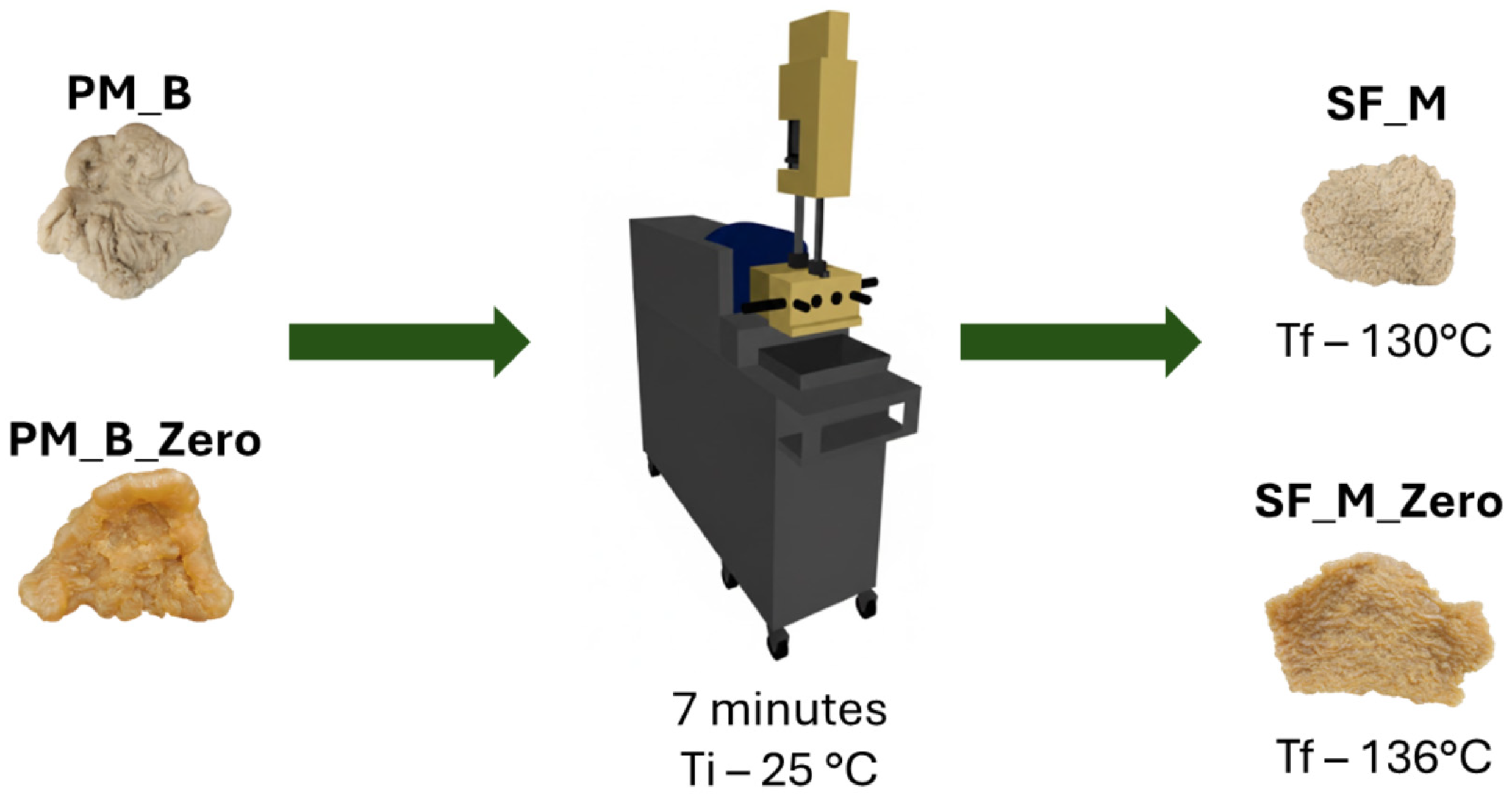
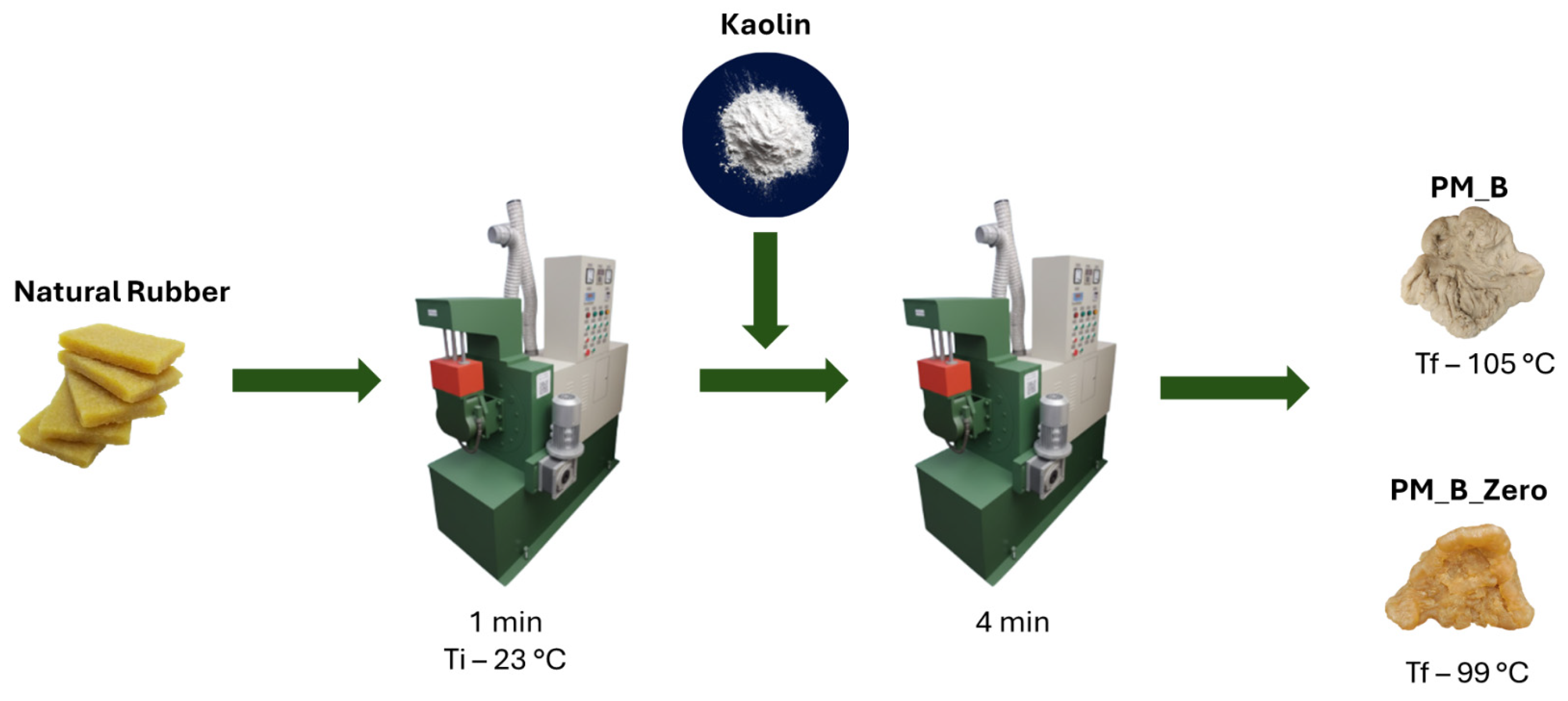
Masterbatches containing kaolin were produced in a Banbury-type internal mixer with tangential rotors (Kneader, Taida, effective capacity: 1 L). NR was pre-processed for 1 min at an initial chamber temperature of 23 °C and rotor speed of 70 rpm, after which 20 phr (parts per hundred rubber) of kaolin was added. Following an additional 4 min of mixing, the batch was discharged, and the temperature was recorded using a needle-type thermocouple (Type J). Figure 1 shows a schematic of the Banbury premix production (PM_B). The same procedure, without kaolin, produced PM_B_Zero.
Subsequently, the premixes were processed in an internal mixer coupled to a torque rheometer (Haake/PolyLab 900, Rheomix 3600p, Thermo Fisher Scientific, Waltham, MA, USA) to improve dispersion under controlled conditions. Processing used roller rotors at 70 rpm for 7 min, starting at 25 °C chamber temperature. These batches are referred to as semifinished mixtures: SF_M for kaolin/NR and SF_M_Zero for neat NR processed under identical conditions. Figure 2 presents a schematic of the semifinished mixtures.

2.2.2. Part 2—Addition of TESPT to Kaolin/NR Mixtures

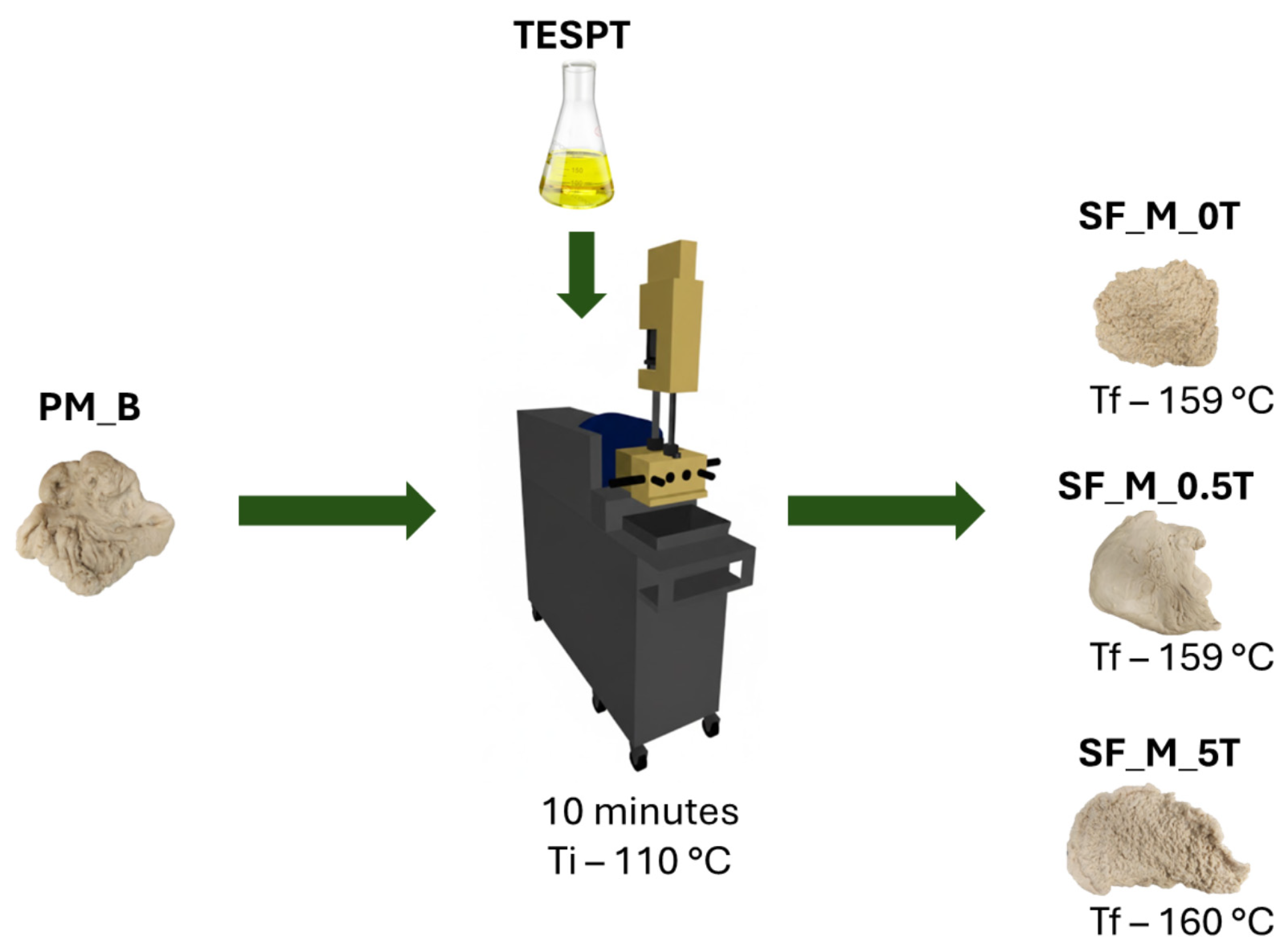
With kaolin pre-dispersed in NR, PM_B was reprocessed in the internal mixer (Haake/PolyLab 900, Rheomix 3600p) at 70 rpm for 10 min, starting from an initial chamber temperature of 110 °C. The higher starting temperature (compared with Part 1) ensured that the mixture reached at least 140 °C during processing so that TESPT could react with both the filler and the polymer matrix. TESPT was added at 0.5 and 5 phr. The reprocessed mixtures were designated SF_M_0.5T and SF_M_5T, respectively. For comparison, PM_B reprocessed without TESPT addition was named SF_M_0T. Figure 3 details this preparation.

2.2.3. Preparation of Kaolin/NR Compounds

For all mixtures listed in Section 2.2.1 and Section 2.2.2, the compound preparation procedure was identical. The formulation ingredients were added to SF_M, SF_M_Zero, SF_M_0T, SF_M_0.5T, and SF_M_5T on an open-roll mill preheated to 60 °C. Each semifinished mixture was first milled for 1 min, followed by sequential addition of each component of the formulation (Table 1), with mixing for 1 min per addition. After all additions, the batches were mixed for an additional 6 min.
Cure characteristics were determined using an oscillating disk rheometer (ODR) at 150 °C to obtain the optimum cure time (t90). Plates (2 mm thick) were then pressed at 150 °C and 20 MPa, using, for each formulation, the respective t90 determined by ODR. The vulcanized compounds were designated with the prefix “C” as follows: C_SF_M, C_SF_M_Zero, C_SF_M_0T, C_SF_M_0.5T, and C_SF_M_5T.

2.2.4. Characterization of the Physical Properties of the Kaolin

The kaolin particles were morphologically analyzed using field-emission gun scanning electron microscopy (FEG-SEM, model Inspect F50, FEI, Hillsboro, OR, USA). In addition, the semi-quantitative chemical composition of the kaolin was determined by energy-dispersive X-ray spectroscopy (EDS) coupled with SEM.
The X-ray diffraction (XRD) tests were performed using the powder method, in a Bruker D8 Advance Da Vinci diffractometer (Bruker, Billerica, MA, USA), equipped with a LYNXEYE detector and Twin-Twin optics, with copper Kα radiation (λ = 0.1544 nm), in the 2θ range of 2 to 60°, a step size of 0.02°, a dwell time of 1 s, and the tube operating at 40 kV and 40 mA. Data analysis was conducted using HighScore Plus v.5.1 software (Malvern Panalytical, Malvern, UK).
The thermogravimetric analysis (TGA) and differential thermal analysis (DTA) tests were conducted on a Netzsch STA 449F instrument (Netzsch Group, Selb, Germany), at a heating rate of 10 K/min, up to 1000 °C, in a synthetic air atmosphere.
The determination of the SSA (specific surface area) of the kaolin, by the BET (Brunauer, Emmett, and Teller) method, was based on ASTM D4820-99 [35]. The kaolin was first dried under vacuum at a pressure of 0.2 millibars at 100 °C for 16 h using the Vacprep 061 equipment (Micromeritics, Norcross, GA, USA). The SSA was, then, measured by nitrogen adsorption using a Micromeritics (Gemini model) instrument.
The particle size distribution and polydispersity index were determined using the dynamic light scattering (DLS) technique on a Particulate Systems NanoPlus instrument, which operates at a wavelength of 660 nm and an angle of 165°. For the analysis, kaolin was previously dispersed in an aqueous medium using an ultrasound tip (Sonics Vibracell VCX 750, Sonics & Materials, Inc., Newtown, CT, USA) with a 19 mm probe for one hour at 55 W. After that, the dispersions were transferred to glass cuvettes, and the analyses were conducted at a temperature of 25 °C. The amount of solid material used for the analysis was empirically determined to ensure good readings, maintaining visual translucency and adequate signal intensity for accurate detection. The analysis was performed in triplicate.

2.2.5. Rheological, Morphological, and Vulcanization Characterization

Small-amplitude oscillatory shear (SAOS) tests were carried out on a TA Instruments RPA Elite for mixtures with and without kaolin, and TESPT (SF_M, SF_M_Zero, SF_M_0T, SF_M_0.5T, SF_M_5T). Preliminary dynamic strain-sweep tests (DSST) defined the linear viscoelastic regime (LVER): frequencies of 0.17 and 16.67 Hz, strain range of 0.03%–60%, at 100 °C.
SAOS frequency sweeps were then performed from 0.002 to 50 Hz at 2% strain and 100 °C. The strain amplitude was selected from DSST to ensure that all measurements across the frequency range remained within the LVER.
A dynamic time-sweep (DTST) was also conducted to assess rheological stability over a duration comparable to that of the SAOS test (around 120 min): frequency of 0.17 Hz, 2% strain, at 100 °C. All samples were stable within the analyzed interval, with a ~15 min delay to reach steady state.
Cure behavior of the compounds was assessed by oscillating disk rheometry (ODR), using TEAM equipment, and following ASTM D2084 [36], at 150 °C for 30 min. Parameters obtained included minimum torque (ML), maximum torque (MH), optimum cure time (t90; time to reach 90% of MH − ML), torque increment (ΔM = MH − ML), scorch time (ts1), and cure rate index (CRI = 100/(t90 − ts1)). The percentage reversion at a defined time after crosslinking was calculated as in [37]:
R e v e r s i o n   ( % ) =   M H M t M H M L     100 ,
where ML is the minimum torque, MH is the maximum torque, and Mt is the torque measured at defined times after the compound reaches MH. This metric quantifies the extent of reversion, i.e., crosslink degradation over time. Higher values indicate greater network loss and reduced cure stability.
Morphological characterization of the rubber compounds was performed by scanning electron microscopy using a tungsten-filament instrument (JEOL JSM-6010LA, JEOL Ltd., Tokyo, Japan), located at the Surface Phenomena Laboratory, Department of Mechanical Engineering (PME), Polytechnic School, University of São Paulo (USP). All formulations from Part 2 (C_SF_M_0T, C_SF_M_0.5T, and C_SF_M_5T) were analyzed.
Vulcanized samples were cryogenically fractured in liquid nitrogen to expose representative fracture surfaces prior to imaging. The fracture surfaces were sputter-coated with a thin gold layer (Balzers Sputter Coater, Oerlikon Balzers, Balzers, Liechtenstein). SEM micrographs were acquired from two randomly selected areas of each sample to qualitatively assess filler distribution and fracture-surface features. To confirm that the particles observed on the fracture surfaces corresponded to kaolin (rather than other compounding ingredients), the semi-quantitative elemental composition of selected particles was determined by energy-dispersive X-ray spectroscopy (EDS) coupled to the SEM.

2.2.6. Mechanical Properties

Tensile tests were performed on the vulcanized compounds (with and without kaolin) using the formulation in Table 1, following ASTM D412-16 [38]. Tests were conducted on a universal testing machine (Kratos, model DEK, San Diego, CA, USA) equipped with a contact extensometer. Specimens (Type B) were die-cut from 2 mm plates pressed at 150 °C, using, for each formulation, the respective t90 determined by ODR.

3. Results

3.1. Characterization of Kaolin

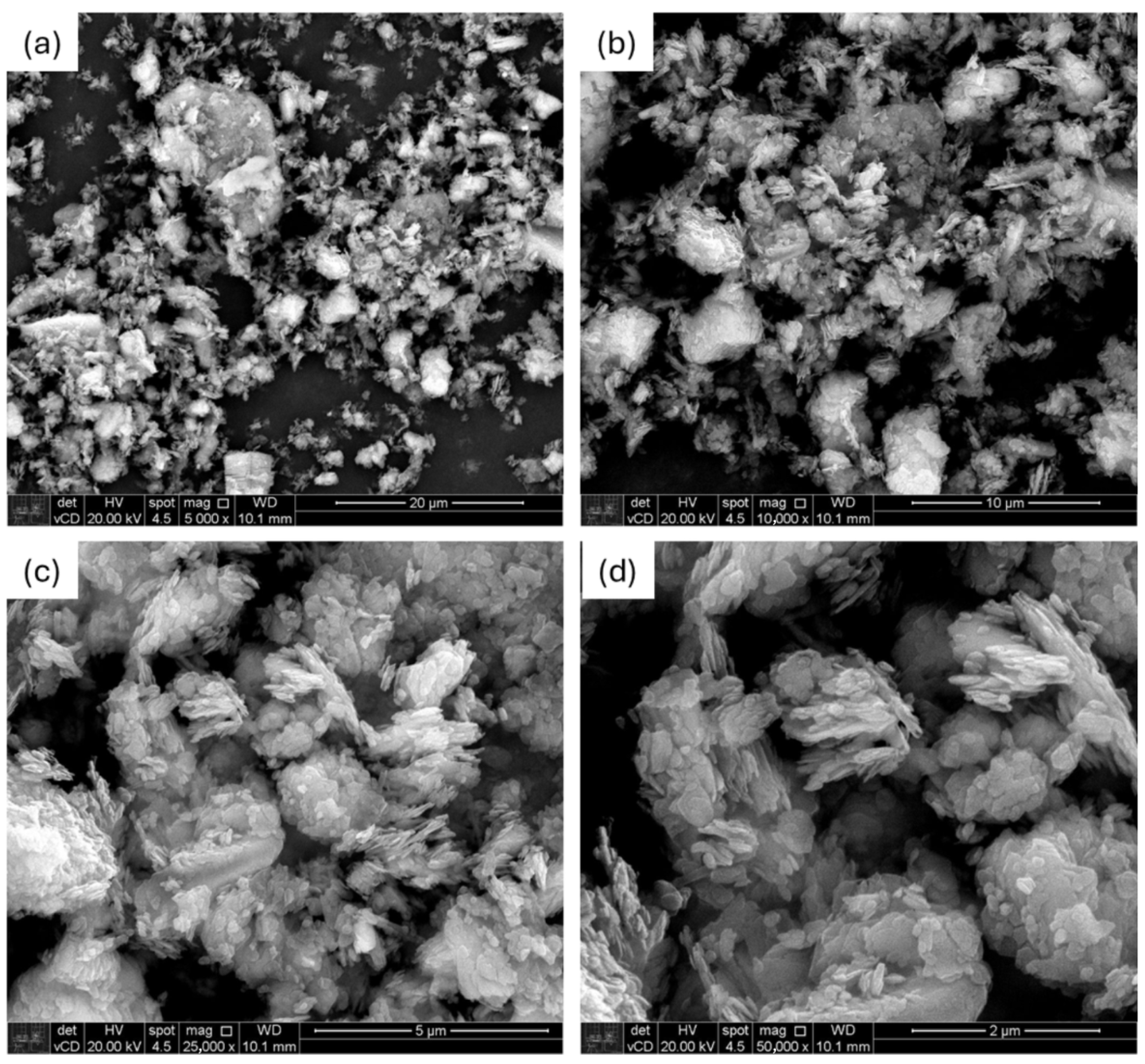
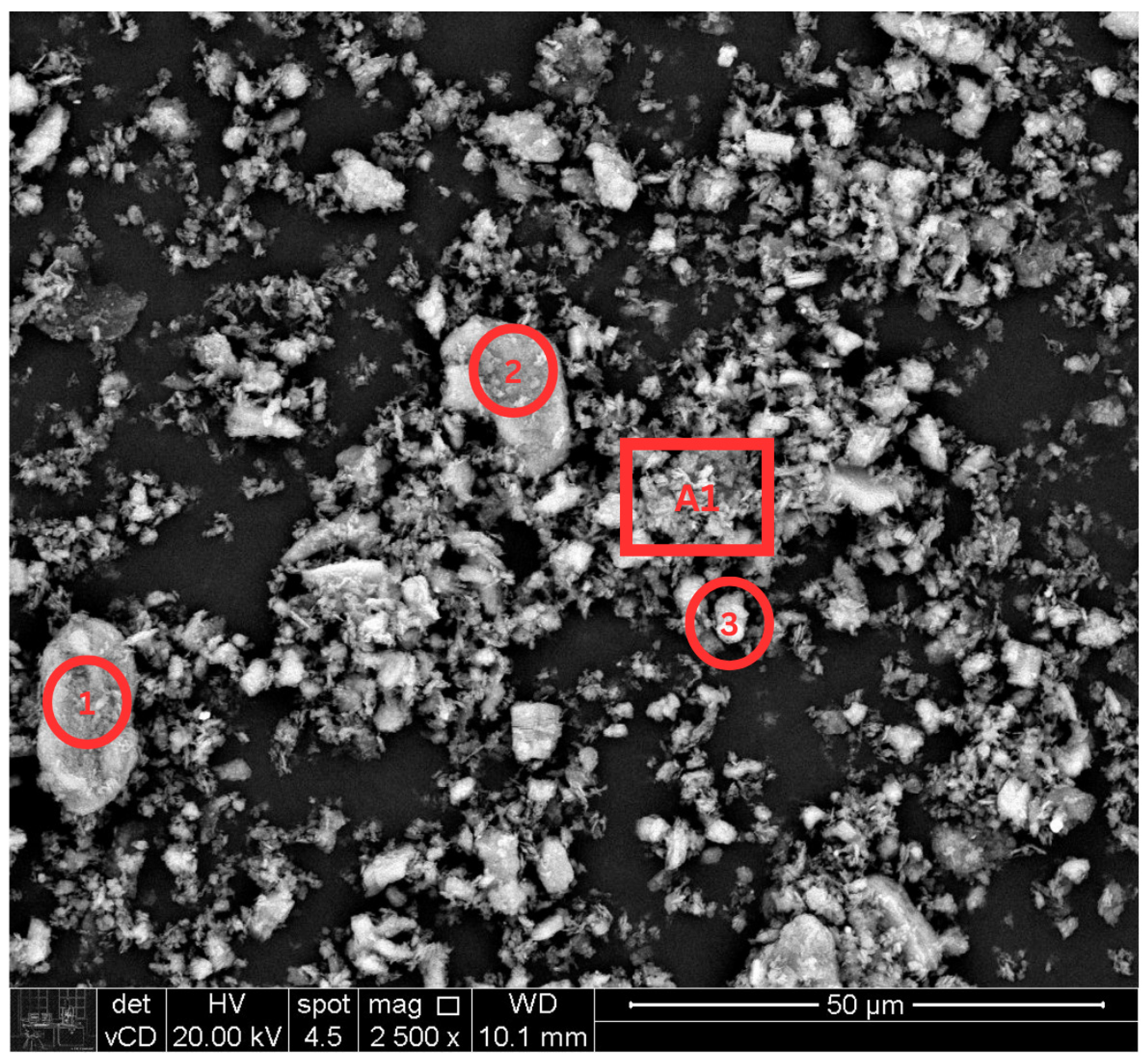
The morphological properties of the kaolin were investigated using scanning electron microscopy (SEM). The micrographs collected at different magnifications (Figure 4) reveal the presence of agglomerates of very fine particles. Figure 5 and Table 2 show the EDS results collected from different particles of the powder. It confirms that kaolin is primarily composed of silicon and aluminum oxides. The average semi-quantitative EDS chemical composition across the whole observed region was 53.9 wt% SiO2 and 46.1 wt% Al2O3 (Table 2). Individual EDS measurements collected from different regions of the particles (labeled A1, 1, 2, and 3 in Figure 5) showed minimal variation, indicating a chemically homogeneous sample and no presence of detectable impurities.
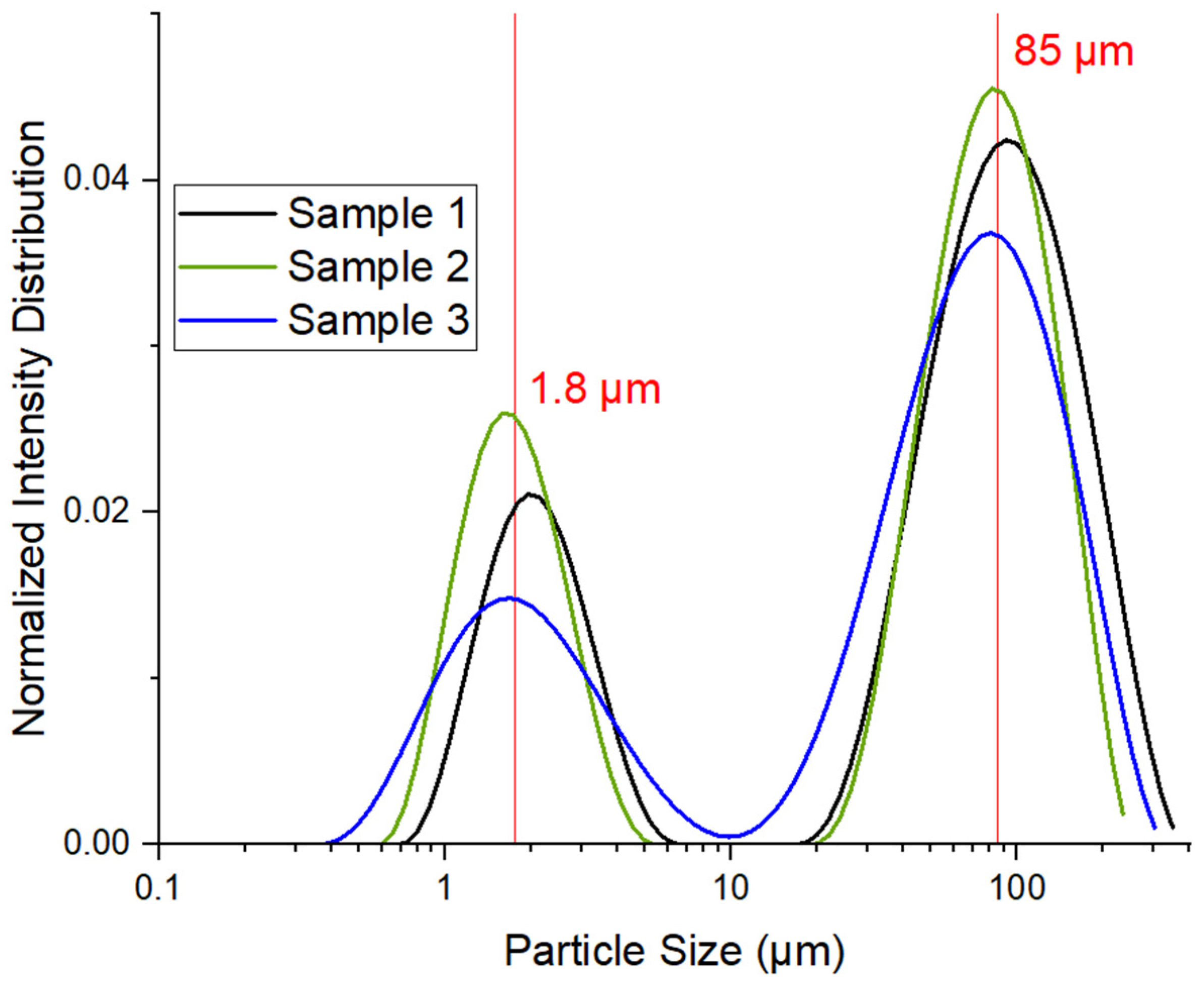
The BET analysis revealed a specific surface area of 16.5 m2/g for the kaolin, a value within the range (11.03–40.65 m2/g) reported by Yang et al. [39] for different kaolins. Particle size distribution tests of three different kaolin samples yielded the curves shown in Figure 6, revealing consistent bimodal distributions, with D10, D50, and D90 values of 1.5, 57.2, and 145.9 µm, respectively, and modes of 1.8 and 85.0 µm. Liang et al. [40] after studying the mechanical treatment of a kaolin supplied by Shanghai McLean Biochemical Technology Co., Ltd. (Shanghai, China), also obtained a high concentration of 2 µm kaolin particles after ball milling.
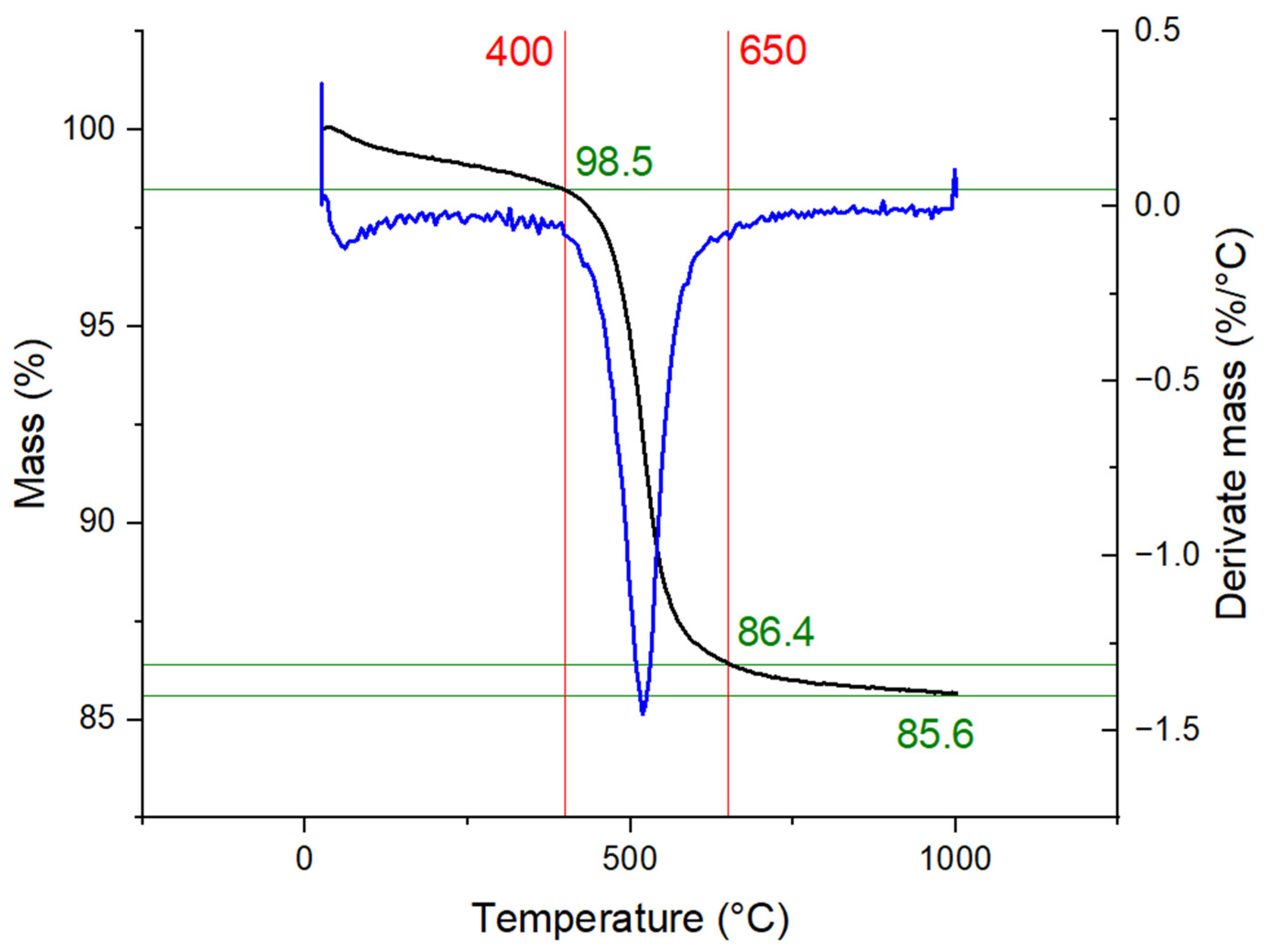
Figure 7 displays the TGA/DTG profiles of kaolin. The thermogravimetric analysis revealed a total mass loss of approximately 13.6%, occurring in two distinct stages. The first stage, with a minor mass loss of 1.5% up to 400 °C, is attributed to the removal of adsorbed water. The second stage, a sharp mass loss of 12.1% between 400 and 650 °C, corresponds to the dehydroxylation of kaolinite, resulting in the formation of amorphous metakaolin [41,42]. In Figure 7, the red vertical lines delimit the temperature interval between 400 and 650 °C associated with kaolinite dihydroxylation, while the green horizontal lines highlight the cumulative mass losses up to 400, 650, and 1000 °C.
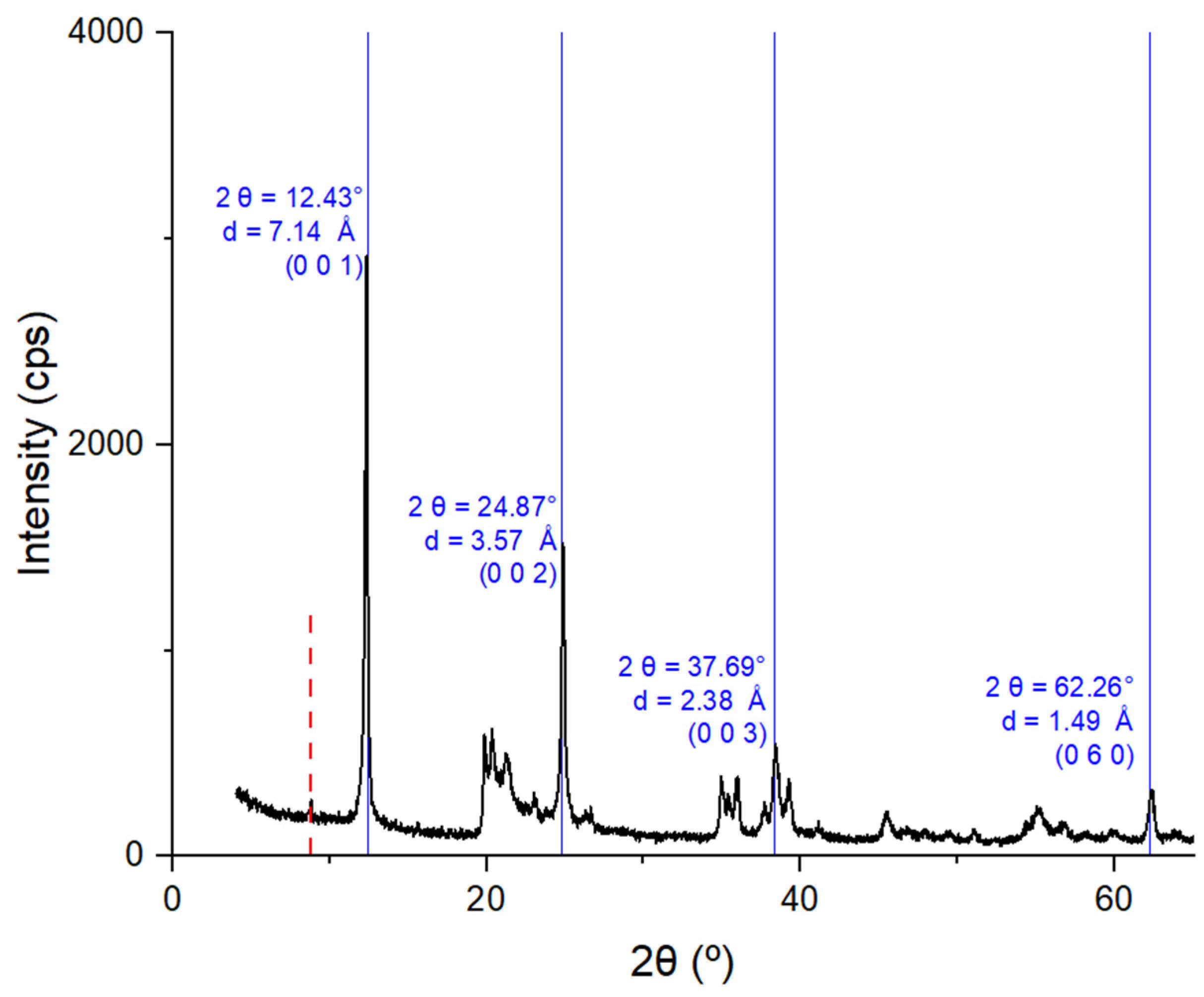
Figure 8 presents the X-ray diffraction (XRD) pattern of the kaolin sample, with the principal peaks identified, and the interplanar spacing (d) values, and corresponding planes (Miller’s Index nomenclature), indicated. The curve confirms kaolinite (K) as the primary crystalline phase, identified by its characteristic peaks at 12.43 and 24.87° (2θ) (Joint Committee on Powder Diffraction Standards, JCPDS, card 14-0164), and their corresponding d-values of 7.14, 3.57, and 2.34 Å. It is noticeable that the absence of quartz peaks at 2θ ≈ 26.5°—a very common impurity in Brazilian natural kaolins. A very low-intensity peak at 2θ = 8.83°, indicated by a red dashed line, suggests a trace contamination by muscovite, although no potassium was detected by the semi-quantitative EDS chemical analysis (muscovite is a clay mineral with the typical formula KAl2(AlSi3O10) (OH)2).

3.2. Characterization of Kaolin/NR Semifinished Mixtures

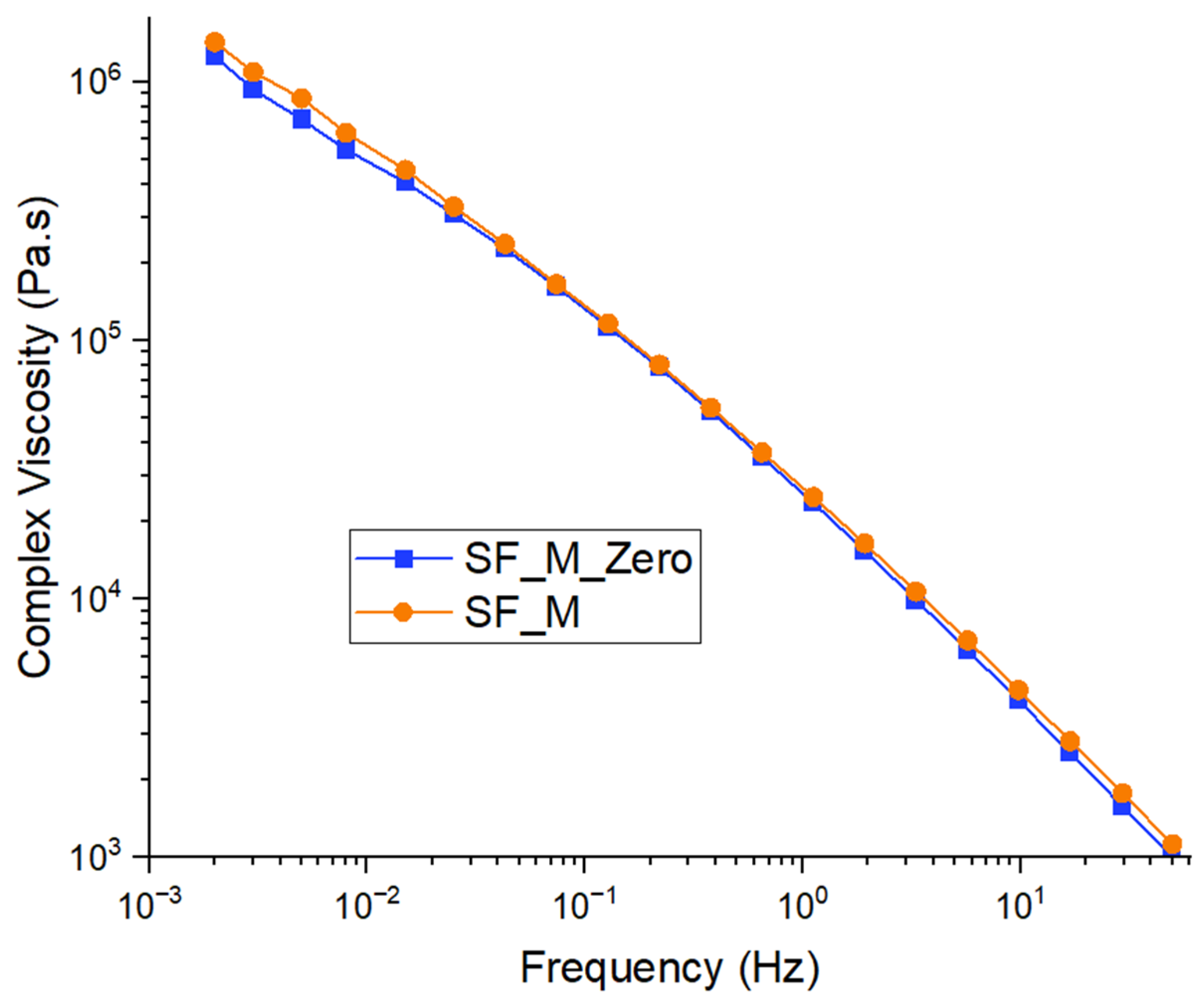
Small-amplitude oscillatory shear (SAOS) tests were performed under the predetermined LVER conditions: 2% strain, a 15 min delay before data acquisition, and total test time ≤ 120 min. The complex viscosity (η*) results for SF_M and SF_M_Zero semifinished mixtures are shown in Figure 9.
Figure 9 shows that SF_M and SF_M_Zero exhibited typical shear-thinning (pseudoplastic) behavior, evidenced by the decrease in complex viscosity with increasing frequency.
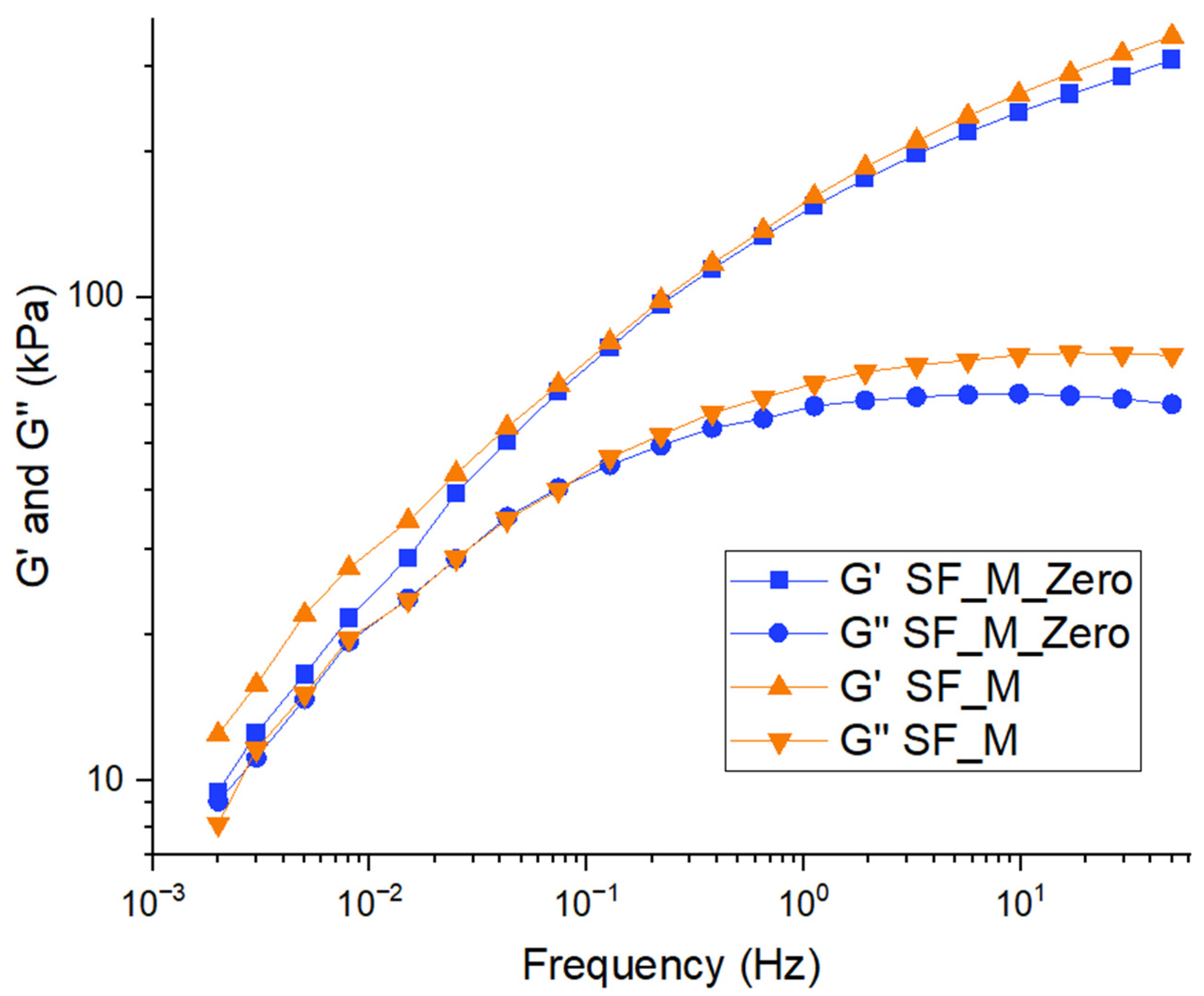
Figure 10 presents the storage modulus (G′) and loss modulus (G″) as a function of frequency for SF_M and SF_M_Zero semifinished mixtures. The SF_M_Zero mixture exhibits the terminal behavior typical of viscoelastic polymer melts (uncured NR), with a tendency toward a G′–G″ crossover at low frequencies. In contrast, this crossover tendency at low frequencies is less pronounced for the SF_M, indicating that the crossover frequency lies below the instrumental detection limit. This response is consistent with kaolin particles restricting polymer chain mobility and increasing the characteristic relaxation time of NR.
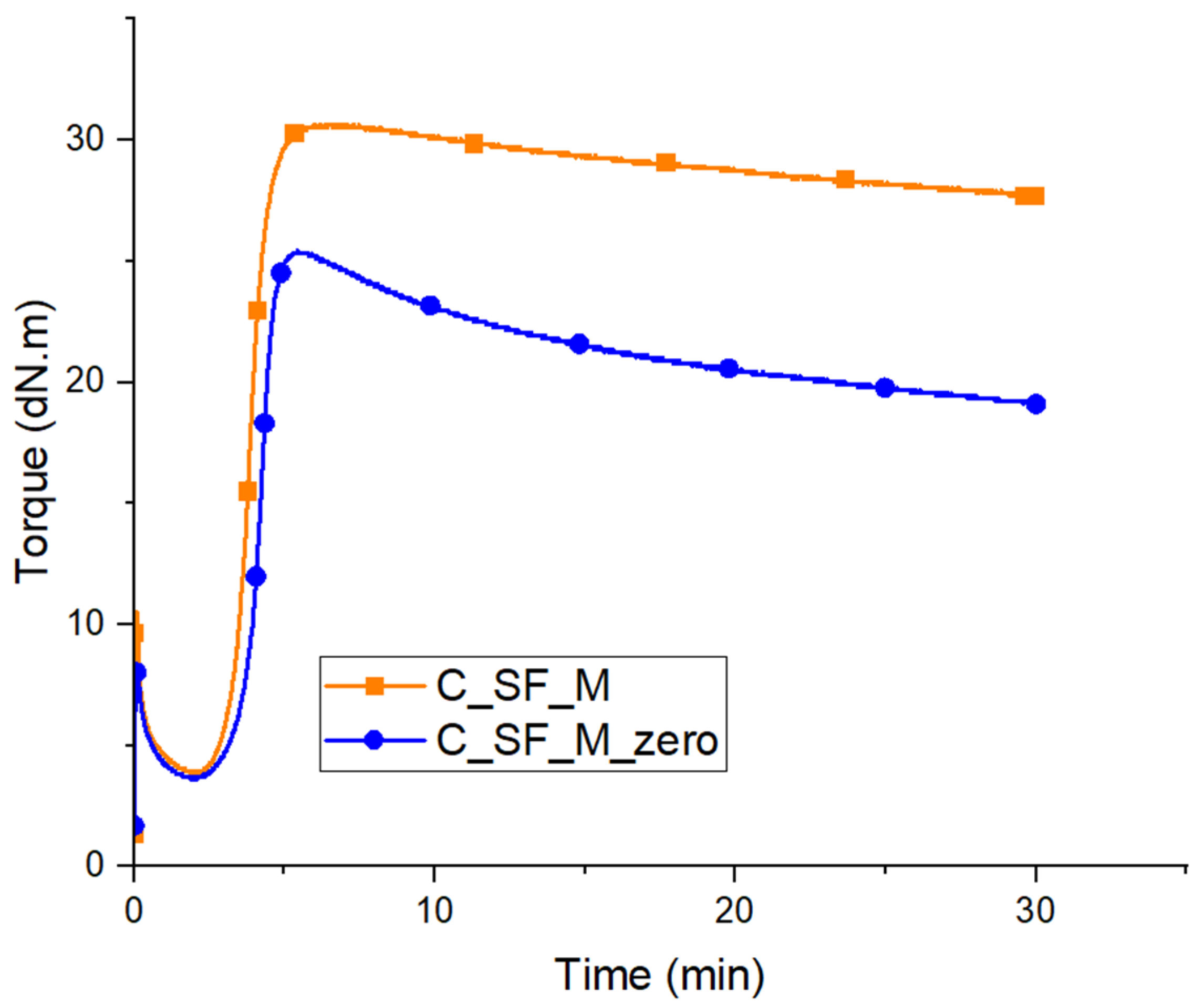
The vulcanization profiles for the natural rubber compounds with and without kaolin are shown in Figure 11. The rheometric parameters, maximum and minimum torque (MH and ML, respectively), scorch time (ts1), optimum cure time (t90), ∆M, and CRI are summarized in Table 3.
As expected, MH and ΔM increased in the kaolin-filled compound relative to the unfilled reference, while ML, t90, ts1, and CRI showed only small differences. Reversion, detected by the reduction in torque after reaching MH, was more severe in the unfilled system.
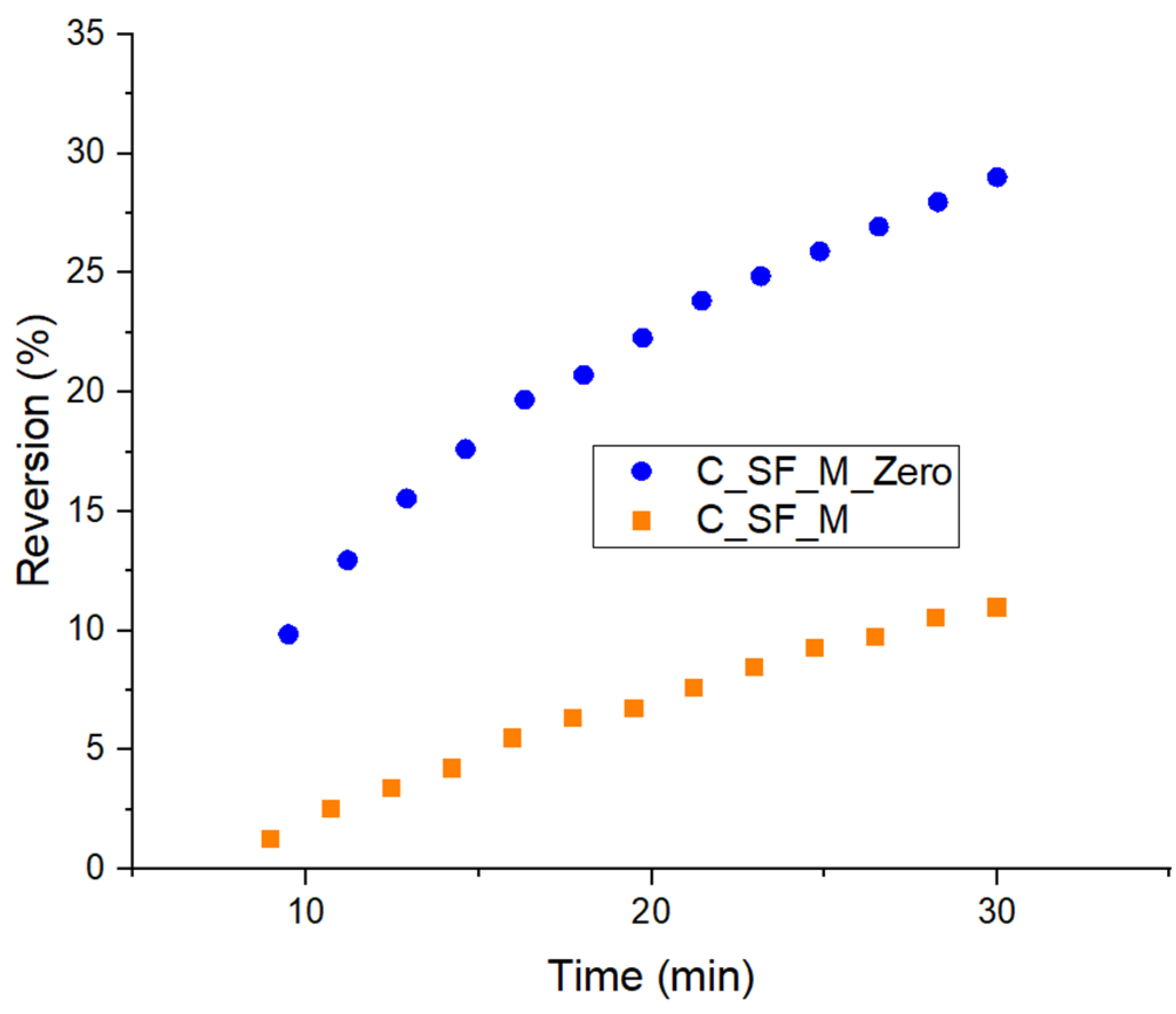
Figure 12 shows the reversion calculated using Equation (1). For the sample without kaolin, reversion reached approximately 30% at ~20 min after the time required to reach MH, while the kaolin-filled compound reached approximately 10%.
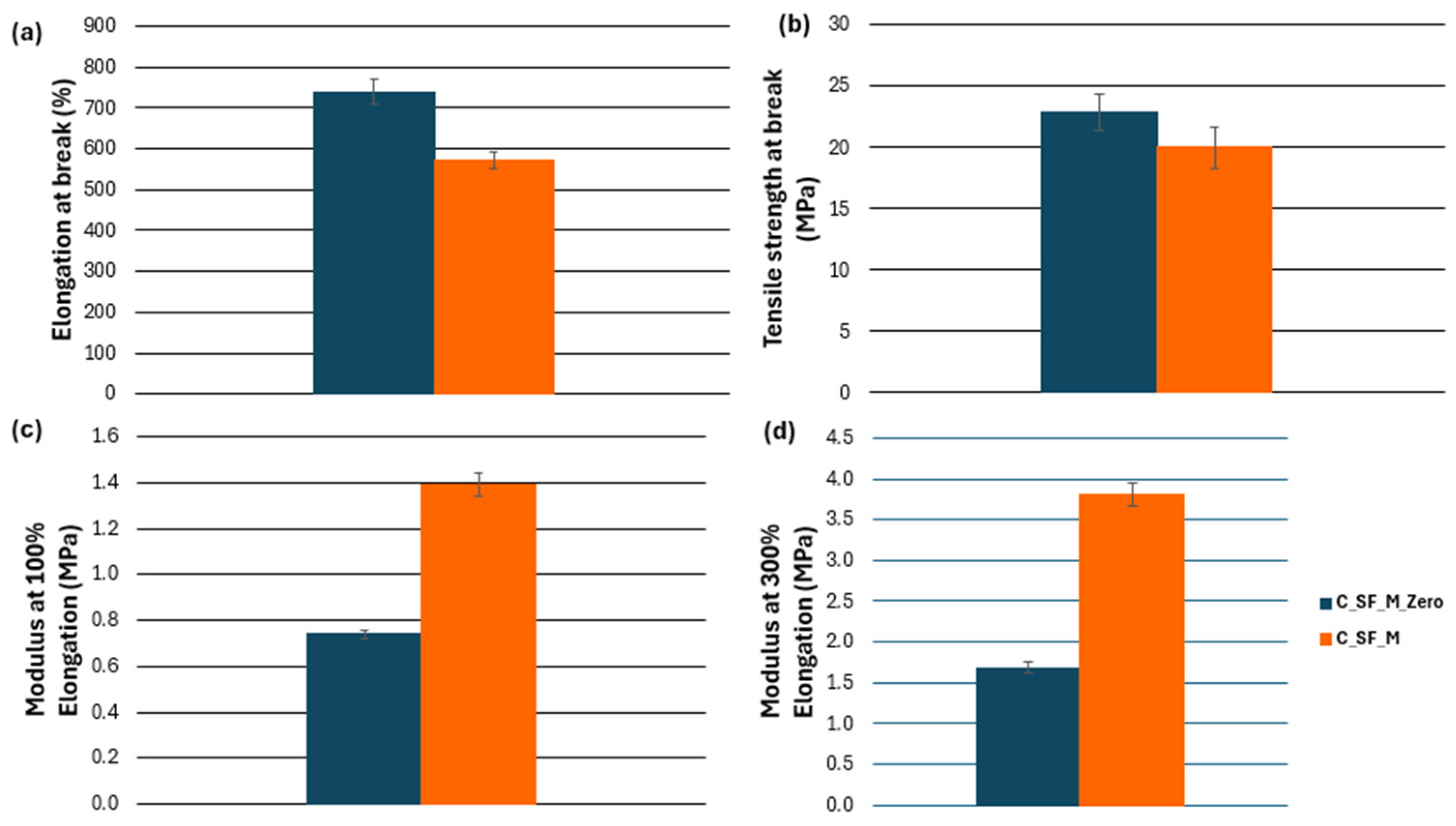
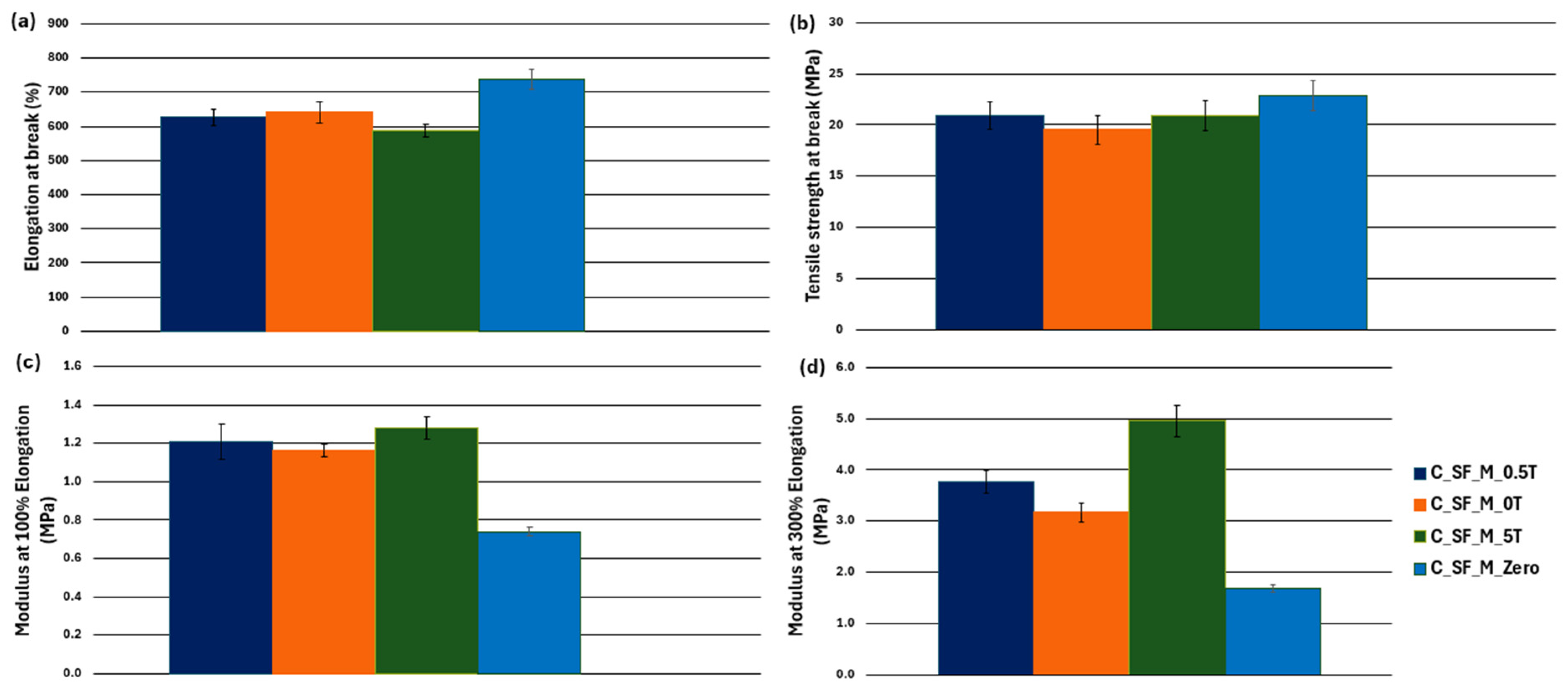
Figure 13 shows the mechanical properties of the unfilled and kaolin-filled compounds, including tensile strength, elongation at break, and modulus at 100% and 300% elongation. The addition of kaolin increased the modulus at both 100 and 300% elongation. However, tensile strength and elongation at break decreased compared with the neat NR compound.
A one-way ANOVA (Analysis of Variance, α = 0.05) was performed to assess whether kaolin produced statistically significant differences in the mechanical properties, as summarized in Table 4.

3.3. Characterization of Kaolin/NR Semifinished Mixtures with and Without TESPT

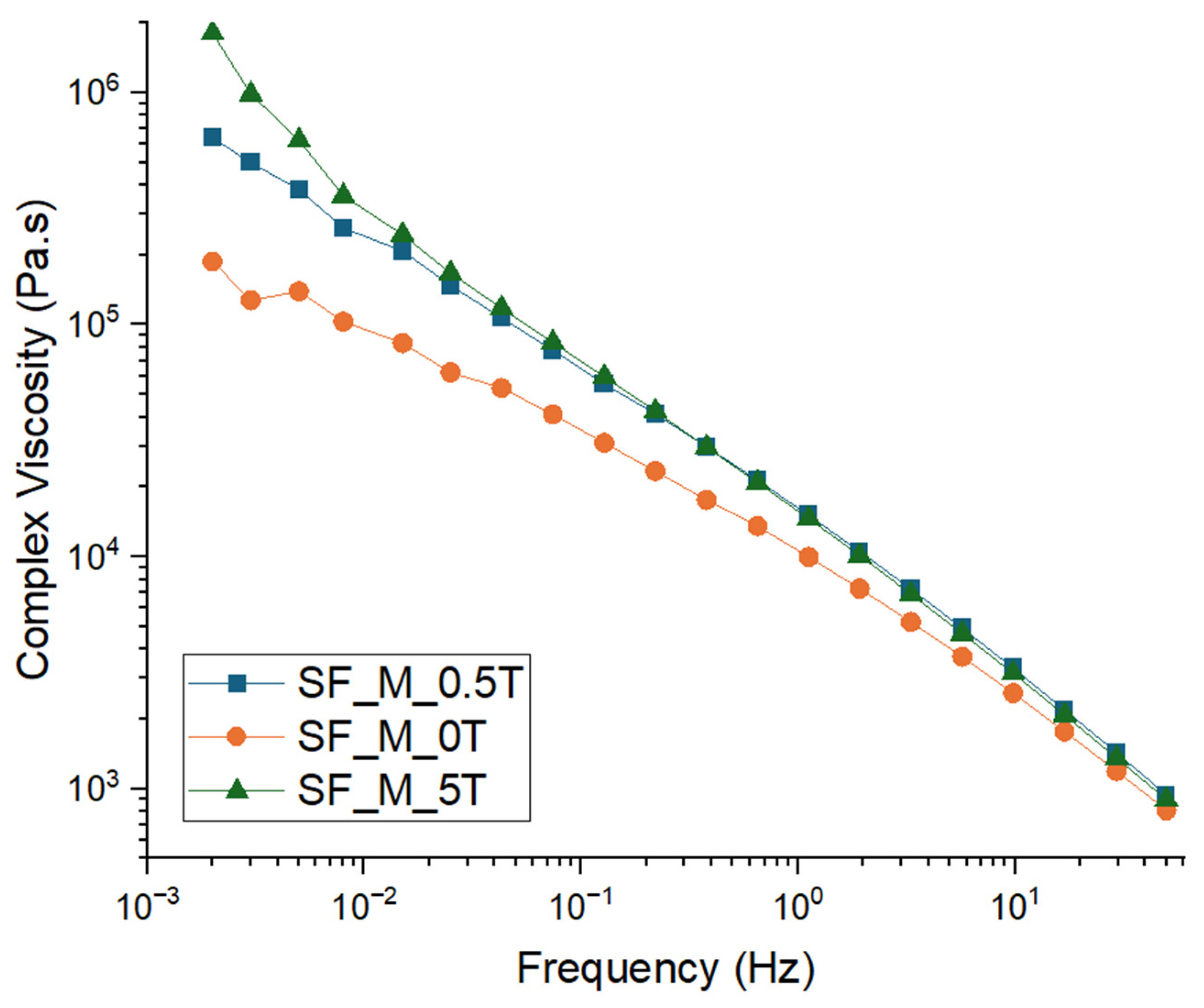
Following Part 1, small-amplitude oscillatory shear (SAOS) measurements were conducted for SF_M_0T, SF_M_0.5T, and SF_M_5T. The complex viscosity (η*) curves are shown in Figure 14.
All mixtures exhibited pseudoplastic behavior. Across the entire frequency range studied, the TESPT-modified mixtures showed higher viscosity than SF_M_0T, with the increase most pronounced at low frequencies. The magnitude of this increase was greater at higher TESPT content (0.5 < 5 phr).
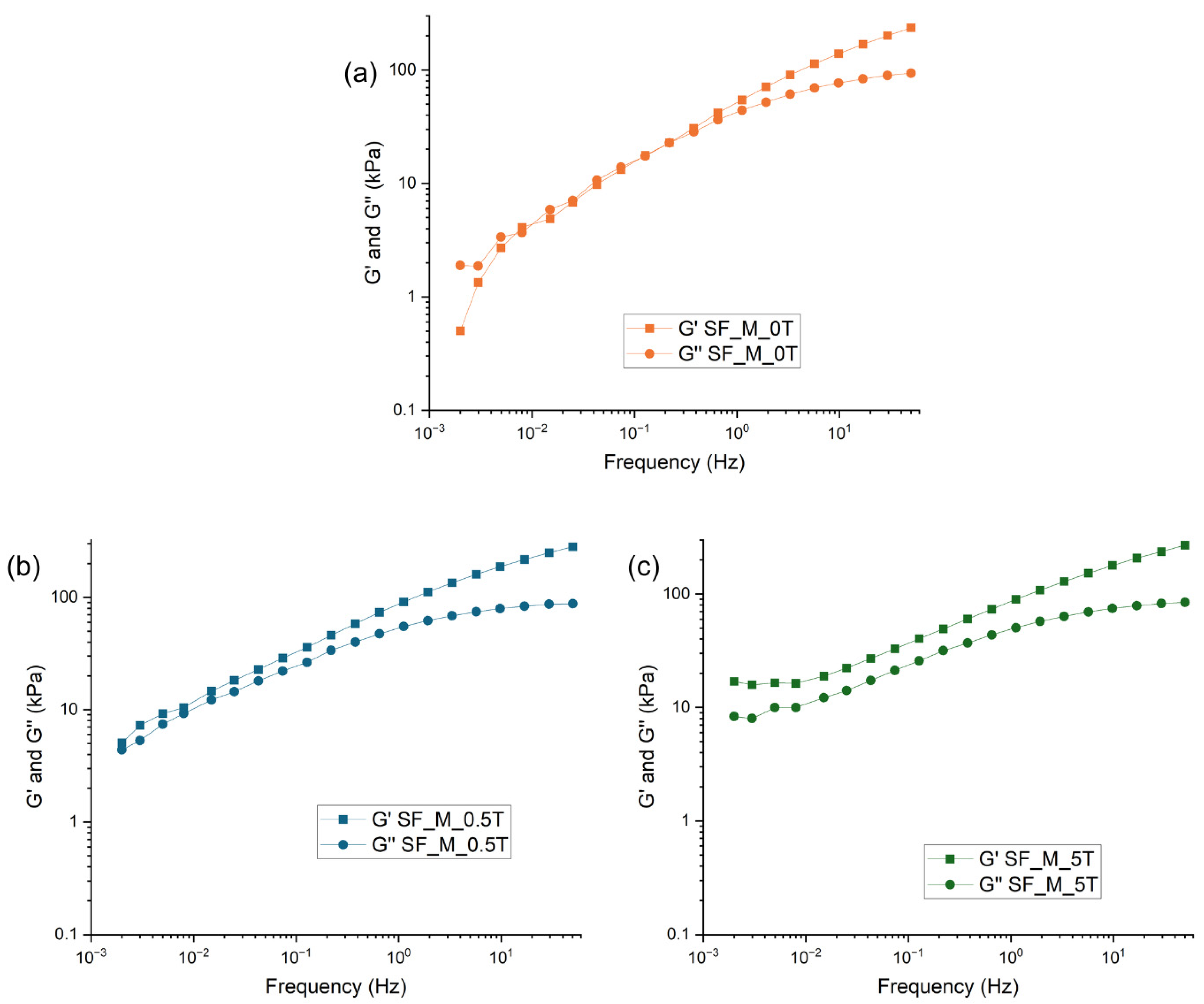
Figure 15 presents G′ and G″ as functions of frequency for SF_M_0T, SF_M_0.5T, and SF_M_5T. The mixture without TESPT showed a G′–G″ crossover at low frequencies. TESPT addition shifted the viscoelastic response: SF_M_0.5T displayed increased G′ and G″ at low frequencies. At high frequencies, the behavior converged to that of the unmodified mixture due to chain alignment. In particular, SF_M_5T, which showed the greatest low-frequency complex viscosity increase (Figure 14), exhibited a low-frequency plateau in G′ and G″.
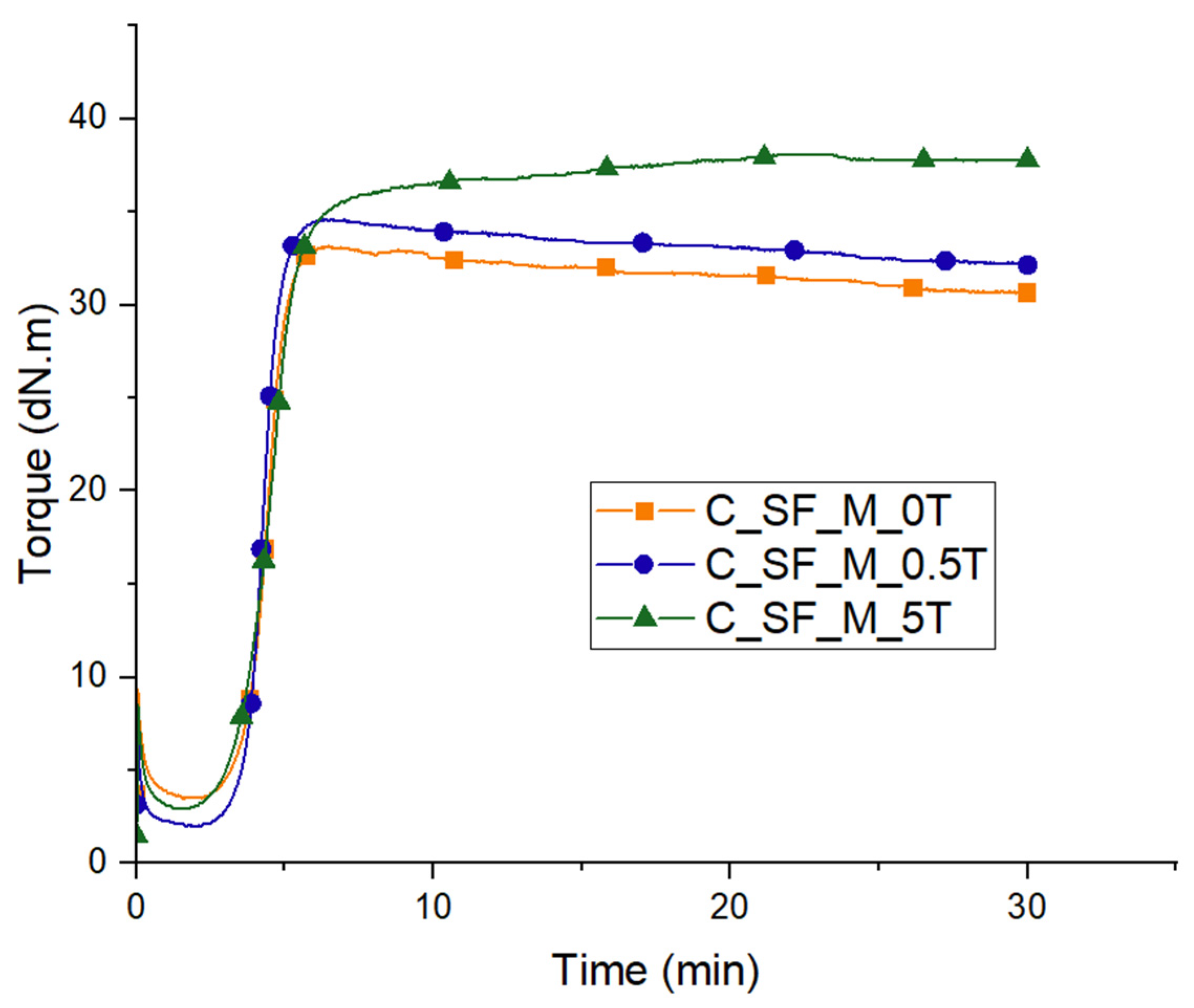
The vulcanization characteristics of C_SF_M_0T, C_SF_M_0.5T, and C_SF_M_5T compounds are shown in Figure 16. The curing parameters, MH, ML, t90, ΔM, and CRI, are summarized in Table 5.
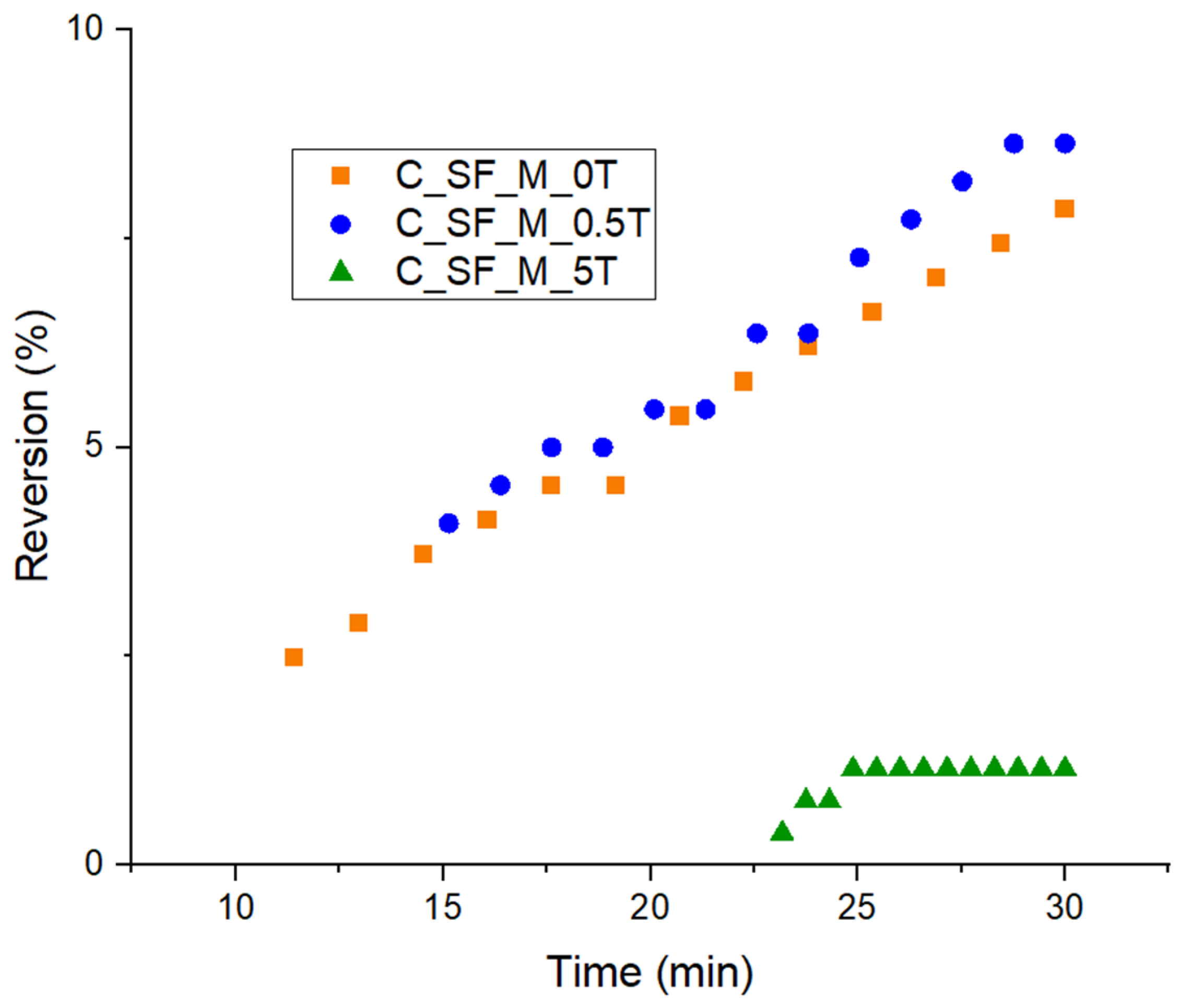
The rheometric curves show an increase in MH for the 5 phr TESPT-containing compound compared with C_SF_M_0T, while ML changed only slightly. Notably, CRI decreased for 5 phr TESPT (from 52.6 to 28.6 relative to 0T). The reduction in torque after MH (reversion) was pronounced for C_SF_M_0T and C_SF_M_0.5T. The degree of reversion, calculated using Equation (1), is shown in Figure 17: C_SF_M_0T ≈ 8%, C_SF_M_0.5T ≈ 9%, and C_SF_M_5T ≈ 1% over a 30 min test period.
The mechanical properties under tensile loading for TESPT-modified and unmodified samples are compared in Figure 18.
A one-way ANOVA (α = 0.05) was performed to evaluate the statistical significance of differences in mechanical properties among the compounds. When significant effects were identified, a Tukey post hoc test was applied for pairwise comparisons. The results are summarized in Table 6 and Table 7.
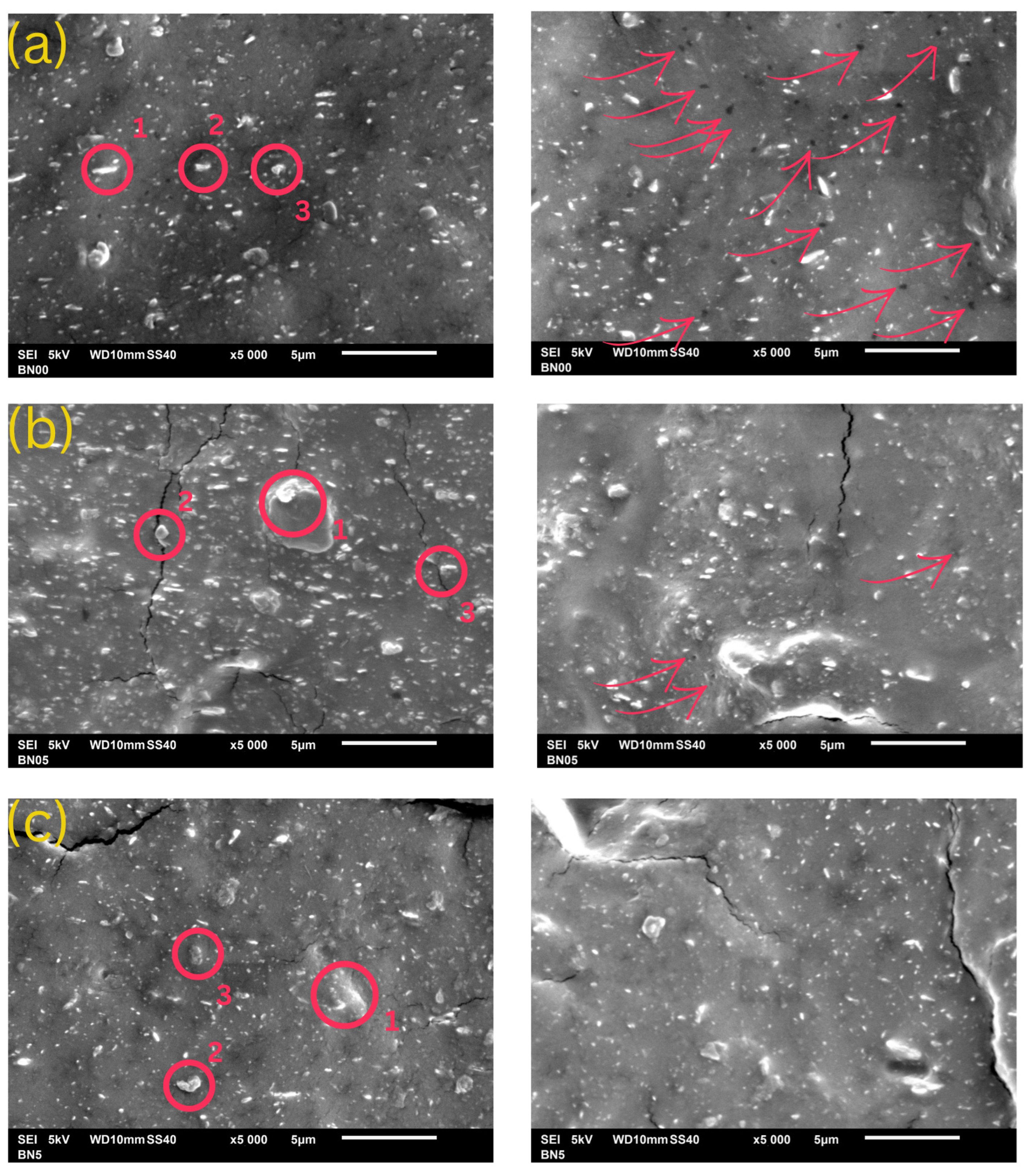
The morphologies of the cryogenically fractured samples were evaluated by SEM. The micrographs acquired at the same magnification (Figure 19) show small kaolin particles distributed throughout the fracture surfaces, together with some agglomerates that appear smaller than those inferred from the kaolin particle-size distribution and from SEM images of the raw filler. In the TESPT-free sample, the arrows in the right micrograph highlight voids that may be associated with partial filler debonding/pull-out during fracture. These features become less evident with 0.5 phr TESPT and are not observed in the sample containing 5 phr TESPT.
To corroborate that the particles identified in the fracture surfaces correspond to kaolin, EDS spectra were collected from the particles highlighted in the left micrographs. The semi-quantitative results are summarized in Table 8 and confirm the presence of Al and Si associated with kaolin, along with C from the NR matrix and Zn and S from the vulcanization system (ZnO and sulfur-containing ingredients).

4. Discussion

4.1. Kaolin Characterization

The kaolin was chemically, physically, and morphologically characterized. Scanning electron microscopy (SEM) revealed the presence of fine, lamellar, and mostly irregular particles, but many exhibited the irregular hexagonal shape typical of kaolinite crystals. A high degree of agglomeration was observed, consistent with the findings of Kgabi et al. [43]. If not disrupted during compounding, such agglomerates can hinder homogeneous dispersion of kaolin in the NR matrix and reduce the reinforcing efficiency, adversely affecting the rheological and mechanical performance of the final product. Pre-processing steps aimed at breaking agglomerates by mechanical means may improve dispersion but were not addressed in this study. Finally, the use of a coupling agent such as TESPT can improve interactions between clay mineral particles and rubber chains, therefore stimulating the dispersion of kaolin particles.
The particle-size distribution measurements revealed a powder with a bimodal size distribution, with D10 ≈ 1.5 µm, D50 ≈ 57 µm, and D90 ≈ 146 µm. This confirms the evidence of agglomeration. The BET measured specific surface area (SSA) was 16.5 m2.g−1. This value falls within the intermediate range reported for fillers in the literature [39], and is lower than that of highly reinforcing fillers such as the widely used precipitated silica, which can easily exhibit SSA values above 100 m2.g−1. The kaolin’s crystalline structure and SSA value indicate the probable exposition of a significant population of surface hydroxyl groups, available to react with silane coupling agents such as TESPT.
The semi-quantitative chemical composition analysis by EDS does not detect hydrogen and indicates average contents of 53.9 wt% of SiO2 and 46.1 wt% of Al2O3, thus consistent with a predominantly kaolinite composition [44]. The absence of other elements (or their presence at levels below the detection limit of the technique), which could be associated with isomorphic substitutions or contaminants, supports the suitability of this kaolin for technical applications and for subsequent surface modification. The TG analysis indicated a mass loss of 12.1 wt% between 400 and 650 °C, which may be attributed to kaolinite dehydroxylation, and the consequent formation of the non-crystalline phase metakaolinite, as represented by Equation (2) [41,45]. Accordingly, under the NR processing conditions adopted in this work (vulcanization at 150 °C), the filler is not expected to undergo any degradation or decomposition.
Kaolinite → Metakaolinite
Al2Si2O5(OH)4 → Al2O3 · 2 SiO2 + 2 H2O,
Therefore, from Equation (2), the theoretical mass loss for complete dehydroxylation of a pure kaolinite is 14.4 wt%. The experimental value determined by TGA, 12.1 wt%, is slightly lower, which may be attributed to factors such as residual agglomeration limiting dehydroxylation kinetics, minor accessory phases (undetected), or overlap with neighboring thermal events. Nevertheless, based on the stoichiometry, the theoretical SiO2/Al2O3 ratio for a pure kaolinite is 1.176. Calculating the same ratio using the composition measured with EDS resulted in a ratio of 1.169, which is only 0.6% below the theoretical value, supporting a near-pure kaolinitic composition.
The XRD pattern confirmed the characteristic crystalline phase of kaolinite, based on the JCPDS card 14-0164 [46], and is consistent with diffraction features reported for well-crystallized kaolinite in the literature [47], presenting intense and well-defined peaks and the presence of the peaks associated with the main crystalline planes of the kaolinite. Although traces of muscovite cannot be ruled out, no changes were detected in the complementary analyses, suggesting that any contamination level is very low.
Taken together, the characterization indicates a fine kaolin powder with evident agglomeration driven by strong particle-particle (or filler–filler, when considered in the context of a compound) attraction, which can be mitigated by suitable physical processing and, when desired, by chemical strategies (e.g., a silane coupling agent added during mixing). This background frames the subsequent discussion of the semifinished mixtures and the vulcanized compounds.

4.2. Discussion Part 1: Kaolin/NR Semifinished Mixtures

This section examines the effect of as-received kaolin first in NR semifinished mixtures (SF_M versus SF_M_Zero) and subsequently evaluates its consequences in the corresponding vulcanized compounds (C_SF_M versus C_SF_M_Zero).
Small-amplitude oscillatory shear (SAOS) testing revealed that kaolin-filled mixtures exhibited typical pseudoplastic behavior, with complex viscosity (η*) decreasing as frequency increased [48] (Figure 9). Even so, viscosity remained slightly higher in the filled mixture across the measured range, which can be attributed to physico-mechanical interactions between kaolin particles and the matrix, despite the absence of effective chemical coupling.
Analysis of G′ and G″ (Figure 10) indicated that the presence of kaolin increased storage modulus over the entire frequency window, consistent with partial reinforcement of the NR structure. However, there was no evidence of a strong three-dimensional network at low frequencies, which is consistent with the limitations of kaolin as an isolated reinforcing filler [49].
Cure characteristics (Figure 11 and Table 3) showed increases in maximum torque (MH) and in ΔM with kaolin addition, suggesting greater stiffness and an increase in crosslink density. In their study, Ha Nair and Joseph [50] obtained a higher maximum torque for kaolin-filled samples, suggesting a higher crosslink density. Notably, kaolin addition reduced reversion from about 30% to 10% at 20 min after reaching maximum torque (Figure 12), which is consistent with improved cure stability under the test conditions. A plausible explanation is that the surface acidity of kaolin [51,52] influences the availability of Zn2+ species and the rate of accelerator complexation during the early stages of crosslinking, favoring the formation of more stable crosslinks and thereby lowering the reversion rate. Prior studies by Coran [53] and Ismail et al. [54] reported that higher acid content in the compound formulation tends to decrease reversion, which is consistent with this interpretation.
It should be emphasized that the proposed influence of kaolin on reversion behavior is formulated as a working hypothesis. To date, there are very few studies that directly investigate the kinetics of sulfur vulcanization or the stability of the zinc-accelerator complex in natural rubber systems filled with kaolin. Thus, the observed reduction in reversion is interpreted based on the known surface chemistry of kaolinite and the experimental curing trends obtained in this work, rather than on direct chemical evidence of altered Zn coordination.
In tensile tests (Figure 13), the kaolin-filled compound showed reduced tensile strength and elongation at break, while the 100% and 300% moduli increased. This response is typical of partially reinforced systems, in which the filler raises stiffness but does not efficiently transfer stress throughout the material, thereby limiting strength [55]. The behavior is consistent with a combination of limited kaolin-NR interfacial adhesion and persistent kaolin-kaolin interactions (agglomeration) that were not fully disrupted under the mixing conditions used. Both factors can restrict stress transfer. Processing adjustments or the use of a coupling agent can mitigate these effects by improving kaolin dispersion and establishing stronger filler-matrix affinity, as explored in Part 2.
Statistical analysis (Table 4) confirmed that the observed differences were statistically significant, notably for the elastic modulus values. Tensile strength was also statistically significant under the adopted criteria (α = 0.05).
In summary, incorporating kaolin into natural rubber provided moderate gains in stiffness and improved cure stability (lower reversion) but at the expense of tensile strength and ductility. These results, together with prior reports [56,57,58] indicate that adding kaolin alone is insufficient for efficient reinforcement. In Part 2, a silane coupling agent (TESPT) is introduced during mixing to promote NR–kaolin bonding and to contribute sulfur to the cure network, thereby improving dispersion and filler-matrix affinity.
The behavior observed for NR compounds filled with kaolin is consistent with the consensus reported in the literature for raw or weakly modified clay fillers in non-polar elastomers [57,59]. Some studies indicate that kaolin primarily acts as an extending or semi-reinforcing filler in NR, increasing stiffness and curing torque while providing limited enhancement of ultimate tensile strength and often reducing elongation at break due to weak rubber–filler interfacial adhesion and the persistence of filler-filler interactions. Ansarifar et al. [60], for example, concluded that kaolin acts as a non-reinforcing filler in strain-induced crystallizing NR, while it can be highly reinforcing in non-crystallizing rubbers such as BR and EPDM, highlighting the need for compatibilization strategies when higher reinforcing efficiency is required in NR. These findings support the interpretation that, in the absence of a coupling or compatibilization, the reinforcing efficiency of kaolin in NR remains limited by dispersion quality and interfacial stress transfer, even when improvements in rheological stiffness are observed.

4.3. Discussion Part 2: Kaolin/NR Semifinished Mixtures with and Without TESPT

The addition of the TESPT coupling agent during mixing produced clear changes in the viscoelastic response of the semifinished mixtures and in the cure and mechanical behavior of the vulcanized compounds, consistent with stronger filler-matrix interaction and with the contribution of sulfur from TESPT to the cure network.
In SAOS, the TESPT-free mixture displays a liquid-dominated signature with a clear tendency to G′–G″ crossover at low frequencies, whereas the TESPT-modified mixtures present higher moduli over the entire window. Notably, for 5 phr TESPT, a low-frequency plateau in G′ below 0.1 Hz appears, and no G′–G″ crossover is observed (Figure 15). A similar phenomenon was reported by Carreau and Vergnes in partially exfoliated clay-based compounds [61]. In parallel, the complex viscosity η* increases across the full frequency range, with the largest rise at low frequencies for 5 phr (Figure 14). Taken together, these features indicate a pseudo-solid response compatible with more effective dispersion and connectivity of kaolin in NR, i.e., a weakly percolated structural network promoted by TESPT bridges at the filler-matrix interface [62,63].
Cure results corroborate this picture: Relative to the TESPT-free compound, 5 phr TESPT increases MH and ΔM while 0.5 phr shows little or no effect, and reversion is strongly suppressed, decreasing from 8% for the TESPT-free reference to 1% over the 30 min test window after reaching MH for the 5 phr formulation (Figure 16 and Table 5). The concurrent rise in MH and ΔM at 5 phr can be rationalized by two contributions operating together: a more cohesive kaolin structural network that persists after vulcanization due to improved dispersion/adhesion, and a higher density and/or stability of crosslinks because TESPT (tetrasulfide) supplies sulfur to the curing chemistry while establishing chemical coupling to the filler surface [64].
Because TESPT contains a tetrasulfide group, its addition can affect vulcanization not only by promoting filler-rubber coupling but also by modifying the cure chemistry (sulfur availability and sulfur-bond distribution). Therefore, the pronounced changes observed at 5 phr TESPT should be interpreted as the outcome of combined effects, rather than being attributed solely to interfacial coupling. Importantly, the response is threshold-like in our dataset: 0.5 phr TESPT produced little or no change in MH, ΔM, or reversion relative to the TESPT-free reference, whereas 5 phr resulted in a pseudo-solid SAOS signature (low-frequency G′ plateau and no G′–G″ crossover) together with strong reversion suppression and higher stiffness. This coupling between rheological network formation and cure stability supports the view that kaolin dispersion/connectivity and interfacial adhesion play a central role in the observed stabilization, while cure-system modification may act synergistically. A full decoupling of these contributions would require dedicated experiments (e.g., TESPT-only controls, cure-kinetics analysis, and crosslink-structure characterization), which are identified as an important direction for future work.
Some authors [64,65] suggest that TESPT can act as a sulfur donor. However, due to its molecular structure, the crosslinks formed in NR are expected to be predominantly polysulfidic. Such polysulfidic linkages are generally considered less thermally stable and may contribute to reversion. As previously discussed by [11], polysulfidic bonds are prone to reversion under thermal and curing conditions. Studies employing TESPT as a sulfur-donating agent in NR [66] as well as several works [67,68,69] evaluating the vulcanization behavior of NR filled with silica and TESPT reported increases in maximum torque (MH), in agreement with the trends observed in this work. Nevertheless, these studies also reported a noticeable increase in reversion, which may support the hypothesis that kaolin may contribute to a reduced tendency toward reversion.
From a mechanical standpoint, TESPT leads to a progressive increase in 100% and 300% modulus, particularly at 5 phr, while tensile strength remains essentially unchanged and elongation at break decreases slightly (Figure 18). The statistical analysis confirms the significance of the modulus increase and the modest change in ductility, in agreement with the microstructural stiffening inferred from SAOS and rheometry (Table 6 and Table 7). It should be emphasized that the higher modulus is interpreted as a combined effect of improved filler–matrix coupling/network formation and potential changes in crosslink density associated with TESPT’s sulfur contribution during vulcanization. Overall, the absence of G′–G″ crossover accompanied by a low-frequency G′ plateau only at 5 phr (Figure 15), the higher MH/ΔM with pronounced reversion suppression (Figure 16 and Table 5), and the mechanical response characterized by higher modulus with tensile strength essentially constant and a small decrease in elongation (Figure 18 and Table 6 and Table 7) compose a coherent scenario of efficient TESPT-assisted compatibilization. In this context, TESPT promotes a more connected and thermally stable rubber–filler network, consistent with trends observed across SAOS, ODR, and tensile testing.
The literature addressing the combined use of TESPT and kaolin in natural rubber systems remains notably scarce, as most silane-assisted reinforcement studies focus on precipitated silica or on alternative clay modifications based on mercapto-silanes or fatty acid derivatives. Nevertheless, available reports on surface-modified kaolin and silica-kaolinite mixed minerals consistently demonstrate that the introduction of sulfur-bearing or silane-based functionalities enhances filler dispersion, increases crosslink density, and promotes more efficient stress transfer at the rubber-filler interface [30]. In this context, the pronounced changes observed in the present work, such as the emergence of a low-frequency G′ plateau, higher torque increments, and improved cure stability, can be rationalized by mechanisms analogous to those reported for silane-coupled systems, even though the specific application of TESPT to kaolin has been far less explored. Thus, the present results not only align with the broader framework of silane-mediated reinforcement but also contribute original insight into the viability of TESPT as an effective in situ compatibilizer for kaolin-filled NR compounds.
Although the SEM images do not show a clear enhancement in kaolin dispersion, some noteworthy features can still be observed. The particles appear to be relatively uniformly distributed throughout the sample, and when compared with SEM images of the raw kaolin and the dispersion curve, a reduction in average particle size can be noted. This reduction may be associated with the high shear conditions imposed during the mixing processes [70]. Another relevant observation, highlighted by the arrows in the figure on the right, is that in the sample without TESPT, distinct voids are present, which may be related to filler debonding during cryogenic fracture. In contrast, in the sample containing 0.5 phr of TESPT, the presence of these voids is markedly reduced, and such features are no longer evident in the sample with 5 phr of TESPT. These observations are consistent with the findings of this study and suggest that TESPT may have acted as a coupling agent between the filler and the rubber matrix [71,72].
It is important to emphasize that the TESPT loading employed in this study, particularly at 5 phr, corresponds to a high silane-to-filler ratio (25 wt% relative to 20 phr kaolin), exceeding typical industrial practice. Therefore, this condition is not presented as an economically optimized formulation, but rather as a mechanistic, upper-bound case used to probe the maximum response of kaolin-filled NR under TESPT-assisted compatibilization. Future studies should target lower, more practical silane dosages and optimize processing to balance coupling efficiency, cost, and performance.

5. Conclusions

The kaolin used in this investigation is predominantly kaolinitic, chemically clean, and includes a fine-size population, although agglomeration is evident in the particle-size distribution due to strong filler-filler attraction, a typical feature of fine powders. These agglomerates can be disrupted by suitable physical (processing) and/or chemical approaches, enabling good dispersion given the material’s high purity and surface chemistry.
In the semifinished mixtures and corresponding vulcanized compounds without TESPT (Part 1), kaolin acted as a low-cost technical filler, increasing stiffness as evidenced by SAOS measurements and by pronounced increases in the 100% and 300% tensile moduli. Importantly, kaolin also contributed to a marked reduction in cure reversion, decreasing torque loss during prolonged vulcanization. However, these benefits were accompanied by reductions in tensile strength and elongation at break, indicating that dispersion and interfacial stress transfer remained limited in the absence of a coupling strategy. Even so, the results demonstrate that unmodified kaolin already provides tangible advantages in terms of modulus enhancement and cure stability in NR compounds.
When TESPT was introduced during mixing (Part 2), the kaolin-filled NR system evolved from partial reinforcement to a more cohesive and interconnected structure. The increase in complex viscosity across the full frequency range, the emergence of a low-frequency G′ plateau without G′–G″ crossover at 5 phr TESPT, the increases in MH and ΔM, and the strong suppression of reversion to approximately 1% collectively indicate the formation of a more stable filler-rubber network. These effects are consistent with two concurrent mechanisms operating at higher TESPT content: improved filler-matrix adhesion and connectivity, promoting the persistence of a kaolin-based structural network after vulcanization, and modification of the curing system, as TESPT acts as a sulfur-bearing coupling agent that contributes to crosslink formation while chemically bridging the kaolin surface and the NR matrix.
Overall, kaolin alone offers a cost-effective route to higher stiffness and lower reversion in NR compounds, provided that processing mitigates agglomeration. For applications requiring stronger, more stable networks and higher stiffness, adding a silane coupling agent such as TESPT during mixing is an effective strategy to enhance kaolin–NR coupling and improve cure stability compared with the TESPT-free filled compound. Tensile strength remains approximately unchanged, while elongation at break decreases slightly.

Author Contributions

Conceptualization, M.C.C., S.M.T. and T.S.V.; methodology, M.C.C.; investigation, M.C.C. and A.C.G.N.; formal analysis, M.C.C.; resources, T.S.V.; data curation, T.S.V.; writing—original draft preparation, M.C.C., S.M.T. and T.S.V.; writing—review and editing, A.C.G.N., S.M.T. and T.S.V.; visualization, M.C.C.; supervision, S.M.T. and T.S.V.; project administration, T.S.V. All authors have read and agreed to the published version of the manuscript.

Funding

National Council for Scientific and Technological Development (CNPq) (Grant No. 163380/2021-0) and Coordenação de Aperfeiçoamento de Pessoal de Nível Superior, Brasil (CAPES/Proex), Finance Code 001.

Data Availability Statement

The original contributions presented in this study are included in the article. Further inquiries can be directed to the corresponding author.

Acknowledgments

The authors would like to thank the following laboratories of the Polytechnic School, University of São Paulo, for their valuable support: the Laboratory of Ceramic Processing (LPC) and the Polymer Laboratory (PolLab; Department of Metallurgical and Materials Engineering). This study was financed in part by the Coordenação de Aperfeiçoamento de Pessoal de Nível Superior, Brasil (CAPES), through the Program for Academic Excellence (PROEX), Finance Code 001, and by the National Council for Scientific and Technological Development (CNPq) (Grant No. 163380/2021-0).

Conflicts of Interest

The authors declare no conflict of interest.

Abbreviations

The following abbreviations are used in this manuscript:
BETBrunauer, Emmett, and Teller
CRICure Rate Index
DLSDynamic Light Scattering
DTADifferential Thermal Analysis
EDSEnergy-Dispersive Spectroscopy
FEG-SEMField Emission Scanning Electron Microscope
JCPDSJoint Committee on Powder Diffraction Standards
DSSTDynamic Strain Sweep Test
DTSTDynamic Time Sweep Test
LVERLinear Viscoelastic Regime
MBTSDibenzothiazolyl Disulfide
NRNatural Rubber
ODROscillating Disk Rheometer
PhrPer Hundred Rubber
SAOSSmall Amplitude Oscillatory Shear
SEMScanning Electron Microscopy
TBzTDTetrabenzylthiuram Disulfide
TESPTBis[3-(triethoxysilyl)propyl] Tetrasulfide
TGAThermogravimetric Analysis
XRDX-ray Diffraction
ZnOZinc Oxide

References

  1. Funt, J.F. Mixing of Rubber; Smithers Rapra Technology Limited: Shawbury, UK, 2009; ISBN 978-1-84735-151-7. [Google Scholar]
  2. García-Tárrago, M.J.; Calaf-Chica, J.; Gómez-Gil, F.J. High-frequency mechanical impedance of rubber mounts: Experimental characterization and resonance mechanisms. Eur. J. Mech. A/Solids 2025, 113, 105677. [Google Scholar] [CrossRef]
  3. Nunes, F.M.; Silva, A.L.E.; May, J.; da Silva Szarblewski, M.; Flemming, L.; Assmann, E.E.; Moraes, J.A.R.; Machado, Ê.L. Environmental impacts associated with the life cycle of natural rubbers: A review and scientometric analysis. Ind. Crops Prod. 2025, 224, 120350. [Google Scholar] [CrossRef]
  4. Chen, W.; Zhou, X.; Pan, M.; Liang, W.; Zhang, Y.; Dong, L. Reduced rolling resistance in green tires with optimized grafted-modifier natural rubber. Prog. Org. Coat. 2025, 205, 109319. [Google Scholar] [CrossRef]
  5. Whba, R.; Su’ait, M.S.; Whba, F.; Sahinbay, S.; Altin, S.; Ahmad, A. Intrinsic challenges and strategic approaches for enhancing the potential of natural rubber and its derivatives: A review. Int. J. Biol. Macromol. 2024, 276, 133796. [Google Scholar] [CrossRef]
  6. Zhang, Z.; Ye, D.; Li, Y.; Hu, F.; Yang, Y.; Liao, Y. Enhancing weatherability and mechanical properties of tung oil wood finishes through natural rubber modification via the Diels–Alder reaction. Int. J. Biol. Macromol. 2024, 272, 132602. [Google Scholar] [CrossRef]
  7. Murakami, S.; Senoo, K.; Toki, S.; Kohjiya, S. Structural development of natural rubber during uniaxial stretching by in situ wide-angle X-ray diffraction using synchrotron radiation. Polymer 2002, 43, 2117–2120. [Google Scholar] [CrossRef]
  8. Zhu, S.; Zhao, F.; Sun, Y.; Wang, C.; Yuan, Z.; Liao, S. Fluorinated natural rubber with enhanced strength and excellent resistance to ozone, organic solvent, and acid and alkali via in situ reactive melt extrusion. Polym. Degrad. Stab. 2024, 228, 110916. [Google Scholar] [CrossRef]
  9. Chailad, W.; Tongsom, K.; Chaochanchaikul, K.; Sakulkhaemaruethai, C. Enhancing air retention in natural rubber: A path to improved performance. Polym. Bull. 2025, 82, 3841–3866. [Google Scholar] [CrossRef]
  10. Bahruddin; Wiranata, A.; Helwani, Z.; Jahrizal; Firzal, Y. Characteristics of exterior emulsion paint using natural rubber latex binder. S. Afr. J. Chem. Eng. 2025, 52, 151–159. [Google Scholar] [CrossRef]
  11. Roberts, A.D. Natural Rubber Science and Technology; Oxford University Press: Oxford, UK, 1988. [Google Scholar]
  12. Andrews, E.H. Reinforcement of rubber by fillers. Rubber Chem. Technol. 1963, 36, 325–336. [Google Scholar] [CrossRef]
  13. Liu, Q.; Zhang, Y.; Xu, H. Properties of vulcanized rubber nanocomposites filled with nanokaolin and precipitated silica. Appl. Clay Sci. 2008, 42, 232–237. [Google Scholar] [CrossRef]
  14. Thomas, S.; Stephen, R. Rubber Nanocomposites: Preparation, Properties and Applications; Wiley: Singapore, 2010; ISBN 978-3131450715. [Google Scholar]
  15. Labruyère, C.; Gorrasi, G.; Monteverde, F.; Alexandre, M.; Dubois, P. Transport properties of organic vapours in silicone/clay nanocomposites. Polymer 2009, 50, 3626–3637. [Google Scholar] [CrossRef]
  16. Paul, D.R.; Robeson, L.M. Polymer nanotechnology: Nanocomposites. Polymer 2008, 49, 3187–3204. [Google Scholar] [CrossRef]
  17. Dai, J.C.; Huang, J.T. Surface modification of clays and clay–rubber composite. Appl. Clay Sci. 1999, 15, 51–65. [Google Scholar] [CrossRef]
  18. Dewi, R.; Agusnar, H.; Alfian, Z.; Tamrin. Characterization of technical kaolin using XRF, SEM, XRD, FTIR and its potentials as industrial raw materials. J. Phys. Conf. Ser. 2018, 1116, 042010. [Google Scholar] [CrossRef]
  19. Konta, J. Clay and man: Clay raw materials in the service of man. Appl. Clay Sci. 1995, 10, 275–335. [Google Scholar] [CrossRef]
  20. Xiao, Y.; Li, B.; Huang, Y.; Gong, Z.; Diao, P.; Wang, C.; Bian, H. High-value application of kaolin by wet mixing method in low heat generation and high wear-resistant natural rubber composites. Appl. Clay Sci. 2024, 261, 107574. [Google Scholar] [CrossRef]
  21. Das, A.; Wang, D.; Stöckelhuber, K.W.; Jurk, R.; Fritzsche, J.; Klüppel, M.; Heinrich, G. Rubber–clay nanocomposites: Some recent results. In Rubber Nanocomposites; Springer: Berlin, Germany, 2010; pp. 85–166. [Google Scholar]
  22. Rattanasom, N.; Saowapark, T.; Deeprasertkul, C. Reinforcement of natural rubber with silica/carbon black hybrid filler. Polym. Test. 2007, 26, 369–377. [Google Scholar] [CrossRef]
  23. Silva, E.S. Efeito da incorporação de sílica tratada com aminosilano nos nanocompósitos PMMA/SAN/sílica. In Coletânea de Atividades em Pesquisa Científica e Inovação Tecnológica; Atena Editora: Ponta Grossa, Brazil, 2017. [Google Scholar]
  24. Sattayanurak, S.; Noordermeer, J.W.M.; Sahakaro, K.; Kaewsakul, W.; Dierkes, W.K.; Blume, A. Silica-reinforced natural rubber: Synergistic effects by addition of small amounts of secondary fillers to silica-reinforced natural rubber tire tread compounds. Adv. Mater. Sci. Eng. 2019, 2019, 5891051. [Google Scholar] [CrossRef]
  25. You, B.; Jin, S. Preparation of hydrophobic modified silica with Si69 and its reinforcing mechanical properties in natural rubber. Materials 2024, 17, 3131. [Google Scholar] [CrossRef]
  26. Jantachum, P.; Khumpaitool, B.; Utara, S. Effect of silane coupling agent and cellulose nanocrystals loading on the properties of acrylonitrile butadiene rubber/natural rubber nanocomposites. Ind. Crops Prod. 2023, 195, 116407. [Google Scholar] [CrossRef]
  27. Thaptong, P.; Sae-Oui, P.; Sirisinha, C. Effects of silanization temperature and silica type on properties of silica-filled solution styrene butadiene rubber (SSBR) for passenger car tire tread compounds. J. Appl. Polym. Sci. 2016, 133, 43342. [Google Scholar] [CrossRef]
  28. Ansarifar, A. Mineral kaolin—A highly versatile filler for rubber. J. Miner. Mater. Sci. 2022, 3, 1–3. [Google Scholar] [CrossRef]
  29. Thimmaiah, S.R.; Siddaramaiah. Investigation of carbon black and metakaolin cofiller content on mechanical and thermal behaviors of natural rubber compounds. J. Elastomers Plast. 2013, 45, 187–198. [Google Scholar] [CrossRef]
  30. Alam, M.N.; Kumar, V.; Debnath, S.C.; Jeong, T.; Park, S.S. Naturally abundant silica–kaolinite mixed minerals as an outstanding reinforcing filler for the advancement of natural rubber composites. J. Polym. Res. 2023, 30, 59. [Google Scholar] [CrossRef]
  31. Hou, Z.; Zhou, D.; Chen, Q.; Xin, Z. Effect of different silane coupling agents in situ modified sepiolite on the structure and properties of natural rubber composites prepared by latex compounding method. Polymers 2023, 15, 1620. [Google Scholar] [CrossRef] [PubMed]
  32. Yan, H.; Sun, K.; Zhang, Y.; Zhang, Y. Effect of nitrile rubber on properties of silica-filled natural rubber compounds. Polym. Test. 2005, 24, 32–38. [Google Scholar] [CrossRef]
  33. Suntako, R. The rubber damper reinforced by modified silica fume (mSF) as an alternative reinforcing filler in rubber industry. J. Polym. Res. 2017, 24, 131. [Google Scholar] [CrossRef]
  34. Dierkes, W.K. Economic Mixing of Silica–Rubber Compounds: Interaction Between the Chemistry of the Silica–Silane Reaction and the Physics of Mixing. Ph.D. Thesis, University of Twente, Enschede, The Netherlands, 2005. [Google Scholar]
  35. ASTM D4820-99; Standard Test Methods for Carbon Black—Surface Area by Multipoint B.E.T. Nitrogen Adsorption. ASTM International: West Conshohocken, PA, USA, 1999.
  36. ASTM D2084-19; Standard Test Method for Rubber Property—Vulcanization Using Oscillating Disk Cure Meter. ASTM International: West Conshohocken, PA, USA, 2019.
  37. Boonkerd, K.; Deeprasertkul, C.; Boonsomwong, K. Effect of Sulfur to Accelerator Ratio on Crosslink Structure, Reversion, and Strength in Natural Rubber. Rubber Chem. Technol. 2016, 89, 450–464. [Google Scholar] [CrossRef]
  38. ASTM D412-16; Standard Test Methods for Vulcanized Rubber and Thermoplastic Elastomers—Tension. ASTM International: West Conshohocken, PA, USA, 2021.
  39. Yang, Y.; Jaber, M.; Michot, L.J.; Rigaud, B.; Walter, P.; Laporte, L.; Zhang, K.; Liu, Q. Analysis of the Microstructure and Morphology of Disordered Kaolinite Based on the Particle Size Distribution. Appl. Clay Sci. 2023, 232, 106801. [Google Scholar] [CrossRef]
  40. Liang, X.; Li, Q.; Fang, Y. Preparation and Characterization of Modified Kaolin by a Mechanochemical Method. Materials 2023, 16, 3099. [Google Scholar] [CrossRef]
  41. Bergaya, F.; Theng, B.K.G.; Lagaly, G. (Eds.) Handbook of Clay Science, 1st ed.; Elsevier: Amsterdam, The Netherlands, 2011; ISBN 978-0080457635. [Google Scholar]
  42. Iriarte, I.A.P.; Mocciaro, A.; Rendtorff, N.M.; Richard, D. Dehydroxylation of kaolinite: Evaluation of activation energy by thermogravimetric analysis and density functional theory insights. Minerals 2025, 15, 607. [Google Scholar] [CrossRef]
  43. Kgabi, D.P.; Ambushe, A.A. Characterization of South African bentonite and kaolin clays. Sustainability 2023, 15, 12679. [Google Scholar] [CrossRef]
  44. Konan, K.L.; Peyratout, C.; Smith, A.; Bonnet, J.P.; Rossignol, S.; Oyetola, S. Comparison of surface properties between kaolin and metakaolin in concentrated lime solutions. J. Colloid Interface Sci. 2009, 339, 103–109. [Google Scholar] [CrossRef]
  45. Ahmed, S.; Tantawy, M.A. Characterization and application of kaolinite clay as solid-phase extractor for removal of copper ions from environmental water samples. Int. J. Adv. Res. 2015, 3, 1–21. [Google Scholar]
  46. Rouabhia, F.; Nemamcha, A.; Moumeni, H. Elaboration and characterization of mullite–anorthite–albite porous ceramics prepared from Algerian kaolin. Cerâmica 2018, 64, 126–132. [Google Scholar] [CrossRef]
  47. Varela, M.L.; Nascimento, R.M.; Martinelli, A.E.; Hotza, D.; Melo, D.M.A.; Melo, M.A.F. Optimization of a methodology for rational mineralogical analysis of clay minerals. Cerâmica 2005, 51, 388–392. [Google Scholar] [CrossRef]
  48. Rattanasom, N.; Suchiva, K. Rheological and processing properties of purified natural rubber. J. Appl. Polym. Sci. 2005, 98, 456–465. [Google Scholar] [CrossRef]
  49. Correia, C.A. Effect of Raw, Bleached, and Nanocellulose Jute Fiber on the Rheological, Mechanical, and Vulcanization Properties of Natural Rubber. Ph.D. Thesis, Universidade Federal do Ceará, Fortaleza, Brazil, 2021. [Google Scholar]
  50. Nair, P.H.; Joseph, R. Nanokaolin clay as reinforcing filler in nitrile rubber. Int. J. Sci. Eng. Res. 2012, 3, 1–9. [Google Scholar]
  51. Murray, H.H. Applied Clay Mineralogy: Occurrences, Processing and Application of Kaolins, Bentonite, Palygorskite–Sepiolite, and Common Clays; Elsevier: Amsterdam, The Netherlands, 2007. [Google Scholar]
  52. Conley, R.F.; Althoff, A.C. Surface acidity in kaolinites. Clays Clay Miner. 1967, 15, 243–251. [Google Scholar] [CrossRef]
  53. Coran, A.Y. Vulcanization. Part VII. Kinetics of sulfur vulcanization of natural rubber in the presence of delayed-action accelerators. Rubber Chem. Technol. 1965, 38, 1–14. [Google Scholar] [CrossRef]
  54. Ismail, H.; Salmiah, I. Palm oil fatty acid as an activator in carbon black-filled natural rubber compounds: Effect of epoxidation. Int. J. Polym. Mater. Polym. Biomater. 1999, 43, 115–125. [Google Scholar] [CrossRef]
  55. Yahaya, L.E.; Adebowale, K.O.; Menon, A.R.R. Mechanical properties of organomodified kaolin natural rubber vulcanizates. Appl. Clay Sci. 2009, 46, 283–288. [Google Scholar] [CrossRef]
  56. Ogbebor, O.J.; Okieimen, F.E.; Ogbeifun, D.E.; Okwu, U.N. Organomodified kaolin as filler for natural rubber. Chem. Ind. Chem. Eng. Q. 2015, 21, 477–484. [Google Scholar] [CrossRef]
  57. Zhang, Y.; Liu, Q.; Zhang, S.; Zhang, Y.; Liang, P. Characterization of kaolinite/styrene–butadiene rubber composites: Mechanical properties and thermal stability. Appl. Clay Sci. 2016, 124–125, 167–174. [Google Scholar] [CrossRef]
  58. Qian, Z.; Zhang, Y.; Wang, Y. Mechanical and thermal properties of kaolin/natural rubber nanocomposites prepared by the conventional two-roll mill method. In Proceedings of the Applied Mechanics and Materials; Trans Tech Publications: Zurich, Switzerland, 2012; Volume 164, pp. 142–145. [Google Scholar]
  59. Zhang, Y.; Liu, Q.; Xiang, J.; Frost, R.L. Influence of kaolinite particle size on cross-link density, microstructure, and mechanical properties of latex-blended styrene–butadiene rubber composites. Polym. Sci. Ser. A 2015, 57, 350–358. [Google Scholar] [CrossRef]
  60. Ansarifar, A.; Sheikh, S.H. Reinforcement with kaolin. In Mineral Fillers in Polymer Applications; Elsevier: Amsterdam, The Netherlands, 2018; Volume 13, pp. 1–20. [Google Scholar]
  61. Carreau, P.J.; Vergnes, B. Rheological characterization of fiber suspensions and nanocomposites. In Rheology of Non-Spherical Particle Suspensions; Elsevier: Amsterdam, The Netherlands, 2015; pp. 19–58. [Google Scholar]
  62. Zou, J.; Wang, X. Rheological responses of particle-filled polymer solutions: The transition to linear–nonlinear dichotomy. J. Rheol. 2021, 65, 1–12. [Google Scholar] [CrossRef]
  63. Filippone, G.; de Luna, M.S. A unifying approach for the linear viscoelasticity of polymer nanocomposites. Macromolecules 2012, 45, 8853–8860. [Google Scholar] [CrossRef]
  64. Choi, S.S.; Kim, I.S.; Woo, C.S. Influence of TESPT content on crosslink types and rheological behaviors of natural rubber compounds reinforced with silica. J. Appl. Polym. Sci. 2007, 106, 2753–2758. [Google Scholar] [CrossRef]
  65. Debnath, S.C.; Datta, R.N.; Noordermeer, J.W.M. Understanding the chemistry of the rubber/silane reaction for silica reinforcement using model olefins. Rubber Chem. Technol. 2003, 76, 1311–1328. [Google Scholar] [CrossRef]
  66. Shakun, A.; Kemppainen, N.; Sarlin, E. Secondary network formation in epoxidized natural rubber with alternative curatives. ACS Omega 2024, 9, 36326–36340. [Google Scholar] [CrossRef]
  67. Nijhawan, R. Effects of Bis(3-triethoxysilylpropyl) Tetrasulfane (TESPT) on Properties of Silica-Filled Natural Rubber Compounds. Ph.D. Thesis, Loughborough University, Loughborough, UK, 2014. [Google Scholar]
  68. Brinke, J.W.T.; Van Swaaij, P.J.; Reuvekamp, L.A.E.M.; Noordermeer, J.W.M. The influence of silane sulphur rank on processing of a silica-reinforced tyre tread compound. Kautsch. Gummi Kunstst. 2002, 55, 150–156. [Google Scholar]
  69. Kim, K.-J.; VanderKooi, J. Rheological effect of zinc surfactant on the TESPT–silica mixture in NR and S-SBR compounds. Int. Polym. Process. 2002, 17, 192–200. [Google Scholar] [CrossRef]
  70. Mañosa, J.; Alvarez-Coscojuela, A.; Maldonado-Alameda, A.; Chimenos, J.M. A lab-scale evaluation of parameters influencing the mechanical activation of kaolin using the design of experiments. Materials 2024, 17, 4651. [Google Scholar] [CrossRef] [PubMed]
  71. Sarkawi, S.S.; Dierkes, W.K.; Noordermeer, J.W.M. Morphology of silica-reinforced natural rubber: The effect of silane coupling agent. Rubber Chem. Technol. 2015, 88, 359–372. [Google Scholar] [CrossRef]
  72. Dohi, H.; Horiuchi, S. Locating a silane coupling agent in silica-filled rubber composites by EFTEM. Langmuir 2007, 23, 12344–12349. [Google Scholar] [CrossRef]
Figure 1. Schematic of Banbury premix production: Ti is the initial chamber temperature, Tf is the discharge temperature of the premixes, PM_B is the Kaolin/NR premix, and PM_B_Zero is the neat-NR premix.
Minerals 16 00149 g001
Figure 2. Schematic of semifinished mixtures processed in an internal mixer coupled to a torque rheometer. PM_B is the Kaolin/NR premixed in the Banbury, PM_B_Zero is the neat-NR premixed in the Banbury, SF_M is the Kaolin/NR semifinished mixtures processed in the internal mixer, SF_M_Zero is the neat-NR semifinished mixtures processed in the internal mixer, and Ti is the initial chamber temperature, and Tf is the discharge temperature of the mixtures.
Minerals 16 00149 g002
Figure 3. Schematic of semifinished mixtures reprocessed with and without TESPT: Ti (initial chamber temperature), Tf (discharge temperature of mixtures), PM_B (kaolin/NR premix), TESPT (coupling agent), SF_M_0T (reprocessed without TESPT), SF_M_0.5T, and SF_M_5T (reprocessed with 0.5 and 5 phr TESPT, respectively).
Minerals 16 00149 g003
Figure 4. SEM images of kaolin at 5000× (a), 10,000× (b), 25,000× (c), and 50,000× (d) magnification.
Minerals 16 00149 g004
Figure 5. Positions where the EDS semiquantitative chemical analyses of the kaolin were performed.
Minerals 16 00149 g005
Figure 6. Particle size distribution curves of the kaolin. The vertical red lines indicate the average modes of the bimodal distribution curves.
Minerals 16 00149 g006
Figure 7. Mass loss (TGA) in black and derivative curves (DTG) in blue of the kaolin.
Minerals 16 00149 g007
Figure 8. XRD pattern of the kaolin. The blue lines indicate the characteristic basal reflections of kaolinite, while the red dashed line highlights a possible contribution from trace muscovite.
Minerals 16 00149 g008
Figure 9. Complex viscosity as a function of frequency for SF_M and SF_M_Zero mixtures.
Minerals 16 00149 g009
Figure 10. G′ and G″ as a function of frequency for SF_M and SF_M_Zero semifinished mixtures.
Minerals 16 00149 g010
Figure 11. Rheometric curves of C_SF_M and C_SF_M_Zero compounds.
Minerals 16 00149 g011
Figure 12. Percentage of reversion versus time for C_SF_M and C_SF_M_Zero compounds.
Minerals 16 00149 g012
Figure 13. Mechanical test results of kaolin/NR compounds without TESPT: (a) elongation at break, (b) tensile strength at break, (c) 100% modulus, and (d) 300% modulus.
Minerals 16 00149 g013
Figure 14. Complex viscosity (η*) versus frequency for semifinished mixtures with and without TESPT.
Minerals 16 00149 g014
Figure 15. G′ and G″ as a function of frequency for (a) SF_M_0T, (b) SF_M_0.5T, and (c) SF_M_5T.
Minerals 16 00149 g015
Figure 16. Rheometric curves for C_SF_M_0T, C_SF_M_0.5T, and C_SF_M_5T compounds.
Minerals 16 00149 g016
Figure 17. Percentage of reversion versus time for C_SF_M_0T, C_SF_M_0.5T, and C_SF_M_5T compounds.
Minerals 16 00149 g017
Figure 18. Mechanical test results of kaolin/NR compounds with TESPT addition (0.5 and 5 phr), including the reference compounds without TESPT (C_SF_M_0T and C_SF_M_Zero): (a) elongation at break, (b) tensile strength at break, (c) 100% modulus, and (d) 300% modulus.
Minerals 16 00149 g018
Figure 19. SEM micrographs of representative regions (5000×) of cryogenically fractured vulcanized rubber compounds containing kaolin: (a) C_SF_M_0T, (b) C_SF_M_0.5T, and (c) C_SF_M_5T. Arrows indicate voids associated with filler debonding/pull-out, and numbered regions correspond to EDS analysis points (Table 8).
Minerals 16 00149 g019
Table 1. Formulation used to produce the vulcanized compounds.
ComponentQuantity (phr)
Semifinished mixture100 (NR) and 20 (Kaolin)
ZnO5
Stearic acid2
MBTS1
TBzTD0.5
Sulfur2
Table 2. Semiquantitative chemical composition of kaolin obtained by EDS, on the positions shown in Figure 5. For all five analyses, the sum of Al2O3 + SiO2 is 100%.
SpotElementComposition (%)
A1Al2O344.6
SiO255.4
1Al2O347.6
SiO252.4
2Al2O346.8
SiO253.2
3Al2O345.3
SiO254.7
AverageAl2O346.1
SiO253.9
Table 3. Rheometric parameters (MH, ML, t90, ts1, ΔM, and CRI) obtained from the cure curves for kaolin/NR compounds without TESPT.
C_SF_MC_SF_M_Zero
MH (dN.m)30.625.4
ML (dN.m)3.83.6
t90 (min)4.54.7
ts1 (min)2.83.0
ΔM26.821.8
CRI58.858.8
Table 4. One-way ANOVA (α = 0.05) results for the mechanical properties of compounds with and without kaolin.
Mean
(C_SF_M_Zero)
Mean (SF_M)F-ValueF-CriticalSignificance (p < 0.05)
Elongation at break (%)739.1573.9209.34.4Significant
Tensile strength (MPa)22.820.015.54.4Significant
Modulus at 100% (MPa)0.71.41169.74.4Significant
Modulus at 300% (MPa)1.73.81757.14.4Significant
Table 5. Rheometric parameters (MH, ML, t90, ts1, ΔM, and CRI) obtained from the cure curves for kaolin/NR compounds without TESPT (C_SF_M_0T) and with TESPT addition (0.5 and 5 phr).
C_SF_M_0TC_SF_M_0.5TC_SF_M_5T
MH (dN.m)34.733.238.2
ML (dN.m)2.03.53.0
t90 (min)5.05.16.2
ts1 (min)3.13.02.7
ΔM32.729.735.2
CRI52.647.628.6
Table 6. One-way ANOVA results for mechanical properties.
PropertyMean
(C_SF_M_0T)
Mean
(C_SF_M_0.5T)
Mean
(C_SF_M_5T)
F-ValueF-CriticalSignificance (p < 0.05)
Tensile Strength (MPa)19.520.920.93.23.3Not significant
Elongation at break (%)640.7626.1588.211.73.3Significant
Modulus at 100% (MPa)1.21.21.38.23.3Significant
Modulus at 300% (MPa)3.23.85.0139.93.3Significant
Table 7. Tukey post hoc test results for pairwise comparisons.
Properties
Sample ComparisonElongation (%)Modulus at 100% (MPa)Modulus at 300% (MPa)
C_SF__M_0Tvs.C_SF_M_0.5TNot significantNot significantSignificant difference
C_SF_M_0Tvs.C_SF_M_5TSignificant differenceSignificant differenceSignificant difference
C_SF_M_0.5Tvs.C_SF_M_5TSignificant differenceSignificant differenceSignificant difference
Table 8. Semi-quantitative elemental composition (EDS) of particles on the cryo-fractured surfaces, collected at the positions indicated in Figure 19 for (a) C_SF_M_0T, (b) C_SF_M_0.5T, and (c) C_SF_M_5T.
Composition of Sample (a)Composition of Sample (b)Composition of Sample (c)
Spot 2Spot 3Spot 4Spot 1Spot 2Spot 3Spot 1Spot 2Spot 3
Element(%)(%)(%)(%)(%)(%)(%)(%)(%)
C58.459.667.626.562.959.354.958.458.5
Al2O314.113.88.529.721.414.214.410.512.3
SiO219.319.111.442.78.020.121.915.818.1
SO34.24.67.3-4.02.86.09.87.4
ZnO4.02.95.21.13.83.62.95.43.8
Disclaimer/Publisher’s Note: The statements, opinions and data contained in all publications are solely those of the individual author(s) and contributor(s) and not of MDPI and/or the editor(s). MDPI and/or the editor(s) disclaim responsibility for any injury to people or property resulting from any ideas, methods, instructions or products referred to in the content.