Genesis and Reservoir Implications of Multi-Stage Siliceous Rocks in the Middle–Lower Ordovician, Northwestern Tarim Basin

Abstract
1. Introduction
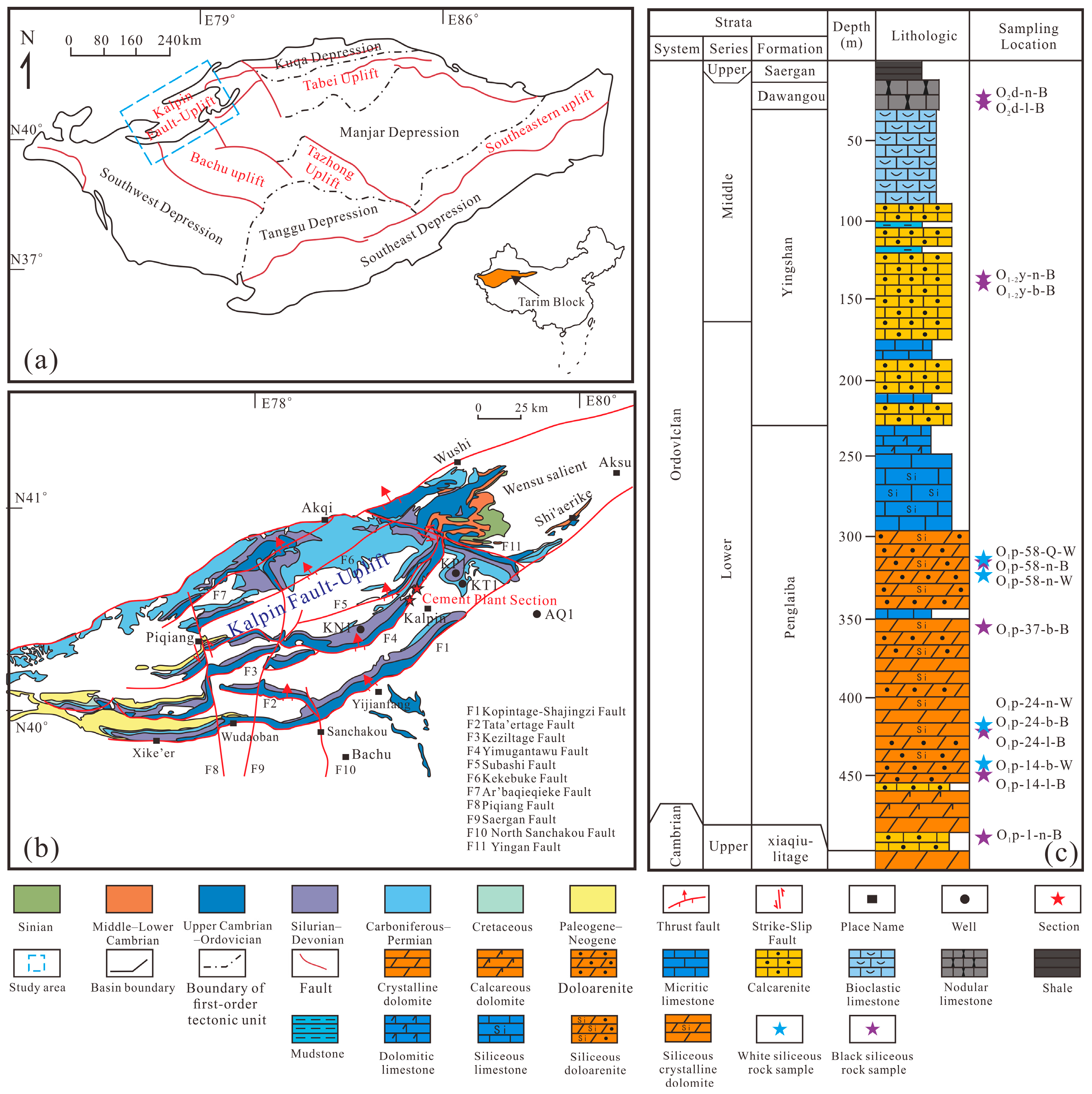
2. Geological Settings
3. Samples and Methods
3.1. Samples
3.2. Experiment
4. Results
4.1. Petrography
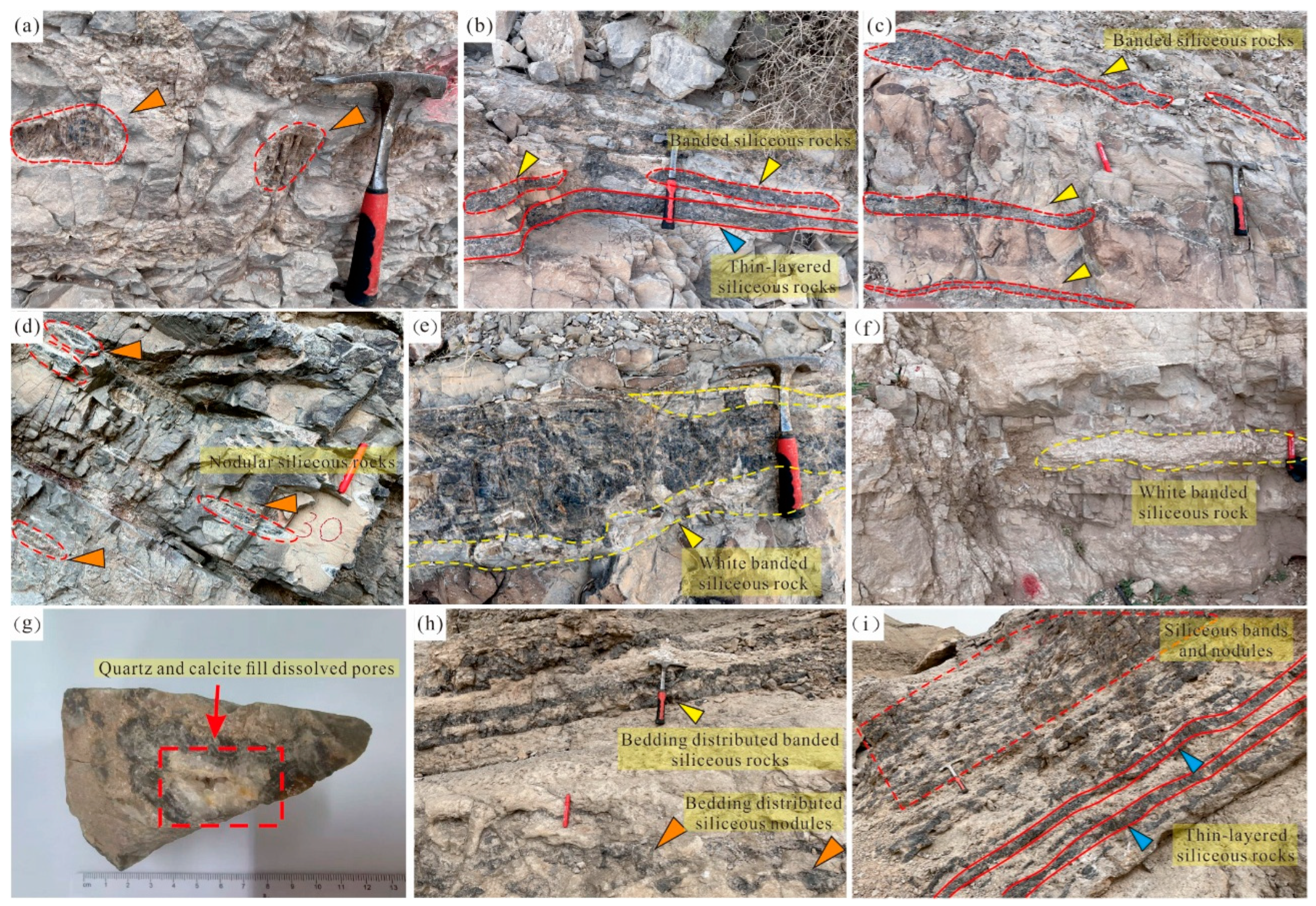
4.1.1. Lithofacies
- (1)
- Penglaiba Formation (O1p)
- (2)
- Yingshan Fm (O1–2y)
- (3)
- Dawangou Fm (O2d)
4.1.2. Microscopic Characteristics
- (1)
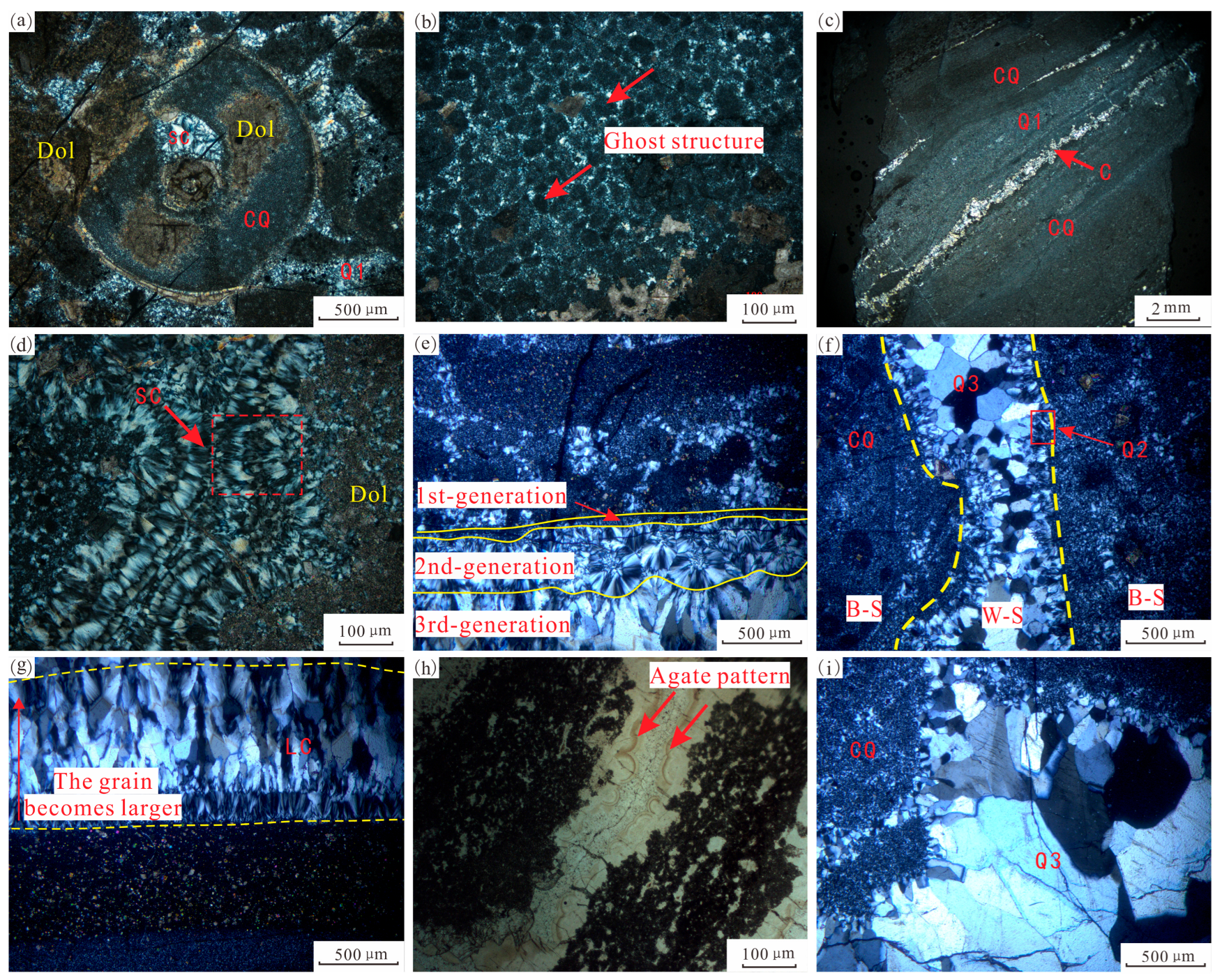
- Black siliceous rocks
- (2)
- White siliceous rocks
4.2. Geochemical Characteristics
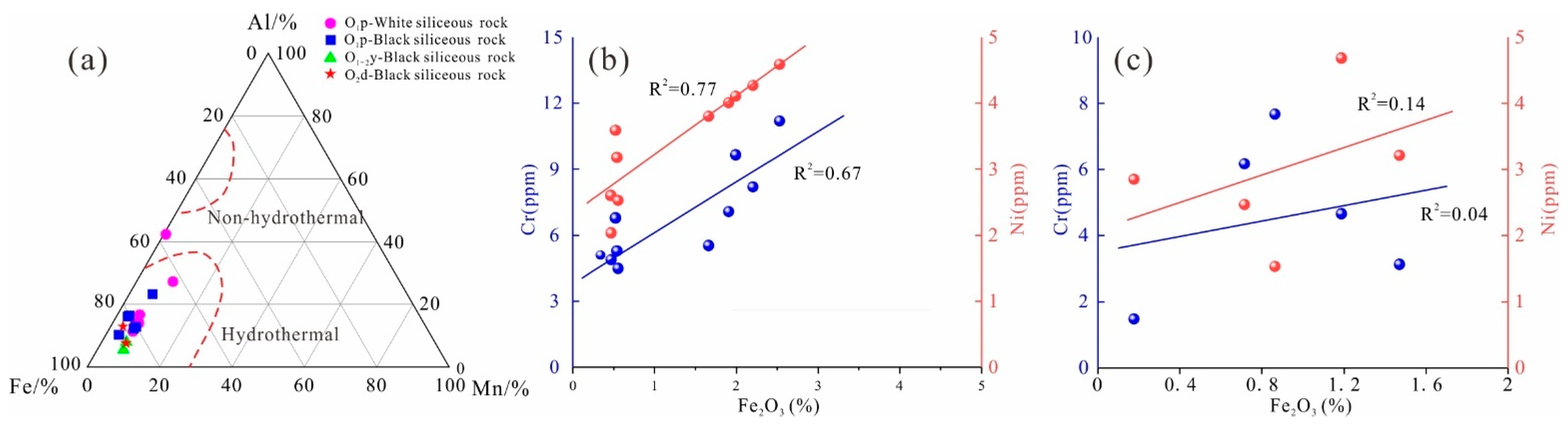
4.2.1. Characteristics of Major and Trace Element
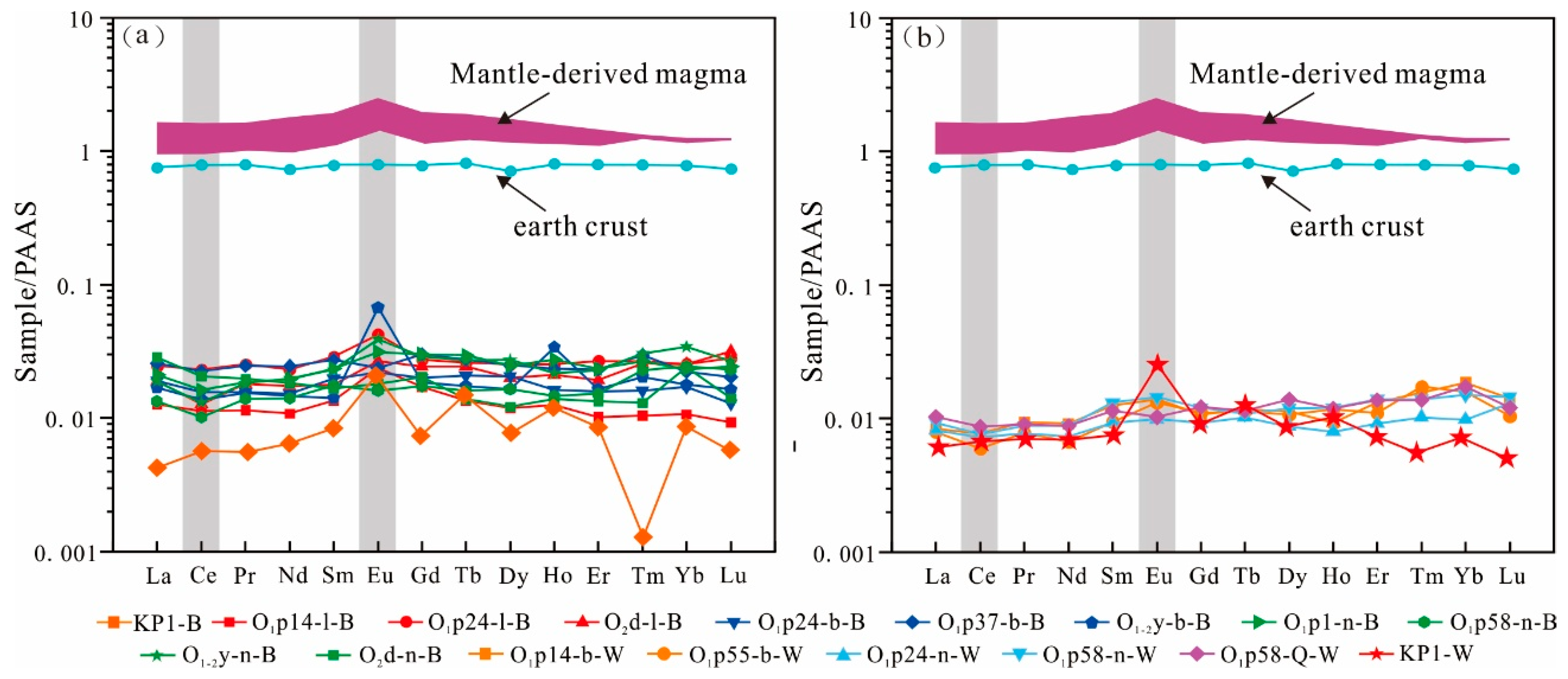
4.2.2. Characteristics of Rare Earth Element
4.2.3. Characteristics of Silicon and Oxygen Isotope
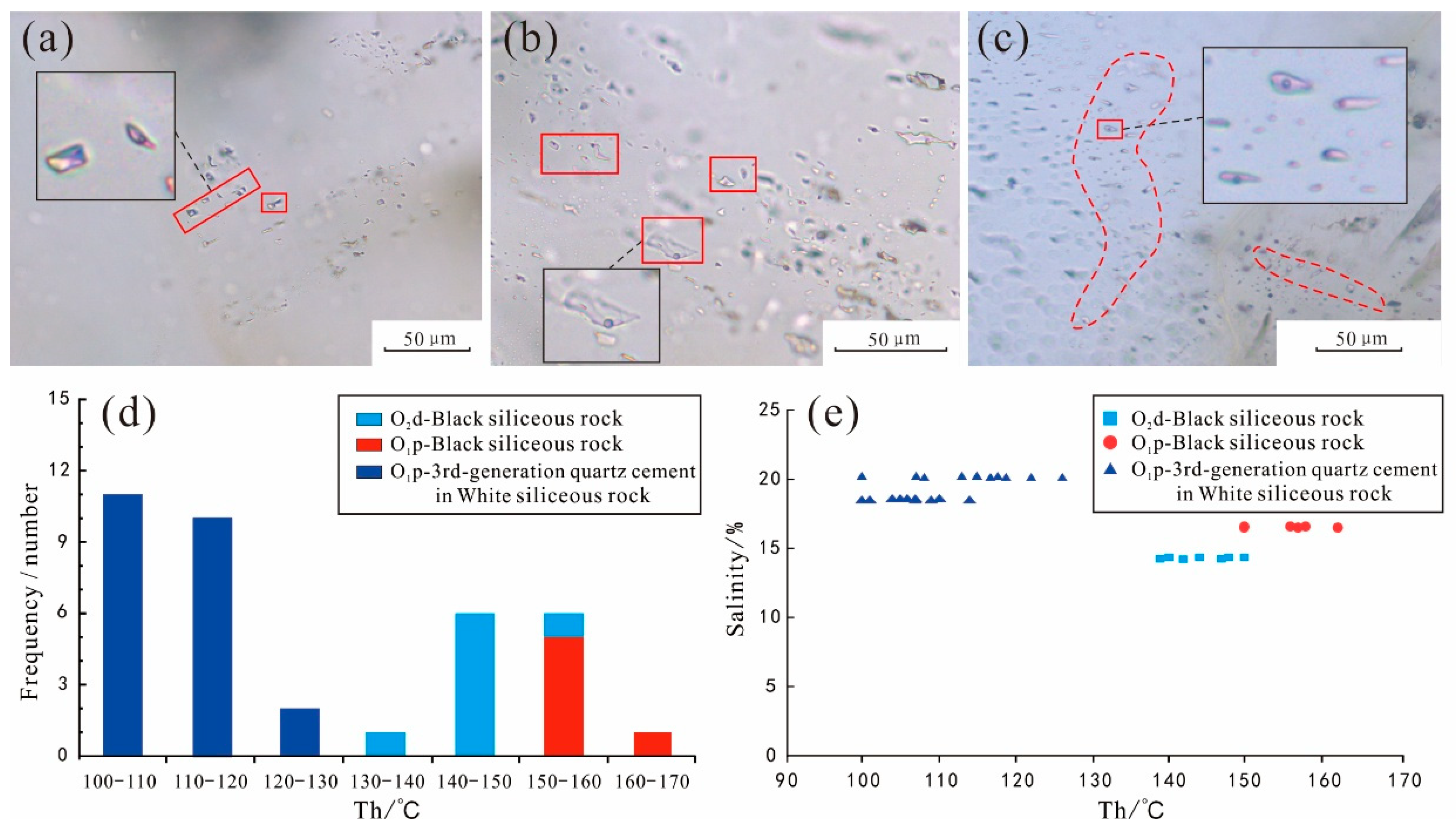
4.3. Characteristics of Fluid Inclusion
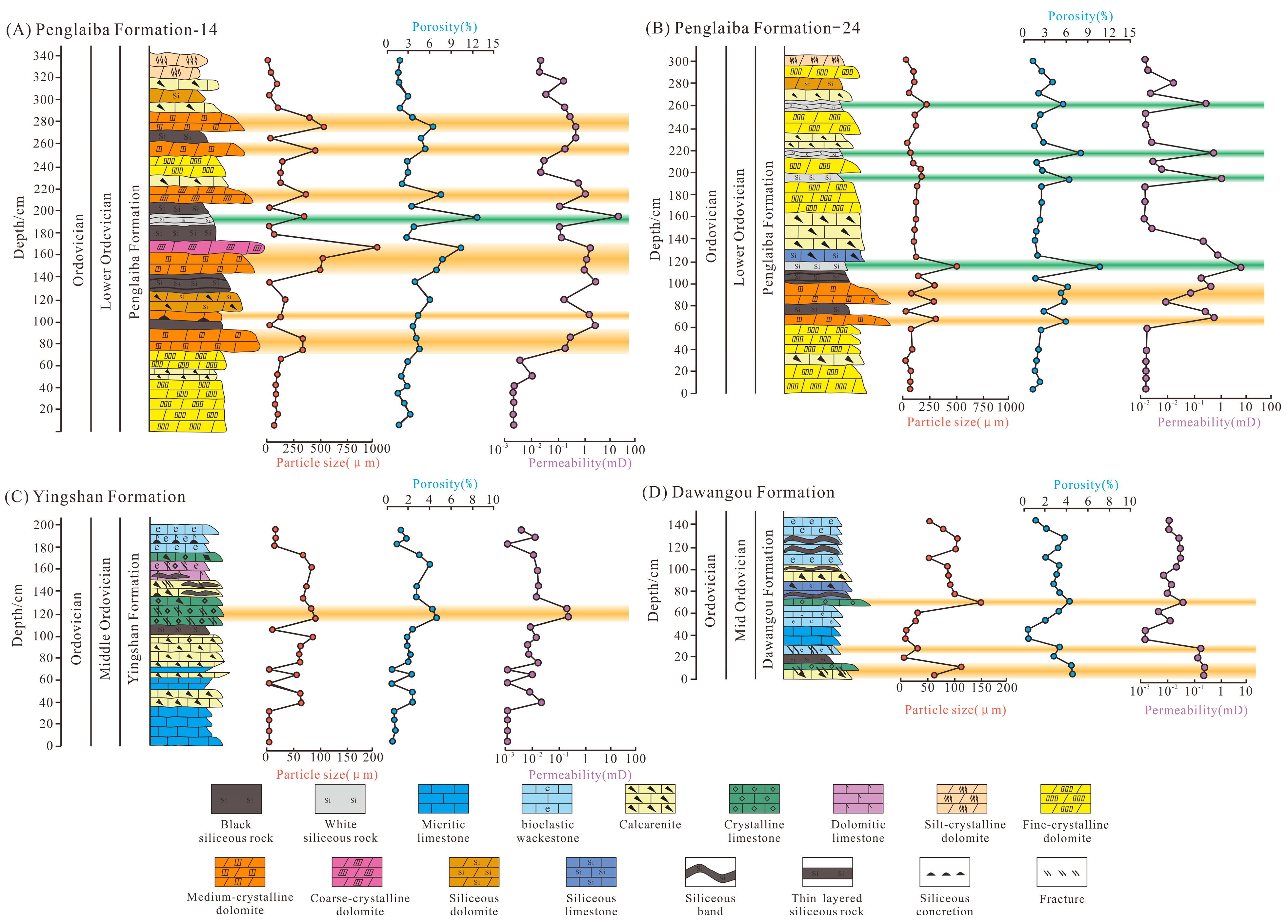
4.4. Reservoir Characteristics of Siliceous Rocks and Their Host Rocks
5. Discussion
5.1. Source of Siliceous Fluids
5.1.1. Major and Trace Elements
5.1.2. Rare Earth Elements
5.1.3. Silicon and Oxygen Isotopes
5.1.4. Fluid Inclusions
5.2. Timing of Siliceous Rock Formation
5.3. Diagenetic Model of Siliceous Rocks
5.4. Significance of Siliceous Rocks for Reservoir Formation
6. Conclusions
- The Middle–Lower Ordovician in the Kalpin area of the northwestern Tarim Basin hosts two stages of siliceous rocks: black and white. The black siliceous rocks are of hydrothermal replacement origin. The white siliceous rocks result from both hydrothermal replacement and hydrothermal precipitation.
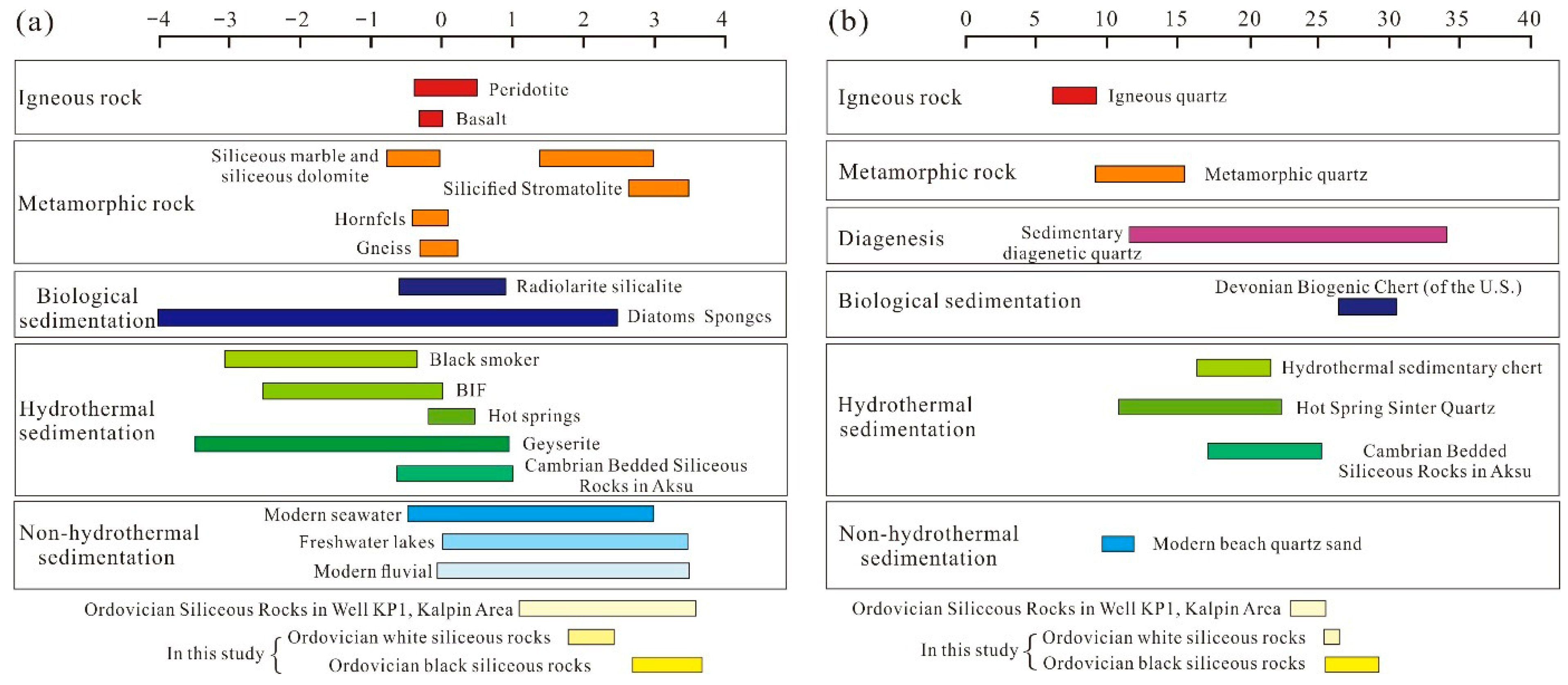
- The black siliceous rocks formed during the Late Ordovician, sourced from siliceous fluids comprising a mixture of deep mantle-derived components, basaltic clastics, high-salinity formation brines, and shallow seawater, characterized by relatively high temperatures and SiO2 supersaturation. The white siliceous rocks formed during the Late Devonian (Early Hercynian period), sourced from silicon-rich fluids mixing basaltic clastics and high-salinity formation brines, characterized by lower temperatures and slightly lower silica content.
- The black siliceous rocks developed on a larger scale with multiple layers and are susceptible to later tectonic modification, which generates fracture networks. This can increase their permeability by more than two orders of magnitude, forming fracture porosity reservoirs with considerable potential.
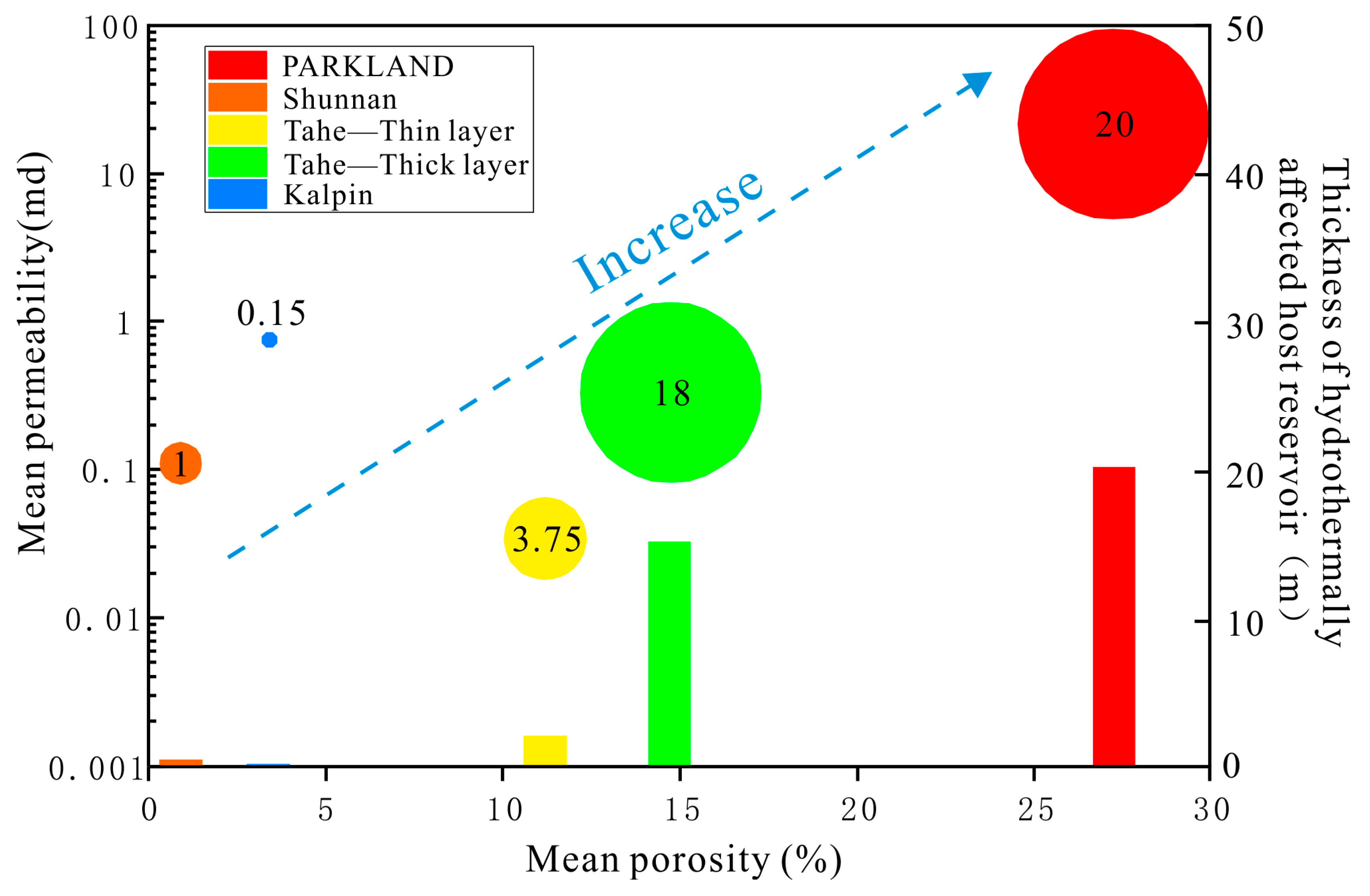
- The black siliceous rocks induce more pronounced hydrothermal alteration in the surrounding rocks. The vertical alteration zone of a single layer ranges from 10 to 20 cm in thickness and expands with increasing layer thickness or cumulative thickness. In dolomite sequences, continuous, laterally stable, and thick (10–20 m) black siliceous rock bodies, together with the adjacent medium-crystalline dolostones altered by hydrothermal fluids, represent more promising hydrothermal reservoir targets in the study area.
Author Contributions
Funding
Data Availability Statement
Acknowledgments
Conflicts of Interest
References
- Zhou, Y.; Chown, E.H.; Guha, J.; Lu, H.; Tu, G. Hydrothermal origin of Late Proterozoic bedded chert at Gusui, Guangdong, China: Petrological and geochemical evidence. Sedimentology 1994, 41, 605–619. [Google Scholar] [CrossRef] [Scilit]
- Boorn, S.H.v.D.; van Bergen, M.J.; Nijman, W.; Vroon, P. Dual role of seawater and hydrothermal fluids in Early Archean chert formation: Evidence from silicon isotopes. Geology 2007, 35, 939–942. [Google Scholar] [CrossRef] [Scilit]
- Yao, X.; Zhou, Y.; Hinnov, L.A. Astronomical forcing of a Middle Permian chert sequence in Chaohu, South China. Earth Planet. Sci. Lett. 2015, 422, 206–221. [Google Scholar] [CrossRef] [Scilit]
- Shen, B.; Ma, H.; Ye, H.; Lang, X.; Pei, H.; Zhou, C.; Zhang, S.; Yang, R. Hydrothermal origin of syndepositional chert bands and nodules in the Mesoproterozoic Wumishan Formation: Implications for the evolution of Mesoproterozoic cratonic basin, North China. Precambrian Res. 2018, 310, 213–228. [Google Scholar] [CrossRef] [Scilit]
- Li, C.; Dong, L.; Ma, H.; Liu, H.; Li, C.; Pei, H.; Shen, B. Formation of the massive bedded chert and coupled Silicon and Iron cycles during the Ediacaran-Cambrian transition. Earth Planet. Sci. Lett. 2022, 594, 117721. [Google Scholar] [CrossRef] [Scilit]
- Yao, X.; Li, S.; Zhou, Y.; Hinnov, L.A. Hydrothermal Origin of Early Permian Chert Nodules in the Central North China Craton Linked to Northern Margin Cratonic Activation. Acta Geol. Sin.-Engl. Ed. 2021, 95, 541–557. [Google Scholar] [CrossRef] [Scilit]
- Lu, F.; Liu, J.; Li, Y.; Liu, Z.; Zhou, Y.; Ding, W. Types and characteristics of chert reservoirs in oversea petroliferous basins. Pet. Explor. Dev. 2011, 38, 628–636. [Google Scholar]
- Lima, B.E.M.; De Ros, L.F. Deposition, diagenetic and hydrothermal processes in the Aptian Pre-Salt lacustrine carbonate reservoirs of the northern Campos Basin, offshore Brazil. Sediment. Geol. 2019, 383, 55–81. [Google Scholar] [CrossRef] [Scilit]
- Luebking, G.A.; Longman, M.W.; Carlisle, W.J. Unconformity-related chert/dolomite production in the Pennsylvanian Amsden Formation, Wolf Springs fields, Bull Mountains basin of central Montana. AAPG Bull. 2001, 85, 131–148. [Google Scholar]
- Donaldson, A.C.; Skoff, D. Lithostratigraphic analysis of Huntersville chert of central Appalachians: Abstract. AAPG Bull. 1985, 69, 1435. [Google Scholar]
- Packard, J.; Al-Aasm, I.; Samson, I.; Berger, Z.; Davies, J. A Devonian hydrothermal chert reservoir: The 225 bcf Parkland field, British Columbia, Canada. AAPG Bull. 2001, 85, 51–84. [Google Scholar] [CrossRef] [Scilit]
- Jafarzadeh, M.; Shoghani-Motlagh, M.; Mousivand, F.; Criniti, S.; Critelli, S. Compositional and Geochemical Signatures of Oligocene volcanoclastic sandstones of Abbasabad-Kahak area, NE Iran: Implications for provenance relations and paleogeography. Mar. Pet. Geol. 2022, 139, 105605. [Google Scholar] [CrossRef] [Scilit]
- Lima, B.E.M.; Tedeschi, L.R.; Pestilho, A.L.S.; Santos, R.V.; Vazquez, J.C.; Guzzo, J.V.P.; De Ros, L.F. Deep-burial hydrothermal alteration of the Pre-Salt carbonate reservoirs from northern Campos Basin, offshore Brazil: Evidence from petrography, fluid inclusions, Sr, C and O isotopes. Mar. Pet. Geol. 2020, 113, 104143. [Google Scholar] [CrossRef] [Scilit]
- Lu, Z.; Chen, H.; Qing, H.; Chi, G.; Chen, Q.; You, D.; Yin, H.; Zhang, S. Petrography, fluid inclusion and isotope studies in Ordovician carbonate reservoirs in the Shunnan area, Tarim basin, NW China: Implications for the nature and timing of silicification. Sediment. Geol. 2017, 359, 29–43. [Google Scholar] [CrossRef] [Scilit]
- Wang, S.; Cao, Y.; Zhang, Y.; Du, D.; Xu, Z.; Yang, M.; Zhao, Y. Origin and geochemical characteristics of siliceous rocks in the third Member of Yingshan Formation in Gucheng area, Tarim Basin. Nat. Gas Geosci. 2020, 31, 710–720. [Google Scholar]
- Liu, Y.; You, D.; Li, H.; Gao, L.; Jiang, H.; Zhang, W.; Bao, F. Characterization and evaluation of chert reservoirs in ultra-deep carbonate rock formations—A case study on Well TS 6 in the Tarim Basin. Oil Gas Geol. 2021, 42, 547–556. [Google Scholar]
- Wang, J. Diagenetic Fluids and Formation Mechanisms of the Ordovician Carbonate Reservoirs in the Shuntuoguole Area, Tarim Basin. Ph.D. Thesis, China University of Geosciences, Beijing, China, 2022. [Google Scholar]
- Li, Y.; Ye, N.; Yuan, X.; Huang, Q.; Su, B.; Zhou, R. Geological and geochemical characteristics of silicified hydrothermal fluids in Well Shunnan 4, Tarim Basin. Oil Gas Geol. 2015, 36, 934–944. [Google Scholar]
- Chen, H.; Lu, Z.; Cao, Z.; Han, J.; Yun, L. Hydrothermal alteration of Ordovician reservoir in northeastern slope of Tazhong uplift, Tarim Basin. Acta Pet. Sin. 2015, 37, 43–63. [Google Scholar]
- Liu, L.; Mao, M.; Jiang, K.; Gao, Y.; Bai, Z.; Wang, C.; Tian, Y.; Li, Q. The origin of Ordovician siliceous rocks and their deposition settings in the Northwest Tarim basin, NW China. Mar. Pet. Geo. 2024, 165, 106903. [Google Scholar] [CrossRef] [Scilit]
- He, J.; Ding, W.; Huang, W.; Cao, Z.; Chen, E.; Dai, P.; Zhang, Y. Petrological geochemical, and hydrothermal characteristics of Ordovician cherts in the southeastern Tarim Basin, NW China, and constraints on the origin of cherts and Permian tectonic evolution. J. Asian Earth Sci. 2019, 170, 294–315. [Google Scholar] [CrossRef] [Scilit]
- Lu, P. The Petrology Characteristics, Sedimentology and Reservoir Analysis of Cambrian-Ordovician Siliceous Rocks in Kalpin Fault-Uplift. Ph.D. Thesis, Chengdu University of Technology, Chengdu, China, 2013. [Google Scholar]
- Yang, Z.; Luo, P.; Liu, B.; Zhou, C.; Ma, J. Depositional characteristics of Early Cambrian hydrothermal fluid: A case study of siliceous rocks from Yurtus Formation in Aksu area of Tarim Basin, Northwest China. Earth Sci. 2019, 44, 3845–3870. [Google Scholar]
- Liu, L.; Gao, Y.; Zhu, G.; Yang, Y.; Yin, C.; Sun, X.; Li, Q. Genesis of siliceous rock in the black rock series of Ediacaran-Cambrian transition and its environmental significance in northwestern Tarim Basin. Acta Geol. Sin. 2024, 98, 511–529. [Google Scholar]
- Han, J.; Wu, X.; Pan, W.; Jiang, J.; Zhang, M. Ordovician sedimentary facies characteristic in Bachu-Wushi outcrop area of Northwest Tarim Basin. Acta Sedimentol. Sin. 2015, 33, 764–772. [Google Scholar]
- Duan, Y.; Huang, S.; Xiao, Z.; Yang, Z.; Luo, C.; Liao, P.; Yao, K.; Ma, X. Analysis of the structural deformation characteristics of the Kalpin fold thrust zon. Chin. J. Geol. 2019, 54, 17–33, (In Chinese with English abstract). [Google Scholar]
- Jiang, K.; Liu, Y.; Zhou, X.; Liu, C.; Chen, Y.; Duan, Y.; Bai, Z.; Zhang, Y.; Miao, M. Fault structural characteristics of the Early Paleozoic in the Keping fault-uplift, Tarim Basin: A case study in the Southern Keping area. Geoscience 2024, 38, 1248–1257. [Google Scholar]
- Jia, C. Tectonic Characteristics and Petroleum Tarim Basin China; Petroleum Industry Press: Beijing, China, 1997; pp. 340–348. [Google Scholar]
- Lin, C.; Li, C.; Liu, J.; Qian, Y.; Luo, H.; Chen, J.; Peng, L.; Bing, Z. Tectonic framework and paleogeographic evolution of the Tarim Basin during the Paleozoic major evolutionary stages. Acta Petrol. Sin. 2011, 27, 210–218. [Google Scholar]
- Zhang, J.; Gao, Y.; Liu, Y.; Zhou, X.; Chen, M.; Jiang, K.; Han, M.; Yang, Y.; Miao, M.; Li, Q. Tectonic characteristics and hydrocarbon exploration potential of Keping fault-uplift in Tarim Basin. Acta Petrol. Sin. 2023, 44, 1041–1057. [Google Scholar]
- Wang, Q.; Liu, J.; Lin, C.; Li, H. Depositional evolution, sequence stratigraphic framework and its response to relative sea-level change, the Middle and Lower Ordovician carbonate system on outcrops, north-western margin of Tarim Basin. Mar. Pet. Geol. 2022, 146, 105909. [Google Scholar] [CrossRef] [Scilit]
- Ma, A.; Li, H.; Li, J.; Gao, X.; Wang, F.; Yao, Y.; Feng, F. The geochemical characteristics of Middle-Upper Ordovician source rocks in Keping outcrops profiles and marine oil-source correlation, Tarim Basin, NW China. Nat. Gas Geosci. 2020, 31, 47–60. [Google Scholar]
- Zhang, S. Stratigraphy of the Tarim Basin and Adjacent Areas; Petroleum Industry Press: Beijing, China, 2003; pp. 1–1063. [Google Scholar]
- Feng, Z.; Bao, Z.; Wu, M.; Jin, Z.; Shi, X.; Luo, A. Lithofacies palaeogeography of the Ordovician in Tarim area. J. Palaegeogr. 2007, 9, 447–460. [Google Scholar]
- Zhao, Z.; Wu, X.; Pan, W.; Zhang, X.; Zhang, L.; Ma, P.; Wang, Z. Sequence Lithofacies palaeogeography of Ordovician in Tarim Basin. Acta Sedimentol. Sin. 2009, 27, 939–955. [Google Scholar]
- Herlinger, R.; Zambonato, E.E.; De Ros, L.F. Influence of diagenesis on the quality of lower cretaceous pre-salt lacustrine carbonate reservoirs from northern Campos Basin offshore Brazil. J. Sediment. Res. 2017, 87, 1285–1313. [Google Scholar] [CrossRef] [Scilit]
- Taylor, S.R.; Mclennan, S.M. The continental crust: Its composition evolution. J. Geol. 1985, 94, 57–72. [Google Scholar]
- Bodnar, R. Interpretation of data from aqueous-electrolyte fluid inclusion. In Fluid Inclusions: Analysis and Interpretation, Short Course Series; Samson, I., Anderson, A., Marshal, D., Eds.; Mineralogical Association of Canada: Sudbury, ON, Canada, 2003; Volume 32, pp. 81–100. [Google Scholar]
- Yang, S.; Chen, H.; Li, Z.; Li, Y.; Yu, X.; Li, D.; Meng, L. Early Permian Tarim Large Igneous Province in Northwest China. Sci. China Earth Sci. 2013, 56, 2015–2026. [Google Scholar] [CrossRef] [Scilit]
- Adachi, M.; Yamamoto, K.; Sugisaki, R. Hydrothermal chert and associated siliceous rocks from the northern pacific their geological significance as indication od ocean ridge activity. Sediment. Geol. 1986, 47, 125–148. [Google Scholar] [CrossRef] [Scilit]
- Boström, K.; Peterson, M.N.A. The origin of aluminum-poor ferromanganoan sediments in areas of high heat flow on the East Pacific Rise. Mar. Geol. 1969, 7, 427–447. [Google Scholar] [CrossRef] [Scilit]
- Boström, K.; Kraemer, T.; Gartner, S. Provenance and accumulation rates of opaline silica, Al, Ti, Fe, Mn, Cu, Ni and Co in Pacific pelagic sediments. Chem. Geol. 1973, 11, 123–148. [Google Scholar] [CrossRef] [Scilit]
- Yamamoto, K. Geochemical characteristics and depositional environments of cherts and associated rocks in the Franciscan and Shimanto Terranes. Sediment. Geol. 1987, 52, 65–108. [Google Scholar] [CrossRef] [Scilit]
- Murray, R.W. Chemical criteria to identify the depositional environment of chert: General principles and applications. Sediment. Geol. 1994, 90, 213–232. [Google Scholar] [CrossRef] [Scilit]
- Mclennan, S.M.; Taylor, S.R. Th and U in sedimentary rocks: Crustal evolution and sedimentary recycling. Nature 1980, 285, 621–624. [Google Scholar] [CrossRef] [Scilit]
- Mclennan, S.M.; Taylor, S.R. Sedimentary rocks and crustal evolution: Tectonic setting and secular trends. J. Geol. 1991, 99, 1–21. [Google Scholar] [CrossRef] [Scilit]
- Bau, M.; Dulski, P.; Möller, P. Yttrium and holmium in south Pacific seawater: Vertical distribution and possible fractionation mechanisms. Geochemistry 1995, 55, 1–15. [Google Scholar]
- Gong, Q.; Li, F.; Lu, C.; Wang, H.; Tang, H. Tracing seawater- and terrestrial-sourced REE signatures in detritally contaminated, diagenetically altered carbonate rocks. Chem. Geol. 2021, 570, 120169. [Google Scholar] [CrossRef] [Scilit]
- Chen, Y.; Jiang, S.; Zhou, X.; Yang, W.; Han, L. δ30Si, δ18O and elements geochemistry on the bedded siliceous rocks and cherts in dolostones from Cambrian strata, Tarim Basin. Geochimica 2010, 39, 159–170. [Google Scholar]
- Murray, R.W.; Ten Brink, M.R.B.; Gerlach, D.C.; Russ, G.P., III; Jones, D.L. Rare earth, major, and trace elements in chert from the Franciscan complex and Monterey Group, California: Assessing REE sources to fine-grained marine sediments. Geochim. Cosmochim. Acta 1991, 55, 1875–1895. [Google Scholar] [CrossRef] [Scilit]
- Frimmel, H.E. Trace element distribution in Neoproterozoic carbonates as palaeoenvironmental indicator. Chem. Geol. 2009, 258, 338–353. [Google Scholar] [CrossRef] [Scilit]
- Feng, Z.; Shao, H.; Liu, Y.; Lu, X.; Zhao, W.; Bai, X.; Xu, Z. Study on the relationship between the Ordovician diagenetic fluid and carbonate reservoir development in Gucheng area, Tarim Basin. China Pet. Explor. 2022, 27, 47–60. [Google Scholar]
- You, Y.; Wen, H.; Luo, L.; Campbell, K.A.; Guido, D.M.; Capezzuoli, E.; Lu, Z.; Du, L.; Yang, Y. A cretaceous siliceous sinter in NE China: Sedimentological and geochemical constraints on its genesis. Sediment. Geol. 2024, 464, 106618. [Google Scholar] [CrossRef] [Scilit]
- Douthitt, C.B. The geochemistry of the stable isotopes of silicon. Geochim. Cosmochim. Acta 1982, 46, 1449–1458. [Google Scholar] [CrossRef] [Scilit]
- Clayton, R.N. High temperature isotope effects in the early solar system. Rev. Mineral. Geochem. 1986, 16, 129–140. [Google Scholar]
- Ding, T.; Jiang, S.; Li, Y.; Gao, J.; Hu, B. Geochemistry of Silicon Isotopes; De Gruyter: Berlin, Germany, 2018. [Google Scholar]
- De La Rocha, C.L.; Brzezinski, M.A.; Deniro, M.J.; Shemesh, A. Silicon-isotope composition of diatoms as an indicator of past oceanic change. Nature 1998, 395, 680–683. [Google Scholar] [CrossRef] [Scilit]
- Cardinal, D.; Alleman, L.Y.; Dehairs, F.; Savoye, N.; Trull, T.W.; André, L. Relevance of silicon isotopes to Si-nutrient utilization and Si-source assessment in Antarctic waters. Glob. Biogeochem. Cycles 2005, 19, GB2007. [Google Scholar] [CrossRef] [Scilit]
- Hendry, K.R.; Georg, R.B.; Rickaby, R.E.M.; Robinson, L.F.; Halliday, A.N. Deep ocean nutrients during the last glacial maximum deduced from sponge silicon isotopic compositions. Earth Planet. Sci. Lett. 2010, 292, 290–300. [Google Scholar] [CrossRef] [Scilit]
- Ziegler, K.; Young, E.D.; Schauble, E.A.; Wasson, J.T. Metal–silicate silicon isotope fractionation in enstatite meteorites and constraints on earth’s core formation. Earth Planet. Sci. Lett. 2010, 295, 487–496. [Google Scholar] [CrossRef] [Scilit]
- Marin-carbonne, J.; Faure, F.; Chaussidon, M.; Damien, J.; François, R. A petrographic and isotopic criterion of the state of preservation of Precambrian cherts based on the characterization of the quartz veins. Precambrian Res. 2013, 231, 290–300. [Google Scholar] [CrossRef] [Scilit]
- Ma, W.; Liu, S.; Huang, W.; Chen, C.; Zhang, C. Fabric characteristics and formation mechanism of chert in Sinian Dengying Formation, Eastern Chongqing. Acta Geol. Sin. 2014, 88, 239–253. [Google Scholar]
- Poitrasson, F. Silicon isotope geochemistry. Rev. Mineral. Geochem. 2017, 82, 289–344. [Google Scholar] [CrossRef] [Scilit]
- Zhu, G.; Zhao, K.; Yu, H.; Huang, F.; Li, T. Silicon isotopic constraints on the genesis of cherts in the Ordovician sedimentary succession in Tarim Basin, Western China. J. Asian Earth Sci. 2021, 215, 104795. [Google Scholar] [CrossRef] [Scilit]
- Qiu, N.; Peter, R.; Mei, Q.; Nicolesco, S.; Tao, C. Application of the (U-Th)/He thermochronometry to the tectono-thermal evolution of sedimentary basin—A case history of Well KQ1 in the Tarim Basin Chin. J. Geophys. 2009, 52, 1825–1835. [Google Scholar]
- Chang, J.; Qiu, N.; Zuo, Y.; Li, C. The new evidence on tectonic uplift in Kepingtage area Tarim China: Constraints from (U-Th)/He ages Chin. J. Geophys. 2011, 54, 163–172. [Google Scholar]
- Liu, J.; Chen, C.; CaI, Z.; Li, J.; Wu, Z. Division of calcite veins stage, paleo-fluid evolution and hydrocarbon charging history in the Middle and Lower Cambrin strike-slip fault zone in Keping area, Northwest of Tarim Basin. Earth Sci. 2023, 48, 2189–2203. [Google Scholar]
- Pan, W.; Hu, X.; Liu, Y.; Gao, Q.; Ye, Y. Geological and geochemical evidences for two sources of hydrothermal fluids found in Ordovician carbonate rocks in northwestern Tarim Basin. Acta Petrol. Sin. 2012, 28, 2515–2524. [Google Scholar]
- Chen, L. The Study on the Formation Mechanism and the Scale of the Ordovician Hydrothermal Reservoir at Late Hercynian in the Southeast Slope of the Tahe Oilfield. Master’s Thesis, Chengdu University of Technology, Chengdu, China, 2017. [Google Scholar]
- Lin, W.; Chu, Y.; Ji, W.; Zhang, Z.; Shi, Y.; Wang, Z.; Li, Z.; Wang, Q. Geochronological and geochemical constraints for a middle Paleozoic continental arc on the northern margin of the Tarim block: Implications for the Paleozoic tectonic evolution of the South Chinese Tianshan. Lithosphere 2013, 5, 355–381. [Google Scholar] [CrossRef] [Scilit]
- Ge, R.; Zhu, W.; Wilde, S.; He, J.; Cui, X.; Wang, X.; Zheng, B. Neoproterozoic to Paleozoic long-lived accretionary orogeny in the northern Tarim craton. Tectonics 2014, 33, 302–329. [Google Scholar] [CrossRef] [Scilit]
- Guo, C.; Gao, J.; Li, Z. Driving mechanism of tectonic evolution in key Paleozoic period in Tarim Basin: Constraints from tracing of provenance attributes in Keping Area. Earth Sci. 2024, 49, 4112–4129. [Google Scholar]
- Gao, L.; Xiao, W.; Tan, Z.; Cheng, H.; Mao, Q.; Wang, H.; Jia, X.; Sang, M.; Guo, Y.; Tan, Y. Probing intra-oceanic subduction infancy in ancient orogenic belts: Example from Chinese South Tianshan. J. Metamorph. Geol. 2024, 42, 1099–1130. [Google Scholar] [CrossRef] [Scilit]
- Yu, X.; Yang, S.; Chen, H.; Li, Z.; Li, Y. Petrogenetic model of the Permian Tarim Large Igneous Province. Sci. China Earth Sci. 2017, 60, 1805–1816. [Google Scholar] [CrossRef] [Scilit]
- Li, F. Formation and Preservation of Carbonate Reservoirs Under Neotectonism—Example from the Kalpin Fold-and-Thrust Belt. Ph.D. Thesis, Geological Resources and Geological Engineering, Beijing, China, 2023. [Google Scholar]
- Qiao, Z.; Shen, A.; Liang, F.; Shao, G.; Zhang, T.; Luo, X.; Sun, X.; Dong, J. Magnesium isotope-based forming process of large sized burial dolomite: A case study of the Penglaiba Formation in Tarim Basin. Acta Geol. Sin. 2023, 97, 2293–2310. [Google Scholar]
- Wei, D.; Gao, Z.; Fan, T.; Niu, Y.; Guo, R. Volcanic events-related hydrothermal dolomitisation and silicification controlled by intra-cratonic strike-slip fault systems: Insights from the northern slope of the Tazhong Uplift, Tarim Basin, China. Basin Res. 2021, 23, 2411–2434. [Google Scholar] [CrossRef] [Scilit]
- Wu, G.; Li, Y.; Liu, Y.; Zhao, Y. Paleozoic sedimento-tectonic evolution and basin dynamic settings in Wushi-Kalpin-Bachu area Northwest Tarim. J. Palaeogeogr. 2013, 15, 203–218. [Google Scholar]
- He, B.; Jiao, C.; Xu, Z.; Cai, Z.; Zhang, J.; Liu, S.; Li, H.; Chen, W.; Yu, Z. The paleotectonic and paleogeography reconstructions of the Tarim Basin and its adjacent areas (NW China) during the late Early and Middle Paleozoic. Gondwana Res. 2016, 30, 191–206. [Google Scholar] [CrossRef] [Scilit]
- Qu, J. Control of Strike Slip Faults on the Development of Carbonate Fractures in Keping Bachu Area, Xinjiang. Master’s Thesis, China University of Petroleum (East China), Qingdao, China, 2022. [Google Scholar]
- Sun, C.; Zhou, H.; Luo, X.; Yang, P.; Liao, W.; Shi, L.; Huang, Z. Structural characteristics formation evolution of Shajingzi fault zone in the Northwest margin of Tarim Basin China Chin. J. Geol. 2024, 59, 199–209. [Google Scholar]
- Guo, R.; Zhang, S.; Bai, X.; Wang, K.; Sun, X.; Liu, X. Hydrothermal dolomite reservoirs in a fault system and the factors controlling reservoir formation—A case study of Lower Paleozoic carbonate reservoirs in the Gucheng area, Tarim Basin. Mar. Pet. Geol. 2020, 120, 104506. [Google Scholar] [CrossRef] [Scilit]
- Jia, L.; Cai, C.; Jiang, L.; Zhang, K.; Li, H.X.; Zhang, W. Petrological and geochemical constraints on diagenesis and deep burial dissolution of the Ordovician carbonate reservoirs in the Tazhong area, Tarim Basin, NW China. Mar. Pet. Geol. 2016, 78, 271–290. [Google Scholar] [CrossRef] [Scilit]
- Luo, X.; Zhang, L.; Zhang, L.; Lei, Y.; Li, J.; Yang, W.; Cheng, M.; Shi, H.; Cao, B. Heterogeneity in siliciclastic carrier beds: Implications for hydrocarbon migration and accumulation. AAPG Bull. 2023, 107, 1017–1036. [Google Scholar] [CrossRef] [Scilit]
- You, D.; Han, J.; Hu, W.; Qian, Y.; Chen, Q.; Xi, B.; Ma, H. Characteristics and formation mechanisms of silicified carbonate reservoirs in Well SN4 of the Tarim Basin. Energy Explor. Exploit. 2018, 36, 820–849. [Google Scholar] [CrossRef] [Scilit]








| Sample | Depth (m) | Type | SiO2 | Al2O3 | Fe2O3 | MgO | CaO | Na2O | K2O | MnO | TiO2 | P2O5 | Al/(Al + Mn + Fe) |
|---|---|---|---|---|---|---|---|---|---|---|---|---|---|
| % | % | % | % | % | % | % | % | % | % | ||||
| O1p-1-n-B | 489 | Black nodule | 85.86 | 0.24 | 0.55 | 0.18 | 6.94 | 0.17 | 0.07 | 0.04 | 0.03 | 0.00 | 0.23 |
| O1p-14-l-B | 443 | Black layer | 94.46 | 0.31 | 1.16 | 0.44 | 1.89 | 0.18 | 0.06 | 0.04 | 0.02 | 0.00 | 0.16 |
| O1p-24-l-B | 420 | Black layer | 94.57 | 0.42 | 1.99 | 0.10 | 0.89 | 0.11 | 0.06 | 0.15 | 0.03 | 0.02 | 0.13 |
| O1p-24-b-B | 420 | Black band | 89.13 | 0.17 | 1.07 | 1.51 | 3.81 | 0.11 | 0.04 | 0.04 | 0.02 | 0.01 | 0.10 |
| O1p-37-b-B | 355 | Black band | 87.66 | 0.27 | 1.02 | 1.10 | 4.97 | 0.15 | 0.07 | 0.04 | 0.03 | 0.00 | 0.16 |
| O1p-58-n-B | 315 | Black nodule | 95.63 | 0.33 | 1.66 | 0.11 | 0.46 | 0.09 | 0.05 | 0.12 | 0.02 | 0.02 | 0.12 |
| O1–2y-b-B | 140 | Black band | 94.58 | 0.21 | 2.53 | 0.04 | 0.78 | 0.09 | 0.04 | 0.19 | 0.02 | 0.02 | 0.05 |
| O1–2y-n-B | 140 | Black nodule | 84.69 | 0.24 | 1.90 | 0.18 | 6.18 | 0.10 | 0.04 | 0.14 | 0.02 | 0.02 | 0.08 |
| O2d-l-B | 18 | Black layer | 93.21 | 0.26 | 2.20 | 0.04 | 1.90 | 0.09 | 0.05 | 0.16 | 0.02 | 0.02 | 0.08 |
| O2d-n-B | 17 | Black nodule | 95.90 | 0.23 | 1.14 | 0.17 | 1.51 | 0.14 | 0.05 | 0.04 | 0.03 | 0.01 | 0.13 |
| O1p-14-b-W | 441 | White band | 84.85 | 0.17 | 0.17 | 0.15 | 7.79 | 0.11 | 0.03 | 0 | 0.02 | 0.02 | 0.42 |
| O1p-24-n-W | 420 | White nodule | 94.32 | 0.20 | 0.71 | 0.71 | 1.48 | 0.07 | 0.04 | 0.05 | 0.02 | 0.02 | 0.17 |
| O1p-55-b-W | 333 | White band | 97.01 | 0.22 | 1.19 | 0.09 | 0.31 | 0.06 | 0.05 | 0.09 | 0.02 | 0.02 | 0.11 |
| O1p-58-n-W | 323 | White nodule | 93.32 | 0.34 | 1.47 | 0.87 | 1.40 | 0.06 | 0.07 | 0.10 | 0.03 | 0.02 | 0.14 |
| O1p-58-Q-W | 315 | Quartz grains | 74.04 | 0.20 | 0.86 | 5.58 | 7.30 | 0.05 | 0.06 | 0.07 | 0.02 | 0.02 | 0.14 |
| Sample | Depth (m) | Type | Li | Be | Sc | V | Cr | Co | Ni | Cu | Zn | Ga | Rb | Sr | Y | Zr | Mo | Cs | Ba | Th | U | Th/U |
|---|---|---|---|---|---|---|---|---|---|---|---|---|---|---|---|---|---|---|---|---|---|---|
| μg/g | μg/g | μg/g | μg/g | μg/g | μg/g | μg/g | μg/g | μg/g | μg/g | μg/g | μg/g | μg/g | μg/g | μg/g | μg/g | μg/g | μg/g | μg/g | ||||
| O1p-1-n-B | 489 | Black nodule | 10.26 | 0.14 | 0.22 | 2.14 | 4.50 | 0.73 | 2.53 | 5.26 | 13.15 | 0.53 | 1.34 | 58.65 | 0.73 | 3.39 | 0.38 | 0.41 | 0.12 | 27.36 | 0.40 | 0.87 |
| O1p-14-l-B | 443 | Black layer | 4.35 | 0.06 | 0.15 | 1.92 | 4.38 | 0.59 | 2.61 | 5.34 | 24.23 | 0.52 | 1.14 | 22.00 | 0.30 | 2.68 | 0.29 | 2.20 | 0.12 | 38.86 | 0.19 | 0.08 |
| O1p-24-l-B | 420 | Black layer | 6.90 | 0.14 | 0.31 | 6.23 | 9.66 | 1.92 | 4.11 | 6.32 | 17.64 | 0.80 | 1.49 | 23.68 | 0.62 | 10.66 | 0.49 | 3.99 | 0.14 | 42.90 | 0.47 | 0.28 |
| O1p-24-b-B | 420 | Black band | 5.68 | 0.03 | 0.18 | 3.76 | 4.89 | 0.54 | 2.04 | 4.35 | 16.44 | 0.53 | 1.08 | 30.78 | 0.41 | 2.81 | 0.33 | 1.04 | 0.10 | 13.13 | 0.28 | 0.39 |
| O1p-37-b-B | 355 | Black band | 4.27 | 0.12 | 0.21 | 3.32 | 6.79 | 1.05 | 3.59 | 6.22 | 23.69 | 0.56 | 1.50 | 24.61 | 0.60 | 3.93 | 0.33 | 2.34 | 0.17 | 13.47 | 0.31 | 0.08 |
| O1p-58-n-B | 315 | Black nodule | 3.05 | 0.12 | 0.20 | 5.42 | 5.54 | 1.55 | 3.81 | 5.88 | 8.41 | 0.64 | 1.38 | 42.62 | 0.48 | 4.69 | 0.40 | 3.86 | 0.19 | 12.41 | 0.33 | 0.07 |
| O1–2y-b-B | 140 | Black band | 6.71 | 0.02 | 0.11 | 6.51 | 11.20 | 2.01 | 4.59 | 7.55 | 10.78 | 0.88 | 1.08 | 32.88 | 0.43 | 7.44 | 0.43 | 1.46 | 0.26 | 314.53 | 0.23 | 0.54 |
| O1–2y-n-B | 140 | Black nodule | 8.78 | 0.06 | 0.20 | 5.33 | 7.09 | 1.81 | 4.01 | 6.51 | 8.20 | 0.57 | 1.26 | 59.72 | 0.90 | 4.39 | 0.37 | 1.30 | 0.14 | 85.63 | 0.23 | 0.54 |
| O2d-l-B | 18 | Black layer | 3.98 | 0.10 | 0.20 | 5.26 | 8.20 | 1.99 | 4.27 | 7.78 | 7.30 | 0.69 | 1.32 | 62.91 | 0.61 | 4.79 | 0.43 | 1.44 | 0.15 | 45.65 | 0.30 | 0.49 |
| O2d-n-B | 17 | Black noule | 4.20 | 0.05 | 0.16 | 4.34 | 5.29 | 0.74 | 3.18 | 5.49 | 20.25 | 0.39 | 1.23 | 27.75 | 0.32 | 3.64 | 0.35 | 2.83 | 0.17 | 28.07 | 0.27 | 0.08 |
| O1p-14-b-W | 441 | White band | 6.73 | 0.05 | 0.16 | 4.50 | 1.48 | 0.20 | 0.86 | 0.43 | 5.26 | 0.22 | 0.95 | 68.82 | 0.31 | 2.95 | 0.19 | 0.40 | 0.12 | 8.18 | 0.12 | 0.40 |
| O1p-24-n-W | 420 | White nodule | 1.74 | 0.09 | 0.17 | 6.07 | 3.18 | 0.78 | 2.47 | 3.45 | 5.35 | 0.59 | 0.88 | 17.83 | 0.32 | 4.44 | 0.32 | 2.91 | 0.09 | 7.96 | 0.24 | 0.12 |
| O1p-55-b-W | 333 | White band | 1.12 | 0.12 | 0.21 | 5.35 | 4.67 | 1.06 | 2.69 | 4.68 | 6.64 | 0.62 | 0.98 | 16.29 | 0.38 | 4.79 | 0.35 | 1.32 | 0.09 | 13.15 | 0.29 | 0.11 |
| O1p-58-n-W | 323 | White nodule | 2.81 | 0.11 | 0.29 | 5.75 | 5.14 | 1.40 | 3.22 | 5.60 | 10.37 | 0.69 | 1.58 | 16.23 | 0.32 | 5.34 | 0.44 | 1.52 | 0.11 | 15.05 | 0.30 | 0.12 |
| O1p-58-Q-W | 315 | Quartz grains | 1.84 | 0.02 | 0.24 | 16.27 | 7.68 | 0.88 | 2.14 | 3.69 | 5.87 | 0.46 | 1.22 | 25.69 | 0.41 | 4.55 | 0.46 | 1.01 | 0.07 | 9.84 | 0.32 | 0.19 |
| Sample | Depth (m) | Type | La | Ce | Pr | Nd | Sm | Eu | Gd | Tb | Dy | Ho | Er | Tm | Yb | Lu | ΣREE | LREE/ HREE | Y/Ho | La/Ho | δCe | δEu | (La/Yb)N |
|---|---|---|---|---|---|---|---|---|---|---|---|---|---|---|---|---|---|---|---|---|---|---|---|
| μg/g | μg/g | μg/g | μg/g | μg/g | μg/g | μg/g | μg/g | μg/g | μg/g | μg/g | μg/g | μg/g | μg/g | ||||||||||
| O1p-1-n-B | 489 | Black nodule | 0.808 | 1.290 | 0.165 | 0.664 | 0.130 | 0.034 | 0.140 | 0.023 | 0.115 | 0.027 | 0.066 | 0.011 | 0.065 | 0.011 | 3.55 | 6.75 | 26.99 | 29.72 | 0.81 | 1.18 | 0.91 |
| O1p-14-l-B | 443 | Black layer | 0.488 | 0.901 | 0.101 | 0.366 | 0.075 | 0.026 | 0.080 | 0.011 | 0.056 | 0.012 | 0.029 | 0.004 | 0.030 | 0.004 | 2.18 | 8.65 | 23.72 | 39.08 | 0.94 | 1.56 | 1.20 |
| O1p-24-l-B | 420 | Black layer | 0.939 | 1.839 | 0.224 | 0.784 | 0.161 | 0.046 | 0.128 | 0.020 | 0.118 | 0.025 | 0.076 | 0.011 | 0.071 | 0.012 | 4.45 | 8.65 | 24.62 | 37.50 | 0.93 | 1.51 | 0.97 |
| O1p-24-b-B | 420 | Black band | 0.724 | 1.250 | 0.138 | 0.520 | 0.109 | 0.024 | 0.094 | 0.016 | 0.096 | 0.016 | 0.045 | 0.007 | 0.048 | 0.006 | 3.09 | 8.44 | 25.51 | 44.84 | 0.91 | 1.10 | 1.10 |
| O1p-37-b-B | 355 | Black band | 0.977 | 1.783 | 0.217 | 0.830 | 0.152 | 0.026 | 0.141 | 0.021 | 0.116 | 0.023 | 0.066 | 0.012 | 0.062 | 0.009 | 4.44 | 8.84 | 26.05 | 42.10 | 0.89 | 0.83 | 1.15 |
| O1p-58-n-B | 315 | Black nodule | 0.508 | 0.811 | 0.123 | 0.479 | 0.097 | 0.017 | 0.081 | 0.012 | 0.077 | 0.015 | 0.043 | 0.009 | 0.068 | 0.010 | 2.35 | 6.44 | 33.19 | 34.93 | 0.75 | 0.92 | 0.54 |
| O1–2y-b-B | 140 | Black band | 0.648 | 1.100 | 0.137 | 0.498 | 0.078 | 0.073 | 0.086 | 0.014 | 0.077 | 0.034 | 0.047 | 0.008 | 0.050 | 0.007 | 2.86 | 7.84 | 12.72 | 19.22 | 0.85 | 4.17 | 0.96 |
| O1–2y-n-B | 140 | Black nodule | 0.721 | 1.045 | 0.161 | 0.673 | 0.128 | 0.042 | 0.135 | 0.021 | 0.128 | 0.021 | 0.065 | 0.012 | 0.096 | 0.012 | 3.26 | 5.66 | 42.07 | 33.55 | 0.71 | 1.51 | 0.55 |
| O2d-l-B | 18 | Black layer | 0.730 | 1.007 | 0.160 | 0.586 | 0.099 | 0.029 | 0.114 | 0.019 | 0.094 | 0.021 | 0.055 | 0.010 | 0.071 | 0.014 | 3.01 | 6.56 | 29.09 | 34.76 | 0.68 | 1.27 | 0.76 |
| O2d-n-B | 17 | Black nodule | 1.087 | 1.636 | 0.174 | 0.617 | 0.093 | 0.020 | 0.095 | 0.011 | 0.057 | 0.014 | 0.038 | 0.005 | 0.068 | 0.006 | 3.92 | 12.34 | 23.11 | 78.38 | 0.85 | 0.98 | 1.18 |
| O1p-14-b-W | 441 | White band | 0.312 | 0.577 | 0.069 | 0.248 | 0.052 | 0.011 | 0.043 | 0.008 | 0.041 | 0.008 | 0.026 | 0.004 | 0.028 | 0.006 | 1.43 | 7.74 | 38.75 | 39.42 | 0.91 | 1.06 | 0.83 |
| O1p-24-n-W | 420 | White nodule | 0.318 | 0.618 | 0.083 | 0.309 | 0.070 | 0.015 | 0.050 | 0.009 | 0.053 | 0.009 | 0.037 | 0.006 | 0.052 | 0.006 | 1.64 | 6.33 | 34.75 | 34.35 | 0.88 | 1.20 | 0.45 |
| O1p-55-b-W | 333 | White band | 0.304 | 0.473 | 0.069 | 0.227 | 0.053 | 0.014 | 0.052 | 0.009 | 0.050 | 0.012 | 0.031 | 0.007 | 0.044 | 0.005 | 1.35 | 5.45 | 32.52 | 26.26 | 0.75 | 1.28 | 0.51 |
| O1p-58-n-W | 323 | White nodule | 0.356 | 0.607 | 0.078 | 0.300 | 0.073 | 0.016 | 0.056 | 0.008 | 0.056 | 0.012 | 0.040 | 0.006 | 0.042 | 0.006 | 1.65 | 6.32 | 27.18 | 29.95 | 0.84 | 1.15 | 0.62 |
| O1p-58-Q-W | 315 | Quartz grains | 0.395 | 0.690 | 0.080 | 0.300 | 0.063 | 0.011 | 0.057 | 0.009 | 0.065 | 0.012 | 0.039 | 0.006 | 0.048 | 0.005 | 1.78 | 6.39 | 34.41 | 33.46 | 0.89 | 0.87 | 0.60 |
| Sample | Type | δ18O (V-SMOW) | δ30Si (V-NBS28) |
|---|---|---|---|
| ‰ | ‰ | ||
| O1p-14-l-B | Black layer | 26.19 | 2.84 |
| O1p-14-b-B | Black band | 25.79 | 3.28 |
| O1p-24-b-B | Black layer | 25.66 | 3.67 |
| O1p-58-n-B | Black nodule | 25.79 | 2.87 |
| O2d-l-B | Black layer | 29.33 | 2.79 |
| O1p-24-n-W | White nodule | 26.48 | 2.17 |
| O1p-55-b-W | White band | 26.44 | 2.42 |
| O1p-58-n-W | White nodule | 25.12 | 2.04 |
| O1p-58-Q-W | Quartz grains | 26.19 | 1.79 |
| Sample | Type | Size | Th | Salinity | |
|---|---|---|---|---|---|
| μm | °C | wt% Nacl | |||
| O1p-14-l-B | Aqueous-rich inclusion | Quantity | 6 | 6 | 6 |
| Min | 2 × 4 | 150 | 16.55 | ||
| Max | 6 × 12 | 162 | 16.63 | ||
| Mean | 155.5 | 16.58 | |||
| O2d-l-B | Aqueous-rich inclusion | Quantity | 7 | 7 | 7 |
| Min | 1 × 5 | 139 | 14.21 | ||
| Max | 4 × 4 | 150 | 14.36 | ||
| Mean | 144.3 | 14.31 | |||
| O1p-58-Q-W | Hydrocarbon-aqueous inclusion | Quantity | 23 | 23 | 23 |
| Min | 1 × 3 | 100 | 18.63 | ||
| Max | 5 × 7 | 126 | 20.15 | ||
| Mean | 111.1 | 19.4 |
| Reservoir Properties | Black Siliceous Rock | White Siliceous Rock | Medium-Crystalline Dolomite | Fine-Crystalline Dolomite | Crystalline Limestone | Calcarenite | Bioclastic Micritic Limestone | Micritic Limestone |
|---|---|---|---|---|---|---|---|---|
| Maximum porosity (%) | 4.88 | 12.82 | 7.87 | 3.33 | 4.63 | 4.61 | 3.93 | 0.80 |
| Minimum porosity (%) | 1.68 | 5.58 | 2.51 | 1.02 | 1.97 | 1.48 | 0.76 | 0.36 |
| Mean porosity (%) | 3.41 | 8.82 | 5.17 | 2.28 | 3.62 | 2.30 | 2.29 | 0.56 |
| Maximum Permeability (mD) | 3.237 | 25.18 | 1.902 | 0.034 | 0.935 | 0.741 | 0.197 | 0.002 |
| Minimum Permeability (mD) | 0.009 | 0.350 | 0.002 | 0.001 | 0.010 | 0.001 | 0.001 | 0.001 |
| Mean Permeability (mD) | 0.747 | 6.911 | 0.495 | 0.005 | 0.222 | 0.087 | 0.032 | 0.001 |
Disclaimer/Publisher’s Note: The statements, opinions and data contained in all publications are solely those of the individual author(s) and contributor(s) and not of MDPI and/or the editor(s). MDPI and/or the editor(s) disclaim responsibility for any injury to people or property resulting from any ideas, methods, instructions or products referred to in the content. |
© 2026 by the authors. Licensee MDPI, Basel, Switzerland. This article is an open access article distributed under the terms and conditions of the Creative Commons Attribution (CC BY) license.
Share and Cite
Luo, J.; Zhang, T.; Shi, P.; Xie, Z.; Zeng, J.; Gao, L.; Ma, Z.; Zhang, X. Genesis and Reservoir Implications of Multi-Stage Siliceous Rocks in the Middle–Lower Ordovician, Northwestern Tarim Basin. Minerals 2026, 16, 107. https://doi.org/10.3390/min16010107
Luo J, Zhang T, Shi P, Xie Z, Zeng J, Gao L, Ma Z, Zhang X. Genesis and Reservoir Implications of Multi-Stage Siliceous Rocks in the Middle–Lower Ordovician, Northwestern Tarim Basin. Minerals. 2026; 16(1):107. https://doi.org/10.3390/min16010107
Chicago/Turabian StyleLuo, Jinyu, Tingshan Zhang, Pingzhou Shi, Zhou Xie, Jianli Zeng, Lubiao Gao, Zhiheng Ma, and Xi Zhang. 2026. "Genesis and Reservoir Implications of Multi-Stage Siliceous Rocks in the Middle–Lower Ordovician, Northwestern Tarim Basin" Minerals 16, no. 1: 107. https://doi.org/10.3390/min16010107
APA StyleLuo, J., Zhang, T., Shi, P., Xie, Z., Zeng, J., Gao, L., Ma, Z., & Zhang, X. (2026). Genesis and Reservoir Implications of Multi-Stage Siliceous Rocks in the Middle–Lower Ordovician, Northwestern Tarim Basin. Minerals, 16(1), 107. https://doi.org/10.3390/min16010107