
The Kovdozero and Pados-Tundra Complexes, Kola Peninsula, Russia: Comparable Geochemistry and Age


 ,
,  , and
, and
Abstract
1. Introduction
2. The Geological Context
3. Materials and Methods
4. Results and Observations
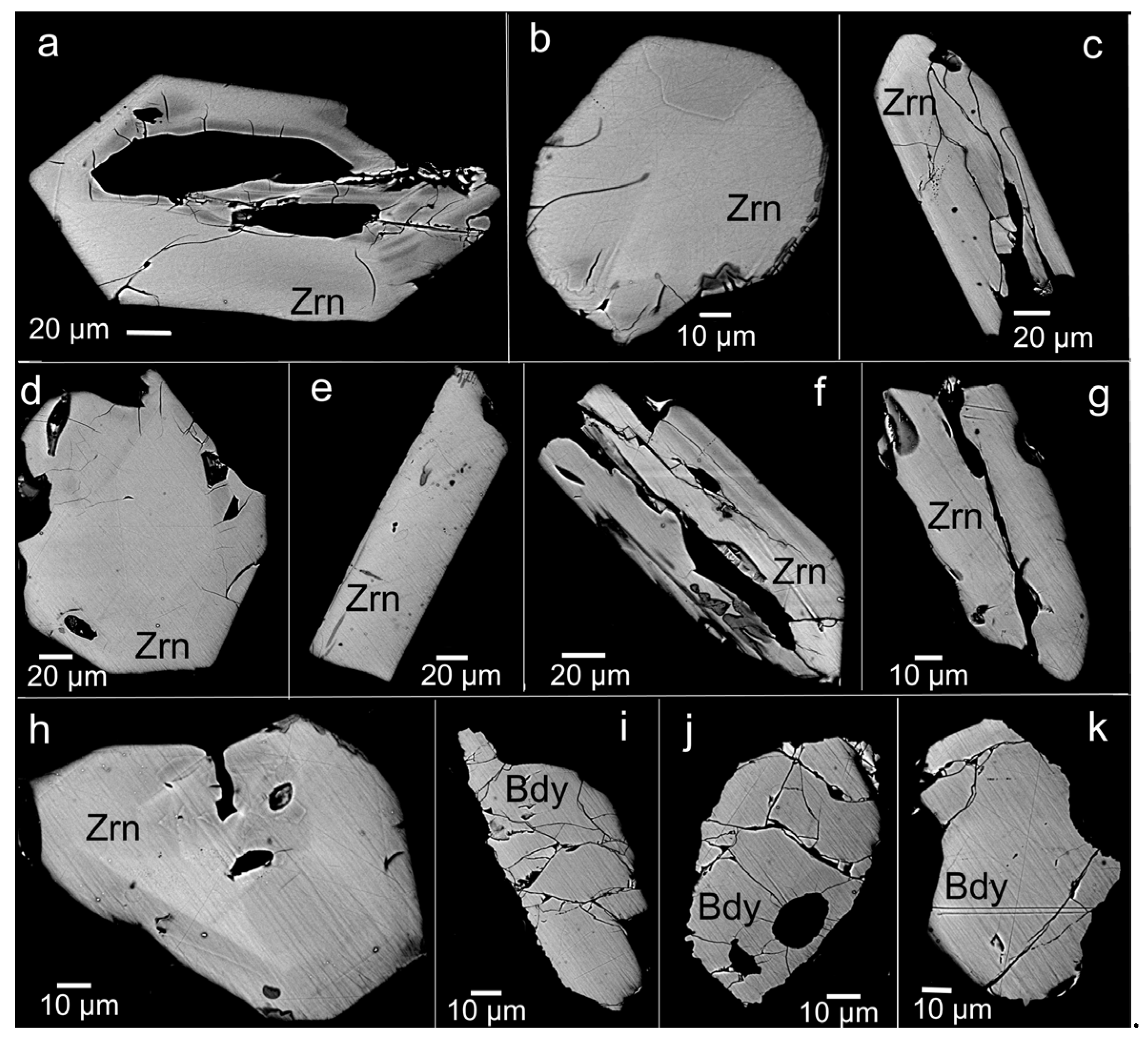
4.1. Two Kovdozero Samples Are Selected for U–Pb Age Determination
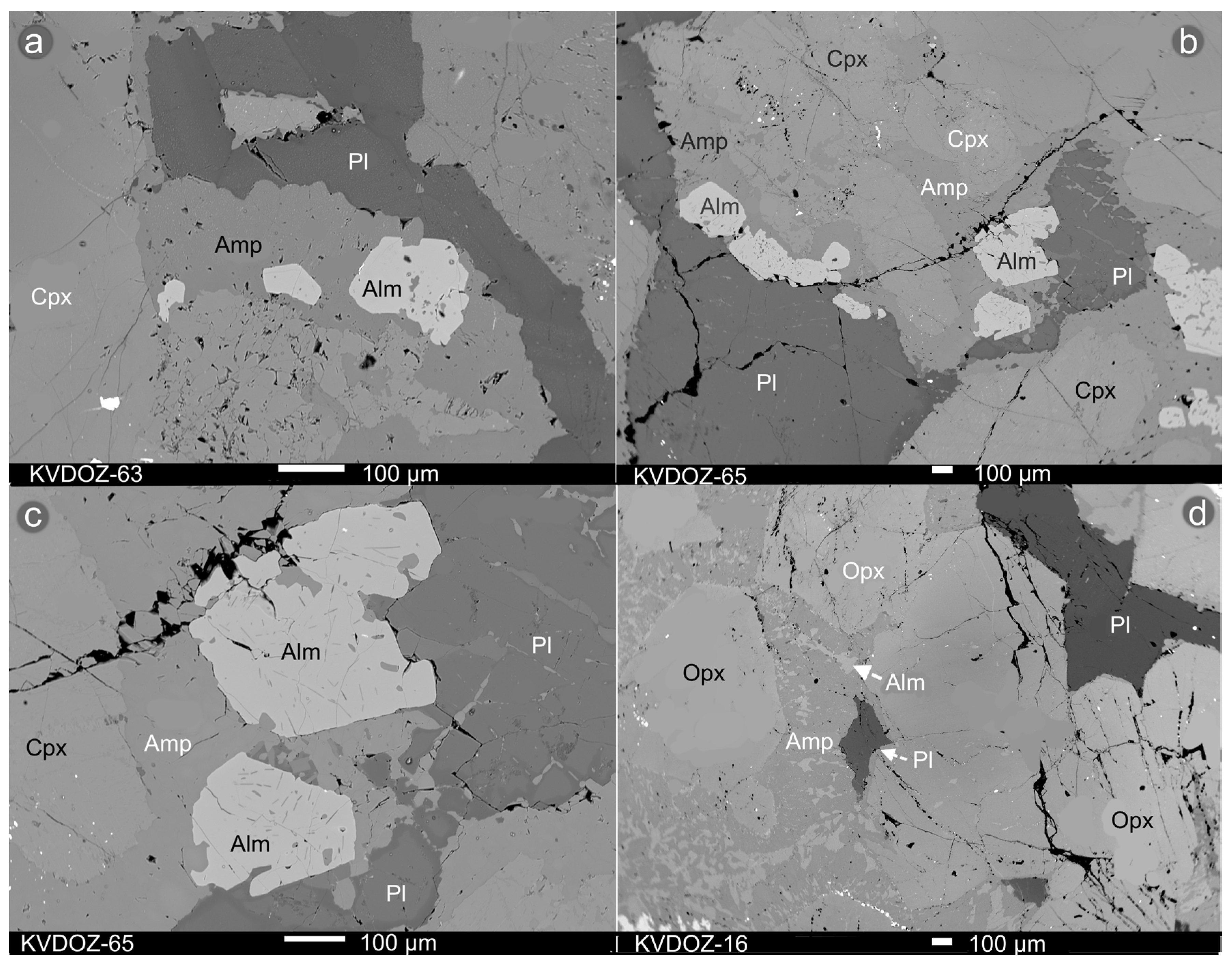
4.2. Garnet in Coronitic Associations
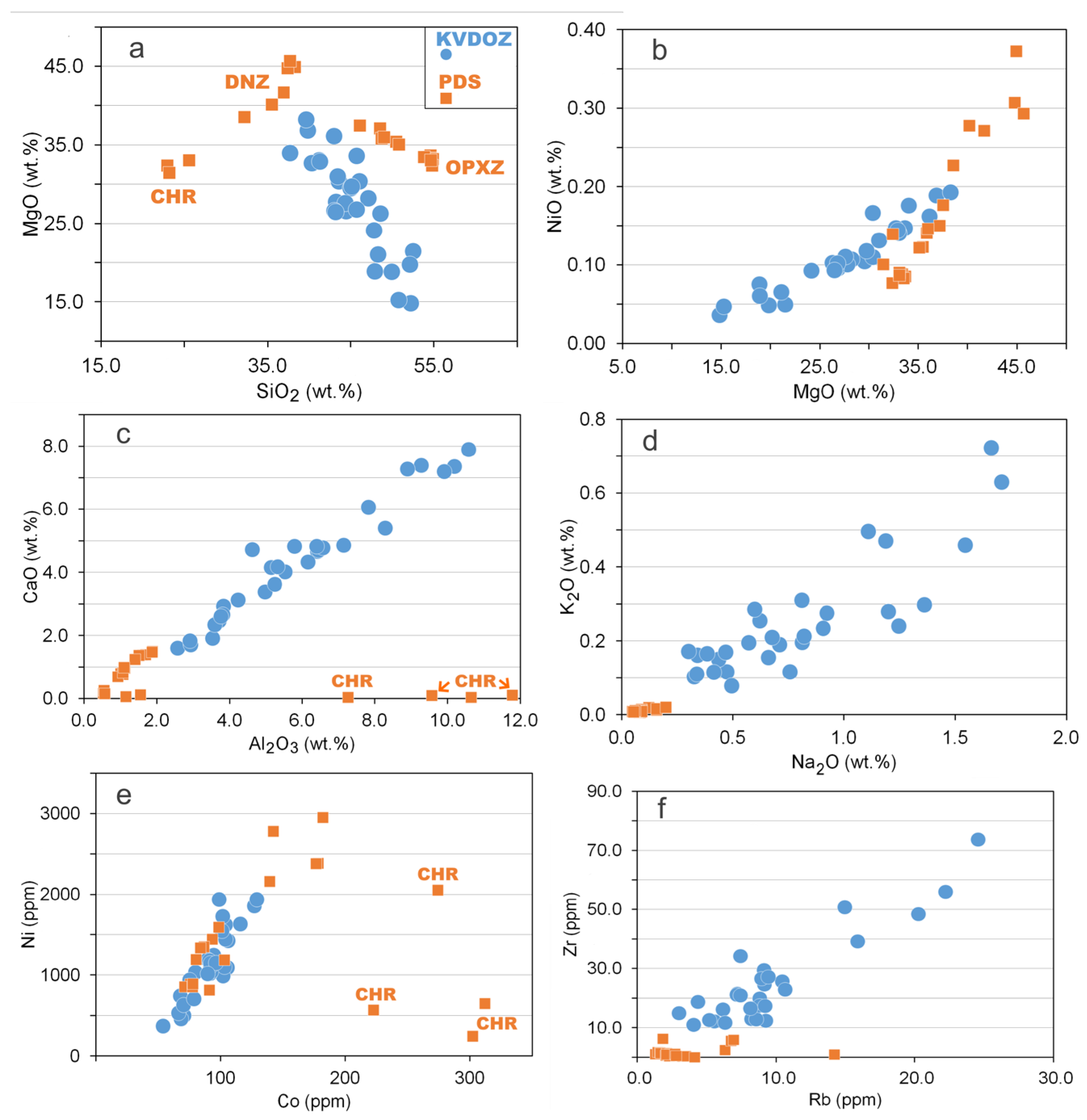
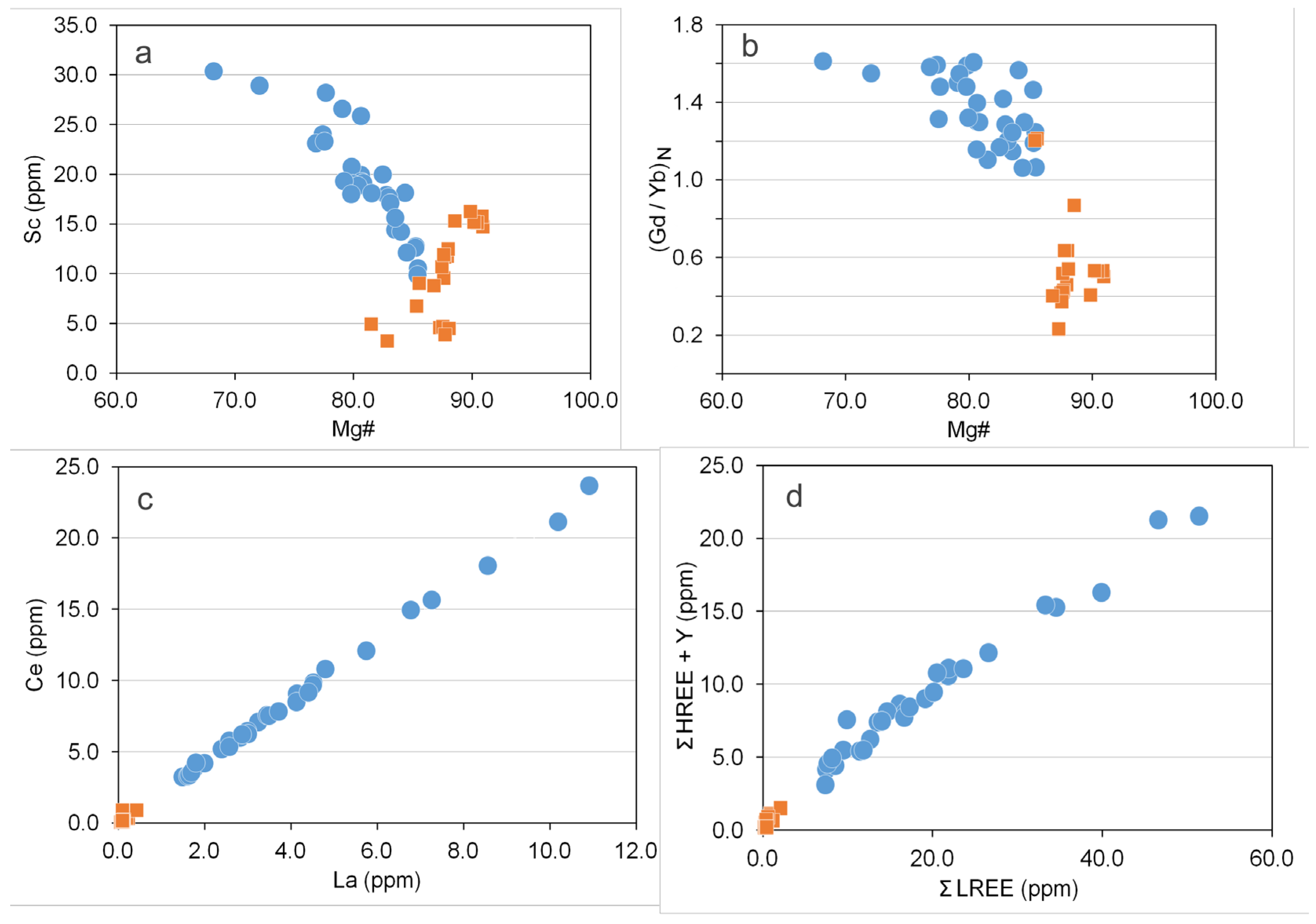
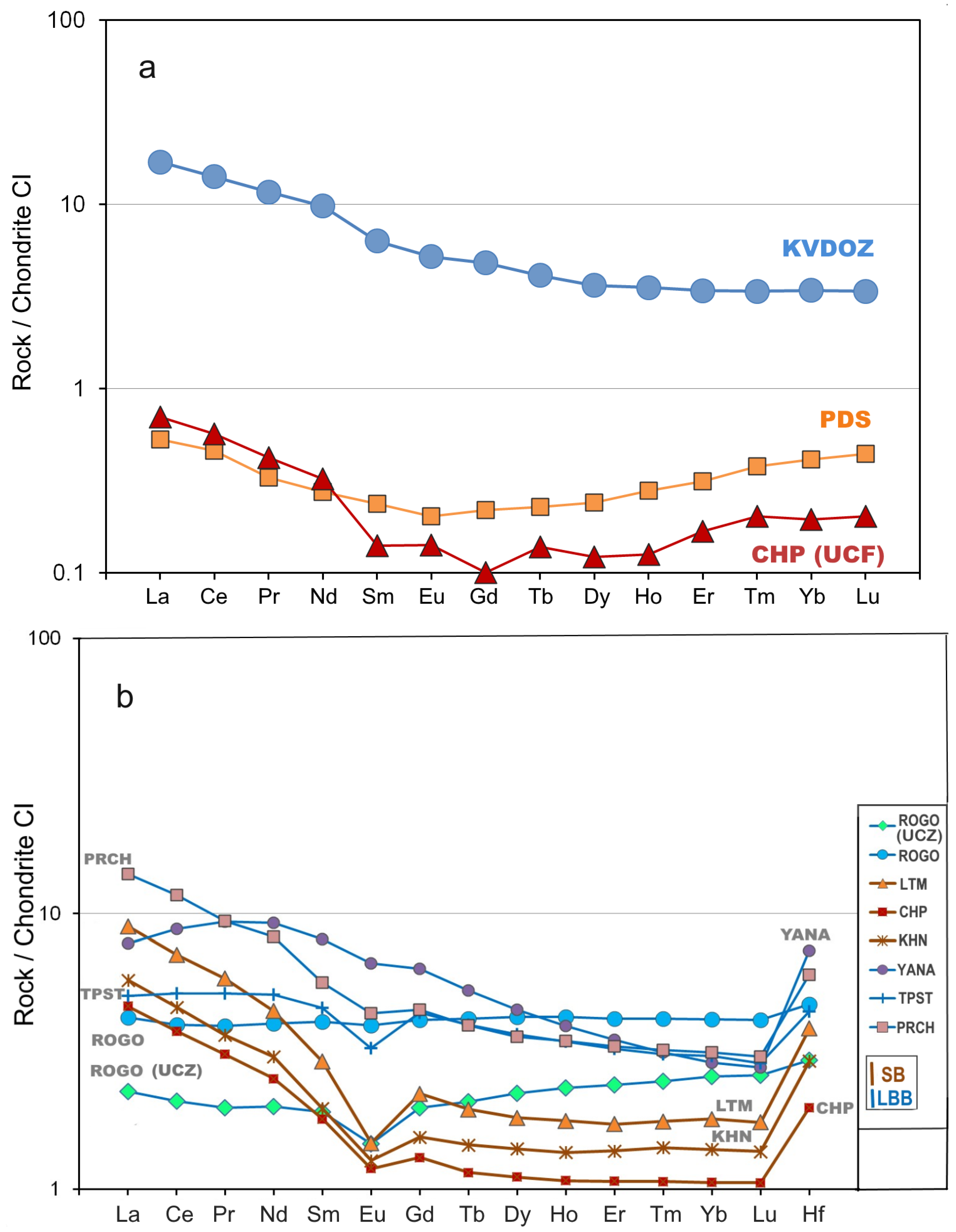
4.3. Results of the Geochemical Analyses: A Comparison of the Two Complexes
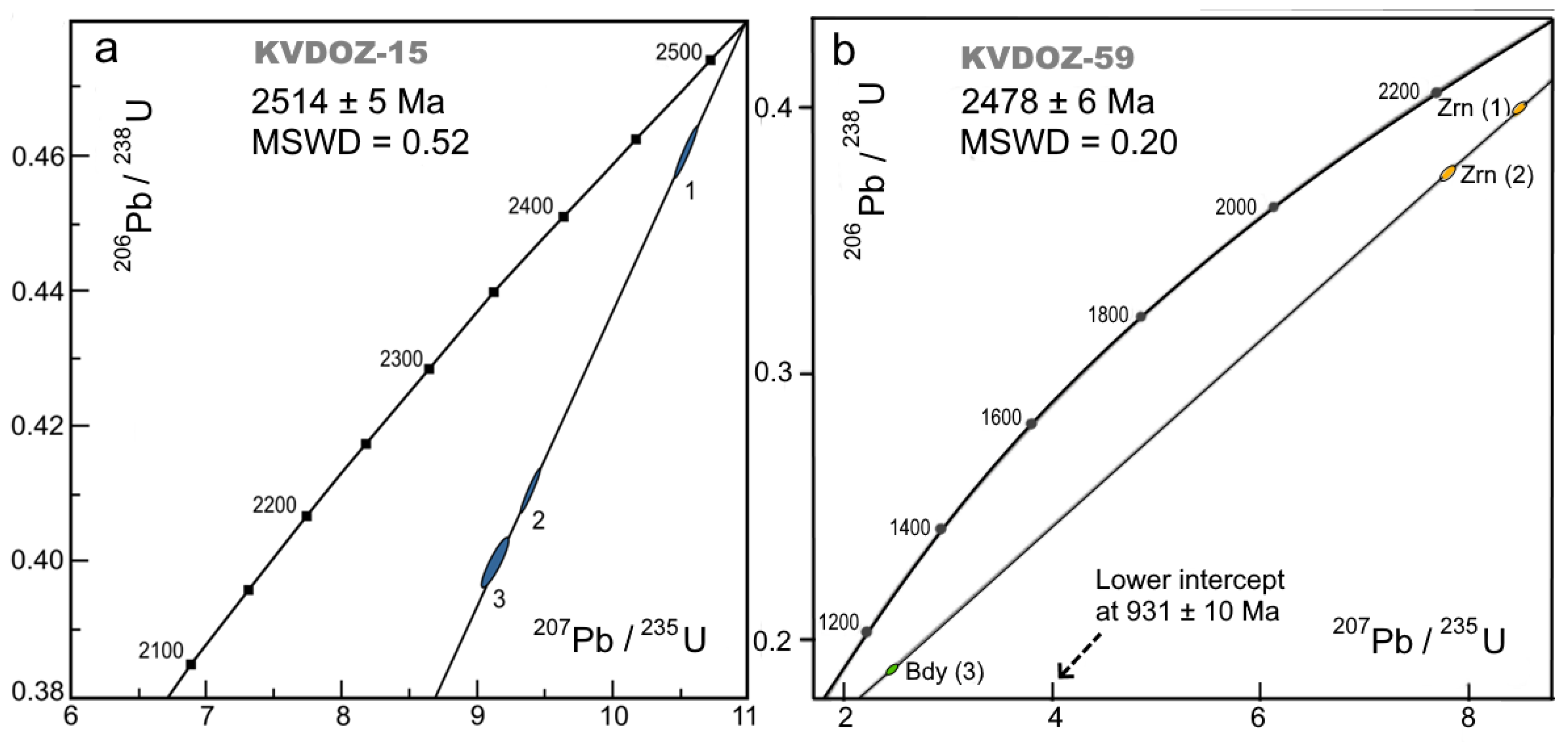
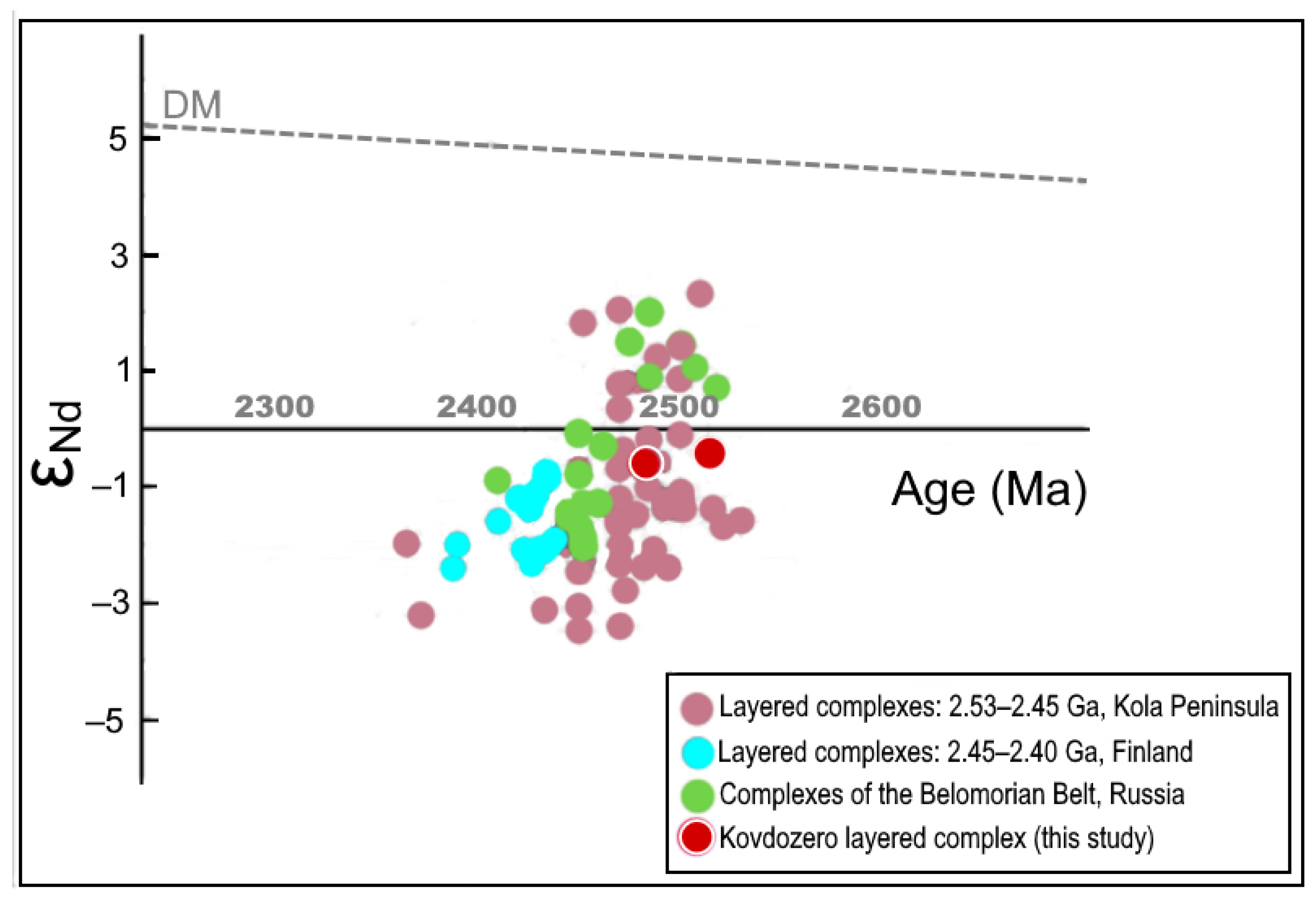
4.4. Age Determination and εNd Values
5. Discussion
5.1. Inferences from the Isotopic Data
5.2. Inferences from the Mineralogical and Geochemical Data
5.3. Coronitic Associations
6. Concluding Inferences
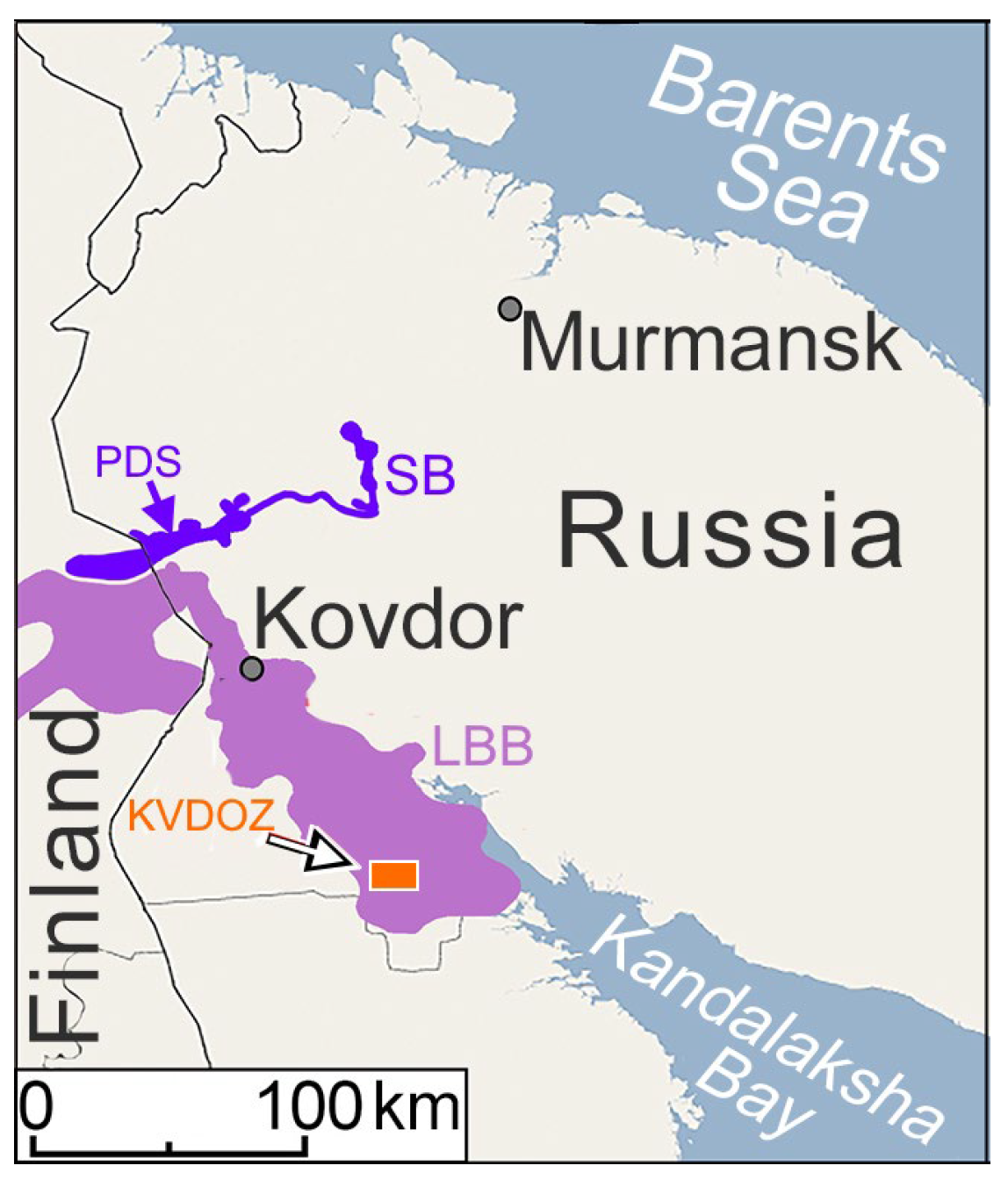
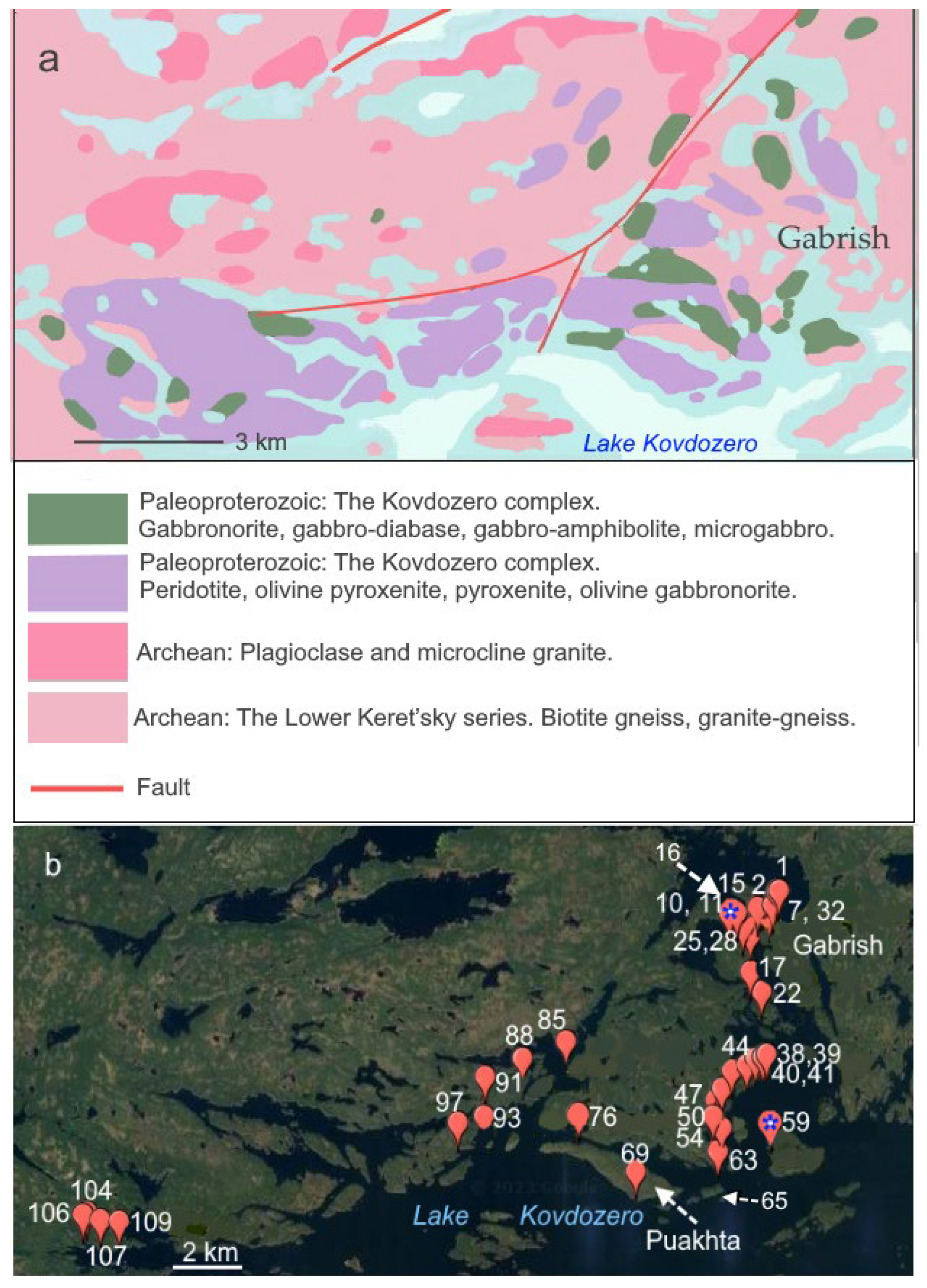
- The new U–Pb dates for the Kovdozero complex, 2514 ± 5 and 2478 ± 6 Ma, lead us to propose that the coronitic complexes of ultrabasic–basic rocks in the entire LBB–SB megastructure were emplaced at approximately 2.5 Ga. This age applies to Pados-Tundra (SB), Perchatka (northern LBB) and the gabbro–anorthosite associations of the Belomorian province to the south, in the White Sea region.
- The ultrabasic and basic complexes of the LBB—SB system crystallized from portions of komatiitic magma in a hypabyssal setting. The Pados-Tundra complex, associated with Chapesvara in the SB, appears to reflect a conduit-type center of a giant plume of such magma. Separate shallow reservoirs of melt likely formed above various parts of the plume in the rift setting.
- Southward from Pados-Tundra to Kovdozero, the SB—LBB suites exhibit a general decrease in Fo in olivine and in Mg–Cr contents, with a buildup in Al in spinel-group minerals, an increase in modal amounts of clinopyroxene and plagioclase and increasing levels of the HFSE and other incompatible elements.
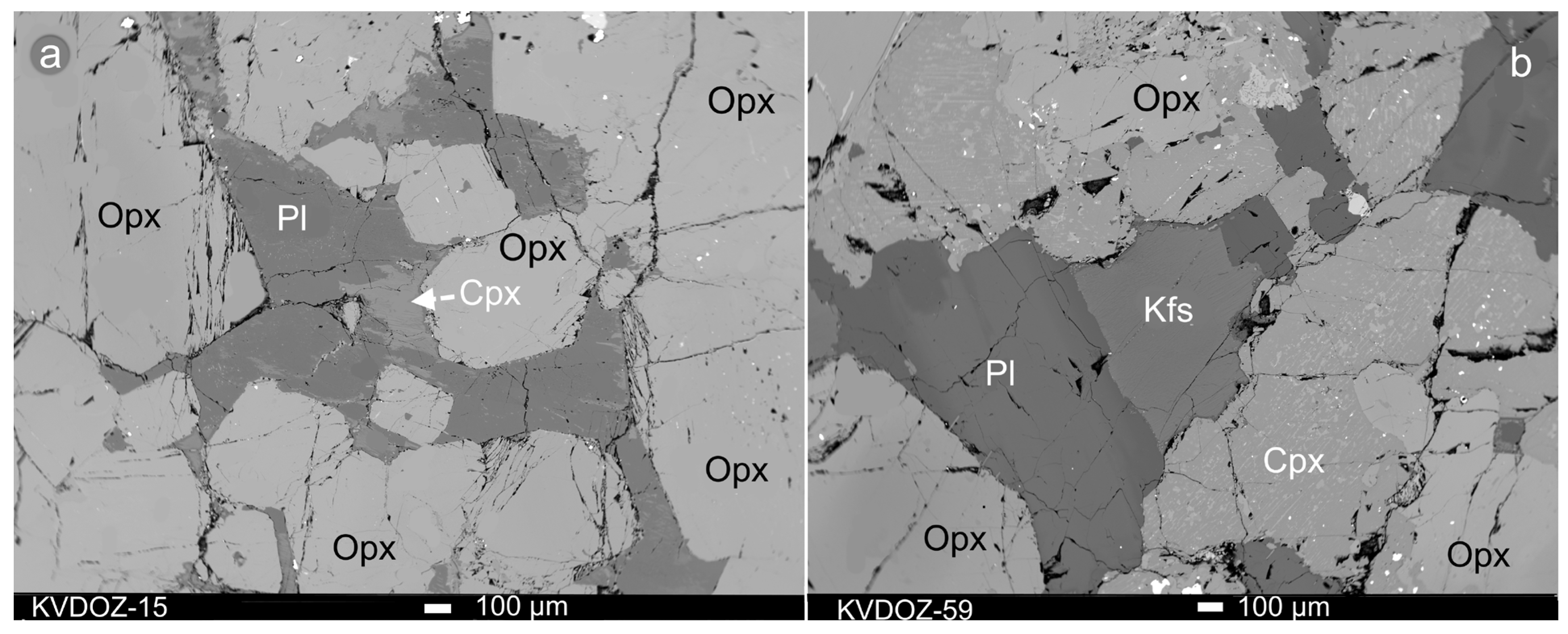
- The leucocratic gabbroic rocks at Kovdozero and the gabbro–anorthosite rocks of the Belomorian province seem to be the final products linked to the diapiric megastructure. The εNd(T) values obtained at Kovdozero, −0.43 and −0.60, indicate a certain degree of crustal contamination of the initial magma.
- A great variety of coronas are formed by the combination of magmatic and autometasomatic processes as consequences of instable and rapid crystallization of komatiite-derived melts in the megastructure.
Supplementary Materials
Author Contributions
Funding
Data Availability Statement
Acknowledgments
Conflicts of Interest
References
- Barkov, A.Y.; Korolyuk, V.N.; Barkova, L.P.; Martin, R.F. Double-front crystallization in the Chapesvara ultramafic subvolcanic complex, Serpentinite Belt, Kola Peninsula, Russia. Minerals 2019, 10, 14. [Google Scholar] [CrossRef]
- Barkov, A.Y.; Nikiforov, A.A.; Korolyuk, V.N.; Martin, R.F. The Lyavaraka ultrabasic complex, Serpentinite Belt, Kola Peninsula, Russia. Geosciences 2022, 12, 323. [Google Scholar] [CrossRef]
- Barkov, A.Y.; Nikiforov, A.A.; Barkova, L.P.; Izokh, A.E.; Korolyuk, V.N. Komatiitic subvolcanic rocks in the Mount Khanlauta massif, Serpentinite Belt (Kola Peninsula). Russ. Geol. Geophys. 2022, 63, 981–1000. [Google Scholar] [CrossRef]
- Barkov, A.Y.; Nikiforov, A.A.; Korolyuk, V.N.; Martin, R.F. Mineral–geochemical and geotectonic features of the Lotmvara-II ultrabasic sill, Serpentinite Belt (Kola Peninsula). Russ. Geol. Geophys. 2023, 64, 1161–1178. [Google Scholar] [CrossRef]
- Lindh, A.; Eskelinen, J.; Luukas, J.; Kousa, J.; Nironen, M. The Bedrock of Finland 1:200000 Map Modified from the General Map 1:1 Million; National Land Survey of Finland, Geological Survey of Finland: Espoo, Finland, 2014. [Google Scholar]
- Nironen, M.; Kousa, J.; Luukas, J.; Lahtinen, R. (Eds.) Geological Map of Finland—Bedrock 1:1000000, 2nd ed.; Geological Survey of Finland: Espoo, Finland, 2016. [Google Scholar]
- Barkov, A.Y.; Nikiforov, A.A.; Martin, R.F. The structure and cryptic layering of the Pados-Tundra ultramafic complex, Serpentinite Belt, Kola Peninsula, Russia. Bull. Geol. Soc. Finl. 2017, 89, 35–56. [Google Scholar] [CrossRef]
- Barkov, A.Y.; Nikiforov, A.A.; Tolstykh, N.D.; Shvedov, G.I.; Korolyuk, V.N. Compounds of Ru–Se–S, alloys of Os–Ir, framboidal Ru nanophases, and laurite–clinochlore intergrowths in the Pados-Tundra complex, Kola Peninsula, Russia. Eur. J. Mineral. 2017, 29, 613–621. [Google Scholar] [CrossRef]
- Serov, P.A.; Bayanova, T.B.; Steshenko, E.N.; Kunakkuzin, E.L.; Borisenko, E.S. Metallogenic setting and evolution of the Pados-Tundra Cr-bearing ultramafic complex, Kola Peninsula: Evidence from Sm–Nd and U–Pb isotopes. Minerals 2020, 10, 186. [Google Scholar] [CrossRef]
- Barkov, A.Y.; Nikiforov, A.A.; Barkova, L.P.; Korolyuk, V.N.; Martin, R.F. Zones of PGE–chromite mineralization in relation to crystallization of the Pados-Tundra ultramafic complex, Serpentinite Belt, Kola Peninsula, Russia. Minerals 2021, 11, 68. [Google Scholar] [CrossRef]
- Sharkov, E.V.; Snyder, G.A.; Taylor, L.A.; Zinger, T.F. An Early Proterozoic large igneous province in the Eastern Baltic Shield: Evidence from the mafic Drusite Complex, Belomorian Mobile Belt, Russia. Int. Geol. Rev. 1999, 41, 73–93. [Google Scholar] [CrossRef]
- Sharkov, E.V.; Krassivskaya, I.S.; Chistyakov, A.V. Belomorian drusite (coronite) complex, Baltic Shield, Russia: An example of dispersed intrusive magmatism in early Paleoproterozoic mobile zones. Russ. J. Earth Sci. 2004, 6, 185–215. [Google Scholar] [CrossRef]
- Terekhov, E.N. Lapland–Belomorian mobile belt as an example of the root zone of the Paleoproterozoic rift system of the Baltic Shield. Litosfera 2007, 6, 15–39. (In Russian) [Google Scholar]
- Krivolutskaya, N.A.; Svirskaya, N.M.; Belyatsky, B.V.; Smolkin, V.F.; Mamontov, V.P.; Fanygin, A.S. Geochemical specifics of massifs of the drusite complex in the central Belomorian mobile belt. II. Sm−Nd isotopic system of the rocks and the U−Pb isotopic system of zircons. Geochem. Int. 2010, 48, 1064–1083. [Google Scholar] [CrossRef]
- Malov, N.D. Structural-petrological and specific metallogenic features of drusites in the north-western Belomorye. Vestn St Petersbg Univ. Earth Sci. 2015, 7, 73–84. (In Russian) [Google Scholar]
- Barkov, A.Y.; Nikiforov, A.A.; Martin, R.F.; Korolyuk, V.N. Corona-type textures in ultrabasic complexes of the Serpentinite Belt, Kola Peninsula, Russia. Minerals 2023, 13, 115. [Google Scholar] [CrossRef]
- Barkov, A.Y.; Martin, R.F.; Korolyuk, V.N.; Lobastov, B.M.; Mezhetskiy, S.A. The coronitic Perchatka layered intrusion, central Lapland—Belomorian Belt, Kola Peninsula, Russia. Can. J. Mineral. Petrol. 2025, 63, 347–369. [Google Scholar] [CrossRef]
- Barkov, A.Y.; Martin, R.F.; Barkova, L.P.; Korolyuk, V.N. Coronitic associations at Gabrish in the Kovdozero layered complex in the southern part of the Lapland–Belomorian Belt, Kola Peninsula, Russia. Minerals 2025, 15, 565. [Google Scholar] [CrossRef]
- Nikolaeva, K.A.; Smirnova, V.S. The Geological Map of the USSR on the Scale of 1:200 000. Kola Series (Q-36-VIII); Shurkin, K.A., Ed.; Northwestern Geological Department, Ministry of Geology and Subsoil Protection of the USSR, Gosgeoltekhizdat Publisher: Moscow, Russia, 1960. [Google Scholar]
- Puchtel, I.S.; Haase, K.M.; Hofmann, A.W.; Chauvel, C.; Kulikov, V.S.; Garbe-Schönberg, C.-D.; Nemchin, A.A. Petrology and geochemistry of crustally contaminated komatiitic basalts from the Vetreny Belt, southeastern Baltic Shield: Evidence for an early Proterozoic mantle plume beneath rifted Archean continental lithosphere. Geochim. Cosmochim Acta 1997, 61, 1205–1222. [Google Scholar] [CrossRef]
- Kulikov, V.S.; Bychkova, Y.V.; Kulikova, V.V.; Ernst, R. The Vetreny Poyas (Windy Belt) subprovince or southeastern Fennoscandia: An essential component of the ca. 2.5–2.4 Ga Sumian large igneous provinces. Precambrian Res. 2010, 183, 589–601. [Google Scholar] [CrossRef]
- Amelin, Y.V.; Heaman, L.M.; Semenov, V.S. U–Pb geochronology of layered mafic intrusions in the eastern Baltic Shield: Implications for the timing and duration of Paleoproterozoic continental rifting. Precamb. Res. 1995, 75, 31–46. [Google Scholar] [CrossRef]
- Nikolaeva, I.V.; Palesskii, S.V.; Koz’menko, O.A.; Anoshin, G.N. Analysis of geologic reference materials for REE and HFSE by inductively coupled plasma-mass spectrometry (ICP-MS). Geochem. Int. 2008, 46, 1016–1022. [Google Scholar] [CrossRef]
- Krogh, T.E. A low-contamination method for hydrothermal dissolution of zircon and extraction of U and Pb for isotopic age determinations. Geochim. Cosmochim. Acta 1973, 37, 485–494. [Google Scholar] [CrossRef]
- Schärer, U.; Wilmart, E.; Duchesne, J.-C. The short duration and anorogenic character of anorthosite magmatism: U-Pb dating of the Rogaland complex, Norway. Earth Planet. Sci. Lett. 1996, 139, 335–350. [Google Scholar] [CrossRef]
- Ludwig, K.R. ISOPLOT/Ex—A Geochronological Toolkit for Microsoft Excel, Version 2.05; Berkeley Geochronology Center, Special Publication: Berkeley, CA, USA, 1999; Volume 1a, p. 49. [Google Scholar]
- Steiger, R.H.; Jäger, E. Subcommission on geochronology: Convention on the use of decay constants in geo- and cosmochronology. Earth Planet. Sci. Lett. 1977, 36, 359–362. [Google Scholar] [CrossRef]
- Stacey, J.S.; Kramers, J.D. Approximation of terrestrial lead isotope evolution by a two-stage model. Earth Planet. Sci. Lett. 1975, 26, 206–221. [Google Scholar] [CrossRef]
- Serov, P.A. Differences in Sm/Nd ratios between early magmatic and late sulfides: The role of fluids and Nd mobility. Chem. Geol. 2025, 671, 122497. [Google Scholar] [CrossRef]
- Raczek, I.; Jochum, K.P.; Hofmann, A.W. Neodymium and strontium isotope data for USGS reference materials BCR-1, BCR-2, BHVO-1, BHVO-2, AGV-1, AGV-2, GSP-1, GSP-2 and eight MPI-DING reference glasses. Geost. Geoanal. Res. 2003, 27, 173–179. [Google Scholar] [CrossRef]
- Tanaka, T.; Togashi, S.; Kamioka, H.; Amakawa, H.; Kagami, H.; Hamamoto, T.; Yuhara, M.; Orihashi, Y.; Yoneda, S.; Shimizu, H.; et al. JNdi-1: A neodymium isotopic reference in consistency with LaJolla neodymium. Chem. Geol. 2000, 168, 279–281. [Google Scholar] [CrossRef]
- Bouvier, A.; Vervoort, J.D.; Patchett, P.J. The Lu–Hf and Sm–Nd isotopic composition of CHUR: Constraints from unequilibrated chondrites and implications for the bulk composition of terrestrial planets. Earth Planet. Sci. Lett. 2008, 273, 48–57. [Google Scholar] [CrossRef]
- Goldstein, S.J.; Jacobsen, S.B. Nd and Sr isotopic systematics of river water suspended material implications for crystal evolution. Earth Planet. Sci. Lett. 1988, 87, 249–265. [Google Scholar] [CrossRef]
- Villa, I.M.; Holden, N.E.; Possolo, A.; Ickert, R.B.; Hibbert, D.B.; Renne, P.R. IUPAC-IUGS recommendation on the half-lives of 147Sm and 146Sm. Geochim. Cosmochim. Acta 2020, 285, 70–77. [Google Scholar] [CrossRef]
- McDonough, W.F.; Sun, S.-S. The composition of the Earth. Chem. Geol. 1995, 120, 223–253. [Google Scholar] [CrossRef]
- Barkov, A.Y.; Martin, R.F.; Barkova, L.P.; Silyanov, S.A.; Lobastov, B.M. Mineralogical and geochemical features, structure, and stages of formation of the Rogomu concentrically zoned massif (Lapland–Belomorian Belt, Kola Peninsula). Petrology 2025, 33, 581–603. [Google Scholar] [CrossRef]
- Huhma, H.; Clift, R.A.; Perttunen, V.; Sakko, M. Sm–Nd and Pb isotopic study of mafic rocks associated with early Proterozoic continental rifting: The Perapohja schist belt in northern Finland. Contrib. Mineral. Petrol. 1990, 104, 369–379. [Google Scholar] [CrossRef]
- Tolstikhin, I.N.; Dokuchaeva, V.S.; Kamensky, I.L.; Amelin, Y.V. Juvenile helium in ancient rocks II. U-He, K-Ar, Sm-Nd and Rb-Sr systematics in the Monche Pluton: 3He/4He ratios frozen in uranium-free ultramafic rocks. Geochim. Cosmochim. Acta 1992, 56, 987–999. [Google Scholar] [CrossRef]
- Balashov, Y.A.; Bayanova, T.B.; Mitrofanov, F.P. Isotope data on the age and genesis of layered basic-ultrabasic intrusions in the Kola Peninsula and northern Karelia, northeastern Baltic Shield. Precamb. Res. 1993, 64, 197–205. [Google Scholar] [CrossRef]
- Bogdanova, S.V.; Bibikova, E.V. The “Saamian” of the Belomorian mobile belt: New geochronological constraints. Precamb. Res. 1993, 64, 131–152. [Google Scholar] [CrossRef]
- Amelin, Y.V.; Semenov, V.S. Nd and Sr isotopic geochemistry of mafic layered intrusions in the eastern Baltic shield: Implications for the evolution of Paleoproterozoic continental mafic magmas. Contrib. Mineral. Petrol. 1996, 124, 255–272. [Google Scholar] [CrossRef]
- Lobach-Zhuchenko, S.B.; Arestova, N.A.; Chekulaev, V.P.; Levsky, L.K.; Bogomolov, E.S.; Krylov, I.N. Geochemistry and petrology of 2.40–2.45 Ga magmatic rocks in the north-western Belomorian Belt, Fennoscandian Shield, Russia. Precamb. Res. 1998, 92, 223–250. [Google Scholar] [CrossRef]
- Hanski, E.; Walker, R.J.; Huhma, H.; Suominen, I. The Os and Nd isotopic systematics of c. 2.44 Ga Akanvaara and Koitelainen mafic layered intrusions in northern Finland. Precamb. Res. 2001, 109, 73–102. [Google Scholar] [CrossRef]
- Puchtel, I.S.; Brugmann, G.E.; Hofmann, A.W.; Kulikov, V.S.; Kulikova, V.V. Os isotope systematics of komatiitic basalts from the Vetreny belt, Baltic shield: Evidence for a chondritic source of the 2.45 Ga plume. Contrib. Mineral. Petrol. 2001, 140, 588–599. [Google Scholar] [CrossRef]
- Stepanova, A.V.; Stepanov, V.S.; Larionov, A.N.; Azimov, P.Y.; Egorova, S.V.; Larionova, Y.O. 2.5 Ga gabbro-anorthosites in the Belomorian province, Fennoscandian Shield: Petrology and tectonic setting. Petrology 2017, 25, 566–591. [Google Scholar] [CrossRef]
- Serov, P.A. Paleoproterozoic Pt-Pd Fedorovo-Pansky and Cu-Ni-Cr Monchegorsk ore complexes: Age, metamorphism, and crustal contamination according to Sm-Nd data. Minerals 2021, 11, 1410. [Google Scholar] [CrossRef]
- Serov, P.A.; Bayanova, T.B. The Sulfide/silicate coefficients of Nd and Sm: Geochemical “fingerprints” for the syn- and epigenetic Cu-Ni-(PGE) ores in the NE Fennoscandian Shield. Minerals 2021, 11, 1069. [Google Scholar] [CrossRef]
- Efimov, A.A.; Kaulina, T.B. Geological features and U–Pb dating (first data) in the southeastern part of the Kovdozero basic–ultrabasic massif (Puakhta block). In The Belomorian Mobile Belt (Geology, Geodynamics, Geochronology); Karelian Science Centre RAS: Petrozavodsk, Russia, 1997; p. 31. (In Russian) [Google Scholar]
- Sergeev, S.A.; Lobach–Zhuchenko, S.B.; Arestova, N.A. To the problem of dating basic rocks. Dokl. Akad. Nauk SSSR 1999, 365, 377–380. (In Russian) [Google Scholar]
- Mitrofanov, F.P.; Balaganskiy, V.V.; Balashov, Y.A.; Gannibal, L.F.; Dokuchaeva, V.S.; Nerovich, L.I.; Radchenko, M.K.; Ryungenen, G.I. The U–Pb age of gabbro-anorthosites of the Kola Peninsula. Dokl. Akad. Nauk SSSR 1993, 331, 95. (In Russian) [Google Scholar]
- Sukhanov, M.K.; Mitrofanov, F.P.; Bayanova, T.B.; Chistyakov, A.V. U-Pb isotopic study of the gabbronorite–anorthosite drusite (coronite) body of Vorony Island (Kandalaksha Archipelago, the White Sea). Petrology 2016, 24, 83–92. [Google Scholar] [CrossRef]
- Huhma, H.; Kontinen, A.; Mikkola, P.; Halkoaho, T.; Hokkanen, T.; Hölttä, P.; Juopperi, H.; Konnunaho, J.; Luukkonen, E.; Mutanen, T.; et al. Nd isotopic evidence for Archaean crustal growth in Finland. Geol. Surv. Fin. Spec. Paper 2012, 54, 176–213. [Google Scholar]
- Barkov, A.Y.; Martin, R.F.; Izokh, A.E.; Nikiforov, A.A.; Korolyuk, V.N. Ultramagnesian olivine in the Monchepluton (Fo96) and Pados-Tundra (Fo93) layered intrusions (Kola Peninsula). Russ. Geol. Geophys. 2021, 62, 324–338. [Google Scholar] [CrossRef]
- Barkov, A.Y.; Nikiforov, A.A.; Martin, R.F.; Silyanov, S.A.; Lobastov, B.M. The Tepsi ultrabasic intrusion, northern part of the Lapland−Belomorian Belt, Kola Peninsula, Russia. Minerals 2024, 14, 685. [Google Scholar] [CrossRef]
- Barkov, A.Y.; Martin, R.F.; Laajoki, K.V.O.; Alapieti, T.T.; Iljina, M.J. Paragenesis and origin of staurolite from a palladium-rich gabbronorite: An unusual occurrence from the Lukkulaisvaara layered intrusion, Russian Karelia. Neues Jahrb. Fur Mineral.-Abh. 1999, 175, 19–222. [Google Scholar] [CrossRef]



| Sample KVDOZ-15 | Sample Weight (mg) | Content (ppm) | Lead Isotope Ratios * | Isotope Ratios and Age (Ma) ** | Rho | |||||
|---|---|---|---|---|---|---|---|---|---|---|
| Pb | U | 206Pb/204Pb | 206Pb/207Pb | 206Pb/208Pb | 207Pb/235U | 206Pb/238U | 207Pb/206Pb | |||
| 1 | 0.5 | 301 | 505 | 2119 | 6.147 | 1.892 | 10.509 | 0.4601 | 2480 | 0.99 |
| 2 | 0.4 | 159 | 244 | 477 | 5.518 | 1.655 | 9.381 | 0.4102 | 2397 | 0.99 |
| 3 | 0.3 | 62 | 76 | 113 | 3.624 | 1.272 | 9.132 | 0.4001 | 2513 | 0.92 |
| Zircon | ||||||||||
| 1 | 0.5 | 516 | 1043 | 10,817 | 6.4352 | 3.5562 | 8.484 ± 0.057 | 0.3990 ± 0.0027 | 2393 ± 1 | 0.9 |
| 2 | 0.4 | 246 | 512 | 2989 | 6.4481 | 3.0999 | 7.818 ± 0.025 | 0.3760 ± 0.0012 | 2355 ± 2 | 0.9 |
| Baddeleyite | ||||||||||
| 3 | 0.3 | 240 | 1203 | 4915 | 6.1252 | 37.515 | 2.461 ± 0.022 | 0.1888 ± 0.0009 | 2489 ± 3 | 0.6 |
| Sample | Content (mcg/g) | Isotope Ratios | TNdDM (Ma) | εNd (T = 2514) | ||
|---|---|---|---|---|---|---|
| Sm | Nd | 147Sm/144Nd | 143Nd/144Nd | |||
| KVDOZ-15 | 1.914 | 10.82 | 0.1071 | 0.511138 ± 11 | 2870 | −0.43 |
| KVDOZ-59 | 1.562 | 7.94 | 0.1190 | 0.511342 ± 9 | 2903 | −0.29 |
| Characteristic | Kovdozero | Pados-Tundra |
|---|---|---|
| Regional structure | Lapland–Belomorian Belt | Serpentinite Belt |
| Intrusion shape | Connected system of chonolithic layered bodies | Lopolite-like layered intrusion [7] |
| Isotopic age | 2514 ± 5 Ma (zircon U–Pb dating) (this study) | 2485 ± 38 Ma (Sm–Nd dating) [9] |
| Values of εNd(T) | Slightly negative (−0.43; −0.60) (this study) | Positive (2.0) [9] |
| Sequences of rocks | Peridotite (mainly lherzolite)—olivine- and plagioclase-bearing websterite—plagioclase orthopyroxenite—norite (locally olivine-bearing)—olivine-bearing gabbro—gabbronorite—gabbro (some quartz-bearing).Rocks enriched in Cpx and Pl are abundant | Dunite—harzburgite—orthopyroxenite series (Cpx and Pl are typically absent) [7] |
| Maximal value of Fo in olivine | Fo87 (our data) | Fo93 |
| Geochemical characteristics | Rocks display trends of relative enrichment in CaO, Al2O3, alkalis, REE, incompatible and high field-strength elements (this study) | Rocks are strikingly poor in CaO, Al2O3, alkalis, and depleted in incompatible and high field-strength elements with extremely low abundances of REE (this study) |
| Series of spinel-subgroup members | Chromite—spinel—hercynite series (enriched in Al) (our data) | Magnesiochromite—chromite series (extending to chromian magnetite) [7,10] |
| Ore zones | Low-sulfide zone of Pd—Pt mineralization in mafic rocks (our data) | Chromium and Ru—Os—Ir mineralization in chromitite and dunite [8,10] |
Disclaimer/Publisher’s Note: The statements, opinions and data contained in all publications are solely those of the individual author(s) and contributor(s) and not of MDPI and/or the editor(s). MDPI and/or the editor(s) disclaim responsibility for any injury to people or property resulting from any ideas, methods, instructions or products referred to in the content. |
© 2025 by the authors. Licensee MDPI, Basel, Switzerland. This article is an open access article distributed under the terms and conditions of the Creative Commons Attribution (CC BY) license.
Share and Cite
Barkov, A.Y.; Serov, P.A.; Martin, R.F.; Bayanova, T.B.; Kaulina, T.V. The Kovdozero and Pados-Tundra Complexes, Kola Peninsula, Russia: Comparable Geochemistry and Age. Minerals 2026, 16, 8. https://doi.org/10.3390/min16010008
Barkov AY, Serov PA, Martin RF, Bayanova TB, Kaulina TV. The Kovdozero and Pados-Tundra Complexes, Kola Peninsula, Russia: Comparable Geochemistry and Age. Minerals. 2026; 16(1):8. https://doi.org/10.3390/min16010008
Chicago/Turabian StyleBarkov, Andrei Y., Pavel A. Serov, Robert F. Martin, Tamara B. Bayanova, and Tatyana V. Kaulina. 2026. "The Kovdozero and Pados-Tundra Complexes, Kola Peninsula, Russia: Comparable Geochemistry and Age" Minerals 16, no. 1: 8. https://doi.org/10.3390/min16010008
APA StyleBarkov, A. Y., Serov, P. A., Martin, R. F., Bayanova, T. B., & Kaulina, T. V. (2026). The Kovdozero and Pados-Tundra Complexes, Kola Peninsula, Russia: Comparable Geochemistry and Age. Minerals, 16(1), 8. https://doi.org/10.3390/min16010008