


Abstract
The Huayangchuan uranium deposit, located in the west of the Xiaoqinling belt on the southern margin of the North China Craton, is a large U–Nb–Pb deposit accompanied with rare–earth elements. The Huayangchuan uranium deposit, discovered in the 1950s, has long been known as a carbonatite–type uranium deposit. Recently, new geological work has found uranium mineralization in many granitic pegmatite veins in the Huayangchuan deposit and adjacent areas. Here, we report a systematic investigation of the petrography, whole–rock geochemistry, zircon U–Pb ages, and in situ Lu–Hf isotopic characteristics of newly discovered U–rich granitic pegmatite veins in the west of Huayangchuan deposit. The petrological results showed that the lithology of the samples is granite pegmatite. The U–Pb ages of zircon were 1826.3 ± 7.9 and 1829 ± 11 Ma. Microscopically, the paragenetic characteristics of zircon, betafite, and uraninite exist in the intergranular fissures of K–feldspar and quartz, reflecting metallogenic phenomena in the rock formation process. Almost all whole–rock samples were rich in SiO2 (64.37−70.69 wt.%), total alkalis (K2O + Na2O = 8.50–10.30 wt.%), and Al2O3 (12.20–14.41 wt.%) but poor in TiO2 (0.23–0.73 wt.%), MgO (0.38–0.90 wt.%), CaO (1.23–2.22 wt.%), P2O5 (0.14–0.83 wt.%), and MnO (0.04–0.57 wt.%). Additionally, they showed enrichment of LILEs (such as Rb, Ba, Th, U, and K), depletion of HFSEs (such as Ta, P, Ti, and Hf), and no alkaline dark minerals, and the characteristics are intraplate A1–type granite. The A1–type granite displayed low zircon εHf(t) values (−19.42–−15.02) with zircon two–stage Hf model aged 3.10–2.76 Ga, indicating that the U–rich granitic pegmatite was derived predominantly from partial melting of the ancient continental crust (such as the early Taihua group formed in Archean–Neoarchean). Combined with the above results and regional geological data, the U–rich granitic pegmatite discovered in the Huayangchuan deposit was formed in a post–collisional regime after the Luliang movement in the late Paleoproterozoic. This study suggests that future uranium prospecting work in this area should focus on late Paleoproterozoic U–rich granitic pegmatites.
1. Introduction
The Huayangchuan U deposit in the Qinling Orogenic Belt (Central China; QLOB) was discovered during the 1950s. In the last decade, the Huayangchuan deposit has been recognized as a large U–Nb–Pb deposit accompanied with REE [1,2,3]. Since its discovery, it has been famous worldwide for the rare presence of carbonate veins rich in U, Nb, Pb, and REE [4,5,6]. Many studies have been published on carbonatites in Huayangchuan, including their chronology, petrography, and geochemistry, all of which point to an igneous origin of carbonatites in QLOB in the evolutionary background of the Late Triassic [7,8,9,10,11,12,13]. Apart from Huayangchuan, the district also contains other large deposits, such as the Xigou carbonatite–related Mo deposit and Huanglongpu carbonatite–related Mo–Pb(–Re) deposit. Regionally, these typical deposits are part of the Triassic carbonatite metallogenic belt of North Qinling.
Recently, new geological work has discovered U mineralization in many granitic pegmatite veins in the Huayangchuan deposit and in adjacent peripheral areas. The U contents of some granitic pegmatite veins reached industrial grade. Field observation and laboratory research have shown that the newly discovered U–rich granite pegmatite veins in the Huayangchuan deposit area overlaps with the known U–rich carbonate veins in terms of spatial distribution, but their metallogenic characteristics are different in metallogenic epoch and ore genesis. However, studies on the chronology, petrography, and geochemistry of U–rich granitic pegmatite veins are scarce, and only a few have been conducted. In this study, we present an investigation of the petrography, whole–rock geochemistry, zircon U–Pb ages, and in situ Lu–Hf isotopic data for the newly discovered U–rich granitic pegmatite veins in the Huayangchuan deposit. Integrating our new results for U–rich granitic pegmatites, we discuss the industrial minerals, metallogenic epoch, petrogenesis, and tectonic setting. The study of U–rich granitic pegmatites indicates that late Paleoproterozoic U–mineralization occurred in the Huayangchuan deposit, which has changed the traditional view that only Indosinian carbonate type U–deposits exist in the Huayangchuan area and provided a new target for prospecting in this area.
2. Regional and Deposit Geology
The Qinling Orogenic Belt (QLOB), an important tectonic unit in central China (Figure 1a), has undergone a prolonged and complex tectonic evolution [14]. The Huayangchuan deposit is located in Shaanxi Province, central China, and geologically located in west of the Xiaoqinling tectonic belt on the southern margin of the North China Craton (Figure 1a,b). The Xiaoqinling tectonic belt is a metamorphic core complex (Figure 1c), and its exposure range is limited by a series of deep and large boundary fault zones [15]. Various magmatic rocks and veins of different ages intrude into the metamorphic core complex, making the uranium deposit in this area with complex genesis by “ancient basement, deep fault, and magmatism”.

Figure 1.
(a) Geologic sketch map of China; (b) Regional tectonic map of Qinling Orogen; (c) Geologic map of the Huayangchuan district (modified from [2]).
According to the metallogenic characteristics of uranium in the area, the geological bodies closely related to uranium mineralization mainly include the Taihua group, Huayangchuan fault zone, and Laoniushan and Huashan granites. Local stratigraphic units in the Huayangchuan area comprise the Archean Taihua group, which is a high–grade metamorphosed and the main outcropping sequence. The Taihua group provided magma sources and materials for various crystallization and mineralization events. Major faults (e.g., Taiyao, Xiaohe, Huayangchuan, and Luonan–Luanchuan; Figure 1c) are all NE– or EW–trending, superimposed by NS–trending secondary faults and fractures. The NE–trending Huayangchuan Fault controls the major distribution of ore bodies in Huayangchuan. In Huayangchuan, the magmatic rocks mainly comprise Proterozoic granite and pegmatite, Triassic carbonatite dikes, and Jurassic–Cretaceous granitoids (Figure 2).
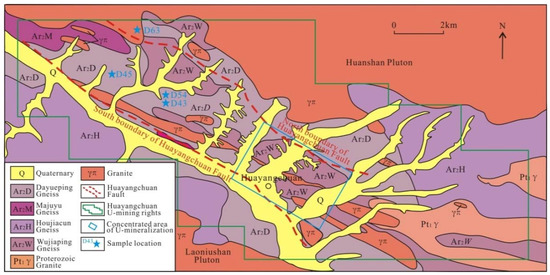
Figure 2.
Simplified geologic map of the Huayangchuan deposit (modified from [13]).
3. Characteristics of U–Rich Granitic Pegmatite and Sample Collection
Many U–rich granitic pegmatite veins have been found in the western area of the Huayangchuan deposit. Field observations showed that the U–rich granitic pegmatite veins intruded into the Taihua group (Figure 3a,b). Its width can generally reach 1–3 m; length can reach at least 100 m. Its extension direction is nearly E–W, and the dip angle is approximately 50°–70°. The chloritization and weathering of the contact zone formed by the U–rich granite pegmatite and the surrounding rock were evident (Figure 3a,b), indicating that the contact zone was a weak area where fluids could easily act. The U contents in some granitic pegmatite veins can reach high industrial grade. Some U–rich granitic pegmatite veins can also be observed deep underground through drilling.
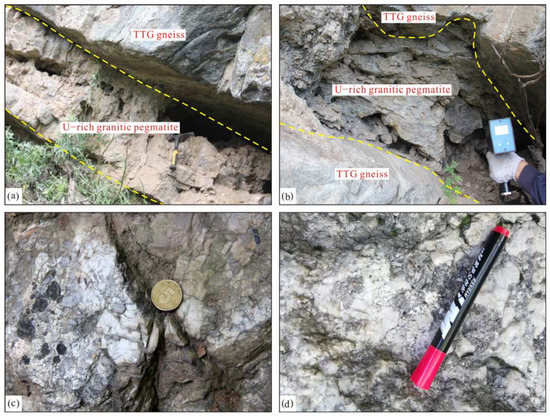
Figure 3.
Field photographs of the U–rich granitic pegmatite. Representative images of the U–rich granitic pegmatite veins (a,b); Ore images of U–rich granitic pegmatite veins (c,d).
The studied pegmatite samples were collected from the western Huayangchuan deposit (Figure 2). Two groups of typical representative U–rich granitic pegmatite samples were tested for petrography, mineralogy, whole–rock geochemistry, zircon U–Pb ages, and in situ Lu–Hf isotopes.
4. Analytical Methods
4.1. Petrography and Mineralogy Analysis
Petrography and mineralogy analysis of U–rich granitic pegmatite slice samples were conducted at the Xi’an Center of Geological Survey, CGS (China), to study the microscopic characteristics and mineral compositions. A German Zeiss Stemi 305 polarizing microscope was used to observe the microscopic characteristics (in cross–polarized light) of U–rich granitic pegmatites samples. And then, an MLA650 scanning electron microscopy (SEM) was used for mineral composition analysis.
4.2. Zircon U–Pb Geochronology
Zircon crystals were separated using heavy–liquid and magnetic methods. Separated zircons were carefully handpicked under a binocular microscope. The selected high–quality zircons were further mounted in epoxy resins and finally polished to approximately half their thickness for analysis. CL images were captured at the Xi’an Center of Geological Survey, CGS (China), to investigate internal structures of analyzed zircons and to select target positions for U–Pb dating analysis. Zircon U–Pb analyses were performed at the Key Laboratory for the Study of Focused Magmatism and Giant Ore Deposits, MLR, Xi’an Center of Geological Survey, China Geological Survey (CGS), using an Agilent 7700× ICP–MS coupled with a 193 nm ArFexcimer laser ablation system (Geolas Pro). A 32 μm spot size and 9 Hz energy density were adopted. Each analysis incorporated a background acquisition time of approximately 20 s (gas blank) followed by 40 s of data acquisition during the ablation. The ratios of U–Th–Pb were calculated using Glitter 4.4 and were corrected for both instrumental mass bias and depth dependent elemental and isotopic fractionation using a Harvard standard zircon 91500. Concordia diagrams and weighted mean calculations were carried out using Isoplot/Ex. 3 software [16]. Common Pb compositions were calibrated using the method described by Andersen [17]. Trace element compositions of zircons were calibrated against reference materials (NIST610), which were combined with Si as internal standardization.
4.3. Major and Trace Element Analyses
Twenty essentially fresh whole–rock samples from four groups were collected for major and trace element analyses, including ten U–rich granitic pegmatites, five surrounding rock samples from the Taihua group, and five granite samples of Huashan pluton. Major– and trace–element analyses were performed at the Key Laboratory for the Study of Focused Magmatism and Giant Ore Deposits in Xi’an, (China). Whole–rock geochemical analyses were performed using X–ray fluorescence (XRF) and ICP–MS, with analytical errors < 3 wt.% for most elements. Loss on ignition (LOI) was estimated using an electronic analytical balance at constant temperature of approximately 1000 °C. The detailed procedures followed are as described by Yang et al. [18].
4.4. Zircon Hf Isotopic Analyses
Zircon Lu–Hf isotope measurements were performed using a Geolas–Pro laser ablation system coupled to a Neptune multiple–collector inductively coupled plasma mass spectrometry (ICP–MS). Details of the instrumental conditions and acquisition were similar to those described in previous studies [19]. A stationary laser ablation spot with a beam diameter of 32 μm was used for the analyses. During the analysis, zircon GJ–1 was used as the reference standard, yielding a weighted mean 176Hf/177Hf ratio of 0.281990–0.282070. The present–day chondritic ratios of 176Hf/177Hf and 176Lu/177Hf are 0.282772 and 0.0332 [20], respectively. The decay constant for 176Lu is 1.865 × 10⁻¹¹a−1 [21]; these values were used to calculate the εHf values. In addition, the depleted mantle single–stage (TDM1) and two–stage model ages (TDM2) were calculated with reference to present–day 176Hf/177Hf ratios of 0.28325 and 176Lu/177Hf ratios of 0.0384 obtained from the depleted mantle [22].
5. Analytical Results
5.1. Characteristics of Petrography and Mineralogy
5.1.1. Characteristics of Petrography
The U–rich granitic pegmatites are mainly composed of quartz (approximately 15–25 wt.%), K–feldspar (mainly microcline is characterized by tartan twinning, approximately 50–60 wt.%), plagioclase (approximately 10–20 wt.%), and small amounts of biotite, hornblende, and accessory minerals. Its total mineral composition was approximately equivalent to that of granite. The contact boundary formed by gneissic xenoliths of the Taihua group in the U–rich granitic pegmatites was observed under a polarizing microscope (Figure 4a). The rock–forming minerals of the U–rich granitic pegmatites exhibited an evidently coarse pegmatitic texture (Figure 4b). In addition, zircon particles can be observed between the inter–crystalline fractures of K–feldspar and quartz (Figure 4c). Meanwhile, intrusion of quartz veinlets into the plagioclase fissure of gneiss was observed (Figure 4d), suggesting that the magmatic hydrothermalism occurred during the formation of U–rich granitic pegmatite.
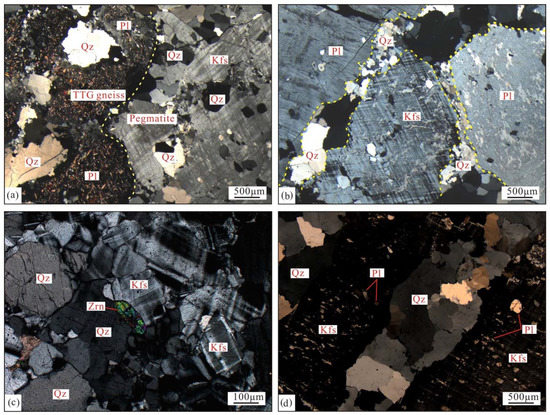
Figure 4.
Microscopic characteristics (in cross–polarized light) of the U–rich granitic pegmatite. (a) Boundary between pegmatite and gneiss xenolith; (b) Pegmatitic texture; (c) Zircon in U–rich granitic pegmatite; (d) Quartz veinlets in gneiss fractures. Qz: Quartz, Pl: Plagioclase, Kfs: K–feldspar, Zrn: zircon.
5.1.2. Characteristics of Principal Uranium Minerals and Zircon
Scanning electron microscopy (SEM) showed that the main uranium minerals in the U–rich granitic pegmatite are betafite and uraninite. The paragenetic relationship between zircon and uranium minerals provides evidence for the age of crystallization and mineralization.
- (1)
- Betafite
Betafite is mainly hosted in the intergranular fissures of rock–forming minerals in the U–rich granitic pegmatite (Figure 5a,b). The aggregation of betafites was also observed in the U–rich granitic pegmatite (Figure 5c,d). In addition, the filling of quartz, K–feldspar, and other minerals can also be observed in the holes in the betafite (Figure 5d). These characteristics reveal that betafites and rock–forming minerals were formed during the crystallization process at the same stage. Ideally, betafite is an equiaxed octahedral crystal. But in fact the crystal shape of betafite in the U–rich granitic pegmatite was incomplete, and the developed fractures often extended into rocks (Figure 5a,b). These characteristics indicate that the U–rich granitic pegmatite veins may have been affected by later tectonism, which often destroyed the crystal shape of the betafite.
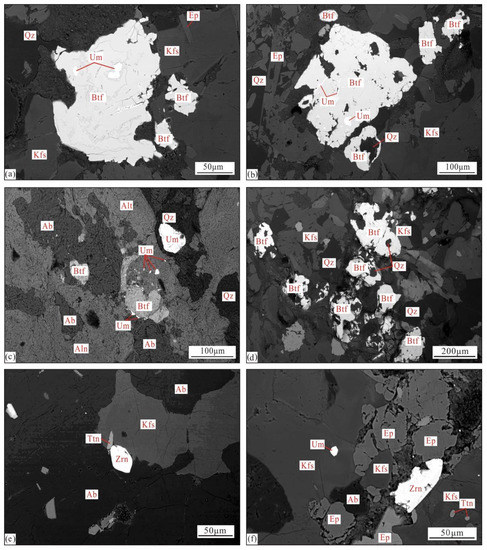
Figure 5.
Scanning electron microscopy images of the U–rich granitic pegmatite. (a) Betafite and its encapsulated uraninite; (b) Betafite and its internal fissure uraninite; (c) Betafite and its edge growing uraninite; (d) Betafite aggregates between K–feldspar and quartz; (e) Zircon between K–feldspar and albite; (f) Zircon from intergranular fissures of K–feldspar. Qz: Quartz, Kfs: K–feldspar, Ab: Albite, Btf: Betafite, Um: Uraninite, Aln: Allanite, Ep: Epidote, Ttn: Titanite, Zrn: Zircon.
- (2)
- Uraninite
Uraninite in the U–rich granitic pegmatite is associated with betafite, which indicates that it is closely related to genesis. Under a scanning electron microscope, it can be seen that there are two types of genesis of uraninite: uraninites were wrapped in betafite (Figure 5a), and other uraninites existed on the outer edge (Figure 5b) or internal fissure of the betafite (Figure 5c). Because the crystallization temperature of uraninite is higher than that of betafite, the formation of uraninite wrapped in betafite may have occurred earlier than that of betafite during the magmatic crystallization of U–rich granitic pegmatites. The uraninite grains that grew in the internal fissures of betafite or on the outer edge of betafite were probably formed by the recrystallisation of elemental U from the previously formedbetafite.
- (3)
- Zircon
The genetic type of zircons and the paragenetic relationship between zircons and ore minerals are important bases for determining the age of crystallization and mineralization. Zircons with a prismatic shape and idiomorphic or subhedral crystal form can be observed under a scanning electron microscope (Figure 5e,f), which shows the same characteristics as zircon in the cathodoluminescence (CL) images. All these show the characteristics of magmatic zircons. Zircons occurred in the intergranular fissures of K–feldspar and were associated with uraninite (Figure 5f). The above occurrence characteristics of zircons indicate mineralization of the U–rich granitic pegmatite during crystallization. Therefore, the zircon age can provide supporting chronological evidence for crystallization and mineralization.
5.2. Zircon U–Pb Geochronology
Older zircons (>1000 Ma) usually exhibit Pb loss. Under the same initial conditions and geological environment, 206Pb and 207Pb isotopes have synchronous variation characteristics and can maintain a relatively stable ratio [23]. Therefore, the 206Pb/238U age was used for zircons younger than 1000 Ma, and the 206Pb/207Pb age was used for zircons older than 1000 Ma to represent the formation age of zircons. Two groups representative of U–rich granitic pegmatite samples from the western Huayangchuan deposit were dated to determine their crystallization and mineralization epoch. Most zircons from the samples were translucent–transparent crystals. They had a size range of 150–300 μm long and 100–200 μm wide, with length:width ratios of 2:1–3:1. The CL images of the zircon grains (Figure 6a) displayed clear concentric oscillatory zoning coupled with high Th:U ratios (most were 0.11–0.89, average = 0.56) (Table 1 and Table 2), suggesting a magmatic origin [24]. Meanwhile, the chondrite–normalized REE patterns of the zircons were similar to those of typical magmatic zircons (Figure 7a,c), with elevated HREE/LREE ratios (Figure 7b,d), significant positive Ce anomalies, and positive correlations between Th and U [25]. The results of LA–ICP–MS zircon analyses are listed in Table 1 and Table 2, as shown in Figure 8a–d. Analyses of forty–three grains from two groups of zircon samples formed a concordant population with a weighted mean 206Pb/207Pb age of 1829 ± 11 Ma (MSWD = 1.5, n = 21; Figure 8b) and 1826.3 ± 7.9 Ma (MSWD = 0.97, n = 22; Figure 8d), respectively. This age was interpreted as the crystallization age of the U–rich granitic pegmatite.
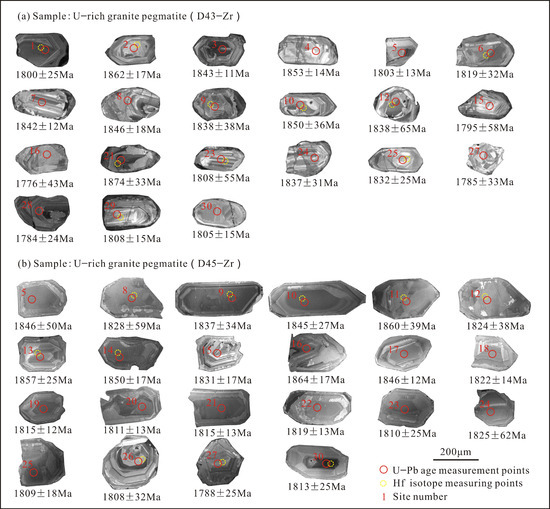
Figure 6.
Cathodoluminescence images of zircons from U–rich granitic pegmatite.

Table 1.
LA–ICP–MS dating results of zircons from the U–rich granitic pegmatite (D43–Zr).
Table 2.
LA–ICP–MS dating results of zircons from the U–rich granitic pegmatite (D45–Zr).
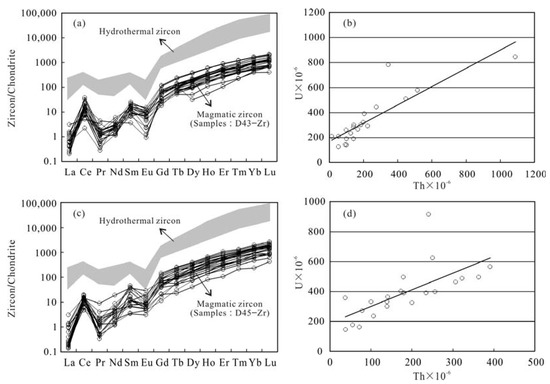
Figure 7.
(a) Chondritenormalized trace multi–element patterns of zircons sample D43–Zr (modified from [25]); (b) Th–U element correlation diagram of zircons sample D43–Zr; (c) Chondrite–normalized trace multielement patterns of zircons sample D45–Zr (modified from [25]); (d) Th–U element correlation diagram of zircons sample D45–Zr (Chondrite values are from [26]).
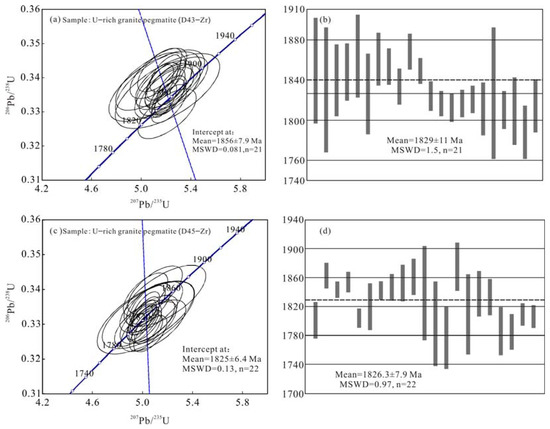
Figure 8.
(a) Zircon U–Pb concordia diagrams of sample D43–Zr; (b) Weighted average of zircon U–Pb ages of sample D43–Zr; (c) Zircon U–Pb concordia diagrams of sample D45–Zr; (d) Weighted average of zircon U–Pb ages of sample D45–Zr.
5.3. Major Elements
The major and trace element test data are presented in Table 3 and Table 4. Most of the U–rich granitic pegmatite samples from the Huayangchuan deposit had low LOI values, indicating that these samples were relatively fresh. The samples were characterized by high concentrations of SiO2 (64.37–70.69 wt. %) and total alkalis (Na2O + K2O = 8.50–10.30 wt.%), higher Al2O3 (12.20–14.41 wt.%), but relatively low concentrations of TiO2 (0.23–0.73 wt.%), MgO (0.38–0.90 wt.%), CaO (1.23–2.22 wt.%), P2O5 (0.14–0.83 wt.%), and MnO (0.04–0.57 wt.%). Meanwhile, they had low Rittmann index (σ = 2.6–4.9, average = 3.8) values. In the SiO2 vs. Na2O + K2O diagram (Figure 9a), SiO2 vs. K2O diagram (Figure 9b), and SiO2 vs. Na2O +K2O–CaO diagram (Figure 9c), most samples were placed in the alkaline granite field, shoshonitic series, and A–Type granite and generally exhibited metaluminous characteristics (A/CNK = 0.8–0.9, Figure 9d), respectively. In addition, it can also be seen that the U–rich granite pegmatite samples have different major element characteristics with the Paleoproterozoic Yuantou granite [27], Huashan granite, and TTG gneiss of the Taihua group (Figure 9a–d).
Table 3.
Measured contents of major (wt. %), rare earth, and trace elements (ppm) of the U–rich granitic pegmatite.
Table 4.
Measured contents of major (wt. %), rare earth, and trace elements (ppm) of the surrounding rock and Huanshan granite.
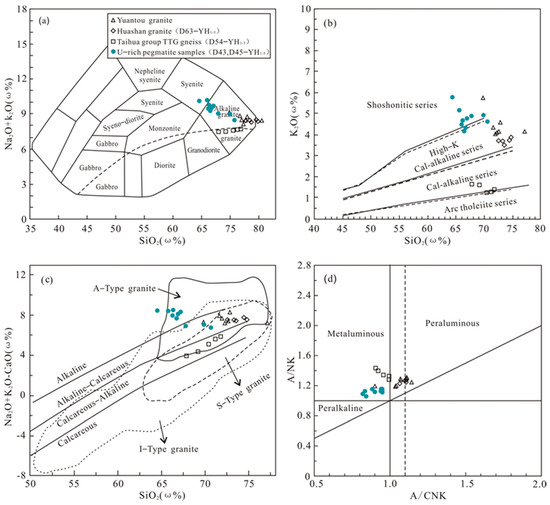
Figure 9.
(a) SiO2 vs. Na2O+K2O diagram (modified from [27]); (b) SiO2 vs. K2O diagram (base map modified from [28]); (c) SiO2 vs. Na2O + K2OCaO diagram (base map modified from [29]); (d) A/CNK vs. A /NK diagram (base map modified from [29]).
5.4. Trace Elements
The contents of rare earth elements (ΣREE) in the U–rich granitic pegmatite samples range from 430.50 to 1286.18 × 10−6 (Table 3), indicating that the REE in the U–rich granitic pegmatite had the characteristics of high total amount but very uneven distribution. In the chondrite–normalized diagrams (Figure 10a), all samples showed LREE–enriched and HREE depletion with (La/Yb)N = 14.36 − 54.66. Meanwhile, the HREE exhibited relatively flat patterns with (Gd/Yb)N = 2.05 − 3.46 and weak negative Eu anomalies (δEu = 0.57 − 1.19) (Figure 10a). Moreover, all of the U–rich granitic pegmatite samples enriched in large–ion lithophile elements (such as Rb, Ba, K, and Pb) and radioactive elements (such as Th and U) and depleted in high–field–strength elements (such as Ta, P, Ti, Zr, and Hf) (Figure 10b). Obviously, the combination and enrichment characteristics of the trace elements in the U–rich granitic pegmatite samples were also consistent with the actual ore–forming elements (such as U, Pb, and REE). Compared with the Yuantou granite [27], Huashan granite, and the TTG gneiss of the Taihua group, the U–rich granite pegmatite sample has a higher total amount of rare earth elements (Figure 10a), as well as Th, U, Pb, and other trace element combinations (Figure 10b). This characteristic is also consistent with the actual metallogenic element combinations (such as U, Pb, REE, etc.) in this area.
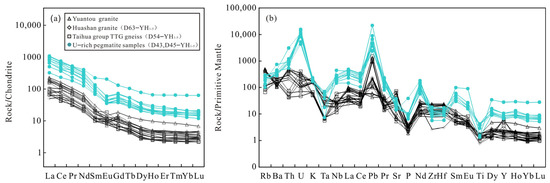
Figure 10.
(a) Chondrite–normalized REE patterns (modified from [27]); (b) Primitive mantle–normalized trace multi–element patterns (chondrite and primitive mantle values are from [26]).
5.5. Zircon Lu–Hf Isotopic Analysis
Twenty zircon grains from the two groups of zircon samples were analyzed for their Hf isotopic compositions. The results of the Lu–Hf analysis are presented in Table 5. These measured zircons have homogeneous Hf isotopic compositions and relatively high 176Hf/177Hf ratios (0.281359–0.281539), with depleted εHf (t) values varying from −19.42 to −15.02 (Table 5, Figure 11a). Correspondingly, their single– (tDM1) and two–stage (tDM2) model ages ranged from 2.61 to 2.41 Ga and from 3.10 to 2.76 Ga (Table 5, Figure 11b), respectively. The Hf isotope composition of the zircon indicates that the Late Paleoproterozoic U–rich granitic pegmatite in Huayangchuan was probably formed by the reworking or remelting of crustal material from the Middle Archean to the Neoarchean.
Table 5.
Hf isotope results of zircons from the U–rich granitic pegmatite.
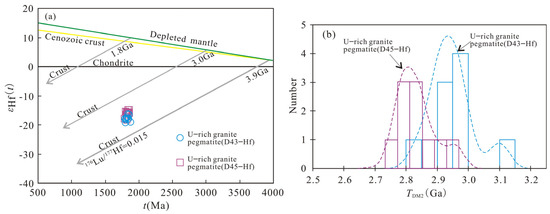
Figure 11.
(a) εHf(t) vs. t (Ma) diagram zircons; (b) T DM2 diagram zircons.
6. Discussion
6.1. Constraints from Zircon Ages Paleoproterozoic U Mineralization
Based on field observations, the U–rich granitic pegmatite veins intruded into the Taihua group, and the intrusive boundary with the Taihua group was clearly visible (Figure 3a,b), indicating the characteristics of a magmatic intrusion. The CL images of zircons from U–rich granitic pegmatite samples also showed general characteristics of magmatic zircons [24]. The REE characteristics of the zircons were consistent with those of typical magmatic zircons (Figure 7a,c). The highly positive correlation of U and Th in zircon showed the characteristics of magmatic genesis (Figure 7b,d), reflecting that the zircon isotope system was still well sealed without the migration of U and Th. Under the polarizing and scanning electron microscopes, zircon grains displayed an intact crystal shape (Figure 3c and Figure 5e,f) and an association with uraninite (Figure 5f). Combined with the betafites in the intergranular fissures of rock–forming minerals (Figure 5a–d), we speculate that the zircons had mineralization characteristics in the crystallization stage. Therefore, the zircon U–Pb dating results obtained in this study were 1826.3 ± 7.9 and 1829 ± 11 Ma (Figure 8b,d), which not only indicated the crystallization age of U–rich pegmatite but also represented the age of uranium mineralization in the same period.
Generally, orogenic belts on the margins of ancient continental blocks are important uranium metallogenic regions. First, ancient land blocks are often rich in large–ion lithophilic elements (e.g., Rb, Ba, Th, U, and K), which can easily provide material sources for uranium polymetallic mineralization. Second, the crust and mantle materials on the margin of the ancient continental region have strong material interactions and frequent magmatic activities, which can create favorable geological conditions for the large–scale enrichment of ore–forming materials. Therefore, the marginal zone of the ancient continent often had favorable uranium polymetallic mineralization conditions that controlled the temporal and spatial distribution of uranium polymetallic deposits [30,31]. Regionally, a large number of late Paleoproterozoic (2.0–1.8 Ga) uranium polymetallic deposits are distributed along the collisional orogenic belt along the marginal zone of the ancient continental North China Craton. Typical deposits include the Lianshanguan uranium deposit in Liaoning Province, the Pinglu uranium deposit in Shanxi Province, and the Hongshiquan uranium deposit in Gansu Province [30,31]. In conclusion, the chronological research results of U–rich granitic pegmatite in this study show that uranium mineralization in the late Paleoproterozoic (1829 ± 11 and 1826 ± 7.9 Ma) also occurred in the Xiaoqinling area of the southern margin of the North China Craton, which implies that the tectonic–magmatic–mineralization events were produced during the ultimate cratonization process of the North China Craton in the late Paleoproterozoic (2.0–1.8 Ga) [32,33,34].
6.2. Rock Type of the U–Rich Granitic Pegmatite
Lithologically, A–type granites can be further divided into peralkaline and aluminous types [35]. Peralkaline A–type granite with a high degree of magmatic differentiation is generally formed during the latest time series of magmatic activity. They are often associated with mafic rocks (such as mafic inclusions, xenoliths, and intrusive veins) and often contain alkaline dark minerals (such as aegirine, aegirine–augite, sodium amphibole, sodium iron amphibole, and olivine) [36]. The peralkaline A–type granite is characterized by high SiO2, rich total alkalis (K2O + Na2O), and relatively poor MgO and low CaO; they usually enriched large–ion lithophile elements (LILEs: such as Rb, Th, U, and K) and depleted high–field–strength elements (HFSEs: such as Zr, Ta, and Ti) [37]. Their ΣREEs are usually several times or even dozens of times greater than that of other types of granites, and they have strong negative δEu anomalies in the chondrite–normalized diagrams [38]. They usually also have high K2O/Na2O values, A/CNK ratios >1, and 10,000 × Ga/Al ratios > 2.6. Compared to peralkaline A–type granites, aluminous A–type granites have a relatively low degree of magmatic differentiation [39]; therefore, they also show slightly different mineral and geochemical characteristics. The aluminous A–type granite is relatively rich in aluminum (Al2O3 > 12 wt.%), but the A/CNK and 10,000 × Ga/Al value are relatively low. They have a high content of light REE, thus showing more obvious characteristics of light and heavy rare earth fractionation, but δEu is usually not obvious [38]. The dark minerals of aluminous A–type granites are mainly ordinary hornblende or biotite [40].
The U–rich granitic pegmatite samples in this study were characterized by high SiO2 (64.37–70.69 wt.%), total alkali values (K2O + Na2O = 8.50–10.30 wt.%), and Al2O3 (12.20–14.41 wt.%) and relatively low MgO (0.38–0.90 wt.%) and CaO (1.23–2.22 wt.%). Most of the U–rich granitic pegmatite samples belonged to the A–type granite in the SiO2 vs. Na2O + K2O–CaO diagram and showed alkaline and alkaline calcareous series (Figure 9c). The A/CNK values of these samples had a range from 0.8 to 0.9 (Table 3), and most of them were metaluminous (Figure 9d) in the A/CNK vs. A/NK diagram. The 10,000 × Ga/Al ratios of the samples were 2.83–3.99 (average = 3.41) (Table 3), and most of them fell into the range of A–type granite in the 10,000 × Ga/Al vs. (K2O + Na2O) diagram (Figure 12a), 10,000 × Ga/Al vs. Y diagram (Figure 12b), 10,000 × Ga/Al vs. (Na2O + K2O)/CaO diagram (Figure 12c), and Zr + Nb + Ce + Y vs. (Na2O + K2O)/ CaO diagram (Figure 12d), which also shows different rock type characteristics from the Huashan granite and TTG of the Taihua group. The trace elements of the U–rich granitic pegmatite samples also showed enrichment of large–ion lithophile elements (typically Rb, Ba, K, and Pb) and radioactive elements (such as Th and U) and depletion of high–field–strength elements (such as Ta, P, Ti, and Hf (Figure 10b). The U–rich granitic pegmatite samples also have a high total content of rare earth elements (ΣREE), but fractionation characteristics of LREE and HREE are obvious, and negative δEu anomalies are relatively weak (Figure 10a). Alkaline dark minerals (such as aegirine, aegirine–augite, sodium amphibole, sodium iron amphibole, and olivine) were not found in the U–rich granitic pegmatite samples (Figure 4). In summary, the U–rich granitic pegmatites of the late Paleoproterozoic in the Huayangchuan deposit were equivalent to aluminous A–type granites.
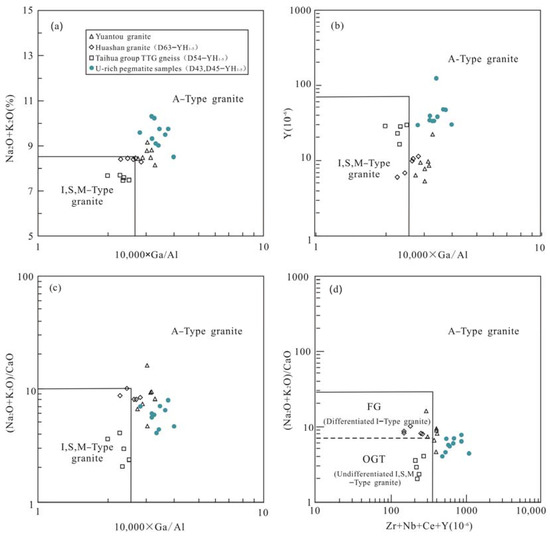
Figure 12.
(a) 10,000 × Ga/Al vs. Na2O + K2O diagram (modified from [27]); (b) 10,000 × Ga/Al vs. Y diagram; (c) 10,000 × Ga/Al vs. (Na2O + K2O)/CaO diagram; (d) Zr + Nb + Ce + Y vs. (Na2O + K2O)/CaO diagram (base map modified from [37]).
6.3. Tectonic Setting of U Mineralization
Type A granites are generally formed in tensile or extensional tectonic settings [36]. Tectonic settings can be divided into non–orogenic and post–orogenic types [41]. Globally, A–type granites were very rare before the Paleoproterozoic but began to appear in large quantities during the late Paleoproterozoic (early Mesoproterozoic) [42]. This phenomenon implies a transition of the tectonic system from compression to extension during the continental evolution [43]. During the late Paleoproterozoic (2.0–1.8 Ga), all kinds of rocks in the basement of the North China Craton underwent strong metamorphism and deformation [44]. This process lasted at least 150 Ma, which included widespread land–land collision events, and this tectonic event was known as the Luliang movement [45]. The Luliang movement promoted a unified crystalline basement in the North China Craton. A series of magmatic activities occurred in the North China Craton after the Luliang movement. For example, Yang (2020) [46] obtained zircon U–Pb ages of felsic pegmatite, granodiorite, and monzogranite in the Xiaoqinling area on the southern margin of the North China Craton, which were aged approximately 1926, 1808, and 1807 Ma, respectively, reflecting tectonic magmatism after the end of the Luliang movement. Thereafter, the bimodal volcanic rocks of the Xiong’er group (1.80–1.75 Ga) [47], the volcanic–sedimentary formation of the Changcheng group (1.68–1.62 Ga) [48], and the contemporaneous or later (1.72–1.60 Ga) basic dyke swarms [49] all indicate that the Xiaoqinling area on the southern margin of the North China Craton had been in a continuous regional extensional environment since the Luliang movement.
In the SiO2 vs. lg[Ca/(Na2O + K2O)] diagram (Figure 13a) and R1 vs. R2 diagram (Figure 13b), most of the U–rich granitic pegmatite samples were plotted in an extensional and non–orogenic tectonic setting. In the Y vs. Nb diagram (Figure 14a), Yb vs. Ta diagram (Figure 14b), Y + Nb vs. Rb diagram (Figure 14c), and Yb + Ta vs. Rb diagram (Figure 14d), most of the U–rich granitic pegmatite samples are generally in an intra–plate granite tectonic setting (WPG) [50]. In the Y–Nb–3×Ga diagram (Figure 15a), Y–Nb–3×Ce diagram (Figure 15b), and Yb + Ta vs. Rb diagram (Figure 15d), most of the U–rich granitic pegmatite samples belong to intraplate A1–type granite [36]. Therefore, the above results indicate that the Xiaoqinling belt in the southern margin of the North China Craton was already in a non–orogenic extensional setting when the U–rich granitic pegmatites were formed (1826.3 ± 7.9 and 1829 ± 11 Ma). The reconstruction scheme of the Columbia supercontinent in the late Paleoproterozoic (2.0–1.8 Ga) provided the location of the North China Craton. At this time, the southern margin of the North China Craton was located in the intraplate rift zone of the Columbian supercontinent [51], which had the non–orogenic tectonic conditions of a plate margin or intraplate rift.
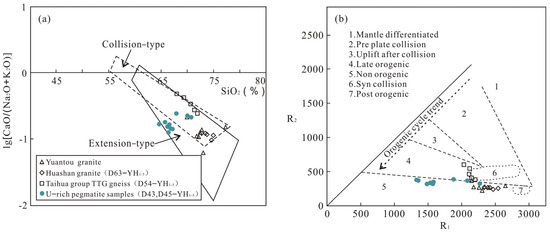
Figure 13.
(a) SiO2 vs. lg[Ca/(Na2O + K2O)] diagram (modified from [27]); (b) R1 vs. R2 diagram (base map modified from [52,53]).
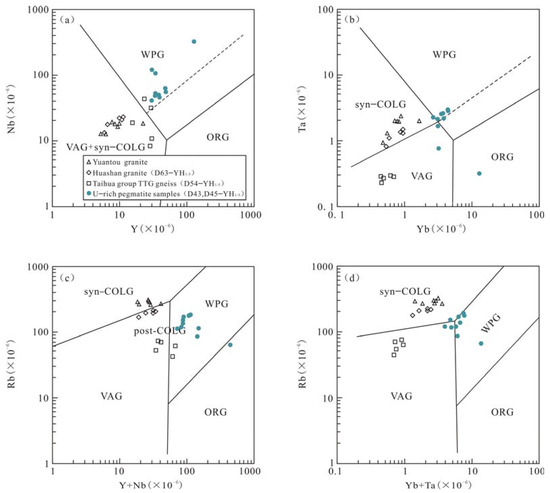
Figure 14.
(a) Y vs. Nb diagram (modified from [27]; (b) Yb vs. Ta diagram; (c) Y + Nb vs. Rb diagram; (d) Yb + Ta vs. Rb diagram (base map modified from [50]).
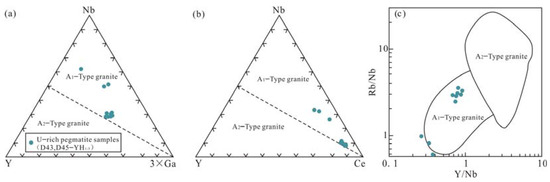
Figure 15.
(a) Y–Nb–3×Ga diagram; (b) Y–Nb–3×Ce diagram; (c) Y/Nb vs. Rb/Nb diagram (base map modified from [36]).
6.4. Metallogenic Models of the U–Rich Granitic Pegmatite
Currently, there are four viewpoints on the genetic model of A–type granite: first, the crustal rocks are partially melted to form I–type granite, and then the residual materials are partially melted again to form A–type granite [54]. However, experimental petrology and actual observations proved that the residual crustal material cannot differentiate A–type granite [55]. Second, A–type granite is formed by the partial melting of the crystalline basement or metamorphic sedimentary rocks [35]. Third, A–type granite is formed by crust–mantle magmatic mixing [56]. Fourth, the separation crystallization of mantle–derived alkaline basalt directly forms A–type granite [57]. The studied U–rich granitic pegmatite samples have the characteristics of high SiO2, Al2O3, and total alkalis, low MgO, TiO2, and P2O5, and enrichment in large–ion lithophiles and radioactive elements (such as Rb, Ba, Th, U, K, and Pb) and depletion of high–field–strength elements (such as Ta, P, Ti, and Hf). These whole–rock geochemical characteristics support the conclusion that the magma source of the U–rich granitic pegmatite samples was felsic crustal material, rather than mantle–derived mafic magma. In addition, experimental petrology has proved that felsic rocks in the shallow crust (depth ≤ 20 km) can produce A–type granites melted through dehydration, high temperature, and partial melting [58]. In fact, the lithology of the Taihua group as the basement was composed of “supracrustal rock” and “TTG suite” (Trondhjemite, Tonalite, and Granodiorite), whose material composition clearly belongs to the evolved felsic crust. The formation ages of Taihua group were approximately 2.8, 2.5, 2.3, and 1.97–1.80 Ga [32,34,59], reflecting the multi–stage cyclic evolution of the crust in this area. The formation age of the early Taihua group (approximately 2.8 Ga) is much older than that of the later U–rich granitic pegmatite and is very close to the two–stage model age (TDM2) of the zircon Hf isotope (3.10–2.76 Ga). This evidence indicates that the materials of the early Taihua group (such as the Middle Archean) were probably the magma source of the later Taihua group (such as the Late Paleoproterozoic).
Therefore, we can speculate that the formation process of U–rich granitic pegmatite in this study was as follows: after the Late Paleoproterozoic (1826.3 ± 7.9 and 1829 ± 11 Ma) Luliang movement, the tectonic setting in this area gradually transitioned to an extensional background [27]. The subduction plates broke off and triggered asthenospheric mantle upwelling, resulting in partial melting of the lithospheric mantle, and the generated basic magma rose and underplated the middle–lower crust, prompting partial melting of the early Taihua group formed in the Archean–Neoarchean (3.10–2.76 Ga). As extension continued, a series of A–type granites gradually formed, such as in the Yuantou and Huayangchuan areas (Figure 16a). The Taihua group formed in the Archean–Neoarchean period was rich in uranium and other radioactive elements, and the uranium–rich granitic pegmatites in this area were directly formed during the magmatic activity in the late Paleoproterozoic (1826.3 ± 7.9 and 1829 ± 11 Ma) (Figure 16b). These U–rich granitic pegmatites also provided material sources for later (Indosinian and Yanshanian) uranium mineralization in the Huayangchuan area or underwent superimposed transformation to form new deposit types, reflecting the ultra–long evolutionary history of uranium mineralization and uranium deposits with complex genesis in the Huayangchuan area.
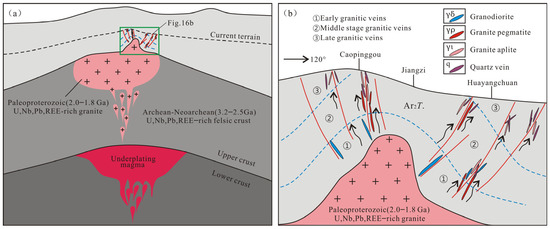
Figure 16.
(a) Petrogenesis pattern drawings of Paleoproterozoic U–rich granitic pegmatite; (b) Mineralization genesis pattern drawings of Paleoproterozoic U–rich granitic pegmatite.
7. Conclusions
- (1)
- The U–rich granitic pegmatites were formed in the late Paleoproterozoic (1826.3 ± 7.9 and 1829 ± 11 Ma). The paragenetic phenomena of the magmatic zircons with betafite and uraninite in the samples showed metallogenic characteristics during the crystallization period.
- (2)
- Based on the classification criteria and rock characteristics of A–type granite, the major elements, trace elements, and mineral compositions of most U–rich granitic pegmatite samples had the characteristics of intraplate A1–type granite
- (3)
- The U–rich granitic pegmatites were formed after the Luliang movement in the late Paleoproterozoic, and the tectonic system gradually transitioned from a continent–continent collision to an extensional setting. The partial melting of the early Taihua group materials formed in the Archean–Neoarchean period triggered a series of tectonic granitic magmatic activities.
- (4)
- The early Taihua group formed in the Archean–Neoarchean period as mature crust material rich in uranium, which provided uranium–rich magma for the formation of uranium–rich granite pegmatite in the late Paleoproterozoic. Existing uranium–rich geological bodies also provided material sources for later uranium mineralization in the Huayangchuan deposit.
Author Contributions
P.L.—Conceptualization, Methodology, Formal analysis, Investigation, Resources, Data curation, Writing—original draft, Writing—review and editing, and Visualization. Y.L.—Writing—review and editing and Supervision. P.G.—Investigation, Resources, Data curation, and Project administration. S.H.—Investigation and Data curation. Y.Z.—Investigation and Data curation. R.C.—Investigation and Data curation. All authors have read and agreed to the published version of the manuscript.
Funding
This research was financially supported by the Geological Survey Project of China Geological Survey, grant number “DD20160014, DD20190069, and DD20221636”.
Institutional Review Board Statement
Not applicable.
Informed Consent Statement
Not applicable.
Data Availability Statement
Data are contained within the article.
Acknowledgments
We are very grateful to Qingqing Kang, Peng Li, Lei Li, and Hongjun Jiang of Geological Party No. 224, Sino Shaanxi Nuclear Industry Group, for their assistance in the field sampling work, and the reviewers for their constructive comments and suggestions which improved the quality of the manuscript.
Conflicts of Interest
There is no conflict of interest for this work.
References
- He, S.; Li, Z.Y.; Hui, X.C.; Guo, J. 40Ar/39Ar geochronology of biotite in Huayangchuan uranium–polymetallic deposit in shaanxi province and its geological significance. Uranium Geol. 2016, 32, 159–164, (In Chinese with English abstract). [Google Scholar]
- Gao, C.; Kang, Q.Q.; Jiang, H.J.; Li, P.; Zhang, X.M.; Li, L.; Dong, Q.Q.; Ye, X.C.; Hu, X.J. A unique uranium polymetallic deposit discovered in the Qinlingorogenic belt: The Huayangchuan super–large U–Nb–Pb–REE deposit associated with pegmatites and carbonatites. Geochimica 2017, 46, 446–455, (In Chinese with English abstract). [Google Scholar]
- Kang, Q.Q.; Zhang, X.M.; Meng, X.H. Analysis on the characteristics and prospecting of rare earth ore in the western section of Xiaoqinlin. Northwest. Geol. 2020, 53, 107–121, (In Chinese with English abstract). [Google Scholar]
- Li, N.; Chen, Y.J.; Zhang, H.; Zhao, T.P.; Deng, X.H.; Wang, Y.; Ni, Z.Y. Molybdenum deposits in East Qinling. Earth Sci. Front. 2007, 14, 186–198, (In Chinese with English abstract). [Google Scholar]
- Wang, L.J.; Xu, C.; Wu, M.; Song, W.L. A study of fluid inclusion from Huayangchuan carbonatite. Acta Mineral. Sin. 2011, 31, 374–375, (In Chinese with English abstract). [Google Scholar]
- Hui, X.C.; Cai, Y.Q.; He, S.; Feng, Z.S. Petrologic and geochemical characteristics of carbonatites in Huayangchuan U–Nb–Pb deposit, Shaanxi province. Geoscince 2017, 31, 246–257, (In Chinese with English abstract). [Google Scholar]
- Yu, X.H. Geological, petrol–mineralogical characteristics and origin of the carbonatites from Huayangchuan, Shaanxi province. Earth Sci.–J. China Univ. Geosci. 1992, 17, 151–158, (In Chinese with English abstract). [Google Scholar]
- Xu, C.; Campbell, I.H.; Allen, C.M.; Huang, Z.; Qi, L.; Zhang, H.; Zhang, G. Flat rare earth element patterns as an indicator of cumulate processes in the Lesser Qinling carbonatites, China. Lithos 2007, 95, 267–278. [Google Scholar] [CrossRef]
- Reguir, E.P.; Chakhmouradian, A.R.; Pisiak, L.; Halden, N.M.; Yang, P.; Xu, C.; Kynický, J.; Cou€eslan, C.G. Trace–element composition and zoning in clinopyroxene– and amphibole–group minerals: Implications for element partitioning and evolution of carbonatites. Lithos 2012, 128, 27–45. [Google Scholar] [CrossRef]
- Hui, X.C.; He, S. Mineralization characteristic of carbonatite veins in Huayangchuan U–polymetal deposit, Shaanxi province. Uranium Geol. 2016, 32, 93–98, (In Chinese with English abstract). [Google Scholar]
- Song, W.L.; Xu, C.; Smith, M.P.; Kynicky, J.; Huang, K.J.; Wei, C.W.; Zhou, L.; Shu, Q.H. Origin of unusual HREE–Mo–rich carbonatites in the Qinling orogen, China. Sci. Rep. 2016, 6, 37377. [Google Scholar] [CrossRef] [PubMed]
- Gao, L.G.; Chen, Y.W.; Bi, X.W.; Hu, R.Z.; Gao, C.; Dong, S.H.; Luo, J.C. Chronology and mineral chemistry of the uranium minerals in Huayangchuan uranium–niobium deposit. Shaanxi province and its implications for uranium mineralization. Acta Geol. Sin. 2019, 93, 2273–2291, (In Chinese with English abstract). [Google Scholar]
- Jiang, H.J.; Gao, C.; Kang, Q.Q.; Chen, H.Y.; Zheng, H.; Chen, B.; Dong, Q.Q.; Zhang, X.M.; Li, P.; Liu, K.H.; et al. Mineralization paragenesis of Huayangchuan U–Nb–Pb deposit in the Lesser Qinling. Geotecton. Et Metallog. 2020, 44, 404–421, (In Chinese with English abstract). [Google Scholar]
- Meng, Q.R.; Zhang, G.W. Timing of collision of the North and South China blocks: Controversy and reconciliation. Geology 1999, 27, 123–126. [Google Scholar] [CrossRef]
- Li, Y.F.; Wang, C.Q.; Bai, F.J.; Song, Y.L. Re–Os isotopic ages of Mo deposit in east Qinling and their geodynamic settings. Miner. Resour. Geol 2004, 6, 571–578, (In Chinese with English abstract). [Google Scholar]
- Ludwig, K.R. User’s manual for Isoplot 3.0: A geochronological toolkit for Microsoft Excel. Berkeley Geochronol. Cent. Spec. Publ. 2003, 4, 1–71. [Google Scholar]
- Andersen, T. Correction of common lead in U–Pb analysis that do not report 204Pb. Chem. Geol. 2002, 192, 59–79. [Google Scholar] [CrossRef]
- Yang, G.X.; Li, Y.J.; Xiao, W.J.; Tong, L.L. OIB–type rocks within West Junggar ophiolitic melanges: Evidence for the accretion of seamounts. Earth–Sci. Rev. 2015, 150, 477–496. [Google Scholar] [CrossRef]
- Hou, K.J.; Li, Y.H.; Zou, T.R.; Qu, X.M.; Shi, Y.R.; Xie, G.Q. LA–MC–ICP–MS technique for Hf isotope microanalysis of zircon and its geological applications. Acta Petrol. Sin. 2007, 23, 2595–2604, (In Chinese with English abstract). [Google Scholar]
- Blichert–Toft, J.; Albarède, F. The Lu–Hf isotope geochemistry of chondrites and the evolution of the mantle–crust system. Earth Planet. Sci. Lett. 1997, 148, 243–258. [Google Scholar] [CrossRef]
- Scherer, E.; Münker, C.; Mezger, K. Calibration of the lutetium–hafnium clock. Science 2001, 293, 683–687. [Google Scholar] [CrossRef] [PubMed]
- Griffin, W.L.; Pearson, N.J.; Belousova, E.; Jackson, S.E.; Van Achterberg, E.; O’Reilly, S.Y.; Shee, S.R. The Hf isotope composition of cratonic mantle: LAM–MC–ICPMS analysis of zircon megacrysts in kimberlites. Geochim. Cosmochim. Acta 2000, 64, 133–147. [Google Scholar] [CrossRef]
- Diwu, C.R.; Sun, Y.; Dong, Z.C.; Wang, H.L.; Chen, D.L.; Chen, L.; Zhang, H. In situ U–Pb geochronology of Hadean zircon xenocryst(4.1–3.9 Ga) from the western of the Northern Qinlinig orogenic belt. Acta Petrol. Sin. 2010, 26, 1171–1174, (In Chinese with English abstract). [Google Scholar]
- Rubatto, D. Zircon trace element geochemistry: Partitioning with garnet and the link between U–Pb ages and metamorphism. Chem. Geol. 2002, 184, 123–138. [Google Scholar] [CrossRef]
- Xu, Q.; Li, Y.; Yang, G.X.; Ning, W.T.; Tong, L.L.; Duan, F.H.; Wu, L.; Ren, P.F. Petrogenesis and tectonic setting of the Middle Devonian Beitashan Formation volcanic rocks in the northern East Junggar, NW China: Insights from geochemistry, zircon U–Pb dating, and Hf isotopes. Geol. J. 2020, 55, 1964–1983. [Google Scholar] [CrossRef]
- Sun, S.S.; McDonough, W.F. Chemical and isotopic systematic of oceanic basalt: Implications for mantle compositions and processes. Magmat. Ocean. Basin 1989, 42, 313–345. [Google Scholar] [CrossRef]
- Deng, X.Q.; Peng, T.P.; Zhao, T.P.; Qiu, Z.L. Petrogenesis of the Late Paleoproterozoic (−1.84 Ga) Yuantou A–type granite in the southern margin of the North China Craton and its tectonic implications. Acta Petrol. Sin. 2019, 35, 2455–2469, (In Chinese with English abstract). [Google Scholar]
- Irvine, T.N.; Baragar, W.R.A. A guide to the chemical classification of the common volcanic rocks. Can. J. Earth Sci. 1971, 8, 523–548. [Google Scholar] [CrossRef]
- Wilson, M. Igneous Petrogenesis: A Global Tectonic Approach; Oxford University Press: London, UK, 1989; pp. 13–34. [Google Scholar] [CrossRef]
- Wang, W.G.; Wang, J. The unique economic uranium mineral assemblage in Lianshanguanuranium deposit and its chatacteristics and significance. Uranium Geol. 1991, 7, 196–205, (In Chinese with English abstract). [Google Scholar]
- Song, J.Y.; Cai, Y.Q.; Yao, C.L.; Zhu, P.F.; Zhao, Y.A.; Zhang, W.M. The relationship between Paleo–Landmass and uranium mineralization in China. Uranium Geol. 2011, 27, 8–12, (In Chinese with English abstract). [Google Scholar]
- Wan, Y.S.; Wilde, S.A.; Liu, D.Y.; Yang, C.X.; Song, B.; Yin, X.Y. Further evidence for −1.85Ga metamorphism in the central zone of the north China Craton: SHRIMP U–Pb dating of zircon frommetamorphic rocks in the Lushan area, Henan province. Gondwana Res. 2006, 9, 189–197. [Google Scholar] [CrossRef]
- Xia, Y.L.; Han, J. Uranium ore–forming ages of the oldest uranium deposits in China and the tracing of uranium metallogenic provinces with lead isotopes. Acta Geosci. Sin. 2008, 29, 752–760, (In Chinese with English abstract). [Google Scholar]
- Liu, D.Y.; Wilde, S.A.; Wan, Y.S.; Wang, S.Y.; Valley, J.W.; Kita, N.; Dong, C.Y.; Xie, H.Q.; Yang, C.X.; Zhang, Y.X.; et al. Combined U–Pb, Hafnium and Oxygen isotope analysis of zircons from meta–igneousrocks in the southern north China craton reveal multiple events inthelate Mesoarchean–early Neoarchean. Chem. Geol. 2009, 261, 140–154. [Google Scholar] [CrossRef]
- Zhou, Y.Y.; Zhai, M.G.; Zhao, T.P.; Lan, Z.W.; Sun, Q.Y. Geochronological and geochemical constraints on the petrogenesis of the Early Paleoproterozoic potassic granite in the Lushan area, southern margin of the North China Craton. J. Asian Earth Sci. 2014, 94, 190–204. [Google Scholar] [CrossRef]
- Eby, G.N. Chemical subdivision of the A–type granitoids: Petrogenetic and tectonic implications. Geology 1992, 20, 641–644. [Google Scholar] [CrossRef]
- Whalen, J.B.; Currie, K.L.; Chappell, B.W. A–type granites: Geochemical characteristics, discrimination and petrogenesis. Contrib. Mineral. Petrol. 1987, 95, 407–419. [Google Scholar] [CrossRef]
- Wu, S.P.; Wang, M.Y.; QI, K.J. Present situation of researches on A–type granites: A review. Acta Petrol. Et Mineral. 2007, 26, 57–66, (In Chinese with English abstract). [Google Scholar]
- King, P.L.; White, A.J.R.; Chappell, B.W.; Allen, C.M. Characterization and origin of aluminous A–type granites from the Lachlan Fold Belt, southeastern Australia. J. Petrol. 1997, 38, 371–391. [Google Scholar] [CrossRef]
- Wu, F.Y.; Sun, D.Y.; Li, H.M.; Jahn, B.M.; Wilde, S. A–type granites in northeastern China: Age and geochemical constraints on their petrogenesis. Chem. Geol. 2002, 187, 143–173. [Google Scholar] [CrossRef]
- Xu, B.L.; Yan, G.H.; Zhang, C.; Li, Z.T.; He, Z.F. Prtrological subdivision and source material of A–type granites. Earth Sci. Front. 1998, 5, 113–124, (In Chinese with English abstract). [Google Scholar]
- Dall’Agnol, R.; Frost, C.D.; Rm, O.T. IGCP Project 510 “A–typegranites and related rocks through time”: Project vita, results, and contribution to granite research. Lithos 2012, 151, 1–16. [Google Scholar] [CrossRef]
- Zhai, M.G.; Santosh, M.; Zhang, L.C. Precambrian geology and tectonic evolution of the North China Craton. Gondwana Res. 2011, 20, 1–5. [Google Scholar] [CrossRef]
- Zhai, M.G.; Hu, B.; Peng, P.; Zhao, T.P. Meso–Neoproterozoic magmatic events and multi–stage rifting in the NCC. Earth Sci. Front. 2014, 21, 100–119, (In Chinese with English abstract). [Google Scholar]
- Zhao, Z.P. Precambrian Crustal Evolution of the Sino–Korean Paraplatform; Science Press: Beijing, China, 1993. (In Chinese) [Google Scholar]
- Yang, C.S. Magmatism and Mineralization in Huayangchuan ore Concentration Area in the Western Part of Xiaoqinling; University of Chinese Academy of Sciences: Beijing, China, 2020; (In Chinese with English abstract). [Google Scholar]
- Zhao, T.P.; Chen, F.K.; Zhai, M.G.; Xia, B. Single zircon U–Pb ages and their geological significance of the Damiao anorthosite complex, Hebei Province, China. Acta Petrol. Sin. 2004, 20, 685–690, (In Chinese with English abstract). [Google Scholar]
- Lu, S.N.; Zhao, G.C.; Wang, H.C.; Hao, G.J. Precambrian metamorphic basement and sedimentary cover of the North China Craton: A review. Precambrian Res. 2008, 160, 77–93. [Google Scholar] [CrossRef]
- Peng, P. Precambrian mafic dyke swarms in the North China Craton and their geological implications. Sci. China (Earth Sci.) 2015, 58, 649–675. [Google Scholar] [CrossRef]
- Pearce, J.A.; Harris, N.B.W.; Tindle, A.G. Trace element discrimination diagrams for the tectonic interpretation of granitic rocks. J. Petrol. 1984, 25, 956–983. [Google Scholar] [CrossRef]
- Rogers, J.J.W.; Santosh, M. Tectonics and surface effects of the supercontinent Columbia. Gondwana Res. 2009, 15, 373–380. [Google Scholar] [CrossRef]
- Brown, G.C. Calc–alkaline intrusive rocks their diversity, evolution, and relation to volcanic arcs. In Andesites–Orogenic Andesites and Related Rocks; Thorpe, R.S., Ed.; John Wiley & Sons: New York, NY, USA, 1982; pp. 437–464. [Google Scholar]
- Batchelor, R.A.; Bowden, P. Petrogenetic interpretation of granitiod rock series using multi–cationic parameters. Chem. Geol. 1985, 48, 43–55. [Google Scholar] [CrossRef]
- Collins, W.J.; Beams, S.D.; White, A.J.R.; Chappell, B.W. Nature and origin of A–type granites with particular reference to southeastern Australia. Contrib. Mineral. Petrol. 1982, 80, 189–200. [Google Scholar] [CrossRef]
- Creaser, R.A.; Price, R.C.; Wormald, R.J. A–type granites revisited: Assessment of a residual–source model. Geology 1991, 19, 163–166. [Google Scholar] [CrossRef]
- Yang, J.H.; Wu, F.Y.; Chung, S.L.; Wilde, S.A.; Chu, M.F. A hybrid origin for the Qianshan A–type granite, northeast China: Geochemical and Sr–Nd–Hf isotopic evidence. Lithos 2006, 89, 89–106. [Google Scholar] [CrossRef]
- Shellnutt, J.G.; Wang, C.Y.; Zhou, M.F.; Yang, Y.H. Zircon Lu–Hf isotopic compositions of metaluminous and peralkaline A–type granitic plutons of the Emeishan large igneous province (SW China): Constraints on the mantle source. J. Asian Earth Sci. 2009, 35, 45–55. [Google Scholar] [CrossRef]
- Zhao, X.F.; Zhou, M.F.; Li, J.W.; Wu, F.Y. Association of Neoproterozoic A– and I–type granites in South China: Implicationsfor generation of A–type granites in a subduction–related environment. Chem. Geol. 2008, 257, 1–15. [Google Scholar] [CrossRef]
- Ni, Z.Y.; Wang, R.M.; Tong, Y.; Yang, C.; Dai, T.M. 207Pb/206Pb age of zircon and 40Ar/39Ar of amphibole from plagioelaseamphibolite in the Taihua group, Luoning, Henan, China. Geol. Rev. 2003, 49, 361–366, (In Chinese with English abstract). [Google Scholar]
Disclaimer/Publisher’s Note: The statements, opinions and data contained in all publications are solely those of the individual author(s) and contributor(s) and not of MDPI and/or the editor(s). MDPI and/or the editor(s) disclaim responsibility for any injury to people or property resulting from any ideas, methods, instructions or products referred to in the content. |
© 2023 by the authors. Licensee MDPI, Basel, Switzerland. This article is an open access article distributed under the terms and conditions of the Creative Commons Attribution (CC BY) license (https://creativecommons.org/licenses/by/4.0/).