Article

SAW-Based Active Cleaning Cover Lens for Physical AI Optical Sensors

Department of Mechanical Engineering, Myongji University, Yongin 17058, Republic of Korea
*
Author to whom correspondence should be addressed.
These authors contributed equally to this work.
Symmetry 2026, 18(2), 347; https://doi.org/10.3390/sym18020347
Submission received: 30 December 2025 / Revised: 30 January 2026 / Accepted: 9 February 2026 / Published: 13 February 2026

Abstract

This paper presents a cover lens concept for camera modules based on surface acoustic waves (SAW) to mitigate the degradation of physical AI optical sensor field-of-view performance caused by surface contamination. The proposed approach utilizes a single-phase unidirectional transducer (SPUDT) that intentionally breaks left–right symmetry through a geometrically asymmetric electrode array to generate SAW, thereby removing droplet contamination. First, the acoustic streaming induced inside a single sessile droplet by the SAW was visualized, and the dynamic behavior of the droplet upon SAW actuation was observed using a high-speed camera. The internal flow developed into a recirculating vortex structure with directional deflection relative to the SAW propagation direction, indicating a symmetry-broken streaming pattern rather than a purely symmetric circulation. Upon the application of the SAW, the droplet was confirmed to move a total of 7.2 mm along the SAW propagation direction, accompanied by interfacial deformation and oscillation. Next, an analysis of transport trajectories for five sessile droplets dispensed at different y-coordinates ( y 1 y 5 ) revealed that all droplets were transported along the x-axis regardless of their initial positions. Furthermore, the analysis of transport velocity as a function of droplet viscosity (1 c P and 10 c P ) and volume (2   μ L , 4   μ L , and 6 μ L ) demonstrated that the transport velocity gradually increased with driving voltage but decreased as viscosity increased under identical actuation conditions. Finally, the proposed cover lens was applied to an automotive front camera module to verify its effectiveness in improving object recognition performance by removing surface contamination. Based on its simple structure and driving principle, the proposed technology is deemed to be expandable as a surface contamination cleaning technology for various physical AI perception systems, including intelligent security cameras and drone camera lenses.

1. Introduction

Recently, Artificial Intelligence (AI) technology has established itself as a core driving element of advanced autonomous vehicles and intelligent driver assistance systems, leading technological innovation across the automotive industry [1,2,3]. Autonomous driving technology is evolving beyond the initial stages of partial automation, primarily characterized by adaptive cruise control and automated parking functions, into a highly autonomous phase capable of operating with minimal human intervention even in complex traffic environments. This evolution is underpinned by technological foundations such as multi-sensor fusion, uncertainty-based risk assessment, and real-time decision-making based on edge computing [4,5,6].
The implementation of such AI-based autonomous driving technology is primarily achieved through vision-based environmental perception employing optical sensors such as cameras and LiDAR. While these sensors serve as core modules for acquiring external environmental information and identifying road conditions, surrounding objects, and potential hazards [7,8,9], the performance of vision-based autonomous driving systems is fundamentally contingent on the quality of the image acquisition devices [10]. However, during operation, these sensors are susceptible to continuous exposure to environmental contaminants such as rain, snow, fog, and dust. Such contamination leads to degraded image quality, object recognition errors, and distance estimation inaccuracies, thereby compromising the safety and reliability of autonomous driving systems [11,12].
To address these challenges, research is being conducted on self-cleaning technologies designed to remove contaminants from camera lens surfaces. Surface contamination cleaning technologies are broadly categorized into two distinct groups: passive cleaning technologies and active cleaning technologies [13].
Passive cleaning technologies control surface energy by physically or chemically modifying solid surface properties or by forming microstructures, thereby allowing contaminants to be removed by gravity without additional external force or energy [14,15,16].
Liu et al. [17] fabricated a hydrophobic surface with a maximum droplet contact angle of 161.7° and a contact angle hysteresis of 3° by attaching silicon carbide paper to a copper surface and utilizing an electrolysis process. Yoon et al. [18] fabricated a hydrophobic surface with a maximum droplet contact angle of 162° by applying aluminum particle-based organosilane-coated alumina to the surface. Wong et al. [19] created a low-surface-energy surface with a liquid contact angle hysteresis of 2.5° using a lubricating liquid-infused micro/nanoporous structure and investigated contaminant removal using this technology. Toma et al. [20] conducted a study on removing contaminants by fabricating a superhydrophobic surface with a maximum droplet contact angle of 160°. This was achieved by modifying a Teflon nanocone array surface with a gold nanoparticle (AuNP) film to create hierarchical nanostructures and further modifying the AuNPs with octadecanethiol (C18). However, passive cleaning technology utilizing such hydrophobic surfaces has limitations in removing small droplets of 3 μ L or less. This is because the surface pinning effect becomes more dominant than gravity as the droplet volume decreases [21].
To address these limitations, active cleaning technologies capable of removing surface contaminants are being researched by harnessing physical energies such as electric fields [22,23,24], heat [25,26,27], and surface acoustic waves (SAW) [28,29,30,31,32,33]. Among these, SAW-based active cleaning technology is particularly advantageous as it leverages mechanical vibrations, surface shear stresses, acoustic radiation forces, and acoustic streaming induced when SAWs propagate along the surface. This mechanism effectively removes not only liquid-based contaminants like raindrops but also solid particles such as dust [34,35]. Moreover, the periodic thermal rise generated during SAW actuation induces localized surface heating effects, which can be effectively applied to the removal of frost and ice layers [36]. Through the combination of these physical effects, SAW-based active cleaning technology is attracting significant attention as an effective solution for maintaining the perception performance of optical sensors, such as cameras and LiDAR, in inclement weather conditions. Tan et al. [37] demonstrated microparticle manipulation using SAW actuation. Potter et al. [38] applied SAW-induced acoustic streaming to remove microparticles from semiconductor wafer surfaces. Song et al. [39] demonstrated the cleaning of viscous droplets using SAW actuation.
However, most existing studies have primarily concentrated on the underlying physical mechanisms of surface cleaning or on evaluating contaminant removal efficiency, while systematic and quantitative investigations into how SAW-based cleaning technologies, when integrated with vision-based AI systems, affect sensor performance, such as object recognition accuracy, remain limited.
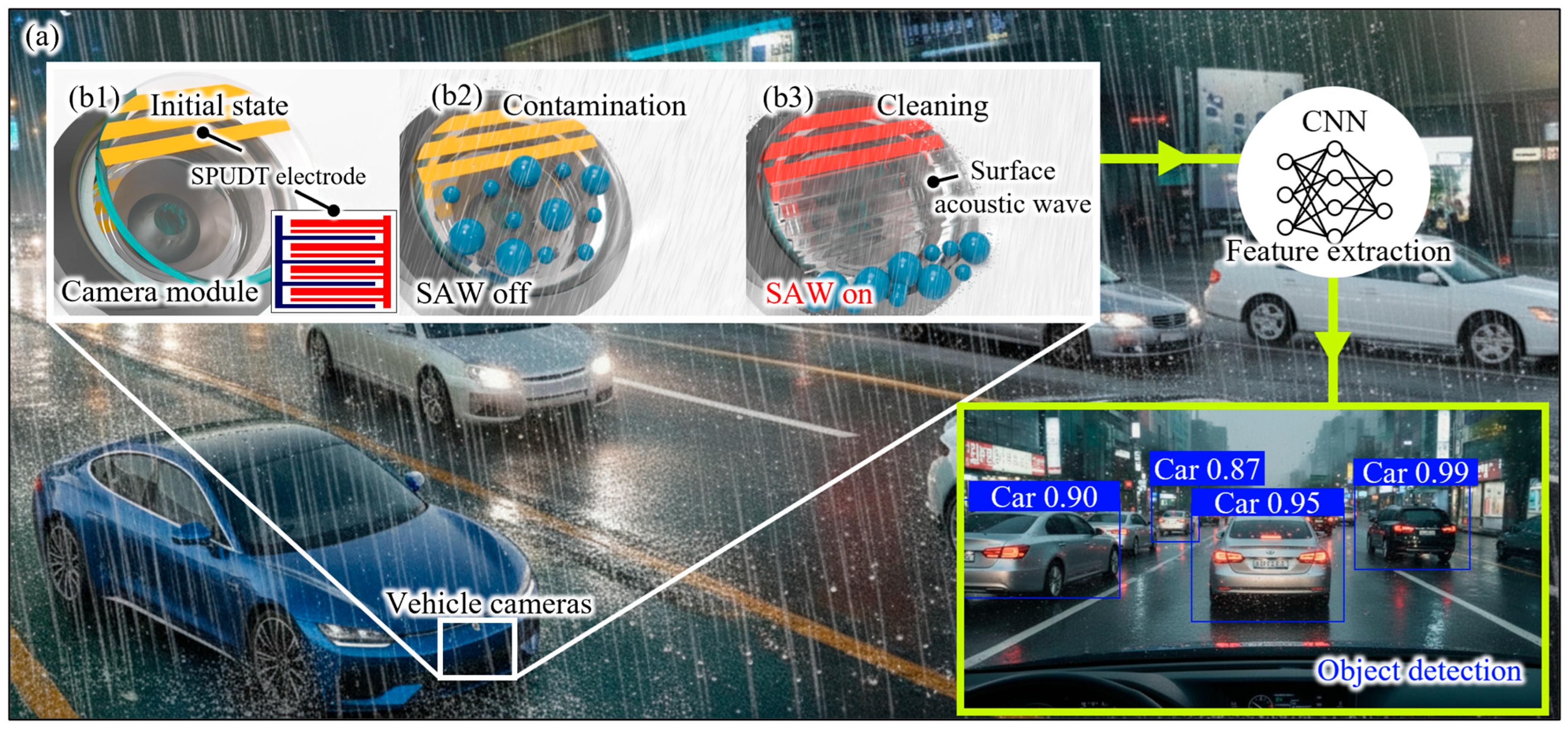
This study presents a SAW-based active cleaning cover lens for physical AI optical sensors (Figure 1). The proposed device employs patterned interdigital electrodes (IDTs) fabricated as single-phase unidirectional transducers (SPUDT) to efficiently generate SAW on a lithium niobate substrate (LiNbO3). First, the velocity magnitude and spatial distribution of SAW-induced acoustic streaming generated within a stationary droplet were evaluated on the cover lens surface. Subsequently, single-droplet transport within a predefined cleaning region on a horizontal plane was evaluated to assess SAW-driven transport performance. Finally, the practical applicability of the proposed approach was demonstrated by mounting the active cleaning cover lens in front of an automotive camera module and experimentally verifying the recovery of object recognition performance following surface cleaning.

2. Working Mechanism

SAWs can actively manipulate stationary droplets located along the SAW propagation path through acousto-fluidic interactions between a piezoelectric substrate and a fluid medium [40,41]. SAW-driven droplet transport can be fundamentally described by two coupled mechanisms: (i) the generation and propagation of SAWs on a piezoelectric substrate, and (ii) droplet motion induced by a force imbalance acting at the solid–liquid and liquid–air interfaces under SAW actuation.
The principle of SAW generation is as follows [31]. When an alternating electrical signal is applied to interdigital transducers (IDTs) composed of metal electrodes deposited on a piezoelectric substrate such as lithium niobate (LiNbO3), aluminum nitride (AlN), or zinc oxide (ZnO), the substrate undergoes localized periodic deformation due to the inverse piezoelectric effect [42]. An IDT is characterized by geometric parameters including the finger width (a), interfinger spacing (b), spatial periodicity (p), acoustic aperture (W), and the number of finger pairs (N), which collectively determine the wavelength, operating frequency, and spatial energy distribution of the generated SAWs [42]. The localized deformation induced by the IDT excitation generates SAWs in the form of Rayleigh waves, which consist of coupled longitudinal and transverse wave components propagating along the substrate surface [43,44]. When a SAW interacts with a droplet on the substrate surface, the Rayleigh wave refracts into the liquid at the Rayleigh angle, thereby forming leaky acoustic waves with longitudinal components within the droplet [45]. Owing to the mismatch in acoustic wave velocities between the piezoelectric substrate and the fluid, a portion of the SAW energy is dissipated into the liquid medium. This energy leakage induces acoustic pressure fields and volumetric body forces within the droplet, which play a central role in driving internal flow and droplet motion [32,46]. The Rayleigh angle, θ R , is determined by the difference between the phase velocity of the SAW propagating along the solid surface and the acoustic wave velocity in the fluid, and is given by [43]:
θ R = sin 1 V L V S
Here, V L denotes the acoustic wave velocity in the liquid, while V S represents the phase velocity of the surface acoustic wave propagating along the solid substrate.
Next, the mechanism of SAW-driven droplet transport can be explained from the perspective of force imbalance within the fluid system. Under the assumption that heat transfer and evaporation effects are negligible, the liquid–air two-phase system subjected to SAW actuation can be described by the conservation of mass and the conservation of momentum equations [33].
t ρ + · u = 0
t ρ u + · ρ u u = p + · τ k + ρ g + f σ + F S A W
Here, u denotes the fluid velocity vector, ρ is the fluid density, p represents pressure, and g is the gravitational acceleration vector. The viscous stress tensor, τ k , is defined as τ k = μ ( u + u T ) , where μ is the dynamic viscosity of the fluid. In addition, f σ represents the force associated with surface and interfacial tension. In this system, droplet motion is governed by the coupled effects of SAW-induced volumetric body forces, viscous resistance within the fluid, and interfacial tension forces at the droplet boundaries. The SAW-induced driving force F S A W , can be expressed as follows [47]:
F S A W = ρ 1 + α 1 2 3 2 A 2 ω 2 k e x p 2 k x + α 1 k z
Here, α 1 = j ( 1 ( v s v l ) 2 is the attenuation coefficient associated with the leaky acoustic wave, A denotes the SAW amplitude, ω is the angular frequency, and k is the SAW wavenumber, which can be expressed as a linear function of the excitation frequency [48]. As a result, the SAW-induced volumetric body force and acoustic streaming generate pressure gradients and interfacial shear stresses within the droplet, which collectively drive the droplet to undergo net translation parallel with the SAW propagation direction. This coupled mechanism constitutes the physical foundation of SAW-driven droplet transport and active surface-cleaning technologies.

3. Materials and Methods

3.1. Design

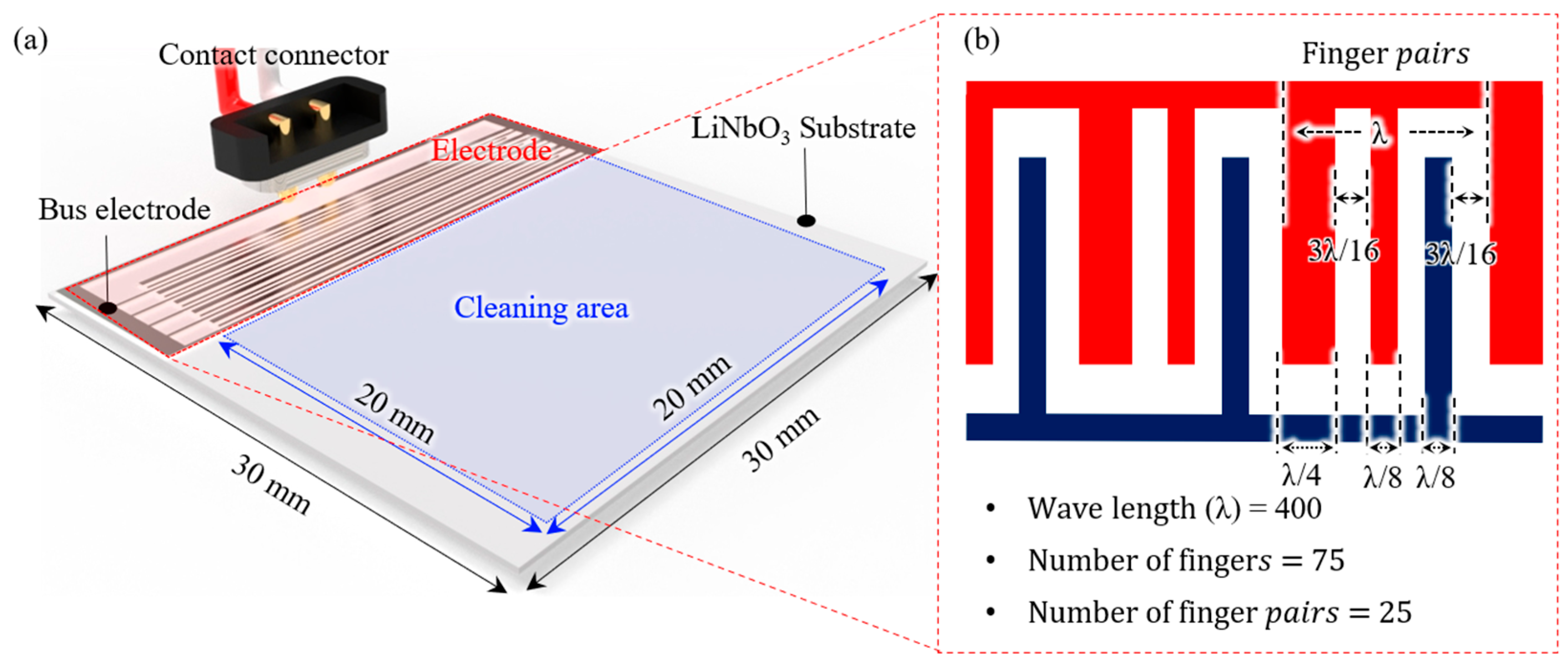
Figure 2 illustrates the schematic design of the proposed unidirectional SAW-based active cleaning device for physical AI optical sensors.
The device consists of patterned electrodes for generating vibrations on a 128° Y-cut X-propagating LiNbO3 piezoelectric substrate and contact connectors for applying external driving signals. The overall dimensions of the device are 30 × 30 mm2, with an effective cleaning area defined as 20 × 20 mm2. One dimension of the cleaning area is inherently determined by the acoustic aperture of the IDT, while the orthogonal dimension was chosen by considering the effective field of view (FOV) of a compact automotive camera module and the physical dimensions of its cover lens. The IDT configuration adopts a triple-electrode structure based on a SPUDT design to suppress the Triple Transit Echo (TTE) and minimize insertion loss [49,50]. In contrast to conventional symmetric bidirectional IDTs, the SPUDT’s triple-electrode unit cell is intentionally designed with geometric asymmetry (e.g., unequal electrode placement/weighting within the cell), which breaks left–right symmetry and imposes a preferred SAW radiation direction, enabling unidirectional SAW generation. Figure 2b details the unit pattern of the SPUDT cell, which comprises 25 periods with a total of 75 fingers arranged periodically. Since the operating frequency of the device is determined by the wavelength of the electrode pattern [51,52], the wavelength was set to 400 μm in this study. The SAW wavelength of 400 μm was selected based on practical constraints and capabilities of the available MEMS fabrication processes, signal generator, and power amplifier, including their operating frequency ranges and output characteristics. Consequently, the device was implemented to achieve an operating frequency of approximately 9.987 MHz. The device was actuated using a custom-developed relay-based driving circuit, applying constant-mode excitation for a single 1 s actuation interval. This driving scheme was selected as a representative experimental condition that allows the cleaning effect to be clearly observed while minimizing potential thermal accumulation effects.

3.2. Fabrication

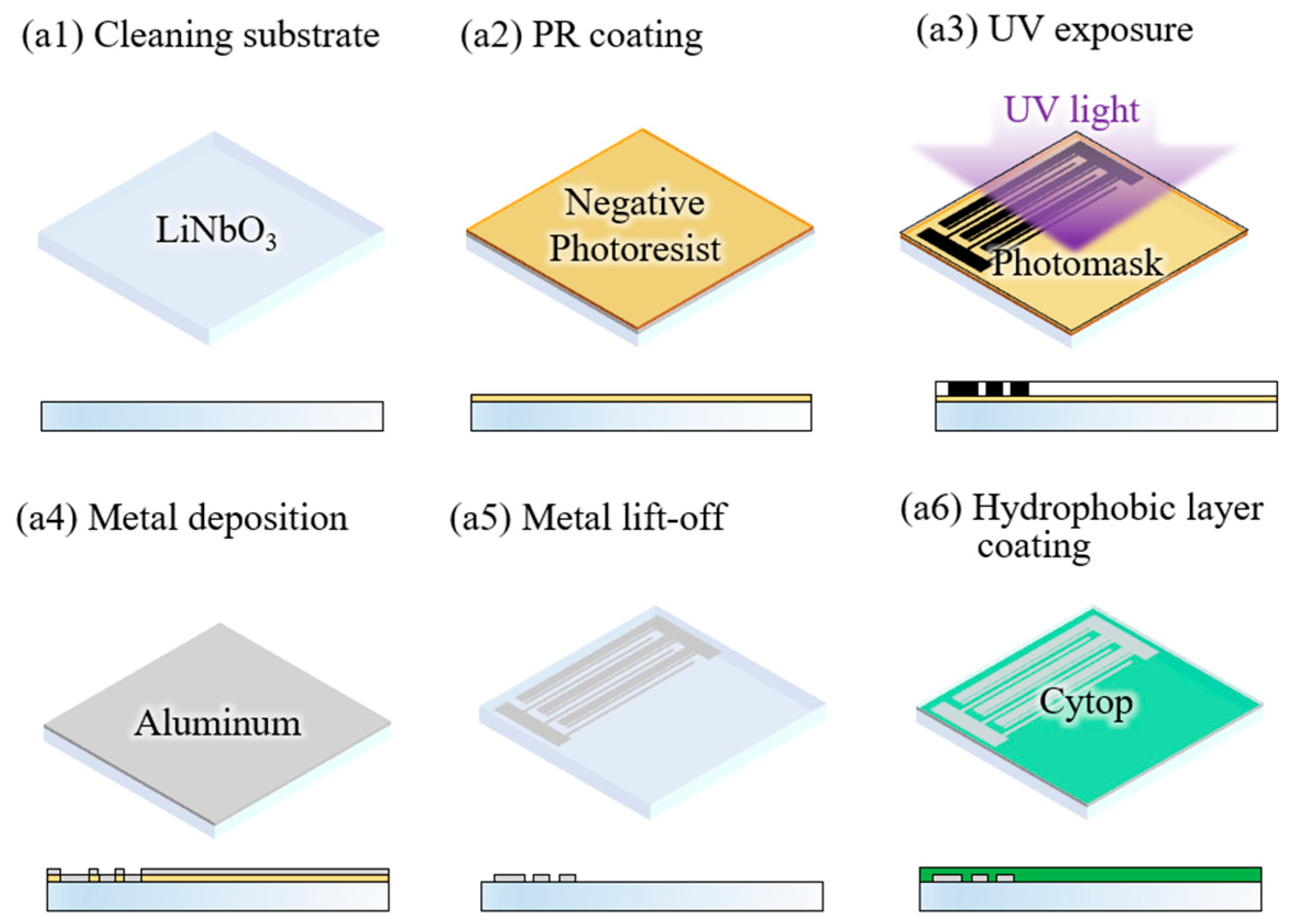
The device was fabricated using a MEMS process (Figure 3). First, a negative photoresist (Germany, Ulm, MicroChemicals GmbH, AZ® nLOF 2035) was spin-coated onto a 128° Y-cut X-propagation lithium niobate (LiNbO3) piezoelectric substrate to form a photoresist layer with a thickness of approximately 3.5 μ m . Subsequently, following the alignment of a photomask with the pre-designed SPUDT pattern, exposure was performed by irradiating UV light with a wavelength of 365 nm at an exposure dose of 70 mJ/cm2. The exposed photoresist was developed using a developer (Germany, Darmstadt, Merck KGaA, AZ 300 MIF), thereby forming pattern windows for electrode deposition. Next, a 150 nm thick aluminum (Al) metal layer was deposited onto the developed LiNbO3 substrate using an E-beam evaporator. Subsequently, a lift-off process was performed to remove the photoresist by immersing the LiNbO3 substrate in an acetone bath with ultrasonication for 10 min, thereby forming the designed SPUDT electrode pattern.
Finally, to reduce friction during droplet transport and ensure electrical insulation, Cytop (Japan, Tokyo, AGC Chemicals, CTL-809M), which possesses low surface energy, was spin-coated to a thickness of approximately 1 μ m .

3.3. Internal Flow Dynamics in a Sessile Droplet

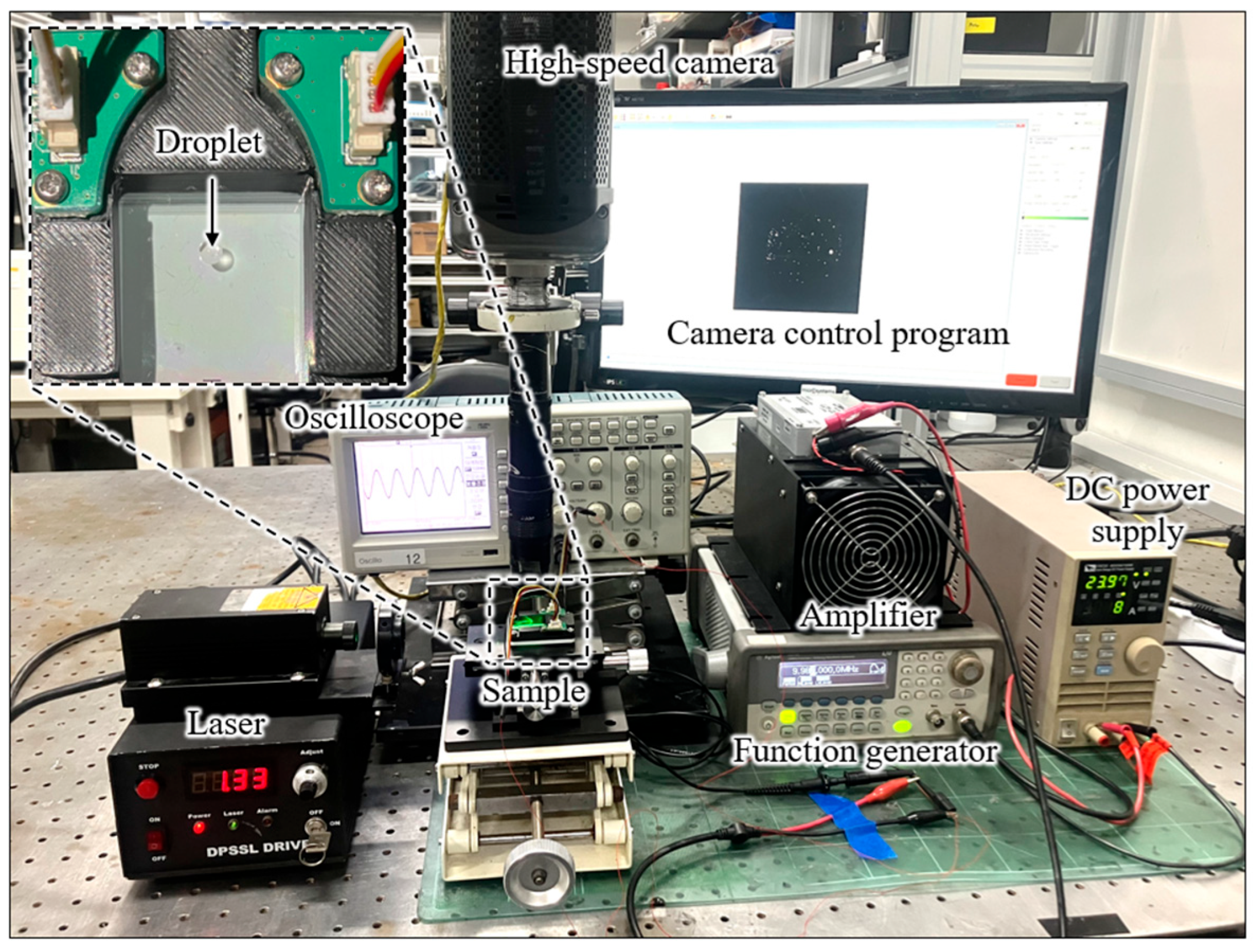
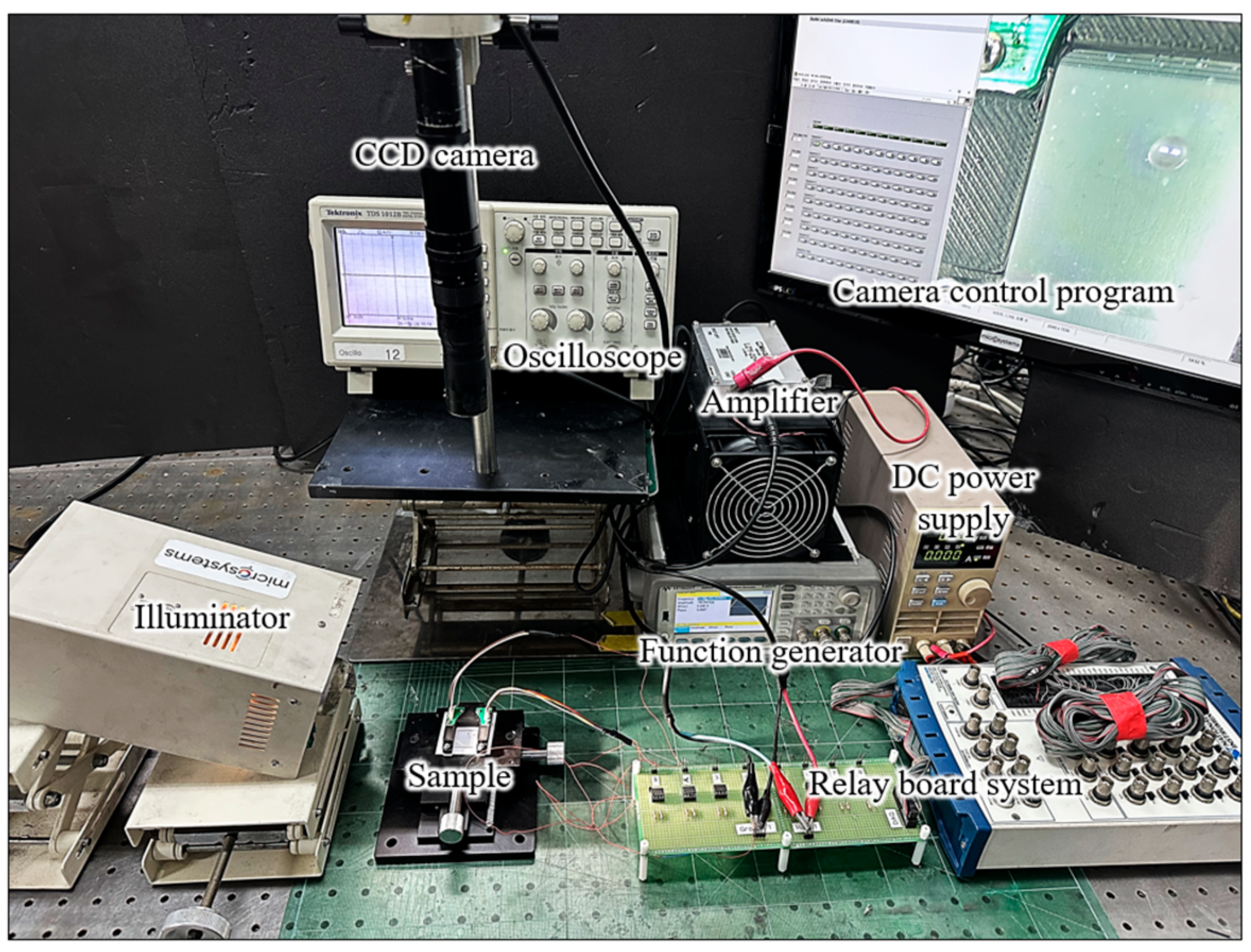
Figure 4 illustrates the experimental setup for visualizing the acoustic streaming induced inside a single droplet as the SAWs leak through the solid–liquid interface, and for quantitatively evaluating the flow velocity. First, a 10 μ L single droplet, in which fluorescent particles (diameter 7–40 μ m ) were dispersed at a concentration of 0.01 wt%, was dispensed onto the surface of the fabricated device. Next, using a function generator (USA, CA, Santa Clara, Agilent Technologies, 33210A) and a power amplifier (USA, NY, Brooklyn, Mini-circuits, LZY-22+), an AC signal with a frequency of 9.987 MHz (9.5 V p p ) was applied to the device. Finally, the fluorescent particles were excited using a 532 nm laser (China, Changchun, Changchun New Industries Optoelectronics Tech. Co., Ltd., MGL-H-532 nm), and their trajectories were recorded from a top-view perspective using a high-speed camera (USA, NJ, Wayne, Vision Research, Phantom Micro eX4) [53,54]. Based on the captured sequential images, a particle tracking analysis was performed using commercial software (USA, MIN, Shoreview, TSI Incorporated, Insight 4G™ to quantitatively determine the velocity distribution of the acoustic streaming inside the droplet [55,56].

3.4. Translation of a Single Droplet on a Horizontal Solid Surface

Figure 5 illustrates the experimental method for evaluating the droplet transport trajectories induced by the SAW within the defined effective cleaning area. First, five identical single droplets were dispensed at different y-coordinates on the device surface. Subsequently, an AC signal with a frequency of 9.987 MHz (40 V p p ) was applied to induce droplet transport, and the resulting motion was recorded using a complementary metal-oxide-semiconductor (CMOS) camera (USA, NJ, Barrington, Edmund Optics, EO-1312C).

3.5. Measurement and Repeatability

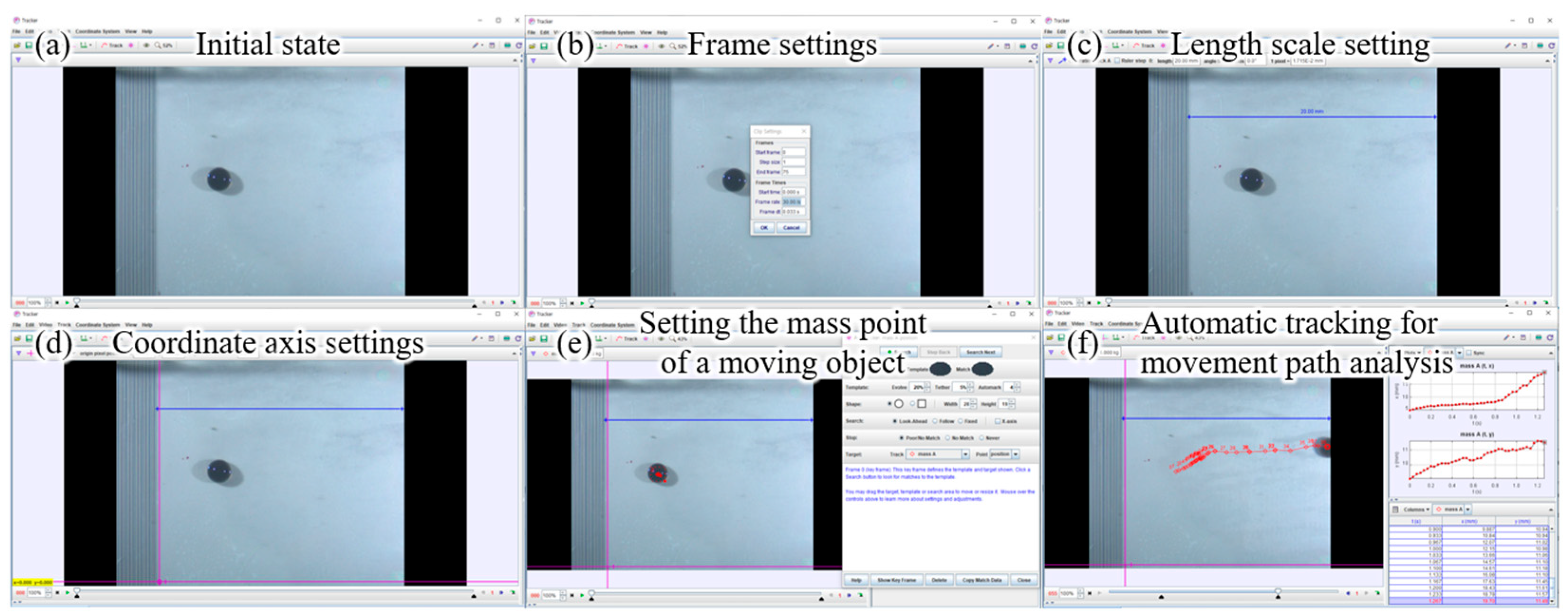
In this study, a video-based tracking approach was employed to quantitatively analyze droplet transport behavior driven by SAW (Figure 6) [57]. Droplet motion was recorded under a fixed optical magnification, and the captured image sequences were analyzed using the Tracker video analysis and modeling tool (USA, MD, College Park, American Association of Physics Teachers (AAPT), Open Source Physics, Tracker). The droplet centroid position was extracted at a temporal resolution of 0.018 s for each frame. Before trajectory analysis, length-scale calibration was performed using a known reference dimension in the experimental images, enabling conversion of pixel-based coordinates into physical units (mm). For each experimental condition—including actuation frequency, applied voltage, and initial droplet position—five independent repeated trials were conducted to ensure reproducibility and statistical reliability. All experiments were performed following an identical procedural sequence, while environmental parameters such as ambient temperature, illumination, and substrate condition were carefully controlled to minimize external disturbances. Droplets of identical volume were generated using a calibrated micropipette, and their initial positions were defined relative to the electrode edge based on a fixed coordinate reference. The droplet displacement was defined as the difference between the droplet centroid position immediately after SAW actuation and that measured after a specified elapsed time. The transport velocity was calculated as the ratio of the predefined transport distance (20 mm along the x-direction within the cleaning region) to the corresponding travel time. Furthermore, the extracted droplet centroid positions were sequentially superimposed in temporal order to reconstruct a composite trajectory image, allowing systematic visualization and analysis of the droplet transport path, directional consistency, and positional stability under SAW actuation.

4. Result and Discussion

4.1. Structural Characterization of the Electrode and Surface Morphology

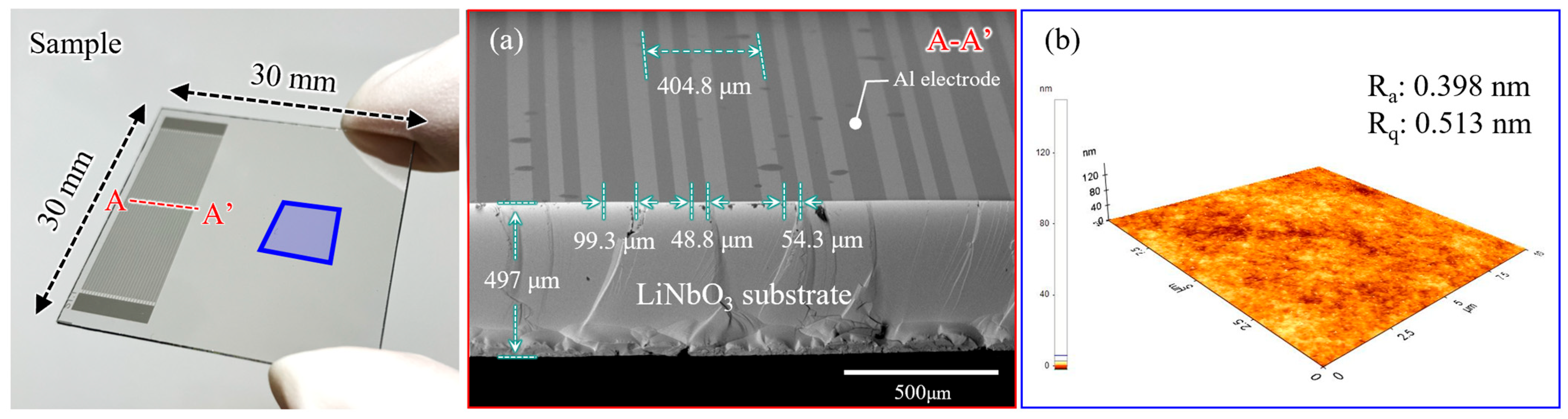
Figure 7 presents the characterization results of the patterned electrode structure and surface properties of the fabricated device, obtained using SEM and AFM. The SEM analysis confirmed that the Al-based triple-electrode patterns were fabricated with high precision, exhibiting a dimensional error of approximately 1.2% relative to the designed geometry (Figure 7a). Furthermore, AFM analysis of the Cytop coating layer revealed a mean roughness ( R a ) of 0.398 nm and a root-mean-square roughness ( R q ) of 0.513 nm (Figure 7b). This sub-nanoscale surface roughness effectively minimizes friction at the solid–liquid interface, thereby facilitating stable droplet transport.

4.2. Internal Flow Dynamics in a Sessile Droplet

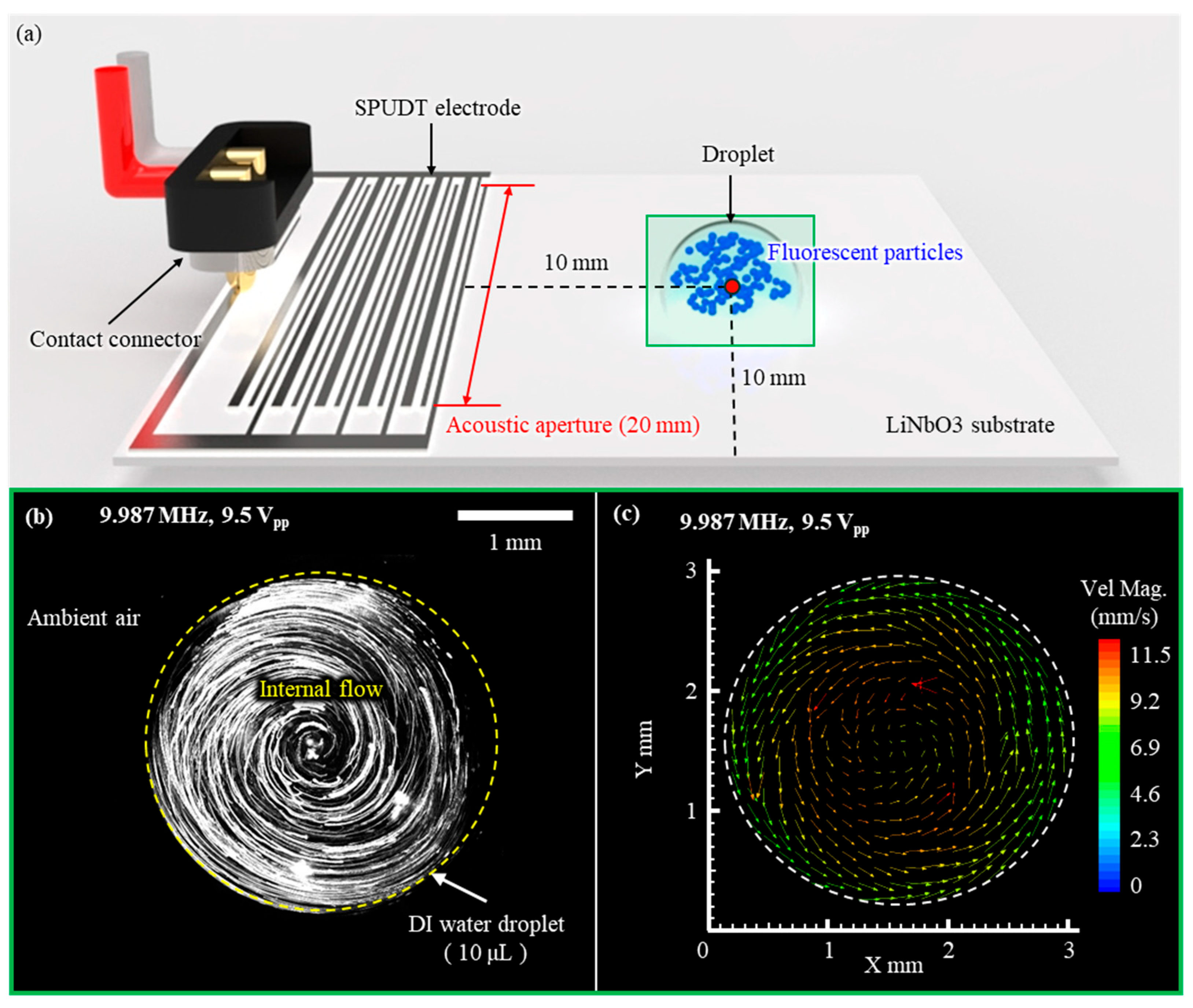
Figure 8 presents the quantitative measurement results of both the acoustic streaming induced inside a 10 μ L single sessile droplet under the SAW actuation and its corresponding flow velocity. The internal flow developed into a recirculating vortex structure with directional deflection relative to the SAW propagation direction, indicating a symmetry-broken streaming pattern rather than a purely symmetric circulation (Figure 8b). Quantitative velocity analysis revealed that the maximum velocity of the generated acoustic streaming was 11.5 mm/s (Figure 8c). These results indicate that a strong circulatory flow was formed inside the droplet, driven by the interaction between the acoustic streaming force induced by SAW propagation and viscous attenuation [58].

4.3. Translation of a Single Droplet on a Horizontal Solid Surface

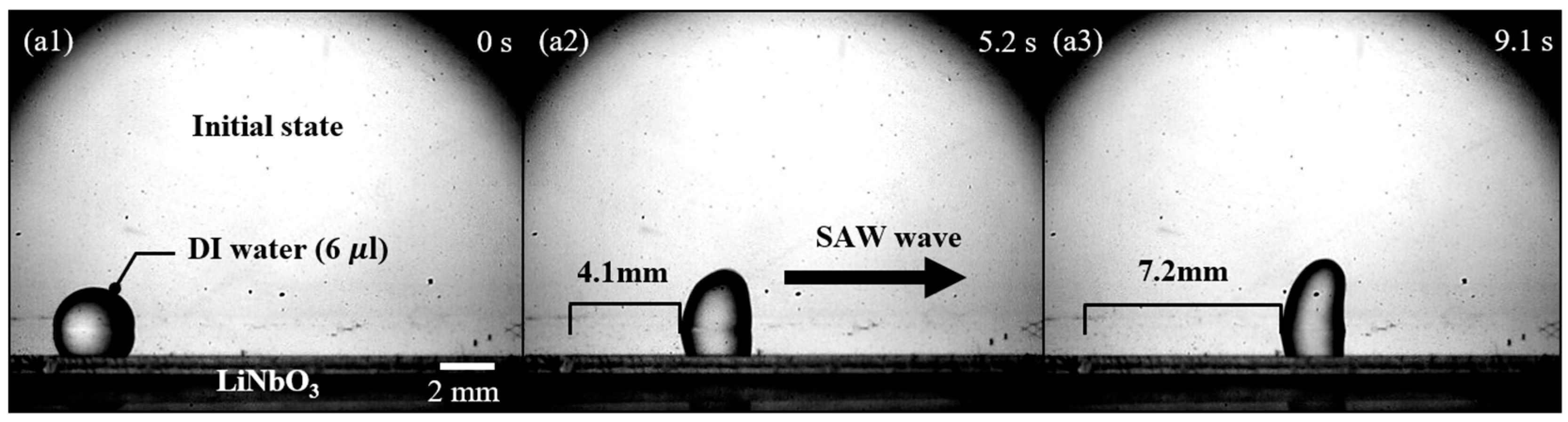
Figure 9 presents sequential images captured using a high-speed camera showing the dynamic behavior of a 6 μL sessile droplet dispensed on the device surface when a SAW actuation with a frequency of 9.987 MHz (20 V p p ) was applied. Upon initiating SAW actuation, acoustic waves are transmitted into the droplet as leaky waves through the solid–liquid interface; simultaneously, capillary waves are induced at the liquid–gas interface [59,60]. Consequently, these capillary waves gradually destabilized the interface, inducing droplet oscillation and shape deformation. As the droplet undergoes deformation, it exhibits transport behavior parallel to the propagation direction of the SAW, achieving a total displacement of 7.2 mm over a duration of approximately 9.1 s. These results demonstrate that the interaction between the acoustic radiation force induced by the leaky SAW and interfacial capillary instability can effectively drive droplet transport.
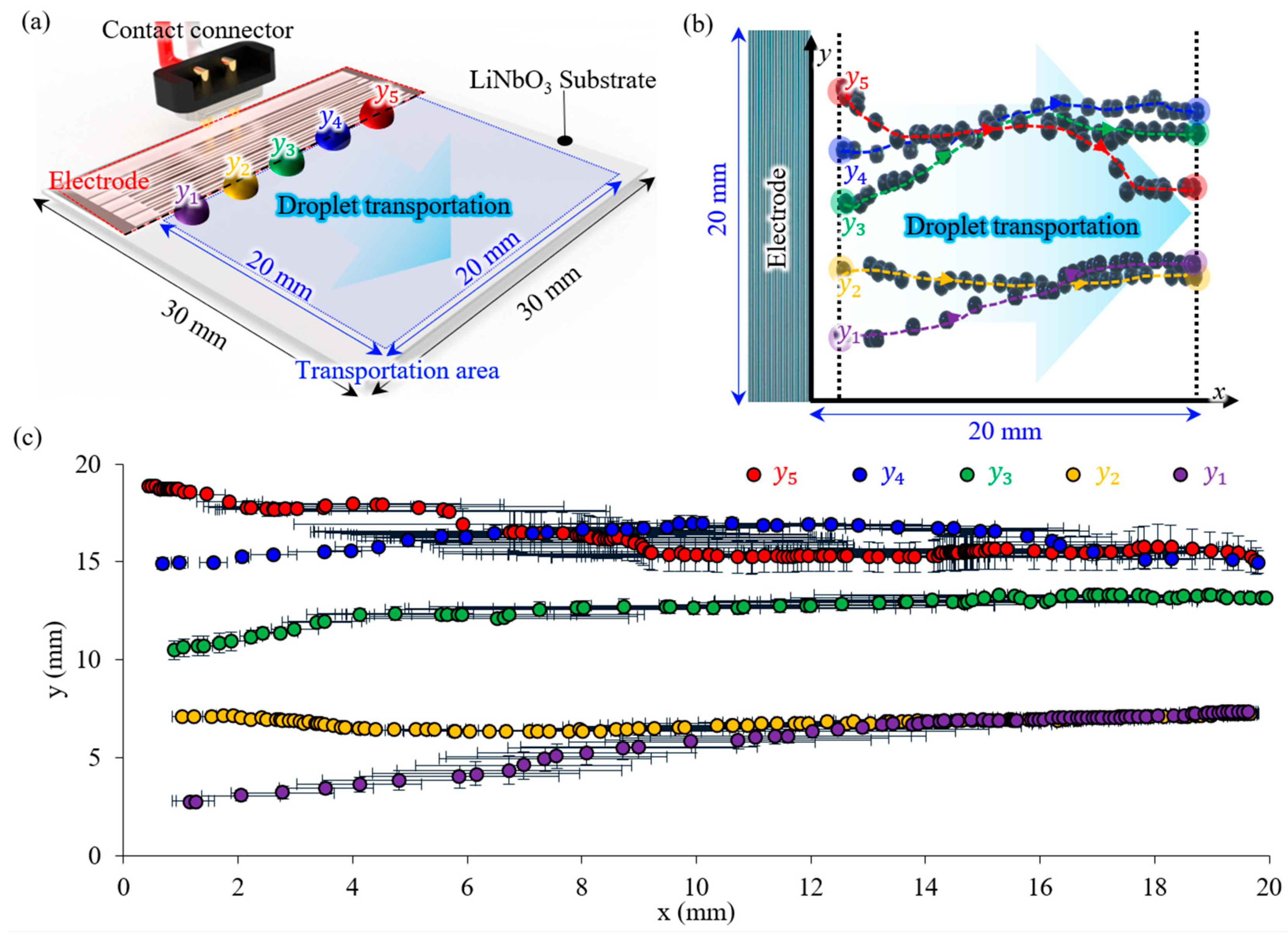
Figure 10 presents the quantitative analysis of the transport trajectories and directionality for five sessile droplets dispensed at different y-coordinates ( y 1 y 5 ) on the device surface under the SAW actuation. All droplets were confirmed to be transported in the x-axis direction, parallel to the propagation direction of the SAW, regardless of their initial y -coordinates. Although the transport trajectory of each droplet exhibited slight variations in curvature and lateral (y-axis) deviations depending on the initial position, effective transport was successfully achieved across the defined cleaning area in all cases. These results imply that the acoustic force generated by the SAW actuation enables a consistent cleaning response even for surface contamination distributed at various locations.
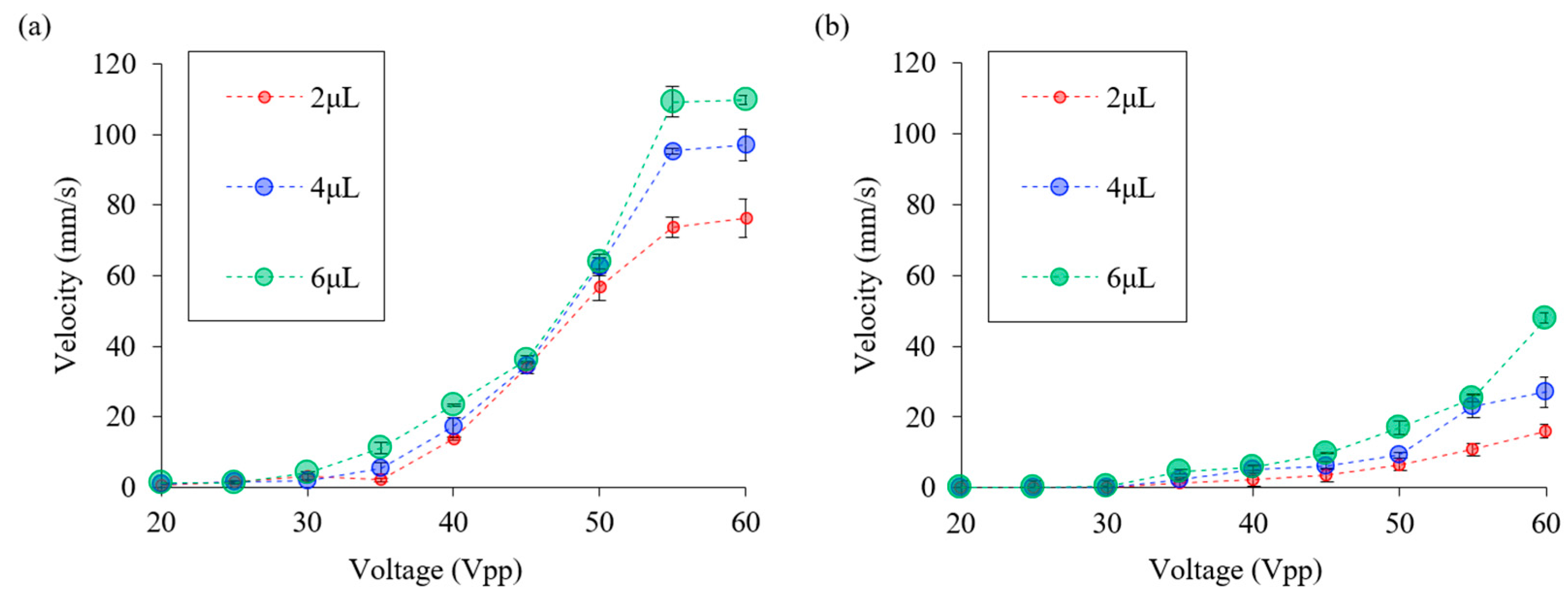
Figure 11 presents the quantitative analysis of droplet transport velocity as a function of viscosity (1 c P and 10 c P ), droplet volume (2 μ L , 4 μ L , and 6 μ L ), and driving voltage for a single sessile droplet dispensed at the y 3 position on the device surface. In the present study, the droplet viscosity was controlled by mixing glycerol with deionized (DI) water, allowing preparation of test fluids with viscosities of 1 c P and 10 c P , respectively. To investigate the wetting characteristics of the coated surface, contact angle hysteresis measurements were performed for both liquids. The results showed that the 1 c P droplet exhibited contact angle hysteresis of approximately 5.9°, while the 10 c P droplet demonstrated an increased hysteresis of approximately 12.7°. All experiments were conducted under the SAW driving condition at a frequency of 9.987 MHz. For the 1 c P viscosity condition, the transport velocities of the 2, 4, and 6 μ L droplets gradually increased with the driving voltage, reaching maximum velocities of 79.2, 97.1, and 109.7 mm/s at 60 V p p , respectively (Figure 11a). A similar trend was observed for the 10 c P viscosity conditions, where maximum velocities of 15.9, 27.0, and 47.9 mm/s were recorded at 60 V p p , respectively (Figure 11b).
Notably, the transport velocity decreased as the droplet viscosity increased under identical actuation conditions. This reduction is attributed to increased viscous resistance, which leads to greater energy loss relative to the acoustic driving force. These results demonstrate that the energy required for effective droplet transport varies with viscosity and volume, suggesting that an electrode design strategy capable of locally concentrating SAW energy is essential to meet target cleaning times across diverse application environments. Furthermore, the SAW-based active cleaning technology proposed in this study is not limited to liquid contaminants such as water droplets but is also potentially applicable to particulate and fine solid contaminants [37,38]. SAW-induced interfacial shear stress and acoustic streaming flows can facilitate particle detachment, mobilization, and transport along the surface. However, the effective removal of particulate contaminants is strongly dependent on multiple factors, including particle size, density, adhesion strength, and surface condition. As a result, the optimal driving frequency, voltage, and power levels for particle removal may differ from those identified for liquid droplet cleaning. Accordingly, systematic investigations to determine contaminant-specific operating conditions are required in future studies to extend the applicability of the proposed technique to a broader range of contamination scenarios.

4.4. Application of a Physical AI Sensing System

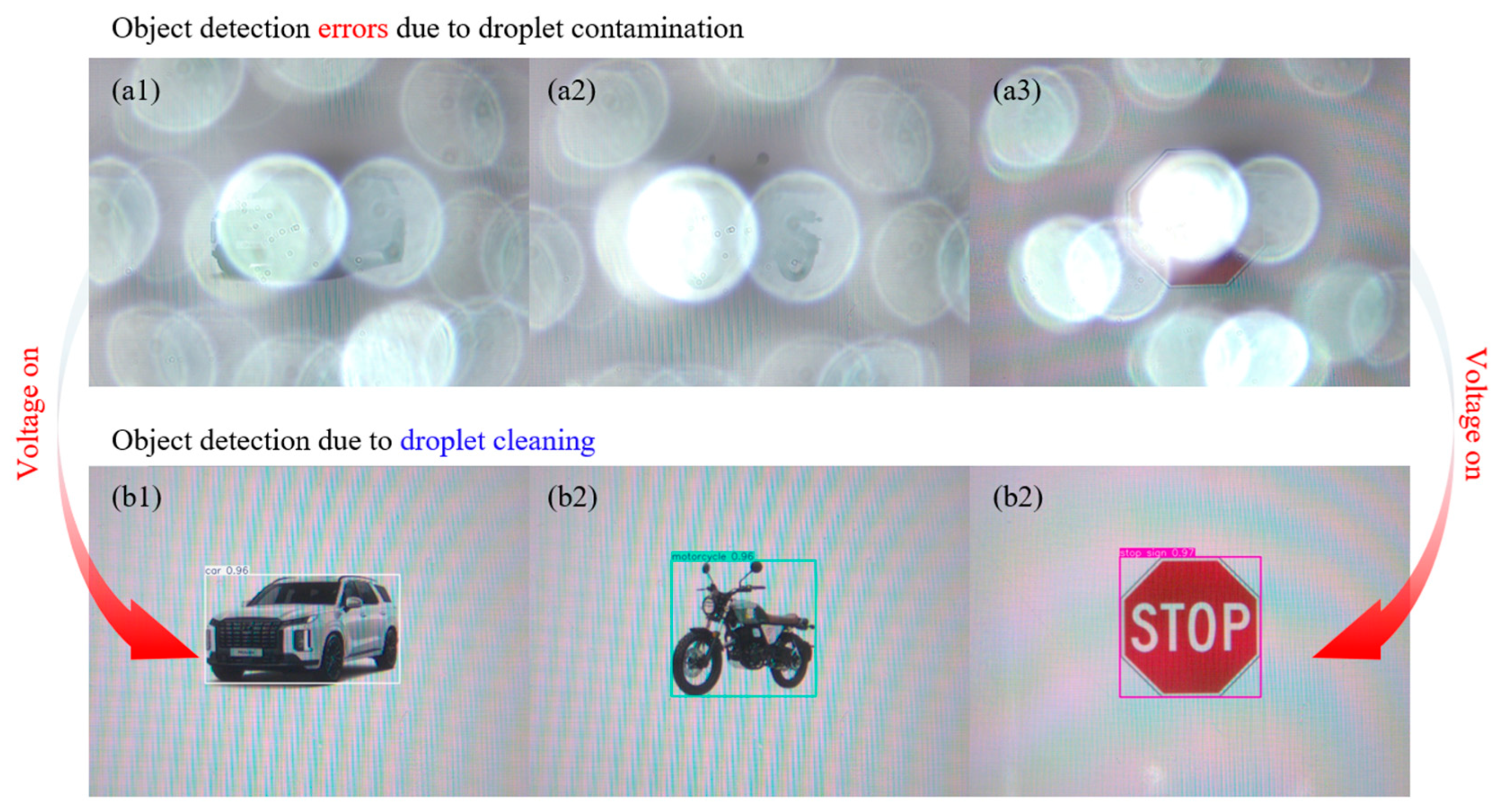
Figure 12 presents a quantitative comparison of object recognition performance before and after multi-droplet contamination removal using a SAW-based active cleaning cover lens driven by an alternating electrical signal (9.987 MHz, 60 V p p ) [27].
Multi-droplet contamination was reproduced by randomly dispensing 4 μL DI water droplets within a predefined cleaning area of 20 mm × 20 mm using a micropipette. Object recognition performance was evaluated using YOLOv5, YOLOv8, and YOLOv26 object detection models pre-trained on the COCO dataset [61,62], with evaluation objects comprising single-instance scenarios of three representative classes: car, motorcycle, and stop sign. Figure 12(b1–b3) shows representative object detection results obtained using the YOLOv26 model. Before droplet removal, the presence of multiple droplets on the SAW cover lens surface caused optical distortion and image quality degradation, resulting in unstable or failed object detection by the recognition models. In contrast, 1 s after SAW actuation, the droplets on the cover lens surface were effectively removed, leading to a substantial recovery in object recognition performance, with recognition rates of car: 0.96, motorcycle: 0.96, and stop sign: 0.97. Future research will systematically investigate the influence of optical degradation on object recognition performance by quantitatively characterizing image quality deterioration as a function of object-to-camera distance, droplet contamination density, and spatial distribution [63]. This analysis will provide a rigorous basis for assessing the practical applicability and operational robustness of the proposed technology under realistic driving and environmental conditions.
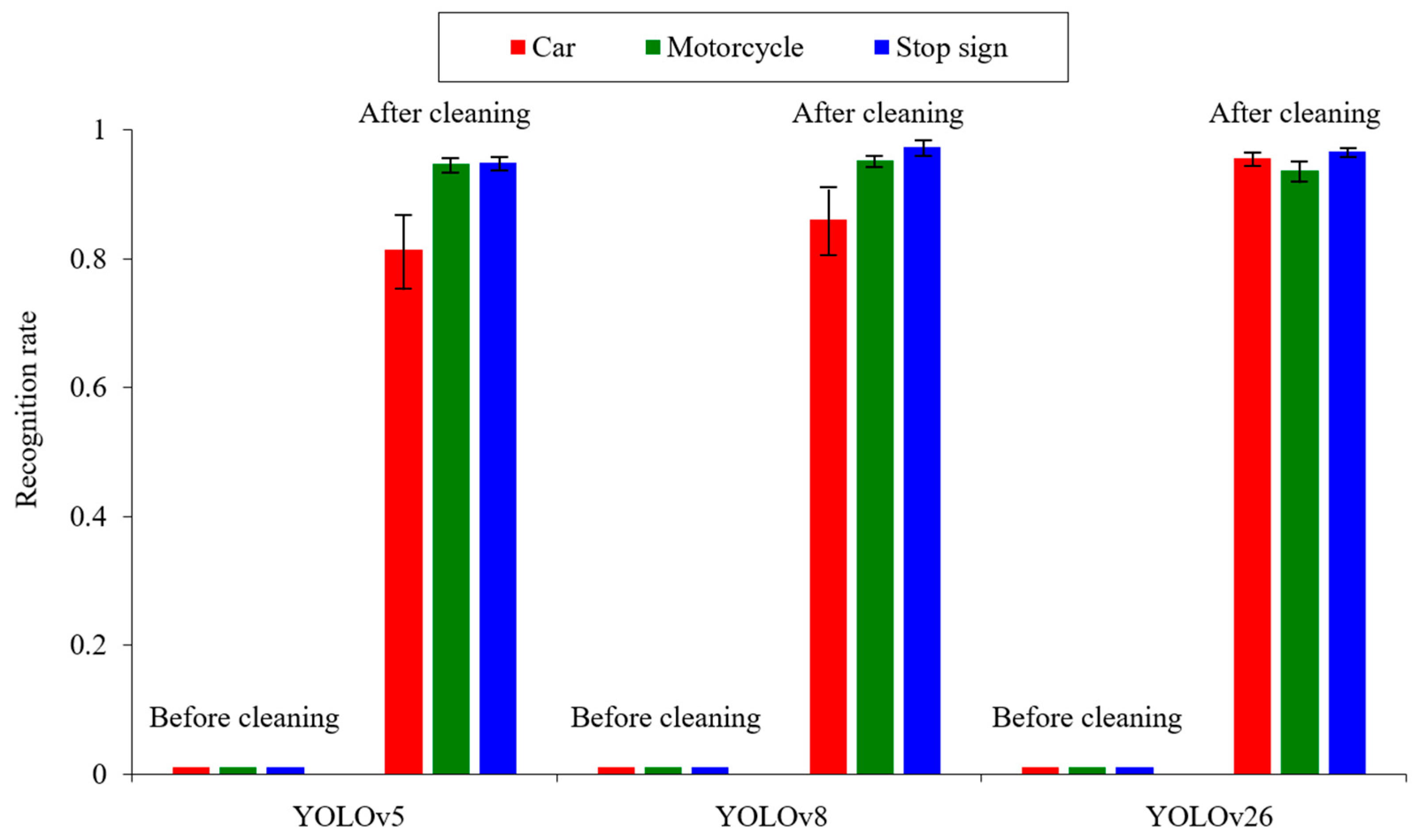
Figure 13 presents a quantitative comparison of object recognition performance following the removal of multi-droplet contamination using a surface acoustic wave (SAW)-based active cleaning cover lens driven by an alternating electrical signal (9.987 MHz, 60 V p p ). Object recognition performance was evaluated using YOLOv5, YOLOv8, and YOLOv26 object detection models pre-trained on the COCO dataset, with evaluation targets comprising three representative classes: car, motorcycle, and stop sign. Under the initial contaminated condition, the presence of multiple droplets on the cover-lens surface caused severe optical occlusion and image distortion, leading to a substantial degradation in recognition performance, with recognition rate for all three object classes decreasing to values close to zero. In contrast, 1 s after SAW actuation, the droplets on the cover-lens surface were effectively removed, resulting in a recovery of object recognition performance, with recognition rate exceeding 0.8 across all three object detection models. These results indicate that the proposed SAW-based active cleaning cover lens provides a practically effective means of rapidly restoring the perceptual performance of vision-based artificial intelligence models, even under multi-droplet contamination conditions.
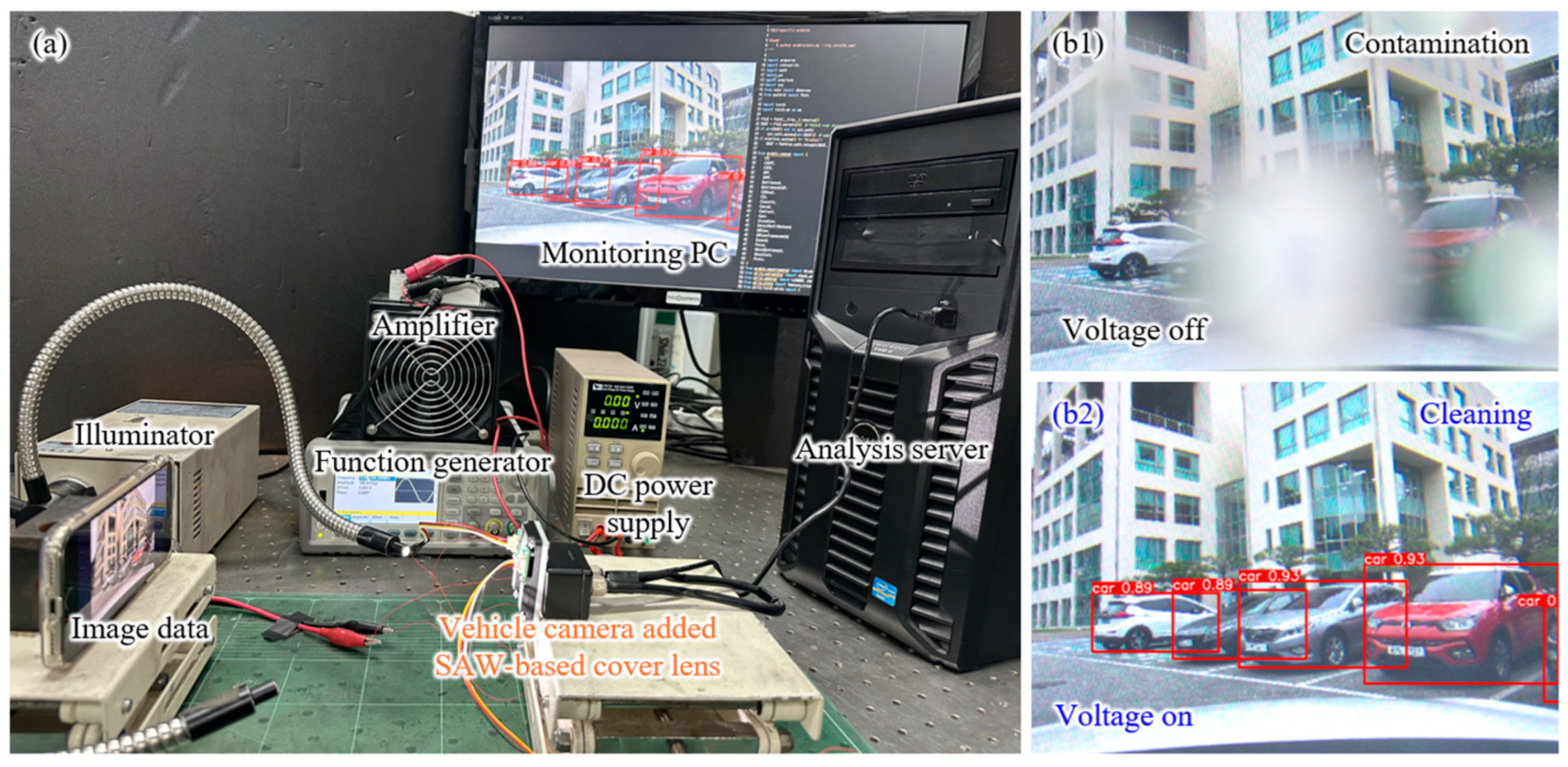
Figure 14 illustrates the experimental procedure and corresponding results demonstrating the restoration of object recognition performance achieved by applying the proposed surface acoustic wave (SAW)-based active cleaning technology to a vehicle front-facing camera for surface contamination removal. To generate contamination, 4 μL DI water droplets were randomly deposited within a predefined 20 mm × 20 mm cleaning area on the cover-lens surface using a micropipette. In the initial contaminated state, the presence of multiple water droplets on the cover lens caused severe optical distortion and image blurring, resulting in the vision-based detection system failing to recognize objects (Figure 14(b1)). Subsequently, SAW actuation at 9.987 MHz with a driving voltage of 50 V p p induced droplet transport and removal from the cover-lens surface. As a result, the optical distortion was effectively eliminated, leading to a full recovery of object recognition performance, as shown in Figure 14(b2).

5. Conclusions

This paper proposed a SAW-based active surface cleaning cover lens for physical AI perception systems. First, visualization of the acoustic streaming induced inside a single sessile droplet, generated as the SAW leaked through the solid–liquid interface, and revealed a closed-loop circular vortex structure formed along the central axis with a maximum flow velocity of 15 mm/s. Next, high-speed camera analysis of the droplet behavior upon the application of the SAW demonstrated that the droplet underwent deformation along the propagation direction, achieving a total displacement of 7.2 mm over a duration of approximately 9.1 s. Subsequently, the quantitative analysis of transport trajectories for five droplets dispensed at different y-coordinates ( y 1 y 5 ) confirmed that all droplets were transported along the x-axis, parallel with the SAW propagation direction, regardless of their initial positions. Furthermore, the analysis of transport velocity as a function of viscosity (1 c P and 10 c P ), volume (2 μ L , 4 μ L , and 6 μ L ), and driving voltage indicated that velocity increased with driving voltage but decreased with higher viscosity under identical conditions. Finally, the proposed technology was applied to an automotive front camera lens module to validate the restoration of object recognition performance through the removal of surface contamination. Based on its simple structure and driving principle, the proposed technology is deemed to be expandable as a surface cleaning solution for various physical AI perception systems, including intelligent security cameras and drone camera lenses.
In future studies, a Laser Doppler Vibrometer (LDV) will be employed to quantitatively characterize the surface displacement and acceleration responses of SAW as a function of electrode design parameters. This approach will enable a systematic evaluation of the relationship between electrode structural factors, such as the ratio of reflector electrodes, electrode geometry, layout, and SAW energy generation and transmission efficiency. Furthermore, to facilitate the practical deployment of the proposed SAW-based active cleaning technology in actual optical sensor environments, the required cleaning time and effective cleaning area will be quantitatively determined, and the minimum actuation energy necessary for reliable contaminant transport and removal will be systematically assessed. Based on these analyses, the driving voltage, frequency, and waveform will be optimized to establish SAW operating conditions with enhanced power efficiency. Furthermore, we acknowledge that comprehensive long-term reliability and power-efficiency assessments are critical for stable operation under real-world conditions. Accordingly, future work will focus on the quantitative evaluation of thermal accumulation effects arising from prolonged and repetitive SAW actuation, including temperature rise, electrode oxidation, degradation of hydrophobic surface coatings, and potential reductions in power efficiency under continuous or high-voltage excitation. In addition to these reliability considerations, systematic quantitative analyses of cleaning performance metrics will be conducted to strengthen application-level validation further. These analyses will include statistical evaluation of contaminant removal time (time-to-clear), residual contamination area fraction after cleaning, and optical-quality proxies such as image contrast degradation or haze levels following cleaning. Moreover, the post-transport behavior of contaminants, including edge accumulation, satellite droplet formation, and rewetting phenomena, will be investigated under repeated cleaning cycles. Such combined assessments of thermal reliability, power efficiency, and quantitative cleaning performance are expected to provide essential insights into the durability, robustness, and industrial applicability of the proposed SAW-based active cleaning technology in practical optical sensing systems.

Author Contributions

Conceptualization, Y.K. and S.C.; methodology, J.J., J.Y. and Y.K.; software, J.J., J.Y. and Y.K.; validation, J.J., J.Y. and Y.K.; formal analysis, J.J., J.Y., W.K. and Y.K.; investigation, J.J., J.Y. and Y.K.; resources, S.C.; data curation, J.J., J.Y. and W.K.; writing—original draft preparation, J.J., J.Y. and Y.K.; writing—review and editing, Y.K. and S.C.; visualization, J.J., J.Y., W.K. and Y.K.; supervision, Y.K. and S.C.; project administration, Y.K. and S.C.; funding acquisition, S.C. All authors have read and agreed to the published version of the manuscript.

Funding

This work was supported by the Technology Development Program (RS-2025-25403438) funded by the Ministry of SMEs and Startups (MSS, Republic of Korea).

Data Availability Statement

Data is contained within the article.

Conflicts of Interest

The authors declare no conflicts of interest.

Abbreviations

The following abbreviations are used in this manuscript:
AIartificial intelligence
SAWsurface acoustic wave
IDTinterdigital transducer
SPUDTsingle-phase unidirectional transducer
TTEtriple transit echo
MEMSmicro-electro-mechanical systems
CMOScomplementary metal-oxide-semiconductor
SEMscanning electron microscopy
AFMatomic force microscopy
PIVparticle image velocimetry
LDVLaser Doppler Vibrometer

References

  1. Alahmed, Y.; Abadla, R. Enhancing safety in autonomous vehicles through advanced AI-driven perception and decision-making systems. In 2024 Fifth International Conference on Intelligent Data Science Technologies and Applications (IDSTA); IEEE: New York, NY, USA, 2024; pp. 268–275. [Google Scholar] [CrossRef]
  2. Njoku, J.N.; Nwakanma, C.I.; Amaizu, G.C.; Kim, D.S. Prospects and challenges of Metaverse application in data-driven intelligent transportation systems. IET Intell. Transp. Syst. 2023, 17, 1–21. [Google Scholar] [CrossRef]
  3. Noviati, N.D.; Putra, F.E.; Sadan, S.; Ahsanitaqwim, R.; Septiani, N.; Santoso, N.P.L. Artificial Intelligence in Autonomous Vehicles: Current Innovations and Future Trends. Int. J. Cyber IT Serv. Manag. 2024, 4, 97–104. [Google Scholar] [CrossRef]
  4. Kuutti, S.; Fallah, S.; Katsaros, K.; Dianati, M.; Mccullough, F.; Mouzakitis, A. A survey of the state-of-the-art localization techniques and their potentials for autonomous vehicle applications. IEEE Internet Things J. 2018, 5, 829–846. [Google Scholar] [CrossRef]
  5. Yeong, D.J.; Velasco-hernandez, G.; Barry, J.; Walsh, J. Sensor and sensor fusion technology in autonomous vehicles: A review. Sensors 2021, 21, 2140. [Google Scholar] [CrossRef]
  6. Liu, S.; Liu, L.; Tang, J.; Yu, B.; Wang, Y.; Shi, W. Edge Computing for Autonomous Driving: Opportunities and Challenges. Proc. IEEE 2019, 107, 1697–1716. [Google Scholar] [CrossRef]
  7. Wang, Y.; Chao, W.L.; Garg, D.; Hariharan, B.; Campbell, M.; Weinberger, K.Q. Pseudo-lidar from visual depth estimation: Bridging the gap in 3D object detection for autonomous driving. In 2019 IEEE/CVF Conference on Computer Vision and Pattern Recognition (CVPR); IEEE: New York, NY, USA, 2019; pp. 8437–8445. [Google Scholar] [CrossRef]
  8. Feng, D.; Rosenbaum, L.; Dietmayer, K.; Sep, R.O. Towards Safe Autonomous Driving: Capture Uncertainty in the Deep Neural Network for Lidar 3D Vehicle Detection. In 2018 21st International Conference on Intelligent Transportation Systems (ITSC); IEEE: New York, NY, USA, 2018; pp. 3266–3273. [Google Scholar] [CrossRef]
  9. Ibisch, A.; Stumper, S.; Altinger, H.; Neuhausen, M.; Tschentscher, M.; Schlipsing, M.; Salinen, J.; Knoll, A. Towards autonomous driving in a parking garage: Vehicle localization and tracking using environment-embedded LIDAR sensors. In 2013 IEEE Intelligent Vehicles Symposium (IV); IEEE: New York, NY, USA, 2013; pp. 829–834. [Google Scholar] [CrossRef]
  10. Son, S.H.; Lee, W.S.; Jung, H.G.; Lee, J.K.; Kim, C.R.; Lee, H.W.; Cho, S.W.; Jang, J.A.; Lee, M.; Ryu, H.C. Experimental Analysis of Various Blockage Performance for LiDAR Sensor Cleaning Evaluation. Sensors 2023, 23, 2752. [Google Scholar] [CrossRef] [PubMed]
  11. Ziebinski, A.; Cupek, R.; Erdogan, H.; Waechter, S. A survey of ADAS technologies for the future perspective of sensor fusion. In International Conference on Computational Collective Intelligence; Springer International Publishing: Cham, Switzerland, 2016; pp. 135–146. [Google Scholar] [CrossRef]
  12. Zang, S.; Ding, M.; Smith, D.; Tyler, P.; Rakotoarivelo, T.; Kaafar, M.A. The impact of adverse weather conditions on autonomous vehicles: How rain, snow, fog, and hail affect the performance of a self-driving car. IEEE Veh. Technol. Mag. 2019, 14, 103–111. [Google Scholar] [CrossRef]
  13. Sun, D.; Böhringer, K.F. Self-cleaning: From bio-inspired surface modification to MEMS/microfluidics system integration. Micromachines 2019, 10, 101. [Google Scholar] [CrossRef] [PubMed]
  14. Sethi, S.K.; Manik, G. Recent Progress in Super Hydrophobic/Hydrophilic Self-Cleaning Surfaces for Various Industrial Applications: A Review. Polym.-Plast. Technol. Eng. 2018, 57, 1932–1952. [Google Scholar] [CrossRef]
  15. Sas, I.; Gorga, R.E.; Joines, J.A.; Thoney, K.A. Literature review on superhydrophobic self-cleaning surfaces produced by electrospinning. J. Polym. Sci. Part B Polym. Phys. 2012, 50, 824–845. [Google Scholar] [CrossRef]
  16. Barthlott, W.; Neinhuis, C. Purity of the sacred lotus, or escape from contamination in biological surfaces. Planta 1997, 202, 1–8. [Google Scholar] [CrossRef]
  17. Liu, Y.; Li, S.; Zhang, J.; Wang, Y.; Han, Z.; Ren, L. Fabrication of biomimetic superhydrophobic surface with controlled adhesion by electrodeposition. Chem. Eng. J. 2014, 248, 440–447. [Google Scholar] [CrossRef]
  18. Yoon, H.; Kim, H.; Latthe, S.S.; Kim, M.W.; Al-Deyab, S.; Yoon, S.S. A highly transparent self-cleaning superhydrophobic surface by organosilane-coated alumina particles deposited via electrospraying. J. Mater. Chem. A 2015, 3, 11403–11410. [Google Scholar] [CrossRef]
  19. Wong, T.S.; Kang, S.H.; Tang, S.K.Y.; Smythe, E.J.; Hatton, B.D.; Grinthal, A.; Aizenberg, J. Bioinspired self-repairing slippery surfaces with pressure-stable omniphobicity. Nature 2011, 477, 443–447. [Google Scholar] [CrossRef]
  20. Toma, M.; Loget, G.; Corn, R.M. Flexible teflon nanocone array surfaces with tunable superhydrophobicity for self-cleaning and aqueous droplet patterning. ACS Appl. Mater. Interfaces 2014, 6, 11110–11117. [Google Scholar] [CrossRef]
  21. Hong, J.; Lee, S.J.; Koo, B.C.; Suh, Y.K.; Kang, K.H. Size-Selective Sliding of Sessile Drops on a Slightly Inclined Plane Using Low-Frequency AC Electrowetting. Langmuir 2012, 28, 6307–6312. [Google Scholar] [CrossRef] [PubMed]
  22. Frozanpoor, I.; Cooke, M.D.; Ambukan, V.; Gallant, A.J.; Balocco, C. Continuous Droplet-Actuating Platforms via an Electric Field Gradient: Electrowetting and Liquid Dielectrophoresis. Langmuir 2021, 37, 6414–6422. [Google Scholar] [CrossRef] [PubMed]
  23. Wikramanayake, E.D.; Perry, J.; Bahadur, V. AC electrowetting promoted droplet shedding on hydrophobic surfaces. Appl. Phys. Lett. 2020, 116, 193701. [Google Scholar] [CrossRef]
  24. Lee, K.Y.; Hong, J.; Chung, S.K. Smart self-cleaning lens cover for miniature cameras of automobiles. Sens. Actuators B Chem. 2017, 239, 754–758. [Google Scholar] [CrossRef]
  25. Park, J.; Lee, S.; Kim, D.I.; Kim, Y.Y.; Kim, S.; Kim, H.J.; Kim, Y. Evaporation-rate control of water droplets on flexible transparent heater for sensor application. Sensors 2019, 19, 4918. [Google Scholar] [CrossRef]
  26. Kim, Y.; Lee, J.; Chung, S.K. Heat-driven self-cleaning glass based on fast thermal response for automotive sensors. Phys. Scr. 2023, 98, 085932. [Google Scholar] [CrossRef]
  27. Kim, Y.; Kim, H.J.; Park, J.; Kim, Y.; Chung, S.K.; Lee, J. Advanced visibility improvement based on a transparent heater for intelligent video surveillance systems. Meas. J. Int. Meas. Confed. 2026, 260, 119778. [Google Scholar] [CrossRef]
  28. Lee, S.; Lee, D.; Hyun, Y.; Lee, K.Y.; Lee, J.; Chung, S.K. Self-cleaning drop free glass using droplet atomization/oscillation by acoustic waves for autonomous driving and IoT technology. Sens. Actuators A Phys. 2023, 361, 114565. [Google Scholar] [CrossRef]
  29. James, A.J.; Vukasinovic, B.; Smith, M.K.; Glezer, A. Vibration-induced drop atomization and bursting. J. Fluid Mech. 2003, 476, 1–28. [Google Scholar] [CrossRef]
  30. Wang, Y.; Li, X.; Meng, H.; Tao, R.; Qian, J.; Fu, C.; Luo, J.; Xie, J.; Fu, Y. Acoustofluidic Diversity Achieved by Multiple Modes of Acoustic Waves Generated on Piezoelectric-Film-Coated Aluminum Sheets. ACS Appl. Mater. Interfaces 2024, 16, 45119–45130. [Google Scholar] [CrossRef] [PubMed]
  31. Ke, X.; Shen, X.; Li, T.; Duan, X. Droplet acoustofluidics: From acoustic principles to micro manipulations. Nanotechnol. Precis. Eng. 2026, 9, 015001. [Google Scholar] [CrossRef]
  32. Hsu, J.C.; Lin, Y.D. Microparticle concentration and separation inside a droplet using phononic-crystal scattered standing surface acoustic waves. Sens. Actuators A Phys. 2019, 300, 111651. [Google Scholar] [CrossRef]
  33. Biroun, M.H.; Rahmati, M.T.; Jangi, M.; Tao, R.; Chen, B.X.; Fu, Y.Q. Computational and experimental analysis of droplet transportation/jetting behaviours driven by thin film surface acoustic waves. Sens. Actuators A Phys. 2019, 299, 111624. [Google Scholar] [CrossRef]
  34. Ai, Y.; Marrone, B.L. Droplet translocation by focused surface acoustic waves. Microfluid. Nanofluidics 2012, 13, 715–722. [Google Scholar] [CrossRef]
  35. Alagoz, S.; Apak, Y. Removal of spoiling materials from solar panel surfaces by applying surface acoustic waves. J. Clean. Prod. 2020, 253, 119992. [Google Scholar] [CrossRef]
  36. Liang, W.; Zhu, B.; Gu, H. Acoustothermal heating in a droplet driven by lamb waves. Int. Commun. Heat Mass Transf. 2024, 158, 107920. [Google Scholar] [CrossRef]
  37. Tan, M.K.; Friend, J.R.; Yeo, L.Y. Microparticle collection and concentration via a miniature surface acoustic wave device. Lab Chip 2007, 7, 618–625. [Google Scholar] [CrossRef] [PubMed]
  38. Potter, G.; Tokranova, N.; Rastegar, A.; Castracane, J. Design, fabrication, and testing of surface acoustic wave devices for semiconductor cleaning applications. Microelectron. Eng. 2016, 162, 100–104. [Google Scholar] [CrossRef]
  39. Song, H.; Jang, D.; Lee, J.; Lee, K.Y.; Chung, S.K. SAW-driven self-cleaning drop free glass for automotive sensors. J. Micromech. Microeng. 2021, 31, 125007. [Google Scholar] [CrossRef]
  40. Wixforth, A.; Strobl, C.; Gauer, C.; Toegl, A.; Scriba, J.; Guttenberg, Z.V. Acoustic manipulation of small droplets. Anal. Bioanal. Chem. 2004, 379, 982–991. [Google Scholar] [CrossRef]
  41. Friend, J.; Yeo, L.Y. Microscale acoustofluidics: Microfluidics driven via acoustics and ultrasonics. Rev. Mod. Phys. 2011, 83, 647–704. [Google Scholar] [CrossRef]
  42. Connacher, W.; Zhang, N.; Huang, A.; Mei, J.; Zhang, S.; Gopesh, T.; Friend, J. Micro/nano acoustofluidics: Materials, phenomena, design, devices, and applications. Lab Chip 2018, 18, 1952–1996. [Google Scholar] [CrossRef] [PubMed]
  43. Sesen, M.; Alan, T.; Neild, A. Microfluidic on-demand droplet merging using surface acoustic waves. Lab Chip 2014, 14, 3325–3333. [Google Scholar] [CrossRef]
  44. Wixforth, A. Acoustically driven planar microfluidics. Superlattices Microstruct. 2003, 33, 389–396. [Google Scholar] [CrossRef]
  45. Du, X.Y.; Fu, Y.Q.; Luo, J.K.; Flewitt, A.J.; Milne, W.I. Microfluidic pumps employing surface acoustic waves generated in ZnO thin films. J. Appl. Phys. 2009, 105, 024508. [Google Scholar] [CrossRef]
  46. Vafaie, A.; Raveshi, M.R.; Devendran, C.; Nosrati, R.; Neild, A. Making immotile sperm motile using high-frequency ultrasound. Sci. Adv. 2024, 10, eadk2864. [Google Scholar] [CrossRef]
  47. Shiokawa, S.; Matsui, Y.; Ueda, T. Study on saw streaming and its application to fluid devices. Jpn. J. Appl. Phys. 1990, 29, 137–139. [Google Scholar] [CrossRef]
  48. Sankaranarayanan, S.K.R.S.; Cular, S.; Bhethanabotla, V.R.; Joseph, B. Flow induced by acoustic streaming on surface-acoustic-wave devices and its application in biofouling removal: A computational study and comparisons to experiment. Phys. Rev. E—Stat. Nonlinear Soft Matter Phys. 2008, 77, 066308. [Google Scholar] [CrossRef]
  49. Fu, Y.Q.; Luo, J.K.; Nguyen, N.T.; Walton, A.J.; Flewitt, A.J.; Zu, X.T.; Li, Y.; McHale, G.; Matthews, A.; Iborra, E.; et al. Advances in piezoelectric thin films for acoustic biosensors, acoustofluidics and lab-on-chip applications. Prog. Mater. Sci. 2017, 89, 31–91. [Google Scholar] [CrossRef]
  50. Mandal, D.; Banerjee, S. Surface Acoustic Wave (SAW) Sensors: Physics, Materials, and Applications. Sensors 2022, 22, 820. [Google Scholar] [CrossRef]
  51. Mazalan, M.B.; Noor, A.M.; Wahab, Y.; Yahud, S.; Zaman, W.S.W.K. Current development in interdigital transducer (IDT) surface acoustic wave devices for live cell in vitro studies: A review. Micromachines 2022, 13, 30. [Google Scholar] [CrossRef] [PubMed]
  52. Campbell, C.K. Applications of Surface Acoustic and Shallow Bulk Acoustic Wave Devices. Proc. IEEE 1989, 77, 1453–1484. [Google Scholar] [CrossRef]
  53. Won, T.; Jang, D.; Lee, K.Y.; Chung, S.K. Acoustic Bubble-Induced Microstreaming for Biochemical Droplet Mixing Enhancement in Electrowetting (EW) Microfluidic Platforms. J. Microelectromech. Syst. 2021, 30, 783–790. [Google Scholar] [CrossRef]
  54. Kim, Y.; Chung, S.K.; Lee, J. Acoustic and heat-driven active cleaning technology for optical sensors. Sens. Actuators A Phys. 2025, 392, 116721. [Google Scholar] [CrossRef]
  55. Jeong, J.; Jang, D.; Kim, D.; Lee, D.; Chung, S.K. Acoustic bubble-based drug manipulation: Carrying, releasing and penetrating for targeted drug delivery using an electromagnetically actuated microrobot. Sens. Actuators A Phys. 2020, 306, 111973. [Google Scholar] [CrossRef]
  56. Kim, D.; Hong, J.; Chung, S.K. Acoustic bubble array-induced jet flow for cleaning particulate contaminants on semiconductor wafers. Korean J. Chem. Eng. 2022, 39, 3261–3266. [Google Scholar] [CrossRef]
  57. Park, J.; Kim, W.; Kim, Y.; Chung, S.K.; Lee, K.Y. Droplet manipulation using a triboelectric gripper for lab-on-a-chip devices. Eng. Res. Express 2026, 8, 015316. [Google Scholar] [CrossRef]
  58. Sano, T.; Onuki, T.; Hamate, Y.; Hojo, M.; Nagasawa, S.; Kuwano, H. Micro blender and separator using inner-vortex of droplet induced by surface acoustic wave. In TRANSDUCERS 2009—2009 International Solid-State Sensors, Actuators and Microsystems Conference; IEEE: New York, NY, USA, 2009; pp. 370–373. [Google Scholar] [CrossRef]
  59. Huang, Q.Y.; Le, Y.; Hu, H.; Wan, Z.J.; Ning, J.; Han, J.L. Experimental research on surface acoustic wave microfluidic atomization for drug delivery. Sci. Rep. 2022, 12, 7930. [Google Scholar] [CrossRef]
  60. Qi, A.; Yeo, L.Y.; Friend, J.R. Interfacial destabilization and atomization driven by surface acoustic waves. Phys. Fluids 2008, 20, 074103. [Google Scholar] [CrossRef]
  61. Karthi, M.; Muthulakshmi, V.; Priscilla, R.; Praveen, P.; Vanisri, K. Evolution of YOLO-V5 Algorithm for Object Detection: Automated Detection of Library Books and Performace validation of Dataset. In 2021 International Conference on Innovative Computing, Intelligent Communication and Smart Electrical Systems (ICSES); IEEE: New York, NY, USA, 2021; Volume 2021, pp. 1–6. [Google Scholar] [CrossRef]
  62. Chang, Y.H.; Zhang, Y.Y. Deep Learning for Clothing Style Recognition Using YOLOv5. Micromachines 2022, 13, 1678. [Google Scholar] [CrossRef] [PubMed]
  63. Kim, H.; Yang, Y.; Kim, Y.; Jang, D.W.; Choi, D.; Park, K.; Chung, S.; Kim, D. Effect of Droplet Contamination on Camera Lens Surfaces: Degradation of Image Quality and Object Detection Performance. Appl. Sci. 2025, 15, 2690. [Google Scholar] [CrossRef]
Figure 1. (a) Schematic diagram of SAW-based active surface cleaning to an automotive sensor; (b1b3) Sequential sketches of contamination cleaning on the sensor surface by SAW.
Symmetry 18 00347 g001
Figure 2. (a) Exploded view of the device structure illustrating its components and their arrangement, and (b) The pattern specifications for the SPUDT electrode illustrate its specific configuration and placement within the 128° Y-cut X propagation lithium niobate.
Symmetry 18 00347 g002
Figure 3. Microfabrication process: (a1) Substrate cleaning using a heated piranha solution; (a2,a3) Spin-coating of a negative-tone photoresist followed by photolithographic patterning; (a4) Deposition of an Al metal layer; (a5) Lift-off process to define the metal electrode pattern; (a6) Deposition of a Cytop hydrophobic layer.
Symmetry 18 00347 g003
Figure 4. Schematic of the experimental setup for visualizing the internal flow dynamics within a sessile droplet.
Symmetry 18 00347 g004
Figure 5. Video-based droplet tracking and analysis procedure using the Tracker software: (a) Initial frame showing the droplet position before SAW actuation; (b) Configuration of frame settings for time-resolved analysis; (c) Calibration of the length scale using a known reference distance to convert pixel coordinates into physical units; (d) Definition of the coordinate axes for quantitative position tracking; (e) Identification and initialization of the droplet center of mass used as the tracking point; (f) Automated tracking results, illustrating the extracted droplet trajectory and the corresponding time-resolved position data obtained at fixed time intervals.
Symmetry 18 00347 g005
Figure 6. Schematic of the experimental setup for observing droplet translation on a horizontal solid surface.
Symmetry 18 00347 g006
Figure 7. (a) Scanning electron microscopy (SEM) image of the Al electrode, and (b) Atomic force microscopy (AFM) image showing the surface morphology of the Cytop-coated layer.
Symmetry 18 00347 g007
Figure 8. Experimental characterization of SAW-induced internal flow within a stationary droplet: (a) The SPUDT electrode patterned on a LiNbO3 substrate and the placement of a water droplet seeded with fluorescent tracer particles; (b) Visualization of the SAW-induced internal flow patterns inside a 10 μL DI water droplet under SAW actuation; (c) Quantitative velocity field obtained by PIV analysis.
Symmetry 18 00347 g008
Figure 9. High-speed camera images showing the SAW-induced translational motion of a single sessile DI water droplet (6 μL) on a LiNbO3 substrate: (a1) initial state at 0 s; (a2) droplet translation along the SAW propagation direction at 5.2 s (displacement ≈ 4.1 mm); (a3) further translation at 9.1 s (displacement ≈ 7.2 mm).
Symmetry 18 00347 g009
Figure 10. SAW-driven droplet transport characterization: (a) Schematic illustration of the experimental setup, showing the LiNbO3 substrate with patterned electrodes and the defined droplet transportation area. Droplets are initially placed at five distinct lateral positions ( y 1 y 5 ). (b) Extracted droplet trajectories, where each trajectory is reconstructed by superimposing droplet positions obtained from time-sequential images, visualizing the overall transport paths under SAW actuation. (c) Quantitative representation of droplet motion, showing the temporal evolution of droplet positions in the x–y plane, with error bars indicating positional uncertainty.
Symmetry 18 00347 g010
Figure 11. Transport velocity of droplets with different volumes and viscosities at different applied voltages under SAW: (a) Viscous droplet (1 c P ); and (b) Viscous droplet (10 c P ).
Symmetry 18 00347 g011
Figure 12. Variation in object recognition rate before and after contamination removal using the SAW active cleaning cover lens: (a1) recognition rate for a car before cleaning, (a2) for a motorcycle, and (a3) for a stop sign; (b1) recognition rate for a car after cleaning, (b2) for a motorcycle, and (b3) for a stop sign.
Symmetry 18 00347 g012
Figure 13. Comparison of object recognition rates before cleaning and 1 s after SAW-based cleaning actuation for YOLOv5, YOLOv8, and YOLOv26 object detection models across three representative classes (car, motorcycle, and stop sign).
Symmetry 18 00347 g013
Figure 14. Demonstration of object recognition restoration using the proposed SAW-based active cleaning cover lens mounted in front of a vehicle camera: (a) Experimental setup; (b1) Object recognition result under the contaminated condition; and (b2) Object recognition result 1 s after SAW actuation at 9.987 MHz and 50 V p p .
Symmetry 18 00347 g014
Disclaimer/Publisher’s Note: The statements, opinions and data contained in all publications are solely those of the individual author(s) and contributor(s) and not of MDPI and/or the editor(s). MDPI and/or the editor(s) disclaim responsibility for any injury to people or property resulting from any ideas, methods, instructions or products referred to in the content.