Article

GPU Ray Tracing Analysis of Plasma Plume Perturbations on Reflector Antenna Radiation Characteristics


1
School of Physics, Xidian University, Xi’an 710071, China
2
Key Laboratory of Optoelectronic Information Perception in Complex Environment, Ministry of Education, Xi’an 710071, China
*
Author to whom correspondence should be addressed.
Symmetry 2026, 18(2), 243; https://doi.org/10.3390/sym18020243
Submission received: 19 December 2025 / Revised: 22 January 2026 / Accepted: 28 January 2026 / Published: 29 January 2026
(This article belongs to the Section Physics)

Abstract

During ion thruster operation, electromagnetic waves propagating through the plasma plume undergo absorption and refraction effects. This paper presents a graphics processing unit (GPU) parallel ray tracing (RT) algorithm for inhomogeneous media to analyze plasma plume-induced perturbations on the radiation characteristics of a satellite reflector antenna, substantially improving computational efficiency. This algorithm performs ray path tracing in the plume, with the vertex and central rays in each ray tube assigned to dedicated GPU threads. This enables the parallel computation of electromagnetic wave attenuation, phase, and polarization. By further applying aperture integration and the superposition principle, the influence of the plume on the far-field antenna radiation patterns is efficiently analyzed. Comparison with serial results validates the accuracy of the algorithm for plume calculation, achieving approximately 319 times speed-up for 586,928 ray tubes. Within the 2–5 GHz frequency range, the plume causes amplitude attenuation of less than 3 dB. This study provides an efficient solution for real-time analysis of plume-induced interference in satellite communications.

1. Introduction

With the widespread application of electric propulsion in satellite tasks [1,2], the interference posed by their generated plumes on spacecraft electromagnetic systems has garnered significant attention [3,4,5,6,7]. Unlike chemical thruster plumes, those produced during ion thruster operation constitute low-temperature plasmas directly generated and accelerated by electrical power. This inhomogeneous plasma exhibits complex electromagnetic properties, which cause refraction, attenuation, or even reflection of incident electromagnetic waves. This interaction results in strong coupling with spacecraft antennas and ultimately causes a series of performance degradations, including communication signal attenuation and radiation pattern distortion [8,9,10,11,12]. Therefore, investigating the interaction between electric propulsion plumes and electromagnetic waves is essential for analyzing plume impacts on satellite communications and holds critical reference value for electromagnetic compatibility design in spacecraft platforms. Research methods for electromagnetic wave propagation characteristics in plasma plumes generally encompass theoretical analysis, experimental validation, and numerical simulation. Experimental approaches are intuitive, but require exceedingly complex and costly systems. Full-wave numerical methods have high accuracy, but impose prohibitive computational resource demands at elevated frequencies [13,14]. In contrast, high-frequency methods precisely compute electromagnetic contributions only at critical scattering or diffraction points, thereby achieving superior computational efficiency and reduced memory requirements. As a high-frequency approximation method, ray tracing (RT) solves electromagnetic wave propagation paths according to specific medium distributions, enabling efficient computations in inhomogeneous media. However, confronting large-scale three-dimensional inhomogeneous plasma scenarios, the substantial ray count renders the computing time of traditional serial RT algorithms extremely significant. It fails to meet real-time rapid analysis and multi-task iteration demands in practical engineering design. Since the ray path tracing for individual rays is mutually independent, this method lends itself to efficient parallelization. The graphics processing unit (GPU) has massively parallel architectures and is widely adopted in scientific computing [15,16], offering accelerated solutions for complex electromagnetic simulations such as the finite-difference time-domain method [17,18,19,20,21,22,23]. Currently, most researchers have leveraged GPU parallel RT algorithms for studies in image rendering, communication channel analysis, and electromagnetic scattering. Qin et al. proposed GPU-parallelized efficient optimization for the RT method to accelerate image rendering processes [24]. Kim et al. introduced a novel full three-dimensional information technology electromagnetic RT method based on a GPU for enabling electromagnetic channel characterization for millimeter-wave communication systems [25]. Hu et al. developed an OptiX-based GPU parallel RT method for real-time channel measurements in urban environments, further optimizing performance for detail-based dynamic scene updates [26]. Meng et al. presented a GPU-parallelized RT method to rapidly predict three-dimensional large-scale sea surface scattering characteristics [27]. Moreover, modern GPUs integrate dedicated RT cores for rendering applications [28,29]. Despite these advances demonstrating the efficacy of GPU parallel RT for large-scale wave propagation and scattering, its application to plasma plume–antenna radiation coupling has not yet been reported. This challenge lies in the requirement to perform ray path tracing in an inhomogeneous plasma plume, whose computational demands differ from those mentioned above. This study introduces the GPU parallel RT calculation for plasma plume–antenna interaction analysis.
In this paper, a GPU parallel RT algorithm for inhomogeneous media is employed to research plasma plume-induced perturbations on the radiation characteristics of satellite reflector antennas. This algorithm achieves a parallel solution by mapping each ray to individual GPU threads, thereby enhancing computational efficiency. Based on an axisymmetric plasma plume model of a 20 cm ion thruster, the effects of the plasma plume on the far-field radiation pattern of satellite reflector antennas are analyzed by integrating ray path tracing, aperture field integration, and electromagnetic field superposition principles. Meanwhile, comparisons with serial RT schemes demonstrate that the GPU parallel tracking in plasma plumes significantly enhances overall computational efficiency while ensuring accuracy. The key contributions of this study are summarized as follows:
  • A GPU parallel RT method is proposed for efficient analysis of electromagnetic wave radiation and scattering by plasma plumes, with algorithmic accuracy validated against serial implementations.
  • Significant computational acceleration is achieved, reaching approximately 319 times speed-up at 586,928 ray tubes while maintaining precision, enabling feasible real-time analysis of plasma plumes.
  • The plume effects on key communication bands (2–5 GHz) are quantitatively assessed, identifying antenna main lobe attenuation (<3 dB) and directional shift (<2°).

2. Theoretical Analysis

2.1. The RT Algorithm for Plasma Plume-Induced Perturbations on the Antenna Radiation

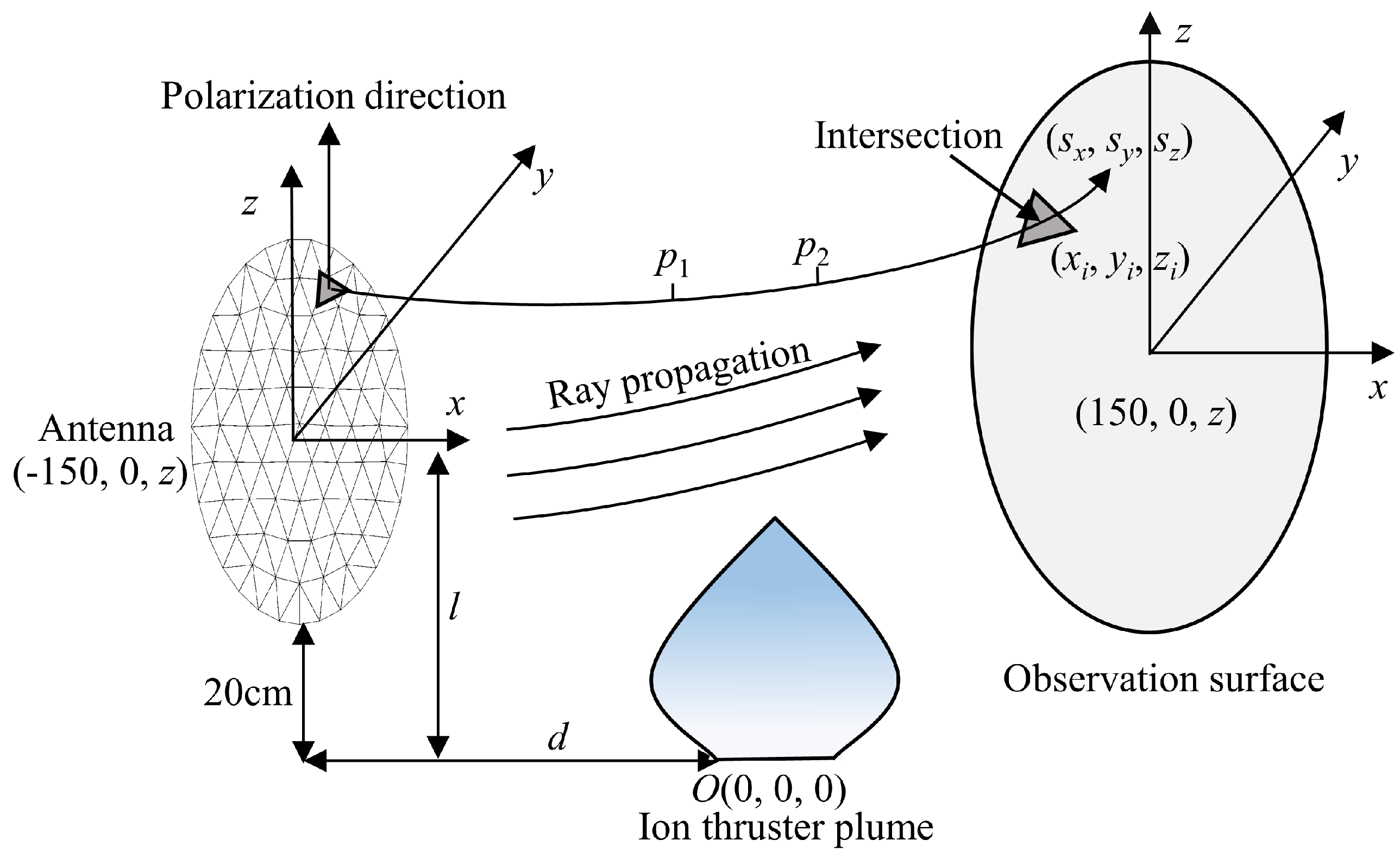
As shown in Figure 1, the electric propulsion system generates a plasma plume symmetric about the z-axis [30]. The ion thruster has a diameter of 20 cm. A parabolic reflector antenna with an aperture of 30 cm is positioned on the left side of the plume, with its axis aligned along the x-axis. When the reflector antenna operates at a high frequency, the emitted electromagnetic waves can be modeled using rays. On the right side of the plume, an observation plane parallel to the yoz-plane is placed at x = 150 cm. The aperture of the reflector antenna is discretized into triangular surface meshes, where each ray tube is defined by the rays passing through the central ray and the vertex rays of each triangular element. To ensure computational accuracy, the maximum element size in the surface mesh of the reflector antenna should be smaller than one-twentieth of the operating wavelength of the electromagnetic wave. We compute the far-field radiation of the antenna under plume interaction by employing the RT technique in conjunction with the aperture integration method. First, the three vertex rays of each triangular ray tube are traced to determine whether the ray tube can reach the observation plane, and we calculate the corresponding intersection points. Second, a central ray of each triangular ray tube is traced, and the electric field strength of this central ray is used to approximate the electric field over the corresponding triangular sub-aperture. Then, phase and polarization variations during wave propagation are determined via segmented path integrals and gradient transformations. The wave amplitude is obtained from ray tube divergence and losses. Finally, the contribution of each ray tube to the far-field is evaluated via aperture integration, from which the radiation characteristics in the presence of the plume are calculated.
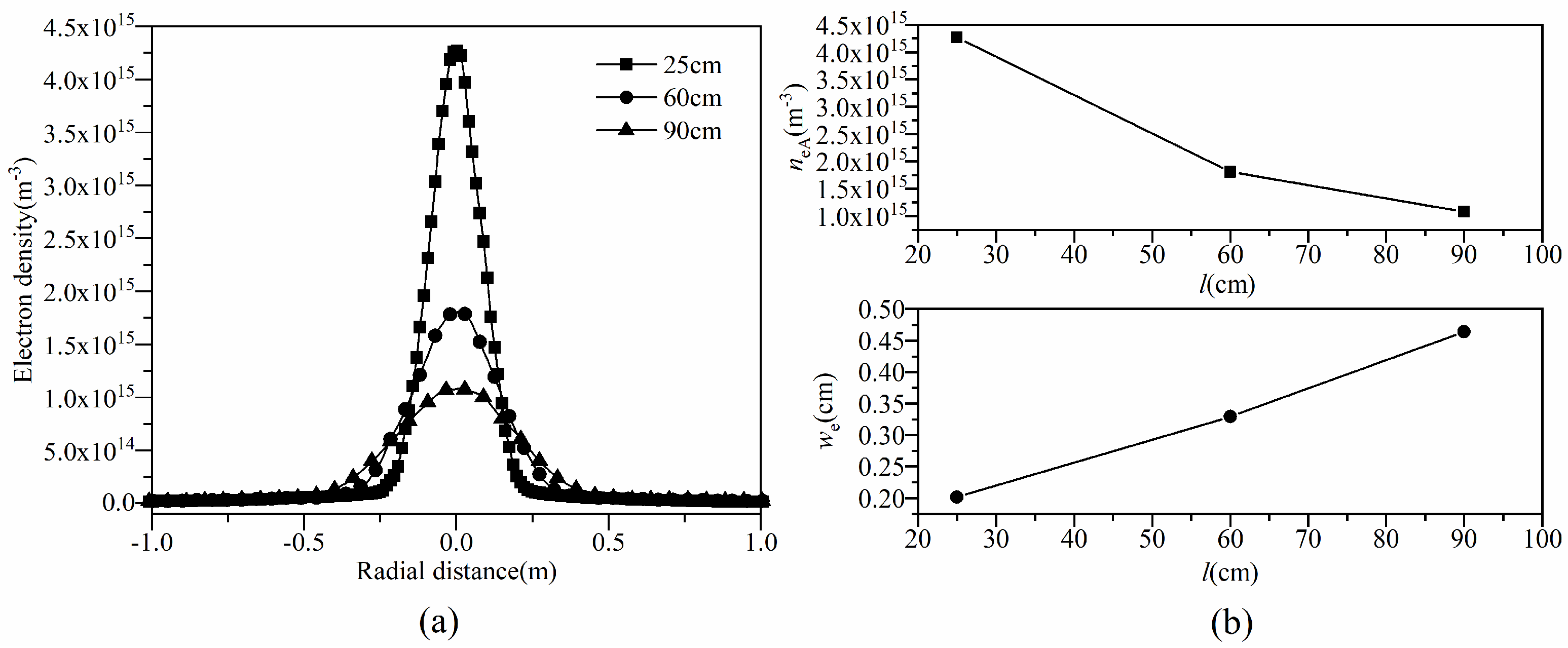
According to the experimental data [31], the plasma plume electron density from the 20 cm ion thruster is symmetric about the z-axis, ranging from approximately 1015 m−3 to 1016 m−3; at a cross-section 50 cm from the ion thruster exit, the beam current density is about 3.5 mA/cm2, with plasma oscillation frequencies spanning 285 MHz to 900 MHz. The electromagnetic wave frequency ranges from 2 GHz to 5 GHz, and the critical electron density nc ≈ 4.9 × 10¹⁶ m−3–3.1 × 10¹⁷ m−3. Based on these data, Figure 2a shows the electron density profiles in the plasma plume at different radial positions, with axial distances l = 25, 60, and 90 cm from the nozzle center. The dependence of the amplitude neA and the full-width at half-maximum we on the distance l is shown in Figure 2b.
Adopting a steady-state approximation, we assume that the macroscopic parameters of the plume are time-invariant and that the electromagnetic field radiated by the antenna is time-harmonic with an angular frequency ω. The wave equation reduces to the Helmholtz equation [32]:
2 E + k 2 E = 0
where E denotes the electric field, k = nk0 is the wavenumber in the plume, n is the refractive index, and k0 is the wavenumber in free space. Under the conditions of weak ionization, cold plasma, and isotropy, the refractive index of the plume is given by
n = ε r = β + i α
where β and α denote the phase coefficient and attenuation coefficient of electromagnetic waves in the plume. Meanwhile, k2 = k02ɛr, where ɛr is the plume relative permittivity:
ε r = 1 ω p 2 ω 2 + υ e 2 i υ e ω ω p 2 ω 2 + υ e 2
where ωp is the plasma angular frequency and ve is the electron collision frequency.
ω = 2 π f , υ e = 2 π f e
where f is the electromagnetic wave frequency and fe is the electron-neutral collision frequency. This expression is a valid simplification for the unmagnetized plasma plume considered here. Therefore, the plasma angular frequency ωp is given by
ω p = n e e 2 m e ε 0
where ne is the electron density, e is the electron charge, me is the electron mass, and ɛ0 is the permittivity of free space. The attenuation of electromagnetic waves propagating through the plasma plume is induced by the plasma collision frequency, primarily due to the electron collision frequency. For a weak collision case, the α and β of electromagnetic waves in the plasma plume can be derived from Equation (3) and are given by
α = ω ε 0 μ 0 2 ( 1 ω p 2 ω 2 + υ e 2 ) 2 + ( υ e ω ω p 2 ω 2 + υ e 2 ) 2 1 + ω p 2 ω 2 + υ e 2
β = ω ε 0 μ 0 2 ( 1 ω p 2 ω 2 + υ e 2 ) 2 + ( υ e ω ω p 2 ω 2 + υ e 2 ) 2 + 1 ω p 2 ω 2 + υ e 2
where μ0 is the permeability of free space.
Due to the axisymmetric nature of the plasma plume model, with the antenna far-field mode usually being represented in spherical coordinates, spherical coordinates are employed to formulate the ray path tracing equations. They can directly express the evolution of both the wave vector and the position vector along the ray path. Moreover, a fixed step size is employed in the Runge–Kutta integration to maintain thread synchronization in GPU parallel implementation, avoid branch divergence, and enhance memory access efficiency. This step size was selected based on a convergence analysis of the plasma plume refractive index distribution, ensuring numerical stability. Under the approximation of geometric optics, the electromagnetic wave propagating through the plasma region satisfies the following Haselgrove equation [33]:
d r d p = c ω k r
d θ d p = c r ω k θ
d φ d p = c r ω sin θ k φ
d k r d p = 0.5 ω c ( 1 n 2 ) r + c r ω k θ 2 + c r ω k φ 2
d k θ d p = 1 r 0.5 ω c ( 1 n 2 ) θ c ω k r k θ + c ω k φ 2 cot θ
d k φ d p = 1 r sin θ 0.5 ω c ( 1 n 2 ) φ c ω k r k θ sin θ c ω k θ k φ cos θ
where c denotes the speed of light in free space and p′ = ct represents the group path. kr, kθ, and kφ are the projections of the local wave vector at the observation point onto the three orthogonal directions in spherical coordinates. The position vector and wave vector along the ray vary with the integration path. During ray path tracing, Equation (8) is numerically solved using the Runge–Kutta method to obtain the position and wave vector at each step from the initial position and initial wave vector.
Meanwhile, the electric field of the electromagnetic ray satisfies the following equation [34]:
E s + 1 2 1 n 2 ϕ ln μ s E + E ln n t ^ = 0
where ϕ is the phase function, s is the arc length along the ray trajectory, μ is the permeability, and t ^ is the unit tangent vector to the ray. From Equation (9), the electric field direction e ^ and its tangential derivative along the ray trajectory can be expressed as follows:
e ^ = E E E * 1 / 2
e ^ s = e ^ Δ ln n t ^
The electric field polarization direction can be determined from the tangent direction and the refractive index gradient. Let the starting and ending points of the ray be p1 and p2; the phase variation along the ray satisfies
I p = k 0 P 1 p 2 n i d s
where n(i) denotes the refractive index of the i-th point. Based on the initial incident polarization vector, the polarization vector e ^ o u t at the intersection point where the ray finally reaches the observation plane can be obtained using Equations (10) and (11) [35]. The electric field intensity Eout is given by
E o u t = E 0 exp i k 0 I D F n i / n f 1 / 2 e ^ o u t
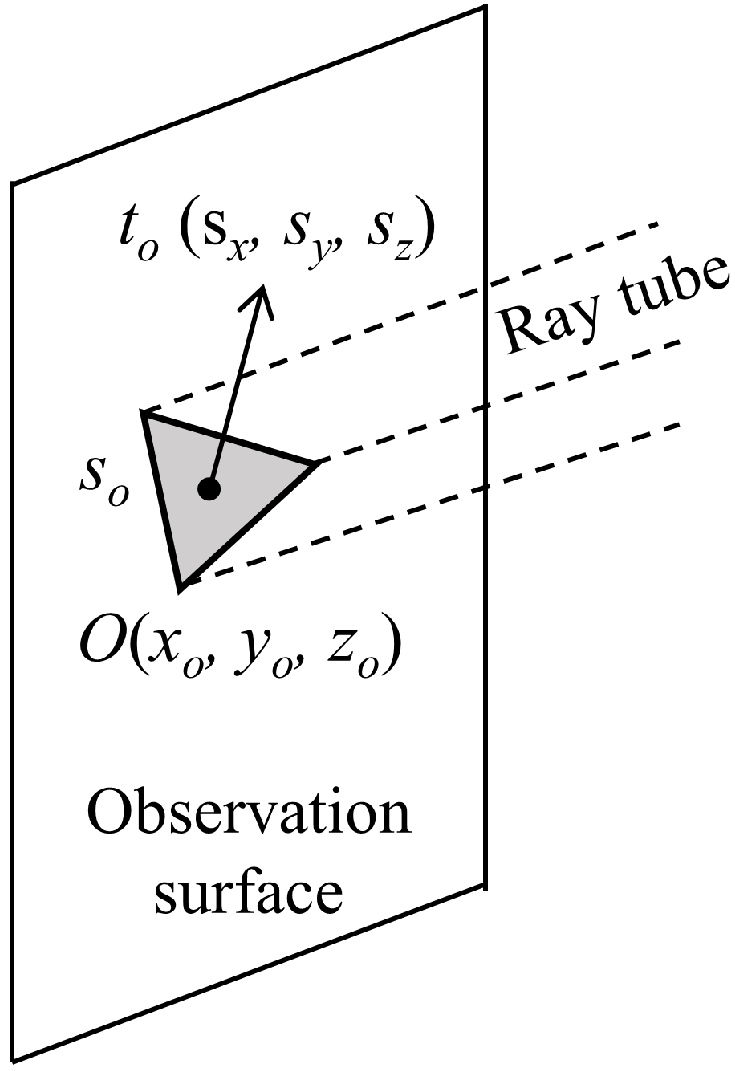
where ni denotes the refractive index at the initial point of the ray, nf represents the refractive index at the terminal point of the ray, and DF is the divergence factor of the ray tube. Figure 3 shows a ray tube intersecting the observation plane at midpoint O. The triangle soi is the cross-section of the i-th ray tube intersecting the observation plane, and toi is the exit direction of the central ray of the i-th ray tube. Due to fine discretization of the rays, the field amplitude at different points across each triangular aperture can be considered uniform. The electric field on the observation plane is approximated as
E x ( x , y ) E y ( x , y ) = E x ( x 0 , y 0 ) E y ( x 0 , y 0 ) exp i k 0 s x ( x x 0 ) + s y ( y y 0 )
where sx and sy represent the x and y directions of the ray. The antenna radiation pattern is computed using the following equation [36]:
E s ( r , θ , φ ) = exp ( i k 0 r ) r A θ θ ^ + A ϕ ϕ ^
where Aθ and Aϕ represent the electric field in the θ and ϕ directions.
A θ = j k 0 2 π i N E x ( x i , y i ) cos ϕ i + E y ( x i , y i ) sin ϕ i exp j k 0 s x x i + s y y i a r e a i I I
A ϕ = j k 0 2 π i N E x ( x i , y i ) sin ϕ i c o s θ i + E y ( x i , y i ) cos θ i cos ϕ i exp j k 0 s x x i + s y y i a r e a i I I
where areai denotes the projected area of the i-th ray tube on the observation plane. And
I I = 1 a r e a i i exp i k 0 sin θ i cos ϕ i s x x + sin θ i sin ϕ i s y y d x d y
The above equation can be regarded as the two-dimensional Fourier transform of the characteristic function s(x,y) of the areai of the i-th ray tube on the observation plane:
s ( x , y ) = 1 ( x , y ) a r e a i 0 ( x , y ) a r e a i
The closed-form solution of the integral is given by
I i = S p , q S 0 , 0
where
S p , q = n = 1 3 exp i w τ n x n + 1 x n y n y n 1 y n + 1 y n x n x n 1 x n x n 1 p + y n y n 1 q x n + 1 x n p + y n + 1 y n q
where
p = k 0 sin θ i cos ϕ i s x q = k 0 sin θ i sin ϕ i s y
and
w = p x ^ + q y ^
τ n = x n x ^ + y n y ^
where (xn, yn) denotes the coordinates of the n-th vertex of the triangular subsurface (n = 1,2,3) and
S 0 , 0 = x 1 y 2 x 2 y 1 + x 2 y 3 x 3 y 2 + x 3 y 1 x 1 y 3 2

2.2. GPU Parallel RT Algorithm for Plasma Plume Calculation

The large number of rays leads to excessive computational time during ray path tracing in the plasma plume. However, the rays are independent during the tracing process and do not require access to other rays. Therefore, we leverage the NVIDIA compute unified device architecture (CUDA) platform to perform massively parallel processing of the entire ray computation to enhance efficiency. CUDA programming is divided into host code and device code to execute the heterogeneous computation. The host code runs serially on the CPU, involving data transfer and management, device memory allocation, and computation task scheduling. The device code executes on the GPU, involving the core parallel computations. These two code segments collaborate by exploiting the strengths of the CPU and GPU to achieve high-performance parallel computing. The computational function executed on the GPU is a kernel function that runs simultaneously across multiple threads. Additionally, the CUDA employs a hierarchical thread organization. Threads represent the fundamental execution units, blocks consist of multiple threads, and grids are composed of multiple blocks. Developers map thread, block, and grid models to GPU hardware components, enabling massive parallelism. Meanwhile, CUDA threads can store data across multi-level memory spaces during execution with distinct capacity characteristics. Various memory types address different data storage requirements, and judicious utilization of them can substantially enhance parallel computing efficiency.
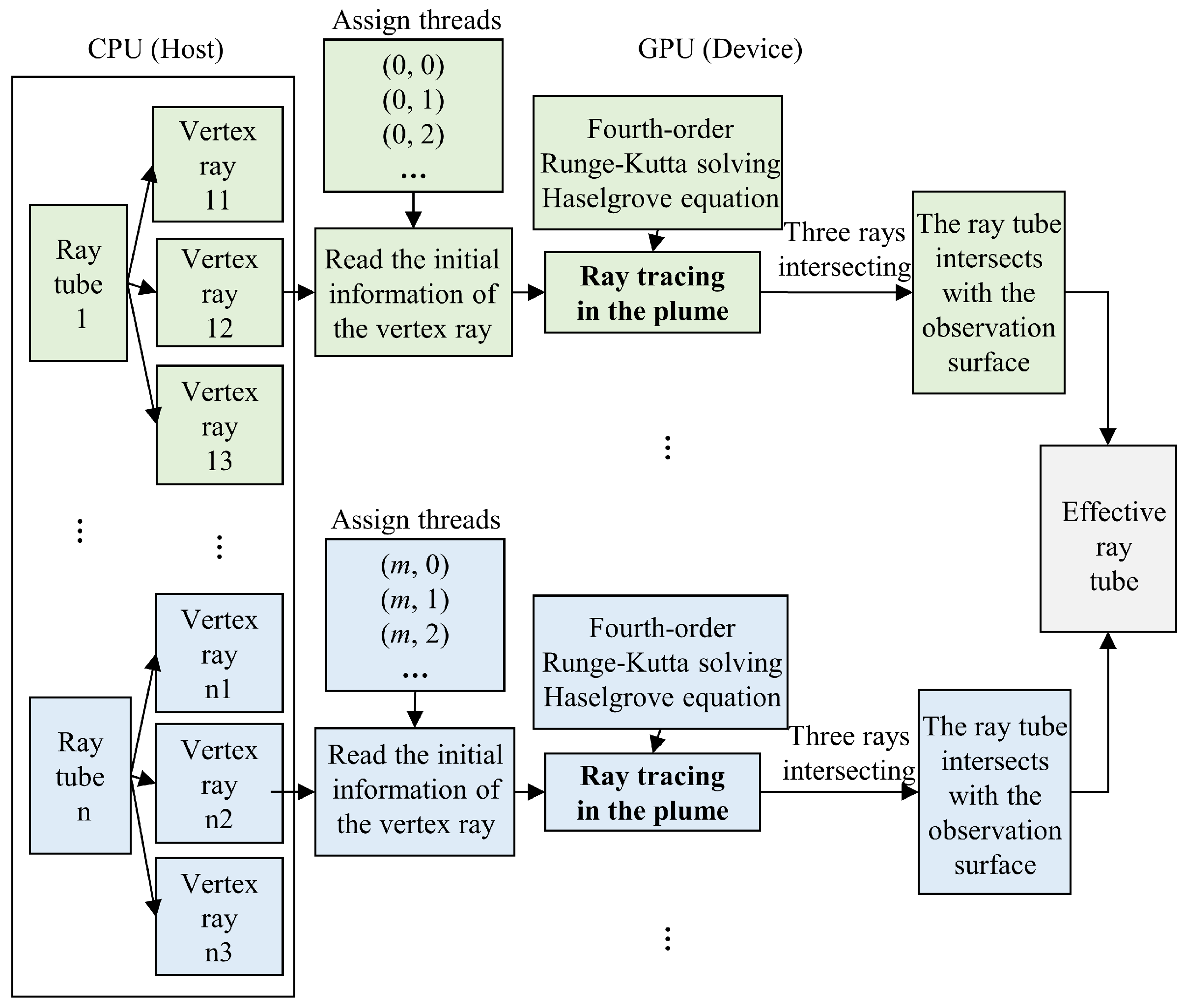
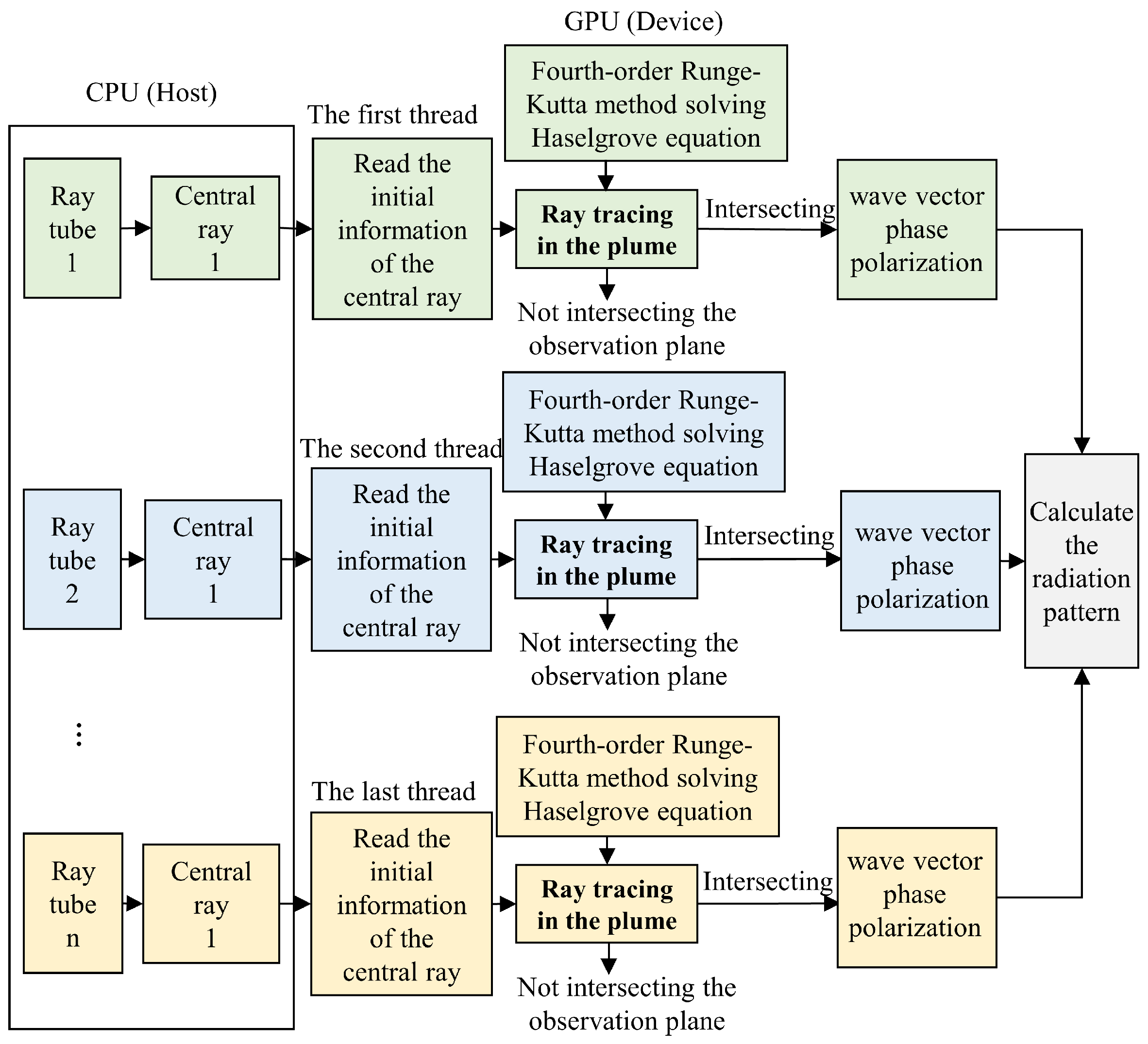
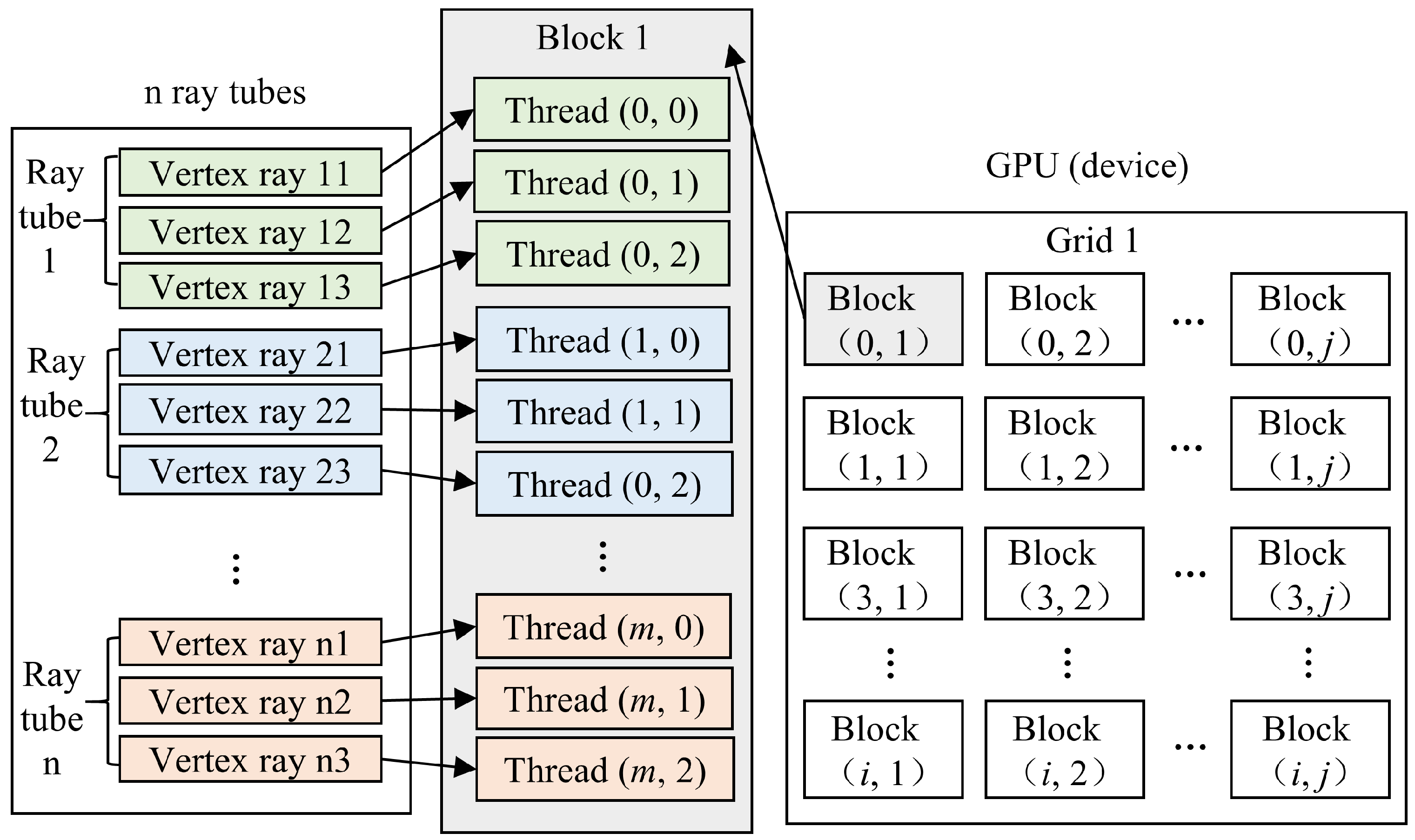
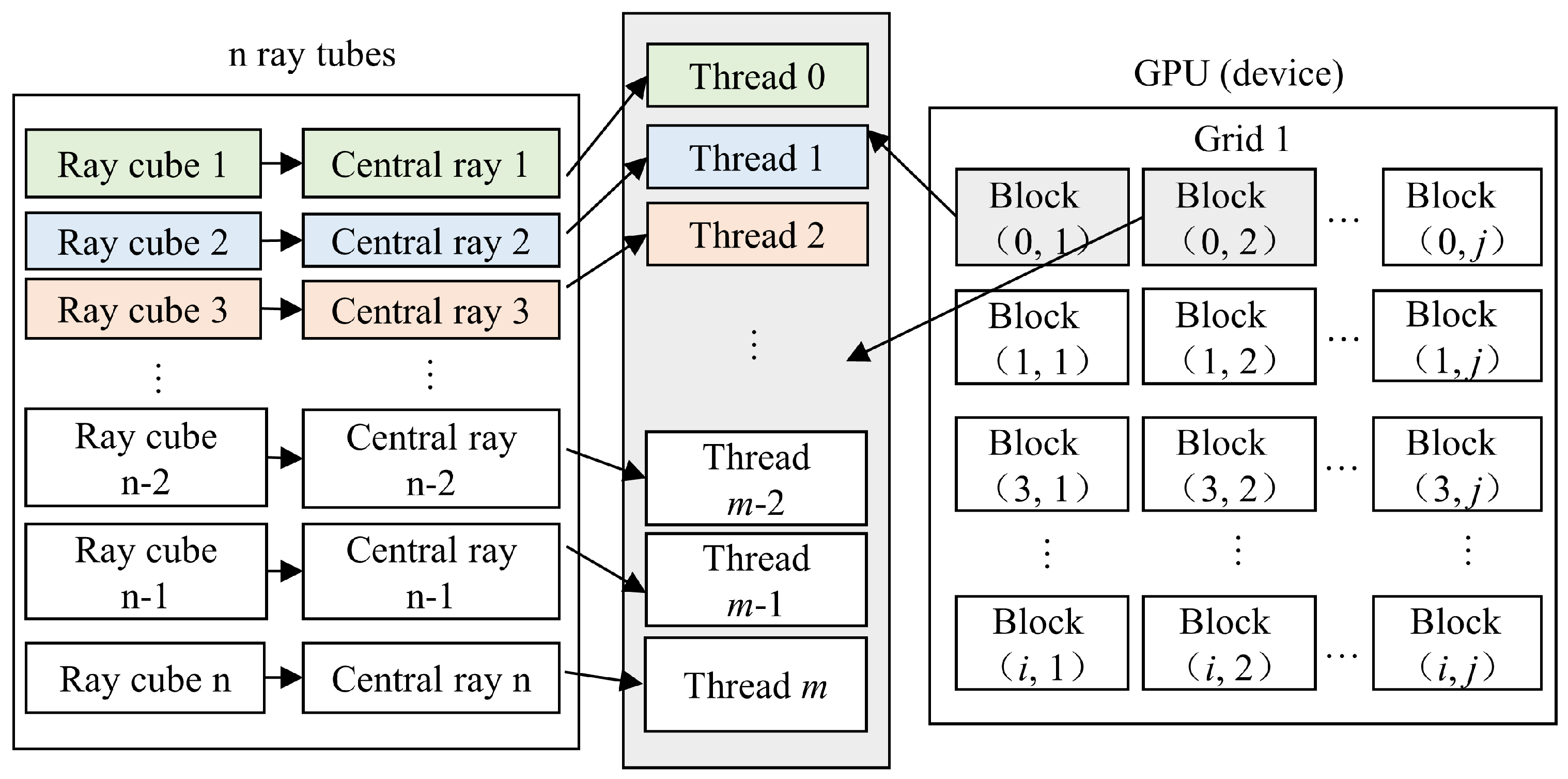
The tracking and field computation for each ray exhibits high independence in the ray path tracing. Therefore, we individually mapped the rays within all ray tubes to GPU threads, with each thread responsible for the iterative solution of a single ray path. The GPU parallel RT algorithm in the plasma plume primarily addresses the issues of thread allocation and kernel function implementation. In the thread allocation part, the central ray and vertex rays within each ray tube are assigned to an equal number of threads. Each thread group comprises four threads, corresponding to the three vertex ray threads and one central ray thread. As illustrated in Figure A1, the vertex ray thread allocation process is depicted, where each ray tube contains three vertex rays. Assuming the incident source is subdivided into n ray tubes, a total of 3n vertex rays are generated. Each group of vertex rays is mapped to three consecutive threads within the same thread block, which can be regarded as a single processing unit. Figure 4 shows the kernel function processing workflow for each thread corresponding to the vertex rays. Initially, the initial information for each vertex ray is loaded. Then, the three threads within each ray tube enter the kernel function to commence the tracing computation. If all three vertex threads intersect the observation plane after completion of tracing, the ray tube reaches the observation surface. By computing the vertex rays of each ray tube in parallel, the final intersection positions of the ray tubes with the observation plane are determined.
Figure A2 illustrates the thread allocation process for the central rays. Each of the n ray tubes contributes one central ray, and each central ray is assigned to a dedicated GPU thread. These threads may belong to different thread blocks. The number of blocks is dynamically adjusted according to the total ray count to optimize hardware utilization in each block, preventing resource underuse and memory access bottlenecks. Figure 5 illustrates the kernel function computation process for each central ray thread, where one central ray corresponds to one dedicated thread. Initially, the initial information for the central ray is loaded. The threads grouped within each thread block execute on a single GPU multiprocessor in a parallel RT. Next, central rays that do not intersect the observation plane contribute nothing and can thus be disregarded. For those central rays reaching the observation plane, the electric field components are computed. The phase varies via the segmented path integral and the polarization via the refractive index gradient and propagation direction. This yields the complete calculation of electromagnetic characteristics for each ray. The GPU launches the requisite number of threads for simultaneous tracing in a single invocation throughout the computation. Therefore, the full path history and the final intersection point data are obtained for every ray.
In the kernel function implementation, the core kernel function involves ray path tracing of both vertex rays and central rays within the ray tube in the plasma plume. These rays are each executed on a dedicated thread grid. Upon invocation of the parallel kernel functions for vertex and central rays, the GPU launches numerous threads to execute the identical tracing code in parallel to obtain the ray trajectory points at each step. Ray path tracing continues until intersection with the observation plane. Table 1 summarizes the key CUDA configuration parameters for the practical implementation, where vn denotes the number of vertex rays and cn the number of central rays. This configuration ensures that all computational tasks are properly assigned to threads.

3. Numerical Results and Discussion

To verify the effectiveness of this parallel method in large-scale plasma plume problems, the RT of CPU serial calculation and GPU parallel calculation was employed in the same simulation environment to research plasma plume-induced perturbations of the antenna. To ensure consistent and comparable results, all simulations were run on an Intel i5-9400 CPU with an NVIDIA GeForce RTX 4090 GPU. A 20 cm ion thruster is positioned within the computational domain, with a 30 cm radius antenna placed on the left side of the plume. The electromagnetic waves emitted by the antenna are represented using rays, which are discretized into 586,928 triangular facets corresponding to the central rays. The observation plane is located on the right side, where the rays, after decomposition, propagate through the plume and intersect the observation plane. The antenna axis is positioned 50 cm from the thruster nozzle center. The spatial distribution of the plasma plume electron density is approximated as follows [31]:
n e = d l 2 exp ( α θ )
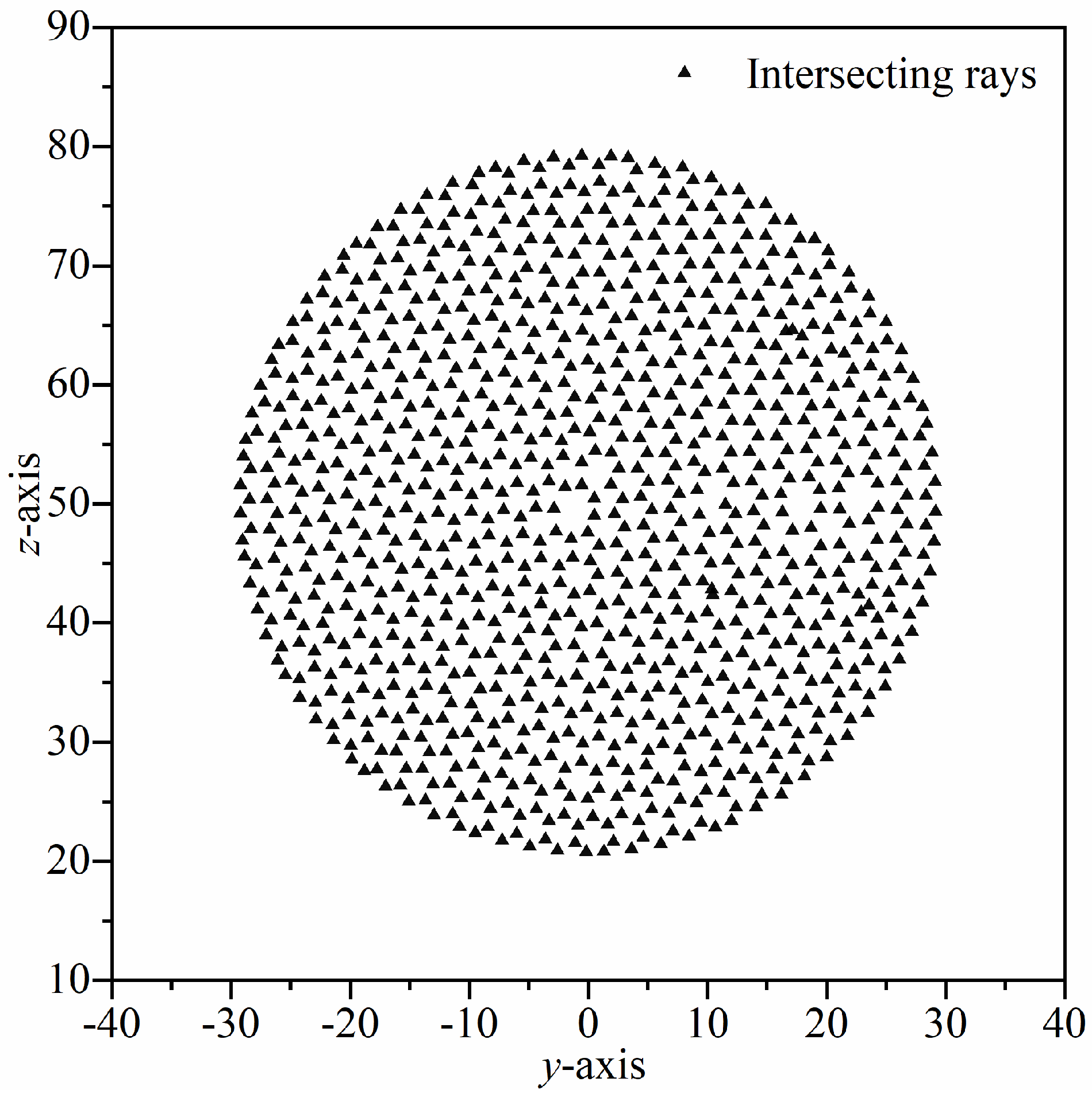
where l denotes the distance from the plume nozzle center, θ represents the angle deviated from the thruster axis, and the constant d is defined as the electron density value along the plume centerline at 1 m from the nozzle center, taken as d = 1 × 10¹⁹ m−3 and α = 0.07. The wave frequency governs phase and amplitude variations, while the collision frequency primarily determines the attenuation of electromagnetic wave disturbances caused by plasma plumes. In the above experimental model, the collision frequency is taken as 5 × 10⁸ Hz. The antenna operates at f = 3 GHz, and the emission wave is triangularly subdivided, with rays launched along the x-direction. Path tracing is performed for the vertex rays of each ray tube to determine intersection with the observation plane. Figure 6 shows the distribution of ray intersections with the observation plane when the ion thruster is turned off. The results indicate that the initial ray directions remain unchanged in the absence of the plume. The ray intersections are confined within a circular area of 30 cm radius on the observation plane.
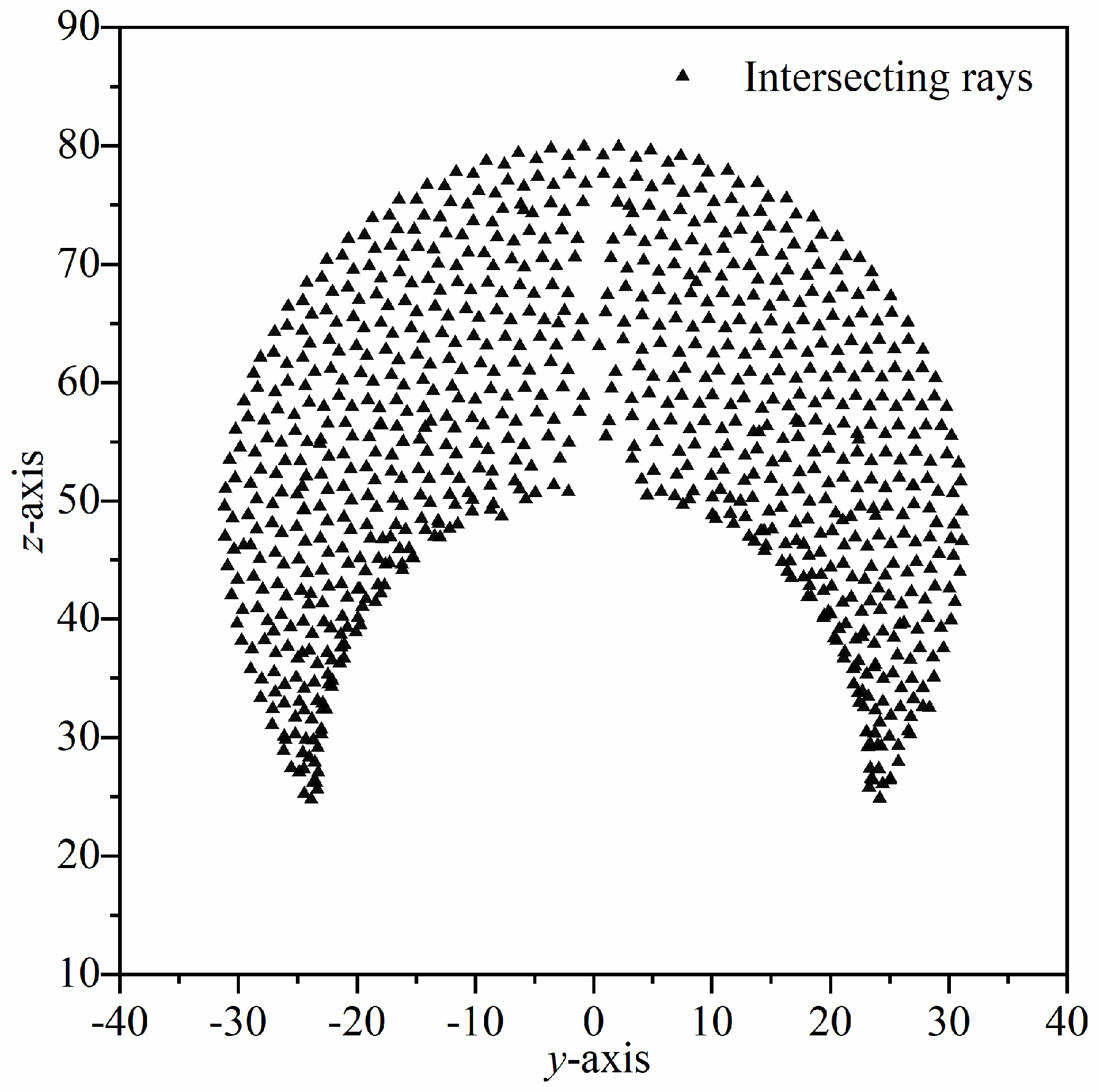
Figure 7 illustrates the distribution of ray intersections with the observation plane when the ion thruster is activated. Upon plume generation, rays propagating along straight lines undergo directional changes due to traversal through the plume. This occurs due to the continuous decay of electron density in the plume, resulting in a smooth transition of the refractive index to vacuum values at the periphery, without any abrupt discontinuity at the boundaries. The rays bend toward regions of higher refractive index, with maximum curvature occurring at the minimum z-position. This effect arises because this region is closest to the plume, where refractive index gradients are most pronounced, thereby accentuating the bending. Moreover, the intersection points exhibit symmetry along the y-axis, which is attributable to the symmetric electron density distribution of the plume in this direction.
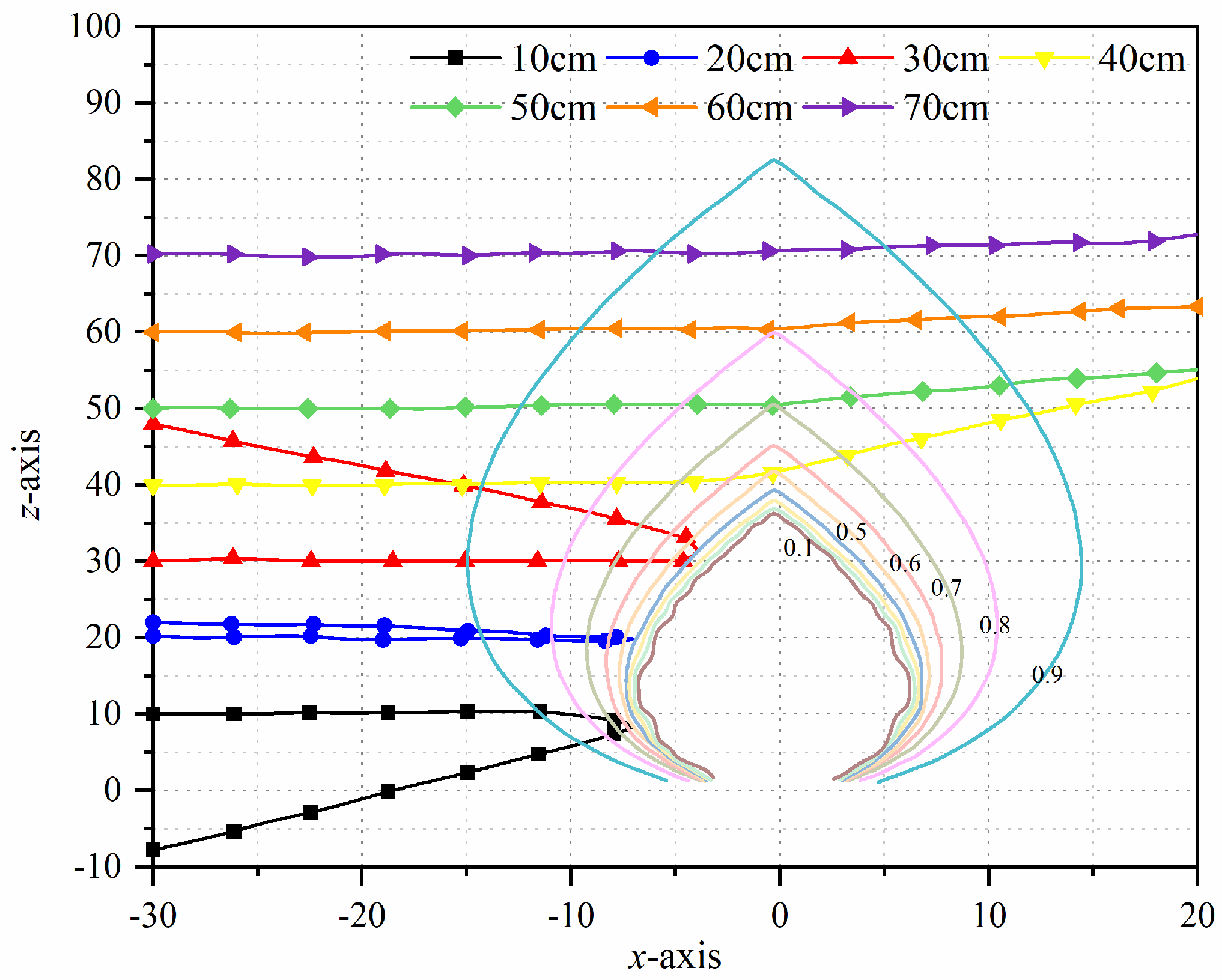
The plume nozzle is at the coordinate origin, and we trace rays emitted from various launch positions within the plane x = −30. The spatial distribution of plume electron density follows Equation (26). Figure 8 shows the GPU parallel RT results with the different refractive index distribution of the plasma plume, where different colors in plumes represent distinct refractive indices. Similarly, it is evident that electromagnetic wave propagation directions undergo significant alterations near regions of pronounced refractive index gradients. The path is determined by the macroscopic refractive index distribution, and plasma waves do not substantially affect ray paths directly in this geometric optics approximation. The ray bending degree within the plume correlates with the local electron density. The strongest deflection occurs near the thruster exit, where the z-value is minimal, and the electron density approaches the critical level. The ray deflection becomes increasingly pronounced as the electron density approaches the critical density.
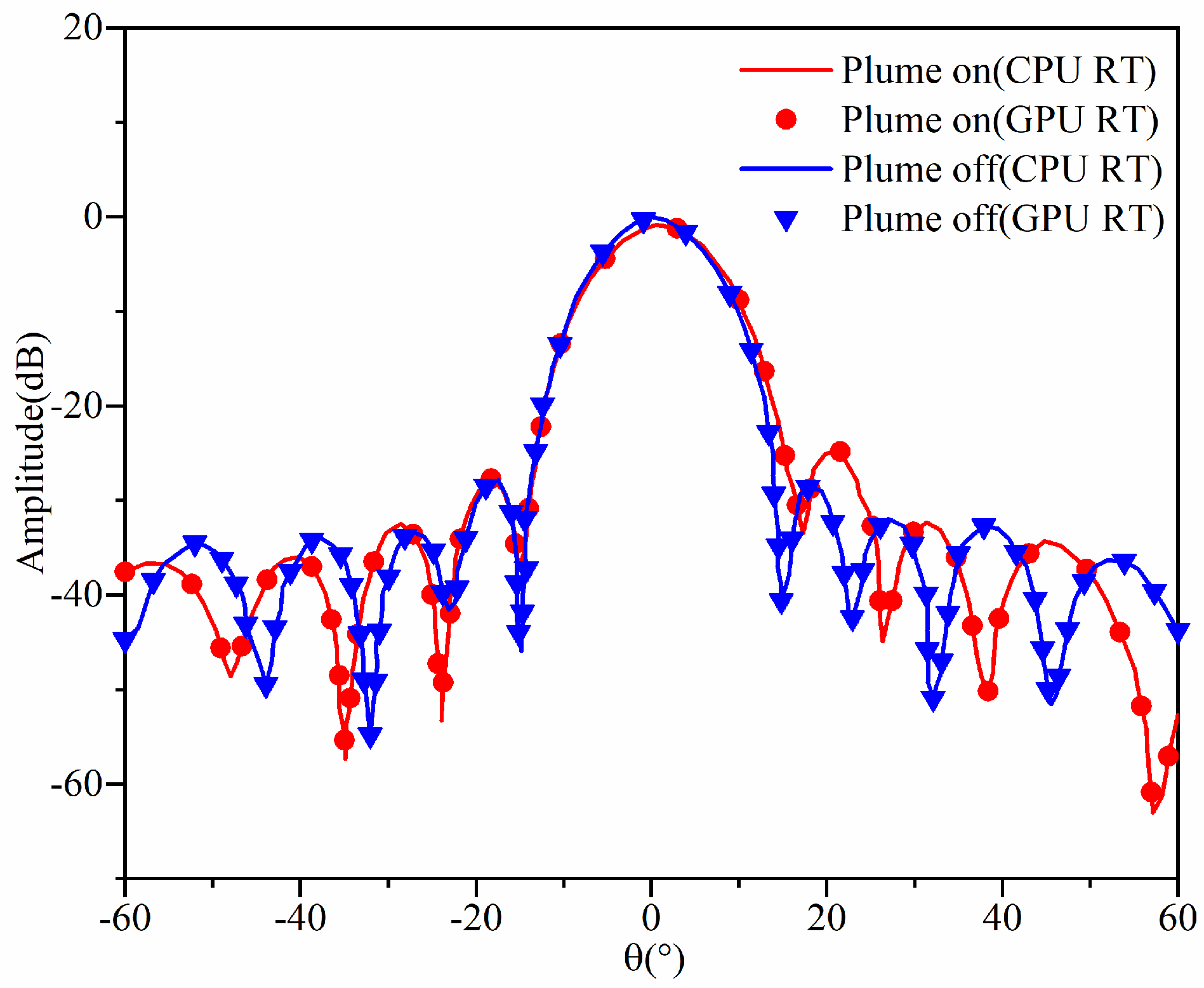
Figure 9 presents a comparison of radiation patterns for the antenna under the influence of the plasma plume using the serial RT calculation and the GPU parallel RT calculation. The thruster-off condition represents the radiation pattern in the absence of the plume, whereas the thruster-on condition corresponds to the radiation pattern with the plume present. The mean squared error between GPU parallel and CPU serial remains less than 10−16, with or without the plume. This excellent agreement validates the accuracy and feasibility of the GPU parallel RT algorithm for plume simulations. It should be noted that this validation confirms the algorithmic equivalence between the parallel and serial schemes, ensuring that the hardware parallelization process maintains high accuracy. Furthermore, numerical results indicate that plume presence causes a 0.8 dB attenuation in the main lobe peak, a 0.5° deviation of the main lobe peak from the antenna axis. This peak deviation is attributable to ray bending caused by the refractive index gradient within the plume. The main lobe shift and attenuation result from the spatial distribution of electron density in the plasma plume. As it gradually approaches the critical density, pronounced variations in the phase constant cause wavefront distortion and main lobe displacement.
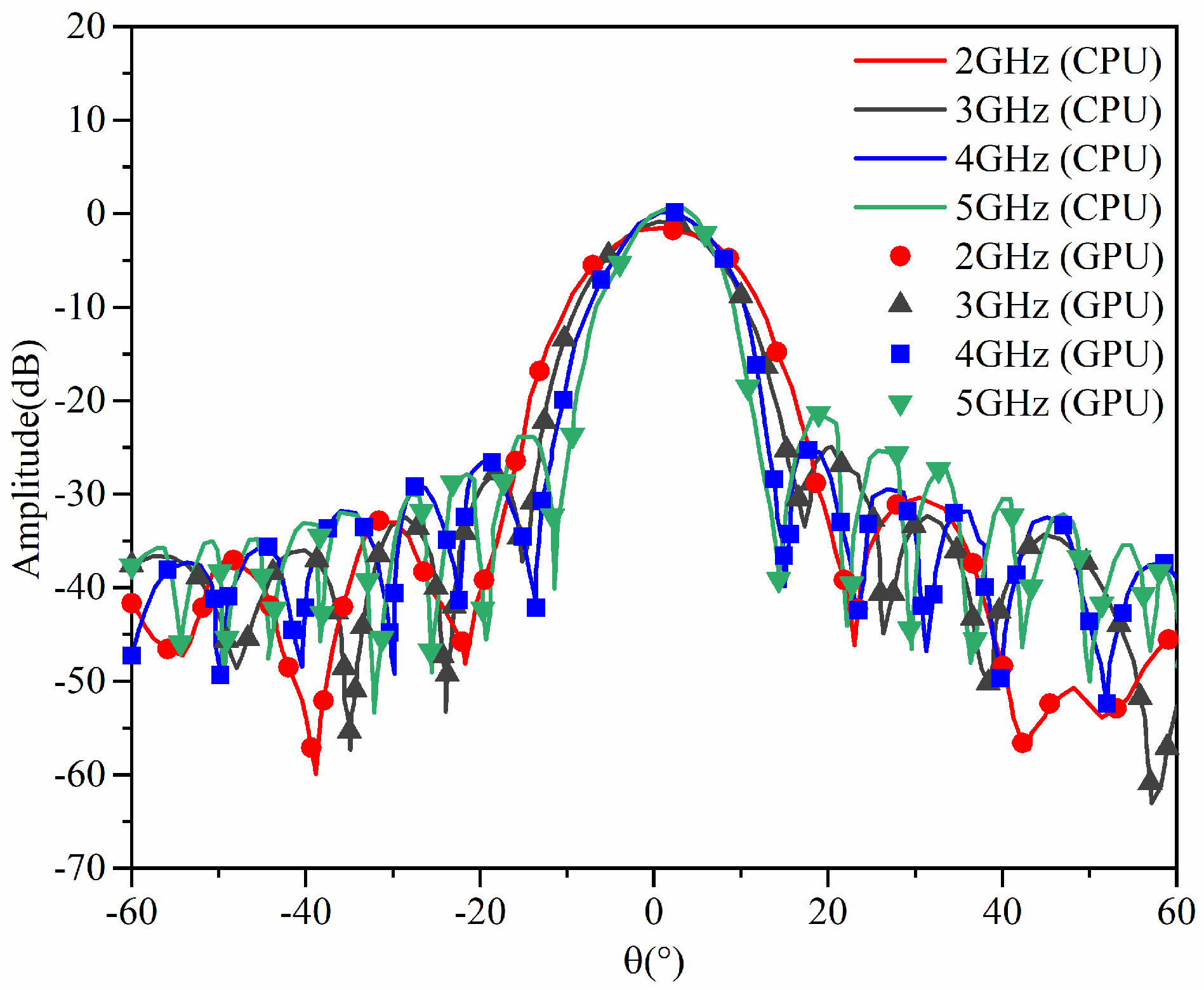
Figure 10 compares the plume-induced perturbations on antenna patterns at multiple frequencies using both serial and parallel schemes. And the main lobe peak amplitude at f = 5 GHz is taken as the 0 dB reference. Numerical analysis demonstrates excellent agreement between parallel results and serial results across different frequencies, thereby validating the accuracy of the parallel scheme. At an antenna frequency of f = 2 GHz, compared to the thruster-off condition, plume presence results in a 2.1 dB attenuation of the main lobe peak, a 1.31° deviation from the antenna axis. At f = 4 GHz, these effects are 0.4 dB and 0.25°, respectively; at f = 5 GHz, they are 0.3 dB and 0.19°. The results indicate that, in addition to electron density, the operating frequency is another critical parameter determining the level of attenuation. Within the 2 GHz to 5 GHz microwave communication band, the plasma plume exerts modest perturbations on the antenna electromagnetic wave amplitude and phase. The main lobe peak attenuation does not exceed 3 dB and the angular deviation from the antenna axis is below 2°. Moreover, relative to the main lobe peak at f = 5 GHz, attenuation differences at other operating frequencies decrease from 1.8 dB to 0.1 dB. It indicates that plume-induced attenuation diminishes rapidly with increasing frequency. When the frequency exceeds 4 GHz, electromagnetic waves have an extremely reduced influence, with the main lobe peak attenuation below 1 dB. Thus, in the presence of this plasma plume interference, selecting operating frequencies above 4 GHz represents a direct and effective measure to enhance communication reliability.
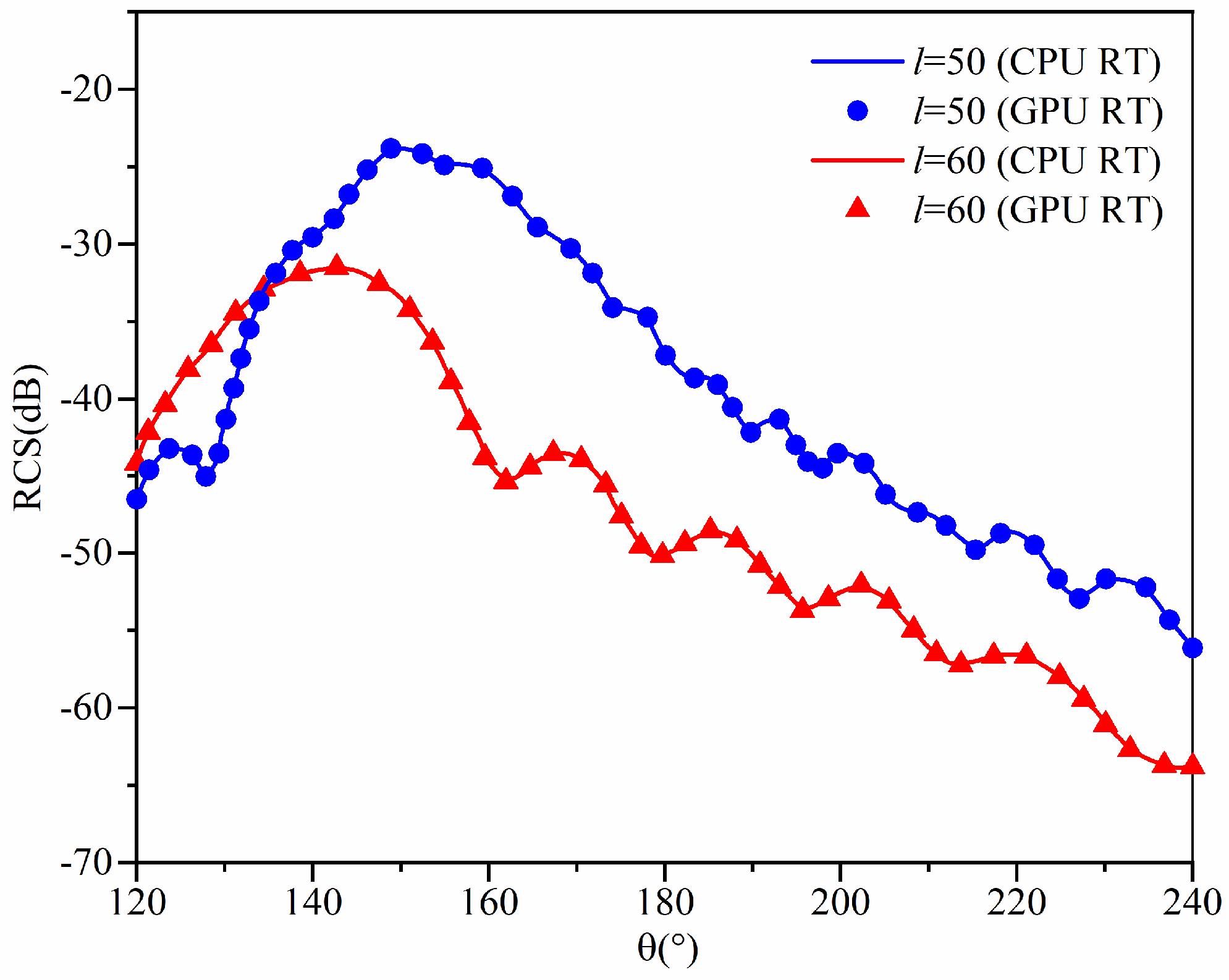
A 30 cm radius aperture antenna with f = 5 GHz serves as the emission source, and the aperture center is positioned at (−31, 0, 60). The nozzle center is located at the coordinate origin, with axial distances from the ion thruster to the nozzle center set at l = 50 cm and l = 60 cm, respectively. The observation plane is placed to the left of the antenna to compute the backscattering characteristics of the inhomogeneous plasma plume. Figure 11 presents the backscattered radar cross-section (RCS) results for the plasma plume under the serial RT calculation and the GPU parallel RT calculation. The results show an excellent agreement between parallel and serial in different axial distances. It confirmed the accuracy of the parallel algorithm for backscattering computations in the plasma plume. The nonuniformity of the plasma plume gives rise to the complex scattering field. The critical density layer serves as a phase discontinuity, thereby generating dominant coherent scattering.
Table 2 presents the algorithm execution times for GPU parallel and CPU serial of the influence calculation of the plume on the antenna radiation patterns. N denotes the number of triangulated facets and is equivalent to the central ray count. We use the parallel speed-up to quantify the efficiency enhancement from parallelization, defined as the ratio of parallel computation time to serial time. Across varying ray counts, the GPU parallel scheme significantly reduces plume computation time, achieving a significant speed-up. It validated the effectiveness of the proposed parallel algorithm. Under a number of triangular facets of 3594, the parallel ray data volume is relatively small, resulting in a speed-up of only approximately 17.4 times. As the number of ray tubes increases, the speed-up of the GPU parallel continues to rise. This is because the growing parallel data volume with increasing ray tube count enhances the parallel computation efficiency. When the number of triangular facets reaches 586,928, the parallel speed-up reaches approximately 319 times. Furthermore, according to the NVIDIA Compute Performance Analyzer, the GPU occupancy reaches 80% when the speed-up peaks at over 300 times. The high GPU occupancy indicates highly efficient utilization of streaming multiprocessor resources, thereby achieving substantial parallel efficiency in RT computations.
From a hardware architecture perspective, GPUs accelerate computation through massive parallel units, enabling fine-grained task decomposition. Specifically, mapping vertex ray intersections and central ray calculations to independent threads reduces processing time. The above results demonstrate that the GPU parallel RT algorithm achieves a significant speed-up while maintaining result accuracy in the plume-wave perturbation calculation. Therefore, this algorithm effectively extends the scope for real-time applications in plume-related calculations.

4. Conclusions

This paper proposes a GPU parallel RT algorithm to investigate the plasma plume-induced perturbations on the radiation characteristics of satellite reflector antennas to enhance computational efficiency. Firstly, rays within each ray tube are individually assigned to distinct GPU threads for parallel tracing. Vertex ray path tracing determines intersections with the observation plane, while central ray path tracing yields approximate electric field strengths. Additionally, the electromagnetic wave amplitude, phase variation, and continuous polarization are determined, respectively, by ray tube divergence and attenuation, segmented path integration, and the combined refractive index gradient and propagation direction. Finally, aperture integration and superposition principles are employed to analyze the influence of axisymmetric plasma plumes on the radiation pattern of antennas. Numerical results demonstrate that the GPU parallel results align excellently with their serial counterparts in plasma plume assessments. Moreover, the parallel speed-up achieves about 319 times while ensuring accuracy, thereby validating the effectiveness of the proposed algorithm. Furthermore, the plasma plume effects on electromagnetic waves in the 2 GHz to 5 GHz microwave communication band are modest, with the main lobe peak attenuation not exceeding 3 dB and an angular deviation from the antenna axis of less than 2°. These findings underscore the importance of considering the specific communication frequency band when assessing thruster-plume compatibility. The proposed algorithm facilitates the efficient computation of the plume influence on satellite reflector antenna radiation characteristics.
Future work will focus on advancing the following two aspects to further refine the computational framework proposed in this study. First, more extensive validation of the proposed algorithm will be conducted to systematically evaluate its general applicability in plume-electromagnetic wave analysis. This includes comparisons with analytical solutions for benchmark problems, cross-verification against full-wave numerical simulations, and experimental data from relevant ground tests. Second, the framework will be extended to more physical environments, particularly magnetized and anisotropic plasma scenarios involving a confining magnetic field. These efforts aim to transform the present method into a real-time analysis tool for satellite electromagnetic compatibility.

Author Contributions

Conceptualization, Y.W. and W.Y.; methodology, Y.W. and W.Y.; software, Y.W.; validation, Y.W. and W.Y.; investigation, Y.W.; resources, B.W. and W.Y.; data curation, W.Y.; writing—original draft preparation, Y.W.; writing—review and editing, B.W.; project administration, Y.W. and W.Y.; funding acquisition, B.W. All authors have read and agreed to the published version of the manuscript.

Funding

This work was supported in part by the National Natural Science Foundation of China (Grant 62371378, 62471352, and 62201411).

Data Availability Statement

The original contributions presented in the study are included in the article, and further inquiries can be directed to the corresponding author.

Conflicts of Interest

The authors declare no conflicts of interest.

Abbreviations

The following abbreviations are used in this manuscript:
GPUGraphics Processing Unit
RTRay Tracing
CUDACompute Unified Device Architecture
RCSRadar Cross Section

Appendix A

Figure A1. GPU thread allocation for vertex rays.
Symmetry 18 00243 g0a1
Figure A2. GPU thread allocation for central rays.
Symmetry 18 00243 g0a2

References

  1. Mazouffre, S. Electric propulsion for satellites and spacecraft: Established technologies and novel approaches. Plasma Sources Sci. Technol. 2016, 25, 033002. [Google Scholar] [CrossRef]
  2. Levchenko, I.; Xu, S.; Teel, G.; Mariotti, D.; Walker, M.L.R.; Keidar, M. Publisher Correction: Recent progress and perspectives of space electric propulsion systems based on smart nanomaterials. Nat. Commun. 2018, 9, 879. [Google Scholar] [CrossRef] [PubMed]
  3. Yang, L.; Lu, C.; Xia, G.; Gao, H.; Xu, N. The Distribution Characteristics of the Multiemitter Field-Effect Electric Propulsion Plume Under Different Working Conditions. IEEE Trans. Plasma Sci. 2021, 49, 3941–3950. [Google Scholar] [CrossRef]
  4. Greig, A.; Charles, C.; Boswell, R. Plume Characteristics of an Electrothermal Plasma Microthruster. IEEE Trans. Plasma Sci. 2014, 42, 2728–2729. [Google Scholar] [CrossRef]
  5. Giordani, A.; Morfei, D.; Scione, E.; Ruà, E.G. Approach to S-band Antenna Pattern Distortion generated by Spacecraft Plasma Plume. In Proceedings of the 2022 International Symposium on Electromagnetic Compatibility (EMC), Gothenburg, Sweden, 5–8 September 2022; pp. 405–409. [Google Scholar] [CrossRef]
  6. Ohler, S.G.; Gilchrist, B.E.; Gallimore, A.D. Electromagnetic signal modification in a localized high-speed plasma flow: Simulations and experimental validation of a stationary plasma thruster. IEEE Trans. Plasma Sci. 1999, 27, 587–594. [Google Scholar] [CrossRef]
  7. Shinde, T.L.; Cairns, I.H.; Held, J.M. Analysis of Spacecraft Charging Effects of SPT-100 Hall Thruster Plumes. IEEE Trans. Plasma Sci. 2025, 53, 3085–3104. [Google Scholar] [CrossRef]
  8. Ding, Y.; Bai, B.; Gao, H.; Shen, F.; Liu, Y.; Li, X. An Analysis of Radar Detection on a Plasma Sheath Covered Reentry Target. IEEE Trans. Aerosp. Electron. Syst. 2021, 57, 4255–4268. [Google Scholar] [CrossRef]
  9. Song, L.; Li, X.; Liu, Y. Effect of Time-Varying Plasma Sheath on Hypersonic Vehicle-Borne Radar Target Detection. IEEE Sens. J. 2021, 21, 16880–16893. [Google Scholar] [CrossRef]
  10. Khojeh, G.; Abdoli-Arani, A. Scattering and resonant frequency of a toroidal plasma covered by a dielectric layer. Chin. J. Phys. 2022, 77, 945–955. [Google Scholar] [CrossRef]
  11. Wang, Z.; Guo, L.; Li, J. Analysis of Echo Characteristics of Spatially Inhomogeneous and Time-Varying Plasma Sheath. IEEE Trans. Plasma Sci. 2021, 49, 1804–1811. [Google Scholar] [CrossRef]
  12. Neumann, A.; Mühlich, N.S. Ground-Based Experiment for Electric Propulsion Thruster Plume—Magnetic Field Interaction. Aerospace 2023, 10, 117. [Google Scholar] [CrossRef]
  13. Chen, W.; Guo, L.; Li, J.; Liu, S. Research on the FDTD Method of Electromagnetic Wave Scattering Characteristics in Time-Varying and Spatially Nonuniform Plasma Sheath. IEEE Trans. Plasma Sci. 2016, 44, 3235–3242. [Google Scholar] [CrossRef]
  14. Wei, B.; Li, L.; Yang, Q.; Ge, D. Analysis of the transmission characteristics of radio waves in inhomogeneous weakly ionized dusty plasma sheath based on high order SO-DGTD. Results Phys. 2017, 7, 2582–2587. [Google Scholar] [CrossRef]
  15. Garland, M.; Le Grand, S.; Nickolls, J.; Anderson, J.; Hardwick, J.; Morton, S. Parallel computing experiences with CUDA. IEEE Micro 2008, 28, 13–27. [Google Scholar] [CrossRef]
  16. Hu, L.; Che, X.; Zheng, S. A closer look at GPGPU. ACM Comput. Surv. 2016, 48, 1–20. [Google Scholar] [CrossRef]
  17. Warren, C.; Giannopoulos, A.; Gray, A.; Giannakis, I.; Patterson, A.; Wetter, L.; Hamrah, A. A CUDA-based GPU engine for gprMax: Open source FDTD electromagnetic simulation software. Comput. Phys. Commun. 2019, 237, 208–218. [Google Scholar] [CrossRef]
  18. Kim, K.H.; Park, Q.H. Overlapping computation and communication of three-dimensional FDTD on a GPU cluster. Comput. Phys. Commun. 2012, 183, 2364–2369. [Google Scholar] [CrossRef]
  19. Gunawardana, M.; Kordi, B. GPU and CPU-based parallel FDTD methods for frequency-dependent transmission line models. IEEE Lett. Electromagn. Compat. Pract. Appl. 2022, 4, 66–70. [Google Scholar] [CrossRef]
  20. Liu, S.; Zou, B.; Zhang, L.; Ren, S. A multi-GPU accelerated parallel domain decomposition one-step leapfrog ADI-FDTD. IEEE Antennas Wirel. Propag. Lett. 2020, 19, 816–820. [Google Scholar] [CrossRef]
  21. Francés, J.; Otero, B.; Bleda, S.; Gallego, S.; Beléndez, A. Multi-GPU and multi-CPU accelerated FDTD scheme for vibroacoustic applications. Comput. Phys. Commun. 2015, 191, 43–51. [Google Scholar] [CrossRef]
  22. Demir, V.; Elsherbeni, A.Z. Compute unified device architecture (CUDA) based finite-difference time-domain (FDTD) implementation. Appl. Comput. Electromagn. Soc. J. 2010, 25, 303–314. [Google Scholar]
  23. Chi, J.; Liu, F.; Jin, J.; Mason, D.G.; Crozier, S. GPU accelerated FDTD solver and its application in MRI. In Proceedings of the 2010 Annual International Conference of the IEEE Engineering in Medicine and Biology (EMBC), Buenos Aires, Argentina, 31 August–4 September 2010; pp. 3305–3308. [Google Scholar] [CrossRef]
  24. Qin, Y.; Lin, J.; Huang, X. Massively parallel ray tracing algorithm using GPU. In Proceedings of the 2015 Science and Information Conference (SAI), London, UK, 28–30 July 2015; pp. 699–703. [Google Scholar] [CrossRef]
  25. Kim, Y.; Kim, H.; Oh, J. Revolutionizing Full Image Theory Method EM Ray Tracing for Massive Propagation Analysis with Enhanced Computational Efficiency. In Proceedings of the 2024 International Symposium on Antennas and Propagation (ISAP), Incheon, Republic of Korea, 5–8 November 2024; pp. 1–2. [Google Scholar] [CrossRef]
  26. Hu, S.; Guo, L.; Liu, Z.; Zhong, Z.; Nan, Z. A High-Performance GPU-Accelerated Ray-Tracing Method for Real-Time V2V Channel Modeling. IEEE Antennas Wirel. Propag. Lett. 2025, 24, 2527–2531. [Google Scholar] [CrossRef]
  27. Meng, X.; Guo, L.; Fan, T. Parallelized TSM-RT Method for the Fast RCS Prediction of the 3-D Large-Scale Sea Surface by CUDA. IEEE J. Sel. Top. Appl. Earth Obs. Remote Sens. 2015, 8, 4795–4804. [Google Scholar] [CrossRef]
  28. Kim, Y.W.; Kwon, S.; Kim, D. RTPD: Penetration depth calculation using hardware-accelerated ray-tracing. Vis. Comput. 2025, 41, 9885–9899. [Google Scholar] [CrossRef]
  29. Nagarajan, V.; Kulkarni, M. RT-DBSCAN: Accelerating DBSCAN using Ray Tracing Hardware. In Proceedings of the 2023 IEEE International Parallel and Distributed Processing Symposium (IPDPS), St. Petersburg, FL, USA, 15–19 May 2023; pp. 963–973. [Google Scholar] [CrossRef]
  30. Hallock, G.A.; Wiley, J.C.; Khanna, A.; Spencer, E.A.; Meyer, J.W.; Loane, J.T. Impact analysis of Hall thrusters on satellite antenna performance. J. Spacecr. Rockets. 2002, 39, 115–124. [Google Scholar] [CrossRef]
  31. Yang, F.; Gu, Z.; Zhang, H.; Yang, Z.; Zhang, Y.; Chen, H. Test of the effect of 20 cm ion thruster’s plume on microwave transmission. Spacecr. Environ. Eng. 2012, 29, 79–82. [Google Scholar]
  32. Harrington, R.F. Time-Harmonic Electromagnetic Fields; Springer: Berlin/Heidelberg, Germany, 1961. [Google Scholar]
  33. Bennett, J.A. Variations of the ray path and phase path: A Hamiltonian formulation. Radio Sci. 1973, 8, 737–744. [Google Scholar] [CrossRef]
  34. Ling, H.; Chou, R.C.; Lee, S.W. Shooting and bouncing rays: Calculating the RCS of an arbitrarily shaped cavity. IEEE Trans. Antennas Propag. 1989, 37, 194–205. [Google Scholar] [CrossRef]
  35. Wilkes, O.; Gleditsch, N.P.; Botnen, I. Loran-C and Omega: A Study of the Military Importance of Radio Navigation Aids; Norwegian University Press: Oslo, Norway, 1987. [Google Scholar]
  36. Ling, H.; Kim, H.; Hallock, G.A.; Birkner, B.W.; Zaman, A.J.M. Effect of an arcjet plume on satellite reflector performance. IEEE Trans. Antennas Propag. 2002, 39, 1412–1420. [Google Scholar] [CrossRef]
Figure 1. The ray propagation and tracking in the plasma plume.
Symmetry 18 00243 g001
Figure 2. Electron density of the electric propulsion plume. (a) Electron density distribution of the plume at different axial distances. (b) The variations in amplitude and the full-width at half-maximum with respect to the axial distance.
Symmetry 18 00243 g002
Figure 3. Principle diagram of caliber integration calculation.
Symmetry 18 00243 g003
Figure 4. The flowchart of the vertex rays parallel tracing computation.
Symmetry 18 00243 g004
Figure 5. The flowchart of the central rays parallel tracing computation.
Symmetry 18 00243 g005
Figure 6. Ray-observation plane intersection distribution without plume.
Symmetry 18 00243 g006
Figure 7. Ray-observation plane intersection distribution with plume present.
Symmetry 18 00243 g007
Figure 8. Parallel ray path tracing within the plasma plume.
Symmetry 18 00243 g008
Figure 9. Comparison of antenna radiation patterns under plume influence using serial and parallel ray tracing (RT) algorithms at f = 3 GHz.
Symmetry 18 00243 g009
Figure 10. Parallel RT computation comparison of plasma plume radiation patterns at different frequencies.
Symmetry 18 00243 g010
Figure 11. Comparison of plasma plume backscattering results at f = 5 GHz.
Symmetry 18 00243 g011
Table 1. Compute unified device architecture (CUDA) configuration and kernel parameters for the graphics processing unit (GPU) parallel ray tracing (RT) algorithm.
Configuration CategoryParameterValue
Execution configThreads per block512
Vertex ray kernelThreads per ray tube3
Blocks per grid(vn + 511)/512
Central ray kernelThreads per ray tube1
Blocks per grid(cn + 511)/512
Table 2. Comparison of serial and GPU parallel computation times within the plasma plume.
NSerial TimeGPU Parallel TimeSpeed-Up
3594125.6 s7.2 s17.4×
12,647418.3 s8.1 s51.6×
37,1891309.7 s10.7 s122.4×
104,2663984.5 s15.7 s253.8×
401,92811,298.5 s37.4 s302.1×
586,92817,426.1 s54.6 s319.2×
Disclaimer/Publisher’s Note: The statements, opinions and data contained in all publications are solely those of the individual author(s) and contributor(s) and not of MDPI and/or the editor(s). MDPI and/or the editor(s) disclaim responsibility for any injury to people or property resulting from any ideas, methods, instructions or products referred to in the content.