Article

The Four-Parameter Odd Generalized Rayleigh Lomax Distribution: Theory, Simulation, and Applications


1
Ministry of Education, Diyala Education Directorate, Baqubah 32001, Iraq
2
Department of Mathematics and Statistics, Faculty of Science, Imam Mohammad Ibn Saud Islamic University (IMSIU), Riyadh 11432, Saudi Arabia
3
Department of Mathematics, College of Computer Science and Mathematics, Tikrit University, Tikrit 34001, Iraq
4
Department of Mathematics, Faculty of Science, Mansoura University, Mansoura 35516, Egypt
*
Author to whom correspondence should be addressed.
Symmetry 2026, 18(2), 244; https://doi.org/10.3390/sym18020244
Submission received: 21 November 2025 / Revised: 22 January 2026 / Accepted: 24 January 2026 / Published: 29 January 2026
(This article belongs to the Section Mathematics)

Abstract

The fundamental problem with current Rayleigh-Lomax-based distributions lies in their limited flexibility to model both symmetry and tail weight simultaneously. Therefore, this study aims to introduce the OGRLx anomalous general distribution as an innovative mathematical framework that addresses these shortcomings by providing precise control over the distribution’s shape and risk ratios. We derived the basic statistical properties of the model, and used six different estimation methods that proved their efficiency through an intensive simulation study, with the Maximum Likelihood Estimator showing the best performance in terms of bias criteria and root mean square error. The practical value of the model is evident in its superior ability to fit data with high skewness and variable risks; experimental results using economic and medical data (bladder cancer) have proven the OGRLx distribution to be significantly superior to nine competing models. It achieved the lowest values for information standards Akaike Information Criteria, Consistent AIC, Bayesian Information Criteria, Hanan and Quinn Information Criteria, Anderson–Darling, Cramer–von Mises, Kolmogorov–Smirnov, and the highest p-value tests, making it a more accurate statistical tool for reliability analysis and medical studies compared to traditional extensions. Finally, it should be noted that all analyses, programming, and statistical operations in this study were performed using the R statistical software.

1. Introduction

Symmetry is a fundamental pillar in statistical modeling, particularly in survival and reliability studies; asymmetric distributions reflect skewed failure behaviors, while symmetrical risk rate patterns usually indicate balanced risk dynamics. From this perspective, the proposed odd Generalized Rayleigh Lomax Distributions (OGRLx) family offers a flexible framework that combines symmetric and asymmetric properties via an adjustable shaping parameter. This feature enables the production of symmetric probability density functions and risk rates at certain parameter values, while introducing controlled asymmetry at other values while maintaining mathematical interpretability, making the OGRLx distribution an exceptional tool in asymmetry-focused statistical analyses. The origin of the Lumex (Lx) distribution, also known as the “Pareto Type II” distribution, dates back to attempts to model data related to business failures [1], but the scope of its applications has expanded to include reliability assessments and life tests, as Hassan and Al-Ghamdi confirmed [2]. Many researchers, such as Harris, have employed this distribution to model different types of data including wealth and income [3], while Atkinson and Harrison used it to study corporate failure data [4], and Corbellini et al. used it to analyze corporate size and queuing problems [5]. Holland et al. also pointed to its multiple applications in the field of biology, including simulating the distribution of file sizes in servers [6]. Over the years, researchers have investigated numerous variations of the Lx distribution. These have included beta Lx distribution [7], shift Lx distribution [8], exponential Lx distribution [9], and Gumble Lx distribution [10]. Studies have also included logistic Lx distribution [11], exponential Weibull Lx distribution [12], and half-logistic Lx distribution [13], as well as logarithmically transformed Lx distribution [14], flexible Lx distribution [15], Topp-Leone Kumaraswamy Lx distribution [16], transmuted generalized Lx distribution [17], Maxwell Lx distribution [18], weighted Lx distribution [19], Zubair Lx distribution [20], X-gamma Lx distribution [21], and Marshall–Olkin Lx distribution [22]. For more details, see the references [21,23,24].
Despite the abundance of these extensions, most current generalizations based on the Rayleigh distribution and grounded in Lomax suffer from limited flexibility in accommodating both asymmetric and non-asymmetric behaviors simultaneously. Furthermore, previous Odd Generalized Rayleigh models (OGR-G) do not provide a unified structure that accommodates the variations in risk rates within a single family. The proposed OGRLx distribution overcomes these limitations by introducing an additional transformation that enhances the ability to control the distribution tail and adapt to different forms. This four-parameter model combines features of Rayleigh and Lomax, enabling it to efficiently model light-tailed and heavy-tailed phenomena. Mathematically, the OGRLx family incorporates several previous distributions as special cases and showcases rich risk-rate patterns, including increasing, decreasing, bathtub, and inverted J-shaped. Thus, the OGRLx model provides a broader and more flexible framework for analyzing reliability and survival data compared to previously published extensions.
The Lx distribution, characterized by parameters γ and ρ, is suitable for a random variable X when the cumulative distribution function (CDF) and probability density function (PDF) are defined as follows for all x > 0 :
H x = 1 1 + x ρ γ
h x = γ ρ 1 + x ρ ( γ + 1 )
where γ > 0 and ρ > 0 as shape and scale parameters.
The main objective of this study is to present the Odd Generalized Rayleigh Lomax (OGRLx) distribution as an innovative statistical framework that transcends the structural limitations of Lomax-based distributions. The impetus for developing this model stems from a critical need in real-world analyses that traditional models fail to address. While current extensions merely improve surface fit, OGRLx offers superior flexibility through the OGR-G transformation, which provides dual and independent control over tail heaviness and symmetry properties. The essential novelty of this model lies in its provision of an analytical mechanism that allows for the decoupling of the distribution peak shape and the tail behavior; the interaction between the two generator parameters (δ, θ) enables simultaneous adjustment of the tidiness and the asymptotic decay rate of the probability tail, a feature that remains rigid in most traditional ‘Lomax’ extensions.
Furthermore, the model is distinguished by its ability to represent diverse and complex forms of the risk function (such as increasing, decreasing, inverted J-shaped, and bathtub-shaped patterns) within a single mathematical structure, which clearly makes it superior to competing models in prediction accuracy. This is especially true when dealing with medical and economic reliability data that are characterized by unstable risk dynamics.
In addition, the researchers analyzed several statistical characteristics and estimated the model parameters using six techniques. Ultimately, this study includes both simulated experiments and applications to actual data.
The OGRLx distribution’s CDF, PDF, sf, and hrt are defined in Section 2 and used to frame the results in this article. Section 3 explores many statistical features. Section 4 contains six distinct ways to estimate the parameters of the model. Section 5 presents and discusses the results of the simulation. Section 6 details a practical investigation using two real datasets. At last, the Section 7 touches on conclusions.

2. Odd Generalized Rayleigh Lomax (OGRLx) Distribution

Through their work, Khalaf and Khalel [25] established a novel distribution family known as the Odd Generalized Rayleigh (OGR-G) family. The family’s CDF and PDF are provided below:
J x , ζ O G R G = 1 e θ H x , ζ 2 1 H x , ζ 2 δ
j x , ζ O G R G = 2 δ θ H x , ζ 3 h x , ζ 2 H x , ζ 1 H x , ζ 3 1 e θ H x , ζ 2 1 H x , ζ 2 δ 1 e θ H x , ζ 2 1 H x , ζ 2
where x , δ , θ > 0 , and H x , ζ the basic cumulative distribution function satisfies the standard regularity conditions of a valid CDF, as follows:
 i.
H x ; ξ a , c , < a < c <
 ii.
H x ; ξ is differentiable and monotonically non-decreasing.
 iii.
H x ; ξ a , a s   x , a n d   H x ; ξ c , a s   x , i . e   H x ; ξ 0 , a s   x 0 , a n d   H x ; ξ 1 , a s   x .
The OGRLx’s CDF, PDF, survival function (sf), and hazard function (hrt) are obtained as follows: Simply substitute (1) and (2) for (3) and (4), respectively.
J x O G R L x = 1 e θ 1 1 + x ρ γ 2 1 + x ρ γ 2 δ
j x O G R L x = 2 δ θ γ ρ 1 + x ρ 2 γ 1 1 1 + x ρ γ 3 1 + 1 + x ρ γ 1 e θ 1 1 + x ρ γ 2 1 + x ρ γ 2 δ 1 e θ 1 1 + x ρ γ 2 1 + x ρ γ 2
Regarding the statistical interpretation of the model parameters, γ and ρ represent the shape and scale parameters inherited from the Baseline Lomax distribution; they play a key role in determining the tail heaviness of the distribution and the basic survival characteristics. More specifically, ρ defines the horizontal scale of the data, while γ controls the asymptotic decay rate of the right tail. The additional shape parameters δ and θ, derived from the (OGR-G) family, provide double flexibility to the model. θ fundamentally affects the ‘sharpness’ of the peak (kurtosis) and controls the initial behavior of the risk function at the origin, allowing the model to start with high or low failure rates as needed. Meanwhile, δ acts as a tilt parameter, adjusting the degree of skewness by altering the curvature of the curve in the intermediate regions. This parametric synergy gives the OGRLx distribution superior ability to model diverse and complex patterns of the risk function, including the (bathtub) pattern, the unimodal pattern, and the inverted J-pattern, making it more efficient at representing heavy- and light-tailed data compared to the original model.
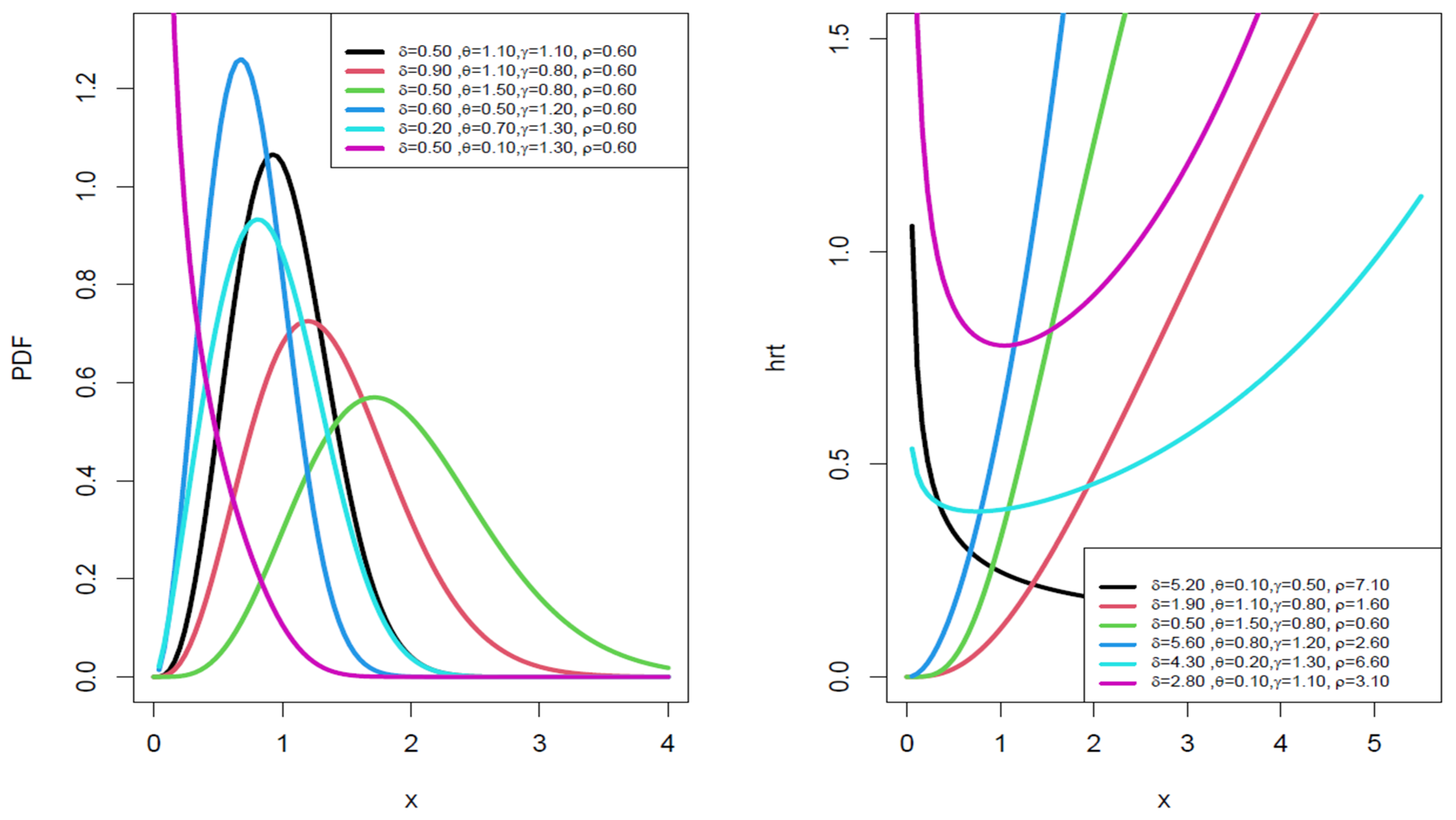
Figure 1 displays PDF of the OGRLx distribution. The graph is characterized by a distinct decreasing trend and a singular peak, indicating a concentration of probability around a specific value. The PDF features a right-skewed configuration, which suggests that while most values cluster around the peak, there is a tail extending to the right. Additionally, the hazard function associated with the OGRLx distribution, as shown in Figure 1, exhibits a J-shaped pattern characterized by both decreasing and increasing segments. This dual behavior provides valuable information regarding the risk associated with different values of the random variable.

3. Statistical Properties

This part delves into the statistical mathematics of the OGRLx distribution, including quantile function, moments, skewness, kurtosis, incomplete moments, R’enyi entropy, tsallis entropy, havrda and charvat entropy, and arimoto entropy.

3.1. Quantile Function

The quantile function may be obtained by applying the inverse function of the CDF to Equation (5).
1 e θ 1 1 + x ρ γ 2 1 + x ρ γ 2 δ = u
therefore, the quantile function of the OGRLx distribution is given for u U 0,1 by
Q ( u ) = 1 ρ 1 2 + 1 θ l n 1 u 1 δ 1 2 + 2 + 1 θ l n 1 u 1 δ 1 2 2 4 2 1 γ
The quantile function given in Equation (7) does not possess a simple closed-form structure but can be evaluated directly for most values of u ∈ (0, 1). However, for extreme quantiles (when u is very close to 0 or 1), numerical instability may occur due to the logarithmic term ln ( 1 u 1 δ ) and nested square-root operations. In such cases, the quantile can be obtained more reliably by solving the nonlinear equation F(x) = using a root-finding algorithm such as the Newton–Raphson or bisection methods. In our implementation (performed in R), this confirms the practical computability of the proposed quantile function even for large sample simulations.
According to the data presented in Table 1, variations in the parameter values reveal a significant relationship between the parameter u and the corresponding quantiles. Specifically, as the value of u increases, there is a corresponding rise in the quantile values. This trend indicates that higher values of u result in a greater dispersion of the distribution, leading to higher quantile estimates. Thus, the analysis suggests a direct correlation where elevating u systematically elevates the quantile levels, reflecting the sensitivity of the distribution to changes in this parameter.

3.2. Expansion of the PDF

In this part, the researchers used several types of algebraic methods, such as the generalized binomial series [26,27] as follows:
1 u s = r = 0 1 r s r u r , 1 u s = m = 0 Γ s + j m ! Γ p u m   : u < 1 ,   s > 0
and the exponential expansion [28] as follows: e a = j = 0 1 j j ! a j ,
A simplified version of Equation (4) allows us to derive the following expression for PDF for the OGR-G family:
1 e θ H x , ζ 2 1 H x , ζ 2 δ 1 = i = 0 1 i δ 1 i e θ i H x , ζ 2 1 H x , ζ 2
using the Exponential expansion e θ ( i + 1 ) H x , ζ 2 1 H x , ζ 2 and binomial series expansion 1 H x , ζ ( 3 + 2 k )
Then
j x , ζ O G R G = i = k = v = 0 2 δ 1 i + k θ k + 1 i + 1 k Γ 3 + 2 k + v k ! v ! Γ 3 + 2 k δ 1 i h x , ζ 2 H x , ζ H x , ζ 3 + 4 k + v
We can expand H x , ζ 3 + 4 k + v hence
j x , ζ O G R G = l = 0 2 i , k , v , r , l h x , ζ H x , ζ l l = 0 i , k , v , r , l h x , ζ H x , ζ l + 1
where
i , k , v , r , l = i = k = v = r = 0 2 δ 1 i + k + r + l θ k + 1 i + 1 k Γ 3 + 2 k + v k ! v ! Γ 3 + 2 k δ 1 i 3 + 4 k + v r l r
by substituting Equations (1) and (2) into Equation (8)
j x , ζ O G R L x = l = 0 2 i , k , v , r , l γ ρ 1 + x ρ ( γ + 1 ) 1 1 + x ρ γ l l = 0 i , k , v , r , l γ ρ 1 + x ρ ( γ + 1 ) 1 1 + x ρ γ l + 1
using binomial series expansion, then
j x , ζ O G R L x = l = m = 0 i , k , v , r , l 1 m l + 1 m 2 γ ρ 1 + x ρ γ ( m + 1 ) 1 l = q = 0 i , k , v , r , l 1 q l + 1 q γ ρ 1 + x ρ γ ( q + 1 ) 1
therefore, the PDF expansion for the OGRLx distribution is as follows:
j x , ζ O G R L x = m = 0 ¥ l , m h x ;   ρ ,   γ m + 1 q = 0 ψ l , q h x ;   ρ ,   γ q + 1
where h x ; ρ , γ m + 1 is the PDF of the Lx distribution with parameters ρ and γ(m + 1), ¥ l , m = l = 0 i , k , v , r , l 2 ( 1 ) m + 1 l + 1 m , and h x ; ρ , γ q + 1 is the PDF of Lx distribution with parameters ρ and γ(q + 1), ψ l , q = l = 0 i , k , v , r , l 1 q q + 1 l + 1 q .
Given the mathematical complexity arising from the nested series in Equation (9), we explain that this expansion aims to transform the density function into a simple linear combination of Lomax distributions, which facilitates the calculation of moments. To ensure clarity of the derivation, we summarize the roles of the key indicators as follows: The indicators (i, k, v): relate to the expansion of the generator and the relationship of the basic forces. The indices (r, l): are the result of the binary expansion of the cumulative function transformation. The indices (m, q): are the final indices that give the relative weight of each component in the final distribution. We emphasize that these series converge very quickly (Rapid Convergence), since using only the first 20 terms gives extremely high computational accuracy, making them practical for software application.

3.3. Moments

Statistical moments of different orders are essential in understanding the degree of uncertainty linked to distributions, such as skewness (S1) coefficients and kurtosis (K1) coefficients. The nth moment of the OGRLx distribution is calculated as follows [29]:
μ ˙ n = E ( X n ) = 0 x n j x d x
by substituting Equation (9) into the equation above
μ ˙ n = m = 0 ¥ l , m 0 x n h x ;   ρ ,   γ m + 1 d x q = 0 ψ l , q 0 x n h x ;   ρ ,   γ q + 1 d x
then
μ ˙ n = m = 0 ¥ l , m ρ γ m + 1 n Γ n + 1 Γ ( γ m + 1 n ) Γ ( γ m + 1 + 1 ) q = 0 ψ l , q ρ γ q + 1 n Γ n + 1 Γ ( γ q + 1 n ) Γ ( γ q + 1 + 1 )
let ϖ = γ m + 1 > n , a n d   η = γ q + 1 > n
  • Equation (10) yields the OGRLx distribution μ ˙ 1 ,   μ ˙ 2 ,   μ ˙ 3 ,   a n d   μ ˙ 4 as follows.
μ ˙ 1 = m = 0 ¥ l , m ρ ϖ Γ ( ϖ 1 ) Γ ( ϖ + 1 ) q = 0 ψ l , q ρ   η Γ   η 1 Γ   η + 1 ,       ϖ ,   η > 1
μ ˙ 2 = m = 0 ¥ l , m 2 ρ ϖ 2 Γ ( ϖ 2 ) Γ ( ϖ + 1 ) q = 0 ψ l , q 2 ρ   η 2 Γ (   η 2 ) Γ (   η + 1 ) ,       ϖ ,   η > 2
μ ˙ 3 = m = 0 ¥ l , m 6 ρ ϖ 3 Γ ( ϖ 3 ) Γ ( ϖ + 1 ) q = 0 ψ l , q 6 ρ   η 3 Γ (   η 3 ) Γ (   η + 1 ) ,       ϖ ,   η > 3
μ ˙ 4 = m = 0 ¥ l , m 24 ρ ϖ 4 Γ ( ϖ 4 ) Γ ( ϖ + 1 ) q = 0 ψ l , q 24 ρ   η 4 Γ (   η 4 ) Γ (   η + 1 ) ,       ϖ ,   η > 4
using Equations (11)–(14), we can calculate the variance V = E ( X 2 ) E X 2 , skewness S 1 = µ 3 µ 2 3 2 , and kurtosis K 1 = µ 4 µ 2 2 of the OGRLx distribution as follows:
To ensure the accuracy of the statistical results, we imposed software constraints during the estimation process to ensure that the parameters remain within the range that satisfies the condition γ m + 1 > n . This procedure ensures the existence of the estimated moments and prevents computational errors or obtaining illogical values during likelihood maximization. In practical applications, it has been shown that the values obtained for the parameters fully satisfy this condition, which enhances the reliability of the extracted statistical properties of the model.
Table 2 shows the numerical values of the moments μ ˙ 1 , μ ˙ 2 , μ ˙ 3 , μ ˙ 4 , variance, skewness (S1), and kurtosis (K1) associated with the OGRLx distribution. From Table 2 we note that when the values of δ, θ, and γ are fixed and the value of ρ increases. Then the values moments, var (x), S1, and K1 are increases.
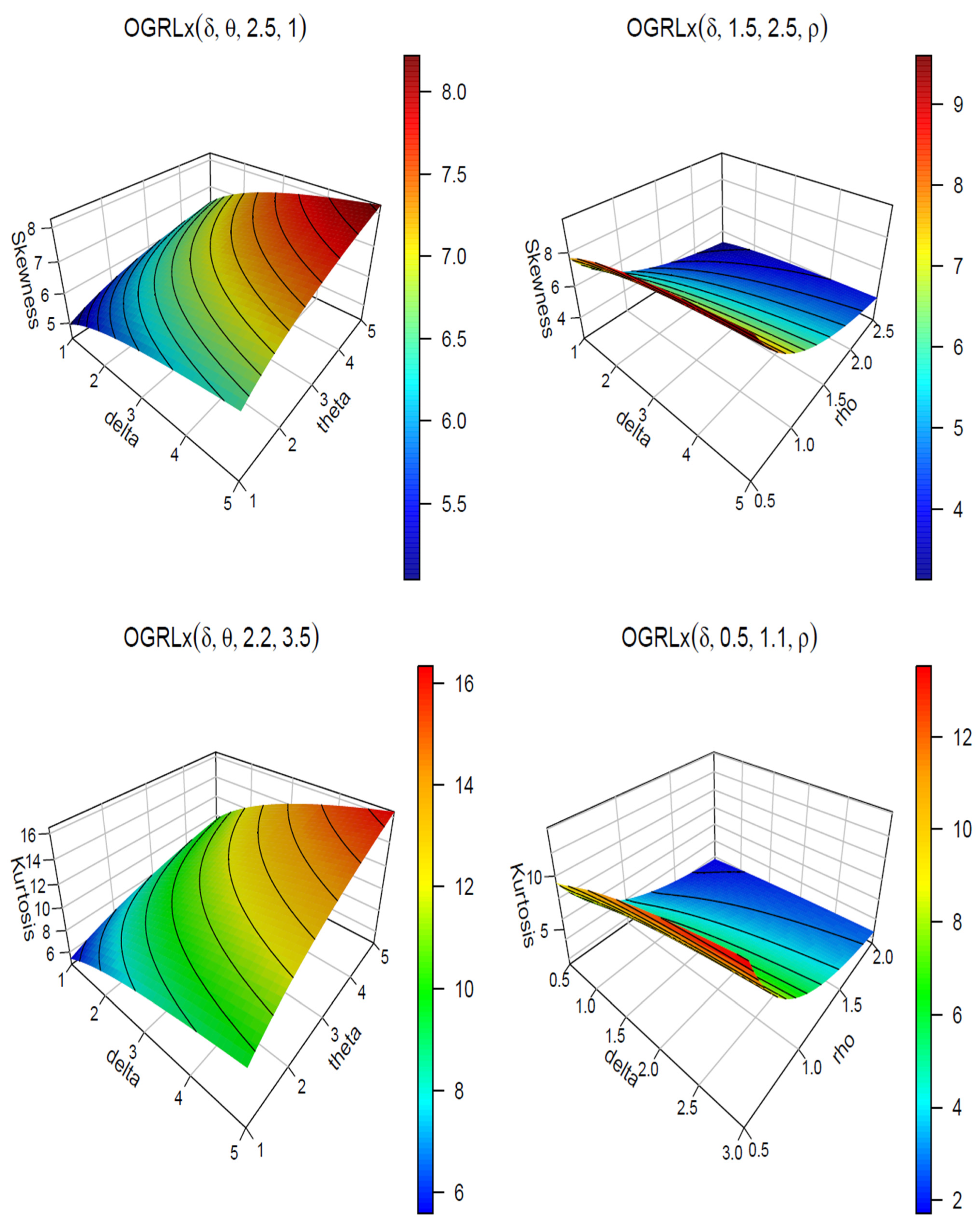
Figure 2 illustrates the dynamic relationship between the parameters of the OGRLx distribution and statistical shape measures. The upper left graph shows a direct increase in the skewness coefficient with changes in the parameters δ and θ, indicating that increasing these parameters increases the length of the right tail of the distribution. In contrast, the upper right graph shows that the curvature may decrease slightly in certain regions when δ and ρ are changed, reflecting the flexibility of the distribution in shifting towards more symmetrical shapes depending on the parameter values.
Regarding the degree of slant of the distribution, the lower left graph shows a marked increase in the kurtosis coefficient with changes in δ and θ, reflecting a greater concentration of probability mass around the center (a slanted distribution). The lower right graph, however, reveals a variation in kurtosis values with changes in δ and ρ, with values decreasing slightly in some regions. This variation demonstrates the ability of the OGRLx distribution to model a wide range of data, from those with light tails to those with very heavy tails, based on the combined interaction between the shaping and scaling parameters.

3.4. Various Entropy Measures

There are various ways to measure the OGRLx’s entropy, as mentioned earlier. These include R’enyi entropy, Tsallis entropy, Havrda and Charvat entropy, and Arimoto entropy.

3.4.1. Rényi Entropy

Several disciplines have used the entropy of a random variable. It quantifies the degree of variability and uncertainty. The Rényi entropy of a random variable X is precisely defined as the following:
T R φ O G R G = 1 1 φ l o g 0 j φ x O G R G d x           ,     φ > 0 ,   φ 1
by substituting Equation (4) into Equation (15)
T R φ O G R G = 1 1 φ l o g 0 2 δ θ φ H x , ζ 3 φ h φ x , ζ 2 H x , ζ φ 1 H x , ζ 3 φ 1 e θ H x , ζ 2 1 H x , ζ 2 φ δ 1 e θ φ H x , ζ 2 1 H x , ζ 2 d x
using binomial series expansion and Exponential expansion, then
j φ x , ζ O G R G = k = v = 0 1 k + v 2 δ θ φ θ v k + 1 v v ! φ ( δ 1 ) k h φ x , ζ 2 H x , ζ φ H x , ζ 3 + 4 v 1 H x , ζ ( 3 + 2 v )
again using binomial series and expand 2 H x , ζ φ , then the PDF expansion power for the OGR-G family is as follows:
j φ x , ζ O G R G = r = 0 k , v , i , p , q , m , r h x , ζ φ H x , ζ r
where
k , v , i , p , q , m , r = k = v = i = p = q = m = 0 1 k + v + q + m + r 2 δ θ     φ θ v k + 1 v Γ 3 + 2 v + i v ! i ! Γ 3 + 2 v φ ( δ 1 ) k φ p p q 3 + 4 v + i + q m m r
substituting Equations (1) and (2) into Equation (16)
j φ x , ζ O G R L x = r = 0 k , v , i , p , q , m , r γ ρ 1 + x ρ ( γ + 1 ) φ 1 1 + x ρ γ r
using binomial series
1 1 + x ρ γ r = l = 0 1 l r l 1 + x ρ γ l
hence
j φ x , ζ O G R L x = r = l = 0 k , v , i , p , q , m , r 1 l r l γ φ ρ φ 1 + x ρ γ ( φ + l ) φ
then the T R φ O G R L x as follows
T R φ O G R L x = 1 1 φ log l = 0 r , l
where
r , l = r = l = 0 k , v , i , p , q , m , r 1 l r l 0 γ φ ρ φ 1 + x ρ γ ( φ + l ) φ d x

3.4.2. Tsallis Entropy

Describe the Tsallis entropy for the OGRLx distribution as follows:
T φ = 1 1 φ 1 0 j x φ d x                 , φ > 0 ,   φ 1
substituting Equation (18) into Equation (19)
T ( φ ) = 1 1 φ 1 l = 0 r , l

3.4.3. Havrda and Charvat Entropy

We can define the Haveda and Charvat entropy as a measure and express it using the following:
H C φ x = 1 2 1 φ 1 0 j x φ d x 1 φ 1           ,     φ > 0 ,   φ 1
substituting Equation (18) into Equation (21), we have
C φ x = 1 2 1 φ 1 l = 0 r , l 1 φ 1

3.4.4. Arimoto Entropy

The Arimoto entropy, denoted as (A), of the OGRLx distribution, may be computed as follows:
A φ = φ 1 φ 0 j x φ d x 1 φ 1           ,     φ > 0 ,   φ 1
substituting Equation (18) into Equation (23), we have
A φ = φ 1 φ l = 0 r , l 1 φ 1

3.4.5. Practical Significance of Entropy Measures

The entropy measures derived in Section 3.4.1, Section 3.4.2, Section 3.4.3 and Section 3.4.4 provide more than just a theoretical characterization of the OGRLx distribution. In reliability engineering, Shannon and Rényi entropies are used to quantify the uncertainty associated with the failure time of a system; a higher entropy indicates a more unpredictable failure pattern. In Information Theory, Arimoto and Tsallis entropies are crucial for analyzing non-extensive systems and signal processing, where they help in determining the minimum bit rate required for lossless data compression. Furthermore, in ecology and physics, these measures serve as indices of diversity and complexity, allowing researchers to distinguish between different stages of a process based on the ‘randomness’ of the observed data.

4. Estimation of Parameters

Here, we examine various methods for estimating the parameters δ, θ, γ, and ρ of our proposed distribution.

4.1. Maximum Likelihood Estimation (MLE)

Use just the MLE approach to calculate the values of the unknown parameters in the OGRLx distribution using complete samples. The parameter vector = δ , θ , γ , ρ T . The log-likelihood function for ∅ can be obtained as follows [30,31]:
L = n l o g 2 + n l o g δ + n l o g θ + n l o g γ n l o g ρ + i = 1 n l o g 1 + x i ρ 2 γ 1 + 3 i = 1 n l o g 1 1 + x i ρ γ + i = 1 n l o g 1 + 1 + x i ρ γ + ( δ 1 ) i = 1 n l o g 1 e θ 1 1 + x i ρ γ 2 1 + x i ρ γ 2 θ i = 1 n 1 1 + x i ρ γ 2 1 + x i ρ γ 2
for each parameter δ, θ, γ, and ρ, we may get their probability estimate by taking the first partial derivative of the log-likelihood function
( L ) δ = n δ + i = 1 n l o g 1 e θ 1 l γ 2 l γ 2
( L ) θ = n θ + ( δ 1 ) i = 1 n 1 l γ 2 l γ 2 e θ 1 l γ 2 l γ 2 1 e θ 1 l γ 2 l γ 2 i = 1 n 1 l γ 2 l γ 2
( L ) γ = n γ + i = 1 n 2 ln l l 2 γ 1 l 2 γ 1 + 3 i = 1 n l γ ln l 1 l γ i = 1 n l γ l n ( l ) 1 + l γ + ( δ 1 ) i = 1 n 4 θ 1 l γ 3 ln l l γ 2 θ 1 l γ 4 ln l l 2 γ e θ 1 l γ 2 l γ 2 1 e θ 1 l γ 2 l γ 2 i = 1 n 4 θ 1 l γ 3 ln l l γ 2 θ 1 l γ 4 ln l l 2 γ
( L ) ρ = n ρ i = 1 n 2 γ 1 x i ρ 2 l 2 γ 2 l 2 γ 1 3 i = 1 n γ x i ρ 2 l γ 1 1 l γ + i = 1 n γ x i ρ 2 l γ 1 1 + l γ δ 1 i = 1 n 4 θ γ x i 1 l γ 3 ρ 2 l γ + 1 + 2 θ γ x i 1 l γ 4 ρ 2 l 2 γ + 1 e θ 1 l γ 2 l γ 2 1 e θ 1 l γ 2 l γ 2 + i = 1 n 4 θ γ x i 1 l γ 3 ρ 2 l γ + 1 + 2 θ γ x i 1 l γ 4 ρ 2 l 2 γ + 1
where l = 1 + x i ρ , and although Newton–Raphson’s approach can be used numerically, it is not possible to calculate the MLE analytically for parameters δ, θ, γ, and ρ. It is determined by numerically calculating Equations (26)–(29) and setting them equal to zero.

4.2. Least Squares Estimation (LSE)

The least squares approach made its debut by [32]. The parameter estimations are obtained by minimizing the objective function. This is comparable to the least squares function, as follows:
L δ , θ ,   γ , ρ = i = 1 n J x i ; n , δ , θ ,   γ , ρ i n + 1 2 = i = 1 n 1 e θ 1 1 + x ρ γ 2 1 + x ρ γ 2 δ i n + 1 2
the estimations are derived by solving the following nonlinear equations:
i = 1 n J x i ; n , δ , θ ,   γ , ρ i n + 1 1 x i ; n , δ , θ ,   γ , ρ = 0
i = 1 n J x i ; n , δ , θ ,   γ , ρ i n + 1 2 x i ; n , δ , θ ,   γ , ρ = 0
i = 1 n J x i ; n , δ , θ ,   γ , ρ i n + 1 3 x i ; n , δ , ϑ ,   γ , ρ = 0
i = 1 n J x i ; n , δ , θ ,   γ , ρ i n + 1 4 x i ; n , δ , θ ,   γ , ρ = 0
where
1 x i ; n , δ , θ ,   γ , ρ = 1 e θ 1 1 + x ρ γ 2 1 + x ρ γ 2 δ ln 1 e θ 1 1 + x ρ γ 2 1 + x ρ γ 2
2 x i ; n , δ , θ ,   γ , ρ = δ 1 1 + x ρ γ 4 1 + x ρ 2 γ 1 e θ 1 1 + x ρ γ 2 1 + x ρ γ 2 δ 1 e θ 1 1 + x ρ γ 2 1 + x ρ γ 2
3 x i ; n , δ , θ ,   γ , ρ = δ 4 θ 1 1 + x ρ γ 3 ln 1 + x ρ 1 + x ρ γ 2 θ 1 1 + x ρ γ 4 ln 1 + x ρ 1 + x ρ 2 γ 1 e θ 1 1 + x ρ γ 2 1 + x ρ γ 2 δ 1 e θ 1 1 + x ρ γ 2 1 + x ρ γ 2
4 x i ; n , δ , θ ,   γ , ρ = δ 4 γ x θ 1 1 + x ρ γ 3 ρ 2 1 + x ρ γ + 1 + 2 γ x θ 1 1 + x ρ γ 4 ρ 2 1 + x ρ 2 γ + 1 1 e θ 1 1 + x ρ γ 2 1 + x ρ γ 2 δ 1 e θ 1 1 + x ρ γ 2 1 + x ρ γ 2

4.3. Weighted Least Squares Estimation (WLSE)

The WLSE technique seeks to calculate estimates for δ, θ, γ, and ρ. The objective is to minimize the WLSE function to acquire the parameter estimations. The target function is defined as follows:
W δ , θ ,   γ , ρ = i = 1 n n + 1 2 ( n + 2 ) i ( n i + 1 ) ( J ( x i ; n , δ , θ ,   γ , ρ ) i n + 1 ) 2 = i = 1 n n + 1 2 ( n + 2 ) i ( n i + 1 ) 1 e θ 1 1 + x ρ γ 2 1 + x ρ γ 2 δ i n + 1 2
using (31)–(34) and the previously described method for determining WLSE’s partial derivatives, we obtain
W δ , θ ,   γ , ρ δ = i = 1 n n + 1 2 ( n + 2 ) i ( n i + 1 ) J x i ; n , δ , θ ,   γ , ρ i n + 1 2 1 x i ; n , δ , θ ,   γ , ρ
W δ , θ ,   γ , ρ ϑ = i = 1 n n + 1 2 ( n + 2 ) i ( n i + 1 ) J x i ; n , δ , θ ,   γ , ρ i n + 1 2 2 x i ; n , δ , θ ,   γ , ρ
W δ , θ ,   γ , ρ γ = i = 1 n n + 1 2 ( n + 2 ) i ( n i + 1 ) J x i ; n , δ , θ ,   γ , ρ i n + 1 2 3 x i ; n , δ , θ ,   γ , ρ
W δ , θ ,   γ , ρ ρ = i = 1 n n + 1 2 ( n + 2 ) i ( n i + 1 ) J x i ; n , δ , θ ,   γ , ρ i n + 1 2 4 x i ; n , δ , θ ,   γ , ρ

4.4. Maximum Product Space Estimators (MPSE)

An acceptable alternative to the highest likelihood strategy is the MPS method, often known as the information measure. Let’s imagine for a moment that we have arranged the data in ascending order. Next, we present the MPSE for the OGRLx in the following form:
G s δ , θ ,   γ , ρ = i = 1 n + 1 J x i ; n , δ , θ ,   γ , ρ J x i 1 ; n , δ , θ ,   γ , ρ       1 n + 1  
where i = 1, 2, …, n+1.
Similarly, one might choose to enhance the function
F δ , θ ,   γ , ρ = 1 n + 1 i = 1 n ln ( J x i ; n , δ , θ ,   γ ,   ρ J x i 1 ; n , δ , θ ,   γ ,   ρ )
finding the first derivative of the function F ( ) with respect to δ, ϑ, γ, and ρ and solving the resultant nonlinear equations yielding the parameter estimations F ( ) δ = 0 ,   F ( ) θ = 0 ,   F ( ) γ = 0 ,   F ( ) ρ = 0 .

4.5. Anderson–Darling Estimation (ADE)

The ADE technique seeks to calculate estimates for δ, θ, γ, and ρ by minimizing the AD function with respect to δ, θ, γ, and ρ. This function is defined as follows:
A δ , θ ,   γ , ρ = n 1 n i = 1 n 2 ! 1 ln J x i ; n , δ , θ ,   γ , ρ + ln S x i ; n , δ , θ ,   γ , ρ = n 1 n i = 1 n 2 ! 1 ln 1 e θ 1 1 + x ρ γ 2 1 + x ρ γ 2 δ + ln 1 1 e θ 1 1 + x ρ γ 2 1 + x ρ γ 2 δ
using (31)–(34) and the previously described method for determining ADE’s partial derivatives, we obtain
A δ , θ ,   γ , ρ δ = i = 1 n 2 ! 1 1 x i ; n , δ , θ ,   γ , ρ J x i ; n , δ , θ ,   γ , ρ 1 x n + 1 i ; n , δ , θ ,   γ , ρ S x n + 1 i ; n , δ , θ ,   γ , ρ
A δ , θ ,   γ , ρ θ = i = 1 n 2 ! 1 2 x i ; n , δ , θ ,   γ , ρ J x i ; n , δ , θ ,   γ , ρ 2 x n + 1 i ; n , δ , θ ,   γ , ρ S x n + 1 i ; n , δ , θ ,   γ , ρ
A δ , θ ,   γ , ρ γ = i = 1 n 2 ! 1 3 x i ; n , δ , θ ,   γ , ρ J x i ; n , δ , θ ,   γ , ρ 3 x n + 1 i ; n , δ , θ ,   γ , ρ S x n + 1 i ; n , δ , θ ,   γ , ρ
A δ , θ ,   γ , ρ ρ = i = 1 n 2 ! 1 4 x i ; n , δ , θ ,   γ , ρ J x i ; n , δ , θ ,   γ , ρ 4 x n + 1 i ; n , δ , θ ,   γ , ρ S x n + 1 i ; n , δ , θ ,   γ , ρ

4.6. Right-Tailed Anderson–Darling Estimation (RTADE)

To obtain RTADE of OGRLx distribution parameters δ, θ, γ, and ρ, minimize the function R(δ, θ, γ, ρ) with respect to these parameters.
R δ , θ ,   γ , ρ = n 2 2 i = 1 n J x i ; n , δ , θ ,   γ , ρ 1 n i = 1 n 2 ! 1 ln S x i ; n , δ , θ ,   γ , ρ = n 2 2 i = 1 n 1 e θ 1 1 + x ρ γ 2 1 + x ρ γ 2 δ 1 n i = 1 n 2 ! 1 ln 1 1 e θ 1 1 + x ρ γ 2 1 + x ρ γ 2 δ
using (31)–(34) and the previously described method for determining RTADE’s partial derivatives, we obtain
R δ , θ ,   γ , ρ δ = 2 i = 1 n 1 x i ; n , δ , θ ,   γ , ρ J x i ; n , δ , θ ,   γ , ρ + 1 n i = 1 n 2 ! 1 1 x n + 1 i ; n , δ , θ ,   γ , ρ S x n + 1 i ; n , δ , θ ,   γ , ρ
R δ , θ ,   γ , ρ ϑ = 2 i = 1 n 2 x i ; n , δ , θ ,   γ , ρ J x i ; n , δ , θ ,   γ , ρ + 1 n i = 1 n 2 ! 1 2 x n + 1 i ; n , δ , θ ,   γ , ρ S x n + 1 i ; n , δ , θ ,   γ , ρ
R δ , θ ,   γ , ρ γ = 2 i = 1 n 3 x i ; n , δ , θ ,   γ , ρ J x i ; n , δ , θ ,   γ , ρ + 1 n i = 1 n 2 ! 1 3 x n + 1 i ; n , δ , θ ,   γ , ρ S x n + 1 i ; n , δ , θ ,   γ , ρ
R δ , θ ,   γ , ρ ρ = 2 i = 1 n 4 x i ; n , δ , θ ,   γ , ρ J x i ; n , δ , θ ,   γ , ρ + 1 n i = 1 n 2 ! 1 4 x n + 1 i ; n , δ , θ ,   γ , ρ S x n + 1 i ; n , δ , θ ,   γ , ρ

4.7. Numerical Estimation and Improvement Procedures

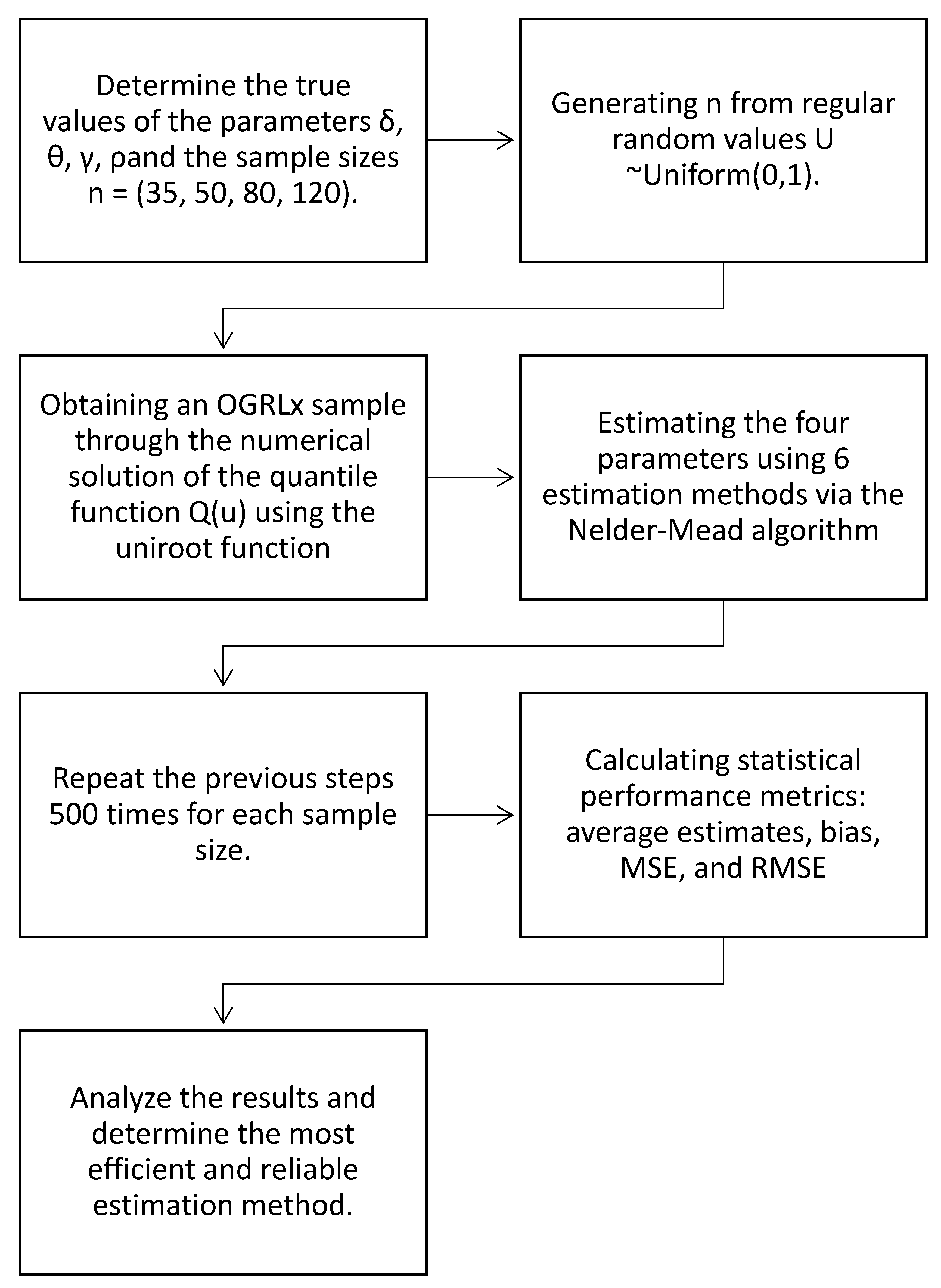
Since all six estimation methods used in this study (MLE, LSE, WLSE, MPSE, ADE, RTADE) involve complex, nonlinear objective functions, the numerical optimization process for estimating the parameters δ, θ, γ, ρ was carried out according to the following methodological steps to ensure accuracy and stability:
  • Data generation and numerical optimization: Since the quantile function lacks a closed form, the uniroot numerical optimization function was used to solve equations and accurately generate random data. For estimation, the Nelder–Mead algorithm (referred to as method = “N” in the code), available in the optimization package within the R programming environment, was employed due to its high capacity for handling complex functions.
  • Parameter Initialization: To ensure rapid convergence and avoid multimodality, the initial values in the code are set to be close to the true values of the parameters. This ensures the stability of the algorithm and its ability to reach the optimal solution in all six estimation methods.
  • Performance Evaluation Criteria: To assess the efficiency of each method, we programmed a special function to calculate statistical performance measures, including the following: Mean Estimates, Mean Squared Error (MSE), Root Mean Squared Error (RMSE), and Bias. Five hundred iterations were performed for each sample size to ensure the reliability of the statistical comparison between the methods.
  • Verification of results: It was confirmed that all resulting estimates met the necessary mathematical conditions, including positive parameters and conditions for the existence of moments, ensuring that the experimental results fully conformed to the theoretical properties of the proposed distribution.

5. Simulation Study

The performance of six different estimation methodologies for the OGRLx distribution was evaluated using Monte Carlo simulation based on a N = 500 sample with sample sizes of 35, 50, 80, and 120. The study included four different parameter value scenarios to ensure the comprehensiveness of the analysis.
  • Case 1: δ = 0.6, θ = 0.5, γ = 0.4, and ρ = 0.3.
  • Case 2: δ = 0.7, θ = 0.6, γ = 0.5, and ρ = 0.4.
  • Case 3: δ = 0.7, θ = 0.7, γ = 0.6, and ρ = 0.5.
  • Case 4: δ = 0.6, θ = 0.4, γ = 0.3, and ρ = 0.5.
The four sets of parameters (Cases 1–4) were carefully chosen to be representative points covering different regions of the parameter space of the OGRLx distribution. This diversity in the selection of shape (γ, δ) and scale (θ, ρ) parameter values aims to ensure the comprehensiveness of the simulation results and their lack of bias towards special cases [33].
For each of the six approaches, we calculated the OGRLx parameters using a Monte Carlo simulation. Here are all the estimated findings in the R programming language. We computed the mean, root mean square error (RMSE), and average bias (Bias), which is defined as follows:
b i a s ( σ ^ ) = i = 1 N σ ^ i N σ ,   a n d   R M S E ( σ ^ ) = i = 1 N ( σ ^ i σ ) 2 N .
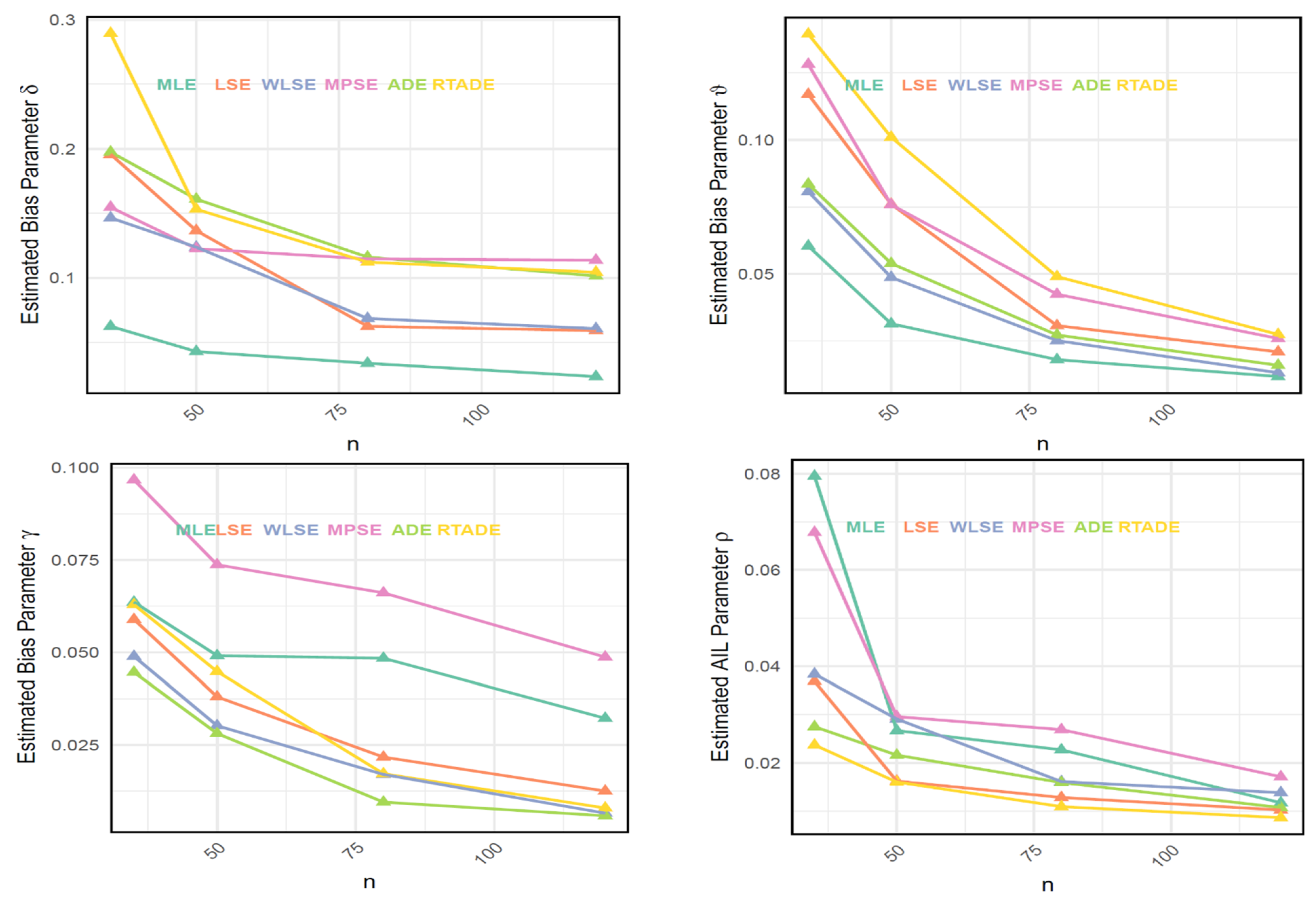
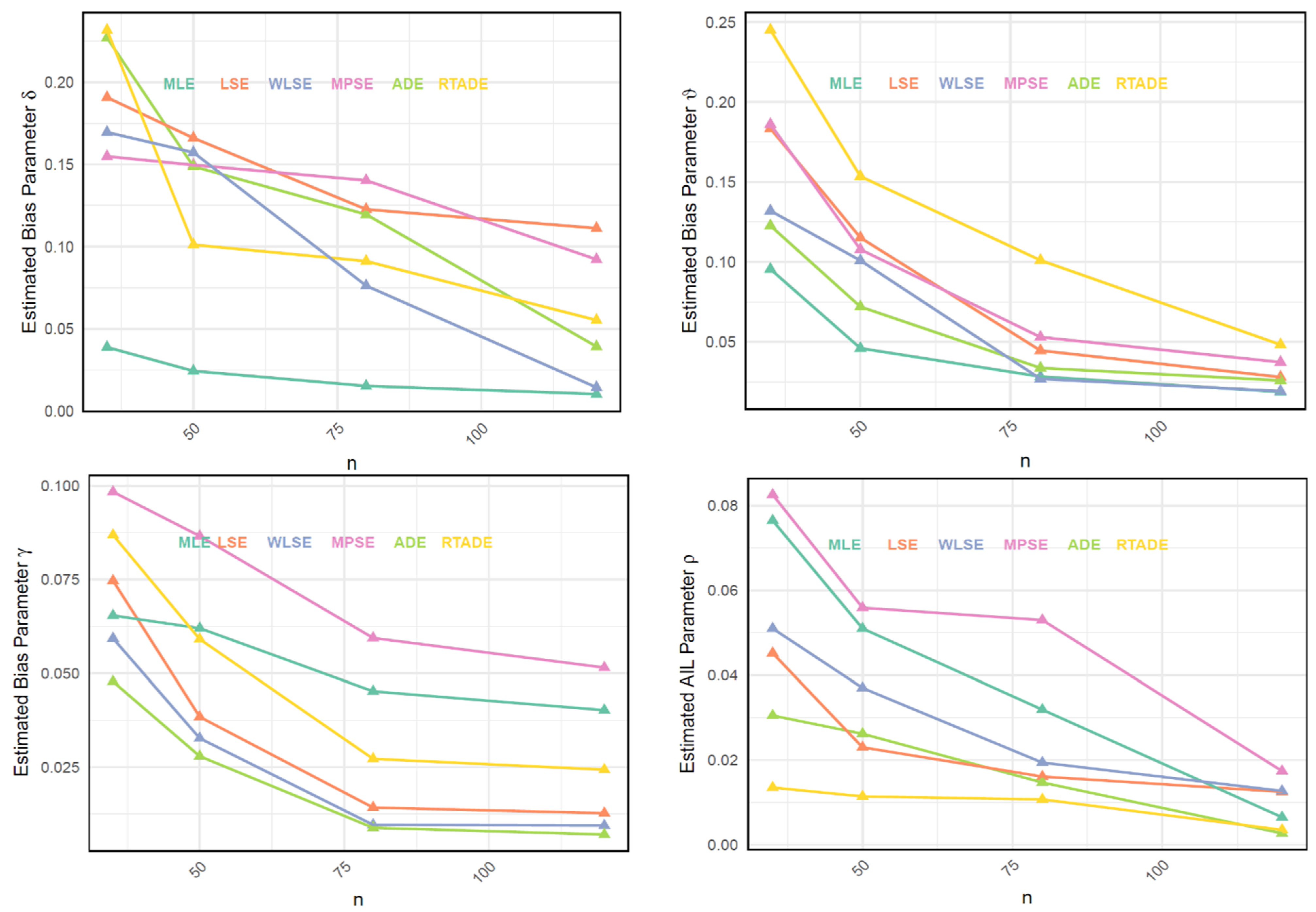
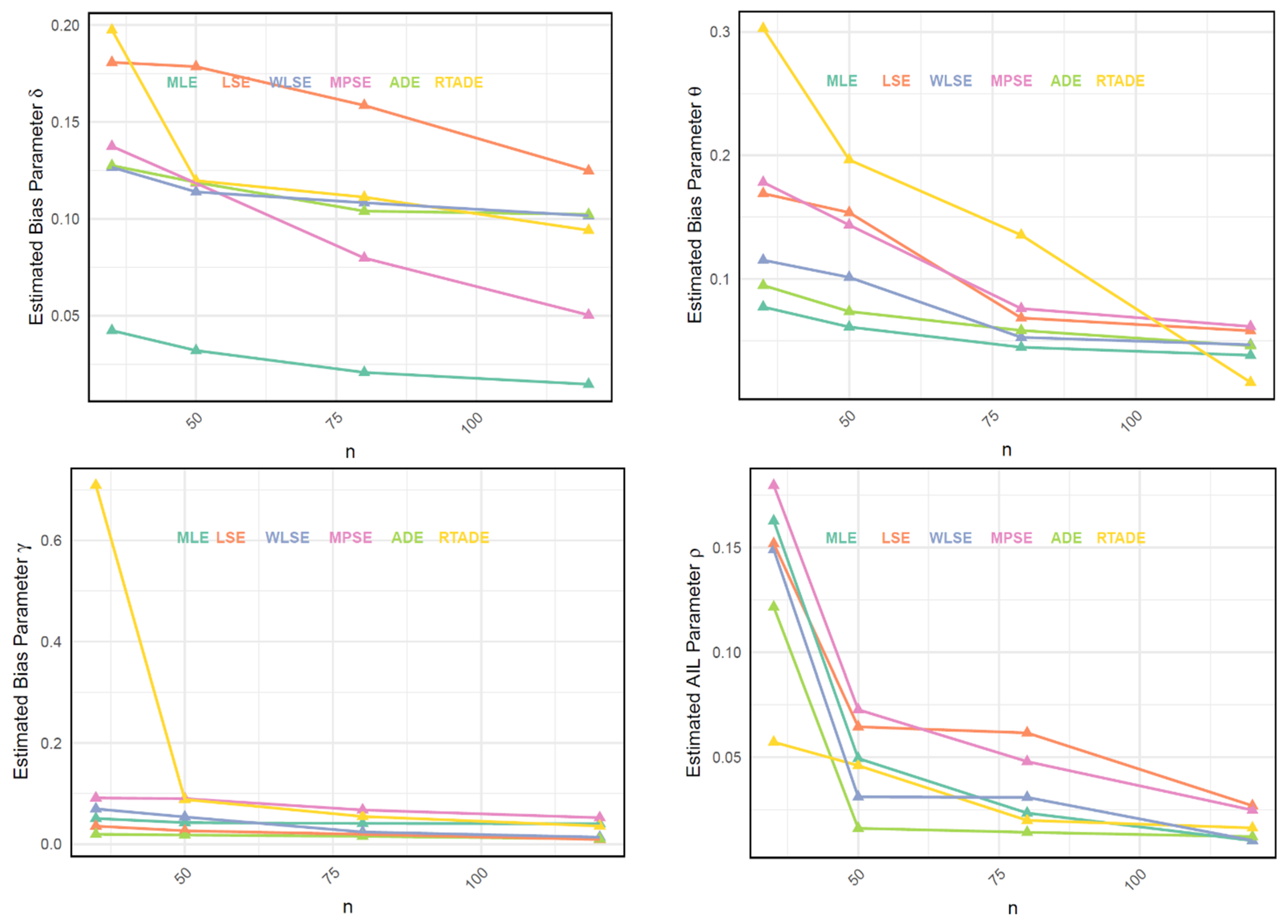
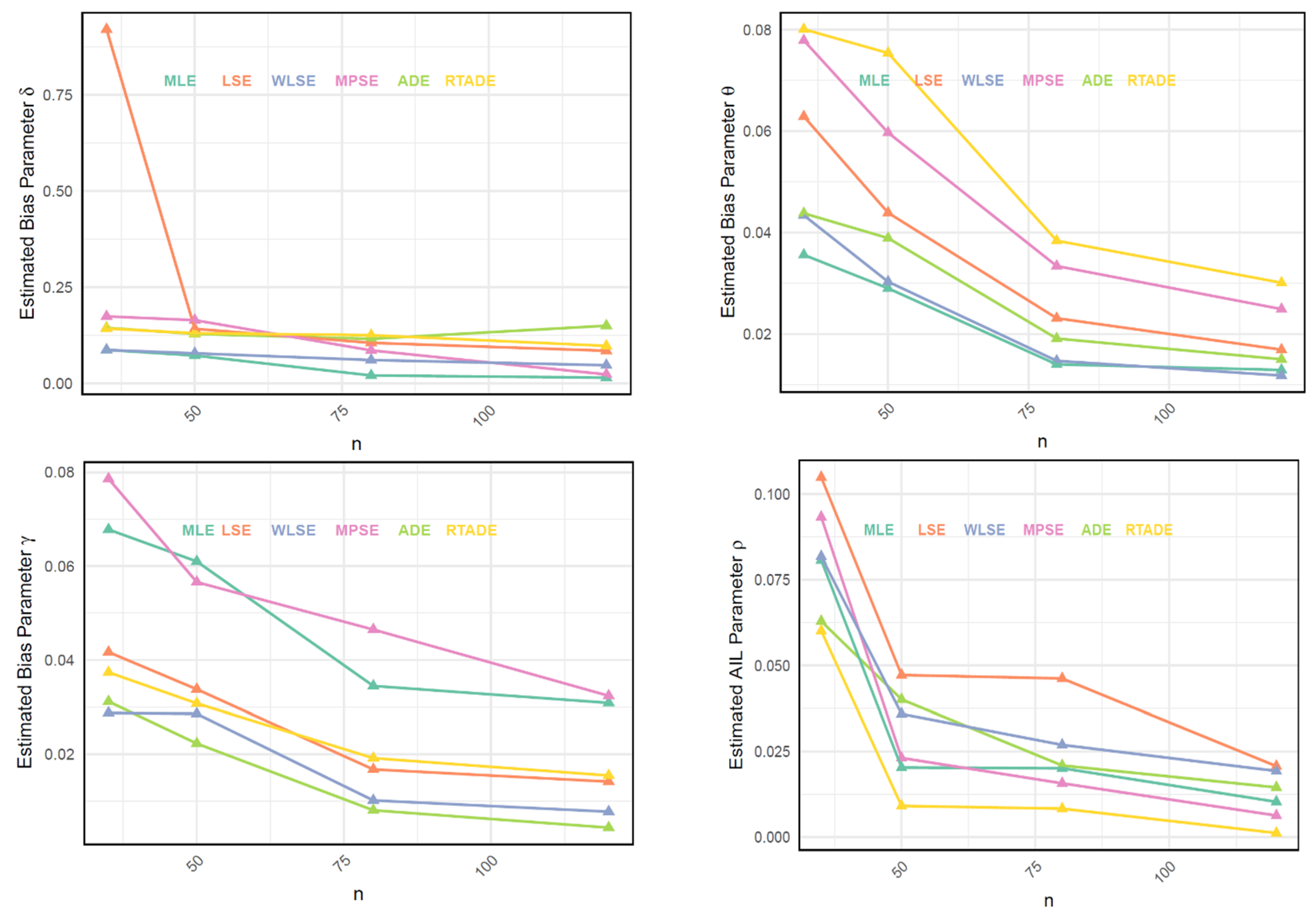
The results documented in Table 3, Table 4, Table 5 and Table 6 and Figure 3, Figure 4, Figure 5 and Figure 6 show in-depth statistical insights into the efficiency of the estimators. In terms of Convergence Behavior, all methods showed remarkable numerical stability, as the values of Bias and RMSE gradually faded away with increasing sample size n, confirming the consistency of the estimators.
When making a critical comparison between the methods, we note the following:
Estimator Efficiency: MLE method demonstrated significant superiority in terms of statistical efficiency and numerical stability, recording the lowest values for RMSE and Bias in most cases. This superiority is attributed to MLE’s ability to extract complete information from the probability function of the OGRLx distribution, particularly in large samples.
Relative performance: The AD method comes as a strong alternative and close competitor to MLE, as it has shown high stability in cases characterized by small sample sizes, indicating high numerical stability for this methodology when dealing with the mathematical complexities of the model.
Parameter sensitivity: Figure 3, Figure 4, Figure 5 and Figure 6 of the bias indicate that the shaping parameters δ and γ) require relatively larger sample sizes to achieve optimal estimation accuracy compared to the scale parameters, which is a vital conclusion for practitioners when applying the model to limited real-world data.
This variation in performance between methods provides great flexibility; while MLE remains the optimal choice for absolute accuracy, other methods provide robust alternatives that ensure reliability of estimation under different numerical conditions.
Note: The simulation results are summarized in Table 3, Table 4, Table 5 and Table 6. For all subsequent tables, the shaded cells indicate the most efficient estimation methods, which are characterized by the lowest Bias and RMSE values for each scenario.
Figure 7 illustrates the organizational structure of the simulation study, showing the sequential steps followed in the estimation process. The simulation cod is also provided in the Appendix A.

6. Application

This section provides a visual representation and practical use cases of the OGRLx distribution. These truths are shown by analyzing two datasets obtained from the economic and bladder cancer patients.
To calculate the first partial derivative of the log-likelihood function with respect to the negative log-likelihood (-LL), Akaike Information Criteria (AIC), Consistent AIC (CAIC), Bayesian Information Criteria (BIC), Hanan and Quinn Information Criteria (HQIC), Anderson–Darling (A*), Cramer–von Mises (W*), Kolmogorov–Smirnov (KS), and p-value tests, R software 4.5.2 was used. Using these information criteria and statistical measures, one can assess the fit quality and compare different distributions.
By utilizing economic and bladder cancer patients, we compared the outcomes of the OGRLx distribution with 10 other well-known Lomax distributions. These variants include the following: Odd Lomax Lomax (OLxLx), Odd Burr XII Lomax (OBXIILx), Truncated Exponential Marshall–Olkin Lomax (TEMOLx), Beta Lomax (BeLx), Kumaraswamy Lomax (KuLx), Eaponential Generalized Lomax (EGLx), Weibull Lomax (WeLx) [34], Gompertz Lomax (GoLx) [35], and Rayleigh Lomax (RLx) distributions.
Table 7 shows the comparative distributions used in this study, with an explanation of the CDF for each model.

6.1. The Data A: (The Economic Dataset)

The economic dataset, which is reproduced in Table 8, consists of 31 yearly time series observations [1980:2010] on response variable as follows: GDP growth (% per year) of Egypt, Source: The economic data employed are collected by World Bank National Accounts data and OECD National Accounts data [36]. The dataset consists of 10.01132, 3.756100, 9.907171, 7.401136, 6.091518, 6.602036, 2.646586, 2.519411, 7.930073, 4.972375, 5.701749, 1.078837, 4.431994, 2.900787, 3.973172, 4.642467, 4.988731, 5.491124, 4.036373, 6.105463, 5.367998, 3.535252, 2.370460, 3.192285, 4.089940, 4.478960, 6.853908, 7.090271, 7.157617, 4.673845, and 5.145106.
Table 8 presents the descriptive analysis of the economic data used, including the number of observations, minimum and maximum values, median, mean, standard deviation, and skewness and kurtosis.
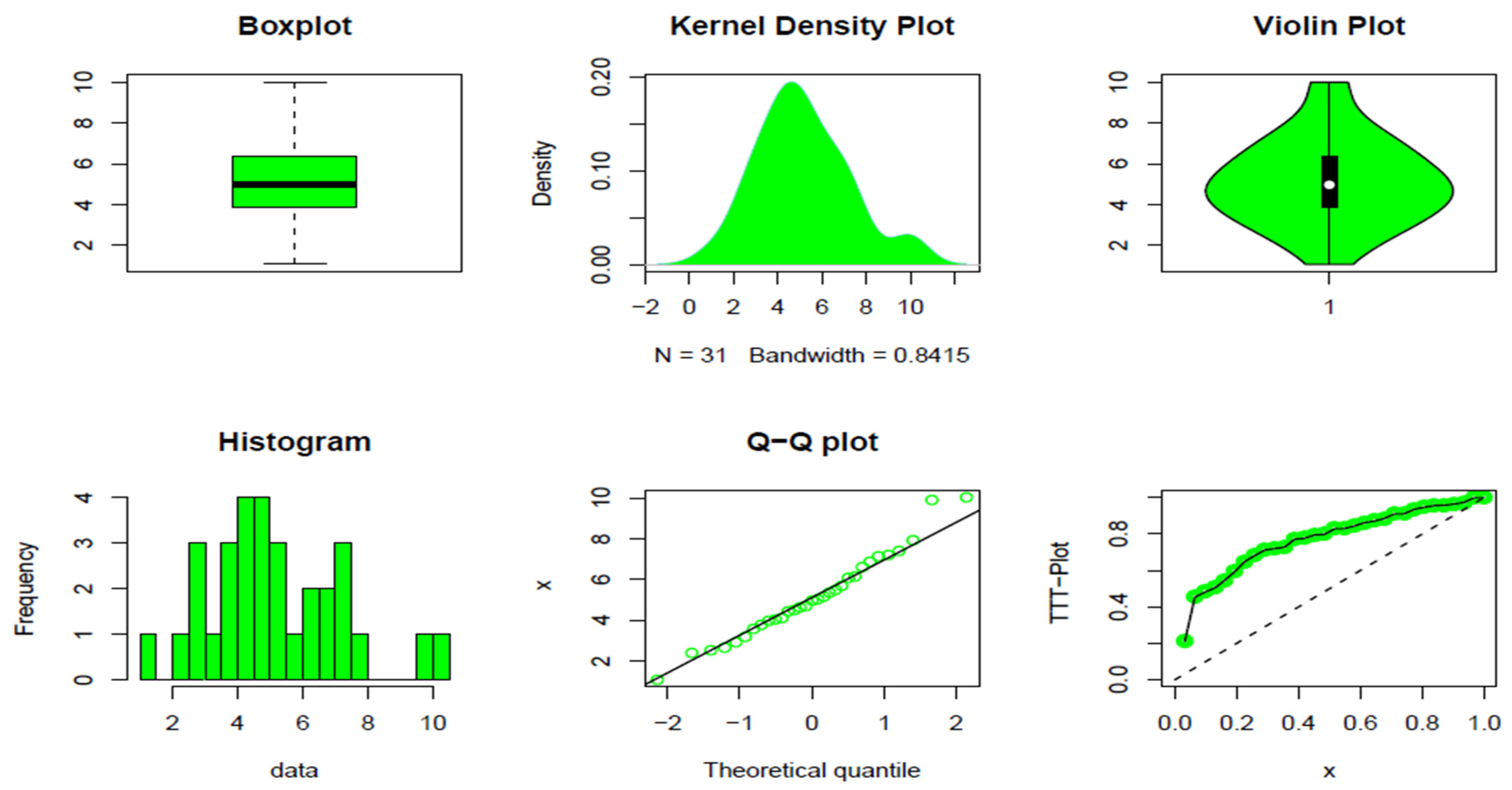
Figure 8 shows a visual representation of data A through various diagnostic plots, including the box plot, kernel density plot, violin plot, histogram, normal probability plot (Q-Q), and TTT plot.
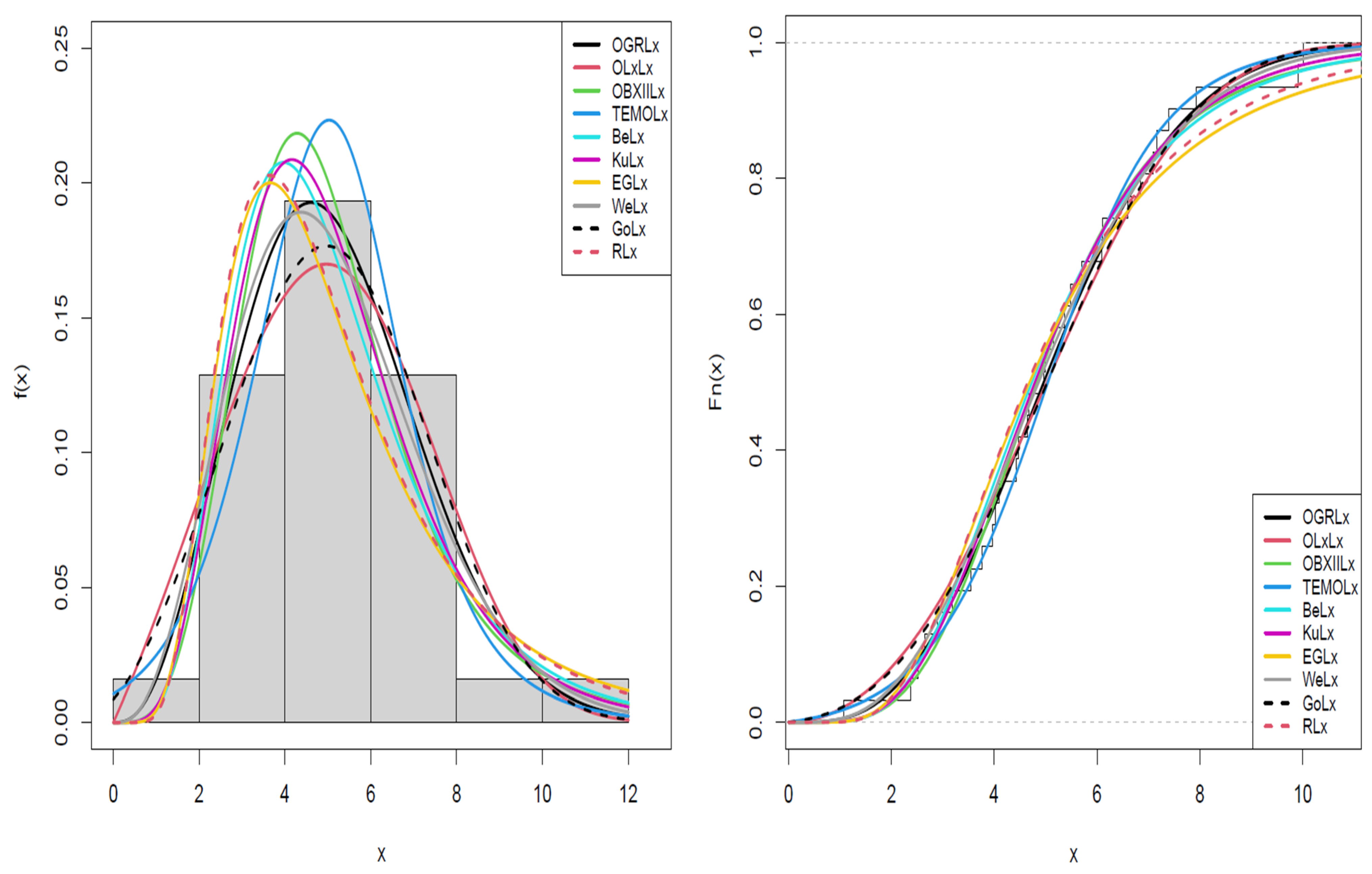
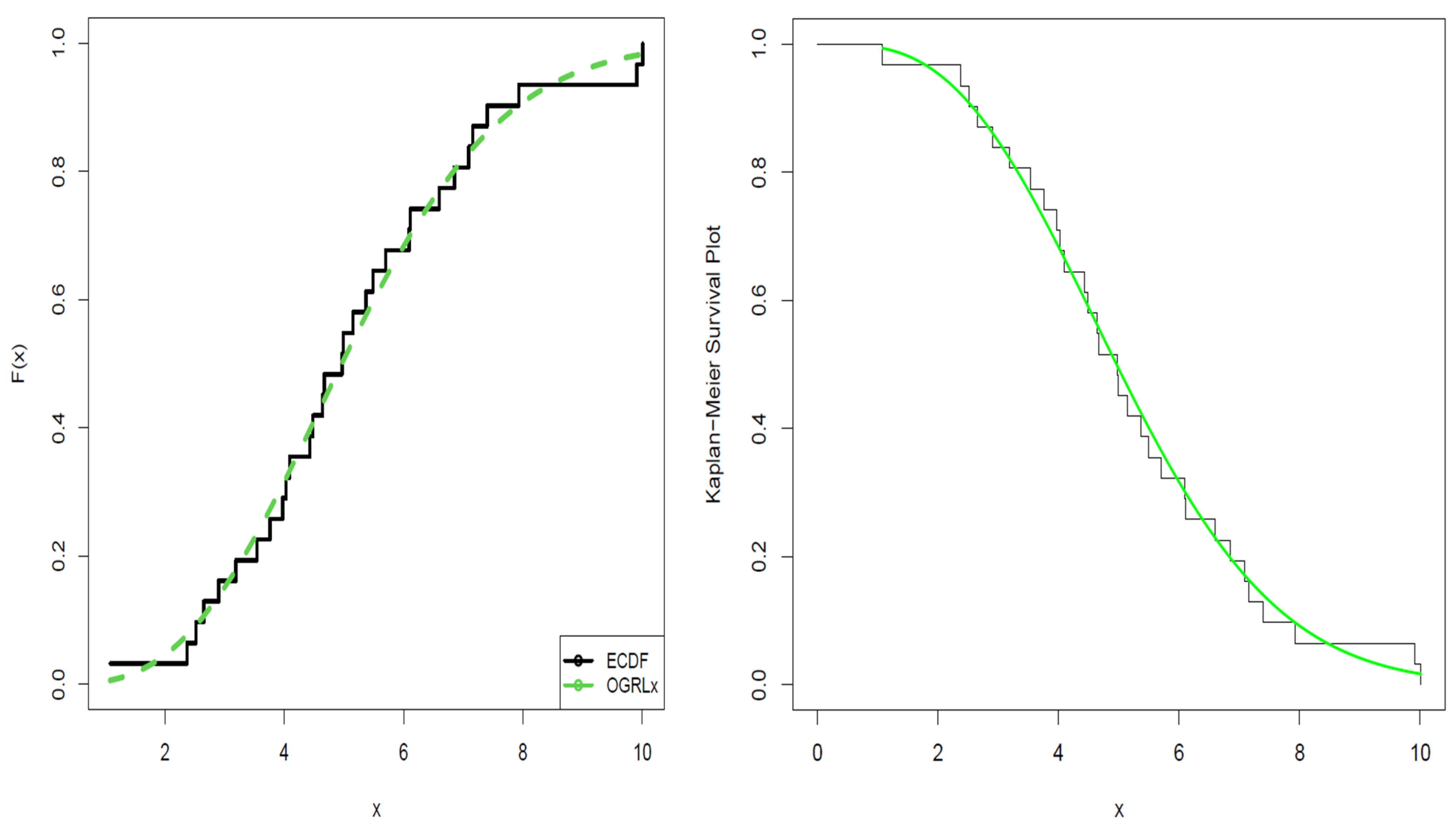
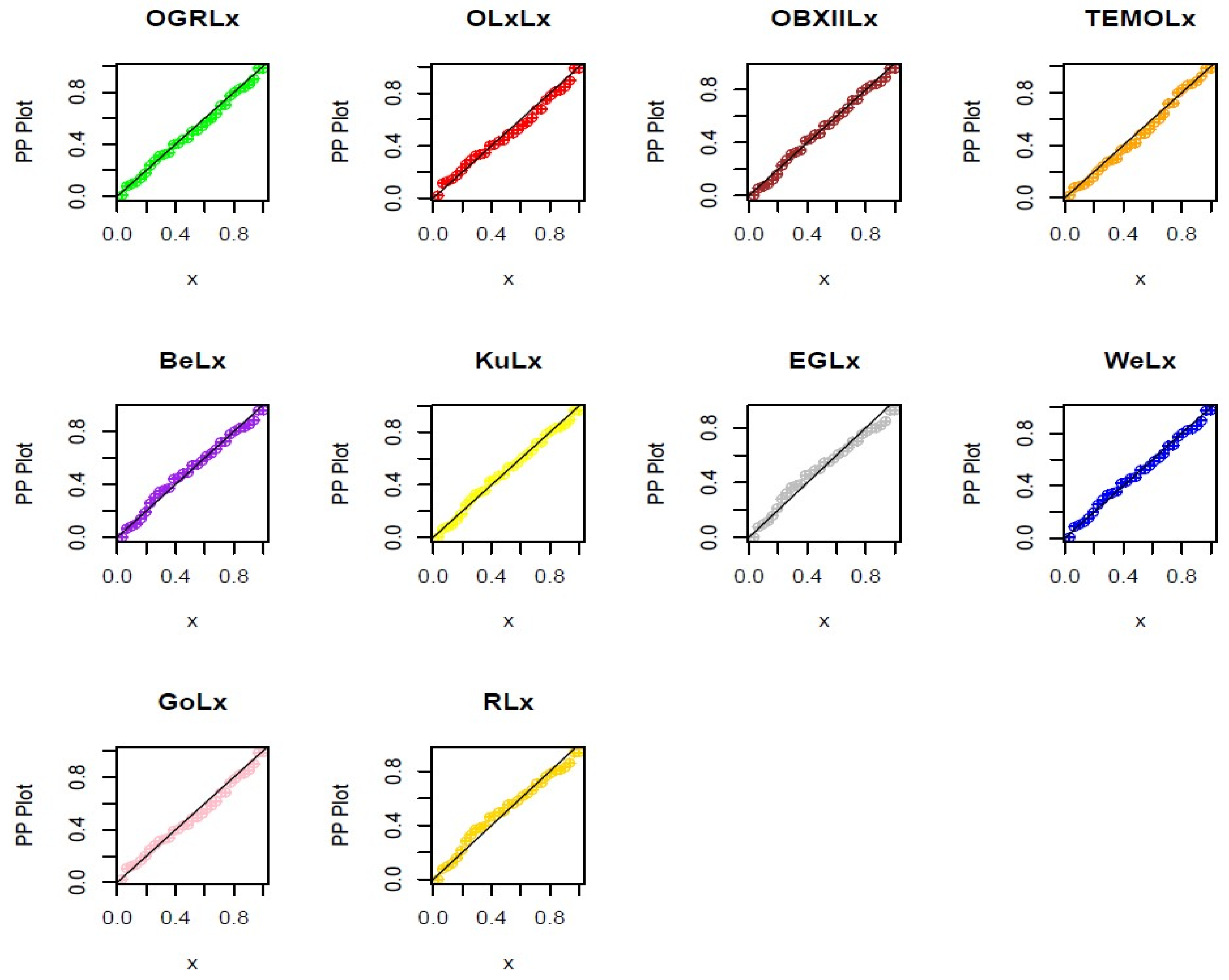
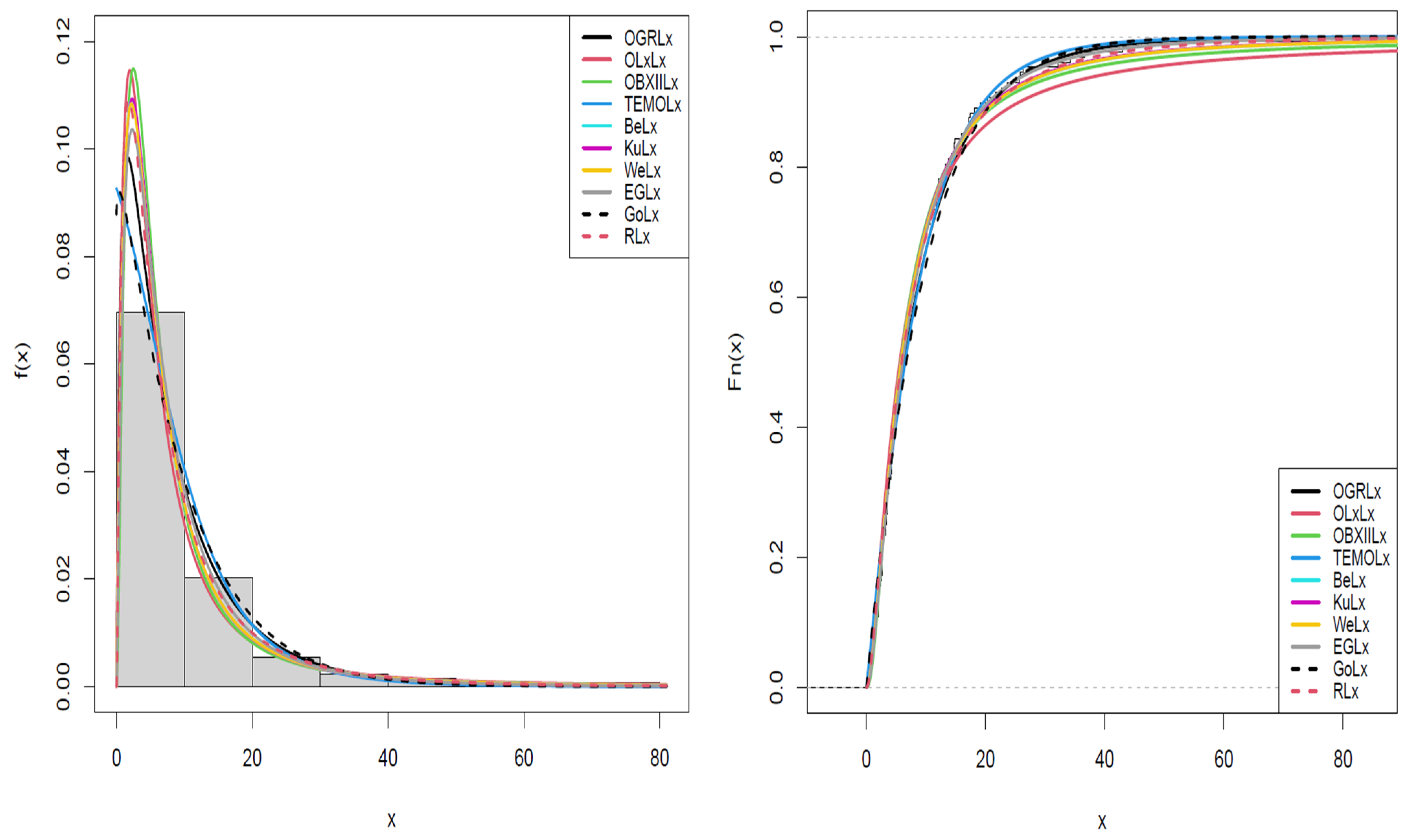
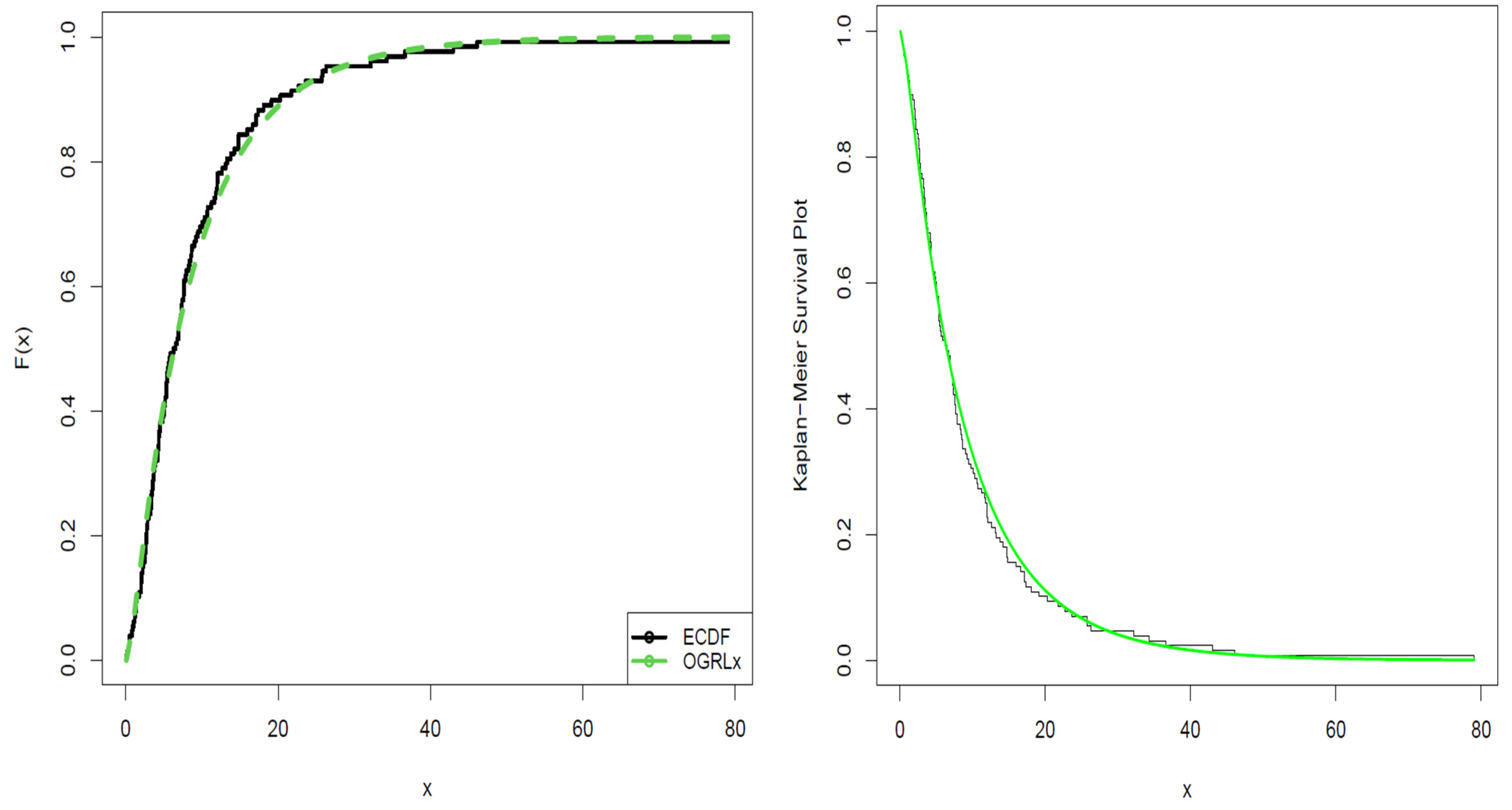
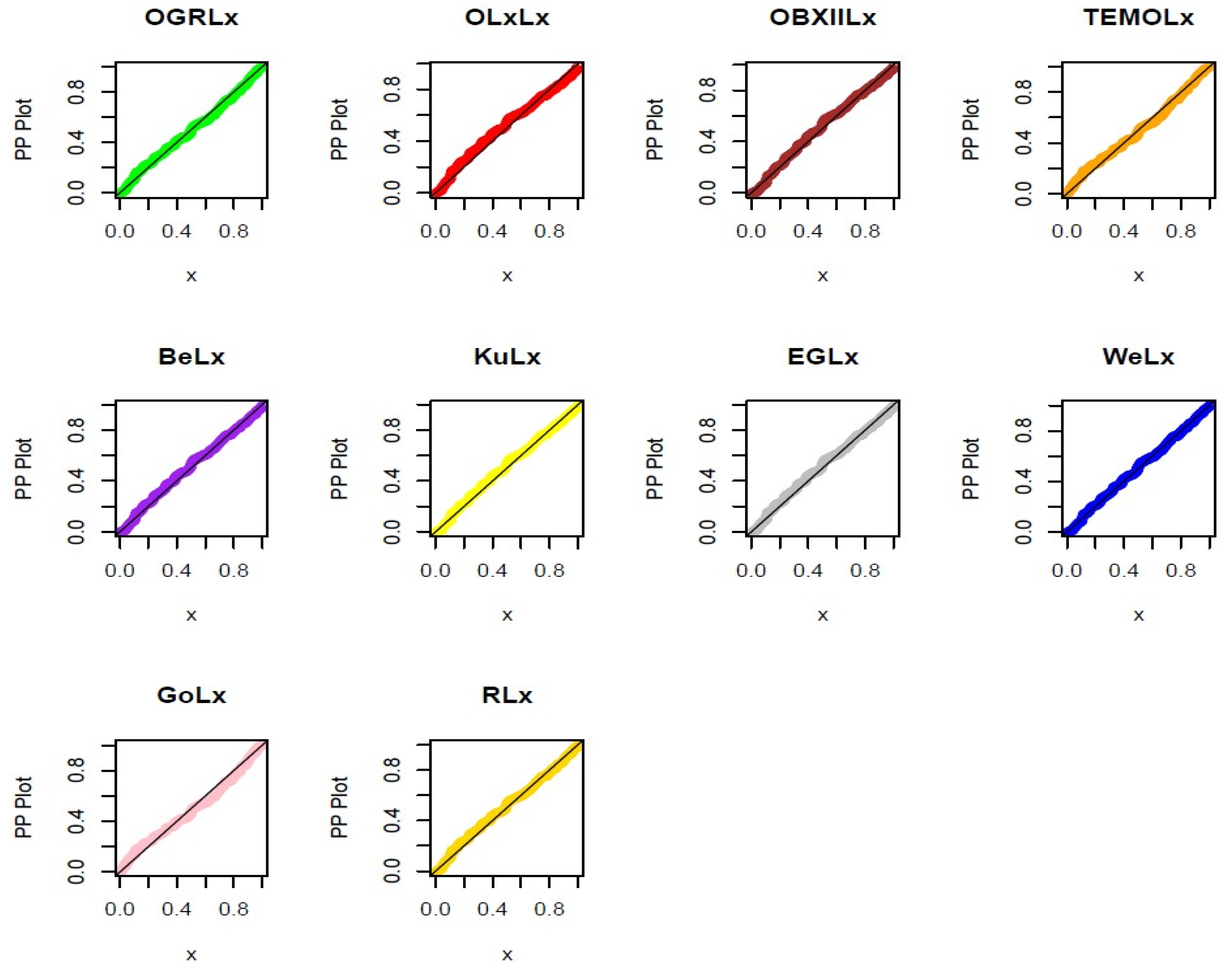
Table 9 and Table 10 present estimates of the OGRLx distribution parameters, log-likelihood values, and an integrated package of eight statistical measures for model differentiation, including the following: information criteria (AIC, CAIC, BIC, HQIC), distance measures (W*, A*), and the K-S test with its associated p-value. The results clearly reveal that the OGRLx distribution achieved the lowest values in all tested statistical criteria and the highest probability value (p-value) compared to all competing models, making it the most efficient and suitable model for the dataset (A). The graphs in Figure 9, Figure 10 and Figure 11 support these statistical results; the estimated PDF, CDF, empirical representation, Kaplan–Meier curves, and P-P plots show the superior ability of the OGRLx distribution to simulate the true pattern of the data. In practical terms, this superiority indicates that the proposed model has exceptional flexibility in accommodating the structural characteristics of the data (such as skewness and risk variance), making it a reliable tool for analysts to draw more accurate conclusions about survival rates or economic forecasts compared to traditional models; this reduces estimation errors and provides a deeper view of real-world data dynamics.

6.2. The Data B

The cancer dataset is sourced from Lee and Wang [37] and includes the remission periods (in months) of 128 bladder cancer patients who were randomly selected. The data are as follows:
0.08, 2.09, 3.48, 4.87, 6.94, 8.66, 13.11, 23.63, 0.20, 2.23, 3.52, 4.98, 6.97, 9.02, 13.29, 0.40, 2.26, 3.57, 5.06,7.09, 9.22, 13.80, 25.74, 0.50, 2.46, 3.64, 5.09, 7.26, 9.47, 14.24, 25.82, 0.51, 2.54, 3.70, 5.17, 7.28, 9.74,14.76, 26.31, 0.81, 2.62, 3.82, 5.32, 7.32, 10.06, 14.77, 32.15, 2.64, 3.88, 5.32, 7.39, 10.34, 14.83, 34.26, 0.90, 2.69, 4.18, 5.34, 7.59, 10.66, 15.96, 36.66, 1.05, 2.69, 4.23, 5.41, 7.62, 10.75, 16.62, 43.01, 1.19, 2.75, 4.26, 5.41, 7.63, 17.12, 46.12, 1.26, 2.83, 4.33, 5.49, 7.66, 11.25, 17.14, 79.05, 1.35, 2.87, 5.62, 7.87, 11.64,17.36, 1.40, 3.02, 4.34, 5.71, 7.93, 11.79, 18.10, 1.46, 4.40, 5.85, 8.26, 11.98, 19.13, 1.76, 3.25, 4.50, 6.25,8.37, 12.02, 2.02, 3.31, 4.51, 6.54, 8.53, 12.03, 20.28, 2.02, 3.36, 6.76, 12.07, 21.73, 2.07, 3.36, 6.93, 8.65,12.63, 22.69.
Table 11 provides a descriptive analysis of the cancer data, including: number of observations, minimum and maximum values, median, mean, standard deviation, and skewness and flattening coefficients.
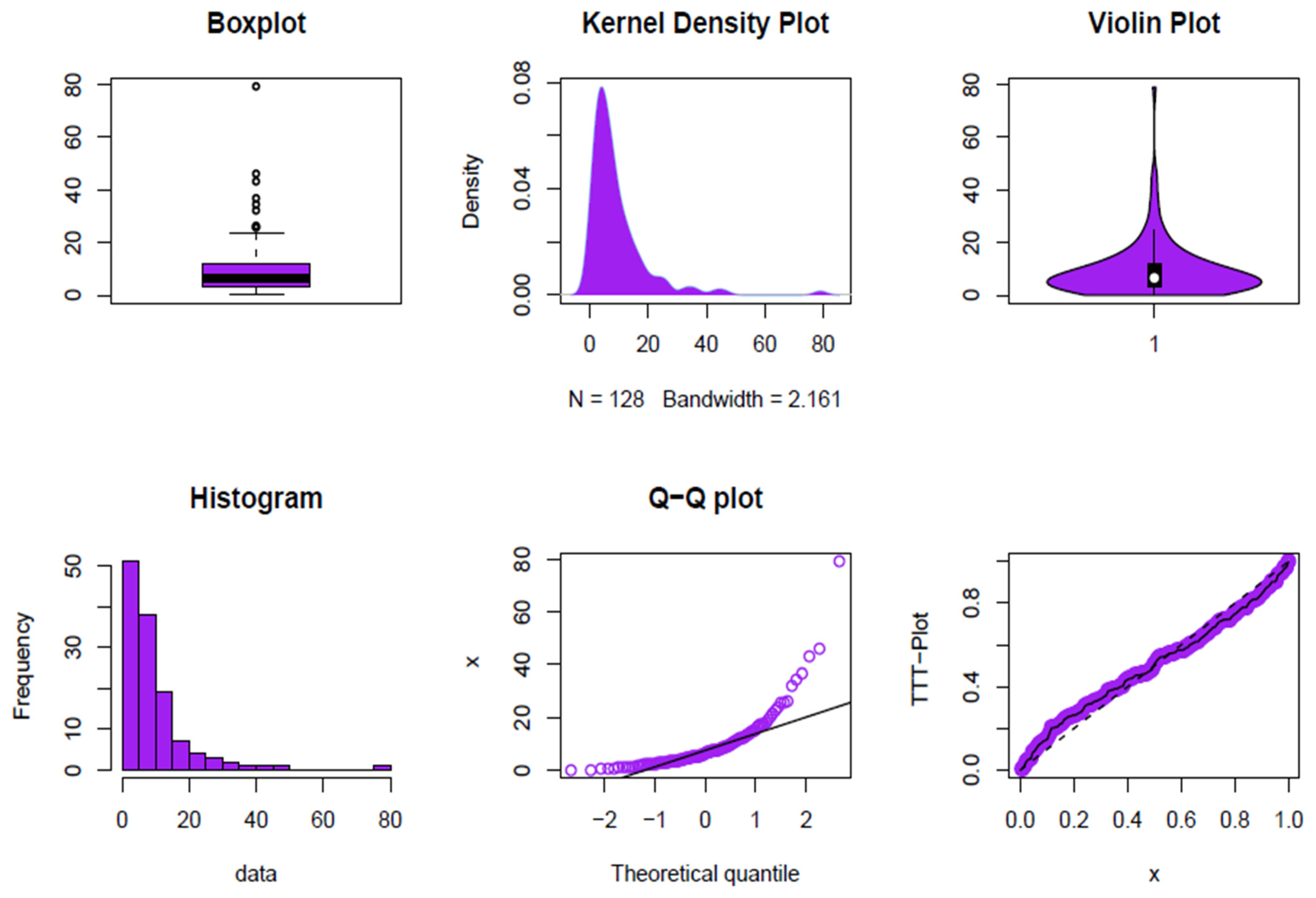
Figure 12 provides a visual representation of the B data through a range of graphs including: box plot, kernel density plot, violin plot, histogram, normal probability plot (Q-Q), and TTT plot.
Table 12 and Table 13 illustrate the results of parameter estimation for the OGRLx distribution applied to the dataset (B), supported by potential logarithm values and a comprehensive set of statistical trade-off criteria including the following: (AIC, CAIC, BIC, HQIC) and fit quality criteria (W*, A*, KS) with their associated probability values. Compared to all alternative models, the OGRLx distribution proved to be absolutely efficient, recording the lowest values in the statistical measures and the highest probability value (p-value), confirming that it is the optimal model and the most capable of representing these data with high flexibility. The graphs shown in Figure 13, Figure 14 and Figure 15 reinforce these results; the estimated PDF and CDF graphs, as well as the empirical graphs, Kaplan–Meier curves, and P-P plots, show an exceptional agreement between the proposed distribution and the actual pattern of data (B). The OGRLx distribution’s ability to accurately acquire data features goes beyond mere numerical matching to provide a deeper understanding of intrinsic data characteristics, such as skewed failure behavior or changes in risk rates, making it a highly competitive model in complex practical applications.

7. Conclusions

In this article, we present the Odd Generalized Rayleigh-Lomax distribution (OGRLx), an extension of the traditional Lomax model. We explore the various statistical features of the proposed OGRLx distribution.
To analyze the behavior of the parameters in this distribution, we used the following six distinct estimation methods: MLE, LSE, WLS, MPSE, AD, and RTAD. A simulation study was conducted to evaluate the performance of these estimation techniques. The results indicated that all methods provided reliable predictions of the parameters, with the MLE estimator being the most efficient in terms of mean, root mean square error (RMSE), and bias.
Real-world data analysis revealed that the OGRLx distribution has “heavy tails” compared to other distributions such as OLxLx and OBXIILx. In practical applications, particularly in economics and bladder cancer studies, the OGRLx distribution consistently outperformed nine other models.
Despite the promising results, there are some limitations to consider; the OGRLx distribution has a high computational complexity resulting from the large mathematical complexity of the probability density function, which requires high programming skills and the selection of starting values. The estimation process may also encounter some identifiability issues that make it difficult to distinguish the individual impact of each parameter in some cases. Therefore, future research should explore broader applications of this distribution in the fields of finance, engineering, and environmental science. In addition, in cases of datasets with simple and unconvoluted structures, simpler models (such as the basic Lomax distribution) may be sufficient and more practical, as the complexity of the four parameters in OGRLx may not be necessary in such scenarios. Based on the above, future research should explore broader applications of this distribution in the fields of finance, engineering, and environmental science. Furthermore, investigating additional methods for estimating parameters, such as the Bayesian approach, may help overcome computational complexities and enhance the reliability of estimates.

Author Contributions

Conceptualization, A.A.K. and M.A.K.; Methodology, A.A.K. and M.A.K.; Software, A.R.E.-S. and A.H.T.; Validation, A.H.T.; Formal analysis, A.H.T.; Investigation, A.R.E.-S. and M.A.K.; Resources, A.R.E.-S.; Writing—original draft, A.A.K.; Writing—review & editing, A.A.K., M.A.K. and A.H.T.; Funding acquisition, A.R.E.-S. All authors have read and agreed to the published version of the manuscript.

Funding

This work was supported and funded by the Deanship of Scientific Research at Imam Mohammad Ibn Saud Islamic University (IMSIU) (grant number IMSIU-DDRSP2602).

Data Availability Statement

Available from the first author upon request. Additionally, the original data used in this study can be accessed through the following sources: DATA (A): doi.org/10.6339/JDS.201910_17(4).0010 (accessed on 20 July 2025) and DATA (B): https://doi.org/10.1002/0471458546 (accessed on 27 July 2025).

Conflicts of Interest

The authors declare no conflicts of interest.

Appendix A. R Code for Simulation Study

remove(list=objects())
options(warn = −1)
############
##### pdf of OGRLx #####
fx<-function(x,delta,theta,gamma,rho){2*delta*theta*(1-(1+x/rho)^-gamma)^3* gamma/rho*(1+x/rho)^-(gamma+1)*(2-(1-(1+x/rho)^-gamma))*(1-(1-(1+x/rho)^-gamma))^-3*(1-exp(-delta*((1-(1+x/rho)^-gamma)^2/(1-(1-(1+x/rho)^-gamma)))^2))^(theta-1)*exp(-delta*((1-(1+x/rho)^-gamma)^2/(1-(1-(1+x/rho)^-gamma)))^2)
}
### cdf of OGRLx #######
Fx <- function(x, delta, theta, gamma, rho){(1-exp(-delta*((1-(1+x/rho)^-gamma)^2/(1-(1-(1+x/rho)^-gamma)))^2))^theta
}
## quantile (Non-closed form)
xp <- function(u, delta, theta, gamma, rho) {
  F1 = function(x) { Fx(x, delta, theta, gamma, rho) }
  Inv = function(u) { uniroot(function(x) { F1(x) − u }, c(0, 10000), extendInt = “yes”)$root }
  
  h = c()
  for (j in 1:length(u)) {
    h[j] = Inv(u[j])
  }
  return(h)
}
#1# Negative log-likelihood function
Nlog_like = function(parm) {
  delta = parm[1]
  theta = parm[2]
  gamma = parm[3]
  rho = parm[4]
  Nlog_like = -sum(log(fx(x, delta, theta, gamma, rho)))
  return(Nlog_like)
}
#2# Least square
LS = function(parm) {
  delta = parm[1]
  theta = parm[2]
  gamma = parm[3]
  rho = parm[4]
  x = sort(x)
  LS = sum((Fx(x, delta, theta, gamma, rho) − ((1:n) / (n + 1)))^2)
  return(LS)
}
#3# Weighted least square method
WLS = function(parm) {
  delta = parm[1]
  theta = parm[2]
  gamma = parm[3]
  rho = parm[4]
  j = 1:n
  x = sort(x)
  w = (n + 1)^2 * (n + 2) / (j * (n − j + 1))
  WLS = sum(w * (Fx(x, delta, theta, gamma, rho) − (j / (n + 1)))^2)
  return(WLS)
}
#4# Maximum product of spacing estimation
MPS = function(parm) {
  delta = parm[1]
  theta = parm[2]
  gamma = parm[3]
  rho = parm[4]
  n = length(x)
  x = sort(x)
  C = numeric(n − 1)
  D = numeric(n − 1)
  for (i in 2:n) {
    C[i − 1] = Fx(x[i], delta, theta, gamma, rho)
    D[i − 1] = Fx(x[i − 1], delta, theta, gamma, rho)
  }
  MPS = −(1 / (n + 1)) * sum(log(C − D), na.rm = TRUE)
  return(MPS)
}
#6# Anderson-Darling estimation
AD = function(parm) {
  delta = parm[1]
  theta = parm[2]
  gamma = parm[3]
  rho = parm[4]
  x = sort(x)
  j = 1:length(x)
  A = log(Fx(x[j], delta, theta, gamma, rho)) + log(Sx(x[n + 1 - j], delta, theta, gamma, rho))
  AD = −n − (1 / n) * sum((2 * j − 1) * A)
  return(AD)
}
#7# Right Tail Anderson-Darling estimation
RTAD = function(parm) {
  delta = parm[1]
  theta = parm[2]
  gamma = parm[3]
  rho = parm[4]
  x = sort(x)
  j = 1:length(x)
  R1 = 2 * sum(Fx(x[j], delta, theta, gamma, rho))
  R2 = log(Sx(x[n + 1 − j], delta, theta, gamma, rho))
  RTAD = (n / 2) − R1 − (1 / n) * sum((2 * j − 1) * R2)
  return(RTAD)
}
## function of resluts
Rslu = function(Estimate,initial){
  Mean = mean(Estimate, na.rm = TRUE)
  MSE  = mean((Estimate-initial)^2, na.rm = TRUE)
  RMSE = sqrt(MSE)
  Bais = abs(Mean-initial)
  Rslu = c(initial, Mean, MSE, RMSE,Bais)
}
# Parameters
set.seed(123)
N = c()
delta =
theta =
gamma =
rho =
## simuation
for(ii in 1:4){
  ## sample size
  n = N[ii]
  ## saving vectors
  N.sim =
  MLE   = matrix(NA, nrow = N.sim, ncol =  )
  LSE   = matrix(NA, nrow = N.sim, ncol =  )
  WLSE  = matrix(NA, nrow = N.sim, ncol =  )
  MPSE  = matrix(NA, nrow = N.sim, ncol =  )
  ADE    = matrix(NA, nrow = N.sim, ncol =  )
  RTADE = matrix(NA, nrow = N.sim, ncol =  )
  for(i in 1:N.sim){
    ## for fixed random generating
    # ## generating uniform
    u = runif(n)
    x = xp(u, delta, theta, gamma, rho)
    #1# Maximum likelihood estimation
    fit_mle = optim(par = c(delta = delta, theta = theta, gamma = gamma, rho = rho),
                    fn = Nlog_like, hessian = FALSE, method = “N”)$par
    MLE[i, ] = fit_mle
    #2# Least square estimation
    fit_ls = optim(par = c(delta = delta, theta = theta, gamma = gamma, rho = rho),
                    fn = LS, hessian = FALSE, method = “N”)$par
    LSE[i, ] = fit_ls
    #3# Weighted Least square estimation
    fit_wlse = optim(par = c(delta = delta, theta = theta, gamma = gamma, rho = rho),
                    fn = WLS, hessian = FALSE, method = “N”)$par
    WLSE[i, ] = fit_wlse
    #4# Maximum Product Spacing estimation
    fit_mpse = optim(par = c(delta = delta, theta = theta, gamma = gamma, rho = rho),
                    fn = MPS, hessian = FALSE, method = “N”)$par
    MPSE[i, ] = fit_mpse
    #6# Anderson-Darling estimation
    fit_ade = optim(par = c(delta = delta, theta = theta, gamma = gamma, rho = rho),
                    fn = AD, hessian = FALSE, method = “N”)$par
    ADE[i, ] = fit_ade
    #7# Right Tail Anderson-Darling estimation
    fit_rtade = optim(par = c(delta = delta, theta = theta, gamma = gamma, rho = rho),
                    fn = RTAD, hessian = FALSE, method = “N”)$par
    RTADE[i, ] = fit_rtade
    delta_mle = Rslu(MLE[[,1], delta)
    theta_mle = Rslu(MLE[[,2], theta)
    gamma_mle = Rslu(MLE[[,3], gamma)
    rho_mle = Rslu(MLE[[,4], rho)
    #2# estimate using Monte-Carlo: LSE
    delta_ls = Rslu(LSE[[,1], delta)
    theta_ls = Rslu(LSE[[,2], theta)
    gamma_ls = Rslu(LSE[[,3], gamma)
    rho_ls = Rslu(LSE[[,4], rho)
    #3# estimate using Monte-Carlo: WLSE
    delta_wlse = Rslu(WLSE[[,1], delta)
    theta_wlse = Rslu(WLSE[[,2], theta)
    gamma_wlse = Rslu(WLSE[[,3], gamma)
    rho_wlse = Rslu(WLSE[[,4], rho)
    #4# estimate using Monte-Carlo: MPSE
    delta_mpse = Rslu(MPSE[[,1], delta)
    theta_mpse = Rslu(MPSE[[,2], theta)
    gamma_mpse = Rslu(MPSE[[,3], gamma)
    rho_mpse = Rslu(MPSE[[,4], rho)
    #6# estimate using Monte-Carlo: ADE
    delta_ade = Rslu(ADE[[,1], delta)
    theta_ade = Rslu(ADE[[,2], theta)
    gamma_ade = Rslu(ADE[[,3], gamma)
    rho_ade = Rslu(ADE[[,4], rho)
    #7# estimate using Monte-Carlo: RTADE
    delta_rtade = Rslu(RTADE[[,1], delta)
    theta_rtade = Rslu(RTADE[[,2], theta)
    gamma_rtade = Rslu(RTADE[[,3], gamma)
    rho_rtade = Rslu(RTADE[[,4], rho)
    #8# estimate using Monte-Carlo: PERCE
    theta_perce = Rslu(PERCE, delta)
    delta_perce = Rslu(PERCE[[,1], delta)
    theta_perce = Rslu(PERCE[[,2], theta)
    gamma_perce = Rslu(PERCE[[,3], gamma)
    rho_perce = Rslu(PERCE[[,4], rho)
  }
    Summary = data.frame(“Sample size” = n, “N.Simulation” = N.sim,
                    “Initial delta” = delta, “Initial theta” = theta,
                    “Initial gamma” = gamma, “Initial rho” = rho)
    ## print result
    Summary
    Reslutofsimulation
    
    print(ii)
    print(Summary)
    print(Reslutofsimulation)
  }

References

  1. Lomax, K.S. Business failures: Another example of the analysis of failure data. J. Am. Stat. Assoc. 1954, 49, 847–852. [Google Scholar] [CrossRef]
  2. Hassan, A.S.; Al-Ghamdi, A.S. Optimum step stress accelerated life testing for Lomax distribution. J. Appl. Sci. Res. 2009, 5, 2153–2164. [Google Scholar]
  3. Harris, C.M. The Pareto distribution as a queue service discipline. Oper. Res. 1968, 16, 307–313. [Google Scholar] [CrossRef]
  4. Atkinson, A.; Harrison, A. Distribution of Personal Wealth in Britain; Cambridge University Press: Cambridge, UK, 1978. [Google Scholar]
  5. Corbellini, A.; Crosato, L.; Ganugi, P.; Mazzoli, M. Fitting Pareto II distributions on firm size: Statistical methodology and economic puzzles. In Advances in Data Analysis: Theory and Applications to Reliability and Inference, Data Mining, Bioinformatics, Lifetime Data, and Neural Networks; Birkhäuser Boston: Boston, MA, USA, 2010; pp. 321–328. [Google Scholar]
  6. Holland, O.; Golaup, A.; Aghvami, A.H. Traffic characteristics of aggregated module downloads for mobile terminal reconfiguration. IEE Proc.-Commun. 2006, 153, 683–690. [Google Scholar] [CrossRef]
  7. Rajab, M.; Aleem, M.; Nawaz, T.; Daniyal, M. On five parameter beta Lomax distribution. J. Stat. 2013, 20, 102–118. [Google Scholar]
  8. Ashour, S.K.; Eltehiwy, M.A. Transmuted lomax distribution. Am. J. Appl. Math. Stat. 2013, 1, 121–127. [Google Scholar] [CrossRef]
  9. El-Bassiouny, A.H.; Abdo, N.F.; Shahen, H.S. Exponential lomax distribution. Int. J. Comput. Appl. 2015, 121, 24–29. [Google Scholar] [CrossRef]
  10. Tahir, M.H.; Hussain, M.A.; Cordeiro, G.M.; Hamedani, G.G.; Mansoor, M.; Zubair, M. The Gumbel-Lomax distribution: Properties and applications. J. Stat. Theory Appl. 2016, 15, 61–79. [Google Scholar] [CrossRef]
  11. Zubair, M.; Cordeiro, G.M.; Tahir, M.H.; Mahmood, M.; Mansoor, M. A study of logistic-lomax distribution and its applications. J. Prob. Stat. Sci. 2017, 15, 29–46. [Google Scholar]
  12. Hassan, A.S.; Abd-Allah, M. Exponentiated Weibull-Lomax distribution: Properties and estimation. J. Data Sci. 2018, 16, 277–298. [Google Scholar] [CrossRef]
  13. Anwar, M.; Zahoor, J. The Half-Logistic Lomax Distribution for Lifetime Modeling. J. Probab. Stat. 2018, 2018, 3152807. [Google Scholar] [CrossRef]
  14. Nassar, M.; Dey, S.; Kumar, D. Logarithm transformed Lomax distribution with applications. Calcutta Stat. Assoc. Bull. 2018, 70, 122–135. [Google Scholar] [CrossRef]
  15. Ijaz, M.; Asim, M.; Khalil, A. Flexible lomax distribution. Songklanakarin J. Sci. Technol. 2019, 42, 1125–1134. [Google Scholar]
  16. Ibrahim, S.; Doguwa, S.I.; Isah, A.; Haruna, M.J. Some properties and applications of Topp Leone Kumaraswamy Lomax distribution. J. Stat. Model. Anal. (JOSMA) 2021, 3, 81–94. [Google Scholar] [CrossRef]
  17. Abu El Azm, W.S.; Almetwally, E.M.; Naji AL-Aziz, S.; El-Bagoury, A.A.A.H.; Alharbi, R.; Abo-Kasem, O.E. A New Transmuted Generalized Lomax Distribution: Properties and Applications to COVID-19 Data. Comput. Intell. Neurosci. 2021, 2021, 5918511. [Google Scholar] [CrossRef] [PubMed]
  18. Abiodun, A.A.; Ishaq, A.I. On Maxwell–Lomax distribution: Properties and applications. Arab J. Basic Appl. Sci. 2022, 29, 221–232. [Google Scholar] [CrossRef]
  19. Kilany, N.M. Weighted lomax distribution. SpringerPlus 2016, 5, 1862. [Google Scholar] [CrossRef]
  20. Bantan, R.; Hassan, A.S.; Elsehetry, M. Zubair Lomax distribution: Properties and estimation based on ranked set sampling. CMC-Comput. Mater. Contin. 2020, 65, 2169–2187. [Google Scholar] [CrossRef]
  21. Almetwally, E.M.; Kilai, M.; Aldallal, R. X-gamma Lomax distribution with different application. J. Bus. Environ. Sci. 2022, 1, 129–140. [Google Scholar] [CrossRef]
  22. Ameeq, M.; Naz, S.; Tahir, M.; Muneeb Hassan, M.; Jamal, F.; Fatima, L.; Shahzadi, R. A new Marshall-Olkin lomax distribution with application using failure and insurance data. Statistics 2024, 58, 450–472. [Google Scholar] [CrossRef]
  23. Atchadé, M.N.; Agbahide, A.A.; Otodji, T.; Bogninou, M.J.; Moussa Djibril, A. A New Shifted Lomax-X Family of Distributions: Properties and Applications to Actuarial and Financial Data. Comput. J. Math. Stat. Sci. 2025, 4, 41–71. [Google Scholar] [CrossRef]
  24. Almongy, H.M.; Almetwally, E.M.; Haj Ahmad, H.; HAl-nefaie, A. Modeling of COVID-19 vaccination rate using odd Lomax inverted Nadarajah-Haghighi distribution. PLoS ONE 2022, 17, e0276181. [Google Scholar] [CrossRef]
  25. Khalaf, A.A.; Khalel, M.A. The New Strange Generalized Rayleigh Family: Characteristics and Applications to COVID-19 Data. Iraqi J. Comput. Sci. Math. 2024, 5, 92–107. [Google Scholar] [CrossRef]
  26. Bhat, A.A.; Ahmad, S.P.; Almetwally, E.M.; Yehia, N.; Alsadat, N.; Tolba, A.H. The odd lindley power rayleigh distribution: Properties, classical and bayesian estimation with applications. Sci. Afr. 2023, 20, e01736. [Google Scholar] [CrossRef]
  27. Shafq, S.; Helal, T.S.; Elshaarawy, R.S.; Nasiru, S. Study on an extension to Lindley distribution: Statistical properties, estimation and simulation. Comput. J. Math. Stat. Sci. 2022, 1, 1–12. [Google Scholar] [CrossRef]
  28. Mohamed, A.A.; Refaey, R.M.; AL-Dayian, G.R. Bayesian and E-Bayesian estimation for odd generalized exponential inverted Weibull distribution. J. Bus. Environ. Sci. 2024, 3, 275–301. [Google Scholar] [CrossRef]
  29. Khalaf, A.A.; Khaleel, M.A. The Odd Burr XII Exponential distribution: Properties and applications. In AIP Conference Proceedings; AIP Publishing LLC: Melville, NY, USA, 2025; Volume 3264, p. 050039. [Google Scholar]
  30. Abdelall, Y.Y.; Hassan, A.S.; Almetwally, E.M. A new extention of the odd inverse Weibull-G family of distributions: Bayesian and non-Bayesian estimation with engineering applications. Comput. J. Math. Stat. Sci. 2024, 3, 359–388. [Google Scholar] [CrossRef]
  31. Khalaf, A.A.; Khaleel, M.A.; Jawa, T.M.; Sayed-Ahmed, N.; Tolba, A.H. A Novel Extension of the Inverse Rayleigh Distribution: Theory, Simulation, and Real-World Application. Appl. Math 2025, 19, 467–488. [Google Scholar]
  32. Swain, J.J.; Venkatraman, S.; Wilson, J.R. Least-squares estimation of distribution functions in Johnson’s translation system. J. Stat. Comput. Simul. 1988, 29, 271–297. [Google Scholar] [CrossRef]
  33. Fang, K.T.; Pan, J. A review of representative points of statistical distributions and their applications. Mathematics 2023, 11, 2930. [Google Scholar] [CrossRef]
  34. Tahir, M.H.; Cordeiro, G.M.; Mansoor, M.; Zubair, M. The Weibull-Lomax distribution: Properties and applications. Hacet. J. Math. Stat. 2015, 44, 455–474. [Google Scholar] [CrossRef]
  35. Chuncharoenkit, W.; Bodhisuwan, W.; Aryuyuen, S. Discrete Gompertz-Lomax Distribution and Its Applications. Thail. Stat. 2024, 22, 832–855. [Google Scholar]
  36. Almetwally, E.M.; Almongy, H.M.; ElSherpieny, E.A. Adaptive type-II progressive censoring schemes based on maximum product spacing with application of generalized Rayleigh distribution. J. Data Sci. 2019, 17, 802–831. [Google Scholar] [CrossRef]
  37. Lee, E.T.; Wang, J. Statistical Methods for Survival Data; John Wiley & Sons: Hoboken, NJ, USA, 2003; Volume 476, Available online: https://books.google.iq/books?id=3QiBBonpRW0C&printsec=copyright&hl=ar&source=gbs_pub_info_r#v=onepage&q&f=false (accessed on 27 July 2025).
Figure 1. PDF and hrt plots for the OGRLx distribution.
Symmetry 18 00244 g001
Figure 2. 3D Plot of Skewness and Kurtosis for the OGRLx Distribution.
Symmetry 18 00244 g002
Figure 3. Bias for parameters OGRLx across the schemes in Table 3.
Symmetry 18 00244 g003
Figure 4. Bias for parameters OGRLx across the schemes in Table 4.
Symmetry 18 00244 g004
Figure 5. Bias for parameters OGRLx across the schemes in Table 5.
Symmetry 18 00244 g005
Figure 6. Bias for parameters OGRLx across the schemes in Table 6.
Symmetry 18 00244 g006
Figure 7. A flowchart illustrating the stages of a Monte Carlo simulation study to evaluate the efficiency of estimation methods.
Symmetry 18 00244 g007
Figure 8. Displays a visual representation of the data A.
Symmetry 18 00244 g008
Figure 9. Shows the estimated PDF and CDF plots for Data A.
Symmetry 18 00244 g009
Figure 10. Shows the empirical and Kaplan–MS plots for the OGRLx distribution based on data A.
Symmetry 18 00244 g010
Figure 11. Estimated PP plots for Data A.
Symmetry 18 00244 g011
Figure 12. Displays a visual representation of the data B.
Symmetry 18 00244 g012
Figure 13. Shows the estimated PDF and CDF plots for Data B.
Symmetry 18 00244 g013
Figure 14. Shows the empirical and Kaplan–MS plots for the OGRLx distribution based on data B.
Symmetry 18 00244 g014
Figure 15. Estimated PP plots for Data B.
Symmetry 18 00244 g015
Table 1. Quantiles for the OGRLx distribution’s selected parameter value.
u(δ, θ, γ, ρ)
(0.3, 2.7, 1.3, 1.2)(0.6, 2.3, 0.9, 1.4)(0.9, 2.3, 1.6, 2.8)(1.2, 2, 1.8, 3)(1.5, 3.4, 1.2, 3.2)
0.10.58740.62700.31820.26620.3588
0.20.62280.66710.33870.28610.3751
0.30.64700.69420.35250.29950.3862
0.40.66670.71620.36380.31040.3954
0.50.68440.73580.37380.32010.4036
0.60.70150.75460.38350.32940.4117
0.70.71920.77390.39340.33890.4200
0.80.73890.79540.40440.34950.4294
0.90.76500.82340.41890.36320.4419
Table 2. Numerical values of the OGRLx distribution’s μ ˙ 1 , μ ˙ 2 , μ ˙ 3 , μ ˙ 4 , V a r ( X ) , S1 and K1.
δ θ γ ρ μ ˙ 1 μ ˙ 2 μ ˙ 3 μ ˙ 4 V a r ( X ) S1K1
Values of ParameterValues of Properties
21.31.532.1084.82611.8169.640.38231.11392.9900
3.52.4596.56818.76129.00.52121.11452.9903
1.731.7943.4824.20234.090.26350.64672.8785
3.52.0934.73911.4364.650.35831.10792.8786
1.61.532.2195.26913.2553.430.34501.09551.9245
3.52.5897.17321.0598.890.47001.09751.9239
1.731.8863.7958.06527.040.23801.09091.8775
3.52.2015.16612.8050.090.32151.09011.8769
31.31.531.7073.1546.217102.40.24011.109910.293
3.51.9914.2939.872189.70.32891.109810.292
1.731.4612.3043.87450.870.16941.10489.5828
3.51.7053.1366.13794.240.22891.10509.5825
1.61.531.7953.4396.96578.450.21691.09216.6332
3.52.0944.68111.06145.30.29611.09206.6311
1.731.5352.5094.32239.360.15751.08756.2525
3.51.7913.4156.86572.920.20731.08786.2526
61.31.531.5122.4704.300124.50.18381.107720.406
3.51.7643.3626.830230.70.25031.107920.410
1.731.2981.8162.70061.510.13111.103218.651
3.51.5152.4724.287113.90.17671.103018.639
1.61.531.5892.6914.81395.290.16601.090213.158
3.51.8543.6647.646175.60.22661.089613.147
1.731.3631.9733.01747.560.11821.086112.180
3.51.5912.6904.79188.110.15781.085912.176
Table 3. The simulation results of the OGRLx distribution for Case 1.
nEst.Est. Par.MLELSEWLSEMPSEADERTADE
35Mean δ ^ 0.63440.69570.71650.44520.74740.6893
θ ^ 0.56040.61700.58070.62820.58350.6395
γ ^ 0.46360.45890.44480.49670.44460.4629
ρ ^ 0.37950.33690.33840.36780.32750.3293
RMSE δ ^ 0.65920.62020.78750.65760.79451.1178
θ ^ 0.28410.54480.35050.35160.31070.4827
γ ^ 0.21330.29200.25240.22360.23650.2707
ρ ^ 0.44710.56540.51240.45450.45790.4902
Bias δ ^ 0.06250.19570.14650.15470.19740.2893
θ ^ 0.06040.11700.08070.12820.08350.1395
γ ^ 0.06360.05890.04890.09670.04460.0629
ρ ^ 0.07950.03690.03840.06780.02750.0237
50Mean δ ^ 0.64300.73660.72380.47730.76100.7532
θ ^ 0.53140.57600.54870.57580.55390.6010
γ ^ 0.44910.43800.43020.47370.42810.4448
ρ ^ 0.32670.31620.30510.32960.29780.2839
RMSE δ ^ 0.61460.61350.51020.41800.50540.6530
θ ^ 0.20940.42210.32210.30940.28280.3469
γ ^ 0.16600.23710.20500.18410.20590.2027
ρ ^ 0.29180.44890.35660.30240.32870.3727
Bias δ ^ 0.04300.13660.12380.12260.16100.1532
θ ^ 0.03140.07600.04870.07580.05390.1010
γ ^ 0.04910.03800.03020.07370.02810.0448
ρ ^ 0.02670.01620.02910.02960.02160.0160
80Mean δ ^ 0.59660.66250.66860.45520.71610.7122
θ ^ 0.51800.53070.52510.54240.52720.5490
γ ^ 0.44840.42170.41700.46610.40950.4172
ρ ^ 0.32270.32820.31610.32690.31590.3209
RMSE δ ^ 0.60930.53550.40740.39450.47780.6012
θ ^ 0.14770.21990.18460.16860.17100.2548
γ ^ 0.14800.18600.14510.14440.13220.1630
ρ ^ 0.23680.35410.28360.23690.26840.3055
Bias δ ^ 0.03390.06250.06860.11470.11610.1122
θ ^ 0.01800.03070.02510.04240.02720.0490
γ ^ 0.04840.02170.01700.06610.00950.0172
ρ ^ 0.02270.01280.01610.02690.01590.0109
120Mean δ ^ 0.67360.67920.68070.58620.70150.7044
θ ^ 0.51170.52090.51310.52590.51590.5274
γ ^ 0.43220.41250.40650.44870.40580.4079
ρ ^ 0.31170.32020.31380.31710.31070.3086
RMSE δ ^ 0.51710.53020.37670.35850.35500.4890
θ ^ 0.10940.16900.13010.11770.12470.1526
γ ^ 0.12990.13970.11870.12020.11820.1219
ρ ^ 0.19510.29900.22900.19180.22110.2352
Bias δ ^ 0.02360.05920.06070.11370.10150.1044
θ ^ 0.01170.02090.01310.02590.01590.0274
γ ^ 0.03220.01250.00650.04870.00580.0079
ρ ^ 0.01170.01020.01380.01710.01070.0086
Table 4. The simulation results of the OGRLx distribution for Case 2.
nEst.Est. Par.MLELSEWLSEMPSEADERTADE
35Mean δ ^ 0.73880.89080.86960.65500.82710.8318
θ ^ 0.69550.78350.73200.78610.72270.7452
γ ^ 0.56540.57470.55930.59840.54780.5869
ρ ^ 0.47650.44520.45010.48260.43030.3864
RMSE δ ^ 0.87191.27781.02570.625570.98471.2733
θ ^ 0.39980.69980.55370.52380.44880.7605
γ ^ 0.25510.37180.34450.26430.29930.3268
ρ ^ 0.53910.71310.64230.55240.56740.5993
Bias δ ^ 0.03880.19080.16960.15490.22710.2318
θ ^ 0.09550.18350.13200.18610.12270.2452
γ ^ 0.06540.07470.05930.09840.04780.0869
ρ ^ 0.07650.04520.05010.08260.03050.0135
50Mean δ ^ 0.72430.86610.85730.65020.84880.8012
θ ^ 0.64600.71520.70090.70780.67200.7536
γ ^ 0.56200.53840.53270.58660.52790.5591
ρ ^ 0.45100.46300.43700.45590.42620.4064
RMSE δ ^ 0.80921.01690.69320.52930.60630.6210
θ ^ 0.25510.60280.63210.33220.37120.5608
γ ^ 0.21330.32520.27290.22830.23460.2944
ρ ^ 0.41040.62720.53150.43690.46270.5206
Bias δ ^ 0.02430.16610.15730.14970.14880.1012
θ ^ 0.04600.11520.10090.10780.07200.1536
γ ^ 0.06200.03840.03270.08660.02790.0591
ρ ^ 0.05100.02300.03700.05590.02620.0114
80Mean δ ^ 0.71520.82270.77620.75960.81960.8212
θ ^ 0.62830.64460.62690.65300.63370.7011
γ ^ 0.54520.51420.50660.55940.50880.5272
ρ ^ 0.43190.46610.44940.45300.43780.4197
RMSE δ ^ 0.63630.72040.46020.47150.59990.6007
θ ^ 0.19670.29930.22990.21720.21940.4917
γ ^ 0.17520.29950.17780.17810.17400.2185
ρ ^ 0.31590.50310.39270.33200.35990.4128
Bias δ ^ 0.01520.12270.07620.14030.11960.0912
θ ^ 0.02830.04460.02690.05300.03370.1011
γ ^ 0.04520.01420.00960.05940.00880.0272
ρ ^ 0.03190.01610.01940.05300.01470.0107
120Mean δ ^ 0.78030.81120.80430.67780.83920.7553
θ ^ 0.61870.62800.61920.63730.62590.6483
γ ^ 0.54020.51270.50940.55150.50700.5243
ρ ^ 0.40650.42050.41270.41740.40270.3964
RMSE δ ^ 0.61450.51850.40320.40530.46680.4388
θ ^ 0.13770.20560.15830.14730.15340.2181
γ ^ 0.15090.17390.13520.14340.13130.1512
ρ ^ 0.23510.37800.29820.24090.27540.3038
Bias δ ^ 0.01030.11120.01430.09220.03920.0553
θ ^ 0.01870.02800.01920.03730.02590.0483
γ ^ 0.04020.01270.00940.05150.00700.0243
ρ ^ 0.00650.01250.01270.01740.00270.0035
Table 5. The simulation results of the OGRLx distribution for Case 3.
nEst.Est. Par.MLELSEWLSEMPSEADERTADE
35Mean δ ^ 0.75750.78070.82660.76250.82750.8974
θ ^ 0.77730.76910.81520.77820.79480.8027
γ ^ 0.65070.63560.62970.67130.61950.6796
ρ ^ 0.66270.65190.64900.57970.62160.5572
RMSE δ ^ 0.71381.40761.13370.62840.73571.3445
θ ^ 0.43260.92600.65980.57850.47331.1204
γ ^ 0.27550.36620.36720.28920.32790.4123
ρ ^ 0.68360.85440.79070.67760.67080.7237
Bias δ ^ 0.04240.18070.12660.13740.12750.1974
θ ^ 0.07730.16910.11520.17820.09480.3027
γ ^ 0.05070.03560.06970.09130.01950.7091
ρ ^ 0.16270.15190.14900.17970.12160.0572
50Mean δ ^ 0.70210.89850.84390.68150.81880.8191
θ ^ 0.78110.88370.82130.84360.80360.8064
γ ^ 0.68250.65640.65350.68990.64800.6883
ρ ^ 0.54940.56450.53100.57270.51600.5439
RMSE δ ^ 0.70111.35030.75690.54140.66610.8341
θ ^ 0.36430.81490.58080.43960.42640.6470
γ ^ 0.28060.35320.33800.24430.28100.3633
ρ ^ 0.52980.74680.61450.55250.53940.6010
Bias δ ^ 0.03210.17850.11390.11840.11880.1197
θ ^ 0.06110.15370.10130.14360.07360.1964
γ ^ 0.04250.02640.05370.08990.01800.0883
ρ ^ 0.04940.06450.03100.07270.01600.0460
80Mean δ ^ 0.77080.85760.82830.72010.88400.8312
θ ^ 0.74470.76840.75270.77600.75830.8355
γ ^ 0.64990.61950.62400.66750.61550.6547
ρ ^ 0.52330.56760.53380.54790.52190.5101
RMSE δ ^ 0.69680.79710.58030.50100.60800.7030
θ ^ 0.25900.39280.31850.28840.30010.4616
γ ^ 0.19780.27400.23860.22590.21650.2594
ρ ^ 0.37210.59850.47430.39240.43360.4756
Bias δ ^ 0.02080.15760.10830.07980.10400.1112
θ ^ 0.04470.06840.05270.07600.05830.1355
γ ^ 0.04090.01950.02400.06750.01550.0547
ρ ^ 0.02330.06160.03080.04790.01410.0198
120Mean δ ^ 0.78470.82480.83160.79410.78000.7941
θ ^ 0.73820.75800.74670.76150.74590.7863
γ ^ 0.64090.60920.61370.65330.60100.6357
ρ ^ 0.51010.52680.51020.52470.50400.5237
RMSE δ ^ 0.64190.36770.55540.37240.58800.5333
θ ^ 0.19720.30200.24080.21590.22060.3087
γ ^ 0.17700.19200.17740.16010.15990.1978
ρ ^ 0.29640.45350.36450.30710.33990.3756
Bias δ ^ 0.01470.12480.10160.05040.10230.0941
θ ^ 0.03820.05800.04670.06150.04590.0163
γ ^ 0.04020.00920.01370.05220.01020.0357
ρ ^ 0.01010.02680.01020.02470.01200.0162
Table 6. The simulation results of the OGRLx distribution for Case 4.
nEst.Est. Par.MLELSEWLSEMPSEADERTADE
35Mean δ ^ 0.66320.69200.68660.65600.74430.7424
θ ^ 0.43560.46290.44340.47790.44380.4801
γ ^ 0.36780.34170.32880.37860.33120.3374
ρ ^ 0.58070.60490.58180.59330.56290.5601
RMSE δ ^ 0.78980.78830.58900.64130.62830.8613
θ ^ 0.21050.39500.28700.26210.23590.3329
γ ^ 0.19120.26070.21190.19250.21290.2254
ρ ^ 0.45970.64180.54000.46300.48880.4982
Bias δ ^ 0.08670.92030.08660.17390.14430.1424
θ ^ 0.03560.06290.04340.07790.04380.0801
γ ^ 0.06780.04170.02880.07860.03120.0374
ρ ^ 0.08070.10490.08180.09330.06290.0601
50Mean δ ^ 0.67210.74160.70770.73580.72820.7201
θ ^ 0.42900.44390.43030.45970.43890.4754
γ ^ 0.36100.33380.32880.38660.32230.3308
ρ ^ 0.52340.54720.53590.52310.51010.5091
RMSE δ ^ 0.70760.76600.57080.55820.56270.7906
θ ^ 0.15190.26120.19840.18410.18740.3019
γ ^ 0.16700.21110.18160.17420.15000.1756
ρ ^ 0.34880.51720.45100.36050.38980.4334
Bias δ ^ 0.07210.14160.07790.16410.12820.1301
θ ^ 0.02900.04390.03030.05970.03890.0754
γ ^ 0.06100.03380.02860.05660.02230.0308
ρ ^ 0.02030.04720.03590.02310.04010.0091
80Mean δ ^ 0.70030.70510.69040.61440.75550.7251
θ ^ 0.41400.42310.41470.43340.41910.4384
γ ^ 0.33450.31680.31020.36650.30810.3192
ρ ^ 0.52140.54620.53690.51570.52090.5083
RMSE δ ^ 0.47930.55330.44100.40130.55220.5915
θ ^ 0.11050.16820.13460.12220.12640.1661
γ ^ 0.13400.15670.12790.14030.11810.1283
ρ ^ 0.26190.42450.34520.26460.30160.3216
Bias δ ^ 0.02030.10510.06040.08550.11550.1251
θ ^ 0.01400.02310.01470.03340.01910.0384
γ ^ 0.03450.01680.01020.04650.00810.0192
ρ ^ 0.02010.04620.02690.01570.02090.0083
120Mean δ ^ 0.71490.68450.68690.77690.74960.6972
θ ^ 0.41290.41690.41180.42490.41500.4301
γ ^ 0.33090.31420.30780.36040.30400.3155
ρ ^ 0.51030.52070.51930.50630.51450.5012
RMSE δ ^ 0.40360.48900.43560.26650.54950.4506
θ ^ 0.08880.12720.10440.09480.10080.1360
γ ^ 0.11280.12010.10150.12330.09310.1044
ρ ^ 0.20630.30200.24730.20470.23260.2528
Bias δ ^ 0.01460.08450.04690.02300.14960.0972
θ ^ 0.01290.01690.01180.02490.01500.0301
γ ^ 0.03090.01420.00780.03240.00440.0155
ρ ^ 0.01030.02070.01930.00630.01450.0012
Table 7. Comparative distributions.
ModelCDF
OLxLx 1 1 1 1 + x b a l o g 1 1 1 + x b a u r
OBXIILx 1 1 + 1 1 + x b a 2 1 + x b a u r
TEMOLx 1 e x p r 1 1 + x b a u + 1 u 1 1 + x b a 1 e x p r
BeLx p b e t a 1 1 + x b a ,   r ,   u
KuLx 1 1 1 1 + x b a r u
EGLx 1 1 1 1 + x b a r u
WeLx 1 e x p u r l o g 1 + x b a r
GoLx 1 e x p r u   1 1 + x b a u
RLx e x p r 2 l o g 1 1 + x b a 2
Table 8. Descriptive Analysis of the Data A.
DatasetNMin.MedianMeanSDMax.SKKU
Data I311.084.975.132.0810.010.48−0.11
Table 9. The parameter values, KS, and p-value for the Data A.
ModelsEstimated Parameters
δ ^
CI   % 95
θ ^
CI   % 95
γ ^
CI   % 95
ρ ^
CI   % 95
KSp-Value
OGRLx13.7655
[48.9, 51.7]
0.97307
[0.127, 2.07]
0.56399
[3.71, 4.84]
3.85999
[9.90, 17.6]
0.052690.99996
OLxLx2.50665
[0.88, 5.66]
3.72098
[0.25, 0.35]
5.05034
[1.25, 6.55]
1.31822
[4.78, 11.2]
0.081990.97419
OBXIILx1.87603
[0.99, 4.74]
2.99927
[4.12, 10.12]
0.62090
[2.33, 3.57]
1.65043
[13.1, 16.4]
0.060930.99938
TEMOLx1.90015
[4.13, 7.93]
18.9324
[19.8, 57.6]
53.0733
[9.25, 15.8]
85.7622
[5.36, 8.97]
0.066820.99749
BeLx8.28451
[1.95, 14.4]
6.07468
[10.8, 23.1]
2.21810
[3.37, 7.80]
9.86573
[10.2, 30.7]
0.088040.95276
KuLx6.76082
[0.31, 13.2]
6.17240
[10.8, 23.3]
2.28796
[3.08, 7.66]
6.48968
[10.2, 23.2]
0.073030.99223
EGLx2.48499
[1.03, 6.00]
1.42374
[1.11, 19.7]
2.84626
[1.18, 6.88]
9.89143
[5.68, 25.6]
0.107890.82578
WeLx4.30139
[3.18, 5.42]
0.88077
[0.56, 2.98]
0.72423
[1.56, 8.77]
2.36629
[8.62, 23,5]
0.074140.99077
GoLx0.00583
[0.002, 0.01]
2.11428
[0.496, 4.72]
1.44546
[0.47, 3.36]
0.98541
[0.35, 2.23]
0.075420.98884
RLx5.36768
[0.93, 9.80]
5.59643
[40.9, 56.0]
3.69933
[20.8, 28.4]
………0.112800.78406
Table 10. ML estimates and selection criteria for the Data A.
Models l AICCAICBICHQICW*A*
OGRLx65.5498139.099140.638144.835140.9690.017350.15670
OLxLx66.1864140.372141.911146.108142.2420.034800.27810
OBXIILx66.3346140.676142.214146.412142.5460.025330.20531
TEMOLx65.9320139.864141.402145.600141.7330.022290.16774
BeLx66.7178141.436142.974147.172143.3060.037650.28684
KuLx66.2012140.408141.947146.144142.2780.025980.21109
EGLx68.0396144.080145.618149.816145.9500.063940.45336
WeLx65.6535139.319140.857145.055141.1880.017620.15914
GoLx66.0782140.156141.695145.892142.0260.031200.25011
RLx67.8842141.768142.657146.070143.1700.063680.45669
Table 11. Descriptive Analysis of the Data B.
DatasetNMin.MedianMeanSDMax.SKKU
Data II1280.086.399.3710.5179.053.2515.2
Table 12. The parameter values, KS, and p-value for the Data B.
ModelsEstimated Parameters
δ ^
CI   % 95
θ ^
CI   % 95
γ ^
CI   % 95
ρ ^
CI   % 95
KSp-Value
OGRLx0.36500
[4.39, 7.60]
0.56185
[0.16, 0.96]
0.16659
[0.01, 0.314]
0.73010
[0.58, 2.04]
0.051160.89096
OLxLx3.09927
[1.51, 4.68]
0.00960
[0.004, 0.08]
0.04433
[0.014.0.074]
2.82872
[1.48, 4.16]
0.072940.50359
OBXIILx1.94536
[0.04, 0.08]
1.56181
[1.55, 3.45]
0.38115
[0.84, 0.96]
0.94527
[4.45, 6.72]
0.062950.69076
TEMOLx2.48139
[0.55, 5.51]
3.46200
[0.67, 6.24]
2.70991
[0.06, 0.15]
4.86174
[1.23, 77]
0.069130.57345
BeLx2.25506
[1.46, 3.04]
2.56177
[0.43, 5.56]
0.87807
[0.06, 1.82]
5.63744
[1.32, 9.94]
0.053720.85382
KuLx2.23220
[1.48, 2.98]
2.89787
[1.58, 7.37]
0.80056
[0.21, 1.81]
4.21693
[0.35, 8.07]
0.055810.82011
EGLx1.48799
[2.67, 2.97]
2.12394
[1.41, 2.83]
1.48799
[2.672.86]
7.43368
[2.23, 12.6]
0.054260.84531
WeLx2.45943
[0.36, 0.87]
0.20292
[0.84, 1.25]
0.10189
[0.42, 0.62]
1.33528
[0.58, 1.78]
0.053710.88454
GoLx0.01128
[0.038, 0.26]
1.81509
[0.69, 0.97]
0.57569
[0.04, 0.84]
0.07399
[0.37, 2.56]
0.070470.54849
RLx0.54752
[0.36, 0.731]
3.14373
[0.79, 7.18]
7.52031
[3.39, 19.9]
………0.056880.80194
Table 13. ML estimates and selection criteria for the Data B.
Models l AICCAICBICHQICW*A*
OGRLx411.806831.613831.939843.022836.2490.067560.44106
OLxLx415.485838.971839.296850.379843.6060.109270.75339
OBXIILx416.235840.476840.801851.884845.1110.137500.93682
TEMOLx412.562833.134833.459844.542837.7690.104980.61304
BeLx412.573833.211833.536844.619837.8460.070710.49632
KuLx412.432832.914833.239844.322837.5490.067740.47607
EGLx412.215832.475832.800843.883837.1100.069120.46015
WeLx411.853831.708832.033843.116836.3430.068620.45756
GoLx414.151836.303836.628847.711840.9380.131310.78594
RLx412.903831.807832.001844.363837.2840.078650.54251
Disclaimer/Publisher’s Note: The statements, opinions and data contained in all publications are solely those of the individual author(s) and contributor(s) and not of MDPI and/or the editor(s). MDPI and/or the editor(s) disclaim responsibility for any injury to people or property resulting from any ideas, methods, instructions or products referred to in the content.