


Abstract
In this study, a novel (2+1)-dimensional generalized Sawada-Kotera (gSK) equation is first proposed, followed by the derivation of its corresponding Hirota bilinear form (bgSK). Utilizing the Hirota direct method and the “long-wave” limit of its N-soliton solutions, we obtain M-lump solutions that decay to a uniform background state in all spatial directions. Furthermore, we construct hybrid solutions consisting of M-lump and line-soliton (stripe-soliton) interactions. Finally, the dynamic properties and evolutionary behavior of these solutions are illustrated through detailed numerical simulations and graphical analysis.
1. Introduction
It is well-established that exact solutions to nonlinear evolution equations (NLEEs) can describe complex nonlinear phenomena in various research fields, including physics and engineering. Consequently, many researchers have been drawn to the study of exact solutions for NLEEs [1,2,3,4]. In particular, mathematicians have focused extensively on solitary wave solutions [5,6]. Over the last few decades, the study of lump solutions has emerged as a significant subject in soliton theory, attracting considerable interest from both mathematicians and physicists due to their utility as prototypes for modeling rogue wave dynamics.
Lump solutions, first proposed by Manakov et al. [7], are localized waves characterized by rational decay in all spatial directions. Since their discovery, many integrable NLEEs have been shown to admit lump solutions, including the KPI equation [8], the (2+1)-dimensional Sawada-Kotera equation [9], the BKP equation [10], the Davey-Stewartson-II equation [11], and the dimensionally reduced pgKP and pgBKP equations [12], among others [13,14,15]. While standard models like the KPI [8] and BKP [10] equations have laid the groundwork for understanding rational decay in (2+1) dimensions, they often utilize fixed coefficients that limit the physical scenarios they can model.
Recent follow-up studies on lump solutions have led to the development of several powerful and effective analytical methods. These include the long-wave-limit method [16,17,18], the positive quadratic function method, the Hirota bilinear method [19,20,21,22,23,24], the Darboux transformation approach [25,26,27], and the Bäcklund transformation approach [28,29]. Among these, the long-wave-limit method combined with Hirota bilinear operators has proven powerful in constructing M-lump solutions and interaction solutions.
It is important to note that the (2+1)-dimensional Sawada-Kotera equation has been actively studied for many decades. During this time, the spectrum of its basic solutions has been significantly expanded to various types of lump solutions, double periodic wave solutions constructed using Riemann theta functions and Hirota bilinear forms, and algebraic-geometric solutions utilizing degenerations on hyperelliptic curves. Furthermore, research has progressed toward understanding complex wave interactions, including scenarios where rational structures interact with trigonometric or exponential structures, as well as the dynamics of “breathers” (oscillating solitons). These interactions can exhibit both elastic and inelastic behaviors, the latter involving wave absorption, rebound, or splitting [30,31,32,33].
In this paper, we focus on a novel (2+1)-dimensional generalized Sawada-Kotera (gSK) equation. We characterize this equation as “novel” because it incorporates a specific combination of higher-order dispersion terms and integral terms governed by arbitrary real constants . This generalization allows for a more versatile description of nonlinear wave propagation compared to the standard model.The equation is defined as:
where and () are real constants. When , , and , Equation (1) reduces to the (2+1)-dimensional Sawada-Kotera equation first introduced by Konopelchenko and Dubrovsky [34].
Furthermore, when , Equation (1) reduces to the Sawada-Kotera equation
Both Equations (2) and (3) are well-studied and have extensive applications across various fields of physics.
As a matter of fact, Equation (1) can be viewed as a member of the infinite hierarchy of integrable equations generated by the classical recursion operator associated with the Sawada-Kotera equation. While the hierarchy is well-established, the specific (2+1)-dimensional generalization studied here provides a unique platform for analyzing the interaction of M-lump structures. Moreover, Equation (1) possesses specific scaling symmetries, which are instrumental in the derivation of rational solutions. By considering the transformation , we can determine the weight of each term, ensuring the consistency of the bilinear form.
In this research, we focus on the -dimensional generalized Sawada-Kotera (gSK) equations under the constraints , , and :
where the integral terms are defined as the inverse x-derivative operators , assuming that u and its derivatives vanish at infinity (), which sets the integration constant to zero. By applying the logarithmic transformation
Equation (4) can be written in the following Hirota bilinear form:
where and denote the Hirota bilinear operators defined by:
Consequently, if f is a solution to Equation (6), then , obtained via the transformation in Equation (5), is a solution to the gSK equation Equation (4). This also implies that the gSK equation is integrable in the sense of possessing a Hirota bilinear form and N-soliton solutions for specific parameter choices. While a full Lax pair for the generalized case is currently under investigation.
In contrast, our gSK equation Equation (1) introduces arbitrary constants . This flexibility allows for a broader classification of wave behaviors than the standard (2+1)-dimensional Sawada-Kotera equation introduced by Konopelchenko and Dubrovsky [34], which is merely a specific case of our generalized model. Various analytical techniques, such as the Darboux transformation [24,25,26] and the Bäcklund transformation [27,28], are excellent for generating localized solutions but can become computationally intensive when deriving high-order interactions. Our approach utilizes the long-wave-limit method combined with Hirota bilinear operators. This specific combination is chosen because it provides a more direct algebraic route to constructing M-lump solutions Equation (24) compared to the more geometric approaches found in [25,35].
This research investigates the M-lump solutions and interaction solutions of the -dimensional Sawada-Kotera (SK) equation, as given in Equation (4). The paper is organized as follows: Section 2 details the construction of M-lump solutions for the -dimensional SK equation using the long-wave-limit method applied to the N-soliton solutions of Equation (6). To illustrate the dynamic properties of these solutions, we provide 3D plots, contour plots, and density plots based on specific parameter selections. Section 3 explores elastic interaction solutions between M-lumps and stripe solitons. These interactions are further visualized through corresponding 3D and density plots. Section 4 concludes the paper with a summary of the key findings.
2. M-Lump Solutions of Equation (4)
In this section, we derive the M-lump solutions of Equation (4) by applying the Hirota bilinear method alongside the long-wave-limit approach.
To begin, the N-soliton solutions of Equation (4) are generated using the solution of Equation (6), expressed as:
where the phase variables and the coupling coefficients are defined as:
The auxiliary functions and are given by:
Here, and are real constants. In Equation (8), the first summation ∑ is taken over all possible combinations of (for ), and denotes the summation over all distinct pairs such that .By setting and , the first two fundamental solutions of Equation (6) can be explicitly derived as follows:
Consider the following functions for the solution:
Choosing different values for the phase constants results in various types of rational solutions. For example, by setting , the solution of Equation (6) can be rewritten as:
where . Taking the long-wave limit of Equation (11) as yields:
with . This, in turn, generates the corresponding singular rational solution of Equation (4):
For the function in Equation (10), we take and (for ), assuming and . It follows that:
which implies:
From Equation (5), we obtain the equivalent form of as:
where
Although Equation (16) may yield a singular solution u for Equation (4), we can obtain a nonsingular solution (ensuring ) by setting:
where * denotes the complex conjugate and Re denotes the real part. Under these conditions, we have:
By substituting Equation (19) into Equation (5) and letting (where and ), we obtain:
which leads to the rational solution:
where the transformed coordinates are:
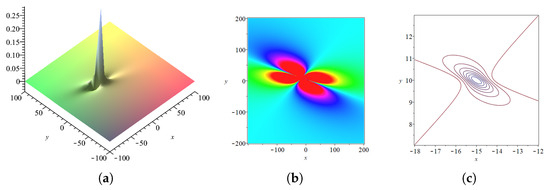
Notably, the rational solution in Equation (21) represents a permanent lump solution. This solution decays as as and travels with velocities and along the x and y axes, respectively.
Figure 1 illustrates the dynamic properties and evolution of solution (21) using specific parameters.
Figure 1.
Evolution profile of the permanent lump solution in Equation (21) with parameters and : (a) 3D surface plot; (b) density plot, (c) contour plot.
The derivation of M-lump solutions begins with general N-soliton solutions. By setting and taking the limit (assuming all share the same asymptotic order), we obtain:
Due to the symmetry of with respect to , the expression can be factorized by . Consequently, we derive a simplified rational solution for Equation (4), , which is equivalent to . Furthermore, can be expressed in the expanded form:
where
and denotes the summation over all possible combinations of , which are different and taken from the set . Taking with conditions for , we can get a special class of nonsingular rational solutions called M-lump solutions, and the asymptotic behavior . In the following subsections, 2-lump and 3-lump solutions of Equation (4) and the corresponding graphs are presented.
2.1. 2-Lump Solutions of Equation (4)
In this section, we construct the 2-lump solutions of Equation (4) by applying the previously established conclusions. By setting , we obtain:
where
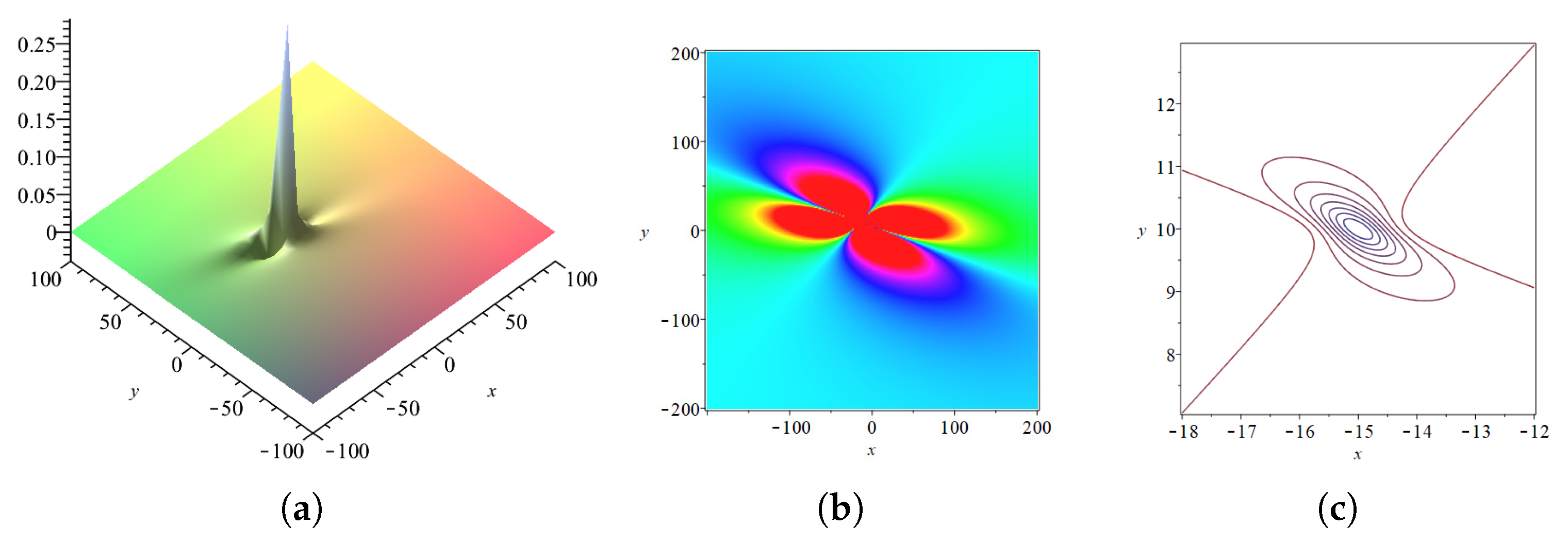
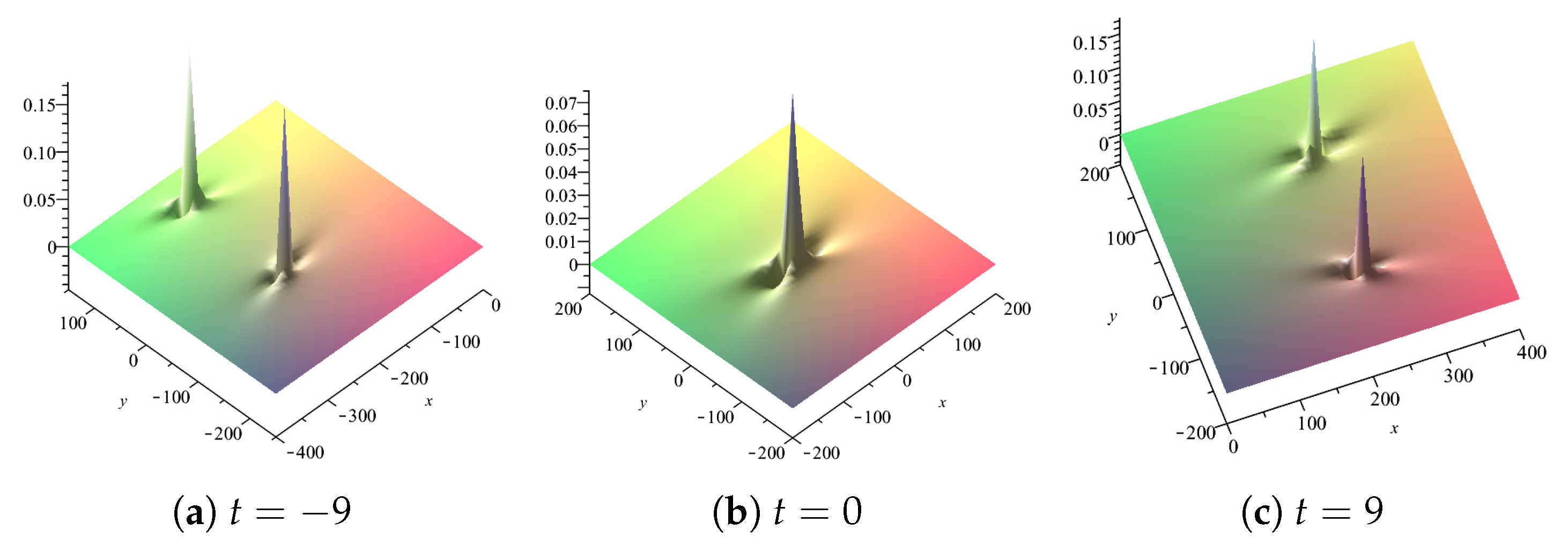
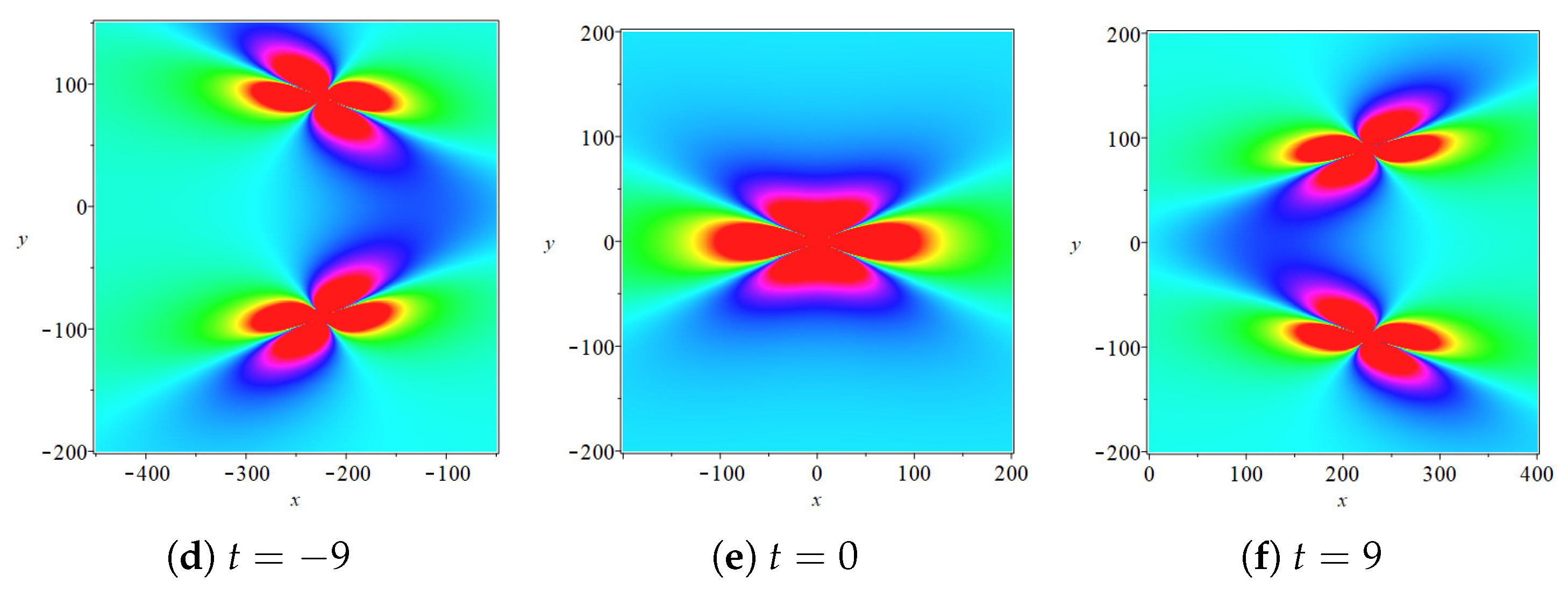
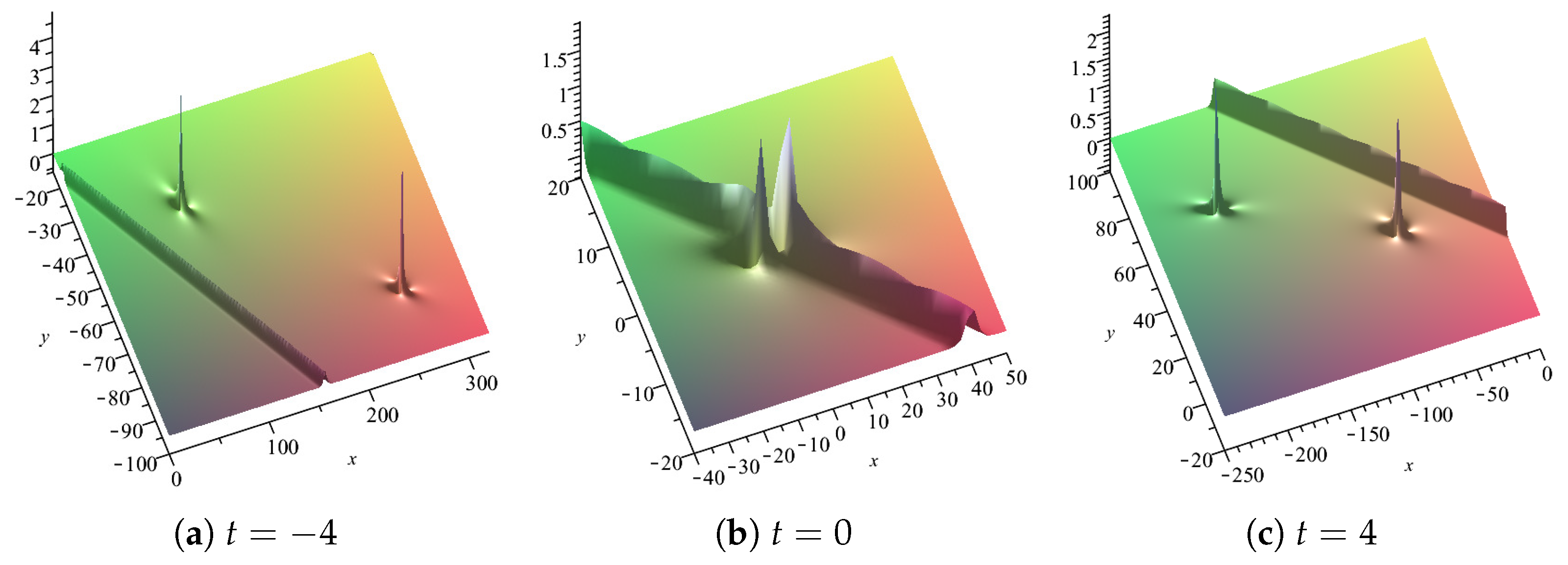
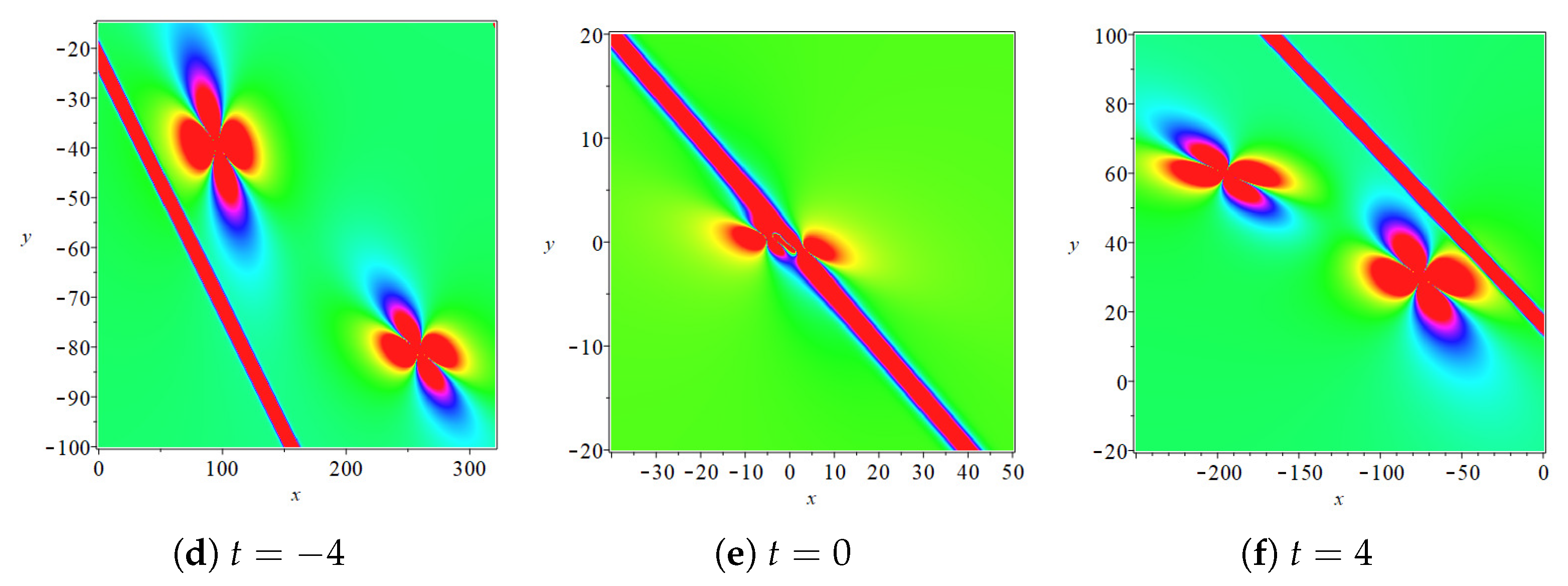
By substituting Equation (27) into the logarithmic transformation and setting , , , and , we obtain a 2-lump solution for Equation (4). Given that is a positive function, the evolution of this solution—under specific parameter constraints-is illustrated in Figure 2.
Figure 2.
Evolution profile of the 2-lump solution Equation (18) with parameters , , at various time intervals: (a–c) 3D plots; (d–f) density plots.
Figure 2 illustrates the elastic collision between two lump waves. The waves propagate along the diagonal in two-dimensional space, merging into a single peak at . Following the collision, the two lumps separate and continue their trajectories while maintaining their original amplitudes, widths, and velocities. The interaction results only in a distinct phase shift.
2.2. 3-Lump Solutions of Equation (4)
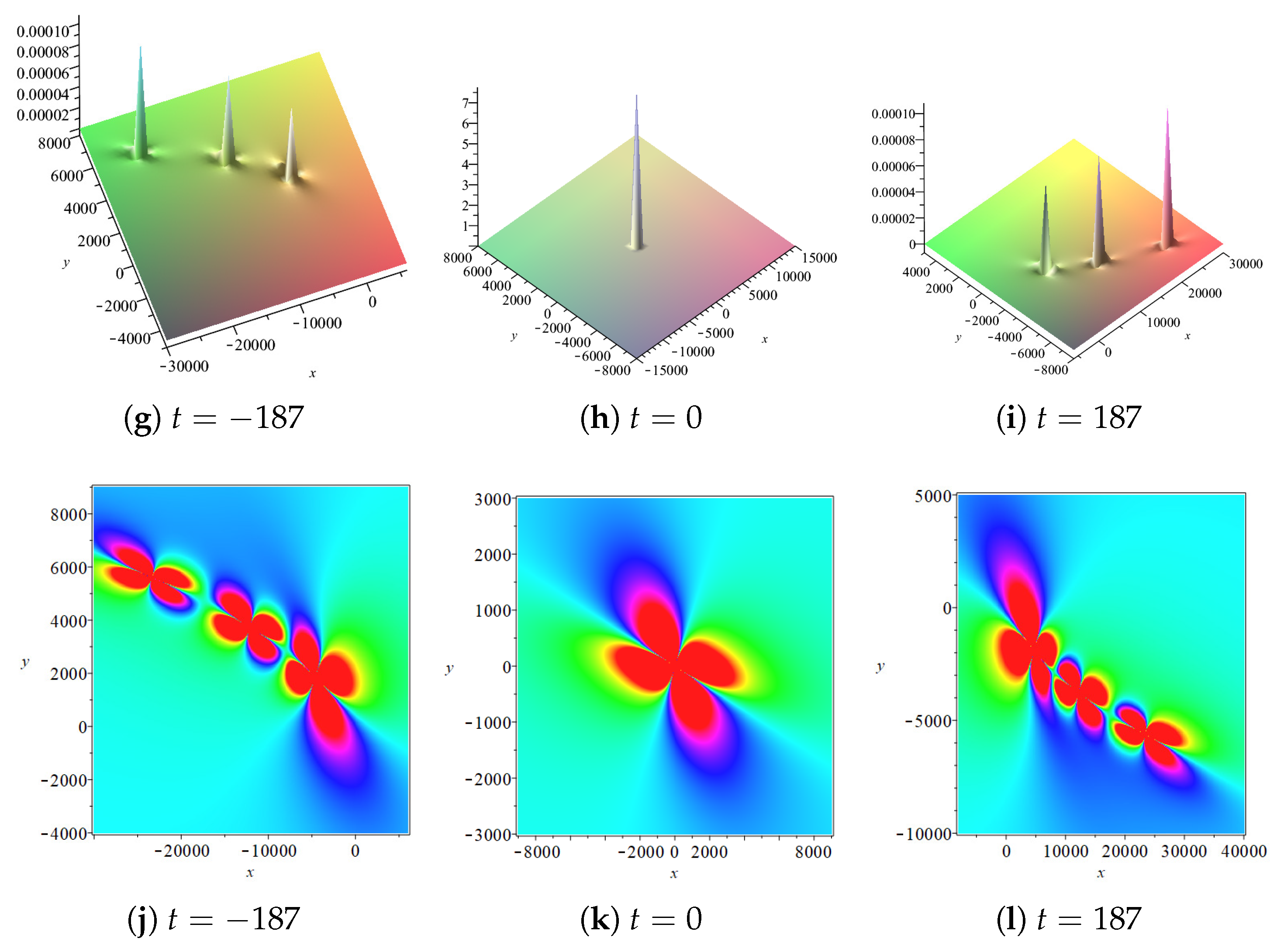
Following the previous procedure, we can derive the 3-lump solutions. By setting and , Equation (24) reduces to the function . Due to its significant complexity, the explicit expression of is omitted here. We define the parameters as for , and for . By substituting into the logarithmic transformation and applying the condition for , we obtain a 3-lump solution of Equation (4). In this case, is a strictly positive function, as it consists of a combination of perfect squares of the second, fourth, and sixth degrees.
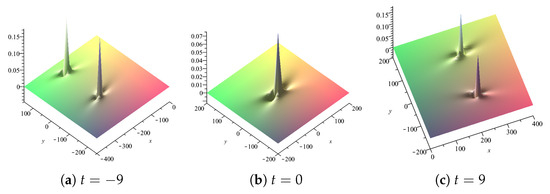
Figure 3 illustrates the elastic collisions between three lump waves. These waves propagate stably along a shared diagonal trajectory in two-dimensional space, each characterized by distinct amplitudes, velocities, and widths.It is observed that the lump wave with the highest amplitude travels faster than those with smaller amplitudes. Consequently, as the faster waves overtake the slower ones, they undergo an elastic collision, momentarily merging into a single peak at . Following this interaction, the three lump waves separate and continue to propagate along their original paths. They fully recover their initial amplitudes, widths, and velocities, exhibiting only a phase shift as a permanent result of the collision.
Figure 3.
Evolution profile of a three-lump solution with parameters : (a–c) 3D plots; (d–f) density plots.
3. Hybrid Solutions of Equation (4)
Following the previous discussion, this section investigates interaction solutions between M-lump solutions and multiple stripe soliton solutions. Notably, the M-lump waves are eventually “swallowed” by the multiple stripe solitons. This phenomenon occurs because the M-lump solutions, defined as positive functions, possess lower energy levels compared to the exponential nature of the stripe soliton solutions.
3.1. Hybrid Solution Between 1-Lump Solution and 1-Stripe Soliton Solution of Equation (4)
In this subsection, we set . By taking the limit as , the function can be expressed in the following form:
where
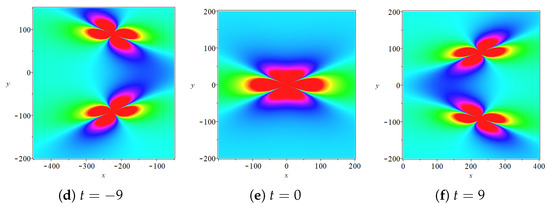
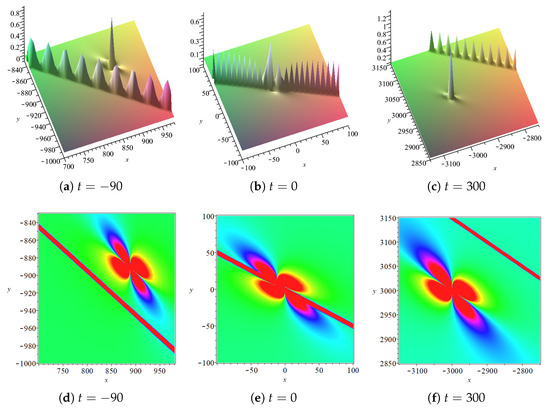
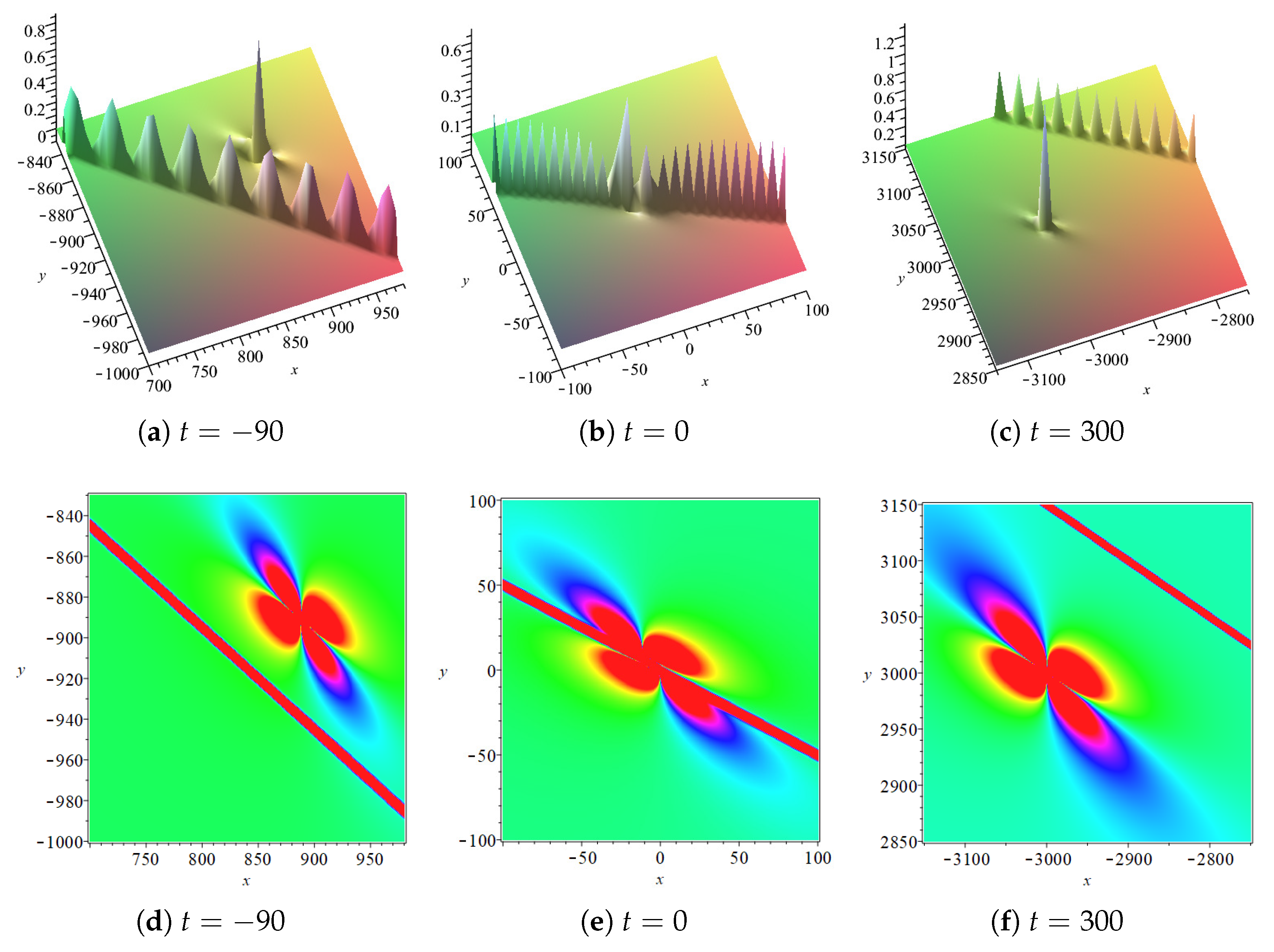
By setting , we obtain the interaction solution between a 1-lump solution and a 1-stripe soliton by substituting into . The dynamic properties of this interaction are illustrated in Figure 4.
Figure 4.
Evolution profile of the interaction between a one-lump solution and a one-stripe soliton solution: : (a–c) 3D plots; (d–f) density plots.
As shown, the one-lump wave and one-stripe soliton travel toward one another, colliding at . Because the exponential one-stripe soliton possesses higher energy, it temporarily “swallows” the one-lump wave. Following the interaction, the two waves separate and continue along their trajectories, maintaining their original velocities, amplitudes, and shapes, with only a phase shift remaining as a result of the collision.
3.2. Hybrid Solution Between 2-Lump Solution and 1-Stripe Soliton Solution of Equation (4)
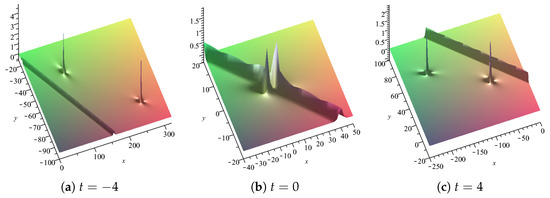
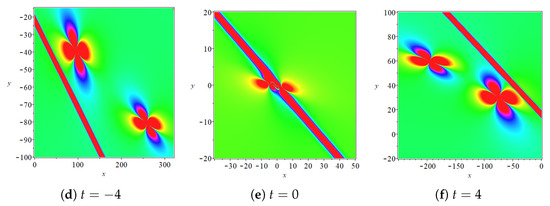
To derive the interaction solutions between the two-lump and one-stripe soliton solutions, we set in Equation (8) and take the limit as . This yields the function , where the parameters are defined as , for , and for . Due to its complexity and space constraints, the explicit expression for is omitted here. The dynamic properties of the interaction between the one-lump and two-stripe soliton solutions for Equation (4) are illustrated in Figure 5 and described below:
Figure 5.
Evolution profile of the interaction between a two-lump solution and a one-stripe soliton solution of Equation (4) with : (a–c) 3D plots; (d–f) density plots.
As illustrated, the two lump waves and the stripe soliton move toward one another, with the collision occurring at . Post-collision, the waves maintain their original shapes, amplitudes, and velocities, undergoing only minor phase shifts. This behavior indicates that the interaction is perfectly elastic.
The observed elastic interaction in our simulations is consistent with the standard analysis of asymptotic properties for Hirota-type solitonic solutions within integrable hierarchies. Specifically, the phase shifts observed after collision are characteristic of the elastic properties inherent in the Sawada-Kotera recursion scheme [36,37,38,39].
Additionally, the results illustrated in the 3D and density plots demonstrate that the collisions between the M-lump solutions and stripe-soliton solutions are completely elastic. In these cases, the localized waves maintain their amplitudes, shapes, and velocities after the collision, experiencing only a phase shift. Such elastic dynamics are crucial for stability in physical modeling. However, it is worth noting that more complex formalisms—such as those utilizing complex variable functions or S-matrix energy formalisms—can lead to inelastic interactions. In such scenarios, waves might undergo fusion, fission, or absorption. While this study focuses on the elastic regime of the gSK equation, the analysis of inelastic transitions remains a promising area for future implementation.
Research into wave interactions often focuses on the transition between rational and exponential structures [31,32,33]. While studies such as [32] explore hybrid interactions in bidirectional equations, our work specifically addresses the stability and elasticity of these interactions within the gSK hierarchy. Unlike the inelastic transitions observed in complex variable formalisms, our simulations in Figure 4 and Figure 5 demonstrate that the gSK equation maintains perfect elasticity during M-lump and stripe soliton collisions, preserving original amplitudes and velocities.
4. Conclusions
In this research, we have successfully derived and analyzed permanent multiple lump solutions and hybrid interaction solutions for a novel (2+1)-dimensional generalized Sawada-Kotera equation. Through the application of the Hirota bilinear method and the “long-wave” limit approach, we obtained M-lump solutions that exhibit rational decay in all spatial directions. Our numerical simulations and analytical results confirm the elastic nature of these collisions within the proposed framework. The primary novelty of this work lies in the formulation of the generalized bgSK equation and the discovery of multi-component solutions that can be used to model and forecast wave propagation in various physical media. These findings provide a theoretical basis for studying more complex nonlinear partial differential equations in fluid mechanics and plasma physics.
While this study confirms the elastic nature of M-lump interactions for the gSK equation, future research could explore the inelastic regime by relaxing the current parameter constraints or by investigating higher-order dispersion terms as suggested in [33].
Author Contributions
X.W., J.-P.Y. and Y.-L.S. have equally contributed to conceptualization, methodology, formal analysis, review and editing, and writing. J.-P.Y. also contributed to data curation and funding acquisition. All authors have read and agreed to the published version of the manuscript.
Funding
The authors appreciate financial support from 11971067 and 11101029 from the National Natural Science Foundation of China.
Data Availability Statement
The original contributions presented in this study are included in the article. Further inquiries can be directed to the corresponding author.
Conflicts of Interest
The authors declare no conflicts of interest.
References
- Xu, L.; Wang, D.S.; Wen, X.Y.; Jiang, Y.L. Exotic Localized Vector Waves in a Two-Component Nonlinear Wave System. J. Nonlinear Sci. 2020, 30, 537–564. [Google Scholar] [CrossRef] [Scilit]
- Ma, W.X.; Fan, E.G. Linear superposition principle applying to Hirota bilinear equations. Comput. Math. Appl. 2011, 61, 950–959. [Google Scholar] [CrossRef] [Scilit]
- Liu, M.M.; Yu, J.P.; Ma, W.X.; Sun, Y.L.; Khalique, C.M. Dynamic Analysis of lump solutions based on the dimensionally reduced generalized Hirota bilinear KP-Boussinesq equation. Mod. Phys. Lett. B 2023, 37, 2250203. [Google Scholar] [CrossRef] [Scilit]
- Matveev, V.B.; Salle, M.A. Darboux Transformations and Solitons; Springer: Berlin/Heidelberg, Germany, 1992. [Google Scholar]
- Tao, Y.S.; He, J.S. Multisolitons, breathers, and rogue waves for the Hirota equation generated by the Darboux transformation. Phys. Rev. E 2012, 85, 026601. [Google Scholar] [CrossRef] [Scilit] [PubMed]
- Rogers, C.; Schief, W.K. Bäcklund and Darboux Transformations: Geometry and Modern Applications in Soliton Theory; Cambridge University Press: Cambridge, UK, 2002. [Google Scholar]
- Manakov, S.V.; Zakharov, V.E.; Bordag, L.A.; Its, A.R.; Matveev, V.B. Two-dimensional solitons of the Kadomtsev-Petviashvili equation and their interaction. Phys. Lett. A 1977, 63, 205–206. [Google Scholar]
- Ma, W.X. Lump solutions to the Kadomtsev–Petviashvili equation. Phys. Lett. A 2015, 379, 1975–1978. [Google Scholar] [CrossRef] [Scilit]
- Huang, L.L.; Chen, Y. Lump Solutions and Interaction Phenomenon for (2+1)-Dimensional Sawada-Kotera Equation. Commun. Theor. Phys. 2017, 67, 473–478. [Google Scholar]
- Gilson, C.R.; Nimmo, J.J.C. Lump solutions of the BKP equation. Phys. Lett. A 1990, 147, 472. [Google Scholar] [CrossRef] [Scilit]
- Rao, J.G.; Cheng, Y.; He, J.S. Rational and semirational solutions of the nonlocal Davey–Stewartson equations. Stud. Appl. Math. 2017, 139, 568–598. [Google Scholar] [CrossRef] [Scilit]
- Ma, W.X.; Qin, Z.; Lü, X. Lump solutions to dimensionally reduced p-gKP and p-gBKP equations. Nonlinear Dyn. 2016, 84, 923–931. [Google Scholar] [CrossRef] [Scilit]
- Wang, D.S.; Guo, B.L.; Wang, X.L. Long-time asymptotics of the focusing Kundu-Eckhaus equation with nonzero boundary conditions. J. Diff. Equ. 2019, 266, 5209–5253. [Google Scholar] [CrossRef] [Scilit]
- Yu, J.P.; Sun, Y.L. A note on the Gaussons of some new logarithmic evolution equations. Compt. Math. Appl. 2017, 74, 258–265. [Google Scholar] [CrossRef] [Scilit]
- Lü, X.; Chen, S.T.; Ma, W.X. Constructing lump solutions to a generalized Kadomtsev-Petviashvili-Boussinesq equation. Nonlinear Dyn. 2016, 86, 523–534. [Google Scholar] [CrossRef] [Scilit]
- Satsuma, J.; Ablowitz, M.J. Two-dimensional lumps in nonlinear dispersive systems. J. Math. Phys. 1979, 20, 1496–1503. [Google Scholar] [CrossRef] [Scilit]
- Sun, Y.L.; Ma, W.X.; Yu, J.P.; Khalique, C.M. Further study of the localized solutions of the (2+1)-dimensional B-Kadomtsev-Petviashvili equation. Commun. Nonlinear Sci. Numer. Simul. 2022, 107, 106131. [Google Scholar]
- Zhao, Z.L.; He, L.C. M-Lump and Hybrid Solutions of a Generalized (2+1)-Dimensional Hirota–Satsuma–Ito Equation. Appl. Math. Lett. 2021, 111, 106612. [Google Scholar] [CrossRef] [Scilit]
- Zhang, Y.; Liu, Y.P.; Tang, X.Y. M-lump solutions to a (3+1)-dimensional nonlinear evolution equation. Compu. Math. Appl. 2018, 76, 592–601. [Google Scholar] [CrossRef] [Scilit]
- Hirota, R. The Direct Method in Soliton Theory; Cambridge University Press: Cambridge, UK, 2004. [Google Scholar]
- Ma, W.X. Generalized bilinear differential equations. Stud. Nonlinear Sci. 2011, 2, 140–144. [Google Scholar]
- Hietarinta, J. Introduction to the Hirota bilinear method. In Integrability of Nonlinear Systems; Kosmann-Schwarzbach, Y., Grammaticos, B., Tamizhmani, K.M., Eds.; Springer: Berlin/Heidelberg, Germany, 1997; pp. 95–103. [Google Scholar]
- Ma, W.X.; Zhou, Y. Lump and lump-soliton solutions to the Hirota-Satsuma-Ito equation. Commun. Nonlinear Sci. Numer. Simul. 2019, 68, 56–62. [Google Scholar]
- Li, Y.; Yao, R.X.; Xia, Y.R.; Lou, S.Y. Plenty of novel interaction structures of soliton molecules and asymmetric solitons to (2+1)-dimensional Sawada-Kotera equation. Commun. Nonlinear Sci. Numer. Simul. 2021, 100, 105843. [Google Scholar] [CrossRef] [Scilit]
- Geng, X.G. Darboux transformation of the two–dimensional Sawada-Kotera equation. J. Appl. Math. 1989, 4, 494–497. [Google Scholar]
- Yu, J.P.; Ma, W.X.; Sun, Y.L.; Khalique, C.M. N-fold Darboux transformation and conservation laws of the modified Volterra lattice. Mod. Phys. Lett. B 2018, 32, 1850409. [Google Scholar] [CrossRef] [Scilit]
- Ablowitz, M.J.; Villarroel, J. Solutions to the time dependent Schrödinger and the Kadomtsev-Petviashvili equations. Phys. Rev. Lett. 1997, 78, 570–573. [Google Scholar] [CrossRef] [Scilit]
- Ma, W.X.; Abdeljabbar, A. A bilinear Bäcklund transformation of a (3+1)-dimensional generalized KP equation. Appl. Math. Lett. 2012, 25, 1500–1504. [Google Scholar] [CrossRef] [Scilit]
- Yu, J.P.; Sun, Y.L. A direct Bäcklund transformation for a (3+1)-dimensional Kadomtsev-Petviashvili-Boussinesq-like equation. Nonlinear Dyn. 2017, 90, 2263–2268. [Google Scholar] [CrossRef] [Scilit]
- An, B.; Feng, L.; Zhu, J. General M-lump, high-order breather and localized interaction solutions to the (2+1)-dimensional Sawada-Kotera equation. Nonlinear Dyn. 2019, 98, 3885–3897. [Google Scholar] [CrossRef] [Scilit]
- Chen, Y.; Li, M. M-lump and lump–kink solutions of the (2+1)-dimensional Caudrey-Dodd-Gibbon-Kotera-Sawada equation. Pramana J. Phys. 2020, 94, 122. [Google Scholar] [CrossRef] [Scilit]
- Zhang, Y.F.; He, J.S.; Liu, Y. Higher-order rational solutions and hybrid interaction solutions of a bidirectional Sawada–Kotera equation. J. Appl. Anal. Comput. 2021, 11, 2630–2649. [Google Scholar]
- Estévez, P.G.; Prada, J.; Villarroel, J. Lump solitons in a higher-order nonlinear equation in 2+1 dimensions. Phys. Rev. E 2016, 93, 062219. [Google Scholar] [CrossRef] [Scilit] [PubMed]
- Konopelchenko, B.G.; Dubrovsky, V.G. Some new integrable nonlinear evolution equations in 2+1 dimensions. Phys. Lett. A 1984, 102, 15–17. [Google Scholar] [CrossRef] [Scilit]
- Yu, J.P.; Sun, Y.L.; Wang, F.D. N-soliton solutions and long-time asymptotic analysis for a generalized complex Hirota-Satsuma coupled KdV equation. Appl. Math. Lett. 2020, 106, 106370. [Google Scholar] [CrossRef] [Scilit]
- Sawada, K.; Kotera, T. A method for finding N-soliton solutions of the KdV equation and KdV-like equations. Prog. Theor. Phys. 1974, 51, 1355–1367. [Google Scholar] [CrossRef] [Scilit]
- Caudrey, P.J.; Dodd, R.K.; Gibbon, J.D. A new hierarchy of Korteweg-de Vries equations. Proc. R. Soc. Lond. A Math. Phys. Sci. 1976, 351, 407–422. [Google Scholar] [CrossRef] [Scilit]
- Fuchssteiner, B.; Oevel, W. The bi-Hamiltonian structure of integrable systems. J. Math. Phys. 1982, 23, 358–363. [Google Scholar] [CrossRef] [Scilit]
- Gao, L.N.; Zi, Y.Y.; Yin, Y.H.; Ma, W.X.; Lü, X. Bäcklund transformation, multiple wave solutions and lump solutions to a (3+1)-dimensional nonlinear evolution equation. Nonlinear Dyn. 2017, 89, 2233–2240. [Google Scholar] [CrossRef] [Scilit]
Disclaimer/Publisher’s Note: The statements, opinions and data contained in all publications are solely those of the individual author(s) and contributor(s) and not of MDPI and/or the editor(s). MDPI and/or the editor(s) disclaim responsibility for any injury to people or property resulting from any ideas, methods, instructions or products referred to in the content. |
© 2026 by the authors. Licensee MDPI, Basel, Switzerland. This article is an open access article distributed under the terms and conditions of the Creative Commons Attribution (CC BY) license.