Article

Numerical Investigation of Wake Interference in Tandem Square Cylinders at Low Reynolds Numbers

by
Sarath R S
1,*,
R Ajith Kumar
1,* and
K Suresh Kumar
2
1
Department of Mechanical Engineering, Amrita Vishwa Vidyapeetham, Amritapuri, Kollam 690525, India
2
RWDI, Dubai 115298, United Arab Emirates
*
Authors to whom correspondence should be addressed.
Symmetry 2025, 17(12), 2038; https://doi.org/10.3390/sym17122038
Submission received: 8 October 2025 / Revised: 13 November 2025 / Accepted: 21 November 2025 / Published: 29 November 2025

Abstract

This study numerically investigates laminar flow around two prismatic bodies, specifically square cylinders, arranged in tandem. The analysis covered gap ratios ( L / D = 2 –7) and Reynolds numbers ( R e = 100–200), focusing on quantifying the aerodynamic characteristics and examining the wake flow structures within the established interference regimes. The time-averaged and unsteady parameters, including the drag and lift coefficients, RMS lift, vortex formation length, Strouhal number, recirculation length, wake width, and pressure distribution, were evaluated for both cylinders. A consistent critical spacing of L / D 4.5 was observed across all Reynolds numbers, coinciding with the minimum Strouhal number, a sharp increase in unsteady lift, and divergence in wake width between cylinders. Notably, in the range 4.5 L / D 6.5 at higher R e , the DC exhibited a mean drag exceeding that of an isolated cylinder, attributed to base-pressure reduction and accelerated inflow from the upstream wake. A critical spacing in the co-shedding regime produced strong drag amplification on the DC, attaining an overall maximum value of 50.41% at R e = 200 and L / D = 6.0 . To note, unlike mean drag, mean lift is found to be zero in all interference cases for both cylinders, irrespective of spacing ratio and Re, owing to the symmetry of the time-averaged pressure distribution on either side of the cylinders. Spectral and phase analyses reveal a transition from broadband, desynchronised oscillations to a frequency-locked state, with the phase angle between the cylinders reducing sharply to Δ ϕ 0 at the critical spacing. This indicates complete in-phase synchronisation or symmetry of the vortex-shedding process between the cylinders at the critical spacing. This confirmed the hydrodynamic transition between the coupled and independent shedding modes of the cylinders. The recirculation lengths for the DC reduce to as low as 0.6 D in the co-shedding regime, highlighting rapid wake recovery. The research presented here offers new insights into force modulation, the evolution of wake structures, and the sensitivity to the Re that occurs when laminar flow occurs between two tandem square cylinders. These findings can be utilised to develop methods for controlling VIV and designing thermal-fluid systems.

1. Introduction

Bluff body flow has become one of the most researched topics in fluid mechanics and remains an evolving subject in fluid dynamics. The broad application areas of bluff body flow include ocean, civil, mechanical, and aerospace engineering. Bluff bodies are characterised by a large wake generated by the separated flow on either side of the body. A wide variety of bluff bodies exists in both engineered structures and natural environments, including, but not limited to, tall buildings, offshore oil platforms, ships and boats, bridge pylons, subsea pipelines, streetlights, and palm trees. Fluid–structure interaction (FSI) associated with bluff bodies is important for minimising the forces exerted on these bodies by the flow, thereby reducing vibration-induced damage and ensuring structural safety [1]. This is particularly important when engineering structures are situated in close proximity, such as high-rise buildings, where fluid forces can be magnified several times, possibly leading to structural collapse [1]. Similar magnifications of fluid forces can be expected in heat exchanger tubes, mooring lines employed in ocean engineering, and cooling towers, among others [2]. If the induced fluid forces exceed the permissible limits, the structures would crumple, and consequently, severe, undesirable casualties, including loss of human lives, would possibly follow. Therefore, owing to the potential risks associated with such catastrophes, it is of cardinal importance to study the flow around bluff bodies by considering the flow and geometric parametric parameters that control the fluid forces induced in bodies (structures). From a different perspective, bluff bodies are also considered energy-harvesting devices [3], where such bodies are encouraged to oscillate at higher oscillatory amplitudes [4,5], favouring energy extraction. Flow over prismatic bodies, such as square cylinders, poses greater challenges than over circular cylinders because of their vulnerability to high-amplitude galloping oscillations [2,6,7]. In contrast to circular cylinders, the points where flow separates on square cylinders remain constant [8], and they generate broader wakes, inducing larger lift and drag forces. Once a square cylinder facing a fluid flow is set into transverse oscillations owing to lift forces, the flow incidence angle varies during the motion, and the effective damping could become negative [6]. Once the total damping becomes negative, it can be triggered to high-amplitude galloping oscillations, which register a monotonic increase with reduced velocity and/or Re [6] resulting in structural failure. It is interesting to note that circular cylinders would never experience galloping vibrations, owing to the fact that flow incidence does not influence wake structures and induces fluid forces [4]. Therefore, circular cylinders undergo only vortex-induced oscillations, unlike square cylinders, which pose greater challenges, as mentioned previously. Many studies have focused on providing corner modifications to square cylinders, aiming to improve overall aerodynamics [9,10,11,12,13,14]. Passive flow control techniques have been widely used in bluff body flows to suppress vortex shedding [15] and for enhancement in some cases [16,17]. Therefore, flow interference between two square cylinders offers potential challenges from a practical perspective. Engineering structures, such as buildings, exist as groups rather than in isolated conditions in many engineering scenarios. In such situations, the flow around bluff bodies undergoes significant alterations due to interference effects [18]. Flow interference between two bluff bodies is the simplest interference configuration that can be investigated. Owing to the possibility of significant flow modifications, interference between two bluff bodies offers greater potential challenges from a practical perspective.
Vortex shedding is an important feature of flows over bluff bodies, characterised by the periodic formation of vortices in the wake of bluff bodies at distinct frequencies. The periodic nature of this unsteady process results in fluctuations in lift and drag forces on the bluff body that can cause resonance of the bluff body’s structural components, resulting in fatigue failure or noise generation [19]. Bluff body flows are well understood for turbulent flows at high Reynolds numbers; however, interest in flows at lower Re (Re ≤ 200) is growing due to the application of these types of flows in compact marine devices, underwater robotic systems, and energy-efficient hydrodynamic systems [1]. Low-Re flows are more predictable than high-Re flows; however, the initiation and development of vortex shedding remain complex for multi-body arrangements, such as tandem square cylinders.
Microfluidic devices, underwater robotic components, compact heat exchangers, and slow-moving aquatic structures are characterised by low-Reynolds-number flows [1]. In these scenarios, even minor changes in the spacing between objects or in flow conditions can lead to notable variations in wake patterns, pressure distributions on the bodies, and the unsteady forces exerted. Tandem bluff body configurations are particularly intriguing due to the wake interference phenomena they exhibit, which range from wake shielding and vortex suppression at close proximities to complex mutual interactions and independent vortex shedding at greater distances [18].
Sohankar et al. [18] performed a numerical analysis focusing on the laminar flow and heat transfer occurring between two square cylinders (inline configuration), utilising a flow control method. The UC alone or two cylinders together were subjected to uniform blowing and suction. He documented a maximum drag reduction of 70% (considering the combined drag of both cylinders) across all gap ratios and Re ranges with uniform blowing and suction applied to both cylinders. In their investigation of aspect ratio effects on wake characteristics and the critical Reynolds number, Rastan et al. [20] reported that rectangular cylinders exhibited vortex shedding at higher frequencies than elliptical cylinders. Hongjun et al. [21] performed a numerical analysis to study the influence of base length ratio (d/D, where d and D denote the shorter and longer base lengths, respectively, with seven ratios varying from 0 to 1) and angle of attack, θ (0°, 90°, and 180°), on flow characteristics and hydrodynamic behaviour of trapezoidal cylinders in a two-dimensional laminar flow at Re = 150. Their findings demonstrated that hydrodynamic forces exhibited a substantial increase as the angle of attack progressed from 0° to 180°. Compared with square cylinders, trapezoidal cylinders with d/D ratios of 0.1 and 0.3 yielded the most pronounced enhancements in the time-averaged drag coefficient (up to 54.5%) and the root mean-square lift coefficient (up to 451.3%), respectively.
Abdelhamid et al. [22] numerically examined how the radius ratio (the ratio of the corner radius to half the cylinder width) affects the topological structure of the flow, the interaction of forces from the fluid, the heat transfer, and the modulation of the wake of a square cylinder at Re = 40–180. The researchers identified four distinct flow regimes and showed that the Strouhal number, Nusselt number, and all wake-related parameters strongly depend on the radius ratio. Farhan et al. [23] analysed how corner modifications (square to circular) of a square cylinder affect the flow behaviour and thermal performance around a square cylinder for different widths of the cylinder and velocities of the flow at Re = 150. They also studied the development of the boundary layer, the separation of the flow, and the creation of recirculation areas. They reported that increasing the level of corner modification can improve the heat transfer efficiency by up to 33%. Kumar et al. [24] investigated incompressible flow and convective heat transfer around a square cylinder placed near an adiabatic wall using dimensionless parameters such as the Reynolds number, Prandtl number, and gap ratio. The authors reported that there is a steady-state flow regime until Re = 121; after this value, the flow becomes periodic. Mellibovsky et al. [25] used three parameters to study the effect of passive flow control on a square cylinder provided with an upstream plate: the plate thickness, velocity ratio, and distance between the cylindrical container and plate. The researchers studied different Reynolds numbers in the laminar regime. Their results showed that it is possible to obtain considerable reductions in drag and suppress the unsteadiness of the wake by selecting suitable combinations of the considered parameters. Kavya et al. [26] performed a numerical simulation of the flow around a square cylinder for different orientations and Reynolds numbers in the range 50–200. The authors found that the orientation of the cylinder has a considerable influence on the Strouhal number and lift coefficient. Raheela et al. [27] carried out a computational analysis of the flow around a square cylinder mounted with detached dual control rods at different spacings at Re = 160. To better understand the dynamics of the fluid forces, they computed the Strouhal number and RMS values of the drag coefficient. Their results showed that the introduction of splitter plates produced a significant reduction in drag (up to 62.2% with an upstream plate, 13.3% with a downstream plate, 70.2% with two plates) compared to the reference case of a single cylinder without control elements.
Vikram et al. [28] performed an experimental investigation of the flow past a square cylinder and of two cylinders of variable size and configuration by introducing corner modifications; water and fine aluminium powder recirculating in a pipe as a tracer. The experiment demonstrated that the shielding effect of the first cylinder significantly reduced the vortex shedding behind the second, smaller cylinder. Furthermore, as the spacing ratio increased, the eddy width also increased, causing the flow field to resemble that of a separate square cylinder, therefore reducing the interference in the wake region. Gowda et al. [29] carried out a computational investigation of the flow behaviour around two square cylinders of different sizes, with both unchanged and corner modified configurations, in the laminar flow regime at Re = 100 and Re = 200. The results demonstrated that the introduction of chamfered or rounded corners decreased the wake width, lift, and drag coefficients while preserving the upstream velocity profile around the cylinder, indicating that the basic properties of the flow were retained even after modifying the corners of the cylinder. Zhou Yu et al. [30] performed a numerical study to examine how the spacing between two square cylinders placed in tandem influences the generation of Kármán vortex streets and the combustion about bluff body geometries. The authors demonstrated that optimal spacing improves the coherence of the vortices and mixing, thus enhancing combustion, whereas lower spacings disrupt flame stability due to interference from the shear layers. Chauhan et al. [8] carried out an experimental study of the flow behaviour of a square cylinder with a downstream attached splitter plate. The experimental study showed that increasing the length of the splitter plate decreased both the drag coefficient and Strouhal number.
A computational study by Ali et al. [31] demonstrated that the presence of a splitter plate of various lengths (from 0.5D to 6D) significantly altered the flow field around a square cylinder of side length D and resulted in considerable hydrodynamic interaction. A numerical analysis to investigate ways to minimise the effects of flow-induced forces on a square prism in laminar flow was conducted by Nidhul et al. [32]. The results showed that the placement of a control plate located two diameters away (as measured from the centre of the prism) had the greatest effect in reducing the hydrodynamic forces acting upon the prism. Pankaj et al. [33] examined numerically the flow past a bluff body (circular cylinder) within subcritical Reynolds numbers between 5000 and 15,000. This study focused on the influence of the blockage ratio on the flow characteristics while maintaining a constant aspect ratio. The results demonstrated that the drag coefficient increased with an increase in the blockage ratio. Li et al., [34], analysed the two-dimensional flow around a square cylinder at small Reynolds numbers (Re = 10 and Re = 20) by utilising a MATLAB-based solver named Navier2D, 2006 version and performing adaptive mesh refinement. The researchers demonstrated that the accuracy of the velocity field symmetry was the same when the plots were created with uniform fine meshes compared to those generated by adaptive refinement. Therefore, adaptive refinement can generate the same level of accuracy with a greater reduction in computational cost than uniform fine meshes.
Liu et al. [35] studied the flow over a series of inline square cylinders and documented the hysteresis behaviour characterised by sudden transitions between two possible flow regimes. The size of this hysteresis region is very sensitive to the Reynolds number and therefore significantly affects the drag forces, surface pressure distributions, and Strouhal number. Raheela et al. [36] researched a two-dimensional flow around a square rod with two control rods at a Reynolds number (Re = 160). The gap distances between the control rods and the main rod are denoted as g 1 (the vertical distance between the upper control rod and the main rod) and g 2 (the vertical distance between the lower control rod and the main rod), where the values of g 1 and g 2 are normalised by the diameter of the control rods. The study found three different flow regimes and that the drag coefficients decreased as the spacing g 2 between the control rods increased, while the other g 1 remained fixed. The greatest drag coefficient occurred at ( g 1 , g 2 ) = (1, 1), and the drag coefficients decreased by 139.72% when ( g 1 , g 2 ) = (1, 3). The results provide useful information for developing optimisation techniques for controlling the flow around square rods using various control rod configurations to minimise the forces exerted by fluids on the rods. Saha et al. [37] performed a numerical analysis to document the transition to three-dimensional flow in the wake of a square cylinder at Reynolds numbers ranging from 150 to 500. The researchers identified two different secondary instability modes: Mode A occurred between Re = 175 and Re = 240, and Mode B occurred between Re = 250 and Re = 280. In addition, a modified version of Mode A, which is related to vortex dislocations and low-frequency oscillations, was found. The transition behaviours exhibited in the square cylinder wake are very similar to those found in circular cylinder wakes, suggesting that the same types of three-dimensional instabilities exist. Dayem et al. [38] used experimental methods to investigate compressible turbulent flow over a square cylinder and the variation of pressure distributions on the cylinder with varying incidence angles of the incoming flow. The results indicated that the incidence angle significantly altered the pressure coefficient distributions, particularly on the windward and leeward surfaces of the cylinder, producing asymmetric pressure distributions. These asymmetric pressure distributions produced variations in the aerodynamic force coefficients, including significant variations in both the drag and lift as the angle of attack was changed. Ma et al. [39] utilised the Lattice Boltzmann method to analyse the flow past a square cylinder that was influenced by circular bars placed both upstream and downstream of the cylinder. The results indicated that the upstream bar had a beneficial effect on lowering the drag, whereas the downstream bar was effective in reducing fluctuations in the lift. In addition, the researchers indicated that the spacing between the bars and the cylinder had a significant effect on the overall flow structure. Chatterjee et al. [40] conducted a computational study to determine the effects of the spacing between five square cylinders arranged in a side-by-side configuration on the wake dynamics. The researchers determined that smaller spacings between the cylinders suppressed vortex shedding owing to the interaction between the shear layers, whereas larger spacings allowed for independent wake formation and resulted in significant changes in the drag distribution among the cylinders.
Kumar et al. [41] investigated the effects of linear shear flow on the wake dynamics of two square cylinders arranged in a side-by-side configuration at Re = 500. The researchers determined that vortex shedding and wake development were dependent on changes in the Reynolds number (Re) and shear rate (K). The researchers investigated the influence of shear parameter values on flow phenomena, revealing that the vortex shedding frequency decreased with an increase in the shear rate. Mushyam et al. [42] investigated the interactions between the wake and mixing layers in the flow across a square cylinder using computational simulations. The upstream mixing layer developed from the interaction of two uniform fluid streams with different velocities flowing on either side (above and below) of the splitter plate. They concluded that these interactions are mainly influenced by the velocity ratios (ratio of flow velocities above and below the splitter plate), with key features such as stagnation point oscillations, mixing layer height (upstream), and vortex shedding patterns remaining relatively unchanged despite the changes in the Strouhal number.
Although numerous studies have examined flow interference between bluff bodies in tandem configurations, most prior research has emphasised turbulent or high-Re flows and circular geometries, where wake interactions are dominated by strong vortex shedding and shear-layer instabilities. In contrast, laminar wake interference at low Reynolds numbers ( R e = 100 –200) (hereafter referred to as Re)—particularly for square cylinders—remains comparatively underexplored, despite its fundamental and practical importance in microscale fluidic systems and low-speed flow environments.
Within the laminar regime, several investigations have contributed to the understanding of wake development and interference behaviour of tandem cylinders (see Table 1). However, these studies typically suffer from one or more of the following limitations: (i) a restricted range of gap ratios, often insufficient to capture the complete transition between wake interference modes; (ii) not all key parameters necessary for a complete flow characterisation, such as aerodynamic forces, shedding frequency, and wake structure metrics, were consistently examined together; (iii) limited quantitative correlation between flow structures and force characteristics across varying spacings, leading to ambiguity in identifying the critical transition regime; and (iv) neglect of detailed surface pressure characteristics, including stagnation and base pressure coefficients ( C p 0 , C p b ), which are essential for explaining drag modulation and wake shielding effects.
A review of the literature (Table 1) reveals that although current studies on laminar flow offer valuable insights, they fall short of providing a systematic and comprehensive assessment of aerodynamic, frequency, and wake parameters over a broad range of spacings and Re. Consequently, the physical processes that dictate the shift from coupled to independent wake behaviour in laminar tandem-square configurations are still not fully understood.
The present study seeks to address the identified gap in the literature by undertaking a comprehensive two-dimensional analysis of laminar flow across two prismatic bodies (square cylinders) in a tandem configuration (see Figure 1b) covering the Re range 100 ≤ Re ≤ 200 (Re varied in steps of 25) and gap ratios (L/D) from 2 to 7. The study aims to
  • Identify critical gap spacing where abrupt transitions in drag, lift, and vortex shedding behaviour occur.
  • Investigate the flow characteristics at various flow regimes.
  • Examine the fluctuations in lift coefficient ( C l ), drag coefficient ( C d ), Strouhal number (St), and their root mean square (RMS) values for both cylinders.
  • Examine wake structure evolution, vortex formation length, wake width, and recirculation regions using streamlines and vorticity plots.
This study is unique in that it provides the first all-encompassing (force dynamics, wake structure, and surface pressures) low-Re characterisation of tandem square cylinder flows. The incorporation of C p 0 and C p b as indicator variables for drag recovery and wake shielding phenomena in laminar flow interference adds a new level of physical interpretation to the mechanisms involved. The results are particularly relevant to low-speed engineering applications, including compact heat exchanger designs, microelectromechanical systems (MEMS), flow metre designs, and aerodynamic sensor array designs, where understanding the effects of wake interference can lead to increased system stability, reduced vibration, and improved pressure and thermal performance when the application operates in a laminar regime.

2. Problem Description and Computational Approach

2.1. Numerical Model and Solution Method

The simulations were performed using the finite-volume solver ANSYS Fluent, 2022 R1 version. The pressure–velocity coupling was achieved using the SIMPLE algorithm, and the convective and diffusive terms in the governing equations were discretised using a second-order upwind and second-order central differencing scheme, respectively. Temporal advancement was performed using a second-order implicit scheme to ensure numerical stability and accuracy.
A non-dimensional time step of Δ t = 0.001 was used, resulting in a Courant number Co < 1 for all cases. Convergence was achieved when the residuals for the continuity and momentum equations dropped below 10 6 and periodicity in the force coefficients was established.
The numerical model adapted in this study provides a stable and accurate framework for capturing laminar unsteady wake dynamics and hydrodynamic force oscillations in a tandem cylinder configuration. Initially, the flow across a single square cylinder was analysed within a Re range (100–200) to establish a baseline for comparison with the interference cases involving a tandem cylinder arrangement at the same Re range. The workflow included (a) a domain independence study, (b) a grid independence study, (c) validation accompanied by a comprehensive investigation of the flow over an isolated square cylinder within a Re range of 100–200, and (d) an investigation of interference effects by varying the gap ratio (L/D = 2–7; see Figure 1b) between two inline square cylinders within the same Re range.
In the present numerical investigation, a two-dimensional, laminar, unsteady, incompressible, and viscous flow framework was adopted to analyse the wake interference between two tandem square cylinders. This modelling choice is justified by the moderate Re range considered ( R e = 100 –200), where the flow is predominantly laminar and the wake structures remain essentially two-dimensional with negligible spanwise instabilities. Previous benchmark studies (for example, Sohankar et al. [18]; Etminan et al. [52]) have demonstrated that below R e 200 , both circular and square cylinder wakes can be accurately captured using 2D unsteady laminar simulations.
In this case, the use of the incompressible assumption is justified by the low Mach numbers (Mach number is less than 0.3), which indicate that there will be little effect due to compressibility, whereas viscous forces are dominant in determining the behaviour in the vicinity of the wake and shear-layer development.
Although the two-dimensional laminar model employed here is a highly idealised description of the actual flow phenomena, it does not consider the three-dimensional aspects of the flow, such as the spanwise displacement of vortices or secondary instabilities that develop with increased Re (greater than 300). These results describe the basic behaviour of a laminar wake and provide a basis for the development of future three-dimensional direct numerical simulation (DNS) and large eddy simulation (LES) studies.

2.2. Governing Equations and Non-Dimensional Parameters

The governing equations are presented in a non-dimensional form, utilising the cylinder width (D) and free-stream velocity ( U ) as characteristic scales. The corresponding non-dimensional variables are defined as follows (Equation (1)).
x * = x D , y * = y D , u * = u U , v * = v U , p * = p ρ U 2 , t * = t U D .
In this context, x * and y * denote the dimensionless coordinates, u * and v * are the scaled velocity components, p * signifies the dimensionless pressure, and t * is the dimensionless time variable.
Substituting these variables into the dimensional form of the Navier–Stokes equations yield the following non-dimensional incompressible flow equations (Equation (2)):
u i * x i * = 0 , u i * t * + u j * u i * x j * = p * x i * + 1 R e 2 u i * x j * 2 ,
where R e is the Reynolds number based on the free-stream velocity and cylinder width.
In the present simulations, the Re was varied by adjusting the free-stream velocity U while maintaining a constant kinematic viscosity ν for each case. This approach allows a direct comparison of the flow field and force coefficients across the considered Re range ( R e = 100 –200) without altering the geometric or fluid properties of the system.
The key non-dimensional parameters employed in this study are defined as follows (Equation (3)):
R e = U D ν , S t = f D U , C d = F d 0.5 ρ U 2 D , C l = F l 0.5 ρ U 2 D , C l , rms = ( C l C l ¯ ) 2 ¯ .
Here, U and D are the reference velocity and length scales, respectively. R e denotes the Reynolds number, S t the Strouhal number, C d and C l represent the mean drag and lift coefficients, and C l , rms quantify the rms value of the fluctuating lift amplitude. The recirculation and vortex formation lengths are expressed in non-dimensional form as L r / D and L f / D , respectively, where L / D and W / D represent the gap ratio and wake width, respectively. All quantities reported hereafter were normalised using these reference scales.

2.3. Domain and Grid Independence Studies

Figure 1a illustrates the flow domain considered for a single cylinder used in the validation study, which has dimensions of 45D × 30D (D6). This domain size was selected after an extensive domain independence study (as shown in Table 2). After D6, the aerodynamic forces remained unchanged. This also confirms that the wall effects do not affect the flow physics near the cylinder.
The square cylinders, each with a characteristic length D, were arranged such that their centres were 15D below the top boundary (wall). To minimise outlet effects, a downstream length of 30D, sufficient to allow complete wake development, was provided. The cylinder was placed 15D upstream of the inlet, where a uniform velocity was applied based on the desired Re. The computational domain is selected such that the blockage ratio (1/30) falls below 5%, since a blockage ratio greater than 5% generates blockage effects. Uniform velocity and pressure values are prescribed at the inlet and outlet, respectively, with symmetry conditions on the top and bottom boundaries. The cylinder surfaces are treated as no-slip walls. The boundary conditions for both single and tandem cylinder case studies are shown in Figure 1.
The dimensionless wall coordinate, y + , was evaluated to assess the near-wall grid resolution and is defined as:
y + = u τ y 1 ν ,
where u τ = τ w / ρ is the friction velocity, τ w is the area-weighted wall shear stress, y 1 denotes the distance of the first cell centre from the wall, and ν is the kinematic viscosity. Although the present simulations correspond to a laminar flow regime ( R e = 100–200), the y + parameter serves as a non-dimensional indicator of the near-wall mesh spacing relative to the viscous length scale.
The calculated y + values are found to be below unity across all tested Re, with values of 0.37, 0.44, 0.53, 0.61, and 0.69 for R e = 100, 125, 150, 175, and 200, respectively. This confirms that the first grid point lies well within the viscous sublayer, ensuring that the near-wall velocity gradients and wall shear stresses are accurately resolved without the use of wall-function approximations.
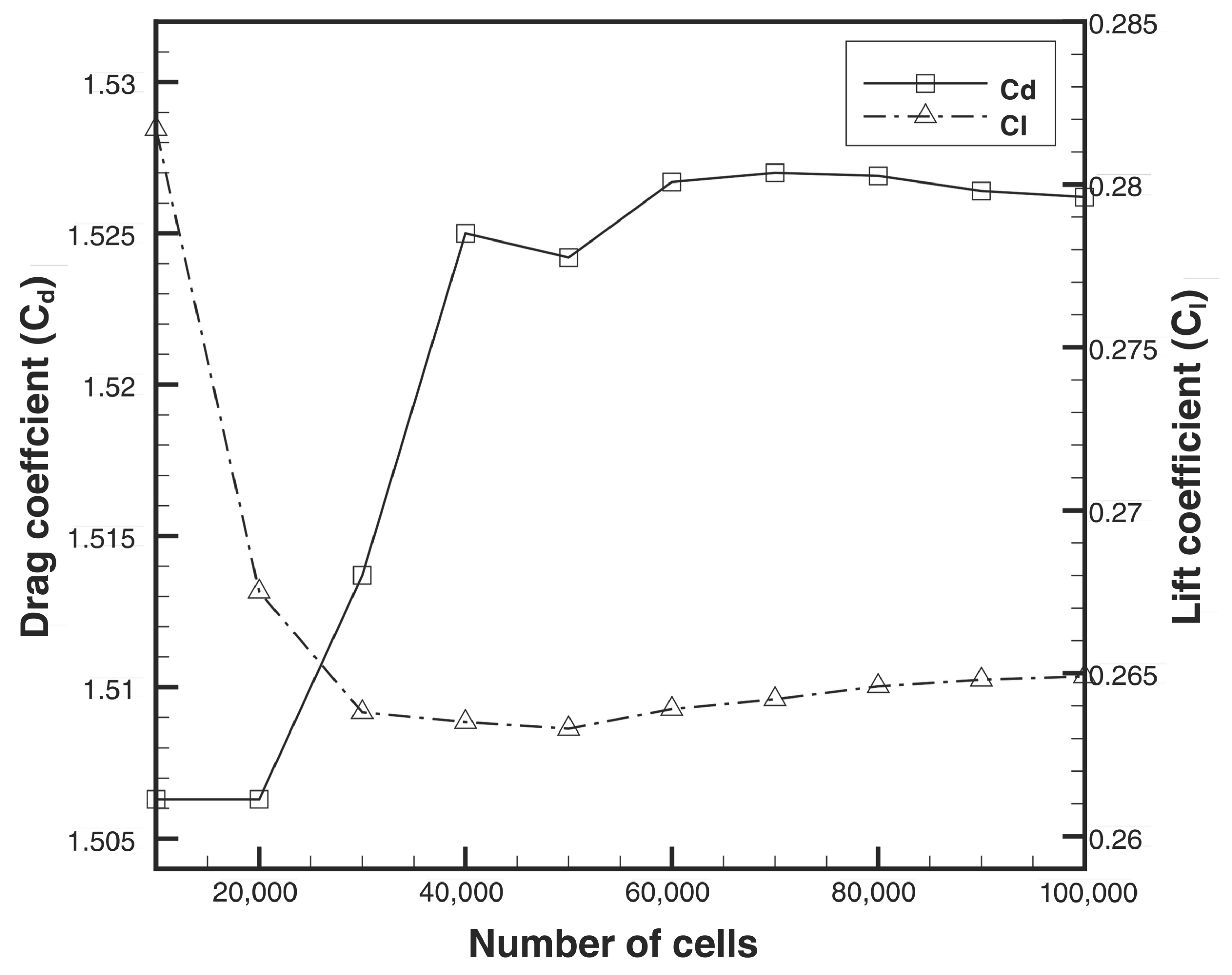
A grid independence analysis was conducted on a single square cylinder with various grid sizes, spanning 10,000 to 100,000 mesh elements. The parameters (mean drag coefficient C d and maximum amplitude of lift coefficient C l ) were found to be constant from 60,000 mesh elements. The subsequent increase in the aerodynamic coefficients (lift and drag) remained negligibly small with further increases in the cell count, as shown in Figure 2. Therefore, the grid chosen for further validation had 60,000 mesh elements to save computational time.
The domain used for the twin-square cylinder was the same as that of the single cylinder. The distance between two square cylinders (L) was non-dimensionalised by introducing the term gap ratio (L/D). The gap ratio (L/D) was varied from 2 to 7 at intervals of 0.5. The Re for the interference case varied from 100 to 200 (at intervals of 25).

2.4. Numerical Code Validation

The validation was performed on a single square cylinder at a Re of 100 and 150 (Table 3) to ensure the accuracy and reliability of the numerical model before extending the analysis to tandem arrangements. Computed aerodynamic coefficients, including the mean drag coefficient ( C d ), root-mean-square lift coefficient ( C l , rms ), and Strouhal number (St), were compared with the existing numerical and experimental results available in the literature. The comparison, presented in Table 3, demonstrates a close agreement with the previous studies, with deviations typically within 2–4%. Such variations can be attributed to differences in grid density, domain size, and numerical schemes used in the earlier works.
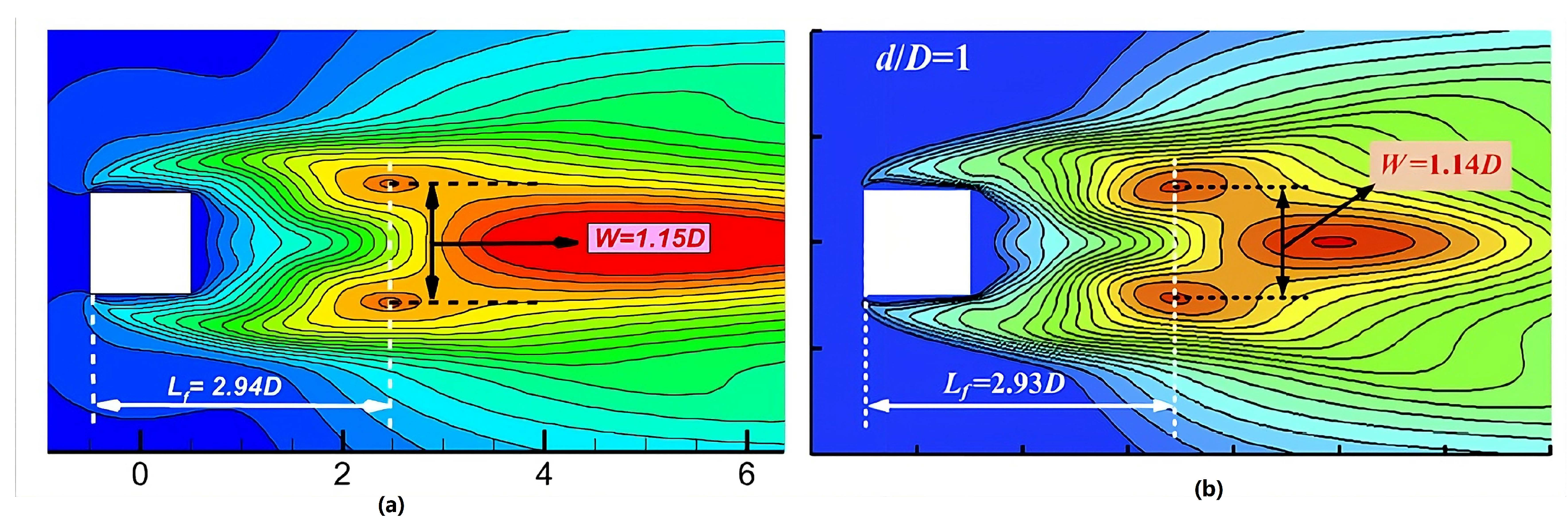
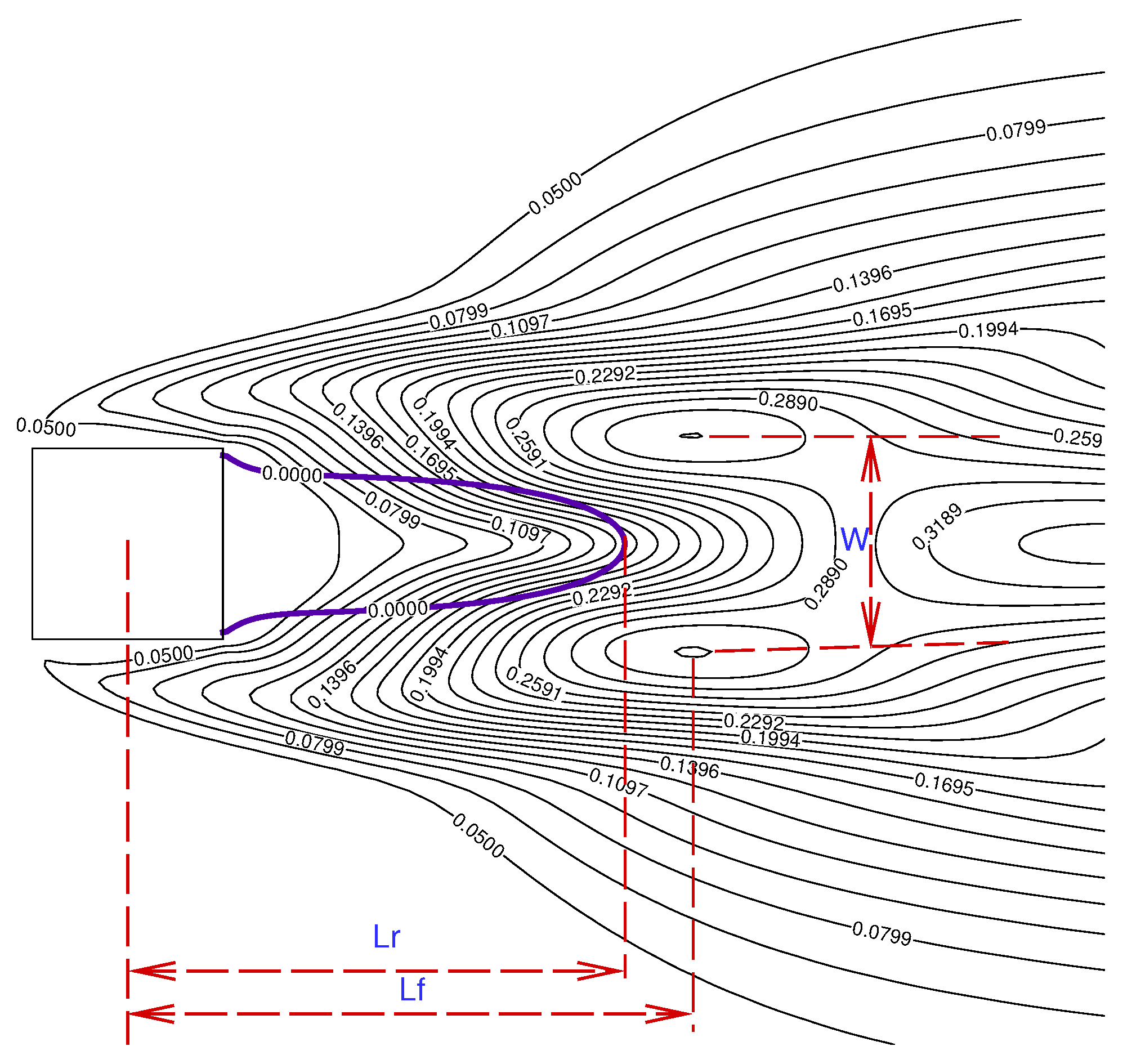
Further validation of the numerical approach was performed by comparing the root-mean-square (RMS) of the streamwise velocity fluctuations ( u rms ) behind a single square cylinder at R e = 150 with benchmark results from the literature by Zhu et al. [21], as illustrated in Figure 3. The present computation (left) accurately reproduces the wake parameters observed by Zhu et al. [21]. The predicted wake width ( W = 1.15 D ) is in close agreement with the reference data ( W = 1.14 D ), while the vortex formation length ( l f = 2.94 D ) matches closely with the reported value ( l f = 2.93 D ).
In addition to the single-cylinder case, the present numerical model is also validated for the flow past two tandem square cylinders to ensure the reliability of the simulation in capturing wake interference and unsteady force dynamics (Table 4). The present numerical results exhibit good agreement with the benchmark studies of Lankadasu et al. [64] and Mithun et al. [65] for R e = 100 and L / D = 5 . Both the upstream and downstream cylinders show comparable mean drag and fluctuating lift coefficients, confirming the reliability of the present numerical model in predicting wake interference. The Strouhal number ( S t = 0.1356 ) also lies within the reported range, validating the accurate capture of the vortex shedding frequency in the co-shedding regime.

3. Results and Discussion

The flow past an isolated square cylinder was initially simulated at Re in the range of 100–200. The study was then extended to two inline square cylinders over the same Re range, with the findings compared to those obtained for the single-cylinder configuration. The flow physics associated with the interference were of primary interest in this study.

3.1. Detailed Numerical Analysis on a Single Square Cylinder

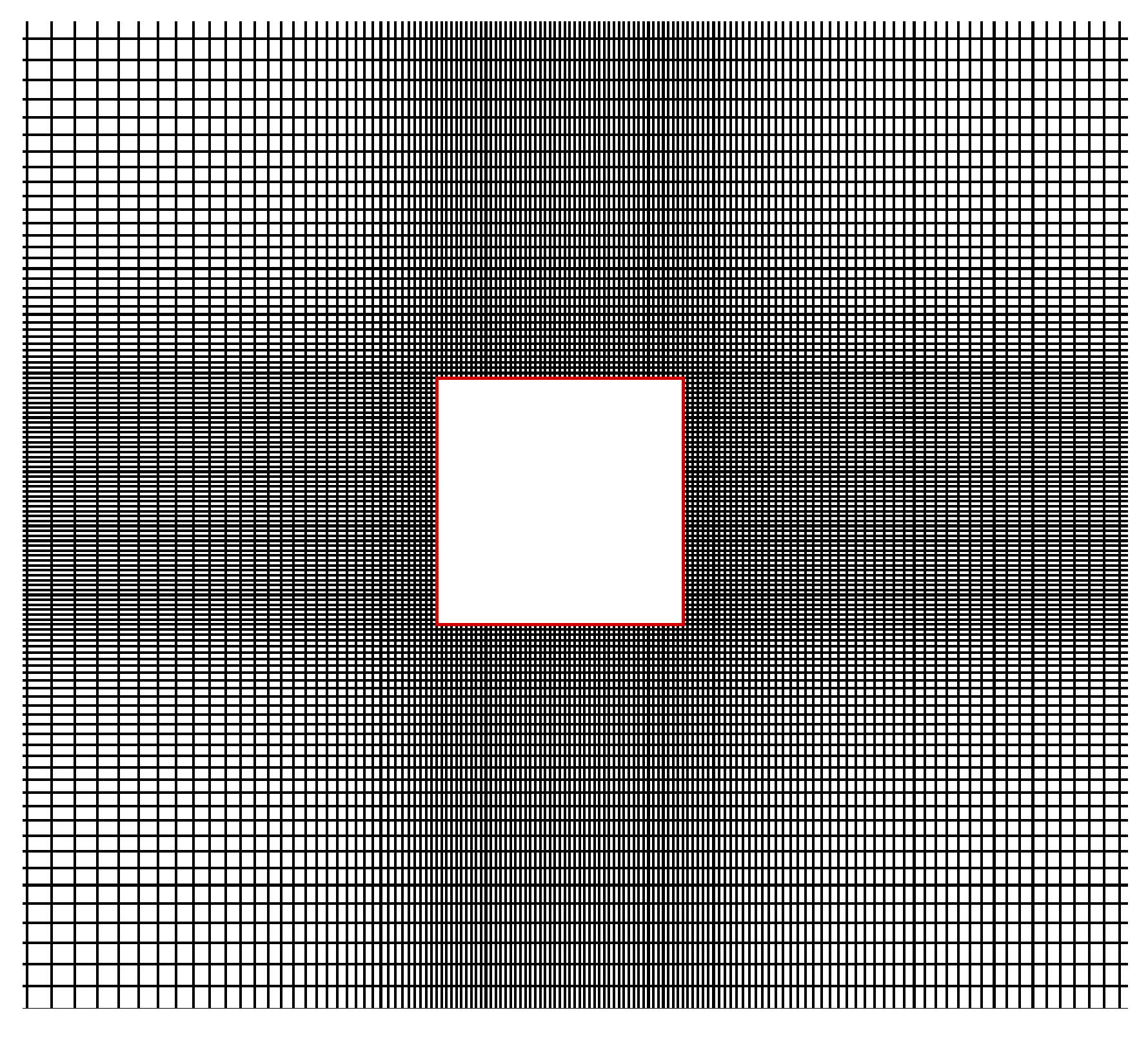
An extensive investigation was conducted for an isolated square cylinder case within a Re range of 100–200. The refined mesh, consisting of structured quadrilateral cells surrounding the cylinder, is shown in Figure 4.

3.1.1. Aerodynamic Forces and Flow Structures

The data presented in Table 5 show that the average drag coefficient ( C d ) decreases as the Re increases until it reaches a minimum value for a Re of 150. At this point, ( C d ) has increased slightly for Re of 175 and 200, which indicates that the behaviour of ( C d ) is not monotonic. The trend in ( C d ) also suggests that there are transitional characteristics in the wake, or changes in the flow separation properties, such as the trends identified by Sohankar et al. [66], which indicate a similar drop in ( C d ) for a Re of 150. Similar drops have been shown to occur by Franke et al. [67], and by Breuer et al. [68]. A steady increase in the lift coefficient ( C l ) was demonstrated as Re increased. An increase in ( C l ) implies an increasing asymmetry in the pressure distribution and an increasing adherence of the flow to the cylinder surface as the inertial forces become dominant, consistent with the observation of Okajima et al. [69].
A significant rise in the root-mean-square (rms) lift coefficient ( C l , rms ) with the Re indicates an amplified effect of oscillating lift forces and a larger degree of flow fluctuation. The root cause of this fluctuation can be attributed to the increased magnitude of vortex shedding and is consistent with that reported in Sohankar et al. [66] over the same range ( C l , rms 0.13 0.23 ).
The Strouhal number ( S t ) exhibits a mild nonmonotonic behaviour and increases up to (Re = 150), then slightly decreases with higher Re, which implies a small-scale shift in the regime of vortex shedding. Behaviour of ( S t ) is consistent with that of Breuer et al. [68], as well as Okajima et al. [69] for confined flows. Finally, the lift-to-drag ratio ( C l / C d ), which represents an important measure of aerodynamic efficiency, was observed to continuously increase with Re; ( C l / C d ) peaked at R e = 200 when lift increased more rapidly than drag. It is noted that at (Re = 150), it is at the minimum drag coefficient while maintaining a reasonable level of lift, therefore, indicating a favourable aerodynamic balance. High lift-to-drag ratios are preferred for harvesting energy from flow-induced vibration [70]. Overall, the close match in both the trend and representative values across C d , C l , C l , rms , and S t confirms the physical accuracy of the present simulations and demonstrates their capability to capture the essential flow features in the laminar regime.
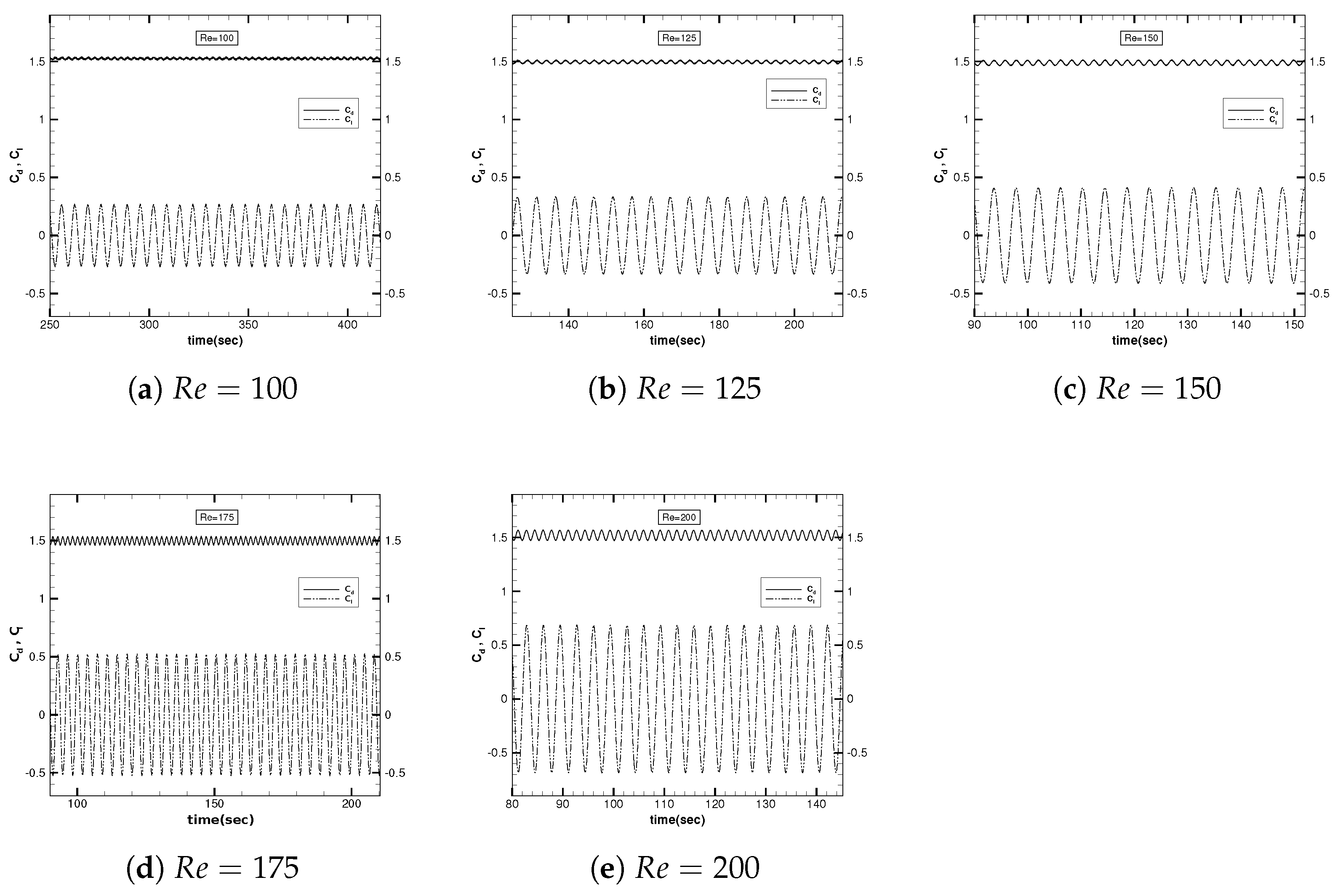
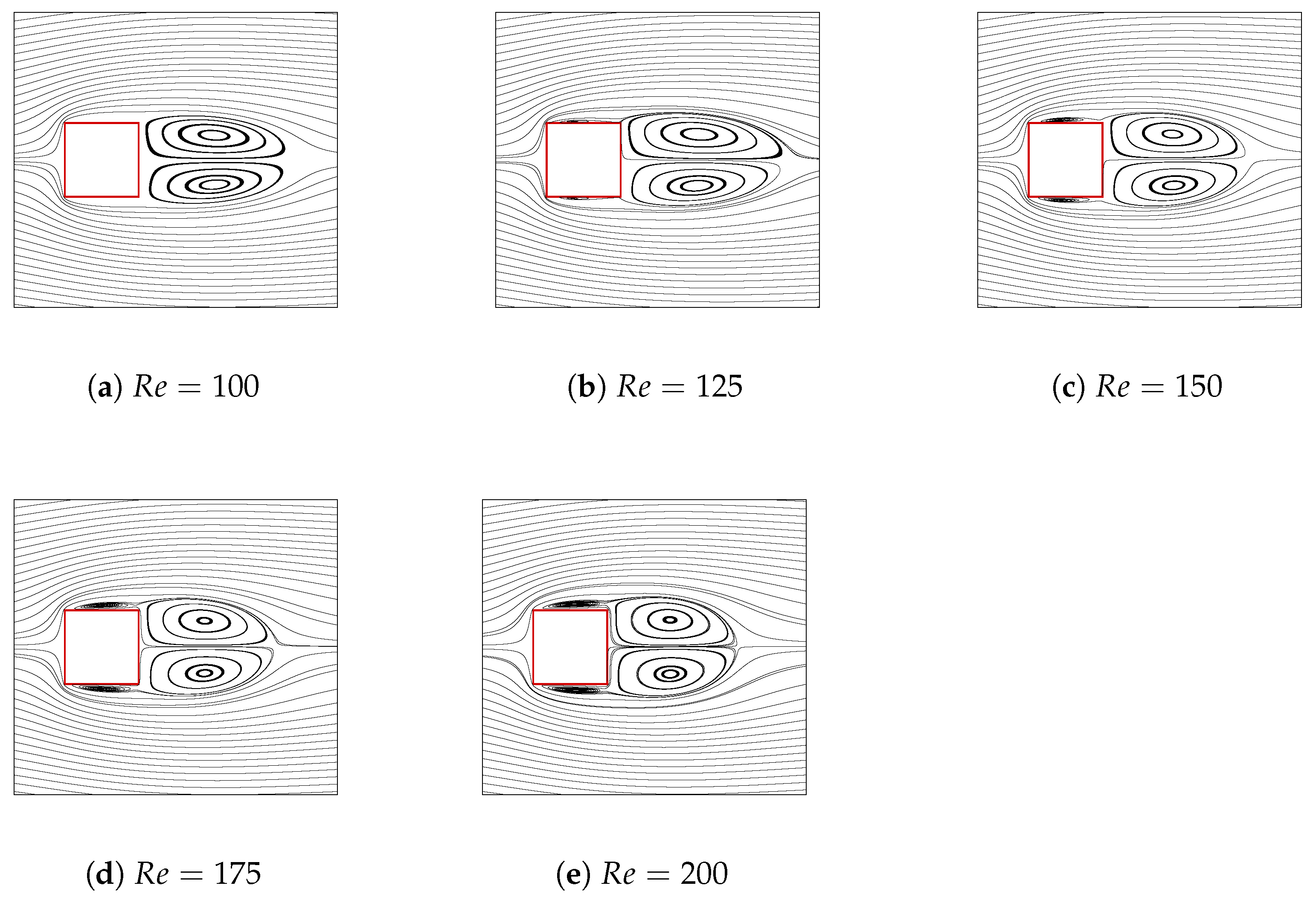
The time histories of the aerodynamic forces for a single square cylinder in the Re range of (100–200) are plotted in Figure 5. In the figure, both the lift and drag coefficient amplitudes are plotted at different Re. Moreover, Figure 6 clearly shows the flow pattern surrounding a single square cylinder within this range of Re. Temporal changes in the aerodynamic coefficients (Figure 5) and streamline patterns (time-averaged) (Figure 6) demonstrate the progressive evolution of the wake dynamics with an increase in Re.
As seen in Figure 5, the lift coefficient ( C l ) exhibits periodic oscillations with increasing amplitude and frequency as Re increases, indicating more energetic vortex shedding, which complies with the results reported by Okajima [69]. A mild reduction in the mean drag ( C d ) is observed up to Re ≈ 150 (Table 5), corresponding to an elongation of the recirculation region (see Figure 6). At Re = 200, the wake became more compact and laterally broader, suggesting increased instability and the onset of three-dimensional effects (Figure 6). While the time-averaged wake remains symmetric, the growing C l fluctuations reflect an enhanced unsteady asymmetry in the shedding process. These findings align with the laminar unsteady wake regime classification by Zdravkovich [71] and confirm that the present simulations capture the key features of flow-induced forces and wake transitions in the subcritical Re range.

3.1.2. Cylinder Wake Parameters

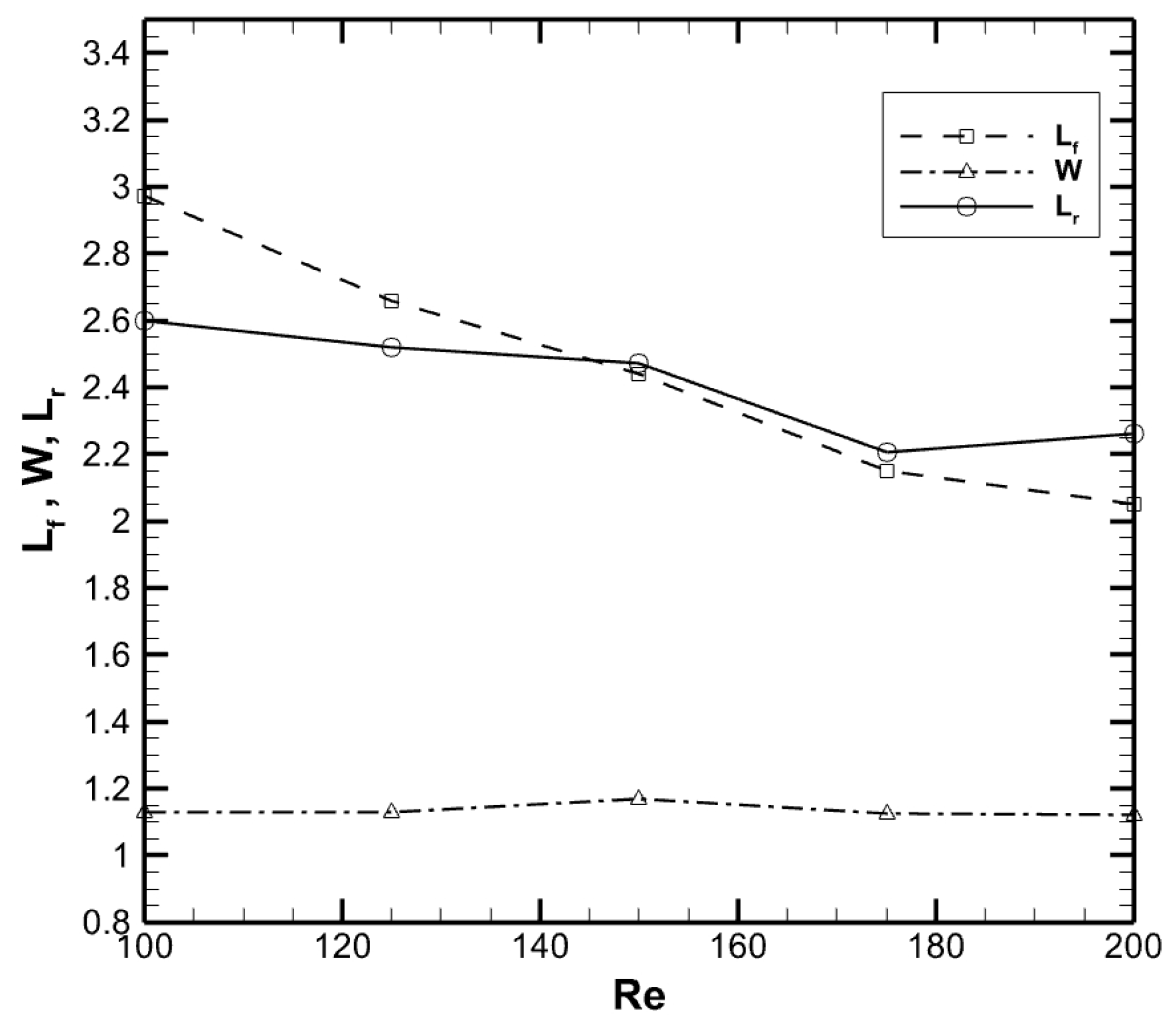
The key wake parameters, including the wake width (W), vortex formation length ( L f ), and recirculation length ( L r ), were analysed and are shown in Figure 7. Figure 8 illustrates the variation of aforementioned parameters with Re in the range 100 < Re < 200.
As evident from Figure 8, the vortex formation length decreases as Re increases, indicating a shorter formation region where vortices form closer to the base of the cylinder at higher Re values. The wake width remained nearly invariant with only minor variations, indicating that the width of the wake did not vary significantly with the Re. The recirculation length also exhibited a decreasing trend as the Re increased until approximately Re = 175, after which it showed a slight increase. This suggests a complex flow behaviour with a transition between different regimes. At higher Re, the shorter vortex formation length signified an earlier roll-up of the shear layers, resulting in enhanced base suction on the cylinders. This directly enhanced the pressure drag, thereby increasing the mean drag coefficient despite the faster wake recovery (Table 5).

3.2. Twin-Square Cylinder Interference Study

Two-square cylinder interference refers to the mutual flow interactions that occur when both the upstream cylinder (hereafter referred to as UC) and downstream cylinder (hereafter referred to as DC) are in close proximity in a fluid flow. The spacing and alignment between the two cylinders alter the manner in which the flow separates, reattaches, and forms vortices around each cylinder [35,72].
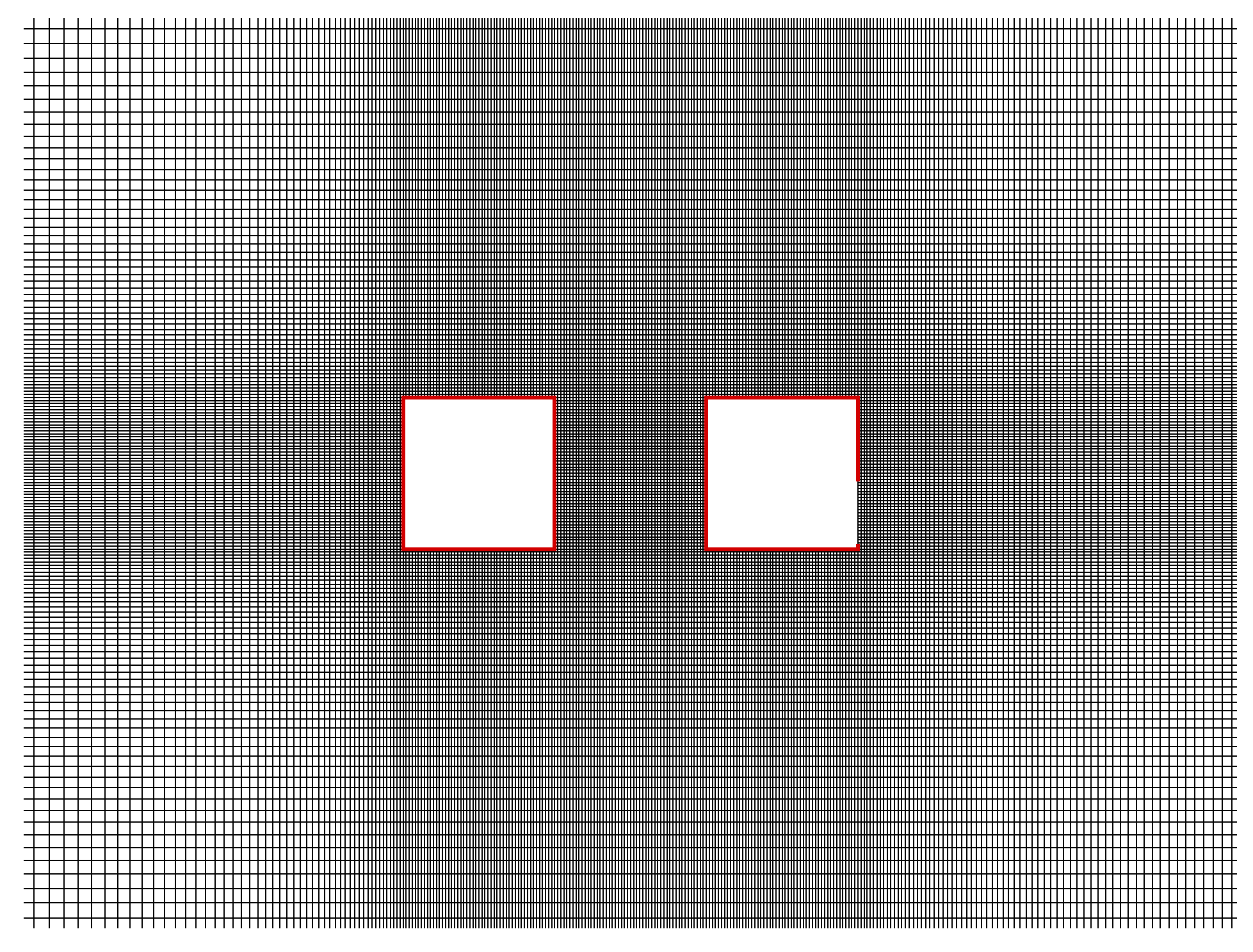
The domain used for the study is shown in Figure 1b, along with the applicable boundary conditions. The refined mesh near the twin-square cylinders is shown in Figure 9.
The aerodynamic parameters for interference cases were analysed in the Re range of (100–200) with the cylinder gap ratio (L/D) ranging from 2 to 7 at intervals of 0.5. The study aims to evaluate the variation in the critical spacing ( l c ) and associated wake parameters of tandem square cylinders as the Re changes from 100 to 200. The critical spacing ( l c ) is the threshold gap ratio (L/D) at which the flow shifts from a shear-layer reattachment regime to a co-shedding regime [72], marking a distinct shift in the wake structure and aerodynamic loading. This parameter plays a crucial role in bluff body flows because it governs the nature of the vortex interactions between adjacent cylinders. At subcritical spacings, strong interference effects dominate, whereas at post-critical spacings (beyond l c ), the DC begins to shed vortices independently. The choice of spacing influences the frequency, coherence of vortex shedding, and also the amplitude of force fluctuations, making it a key factor in aerodynamic performance, flow-induced vibration control, and structural integrity in practical engineering configurations. The present study advances the understanding of tandem cylinder interference by moving beyond regime classification to quantify novel wake features, including distinct trends in vortex formation length, wake width, and recirculation length for both cylinders. These results reveal new physical mechanisms governing the force amplification and transition behaviour near the critical spacing.

3.2.1. Drag Characteristics in Interference

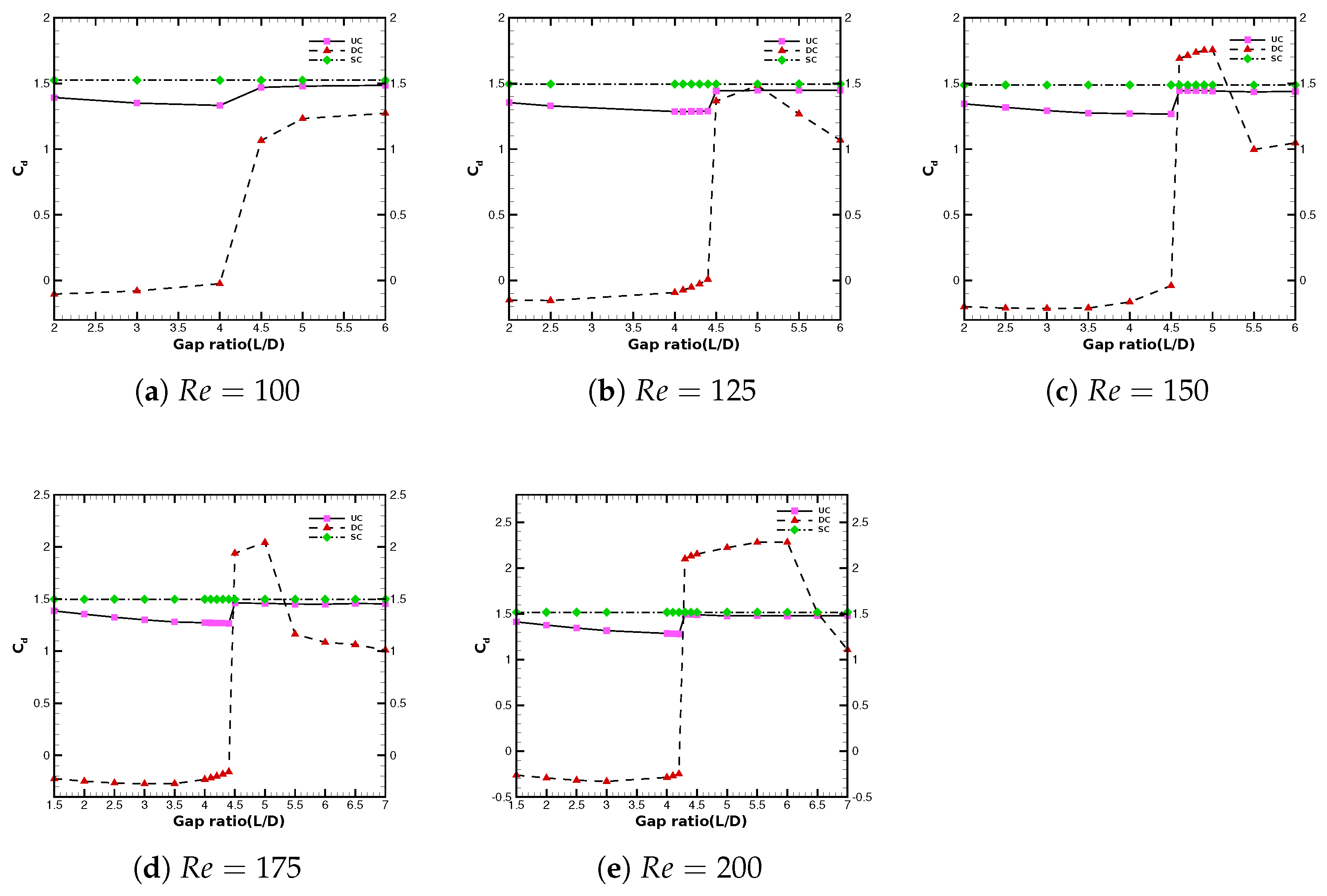
The change in aerodynamic forces for the UC and DCs can be used as an accurate tool to estimate this critical spacing ( l c ) across the tested Re range. Initially, the change in the drag coefficient ( C d ) for both cylinders is plotted, as shown in Figure 10 for Re (100–200).
It is evident from Figure 10 that the drag coefficient ( C d ) increases drastically for the DC across all the Re after a specific gap ratio (between 4 and 4.5). Similar patterns are seen for UC at the same gap ratios, but with a narrower high-drag plateau.
Based on the gap ratio, the interference regions can be classified [73] as (a) extended-body regime (1.5 < L/D < 4), (b) shear-layer reattachment regime (4 < L/D < 4.5), and (c) co-shedding regime (L/D > 4.5). At the extended-body regime (1.5 < L/D < 4), DC is shielded by the wake of the UC and is exposed to a low-velocity, fluctuating recirculating flow instead of the free stream. This suppresses vortex shedding and can result in significantly reduced or even negative drag on the DC [35]. A slight reduction in C d was also observed for the UC owing to the interference from the DC across all the Reynolds numbers (100–200).
In the shear-layer reattachment regime ( 4 < L / D < 4.5 ), the DC is only partially shielded by the upstream wake and begins to interact with a higher-momentum fluid. As the gap approaches the critical spacing ( l c ), the shielding effect diminishes, leading to a rise in mean drag, intensified vortex-induced fluctuations, and the reappearance of periodic vortex shedding. These changes indicate that the DC is progressively released from the influence of the upstream body and transitions towards the behaviour of a stand-alone cylinder.
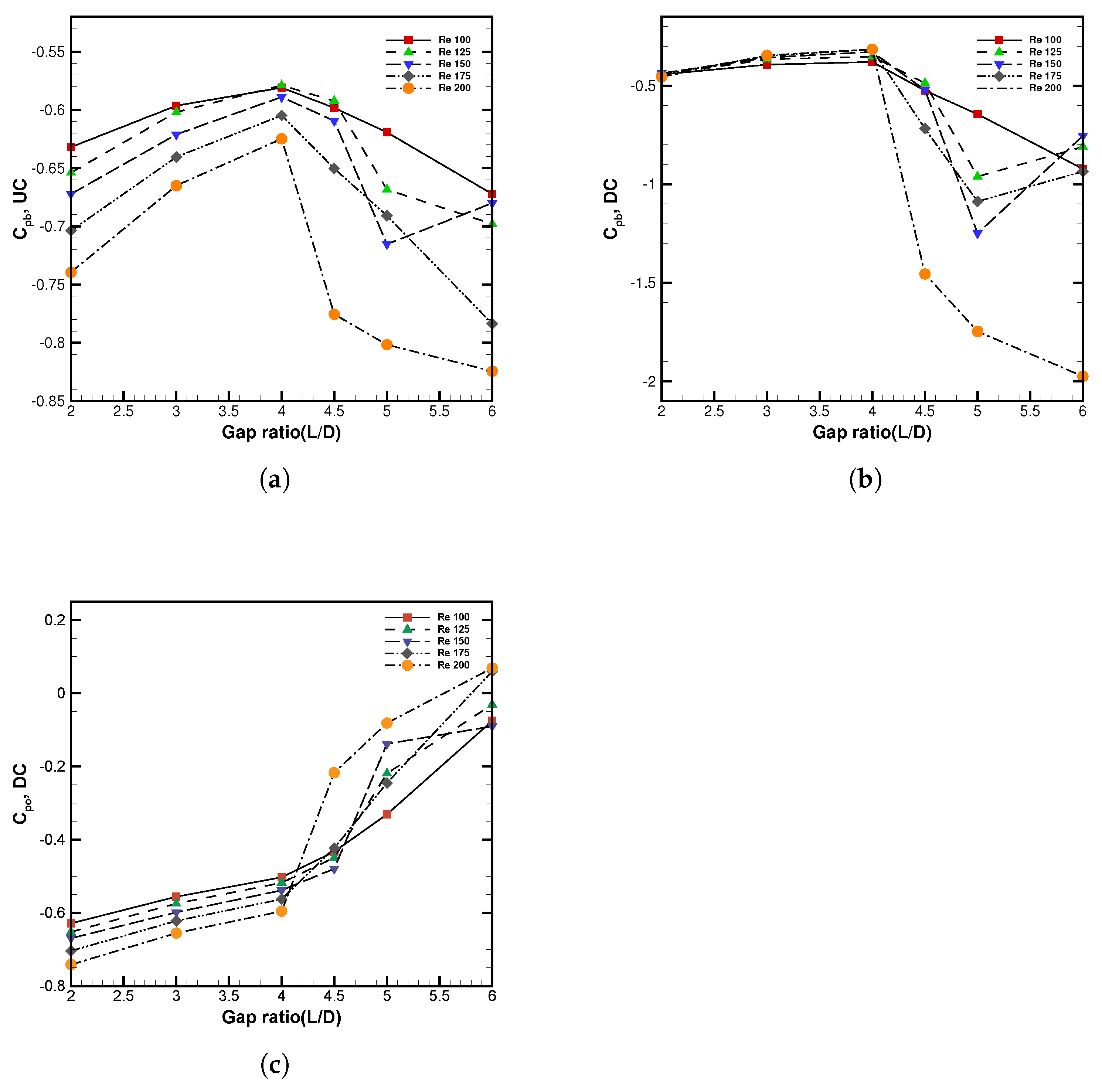
Eventually, the flow interaction between the cylinders weakened in the Co-shedding regime (L/D > 4.5). A distinct peak in the drag coefficient of the DC was observed for 4.5 < L / D < 6.5 at higher Reynolds numbers ( R e = 150 200 ), exceeding that of an isolated cylinder. This increase was attributed to intensified vortex impingement and reduced flow shielding from the UC, which significantly altered the pressure distribution on the downstream body. This observation is supported by Figure 11. The DC exhibits a sharp drop in base pressure coefficient ( C p b ) and a concurrent rise in stagnation pressure coefficient ( C p s ) within this gap range, indicating stronger suction at the rear and elevated frontal pressure exposure. The resulting increase in the pressure differential led to enhanced form drag (discussed in detail during the pressure coefficient analysis).
The UC experienced drag identical to that of a standalone cylinder throughout the Re range. In this regime, the UC wake no longer significantly affected the DC, and the two cylinders acted as separate bodies. This study identifies a novel drag overshoot on the downstream square cylinder within 4.5 < L / D < 6.5 at R e = 150 200 , where the drag exceeds that of an isolated cylinder. While prior studies [72,74,75] reported drag recovery beyond the critical spacing, the present findings reveal a drag trend previously not reported and are attributed to enhanced vortex impingement and pressure differential.
The downstream-cylinder mean drag, C D , D C , was compared against the isolated square-cylinder baseline C D , single at the same Re to quantify interference effects. For L / D 4 , the DC remains sheltered within the upstream wake and C D , D C is consistently below the isolated-cylinder value. A sharp transition occurs in the vicinity of L / D 4.5 —the co-shedding/reattachment window—where C D , D C increase rapidly. The observed peak amplifications (relative to C D , single ) are as follows: no positive amplification for Re = 100 and Re = 125; **+17.98%** at L / D = 5.0 for Re = 150 ( C D , D C = 1.7550 ); **+36.38%** at L / D = 5.0 for Re = 175 ( C D , D C = 2.0419 ); and **+50.41%** at L / D = 6.0 for Re = 200 ( C D , D C = 2.2817 ). Beyond the peak window ( L / D 6 ), the downstream drag tends to decrease towards or below the single-cylinder level as the cylinders become hydrodynamically independent. These results indicate a strong, Reynolds-number-dependent amplification of mean drag induced by wake reattachment and co-shedding in the critical spacing range.
Based on the results presented in Figure 10, specific gap ratios were selected (L/D = 2, 4, 4.5, and 6) covering all three interference zones (before and after critical spacing). These gap ratios extensively represent all three regimes discussed above.

3.2.2. Temporal Lift Characteristics in Interference

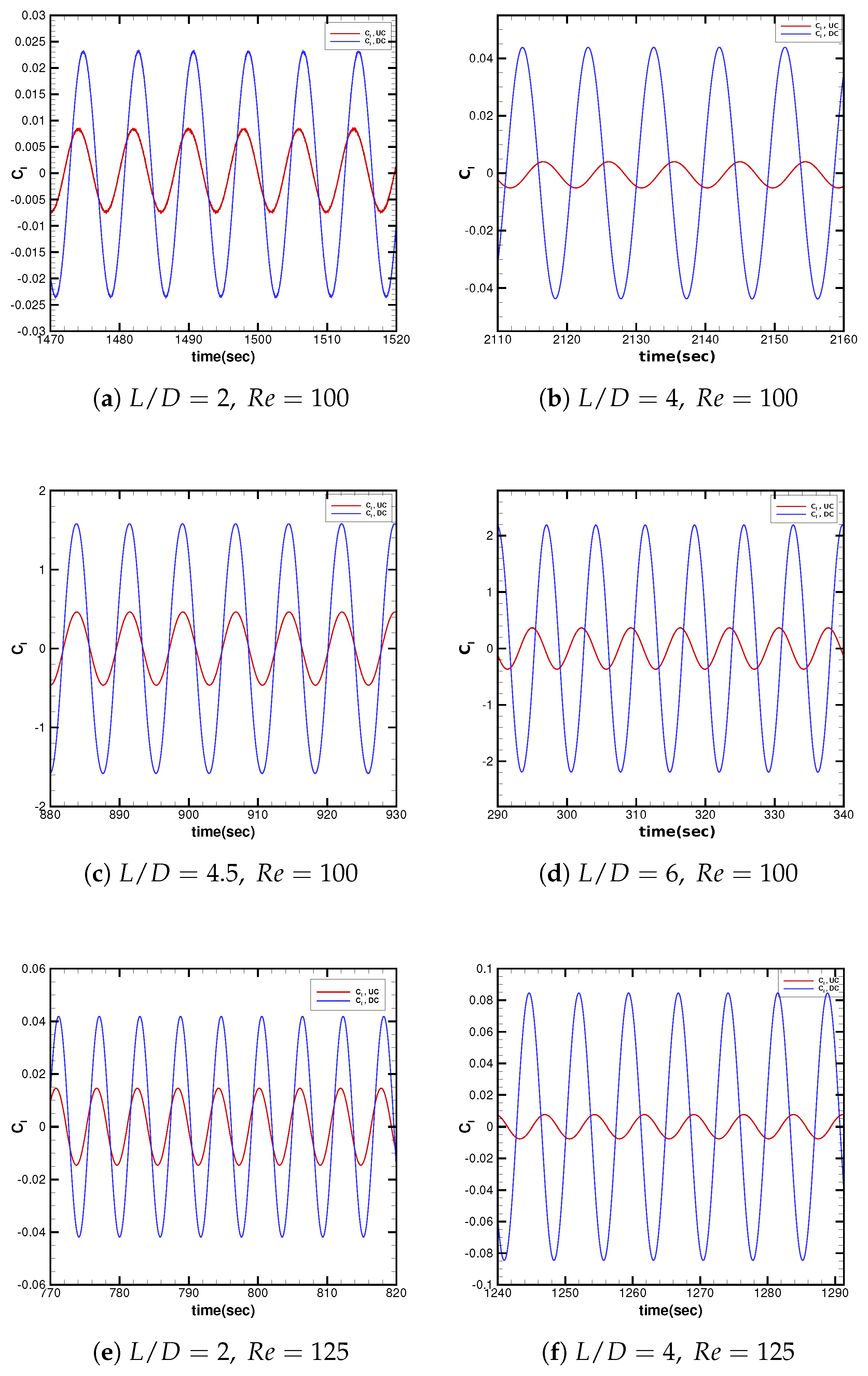
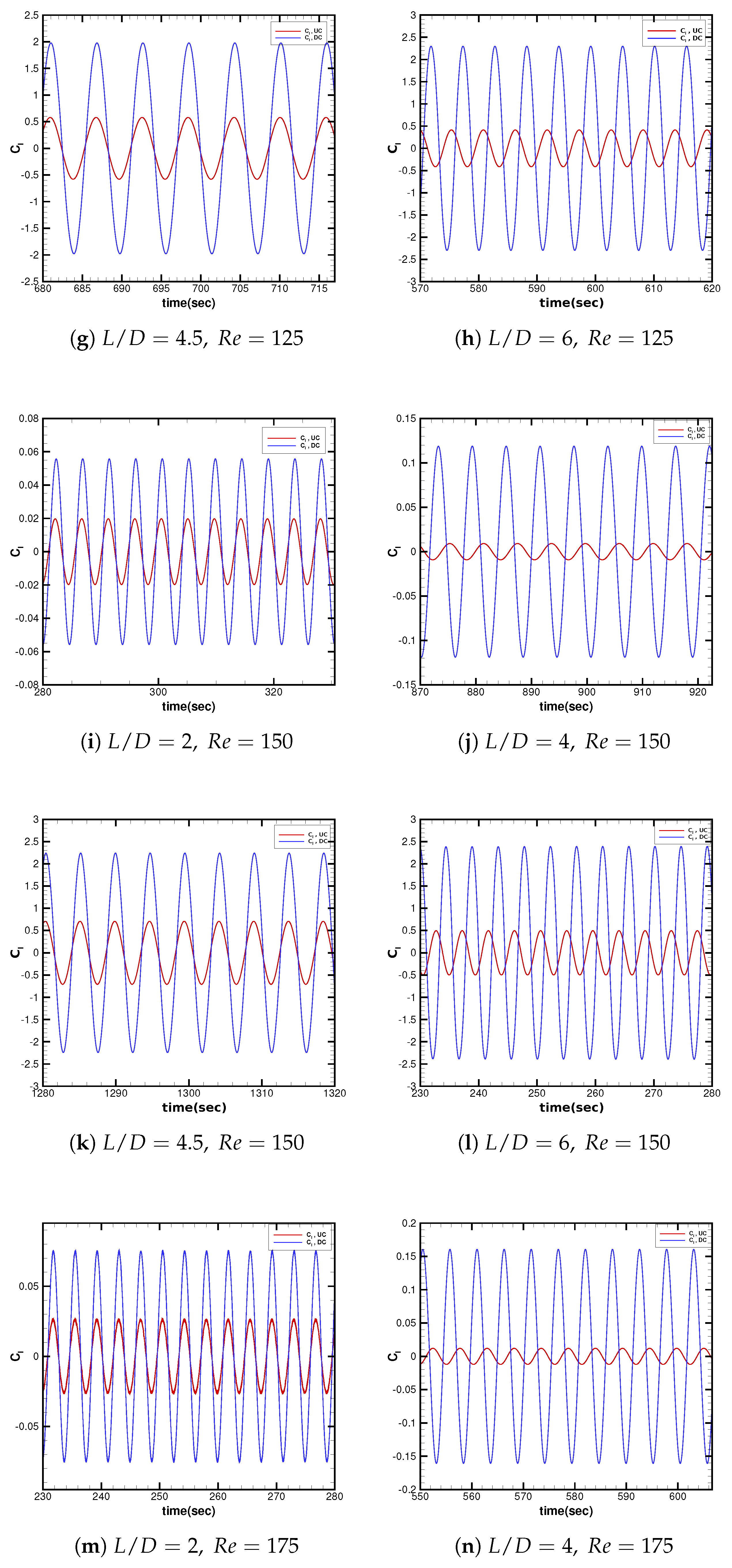
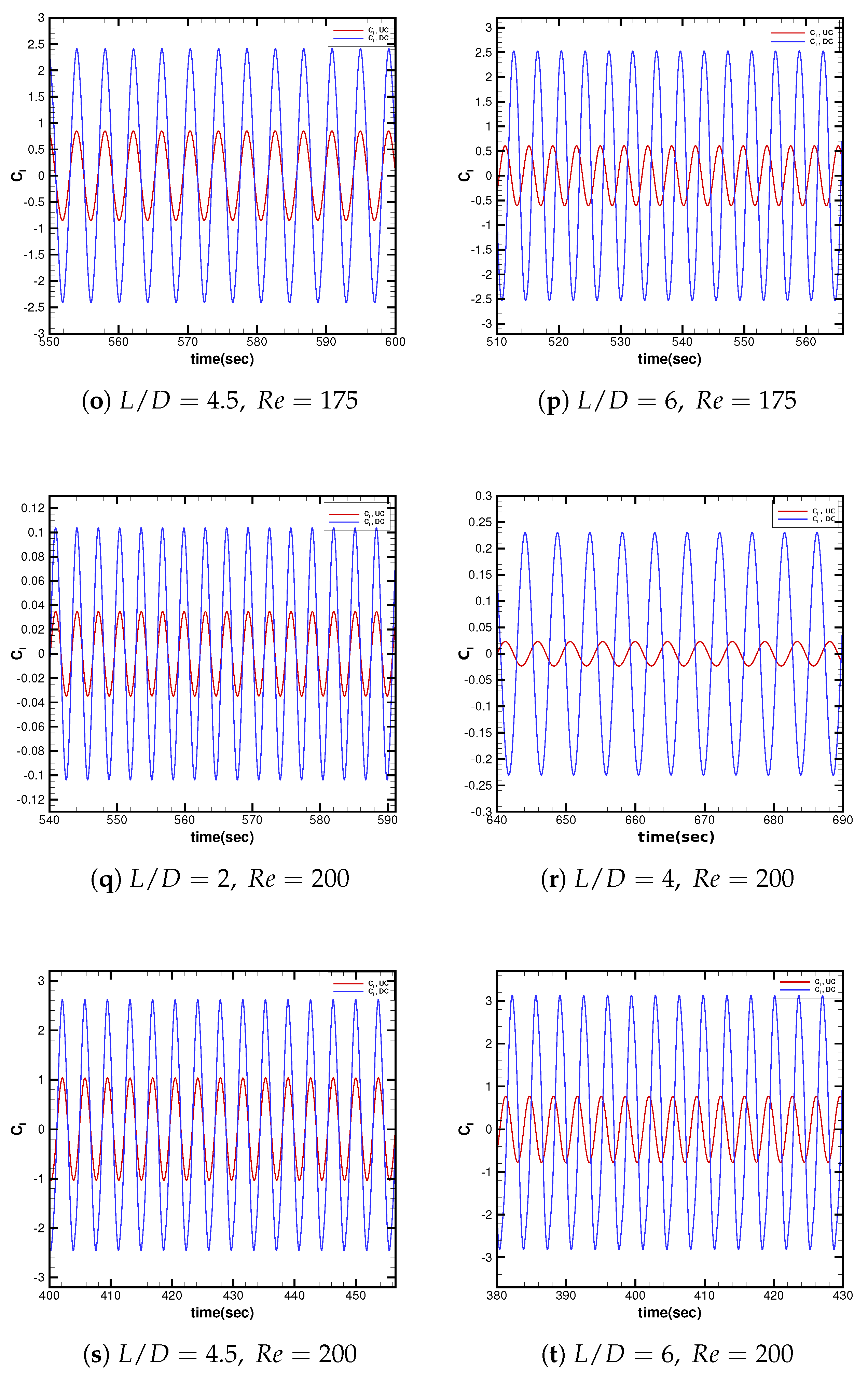
Figure 12 illustrates the temporal change in the amplitude of lift coefficient C l for UC and the DC at specific gap ratios (L/D = 2, 4, 4.5, and 6) for all test Re.
In the extended-body regime (L/D = 2, 4), the lift coefficient amplitude ( C l ) was low for both UC and DC (Figure 12). However, small variations in the lift coefficient were noted at higher Re. At the critical spacing (L/D ≈ 4.5) and after the gap ratio with L/D = 6, the amplitude of the lift coefficient ( C l ) shows a drastic increase in value ( C l > 2). This supports the findings observed in the case of the drag coefficient ( C d ) at the same spacing (see Figure 10). This is possibly because the cylinders come out of interference and act as standalone cylinders at larger gap ratios.

3.2.3. Spectral and Phase Shift Analysis of Lift Fluctuations

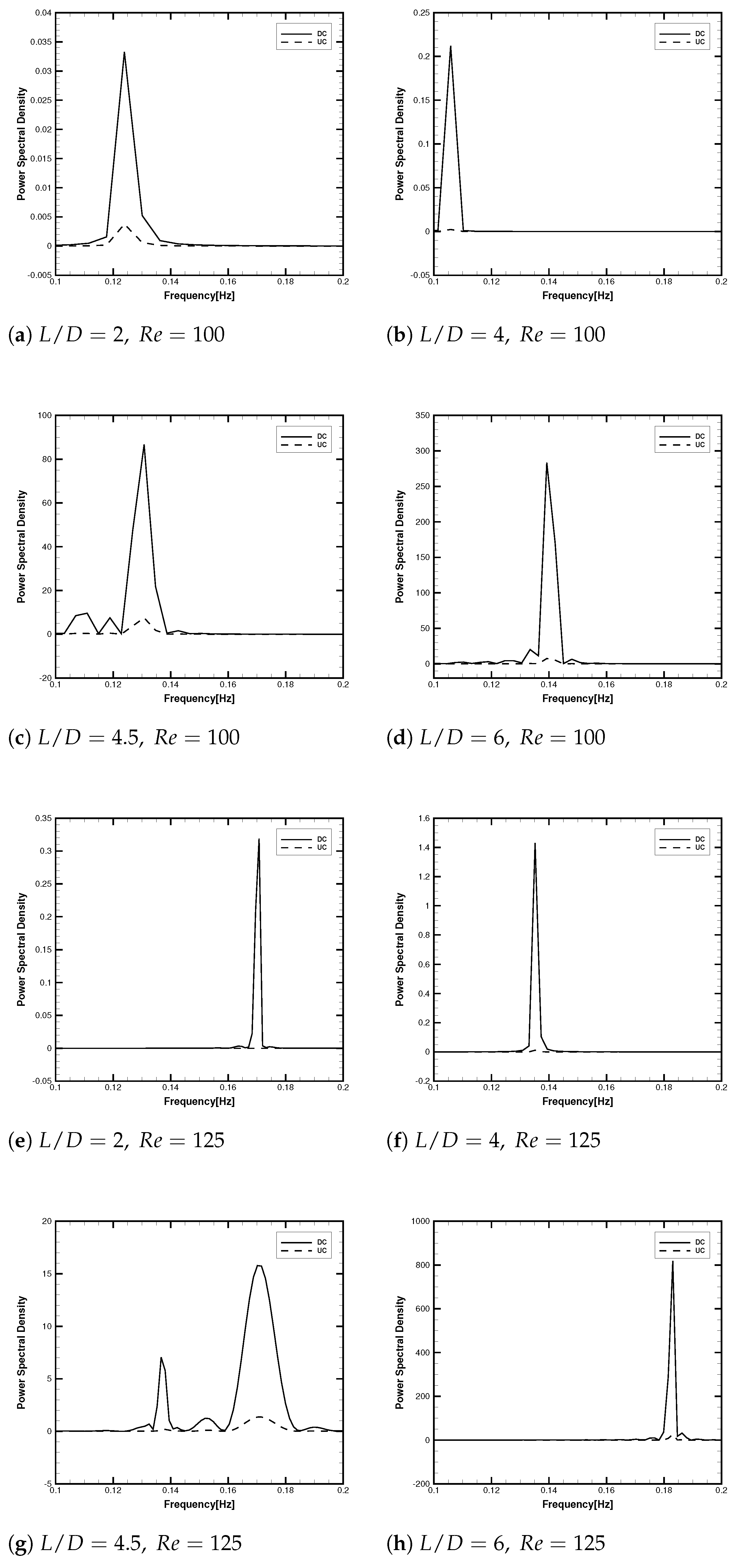
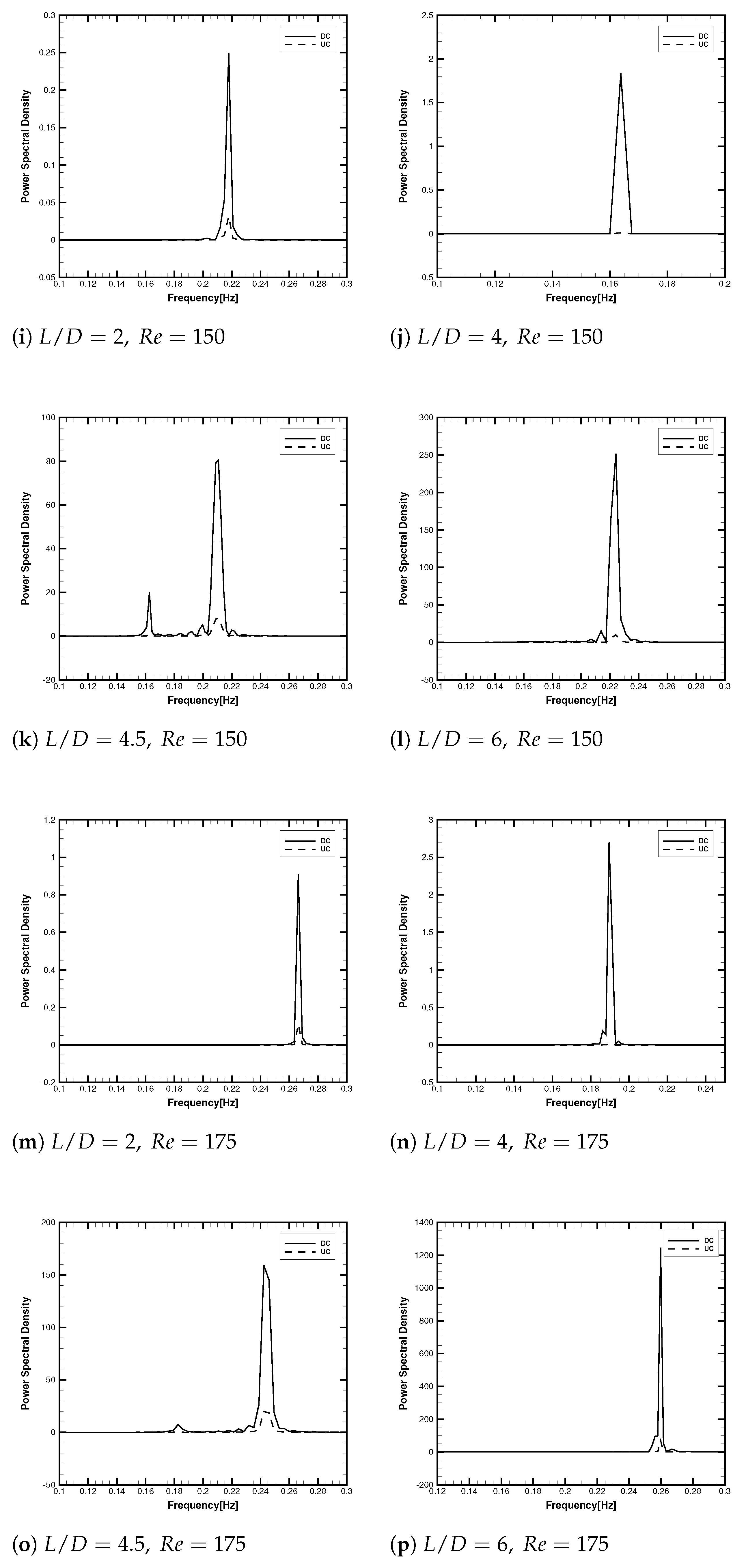
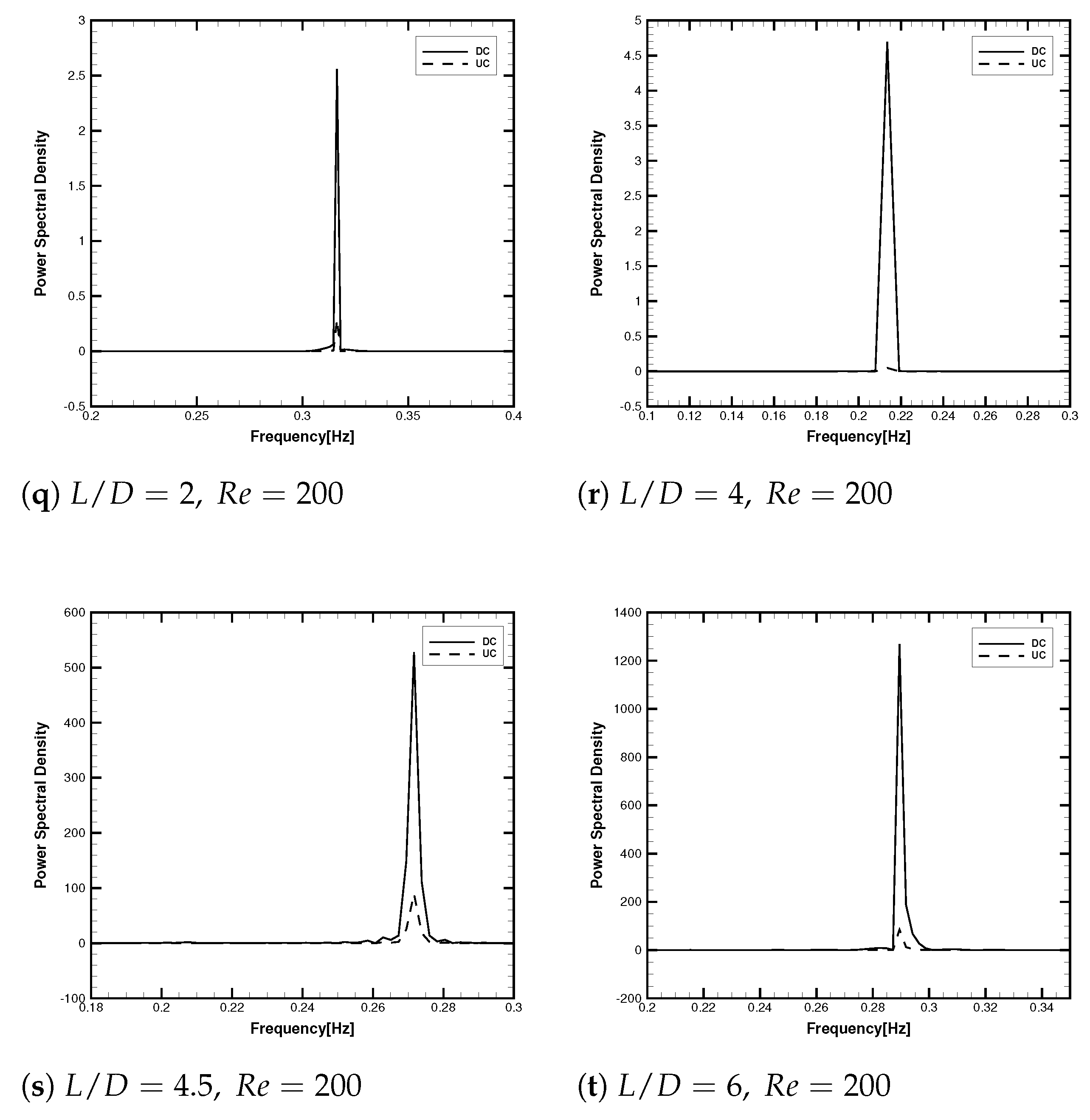
To further substantiate the time-domain observations, a spectral analysis of the lift coefficient was performed (Figure 13). The Power Spectral Density (PSD) was computed using Fast Fourier Transform of the C l signals over the statistically steady portion of the simulation.
The Power Spectral Density (PSD) of the lift coefficient ( C l ) provides a quantitative assessment of the unsteady wake characteristics across Reynolds numbers ( R e = 100 –200) and gap ratios ( L / D = 2 –7).
In the extended-body regime ( L / D < 4 ), both cylinders exhibit a single dominant low-frequency peak, increasing proportionally with R e , indicating a synchronised shedding mode (Figure 13). The DC’s signal amplitude remains weak (compared to very high values at higher gaps) due to strong wake shielding, and the narrow spectral bandwidth confirms a highly periodic yet low-energy oscillation. The nearly identical frequency content of both cylinders suggests complete flow coupling within a single extended shear layer.
The shear-layer reattachment regime ( 4 L / D 4.5 ) displays markedly different behaviour. Here, the PSD of the DC broadens and splits into two distinct frequencies. This dual-frequency response possibly arises from the intermittent switching between upstream-imposed vortex impingement and self-generated shedding. The UC retains a stable single-frequency signature, while the DC’s spectral energy distributes across both modes, reflecting amplitude modulation and partial desynchronisation. The coexistence of these peaks quantitatively marks the onset of wake independence and matches the sharp rise in C l , rms (Figure 14) and the Strouhal number (Figure 15) observed at this spacing range.
In the co-shedding regime ( L / D > 4.5 ), the spectra recover single, sharp peaks at higher frequencies ( f 0.30 0.70 Hz depending on R e ), indicating well-established, independent vortex shedding from each cylinder (Figure 13). The absence of secondary modes in the post-critical gap ratios confirms that wake interference has diminished and that the DC sheds vortices at its own frequency.
Across every configuration, the DC consistently shows a much higher PSD peak compared to the UC. The UC signal is almost flat, with minimal energy, highlighting that strong vortex shedding predominantly occurs at the downstream location. This separation in PSD intensity between DC and UC becomes even more pronounced as both spacing and Re increase.
Overall, the PSD characteristics across all Reynolds numbers confirm a progressive transition from synchronised low-energy shedding to broadband dual-mode interaction and finally to high-energy independent shedding. This spectral bifurcation provides unambiguous quantitative evidence for the three interference regimes and reinforces the wake-regime classification established from force, Strouhal, and flow-visualisation analyses.
To further elucidate the synchronisation characteristics between the two cylinders, the phase difference ( Δ ϕ ) between the lift coefficient ( C l ) signals of the upstream (UC) and downstream (DC) cylinders was quantified. The instantaneous lift data from both cylinders were first extracted over several vortex shedding cycles after attaining a statistically steady periodic state. The phase lag was then determined by calculating the temporal difference between corresponding positive peaks in the C l signals of UC and DC and normalizing it with the shedding period ( T s = 1 / f s ), using the following relation:
Δ ϕ = Δ t T s × 360 ,
where Δ t represents the time delay between the lift peaks of the two cylinders. The resulting phase difference provides a quantitative measure of synchronisation and vortex coupling between the cylinder wakes.
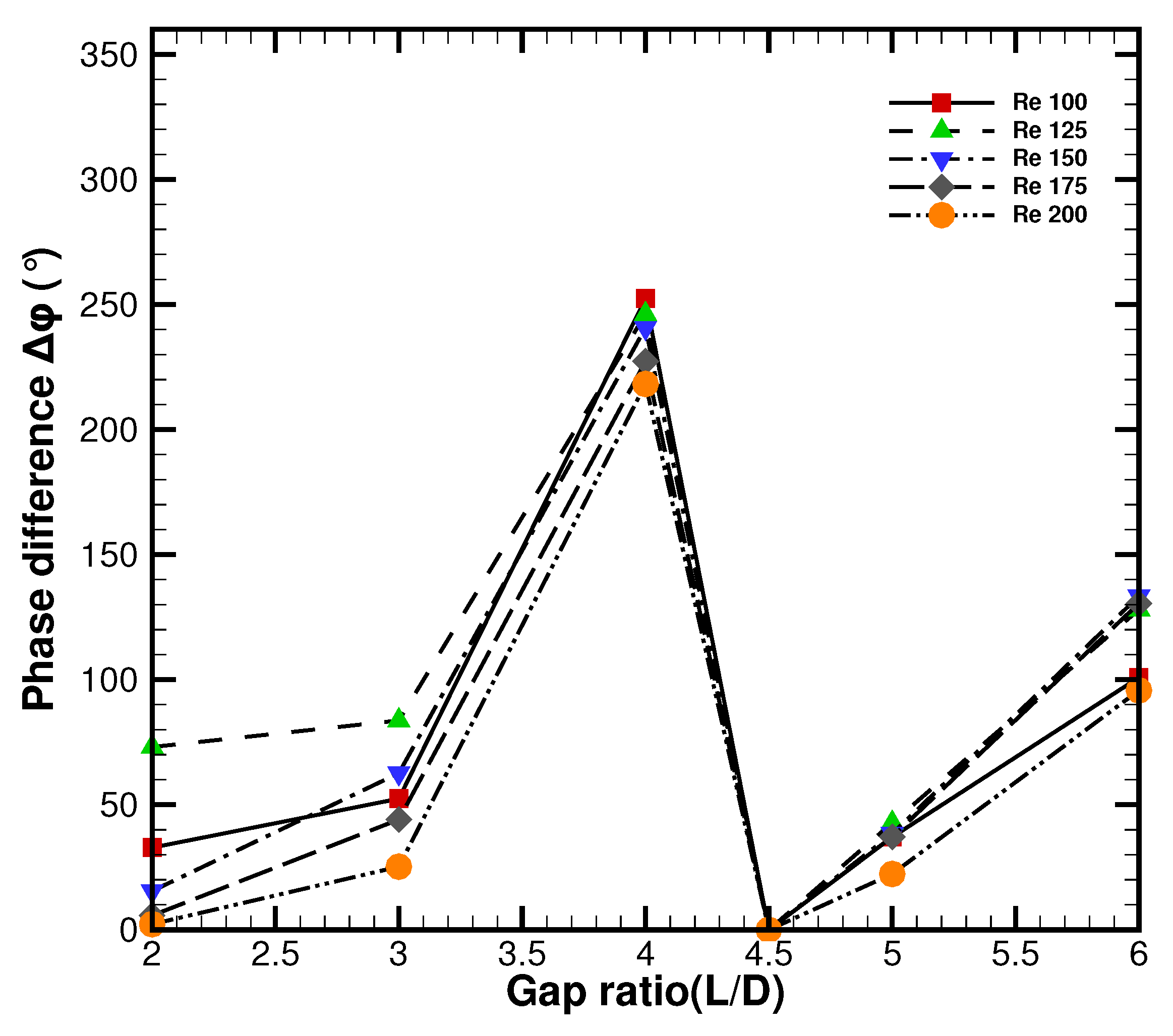
Figure 16 illustrates the variation of phase difference ( Δ ϕ ) with the gap ratio ( L / D = 2–6) in the Reynolds numbers range, R e = 100 –200. The overall trend reveals three distinct regimes consistent with the interference classifications established in the aerodynamic and spectral analyses.
In the extended-body regime ( 1.5 < L / D < 4 ), the phase difference remains relatively small ( Δ ϕ 0 80 ), indicating strong coupling between the cylinders. Here, the DC lies within the steady recirculation bubble of the UC, resulting in highly correlated, nearly in-phase oscillations. With an increasing gap ratio, the DC starts to experience weak periodic disturbances, leading to a rise in Δ ϕ .
As the gap increases to around L / D 4 4.5 , corresponding to the shear-layer reattachment regime, the phase difference abruptly increases, reaching a peak of approximately 250 at L / D 4 , nearly independent of Re. This sharp rise reflects a critical transition in wake behaviour, where the upstream vortices intermittently reattach on the DC surface, producing a partially out-of-phase relationship between the lift oscillations. The subsequent drop to nearly zero at L / D = 4.5 signifies a sudden resynchronisation—a phase lock—marking the onset of independent vortex shedding from both cylinders. This zero crossing represents the critical spacing where the DC starts shedding vortices at the same frequency and phase as the UC, leading to complete phase alignment.
Beyond L / D > 4.5 , in the co-shedding regime, the phase difference gradually increases again (up to ∼ 100 at L / D = 6 ), implying a weak phase lag due to mutual interference of two fully developed but distinct wakes. These trends remain consistent across all Reynolds numbers ( R e = 100 –200), indicating that the phase dynamics are primarily governed by geometric spacing rather than inertial effects within this laminar range.
This phase-based characterisation thus provides a quantitative confirmation of the regime transitions identified earlier through force coefficients and spectral signatures. The critical spacing ( L / D 4.5 ), marked by Δ ϕ 0 , signifies the most distinct hydrodynamic transition between coupled and independent vortex shedding modes.

3.2.4. Strouhal Number ( S t ) Characteristics in Interference

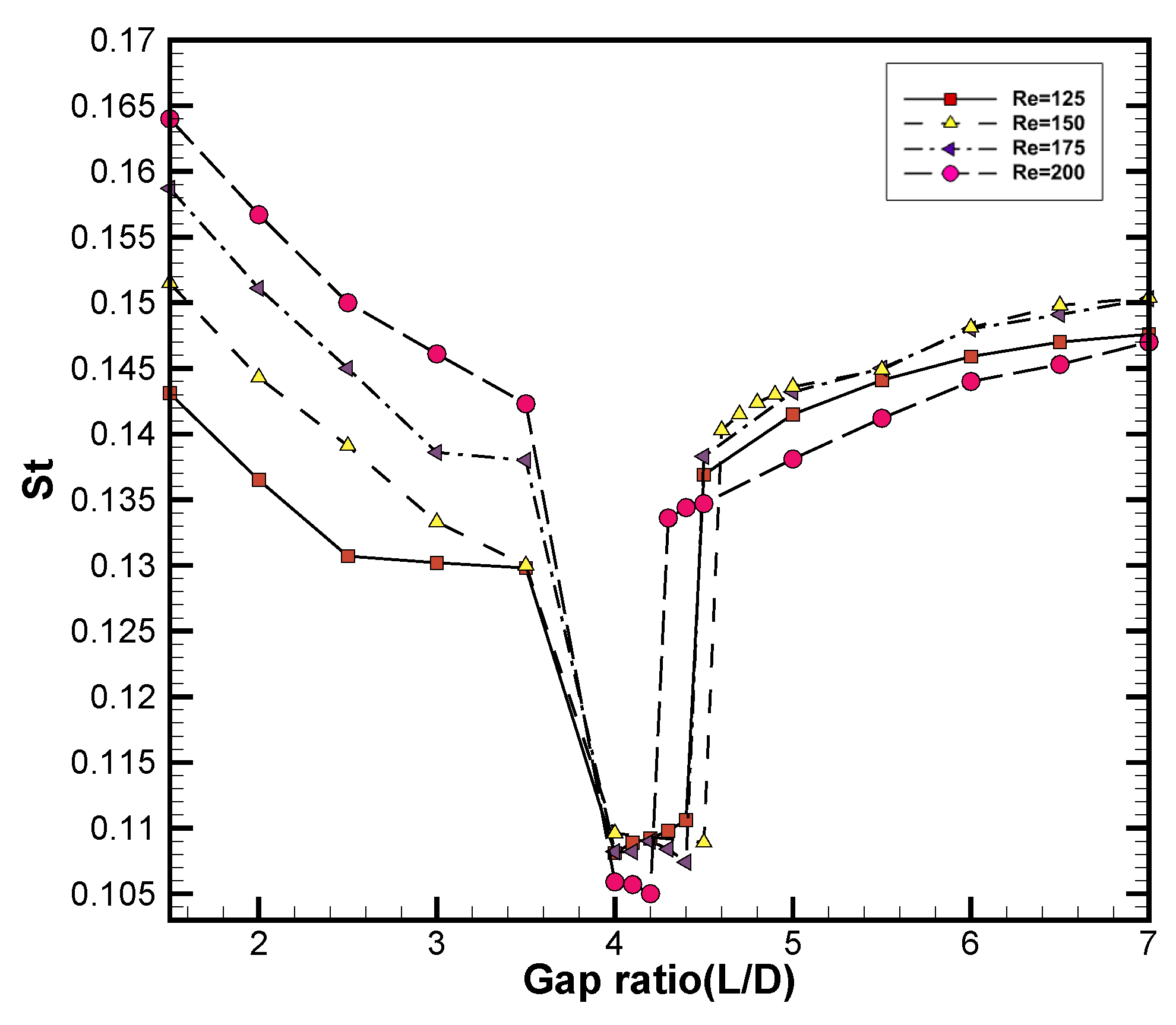
The Strouhal number ( S t ) defines the frequency of vortex shedding from bluff bodies and is critical for predicting vortex-induced vibrations (VIV) in structures such as bridges, chimneys, and pipelines. Resonance arises when the shedding frequency aligns with the structure’s natural frequency, potentially causing large oscillations and structural failure. In tandem cylinder arrangements, interference effects can alter S t by reducing, suppressing, or shifting vortex shedding [74,75], making an accurate estimation of this parameter essential in fluid–structure interaction analyses to avoid the risk of possible resonance. The Strouhal number is usually determined by extracting the dominant vortex shedding frequency from the time series of the lift coefficient ( C l ). As expected, S t remains invariant for both the UC and DC for all gap ratios and Reynolds numbers. Hence, in this study, S t was estimated for the DC. The change in the S t with the gap ratio is shown in Figure 15.
The Strouhal number decreases sharply with an increase in gap ratio, specifically in the small gap region (1.5 < L/D < 4), owing to flow interference at close proximity. Owing to the increased inertial effects, higher Reynolds numbers (175 and 200) exhibited slightly higher Strouhal numbers at small gap ratios (Figure 15).
In the shear-layer reattachment regime (4 < L/D < 4.5), the Strouhal number approaches its minimum value for all Reynolds numbers (see Figure 15). This indicates the presence of a critical gap ratio l c . The vortex shedding became steady and less disrupted. This critical gap ratio (approximately 4.5, derived from the drag and lift plots) could be significant for practical applications such as heat exchanger design, aerodynamics of structures, and flow past tube arrays.
S t increased again with the gap ratio in the co-shedding regime (L/D > 4.5). At larger gap ratios, each body behaves increasingly like an isolated body (less interaction between bodies), which allows the Strouhal number to stabilise and increase. The Re effects became more pronounced at larger gap ratios, where higher Reynolds numbers (e.g., Re = 200) consistently showed higher Strouhal values than those at lower Reynolds numbers.
As Re increases, the Strouhal number also increases slightly across all gap ratios (Figure 15). This indicates that vortices were shed more frequently at higher flow speeds. The increase occurred owing to stronger inertial forces at high Reynolds numbers, resulting in a more unsteady flow and accelerated, more consistent vortex formation. However, the overall trend remained similar for all tested Reynolds numbers.

3.2.5. RMS Lift Characteristics in Interference

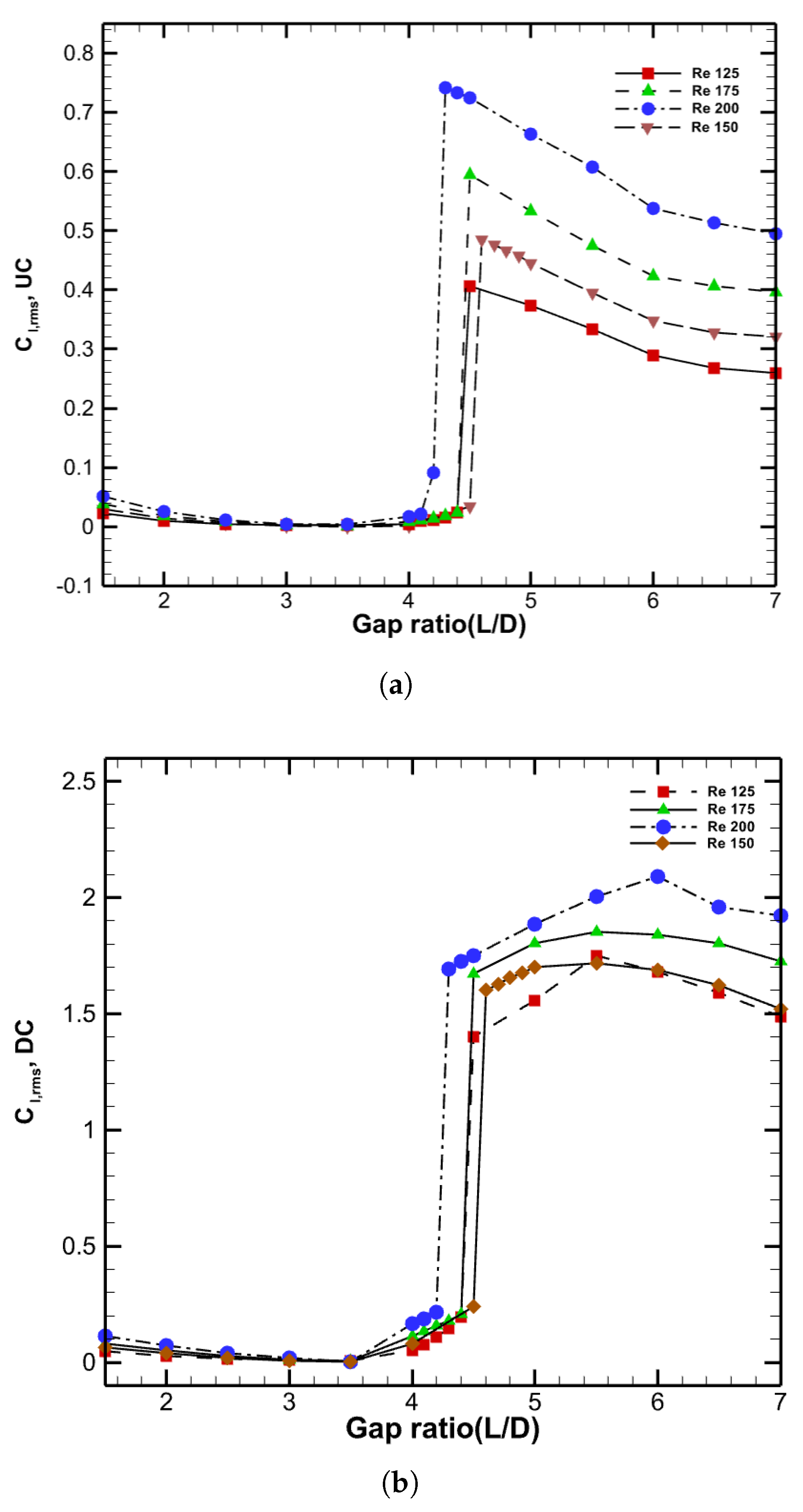
Figure 14 demonstrates how the RMS lift coefficients of the UC and DC depend on the gap ratio and Re. For smaller L/D ratios (1.5 < L/D < 4) in the extended-body regime, the DC suppresses vortex shedding from the UC, reducing C l , rms of the UC, as shown in Figure 14a. In the shear-layer reattachment regime (4 < L/D < 4.5), a transition occurs, where the UC begins to shed vortices more freely, increasing C l , rms . For larger gap (L/D > 4.5) values, the influence of the DC weakened, and the UC behaved more like an isolated body. Higher Reynolds numbers amplified the RMS lift coefficient owing to the strong vortex shedding and resulting unsteady wake dynamics. The sharp jump in C l , rms at L/D ≈ 4.5 confirms the existence of a critical gap in the interference case.
C l , rms of the DC remained close to zero across all Reynolds numbers in the extended-body regime (1.5 < L/D < 4), as shown in Figure 14b. Here, the DC resided within the recirculation bubble of the upstream wake, where the separated shear layers reattached symmetrically onto its surfaces. This created a quasi-steady, balanced pressure field, suppressing alternating vortex shedding and resulting in negligible lift fluctuations ( C l , rms 0 ). Such “extended-body” behaviour has been widely reported in tandem square cylinder studies at specific Reynolds numbers [35,72,74,75].
In the shear-layer reattachment regime (4 < L/D < 4.5), there was a sharp increase in C l , rms , with the magnitude dependent on Re. This critical transition suggests that the DC has moved beyond the direct wake shielding of the UC and begins to experience unsteady flow owing to vortex shedding from the UC. The lift fluctuations on the DC became pronounced as it interacted with the coherent vortices shed from the UC.
As evident from Figure 14, after the sharp rise, C l , rms reaches a peak and then gradually decreases with an increasing gap ratio at larger gap ratios (L/D > 4.5). The DC began to behave more independently as the gap ratio increased, with a reduced influence from the UC. However, the interaction between the wakes of the cylinders persists, keeping C l , rms elevated compared with the small-gap regime.
In summary, as shown in Figure 14, for the UC, the lift fluctuations are suppressed at small gap ratios but sharply increase at L/D ≈ 4.5; thereafter, there is a steady reduction as L/D is increased. For the DC, C l , rms became steadier and more dependent on the interaction with the upstream wake.

3.2.6. Vorticity Contours in Interference Case

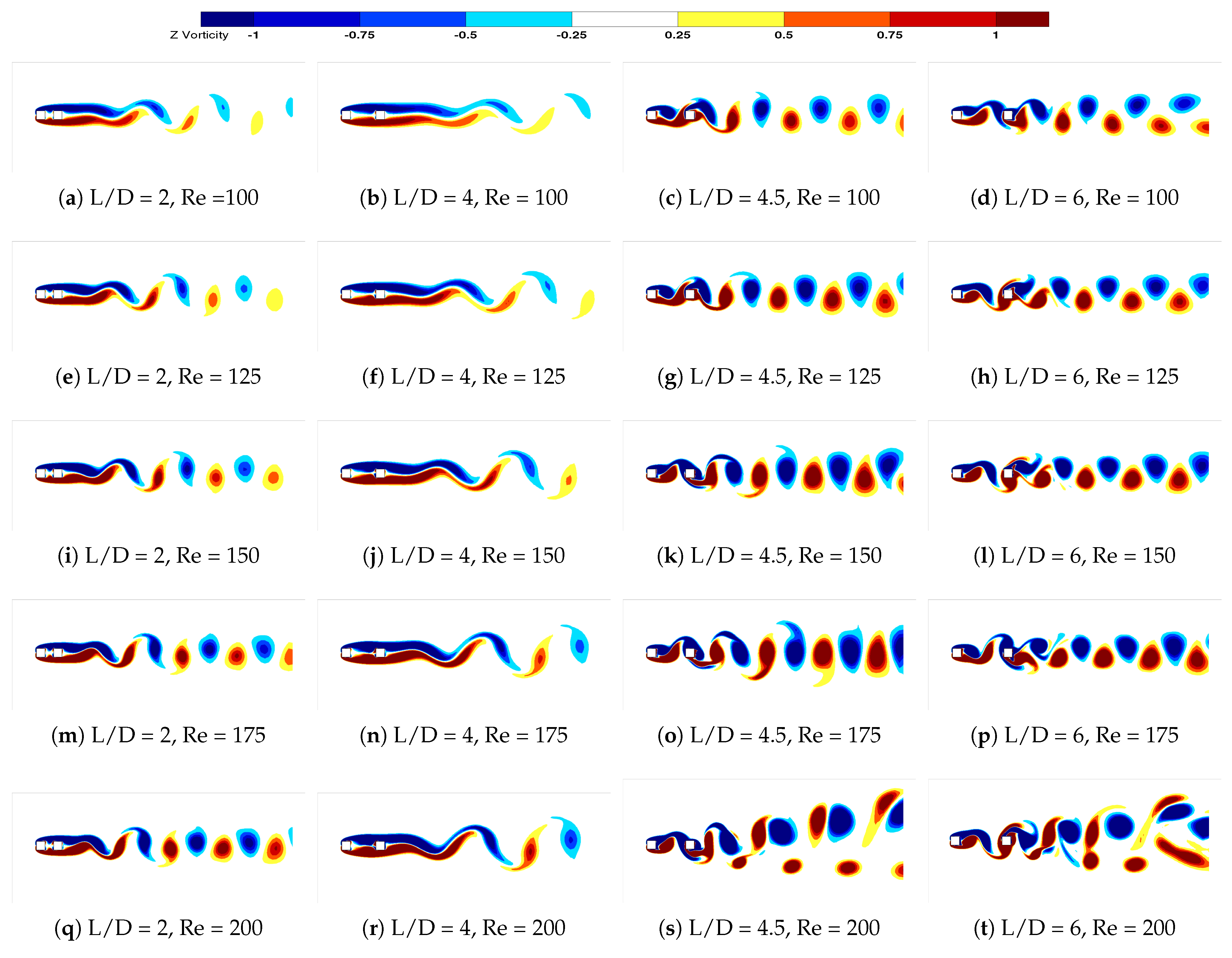
Figure 17 illustrates how L/D and Re govern the wake dynamics of the twin cylinders, as seen from the vorticity contours. For small gap ratios, the cylinders are close to each other, leading to wake shielding and vortex suppression. For L / D = 2 , the tandem cylinders remained in the extended-body regime for all Re values in the range of 100–200. The DC lies entirely within the recirculation zone of the upstream wake, where symmetric shear-layer reattachment produces a single composite wake (Figure 17). This suppresses its own vortex shedding, maintaining C l , rms 0 (Figure 14) and a strongly reduced drag, while the UC drag changes only slightly. An increase in R e intensified the vorticity and slightly increased S t (Figure 15), but the shielding effect and overall regime remain unchanged, consistent with extended-body behaviour.
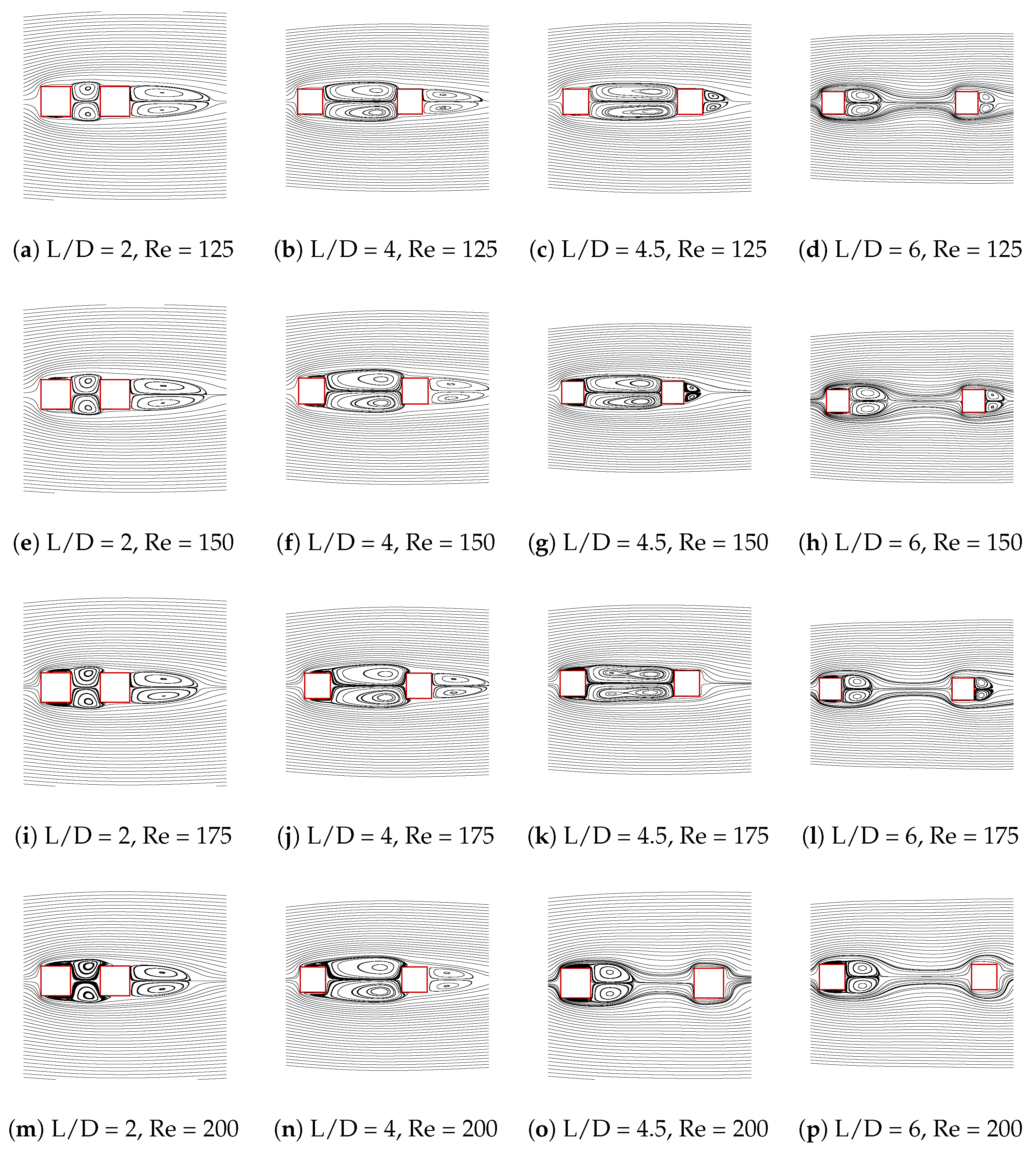
In the shear-layer reattachment region (L/D = 4 and L/D = 4.5), the flow transformed from the extended-body regime to the co-shedding regime, where each cylinder developed a distinct von Kármán street. At R e = 100 , the wakes are already more organised than for L / D = 2 , showing alternating “2S” mode(2S mode, in which two single vortices—one from each side of the body—are shed per cycle, forming a classical von Kármán street [19,76]). As R e increased to 125–150, the shedding became more coherent, that is, more periodic. At R e = 175 –200, the vorticity contours (see Figure 17) reveal two well-separated, parallel vortex streets with minimal interference, consistent with the literature on co-shedding behaviour [73]. The vortices at higher R e are also more intense, with stronger core vorticity, indicating more energetic and vigorous shedding than at lower R e .
For large gap ratios ( L / D = 6 ), the flow behaviour in the Re range of 100–175 remains largely consistent, with each cylinder generating a regular, well-defined von Kármán vortex street and minimal mutual interference (see Figure 17). The wake retained its symmetry, periodicity, and coherence, which are characteristics of isolated-cylinder shedding. The vortices from each cylinder evolved along separate, parallel paths with negligible cross-interaction. At R e = 200 , the vortex streets exhibited higher vorticity magnitudes and sharper shear layers, indicating a more energetic and intensified shedding process.

3.2.7. Wake Interaction Patterns in Interference

Wake interference was analysed using mean velocity streamlines (Figure 18), vorticity contours (Figure 17), and lift coefficient time histories (Figure 12) for L / D = 2 , 4 , 4.5 , and 6 at R e = 100 –200.
For small gaps ( L / D = 2 ) in the extended body region, the wakes merged immediately, forming a single, elongated recirculation region that enveloped the DC. The UC’s shear layers reattached directly onto the DC, suppressing vortex shedding. This is confirmed by the near-zero C l oscillations of the DC, as depicted in Figure 12a,e,i,m,q; the merged recirculation bubble constituted of stationary vortices in Figure 18a,e,i,m; and the reattached shear-layer structure in Figure 17a,e,i,m,q. Such “extended-body” behaviour agrees with the wake shielding regime documented by Zhang et al. [74] and Xu et al. [75].
At moderate gaps ( L / D = 4 ), shear-layer interference persisted, and the DC exhibited intermittent vortex shedding with increased C l fluctuations (Figure 12b,f,j,n).
At the critical spacing ( L / D 4.5 ), the gap jet directly pushes the UC shear layers onto the DC. This is evident from the strong periodic C l oscillations (Figure 12c,g,k,o), the widened wake envelopes revealed in the time-averaged streamlines (Figure 18c,g,k), and enhanced alternating vorticity shed downstream in Figure 17c,g,k,o. This behaviour matches the abrupt wake shift from shielding to the co-shedding regime [74].
For large gaps ( L / D = 6 ) in the co-shedding region, both the UC and DC generated independent Kármán streets with minimal interaction, as observed in the streamlines (Figure 18d,h,l,p) and vorticity contours (Figure 17d,h,l,p). Flow reattachment occurred downstream, and the force histories converged towards the isolated cylinder values [18].

3.2.8. Pressure Coefficient Analysis

The comparative analysis of the base pressure ( C p b ) and stagnation pressure ( C p 0 ) coefficients across the upstream (UC) and downstream cylinders (DC) reveals fundamentally different sensitivities of the cylinders to these parameters, as shown in Figure 11. While the UC exhibits a steady reduction in base suction (becomes less negative) with the gap ratio until L / D = 4.0, DC exhibits only a marginal base pressure decrease until this L / D ratio (=4.0) for all Re values. That is, the base pressure is nearly invariant with Re up to this gap ratio for DC. This could be attributed to the existence of a near-stagnant recirculation bubble established between the cylinders until L / D = 4.0 (see Figure 11b). Both cylinders experienced an abrupt increase in base pressure beyond L / D = 4.0, particularly for Re = 200 (see Figure 18o, where the recirculation bubble breaks and shedding commences from the UC). The recirculation bubble becomes unstable and is about to undergo a bifurcation at L / D = 4.5 for Re = 175 (Figure 18k). The base pressure sensitivity was observed to be the highest at the highest test Re, viz., Re = 200 for both cylinders. It can also be observed that the higher the Re value, the higher the base suction pressure (more negative) for the cylinders (more evident for DC). Notably, at L / D = 4.0, the base pressure is least sensitive to Re, particularly for the UC. Overall, the base-pressure trends were non-linear, and, because of the complex wake interference, the DC experienced a markedly different pressure environment than the UC.
At small L / D , C p b values are relatively mild, indicating that the base suction is weak compared to a stand-alone cylinder, because the wake behind the DC is embedded within the already low-pressure wake of the UC, as evident from Figure 11b. Vortex shedding from the DC was either suppressed or highly weakened in this regime, as confirmed by the low-amplitude C l oscillations (Figure 12). As L / D rises beyond ≈4.5, base suction of the DC intensifies abruptly. At L / D = 6 and R e = 200 , C p b values are comparable with a stand-alone cylinder at the same R e . This sharp drop of C p b (more negative) corresponds to the re-establishment of a fully developed wake, indicating strong, coherent vortex shedding taking place from DC.
Figure 11a shows that the base pressure coefficient of the UC changed non-monotonically with the gap ratio. For all Reynolds numbers, C p b became less negative up to L / D 4 , indicating reduced suction due to shear-layer interactions with the downstream body. Beyond the critical spacing ( L / D > 4.5 ), C p b decreases sharply (becomes more negative). Its behaviour closely resembles that of an isolated square cylinder and is consistent with earlier observations in laminar tandem cylinder flows [74,75]. The effect was more evident at higher Reynolds numbers, with R e = 200 showing the strongest base suction at larger gaps.
Unlike UC, which consistently exhibits C p 0 1 (typical of direct freestream impingement), DC shows large variations in C p 0 with both L / D and R e , as shown in Figure 11c. Until L / D = 4.0, C p 0 registers a near-linear increase with the gap ratio (becomes more positive) for the DC, but remains negative throughout, indicating that the front face of the DC lies entirely within the recirculating bubble of the UC (see Figure 18). It is evident that the higher the Re, the lower (more negative) the stagnation pressure until L / D = 4.0. For L / D = 4.0, the parametric trend undergoes a reversal with a greater value (less negative) for higher Reynolds numbers. In this regime, the oncoming flow lacks sufficient kinetic energy to establish an ideal stagnation point, resulting in suppressed pressure recovery.
As the gap goes up to L / D = 4 and 4.5 , C p 0 partially recovers, particularly at higher R e . This marks the onset of partial freestream interaction, where the UC wake begins to reattach or flow around the DC, forming an identifiable stagnation region at the downstream leading face. At L / D = 6 , C p 0 increased further, reaching positive values for R e 175 , indicating that the DC had effectively exited the wake zone and was experiencing direct freestream impingement similar to an isolated cylinder.
The net form-drag contribution can be approximated as Δ C p = C p 0 C p b for the DC. This quantity represents the pressure-drag component of C d (not considering the viscous effects). At L / D = 2 and R e = 100 , Δ C p 0.19 , indicating weak pressure drag, which is consistent with strong shielding in this regime (Figure 10). At L / D = 6 and R e = 200 , Δ C p exceeds 2.04 , which is comparable to ≈2.1 for an isolated square cylinder, indicating that the DC behaves almost identically to a single bluff body with high form drag.

3.2.9. Detailed Wake Parameter Estimation in Interference

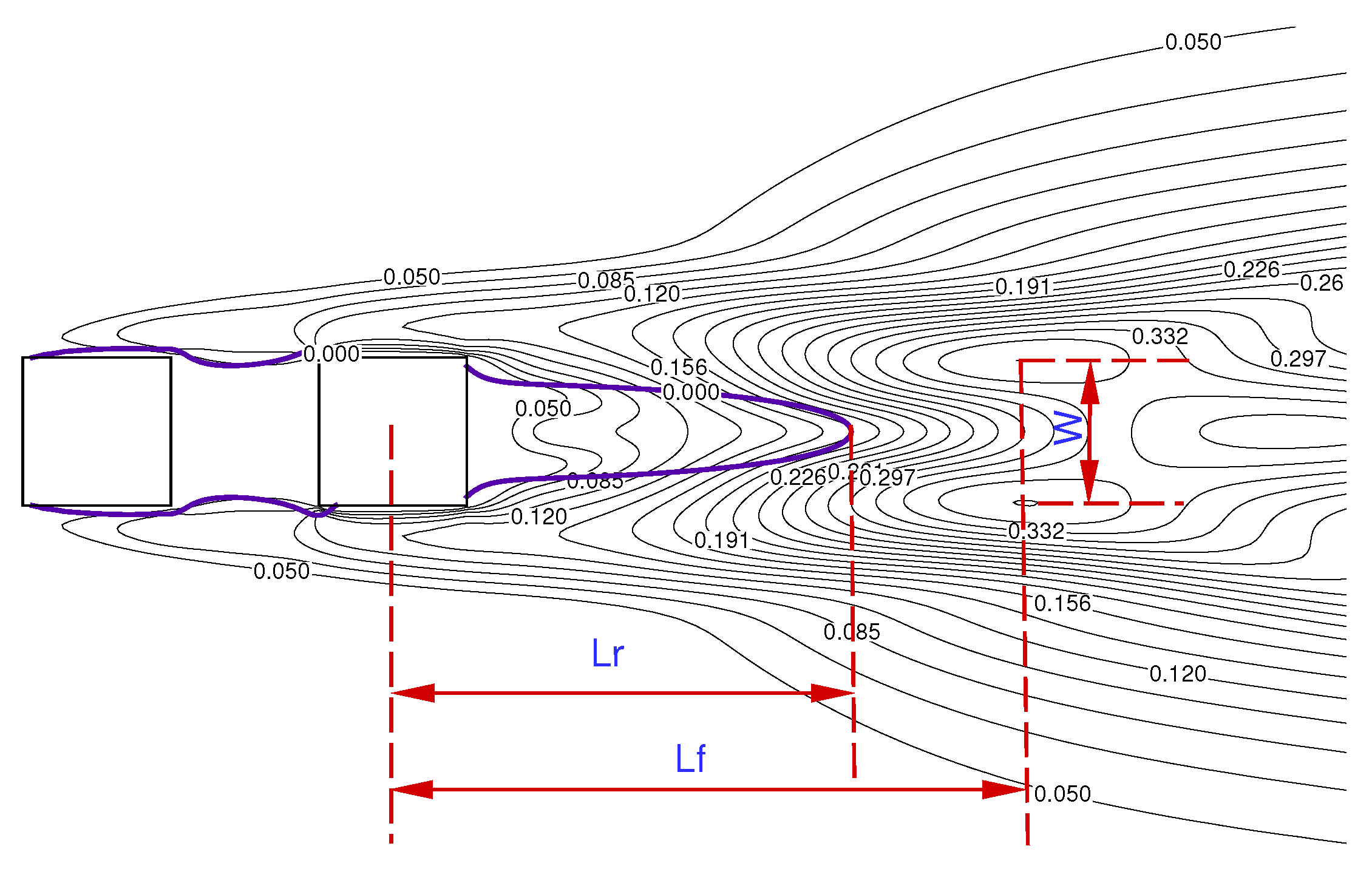
The wake parameters, viz., wake width (W), vortex formation length ( L f ), and recirculation length ( L r ) across two square cylinders in interference are estimated, as illustrated in Figure 19. In the interference cases, all wake parameters were computed with respect to the second cylinder (downstream) in tandem.
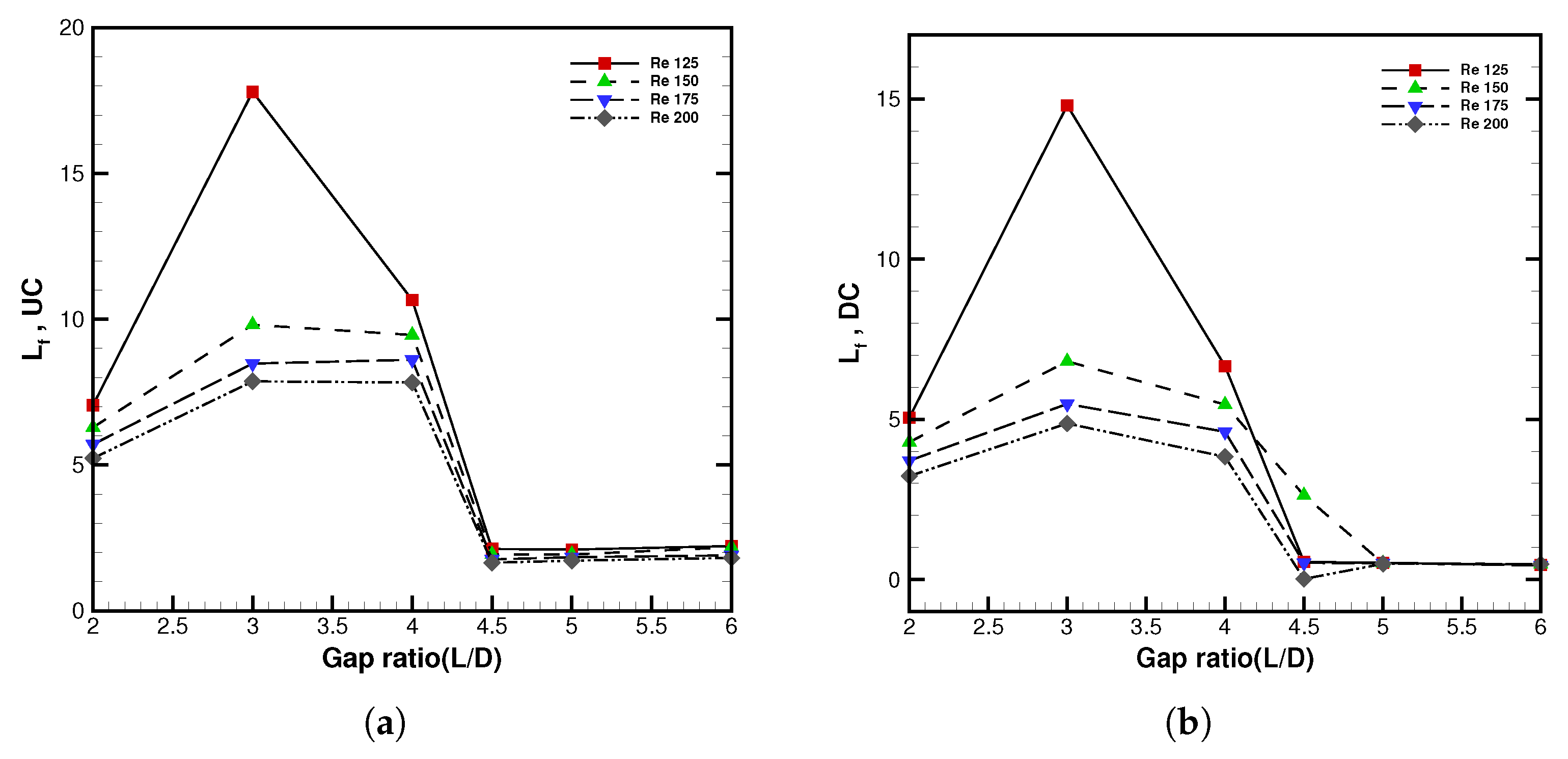
The non-dimensional vortex formation length ( L f ) plays a vital role in understanding the flow physics associated with interference, as shown in Figure 20. In the literature [11,77], the vortex formation length ( L f ) is described as the distance in the streamwise direction from the centre of the bluff body to the point where the vortex, having formed behind the body, is fully developed and reaches its maximum strength before being shed into the wake. It is the point at which the maximum wake velocity fluctuations (rms velocity) are observed at the shedding frequency. In the reattachment regime ( L / D 4 ), the UC does not shed vortices independently, and the cylinders act as an extended body; thus, the vortex formation length is calculated from DC’s centre [74,75]. For cross-regime comparison, this vortex length ( L f , U C ) may be expressed by adding the gap distance L to the downstream-referenced formation length L f ( d ) (see Figure 19) ( L f , U C = L + L f ( d ) ). This approach does not alter the physical definition of L f but simply shifts the origin of the measurement.
At L/D = 2–4, vortex formation is governed by the wake interaction between the cylinders, with UC shedding suppressed. The extended formation distances reflect the extended time required for the instabilities in the wake of the second cylinder to fully develop. The largest effective formation length appears at L/D = 3, particularly at lower Reynolds numbers (Re = 125), indicating a highly unstable interaction regime with extended recirculation zones (Figure 20). As Re increased, the vortex formation point shrinks (shifts upstream), indicating enhanced instability and earlier roll-up owing to stronger inertial effects.
Beyond L/D = 4.5, vortex shedding became independent for both cylinders, and the upstream and downstream formation lengths were separately measured for these cases (L/D > 4.5). The UC displayed stable, short formation lengths (2D), followed by a slight increase in drag force for the UC and an abrupt jump for the DC (Figure 10), typical of isolated bluff body behaviour. The formation length measured from the DC drop to less than 0.5, indicating high entrainment and fast wake development due to the accelerating flow induced by the upstream wake.
The gap ratio, L/D = 4–4.5, marks a critical transition where the flow shifts from suppressed shedding to co-shedding flow. Beyond a gap ratio of 4.5, the vortex formation regions for both the UC and DC stabilised, and consequently, L f became nearly invariant with the L/D ratio, indicating a transition to the independent-shedding regime.
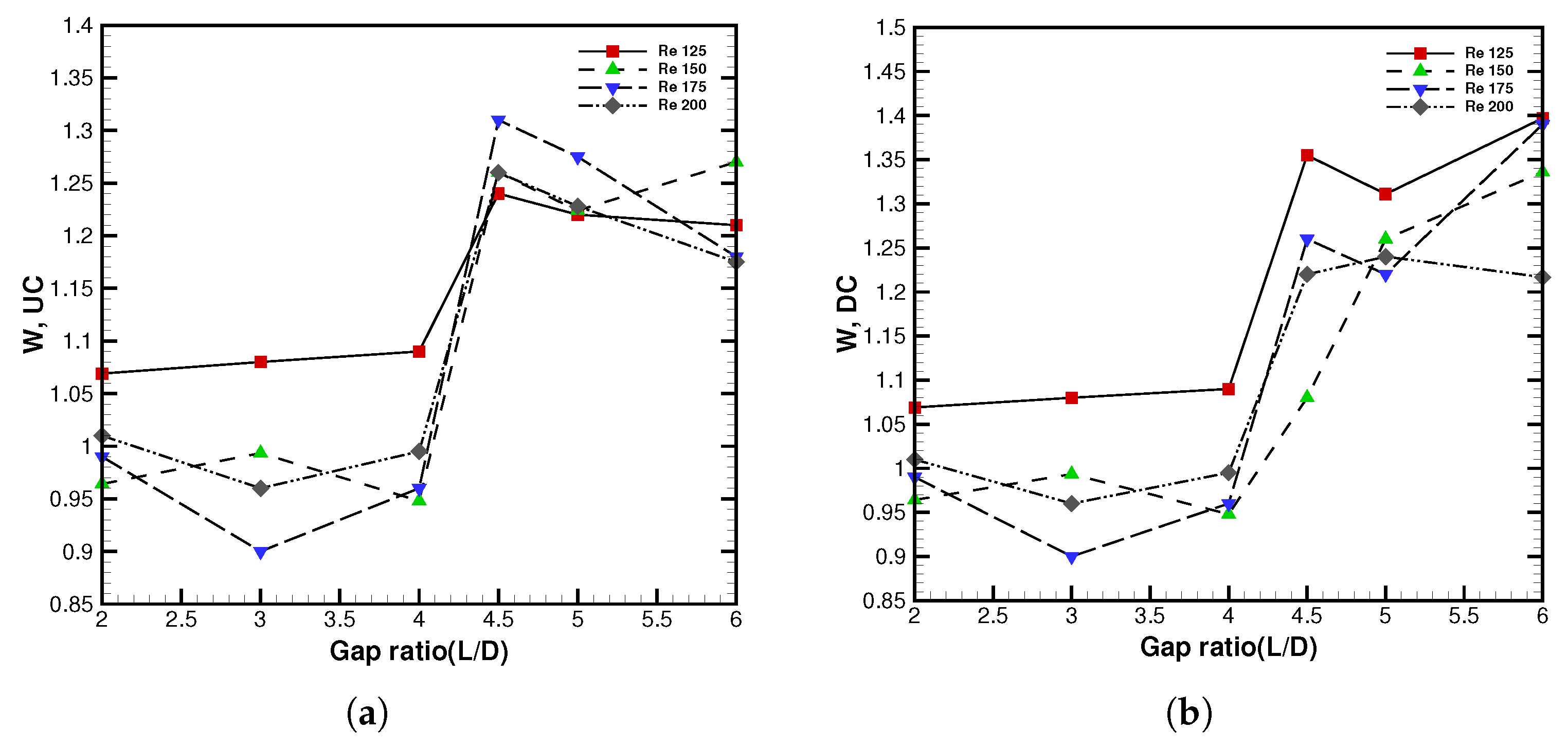
The wake width behind bluff bodies is a critical parameter that influences drag, vortex dynamics, and flow stability. In bluff body wakes, the wake width (W) is the distance between the two distinct peaks of the root-mean-square (rms) velocity fluctuations in the wake, which reflects the width of the region occupied by the strongest velocity fluctuations associated with vortex shedding [20,77]. In the current study, the wake width variation was examined for tandem square cylinders using measurements taken separately from both the UC and DC (Figure 21). However, until the critical gap, shedding was expected only from the DC. Hence, the wake width (W) remains the same (taken from the DC) for both cylinders until the critical spacing ( l c ). The behaviour was interpreted with respect to flow regime transitions and wake interactions.
For gap ratios up to 4.5, the wake width was measured from the DC. This signifies that vortex shedding is initiated only from the DC for lower gap ratios, whereas the wake from the UC remains suppressed owing to proximity-induced interference [74,75]. The combined wake formed a single coherent structure behind the DC, with wake widths ranging from approximately 0.9D to 1.09D. The wake width exhibited limited sensitivity to the Re.
At a gap ratio of 4.5, a distinct divergence in the wake width occurred between the cylinders, indicating the onset of independent vortex shedding from the UC (see Figure 17). The wake width measured from the UC increases sharply from 0.94D (gap ratio 4) to 1.26D (gap ratio 4.5) for Re = 150, as illustrated in Figure 21a, indicating the re-establishment of the vortex street behind the first cylinder. Simultaneously, the downstream wake also widened, indicating complex wake interference and mutual vortex interactions.
This sudden expansion in the wake width corresponds to a transition in the flow regime from wake interference to co-shedding, where both cylinders contribute to unsteady vortex formation, albeit still strongly coupled. Beyond L/D = 5, both the upstream and downstream cylinders exhibited independently measured wake widths (measured separately for both the UC and DC), with values consistently higher than those in the suppressed-shedding regime, demonstrating enhanced vortex activity and less constraint from upstream flow structures.
Interestingly, while the wake width of the UC stabilises or slightly declines with increasing Re at larger gaps, the DC maintains higher wake width values (Figure 21b), particularly at lower Re, possibly due to enhanced mixing and vortex distortion from the disturbed inflow created by the first cylinder.
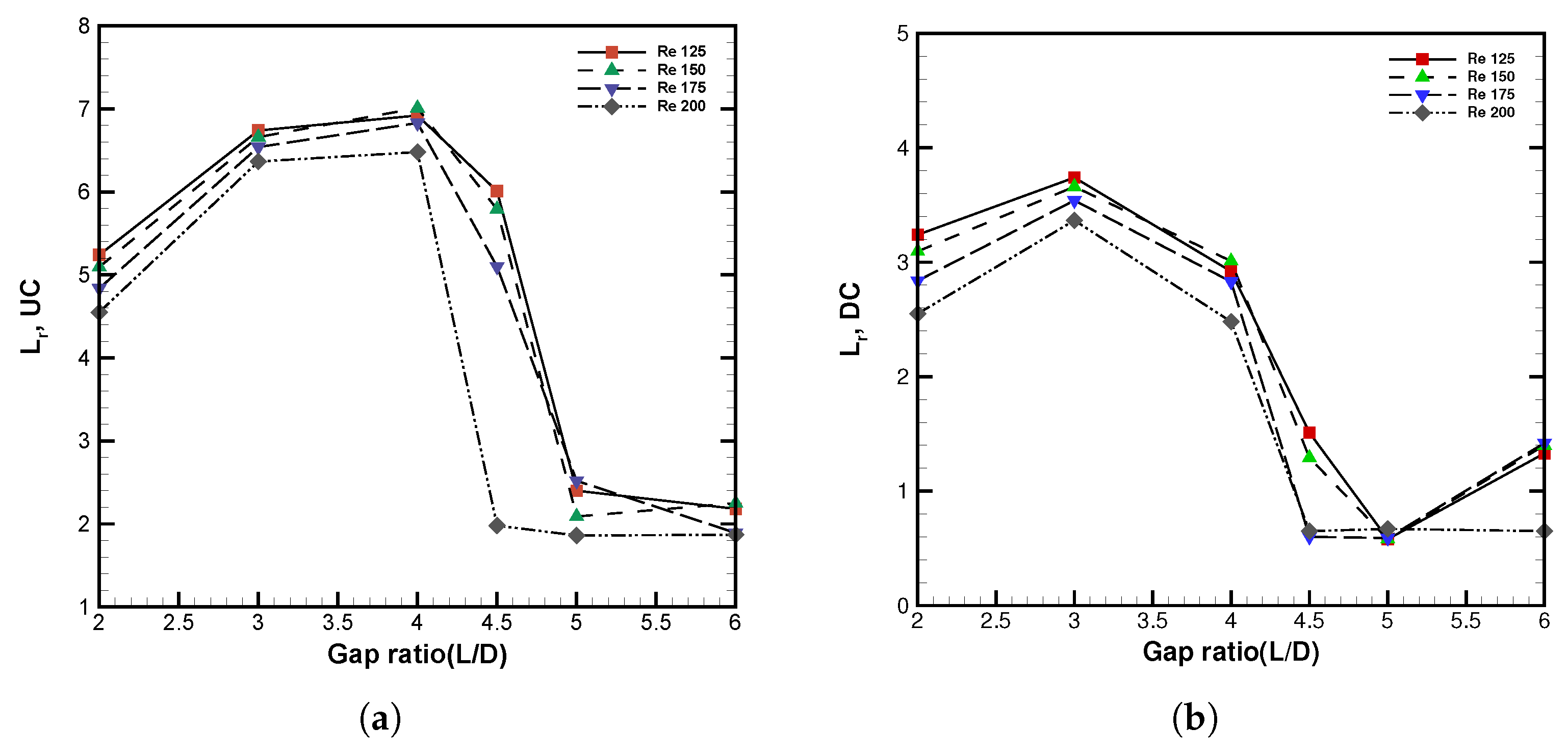
The streamwise distance from the centre of the cylinder to the location at which the time-averaged streamwise velocity drops to zero is known as the recirculation length L r [74,75] and it serves as a critical metric for assessing the wake structure and its downstream extent. Figure 22 illustrates how L r varies with Re and L/D ratio.
As discussed in earlier sections, up to a gap ratio of L / D 4 , shedding occurs predominantly from DC, and hence the total recirculation length is measured relative to the UC as L r , U C = L + L r ( d ) . In this regime, the DC exhibited an increasing–decreasing trend, attaining the maximum value at L / D 3 (e.g., ∼3.7 at R e = 125 ; Figure 22b), indicating strong wake interaction. For L / D = 3.0, L r undergoes a declining trend till L / D = 4.5–5.0 and remains invariant for Re = 200, but it abruptly escalates to higher values for other Re values.
As seen in Figure 22a, recirculation lengths decrease moderately with increasing Re, reflecting faster wake recovery due to higher inertial forces. At the critical gap ( L / D 4.5 ), a sharp drop in L r was observed for both cylinders, marking the beginning of independent vortex shedding and wake separation. This result highlights the fact that owing to mutual interference, the recirculation region expands for inline twin-square cylinders in the laminar Re region. For L / D > 5 (co-shedding regime), the UC maintained relatively stable recirculation lengths (∼2.0–2.5 D), consistent with the isolated square-cylinder behaviour, whereas the DC exhibited very short recirculation zones (as low as ∼0.6 D) that recovered slightly to ∼1.0–1.2 D at L / D 6 . The acutely short recirculation length (∼0.6 D) observed for the DC in the co-shedding regime ( L / D > 5 ) could be because, at higher Reynolds numbers, the transition in the shear layers shifts upstream, leading to increased entrainment and a greater rate at which fluid from outside the wake is pulled into the formation region. This enhanced entrainment results in a reduction in formation length; that is, the location where fully formed vortices are shed moves closer to the body with an increase in Re, consequently causing the formation region to shrink [77].

4. Conclusions

This study presents a systematic CFD investigation of laminar flow past two inline square cylinders at Reynolds numbers spanning between 100 and 200 and gap ratios from 2 to 7. By quantifying the aerodynamic forces, shedding frequencies, and wake-structural parameters, the analysis established a robust critical spacing of L / D 4.5 that delineated three distinct flow interference regimes. Beneath the threshold (the lower spacing), the DC has been shielded by the near-wake region, and vortex shedding was suppressed. As the spacing increased into an intermediate range, shear-layer reattachment led to sharp transitions between the drag, lift fluctuation, and shedding characteristics. With larger spacing, each cylinder will individually be in the shedding mode as the inflow into the DC has been significantly altered due to the rapid flow of the upstream wake; thus, the recirculation bubble behind the DC is notably reduced in size. The tandem arrangement results in a significant, Re-dependent, drag increase for the DC. At higher Re, a sharp drag shoot appears in the co-shedding window: the peak amplifications are 17.98% (Re = 150 at L / D = 5.0 ), 36.38% (Re = 175 at L / D = 5.0 ), and 50.41% (Re = 200 at L / D = 6.0 ). For L / D 4 , the downstream body is sheltered and drag is reduced; for L / D 6 , drag falls below the isolated-cylinder value, indicating hydrodynamic independence. These quantitative trends illustrate the non-linear sensitivity of mean forces to inter-cylinder spacing and Re in laminar tandem flows. These regime-dependent variations in drag, lift, and wake frequencies provide a clear physical framework for interpreting wake interactions in tandem cylinder configurations.
In addition to finding the critical spacing of interference that produces significant wakes, the research demonstrates parameter-based behaviour trends that remain consistent over the entire range of Reynolds numbers examined (Re = 100 – 200): higher Reynolds numbers create greater unsteadiness in the wake, cause the wake to recover faster, shorten the recirculation zone, but do not change the basic classification of the flow regime.
This regime-based understanding of the behaviour creates a methodical basis for engineers who use arrays of bluff bodies to determine the performance characteristics of their systems, i.e., compact heat exchangers, offshore risers, MEMS flow sensors, and vortex-induced vibration control devices.
The research provides a methodology for designing optimum spacing and minimising fluctuating forces in laminar or low-Re systems by providing quantitative information on the development of wake shielding, shear-layer reattachment, and co-shedding mechanisms as functions of spacing and Re. Additionally, the correlations found between aerodynamic coefficients, Strouhal number, and structural properties of the wake provide benchmark data for verifying experimental models and higher fidelity computational models. Finally, the numerical methods developed in this research may be directly applied to model complex multi-body geometries, including finned tube bundles and micro-channel networks. Further work will extend this methodology to include three-dimensional, turbulent, and thermally coupled flows; thus, increasing its applicability to actual operating conditions and industrial design applications.

Author Contributions

Conceptualisation, S.R.S. and R.A.K.; methodology, S.R.S.; software, S.R.S.; validation, S.R.S.; formal analysis, S.R.S.; investigation, S.R.S.; resources, S.R.S.; data curation, S.R.S.; writing—original draft, S.R.S.; writing—review and editing, R.A.K. and K.S.K.; supervision, R.A.K. and K.S.K.; project administration, R.A.K. All authors have read and agreed to the published version of the manuscript.

Funding

This research received no external funding.

Data Availability Statement

The data featured in this study can be obtained by making a reasonable request to the corresponding author. The datasets are not stored in a public archive due to their substantial size and because they are part of an ongoing research project.

Acknowledgments

Authors would like to express their sincere gratitude to Amrita Vishwa Vidyapeetham, Amritapuri Campus, for providing the facilities, support, and academic environment that made this research possible. While preparing this manuscript, the authors utilised Grammarly to check for grammatical accuracy. They have thoroughly reviewed and revised the results, assuming full responsibility for the content of this publication.

Conflicts of Interest

Author K Suresh Kumar was employed by Rowan Williams Davies & Irwin (Canada). The remaining authors declare that the research was conducted in the absence of any commercial or financial relationships that could be construed as a potential conflict of interest.

References

  1. Wu, Y.; Cheng, Z.; McConkey, R.; Lien, F.S.; Yee, E. Modelling of flow-induced vibration of bluff bodies: A comprehensive survey and future prospects. Energies 2022, 15, 8719. [Google Scholar] [CrossRef]
  2. Kumar, R.A.; Gowda, B.L. Flow-induced vibration of a square cylinder without and with interference. J. Fluids Struct. 2006, 22, 345–369. [Google Scholar] [CrossRef]
  3. Cao, D.; He, J.; Zeng, H.; Zhu, Y.; Chan, S.Z.; Williams, M.R.; Khor, I.Z.L.; Yalla, O.V.; Sunny, M.R.; Ghoshal, R.; et al. A Review of Oscillators in Hydrokinetic Energy Harnessing Through Vortex-Induced Vibrations. Fluids 2025, 10, 78. [Google Scholar] [CrossRef]
  4. Chang, C.C.J.; Kumar, R.A.; Bernitsas, M.M. VIV and galloping of single circular cylinder with surface roughness at 3.0 × 10⁴ ≤ Re ≤ 1.2 × 10⁵. Ocean Eng. 2011, 38, 1713–1732. [Google Scholar] [CrossRef]
  5. Park, H.; Kumar, R.A.; Bernitsas, M.M. Suppression of vortex-induced vibrations of rigid circular cylinder on springs by localized surface roughness at 3.0 × 10⁴ ≤ Re ≤ 1.2 × 10⁵. Ocean Eng. 2016, 111, 218–233. [Google Scholar] [CrossRef]
  6. Li, X.; Lyu, Z.; Kou, J.; Zhang, W. Mode competition in galloping of a square cylinder at low Reynolds number. J. Fluid Mech. 2019, 867, 516–555. [Google Scholar] [CrossRef]
  7. Gowda, B.; Kumar, R.A. Flow-induced oscillations of a square cylinder due to interference effects. J. Sound Vib. 2006, 297, 842–864. [Google Scholar] [CrossRef]
  8. Chauhan, M.K.; Dutta, S.; More, B.S.; Gandhi, B.K. Experimental investigation of flow over a square cylinder with an attached splitter plate at intermediate Reynolds number. J. Fluids Struct. 2018, 76, 319–335. [Google Scholar] [CrossRef]
  9. Chandar, S.V.; Sarath, R.; Kumar, R.A. Aerodynamic characteristics of a square section cylinder: Effect of corner arc. In Proceedings of the 2017 2nd International Conference for Convergence in Technology (I2CT), Mumbai, India, 7–9 April 2017; IEEE: Piscataway, NJ, USA, 2017; pp. 814–819. [Google Scholar]
  10. Nawaz, M.A.; Abubaker, M.; Kumar, R.A.; Sohn, C.H. Drag reduction for flow past a square cylinder through corner chamfering. J. Mech. Sci. Technol. 2022, 36, 5501–5510. [Google Scholar] [CrossRef]
  11. Kumar, R.A.; Sohn, C.H.; Gowda, B.L. A PIV study of the near wake flow features of a square cylinder: Influence of corner radius. J. Mech. Sci. Technol. 2015, 29, 527–541. [Google Scholar] [CrossRef]
  12. Arunkumar, K.; Sarath, R. Investigation of Flow Structures Around a Circular Cylinder with Notch: A Flow Visualization Analysis. In Advances in Mechanical Processing and Design: Select Proceedings of ICAMPD 2019; Springer: Berlin/Heidelberg, Germany, 2020; pp. 181–190. [Google Scholar]
  13. Many, H.C.; Srinivasan, V.C.; Raghavan, A.K. Effect of corner-arc on the flow structures around a square cylinder. In Proceedings of the Fluids Engineering Division Summer Meeting, Montreal, QC, Canada, 15–20 July 2018; American Society of Mechanical Engineers: New York, NY, USA, 2018; Volume 51555, p. V001T07A007. [Google Scholar]
  14. Hariprasad, C.; Ajith Kumar, R.; Dahl, J.; Sohn, C.H. Flow structures around a square cylinder: Effect of corner chamfering. J. Aerosp. Eng. 2024, 37, 04024021. [Google Scholar] [CrossRef]
  15. Park, H.; Bernitsas, M.M.; Ajith Kumar, R. Selective Roughness in the Boundary Layer to Suppress Flow-Induced Motions of Circular Cylinder at 30,000 < Re < 120,000. J. Offshore Mech. Arct. Eng. 2012, 134, 041801. [Google Scholar]
  16. Kim, E.S.; Bernitsas, M.M.; Ajith Kumar, R. Multicylinder flow-induced motions: Enhancement by passive turbulence control at 28,000 < Re < 120,000. J. Offshore Mech. Arct. Eng. 2013, 135, 021802. [Google Scholar]
  17. Park, H.; Kumar, R.A.; Bernitsas, M.M. Enhancement of flow-induced motion of rigid circular cylinder on springs by localized surface roughness at 3 × 10⁴ ≤ Re ≤ 1.2 × 10⁵. Ocean Eng. 2013, 72, 403–415. [Google Scholar] [CrossRef]
  18. Sohankar, A.; Khodadadi, M.; Rangraz, E.; Alam, M.M. Control of flow and heat transfer over two inline square cylinders. Phys. Fluids 2019, 31, 123604. [Google Scholar] [CrossRef]
  19. Bearman, P.W. Vortex shedding from oscillating bluff bodies. Annu. Rev. Fluid Mech. 1984, 16, 195–222. [Google Scholar] [CrossRef]
  20. Rastan, M.; Alam, M.M.; Zhu, H.; Ji, C. Onset of vortex shedding from a bluff body modified from square cylinder to normal flat plate. Ocean Eng. 2022, 244, 110393. [Google Scholar] [CrossRef]
  21. Zhu, H.; Tang, T.; Zhou, T.; Liu, H.; Zhong, J. Flow structures around trapezoidal cylinders and their hydrodynamic characteristics: Effects of the base length ratio and attack angle. Phys. Fluids 2020, 32, 103606. [Google Scholar] [CrossRef]
  22. Abdelhamid, T.; Alam, M.M.; Islam, M. Heat transfer and flow around cylinder: Effect of corner radius and Reynolds number. Int. J. Heat Mass Transf. 2021, 171, 121105. [Google Scholar] [CrossRef]
  23. Zafar, F.; Alam, M.M. Flow structure around and heat transfer from cylinders modified from square to circular. Phys. Fluids 2019, 31, 083604. [Google Scholar] [CrossRef]
  24. Kumar, D.; Dhiman, A.K. Computations of incompressible fluid flow around a long square obstacle near a wall: Laminar forced flow and thermal characteristics. Sādhanā 2017, 42, 941–961. [Google Scholar] [CrossRef]
  25. An, B.; Bergadà, J.; Mellibovsky, F.; Sang, W.; Xi, C. Numerical investigation on the flow around a square cylinder with an upstream splitter plate at low Reynolds numbers. Meccanica 2020, 55, 1037–1059. [Google Scholar] [CrossRef]
  26. Kavya, H.; Kotresha, B.; Naik, K. CFD Analysis of 2-D unsteady flow past a square cylinder at an angle of incidence. Int. J. Adv. Res. Mech. Prod. Eng. Dev. 2014, 1, 117–125. [Google Scholar]
  27. Islam, S.U.; Manzoor, R.; Ying, Z.C.; Rashdi, M.M.; Khan, A. Numerical investigation of fluid flow past a square cylinder using upstream, downstream and dual splitter plates. J. Mech. Sci. Technol. 2017, 31, 669–687. [Google Scholar] [CrossRef]
  28. Vikram, C.K.; Ravindra, H.; Krishnegowda, Y. Visualization of flow past square cylinders with corner modification. J. Mech. Energy Eng. 2020, 4, 285–294. [Google Scholar] [CrossRef]
  29. Gowda, Y.K.; Ravindra, H.V.; Chowdeswarally Krishnappa, V. Numerical analysis of two square cylinders of different sizes with and without corner modification. In Proceedings of the ASME International Mechanical Engineering Congress and Exposition, Phoenix, AZ, USA, 11–17 November 2016; American Society of Mechanical Engineers: New York, NY, USA, 2016; Volume 50626, p. V008T10A001. [Google Scholar]
  30. Yu, Z.; Chang, J.; Yaying, M. Numerical Research on the Influence of Parallel Square Cylinder Space on the Characteristics of Karman Vortex Street and Combustion around Bluff Body. In Proceedings of the 2020 Asia Energy and Electrical Engineering Symposium (AEEES), Chengdu, China, 28–31 May 2020; IEEE: Piscataway, NJ, USA, 2020; pp. 270–274. [Google Scholar]
  31. Mat Ali, M.S.; Doolan, C.J.; Wheatley, V. Low Reynolds number flow over a square cylinder with a splitter plate. Phys. Fluids 2011, 23, 033602. [Google Scholar] [CrossRef]
  32. Nidhul, K.; Sunil, A.; Kishore, V. Numerical Investigation of Flow Characteristics over a Square Cylinder with a Detached Flat Plate of Varying Thickness at Critical Gap Distance in the wake at Low Reynolds Number. Int. J. Res. Aeronaut. Mech. Eng. 2015, 3, 104–118. [Google Scholar]
  33. Kumar, P.; Singh, S.K. Flow past a bluff body subjected to lower subcritical Reynolds number. J. Ocean Eng. Sci. 2020, 5, 173–179. [Google Scholar] [CrossRef]
  34. Li, Z. Analysis of 2D unsteady flow past a square cylinder at low Reynolds numbers with CFD and a mesh refinement method. WSEAS Trans. Fluid Mech 2017, 12, 150–157. [Google Scholar]
  35. Liu, C.H.; Chen, J.M. Observations of hysteresis in flow around two square cylinders in a tandem arrangement. J. Wind Eng. Ind. Aerodyn. 2002, 90, 1019–1050. [Google Scholar] [CrossRef]
  36. Manzoor, R.; Ghaffar, A.; Baleanu, D.; Nisar, K.S. Numerical analysis of fluid forces for flow past a square rod with detached dual control rods at various gap spacing. Symmetry 2020, 12, 159. [Google Scholar] [CrossRef]
  37. Saha, A.K.; Biswas, G.; Muralidhar, K. Three-dimensional study of flow past a square cylinder at low Reynolds numbers. Int. J. Heat Fluid Flow 2003, 24, 54–66. [Google Scholar] [CrossRef]
  38. Dayem, A.A.; Bayomi, N. Experimental and numerical flow visualization of a single square cylinder. Int. J. Comput. Methods Eng. Sci. Mech. 2006, 7, 113–127. [Google Scholar] [CrossRef]
  39. Ma, Y.; Mohebbi, R.; Rashidi, M.; Yang, Z. Numerical simulation of flow over a square cylinder with upstream and downstream circular bar using lattice Boltzmann method. Int. J. Mod. Phys. C 2018, 29, 1850030. [Google Scholar] [CrossRef]
  40. Chatterjee, D.; Raja, M. Mixed convection heat transfer past in-line square cylinders in a vertical duct. Therm. Sci. 2013, 17, 567–580. [Google Scholar] [CrossRef]
  41. Kumar, A.; Ray, R.K. A numerical simulation of shear flow past two equal sized square cylinders arranged in parallel at Re = 500. AIP Conf. Proc. 2017, 1863, 490003. [Google Scholar] [CrossRef]
  42. Mushyam, A.; Bergada, J.M. A numerical investigation of wake and mixing layer interactions of flow past a square cylinder. Meccanica 2017, 52, 107–123. [Google Scholar] [CrossRef][Green Version]
  43. Firdaus, A.F.; Nguyen, V.L.; Zuhal, L.R. Investigation of the flow around two tandem rotated square cylinders using the least square moving particle semi-implicit based on the vortex particle method. Phys. Fluids 2023, 35, 027117. [Google Scholar] [CrossRef]
  44. Kouchakzad, M.; Sohankar, A.; Rastan, M. Onset of vortex shedding and hysteresis in flow over tandem sharp-edged cylinders of diverse cross sections. Phys. Fluids 2024, 36, 013604. [Google Scholar] [CrossRef]
  45. Shui, Q.; Duan, C.; Wang, D.; Gu, Z. New insights into numerical simulations of flow around two tandem square cylinders. AIP Adv. 2021, 11, 045315. [Google Scholar] [CrossRef]
  46. Abid, M.; Yasin, N.; Saqlain, M.; Ul-Islam, S.; Ahmad, S. Numerical investigation and statistical analysis of the flow patterns behind square cylinders arranged in a staggered configuration utilizing the Lattice Boltzmann method. J. Appl. Fluid Mech. 2024, 17, 1820–1843. [Google Scholar] [CrossRef]
  47. Sohankar, A.; Rangraz, E.; Khodadadi, M.; Alam, M.M. Fluid flow and heat transfer around single and tandem square cylinders subjected to shear flow. J. Braz. Soc. Mech. Sci. Eng. 2020, 42, 414. [Google Scholar] [CrossRef]
  48. Rao, Y.; Ni, Y.; Liu, C. Flow effect around two square cylinders arranged side by side using lattice Boltzmann method. Int. J. Mod. Phys. C 2008, 19, 1683–1694. [Google Scholar] [CrossRef]
  49. Abbasi, W.S.; Ashfaq, K.; Rahman, H. Influence of gap ratios on wake dynamics of two rectangular 5:1 cylinders placed inline. Phys. Fluids 2024, 36, 103621. [Google Scholar] [CrossRef]
  50. Kalsoom, S.; Abbasi, W.S.; Manzoor, R. Numerical study of flow past two square cylinders with horizontal detached control rod through passive control method. AIP Adv. 2024, 14, 065009. [Google Scholar] [CrossRef]
  51. Derakhshandeh, J.F.; Alam, M.M. Reynolds number effect on the flow past two tandem cylinders. Wind Struct. 2020, 30, 475–483. [Google Scholar]
  52. Etminan, A.; Moosavi, M.; Ghaedsharafi, N. Characteristics of aerodynamics forces acting on two square cylinders in the streamwise direction and its wake patterns. Adv. Cont. Chem. Eng. Civ. Eng. Mech. Eng. 2010, 209, 217. [Google Scholar]
  53. Abbasi, W.S.; Islam, S.U. Transition from steady to unsteady state flow around two inline cylinders under the effect of Reynolds numbers. J. Braz. Soc. Mech. Sci. Eng. 2018, 40, 168. [Google Scholar] [CrossRef]
  54. Adeeb, E.; Haider, B.A.; Sohn, C.H. Influence of rounded corners on flow interference between two tandem cylinders using FVM and IB-LBM. Int. J. Numer. Methods Heat Fluid Flow 2018, 28, 1648–1663. [Google Scholar] [CrossRef]
  55. Krishne Gowda, Y.; Ravindra, H.; Vikram, C. Effects of Corner Cutoffs on Flow Past Two Square Cylinders in a Tandem Arrangement. In Proceedings of the ASME International Mechanical Engineering Congress and Exposition, Houston, TX, USA, 9–15 November 2012; American Society of Mechanical Engineers: New York, NY, USA, 2012; Volume 45233, pp. 643–650. [Google Scholar]
  56. Aboueian, J.; Sohankar, A. Identification of flow regimes around two staggered square cylinders by a numerical study. Theor. Comput. Fluid Dyn. 2017, 31, 295–315. [Google Scholar] [CrossRef]
  57. Sen, S.; Mittal, S.; Biswas, G. Flow past a square cylinder at low Reynolds numbers. Int. J. Numer. Methods Fluids 2011, 67, 1160–1174. [Google Scholar] [CrossRef]
  58. Sharma, A.; Eswaran, V. Heat and fluid flow across a square cylinder in the two-dimensional laminar flow regime. Numer. Heat Transf. Part A Appl. 2004, 45, 247–269. [Google Scholar] [CrossRef]
  59. Robichaux, J.; Balachandar, S.; Vanka, S. Three-dimensional Floquet instability of the wake of square cylinder. Phys. Fluids 1999, 11, 560–578. [Google Scholar] [CrossRef]
  60. Singh, A.; De, A.; Carpenter, V.; Eswaran, V.; Muralidhar, K. Flow past a transversely oscillating square cylinder in free stream at low Reynolds numbers. Int. J. Numer. Methods Fluids 2009, 61, 658–682. [Google Scholar] [CrossRef]
  61. Sahu, A.K.; Chhabra, R.; Eswaran, V. Two-dimensional unsteady laminar flow of a power law fluid across a square cylinder. J. Non-Newton. Fluid Mech. 2009, 160, 157–167. [Google Scholar] [CrossRef]
  62. Jaiman, R.K.; Sen, S.; Gurugubelli, P.S. A fully implicit combined field scheme for freely vibrating square cylinders with sharp and rounded corners. Comput. Fluids 2015, 112, 1–18. [Google Scholar] [CrossRef]
  63. Zheng, Q.; Alam, M.M. Intrinsic features of flow past three square prisms in side-by-side arrangement. J. Fluid Mech. 2017, 826, 996–1033. [Google Scholar] [CrossRef]
  64. Lankadasu, A.; Vengadesan, S. Interference effect of two equal-sized square cylinders in tandem arrangement: With planar shear flow. Int. J. Numer. Methods Fluids 2008, 57, 1005–1021. [Google Scholar] [CrossRef]
  65. Mithun, M.; Kumar, P.; Tiwari, S. Numerical investigations on unsteady flow past two identical inline square cylinders oscillating transversely with phase difference. J. Appl. Fluid Mech. 2018, 11, 847–859. [Google Scholar] [CrossRef]
  66. Sohankar, A.; Norberg, C.; Davidson, L. Low-Reynolds-number flow around a square cylinder at incidence: Study of blockage, onset of vortex shedding and outlet boundary condition. Int. J. Numer. Methods Fluids 1998, 26, 39–56. [Google Scholar] [CrossRef]
  67. Franke, R.; Rodi, W.; Schönung, B. Numerical calculation of laminar vortex-shedding flow past cylinders. J. Wind Eng. Ind. Aerodyn. 1990, 35, 237–257. [Google Scholar] [CrossRef]
  68. Breuer, M.; Bernsdorf, J.; Zeiser, T.; Durst, F. Accurate computations of the laminar flow past a square cylinder based on two different methods: Lattice-Boltzmann and finite-volume. Int. J. Heat Fluid Flow 2000, 21, 186–196. [Google Scholar] [CrossRef]
  69. Okajima, A. Strouhal numbers of rectangular cylinders. J. Fluid Mech. 1982, 123, 379–398. [Google Scholar] [CrossRef]
  70. Zhu, H.; Tang, T.; Zhou, T.; Cai, M.; Gaidai, O.; Wang, J. High performance energy harvesting from flow-induced vibrations in trapezoidal oscillators. Energy 2021, 236, 121484. [Google Scholar] [CrossRef]
  71. Zdravkovich, M. Flow Around Circular Cylinders. Volume 1: Fundamentals; Oxford University Press: Oxford, UK, 1997. [Google Scholar]
  72. Etminan, A.; Moosavi, M.; Ghaedsharafi, N. Determination of flow configurations and fluid forces acting on two tandem square cylinders in cross-flow and its wake patterns. Int. J. Mech. 2011, 5, 63–74. [Google Scholar]
  73. Xu, G.; Zhou, Y. Strouhal numbers in the wake of two inline cylinders. Exp. Fluids 2004, 37, 248–256. [Google Scholar] [CrossRef]
  74. Zhang, H.; Perkins, N.C. Interference effects on vortex shedding from two square cylinders in a tandem arrangement. Phys. Fluids 1995, 7, 2575–2581. [Google Scholar]
  75. Xu, D.; Lin, M.G. Interactions of wakes behind two square cylinders in a tandem arrangement. J. Fluids Struct. 2003, 17, 387–403. [Google Scholar]
  76. Williamson, C.; Roshko, A. Vortex formation in the wake of an oscillating cylinder. J. Fluids Struct. 1988, 2, 355–381. [Google Scholar] [CrossRef]
  77. Gerrard, J. The mechanics of the formation region of vortices behind bluff bodies. J. Fluid Mech. 1966, 25, 401–413. [Google Scholar] [CrossRef]
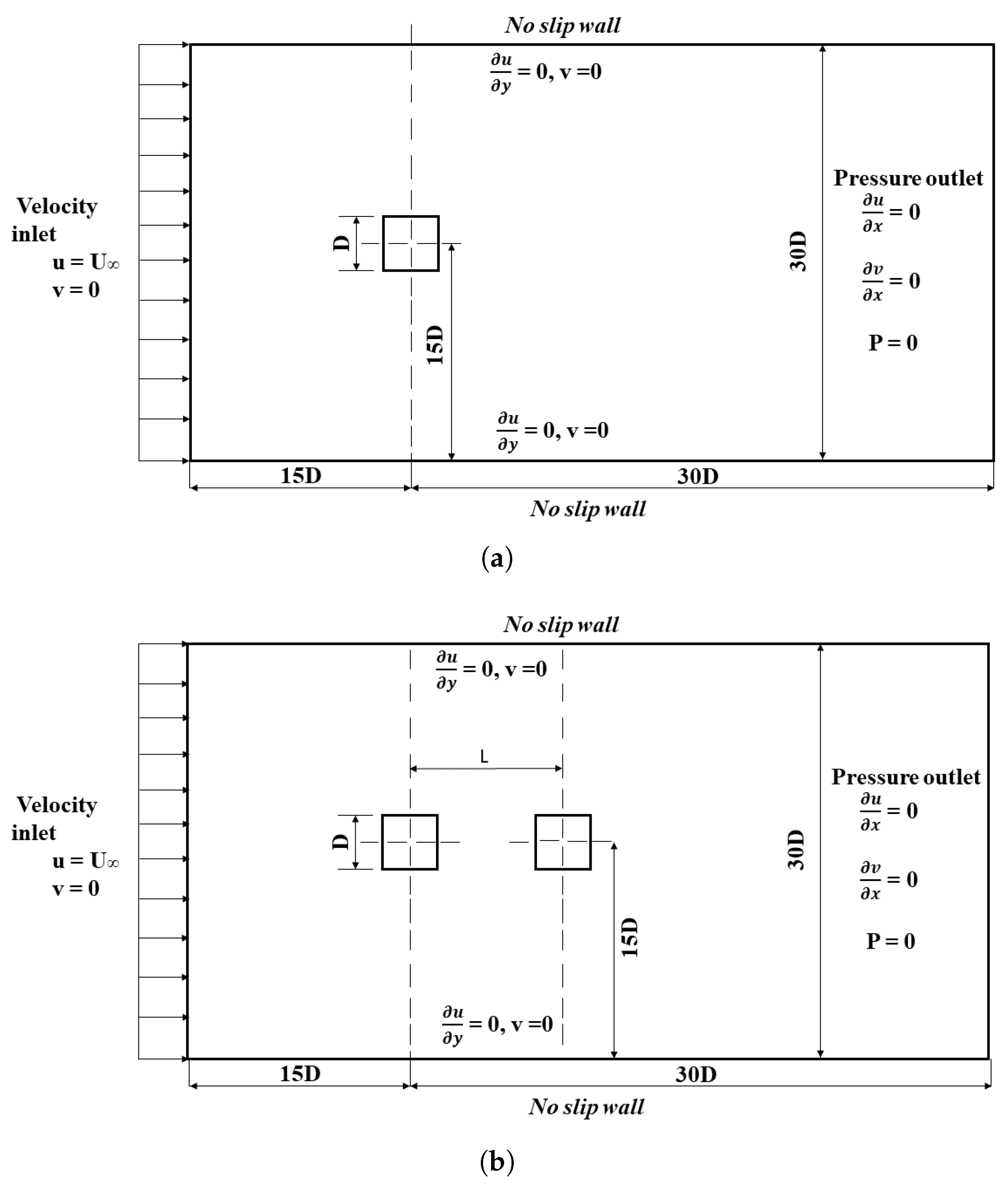
Figure 1. Numerical domain and boundary conditions used for the analysis. (a) Flow domain for a single square cylinder; (b) Flow domain for inline square cylinders.
Symmetry 17 02038 g001
Figure 2. Grid independence study.
Symmetry 17 02038 g002
Figure 3. Comparison of RMS streamwise velocity ( u rms ) contours at R e = 150: (a) Present study, (b) Reference data [21].
Symmetry 17 02038 g003
Figure 4. Refined mesh around an isolated square cylinder.
Symmetry 17 02038 g004
Figure 5. Aerodynamic forces for a single square cylinder ( R e = 100–200).
Symmetry 17 02038 g005
Figure 6. Mean velocity streamlines around a single square cylinder ( R e = 100–200).
Symmetry 17 02038 g006
Figure 7. Wake parameters for a single square cylinder. (RMS X velocity and Mean X velocity plotted together).
Symmetry 17 02038 g007
Figure 8. Variation of wake parameters in the Re range ( R e = 100–200).
Symmetry 17 02038 g008
Figure 9. Refined mesh around two inline square cylinders.
Symmetry 17 02038 g009
Figure 10. Variation of the drag coefficient ( C d ) for the UC and DC ( R e = 100–200). (SC represents single square cylinder values.).
Symmetry 17 02038 g010
Figure 11. Variation of pressure coefficient (base and stagnation), ( R e = 100–200). (a) Base pressure coefficient variation, UC; (b) Base pressure coefficient variation, DC; (c) Stagnation pressure coefficient variation, DC.
Symmetry 17 02038 g011
Figure 12. Variation of lift coefficient C l for both the UC and the DC across gap ratios ( L / D = 2, 4, 4.5, 6) and Reynolds numbers ( R e = 100–200).
Symmetry 17 02038 g012aSymmetry 17 02038 g012bSymmetry 17 02038 g012c
Figure 13. Spectral analysis (FFT) of lift coefficient for various gap ratios ( L / D = 2, 4, 4.5, 6) and Reynolds numbers ( R e = 100–200).
Symmetry 17 02038 g013aSymmetry 17 02038 g013bSymmetry 17 02038 g013c
Figure 14. Root–mean–square lift coefficient variation with gap ratio. (a) RMS lift coefficient with gap ratio for UC; (b) RMS lift coefficient with gap ratio for DC.
Symmetry 17 02038 g014
Figure 15. Variation of S t with gap ratio for the DC.
Symmetry 17 02038 g015
Figure 16. Variation of phase difference ( Δ ϕ ) between the lift coefficients of upstream and downstream cylinders with gap ratio ( L / D ) for various Reynolds numbers.
Symmetry 17 02038 g016
Figure 17. Vorticity contours for twin–cylinder interference at different gap ratios and Reynolds numbers.
Symmetry 17 02038 g017
Figure 18. Mean velocity contours for twin–cylinder interference in specific gap ratios ( L / D = 2 , 4 , 4.5 , 6 ), ( R e = 125–200).
Symmetry 17 02038 g018
Figure 19. Wake parameter estimation for two-cylinder interference, Re = 150 and L/D = 2.
Symmetry 17 02038 g019
Figure 20. Variation in vortex formation length with ( R e = 125–200) and gap ratio. (a) Vortex formation length measured from UC; (b) Vortex formation length measured from DC.
Symmetry 17 02038 g020
Figure 21. Wake width variation with ( R e = 125–200) and gap ratio. (a) Wake width measured from UC; (b) Wake width measured from DC.
Symmetry 17 02038 g021
Figure 22. Variation in recirculation length with gap ratio and ( R e = 125–200) (a) Recirculation length measured from UC; (b) Recirculation length measured from DC.
Symmetry 17 02038 g022
Table 1. Summary of previous studies on laminar flow over two tandem square cylinders.
StudyRe RangeL/D RangeAerodynamic ParametersMethodology and ArrangementFlow Regime and Key Findings
Firdaus et al. (2023) [43]3–1500.5–6.0 C D , C L , C L , rms , S t Vortex Particle Method (2D), tandem configurationIdentified five vortex wake patterns; critical spacing governed by wake merging and shielding effects.
Kouchakzad et al. (2023) [44]30–1501–6 C D , C L , S t Numerical (2D), tandemThree mean flow patterns reported; hysteresis observed near critical gap spacing.
Shui et al.
(2021) [45]
1001.5–9.0 C D , C L , S t ; phase lagFinite Element Method (2D), tandemSix flow regimes identified; vortex impingement induces phase lag and asymmetric shedding.
Abid et al.
(2024) [46]
1–1500.5–5 C D , C L , S t Lattice Boltzmann Method (2D), offset cylindersFive flow regimes including steady, periodic, and chaotic states depending on spacing and offset.
Sohankar et al. (2020) [47]70–1501.0–5.0 C D , C L , N u , C p Finite Volume Method (2D), tandemTwo hysteresis modes reported; inlet shear strongly influences regime transitions.
Rao et al.
(2008) [48]
≤1901.0–2.7 C D , C L , f s Lattice Boltzmann Method (2D), side-by-sideObserved flip-flop and synchronised shedding regimes.
Abbasi et al. (2024) [49]2500.25–10 C D , C L Lattice Boltzmann, in-line rectangular cylindersFour flow regimes ranging from single slender-body flow to fully separated wakes.
Kalsoom et al. (2024) [50]1500.1D–21D (control rod length) C D , C L Lattice Boltzmann, tandemFour distinct regimes classified based on control rod length variation.
Derakhshandeh et al. (2020) [51]50–2004.0 C D , C L , S t Numerical (2D), tandemThree wake modes identified as a function of Reynolds number and spacing.
Etminan et al. (2010) [52]1–2005.0 C D , C L Finite Volume Method (2D), tandemOnset of vortex shedding and recirculation region behind the DC examined.
Abbasi et al. (2018) [53]1–1103.5 C D , C L , S t Numerical (2D), in-line cylindersIdentified three wake interference regimes with spacing-dependent transitions.
Adeeb et al. (2018) [54]1001.5–10 C D , C L Hybrid LBM–FVM (2D), tandem cylindersRounded corners reduced drag and delayed vortex formation in the wake region.
Gowda et al. (2012) [55]1002, 4, 6 C L , S t CFD (2D), tandemCorner modifications significantly influence wake stability and vortex shedding frequency.
Kouchakzad et al. (2024) [44]30–1501–6 (aspect ratio 1–4) C D , C L , S t Numerical (2D), tandemThree wake modes with spacing-dependent hysteresis observed.
Aboueian et al. (2017) [56]1500.1–6 C D , S t Finite Volume Method (2D), staggeredFive flow regimes identified; DC exhibited strong unsteadiness and large-scale vortex structures.
Present Study (2025)100–2002–7 C D , C L , C L , rms , St , L f , L r , W , C p , o , C p , b 2D Finite Volume Method, tandem configurationCritical spacing ( L / D 4.5 ) marks transition between wake shielding and independent shedding; detailed analysis of drag, lift, unsteady lift, vortex dynamics, pressure coefficients, and wake parameters performed.
Table 2. Domain independence test.
DomainDomain Size ( Y × X )Cells C d C l
D1 20 D × 17.5 D 19,7001.76580.2404
D2 25 D × 20 D 31,3801.68540.2379
D3 30 D × 22.5 D 44,1081.64300.2250
D4 35 D × 25 D 61,2121.60350.2378
D5 40 D × 27.5 D 80,3001.57090.2298
D6 45 D × 30 D 101,2161.52300.26121
D7 50 D × 32.5 D 125,4161.52100.2666
D8 55 D × 35 D 151,4161.52200.2632
D9 60 D × 37.5 D 179,0161.52130.2601
1 Domain D6 selected considering computational time.
Table 3. Comparison of time-averaged drag coefficient ( C D , mean ), fluctuating lift coefficient ( C l , rms ), and Strouhal number ( S t ) for flow past a square cylinder at R e = 100 and R e = 150 , with percentage errors included.
References Re C D , mean C l , rms St
Sen et al. [57]1001.5287 (0.18%)0.1928 (3.66%)0.1452 (3.83%)
Sharma et al. [58]1001.4940 (2.09%)0.1920 (3.23%)0.1488 (1.46%)
Robichaux et al. [59]1001.5300 (0.26%)0.1540 (1.99%)
Singh et al. [60]1001.5100 (1.05%)0.1470 (2.65%)
Sahu et al. [61]1001.4880 (2.49%)0.1880 (1.08%)0.1486 (1.59%)
Present study (2025)1001.52600.18600.1510
Zhu et al. [21]1501.4539 (1.50%)0.2941 (1.36%)0.1530 (4.58%)
Jaiman et al. [62]1501.4740 (0.24%)0.2904 (2.96%)0.1565 (2.24%)
Zheng et al. [63]1501.4678 (1.34%)0.2753 (8.60%)0.1567 (2.11%)
Sharma et al. [58]1501.4667 (1.43%)0.2913 (2.99%)0.1588 (0.88%)
Singh et al. [60]1501.5160 (2.64%)0.2870 (4.18%)0.1590 (0.63%)
Present study (2025)1501.48760.29050.1602
Table 4. Comparison of time-averaged drag coefficient ( C D , mean ), fluctuating lift coefficient ( C L , rms ), and Strouhal number ( S t ) for flow past two tandem square cylinders at R e = 100 and L / D = 5 .
References C D , mean (UC) C l , rms (UC) C D , mean (DC) C l , rms (DC) St
Lankadasu et al. [64]1.4230.27941.0891.1320.137
Mithun et al. [65]1.5950.28151.3521.295
Present study (2025)1.47890.29941.23231.30320.1356
Table 5. Aerodynamic forces for an isolated square cylinder at ( R e = 100–200).
Re C d C l C l , rms St C l / C d
1001.52420.26330.18590.15190.1728
1251.49490.33110.23470.15710.2215
1501.48760.41050.29050.16020.2760
1751.49720.51960.36730.15870.3469
2001.51700.67970.48040.15150.4480
Disclaimer/Publisher’s Note: The statements, opinions and data contained in all publications are solely those of the individual author(s) and contributor(s) and not of MDPI and/or the editor(s). MDPI and/or the editor(s) disclaim responsibility for any injury to people or property resulting from any ideas, methods, instructions or products referred to in the content.