You are currently viewing a new version of our website. To view the old version click .
Symmetry
  • Article
  • Open Access

30 November 2025

Symmetry-Aware Bayesian-Optimized Gaussian Process Regression for Remaining Useful Life Prediction of Lithium-Ion Batteries Under Real-World Conditions


,
,
and
1
Department of Electrical and Electronics Engineering, R.M.K. Engineering College, Kavaraipettai 601206, India
2
Department of Computer Science and Engineering, Sriram Engineering College, Perumalpattu 602024, India
3
S-Gen Energy & Infra Pvt Ltd., Chennai 600056, India
*
Author to whom correspondence should be addressed.
Symmetry2025, 17(12), 2039;https://doi.org/10.3390/sym17122039 
(registering DOI)
This article belongs to the Section Engineering and Materials

Abstract

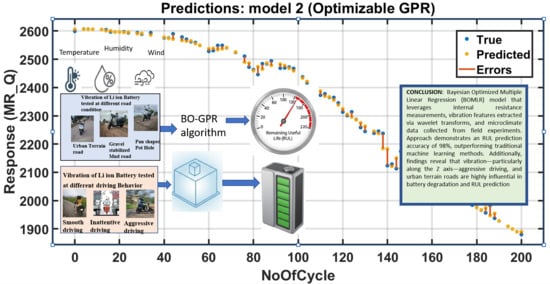
Lithium-ion batteries are widely used in electric vehicles (EVs) due to their high energy and power density. The accurate prediction of Remaining Useful Life (RUL) is critical for ensuring safety, reliability, and optimal battery utilization. However, RUL estimation remains challenging because battery degradation is influenced not only by electrochemical factors but also by real-world operating conditions, which often exhibit complex symmetric and asymmetric patterns. Existing RUL prediction models neglect the impact of micro-climatic conditions and road-induced vehicle vibrations, which leads to reduced prediction accuracy and limited application in practical driving environments. This paper proposes a Bayesian-optimized Gaussian process regression model (BO_GPR) for RUL prediction by integrating internal resistance data, battery degradation characteristics, micro-climatic parameters (temperature, humidity, wind speed), and vehicle vibration data under diverse driving scenarios. Vibration signals are preprocessed using the Discrete Wavelet Transform (DWT) and band-specific features are extracted using Tunable Q-factor Wavelet Transform (TQWT) to enhance feature sensitivity. The proposed BO-GPR model achieves an accuracy of 98.1%, outperforming conventional machine learning approaches. Experimental analysis shows that Z-axis vibrations, aggressive driving patterns, and urban terrain roads, in combination with micro-climatic variability, play a crucial role in accelerating RUL degradation. By explicitly modeling these factors, the proposed method provides a more realistic, data-driven framework for the health monitoring of electric vehicle batteries. These findings highlight the importance of incorporating environmental influences, vehicle dynamics, and degradation symmetry considerations in RUL prediction, supporting predictive maintenance, fleet management, and battery warranty optimization, improving the reliability and lifecycle cost-effectiveness of electric mobility systems.

1. Introduction

The RUL of lithium-ion batteries depends on several factors, including cell chemistry, charge/discharge cycles, and operating temperature []. During repeated cycling, internal resistance increases, leading to capacity fade []. In addition, the formation and growth of the solid electrolyte interphase (SEI) layer on both electrodes contributes significantly to performance degradation. Other degradation mechanisms include conductivity loss (CL), loss of lithium ions (LLI), and loss of active material (LAM), as reported in []. Continuous exposure to vibrations during vehicle operation further accelerates degradation and shortens battery lifetime []. Temperature plays a critical role in degradation: at high temperatures, lithium corrosion and hydrocarbon gas generation occur, while at low temperatures, lithium plating at the negative electrode reduces discharge capacity [,]. There are several studies on thermal dissipation in batteries due to vibration and their impact on discharge capacity; vibration under different frequencies and amplitudes has been shown to influence heat transfer, where phase change materials (PCMs) combined with carbon nanoparticles or graphene are used to enhance thermal conductivity []. Laboratory studies have also examined aging and capacity estimation under vibration in six degrees of freedom, using deep learning models such as long short-term memory (LSTM) networks, which were studied in []. In addition, machine learning and regression models, evaluated through metrics like Mean Absolute Error (MAE) and Root Mean Square Error (RMSE), have also been widely used for RUL prediction [,]. “A direct calculation method for capacity calculation from raw data” is provided by Hongao Liu et al. in [], and the “correlation between vibration and reduced electrical performance for different electrical structure” is explained in []. However, these studies primarily focus on controlled laboratory conditions, and the impact of real-world road driving conditions remains largely unexplored.
Recent advancements in data-driven approaches have further improved prediction accuracy. For example, symmetry in battery degradation and charging pattern is illustrated in []. Statistical methods such as the Wilcoxon rank-sum test have been applied for capacity regeneration analysis [], while incremental capacity (IC) analysis combined with fully connected neural networks (FCNNs) has enabled effective feature extraction from charging curves []. Other works have utilized hybrid models, such as support vector machines (SVMs), LSTM, and empirical mode decomposition with adaptive noise, to enhance RUL prediction [,]. Transformer-based architectures have also been introduced to denoise and analyze charge–discharge sequences [], while gated recurrent unit (GRU) models have been applied for both single cells and battery packs [,]. Lin 2022 et al. proposed a Bayesian framework for RUL prediction taking uncertainties into consideration []. Knee point features were incorporated into battery lifecycle prediction by Cui et al. []. In addition, several studies have examined capacity degradation, power fade, and state of health (SOH) estimation under laboratory stress tests, such as in []. Driving behavior was considered in a study on the energy consumption of EVs, along with trip condition effects []. Machine learning models predicting the RUL of lithium-ion batteries work most effectively with larger datasets. Hence, dataset availability is a major concern for RUL prediction. Low-dataset transfer learning allows for the reuse of a pretrained model for another task, as reported in []. The small-sample learning technique focuses on effective learning with limited data through techniques like regularization, data augmentation, or generative models [,].
Most existing studies on lithium-ion battery RUL prediction are limited to laboratory-controlled cycling tests, focusing primarily on electrochemical degradation parameters. However, they often neglect practical real-world factors, such as road-induced vibrations, micro-climatic variability, and diverse driving behaviors, all of which significantly accelerate battery aging in electric vehicles. This gap highlights the need for a more robust and realistic framework that integrates both electrochemical and external stressors for accurate RUL prediction. In this paper, a BO-GPR model is proposed for accurate RUL prediction of lithium-ion batteries in electric vehicles by considering real-world operating conditions. The major contributions of this work are summarized as follows:
  • Integration of multi-domain factors: Unlike conventional approaches, the proposed framework incorporates battery internal resistance, degradation characteristics, micro-climatic conditions (temperature, humidity, wind speed), road surface types, and driving behaviors.
  • Advanced vibration signal processing: Vehicle-induced vibration signals are denoised using DWT, and TQWT is employed for band-specific feature extraction.
  • Bayesian optimization of regression model: The BO-GPR algorithm is developed to combine micro-climatic and vibration features with degradation data, achieving robust and accurate RUL prediction.
  • Experimental validation: The proposed method achieves an accuracy of 98.1%, outperforming conventional regression and machine learning approaches. Experimental analysis further confirms that Z-axis vibrations, aggressive driving, and urban terrain roads significantly accelerate degradation under micro-climatic variability.
This study emphasizes the importance of integrating environmental and dynamic driving factors for more reliable and realistic RUL prediction, thereby enhancing the safety, reliability, and operational efficiency of electric vehicle batteries.

1.1. Problem Statement

Lithium-ion batteries in electric vehicles are subjected to continuous vibrations and mechanical stresses during real-world operation, which accelerate degradation and reduce service life. Vibration increases the internal resistance, disrupts the intercalation and deintercalation processes, and results in CL. Elevated resistance leads to ohmic losses, higher heat generation, and faster degradation. In addition, repeated charge–discharge cycling affects the SOH and further contributes to aging.
Electrochemical Impedance Spectroscopy (EIS) is widely used to study battery degradation by measuring ohmic resistance (Rohm), charge transfer resistance (Rct), SEI film resistance (RSEI), and Warburg resistance (Rw). These parameters capture internal resistance growth and electrochemical changes. However, higher operating temperatures accelerate electrode corrosion and cause irreversible lithium loss, while low temperatures impair discharge capacity. Existing studies primarily investigate temperature effects under controlled laboratory conditions, but do not fully account for the combined influence of vibration, micro-climatic variability, and driving behavior during actual vehicle operation.
To address this gap, it is necessary to predict the RUL of lithium-ion batteries based on degradation parameters, micro-climatic data, and driving conditions under runtime environments. The key research questions are:
  • RQ1: How do driving behavior and micro-climatic conditions influence battery degradation during EV operation?
  • RQ2: How can RUL be analyzed and predicted using degradation parameters and micro-climatic data?
  • RQ3: Which degradation parameters have the most significant influence on RUL prediction?

1.2. Contributions

  • Detection of the impact of vibration on the battery pack due to different road conditions, such as a pan-shaped pothole, gravel-stabilized mud road, and urban terrain road, through an accelerometer fixed on the battery module and motor driver circuit. Simultaneously, battery degradation modes are analyzed during different driving behaviors such as inattentive driving, aggressive driving, and smooth driving.
  • Analysis of the low-frequency vibration impact on the battery through DWTs applied to the low-frequency vibration signals and performing residual coefficient analysis.
  • Energy band analysis of low- and high-vibration signals and analysis of their impact on the battery through a proposed algorithm, TQWT, under different road conditions and with different driving behaviors.
Prediction of RUL based on the degradation of battery data, micro-climatic data, and driver behavior using the BO-GPR model, and the measurement of model accuracy using statistical parameters such as R2, RMSE, and MAE.

2. Methodology

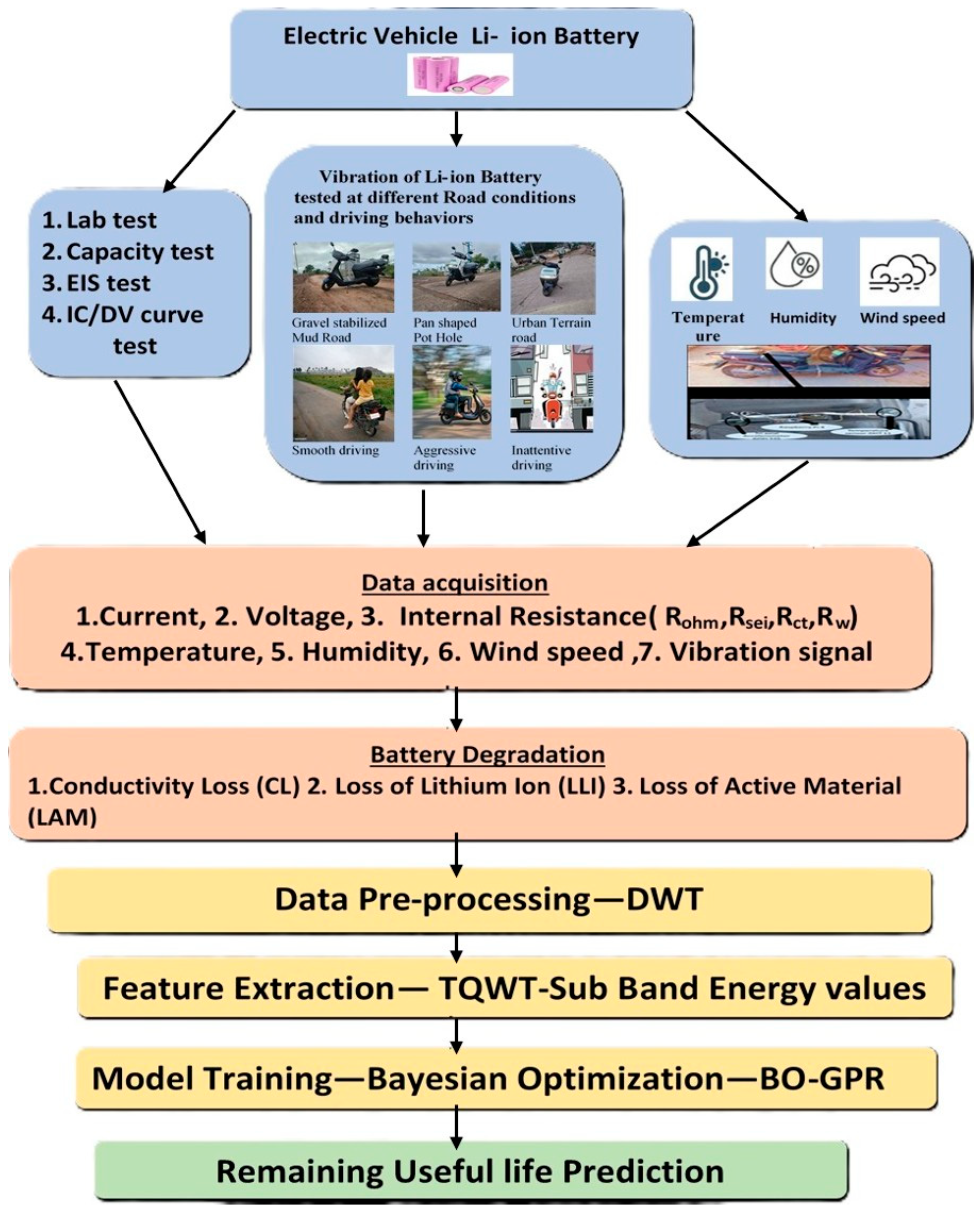
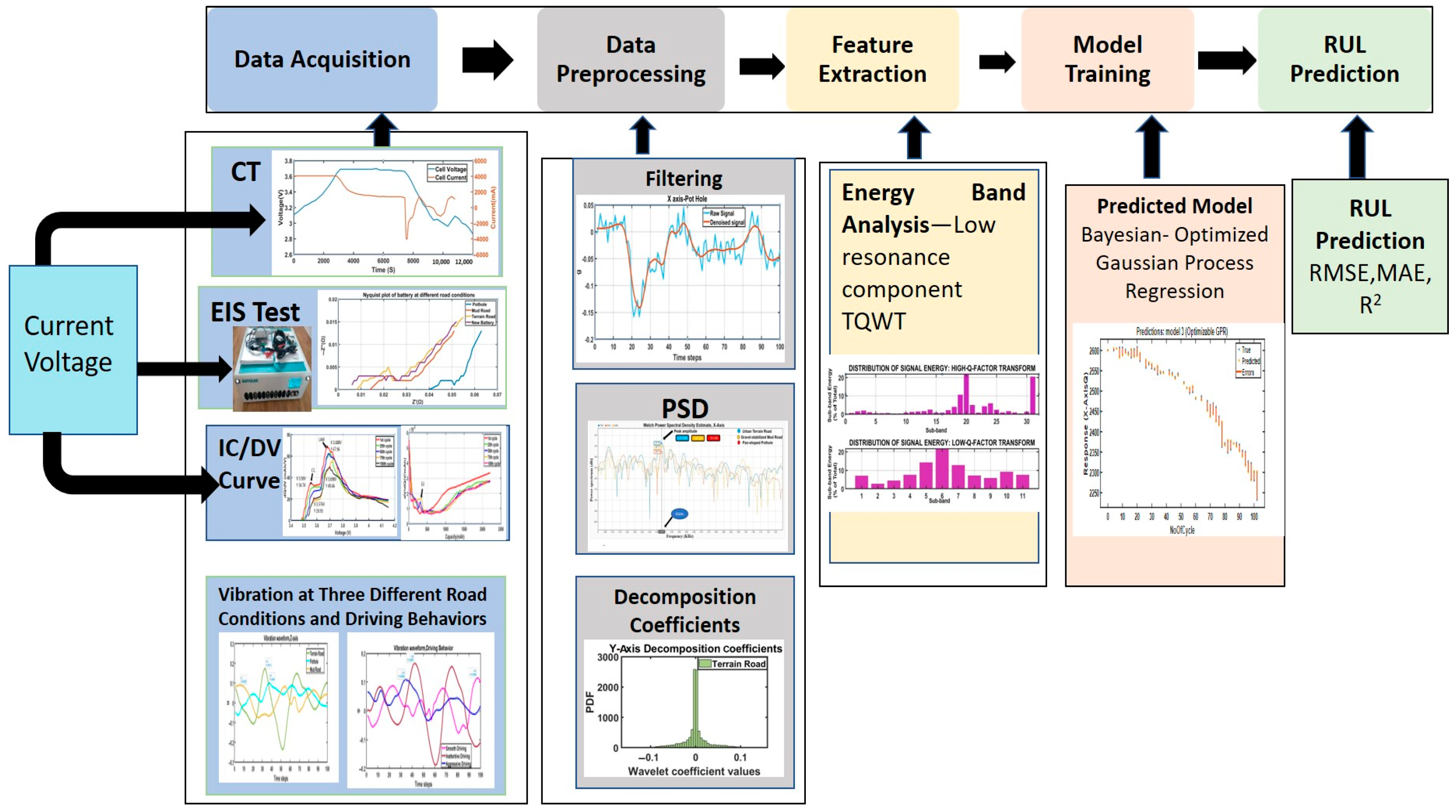
Lithium-ion battery testing is essential for ensuring the performance, safety, and extension of battery life. The proposed research design involves both laboratory-controlled and real-world driving tests to ensure realistic and reproducible results. Tests were conducted at the EV Battery Testing Lab of S-Gen Energy & Infra Pvt. Ltd. under varying road, climate, and driving conditions. Data were collected, scrutinized, and analyzed to evaluate degradation trends and validate the predictive model accuracy. This integrated experimental and modeling approach ensures the reliability and appropriateness of the research design. The vibration signals of three different road conditions, comprising a pan-shaped pothole, a gravel-stabilized mud road, and an urban terrain road, were acquired. Further, driving behavior is linked with battery degradation, and three different cases were considered in this study, comprising (i) inattentive driving, (ii) aggressive driving, and (iii) smooth driving, for battery degradation analysis. There is a need to analyze battery degradation with different micro-climatic conditions, road conditions, and driving behaviors. A capacity test, EIS test, and incremental capacity (IC) test/Differential Voltage (DV) curve test were performed on the battery in a lab, and the values were recorded, as shown in Figure 1.
A vibration dataset with varying time series was obtained from the sensors mounted on the vehicles using a data acquisition system. Signals obtained in the time domain were converted to the frequency domain using DWT, and the Power Spectral Density (PSD) of the signal was obtained. Vibration Signals were preprocessed using DWT and denoised, and residual coefficient analysis was performed. Feature extraction was performed through TQWT. Energy band analysis of the vibration signal was performed to understand the distribution of the frequency band energy values of the signal. RUL prediction was performed based on vibration data acquired from the three different axes, the X-axis, Y-axis, and Z-axis. The BO-GPR method was used for RUL prediction based on the different axes of vibration signals, capacity degradation with different road conditions, and driving behavior, along with micro-climatic conditions.
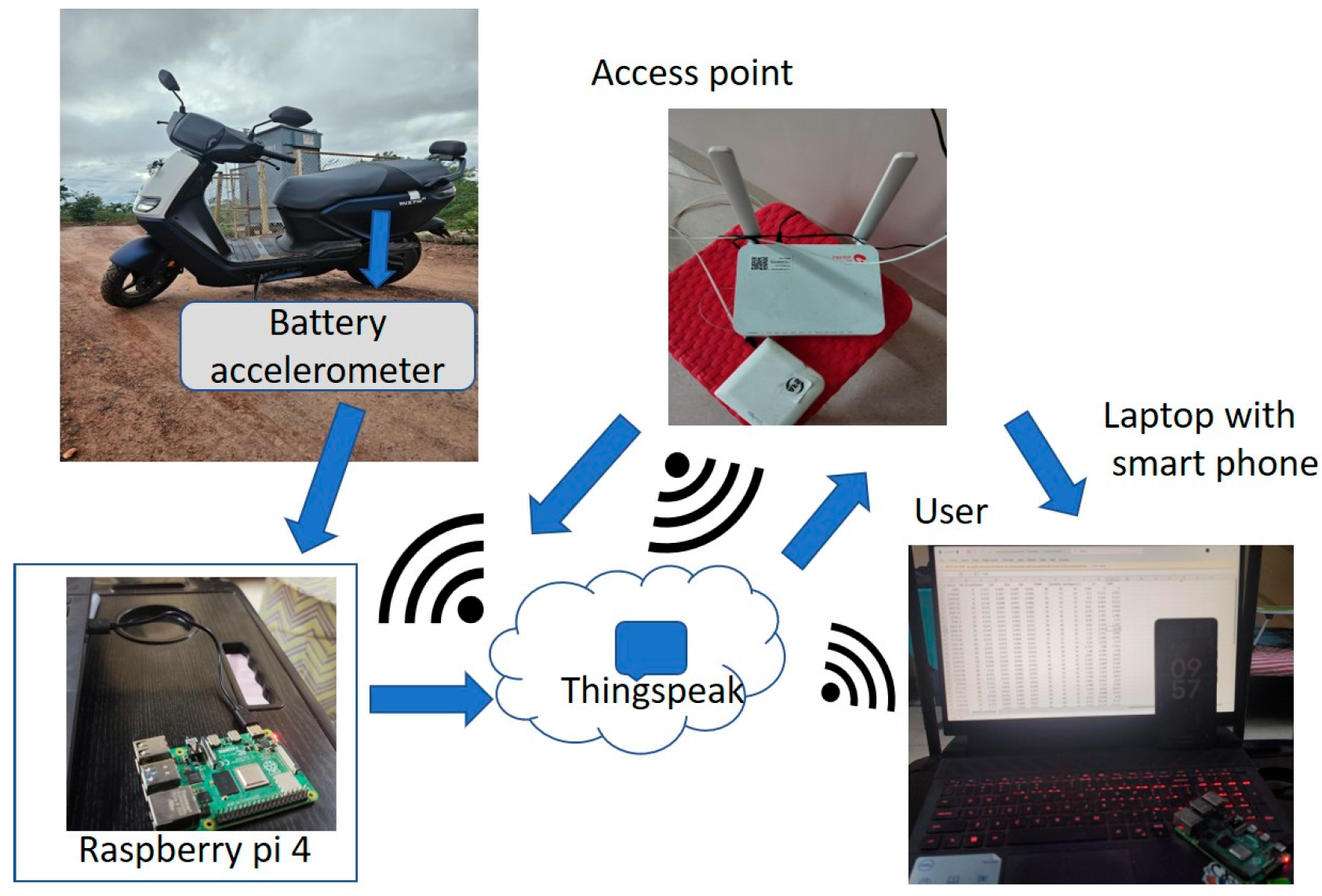
A Triaxial Accelerometer ADXL 335 (Analog Devices, Norwood, MA, USA, sourced @ Ohm Electronics) was placed on an Ather Rizta Z model EV with a 120 km range to measure the vibration along the X, Y, and Z directions and the vibrations due to driving behavior, as shown in Figure 2. Micro-climatic test conditions, such as temperature, humidity, and wind speed, were recorded in Ambattur, Chennai city, Tamil Nadu. The duration of the entire test campaign was 3 days, with 5 h per day. Ambient temperature and relative humidity varied between 36 and 38 °C and 48–58%, respectively. A Raspberry Pi 4 (Raspberry Pi Foundation, Cambridge, UK, sourced @ Ohm Electronics) was used for sensor data acquisition and transmission of data to ThingSpeak cloud platform (https://thingspeak.com; accessed on 12 February 2024).” Three different cases of road conditions were used, pan-shaped pothole, gravel-stabilized mud road seen in urban areas, and urban terrain road, for this study.
Block Diagram:
Figure 1. Overall block diagram of RUL prediction in Li-ion battery degradation.
Figure 2. Experimental setup.
Three different driving behaviors, comprising inattentive driving, aggressive driving, and smooth driving, were included in this study to understand the battery discharge capacity [] and vibrations’ impact on battery degradation due to driving behavior. A charge–discharge test was performed, and we measured the current, voltage limits, and cycles to evaluate battery degradation and aging. Performance tests, such as EIS tests and IC/DV curve tests, were performed to evaluate battery degradation and aging. Figure 3 shows the test flow carried out in this experiment.
Figure 3. Battery degradation test flow.

2.1. Lab Based Measurements

Ten cells of ICR-18650 rechargeable Li-ion batteries with 3.7 V nominal voltage and 2.6 Ah were selected and connected in series and parallel. The charging and discharging voltages of the batteries were 4.2 V and 3.0 V, respectively.

2.1.1. Capacity Test

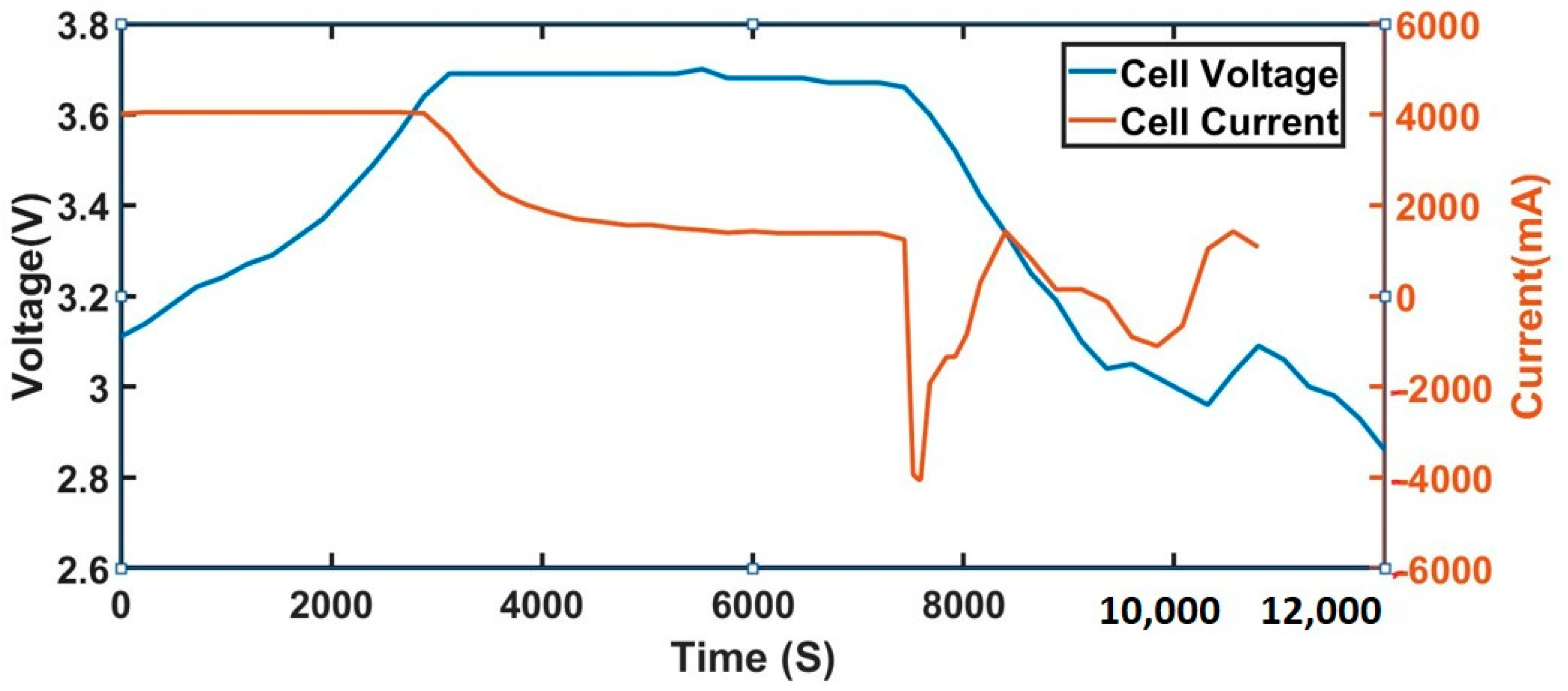
The capacity test was measured based on capacity of the battery. The battery was initially discharged by discharging a current of 1 C until the 3.0 V cut-off voltage. After 30 min of rest period, the battery was charged in a Constant Current–Constant Voltage (CC-CV) mode to reach a maximum voltage of 4.2 V, followed by Constant Voltage charging until the current dropped to 120 mA. This process was repeated three times, and the average of the three discharge capacities of the battery was considered as the actual capacity of the battery. Figure 4 shows the variation in charging and discharging current and voltage over a period of 3 h for a single cell. Measurements were performed in the lab at a room temperature of 30 °C, humidity of 49%, and wind speed of 9 km/h.
Figure 4. Charging and discharging conditions of single-cell voltage.

2.1.2. EIS Test

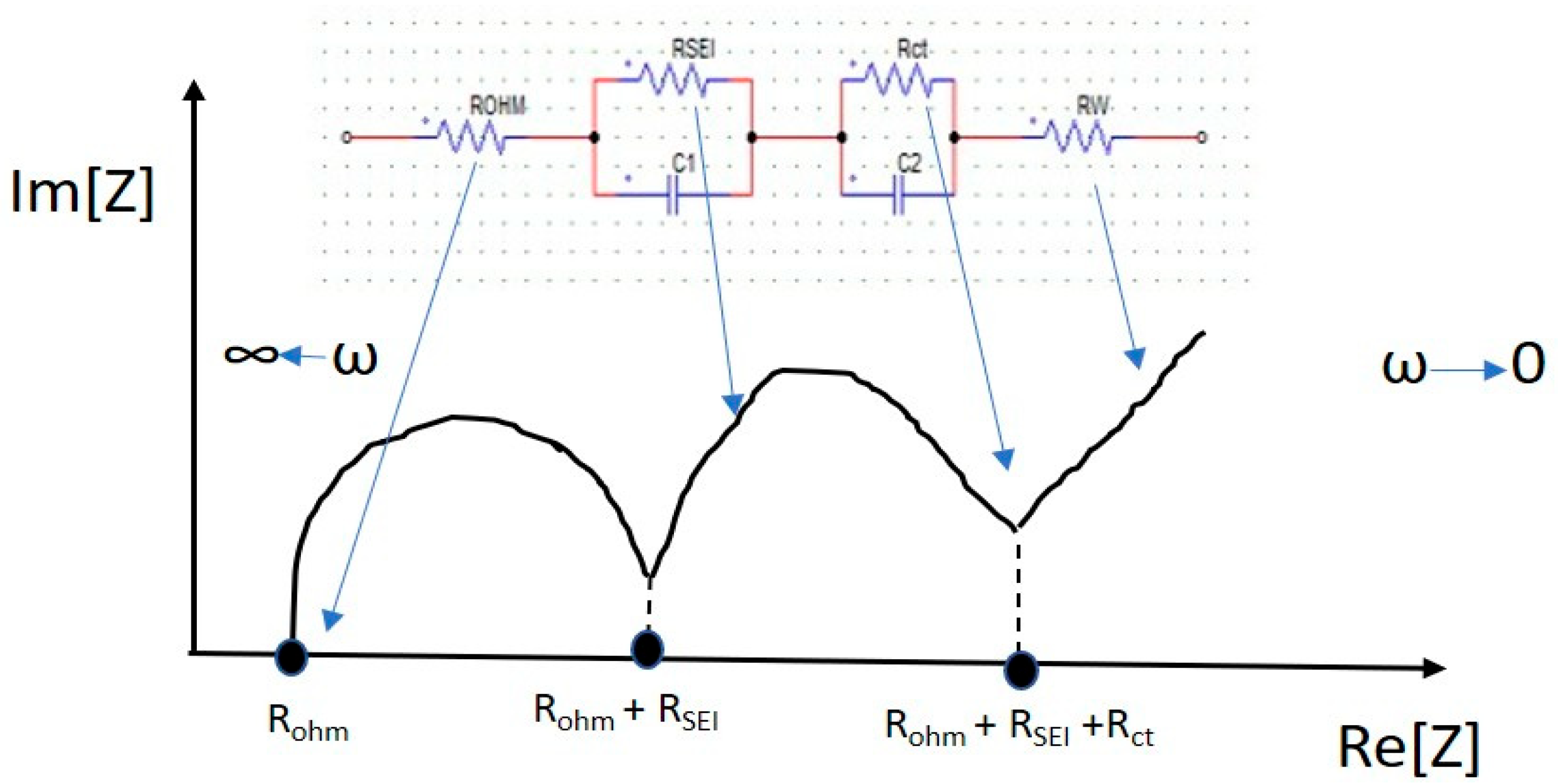
EIS was performed in an Electrochemical workstation Autolab PGSTAT204(Metrohm Autolab B.V., Utrecht, The Netherlands) in the EV Battery Testing Lab of S-Gen Energy & Infra Pvt Ltd., using a small alternating current (AC) signal with 10 mV over a wide frequency range from 10 Hz to 100 KHz with an excitation current of 100 mA. The measured impedance is the EIS impedance of the battery in a fully charged state, as reported in []. The experimental data was fitted with the equivalent circuit using the Zview2 professional impedance analysis software (Scribner Associates Inc., Southern Pines, NC, USA; https://www.scribner.com; accessed on 2 June 2024). The data is typically represented in a Nyquist plot. The real part of impedance is plotted on the X-axis. The imaginary part is plotted on the Y-axis. This visualization helps in distinguishing various impedance elements within the battery, such as resistances and capacitances associated with different processes, such as charge transfer and ion migration. The Nyquist plot is sensitive to changes and hence makes it easy to identify the variations in the battery. An Electrochemical Impedance Model (EIM) was created, and each electrical component represents a part of the electrochemical system. The equivalent circuit of EIM is shown in Figure 5.
Figure 5. Conventional diagram of EIS.
The Nyquist plot has three regions. It has two semicircles from high frequency to low frequency and a straight line. The first semicircle corresponds to RSEI, the second semicircle corresponds to Rct, and the straight line at 45° corresponds to Warburg impedance (Z(W)). At low frequency, capacitive reactance tends to infinity, and current passes through resistance. The imaginary term becomes zero, and impedance is associated with the real term. The point on the real axis represents the Rohm, and then the first semicircle represents the RSEI, and the impedance is calculated as in (1).
Z(ω) = Rohm + RSEI
For the next semicircle, the impedance is calculated as in (2).
Z(ω) = Rohm + RSEI +Rct
At low frequencies, oxidation of Li-ions at the anode results in the depletion of Li ions, reducing the current flow in the battery for the same potential. This increases impedance, known as Warburg impedance, in the frequency domain. This is described by the Cottrell equation in the frequency domain as in (3).
Z W = σ ω j σ ω
where Z(W) is Warburg impedance, σ is the Warburg coefficient, ω is angular frequency (rad/s), and j = 1 . Warburg impedance is visible in the Nyquist plot as the straight line with a 45° angle to the abscissa, representing the diffusion of lithium ions within the electrode. The impedance is frequency-dependent and has equal real and imaginary components.
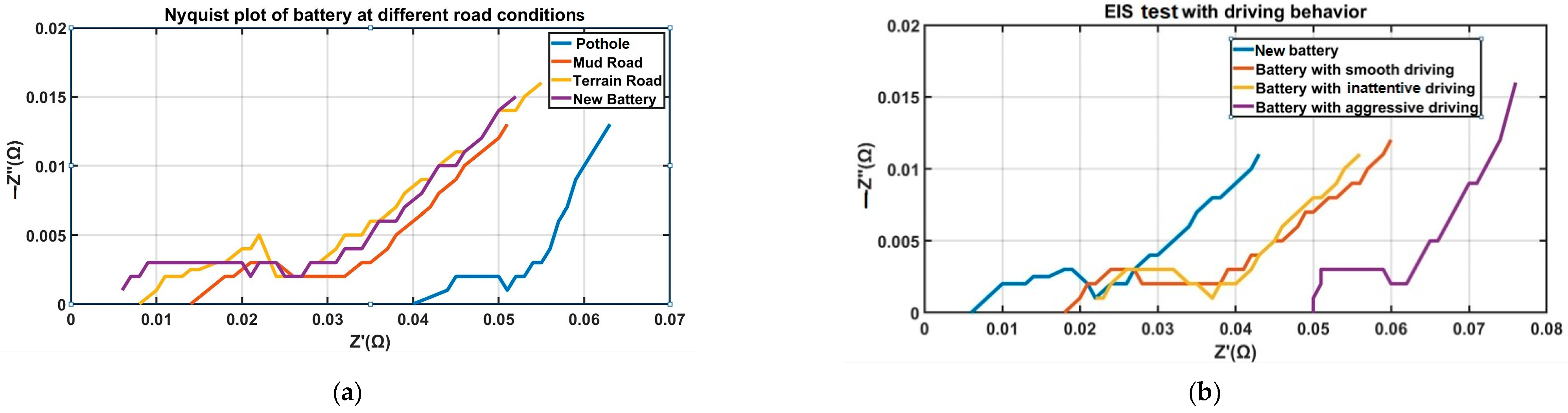
Figure 6a represents the EIS test performed with three different road conditions—pan-shaped pothole, gravel-stabilized mud road, and urban terrain road—at a room temperature of 28 °C, humidity of 65%, and wind speed of 9 km/h
Figure 6. (a) EIS curve for different road conditions. (b) EIS curve at different driving behavior.
Figure 6b represents the EIS test performed with three different driving behaviors— inattentive driving, smooth driving, and aggressive driving—at a room temperature of 28 °C, humidity of 65%, and wind speed of 9 km/h. CL is associated with electrolyte decomposition, collector corrosion, and binder degradation. This loss is reflected by Rohm. The reduction in quantity of lithium ions available for intercalation during the charging and discharging process is LLI. The SEI layer is formed on the cathode and is responsible for trapping the lithium ions in the cathode, and free mobile ions are not available for intercalation. Further, the electrode charge transfer process is affected by the SEI layer. LLI is reflected by RSEI and Rct. There is a loss of active material in both the cathode and anode due to structural changes, which influences the diffusion process. LAM is reflected by RW. The relationships of CL, LLI, and LAM to the resistances are shown in (4) to (6).
C L = R o h m i R o h m 0 R o h m 0
L L I = ( R S E I i R S E I 0 ) + R c t i R c t 0 R S E I 0 + R c t 0
L A M = R W i R W 0 R W 0
where Rohmi, RSEIi, Rcti, and RWi are the impedance of the battery after the ith cycle, and Rohm0, RSEI0, Rct0, and RW0 are the initial impedance of the battery. With an increase in vibration frequency, Rohm increases, and RSEI and Rct decrease. The inclination angle of the straight line increases after vibration. Meanwhile, all three resistances increase with the number of cycles of charge and discharge.

2.1.3. IC/DV Curve Test Analysis

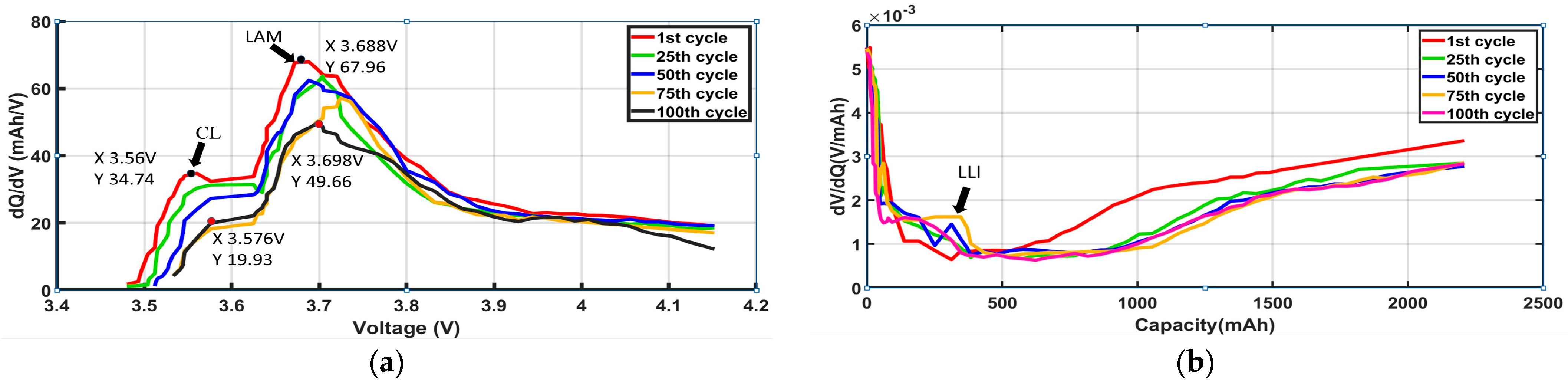
IC/DV curve test analysis is used in battery degradation studies for identifying lithium inventory loss, active material degradation, and electrode potential shifts over cycling. Tests were performed at 28 °C for 100 cycles. During each cycle, cells were discharged at a 0.5 C to 1 C rate, and the voltage and capacity data were collected at 1 Hz frequency. Accurate to 1 mV precise voltage measurements were taken, as well as capacity measurements with a resolution of 10 mAh. Phase transitions within the battery material correspond to a peak in the IC&DV curve. These peak shifts or decreases in magnitude indicate a loss in capacity or efficiency. Incremental capacity is calculated as a function of voltage and is mathematically represented as d q d v . Figure 7a represents the IC curve from the test conducted on Li-ion battery at different cycles.DV analysis is the inverse of IC analysis, expressed as d v d q . The shift in the IC curve towards a lower voltage is identified as CL, which correlates with collector corrosion or electrolyte decomposition within the battery. The peak variation difference in the IC curve is identified as LAM, which correlates with possible electrode decomposition, electrolyte oxidation, active particle denaturation, lithium dendrite formation, and disordered crystal structure inside the battery. Measurements were performed in the lab at a room temperature of 28 °C, humidity of 65%, and wind speed of 9 km/h.
Figure 7. (a) IC curve test (b) DV curve test.
Figure 7b represents the DV curve from the tests conducted on the Li-ion battery. The DV curve test on a fresh battery has distinct features compared to the test after 50 cycles, with higher peaks and a broader range. This indicates that the battery has higher energy storage and efficiency during its initial usage. The decrease in peak height with the shift indicates LLI with degradation mechanisms such as SEI growth, lithium plating, and electrolyte oxidation. The decrease in peak height at constant voltage indicates LAM with degradation mechanisms such as particle cracking and transition metal dissolution.

2.2. On-Road EV Running Condition-Based Vibration Signal Acquisition

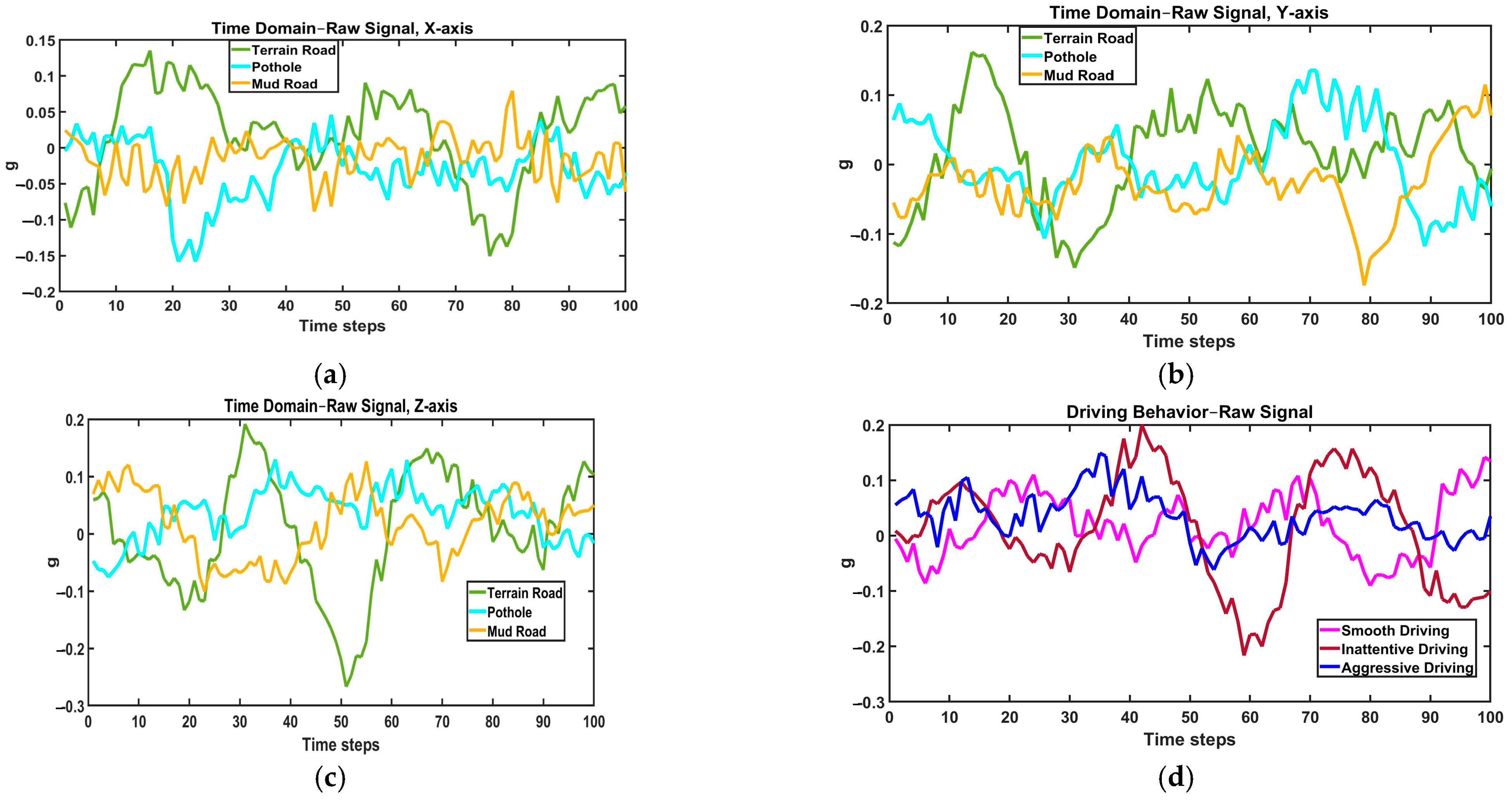
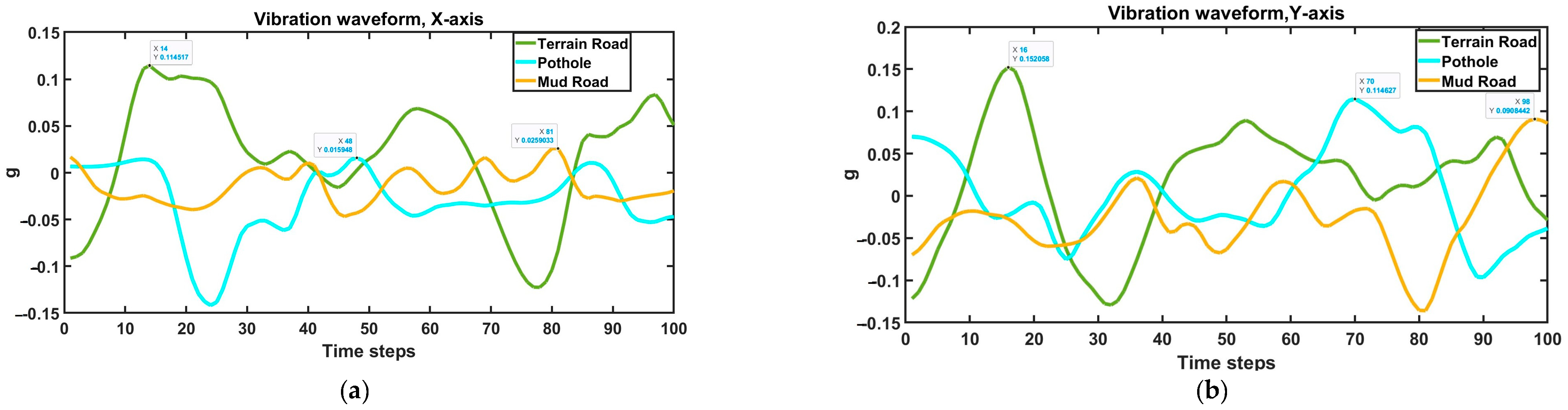
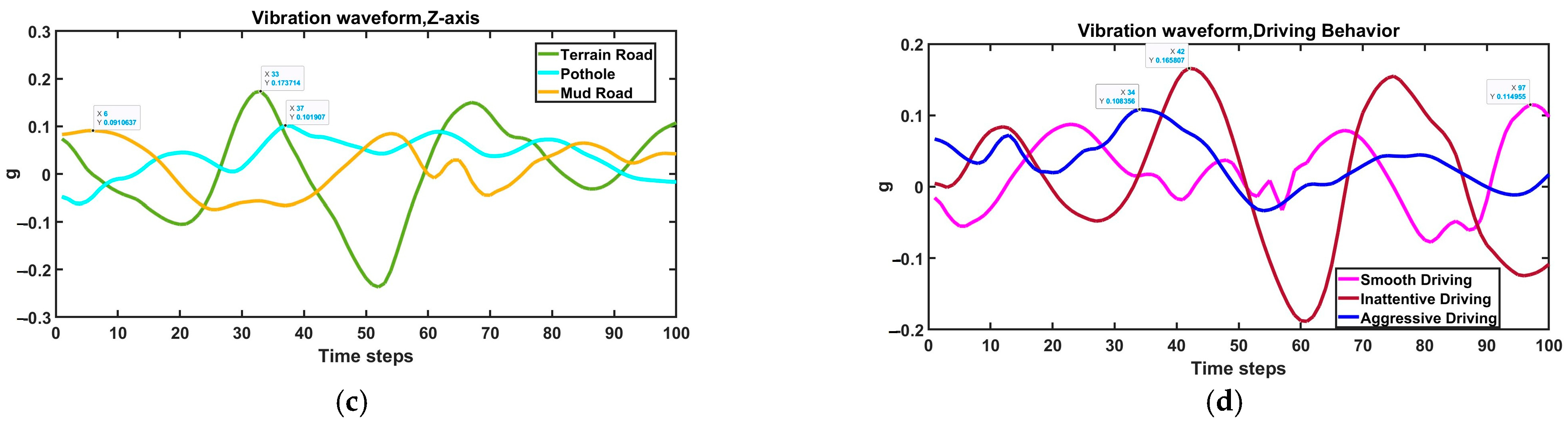
Vibration signals were measured through the accelerometer placed on the battery. Data was collected at a sampling frequency of 1 KHz. The sensor provided an analog output voltage proportional to acceleration, with a measurement range of ±3 g and sensitivity of approximately 300 mV/g for each axis. Three different cases of road conditions were tested for this study: a pan-shaped pothole, gravel-stabilized mud road seen in urban areas, and urban terrain road. The vehicle was operated under controlled driving conditions across three distinct road types to evaluate vibration behavior: Each road segment was approximately 500 m in length, and the vehicle was driven at a constant speed of 25 km/h to maintain uniform dynamic loading conditions. Environmental parameters, such as temperature, humidity, and wind speed, were recorded simultaneously using a DHT22 sensor and an Adafruit cup-type Model 1733 anemometer to correlate with micro-climatic effects on vibration response. Each test lasted for 100 min per road type, with 40 test runs covering 40 Km in total. Vibration signals are time domain signals represented for three different road conditions in the X-, Y-, and Z-axes, as shown in Figure 8a–c. The vibration signals were recorded for different driving behaviors [,,]—smooth driving, inattentive driving, and aggressive driving—as shown in Figure 8d. Measurements were taken on the road at a temperature of 38 °C, humidity of 49%, and wind speed of 16 Km/h.
Figure 8. Time domain vibration signals at battery. (a) along X-axis, (b) along Y-axis, (c) along Z-axis, (d) for different driving behaviors.

2.3. Vibration Signal Processing Using DWT

The DWT processes the signal through a series of high-pass and low-pass filters, followed by down-sampling. The DWT was performed on the vibrational signal to capture both time and frequency information for analyzing non-stationary signals. The translation invariance was measured through removing the down-sampling and up-sampling the filter coefficients at each level, which improves the translation invariance, resulting in the denoising of the signal. Wavelet transforms overcome the Heisenberg uncertainty principle through multiresolution decomposition. DWT preprocessing was implemented using MATLAB R2024a (MathWorks Inc., Natick, MA, USA), which has a wavelet signal denoiser app. A single-level DWT using Daubechies-6 wavelet signal was analyzed. The DWT separates the approximation coefficients and detail coefficients and is used for identifying the non-stationary signals. The DWT was implemented via a multilevel filter bank, where each level corresponded to a specific frequency band. The vibration signal was reconstructed, and the processed coefficients were obtained through an inverse transform. The DWT separates the signal of low-frequency content from that of high-frequency content. Figure 9 shows the denoised signal vibration after processing with DWT for the X-, Y-, and Z-axes.
Figure 9. Denoised time domain vibration signals for different road conditions on the (a) X-axis, (b) Y-axis, and (c) Z-axis (d) for different driving behaviors.
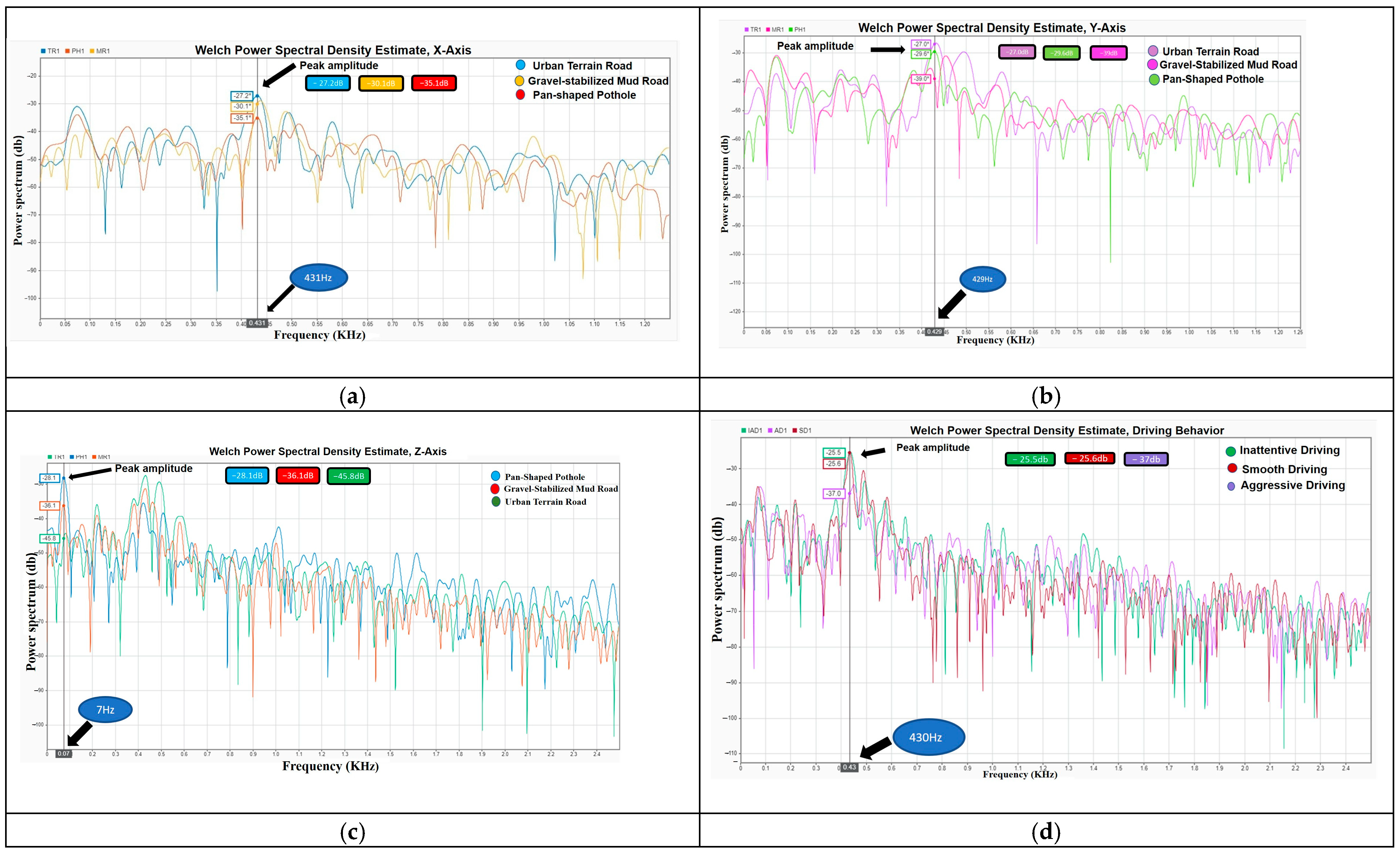
The PSD describes the power contained in each frequency component of the signal. The PSD provides a frequency-based representation of power distribution and assesses the stress level, fatigue level, and potential failure mode, which are caused due to vibrations on the battery. In this study, vibration signals were acquired at a sampling rate of 1 kHz. According to the Nyquist criterion, the sampling frequency must be at least twice the highest frequency of interest to avoid aliasing. The experimental PSD analysis, as shown in Figure 10, indicated that the dominant vibrational energy occurs around 431 Hz, for the X- and Y-axes, with different driving behavior vibrations, and around 7 Hz for Z-axis vibration, which is well within the Nyquist limit of 500 Hz for a 1 kHz sampling rate. Therefore, the selected sampling frequency ensures that the critical frequency components influencing battery degradation are accurately captured while avoiding unnecessary oversampling.
Figure 10. PSD for different road conditions for (a) X-axis (b) Y-axis (c) Z-axis and (d) PSD for different driving behaviors. * indicates peak amplitude.
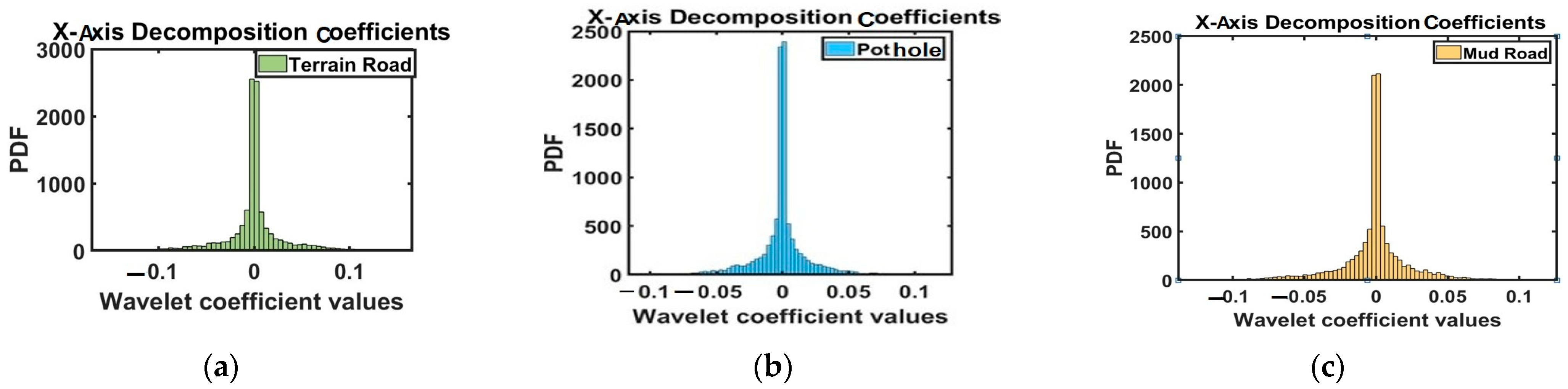
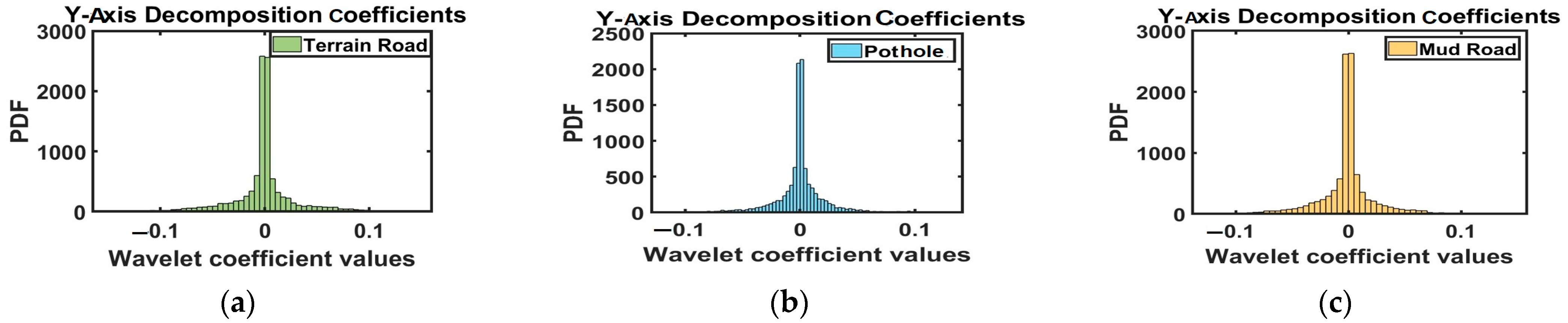
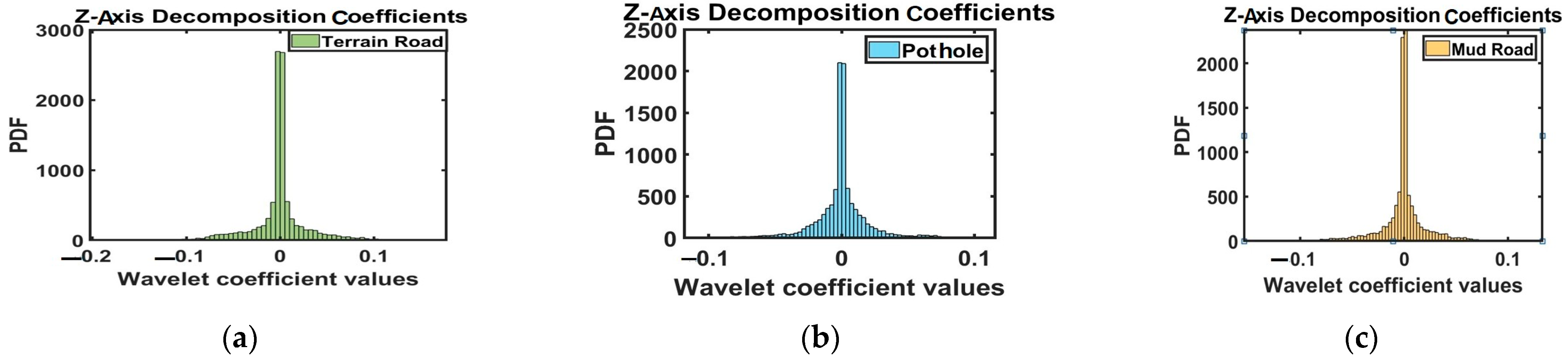
Higher frequency components were disregarded as they fall outside the reliable Nyquist band for the chosen sampling rate. This choice also reduces data storage requirements and computational complexity, making the acquisition more practical for real-time, on-road testing scenarios []. High-frequency lateral vibrations are likely to aggravate ohmic and charge-transfer resistances through micro-cracking and loss of electrical contact, whereas low-frequency vertical oscillations contribute to loss in active material and accelerated aging through cyclic compressive stress. Thus, the integration of axis-specific vibration features provides a more comprehensive understanding of RUL prediction under real-world driving conditions. The decomposed coefficients are shown for the urban terrain road, gravel-stabilized mud road, and pan-shaped pothole, along the X-axis, Y-axis, and Z-axis of vibrations, shown in Figure 11, Figure 12 and Figure 13.
Figure 11. Decomposed coefficients in X-axis: (a) Terrain Road, (b) Pothole, (c) Mud Road (battery vibration).
Figure 12. Decomposed coefficient in Y-axis: (a) Terrain Road, (b) Pothole, (c) Mud Road (battery Vibration).
Figure 13. Decomposed coefficient in Z-axis: (a) Terrain Road, (b) Pothole, (c) Mud Road (battery Vibration).

2.4. Energy and Transient Feature Extraction of Vibrational Signals Using TQWT

Resonance-based sparse signal decomposition (RSSD) was applied to separate components of a signal based on their resonant properties rather than traditional frequency or scale-based methods. RSSD uses a TQWT, which is constructed based on wavelets and obtains high and low resonance component, in contrast to the variational mode decomposition preferred in []. The TQWT tunes the Q-factor to match the signal’s oscillatory behavior, as shown in (8). It is suitable for transient feature extraction, specifically vibrational signals, as they are sparse, and degradation detection. The TQWT is equivalent to a band pass filter under multi-scale decomposition, and the central frequency fc(j) and bandwidth BW(j) of the equivalent filter under each scale are shown in (7) to (9).
Q = f c B W
f c j = 2 β α j 1 f s 4          j   =   1 ,   2 ,   3 J
B W j = β α j 1 f s 4            j   =   1 ,   2 ,   3 J
where fs is the sampling frequency, α is the scaling factor, and β is the design parameter affecting the shape or scaling of the filter. The TQWT parameters include the Q-factor, which determines the sharpness of the wavelet. The redundancy (r) influences the rate of oversampling, and the decomposition level (j) identifies the levels of detail extracted from the signal. The time domain of the analyzed signal should not exceed the time domain length of all scales. The maximum length is given in (10)
J m a x = l n ( N / 4 ( Q + 1 ) ) ( l n ( ( ( Q + 1 ) ) / ( Q + 1 2 / r ) ) )
The process involved in TQWT is setting RSSD parameter [q, r, j], which calculates the maximum number of layers for the RSS decomposition of signals. The optimal selection of the TQWT wavelet sub-band is where power spectrum kurtosis [PSK] is defined. RSSD is based on morphological component analysis (MCA)
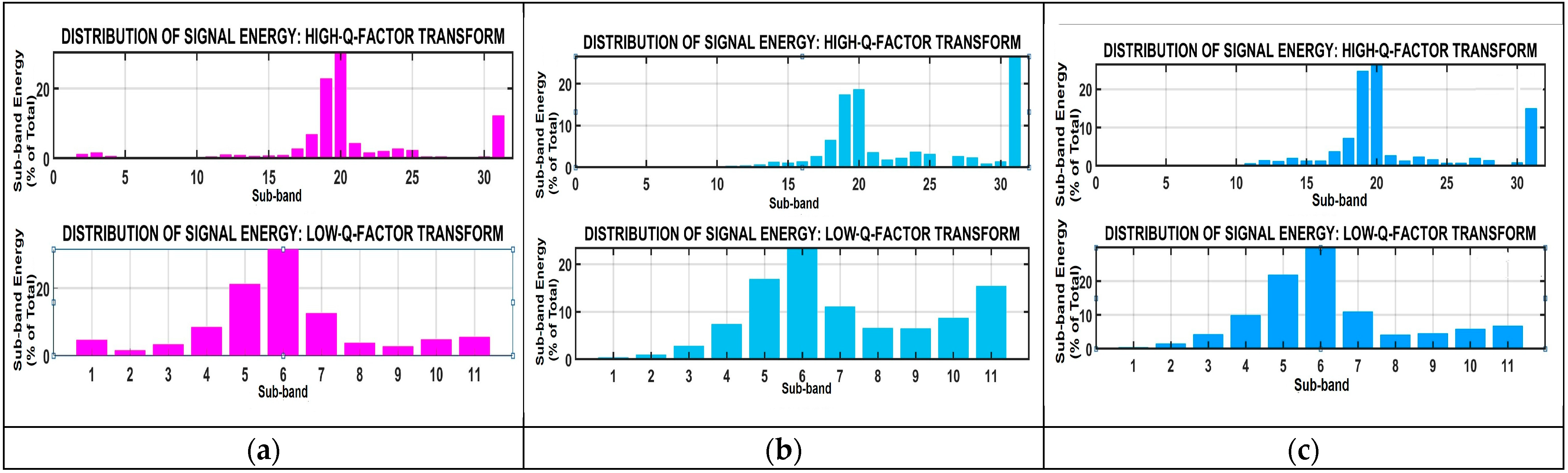
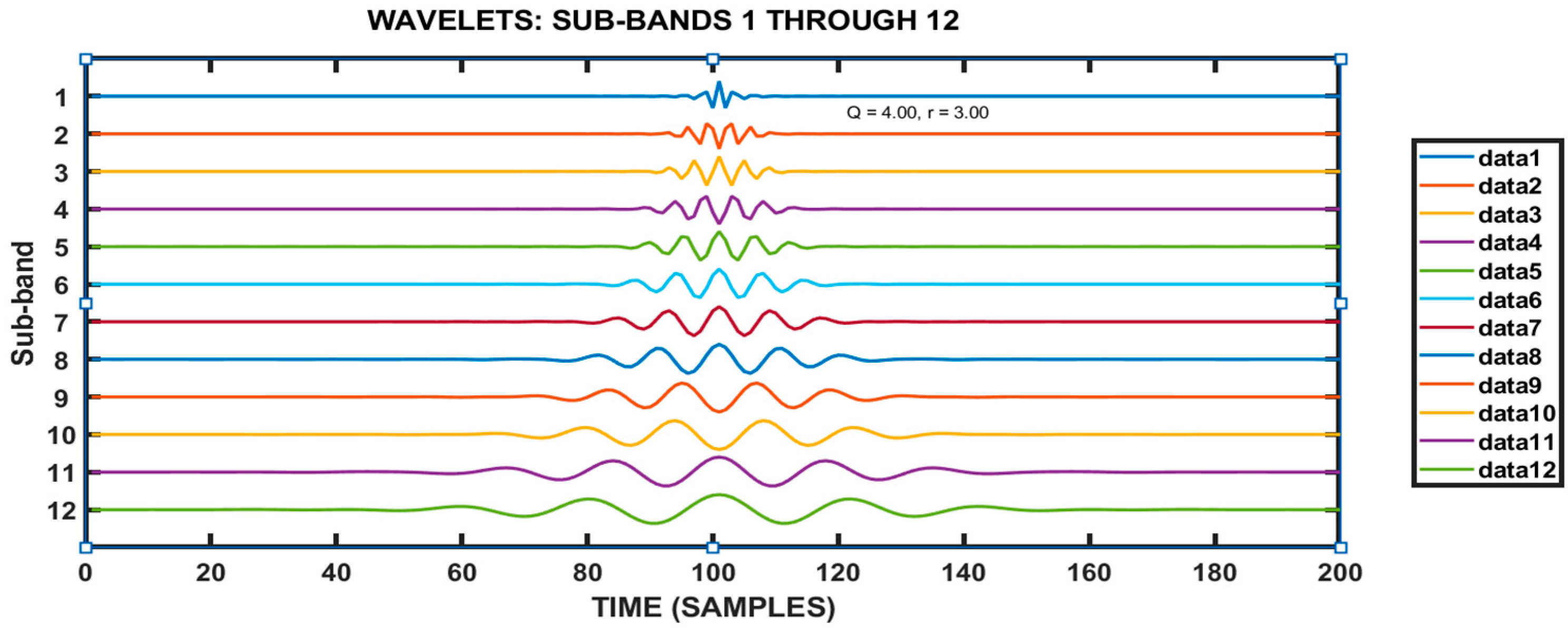
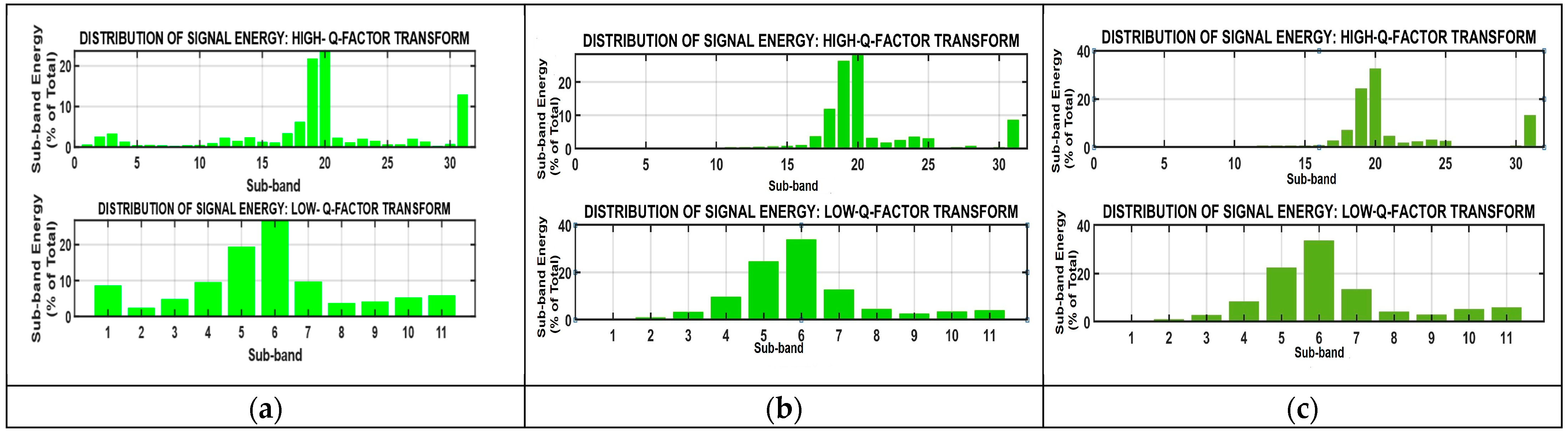
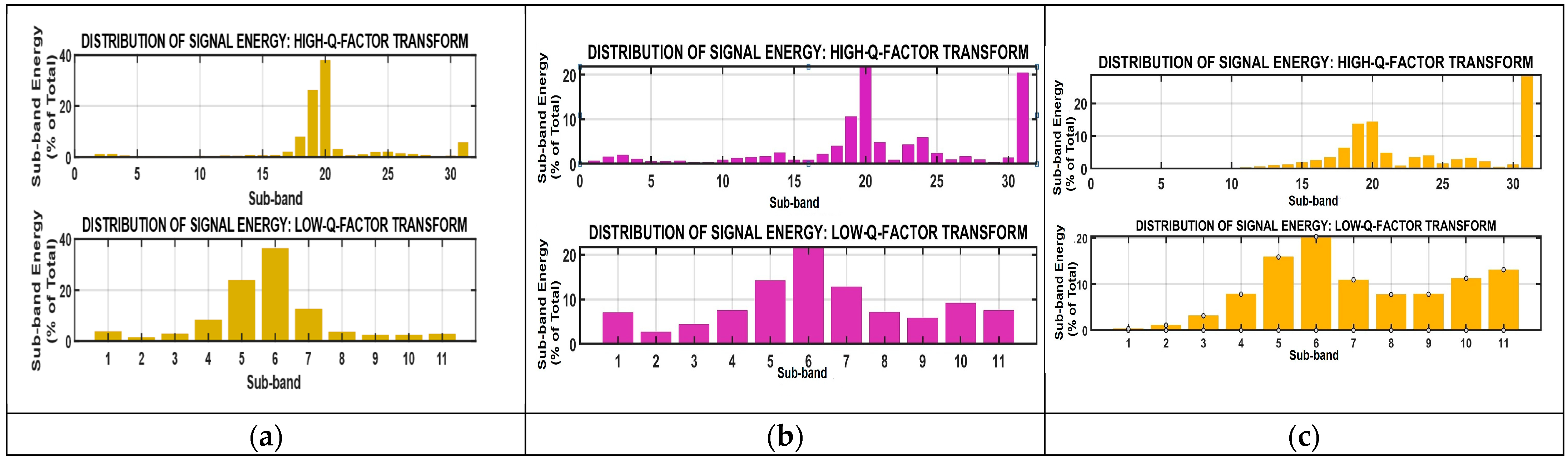
Figure 14 shows the TQWT wavelet base for different sub-bands 1 to 17. The TQWT provides frameworks for analyzing energy distribution across different frequency bands within a signal. The TQWT satisfies Parseval’s theorem and ensures the total energy of the wavelet coefficients equals the energy of the original signal. This ensures no information is lost during transformation. The test result values of the TQWT were Q-factor = 4, r = 3, α = 0.867, and β = 0.4. Sub-band energy graphs are shown in Figure 15, Figure 16 and Figure 17 for the three different axes at the three different road conditions. The objective function shown in (11) aims to minimize the reconstruction error between the original signal x and its decomposed components, represented by the high resonance and low resonance bases Φ 1 and, Φ 2 respectively. The first term enforces fidelity to the original signal, while the second term imposes sparsity through the L1-norm regularization weighted by λ h j [].
a r g m i n x Φ 1 W h Φ 2 W l 2 2 + j = 1 J h + 1 λ h j W h j 1 + j = 1 J l + 1 λ h j W l j 1
where Φ1 and Φ2 represent the inverse Tunable Q-Value Wavelet Transform, which has high and low Q-factors, respectively; Jh and Jl are the maximum number of decomposition stages of TQWTh and TQWTl; wh,j and wl,j represent, respectively, the jth sub-band corresponding to TQWTh and TQWTl; and λh,j and λl,j are the regularization parameters at the jth sub-band.
Figure 14. TQWT wavelet base for vibration signal on battery during running condition of EV on road.
Figure 15. Vibration on battery sub-band energy graph: (a) X-axis, (b) Y-axis, (c) Z-axis.
Figure 16. Vibration on battery sub-band energy graph: (a) Terrain road, (b) Pothole, (c) Mud road.
Figure 17. Vibration on battery sub-band energy graph: (a) Inattentive driving, (b)Aggressive driving, (c) Smooth driving.

2.5. Bayesian-Optimized Regression Framework for RUL Prediction

In this paper, the RUL prediction of capacity was performed through Bayesian-optimized multiple regression and gaussian process regression, considering parameters such as the capacity obtained from the capacity tests at different no. of cycles; internal resistances Rohm, RSEI, Rct, and RW obtained from EIS test; and micro-climatic conditions like temperature, humidity, and wind speed on the day of experiment and are compared for RUL prediction.

2.5.1. Gaussian Process Regression (GPR)

Bayesian Optimization is a global optimization algorithm. Based on Bayesian theory, the GPR model predicts the “aging process of the battery with strong non-linearity”, as noted by Li et al. in []. Bayesian theorem hyperparameter optimization is implemented, which estimates the posterior distribution of the target function, and finds the “hyperparameter combination, minimizes the objective function through mapping function between the sample points and minimized objective function values”, as stated by Liu et al. []. GPR constructs the maximum likelihood function based on the unknown parameters of the sample data. “The purpose of the maximum likelihood method is to maximize the log-likelihood function S(θ)” [], as shown in (12).
S θ = 1 2 log K f x , x + σ n 2 I n 1 2 y T × K f x , x + σ n 2 I n 1 y n 2 log 2 π
where the kernel function Kf is an isotropic exponential as in (13).
K f x , x = σ f 2 e x p ( x x 2 2 l 2 )
σ f 2 is the signal variance, l is the variance length, In is the nth dimensional unit matrix, and σ n 2 I n is the noise covariance matrix. The process flow of the GPR process is shown in Figure 18.
Figure 18. GPR process flow.

2.5.2. Multiple Linear Regression

Multiple Linear Regression (MLR) employs several independent variables to predict the value of a dependent (response) variable. The MLR model expresses the linear relationship between the dependent variable and the independent predictors as in (14).
y i = β 0 + β 1 x i 1 + β 2 x i 2 + + β p x i p + ε
where for I = n observations, yi = dependent variable, xi = independent variables, β0 = y-intercept (constant term), βp = slope coefficients for each explanatory variable, and ε = residuals. Residuals are the error terms, assumed to be independently and identically distributed with zero mean and constant variance, following a normal distribution N(0, σ2). Residual coefficient analysis is the critical aspect of regression analysis and focuses on the examination and interpretation of residuals, which are the difference between the observed and predicted values generated by a regression model. Residuals assess the adequacy of a model and ensure assumptions are met, as in (15).
r i = y i y ^ i
where yi is the actual value and ŷi is the predicted value.
The accuracy of the predicted RUL was checked using the parametric indices such as R2, RMSE, and MAE. The mathematical equations of these errors are expressed as in (16) to (19).
Q error = Qpre − Qactual
R 2 = 1 ( Q p r e Q a c t u a l ) 2 ( Q p r e Q m e a n a c t u a l ) 2
R M S E = 1 n i = 1 n Q p r e Q a c t u a l 2
M A E = 1 n i = 1 n Q p r e Q a c t u a l
where Qpre is the predicted capacity, Qactual is the actual capacity, Qmeanactual is the mean of actual capacity, and n is the number of cycles.

3. Results and Discussion

3.1. Model Performance Evaluation

The proposed Bayesian-optimized Gaussian process Regression (BO-GPR) model was evaluated using battery degradation parameters, vibration features, and micro-climatic data. The model achieved an overall accuracy of 98.1%, legibly outperforming the conventional MLR method. This improvement is attributed to the integration of micro-climatic conditions, vibration features, and degradation parameters, which provided a richer feature space compared to laboratory-only models. Performance was validated using MAE, RMSE and R2 values and compared against conventional Multiple Linear Regression methods.

3.1.1. RUL Capacity Prediction Fade for Vibration

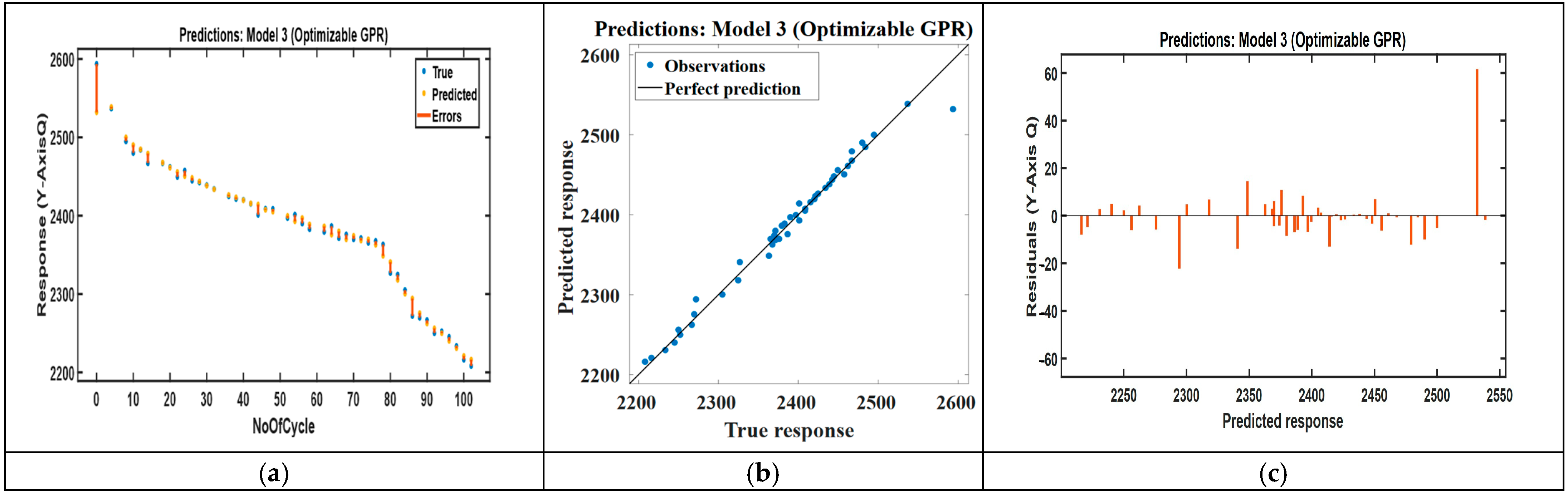
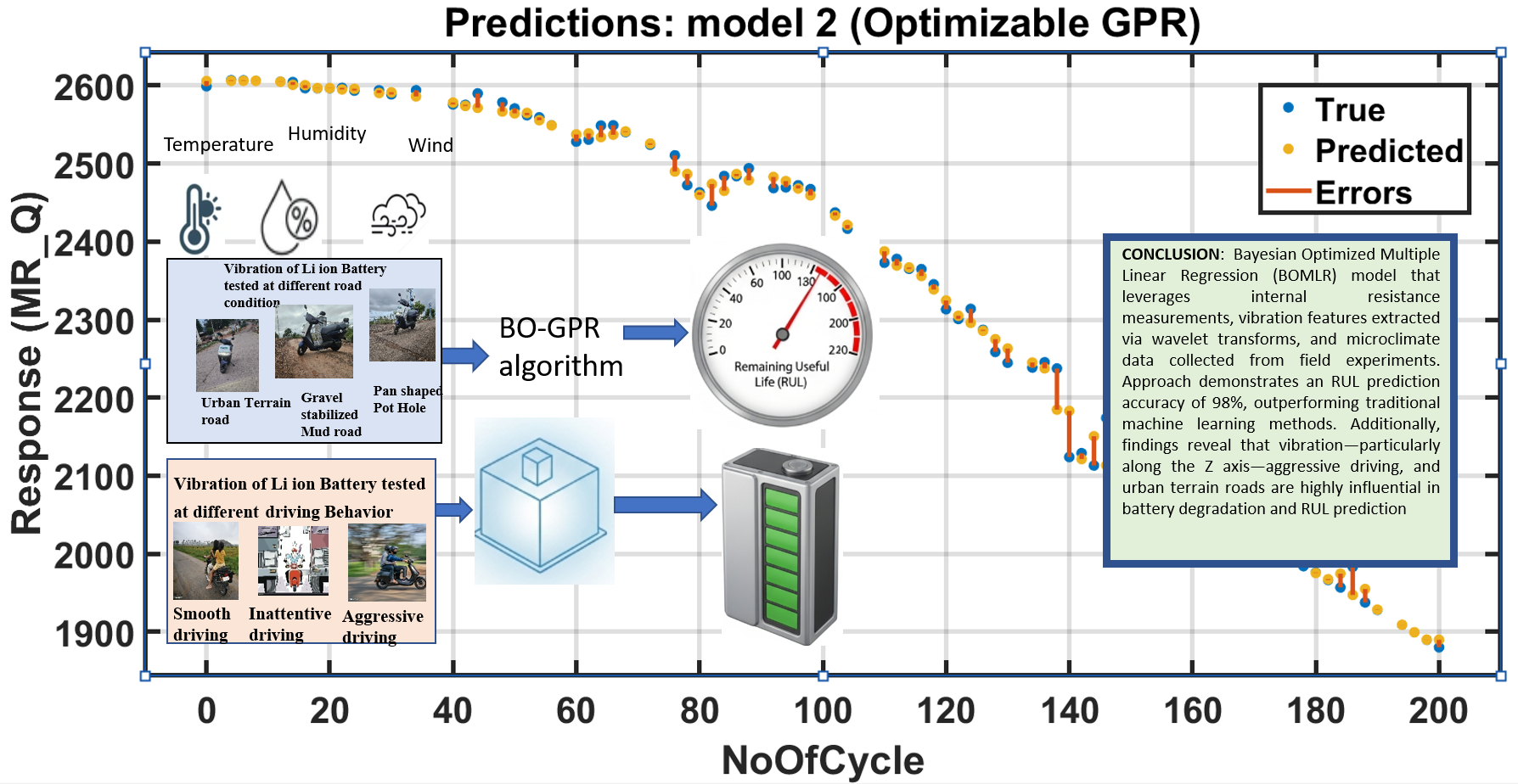
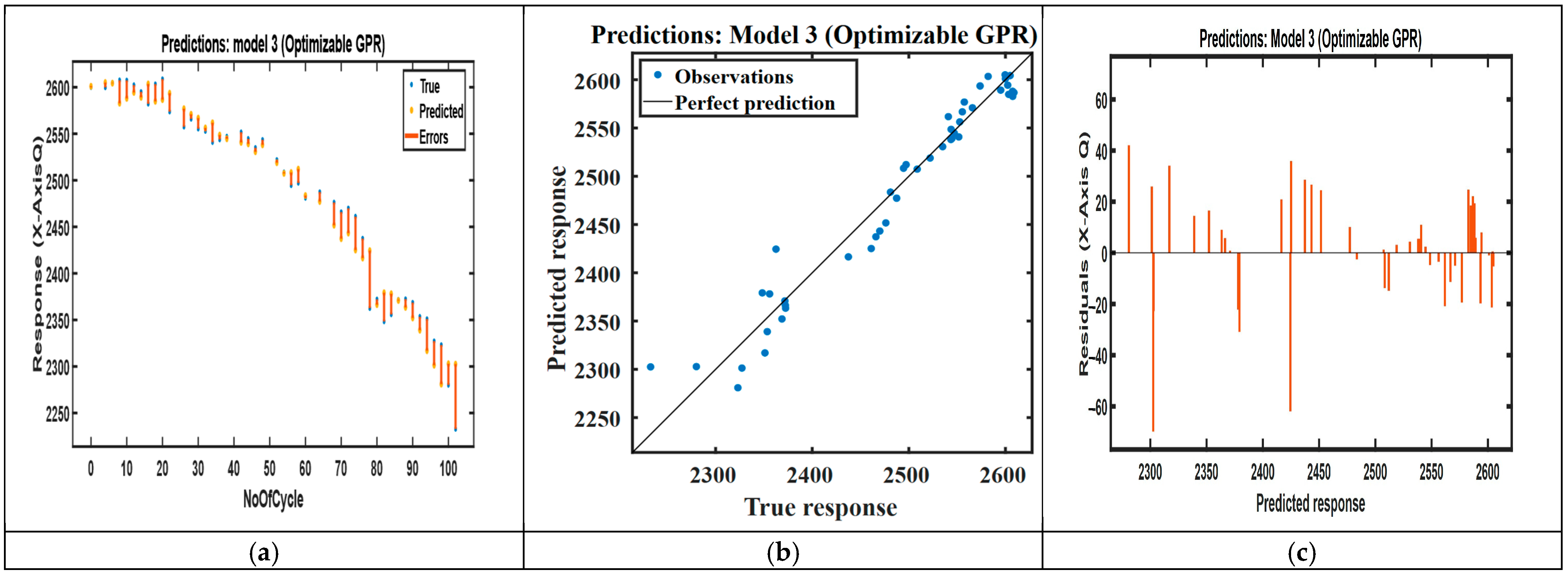
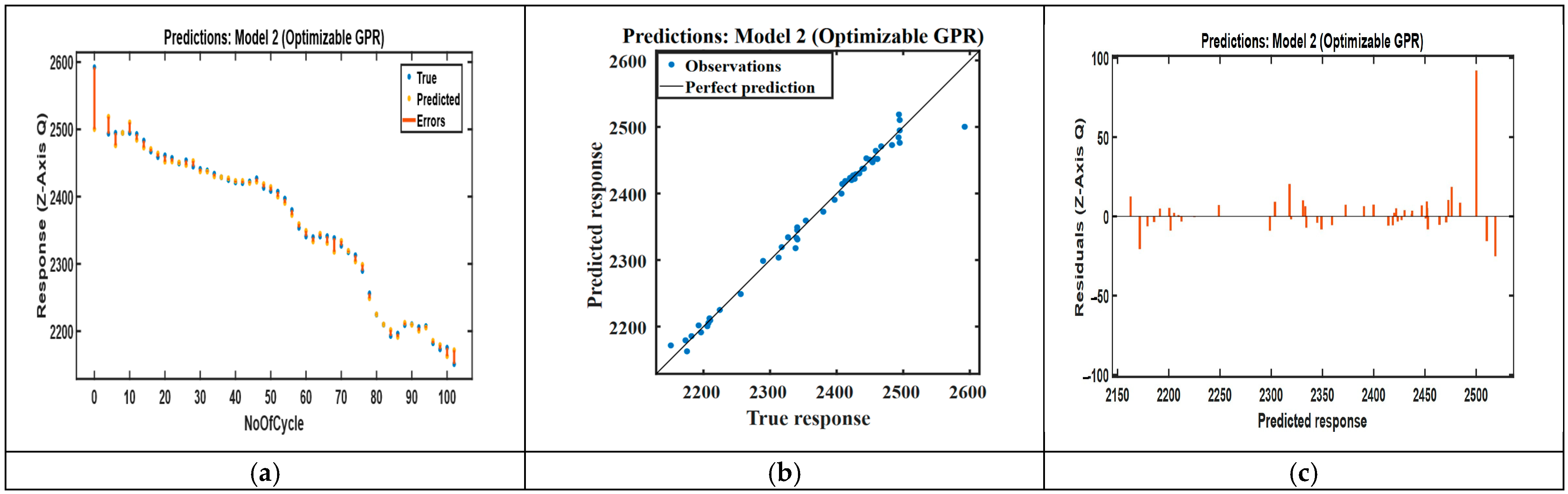
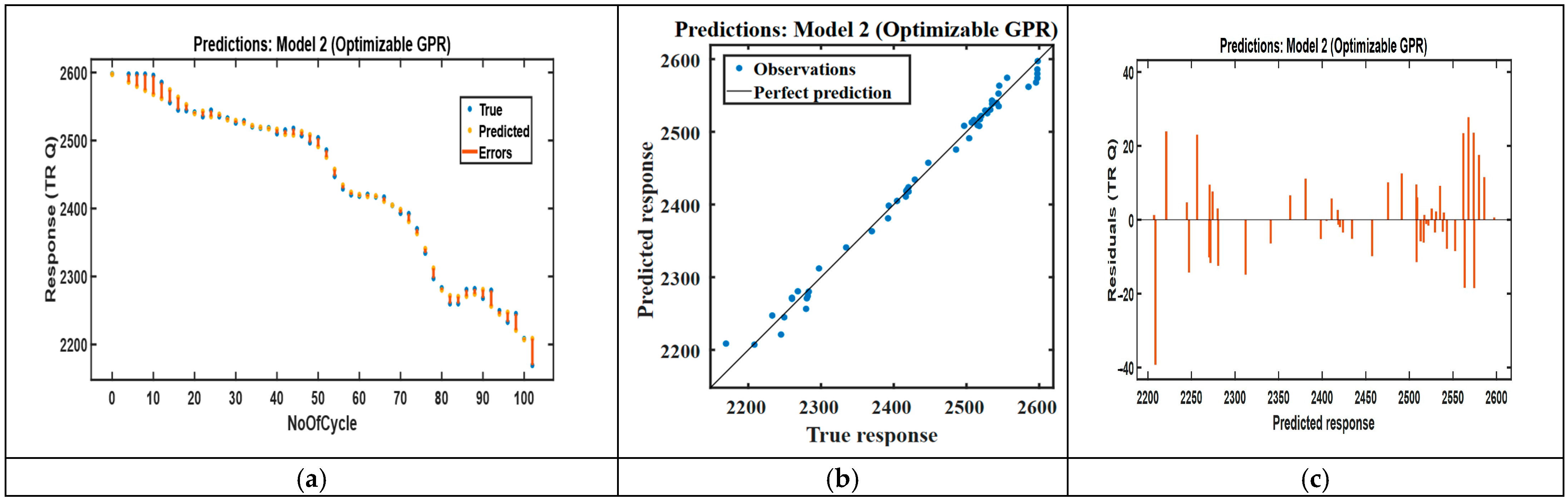
The accuracy of the GPR model in predicting the capacity fade and battery degradation over multiple cycles is shown in Figure 19, Figure 20 and Figure 21 for the vibration signal on the X-axis, Y-axis, and Z-axis. The response plot shows both true and predicted responses decrease as the number of cycles increases, with the predicted values closely following the true values. The error bars are generally small, suggesting good model performance, though they increase slightly toward higher cycle numbers. The model’s prediction is accurate, showing that the predicted values exactly match the true values. Residual validation shows a stronger correlation for the predicted response. Measurements were taken on road, at a temperature of 38 °C, humidity of 49%, and wind speed of 16 km/h.
Figure 19. RUL estimation for X-axis vibration data: (a) model response curve, (b) comparison of predicted and actual responses, and (c) residual error validation.
Figure 20. RUL estimation for Y-axis vibration data: (a) model response curve, (b) comparison of predicted and actual responses, and (c) residual error validation.
Figure 21. RUL estimation for Z-axis vibration data: (a) model response curve, (b) comparison of predicted and actual responses, and (c) residual error validation.
Interpretation of the MLR equation for different vibration axes shows that the significant parameters in capacity degradation along the Z-axis vibration are due to increases in Rohm, Rsei, and CL. For the vibration along the X-axis, the effect of increases in Rct, Rsei, Rw, and CL is high on capacity degradation, and along the Y-axis, vibration capacity degradation is due to increases in Rohm, Rsei, Rw, and CL. The other statistical parameters are RMSE, R2 and MAE, shown in Table 1.
Table 1. Comparison of statistical parameters of predicted RUL along different axes of vibration.

3.1.2. RUL Capacity Prediction with Different Road Conditions

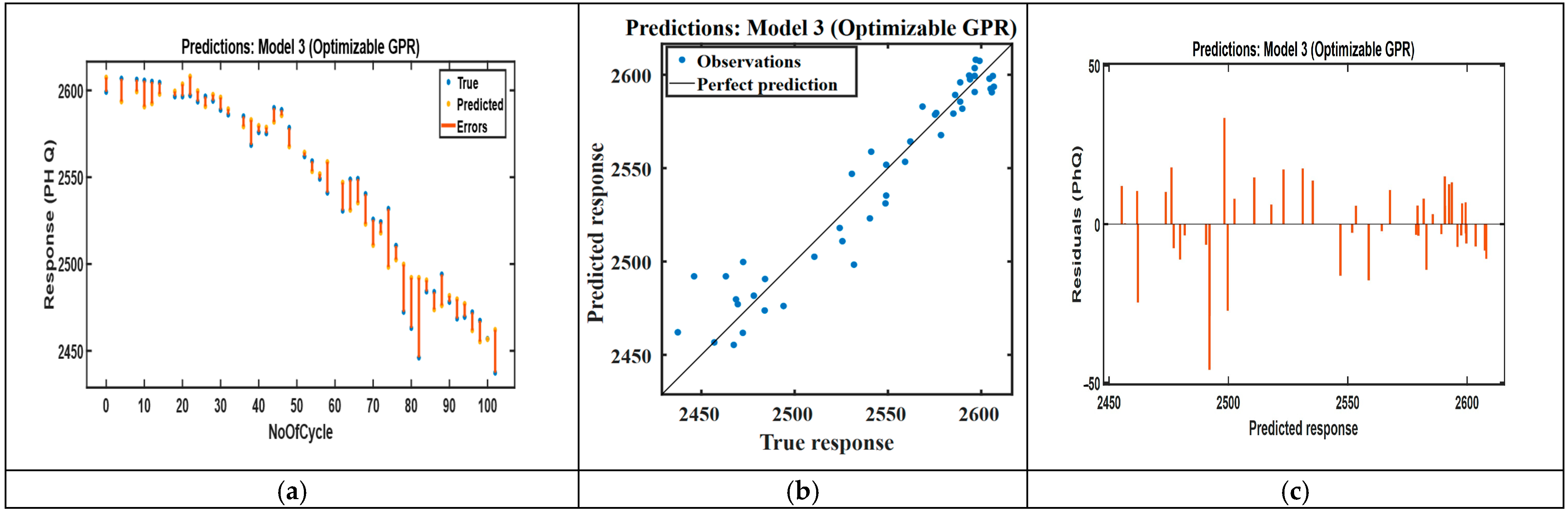
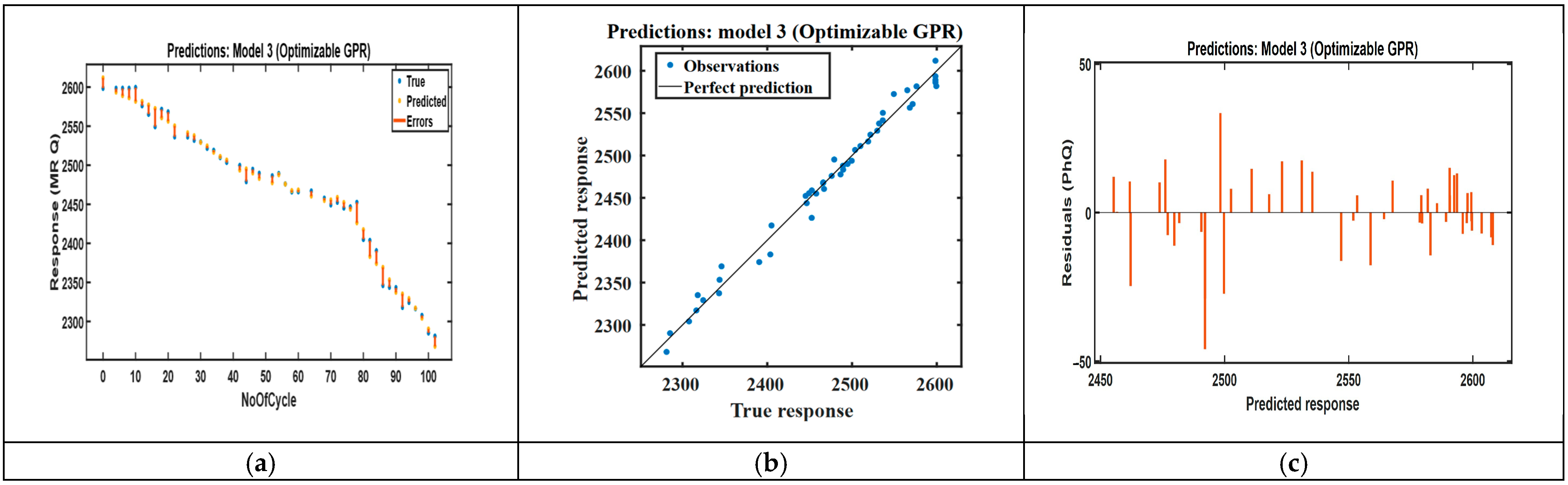
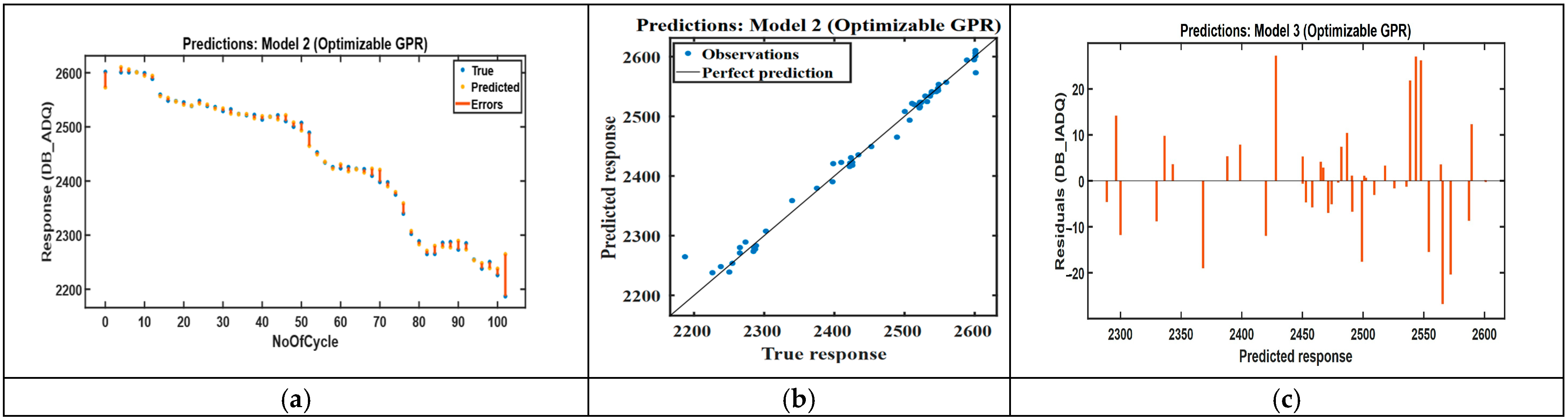
The accuracy of the BO-GPR model in predicting the capacity fade and battery degradation over multiple cycles is shown in Figure 22, Figure 23 and Figure 24 for three different road conditions: urban terrain road, pan-shaped pothole, and gravel-stabilized mud road. Measurements were taken on road at a temperature of 38 °C, humidity of 49%, and wind speed of 16 km/h. The response plot shows both true and predicted responses, and decreases as the number of cycles increases, with the predicted values closely following the true values. The error bars are generally small, suggesting a good model of performance, increasing slightly towards higher cycle numbers. The predicted response vs. true response plot indicates the model’s predictions are accurate, showing that the predicted values exactly match the true values. Residual validation shows a stronger correlation for the predicted response.
Figure 22. RUL estimation for urban terrain road vibration data: (a) model response curve, (b) comparison of predicted and actual responses, and (c) residual error validation.
Figure 23. RUL estimation for pan-shaped pothole vibration data: (a) model response curve, (b) comparison of predicted and actual responses, and (c) residual error validation.
Figure 24. RUL estimation for gravel-stabilized mud road vibration data: (a) model response curve, (b) comparison of predicted and actual responses, and (c) residual error validation.
In our interpretation of the MLR equation for urban terrain road, capacity degradation is high specifically due to Rohm, Rct, Rsei, and Rw. For the gravel-stabilized mud road condition, capacity degradation is high specifically due to Rct, Rsei, wind speed, and CL. And for the pan-shaped pothole, capacity degradation is high specifically due to Rct and Rsei. The statistical parameters are RMSE, R2, and MAE, as shown in Table 2.
Table 2. Comparison of statistical parameters of predicted RUL for different road conditions.

3.1.3. RUL Capacity Prediction Fade for Driving Behavior

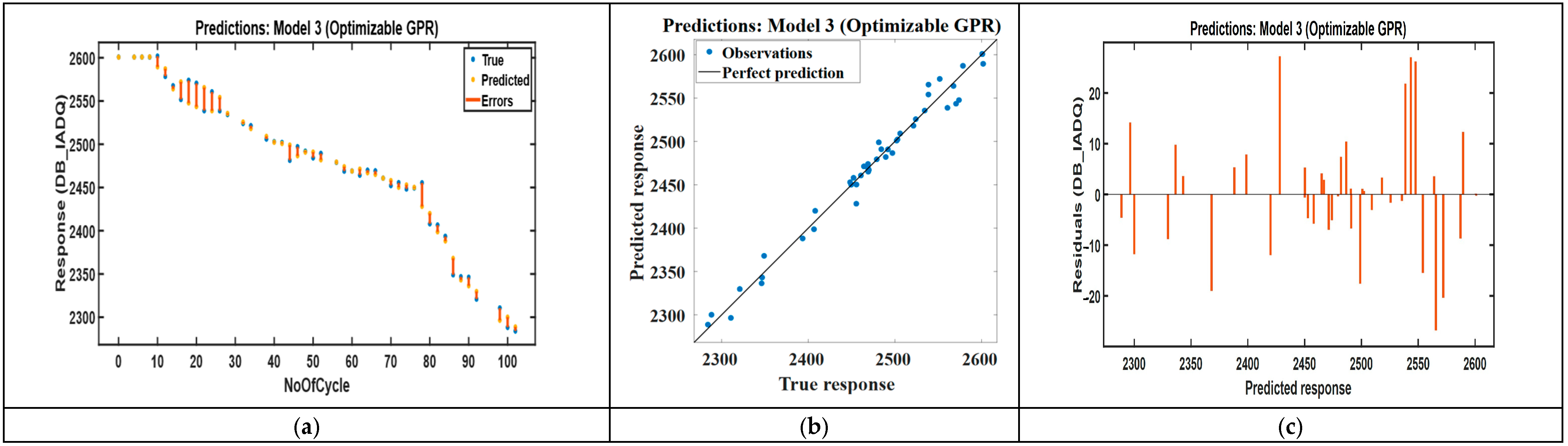
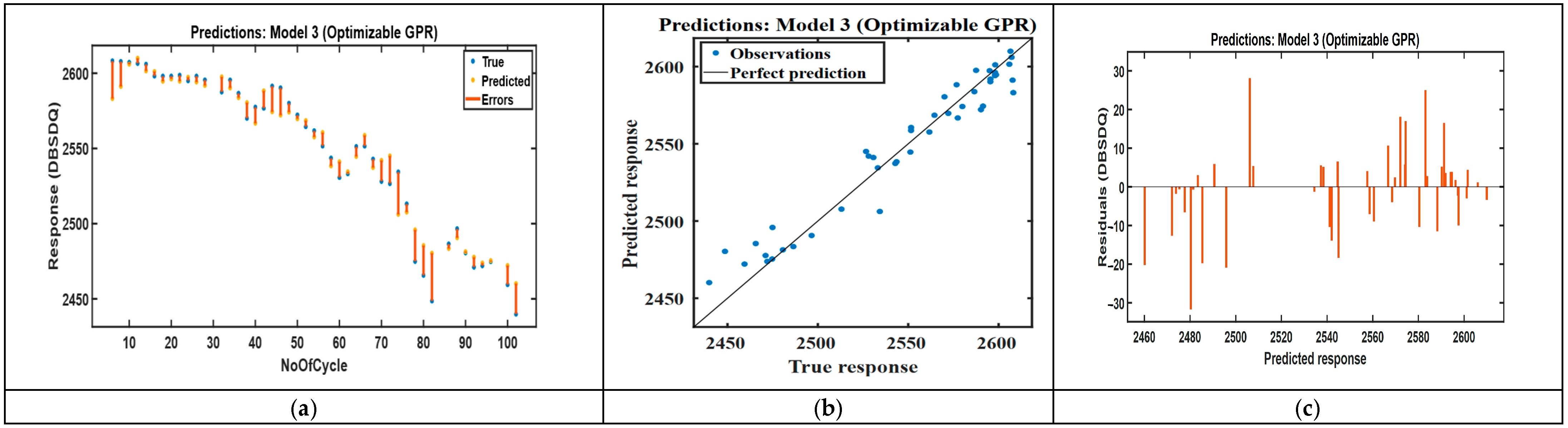
The accuracy of the BO-GPR model in predicting the capacity fade and battery degradation over multiple cycles is shown in Figure 25, Figure 26 and Figure 27 for the three different driving behaviors: aggressive driving, inattentive driving, and smooth driving. The response plot shows that both true and predicted responses decrease as the number of cycles increases, with the predicted values closely following the true values. The error bars are generally small, though they increase slightly towards higher cycle numbers. The predicted response vs. true response plot indicates that BO-GPR predictions are accurate, showing that the predicted values exactly match the true values. Residual validation shows a stronger correlation for the predicted response. Measurements were taken of the road at a temperature of 38 °C, humidity of 49%, and wind speed of 16 km/h.
Figure 25. RUL estimation for aggressive driving behavior: (a) model response curve, (b) comparison of predicted and actual responses, and (c) residual error validation.
Figure 26. RUL estimation for inattentive driving behavior: (a) model response curve, (b) comparison of predicted and actual responses, and (c) residual error validation.
Figure 27. RUL estimation for smooth driving behavior: (a) model response curve, (b) comparison of predicted and actual responses, and (c) residual error validation.
Interpretation of the MLR equation for different driving behaviors shows that capacity degradation is high with aggressive driving due to increases in Rsei, Rct, Rw, temperature, humidity, and wind speed. For inattentive driving, it is due to increases in Rohm, Rct, Rsei, Rw, temperature, and wind speed. For smooth driving, capacity degradation is due to increases in Rsei, Rw, Rct, and temperature. The statistical parameters RMSE, R2, and MAE are shown in Table 3.
Table 3. Comparison of statistical parameters of predicted RUL for different driving behavior.

3.2. Effect of Micro-Climatic Conditions

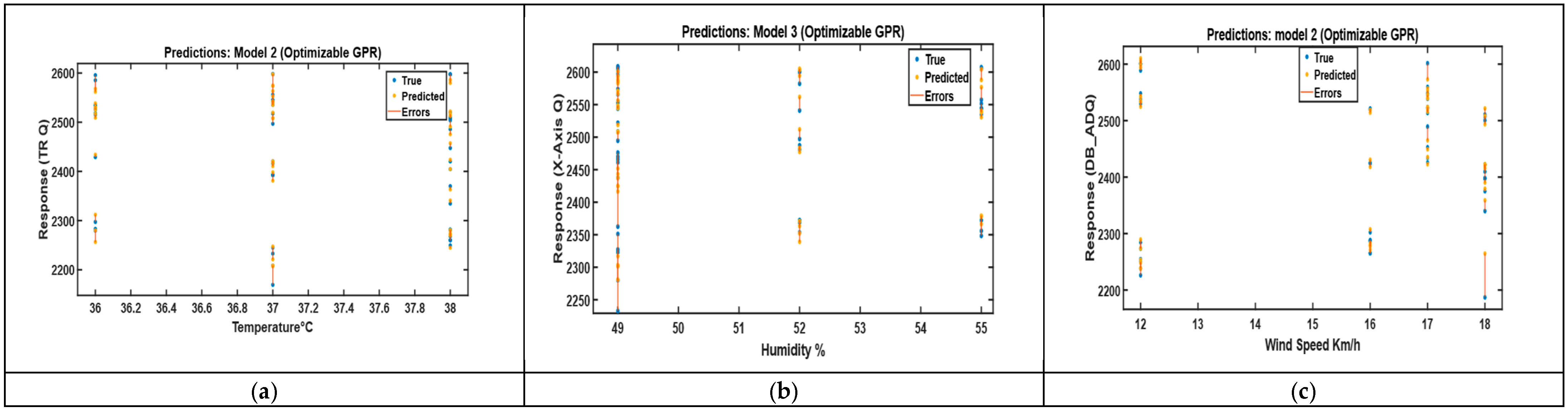
The influences of temperature, humidity, and wind speed were considered for RUL prediction. Results validated that with an increase in temperature, the capacity of the LI-ion battery degraded. Temperature was a major influencing parameter in capacity degradation for a terrain road. An increase in temperature increased electrode corrosion and capacity fading. Similarly, humidity accelerated the corrosion of terminals, connectors, and current collectors, contributing to a decrease in battery capacity. Wind speed mitigated the temperature of the battery, and during aggressive driving, wind speed made a major contribution to capacity degradation, which is shown in Figure 28.
Figure 28. RUL predictions: (a) Temperature, (b) Humidity, (c) Wind speed.

3.3. Influence of Road Surface Condition and Driving Behavior

Battery health is determined by analyzing the degradation modes quantified as CL, LLI, and LAM. The impact of internal resistance was high on degradation modes, and variation in internal resistance increases and decreases were seen due to battery degradation. Vibration, road condition, and driving behavior had impacts on Li-ion battery degradation; the impacts were analyzed, and their results are explained. Degradation modes measured through EIS tests and the internal resistance variation show that ohmic resistance Rohm and SEI layer resistance RSEI have high impacts on battery degradation, and they are the primary factors for battery degradation, when compared to charge-transfer resistance and Warburg resistance. Ohmic resistance causes heat loss due to the conducting materials inside the battery and increases battery degradation. Similarly, the SEI layer is formed at the anode, thus increasing LAM and reducing the movement of active material ions inside the battery.

3.3.1. Effect of Road Condition, Vibration, and Driving Behavior on Battery Degradation

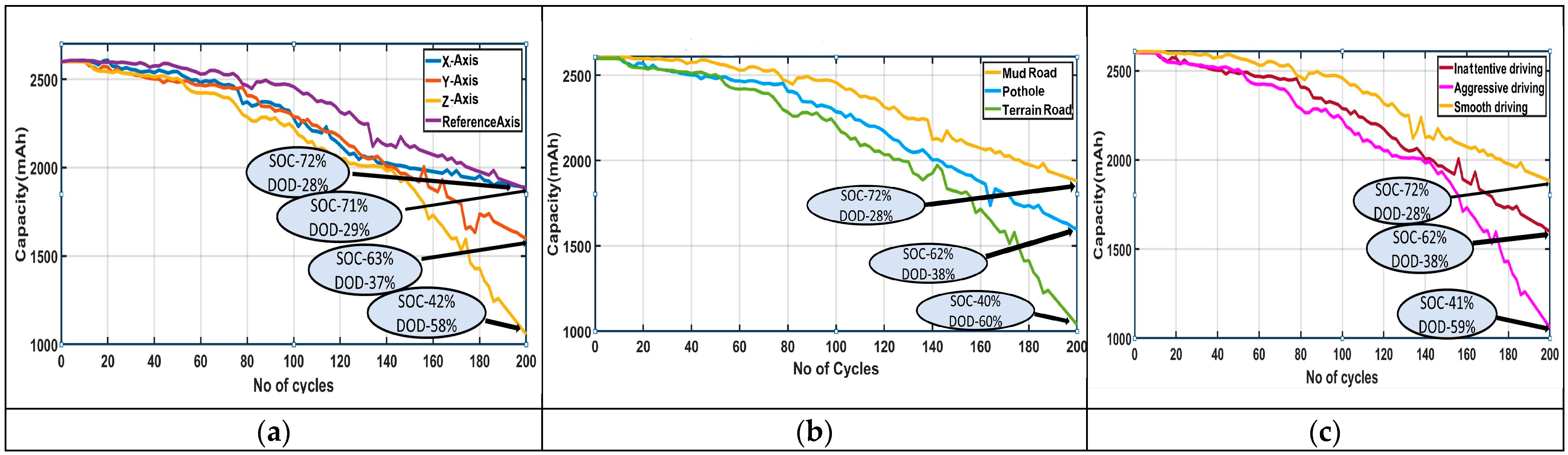
To further examine the external influences on degradation behavior, the variation in battery capacity was analyzed for different vibration axes, road conditions, and driving patterns in the EV Battery Test Lab. Figure 29a–c illustrate the capacity degradation trends of the battery with these factors. The results show that higher vibration intensity along the Z-axis and rough terrains, such as mud or terrain roads, accelerate capacity fade compared to smoother surfaces. Similarly, aggressive driving induces faster degradation due to frequent acceleration–braking cycles and increased internal heating, whereas smooth driving results in the lowest capacity loss. These observations confirm that both mechanical vibration and driver behavior strongly influence battery aging through coupled electrochemical and thermal effects.
Figure 29. Variation in battery capacity degradation (a) along X-, Y-, and Z-axes (b) with road conditions, and (c) with driving behavior.

3.3.2. Degradation Modes for Vibration Along X-, Y-, and Z-Axes

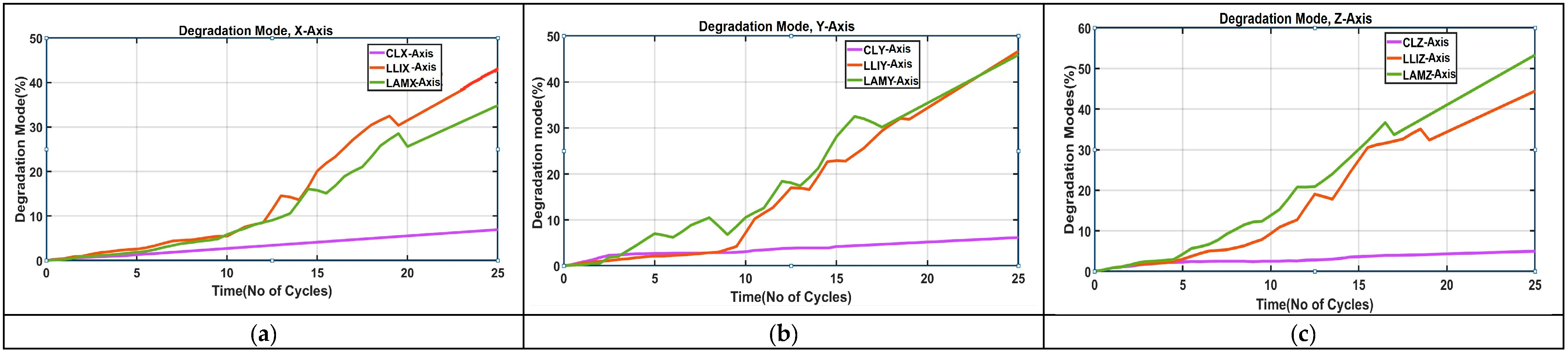
Variations in CL, LLI, and LAM are shown in percentages along the X-axis, Y-axis, and Z-axis vibration signals in Figure 30. The CL was 6.9%, 6.1%, and 4.9% along the X-, Y-, and Z-axes of vibration signal, respectively, whereas the LLI was 42.7%, 46.6%, and 44.4% along the X-, Y-, and Z-axes of vibration signal, respectively, and the LAM was 34.8%, 45.8%, and 53.3% along the X-, Y-, and Z-axes of vibration signal, respectively. In all three cases, the LAM and LLI are responsible for battery degradation, with more degradation along the Z-axis and Y-axis of vibration signal, with small variations in SEI layer resistance, charge-transfer resistance, and Warburg resistance. Micro-climatic and road test conditions were urban terrain road with a temperature of 38 °C, humidity of 49%, and wind speed of 16 km/h.
Figure 30. Degradation modes CL, LLI, LAM for (a) X-axis, (b) Y-axis, (c) Z-axis.

3.3.3. Degradation Modes for Different Road Conditions

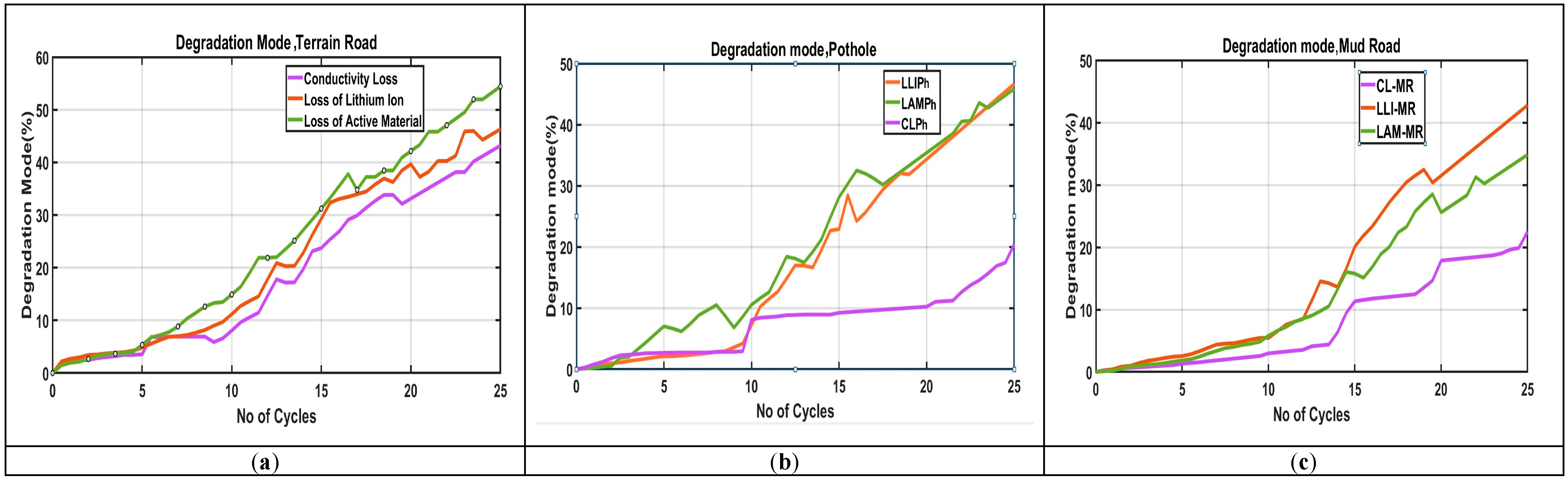
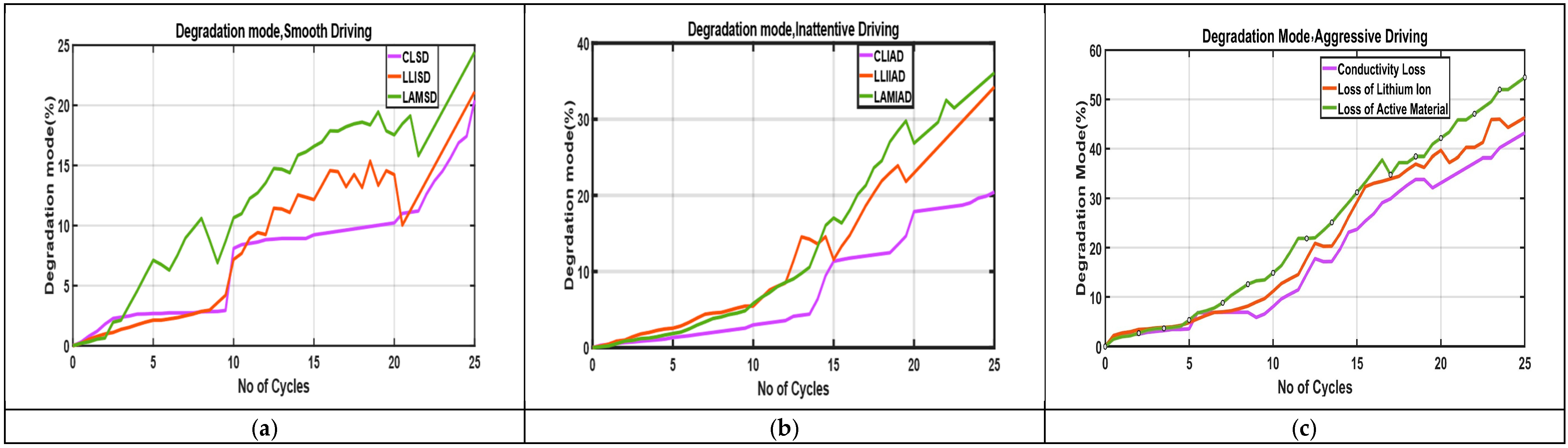
As shown in Figure 31, the urban terrain road exhibits all three modes for increasing conditions with an increase in the charging and discharging cycle. Urban terrain roads are challenging roads that lead to increases in CL, LLI, and LAM, as well as increases in internal resistance. The LAM is highest, at about 53.4%, in the case of urban terrain road, the LLI is highest, at 46.6%, in the case of the pan-shaped pothole, and the CL is highest, at 42%, in the case of urban terrain road. Warburg resistance increases due to the LAM in the electrode, the lithium ion that undergoes intercalation and deintercalation due to charging and discharging. These cycles stress and strain the material structure and lead to cracking, fracturing, and the complete detachment of active material from the conductive matrix. Micro-climatic conditions were as follows: temperature, 38 °C; humidity, 49%; wind speed, 16 km/h.
Figure 31. Degradation modes CL, LLI, and LAM for (a) urban terrain road, (b) pan-shaped pothole, and (c) gravel-stabilized mud road.

3.3.4. Degradation Modes for Different Driving Behavior

Aggressive driving makes batteries degrade faster when compared to other driving behaviors. Aggressive driving results in stress and strain in the battery, causing the Li-ion battery to rupture, leading to the loss of active material in the electrode. Li-ion conducting material is lost due to stress and strain, which increases LLI and reduces the battery efficiency due to losses in conductivity, and capacity decreases with CL, as shown in Figure 32. The LAM is 54.4%, the LLI is 46.3%, and the CL is 43.2% for aggressive driving. Micro-climatic and road test conditions were: urban terrain road with a temperature of 38 °C, humidity of 49%, and a wind speed of 16 km/h.
Figure 32. Degradation modes CL, LLI, and LAM for (a) smooth driving, (b) inattentive driving, and (c) aggressive driving.

3.4. Sensitivity Analysis of Degradation Parameter

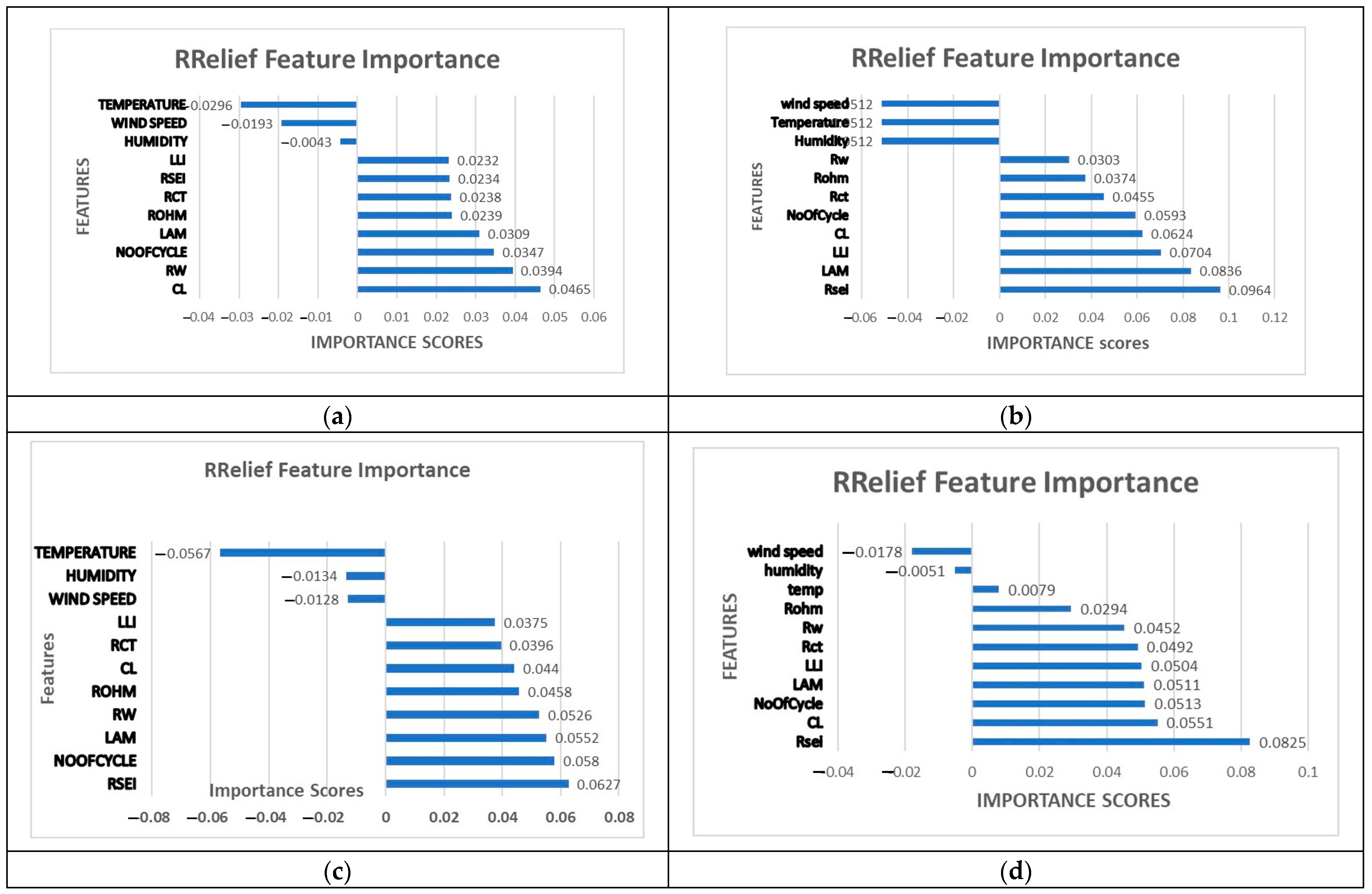
To identify the most influential parameter affecting RUL, sensitivity analysis was performed using the RRelief (RegressionRelief) algorithm in the Regression learner app in MATLAB 2024a. Results indicated that RSEI and CL are the most important parameters influencing battery degradation for the X-axis and Z-axis vibration. Temperature is a major negative attributing feature for urban terrain road; wind speed is also a negative attributer during aggressive driving behavior, as shown in Figure 33.
Figure 33. Feature importance graphs: (a) Z-axis, (b) X-axis, (c) urban terrain road, (d) Aggressive Driving.

3.5. Validation Against Experimental Data

Predicted RUL values were compared with experimental results obtained from laboratory cycling and EIS measurements. The BO-GPR model demonstrated close agreement with experimental data, with an error margin of less than 2%. Predicted RUL using BO-GPR in terms of capacity is shown in Table 4. The predicted capacity values at different vibrational axes, different road conditions, and with different driving behaviors show that the impact of vibration results in capacity degradation. The impact of vibration on Li-ion batteries is high along the Z-axis, on urban terrain roads, and for aggressive driving, given the micro-climatic condition variability. TQWT values are higher at different sub-band energy levels, and their values show the impact of vibration for each condition.
Table 4. Consolidated Experimental Results.
Recent studies using conventional machine learning methods report lower performance for standard battery datasets. CEEMDAN-WOA-SVR [] and the random forest regression model report substantially larger RMSE values than our BO-GPR model does [], and optimized random forest methods typically show goodness-of-fit values in the mid-90% range [,]. These results indicate that the BO-GPR method yields an improved predictive performance on average 98.1% under real-world vibration and micro-climatic variability, as shown in Table 5.
Table 5. Performances of different RUL prediction methods.

4. Conclusions and Future Work

RUL prediction is performed through a proposed BO-GPR and provides an error of RMSE around 1.25 for all different test cases. The R2 Value is around 0.98, which proves that the proposed model fits the data perfectly. The proposed BO-GPR algorithm prediction accuracy is about 98.39% in the case of measuring the impact of vibration on battery degradation, 98.06% for the impact of road condition on battery degradation, and 97.85% for the impact of driving behavior on battery degradation. Vibration analysis revealed that high-frequency lateral modes (~431 Hz) strongly influence ohmic and charge-transfer resistances, while low-frequency vertical oscillations (~7 Hz) significantly accelerate mechanical degradation and loss in active material. Sensitivity analysis shows CL and RSEI are the most sensitive features to Z-axis and X-axis vibration, resulting in conductivity loss and solid electrolyte interphase layer growth along the electrode, along with temperature on urban terrain road and wind speed for aggressive driving, resulting in rapid battery degradation. Unlike conventional approaches restricted to driving cycle, our model integrates internal resistance parameters with EIS micro-climatic conditions, and vibration signals across multiple road conditions and driving behaviors are incorporated for better validation of battery degradation. The results highlight that excluding road conditions and micro-climatic variability underestimates degradation by 15–20%. Incorporating real-world driving and environmental factors enhances the robustness of battery prognostics. These findings suggest practical implications for battery management systems, where adaptive control strategies can extend the battery lifetime in EVs. Battery degradation is highly noticeable through capacity reduction in the Li-ion battery, which, when increased, reduces battery degradation. While the proposed framework demonstrates robust performance in predicting the RUL of lithium-ion batteries under real-world road, climatic, and driving conditions, several extensions can enhance its application. Future, integration of active cell balancing could reduce battery degradation and improve the life of battery capacity. Also, this model could be applied to new and different chemistries of batteries that are poised to revolutionize the future battery world.

Author Contributions

Conceptualization, V.K. and N.J.S.; methodology, V.K. and N.J.S.; software, N.J.S.; validation, N.J.S.; formal analysis, V.K.; investigation, V.K.; resources, S.S.; data curation, V.K.; writing—original draft preparation, V.K.; writing—review and editing, N.R.S.; visualization, V.K.; supervision, N.J.S. and N.R.S.; project administration, N.R.S.; funding acquisition, S.S. All authors have read and agreed to the published version of the manuscript.

Funding

This research was funded by Senthilraj Sarangapani, grant number SGEN-2023-002, and the APC was funded by S-Gen Energy & Infra Pvt Ltd.

Data Availability Statement

The original contributions presented in the study are included in the article, further inquiries can be directed to the corresponding author.

Conflicts of Interest

The authors declare that this study received funding from S-Gen Energy & Infra Pvt Ltd. The funder had the following involvement with the study: Provided the EV test bed.

Abbreviations

The following abbreviations are used in this manuscript:
BOGPRBayesian-Optimized Gaussian Process Regression
CLConductivity Loss
DWTDiscrete Wavelet Transform
EOLEnd of Life
LAMLoss of Active Material
LLILoss of Lithium Ion
MAEMean Absolute Error
RMSERoot Mean Square Error
RULRemaining Useful Life
SOHState of Health
SEISolid Electrolyte Interphase
TQWTTunable Q-factor wavelet Transform

References

  1. Jiao, Z.; Wang, H.; Xing, J.; Yang, Q.; Yang, M.; Zhou, Y.; Zhao, J. LightGBM-based framework for lithium-ion battery remaining useful life prediction under driving conditions. IEEE Trans. Ind. Inform. 2023, 19, 11353–11362. [Google Scholar] [CrossRef]
  2. Siddique, A.R.M.; Tasnim, S.; Mahmud, S.; Van Heyst, B. Thermal field investigation of lithium-ion battery with porous medium under vibration. J. Energy Storage 2022, 47, 103632. [Google Scholar] [CrossRef]
  3. Liu, H.; Xiao, Q.; Jin, Y.; Mu, Y.; Meng, J.; Zhang, T.; Teodorescu, R. Improved LightGBM-based framework for electric vehicle lithium-ion battery remaining useful life prediction using multi health indicators. Symmetry 2022, 14, 1584. [Google Scholar] [CrossRef]
  4. Shukla, K.; Siddique, A.R.M.; Venkateshwar, K.; Mohaghegh, M.R.; Tasnim, S.H.; Mahmud, S. Experimental investigation on thermal field measurement of lithium-ion batteries under vibration. J. Energy Storage 2022, 53, 105110. [Google Scholar] [CrossRef]
  5. Shen, J.; Mohammed, H.I.; Chen, S.; Alkali, B.; Luo, M.; Yang, J. Mechanical vibration’s effect on thermal management module of Li-Ion battery module based on phase change material (PCM) in a high-temperature environment. Case Stud. Therm. Eng. 2024, 60, 104752. [Google Scholar] [CrossRef]
  6. Wang, Z.; Zhao, Q.; Yu, X.; An, W.; Shi, B. Impacts of vibration and cycling on electrochemical characteristics of batteries. J. Power Source 2024, 601, 234274. [Google Scholar] [CrossRef]
  7. Zhang, W.; Li, X.; Wu, W.; Huang, J. Influence of mechanical vibration on composite phase change material based thermal management system for lithium-ion battery. J. Energy Storage 2022, 54, 105237. [Google Scholar] [CrossRef]
  8. Li, W.; He, M.; Wang, Y.; Shao, F. Study on the capacity degradation mechanism and capacity predication of lithium-ion battery under different vibration conditions in six degrees-of-freedom. J. Electrochem. Energy Convers. Storage 2023, 20, 021001. [Google Scholar] [CrossRef]
  9. Ren, Y.; Tang, T.; Xia, Q.; Zhang, K.; Tian, J.; Hu, D.; Yang, D.; Sun, B.; Feng, Q.; Qian, C. A data and physical model joint driven method for lithium-ion battery remaining useful life prediction under complex dynamic conditions. J. Energy Storage 2024, 79, 110065. [Google Scholar] [CrossRef]
  10. Pan, D.; Li, H.; Wang, S. Transfer learning-based hybrid remaining useful life prediction for lithium-ion batteries under different stresses. IEEE Trans. Instrum. Meas. 2022, 71, 3501810. [Google Scholar] [CrossRef]
  11. Liu, H.; Deng, Z.; Yang, Y.; Lu, C.; Li, B.; Liu, C.; Cheng, D. Capacity evaluation and degradation analysis of lithium-ion battery packs for on-road electric vehicles. J. Energy Storage 2023, 65, 107270. [Google Scholar] [CrossRef]
  12. Hua, X.; Thomas, A. Effect of dynamic loads and vibrations on lithium-ion batteries. J. Low Freq. Noise Vib. Act. Control. 2021, 40, 1927–1934. [Google Scholar] [CrossRef]
  13. Zhang, J.; Jiang, Y.; Li, X.; Luo, H.; Yin, S.; Kaynak, O. Remaining useful life prediction of lithium-ion battery with adaptive noise estimation and capacity regeneration detection. IEEE/ASME Trans. Mechatron. 2022, 28, 632–643. [Google Scholar] [CrossRef]
  14. Oyucu, S.; Dümen, S.; Duru, İ.; Aksöz, A.; Biçer, E. Discharge Capacity Estimation for Li-Ion Batteries: A Comparative Study. Symmetry 2024, 16, 436. [Google Scholar] [CrossRef]
  15. Wang, J.; Zhang, S.; Li, C.; Wu, L.; Wang, Y. A data-driven method with mode decomposition mechanism for remaining useful life prediction of lithium-ion batteries. IEEE Trans. Power Electron. 2022, 37, 13684–13695. [Google Scholar] [CrossRef]
  16. Timilsina, L.; Badr, P.R.; Hoang, P.H.; Ozkan, G.; Papari, B.; Edrington, C.S. Battery degradation in electric and hybrid electric vehicles: A survey study. IEEE Access 2023, 11, 42431–42462. [Google Scholar] [CrossRef]
  17. Chen, D.; Hong, W.; Zhou, X. Transformer network for remaining useful life prediction of lithium-ion batteries. IEEE Access 2022, 10, 19621–19628. [Google Scholar] [CrossRef]
  18. Li, Y.; Li, L.; Mao, R.; Zhang, Y.; Xu, S.; Zhang, J. Hybrid data-driven approach for predicting the remaining useful life of lithium-ion batteries. IEEE Trans. Transp. Electrif. 2023, 10, 2789–2805. [Google Scholar] [CrossRef]
  19. Zhang, J.; Huang, C.; Chow, M.Y.; Li, X.; Tian, J.; Luo, H.; Yin, S. A data-model interactive remaining useful life prediction approach of lithium-ion batteries based on PF-BiGRU-TSAM. IEEE Trans. Ind. Inform. 2023, 20, 1144–1154. [Google Scholar] [CrossRef]
  20. Ding, C.; Guo, Q.; Zhang, L.; Wang, T. Intelligent Learning Method for Capacity Estimation of Lithium-Ion Batteries Based on Partial Charging Curves. Energies 2024, 17, 2686. [Google Scholar] [CrossRef]
  21. Lin, Y.H.; Li, G.H. A Bayesian deep learning framework for RUL prediction incorporating uncertainty quantification and calibration. IEEE Trans. Ind. Inform. 2022, 18, 7274–7284. [Google Scholar] [CrossRef]
  22. Cui, X.; Zhang, J.; Zhang, D.; Wei, Y.; Qi, H. Joint Prediction of Li-Ion Battery Cycle Life and Knee Point Based on Early Charging Performance. Symmetry 2025, 17, 351. [Google Scholar] [CrossRef]
  23. Qin, T.; Zeng, S.; Guo, J.; Skaf, Z. State of Health Estimation of Li-ion Batteries with Regeneration Phenomena: A Similar Rest Time-Based Prognostic Framework. Symmetry 2017, 9, 4. [Google Scholar] [CrossRef]
  24. Al-Wreikat, Y.; Serrano, C.; Sodré, J.R. Driving behaviour and trip condition effects on the energy consumption of an electric vehicle under real-world driving. Appl. Energy 2021, 297, 117096. [Google Scholar] [CrossRef]
  25. Gu, B.; Liu, Z. Transfer Learning-Based Remaining Useful Life Prediction Method for Lithium-Ion Batteries Considering Individual Differences. Appl. Sci. 2024, 14, 698. [Google Scholar] [CrossRef]
  26. Qin, H.; Fan, X.; Fan, Y.; Wang, R.; Shang, Q.; Zhang, D. A Transferable Prediction Approach for the Remaining Useful Life of Lithium-Ion Batteries Based on Small Samples. Appl. Sci. 2023, 13, 8498. [Google Scholar] [CrossRef]
  27. Liu, L.; Sun, W.; Yue, C.; Zhu, Y.; Xia, W. Remaining Useful Life Estimation of Lithium-Ion Batteries Based on Small Sample Models. Energies 2024, 17, 4932. [Google Scholar] [CrossRef]
  28. Etxandi-Santolaya, M.; Mora-Pous, A.; Canals Casals, L.; Corchero, C.; Eichman, J. Quantifying the impact of battery degradation in electric vehicle driving through key performance indicators. Batteries 2024, 10, 103. [Google Scholar] [CrossRef]
  29. Wang, J.; Zhang, H.; Wu, B.; Liu, W. Symmetry-Guided Electric Vehicles Energy Consumption Optimization Based on Driver Behavior and Environmental Factors: A Reinforcement Learning Approach. Symmetry 2025, 17, 930. [Google Scholar] [CrossRef]
  30. Bouhsissin, S.; Sael, N.; Benabbou, F. Driver behavior classification: A systematic literature review. IEEE Access 2023, 11, 14128–14153. [Google Scholar] [CrossRef]
  31. Raslan, E.; Alrahmawy, M.F.; Mohammed, Y.A.; Tolba, A.S. Evaluation of data representation techniques for vibration based road surface condition classification. Sci. Rep. 2024, 14, 11620. [Google Scholar] [CrossRef]
  32. Martinez-Ríos, E.A.; Bustamante-Bello, M.R.; Arce-Sáenz, L.A. A review of road surface anomaly detection and classification systems based on vibration-based techniques. Appl. Sci. 2022, 12, 9413. [Google Scholar] [CrossRef]
  33. Peng, S.; Xing, J.; Liu, X. A Rolling Bearing Vibration Signal Noise Reduction Processing Algorithm Using the Fusion HPO-VMD and Improved Wavelet Threshold. Symmetry 2025, 17, 1316. [Google Scholar] [CrossRef]
  34. Tang, Y.; Zhong, S.; Wang, P.; Zhang, Y.; Wang, Y. Remaining useful life prediction of high-capacity lithium-ion batteries based on incremental capacity analysis and Gaussian kernel function optimization. Sci. Rep. 2024, 14, 23524. [Google Scholar] [CrossRef] [PubMed]
  35. Li, Z.; Shen, S.; Ye, Y.; Cai, Z.; Zhen, A. An interpretable online prediction method for remaining useful life of lithium-ion batteries. Sci. Rep. 2024, 14, 12541. [Google Scholar] [CrossRef] [PubMed]
  36. Meng, X.; Cai, C.; Wang, Y.; Wang, Q.; Tan, L. Remaining Useful Life Prediction of Lithium-Ion Batteries using CEEMDAN and WOA-SVR Model. Front. Energy Res. 2022, 10, 984991. [Google Scholar] [CrossRef]
  37. Wang, G.; Lyu, Z.; Li, X. An Optimized Random Forest Regression Model for Li-Ion Battery Prognostics and Health Management. Batteries 2023, 9, 332. [Google Scholar] [CrossRef]
  38. Wu, J.; Cheng, X.; Huang, H.; Fang, C.; Zhang, L.; Zhao, X.; Zhang, L.; Xing, J. Remaining useful life prediction of Lithium-ion batteries based on PSORF algorithm. Front. Energy Res. 2023, 10, 937035. [Google Scholar] [CrossRef]
Disclaimer/Publisher’s Note: The statements, opinions and data contained in all publications are solely those of the individual author(s) and contributor(s) and not of MDPI and/or the editor(s). MDPI and/or the editor(s) disclaim responsibility for any injury to people or property resulting from any ideas, methods, instructions or products referred to in the content.

Article Metrics

Citations

Article Access Statistics

Multiple requests from the same IP address are counted as one view.