Abstract
This study presents a comprehensive investigation of cubic–quartic solitons within birefringent optical fibers, focusing on the effects of the Kerr law on the refractive index. The researchers have derived soliton solutions analytically using the sine-Gordon function technique. To validate their analytical results, the study employs the improved Adomian decomposition method, a numerical technique known for its efficiency and accuracy in solving nonlinear problems. This method effectively approximates solutions while minimizing computational errors, allowing for reliable numerical simulations that corroborate the analytical findings. The insights gained from this research contribute to a deeper understanding of the symmetry properties involved in nonlinear wave propagation in optical fibers. The study highlights the significant role of nonlinearities in shaping the behavior of waves within these systems. The use of proposed method not only serves as a checking mechanism for the sine-Gordon solutions but also illustrates its potential applicability to other nonlinear systems exhibiting complex symmetry behaviors. This versatility could lead to new exploration fronts in nonlinear optics and photonics, expanding the toolkit available for researchers in these rapidly evolving fields.
1. Introduction
A mathematical model governing the dynamics of pulse propagation in waveguides and optical fibers is the cubic–quartic nonlinear Schrödinger equation (CQ-NLSE) [1,2,3,4,5]. This equation incorporates third-order (3O) and fourth-order (4O) dispersion terms, respectively, which become significant when group velocity dispersion (GVD) is insignificant. Extensive research focused on this model is in the context of polarization-preserving fibers, with the discoveries of various breakthroughs [6,7,8]. Certainly, recent years have witnessed an inflow of concern regarding the exploration of optical solitons in optoelectronic media, mostly modeled with CQ Kerr nonlinearities associated with birefringent fibers. Importantly, the significance of this model further triggers inquisitiveness from the research community by viewing the model from various perspectives, including extending and modifying the model to perfectly capture the mimicking physical scenario. Thus, we mention the recent work by Hakima and Ismael [9] that modeled the dispersion of solitons over nonlinear fractional optical media via the use of the CQ resonant Schrödinger and CQ Schrödinger equations by infusing parabolic law nonlinearities. In addition, Shahzad et al. [10] incorporated anti-cubic nonlinearity law into the dynamics of optical solitary waves associated with the higher-order CQ Bragg-gratings model, while Rehman et al. [11] analyzed the analytical relevance of various CQ solitons for the NLSE, considering the sophisticated cubic–quintic–septic–nonic nonlinearity form. The last nonlinearity thus came into existence recently and found applications in various nonlinear processes. In fact, Chen and Li [12] modeled the propagation of CQ optical solitons through cubic–quintic–septic–nonic nonlinear media by an NLSE, while AlQahtani and Alngar [13] examined the State-of-the-Art soliton movement described by the CQ Schrödinger equation endowed with cubic–quintic–septic–nonic nonlinearity with applications in fiber polarization-preserving systems, and Hussain et al. [14] combined cubic–quintic–septic–nonic nonlinearity with some distinctive members of the NLSE’s class to study the existence of valid solitonic expressions in optical media.
However, motivated by the newness, or rather the emerging application of CQ optical structures in modern communication industries, this study pays additional attention to the numerical validation of certain exact optical solitons in birefringent fibers, specifically addressing the soliton propagation dynamics presided over by the coupled CQ-NLSE with the self-phase and cross-phase modulation coefficients. In this regard, our survey concerning the availability of the sufficient literature for numerical procedures for validation has proven to be abortive. In particular, this study is concerned with the deployment of the famous improved Adomian decomposition method (IADM) to derive a generalized numerical scheme for the approximate solution to the NLSE with CQ nonlinearity. The IADM represents a significant enhancement of the classical Adomian method, designed to handle complex-valued nonlinear evolution equations [15,16]. Certainly, various authors have effectively deployed the said numerical (also semi-analytical) method in tackling diverse problems of mathematical physics. Moreover, we recall some of the studies exclusively based upon the application of the IADM, including, among others, the notable study by Banaja et al. [17] that applied the IADM to a cascaded system for optical soliton exploration; the paper by González-Gaxiola et al. [18] that focuses on CQ bright optical solitons; and the study by Batool et al. [19] that numerically examined the Lakshmanan–Porsezian–Daniel equation to justify some constructed exact solitons, to mention a few. In addition, it is pertinent to remember that the IADM is based upon the Adomian’s classical decomposition approach [20,21], which successfully finds ground in the efficient approximation of functional equations’ solutions. In addition, several researchers have examined and further improved this very method to fast-track convergence. Thus, Alshaery and Ebaid [22] utilized the method to numerically obtain approximate periodic solutions for the elliptical Kepler equations, while González-Gaxiola [23] constructed an approximate solution for the Triki–Biswas equation via the application of the same method. One may also read the good work of Turkyilmazoglu [24] on the convergence analysis for the acceleration Adomian method. Above and beyond, numerical approaches based on decomposition methods have recently been utilized to tackle various nonlinear evolution equations, including the work by Arora et al. [25] that examined the numerical perspective of the NLSE with applications in optical fiber communication through an enhanced decomposition method; the work of AlQarni et al. [26], who derived a reliable computational scheme for tackling the CQ Fokas–Lenells model through the modified Adomian decomposition method, the new submission by González-Gaxiola et al. [27] on the application of the Laplace–Adomian decomposition on quiescent pure-quartic solitary solutions with Kerr nonlinearity; the work of Bodaqah et al. [28], who deployed the IADM to acquire optimal solitons for the class of nonlinear Schrödinger equations with CQ nonlinearity form; and the recent paper by Aljohani et al. [29] that computationally implemented the finite difference scheme and the classical decomposition technique on the advection–diffusion equation to model the dispersion of groundwater pollution, to mention a few.
Additionally, this study will make use of certain analytically obtained solitonic expressions, relevant to the governing coupled CQ-NLSE, to validate the proposed numerical scheme. Our findings will be benchmarked against the work by Yildirim et al. [30], who employed the promising sine-Gordon function technique to construct various optical expressions for examining NLSE. What is more, the study will also conduct a comprehensive analysis of error compliance, assessing the alignment of the proposed numerical solutions with the said analytical solutions [30]. Various tables and plots will be included to enhance clarity and understanding. Lastly, the arrangement of the current paper goes as follows: Section 2 presents the examining model. Section 3 derives the resulting IADM for the model. Section 4 recalls certain analytical solutions in Yildirim et al. [30] for comprehensive analysis. Section 5 gives the numerical simulation, and, finally, Section 6 provides some concluding notes.
2. Governing Model
The governing class of NLSE of concern, which is specifically endowed with CQ Kerr nonlinearity, is modeled via the following dimensionless complex-valued nonlinear partial differential equation (NLPDE) [1,2,3,4,5]:
where is the complex-valued wave field; constant coefficients and represent the 3O and 4O dispersions, respectively; and constant coefficient denotes the refractive index of the Kerr law.
Furthermore, upon making consideration of the propagation of pulses in birefringent fibers via the application of CQ Kerr nonlinearity, one thus finds the following dimensionless coupled complex-valued NLPDE to be suitable:
where and are the complex-valued wave fields in the respective uncoupled equations, constant coefficients and follow the description of Equation (1), constant coefficients represents the respective constant self-phase modulations, and denotes the corresponding cross-phase modulations.
Accordingly, the exact solution of the coupled nonlinear model expressed in Equations (2) and (3) is attained upon making use of the following wave transformations:
where represents the respective amplitudes of the soliton, and i is an imaginary unit. Meanwhile, the velocity, , is expressed as follows:
where is the soliton’s velocity. In addition, the phase function, , takes the following representation:
where the free constants , and denote the frequency, wavenumber, and the phase constant term, respectively.
3. Derivation of the Numerical Scheme
This section employs the IADM to derive the resultant generalized iterative scheme for the coupled CQ NLSE (Equations (2) and (3)). This deployed approach is a superior variant of the classical Adomian decomposition approach that has been successfully applied to various mathematical physics models. This method is characterized by high convergence and requires less computational space and time, among other advantages. Furthermore, it is widely used to solve a range of problems in technology and science, including contemporary fields, such as solid dynamics, electrodynamics, optoelectronics, material science, and astrophysics, among others [15,16,17,18,19,20,21,22,23,24].
In this regard, we begin the implementation of the adopted IADM on Equations (2) and (3) by splitting the resulting complex-valued wave functions and in the following manner:
where is the imaginary number, while and are real-valued functions. Therefore, with the above split-functions assumption, one then obtains from Equations (2) and (3) the following real-valued evolution equations as in what follows.
For component, one obtains the following equations,
while the following equations are obtained for component,
Further, the IADM proceeds to decompose the solution functions and in Equations (8) and (11) using the sums of infinite series of the following form,
where and . Furthermore, when expressing Equations (8) and (9) and Equations (10) and (11) using an operator notation, which means replacing with , one thus obtains the following equations for the component,
and for component, one obtains
where and in the component equations are nonlinear terms, explicitly expressed as follows:
Meanwhile, the nonlinear terms and in the component equations are determined as follows:
Moreover, upon applying the inversion operator, , of the earlier applied direct linear operator, expressed as , to Equations (13)–(16), one obtains from the component equations as follows,
while the component equations yield the following,
Notably, the initial data, and , appearing in the above coupled system can easily be determined upon referring to the initial solution assumption as follows:
Nonetheless, the deployed improved decomposition technique reveals a generalized recursive solution scheme for Equations (8)–(11), starting with the solution component, as follows,
while that of the solution component is obtained as follows,
where and are the discovered Adomian polynomials, which are computationally obtained for component as follows,
while that of the component is obtained via the following compacted formula,
4. Analytical Structures
The current section recalls some important analytical solutions recently devised by Yildirim et al. [30] for examining coupled equations via the application of the sine-Gordon technique. In addition, these solitonic expressions to be recalled will subsequently be utilized for numerical simulation purposes and comparative analysis. In this regard, several solution sets, based on the submission by Yildirim et al. [30], are recalled in what follows.
4.1. Set I
Starting with the consideration of and where the following exact solitonic expressions for the examining coupled NLSE are constructed [30].
Combo dark–bright solitons
Singular solitons
4.2. Set II
Consequently, making use of and where one constructs the following exact solitonic expressions [30].
Dark solitons
Combo singular solitons
4.3. Set III
Accordingly, considering and where the sine-Gordon method then constructs the following optical solitons for the leading model [30].
Combo dark–bright solitons
Combo singular solitons
In the context of numerical methods, including techniques like the IADM, a theoretical estimate of the error provides a way to quantify how close the approximate solution is to the exact solution. If represents the exact solution of a differential equation and denotes the approximate solution obtained through a numerical method, the absolute error can be defined as follows:
In the case of IADM, the absolute error can be calculated by comparing the exact and approximate solutions. This approach will be applied in the following section.
5. Numerical Simulations
Given the substantial technological importance of the CQ-NLSE in birefringent fibers—recall that the model marvelously works in polarization-preserving fibers—the current section thus establishes a numerical relevance of the derived IADM scheme for the examining model by contrasting it with some of the constructed exact solitonic expressions by Yildirim et al. [30], via the application of the sine-Gordon technique. Hence, to simulate the solitons described in Equations (29)–(40) in comparison with the derived numerical scheme, we begin by considering the relevant parameters involved as follows: and . Meanwhile, the coupled model’s parameters take the following case possibilities:
Case I: , , where
Case II: , , , where
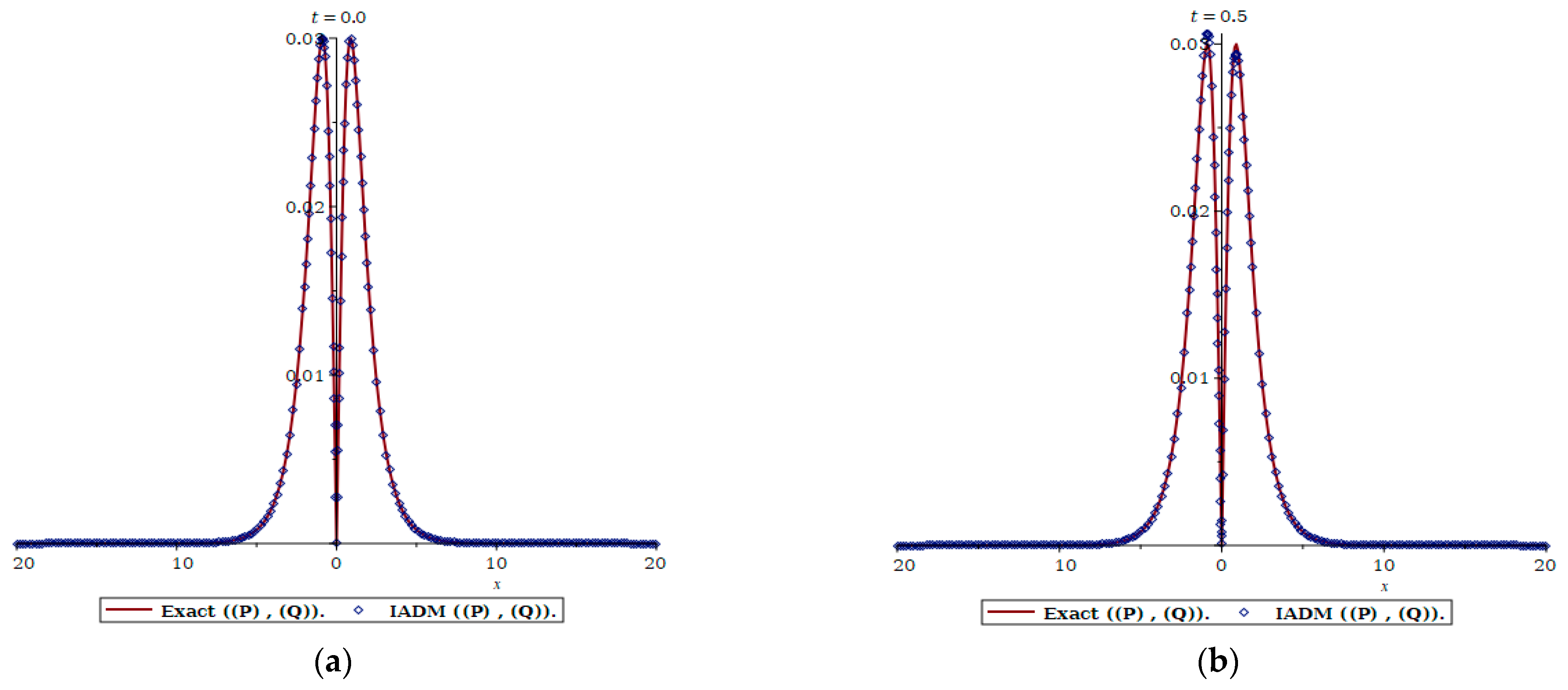
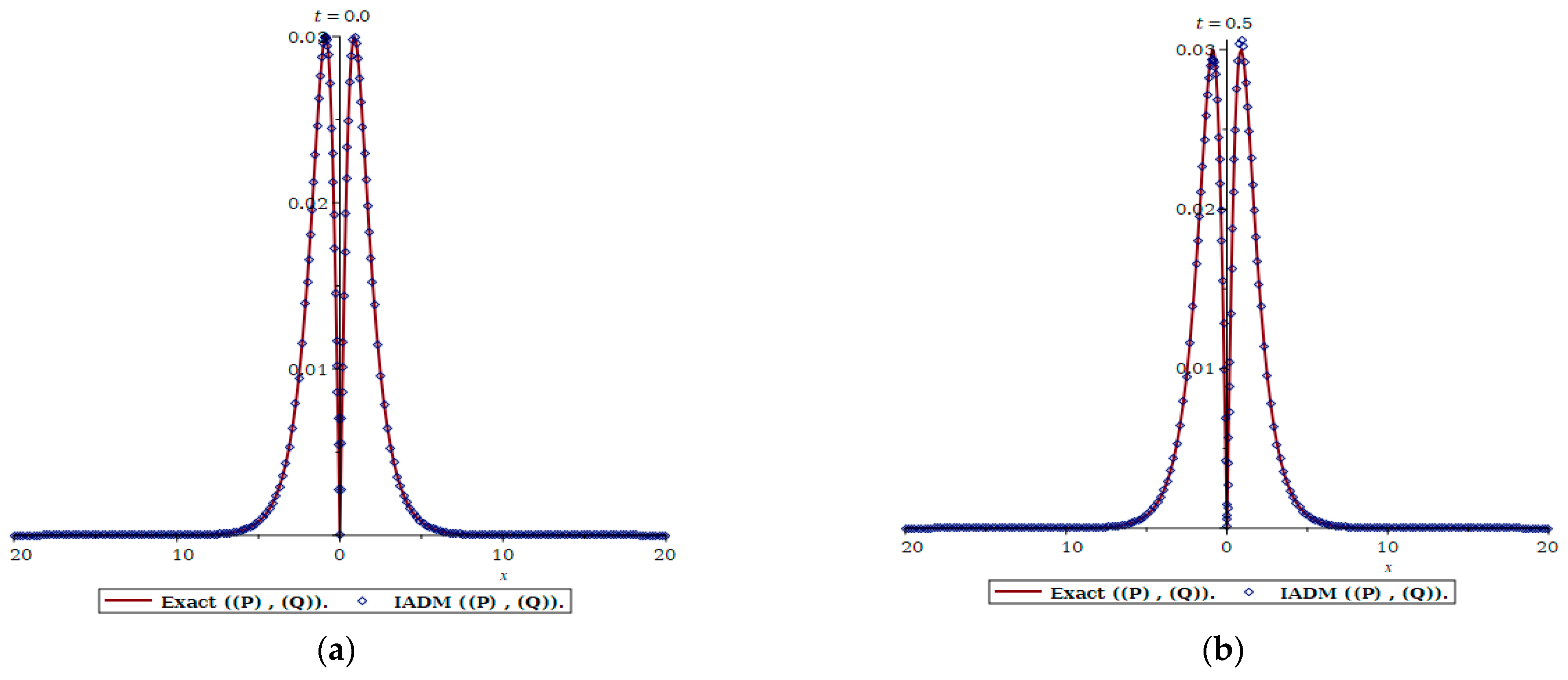
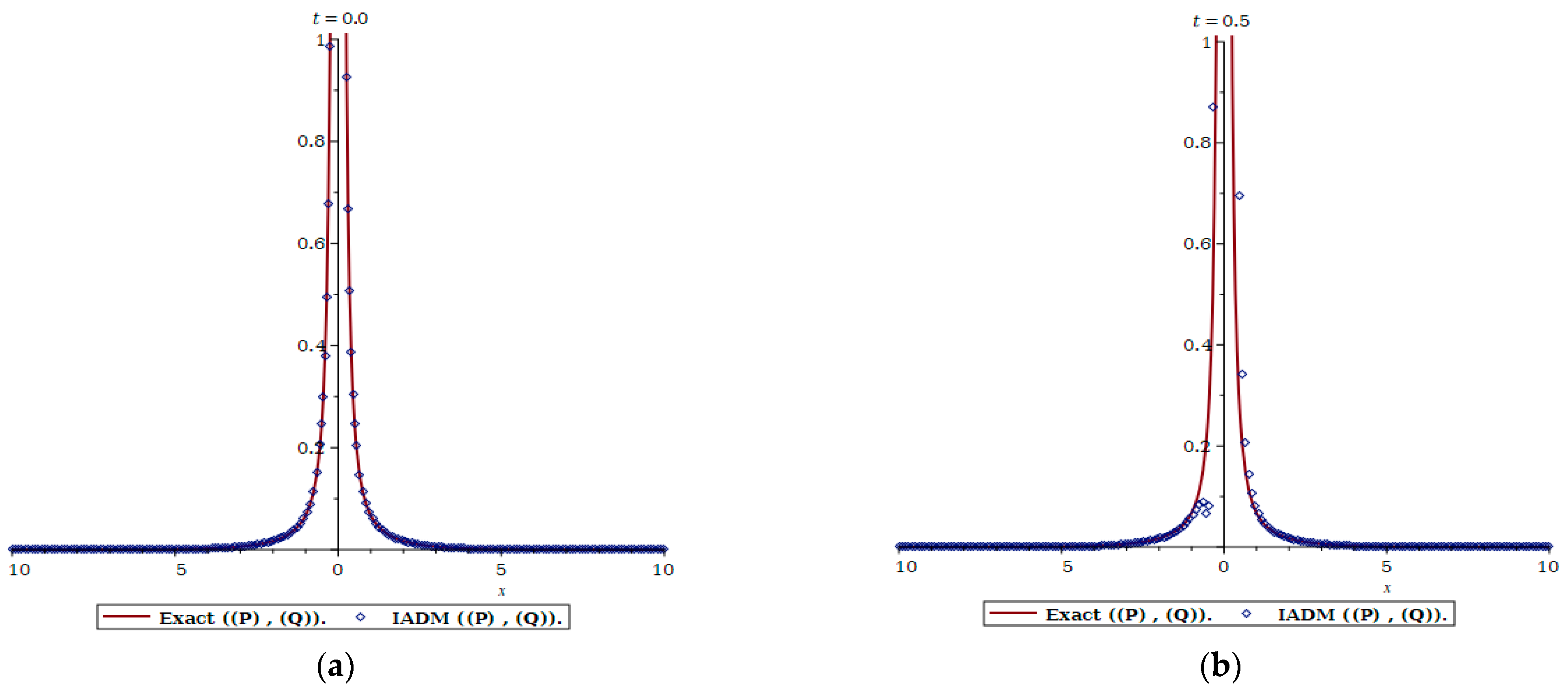
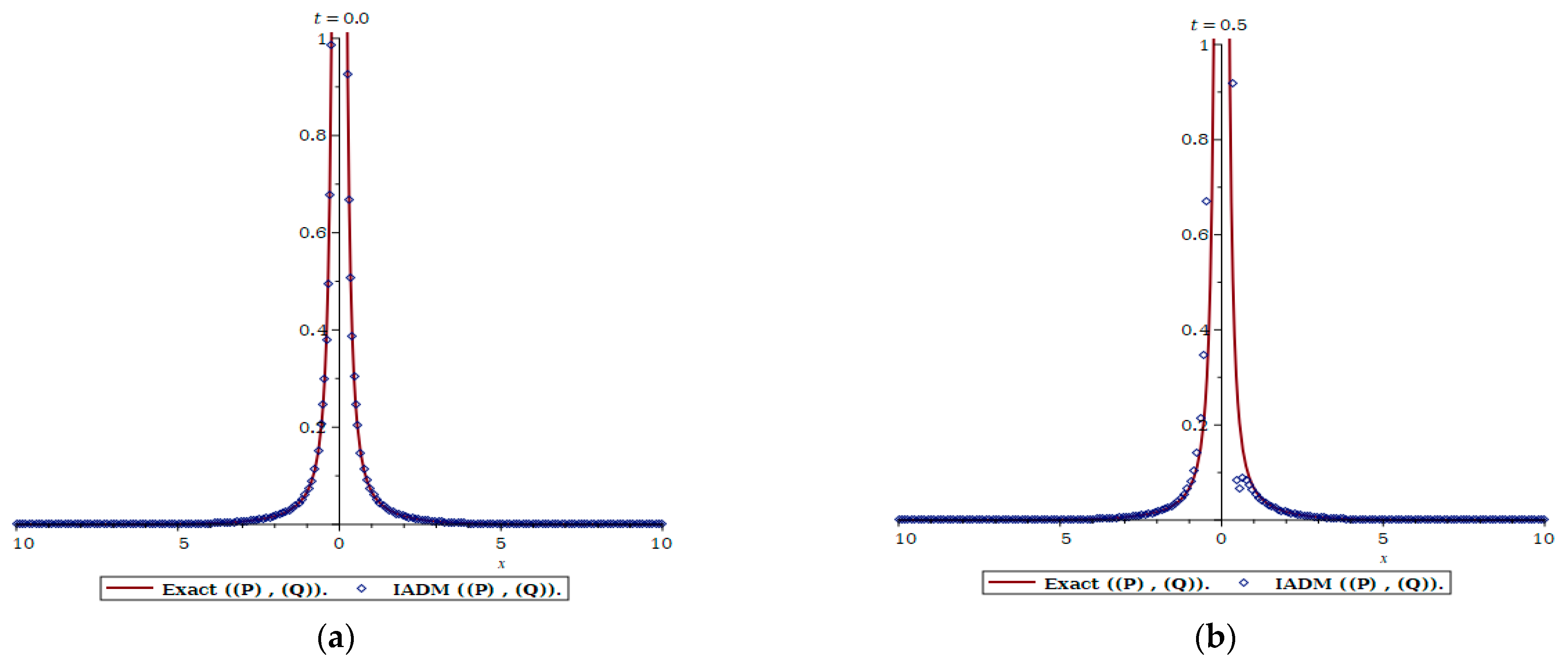
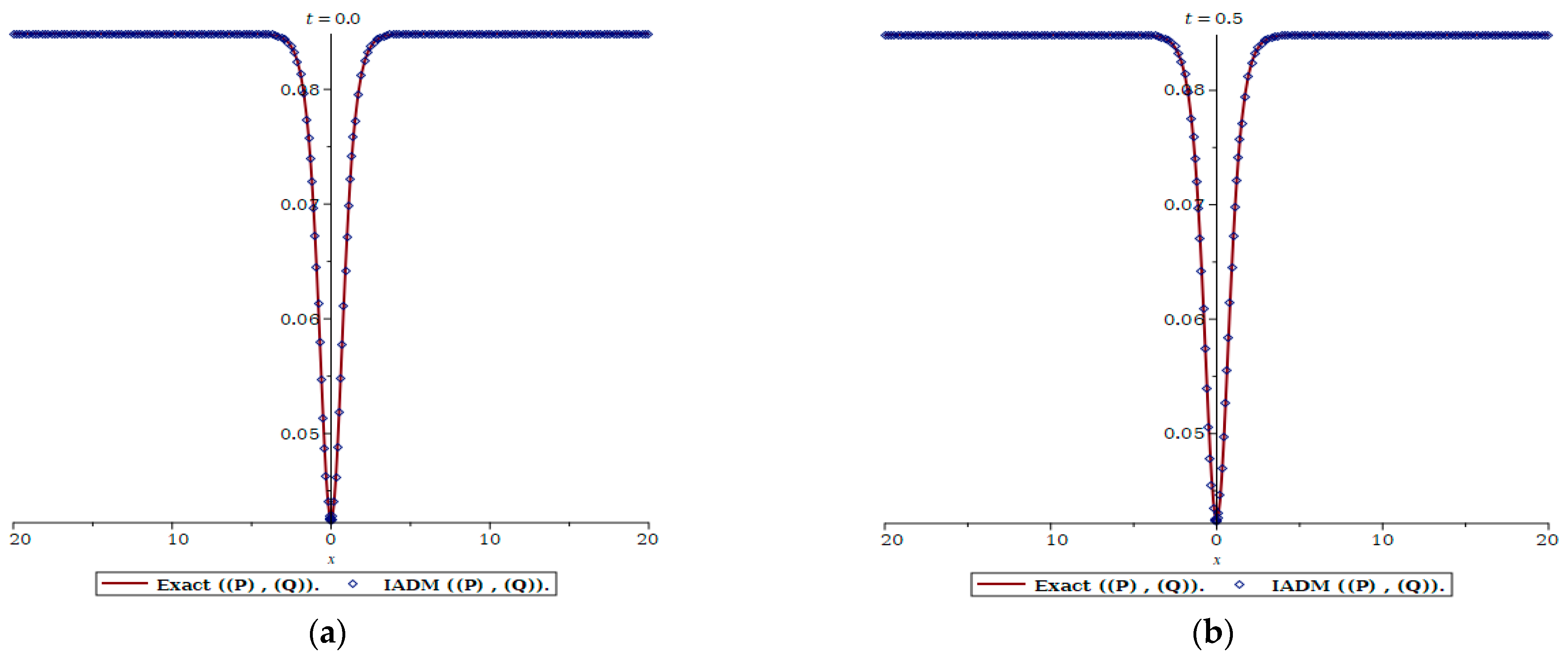
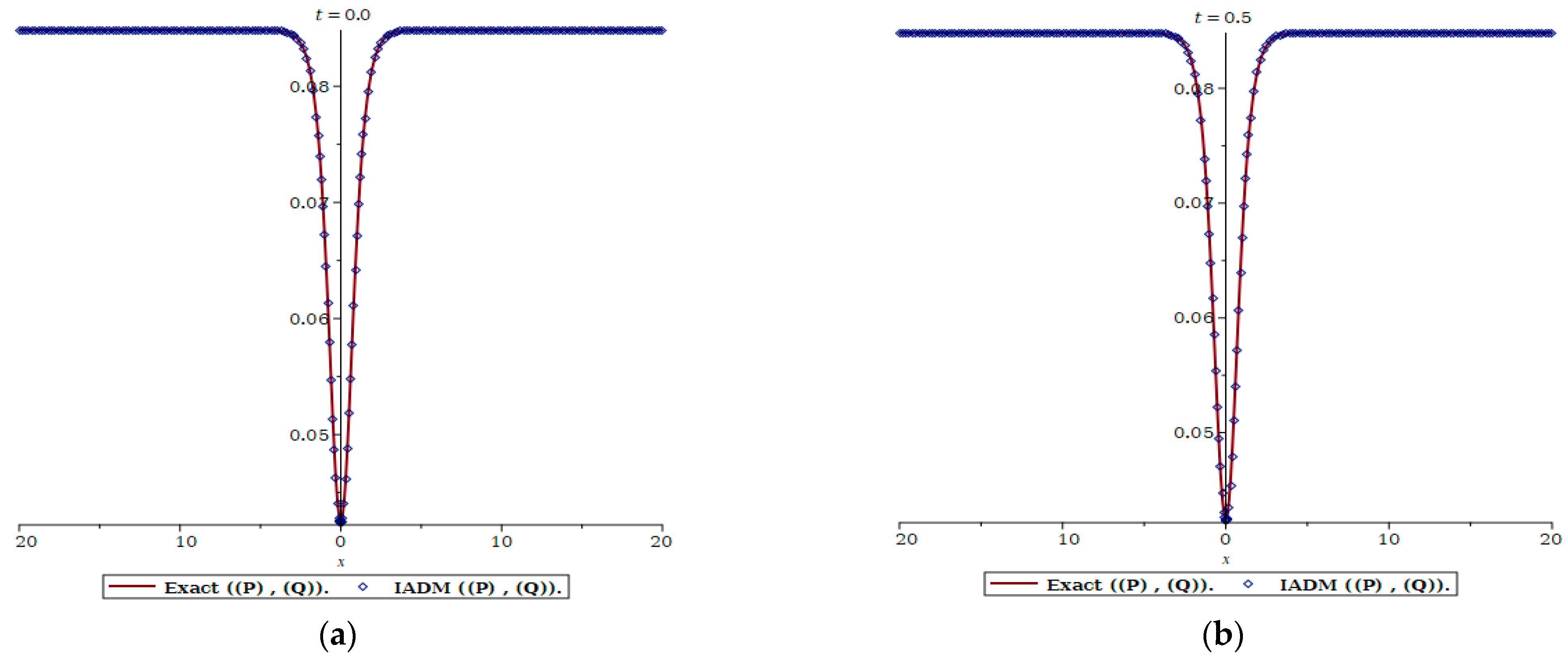
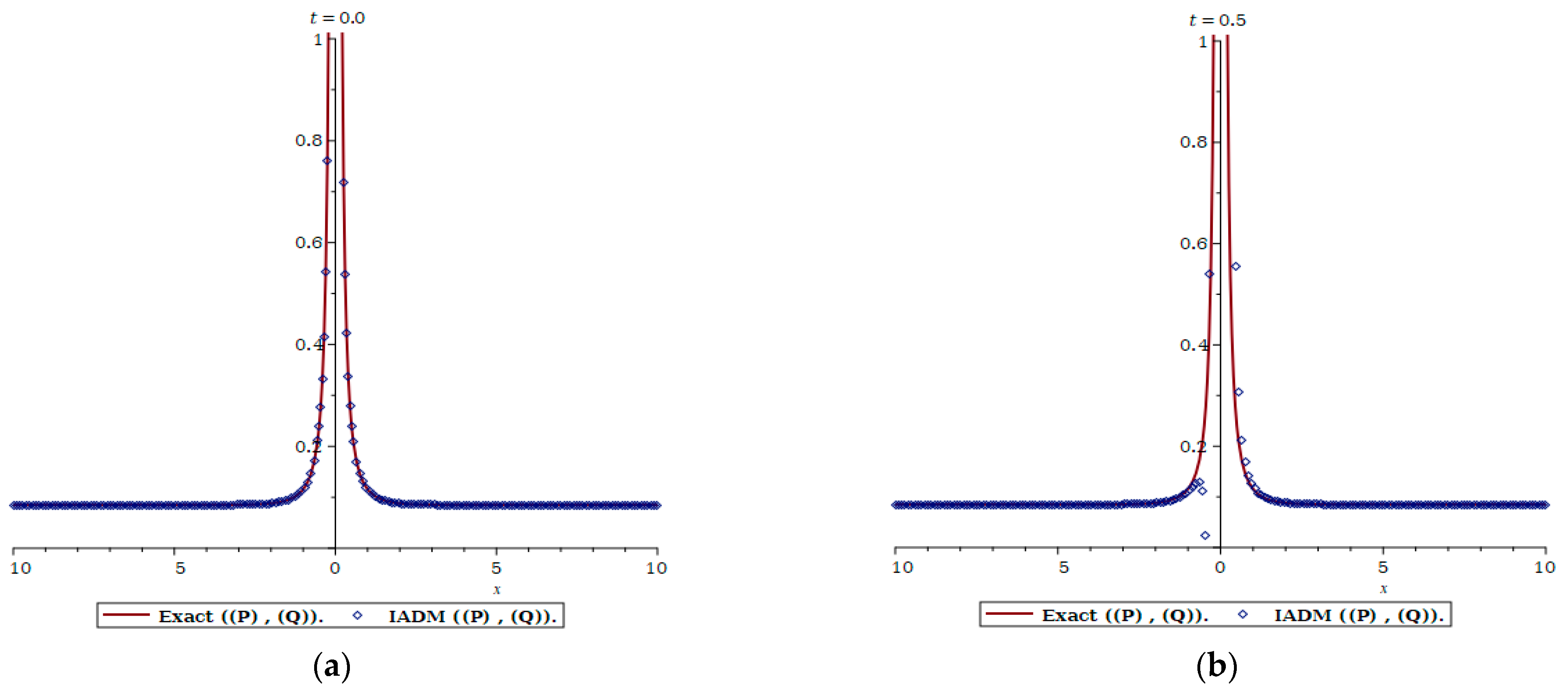
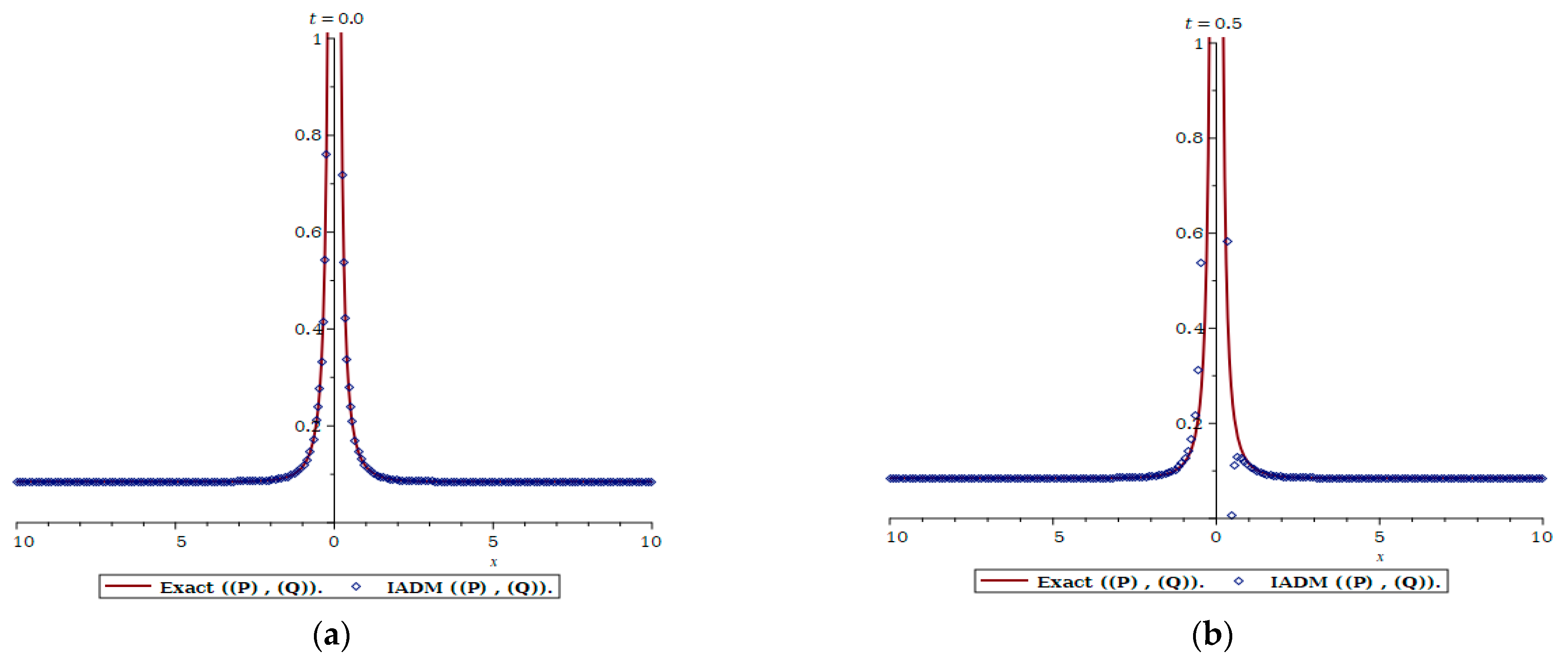
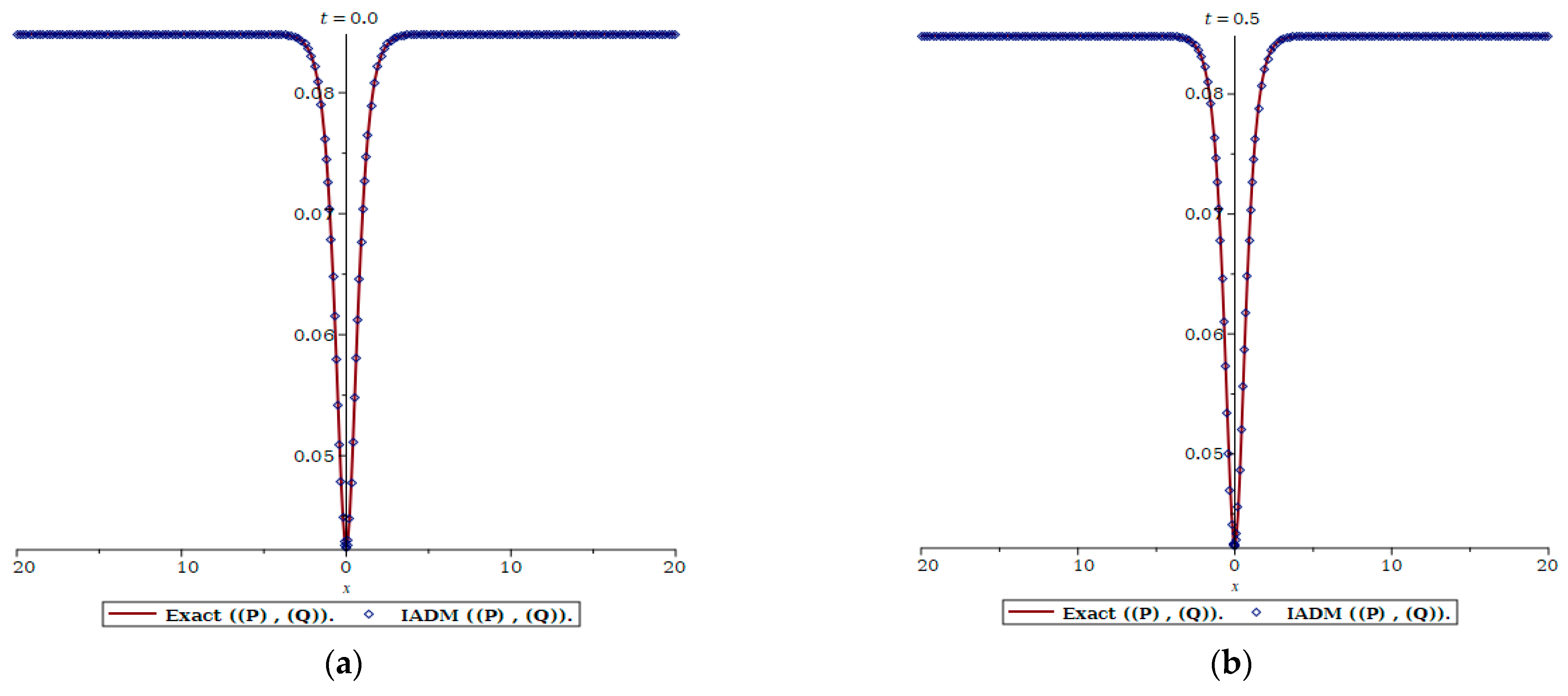
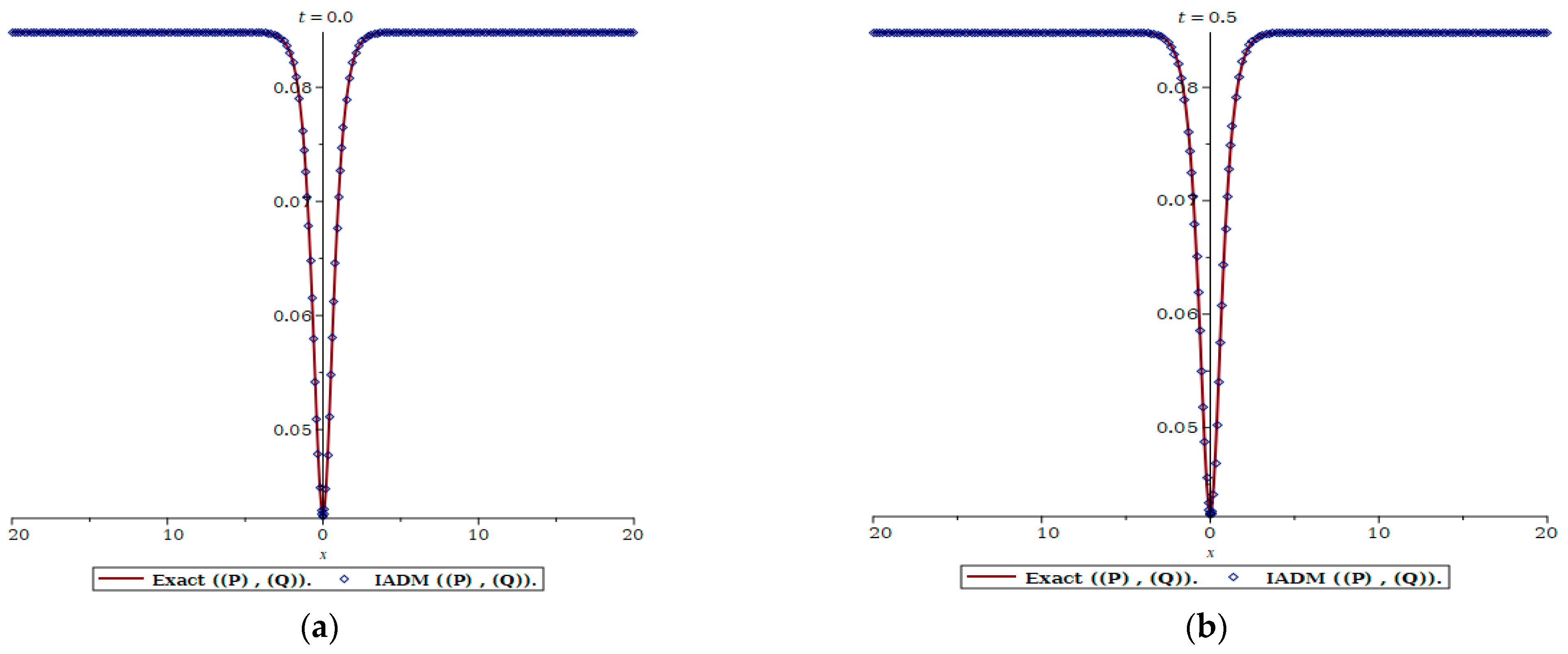
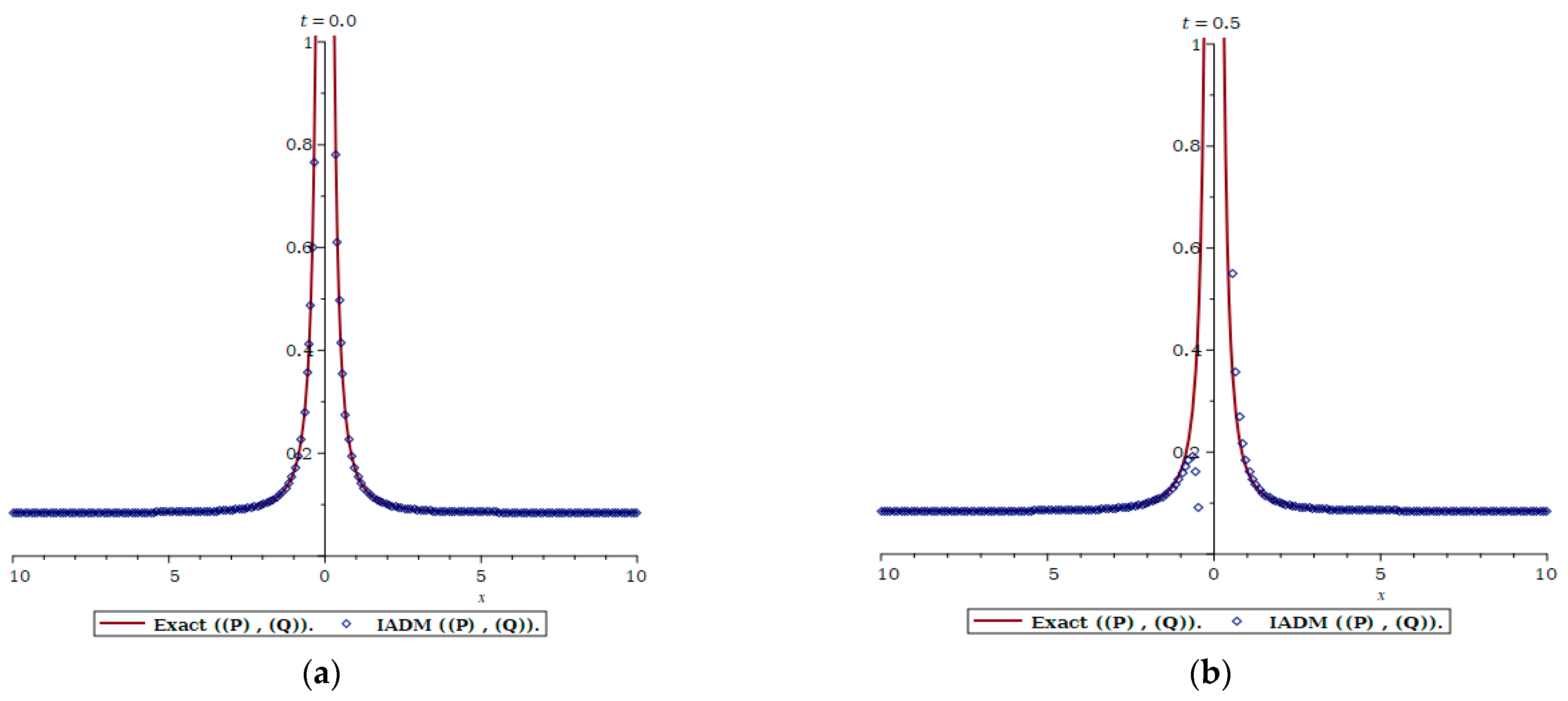
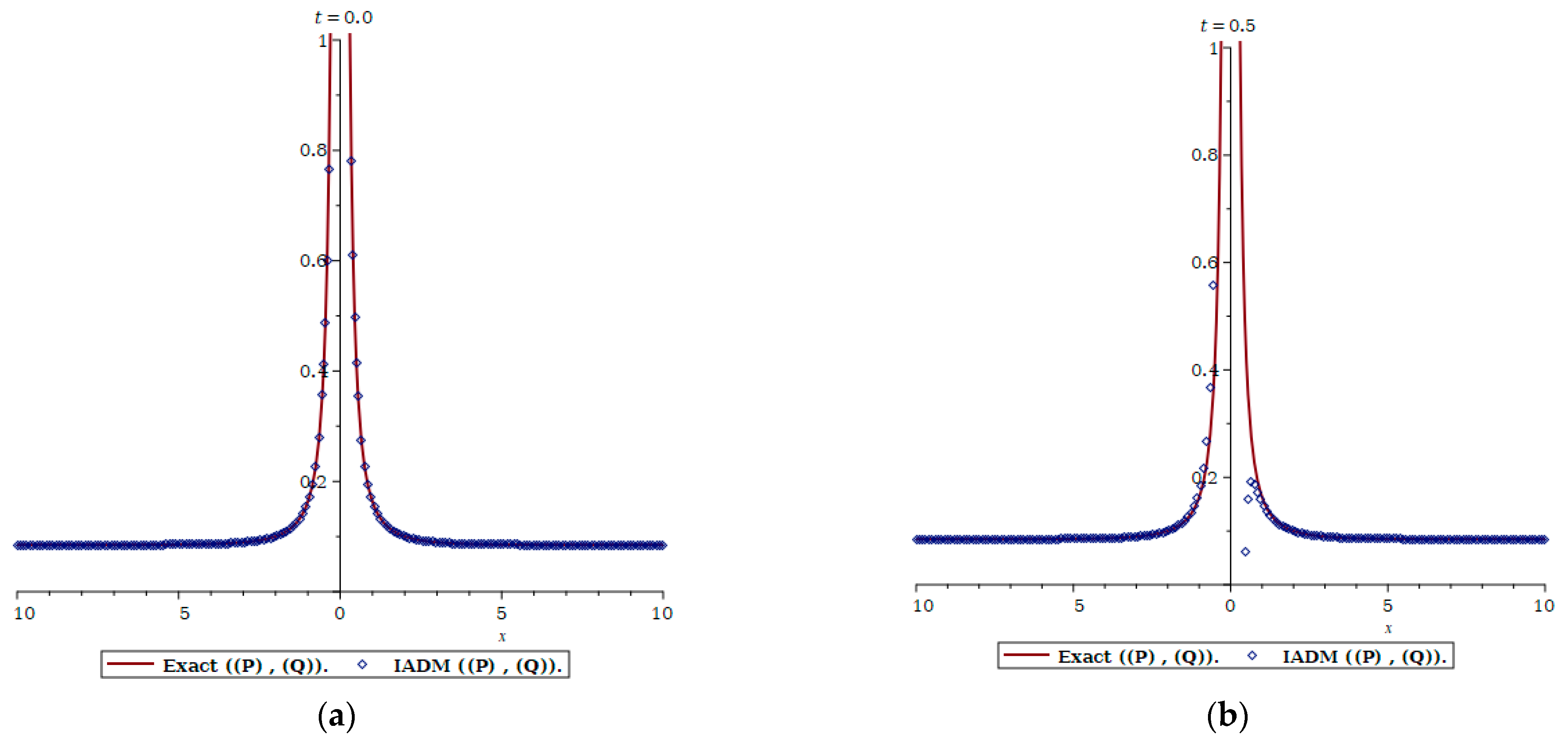
Accordingly, Table 1, Table 2, Table 3, Table 4, Table 5, Table 6, Table 7, Table 8, Table 9, Table 10, Table 11 and Table 12 present comparisons of the exact solution pairs for and , along with their corresponding approximate solutions, assessing the absolute error difference for each case. Additionally, we generate two-dimensional plots to visually represent the results obtained from both the numerical and analytical methods, as shown in Figure 1, Figure 2, Figure 3, Figure 4, Figure 5, Figure 6, Figure 7, Figure 8, Figure 9, Figure 10, Figure 11 and Figure 12: panel (a) shows the absolute error at time , while panel (b) displays the absolute error at time , covering the ranges () and () interchangeably. Remarkably, given that the reported tables and figures are obviously self-descriptive, it is equally pertinent to mention here that the proposed IADM gives the least error at while insignificantly increasing as increases; undoubtedly, this has to do with the model’s parameters that coefficient the temporal variable in the competing benchmark solutions—see the comparing exact solutions in Section 4. The derived IADM effectively leverages a linear temporal operator, emphasizing its reliance on the initial condition. This positions the derived scheme as an initial-value problem for a nonlinear complex-valued evolution equation. Scholars such as Arora et al. [25], AlQarni et al. [26], González-Gaxiola et al. [27], and Bodaqah et al. [28] have also explored similar one-directional computational schemes tailored for the numerical analysis of NLSEs. In contrast, Aljohani et al. [29] focused on a finite difference scheme addressing boundary-value problems related to an advection–diffusion equation, which represents a linearized form of the telegraph equation. The graphical results presented in Figure 1, Figure 2, Figure 3, Figure 4, Figure 5, Figure 6, Figure 7, Figure 8, Figure 9, Figure 10, Figure 11 and Figure 12 illustrate a strong correlation between the approximate IADM solutions and the benchmark exact solutions, affirming the validity of the approach. Moreover, the tables indicate minimal errors in the calculations. However, it is evident that as the scale increases, discrepancies between the exact and approximate solutions manifest, underscoring the complexities inherent in the numerical methods applied. Despite these challenges, the robustness of the graphical alignment suggests that the IADM remains a valuable tool for addressing these nonlinear problems, warranting further investigation and refinement in larger-scale applications.
Table 1.
Error difference between the proposed IADM solution and the exact combo dark–bright solution for Set I results under Case I.
Table 2.
Error difference between the proposed IADM solution and the exact combo dark–bright solution for Set I results under Case II.
Table 3.
Error difference between the proposed IADM solution and the exact singular solution for Set I results under Case I.
Table 4.
Error difference between the proposed IADM solution and the exact singular solution for Set I results under Case II.
Table 5.
Error difference between the proposed IADM solution and the exact dark solution for Set II results under Case I.
Table 6.
Error difference between the proposed IADM solution and the exact dark solution for Set II results under Case II.
Table 7.
Error difference between the proposed IADM solution and the exact combo singular solution for Set II results under Case I.
Table 8.
Error difference between the proposed IADM solution and the exact combo singular solution for Set II results under Case II.
Table 9.
Error difference between the proposed IADM solutions and the exact combo dark–bright solution for Set III results under Case I.
Table 10.
Error difference between the proposed IADM solutions and the exact combo dark–bright solution for Set III results under Case II.
Table 11.
Error difference between the proposed IADM solutions and the exact combo singular solution for Set III results under Case I.
Table 12.
Error difference between the proposed IADM solutions and the exact combo singular solution for Set III results under Case II.
Figure 1.
Pictorial depiction comparing the proposed IADM solution and the exact combo dark–bright solution for the solution pairs for and for Set I results under Case I.
Figure 2.
Pictorial depiction comparing the proposed IADM solution and the exact combo dark–bright solution for the solution pairs for and for Set I results under Case II.
Figure 3.
Pictorial depiction comparing the proposed IADM solution and the exact singular solution for the solution pairs for and for Set I results under Case I.
Figure 4.
Pictorial depiction comparing the proposed IADM solution and the exact singular solution for the solution pairs for and for Set I results under Case II.
Figure 5.
Pictorial depiction comparing the proposed IADM solution and the exact combo dark solution for the solution pairs for and for Set II results under Case I.
Figure 6.
Pictorial depiction comparing the proposed IADM solution and the exact dark solution for the solution pairs for and for Set II results under Case II.
Figure 7.
Pictorial depiction comparing the proposed IADM solution and the exact combo singular solution for the solution pairs for and for Set II results under Case I.
Figure 8.
Pictorial depiction comparing the proposed IADM solution and the exact combo singular solution for the solution pairs for and for Set II results under Case II.
Figure 9.
Pictorial depiction comparing the proposed IADM solution and the exact combo dark–bright solution for the solution pairs for and for Set III results under Case I.
Figure 10.
Pictorial depiction comparing the proposed IADM solution and the exact combo dark–bright solution for the solution pairs for and for Set III results under Case II.
Figure 11.
Pictorial depiction comparing the proposed IADM solution and the exact combo singular solution for the solution pairs for and for the Set III results under Case I.
Figure 12.
Pictorial depiction comparing the proposed IADM solution and the exact combo singular solution for the solution pairs for and for Set III results under Case II.
6. Conclusions
In this investigation, we explored CQ solitons utilizing the proposed numerical IADM and compared the outcomes with certain analytical solitonic solutions derived from the sine-Gordon analytical approach. Our assessment of the absolute error difference between the two methodologies revealed it to be negligible, demonstrating the accuracy and effectiveness of the IADM in capturing the behavior of solitons. The results were further illustrated through two-dimensional plots that depict the evolution of solitons within optoelectronic devices for a range of fixed temporal variable values. This visual representation not only enhances our understanding of soliton dynamics in these systems but also confirms the reliability of our numerical approach. This research establishes a robust foundation for the study of CQ solitons in birefringent fibers and paves the way for expanding numerical methodologies in future investigations in this field. We also recommend additional research focused on the numerical validation of various CQ NLSEs, particularly those incorporating different nonlinear laws, such as parabolic and anti-cubic nonlinearity, as well as more complex forms, like cubic–quintic–septic–nonic nonlinearity, which are gaining significant attention in optoelectronics. This could lead to further advancements in our understanding and application of CQ solitons in nonlinear optical systems.
Author Contributions
Conceptualization, H.O.B. and A.A.A. (Aisha A. Alshaery); methodology, H.O.B., A.M.A. and A.A.A. (Alyaa A. AlQarni); software, A.M.A.; validation, H.O.B., A.A.A. (Aisha A. Alshaery) and A.A.A. (Alyaa A. AlQarni); investigation, A.M.A.; data curation, A.M.A. and A.A.A. (Alyaa A. AlQarni); writing—original draft preparation, A.M.A.; writing—review and editing, H.O.B., A.A.A. (Aisha A. Alshaery) and A.M.A.; visualization, A.M.A. and A.A.A. (Alyaa A. AlQarni); supervision, A.A.A. (Aisha A. Alshaery) and H.O.B.; project administration, H.O.B., A.A.A. (Aisha A. Alshaery) and A.M.A. All authors have read and agreed to the published version of the manuscript.
Funding
This research received no external funding.
Data Availability Statement
The original contributions presented in this study are included in the article. Further inquiries can be directed to the corresponding author.
Conflicts of Interest
The authors declare no conflict of interest.
References
- Biswas, A.; Triki, H.; Zhou, Q.; Moshokoa, S.P.; Ullah, M.Z.; Belic, M. Cubic-quartic optical solitons in Kerr and power-law media. Optik 2017, 144, 357–362. [Google Scholar] [CrossRef]
- Biswas, A.; Kara, A.H.; Ullah, M.Z.; Zhou, Q.; Triki, H.; Belic, M. Conservation laws for cubic-quartic optical solitons in Kerr and power-law media. Optik 2017, 145, 650–654. [Google Scholar] [CrossRef]
- Bansal, A.; Biswas, A.; Zhou, Q.; Babatin, M.M. Lie symmetry analysis for cubic-quartic nonlinear Schrödinger’s equation. Optik 2018, 169, 12–15. [Google Scholar] [CrossRef]
- Das, S.E.; Ozisik, M.; Bayram, M.; Secer, A.; Albayrak, P. Optical solitons of a cubic-quartic nonlinear Schrödinger equation with parabolic law nonlinearity in optical metamaterials. Int. J. Geom. Methods Mod. Phys. 2023, 20, 2350235. [Google Scholar] [CrossRef]
- El-Horbaty, M.; Gepreel, K.A.; Yildirim, Y. Investigation of optical soliton solutions for the cubic-quartic derivative nonlinear Schrödinger equation using advanced integration techniques. Phys. Scr. 2024, 99, 115209. [Google Scholar] [CrossRef]
- Blanco-Redondo, A.; Sterke, C.M.D.; Sipe, J.E.; Krauss, T.F.; Eggleton, B.J.; Husko, C. Pure-quartic solitons. Nat. Commun. 2016, 7, 10427. [Google Scholar] [CrossRef]
- Das, A.; Biswas, A.; Ekici, M.; Khan, S.; Zhou, Q.; Moshokoa, S.P. Suppressing internet bottleneck with fractional temporal evolution of cubic-quartic optical solitons. Optik 2019, 182, 303–307. [Google Scholar] [CrossRef]
- Kohl, R.W.; Biswas, A.; Ekici, M.; Zhou, Q.; Moshokoa, S.P.; Belic, M.R. Cubic-quartic optical soliton perturbation by semi-inverse variational principle. Optik 2019, 185, 45–49. [Google Scholar] [CrossRef]
- Hakima, K.A.; Ismael, H.F. Time-fractional of cubic-quartic Schrödinger and cubic-quartic resonant Schrödinger equations with parabolic law: Various optical solutions. Phys. Scr. 2024, 99, 125213. [Google Scholar] [CrossRef]
- Shahzad, T.; Baber, M.Z.; Sulaiman, T.A.; Ahmad, M.O.; Yasin, M.W. Optical wave profiles for the higher order cubic-quartic Bragg-gratings with anti-cubic nonlinear form. Opt. Quant. Electron. 2024, 56, 67. [Google Scholar] [CrossRef]
- Rehman, H.U.; Iqbal, I.; Hashemi, M.S.; Mirzazadeh, M.; Eslami, M. Analysis of cubic-quartic-nonlinear Schrödinger’s equation with cubic-quintic-septic-nonic form of self-phase modulation through different techniques. Optik 2023, 287, 171028. [Google Scholar] [CrossRef]
- Chen, D.; Li, Z. Optical solitons of the cubic-quartic-nonlinear Schrödinger’s equation having cubic-quintic-septic-nonic form of self-phase modulation. Optik 2023, 277, 170687. [Google Scholar] [CrossRef]
- AlQahtani, S.A.; Alngar, M.E.M. Soliton solutions of perturbed NLSE-CQ model in polarization-preserving fibers with cubic–quintic–septic–nonic nonlinearities. J. Opt. 2024, 53, 3789–3796. [Google Scholar] [CrossRef]
- Hussain, S.; Iqbal, M.S.; Bayram, M.; Ashraf, R.; Inc, M.; Rezapour, S.; Tarar, M.A. Optical soliton solutions in a distinctive class of nonlinear Schrödinger’s equation with cubic, quintic, septic, and nonic nonlinearities. Opt. Quant. Electron. 2024, 56, 1066. [Google Scholar] [CrossRef]
- Bakodah, H.O.; Banaja, M.A.; Alqarni, A.A.; Alshaery, A.A.; Younis, M.; Zhou, Q.; Biswas, A. Optical solitons in birefringent fibers with Adomian decomposition method. J. Comput. Theor. Nanosci. 2015, 12, 5846–5853. [Google Scholar] [CrossRef]
- Ngartera, L.; Moussa, Y.Y. Advancements and applications of the Adomian decomposition method in solving nonlinear differential equations. J. Math. Res. 2024, 16, 1–38. [Google Scholar] [CrossRef]
- Banaja, M.A.; AlQarni, A.A.; Bakodah, H.O.; Zhou, Q.; Moshokoa, S.P.; Biswas, A. The investigate of optical solitons in cascaded system by improved Adomian decomposition scheme. Optik 2017, 130, 1107–1114. [Google Scholar] [CrossRef]
- González-Gaxiola, O.; Waldo, S.; Biswas, A.; Mallawi, F.; Belic, M.R. Cubic-quartic bright optical solitons with improved Adomian decomposition method. J. Adv. Res. 2020, 21, 161–167. [Google Scholar] [CrossRef]
- Batool, S.; Arshad, M.; Perveen, N.; Sarwar, S. Bright optical solution for fractional Lakshmanan–Porsezian–Daniel with spatio temporal dispersion by improved Adomian decomposition method. Opt. Quantum Electron. 2024, 56, 1137. [Google Scholar] [CrossRef]
- Adomian, G. Solution of physical problems by decomposition. Comp. Math. Appl. 1994, 27, 145–154. [Google Scholar] [CrossRef]
- Adomian, G. A review of the decomposition method in applied mathematics. J. Math. Anal. Appl. 1988, 135, 501–544. [Google Scholar] [CrossRef]
- Alshaery, A.; Ebaid, A. Accurate analytical periodic solution of the elliptical Kepler equation using the Adomian decomposition method. Acta Astronaut. 2017, 140, 27–33. [Google Scholar] [CrossRef]
- González-Gaxiola, O. Numerical solution for Triki-Biswas equation by Adomian decomposition method. Optik 2019, 194, 163014. [Google Scholar] [CrossRef]
- Turkyilmazoglu, M. Accelerating the convergence of Adomian decomposition method (ADM). J. Comput. Sci. 2019, 31, 54–59. [Google Scholar] [CrossRef]
- Arora, G.; Rani, R.; Emadifar, H. Numerical solutions of nonlinear Schrodinger equation with applications in optical fiber communication. Optik 2022, 266, 169661. [Google Scholar] [CrossRef]
- Bodaqah, A.M.; Alshaery, A.A.; Bakodah, H.O.; Yildirim, Y.; Biswas, A. Cubic–quartic optical solitons with Fokas–Lenells equation by the improved Adomian decomposition method. J. Opt. 2024, 1–9. [Google Scholar] [CrossRef]
- González-Gaxiola, O.; Yildirim, Y.; Hussein, L.; Biswas, A. Quiescent pure-quartic optical solitons with Kerr and non-local combo self-phase modulation by Laplace-Adomian decomposition. J. Opt. 2024, 1–10. [Google Scholar] [CrossRef]
- Bodaqah, A.M.; Al Qarni, A.A.; Bakodah, H.O.; Alshaery, A.A. Acquisition of optimal computational solitons for cubic–quartic nonlinear Schrödinger equation through improved Adomian decomposition method. Opt. Quant. Electron. 2024, 56, 1250. [Google Scholar] [CrossRef]
- Aljohani, A.F.; Alsisi, A.; Althobaiti, S.; Nass, A.M.; Nuruddeen, R.I.; Selim, M.M.; Alamri, O.; Althobaiti, A. Groundwater pollution equation: Lie’s symmetry analysis and numerical consideration. Partial. Diff. Equ. Appl. Math. 2024, 11, 100861. [Google Scholar] [CrossRef]
- Yıldırım, Y.; Biswas, A.; Jawad, A.J.A.M.; Ekici, M.; Zhou, Q.; Khan, S.; Alzahrani, A.K.; Belic, M.R. Cubic–quartic optical solitons in birefringent fibers with four forms of nonlinear refractive index. Optik 2020, 203, 163885. [Google Scholar] [CrossRef]
Disclaimer/Publisher’s Note: The statements, opinions and data contained in all publications are solely those of the individual author(s) and contributor(s) and not of MDPI and/or the editor(s). MDPI and/or the editor(s) disclaim responsibility for any injury to people or property resulting from any ideas, methods, instructions or products referred to in the content. |
© 2024 by the authors. Licensee MDPI, Basel, Switzerland. This article is an open access article distributed under the terms and conditions of the Creative Commons Attribution (CC BY) license (https://creativecommons.org/licenses/by/4.0/).