

Abstract
Geometric function theory has extensively explored the geometric characteristics of analytic functions within symmetric domains. This study analyzes the geometric properties of a specific class of analytic functions employing confluent hypergeometric functions and generalized Bessel functions of the first kind. Specific constraints are imposed on the parameters to ensure the inclusion of the confluent hypergeometric function within the analytic function class. The coefficient bound of the class is used to determine the inclusion properties of integral operators involving generalized Bessel functions of the first kind. Different results are observed for these operators, depending on the specific values of the parameters. The results presented here include some previously published findings as special cases.
Keywords:
univalent function; starlike functions; convex functions; confluent hypergeometric functions; generalized Bessel function of the first kind MSC:
30C45; 33C10; 33C15
1. Introduction
The incredible use of special functions has provoked great interest among researchers in the last few decades. Geometric function theory has extensive literature addressing the geometric and analytic characteristics of various kinds of hypergeometric functions, such as the Gaussian hypergeometric function [1,2,3,4], confluent hypergeometric function [1,5,6,7,8], Bessel function [9,10,11,12], Struve function [13,14,15], Lommel function [13,16,17], Bessel–Wright function [18] and other generalized hypergeometric functions [19,20]. The authors employed many methods to determine various conditions on the parameters of these special functions to be in the class of normalized analytic functions.
Let denote the class of analytic functions of the form
in the open unit disk and be the class of univalent functions, that is
There are many subclasses of (see [1,21,22]) from which and are known as the classes of starlike functions and convex functions, respectively
and
A function is said to be close-to-convex if and only if , , where is a fixed starlike function and . The class of all close-to-convex functions is denoted by . In this study, we considered the following definitions:
Definition 1
([23,24]). For then the classes and are defined as
and
Let a function if and only if .
Definition 2
([25]). Let , for then the function to be in if and only if
When , then , and when , then .
Definition 3
A function is said to be parabolic starlike if
the class of such functions denoted by (see [26]). A related class is defined by using the Alexander transform as if and only if . For the classes reduce to , of functions parabolic starlike in (see [27,28]). In particular, when , then is the parabolic starlike functions in (see [29,30]). The inclusion properties of several subclasses of S are investigated for various linear operators in the literature (see [3,4]). In this work, we are interested to study the following subclass [3]:
where , , and .
The coefficient bound for the function is given by
The extreme function of the classes is
where and . Since , the inequality (2) can be rewritten as (see [3])
The main objective of this work is to find several conditions on the parameters involved in the confluent hypergeometric function and generalized Bessel function of the first kind to belong to the class of normalized analytic functions. The confluent hypergeometric function is defined as (see [1]), for with
where
The series in (4) is convergent for all finite values of z. The function satisfies the following conditions
and
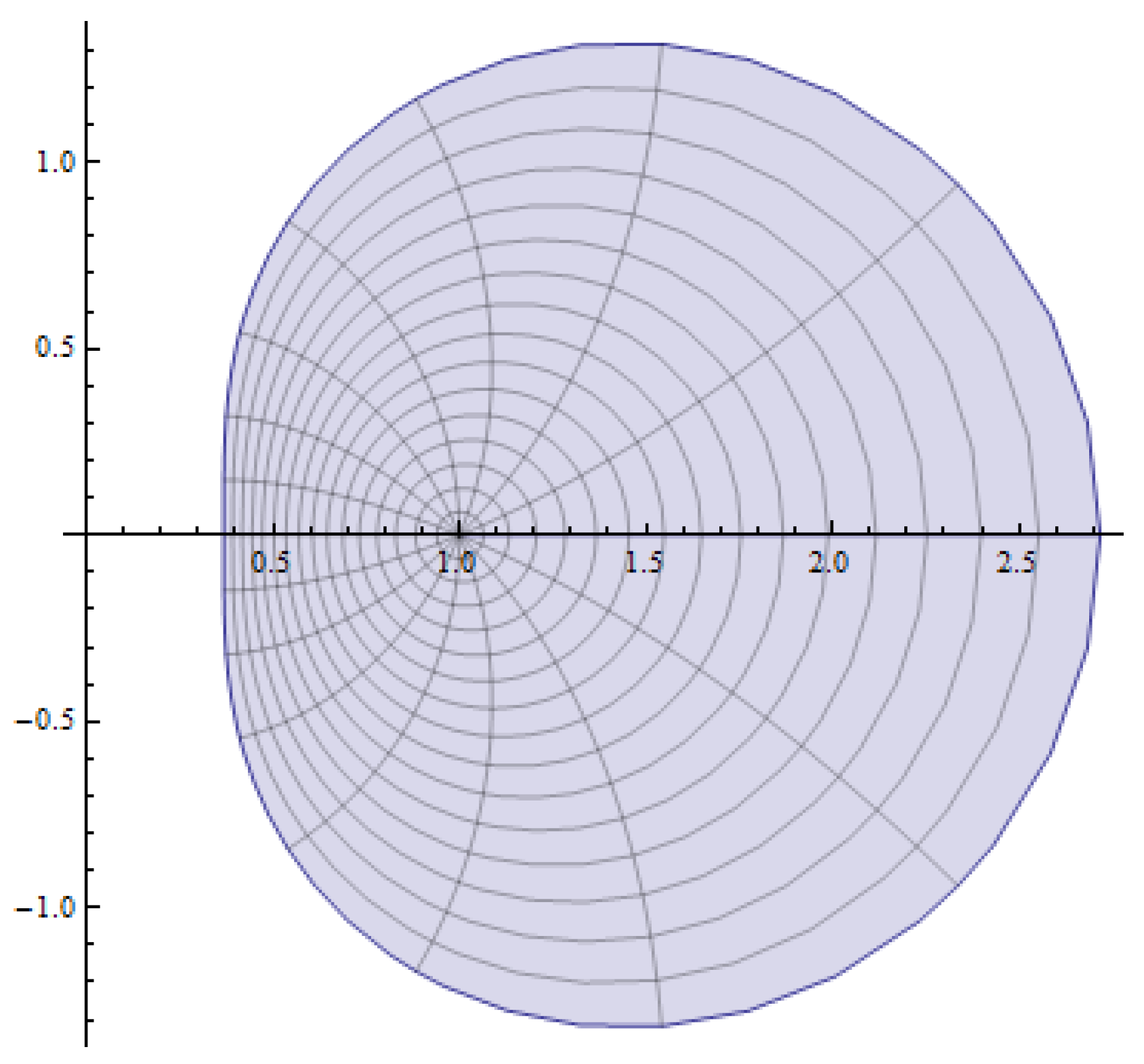
Confluent hypergeometric functions have a connection with symmetry about an axis. Several confluent hypergeometric functions map the unit disc to a domain symmetric with respect to the real axis, for example, maps the unit disc to the region as shown below Figure 1.
Figure 1.
Mapping of unit disc by .
Inspired by the findings presented in references [31,32], our objective is to establish sufficient conditions for the parameter of the normalized Bessel function of the first kind. To initiate our discussion, let us revisit the definition of the generalized Bessel function of the first kind.
Let and . The generalized Bessel function of the first kind (see [9,31]) is defined as the particular solution of the second-order linear homogenous differential equation
which is a natural generalization of Bessel’s equation. This function has the familiar representation
Equation (7) allows us to look into Bessel, modified Bessel, and spherical Bessel functions. The solutions to Equation (7) are called the generalized Bessel function of order p. The particular solution described in Equation (8) is known as the generalized Bessel function of the first kind of order p. However, the series mentioned earlier converges everywhere in . Now, let us consider the function , defined through the transformation
The series representation of is
where . It also satisfies the following conditions [31]
and
where and .
For , using a convolution operator is defined as (see [32])
where ∗ denotes the Hadamard product or convolution of two functions, which is defined for the functions of form (1) and
as
The series representation of Equation (12) is given by
In this article, we discuss the inclusion characteristics of confluent hypergeometric functions and associated integral operator to the class . We mainly derive sufficient conditions involving the parameter of a, b, , , and . All the results are stated and proved in Section 3. Several geometric characteristics of operator for are also given in Section 3. Special cases leads to known results. For this purpose, we recall few basic results from the literature in Section 2, while the concluding remark is stated in Section 4.
2. Preliminary Results
Lemma 1
([1]). For and , the confluent hypergeometric function satisfies the following contiguous relations:
- i
- ii
- iii
Lemma 2
Lemma 3
Lemma 4
Lemma 5
([25]). Let be in if
Lemma 6
([25]). Let be in if it satisfies the following condition
Lemma 7
3. Main Results
The parameters of the confluent hypergeometric function satisfy several conditions, letting be in . The following theorem states the inclusion characteristics associated with confluent hypergeometric functions.
Theorem 1.
Let with , if a and b are satisfied by one of the following conditions, then . For
- i.
- ii.
Proof.
The sufficient condition from Lemma 2 for the class is
Further from (24), we obtain
We will use (25) to prove both the cases of the Theorem 1.
The above result will have a different expression for some particular values of the parameters . We consider a few special cases and presented below as example.
Example 1.
In our first example, we consider . Then, . Now, for , if the inequality
holds, then .
The verification of the above claim can be performed as follows: From Lemma 2, it is sufficient to establish the inequality
Applying the coefficient of in (32), we obtain
From (34), we will obtain the conclusion.
Example 2.
If and then . If
holds, then .
The verification of the above claim can be performed as follows: Again from Lemma 2, it is sufficient to validate the inequality
Applying the coefficient of in (35), we obtain
From (36), we will obtain the required results.
Example 3.
If and , then .If
holds, then .
The verification of the above claim can be performed as follows: Again apply the coefficient of in (35), we obtain
Example 4.
When and , the confluent hypergeometric function becomes the Laguerre polynomial . Thus, if for , , and the inequality
holds, then .
To verify this claim, now we apply the coefficient of in (35). Then, we have
From (37), we will obtain the required results.
Next, we consider the operator
Term by term integration for the series of , leads to
where
The next result provides conditions for which is in .
Theorem 2.
Suppose that and . Further, if
then .
Proof.
For class , the sufficient conditions form Lemma 2 is
Simplifying (40), we obtain
From (41) and the hypothesis of the theorem will obtain the result. □
Taking in the above result then the following result is direct.
Corollary 1.
If for and , the inequality
holds, then .
Let the linear operator belong to the class of univalent functions or to its subclasses of , , , and , by satisfying several relevant criteria on the parameters involved in these special functions. From (13), the coefficient of the operator is
Then the geometric characteristics related to in are given in the following results.
Theorem 3.
Let be of the form (1) and with , , and . Suppose that the following inequality holds for :
Then, for , , .
Proof.
In Lemma 3, the sufficient conditions for the class is given as
From (47) and the hypothesis of the theorem will obtain the result. □
Remark 1.
For , Theorem 3 leads to the Theorem 2 of [32].
Theorem 4.
Let be of the form (1) and with , , and . Suppose that the following inequality holds for :
Then, for , , .
Proof.
From Lemma 4, it follows that the sufficient condition for the class is
From (51) and the hypothesis of the theorem will obtain the result. □
Remark 2.
Note that when in Theorem 4, it is equivalent to Theorem 3 of [32].
Theorem 5.
Let be of the form (1) and with , , and . Suppose that the following inequality holds for and :
Then, for , , .
Proof.
Note that the Lemma 5 gives the sufficient condition for the class as
From (55) and the hypothesis of the theorem will obtain the result. □
Remark 3.
For , Theorem 5 is equivalent to Theorem 1 in [32].
Theorem 6.
Let be of the form (1) and with , , and . Suppose that the following inequality holds for and :
Then, for , , .
Proof.
From Lemma 6, we have the sufficient condition for the class as
From (60) and the hypothesis of the theorem will obtain the result. □
If then the following results are direct.
Corollary 2.
Let be of the form (1) and with , , and . Suppose that the following inequality holds for :
Then, for , , .
Corollary 3.
Let be of the form (1) and with , , and . Suppose that the following inequality holds for :
Then, for , , .
If and , then the following results are direct.
Corollary 4.
Let be of the form (1) and with , , and . Suppose that the following inequality holds:
Then, for , , .
Corollary 5.
Let be of the form (1) and with , , and . Suppose that the following inequality holds:
Then, for , ,.
Theorem 7.
Let be of the form (1) and with , , and . Suppose that the following inequality holds for :
Then, for ,, .
4. Conclusions
In this work, confluent hypergeometric functions and generalized Bessel functions of the first kind are used to study the geometric properties of a particular class. For the confluent hypergeometric function to be in the class, a few limitations were imposed on the parameters. The coefficient bound of the class was used to determine the geometric characteristics of integral operators using confluent hypergeometric functions and the generalized Bessel function of the first kind. For specific parameter values, these operators produce a variety of results. The presented findings included several previously published special cases.
Author Contributions
Conceptualization, M.K.G. and R.K.; methodology, S.R.M., M.K.G. and R.K.; validation, S.R.M., M.K.G. and R.K.; formal analysis, S.R.M., M.K.G. and R.K.; investigation, M.K.G. and R.K.; resources, S.R.M.; writing—original draft preparation, M.K.G. and R.K.; writing—review and editing, S.R.M., M.K.G. and R.K.; Supervision, R.K. All authors have read and agreed to the published version of this manuscript.
Funding
This work was supported by the Deanship of Scientific Research, Vice Presidency for Graduate Studies and Scientific Research, King Faisal University, Saudi Arabia (GrantA081).
Data Availability Statement
Data are contained within the article.
Conflicts of Interest
The authors declare no conflicts of interest.
References
- Rainville, E. Special Functions; The Macmillan Co., Ltd.: New York, NY, USA, 1960; pp. 123–128. [Google Scholar]
- Raghavendar, K.; Swaminathan, A. Integral transforms of functions to be in certain class defined by the combination of starlike and convex functions. Comput. Math. Appl. 2012, 63, 1296–1304. [Google Scholar] [CrossRef]
- Wani, L.A.; Swaminathan, A. Inclusion properties of hypergeometric type functions and related integral transforms. Stud. Univ. Babes-Bolyai Math. 2020, 65, 211–227. [Google Scholar] [CrossRef]
- Giri, M.K.; Raghavendar, K. Inclusion results on hypergeometric functions in a class of analytic functions associated with linear operators. Contemp. Math. 2024, 5, 1738–1757. [Google Scholar] [CrossRef]
- Ali, R.M.; Mondal, S.R.; Ravichandran, V. On the Janowski convexity and starlikeness of the confluent hypergeometric function. Bull. Belg. Math. Soc. Simon Stevin 2015, 22, 227–250. [Google Scholar] [CrossRef]
- Bohra, N.; Ravichandran, V. On confluent hypergeometric functions and generalized Bessel functions. Anal. Math. 2017, 43, 533–545. [Google Scholar] [CrossRef]
- Miller, S.S.; Mocanu, P.T. Univalence of Gaussian and confluent hypergeometric functions. Proc. Am. Math. Soc. 1990, 110, 333–342. [Google Scholar] [CrossRef]
- Ponnusamy, S.; Vuorinen, M. Univalence and convexity properties for confluent hypergeometric functions. Complex Var. Theory Appl. 1998, 36, 73–97. [Google Scholar] [CrossRef]
- Baricz, Á. Geometric Properties of Generalized Bessel Functions. In Generalized Bessel Functions of the First Kind; Lecture Notes in Mathematics Vol. 1994; Springer: Berlin/Heidelberg, Germany, 2010; pp. 23–69. [Google Scholar] [CrossRef]
- Baricz, Á.; Ponnusamy, S. Starlikeness and convexity of generalized Bessel functions. Integral Transform. Spec. Funct. 2010, 21, 641–653. [Google Scholar] [CrossRef]
- Kanas, S.; Mondal, S.R.; Mohammed, A.D. Relations between the generalized Bessel functions and the Janowski class. Math. Inequal. Appl. 2018, 21, 165–178. [Google Scholar] [CrossRef]
- Prajapat, J.K. Certain geometric properties of normalized Bessel functions. Appl. Math. Lett. 2011, 24, 2133–2139. [Google Scholar] [CrossRef]
- Baricz, A.; Yağmur, N. Geometric properties of some Lommel and Struve functions. Ramanujan J. 2017, 42, 325–346. [Google Scholar] [CrossRef]
- Farzana, H.A.; Bhaskaran, A.S.; Muthusamy, P.J. Univalent and starlike properties for generalized Struve function. Int. J. Math. Math. Sci. 2016, 20, 3987231. [Google Scholar] [CrossRef]
- Noreen, S.; Raza, M.; Deniz, E.; Kazımoğlu, S. On the Janowski class of generalized Struve functions. Afr. Mat. 2019, 30, 23–35. [Google Scholar] [CrossRef]
- Sim, Y.; Kwon, O.; Cho, N.E. Geometric properties of Lommel functions of the first kind. Symmetry 2018, 10, 455. [Google Scholar] [CrossRef]
- Yagmur, N. Hardy space of Lommel functions. Bull. Korean Math. Soc. 2015, 52, 1035–1046. [Google Scholar] [CrossRef]
- Din, M.U.; Raza, M.; Xin, Q.; Yalçin, S.; Malik, S.N. Close-to-Convexity of q-Bessel–Wright Functions. Mathematics 2022, 10, 3322. [Google Scholar] [CrossRef]
- Owa, S.; Srivastava, H.M. Univalent and starlike generalized hypergeometric functions. Can. J. Math. 1987, 39, 1057–1077. [Google Scholar] [CrossRef]
- Ruscheweyh, S.; Singh, V. On the order of starlikeness of hypergeometric functions. J. Math. Anal. Appl. 1986, 113, 1–11. [Google Scholar] [CrossRef]
- Duren, P.L. Elementary theory of univalent functions. In Univalent Functions; Springer: New York, NY, USA, 1983; pp. 32–75. [Google Scholar]
- Goodman, A.W. Univalent functions and nonanalytic curves. Proc. Amer. Math. Soc. 1957, 8, 598–601. [Google Scholar] [CrossRef]
- Ponnusamy, S.; Rønning, F. Starlike properties for convolutions involving hypergeometric series. Ann. Univ. Mariae Curie-Sklodowska Sect. A 1998, 52, 141–155. [Google Scholar]
- Gangadharan, A.; Shanmugam, T.N.; Srivastava, H.M. Generalized hypergeometric functions associated with K-uniformly convex functions. Comput. Math. Appl. 2002, 44, 1515–1526. [Google Scholar] [CrossRef]
- Bharati, R.; Parvatham, R.; Swaminathan, A. On subclasses of uniformly convex functions and corresponding class of starlike functions. Tamkang J. Math. 1997, 28, 17–32. [Google Scholar] [CrossRef]
- Rønning, F. On starlike functions associated with parabolic regions. Ann. Univ. Mariae Curie-Skłodowska Sect. Math. 1991, 45, 117–122. [Google Scholar]
- Kanas, S.; Wisinowaska, A. Conic regions and k-uniform convexity. J. Comput. Appl. Math. 1999, 105, 327–336. [Google Scholar] [CrossRef]
- Kanas, S.; Wisinowaska, A. Conic regions and k-starlike functions. Rev. Roum. Math. Pure Appl. 2000, 45, 647–657. [Google Scholar]
- Goodman, A.W. On uniformly convex functions. Ann. Polon. Math. 1991, 56, 87–92. [Google Scholar] [CrossRef]
- Goodman, A.W. On uniformly starlike functions. J. Math. Anal. Appl. 1991, 155, 364–370. [Google Scholar] [CrossRef]
- Baricz, A. Geometric properties of generalized Bessel functions of complex order. Mathematica 2006, 48, 13–18. [Google Scholar]
- Porwal, S.; Ahmad, M. Some Sufficient Conditions for Generalized Bessel Functions Associated with Conic Regions. Vietnam. J. Math. 2015, 43, 163–172. [Google Scholar] [CrossRef]
Disclaimer/Publisher’s Note: The statements, opinions and data contained in all publications are solely those of the individual author(s) and contributor(s) and not of MDPI and/or the editor(s). MDPI and/or the editor(s) disclaim responsibility for any injury to people or property resulting from any ideas, methods, instructions or products referred to in the content. |
© 2024 by the authors. Licensee MDPI, Basel, Switzerland. This article is an open access article distributed under the terms and conditions of the Creative Commons Attribution (CC BY) license (https://creativecommons.org/licenses/by/4.0/).


