


Abstract
The aim of the paper is to construct a secondary characteristic homomorphism for Lie pseudoalgebras. The case of inner product modules is under consideration.
1. Introduction
Secondary characteristic classes were discovered in the 1970s as global invariants of a principal fiber bundle with a connection whose curvature form vanishes (cf. [1,2]). These classes may depend on the connection. However, the classes of the principal bundle of a Riemannian manifold depend only on the conformal structure of the manifold. Various approaches to secondary characteristic classes have also been studied by, among others, Bott [3], Lehmann [4] and Heitsch [5]. The classes considered in this paper are related to the approach of defining the characteristic homomorphism of flat principal bundles determined by the connection of and the reduction of the structure of the Lie group, as considered by Kamber and Tondeur (cf. [6,7]). It has important topological properties such as homotopy independence, functoriality and rigidity. The secondary characteristic homomorphism defined in this paper is a generalization of the homomorphism considered for Lie algebroids (cf. [8,9,10]) to Lie pseudoalgebras.
Let A be a commutative algebra over a commutative ring R (not necessarily with a unital element). A Lie pseudoalgebra over, or an -Lie algebra, is defined as an A-module L equipped with the structure of an R-Lie algebra featuring a Lie bracket and a Lie algebra homomorphism , mapping from L into the Lie algebra of the derivations of A (with the bracket ). This homomorphism, referred to as the anchor of L, is a morphism of A-modules such that
for (cf. [11,12,13,14,15,16]). If L is a Lie pseudoalgebra over , then the pair is referred to as a Lie–Rinehart algebra (cf. [17,18]). For historical and substantive commentary on -Lie algebras, we recommend referring to [18].
Lie pseudoalgebras are algebraic counterparts of Lie algebroids, which were first introduced by Pradines in [19] as infinitesimal objects of Lie groupoids. We should note that any smooth manifold M defines the Lie algebroid , which is the tangent bundle of M, with the identity anchor and the Lie algebra of vector fields on M. Other examples of Lie algebroids include Lie algebras, integrable distributions (especially foliations), cotangent bundles of Poisson manifolds (particularly symplectic manifolds) [20], Lie algebroids of principal bundles [21,22], Lie algebroids of transversal foliations [23] and Lie algebroids with Riemannian [24] or symplectic structure [25]. On the other hand, some algebraic structures can be considered as Lie pseudoalgebras. Some basic examples include the following: every Lie algebra over a commutative ring R with the zero anchor and the module of all derivations of A for every commutative R-algebra A as the Lie subalgebra of with the inclusion map as the anchor. In particular, the polynomial ring of a commutative ring R over the algebra , with a chosen polynomial , has a Lie bracket determined by , and the anchor is given by (cf. [26]). In [27], further examples of Lie pseudoalgebras are defined by derived preinfintesimal modules as the algebraic counterparts of the derived Lie almost vector bundles introduced in [28].
Other sources of Lie pseudoalgebras, which do not necessarily define Lie algebroids, include certain Poisson algebras and foliations. For examples arising from singular distributions, you can refer to the examples of Lie pseudoalgebras associated with an almost Lie structure discussed in [29]. Additionally, each Poisson algebra A over a commutative ring R determines the A-module of Kähler differentials , which serves as an analog of the module of 1-forms in the case of for a smooth manifold M. In [17], it is demonstrated that in , the structure of a Lie pseudoalgebra over can be introduced. Furthermore, Poisson algebras can serve as a source of Lie pseudoalgebras that are not Lie algebroids.
We generalize known secondary characteristic classes related to Lie algebroids and flat connections to include objects such as Lie pseudoalgebras. This extension is twofold. On the one hand, it is a generalization because Lie pseudoalgebras are the algebraic counterparts of Lie algebroids. On the other hand, this generalization encompasses a specific class of connections that are not necessarily flat but have curvature tensors assuming certain values.
The result of this article constitutes an algebraic generalization of distinctive characteristic classes discussed in the paper [8], where certain unique characteristic homomorphisms for Lie algebroids were defined. The distinctive characteristic homomorphism is introduced for a pair of regular Lie algebroids, denoted as , both on the same manifold M with identical anchor images. This is established within the context of a flat L-connection in A, where L is any Lie algebroid over M, whether regular or irregular (see also [9]).
Some exotic characteristic classes have been documented in the literature [30,31]. We aim to further develop such characteristic classes within somewhat more general cases, formulated in the context of pairs of extensions of -Lie algebras.
Given two splitting extensions of Lie pseudoalgebras, denoted as and , associated with their morphism and some connection with the curvature tensor taking values in , we construct the characteristic homomorphism that operates from the cohomology of basic forms (as explained in Section 4) to the total cohomology of the given Lie pseudoalgebra M. If ∇ has values in K, the homomorphism becomes trivial. Consequently, the appearance of a cohomology class from the image of can be considered as an obstruction to ∇ having values in K. Next, we calculate the secondary characteristic homomorphism for pairs of inner product modules. For an inner product module , the following is a pair of pseudoalgebras: the algebra of covariant derivatives and its subalgebra consisting of their skew-symmetric endomorphisms concerning the pseudometric h. An inner product A-module E is a finitely generated projective A-module, where A is a commutative algebra over a unital commutative ring R equipped with a pseudometric, i.e., a symmetric, nondegenerate, A-bilinear map (cf. [32] and the recent article [33]).
We arrive at a specific conclusion when an inner product module is isometric with every other inner product module , and . In such cases, the secondary characteristic homomorphism for the triple remains independent of the choice of the pseudometric h. Consequently, nontrivial secondary characteristic classes become obstructions to the existence of the pseudometric that is invariant with respect to the connection. Therefore, the classes from the image of the characteristic homomorphism generalize the flat secondary characteristic classes discussed in [34].
2. Preliminaries
Connections of Lie pseudoalgebras and their extensions are important concepts in the presented approach to characteristic classes and in the definition of the notion of a connection. A key element in this framework is the algebra of covariant derivatives, which has been previously explored, for instance, in [17,30,31]. Let A be a commutative algebra over a commutative ring R and E be a module over A. Furthermore, consider as a submodule of in such a way that for every element , there exists precisely one such that
Notice that is an R-Lie subalgebra of . Consequently, forms a Lie pseudoalgebra over with the anchor and is referred to as the algebra of covariant derivatives. It is worth noting that the kernel of the anchor is , and if the representation is faithful, comprises all satisfying (1). It is important to observe that the algebra serves as a generalization of the Lie algebroid of a vector bundle (cf. [22,35]).
In the classical approach, a linear connection on a manifold M, for a vector bundle V over M, is represented by a -linear operator that satisfies the Leibniz condition:
for , , , which means that ∇ has values in , and (2) ensures that
Now, we extend the notion of connection to Lie pseudoalgebras, adopting a notation similar to the initial concept of generalizing the definition of connections in [36].
Let , be -Lie pseudoalgebras. We say that a homomorphism of A-modules is an L-connection in if
When referring to the curvature of the connection , we are describing the R-bilinear homomorphism
One can observe that is alternating. Therefore, . We refer to ∇ as flat if equals zero. It is evident that is equal to zero iff ∇ is also a homomorphism of R-Lie algebras.
We will now clarify the relationship between this concept of connection and the one discussed in [36]. Consider and as Lie pseudoalgebras over with anchors , and , respectively. Let
be a short exact sequence in the category of A-modules. Assuming that is a splitting of as a homomorphism of A-modules, it can be observed that
which means that ∇ is an -connection in L. This implies that every splitting of the exact sequence which is a morphism of A-modules qualifies as a connection in the generalized sense.
Given a Lie pseudoalgebra over , the anchor can be interpreted as a flat L-connection in . Additionally, the map , where , represents a flat L-connection in , and it is referred to as the adjoint representation of L.
Consider as a Lie pseudoalgebra over , and let be an L-connection in . Define . Let denote the duality defined as for and . Then, the map
given by
is an L-connection in . is called the contragredient connection to ∇. If ∇ is flat, so is , because for , , .
When referring to a homomorphism
of Lie pseudoalgebras and over , we mean a flat K-connection in L. If is a Lie pseudoalgebra over , then and have induced structures of Lie pseudoalgebras with the zero map and the inclusion as the anchor. Consequently, the inclusion and commute with anchors. Therefore, we have the following short exact sequence of Lie pseudoalgebras, known as the Atiyah sequence:
We review some well-known facts about the cohomology of Lie pseudoalgebras (as found in, for example, [17,30,37,38]). Consider as a Lie pseudoalgebra over , and let E be an A-module. Put:
as the space of all alternating, n-linear mappings. Let , where . For abbreviation, we write instead of . The module serves as an A-algebra and is an algebra over with left multiplication ∧ defined as:
for , , where the sum is taken over -shuffles of permutations. In other words, represents the subset of , which consists of all permutations such that and .
Suppose that is an L-connection in . We define the covariant derivative as follows:
If ∇ is flat, becomes a differential operator (). Then, by the Lie pseudoalgebra cohomology, refers to the cohomology of the complex .
In , we also have two important operators: the substitution operator and the Lie derivative. Let . The substitution operator is defined as if and by:
The Lie derivative is defined as if and by:
for , , . These operators satisfy the following properties:
- (a)
- for all .
- (b)
- for all (Cartan formula for the Lie derivative).
Furthermore, and for all if ∇ is flat, and as a result, . When , we will denote by and the cohomology of the complex as .
3. Algebra of Invariant Homomorphisms
Consider as a Lie pseudoalgebra over , and let be a connection in the A-module . We define an L-connection in the A-module by:
for , , , , and additionally, we put . In this way, we define the following L-connection in , where :
Lemma 1.
If is a flat L-connection in the A-module , then is a flat L-connection in.
Proof.
A standard calculation. □
Corollary 1.
For every Lie pseudoalgebra over , the L-connection:
in is flat.
Let be an L-connection in an A-module . We say that a map is invariant with respect to the L-connection , or -invariant, if
We will denote the set of all -invariant homomorphisms by . We have the structure of the algebra with the standard exterior multiplication in the module . For any , the map is a differentiation of degree zero. Hence, is a subalgebra of .
By , we will denote the set of all alternating, -invariant homomorphisms from . Observe that . Therefore, we can restrict to endomorphisms of . Moreover, the product of alternating homomorphisms is alternating. Therefore, is a subalgebra of algebras and .
4. Construction of the Secondary Characteristic Homomorphism for Pairs of Extensions of Lie Pseudoalgebras
Let
be two split extensions of -Lie pseudoalgebras L and K, where A is a commutative algebra over a commutative ring R, i.e., , are short exact sequences of -Lie pseudoalgebras, which split in the category of A-modules. Denote by and the Lie bracket and the anchor in a Lie pseudoalgebra P, respectively. Clearly, and . Let us assume the commutativity of the diagram:
where , are homomorphisms of R-Lie algebras.
We define the pair as a morphism of extensions ,. We also let be a Lie pseudoalgebra over and be an M-connection in L with the curvature tensor having values in . Let be a splitting of in the category of A-modules. Equivalently, there exist homomorphisms of A-modules , such that:
Since , it follows that is an -connection in K, known as an -connection. The homomorphism is referred to as a form of the -connection (for -connections, see [17,22,35,39] —in the case of Lie algebroids). We observe that . Therefore, is a splitting of (consequently, is an -connection). Since splits, there exists a homomorphism of A-modules , such that:
i.e., is the form of the connection .
Remark 1.
If the A-module is projective, the short exact sequence splits in the category of A-modules.
By the -curvature of the -connection, we mean given by
i.e.,
Corollary 2.
It follows from the definition of that
where is defined by and is a differential operator in induced by the zero -connection in L.
Lemma 2.
Proof.
Since
and is injective, it follows that . □
Corollary 3.
Proof.
Since , Lemma 2 now yields:
□
The anchors and , serving as flat connections in , determine the differential operators and in and , respectively. We will denote their cohomology spaces by and , respectively.
The extension induces the following L-connection in defined by
Lemma 3.
is a flat L-connection which satisfies the properties: ,
for , .
Proof.
Let , . Since and , we deduce that
The flatness of ∇ and (8) are consequences of the Jacobi identity in L. □
The L-connection in induces the K-connection
in by the formula given in (4) and following suitable restriction to alternating homomorphisms. Lemma 1 implies that is flat. Based on the definitions of and the invariance, we have:
Lemma 4.
Any is -invariant if and only if
for , .
We define the set:
Since for every , the substitution operator is an antiderivation, is a subalgebra of called a basic subalgebra, and its elements are referred to as basic forms.
Let , where , be the Lie derivative, and the differential operator in induced by . We recall that if and:
for , .
Lemma 5.
for any .
Proof.
The proof is conducted through a calculation and relies on property (8). □
Lemma 6.
for all .
Proof.
It is sufficient to observe that and for , . □
Now, Lemma 6 and the Cartan formula for the Lie derivative (see page 5) imply that
for and . Hence, from Lemma 5, we see that the image of under is included in . Consequently, we have a differential operator
in the algebra . The cohomology of the complex will be denoted by .
We define homomorphisms of A-modules
and a homomorphism of A-algebras
Lemma 7.
is independent of the choice of the -connection .
Proof.
Let be a homomorphism of A-modules such that , . Then:
Moreover, . Hence, by the equality , we conclude that for . The injectivity of shows that has values in . □
By the definition of ,
where is a homomorphism of A-algebras given by
for , , and
for , . The pair of extensions , and the L-connection induces the homomorphism
Theorem 1.
is an injective homomorphism of A-algebras.
Proof.
It remains to observe that is a surjection. It is satisfied because . □
Theorem 2.
Let be a flat splitting of in the category of A-modules. Then, for and , we have
where is an element of K such that .
Proof.
We first recall that is a flat -connection in L. Let and . We next observe that the right-hand side of (11) does not depend on the choice of elements , such that . Indeed, let be elements of K such that . Then, , and hence:
which gives . Now, we take . Since , and is injective,
We thus obtain
□
Theorem 3.
commutes with the differentials and .
Proof.
Let , . Then:
Since , and , the -invariance of f (see Lemma 4) implies:
One can verify that:
Hence, based on Corollary 3 and the assumption that the curvature of ∇ has values in , we conclude that:
equals and belongs to . For this reason, one can verify that:
□
Since commutes with the differential operators and , it induces the homomorphism
Analogously, induces the homomorphism
which depends only on the structures of . The homomorphism is called the secondary characteristic homomorphism for the triple , whereas is said to be the secondary characteristic homomorphism for the pair . Elements of the A-module are called secondary characteristic classes for .
Remark 2.
If ∇ has values in K (), it follows that is trivial. Based on this, we consider as a measure of the incompatibility of ∇ with the extension .
Remark 3.
This construction is an extension of one of the Lie algebroids (cf. [8]) in the category of Lie pseudoalgebras.
Consider a third short exact sequence, denoted as , of Lie pseudoalgebras, which splits in the category of A-modules. Moreover, assuming that there exists a morphism of extensions , , i.e., we have the commutative diagram:
and let be a splitting of .
We define the K-connnection by , , (see the definition of in (6) for the pair , ). Let us denote by , and the characteristic homomorphism (on the level of forms) for , , and identities connections, respectively. Since is a splitting of , we have
Notice that in view of for (here, we have the substitution operators) and and for , we observe that the image of the space under is included in . Lemma 2 now yields:
In this way, we have proven:
Theorem 4.
.
5. Application for Inner Product Modules
Let R be a unital and commutative ring, A an algebra over R and E a finitely generated projective A-module. It is demonstrated in [30] that the anchor of is surjective and the Atiyah sequence splits. Assume that E is endowed with a nondegenerate, symmetric, A-bilinear map . In this context, we refer to h as a pseudometric.
A finitely generated projective A-module E with a pseudometric h is referred to as an inner product module (see [32]). Let be a Lie pseudoalgebra over . An M-connection within is considered compatible with h if
for all , (see [32]). Additionally, we assume that R includes , i.e., the element , satisfying . For any , by , we will denote the endomorphism , where represents the element of with the property that
Now, we define two modules:
and
In , we also establish the structure of a Lie–Rinehart subalgebra within with the Atiyah sequence . As a result, we have the following commutative diagram:
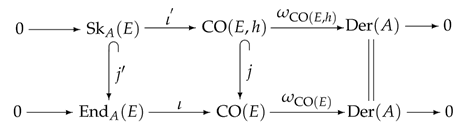 where , , j, are suitable inclusions. In the terminology of differential geometry, we refer to as a reduction of .
Now, let be any flat connection in . Define a connection by
We see that
where id denotes the identity map on , considered as a -connection on . Moreover, is also flat because .
We derive using ∇ and . To simplify the notation, we briefly write instead of .
Let be a connection compatible with h, i.e., . The existence of such a connection is proved in [32] (Theorem 1.3, p. 278). However, one can check that if is any connection in , then is compatible with h.
Lemma 8.
If , then .
Proof.
Let . Then, from (12) and the definition of , we deduce
Since , we see that . □
As a result, we obtain the following:
Theorem 5.
For all , we have
From Theorem 5, we obtain the following:
Corollary 4.
for all
Proof.
Theorem 5 gives
□
We intend to prove that every basic form is closed. In the proof, we use the following:
Lemma 9.
For any , we have .
Proof.
Let . Since is the kernel of , it follows that
and hence
This implies:
and, in consequence, . □
Theorem 6.
Every form of degree is closed.
Proof.
Let . Then:
where:
Observe that
because (see Lemma 9). By applying this, we can observe that
By the invariance of f, we can deduce that the last sum is equal to
and hence zero since . Consequently, . □
Let be a multilinear trace form. We set the trace form by . Explicitly,
Let denote its restriction to . By the definition of , we see immediately that for all . is -invariant where is defined by (see [30]). Since and for all and , we deduce that is -invariant (see Lemma 4), and consequently, . Moreover, by Theorem 6, is closed with respect to . So, by Theorem 5, induces the secondary characteristic class for the triple by
In this way, we have obtained the Chern–Simons-type classes for , its reduction and arbitrary flat connection . These classes generalize the secondary characteristic classes stated in [34] for Lie algebroids.
By an isometry between inner product of finitely generated A-modules and , we mean an isomorphism of A-modules such that
Then, we say that , are isometric.
Let and be two isometric inner product A-modules with an isometry . Observe that if f is an element of with the anchor , then and
The map
is an isomorphism of Lie pseudoalgebras. Indeed, preserves the Lie brackets and, by (14), commutes with the anchors. The pullback
of forms via is an isomorphism of algebras. Moreover, the restriction to is also an isomorphism of Lie pseudoalgebras:
Let , , and denote suitable inclusions. Observe that the anchor of equals . Now, let , , , . Since commutes with anchors, and f is invariant, we have:
Moreover, for all . These properties indicate that is an element of the basic algebra. Therefore, we observe that the restriction of to the basic algebra is an isomorphism onto the algebra with the inverse homomorphism induced by .
Lemma 10.
Proof.
Let , . Since is an isometry and commutes with the anchors of and , we obtain the desired equality. □
Consequently, we obtain:
Theorem 7.
where and denote the secondary characteristic homomorphisms for the pairs and , respectively.
Proof.
We conclude from Lemma 10 that , and hence, by Theorem 5:
□
commutes with suitable differential operators. Hence, using Theorem 7, we obtain the following:
Theorem 8.
The secondary characteristic homomorphism for the triple
where is isomorphic to each other inner product module , is independent of the choice of the metric.
Therefore, if in the A-module , which is isometric with each other , there exists a pseudometric h such that ∇ is compatible with h, i.e., , then secondary characteristic classes for are equal to zero. Hence, nontrivial secondary characteristic classes are obstructions to the existence of an invariant pseudometric with respect to the connection. Moreover, we can describe the secondary characteristic homomorphism for using an arbitrary compatible connection. Namely, we have the following:
Theorem 9.
Let be a flat M-connection on and be any M-connection on compatible with h. Then
Proof.
Let , . Since and is compatible with h, we have:
and hence, . It follows that
Finally, we obtain:
□
We have analyzed the pseudoalgebra associated with an inner product module E and its reduction, which is a more general case compared to a Lie algebroid of a vector bundle and its Riemannian reduction. In the specific case of Lie algebroids, we derive novel characteristic classes in the sense of [34]. Clearly, in this context, any Riemannian structure is isometric to any other such structure .
6. Conclusions
The considered characteristic homomorphism generalizes the concept of secondary characteristic classes to more general structures, including pairs of Lie pseudoalgebras . It also encompasses connections with curvatures that fall within the kernel of the anchor of the Lie pseudoalgebra K. We have demonstrated this construction in the context of inner product modules equipped with flat connections, revealing that Chern–Simons-type classes are included in the image of the characteristic homomorphism.
There is another concept of Lie pseudoalgebras that in general differs from the one discussed in this paper. The theory of the second type of Lie pseudoalgebras was developed in [40]. It is a module over commutative Hopf algebra endowed with a specific Lie bracket which satisfies some generalized version of the Jacobi identity (for more details, we refer the reader to [40,41]). In some situations, this different approach generalizes the one under consideration. We claim that the study of characteristic homomorphisms on the second kind of Lie pseudoalgebras in the sense of [40] can give interesting results in the future.
Funding
This research received no external funding.
Data Availability Statement
Not applicable.
Conflicts of Interest
The authors declare no conflicts of interest.
References
- Chern, S.S.; Simons, J. Some cohomology classes in principal fiber bundles and their applications to Riemannian geometry. Proc. Nat. Acad. Sci. USA 1971, 68, 791–794. [Google Scholar] [CrossRef]
- Chern, S.S.; Simons, J. Characteristic forms and geometric invariants. Ann. Math. 1974, 99, 48–69. [Google Scholar] [CrossRef]
- Bott, R. Lectures on characteristic classes and foliations. In Lectures on Algebraic and Differential Topology; Lecture Notes in Mathematics; Springer: Berlin/Heidelberg, Germany, 1972; Volume 279, pp. 1–94. [Google Scholar]
- Lehmann, D. Classes caractéristiques exotiques et J-connexité des espaces de connections. Ann. Inst. Fourier 1974, 24, 267–306. [Google Scholar] [CrossRef][Green Version]
- Heitsch, J.L. Independent Variation of Secondary Classes. Ann. Math. 1978, 108, 421–460. [Google Scholar] [CrossRef]
- Kamber, F.; Tondeur, P. Characteristic invariants of foliated bundles. Manuscripta Math. 1974, 11, 51–89. [Google Scholar] [CrossRef]
- Kamber, F.; Tondeur, P. Foliated Bundles and Characteristic Classes; Lecture Notes in Mathemathics; Springer: Berlin/Heidelberg, Germany; New York, NY, USA, 1975; Volume 493. [Google Scholar]
- Balcerzak, B.; Kubarski, J. Some exotic characteristic homomorphism for Lie algebroids. Topol. Appl. 2012, 159, 1853–1862. [Google Scholar] [CrossRef]
- Balcerzak, B.; Kubarski, J. The Koszul homomorphism for a pair of Lie algebras in the theory of exotic characteristic classes of Lie algebroids. Topol. Appl. 2013, 160, 1384–1394. [Google Scholar] [CrossRef]
- Kubarski, J. Algebroid nature of the characteristic classes of flat bundles. Banach Cent. Publ. 1998, 45, 199–224. [Google Scholar] [CrossRef][Green Version]
- Chen, Z.; Liu, Z.-J. On (co-)morphisms of Lie-Rinehart algebras and groupoids. J. Algebra 2007, 316, 1–31. [Google Scholar] [CrossRef]
- Herz, J.-C. Pseudo-algèbres de Lie. I. C. R. Acad. Sci. Paris 1953, 263, 1935–1937. [Google Scholar]
- Herz, J.-C. Pseudo-algèbres de Lie. II. C. R. Acad. Sci. Paris 1953, 263, 2289–2291. [Google Scholar]
- Mackenzie, K.C.H. Lie algebroids and Lie pseudoalgebras. Bull. Lond. Math. Soc. 1995, 27, 97–147. [Google Scholar] [CrossRef]
- Popescu, P. The Lie Pseudoalgebra of an Anchored Module. Algebra Colloq. 2006, 13, 267–288. [Google Scholar] [CrossRef]
- Rinehart, G.S. Differential forms on general commutative algebras. Trans. Amer. Math. Soc. 1963, 108, 195–222. [Google Scholar] [CrossRef]
- Huebschmann, J. Poisson cohomology and quantization. J. Reine Angew. Math. 1990, 408, 57–113. [Google Scholar]
- Huebschmann, J. On the history of Lie brackets, crossed modules, and Lie pseudoalgebras. J. Geom. Mech. 2021, 13, 385–402. [Google Scholar] [CrossRef]
- Pradines, J. Théorie de Lie pour les groupïdes différentiables, calcul différentiel dans la catégorie des groupïdes infinitésimaux. C. R. Acad. Sci. Paris 1967, 264, 245–248. [Google Scholar]
- Dazord, P.; Sondaz, D. Variétés de Poisson, Algébroïdes de Lie. Publ. Dépt. Math. Univ. Lyon I 1988, 1/B, 1–68. [Google Scholar]
- Kubarski, J. Lie algebroid of a principal fibre bundle. Publ. Dep. Math. Univ. Lyon 1 1989, 1/A, 1–66. [Google Scholar]
- Mackenzie, K.C.H. General Theory of Lie Groupoids and Lie Algebroids; London Mathematical Society Lecture Note Series 213; Cambridge University Press: Cambridge, UK, 2005. [Google Scholar]
- Kubarski, J. The Chern-Weil Homomorphism of Regular Lie Algebroids. Publ. Dept. Math. Univ. Lyon 1991, 1991, 1–69. [Google Scholar]
- Balcerzak, B.; Pierzchalski, A. Generalized gradients on Lie algebroids. Ann. Glob. Anal. Geom. 2013, 44, 319–337. [Google Scholar] [CrossRef]
- de León, M.; Marrero, J.C.; Martínez, E. Lagrangian submanifolds and dynamics on Lie algebroids. J. Phys. A Math. Gen. 2005, 38, R241. [Google Scholar] [CrossRef]
- Chen, Z.; Qi, Y. On A-extended Lie Rinehart algebras. Chin. Q. J. Math. 2007, 22, 317–327. [Google Scholar]
- Popescu, M.; Popescu, P. Extended curvatures and Lie pseudoalgebras. In Proceedings of the 4th International Conference on Applied Mathematics and Numerical Methods (ICAMNM 2022), Craiova, Romania, 29 June–2 July 2022; ITM Web of Conferences. Volume 49, p. 02007. [Google Scholar]
- Popescu, M.; Popescu, P. Extended Curvatures and Lie Algebroids. Symmetry 2022, 14, 1375. [Google Scholar] [CrossRef]
- Popescu, P.; Popescu, M. Embedding almost Lie structures. In Summer School on Differential Geometry (Coimbra, 1999); University of Coimbra: Coimbra, Portugal, 1999; pp. 149–157. [Google Scholar]
- Ozeki, H. Chern classes of projective modules. Nagoya Math. J. 1963, 23, 121–152. [Google Scholar] [CrossRef][Green Version]
- Rubtsov, V.N. The cohomology of the Der-complex. Uspekhi Mat. Nauk 1980, 35, 209–210. (in Russian); Russ. Math. Surv. 1980, 35, 190–191. (in English). [Google Scholar] [CrossRef]
- Kong, M. Euler class of inner product modules. J. Algebra 1977, 49, 276–303. [Google Scholar] [CrossRef]
- Pessers, V.; Van der Veken, J. Riemannian manifolds as Lie-Rinehart algebras. Int. J. Geom. Methods Mod. Phys. 2016, 13 (Suppl. S1), 23. [Google Scholar] [CrossRef]
- Crainic, M.; Fernandes, R.L. Secondary characteristic classes of Lie algebroids. In Quantum Field Theory and Noncommutative Geometry; Lecture Notes in Physics 662; Springer: Berlin/Heidelberg, Germany, 2005; pp. 157–176. [Google Scholar]
- Teleman, N. A characteristic ring of a Lie algebra extension. Accad. Naz. Lincei. Rend. Cl. Sci. Fis. Mat. Nat. 1972, 8, 498–506 (Nota I) and 708–711 (Nota II). [Google Scholar]
- Lazzarini, S.; Masson, T. Connections on Lie algebroids and on derivation-based noncommutative geometry. J. Geom. Phys. 2012, 62, 387–402. [Google Scholar] [CrossRef]
- Palais, R.S. The cohomology of Lie rings. In Proceedings of Symposia in Pure Mathematics III; American Mathematical Society: Providence, RI, USA, 1961; pp. 130–137. [Google Scholar]
- Serre, J.-P. Cohomology of Lie algebras. Ann. Math. 1953, 57, 591–603. [Google Scholar]
- Teleman, N. Cohomology of Lie algebras. In Global Analysis and Its Applications: Proceedings of the International Seminar Course (Lectures), Trieste, Italy, 4 July–25 August 1972; International Centre for Theoretical Physics: Vienna, Austria, 1974; Volume III, pp. 195–202. [Google Scholar]
- Bakalov, B.; D’Andrea, A.; Kac, V.G. Theory of finite pseudoalgebras. Adv. Math. 2001, 162, 1–140. [Google Scholar] [CrossRef]
- D’Andrea, A. Formal de Rham theory: Irreducible representations of finite simple Lie pseudoalgebras. Boll. Unione Mat. Ital. Sez. B 2004, 7, 673–686. [Google Scholar]
Disclaimer/Publisher’s Note: The statements, opinions and data contained in all publications are solely those of the individual author(s) and contributor(s) and not of MDPI and/or the editor(s). MDPI and/or the editor(s) disclaim responsibility for any injury to people or property resulting from any ideas, methods, instructions or products referred to in the content. |
© 2023 by the author. Licensee MDPI, Basel, Switzerland. This article is an open access article distributed under the terms and conditions of the Creative Commons Attribution (CC BY) license (https://creativecommons.org/licenses/by/4.0/).