1. Introduction
Decision-making is a procedure of resolving real issues by selecting the best option from a set of appropriate alternatives. Throughout the span of a typical day, people make a lot of decisions. When there is only one option, no decision must be made; nevertheless, if there are two or more possibilities, choosing is advantageous. In the branch of operations research known as multi-criteria decision-making (MCDM), the optimal solution is determined after considering all potential options in light of various criteria. There are lots of applications of MCDM issues in various fields. Numerous issues with ambiguity and uncertainty exist in real life. To deal with this ambiguous and uncertain information, Zadeh [
1] developed fuzzy set (FS) theory. This set garnered a lot of attention for representing data with uncertainty shortly after it was introduced, and it is still in the spotlight. It has been utilized in numerous multi-criteria decision-making situations. Al-Husban et al. [
2] used the multi-fuzzy space to create a new algebraic system. Chen and Phuong [
3] suggested a new fuzzy time series forecasting approach based on optimal partitions of intervals in the universe of discourse and optimal weighting vectors of two-factor second-order fuzzy-trend logical relationship groups. Er and Jebril [
4] advanced research based on the fuzzy controller. Vovan [
5] used the fuzzy clustering technique to develop a predictive model for interval time series and used several benchmark data series to demonstrate practical applications. Atanassov [
6] expanded fuzzy sets to intuitionistic fuzzy sets (IFSs) by assigning a degree of membership and non-membership to the items, meeting the requirement
. In light of the inclusion of membership and non-membership grades, IFSs became wider, more significant, and more usable. In order to manage complicated ambiguity and uncertainty with the condition
, Yager [
7] created a new extension of IFSs called Pythagorean fuzzy sets (PFSs). Thereafter, the concept of Pythagorean fuzzy numbers was proposed by Zhang and Xu [
8]. There are numerous uses for IFSs in various sectors, such as image fusion and reservoir flood control [
9], optimization problems, medical analysis [
10], and decision-making [
11,
12]. PFSs are more strong and practicable than IFSs, since they can accommodate greater unpredictability than IFSs. Senapati et al. [
13] established Fermatean fuzzy sets (FFSs) and fundamental operations on them, along with a Fermatean fuzzy TOPSIS method for resolving multi-criteria decision-making issues. Yager [
14] proposed the notion of
q-rung orthopair fuzzy sets (q-ROFSs) in order to widen the range of member and non-membership degrees. Lately, many techniques for handling the input data have been proposed, motivated by the observation that the weights of membership and non-membership degrees may not always be equal in general situations. These methods can be applied to characterize some real-world problems and broaden the data sets being studied. In this light, Al-shami et al. [
15] created a novel class of fuzzy sets called SR-fuzzy sets and thoroughly investigated their properties. The n,m-rung orthopair fuzzy sets were described by Ibrahim and Alshammari [
16] as a different variety of the generalized q-rung orthopair fuzzy set. Al-shami et al. [
17] presented the idea of an n
th power root fuzzy set (nPR-FS) and offered its core set of operations.
In medical science, engineering, economics, the environment, artificial intelligence, and other fields, the majority of situations are unknown in some way. Action-oriented research has so far created a wide range of competing models for the representation of vaguely defined scenarios, which include ambiguous situations like those connected to a lack of comprehensive and accurate knowledge. Probability theory, fuzzy sets, rough sets, and soft sets are a few examples of these models. The application of rough sets and soft rough sets has proven to be a significant tool for managing uncertainty and vagueness in data that has widespread use in the medical and economic domains [
18,
19,
20,
21,
22,
23].
The major issue with decision-making challenges is the combination of numerous elements from different sources to produce results or conclusions. Researchers have used a variety of strategies to achieve the best aggregation by taking rules into account and employing diverse procedures. Therefore, aggregation operators were created for this purpose. These aggregation operations are very significant, since they combine the input data into a unified value. These operators for data aggregation are crucial for the development of data analysis findings. Averaging operators such as intuitionistic fuzzy weighted, ordered weighted, and hybrid ones were suggested by Xu [
24] to handle intuitionistic fuzzy information. Additionally, weighted, ordered weighted, and hybrid geometric operators based on IFSs were described by Xu and Yager [
25]. Zeng and Sua [
26] combined aggregation operators and distance measures to create the intuitionistic fuzzy ordered weighted distance operator. In the context of the Pythagorean fuzzy weighted, weighted power, and ordered weighted operators, Yager [
27] introduced various geometric aggregation and averaging operations. In a further study, Peng and Yuan [
28] looked at some fundamental aspects of Pythagorean fuzzy aggregation operators. The correlation coefficients between Pythagorean fuzzy sets, linguistic Pythagorean fuzzy sets, and generalized Pythagorean fuzzy geometric interactive aggregation operators employing Einstein operations were all taken into consideration by Garg in [
29,
30,
31]. Several decision-making techniques were described by [
32,
33]. Regarding Fermatean fuzzy sets, Senapati et al. [
34] created the Fermatean fuzzy weighted power average operator. Al-shami et al. [
15] suggested and applied the SR-fuzzy weighted power average operator to select the best university. Ibrahim and Alshammari [
16] proposed the n,m-rung orthopair fuzzy weighted power average. Ibrahim et al. [
35] developed a new weighted aggregated operator via n
th power root fuzzy sets.
The examination of livable urban environment modeling is of the highest significance for successfully implementing the livable city idea at various spatial scales. The choice of an appropriate MCDM model for assessing cities’ livable environments in China was investigated by Chen [
36]. The TOPSIS technique and fuzzy-AHP approaches were suggested by Rashmi et al. [
37] to address the problem of choosing the best travel destination in India. Genç and Filipe [
38] created a methodology in order to have a multi-criteria approach for choosing a tourist destination region or place in Portugal. Wu et al. [
39] proposed a decision-making model based on the combination of two fuzzy AHP and fuzzy TOPSIS methods, which are capable of determining the optimal agritourism location for investors in Vietnam.
The concept of the n,m-th power root fuzzy set (n,mPR-FS) was demonstrated by Saeed and Ibrahim [
40], who also provided its fundamental set of operations. It is more likely to be used in uncertain situations than other types of fuzzy sets due to its wider range of displayed membership grades. They also investigated the idea of topology for n,m-th power root fuzzy sets. In this paper, we continue to look into several other concepts motivated by this kind of fuzzy set extension and demonstrate how this class of fuzzy set extension allows us to analyze information data of various significance for grades of membership and non-membership, which is suitable for some real problems.
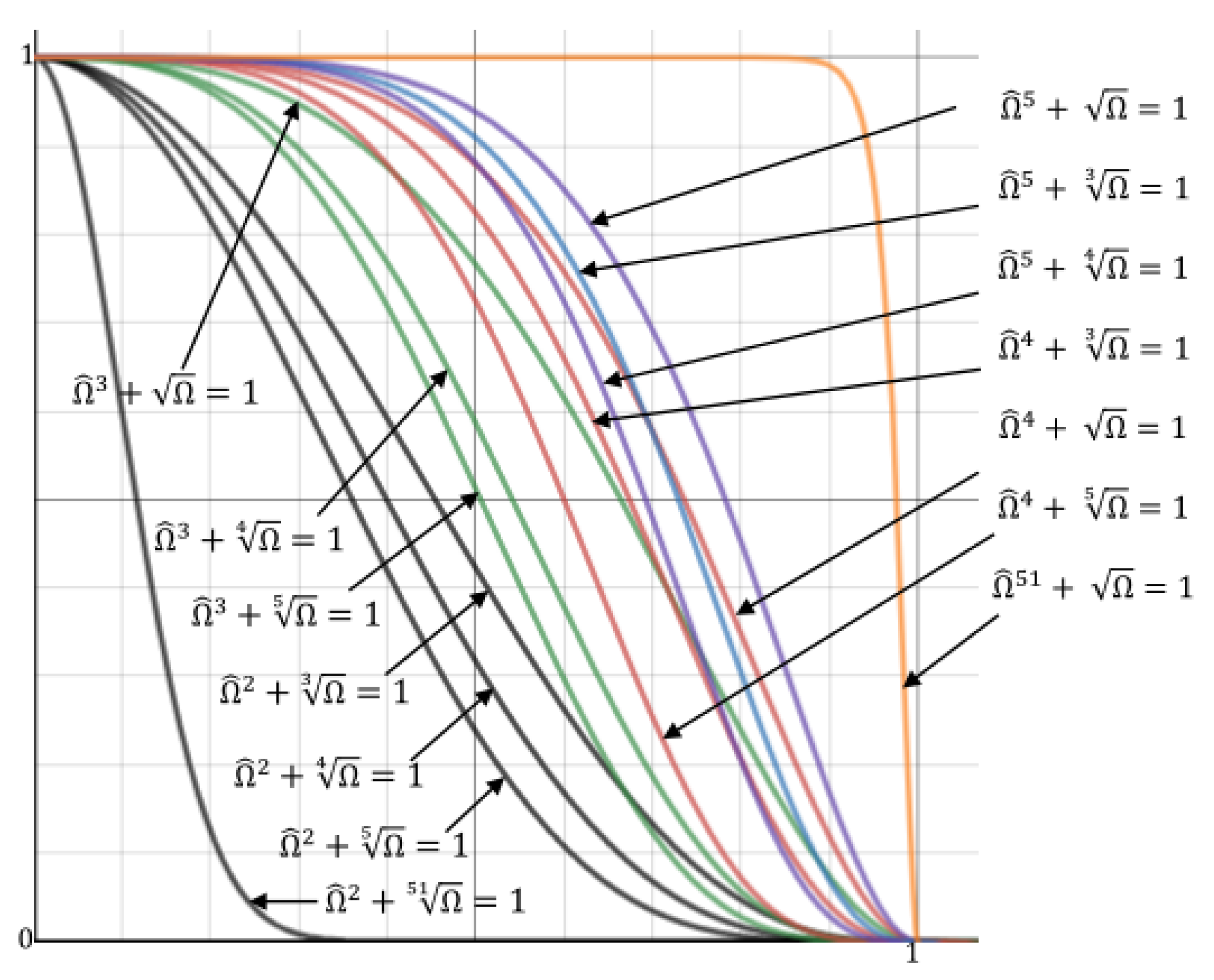
The motives of the current study are summarized as follows: When dealing with two-dimensional uncertainty, n,mPR-FSs have a wider range of applications than IFSs, PFSs, FFSs, and nPR-FSs. To better understand this argument, consider a pair containing membership and non-membership degrees ; then, it is apparent that for and , for example, . But, , for example, and , or and .
Motivated by the above analysis, in this research paper, the notion of nPR-FS is extended to n,mPR-FS, thus allowing more uncertainties to be handled easily, as the order of uncertainty is increased from 1 to the power of the membership degree and 1 to the power of the non-membership degree.
The aims of this study are (1) to offer a novel fundamental operational; (2) to provide alternative score and accuracy functions for comparing n,mPR-fuzzy numbers; (3) to introduce an n,mPR-fuzzy weighted power average aggregation operator and to discuss some of its features; and (4) to present a multi-criteria decision-making technique based on this aggregation operator, which depends on an n,mPR-fuzzy environment.
This research contributes the following:
A number of a fresh operations on n,mPR-FSs are provided and supported with examples;
A real-life multi-criteria decision-making problem, including the choice of an adequate best country for life, is solved using one more effective algorithm that operates in an n,mPR-fuzzy environment;
A comparison of the developed group decision-making method under n,mPR-fuzzy sets with few existing approaches is also given.
This manuscript is formatted as follows. In
Section 2, we present some definitions and results related to this article. In
Section 3, we outline several operations for the n,m-th power root fuzzy set and look into some of their key traits. In
Section 4, we illustrate the idea of a weighted power average operator that is defined across the category of n,m-th power root fuzzy sets. Then, using an empirical example, we discuss the MADM problems that can occur when utilizing this operator. It is clear that one of the n,m-th power root fuzzy set’s main advantages is that it can be used in a wide range of decision-making situations. In
Section 5, we provide a comparative analysis of the proposed FWPA
operator with other popular operators such as the SR-FWPA operator [
15], nPR-FWPA operator [
35], FFWPA operator [
34], and n,m-ROFWPA operator [
16]. In the final section, we summarize the paper’s main achievements and make some recommendations for future research.
The objectives of this study are to provide a novel weighted aggregating operator and analyze its salient features as well as to investigate the MCDM techniques that employ this operator.
3. Several New Operations on n,mPR-FSs
In this section, we suggest a number of fresh operations on n,mPR-FSs and focus on a few of their attributes. Exactly four decimal digits are used for the calculations throughout the full document.
Definition 3. Let , and be n,mPR-FSs. Then,
- 1.
,
- 2.
,
- 3.
, and
- 4.
,
where α is a positive real number.
Example 1. Consider the 3,2PR-FSs and for . Then,
- 1.
- 2.
- 3.
, for .
- 4.
, for .
Theorem 1. If and are n,mPR-FSs, then and are also n,mPR-FSs.
Proof. For n,mPR-FSs
and
, the relationships shown below are clear:
and
implies ,
and
implies .
Since and , then , we obtain , and hence, .
Similarly, we can acquire
It is clear that
Thus, we can acquire
Thus, and are n,mPR-FSs. □
Theorem 2. Let be a n,mPR-FS and . Then, and are n,mPR-FSs.
Proof. Since
,
and
, then
It is clear that
. Then, we have
Hence, and are n,mPR-FSs. □
Theorem 3. Let and be n,mPR-FSs. Then,
- 1.
.
- 2.
.
Proof. □
Theorem 4. Let , and be n,mPR-FSs. Then,
- 1.
.
- 2.
.
Proof. We apply the same strategy as described in (1).
□
Theorem 5. Let , and be n,mPR-FSs. Then,
- 1.
, for .
- 2.
, for .
- 3.
, for .
- 4.
, for .
Proof. □
Theorem 6. Let , and be n,mPR-FSs. Then,
- 1.
.
- 2.
.
- 3.
.
- 4.
.
Proof. Definitions 3 and 2 give us
Thus,
We apply the same strategy as described in (1).
And
Thus,
We apply the same strategy as described in (3).
□
Theorem 7. Let and be n,mPR-FSs, and . Then,
- 1.
.
- 2.
.
Proof. Definitions 2 and 3 give us
This can be demonstrated similarly to (1).
□
Theorem 8. Let , and be n,mPR-FSs, and . Then,
- 1.
.
- 2.
.
- 3.
.
- 4.
.
Proof. Definitions 2 and 3 (3) give us
□
4. n,mPR-Fuzzy Weighted Power Average Operator
Definition 4. Let be a value of n,mPR-FSs and be a weight vector of with , , and . Then, an n,mPR-fuzzy weighted power average (FWPA) operator is a function FWPA, where Example 2. Let and be n,mPR-FSs. If is a weight vector of (i= 1, 2, 3), then
FWPA Theorem 9. Let be a value of n,mPR-FSs and be a weight vector of with and . Then, FWPA is an n,mPR-FS.
Proof. For any n,mPR-FS
, we have
and
Hence,
and then
which implies that
Then, FWPA is an n,mPR-FS. □
Theorem 10. (Boundedness) Let be a number of n,mPR-FSs and be a weight vector of with . Suppose that , , and . Then, Proof. For any
, we can obtain
and
. Then, the inequalities for the membership value are
Similarly, for the non-membership value
Therefore, FWPA. □
Theorem 11. (Monotonicity) Let and be numbers of n,mPR-FSs. If and , then Proof. Since for all i we have and , then and . Therefore,
Theorem 12. (Idempotency) Let be a number of n,mPR-FSs, such that , and let be a weight vector of with . Then, FWPA.
Proof. Since , then FWPA. □
Theorem 13. Let be a value of n,mPR-FSs, be n,mPR-FS, and be a weight vector of with . Then,
FWPA FWPA.
Proof. For any and , we have
and
.
That is,
—(1)
and
.—(2)
Thus, we have
and
Then, from (1) and (2), we obtain
FWPA FWPA.
□
Theorem 14. Let be a value of n,mPR-FSs, be n,mPR-FS, and be a weight vector of with . Then,
- 1.
FWPA FWPA.
- 2.
FWPA FWPA.
Proof. We provide proof of (1). The other assumption is verified in a similar way. Since for any and , we have
—(1)
Similarly,
—(2)
Therefore, from (1) and (2), we have
□
Theorem 15. Let and be values of n,mPR-FSs and be a weight vector of them with . Then,
- 1.
FWPA FWPA.
- 2.
FWPA FWPA
FWPA FWPA.
Proof. For any and , we have
and .
That is,
—(*)
and
.—(**)
Hence, we have
Thus, from (*) and (**) we obtain
FWPA FWPA.
Thus, from (***) and (****), we obtain
□
For the purpose of ranking the n,mPR-FSs, we present the score and accuracy functions of the n,mPR-FS.
Definition 5. Let be an n,mPR-FS. Then,
- 1.
the score of Γ is given as , and
- 2.
the accuracy of Γ is given as .
Example 3. Consider that is an n,mPR-FS. Then, Theorem 16. Let be any n,mPR-FS. Then,
- 1.
.
- 2.
.
Proof. For any n,mPR-FS , we have . Hence, and . Thus, , namely . If , then , and if , then .
The proof is clear.
□
Definition 6. For any n,mPR-FSs , the comparative approach is designed as the following:
- 1.
if , then ,
- 2.
if , then ,
- 3.
if , then
- (a)
if , then ,
- (b)
if , then ,
- (c)
if , then .
Application of n,mPR-fuzzy sets:
The following involves the application of an FWPA operator to MCDM problems in order to evaluate alternatives using n,mPR-fuzzy information. The following steps are generally incorporated within the suggested approach:
Step 1: For an MCDM problem, we build the n,mPR-fuzzy decision matrix containing the values of n,mPR-FSs, where the elements are the appraisals of the alternative regarding the criterion .
Step 2: Create a normalized n,mPR-fuzzy decision matrix from the n,mPR-fuzzy decision matrix .
Step 3: The proposed FWPA operator is used to calculate alternative choice values with related weights.
Step 4: Determine the scores for the n,mPR-FSs values that were acquired in Step 3.
Step 5: The best option can be found by utilizing Definition 6 to establish the optimal ranking order of the alternatives.
We use a real-world example of choosing a particular country utilizing n,mPR-fuzzy data to illustrate the proposed approach. Based on statistical comparisons of each country’s performance on a number of important business, economic, and quality of life variables, the best countries for living can be determined. We can determine the best country for life based on the ten criteria stated below:
Agility: is adaptable, dynamic, responsive, and so on.
Cultural Influence: is culturally significant in terms of entertainment, fashion, influential culture, prestige, and so on.
Open for Business: has cheap manufacturing costs, a favorable tax environment, transparent government practices, and so on.
Social Purpose: cares about human rights, cares about the environment, gender equality, religious freedom, respects property rights, and so on.
Power: a leader, economically influential, has strong exports, has strong international alliances, has strong military services, and so on.
Movers: different, distinctive, dynamic, unique, and so on.
Adventure: friendly, good for tourism, pleasant climate, scenic, and so on.
Heritage: has a rich history, many cultural attractions, many geographical attractions, and so on.
Entrepreneurship: has a skilled labor force, technological expertise, well-developed infrastructure, and so on.
Quality of Life: has a good job market and income equality, is politically stable and safe, and has a well-developed public education system, well-developed public health system, and so on.
The aforementioned criteria were created by grouping country characteristics from the study’s findings that showed comparable global tendencies.
Let be a set of alternatives (countries), where
= Japan,
= Germany,
= Sweden,
= Switzerland,
= Australia,
= Canada,
= United States, and
= United Kingdom.
And, let be a set of criteria for the selection of countries (category), where
= Adventure,
= Agility,
= Cultural Influence,
= Entrepreneurship,
= Heritage,
= Movers,
= Open for Business,
= Power,
= Quality of Life, and
= Social Purpose.
The construction of the n,mPR-fuzzy set decision-making matrix is shown in
Table 1. It is shown that the degree to which country
meets those requirements
is
and the degree to which country
fails to meet those requirements
is
, such that
for
. The following was decided upon as the weight vector for the criteria:
.
is given more importance, while
is given a lower value.
Now, using the weight vectors
,
and
, we use the FWPA
operator in
Table 2, as follows:
Now, as stated in
Table 3, we determine the score value for each option and the rankings are presented in
Table 4.
To show how the parameters
n and
m affected the final results of the MADM, we utilized several values of
n and
m to rank the choices. The outcomes of the ranking of the alternatives based on the FWPA
operator are displayed in
Table 4, as follows:
When and , as a result, we obtained a ranking of options as follows: .
When and , as a result, we obtained a ranking of options as follows: .
When and , as a result, we obtained a ranking of options as follows: .
Thus, the finest option worldwide is Switzerland.





 ,
,