


Abstract
Symmetry is a key part of the study of basic forces and particles, as well as the creation of mathematical models that help scientists in various scientific disciplines understand complex events. Scientists can figure out what a system is made of and how it works by looking at its symmetry. They can then use this information to make predictions and create new materials and technologies. Humanity has conquered many once-fatal diseases due to medical research and technological advancements. Although this progress is encouraging, there are still a great many areas that require continual human efforts. An effort is made in this article to choose the best treatment strategy to completely manage the pandemic of COVID-19 under conjunctive complex fuzzy knowledge. In this paper, the concept of conjunctive complex fuzzy relations is presented and numerous set theoretical aspects of this phenomenon are established. The investigation of this ideology is further expanded to describe different sorts of essential structural conjunctive complex fuzzy relations. Matrix and graphical representations of the formation of these newly specified relations are also provided. Moreover, this concept has been successfully employed to provide a therapy strategy for a rapid recovery from COVID-19. Furthermore, a comparative analysis is conducted to demonstrate the validity and applicability of the suggested approaches compared to existing methods.
1. Introduction
Decision-making is a crucial ability that can have a significant impact on a person’s ability to manage a variety of situations. It entails analyzing available data, evaluating alternatives and selecting the optimal course of action to accomplish a desired outcome. Relations, as a fundamental concept in mathematics, represent the connections of a set of elements in the domain. The structure in which the relationship between elements of two sets is expressed is named as a binary relation. Customarily, the directed graphs and the matrices are the main two ways of representing a relation effectively. One can easily view the existence of this concept in everyday life, for example, in a relationship between an employee and his or her salary, between inflation and economic growth, between efficiency of a treatment method and speedy recovery, and so on. The useful applications of this phenomenon can be seen in decision-making problems, such as determining which city pairs are connected by air flights in a network or finding a viable order for the various stages of a complicated project. The techniques and methods used for reasoning, modeling and computing are in fact exact, deterministic and precise in nature. In general, precision implies that patterns are not vague but are crystal clear. In practice, uncertainty cannot be avoided in real-world problems. In this case, fuzzy logic emerges as a powerful tool to counter these situations. Fuzzy set theory is a mathematical framework that allows for the representation and manipulation of uncertainty and vagueness in decision-making processes, unlike traditional set theory, which classifies objects as either belonging or not belonging to a set. A fuzzy set is defined by a function, known as a membership function, that assigns each element of a universal set a value from [0,1]. These membership degrees indicate gradation and ambiguity, making uncertainty and ambiguity easier to express. The fuzzy set theory has a wide range of applications that have been developed in a variety of different domains. One of the earliest and most well-known applications is in control systems, where fuzzy logic and fuzzy sets have been successfully applied to model and control complex systems. In systems with nonlinear behavior or complicated mathematical models, fuzzy logic is beneficial. Pattern recognition, data mining, decision analysis, optimization, image processing, and natural language processing use this theory. It can manage imprecision and uncertainty, making it suited for subjective or ambiguous information issues.
Many structures, methods and formulations have been introduced to model uncertainty in fuzzy set theory and fuzzy logic. Each of these methods has its own advantages, accompanied by some limitations that leave gaps. The ability to model natural language expressions plays a pivotal role in the success story of fuzzy set theory for practical applications. An important part of this structure is devoted to the representation of linguistic modifiers. Such a description is called a fuzzy relation. Fuzzy relations have applications in diverse types of areas, for example, in databases, pattern recognition, neural networks, fuzzy modeling, economy, medicine and multi-criteria decision-making. Furthermore, in the problems of diagnosis of diseases, where physical mechanisms are not well-known due to high complexity and nonlinearity, complex fuzzy relations are preferred to solve these cases. These relations play a key role in dealing with some decision-making problems in social and human sciences. Complex fuzzy relations are widely applied; in multi-attribute decision-making problems. These relations are taken into account and applied in group decision-making problems where solutions from individual preferences about some set of options are derived; this is an effective approach in dealing with decision-making in medical diagnosis.
In 1965, Zadeh introduced the fundamental concepts of fuzzy sets [1], establishing the groundwork for their definition and implementation. Following Zadeh’s seminal work, Rosenfeld [2] expanded upon these concepts by proposing the notion of fuzzy subgroups, thereby generalizing the classical group theory. In [3], Das obtained a characterization of all fuzzy subgroups of cyclic groups of finite order by studying “level subgroups” of a fuzzy subgroup, building upon the concept of fuzzy sets and fuzzy groups introduced by Zadeh and Rosenfeld, respectively. References [4,5,6,7,8,9,10] provide extensive research works on fuzzy subgroups. These works offer detailed insights and analyses in this area of study. Bhattacharya and Mukherjee [11] examined the conditions under which a fuzzy relation can be classified as a fuzzy subgroup within a given group, establishing that a fuzzy subset assumes the role of a fuzzy subgroup if its strongest fuzzy relation also satisfies the criteria of a fuzzy subgroup. In [12], Bustince and Burillo analyze the structures of intuitionistic fuzzy relations and investigate the connections between the structures of a relation and its complementary one. They also provide a characterization of specific structures of intuitionistic relations based on two particular fuzzy relations. The idea of interval-valued fuzzy relations was discussed by same authors in [13]. The study [14] presented by Barbara Pekala investigates the properties of Atanassov’s intuitionistic fuzzy relations and their relationship with Atanassov’s operators. Fan [15] conducted an investigation on the decomposition theorems of fuzzy relations, exploring their fundamental properties and implications. This area of research has garnered considerable attention in recent years due to its successful application in various domains. For instance, the use of fuzzy relations has proven effective in disease prediction models [16], neural network modeling [17], solving linear Diophantine equations [18] and modeling Dempster–Shafer belief structures [19]. These applications highlight the versatility and practical relevance of the theory. In 1989, Buckley [20] pioneered the study of complex fuzzy numbers, which extend the traditional notion of fuzzy numbers to include complex components. Subsequently, he developed a comprehensive analysis of these numbers within the framework of derivation and integration, as presented in [21,22]. Ramote et al. (2002) introduced the concept of complex fuzzy sets (CFS) and conducted an extensive investigation on two novel operations, namely, reflection and rotation [23]. This work laid the foundation for further exploration and utilization of complex fuzzy relations in various domains. Building upon Ramote et al.’s work, Das (2011) innovatively extended the concept of complex fuzzy relations by introducing the notion of complex fuzzy relations [24]. Abd Ulazeez et al. [25] further developed the concept of the intuitionistic fuzzy relation, which extended the traditional fuzzy relation to capture the hesitancy and indeterminacy in decision-making processes. Yousef and Nasruddin (2018) proposed the idea of complex multi-fuzzy relations specifically tailored for decision-making problems [26]. The concept of -equalities of complex fuzzy relations was introduced by Guangquan in 2020 [27]. This concept provided a measure of similarity between complex fuzzy relations, facilitating comparative analysis and similarity-based reasoning in complex systems. In subsequent studies, M. Khan et al. (2021) explored the various types of complex fuzzy relations and their potential applications in the future commission market [28]. Furthermore, the authors discussed the complex T-spherical fuzzy relations and their applications in economic relationships and international trades in [29]. They investigated cybersecurity and cybercrimes in the oil and gas sectors using the innovative structures of complex intuitionistic fuzzy relations in [30]. Additionally, they explored medical diagnosis and the life span of sufferers using interval-valued complex fuzzy relations in [31]. They also examined cybersecurity against loopholes in industrial control systems using interval-valued complex intuitionistic fuzzy relations in [32]. They conducted an analysis of communication and network security using the concepts of complex picture fuzzy relations in [33]. In the context of COVID-19 forecasting, Xian (2023) developed an algorithm for fuzzy time series forecasting of COVID-19 [34]. Verma (2023) presented applications of fuzzy time series models in predicting the spread of COVID-19 [35]. Castillo (2023) proposed a novel technique for forecasting COVID-19, aiming to improve accuracy and reliability in predicting the spread of the disease [36]. Wang Y. et al. (2023) provided methods for detecting COVID-19 patients using interval-valued T-spherical fuzzy relations and information measures [37]. Modernistic applications of the fuzzy set can be seen in [38,39,40].
The fuzzy set and its generalizations are important tools for modeling decision-making problems. Although FS is a successful tool for modeling one-dimensional information, it is not suitable for modeling two-dimensional information. In this case, the idea of the complex fuzzy set emerges as a useful strategy to counter two-dimensional information. Conjunctive complex fuzzy sets provide a parameterization element to the classical fuzzy set and complex fuzzy set theories to control data errors. This adaptable paradigm for handling two-dimensional ambiguity and vagueness in decision-making is successful. Due to uncertainty and imprecision in complicated fuzzy logic, decision-making tasks may be difficult. Complex fuzzy relations use two-dimensional degrees of membership to handle ambiguous information. This method can handle complicated decision-making settings where binary fuzzy logic fails. In decision-making problems, complex fuzzy relations are used to model the relationships between input and output variables, allowing decision-makers to analyze and evaluate different options based on multiple criteria.
The main thrust of this study is concentrated on the development of a suitable optimization framework in which the decomposition problem is formulated and solved numerically. The present study stands out from the others because of its novel methodology as it facilitates the decision-makers to make the best decision about a certain physical phenomenon on the basis of the selection of the most suitable value of the parameter. Moreover, this unique ability makes the proposed method more prominent than the other previously developed strategies, as these strategies become a special case of our method for a particular value of the parameter.
The uppermost aim of this article is to choose an efficient treatment method for a speedy recovery of COVID-19 patients under a conjunctive complex fuzzy environment. This article is the first to analyze the epidemic within the context of the concept of conjunctive complex fuzzy knowledge, as no previous research has explored this area of study. This research breaks new ground by investigating the application of CCFR to comprehend and address the epidemic’s complexities.
The following are some of the most important goals that we want to accomplish in this present study:
- Initiate the concepts of the CCFR and describe the key varieties of this newly defined concept. This will introduce a number of various essential structural types and then demonstrate their construction through the use of matrix and graphical representations. This will need substantial mathematical study and formal proofs of this type’s relevance.
- Use the new way to choose a COVID-19 therapy that works fast. The method will be used to handle real-world challenges like treating COVID-19.
- Compare the suggested approach to current techniques to show its effectiveness. This will entail comparing the validity of the suggested approach to that of existing methods, utilizing actual data sets and scenarios.
The rest of the work is as follows: in Section 2, we review the preliminary knowledge and basic concepts of the complex fuzzy set (CFS). In Section 3, we introduce the notions of the conjunctive complex fuzzy relation and the composition of conjunctive complex fuzzy relations and give some key examples of these concepts for better understanding. In Section 4, we investigate fundamental structural types of conjunctive complex fuzzy relations and present their constructions by means of matrix and graphical representations. In Section 5, we develop a mechanism to select an efficient treatment method for the speedy recovery from COVID-19 in the framework of a conjunctive complex fuzzy environment. Finally, a comparative analysis is presented to illustrate the validity and feasibility of this new strategy with existing methods.
2. Preliminaries
2.1. Abbreviations
In Table 1, we present a comprehensive list of terms and their corresponding abbreviations utilized in the research outlined within this article.

Table 1.
Abbreviation Table.
2.2. Some Fundamental Concepts
This section contains a brief review of the notion of the complex fuzzy set and related ideas which are quite essential to understand the novelty of this article.
Definition 1.
Ref. [21]: A complex fuzzy relation is a CFS of the product space and is characterized by the complex membership function , which assigns to each pair a complex-valued membership grade. In other words,
Definition 2.
Ref. [21]: A complex fuzzy relation is said to be:
- Complex fuzzy reflexive if contains all pairs of the form for any of .
- Complex fuzzy symmetric if
- Complex fuzzy transitive if
Definition 3.
Ref. [22]: Let be a CFS of a universe and be an element of a unit circle with and . The CFS is called the conjunctive complex fuzzy set (CCFS) with respect to CFS and is written as:
3. Set Theoretical Properties of Conjunctive Complex Fuzzy Relations
This section introduces conjunctive complex fuzzy relations and their composition. We also provide important types of this newly defined notion and analyze their relevance by demonstrating numerous basic characteristics of these concepts.
Definition 4.
A conjunctive complex fuzzy relation (CCFR) is a CCFS of the product space and is characterized by the complex membership function , which assigns to each pair a complex-valued membership grade. In other words,
Definition 5.
A CCFR is a CCFS of the product space and is characterized by the complex membership function , which assigns to each pair a complex-valued membership grade. In other words,
For convenience, the collection of all CCFR is denoted by , and any of its elements are represented by .
The following example illustrates a useful application of the concept of conjunctive complex fuzzy relations by which one can obtain the true shade of a required color.
Example 1.
Consider a universal set X consisting of three colors
We want to mix any two colors of the universe in such a way that we obtain the royal sapphire color. Study shows that the true shade of the royal sapphire color is obtained by mixing a certain ratio of the green color into purple color. Let the symbols and represent the elements of the universe and represent the true shade of the royal sapphire color. The mathematical representation of this situation is described as follows:
In order to obtain the true shade of the royal sapphire color, we reduce the certain ratio of the green color in the above situation by applying the parameter . Let denote the true shade of the required color for the value of parameter . The mathematical representation of the relation is interpreted as follows:
The above discussion shows that the true shade of the required color is obtained in the framework of CCFR. The matrix and graphical representations of the above physical phenomenon are depicted in Table 2 and Figure 1, respectively.
Table 2.
Matrix representation of the true shade of royal sapphire color.
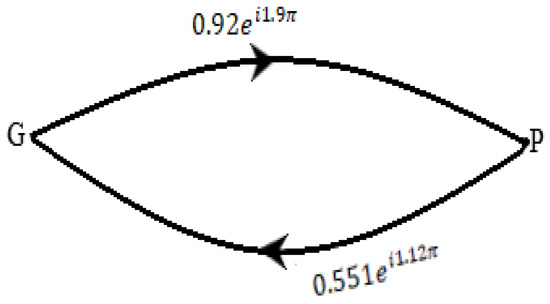
Figure 1.
Diagrammatic view of true shade of the required royal sapphire color.
Definition 6.
The standard set operations on any two CCFRs and are given below:
- (1)
- .
- (2)
- .
- (3)
- for all .
Example 2.
The matrix representations of two complex fuzzy relations and on the universe are represented in Table 3 and Table 4.
Table 3.
Matrix representation of complex fuzzy relation .
Table 4.
Matrix representation of complex fuzzy relation .
The matrix representation of two CCFRs and relative to are given in Table 5 and Table 6, respectively.
Table 5.
Matrix representation of conjunctive complex fuzzy relation .
Table 6.
Matrix representation of conjunctive complex fuzzy relation .
In view of Definition 6, the union of and is obtained in Table 7.
Table 7.
Matrix representation of .
In view of Definition 6, the intersection of and is obtained in Table 8.
Table 8.
Matrix representation of .
In view of Definition 6, the compliment of is obtained in Table 9.
Table 9.
Matrix representation of .
Definition 7.
- (1)
- The conjunctive complex fuzzy empty relation is characterized by the following complex membership function: for all .
- (2)
- The conjunctive complex fuzzy identity relation on is described by the following complex-valued membership function: for all .
Remark 1.
For each , and .
Example 3.
The above algebraic facts can easily be observed from Example 2.
Definition 8.
The conjunctive complex fuzzy inverse relation of is defined as The subsequent identities are obvious observations from the above definition:
- .
- .
Proposition 1.
The following characteristics are satisfied in
:
- 1.
- .
- 2.
- .
- 3.
- .
- 4.
- and .
- 5.
- and .
- 6.
- If , then .
- 7.
- If and , then .
- 8.
- If and , then .
- 9.
- If then and .
- 10.
- and .
Proof.
- 1.
- The Proof is obvious.
- 2.
- In view of Definition 8, for any we have
It follows that .
- 3.
- It is easy to prove.
- 4.
- We establish the required inclusion in the following two cases:
Case I: If ,
then .
It follows that
Case II: If ,
then we have .
It follows that
Combining relations (1) and (2), we obtain
- 5.
- The Proof is trivial.
- 6.
- The Proof demonstrates the point effectively.
- 7.
- By using the given conditions that and , we have
It follows that
- 8.
- The Proof is obvious.
- 9.
- By applying the given condition that , we have
It follows that
- 10.
- .
Hence, . □
Definition 9.
The composition of CCFRs and is characterized by the following complex-valued membership function:
Example 4.
In view of Example 2, the composition of conjunctive complex fuzzy relations and is obtained in Table 10.
Table 10.
Matrix representation of .
Proposition 2.
The CCFRs and admit the following properties:
- If , then .
- .
Proof.
- In the light of Definition 9 and using the fact that , we have
It follows that .
- 2.
- In the application of Definition 8, for any we have
It follows that □.
Remark 2.
The CCFR obeys the associative property and the distributive properties in the framework of Definition 9, whereas they do not preserve the commutative law. This algebraic fact is illustrated in the subsequent example.
Example 5.
Table 10 in Example 4 illustrates the outcomes of
. Table 11 describes the numeric values of the relation .
Table 11.
Matrix representation of .
Clearly, .
4. Structural Types of Conjunctive Complex Fuzzy Relations
In this section, we introduce some fundamental structural types of conjunctive complex fuzzy relations and present their constructions by means of matrix and graphical representations. Moreover, we highlight the significance of the study of these types by proving their many useful key attributes.
Definition 10.
The CCFR of is said to be a conjunctive complex fuzzy reflexive relation (CCFRR) if contains all pairs of the form for any of . The class of all CCFRR relations is denoted by .
Definition 11.
The CCFR of is said to be a conjunctive complex fuzzy irreflexive relation if does not contains any pair of the form for any of .
Definition 12.
The CCFR of is said to be a conjunctive complex fuzzy not reflexive relation if does not contain all pairs of the form for any of .
The following example interprets the above-stated algebraic facts.
Example 6.
Consider the CCFRs stated in Table 4 of Example 2.
- The CCFRR relation is obtained as follows:
- The conjunctive complex fuzzy irreflexive relation is obtained as follows:
- The conjunctive complex fuzzy not reflexive relation is obtained as follows:
The matrix and graphical representations of the above CCFRs are described in Table 12 and Figure 2, respectively.
Table 12.
Matrix representation of conjunctive complex fuzzy reflexive relation.
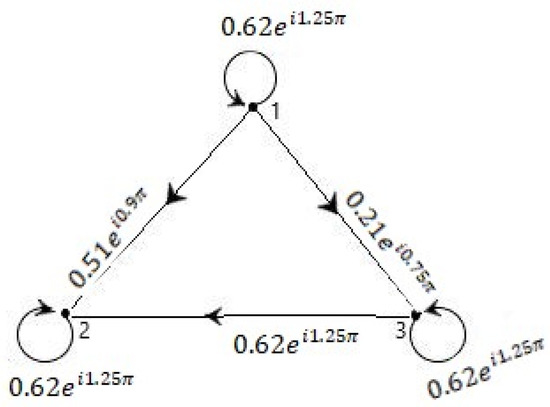
Figure 2.
Directed graph of conjunctive complex fuzzy reflexive relation.
The matrix and graphical representations of the above CCFRs are described in Table 13 and Figure 3, respectively.
Table 13.
Matrix representation of conjunctive complex fuzzy irreflexive relation.
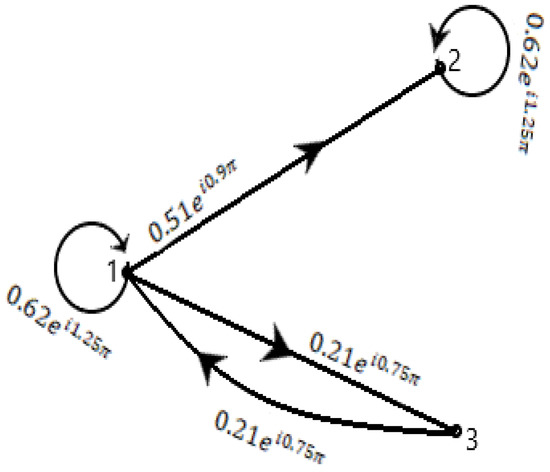
Figure 3.
Directed graph of conjunctive complex fuzzy irreflexive relation.
The matrix and graphical representations of the above CCFRs are described in Table 14 and Figure 4, respectively.
Table 14.
Matrix representation of conjunctive complex fuzzy not reflexive relation.
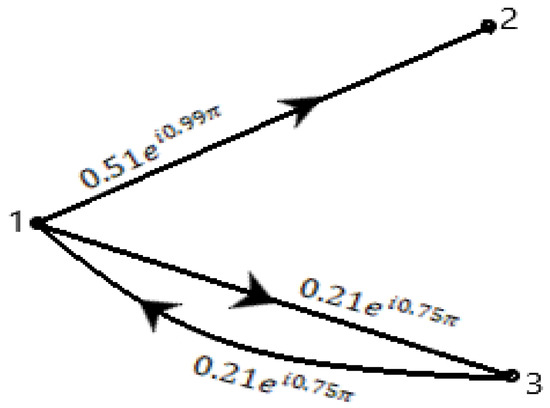
Figure 4.
Directed graph of conjunctive complex fuzzy not reflexive relation.
Definition 13.
The CCFR of is said to be a conjunctive complex fuzzy symmetric relation (CCFSR) if its complex-valued membership function satisfies the following property: .
The class of all CCFSRs is denoted by .
Definition 14.
The CCFR of is said to be a conjunctive complex fuzzy antisymmetric relation if its complex-valued membership function satisfies the following property: for all .
Example 7.
Consider the CCFRs stated in Table 4 of Example 2.
- The CCFSR is obtained as follows: , .
- The conjunctive complex fuzzy antisymmetric relation is obtained as follows: .
The matrix and graphical representations of the above CCFRs are described in Table 15 and Figure 5, respectively.
Table 15.
Matrix representation of conjunctive complex fuzzy symmetric relation.
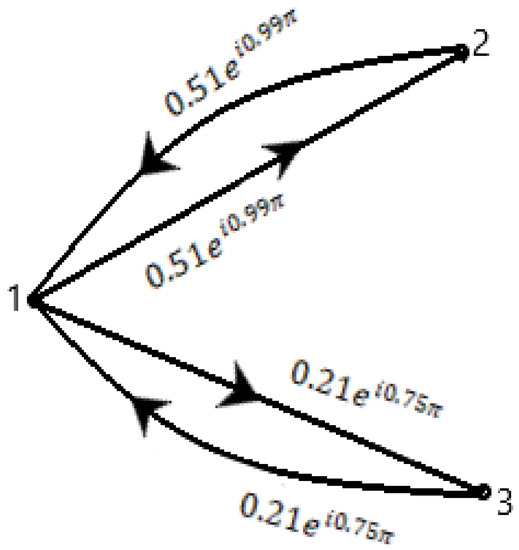
Figure 5.
Directed graph of conjunctive complex fuzzy symmetric relation.
The matrix and graphical representations of the above CCFRs are described in Table 16 and Figure 6, respectively.
Table 16.
Matrix representation of conjunctive complex fuzzy antisymmetric relation.
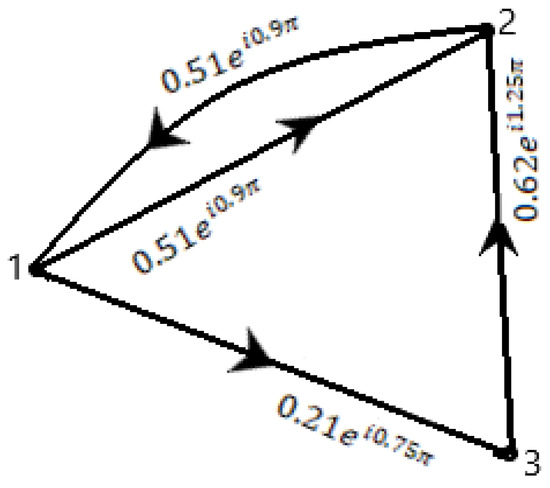
Figure 6.
Directed graph of conjunctive complex fuzzy antisymmetric relation.
Definition 15.
The CCFR of is said to be a conjunctive complex fuzzy transitive relation (CCFTR) if its complex-valued membership function satisfies the following property: . The class of all CCFTR is denoted by .
The following example interprets the above-stated algebraic fact.
Example 8.
Consider the CCFR stated in Table 5 of Example 2.
The CCFTR is obtained as follows:
Table 17.
Matrix representation of conjunctive complex fuzzy transitive relation.
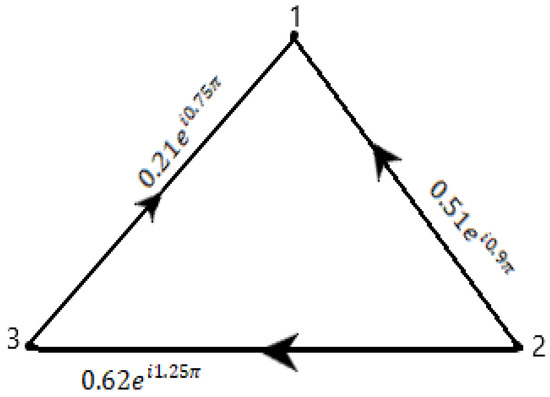
Figure 7.
Directed graph of conjunctive complex fuzzy transitive relation.
Proposition 3.
Every complex fuzzy relation admits the following properties:
- Every CFRR is a CCFRR.
- Every CFSR is a CCFSR relation.
- Every CFTR is a CCFTR.
Proof.
- One establishes in the framework of the application of Definition 2 and 10:
- The application of Definition 4 and using the fact described in Definition 3 on any CFR gives
It follows that .
- 3.
- The application of Definition 4 and using the fact described in Definition 3 on any CFR gives
This shows that . □
Proposition 4.
For any , then .
Proof.
In view of Definition 10 and using the given condition, for any element we have
In the subsequent result, we inaugurate a condition of existence of CCFSR. □
Proposition 5.
if and only if
.
Proof.
By applying Definition 13 on any we have . □
By using Definition 8 in the above equation, it yields
It follows that , .
Conversely, suppose , then In view of Definition 8, the above relation becomes .
Proposition 6.
For any , then .
Proof.
In view of Definition 13, we have and
Consider
It follows that .
Consequently, □.
Remark 3.
The composition of two CCFSRs may not be a CCFSR. The following example describes this fact.
Example 9.
Table 18.
Matrix representation of complex fuzzy symmetric relation .
Table 19.
Matrix representation of complex fuzzy symmetric relation .
The matrix representation of the CCFSRs and corresponding to the value are obtained in Table 20 and Table 21, respectively.
Table 20.
Matrix representation of conjunctive complex fuzzy symmetric relation .
Table 21.
Matrix representation of conjunctive complex fuzzy symmetric relation .
In view of Definition 9, the matrix representation of is given in Table 22.
Table 22.
Matrix representation of .
Note that .
Hence .
In the following result, we investigate a condition under which the composition of two conjunctive complex fuzzy symmetric relations is a conjunctive complex fuzzy relation.
Proposition 7.
if and only if .
Proof.
Suppose . In light of Proposition 4, we have
It follows that .
Consequently, .
Conversely, suppose . This implies that . □
In view of Proposition 4, we have .
It follows that .
In the subsequent result, we evaluate the condition of the existence of a conjunctive complex fuzzy transitive relation.
Proposition 8.
if and only if
Proof.
In view of Definition 15 and using the assumption that we have , then
This implies that .
Conversely, in view of Definition 9 and using the assumption, we have
In the light of Definition 15, the above relation yields the following arguments: . □
Proposition 9.
The inverse of a CCFTR is a CCFTR.
Proof.
For the application of Definition 8 for any CCFTR we have
By using Proposition 8 in the above equation, we obtain
Thus, .
Hence, .
Consequently, . □
Proposition 10.
The intersection of two CCCFTRs is CCFTR f
, then .
Proof.
In the application of Definition 9, for any two CCFTRs and we have
Thus,
By using Proposition 8 in the above equation, we obtain
Consequently, .
This proves the required result. □
Remark 4.
For any two and , .
Example 10.
Table 23.
Matrix representation of complex fuzzy transitive relation .
Table 24.
Matrix representation of complex fuzzy transitive relation .
The matrix representations of CCFTRs and relative to are obtained in Table 25 and Table 26, respectively.
Table 25.
Matrix representation of conjunctive complex fuzzy transitive relation .
Table 26.
Matrix representation of conjunctive complex fuzzy transitive relation .
In view of Definition 6, the matrix representation of is shown in Table 27.
Table 27.
Matrix representation of .
Note that in the light of Proposition 8, we have the following consequence:
Definition 16.
A CCFR is said to be a conjunctive complex fuzzy equivalence relation (CCFER) if is a conjunctive complex fuzzy reflexive, symmetric and transitive relation.
Example 11.
Table 4 of Example 2 describes that is a conjunctive complex fuzzy equivalence relation.
Proposition 11.
If is a CCFER relation, then .
Proof.
By applying Proposition 8 and using the given condition, we have
Moreover, consider
This implies that
Consequently,
By comparing (3) and (4), we obtain the required equality. □
In the subsequent result, we investigate a condition under which the composition of two conjunctive complex fuzzy equivalence relations is a conjunctive complex fuzzy equivalence relation.
Proposition 12.
For any two conjunctive complex fuzzy equivalence relations
. is a conjunctive complex fuzzy equivalence relation if and only if
.
Proof.
Suppose . The conjunctive complex fuzzy reflexive and symmetric properties follow in the framework of and . Moreover, in view of Remark 2, we have
It follows that .
By applying the conjunctive complex fuzzy transitive property of and in the above equation, it yields:
In the light of Proposition 8, we have the required result.
In view of Remark 3 and Proposition 8, we can easily prove the converse statement. □
Definition 17.
For any element and a CCFER , then the conjunctive complex fuzzy equivalence class of by is denoted by and is defined as .
Remark 5.
The significance of the above concept is interpreted as it partitions the universe into the disjoint union of conjunctive complex fuzzy equivalence classes. This approach facilitates our study of the behavior of a physical situation under a conjunctive complex fuzzy environment in much better way.
The subsequent example highlights the above-stated concept.
Example 12.
The CFER on the universe
is represented in Table 28.
Table 28.
Matrix representation of complex fuzzy equivalence relation .
The matrix representation of the CCFER corresponding to is obtained in Table 29.
Table 29.
Matrix representation of conjunctive complex fuzzy equivalence relation .
The conjunctive complex fuzzy equivalence class of by 1 is given by
The conjunctive complex fuzzy equivalence class of by 3 is given by
5. Selection of an Efficient Treatment Method for a Speedy Recovery from COVID-19 under Conjunctive Complex Fuzzy Knowledge
This section focuses on analyzing the highlighted issues related to COVID-19. The analysis is based on the cause of the disease, its symptoms and the diagnosis and treatment of the patient. The concept of CCFR is applied to suggest an efficient treatment method for a speedy recovery from COVID-19 based on mathematical strategies.
Since the inception of the COVID-19 pandemic in 2019, several serious efforts were made to find the treatment methods to cure the affected patients from this disease. The medical analysis of the patients indicated the fatal symptoms of this disease, specifically, intermittent fever, remittent fever, productive cough, sore throat and pain in head. Due to these symptoms, the death rate of patients significantly increases within six months of its outset. This situation created uproar throughout the world. However, the most strenuous and continuous human efforts resulted in the formulation of several treatment methods to counter this disaster.
Intravenous remdesivir, molnupiravir, Interferons and ivermectin are thought to be useful and affective treatment methods. In the following discussion, we design a mathematical strategy to choose which one of the mentioned treatment methods is more efficient for a speedy recovery from this disease under a CCFS environment. The following example works based on hypothetical data, but if real data are used, it can lead to useful results and help streamline hospital workflow by minimizing human error and misdiagnosis issues.
Step 1: The main focus of this section is to highlight the significance of the CCFS in order to choose the most efficient treatment methods from intravenous remdesivir, molnupiravir, interferons and ivermectin to recover from COVID-19. Table 30 describes a set of four ranges, namely, serious, moderate, low and no COVID, depending on the condition of the disease.
Table 30.
Ranges to evaluate the efficiency of a treatment method.
Step 2: The medical conditions of the patients {} are initially translated into mathematical syntax with the aid of medical personnel. Table 31 depicts a diagnostic map that describes the distinct COVID-19 symptoms in each patient. In Table 31, the symbols ,,, and describe intermittent fever, remittent fever, productive cough, sore throat and pain in head, respectively. These details are organized in the framework of the CFS, where each real part of the CFS represents the amplitude term and each imaginary part represents the phase term.
Table 31.
Distinct COVID-19 symptoms of each patient.
In Figure 8, each amplitude term is represented by a blue column, whereas each phase term is represented by a red column.
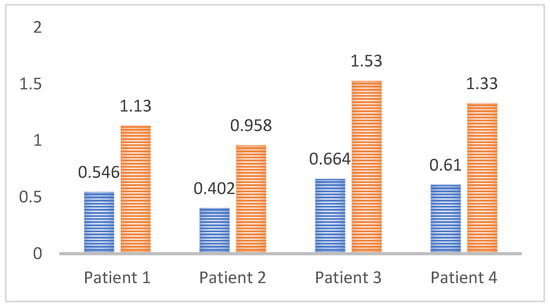
Figure 8.
Diagnostic map of distinct COVID-19 symptoms.
Step 3: The intravenous remdesivir is applied to , molnupiravir to , interferons to and Ivermectin to . Table 32 illustrates the recovery rate of each patient with respect to the parameter , where the parameter represents the rate of efficiency of the treatment method. These details are obtained in the form of a CCFS.
Table 32.
Recovery rate of each patient.
The recovery rate of each patient with respect to the parameter is shown in Figure 9.
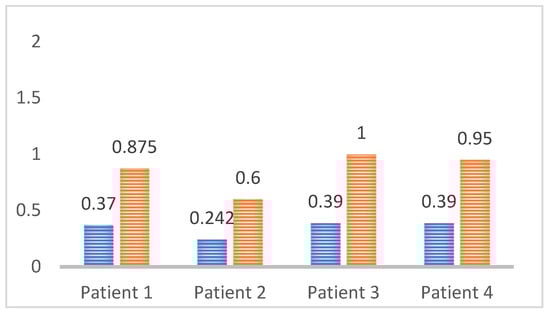
Figure 9.
Recovery rate of each patient with respect to the parameter .
Step 4: Moreover, we convert each entry of Table 32 into a real value by applying the following weighted formula:
where and are amplitude and phase terms in the CCFS, respectively. and are the weights for the amplitude terms and the phase terms, respectively.
We determine the average of all the aspects from Table 33 that correspond to each individual symptom. Table 34 describes the rate of efficiency of each treatment method.
Table 33.
Average output corresponding to symptoms of each patient.
Table 34.
Rate of efficiency of each treatment method.
Figure 10 depicts the efficiency rate of each treatment method.
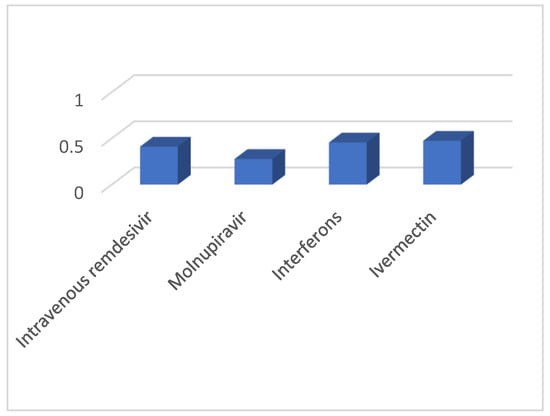
Figure 10.
Rate of efficiency of treatment methods.
Step 5: By comparing Table 30 and Table 34, we conclude that molnupiravir is the most efficient treatment method for a speedy recovery from COVID-19.
Comparative Analysis
In the next part of the discussion, a comparative analysis is conducted to demonstrate the efficacy and viability of the proposed method. The following Table 35 shows a comparison between our methods and those that already exist, namely, fuzzy logic, complex fuzzy logic and conjunctive complex fuzzy logic.
Table 35.
A comparative analysis of the existing approaches and the proposed conjunctive complex fuzzy logic.
The significant contributions of the comparative study between the recently proposed mechanism and the existing strategies are given below:
- Like fuzzy logic, the previous strategies give an ordinary solution based only on membership value instead of this complex fuzzy logic based solution, which is preferable to a fuzzy approach. However, it is difficult to improve the optimization of the recovery rate due to the limitations of its structure, whereas conjunctive complex fuzzy logic gives the best solution, which enhances the recovery rate by selecting the parametric value.
- The recently proposed approach possesses a distinct advantage over other methods, primarily due to its exceptional ability to effectively handle the interdependencies and interactions among arguments. This is an aspect that other methods struggle to address adequately.
- The newly developed method is more general in nature and offers a flexible solution that can be applied to a wide variety of situations, unlike other approaches that may be limited to specific contexts or circumstances. Moreover, this recently developed technique provides a comprehensive framework that can be adapted and utilized in a variety of domains.
- It is quite evident from the above discussion that multiple attribute decision-making problems are much easier to solve with the suggested method. The available evidence strongly supports the conclusion that the proposed approach is the best and most efficient way to deal with such complex situations, as it allows the decision-maker to select from a range of suitable values of the parameter in order to make an appropriate decision about a specific physical situation.
6. Conclusions
Some of the main objectives that have been achieved in this research work are expressed as the various novel concepts of conjunctive complex fuzzy relations that have been introduced; many important characteristics of these newly defined notions have been established. The conjunctive complex fuzzy environment was effectively used to design an efficient mechanism for a speedy recovery from COVID-19, and a comparative analysis was presented to demonstrate the efficacy of the proposed technique in comparison to existing methods. Moreover, the composition of any two CCFRs has been defined, and the key attributes of this phenomenon have been investigated. Additionally, essential structural types of conjunctive complex fuzzy relations have been identified, emphasizing the significance of these concepts through their diverse applications. Furthermore, a mathematical framework for selecting an efficient treatment strategy for COVID-19, utilizing the concept of conjunctive complex fuzzy relations, has been proposed. Finally, a comparative analysis has been conducted to demonstrate the validity and applicability of the suggested approaches compared to existing methods. It is important to note that the recently developed method has been proven to be more effective than previous strategies, such as fuzzy logic, which generates ordinary responses based solely on membership values. Instead of this, a complex fuzzy logic based solution is preferable to a fuzzy approach. However, it is difficult to improve the optimization of the recovery rate due to the limitations of its structure, whereas the application of conjunctive complex fuzzy logic provides an optimal strategy that substantially enhances the recovery rate by taking the parametric value into account. Looking ahead, there are plans to extend the application of conjunctive complex fuzzy relations to other fields, such as neural networks and cryptography. By applying this concept across various domains, the aim is to enhance our understanding of its potential utility and contribute to advancements in these respective fields. The main limitation of this study is its computational complexity. Modeling complex systems with complex fuzzy sets can demand substantial computational and memory resources. In addition, it can be difficult to devise membership functions for complex fuzzy sets, and the results may be highly sensitive to parameter selection. A further limitation is the difficulty in interpreting the results of conjunctive complex fuzzy logic models, which may require expert knowledge and can be less intuitive than conventional mathematical models. Our future efforts will primarily focus on addressing the limitations mentioned above by creating a comprehensive instrument for decision analysis that integrates the linear conjunctive operator. In addition, one of the future aims will be to increase the applicability and utility of this instrument in real-world situations. Moreover, the approach proposed in this article will be adapted to address multi-attribute decision-making problems in a variety of domains, such as image processing, cybersecurity and neural networks.
Author Contributions
Conceptualization, G.A. and A.R. (Abdul Razaq); methodology, M.I.F. and U.S.; validation, G.A. and A.R. (Asima Razzaque); formal analysis, M.I.F., G.A., I.M. and A.R. (Abdul Razaq); investigation, A.I. and A.R. (Asima Razzaque); resources, I.M.; data curation, A.I. and I.M.; writing—original draft preparation, A.I.; writing—review and editing, A.R. (Abdul Razaq); visualization, U.S.; supervision, U.S.; funding acquisition, A.R. (Asima Razzaque). All authors have read and agreed to the published version of the manuscript.
Funding
This work was supported by the Deanship of Scientific Research, Vice Presidency for Graduate Studies and Scientific Research, King Faisal University, Saudi Arabia [Grant No. 3749].
Data Availability Statement
No data were used to support this study.
Conflicts of Interest
The authors declare no conflict of interest.
References
- Zadeh, L.A. Fuzzy sets. Inf. Control 1965, 8, 338–353. [Google Scholar] [CrossRef]
- Rosenfeld, A. Fuzzy groups. J. Math. Anal. Appl. 1971, 35, 512–517. [Google Scholar] [CrossRef]
- Das, P.S. Fuzzy groups and level subgroups. J. Math. Anal. Appl. 1984, 84, 264–269. [Google Scholar] [CrossRef]
- Mukherjee, N.P.; Bhattacharya, P. Fuzzy normal subgroups and fuzzy cosets. Inf. Sci. 1984, 34, 225–239. [Google Scholar] [CrossRef]
- Mashour, A.S.; Ghanim, H.; Sidky, F.I. Normal fuzzy subgroups. Ser. Mat. 1990, 20, 53–59. [Google Scholar]
- Ajmal, N.; Jahan, I. A study of normal fuzzy subgroups and characteristic fuzzy subgroups of a fuzzy group. Fuzzy Inf. Eng. 2012, 4, 123–143. [Google Scholar] [CrossRef]
- Gulzar, M.; Alghazzawi, D.; Mateen, M.H.; Kausar, N. A certain class of t-intuitionistic fuzzy subgroups. IEEE Access 2020, 8, 163260–163268. [Google Scholar] [CrossRef]
- Gulzar, M.; Mateen, M.H.; Alghazzawi, D.; Kausar, N. A novel applications of complex intuitionistic fuzzy sets in group theory. IEEE Access 2020, 8, 196075–196085. [Google Scholar] [CrossRef]
- Emniyet, A.; Şahin, M. Fuzzy normed rings. Symmetry 2018, 10, 515. [Google Scholar] [CrossRef]
- Şahin, S.; Kısaoğlu, M.; Kargın, A. In Determining the Level of Teachers’ Commitment to the Teaching Profession Using Classical and Fuzzy Logic. In Neutrosophic Algebraic Structures and Their Applications; SSRN: Rochester, NY, USA, 2022; p. 183. [Google Scholar]
- Bhattacharya, P.; Mukherjee, N.P. Fuzzy relations and fuzzy groups. Inf. Sci. 1985, 36, 267–282. [Google Scholar] [CrossRef]
- Bustince, H.; Burillo, P. Structures on intuitionistic fuzzy relations. Fuzzy Sets Syst. 1990, 78, 293–303. [Google Scholar] [CrossRef]
- Bustince, H.; Burillo, P. Mathematical analysis of interval-valued fuzzy relations: Application to approximate reasoning. Fuzzy Sets Syst. 2000, 113, 205–219. [Google Scholar] [CrossRef]
- Pe, B. Properties of Atanassov’s intuitionistic fuzzy relations and Atanassov’s operators. Inf. Sci. 2012, 213, 84–93. [Google Scholar]
- Fan, H.; Feng, J.E.; Meng, M.; Wang, B. General decomposition of fuzzy relations: Semi-tensor product approach. Fuzzy Sets Syst. 2020, 384, 75–90. [Google Scholar] [CrossRef]
- Vigier, H.P.; Terceño, A. A model for the prediction of “diseases” of firms by means of fuzzy relations. Fuzzy Sets Syst. 2008, 159, 2299–2316. [Google Scholar] [CrossRef]
- Aladag, C.H.; Basaran, M.A.; Egrioglu, E.; Yolcu, U.; Uslu, V.R. Forecasting in high order fuzzy times series by using neural networks to define fuzzy relations. Expert Syst. Appl. 2009, 36, 4228–4231. [Google Scholar] [CrossRef]
- Ayub, S.; Shabir, M.; Riaz, M.; Aslam, M.; Chinram, R. Linear Diophantine fuzzy relations and their algebraic properties with decision making. Symmetry 2021, 13, 945. [Google Scholar] [CrossRef]
- Zheng, H.; Deng, Y. Evaluation method based on fuzzy relations between Dempster–Shafer belief structure. Int. J. Intell. Syst. 2018, 33, 1343–1363. [Google Scholar] [CrossRef]
- Buckley, J.J. Fuzzy complex numbers. Fuzzy Sets Syst. 1989, 33, 333–345. [Google Scholar] [CrossRef]
- Buckley, J.J.; Qu, Y. Fuzzy complex analysis I: Differentiation. Fuzzy Sets Syst. 1991, 41, 269–284. [Google Scholar] [CrossRef]
- Buckley, J.J. Fuzzy complex analysis II: Integration. Fuzzy Sets Syst. 1992, 49, 171–179. [Google Scholar] [CrossRef]
- Ramot, D.; Milo, R.; Friedman, M.; Kandel, A. Complex fuzzy sets. IEEE Trans. Fuzzy Syst. 2002, 10, 171–186. [Google Scholar] [CrossRef]
- SDas, K.; Panda, D.C.; Sethi, N.; Gantayat, S.S. Inductive learning of complex fuzzy relation. Int. J. Comput. Sci. Eng. Inf. Technol. 2011, 1, 29–38. [Google Scholar]
- Alkouri, A.U.M.; Salleh, A.R. Complex Atanassov’s intuitionistic fuzzy relation. Abstr. Appl. Anal. 2013, 2013, 287382. [Google Scholar] [CrossRef]
- Al-Qudah, Y.; Hassan, N. Complex multi-fuzzy relation for decision making using uncertain periodic data. Int. J. Eng. Technol. 2018, 7, 2437–2445. [Google Scholar] [CrossRef]
- Zhang, G.; Dillon, T.S.; Cai, K.; Ma, J.; Lu, J. Delta-equalities of complex fuzzy relations. In Proceedings of the 24th IEEE International Conference on Advanced Information Networking and Applications, Perth, WA, Australia, 20–23 April 2010; pp. 1218–1224. [Google Scholar]
- Khan, M.; Zeeshan, M.; Song, S.Z.; Iqbal, S. Types of complex fuzzy relations with applications in future commission market. J. Math. 2021, 2021, 6685977. [Google Scholar] [CrossRef]
- Nasir, A.; Jan, N.; Yang, M.S.; Khan, S.U. Complex T-spherical fuzzy relations with their applications in economic relationships and international trades. IEEE Access 2021, 9, 66115–66131. [Google Scholar] [CrossRef]
- Jan, N.; Nasir, A.; Alhilal, M.S.; Khan, S.U.; Pamucar, D.; Alothaim, A. Investigation of cyber-security and cyber-crimes in oil and gas sectors using the innovative structures of complex intuitionistic fuzzy relations. Entropy 2021, 23, 1112. [Google Scholar] [CrossRef] [PubMed]
- Nasir, A.; Jan, N.; Gumaei, A.; Khan, S.U. Medical diagnosis and life span of sufferer using interval valued complex fuzzy relations. IEEE Access 2021, 9, 93764–93780. [Google Scholar] [CrossRef]
- Nasir, A.; Jan, N.; Gumaei, A.; Khan, A.U.; Albogamy, F.R. Cybersecurity against the loopholes in industrial control systems using interval-valued complex intuitionistic fuzzy relations. Appl. Sci. 2021, 11, 7668. [Google Scholar] [CrossRef]
- Nasir, A.; Jan, N.; Khan, S.U.; Gumaei, A.; Alothaim, A. Analysis of communication and network securities using the concepts of complex picture fuzzy relations. Comput. Intell. Neurosci. 2021, 2021, 9427492. [Google Scholar] [CrossRef] [PubMed]
- Xian, S.; Chen, K.; Cheng, Y. Improved seagull optimization algorithm of partition and XGBoost of prediction for fuzzy time series forecasting of COVID-19 daily confirmed. Adv. Eng. Softw. 2020, 173, 103212. [Google Scholar] [CrossRef] [PubMed]
- Verma, P.; Khetan, M.; Dwivedi, S.; Dixit, S. Forecasting the COVID-19 outbreak: An application of arima and fuzzy time series models. Comput. Sci. 2020. [Google Scholar]
- Castillo, O.; Melin, P. Forecasting of COVID-19 time series for countries in the world based on a hybrid approach combining the fractal dimension and fuzzy logic. Chaos Solitons Fractals 2020, 140, 110242. [Google Scholar] [CrossRef] [PubMed]
- Wang, Y.; Ullah, K.; Mahmood, T.; Garg, H.; Zedam, L.; Zeng, S.; Li, X. Methods for detecting COVID-19 patients using interval-valued T-spherical fuzzy relations and information measures. Int. J. Inf. Technol. Decis. Mak. 2022, 22, 1033–1060. [Google Scholar] [CrossRef]
- Alhamzi, G.; Javaid, S.; Shuaib, U.; Razaq, A.; Garg, H.; Razzaque, A. Enhancing interval-valued Pythagorean fuzzy decision-making through Dombi-based aggregation operators. Symmetry 2023, 15, 765. [Google Scholar] [CrossRef]
- Masmali, I.; Hassan, R.; Shuaib, U.; Razaq, A.; Razzaque, A.; Alhamzi, G. Stock Reordering Decision Making under Interval Valued Picture Fuzzy Knowledge. Symmetry 2023, 15, 898. [Google Scholar] [CrossRef]
- Masmali, I.; Khalid, A.; Shuaib, U.; Razaq, A.; Garg, H.; Razzaque, A. On Selection of the Efficient Water Purification Strategy at Commercial Scale Using Complex Intuitionistic Fuzzy Dombi Environment. Water 2023, 15, 1907. [Google Scholar] [CrossRef]
Disclaimer/Publisher’s Note: The statements, opinions and data contained in all publications are solely those of the individual author(s) and contributor(s) and not of MDPI and/or the editor(s). MDPI and/or the editor(s) disclaim responsibility for any injury to people or property resulting from any ideas, methods, instructions or products referred to in the content. |
© 2023 by the authors. Licensee MDPI, Basel, Switzerland. This article is an open access article distributed under the terms and conditions of the Creative Commons Attribution (CC BY) license (https://creativecommons.org/licenses/by/4.0/).