Abstract
Fractional differential equations are becoming more and more indispensable for modeling real-life problems. Modeling and then analyzing these fractional differential equations assists researchers in comprehending and predicting the system they want to study. This is only conceivable when their solutions are available. However, the majority of fractional differential equations lack exact solutions, and even when they do, they cannot be assessed precisely. Therefore, in order to analyze the symmetry analysis and acquire approximate solutions, one must rely on numerical approaches. In order to solve several significant fractional differential equations numerically, this work presents an effective approach. This method’s versatility and simplicity are its key benefits. To verify the RKHSM’s applicability, the convergence analysis and error estimations related to it are discussed. We also provide the profiles of a variety of representative numerical solutions to the problem at hand. We validated the potential, reliability, and efficacy of the RKHSM by testing some examples.
1. Introduction
The derivative concept has gained a lot of attention and significance in numerous fields of applied mathematics. This concept is used to build some ordinary or partial differential equations that model nearly all the behavior of dynamic processes in nature. However, utilizing the classical derivative doesn’t fill the gap that exists in several domains. Due to this latter need, the classical concept of the derivative was modernized to include the notion of a fractional derivative [1,2]. Fractional differential equations (also abbreviated as FDEs) have become more and more common for modeling real-world problems in recent years. The majority of natural processes are described by non-linear differential equations. Non-linear processes must be multiplied in order to solve engineering, applied mathematics, and physics problems [3]. FDEs, therefore, need either analytical or numerical methods to be solved. Since there is currently no analytical solution to the majority of FDEs, mathematicians have long sought to create successful numerical methods for addressing them [4,5,6,7,8]. This is what our research aims to do. Our general idea is to extend the application of the RKHSM to obtain numerical simulations for non-linear ordinary differential equations of fractional order (also abbreviated as NFODEs).
In numerical analysis, the RKHSM has been extensively employed. Starting from Cui and Lin [9], who discussed the solutions to many problems. Then, the RKHSM has been selected as a substitute method for solving various differential equations and integral problems, and even fractional types of problems [10,11,12,13,14,15]. A reproducing kernel collocation approach for nonlocal fractional BVPs was recently described in [16]. Du and Chen offer a stable LSM based on RK in [17,18] for variable order time-fractional advection-diffusion equations and nonlinear FIDEs. For the solution of fuzzy fractional integrodifferential equations, a modified RKSM is used in [19]. In [10], Chen et al. proposed resolving an RK space with a nonlinear time-delay singly perturbed BVP. The RKHSM is characterized by its simplicity of use and flexibility in solving a wide variety of difficult differential equations, without forgetting the fact that it is mesh-free.
2. Preliminaries
This section is focused on introducing some theory requirements for understanding the RKHSM that we will apply to solve some non-linear and linear fractional ODEs.
Definition 1.
A function defined from to (where is a reproducing kernel of H provided
- 1.
- 2.
Note carefully that H is a Hilbert space.
Definition 2.
We set [9]
where An inner product on is
while the norm is
for all
Theorem 1.
The function
is the reproducing kernel function of Where
See [15] for the proof.
Theorem 2.
The function
is the reproducing kernel function of Where
See [15] for the proof.
Definition 3.
The Caputo derivative of is
RKHS Method
Consider the 1st-order non-linear ODE,
is a function of and , is the unknown, is the Caputo derivative, and is a constant.
Making the variable change: to homogenize Replacing by in (5), gives
the function is non-linear.
Using the linear operator such that in (6) to get
The next step is to build an orthogonal function system of Letting
where
- ; is given by (2).
- The set is dense in
- means the adjoint of
And, to find we need to use Gram-Schmidt’s process:
where represents the function system in obtained by
The coefficients can be found by
where
Theorem 3.
Suppose is dense in then is the complete system of
Proof.
Observe that Thus, fixing we can write
Since
and is dense on the interval
Then,
that gives
□
Lemma 1.
Assume then
where and
Proof.
we have
We obtain, utilizing the expression of
Consequently,
where Then Lemma 1 follows from (13). □
Theorem 4.
Proof.
Firstly, is a complete orthonormal basis in that allows us to write
Secondly, by replacing by its Formula (14) in , we get
□
Now, the RKHSM’s solution can be represented as
The space is a Hilbert space, hence
converges to in the norm, in other words.
Theorem 5.
converges uniformly to and converges uniformly to
Proof.
- 1.
- Let us estimate the following:where is a constant.
- 2.
- Doing the same thing to the derivative, we getdue to the uniform boundedness of we havewhere is a positive constant.
Therefore
□
3. Convergence Analysis
We write
to denote the numerical solution for problem (14), where
Here, by letting the values of will be known from the IC. And,
Theorem 6.
Assume that is bounded, is dense, and the solution of (18) is unique. Then
- 1.
- converges to
- 2.
Proof.
- 1.
- We havethe orthogonality of impliesand soSince is bounded, we deduce is convergent.where is a constant.ConsequentlyObserve that So forFurthermore,Consequently, we have asOn account of the completeness of we reach: as
- 2.
- Taking the limit in (18), we obtainUtilising the operator , we getit follows thatMultiplying (23) by and taking to findWe conclude,there exists such thatthat resulting from the density of .Now, we know that,Since is continuous and by letting we can easily deduce the result.
□
4. Numerical Experiments
In this section, we tested two examples to assure the efficiency of the RKHSM. The rate of convergence of the presented method is as follows [20]:
where
Now, the process for using the RKHSM can be summed up as follows:
- Step 1: Fix
- Step 2: Set
- Step 3: Calculate the coefficients using (11);
- Step 4: Set
- Step 5: Choose an initial guess
- Step 6: Set
- Step 7: Set
- Step 8:
- Step 9: If set Go to step 7. Else stop.
- where and n is the number of collocation points.
Example 1.
Taking the following fractional linear ODE:
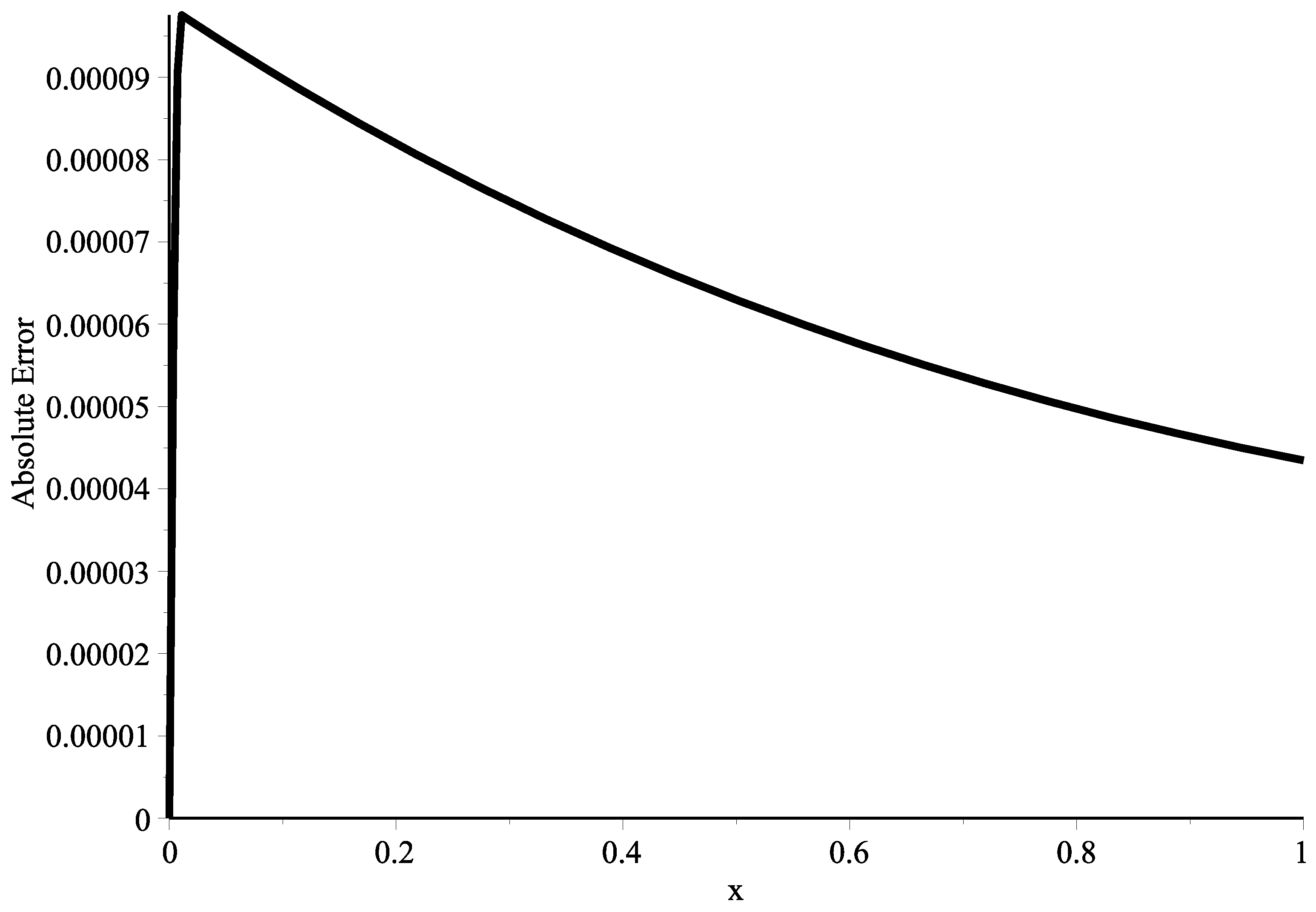
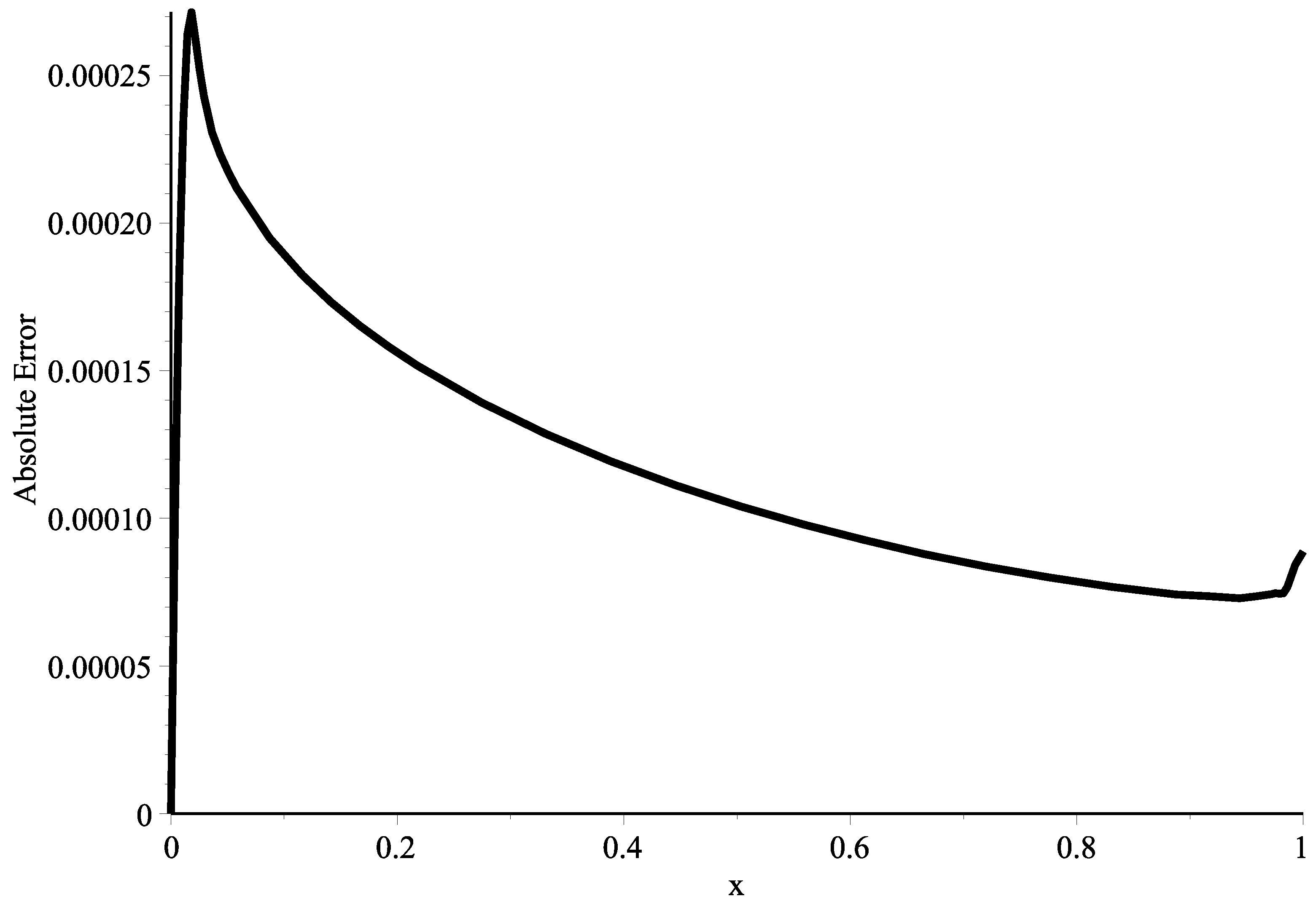
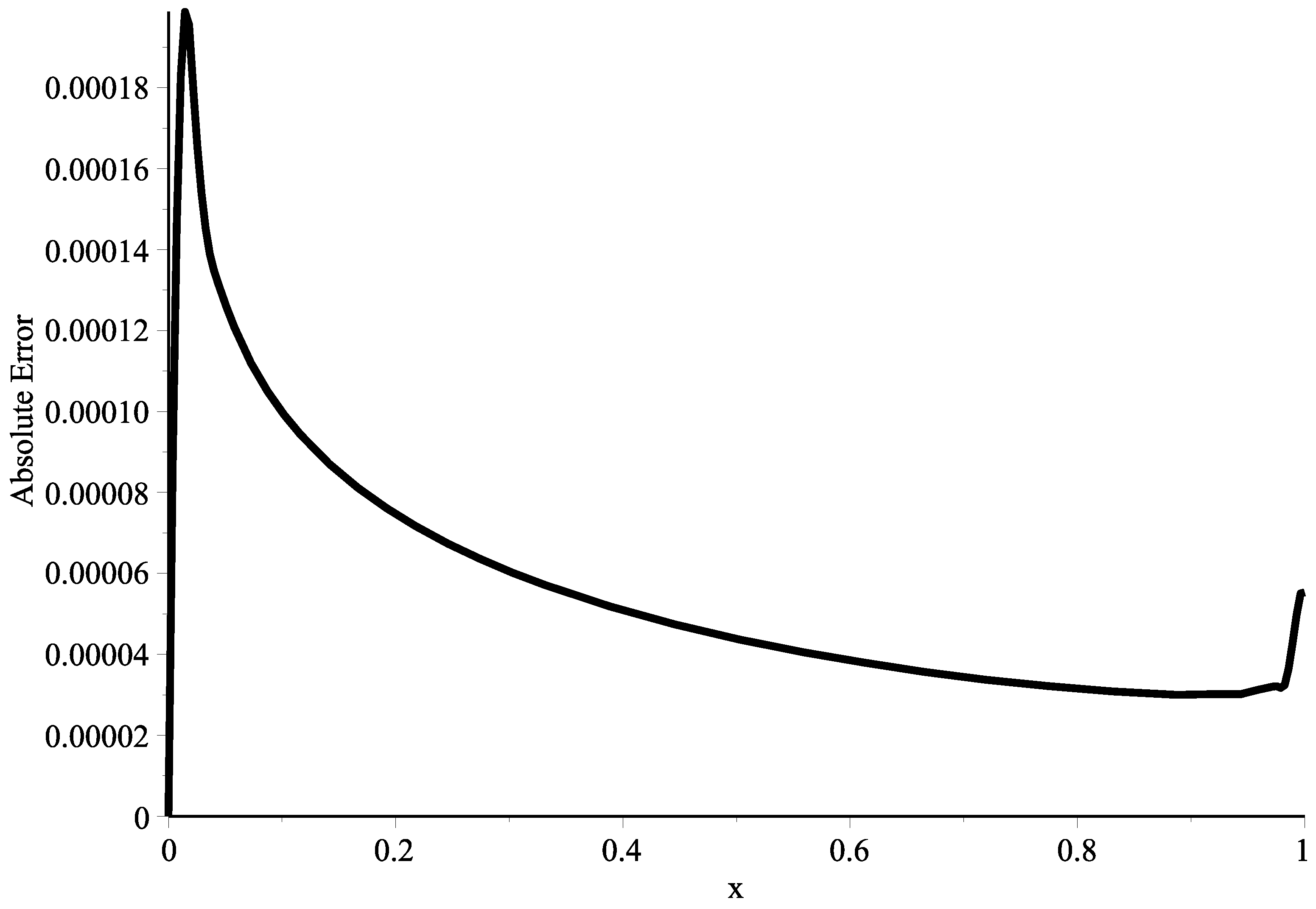
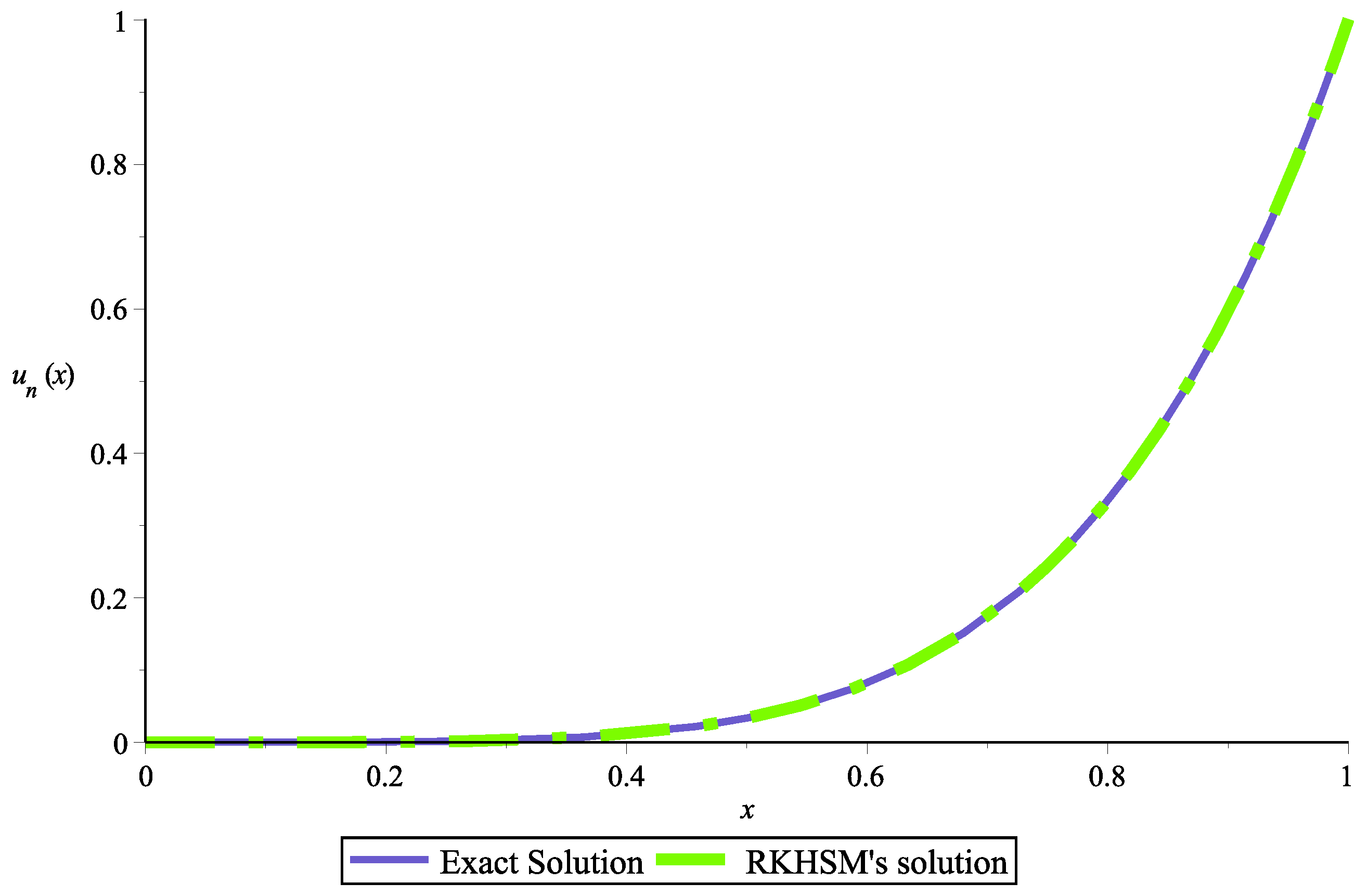
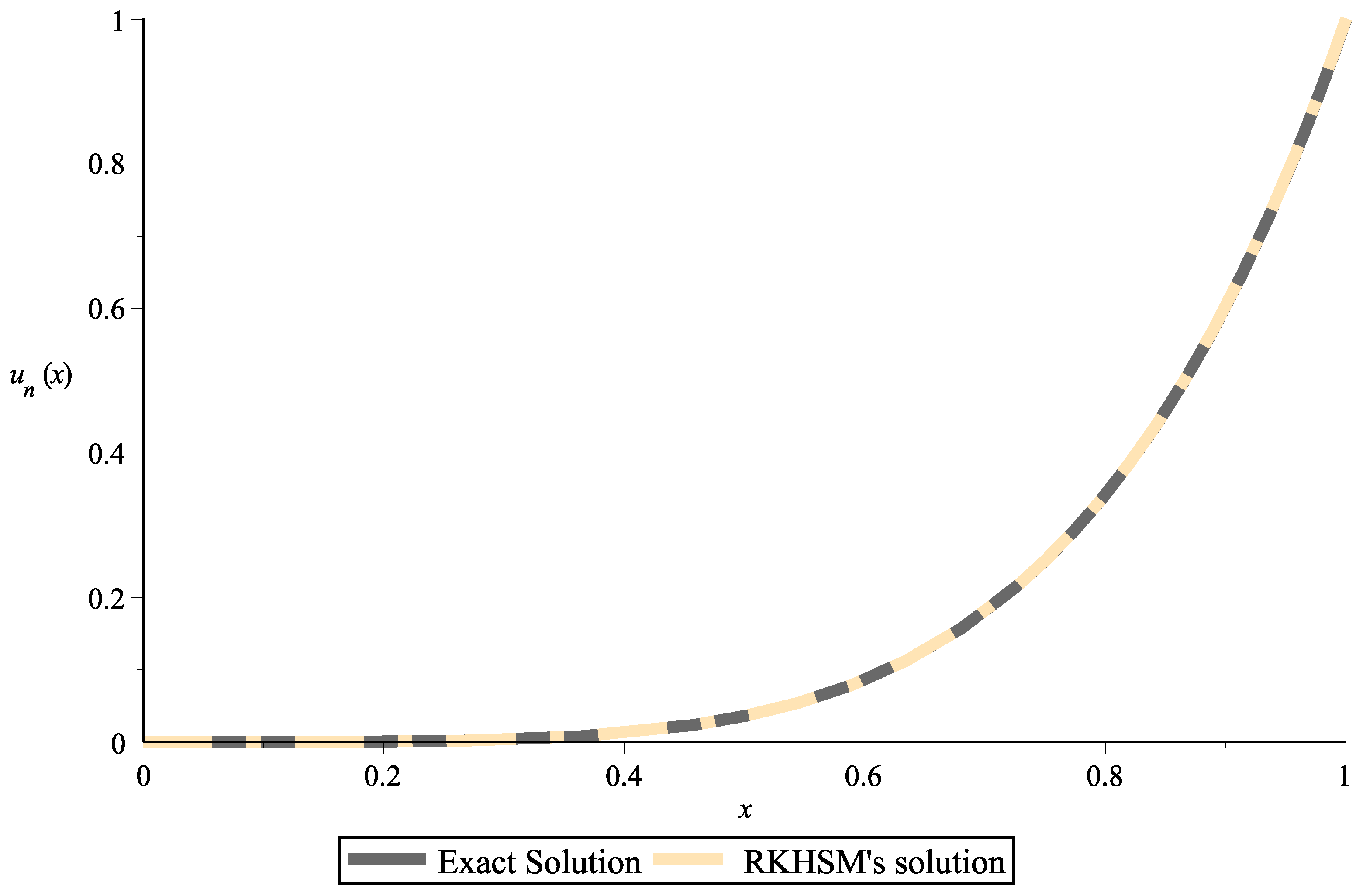
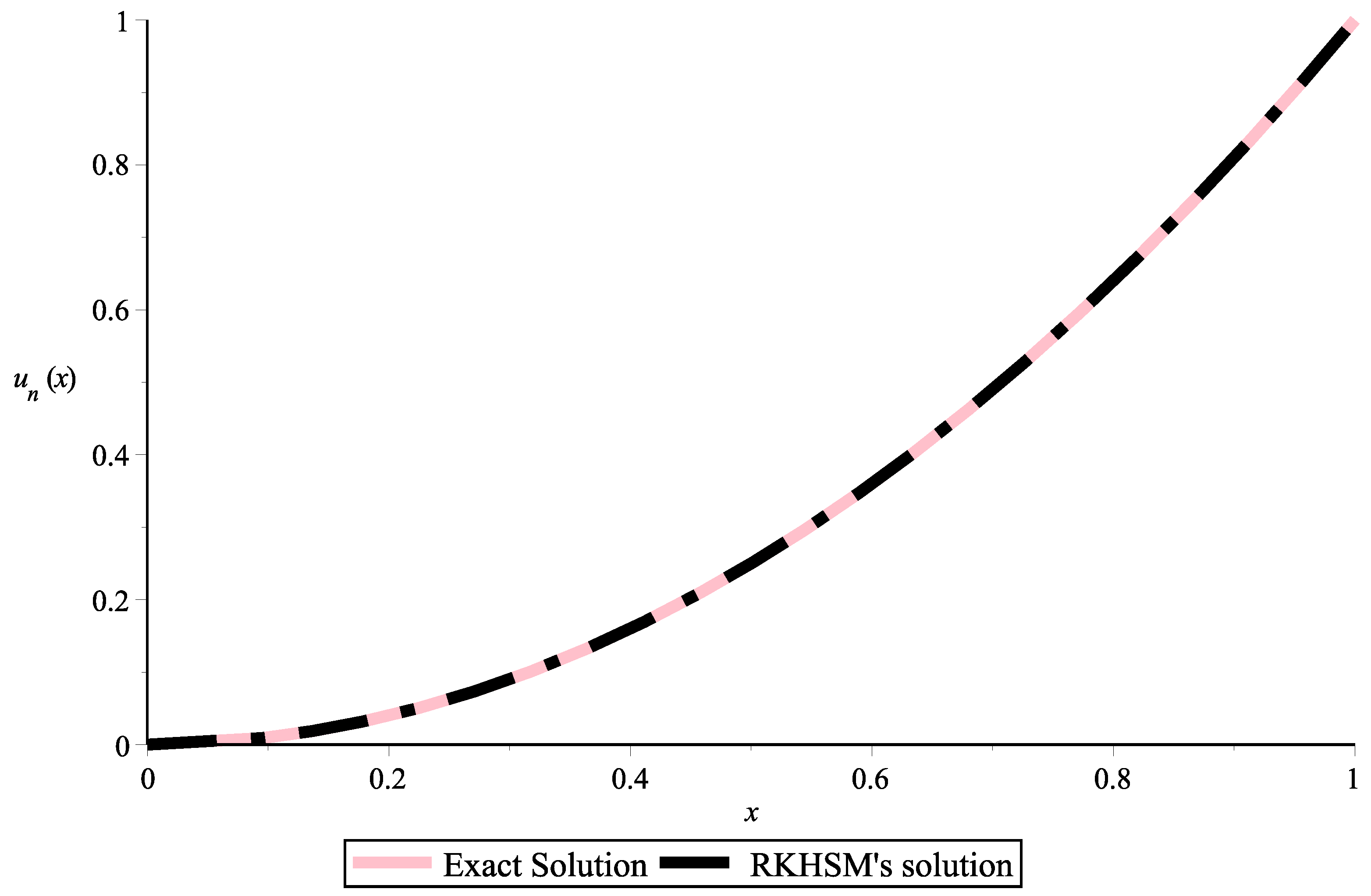
Taking collocation points in which where is an integer that varies from 1 to The numerical solution for (24) is obtained via the RKHSM for different fractional derivatives The outcomes are compared with the exact solution Figure 1 shows the exact solution and the RKHSM’s solution with The absolute error, in this case, is plotted in Figure 2. In Figure 3, the blue (exact solution) and green (proposed method) lines overlap for , and its absolute error is given in Figure 4. When Figure 5 shows that the exact solution and proposed method lines also overlap, and its absolute error is displayed in Figure 6. In Table 1 and Table 2, we combined the obtained results for and The very small difference between the numerical and exact results confirms that the proposed method is effective.
Figure 1.
Two-dimensional plot of the solutions obtained via the Exact formula and RKHSM for Example 1 with .
Figure 2.
Two-dimensional plot of the absolute error for Example 1 with .
Figure 3.
Two-dimensional plot of the solutions obtained via the Exact formula and RKHSM for Example 1 with .
Figure 4.
Two-dimensional plot of the absolute error for Example 1 with .
Figure 5.
Two-dimensional plot of the solutions obtained via the Exact formula and RKHSM for Example 1 with .
Figure 6.
Two-dimensional plot of the absolute error for Example 1 with .
Table 1.
Numerical outcomes for (24) with .
Table 2.
Numerical outcomes for (24) with diverse of .
Example 2.
Taking the following fractional linear ODE:
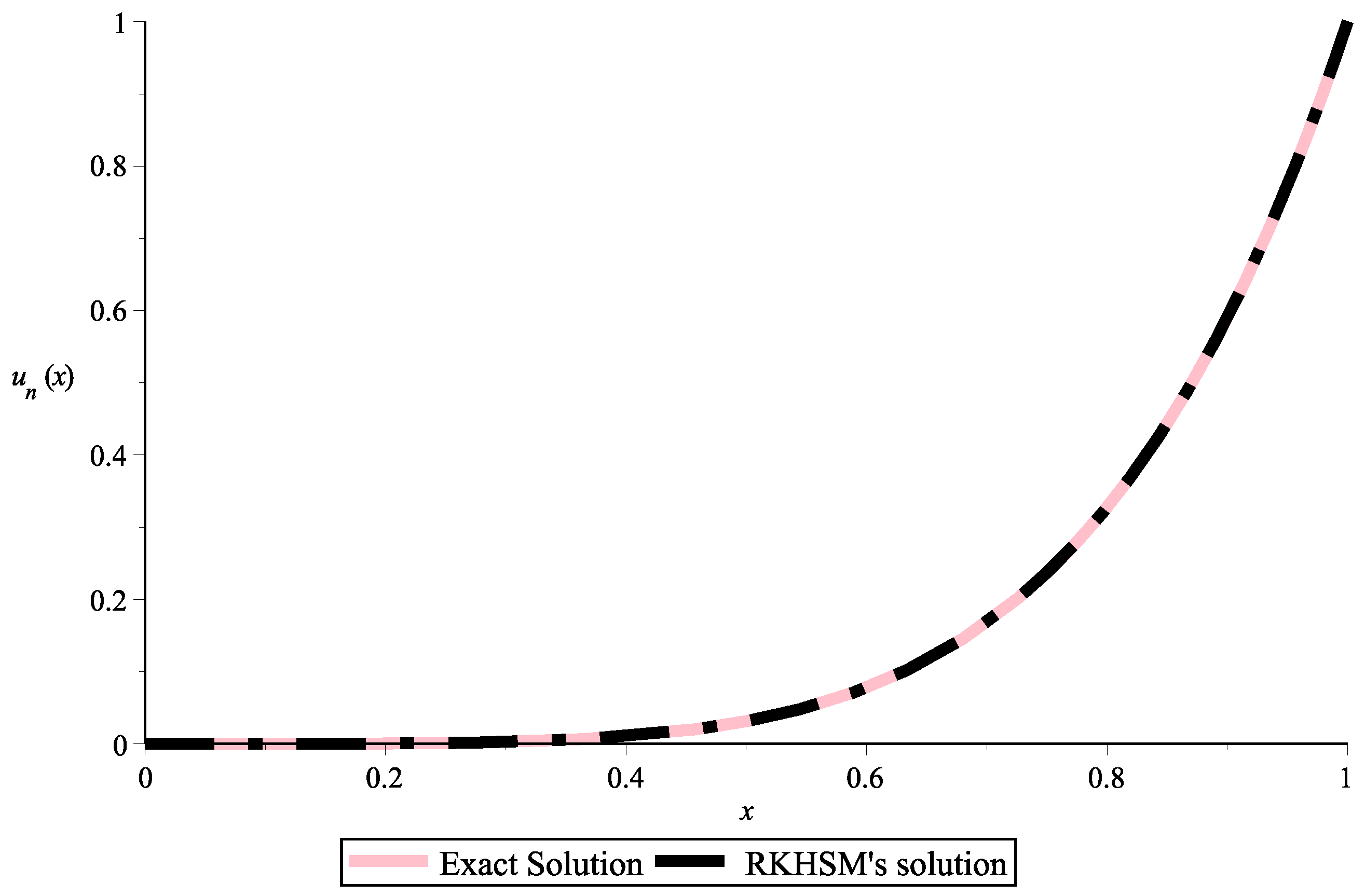
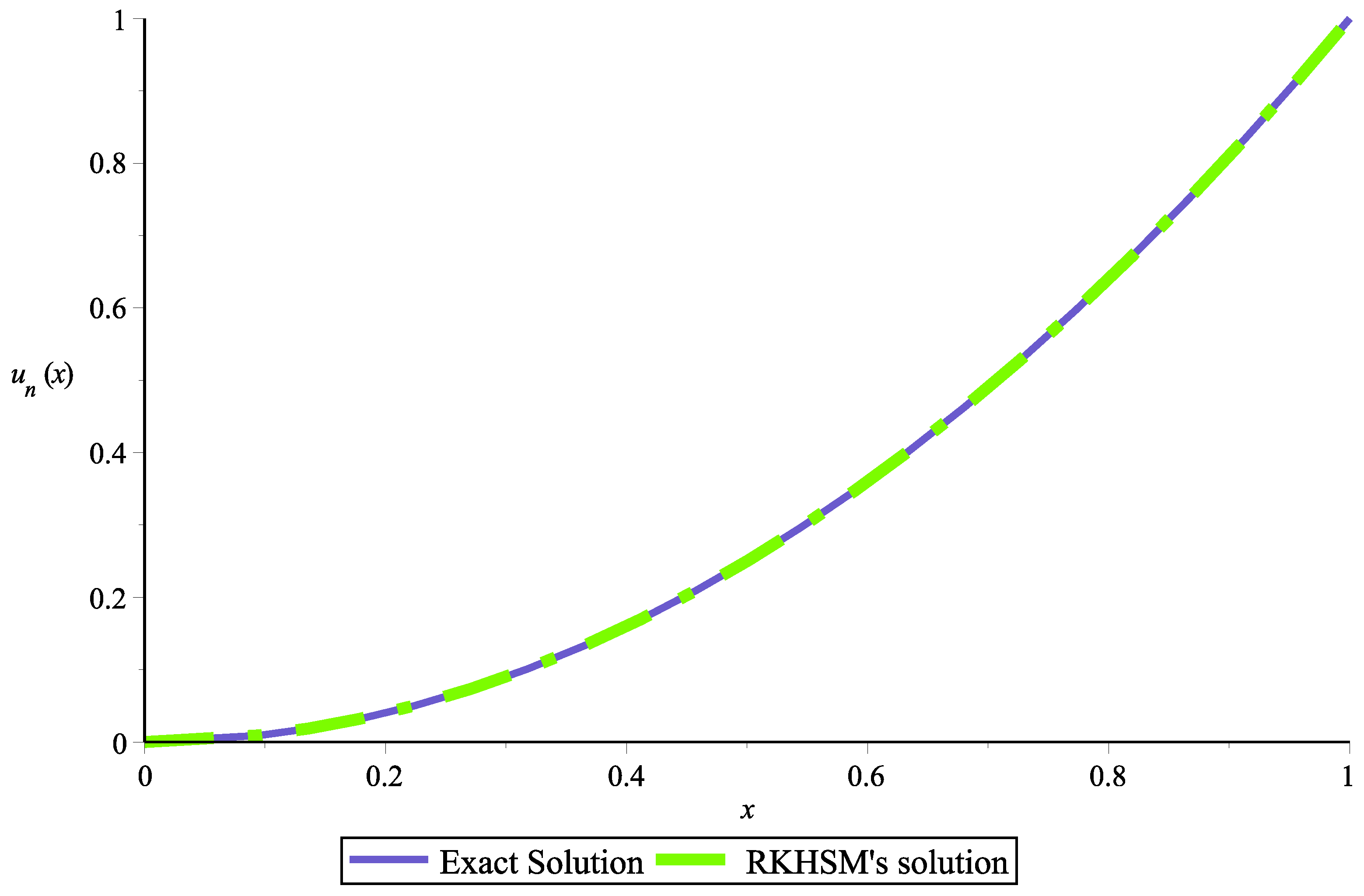
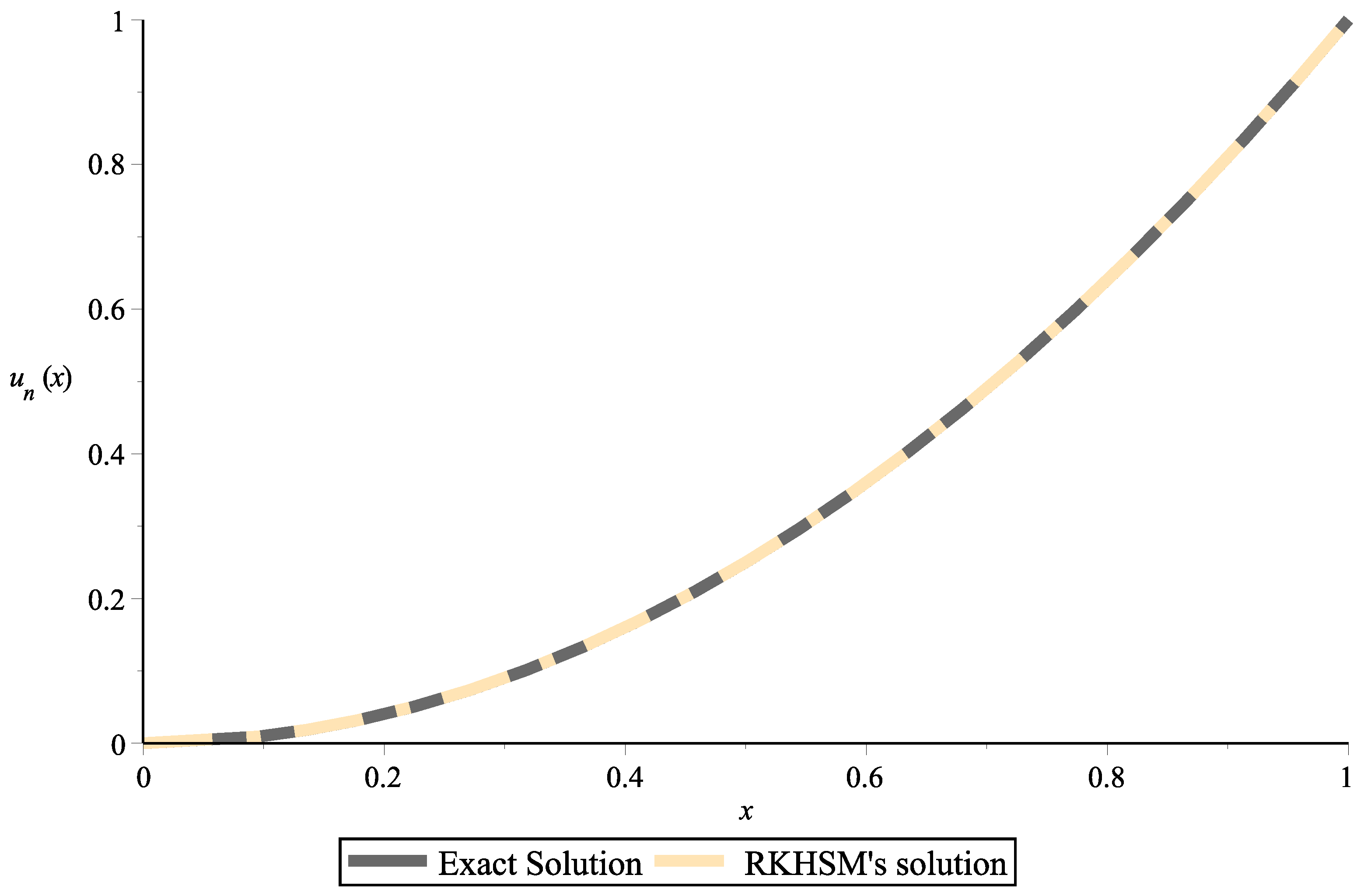
Taking collocation points in which where is an integer that varies from 1 to The numerical solution for (25) is obtained via the RKHSM for different fractional derivative The results are compared with the exact solution Figure 7, Figure 8 and Figure 9 show the exact solution and the RKHSM’s solution with and respectively. In Table 3 and Table 4, we combined the obtained results for and The very small difference between the numerical and exact results confirms that the proposed method is effective.
Figure 7.
Two-dimensional plot of the solutions obtained via the Exact formula and RKHSM for Example 2 with .
Figure 8.
Two-dimensional plot of the solutions obtained via the Exact formula and RKHSM for Example 2 with .
Figure 9.
Two-dimensional plot of the solutions obtained via the Exact formula and RKHSM for Example 2 with .
Table 3.
Numerical outcomes for (25) with .
Table 4.
Numerical outcomes for (25) with diverse .
5. Conclusions
In the current work, we successfully applied a numerical approach to provide numerical solutions to the proposed problem. The two key steps for using the RKHS method are creating an orthonormal function system of the suitable RKHS and defining an acceptable bounded linear operator. It is demonstrated that the proposed approaches have good convergence. To demonstrate the capability and dependability of the RKHSM, two examples were used. When exact results are compared to our acquired results, it is seen that they are in strong agreement. The applicability, simplicity, and efficacy of the suggested method for solving such classes of fractional differential equations may be seen from the numerical results. This work opens up the possibility for the RKHSM to be used in studying NFODEs that are described with novel fractional derivatives. As part of our purpose, we plan to suggest a general numerical algorithm for systems of non-linear fractional differential equations, which will be new in the literature.
Author Contributions
Conceptualization, R.T.A.; Methodology, A.A. and N.A.; Software, A.A.; Formal analysis, N.A.; Investigation, R.T.A.; Resources, N.A.; Data curation, A.A.; Writing—original draft, N.A.; Writing—review & editing, N.A.; Visualization, A.A.; Supervision, R.T.A.; Project administration, A.A., R.T.A.; Funding acquisition, R.T.A. All authors have read and agreed to the published version of the manuscript.
Funding
This research was funded by Deanship of Scientific Research, Imam Mohammad Ibn Saud Islamic University (IMSIU), Saudi Arabia grant number 221412044.
Data Availability Statement
Data are included within this research.
Acknowledgments
The authors extend their appreciation to the Deanship of Scientific Research, Imam Mohammad Ibn Saud Islamic University (IMSIU), Saudi Arabia, for funding this research work through Grant No. (221412044).
Conflicts of Interest
The authors declare no conflict of interest.
References
- Podlubny, I. Fractional Diffrential Equations; Academic Press: New York, NY, USA, 1999. [Google Scholar]
- Kilbas, A.A.; Srivastava, H.M.; Trujillo, J.J. Theory and Applications of Fractional Differential Equations; Elsevier: San Diego, CA, USA, 2006. [Google Scholar]
- Sun, H.G.; Zhang, Y.; Baleanu, D.; Chen, W.; Chen, Y.Q. A new collection of real-world applications of fractional calculus in science and engineering. Commun. Nonlinear Sci. Numer. Simul. 2018, 64, 213–231. [Google Scholar] [CrossRef]
- Akgül, A. A novel method for a fractional derivative with non-local and non-singular kernel. Chaos Solitons Fractals 2018, 114, 478–482. [Google Scholar] [CrossRef]
- Diethelm, K.; Ford, N.J. Multi-order fractional differential equations and their numerical solution. Appl. Math. Comput. 2004, 154, 621–640. [Google Scholar] [CrossRef]
- Fernandez, A.; Baleanu, D.; Fokas, A.S. Solving PDEs of fractional order using the unified transform method. Appl. Math. Comput. 2018, 339, 738–749. [Google Scholar] [CrossRef]
- Cao, Q.-H.; Dai, C.-Q. Symmetric and anti-symmetric solitons of the fractional second- and third-order nonlinear Schrödinger equation. Chin. Phys. Lett. 2021, 38, 090501. [Google Scholar] [CrossRef]
- Chen, C.; Jiang, Y.-L.; Wang, X.-T. Lie symmetry analysis of the time fractional generalized KdV equations with variable coefficients. Symmetry 2019, 11, 1281. [Google Scholar] [CrossRef]
- Cui, M.; Lin, Y. Nonlinear Numerical Analysis in the Reproducing Kernel Space; Nova Science Publishers Inc.: New York, NY, USA, 2009. [Google Scholar]
- Chen, S.-B.; Soradi-Zeid, S.; Dutta, H.; Mesrizadeh, M.; Jahanshahi, H.; Chu, Y.-M. Reproducing kernel Hilbert space method for nonlinear second order singularly perturbed boundary value problems with time-delay. Chaos Solitons Fractals 2021, 144, 110674. [Google Scholar] [CrossRef]
- Dou, H.-X.; Deng, L.-J. A proximal algorithm with convergence guarantee for a nonconvex minimization problem based on reproducing kernel Hilbert space. Symmetry 2021, 13, 2393. [Google Scholar] [CrossRef]
- Yildirim, E.N.; Akgül, A.; Inc, M. Reproducing kernel method for the solutions of non-linear partial differential equations. Arab J. Basic Appl. Sci. 2018, 28, 80–86. [Google Scholar] [CrossRef]
- Abu Arqub, O.; Osman, M.S.; Park, C.; Lee, J.R.; Alsulam, H.; Alhodaly, M. Development of the reproducing kernel Hilbert space algorithm for numerical pointwise solution of the time-fractional nonlocal reaction-diffusion equation. Alex. Eng. J. 2022, 61, 10539–10550. [Google Scholar] [CrossRef]
- Allahviranloo, T.; Sahihi, H. Reproducing kernel method to solve fractional delay differential equations. Appl. Math. Comput. 2021, 400, 126095. [Google Scholar] [CrossRef]
- Attia, N.; Akgül, A.; Seba, D.; Nour, A. An efficient numerical technique for a biological population model of fractional order. Chaos Solitons Fractals 2021, 141, 110349. [Google Scholar] [CrossRef]
- Li, X.; Wu, B. A new reproducing kernel collocation method for nonlocal fractional boundary value problems with non-smooth solutions. Appl. Math. Lett. 2018, 86, 194–199. [Google Scholar] [CrossRef]
- Du, H.; Chen, Z.; Yang, T. A stable least residue method in reproducing kernel space for solving a nonlinear fractional integro-differential equation with a weakly singular kernel. Appl. Numer. Math. 2020, 157, 210–222. [Google Scholar] [CrossRef]
- Du, H.; Chen, Z.; Yang, T. A meshless method in reproducing kernel space for solving variable-order time fractional advection–diffusion equations on arbitrary domain. Appl. Numer. Math. 2021, 116, 107014. [Google Scholar] [CrossRef]
- Hasan, S.; Maayah, B.; Bushnaq, S.; Momani, S. A modified reproducing kernel Hilbert space method for solving fuzzy fractional integro-differential equations. Bol. Soc. Paran. Mat. 2023, 41, 1–16. [Google Scholar] [CrossRef]
- Babolian, E.; Javadi, S.; Moradi, E. Error analysis of reproducing kernel Hilbert space method for solving functional integral equations. J. Comput. Appl. Math. 2016, 300, 300–311. [Google Scholar] [CrossRef]
Disclaimer/Publisher’s Note: The statements, opinions and data contained in all publications are solely those of the individual author(s) and contributor(s) and not of MDPI and/or the editor(s). MDPI and/or the editor(s) disclaim responsibility for any injury to people or property resulting from any ideas, methods, instructions or products referred to in the content. |
© 2023 by the authors. Licensee MDPI, Basel, Switzerland. This article is an open access article distributed under the terms and conditions of the Creative Commons Attribution (CC BY) license (https://creativecommons.org/licenses/by/4.0/).