Abstract
The metric dimension has various applications in several fields, such as computer science, image processing, pattern recognition, integer programming problems, drug discovery, and the production of various chemical compounds. The lowest number of vertices in a set with the condition that any vertex can be uniquely identified by the list of distances from other vertices in the set is the metric dimension of a graph. A resolving function of the graph G is a map such that for every pair of adjacent distinct vertices . The local fractional metric dimension of the graph G is defined as = , where is a local resolving function of . This paper presents a new family of planar networks namely, rotationally heptagonal symmetrical graphs by means of up to four cords in the heptagonal structure, and then find their upper-bound sequences for the local fractional metric dimension. Moreover, the comparison of the upper-bound sequence for the local fractional metric dimension is elaborated both numerically and graphically. Furthermore, the asymptotic behavior of the investigated sequences for the local fractional metric dimension is addressed.
1. Introduction
Slater [1] and Harary [2] independently established the issue of the metric dimension in the 1970s, which involved calculating the smallest number of vertices in a graph that could be uniquely represented by their corresponding vector of distances. Imran et al. [3,4] required the characterization of families of (rotationally symmetric) planar graphs with a constant metric dimension in this regard (see, for example, [5,6]). The problem of the metric dimension is important not only in research on graph structural features, but also in the solution of real-world problems, such as robot navigation [6], pattern recognition and image processing [7], combinatorial optimization [8], and networking [9], which are only a few examples among other things. Particularly, the problem of the hexagonal metric dimension, because of its application and graphs [10,11,12], has taken on a new significance.
The metric dimension problem was redeveloped as an integer programming problem by Chartrand et al. [13] in 2000. Currie and Oellermann [14] proposed a linear programming relaxation, which they named the fractional metric dimension of the graph, as the best solution. Benish et al. [15] proposed a local variant of the fractional metric dimension involving only nearby vertices in 2018. In [16], this was determined for a variety of graph types. Liu et al. [17] recently published a paper on this topic, where they calculated the local fractional metric dimension of a rotationally symmetric family of symmetric planar networks produced from a cycle of edge combinations of order m.
A network N is an ordered 2-tuple consisting of two sets: a set of nodes (termed vertices ) and a set of edges that connect nodes/vertices. The number of items in N is the order of N. The number of items in is denoted by p, and the size of N is the number of elements. is denoted by the letter q. represents the distance between x and y. For additional information, we refer the reader to [18,19,20] as a connection to graph theory.
We live in a silicon age with technological advancements. Robots and other devices are progressing at a fast rate. Personnel is being replaced by machines. In the meantime, this is necessary in order to connect the above-mentioned landmarks due to financial restrictions and the management of massive queues. There are fewer of these on production lines or in servicing areas. In this way, distance-based dimensions address these issues’ limits without difficulty. A collection of numbers from is defined as an ordered set of vertices on which an object can be placed. We refer to a k-tuple as in metric notation, where for denotes the distance between two points, and x. The set Y is transformed into a resolving set with k elements if, for each pair of different vertices, .
The resolving set Y in N has the smallest number of elements. The base of N is a collection of elements. The cardinality of the letter Y is N. In [21], this denotes the metric dimension, and Slatter [22,23] invented the phrase “resolving set of a problem”. The concept of a locating set is used to create a connected network. Harary and Melter [24] discovered the above-mentioned terms and declared them to be the metric dimension of a component of a network. Following that, a group of researchers tested various networks for the evaluation of the metric dimension of a group of interconnected networks, where F was defined as a bounded function.
In a collection of interconnected networks, if all of the networks in a family have the same metric dimension, then F is said to be of a constant metric dimension [25]. Furthermore, given that a generalized Peterson antiprism in a network C is a network that is a circulant network , every one of these forms a family with a constant metric dimension. Similarly, the metric dimensions of wheels and Jahangir networks were explored. With the support of IPP, we were able to acquire a more accurate solution of this concept. FMD was also utilized by Fehr et al. [26] to find an improved solution to a linear programming relaxation problem. Arumugam and Mathew [27] provided clarification of the situation. FMD has many new features. Several graph theorists discussed several results related to the metric dimension and graph labelings on various families of graphs in [28,29,30,31,32]. Many researchers have discussed several aspects of graph theory [33,34,35,36,37,38,39,40].
Several networks have surfaced in relation to FMD, including Cartesian and hierarchical networks, which are examples of these types of networks. Linked networks’ lexicographic and comb products were discussed in [41,42]. Furthermore, Liu et al. [43] calculated the generalized Jahangir network’s FMD. Aisyah et al. recently defined and computed the idea of the local fractional metric dimension (LFMD) for the corona product of two networks [44]. Circular ladders are a type of rotationally symmetric and planar network that consists of distinct faces. The triangle, quadrangle, and pentagon are all geometric shapes. It was found that for quadrangular circular ladders and a pentagonal circular ladder , the LFMD is constant for each and value, where n signifies that each of these circular ladders has a different number of steps. Moreover, it has been established that a triangular circular ladder and a pentagonal circular ladder are equivalent ladders in a circle . They have an LFMD that is variable. Recently, Poulik and Ghorai discussed the determination of journey order based on a graph’s Wiener absolute index with the help of bipolar fuzzy information, and they elaborated on the estimation of the most affected cycles and the busiest network routes based on the complexity function of a graph in a fuzzy environment in [45,46].
The following lemma will be used throughout this manuscript.
Lemma 1
([15,47,48]). Let G be a finite connected graph of order . Then, the following bounds hold.
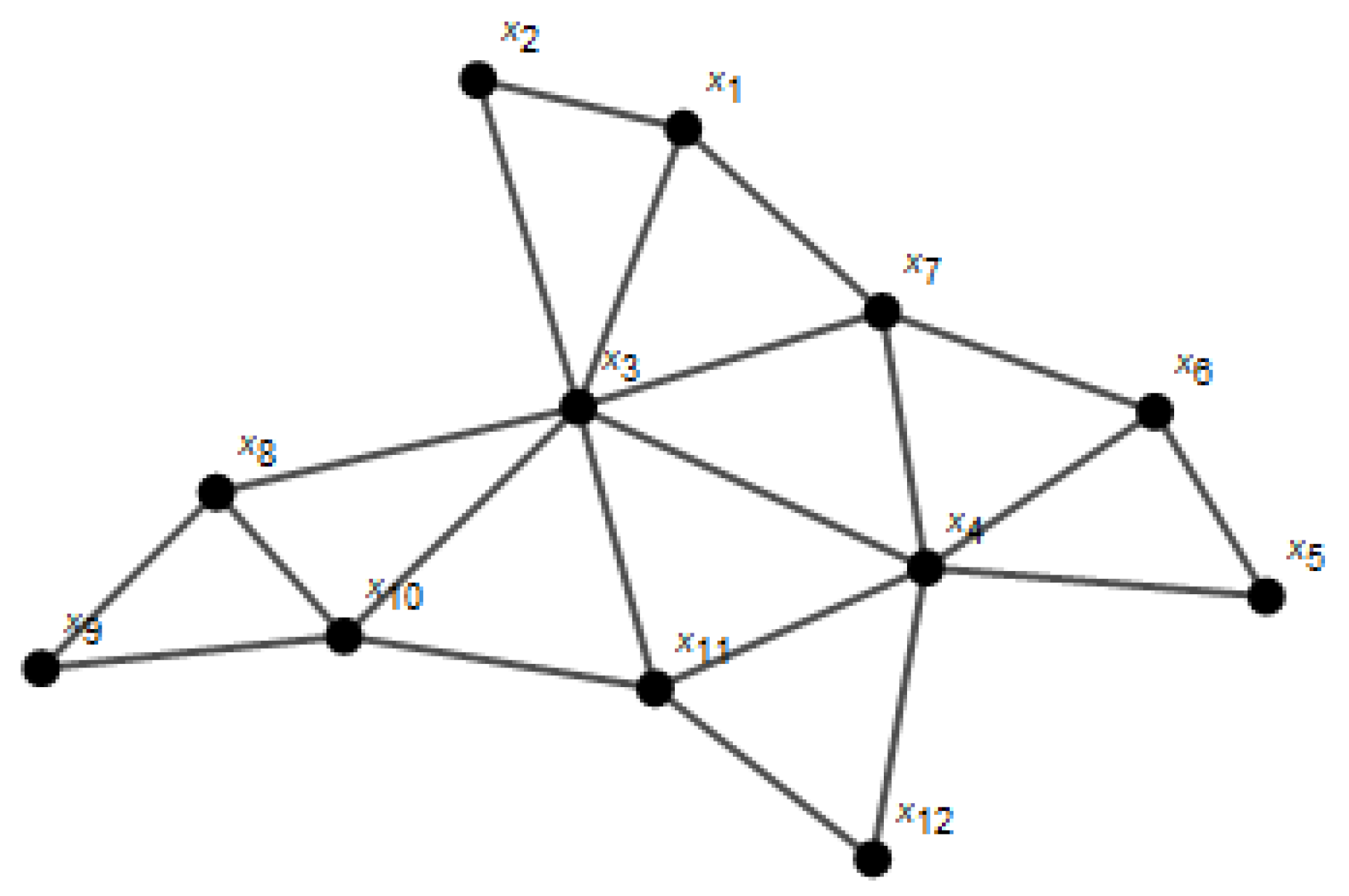
A planar graph G with a local fractional metric dimension less than or equal to 3 is shown in Figure 1.
Figure 1.
A planar graph G with a local fractional metric dimension less than or equal to 3.
The resolving sets with respect to adjacent vertices are:
Since the minimum cardinality of the resolving set is 4, by relation (2), we have
The remaining sections proceed as follows: In Section 2, Section 3 and Section 4, the upper-bound sequences of the local fractional metric dimension over heptagonal rotationally symmetric planar graphs with up to four cords are discussed. In Section 5, a comparison of the upper-bound sequences of the local frictional metric dimension is elaborated upon. In the last section, we will provide the concluding remarks of the proposed work and discuss some open problems for further research. Throughout the manuscript, LFMD is the local frictional metric dimension, and HRS graphs are heptagonal rotationally symmetrical planar graphs.
2. Upper-Bound Sequences of the LFMD of HRS Planar Graphs with One Cord
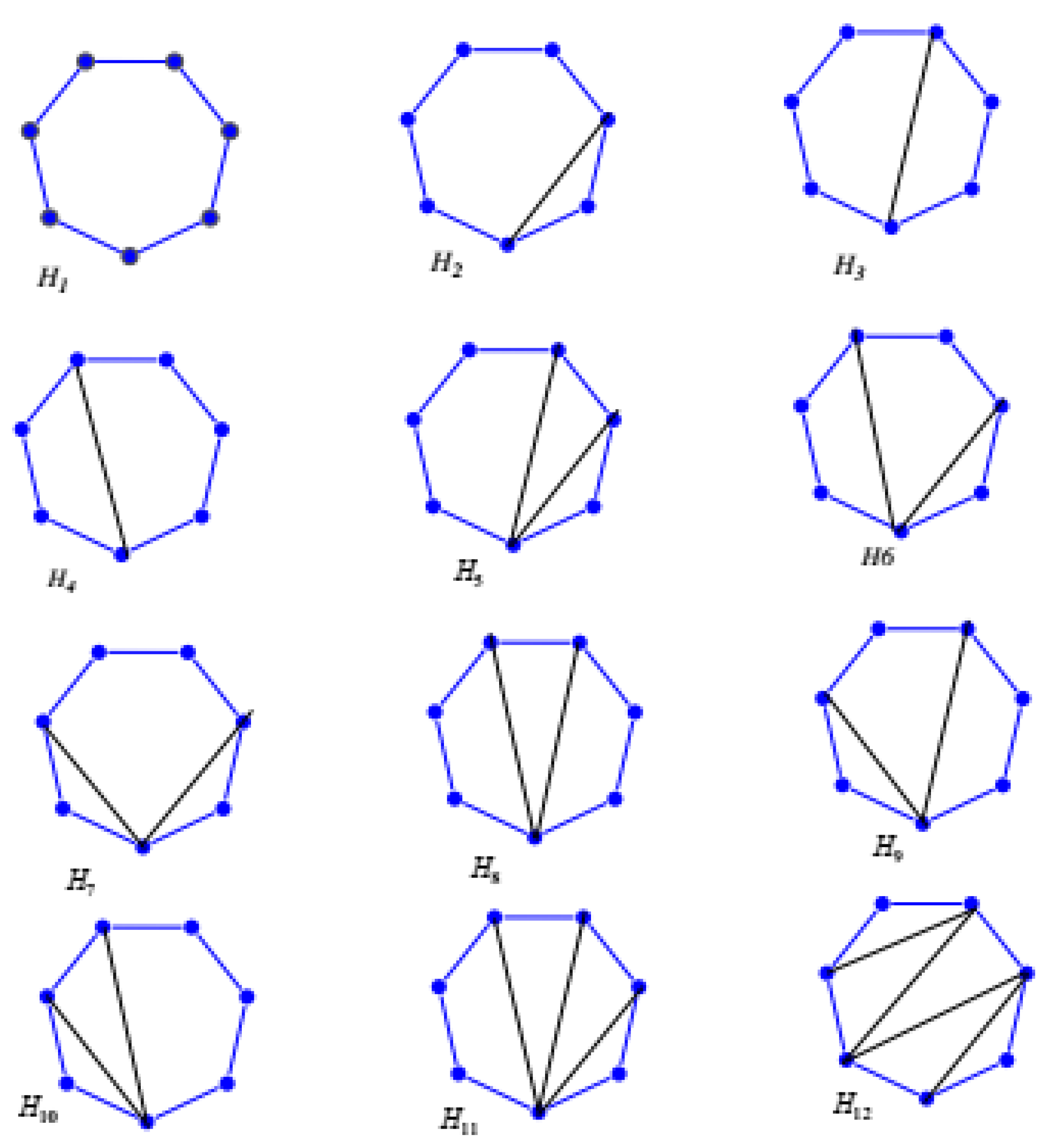
In this section, we will find the sequences of the LFMD of HRS planar graphs with one cord. The families of planar graphs based on a heptagon with up to four cords are shown in Figure 2.
Figure 2.
Heptagonal planar graphs with up to four cords.
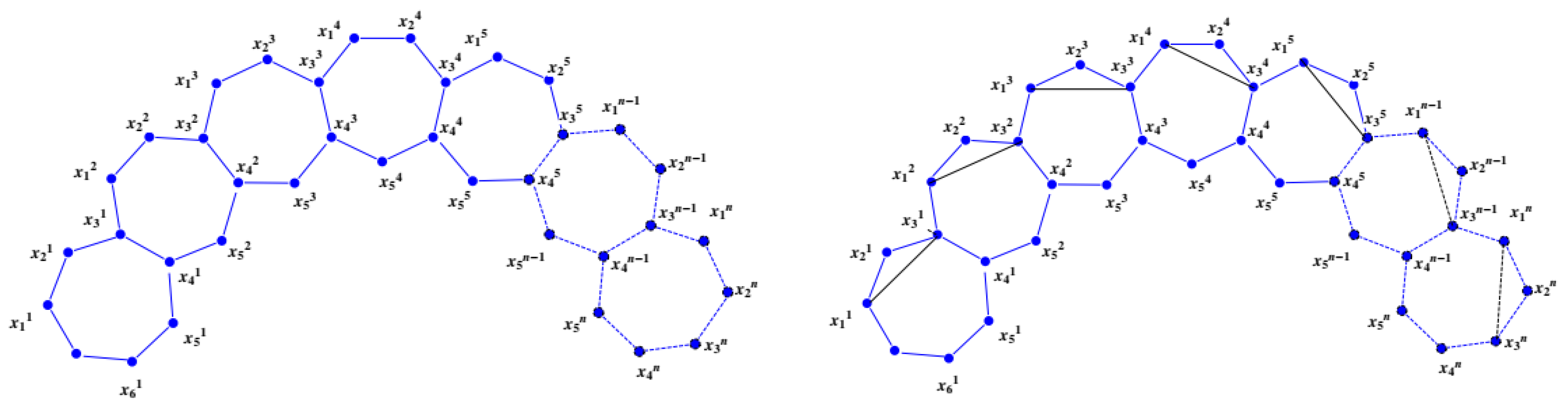
The heptagonal symmetrical planar graphs and are shown in Figure 3.
Figure 3.
Heptagonal symmetrical planar graphs and .
Proposition 1.
Let be a heptagonal rotationally symmetrical planar graph. Then, and
Proof.
For , we have a unique cycle of an odd length, so . For , we have:
Since the minimum cardinality of the resolving set is 9, by relation (2), we have
For , we have the following resolving sets:
- , .
- , .
- , .
- , .
- , .
- .Here,
- .Here,
They have the following cardinalities.
As 11 is the minimal cardinality, by relation (2), we have
□
Proposition 2.
Let be a heptagonal rotationally symmetrical planar graph. Then,
Proof.
For , we have
Since the minimum cardinality of the resolving set is 4, by relation (2), we have
For , we have:
Since the minimum cardinality of the resolving set is 4, by relation (2), we have
For , we have the following resolving sets:
- .
- .
- .Here,
- .Here,
They have the following cardinalities.
As 4 is the minimal cardinality, by relation (2), we have
□
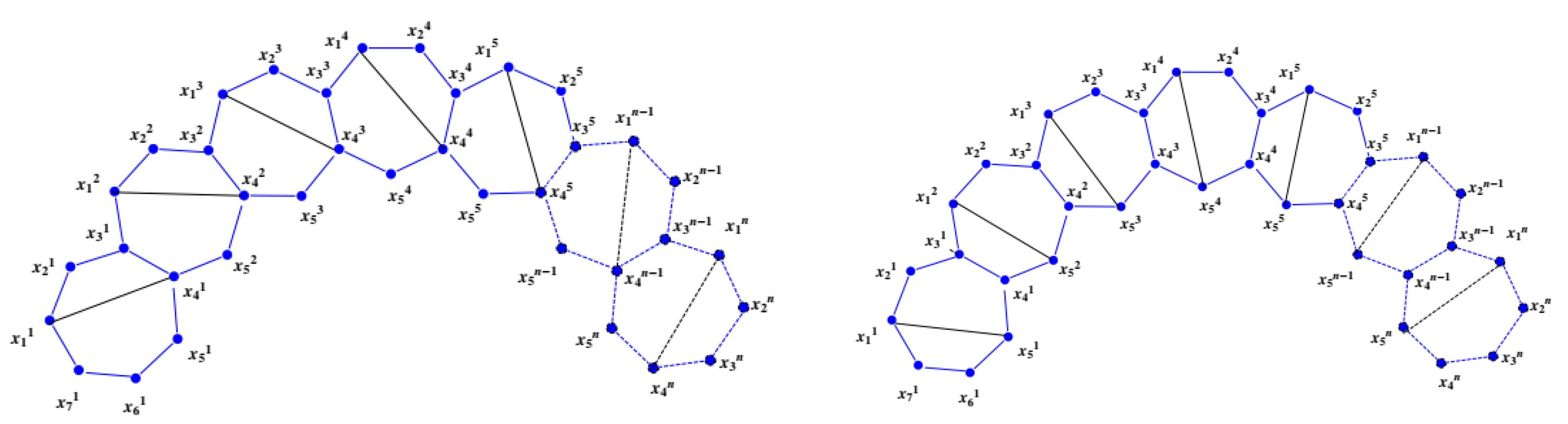
The heptagonal symmetrical planar graphs and are shown in Figure 4.
Figure 4.
Heptagonal symmetrical planar graphs and .
Proposition 3.
Let be a heptagonal rotationally symmetrical planar graph. Then,
Proof.
For , we have:
Since the minimum cardinality of the resolving set is 5, by relation (2), we have
For , we have:
Since the minimum cardinality of the resolving set is 5, by relation (2), we have
For , we have the following resolving sets:
- .Here,
- .Here,
- .Here,
They have the following cardinalities.
As 7 is the minimal cardinality, by relation (2), we have
□
Proposition 4.
Let be a heptagonal rotationally symmetrical planar graph. Then,
Proof.
For , we have
Since the minimum cardinality of the resolving set is 5, by relation (2), we have
For , we have:
Since the minimum cardinality of the resolving set is 8, by relation (2), we have
For , we have the following resolving sets:
- .
- .Here,
- .Here,
- .Here,
- .Here,
They have the following cardinalities.
As 6 is the minimal cardinality, by relation (2), we have
□
3. Upper-Bound Sequences of the LFMD of HRS Planar Graphs with Two Cords
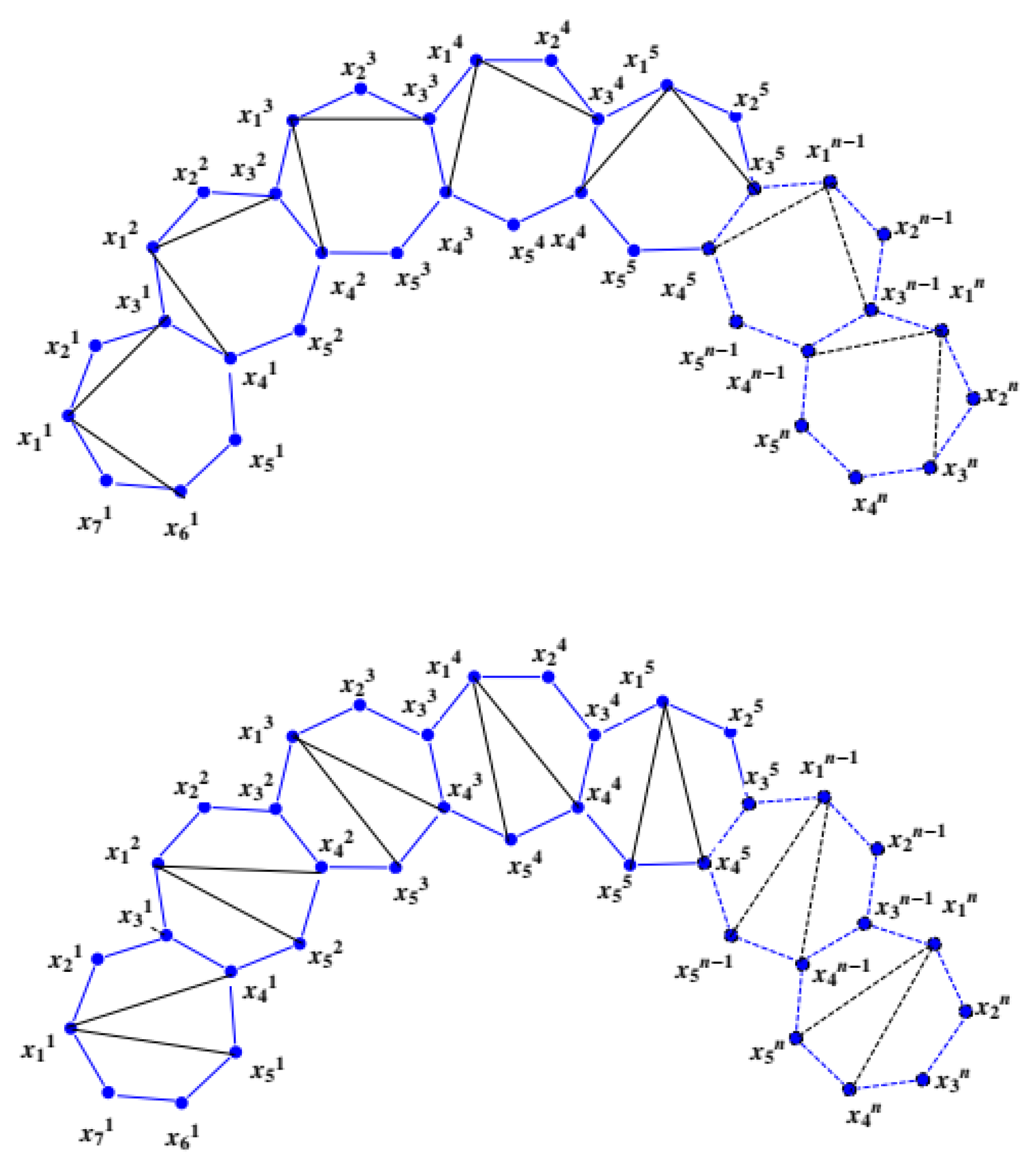
In this section, we will find the LFMD of HRS planar graphs with two cords. The heptagonal symmetrical planar graphs and are shown in Figure 5.
Figure 5.
Heptagonal symmetrical planar graphs and .
Proposition 5.
Let be a heptagonal rotationally symmetrical planar graph. Then,
The proof is similar to the proof of Proposition 2.
Proposition 6.
Let be a heptagonal rotationally symmetrical planar graph. Then,
Proof.
For , we have:
Since the minimum cardinality of the resolving set is 3, by relation (2), we have
For , we have:
Since the minimum cardinality of the resolving set is 3, by relation (2), we have
For , we have the following resolving sets:
- .Here,
- .Here,
They have the following cardinalities.
As is the minimal cardinality is 3, by relation (2), we have
□
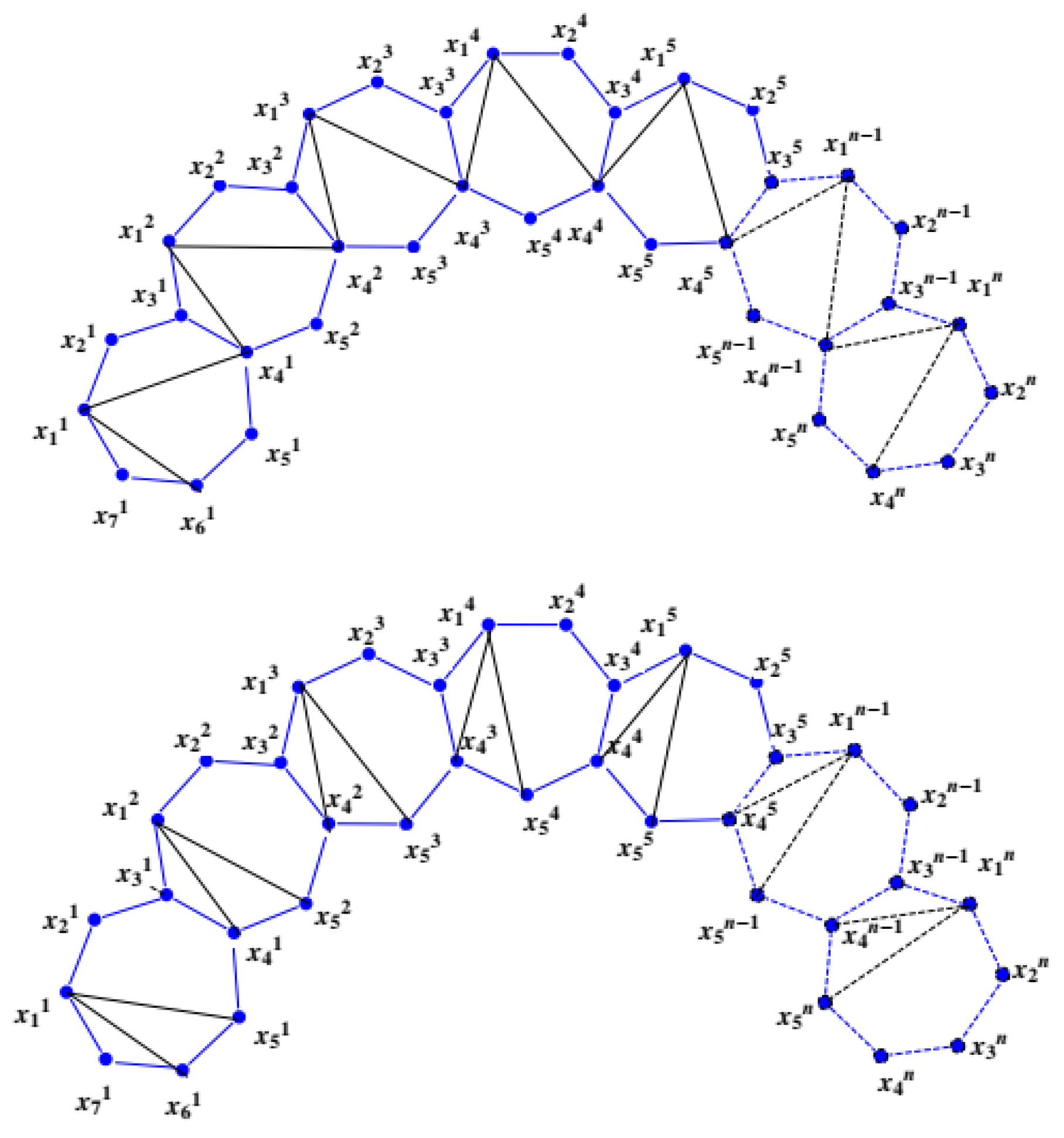
The heptagonal symmetrical planar graphs and are shown in Figure 6.
Figure 6.
Heptagonal symmetrical planar graphs and .
Proposition 7.
Let be a heptagonal rotationally symmetrical planar graph. Then,
The proof is similar to the proof of Proposition 2.
Proposition 8.
Let be a heptagonal rotationally symmetrical planar graph. Then,
Proof.
For , we have:
Since the minimum cardinality of the resolving set is 4, by relation (2), we have
For , we have:
Since the minimum cardinality of the resolving set is 5, by relation (2), we have
For , we have the following resolving sets:
- .Here,
- .Here,
- .Here,
- .Here,
- .Here,
They have the following cardinalities.
As 5 is the minimal cardinality, by relation (2), we have
□
The heptagonal symmetrical planar graphs and are shown in Figure 7.
Figure 7.
Heptagonal symmetrical planar graphs and .
Proposition 9.
Let be a heptagonal rotationally symmetrical planar graph. Then,
Proof.
For , we have:
Since the minimum cardinality of the resolving set is 3, by relation (2), we have
For , we have:
Since the minimum cardinality of the resolving set is 3, by relation (2), we have
For , we have the following resolving sets:
- .Here,
- .Here,
- .Here,
They have the following cardinalities.
As 3 is the minimal cardinality, by relation (2), we have
□
Proposition 10.
Let be a heptagonal rotationally symmetrical planar graph. Then,
The proof is similar to the proof of Proposition 2.
4. Upper-Bound Sequences of the LFMD of HRS Planar Graphs with Three and Four Cords
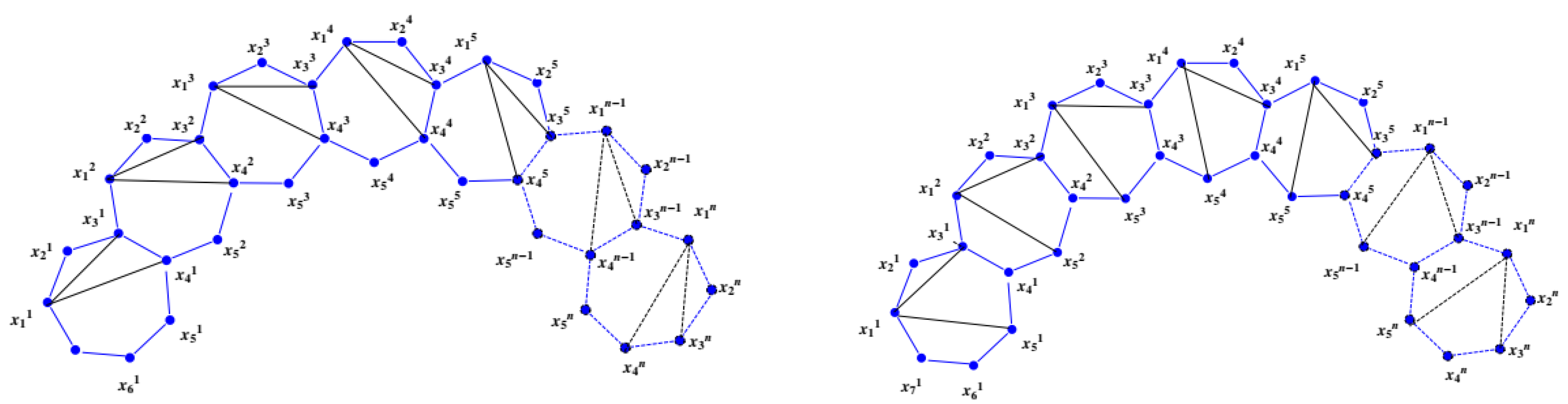
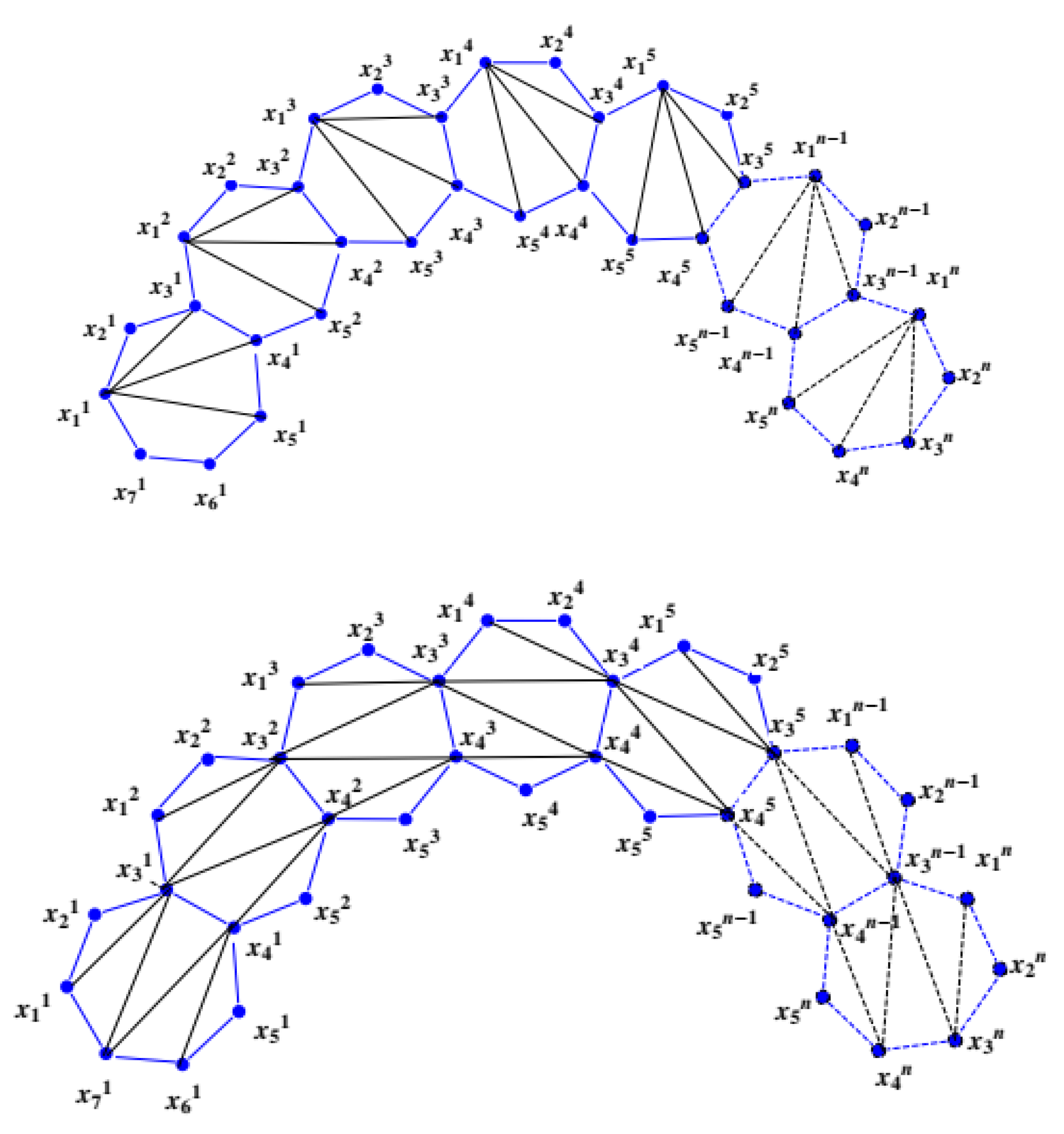
In this section, we will find the LFMD of HRS planar graphs with three and four cords. The heptagonal symmetrical planar graphs and are shown in Figure 8.
Figure 8.
Heptagonal symmetrical planar graphs and .
Proposition 11.
Let be a heptagonal rotationally symmetrical planar graph. Then,
Proof.
For , we have:
Since the minimum cardinality of the resolving set is 3, by relation (2), we have
For , we have:
Since the minimum cardinality of the resolving set is 3, by relation (2), we have
For , we have the following resolving sets:
- .Here,
- .Here,
- .Here,
- .Here,
- .Here,
- .Here,
- .Here,
They have the following cardinalities.
As 3 is the minimal cardinality, by relation (2), we have
□
Proposition 12.
Let be a heptagonal symmetrical planar graph. Then,
5. Comparison of the Investigated Upper-Bound Sequences for the Local Fractional Metric Dimension
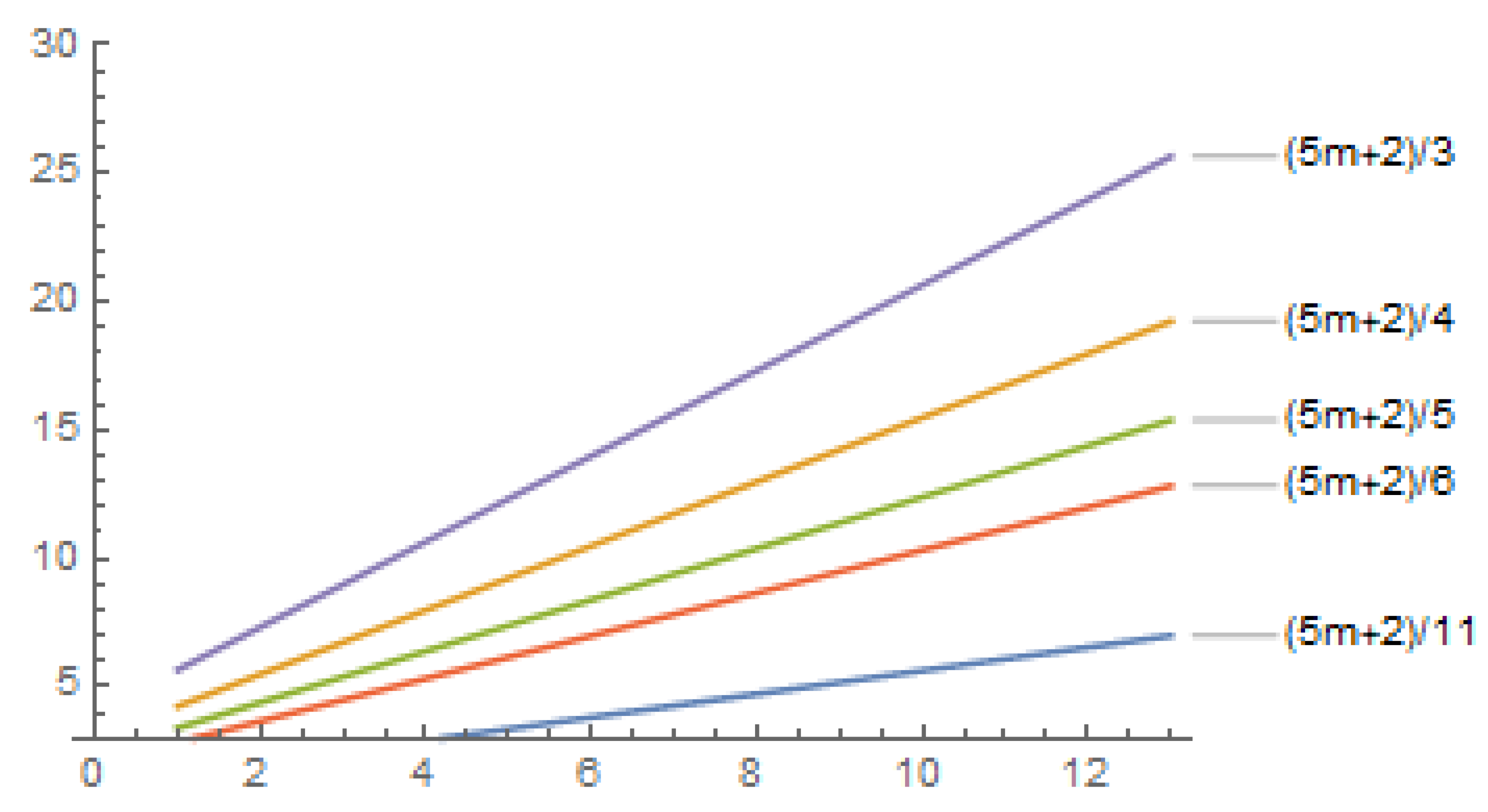
In this section, we will discuss the asymptotic behaviors and numerical and graphical comparisons between the investigated upper-bound sequences for the local fractional metric dimension. We found the sequences of the local fractional metric dimensions of heptagonal rotationally symmetrical planar graphs. In Table 1 and Table 2, the asymptotic behaviors and the numerical comparison are, respectively, discussed. The graphical behavior of the upper-bound sequences for the local fractional metric dimensions of the heptagonal rationally symmetrical planar graphs is shown in Figure 9.
Table 1.
Asymptotic behavior of the local fractional metric dimension of the graph , ) arising from a planar chorded cycle.
Table 2.
Numerical comparison of the upper-bound sequences for the local fractional metric dimensions of heptagonal rationally symmetrical planar graphs.
Figure 9.
Graphical behavior of the upper-bound sequences for the local fractional metric dimensions of heptagonal rationally symmetrical planar graphs.
6. Conclusions
Finding the metric dimension of a given graph for a specific number is an NP-hard problem. The metric dimension has many applications in several fields, such as computer science, minimal distance problems, and chemical graph theory. In this regard, we proposed a new rotationally symmetrical heptagonal planar network and then found its upper-bound sequences for the local fractional metric dimensions. Further, in future work, anyone can solve some of the following open problems:
- The generalization of the proposed work to an n-sided polygon with up to k cords.
- Finding the upper bounds for the local fractional metric dimensions of rotationally symmetrical n-sided polygon planar networks and then finding their asymptotic behaviors.
Author Contributions
Conceptualization, S.A. and R.I.; methodology, R.I.; software, H.K.; validation, M.U.G. and S.A.; formal analysis, S.A.; investigation, S.A.; resources, R.I.; data curation, S.A. and F.J.H.C.; writing—original draft preparation, S.A.; writing—review and editing, M.U.G. and F.J.H.C.; visualization, H.K.; supervision, S.A.; project administration, R.I.; funding acquisition, R.I. All authors have read and agreed to the published version of the manuscript.
Funding
The authors extend their appreciation to the Deanship of Scientific Research at King Khalid University for funding this work through Small Groups Project under grant number (R.G.P.1/277/43).
Data Availability Statement
No data were used to support this study.
Acknowledgments
The authors appreciate the Deanship of Scientific Research at King Khalid University for funding this work through Small Groups Project under grant number (R.G.P.1/277/43).
Conflicts of Interest
The authors declare no conflict of interest.
References
- Slater, P.J. Dominating and reference sets in a graph. J. Math. Phys. Sci. 1988, 22, 445–455. [Google Scholar]
- Melter, F.H.; Harary, F. On the metric dimension of a graph. Ars Combin 1976, 2, 191–195. [Google Scholar]
- Imran, M.; Bokhary, S.A.U.H.; Baig, A.Q. On the metric dimension of convex polytopes. AKCE Int. J. Graphs Comb. 2013, 10, 295–307. [Google Scholar]
- Imran, M.; Baig, A.Q.; Bokhary, S.A.U.H.; Baskoro, E.T. On the metric dimension of rotationally-symmetric graphs. Ars Comb. 2016, 124, 111–128. [Google Scholar]
- Javaid, I.; Rahim, M.T.; Ali, K. Families of regular graphs with constant metric dimension. Util. Math. 2008, 75, 21–34. [Google Scholar]
- Khuller, S.; Raghavachari, B.; Rosenfeld, A. Landmarks in graphs. Discret. Appl. Math. 1996, 70, 217–229. [Google Scholar] [CrossRef]
- Melter, R.A.; Tomescu, I. Metric bases in digital geometry. Comput. Vis. Graph. Image Process. 1984, 25, 113–121. [Google Scholar] [CrossRef]
- Sebo, A.; Tannier, E. On metric generators of graphs. Math. Oper. Res. 2004, 29, 383–393. [Google Scholar] [CrossRef]
- Beerliova, Z.; Eberhard, F.; Erlebach, T.; Hall, A.; Hoffmann, M.; Mihalák, M.; Ram, L.S. Network discovery and verification. In International Workshop on Graph-Theoretic Concepts in Computer Science; Springer: Berlin/Heidelberg, Germany, 2005; pp. 127–138. [Google Scholar]
- Manuel, P.; Bharati, R.; Rajasingh, I. On minimum metric dimension of honeycomb networks. J. Discret. Algorithms 2008, 6, 20–27. [Google Scholar] [CrossRef]
- Shreedhar, K.; Sooryanarayana, B.; Hegde, C.; Vishukumar, M. Metric dimension of hexogonal cellular networks. Int. J. Math. Sci. Engg. Appl. 2010, 4, 133–148. [Google Scholar]
- Xu, D.; Fan, J. On the metric dimension of HDN. J. Discret. Algorithms 2014, 26, 1–6. [Google Scholar] [CrossRef]
- Chartrand, G.; Eroh, L.; Johnson, M.A.; Oellermann, O.R. Resolvability in graphs and the metric dimension of a graph. Discret. Appl. Math. 2000, 105, 99–113. [Google Scholar] [CrossRef]
- Currie, J.; Oellerman, O.R. The metric dimension and metric independence of a graph. J. Comb. Math. Comb. Comput. 2001, 39, 157–167. [Google Scholar]
- Benish, H.; Murtaza, M.; Javaid, I. The Fractional Local Metric Dimension of Graphs. arXiv 2018, arXiv:1810.02882. [Google Scholar]
- Javaid, M.; Raza, M.; Kumam, P.; Liu, J.B. Sharp bounds of local fractional metric dimensions of connected networks. IEEE Access 2020, 8, 172329–172342. [Google Scholar] [CrossRef]
- Liu, J.B.; Aslam, M.K.; Javaid, M. Local fractional metric dimensions of rotationally symmetric and planar networks. IEEE Access 2020, 8, 82404–82420. [Google Scholar] [CrossRef]
- Chartrand, G.; Lesniak, L.; Zhang, P. Graphs & Digraphs; Chapman & Hall: London, UK, 1996; Volume 22. [Google Scholar]
- Gross, J.L.; Yellen, J.; Anderson, M. Graph Theory and Its Applications; Chapman and Hall/CRC: London, UK, 2018. [Google Scholar]
- West, D.B. Introduction to Graph Theory; Prentice hall: Upper Saddle River, NJ, USA, 2001; Volume 2. [Google Scholar]
- Buczkowski, P.; Chartrand, G.; Poisson, C.; Zhang, P. On k-dimensional graphs and their bases. Period. Math. Hung. 2003, 46, 9–15. [Google Scholar] [CrossRef]
- Slater, P.J. Leaves of trees. Congr. Numer. 1975, 14, 549–559. [Google Scholar]
- Slater, P.J. Domination and location in acyclic graphs. Networks 1987, 17, 55–64. [Google Scholar] [CrossRef]
- Aisyah, S.; Utoyo, M.I.; Susilowati, L. The Fractional Local Metric Dimension of Comb Product Graphs. Baghdad Sci. J. 2020, 17. [Google Scholar] [CrossRef]
- Tomescu, I.; Javaid, I. On the metric dimension of the Jahangir graph. Bulletin Mathématique de la Société des Sciences Mathématiques de Roumanie 2007, 50, 371–376. [Google Scholar]
- Fehr, M.; Gosselin, S.; Oellermann, O.R. The metric dimension of Cayley digraphs. Discret. Math. 2006, 306, 31–41. [Google Scholar] [CrossRef]
- Arumugam, S.; Mathew, V. The fractional metric dimension of graphs. Discret. Math. 2012, 312, 1584–1590. [Google Scholar] [CrossRef]
- Yero, I.G.; Rodríguez-Velázquez, J.A. A note on the partition dimension of Cartesian product graphs. Appl. Math. Comput. 2010, 217, 3571–3574. [Google Scholar] [CrossRef]
- Ali, S.; Mahmood, M.K. A paradigmatic approach to investigate restricted totient graphs and their indices. Comput. Sci. 2021, 16, 793–801. [Google Scholar]
- Ali, S.; Mahmood, M.K.; Mateen, M.H. New labeling algorithm on various classes of graphs with applications. In Proceedings of the 2019 International Conference on Innovative Computing (ICIC), Lahore, Pakistan, 1–2 November 2019; pp. 1–6. [Google Scholar]
- Ali, S.; Falcón, R.M.; Mahmood, M.K. Local fractional metric dimension of rotationally symmetric planar graphs arisen from planar chorded cycles. arXiv 2021, arXiv:2105.07808. [Google Scholar]
- Yero, I.G. On the strong partition dimension of graphs. arXiv 2013, arXiv:1312.1987. [Google Scholar]
- Liu, J.-B.; Wang, C.; Wang, S.; Wei, B. Zagreb indices and multiplicative zagreb indices of eulerian graphs. Bull. Malays. Math. Sci. Soc. 2019, 42, 67–78. [Google Scholar] [CrossRef]
- Liu, J.-B.; Zhao, J.; Min, J.; Cao, J. The Hosoya index of graphs formed by a fractal graph. Fractals 2019, 27, 1950135. [Google Scholar] [CrossRef]
- Liu, J.-B.; Daoud, S.N. Number of spanning trees in the sequence of some graphs. Complexity 2019, 2019, 4271783. [Google Scholar] [CrossRef]
- Mahmood, M.K.; Ali, S. A novel labeling algorithm on several classes of graphs. Punjab Univ. J. Math. 2017, 49, 23–35. [Google Scholar]
- Mahmood, M.K.; Ali, S. On super totient numbers, with applications and algorithms to graph labeling. Ars Comb. 2019, 143, 29–37. [Google Scholar]
- Ali, S.; Mahmood, K. New numbers on euler’s totient function with applications. J. Math. Ext. 2019, 14, 61–83. [Google Scholar]
- Ali, S.; Mahmood, M.K.; Shum, K.P. Novel classes of integers and their applications in graph labeling. Hacet. J. Math. Stat. 2021, 1, 1–17. [Google Scholar] [CrossRef]
- Ali, S.; Mahmmod, M.K.; Falcón Ganfornina, R.M. A paradigmatic approach to investigate restricted hyper totient graphs. AIMS Math. 2021, 6, 3761–3771. [Google Scholar] [CrossRef]
- Feng, M.; Lv, B.; Wang, K. On the fractional metric dimension of graphs. Discret. Appl. Math. 2014, 170, 55–63. [Google Scholar] [CrossRef]
- Feng, M.; Wang, K. On the fractional metric dimension of corona product graphs and lexicographic product graphs. arXiv 2012, arXiv:1206.1906. [Google Scholar]
- Liu, J.B.; Kashif, A.; Rashid, T.; Javaid, M. Fractional metric dimension of generalized Jahangir graph. Mathematics 2019, 7, 100. [Google Scholar] [CrossRef]
- Aisyah, S.; Utoyo, M.I.; Susilowati, L. On the local fractional metric dimension of corona product graphs. IOP Conf. Ser. Earth Environ. Sci. 2019, 243, 012043. [Google Scholar] [CrossRef]
- Poulik, S.; Ghorai, G. Determination of journeys order based on graph’s Wiener absolute index with bipolar fuzzy information. Inf. Sci. 2021, 545, 608–619. [Google Scholar] [CrossRef]
- Poulik, S.; Ghorai, G. Estimation of most effected cycles and busiest network route based on complexity function of graph in fuzzy environment. Artif. Intell. Rev. 2022, 55, 4557–4574. [Google Scholar] [CrossRef] [PubMed]
- Okamoto, F.; Phinezy, B.; Zhang, P. The local metric dimension of a graph. Math. Bohem. 2010, 135, 239–255. [Google Scholar] [CrossRef]
- Kalinowski, R.; Pilsniak, M. Distinguishing graphs by edge-colourings. Eur. J. Comb. 2015, 45, 124–131. [Google Scholar] [CrossRef]
Disclaimer/Publisher’s Note: The statements, opinions and data contained in all publications are solely those of the individual author(s) and contributor(s) and not of MDPI and/or the editor(s). MDPI and/or the editor(s) disclaim responsibility for any injury to people or property resulting from any ideas, methods, instructions or products referred to in the content. |
© 2023 by the authors. Licensee MDPI, Basel, Switzerland. This article is an open access article distributed under the terms and conditions of the Creative Commons Attribution (CC BY) license (https://creativecommons.org/licenses/by/4.0/).