


Abstract
Initially, the concept of the complexity reduction approach was applied to solve symmetry algebraic systems that were generated from the discretization of the partial differential equations. Consequently, in this paper, the effectiveness of a complexity reduction approach based on half- and quarter-sweep iteration concepts for solving linear Fredholm integral equations of the second kind is investigated. Half- and quarter-sweep iterative methods are applied to solve dense linear systems generated from the discretization of the second kind of linear Fredholm integral equations using a repeated modified trapezoidal (RMT) scheme. The formulation and implementation of the proposed methods are presented. In addition, computational complexity analysis and numerical results of test examples are also included to verify the performance of the proposed methods.
1. Introduction
Integral equations commonly arise as mathematical models for a variety of physical phenomena and also as reformulations of other mathematical models. In this paper, the second kind of linear Fredholm integral equations, which can be represented mathematically as follows,
are considered. The kernel and function are known, whereas the function is unknown and has to be determined from Equation (1). The kernel is assumed to be integrable and to satisfy properties that are sufficient to guarantee the conditions of the Fredholm alternative theorem (refer to Theorem 1 below). Equation (1) can also be rewritten in the equivalent operator form
where the integral operator is defined as follows:
Theorem 1
([1]). Let χ be a Banach space and let be compact. Then, the equation has a unique solution if and only if the homogeneous equation has only the trivial solution . In such a case, the operator has a bounded inverse .
Definition 1
([1]). Let χ and be a normed vector space and let be linear. Then, κ is compact if the set has compact closure in . This is equivalent to saying that, for every bounded sequence , the sequence has a subsequence that is convergent to some points in . Compact operators are also called completely continuous operators.
In many applications, numerical techniques are widely used to solve linear Fredholm integral equations compared to the analytical method. The basic concept is the discretization of linear Fredholm integral equations to yield linear systems, which are then solved numerically. Many methods have been proposed to discretize the linear Fredholm integral equations of the second kind into linear systems, such as projection [2,3,4,5,6] and quadrature [7,8,9,10,11,12,13] methods. Such discretizations mostly lead to dense linear systems and can be prohibitively expensive to solve using direct methods as the order of the system increases. Hence, iterative methods are an attractive alternative for efficient solutions.
Consequently, the concept of the half-sweep iteration was first envisioned by Abdullah [14] via the Explicit Decoupled Group (EDG) method to solve symmetry algebraic systems that are generated from the discretization of the two-dimensional Poisson equations. Meanwhile, Othman and Abdullah [15] extended the half-sweep iteration concept to the quarter-sweep iteration concept through the Modified Explicit Group (MEG) method. Both the iteration concepts are also known as the complexity reduction approach. The basic idea of the half- and quarter-sweep iteration concepts is to reduce the computational complexity of the method during iterations. The implementation of the half- and quarter-sweep iterations will only consider nearly a half and a quarter of all interior node points in a solution domain, respectively. Further studies to verify the effectiveness of both iteration concepts have been carried out; refer to [16,17,18,19,20,21] and references therein. In this paper, the performance of the half- and quarter-sweep iterative methods is investigated in solving dense linear systems generated by the discretization of problem (1) using a repeated modified trapezoidal (RMT) [13] scheme.
The outline of this paper is as follows. Section 2 gives the formulation of the full-, half- and quarter-sweep RMT approximation equations. Meanwhile, Section 3 discusses the application of the full-, half- and quarter-sweep iterative methods to solve problem (1). Numerical results are presented in Section 4 to demonstrate the performance of the proposed numerical techniques. The computational complexity of the proposed methods in solving problem (1) is explained in Section 5, and concluding remarks are given in Section 6.
2. Repeated Modified Trapezoidal Approximation Equations
The RMT scheme is applied to discretize problem (1) by replacing the integral by finite sums. The formula for the modified trapezoidal scheme for solving definite integral is defined as follows
and its repeated formula (RMT) is
where the constant step size, h, is defined as
and, n and are the number of subintervals in the interval and abscissas of the partition points of the integration interval , respectively.
The conditions of and must be differentiable with respect to their variables should be satisfied in order to discretize problem (1) using the RMT scheme. Moreover, two cases, which are whether the derivative of exists or not, also need to be considered separately. Before further explanation, the following notations are used for simplicity:
and
Now, let interval be divided uniformly into n subintervals and the discrete set of points of x and t given by and . Based on [13], the RMT approximation equations for both cases are shown as follows.
Case 1: does not exist
Case 2: exists
where
and
The standard RMT approximation equations as defined in Equations (7) and (8) also can be referred to as full-sweep RMT approximation equations.
For further discussions on formulating the half- and quarter-sweep RMT approximation equations for problem (1), the interval that is divided uniformly, as shown in Figure 1 and Figure 2, is considered.
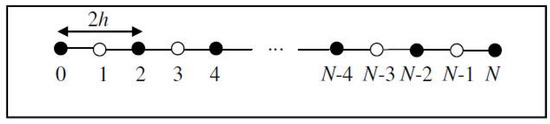
Figure 1.
Distribution of uniform node points for the half-sweep case.
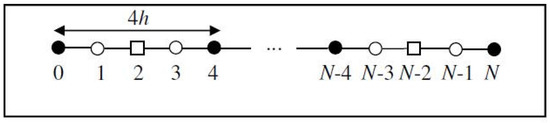
Figure 2.
Distribution of uniform node points for the quarter-sweep case.
Based on Figure 1 and Figure 2, the half- and quarter-sweep iterative methods will compute estimation values for node points of type • only until the convergence criterion is satisfied. After the convergence criterion is achieved, the estimation solutions for the remaining points are computed directly [12,14,15].
By applying the half- and quarter-sweep iteration concepts, the generalized full-, half- and quarter-sweep RMT approximation equations for both cases can be expressed as follows.
Case 1: does not exist
Case 2: exists
where
and
The value of p, which corresponds to 1, 2 and 4, represents the full-, half- and quarter-sweep cases, respectively. From Equations (9) and (10), it is obvious that the full-, half- and quarter-sweep RMT approximation equations can be represented in matrix form, as shown in Equation (11) with equations and unknowns
where the matrix M is dense, f is known and is the unknown vector to be calculated.
3. Iterative Methods
For the solution of system (11), complexity reduction approaches with the Gauss–Seidel (GS) iterative method are implemented. Combinations of the GS method with half- and quarter-sweep iterations are called the Half-Sweep Gauss–Seidel (HSGS) and Quarter-Sweep Gauss–Seidel (QSGS) methods, respectively. Meanwhile, the standard GS method is also known as the Full-Sweep Gauss–Seidel (FSGS) method.
Definition 2
([22]). Let M be a real matrix. Then, is referred to as
- (i)
- a regular splitting if S is nonsingular, and ,
- (ii)
- a weak regular splitting if S is nonsingular, and ,
- (iii)
- a nonnegative splitting, if , and
- (iv)
- a convergent splitting if .
Theorem 2
([23]). The following statements are equivalent:
- (i)
- W is a convergent matrix,
- (ii)
- for some matrix norm,
- (iii)
- .
Lemma 1
([23]). If the spectral radius satisfies , then exists and
Based on regular splitting, the GS splitting can be defined as follows.
Definition 3
([22]). Let , where P, and are diagonal, strictly lower triangular and strictly upper triangular parts of matrices M, respectively. We call the Gauss–Seidel splitting of M, if and . In addition, the splitting is called
- (i)
- Gauss–Seidel convergent if spectral radius, , and
- (ii)
- Gauss–Seidel regular if and .
The general scheme for all three GS iterative methods to solve system (11) can be written as
Based on the formulation (12), the iterative forms of the FSGS, HSGS and QSGS methods for solving system (11) are of the form
and
respectively, where
and
Theorem 3.
Let square matrices , and be in the order of , and , respectively. The successive approximations (13)–(15) for converge to the unique solution of
and
respectively, if and only if the spectral radius of the iteration matrices is less than one, i.e., , and .
Proof.
The iterative form of the FSGS, HSGS and QSGS methods can be rewritten as follows:
and
respectively. Since , and and, based on Theorem 2, , and matrices are convergent and satisfy the following conditions
and
respectively. Based on Lemma 1, this implies that
and
Hence, the sequences converge to the vectors , and and, , and , respectively. □
By determining the values of matrices P, and as stated in Definition 3, the algorithms for the FSGS, HSGS and QSGS methods with full-, half- and quarter-sweep RMT approximation equations, respectively, to solve problem (1) can generally be described by Algorithms 1 and 2.
| Algorithm 1: GS methods with RMT scheme (Case 1) | |||
| Step i. | Set and initialize all the parameters. | ||
| Step ii. | Iteration cycle | ||
| for | |||
| for | |||
| Compute | |||
| Step iii. | Convergence test. If the convergence criterion, i.e., the maximum norm | ||
| , is satisfied, go to Step iv. Otherwise, go to Step ii. | |||
| Step iv. | Stop. | ||
| Algorithm 2: GS methods with RMT scheme (Case 2) | |||
| Step i. | Set and initialize all the parameters. | ||
| Step ii. | Iteration cycle | ||
| for | |||
| for | |||
| Compute | |||
| Step iii. | Convergence test. If the convergence criterion, i.e., the maximum norm | ||
| , is satisfied, go to Step iv. Otherwise, go to Step ii. | |||
| Step iv. | Stop. | ||
After the iteration process, additional calculation is required for the HSGS and QSGS methods to compute the remaining points. In this paper, the second-order Lagrange interpolation technique [12] is applied to compute the remaining points. The formulations to calculate remaining points using the second-order Lagrange interpolation technique for HSGS and QSGS are defined as
and
respectively.
4. Numerical Simulations
For numerical simulations, two parameters, i.e., the number of iterations and computational time, are considered for comparative analysis to verify the performance of the FSGS with full-sweep RMT (FSGS-RMT), HSGS with half-sweep RMT (HSGS-RMT) and QSGS with quarter-sweep RMT (QSGS-RMT) methods in solving problem (1). The following two test problems that satisfy the conditions of the Fredholm alternative theorem have been chosen for the numerical simulations.
Test Problem 1 [24]
where the exact solution is given by
Test Problem 2 [11]
where the exact solution is
Throughout the simulations, the convergence test considered the threshold, . The simulations were run sequentially by a computer with processor Intel(R) Core(TM) 2 CPU 1.66GHz and computer codes were written in C programming language. The value of initial datum was set to be zero for all the test problems. All results of numerical simulations obtained from the implementation of the FSGS-RMT, HSGS-RMT and QSGS-RMT methods for test problems 1 and 2 are tabulated in Table 1 and Table 2, respectively. The following Table 3 and Table 4 show the estimation solutions of at points and for both test problems. Moreover, numerical results by applying FSGS with the standard repeated trapezoidal (FSGS-RT) method are also included for comparison purposes.

Table 1.
Numerical results of test problem 1.
Table 2.
Numerical results of test problem 2.
Table 3.
Numerical discrete solutions for test problem 1.
Table 4.
Numerical discrete solutions for test problem 2.
5. Computational Complexity Analysis
In order to measure the computational complexity of the methods, the amount of computational work required from each method for solving problem (1) was estimated by considering the arithmetic operations performed per iteration. In estimating the computational work of the proposed methods, it is assumed that the values of , , , and are stored beforehand. Based on Algorithm 1 (for Case 1), it can be observed that the number of arithmetic operations required (excluding the convergence test) per iteration for the FSGS-RMT, HSGS-RMT and QSGS-RMT methods is additions/subtractions (ADD/SUB) and multiplications/divisions (MUL/DIV). Meanwhile, for Case 2 (Algorithm 2), ADD/SUB and MUL/DIV operations are involved for an iteration.
The iteration process for the HSGS-RMT and QSGS-RMT methods is carried out only on and mesh points, respectively. Thus, an additional two ADD/SUB and six MUL/DIV operations are involved to calculate a mesh point for the remaining points after convergence by using second-order Lagrange interpolation. Hence, the total numbers of arithmetic operations involved in an iteration and in the direct solution after convergence for the FSGS-RMT, HSGS-RMT and QSGS-RMT methods are summarized in Table 5.
Table 5.
Total computing operations for the FSGS-RMT, HSGS-RMT and QSGS-RMT methods.
6. Conclusions
In this paper, a complexity reduction approach based on the half- and quarter-sweep iteration concepts has been successfully employed to obtain the estimation solutions for the second kind of linear Fredholm integral equations. Through numerical results obtained for test problems 1 and 2 (refer Table 1 and Table 2), the findings show that the numbers of iterations for the FSGS-RMT, HSGS-RMT and QSGS-RMT methods are nearly the same. In terms of computational time, both the HSGS-RMT and QSGS-RMT methods are faster than the FSGS-RMT method. This is due to the reduction in the computational complexity of the HSGS-RMT and QSGS-RMT methods, which is approximately and less than the FSGS-RMT method, respectively. Meanwhile, accuracies of numerical solutions for the HSGS-RMT and QSGS-RMT methods are also in good agreement compared to the FSGS-RMT method. The findings also support the claim in [13] that the RMT scheme is more accurate than the repeated trapezoidal scheme; refer to Table 3 and Table 4. Overall, the results reveal that the QSGS-RMT method is superior to the FSGS-RT, FSGS-RMT and HSGS-RMT methods. For future works, the effectiveness of the proposed complexity reduction approach will be investigated in solving fractional integro-differential equations [25,26].
Author Contributions
Conceptualization, M.S.M. and M.K.M.A.; Methodology, M.S.M., E.A., M.K.M.A., J.V.L.C. and A.S.; Formal analysis, M.S.M.; Writing—original draft preparation, M.S.M.; Writing—review and editing, E.A., J.V.L.C., A.S. and R.L.; Supervision, J.S.; Project administration, M.S.M.; Funding acquisition, M.S.M. All authors have read and agreed to the published version of the manuscript.
Funding
This research is funded by Yayasan Universiti Teknologi PETRONAS under YUTP-Fundamental Research Grant (Cost Center: 015LC0-083) and Universiti Teknologi PETRONAS—Universiti Malaysia Pahang Matching Grant (Cost Center: 015MC0-033).
Institutional Review Board Statement
Not applicable.
Informed Consent Statement
Not applicable.
Data Availability Statement
Not applicable.
Conflicts of Interest
The authors declare no conflict of interest.
Abbreviations
The following abbreviations are used in this manuscript:
| EDG | Explicit Decoupled Group |
| MEG | Modified Explicit Group |
| RMT | Repeated Modified Trapezoidal |
| GS | Gauss–Seidel |
| FSGS | Full-Sweep Gauss–Seidel |
| HSGS | Half-Sweep Gauss–Seidel |
| QSGS | Quarter-Sweep Gauss–Seidel |
References
- Atkinson, K.E. The Numerical Solution of Integral Equations of the Second Kind; Cambridge University Press: Cambridge, UK, 1997. [Google Scholar]
- Chen, Z.; Micchelli, C.A.; Xu, Y. Fast collocation methods for second kind integral equations. SIAM J. Numer. Anal. 2003, 40, 344–375. [Google Scholar] [CrossRef]
- Huang, M. A constuction of multiscale bases for Petrov-Galerkin methods for integral equations. Adv. Comput. Math. 2006, 25, 7–22. [Google Scholar] [CrossRef]
- Long, G.; Sahani, M.M.; Nelakanti, G. Polynomially based multi-projection methods for Fredholm integral equations of the second kind. Appl. Math. Comput. 2009, 215, 147–155. [Google Scholar] [CrossRef]
- Maleknejad, K.; Sahlan, M.N. The method of moments for solution of second kind Fredholm integral equations based on B-spline wavelets. Int. J. Comput. Math. 2010, 87, 1602–1616. [Google Scholar] [CrossRef]
- Xiao, J.-Y.; Wen, L.-H.; Zhang, D. Solving second kind Fredholm integral equations by periodic wavelet Galerkin method. Appl. Math. Comput. 2006, 175, 508–518. [Google Scholar] [CrossRef]
- Dick, J.; Kritzer, P.; Kuo, F.Y.; Sloan, I.H. Lattice-Nyström method for Fredholm integral equations of the second kind with convolution type kernels. J. Complex. 2007, 23, 752–772. [Google Scholar] [CrossRef][Green Version]
- Kaneko, H.; Xu, Y. Gauss-type quadratures for weakly singular integrals and their application to Fredholm integral equations of the second kind. Math. Comput. 1994, 62, 739–753. [Google Scholar] [CrossRef]
- Muthuvalu, M.S.; Sulaiman, J. Quarter-Sweep Arithmetic Mean (QSAM) iterative method for second kind linear Fredholm integral equations. Appl. Math. Sci. 2010, 4, 2943–2953. [Google Scholar]
- Muthuvalu, M.S.; Sulaiman, J. Comparisons of quadrature schemes with Arithmetic Mean iterative method for second kind linear Fredholm integral equations. J. Math. Comput. Sci. 2010, 1, 174–186. [Google Scholar] [CrossRef][Green Version]
- Muthuvalu, M.S.; Sulaiman, J. Half-Sweep Arithmetic Mean method with composite trapezoidal scheme for solving linear Fredholm integral equations. Appl. Math. Comput. 2011, 217, 5442–5448. [Google Scholar] [CrossRef]
- Muthuvalu, M.S.; Sulaiman, J. Numerical solution of second kind linear Fredholm integral equations using QSGS iterative method with high-order Newton-Cotes quadrature schemes. Malays. J. Math. Sci. 2011, 5, 85–100. [Google Scholar]
- Saberi-Nadjafi, J.; Heidari, M. Solving linear integral equations of the second kind with repeated modified trapezoid quadrature method. Appl. Math. Comput. 2007, 189, 980–985. [Google Scholar] [CrossRef]
- Abdullah, A.R. The four point Explicit Decoupled Group (EDG) method: A fast Poisson solver. Int. J. Comput. Math. 1991, 38, 61–70. [Google Scholar] [CrossRef]
- Othman, M.; Abdullah, A.R. An efficient four points Modified Explicit Group Poisson solver. Int. J. Comput. Math. 2000, 76, 203–217. [Google Scholar] [CrossRef]
- Ali, N.H.M.; Ling, S.T. Rotated Krylov preconditioned iterative schemes in the solution of convection-diffusion equations. Appl. Math. Comput. 2008, 206, 425–437. [Google Scholar] [CrossRef]
- Muthuvalu, M.S.; Sulaiman, J. Half-Sweep Geometric Mean method for solution of linear Fredholm equations. Matematika 2008, 24, 75–84. [Google Scholar]
- Ng, K.F.; Ali, N.H.M. Performance analysis of explicit group parallel algorithms for distributed memory multicomputer. Parallel Comput. 2008, 34, 427–440. [Google Scholar] [CrossRef]
- Nusi, N.M.; Othman, M. Half- and quarter-sweeps implementation of Finite-Difference Time-Domain method. Malays. J. Math. Sci. 2009, 3, 45–53. [Google Scholar]
- Othman, M.B.; Abdullah, A.R.B. The halfsweeps multigrid method as a fast multigrid Poisson solver. Int. J. Comput. Math. 1998, 69, 319–329. [Google Scholar] [CrossRef][Green Version]
- Sulaiman, J.; Hasan, M.K.; Othman, M.; Karim, S.A.A. MEGSOR iterative method for the triangle element solution of 2D Poisson equations. Procedia Comput. Sci. 2010, 1, 377–385. [Google Scholar] [CrossRef]
- Niki, H.; Kohno, T.; Morimoto, M. The preconditioned Gauss-Seidel method faster than the SOR method. J. Comput. Appl. Math. 2008, 219, 59–71. [Google Scholar] [CrossRef]
- Isaacson, E.; Keller, H.B. Analysis of Numerical Methods; Dover Publications: New York, NY, USA, 1994. [Google Scholar]
- Wang, W. A new mechanical algorithm for solving the second kind of Fredholm integral equation. Appl. Math. Comput. 2006, 172, 946–962. [Google Scholar] [CrossRef]
- Ahmad, B.; Alruwaily, Y.; Alsaedi, A.; Ntouyas, S.K. Riemann-Stieltjes integral boundary value problems involving mixed Riemann-Liouville and Caputo fractional derivatives. J. Nonlinear Funct. Anal. 2021, 11. [Google Scholar] [CrossRef]
- Lachouri, A.; Ardjouni, A.; Djoudi, A. Positive solutions of a fractional integro-differential equation with integral boundary conditions. Commun. Optim. Theory 2020, 2020, 1–9. [Google Scholar] [CrossRef]
Publisher’s Note: MDPI stays neutral with regard to jurisdictional claims in published maps and institutional affiliations. |
© 2022 by the authors. Licensee MDPI, Basel, Switzerland. This article is an open access article distributed under the terms and conditions of the Creative Commons Attribution (CC BY) license (https://creativecommons.org/licenses/by/4.0/).