Abstract
The main goal of this research is to present a new approach to double transforms called the double Laplace–ARA transform (DL-ARAT). This new double transform is a novel combination of Laplace and ARA transforms. We present the basic properties of the new approach including existence, linearity and some results related to partial derivatives and the double convolution theorem. To obtain exact solutions, the new double transform is applied to several partial differential equations such as the Klein–Gordon equation, heat equation, wave equation and telegraph equation; each of these equations has great utility in physical applications. In symmetry to other symmetric transforms, we conclude that our new approach is simpler and needs less calculations.
1. Introduction
For solving partial differential equations (PDE)s, integral transforms are considered the most effective technique. Their significance stems from the fact that PDEs can be used to mathematically explain a variety of occurrences in mathematical physics and some other scientific fields [1,2,3,4,5,6,7,8,9,10,11,12,13]. These equations can also be transformed in order to find the exact solutions to PDEs using integral transforms. Because of the strength and simplicity of the transform techniques, scientists and researchers have worked very hard at studying and improving them.
Many integral transforms have been established and implemented to solve partial and integral differential equations; these transforms allow us to obtain the exact solutions of the target equations without needing linearization or discretization; they are applied to transform partial differential equations into ordinary ones, in the case of using single transformation, or into algebraic ones if we use double integral transformation. As examples, we mention Laplace transform [14], Fourier transform [15], Novel transform [16], M-transform [17], Sumudu transform [18], Natural transform [19], Elzaki transform [20], Kamal transform [21], the Aboodh transform [22], ARA transform [23] and ZZ transform [24].
The double transforms have also been widely applied to solving PDEs with unknown functions of two variables, and as a result, double transforms are considered very effective in handling PDEs compared to other numerical approaches [25,26,27,28]. In addition, extensions of the double transform have been developed in the relevant literature, such as the double Laplace transform, double Shehu transform [29], double Kamal transform [30], double Sumudu transform [31,32,33,34,35,36], double Elzaki transform [37], double Laplace–Sumudu transform [38] and ARA–Sumudu transform [39,40]. All these double transforms cited above can be considered special cases of the general double transform by Meddahi et al. [41], but sometimes we need to study special kinds of double transforms and compare them to consider the properties of each one, and decide on the best ones to use in handling new applications.
Recently, Saadeh and others introduced a novel integral transform known as the ARA transform. ARA is a name of the presented transform and it is not an abbreviation, it has novel properties; that is, it can generate many transforms by changing the value of the index , also as introduced in [23], it has a duality to the Laplace transform and has an advantage that allows it to overcome the singularity at . For all of these merits, we decided to construct a new combination between the Laplace and ARA transforms, so that we could reap the benefits of these two powerful transforms. We called this new approach the double Laplace–ARA transform.
The main goal of this paper is to introduce a new double transform, namely DL-ARAT. Fundamental properties and theorems of DL-ARAT are presented and proven, and we also compute the values of DL-ARAT for some functions. New relations related to partial derivatives and the double convolution theorem are established and implemented to solve PDEs. The novelty of this work appears in the new combinations between Laplace and ARA transforms, in which the new DL-ARATs have the advantages of the two transforms, the simplicity of Laplace and the applicability of ARA, in handling some singular points that appeared in the equations.
In this research, we studied the nonhomogeneous linear PDE of the following form
with the initial conditions
and the boundary conditions
and , where is an unknown function, is the source term and and are constants.
A simple formula for the solution of the above equation was established and employed to solve some applications in order to display the efficiency and strength of this new approach.
This article is organized as follows: In Section 2, fundamental concepts and properties of Laplace and ARA transformations are introduced. In Section 3, we introduce the new double transform DL-ARAT, that combines the Laplace and ARA transforms; we also present some properties of the new transform. In Section 4, we introduce the application of DL-ARAT to solve some types of PDEs. In Section 5, some examples are presented and solved using DL-ARAT. Finally, In Section 6, a conclusion is provided.
2. Basic Definitions and Theorems for Laplace and ARA Transforms
In this section, we introduce the basic properties of Laplace and ARA transforms.
2.1. Laplace Transform [14]
Definition 1.
Let be a function of specified for . Then, Laplace transform of , denoted by , is defined by
The inverse Laplace transform is provided by
Theorem 1.
(Existence conditions). If is a piecewise continuous function on the interval and of exponential order , then exists for and satisfies
where is positive constant. Then, Laplace transform integral converges absolutely for
Proof of Theorem 1.
Using the definition of Laplace transform, we find
Thus, Laplace transform integral converges absolutely for .
In the following arguments, we present some properties of the Laplace transform.
Assume that , and . Then
□
2.2. ARA Transform [23]
Definition 2.
The ARA integral transform of order of a continuous function on the interval is defined as
Theorem 2.
(Existence conditions). If the function is piecewise continuous in every finite interval and satisfies
where is positive constant, then the ARA transform exists for all .
Proof of Theorem 2.
Using the definition of ARA transform, we obtain
Using the property of improper integral, we find
This improper integral converges for all . Thus, exists.
In the following, we state some basic properties of the ARA transform
Assume that and and . Then
where is the ARA transform of order one of a piecewise continuous function on and it is defined as
For simplicity, let us denote using .
The above results can be obtained from the definition of Laplace and ARA transforms with simple calculations.□
3. Double Laplace–ARA Transform of Order One (DL-ARAT)
This section introduces a new integral transform, which is a novel combination between the famous Laplace transform and ARA transform denoted by DL-ARAT. We provide the fundamental properties and characteristics including the existence conditions, linearity and the inverse of the proposed new double transform. Moreover, some important properties and results are provided and used to compute the DL-ARAT for some elementary functions. The double convolution theorem and the derivatives properties of the new transform are also presented and illustrated.
Definition 3.
Let be continuous function of two positive variables and. Then the DL-ARAT of is defined as
provided the integral exists.
Clearly, the DL-ARAT is a linear integral transformation as shown below,
where and are constants and exists.
Additionally, the inverse of the DL-ARAT is found using
Property 1.
Let . Then
Proof of Property 1.
□
3.1. DL-ARAT of Some Basic Functions
- i.
- Let . Then,
- ii.
- Let and are constants. Then,From Equations (5) and (13), we find
- iii.
- Let and are constants. Then,From Equations (6) and (14), we findSimilarly,Using the property of complex analysis, we haveUsing Euler’s formulasAnd the formulasNow, we find the DL-ARAT of the following functions
- iv.
- Let , thenFrom Equation (14), we get .
3.2. Existence Conditions for DL-ARAT
Let be function of exponential order and as and . If there exists a positive such that and , we have
We can write as and , and .
Theorem 3.
Let be a continuous function on the region of exponential orders and .Then exists for and provided and .
Proof of Theorem 3.
Using the definition of DL-ARAT, we get
Thus, exists for and provided and .□
3.3. Some Theorems of DL-ARAT
Theorem 4.
(Shifting Property). Let be a continuous function and . Then
Proof of Theorem 4.
□
Theorem 5.
(Periodic Function). Let exists, where periodic function of periods and such that
Then
Proof of Theorem 5.
Using the definition of DL-ARAT, we find
Using the property of improper integral, Equation (21) can be written as
Putting and on second integral in Equation (22), we obtain
Using the periodicity of the function , Equation (23) can be written as
Using the definition of DL-ARAT, we obtain
Thus, Equation (25) can be simplified into
□
Theorem 6.
(Heaviside Function). Let exists and , then
where is the Heaviside unit step function defined as
Proof of Theorem 6.
Using the definition of DL-ARAT, we find
Putting and in Equation (27). We obtain
Thus, Equation (28) can be simplified into
□
Theorem 7.
(Convolution Theorem). Let and exists and , , then
where and the symbol is denotes the double convolution with respect to and .
Proof of Theorem 7.
Using the definition of DL-ARAT, we obtain
Using the Heaviside unit step function, Equation (31) can be written as
Thus, Equation (32) can be written as
□
Theorem 8.
(Derivatives’ Properties). Let be a continuous function and . Then, we get the following derivatives properties
- (a)
- (b)
- (c)
- (d)
- (e)
Proof of Theorem 8.
- (a)
Using the integration by part, we obtain
Let ,
Thus,
- (b)
Using the integration by part, we obtain
Let ,
Thus,
- (c)
Using the integration by part, we obtain
Let ,
Thus,
Using Equation (33), we have
- (d)
Using the integration by part, we obtain
Let ,
Thus,
Using Equation (34), we have
- (e)
Using the integration by part, we obtain.
And, using Equations (7) and (33), we have
□
The previous results of DL-ARAT to some basic functions, some theorems and basic derivatives are summed up in the in Table 1 below:
Table 1.
DL-ARAT to some basic functions.
4. Basic Idea of Double Laplace-ARA Transform Method
To illustrate the basic idea of this method for solving partial differential equations, we consider a second order linear partial differential equation in two independent variables and in its general form given by
with the initial conditions
And the boundary conditions
And assume that , where is unknown function, is the source term and and are constants.
The main idea of this method is to apply the DL-ARAT to Equation (37), Laplace transform to the initial conditions in Equation (38) and ARA transform to the boundary conditions in Equation (39) as the following:
Operating Laplace transform to the initial conditions given in Equation (38) yields
ARA transform of the boundary conditions in Equation (39) is given by
And
Now, applying the DL-ARAT on both sides of Equation (37), we find that
Using the differentiation property of the DL-ARAT and above conditions, we have
Equation (40) can be simplified as follows-
Operating with the inverse DL-ARAT on both sides of Equation (41), we obtain
where represents the term arising from the known function and all conditions.
5. Applications of Double Laplace–ARA Transform in Solving Partial Differential Equations

Many physical phenomena can be modeled by a set of governing equations, several of them begin as partial differential equations. One may encounter PDEs in many branches of sciences such as:
- Quantum mechanics.
- Particle physic.
- Astrophysics.
- Chemistry.
- Biology.
- Environmental science.
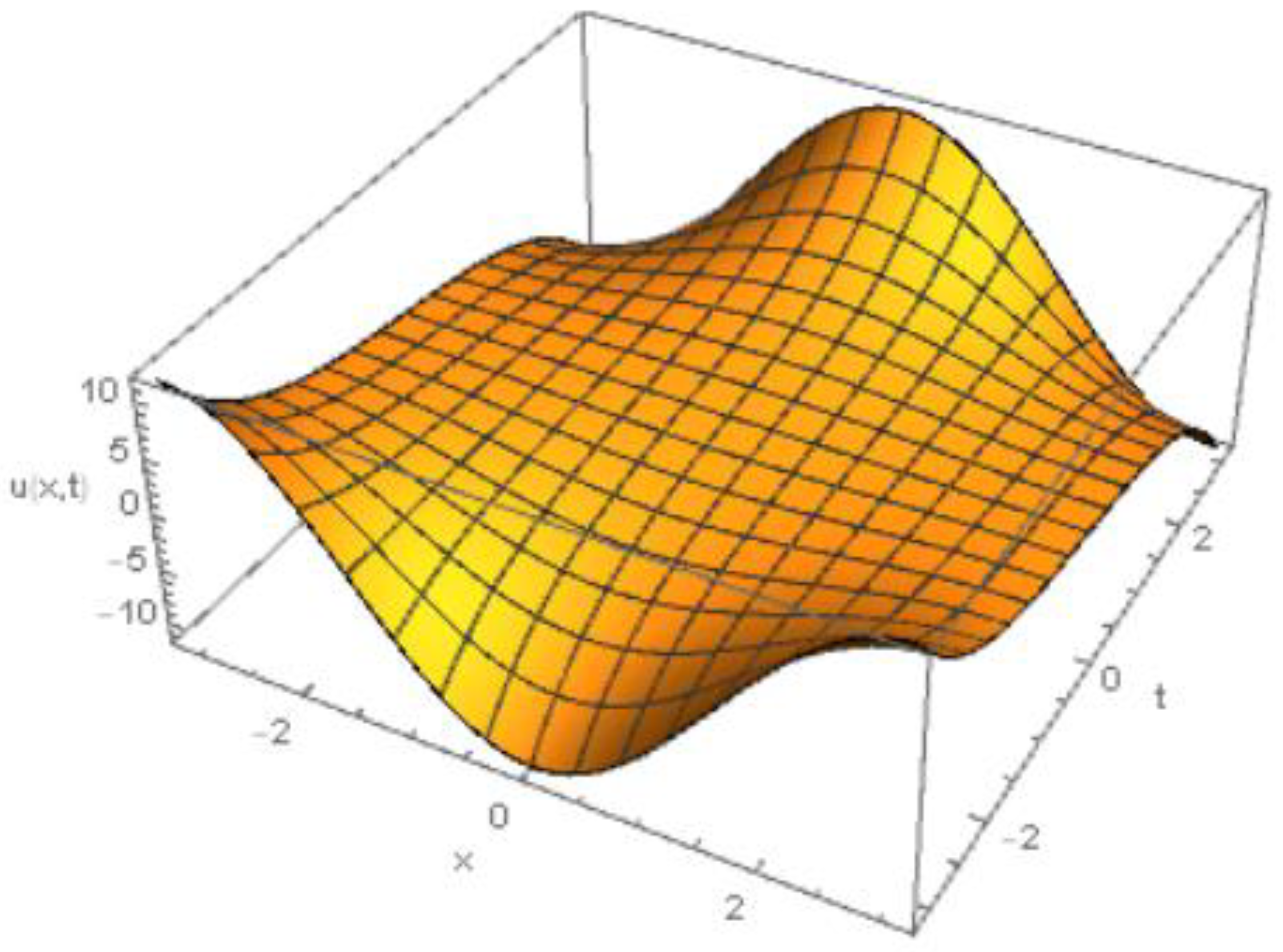
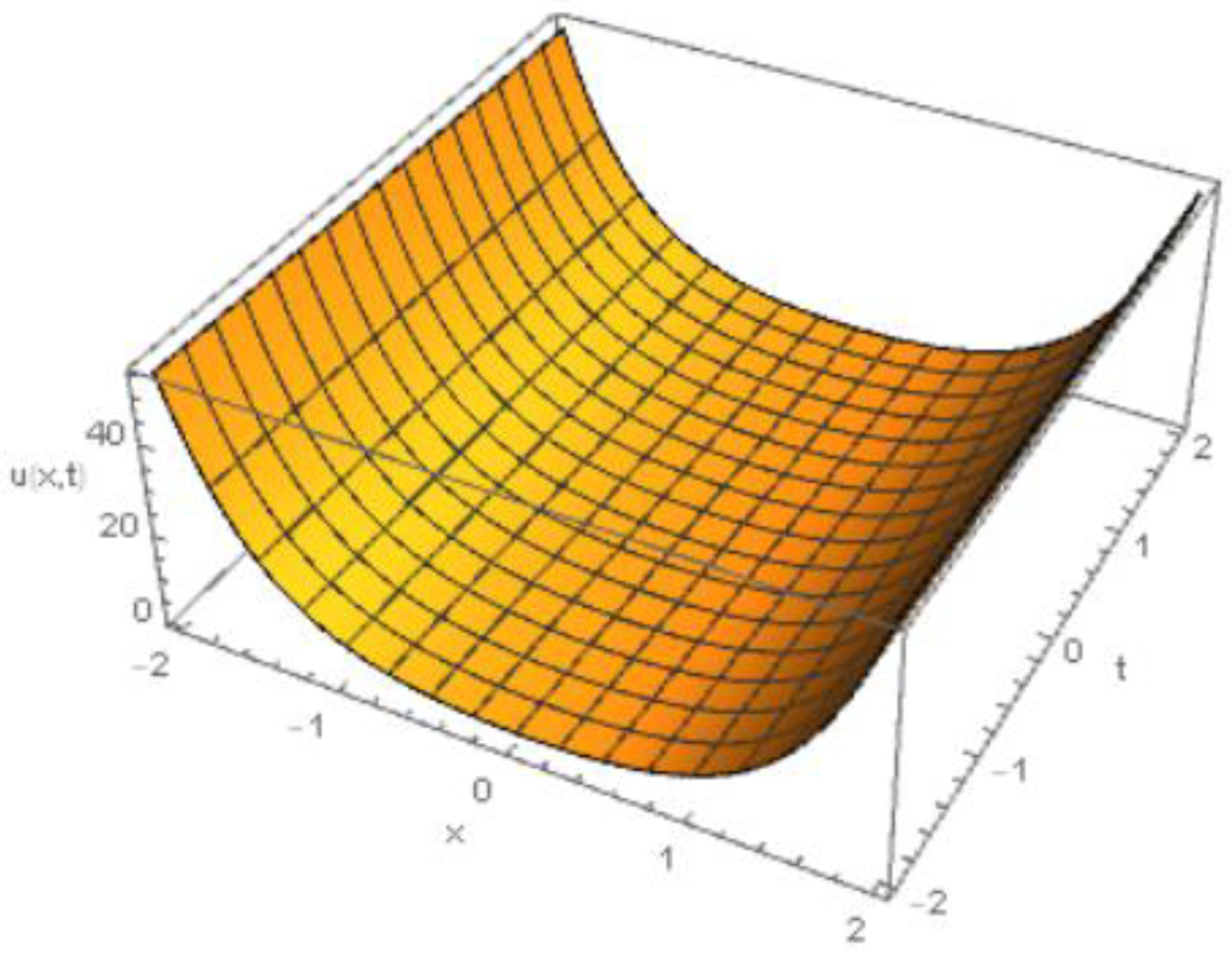
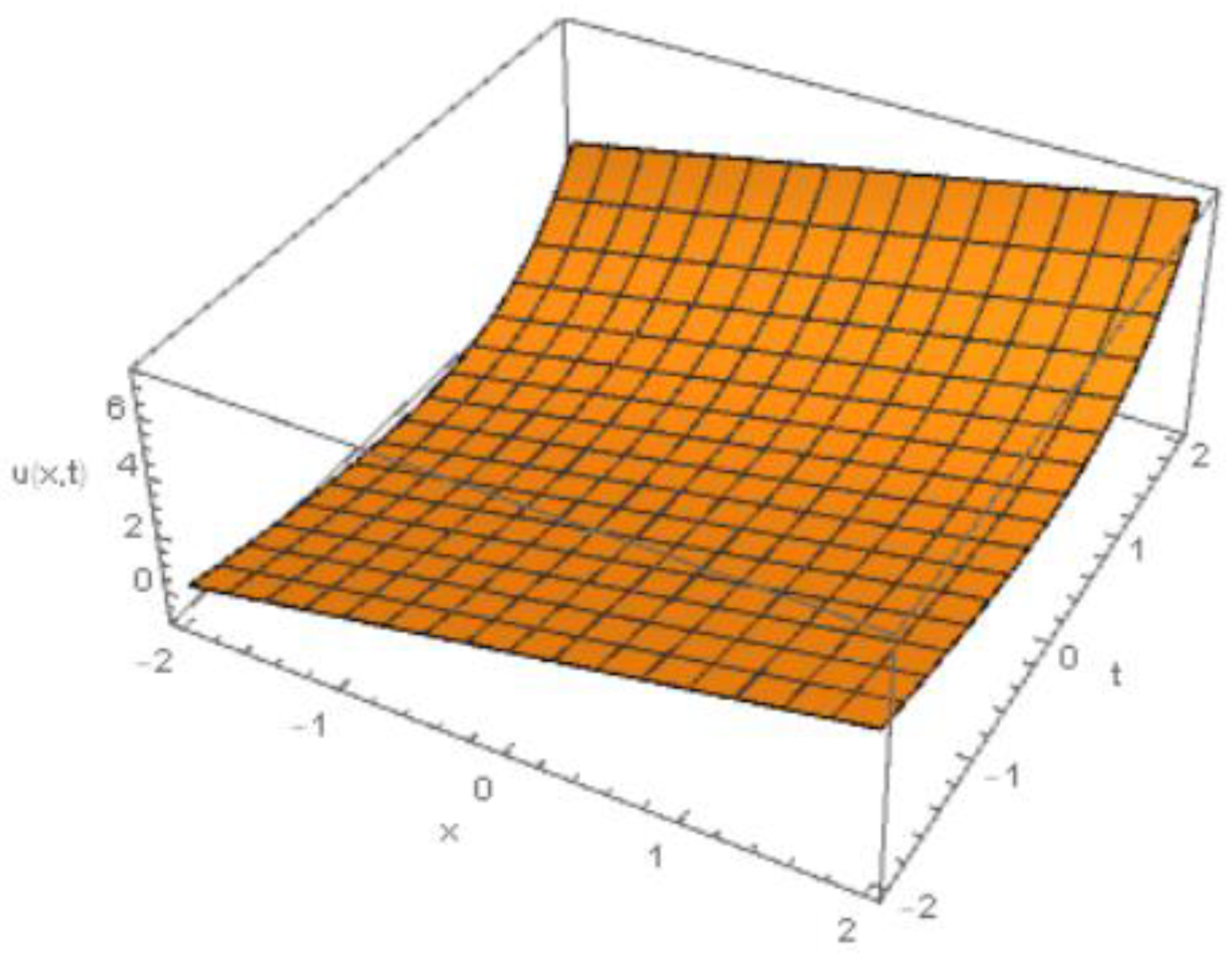
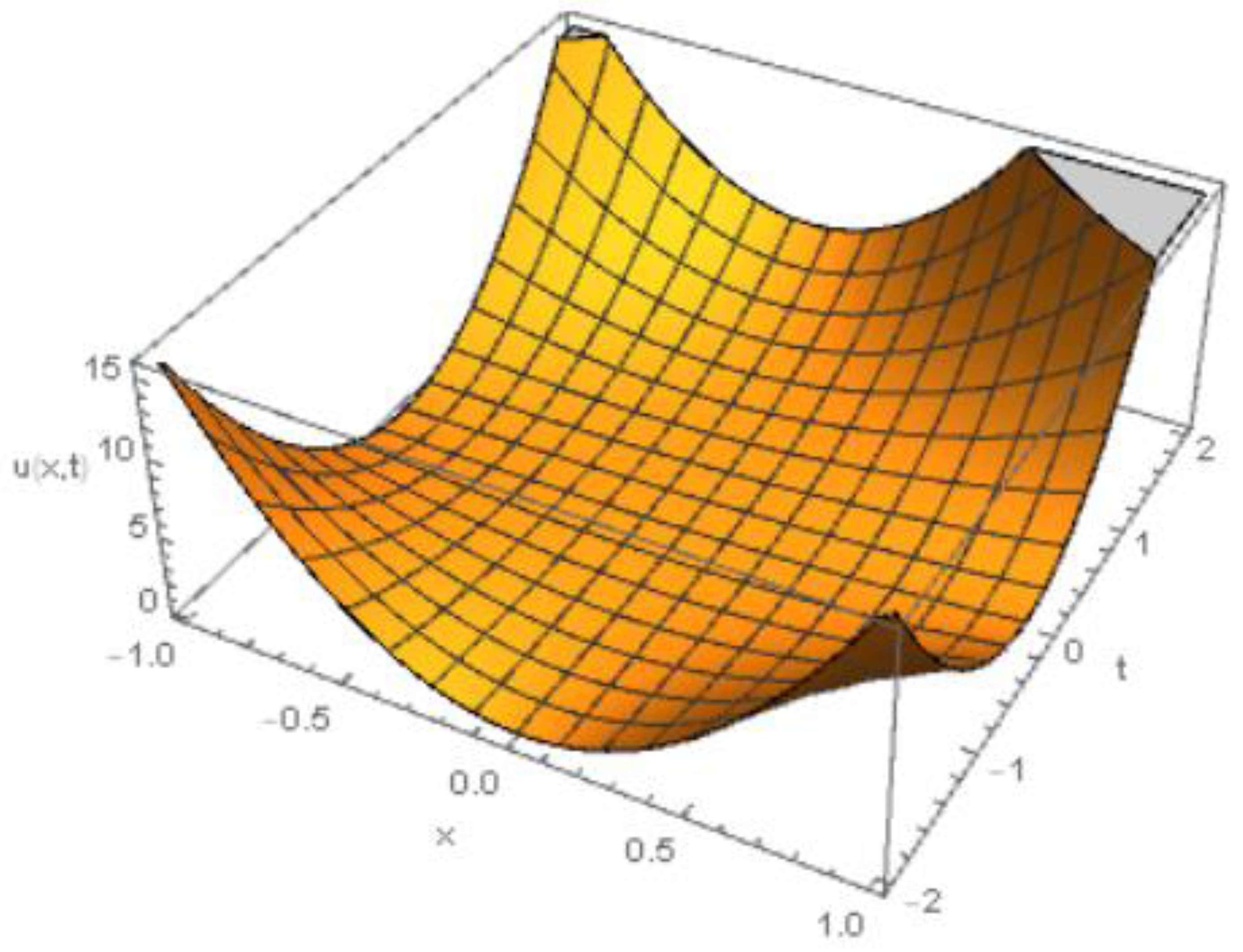
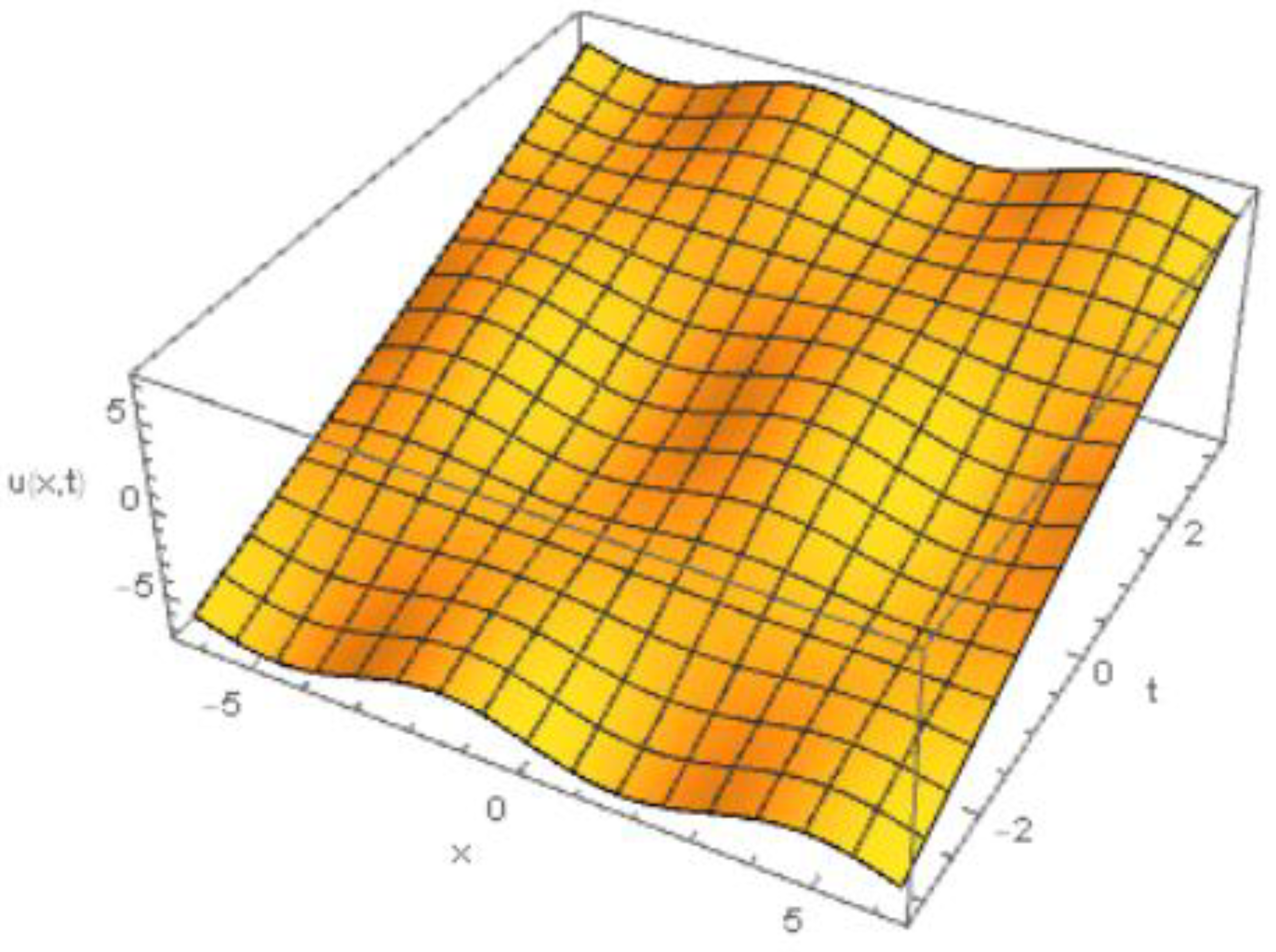
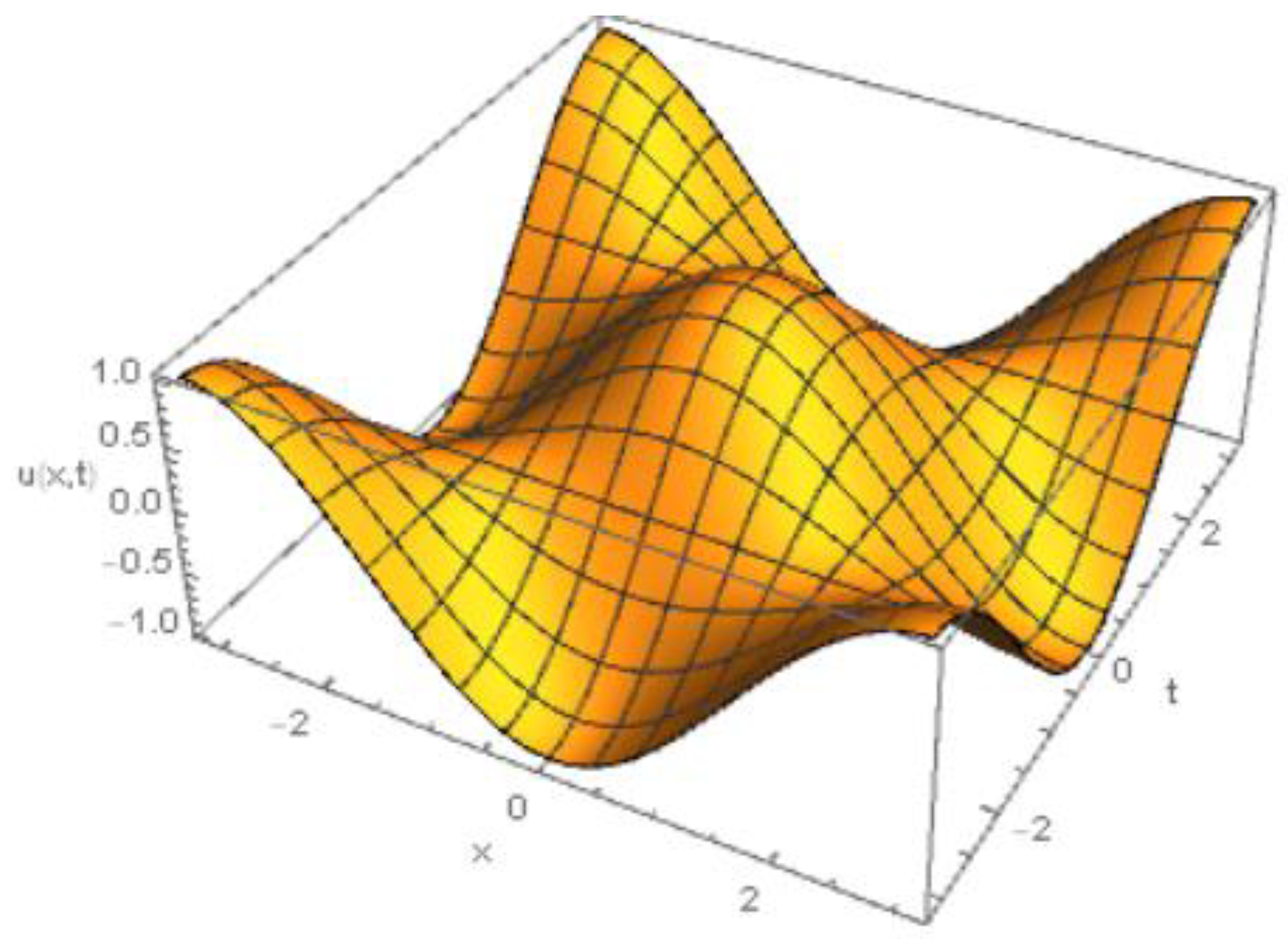
The list goes on. Solving these partial differential equations is another challenge. Current mathematics fail to provide a closed solution and more advances are yet to come. Meanwhile, many numerical techniques have been developed for solving PDEs. In this section we introduce the solution of some familiar PDEs such as the wave equation, heat equation, telegraph equation and others. All the following figures of the selected examples were obtained using Mathematica software 13.
Example 1.
Let us consider the homogeneous wave equation
with the initial conditions and the boundary conditions
Applying Laplace transform to the initial conditions and ARA transform to the boundary conditions, we find
By substituting the values of the functions , and in the general formula in Equation (41), we obtain
Applying the inverse DL-ARAT to Equation (44), then the solution to Equation (43) is
The following figure, Figure 1, illustrates the 3D graph of the exact solution of Example 1.
Figure 1.
The exact solution of Example 1.
Example 2.
Let us consider the homogeneous Laplace equation
with the initial conditions and the boundary conditions .
Applying Laplace transform to the initial conditions and ARA transform to the boundary conditions, we find
By substituting the values of the functions , and in the general formula in Equation (41), we obtain
Now, applying the inverse DL-ARAT to Equation (46), then the solution to Equation (45) is
The following figure, Figure 2, illustrates the 3D graph of the exact solution of Example 2.
Figure 2.
The exact solution of Example 2.
Example 3.
Let us consider the homogeneous telegraph equation
with the initial conditions and the boundary conditions
Applying Laplace transform to the initial conditions and ARA transform to the boundary conditions, we find
By substituting the values of the functions , and in the general formula in Equation (41), we obtain
Now, applying inverse DL-ARAT to Equation (48), then the solution to Equation (47) is
The following figure, Figure 3, illustrates the 3D graph of the exact solution of Example 3.
Figure 3.
The exact solution of Example 3.
Example 4.
Let us consider the nonhomogeneous heat equation
with the initial conditions and the boundary conditions
Applying Laplace transform to the initial conditions and ARA transform to the boundary conditions, we find
By substituting the values of the functions , and in the general formula in Equation (41), we obtain
Now, applying the inverse of DL-ARAT to Equation (50), then the solution to Equation (49) is
The following figure, Figure 4, illustrates the 3D graph of the exact solution of Example 4.
Figure 4.
The exact solution of Example 4.
Example 5.
Let us consider the Klein–Gordon equation
with the initial conditions and the boundary conditions .
Applying Laplace transform to the initial conditions and ARA transform to the boundary conditions, we find
By substituting the values of the functions and and in the general formula in Equation (41), we obtain
Now, applying the inverse DL-ARAT to Equation (52), then the solution to Equation (51) is
The following figure, Figure 5, illustrates the 3D graph of the exact solution of Example 5.
Figure 5.
The exact solution of Example 5.
Example 6.
Let us consider the advection–diffusion equation
with the initial conditions , and the boundary conditions .
Applying Laplace transform to the initial conditions and ARA transform to the boundary conditions, we find
By substituting the values of functions , and in the general formula in Equation (41), we obtain
Now, applying the inverse DL-ARAT to Equation (54), then the solution to Equation (53) is
The following figure,Figure 6, illustrates the 3D graph of the exact solution of Example 6.
Figure 6.
The exact solution of Example 6.
Example 7.
Let us consider the Goursat equation
with the initial condition> , boundary the condition and
Applying Laplace transform to the initial conditions and ARA transform to the boundary conditions, we find
By substituting the values of the functions and in the general form in Equation (41), we obtain
Now, applying the inverse DL-ARAT to Equation (56), then the solution to Equation (55) is
The following figure, Figure 7, illustrates the 3D graph of the exact solution of Example 7.
Figure 7.
The exact solution of Example 7.
6. Conclusions
In this paper, a new double transform called the DL-ARAT were presented, several properties and theorems related to the linearity, existence, partial derivatives and the double convolution theorem were introduced. The new results were implemented to establish a new formula for solving PDEs, we discussed some numerical examples and get the exact solutions using the new double transform. Applications of the DL-ARAT will be developed in the future and utilized to solve integral equations, PDEs with variable coefficients and the equations appeared during the fluid flow [1,2]. Moreover, we have mentioned here that this new double transform can be combined with one of the iteration numerical methods to solve nonlinear PDEs and equations with variables coefficients, since all integral transforms cannot solve nonlinear problems directly, unless they are combined with iteration methods.
In a general view of what was discussed in [1,2] we find that this research focuses on the same direction with the possibility of using partial differential equations in explaining physical phenomena. Therefore, we recommend that this study be continued using the applications of this method as a future project for solving equations that appear during fluid flow.
Author Contributions
Conceptualization, A.K.S., Z.I.M. and R.S.; methodology, A.K.S., Z.I.M. and R.S.; software, R.S., A.K.S. and Z.I.M.; validation, A.K.S., Z.I.M. and R.S.; formal analysis, A.K.S., Z.I.M. and R.S.; investigation, A.K.S., Z.I.M. and R.S.; resources, R.S.; data curation, A.K.S.; writing—original draft preparation, Z.I.M.; writing—review and editing, A.K.S. and Z.I.M..; visualization, A.K.S. and Z.I.M.; supervision, R.S.; project administration, Z.I.M.; funding acquisition, Z.I.M. and R.S. All authors have read and agreed to the published version of the manuscript.
Funding
This research received no external funding.
Data Availability Statement
Not applicable.
Conflicts of Interest
The authors declare no conflict of interest.
References
- Ahmad, L.; Khan, M. Importance of activation energy in development of chemical covalent bounding in flow of Sisko magneto-Nano fluids over porous moving curved surface. Int. J. Hydrogen Energy. 2019, 44, 10197–10206. [Google Scholar] [CrossRef]
- Ahmad, L.; Khan, M. Numerical simulation for MHD flow of Sisko nanofluid over a moving curved surface: A revised model. Microsyst. Technol. 2019, 25, 2411–2428. [Google Scholar] [CrossRef]
- Constanda, C. Solution Techniques for Elementary Partial Differential Equations; Chapman and Hall/CRC: New York, NY, USA, 2002. [Google Scholar]
- Debnath, L. The double Laplace transforms and their properties with applications to functional, integral and partial differential equations. Int. J. Appl. Comput. Math. 2016, 2, 223–241. [Google Scholar] [CrossRef]
- Muatjetjeja, B. Group classification and conservation laws of the generalized Klein–Gordon–Fock equation. Int. J. Mod. Phys. B 2016, 30, 1640023. [Google Scholar] [CrossRef]
- Wazwaz, A.M. Partial Differential Equations and Solitary Waves Theory; Springer: New York, NY, USA, 2009. [Google Scholar]
- Eddine, N.C.; Ragusa, M.A. Generalized critical Kirchhoff-type potential systems with Neumann boundary conditions. Appl. Anal. 2022, 101, 3958–3988. [Google Scholar] [CrossRef]
- Rashid, S.; Ashraf, R.; Bonyah, E. On analytical solution of time-fractional biological population model by means of generalized integral transform with their uniqueness and convergence analysis. J. Funct. Spaces 2022, 2022, 7021288. [Google Scholar] [CrossRef]
- Zid, S.; Menkad, S. The lambda-Aluthge transform and its applications to some classes of operators. Filomat 2022, 36, 289–301. [Google Scholar] [CrossRef]
- Debnath, L. Nonlinear Partial Differential Equations for Scientists and Engineers; Birkhäuser: Boston, MA, USA, 1997. [Google Scholar]
- Qazza, A.; Hatamleh, R.; Alodat, N. About the solution stability of Volterra integral equation with random kernel. Far East J. Math. Sci. 2016, 100, 671–680. [Google Scholar] [CrossRef]
- Gharib, G.; Saadeh, R. Reduction of the self-dual yang-mills equations to sinh-poisson equation and exact solutions. WSEAS Trans. Math. 2021, 20, 540–554. [Google Scholar] [CrossRef]
- Saadeh, R.; Al-Smadi, M.; Gumah, G.; Khalil, H.; Khan, A. Numerical investigation for solving two-point fuzzy boundary value problems by reproducing kernel approach. Appl. Math. Inf. Sci. 2016, 10, 2117–2129. [Google Scholar] [CrossRef]
- Widder, V. The Laplace Transform; Princeton University Press: Princeton, NJ, USA, 1941. [Google Scholar]
- Bochner, S.; Chandrasekharan, K. Fourier Transforms; Princeton University Press: London, UK, 1949. [Google Scholar]
- Atangana, A.; Kiliçman, A. A novel integral operator transform and its application to some FODE and FPDE with some kind of singularities. Math. Probl. Eng. 2013, 2013, 531984. [Google Scholar] [CrossRef]
- Srivastava, H.; Luo, M.; Raina, R. A new integral transform and its applications. Acta Math. Sci. 2015, 35, 1386–1400. [Google Scholar] [CrossRef]
- Watugula, G.K. Sumudu transform: A new integral transform to solve differential equations and control engineering problems. Int. J. Math. Educ. Sci. Technol. 1993, 24, 35–43. [Google Scholar] [CrossRef]
- Khan, Z.H.; Khan, W.A. Natural-transform-properties and applications. NUST J. Eng. Sci. 2008, 1, 127–133. [Google Scholar]
- Elzaki, T.M. The new integral transform “Elzaki transform”. Glob. J. Pure Appl. Math. 2011, 7, 57–64. [Google Scholar]
- Sedeeg, A.H. The New Integral Transform “Kamal Transform”. Adv. Theor. Appl. Math. 2016, 11, 451–458. [Google Scholar]
- Aboodh, K.; Idris, A.; Nuruddeen, R. On the Aboodh transform connections with some famous integral transforms. Int. J. Eng. Inform. Syst. 2017, 1, 143–151. [Google Scholar]
- Saadeh, R.; Qazza, A.; Burqan, A. A new integral transform: ARA transform and its properties and applications. Symmetry 2020, 12, 925. [Google Scholar] [CrossRef]
- Zafar, Z. ZZ transform method. Int. J. Adv. Eng. Glob. Technol. 2016, 4, 1605–1611. [Google Scholar]
- Aghili, A.; Moghaddam, B.P. Certain theorems on two dimensional Laplace transform and non-homogeneous parabolic partial differential equations. Surv. Math. Its Appl. 2011, 6, 165–174. [Google Scholar]
- Dhunde, R.R.; Bhondge, N.M.; Dhongle, P.R. Some remarks on the properties of double Laplace transforms. Int. J. Appl. Phys. Math. 2013, 3, 293–295. [Google Scholar] [CrossRef]
- Dhunde, R.R.; Waghmare, G.L. Double Laplace transform method in mathematical physics. Int. J. Theor. Math. Phys. 2017, 7, 14–20. [Google Scholar]
- Eltayeb, H.; Kiliçman, A. A note on double Laplace transform and telegraphic equations. Abstr. Appl. Anal. 2013, 2013, 932578. [Google Scholar] [CrossRef]
- Alfaqeih, S.; Misirli, E. On double Shehu transform and its properties with applications. Int. J. Anal. Appl. 2020, 18, 381–395. [Google Scholar]
- Sonawane, S.M.; Kiwne, S.B. Double Kamal transforms: Properties and Applications. J. Appl. Sci. Comput. 2019, 4, 1727–1739. [Google Scholar]
- Ganie, J.A.; Ahmad, A.; Jain, R. Basic analogue of double Sumudu transform and its applicability in population dynamics. Asian J. Math. Stat. 2018, 11, 12–17. [Google Scholar] [CrossRef][Green Version]
- Eltayeb, H.; Kiliçman, A. On double Sumudu transform and double Laplace transform. Malays. J. Math. Sci. 2010, 4, 17–30. [Google Scholar]
- Tchuenche, J.M.; Mbare, N.S. An application of the double Sumudu transform. Appl. Math. Sci. 2007, 1, 31–39. [Google Scholar]
- Al-Omari, S.K.Q. Generalized functions for double Sumudu transformation. Int. J. Algebra 2012, 6, 139–146. [Google Scholar]
- Eshag, M.O. On double Laplace transform and double Sumudu transform. Am. J. Eng. Res. 2017, 6, 312–317. [Google Scholar]
- Ahmed, Z.; Idrees, M.I.; Belgacemc, F.B.M.; Perveen, Z. On the convergence of double Sumudu transform. J. Nonlinear Sci. Appl. 2020, 13, 154–162. [Google Scholar] [CrossRef]
- Idrees, M.I.; Ahmed, Z.; Awais, M.; Perveen, Z. On the convergence of double Elzaki transform. Int. J. Adv. Appl. Sci. 2018, 5, 19–24. [Google Scholar] [CrossRef]
- Ahmed, S.; Elzaki, T.; Elbadri, M.; Mohamed, M.Z. Solution of partial differential equations by new double integral transform (Laplace–Sumudu transform). Ain Shams Eng. J. 2021, 12, 4045–4049. [Google Scholar] [CrossRef]
- Saadeh, R.; Qazza, A.; Burqan, A. On the Double ARA-Sumudu transform and its applications. Mathematics 2022, 10, 2581. [Google Scholar] [CrossRef]
- Qazza, A.; Burqan, A.; Saadeh, R.; Khalil, R. Applications on Double ARA–Sumudu Transform in Solving Fractional Partial Differential Equations. Symmetry 2022, 14, 1817. [Google Scholar] [CrossRef]
- Meddahi, M.; Jafari, H.; Yang, X.-J. Towards new general double integral transform and its applications to differential equations. Math. Methods Appl. Sci. 2021, 45, 1916–1933. [Google Scholar] [CrossRef]
Publisher’s Note: MDPI stays neutral with regard to jurisdictional claims in published maps and institutional affiliations. |
© 2022 by the authors. Licensee MDPI, Basel, Switzerland. This article is an open access article distributed under the terms and conditions of the Creative Commons Attribution (CC BY) license (https://creativecommons.org/licenses/by/4.0/).