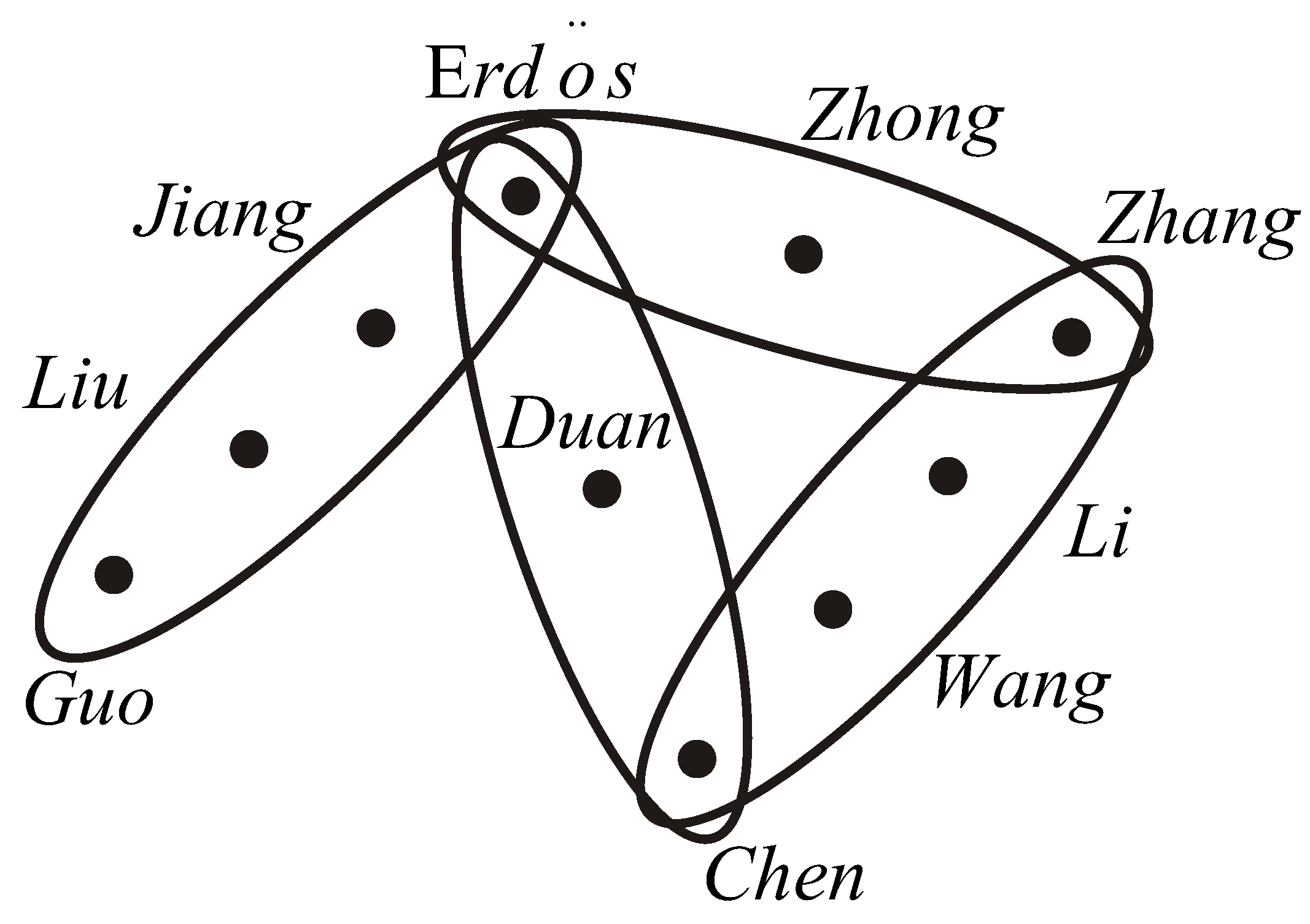
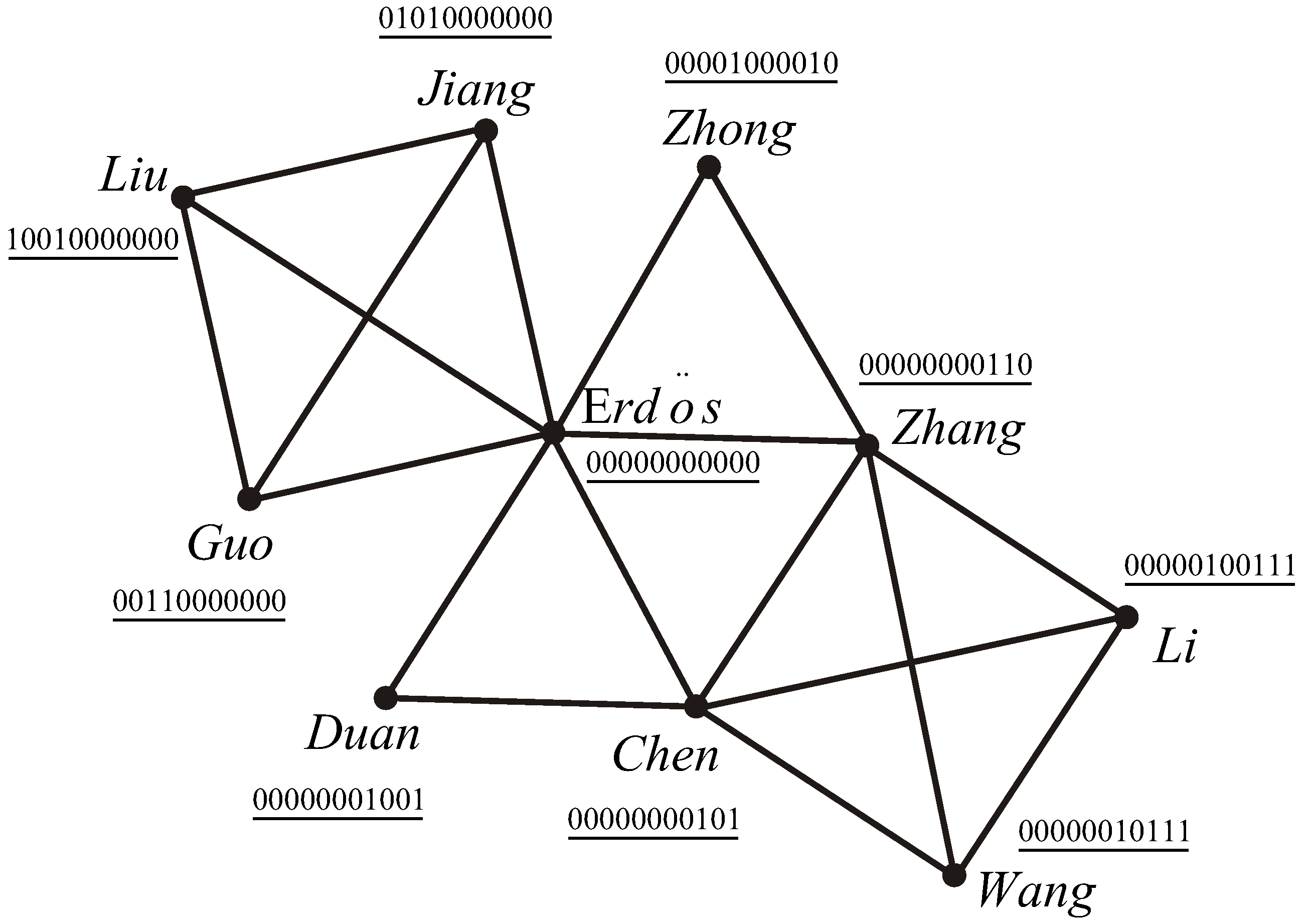
1. Background
In many complex systems, the interaction between substances is collective, and this interaction between groups is ubiquitous in many fields. For example, joint procurement of goods, the interaction of proteins, labels posted on posts on the same website, cooperation between researchers, and so on. However, the interaction between these groups cannot be represented by vertices and edges in simple graphs. Suppose three or more researchers wrote a book together—this book cannot be represented by an edge in the simple graph. Furthermore, if an edge is created among all researchers, many papers jointly written by some researchers cannot be distinguished [
1]. Hypergraphs can naturally represent the interaction between groups because they are composed of vertices and hyperedges, which solves the inherent limitations of a simple graph. Each hyperedge of a hypergraph can be a subset of the vertex set and it can represent the group interaction between vertices, so research on hypergraphs is also extremely necessary.
Hypergraphs can better represent the real world. Complex structures similar to a mesh in life can be represented by hypergraphs. In the paper [
2], Claude Berge first mentioned the concept of the hypergraph. In 1973, Paul Seymour [
3] discussed the related problems of minimal hypergraphs which are not 2-colourable. Claude Berge [
4] described the related concepts of hypergraphs and the theory of hypergraphs in 1989. Up to the 21st century, the study of hypergraphs has remained a very hot topic. In recent years, Zikai Tang, Xiuping Fang, and Yaoping Hou [
5] discussed and studied the spectral radii of the
k-uniform linear hypergraphs in 2018. Furthermore, Geon Lee, Jihoon Ko, and Kijung Shin [
1] investigate the local structures of real-world hypergraphs with the help of algorithms in 2020. Xiangxiang Liu, Ligong Wang, and Xihe Li [
6] found the Wiener index of special hypergraphs in 2020. Mario Gionfriddo and others studied the relevant concepts of hypercycle systems in 2020 [
7]. However, no one has studied the
-embeddability of hypergraphs.
In the past half-century, people’s research on graph theory has shown an extremely active trend along with the rapid advancement of science and technology. The distance in a graph is a very important concept in graph theory, which is widely used in physics, chemistry, and computer information science. For example, when considering the distance between atoms in a chemical molecule, the distance between nodes in a traffic network, and the distance between nodes in a computer network, we only need to abstract the actual network into a graph, and then consider the distance between the vertices in the graph. A hypercube graph is a kind of graph with good symmetry, and the distance between any two vertices on it is the Hamming distance. In order to make the calculation of distance in the considered graph easier, people try to embed the considered graph into the hypercube graph proportionally. An
-graph refers to a graph that can be embedded into a hypercube proportionally. In the past few decades, the
-embeddability of graphs has been intensively studied. Assouad and Deza in [
8,
9] gave a judgment theorem on how to identify a graph as an
-graph. According to this result, a graph is an
-graph if and only if it can be embedded into a hypercube graph proportionally. Karzanov [
10] proved that the identification problem for general
-spaces is NP-complete. Surprisingly, Shpectorov [
11] proved that an
-graph can be recognized in polynomial time. Research on the
-graph is also in full swing. It has extensive and profound applications in complex networks, information science, transportation, chemical graph theory, circuit communication, and other fields. For example, consider the Wiener index of a graph, that is, the sum of the distances between all pairs of vertices in the graph. If calculated directly using the defined formula, its complexity is the cubic order of vertices. However, if the graph is
-embedded, its computational complexity can be reduced to the linear order of vertices.
To obtain more useful information or simpler algorithms, people usually put the studied complex objects into some well-studied mature space. Based on this, one usually considers putting the research objects into the -space. Studying the -embeddability of hypergraphs is of great significance to real life. For example, how connecting the particles of a molecule makes the molecular structure more stable; How connecting wires between the wiring ports of the circuit board makes the battery thinner and more practical. Therefore, it is necessary to study the -embeddability of hypergraphs. In this paper, we characterize the -embeddability of hypertrees and unicyclic hypergraphs.
2. Preliminaries
A
hypergraph is an ordered pair of a finite set of vertices, the vertex set
V, and a finite multiset of hyperedges, the edge set
E, such that each hyperedge is a non-empty subset of
V, i.e.,
for all
. The number of vertices contained in the hypergraph is called the
order of the hypergraph, which is denoted as
. The number of hyperedges included in the hypergraph is called the
size of the hypergraph, which is denoted as
. Consequently, a graph is a hypergraph
, where each hyperedge is a set of at most two vertices:
for all
[
2,
12].
A
simple hypergraph is a hypergraph
H such that
. A
simple graph is a simple hypergraph each of whose hyperedges has two vertices [
4].
Throughout this article, we focus on simple hypergraphs, meaning that the number of vertices on each hyperedge is greater than or equal to 2 [
12]. In this paper, the graphs we consider are simple graphs.
The maximum number of vertices contained in the hyperedges of the hypergraph is denoted by the
rank of the hypergraph. The minimum number of vertices contained in the hyperedges of the hypergraph is denoted by the
lower rank of the hypergraph. When each hyperedge of the hypergraph contains the same number of vertices (i.e.,
=
), the hypergraph
H is called a
uniform hypergraph [
4]. A simple uniform hypergraph of rank
k is called a
k-uniform hypergraph [
4,
12].
For any vertex v in the vertex set V, the number of hyperedges that contain v is called the degree of vertex v in the hypergraph H, denoted as .
In the hypergraph
H, a vertex-hyperedge sequence
is called a
chain of length
k [
3], simply
-
chain, if it satisfies: (1) For any two vertices,
; (2) For any two hyperedges in the hypergraph
; (3)
. In particular, if
, then this chain is called a
hypercycle of the hypergraph. If
, the hypercycle is called significant [
13]. Denotes a hypercycle of
m hyperedges by
. Accordingly, in a simple graph, a
cycle is a hypercycle in which each hyperedge contains two vertices. In particular, the
k cycle is denoted by
.
If there is a - in a hypergraph, and are said to be connected. If there is a chain between any two vertices of the hypergraph, the hypergraph is said to be . A connected hypergraph with no hypercycle is called a , denoted by . If , then the vertex x is called the branch vertex of . If two hyperedges and share the same branch vertex x, they are said to be adjacent. In this case, and . If two vertices are in the same hyperedge, they are called adjacent.
Let
be a subset of
E and let
S denote the subset of
V consisting of all vertices in
H of hyperedges in
. Then the hypergraph
is the
subhypergraph of H induced by the hyperedge set
of
H. It is denoted by
[
14].
In a connected hypergraph, among all
-
chains, the least number of hyperedges contained in the
-
is called the
distance between
and
, denoted as
[
3].
For a hypergraph
H =
, if
,
H is called a
[
4], whenever
,
,
.
For a hyperedge of a hypergraph, if there is exactly one vertex whose degree is at least 2, is called a hanged hyperedge.
For
, a
superstar of
H—with
v as a
center—is the set of hyperedges that contains
v [
15]. If each hyperedge in the superstar contains
k vertices, it is called a
k-uniform superstar. This denotes a
k-uniform superstar with
n vertices and
m hyperedges by
. It is clear that
satisfies
.
If the hypergraph is connected and it has only one hypercycle, then it is a unicyclic hypergraph. When a unicyclic hypergraph contains m hyperedges, it is denoted by .
Let
X be the set of all real number sequences
, where
. For any
, define the distance function
. Then
is a metric space, usually called the
-
space. If
and
Y is linear space, then the metric space
is called the
subspace of
-space [
16].
Let
be a connected graph. For any two vertices
u and
v,
represents the distance between
u and
v in graph
G, that is, the length of the shortest path connecting
u and
v. Obviously
is a metric on
, and
is a metric space, called the
graphic metric space associated with
G [
17,
18].
A graph
G is an
-
graph [
19] if the metric space
is an isometric subspace of
-space. If graph
G is an
-graph, then graph
G has the
-embeddability property. That is, there is a distance-maintaining mapping
from
to
X, such that for any two vertices
.
An
n-dimensional hypercube or
n-cube is defined as follows: the
n-cube is a graph whose vertices are the ordered
n-tuples of 0’s and 1’s, two vertices being joined if and only if they differ in exactly one coordinate [
14,
16].
In 1980, Assouad and Deza [
8] proved that a graph
G is an
-graph if and only if there are two positive integers
and
n, the graph
G can be scale-
-embedded into a hypercube
. That is, for any two vertices
, there is a mapping
, which satisfies
. Among them,
is called the
scale of
G [
20]. For convenience, we use
to denote that graph
G is scale-
-embeddable into the hypercube
.
A subset
S of vertices of a graph
G is
convex if for any two vertices
u,
v of S all vertices on shortest
-paths belong to
S. Divide the vertex set
into two non-empty parts
A and
B, satisfying
;
called a
cut of
G. If both
A and
B are convex, then the cut
is a
convex cut [
21,
22]. A cut
of
Gcuts an edge
if
and
. It was known that
-graphs can be recognized by convex cuts [
21,
22].
Theorem 1 ([
21,
22])
. A graph G is scale-λ-embeddable into a hypercube if and only if there exists a collection of convex cuts (not necessarily distinct) such that every edge of G is cut by exactly λ cuts from . Furthermore, if has n cuts, G can be scale-λ-embeddable into the hypercube . 3. -Embeddability of Hypertrees
Before discussing the
-embeddability of hypergraphs, we must give several lemmas to facilitate the proof of the main theorems. Deza and Laurent proposed some examples of
-graphs in [
23]. They also presented some operations which preserve
-embeddability such as “1-
” and direct product of two
-graphs. Here “1-
” of two graphs means identifying a single vertex from two graphs. Let
and
be two disjoint graphs, where the vertex
, vertex
. Now identify vertex
and vertex
into a new vertex
x, such that
. We say that the resulting graph is obtained by identifying a single vertex
x from
and
, and denote it by
. This operation is called “1-
” operation. At the same time, we denote that
and
.
Firstly, the definition of a complete graph is given. A simple graph
G is said to be
complete if every pair of distinct vertices of
G are connected in
G [
14]. A complete graph with
n vertices is often denoted by
.
Lemma 2 ([
23])
. Let and be two -graphs. Then is an -graph. Lemma 3. Every hypertree with m hyperedges has at least two hanged hyperedges.
Proof. Let be the longest chain in the hypertree . It can be assumed that is any 1-degree vertex in , and is any 1-degree vertex in . The hyperedge has no adjacent hyperedge at vertex . Similarly, the hyperedge has no adjacent hyperedge at vertex . Otherwise, either a hypercycle is formed, or a chain longer than P is formed, but this is clearly impossible. Therefore, the hyperedge and the hyperedge are two hanged hyperedges. Hence, every hypertree with m hyperedges has at least two hanged hyperedges. □
Lemma 4 ([
18])
. For any nonnegative integer k, if , then . Lemma 5. If and , then .
Proof. Let and be two positive integers. In addition, and . Let be obtained by identifying single vertices x from and . By Lemma 4, there are and . By Lemma 2, the graph is an -graph. Moreover, by Theorem 1, the convex cuts of and are still convex cuts in . That is, the graph was obtained by identifying vertex x with and and performing “1-” operation will not affect the convex cut division of and , then . □
To facilitate the proof of the principal theorem, we give a new definition of hypergraph H. Construct a simple graph as the accompanying base graph of H, denoted by . Such that , two vertices are joined by one edge if and only if they lie in the same hyperedge of H.
Note 1: A clique of G is a complete subgraph of G. For any hyperedge in H, the vertices in induce a clique in .
Note 2: Further, for any two vertices of H, .
Below are some of the theorems of the -embeddability of hypertrees.
Theorem 2. Any hypertree is an -graph. In fact, a hypertree with n vertices and m hyperedges is scale-2-embedded into the hypercube .
Proof. Denote the hypertree containing i hyperedges by , and denote the m hyperedges of hypertree by . Suppose that the cardinality of is .
When , the hypertree has exactly one hyperedge. Let be this hyperedge, and . It is obvious that the accompanying base graph of is a complete graph. By Lemma 1, is an -graph, and . Since , , the hypertree is scale-2-embeddable into a hypercube
The result is clearly true for . So assume that . We apply mathematical induction on m. Assume that the theorem is true for all hypertrees having fewer hyperedges than . If the hypertree contains hyperedges then . By Lemma 3, take one hanged hyperedge in hypertree as , such that . By the inductive hypothesis, the hypertree is an -graph, , and the hypertree can be scale-2-embeddable into the hypercube .
Suppose that the hypertree can be seen as a hypergraph obtained by identifying the branch vertex x from and . It is clear that . By the inductive hypothesis, , . By Lemma 2, the hypertree is an -graph. By Lemma 5, The proof is complete by the induction assumption. □
From the above theorem, we give the -embeddability of a special hypertree.
Corollary 1. The k-uniform superstar is scale-2-embedded into the .
Proof. It is sufficient to substitute into . □
The dimension of the hypercube also can be expressed in degrees as follows:
Theorem 3. Any hypertree with m hyperedges can be scale-2-embeddable into the hypercube , where is the number of i-degree vertices .
Proof. By induction on m. Let be a hypertree containing i hyperedges, and denote the m hyperedges of the hypertree by . Suppose that the cardinality of is , is the number of i-degree vertices of the hypertree .
When , the hypertree consists of only one hyperedge, say . Let be the number of i-degree vertices of the hypertree . Then . It is obvious that the accompanying base graph of is a complete graph, and by Lemma 1, is an -graph, . Hence, the hypertree is scale-2-embeddable into the hypercube .
Now assume that the result is true for the hypertree with hyperedges . Let be the number of i-degree vertices of the hypertree . By the inductive hypothesis, the hypertree is an -graph, and .
By Lemma 3, every hypertree with
m hyperedges
has at least two hanged hyperedges. Take one hanged hyperedge in hypertree
as
. Suppose that the branch vertex of
is
x. Then the hypertree
can be seen as a hypergraph obtained by identifying
x from
and
. It is clear that
. Assume that
,
, then
. By the inductive hypothesis,
,
. By Lemma 2, the hypertree
is an
-graph. Then by Lemma 5,
, where
Moreover,
Since
contains only one hyperedge and all vertices of
are 1-degree vertices, then
. Due to
containing
hyperedges, there will be no
m-degree vertices in
, i.e.,
. This completes the proof of the theorem. □
4. -Embeddability of Unicyclic Hypergraphs
In this section, we will focus on the -embeddability of unicyclic hypergraphs. In particular, we also study the -embeddability of hypercycles.
In 2013, Guangfu Wang and Heping Zhang [
16] introduced the gluing edge operation (“2-
” operation) of two graphs. Let
and
be two disjoint graphs, where the edge
in
, edge
in
. Now identify edge
with edge
as a new edge
, such that
and
or
and
. We say that the resulting graph is obtained by gluing
and
along the edge
e and denote it by
or
. They get a sufficient condition of a graph obtained from two
-graphs by gluing an edge is still an
-graph, see Lemma 6.
Lemma 6 ([
16])
. Let and be two -graphs. If at least one of them is bipartite, then is an -graph. Before proving the main theorem, we introduce a special class of graphs. Let
be a cycle of length
n, where
. Joining each vertex
of
with a new
out of
by an edge obtains a graph, called a
denoted as
. Furthermore, for integer
, we join each vertex
of
with
new vertices
to produce a
generalized sun graph, denoted by
[
24]. It is reasonable to allow some
, that is, no joining the vertex
of
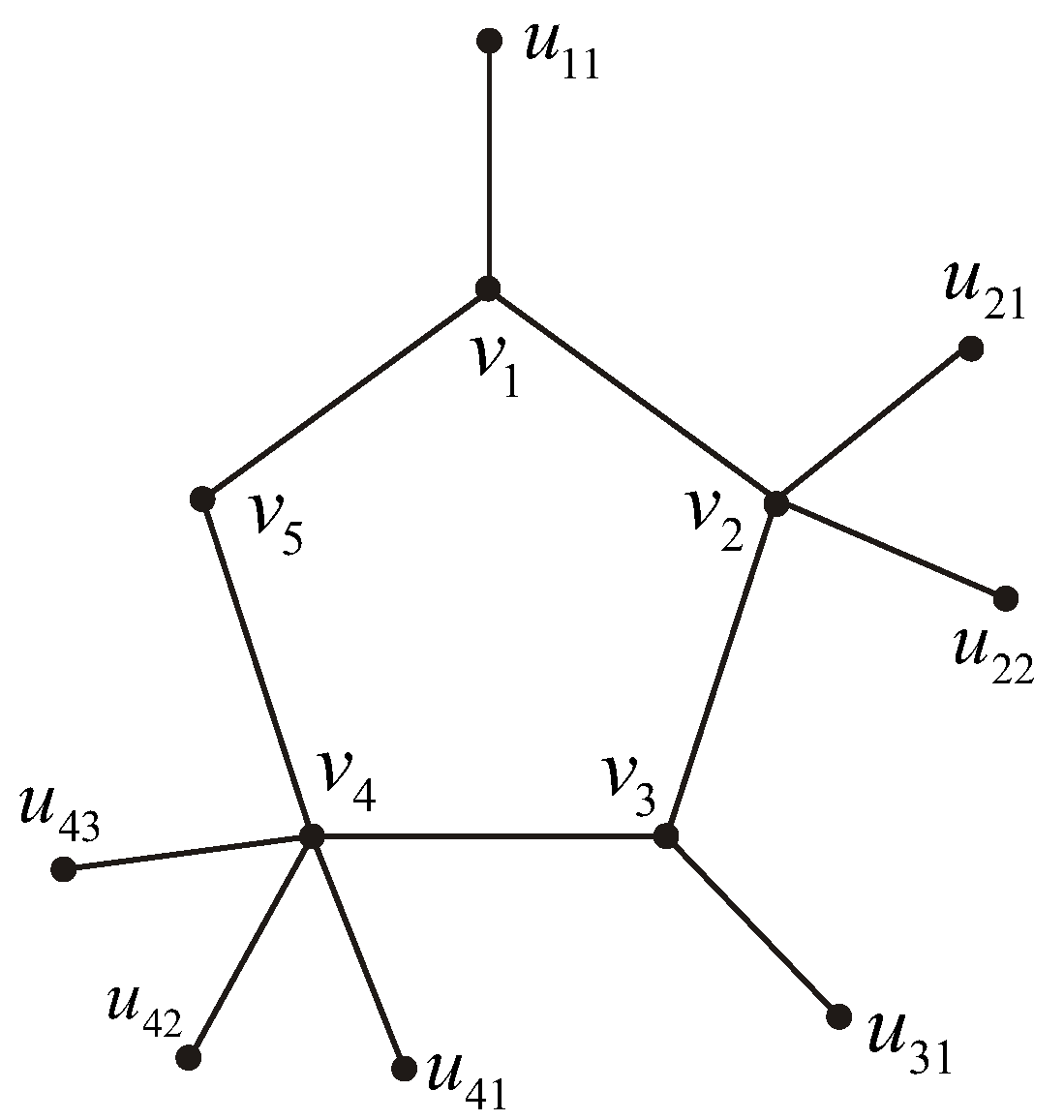
with any new vertex. For instance, the generalized sun graph
is shown in
Figure 1.
The line graph of a graph G has vertices corresponding to the edges of G and two vertices are adjacent in if their corresponding edges of G have a common end-vertex.
From the definition of the line graph, we can know that the line graph of a generalized sun graph is the graph obtained from a cycle
and
n complete graphs
by the “2-
” operation at their corresponding positions gradually, denoted by
, abbreviated as
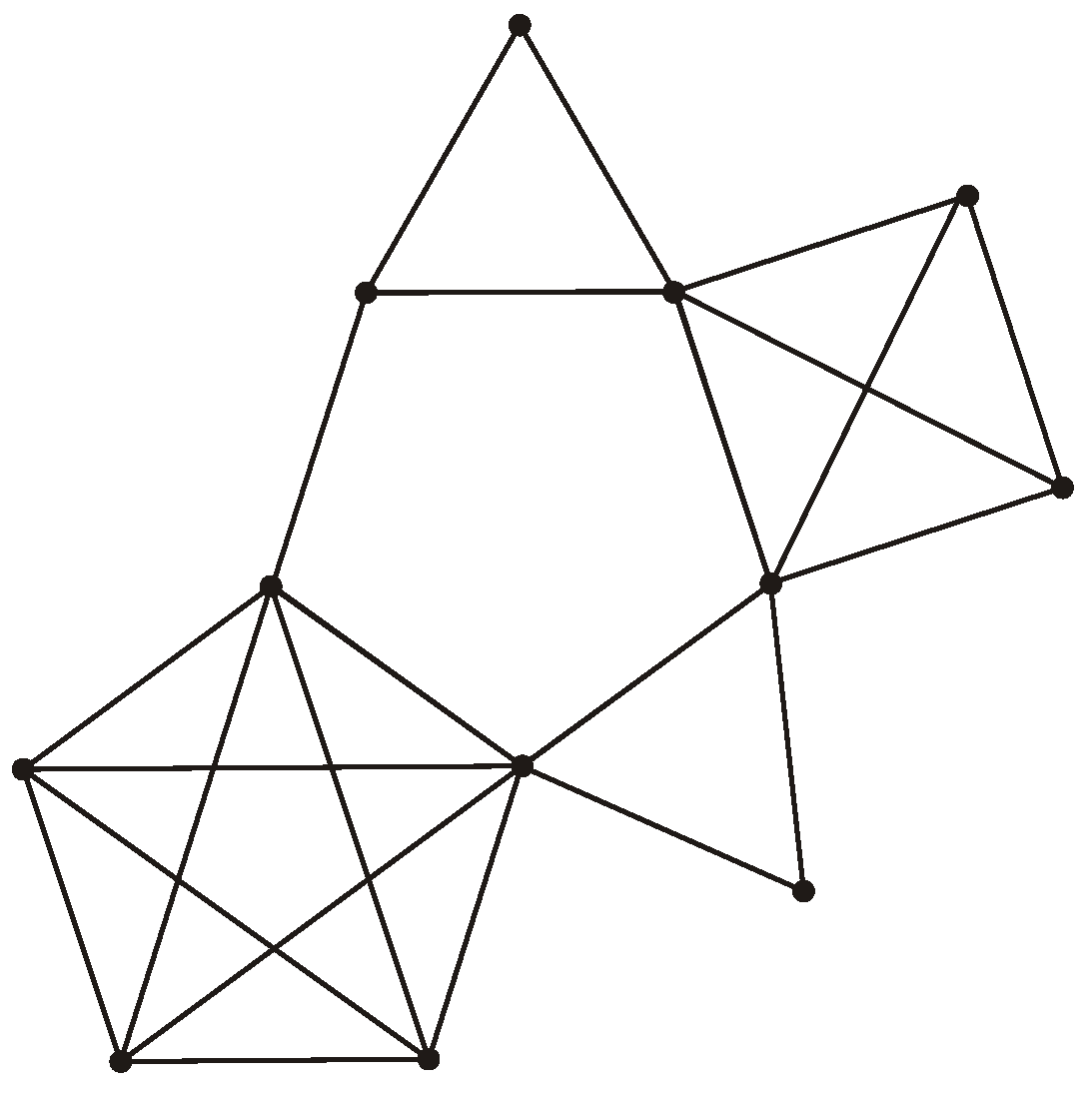
[
17]. For instance, the line graph of generalized sun graph
is shown in
Figure 2.
Lemma 7 ([
17])
. An is an -graph. Then, from the above lemma, we get the following theorem:
Theorem 4. A hypercycle with n vertices and m hyperedges is an -graph and can scale-2-embeddable into a hypercube .
Proof. Clearly, the accompanying base graph of hypercycle is isomorphic to the linear graph of generalized sun graph . By Lemma 7, we get that the is an -graph. Because for any two vertices v, u of , . Then the hypercycle is an -graph.
Next, we will prove that . Assume that the hypercycle contains n vertices and m hyperedges. The degree of a vertex of is either 1 or 2. Suppose that the hypercycle contains vertices with degree 1 and vertices with degree 2. It is clear that , . Let the hypercycle be , and , , …, , , where are the 2-degree vertices in and are the 1-degree vertices in . The hyperedge of a hypercycle corresponds to a complete graph of its accompanying underlying graph , denoted this complete graph by . Therefore, can be seen as the result obtained by the “2-sum” operation of a cycle and m complete graphs at corresponding positions m times. It is clear that is isomorphic to the linear graph of generalized sun graph .
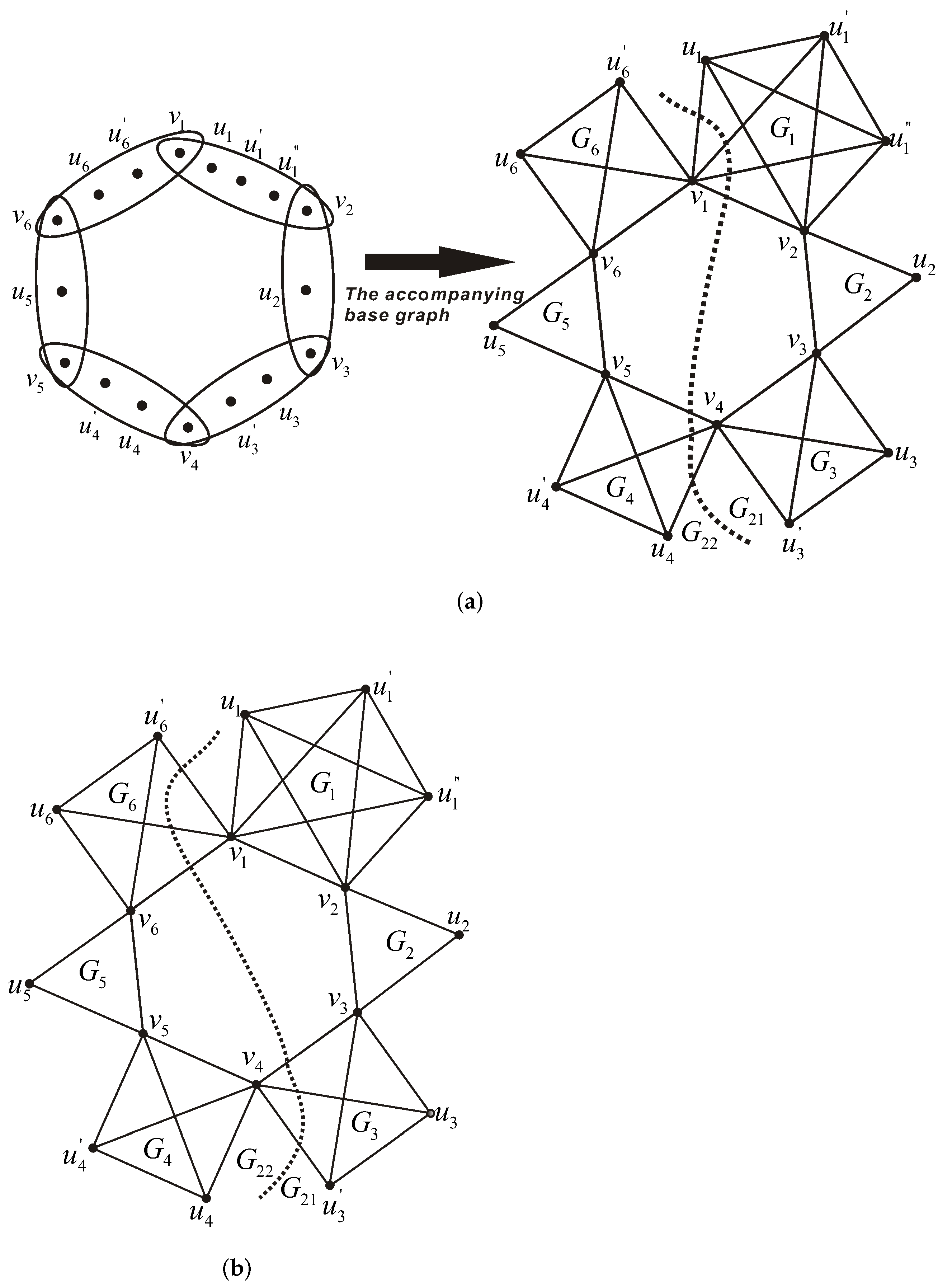
We will prove the -embeddability of hypercycle by convex cuts. Convex cuts are constructed according to the degree of the vertices of . It is detailed in the following text.
Firstly, let’s discuss convex cuts of the first kind.
Take any vertex
or
of degree 1 of
. Now we give a cut
, which is the vertices division of the accompanying base graph
, where
,
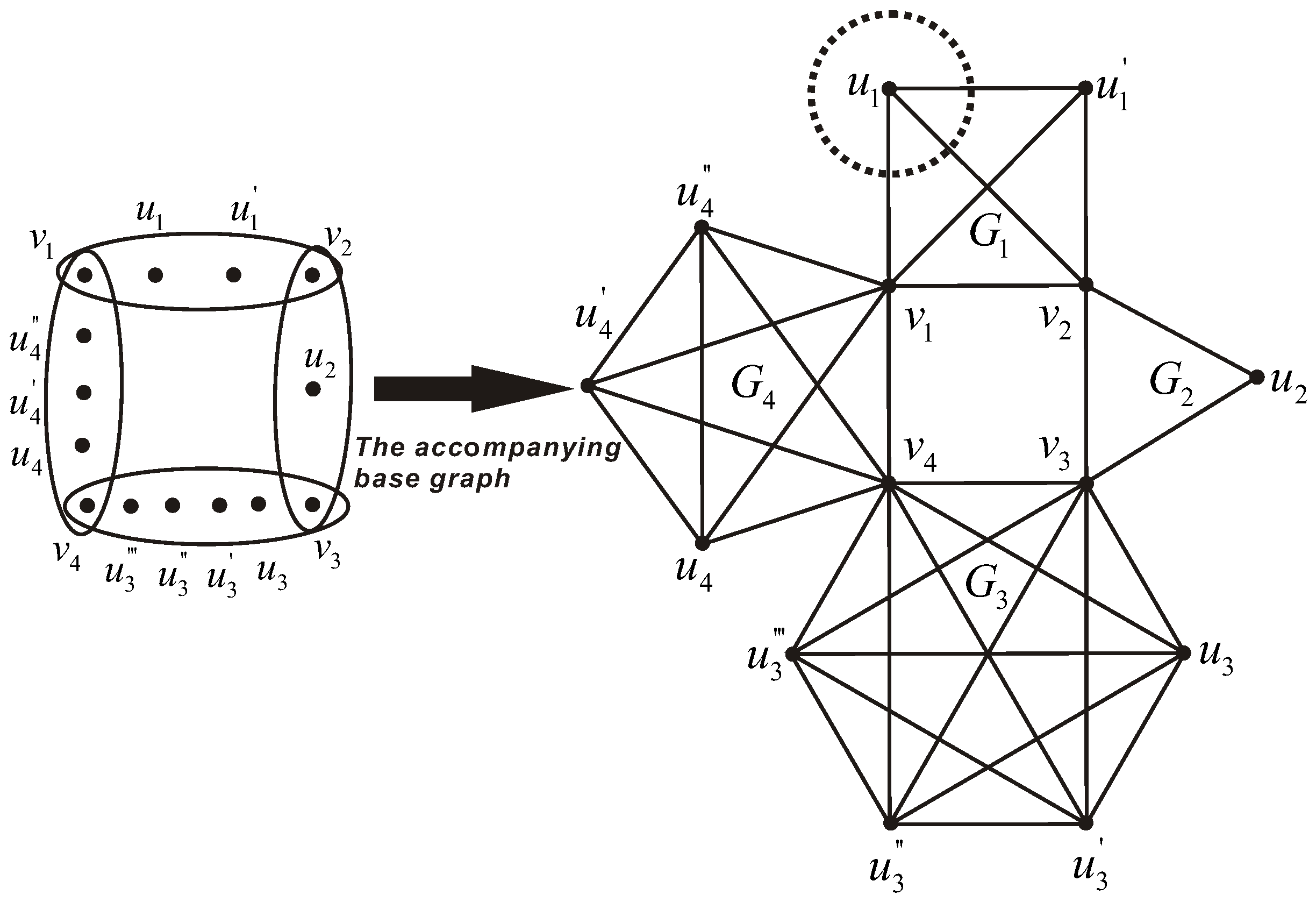
. As shown in
Figure 3, let
be the induced subgraph of the single vertex in
, and let
be the induced subgraph of the vertices in
. In the vertex set
, the shortest path from the
to the
is still in
, then
is convex. In the vertex set
, for any two vertices
, the shortest path from
to
is still in
, because
is still in the form of
. The shortest path of any two vertices on the graph
is still in
, (If two vertices are in the same complete graph, the distance between the two vertices is 1. Otherwise, the shortest path between two vertices must follow the
m-cycle
. That is, the shortest path between any two vertices is still in
), then
is convex. So the cut
is a convex cut.
Therefore, there are cuts of the first kind in that are convex cuts. Denote these convex cuts by , , …, . Then there exists a collection of convex cuts of , such that . Moreover, the edge between and (or and ) is cut by 2 cuts from , and the edge between and (or and ) is cut by 1 cut from .
Secondly, let us discuss convex cuts of the second kind.
- (1)
When
m is even, see
Figure 4a. A cut
is given, which is the vertices division of the accompanying base graph
, where
,
. Let
be the induced subgraph of the vertex in
. Let
be the induced subgraph of the vertex in
. Take any two vertices in
, such as
,
or
,
or
,
or
,
. The content is divided into the following two categories:
- ➀
If , we have ; ; ; , because for any graph or , these graphs are still complete graphs, in which the distance between any two different vertices is 1. Moreover, the shortest path between the two different vertices in graph is still in .
- ➁
The shortest path of any two different vertices in graph must be along the m-cycle . So the shortest path between the two vertices of is still in , and is convex.
In the same way, the shortest path between any two vertices of
is still in
, so
is convex. Then the cut
is a convex cut. Since
m-cycle
is an even length cycle, the
i-th convex cut
is repeated with the
-th convex cut. There are
convex cuts like this. Similarly, another
convex cuts as shown in
Figure 4b will be obtained. In fact, these two types of convex cuts appear symmetrically.
Thus, when m is even, there are cuts of the second kind in that are convex cuts. Denote these convex cuts by , , …, . Then there exists a collection of convex cuts of , such that . Moreover, the edge between and (or and ) is cut by one cut from , and the edge between and is cut by two cuts from .
- (2)
When
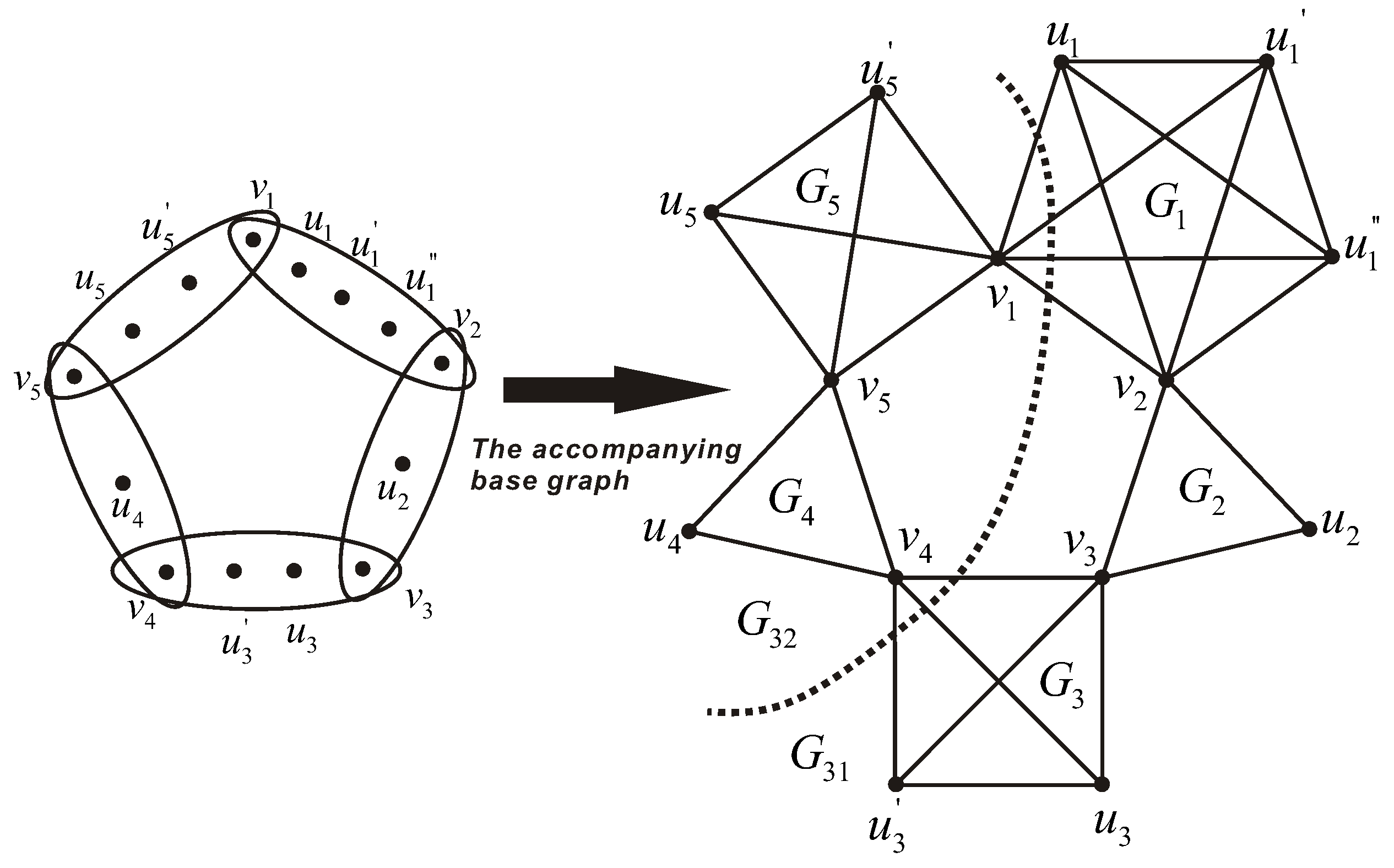
m is odd, see
Figure 5. A cut
is given, which is the vertices division of the accompanying base graph
, where
,
. Let
be the induced subgraph of the vertex in
. Let
be the induced subgraph of the vertex in
. Taking any two vertices in graph
, such as
,
, or
,
, or
,
. The content is divided into the following two categories:
- ➀
If , we have ; ; ; . Because for any graph or or , these graphs are still complete graphs, in which the distance between any two different vertices is 1. Moreover, the shortest path between the two different vertices in graph is still in .
- ➁
The shortest path of any two different vertices in graph must be along the m-cycle . So the shortest path between the two vertices of is still in , then is convex. In the same way, the shortest path between any two vertices of is still in , so is convex. Then the cut is a convex cut.
Since m-cycle is an odd length cycle, there are convex cuts like this. So when m is odd, there are cuts of the second kind in that are convex cuts. Denote these convex cuts by , , …, . Then there exists a collection of convex cuts of , such that . In fact, these convex cuts all appear symmetrically. Moreover, the edge between and (or and ) is cut by one cut from , and the edge between and is cut by two cuts from .
Consequently, all the cuts of the second kind in are convex cuts.
Therefore, in the accompanying base graph of the hypercycle , there are convex cuts, which can form a convex cut cluster or . By Lemma 1, each edge of the accompanying base graph is cut by exactly two cuts from , so the graph can scale-2-embeddable into a hypercube . Because for any two vertices v, u of , . Then the hypercycle can scale-2-embeddable into a hypercube . □
Finally, we study the -embeddability of unicyclic hypergraphs. Given a unicyclic hypergraph , where n is the number of vertices, m is the number of hyperedges, is the number of vertices contained in a single cycle in the unicyclic hypergraph, is the number of edges contained in a single cycle in the unicyclic hypergraph, is the number of edges other than the number of edges contained in a single cycle. It is clear that . Then we have:
Theorem 5. Any unicyclic hypergraph is an -graph. In fact, a unicyclic hypergraph with n vertices and m hyperedges is scale-2-embedded into a hypercube .
Proof. The unicyclic hypergraph is obtained by gradually using “1-” operation between the hypercycle and some hyperedges. For any hyperedge in hypergraph H, the vertices in induce a clique in . By Lemma 1, is an -graph. Combining Theorem 4 and Lemma 2, we know that any unicyclic hypergraph is an -graph.
Next, we will prove that . Suppose that a unicyclic hypergraph with n vertices and m hyperedges is . Assume that the number of vertices contained in a single hypercycle is and the number of hyperedges is , where . We prove the result by mathematical induction on m.
- (1)
Assume that a unicyclic hypergraph has no hanged hyperedges. Without loss of generality, at this time, any unicyclic hypergraph is a hypercycle , then , , . By Theorem 4, a unicyclic hypergraph is an -graph and . Hence, a unicyclic hypergraph without hanged hyperedges can be scale-2-embeddable into a hypercube .
- (2)
When a unicyclic hypergraph contains hanged hyperedges. If the unicyclic hypergraph contains a hanged hyperedge. Let be the hanged hyperedge, and let be the unicyclic hypergraph. By Lemma 2, . Hence, the unicyclic hypergraph is scale-2-embedded into a hypercube .
The result can be verified for a unicyclic hypergraph containing a hanged hyperedge. Hence, suppose that the result is true for a unicyclic hypergraph containing more than one hanged hyperedges. Assume that a unicyclic hypergraph contains hanged hyperedges, then the unicyclic hypergraph is . By inductive assumptions, any unicyclic hypergraph is an -graph and .
When a unicyclic hypergraph contains hanged hyperedges, obviously, denoted this unicyclic hypergraph by . Denoted the hanged hyperedge added to unicyclic hypergraph by . By Lemma 2, . Moreover, . Hence, the result is true. □