


Abstract
In this paper, we present a complete proof of the so-called First On-Shell Theorem that determines dynamical content of the unfolded equations for free symmetric massless fields of arbitrary integer spin in any dimension and arbitrary integer or half-integer spin in four dimensions. This is achieved by calculation of the respective cohomology both in the tensor language in Minkowski space of any dimension and in terms of spinors in . In the d-dimensional case is computed for any p and interpretation of is given both for the original Fronsdal system and for the associated systems of higher form fields.
1. Introduction
Higher-spin (HS) gauge theory is based on works of Fronsdal [1] and Fang and Fronsdal [2], where the action and equations of motion for massless gauge fields of any spin were originally obtained in flat four-dimensional Minkowski space. Even earlier, important restrictions on low-energy HS vertices were obtained by Weinberg in [3,4] and so-called no-go theorems restricting S-matrix possessing too high symmetries in flat space-time were proven in [5,6]. (For a review see [7].) The no-go theorems implied the existence of the barrier suggesting that the construction of an interacting local HS theory in Minkowski space-time is impossible. The proof of these theorems essentially uses the specific form of the algebra of isometries of Minkowski space. The barrier in flat space can be overcome in the space-time with non-zero sectional curvature, for example, in the anti-de Sitter space [8]. In these spaces it becomes possible to formulate a consistent nonlinear theory of fields of all spins [9,10].
The construction of a nonlinear HS theory is essentially based on the so-called unfolded approach [11,12], which is a far-going generalization of the Cartan formulation of gravity () in terms of differential forms to fields of any spin . Via introducing appropriate auxiliary variables, the unfolding procedure allows one to replace the system of partial differential equations of any order on a smooth manifold by a larger system of first-order equations on vector-valued differential forms. One of the essential features of this approach, which is very useful for analysing symmetries of a given system, is that the variables in the equations are valued in one or another representation of the underlying symmetry algebra.
The dynamical content of the HS theory can be reconstructed from its unfolded formulation using the cohomology technique [13]. As is recalled below, the dynamical data of the theory are in one-to-one correspondence with the cohomology of certain linear nilpotent operator that can be read of the unfolded equations in question. The statement that unfolded equations of free HS fields are equivalent to the Fronsdal equations was made in the original papers in the spinor [14] and tensor [15] formalisms. In the tensor formulation of HS theory the idea of the proof was illustrated in [16], where however the analysis of the trace part of the Fronsdal equations was not completed, while general arguments for mixed-symmetry HS fields were given in [17]. In [18] the unfolded equations for massless fields were derived from the Fronsdal theory by the BRST methods. To the best of our knowledge, no detailed analysis of the problem in the spinor formalism was available in the literature.
In this paper we present a complete proof of the so called First On-Shell Theorem by computation of the cohomology rings of for the physically important cases of the integer-spin symmetric fields both in flat space-time of any dimension and as well as for the fields of any integer and half-integer spin in . The computation technique analogous to the Hodge theory for differential forms is performed in terms of so-called cohomology and provides a complete analysis of the dynamical content of the free unfolded equations for symmetric massless fields of any spin. Giving a direct proof of the equivalence between the Fronsdal formulation of the HS gauge theory and its unfolded formulation this paper fills in some gaps in the literature also illustrating a general approach applicable to a broad class of unfolded systems. In addition, in the tensor case we compute higher cohomology groups and interpret them in terms of higher Bianchi identities and more general dynamical systems. In particular, we discuss the matching between the Bianchi identities in terms of one-form gauge fields and zero-form field strengths.
The rest of the paper is organized as follows. In Section 2 we briefly recall different approaches to the description of HS massless fields. Main idea of the cohomology approach is explained in Section 3. Cohomology calculation method used in this paper is discussed in Section 4. Section 5 contains derivation of in Minkowski space of any dimension. In particular, the cases of and representations are analysed here. In Section 6 calculation of the low-order cohomology groups in is performed. Obtained results are discussed in Section 7. Index conventions and normalisations of the tensor Young diagrams are presented in the Appendix A.
2. Fronsdal Theory
2.1. Metric Formulation
According to Fronsdal [1], a spin-s massless symmetric field can be described in terms of two symmetric traceless tensors (for index conventions see Appendix A)
These two fields can be combined into a single rank-s totally symmetric tensor
obeying the double-tracelessness condition
The field equations in Fronsdal theory have the form
where .
The tensor is invariant under the gauge transformations with a rank- traceless gauge parameter
Fronsdal Equation (4) is a generalization of the well-known equations of fields with spins . For the case of the last term in the Fronsdal tensor disappears and Equation (4) reproduces Maxwell equations for the field . Without the last two terms at it gives Klein-Gordon equation for a massless scalar field. The case of reproduces the equations of linearized gravity [19]. Gauge transformation (5) gives the known gauge transformations of low-spin fields and its absence for a scalar field.
2.2. Frame-Like Formulation
2.2.1. Tensor Formalism
The unified description of massless fields of arbitrary spin can be given in the so-called frame-like formalism that generalizes Cartan formulation of gravity, operating in terms of differential forms [14,15,20]. Frame-like formulation of the HS gauge theory in any dimension is given in terms of the one-form fields valued in two-row Young diagrams corresponding to irreducible (i.e., traceless) modules [15], obeying conditions
(For index conventions see Appendix A).
By introducing auxiliary fields it is possible to put a system of partial differential equations into the first-order unfolded form [11,12]. Generally, unfolded equations read as
Here is a set of differential forms over some manifold. (Indices are treated formally and can take an infinite number of values.) The coefficients satisfy the (anti)symmetry condition
where denotes the form-degree of . Also are restricted by the integrability conditions expressing that .
In the tensor language the unfolded HS equations in Minkowski space proposed in [15] read as
where is a soldering form (vielbein, frame field, tetrad) and is the background Lorentz covariant derivative that satisfies relations
In the Cartesian coordinate system with the equations simplify to
where C satisfies the Lorentz irreducibility conditions
The traceless tensor C on the r.h.s. of (14) is a generalized Weyl tensor. There are also unfolded equations on C and on additional auxiliary fields [10] (for reviews see [16,21]). This system constitutes an infinite chain of zero-form equations. Zero-form sector, that contains equations on spin-zero and spin-one fields, will not be considered in this paper.
Equations (13) are invariant under the gauge transformations
and Equation (14) is invariant under
where are zero-forms valued in the appropriate two-row irreducible -modules obeying conditions analogous to (15).
The Fronsdal field is embedded into the frame-like one-form in the following manner. Converting the form index into the fiber one using vielbein h,
the resulting tensor (19) can be decomposed into irreducible -modules. In terms of traceless Young diagrams this decomposition is

The first two components give the Fronsdal field, while the third one is an excess of the components of the frame-like field in comparison with the Fronsdal field. At the tensor level, this decomposition is represented as:
where are traceless and correspond to the i-th diagram. The relative coefficient is fixed by the tracelessness condition with respect to indices a.
This decomposition shows that the Fronsdal field identifies with the symmetric part of the frame-like field, since the contribution of the third diagram disappears upon symmetrization. The resulting field
is symmetric and double-traceless. The extra term is pure gauge. Its contribution can be canceled by the gauge transformation with suitable gauge parameter. For detailed discussion of Fronsdal field embedding see [16,20,21].
It is not difficult to check [15,20] (for reviews see [16,21]) that the Fronsdal equations and gauge transformations follow from the unfolded system (13), (14). A more complicated question is whether the Fronsdal fields and equations are the only ones that result from (13), (14). The answer can be obtained via the cohomology technique [13].
2.2.2. Spinor Language in
The physically important case of the unfolded system for HS connection (13), (14) is that of space-time in which case the language of two-component spinors is most appropriate. In this language instead of using Lorentz indices , one uses two pairs of dotted and undotted spinor indices and taking values . The two languages are related via Pauli matrices. The background geometry is described in terms of the Lorentz connection and frame field h, that satisfy equations
where is proportional to the curvature of and we adopt the following rules
where
The spinor version of the unfolded system for one-form reads as follows. First, the HS curvatures in the spinor language are [14]
and is a Lorentz-covariant derivative with Cartan’s spin-connection
The main advantage of the two-component spinor notation is that it makes the representation theory of the Lorentz group very simple. Namely, every Lorentz irreducible multispinor representing a traceless tensor is totally symmetric in its spinor indices. Since the only Lorentz invariant objects are antisymmetric bispinors and irreducible multispinors are necessarily symmetric with respect to the indices in the groups and separately. Thus, working with the two-component spinor notation one can happily forget about painful calculations with the traces of Lorentz-tensors.
3. The Idea of Cohomology Analysis: Example of Integer Spin Massless Fields
The l.h.s.’s of unfolded HS equations and gauge transformations in d-dimensional Minkowski space are [15,16]
where
is referred to as (linearized) HS curvature. For simplicity we study the Minkowski case. Since in is defined analogously, our analysis applies to that case as well.
Due to their definition, HS curvatures obey the Bianchi identities
The appearance of allows one to clarify the role of the fields and gauge parameters . Working with the zero-forms and one-forms valued in two-row Young diagrams, we consider the space of p-forms valued in two-row Young diagrams with any p. Defining to annihilate the forms with an empty second row, we find that and . As originally proposed in [13], the cohomology classifies fields, their equations and gauge symmetries.
Indeed, those components of the fields , that are not annihilated by , can be expressed via derivatives of the fields with lower t by setting suitable components of the HS curvatures to zero. Such fields are called auxiliary. Conversely, those components of the fields , that cannot be expressed in terms of derivatives of lower fields via zero-curvature conditions, are in . By Stueckelberg fields we mean -exact fields (i.e., fields of the form ) as they can be eliminated by an appropriate -exact term in the gauge transformation (29). Fields that are not expressed via derivatives of other fields and are not Stueckelberg are called dynamical. These describe the physical degrees of freedom of the theory. Thus, the dynamical HS fields are associated with .
The classification for the gauge parameters is analogous. The parameters, that are not annihilated by , describe algebraic Stueckelberg shifts. The leftover symmetries are described by the parameters in . -exact parameters correspond to the so called gauge for gauge transformations. Parameters, which are -closed and not -exact, are referred to as genuine differential gauge parameters. Note that since in the HS example in question the gauge parameters are zero-forms there is no room for gauge for gauge symmetries in that case.
Let V be a graded vector space, be an element of over some smooth d-dimensional manifold . We demand the grading of V to be bounded from below, that is V is -graded. Let be operators that act ”vertically”, i.e., do not affect the space-time coordinates, and shift grading by , be the Grassmann-odd operator that does not affect the grading and is allowed to act non-trivially on the space-time coordinates. Consider the covariant constancy condition of a general form along with the zero-curvature condition
Notice that Equation (32) remains invariant under the gauge transformations
where .
One can prove the following proposition [13] (see also [16,22,23,24]):
Theorem 1.
The following is true:
- (1)
- Differential gauge symmetry parameters ε span
- (2)
- Nontrivial dynamical fields span
- (3)
- Physically distinguishable differential field equations on the nontrivial dynamical fields, contained in , span
Thus, taking into account that HS gauge fields are described by the one-forms , to prove that the Fronsdal metric formulation is equivalent to the unfolded one, we have to calculate and . More generally, higher cohomology with describes Bianchi identities for dynamical equations at and Bianchi for Bianchi identites at [24]. Similarly, the lower cohomology with describes gauge for gauge differential symmetries.
4. A Method for Calculating Cohomology
Calculation of cohomology is of utter importance for the analysis of unfolded systems of the general form (32). The straightforward calculation of the cohomology can be quite involved. In this paper we find cohomology using a standard homotopy approach recalled below, that is a generalization of the Hodge theory for de Rham cohomology extendable to a more general class of (co)chain complexes. Main details of the construction used in this paper follow those of [24], where the cohomology analysis was applied to the conformal HS theories of the bosonic fields of any symmetry type. Unfortunately, some of the methods of [24], based on the fact that in conformal theories has the clear meaning in terms of the conformal algebra, are not directly applicable to the non-conformal HS theories discussed in this paper, which makes the analysis of the latter a bit more involved.
Let V be a graded vector space and d be a linear operator of degree +1 on V (that is, it raises the grading of a homogeneous element by 1) such that . Then . Let ∂ be another operator of degree on V (i.e., it lowers the grading by 1) such that . The operators d and ∂ can be used to compose the degree 0 operator
It is easy to see that satisfies
Lemma 1.
If Δ is diagonalizable on the (graded) vector space V, then .
Proof.
First of all we should show that is an invariant subspace of . Suppose . Then
Therefore, is an invariant subspace of , because linearity is obvious.
Since the operator is diagonalizable by assumption, we can consider eigenvectors of . Let g be d-closed and . Then
Hence, g is also d-exact for , representing a trivial element of . Thus, every d-closed form annihilated by is not d-exact. In other words, every d-closed form f can be written as with some . □
If V is a Hilbert space with inner product , there exists such ∂ that the converse inclusion takes place as well, which means that .
Lemma 2.
Let be a Hilbert space, let be the operator conjugated to d in the usual sense and . Then .
Proof.
Take any . Then
Hence, . To show that suppose the opposite. Let . Then due to (38)
Thus, □
From Lemmas 1 and 2, it follows that, if all the requirements are met,
Thus, in a Hilbert space with a diagonalizable Laplace operator , finding the cohomology is equivalent to finding . Further calculations of cohomology will rely on this fact.
The following important comment [24] is now in order. In the case of interest, for every unfolded subsystem associated with a fixed spin
with finite-dimensional grade-n subspaces . In that case leaves invariant every and, being self-adjoint in the finite-dimensional Hilbert space, is diagonalizable.
It is worth noting the similarity of the above analysis with the Hodge theory mentioned at the beginning of this section. Indeed, consider the (finite-dimensional) vector space V endowed with some nilpotent operators d and ∂, . The condition of disjointness is also imposed (see [25] for details), that is, . In other words, it is demanded that
Define the Laplacian by (34). Under these assumptions it can be shown that
- . The harmonic cocycles annihilated by are those and only those, that are d-closed and ∂-closed simultaneously;
- . In other words, for any vector there exists a unique Hodge decomposition , where and are some vectors in V, and h is harmonic .
This implies that the harmonic cocycles and cohomology classes of d are isomorphic as vector spaces, that is (40) is true.
In the subsequent sections the operators and will play the roles of d and ∂. Moreover, in the following calculations one can spot which Young diagram or multispinor belongs to or due to the equivariance of the constructed Laplace operators with respect to the action of or or , depending on the problem in question.
5. Cohomology in Minkowski Space of Any Dimension
5.1. Generating Functions
The problem of finding the cohomology in tensor spaces of one or another type can be conveniently reformulated in terms of differential operators. To this end two-row Young diagrams in the symmetric basis can be described as a subset of polynomial ring generated by the set of commuting variables (see [16] for detail). Consider the ring . Its homogeneous elements are differential p-forms valued in
Consider the generating function
Its expansion in powers of Y and Z yields the tensor-valued forms as the Taylor coefficients. In this language the Young irreducibility condition reads as
The tracelessness condition takes the form
The generators of and (Following [24], in this section we do not distinguish between different real forms of the same complex algebra freely going to their compact real (Euclidean) form since, not affecting the final results, this choice simplifies the analysis by allowing a positive-definite invariant scalar product on the space of tensors. Results of the Euclidean case coincide with those of the Lorentz one due to the equivalence of their representation theory on finite-dimensional modules. Indeed, suppose that some Lorentz-irreducible tensor represented cohomology in the Lorentz case. Then analogous -irreducible tensor represents cohomology in the compact case and vice versa. The only potential difference could be related to (anti)self-dual tensors that may exist in one signature but not in the other. However, these do not play a role in our analysis where (anti)self-dual tensors always appear in pairs or do not appear at all in sufficiently high dimensions .) are now realized by the first-order differential operators
where is a Grassmann-odd element of the exterior algebra associated with the frame one-form .
In these terms acts as
It differs from the definition of Section 3 by an additional numerical factor introduced for future convenience. In the sequel we sometimes do not write variables explicitly, that are always assumed to be present implicitly. We adopt the convention that index a is contracted with Y, b with Z and with with s ordered as .
The space can be equipped with the scalar product
where with complex and Berezin integral over anticommuting variables. (We work with the polynomials of complex variables with real coefficients). The space with the scalar product (51) is a Hilbert space in the Euclidean metric signature case used in this section. This scalar product yields the following conjugation rules:
5.2. Example
To illustrate the idea of our construction let us first consider a simpler case where fields and gauge parameters take values in the irreps of described by two-row Young diagrams (no tracelessness conditions are imposed). Define the following operators, that form
Namely, form while is central.
In terms of these operators the space of p-forms valued in two-row Young diagrams is identified as
Here is generated by the Grassmann variables .
Let us introduce auxiliary operators
Among the auxiliary operators D plays the most important role as it gives differential form degree. Now we should construct on and . Consider the following operator:
where and . Functions f and g have to be found from the conditions
After some re-ordering of operators this yields two equations
verified by
giving
The free coefficient is determined from the conjugacy requirement:
giving
and hence
One can notice, that in (66) differs from what one would expect from the conjugation rules (52). The reason is that in (52) we work with complex. In the -case we deal with complex, therefore one should project on the highest weight vectors of the underlying in the complex C. The same procedure applies to the -case. Though general formulae for extremal projectors are known for any simple Lie algebra (We are grateful to the referee for bringing this fact to our attention.) [26,27,28,29] (for reviews see [30,31]), to keep the paper self-contained we derive the relevant projectors straightforwardly.
Knowing , it remains to construct the Laplace operator and find its zeros. Elementary computation gives
Being built from the manifestly -invariant operators, commutes with hence being diagonal on its irreducible submodules. Thus, it suffices to analyze zeros of on irreducible components of the forms.
5.2.1.
Any element of has the form . It is easy to see that
Therefore
5.2.2. ,
For , a general element of is . Generally it forms a reducible -module associated with the tensor product of two diagrams. In terms of Young diagrams it decomposes into the following irreducible components:

At the last diagram is absent. The manifest decomposition of into irreducible components is
where corresponds to the i-th diagram. There are no restrictions on in (71) except for . If for some tensor expression has a wrong Young shape, it is zero. To simplify calculations we derive restrictions on for each diagram from the condition of being -closed. For the second and fourth diagrams we find no restrictions, but for others we have
Using this we obtain the action of on the rest diagrams:
As a result,
The dynamical interpretation of the obtained results is as follows. The system has one symmetric gauge field with gauge transformation described by a symmetric parameter. The second cohomology group is spanned by a single tensor corresponding to the generalized (traceful) Weyl tensor. If the latter is set to zero, the system becomes topological with the zero-curvature field equations. Otherwise the unfolded equations encode a set of constraints expressing all fields and Weyl tensor via derivatives of the physical fields. Proceeding further with the equations on the Weyl tensor and its descendants results in an infinite set of constraints with no differential equations on the physical field. Such off-shell unfolded equations were considered in [32]. The off-shell systems are for interest in many contexts such as, e.g., construction of actions and quantization [33,34]. The lower cohomology groups (69), (77) and (78) match with those obtained, e.g., in [16].
5.3. Case
5.3.1. Irreducibility Conditions
The case is in many respects analogous to that of . The difference is due to the tracelessness condition (46). The algebra of the operators encoding irreducibility conditions is extended since the metric allows the new types of contractions between and their derivatives. From the representation theory perspective new terms associated with traces appear in the diagram decomposition of the form coefficients, affecting the cohomology analysis.
The following operators form the algebra :
Evidently, these operators commute with the generators (49). and form a Howe-dual pair [35]. Young condition (45) and tracelessness condition (46) impose highest weight conditions on a -module.
In addition, we introduce the following invariant operators:
which, along with D (57) counting differential form degree, extend to . The simplest way to see this is to let index a take a single value, treating the operators as creation and annihilation operators, and apply the oscillator realization of .
In the problem in question, the form space is
Note that these restrictions imply the tracelessness over indices and as a consequence of the form of commutators of with .
5.3.2.
Let us look for in the form
The condition gives
This imposes the following six equations on seven coefficients
Choosing as a free parameter, we obtain
The condition demands
giving
This yields operator such that on V, and .
To calculate the Laplace operator on we obtain straightforwardly that
Since, by construction, both and and hence are invariant, is diagonal on irreducible -modules and, to compute , it suffices to find its zeros on the irreducible components.
5.3.3.
In the sector of zero-forms, all terms that contain trivialize. Hence,
and
Comparing the resulting differential gauge parameters with (5), we find that, as anticipated, differential gauge symmetries in the unfolded formulation coincide with those of the Fronsdal theory.
5.3.4. ,
The main difference between - and - cases is due to the traceful terms in the decomposition of the p-forms into the irreducible parts depicted as
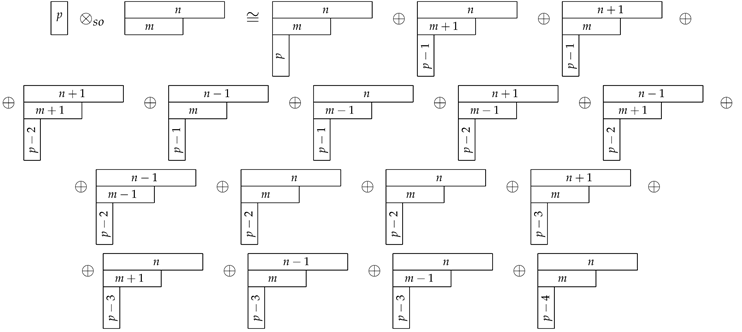
For , the diagrams carrying negative p-dependent labels are absent. It is important to note that the diagram is present twice: one copy results from the contraction of one of the form indices with the first row followed by the symmetrization of another form index with the same row. Another one results from the application of the same procedure to the second row. This fact leads to two different tensor implementations. Also note that some of the diagrams vanish for special dimensions by virtue of the Two-Column Theorem:
Theorem 2.
traceless tensors with the symmetry properties of such Young diagrams that the sum of the heights of the first two columns exceeds d, are identically zero [36].
The cohomology is empty for . Analogously, some potential elements of are zero by the Two-Column Theorem for large .
Now we are in a position to consider the action of the Laplace operator on each of the diagrams (109) separately. In the following restrictions on will be imposed: if for some a tensor has a wrong Young shape, it is zero. In most cases we will simplify calculation by demanding p-forms be -closed. Another simplification is due to the fact that is equivalent to the two equations and .
Diagram (n,m;p), has the tensor form . It is -closed, if . Then
This diagram is in at that reproduces the already obtained result for .
Diagram (n + 1,m + 1;p − 2), has the tensor form . This diagram is -closed. The action of is
This diagram is in , if , thus belonging to with .
Diagram (n,m + 1;p − 1), has the tensor form . Then
This equation admits no solutions since in the case in question.
Diagram (n + 1,m;p − 1), has the tensor form
It is -closed iff . Then
This expression vanishes at . Hence,
As one can see, in (113) also leads to zero Laplace action. However, this is not a new result, since it has been already accounted in the diagrams for (110), for (111) and the case of (113). This fact is a simple consequence of the tensor multiplication of a column by a scalar.
Diagram (n − 1,m;p − 1), has the tensor form
where is an arbitrary tensor.
One can check that demands with
After some calculation we obtain
This implies that has zero at contributing to . The case of must be considered separately because of the divergent denominator. The seeming divergence emerges due to the second term in (116), which is absent at ,
leading to the same answer with .
Diagram (n,m − 1;p − 1) has the tensor form
where is an arbitrary tensor.
Let us show that this diagram can never be annihilated by . Indeed,
where (lit) denotes some terms that are linearly independent from the first one. If the above expression reduces to
The expression in brackets vanishes at . However, such diagram is zero by virtue of the Two-column theorem 2, since the heights of the first two columns sum up to .
Thus, the nontrivial T is never in .
Diagram (n + 1,m − 1;p − 2) has the tensor form
where is an arbitrary tensor.
Though the tensor realization (122) may look complicated, the problem is simplified by the observation that all terms except for the first and second ones carry a factor of . The action of on the first and second terms produces a factor of in front of each combination. It can be checked that has an overall factor of so that the only possible solution for is at in which case the tensor decomposition acquires the form
At , after some calculations one can check that
For it is not difficult to see that . Indeed,
where (lit) denotes other linearly independent terms. The first term is never zero.
Thus,
Diagram (n − 1,m + 1;p − 2), has the tensor form
where is an arbitrary tensor.
Though it is obviously in for any m, it is not hard to see that it is never in .
Hence this diagram does not contribute to .
Diagram (n − 1,m − 1;p − 2), has an involved tensor form. Since the coefficients in the expression below are complicated, we extract the factor of once present denoting the leftover coefficients as ,
where is an arbitrary tensor. The explicit form of is given in the Appendix A.
Now we observe that the action of on the terms free of the factor of produces such factor. Hence, has the form of the sum of linearly independent terms with the common factor of . Consequently,
At , the only terms that remain are
It can be checked that for
For it is not difficult to see that
where . Therefore,
Diagram (n + 1,m;p − 3), has the tensor form
where is an arbitrary tensor.
Explicit computation gives
This expression vanishes at . Indeed, in this case so that
Since
it follows that at . To check that at one should substitute the expression for T noticing that different linearly independent terms have no common factor to vanish, that implies nontriviality of .
Diagram (n,m + 1;p − 3), has the tensor form . It belongs to , but not to .
Diagram (n,m;p − 2) admits two tensor realizations due to the double presence of this diagram in the result of tensor product. The tensors
are linearly independent. That Laplace operator acts diagonally on , , allows us to separately consider each of these diagrams. Firstly, we check if these are in computing
at . Formally, is annihilated by at , but this is not allowed by the Two-column theorem. So, the only candidate for cohomology is . However,
which is never zero.
Diagram (n−1,m;p−3), has the tensor form
where is an arbitrary tensor.
Obviously, . However, .
hence not contributing to cohomology.
Diagram (n,m−1;p−3), has the tensor form
with all terms except for the first one carrying a factor of . The action of on the first term brings a factor of in front of . Since all terms in the decomposition are linearly independent we conclude that
At one can check that . However, for T does not belong to ,
Consequently, the only contribution to is
Diagram (n,m;p−4), has the tensor form
This is obviously annihilated by , but not by .
Hence it does not contribute to .
5.3.5. Summary
Summarizing the results of Section 5.3.3 and Section 5.3.4 we found the following cohomology groups:
At
According to Theorem 1, the differential gauge transformation parameters are described by (153). The gauge parameter in the Fronsdal theory is known to be a symmetric traceless tensor. Since tensors constitute the cohomology group , the unfolded differential gauge transformation is shown to coincide with the Fronsdal one.
As recalled in Section 2.1, the Fronsdal field consists of two symmetric traceless fields (2). These fields are represented by the cohomology groups (154). Cohomology group consists of two elements and matching the components of the Fronsdal field. Thus, the physical fields in the unfolded approach indeed coincide with the Fronsdal field.
The cohomology group (155) describes gauge invariant combinations of derivatives of the physical fields that can be used to impose differential equations on the latter. The Fronsdal cohomology classes and match with the Fronsdal equations: is associated with the traceless part of the Fronsdal equations, while with the trace part, that is the equations just reproduce the Fronsdal equations. Note that the number of resulting equations is the same as the number of fields, as it should be in a Lagrangian system.
W in (155) represents "Weyl" cohomology. Imposing in the case of gravity one gets conformally flat metrics and in the case of higher spins “conformally flat” fields. In Einstein gravity and HS theory, the equation is not imposed. Instead, elements of W are interpreted as new fields C that describe generalized Weyl tensors by virtue of the unfolded Equation (14). Thus, calculation of the cohomology group shows that unfolded Equations (13) and (14) contain Fronsdal equations along with constraints on auxiliary fields.
In accordance with the general discussion of Section 3 elements of (156) correspond to Bianchi identities. Class describes the Bianchi identities for the Fronsdal equations. Note that their number coincides with the number of differential gauge parameters. The remaining classes and correspond to the Bianchi identities on the Weyl tensor. It is noteworthy that the latter can be checked to coincide with the first cohomology in the Weyl sector of zero-forms of [10] for . This fact exhibits the connection between the gauge and Weyl sectors.
For cohomology groups describe the higher Bianchi identities for Bianchi identities on the Weyl tensor also interpreted as syzygies [24].
Obtained lower cohomology groups match with the results of [16,17,18].
In HS theory the fields are realized by one-forms. Formally, one can consider field Equations (13) and (14) for p-forms valued in a two-row irreducible -module. From our results and physical interpretation of the cohomology groups it follows that for the unfolded system in the gauge sector is off-shell. To answer the question whether the full unfolded system including both the gauge p-form sector and the Weyl -form sector is off-shell, the analysis of has to be performed in the Weyl sector. The case of may be somewhat similar to the case, where the equation on lies in the Weyl sector.
Finally, let us stress that the results of this section for HS fields in Minkowski space admit a straightforward deformation to with the same operator . This is because in that case dynamical fields are described by rectangular diagrams of the algebra [37]. In general, in the flat limit, irreducible massless (gauge) fields in decompose into nontrivial sets of irreducible flat space massless fields [38,39,40] and there is no one-to-one correspondence between massless fields in Minkowski space and . Namely, a generic irreducible field in Minkowski space may admit no deformation to (see also [41]).
6. Cohomology in in the Spinor Language
HS theories admit a description in terms of two-component spinors instead of tensors. That is, instead of using the generating functions in the tensor form , where and carried vector Lorentz indices , we will use
where the indices and of the two-component commuting spinors and take two values .
Analogously to Section 3 and Section 4, we have to introduce the grading on the space of . Consider the homogeneous element of of degree N and in y and , respectively
Define the grading operator G on as follows:
Note that in the bosonic sector the frame-like fields have the lowest possible grading . For our later computations to match with the Fronsdal theory, we define the action of on to decrease the G-grading:
where
and the dependence on x and in is always implicit.
It is easy to check that so defined is nilpotent, .
Note that change the grading G by 2. This agrees in particular with the fact that the bosonic and fermionic sectors, where the grading is even and odd respectively, are independent. We consider in detail the more complicated bosonic case, observing in the end that the computation for fermionic fields is quite similar.
Note that the analysis of cohomology in the conformal HS theory was also performed in terms of two-component spinors in [42,43]. It is more complicated since the generating functions of conformal HS theory depend on twice as many independent spinors, but simpler since it is free of the module factors like in the grading definition (160).
Next, we define a scalar product (Being -invariant this scalar product is not positive-definite. Analogously to the tensorial case, without affecting the cohomology analysis it can be made positive-definite by going to the algebra, which is the compact real form of with altered conjugation rules , .) on generating elements of by
where , and is a vierbein one-form.
In some local coordinates on the base manifold (which in our case is ) the vierbein one-forms can be expressed as
The vierbein is demanded to be non-degenerate at any point of .
The next step is to obtain with respect to the scalar product , i.e., . It is not hard to check that
where
By we mean a general p-form polynomial in y and with the coordinate one-forms replaced by h via (164), that is
So defined increases the grading. The Laplace operator
is by construction self-adjoint with respect to and non-negative definite for the compact version of the space-time symmetry algebra.
7. Bosonic Case in
To calculate cohomology of we have to compute the action of . Since and are defined differently in the different regions of the plane, we compute the Laplacian action in the these regions separately. Direct computation yields:
The computation of the cohomology will be performed as follows. Taking a general p-form , we decompose it into Lorentz irreducible components. As we will observe, the projectors onto irreducible parts will commute with the action of the Laplacian. Thus, instead of involved calculation of the action of on all of the irreducible components of we can first calculate its action on the general and then project.
7.1.
Evidently, since all the terms in (169e) contain derivatives in h’s. At the same time, . Thus, we conclude
By Theorem 1, elements of this cohomology space correspond to the parameters of differential (non-Stueckelberg) linearized HS gauge transformations. This result fits the pattern of the spin-s Fronsdal gauge symmetry parameters with .
7.2.
The decomposition of a one-form into Lorentz irreps reads as
Thus, for fixed n and m, there are four Lorentz-irreducible one-forms: , , , . For direct computations it will be convenient to separate two of the indices of the y group:
In terms of the basis one-forms the projectors onto irreducible components are
where implies symmetrization over indices and similarly for the dotted indices.
7.2.1. in the Diagonal Sector
In the diagonal sector with the Laplacian is a sum of the following four terms:
Consider the first term in (175).
The expression in square brackets is denoted by . The notation for other irreducible components , and is analogous. Straightforward computation yields
Projecting onto the irreducible parts of we find
Thus, the only elements of the kernel of are and . By the Hodge theorem of Section 4 this yields that is
where n is the number of indices of the corresponding cocycles.
Equivalently,
where belongs to the diagonal , that is,
The fields and exactly correspond to the irreducible components of the double-traceless Fronsdal field.
It remains to prove that there are no other nontrivial cocycles in at .
7.2.2. in the Far-from-Diagonal Sector
Consider the action of the Laplace operator on general one-forms at
Thus, there are no nontrivial cocycles in this sector. For the computation is analogous. Thus, in the far-from-diagonal sector.
7.2.3. Subtlety in the Near-Diagonal Sector
In this case we face certain peculiarity. Denote the space of p-forms ( for ) with N chiral and anti-chiral indices by . Recall that the grading operator is . Consider the case with . Namely, let and . At the operator maps a state onto the diagonal, , where in accordance with (165c), acts ‘both up and down’:
Thus,
As a result,
Consequently, should be searched in the form of a linear combination of the vectors both from and from .
Indeed, let X be a vector in . Consider the complex conjugated vector and compute the action of the Laplacian on them. Let
with some coefficients , , , and . That X and are conjugated and operator is self-adjoint implies the relations and . Looking for in the form
and acting on Y by the Laplace operator we find that the condition yields
Since X and are linearly independent, the problem of finding such that , amounts to the linear system
which admits non-trivial solutions iff
Hence, we conclude that
In the next section coefficients and will be shown to be real, i.e., .
Summarizing, if we find that the coefficients and coincide up to a sign, , this would imply the existence of a non-trivial -cocycle
Otherwise the cohomology is trivial.
7.2.4. in the Near-Diagonal Sector
To compute in the leftover sector of (analysis at is analogous) consider a general one-form (172) with .
In this sector, the Laplacian differs form that at by the term in
Consequently, it is essential to compute the action of this additional term. As before (cf. (176)), denote
This yields
Projecting onto the irreducible parts, we find:
We observe that the action of the Laplacian in this sector differs from the previously computed one only in the type-(B) sector, namely,
That at integer n implies triviality of in the near-diagonal sector.
7.3.
The calculation of is in main features analogous to that of . To decompose a general two-form into irreducible parts we use the following useful identity
where
The decomposition reads
Consider now the reducible two-forms
For practical calculations we have to find the result of the action of the operator on the two-form H. The result is
or, in the condensed notation for symmetrized indices,
7.3.1. in the Far-From-Diagonal Sector
Compute on the general two-forms and ,
As in (176), denote
and similarly for and . Straightforward computation yields
Projecting onto the irreducible part we obtain
We see that whenever . This gives a 2-cocycle of the form . It can be represented in terms of the generating function as follows. Contract all the indices in with some symmetric coefficients to obtain
where . Summarizing, we found a part of the kernel of represented by the two-forms
with being a general polynomial of y’s of degree .
Let us now project (208) onto the second irreducible part ,
Since is proportional to , the case is beyond the allowed region. Thus, does not contribute to .
Projecting (208) onto , we find
Again, does not contribute to since , .
Next, we consider the anti-holomorphic two-form . The action of the Laplacian yields
Projecting onto the irreducible components we obtain
The condition valid in the far-from-diagonal sector does not allow to be in the kernel of .
The analysis of the opposite sector is analogous via swapping dotted and undotted indices. As a result, the final answer for the under-diagonal sector is
This completes the analysis of in the sector . The cohomology is represented by the two-forms
These two-forms are known to represent the so-called Weyl cocycle in the HS theory. It is thus shown that there are no other non-trivial 2-cocycles in this sector.
7.3.2. on the Diagonal
Now we prove that there are no non-trivial cocycles at except for the Weyl cohomology (221). As before, act by the operator on the two-form
Denoting
and analogously for , and , straightforward computation yields
and
We observe that the only way for some of to be in is at . But in the diagonal sector with this implies . This case extends formula (221) to the spin-one -independent sector. The analysis of the anti-holomorphic part is analogous. The resulting cohomology parameterizes the spin-one field strength, i.e., Faraday field strength.
7.3.3. in the Near-Diagonal Sector
In the near-diagonal sector a subtlety considered in Section 7.2.3 takes place. We should search for a kernel of in the form of a linear combination of the two-forms lying under the diagonal and above the diagonal. Our strategy is to act separately on the general holomorphic (203a) and anti-holomorphic (203b) two-forms placed below the diagonal and then determine which two-forms are in . (The computation with only differs by the complex conjugation.)
We start with the general holomorphic two-form below the diagonal
Firstly, we set considering the cases of , that are special in our computation scheme, because is the number of indices , later. This yields
The first term is computed the same way as in (208) giving
The computation of the additional term yields
Projection onto the irreducible parts A, B and C yields
Let us stress that the complex conjugation denoted by † swaps dotted and undotted indices
and relates and in the following way:
The computation for the complex-conjugated objects is analogous giving
From (230a) and (233a) we observe that there is a non-trivial 2-cocycle
with arbitrary coefficients . This answer agrees with the analysis of Section 7.2.3. Indeed, the coefficients on the r.h.s. of (230a) coincide up to a sign , and by (195) of Section 7.2.3 this implies a non-trivial 2-cocycle (234).
This cocycle represents the traceless part of the free Fronsdal HS equations.
The irreducible representations of types and do not contribute to cohomology since they are not in (recall that we are assuming ).
Now consider the cases of . Computing the action of the Laplace operator on the following objects:
it is not difficult to obtain
We see that these results for extend the traceless part of the Fronsdal cohomology (234) to spins .
It remains to analyze the case of anti-holomorphic two-form below the diagonal
Unlike Equation (226), the number of indices and in (237) is , not . Hence, there is no need to consider separately the cases of and . Instead, we set and then analyze the case separately.
Let . The action of the corresponding Laplace operator on (237) yields
The computation is completely analogous to that for the holomorphic two-form. After projecting onto the irreducible components it gives
Applying once again the result (195) of Section 7.2.3 to (239b), on the r.h.s. of which the coefficients coincide up to a sign, , we obtain the 2-cocycle of the form
that represents the trace part of the Fronsdal equations.
Having considered , now consider the case of . Computation of the action of the Laplace operator on the following two-form:
yields
After projecting onto the irreducible components, we find that the case of extends the trace part of the Fronsdal cocycle (240) to spin . In addition, (242) also contributes to the antiholomorphic part of the Weyl cocycle represented by the second term on the r.h.s. of (221). The holomorphic part of the latter lies in the opposite (complex-conjugated) region, in which the analysis is completely analogous. This 2-cocycle represents the Weyl tensor for the linearized gravity () in .
This completes the analysis of in the near-diagonal sector .
7.4. Summary for Bosonic
Here we collect the final results for the cocycles associated with the bosonic HS gauge parameters, fields and field equations in .
Recall that represents parameters of the differential HS gauge symmetries. It is spanned by the zero-forms
represents the dynamical HS fields. For the bosonic HS fields in it is spanned by the two 1-cocycles and corresponding, respectively, to the traceless and trace components of the original Fronsdal field in the metric formalism:
where are -diagonal, that is
Finally, , which represents gauge invariant differential operators on the bosonic HS fields, are spanned by three different 2-cocycles: the so-called Weyl cocycle and two irreducible components of the Fronsdal cocycle (234) and (240). The latter correspond to the ’s of the dynamical equations for the fields of spin (spin field equations are in the zero-form sector of unfolded equations [12]). Note that these cocycles are real since they contain equal numbers of dotted and undotted indices.
where obey (245).
8. Fermionic HS Fields in
So far, we considered the bosonic case with even grading . By (160) odd G corresponds to fields of half-integer spins, i.e., oddness of G determines the field statistics.
To extend the results for to fermionic fields, we first define the operator on multispinors of odd ranks. In the fermionic case, the lowest possible odd grading is . This means that the previously unique lowest grading line on the -plane splits into two separate lines . Therefore, the definition of and its conjugated depends on the lowest grading line. We define the action of to vanish on the both lines. In all other gradings, is defined analogously to the bosonic case. Namely,
Analogously, the operator is defined as
For the lowest grading lines and , is defined as in the sectors and , respectively.
Notice that the action of the fermionic Laplace operator is analogous to that of the bosonic one (169) with the grading shifted by one, , except for the lowest grading. The final result is
This allows us do deduce the fermionic cohomology from the bosonic one arriving at the following final results.
8.1. Fermionic
The space for fermionic HS fields is spanned by two independent zero-forms with
Recall that, from Theorem 3.1, represents the parameters of differential HS gauge transformations.
8.2. Fermionic
In the bosonic case, we had two physically different cocycles in (179a) corresponding to traceless and trace parts of the Fronsdal field. These belong to the diagonal .
For the fermionic case, the situation is almost analogous. The lowest grading is now . So, in this sector, there are four (not two) different 1-cocycles inherited from the bosonic case: , , , and and two additional cocycles, , , given by
with a non-negative integer n (positive for and ). Cocycles , and belong to the upper near-diagonal line , whereas , and belong to the lower near-diagonal line . All of them have a grading of . and are mutually conjugated.
These results can be put into the following concise form
where are of the homogeneity degree , i.e.,
and is of the homogeneity degree , i.e.,
For , and , the results are analogous except that as degree and has degree .
8.3. Fermionic
According to the same arguments, the fermionic is almost analogous to the bosonic one. Recall that the bosonic 2-cocycles are represented by three different two-forms: Weyl tensor, traceless and traceful parts of the generalized Einstein tensors (near diagonal, ).
The fermionic Weyl cohomology is given by the same formula as the bosonic one:
where and are polynomials of y and , respectively.
The two bosonic Fronsdal cocycles (246) were represented by the two zero-forms with the support on the diagonal . In the fermionic case the two Fronsdal cocycles split into four. The bosonic diagonal polynomial is replaced by a pair of near-diagonal and satisfying the relations
These support the fermionic 2-cocycles associated with the ’s of the fermionic field equations for spin massless fields as follows
As in the case of 1-forms, additional cocycles appear in the cohomology
9. Conclusions
In this paper, free unfolded equations for massless HS fields are analyzed in detail in terms of cohomology. This is done both in flat space of arbitrary dimension in the tensor formalism for bosonic fields and in in the spinor formalism for both bosonic and fermionic fields. Not surprisingly, the final results agree with those stated long ago in the original papers [12,15]. Our aim is to present the detailed analysis of the cohomology providing an exhaustive proof of the so-called First On-Shell Theorem of the form of free unfolded HS equations, allowing the interested reader to check every step.
In the tensor case the full set of cohomology groups was found both for the groups and . Our results for and coincide with those found in [16]. For the case of traceless fields lower cohomology groups matched against those in [16,17,18]. In we used spinor formalism to analyze for both bosonic and fermionic HS fields. To the best of our knowledge such analysis was not available in the literature.
Practically, to compute in both and cases we used the analogue of the Hodge theorem. Namely, the problem of finding the cohomology was reduced to the calculation of the kernel of an appropriate positive-definite Laplace-Hodge operator invariant under the action of compact version of the space-time symmetry algebra. This technique was shown to be lucid and efficient. Having found the cohomology groups for , in accordance with [13] we obtained the exhaustive information about the differential HS gauge parameters, dynamical HS gauge fields and their field equations. Thus, we have explicitly proven the so-called First On-Shell Theorem for bosonic HS fields in (which case is straightforwardly extendable to ) and all massless fields in . The technique used in this paper can be further applied to the calculation of in the zero-form sector of HS fields studied in [13,22] that describes dynamics of a scalar field and particle as well as to more general systems considered in [44,45,46]. One of the byproduct results of this paper is the interpretation of the matching between cohomology of the one-form sector against zero-form sector expressing the matching between Bianchi identities in the two sectors.
Author Contributions
All authors have been contributed equally. All authors have read and agreed to the published version of the manuscript.
Funding
This research was funded by Federal research program grant number 0023-2021-0007 and RFBR grant number 20-02-00208.
Acknowledgments
We are grateful to Vyacheslav Didenko, Anatoly Korybut, and Alexander Tarusov for their helpful and stimulating discussions and Maxim Grigoriev for a useful comment. We are particularly grateful to the referee for useful suggestions and correspondence, and to Yuri Tatarenko for pointing out the missed fermionic cohomology in Section 8. We acknowledge partial support from the Russian Basic Research Foundation, Grant No 20-02-00208.
Conflicts of Interest
The authors declare no conflict of interest.
Appendix A
Appendix A.1. Index Conventions
Since most of the tensors encountered in the course of this paper are Young tensors in the symmetric basis, it is convenient to accept the following notation.
A tensor without a certain type of index symmetry will be denoted as , where the vertical line | separates groups of indices not related by any symmetries to each other.
A tensor that has a symmetric set of n indices, say, will be denoted . A tensor corresponding to a certain Young diagram in the symmetric basis then has the form: .
Symmetrization over n indices is performed by the formula .
We will denote all symmetrized tensor indices by the same letter. For example,
In Section 5 we omit and assume that all indices are contracted with the corresponding variables.
The rules for raising and lowering -indices are
with
Appendix A.2. Coefficients in the Tensor form of the Diagram (n − 1,m − 1;p − 2)
References
- Fronsdal, C. Massless Fields with Integer Spin. Phys. Rev. D 1978, 18, 3624. [Google Scholar] [CrossRef]
- Fang, J.; Fronsdal, C. Massless Fields with Half Integral Spin. Phys. Rev. D 1978, 18, 3630. [Google Scholar] [CrossRef]
- Weinberg, S. Feynman Rules for Any Spin. 2. Massless Particles. Phys. Rev. 1964, 134, B882–B896. [Google Scholar] [CrossRef]
- Weinberg, S. Photons and Gravitons in S-Matrix Theory: Derivation of Charge Conservation and Equality of Gravitational and Inertial Mass. Phys. Rev. 1964, 135, B1049–B1056. [Google Scholar] [CrossRef]
- Coleman, S.R.; Mandula, J. All Possible Symmetries of the S Matrix. Phys. Rev. 1967, 159, 1251–1256. [Google Scholar] [CrossRef]
- Haag, R.; Lopuszanski, J.T.; Sohnius, M. All Possible Generators of Supersymmetries of the s Matrix. Nucl. Phys. B 1975, 88, 257. [Google Scholar] [CrossRef]
- Bekaert, X.; Boulanger, N.; Sundell, P. How higher-spin gravity surpasses the spin two barrier: No-go theorems versus yes-go examples. Rev. Mod. Phys. 2012, 84, 987–1009. [Google Scholar] [CrossRef]
- Fradkin, E.S.; Vasiliev, M.A. On the Gravitational Interaction of Massless Higher Spin Fields. Phys. Lett. B 1987, 189, 89–95. [Google Scholar] [CrossRef]
- Vasiliev, M.A. More on equations of motion for interacting massless fields of all spins in (3+1)-dimensions. Phys. Lett. B 1992, 285, 225–234. [Google Scholar] [CrossRef]
- Vasiliev, M.A. Nonlinear equations for symmetric massless higher spin fields in (A)dS(d). Phys. Lett. B 2003, 567, 139–151. [Google Scholar] [CrossRef]
- Vasiliev, M.A. Equations of Motion of Interacting Massless Fields of All Spins as a Free Differential Algebra. Phys. Lett. B 1988, 209, 491–497. [Google Scholar] [CrossRef]
- Vasiliev, M.A. Consistent Equations for Interacting Massless Fields of All Spins in the First Order in Curvatures. Ann. Phys. 1989, 190, 59–106. [Google Scholar] [CrossRef]
- Shaynkman, O.V.; Vasiliev, M.A. Scalar field in any dimension from the higher spin gauge theory perspective. Theor. Math. Phys. 2000, 123, 683–700. [Google Scholar]
- Vasiliev, M.A. Free Massless Fields of Arbitrary Spin in the De Sitter Space and Initial Data for a Higher Spin Superalgebra. Fortschr. Phys. 1987, 35, 741–770. [Google Scholar] [CrossRef]
- Lopatin, V.E.; Vasiliev, M.A. Free Massless Bosonic Fields of Arbitrary Spin in d-dimensional De Sitter Space. Mod. Phys. Lett. A 1988, 3, 257. [Google Scholar] [CrossRef]
- Bekaert, X.; Cnockaert, S.; Iazeolla, C.; Vasiliev, M.A. Nonlinear higher spin theories in various dimensions. arXiv 2020, arXiv:hep-th/0503128. [Google Scholar]
- Skvortsov, E.D. Gauge fields in (A)dS(d) within the unfolded approach: Algebraic aspects. arXiv 2010, arXiv:0910.3334. [Google Scholar] [CrossRef]
- Barnich, G.; Grigoriev, M.; Semikhatov, A.; Tipunin, I. Parent field theory and unfolding in BRST first-quantized terms. Commun. Math. Phys. 2005, 260, 147–181. [Google Scholar] [CrossRef]
- Fierz, M.; Pauli, W. On relativistic wave equations for particles of arbitrary spin in an electromagnetic field. Proc. R. Soc. Lond. A 1939, 173, 211–232. [Google Scholar]
- Vasiliev, M.A. ‘Gauge’ Form of Description of Massless Fields with Arbitrary Spin. Yad. Fiz. 1980, 32, 855–861. (In Russian) [Google Scholar]
- Didenko, V.E.; Skvortsov, E.D. Elements of Vasiliev theory. arXiv 2020, arXiv:1401.2975. [Google Scholar]
- Gelfond, O.A.; Vasiliev, M.A. Higher rank conformal fields in the Sp(2M) symmetric generalized space-time. Theor. Math. Phys. 2005, 145, 1400–1424. [Google Scholar]
- Vasiliev, M.A. Higher spin theories and Sp(2M) invariant space-time. arXiv 2020, arXiv:hep-th/0301235. [Google Scholar]
- Vasiliev, M.A. Bosonic conformal higher-spin fields of any symmetry. Nucl. Phys. B 2010, 829, 176–224. [Google Scholar] [CrossRef]
- Kostant, B. Lie Algebra Cohomology and the Generalized Borel-Weil Theorem. Ann. Math. 1960, 74, 329–387. [Google Scholar] [CrossRef]
- Asherova, R.M.; Smirnov, Y.F.; Tolstoy, V.N. Projection operators for the simple Lie groups. Teor. Mat. Fiz. 1971, 8, 255–271. [Google Scholar] [CrossRef]
- Asherova, R.M.; Smirnov, Y.F.; Tolstoy, V.N. Projection operators for the simple Lie groups. II. General scheme for construction of lowering operators. The case of the group SU(n). Teor. Mat. Fiz. 1973, 15, 107–119. [Google Scholar]
- Asherova, R.M.; Smirnov, Y.F.; Tolstoy, V.N. A description of some class of projection operators for semisimple complex Lie algebras. Matem. Zametki 1979, 26, 15–25. [Google Scholar]
- Zhelobenko, D. Representations of Reductive Lie Algebras; Nauka: Moscow, Russia, 1994. [Google Scholar]
- Tolstoy, V.N. Fortieth anniversary of extremal projector method for Lie symmetries. Contemp. Math. 2005, 391, 371–384. [Google Scholar]
- Tolstoy, V.N. Extremal projectors for contragredient Lie (super)symmetries (short review). Phys. At. Nucl. 2011, 74, 1747–1757. [Google Scholar] [CrossRef]
- Vasiliev, M.A. Actions, charges and off-shell fields in the unfolded dynamics approach. Int. J. Geom. Methods Mod. Phys. 2006, 3, 37–80. [Google Scholar] [CrossRef]
- Misuna, N.G. Off-shell higher-spin fields in AdS4 and external currents. arXiv 2020, arXiv:2012.06570. [Google Scholar]
- Misuna, N. On unfolded off-shell formulation for higher-spin theory. Phys. Lett. B 2019, 798, 134956. [Google Scholar] [CrossRef]
- Howe, R. Remarks on classical invariant theory. Trans. Am. Math. Soc. 1989, 313, 539–570. [Google Scholar] [CrossRef]
- Hamermesh, M. Group Theory and Its Application to Physical Problems; Dover Publications: New York, NY, USA, 1989. [Google Scholar]
- Vasiliev, M.A. Cubic interactions of bosonic higher spin gauge fields in AdS5. Nucl. Phys. B 2001, 616, 106–162. [Google Scholar] [CrossRef]
- Brink, L.; Metsaev, R.R.; Vasiliev, M.A. How massless are massless fields in AdS(d). Nucl. Phys. B 2000, 586, 183–205. [Google Scholar] [CrossRef]
- Metsaev, R.R. Massless mixed symmetry bosonic free fields in d-dimensional anti-de Sitter space-time. Phys. Lett. B 1995, 354, 78–84. [Google Scholar] [CrossRef]
- Metsaev, R.R. Arbitrary spin massless bosonic fields in d-dimensional anti-de Sitter space. Lect. Notes Phys. 1999, 524, 331–340. [Google Scholar]
- Boulanger, N.; Iazeolla, C.; Sundell, P. Unfolding Mixed-Symmetry Fields in AdS and the BMV Conjecture: I. General Formalism. J. High Energy Phys. 2009, 7, 13. [Google Scholar] [CrossRef]
- Shaynkman, O.V. Bosonic Fradkin-Tseytlin equations unfolded. J. High Energy Phys. 2016, 12, 118. [Google Scholar] [CrossRef]
- Shaynkman, O.V. Bosonic Fradkin-Tseytlin equations unfolded. Irreducible case. Phys. Lett. B 2019, 795, 528–532. [Google Scholar] [CrossRef]
- Gelfond, O.A.; Vasiliev, M.A. Higher-Rank Fields and Currents. J. High Energy Phys. 2016, 10, 67. [Google Scholar] [CrossRef]
- Vasiliev, M.A. Invariant Functionals in Higher-Spin Theory. Nucl. Phys. B 2017, 916, 219–253. [Google Scholar] [CrossRef]
- Vasiliev, M.A. From Coxeter Higher-Spin Theories to Strings and Tensor Models. J. High Energy Phys. 2018, 8, 51. [Google Scholar] [CrossRef]
Publisher’s Note: MDPI stays neutral with regard to jurisdictional claims in published maps and institutional affiliations. |
© 2021 by the authors. Licensee MDPI, Basel, Switzerland. This article is an open access article distributed under the terms and conditions of the Creative Commons Attribution (CC BY) license (https://creativecommons.org/licenses/by/4.0/).