


Abstract
Let G be a graph with vertex set and edge set . A graph invariant for G is a number related to the structure of G which is invariant under the symmetry of G. The Sombor and reduced Sombor indices of G are two new graph invariants defined as and , respectively, where is the degree of the vertex v in G. We denote by the graph constructed from the star by adding edge(s), , between a fixed pendent vertex and other pendent vertices. Réti et al. [T. Réti, T Došlić and A. Ali, On the Sombor index of graphs, Contrib. Math. 3 (2021) 11–18] proposed a conjecture that the graph has the maximum Sombor index among all connected -cyclic graphs of order n, where . In some earlier works, the validity of this conjecture was proved for . In this paper, we confirm that this conjecture is true, when . The Sombor index in the case that the number of pendent vertices is less than or equal to is investigated, and the same results are obtained for the reduced Sombor index. Some relationships between Sombor, reduced Sombor, and first Zagreb indices of graphs are also obtained.
MSC:
05C07; 05C09; 05C35
1. Basic Definitions
Throughout this paper, all graphs considered are finite, undirected, and simple. Let G be such a graph with vertex set and edge set . We recall that the degree of a vertex v in G, , is defined as the number of edges incident to v. Let be the maximum degree in G. The set of all vertices adjacent to the vertex v is denoted by . The edge degree of is the degree of e in the line graph of G. If we define to be the number of edges of degree i in G, then it can be easily seen that . We also use the notation for the number of edges of G with endpoints of degrees i and j.
A graph G with this property that the degree of each vertex is at most four is called a chemical graph. Suppose and . Then, the sequence is called the degree sequence of G. The graph union of two graphs G and H with disjoint vertex sets is another graph with and . The union of s disjoint copies is denoted by . The join of two graphs G and H with disjoint vertex sets is a graph with vertex set and edge set ∪.
Suppose f is an edge and are two non-adjacent vertices of G. Then, is the subgraph of G obtained by deleting the edge f and is a graph obtained from G by adding an edge connecting u and v.
Suppose G is a connected graph with exactly n vertices and m edges. The cyclomatic number of G is defined as and a -cyclic graph is a graph with cyclomatic number . For terms and notations not defined here, we follow the standard texts in graph theory as the famous book of West [1].
A graph invariant for G is a number related to the structure of G which is invariant under the symmetry of G. The first Zagreb index of a graph G is an old degree-based graph invariant introduced by Gutman and Trinajstić [2] defined as ==. In a recent paper about the general form of all degree-based topological indices of graphs [3], Gutman introduced two new invariants and invited researchers to investigate their mathematical properties and chemical meanings. He used the names “Sombor index” and “reduced Sombor index” for his new graphical invariants. The Sombor and reduced Sombor indices are defined as follows:
Very recently, Redžepović [4] discussed chemical applicability on the Sombor index of graphs. Specifically, the Sombor index was used to model entropy and enthalpy of vaporization of alkanes with satisfactory prediction potential, indicating that this topological index may be used successfully on modeling thermodynamic properties of compounds. In the same paper, the level of the predicting power of the Sombor index and its degeneracy were tested.
We refer to [5,6], for more information on degree-based topological indices of graphs and their extremal problems.
Let denote the set of all decreasing real sequences such that . Define a relation ⪯ on as follows: For two decreasing real sequences and in , we write if and only if for each integer k, , we have . It is easy to see that is a partially ordered set. The partial order ⪯ is called the majorization and, if , then we say that c is majorized by d. We refer the interested readers to consult the survey article [7] and the book [8], for more information on majorization theory and its applications in graph theory.
Suppose and are different points in X. The line segment is the set of all points , where . The set X is said to be convex, if for every point , . Let be convex. The function is called a convex function, if for any and , we have ≤+. If f is convex and we have strict inequality for all , then we say the function is strictly convex. It is well-known that if I is an open interval and is a real twice-differentiable function on I, then g is convex if and only if for each , . The function g is strictly convex on I, if for all .
2. Background Materials
In [3], Gutman proved that, among all n-vertex graphs, the empty graph and the complete graph have the minimum and maximum Sombor indices, respectively. He also proved that, if we restrict our attention to the n-vertex connected graph, then the n-vertex path will attain the minimum Sombor index. He also proved in [9] that , and, if G has m edges, then .
Cruz et al. [10] characterized the extremal graphs with respect to the Sombor index over the set of all n-vertex chemical graphs, connected chemical graphs, chemical trees, and hexagonal systems. Cruz and Rada [11], studied the extremal values of Sombor index over the set of all unicyclic and also bicyclic graphs of a given order. In a recent work, Das et al. [12] obtained lower and upper bounds for the Sombor index of graphs based on some other graph parameters. Moreover, they obtained some relationships between Sombor index and the first and second Zagreb indices of graphs.
Deng et al. [13] investigated the chemical importance of the Sombor index and obtained the extremal values of the reduced Sombor index for chemical trees. Milovanović et al. [14] investigated the relationship between Sombor index and Albertson index which is an old irregularity measure for graphs, and, in [4], Redepović examined the predictive and discriminative potentials of Sombor and reduced Sombor indices of chemical graphs. Wang et al. [15] investigated the relationships between the Sombor index and some degree based invariants, and obtained some Nordhaus–Gaddum type results. In [16,17], the authors presented some bounds on the Sombor index of some class of graphs in terms of graph parameters and characterized the extremal graphs. Ghanbari and Alikhani [18] computed this index for certain graphs and examined its effects under some operations on vertex and edge of G. As a consequence, they presented bounds for the Sombor index of the join and corona product of two graphs.
The following lemma [19] is useful in some of our results.
Lemma 1.
Suppose and are two decreasing sequences of real numbers. If , then, for any convex function f, Furthermore, if and f is a strictly convex function, then
The graph constructed from the star by adding edge(s), , between a fixed pendent vertex and other pendent vertices is denoted by [20].
Conjecture 1
(Réti et al. [20]). If ν and n are fixed integers satisfying the inequality , then, among all connected ν-cyclic graphs of order n, only the graph has the maximum Sombor index.
3. New Bounds on the Sombor Index
The aim of this section is to present some new bounds on Sombor and reduced Sombor indices of graphs. The relationship between the Sombor index, reduced Sombor index, and the first Zagreb index of graphs will also be investigated.
Lemma 2.
Let G be an n-vertex connected graph with cyclomatic number ν and degree sequence with this property that the number of pendent vertices is less than or equal to . If and , then
Proof.
We have . Moreover,
On the other hand, the sum of all integers on the right hand side of (1) is again . Let and let , where the multiplicities of the numbers 1 and 2 in the last sequence are and , respectively. Thus, we have
Since the number of pendent vertices is less than or equal to in G, one can easily see that for . From this result with (2), we conclude that . Hence, . This completes the proof of the result. □
Lemma 3
(Réti et al. [20]). Suppose G is a connected graph with a maximum Sombor index among all connected graphs with n vertices and cyclomatic number ν. If , then .
Define
Lemma 4.
Let G be a graph with n vertices and m edges. Then,
For , the equality holds if and only if .
Proof.
For any , we have . Note that the function is strictly convex on . For any edge , we have
and . Moreover, the equality holds in (3) if and only if . For any , by Lemma 1, we have
with equality holding if and only if . For any , we obtain
with equality holding if and only if . Hence,
Moreover, the above equality holds if and only if as . □
Lemma 5.
Let . The two functions and are strictly convex on .
Proof.
We have . Therefore, for each r, , we have . This proves that f is strictly convex on . Similarly, one can easily prove that is strictly convex on . □
Lemma 6.
Let G be a connected graph with cyclomatic number ν and vertex set with the condition that the number of pendent vertices is less than or equal to . If ; then,
with equality if and only if .
Proof.
Suppose . By Lemma 5, f is strictly convex on . By Lemma 2, where the multiplicities of the numbers 1 and 2 in the last sequence are and , respectively. Now, Lemma 1 implies that ≤+ with equality if and only if . □
We are now ready to prove one of the main results of this section.
Theorem 1.
Let G be a connected graph with a maximum value of Sombor index among all n-vertex connected graphs with cyclomatic number ν and assume that the number of pendent vertices is less than or equal to . If , then and =
Proof.
By Lemma 3, we have . Suppose and . By definition of Sombor index, =+. Since is a graph of order with edges, Lemmas 4 and 6 imply that ≤++, with equality if and only if . This completes the proof of the theorem. □
Lemma 7.
If G is an n-vertex graph with exactly m edges, then
with equalities if and only if and .
Proof.
Suppose . Since G is a graph with m edges, . On the other hand, the functions and are strictly convex on , and increasing on . Therefore,
and
where . The equalities in (4) and (5) hold if and only if . Furthermore, , and, by Lemma 1, we obtain
and
The equalities hold if and only if and , proving the lemma. □
Corollary 1.
If T is an n-vertex tree, then
The equalities hold if and only if .
Lemma 8.
Let G be a graph with maximum reduced Sombor index among all connected graphs with n vertices and cyclomatic number ν. Then, .
Proof.
Suppose , , and . Since G is a connected graph, there exists a positive integer i, , such that . Assume that , , and . By definitions,
On the other hand, the functions , , and are strictly convex on , and . Apply Lemma 1 to obtain
Lemma 9.
Let G be a connected graph of order with cyclomatic number ν and vertex set with the condition that the number of pendent vertices is less than or equal to . If , then
with equality if and only if .
Proof.
Suppose . By Lemma 5, g is strictly convex on . By Lemma 2, where the multiplicities of the numbers 1 and 2 in the last sequence are and , respectively. By Lemma 1, we obtain
with equality if and only if . □
The following theorem is the second main result of this section.
Theorem 2.
Suppose G has maximum reduced Sombor index among all n-vertex graphs with cyclomatic number ν and assume that the number of pendent vertices is less than or equal to . If , then and +.
Proof.
By Lemma 8, we have . Suppose and . By definition of a reduced Sombor index, =+. Since is a graph of order with edges, Lemmas 7 and 9 imply that ≤+ with equality if and only if . □
The following lemma is useful in finding some new lower bounds for the Sombor and reduced Sombor indices of graphs.
Lemma 10
(Ref. [21]). If G is a graph with n vertices, m edges, and without isolated edges. Then, =+ and =−−.
Suppose x and y are two positive real numbers and . Since , , and the equality holds if and only if . Thus, , and the equality holds if and only if . We now give two lower bounds on Sombor index and reduced Sombor index for connected graph G in terms of m and the first Zagreb index.
Theorem 3.
Let G be a connected graph with vertices and m edges. Then, ≥ and ≥. The equalities hold if and only if or .
Proof.
By definition of Sombor index,
and by our discussion before the statement of this theorem,
On the other hand, . Therefore, by definition of , ,
The equality holds if and only if . Now, by Lemma 10,
The equality holds if and only if that is, if and only if or . By definition of a reduced Sombor index,
Using the same technique in the proof of first part, we obtain
The equality holds if and only if . Now, by Lemma 10,
The equality holds if and only if , that is, if and only if or . □
4. The Case of
The aim of this section is to prove the case of in Conjecture 1. In addition, we give some information on the structure of the graphs with maximum Sombor index (resp. reduced Sombor index) among connected n-vertex -cyclic graphs. To do this, let be the set of graphs G of order at least 1 satisfying: for any vertices v and of G, if , then is a subset of . In addition, assume that denotes the set of all graphs with exactly n vertices and cyclomatic number , where . If , then we use that notation for the number of pendent vertices of G. If , then we define:
It is easy to see that is a partition for .
Lemma 11.
Let G be a graph with a maximum Sombor index among connected graphs with n vertices and cyclomatic number ν. Then, .
The proof of Lemma 11 is similar to that of Lemma 8, so we omit it.
Lemma 12.
Let G be a graph with maximum Sombor index (resp. reduced Sombor index) among connected n-vertex ν-cyclic graphs. Then, G is in .
Proof.
We prove this result by contradiction. For this, we assume that , and , . Assume that , , and . By Lemmas 8 and 11, is a connected n-vertex -cyclic graph. Now, via the majorization technique, one can easily check that and . Therefore, by definitions,
The equalities hold if and only if . On the other hand,
The functions and , , are strictly convex on , and . By Lemma 1, from (10) and (11), we obtain and , contradicted by the fact that (resp. ) is maximum. Thus, G is in . This completes the proof. □
Lemma 13.
Let G be a graph in of order at least 2. Then, G has an isolated or universal vertex u, with being in .
Proof.
Let G be in . Assume that G has no isolated vertex and let v be a vertex of G with a maximum degree, and let and . As G is in and , . Thus, , and therefore v is universal vertex in G. It is easy to check that, if u is isolated or universal, then is in . □
The following characterization of gives some information on the structure of the graphs with maximum Sombor index (resp. reduced Sombor index) among connected n-vertex -cyclic graphs.
Lemma 14.
The following statements hold:
- (1)
- is in ,
- (2)
- if G is in , then is in ,
- (3)
- if G is in , then is in ,
- (4)
- each graph of is obtained from by applying rules 2) and 3) a finite number of times.
Proof.
If G is in , then it is easy to see that and is in . In addition, by induction on order of graph and using Lemma 13, one can easily check that any graph in is obtained from by applying rules (2) and (3) a finite number of times. □
Theorem 4.
Let . If G has a maximum Sombor index or a reduced Sombor index, then or .
Proof.
The proof follows from Lemmas 3, 8 and 12 and Theorems 1 and 2. □
In the following theorem, it is proved that Conjecture 1 for the case that is correct.
Theorem 5.
Let n is a positive integer greater than or equal to 8. Then, the graph has maximum and among all vertex connected graphs with cyclomatic number 6.
Proof.
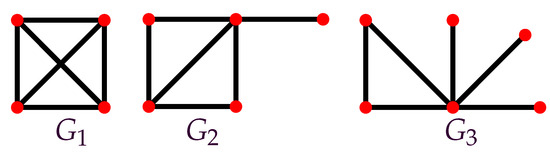
Suppose , and are graphs which are depicted in Figure 1. In addition, suppose , , and . By Lemma 14, . Now, by the structures of the graphs , and , it is easy to see that
Figure 1.
All vertex connected graphs in , , with exactly six edges.
Therefore, and for . Thus, the proof follows from Theorem 4. □
A similar argument as Theorem 5 shows that the graph , , has the maximum reduced Sombor index among all connected vertex graphs, . By Theorem 4, Conjecture 1 can be reduced to the following conjecture:
Conjecture 2.
Suppose n and ν are non-negative integers such that . If , then and .
5. Conclusions
In this paper, the authors develop a method to calculate the maximum value of the Sombor index of graphs. This method is applied to partially solve a conjecture of Réti et al. [20]. In an exact phrase, it is proved that the graph has the maximum Sombor index among all connected 6-cyclic graphs of order n. Moreover, we proved that the graph has the maximum Sombor index among all connected -cyclic graphs of order n, where and the number of pendent vertices is less than or equal to . It is also proved that, under the same conditions, this conjecture is valid for the reduced Sombor index.
Author Contributions
Investigation, K.C.D., A.G. and A.R.A.; writing-original draft preparation, K.C.D., A.G. and A.R.A.; writing-review and editing, K.C.D., A.G. and A.R.A. All authors have read and agreed to the published version of the manuscript.
Funding
This research received no external funding.
Institutional Review Board Statement
Not applicable.
Informed Consent Statement
Not applicable.
Data Availability Statement
Not applicable.
Acknowledgments
The authors are grateful to the referees for their valuable comments and suggestions.
Conflicts of Interest
The authors declare that there is no conflict of interest.
References
- West, D.B. Introduction to Graph Theory, 2nd ed.; Prentice Hall: Hoboken, NJ, USA, 2001. [Google Scholar]
- Gutman, I.; Trinajstić, N. Graph theory and molecular orbitals, Total π-electron energy of alternant hydrocarbons. Chem. Phys. Lett. 1972, 17, 535–538. [Google Scholar] [CrossRef]
- Gutman, I. Geometric approach to degree-based topological indices: Sombor indices. MATCH Commun. Math. Comput. Chem. 2021, 86, 11–16. [Google Scholar]
- Redžepović, I. Chemical applicability of Sombor indices. J. Serb. Chem. Soc. 2021, 86, 445–457. [Google Scholar] [CrossRef]
- Rada, J.; Bermudo, S. Is every graph the extremal value of a vertex-degree-based topological index? MATCH Commun. Math. Comput. Chem. 2019, 81, 315–323. [Google Scholar]
- Yao, Y.; Liu, M.; Das, K.C.; Ye, Y. Some extremal results for vertex-degree-Based invariants. MATCH Commun. Math. Comput. Chem. 2019, 81, 325–344. [Google Scholar]
- Liu, M.; Liu, B.; Das, K.C. Recent results on the majorization theory of graph spectrum and topological index theory—A survey. Electron. J. Linear Algebra 2015, 30, 402–421. [Google Scholar] [CrossRef][Green Version]
- Marshall, A.W.; Olkin, I. Inequalities: Theory of Majorization and Its Applications; Academic Press: New York, NY, USA, 1979. [Google Scholar]
- Gutman, I. Some basic properties of Sombor indices. Open J. Discret. Appl. Math. 2021, 4, 1–3. [Google Scholar] [CrossRef]
- Cruz, R.; Gutman, I.; Rada, J. Sombor index of chemical graphs. Appl. Math. Comput. 2021, 399, 126018. [Google Scholar]
- Cruz, R.; Rada, J. Extremal values of the Sombor index in unicyclic and bicyclic graphs. J. Math. Chem. 2021, 59, 1098–1116. [Google Scholar] [CrossRef]
- Das, K.C.; Cevik, A.S.; Cangul, I.N.; Shang, Y. On Sombor index. Symmetry 2021, 13, 140. [Google Scholar] [CrossRef]
- Deng, H.; Tang, Z.; Wu, R. Molecular trees with extremal values of Sombor indices. Int. J. Quantum Chem. 2021, 121, e26622. [Google Scholar] [CrossRef]
- Milovanović, I.; Milovanović, E.; Matejić, M. On some mathematical properties of Sombor indices. Bull. Int. Math. Virtual Inst. 2021, 11, 341–353. [Google Scholar]
- Wang, Z.; Mao, Y.; Li, Y.; Furtula, B. On relations between Sombor and other degree-based indices. J. Appl. Math. Comput. 2021, 1–17. [Google Scholar] [CrossRef]
- Das, K.C.; Shang, Y. Some extremal graphs with respect to Sombor index. Mathematics 2021, 9, 1202. [Google Scholar] [CrossRef]
- Das, K.C.; Gutman, I. On Sombor index of trees. Appl. Math. Comput. 2022, 412, 126575. [Google Scholar]
- Ghanbari, N.; Alikhani, S. Sombor index of certain graphs. Iranian J. Math. Chem. 2021, 12, 27–37. [Google Scholar]
- Hardy, G.H.; Littlewood, J.E.; Ṕolya, G. Inequalities; Cambridge University Press: Cambridge, UK, 1952. [Google Scholar]
- Réti, T.; Došlić, T.; Ali, A. On the Sombor index of graphs. Contrib. Math. 2021, 3, 11–18. [Google Scholar]
- Ghalavand, A.; Ashrafi, A.R. Bounds on the entire Zagreb indices of graphs. MATCH Commun. Math. Comput. Chem. 2019, 81, 371–381. [Google Scholar]
Publisher’s Note: MDPI stays neutral with regard to jurisdictional claims in published maps and institutional affiliations. |
© 2021 by the authors. Licensee MDPI, Basel, Switzerland. This article is an open access article distributed under the terms and conditions of the Creative Commons Attribution (CC BY) license (https://creativecommons.org/licenses/by/4.0/).