


Abstract
This paper aims to propose a new reckoning method for solving the split equality fixed point problem of demicontractive operators in Hilbert spaces, and to establish a theorem with regard to the strong convergence of this new scheme. As an application, we also consider quasi-pseudo-contractive operators and obtain a result on the solution to the split equality fixed point problem in the framework of Hilbert spaces. A numerical example is also provided.
Keywords:
split equality fixed point problem; demicontractive operator; strong convergence; quasi pseudo-contractive mapping MSC:
47H05; 47H09; 47H20
1. Introduction
Consider three Hilbert spaces, , , and , and two nonempty, closed, and convex sets and . In addition, consider a bounded linear mapping , and , be mappings.
The split feasibility problem (SFP) appeared first in 1994, in a work of Censor and Elfving [1]; it refers to determining an element in the set
Subsequently, signal processing and the reconstruction of images have benefited by the development of iterative methods for solving the SFP; see [2,3,4].
The split common fixed point problem (SCFP) appeared in a paper of Censor and Segal [5]; it refers to determining a point x satisfying
where the mappings S and T are nonlinear, and is as above. Here, and are formed by all the fixed points of S and T, respectively. It can be observed that the SFP can be obtained by an adequate choice, namely considering orthogonal projections as operators S and T. In the recent years, the reconstruction of images or the radio-therapy have used, as a beneficial tool, the SCFP (1) [6,7,8,9,10,11,12,13,14].
In [5], in order to study the SCFP (1), the next reckoning algorithm was designed by Censor and Segal. For , define
where S and T are directed mappings, I is the identity operator on and . They also obtained a result concerning the weak convergence with regard to the SCFP (1). Meanwhile, their statement was further developed to mappings endowed with properties such as quasi-nonexpansiveness [7,15] or demicontractility [8], with the same weakly convergence of to an element satisfying the SCFP (1).
Recently, Moudafi [16] has addressed the split equality fixed point problem (SEFP on short):
where and are characterized by boundedness and linearity, S and T are characterized by firmly quasi-nonexpansiveness. (2)-type problems allow a symmetric and partial relation with respect to both variables. The goal is the cover of a wide number of situations, such as applications in game theory, decomposition methods for differential equations or radio-therapy. In the case when and , the SEFP (2) reduces to the SCFP (1).
In order to solve the SEFP (2), a simultaneous numerical method was proposed by Moudafi and Al-Shemas [17]:
where the operators S and T are endowed with the firmly quasi-nonexpansiveness property, and , and , symbolize the spectral radii of and , respectively.
In the above work, the step sizes relate to the norm or the norm , which are generally not easily computable in practice. To overcome this difficulty, variable step sizes which ultimately have no relation with the norm are considered (see, e.g., [11,18,19,20,21]). Regarding their step sizes, Wang and Xu [21] dealt with
where , , and
and they proposed the following numerical formula to find a solution to the SCFP (1):
By imposing suitable hypotheses, they stated a weak convergence result. Obviously, the step sizes chosen here are not based on the norm .
In 2018, Cui et al. [22] widened the result in [21] from nonexpansiveness to demicontractive continuous operators under assumptions (3) and (4). Furthermore, they have used their result in order to propose a solution to the SEFP with the following variable step size:
On the other hand, inspired by the work of Attouch [23], Moudafi [16] proposed a viscosity approximation method for nonexpansive mappings to obtain strong results in Hilbert spaces. This viscosity approximation method has been an object of study for many authors e.g., see [24,25,26,27].
In this paper, we consider a new reckoning scheme to determine a solution to the SEFP of operators featuring the demicontractility, by using viscosity approximation methods in Hilbert spaces. A result with respect to the strong convergence of this scheme is stated and proved. As an application, we consider quasi pseudo-contractive operators and apply our result to solve the associated SEFP problem.
2. Preliminaries
Along this work, we need a Hilbert space with the scalar product , and norm . designates the set of all real numbers. The strong (weak) convergence of a sequence from to a point in , is designated by → (⇀). Along the paper is a nonempty, closed, convex set, T is an operator defined on C into , and is the set of the fixed points of T.
In order to prove our main results, we recollect the following definitions.
Definition 1.
A selfmapping T on is called
- (i)
- contractive if there can be found with the property
- (ii)
- nonexpansive if
- (iii)
- quasi-nonexpansive if
- (iv)
- directed (firmly quasi-nonexpansive) if
- (v)
- σ-demicontractive if there can be found a constant such thatwhich is the same as
- (vi)
- quasi-pseudo-contractive if
It can be observed that the class of operators endowed with demicontractility contains other classes, for example those of quasi-nonexpansive mappings or directed mappings.
Remark 1.
Every σ-demicontractive operator () is characterized by quasi-nonexpansiveness. In addition, every directed mapping is (−1)-demicontractive.
Example 1
([28]; see Example 2.5). Take and , , , . Then, and T is an operator endowed with the demicontractility property, but not with the quasi-nonexpansiveness.
The orthogonal projection from onto C,
provides an example of a mapping endowed with firmly nonexpansiveness. It is known (please see [29]) that is characterized by the inequality
Recollect that is characterized by demiclosedness at 0 if for any and ,
If is a nonempty, closed, and convex set, and is nonexpansive, according to [30], the operator is demiclosed on C. Nevertheless, the same is not true if T features quasi-nonexpansiveness instead of nonexpansiveness as the following example shows.
Example 2
([28]; see Example 2.11). The operator
features the quasi-nonexpansiveness, but is not characterized by the demiclosedness at 0.
is called semi-compact if, for any bounded sequence with , there can be found such that .
In the following, we recollect some lemmas needed in our main results. The first one provides conditions on which a sequence with adequate properties converges to zero.
Lemma 1.
[31] Presume that , , such that
where and for which
- (i)
- (ii)
- and
- (iii)
- or
Then
The next lemma recalls properties of a mapping which satisfies demicontractive properties.
Lemma 2
([32]; see Proposition 2.1). Presume that is a μ-demicontractive operator. Then, is characterized by closedness and convexity.
Eventually, we also use the demiclosedness property of nonexpansive mappings.
Lemma 3
([33]). If is a nonexpansive operator, then is characterized by demiclosedness at 0.
3. Main Results
Unless otherwise specified, in the sequel, we presume that , , and are real Hilbert spaces. Here, and are demicontractive operators of constants , , respectively. Let and be two contractive operators with constants , respectively. Consider two operators and characterized by boundedness and linearity, with their adjoints and , respectively. Set and .
designates the set of the solutions to problem (2), more precisely
Presume that . Denote by . We endow this set with the scalar product:
Observe that can be organized as a real Hilbert space and
We propose the algorithm below to determine the solutions to problem (2).
| Algorithm 1.Let , and be arbitrarily given. |
| The algorithm becomes Step 1. If Step 2. Define and , |
Lemma 4.
checks problem (2) if and only if
Proof.
Suppose that solves problem (2). Then, and . It is obvious that
To prove the converse statement, presume that (7) holds. Since S and T are demicontractive, for any
, inequality (6) compels
Taking advantage of inequalities (8) and (9), and , we obtain
which implies that , and , completing the proof. □
By Lemma 4, we may assume that Algorithm 1 produced, by and large, an infinite sequence . If the algorithm requires only a finite number of iterations, a solution is obviously reached.
Lemma 5.
Suppose and are sequences endowed with a boundedness property, and
Then, , , and
Proof.
Set . For any , by relation (6), we obtain
Since , , the boundedness of and compels
Due to the fact that , , the conclusion has been proved. □
The next theorem refers to the strong convergence of the scheme designed previously; it links it also to a variational inequality.
Theorem 1.
Let and be two sequences. Assume that the following conditions are satisfied:
- (a)
- and are demiclosed at 0;
- (b)
- ;
- (c)
- and ;
- (d)
Then, in Algorithm 1 is strongly convergent to , the unique solution to the following variational inequality problem (VIP):
Proof.
Lemma 2 ensures the closedness and convexity of and . The boundedness and linearity of the operators and B imply the closedness and the convexity of . Similarly to Step 1 in the proof of Theorem 3.3 in [34], the uniqueness of the solution to the VIP (10) follows; denote this solution by .
Next, we have divided the proof into two stages.
Step 1. We prove that the boundedness characterizes the sequence .
Set , , , and . Since , by (6), we obtain
where .
Denote by . From (5), we have . Then, relation (11) leads us to
According to Algorithm 1, it follows
Analogously, we have
Relations (13)–(15) compel
Mathematical induction ensures us that the next inequality holds true
Taking also into account condition (b) of the theorem, we get that is bounded, so do , , . Relation (11) implies the boundedness of and .
Step 2. We prove now the strong convergence of to .
In fact, since and are contractions, the next relations hold true:
Algorithm 1, (12) and (16) lead us to
where
From condition , we get that
Since is bounded, from (13) and condition , it follows that and are bounded. Hence, is bounded from above, that is, is finite. By consequence, there can be found a subsequence such that
The boundedness of allows us to assume, with no loss of generality, that is weakly convergent to . It follows that
It follows from (18) and (19), and that
exists in . Hence, condition implies
that is,
Equalities (20) and Lemma 5 lead to
Since , , from condition and (21), we obtain that and . Since the boundedness and linearity characterize the operators and , we have . Taking advantage of the semicontinuity which characterizes the norm and of (22), we obtain
Thus, Then, by , (10), (18), and (19), we obtain
By the use of (17) and (23), condition , and Lemma 1, it follows that , so is strongly convergent to . □
Remark 2.
Theorem 1 enlarges ([21], Theorem 3.1) on the following issues:
- (I)
- The split common fixed point problem is generalized to the SEFP problem; the nonexpansive mappings are extended to the demicontractive operators;
- (II)
- The weak convergence in ([21], Theorem 3.1) is extended to the strong convergence.
4. Numerical Example
In order to illustrate the usability of the algorithm of Theorem 1, we consider the following example in .
Example 3
(Numerical Example). Let . Let , , Let , , Let S, , and , respectively. Let be the sequence generated iteratively by Algorithm 1, where , , . Then, is strongly convergent to (0,0).
Solution: For any x, , define and . Example 1 ensures that and . Obviously, . and are characterized by demiclosedness at 0. All the assumptions of Theorem 1 are accomplished.
Algorithm 1 becomes, in this case,
where the step size is as follows:
By using scheme (24), we obtained the numerical results in Table 1. Figure 1 also illustrates the usefulness of Theorem 1.

Table 1.
The convergence of with initial values (0.3,0.1).
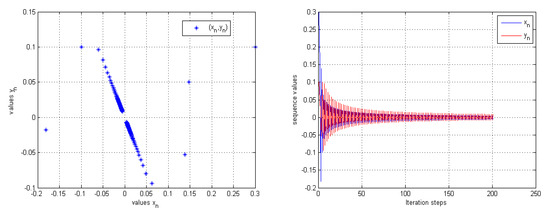
Figure 1.
The convergence of with initial values (0.3,0.1).
5. Application
In this section, Theorem 1 will be applied to the study of the SEFP problem in the case of quasi pseudo-contractive operators, a more general class than the class of demicontractive mappings in Hilbert spaces.
In 2015, the following iterative method for solving the SEFP (2) was taken into consideration by Chang et al. [35]:
where S and T are quasi-pseudocontractive, and . Furthermore, the weak convergence of the sequence generated by (25) to a solution to the SEFP (2) under some mild assumptions was proved. If S and T are both semi-compact, they obtained a strong convergence result.
Consider the next hypotheses:
Let S and T be two Lipschitzian quasi-pseudo-contractive mappings with
Let Consider the mappings K and W,
| Algorithm 2.Let , be arbitrarily given. |
| The algorithm becomes Step 1. If Step 2. Define and , |
We need the following lemma which helps us to prove our result.
Lemma 6.
[35] Let be a real Hilbert space and T be a Lipschitzian mapping with . Denote by
where . The next statements hold true:
- (1)
- .
- (2)
- If is demiclosed at 0, then so is .
- (3)
- Additionally, if T is quasi-pseudo-contractive, K is quasi-nonexpansive.
The next theorem proves that the algorithm is strongly convergent to the solution to a variational inequality.
Theorem 2.
Let be three real Hilbert spaces. Assume that , B, , , Ω are the same as in Theorem 1, and assumptions and hold. If the following conditions are satisfied:
- (a)
- and are demiclosed at 0;
- (b)
- ;
- (c)
- and ;
- (d)
then generated by Algorithm 2 converges strongly to the unique solution to problem (10).
Proof.
By Lemma 6 and the conditions imposed here, we obtain that and are endowed with demiclosedness at 0, and K and W are quasi-nonexpansive. Therefore, K and W are demicontractive. It follows from Theorem 1 that the conclusion holds. □
6. Conclusions
Along this work, we study the SEFP (2), a generalization of the SCFP (1). With the purpose of obtaining a strong convergence result, a new numerical scheme was introduced, combining viscosity approximation methodologies for the SEFP (2) of adequate operators in Hilbert spaces. Meanwhile, we applied our main result to the SEFP (2) of quasi pseudo-contractive mappings. We would like to note the following:
- (1)
- Theorem 1 mainly enlarge the ones in ([21], Theorem 3.1) and ([22], Theorem 14) from the following issues: (i) we extend the weak convergence result ([21], Theorem 3.1) for the SCFP (1) involving nonexpansive mappings to the strong convergent result for the SEFP (2) involving demicontractive operators; we improve and extend the weak convergence result ([22], Theorem 14) to the strong convergence result and remove the Lipschitz continuous conditions of the operators S and T; the proof of the strong convergence in Theorem 1 is different from the technique used to prove the weak convergence used in ([21], Theorem 3.1) and ([22], Theorem 14) because we use viscosity approximation methods.
- (2)
- Theorem 2 improves and extends ([35], Theorem 3.2) from the following points of view: (i) we remove the conditions of semi-compactness on the operators S and T, and still obtain a strong convergence result by using viscosity approximation methods; (ii) the choice in proving the convergence of Algorithm 3.1 in [35] requires the computation of the related operator norms, which is a complicated task to be accomplished. Thus, our choice (26) of the step sizes is more efficient and desirable.
- (3)
- We give a numerical example to demonstrate the usefulness and convergence of our algorithm.
Author Contributions
Writing—original draft preparation, and writing—review and editing, Y.W., J.C., and A.P. All the authors contributed equally to this work. All authors have read and agreed to the published version of the manuscript.
Funding
The work was supported by the Natural Science Foundation of China (No. 11975156, 11671365), the Natural Science Foundation of Guangdong Province (2018A0303070012) and the Ph.D. research startup foundation of Lingnan Normal University (ZL1919).
Conflicts of Interest
The authors declare no conflict of interest.
References
- Censor, Y.; Elfving, T. A multiprojection algorithm using Bregman projections in a product space. Numer. Algorithms 1994, 8, 221–239. [Google Scholar] [CrossRef]
- Qin, X.; Petruşel, A.; Yao, J.-C. CQ iterative algorithms for fixed points of nonexpansive mappings and split feasibility problems in Hilbert spaces. J. Nonlinear Convex Anal. 2018, 19, 157–165. [Google Scholar]
- Cho, S.Y.; Qin, X.; Yao, J.-C.; Yao, Y. Viscosity approximation splitting methods for monotone and nonexpansive operators in Hilbert spaces. J. Nonlinear Convex Anal. 2018, 19, 251–264. [Google Scholar]
- Takahashi, W.; Wen, C.F.; Yao, J.-C. The shrinking projection method for a finite family of demimetric mappings with variational inequality problems in a Hilbert space. Fixed Point Theory 2018, 19, 407–419. [Google Scholar] [CrossRef]
- Censor, Y.; Segal, A. The split common fixed point problem for directed operators. J. Convex Anal. 2009, 16, 587–600. [Google Scholar]
- Jailoka, P.; Suantai, S. Split common fixed point and null point problems for demicontractive operators in Hilbert spaces. Optim. Methods Softw. 2019, 34, 248–263. [Google Scholar] [CrossRef]
- Moudafi, A. A note on the split common fixed point problem for quasinonexpansive operators. Nonlinear Anal. 2011, 74, 4083–4087. [Google Scholar] [CrossRef]
- Moudafi, A. The split common fixed point problem for demicontractive mappings. Inverse Probl. 2010, 26, 055007. [Google Scholar] [CrossRef]
- Wang, F. A new method for split common fixed-point problem without priori knowledge of operator norms. J. Fixed Point Theory Appl. 2017, 19, 1–10. [Google Scholar] [CrossRef]
- Wang, Y.Q.; Kim, T.H.; Fang, X.L.; He, H.M. The split common fixed-point problem for demicontractive mappings and quasi-nonexpansive mappings. J. Nonlinear Sci. Appl. 2017, 10, 2976–2985. [Google Scholar] [CrossRef][Green Version]
- Yao, Y.; Yao, J.-C.; Liou, Y.C.; Postolache, M. Iterative algorithms for split common fixed points of demicontractive operators without priori knowledge of operator norms. Carpathian J. Math. 2018, 34, 459–466. [Google Scholar]
- Yao, Y.; Leng, L.; Postolache, M.; Zheng, X. Mann-type iteration method for solving the split common fixed point problem. J. Nonlinear Convex Anal. 2017, 18, 875–882. [Google Scholar]
- Takahahsi, W.; Yao, J.-C. The split common fixed point problem for two finite families of nonlinear mappings in Hilbert spaces. J. Nonlinear Convex Anal. 2019, 20, 173–195. [Google Scholar]
- Wang, J.; Fang, X. A strong convergence theorem for the split common fixed-point problem of demicontractive mappings. Appl. Set-Valued Anal. Optim. 2019, 1, 105–112. [Google Scholar]
- Yao, Y.; Postolache, M.; Yao, J.-C. An iterative algorithm for solving the generalized variational inequalities and fixed points problems. Mathematics 2019, 7, 61. [Google Scholar] [CrossRef]
- Moudafi, A. Viscosity approximation methods for fixed points problems. J. Math. Anal. Appl. 2000, 241, 46–55. [Google Scholar] [CrossRef]
- Moudafi, A.; Al-Shemas, E. Simultaneous iterative methods for split equality problem. Trans. Math. Program Appl. 2013, 1, 1–11. [Google Scholar]
- Yao, Y.; Liou, Y.C.; Postolache, M. Self-adaptive algorithms for the split problem of the demicontractive operators. Optimization 2018, 67, 1309–1319. [Google Scholar] [CrossRef]
- Yao, Y.; Liou, Y.C.; Yao, J.-C. Split common fixed point problem for two quasi-pseudo-contractive operators and its algorithm construction. Fixed Point Theory Appl. 2015, 2015, 127. [Google Scholar] [CrossRef]
- Yao, Y.; Postolache, M.; Zhu, Z. Gradient methods with selection technique for the multiple-sets split feasibility problem. Optimization 2020, 69, 269–281. [Google Scholar] [CrossRef]
- Wang, F.; Xu, H.K. Weak and strong convergence of two algorithms for the split fixed point problem. Numer. Math. Theor. Meth. Appl. 2018, 11, 770–781. [Google Scholar]
- Cui, H.H.; Ceng, L.C.; Wang, F.H. Weak convergence theorems on the split common fixed point problem for demicontractive continuous mappings. J. Funct. Spaces 2018, 9610257. [Google Scholar] [CrossRef]
- Attouch, H. Viscosity solutions of minimization problems. SIAM J. Optim. 1996, 6, 769–806. [Google Scholar] [CrossRef]
- Yao, Y.; Postolache, M.; Liou, Y.C. Strong convergence of a self-adaptive method for the split feasibility problem. Fixed Point Theory Appl. 2013, 2013, 201. [Google Scholar] [CrossRef]
- Marino, G.; Xu, H.K. General iterative method for nonexpansive mappings in Hilbert spaces. J. Math. Anal. Appl. 2006, 318, 43–52. [Google Scholar] [CrossRef]
- Xu, H.K. Viscosity Approximation Methods for Nonexpansive Mappings. J. Math. Anal. Appl. 2004, 298, 279–291. [Google Scholar] [CrossRef]
- Qin, X.; Yao, J.-C. A viscosity iterative method for a split feasibility problem. J. Nonlinear Convex Anal. 2019, 20, 1497–1506. [Google Scholar]
- Wang, Y.Q.; Kim, T.H. Simultaneous iterative algorithm for the split equality fixed-point problem of demicontractive mappings. J. Nonlinear Sci. Appl. 2017, 10, 154–165. [Google Scholar] [CrossRef][Green Version]
- Takahashi, W. Nonlinear Functional Analysis; Yokohama Publishers: Yokohama, Japan, 2000. [Google Scholar]
- Goebel, K.; Kirk, W.A. Topics in Metric Fixed Point Theory; Cambridge Studies in Advanced Mathematics 28; Cambridge University Press: Cambridge, UK, 1990. [Google Scholar]
- Xu, H.K. Iterative algorithms for nonlinear operators. J. Lond. Math. Soc. 2002, 66, 240–256. [Google Scholar] [CrossRef]
- Marino, G.; Xu, H.K. Weak and strong convergence theorems for strict pseudo-contractions in Hilbert spaces. J. Math. Anal. Appl. 2007, 329, 336–346. [Google Scholar] [CrossRef]
- Opial, Z. Weak convergence of the sequence of successive approximations for nonexpansive mappings. Bull. Am. Math. Soc. 1967, 73, 591–597. [Google Scholar] [CrossRef]
- Wang, Y.Q.; Fang, X.L. Viscosity approximation methods for the multiple-set split equality common fixed-point problems of demicontractive mappings. J. Nonlinear Sci. Appl. 2017, 10, 4254–4268. [Google Scholar] [CrossRef][Green Version]
- Chang, S.S.; Wang, L.; Qin, L.J. Split equality fixed point problem for quasi-pseudo-contrative mappings with applications. Fixed Point Theory Appl. 2015, 2015, 208. [Google Scholar] [CrossRef]
© 2020 by the authors. Licensee MDPI, Basel, Switzerland. This article is an open access article distributed under the terms and conditions of the Creative Commons Attribution (CC BY) license (http://creativecommons.org/licenses/by/4.0/).