


Abstract
Multi-polar vagueness in data plays a prominent role in several areas of the sciences. In recent years, the thought of m-polar fuzzy sets has captured the attention of numerous analysts, and research in this area has escalated in the past four years. Hybrid models of fuzzy sets have already been applied to many algebraic structures, such as -algebras, lie algebras, groups, and symmetric groups. A symmetry of the algebraic structure, mathematically an automorphism, is a mapping of the algebraic structure onto itself that preserves the structure. This paper focuses on combining the concepts of m-polar fuzzy sets and m-polar fuzzy points to introduce a new notion called m-polar -fuzzy ideals in -algebras. The defined notion is a generalization of fuzzy ideals, bipolar fuzzy ideals, -fuzzy ideals, and bipolar -fuzzy ideals in -algebras. We describe the characterization of m-polar -fuzzy ideals in -algebras by level cut subsets. Moreover, we define m-polar -fuzzy commutative ideals and explore some pertinent properties.
1. Introduction
As a ramification of general algebra, -algebras first appeared in the mathematics literature in 1966, in work by Imai and Iséki [1,2]. These ideas are created from two distinct approaches: propositional calculi and set theory. -algebras are algebraic patterns of the -system in combinatory logic. The name of -algebras arises from the combinatories in combinatory logic. Various properties of -algebras are explored within [3,4,5,6].
Bipolar fuzzy sets [7]—a generalization of Zadeh’s idea of the fuzzy set [8] which itself expands the classical set—are sets whose elements have positive and negative membership degrees. Hybrid models of fuzzy sets have been applied in many different sciences [9,10,11,12]. The first definition of fuzzy ideals in -algebras was by Xi [13] in 1991. Bipolar information is applied in many algebraic structures—for instance, -algebras [14,15,16,17], -algebras [18], -semihypergroups [19], and hemirings [20]. In many real-life issues, information sometimes comes from m factors , that is, multi-attribute data arise which cannot be handled using the existing ideals (e.g., fuzzy ideals, bipolar fuzzy ideals, etc.). For the time being, experts trust that the real world is proceeding to multipolarity. Multi-polar vagueness in information performs a crucial role in different areas of the sciences. In neurobiology, multi-polar neurons have numerous dendrites, permitting the integration of a great deal of data from different neurons. In technology, multi-polar technology can be utilized to build and perform large-scale IT structures.
In view of this inspiration, Chen et al. [21] introduced an m-polar fuzzy set (m-pF set, for short) in 2014, which was an extension of the bipolar fuzzy set. In an m-pF set, the degree of membership of an object ranges over , which depicts m distinct characteristics of the object. The theory of m-pF sets was essentially created to deal with the absence of a mathematical method towards multi-attribute, multi-polar, and multi-index information. Since that time, m-pF sets have been utilized in mathematical theories such as graph theory [22,23,24] and matroid theory [25]. Additionally, m-pF sets have applications in real-life issues such as decision-making problems [26,27]. For the first time, Akram et al. [28] implemented the idea of m-pF sets into algebraic structures and gave the notion of m-pF lie subalgebras. In addition, Akram and Farooq [29] established m-pF lie ideals of lie subalgebras. Applying the idea of m-pF sets to group theory, Farooq et al. [30] initiated the concept of m-pF subgroups, and investigated some of their properties. Furthermore, Al-Masarwah and Ahmad [31] applied m-pF sets to -algebras. They presented the concepts of m-pF subalgebras, m-pF ideals, and m-pF commutative ideals, and investigated related results.
In 1971, Rosenfeld [32] used fuzzy sets in the theory of groups and established the notion of fuzzy subgroups. In 1996, Bhakat and Das [33] generalized the idea of fuzzy subgroups to -fuzzy subgroups by using the concept of fuzzy points and its “belongingness (∈)” and “quasi-coincidence (q)” with a fuzzy set. After that, Bhakat [34,35] studied this concept in detail. Actually, the notion of an -fuzzy subgroup is a fundamental and valuable generalization of the fuzzy subgroup. In -algebras, -fuzzy subalgebras were created and discussed by Jun [36,37], and further studied by Muhiuddin and Al-Roqi in [38]. Jun [39] and Zhan et al. [40] proposed and discussed a generalization of a fuzzy ideal in a -algebra. As an extension of generalized fuzzy ideals in -algebras, Ma et al. [41] considered -interval-valued fuzzy ideals and Jana et al. [42] proposed the concept of -bipolar fuzzy ideals. Recently, Ibrara et al. [43] proposed the -bipolar fuzzy generalized bi-ideal in ordered semigroups. In hemirings, Abdullah [44] defined the concepts of N-dimensional -fuzzy H-ideals.
Motivated by the previous studies, here we combine the notions of m-pF sets and m-pF points to introduce a new notion called m-polar -fuzzy ideals in -algebras. The defined concept is a generalization of fuzzy ideals, bipolar fuzzy ideals, -fuzzy ideals, and -bipolar fuzzy ideals. We prove that every m-polar -fuzzy ideal is an m-polar -fuzzy ideal, and every m-polar -fuzzy ideal is an m-polar -fuzzy ideal. For the characterizations of -algebras, we give a fundamental bridge between crisp ideals and m-polar -fuzzy ideals, since sometimes it is difficult to comprehend whether a particular ideal is an m-polar -fuzzy (resp., crisp) ideal or not. In this case, to provide the required information, we describe the characterization of m-polar -fuzzy ideals by level cut subsets. However, this technique has some gaps. One of them is that all outcomes have similarities in crisp ideals. In other words, m-polar -fuzzy ideals become a mirror of the crisp case. Moreover, we define m-polar -fuzzy commutative ideals and discuss some relevant properties. To show the novelty of this model, some contributions of several authors toward m-polar -fuzzy ideals in -algebras are analyzed in Table 1.

Table 1.
Contributions of several authors toward m-polar -fuzzy ideals.
2. Preliminaries
We recall basic concepts of -algebras, m-pF sets, m-pF ideals, and m-pF commutative ideals. From now on, X stands for a -algebra, unless something else is indicated.
A -algebra is an algebraic structure satisfying the axioms below: for all
- (I)
- (II)
- (III)
- (IV)
- and imply
A -algebra X is called a -algebra if for any In any -algebra the following hold: for all
- (1)
- (2)
- (3)
- (4)
- (5)
where means
A non-empty subset J of X is said to be an ideal of X if for all
A -algebra X is called commutative if where A non-empty subset D of a -algebra X is a commutative ideal of X (see [45]) if for all
Definition 1
([21]). An m-pF set on is a function where
is the membership value of every element and is the i-th projection mapping for all . The values and are the smallest and largest values in respectively.
Al-Masarwah and Ahmad [31] proposed m-pF ideals and m-pF commutative ideals as follows:
Definition 2
([31]). An m-pF set of X is said to be an m-pF ideal if the assertions below are valid: for all
(J1)
(J2)
That is,
(J1)
(J2)
for all
Definition 3
([31]). An m-pF set of a -algebra X is said to be an m-pF commutative ideal of X if it satisfies and for all
(J3)
That is, (J3)
for all
For an m-pF set of the set
for all is called the level cut subset of
An m-pF set of X of the form
is called an m-pF point, denoted by , with support x and value
An m-pF point
- Belongs to , denoted by , if , that is, for each
- Is quasi-coincident with , denoted by , if , that is, for each
We say that
- if does not hold,
- if or
- if and
3. -Polar -Fuzzy Ideals
In this section, we propose and discuss m-polar -fuzzy ideals, where
Theorem 1.
For an m-pF set of the set for all is an ideal of X if and only if satisfies the assertions below: for all
- (1)
- (2)
Proof.
Let be an ideal of Suppose that there exists such that
Then, and thus But implies a contradiction. Thus, (1) holds. Assume for some Then, and However, since a contradiction. Thus, (2) holds.
Conversely, suppose that (1) and (2) hold. Let be such that For any we get
Thus, Therefore, Let be such that This implies that
Thus, that is, Hence, is an ideal of □
Definition 4.
An m-pF set of X is called an m-polar -fuzzy ideal of X if for all and
- (1)
- (2)
- and
Theorem 2.
Let be an m-pF subset of X and J be an ideal of X such that
- (1)
- for all
- (2)
- for all
Then, is an m-polar -fuzzy ideal of
Proof.
(a) (For ) Let and be such that Then, Since we have If then and we have If then and we have Thus, Let and be such that and Then,
This implies that and so . That is, If then and we have If then and we have Therefore, Hence, is an m-polar -fuzzy ideal of
(b) (For ) Let and be such that Then, This implies and so Thus, If then and we have If then and we have Hence, Let and be such that and Then,
Thus and so That is, If then and we have If then and we have Thus, Hence, is an m-polar -fuzzy ideal of
(c) (For ) It follows from (a) and (b). □
The following example illustrates Theorem 2.
Example 1.
Let be a -algebra which is defined in Table 2:
Table 2.
The operation “”.
Let be a 3-pF set defined as:
Then, is an ideal of Therefore, is a 3-polar -fuzzy ideal of
4. -Polar -Fuzzy Ideals
In this section, we define m-polar -fuzzy ideals of X as a special case of m-polar -fuzzy ideals, and discuss several results.
Definition 5.
An m-pF set of X is called an m-polar -fuzzy ideal of X if for all and
- (1)
- (2)
- and
Example 2.
Consider a -algebra which is defined in Table 3:
Table 3.
The operation “”.
Let be a 4-pF set defined as:
Clearly, is a 4-polar -fuzzy ideal of
Lemma 1.
For an m-pF set of the following conditions are equivalent for all
- (1)
- (2)
Proof.
Let be an m-pF set of X and Assume If then
for some It follows that but Since , we get Therefore, a contradiction to (1). Thus, If then and so which implies that or Hence, Otherwise, a contradiction. Therefore, for all
Let and be such that Then, Assume that If then
This is a contradiction. Therefore, which implies that
Thus, □
Lemma 2.
For an m-pF set of the following conditions are equivalent for all
- (1)
- and
- (2)
Proof.
Let be an m-pF set of X and such that If then Choose such that
This implies that and but and that is, a contradiction. Thus, whenever If then and It follows that by (1), so that or If then which is a contradiction. Therefore, Consequently, for all
For any Let be such that Then,
Suppose that If then
a contradiction, so This implies that
Hence, □
From Lemmas 1 and 2, we deduce that
Theorem 3.
An m-pF set of X is an m-polar -fuzzy ideal of X if and only if for all
- (i)
- (ii)
Theorem 4.
Any m-polar -fuzzy ideal of X satisfies: for all
- (1)
- (2)
Proof.
(1) Suppose that for all Then, We have
(2) Assume that hold in Then,
This completes the proof. □
The next theorem gives the bridge between m-polar -fuzzy ideals and crisp ideals.
Theorem 5.
An m-pF set of X is an m-polar -fuzzy ideal of X if and only if is an ideal of X for all
Proof.
Suppose is an m-polar -fuzzy ideal of Let and Then, Using Theorem 3 (i) implies that
Thus, Again, let Then, and Using Theorem 3 (ii), we have
Hence, Therefore, is an ideal of
Conversely, let be an ideal of X for all If there exists such that then for some It follows that but a contradiction. Therefore, for all Suppose there exist v, such that
Then, for some It follows that and but a contradiction. Thus,
for all Hence, is an m-polar -fuzzy ideal of X by Theorem 3. □
Theorem 6.
An m-pF set of X is an m-polar fuzzy ideal of X if and only if is an m-pF ideal of
Proof.
Assume that is an m-polar fuzzy ideal of Suppose that there exists such that Select such that
Then, but a contradiction. Thus, for all Assume there exist such that Select such that
Then, and but a contradiction. Thus, for all Hence, is an m-pF ideal of
Conversely, suppose is an m-pF ideal of Let for Then, By hypothesis
that is, Let for Then, By hypothesis
This implies that Therefore, is an m-polar fuzzy ideal of □
Remark 1.
The above theorem shows that m-polar fuzzy ideals are the same as m-pF ideals of
Remark 2.
Every m-polar -fuzzy ideal is an m-polar -fuzzy ideal, but the converse may not be true, as shown in the next example.
Example 3.
Reconsider the -algebra X given in Example 2. An m-pF set of X defined by
is an m-polar -fuzzy ideal of X which is not an m-polar -fuzzy ideal of since
We provide a condition for an m-polar -fuzzy ideal to be an m-polar -fuzzy ideal.
Theorem 7.
If is an m-polar -fuzzy ideal of X and then is an m-polar -fuzzy ideal of
Proof.
Let be an m-polar -fuzzy ideal of X and Let for Then, Using Theorem 3 (i), we get
Therefore, Now, let for Then, and Using Theorem 3 (ii), we have
Thus, Hence, is an m-polar -fuzzy ideal of □
Next, we discuss the relation between an m-polar -fuzzy ideal and an m-polar -fuzzy ideal.
Theorem 8.
Every m-polar -fuzzy ideal of X is an m-polar -fuzzy ideal of
Proof.
Let be an m-polar -fuzzy ideal of Let and be such that Then, It follows from Definition 4 (1) that Let and be such that and Then, and It is implied from Definition 4 (2) that Hence, is an m-polar -fuzzy ideal of □
The converse of the above theorem is not true in general.
Example 4.
Reconsider the -algebra X given in Example 2. An m-pF set of X defined by
is an m-polar -fuzzy ideal of X which is not an m-polar -fuzzy ideal of since
but
Let be an m-pF set of we define the following sets for all
and
The sets and are called q-level cut subset of and -level cut subset of respectively.
Obviously,
Theorem 9.
If is an m-polar -fuzzy ideal of then is an ideal of X for all
Proof.
Suppose is an m-polar -fuzzy ideal of Let and Then, Using Theorem 3 (i), we have
i.e., Hence, Again, let Then, and Using Theorem 3 (ii), we have
so that that is, Thus, is an ideal of □
Theorem 10.
An m-pF set of X is an m-polar -fuzzy ideal of X if and only if is an ideal of X for all
Proof.
Suppose is an m-polar -fuzzy ideal of Let and Then, that is, Using Theorem 3 (i), we have
We consider two cases:
Case (1):
Hence, or Therefore, or Thus, , that is,
Case (2):
Hence, or Therefore, or Thus, , that is, Hence, in any case, we get , that is, Suppose for Then,
Thus, or and or Using Theorem 3 (ii), we have
We consider four cases:
Case (1): and
Hence, or Therefore, or Thus, , that is,
Case (2): and
Hence, or Therefore, or Thus, , that is,
Case (3): and This is similar to Case (2).
Case (4): and
Hence, or Therefore, or Thus, , that is, Therefore, in any case, we get , that is, Thus, is an ideal of
Conversely, suppose is an m-pF set of X and such that is an ideal of If there exists such that then
for some This implies that but Additionally, and so that is, Therefore, a contradiction. Thus, for all Suppose that there exist such that Then,
for some This implies that Since is an ideal of Thus, or a contradiction. Therefore, for all Hence, is an m-polar -fuzzy ideal of □
5. -Polar -Fuzzy Commutative Ideals
In this section, we propose the notion of m-polar -fuzzy commutative ideals in -algebras and discuss the related properties.
Definition 6.
An m-pF set of a -algebra X is called an m-polar -fuzzy commutative ideal of X if for all and
- (1)
- (2)
- and
Example 5.
Let be a -algebra which is defined in Table 4:
Table 4.
The operation “”.
Let be a 3-pF set defined as:
Clearly, is a 3-polar -fuzzy commutative ideal of
Theorem 11.
An m-pF set of a -algebra X is an m-polar -fuzzy commutative ideal of X if and only if for all :
- (1)
- (2)
Proof.
Assume is an m-polar -fuzzy commutative ideal of a -algebra Let and suppose that If then
for some It follows that , but Since we get Therefore, a contradiction. Thus, for all If then and so which implies that Hence, Otherwise, a contradiction. Hence, for all Let Assume that
Then,
If not, then
for some This implies that and but a contradiction. Hence, whenever If then
It follows that Therefore, or If then
a contradiction. Therefore, for all
Conversely, suppose that (1) and (2) hold. Let and be such that Then, Assume If then
a contradiction. Therefore, which implies that
Thus, Let and be such that Then,
Suppose that If then
a contradiction. Hence, This implies that
So, Hence, is an m-polar -fuzzy commutative ideal of □
Theorem 12.
Every m-polar -fuzzy commutative ideal of a -algebra X is an m-polar -fuzzy ideal of
Proof.
Let be an m-polar -fuzzy commutative ideal of a -algebra Let and Then, by taking in (2) of Definition 6, we have
Since for all and so
Hence, satisfies (2) of Definition 5. Combining with (1) of Definition 5 implies that is an m-polar -fuzzy ideal of □
In general, the converse of Theorem 12 is not true.
Example 6.
Let be a -algebra which is defined in Table 5:
Table 5.
The operation “”.
A 3-pF set defined by:
is a 3-polar -fuzzy ideal of X which is not a 3-polar -fuzzy commutative ideal of since
Theorem 13.
If is an m-polar -fuzzy ideal of a -algebra X and
for all then is an m-polar -fuzzy commutative ideal of
Proof.
Suppose is an m-polar -fuzzy ideal of a -algebra Then,
for all Also, by assumption and (ii) of Theorem 3, we have
Hence, is an m-polar -fuzzy commutative ideal of □
The next theorem provides necessary and sufficient condition for the crisp commutative ideal to be an m-polar -fuzzy commutative ideal.
Theorem 14.
An m-pF set of a -algebra X is an m-polar -fuzzy commutative ideal of X if and only if is a commutative ideal of X for all
Proof.
Assume that is an m-polar -fuzzy commutative ideal of Let and Then, Theorem 11 (1) implies that
Thus, Again, let Then, and Theorem 11 (2) implies that
Therefore, Thus, is a commutative ideal of
Conversely, let be an m-pF set of X be such that is a commutative ideal of X for all If there exists such that then
for some It follows that but a contradiction. Therefore,
for all Assume there exist such that
Then, for some This implies that and but This is impossible. Thus,
for all Hence, is an m-polar -fuzzy commutative ideal of X by Theorem 11. □
6. Insights of This Study
- m-pF points are defined.
- m-pF (commutative) ideals are modified and generalized.
- The concept of m-polar -fuzzy ideals is introduced, and as a special case, an m-polar -fuzzy ideal is defined.
- The relations between an m-polar -fuzzy (commutative) ideal and the crisp (commutative) ideal are established.
- Conditions for an m-pF set to be an m-polar -fuzzy ideal are considered.
- Some results in this study are displayed in Figure 1.
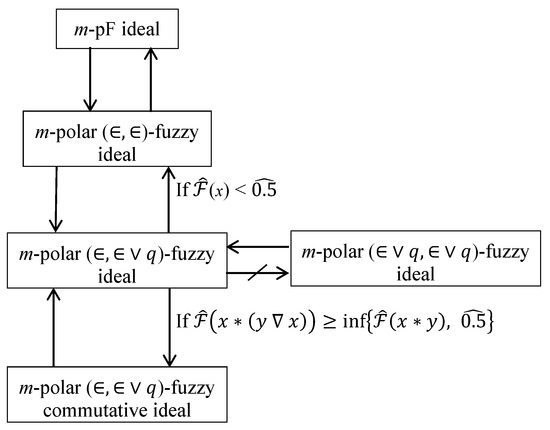 Figure 1. Some results in this study.
 - The results in this paper are supported by suitable examples.
7. Conclusions
The idea of m-pF ideals plays a key role in the theory of a -algebra. The m-pF points of a -algebra X are crucial tools to designate the algebraic subsystems of In this paper, we defined m-polar -fuzzy ideals and investigated related results. We proved that every m-polar -fuzzy ideal is an m-polar -fuzzy ideal, and every m-polar -fuzzy ideal is an m-polar -fuzzy ideal. We also obtained some characterization theorems of m-polar -fuzzy ideals in -algebras. Finally, we defined m-polar -fuzzy commutative ideals in -algebras and obtained some fundamental results.
The results of this study can be further expanded to various algebraic structures, such as -algebras, semigroups, -semihypergroups, and hemirings (see [18,19,44,46]). Furthermore, the notion of the m-pF set used in this work can be studied according to the thought in [47,48,49,50], which will be the way for much future research.
Author Contributions
Conceptualization, A.A.-M.; Methodology, A.A.-M.; Supervision, A.G.A.; Writing—original draft, A.A.-M.; Writing—review and editing, A.G.A.
Funding
This research received no external funding.
Conflicts of Interest
The authors declare no conflict of interest.
References
- Iséki, K. An algebra related with a propositional calculus. Proc. Jpn. Acad. 1966, 42, 26–29. [Google Scholar] [CrossRef]
- Imai, Y.; Iséki, K. On axiom systems of propositional calculi. Proc. Jpn. Acad. 1966, 42, 19–21. [Google Scholar] [CrossRef]
- Iséki, K. On BCI-algebras. Math. Semin. Notes 1980, 8, 125–130. [Google Scholar]
- Meng, J. On ideals in BCK-algebras. Math. Jpn. 1994, 40, 143–154. [Google Scholar]
- Meng, J.; Jun, Y.B. BCK-Algebras; Kyung Moon Sa Co.: Seoul, Korea, 1994. [Google Scholar]
- Huang, Y.S. BCI-Algebra; Science Press: Beijing, China, 2006. [Google Scholar]
- Zhang, W.R. Bipolar fuzzy sets and relations: A computational framework for cognitive and modeling and multiagent decision analysis. In Proceedings of the Fuzzy Information Processing Society Biannual Conference, San Antonio, TX, USA, 18–21 December 1994; pp. 305–309. [Google Scholar]
- Zadeh, L.A. Fuzzy sets. Inf. Control 1965, 8, 338–353. [Google Scholar] [CrossRef]
- Samanta, S.; Sarkar, B. Representation of competitions by generalized fuzzy graphs. Int. J. Comput. Int. Syst. 2018, 11, 1005–1015. [Google Scholar] [CrossRef]
- Revanasiddappa, M.B.; Harish, B.S. A new feature selection method based on intuitionistic fuzzy entropy to categorize text documents. Int. J. Interact. Multimed. Artif. Intell. 2018, 5, 106–117. [Google Scholar] [CrossRef]
- Esmaeilpour, M.; Mohammadi, A.R.A. Analyzing the EEG signals in order to estimate the depth of anesthesia using wavelet and fuzzy neural networks. Int. J. Interact. Multimed. Artif. Intell. 2016, 4, 12–15. [Google Scholar] [CrossRef]
- Almulhim, T.; Mikhailov, L.; Xu, D.L. A fuzzy group prioritization method for deriving weights and its software implementation. Int. J. Interact. Multimed. Artif. Intell. 2013, 2, 7–14. [Google Scholar] [CrossRef]
- Xi, O.G. Fuzzy BCK-algebras. Math. Jpn. 1991, 36, 935–942. [Google Scholar]
- Lee, K.J. Bipolar fuzzy subalgebras and bipolar fuzzy ideals of BCK/BCI-algebras. Bull. Malays. Math. Sci. Soc. 2009, 32, 361–373. [Google Scholar]
- Al-Masarwah, A.; Ahmad, A.G. Doubt bipolar fuzzy subalgebras and ideals in BCK/BCI-algebras. J. Math. Anal. 2018, 9, 9–27. [Google Scholar]
- Al-Masarwah, A.; Ahmad, A.G. On some properties of doubt bipolar fuzzy H-ideals in BCK/BCI-algebras. Eur. J. Pure Appl. Math. 2018, 11, 652–670. [Google Scholar] [CrossRef]
- Al-Masarwah, A.; Ahmad, A.G. Novel concepts of doubt bipolar fuzzy H-ideals of BCK/BCI-algebras. Int. J. Innov. Comput. Inf. Control 2018, 14, 2025–2041. [Google Scholar]
- Sabarinathan, S.; Muralikrishna, P.; Kumar, D.C. Bipolar valued fuzzy H-ideals of BF-algebras. Int. J. Pure Appl. Math. 2017, 112, 87–92. [Google Scholar] [CrossRef]
- Yaqoob, N.; Aslam, M.; Davvaz, B.; Ghareeb, A. Structures of bipolar fuzzy Γ-hyperideals in Γ-semihypergroups. J. Intell. Fuzzy Syst. 2014, 27, 3015–3032. [Google Scholar]
- Hayat, K.; Mahmood, T.; Cao, B.Y. On bipolar anti fuzzy H-ideals in hemirings. Fuzzy Inf. Eng. 2017, 9, 1–19. [Google Scholar] [CrossRef]
- Chen, J.; Li, S.; Ma, S.; Wang, X. m-polar fuzzy sets: An extension of bipolar fuzzy sets. Sci. World J. 2014, 2014, 416530. [Google Scholar] [CrossRef] [PubMed]
- Akram, M.; Sarwar, M. Novel applications of m-polar fuzzy hypergraphs. J. Intell. Fuzzy Syst. 2017, 32, 2747–2762. [Google Scholar] [CrossRef]
- Akram, M.; Shahzadi, G. Hypergraphs in m-polar fuzzy environment. Mathematics 2018, 6, 28. [Google Scholar] [CrossRef]
- Mandal, S.; Sahoo, S.; Ghorai, G.; Pal, M. Genus value of m-polar fuzzy graphs. J. Intell. Fuzzy Syst. 2018, 34, 1947–1957. [Google Scholar] [CrossRef]
- Sarwar, M.; Akram, M. New applications of m-polar fuzzy matroids. Symmetry 2017, 9, 319. [Google Scholar] [CrossRef]
- Akram, M.; Ali, G.; Alshehri, N.O. A new multi-attribute decision-making method based on m-polar fuzzy soft rough sets. Symmetry 2017, 9, 271. [Google Scholar] [CrossRef]
- Zahedi Khameneh, A.; Kiliçman, A. m-polar fuzzy soft weighted aggregation operators and their applications in group decision-making. Symmetry 2018, 10, 636. [Google Scholar] [CrossRef]
- Akram, M.; Farooq, A.; Shum, K.P. On m-polar fuzzy lie subalgebras. Ital. J. Pure Appl. Math. 2016, 36, 445–454. [Google Scholar]
- Akram, M.; Farooq, A. m-polar fuzzy lie ideals of lie algebras. Quasigroups Relat. Syst. 2016, 24, 141–150. [Google Scholar]
- Farooq, A.; Alia, G.; Akram, M. On m-polar fuzzy groups. Int. J. Algebr. Stat. 2016, 5, 115–127. [Google Scholar] [CrossRef]
- Al-Masarwah, A.; Ahmad, A.G. m-polar fuzzy ideals of BCK/BCI-algebras. J. King Saud Univ.-Sci. 2018. [Google Scholar] [CrossRef]
- Rosenfeld, A. Fuzzy groups. J. Math. Anal. Appl. 1971, 35, 512–517. [Google Scholar] [CrossRef]
- Bhakat, S.K.; Das, P. (∈,∈∨q)-fuzzy subgroups. Fuzzy Sets Syst. 1996, 80, 359–368. [Google Scholar] [CrossRef]
- Bhakat, S.K. (∈∨q)-level subsets. Fuzzy Sets Syst. 1999, 103, 529–533. [Google Scholar] [CrossRef]
- Bhakat, S.K. (∈,∈∨q)-fuzzy normal, quasi-normal and maximal subgroups. Fuzzy Sets Syst. 2000, 112, 299–312. [Google Scholar] [CrossRef]
- Jun, Y.B. On (α,β)-fuzzy subalgebras of BCK/BCI-algebras. Bull. Korean Math. Soc. 2005, 42, 703–711. [Google Scholar] [CrossRef]
- Jun, Y.B. Fuzzy subalgebras of type (α,β) in BCK/BCI-algebras. Kyungpook Math. J. 2007, 47, 403–410. [Google Scholar]
- Muhiuddin, G.; Al-Roqi, A.M. Subalgebras of BCK/BCI-algebras based on (α,β)-type fuzzy sets. J. Comput. Anal. Appl. 2015, 18, 1057–1064. [Google Scholar]
- Jun, Y.B. On (α,β)-fuzzy ideals of BCK/BCI-algebras. Sci. Math. Jpn. 2004, 60, 613–617. [Google Scholar]
- Zhan, J.; Jun, Y.B.; Davvaz, B. On (∈,∈∨q)-fuzzy ideals of BCI-algebras. Iran. J. Fuzzy Syst. 2009, 6, 81–94. [Google Scholar]
- Ma, X.; Zhan, J.M.; Davvaz, B.; Jun, Y.B. Some kinds of (∈,∈∨q)-interval-valued fuzzy ideals of BCI-algebras. Inf. Sci. 2008, 178, 3738–3754. [Google Scholar] [CrossRef]
- Jana, C.; Pal, M.; Saeid, A.B. (∈,∈∨q)-Bipolar fuzzy BCK/BCI-algebras. Mo. J. Math. Sci. 2017, 29, 139–160. [Google Scholar]
- Ibrara, M.; Khana, A.; Davvazb, B. Characterizations of regular ordered semigroups in terms of (α,β)-bipolar fuzzy generalized bi-ideals. J. Intell. Fuzzy Syst. 2017, 33, 365–376. [Google Scholar] [CrossRef]
- Abdullah, S. N-dimensional (α,β)-fuzzy H-ideals in hemirings. Int. J. Mach. Learn. Cybern. 2014, 5, 635–645. [Google Scholar] [CrossRef]
- Meng, J. Commutative ideals in BCK-algebras. Pure Appl. Math. 1991, 9, 49–53. [Google Scholar]
- Khan, K.; Muhammad, N. On (∈,∈∨q)-intuitionistic fuzzy ideals of soft semigroups. Int. J. Mach. Learn. Cybern. 2014. [Google Scholar] [CrossRef]
- Al-Husban, R.; Salleh, A.R.; Ahmad, A.G. Complex intuitionistic fuzzy normal subgroup. Int. J. Pure Appl. Math. 2017, 115, 199–210. [Google Scholar] [CrossRef]
- Alsarahead, M.O.; Ahmad, A.G. Complex fuzzy subrings. Int. J. Pure Appl. Math. 2017, 117, 563–577. [Google Scholar]
- Selvachandran, G.; Salleh, A.R. On normalistic vague soft groups and normalistic vague soft group homomorphism. Adv. Fuzzy Syst. 2015, 592813. [Google Scholar] [CrossRef]
- Selvachandran, G.; Salleh, A.R. Vague soft hypergroups and vague soft hypergroup homomorphism. Adv. Fuzzy Syst. 2014, 758637. [Google Scholar] [CrossRef]
© 2019 by the authors. Licensee MDPI, Basel, Switzerland. This article is an open access article distributed under the terms and conditions of the Creative Commons Attribution (CC BY) license (http://creativecommons.org/licenses/by/4.0/).