Construction of a GEP-Based Ecological Security Pattern in the Henan Region Along the Yellow River: Integrating MSPA


Abstract
1. Introduction
2. Materials and Methods
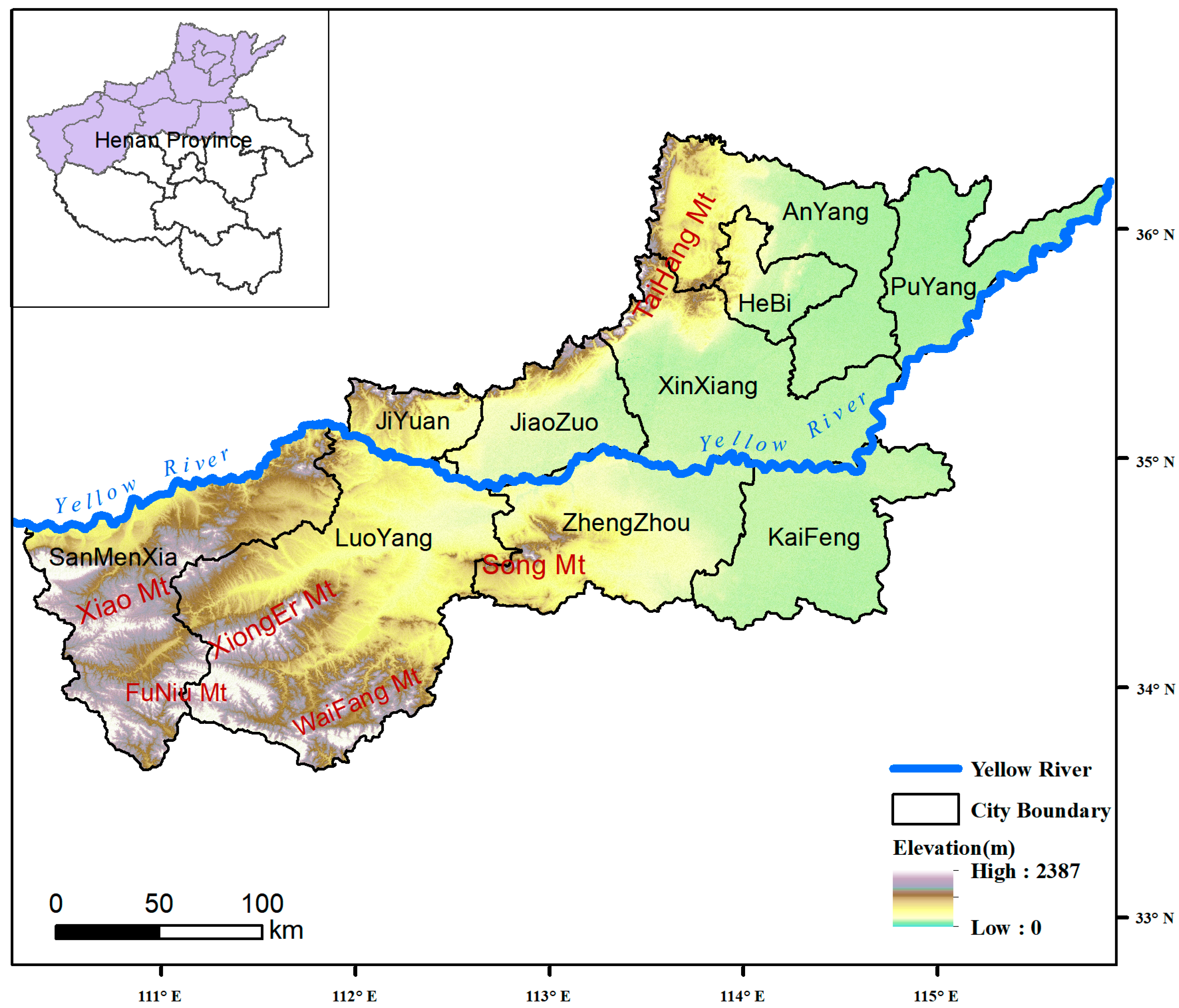
2.1. Study Sites
2.2. Data Sources and Processing
- Land use/cover data: Land use data for the years 2000, 2010, and 2020 were obtained from the Globeland30 global land cover product at a spatial resolution of 100 m. Following the product’s classification scheme, the land use data were reclassified into eight ecosystem types: cropland, forest, grassland, shrubland, wetland, water body, artificial surface, and bare land.
- Statistical Data: In this study, data on the output of agriculture, animal husbandry, and fishery products, as well as tourism revenue, were primarily obtained from the Henan Statistical Yearbook, the Henan Survey Yearbook, the China City Statistical Yearbook, and the statistical yearbooks and statistical communiqués issued by prefectures and counties. Tourism revenue data were additionally sourced from the above statistical yearbooks and statistical communiqués released by local governments. To ensure accuracy and completeness, sector-specific datasets published by the Department of Agriculture, the Department of Natural Resources, and the Statistical Bureau of Henan Province were also consulted.
- Ecological Parameters: Digital Elevation Model (DEM) data were downloaded from the Geospatial Data Cloud from the ASTER GDEM (30 m resolution), and then mosaicked, clipped, and projected to generate the study-area DEM. Hydrology tools were used for depression filling and flow accumulation to delineate watershed boundaries. Normalized Difference Vegetation Index (NDVI) data were provided by the Data Center for Resources and Environmental Sciences, Chinese Academy of Sciences (RESDC). Soil texture, soil organic matter content, and solar radiation data were acquired from the National Tibetan Plateau Data Center. Meteorological data for the study area and its surroundings (1986–2022) include daily precipitation, mean air temperature, maximum air temperature, minimum air temperature, and sunshine duration, and were obtained from the China Meteorological Administration’s China Surface Climate Data Daily Dataset (http://data.cma.cn/). Spatial interpolation was performed with the ANUSPLIN package to generate monthly, annual, and multi-year mean precipitation datasets for evapotranspiration and water retention calculations. To match the resolution of different land use types, all of the above data were uniformly resampled or interpolated to a 100 m raster. Road data were extracted from the National Road Dataset of RESDC and used to estimate the biodiversity index. Locations of scenic spots within the study area were collected using a Baidu-Maps POI crawler; duplicate records and culturally oriented sites were manually excluded to retain only natural attractions. The remaining parameters were taken from the recommended values in the InVEST model manual, supplemented by the relevant literature.
- Price Parameters: By combining information collected from agriculture, development-and-reform, environmental, price-supervision, and health departments with the literature review and market surveys, we obtained price benchmarks for crop, livestock, and fishery products, carbon-trading prices, average oxygen prices, air purification costs, water quality purification fees, and pollutant treatment costs. These unit values serve as conversion standards for quantifying the monetary value of ecosystem services when calculating Gross Ecosystem Product (GEP).
- Road data: This dataset was obtained from the National Road dataset of the Resource and Environment Science Data Centre of the Chinese Academy of Sciences (http://www.resdc.cn) and includes highways, railways, national roads, provincial roads, and county roads.
2.3. Ecosystem Service Assessment and Gross Ecosystem Product (GEP) Accounting
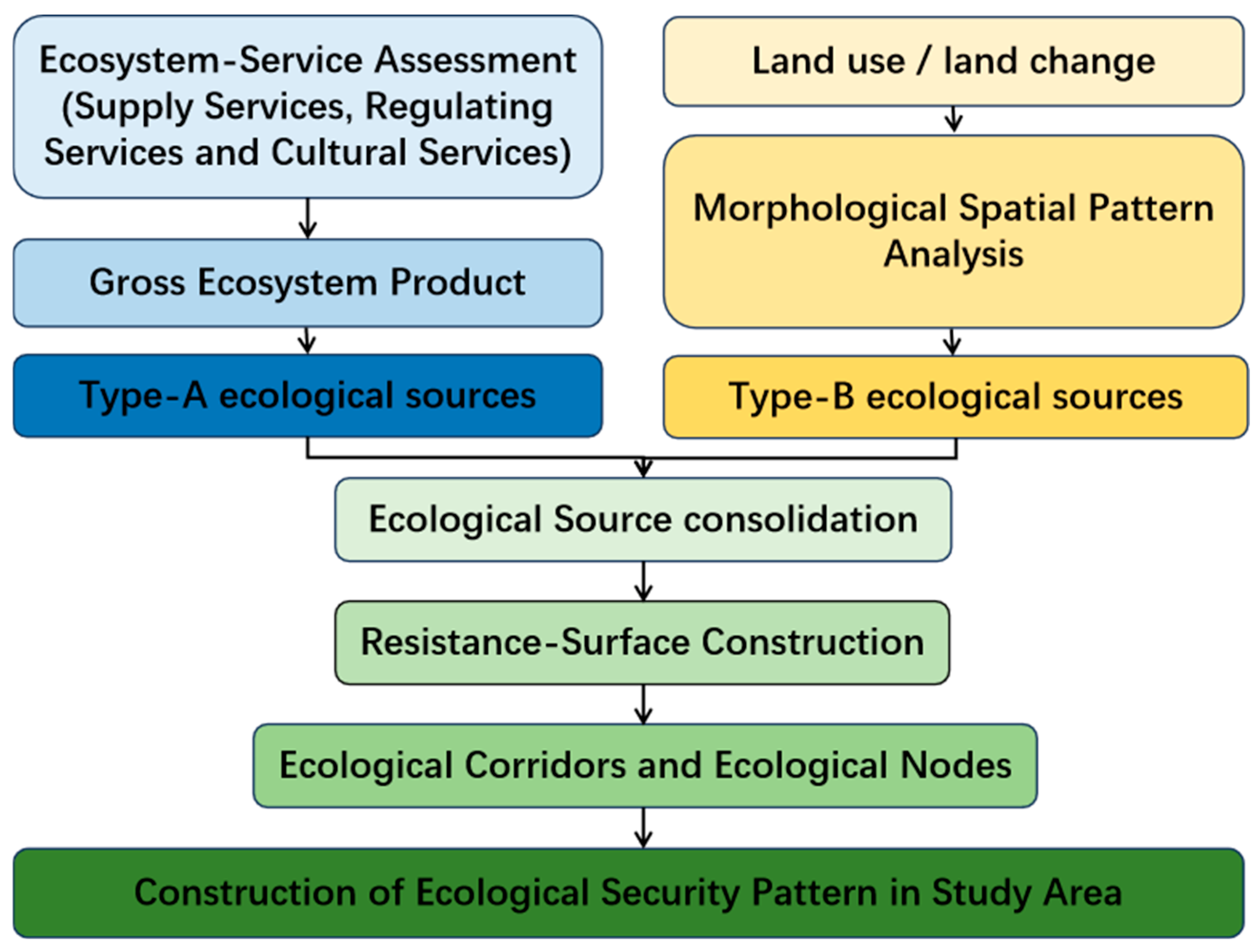
2.4. Ecological Source Identification
2.5. Resistance Surface Construction
2.6. Extraction of Ecological Corridors and Nodes
3. Results
3.1. Temporal Dynamics of GEP
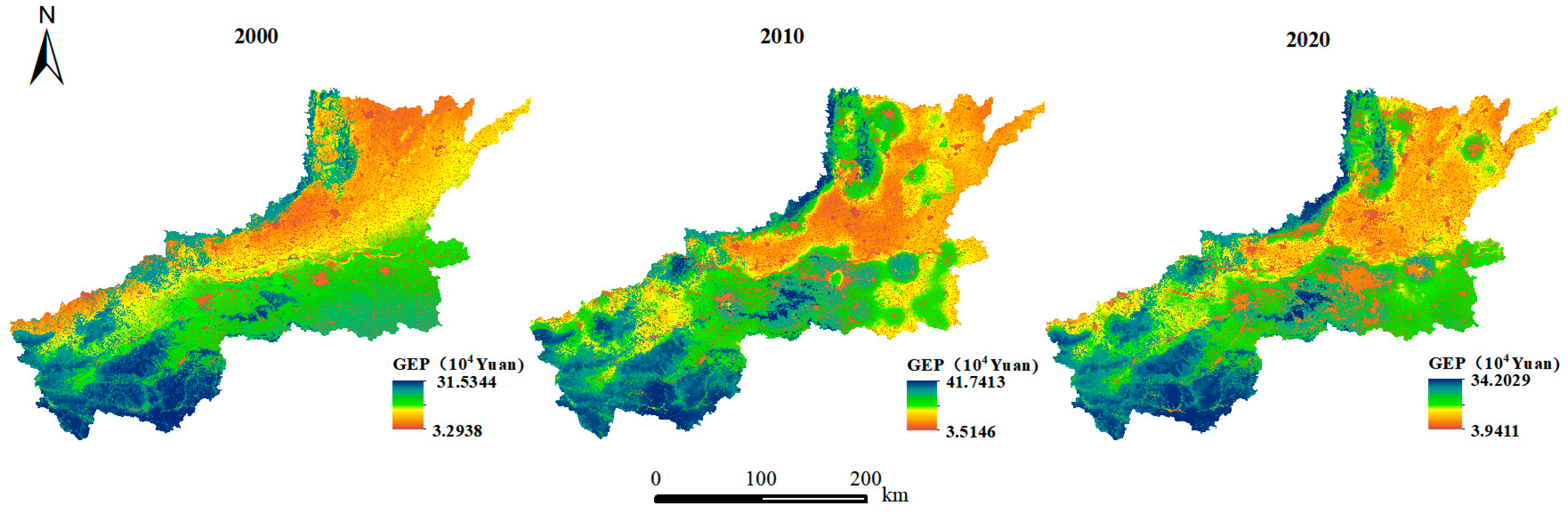
3.2. Spatial Variation Characteristics of Gross Ecosystem Product (GEP)
3.3. Distribution Characteristics of Landscape Pattern Types
3.4. Distribution Characteristics of Ecological Sources
3.5. Distribution Characteristics of the Integrated Resistance Surface
3.6. Ecological Corridors and Nodes
4. Discussion
4.1. Rationality of GEP-Based Ecological Security Pattern Construction
4.2. Impacts of LULC and Policies on GEP and ESP Patterns
4.3. Constructing a “Three-Core, Two-Belt, Two-Zone” Ecological-Protection Optimization Pattern
4.4. Limitations and Future Directions
5. Conclusions
Author Contributions
Funding
Data Availability Statement
Conflicts of Interest
References
- Hu, T.; Peng, J.; Liu, Y.; Wu, J.; Li, W.; Zhou, B. Evidence of green space sparing to ecosystem service improvement in urban regions: A case study of China’s Ecological Red Line policy. J. Clean. Prod. 2020, 251, 119678. [Google Scholar] [CrossRef]
- Li, Q.; Tang, L.; Qiu, Q.; Li, S.; Xu, Y. Construction of urban ecological security pattern based on MSPA and MCR Model: A case study of Xiamen. Acta Ecol. Sin. 2024, 44, 2284–2294. [Google Scholar]
- Li, K.; Fan, H.; Ouyang, J.; Yao, P. Valuation of the 2020 gross ecosystem product of China and analysis of driving factors. J. Clean. Prod. 2025, 513, 145741. [Google Scholar] [CrossRef]
- Cui, S.; Du, X.L.; Jia, C.Y.; Fu, Q.; Liu, D. Ecosystem Service Value Estimation and Ecological Security Pattern in Heilongjiang Province. Chin. J. Environ. Sci. 2024, 45, 6489–6500. [Google Scholar]
- Wang, W.; Hu, S.; Zhao, Z.; Wang, W. Spatio-temporal Characteristics of Ecosystem Service Value in Henan Province under Different Land Use Scenarios. Geogr. Geo-Inf. Sci. 2024, 40, 42–50. [Google Scholar]
- Lee, C.C.; He, Z.W.; Luo, H.P. Spatio-temporal characteristics of land ecological security and analysis of influencing factors in cities of major grain-producing regions of China. Environ. Impact Assess. Rev. 2024, 104, 107344. [Google Scholar] [CrossRef]
- Cui, X.; Deng, W.; Yang, J.; Huang, W.; de Vries, W.T. Construction and optimization of ecological security patterns based on social equity perspective: A case study in Wuhan, China. Ecol. Indic. 2022, 136, 108714. [Google Scholar] [CrossRef]
- Guo, J.; Feng, P.; Xue, H.; Xue, S.; Fan, L. A framework of ecological security patterns in arid and semi-arid regions considering differences socioeconomic scenarios in ecological risk: Case of Loess Plateau, China. J. Environ. Manag. 2025, 373, 123923. [Google Scholar] [CrossRef]
- Lai, J.; Qi, S. Construction of ecological security pattern based on ecological protection red line, machine learning algorithms, and circuit theory: A case study of Kunming city, China. J. Clean. Prod. 2025, 520, 146117. [Google Scholar] [CrossRef]
- Ding, T.; Chen, J.; Fang, L.; Ji, J. Identifying and optimizing ecological security patterns from the perspective of the water-energy-food nexus. J. Hydrol. 2024, 632, 130912. [Google Scholar] [CrossRef]
- Tian, Z.; Liu, S.; Gu, P.; Lv, X.; Peng, W. Construction of Huludao’s ecological security pattern based on MSPA-MCR-FLUS model. J. Agric. Resour. Environ. 2025, 42, 890–900. [Google Scholar] [CrossRef]
- Wang, L.; Wang, S.; Liang, X.; Jiang, X.; Wang, J.; Li, C.; Chang, S.; You, Y.; Su, K. How to Optimize High-Value GEP Areas to Identify Key Areas for Protection and Restoration: The Integration of Ecology and Complex Networks. Remote Sens. 2023, 15, 3420. [Google Scholar] [CrossRef]
- Wei, M.; Huang, T. Multi-scale transformation and evolutionary factors of ecological security patterns in the Yangtze River Economic Belt. J. Environ. Manag. 2025, 390, 126308. [Google Scholar] [CrossRef]
- Yan, J.; Li, J.; Yao, X.; Li, Q.; Zheng, Z.; Li, G.; Qi, G.; Ma, W.; Song, M.; Gao, P. Ecological security pattern construction based on landscape ecological risk assessment in the Yellow River basin. Front. Environ. Sci. 2025, 13, 1514599. [Google Scholar] [CrossRef]
- Li, S.; Gui, F.; Li, H.; Song, Y.; Peng, L.; Zhou, L.; Wang, Y. Construction of island ecological security pattern under multi-circle development pattern: Evidence from Hainan Island. Ocean. Coast. Manag. 2025, 269, 107809. [Google Scholar] [CrossRef]
- Liu, R.; Yang, L.; Li, T.; Zhu, B.; Li, J. Establishment of ecological security pattern along the Yellow River in Shaanxi Province based on ERA and MCR models. Chin. J. Environ. Sci 2024, 44, 1053–1063. [Google Scholar] [CrossRef]
- Wang, B.; Zhang, Y.; Gu, H.; Bian, Z. Ecological Security Patterns Based on Ecosystem Service Assessment and Circuit Theory: A Case Study of Liaoning Province, China. Land 2025, 14, 1257. [Google Scholar] [CrossRef]
- Yuan, Q.; Li, R. Priority conservation zoning for future karst areas based on the construction of a multi-perspective ecological security pattern. Ecol. Indic. 2025, 178, 113941. [Google Scholar] [CrossRef]
- Zhao, L.; Cao, G.; Yan, X.; Su, W.; Xian, Q. Ecological security pattern identification based on InVEST model and circuit theory—A case study at Hainan Zang Autonomous Prefecture, Qinghai Province. Bull. Soil Water Conserv. 2025, 45, 137–146. [Google Scholar] [CrossRef]
- Zhang, L.; Liu, Q.; Wang, J.; Wu, T.; Li, M. Constructing ecological security patterns using remote sensing ecological index and circuit theory: A case study of the Changchun-Jilin-Tumen region. J. Environ. Manag. 2025, 373, 123693. [Google Scholar] [CrossRef]
- Wang, X.; Zhu, M.; Zhang, X.; Ma, J.; Zhou, J.; Cheng, T.; Zheng, Y.; Tu, Y.; Yao, W.; Ma, J. Ecological security pattern construction of the Three-river Source Region based on Source-Resistance-Corridor. Acta Ecol. Sin. 2024, 44, 4609–4623. [Google Scholar]
- He, P.; Wang, L.; Zhai, S.; Guo, Y.; Huang, J. Assessment of Landscape Risks and Ecological Security Patterns in the Tarim Basin, Xinjiang, China. Land 2025, 14, 1221. [Google Scholar] [CrossRef]
- Dong, X.; Wang, F.; Fu, M. Research progress and prospects for constructing ecological security pattern based on ecological network. Ecol. Indic. 2024, 168, 112800. [Google Scholar] [CrossRef]
- Adriaensen, F.; Chardon, J.P.; De Blust, G.; Swinnen, E.; Villalba, S.; Gulinck, H.; Matthysen, E. The application of ‘least-cost’ modelling as a functional landscape model. Landsc. Urban Plan. 2003, 64, 233–247. [Google Scholar] [CrossRef]
- Chen, J.; Wang, S.; Zou, Y. Construction of an ecological security pattern based on ecosystem sensitivity and the importance of ecological services: A case study of the Guanzhong Plain urban agglomeration, China. Ecol. Indic. 2022, 136, 108688. [Google Scholar] [CrossRef]
- Chen, Y.; Zhang, C.; Hu, F.; Hu, G.; Lang, Y.; Huang, H. Analysis of Ecological Network Evolution in Taihang Mountains Based on MSPA-InVEST Model. Chin. J. Environ. Sci. 2025, 46, 6443–6454. [Google Scholar] [CrossRef]
- Dang, Z.; Hu, B.; Gao, C.; Wen, S.; Ren, J.; Liang, Y. Construction and Optimization of the Ecological Security Pattern of Pinglu Canal Economic Zone Based on the InVEST-Circuit Theory Model. Land 2025, 14, 1103. [Google Scholar] [CrossRef]
- Li, W.; Liu, Y.; Lin, Q.; Wu, X.; Hao, J.; Zhou, Z.; Zhang, X. Identification of ecological security pattern in the Qinghai-Tibet Plateau. Ecol. Indic. 2025, 170, 113057. [Google Scholar] [CrossRef]
- Jia, Q.; Jiao, L.; Lian, X.; Wang, W. Linking supply-demand balance of ecosystem services to identify ecological security patterns in urban agglomerations. Sustain. Cities Soc. 2023, 92, 104497. [Google Scholar] [CrossRef]
- Ke, Q.; Zhou, Q.; Zhuang, B.; Sun, C. Construction of ecological security pattern in Guangdong-Hong Kong-Macao Greater Bay Area based on the balance of ecosystem services supply and demand. Acta Ecol. Sin. 2024, 44, 1765–1779. [Google Scholar]
- Zhang, J.; Cao, Y.; Ding, F.; Wu, J.; Chang, I. Regional Ecological Security Pattern Construction Based on Ecological Barriers: A Case Study of the Bohai Bay Terrestrial Ecosystem. Sustainability 2022, 14, 5384. [Google Scholar] [CrossRef]
- Chen, Z.; Lei, J.-r.; Wu, T.; Chen, D.; Zhou, Z.; Li, Y.; Hong, X.; Yang, Z.; Li, Y. Gross ecosystem product accounting of national park: Taking Hainan Tropical Rainforest National Park as an example. Chin. J. Appl. Ecol. 2021, 32, 3883–3892. [Google Scholar] [CrossRef]
- Ye, X.; Zou, C.; Liu, G.; Lin, N.; Xu, M. Main research contents and advances in the ecological security pattern. Acta Ecol. Sin. 2018, 38, 3382–3392. [Google Scholar] [CrossRef][Green Version]
- Ouyang, Z.; Song, C.; Zheng, H.; Polasky, S.; Xiao, Y.; Bateman, I.J.; Liu, J.; Ruckelshaus, M.; Shi, F.; Xiao, Y.; et al. Using gross ecosystem product (GEP) to value nature in decision making. Proc. Natl. Acad. Sci. USA 2020, 117, 14593–14601. [Google Scholar] [CrossRef] [PubMed]
- Fang, L.; Xu, D.; Wang, L.; Niu, Z.; Zhang, M. The study of ecosystem services and the comparison of trade-off and synergy in Yangtze River Basin and Yellow River Basin. Geogr. Res. 2021, 40, 821–838. [Google Scholar] [CrossRef]
- Li, J.; Hu, D.; Wang, Y.; Chu, J.; Yin, H.; Ma, M. Study of identification and simulation of ecological zoning through integration of landscape ecological risk and ecosystem service value. Sustain. Cities Soc. 2024, 107, 105442. [Google Scholar] [CrossRef]
- Xie, G.; Zhen, L.; Lu, C.; Xiao, Y.; Chen, C. Expert knowledge based valuation method of Ecosystem services in China. J. Nat. Resour. 2008, 23, 911–919. [Google Scholar]
- Hu, C.; Zou, B.; Liang, Y.; He, C.; Lin, Z. Spatio-temporal evolution of gross ecosystem product with high spatial resolution: A case study of Hunan Province during 2000–2020. Remote Sens. Nat. Resour. 2023, 35, 179–189. [Google Scholar] [CrossRef]
- Lin, Y.; Xu, X. Spatiotemporal variations of gross ecosystem product and identification of important ecological protection spaces in the Yangtze River Delta. Resour. Sci. 2022, 44, 847–859. [Google Scholar] [CrossRef]
- Liu, F.; Ning, J.; Li, S.; He, T.; Wang, A.; Su, Y. Ecological security pattern construction and optimization in the Yellow River Basin of Henan Province. Ecol. Sci. 2025, 44, 211–221. [Google Scholar] [CrossRef]
- Wu, H.; Yu, L.; Liu, H.; Liu, S.; Di, W. Identification and Strategy of Key Areas of Land and Space Ecological Restoration Based on the Ecological Safety Pattern: Taking Henan Province as an Example. Chin. J. Environ. Sci. 2026, 47, 456–466. [Google Scholar] [CrossRef]
- Liu, S.; Wang, Q.; Miao, C.; Dong, Y.; Sun, Y.; Yu, L. Ecological security patterns of water conservation in the upper reaches of the Yellow River basin (Sichuan section) with ecological network approach. J. Beijing Norm. Univ. (Nat. Sci.) 2024, 60, 418–426. [Google Scholar]
- Zhang, J.; Chen, S. Evaluating water conservation capacity in the Yellow River water conservation area integrating ecological model and machine learning. J. Hydrol. 2025, 663, 134202. [Google Scholar] [CrossRef]
- Gou, M.; Li, L.; Liu, C.; Xiao, W.; Wang, N.; Ouyang, S.; Hu, J. Gradient effects of ecosystem service trade-off relationship in the Daning River Basin. Acta Ecol. Sin. 2022, 42, 7445–7457. [Google Scholar] [CrossRef]
- Wang, L.; Xiao, Y.; Ouyang, Z.; Wei, Q.; Bo, W.; Zhang, J.; Ren, L. Gross ecosystem product accounting in the national key ecological function area: An example of Arxan. Chin. J. Popul. Resour. 2017, 27, 146–154. [Google Scholar]
- Shi, L.; Zhang, X.; Halik, Ü. The Driving Mechanism and Spatio-Temporal Nonstationarity of Oasis Urban Green Landscape Pattern Changes in Urumqi. Remote Sens. 2025, 17, 3123. [Google Scholar] [CrossRef]
- Chen, B.; Liu, X.; Liu, J. Construction and optimization of ecological security patterns in Chinese black soil areas considering ecological importance and vulnerability. Sci. Rep. 2025, 15, 12142. [Google Scholar] [CrossRef] [PubMed]
- Kong, L.; Wang, Y.; Liu, Y.; Ao, Y.; Chai, B. Identification of key areas for ecological restoration based on ecological carrying capacity and ecological security pattern: A case study of Baoding, the central city of the Beijing-Tianjin-Hebei world-class urban cluster. Ecol. Indic. 2025, 178, 114032. [Google Scholar] [CrossRef]
- Jia, Z.; Fu, Q.; Song, C. Construction and Optimization of Ecological Security Pattern in Semi-arid Region of Western Heilongjiang Province. Chin. J. Environ. Sci. 2025, 46, 5180–5195. [Google Scholar] [CrossRef]
- Song, C.; Ouyang, Z. Gross Ecosystem Product accounting for ecological benefits assessment: A case study of Qinghai Province. Acta Ecol. Sin. 2020, 40, 3207–3217. [Google Scholar] [CrossRef]
- Li, J.; Liang, L.; Chao, Y.; Wang, X.; Qiu, M.; Luo, P.; Zhu, Y. Construction of the ecological security pattern of Mu Us sandy land on the basis of the “Source − Resistance − Corridor” theory. Ecol. Indic. 2025, 171, 113162. [Google Scholar] [CrossRef]
- Li, Y.; Wei, M.; Zhou, R.; Jin, H.; Chen, Y.; Hong, C.; Duan, W.; Li, Q. Identifying priority restoration areas based on ecological security pattern: Implications for ecological restoration planning. Ecol. Indic. 2025, 174, 113486. [Google Scholar] [CrossRef]
- Liu, P.; Liu, Y.; Li, T.; Guo, W.-W.; Yang, A.-L.; Yang, X.; Li, E.-Z.; Wang, Z.-J. Identification and Trend Analysis of Ecological Security Pattern in Mudanjiang City Based on MSPA-MCR-PLUS Model. Sustainability 2024, 16, 9690. [Google Scholar] [CrossRef]
- Liu, H.; Wang, Z.; Zhang, L.; Tang, F.; Wang, G.; Li, M. Construction of an ecological security network in the Fenhe River Basin and its temporal and spatial evolution characteristics. J. Clean. Prod. 2023, 417, 137961. [Google Scholar] [CrossRef]
- Peng, J.; Yang, Y.; Liu, Y.; Hu, Y.; Du, Y.; Meersmans, J.; Qiu, S. Linking ecosystem services and circuit theory to identify ecological security patterns. Sci. Total Environ. 2018, 644, 781–790. [Google Scholar] [CrossRef]
- Chen, W.; Liu, H.; Wang, J. Construction and optimization of regional ecological security patterns based on MSPA-MCR-GA Model: A case study of Dongting Lake Basin in China. Ecol. Indic. 2024, 165, 112169. [Google Scholar] [CrossRef]
- Gregory, A.; Spence, E.; Beier, P.; Garding, E. Toward Best Management Practices for Ecological Corridors. Land 2021, 10, 140. [Google Scholar] [CrossRef]
- Liu, M.; Fan, J.; Wang, Y.; Hu, C. Study on Ecosystem Service Value (ESV) Spatial Transfer in the Central Plains Urban Agglomeration in the Yellow River Basin, China. Int. J. Environ. Res. Public Health 2021, 18, 9751. [Google Scholar] [CrossRef] [PubMed]
- Zhao, Y.; Zhang, X.; Wu, Q.; Huang, J.; Ling, F.; Wang, L. Characteristics of spatial and temporal changes in ecosystem service value and threshold effect in Henan along the Yellow River, China. Ecol. Indic. 2024, 166, 112531. [Google Scholar] [CrossRef]





| Service Type | Ecological Indicator | Material-Quantity Spatial Assessment Method | Value Accounting Method |
|---|---|---|---|
| Supply services | Agricultural products | County-level grain and oil crop yields from statistical yearbooks are disaggregated to 100 m grid cells based on cropland NDVI | Market price method |
| Livestock products | County-level meat, egg, and milk yields from statistical yearbooks are disaggregated to cropland and grassland grid cells using NDVI | ||
| Regulating services | Water retention | Assessed with the InVEST model’s Annual Water Yield module (water balance principle) | Replacement cost method |
| Water purification | Assessed with the InVEST model’s Nutrient Delivery Ratio (NDR) module for total N and P removal | Replacement cost method | |
| Soil conservation | Assessed with the InVEST model’s Sediment Delivery Ratio (SDR) module | Replacement cost method | |
| Carbon sequestration | Assessed with the InVEST model’s Carbon Storage and Sequestration module | Replacement cost method | |
| Oxygen release | Estimated from carbon sequestration using the stoichiometric ratio MO2/MC = 32/44 | Replacement cost method | |
| Air purification | Estimated from research-based adsorption capacities of forests, shrublands, and grasslands for SO2, NOx, and dust | Replacement cost method | |
| Climate regulation | Evapotranspiration estimated with the modified Hargreaves model | Replacement cost method | |
| Biodiversity conservation | Habitat quality (0–1) assessed with the InVEST model’s Habitat Quality module; nature reserves are assigned a value of 1 | Conservation value method | |
| Cultural services | Ecotourism | Kernel density of natural scenic sites | Tourism revenue substitution method |
| Resistance Factor | Resistance Value | Weight | ||||||
|---|---|---|---|---|---|---|---|---|
| 1 | 2 | 3 | 4 | 5 | 6 | 7 | ||
| Land use type | Forest, water | Grassland | Wetland | Cropland | — | Bare land | Artificial surface | 0.35 |
| Landscape pattern type | Core | Islet | Perforation | Edge | Loop | Bridge | Branch | 0.12 |
| NDVI | 0.88–1 | 0.82–0.88 | 0.75–0.82 | 0.67–0.75 | 0.56–0.67 | 0.42–0.56 | 0.10–0.42 | 0.15 |
| Elevation | 34–266 | 185–385 | 385–592 | 592–826 | 826–1077 | 1077–1370 | 1370–2387 | 0.2 |
| Slope | 0–2.6 | 2.6–7.5 | 7.5–13.03 | 13.03–18.83 | 18.83–25.2 | 25.2–33.3 | 33.3–74.1 | 0.18 |
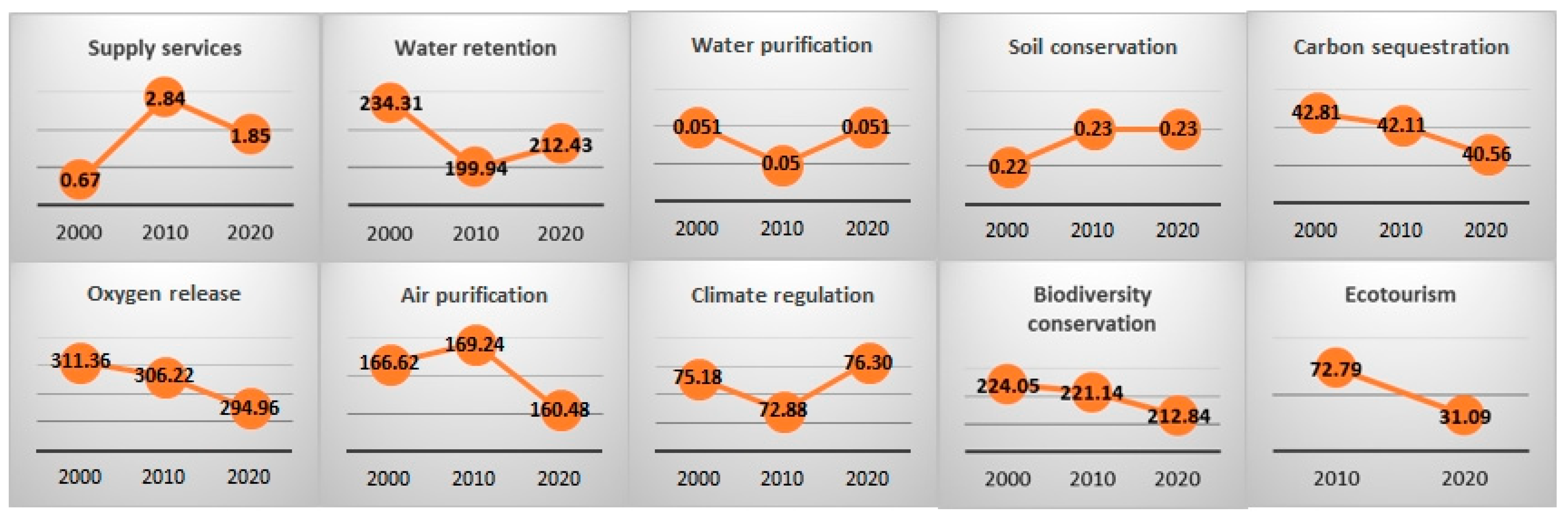
| Service Type | 2000 | Contribution | Ranking | 2010 | Contribution | Ranking | 2020 | Contribution | Ranking |
|---|---|---|---|---|---|---|---|---|---|
| (Billion Yuan) | (Billion Yuan) | (Billion Yuan) | |||||||
| Supply services | 1.67 | 0.0600% | 7 | 2.84 | 0.2612% | 8 | 1.85 | 0.1795% | 8 |
| Water retention | 234.31 | 22.2038% | 2 | 199.94 | 18.3863% | 3 | 212.43 | 20.6084% | 3 |
| Water purification | 0.05 | 0.0048% | 9 | 0.05 | 0.0046% | 10 | 0.05 | 0.0049% | 10 |
| Soil conservation | 0.22 | 0.0208% | 8 | 0.23 | 0.0212% | 9 | 0.23 | 0.0223% | 9 |
| Carbon sequestration | 42.81 | 4.0568% | 6 | 42.11 | 3.8724% | 7 | 40.56 | 3.9348% | 6 |
| Oxygen release | 311.36 | 29.5052% | 1 | 306.22 | 28.1597% | 1 | 294.96 | 28.6149% | 1 |
| Air purification | 166.62 | 15.7893% | 4 | 169.24 | 15.5632% | 4 | 160.48 | 15.5686% | 4 |
| Climate regulation | 75.18 | 7.1242% | 5 | 72.88 | 6.7020% | 5 | 76.3 | 7.4021% | 5 |
| Biodiversity conservation | 224.05 | 21.2315% | 3 | 221.14 | 20.3358% | 2 | 212.84 | 20.6482% | 2 |
| Ecotourism | No data | —— | — | 72.79 | 6.6937% | 6 | 31.09 | 3.0161% | 7 |
Disclaimer/Publisher’s Note: The statements, opinions and data contained in all publications are solely those of the individual author(s) and contributor(s) and not of MDPI and/or the editor(s). MDPI and/or the editor(s) disclaim responsibility for any injury to people or property resulting from any ideas, methods, instructions or products referred to in the content. |
© 2026 by the authors. Licensee MDPI, Basel, Switzerland. This article is an open access article distributed under the terms and conditions of the Creative Commons Attribution (CC BY) license.
Share and Cite
Li, M.; Yang, Y.; Wang, Y.; He, L.; Huang, W.; Chen, S.; Huang, J.; Yang, M.; Yang, Y. Construction of a GEP-Based Ecological Security Pattern in the Henan Region Along the Yellow River: Integrating MSPA. Land 2026, 15, 557. https://doi.org/10.3390/land15040557
Li M, Yang Y, Wang Y, He L, Huang W, Chen S, Huang J, Yang M, Yang Y. Construction of a GEP-Based Ecological Security Pattern in the Henan Region Along the Yellow River: Integrating MSPA. Land. 2026; 15(4):557. https://doi.org/10.3390/land15040557
Chicago/Turabian StyleLi, Maojuan, Yabo Yang, Yiying Wang, Le He, Wenbo Huang, Shengjie Chen, Jinting Huang, Mingying Yang, and Yuanyuan Yang. 2026. "Construction of a GEP-Based Ecological Security Pattern in the Henan Region Along the Yellow River: Integrating MSPA" Land 15, no. 4: 557. https://doi.org/10.3390/land15040557
APA StyleLi, M., Yang, Y., Wang, Y., He, L., Huang, W., Chen, S., Huang, J., Yang, M., & Yang, Y. (2026). Construction of a GEP-Based Ecological Security Pattern in the Henan Region Along the Yellow River: Integrating MSPA. Land, 15(4), 557. https://doi.org/10.3390/land15040557