


Abstract
Peatlands cover approximately 10% (640,000 ha) of Latvia’s territory, of which about 51,000 ha is officially classified as degraded due to peat extraction and related activities. This study assesses the current status of peat extraction site recultivation in Latvia and evaluates future after-use requirements under contrasting policy pathways using a review of scientific literature, project reports, national statistics, and updated peat extraction licence records. A simple allocation model was applied to estimate recultivation trajectories for the nationally defined degraded peatland area under two scenarios: (i) a licence-expiry baseline scenario and (ii) an accelerated immediate-stop-peat-mining scenario. The results show that full recultivation would require average annual efforts of approximately 1500 ha yr−1 under the baseline scenario and around 2000 ha yr−1 under the accelerated scenario. Although European Union-funded projects and corporate initiatives have demonstrated the potential of rewetting, paludiculture, and renewable energy integration, only a limited number of sites have been officially recognised as fully recultivated or restored. Because ecological recovery of peatland functions may take decades, administrative closure alone does not guarantee climate or biodiversity benefits. A phased recultivation strategy linked to licence expiry and prioritising degraded and self-regenerating sites emerges as the most pragmatic pathway for Latvia, balancing European Union climate objectives, institutional capacity, and socio-economic constraints.
1. Introduction
Peatlands cover only about 3% of the Earth’s surface, yet they are unique wetland ecosystems that store nearly one-third of global soil carbon [1,2,3]. Their waterlogged and predominantly anaerobic conditions slow organic matter decomposition enable peat to accumulate over millennia [4,5]. As a result, peatlands represent globally important long-term carbon stores and play a key role in climate regulation [3,6]. In their natural state, peatlands generally function as carbon sinks, removing carbon dioxide (CO2) from the atmosphere [7]. However, this balance can be disrupted by anthropogenic activities such as drainage, deforestation, and agricultural conversion, which can shift peatlands from carbon sinks to carbon sources and lead to substantial greenhouse gas (GHG) emissions [8,9,10,11]. Some estimates suggest that drained peatlands account for approximately 3–6% of global anthropogenic CO2 emissions [3,12].
Peatlands cover approximately 600,000 km2 across Europe, with the largest concentrations located in northern and northeastern regions [6,13]. Due to their large carbon stocks and high biodiversity value, peatlands are increasingly recognised as important nature-based solutions for climate change mitigation and adaptation [14,15]. As a result of these ecological and climatic functions, peatlands have become an increasing focus of European environmental policy. Peatland protection and restoration have been incorporated into several major European Union (EU) policy frameworks, including the European Green Deal, the EU Biodiversity Strategy for 2030, the Fit for 55 package, and the recently adopted Nature Restoration Law. These initiatives introduce binding or emerging obligations for EU Member States to restore degraded peatlands, reduce land-use-related GHG emissions, and strengthen ecosystem resilience [14,15,16,17,18].
Latvia holds a distinct position within the European peatland landscape, as approximately 10% of the country’s territory is covered by peatlands [6,19]. Peatlands therefore represent a key component of Latvia’s natural landscape and resource base. In the territory of Latvia, peat formation began shortly after the retreat of the last continental ice sheet, with the earliest fens developing around 11,000 years ago, followed by major expansion of raised bogs during the late Holocene (~4200 years ago) [20]. Climatic conditions have strongly influenced these processes: cool and moist phases generally promoted peat accumulation and carbon sequestration, whereas warmer and drier periods slowed peat formation. These long-term patterns highlight both the importance of Latvian peatlands as substantial carbon stores and their sensitivity to future climate change.
Peat extraction has played a significant role in Latvia’s economy for decades, particularly through the production of high-quality horticultural peat for export markets [21]. However, drained and extracted peatlands are associated with persistent GHG emissions, altered hydrological regimes, and considerable biodiversity loss [12,22]. Consequently, the restoration of peat extraction sites has become both a legal obligation and a climate mitigation priority. Latvian legislation requires landowners and peat extraction companies to implement after-use measures once extraction activities cease. These after-use options include renaturalisation (hydrological and vegetation restoration), afforestation, agricultural use (e.g., berry cultivation), the creation of open water bodies, paludiculture (agriculture and forestry on rewetted peatlands), and, more recently, renewable energy developments such as wind energy installations and agrovoltaics or photovoltaic systems [22,23]. Despite the ecological and economic importance of peatlands in Latvia, the long-term trajectories and implementation capacity of peat extraction site restoration remain insufficiently assessed at the national scale.
Existing studies in Latvia have primarily focused on near-natural peatlands or site-specific restoration projects in protected areas, whereas industry-operated extraction sites and historically extracted peat fields have received comparatively little systematic assessment [24,25]. Consequently, the current status and future potential of peat extraction site recultivation at the national scale remain insufficiently reviewed.
The aim of this study is to provide a comprehensive assessment of peat extraction site recultivation in Latvia. Specifically, we (1) review the current status and practices of recultivation in both active and historical peat extraction sites, (2) identify key challenges faced by policymakers and industry stakeholders, and (3) evaluate emerging opportunities, including paludiculture, renewable energy production, and carbon- and biodiversity-oriented land-use approaches. In addition, we assess future recultivation requirements by analysing the nationally defined area of degraded peatlands and exploring contrasting policy scenarios for peat extraction and restoration timelines. By integrating scientific literature, EU and national legislation, project reports, grey literature, and industry initiatives, this study provides an up-to-date national-scale assessment that places Latvia’s peatland restoration efforts within a broader European climate and biodiversity policy context.
This study addresses the following research questions:
- (1)
- What is the current extent and status of degraded peat extraction sites requiring recultivation in Latvia?
- (2)
- How do alternative policy pathways affect the temporal trajectory and annual effort required for peatland recultivation?
- (3)
- To what extent does formal recultivation correspond to ecological recovery in the broader European context?
In this study, the term recultivation refers to the broader set of post-extraction land-use options applied to peat extraction sites, including ecological restoration (renaturalisation), afforestation, agricultural use, paludiculture, open water bodies, and renewable energy developments.
2. Materials and Methods
2.1. Study Area
Latvia (55–58° N and 20–28° E) is located in the boreo-nemoral vegetation zone of Northern Europe and is characterised by a cool temperate climate influenced by both maritime and continental air masses (Figure 1). The country consists predominantly of lowland terrain with several upland areas. The climate is humid continental, with warm (occasionally hot) summers and cold (occasionally very cold) winters. According to the 1991–2020 climate normal period, the mean annual air temperature in Latvia is +6.8 °C, while the mean annual precipitation is 679 mm, with the highest precipitation typically occurring during summer and autumn.
Figure 1.
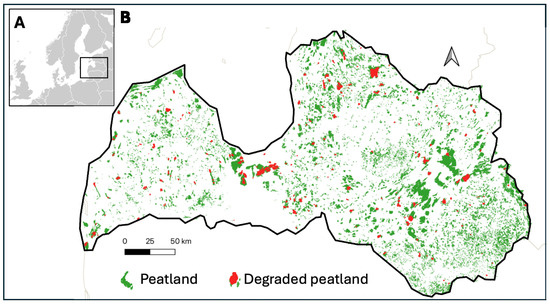
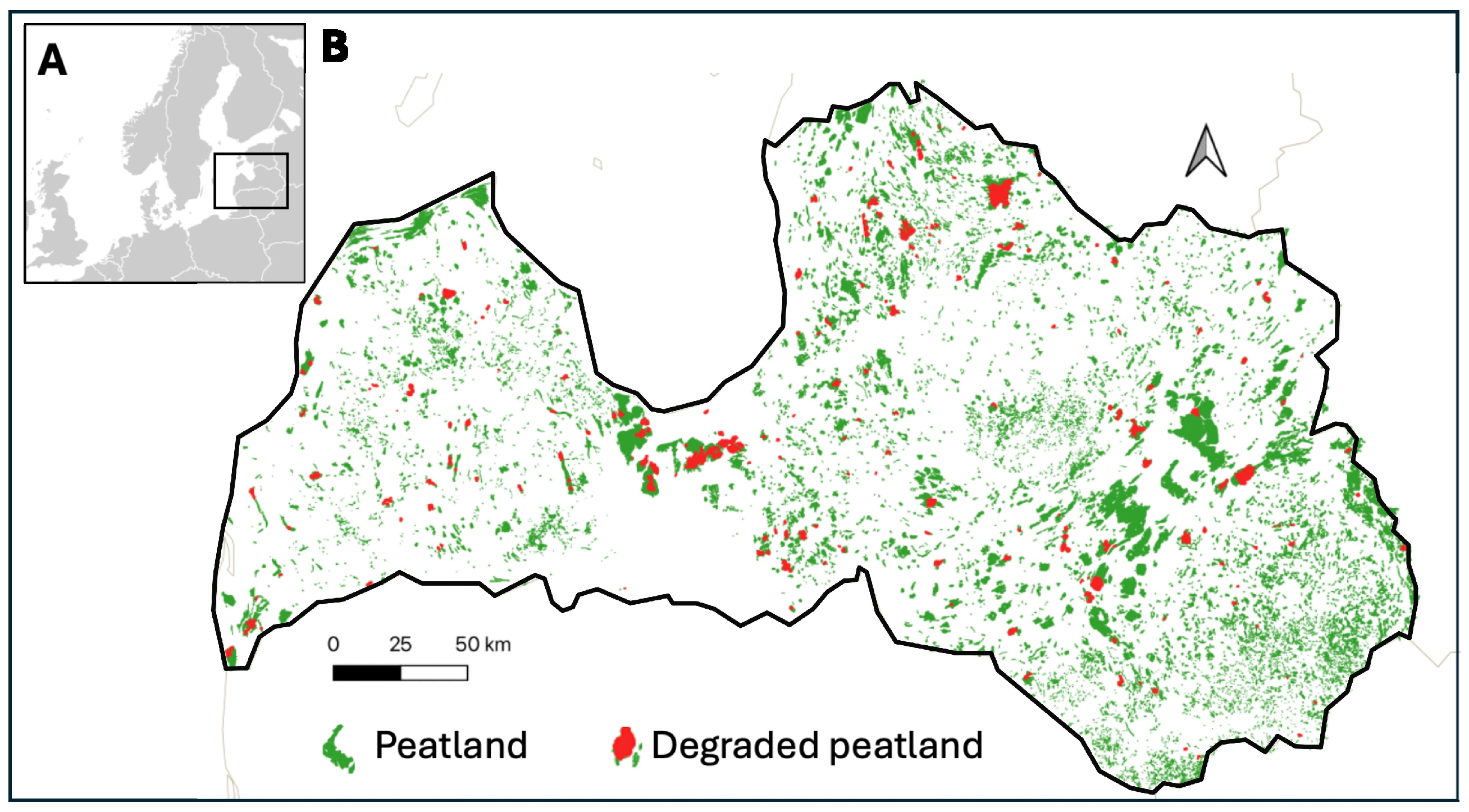
Location of Latvia in Northeastern Europe (A), and distribution of all peatlands and degraded peatlands in Latvia [26] (B) according to the LIFE Restore data [27].
Peatlands are widespread across Latvia and developed following the retreat of the Fennoscandian Ice Sheet during the early Holocene. Peat accumulation began approximately 11,000 years ago, with the expansion of raised bogs intensifying during the late Holocene under favourable climatic and hydrological conditions [20].
Official statistics further distinguish between near-natural peatlands, peatlands located within specially protected nature areas, and peatland deposits subject to licences for industrial extraction.
2.2. Peat Extraction History
Peat extraction in Latvia has a long history. Initially, peat was used locally as a fuel source, with small-scale cutting occurring between the 17th and 19th centuries, and possibly earlier [28]. Industrial-scale extraction expanded during the 20th century, particularly during the Soviet occupation period, when extensive drainage systems were constructed and mechanised peat harvesting methods were introduced [25,28]. After Latvia regained independence in 1991, the peat industry underwent substantial restructuring, shifting towards the production of high-quality horticultural peat for export markets.
This historical development also left a legacy of abandoned peat extraction fields with limited or no post-extraction land-use planning. Today, peat extraction remains economically important not only for Latvia’s economy but also for the European horticultural growing media sector [19,29,30,31,32].
2.3. Data Sources and Analytical Framework
In this study, the term “recultivation” refers to the legally required after-use of peat extraction sites and encompasses a range of potential land-use options, including renaturalisation, afforestation, agricultural use, paludiculture, open water bodies, and renewable energy developments. The term “restoration” is used more narrowly to describe recultivation measures aimed at re-establishing peatland hydrology, vegetation, and associated ecosystem functions. While restoration represents a key recultivation pathway with substantial climate mitigation potential, not all recultivated peatlands can be considered restored as functional mires [33,34].
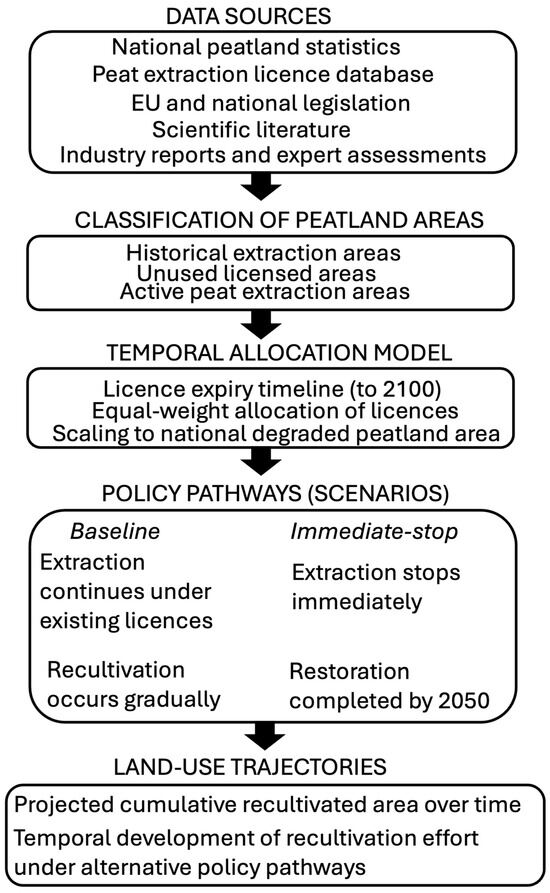
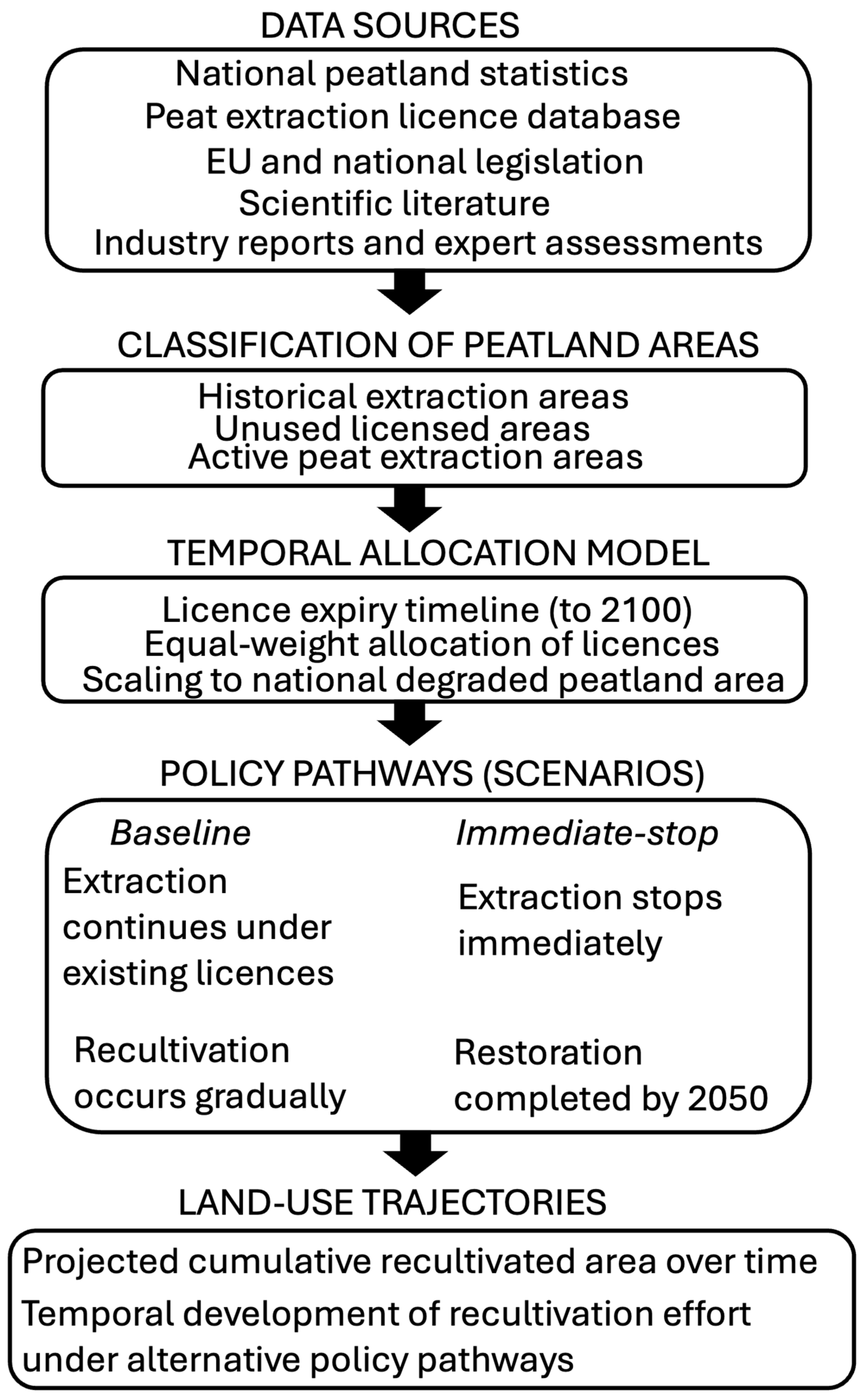
The analysis is based on a multi-source review of scientific literature, policy documents, project reports, and industry information (Figure 2; Appendix A, Table A1, Figure A1). Peer-reviewed scientific publications were used to establish the academic context regarding peatland ecology, degradation processes, and recultivation approaches. Reports and deliverables from EU-funded projects (e.g., LIFE projects) provided additional insights into practical restoration and rewetting measures, monitoring protocols, and implementation challenges. Industry perspectives were incorporated through company reports, expert assessments, and unpublished materials, which often contain site-specific operational information not available in the scientific literature. National legislation and EU policy frameworks form a central component of the analysis because peat extraction and post-extraction land use in Latvia are strongly regulated through domestic legal instruments (e.g., Cabinet of Ministers Regulation No. 570 “On the procedure for extraction of mineral resources”), as well as EU climate and biodiversity policies, including the LULUCF Regulation, the EU Biodiversity Strategy for 2030, and the Nature Restoration Law.
Figure 2.
Conceptual framework used to estimate temporal trajectories of peatland recultivation in Latvia under alternative policy pathways. The framework integrates multiple data sources, classifies peatlands by extraction status, and applies a licence-expiry-based allocation model to estimate cumulative recultivation over time.
These diverse sources were critically reviewed to identify key recultivation pathways, policy constraints, and management practices relevant to peat extraction sites in Latvia. Quantitative information, such as the extent of degraded and recultivated peatlands, was combined with qualitative insights into governance structures, land management decisions, and socio-economic drivers affecting peatland after-use. Based on this review, two contrasting policy pathways were defined to explore potential future trajectories of post-extraction land use in Latvian peatlands. These pathways represent simplified scenario narratives reflecting alternative regulatory and management directions affecting peat extraction and recultivation practices. The pathways do not aim to predict future outcomes but rather to illustrate plausible development trajectories under different policy assumptions.
Several limitations should be acknowledged. First, the analysis partly relies on grey literature and unpublished industry data, which may vary in completeness and methodological transparency. Second, monitoring data on peatland recultivation are often limited in spatial and temporal coverage. Finally, definitions of “successful recultivation” vary among projects and regulatory frameworks. Despite these limitations, the integration of multiple information sources provides a robust and up-to-date overview of peat extraction site recultivation practices and policy trajectories in Latvia.
A related issue concerns what is meant by recultivation. In much of the contemporary literature, the focus is on restoration or rewetting, whereas this study addresses the wider set of post-extraction land-use pathways. Here, we examine a spectrum of possible after-use scenarios, including restoration, rewetting, afforestation, agricultural use, paludiculture, open water bodies, and renewable energy development. In this context, the umbrella concept of recultivation, or post-extraction after-use, is more appropriate than restoration alone, because not all degraded peatlands can or should follow the same ecological trajectory. This distinction is also reflected in the wider literature, where productive wet land use such as paludiculture is explicitly differentiated from ecological restoration and benefits of rewetting [6,19,27,30,35].
2.4. Modelling Approach
To explore potential future recultivation trajectories, a simple allocation model was developed to distribute recultivation effort across the nationally defined degraded peatland area according to and peat extraction licence status. The model does not attempt to simulate ecological processes but instead provides a policy-based allocation framework illustrating how recultivation could progress over time under different regulatory assumptions. The model integrates several data sources, including official statistics on degraded peatlands [36], information from Latvian State Forests [37], Riga Forests, private peat extraction companies, and peat extraction licence expiry data compiled for this study from the Latvian Environment, Geology and Meteorology Centre database and related sources [26,38].
For modelling purposes, three categories of degraded peatlands were distinguished:
- (1)
- Historical extraction areas—exhausted sites without valid licences, many of which are already targeted by national or EU-funded recultivation projects.
- (2)
- Unused licenced areas—peatlands covered by valid extraction licences but not currently used for peat extraction.
- (3)
- Active peat extraction areas—sites currently used for peat harvesting under valid licences.
The model assumes a sequential recultivation priority reflecting current regulatory and operational practices:
- (1)
- Historical extraction areas are prioritised first.
- (2)
- Unused licenced areas gradually enter recultivation as licences approach expiry.
- (3)
- Active extraction areas become available for recultivation after peat extraction is completed.
In practice, recultivation can occur simultaneously on exhausted fields within active licences [39]. However, due to the lack of detailed spatial information on partially exhausted fields, this complexity could not be explicitly incorporated into the model and the simplified categorisation was retained. For licenced areas, recultivation timing was weighted according to licence expiry dates up to the year 2100. Because detailed site-level information on the extracted area within each licence was not available, each licence was treated as a single modelling unit. The weight assigned to licence i expiring in year y was calculated as:
where —the weight of licence expiring in year , and —number of licences expiring that year.
To express the proportion of all licences that came due in a given year, we used the raw allocation for year :
where —raw allocation for year (a fraction of the total licence pool), —number of licences expiring that year, —the weight of licence expiring in year .
Expiry years then were used to distribute recultivation across the timeline, with a scaling factor applied to match the known total degraded peatland area:
where —scaling factor applied to convert fractions into hectares, —total degraded peatland area in Latvia, —sum of all raw allocations across years.
In the following step, annual allocations were scaled:
where —scaled recultivation area in year (ha).
In simple terms, the model first determines how many licences expire each year and assigns each licence an equal share of the total degraded area. These shares are then scaled so that the cumulative allocations correspond to the officially degraded peatland area in Latvia. This procedure produces a temporal distribution of potential recultivation effort, which can be interpreted as a simplified trajectory of post-extraction land-use development. By summing allocations across years, cumulative trajectories were obtained:
where —cumulative recultivated area up to year (ha).
Finally, two contrasting policy scenarios were modelled to illustrate alternative policy pathways:
- (1)
- Licence-expiry baseline scenario—peat extraction continues under the terms of existing licences and recultivation occurs gradually as extraction areas are exhausted.
- (2)
- Immediate-stop scenario—peat extraction ceases immediately and all degraded peatlands are assumed to undergo restoration measures to be completed by 2050.
These scenarios represent simplified policy narratives reflecting different regulatory approaches to peat extraction and climate mitigation in Latvia.
3. Results
3.1. Peatland Distribution and Peat Resources
According to Latvian legislation, peatlands are defined as areas with a peat layer at least 30 cm thick. Based on this definition, peatlands cover approximately 10% of Latvia’s territory [36], although published estimates vary depending on inventory methodology and reporting period. Of the total peatland area, 49.3% is classified as fens, 41.7% as bogs, and 9.0% as transitional mires. The average peat thickness in Latvia is approximately 5 m, and total peat resources are estimated at about 11.3 billion m3, corresponding to roughly 1.7 billion tonnes at 40% moisture content. However, a substantial proportion of these resources is not practically available for peat extraction because of natural constraints, protection status, or technical limitations.
Historical inventories show that the 1980 National Peat Fund listed 5799 peat deposits [40], whereas the current State Geological Information System, maintained by the Latvian Environment, Geology and Meteorology Centre, records 5632 peat deposits larger than 1 ha [26,38]. Peatlands are unevenly distributed across Latvia, with the largest peatland complexes concentrated in the northern and central parts of the country (Figure 1).
3.2. Past and Current Peat Extraction
Historically, peat extraction in Latvia has included both milled peat and block peat, with uses ranging from energy production, animal bedding, composts and insulation materials to horticultural substrates, chemical processing and medical applications. Industrial peat extraction expanded substantially during the mid-twentieth century, reaching a peak in the 1970s, when production was active in more than 100 peat deposits and annual output amounted to approximately 4.3 million tonnes at 40% moisture content. By the late 1980s, extraction levels had declined to around 2.5 million tonnes yr−1, followed by a sharp decrease during the 1990s, reaching a minimum of approximately 209,000 tonnes in 1998.
Since the late 2000s, peat extraction volumes have partly recovered and stabilised. Between 2019 and 2022, annual production ranged from approximately 1.17 to 1.47 million tonnes at 40% moisture content. Interannual variability remains high and is strongly influenced by weather conditions. For example, peat extraction in 2025 was substantially reduced due to exceptionally wet conditions, with reported production falling to less than 10% of average annual volumes.
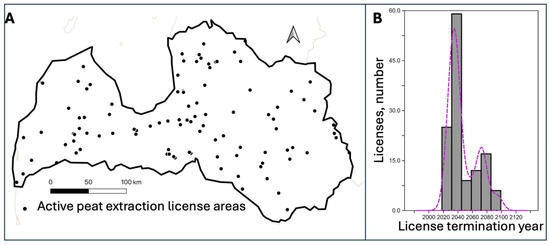
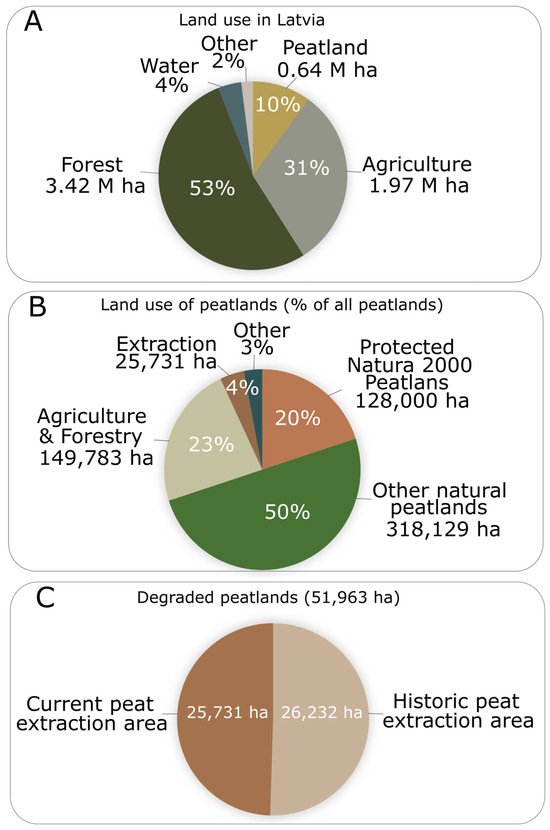
As of 2024–2025, Latvia had 130 valid peat mining licences (Figure 3). Licence expiry dates are unevenly distributed over time: 25 licences terminate between 2018 and 2031, 59 between 2032 and 2045, 9 between 2046 and 2058, 12 between 2059 and 2072, 17 between 2073 and 2085, and 6 between 2086 and 2099. The mean termination year is 2046 (±19 years), whereas the median termination year is 2038. This indicates that although some licences will expire in the near term, a substantial proportion will remain valid well into the second half of the twenty-first century.
Figure 3.
Distribution of active peat mining licence areas (black dots) in Latvia at 2025 (A) and the number of licences (grey bars; dashed line—Kernel density) and their termination year (B).
Remaining peat resources within active extraction sites are estimated at approximately 77 million tonnes at 40% moisture content. The Latvian peat industry is currently oriented almost entirely towards the production of horticultural peat and peat-based growing media for export markets, while the use of peat for energy is being phased out in line with national and EU climate policy. Peat-based growing media continue to dominate European horticulture, and Latvia remains one of the key suppliers to this market [31]. Although peat reduction strategies are advancing across Europe, large-scale substitution remains constrained by the availability, price, and quality of alternative materials such as compost, wood fibre, bark, and coir. As a result, peat extraction retains socio-economic importance in Latvia: in 2023, the sector generated €277 million in turnover, supported 2327 direct jobs and 5171 jobs in total, and contributed an estimated €221.3 million to the national economy [21,41].
3.3. Recultivation
Over the past decade, several EU-funded projects and national initiatives have targeted degraded peatlands in Latvia. The LIFE REstore project (2016–2020) implemented restoration-related measures across approximately 5000 ha of former peat extraction sites, primarily focusing on hydrological assessment, carbon stock mapping, and pilot rewetting actions [27]. The subsequent LIFE PeatRestore project (2016–2021) restored an additional ~1500 ha [42], while the ongoing LIFE PeatCarbon initiative (2022–2027) aims to restore a further ~2500 ha of cutover or drained peatlands [43]. In addition to these EU-funded project initiatives, Latvijas Valsts Meži (Latvian State Forests) has reported approximately 371 ha of officially recultivated peat extraction fields within active licence areas by 2025 [37]. Taken together, EU-funded projects and corporate initiatives account for roughly 8000–9000 ha of degraded peatlands that have either been restored or are in advanced stages of restoration planning.
Beyond actively managed restoration projects, a substantial area of degraded peatlands appears to be undergoing natural regeneration or has reached relatively stable hydrological conditions. These areas, estimated at approximately 8000 ha, may meet ecological recovery criteria and could potentially be formally recognised as recultivated following official inspection and assessment. When combined, approximately 17,000 ha of Latvia’s degraded peatlands have either been restored, are currently undergoing restoration, or show evidence of natural regeneration.
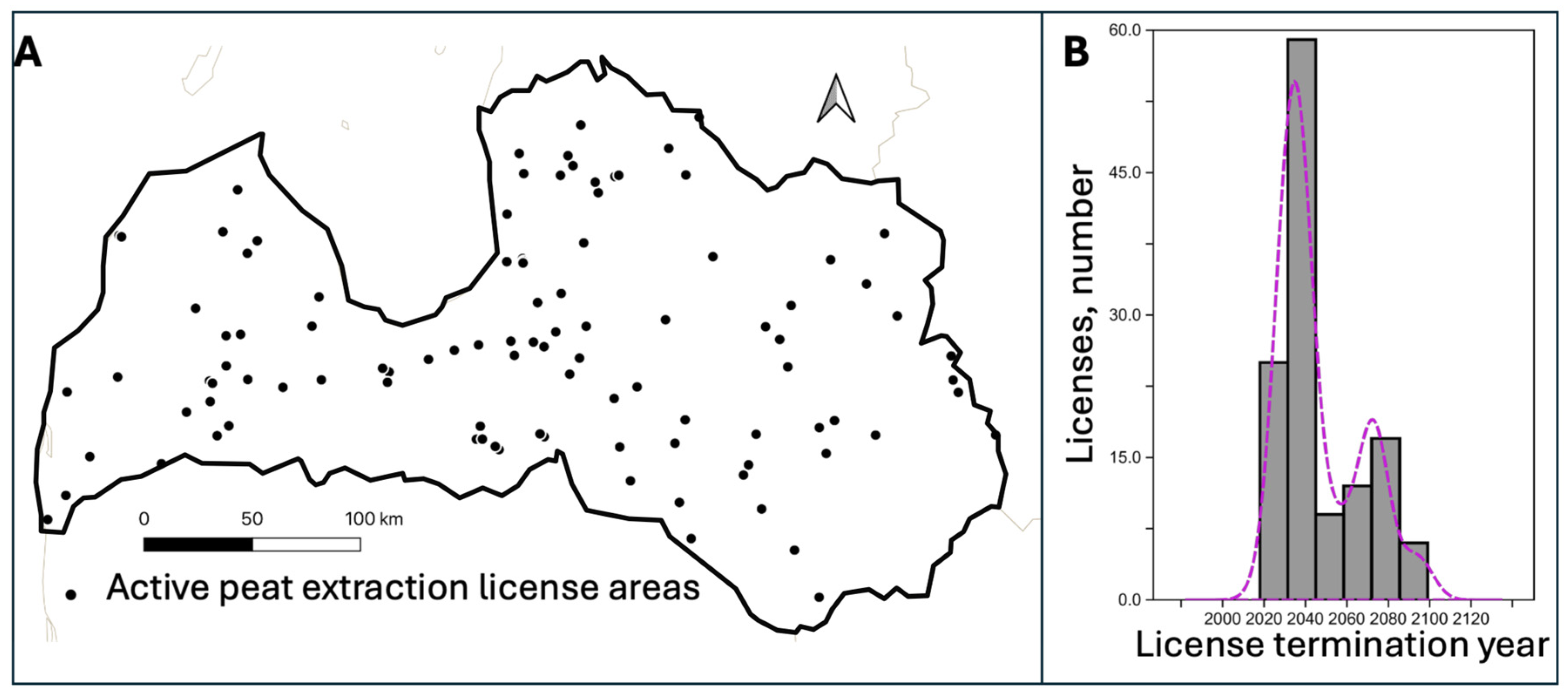
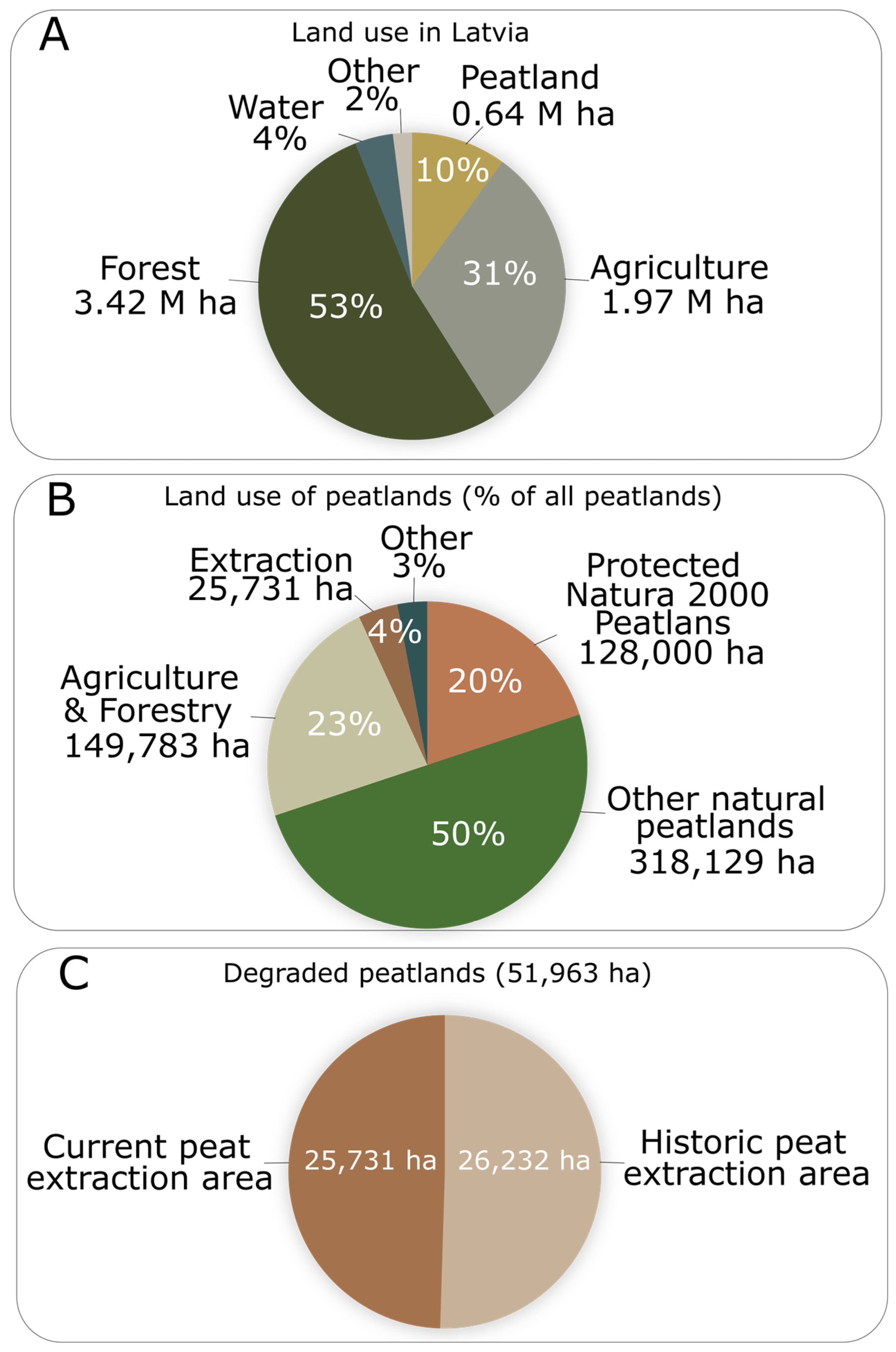
Overall, peatlands subject to recultivation obligations cover approximately 50,179 ha, corresponding to about 7% of Latvia’s total peatland area (Figure 4). This proportion varies slightly depending on the total peatland estimate used. Of this degraded area, 26,232 ha are classified as historical extraction sites without active licences, while 25,731 ha fall within active peat extraction licence areas. Within the licenced area, approximately 15,008 ha are currently under extraction, whereas 10,723 ha are unused or no longer exploited despite still being covered by valid licences.
Figure 4.
Land use in Latvia expressed as percentages and million ha (A), land use of peatlands (in percentages of all peatlands) (B), and degraded peatlands and their categories (in ha) (C).
Ownership of licenced peat extraction areas is dominated by the state (55%), followed by municipalities (16%), private legal entities (15%), individuals (5%), and mixed or joint ownerships (9%). This ownership structure highlights the central role of state-owned and state-managed land in achieving Latvia’s peatland recultivation, restoration, and climate policy objectives.
3.4. Recultivation Trajectories
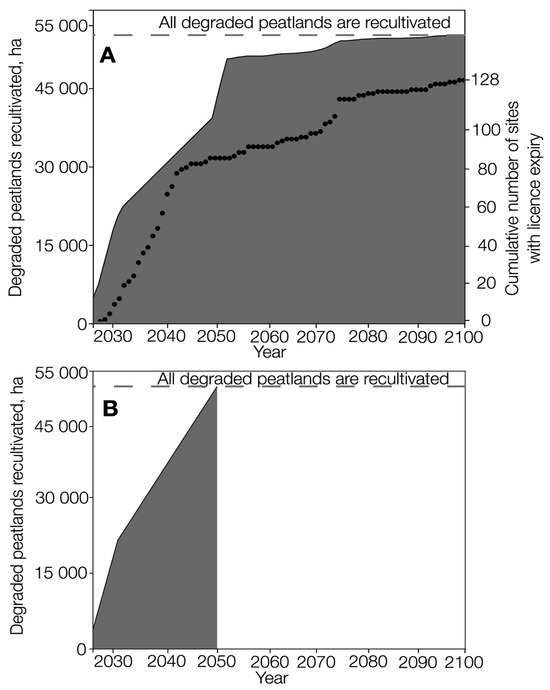
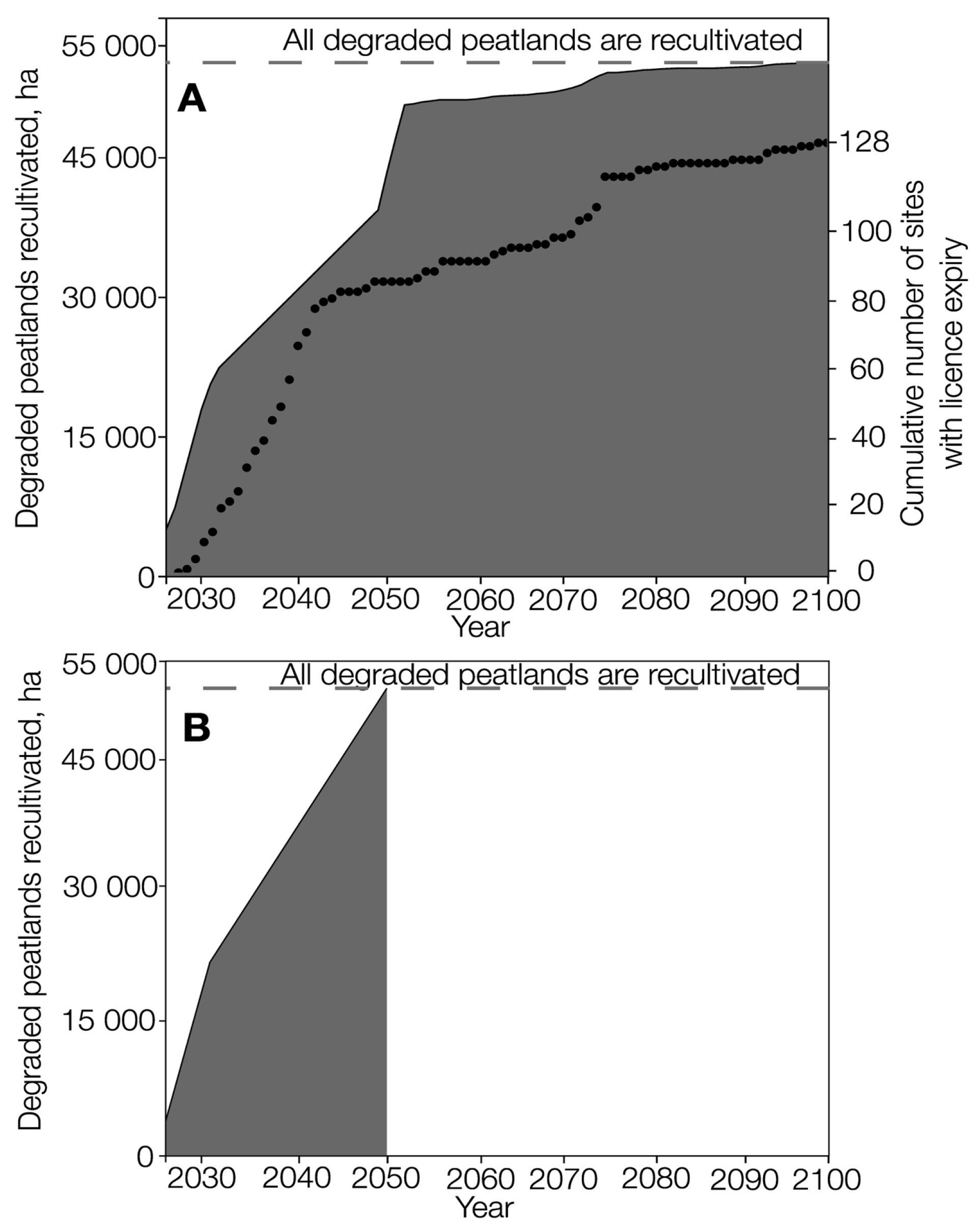
Analysis of peat extraction licence expiry dates, combined with documented restoration commitments, indicates a temporally structured pattern of peatland recultivation in Latvia that can be described as three sequential phases or “waves” (Figure 3 and Figure 5). The first phase comprises historical extraction sites, including areas under active restoration projects and sites undergoing natural regeneration. According to the modelled allocation, approximately 29,500 ha could be restored or officially recognised as recultivated by 2030. The second phase involves unused peat extraction licence areas, which gradually enter recultivation as licence termination approaches. Under the model assumptions, this phase extends from approximately 2030 to 2050 and increases the cumulative recultivated area to about 45,000 ha. The third phase concerns active peat extraction fields, which, under current licence conditions, become available for recultivation only after peat extraction ceases. Under the baseline allocation, full completion of the national recultivation process would therefore not be reached until approximately 2100 (Figure 5).
Figure 5.
Projected recultivation of degraded peatlands in Latvia under two scenarios: (A)—licence-expiry baseline scenario with a cumulative number of sites with licence expiry years, Dots—cumulative number of sites with licence expiry, and (B)—immediate-stop scenario. In dark grey—historical extraction sites, and light grey—active licence areas.
Under the licence-expiry baseline scenario, in which peat extraction continues until existing licences terminate, model results indicate that recultivation activity is front-loaded in the period 2026–2030, with an average annual rate of approximately 2000 ha yr−1. This elevated rate reflects the implementation of already planned EU-funded and corporate restoration projects targeting historical extraction sites. Between 2031 and 2050, the annual recultivation rate declines to approximately 100–1200 ha yr−1, as fewer additional sites become available for intervention. After 2050, only limited further recultivation is projected, mainly in association with the expiry of long-term licences and the implementation of subsequent after-use measures.
In the accelerated immediate-stop scenario, peat extraction is assumed to cease at the beginning of the modelling period, making the entire nationally defined degraded peatland area immediately available for recultivation. Under this scenario, approximately 30,600 ha would need to be recultivated within 25 years in order to achieve full completion by 2050, corresponding to an average rate of about 2000 ha yr−1. This rate is substantially higher than the pace of recent recultivation activity in Latvia and illustrates the scale of effort that would be required under an accelerated policy pathway.
4. Discussion
4.1. Latvia in the Wider European Peatland Transition Context
Our results indicate that degraded peatlands in Latvia cover approximately 50,000–52,000 ha, corresponding to about 6–7% of the national peatland area. This places Latvia among the European Union (EU) Member States with a substantial peatland after-use and restoration challenge relative to national territory. Our estimate is slightly higher than the 50,179 ha reported in the Latvian Just Transition Plan, most likely because it incorporates updated licence information and recently delineated historical extraction areas [26,36,38,39]. Such discrepancies are not unusual. Across Europe, peatland data are often fragmented among institutions with different mandates, temporal coverage, and operational definitions, which complicates comparison, prioritisation, and long-term planning [44,45,46,47]. Recent assessments further emphasise that although political commitment to peatland protection and restoration is increasing across Europe, implementation remains constrained by incomplete databases, weak cross-sector integration, and limited monitoring and reporting systems [48,49,50]. In this respect, Latvia is not exceptional, but rather reflects a wider European governance challenge.
Peatland management in Europe is no longer framed only as a biodiversity issue, but increasingly as a core component of climate policy, land-use transition, and agricultural reform. Approximately half of the remaining peatland area in the EU is considered degraded, and these areas contribute disproportionately to GHG emissions from land use [49,51]. Recent European policy developments, including the Nature Restoration Law, the revised LULUCF Regulation, and the growing integration of organic soils into the Common Agricultural Policy (CAP), indicate that peatland restoration and improved management of drained peatlands are moving from voluntary pilot actions towards a more systematic policy domain [50,51]. However, progress remains uneven among Member States. Some countries have adopted clearer national peatland strategies and restoration pathways, whereas others are still at an early stage of integrating peatland concerns into climate, agricultural, and biodiversity planning [49,50,52,53]. Latvia therefore operates within a rapidly changing European policy environment, but one that is still characterised by uneven implementation capacity.
Our results further suggest that recultivation timelines in Latvia are governed less by ecological ambition than by institutional, legal, and operational constraints, especially licence duration and the sequencing of post-extraction obligations. This pattern is consistent with broader European experience. Across Europe, peatland after-use trajectories are shaped not only by ecological suitability, but also by drainage legacies, land tenure, infrastructure, subsidy systems, and conflicts between alternative peatland uses [22,49,53,54,55,56]. In practice, the greatest short-term intervention potential lies in historically extracted or otherwise already abandoned peatlands, where intervention costs are lower and fewer legal or operational barriers remain. However, this pool of comparatively accessible sites is finite. Over time, restoration increasingly shifts towards more contested and technically demanding landscapes, including active extraction areas, agricultural peat soils, and forestry-drained sites, keeping in mind site settings [17,51,56,57,58,59,60,61,62,63,64,65].
4.2. Administrative After-Use Versus Ecological Recovery
A central finding of this study is that achieving formal recultivation does not necessarily imply ecological recovery. This distinction is rather critical. Across Europe, after-use obligations are often fulfilled through pathways that satisfy legal or administrative requirements but do not restore peatland hydrology, carbon accumulation, or biodiversity values [14,48,55,66,67]. Recent European perspectives have also emphasised that restoration outcomes depend strongly on the strategy applied. In particular, rewetting is frequently a necessary step towards peatland restoration, but not all rewetted peatlands follow the same recovery trajectory, and poorly designed interventions may involve trade-offs, including nutrient release, elevated methane emissions, or only limited short-term biodiversity gains [55,68]. At the same time, the literature and projects do not support a single universally applicable post-extraction solution. Some studies prioritise rewetting as the most suitable pathway for restoring peatland ecosystem functions, whereas others show that afforestation, paludiculture, or other after-use options may be considered under specific local conditions [17,22,48,55,65]. This variation reflects differences among sites in geology, hydrology, peat characteristics, nutrient status, and climate. Consequently, recultivation and restoration planning should be based on site-specific assessment rather than on the assumption that one approach is optimal and feasible in all cases.
Long-term studies from northern Europe and North America further show that ecological recovery of extracted peatlands is generally slow and non-linear. Even where rewetting is successful, the re-establishment of peat-forming vegetation, microtopography, and stable carbon sink function commonly takes decades rather than years [69,70,71,72,73,74]. In Canada, where peatland restoration on extracted bogs has been studied for more than two decades, restoration frameworks based on rewetting and Sphagnum reintroduction have shown that carbon sink function can be re-established, but only gradually and under suitable hydrological conditions [73,74]. The Canadian and North European experience is important for Latvia because it demonstrates both the possibility of functional recovery and the timescale required to achieve it [70,71,73,75]. At the same time, Canadian restoration practice has largely developed in peat-extracted bogs with specific geological, hydrological, climatic, and management settings, and therefore should not be transferred uncritically to all European peatland types and settings [73]. European peatlands are more heterogeneous, and recovery pathways differ strongly among bogs, fens, agricultural peat soils, and forestry-drained organic soils [55,56,76,77].
This broader perspective strengthens the interpretation of our Latvian results. Even where sites are officially declared recultivated, the re-establishment of peat-forming vegetation and long-term carbon sink function may take decades, and in some cases may not occur without continued hydrological management [34,72,75,78]. Therefore, restoration success should not be evaluated solely on the basis of implemented measures or administrative closure, but also through longer-term monitoring of hydrology, vegetation development, and GHG dynamics [55,79,80]. This is increasingly relevant because wetlands and organic soils are becoming more closely linked to EU climate accounting and restoration targets [50,51]. At the same time, long-term monitoring cannot realistically be placed on landowners alone. If Latvia expects demonstrable climate and biodiversity outcomes, national mechanisms for ecological follow-up, data harmonisation, and transparent reporting will also be required.
4.3. Feasibility, After-Use and Future Directions
One of the striking findings from our modelled scenarios is that the principal constraint on peatland recultivation in Latvia is probably not the total area requiring intervention, but the annual rate at which recultivation can theoretically be implemented (Figure 5). Under the licence-expiry scenario, recultivation proceeds rapidly in the first years because previously identified sites and already planned projects are available for action. Thereafter, the annual rate declines as the most accessible sites are exhausted and intervention becomes increasingly dependent on licence expiry. By contrast, the accelerated scenario does not change the total area requiring intervention but compresses the required effort into a much shorter period. In other words, the two pathways diverge mainly in their demands on funding, technical capacity, permitting, workforce, and institutional coordination, rather than in their ultimate land-use objective. This interpretation is consistent with broader European assessments showing that the key barriers to peatland transformation are often less biophysical than socio-economic and institutional, including missing incentives, limited cross-sectoral coordination, and stakeholder resistance where peatland areas remain economically productive [76].
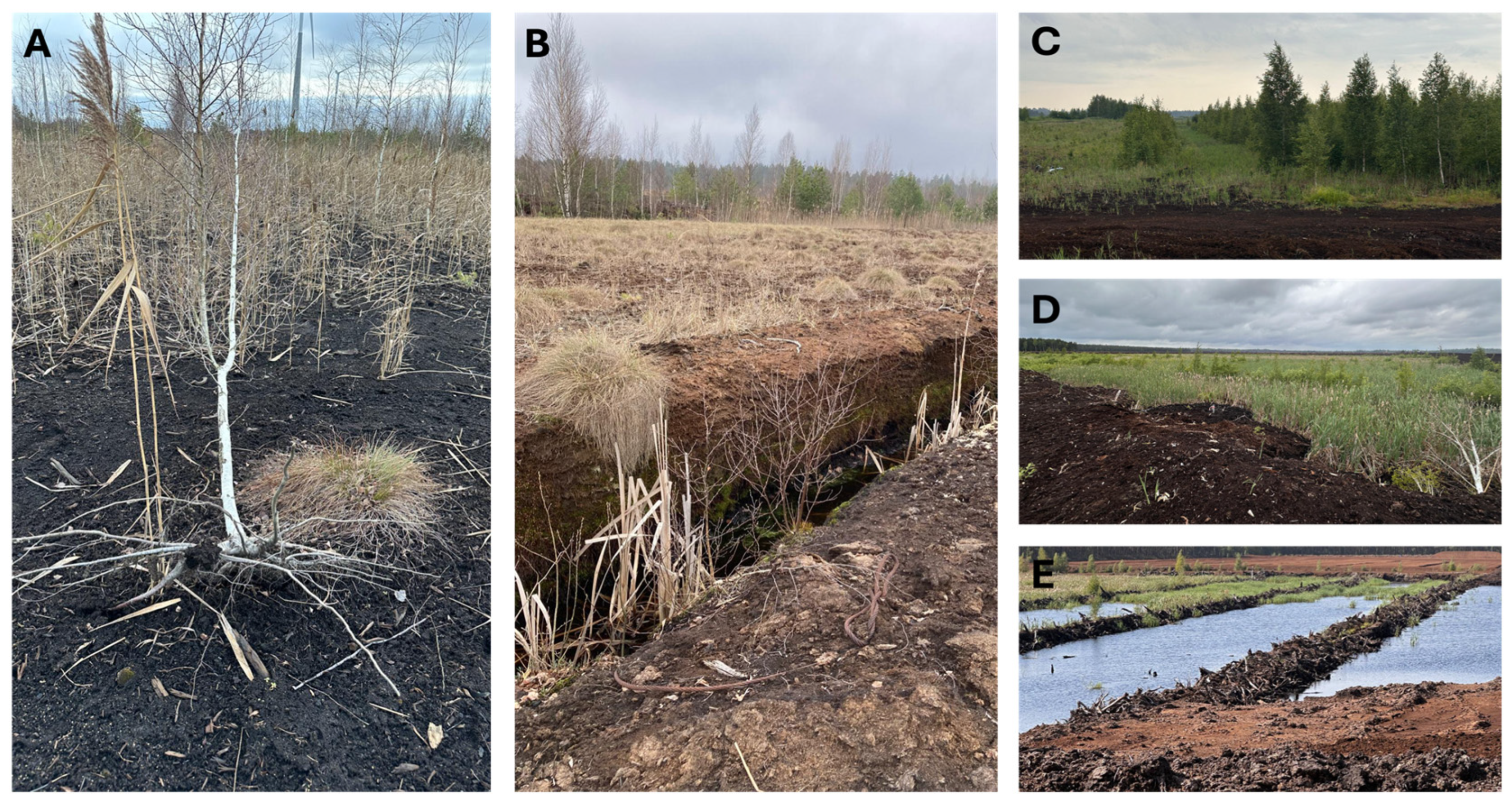
Latvian legislation requires operators to prepare and implement after-use plans once peat extraction ceases [81]. However, our results show that this framework has produced a broad range of outcomes. Historically, afforestation and passive abandonment were common pathways, especially during the socio-economic transition following the end of the Soviet occupation time. More recently, EU-funded projects and private initiatives have introduced additional options, including rewetting, berry cultivation, paludiculture, and renewable energy use on historically extracted sites (Appendix A, Table A1). Similar diversification of post-use pathways can be observed elsewhere in Europe, particularly where restoration policy has become linked to climate mitigation, carbon farming, or agricultural transition [23,55,76,82]. Nevertheless, in Latvia, as in many other countries, those options that involve lower upfront costs and fewer regulatory barriers still tend to dominate [19,21,83,84]. This suggests that current governance is more effective at ensuring formal site closure than at steering degraded peatlands towards ecologically ambitious recovery pathways [48,66,67,81].
A further issue is that, as of 2025, only a limited number of peatlands in Latvia have been officially recognised as fully recultivated, even though many more are under restoration or undergoing natural regeneration, especially on state-owned land [48,66]. This gap reflects not only the pace of implementation, but also the fact that formal recognition depends on administrative inspection and legal closure rather than verified long-term ecosystem performance. Similar concerns have been raised more generally in Europe, where the rapid expansion of peatland restoration as a climate solution also generated debates around metrics, accounting, and what exactly counts as restoration success [56]. These debates are likely to intensify as recultivation outcomes become more closely connected to national climate targets, agricultural support, and potentially also carbon certification schemes [85].
Peatland recultivation in Latvia also cannot be discussed in isolation from the continuing demand for horticultural peat and the still uncertain large-scale performance of peat-free alternatives. Currently, peat remains a dominant constituent of professional growing media in Europe because of its favourable and relatively predictable physical and chemical properties. At the same time, peat reduction initiatives have accelerated across Europe over the last decade [73,75]. However, large-scale peat substitution remains constrained by the availability, cost, and variable quality of alternatives such as wood fibre, bark, compost, and coir, and by the performance consistency and biosecurity requirements of commercial horticulture [73,75,86]. Material-flow analyses further show that non-energy peat continues to be transported on a large scale from northern and north-eastern Europe to western European horticultural markets, indicating that peat extraction in countries such as Latvia remains embedded in a wider European supply system rather than being driven only by domestic demand [87]. Scenario work for the growing media sector also suggests that demand is likely to decline gradually rather than disappear abruptly, reinforcing the transition character of the current period [31,32].
Under these conditions, a regulated continuation of peat extraction within already licenced and degraded sites may function as a transitional mechanism, provided that it does not expand into near-natural peatlands and that it is explicitly linked to recultivation and restoration financing. This is not an argument for peat extraction as a preferred long-term land use, but rather an acknowledgement of the current transition context. The economic dimension remains relevant here. The Latvian peat sector generated €277 million in turnover in 2023, contributed approximately €221.3 million to the national economy, and supported 2327 direct and 5171 total jobs when indirect effects are included [41]. These values do not weaken the environmental case for restoration, but they do reinforce the need for transition pathways that are socially and regionally manageable.
Depending on site condition, hydrological complexity, and after-use objective, full recultivation of Latvia’s degraded peatlands will require substantial long-term investment. However, the total cost will vary considerably. In this respect, the possibility that 8000–9000 ha may already be undergoing natural regeneration or may have reached relatively stable hydrological conditions is important [35,48,66]. If confirmed through ecological assessment, such areas could make a meaningful contribution to national targets while allowing limited financial and technical resources to be concentrated on more deeply drained, actively extracted, or hydrologically complex sites. At the same time, spontaneous recovery should not be assumed to be equivalent to full restoration without site-specific evaluation, especially where peat-forming vegetation and long-term carbon sequestration remain uncertain [30,34,72].
A phase-based, licence-expiry-linked recultivation strategy emerges as the most pragmatic pathway for Latvia. Such an approach keeps extraction within existing boundaries, enables progressive rewetting and post-extraction transition as licences expire, and allows time for the technical upscaling of restoration methods such as Sphagnum transfer, paludiculture, and other compatible land uses [19,68,69,73,85]. Although an immediate halt to peat extraction could theoretically reduce emissions from active extraction areas in the short term, in practice, it could also create major implementation challenges, including disruption of site management, pressure on regional economies and institutions, and an increased risk of prolonged site abandonment before restoration funding and planning are secured. The more realistic policy challenge is therefore not whether recultivation and restoration are needed, but how to sequence them in ways that are ecologically meaningful, institutionally feasible, and socio-economically defensible.
Under current European market and policy conditions, peat extraction in Latvia remains part of the existing land-use system rather than a sole desirable long-term solution. If economic benefits from peat production are more explicitly linked to restoration financing and post-extraction recovery, Latvia may be better able to manage the trade-offs between climate mitigation, biodiversity objectives, land-use obligations, and socio-economic stability during the transition towards lower-impact alternatives.
Future work should also integrate hydrological assessment more explicitly into peatland recultivation planning. Successful after-use depends not only on land-use selection, but also on whether sites’ hydrology can be restored or managed to meet the requirements of the intended trajectory [88,89]. In Northern Europe, both conceptual and process-based hydrological models have been used to evaluate peatland response to drainage, rewetting, and restoration, and to interpret water-table dynamics at site and catchment scales [90,91,92,93,94,95,96]. Such approaches are also relevant for paludiculture, where stable water levels close to the peat surface are a prerequisite for both biomass production and low-emission management, and where hydrological variability can determine which crops or management options are feasible [6,19,84]. Consequently, conceptual and process-based hydrological modelling could improve the design, prioritisation, and long-term evaluation of peatland recultivation in Latvia and elsewhere in Northern Europe. More generally, future research should focus on harmonised inventories, site-specific assessment of after-use suitability, GHG emissions and long-term monitoring frameworks that better connect administrative closure with verified ecosystem recovery.
5. Conclusions
This study provides the first comprehensive national-scale assessment of peat extraction site recultivation in Latvia by combining administrative data, project experience, and scenario-based modelling. Approximately 50,000–52,000 ha of peatlands is subject to recultivation obligations, representing a substantial challenge relative to Latvia’s territory and institutional capacity. The analysis shows that future recultivation trajectories are shaped less by ecological ambition alone than by licence duration, land-use legacies, and the annual rate at which recultivation can realistically be implemented. Under current licence-expiry conditions, recultivation is likely to proceed gradually, requiring average efforts of around 1500 ha yr−1 over several decades. By contrast, completion by 2050 would require sustained rates of approximately 2000 ha yr−1, implying substantially greater financial, technical, and organisational demands. Although such rates appear achievable over short periods, maintaining them in the long term would require stable funding, workforce development, and coordinated governance. The study also shows that there remains a clear gap between administrative recultivation and ecological recovery. Sites may be formally recognised as recultivated while remaining functionally degraded for decades. This underlines the need for long-term assessment of hydrology, vegetation development, and greenhouse gas dynamics. At the same time, a notable proportion of degraded peatlands appears to be undergoing natural regeneration or to have reached relatively stable hydrological conditions. If confirmed through targeted ecological assessment, these sites could contribute to national recultivation targets while allowing financial and technical resources to be prioritised towards more complex and actively degraded sites.
In a broader European context, the Latvian case illustrates a wider challenge—peatland recultivation is not determined only by restoration targets, but also by inventory quality, legal frameworks, hydrological feasibility, and socio-economic constraints. A phased, licence-expiry-linked recultivation strategy, prioritising historically degraded and self-regenerating sites, therefore, appears to be the most realistic pathway under current conditions. Future research should focus on harmonising peatland inventories, integrating hydrological modelling into recultivation planning, and developing long-term monitoring frameworks that better connect formal closure with verified ecological recovery.
Author Contributions
Conceptualization, N.S. and I.O.; methodology, N.S., M.A. and I.O.; software, N.S.; formal analysis, N.S. and M.A.; investigation, N.S., I.O. and M.A.; resources, M.A., J.P.-U. and I.G.; data curation, N.S.; writing—original draft preparation, N.S.; writing—review and editing, I.O., M.A., J.P.-U. and I.G.; visualization, N.S.; supervision, I.G.; project administration, N.S.; funding acquisition, N.S. All authors have read and agreed to the published version of the manuscript.
Funding
This research was funded by the European Union Cohesion Policy Programme for 2021–2027 and the State Budget of Latvia under the PeatTransform project (6.1.1.2/1/25/A/001). The APC was funded by the same sources.
Data Availability Statement
No new datasets were generated or analysed during the current study. All information used in this study is available from national databases, publicly accessible reports, and referenced sources.
Conflicts of Interest
The authors declare no conflicts of interest. The funders had no role in the design of the study; in the collection, analyses, or interpretation of data; in the writing of the manuscript; or in the decision to publish the results.
Abbreviations
The following abbreviations are used in this manuscript:
| EU | European Union |
| GHG | Greenhouse gas |
| LULUCF | Land Use, Land-Use Change and Forestry |
| LIFE | EU Programme for the Environment and Climate Action |
| LVGMC | Latvian Environment, Geology and Meteorology Centre |
Appendix A. Resources Used in This Study
This appendix provides an overview of the key projects, policy documents, databases, and scientific resources used in this study. The listed resources supported the background analysis, contextual framing, and interpretation of peatland restoration, recultivation, and management practices in Latvia and the wider Baltic region.
Table A1.
Overview of resources used in this study.
Figure A1.
Types of peatland states: (A)—sporadic revegetation on degraded peatland; (B)—abandoned peat extraction site; (C)—afforested peatland; (D)—cattail plantation on peatland as recultivation measure (paludiculture); (E)—water pools as recultivation measure.
References
- Gorham, E. Northern peatlands: Role in the carbon cycle and probable responses to climatic warming. Ecol. Appl. 1991, 1, 182–195. [Google Scholar] [CrossRef] [Scilit] [PubMed]
- Leifeld, J.; Menichetti, L. The underappreciated potential of peatlands in global climate change mitigation strategies. Nat. Commun. 2018, 9, 1071. [Google Scholar] [CrossRef] [Scilit] [PubMed]
- IPCC. Climate Change and Land: An IPCC Special Report on Climate Change, Desertification, Land Degradation, Sustainable Land Management, Food Security, and Greenhouse Gas Fluxes in Terrestrial Ecosystems; Intergovernmental Panel on Climate Change. 2019. Available online: https://www.ipcc.ch/srccl/chapter/chapter-2/ (accessed on 20 January 2026).
- Clymo, R.S. The limits to peat bog growth. Philos. Trans. R. Soc. Lond. B 1984, 303, 605–654. [Google Scholar] [CrossRef] [Scilit]
- Yu, Z. Northern peatland carbon stocks and dynamics: A review. Biogeosciences 2012, 9, 4071–4085. [Google Scholar] [CrossRef] [Scilit]
- Joosten, H.; Tanneberger, F.; Moen, A. (Eds.) Mires and Peatlands of Europe: Status, Distribution and Conservation; Schweizerbart Science Publishers: Stuttgart, Germany, 2017. [Google Scholar]
- Loisel, J.; Yu, Z.; Beilman, D.W.; Camill, P.; Alm, J.; Amesbury, M.J.; Anderson, D.; Andersson, S.; Bochicchio, C.; Barber, K.; et al. A database and synthesis of northern peatland soil properties and Holocene carbon and nitrogen accumulation. Holocene 2014, 24, 1028–1042. [Google Scholar] [CrossRef] [Scilit]
- Rosset, T.; Binet, S.; Rigal, F.; Gandois, L. Peatland dissolved organic carbon export to surface waters: Global significance and effects of anthropogenic disturbance. Geophys. Res. Lett. 2022, 49, e2021GL096616. [Google Scholar] [CrossRef] [Scilit]
- Ranniku, R.; Mander, Ü.; Escuer-Gatius, J.; Schindler, T.; Kupper, P.; Sellin, A.; Soosaar, K. Dry and wet periods determine stem and soil greenhouse gas fluxes in a drained peatland forest. Sci. Total Environ. 2024, 928, 172452. [Google Scholar] [CrossRef] [Scilit]
- van Giersbergen, Q.; Barthelmes, A.; Couwenberg, J.; Lång, K.; Martin, N.; Tegetmeyer, C.; Fritz, C.; Tanneberger, F. Identifying hotspots of greenhouse gas emissions from drained peatlands in the European Union. Nat. Commun. 2025, 16, 10825. [Google Scholar] [CrossRef] [Scilit]
- Mander, Ü.; Öpik, M.; Espenberg, M. Global peatland greenhouse gas dynamics: State of the art, processes, and perspectives. New Phytol. 2025, 246, 94–102. [Google Scholar] [CrossRef] [Scilit] [PubMed]
- Leifeld, J.; Wüst-Galley, C.; Page, S. Intact and managed peatland soils as a source and sink of GHGs from 1850 to 2100. Nat. Clim. Change 2019, 9, 945–947. [Google Scholar] [CrossRef] [Scilit]
- Greifswald Mire Centre. The Peatland Atlas: European Peatland Atlas. 2023. Available online: https://www.greifswaldmoor.de/files/images/Peatland%20Atlas/PeatlandAtlas2023_Web_20230823.pdf (accessed on 20 January 2026).
- Bonn, A.; Reed, M.S.; Evans, C.D.; Joosten, H.; Bain, C.; Farmer, J.; Emmer, I.; Couwenberg, J.; Moxey, A.; Artz, R.; et al. Investing in nature: Developing ecosystem service markets for peatland restoration. Ecosyst. Serv. 2014, 9, 54–65. [Google Scholar] [CrossRef] [Scilit]
- Doelman, J.C.; Verhagen, W.; Stehfest, E.; van Vuuren, D.P. The role of peatland degradation, protection and restoration for climate change mitigation in the SSP scenarios. Environ. Res. Clim. 2023, 2, 035002. [Google Scholar] [CrossRef] [Scilit]
- CEEweb for Biodiversity. Peatland-Related Policies in Six Central and Eastern European Countries. 2022. Available online: https://www.ceeweb.org/ducuments/publications/euki_peatlands_ceeweb.pdf (accessed on 20 January 2026).
- Jurasinski, G.; Barthelmes, A.; Byrne, K.A.; Chojnicki, B.H.; Christiansen, J.R.; Decleer, K.; Fritz, C.; Günther, A.B.; Huth, V.; Joosten, H.; et al. Active afforestation of drained peatlands is not a viable option under the EU Nature Restoration Law. Ambio 2024, 53, 970–983. [Google Scholar] [CrossRef] [Scilit]
- Terrisse, A.; Karner, M.; Kaufmann, J.; Ernoul, L. Characterizing governance models for upscaling wetland restoration. Environ. Manag. 2025, 75, 1155–1167. [Google Scholar] [CrossRef] [Scilit]
- Ozola, I.; Dauskane, I.; Aunina, I.; Stivrins, N. Paludiculture in Latvia—Existing knowledge and challenges. Land 2023, 12, 2039. [Google Scholar] [CrossRef] [Scilit]
- Stivrins, N.; Kalnina, L.; Cerina, A.; Reire, E.; Kreslina, S.; Ozola, I.; Soms, J.; Veski, S. Climate change impact on peatland dynamics during the Holocene in Latvia, northeastern Europe. Catena 2025, 254, 108965. [Google Scholar] [CrossRef] [Scilit]
- Krigere, I.; Klavins, M.; Kalnina, L.; Krumins, J.; Silamikele, I.; Purmalis, O. Towards sustainable use of peat and wise management of peatlands: Bog and peatland research in Latvia during a century. Adv. Civ. Eng. Technol. 2024, 6, 000631. [Google Scholar] [CrossRef] [Scilit]
- Tanneberger, F.; Appulo, L.; Ewert, S.; Lakner, S.; Ó Brolcháin, N.; Peters, J.; Wichtmann, W. The power of nature-based solutions: How peatlands can help us to achieve key EU sustainability objectives. Adv. Sustain. Syst. 2021, 4, e2000146. [Google Scholar] [CrossRef] [Scilit]
- Schwill, F.; Bentsen, N.S.; Pump, C.; Hohlbein, M.; Jurasinski, G. Greenhouse gas balance of solar parks built on peatlands in Germany. Sci. Rep. 2025, 15, 44341. [Google Scholar] [CrossRef] [Scilit]
- Triisberg, T.; Karofeld, E.; Liira, J.; Orru, M.; Ramst, R.; Paal, J. Microtopography and the properties of residual peat are convenient indicators for restoration planning of abandoned extracted peatlands. Restor. Ecol. 2014, 21, e12030. [Google Scholar] [CrossRef] [Scilit]
- Krīgere, I.; Ozola, D.; Stankeviča, K.; Kalniņa, L.; Markots, A.; Silamiķele, I. Pārskats par Projekta “Priekšlikumu Izstrāde Īpaši Aizsargājamo Dabas Teritoriju Izveidei un Biotopu Atjaunošanai Degradētos Kūdrājos” Īstenošanu; Latvijas Vides Aizsardzības Fonds: Rīga, Latvia, 2023. (In Latvian)
- Latvian Environment, Geology and Meteorology Centre (LVGMC). Peat Deposits. 2023. Available online: https://www.meteo.lv/apex/f?p=117:1:1502646606608801 (accessed on 1 February 2026).
- LIFE REstore. Sustainable and Responsible Management and Re-Use of Degraded Peatlands in Latvia. 2019. Available online: https://webgate.ec.europa.eu/life/publicWebsite/project/LIFE14-CCM-LV-001103/sustainable-and-responsible-management-and-re-use-of-degraded-peatlands-in-latvia (accessed on 26 January 2026).
- Ozola, I. Kūdras ieguves un izmantošanas ekonomiskie un sociālekonomiskie aspekti. Akadēmiskā Dzīve 2016, 51, 51–64. Available online: https://dspace.lu.lv/server/api/core/bitstreams/d1141a90-6195-44e8-8fb3-da33b11676fd/content (accessed on 20 January 2026).
- Maljanen, M.; Sigurdsson, B.D.; Guðmundsson, J.; Óskarsson, H.; Huttunen, J.T.; Martikainen, P.J. Greenhouse gas balances of managed peatlands in the Nordic countries—Present knowledge and gaps. Biogeosciences 2010, 7, 2711–2724. [Google Scholar] [CrossRef] [Scilit]
- Karofeld, E.; Jarašius, L.; Priede, A.; Sendžikaitė, J. On the after-use and restoration of abandoned extracted peatlands in the Baltic countries. Restor. Ecol. 2016, 25, 293–300. [Google Scholar] [CrossRef] [Scilit]
- Blok, C.; Eveleens, B.; van Winkel, A. Growing media for food and quality of life in the period 2020–2050. Acta Hortic. 2021, 1305, 341–355. [Google Scholar] [CrossRef] [Scilit]
- Blok, C.; Barbagli, T.; Eveleens-Clark, B.; Nguyen, V.; Beerling, E.; Boedijn, A. Future directions of the global growing media industry: Insights from Dutch policy up to 2050. Front. Hortic. 2026, 5, 1791241. [Google Scholar] [CrossRef] [Scilit]
- Kareksela, S.; Haapalehto, T.; Juutinen, R.; Matilainen, R.; Tahvanainen, T.; Kotiaho, J.S. Fighting carbon loss of degraded peatlands by jump-starting ecosystem functioning with ecological restoration. Sci. Total Environ. 2015, 537, 268–276. [Google Scholar] [CrossRef] [Scilit]
- Kreyling, J.; Tanneberger, F.; Jansen, F.; van der Linden, S.; Aggenbach, C.; Blüml, V.; Couwenberg, J.; Emsens, W.-J.; Joosten, H.; Klimkowska, A.; et al. Rewetting does not return drained fen peatlands to their old selves. Nat. Commun. 2021, 12, 5693. [Google Scholar] [CrossRef] [Scilit]
- Baltijas krasti. Vadlīnijas par Principa “Nenodarīt Būtisku Kaitējumu” Klimata un Vides Mērķu Piemērošanu Vēsturiskajās Kūdras Ieguves Vietās. 2025. Available online: https://www.zemgale.lv/lv/media/6788/download?attachment (accessed on 16 March 2026).
- Guidelines for the Sustainable Use of Peat for 2020–2030. Likumi.lv. Available online: https://likumi.lv/ta/id/319013-par-kudras-ilgtspejigas-izmantosanas-pamatnostadnem-20202030-gadam (accessed on 20 January 2026).
- Latvian State Forests. LVM Strategy Summary 2030. 2025. Available online: https://www.lvm.lv/images/lvm/par-mums/korporativa-parvaldiba/strategija/lvm_strategijas_kopsavilkums_2030.pdf (accessed on 20 January 2026).
- Latvian Environment, Geology and Meteorology Centre (LVGMC). Zemes Dzīļu Informācijas Sistēma. 2025. Available online: https://videscentrs.lvgmc.lv/iebuvets/zemes-dzilu-informacijas-sistema (accessed on 20 January 2026).
- Dreimanis, I. Kūdras Ieguves Ietekmētie Kūdrāji Latvijā un to Rekultivācijas Potenciāla Izvērtējums. Master’s Thesis, University of Latvia, Rīga, Latvia, 2024; 119p. (In Latvian) [Google Scholar]
- Andersons, K.; Baltais, J.; Krauklis, I. Latvijas Kūdras Fonds uz 1980. Gada 1. Janvāri. 1980. Available online: https://test.lndb.lv/data/obj/69660.html (accessed on 20 January 2026).
- KPMG Baltics SIA. Evaluation of the Socioeconomic Impact of the Peat Industry in Latvia, Lithuania and Estonia. 2025. Available online: https://www.latvijaskudra.lv/upload/statistika_2025/final_evaluation_of_the_se_impact_of_the_peat_industry_in_latvia_lithuania_and_estonia.pdf (accessed on 16 March 2026).
- LIFE Peat Restore. Reduction of CO2 Emissions by Restoring Degraded Peatlands in the Northern European Lowland. 2016–2022. Available online: https://webgate.ec.europa.eu/life/publicWebsite/project/LIFE15-CCM-DE-000138/reduction-of-co2-emissions-by-restoring-degraded-peatlands-in-northern-european-lowland (accessed on 20 January 2026).
- LIFE PeatCarbon. Peatland Restoration for Greenhouse Gas Emission Reduction and Carbon Sequestration in the Baltic Sea Region. 2022–2027. Available online: https://webgate.ec.europa.eu/life/publicWebsite/project/LIFE21-CCM-LV-LIFE-PeatCarbon-101074396/peatland-restoration-for-greenhouse-gas-emission-reduction-and-carbon-sequestration-in-the-baltic-sea-region (accessed on 1 September 2025).
- Hiraishi, T.; Krug, T.; Tanabe, K.; Srivastava, N.; Baasansuren, J.; Fukuda, M.; Troxler, T.G. (Eds.) 2013 Supplement to the 2006 IPCC Guidelines for National Greenhouse Gas Inventories: Wetlands; IPCC: Geneva, Switzerland, 2014. [Google Scholar]
- FAO. World Reference Base for Soil Resources 2014: International Soil Classification System for Naming Soils and Creating Legends for Soil Maps; Update 2015; World Soil Resources Report 106; Food and Agriculture Organization of the United Nations: Rome, Italy, 2015; 203p. [Google Scholar]
- Stivrins, N.; Matskins, D.; Ozola, I. Declining extent of fen peat deposits over the past 50 years in Ogre municipality, central Latvia. Est. J. Earth Sci. 2025, 74, 53–60. [Google Scholar] [CrossRef] [Scilit]
- Global Peatland Database. Greifswald Mire Centre. 2026. Available online: https://greifswaldmoor.de/global-peatland-database-en.html (accessed on 20 January 2026).
- Baltijas Krasti. Kopsavilkuma Ziņojums par Pašvaldību Īpašumā Esošo Kūdras Ieguves Vietu Izvērtējumu. 2025. Available online: https://www.vidzeme.lv/wp-content/uploads/2026/03/Kopsavilkuma_zinojums_pasvaldibas.pdf (accessed on 17 March 2026).
- Nordbeck, R.; Högl, K. National peatland strategies in Europe: Current status, key themes, and challenges. Reg. Environ. Change 2024, 24, 5. [Google Scholar] [CrossRef] [Scilit]
- Nordbeck, R.; Högl, K.; Schaller, L. The integration of peatlands into the EU Common Agricultural Policy: Recent progress and remaining challenges. Environ. Sci. Policy 2025, 169, 104077. [Google Scholar] [CrossRef] [Scilit]
- Chen, C.; Lemke, N.; Loft, L.; Matzdorf, B. Transformation of peatland management toward climate targets in Europe. Ecosyst. Health Sustain. 2024, 10, e0239. [Google Scholar] [CrossRef] [Scilit]
- Bonn, A.; Allott, T.; Evans, M.; Joosten, H.; Stoneman, R. (Eds.) Peatland Restoration and Ecosystem Services: Science, Policy and Practice; Cambridge University Press: Cambridge, UK, 2016. [Google Scholar]
- Loisel, J.; Gallego-Sala, A. Ecological resilience of restored peatlands to climate change. Commun. Earth Environ. 2022, 3, 208. [Google Scholar] [CrossRef] [Scilit]
- Deng, Y.; Boodoo, K.S.; Knorr, K.-H.; Glatzel, S. Assessing the impact of land use on peat degradation in bogs in the Enns Valley, Austria. Soil Use Manag. 2025, 41, e70013. [Google Scholar] [CrossRef] [Scilit]
- Žák, D.; McInnes, R.J. A Call for Refining the Peatland Restoration Strategy in Europe. J. Appl. Ecol. 2022, 59, 2698–2704. [Google Scholar] [CrossRef] [Scilit]
- Palmer, J.; Kama, K.; Rytkönen, R.; Merrill-Glover, A. Carbon futures in the mire? Knowledge controversies in European peatland restoration and remaking. Prog. Environ. Geogr. 2025, 4, 230–251. [Google Scholar] [CrossRef] [Scilit]
- Evans, C.D.; Peacock, M.; Baird, A.J.; Artz, R.R.E.; Burden, A.; Callaghan, N.; Chapman, P.J.; Cooper, H.M.; Coyle, M.; Craig, E.; et al. Overriding water table control on managed peatland greenhouse gas emissions. Nature 2021, 593, 548–552. [Google Scholar] [CrossRef] [Scilit]
- Günther, A.; Barthelmes, A.; Huth, V.; Joosten, H.; Jurasinski, G.; Koebsch, F.; Couwenberg, J. Prompt rewetting of drained peatlands reduces climate warming despite methane emissions. Nat. Commun. 2020, 11, 1644. [Google Scholar] [CrossRef] [Scilit] [PubMed]
- Järveoja, J.; Peichl, M.; Maddison, M.; Soosaar, K.; Vellak, K.; Karofeld, E.; Teemusk, A.; Mander, Ü. Impact of water table level on annual carbon and greenhouse gas balances of a restored peat extraction area. Biogeosciences 2016, 13, 2637–2651. [Google Scholar] [CrossRef] [Scilit]
- Glenk, K.; Martin-Ortega, J. The economics of peatland restoration. Ecosyst. Serv. 2018, 30, 181–190. [Google Scholar] [CrossRef] [Scilit]
- Horsburgh, N.; Tyler, A.; Mathieson, S.; Wackernagel, M.; Lin, D. Biocapacity and cost-effectiveness benefits of increased peatland restoration in Scotland. J. Environ. Manag. 2022, 306, 114486. [Google Scholar] [CrossRef] [Scilit] [PubMed]
- Balode, L.; Blumberga, D. Comparison of the Economic and Environmental Sustainability for Different Peatland Strategies. Land 2024, 13, 518. [Google Scholar] [CrossRef] [Scilit]
- Guo, H.; Cui, S.; Nielsen, C.K.; Tang, L.; Pugliese, L.; Wu, S. Harnessing the low-hanging fruits: Rewetting unmanaged marginal organic soils to achieve maximal greenhouse gas reduction. Environ. Sci. Technol. 2025, 59, 6521–6533. [Google Scholar] [CrossRef] [Scilit] [PubMed]
- Willenbockel, D. Peatland restoration in Germany: A dynamic general equilibrium analysis. Ecol. Econ. 2024, 220, 108187. [Google Scholar] [CrossRef] [Scilit]
- Butlers, A.; Laiho, R.; Lazdins, A.; Schindler, T.; Soosaar, K.; Jauhiainen, J.; Bardule, A.; Kamil-Sarar, M.; Licite, I.; Samariks, V.; et al. Organic soils can be CO2 sinks in both drained and undrained hemiboreal peatland forests. Biogeoscience 2025, 22, 4627–4647. [Google Scholar] [CrossRef] [Scilit]
- Baltijas Krasti. Kopsavilkuma Ziņojums par Privātpersonu Īpašumā Esošo Kūdras Ieguves Vietu Izvērtējumu. 2025. Available online: https://www.vidzeme.lv/wp-content/uploads/2026/03/Kopsavilkuma_zinojums_privatipasumi.pdf (accessed on 17 March 2026).
- LVGMC. Zemes Dzīļu Izmantošanas Licences Derīgo Izrakteņu Ieguvei. 2026. Available online: https://data.gov.lv/dati/dataset/zemes-dzilu-izmantosanas-licences-derigo-izraktenu-ieguvei (accessed on 17 March 2026).
- Tong, C.H.M.; Pullens, J.W.M.; Petersen, R.J.; Frederiksen, R.R.; Laerke, P.E. Limited climate benefits of rewetting a shallow-drained peatland when interannual variables in CO2 and CH4 fluxes are considered. J. Environ. Manag. 2026, 404, 129222. [Google Scholar] [CrossRef] [Scilit] [PubMed]
- Purre, A.-H.; Ilomets, M.; Truus, L.; Pajula, R.; Sepp, K. The effect of different treatments of moss layer transfer technique on plant functional types’ biomass in revegetated milled peatlands. Restor. Ecol. 2020, 28, e13246. [Google Scholar] [CrossRef] [Scilit]
- Gonzalez, E.; Rochefort, L. Drivers of success in 53 cutover bogs restored by a moss layer transfer technique. Ecol. Eng. 2014, 68, 279–290. [Google Scholar] [CrossRef] [Scilit]
- Tuittila, E.-S.; Komulainen, V.-M.; Vasander, H.; Nykänen, H.; Martikainen, P.J.; Laine, J. Methane dynamics of a restored cut-away peatland. Glob. Change Biol. 2000, 6, 569–581. [Google Scholar] [CrossRef] [Scilit]
- Klimkowska, A.; Goldstein, K.; Wyszomirski, T.; Kozub, Ł.; Wilk, M.; Aggenbach, C.; Bakker, J.P.; Belting, H.; Beltman, B.; Blüml, V.; et al. Are we restoring functional fens? The outcomes of restoration projects in fens re-analysed with plant functional traits. PLoS ONE 2019, 14, e0215645. [Google Scholar] [CrossRef] [Scilit]
- Chimner, R.A.; Cooper, D.J.; Wurster, F.C.; Rochefort, L. An overview of peatland restoration in North America: Where are we after 25 years? Restor. Ecol. 2017, 25, 283–292. [Google Scholar] [CrossRef] [Scilit]
- Nugent, K.A.; Strachan, I.B.; Roulet, N.T.; Rochefort, L. Multi-year net ecosystem carbon balance of a restored peatland reveals a return to carbon sink. Glob. Change Biol. 2018, 24, 5751–5768. [Google Scholar] [CrossRef] [Scilit]
- Hugron, S.; Guene-Nanchen, M.; Roux, N.; LeBlanc, M.-C.; Rochefort, L. Plant reintroduction in restored peatlands: 80% successfully transferred—Does the remaining 20% matter? Glob. Ecol. Conserv. 2020, 22, e01000. [Google Scholar] [CrossRef] [Scilit]
- Mander, Ü.; Espenberg, M.; Melling, L.; Kull, A. Peatland Restoration Pathways to Mitigate Greenhouse Gas Emissions and Retain Peat Carbon. Biogeochemistry 2023, 167, 523–543. [Google Scholar] [CrossRef] [Scilit] [PubMed]
- Elo, M.; Kareksela, S.; Ovaskainen, O.; Abrego, N.; Niku, J.; Taskinen, S.; Aapala, K.; Kotiaho, J.S. Restoration of forestry-drained boreal peatland ecosystem can effectively stop and reverse ecosystem degradation. Comm. Earth Environ. 2024, 5, 680. [Google Scholar] [CrossRef] [Scilit]
- Alamenciak, T.; Pomezanski, D.; Shackelford, N.; Murphy, S.D.; Cooke, S.J.; Rochefort, L.; Voicescu, S.; Higgs, E. Ecological restoration research in Canada: Who, what, where, when, why, and how? FACETS 2023, 8, 8–11. [Google Scholar] [CrossRef] [Scilit]
- Kyrkjeeide, M.O.; Jokerud, M.; Mehlhoop, A.C.; Lunde, L.M.F.; Fandrem, M.; Lyngstad, A. Peatland restoration in Norway—Evaluation of ongoing monitoring and identification of plant idenicators of restoration success. Nordic J. Bot. 2024, 2024, E03988. [Google Scholar] [CrossRef] [Scilit]
- Gatis, N.; Benaud, P.; Anderson, K.; Ashe, J.; Grand Clement, E.; Luscombe, D.J.; Puttock, A.; Brazier, R.E. Peatland restoration increases water storage and attenuates downstream stormflow but does not guarantee an immediate reversal of long-term ecohydrological degradation. Sci. Rep. 2023, 13, 15865. [Google Scholar] [CrossRef] [Scilit]
- Ministru Kabinets. Derīgo Izrakteņu Ieguves Kārtība (MK Noteikumi Nr. 570). 2012. Available online: https://likumi.lv/ta/id/251021-derigo-izraktenu-ieguves-kartiba (accessed on 20 January 2026).
- Chico, G.; Clewer, T.; Midgley, N.G.; Gallego-Anex, P.; Ramil-Rego, P.; Ferreiro, J.; Whayman, E.; Goeckeritz, S.; Stanton, T. The extent of windfarm infrastructures on recognised European blanket bogs. Sci. Rep. 2023, 13, 3919. [Google Scholar] [CrossRef] [Scilit] [PubMed]
- Glenk, K.; McBride, A.; Urban, D.; Glendinning, J.; Fletcher, D.; Moxey, A.; Martin-Ortega, J. Understanding Peatland Restoraiton Costs and Contractor Capacity. Climate Change. 2025. Available online: https://www.climatexchange.org.uk/wp-content/uploads/2025/04/CXC-Understanding-peatland-restoration-costs-January-2025.pdf (accessed on 17 March 2026).
- Stivrins, N.; Bikse, J.; Jeskins, J.; Ozola, I. Hands-on approach to foster paludiculture implementation and carbon certification on extracted peatland in Latvia. Land 2024, 13, 188. [Google Scholar] [CrossRef] [Scilit]
- European Commission: Directorate-General for Climate Action and Ramboll Management Consulting, Funding EU Carbon Removals—Assessment of Existing EU Funding Programmes and New Funding Models to Increase Carbon Removal Supply. Publications Office of the European Union: Luxembourg, 2025. Available online: https://data.europa.eu/doi/10.2834/7897019 (accessed on 6 September 2025).
- Goglio, P.; Ponsioen, T.; Carrasco, J.; Tei, F.; Oosterkamp, E.; Perez, M.; van der Wolf, J.; Pyck, N. Environmental impact of peat alternatives in growing media for European mushroom production. Sci. Total Environ. 2025, 964, 178624. [Google Scholar] [CrossRef] [Scilit]
- Hirschler, O.; Osterburg, B. Peat Extraction, Trade and Use in Europe: A Material Flow Analysis. Mires Peat 2022, 28, 24. [Google Scholar] [CrossRef] [Scilit]
- Denager, T.; Christiansen, J.R.; Schneider, R.J.M.; Langen, P.; Quistgaard, T.; Stisen, S. Combined water table and temperature dynamics control CO2 emission estimates from drained peatlands under rewetting and climate change scenarios. Biogeoscience 2026, 23, 441–462. [Google Scholar] [CrossRef] [Scilit]
- Menberu, M.W.; Tahvanainen, T.; Marttila, H.; Irannezhad, M.; Ronkanen, A.; Penttinen, J.; Kløve, B. Water-table-dependent hydrological changes following peatland forestry drainage and restoration: Analysis of restoration success. Water Resour. Res. 2016, 52, 3742–3760. [Google Scholar] [CrossRef] [Scilit]
- Menberu, M.W.; Haghighi, A.T.; Ronkanen, A.; Marttila, H.; Kløve, B. Effects of drainage and subsequent restoration on peatland hydrological processes at catchment scale. Water Resour. Res. 2018, 54, 4479–4497. [Google Scholar] [CrossRef] [Scilit]
- Krams, M.; Ziverts, A. Experiments of conceptual mathematical groundwater dynamics and runoff modelling in Latvia. Nordic Hydrol. 1993, 24, 243–262. [Google Scholar] [CrossRef] [Scilit]
- Ziverts, A.; Jauja, I. Mathematical model of hydrological processes METQ98 and its applications. Nord. Hydrol. 1999, 30, 109–128. [Google Scholar] [CrossRef] [Scilit]
- Bakute, A.; Stivrins, N.; Grinfelde, I.; Pilecka-Ulcugaceva, J. Calibration and validation of a conceptual hydrological model in swampy river basins of Latvia. Res. Rural. Dev. 2025, 40, 298–303. [Google Scholar] [CrossRef] [Scilit]
- Gunathilake, M.B.; Marttila, H.; Takriti, M.; Rivedal, S.; Klove, B. Sequential coupling of HBV-light and MODFLOW models to assess water table variations under the future climate in agricultural peatlands. Hydrol. Res. 2026, 57, 150–170. [Google Scholar] [CrossRef] [Scilit]
- Mozafari, B.; Bruen, M.; Donohue, S.; Renou-Wilson, F.; O’Loughlin, F. Peatland dynamics: A review of process-based models and approaches. Sci. Total Environ. 2023, 877, 162890. [Google Scholar] [CrossRef] [Scilit]
- Rizzoli, A.; Cappucci, S.; Amodio, M.; Alimonti, C. Water rResource management in Wetland: Developing a Predictive Model for Climate Resilience in the Pantanello Natural Park, Italy. Water 2026, 18, 542. [Google Scholar] [CrossRef] [Scilit]
Disclaimer/Publisher’s Note: The statements, opinions and data contained in all publications are solely those of the individual author(s) and contributor(s) and not of MDPI and/or the editor(s). MDPI and/or the editor(s) disclaim responsibility for any injury to people or property resulting from any ideas, methods, instructions or products referred to in the content. |
© 2026 by the authors. Licensee MDPI, Basel, Switzerland. This article is an open access article distributed under the terms and conditions of the Creative Commons Attribution (CC BY) license.