1. Introduction
Industrial heritage, as a spatial carrier of industrial civilization and a material record of regional land-use evolution, has become a critical topic in research on cultural heritage conservation [
1], landscape planning [
2], and sustainable land use [
3]. With the global acceleration of deindustrialization, many industrial sites retaining production functions or spatial potential are facing transformation pressures. In China, policies such as the Administrative Measures for National Industrial Heritage emphasize the coordinated development of heritage protection, continued production, ecological restoration, and public utilization. As a result, industrial sites are transitioning from single-function production spaces to multifunctional landscapes integrating production, ecology, and tourism, posing new challenges to traditional experience-based planning approaches [
4].
Field investigations of the Changlu Salt Culture Scenic Area reveal several spatial and experiential shortcomings. Compared with mature industrial heritage projects, its touring route system lacks overall organization, leading to unnecessary detours within the grid-like road network and increasing travel costs between major attractions. In addition, unclear spatial boundaries between tourist zones, production areas, and ecologically sensitive wetlands create management and safety risks. Questionnaire results further indicate fragmented visitor experiences due to weak thematic connections among attractions. These issues reflect a broader challenge for living industrial heritage sites, where route planning often lacks quantitative and systematic support under the dual objectives of production continuity and tourism activation. However, existing studies rarely integrate subjective experiential attributes—such as landscape attractiveness and cultural immersion—into global path optimization models tailored to industrial heritage contexts. Furthermore, limited research has integrated entropy-based objective weighting with subjective preference adjustments within a unified routing framework that simultaneously considers ecological constraints.
This study advances the literature in four ways. First, it integrates visitor-attraction scores from a 306-respondent survey with spatial and temporal metrics into an entropy-weighted edge model, producing reproducible multi-criteria weights for route optimization. Second, it couples this entropy-weighted model with the Floyd–Warshall all-pairs algorithm to generate globally optimal theme-based routes suited to grid-structured landscapes. Third, ecological constraints are encoded through an Ecological Sensitivity index, functioning both as a penalizing factor and a control threshold to balance visitor experience with habitat protection. Fourth, the algorithmic results are validated through comparisons with ten designer-generated routes and a baseline distance-only model, demonstrating measurable improvements in comprehensive route utility.
Against this background, this study proposes a route-planning framework integrating algorithmic quantification, ecological control, and cultural immersion for the Changlu Salt Culture Scenic Area. By integrating spatial distance, travel time, attractiveness, and ecological safety into a comprehensive weighting model and using the Floyd algorithm for global optimization, the study creates multiple theme-based routes and evaluates them via quantitative comparison. It assumes that the entropy-weighted Floyd model enhances the comprehensive path score, balancing efficiency, attractiveness, and ecological safety, compared with traditional distance-only planning. The framework aims to offer a reproducible, data-driven approach for the sustainable transformation of living industrial heritage landscapes.
Nevertheless, this research is subject to certain limitations. The proposed model is tested within a relatively compact network structure (13 nodes), and its scalability to larger or dynamically changing heritage landscapes requires further validation. In addition, visitor preference data are derived from cross-sectional questionnaire responses rather than long-term behavioral tracking, which may limit the model’s sensitivity to temporal variations in tourist flow patterns.
The framework aims to provide a reproducible and data-driven approach for the sustainable transformation of living industrial heritage landscapes.
3. Materials and Methods
Floyd algorithm is a classic algorithm for finding the shortest path between all pairs of vertices in a weighted graph [
27,
28,
29]. Let G = (V, E, W) be a weighted undirected graph, where V represents the set of scenic nodes, E represents the set of paths between nodes, and W represents the edge weight function. The algorithm works by iteratively considering different intermediate nodes between pairs of vertices, gradually calculating and replacing previous solutions with relatively better ones until all intermediate nodes have been considered, ultimately yielding the shortest path between any two points [
30,
31]. In this algorithm, dis(AB) is defined as the shortest path length between vertex A and vertex B in the graph. For any possible intermediate node C between A and B, (C − 1) denotes the shortest path value before introducing node C as an intermediate node. The algorithm checks if dis(AC) + dis(CB) is less than dis(AB), i.e.,
If dis(AC) + dis(CB) < dis(AB) holds true, it means that the distance from vertex A to vertex B via intermediate point C is shorter than the direct distance from vertex A to vertex B. Therefore, we update dis(AB) = dis(AC) + dis(CB). This process is repeated until all nodes are traversed, and the final dis(AB) represents the shortest path between the two vertices.
The salt industry scenic area has numerous attractions of diverse types, and different types of landscape nodes are widely distributed and interspersed. During the initial planning of the scenic area’s update design, it is necessary to classify and connect nodes of different themes. The Floyd shortest path algorithm can scientifically and quickly calculate the optimal path [
32]. This algorithm has significant advantages in handling multi-objective travel environments with specific preferences [
33]. The scenic area has a complex network of roads, and the commuting distances are generally long, making it costly for tourists to get lost [
34]. This algorithm can achieve optimal solutions that satisfy multiple requirements simultaneously by flexibly adjusting the weights of different paths [
35].
Compared to other similar path algorithms, the Floyd algorithm has a unique dynamic programming structure and a global perspective, giving it irreplaceable advantages. Unlike algorithms such as Dijkstra and A*, the core of this algorithm lies in the gradual introduction of intermediate nodes to achieve global relaxation, which helps in handling the relatively complex network of routes within the salt field scenic area [
36]. Although the time complexity of this algorithm makes it somewhat cumbersome in large-scale path network calculations, in the case of the salt industry scenic area with a limited number of landscape nodes, the algorithm’s clear and straightforward logic structure and code make its advantages evident. Furthermore, this algorithm can transform real-world physical paths into a mathematical graph that can be flexibly weighted [
37]. For example, assigning larger or smaller weights to walking paths through production areas can mitigate risks, thus achieving a balance between distance, visitor experience, and travel costs in the initial path planning of the scenic area.
3.1. Construction Process of the Route Planning Model for the Salt Industry Cultural Tourism Area
3.1.1. Site Introduction and Problem Description
The Changlu Salt Industry Scenic Area in Tianjin is located at 39°14′ N, 117°48′ E, covering an area of approximately 100 square kilometers and about 150 km from Beijing. The Changlu Salt Field dates back to the late Five Dynasties and early Song, being one of China’s oldest salt bases. It flourished in the Ming and Qing, supplying salt to the court and northern China. In the early 20th century, it transformed into a modern industry with mechanized production, boosting output [
38]. In the mid-20th century, it supported the national chemical industry and regional economy. As the industry changed, traditional facilities became idle, and their industrial heritage value was recognized. Recently, the local government and enterprises launched the ‘Salt-Tourism Integration’ strategy to preserve the legacy, turning the site into a scenic area balancing heritage and tourism. Today, it is a unique cultural landscape showing ancient salt-making wisdom and modern progress. It was officially designated a key industrial heritage unit, laying the foundation for current spatial optimization research.
The scenic area is situated within the Changlu Hangu Saltworks. Visitors can enter the scenic area through two entrances. The attractions within the area are scattered and encompass various themes, including salt industry history, salt production process reenactments, and educational and recreational activities for children. Data from the field surveys and 306 questionnaires indicate that the scenic area currently lacks a well-planned tour route. Visitors either gather information online beforehand to create their own routes or simply enter the area and explore without a specific plan. In this situation, according to respondent feedback, a positive visitor experience depends heavily on personal subjective judgment rather than guided navigation. The scenic area is vast, and the attractions are far apart. With limited time and energy, the optimal tour route would be one that connects the most valuable attractions that best suit visitors’ preferences within a limited timeframe. Therefore, the urgent problems to be solved are the following: how to categorize the attractions and redesign the landscape nodes with rich salt industry cultural connotations, and how to plan several themed routes with high tourism value under limited conditions, thereby enhancing the image of the salt field scenic area and optimizing the visitor experience.
3.1.2. Site Data Preprocessing
This paper makes the following assumptions for the simplified model of the salt industry scenic area:
The attractions within the salt industry scenic area are simplified into nodes in the site model and represented by letter symbols.
The internal roads of the salt field are simplified into edges. Since the internal roads of the salt field are arranged in a grid-like, perpendicular pattern, the roads are simplified into line segments. If there are a small number of curved roads, their lengths are estimated and then simplified into line segments.
At this stage, the traffic efficiency and travel cost on the same road between two nodes remain constant.
These assumptions are introduced to simplify the model and ensure computational feasibility; however, they may limit the accuracy of dynamic behavioral simulation. For instance, assuming constant traffic efficiency ignores real-world variations such as peak-hour congestion or weather impacts, which could be addressed in future extensions using dynamic modeling techniques.
All tourists are assumed to follow the existing routes within the salt field; unconventional tourist behaviors such as crossing salt fields and trampling vegetation are not considered.
These assumptions are introduced to simplify the model and ensure computational feasibility; however, they may limit the accuracy of dynamic behavioral simulation.
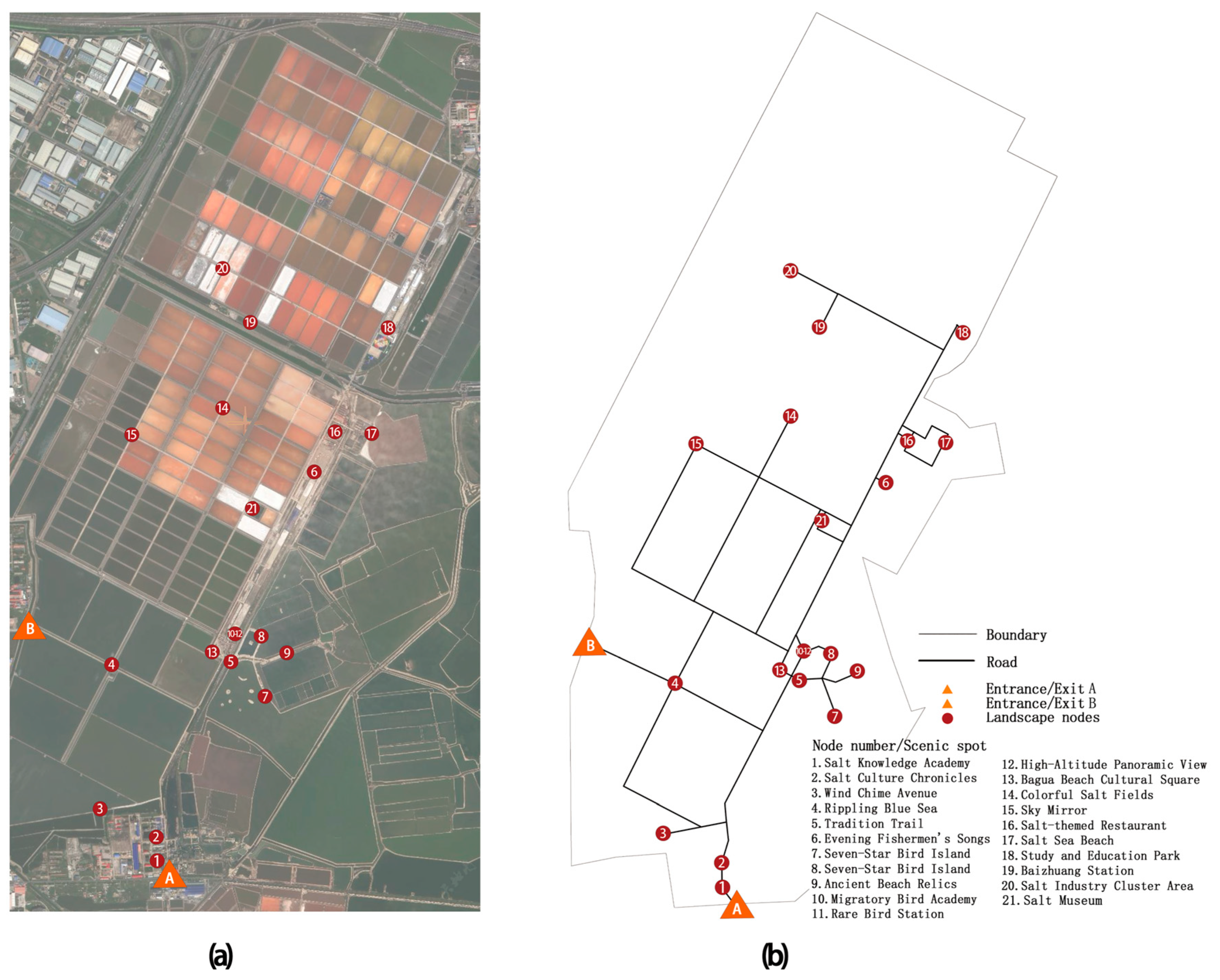
As shown in
Figure 1 Site Data Preprocessing (a) Site Layout Map (b) Relationship between Landscape Nodes and Roads, the site route map, the existing and newly designed landscapes in the salt industry scenic area are numbered from “1” to “20,” and the scenic area has two entrances marked with yellow triangles “A” and “B”. As can be seen in the figure, the scenic area has numerous attractions that are widely distributed [
39]. The cultural and historical attractions are mostly located on the right side of the figure, while the salt field landscape nodes are scattered throughout the salt fields on the left side. The internal roads of the salt field crisscross, mostly perpendicular to each other, and all roads are two-way, but with varying characteristics: four-lane two-way concrete roads, two-lane two-way dirt roads, pedestrian brick-paved roads, roads parallel to water channels, etc. Due to the special structure of the salt field and the presence of train tracks, not all nodes are interconnected [
40]. For example, nodes “14” and “19” are separated by train tracks and a water channel, with no connecting path. Based on satellite imagery and field surveys, the relationship between landscape nodes and roads in the scenic area is represented in
Figure 2, preparing for the subsequent construction of an undirected graph. In this figure, black line segments represent two-way roads, red dots represent landscape nodes, and black dashed lines represent the salt field boundary.
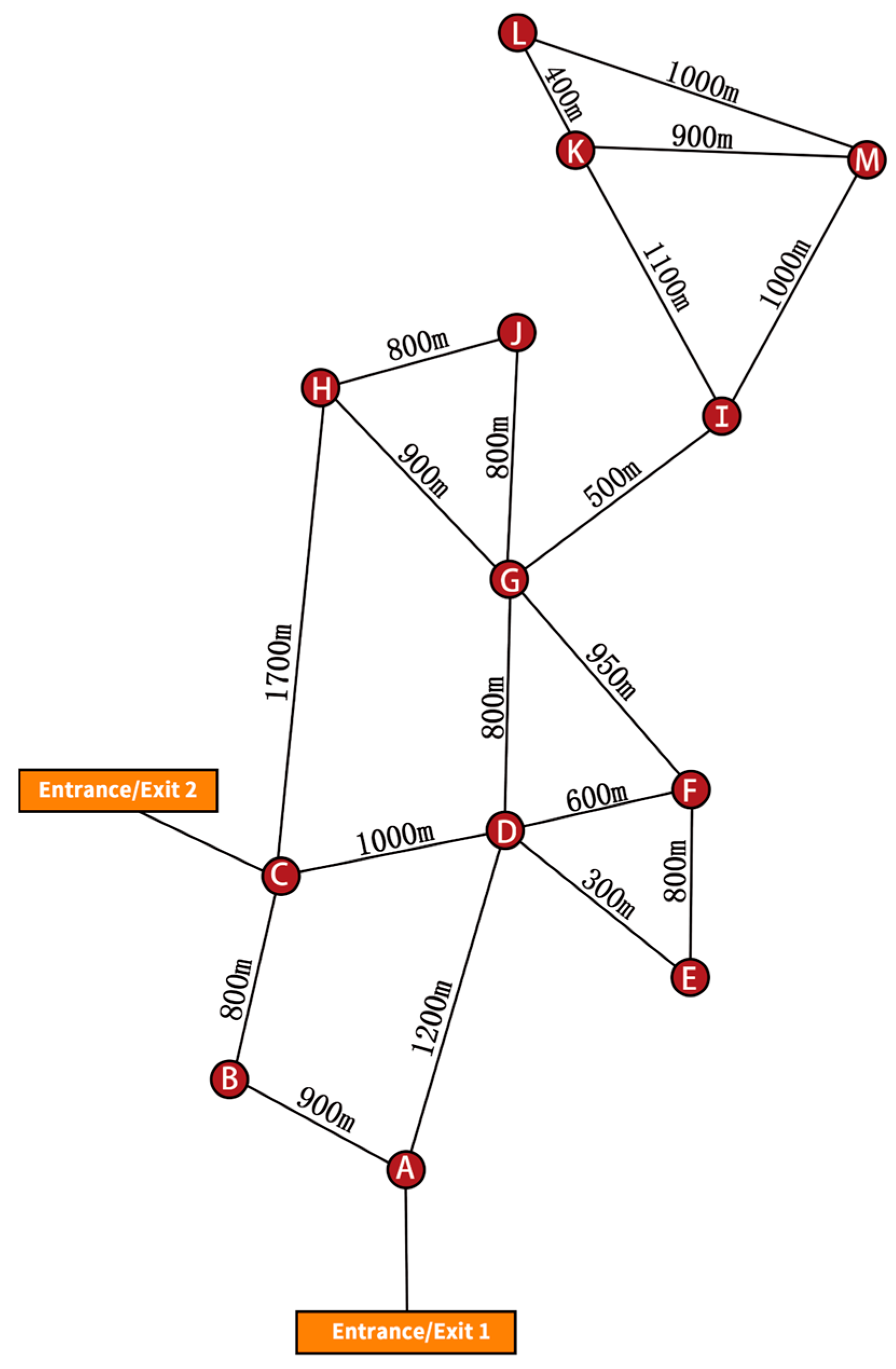
Based on the relationships and distances between attractions, an undirected graph of landscape nodes is drawn on the basis of the scenic area road network diagram. As shown in
Figure 2, the undirected graph of landscape nodes, the red nodes represent landscapes or clusters of landscapes within the scenic area. Some landscape nodes that are close to each other and strongly correlated are represented by a single node in the undirected graph. For example, in the X site route map, the landscape nodes “5, Shiyi Trail,” “13, Bagua Beach Cultural Square,” and “10–12, Migratory Bird Classroom, Rare Bird Station, High-Altitude Scenic View” are combined into node “D” in
Figure 1b. The positions of the nodes in the undirected graph do not represent their precise locations in the actual satellite image. The lines connecting the nodes only indicate that the connected attractions have bidirectional access. Unconnected nodes do not have direct access and require transit through intermediate nodes to reach the destination. The line segments connecting the nodes show the actual length of the transportation path between the two connected landscape nodes or clusters of landscapes based on field measurements; therefore, curved paths are simplified into straight lines. Since “Entrance 1” is close to node “A,” and there is only one path between them, the distance between them is ignored in the calculation, and node “A” is used instead of “Entrance 1” as the starting or ending point of the path. Similarly, node “C” is used instead of “Entrance 2” as the starting or ending point of the path.
3.2. Adjacency Matrix Creation and Weight Design
3.2.1. Adjacency Matrix Creation
Based on the undirected graph of landscape nodes, it is easily seen that the graph is connected; all nodes are connected through direct or indirect connections, and there are no isolated nodes. The degree of each node (i.e., the number of connections for each node) is as follows: A:2, B:2, C:3, D:5, E:2, F:3, G:5, H:3, I:3, J:2, K:3, L:2, M:3. Nodes D and G have the highest degree, both 5, making them central nodes in the network. They should be given special consideration as key landscape nodes in subsequent design. The adjacency list is shown in
Table 1, and the adjacency distance matrix is shown in
Table 2. The distance between two unconnected points is considered infinite, represented by INF.
When calculating scenic route paths, it is not enough to consider only distance; various factors such as travel time between attractions, tourists’ priorities, and the attractiveness of scenic spots all influence route selection. Therefore, it is necessary to find a suitable balance in the edge weights of the undirected graph or generate tour routes that satisfy multiple conditions by adjusting the weights of different variable factors. Based on the distance undirected graph and on-site survey measurements, and assuming a sightseeing vehicle speed of 25 km/h and a walking speed of 5 km/h, the scenic area travel time matrix is shown in
Table 3. Since the transportation methods between attractions include various modes such as driving and walking, and will later include cycling and miniature trains, each with different speeds and efficiencies, the time values cannot be simply equated to distance values. The values in the time matrix represent the ratio of the distance between two nodes to the speed of the corresponding mode of transportation. The time between two unconnected points is considered infinite and represented by INF.
From Lutai Yusha to the Salt Industry Scenic Area, the salt fields are embracing the new era with stories passed down for thousands of years and the wisdom of coexistence between humans and nature. This colorful salt field is not only a substantial and vibrant industrial heritage site, but also a natural gallery that attracts tourists from Beijing, Tianjin, Hebei, and even the whole country.
To quantify the attractiveness of landscape nodes and other influencing factors and thus improve the scientific accuracy of the edge weight values assigned in the calculations, a questionnaire survey was conducted among direct and potential tourists of the Salt Industry Scenic Area. The survey subjects included tourists leaving the Salt Industry Scenic Area, permanent residents of the Beijing-Tianjin-Hebei region, teachers and students from schools surrounding the Salt Industry Scenic Area, and people from other regions visiting Tianjin. The questionnaires were distributed proportionally through paper and online surveys. A total of 372 questionnaires were distributed, yielding 306 valid responses. Specifically, 260 online questionnaires were distributed, with 231 valid responses, and 112 paper questionnaires were distributed, with 75 valid responses. The effective response rate was 82%.
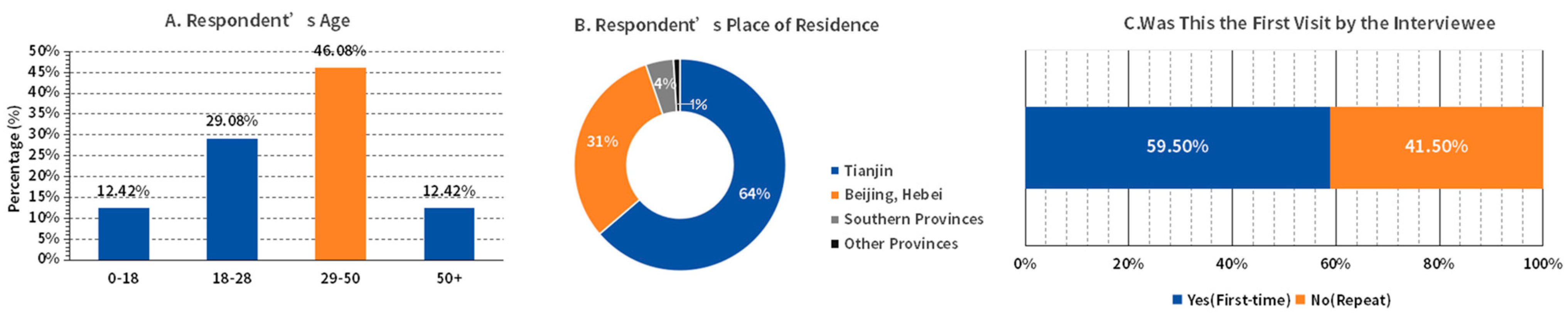
The demographic data from the questionnaire results showed that the highest proportion of respondents were aged 29 to 50, accounting for 46%, followed by those aged 18 to 28, accounting for 29%. Respondents over 50 and under 18 accounted for a smaller proportion, totaling 25%. Overall, middle-aged and young people participated in the survey the most. Due to the location of questionnaire distribution and the target respondents, the respondents’ permanent residences were highly concentrated in the Beijing-Tianjin-Hebei region. More than half of the respondents (64%) were permanent residents of Tianjin, followed by those residing in Beijing and Hebei Province, accounting for 31%. The proportion of respondents from southern Chinese provinces and northern provinces outside the Beijing-Tianjin-Hebei region was relatively small, at 4% and 1%, respectively. The regional concentration of respondents may introduce a geographical preference bias, which should be taken into account when generalizing the model to other regions. Among the 306 respondents who completed valid questionnaires, 42% had visited the Tianjin Changlu Salt Industry Scenic Area, while 58% had not visited the scenic area (
Figure 3).
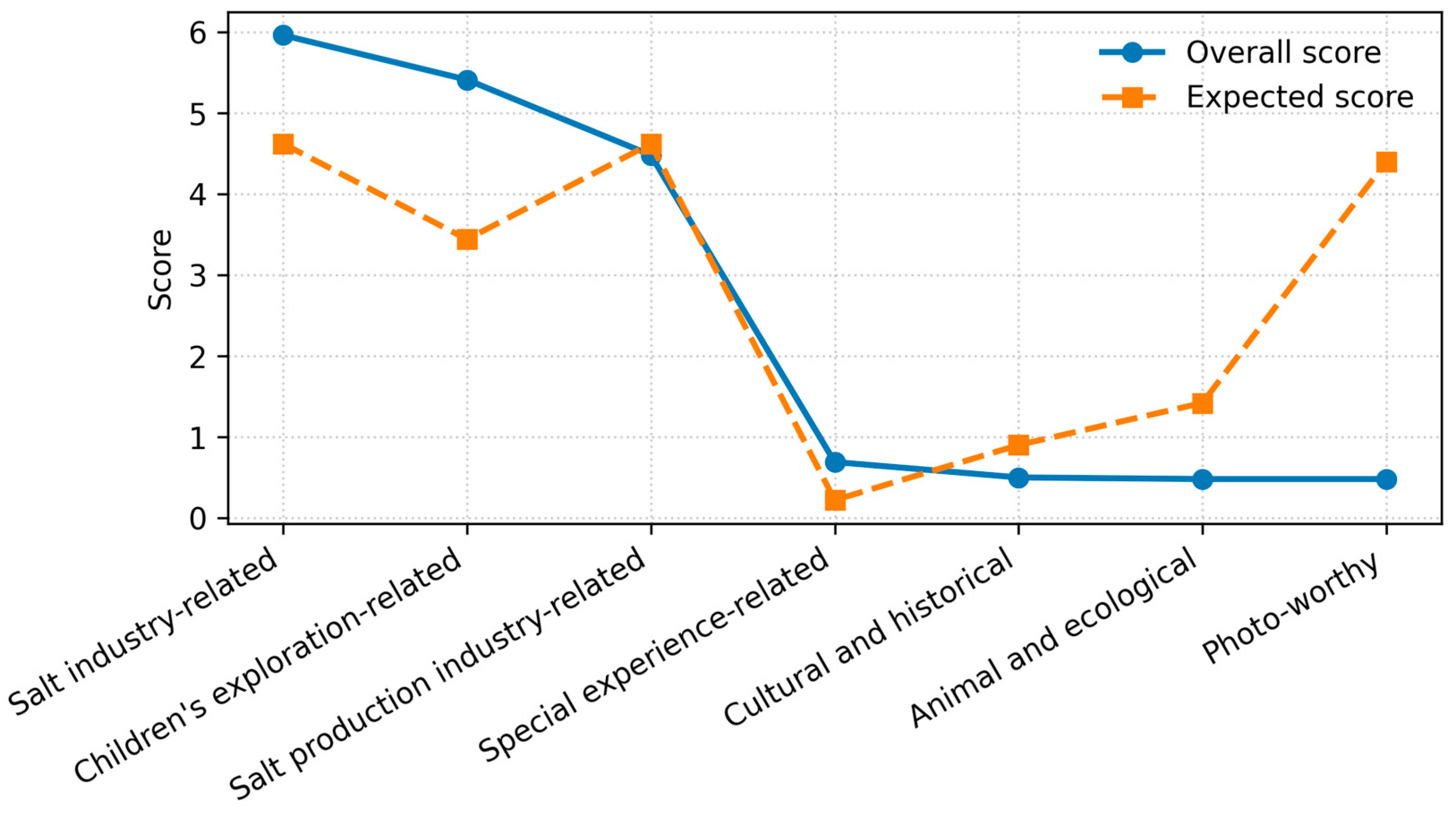
To study tourists’ satisfaction with attractions within the scenic area after their visit, the attractions were categorized into seven major categories, each containing several related attractions: Salt Industry Scenery (Colorful Salt Fields, Salt Mountain, Ancient Lutai Salt Field, Salt Industry, etc.), Children’s Exploration (Research and Study Park, Children’s Playground, Salt Knowledge Classroom, etc.), Salt Production Industry (Salt Mountain, Salt Collection Area, Production Equipment, etc.), Special Experiences (Fishing Song at Sunset Music Festival, Helicopter Sightseeing, Camping, Salt-themed Restaurant, etc.), Humanities and History (Salt Industry Museum, Salt Culture, Salt Knowledge Classroom, etc.), Animal Ecology (Seven-Star Bird Island, Migratory Bird Classroom, etc.), and Photo Opportunities (Salt Mountain, Sky Mirror, Wind Chime Avenue, etc.). Respondents who had visited the Tianjin Changlu Salt Industry Scenic Area were selected from the submitted questionnaires and asked to select and rank the attractions they were satisfied with. The results were compiled and calculated to obtain
Figure 4, showing the overall scores of the attraction types. The average overall score reflects the overall ranking of the options; a higher score indicates a higher overall ranking. The calculation method is: Average overall score = (Σ frequency × weight)/number of respondents who answered this question. For example, if a question was answered 12 times, and option A was selected and ranked first 2 times, second 4 times, and third 6 times, then the average overall score for option A = (2 × 3 + 4 × 2 + 6 × 1)/12 = 1.67 points. The 127 respondents who had visited the scenic area rated the salt industry scenery, children’s exploration, and salt production industry related attractions as having the highest overall scores, with values of 5.96, 5.41, and 4.48, respectively, reflecting that respondents who had visited the area were more satisfied with these types of attractions. The weighted ranking method was adopted to reflect the ordinal preference structure of respondents. Alternative aggregation methods, such as AHP or Likert—based scaling, may yield slightly different results.
To study the expectations of respondents who had not visited the scenic area regarding the types of attractions, the remaining 179 respondents selected and ranked the attractions they expected to be most appealing based on their experience, resulting in
Figure 4, showing the expected overall scores of the attraction types. As shown in the figure, respondents had high expectations for salt industry scenery, photo opportunities, and children’s exploration related attractions, with scores of 4.42, 4.40, and 3.44, respectively.
Table 4 is obtained by setting the expected overall score for the salt production industry type equal to the score for the salt industry landscape type in the attraction type scoring chart and organizing the data accordingly.
3.2.2. Scenic Area Roads Integrate Border Rights Design
Addressing the limitations of the traditional Floyd algorithm’s single-distance orientation in tourism scenarios, this study proposes a multi-attribute comprehensive weighting optimization model that integrates spatial distance, travel time, landscape attractiveness, and environmental constraints [
41,
42]. For the landscape path planning needs of the Tianjin Changlu Salt Industry Scenic Area, this study constructs a four-dimensional indicator system composed of spatial attributes, temporal attributes, experiential attributes and environmental attributes, with quantifiable sub-indicators set under each dimension (
Table 5):
To quantify the visual and cultural experience during the tour, we defined the Scenic Score (
) and Expected Scenic Score (
Oij) for each edge (from node
i to node
j). These scores are derived from the overall scores and expected overall scores of the connected nodes (as detailed in
Table 4) and the visual continuity along the path. The scenic score is the sum of the combined scores of landscape nodes connected by the path, and the calculation method for the expected scenic score is the same. In the Floyd optimization framework,
and
Oij serve as benefit-type indicators, allowing the algorithm to prioritize routes that offer higher experiential values even if they are slightly longer.
The ecological sensitivity score (
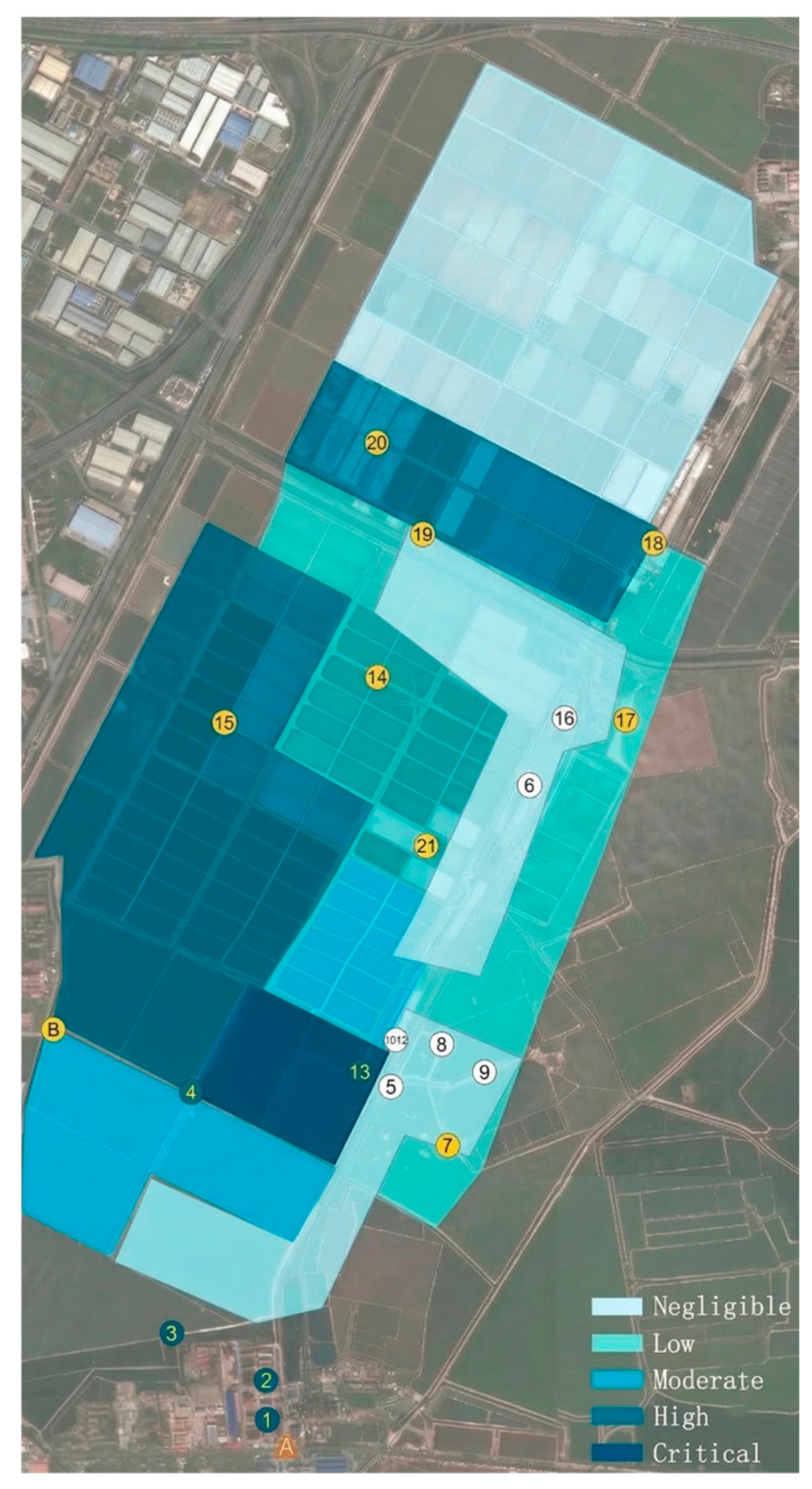
) is primarily derived from ecological field surveys and GIS-based habitat mapping. Rather than employing uniform buffer zones, the model assigns differentiated values based on the specific ecological characteristics of the traversed areas. High ecological risk values (0.7–1.0) are assigned to routes crossing core nesting sites of rare birds (e.g., Red-crowned cranes), dense wetlands, and active foraging areas (
Figure 5). Conversely, values progressively decrease toward zero (0.0–0.6) for low-risk zones, such as sparse salt-marsh vegetation, restored industrial areas, and hardened roads or salt storage yards. It is important to note that to ensure computational feasibility, this data model relies on static simplifying assumptions. These assumptions may limit the accuracy of dynamic behavioral simulations and introduce potential biases; for instance, the current model cannot easily account for time-varying factors like seasonal bird migration fluctuations or extreme weather events, which restricts its real-time responsiveness to dynamic ecological risks. This score is treated as a cost-type indicator, so that higher ecological risk increases the path weight. This index ensures that the Floyd algorithm does not merely seek the shortest or most scenic path but actively penalizes routes encroaching on high-risk habitats. By integrating these spatial, temporal, experiential, and environmental attributes into an entropy-weighted cost function, we establish a multi-objective optimization framework that aligns with sustainable heritage conservation.
The combined edge cost is defined as follows:
where
Dij is distance,
Tij is travel time,
is scenic score,
is ecological risk (all normalized), and
Oij is expected scenic score. The weights of distance (
), travel time (
), scenic score (
), ecological risk (
) and expected scenic score (
wo) were determined using the entropy-weighting method. This approach assigns higher weights to indicators with greater variability across the network, thereby reducing subjective bias and enhancing model robustness. After normalization, the final weights were obtained through information entropy calculation and redundancy degree standardization.
The weight ensures that paths through fragile ecosystems are penalized. In practice, edges with above a threshold (e.g., 0.8) can be treated as prohibited (set to infinite cost), effectively excluding them from any optimal route. This extension aligns with eco-tourism planning principles that balance route efficiency against habitat protection.
By integrating
Figure 2 (undirected graph of landscape nodes),
Table 2 (distance matrix),
Table 3 (time matrix),
Table 4 (scenic spot type score table), and
Table 6 (ecological sensitivity classification and assignment standard),
Table 7 (landscape node path data table) is obtained.
4. Results
This study uses the range method to standardize the five indicators mentioned above. Specifically, a positive indicator treatment method is used for cost-type data such as distance and time, while a negative indicator treatment method is used for the scenic score reflecting attractiveness and the expected scenic score. Let the standardized value of the path distance be, the standardized value of time be, the standardized value of the scenic score be, and the standardized value of the expected scenic score be. To eliminate the dimensional differences of different data, the range method is used to optimize the values of distance, time, scenic score, and expected scenic score of the landscape node paths [
43,
44]. The range method is used as a positive indicator treatment for distance and time data, and as a negative indicator treatment for scenic score and expected scenic score data. Let the distance indicator of the path be
, the time indicator be
, the scenic score indicator be
, the ecological indicator be
,and the expected scenic score indicator be
.
The distance metric
of the path
is
The time metric
of the path
is
The scenic score metric
of the path
is
The ecological risk metric
of the path
is
The expected scenic score metric
of the path
is
After organizing and calculating the data, the results are shown in
Table 8, the Landscape Node Path Index Table. For paths connecting landscape nodes within the scenic area, the larger the calculated path index (i.e., the shorter the path distance, the lower the travel time cost, the higher the scenic path score, the lower the ecological risk and the higher the expected scenic score), the higher the travel and sightseeing value of that path compared to other paths. This path should be given priority consideration in subsequent design and calculations.
As shown in
Table 8, the landscape node path indicator table provides five indicators: distance, time, scenic score, ecological risk and expected scenic score, along with 19 paths. To scientifically plan tourist routes using the Floyd path algorithm in scenic area route planning, these five indicators are weighted using the entropy weight method to form a combined edge weight [
45,
46]. The data in the table has been standardized and is within the range [0, 1] or is a positive number. The data for each of the five indicators is summed vertically to obtain the total sum C for that indicator. The sum of distances D’ is C
1 = 11.1, the sum of times T’ is C
2 = 14.7, the sum of scenic score S’ is C
3 = 9.05, the sum of ecological risk E’ is C
4 = 6.85 and the sum of expected scenic score O’ is C
5 = 12.28. The proportion of each indicator J (J = 1 to 5) and each path L (L = 1 to 19) is then calculated:
Based on the calculated pro 490 portions, the information entropy (e) and redundancy (d) are calculated. The sample size is denoted by N. In this table, the sample size is the number of paths, so N=19. The information entropy (e) is
Redundancy d reflects the discriminatory power of the indicator. Lower entropy corresponds to higher redundancy and higher weight. Redundancy d is calculated as follows:
The weight W is calculated as the proportion of redundancy for each type of indicator, and its calculation formula is
Table 9 shows the weight percentages of the five indicators after calculation using the entropy weight method, along with the intermediate calculated results of information entropy
and redundancy coefficients
, thereby ensuring the transparency and reproducibility of the evaluation process. Therefore, the objective fusion edge weight
for each path can be calculated as
. For example, the objective fusion edge weight
= 0.57 × 0.13 + 0.86 × 0.08 + 0.00 × 0.32 + 0.92 × 0.18 + 0.51 × 0.29 = 0.46 for road
.
For the subjective weighting W
S of path indicators, this paper uses an empirical ranking method to assign weights to the five indicators [
47]. The core logic is to rank the indicators based on their direct impact on the design and planning of tourist routes within the scenic area. The scenic score directly reflects tourists’ satisfaction with the attractions and is the core of the evaluation, thus having the greatest impact. The time factor affects the time tourists spend traveling between attractions within the scenic area. Distance determines the physical distance between attractions, but due to different modes of transportation, distance and time are not strongly correlated, and only have a significant impact in cases of fixed modes of transportation such as dedicated cycling tours. In general, its impact is less than that of the time factor. The expected scenic score reflects tourists’ expectations of the attractions and is a supplementary indicator to the scenic score, having the least impact on the final evaluation.
The importance ranking of the indicators is: Overall Score
> Time
> Distance
> Expected Overall Score
> Ecological
. Based on the ranking results, basic scores are assigned to the indicators according to the principle of “decreasing importance”: Scenic Score (1st place) 5 points, Time (2nd place) 4 points, Distance (3rd place) 3 points, Expected Scenic Score (4th place) 2 points, Ecological Score (5th place) 1 points. The subjective weight
for each indicator is calculated as follows: Weight = Indicator Basic Score/Total Basic Score. Substituting the values, the subjective weight percentages of the path indicators shown in
Table 10 can be calculated. The objective fusion edge weight
for each path can be calculated as
.
To achieve variable edge weights in salt field road calculations, a linear weighting method is used to directly integrate the subjective and objective weight proportions of path indicators, i.e., path fused edge weight
[
48]. To facilitate subsequent calculations using the Floyd algorithm, the profit maximization problem is equivalently transformed into a cost minimization problem [
49]. For each edge weight K in the matrix, its corresponding transformed edge weight
is calculated. The parameter α was determined after preliminary sensitivity testing, in which α values of 0.2, 0.3, and 0.5 were compared. The route structure remained stable for α ranging from 0.2 to 0.4; therefore, α = 0.3 was selected. The calculation results are shown in
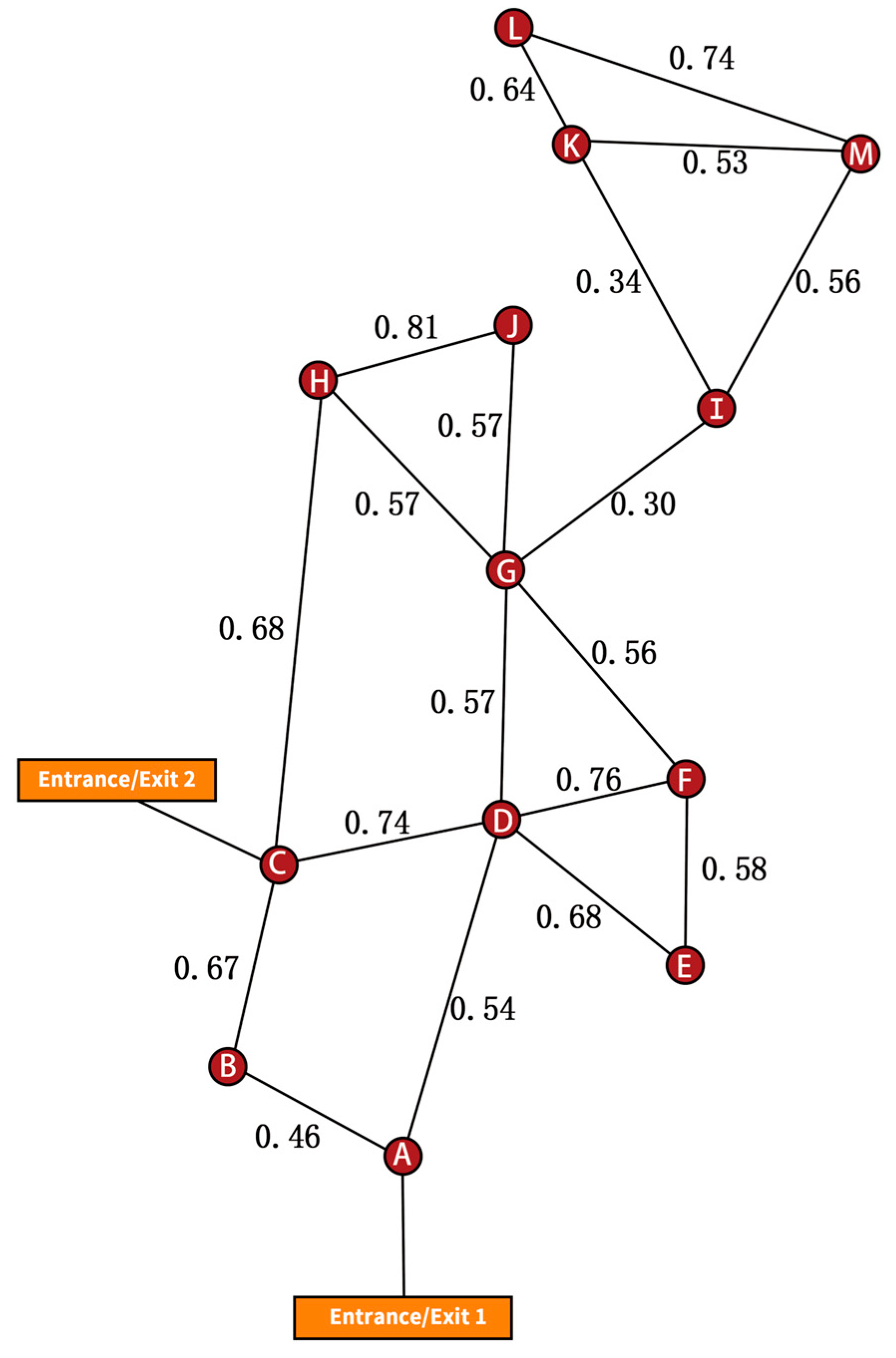
Table 11, Path Fusion Edge Weights. The resulting undirected graph of landscape nodes with edge weights is shown in
Figure 5, Path Fusion Edge Weights Graph. Based on this graph, an adjacency matrix is constructed as shown in
Table 12, Fusion Edge Weights Adjacency Matrix. The edge weight between two disconnected points is infinite, denoted by INF.
4.1. Algorithm Implementation and Path Output
Input: A starting node (e.g., node A or node C), a subset of attractions to be visited (e.g., nodes F, H, J, C, D, L, etc.), and a fixed 13 × 13 adjacency matrix. This adjacency matrix is constructed based on the fused edge weight adjacency matrix of
Table 12, fully describing the road connections and fused edge weight information between the 13 attractions (A to M) within the scenic area. Nodes without direct road connections are set to infinite distances, and due to the undirected nature of the road network within the scenic area, the matrix is symmetric.
Output: A complete maximum edge weight path sequence, detailing all nodes traversed from the starting point, passing through all specified attractions, and returning to the starting point; the calculated total path revenue value, which is the sum of the edge weights on the path.
Step 1: Transform the original edge weight matrix. For each edge weight K in the matrix, calculate its corresponding cost value . Through this monotonically decreasing transformation, the revenue maximization problem is equivalently transformed into a cost minimization problem, laying the foundation for the subsequent application of the Floyd algorithm. The transformed cost matrix maintains the symmetry of the original matrix, and all cost values are within the range [0, 1].
Step 2: Apply the Floyd–Warshall algorithm to calculate the minimum cost path between all node pairs. Initialization involves creating the cost matrix and path matrix. A triple-loop iterative process is used: each node is treated as an intermediate node C, and all node pairs (A, B) are traversed to check if there exists a path through C with a lower cost than the currently known path. If , the cost matrix and path matrix are updated. After the complete iterative process, the resulting cost matrix contains the minimum conversion cost between any two attractions, and the path matrix stores the corresponding path information.
Step 3: Based on the user-defined starting point and the subset of attractions to be visited, determine the complete set of visiting nodes. Extract these nodes from the cost matrix to form a submatrix containing the minimum conversion cost information between the target nodes.
Step 4: It should be noted that the Floyd algorithm is used to compute the shortest path matrix between all node pairs, while the final route optimization is solved as a Traveling Salesman Problem using full permutation enumeration due to the small network size. Transform the problem into an equivalent Traveling Salesman Problem, and find the optimal solution by systematically enumerating all possible attraction visiting orders. For each permutation of the subset of attractions, calculate the total conversion cost of starting from the starting point, visiting all attractions in order, and returning to the starting point. By comparing the total conversion cost values of all permutations, the optimal visiting order with the minimum total conversion cost is determined. This order corresponds to the maximum edge weight path under the fused edge weight adjacency matrix of
Table 12.
Step 5: Based on the obtained optimal visiting order and path matrix, the complete tour route is reconstructed. For each pair of adjacent nodes in the optimal order, the detailed path sequence between them, including all necessary intermediate nodes, is obtained by querying the path matrix. These path segments are then organically combined according to the visiting order to form a complete path sequence starting from the starting point, passing through all designated attractions, and returning to the starting point.
Step 6: The complete path sequence is output, clearly showing the order of all nodes traversed during the tour. The true total edge weight of the path is calculated based on the fused edge weight adjacency matrix of
Table 12. The result ensures that users can obtain the maximum benefit path scheme starting from the designated starting point, visiting all target attractions, and returning to the starting point, providing a scientific basis for scenic area tour route planning.
4.2. Rational Route Planning
4.2.1. Scenic Area Road Classification
To identify critical roads in an undirected graph and assess their importance, so that service facilities and traffic conditions on these roads can be prioritized during design, the Floyd algorithm is used to calculate the minimum transformation edge weights between all node pairs [
50], and the frequency with which each edge is included in these minimum transformation edge weights is counted, i.e., edge betweenness centrality [
51]. A higher edge betweenness centrality indicates that the road carries more traffic flow in the network and therefore is more important [
52]. Roads are classified into three importance levels-Level 1, Level 2, and Level 3-based on their edge betweenness centrality values. The classification criteria are as follows: Level 1 roads have a betweenness centrality value higher than 1.5 times the average of all edges; Level 2 roads have a betweenness centrality value between 0.5 and 1.5 times the average; and Level 3 roads have a betweenness centrality value lower than 0.5 times the average. The calculated average edge betweenness centrality is approximately 15.2. The road classification results are shown in
Table 13 (Classification of Scenic Area Roads) and drawn based on the table data.
4.2.2. Theme Path Generation
- (1)
Salt Industry Theme Path
Changlu Salt Industry Scenic Area differs from other types of industrial cultural tourism scenic areas in that it possesses a complete set of salt-making equipment and unique salt field culture and landscape. Although most tourists are frequently exposed to salt products daily, terms like “salt-making process,” “salt fields,” and “salt culture” remain relatively unfamiliar. Exploring the salt fields, experiencing salt culture, and understanding this industrial process are among the main purposes of visiting the Salt Industry Scenic Area [
53].
Within this design site, attractions related to this theme include the colorful salt fields, salt mountains, and the ancient Lutai salt field under the salt industry landscape category; the salt mountains and salt-making area under the salt-making industry category; salt-making production equipment; and areas related to salt industry history such as the salt industry museum, salt culture, and salt knowledge academy. Based on the attraction type scoring table in
Table 4, six high-scoring attractions (F, L, J, H, C, and D) related to the salt industry scenic area were selected. These are also representative landscapes of the Salt Industry Scenic Area and can be considered “must-see attractions” to a certain extent. After calculating the minimum cost path using the Floyd algorithm and enumerating all visiting sequences starting from A, the total cost of each sequence is calculated [
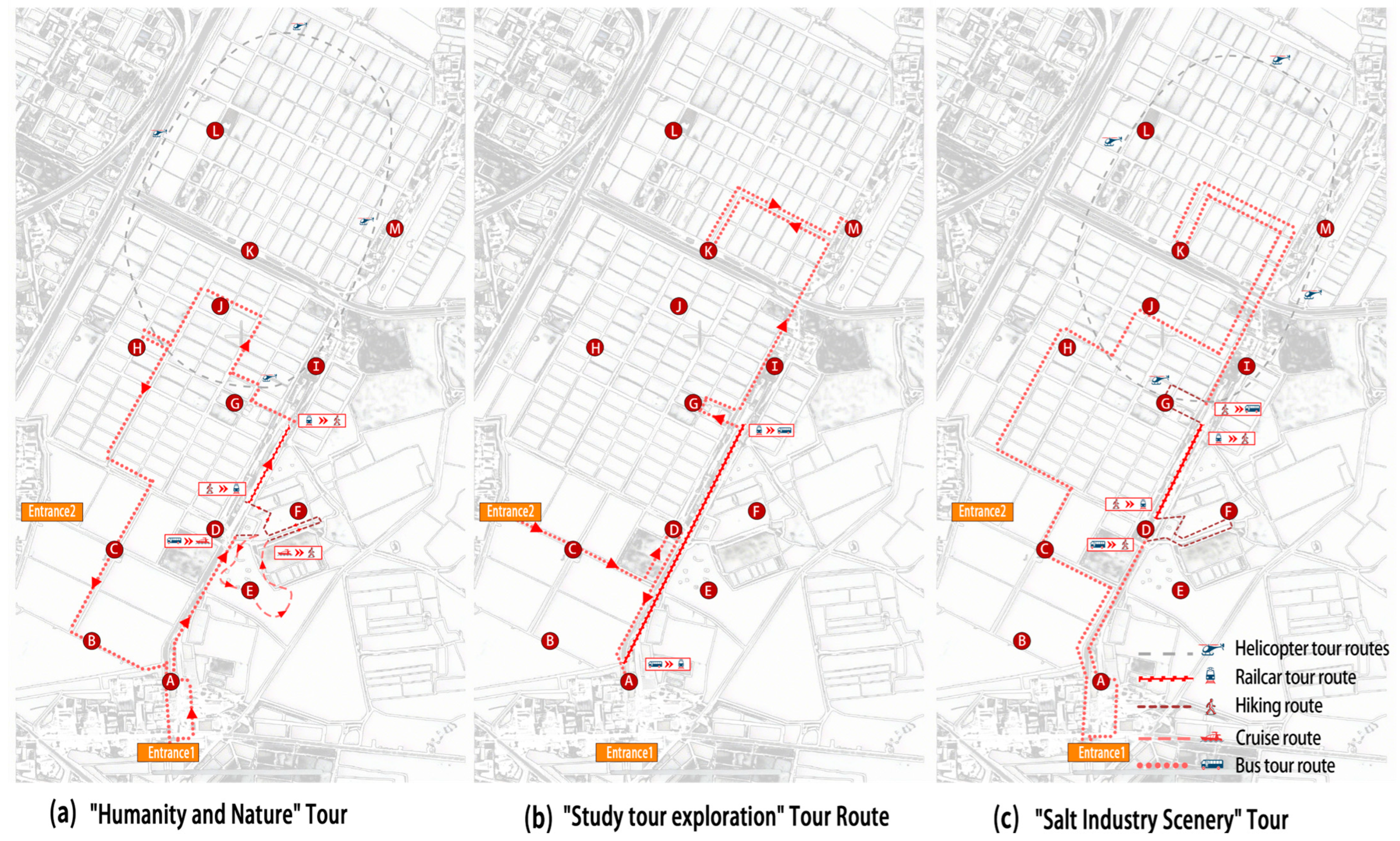
54]. The minimum total cost visiting sequence is: A→F→L→J→H→C→D→A. Reconstructing the complete path sequence and adding all intermediate nodes, the complete path is: A→D→F→G→I→K→L→K→I→G→J→H→C→D→A, where D, G, I, and K are mandatory intermediate nodes that can be visited without being traversed.
- (2)
Humanity and Nature Theme Path
Located near the Bohai Sea, the salt fields offer expansive views, allowing visitors to witness a magnificent panorama where the sea and sky merge seamlessly. The neatly arranged crystallization pools contrast sharply with the coastal scenery. Differences in brine concentration lead to varying densities of halophilic bacteria within the pools, resulting in a vibrant array of colors—red, orange, yellow, and brown—that, viewed from above, resemble an eyeshadow palette placed on a natural coastline, creating a spectacular and enchanting rainbow of colors. A unique ecosystem also exists alongside the salt fields. Surrounding them are protected wetlands inhabited by seabirds and other marine life. The scenic area also features a bird science livestream studio and a migratory bird conservation base [
55]. A key feature of the visit is the opportunity to appreciate nature and experience the harmonious integration of nature and humanity within the salt field ecosystem.
Attractions related to this theme within the Salt Industry Scenic Area include animal ecology sites such as Seven-Star Bird Island and a migratory bird school, as well as salt industry-related attractions such as the Rainbow Salt Fields, salt mountains, the ancient Lutai salt field, and salt industry sites. Based on the attraction type score table in
Table 4, four high-scoring attractions (E, F, J, and H) related to the theme of people and nature were selected. The Floyd–Warshall algorithm was used to calculate the shortest cost path between all node pairs. Similarly, all 24 possible visit sequences starting from A were enumerated, and the total cost of each sequence was calculated. The minimum total cost visit sequence is: A→E→F→J→H→A. The complete path sequence after adding intermediate nodes is: A→D→E→F→G→J→H→C→B→A. The path includes the necessary intermediate nodes D, G, C, and B; in actual visits, visitors can choose to only visit these nodes.
- (3)
Research and exploration thematic paths.
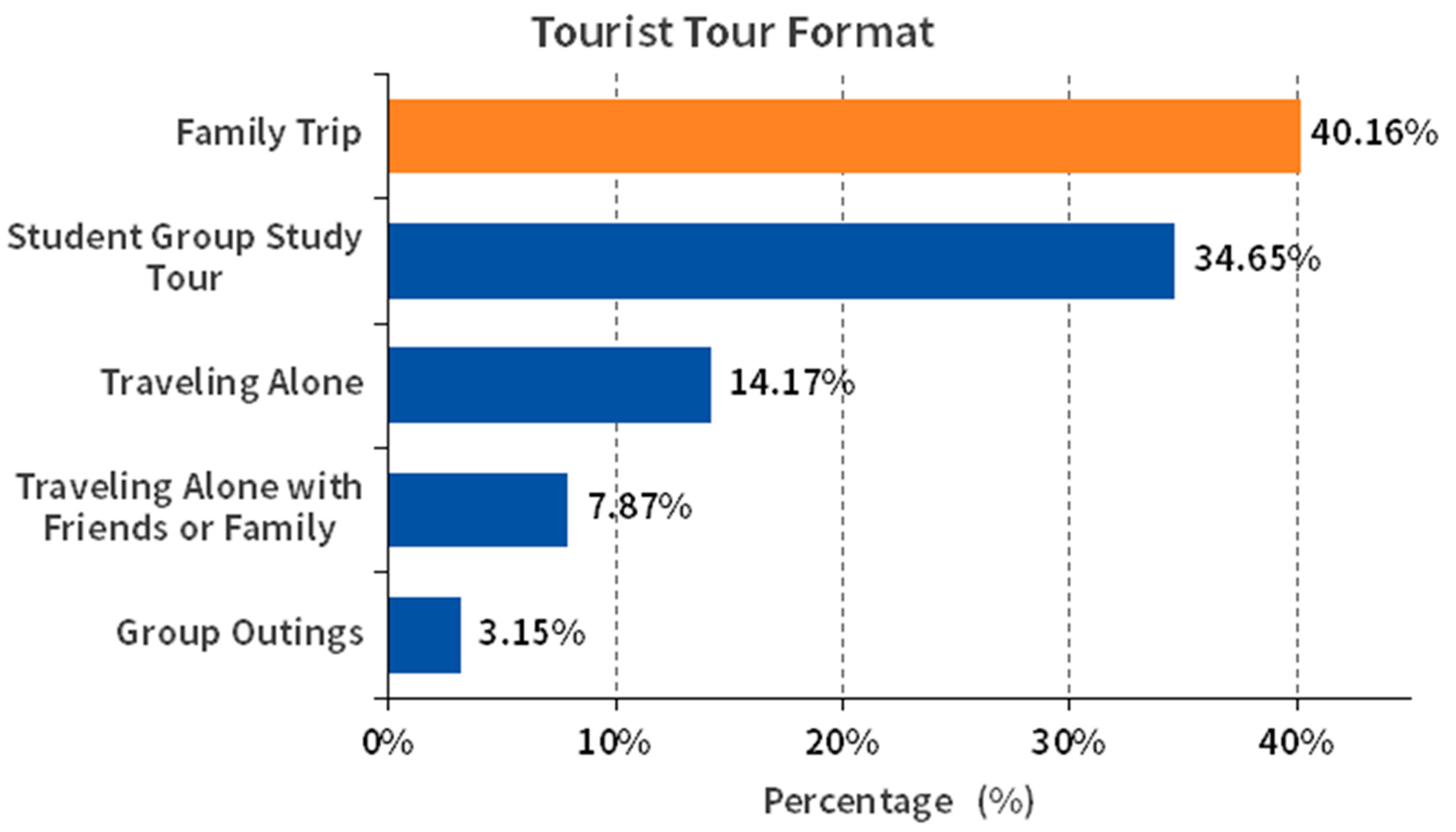
According to the questionnaire results, as shown in
Figure 6 (Tourist Tour Format), among the 127 respondents who visited the scenic area, the vast majority (40%) and (35%) were families with children or participating in group study tours organized by schools or other educational institutions. Of the remaining respondents, 14% visited alone, 8% traveled with friends or family, and the smallest group (3%) participated in company team-building activities. The data analysis indicates that the motivation for visiting due to children’s activities cannot be ignored [
56]. Future landscape updates should focus on the arrangement of facilities related to children’s entertainment and educational activities and appropriately increase convenient services for families. Scenic area route planning should also consider routes for children’s educational exploration themes to increase convenience for this group.
The scenic area offers educational activities at various venues, including children’s exploration attractions such as educational parks, children’s playgrounds, and salt knowledge classrooms, as well as cultural and historical attractions such as salt industry museums, salt culture exhibits, and salt knowledge classrooms. These attractions are relatively concentrated, so some closely spaced attractions are considered a cluster. For safety and management reasons, and because children’s educational activities are mostly purposeful and organized group activities, the entrance/exit is separated from other visitors and designated as Entrance/Exit C. Four nodes A, G, K, and M related to this theme are selected. The Floyd algorithm is applied to calculate the shortest cost path for all node pairs between A and M. Enumerating all access sequences starting from C, the minimum total cost access sequence is calculated as: C → A → G → K → M → C. The complete path sequence is reconstructed: there is no direct path from C to A, so the reasonable path is C → D → A; there is no direct path from A to G, so the lowest cost path is A → D → G; the reasonable path from G to K is G→I→K; there is a direct path from K to M; and the reasonable path from M to C is M→I→G→D→C. After adding all necessary intermediate nodes, the complete path sequence is C → D → A → D → G → I → K → M → I → G → D → C. Intermediate nodes such as D and I can be visited without actually being traversed (
Figure 7).
The summaries of the three types of tour routes are shown in
Table 14—”Tour Routes for Each Theme”.
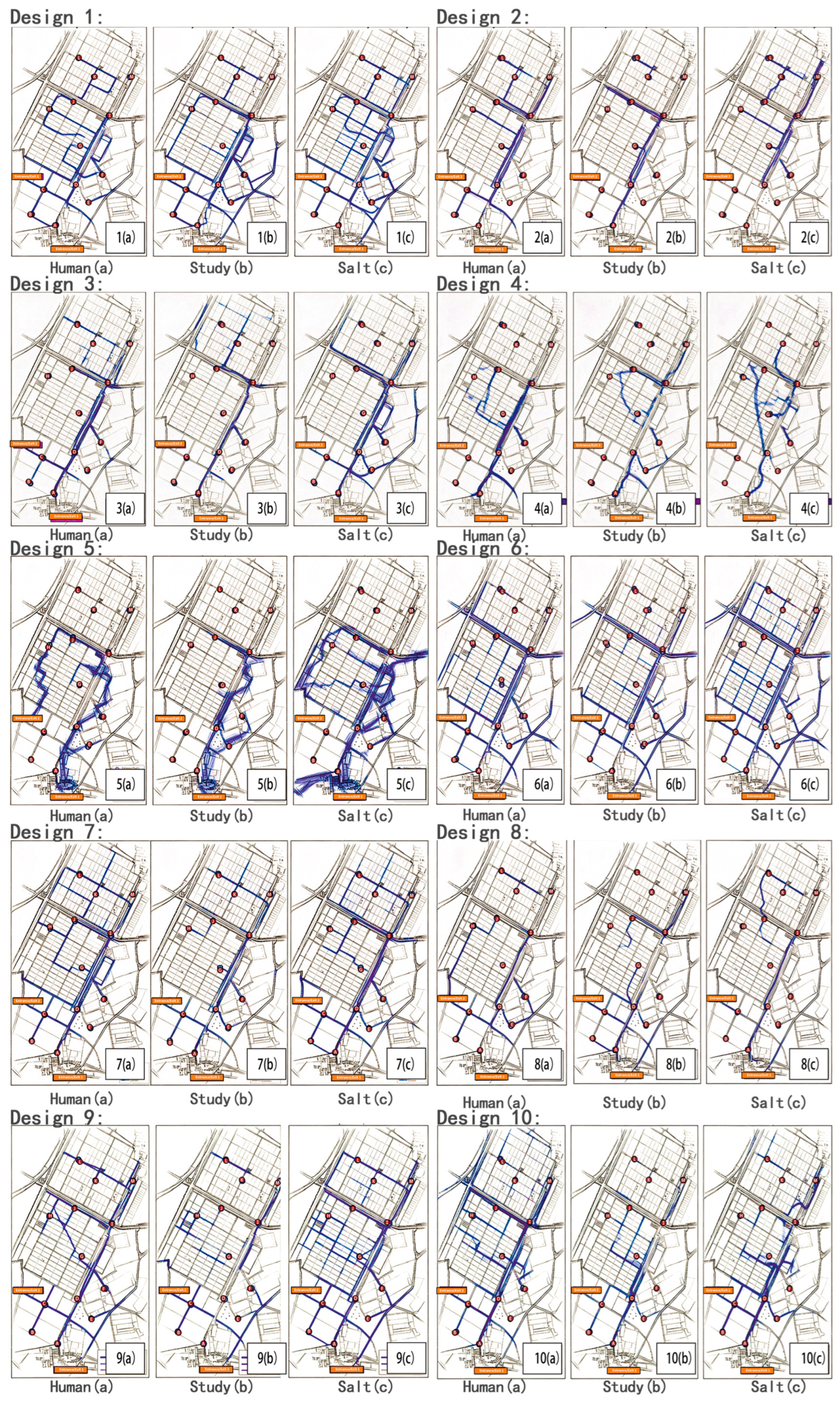
4.3. Validation Through Designer Comparison
To ensure a fair and fully reproducible comparison, thereby avoiding any evaluation bias, all three categories of routes—the distance-only baseline, the 10 manual routes, and the Floyd-optimized routes (
Figure 8 and
Figure 9)—were quantified using the exact same three key mathematical indicators: total travel time (min), landscape attractiveness, and ecological disturbance. Specifically, the total travel time for each route was calculated based on the fixed travel speed matrix. Landscape attractiveness was computed by summing the scenic scores (
) and expected scenic scores (O
ij) of all landscape nodes connected by the respective paths, precisely in accordance with the Scenic Spot Type Score Table (
Table 4). Similarly, ecological disturbance was calculated by summing the ecological sensitivity scores (
) for each traversed edge, strictly following the GIS-based habitat risk values defined in
Table 6. The resulting performance metrics for the baseline, the average of the 10 manual schemes, and the Floyd-optimized routes are summarized in
Table 15.
The results demonstrate that while the distance-only baseline achieves the minimum travel time (23.8 min), it performs poorly in terms of environmental and experiential dimensions, exhibiting the highest ecological risk (1.47) and the lowest scenic score (31.2). As shown in
Table 15, this solution prioritizes efficiency at the expense of landscape quality and ecological safety, revealing the inherent limitation of single-criterion optimization.
In contrast, the entropy-weighted Floyd routes present a more balanced performance profile. Compared with the average manual designer schemes, travel time is reduced by 15.7% (29.2 vs. 24.6), while landscape attractiveness increases by 8.0% (37.8 vs. 35.0). More importantly, ecological disturbance is significantly mitigated. The disturbance index of the entropy-weighted Floyd routes decreases to 0.82, compared with 1.47 for the baseline (a 44.2% reduction) and 1.15 for designer schemes (a 28.7% reduction). These results indicate that environmentally sensitive segments are effectively penalized or avoided during the optimization process.
Overall, the findings suggest that the entropy-weighted Floyd approach provides a robust multi-criteria solution for industrial heritage route planning. Rather than merely minimizing distance, it systematically mediates the trade-offs among touring efficiency, visitor experience, and ecological protection-dimensions that experience-based manual designs often struggle to reconcile simultaneously.