Article

Accessibility and Social Equity of Urban Park Green Spaces in Megacities from an Environmental Justice Perspective: A Case Study of the Six Central Districts of Beijing

Landscape Architecture, Beijing Forestry University, Beijing 100083, China
*
Author to whom correspondence should be addressed.
Land 2026, 15(3), 484; https://doi.org/10.3390/land15030484
Submission received: 8 February 2026 / Revised: 13 March 2026 / Accepted: 15 March 2026 / Published: 17 March 2026

Abstract

Against the backdrop of rapid development in megacities, urban park green spaces serve as essential public resources whose accessibility and equity directly affect residents’ quality of life and broader social justice. This study addresses the imbalance between the spatial distribution of green space resources and the socio-demographic characteristics of different population groups in megacities. It takes the six central districts of Beijing as the study area and integrates data from 457 urban parks. The research applies the Gaussian two-step floating catchment area (G2SFCA) method and bivariate spatial autocorrelation analysis (Moran’s I) to systematically evaluate the equity of urban park green space provision across multiple social dimensions, including economic status, educational attainment, and vulnerable groups. The results indicate that urban park green spaces in Beijing’s six central districts exhibit a pronounced central and northern advantage, with significant deficits in southern and peripheral areas. High accessibility and greater per capita green space are concentrated in core and high-housing-price districts, overlapping with high-income and highly educated populations. In contrast, vulnerable groups and migrant workers are more likely to reside in green-space-deficient areas, facing a structural “high population density–low green space provision” disadvantage, reflecting clear social inequities. In addition, inequity is more pronounced at the walking scale than at the cycling scale. The study reveals a dual mismatch in green space provision across both spatial and social dimensions within a megacity context. The findings suggest that future urban planning should shift from quantitative expansion to the optimization of existing green space resources. Planning strategies should prioritize vulnerable groups and adopt a people-oriented approach. Policymakers should allocate greater support to southern and peripheral areas, increase the provision of pocket parks, and improve slow-mobility systems. These measures can more precisely safeguard equitable access to green space for disadvantaged populations and promote the realization of spatial justice.

1. Introduction

Urban park green spaces are a vital component of urban ecosystems. They contribute to improving living environments, enhancing public health and well-being, and fostering social equity, and are widely recognized as key indicators of urban sustainability [1,2]. Existing studies demonstrate that urban park green spaces not only mitigate the urban heat island effect, regulate air quality, and provide essential ecosystem services [3,4,5] but also serve as important venues for daily recreation, social interaction, and mental health support [6,7,8]. However, under the rapid expansion of megacities and increasingly complex socio-spatial differentiation, significant disparities often emerge between the spatial distribution of urban park green spaces and the actual needs of diverse social groups, triggering widespread debates on the issue of “green space social equity” [9,10]. Achieving equitable allocation of urban park green spaces across different social groups has therefore become a central concern in urban governance and a critical theme in research on spatial justice [11,12].
In recent years, research on the equity of urban green spaces has become a prominent academic focus [13,14,15,16]. Scholars worldwide have conducted extensive studies on the relationships among green space distribution, service capacity, accessibility, usage behavior, and socioeconomic characteristics [17,18,19,20,21,22,23,24,25,26]. Existing research has primarily advanced along two dimensions. The first involves evaluating residents’ spatial accessibility to green spaces using models such as network analysis or the two-step floating catchment area method (2SFCA) [27,28,29]. The second explores how social attributes—such as income, ethnicity, and age—shape disparities in access to green spaces [30,31,32]. A consistent finding is that vulnerable groups, including low-income residents, ethnic minorities, and both the elderly and children, are disadvantaged in terms of both the amount of green space available to them and their spatial accessibility to such resources. This phenomenon is commonly referred to as “environmental injustice” [33,34,35]. Furthermore, research perspectives have gradually shifted from emphasizing “quantity equity,” which focuses on per capita green space area, to highlighting “accessibility equity,” which emphasizes spatial proximity [36,37]. This shift indicates that the field is moving toward a more practice-oriented stage with greater implications for planning and policy.
In addition, ongoing social structural changes—such as urban–rural disparities, generational differentiation, and housing stratification—have led to pronounced inequalities in residents’ access to urban park green spaces [38,39]. High housing-price areas often possess denser and higher-quality green space resources [40], whereas middle and low-income populations, as well as the elderly, frequently face “green space deserts” or physical barriers that restrict access. From a social equity perspective, it is therefore essential to consider socioeconomic factors—including housing prices, age structure, and educational attainment—when examining differences in the ability of diverse groups to obtain green space resources in daily life. Such analysis provides a crucial foundation for advancing green justice and promoting livable cities [41,42,43].
These studies have offered important theoretical and empirical support for understanding the social equity of green space distribution. However, several limitations remain. First, most research focuses primarily on accessibility measurement, with less attention paid to the equitable allocation of green space supply itself across different groups, limiting comprehensive analysis of the supply–demand relationship [10,39]. Second, the categorization of social groups is often single-dimensional, with few studies simultaneously considering the intertwined effects of economic status, educational attainment, vulnerable groups (the elderly and children), and migrant workers [16,20,44,45]. Third, research frequently relies on a single walking-scale analysis, overlooking the influence of other common mobility modes, such as cycling, on equity patterns [46,47]. Finally, the integration of research findings with broader urban planning and spatial governance policies remains limited, constraining their practical applicability [48,49].
Against this background, the present study takes the six central districts of Beijing as a case study. It integrates data from 457 urban park green spaces, the Seventh National Population Census of China, and multiple sources of big data, systematically assessing social equity in green space provision across four dimensions: economic status, educational attainment, vulnerable groups, and migrant workers. The study applies the Gaussian two-step floating catchment area method (G2SFCA) and spatial autocorrelation analysis to evaluate dual aspects of equity—both green space supply and accessibility—while comparing disparities at walking and cycling scales. Distinguishing from previous studies that focus primarily on a single measure of accessibility, this study establishes a dual evaluation framework of “scale supply–service performance.” The research employs bivariate spatial autocorrelation to quantitatively identify the coupling and mismatch between urban park green space scale equity and accessibility equity. It also examines the deeper implications of megacity planning policies for environmental justice. Compared with recent studies on Chinese cities that emphasize either single accessibility metrics or equity for specific groups, this study offers several marginal contributions. First, it moves beyond a simple “distance–quantity” assessment by introducing spatial coupling analysis into the environmental justice framework. This approach quantitatively reveals the spatial mismatch between green space scale and service performance. Second, the study situates equity outcomes within the long-term evolution of planning standards and governance structures in megacities. This shift from descriptive patterns to a performance–policy analytical linkage provides a new empirical perspective for precision governance in urban park green space planning within megacities. The aim is to identify spatial inequities and social injustices in green space allocation and to provide empirical evidence to support human-centered, equity-oriented urban park green space planning and renewal.
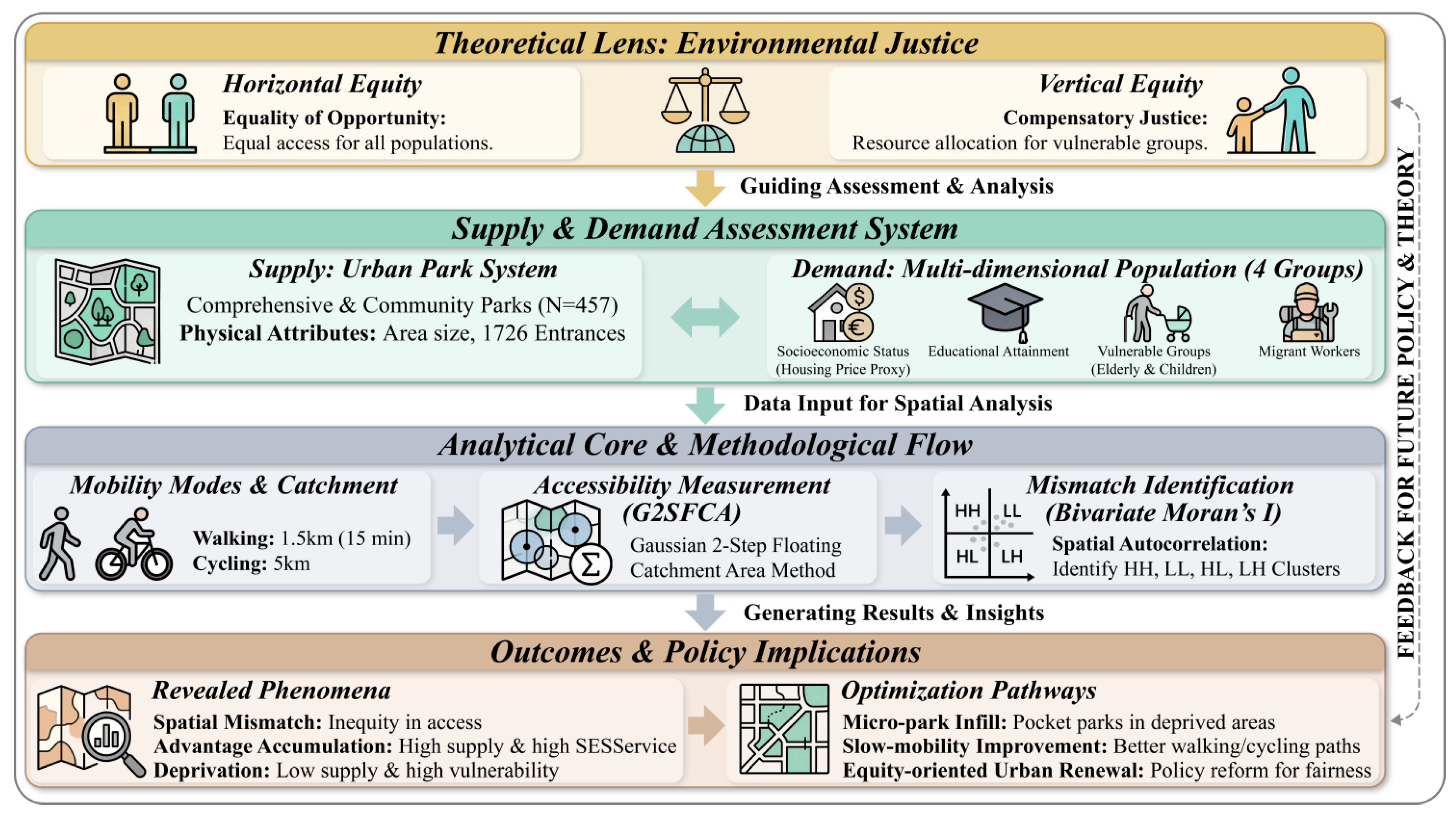
To clearly illustrate the multi-level analytical pathway of this study, the paper develops an integrated conceptual framework (Figure 1). The framework is grounded in environmental justice theory and encompasses two core dimensions: horizontal equity and vertical equity. The framework integrates “scale supply” and “service performance” into a unified analytical structure. It moves from spatial pattern identification to the analysis of social mismatch, and further to the evaluation of planning policies. This stepwise approach provides a structured perspective for understanding the complex equity issues of urban park green space provision in a megacity context.

2. Materials and Methods

2.1. Research Area

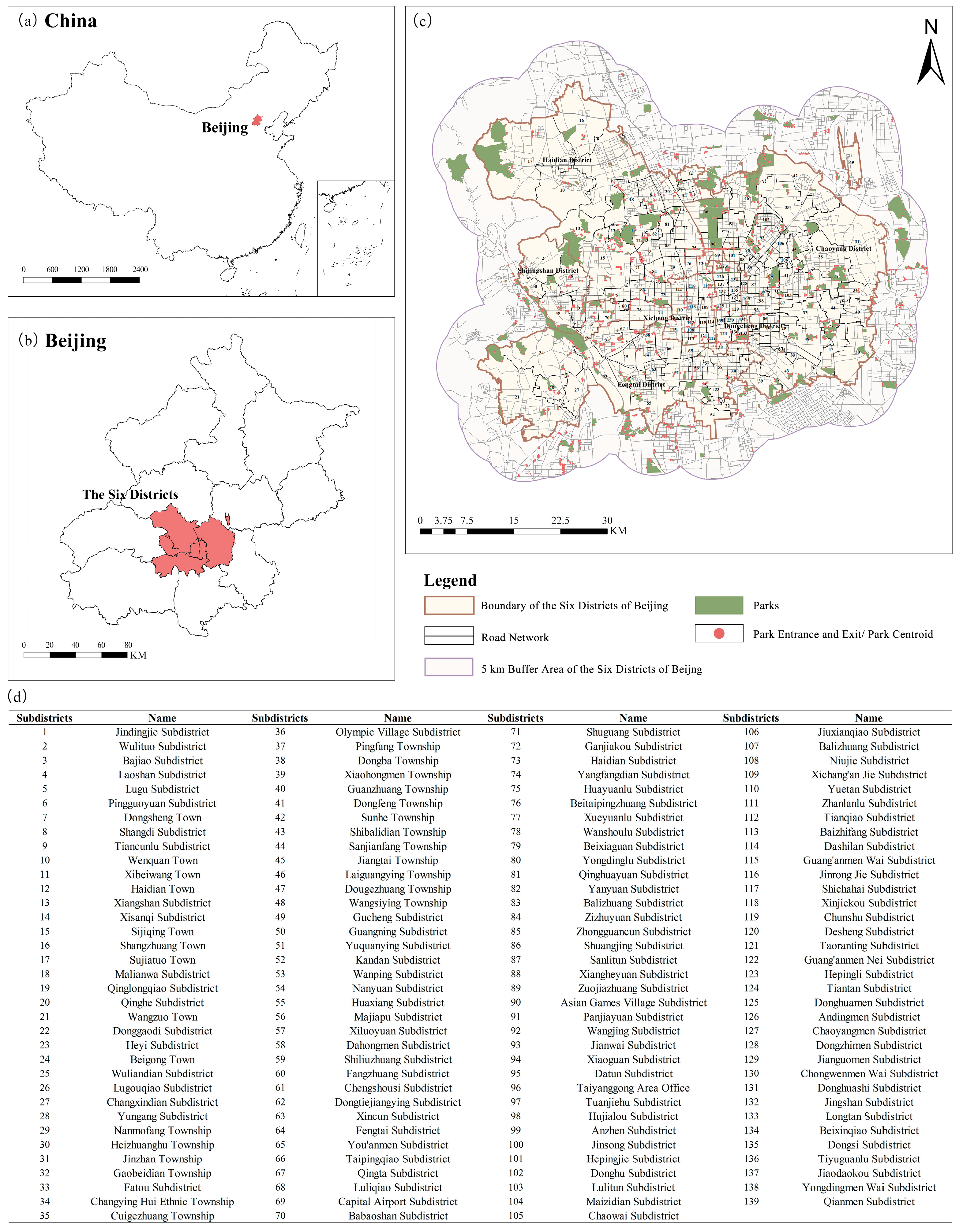
This study focuses on the six central districts of Beijing (Dongcheng, Xicheng, Chaoyang, Haidian, Fengtai, and Shijingshan) as the research area (Figure 2), covering a total area of 1378 km2 and encompassing 139 subdistricts. As the core built-up area of Beijing, this region is characterized by high population density, active socioeconomic activities, and prominent imbalances between the supply and demand of public resources, making it a typical case for studying equity in urban park green spaces in a megacity context [47,50]. Considering residents’ travel behaviors, a 5 km buffer was added beyond the study area boundary, and all parks within this extended area were included in the analysis to ensure accurate calculations of green space accessibility for boundary regions.

2.2. Research Data

The data used in this study primarily include green space, road, population and economic data.
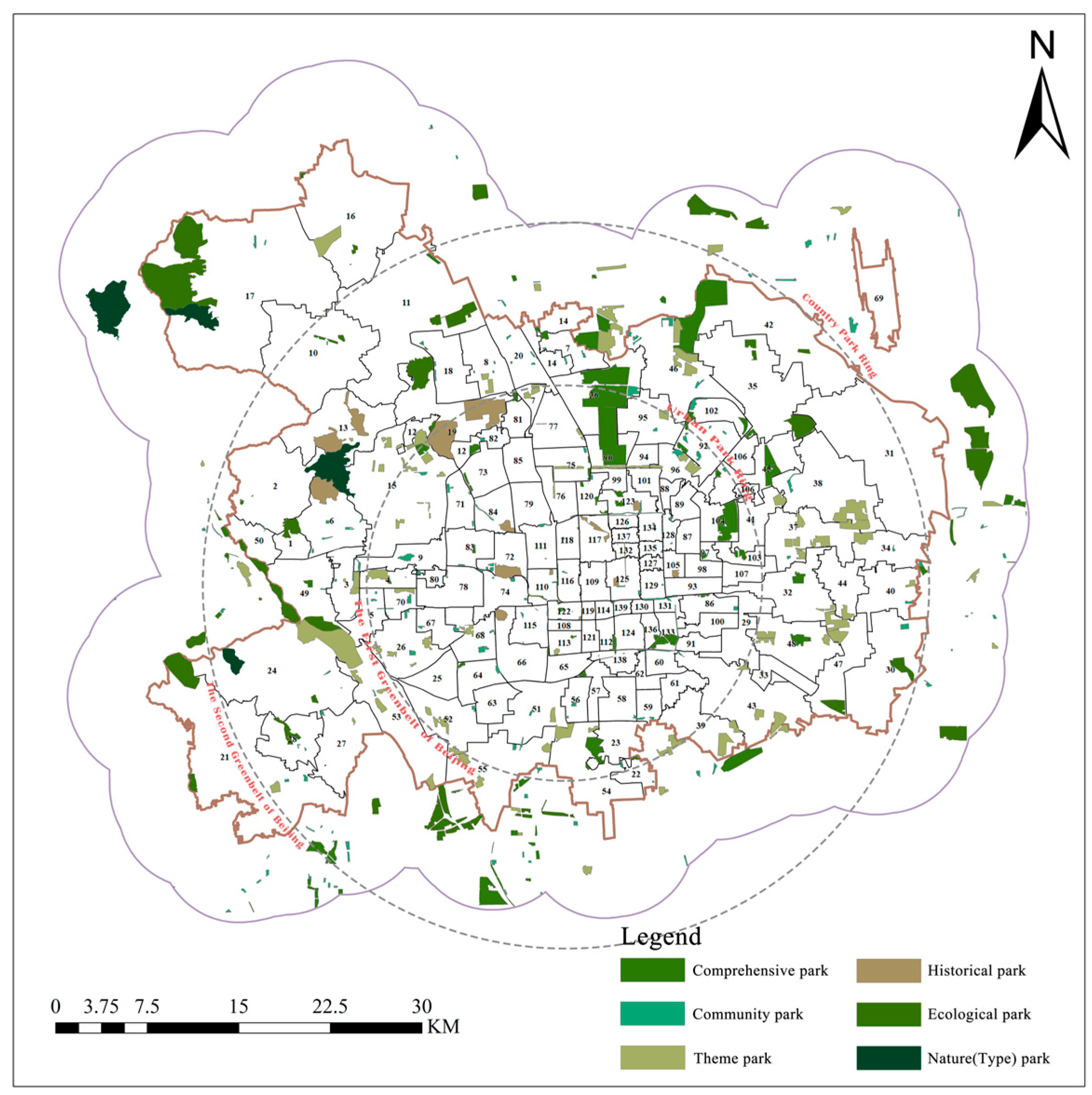
(1) Green space data: Following official standards, such as the Beijing Municipal Measures for the Classification and Grading Management of Parks [51,52,53], and considering environmental equity, the study focused on public green spaces that have a significant and meaningful impact on social equity. Small parks with single functions were excluded. Although small parks play a complementary role at the walking scale, their limited service radius and the lag in data updates make it difficult to achieve precise and consistent statistical coverage across an entire megacity. This study aims to examine the distributional characteristics of public resources that generate substantial ecological benefits and social impacts. Therefore, the analysis focuses on urban park green spaces defined in the planning standards of Beijing as parks that provide comprehensive recreational functions. Based on statistics from the Beijing Municipal Forestry and Parks Bureau in 2024 [54], a total of 457 urban parks within the study area and its buffer zone were selected as the research objects (Figure 3, Table 1). These included 82 comprehensive parks, 19 historical parks, 208 community parks, 40 ecological parks, 103 theme parks, and 5 nature (type) parks. The study delineates park boundaries using high-resolution satellite imagery with a spatial resolution finer than 0.5 m, following relevant methodological guidelines [55], the study identifies 1726 park entrances across parks of different sizes to accurately simulate residents’ access routes. The identification and validation process includes three steps. First, the study uses Python-based web crawling techniques to extract park entrance point-of-interest (POI) data from the Baidu Map API (https://lbsyun.baidu.com, accessed on 25 April 2025) as initial seed points. Second, the study overlays the POI data onto high-resolution satellite imagery and verifies their spatial accuracy through visual interpretation. The verification process checks for physical features such as paved plazas or entrance structures. Third, the study conducts ground-level validation using street-view maps. This step removes service-only gates and closed fence boundaries that are not accessible to the public. These procedures ensure consistency between the geographic location of entrances and their actual social usability, thereby improving the reliability of the accessibility analysis.
(2) Road data: Road network data were obtained from Open Street Map (OSM) (https://www.openstreetmap.org, accessed on 25 April 2025). Using ArcGIS (version 10.8) network analysis tools and referencing previous studies [56], a topologically accurate road network was constructed based on park entrances, road infrastructure, and traffic regulations to calculate actual travel distances.
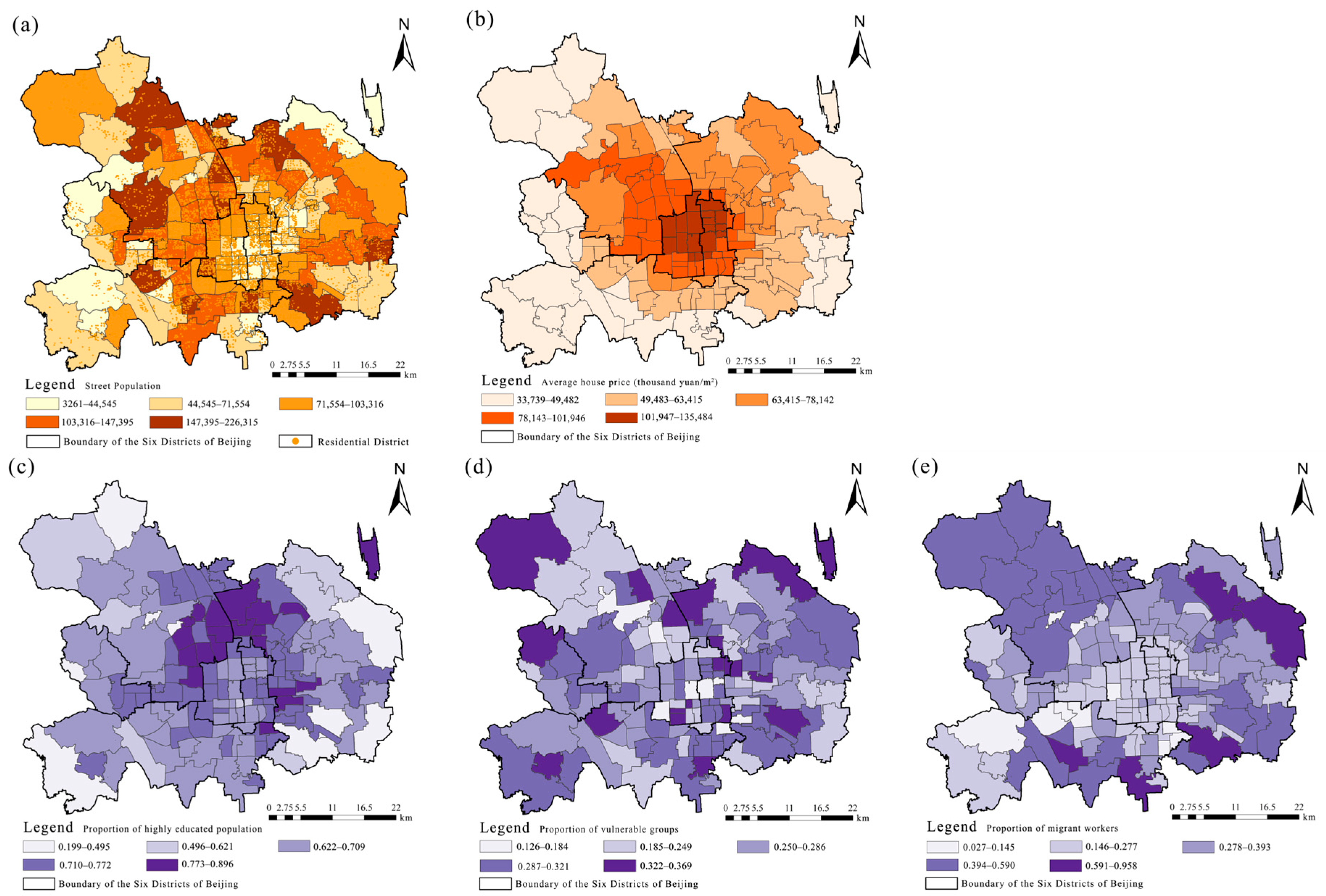
(3) Population and economic data: Population size represents potential demand for green spaces and is closely related to green space equity [57]. To improve spatial precision, residential communities were used as the basic analysis unit. Geographic coordinates, number of households, and average housing transaction prices for 8113 residential communities in the study area were collected using Python web-scraping techniques from Lianjia (https://bj.lianjia.com, accessed on 25 April 2025). Combined with the average household size from the Seventh National Population Census of China (2.31 persons per household) [58], the population size of each community was estimated (Figure 4a). It should be noted that household-based population estimation methods typically assume a stable household size across different communities. However, actual urban communities exhibit variations in age structures, tenancy ratios, and household types, which may introduce estimation biases. Therefore, this study conducts analysis at the subdistrict scale to mitigate the potential errors caused by structural differences at the individual community level. Housing prices reflect the market-based, uneven distribution of residential space and map the socioeconomic characteristics of different social groups [59]. Therefore, housing prices were used as a key proxy for residents’ economic status and classified into five levels to represent different income groups (Figure 4b). Regarding the validity of housing prices as a proxy for socioeconomic status (SES), this study considers housing prices to be a practical and widely used indicator in the context of Chinese megacities. Although SES is inherently multidimensional, housing prices are strongly associated with capital accumulation, public service accessibility, and residential stratification in urban China. Previous studies have frequently used housing price as an effective proxy to reflect socioeconomic differentiation at the neighborhood scale. Nevertheless, this approach also has recognized limitations. In cities with large rental populations or complex household structures, housing prices may not fully capture the actual socioeconomic characteristics of residents. To mitigate potential biases associated with rental mobility and policy-related distortions (such as school-district housing), this study uses the average listing price derived from multiple residential communities within each subdistrict rather than relying on single-point observations. The implications and limitations of using housing prices as a socioeconomic proxy are further discussed in the Section 4. Additionally, based on subdistrict-level data from the Seventh National Population Census of China, the proportions of highly educated residents (high school and above), vulnerable groups (children aged 0–14 and seniors aged 65 and above), and migrant workers were calculated for each subdistrict (Figure 4c–e). These indicators are widely used to assess disparities in resource access among different social groups [54,60].

2.3. Research Methods

2.3.1. Definition of Travel Distance Thresholds

Transportation modes and their associated time costs are fundamental to achieving environmental justice. As low-cost and high-frequency green travel options, walking and cycling are the most universal ways for megacity residents to access urban park green spaces. These modes are critical for ensuring both horizontal and vertical equity among disadvantaged groups. Consequently, this study focuses on these two modes and defines parameters based on national standards, including the Standard for urban residential area planning and design (GB 50180–2018) [61], the Standard for Urban Pedestrian and Bicycle Transport System Planning (GB/T 51439–2021) [62], and the Standard for urban comprehensive transport system planning (GB/T 51328–2018) [63].
We established a 1.5 km walking service radius, corresponding to a 15 min walking circle. This value accounts for the average adult walking speed (approximately 4 km/h) and the marginal psychological effects of park access, representing a widely recognized comfortable walking limit for community life. Additionally, drawing on non-motorized transport service standards and Beijing’s daily commuting characteristics, we set a 5 km cycling service radius to encompass the maximum willingness threshold for medium-distance travel (Table 2).

2.3.2. Accessibility Assessment Based on the Gaussian Two-Step Floating Catchment Area (G2SFCA) Method

This study employs the Gaussian Two-Step Floating Catchment Area (G2SFCA) method to measure the spatial accessibility of urban park green spaces. By incorporating a Gaussian decay function, the model effectively simulates the non-linear decrease in residents’ visiting inclination as spatial distance increases. The Two-Step Floating Catchment Area (2SFCA) method is a classical approach for evaluating spatial accessibility by simultaneously considering both the supply of green spaces and the population demand. Its core logic is that, within a specified travel threshold, the accessibility of a given area is jointly determined by the service capacity of the green spaces it can access and the number of people within the service catchment. By accounting for both supply and demand, the 2SFCA method provides a comprehensive and straightforward way to calculate the accessibility of urban park green spaces [64,65]. Among its various extensions, the Gaussian function is the most commonly used to establish spatial decay rules. In this study, we improved the conventional Gaussian 2SFCA by refining data sources and origin–destination (OD) cost calculation rules. To enhance calculation accuracy, actual travel distances along the road network from residential areas to urban park green spaces were used instead of simple Euclidean distances as the search radius. The procedure is as follows:
Step 1: Centered at the supply point j , determine the search threshold j with a radius of d 0 . Identify the set of demand points k falling within this threshold and calculate the supply–demand ratio R j for the supply point j [66]:
R j = S j j { d k j d 0 } G d k j , d 0 P k
G d k j , d 0 = e 1 2 d k j d 0 2 e 1 2 1 e 1 2 0     , d k j > d 0 , d k j d 0
In Equations (1) and (2), S j represents the total supply capacity of point j , i.e., the park area; R j denotes the supply–demand ratio of point j , indicating the service capacity of park green spaces; d kj is the distance between demand point k and supply point j , expressed as path length; P k represents the scale of demand point k , measured by the population within the distance threshold   ( d kj     d 0 ) ; G d kj , d 0 is the distance decay function accounting for spatial friction effects.
In this model, d 0 represents the travel distance threshold defined previously. This value is applied strictly as the maximum search radius for the Gaussian decay function, serving as the definitive cut-off value for the interaction between spatial supply and demand. During the calculation process, the service potential of a park is only included in the accessibility score if the path distance between the park and the community falls within this threshold. Once the distance exceeds this limit, the spatial weight drops to zero. This approach effectively simulates the physical constraints and willingness thresholds of residents under specific travel modes.
Step 2: Establish supply points j within the search radius d 0 of each demand point i , while applying Gaussian decay. Sum the supply–demand ratios R j of all park green spaces j to obtain accessibility [67]:
A i = j { d i j d 0 } G d i j , d 0 R j
In Equation (3): A i represents the accessibility of park green spaces for demand point i , indicating the per capita availability of green spaces within the service radius. Higher values indicate better accessibility. Other indicators retain the same meanings as in Equation (1).
The Gaussian decay function G d kj , d 0 simulates the spatial decay characteristics of residents’ perception of park services. This study sets the decay bandwidth (threshold distance d 0 ) to 1.5 km for walking and 5 km for cycling. The decay parameter σ interacts with d 0 and is calibrated using formula σ = d 0 2 / ln ( 0.01 ) . This configuration ensures that weights decrease non-linearly and smoothly as distance increases, precisely reaching zero at d 0 . This interaction effectively eliminates the “edge effects” inherent in traditional 2SFCA models, aligning the accessibility curve more closely with actual travel psychology.
To verify the sensitivity of the accessibility model to distance threshold assumptions, we performed a robustness test. We compared the baseline scenario (1.5 km walking, 5 km cycling) with a reduced threshold scenario (1.0 km walking, 4.0 km cycling). The results show strong consistency between the accessibility scores of the two models (Walking: Pearson’s R 2 = 0.899 > 0.85, p < 0.001; Cycling: Pearson’s R 2 = 0.984 > 0.85, p < 0.001). These findings indicate that while changes in the search radius cause fluctuations in absolute accessibility values, the relative spatial hierarchy remains highly stable. Thus, the core research findings are not altered by minor adjustments to the search radius. This demonstrates that the parameters set in this study possess excellent robustness and can reliably reflect the spatial equity patterns of urban park green spaces.

2.3.3. Evaluation Methods for Social Equity of Urban Park Green Spaces

To evaluate social equity, the total accessible area of urban park green space and the corresponding accessibility index for each residential community were first classified into five levels using the natural breaks (Jenks) method, with Level I representing the lowest and Level V representing the highest access.
At the level of quantitative equity, the population characteristics of each subdistrict—including highly educated residents, vulnerable groups, and migrant workers—were associated with the green space availability levels. Boxplots were used to visualize these quantitative relationships. Additionally, the relationship between community economic status and accessibility indicators, such as shortest travel distance, accessibility index, and reachable green space area, was examined.
At the level of spatial equity, bivariate spatial autocorrelation (Bivariate Moran’s I) was employed to analyze the spatial clustering between different social groups and urban park green space availability or accessibility. To further identify the matching characteristics between the two variables, this study introduces Local Indicators of Spatial Association (LISA) analysis. The LISA statistic categorizes the study area into four statistically significant cluster modes. Local Indicators of Spatial Association (LISA) cluster maps were used to identify four types of spatial relationships: high–high (HH, overlapping advantage), low–low (LL, overlapping disadvantage), high–low (HL, insufficient resources), and low–high (LH, insufficient population demand). This approach reveals spatial mismatches and inequities in green space distribution [55].
The global bivariate spatial correlation index was calculated as follows [68]:
I = n i = 1 n j = 1 n w i j ( Y i Y ¯ ) ( Y j Y ¯ ) i = 1 n j = 1 n w i j i = 1 n ( Y i Y ¯ ) 2
I represents the global bivariate spatial correlation index; n is the total number of spatial units (in this study, the total number of streets); w ij denotes the spatial weight matrix; Y i and Y j are the values of the study variables for the i and j spatial units in the study area, respectively; and Y is the mean value of the study variable across all spatial units within the core area.
The global Moran’s I ranges from −1 to 1. A Moran’s I value of greater than 0 indicates a positive spatial correlation between urban park green space accessibility and income levels. In this case, spatial units with high (or low) values are surrounded by units with similarly high (or low) values. Larger Moran’s I values reflect stronger clustering, and a significance level of p ≤ 0.05 indicates highly significant clustering. Conversely, a Moran’s I value of less than 0 indicates a negative spatial correlation, meaning that high-value units are adjacent to low-value units, and vice versa. A Moran’s I value of 0 indicates no spatial correlation, suggesting a random spatial distribution without spatial autocorrelation.
This study constructs a spatial weight matrix using the first-order Queen contiguity criterion to capture spatial spillover effects among community units. Under this criterion, the spatial weight w ij is set to 1 if two spatial units share a common boundary or vertex; otherwise, it is 0. To mitigate edge effects, we employed buffer analysis. The calculation incorporates all urban parks within a 5 km buffer outside the study area boundary. This approach ensures that communities near the boundary can accurately access service resources within their potential reach, thereby avoiding the underestimation of accessibility caused by the artificial truncation of the study area.

3. Results

3.1. Spatial Distribution Characteristics of Urban Park Green Spaces

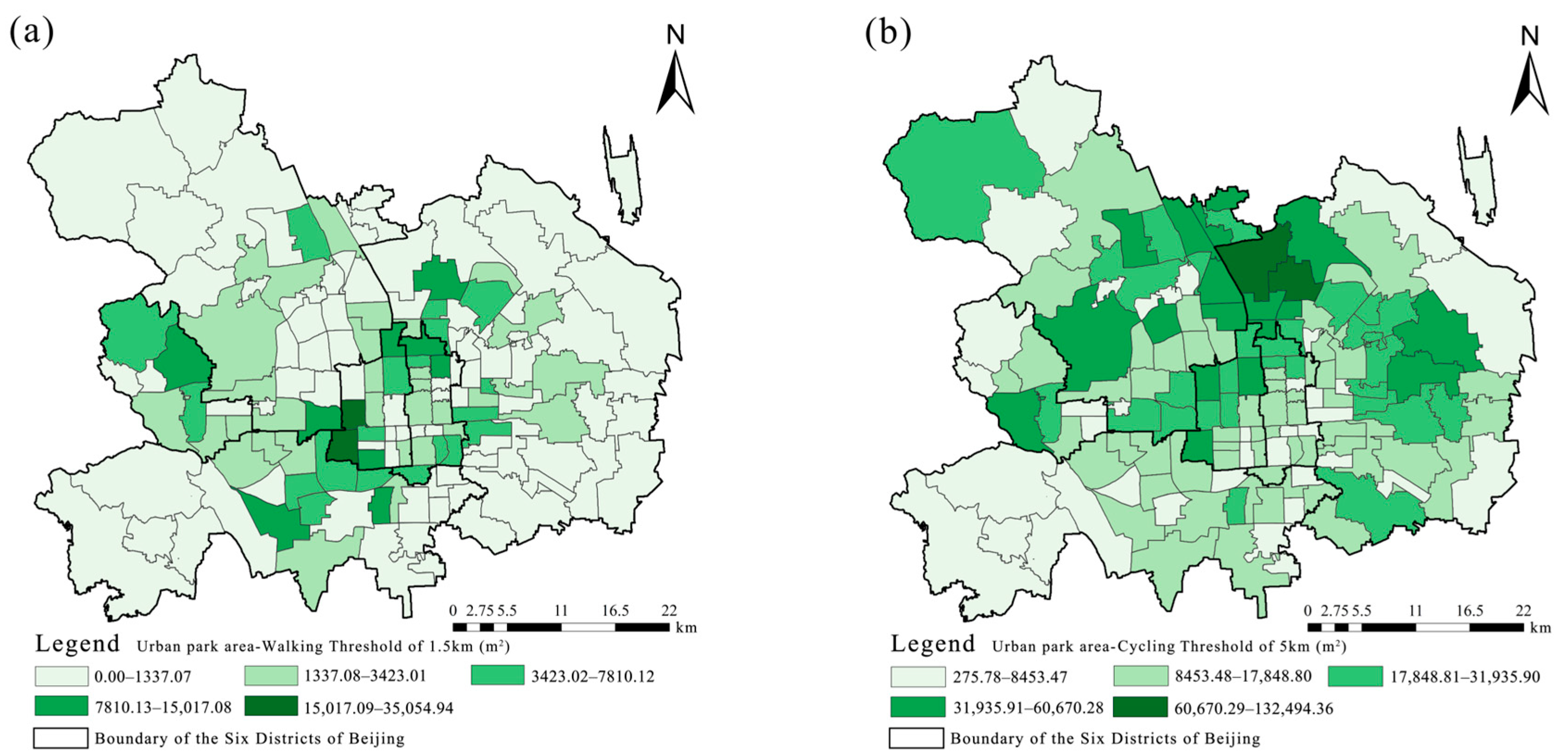
The supply of urban park green spaces in Beijing’s six central districts exhibits significant spatial inequality (Figure 5). Under a 1.5 km walking threshold, residential communities in Dongcheng, Xicheng, Shijingshan, and Fengtai districts generally have higher total accessible park areas, with Xicheng showing the most concentrated access. Subdistricts located along the First Greenbelt and Second Greenbelt also demonstrate relatively high accessible areas, reflecting a spatial pattern characterized by advantages in central districts and higher values along greenbelt corridors. Under a 5 km cycling threshold, the spatial pattern shifts to a “north–south gradient,” with high-value areas concentrated in Chaoyang District, home to the Olympic Forest Park, and Haidian District, which includes the Sanshan–Wuyuan area.
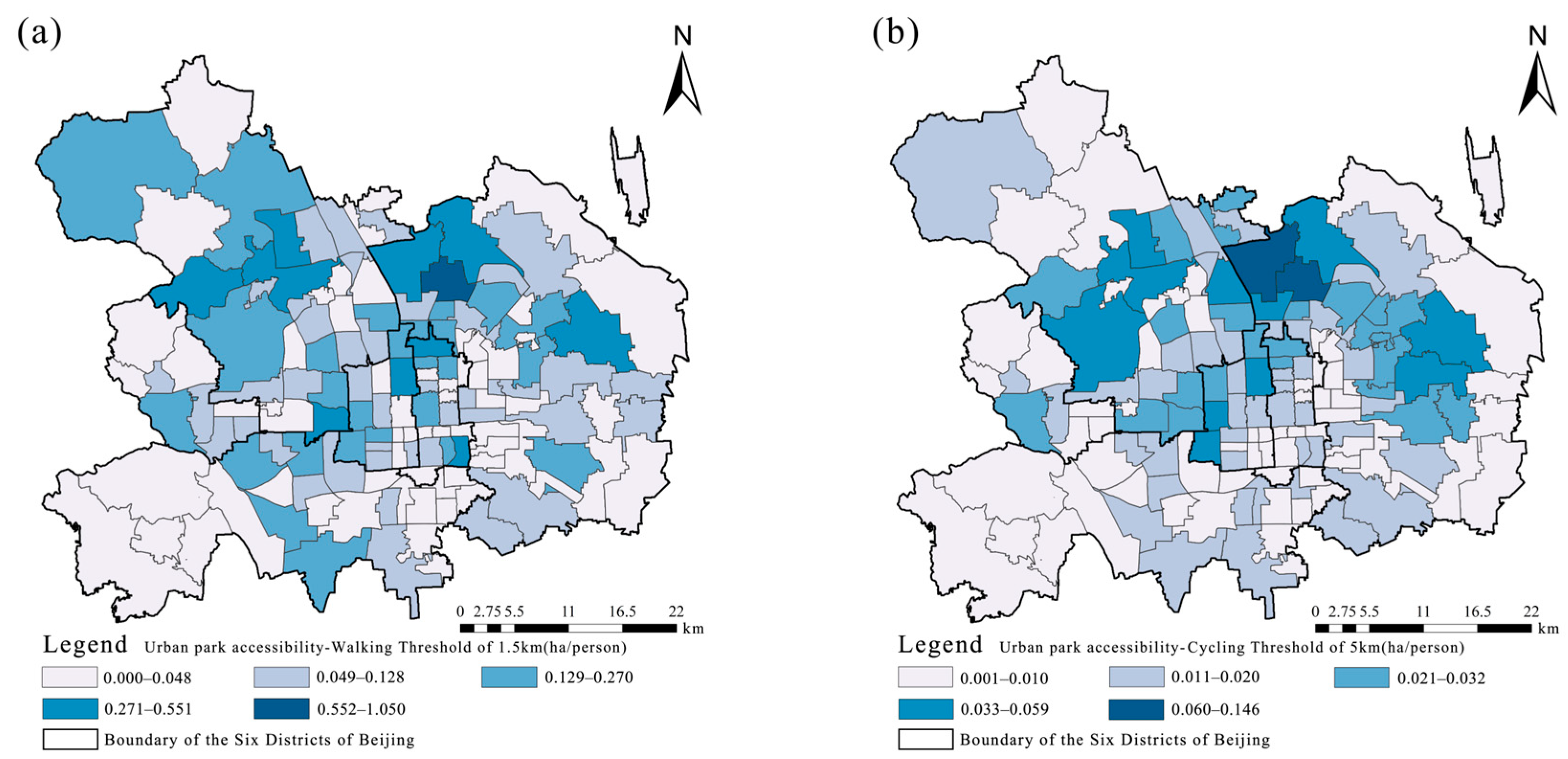
Examining the spatial distribution of accessibility (Figure 6), high-accessibility areas at the walking scale are primarily distributed along the First and Second Greenbelt corridors, with the First Greenbelt being particularly prominent. Additionally, subdistricts in core areas such as Shichahai and Hepingli show accessibility peaks due to the presence of historic parks. These high-accessibility zones closely coincide with the distribution of large comprehensive parks and ecological parks. At the cycling scale, areas of high accessibility further concentrate in the northern parts of Chaoyang and Haidian districts, particularly in subdistricts such as Olympic Village, Datun, Xiangshan, and Qinglongqiao, forming extensive service advantage zones. The resulting north–south disparity is more pronounced.

3.2. Social Equity Analysis of Urban Park Green Space Area

Bivariate spatial autocorrelation and boxplot analyses reveal significant spatial mismatches between the supply of urban park green space and the distribution of social groups.
(1)
Socioeconomic status
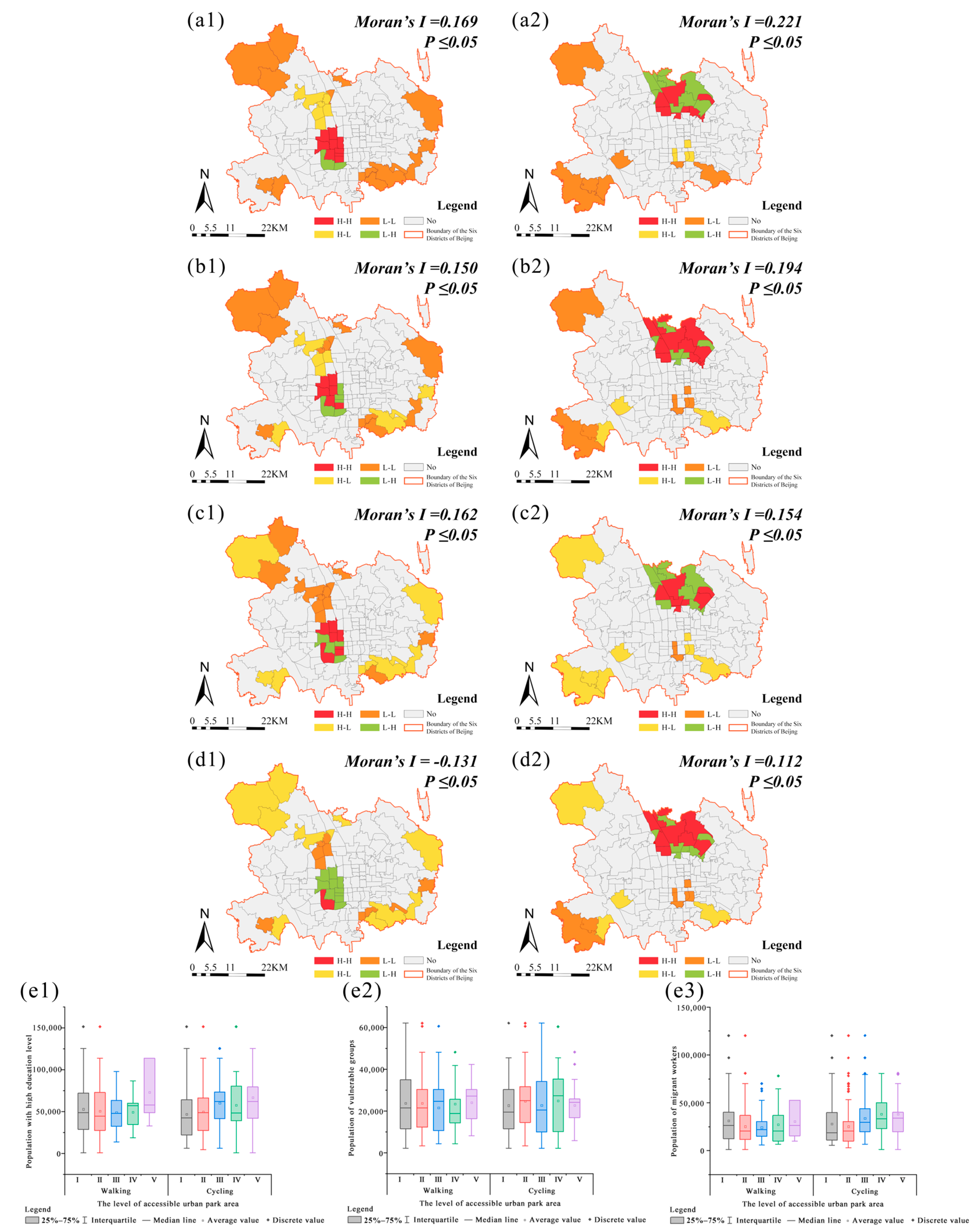
Areas with higher housing prices show a positive spatial correlation with higher levels of park provision. At the walking threshold (Figure 7(a1)), core subdistricts in Xicheng display typical “high housing price–high green space” (HH) clusters, while southern Fengtai (Yungang and Changxindian subdistricts) and the northwestern edge of Haidian present “low housing price–low green space” (LL) clusters. At the cycling threshold (Figure 7(a2)), new HH clusters emerge in high-price areas such as Xueyuanlu and Huayuanlu subdistricts in Haidian, and Aoyuncun and Donghu subdistricts in Chaoyang, whereas LL clusters remain concentrated in peripheral and southern areas. Overall, the central city and Olympic functional zones are characterized by HH clusters, while LL clusters are concentrated in peripheral and southern subdistricts, with some areas exhibiting mismatches such as “low housing price–high green space” (LH) and “high housing price–low green space” (HL).
(2)
Educational attainment
Populations with higher educational attainment also tend to cluster in areas with greater green space provision. At the walking threshold (Figure 7(b1)), Xicheng’s core subdistricts form typical “high education–high green space” (HH) clusters. By contrast, the university-concentrated area of Zhongguancun in Haidian exhibits “high education–low green space” (HL), while peripheral subdistricts and southern Fengtai display “low education–low green space” (LL). At the cycling threshold (Figure 7(b2)), a new HH cluster emerges along the Haidian–Chaoyang boundary, while the northwestern edge of Haidian and the southwestern part of Fengtai remain LL zones. Notably, some northern boundary areas exhibit both HH and “low education–high green space” (LH), indicating that less-educated populations gain better access to green space within the cycling threshold. Shibalidian subdistrict, however, shows HL characteristics, highlighting imbalances in peripheral areas.
Boxplot analysis further demonstrates the relationship between education level and green space provision (Figure 7(e1)). At the walking threshold, the median increases with higher green space levels, indicating that more educated populations tend to cluster in resource-rich areas. However, mean values differ little across Levels I–IV, with a sharp rise only at Level V. The box lengths show a “shrink-then-expand” pattern, suggesting population concentration at mid-levels and greater variability in the highest green space areas. At the cycling threshold, both median and mean values increase steadily across levels, although Level IV exhibits an unexpected decline.
(3)
Vulnerable groups and migrant workers
Both vulnerable groups and migrant workers are negatively associated with green space provision, particularly in peripheral areas of the study region, forming “high population–low green space” patterns. At the walking threshold, Taipingqiao and Changxindian in Fengtai, Shibalidian in Chaoyang, and Sujiatuo in Haidian represent typical cases where large concentrations of these groups coincide with insufficient park provision. At the cycling threshold, accessibility improves in some northern areas due to proximity to large parks, yet inequities remain pronounced in the south.
For vulnerable groups, walking-scale analysis (Figure 7(c1)) shows Xicheng with both “high vulnerability–high green space” (HH) and “low vulnerability–high green space” (LH), reflecting overall better provision but significant internal differences. Northwestern Haidian and southern Fengtai predominantly display “high vulnerability–low green space” (HL) or LL patterns. At the cycling threshold (Figure 7(c2)), HH clusters emerge in northern areas and around the central axis, improving access for vulnerable groups. However, southeastern Chaoyang, southwestern Fengtai, and parts of Dongcheng remain in HL or LL states. Boxplot results (Figure 7(e2)) indicate that vulnerable groups shares increase with greater green space availability, though anomalies appear at Level IV. At the cycling threshold, mean values and variance are higher at top levels, suggesting vulnerable groups cluster in areas of very high green space provision, while mid-level areas show more variability.
For migrant workers, walking-scale analysis (Figure 7(d1)) reveals “high population–low green space” (HL) in northwestern Haidian (e.g., Sujiatuo, Dongsheng, Qinglongqiao subdistricts), where migrant concentrations face resource shortages. In contrast, core functional zones like Zhongguancun, Tsinghua, and Yanyuan are mostly LL, while much of Xicheng appears as LH. Southern Fengtai and eastern and southern Chaoyang are dominated by HL or LL, again indicating spatial differences. At the cycling threshold (Figure 7(d2)), northern core areas and the Haidian–Chaoyang boundary show extensive HH and LH patterns, meaning migrants gain better green space access with larger travel radii. Nonetheless, parts of Dongcheng and southwestern Fengtai (e.g., Changxindian, Wangzuo subdistricts) remain HL or LL. Boxplot analysis of migrant workers and green space availability (Figure 7(e3)) shows that at the walking threshold, they are more concentrated in low-access areas, while high-access areas display greater variability. At the cycling threshold, both median and mean values rise with higher green space levels, with population distributions becoming more balanced.
To verify whether the inter-group differences shown in the boxplots are statistically significant, this study performed the Kruskal–Wallis test on the accessible urban park green space areas across different social groups. The results (Table 3) indicate that the differences in accessible urban green space areas are significant across all social dimensions at both walking and cycling scales ( p < 0.001). These findings suggest that the observed phenomena are not randomly distributed. Instead, they exhibit distinct characteristics of socio-spatial differentiation.

3.3. Social Equity Analysis of Urban Park Green Space Accessibility

Accessibility to urban park green spaces shows more complex variations across different social groups.
(1)
Socioeconomic status
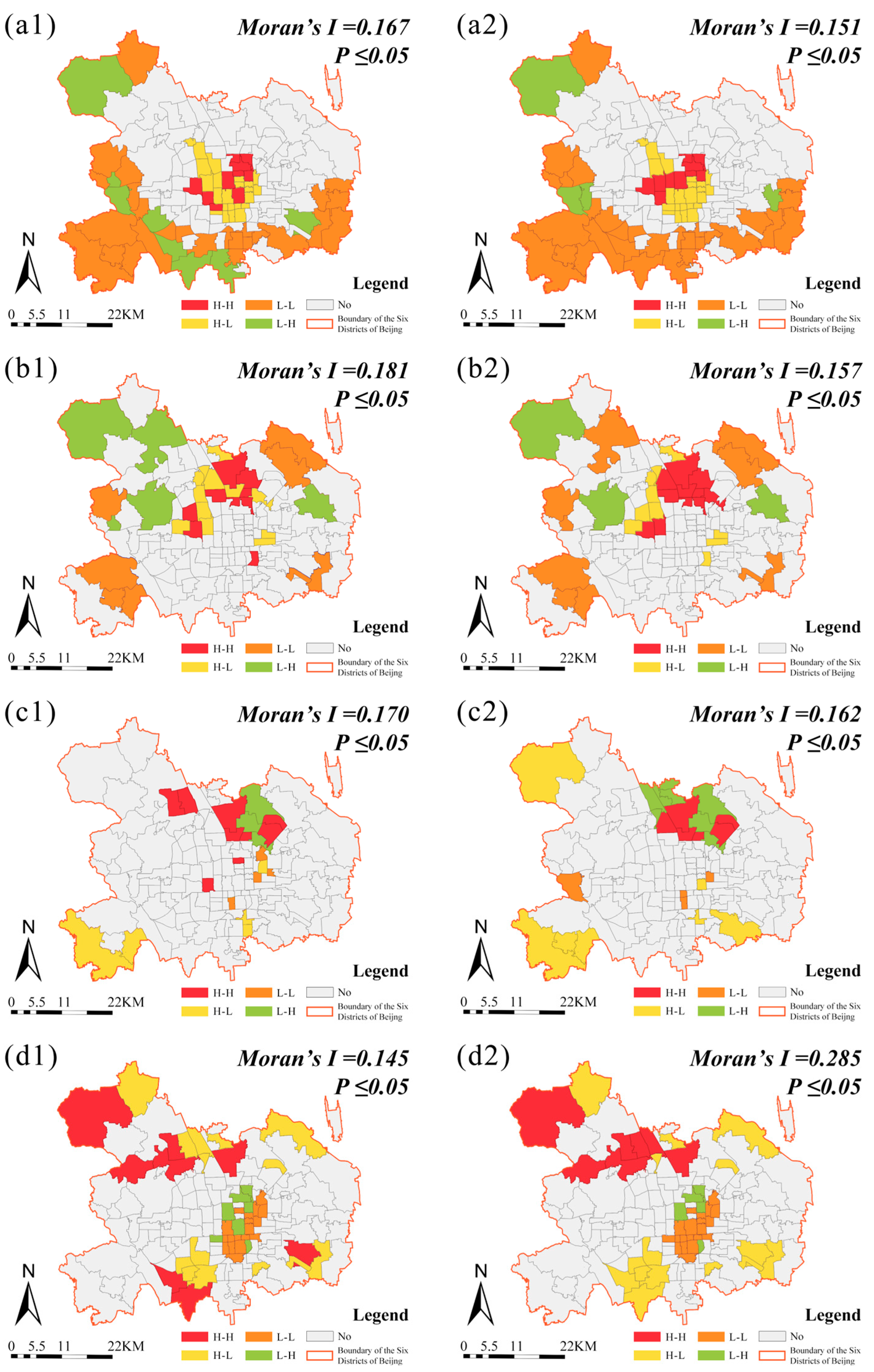
The coupling of accessibility and socioeconomic status exhibits a dual “core–periphery” pattern. Within the central districts (Dongcheng and Xicheng), polarization is evident. Some high-housing-price subdistricts show a “high price–low accessibility” (HL) clustering. In peripheral areas, subdistricts in Shijingshan, Fengtai, and southern Chaoyang generally display a “low price–low accessibility” (LL) clustering.
Table 4 shows that the proportions of communities with access to urban park green spaces within 0.5 km walking, 1.5 km walking, and 5 km cycling distances are 14.34%, 67.61%, and 99.05%, respectively. This indicates that, overall, residential communities in the study area have relatively good accessibility to urban park green spaces. However, significant disparities exist in spatial distribution. At the walking scale (Figure 8(a1)), the northern Dongcheng and western Xicheng subdistricts are characterized by “high socioeconomic status–high green space” (HH), while the southern Dongcheng and eastern Xicheng subdistricts show HL clustering. In northwestern Haidian, Sujiatuo Town exhibits “low socioeconomic status–high green space” (LH), while Shangzhuang Town displays LL. The southern and western parts of the six central districts (Shijingshan, Fengtai, and southern Chaoyang) are dominated by LL, indicating a dual disadvantage in both economy and accessibility. At the cycling scale (Figure 8(a2)), Dongcheng and Xicheng retain their existing patterns, while many southern subdistricts show HL clustering, suggesting that high socioeconomic subdistricts in the core still lack sufficient green space accessibility even within cycling range. Northwestern Haidian maintains its walking-scale outcomes, whereas Shijingshan, Fengtai, and southern Chaoyang continue to be dominated by LL.
(2)
Educational attainment
Populations with high educational levels cluster with high accessibility in subdistricts such as Tsinghua Garden, Zhongguancun, and Xueyuan Road in Haidian, as well as Olympic Village in Chaoyang, forming strong HH clusters that reflect the preference and concentration of knowledge-based groups for high-quality environments.
At the walking scale (Figure 8(b1)), areas around Tsinghua Garden, Zhongguancun, Xueyuan Road, and Olympic Forest Park are HH clusters. Ganjiakou, Yangfangdian, Olympic Village, and Datun subdistricts also exhibit HH clustering. Subdistricts such as Dongsheng, Beixiaguan, and Wanshoulu are characterized as HL, while outer areas such as Sujiatuo, Xibeiwang, and Dongba show LH. Many southeastern and southwestern edge subdistricts fall into the LL category. At the cycling scale (Figure 8(b2)), the HH pattern in the core intensifies, with Olympic Village shifting from HL to HH, and Xibeiwang changing from LH to LL. This pattern indicates increased accessibility at the cycling scale in areas near large green spaces, while mismatches or deficits persist in peripheral areas.
(3)
Vulnerable groups and migrant workers
The disadvantage patterns of these two groups are largely consistent with the area-based analysis. Peripheral subdistricts in the six central districts—especially Changxindian and Wangzuo in Fengtai, as well as urban–rural fringes in Chaoyang and Haidian—show the most severe HL clustering, reflecting high population but low accessibility. Even at the cycling scale, improvements remain limited.
For vulnerable groups, at the walking scale (Figure 8(c1)), Olympic Village, Asian Games Village, Wangjing, and Yuetan in Xicheng show HH clustering. Neighboring subdistricts such as Laiguangying, Datun, and Taiyanggong show LH, while Changxindian and Wangzuo are HL, and Tianqiao is LL. At the cycling scale (Figure 8(c2)), the overall pattern remains consistent with walking outcomes, though expanded accessibility alleviates mismatches in some areas. Qinghe, Xisanqi, and Dongsheng in Haidian shift to LH, but northwestern Haidian, western Fengtai, and southern Chaoyang remain HL.
For migrant workers, at the walking scale (Figure 8(d1)), the northern and southern edges of the six central districts stand out, displaying both HH and HL clustering. This reveals disparities in green space accessibility within migrant worker-concentrated areas. In contrast, core subdistricts of Dongcheng and Xicheng largely show LL or HL, with limited spatial overlap between migrant workers and green space access. At the cycling scale (Figure 8(d2)), several northern subdistricts shift from HL to HH, suggesting that cycling mitigates accessibility deficits in certain migrant worker communities. However, Kandan and Huaxiang in Fengtai remain HL.

3.4. Spatial Coupling Between Scale Equity and Accessibility Equity

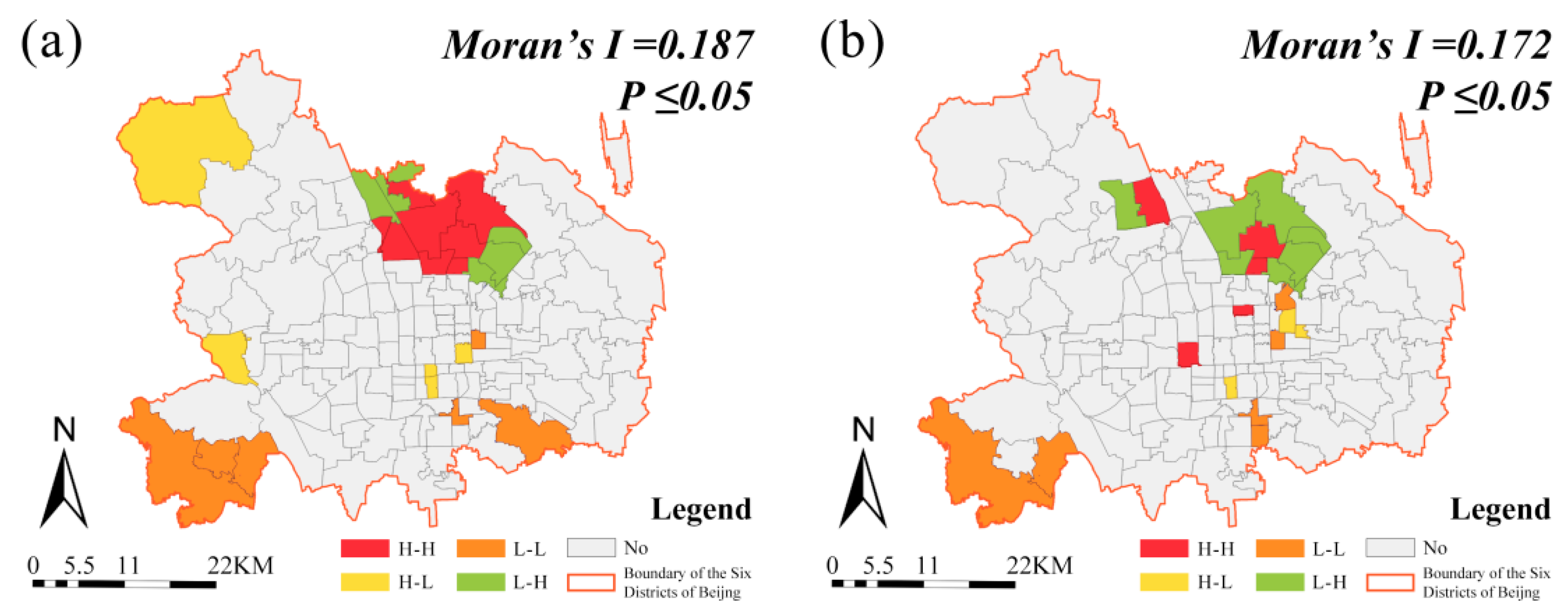
To examine the spatial relationship between scale equity and accessibility equity, this study conducts a bivariate Local Moran’s I analysis under walking (1.5 km) and cycling (5 km) thresholds. This analysis aims to identify the spatial coupling patterns between supply scale and accessibility levels.
At the walking scale (Figure 9a), the spatial patterns of scale and accessibility equity exhibit a coexistence of coupling and mismatch. Certain subdistricts in the core urban area—such as Yuetan in Xicheng, Andingmen in Dongcheng, and Datun in Chaoyang—form HH clusters. In contrast, several northern areas, including Wangjing and Donghu in Chaoyang and Malianwa in Haidian, display LH patterns. Conversely, Sanlitun in Chaoyang and Tianqiao in Xicheng exhibit HL patterns. Along the periphery of the six central districts, particularly in Wangzuo Town and Changxindian subdistrict in Fengtai, LL clusters are concentrated.
At the cycling scale (Figure 9b), the overall spatial pattern remains consistent with the walking results; however, the HH clusters expand northward to include areas such as Xueyuanlu in Haidian and Yayuncun in Chaoyang. Nevertheless, LH and HL mismatches persist, and LL clusters remain primarily in peripheral areas, indicating that structural supply imbalances endure across different travel scales. Overall, while scale equity and accessibility equity are significantly correlated, they are not entirely consistent.

3.5. Relationship Between Community Socioeconomic Status and Accessibility Indicators

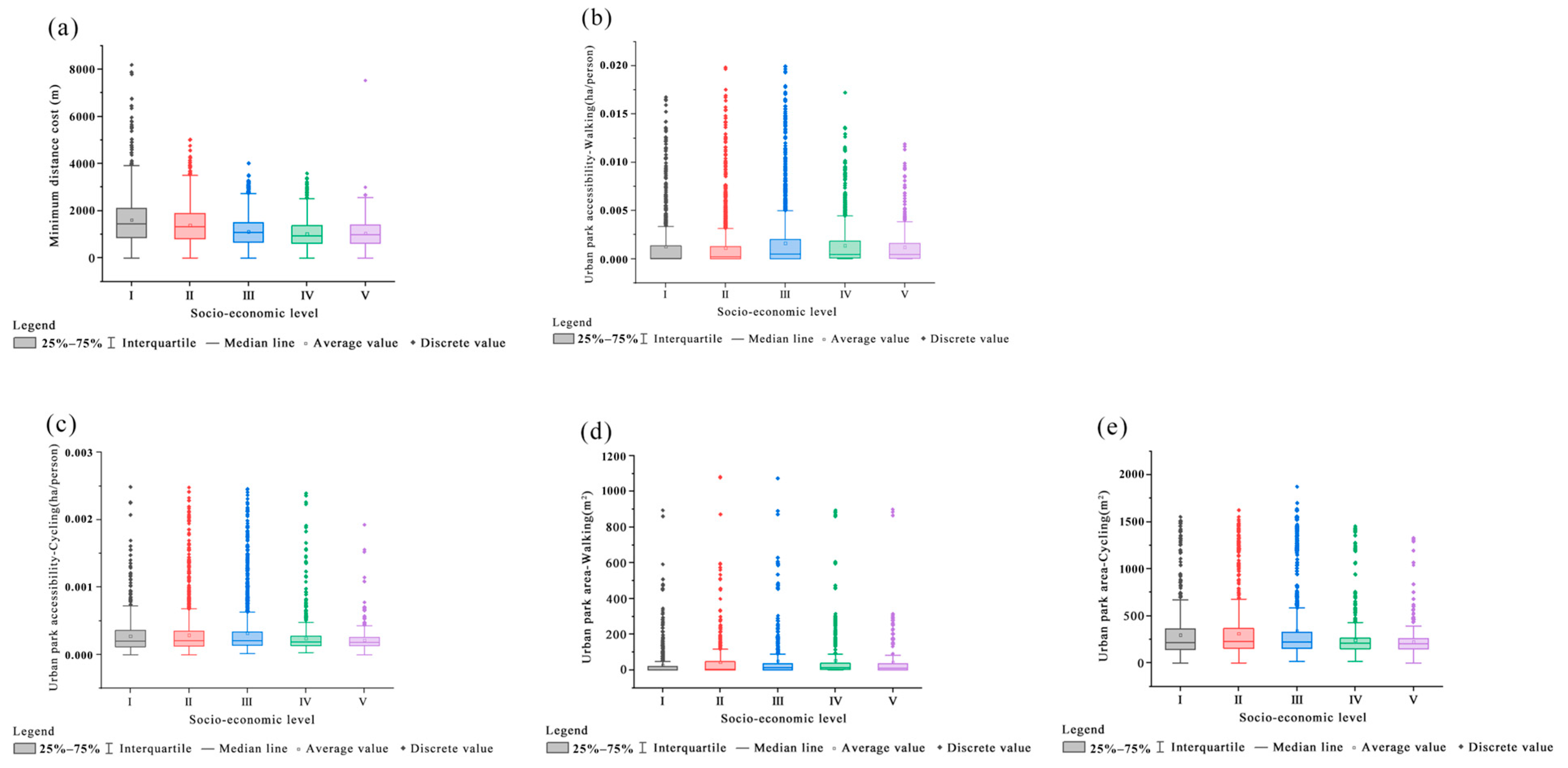
The boxplot analysis (Figure 10) further quantifies the relationship between socioeconomic status and access to urban park green space. The results show that communities with higher socioeconomic status tend to have a shorter average minimum distance to the nearest park. At the walking scale, high-status communities enjoy significantly better park accessibility than low-status communities. However, at the cycling scale, communities with medium socioeconomic status show the greatest accessible urban park area. In contrast, high-status communities located in dense urban cores show relatively limited accessible urban park green space areas. Low-status communities perform worst across all indicators, with wide internal disparities, suggesting that they face more severe and unstable forms of green space deprivation.
The boxplot results (Figure 10a) indicate that the median distance decreases consistently with rising socioeconomic levels, implying that communities with higher housing prices (higher socioeconomic status) are located closer to parks. The box length for socioeconomic levels I and II is significantly larger than for levels III–V, and numerous outliers exist in level I. This suggests that low-income communities (levels I–II) exhibit highly uneven accessibility, with some neighborhoods facing particularly poor access to parks.
Boxplots based on natural breaks in socioeconomic levels and park accessibility thresholds show a generally positive association. At the walking scale (Figure 10b), the median values for levels II–V gradually rise and stabilize at higher levels (middle to high-income communities), indicating that higher socioeconomic communities have overall better access to high-quality parks. Low-income communities (levels I–II) demonstrate low accessibility with large variation, while levels III–V show rising medians and narrowing box lengths, reflecting more balanced green space provision and less internal disparity. At the cycling scale (Figure 10c), the medians for low to middle-income communities (levels I–III) remain relatively stable, while those for higher levels (III–V) show a slight decline. Nonetheless, the boxes tighten and outliers decrease, indicating stable and relatively equitable accessibility in high-status communities, whereas low-status communities still show marked internal disparities.
Boxplots based on natural breaks in socioeconomic levels and accessible urban park area reveal similar trends. At the walking scale (Figure 10d), low-income communities (levels I–II) exhibit the lowest median and mean values, both indicating insufficient green space provision. High-income communities (levels III–V) show slightly reduced accessible area, but the values are tightly clustered, reflecting relatively balanced provision. At the cycling scale (Figure 10e), low-income communities continue to display limited accessible areas and high disparities. Medium-status communities (level III) perform best, while high-status communities (levels IV–V) show more homogeneous but not substantially greater accessible areas.
To verify whether the differences in accessibility indicators across varying community socioeconomic levels are statistically significant, this study performed a Kruskal–Wallis test. The results (Table 5) demonstrate significant disparities in accessibility indicators among communities with different housing price levels at both walking and cycling scales ( p < 0.001). This provides statistical evidence of pronounced social stratification in the distribution of urban park green space resources among groups with different economic statuses.

4. Discussion

This study focuses on the six central districts of Beijing and integrates multi-source data to assess urban park accessibility and equity. The results reveal the spatial patterns of park accessibility and the associated characteristics of social equity in a megacity context. These findings provide scientific evidence to support the equitable allocation of urban park green spaces and the advancement of spatial justice in megacities.

4.1. The Uneven Spatial Distribution of Urban Park Green Spaces Is Rooted in Urban Planning History and Policy Orientation

The mismatched pattern of “central advantage and stronger provision in the north than in the south” reflects the dense distribution of historic landmark parks and large comprehensive parks in the core districts of Beijing. It also demonstrates the positive role of the First Greenbelt in enhancing short-distance accessibility. The identified spatial mismatch may be associated with the historical planning framework of Beijing. Northern areas appear to benefit from the spillover effects of large strategic projects, such as Olympic Forest Park. These projects are associated with high-quality green resources and efficient transport connectivity. In contrast, the core urban area possesses a substantial stock of green space. However, fragmented urban morphology and limited entrance permeability constrain its actual service performance. Southern areas face a dual deficiency in both large-scale greening projects and micro-level infrastructure investment. This structural imbalance may contribute to pronounced environmental injustice.
From the perspective of planning and policy drivers, the First Greenbelt and Second Greenbelt systems are important factors associated with the formation of ring-shaped high-accessibility zones. The First Greenbelt has significantly improved green space service levels in peripheral areas, and its accessibility effect appears evident in the spatial results. In contrast, the service function of the Second Greenbelt has not been fully realized, and several subdistricts still experience insufficient accessibility. This spatial pattern is closely related to the orientation of successive master plans of Beijing, which have prioritized the core functional zones and the northern ecological conservation areas, forming a supply imbalance of “strong in the north, weak in the south” [69]. Similar patterns of uneven distribution have been widely observed in other megacities as well [54,70], suggesting that while large-scale greenbelts can enhance overall ecological services, their role in narrowing group-level usage disparities is limited.
Relying on the First Greenbelt policy, Shijingshan District and Fengtai District have laid out a large number of community parks and ecological parks in the urban–rural fringe areas, forming a continuous walkable space of “urban area–greenbelt–community,” which has effectively improved the short-distance green space accessibility for residents in peripheral areas. This effect echoes domestic research conclusions that “greenbelt policies in megacities can improve the equity of public services in peripheral areas” [71]. However, this pattern differs from the “center-to-periphery” decline of green space distribution observed in cities such as Shanghai and Guangzhou. This contrast may reflect particular characteristics of Beijing’s green space planning framework. At the macro level, the establishment of the First and Second Greenbelts has secured large-scale ecological spaces. At the same time, surrounding real estate development has capitalized on ecological premiums, which may contribute to market-driven green gentrification.
In response to these historically embedded policy disparities, future planning could consider adopting an asymmetric resource allocation strategy characterized by “southern enhancement and northern optimization.” For southern and peripheral areas, the next round of master plan revisions should shift the Second Greenbelt from a single-function “green buffer” to an “ecological-service-performance-oriented” model. Planners may consider guiding large comprehensive parks and strategic green spaces toward southern districts to compensate for historical deficits. Moreover, policymakers should move beyond a supply model dominated by large parks. They should establish a multi-level green space system that integrates large ecological parks, medium-sized comprehensive parks, and small pocket parks. This hierarchical structure may extend green space services beyond macro-scale greenbelts and better serve underserved subdistricts.

4.2. The Spatial Mismatch Between Green Space Resources and Social Groups Reflects the Dual Influence of Market Logic and Social Stratification

Urban park green space resources in the six central districts of Beijing exhibit significant spatial mismatches across different social groups. These mismatches reflect the coexistence of “cumulative advantages” for socially privileged groups and “deprivation” for disadvantaged populations. Some areas also exhibit functional misalignment between population demand and green space supply. Communities with higher housing prices and higher education levels tend to cluster in areas with relatively sufficient green space, whereas vulnerable groups and migrant workers are disproportionately concentrated in subdistricts with insufficient provision, forming a typical pattern of environmental injustice. These findings provide empirical evidence for the theory of “environmental inequality,” which posits that vulnerable groups are more likely to be exposed to adverse environmental conditions [10,72].
First, the relationship between socioeconomic status and green space supply suggests a market-driven logic of “advantage accumulation.” Residents in high-housing-price areas, such as Xicheng District and the Olympic functional zone, benefit from environmental advantages in addition to their economic advantages. This pattern reflects the mutually reinforcing relationship between green space provision and the real estate market [73,74]. However, in high-density core districts such as southern Dongcheng, green space becomes insufficient within cycling thresholds. This result indicates a partial decoupling between economic advantages and green space supply under conditions of land scarcity. Similar patterns have been observed in the central districts of other megacities, such as Manhattan in New York and Huangpu in Shanghai [75].
The localized “high housing price–low accessibility” mismatch in Beijing’s urban core also reflects the limitations of using housing prices as a proxy for socioeconomic status (SES). Housing values cannot fully capture rental populations, informal housing conditions, or wealth heterogeneity within communities. In particular, high-priced school-district housing and historically formed neighborhoods are often influenced by earlier planning constraints. Consequently, asset value may diverge from actual environmental quality. This divergence points toward a complex interplay between market dynamics, historical governance legacies, and long-standing allocation priorities in influencing environmental justice within the urban core.
Second, the relationship between educational attainment and green space supply shows a “dual characteristic.” Districts with a concentration of highly educated populations are generally accompanied by high-quality green spaces, reflecting an “education-environment advantage” effect. This supports the observed agglomeration effect of knowledge-based groups toward high-quality public environments [76]. However, some science-and-technology hubs, such as Zhongguancun, exhibit a “high education–low green space” misalignment. This mismatch could be attributed to historical land-use patterns, where research and industrial functions were predominantly allocated, leaving insufficient space for nearby parks. Similar discrepancies are found in emerging industrial peripheries such as Shibalidian Township. In these areas, a “high education–low accessibility” pattern reflects the asynchronous development between population change and green space provision.
Finally, vulnerable groups and migrant workers commonly experience service deprivation. Southern and peripheral subdistricts, such as Changxindian in Fengtai District and Shibalidian in Chaoyang District, face severe green space shortages at the walking scale. These shortages intensify daily accessibility constraints for older adults and children. Industrial parks and urban villages with high concentrations of migrant workers exhibit similar characteristics. Although cycling access to large-scale parks provides partial relief, inadequate transport infrastructure limits further improvements in equity.
This structural mismatch likely stems from the combined influence of market-driven spatial differentiation, historical land-use patterns, and public policies that lag behind evolving social demands. Future planning should adopt targeted strategies based on different clustering characteristics. For southern LL areas experiencing “double deprivation”, planners could consider prioritizing gap filling. Urban regeneration projects might allocate reclaimed land to pocket parks to ensure a basic level of scale equity. For core-area HL clusters, where green space scale is relatively high but accessibility remains limited, strategies should focus on improving efficiency within existing stock. Planners should implement micro-renewal measures, such as adding park entrances and enhancing community connectivity. These interventions can transform potential area advantages into effective service performance.

4.3. Scale Effects Are Critical for Assessing Green Space Equity

Scale effects significantly influence the relationship between socioeconomic characteristics and green space accessibility. At the walking scale, this relationship exhibits a pronounced dual pattern: “high–high” in the urban core and “low–high” in peripheral areas. Communities with higher housing prices are generally located near existing parks and green spaces, allowing residents to enjoy relatively convenient access within walking distance. However, some high-density neighborhoods in the urban core display a localized mismatch characterized by “high economic status–low accessibility.” At the cycling scale, this core–periphery contrast becomes partially restructured. Expanded travel radii mitigate certain supply–demand mismatches, particularly in peripheral districts adjacent to large-scale green spaces. Nevertheless, structural inequalities remain evident.
Scale effects are even more pronounced for vulnerable groups and migrant workers. At the walking scale, southern and western peripheral subdistricts of the six central districts form a typical “high population–low accessibility” pattern. This finding aligns with prior studies showing that vulnerable populations are more likely to experience public service deprivation [35]. Accessibility improves in some areas at the cycling scale. However, limitations in peripheral road networks and non-motorized transport systems may still restrict improvements in service equity. As a result, structural disadvantages persist despite the expansion of service radius.
Overall, scale effects are highly pronounced in the analysis of accessibility equity. At the walking scale, accessibility reflects issues of everyday service fairness. It highlights the disadvantages faced by low-income and vulnerable groups. By contrast, the cycling scale alleviates some supply–demand mismatches, enabling certain core and peripheral areas to shift into HH clusters. However, the cycling scale also reveals partial decoupling in high-housing-price communities in the urban core. Structural disadvantages among vulnerable groups in peripheral areas also remain evident.
The scale-dependent nature of equity is further influenced by differences in park typology. At the walking scale, community-level parks appear to exert a more localized influence, potentially due to their limited service radii and highly sensitive to spatial distribution. In contrast, at the cycling scale, large comprehensive parks exert substantial spillover effects across adjacent subdistricts. Consequently, mismatches between scale equity and accessibility equity are partly attributable to the uneven spatial structure of park types. Equity formation may thus be understood as a result of both scale dependence and spatial configuration dependence.
Given the critical role of scale effects in equity assessments, spatial optimization should address not only green space provision itself but also multi-level transport integration. In areas where vulnerable groups are concentrated and walking-scale accessibility is weak; planners should strengthen the micro-level implementation of the “15 min community life circle” and promote the development of pocket parks at the community scale. At the cycling scale, planners should rely on the greenbelt system to establish cross-regional greenway networks. These networks can generate spillover effects through the road system and alleviate the resource isolation of peripheral areas. Such coordinated optimization of “transportation + green space” could be considered an effective strategy for narrowing the green gap and potentially advancing substantive justice in megacities [77].

4.4. Limitations and Future Directions

This study identifies disparities in urban park green space accessibility and related equity issues among different social groups in the six central districts of Beijing. However, several limitations remain and should be addressed in future research.
First, at the methodological and data levels, this study uses housing price as the sole proxy for socioeconomic status (SES). This approach may not fully account for the influence of real estate speculation, rental populations, or specific policies such as the school-district system on actual wealth levels. In cities with large rental populations, such as Beijing, housing prices may partly reflect investment behavior or policy-driven housing demand rather than the actual socioeconomic characteristics of residents. Therefore, this study interprets the results as spatial associations between housing prices and green space accessibility. The findings should not be interpreted as direct evidence of individual-level socioeconomic inequality. In addition, the household-based population estimation method has limitations when applied to highly heterogeneous communities. Population composition varies substantially across communities. Extremely high densities and atypical household structures in migrant-concentrated neighborhoods may lead to deviations when estimating actual green space demand. Conventional household-based statistics may overlook the physiological and psychological intensity of green space needs within these areas. This limitation may lead to a certain degree of “statistical masking” in equity assessments.
Second, this study relies primarily on static demographic data and community-scale spatial analysis. It does not fully incorporate residents’ daily mobility patterns, actual usage behaviors, or dynamic activity trajectories. The integration of subdistrict-level social indicators with community-level accessibility analysis may therefore involve scale mismatches. Future research should incorporate more fine-grained dynamic population indicators, such as mobile signaling data and multi-source social media data. These data may provide a more nuanced understanding of potential supply–demand mismatches.
Third, this study focuses on dimensions such as economic status, educational attainment, vulnerable groups, and migrant workers. However, it pays limited attention to intra-group heterogeneity. For example, migrant workers differ substantially in occupation type, residential stability, and social networks. These differences may lead to complex variations in green space demand and actual accessibility. Future research should examine more finely differentiated subgroups to better reveal the diverse manifestations of equity issues.
Finally, at the theoretical and practical levels, this study emphasizes social differentiation and equity in green space accessibility. However, it does not systematically evaluate the coupling mechanisms between accessibility, health benefits, and environmental justice. Future studies could construct an integrated analytical framework linking “green space equity–behavioral use–health outcomes.” Researchers could combine this framework with data on residents’ mental and physical health to explore spatial optimization pathways guided by public health objectives. In addition, future work could embed these findings into urban regeneration and green infrastructure planning. Such integration could potentially bridge the gap between theoretical insights and policy interventions, contributing to the broader pursuit of social equity and sustainable development goals.

5. Conclusions

This study systematically examines the equity characteristics of urban park green spaces in the six central districts of Beijing, focusing on both area provision and accessibility. The core contribution lies in the construction of an environmental justice framework that integrates “scale supply–service performance–social demand.” Through this framework, the study identifies a dual mismatch pattern of urban park green space equity across the “core–periphery” gradient in megacities. It further reveals the coexistence of two underlying mechanisms: the “advantage accumulation” driven by market forces and the “localized decoupling” constrained by planning and policy regulations. These findings provide a theoretical basis for shifting urban governance from a focus on aggregate quantity balance to a performance-oriented approach. The main conclusions are as follows:
(1)
Spatial patterns: Urban park green spaces exhibit significant spatial inequality, characterized by a pattern of central advantage and northern concentration, while peripheral and southern areas show relatively weaker provision.
(2)
Social differentiation: High-income and highly educated groups generally enjoy better access to green space resources, whereas vulnerable groups and migrant workers face higher population pressure and lower green space provision, leading to uneven distribution of environmental benefits.
(3)
Scale effects: Equity disparities are more pronounced at the walking scale than at the cycling scale, highlighting the critical role of community-level and nearby green spaces in ensuring environmental justice.
The results highlight a chain effect linking social stratification, environmental inequality, and spatial injustice. Given Beijing’s distinctive governance structure, future green space planning should adopt a cross-sectoral and targeted governance strategy. The Municipal Commission of Planning and Natural Resources should take the lead in activating fragmented land parcels released through the “urban renewal and functional optimization” program, thereby promoting small-scale regeneration and expanding street-level pocket parks in core areas. The Municipal Bureau of Forestry and Parks should revise greenbelt-related planning standards by shifting evaluation metrics from overall greening rate to per capita effective accessibility performance. Meanwhile, the Municipal Commission of Transport should improve the slow-traffic system to bridge the “last mile” gap between high-density residential neighborhoods and greenbelt resources. Through such performance-oriented institutional innovation, the city can prioritize the environmental rights of disadvantaged groups and foster a more inclusive, equitable, and sustainable urban ecological space.

Author Contributions

Conceptualization, T.D. and C.W.; Methodology, T.D. and C.W.; Software, T.D.; Validation, T.D.; Formal analysis, T.D., B.Z. and Y.L. (Yuqi Li); Data curation, T.D. and C.W.; Writing—original draft, T.D.; Writing—review & editing, T.D. and C.W.; Visualization, T.D., B.Z. and Y.L. (Yuqi Li); Supervision, C.W. and Y.L. (Yunyuan Li); Project administration, Y.L. (Yunyuan Li); Funding acquisition, Y.L. (Yunyuan Li). All authors have read and agreed to the published version of the manuscript.

Funding

This research is funded by the National Key Research and Development Plan program of China (No. 2024YFD2200902).

Data Availability Statement

Green space data were obtained from the Beijing Municipal Forestry and Parks Bureau (https://yllhj.beijing.gov.cn/ggfw/bjsggml/; accessed on 25 April 2025). Road network data were obtained from Open Street Map (OSM) (https://www.openstreetmap.org/#map=8/29.733/91.296; accessed on 25 April 2025). Population and economic data were sourced from the Seventh National Population Census published by the National Bureau of Statistics of China (https://www.stats.gov.cn/sj/pcsj/rkpc/d7c/; accessed on 25 April 2025). Due to privacy and confidentiality restrictions, detailed street-level information—including residential compound household numbers, housing prices, and demographic composition—is not publicly accessible and cannot be shared. All other data supporting the findings of this study are available from the corresponding author upon reasonable request.

Conflicts of Interest

The authors declare no conflict of interest.

References

  1. Wolch, J.R.; Byrne, J.; Newell, J.P. Urban green space, public health, and environmental justice: The challenge of making cities ‘just green enough’. Landsc. Urban Plan. 2014, 125, 234–244. [Google Scholar] [CrossRef]
  2. Kabisch, N.; Haase, D. Green justice or just green? Provision of urban green spaces in Berlin, Germany. Landsc. Urban Plan. 2014, 122, 129–139. [Google Scholar] [CrossRef]
  3. Chiesura, A. The role of urban parks for the sustainable city. Landsc. Urban Plan. 2004, 68, 129–138. [Google Scholar] [CrossRef]
  4. Haaland, C.; van den Bosch, C.K. Challenges and strategies for urban green-space planning in cities undergoing densification: A review. Urban For. Urban Green. 2015, 14, 760–771. [Google Scholar] [CrossRef]
  5. Chen, J.; Yang, Z.; Jiang, Y.; Yang, H.; Yang, L. Rising heat, rising sirens: Spatiotemporal disparities and socio-spatial drivers of heat-related illness exposure risk in Japan. Sustain. Cities Soc. 2026, 39, 107210. [Google Scholar] [CrossRef]
  6. Mitchell, R.; Popham, F. Effect of exposure to natural environment on health inequalities: An observational population study. Lancet 2008, 372, 1655–1660. [Google Scholar] [CrossRef]
  7. Shanahan, D.F.; Bush, R.; Gaston, K.J.; Lin, B.B.; Dean, J.; Barber, E.; Fuller, R.A. Health Benefits from Nature Experiences Depend on Dose. Sci. Rep. 2016, 6, 28551. [Google Scholar] [CrossRef] [PubMed]
  8. Wang, R.; Jiang, Y.; Liu, D.; Peng, H.; Cao, M.; Yao, Y. Is perceived safety a prerequisite for the relationship between green space availability, and the use and perceived comfort of green space? Wellbeing Space Soc. 2025, 8, 100247. [Google Scholar] [CrossRef]
  9. Rigolon, A. A complex landscape of inequity in access to urban parks: A literature review. Landsc. Urban Plan. 2016, 153, 160–169. [Google Scholar] [CrossRef]
  10. Dai, D. Racial/ethnic and socioeconomic disparities in urban green space accessibility: Where to intervene? Landsc. Urban Plan. 2011, 102, 234–244. [Google Scholar] [CrossRef]
  11. Xu, C.; Haase, D.; Pribadi, D.O.; Pauleit, S. Spatial variation of green space equity and its relation with urban dynamics: A case study in the region of Munich. Ecol. Indic. 2018, 93, 512–523. [Google Scholar] [CrossRef]
  12. Cohen, M.; Baudoin, R.; Palibrk, M.; Persyn, N.; Rhein, C. Urban biodiversity and social inequalities in built-up cities: New evidences, next questions. The example of Paris, France. Landsc. Urban Plan. 2012, 106, 277–287. [Google Scholar] [CrossRef]
  13. Žlender, V.; Thompson, C.W. Accessibility and use of peri-urban green space for inner-city dwellers: A comparative study. Landsc. Urban Plan. 2017, 165, 193–205. [Google Scholar] [CrossRef]
  14. Liu, H.; Li, F.; Li, J.; Zhang, Y. The relationships between urban parks, residents’ physical activity, and mental health benefits: A case study from Beijing, China. J. Environ. Manag. 2017, 190, 223–230. [Google Scholar] [CrossRef]
  15. Nesbitt, L.; Meitner, M.J.; Girling, C.; Sheppard, S.R.J. Urban green equity on the ground: Practice-based models of urban green equity in three multicultural cities. Urban For. Urban Green. 2019, 44, 126433. [Google Scholar] [CrossRef]
  16. Rigolon, A.; Browning, M.; Jennings, V. Inequities in the quality of urban park systems: An environmental justice investigation of cities in the United States. Landsc. Urban Plan. 2018, 178, 156–169. [Google Scholar] [CrossRef]
  17. Sun, Z.; Ala, T.; Zhang, X. Quantitative equity evaluation of urban park spatial distribution: A case of parks within the Sixth Ring Road of Beijing. J. Hum. Settl. West China 2020, 35, 83–90. [Google Scholar] [CrossRef]
  18. Huang, S.; Wang, C.; Deng, M.; Chen, Y. Coupling Coordination between Park Green Space (PGS) and Socioeconomic Deprivation (SED) in High-Density City Based on Multi-Scale: From Environmental Justice Perspective. Land 2023, 12, 82. [Google Scholar] [CrossRef]
  19. Wolsink, M. ‘Sustainable City’ requires ‘recognition’—The example of environmental education under pressure from the compact city. Land Use Policy 2016, 52, 174–180. [Google Scholar] [CrossRef]
  20. Xu, J.; Fang, S.; Liu, C. Analysis of spatial fairness of parks in Wuhan based on G2SFCA. Resour. Sci. 2017, 39, 430–440. [Google Scholar]
  21. Wei, F. Greener urbanization? Changing accessibility to parks in China. Landsc. Urban Plan. 2017, 157, 542–552. [Google Scholar] [CrossRef]
  22. Barbosa, O.; Tratalos, J.A.; Armsworth, P.R.; Davies, R.G.; Fuller, R.A.; Johnson, P.; Gaston, K.J. Who benefits from access to green space? A case study from Sheffield, UK. Landsc. Urban Plan. 2007, 83, 187–195. [Google Scholar] [CrossRef]
  23. Reyes, M.; Páez, A.; Morency, C. Walking accessibility to urban parks by children: A case study of Montreal. Landsc. Urban Plan. 2014, 125, 38–47. [Google Scholar] [CrossRef]
  24. Zhou, X.; Kim, J. Social disparities in tree canopy and park accessibility: A case study of six cities in Illinois using GIS and remote sensing. Urban For. Urban Green. 2013, 12, 88–97. [Google Scholar] [CrossRef]
  25. Liu, D.; Lu, Y.; Jiang, Y. Exploring the environmental justice of street tree provision: Adding biodiversity to automatic assessment of street-level greenery. Urban For. Urban Green. 2025, 115, 129184. [Google Scholar] [CrossRef]
  26. Jiang, Y.; Liu, D.; Ren, L.; Grekousis, G.; Lu, Y. Tree abundance, species richness, or species mix? Exploring the relationship between features of urban street trees and pedestrian volume in Jinan, China. Urban For. Urban Green. 2024, 95, 128294. [Google Scholar] [CrossRef]
  27. Wang, D.; Brown, G.; Liu, Y. The physical and non-physical factors that influence perceived access to urban parks. Landsc. Urban Plan. 2015, 133, 53–66. [Google Scholar] [CrossRef]
  28. Comber, A.; Brunsdon, C.; Green, E. Using a GIS-based network analysis to determine urban greenspace accessibility for different ethnic and religious groups. Landsc. Urban Plan. 2008, 86, 103–114. [Google Scholar] [CrossRef]
  29. Zhang, J.; Hu, J.; Zhang, X.; Li, Y.; Huang, J. Towards a Fairer Green city: Measuring unfairness in daily accessible greenery in Chengdu’s central city. J. Asian Archit. Build. Eng. 2024, 23, 1776–1795. [Google Scholar] [CrossRef]
  30. Sister, C.; Wolch, J.; Wilson, J. Got green? addressing environmental justice in park provision. GeoJournal 2010, 75, 229–248. [Google Scholar] [CrossRef]
  31. Nesbitt, L.; Meitner, M.J.; Girling, C.; Sheppard, S.R.J.; Lu, Y. Who has access to urban vegetation? A spatial analysis of distributional green equity in 10 US cities. Landsc. Urban Plan. 2019, 181, 51–79. [Google Scholar] [CrossRef]
  32. Jennings, V.; Browning, M.H.; Rigolon, A. Urban green space and health equity: A systematic review. Int. J. Environ. Res. Public Health 2021, 18, 1527. [Google Scholar]
  33. Cao, Y.; Guo, Y.; Zhang, M. Research on the Equity of Urban Green Park Space Layout Based on Ga2SFCA Optimization Method—Taking the Core Area of Beijing as an Example. Land 2022, 11, 1323. [Google Scholar] [CrossRef]
  34. Wang, C.; Huang, S.; Deng, M.; Wei, W. Research on the fairness of urban park green space in high-density cities from the perspective of supply-demand coupling coordination: A case study of Longhua District, Shenzhen. Chin. Landsc. Archit. 2023, 39, 79–84. [Google Scholar]
  35. Guo, Y.; Cao, Y.; Li, Y.; Wang, R.; Fang, Y. Establishment of an equity evaluation method for urban parkland layout under the process-outcome perspective. Humanit. Soc. Sci. Commun. 2024, 11, 627. [Google Scholar] [CrossRef]
  36. Kwan, M.-P. The Limits of the Neighborhood Effect: Contextual Uncertainties in Geographic, Environmental Health, and Social Science Research. Ann. Am. Assoc. Geogr. 2018, 108, 1482–1490. [Google Scholar] [CrossRef]
  37. Talen, E.; Anselin, L. Assessing Spatial Equity: An Evaluation of Measures of Accessibility to Public Playgrounds. Environ. Plan. A 1998, 30, 595–613. [Google Scholar] [CrossRef]
  38. Li, F.; Wang, R.; Paulussen, J.; Liu, X. Comprehensive concept planning of urban greening based on ecological principles: A case study in Beijing, China. Landsc. Urban Plan. 2005, 72, 325–336. [Google Scholar] [CrossRef]
  39. Shen, Y.; Sun, F.; Che, Y. Public green spaces and human wellbeing: Mapping the spatial inequity and mismatching status of public green space in the Central City of Shanghai. Urban For. Urban Green. 2017, 27, 59–68. [Google Scholar] [CrossRef]
  40. You, H. Characterizing the inequalities in urban public green space provision in Shenzhen, China. Habitat Int. 2016, 56, 176–180. [Google Scholar] [CrossRef]
  41. He, G.; Xiao, Y.; Wu, R.; Huang, J.; Li, Z. Research on the accessibility of urban parks in Guangzhou from the perspective of social fairness. Landsc. Archit. 2020, 27, 90–96. [Google Scholar]
  42. Zhu, S.; Huang, J.; Zhao, Y. Coupling coordination analysis of ecosystem services and urban development of resource-based cities: A case study of Tangshan city. Ecol. Indic. 2022, 136, 108706. [Google Scholar] [CrossRef]
  43. Li, L.; Fan, Z.; Feng, W.; Yuxin, C.; Keyu, Q. Coupling coordination degree spatial analysis and driving factor between socio-economic and eco-environment in northern China. Ecol. Indic. 2022, 135, 108555. [Google Scholar] [CrossRef]
  44. Zhou, M.; Wang, L. Change of park green space social equity and its driving forces from the perspective of population aging. Chin. Landsc. Archit. 2023, 39, 57–63. [Google Scholar]
  45. Feng, J.; Lin, Q. Spatial equity of park green spaces for the elderly in the central urban area of Guangzhou based on the G2SFCA method. J. Chin. Urban For. 2022, 20, 56–61. [Google Scholar]
  46. Tan, P.Y.; Samsudin, R. Effects of spatial scale on assessment of spatial equity of urban park provision. Landsc. Urban Plan. 2017, 158, 139–154. [Google Scholar] [CrossRef]
  47. Wu, J.; He, Q.; Chen, Y.; Lin, J.; Wang, S. Dismantling the fence for social justice? Evidence based on the inequity of urban green space accessibility in the central urban area of Beijing. Environ. Plann. B Urban Anal. City Sci. 2018, 47, 626–644. [Google Scholar] [CrossRef]
  48. Li, Q.; Duan, W.; Chen, Y.; Ma, M.; Zheng, X. Assessment of Urban Green Space Equity in Beijing’s Central Urban Villages: A Remote Sensing Perspective on Environmental Justice. Sustainability 2025, 17, 4561. [Google Scholar] [CrossRef]
  49. Cao, M.; Yao, H.; Xia, J.; Fu, G.; Chen, Y.; Wang, W.; Li, J.; Zhang, Y. Accessibility-Based Equity Assessment of Urban Parks in Beijing. J. Urban Plan. Dev. 2021, 147, 05021018. [Google Scholar] [CrossRef]
  50. Beijing Municipal Government. Beijing Municipal Policies on Urban Green Space Development; Report No. 2023/02/14; Beijing Municipal Government: Beijing, China, 2023. [Google Scholar]
  51. Beijing Municipal Forestry; Parks Bureau. Beijing Municipal Measures for the Classification and Grading Management of Parks; Report No. 2022/06/21; Beijing Municipal Forestry and Parks Bureau: Beijing, China, 2022. [Google Scholar]
  52. Ministry of Housing; Urban-Rural Development of the People’s Republic of China. CJJ/T 85-2017; Classification Standard for Urban Green Space. Ministry of Housing and Urban-Rural Development of the People’s Republic of China: Beijing, China, 2017.
  53. Ministry of Housing; Urban-Rural Development of the People’s Republic of China. GB/T 51346-2019; Urban Green Space Planning Standard. Ministry of Housing and Urban-Rural Development of the People’s Republic of China: Beijing, China, 2019.
  54. Beijing Municipal Forestry and Parks Bureau. Beijing Park Directory. Available online: https://yllhj.beijing.gov.cn/ggfw/bjsggml/ (accessed on 5 September 2025).
  55. Guo, P.; Sun, Y. Reachability of parks and green spaces in the central urban area of Tianjin based on Internet map service and Ga2SFCA. J. Tianjin Norm. Univ. (Nat. Sci. Ed.) 2020, 40, 63–69. [Google Scholar] [CrossRef]
  56. Browning, R.C.; Baker, E.A.; Herron, J.A.; Kram, R. Effects of obesity and sex on the energetic cost and preferred speed of walking. J. Appl. Physiol. 2006, 100, 390–398. [Google Scholar] [CrossRef]
  57. Qin, H.; Zhu, J.; Xu, H.; Cao, H. Research on equity evaluation and optimal layout of urban park green space supply. J. Environ. Sci. 2022, 10, 95–103. [Google Scholar]
  58. The Standing Committee of the Beijing People’s Congress. Announcement of Main Data of the Seventh National Population Census in Beijing; The Standing Committee of the Beijing People’s Congress: Beijing, China, 2021. [Google Scholar]
  59. Jin, H.; Ge, H.; Huang, Q. Research on reachability of urban park green space in Hangzhou from the perspective of social equity. J. Northwest For. Univ. 2022, 261–267. [Google Scholar]
  60. Hallum, S.H.; Wende, M.E.; Hesam Shariati, F.; Thomas, K.M.; Chupak, A.L.; Witherspoon, E.; Kaczynski, A.T. Unearthing Inequities in the Relationship between Multiple Sociodemographic Factors and Diverse Elements of Park Availability and Quality in a Major Southern Metropolitan Region. Int. J. Environ. Res. Public. Health 2024, 21, 204. [Google Scholar] [CrossRef] [PubMed] [PubMed Central]
  61. Ministry of Housing; Urban-Rural Development of the People’s Republic of China. Announcement on the Release of National Standards for Urban Residential AREA planning and Design; Ministry of Housing and Urban-Rural Development of the People’s Republic of China: Beijing, China, 2019. [Google Scholar]
  62. Ministry of Housing; Urban-Rural Development of the People’s Republic of China. Announcement on the Release of Standard for Urban Pedestrian and Bicycle Transport System Planning; Report No. 2022/04/08; Ministry of Housing and Urban-Rural Development of the People’s Republic of China: Beijing, China, 2022. [Google Scholar]
  63. Weboos. Standard for Urban Comprehensive Transport System Planning. Available online: https://www.cabp.com.cn (accessed on 25 April 2025).
  64. Yu, T.; Duan, D.; Li, J. Evaluation methods and cases of landscape reachability as a functional indicator of urban green space system. Urban Plan. 1999, 20, 7–10+42+63. [Google Scholar]
  65. Yang, D.-H.; Goerge, R.; Mullner, R. Comparing GIS-Based Methods of Measuring Spatial Accessibility to Health Services. J. Med. Syst. 2006, 30, 23–32. [Google Scholar] [CrossRef] [PubMed]
  66. Ren, J.; Wang, Y. Analysis on reachability of park green space in Huangpu District of Shanghai based on improved two-step mobile search method. Prog. Geogr. Sci. 2021, 774–783. [Google Scholar] [CrossRef]
  67. De, T.; Sun, Y.; Xie, M. Evaluation of reachability of park green space in Shenzhen based on improved Gauss two-step mobile search method. Prog. Geogr. Sci. 2021, 1113–1126. [Google Scholar]
  68. Moran, P.a. Notes on continuous stochastic phenomena. Biometrika 1950, 37, 17–23. [Google Scholar] [CrossRef]
  69. Xu, L.; You, H.; Li, D.; Yu, K. Urban green spaces, their spatial pattern, and ecosystem service value: The case of Beijing. Habitat Int. 2016, 56, 84–95. [Google Scholar] [CrossRef]
  70. Koprowska, K. Environmental Justice in the Context of Urban Green Space Availability. Acta Univ. Lodz. Folia Oeconomica 2020, 6, 141–161. [Google Scholar] [CrossRef]
  71. Su, Z.; Qian, Y.; Hua, Y.; Zhang, Z.; Zhou, W.; Han, L. Evaluation of ecological construction in green isolation areas of Beijing based on high-resolution remote sensing data. Acta Ecol. Sin. 2025, 1–13. [Google Scholar]
  72. Shan, L.; He, S. The role of peri-urban parks in enhancing urban green spaces accessibility in high-density contexts: An environmental justice perspective. Landsc. Urban Plan. 2025, 254, 105244. [Google Scholar] [CrossRef]
  73. Lutzenhiser, M.; Netusil, N.R. The Effect of Open Spaces on a Home’s Sale Price. Contemp. Econ. Policy 2001, 19, 291–298. [Google Scholar] [CrossRef]
  74. Wu, W.; Chen, W.Y.; Yun, Y.; Wang, F.; Gong, Z. Urban greenness, mixed land-use, and life satisfaction: Evidence from residential locations and workplace settings in Beijing. Landsc. Urban Plan. 2022, 224, 104428. [Google Scholar] [CrossRef]
  75. Yang, Y.; Jiang, L.; Ma, X.; Liu, S.; Wang, L. A Comprehensive Approach to Identifying the Supply and Demand of Urban Park Cultural Ecosystem Services in the Megalopolis Area of Shanghai, China. Land 2025, 14, 455. [Google Scholar] [CrossRef]
  76. Zhang, K.; Chen, M. Multi-method analysis of urban green space accessibility: Influences of land use, greenery types, and individual characteristics factors. Urban For. Urban Green. 2024, 96, 128366. [Google Scholar] [CrossRef]
  77. Yang, W.; Li, X.; Chen, H.; Cao, X. Research on multi-scale green space accessibility and fairness in Guangzhou based on the multi-modal two-step floating catchment area method. Acta Ecol. Sin. 2021, 41, 6064–6074. [Google Scholar]
Figure 1. Conceptual framework of the study. (Note: HH, LL, HL, and LH denote High–High, Low–Low, High–Low, and Low–High types of spatial clusters, respectively).
Land 15 00484 g001
Figure 2. Geographic context of the research area. (a) Location of Beijing within China; (b) Location of the six central districts within Beijing; (c) Distribution of subdistricts and urban parks of different levels within the six central districts; (d) Names of subdistricts in the six central districts.
Land 15 00484 g002
Figure 3. Distribution of urban parks in the six central districts of Beijing. (Note: The purple line indicates the 5 km buffer boundary of the six central districts, and the dashed line represents the location of the Green Belt Park Ring.)
Land 15 00484 g003
Figure 4. Population and economic data. (a) Distribution of residential communities and population by subdistrict in the six central districts of Beijing; (b) Average housing price by subdistrict; (c) Proportion of highly educated population by subdistrict; (d) Proportion of vulnerable groups by subdistrict; (e) Proportion of migrant workers by subdistrict.
Land 15 00484 g004
Figure 5. Spatial distribution characteristics of accessible park area. (a) Total urban park area accessible within a 1.5 km walking distance from residential communities in each subdistrict; (b) Total urban park area accessible within a 5 km cycling distance from residential communities in each subdistrict.
Land 15 00484 g005
Figure 6. Spatial distribution characteristics of accessibility. (a) Average walking accessibility to urban park green spaces from residential communities in each subdistrict; (b) Average cycling accessibility to urban park green spaces from residential communities in each subdistrict.
Land 15 00484 g006
Figure 7. Social equity analysis of urban park green space area. (a1,a2) Spatial autocorrelation analysis of socioeconomic status and urban park green space area; (b1,b2) Spatial autocorrelation of the educational attainment of subdistrict populations and urban park green space area; (c1,c2) Spatial autocorrelation of the number of vulnerable groups in subdistrict populations and urban park green space area; (d1,d2) Spatial autocorrelation of the number of migrant workers in subdistrict populations and urban park green space area; (e1e3) Statistical distribution analysis of urban park green space area across different social groups.
Land 15 00484 g007
Figure 8. Social equity analysis of urban park green space accessibility. (a1,a2) Spatial autocorrelation analysis of socioeconomic status and urban park green space accessibility; (b1,b2) Spatial autocorrelation analysis of subdistrict residents’ educational attainment and urban park green space accessibility; (c1,c2) Spatial autocorrelation analysis of the number of vulnerable groups in subdistricts and urban park green space accessibility; (d1,d2) Spatial autocorrelation analysis of the number of migrant workers in subdistricts and urban park green space accessibility.
Land 15 00484 g008
Figure 9. Spatial autocorrelation analysis of urban park green space scale and accessibility. (a) Walking; (b) Cycling.
Land 15 00484 g009
Figure 10. Relationship between socioeconomic status and accessibility indicators. (a) Minimum distance cost from residential subdistricts with different economic levels to the nearest park; (b) Accessibility to urban park green spaces (walking); (c) Accessibility to urban park green spaces (cycling); (d) Total accessible area of urban park green spaces (walking); (e) Total accessible area of urban park green spaces (cycling).
Land 15 00484 g010
Table 1. Overview of urban parks by park type and grade.
TypeAppropriate Scale/haNumberPark Description
Comprehensive park(10, 50]82A park with well-developed functions, complete facilities, and diverse offerings, suitable for a wide range of activities including sightseeing, relaxation, science education, cultural experiences, fitness, and children’s play, capable of meeting the varied recreational needs of different user groups.
Community park(1, 10]208A park that provides essential supporting facilities and activity spaces, primarily serving residents within a defined residential area for convenient daily recreation, with an emphasis on children’s play and leisure or fitness activities for the elderly.
Historical park19A garden landscape with prominent historical, cultural, ecological, or scientific value, reflecting the gardening techniques of a specific historical period and having influenced urban development or the evolution of cultural and artistic practices.
Theme park103A park centered on a distinctive theme or possessing significant historical and cultural value, equipped with appropriate recreational and service facilities, primarily designed to support the themed experience or specific service functions while also accommodating other uses.
Ecological park40A park located outside the urban residential area, integrating multiple functions such as public recreation, ecological conservation, natural landscape display, and science education, including suburban parks, riverside forest parks, and rural parks.
Nature(Type) park5An area within the nature conservation system (including forest parks, geoparks, wetland parks, and scenic spots) that is open to the public, provides recreational and educational functions, and is equipped with appropriate recreational service facilities.
Total457
Note: Data in the table are based on the Beijing municipal measures for the classification and grading management of parks (2022).
Table 2. Acceptable distance and time thresholds for different modes of travel and their references.
Mode of TransportTravel SpeedAcceptable Time ThresholdAcceptable Distance ThresholdReferences
Walking4–5 km/h15–18 min1.5 kmStandard for urban residential area planning and design (GB 50180–2018)
Standard for Urban Pedestrian and Bicycle Transport System Planning (GB/T 51439–2021)
Cycling12–15 km/h15–20 min5 kmStandard for Urban Pedestrian and Bicycle Transport System Planning (GB/T 51439–2021)
Standard for urban comprehensive transport system planning (GB/T 51328–2018)
Table 3. Summary of Kruskal–Wallis test results for accessible urban park green space areas across different social dimensions.
Social DimensionMode of TransportKruskal–Wallis Testp-ValueSignificance
High Education levelWalking0.068 (0.000 ***)<0.001***
Cycling0.119 (0.000 ***)<0.001***
Vulnerable GroupsWalking0.102 (0.000 ***)<0.001***
Cycling0.075 (0.000 ***)<0.001***
Migrant WorkersWalking0.126 (0.000 ***)<0.001***
Cycling0.148 (0.000 ***)<0.001***
Note: Significance level: *** p < 0.001
Table 4. Distance cost of accessing parks for residential communities and their socioeconomic status.
Distance Cost (km)Community Number/PercentageTotal
Low Income Community (I)Low–Middle Income Community (II)Middle Income Community (III)Middle–High Income Community (IV)High Income Community (V)
≤0.51182863802661131163/14.34%
0.5–1.5426118113988764414322/53.27%
1.5–3.04479775792601302393/29.50%
3.0–5.0787118110178/2.19%
>5.018200121/0.26%
Total10872517237514136858077/99.31%
Table 5. Summary of Kruskal–Wallis test results for distance cost, accessibility, and total accessible area across different economic levels.
Evaluation IndicatorsMode of TransportKruskal–Wallis Testp-ValueSignificance
Min. Distance cost0.057 (0.000 ***)<0.001***
AccessibilityWalking0.386 (0.000 ***)<0.001***
Cycling0.203 (0.000 ***)<0.001***
Total accessible areaWalking0.329 (0.000 ***)<0.001***
Cycling0.227 (0.000 ***)<0.001***
Note: Significance level: *** p < 0.001.
Disclaimer/Publisher’s Note: The statements, opinions and data contained in all publications are solely those of the individual author(s) and contributor(s) and not of MDPI and/or the editor(s). MDPI and/or the editor(s) disclaim responsibility for any injury to people or property resulting from any ideas, methods, instructions or products referred to in the content.