1. Introduction
The “15 minute city” (15mC) has become a prominent paradigm in sustainable urban development, advocating urban environments where essential services are accessible within a 15 min walk or bicycle ride [
1]. The European Union’s New European Bauhaus (NEB) initiative complements this concept by promoting creative, human-centered, and environmentally responsible urban transformation [
2,
3].
Urban logistics, especially last-mile delivery, remains one of the most critical challenges to implementing the 15mC, particularly within heritage districts where narrow street networks and complex morphological constraints impede conventional distribution models [
4]. Ciutat Vella in Valencia exemplifies this challenge, combining high service demand with strict spatial and regulatory limitations.
Previous research identifies urban logistics as one of the most complex components of sustainable 15mC implementation [
5]. Taniguchi et al. [
6] highlights the importance of collaborative distribution networks informed by IoT-enabled data flows. Last-mile delivery typically presents the highest environmental and financial cost within the logistics chain [
7]. Consequently, simulation-based methods are essential tools for evaluating and optimizing performance, as demonstrated by Poeting et al. [
8] and Swanson [
9].
This research introduces a complementary simulation approach based on Spatial Decision Support Systems (SDSS), integrating GIS, parametric modeling, and quantifiable performance indicators [
10]. The literature on urban logistics remains fragmented [
11], with gaps relating to consumer-demand simulation, routing, and transshipment logistics. Since 2010, spatial data infrastructures have evolved significantly, enabling dynamic, continuously updated urban datasets [
12]. Detailed bibliographical research (following the FAIR principles) using the Dimensions AI tool (version 2.5)
https://app.dimensions.ai/discover/publication (accessed 10 December 2025) for bibliographical analysis. The following keywords successive refinement (documents count in parenthesis): Urban-logistics (1.275.012), Last-mile-distribution, optimization (335.122), GIS (277.204), SDSS (8.893), Grasshopper-Galapagos (2.100), optimization (726) and Sustainability (452). Following these counts we only considered articles from 2019 and dealing with the built environment, leaving 46 articles which were considered for setting the background.
Our research hypothesis is based on the assumption that combining existing geo-localized data, can improve the evaluation and optimization of urban logistics, specifically last-mile delivery, within 15 min city frameworks. This hypothesis considers that SDSS leverages updated spatial data infrastructures and supports simulation of consumer demand, routing, and transshipment logistics, it can address current fragmentation in urban-logistics research and outperform traditional simulation approaches alone. All references relevant for our research are commented below.
Although many scholars stress the importance of data-driven approaches and urban Key Performance Indicators (KPIs) [
13], Cuntò et al. [
14] combine GIS data and Multi Criteria Decision Analysis focusing on proximity-based local ecosystems for circularity and green areas. Similarly, Della Spina [
15] also approaches urban regeneration from a local approach based on NEB principles. S. Rueda et al. take a similar approach using cadastral data, field surveys, and logistics-demand modeling, using Seville’s approach to assessing their environmental sustainability plan [
16].
Our research question is formulated as follows: How can an SDSS-based simulation framework, integrating GIS, parametric modeling, and dynamic spatial data, enhance the evaluation and optimization of last-mile urban logistics in the context of sustainable 15 min city implementation?
2. Materials and Methods
This study develops an SDSS aligned with 15mC and NEB principles within the DUT partnership project ENACT (see Acknowledgements). The authors combining official spatial datasets from Valencia [
17] with a parametric Grasshopper (algorithmic modeling plugin for Rhinoceros 6 from Robert McNeel & Associates Seattle WA, USA) model for distance-based optimization using constraints derived from urban-logistics requirements [
18]. Municipal open-data platforms with GIS-based optimization provide effective environments for evaluating complex spatial configurations under multiple constraints [
19].
2.1. Input Datasets
Five complementary datasets were used to ensure spatial accuracy and semantic compatibility:
GIS building footprints (shapefile) providing the base layer [
20].
Cadastral registry (XLSX) [
21] filtered for active properties and land-use classes, enabling parcel-level demand attribution.
Field survey of vacant commercial premises, identifying 44 candidate logistics spaces, characterized by location, area, suitability, and estimated pallet capacity.
Starting from the Smart City Valencia platform open data [
16], the derived demand layer, estimating weekly pallet demand per parcel following the methodology in [
10] are obtained (see
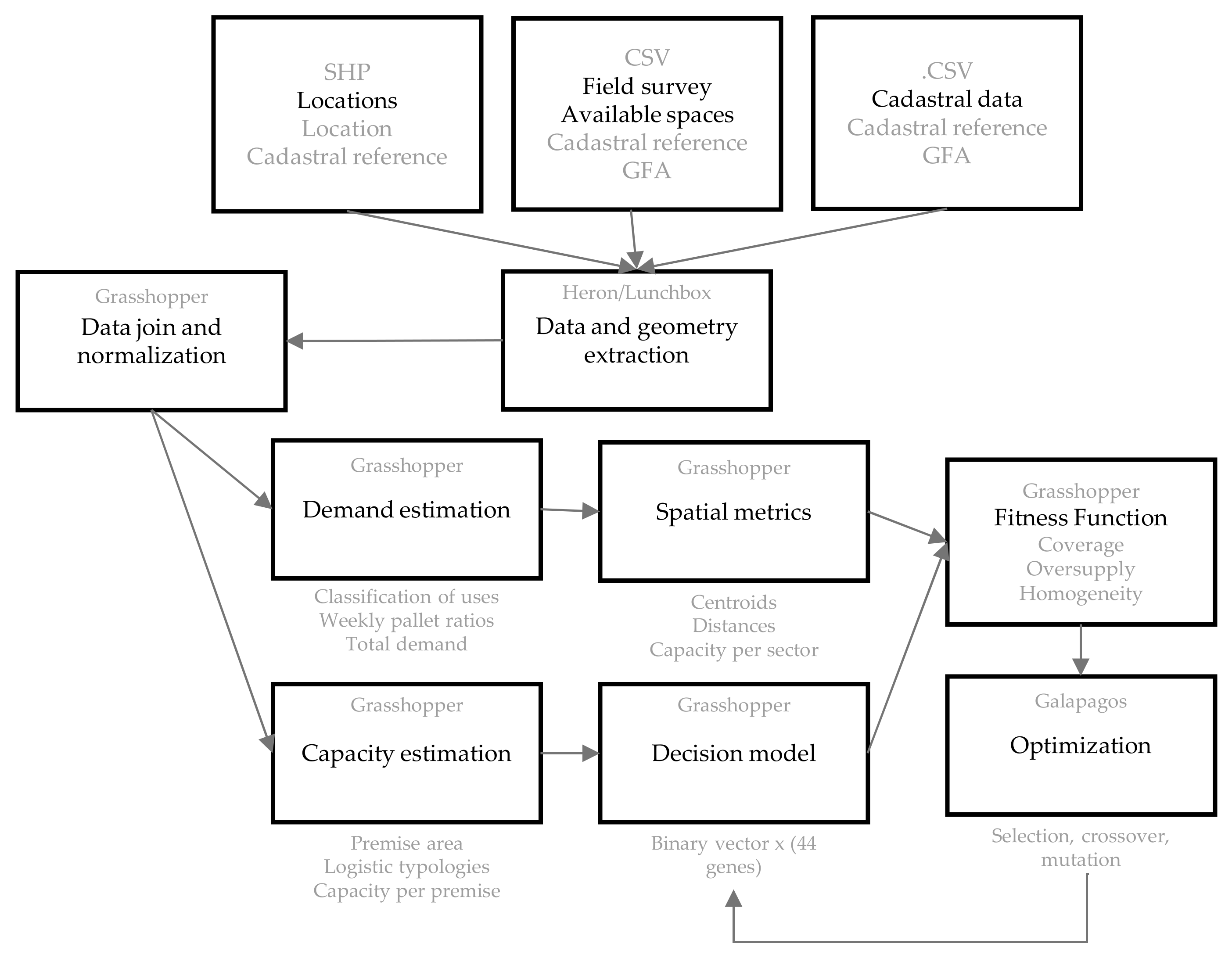
Figure 1 for data flow).
Sector boundaries, allowing spatial-equity analysis during optimization.
2.2. Demand Model
Demand estimation followed the framework in [
15] and its earlier implementation in [
16]. Cadastral parcels were classified into residential, commercial, and hospitality categories, each assigned a delivery frequency based on Valencia operational patterns [
16] following Seville’s S. Rueda et al. approach and ratios [
17].
Standardized pallet-conversion ratios were applied individually to each parcel ID:
Residential: 0.12 pallets/operation.
Commercial: 0.15 pallets/operation.
Hospitality: 0.25 pallets/operation.
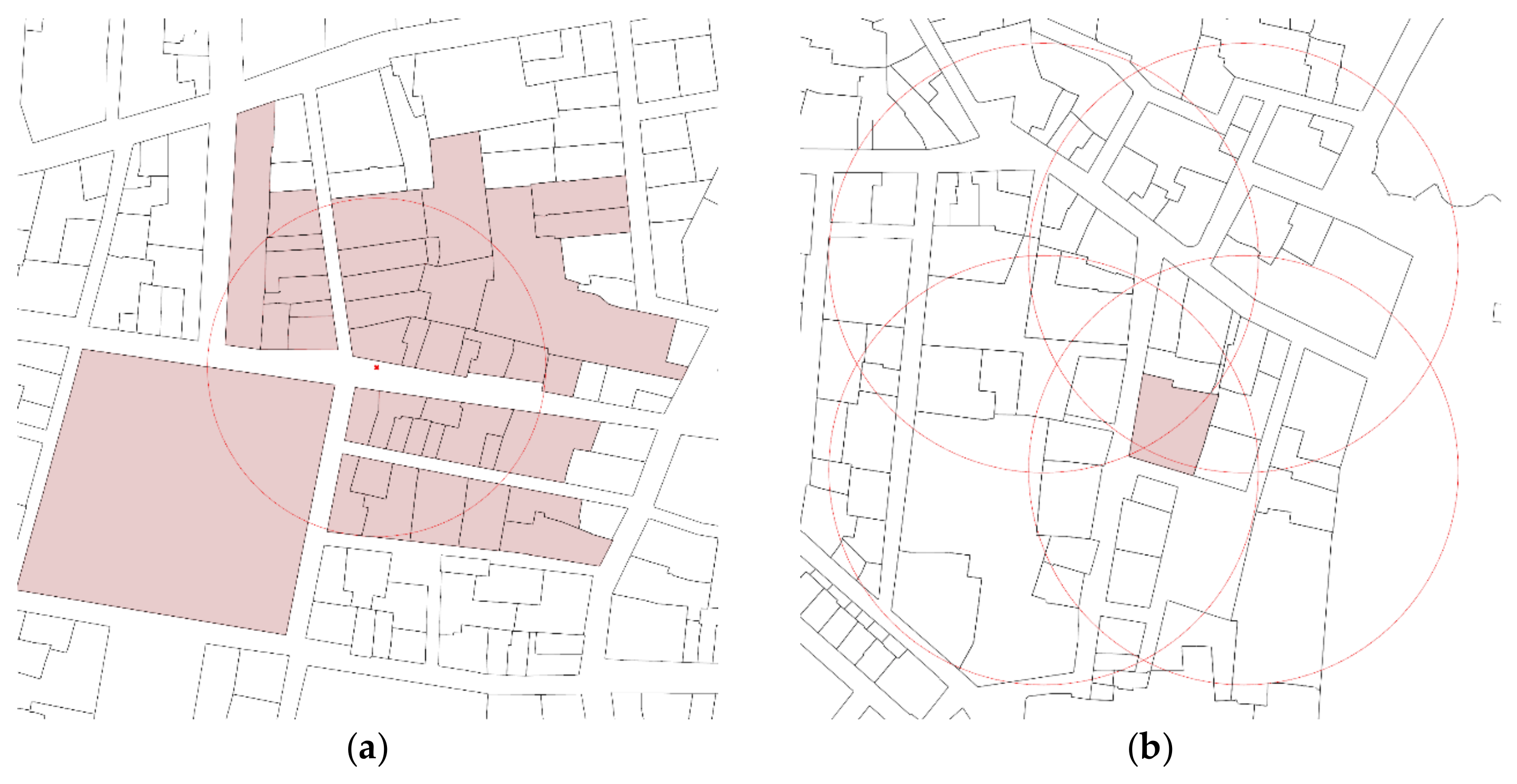
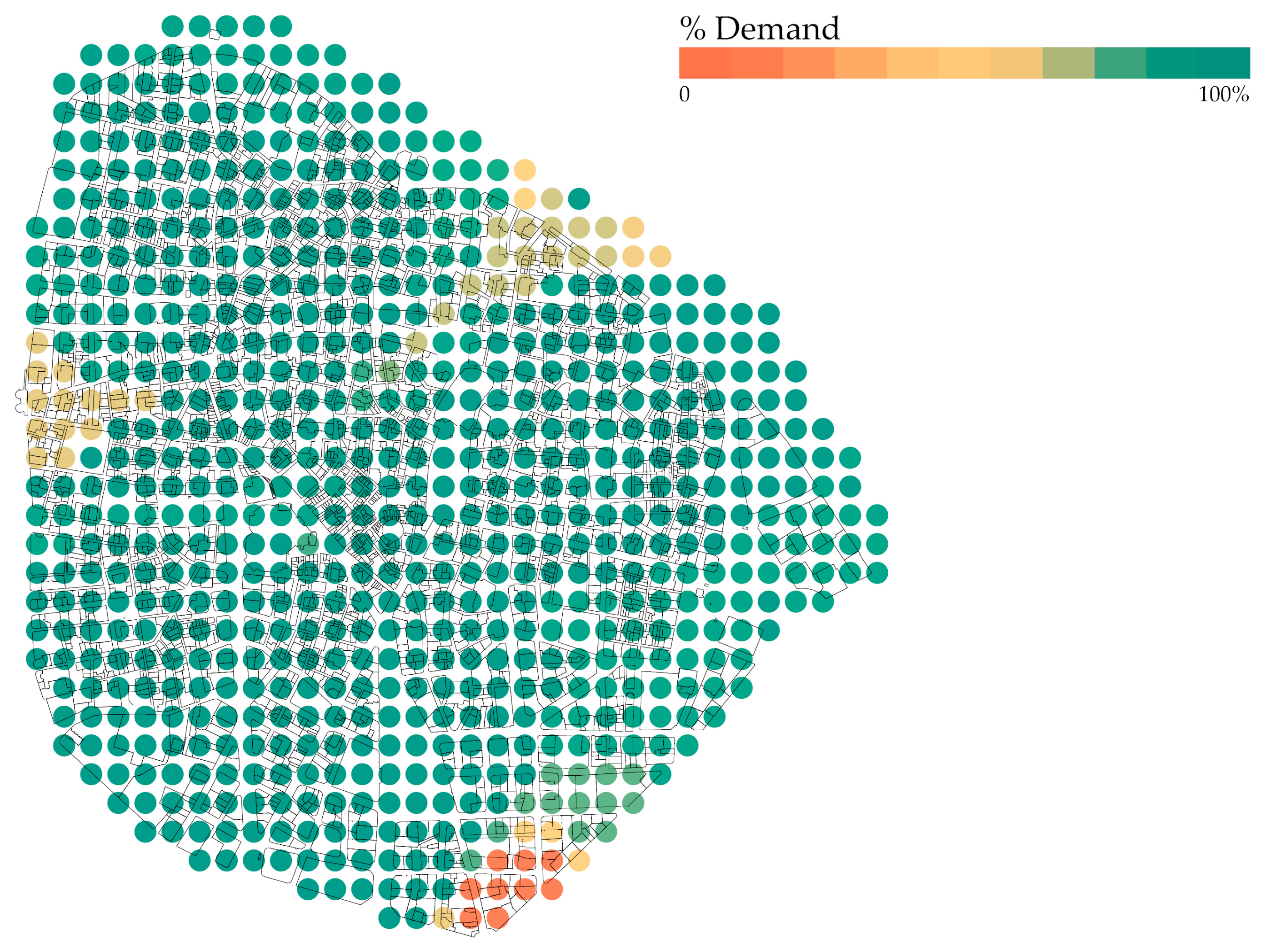
For the zonal evaluation (see
Figure 2), a grid of evaluation points spaced at 50 m was generated. For each point, the freight demand of all parcels located within a 50 m radius was aggregated. Because these catchment areas overlap, each parcel’s demand was proportionally allocated across all evaluation points whose catchments include that parcel. This allocation preserves the total number of pallets during aggregation. These evaluation points, rather than the original parcels, were subsequently used as the demand units in the optimization.
2.3. SDSS
The core of the Spatial Decision Support System was implemented as a parametric model using Grasshopper, a visual programming environment for Rhinoceros 3D, widely used in computational design and urban modeling. The model was developed with the aim of integrating heterogeneous urban data, automating spatial analysis, and enabling multi-objective optimization of logistics platform locations within Ciutat Vella.
To facilitate the import and handling of geospatial and tabular data, the workflow incorporated two external plugins: Heron, used for reading and parsing shapefiles and other GIS layers directly into the Grasshopper environment; and LunchBox, employed to read and structure Excel (XLSX) files, including the cadastral property registry and the field survey of vacant commercial premises. These tools allowed seamless integration between GIS datasets and parametric operations without intermediate preprocessing in external platforms.
Once the input data were loaded, the model generated a spatial inventory of candidate locations, based on the 44 identified vacant commercial units. Each location was assigned a set of attributes: unique ID, geographic coordinates, surface area, and proximity to urban demand clusters. A key step in the process was the estimation of each unit’s logistics capacity (in pallets/week), which was determined individually based on the available surface area of each space.
To ensure consistency with established planning references, the model applied the capacity typologies of logistics platforms defined in [
21], as implemented in [
22]. The following standardized capacities were used as reference thresholds for Valencia [
16] following Seville’s S. Rueda approach and ratios [
17]:
Logistics platform of 10 × 20 m → 1250 pallets/week
Logistics platform of 20 × 25 m → 3280 pallets/week
Logistics platform of 35 × 35 m → 8635 pallets/week
Logistics platform of 100 × 100 m → 76,665 pallets/week
Based on these benchmarks, for each of the premises a specific capacity category was assigned in accordance with its measured usable floor area. For example, smaller units below 200 m2 were assigned a capacity aligned with the 10 × 20 typology, while larger spaces over 700 m2 were modeled as medium-scale platforms. This individualized attribution ensured realistic simulation of the potential supply landscape and avoided assuming uniform or idealized performance across locations. The number of feasible configurations grows exponentially with the number of available premises. In the unconstrained case, the search space contains 2n combinations, where “n” is the number of candidate locations, underscoring the need for an efficient optimization strategy.
The parametric workflow then calculated all feasible combinations of locations capable of covering the estimated weekly demand (14,681 pallets). To manage this high-dimensional search space, a binary genome representation was used, in which each gene represented the activation state (1 or 0) of a given location. The total number of combinations was theoretically 244, underscoring the need for an efficient optimization strategy.
2.4. Optimization Method
The optimization was carried out using Galapagos, a native evolutionary solver in Grasshopper. Galapagos applied a genetic algorithm to evolve the solution space towards configurations that best satisfied a composite fitness function. This function was designed to balance three conflicting objectives:
Maximize demand coverage, ensuring that the sum of capacities of selected locations equaled or slightly exceeded the target demand.
Maximize spatial homogeneity, distributing logistics platforms across different areas of the district to reduce congestion and increase accessibility.
Minimize oversupply, penalizing configurations where excess capacity was significantly higher than required.
The fitness function was computed as a weighted sum of normalized penalties for each criterion. For each evaluation point, the share of covered demand is estimated and capped at 1 to prevent counting over coverage. These cell-level shares are then used to compute the mean coverage and a spatial homogeneity index based on the mean absolute deviation from the mean, such that higher values indicate more uniform coverage. Oversizing is penalized by comparing the total proposed capacity with the aggregated total demand. If capacity does not exceed demand, the penalty is neutral; if it does, the penalty increases proportionally.
The fitness (
F) maximized by the optimizer is computed as the product of coverage (
C) and homogeneity (
H) divided by the overcapacity penalty (
O): it increases when more demand is covered more uniformly and decreases when excess capacity is introduced following the next equation:
is the mean covered-demand share across all cells, and each denotes the covered-demand share in cell i. is the inverse of the mean absolute deviation, where is the absolute deviation of each cell’s coverage from the overall mean C. K denotes the total capacity of the proposed platforms, and D denotes the total demand.
The Galapagos algorithm was configured to run with default evolutionary parameters (initial population size, mutation rate, crossover strategy), ensuring reproducibility and generalizability of the approach. Each optimization run lasted between 10 and 35 min on a standard workstation, typically converging towards high-performing solutions within 100 to 300 generations.
2.5. Case Study: Ciutat Vella
Ciutat Vella is the historical core of Valencia, Spain, encompassing 1.69 km2 (1.25% of the municipal area) with approximately 27,893 inhabitants (3.37% of the city’s population) and contributing 706 million euros to the city’s GDP (3.86%). Its urban fabric is dense, irregular, and characterized by narrow streets, heritage buildings, and mixed-use zoning, features that complicate conventional last-mile delivery systems.
The district contains 9498 cadastral plots and 41,975 registered properties. Its land use composition reveals a high concentration of residential and commercial functions, particularly small-scale retail, hospitality, and cultural facilities. This mixed-use structure contributes to significant and diverse demand for last-mile logistics services.
The case of Ciutat Vella thus offers valuable context to test the capacity of SDSS to balance local logistics performance with spatial efficiency.
3. Results
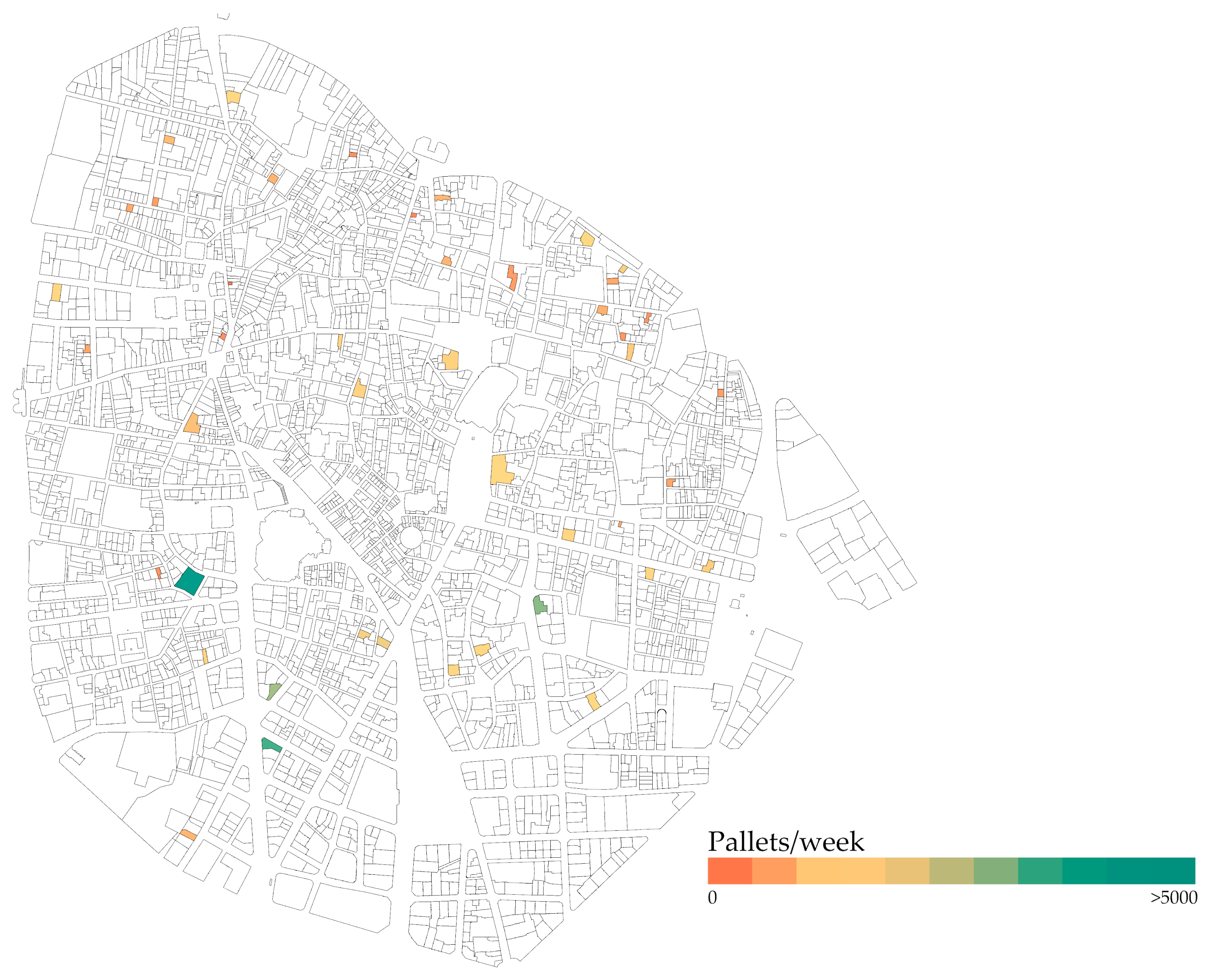
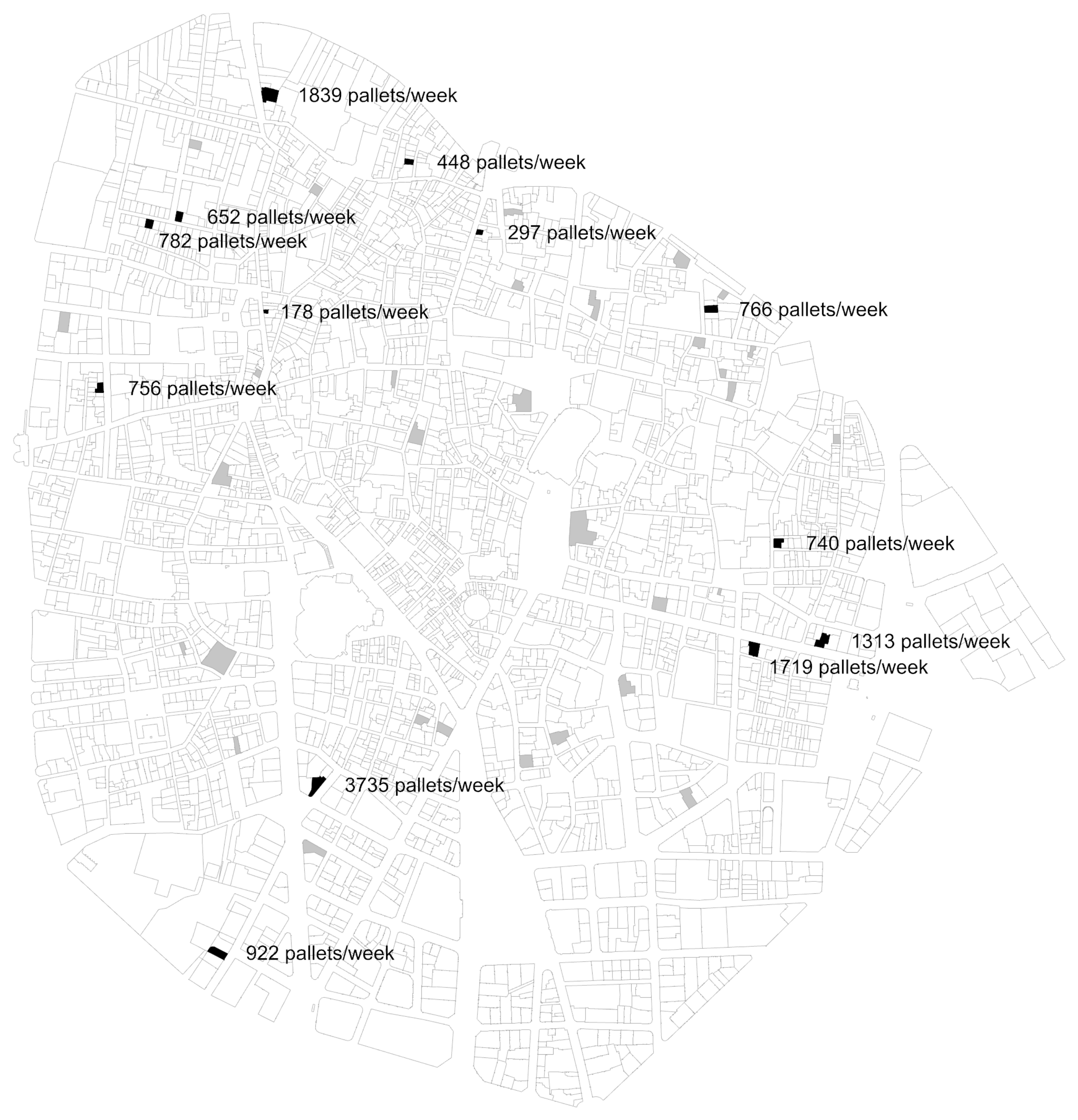
The optimization process under Galapagos evaluated thousands of potential combinations of the 44 available locations. A field survey was conducted within the ENACT project verifying the 44 vacant commercial spaces suitable for micro-logistics use (
Figure 3).
Their aggregated capacity, estimated at 69,197 pallets/week, represented 471% of the actual estimated logistics demand for the district, revealing a significant potential for infrastructure oversupply if all available locations were activated without further optimization. Seeking the best subset that fulfilled the three defined objectives: minimize oversupply, maximize demand coverage, and promote spatial homogeneity.
Given the large mismatch between available space and actual demand, an optimization strategy was necessary for:
Avoiding unnecessary costs and environmental impact associated with redundant infrastructure.
Ensuring equitable spatial distribution of platforms to maximize efficiency and minimize traffic concentration.
Promoting compact and scalable logistics solutions aligned with the goals of 15mC, NEB principles, and Valencia’s climate neutrality roadmap.
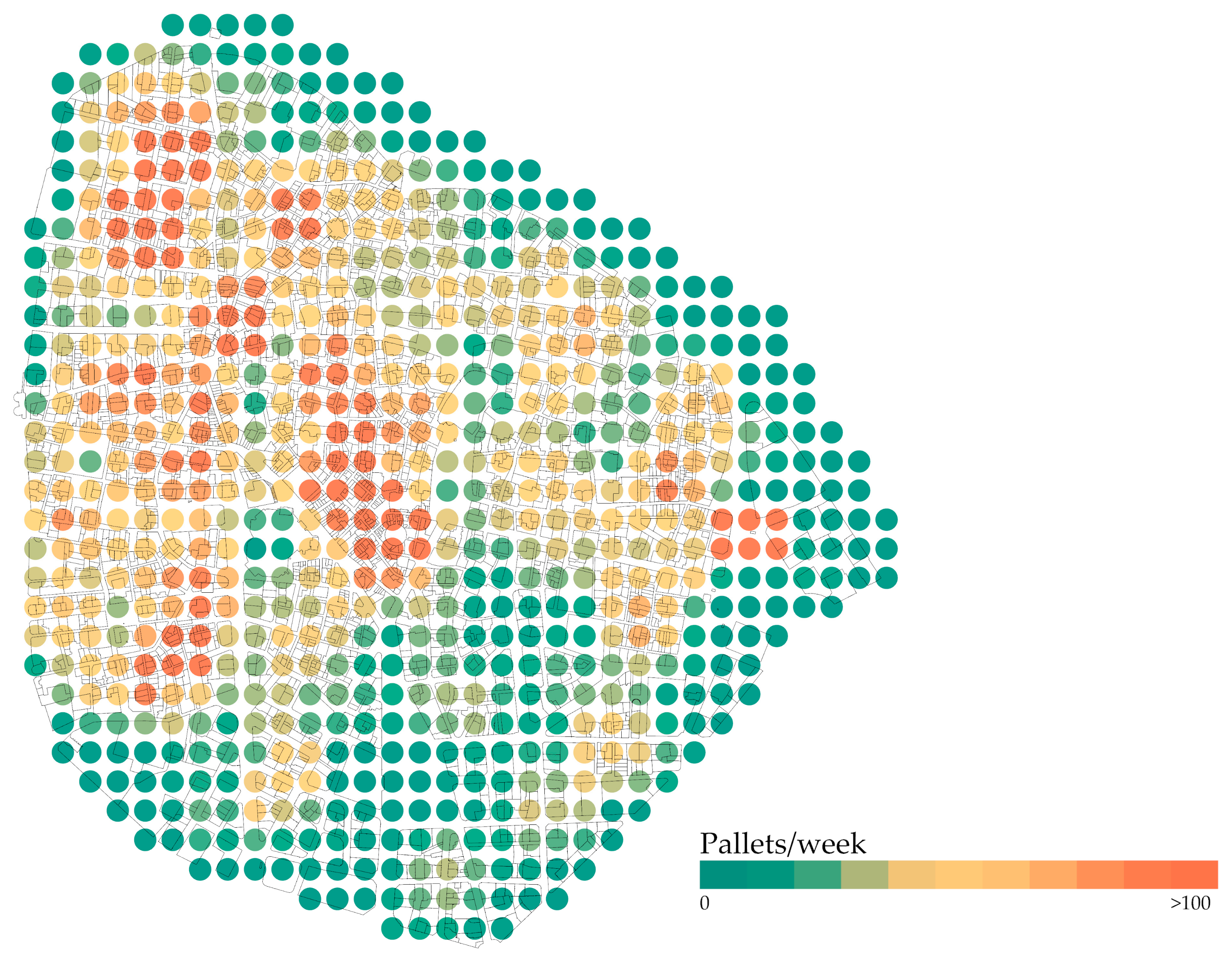
Transferring parcel-level demand to evaluation-point demand enabled the identification of zones with higher demand (see
Figure 4). In the eastern area of the district, the scarcity of urban voids, high building density, and the presence of freight-critical facilities (e.g., Mercado Central) result in higher demand. Conversely, in the south-western area, the presence of urban voids reduces demand.
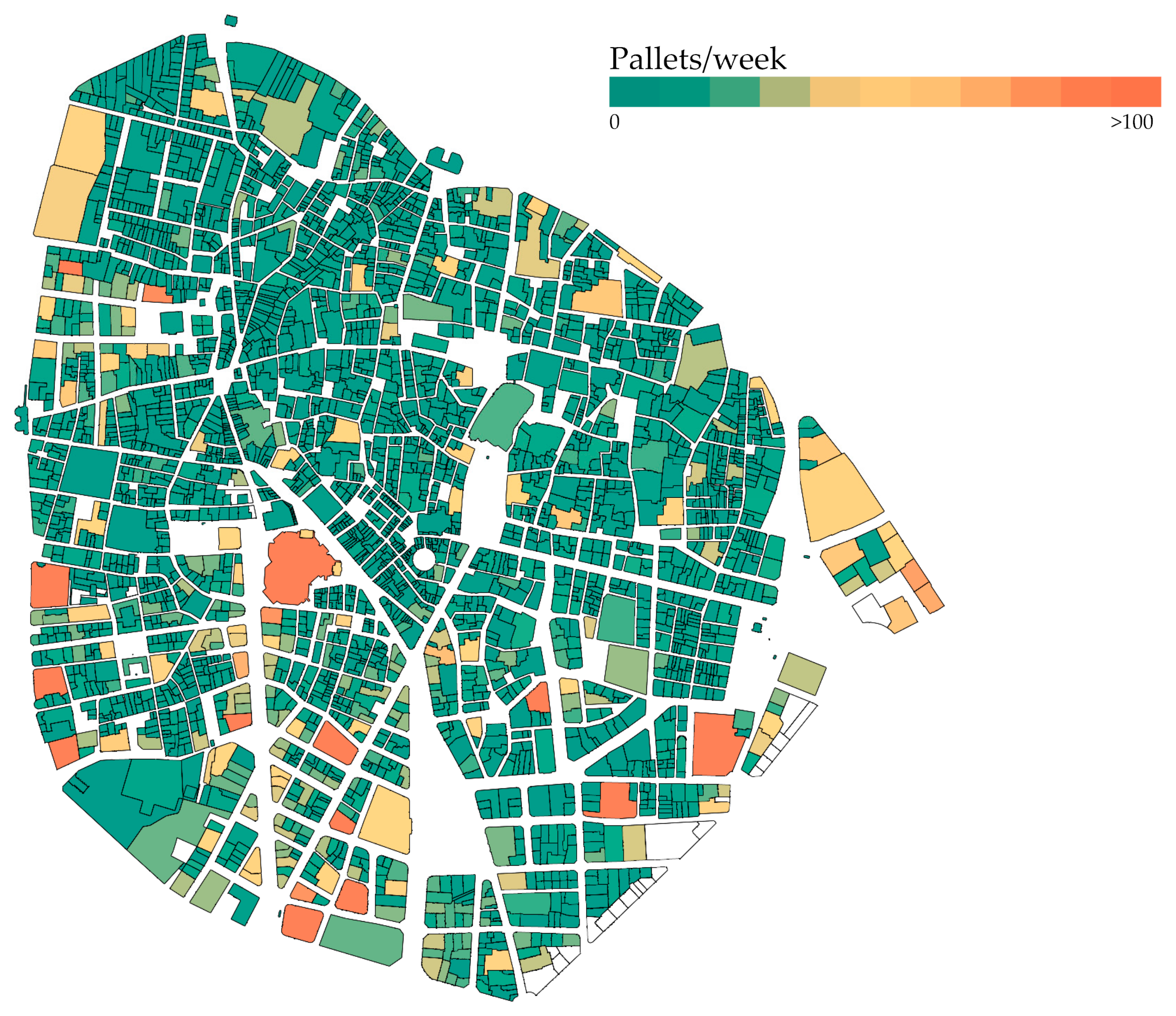
Applying pallet-per-built-area ratios by building typology to each parcel in Ciutat Vella yields a total demand of 14,681 pallets/week, comprising: 14,681 pallets/week, including (see
Figure 5):
9969.5 pallets/week (residential).
4014 pallets/week (commercial).
697.5 pallets/week (hospitality).
The best-performing solution (see
Figure 6 and
Figure 7) was obtained after 118 iterations, with 50 decision variables evaluated per iteration, and a runtime of 14 min. The top ten solutions exhibited a marked spread in the fitness score
F(0.78–0.72); therefore, the highest-scoring configuration was retained as the optimal solution within the explored search space.
In summary, the parametric model acted as an integrative layer between data, spatial logic, and algorithmic decision-making. Its flexibility allows adaptation to other urban contexts, datasets, and optimization goals, offering a replicable foundation for data-driven planning.
The model iteratively evaluated configurations, using a genome that activates or deactivates candidate locations. The fitness function penalized excessive supply while rewarding coverage and balance across sectors.
4. Discussion
This paper introduces “last-mile logistics” as a prime sustainability bottleneck for municipalities, framing the solution as a location/allocation problem for micro-hubs within urban [
23] layouts. New approaches have been identified in the bibliographical analysis (
Section 1) which raised the new approaches based on SDSS as a relevant approach.
The latest review on last-mile logistics simulation domain by Süß et al. [
24], favors the collaborative framework integrating three layers which are present on this paper’s approach: a multi-agent logistics network layer, a demand and urban-context microsimulation layer, and a dynamic multi-agent microsimulation with specified inputs and outputs, all designed to minimize urban freight costs.
Our approach to the first layer (multi-agent logistics network) is microsimulation through SDSS. The first two layers are supported by input data from the Smart City Valencia platform, and the third layer corresponds to our approach introducing a algorithmic model. The proposed generic algorithmic basis introduces Grasshopper to propose a mathematical solution for interpreting the existing space, and from it, to model urban scenes. The territorial analysis from the urban layer, with the interpretation of pre-existing facilities (intermediate storage) guides the algorithm.
Although best-performing solutions consistently activated between six and nine logistics platforms (total capacity ranging from 14,800 to 16,000 pallets/week), the final optimization selected a total of 12 sites allowing for a balanced optimization of: operational flexibility set of premises whose spatial distribution broadly matches the highest-demand areas, while favoring medium capacity sites over lower or higher-capacity premises (fulfilling NEB principles). Key outcomes included:
Homogeneity: The selected locations were spatially distributed across all five administrative sectors of Ciutat Vella, ensuring localized service provision and reducing pressure on specific nodes.
Oversupply Reduction: Compared to the baseline scenario (44 sites, 471% capacity), the optimized configuration reduced oversupply to a marginal buffer (average of 7–10%).
The main findings from the optimization process can be translated into the following urban planning rules from the final spatial distribution pattern:
A uniform distribution of demand (population) favors lower capacity intermediate storage locations optimizing transport resources requirements for last-mile distribution.
The combined consideration of NEB principles and 15 mC design ensures an optimal approach for reshaping last-mile distribution in heritage cities.
The optimization process through Galapagos evolutionary solver delivers quantitative solutions to the proposed scenarios, allowing a deterministic optimized solution, to the proposed 15mC challenge (citizen services, transport, travel-time, energy use) with minimal use of resources and time.
The Grasshopper-Galapagos add-on proved effective in identifying high-performance solutions within a reasonable computational time (typically under 30 min). The solver used a genome of 44 binary values (one per candidate location), and crossover/mutation parameters were kept at default to maintain generality and replicability.
5. Conclusions
The previous discussion demonstrates the effectiveness of parametric SDSS tools that enable adaptive planning in areas with strong morphological constraints, and how genetic solvers provide flexibility in navigating multidimensional design spaces.
Main theoretical implications for the paper results are:
Reframing last-mile logistics as a spatial optimization problem within sustainability theory, by broadening urban logistics theory beyond operational efficiency to encompass spatial equity and environmental externalities.
Bridging spatial decision support and metaheuristic optimization by using genetic algorithms. This integration suggests a theoretical convergence between SDSS and evolutionary design methods.
Advancing the theory of decision support under resource constraints through a new model challenging the prevailing assumptions.
These findings are completely aligned with broader research on smart urban logistics and support the transition towards:
Operational viability for municipalities combining GIS and data platforms for new modeling approaches allowing high-quality, near-optimal configurations.
The selection of open-source and replicable workflows strengthens the reproducibility, scalability and adaptability of urban planning decisions.
The visual and interactive nature of the model positions it as a tool for stakeholder deliberation, enabling planners, residents, and logistics operators to collaboratively explore trade-offs between coverage, overcapacity, and spatial equity.
The study extends urban logistics and SDSS outreach by introducing a hybrid, equity-aware optimization framework that is both computationally tractable and spatially grounded. In practice, it delivers a fast, transparent, and replicable method that municipalities can adopt to design sustainable last-mile infrastructures (and other 15mC sustainability challenges) using only existing data platforms and standard design software. All in all, the proposed approach introduces a more integrated, efficient, and resilient urban service systems optimization by configuring a generic methodology. The same methodology will be further developed to a future toolbox for urban development.
Author Contributions
Conceptualization, all authors; methodology, J.A.B.C. and R.C.M.; validation J.A.B.C. and R.C.M.; formal analysis, J.O.-M.; investigation, J.A.B.C.; data curation, R.C.M.; writing—original draft preparation, J.A.B.C.; writing—review and editing, J.O.-M. All authors have read and agreed to the published version of the manuscript.
Funding
This research received co-funding from the project “ENACT 15mC—Envisioning Neighbourhoods and Co-Creating Thriving Communities in the 15-Minute City”, supported by the European Union and the 2023 call for “Proyectos de Colaboración Internacional” from the “Agencia Estatal de Investigación (Ministerio de Ciencia Innovación y Universidades, Gobierno de España)”, through the Driving Urban Transitions Partnership (DUT, AEI, PCI2023-145946-2), and coordinated by the Norwegian University of Science and Technology in collaboration with various associations, organizations, and universities, including the Universitat Politècnica de València.
Data Availability Statement
Research data has not been publicly shared due to restrictions on the dataset ownership and privacy issues. We will make the data available upon request previous authorization from the relevant parties.
Acknowledgments
The authors have reviewed and edited the output and take full responsibility for the content of this publication.
Conflicts of Interest
The authors declare no conflicts of interest. The funders had no role in the design of the study; in the collection, analyses, or interpretation of data; in the writing of the manuscript; or in the decision to publish the results.
Abbreviations
The following abbreviations are used in this manuscript:
| 15mC | 15 min cities |
| NEB | New European Bauhaus |
| SDSS | Spatial Decision Support Systems |
| GIS | Geographical Information System |
| KPIs | Key Performance Indicators |
| ENACT | Envisioning Neighbourhoods and Co-Creating Thriving Communities in 15mC |
| XLSX | Excel Open XML Spreadsheet format |
| GeoJSON | Geographic JavaScript Object Notation |
References
- Iqbal, A.; Nazir, H.; Qazi, A.W. Exploring the 15-Minutes City Concept: Global Challenges and Opportunities in Diverse Urban Contexts. Urban Sci. 2025, 9, 252–276. [Google Scholar] [CrossRef] [Scilit]
- NEB Compass—A Guiding Framework. Available online: https://new-european-bauhaus.europa.eu/tools-and-resources/use-compass_en (accessed on 10 August 2025).
- Wyckmans, A. Beautiful and Inclusive Transitions to Resilient, Climate-Neutral Cities and Communities, Driven by Radical Collaboration. In Digital Dreams, Urban Realities; The Urban Book Series; Vukmirović, M., Đukić, A., Lazarević, E.V., Krstić-Furundžić, A., Eds.; Springer: Cham, Switzerland, 2025. [Google Scholar] [CrossRef] [Scilit]
- Ivanova, U. Enhancing Last-Mile Delivery Efficiency: A Lean-Based Framework for Sustainable Logistics in the Helsinki Metropolitan Area. Bachelor’s Thesis, Haaga-Helia University of Applied Sciences, Helsinki, Finland, 2025. Available online: https://www.theseus.fi/bitstream/handle/10024/884861/Ivanova_Uliana.pdf?sequence=2&isAllowed=y (accessed on 10 August 2025).
- Kahalimoghadam, M. Developing and Implementing Collaborative Urban Distribution Networks to Improve the Sustainability of Last-mile Logistics. Ph.D. Thesis, University of Melbourne, Melbourne, Australia, 2024. Available online: https://hdl.handle.net/11343/345313 (accessed on 1 September 2025).
- Taguchi, E.; Thompson, R.G.; Qureshi, A.G. Modelling city logistics using innovative technologies. Transp. Res. Procedia 2020, 46, 3–12. [Google Scholar] [CrossRef] [Scilit]
- Pina-Pardo, J.C.; Moreno, M.; Barros, M.; Faria, A.; Winkenbach, M.; Janjevic, M. Design of a two-echelon last-mile delivery model. EURO J. Transp. Logist. 2022, 11, 100079. [Google Scholar] [CrossRef] [Scilit]
- Poeting, M.; Schaudt, S.; Clausen, U. Simulation of An Optimized Last-Mile Parcel Delivery Network Involving Delivery Robots, Advances in Production, Logistics and Traffic. ICPLT 2019; Lecture Notes in Logistics; Springer: Cham, Switzerland, 2019; pp. 1–19. [Google Scholar] [CrossRef] [Scilit]
- Swanson, D. A simulation-based process model for managing drone deployment to minimize total delivery time. IEEE Eng. Manag. Rev. 2019, 47, 154–167. [Google Scholar] [CrossRef] [Scilit]
- Agugiaro, G.; Garcia Gonzalez, F.; Cavallo, R. The City of Tomorrow from… the Data of Today. ISPRS Int. J. Geo-Inf. 2020, 9, 554–597. [Google Scholar] [CrossRef] [Scilit]
- Moreno, R.P.R.; Lopes, R.B.; Ferreira, J.V.; Ramos, A.L. A study of the main mathematical models used in mobility, storage, pickup and delivery in urban logistics: A systematic review. Systems 2024, 12, 374. [Google Scholar] [CrossRef] [Scilit]
- Bernard Keenan, P.; Jankowski, P. Spatial Decision Support Systems: Three decades on. Decis. Support Syst. 2019, 116, 64–76. [Google Scholar] [CrossRef] [Scilit]
- Bibri, S.E. The Sciences Underlying Smart Sustainable Urbanism: Unprecedented paradigmatic and scholarly shifts in light of Big Data science and analytics. Smart Cities 2019, 2, 179–213. [Google Scholar] [CrossRef] [Scilit]
- Cuntò, S.; Muccio, E.; Sacco, S.; Zizzania, P. A Collaborative Spatial Decision Support System for Assessing Transformative Potential of Minimum Ecological Units (MEUs) in a Circular Regeneration Perspective. In Computational Science and Its Applications—ICCSA 2023 Workshops; LNCS 14112; Gervasi, O., Murgante, B., Rocha, A.M.A.C., Garau, C., Scorza, F., Karaca, Y., Torre, C.M., Eds.; Springer: Cham, Switzerland, 2023; pp. 235–252. [Google Scholar] [CrossRef] [Scilit]
- Della Spina, L. A Decision Support Evaluation Framework for Community-Based Collaborative Urban Regeneration Processes. Sustainability 2024, 16, 6434. [Google Scholar] [CrossRef] [Scilit]
- Available online: https://valencia.opendatasoft.com/pages/home/?flg=es-es (accessed on 1 September 2025).
- Rueda, S. Plan especial de indicadores de sostenibilidad ambiental de la actividad urbanística de Sevilla. Gerencia de Urbanismo. Ayunt. Sevilla Agencia Ecol. Barc. Madr. 2008, 9, 2009. [Google Scholar]
- Soto-Mendoza, V.; García-Calvillo, I.; Ruiz-y-Ruiz, E.; Pérez-Terrazas, J. A Hybrid Grasshopper Optimization Algorithm Applied to the Open Vehicle Routing Problem. Algorithms 2020, 13, 96. [Google Scholar] [CrossRef] [Scilit]
- Bedra, K.B.; Zheng, J.; Li, J.; Sun, Z.; Zheng, B. Automating microclimate evaluation and optimization during urban design: A Rhino–Grasshopper workflow. Sustainability 2023, 15, 16613. [Google Scholar] [CrossRef] [Scilit]
- AUMSA. Pla Especial de Protecció Ciutat Vella, Cataleg de Proteccions. Ajuntament de Valencia. 2020. Available online: https://mediambient.gva.es/auto/urbanismo/reg-planeamiento/4%20VALENCIA/46250%20VALENCIA/2%20P.%20DIFERIDO/46250-4130%20PEP%20Ciutat%20Vella%202019-0291/2%20MEMORIA/46250-4130%202019-0291%2002.02.01%201.2.MEM.%20DESCRIP.%20Y%20JUSTIF.pdf (accessed on 1 September 2025).
- Cadastral Repository for Spain. Available online: https://www1.sedecatastro.gob.es/OVCInicio.aspx (accessed on 10 August 2025).
- Rutten, D. Galapagos, on the logic and limitations of generic solvers. Arch. Des. 2013, 83, 132–135. [Google Scholar] [CrossRef] [Scilit]
- Bibri, S.S.; Krogstie, J. Smart Sustainable Cities of the future: An extensive interdisciplinary literature review. Sustain. Cities Soc. 2017, 31, 183–212. [Google Scholar] [CrossRef] [Scilit]
- Süß, V.; Ludwig, A.; Franczyk, B.; Gaunitz, B. Last-Mile Simulation Approaches for Sustainable Delivery in Urban Outskirts: A Review. Procedia Comput. Sci. 2025, 270, 1968–1977. [Google Scholar] [CrossRef] [Scilit]
| Disclaimer/Publisher’s Note: The statements, opinions and data contained in all publications are solely those of the individual author(s) and contributor(s) and not of MDPI and/or the editor(s). MDPI and/or the editor(s) disclaim responsibility for any injury to people or property resulting from any ideas, methods, instructions or products referred to in the content. |