Urban Sprawl Inside and Outside Natura 2000 Sites (SPAs) in Mediterranean EU States: The Case of Cyprus

Abstract
1. Introduction
- Extent of Urbanization: Urban cover within Natura 2000 sites is significantly lower than outside, yet the growth rate of urbanization within these sites is slightly higher, indicating an incipient sprawl into protected areas [10]. This sprawl is particularly pronounced in areas surrounded by densely populated urban clusters [10].
- Impact on Biodiversity: Urban sprawl leads to habitat fragmentation and loss, which are detrimental to the species and ecosystems that Natura 2000 sites aim to protect [17]. The spread of urban areas increases landscape fragmentation and the spread of invasive species, further threatening biodiversity [18].
- Socio-Economic Drivers: Factors such as population density, road and railway density, and economic development are significant drivers of urban sprawl [18]. These factors contribute to the pressure on Natura 2000 sites as urban areas expand to accommodate growing populations and infrastructure needs.
- Urban Planning and Management: Implementing sustainable urban growth management practices can help mitigate the effects of urban sprawl. This includes the use of geographic information systems and remote sensing for environmental monitoring, as well as the enforcement of planning policies [19].
- Conservation Strategies: The mitigation hierarchy approach, which involves avoiding, reducing, and offsetting negative impacts, is crucial for maintaining habitat connectivity and preventing biodiversity loss [20]. Spatial graph analysis can aid in identifying and prioritizing actions needed to maintain connectivity in urban landscapes [20].
- Strengthening enforcement through increased inspection capacity, deterrent penalties, timely prosecution of violations, and avoidance of repeated legalization or amnesty schemes;
- Improving planning integration, including mandatory consideration of Natura 2000 objectives in local plans, establishment of buffer zones, connectivity-oriented spatial planning, and enhanced regional coordination;
- Enhancing monitoring by deploying systematic high-resolution observation, early detection mechanisms, public reporting tools, and regular compliance audits;
- Targeted spatial interventions, prioritizing small and peri-urban Natura 2000 sites at higher risk, enforcing strict no-build zones in critical areas, restoring degraded habitats, and applying compensatory measures where impacts are unavoidable;
- Governance reform, aimed at better integration between conservation and planning authorities, strengthening local administrative capacity, improving stakeholder engagement, and ensuring transparency in decision-making.
- Urban Sprawl Theory: We utilize high-resolution data to redefine sprawl not just as an expansion of urban boundaries, but as a fragmented, pervasive encroachment into rurality.
- Efficacy Assessment Theory: We assess the “protective shield” of Natura 2000 (SPAs) by measuring building density as a proxy for conservation success or failure, testing whether legal designation translates into physical exclusion of development.
- Policy Implementation Theory: We examine the “implementation gap” between the social intent of the “memonomeni katoikia” (isolated housing) policy and its actual spatial outcome, identifying how institutional loopholes facilitate luxury-driven sprawl.
2. Materials and Methods
3. Results
3.1. Isolated Housing and Other Built Premises Within SPAs
3.2. Results of Urban Sprawl at the Country Level per Planning Zone (1993–2022)
3.3. District Comparison of Isolated Houses for the Years 1993–2022
4. Discussion
5. Conclusions
- Implementing stricter legal measures and financial instruments to curb the exploitation of planning loopholes and the abolition or strict tightening of isolated housing policy, which essentially is a planning distortion policy that appeases and facilitates urban sprawl.
- Standardizing high-resolution, building-level mapping across the EU to ensure precise cross-border monitoring, thus overcoming existing limitations and underestimation of urban sprawl.
- Conducting site-specific analyses within the Natura 2000 network to understand localized patterns at the site level.
Author Contributions
Funding
Data Availability Statement
Acknowledgments
Conflicts of Interest
References
- Simkin, R.; Seto, K.C.; McDonald, R.I.; Jetz, W. Biodiversity impacts and conservation implications of urban land expansion projected to 2050. Proc. Natl. Acad. Sci. USA 2022, 119, e2117297119. [Google Scholar] [CrossRef] [PubMed]
- European Environment Agency (EEA). Land Take and Ecosystem Services; EEA Report No. 10/2019; European Environment Agency: Copenhagen, Denmark, 2019.
- European Environment Agency (EEA). Land Take in Europe; Indicator Assessment; European Environment Agency: Copenhagen, Denmark, 2021.
- European Environment Agency. Urban Sprawl in Europe—The Ignored Challenge; EEA Report No. 10/2006; European Environment Agency: Copenhagen, Denmark, 2006.
- Siedentop, S.; Fina, S. Urban sprawl beyond growth: The effect of demographic change on infrastructure costs. Flux 2010, 79–80, 90–100. [Google Scholar] [CrossRef]
- Science for Environment Policy. No Net Land Take by 2025? Future Brief No. 14; European Commission: Brussels, Belgium, 2016. [Google Scholar]
- Martínez-Fernández, J.; Ruiz-Benito, P.; Zavala, M.A. Recent land cover changes in Spain across biogeographical regions and protection levels: Implications for conservation policies. Land Use Policy 2015, 44, 62–75. [Google Scholar] [CrossRef]
- Anderson, E.; Mammides, C. Changes in land-cover within high nature value farmlands inside and outside Natura 2000 sites in Europe: A preliminary assessment. Ambio 2020, 49, 1958–1971. [Google Scholar] [CrossRef]
- Mammides, C.; Zotos, S.; Martini, F. Quantifying the amount of land lost to artificial surfaces in European habitats: A comparison inside and outside Natura 2000 sites using a quasi-experimental design. Biol. Conserv. 2024, 293, 110556. [Google Scholar] [CrossRef]
- Concepción, E.D. Urban sprawl into Natura 2000 network over Europe. Conserv. Biol. 2021, 35, 1063–1072. [Google Scholar] [CrossRef]
- Department of Town Planning and Housing. Policy for the Regulation and Control of Development and Protection of the Environment in the Countryside and in Villages; Ministry of the Interior, Republic of Cyprus: Nicosia, Cyprus, 2024; 292p.
- Fuladlu, K.; Riza, M.; İlkan, M. Monitoring urban sprawl using time-series data: Famagusta region of Northern Cyprus. SAGE Open 2021, 11, 215824402110074. [Google Scholar] [CrossRef]
- Seto, K.C.; Güneralp, B.; Hutyra, L.R. Global forecasts of urban expansion to 2030 and direct impacts on biodiversity and carbon pools. Proc. Natl. Acad. Sci. USA 2012, 109, 16083–16088. [Google Scholar] [CrossRef]
- Dimopoulos, P.; Bergmeier, E.; Fischer, P. Natura 2000 habitat types of Greece evaluated in the light of distribution, threat and responsibility. Biol. Environ. 2006, 106B, 175–187. [Google Scholar] [CrossRef]
- Gallardo, M.; Fernández-Portela, J.; Cocero, D.; Vilar, L. Land use and land cover changes in depopulated areas of Mediterranean Europe: A case study in two inland provinces of Spain. Land 2023, 12, 1967. [Google Scholar] [CrossRef]
- González-García, A.; Palomo, I.; Arboledas, M.; González, J.A.; Múgica, M.; Mata, R.; Montes, C. Protected areas as a double edge sword: An analysis of factors driving urbanisation in their surroundings. Glob. Environ. Change 2022, 74, 102522. [Google Scholar] [CrossRef]
- Delsen, D.M.; Kissling, W.D.; Allan, J. Threatened terrestrial vertebrates are exposed to human pressures across 94% of Europe’s protected land. bioRxiv 2020. [Google Scholar] [CrossRef]
- Hennig, E.I.; Soukup, T.; Orlitova, E.; Schwick, C.; Kienast, F.; Jaeger, J.A.G. Urban Sprawl in Europe; Joint EEA-FOEN Report No. 11/2016; European Environment Agency: Copenhagen, Denmark, 2016.
- Festus, I.A.; Omoboye, I.F.; Andrew, O.B. Urban sprawl: Environmental consequence of rapid urban expansion. Mediterr. J. Soc. Sci. Hum. 2020, 5, 322751. [Google Scholar] [CrossRef]
- Arlidge, W.N.S.; Bull, J.W.; Addison, P.F.E.; Burgass, M.J.; Gianuca, D.; Gorham, T.M.; Jacob, C.; Shumway, N.; Sinclair, S.P.; Watson, J.E.M.; et al. A global mitigation hierarchy for nature conservation. BioScience 2018, 68, 336–347. [Google Scholar] [CrossRef] [PubMed]
- Kara, C.; Doratli, N. Predict and simulate sustainable urban growth by using GIS and MCE based CA: Case of Famagusta in Northern Cyprus. Sustainability 2021, 13, 4446. [Google Scholar] [CrossRef]
- Trombadore, A.; Tsolaki, A.; Santamouris, M. Sustainable master planning and urban design for the “buffer zone” of Nicosia. In Proceedings of the 2nd PALENC Conference and 28th AIVC Conference on Building Low Energy Cooling and Advanced Ventilation Technologies in the 21st Century, Crete Island, Greece, 27–29 September 2007; pp. 1061–1064. [Google Scholar]
- Panayides, P. Six aspects of land use and development activity that result in adverse effects to Cypriot wildlife resources. In Proceedings of the XXVth International Congress of the International Union of Game Biologists and the IXth International Symposium Perdix; Hadjisterkotis, E., Ed.; Government Printing Office, Ministry of Interior: Nicosia, Cyprus, 2005; pp. 76–90. [Google Scholar]
- Gbenga, L.A.; Tomiwa, V.O.; Rasheed, A.H.; Kehunde, E.O.; Andrey, K.O.C.O.; Florian, K. Spatiotemporal assessment of land use land cover dynamics in Modling district, Austria, using remote sensing techniques. Heliyon 2025, 11, e43454. [Google Scholar] [CrossRef]
- Lagarias, A.; Stratigea, A. High-resolution spatial data analysis for monitoring urban sprawl in coastal zones: A case study in Crete Island. In Computational Science and Its Applications—ICCSA 2021; Lecture Notes in Computer Science; Gervasi, O., Murgante, B., Misra, S., Garau, C.M., Tarantino, E., Torre, C.M., Eds.; Springer: Cham, Switzerland, 2021; Volume 12958, pp. 75–90. [Google Scholar]
- IPCC. Climate change 2022: Impacts, adaptation and vulnerability—Cross-chapter paper 4: Mediterranean region. In Climate Change 2022: Impacts, Adaptation and Vulnerability; Pörtner, H.-O., Roberts, D.C., Tignor, M., Poloczanska, E.S., Mintenbeck, K., Alegría, A., Craig, M., Langsdorf, S., Löschke, S., Möller, V., et al., Eds.; Cambridge University Press: Cambridge, UK, 2022; pp. 2233–2272. [Google Scholar]
- Gallardo, M.; Martínez-Vega, J. Modeling land-use scenarios in protected areas of an urban region in Spain. In Geomatic Approaches for Modeling Land Change Scenarios; Paegelow, M.T., Mas, M., Escobar, J.F., Eds.; Lecture Notes in Geoinformation and Cartography; Springer: Berlin/Heidelberg, Germany, 2018; pp. 307–327. [Google Scholar]
- Lagarias, A. Impervious land expansion as a control parameter for climate-resilient planning on the Mediterranean coast: Evidence from Greece. Land 2023, 12, 1844. [Google Scholar] [CrossRef]
- Boutin, N.; Chourot, L.; Raynal, J.-C.; de Wit, R. Barriers to effective management of Mediterranean coastal lagoons following key European Union directives: Perceptions of managers of Natura 2000 lagoon sites in South France. Environments 2025, 12, 137. [Google Scholar] [CrossRef]
- Bores, J.; Meyer, H.; Underwood, E.; Sirychenko, M.; Langhout, W.; von Döhren, P. Review and synthesis of best practices in governance and land-use policies to implement TEN-N. ARPHA Prepr. 2024, 5, e139236. [Google Scholar]
- Delgado Viñas, C. Urbanización sin fronteras el acoso urbanístico a los espacios naturales protegidos. Boletín Asoc. Geógrafos Españoles 2008, 47, 271–310. [Google Scholar]
- Catalano, A.; Vitrano, R. Natural Disasters and Unauthorized Building: Studies from the Research Workshop; University of Molise & University of Palermo: Kos, Greece, 2012. [Google Scholar]
- Loi, C.; Papatheodorou, A.; Glyptou, K. Tourism and the application of environmental legislation: The case of Rhodes, Greece. Tour. Today 2014, 14, 143–163. [Google Scholar]
- Kati, V.; Spiliopoulou, K.; Stefanidis, A.; Kassara, C. Sacrificing wilderness for renewables? Land artificialization from inadequate spatial planning of wind energy in Evvoia, Greece. Land 2025, 14, 1296. [Google Scholar] [CrossRef]
- Ledda, A.; Serra, V.; de Montis, A. Rural building fragmentation in Natura 2000 sites: Sardinia case study. INPUT Acad. Proc. 2019, 11, 1004–1012. [Google Scholar]
- Seccaroni, M.; D’Uva, D. AI-Driven Detection of Unauthorized Buildings to Protect Hamlet Heritage in Fragile Territories in Italy. Int. Arch. Photogramm. Remote Sens. Spat. Inf. Sci. 2025, XLVIII-M-9-2025, 1349–1355. [Google Scholar] [CrossRef]
- Harasymiuk, J.; Szafranko, E.H.; Pawłowicz, J.A. Research on the possibilities of building in Natura 2000 sites in Poland on the example of Warmia and Mazury Province. In Proceedings of the International Forum on Energy, Environment Science and Materials (IFEESM 2017), Shenzhen, China, 28–29 October 2017; Atlantis Press: Paris, France, 2018; pp. 1550–1554. [Google Scholar]
- Fidélis, T.; Sumares, D. Nature conservation and urban development control in the Portuguese planning system: A new impetus against old praxis? Eur. Environ. 2008, 18, 298–311. [Google Scholar] [CrossRef][Green Version]
- Pérez, F.L. Urbanización isla de Valdecañas y Red Natura 2000: Análisis jurisprudencial. Actual. Jurídica Ambient. 2020, 100, 43–52. [Google Scholar]
- Van Hoorick, G. Compensation, mitigation and conservation measures in the birds and habitats directives: Beyond the Babel-like confusion? Common Mark. Law Rev. 2015, 52, 855–866. [Google Scholar]
- Haumont, F. L’application des mesures compensatoires prévues par Natura 2000. ERA Forum 2009, 10, 611–624. [Google Scholar] [CrossRef]
- Christopoulou, O.; Trizoni, E. Planning of human activities based on the views of local authorities in protected areas: The case of Mountain Pelion, Greece. Int. J. Sustain. Dev. Plan. 2007, 2, 44–56. [Google Scholar] [CrossRef]
- Geddes, I.; Ioannou, B.; Psaras, M. Factors, mechanisms and challenges of planning in Cyprus. Plan. Perspect. 2021, 36, 743–765. [Google Scholar]
- Petanidou, T.; Kizos, T.; Soulakellis, N. Socioeconomic dimensions of changes in the agricultural landscape of the Mediterranean Basin: A case study of the abandonment of cultivation terraces on Nisyros Island, Greece. Environ. Manag. 2008, 41, 250–266. [Google Scholar] [CrossRef] [PubMed]
- Aguilera, F.; Valenzuela, L.M.; Botequilha-Leitão, A. Landscape metrics in the analysis of urban land use patterns: A case study in a Spanish metropolitan area. Landsc. Urban Plan. 2011, 99, 226–238. [Google Scholar] [CrossRef]
- Elloumi, M.; Jouve, A.-M.; Napoléone, C.; Paoli, J.-C. (Eds.) Régulation Foncière et Protection des Terres Agricoles en Méditerranée; Options Méditerranéennes B66; CIHEAM: Montpellier, France, 2011. [Google Scholar]
- Zhu, X.X.; Tuia, D.; Mou, L.; Xia, G.-S.; Zhang, L.; Xu, F.; Fraundorfer, F. Deep Learning in Remote Sensing: A Comprehensive Review and List of Resources. IEEE Geosci. Remote Sens. Mag. 2017, 5, 8–36. [Google Scholar] [CrossRef]
- Tzirkalli, E.; Eliades, E.; Chrysopolitou, V.; Hatziiordanou, L.; Panagiotou, N.; Agapiou, A.; Antoniou, A.; Xenophontos, M.; Panayiotou, C.; Hadjicharalambous, H. Natura 2000 habitat mapping in Cyprus using high resolution orthophoto maps. In Proceedings of the SPIE 10773, Remote Sensing for Agriculture, Ecosystems, and Hydrology, Berlin, Germany, 10–13 September 2018; SPIE: Bellingham, WA, USA, 2018. [Google Scholar]
- Tsiakos, V.; Karagiannopoulou, A. VHR Orthomosaic Imageries Produced by Dedicated Drone Flight Campaigns over Cyprus (2021–2022)—Choirokoitia Region; Zenodo: York, UK, 2022. [Google Scholar]
- Prodromou, M.; Theocharidis, C.; Pitas, I.; Eliades, F.; Themistocleous, K.; Papasavvas, K.; Dimitrakopoulos, C.; Danezis, C.; Hadjimitsis, D.G. Forest habitat mapping in Natura 2000 regions in Cyprus using Sentinel-1, Sentinel-2 and topographical features. Remote Sens. 2024, 16, 1373. [Google Scholar] [CrossRef]
- Mikula, K.; Šibíková, M.; Ambroz, M.; Kollár, M.; Ožvat, A.A.; Urbán, J.; Jarolímek, I.; Šibík, J. NaturaSat—A Software Tool for Identification, Monitoring and Evaluation of Habitats by Remote Sensing Techniques. Remote Sens. 2021, 13, 3381. [Google Scholar] [CrossRef]
- Vincent, A. Propuesta Metodológica para la Planificación y Gestión de los Espacios Protegidos Red Natura 2000, Utilizando Teledetección (Análisis de Imágenes en Base a Objetos) y Sistemas de Información Geográfica. Doctoral Thesis, Universidad Politécnica de Madrid, Madrid, Spain, 2022. [Google Scholar]
- Hernando, A.; Arroyo, L.A.; Velázquez, J.; Tejera, R. Object-based image analysis for mapping Natura 2000 habitats to improve forest management. Photogramm. Eng. Remote Sens. 2012, 78, 991–999. [Google Scholar] [CrossRef]
- García-Galar, A.; Lamelas, M.T.; Domingo, D. Assessment of oak groves conservation statuses in Natura 2000 SACs with single photon LiDAR and Sentinel-2 data. Remote Sens. 2023, 15, 710. [Google Scholar] [CrossRef]
- Austrian Environment Agency. Overview of Best Practices for Limiting Soil Sealing or Mitigating Its Effects in EU-27; Austrian Environment Agency: Vienna, Austria, 2011. [Google Scholar]
- European Commission. EU Soil Strategy for 2030: Reaping the Benefits of Healthy Soils for People, Food, Nature and Climate; COM(2021) 699 Final; European Commission: Brussels, Belgium, 2021. [Google Scholar]
- Papazoglou, C.; Demetropoulos, A. Cyprus. In Nature Conservation in Europe: Approaches and Lessons; Tucker, G., Ed.; Cambridge University Press: Cambridge, UK; New York, NY, USA, 2023; pp. 219–236. [Google Scholar]
- Ioannou, B. Post-colonial urban development and planning in Cyprus. Urban Plan. 2016, 1, 85–95. [Google Scholar] [CrossRef]
- Geddes, I. Cyprus. In Informal Construction in Southern Europe; Cambridge University Press: Cambridge, UK, 2023. [Google Scholar]
- Hadjiyianni, I.; Kapardis, A.; Pavlides, N. Water Crimes in Cyprus; Springer: Cham, Switzerland, 2020. [Google Scholar]
- Gutzwiller, K.J.; Barrow, W.C. Influences of roads and development on bird communities. Biol. Conserv. 2003, 113, 225–237. [Google Scholar] [CrossRef]
- Benítez-López, A.; Alkemade, R.; Verweij, P.A. The impacts of roads and other infrastructure on mammal and bird populations: A meta-analysis. Biol. Conserv. 2010, 143, 1307–1316. [Google Scholar] [CrossRef]
- Liley, D.; Clarke, R.T. The impact of urban development and human disturbance on the numbers of nightjars Caprimulgus europaeus in Dorset, England. Biol. Conserv. 2003, 114, 219–230. [Google Scholar] [CrossRef]
- Palomino, D.; Carrascal, L.M. Threshold distances to nearby cities and roads influence the bird community of a mosaic landscape. Biol. Conserv. 2007, 140, 100–109. [Google Scholar] [CrossRef]
- Kallimanis, A.S.; Touloumis, K.; Tzanopoulos, J.; Mazaris, A.D.; Apostolopoulou, E.; Stefanidou, S.; Scott, A.V.; Potts, S.G.; Pantis, J.D. Vegetation coverage change in the EU: Patterns inside and outside Natura 2000 protected areas. Biodivers. Conserv. 2015, 24, 579–591. [Google Scholar] [CrossRef]
- Hermoso, V.; Moran-Ordonez, A.; Brotons, L. Assessing the role of Natura 2000 at maintaining dynamic landscapes in Europe over the last two decades: Implications for conservation. Landsc. Ecol. 2018, 33, 1447–1460. [Google Scholar] [CrossRef]


| Region | Key Findings | Citation |
|---|---|---|
| Famagusta, Cyprus | Loss of fertile land, habitat fragmentation, increased greenhouse gas emissions | [12,21] |
| Nicosia, Cyprus | Scattered housing growth in buffer zone, environmental vulnerability due to climate change | [22] |
| Cyprus | Land use change, environmental threats, loss of agricultural land, fragmentation | [23] |
| Austria | Loss of forest and agricultural land to settlement expansion | [24] |
| Mediterranean Region | Soil degradation, biodiversity loss, water resource degradation, increased emissions | [25,26] |
| EU level | Urban sprawl in Natura 2000 network, Land transformation | [10] |
| EU level | Land lost to artificial surfaces, land imperviousness inside and outside Natura 2000 sites | [9] |
| Country | Common Term/Framing (Indicative) | Characteristic Pattern (as Reported in Literature) |
|---|---|---|
| Spain | “Urbanización” | Coastal resort/second-home enclaves; pressure on protected landscapes [31]. |
| Italy | “Abusivismo edilizio” | Persistent illegal/unauthorized coastal construction; enforcement/regularization tensions [32]. |
| Greece | Unregulated expansion/coastal artificialization | Tourism- and second-home-driven sprawl, including island contexts; continued impervious expansion in coastal Natura 2000 areas [28,33]. |
| France | Mitage/dispersed development | Dispersed coastal/rural development; governance barriers in protected coastal systems [29]. |
| Portugal | Dispersed settlement (limited evidence in supplied sources) | General recognition in governance debates, but limited Natura-specific quantitative evidence in reviewed material [30]. |
| Geography/Case | What Is Measured | Key Finding (as Reported) | Main Implication |
|---|---|---|---|
| Europe-wide Natura 2000 (pan-European) | Urban cover and growth rates using consistent datasets | Urban cover is lower inside Natura 2000 than outside, but growth rates are slightly higher—suggesting incipient sprawl into protected areas [10]. | Designation reduces absolute urbanization but does not eliminate development pressure. |
| Spain (Madrid region protected areas) | Land-use scenarios/modelling of built-up growth | Built-up expansion continues within protected areas; scenario modelling indicates substantial future land take under baseline trends [27]. | Protected status alone may be insufficient under strong metropolitan pressure. |
| Greece (Mediterranean coast) | Impervious land expansion in coastal settings | Continued impervious surface expansion in coastal Natura 2000 areas, associated with renewed development cycles [28]. | Soil sealing and hydrological impacts can accumulate inside/near Natura sites. |
| Greece (infrastructure–Natura overlap) | Land artificialization linked to wind-energy siting | Substantial artificialization risk from spatial planning shortcomings where projects overlap Natura 2000 areas [34]. | Large projects can create step changes in land take when planning integration is weak. |
| Italy (Sardinia, terrestrial Natura 2000) | Rural Buildings Fragmentation Index + mesh density | Rural buildings contribute measurably to fragmentation; relationships vary across landscape units [35]. | Low-density structures can be important fragmentation drivers even without “urban fabric” expansion |
| Italy (detection methods) | AI-driven detection of unauthorized buildings | Evidence of emerging technical approaches to identify unauthorized buildings in fragile territories [36]. | Monitoring capacity is expanding, but institutional uptake remains uneven. |
| Data Source/Technique | Description | Citation |
|---|---|---|
| High-Resolution Orthophotos | Used for detailed habitat mapping and updating of Natura 2000 habitat maps in Cyprus. | [48,49] |
| Sentinel-2 Data | Provides multispectral data for habitat classification and monitoring, with applications in NaturaSat software (V2.1.7). | [50,51] |
| Random Forest Classification | Achieves high accuracy (91–94%) in habitat mapping using Sentinel-2 and topographical data. | [49] |
| Object-Based Image Analysis (OBIA) | Effective for high-resolution orthophotos, enabling detailed land cover classification. | [52,53] |
| Drone Orthomosaic Images | Acquired at 1 m resolution, useful for small-scale features like Ecological Focus Areas. | [49] |
| NaturaSat Software | Utilizes semi-automatic segmentation and deep learning for habitat identification and monitoring. | [51] |
| LiDAR Data | Enhances habitat mapping with structural diversity indices, improving conservation status assessment. | [54] |
| N = 32 | Year | Mean | Std. Deviation | 95% Confidence Interval for the Mean | Max | |
|---|---|---|---|---|---|---|
| Lower Bound | Upper Bound | |||||
| Number of isolated houses | 1993 | 10.66 | 31.39 | −0.66 | 21.97 | 146.00 |
| 2008 | 32.16 | 49.34 | 14.37 | 49.94 | 229.00 | |
| 2022 | 48.63 | 64.99 | 25.19 | 72.06 | 268.00 | |
| Number of warehouses & auxiliary buildings | 1993 | 19.19 | 24.67 | 10.29 | 28.08 | 102.00 |
| 2008 | 56.81 | 52.30 | 37.95 | 75.67 | 211.00 | |
| 2022 | 65.41 | 60.50 | 43.59 | 87.22 | 233.00 | |
| Total number of building premises | 1993 | 29.84 | 53.23 | 10.65 | 49.03 | 248.00 |
| 2008 | 88.97 | 89.69 | 56.63 | 121.31 | 332.00 | |
| 2022 | 114.03 | 111.94 | 73.67 | 154.39 | 381.00 | |
| Density of isolated houses | 1993 | 0.51 | 1.40 | 0.00 | 1.01 | 6.79 |
| 2008 | 2.10 | 3.73 | 0.75 | 3.44 | 14.77 | |
| 2022 | 2.79 | 4.58 | 1.14 | 4.44 | 21.43 | |
| Density of warehouses & auxiliary buildings | 1993 | 1.04 | 1.49 | 0.50 | 1.58 | 5.38 |
| 2008 | 3.59 | 5.48 | 1.61 | 5.56 | 24.26 | |
| 2022 | 3.52 | 5.45 | 1.56 | 5.49 | 25.85 | |
| Total density of built premises | 1993 | 1.54 | 2.61 | 0.60 | 2.49 | 12.18 |
| 2008 | 5.68 | 8.21 | 2.72 | 8.64 | 31.82 | |
| 2022 | 6.31 | 8.32 | 3.31 | 9.31 | 31.82 | |
| Year | % Increase/Year | |||||
|---|---|---|---|---|---|---|
| 1993 | 2008 | 2022 | Increase (%) 1993–2008 | Increase (%) 2008–2022 | Increase (%) 1993–2022 | |
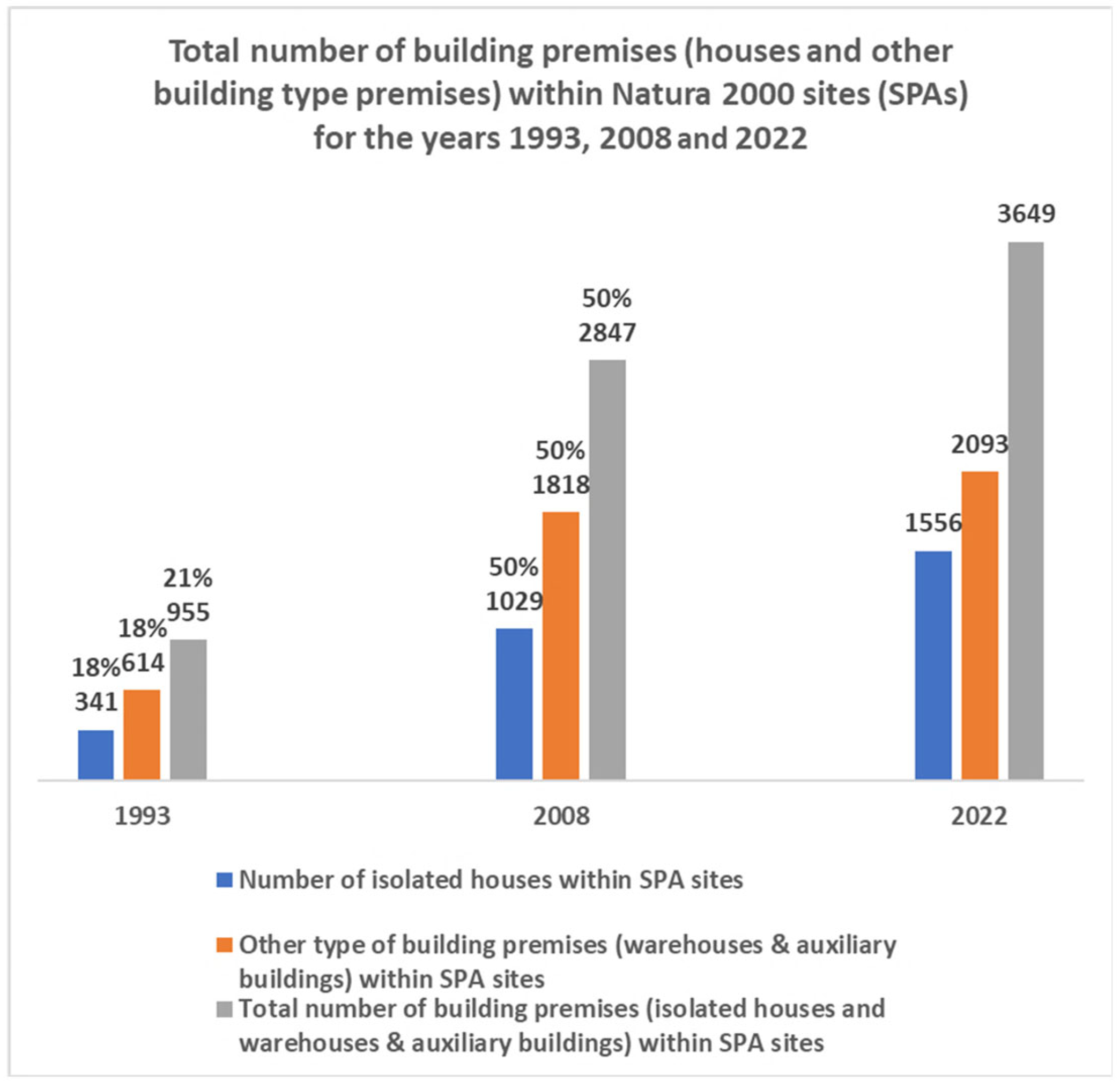
| Number of isolated houses within SPA sites | 341 | 1029 | 1556 | 201.76% | 51% | 356% |
| Other types of building premises (warehouses & auxiliary buildings) within SPA sites | 614 | 1818 | 2093 | 196.09% | 15% | 241% |
| Total number of building premises (isolated houses and warehouses & auxiliary buildings) within SPA sites | 955 | 2847 | 3649 | 198% | 28% | 282% |
| N = 32, K = 3 | F (2, 93) | p-Value |
|---|---|---|
| Number of isolated houses | 4.55 | 0.013 * |
| Number of warehouses & auxiliary buildings | 8.28 | 0.001 * |
| Total number of built premises | 7.66 | 0.001 * |
| Density of isolated houses | 3.56 | 0.032 * |
| Density of warehouses & auxiliary buildings | 3.27 | 0.042 * |
| Total density of built premises | 4.49 | 0.014 * |
| N = 32 Dependent Variable | (I) Year | (J) Year | Mean Difference (I − J) | p-Value | 95% Confidence Interval | |
|---|---|---|---|---|---|---|
| Lower Bound | Upper Bound | |||||
| Number of households | 1993 | 2008 | −21.50 | 0.21 | −51.56 | 8.56 |
| 2022 | −37.97 | 0.01 * | −68.02 | −7.91 | ||
| 2008 | 1993 | 21.50 | 0.21 | −8.56 | 51.56 | |
| 2022 | −16.47 | 0.40 | −46.52 | 13.59 | ||
| 2022 | 1993 | 37.97 | 0.01 * | 7.91 | 68.02 | |
| 2008 | 16.47 | 0.40 | −13.59 | 46.52 | ||
| Numbers of warehouses | 1993 | 2008 | −37.63 | 0.01 * | −66.40 | −8.85 |
| 2022 | −46.22 | 0.001 * | −74.99 | −17.45 | ||
| 2008 | 1993 | 37.63 | 0.01 * | 8.85 | 66.40 | |
| 2022 | −8.59 | 0.76 | −37.37 | 20.18 | ||
| 2022 | 1993 | 46.22 | 0.001 * | 17.45 | 74.99 | |
| 2008 | 8.59 | 0.76 | −20.18 | 37.37 | ||
| Total number of premises | 1993 | 2008 | −59.13 | 0.02 * | −111.72 | −6.53 |
| 2022 | −84.19 | 0.001 * | −136.79 | −31.59 | ||
| 2008 | 1993 | 59.13 | 0.02 * | 6.53 | 111.72 | |
| 2022 | −25.06 | 0.50 | −77.66 | 27.54 | ||
| 2022 | 1993 | 84.19 | 0.001 * | 31.59 | 136.79 | |
| 2008 | 25.06 | 0.50 | −27.54 | 77.66 | ||
| Density for houses | 1993 | 2008 | −1.59 | 0.17 | −3.68 | 0.50 |
| 2022 | −2.28 | 0.03 * | −4.37 | −0.19 | ||
| 2008 | 1993 | 1.59 | 0.17 | −0.50 | 3.68 | |
| 2022 | −0.69 | 0.71 | −2.78 | 1.40 | ||
| 2022 | 1993 | 2.28 | 0.03 * | 0.19 | 4.37 | |
| 2008 | 0.69 | 0.71 | −1.40 | 2.78 | ||
| Density for warehouses | 1993 | 2008 | −2.55 | 0.07 * | −5.25 | 0.16 |
| 2022 | −2.48 | 0.08 * | −5.19 | 0.22 | ||
| 2008 | 1993 | 2.55 | 0.07 * | −0.16 | 5.25 | |
| 2022 | 0.07 | 1.00 | −2.64 | 2.77 | ||
| 2022 | 1993 | 2.48 | 0.08 * | −0.22 | 5.19 | |
| 2008 | −0.07 | 1.00 | −2.77 | 2.64 | ||
| Density for total premises | 1993 | 2008 | −4.14 | 0.049 * | −8.26 | −0.02 |
| 2022 | −4.77 | 0.02 * | −8.88 | −0.65 | ||
| 2008 | 1993 | 4.14 | 0.049 * | 0.02 | 8.26 | |
| 2022 | −0.63 | 0.93 | −4.74 | 3.49 | ||
| 2022 | 1993 | 4.77 | 0.02 * | 0.65 | 8.88 | |
| 2008 | 0.63 | 0.93 | −3.49 | 4.74 | ||
| Type of Planning Zone | Number of Isolated Houses (1993) | Number of Isolated Houses (2008) | Number of Isolated Houses (2022) | % Increase (1993–2008) | % Increase (2008–2022) | % Increase (1993–2022) | % of Total Houses (1993) | % of Total Houses (2008) | % of Total Houses (2022) |
|---|---|---|---|---|---|---|---|---|---|
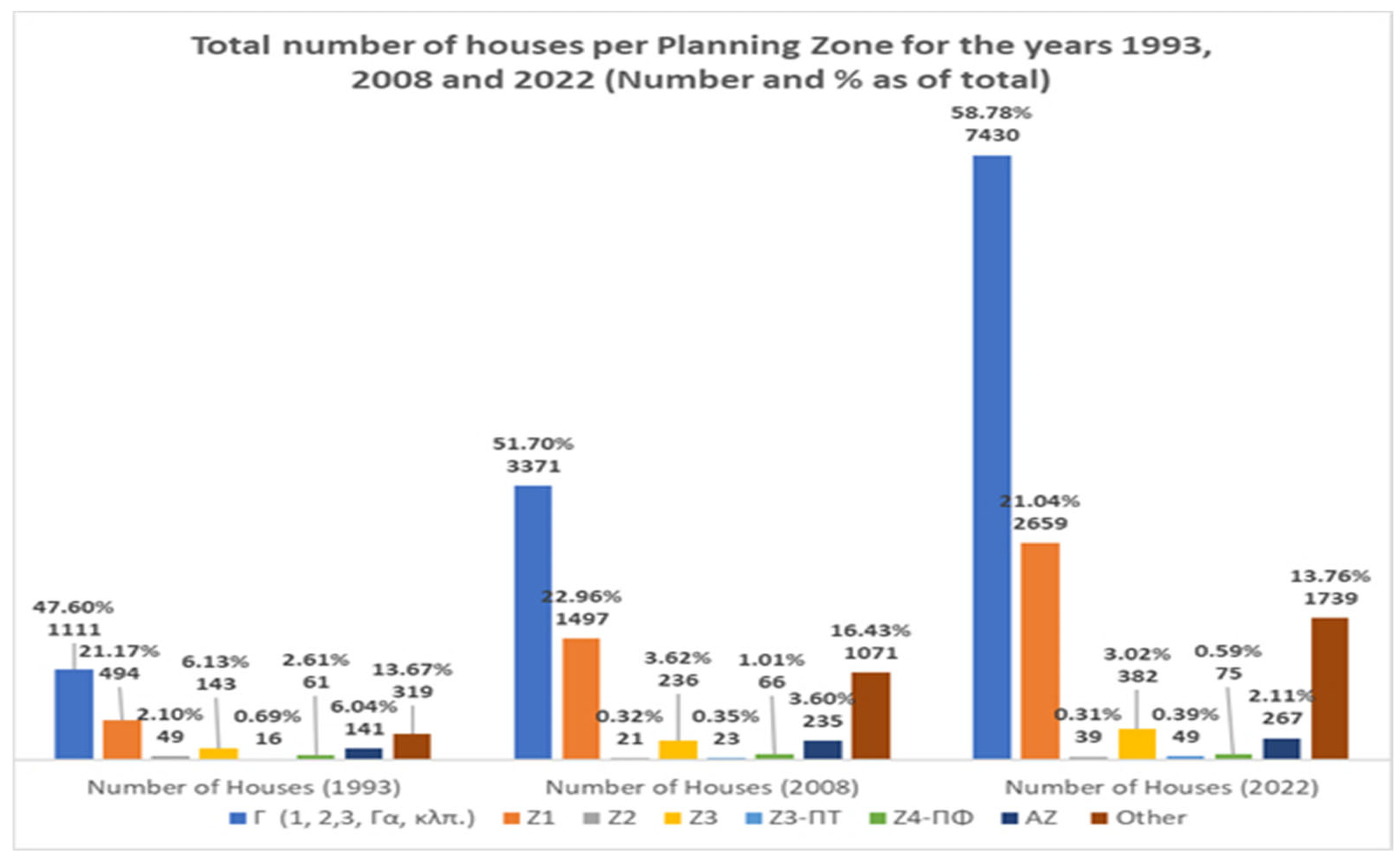
| Γ (1, 2, 3, Γα) | 1111 | 3371 | 7430 | 203.42% | 120.41% | 568.77% | 45.53% | 51.70% | 58.78% |
| Z1 | 494 | 1497 | 2659 | 203.04% | 77.62% | 438.26% | 20.25% | 22.96% | 21.04% |
| Z2 | 49 | 21 | 39 | −57.14% | 85.71% | −20.41% | 2.01% | 0.32% | 0.31% |
| Z3 | 143 | 236 | 382 | 65.03% | 61.86% | 167.13% | 5.86% | 3.62% | 3.02% |
| Z3-ΠΠ | 16 | 23 | 49 | 43.75% | 113.04% | 206.25% | 0.66% | 0.35% | 0.39% |
| Z4-ΠΚΦ | 61 | 66 | 75 | 8.20% | 13.64% | 22.95% | 2.50% | 1.01% | 0.59% |
| AZ | 141 | 235 | 267 | 66.67% | 13.62% | 89.36% | 5.78% | 3.60% | 2.11% |
| Other | 425 | 1071 | 1739 | 152.00% | 62.37% | 309.18% | 17.42% | 16.43% | 13.76% |
| Total | 2440 | 6520 | 12,640 | 167.21% | 93.87% | 418.03% | 100.00% | 100.00% | 100.00% |
| District | Number of Houses (1993) | Number of Houses (2008) | Number of Houses (2022) | % Increase (1993–2008) | % Increase (2008–2022) | % Increase (1993–2022) | % of Total Houses (1993) | % of Total Houses (2008) | % of Total Houses (2022) |
|---|---|---|---|---|---|---|---|---|---|
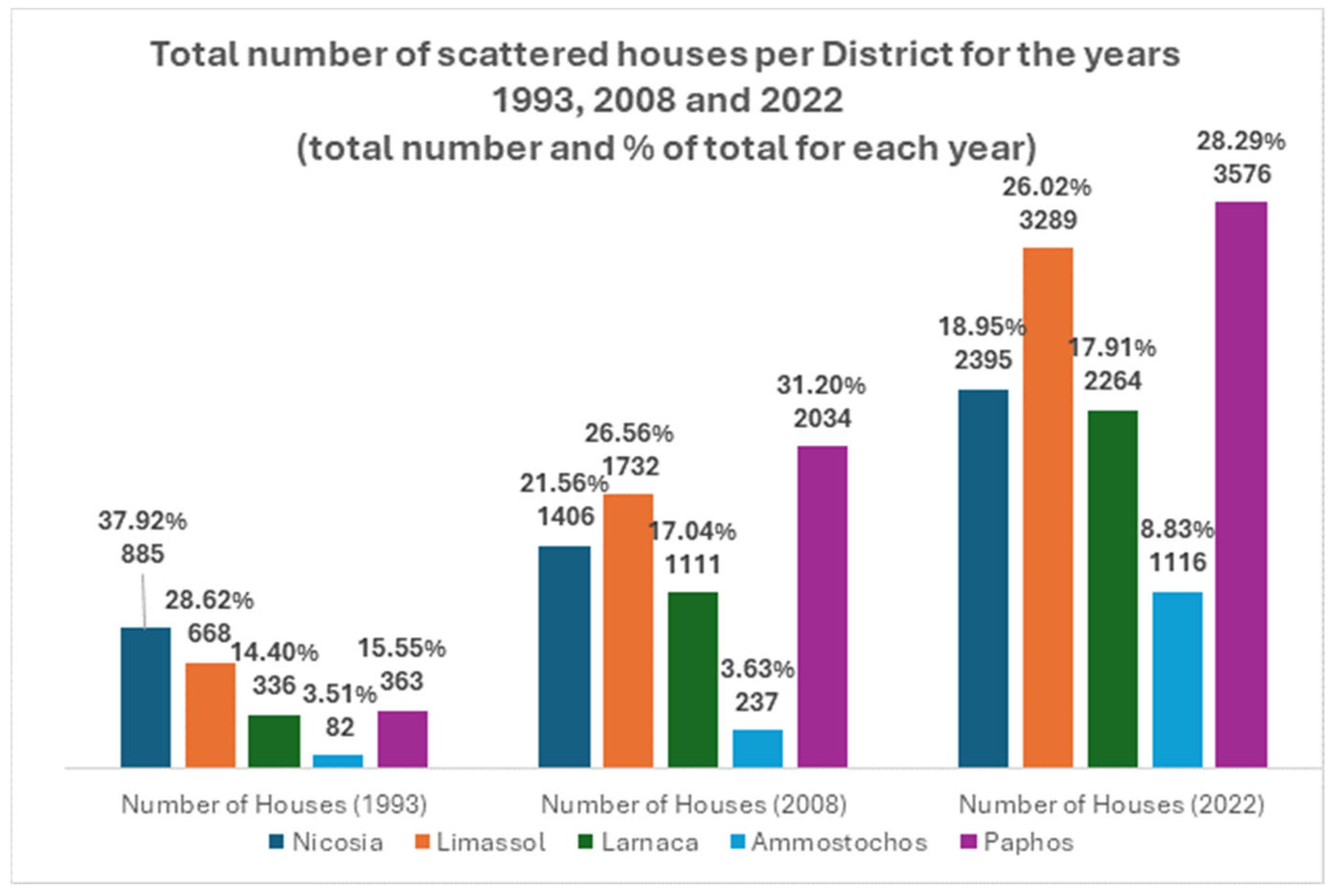
| Nicosia | 885 | 1406 | 2395 | 58.87% | 70.34% | 170.62% | 36.27% | 21.56% | 18.95% |
| Limassol | 668 | 1732 | 3289 | 159.28% | 89.90% | 392.37% | 27.38% | 26.56% | 26.02% |
| Larnaca | 442 | 1111 | 2264 | 151.36% | 103.78% | 412.22% | 18.11% | 17.04% | 17.91% |
| Ammachostos | 82 | 237 | 1116 | 189.02% | 370.89% | 1260.98% | 3.36% | 3.63% | 8.83% |
| Paphos | 363 | 2034 | 3576 | 460.33% | 75.81% | 885.12% | 14.88% | 31.20% | 28.29% |
| Total | 2440 | 6520 | 12,640 | 167.21% | 93.87% | 418.03% | 100.00% | 100.00% | 100.00% |
Disclaimer/Publisher’s Note: The statements, opinions and data contained in all publications are solely those of the individual author(s) and contributor(s) and not of MDPI and/or the editor(s). MDPI and/or the editor(s) disclaim responsibility for any injury to people or property resulting from any ideas, methods, instructions or products referred to in the content. |
© 2026 by the authors. Licensee MDPI, Basel, Switzerland. This article is an open access article distributed under the terms and conditions of the Creative Commons Attribution (CC BY) license.
Share and Cite
Panayides, P.; Panayi, P.; Tziraki, M.; Mavrikiou, P.; Ioannou, B. Urban Sprawl Inside and Outside Natura 2000 Sites (SPAs) in Mediterranean EU States: The Case of Cyprus. Land 2026, 15, 481. https://doi.org/10.3390/land15030481
Panayides P, Panayi P, Tziraki M, Mavrikiou P, Ioannou B. Urban Sprawl Inside and Outside Natura 2000 Sites (SPAs) in Mediterranean EU States: The Case of Cyprus. Land. 2026; 15(3):481. https://doi.org/10.3390/land15030481
Chicago/Turabian StylePanayides, Panicos, Panicos Panayi, Maria Tziraki, Petroula Mavrikiou, and Byron Ioannou. 2026. "Urban Sprawl Inside and Outside Natura 2000 Sites (SPAs) in Mediterranean EU States: The Case of Cyprus" Land 15, no. 3: 481. https://doi.org/10.3390/land15030481
APA StylePanayides, P., Panayi, P., Tziraki, M., Mavrikiou, P., & Ioannou, B. (2026). Urban Sprawl Inside and Outside Natura 2000 Sites (SPAs) in Mediterranean EU States: The Case of Cyprus. Land, 15(3), 481. https://doi.org/10.3390/land15030481