Article

Seasonal Vegetation Dynamics and Soil Seed-Bank Relationships in Rawdat Nourah, King Abdulaziz Royal Reserve, Saudi Arabia


by
Asma A. Al-Huqail
1,*,
Mohamed A. El-Sheikh
1,
Abdullah M. Alowaifeer
2,
Turki S. Alsaleem
2 and
Ahmed M. Abd-ElGawad
1,3,*
1
Chair of Climate Change, Environmental Development and Vegetation Cover, Department of Botany and Microbiology, College of Science, King Saud University, Riyadh 11451, Saudi Arabia
2
King Abdulaziz Royal Reserve Development Authority, Riyadh 11564, Saudi Arabia
3
Plant Production Department, College of Food & Agriculture Sciences, King Saud University, P.O. Box 2460, Riyadh 11451, Saudi Arabia
*
Authors to whom correspondence should be addressed.
Land 2026, 15(3), 480; https://doi.org/10.3390/land15030480
Submission received: 1 February 2026 / Revised: 1 March 2026 / Accepted: 12 March 2026 / Published: 17 March 2026
(This article belongs to the Section Land Use, Impact Assessment and Sustainability)

Abstract

Vegetation in desert ecosystems is strongly affected by seasonal climatic fluctuations and soil physical and chemical properties. Rawdat Nourah is a natural watershed depression within the King Abdulaziz Royal Reserve in Saudi Arabia. It is colonized by grasses, herbs, and shrubs. Climatic variability and soil heterogeneity are influencing the vegetation dynamics and regeneration patterns in this ecosystem. Based on the literature review, no previous study analyzed and determined either the vegetation composition or the soil seed-bank of Rawdat Nourah. So, the general objective of this study is to examine the vegetation composition and its relationships with soil physicochemical properties and soil seed-bank composition across Rawdat Nourah across different seasons. Floristic analyses, vegetation composition, soil properties, and soil seed-bank were performed within two seasons (winter–spring and summer–fall seasons) of 2023–2024. The obtained data were analyzed using multivariate and statistical approaches. Six plant associations were identified: winter–spring (WVG I: Zilla spinosa–Malva parviflora; WVG II: Rhazya stricta–Zilla spinosa; WVG III: Cynodon dactylon–Convolvulus pilosellifolius) and summer–fall (SVG I: Calotropis procera–Pulicaria undulata; SVG II: Cynodon dactylon–Zilla spinosa; SVG III: Rhazya stricta–Schismus arabicus). Species richness was higher in winter–spring (2.4 species stand−1) than in summer–fall (1.66 species stand−1), while the seed-bank densities were 633.9 and 575.1 seeds m−2, respectively. Vegetation responded strongly to marked seasonal contrasts in temperature and moisture (~15 °C, 11 mm vs. ~36 °C, 3 mm). Moderate human activity enhanced vegetation cover, whereas prolonged grazing exclusion reduced diversity through the dominance of a few species. The response of vegetation structure and species richness to climatic factors varies greatly depending on the increase in water availability, and moisture content during the mild weather Winter–Spring season (mean temperature is 15 °C and rainfall is 11 mm), compared to the Summer–Autumn season (mean temperature is 36 °C and rainfall is 3 mm). The richness and cover of the plants were generally affected by human activity, where long-term grazing will reduce species richness and increase competition between species, making one or two species dominant. Although above-ground vegetation exhibited clear seasonal and spatial shifts in species composition and abundance, these changes were not reflected in the soil seed-bank. This relation suggests that above-ground communities and seed-banks are regulated by different ecological processes under arid conditions. The data of the present study showed low correlation between the current vegetation and the soil seed bank, which reflects a degradation in this region. Therefore, these findings suggest that sustained protection of the King Abdulaziz Royal Reserve is essential for enhancing seed-bank persistence, vegetation recovery, and ecosystem resilience under arid conditions.

1. Introduction

The hyper-arid rawdat ecosystems are unique ecological sites found mainly in the deserts within the Arabian Peninsula. The term “rawdat” refers to the natural depression or low-lying catchment where rainwater is collected via valleys, making a small temporary oasis within a dryland region [1]. Rawdat ecosystems are very important for the environment because they are natural reservoirs that support unique plants and animals [2,3]. The vegetation in such hyper-arid ecosystems is adapted to survive under harsh conditions such as drought, intense heat, and high salinity [4,5]. This ecosystem supports plant diversity due to water availability and nutrients, thereby acting as a vital refuge for wildlife and for keeping biodiversity, soil stability, and ecological resilience in the face of climate change.
Within the hyper-arid habitats, rainfall and temperature are widely recognized as primary controls on vegetation change in drylands [6,7]. These drivers generate temporal and spatial fluctuations in plant communities and their soil seed banks, particularly in semi-arid meadow systems [8,9,10]. In hyper-arid habitats, soil seed banks buffer population fluctuations because dormancy and longevity allow species to persist through unfavorable years [9,11,12]. This mechanism is especially important for communities dominated by annuals that re-establish each growing season [13]. Theory and empirical work show that seed banks increasingly stabilize populations as environmental variability rises [14]. Hyper-arid lands (≈9% of Earth’s land surface) are often sparsely vegetated, with growth concentrated in wadis, oases, and depressions (rawdats) supported by local groundwater; these landscapes face intensifying water scarcity and climatic stress with implications for ecological stability and food security [15,16]. Recent warming-drying trends and extremes can push systems past ecological thresholds, driving vegetation and soil degradation and motivating restoration and resilience-building actions [17,18,19].
Patchy vegetation in these environments reflects resource redistribution by microtopography, which regulates soil moisture and nutrient accumulation and thus establishes niches [18]. Subtle elevation variations and associated geomorphic processes (erosion, deposition) create habitat heterogeneity that structures communities [20]. Within depressions, vegetation patches act as ecological refuges and “green spots” where soil texture, groundwater movement, and seed-bank dynamics interact to sustain semi-meadow vegetation [21,22]. These natural processes via microtopography-informed management can enhance restoration outcomes in arid lands [23,24].
The depression or rawdats microtopography of hyperarid landscapes encompasses the small-scale, intricate differences in landform that become crucial for the survival and shelter of plants [25,26]. In these geomorphological regions, biotic factors like plant growth and abiotic factors like erosion and sediment deposition work together to create a variety of habitats [27,28]. Vegetation patches or spotty plant distribution within these depressions act as ecological refuges that increase water catchment and nutrient accumulation, which, in consequence, support plant diversity and form semi-meadow green spots in the Sahara Desert [2,3]. This depression ecosystem is inhabited by some characteristic plant species, such as Ziziphus nummularia, Lycium shawii, Pulicaria undulata, Rhayza stricta, and Zilla spinosa [3,29,30]. The patterns of these green spots are not haphazard; they are governed by detailed interactions of groundwater movement, soil texture, soil seed-bank, and biological colonization, which give rise to intricate patterns that vary significantly in both scale and form [31,32].
The vegetation of these rawdat within the hyperarid Sahara has specific adaptations that can be seen in morphology, including root structure, a broad range of physiological adaptations, site preferences, dependency and affinity relationships, and reproductive strategies. Many of the herbaceous plants are ephemerals that may germinate within three days of adequate rainfall and sow their seeds within 10 or 15 days of germination. Sheltered in the hyperarid desert depressions are occasional stands of relict vegetation such as scrub plants. Others have adopted different adaptations to this uncertain environment. Neurada procumbens, for example, carries several seeds, but reportedly only one of these germinates with each rain shower; if the first seedling fails to become established, another one comes up with the next rain shower [33]. In Saudi Arabia, Rawdat ecosystems are one of the most important habitats. Their floors are often filled with well-drained silts, sands, and gravels, which may hold considerable amounts of moisture. These unique features make this ecosystem rich in plants that also support the wildlife.
Semi-arid meadows, therefore, serve as biodiversity reservoirs that stabilize desert ecosystems. An assessment of seasonal vegetation dynamics and soil seed-bank relationships in arid depressions is essential for predicting ecological responses to environmental change and guiding conservation, management, and restoration. According to our knowledge and based on the literature review, no previous study analyzed and determined either the vegetation composition or the soil seed-bank of Rawdat Nourah. We hypothesize that due to the various anthropogenic activities within the Rawdat Nourah, such as over-grazing, over-logging, and unmanaged camping, a low correlation between above-ground vegetation and soil seed-bank will be assessed. Therefore, the general aim of the present study was to evaluate the correlation between the current vegetation and the soil seed-bank in Rawdat Nourah and to assess the seasonal variation in the vegetation composition and soil seed-bank that can help in the management and restoration of such a hotspot ecosystem within an arid desert. The specific objectives of this study are (1) to examine the seasonal variation in above-ground vegetation and soil seed-bank composition and diversity; (2) to compare seed-bank and vegetation composition across different seasons; (3) to assess whether soil seed-bank composition is influenced by existing vegetation structure; and (4) to evaluate how the correspondence between the soil seed-bank and understory vegetation varies seasonally.

2. Materials and Methods

2.1. Study Area

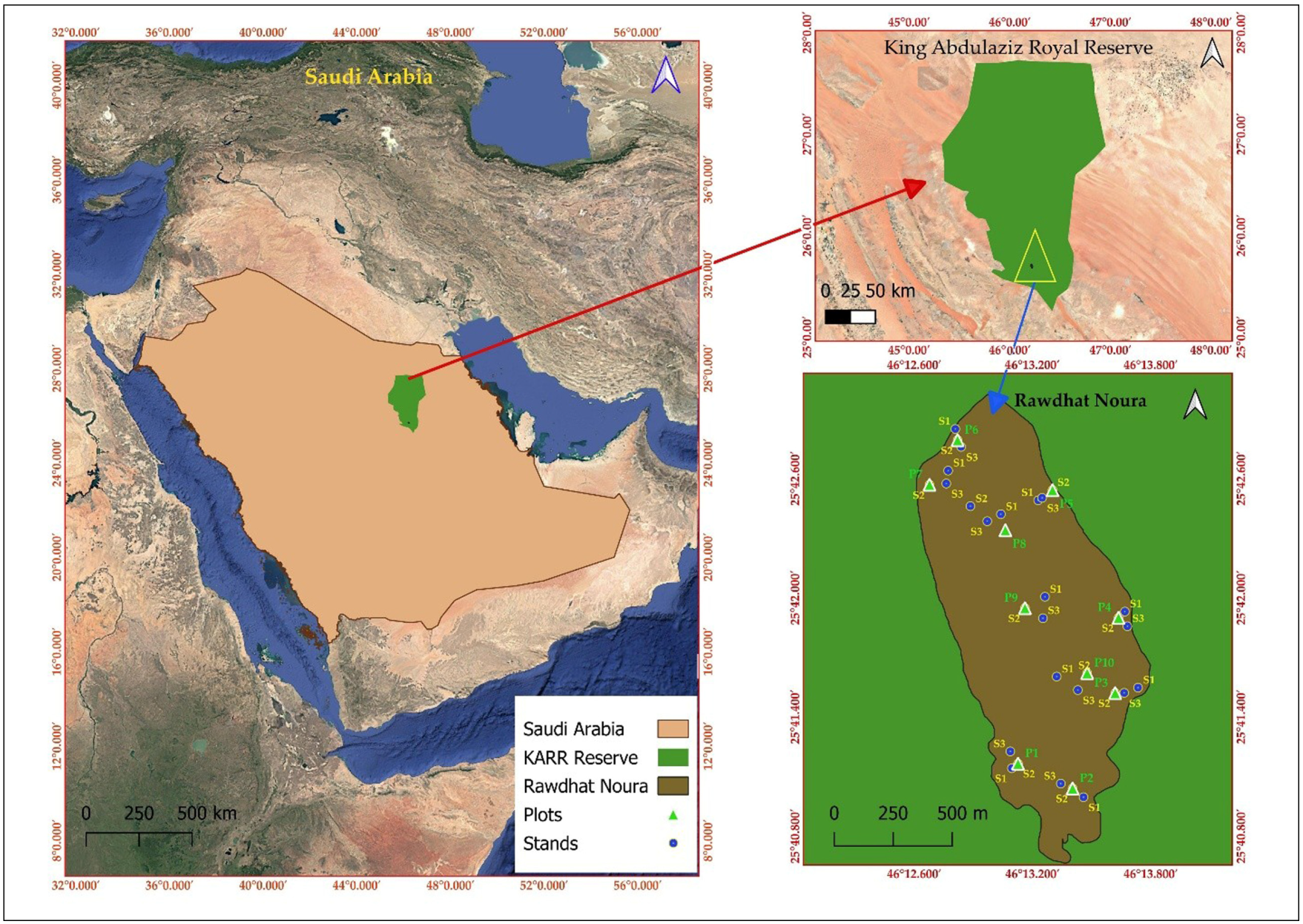
The study area is located at 25.69376° N, 46.22515° E within the King Abdulaziz Royal Reserve and covers approximately 4.42 km2 (Figure 1). It represents a depression formed by natural drainage and wind erosion of sedimentary layers. These depressions accumulate runoff during winter and spring rainfall [34].
The depression receives runoff mainly from a 170 km-long and 81 km-wide channel originating from the confluence of Wadi Al-Miyah and Wadi Sudayr near Rawdat Quba. Geologically, the wadi lies within the sedimentary formations of the Arabian Shelf, displaying considerable variation in lithology and age. Elevation ranges from 1001 m a.s.l. at Jabal Tuwaiq’s southwestern edge to 541 m a.s.l. at the depression outlet. The area’s fine-textured sandy-loam to silty-clay soils promote short-term water retention following rainfall, in contrast to the surrounding rocky and sandy deserts, which exhibit low infiltration. Consequently, Rawdat Nourah supports a semi-arid meadow community dominated by shrubs, forbs, and perennial grasses [15,35,36].

2.2. Climate

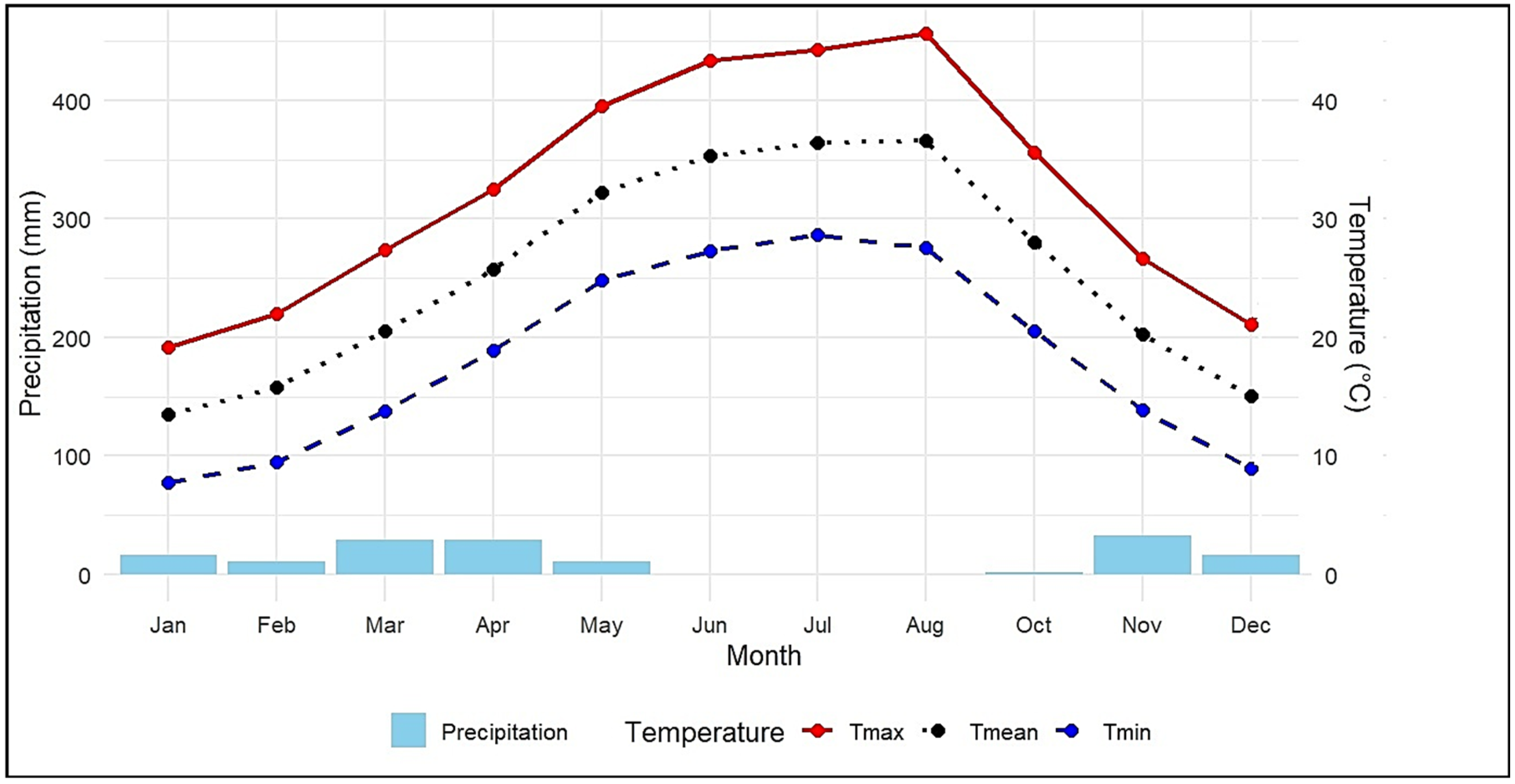
The climate of the study area is characterized by pronounced seasonal variability in temperature and precipitation (Figure 2). Mean monthly precipitation is low overall, with rainfall mainly concentrated in March–April and November–December, while June and July are nearly dry. Temperatures rise steadily from January, reaching peak maximum values in August (45.6 °C), whereas minimum temperatures increase from about 7.8 °C in January to around 28.6 °C in July, as derived from the Climate Change Knowledge Portal [37]. High evapotranspiration and irregular rainfall govern local hydrological and ecological dynamics. The elevation gradient of Wadi Al-Atsh enables temporary ponding that sustains vegetation and makes Rawdat Nourah a biodiversity hotspot for native flora.

2.3. Vegetation Sampling

To capture the ecological variability of Rawdat Nourah, a relevés of ten sampling plots were positioned across the major physiographic zones, including depressions, run-on areas, gentle slopes, and open plains (Figure S1). Each plot contained three quadrats to represent dominant life forms: one 20 m × 20 m quadrat for shrub strata and two 10 m × 10 m quadrats targeting herbaceous layers, producing a total of 30 quadrats. The quadrats were randomly distributed within each plot. The quadrats’ coordinates and their altitude are provided in Table S1. A relevé (list of plant species) within each plot was identified using regional floras Chaudhary [38], Chaudhary [39], Chaudhary [40], and Collenette [29], and identifications were verified using Plants of the World Online POWO [41]. Surveys were conducted during two contrasting climatic phases—summer–fall and winter–spring (2023–2024)—to document seasonal differences in vegetation composition. Plant density followed the procedures in Bonham [42], while cover values of the relevé were assigned using the Braun–Blanquet scale [43]. The Species Importance Value Index (IVI) was derived from relative density and relative cover values as (Equations (1)–(3)):
Relative   density s p e c i e s   A = 100 × Absolute   density   of   species   A Total   absolute   densities   of   all   species
Relative   cover   s p e c i e s   A = 100 × Absolute   cover   of   species   A Total   absolute   cover   of   all   species
IVI = Relative   density + Relative   cover
Lifeforms were classified according to Raunkiaer [44], and chorotypes were assigned using published floras and online databases (https://flora.org.il/en/plants/ accessed on 1 December 2025, http://www.theplantlist.org accessed on 5 November 2025, https://powo.science.kew.org accessed on 1 November 2025). Sampling was carried out during two contrasting seasons—summer–fall and winter–spring of the year 2024—to assess seasonal variation in species composition and dominance.

2.4. Soil Seed-Bank Sampling

At the center of every vegetation quadrat, a soil sample of 4000 cm3 was collected to characterize the viable seed reservoir, giving 30 seed-bank samples. The seedling emergence technique [45] was used to quantify viable seeds through controlled germination [46]. Soils were sieved (4 mm), cold-stratified at 2 °C for 30 days [47], and then placed in perforated plastic trays (45 cm × 45 cm × 7 cm) over sterilized sand. Samples were maintained in a greenhouse at 25 ± 2 °C and watered daily. Germinating seedlings were recorded, identified weekly, and removed for the duration of the trial. Relative density of each species was calculated using Equation (4):
R D ( % ) = 100 × N i N t
where N i is the number of seedlings of species i and N t is the total number of seedlings across all species.

2.5. Soil Analysis

Soil samples were collected from each quadrat at a depth of 5–25 cm for analysis of physical and chemical properties. Thereafter, the samples were air-dried at room temperature, gently crushed, and sieved through a 2 mm mesh to remove coarse fragments. Soil texture was determined using the hydrometer method [48]. Porosity was estimated following Mualem [49], and water-holding capacity was measured using the method proposed by Keen and Raczkowski [50]. Particle density was determined using the graduated-cylinder method [51]. Chemical attributes were quantified from 1:5 soil water extracts, including pH and electrical conductivity (EC), which were determined according to Rowell [52]. Organic matter was measured by the loss-on-ignition procedure at 550 °C, while calcium carbonate (CaCO3) was determined using a calcimeter [53]. Total nitrogen and phosphorus were analyzed using the Kjeldahl digestion method [54] and spectrophotometric determination [55], respectively. Exchangeable Na+, K+, Ca2+, and Mg2+ were extracted using 2.5% acetic acid; Na+ and K+ concentrations were quantified by flame photometry, and Ca2+ and Mg2+ by atomic absorption spectrometry [56,57]. Carbonate (CO32−) and bicarbonate (HCO3) contents were determined by acid titration [53], whereas chloride (Cl) was analyzed using AgNO3 titration [58]. Table S2 explained the various methods and references of the soil analyses used in the present study.

2.6. Data Analysis

Two analytical datasets (matrices) were generated: Matrix I: plot × species IVI and Matrix II: plot × IVI × soil variables. Community classification was performed using TWINSPAN [59], based on the relevés matrix of the species IVI (relative cover + relative density), and the floristic gradients were examined using Detrended Correspondence Analysis (DCA) [60] using the same matrix. Relationships between species assemblages and edaphic factors were tested via Canonical Correspondence Analysis (CCA) [61]. For CCA, two matrices were used; the first is the relevés matrix of the species IVI (relative cover + relative density), while the second is the relevés matrix of the soil variables. The Ward linkage method and the Bray–Curtis distance metric were used to conduct cluster analysis. The Bray–Curtis measure was chosen because it was suitable for abundance data, and the Ward approach was chosen because it could reduce within-cluster variance. To explore the correspondence between above-ground vegetation and the soil seed-bank, heatmaps, dendrograms, and constellation diagrams were produced using TBtools, version 2.1 [62]. Alpha (α) diversity was expressed as the mean number of species per stand, while gamma (γ) diversity represented total richness per community.
Diversity indices were computed using Equations (5) and (6):
H = p i l n   ( p i ) ( Shannon Wiener   Index )
C = p i 2 ( Simpson s   Dominance   Index )
where pi is the relative cover of species i [63,64].
Pearson’s correlation coefficients tested relationships between soil variables and diversity indices. Statistical analyses, including one-way ANOVA, were performed using JMP® Pro 16.0.0 and SPSS, Version 31 (IBM Corp., Armonk, NY, USA) to evaluate seasonal and community-level variation in vegetation and soil parameters. Figures were generated in R (version 4.3.3). Visualization of soil and vegetation relationships was performed using the packages ggplot2, dplyr, reshape2, ggpubr, and pheatmap.

3. Results and Discussion

3.1. Floristic Structure of Rawdat Nourah

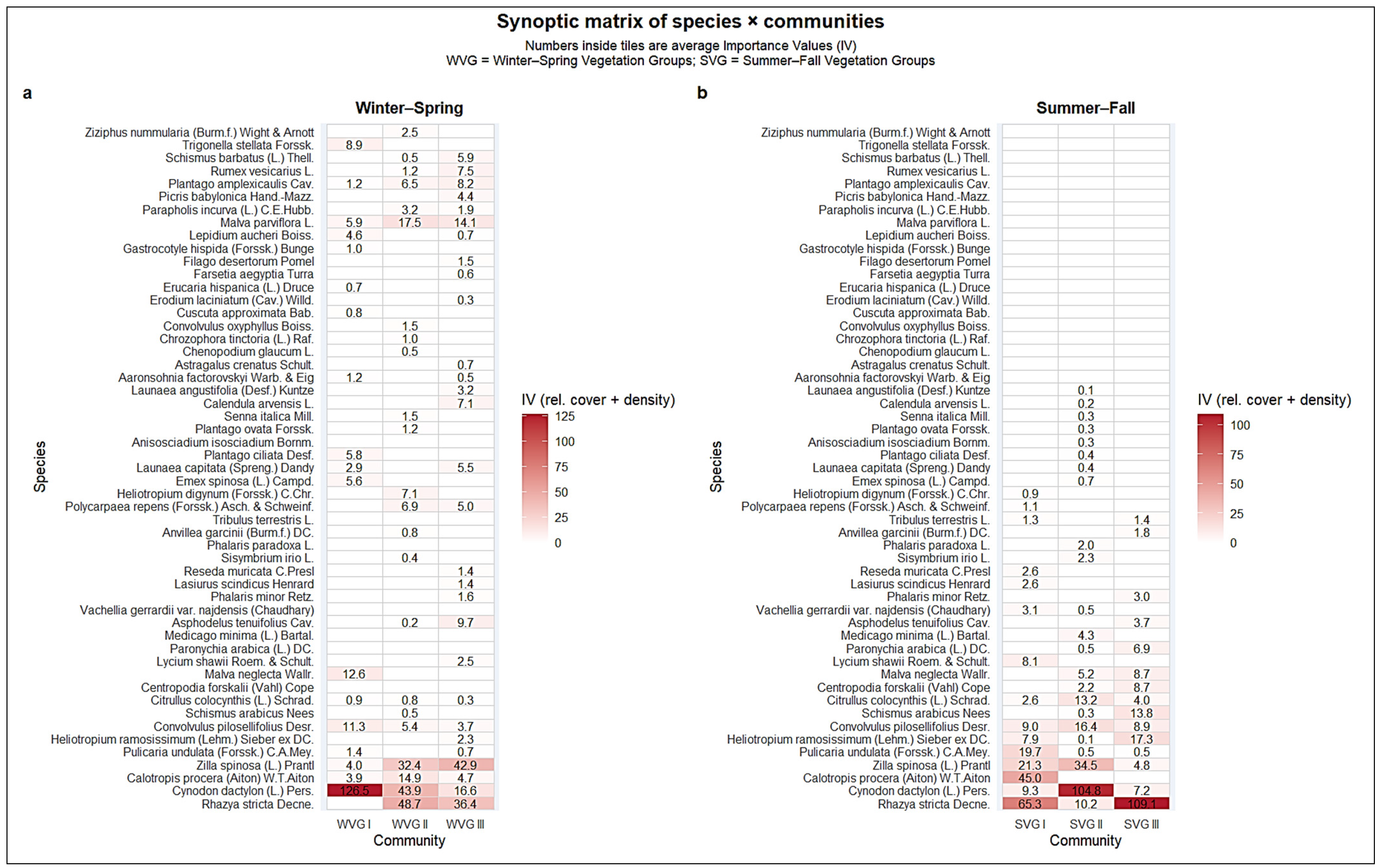
A total of 67 plant species were recorded in Rawdat Nourah, including 59 in winter–spring and 34 in summer–fall, with 26 shared species (9 annuals, 3 biennials, and 14 perennials). Excluding shared taxa, winter–spring comprised 25 exclusive species (78% annuals), whereas summer–fall included 8 exclusive species (75% annuals). These contrasts reflect strong seasonal shifts in community composition driven by temperature and soil moisture regimes (Figure 3 and Figure S2). These patterns of the seasonal dominance of annuals correspond with arid-zone vegetation dynamics in Saudi Arabia, where therophytes capitalize on brief post-rainfall moisture periods, while perennials maintain structure and cover through extended droughts [65,66]. Similar turnover patterns have been reported in other raudhat and wadi habitats [2,3].
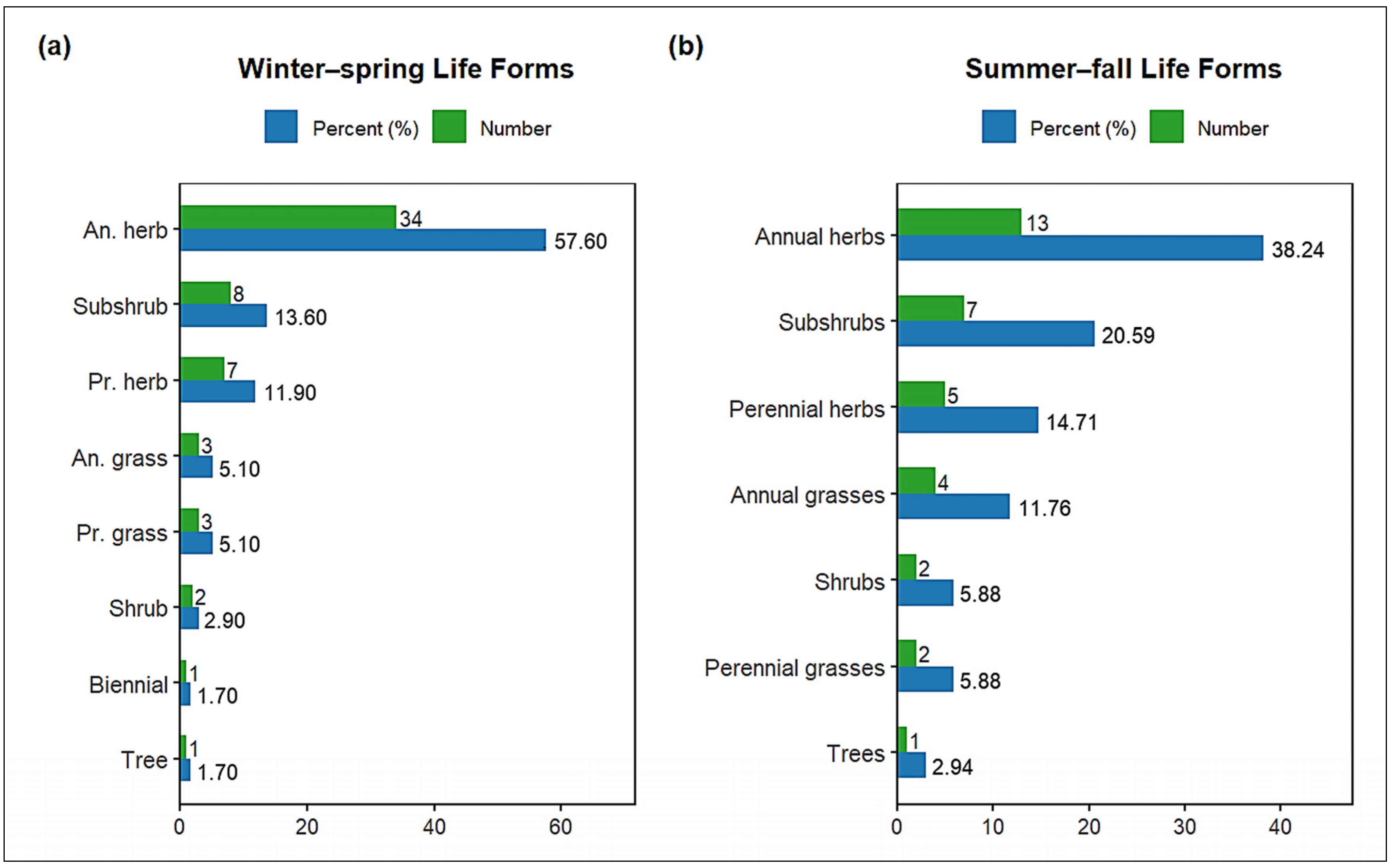
Life-form composition exhibited distinct seasonal shifts (Figure 4). Annual herbs dominated during winter–spring (34 species; 57.6%) but declined sharply in summer–fall (13 species; 38.2%). Subshrubs (chamaephytes) remained consistent (8 species; 13.6% in winter–spring and 7 species; 20.6% in summer–fall), followed by perennial herbs (7 species; 11.9% and 5 species; 14.7%). Trees were the least represented life form (one species per season). These trends demonstrate that annuals drive primary productivity following rainfall pulses, while perennials and subshrubs sustain vegetation continuity and resilience through the dry season [3,66,67].
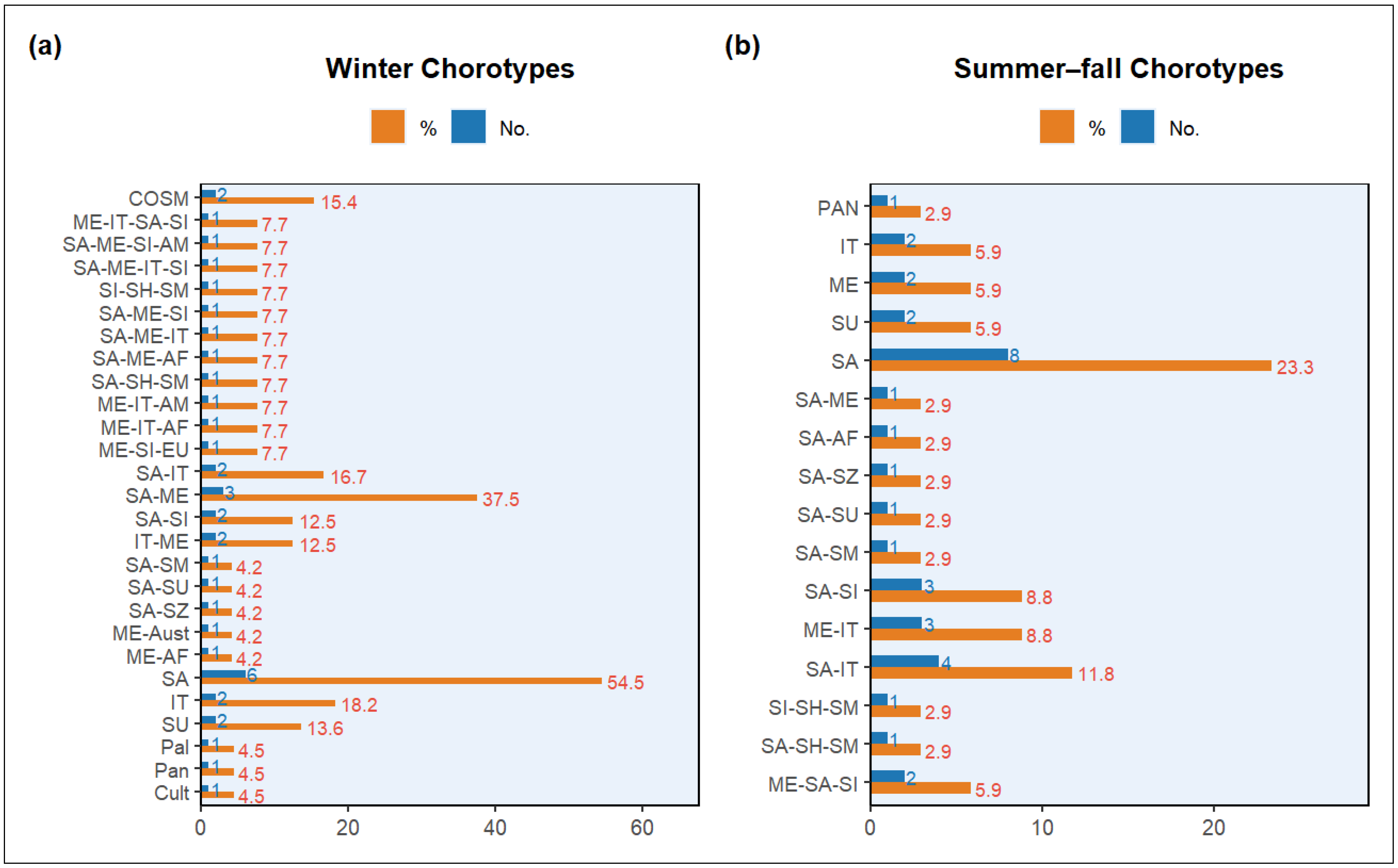
The relative dominance of plant families varied seasonally (Figure S3). During the winter–spring period, Asteraceae, Poaceae, and Brassicaceae were the most abundant families, whereas Poaceae, Asteraceae, and Fabaceae were more prominent in the summer–fall season. This seasonal change in family composition reflects differences in physiological responses to temperature and moisture availability, with grasses maintaining dominance under warmer and drier conditions [68,69]. Phytogeographic (chorological) analysis revealed a clear desert-adapted flora (Figure 5). The Saharo-Arabian chorotype was most prevalent, comprising 12 species in winter–spring and 8 in summer–fall. It was followed by Saharo-Arabian–Irano-Turanian elements (9 and 4 species, respectively). Only two cosmopolitan taxa were found in winter–spring, and two multi-regional species (Saharo-Arabian–Mediterranean–Irano-Turanian–Saharo-Sindian) appeared in summer–fall, confirming the arid-zone signature of the Rawdat flora [70].
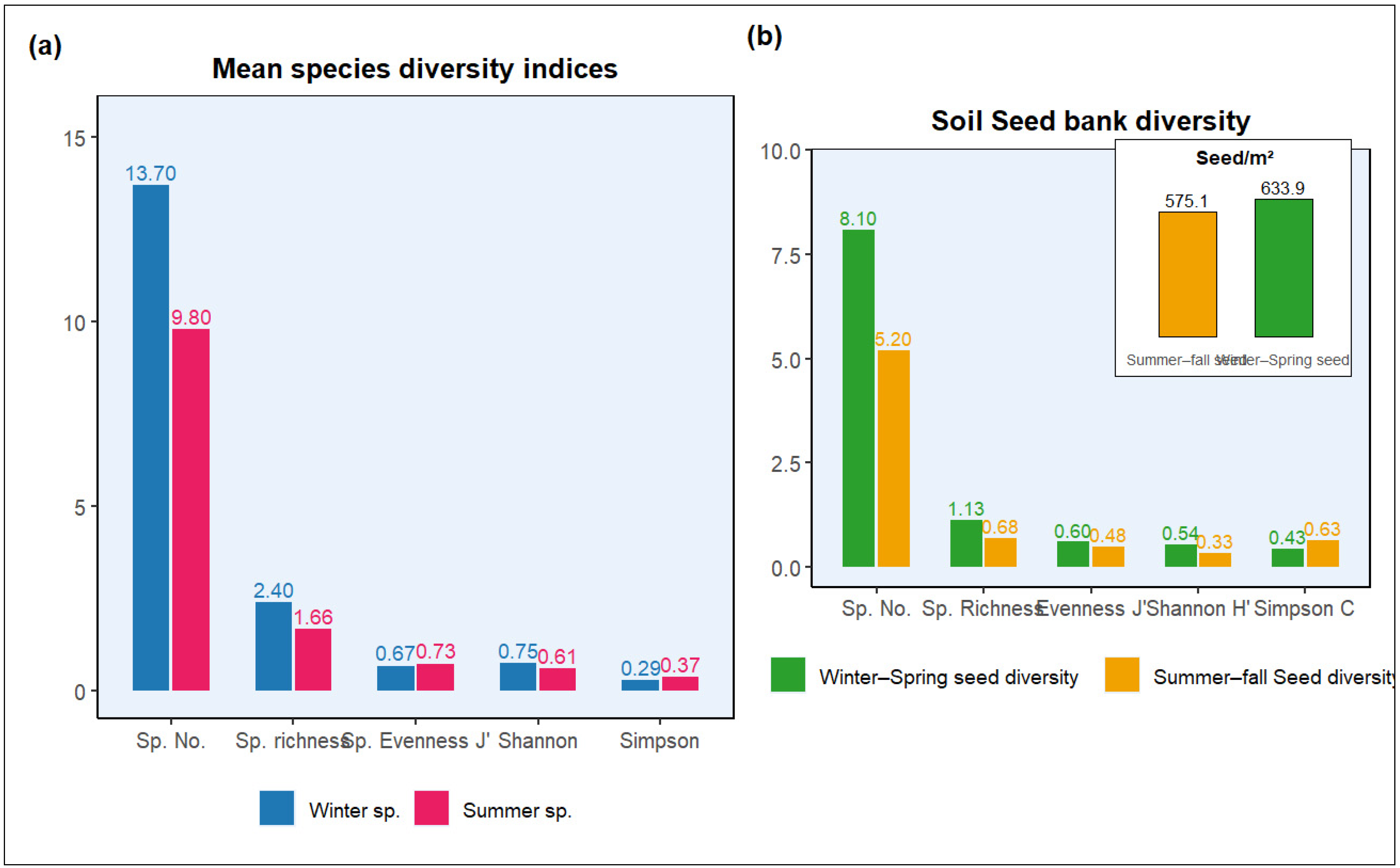
Species richness, number, and Shannon diversity (H′) were higher in winter–spring for both above-ground vegetation and the soil seed-bank, while Simpson’s dominance index (C) increased in summer–fall, indicating reduced evenness and dominance by a few tolerant species (Figure 6).
Extended grazing exclusion corresponded to lower species richness and higher dominance of stress-tolerant taxa such as Cynodon dactylon (unpublished field observation), which maintained a strong presence across several associations, i.e., the complete protection and prevention of grazing led to one plant dominating the habitat, making a monospecific stand, particularly for grasses that make a mat of plant materials that prevent the other species to germinate and grow [71]. Therefore, the reintroduction of traditional grazing throughout ecological, cultural, and economic measures would enhance the plant diversity in such habitats [72,73]. These seasonal patterns confirm a strong coupling between rainfall pulses and plant life-span strategies: annuals exploit transient moisture, while perennials and subshrubs ensure community persistence [3,67,69].

3.2. Vegetation Composition

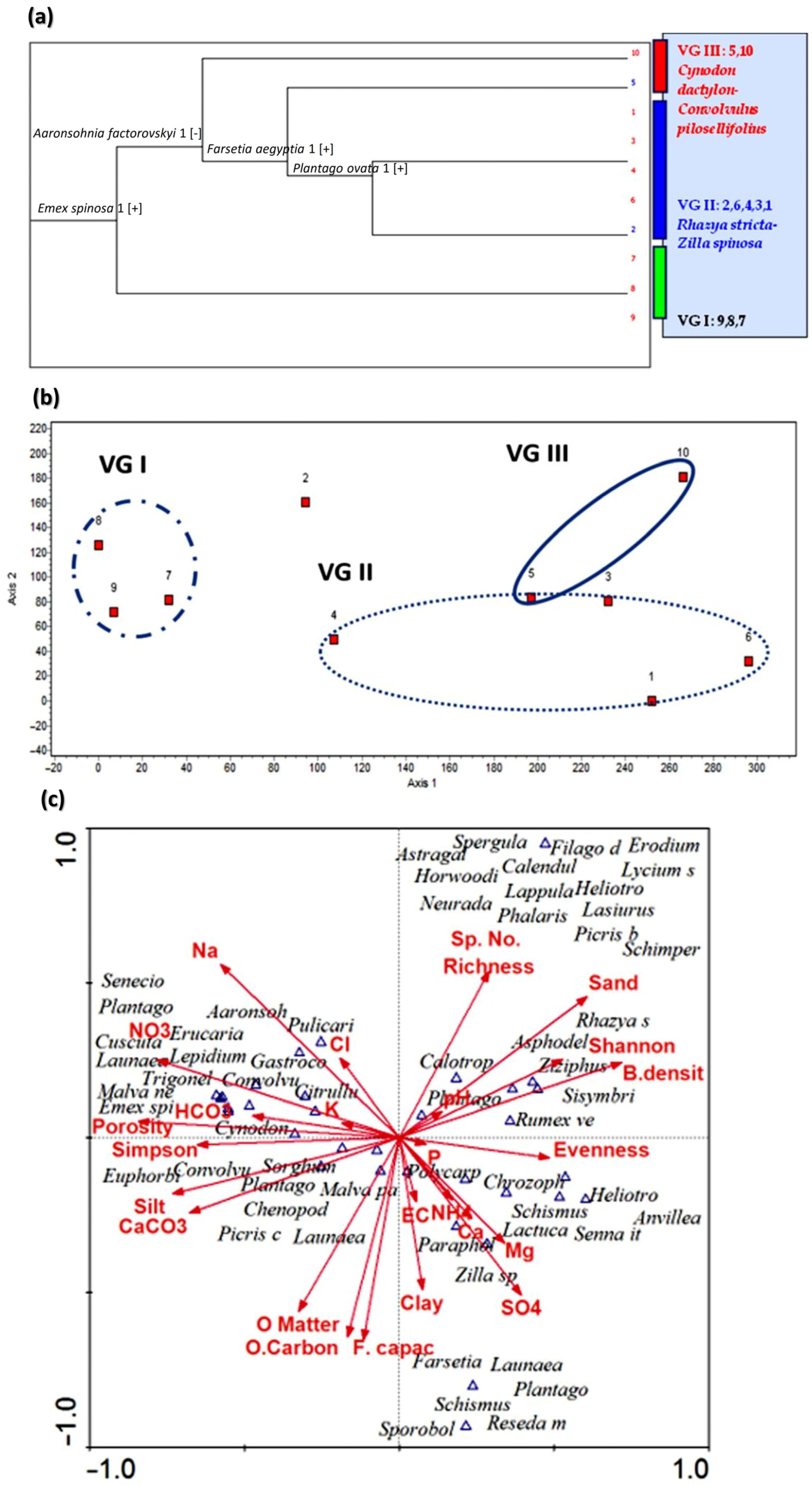
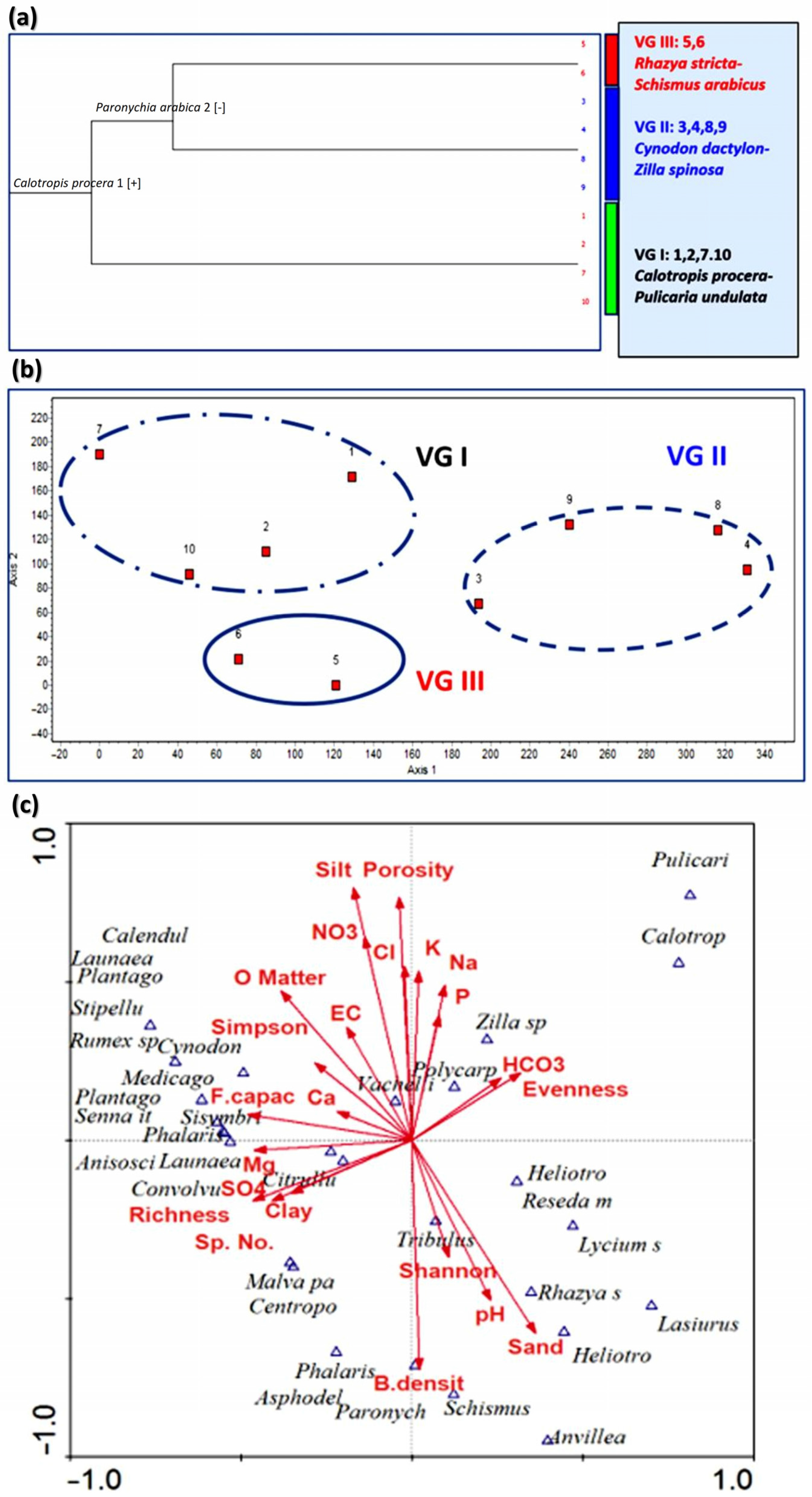
The results of the cluster analysis and ordination demonstrate six well-defined plant associations—three during the winter–spring season and three in the summer–fall, each reflecting coherent floristic, edaphic, and climatic gradients corresponding to Levels 2–3 of the TWINSPAN classification. In winter–spring, three plant communities were identified (Figure 7a,b) as follows: WVG I: Zilla spinosa–Malva parviflora, WVG II: Rhazya stricta–Zilla spinosa, and WVG III: Cynodon dactylon–Convolvulus pilosellifolius. On the other side, three plant communities were identified during the summer–fall season (SVG I: Calotropis procera–Pulicaria undulata, SVG II: Cynodon dactylon–Zilla spinosa, and SVG III: Rhazya stricta–Schismus arabicus). DCA and CCA ordinations confirmed the distinct separation among these communities. In winter–spring, WVG I was dominated by ephemeral annuals, whereas in summer–fall, all three associations were composed primarily of perennials or woody species. Such seasonal turnover typifies arid-zone vegetation, where short-lived therophytes exploit transient moisture in cooler months and perennial shrubs dominate during the prolonged hot–dry period [74,75].
Multivariate ordinations revealed that plant-community composition was strongly influenced by soil gradients and environmental stress. During winter–spring, WVG I (negative side of AX1) correlated with elevated Na+ and NO3, higher soil porosity, greater Simpson dominance, silt enrichment, and increased CaCO3 content (Table 1 and Figure 7c).
WVG II, situated on the negative side of AX2, corresponded with higher clay fraction, organic matter, organic C, SO42−, and field capacity conditions reflecting more stable, nutrient-rich substrates. In contrast, WVG III (upper positive side of AX1) was associated with coarser, sandier soils, higher bulk density, greater species evenness, and elevated Shannon diversity, indicating adaptation to less fertile, well-drained sites. These gradients demonstrate that vegetation structure in Rawdat Nourah is tightly linked to soil texture, nutrient status, and micro-topographic variability—patterns consistent with vegetation–soil interactions reported for other Saudi and global arid ecosystems [74,75,76].
Distinct edaphic preferences were also evident in summer–fall communities. SVG I, dominated by woody perennials (Calotropis procera, Pulicaria undulata), occurred on the upper positive side of AX2 and positively correlated with Na+, K+, Cl, NO3, organic matter, silt, and porosity (Table 2 and Figure 8c), indicating adaptation to nutrient-rich, fine-textured substrates. SVG II, characterized by Cynodon dactylon, lay on the negative side of AX1 and correlated with Mg2+, SO42−, higher field capacity, and greater species richness features of moderately fertile, moisture-retaining soils. Conversely, SVG III (Rhazya stricta, Lycium shawii) occupied the lower negative side of AX2 and was associated with higher pH, sand fraction, and bulk density, denoting tolerance to coarse, dry, low-fertility substrates. These ordination results demonstrate that soil chemistry, salinity, and texture exert strong control over vegetation composition in Rawdat Nourah, echoing patterns observed across other arid and semi-arid rangelands [3,74,75,76]. In the rawdat ecosystem, water is collected within one region that comes from the valleys (wadis), which causes erosion of the soil crust, leading to an increase in the soil salinity. This action also changes the soil texture and structure due to particle deposition. These soil factors control the plant community in such habitats.

3.3. Vegetation and Soil Characteristics

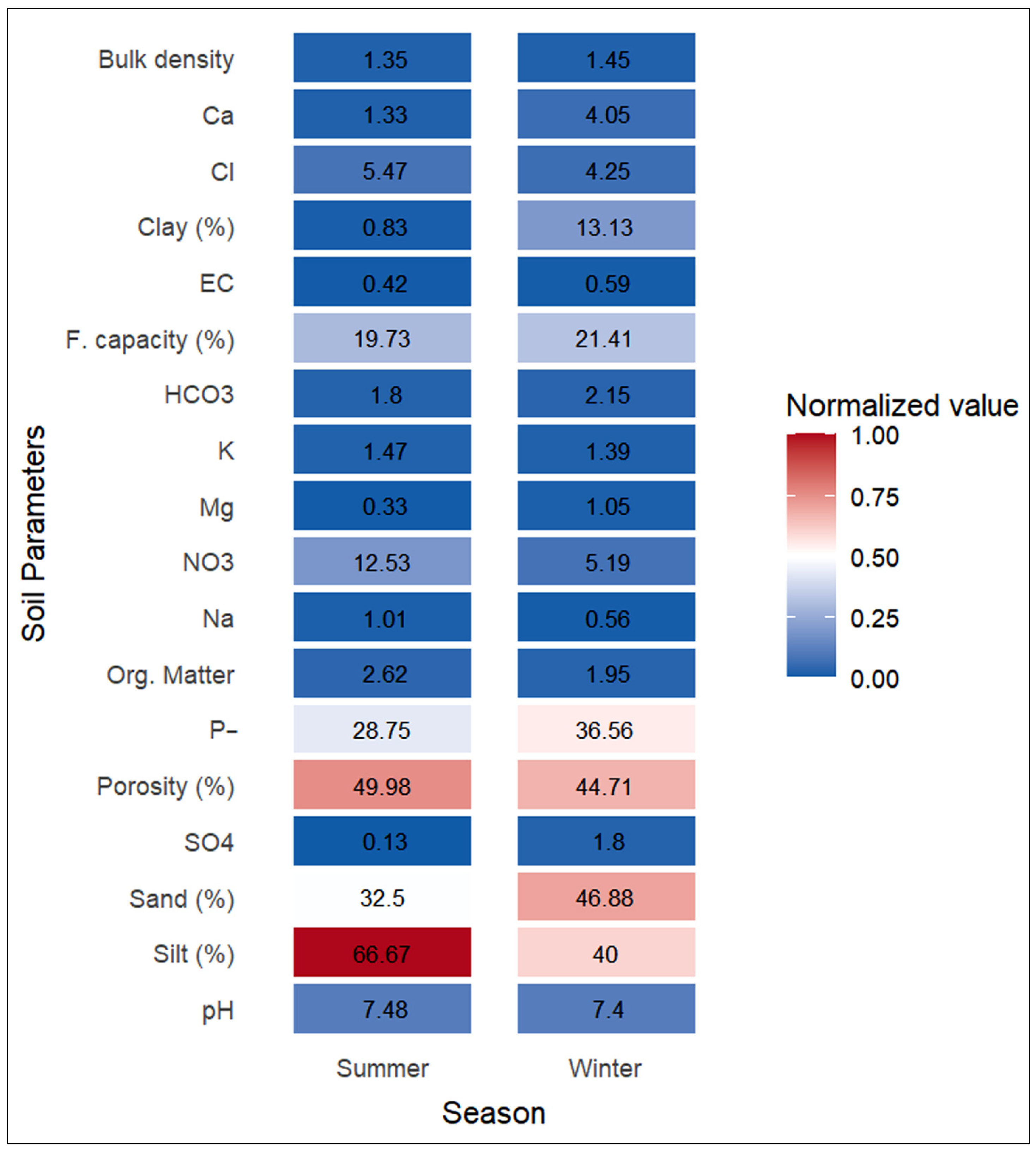
Overall soil properties exhibited distinct seasonal contrasts between the summer–fall and winter–spring periods (Figure 9). The normalized heatmap revealed higher porosity, phosphorus, and silt content during summer, whereas calcium and sulfate concentrations were elevated in winter, reflecting hydrological and depositional shifts driven by rainfall and evaporation dynamics.
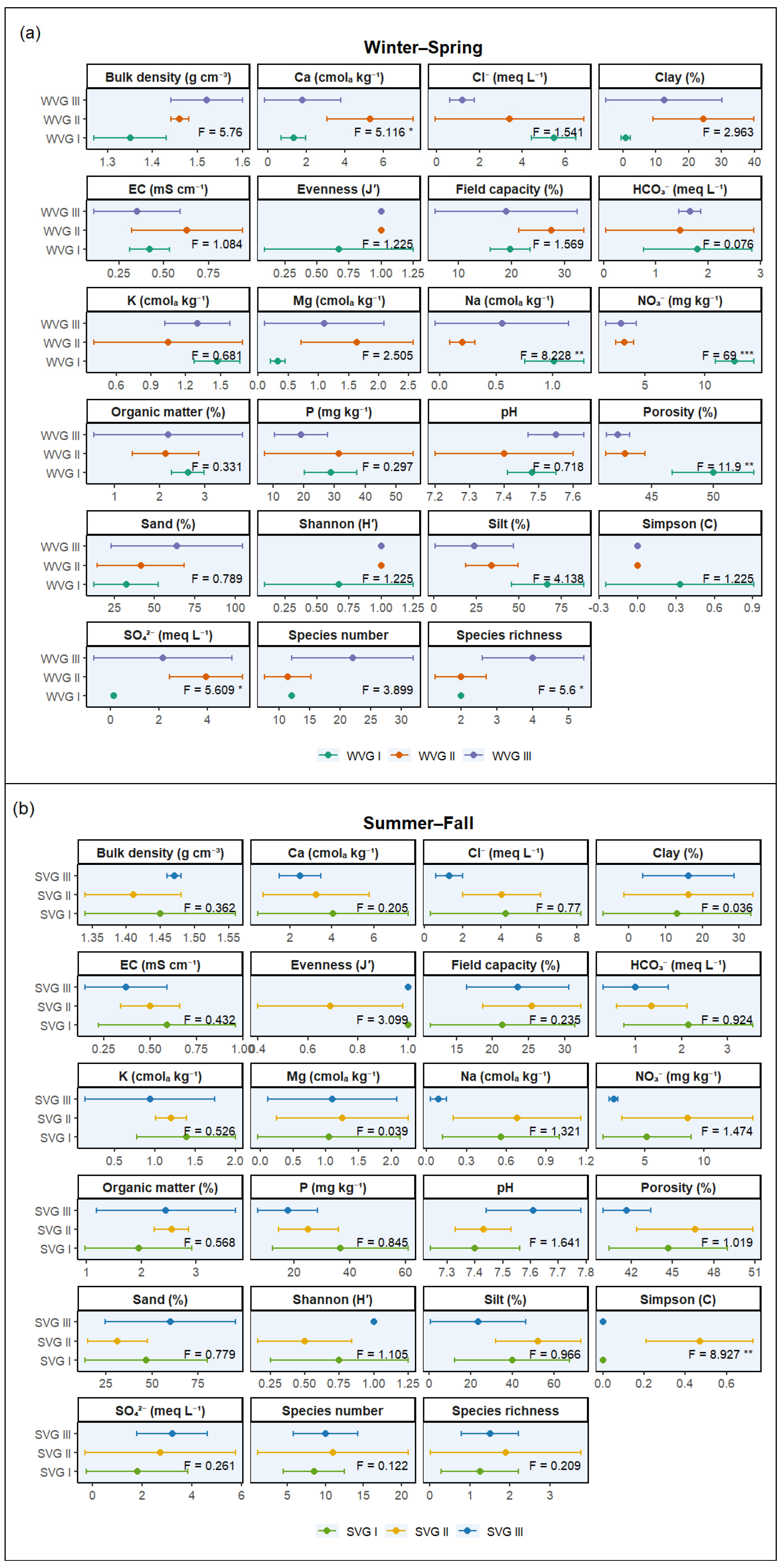
Community-level soil properties differed significantly among winter–spring associations for Na+, NO3, and porosity (one-way ANOVA, p < 0.05), whereas other parameters showed no significant among-group differences (Table 3). These contrasts match with the ordination patterns described in Section 3.2, where edaphic and microtopographic gradients structured community turnover across seasons. The multivariate comparison of mean ± SD soil parameters and diversity indices across vegetation groups (Figure 10) further illustrates these patterns, emphasizing the distinct edaphic niches of the winter–spring (WVG I–III) and summer–fall (SVG I–III) communities in Rawdat Nourah.

3.4. Diversity–Soil Relationships

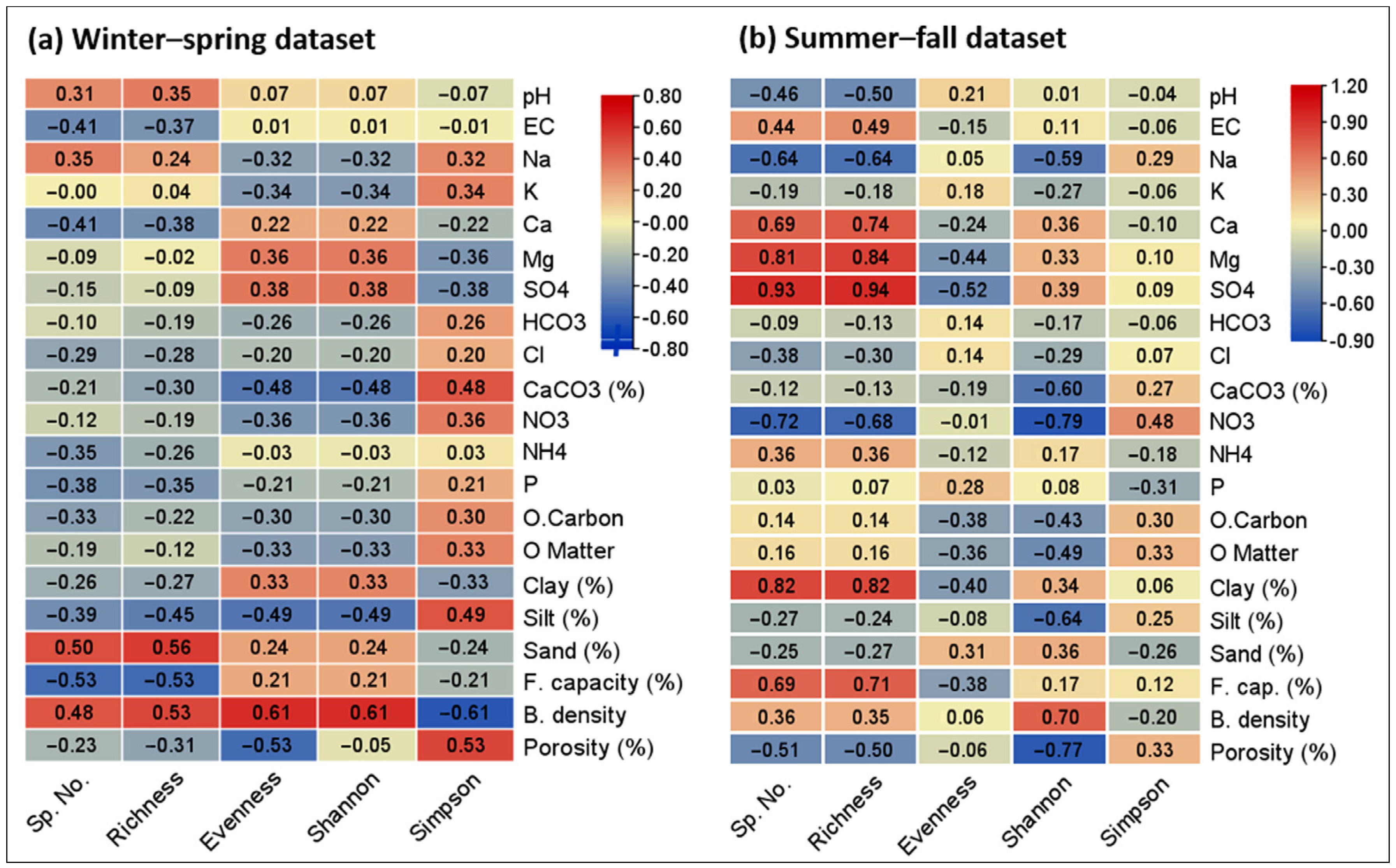
During the winter–spring season, the Shannon diversity index (H′) and species evenness showed a positive correlation with bulk density, whereas evenness exhibited a negative relationship with nitrate (NO3) concentration (Figure 11a). Conversely, the Simpson dominance index (C) displayed a positive association with nitrate and soil porosity, but a negative relationship with bulk density, indicating that denser soils favored more even species distribution while elevated nitrate promoted dominance by a few taxa. In the summer–fall season, both total species number and species richness were positively correlated with sulfate (SO42−) and magnesium (Mg2+) but negatively correlated with sodium (Na+) (Figure 11b). Additionally, species richness exhibited a positive association with clay fraction, whereas Shannon diversity (H′) showed a negative correlation with nitrate (NO3), highlighting the inhibitory effect of high nitrate and salinity during the hot–dry period.
Seasonal soil variations strongly influenced vegetation diversity in Rawdat Nourah. During winter–spring, higher bulk density enhanced species evenness (Shannon H′), while nitrate and porosity increased species dominance (Simpson C), consistent with the findings of Sun, et al. [75] and Al-Mutairi [77]. In summer–fall, species richness and abundance correlated positively with sulfate and magnesium but declined with increasing sodium, indicating salinity-driven stress [76]. Finer soil textures in winter–spring improved moisture retention and supported richer communities, whereas coarser, sand-dominated soils in summer constrained plant diversity. These findings highlight the pivotal role of soil chemistry and texture in shaping seasonal community structure within arid rangelands and suggest that soil property management could enhance vegetation restoration outcomes [3,78].

3.5. Soil Seed-Bank Composition

During the winter–spring season, 27 species were recorded in the soil seed-bank samples, whereas 19 species were identified during the summer–fall season, with the majority represented by annuals (Table 4). Among these, 12 species were found exclusively in the seed-bank and were absent from the above-ground vegetation, while 50 species occurred only above ground. Seventeen species were common to both components. This distribution underscores the pivotal role of water availability, primarily from limited winter rainfall, in shaping regeneration potential within this desert ecosystem. The study area experiences short, sporadic precipitation events confined to the moist winter–spring period, followed by a prolonged, intensely arid summer–fall when temperatures may approach 50 °C. Consequently, most species fail to complete reproductive cycles, except for ephemeral therophytes that rapidly complete life cycles after rainfall and sustain populations through persistent soil seed reserves [3].
Approximately 46% of Saudi Arabia’s desert flora consists of annuals—a pattern attributed to evolutionary selection for short-lived taxa exploiting transient moisture pulses [2,79]. The three perennial species detected in the seed-bank, Citrullus colocynthis, Cynodon dactylon, and Pulicaria undulata, exhibit high ecological resilience, occupying wadis and floodplains and persisting across multiple seasons [80]. Perennial taxa often produce dormant, long-lived propagules, enhancing persistence under environmental stress [81]. In contrast, woody plants have restricted seed dispersal, limiting their presence in the soil seed-bank [82]. The delayed seed release common among desert species further represents an adaptive strategy promoting post-dry-season regeneration [83].
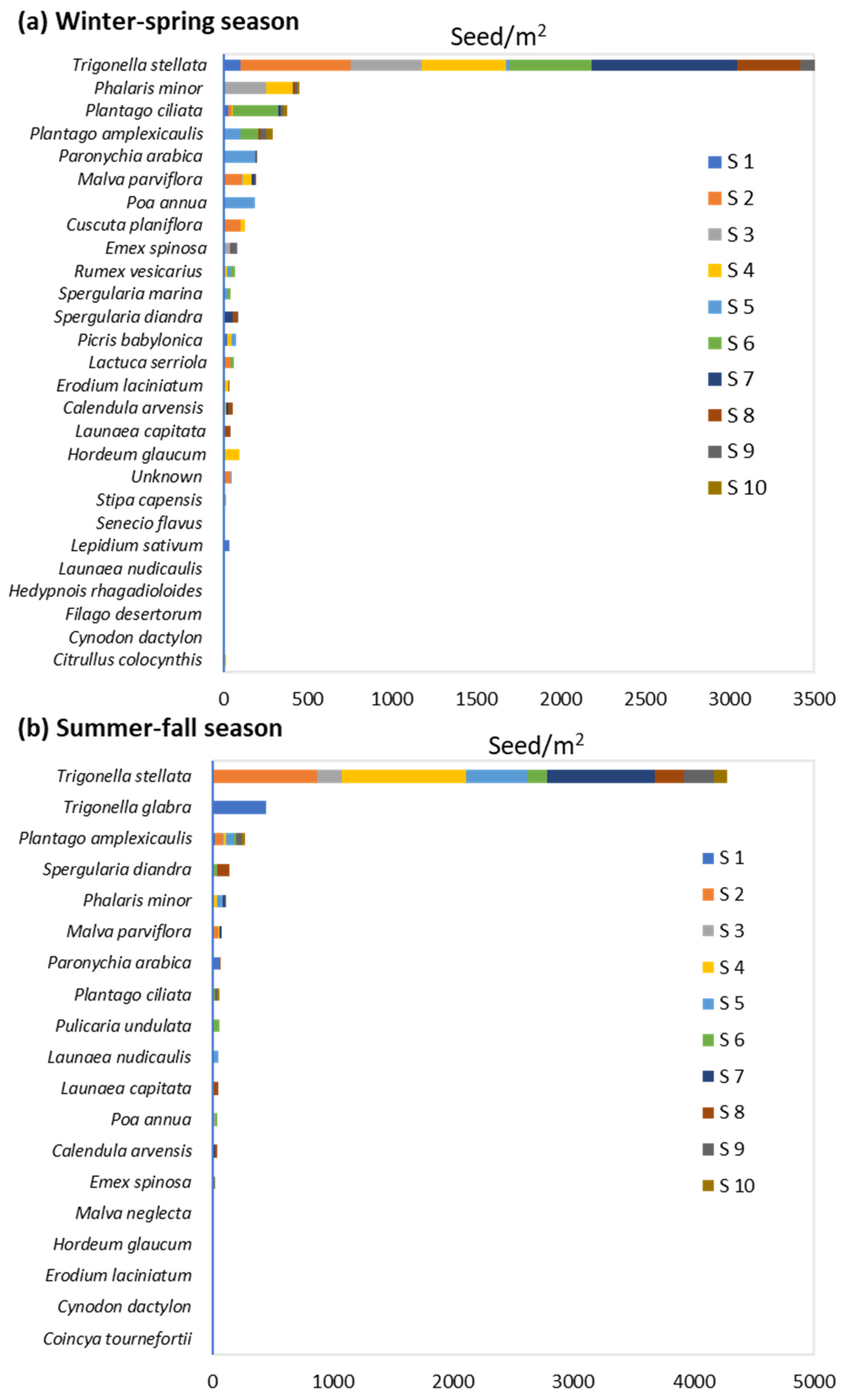
Analysis of seed-bank diversity across winter–spring sites revealed marked spatial heterogeneity. Sites 4 and 5 exhibited the highest diversity, reflected in greater species number, richness, evenness, and Shannon index values, coupled with low Simpson dominance (Table S3 and Figure S4). Conversely, Site 10 showed minimal diversity, dominated by a few taxa. Seed density ranged from 983 seeds m−2 (Site 2) and 972 seeds m−2 (Site 7) to 206 seeds m−2 (Site 10), paralleling observations from other Saudi Rawdats—402–643 seeds m−2 in Raudhat Alkhafs [81]. This spatial variability reflects localized influences of soil moisture, microtopography, and vegetation cover on propagule persistence.
Regarding individual species contributions, Trigonella stellata exhibited the highest seed density (373 seeds m−2), followed by Phalaris minor, Plantago ciliata, and Plantago amplexicaulis (Figure 12a). Moderate densities were observed for Paronychia arabica, Malva parviflora, Poa annua, Cuscuta planiflora, Spergularia diandra, and Emex spinosa. Low-density species included Lepidium sativum, Erodium laciniatum, Stipa capensis, Citrullus colocynthis, Cynodon dactylon, Senecio flavus, Launaea nudicaulis, Hedypnois rhagadioloides, and Filago desertarum. The predominance of T. stellata and other small-seeded annuals demonstrates the adaptive advantage of ephemeral taxa producing abundant, long-lived propagules resilient to arid-zone moisture fluctuations [3,84,85].
During the summer–fall season, diversity patterns again showed distinct spatial variability (Table S4). Site 8 recorded the highest species number and richness, whereas Site 6 showed maximum evenness and Shannon diversity but the lowest dominance (Figure 12b). Conversely, Site 2 had minimal species richness (0.29), and Site 7 exhibited the highest Simpson dominance (0.89). Seed densities ranged from 156 seeds m−2 (Site 10) to 1100 seeds m−2 (Site 4). These values closely match those documented for Raudhat Alkhafs [2,84,86], reaffirming that microtopography, fertility, and moisture gradients govern seed accumulation and survival in hyper-arid conditions. The summer seed-bank was again dominated by Trigonella stellata (427 seeds m−2), followed by T. glabra (44 seeds m−2) and Plantago amplexicaulis (27 seeds m−2) (Figure 12 and Figure S4). Moderate densities occurred for Spergularia diandra, Phalaris minor, Malva parviflora, Paronychia arabica, Plantago ciliata, Pulicaria undulata, Launaea nudicaulis, and L. capitata, while Malva neglecta, Hordeum glaucum, Erodium laciniatum, Cynodon dactylon, and Coincya tournefortii were rare.
The soil seed-bank was dominated by herbaceous species, with woody taxa entirely absent from the germinable component. This pattern aligns with previous findings from arid Saudi habitats [3,68,78]. The dominance of small-seeded herbs and grasses reflects adaptive traits, such as high fecundity, long seed longevity, and rapid post-rainfall germination, well-suited to arid-zone conditions. On the other side, woody species, characterized by larger and less persistent seeds, are more prone to desiccation and grazing, limiting their contribution to the soil seed pool.

3.6. Correlation Between Aboveground Vegetation and Soil Seed-Bank

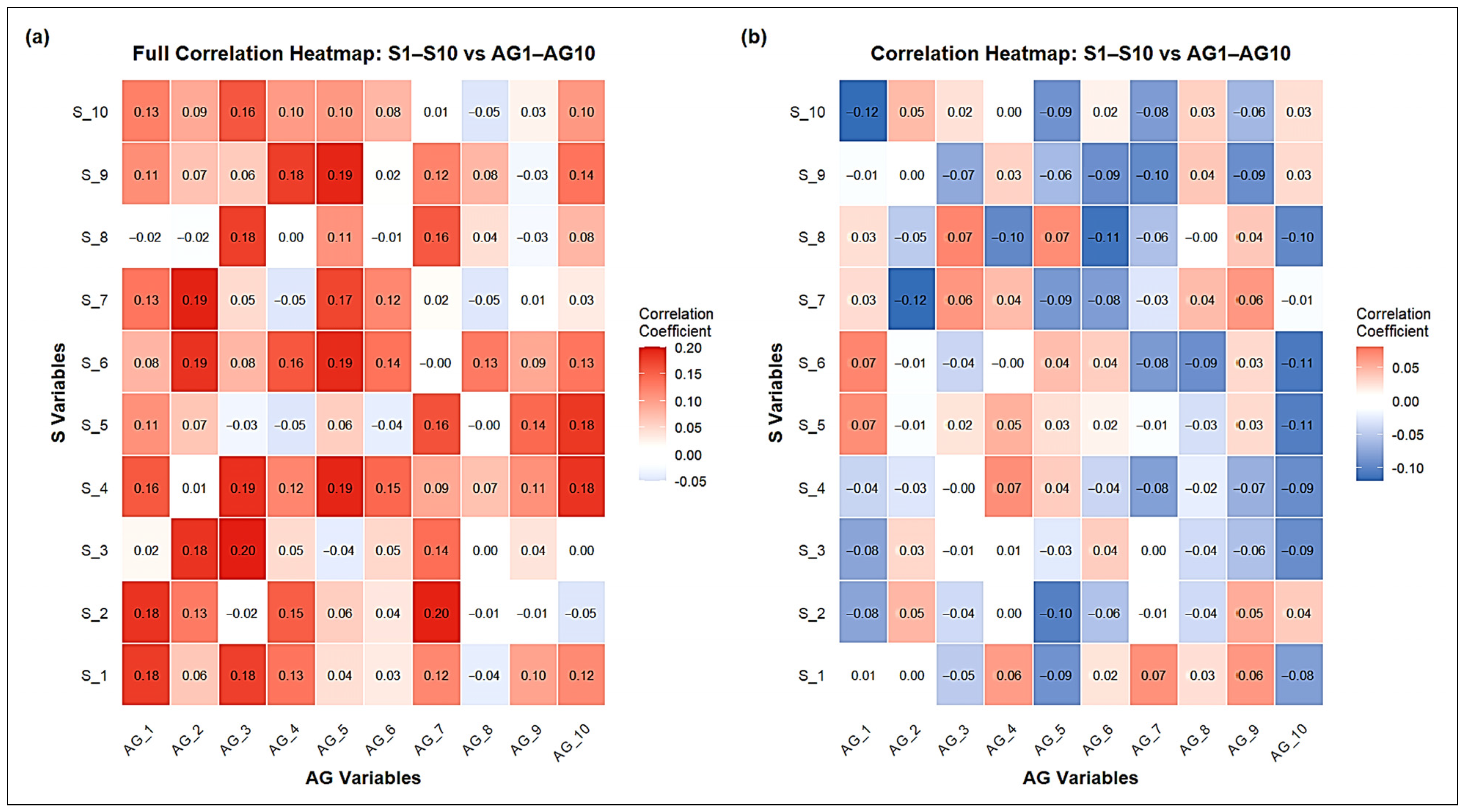
The analysis of relative species densities during the winter–spring season revealed a weak but positive relationship between the above-ground vegetation at Site APG 8 and the soil seed-bank composition at Sites 2, 4, 6, 7, 8, and 9 (Figure 13a). In contrast, during the summer–fall season, no statistically significant correlation was observed between the two datasets (Figure 13). Comparable weak correspondences between above-ground and soil seed-bank communities have been reported by Al-Huqail, et al. [3] in Raudhat Alkhafs and by studies in degraded biosphere reserves of West Africa [68,83].
The low vegetation seed-bank correspondence observed in Rawdat Nourah can be attributed to prolonged aridity, extreme summer heat, high evapotranspiration, and periodic grazing disturbance, all of which suppress plant regeneration and seed persistence. These environmental stressors favor dominance by ephemeral annuals while constraining the contribution of perennial and woody species, thereby reducing compositional overlap between standing vegetation and below-ground seed reserves. Similar weak relationships have been noted across other arid and semi-arid ecosystems, where episodic rainfall, grazing exclusion, and intense temperature variability shape asynchronous community dynamics [2,8,10,80,81].
The above-ground vegetation in Rawdat Nourah exhibited pronounced seasonal and spatial variation in abundance and floristic composition; however, these changes were not reflected by shifts in the soil seed-bank. This indicates that different ecological processes govern the temporal renewal of standing vegetation and the long-term persistence of the soil seed-bank. Such decoupling reflects the combined influences of environmental harshness, competition for limited microsites, and seed-longevity constraints under hyper-arid conditions [75,87].
These findings reflect the significance of sustained habitat protection and controlled grazing within the King Abdulaziz Royal Reserve. Long-term conservation measures could enhance seed-bank resilience, strengthen the linkage between below-ground and above-ground vegetation, and thereby promote ecosystem recovery, vegetation regeneration, and rangeland stability [88]. Based on the present data, and due to the limited time for the project, we recommend a successive survey for the vegetation and soil seed-bank for the studied area for five years to be able to confirm the data and correlate it with climatic conditions. Also, the nearest weather station is far from the site (about 95 km, the King Khalid International Airport in Riyadh); therefore, it is recommended to fix a portable weather station within the studied area to get precise climatic data that will help in understanding the vegetation dynamics.

4. Conclusions

Seasonal differences in soil conditions played a significant role in shaping plant diversity and community organization in the study area. In the winter–spring period, higher soil bulk density was linked to more species evenness (Shannon H′), whereas elevated nitrate (NO3) levels and increased soil porosity were associated with the dominance of a limited number of species (Simpson C). During summer-fall, both species richness and total abundance increased in relation to sulfate (SO42−) and magnesium (Mg2+) concentrations, but declined with rising sodium (Na+) levels, indicating the influence of salinity stress on vegetation patterns. Seasonal differences in soil texture further contributed to these trends, as finer soils in winter enhanced moisture retention and supported more diverse assemblages, while coarse, sand-rich substrates in summer restricted plant diversity. Although above-ground vegetation exhibited clear seasonal and spatial shifts in species composition and abundance, these changes were not reflected in the soil seed-bank. This relation suggests that above-ground communities and seed-banks are regulated by different ecological processes under arid conditions. The data of the present study showed low correlation between the current vegetation and the soil seed-bank, which reflects a degradation in this region, but it is expected to be recovered after the conservation strategy that has been launched since 2018 by the King Abdulaziz Royal Reserve Development Authority. Therefore, these findings suggest that sustained protection of the King Abdulaziz Royal Reserve is essential for enhancing seed-bank persistence, vegetation recovery, and ecosystem resilience under arid conditions. It is expected to have a recovery after the continuation of the protection management within the Rawdat Nourah, where a future study is recommended to assess the effect of this management on the vegetation composition and the soil seed bank in the coming years.

Supplementary Materials

The following supporting information can be downloaded at: https://www.mdpi.com/article/10.3390/land15030480/s1, Figure S1: Schematic illustration of the sampling design adopted in Rawdat Nourah; Figure S2: Seasonal floristic structure and lifespan composition of vegetation in Rawdat Nourah; Figure S3. Dominant plant families by season in Rawdat Nourah during the winter–spring and summer–fall seasons; Figure S4: Spatial variation of soil-seed-bank diversity during the winter–spring and summer-fall seasons at Rawdat Nourah; Table S1: The coordinates and altitudes of the studied plots with their stands with Rawdhat Noura, King Abdulaziz Royal Reserve, Saudi Arabia; Table S2: Laboratory methods used for soil physicochemical analyses in the present study; Table S3: Species-diversity indices of the soil seed-bank (winter–spring season) in Rawdat Nourah; Table S4: Species-diversity indices of the soil seed-bank (summer–fall season) in Rawdat Nourah.

Author Contributions

Conceptualization, A.A.A.-H., M.A.E.-S. and A.M.A.-E.; validation, A.A.A.-H., M.A.E.-S. and A.M.A.-E.; formal analysis, A.A.A.-H., M.A.E.-S. and A.M.A.-E.; investigation, A.A.A.-H., M.A.E.-S., A.M.A.-E., A.M.A. and T.S.A.; resources, A.A.A.-H., A.M.A. and T.S.A.; writing—original draft preparation, A.A.A.-H., M.A.E.-S. and A.M.A.-E.; writing—review and editing, A.A.A.-H., M.A.E.-S., A.M.A.-E., A.M.A. and T.S.A.; project administration, A.A.A.-H. All authors have read and agreed to the published version of the manuscript.

Funding

This research was supported by King Abdulaziz Royal Reserve Development Authority, and the Deanship of Scientific Research, King Saud University, through the Vice Deanship of Scientific Research Chairs: Chair of Climate Change, Environmental Development and Vegetation Cover.

Data Availability Statement

The data of this study are included within the manuscript and the Supplementary Materials.

Acknowledgments

The authors are grateful to the King Abdulaziz Royal Reserve Development Authority for funding. Also, authors are grateful to the Deanship of Scientific Research, King Saud University, for funding through the Vice Deanship of Scientific Research Chairs: Chair of Climate Change, Environmental Development and Vegetation Cover.

Conflicts of Interest

The authors declare no conflicts of interest.

Abbreviations

The following abbreviations are used in this manuscript:
AGAbove-Ground Vegetation
CCACanonical Correspondence Analysis
DCADetrended Correspondence Analysis
ECElectrical Conductivity
H′Shannon Diversity Index
Na+Sodium Ion
NO3Nitrate Ion
O.M.Organic Matter
SVG/WVGSummer–Fall/Winter–Spring Vegetation Group
TWITwo-Way Indicator Species Analysis

References

  1. Shahin, M. Water Resources and Hydrometeorology of the Arab Region; Springer Science & Business Media: Dordrecht, The Netherlands, 2007; Volume 59. [Google Scholar]
  2. Abd-ElGawad, A.M.; Al-Huqail, A.A.; Alowaifeer, A.M.; Alsaleem, T.S.; Assaeed, A.M.; Azab, O.M.; Dar, B.A.; Kassem, H.S. Soil seed bank dynamics and vegetation composition in raudhat Altinhat, Saudi Arabia: Implications for arid ecosystem restoration. Front. Environ. Sci. 2025, 13, 1650193. [Google Scholar] [CrossRef]
  3. Al-Huqail, A.A.; Al-Harbi, H.F.; Alowaifeer, A.M.; El-Sheikh, M.A.; Assaeed, A.M.; Alsaleem, T.S.; Kassem, H.S.; Azab, O.M.; Dar, B.A.; Malik, J.A. Correlation between aboveground vegetation composition and soil seed bank of Raudhat desert habitat: A case study of Raudhat Alkhafs, Saudi Arabia. BMC Plant Biol. 2025, 25, 136. [Google Scholar] [PubMed]
  4. Groner, E.; Babad, A.; Berda Swiderski, N.; Shachak, M. Toward an extreme world: The hyper-arid ecosystem as a natural model. Ecosphere 2023, 14, e4586. [Google Scholar] [CrossRef]
  5. Eckardt, F.D.; Maggs-Kölling, G.; Marais, E.; de Jager, P.C. A Brief Introduction to Hot Desert Environments: Climate, Geomorphology, Habitats, and Soils. In Microbiology of Hot Deserts; Ramond, J.-B., Cowan, D.A., Eds.; Springer International Publishing: Cham, Switzerland, 2022; pp. 1–36. [Google Scholar]
  6. Franklin, J.; Serra-Diaz, J.M.; Syphard, A.D.; Regan, H.M. Global change and terrestrial plant community dynamics. Proc. Natl. Acad. Sci. USA 2016, 113, 3725–3734. [Google Scholar] [CrossRef] [PubMed]
  7. Zhang, T.; Chen, Y. The effects of landscape change on habitat quality in arid desert areas based on future scenarios: Tarim River Basin as a case study. Front. Plant Sci. 2022, 13, 1031859. [Google Scholar] [CrossRef]
  8. Hopfensperger, K.N. A review of similarity between seed bank and standing vegetation across ecosystems. Oikos 2007, 116, 1438–1448. [Google Scholar] [CrossRef]
  9. Thompson, K.; Bakker, J.P.; Bekker, R.M. The Soil Seed Banks of North West Europe: Methodology, Density and Longevity; Cambridge University Press: Cambridge, UK, 1997. [Google Scholar]
  10. Venable, D.L. Bet hedging in a guild of desert annuals. Ecology 2007, 88, 1086–1090. [Google Scholar] [CrossRef]
  11. Gallagher, R.S. Seeds: The Ecology of Regeneration in Plant Communities; CABI: Boston, MA, USA, 2013. [Google Scholar]
  12. Guo, N.; Sang, C.; Huang, M.; Zhang, R.; Degen, A.A.; Ma, L.; Bai, Y.; Zhang, T.; Wang, W.; Niu, J. Long-term active restoration of degraded grasslands enhances vegetation resilience by altering the soil seed bank. Agron. Sustain. Dev. 2023, 43, 6. [Google Scholar] [CrossRef]
  13. Hernandez, J.O.; Cortes, D.T.; Park, B.B. Research geographical distribution, strategies, and environmental and socioeconomic factors influencing the success of land-based restoration: A systematic review. Sustainability 2024, 16, 6381. [Google Scholar] [CrossRef]
  14. Mndela, M.; Mangwane, M.; Ngcobo, N.; Rasekgokga, N.J.; Monegi, P. Soil seed banks along a woody plant removal gradient in a semi-arid savanna of South Africa: Implications for restoration. Acta Oecol. 2023, 118, 103891. [Google Scholar] [CrossRef]
  15. Sayed, O.H.; Masrahi, Y.S. Climatology and phytogeography of Saudi Arabia. A review. Arid. Land Res. Manag. 2023, 37, 311–368. [Google Scholar] [CrossRef]
  16. Alfarhan, A. A floristic account on Raudhat Khuraim central province Saudi Arabia. Saudi J. Biol. Sci. 2001, 8, 80–103. [Google Scholar]
  17. Bégué, A.; Vintrou, E.; Ruelland, D.; Claden, M.; Dessay, N. Can a 25-year trend in Soudano-Sahelian vegetation dynamics be interpreted in terms of land use change? A remote sensing approach. Glob. Environ. Chang. 2011, 21, 413–420. [Google Scholar] [CrossRef]
  18. Dou, H.; Lin, T.; Xu, Q.; Wang, J.; Xu, H.; Aili, A.; Zhang, P.; Wang, C.; Zhao, W. Ecohydrological significance of microtopography in arid Zones: Regulating Water, supporting Vegetation, promoting ecosystem stability. Ecol. Indic. 2025, 171, 113200. [Google Scholar] [CrossRef]
  19. Santini, N.S.; Chamizo, S.; Lucas-Borja, M.E.; Muñoz-Rojas, M. Restoration of degraded terrestrial ecosystems. Front. Ecol. Evol. 2022, 10, 863845. [Google Scholar] [CrossRef]
  20. Amuchástegui, G.; Di Franco, L.; Feijoó, C. Catchment morphometric characteristics, land use and water chemistry in Pampean streams: A regional approach. Hydrobiologia 2016, 767, 65–79. [Google Scholar] [CrossRef]
  21. AlNafie, A.H. Phytogeography of Saudi Arabia. Saudi J. Biol. Sci. 2008, 15, 159–176. [Google Scholar]
  22. Mandaville, J.P. Flora of Eastern Saudi Arabia; Routledge: London, UK, 2013. [Google Scholar]
  23. Huang, M.; Sang, C.; Zhao, J.; Degen, A.A.; Chen, X.; Zhang, T.; Bai, Y.; Li, S.; Wang, W.; Shrestha, N. Grazing exclusion altered the pattern of the soil seed bank but not the aboveground vegetation along an altitudinal gradient in alpine grassland. Land Degrad. Dev. 2022, 33, 3901–3913. [Google Scholar] [CrossRef]
  24. Shiferaw, W.; Demissew, S.; Bekele, T. Ecology of soil seed banks: Implications for conservation and restoration of natural vegetation: A review. Int. J. Biodivers. Conserv. 2018, 10, 380–393. [Google Scholar] [CrossRef]
  25. El-Sheikh, M.A.; Abbadi, G.A.; Bianco, P.M. Vegetation ecology of phytogenic hillocks (nabkhas) in coastal habitats of Jal Az-Zor National Park, Kuwait: Role of patches and edaphic factors. Flora Morphol. Distrib. Funct. Ecol. Plants 2010, 205, 832–840. [Google Scholar] [CrossRef]
  26. Eltner, A.; Maas, H.-G.; Faust, D. Soil micro-topography change detection at hillslopes in fragile Mediterranean landscapes. Geoderma 2018, 313, 217–232. [Google Scholar] [CrossRef]
  27. Dougill, A.J.; Thomas, A.D. Nebkha dunes in the Molopo Basin, South Africa and Botswana: Formation controls and their validity as indicators of soil degradation. J. Arid. Environ. 2002, 50, 413–428. [Google Scholar] [CrossRef]
  28. Quets, J.J.; Temmerman, S.; El-Bana, M.I.; Al-Rowaily, S.L.; Assaeed, A.M.; Nijs, I. Unraveling landscapes with phytogenic mounds (nebkhas): An exploration of spatial pattern. Acta Oecol. 2013, 49, 53–63. [Google Scholar] [CrossRef]
  29. Collenette, S. Wildflowers of Saudi Arabia; National Commission for Wildlife Conservation and Development (NCWCD): Riyadh, Saudi Arabia, 1999. [Google Scholar]
  30. Elgharib, A.; Trigo, M.d.M.; Moursy, M.M.; Soultan, A. Vegetation analysis and environmental relationships of Qatar’s depression habitat. Plants 2025, 14, 1807. [Google Scholar] [CrossRef]
  31. Hugenholtz, C.H.; Wolfe, S.A. Recent stabilization of active sand dunes on the Canadian prairies and relation to recent climate variations. Geomorphology 2005, 68, 131–147. [Google Scholar] [CrossRef]
  32. Mata-González, R.; Averett, J.P.; Abdallah, M.A.; Martin, D.W. Variations in groundwater level and microtopography influence desert plant communities in shallow aquifer areas. Environ. Manag. 2022, 69, 45–60. [Google Scholar] [CrossRef]
  33. Hegazy, A.K.; Alatar, A.A.; Khan, M.A.; Lovett-Doust, J. Interaction between “safe sites” and “safe sides” for germination of Neurada procumbens (Neuradaceae) in the Middle East. Folia Geobot. 2014, 49, 175–192. [Google Scholar] [CrossRef]
  34. MEWA. Saudi Arabia Environmental and Natural Resources Report; Ministry of Environment, Water and Agriculture (MEWA): Riyadh, Saudi Arabia, 2023.
  35. El-Din, S.T.; Assaeed, A.M.; Al-Sheick, A.A. Distribution of range plant communities as influenced by edaphic factors in Raudhat Khuraim. Egypt. J. Appl. Sci. 1994, 9, 69–82. [Google Scholar]
  36. Almalki, K.A.; Al Mosallam, M.S.; Aldaajani, T.Z.; Al-Namazi, A.A. Landforms characterization of Saudi Arabia: Towards a geomorphological map. Int. J. Appl. Earth Obs. Geoinf. 2022, 112, 102945. [Google Scholar] [CrossRef]
  37. World Bank Group. Climate Change Knowledge Portal. 2024. Available online: https://climateknowledgeportal.worldbank.org (accessed on 1 April 2025).
  38. Chaudhary, S.A. Flora of the Kingdom of Saudi Arabia; Ministry of Agriculture and Water: Riyadh, Saudi Arabia, 1999; Volume 1.
  39. Chaudhary, S.A. Flora of the Kingdom of Saudi Arabia; Ministry of Agriculture and Water: Riyadh, Saudi Arabia, 2000; Volume 2.
  40. Chaudhary, S.A. Flora of the Kingdom of Saudi Arabia; Ministry of Agriculture and Water: Riyadh, Saudi Arabia, 2001; Volume 3.
  41. POWO. Plants of the World Online. Facilitated by the Royal Botanic Gardens, Kew. Available online: http://www.plantsoftheworldonline.org/ (accessed on 26 April 2023).
  42. Bonham, C.D. Measurements for Terrestrial Vegetation; John Wiley & Sons: Hoboken, NJ, USA, 2013. [Google Scholar]
  43. Ellenberg, D.; Mueller-Dombois, D. Aims and Methods of Vegetation Ecology; Wiley: New York, NY, USA, 1974. [Google Scholar]
  44. Raunkiaer, C. Plant Life Forms; Clarendon Press: Oxford, UK, 1937. [Google Scholar]
  45. Baker, H.G. Some aspects of the natural history of seed banks. In Ecology of Soil Seed Banks; Leck, M.A., Parker, V.T., Simpson, R.L., Eds.; Academic Press: San Diego, CA, USA, 1989; pp. 9–21. [Google Scholar]
  46. Padonou, E.A.; Akakpo, B.A.; Tchigossou, B.; Djossa, B. Methods of soil seed bank estimation: A literature review proposing further work in Africa. iForest Biogeosciences For. 2022, 15, 121. [Google Scholar] [CrossRef]
  47. Niu, F.; Huo, L.; Wang, Z.; Liu, J.; Gao, Z.; Li, M.; Xu, B. Effects of nitrogen addition and watering on soil seed bank germination in a semiarid grassland on the Loess Plateau of China. Land Degrad. Dev. 2023, 34, 142–155. [Google Scholar] [CrossRef]
  48. Bouyoucos, G.J. Hydrometer method improved for making particle size analyses of soils. Agron. J. 1962, 54, 464–465. [Google Scholar] [CrossRef]
  49. Mualem, Y. A new model for predicting the hydraulic conductivity of unsaturated porous media. Water Resour. Res. 1976, 12, 513–522. [Google Scholar] [CrossRef]
  50. Keen, B.A.; Raczkowski, H. The relation between the clay content and certain physical properties of a soil. J. Agric. Sci. 1921, 11, 441–449. [Google Scholar] [CrossRef]
  51. Blake, G.R.; Hartge, K.H. Particle Density. In Methods of Soil Analysis; Soil Science Society of America, Inc.: Madison, WI, USA, 1986; pp. 377–382. [Google Scholar]
  52. Rowell, D. Soil Science: Method and Applications; Longman Group UK Ltd.: Harlow, UK, 1994. [Google Scholar]
  53. Page, A.L. Methods of Soil Analysis. Part 2. Chemical and Microbiological Properties; American Society of Agronomy; Soil Science Society of America: Madison, WI, USA, 1982. [Google Scholar]
  54. Bremner, J. Total nitrogen. In Methods of Soil Analysis. Part 2; Page, A.L., Miller, R.H., Keeney, D.R., Eds.; John Wiley & Sons: Hoboken, NJ, USA, 1982; pp. 595–624. [Google Scholar]
  55. Nelson, D.; Sommers, L. Chemical and microbiological properties. In Methods for Soil Analysis; Page, A.L., Ed.; ASA Monograph: Madison, WI, USA, 1982; pp. 539–579. [Google Scholar]
  56. Allen, S.E.; Grimshaw, H.; Parkinson, J.A.; Quarmby, C. Chemical Analysis of Ecological Materials; Blackwell Scientific Publications: Oxford, UK, 1974. [Google Scholar]
  57. Rhoades, J. Soluble salts. In Methods of Soil Analysis: Part 2: Chemical and Microbiological Properties; Page, A.L., Miller, R.H., Keeney, D.R., Eds.; American Society of Agronomy, Inc: Madison, WI, USA, 1982. [Google Scholar]
  58. Jackson, M.L. Soil Chemical Analysis; Constable & Co Ltd.: London, UK, 1962; Volume 497. [Google Scholar]
  59. Hill, M.O. DECORANA-A FORTRAN Program for Detrended Correspondence Analysis And Reciprocal Averaging; Cornell University: Ithaca, NY, USA, 1979. [Google Scholar]
  60. Hill, M.O. TWINSPAN—A FORTRAN Program for Arranging Multivariate Data by Classification of the Individuals and Attributes; Cornell University: Ithaca, NY, USA, 1979. [Google Scholar]
  61. Braak, T.J. CANOCO Reference Manual and CanoDraw For Windows User’s Guide: Software for Canonical Community Ordination, (Version 45); Microcomputer Power: Ithaca, NY, USA, 2002; p. 500. [Google Scholar]
  62. Chen, C.; Wu, Y.; Li, J.; Wang, X.; Zeng, Z.; Xu, J.; Liu, Y.; Feng, J.; Chen, H.; He, Y. TBtools-II: A “one for all, all for one” bioinformatics platform for biological big-data mining. Mol. Plant 2023, 16, 1733–1742. [Google Scholar] [CrossRef]
  63. Magguran, A.E. Ecological Diversity and its Measurement; Princeton University Press: Princeton, NJ, USA, 1988. [Google Scholar]
  64. Pielou, E.C. Ecological Diversity; Wiley: New York, NY, USA, 1975. [Google Scholar]
  65. Abd-ElGawad, A.M.; Assaeed, A.M.; Al-Rowaily, S.L.; Dar, B.M.; Malik, J.A. Moisture and salinity drive the vegetation composition of Wadi Hargan, Riyadh, Saudi Arabia. Diversity 2021, 13, 587. [Google Scholar] [CrossRef]
  66. Gomaa, N.H.; Hegazy, A.K.; Alhaithloul, H.A.S. Facilitation by Haloxylon persicum shrubs enhances density and richness of soil seed bank of annual plants in a hyper-arid ecosystem. Plants 2023, 12, 1276. [Google Scholar] [CrossRef]
  67. Alzamel, N. Floristic composition and vegetation analysis in Wadi AlFurayshah region, Saudi Arabia. J. Environ. Stud. 2022, 28, 35–40. [Google Scholar] [CrossRef]
  68. Alharthi, S.T.; El-Sheikh, M.A.; Alfarhan, A.A. Biological change of western Saudi Arabia: Alien plants diversity and their relationship with edaphic variables. J. King Saud Univ. Sci. 2023, 35, 102496. [Google Scholar] [CrossRef]
  69. Poppenwimer, T.; Mayrose, I.; DeMalach, N. Revising the global biogeography of annual and perennial plants. Nature 2023, 624, 109–114. [Google Scholar] [CrossRef]
  70. Sakkir, S.; Kabshawi, M.; Asmita, N.; Almansoori, S.; Alahbabi, H. Systematic composition, species diversity and plant chorology of Wadi Shuwaib: A typical desert wadi in the eastern region of United Arab Emirates (UAE). Biodivers. Data J. 2025, 13, e159155. [Google Scholar] [CrossRef]
  71. Verdú, J.R.; Crespo, M.B.; Galante, E. Conservation strategy of a nature reserve in Mediterranean ecosystems: The effects of protection from grazing on biodiversity. Biodivers. Conserv. 2000, 9, 1707–1721. [Google Scholar] [CrossRef]
  72. Dvorský, M.; Mudrák, O.; Doležal, J.; Jirků, M. Reintroduction of large herbivores restored plant species richness in abandoned dry temperate grassland. Plant Ecol. 2022, 223, 525–535. [Google Scholar] [CrossRef]
  73. Török, P.; Lindborg, R.; Eldridge, D.; Pakeman, R. Grazing effects on vegetation: Biodiversity, management, and restoration. Appl. Veg. Sci. 2024, 27, e12794. [Google Scholar] [CrossRef]
  74. Sallam, H.; Alzain, M.N.; Abuzaid, A.O.; Loutfy, N.; Badry, M.O.; Osman, A.K.; Hammad, S.A. Wild plant diversity and soil characteristics of desert roadside vegetation in the eastern desert. Diversity 2023, 15, 874. [Google Scholar] [CrossRef]
  75. Sun, J.; Wang, N.; Niu, Z. Effect of soil environment on species diversity of desert plant communities. Plants 2023, 12, 3465. [Google Scholar] [CrossRef] [PubMed]
  76. Li, S.; Gao, G.; Wang, C.; Li, Z.; Feng, X.; Fu, B. Aridity regulates the impacts of multiple dimensional plant diversity on soil properties in the drylands of northern China. Sci. Total Environ. 2024, 946, 174211. [Google Scholar] [CrossRef]
  77. Al-Mutairi, K.A. Do spatially structured soil variables influence the plant diversity in Tabuk arid Region, Saudi Arabia? Sustainability 2022, 14, 2611. [Google Scholar] [CrossRef]
  78. Manirakiza, N.; Melkani, S.; Rabbany, A.; Medina-Irizarry, N.; Smidt, S.; Braswell, A.; Martens-Habbena, W.; Bhadha, J.H. Responses of soil health to seasonal change under different land cover types in a sub-tropical preserve ecosystem. PLoS ONE 2025, 20, e0318092. [Google Scholar] [CrossRef]
  79. Cui, X.; Xu, G.; He, X.; Luo, D. Influences of seasonal soil moisture and temperature on vegetation phenology in the Qilian Mountains. Remote Sens. 2022, 14, 3645. [Google Scholar] [CrossRef]
  80. Nunes, A.M.; Byrne, K.M. Drought and shrub cover differentially affect seed bank composition within two sagebrush steppe communities. J. Arid. Environ. 2022, 202, 104752. [Google Scholar] [CrossRef]
  81. Araki, S.; Washitani, I. Seed dormancy/germination traits of seven Persicaria species and their implication in soil seed-bank strategy. Ecol. Res. 2000, 15, 33–46. [Google Scholar] [CrossRef]
  82. Baskin, C.C.; Baskin, J.M. Seeds: Ecology, Biogeography, and Evolution of Dormancy and Germination; Academic Press: San Diego, CA, USA, 2014. [Google Scholar]
  83. Kang, Y.; Wang, Z.; Xu, B.; Shen, W.; Chen, Y.; Zhou, X.; Liu, Y.; Zhang, T.; Wang, G.; Jia, Y.; et al. Disentangling the response of vegetation dynamics to natural and anthropogenic drivers over the Minjiang River basin using dimensionality reduction and a structural equation model. Forests 2024, 15, 1438. [Google Scholar] [CrossRef]
  84. Jian, J.; Chai, X.; Zhao, X.; Yang, Z. Self-pollinated types and ecological adaptations of the desert plant Gymnocarpos przewalskii. Plants 2025, 14, 1410. [Google Scholar] [CrossRef]
  85. Al Shaye, N.A. Comparative morpho-anatomical study on Leptadenia pyrotechnica (Apocynaceae) growing in the hyper-arid and arid habitats of Saudi Arabia. PeerJ 2023, 11, e15320. [Google Scholar] [CrossRef]
  86. Gomaa, N.H. Soil seed bank in different habitats of the Eastern Desert of Egypt. Saudi J. Biol. Sci. 2012, 19, 211–220. [Google Scholar] [CrossRef]
  87. Luo, X.; Cao, M.; Zhang, M.; Song, X.; Li, J.; Nakamura, A.; Kitching, R. Soil seed banks along elevational gradients in tropical, subtropical and subalpine forests in Yunnan Province, southwest China. Plant Divers. 2017, 39, 273–286. [Google Scholar] [CrossRef] [PubMed]
  88. Al-Rowaily, S.L.; El-Bana, M.I.; Al-Bakre, D.A.; Assaeed, A.M.; Hegazy, A.K.; Ali, M.B. Effects of open grazing and livestock exclusion on floristic composition and diversity in natural ecosystem of Western Saudi Arabia. Saudi J. Biol. Sci. 2015, 22, 430–437. [Google Scholar] [CrossRef]
Figure 1. Map showing Rawdat Nourah location within King Abdulaziz Royal Reserve, Saudi Arabia, and the sampling studied plots for vegetation and soil seed-bank.
Land 15 00480 g001
Figure 2. Monthly climograph of the study area showing mean precipitation (bars) and maximum, mean, and minimum air temperatures (lines).
Land 15 00480 g002
Figure 3. Synoptic heatmap showing mean importance values (IV %) of the dominant plant species across winter–spring (WVG I–III) and summer–fall (SVG I–III) vegetation groups in Rawdat Nourah, King Abdulaziz Royal Reserve. Panel (a) represents the winter–spring communities and panel (b) the summer–fall communities. Color intensity corresponds to the relative contribution of each species to its vegetation group, highlighting clear seasonal compositional turnover. Vegetation groups and associated sampling sites are as follows: WVG I: Sites 9, 8, 7; WVG II: Sites 2, 6, 4, 3, 1; WVG III: Sites 5, 10; SVG I: Sites 1, 2, 7, 10; SVG II: Sites 3, 4, 8, 9; SVG III: Sites 5, 6.
Land 15 00480 g003
Figure 4. Life-form composition of vegetation in Rawdat Nourah during (a) winter–spring and (b) summer–fall seasons.
Land 15 00480 g004
Figure 5. Phytogeographical affinities (chorotypes) of Rawdat Nourah flora. (a) Winter–spring; (b) Summer–fall. SA = Saharo-Arabian, IT = Irano-Turanian, ME = Mediterranean, SI = Saharo-Sindian, SU = Sudanian, SZ = Sudano-Zambezian, TR = Tropical, COSM = Cosmopolitan, PAN = Pantropical, Pal = Paleotropical, Aus = Australian, Eu = European, AM = American. The flora is dominated by Saharo-Arabian and SA–IT elements.
Land 15 00480 g005
Figure 6. Species diversity metrics for (a) above-ground vegetation and (b) soil seed-bank across seasons in Rawdat Nourah.
Land 15 00480 g006
Figure 7. Winter–spring vegetation communities in Rawdat Nourah. (a) TWINSPAN dendrogram showing three associations: WVG I (Zilla spinosa–Malva parviflora), WVG II (Rhazya stricta–Zilla spinosa), and WVG III (Cynodon dactylon–Convolvulus pilosellifolius). (b) DCA ordination illustrating species–site relationships. (c) CCA ordination biplot (species × environment) indicating major edaphic gradients controlling winter–spring vegetation distribution.
Land 15 00480 g007
Figure 8. Summer–fall vegetation communities in Rawdat Nourah. (a) TWINSPAN dendrogram identifying SVG I (Calotropis procera–Pulicaria undulata), SVG II (Cynodon dactylon–Zilla spinosa), and SVG III (Rhazya stricta–Schismus arabicus). (b) DCA ordination showing community separation across environmental gradients. (c) CCA biplot (species × environment) highlighting the primary soil factors controlling summer–fall community distribution.
Land 15 00480 g008
Figure 9. Comparative edaphic profiles (mean ± SD) for key soil variables by community and season in Rawdat Nourah. Panels summarize salinity/ions (EC, Na+, K+, Ca2+, Mg2+, Cl, HCO3, SO42−, NO3), fertility (organic matter), and texture/structure (clay, silt, sand, bulk density, porosity, field capacity).
Land 15 00480 g009
Figure 10. Comparative summary of soil physicochemical and vegetation attributes (mean ± SD) across plant communities in Rawdat Nourah during the (a) winter–spring and (b) summer–fall seasons. Horizontal bars represent standard deviations, while colored points denote community means (WVG I–III and SVG I–III). Each panel displays the inter-group F-statistic from ANOVA tests, with significance levels indicated as * p < 0.05, ** p < 0.01, and *** p < 0.001. The variables encompass soil chemistry (pH, EC, Na+, Ca2+, etc.), texture (clay, silt, sand), and diversity metrics (species number, richness, evenness, Shannon H′, Simpson C), illustrating community-specific edaphic and floristic contrasts between the two seasons.
Land 15 00480 g010
Figure 11. Correlation heatmaps showing relationships between soil variables and diversity indices in Rawdat Nourah during the (a) winter–spring and (b) summer–fall seasons. Positive correlations are represented by warm colors and negative correlations by cool colors. Variables include physicochemical parameters (Na+, Mg2+, SO42−, NO3, porosity, bulk density, clay, etc.) and diversity metrics (species number, richness, evenness, Shannon H′, Simpson C).
Land 15 00480 g011
Figure 12. Spatial variation of soil-seed-bank diversity during the (a) winter–spring and (b) summer-fall seasons at Rawdat Nourah.
Land 15 00480 g012
Figure 13. Correlation heatmaps showing relationships between above-ground vegetation (AG) and soil seed-bank composition across sampling sites (S1–S10) in Rawdat Nourah. (a) Winter–spring season—weak positive correspondence between AG 8 and S2, S4, S6–S9; (b) Summer–fall season—no significant correlation. Color intensity represents the strength and direction of the correlation coefficient (p < 0.05).
Land 15 00480 g013
Table 1. The correlations of environmental variables with canonical correspondence analysis (CCA) axes in Rawdat Nourah during the winter–spring season. * p < 0.05; ** p < 0.01; *** p < 0.001.
VariableAX1AX2AX3AX4
pH0.13870.08430.09500.5736
EC0.0539−0.2083−0.3391−0.4351
Na−0.5783 **0.5604 **0.05610.5557
K−0.18620.0469−0.20250.1171
Ca0.2341−0.2626−0.1909−0.6263
Mg0.3405−0.3418−0.1778−0.3192
SO42−0.3943−0.5090 **−0.1194−0.3649
HCO3−0.4739 *0.07090.6618−0.5376
Cl−0.19100.2573−0.67350.0703
NO3−0.7813 ***0.2512−0.29610.3817
P0.0869−0.0224−0.3612−0.3131
Organic matter−0.3250−0.5615 **−0.32700.1700
Clay (%)0.0751−0.4921 *0.3303−0.5528
Silt (%)−0.7323 ***−0.1819−0.24820.2054
Sand (%)0.6075 **0.4555 *0.02410.1467
Field capacity−0.1163−0.6555 **0.0372−0.3763
Bulk density0.7193 ***0.24320.3289−0.1888
Porosity−0.8438 ***0.0520−0.16750.3201
Species No.0.29040.5379 **0.40470.4311
Richness0.29050.5380 **0.40460.4311
Evenness0.4854 *−0.06570.5092−0.1729
Shannon0.5275 **0.25340.54150.2753
Simpson−0.6530 **−0.0237−0.3865−0.0176
Table 2. The correlations of environmental variables with canonical correspondence analysis (CCA) axes in Rawdat Nourah during the summer–fall season. * p < 0.05; ** p < 0.01; *** p < 0.001.
VariableAX1AX2AX3AX4
pH0.2309−0.5054 **−0.1497−0.1977
EC−0.19000.35810.13770.0172
Na0.09680.4899 *−0.20840.1284
K0.02040.5344 **0.2587−0.2702
Ca−0.21770.09150.07110.2014
Mg−0.4612 *−0.03200.20810.1027
SO42−−0.4656 *−0.19030.28860.1602
HCO30.26200.1962−0.10010.0376
Cl−0.02100.5505 **−0.1831−0.2068
NO3−0.13820.6425 **−0.1973−0.2728
P0.08050.39570.1888−0.0766
Organic matter−0.38280.4713 *0.5705−0.4392
Clay (%)−0.3532−0.16760.21000.2945
Silt (%)−0.17080.7963 ***0.3138−0.0777
Sand (%)0.3628−0.6094 **−0.4048−0.1064
Field capacity−0.4792 *0.08190.35690.1772
Bulk density0.0226−0.7233 ***−0.29480.1662
Porosity−0.03650.7669 ***0.0788−0.0930
Species No.−0.4098 *−0.19130.25900.4583
Richness−0.4099 *−0.19120.25910.4583
Evenness0.31930.21290.1882−0.1839
Shannon H′0.1088−0.37000.45030.3847
Simpson C−0.28300.2442−0.4503−0.2718
Table 3. Mean (M) ± SD of soil characteristics and diversity indices for winter–spring (WVG I–III) and summer–fall (SVG I–III) communities in Rawdat Nourah, with ANOVA F-values by season. * p < 0.05; ** p < 0.01; *** p < 0.001.
Soil
Variables
Winter–Spring SeasonSummer–Fall Season
WVG IWVG IIWVG IIIF-ValueSVG ISVG IISVG IIIF-value
pH7.48 ± 0.077.40 ± 0.207.55 ± 0.080.7187.40 ± 0.167.43 ± 0.107.61 ± 0.171.641
EC (mS cm−1)0.42 ± 0.110.63 ± 0.310.35 ± 0.241.0840.59 ± 0.370.50 ± 0.160.37 ± 0.220.432
Na (cmola kg−1)1.01 ± 0.260.20 ± 0.110.55 ± 0.598.228 **0.56 ± 0.440.68 ± 0.480.09 ± 0.061.321
K (cmola kg−1)1.47 ± 0.201.05 ± 0.641.30 ± 0.280.6811.39 ± 0.611.20 ± 0.190.94 ± 0.800.526
Ca (cmola kg−1)1.33 ± 0.645.32 ± 2.241.80 ± 1.985.116 *4.05 ± 3.553.25 ± 2.522.50 ± 0.990.205
Mg (cmola kg−1)0.33 ± 0.121.64 ± 0.931.10 ± 0.992.5051.05 ± 1.091.25 ± 1.011.10 ± 0.990.039
SO42− (meq L−1)0.13 ± 0.083.96 ± 1.512.18 ± 2.865.609 *1.80 ± 2.042.73 ± 3.023.20 ± 1.410.261
HCO3 (meq L−1)1.80 ± 1.041.46 ± 1.421.65 ± 0.210.0762.15 ± 1.411.35 ± 0.771.00 ± 0.710.924
Cl (meq L−1)5.47 ± 1.033.40 ± 3.461.20 ± 0.571.5414.25 ± 3.934.05 ± 2.051.30 ± 0.710.770
NO3 (mg kg−1)12.53 ± 1.633.29 ± 0.762.98 ± 1.2869.0 ***5.19 ± 3.738.63 ± 5.582.35 ± 0.391.474
P (mg kg−1)28.75 ± 8.5831.43 ± 24.2319.11 ± 8.680.29736.56 ± 24.3825.01 ± 10.7917.66 ± 10.740.845
Organic matter (%)2.62 ± 0.362.13 ± 0.732.19 ± 1.640.3311.95 ± 0.972.55 ± 0.312.45 ± 1.270.568
Clay (%)0.83 ± 1.4424.50 ± 15.3512.50 ± 17.682.96313.13 ± 20.1416.25 ± 17.6216.25 ± 12.370.036
Silt (%)66.67 ± 21.2634.00 ± 15.3723.75 ± 22.984.13840.00 ± 27.6152.50 ± 20.4123.75 ± 22.980.966
Sand (%)32.50 ± 19.8441.50 ± 26.9063.75 ± 40.660.78946.88 ± 33.1331.25 ± 16.3960.00 ± 35.360.779
Field capacity (%)19.73 ± 3.7927.45 ± 6.1319.00 ± 13.441.56921.41 ± 10.0025.46 ± 6.7823.50 ± 7.070.235
Bulk density (g cm−3)1.35 ± 0.081.46 ± 0.021.52 ± 0.085.7601.45 ± 0.111.41 ± 0.071.47 ± 0.010.362
Porosity (%)49.98 ± 3.3242.86 ± 1.5942.27 ± 0.9211.9 **44.71 ± 4.3146.64 ± 4.2341.70 ± 1.731.019
Species number12.00 ± 0.0011.40 ± 3.7822.00 ± 9.903.8998.50 ± 4.0411.00 ± 9.9010.00 ± 4.240.122
Species richness2.00 ± 0.002.00 ± 0.714.00 ± 1.415.600 *1.25 ± 0.961.89 ± 1.871.50 ± 0.710.209
Evenness (J′)0.67 ± 0.581.00 ± 0.001.00 ± 0.001.2251.00 ± 0.000.69 ± 0.291.00 ± 0.003.099
Shannon (H′)0.67 ± 0.581.00 ± 0.001.00 ± 0.001.2250.75 ± 0.500.50 ± 0.341.00 ± 0.001.105
Simpson (C)0.33 ± 0.580.00 ± 0.000.00 ± 0.001.2250.00 ± 0.000.47 ± 0.260.00 ± 0.008.927 **
Table 4. Comparison of species composition between above-ground vegetation (AV) and soil seed-bank (SSB) during winter–spring and summer–fall seasons in Rawdat Nourah.
Species of AV SSB-Winter–SpringSSB-Summer–FallSpecies of AG and SSBSpecies of SSB
Anvillea garciniiCalendula arvensisCalendula arvensisCalendula arvensisCoincya tournefortii
Asphodelus tenuifoliusCitrullus colocynthisCoincya tournefortiiCynodon dactylonHedypnois rhagadioloides
Calotropis proceraCuscuta planifloraCynodon dactylonEmex spinosaHordeum glaucum
Citrullus colocynthisCynodon dactylonEmex spinosaErodium laciniatumLaunaea nudicaulis
Convolvulus pilosellifoliusEmex spinosaErodium laciniatumFilago desertorumLepidium sativum
Heliotropium digynumErodium laciniatumHordeum glaucumLactuca serriolaPoa annua
Heliotropium ramosissimumFilago desertorumLaunaea capitataLaunaea capitateSenecio flavus
Lasiurus scindicus HenrardHedypnois rhagadioloidesLaunaea nudicaulisMalva neglectaSpergularia diandra
Launaea angustifoliaHordeum glaucumMalva neglectaMalva parvifloraSpergularia marina
Lycium shawiiLactuca serriolaMalva parvifloraParonychia arabicaStipa capensis
Plantago ovataLaunaea capitataParonychia arabicaPhalaris minorTrigonella glabra
Polycarpaea repensLaunaea nudicaulisPhalaris minorPicris babylonicaUnknown
Reseda muricataLepidium sativumPlantago amplexicaulisPlantago amplexicaulis
Rhazya strictaMalva parvifloraPlantago ciliataPlantago ciliata
Schismus arabicusParonychia arabicaPoa annuaPulicaria undulata
Senna italicaPhalaris minorPulicaria undulataRumex vesicarius
Sisymbrium irioPicris babylonicaSpergularia diandraTrigonella stellata
Zilla spinosalPlantago amplexicaulisTrigonella glabra
Aaronsohnia factorovskyPlantago ciliata19-Trigonella stellata
Astragalus crenatusPoa annua
Chenopodium glaucumTrigonella stellata
Chrozophora tinctoriaRumex vesicarius
Convolvulus oxyphyllusSenecio flavus
Cuscuta approximataSpergularia diandra
Erucaria hispanicaSpergularia marina
Euphorbia granulataStipa capensis
Farsetia aegyptiaUnknown
Gastrocotyle hispida
Horwoodia dicksoniae
Lappula spinocarpos
Launaea procumbens
Lepidium aucheri
Neurada procumbens
Parapholis incurva
Picris cyanocarpa
Plantago albicans
Schimpera arabica
Schismus barbatus
Senecio glaucus
Sorghum halepense
Spergularia flaccida
Sporobolus africanus
Ziziphus nummularia
Anisosciadium isosciadium
Centropodia forskalii
Medicago minima
Phalaris paradoxa
Stipellula capensis
Tribulus terrestris
Vachellia gerrardi
Disclaimer/Publisher’s Note: The statements, opinions and data contained in all publications are solely those of the individual author(s) and contributor(s) and not of MDPI and/or the editor(s). MDPI and/or the editor(s) disclaim responsibility for any injury to people or property resulting from any ideas, methods, instructions or products referred to in the content.