Next Article in Journal
Divergent Pathways to Place Attachment: How Heterogeneous Communities Shape Human–Green Space Relationships in Beijing
Previous Article in Journal
Proxilience Effects on Spatial Disparities in Metropolitan Areas—A Cross-Scale Analysis of “Superbowl” Agglomerations
Previous Article in Special Issue
From Intensification to Sustainability? Political Leadership and Agricultural Transformation in Ethiopia
 
 
Due to scheduled maintenance work on our servers, there may be short service disruptions on this website between 11:00 and 12:00 CEST on March 28th.
Article

Can Ecological Civilization Construction Enhance Green Total Factor Productivity? Evidence from China’s Prefecture-Level Cities

1
College of Economics and Management, Nanjing Forestry University, Nanjing 210037, China
2
School of Marxism, Nanjing Forestry University, Nanjing 210037, China
*
Author to whom correspondence should be addressed.
Land 2026, 15(3), 470; https://doi.org/10.3390/land15030470
Submission received: 5 February 2026 / Revised: 7 March 2026 / Accepted: 12 March 2026 / Published: 15 March 2026

Abstract

Reconciling economic growth with environmental protection continues to represent a central global challenge. As one of the world’s largest developing economies, China has advanced an ecological civilization strategy that offers a unique opportunity to evaluate how national policy can shape sustainable development trajectories. This study assesses whether China’s ecological civilization construction enhances urban green total factor productivity (GTFP). Using panel data for 283 Chinese cities (2006–2019), this study identifies ecological civilization pilot cities through a standardized and reproducible protocol, measures urban GTFP using the Global Malmquist–Luenberger (GML) index and estimates policy effects with a multi-period difference-in-differences (DID) design that accounts for staggered implementation and overlapping policies. The results indicate that urban GTFP exhibited an overall upward but fluctuating trend during the study period, with regional growth rates ranking East > Central > West and a tendency toward convergence in recent years. The analysis further indicates that national ecological civilization construction policies exert a statistically significant and positive effect on urban GTFP, with the findings remaining robust to parallel trend tests and multiple robustness checks. The promotion effect displays marked regional heterogeneity, being strongest in western cities, followed by eastern and central regions, and remains positive across different urban contexts, including resource-based and non-resource-based cities as well as cities within and outside the Yangtze River Economic Belt. Mechanism analysis further reveals that the policy effect operates primarily through industrial upgrading and green technological innovation, whereas the industrial structure rationalization channel is not statistically significant. Overall, this study provides a transparent and reproducible framework for pilot city identification and causal evaluation, offering policy-relevant insights for differentiated and region-specific ecological governance aimed at balanced regional development, industrial upgrading, and green technological innovation.

1. Introduction

Amid intensifying global challenges—such as climate change, resource depletion, and environmental degradation—the imperative to achieve sustainable development has become increasingly pressing [1]. Against this backdrop, balancing economic growth with environmental preservation has emerged as a central challenge for nations worldwide. As a major global economy and one of the largest developing countries, China plays a pivotal role in global environmental governance and the pursuit of sustainable development [2]. To reconcile growth and sustainability, the Chinese government introduced the concept of Ecological Civilization. This concept, with distinct Chinese characteristics, occupies a central position and strategic significance in the country’s development agenda in the new era [3].
In the process of advancing ecological civilization construction, the Chinese government has formulated and implemented a series of pilot policies. The “pilot-first, promote-later” approach represents a signature strategy in China’s reform efforts, aiming to overcome challenges and break deadlocks through localized trials. Once consensus on practical experiences is achieved, the lessons and methodologies from these pilots are expanded and applied more broadly, serving as a model, a breakthrough, and a catalyst for comprehensive reforms. Specifically, various government agencies in China—such as the National Development and Reform Commission (NDRC), the Ministry of Environmental Protection, the Ministry of Science and Technology, and the Ministry of Finance—have issued a series of policies. These policies explicitly advocate the establishment of pilot regions and the selection of cities that meet the relevant criteria, granting them the designation of ecological civilization pilot cities. The objective is to fully leverage these pilot cities as platforms and exemplars, guiding and leading broader efforts in ecological civilization construction.
China’s ecological civilization construction, as a complex, systemic, and multi-stakeholder endeavor, requires accurate and objective evaluation of its outcomes and impacts. Although ministries and commissions have issued policies with varying emphases and metrics, commonalities also exist, creating a pressing need for systematic evaluation. Despite substantial experimentation, a critical challenge remains how to scientifically assess the effectiveness of ecological civilization pilot policies in terms of environmental quality, economic performance, and green development outcomes. These unresolved questions highlight the importance of rigorous academic inquiry into both the impacts and underlying mechanisms of pilot policies.
A growing body of scholarship has examined ecological civilization construction and its pilot programs from multiple perspectives, offering valuable insights into policy evolution, institutional arrangements, and environmental outcomes. Quantitative studies increasingly employ Green Total Factor Productivity (GTFP) as a comprehensive indicator that integrates economic performance with environmental constraints, thereby capturing the dual objectives of growth and sustainability [4]. Recent empirical evidence confirms that national ecological civilization pilots and related environmental initiatives significantly improve urban or regional GTFP, though the magnitude of effects varies across time and space [5]. Beyond direct productivity impacts, scholars have also emphasized the mechanisms of policy influence, highlighting industrial structure upgrading, green technological innovation, and environmental regulation as key channels that translate pilot interventions into measurable gains in efficiency and sustainability [6]. Spatial heterogeneity has likewise received increasing attention, with studies reporting that policy effects are stronger in non-resource-based cities, in regions with higher governance capacity, and along coastal or more economically dynamic corridors, whereas resource-dependent and inland regions often display weaker responses [7]. Methodologically, the field has advanced from descriptive assessments toward more rigorous causal inference, employing approaches such as multi-period difference-in-differences (DID) and synthetic control to isolate policy impacts and improve robustness [8]. Taken together, this body of literature underscores both the achievements and complexity of ecological civilization pilots but also reveals enduring gaps regarding the integration of multiple policy frameworks, the replicability of findings at the prefecture-city scale, and the long-term mechanisms by which ecological civilization policies reshape productivity dynamics.
While these contributions are innovative and forward-looking, several areas still warrant further exploration. First, most existing DID-based studies on ecological policies in China focus on evaluating the effects of a single policy initiative and often rely on provincial-level data, which may constrain conceptual clarity and replicability at the prefecture-level city scale. Second, heterogeneity across regions, city types, and development contexts has not been systematically addressed, partially limiting understanding of differentiated policy effects. Third, existing work has not adequately examined the mechanisms through which ecological civilization policies influence productivity dynamics, particularly in relation to the broader transition from traditional high-pollution, high-energy-consuming economies to green, innovation-driven development models. Addressing these gaps is essential for advancing both theoretical understanding and policy relevance. Building on this research context, this study systematically reviews national-level ecological civilization pilot policies implemented between 2010 and 2019. By integrating cumulative policy overlap with city-specific characteristics and third-party evaluations, the study identifies 84 pilot cities from 283 prefecture-level units, forming the basis of a quasi-natural experiment. At the prefecture-level city scale, we compute GTFP using the global Malmquist–Luenberger (GML) index and estimate the causal effect of ecological civilization construction with a multi-period difference-in-differences (DID) framework that accommodates staggered rollouts and overlapping initiatives. We further examine heterogeneity across regions and city types and investigate potential mechanisms—focusing on city-level industrial structure upgrading and green technological innovation. All explanatory and mediating variables are constructed at the prefecture-level city scale to ensure consistency between the theoretical framework and empirical specification. The objective is to diagnose implementation bottlenecks and provide evidence-based recommendations to optimize the design and governance of ecological civilization policies in China.
The contributions and innovations of this paper are mainly reflected in the following aspects. First, unlike most existing DID-based studies that evaluate the effects of a single environmental policy, this study constructs a standardized identification framework for ecological civilization construction at the prefecture-level city scale by systematically integrating nine national-level pilot policies. Given that ecological civilization construction in China involves multiple overlapping initiatives and diverse stakeholders, relying on a single policy designation may fail to capture the comprehensive policy environment. By synthesizing multiple pilot policies and identifying pilot cities through a time–space–policy triangulation approach, this study provides a more systematic and replicable strategy for measuring ecological civilization construction, thereby reducing potential subjectivity and fragmentation in policy identification. Second, this study extends the literature on policy heterogeneity by examining differentiated effects across regions, city types, and cross-regional development contexts. Specifically, the analysis compares eastern, central, and western regions, resource-based and non-resource-based cities, as well as cities within and outside the Yangtze River Economic Belt. By linking policy effectiveness to variations in development stages, industrial structures, and spatial resource endowments, the study offers a more nuanced understanding of how ecological civilization policies generate heterogeneous outcomes across different territorial contexts. Third, this study goes beyond average treatment effects by investigating the mechanisms through which ecological civilization policies influence green total factor productivity. Using a mediation-effect framework, the analysis identifies industrial structure upgrading and green technological innovation as key transmission channels. This mechanism-oriented perspective clarifies how ecological civilization policies facilitate the transition from traditional high-pollution and high-energy consumption development models toward greener and more innovation-driven economic systems.

2. Theoretical Analysis and Research Hypothesis

2.1. The Impact of National Ecological Civilization Construction on the Improvement of GTFP

Ecological civilization construction, as a key strategy for promoting green and sustainable development in China, targets multiple dimensions of urban green development including enhancing economic development, improving environmental quality, protecting and restoring ecosystems, increasing resource use efficiency, developing green industries, and refining environmental management systems. This comprehensive policy, supported by multi-level government efforts and institutional innovations, provides pilot cities with significant opportunities to drive green transformation. Based on key documents such as the Opinions of the Central Committee of the Communist Party of China and the State Council on Accelerating the Advancement of Ecological Civilization Construction [9] and the Overall Plan for Ecological Civilization System Reform [10] (hereinafter “the Plan”), this paper systematically reviews, synthesizes, and selects nine national-level comprehensive ecological civilization pilot policies as the focus of the study. Through analyzing these policies, it is found that the evaluation criteria for ecological civilization construction primarily concentrate on three dimensions: resource use efficiency, environmental impact, and economic growth—these three aspects forming the core focus of ecological civilization policies. In this study, these policy effects are examined at the prefecture-level city scale, focusing on how pilot designation reshapes urban economic and environmental performance.
As a crucial indicator for measuring the comprehensive productivity of economic systems in the context of green development, GTFP offers a distinct advantage in assessing the utilization of resources and the environment during economic growth [11]. It serves as a critical driver for China’s high-quality economic development, enabling the pursuit of economic growth alongside environmental protection. Particularly in the context of China’s shift away from reliance solely on GDP growth rates, policies increasingly emphasize dimensions such as economic quality, efficiency, sustainability, innovation capacity, and environmental protection.
From the perspective of policy effects, ecological civilization construction has had a significant impact on the green development pathways of pilot cities [12]. First, pilot cities have benefited from multiple policy incentives provided by both central and local governments, including tax reductions, financial subsidies, financial support, and talent recruitment programs. These measures are expected to facilitate improvements in total factor productivity, facilitating industrial restructuring, and fostering technological innovation. Second, ecological civilization pilot policies have established clear development targets for cities. These policy mandates, such as the formulation of sustainable development plans, the establishment of greenhouse gas emission tracking and management systems, the implementation of pollution reduction accountability systems, and the optimization of energy structures, have provided systematic guidance for pilot cities in pursuing green development and achieving long-term ecological civilization goals. Third, the prestige of being designated as a national-level ecological civilization pilot city has strengthened these cities’ roles as exemplary models.
As pioneers of green development, pilot cities tend to improve their overall policy credibility and institutional visibility, which can enhance their attractiveness to high-quality domestic and international investment. At the same time, participation in ecological civilization pilots is often associated with greater engagement in external economic activities, thereby creating more opportunities for international cooperation in foreign trade. This multifaceted effect further promotes sustainable economic growth in pilot cities. Fourth, pilot cities leverage tools such as green finance and media outreach to create a “signaling effect.” By signaling a commitment to discouraging high-pollution industries and encouraging eco-friendly sectors, these cities actively transform ecological capital into economic value, facilitating the coordinated development of green economies and environmental protection.
Based on this analysis, ecological civilization construction has provided pilot cities with opportunities for green, sustainable, and high-quality development, and the policies have had a positive impact on the GTFP of these cities. Therefore, this paper proposes the following hypothesis.
Hypothesis 1.
National ecological civilization construction contributes to the improvement of urban GTFP.

2.2. Channels Through Which National Ecological Civilization Construction Enhances GTFP

(1)
The effect of industrial structure optimization
As one of the core drivers of economic development and ecological civilization construction, industrial upgrading has long been a focal point for both government officials and economists. According to the “Environmental Kuznets Curve” hypothesis, economic scale, industrial structure, and technological progress are key factors influencing environmental quality [13]. The hypothesis suggests that, as economies grow, environmental quality initially deteriorates but later improves, with the optimization and upgrading of industrial structures playing a crucial role in this transition. Existing research generally agrees that industrial upgrading not only promotes regional economic development but also enhances resource use efficiency and improves environmental quality [14]. In this study, industrial structure optimization is examined at the prefecture-level city scale, referring to structural transformation within a city’s economic system rather than macro-level national industrial restructuring.
The report of the 20th National Congress of the Communist Party of China explicitly states: “To build an ecological civilization, we must fundamentally establish an industrial structure, growth model, and consumption pattern that prioritize energy conservation, resource efficiency, and environmental protection [15].” This policy directive highlights that the optimization of industrial structure in the context of green transformation is not only central to economic growth but also a critical component of ecological civilization construction. Traditional industrial structures, characterized by high resource consumption and pollution emissions, must urgently transition towards minimizing both resource use and environmental damage as ecological civilization construction advances. This shift poses new challenges to the conventional theories of industrial structure established under the paradigm of industrial civilization. In the context of ecological civilization construction, cities are encouraged to transform their industrial structures by adjusting the sectoral composition within cities, gradually reducing the share of high-pollution and high-emission industries and increasing the share of green sectors. This process not only contributes to environmental quality improvement but also facilitates the upgrading of traditional, extensive industries in cities. As such, industrial structure optimization has become a critical component of ecological civilization construction. Existing research has confirmed a positive correlation between city-level industrial upgrading and urban GTFP, demonstrating that optimizing industrial structure can significantly enhance urban GTFP [16].
Based on this, the present study explores the impact of national ecological civilization construction on urban GTFP from the perspective of industrial structure optimization and proposes the following hypothesis.
Hypothesis 2.
Industrial structure optimization serves as an important mediating channel through which national ecological civilization construction influences urban GTFP.
Accordingly, the paper further explores the specific dimensions of industrial structure optimization. Existing studies generally agree that industrial structure optimization (or structural change) is a multi-dimensional process, which can be broadly characterized by two core dimensions: industrial upgrading and industrial rationalization [17]. Industrial upgrading refers to the enhancement of industrial levels and technological capabilities, implying a greater reliance on high-tech, low-resource-consuming industries. Industrial rationalization emphasizes the coordinated development of various industries and the efficient allocation of resources. Ecological civilization pilot policies, by guiding cities toward energy-saving, environmentally friendly, and green industries, are likely to promote improvements in both industrial upgrading and rationalization, which in turn positively impact GTFP. Based on this, the following specific hypotheses are proposed.
Hypothesis 2a.
Industrial structure upgrading is a mediating channel through which national ecological civilization construction affects urban GTFP.
Hypothesis 2b.
Industrial structure rationalization is a mediating channel through which national ecological civilization construction affects urban GTFP.
(2)
The effect of green technological innovation
Science and technology are the primary drivers of economic and social development, with green technological innovation playing a particularly crucial role in the construction of ecological civilization. As marketization deepens, the role of technological advancement in promoting economic growth has become increasingly evident. The “Porter Hypothesis” suggests that appropriate environmental regulations can stimulate innovation activities within urban economic systems, thereby reducing environmental pollution. Although the Porter Hypothesis has not been fully validated in practice, the role of environmental regulations in spurring technological innovation cannot be overlooked [18]. In the long term, technological innovation, especially progress in green technology, is essential for enhancing production efficiency and achieving sustainable development. In this study, green technological innovation is conceptualized and measured at the prefecture-level city scale, reflecting urban innovation capacity and technological diffusion within cities rather than firm-level dynamics.
Green technological progress differs from conventional technological upgrading in that it emphasizes innovations that simultaneously improve production efficiency and reduce environmental impacts. Such progress not only includes improvements in product design, green production processes, and equipment, but also encompasses innovations in material utilization, recycling technologies, and pollution-reducing production methods. The central objective of green technological progress is to achieve the coordinated development of economic growth and environmental protection through reduced resource consumption and environmental pollution [18]. Within the context of ecological civilization construction, these innovations facilitate technological and managerial transformation while also improving energy efficiency and reducing emissions, thereby enhancing the overall efficiency of resource utilization.
In the process of ecological civilization construction, promoting green technological innovation has become a vital means to enhance GTFP. By strengthening the research, development, and application of clean energy and energy-saving technologies, cities can effectively reduce emissions and increase production efficiency, thus achieving the goals of green development. Green technological innovation not only plays a key role in directly improving environmental quality but also drives sustainable industrial upgrading by enhancing efficiency and innovation within production processes. A substantial body of literature has explored the role of green technological innovation, with many studies highlighting the impact of environmental regulations on green technology innovation and the positive effects of green technological advancement on urban GTFP [19]. Green technological innovation not only enhances productivity but also fosters long-term green growth potential for urban economies. Within the framework of ecological civilization construction, green technological innovation is an effective pathway for improving resource use efficiency and reducing environmental pollution, serving as a crucial mediating mechanism for boosting urban GTFP.
Based on this analysis, the following hypothesis is proposed.
Hypothesis 3.
City-level green technological innovation is expected to mediate the relationship between national ecological civilization construction and urban GTFP.
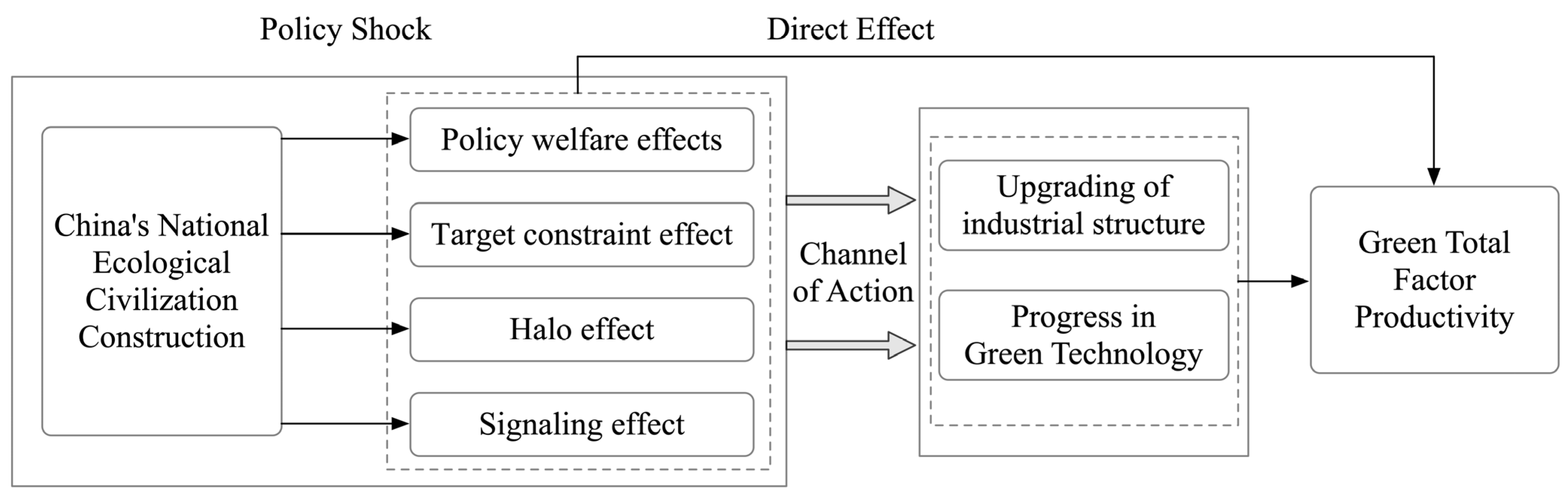
The aforementioned theories and hypotheses suggest that China’s ecological civilization construction is associated with improvements in urban GTFP and may operate through two potential mediating channels: industrial structure optimization and green technological innovation. The conceptual pathways through which the national ecological civilization pilot policies may affect urban GTFP are illustrated in Figure 1.

3. Research Design

3.1. Model Construction

To test Hypothesis 1, this study employs a multi-period DID approach to analyze the impact of national ecological civilization construction. This method is selected for two key reasons. One consideration is that the observed changes in the GTFP of the target cities may reflect the combined effects of ecological civilization construction or other factors, such as temporal effects driven by economic development or developmental inertia. By constructing a quasi-natural experiment that treats pilot cities as the experimental group and non-pilot cities as the control group, the DID model helps isolate the net effect of the policy while controlling for potential confounding factors during policy implementation. Another consideration is that the ecological civilization pilot program involves multiple overlapping policies, with the range of pilot cities expanding incrementally across different phases. In this context, a traditional DID model is insufficient. Thus, this study adopts a multi-period DID approach to more accurately capture the staggered implementation and cumulative effects of the policy.
However, recent methodological studies have demonstrated that traditional two-way fixed effects (TWFE) estimators may yield biased estimates in the presence of staggered treatment adoption, particularly when treatment effects are heterogeneous across cohorts and over time [20,21]. To account for this concern, while retaining the TWFE specification as the baseline model, this study additionally implements modern DID estimators that explicitly accommodate heterogeneous treatment timing. These supplementary estimators are employed as robustness checks to enhance the credibility and identification validity of the empirical results.
To scientifically evaluate the impact of the pilot policy on urban GTFP, the following regression model is constructed:
G T F P i , t = α + β d i d i , t + γ Control _ Var i , t + C i t y F E + Y e a r F E + ε i , t
where i denotes the city, and t represents the year. G T F P is the dependent variable. The dummy variable d i d i t = 1 indicates that city i is designated as an ecological civilization pilot city in year t , while d i d i t = 0 signifies that city i is not a pilot city in year t . Control _ Var represents the set of control variables. CityFE denotes city fixed effects, and YearFE represents year fixed effects. E is the random error term. The estimated coefficient β measures the average difference in GTFP before and after the implementation of the ecological civilization pilot policy.
In addition, based on the hypotheses of this study, the ecological civilization pilot policy may indirectly affect GTFP through two channels: industrial structure upgrading and green technological innovation. To test these mediation effects, the following mediation effect regression models are established:
G T F P i , t = α 0 + α 1 did i , t + γ 1   control i , t + u 1 i + v 1 t + ε 1 i , t
me i , t = β 0 + β 1 d i d i , t + γ 2 control i , t + u 2 i + v 2 t + ε 2 i , t
GTFP i , t = δ 0 + δ 1 d i d i , t + δ 2 me i , t + γ 3 control i , t + u 3 i + v 3 t + ε 3 i , t
where me i , t represents the mediator variable, and “ control ” denotes the set of control variables. u 1 i , u 2 i , u 3 i are city fixed effects, v 1 t , v 2 t , v 3 t are year fixed effects, and ε 1 i , t , ε 2 i , t , ε 3 i , t are random error terms. The meanings of the remaining variables are consistent with those in Equation (1).
It should be noted that the mediation analysis in this study is conducted using sequential regression models. Therefore, the estimated mediation effects should be interpreted as empirical evidence of potential transmission channels rather than definitive causal mechanisms.

3.2. Variable Description and Data Source

3.2.1. Spatial Domain and Data Sources

This study focuses on 283 prefecture-level and above cities in China, covering the majority of the country’s prefecture-level administrative regions and core cities (excluding Hong Kong, Macao, and Taiwan). The selection of regions is broad, ensuring high representativeness and comprehensiveness. Among China’s 293 prefecture-level administrative regions, some cities in Hainan, Guizhou, Tibet, Qinghai, Ningxia, and Xinjiang exhibit incomplete data in various statistical yearbooks due to data availability issues. To ensure data quality, cities with severe data deficiencies were excluded from the sample. Given the pivotal role of Beijing, Tianjin, Shanghai, and Chongqing—China’s four municipalities—in the nation’s socio-economic reforms and their strong relevance to ecological civilization construction, these municipalities were included in the study. Additionally, for cities affected by administrative adjustments, which resulted in fragmented data and inconsistencies in statistical standards, their data were merged with that of their respective prefecture-level cities to ensure consistency and reliability of the research results.
In terms of the temporal scope, the study covers the period 2006–2019. The lower bound of 2006 was selected because earlier data are severely incomplete and subject to inconsistent statistical standards, undermining cross-city comparability and the validity of empirical analysis. The upper bound of 2019 was chosen because subsequent data were substantially distorted by the COVID-19 pandemic, which introduced profound exogenous shocks to China’s economy and society, and because several key indicators underwent definitional and reporting adjustments, reducing temporal consistency and comparability [22,23]. The selected timeframe thus provides over a decade of continuous and standardized observations, sufficient to capture the cumulative and relatively stable effects of ecological civilization construction policies while ensuring the robustness and policy relevance of the findings. Most of the data were obtained from the China Urban Statistical Yearbook, China Urban Construction Statistical Yearbook, China Science and Technology Statistical Yearbook, and official government websites. For a few cities with incomplete data for certain indicators, linear interpolation was applied to fill the gaps [24], following the practices outlined in relevant literature [25,26].

3.2.2. Determining Experimental and Control Groups: Methodological Considerations

To ensure conceptual clarity, this study follows the classification framework outlined in the Plan, which categorizes ecological civilization institutions into eight major areas: property rights for natural resource assets; territorial space development and protection; spatial planning; resource conservation and total quantity management; resource paid-use and ecological compensation; environmental governance systems; ecological and environmental protection markets; and performance evaluation and accountability mechanisms. According to the Plan, policies that simultaneously involve several of these institutional categories are defined as comprehensive policies, while those addressing only a single category are treated as single-issue pilots. Building on this classification, the policy system of ecological civilization pilots in China is characterized by typological diversity, a proliferation of initiatives, broad stakeholder involvement, and intricate governance processes. Given this complexity and the limited accessibility of certain policy documents, this study does not attempt to provide comprehensive coverage of single-issue pilots. Instead, it focuses on nine national-level comprehensive pilot policies that embody integrated institutional reforms. These policies have been primarily operationalized through the establishment of comprehensive ecological civilization demonstration zones, which function as the principal mechanism for advancing reform through pilot practices. The identification of these nine representative policies results from a rigorous process of review, synthesis, and critical screening of policy documents, thereby ensuring both their conceptual representativeness and practical clarity as pilot initiatives.
The “national ecological civilization construction” plan referenced in this study is derived from a systematic review and synthesis of nine national-level comprehensive pilot policies, rather than from individual policy documents issued by specific departments or joint agencies. Based on these nine policies, we construct a standardized framework at the prefecture-level city scale. For each policy, a city’s inclusion as a pilot equals 1, and the cumulative score across all nine policies naturally increases for cities participating in multiple pilot initiatives. This cumulative score reflects the depth of a city’s involvement in China’s ecological civilization construction strategy and constitutes the first step of the standardized framework.
During the process of integrating and standardizing the pilot policies, several methodological challenges arose. The first concerns duplicate pilot selection, as some cities were designated multiple times—either across different phases of the same policy or under distinct policies issued at different stages. The second involves variation in pilot levels, since the scope of pilot programs differs by issuing departments and periods, covering provincial-level regions, prefecture-level cities, county-level cities, and their subordinate districts. To resolve these complexities, this study draws on established approaches in prior research and applies three methodological considerations. Following common practice in the literature [27,28], cities participating in multiple initiatives are assigned the implementation year of their earliest entry. Second, for standardization at the prefecture level, we adopt the principle that “any province designated as an ecological civilization pilot region is treated as including all its prefecture-level cities.” Although consistent with prevailing practice, this approach may overstate pilot coverage. Third, to mitigate this risk, our scoring method simplifies the weighting scheme proposed previously [29]: rather than assigning 0.5 to each prefecture-level city under provincial-level pilots, we assign a value of 1.0. This adjustment is justified by the broader scope of policy documents incorporated in our framework, which provides sufficient scoring opportunities and thereby minimizes the likelihood of overestimation. Accordingly, provincial-level inclusion contributes only a single incremental point to the cumulative score.
To further reduce subjectivity in determining pilot cities, the standardized identification framework incorporates two additional steps. First, third-party evaluation standards are introduced to account for the cumulative effects of ecological civilization policies. Specifically, a widely applied ecological civilization index is employed as an objective benchmark, in which a composite score of 70 or above is commonly used to indicate a nationally recognized “good” level of ecological performance, following assessment practices documented in authoritative reports developed by national expert institutions, such as research teams affiliated with the Chinese Academy of Engineering [30]. Second, beyond formal policy inclusion and quantitative performance thresholds, an expert-based evaluation is incorporated as a complementary screening step. Expert assessments are used to qualitatively evaluate the overall quality of green development in candidate cities, serving as a robustness-enhancing supplement to standardized indicators. This combined approach helps ensure that the final identification of pilot cities is grounded in both transparent, rule-based criteria and informed professional judgment.
In summary, the three-tiered framework integrates policy engagement, ecological performance thresholds, and expert judgment into a unified and transparent selection mechanism. Applying these criteria, 84 cities were identified as exemplifying the highest level of ecological civilization construction in China. This rigorous process enhances both the scientific robustness of the dataset and the credibility of the findings, thereby providing a solid foundation for the subsequent empirical analysis.
Importantly, the identification strategy rests on the assumption that the designation of ecological civilization pilot cities is primarily driven by national policy objectives rather than short-term fluctuations in urban green productivity. In other words, cities are selected as pilots based on their institutional capacity and policy readiness rather than on contemporaneous changes in GTFP. This assumption is consistent with the top-down policy design of ecological civilization initiatives in China and supports the validity of the DID identification strategy.
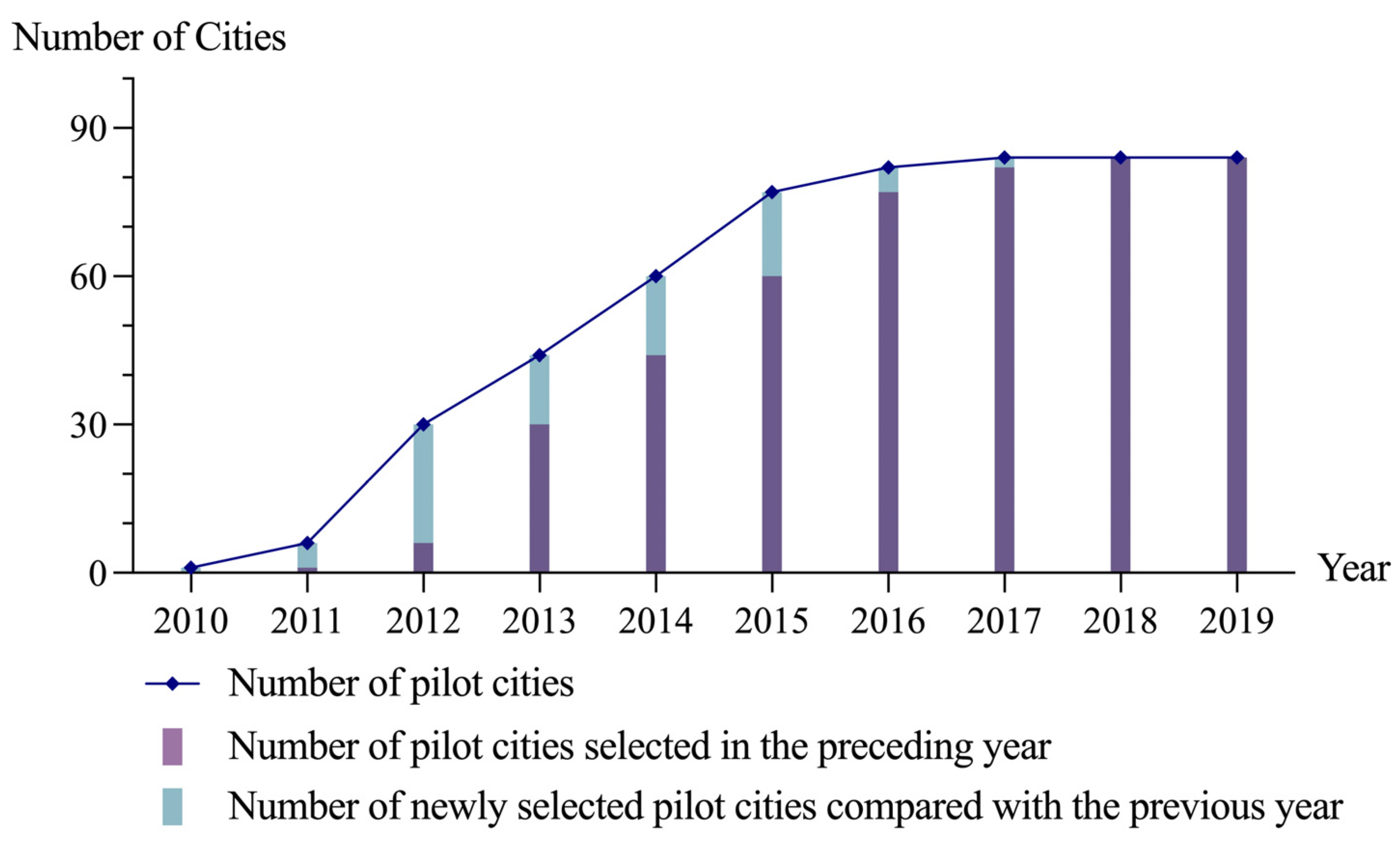
Following the identification of 84 pilot cities, this study conducts a time–space–policy triangulation to further validate the selection results. This multi-dimensional cross-check is deliberately designed to demonstrate, from an alternative perspective, that the criteria applied are both rigorous and non-arbitrary. More importantly, the triangulation not only reinforces the robustness of the sample by aligning temporal consistency, spatial rationality, and policy coherence, but also provides a seamless analytical bridge to the subsequent heterogeneity analysis. In this sense, the verification process itself becomes an integral part of the methodological design, ensuring both conceptual rigor and analytical continuity. The temporal distribution of the pilot cities is presented in Figure 2.
As shown in Figure 2, this study selects 2010 as the starting year for policy evaluation, as it marks the launch of the first batch of low-carbon city pilots initiated by the NDRC. This policy integrated multiple environmental regulatory tools and adopted a pilot governance model, signifying a major milestone in China’s comprehensive environmental regulation efforts with far-reaching implications. Additionally, the choice of 2010 precedes the incorporation of ecological civilization construction into the national “Five-Sphere Integrated Plan” during the 18th National Congress of the Communist Party of China in 2012. This enables a more comprehensive understanding of the evolution of China’s ecological civilization construction from a temporal perspective, capturing the trajectory of policy development over time. The number of pilot cities has exhibited a steadily increasing trend since 2010. The year 2012 saw the largest increase, with 24 new cities selected. In the same year, the 18th National Congress of the Communist Party of China established ecological civilization construction as a fundamental national policy and incorporated it into the “Five-Sphere Integrated Plan.” This development led to the launch and comprehensive rollout of numerous related policies and pilot projects. Between 2011 and 2015, the number of pilot cities continued to grow steadily, in alignment with the implementation of the 13th Five-Year Plan, reflecting the gradual expansion of policy implementation and regional coverage. The promulgation of the Plan provided the institutional framework—commonly referred to as the ‘four beams and eight pillars’—thereby marking ecological civilization construction’s transition into a new stage of institutionalization. Following this, the 2016 issuance of the Opinions on Establishing Unified and Standardized National Ecological Civilization Pilot Zones stipulated that no department could launch new ecological civilization pilot projects without prior approval from the Central Committee of the Communist Party of China and the State Council. Additionally, all self-initiated pilot projects were required to conclude by 2020. This policy shift led to a sharp decline in the number of new pilot cities between 2016 and 2017, with relatively few meeting the screening criteria for inclusion. While no new pilot cities were established in 2018 and 2019, the focus shifted toward refining and enhancing the organization, implementation, and policy requirements of the existing pilot projects, making 2019 a natural endpoint for the observation period. This also corresponds to the data scope adopted in this study, as the comparability of post-2019 data was further reduced by the exogenous shocks of the COVID-19 pandemic.
The trajectory of pilot cities demonstrates a gradual shift from initial experimentation to broader expansion, reflecting the evolution of ecological civilization construction from exploration to phases of development, stabilization, and maturity. Changes in the number of pilots also indicate the ongoing refinement of institutional frameworks and the progressive modernization of China’s governance system and capacity. Accordingly, the temporal distribution of pilot cities aligns with national macro-policy shifts and serves as cross-validation of the methodological rigor of the selection criteria adopted in this study.
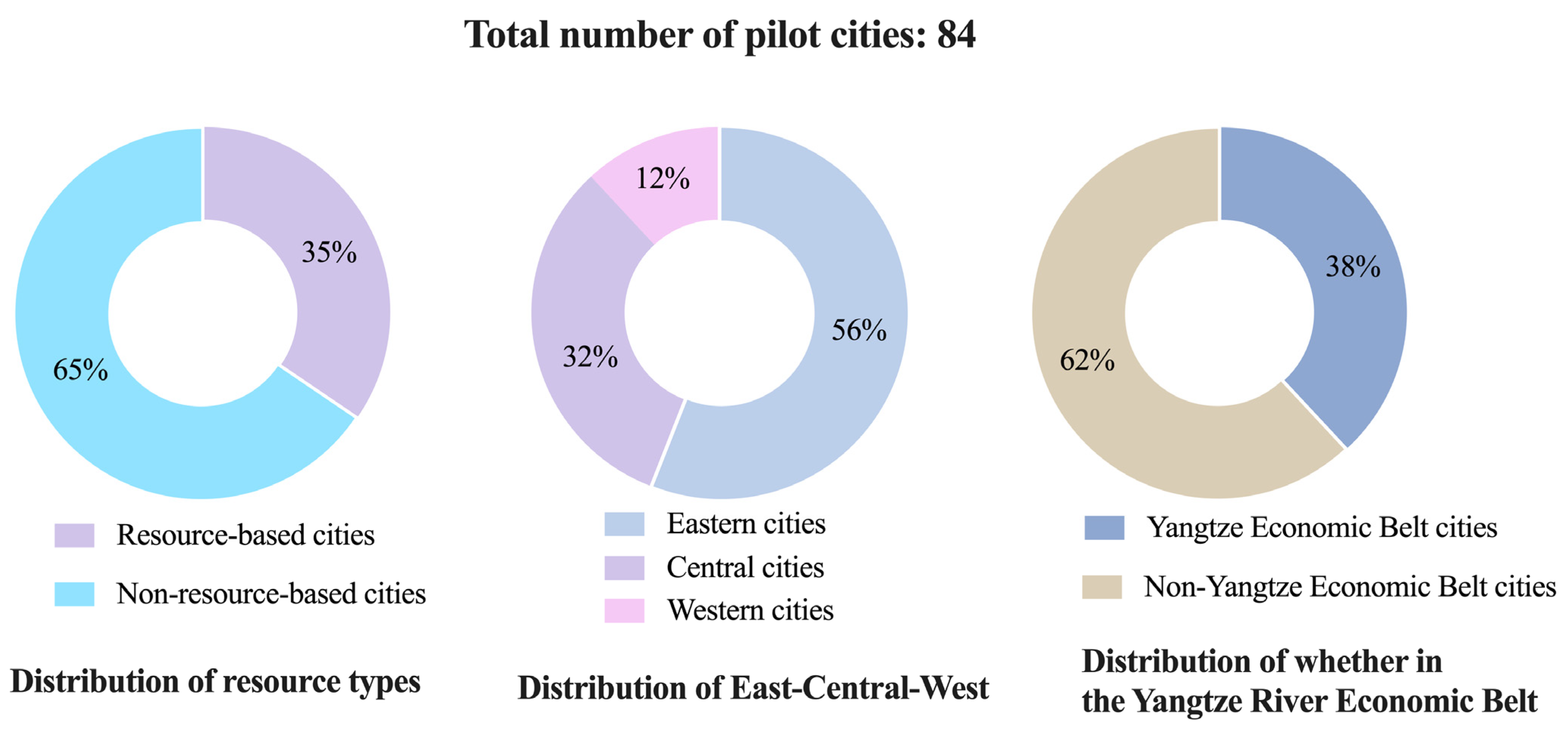
Beyond the temporal dimension, this study also examines the spatial characteristics of pilot cities, including their resource endowments, regional distribution across eastern, central, and western China, and the distinction between the Yangtze River Economic Belt and non-Yangtze River areas. This spatial distribution corresponds closely with national policy orientations and provides complementary validation of the selection framework. These spatial patterns offer further support for the heterogeneity analysis, as illustrated in Figure 3.
(1) From the perspective of resource endowment, resource-based cities are characterized by economies centered on the extraction and processing of natural resources, such as minerals and forests. In this study, the pilot cities are classified in accordance with the National Plan for the Sustainable Development of Resource-Based Cities (2013–2020). Among the ecological civilization pilot cities, 65% are non-resource-based and 35% are resource-based, indicating that the former outnumber the latter. This distribution is broadly balanced and consistent with national macro-regional policy orientations, thereby reinforcing the rationality of the selection as it reflects the state’s dual strategy of revitalizing resource-dependent regions and advancing green transformation in non-resource-based urban centers. The two categories of cities nonetheless exhibit distinct trajectories in ecological civilization construction, particularly in terms of resource endowment, environmental pressures, and policy orientation [31,32]. Resource-based cities, endowed with abundant natural assets, remain heavily reliant on extraction for economic growth, whereas non-resource-based cities tend to emphasize manufacturing and service industries. In terms of environmental pressures, resource-based cities are more vulnerable to land degradation, water contamination, and air pollution caused by intensive exploitation, thereby necessitating strong measures for environmental protection and ecological restoration. By contrast, non-resource-based cities, though less affected by direct extraction, face challenges associated with industrialization and urbanization, including excessive energy consumption and elevated pollutant emissions, which require improvements in resource efficiency and the adoption of cleaner production practices. These contrasting conditions are reflected in divergent policy orientations: resource-based cities often require stricter environmental regulation and resource management to mitigate ecological risks, while non-resource-based cities prioritize industrial upgrading and green technological innovation to achieve sustainable development. Despite these differences, both types of cities converge on the common objective of advancing green development and fostering a virtuous cycle that integrates high-quality economic growth with ecological sustainability.
(2) From the perspective of policy and regional division, a considerable body of academic research classifies mainland China into eastern, central, and western regions according to differences in economic development levels and geographical location, in order to investigate regional heterogeneity [33]. This tripartite division is firmly established in the scholarly literature and simultaneously grounded in national policy. As stated by the NDRC, the eastern–central–western division constitutes a policy-based framework rather than an administrative or purely geographical boundary [34]. Among the pilot cities, 56% are in the eastern region, 32% in the central region, and 12% in the western region, with the distribution following the pattern: eastern > central > western. This regional allocation is not only consistent with China’s long-standing policy framework of eastern–central–western division but also serves as an implicit validation of the rationality of the selection, as it echoes national efforts to balance development opportunities across diverse regions. The levels of ecological civilization development across these regions vary, each presenting distinct advantages and challenges. The eastern region, with its advanced economic development, technological innovation, and educational resources, benefits from a solid industrial foundation and progress in environmental technologies and pollution control. However, it also faces significant environmental pressures, including severe pollution, resource depletion, and ecosystem degradation, driven by rapid industrialization. In contrast, the central region, rich in natural resources and agricultural land, holds potential in areas such as ecological tourism and sustainable agriculture. Some cities in this region have actively explored green development strategies, but challenges persist in industrial upgrading and technological innovation, with certain areas still reliant on heavily polluting industries. The western region, with vast land, abundant water, and mineral resources, enjoys relatively low industrial pollution and population density, creating favorable conditions for ecological restoration and environmental protection. However, it struggles with weak economic foundations, underdeveloped infrastructure, and regional disparities. Advancing ecological civilization construction requires region-specific strategies that leverage these diverse strengths while addressing inherent challenges. Over time, the selection of pilot cities has shifted from a concentration in the eastern region to greater inclusion of central and western cities, reflecting the government’s increasing focus on promoting balanced, coordinated, and sustainable regional development.
(3) From a geographical perspective, this study classifies the experimental group cities based on the Yangtze River Economic Belt Strategy outlined in the 2015 Government Work Report. As one of China’s “Three Major Strategies,” this initiative plays a vital role in optimizing economic spatial distribution and fostering a new framework for international openness. The Yangtze River Economic Belt includes 11 provinces and municipalities (Shanghai, Jiangsu, Zhejiang, Anhui, Jiangxi, Hubei, Hunan, Chongqing, Sichuan, Yunnan, and Guizhou) and serves as a key demonstration zone for ecological civilization construction, with the Yangtze River Delta (Shanghai, Jiangsu, Zhejiang, and Anhui) being among the most economically dynamic, open, and innovative regions in the country. In this study, 38% of the ecological civilization pilot cities belong to the Yangtze River Economic Belt, while 62% are outside it, indicating that non-Belt cities outnumber those within the Belt. However, given China’s vast territory, diverse resource endowments, and 32 provincial-level administrative divisions, the density of pilot cities within the Yangtze River Economic Belt exceeds that of non-Belt regions. These findings underscore the importance of balancing regional development in ecological civilization construction, while validating the rationality of the selection and highlighting its alignment with overarching national policy priorities and scientifically grounded standards.

3.2.3. Measurement and Trends of GTFP

This paper constructs a GTFP index to comprehensively assess the impact and effectiveness of ecological civilization construction, accounting for the coordinated development of regional resources, environment, and economy. To measure GTFP, the study adopts a super-efficiency Slack-Based Measure (SBM) model that incorporates both energy consumption and environmental pollution [35]. The index is then calculated using the GML method with global benchmarking. In addition, the selection of input, desired output, and undesired output indicators is based on established approaches in recent authoritative studies [36,37,38], thereby enhancing the rigor and validity of the indicator system. The specific indicators used in the model are presented in Table 1.
The GTFP index, G M L o T , T + 1 , measures the change in GTFP from period T to T + 1. A value of G M L o T , T + 1   = 1 indicates no change in GTFP; G M L o T , T + 1 < 1 reflects a decline in GTFP; and G M L o T , T + 1   > 1 indicates an improvement in GTFP. Based on the geometric mean of the GML index during the study period, GTFP improved in 143 cities, accounting for 50.5% of the total sample, suggesting that most cities in China achieved varying degrees of GTFP growth in recent years. At the national level, the GTFP of Chinese cities increased by an average of 0.1% annually between 2007 and 2020. Among all cities, Beijing recorded the highest growth in GTFP, with a geometric mean GML index change of 1.077, followed by Shanghai at 1.071 and Tianjin at 1.064. These top three cities, all municipalities, underwent different models of ecological civilization transformation during the study period and rank among the highest in terms of ecological civilization construction in China. On the other hand, the cities with the largest average annual declines in the GML index were Xuancheng, Zhangzhou, and Dongguan, with decreases of 1.8%, 1.9%, and 4.0%, respectively.
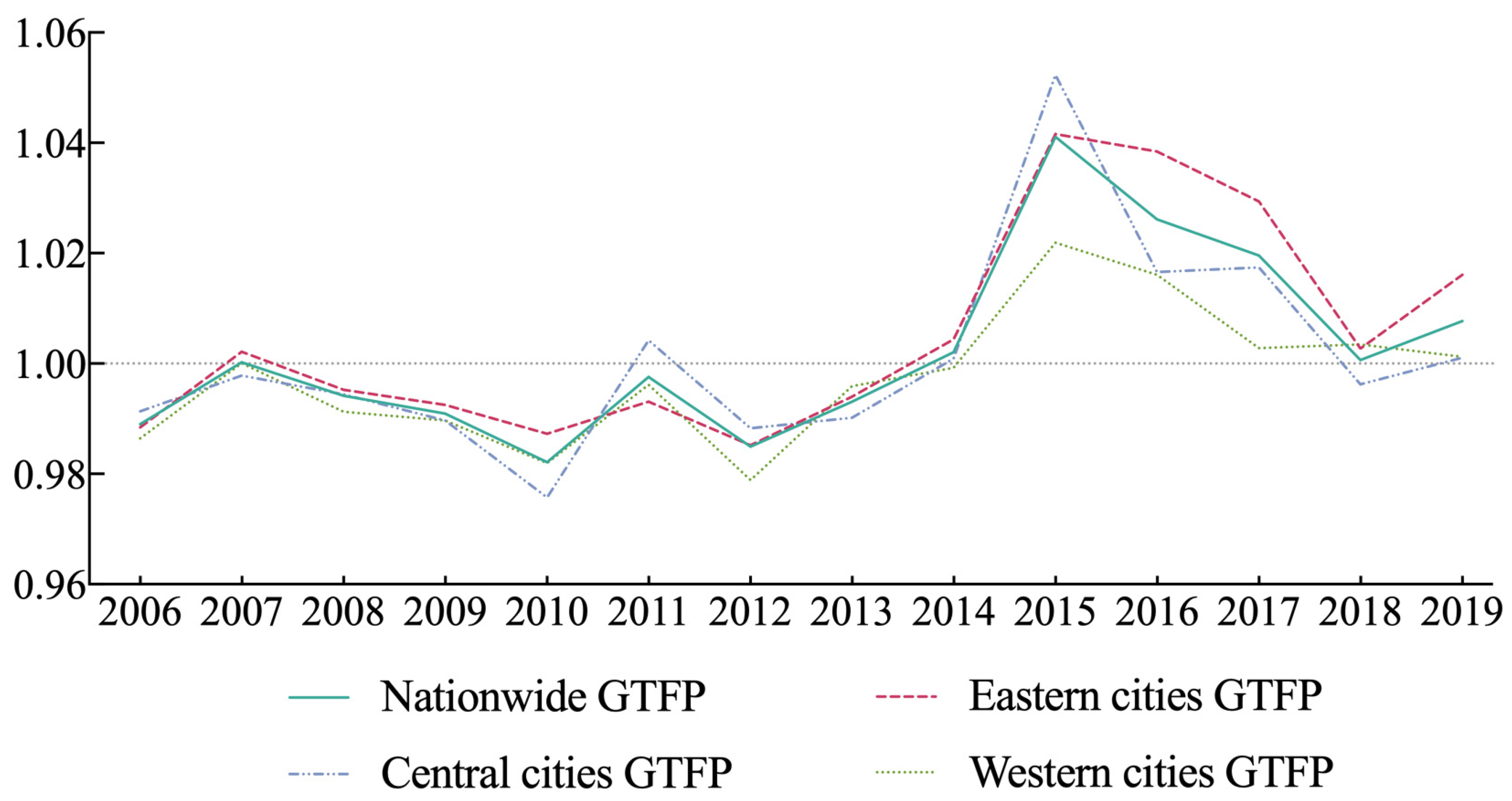
To provide a more intuitive presentation of the GTFP measurement results, the 283 cities in China are grouped into eastern, central, and western regions. The temporal trends in the geometric mean of the cities’ green GML index from 2006 to 2019 are illustrated in Figure 4.
Overall, the green GML index for the nation and the three major regions—eastern, central, and western—exhibits a fluctuating upward trend, following a trajectory of initial increase, subsequent decline, and renewed growth. In recent years, the GTFP across regions has gradually converged, reflecting a more coordinated development pattern.
From a temporal perspective, the evolution of the GML index can be divided into four distinct phases. In the first phase, prior to 2007, GTFP remained low. This may be attributed to China’s accession to the WTO in 2000, which transformed the country into the “world’s factory.” The pursuit of economic growth through an extensive development model temporarily overshadowed environmental protection and energy conservation efforts. However, by 2006, heightened attention to environmental regulations and energy conservation prompted some polluting enterprises to scale back production or exit the market, improving green efficiency to some extent. The second phase, from 2008 to 2011, witnessed a decline in GTFP. This downturn can be linked to the global financial crisis, which posed a threat of economic recession. In response to insufficient demand, the government launched a 4 trillion yuan stimulus package in 2009 to counter the risks of economic hard landing. While these investments were instrumental in stabilizing economic growth, the resurgence of high-energy-consumption and high-pollution projects contributed to the decline in green efficiency. The third phase, from 2011 to 2016, saw a general upward trend in GTFP. This improvement aligns with the “12th Five-Year Plan,” where high-quality growth became a central economic objective, emphasizing environmental protection, energy conservation, and green development. At the macro level, the government supported the development of environmentally friendly high-tech industries and strategically positioned emerging industries, while simultaneously promoting ecological civilization pilot policies to modernize environmental governance systems and capabilities. At the micro level, stricter environmental regulations increased pollution control costs for enterprises, forcing them to innovate in production processes, technologies, and emission reduction practices [39]. The success of environmental policies during this period effectively enhanced urban GTFP. In the fourth phase, from 2016 to 2020, GTFP continued to grow steadily, reflecting the achievements of environmental protection efforts and the maturation of ecological civilization construction during the “13th Five-Year Plan” period. Throughout most years of this phase, the GML index remained above 1, indicating consistent growth in GTFP, although the growth rate slowed. This deceleration aligns with the diminishing marginal returns inherent in the ecological civilization construction process. The introduction of the “four beams and eight pillars” framework for ecological civilization system reform in 2015 marked a turning point, providing clearer strategic direction for environmental governance. The scope of ecological protection became more diversified, multilayered, and refined, signaling a new phase in ecological civilization and the “Beautiful China” initiative.
From a regional perspective, the GTFP of eastern cities is generally higher than that of central and western cities. However, there are periodic variations throughout the sample period, suggesting that the driving mechanisms behind green transformation may differ across these regions. The growth rate of GTFP follows the pattern of eastern > central > western, indicating that the rapid increase in GTFP is, to some extent, dependent on the economic foundation and development potential of each region. Eastern cities benefit from well-developed infrastructure, locational advantages, and superior technological innovation and industrial development compared to their central and western counterparts, driving GTFP at a faster pace. From a strategic and policy perspective, the implementation of regional coordination strategies—such as the “Western Development” initiative in 2000 and the “Rise of Central China” strategy in 2006—led to the relocation of high-energy-consuming and heavily polluting industries from the east to the central and western regions. This industrial transfer intensified the energy conservation and emission reduction pressures in these regions, further constraining their GTFP growth. Meanwhile, leveraging its advanced infrastructure, technology, talent, and information advantages, the eastern region attracted foreign high-tech industries, fostering the concentration of high-value-added, technology-intensive sectors and driving industrial upgrading. From the perspective of traditional economic geography, developed regions often possess significant locational advantages, while underdeveloped regions face spatial constraints that hinder initial development. Merely relying on fiscal support from policies like “Western Development” without institutional policy tools to promote regional development model upgrades has limited the ability of central and western regions to transition away from extensive production models and inefficient industrial structures in the short term. Consequently, the three regions exhibit disparities in human capital accumulation, technological innovation, knowledge spillovers, and levels of industrialization and urbanization. However, with the continuous advancement of ecological civilization construction and environmental policies during the 13th Five-Year Plan period, governments at all levels have prioritized industrial restructuring, innovation-driven growth, and energy conservation. All regions have actively promoted high-tech industries, emphasizing balanced and coordinated development. These efforts have gradually narrowed the inter-regional GTFP growth disparities, fostering more sustainable and inclusive development across the eastern, central, and western regions.


3.2.4. Mechanism Variables

The mediating variable for industrial structure upgrading (W) is measured with reference to established approaches in the literature [40,41]. In essence, this indicator reflects the progressive shift in the economic structure from the primary sector toward the secondary and, especially, the tertiary sector. A higher value of W indicates a more advanced industrial structure, capturing the transition toward higher value-added activities.
For industrial structure rationalization, this study employs the Theil index, following established practice in the literature [42]. The Theil index effectively measures structural disparities across industries in terms of both output and employment while accounting for the economic importance of each sector. A value closer to zero suggests a more balanced industrial structure, whereas deviations from zero indicate a decline in rationality, with misalignments between sectoral contributions and their economic roles.
The progress of green technology is assessed using indicators as documented in prior studies [37]. Specifically, the number of green invention patent applications per 10,000 people (GIP) captures the quantity of green innovation, while the number of green utility model patent applications per 10,000 people (GUP) reflects the quality of green innovation. These indicators provide a nuanced view of a city’s capacity to generate and adopt environmentally sustainable technologies.
Additionally, the innovation index (IRIEC) serves as a mediating variable, capturing the broader influence of innovative activities on both economic performance and environmental outcomes. Together, these metrics ensure a comprehensive evaluation of the mechanisms through which ecological civilization construction influences GTFP.

3.2.5. Control Variables

To ensure the robustness of the regression results, this study draws on previous research evaluating ecological civilization and incorporates several influencing factors as covariates in the model [43]. These covariates include economic development level, industrial structure, marketization level, degree of regional openness, human capital level, and infrastructure development level. The interpretation of these indicators is provided in Table 2.
Descriptive statistics of the main variables are presented in Table 3. To mitigate potential scale differences across variables, continuous variables are appropriately transformed prior to estimation. The number of observations varies across variables due to missing values in certain control variables.

4. Empirical Results

4.1. Benchmark Result

To test Hypothesis 1, Equation (1) was regressed using Stata17, with the baseline regression results presented in Table 4.
Columns (1) and (2), (3) and (4), (5) and (6) show the estimation results for all cities, cities excluding municipalities, and ordinary prefecture-level cities (excluding municipalities, provincial capitals, and cities with independent planning status), respectively. After controlling for city (individual) fixed effects and time fixed effects, the estimated coefficients for ecological civilization pilot cities remain significantly positive, regardless of whether control variables are included. This indicates that the pilot policies have, overall, contributed to improving urban GTFP, suggesting that the ecological civilization pilot policies have promoted green development in the selected cities, thereby validating H1.
Specifically, taking Column (2) as an example, the estimated coefficient of the policy dummy variable treatment × after is 0.0112, which passes the significance test at the 1% level. This finding demonstrates that the ecological civilization pilot policy has significantly enhanced the GTFP of cities. After accounting for other factors, the policy has led to an average increase of approximately 1.12% in GTFP in pilot cities compared to non-pilot cities.

4.2. Parallel Trend Test

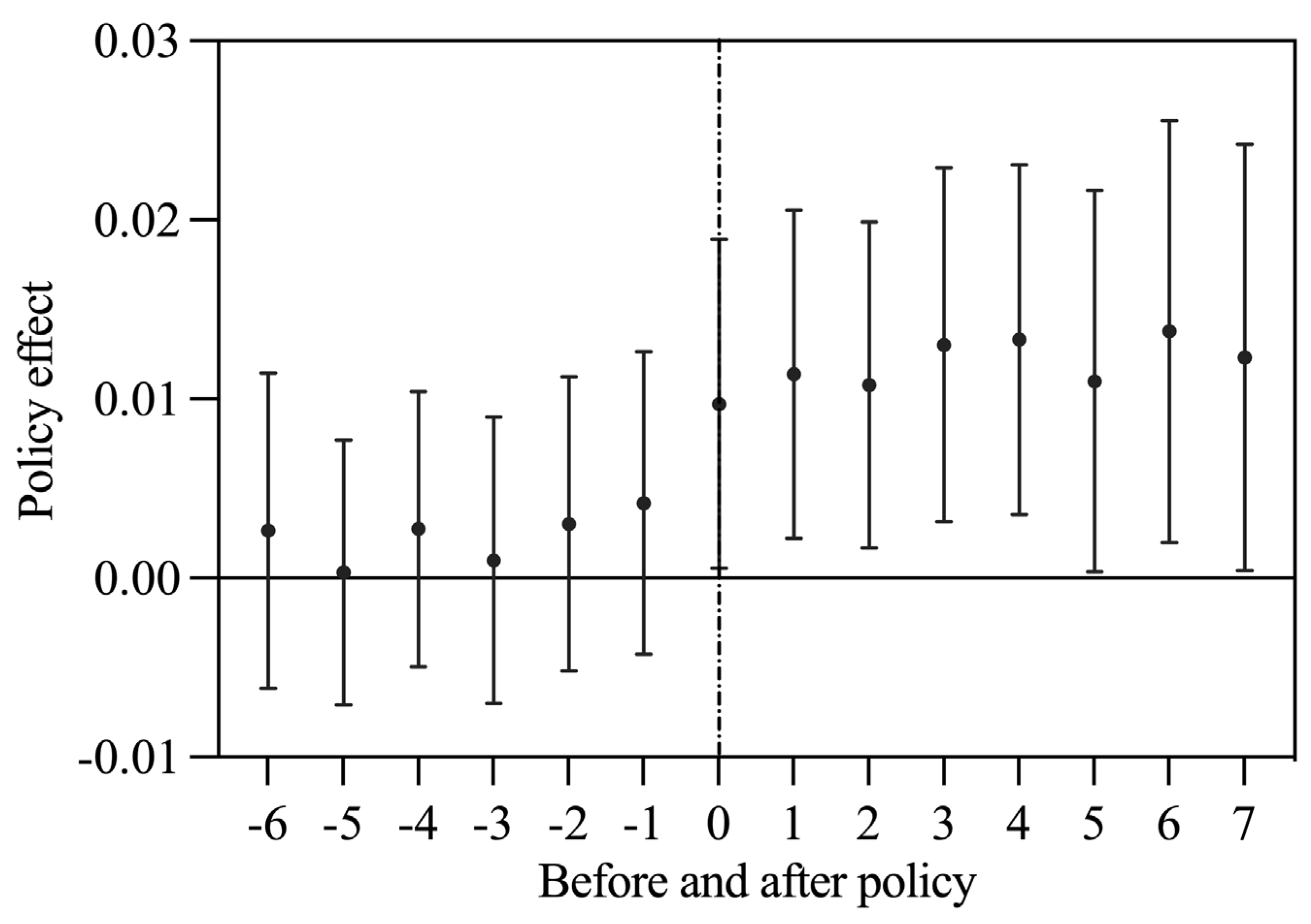
A key prerequisite for the validity of the multi-period DID model is the parallel trend assumption, which requires that, prior to policy implementation, the trend in GTFP for the experimental group and the control group remains parallel. To test this assumption, this study employs the event study methodology proposed by Jacobson [44], which can be expressed as follows:
G T F P i , t = α + t = 6 7 δ t D i , t + γ Control _ Var i , t + CityFE + YearFE + ε i , t
where D i , t is a set of dummy variables, taking the value of 1 if city i implements the ecological civilization pilot policy in year t , and 0 otherwise. The meanings of the remaining variables are consistent with those in Equation (1). The key focus of the parallel trend test in this equation is on δ t , which captures the difference in GTFP between pilot and non-pilot cities in year t of the policy implementation. Given the limited data for six years prior to and seven years following the policy implementation, the data for the six pre-implementation years are aggregated into the −6 period, and the data for the seven post-implementation years are aggregated into the 7th period. To address multicollinearity issues, the 6th period prior to policy implementation is used as the baseline. The results of the parallel trend test are presented in Figure 5.
The coefficient estimates for each period prior to the implementation of the ecological civilization pilot policy are insignificant, indicating that there are no significant differences between the experimental and control groups before the policy was implemented. Thus, the research sample passes the parallel trend test.

4.3. Placebo Test

4.3.1. Time Placebo Test

To ensure that the differences in GTFP between pilot and non-pilot cities are not driven by time variations, this study advances the starting year of the ecological civilization pilot policy by 2, 3, 4, and 5 years, constructing placebo policy timings denoted as Eccpost−false1, Eccpost−false2, Eccpost−false3, and Eccpost−false4, respectively. Regression analysis using Equation (1) with these placebo timings indicates that the estimated coefficients are all insignificant (p > 0.05). This confirms that there are no systematic differences in the time trends between the experimental and control groups, further validating that the ecological civilization pilot policy has indeed contributed to the improvement of GTFP in the pilot cities.

4.3.2. Urban Placebo Test

To ensure that the baseline regression results are not influenced by unobservable omitted variables, this study conducts a placebo test following the approach of Cai [45]. Specifically, 84 cities are randomly selected from the sample as a pseudo-treatment group, with the remaining cities serving as the corresponding pseudo-control group. The impact of these pseudo-pilot cities on GTFP is then estimated. This process is repeated 500 times, generating 500 regression coefficients and their corresponding p-values. The counterfactual test results show that the regression coefficients are centered around zero and follow a normal distribution, with the majority of the coefficients being statistically insignificant. The coefficient estimate from the baseline regression lies in the upper tail of the distribution of the pseudo-regression coefficients, indicating that it represents a low-probability event in the placebo tests [46]. Therefore, it can be concluded that the baseline estimates are unlikely to be driven by unobservable factors.

4.4. Robustness Test

The baseline regression results indicate that the GTFP of ecological civilization pilot cities has improved significantly compared to non-pilot cities, suggesting that ecological civilization construction positively contributes to enhancing GTFP. However, to eliminate potential confounding factors and ensure more rigorous and accurate conclusions, a series of robustness tests were conducted. Specifically, these tests include analyzing sample selection criteria, incorporating additional baseline variables to mitigate selection bias, and excluding the interference of other policies implemented during the study period.
(1) Sample Data Selection. To prevent extreme values from biasing the baseline regression results, 1% and 5% winsorization [47] were applied to the GTFP variable. Equation (1) was re-estimated using the trimmed data, and the results indicate that, after excluding extreme values, the coefficient estimate for the interaction term treatment × after remains statistically significant at the 1% level. This finding is consistent with the baseline regression results, further confirming the robustness of the conclusion.
(2) Mitigating Selection Bias by Including Baseline Variables. The ideal scenario for employing a progressive DID model assumes that pilot and non-pilot cities are selected randomly. However, factors such as economic development level, historical responsibilities, and geographical location may influence whether a city is chosen as an ecological civilization pilot, potentially leading to estimation bias, as these factors may have varying impacts on GTFP over time. To mitigate the non-random selection bias associated with ecological civilization pilot cities, separate regressions were conducted for all cities, cities excluding municipalities, and ordinary prefecture-level cities (excluding municipalities, provincial capitals, and cities with independent planning status), as shown in Table 3. The results consistently pass the 1% significance level test across all groups, aligning with the baseline regression results. Moreover, the pilot cities are distributed across different geographical locations and exhibit varying levels of economic development, suggesting a certain degree of randomness in their selection. This further supports the robustness of the findings.
(3) Controlling for Interference from Other Policies. To prevent potential biases in the baseline estimates caused by the influence of other policies on urban GTFP during the sample period, this study carefully addresses these concerns from the outset of the model design. The ecological civilization construction examined here is treated as a consolidated and standardized collection of multiple pilot policies. In determining the pilot cities, the analysis not only accounts for the cumulative effects of various ecological civilization-related policies but also draws on authoritative third-party ecological civilization index reports. Furthermore, the scientific validity of the pilot city selection is demonstrated through a multi-dimensional analysis, including the temporal distribution of pilot programs, resource heterogeneity, and geographical location. These measures effectively reduce the likelihood that other policies implemented during the sample period would influence the GTFP of cities, thus enhancing the reliability of the results. Additionally, beyond the potential influence of ecological civilization-related policies, the NDRC on Advancing the Pilot Work of National Innovation-Oriented Cities may also affect urban GTFP, potentially introducing bias into the baseline estimates. To mitigate this concern, we collected and reviewed this policy document and incorporated a dummy variable representing the national innovation-oriented city pilot policy into the baseline regression model. After controlling for the potential interference of both policies, the regression results remain consistent with the baseline estimates, further reinforcing the robustness and reliability of the findings.
(4) Modern DID Estimation under Staggered Treatment Timing. To assess whether staggered treatment timing induces bias in the traditional two-way fixed effects (TWFE) estimator, we first conduct a Goodman–Bacon [20] decomposition to examine the weighting structure of the multi-period DID estimator. This approach enables us to identify the contribution of different comparison groups and evaluate the extent to which the baseline estimates may be influenced by heterogeneous treatment effects. The results are reported in Table 5.
Panel A, column (1), presents the overall Bacon decomposition estimate, while Panel B reports the relative contribution of different comparison types to the TWFE estimator. The estimates indicate that the policy effect remains positive and statistically significant. Notably, the vast majority of the TWFE weight (93.63%) is derived from comparisons between treated and never-treated cities, whereas only a small proportion (6.37%) originates from early- versus late-treated cohorts. This weighting structure suggests that the baseline TWFE estimates are unlikely to be materially driven by problematic aggregation or heterogeneous treatment timing.
Building on this evidence, we further implement the Callaway and Sant’Anna estimator [21], which explicitly accounts for heterogeneous treatment timing by estimating group-time average treatment effects and computing the overall average treatment effect on the treated (ATT). As shown in Panel A, column (2), the estimated ATT remains positive and statistically significant, thereby reinforcing the robustness of the main findings.

5. Trend Analyses

5.1. Heterogeneity Analysis

5.1.1. Regional Heterogeneity

The selection of regions and cities as the basis for heterogeneity analysis has been explained in detail in the previous section on the characteristics of the pilot cities and will not be repeated here. To further explore whether the impact of ecological civilization pilot policies on urban GTFP varies across regions, this study divides mainland China into three regions—eastern, central, and western—based on economic development levels, geographical location, and differences in land-use structures across regions.
The sample data are then regressed using Equation (6).
G T F P i , t = α + β Q × d i d i , t + γ Control _ Var i , t + CityFE + YearFE + ε i , t
Here, Q represents a set of dummy variables capturing key characteristics of the cities, including their regional classification (eastern, central, or western), whether they are resource-based cities, and whether they are part of the Yangtze River Economic Belt. The meanings of the remaining variables are consistent with those in Equation (1). The impact of the pilot policies on the GTFP of cities in the eastern, central, and western regions is presented in Table 6.
The results indicate that the ecological civilization pilot policy has a significant impact on GTFP across all regions, but the magnitude of the effect varies noticeably. Specifically, the policy has the greatest impact on the GTFP of cities in the western region, followed by the eastern and central regions, i.e., western > eastern > central. However, when considering the GTFP levels calculated earlier—eastern > central > western—these findings point to persistent regional imbalances and uneven development foundations in China’s green development trajectory, which are well documented in the literature on regional disparities in green development and competitiveness [26].

5.1.2. Urban Heterogeneity

The sample data were regressed using Equation (6) based on four city types: resource-based cities, non-resource-based cities, cities within the Yangtze River Economic Belt, and cities outside the Yangtze River Economic Belt. The regression results are presented in Table 7.
The results indicate that the ecological civilization pilot policy has a significant positive impact on the GTFP of different types of cities. As shown in Columns (1)–(4) of Table 5, the coefficients are all positive and significant at the 1% level, confirming that the policy effect holds for resource-based and non-resource-based cities, as well as for cities within and outside the Yangtze River Economic Belt. Although the coefficients differ slightly, the differences are relatively small, suggesting that the policy benefits are broadly consistent across heterogeneous urban contexts.

5.2. Impact Mechanism Test

To examine the effects of industrial structure upgrading and green technological innovation on GTFP within the context of ecological civilization construction and to test hypotheses H2 and H3, this study applies a mediation effect model, as specified in Equations (2)–(4). In addition, to ensure the comparability of results and reduce bias from confounding variables, the control variables remain consistent with those in previous models (Table 4), which include economic development level, industrial structure, marketization level, degree of regional openness, human capital level, and infrastructure development level. Furthermore, to address potential multicollinearity issues—such as when industrial structure upgrading and rationalization are used as mediating variables—if the ratio of secondary industry GDP is included as a control variable, there may be a high correlation between the mediating and control variables. Therefore, while maintaining consistency in control variables, this study carefully excludes certain specific control variables to ensure the accuracy of the estimates and the rigor of the research. Since the regression results of the first step (Equation (1)) in the mediation effect test have been thoroughly discussed in the baseline regression section, this section will focus solely on the regression results of the second step (Equation (3)) and the third step (Equation (4)) of the mediation effect test.
The results of the test for the mediating channel of industrial structure optimization are shown in Table 8.
Table 8 reveals that ecological civilization construction has a significant positive impact on urban GTFP. Columns (1) and (2) present the second-step regression results, where industrial structure upgrading is measured by the advanced industrial structure index (w) and the rationalization of industrial structure index (theil), respectively. The results indicate that ecological civilization construction policies promote industrial structure upgrading at a significance level of at least 1%, but the regression results for industrial structure rationalization are not significant. This suggests that while national ecological civilization construction supports industrial structure upgrading, its effect on industrial structure rationalization is uncertain. Therefore, the second-step mediation effect of industrial structure upgrading is valid, while that of industrial structure rationalization is not. Furthermore, after substituting the advanced industrial structure index (w) into the regression equation, the coefficient for w continues to positively affect GTFP at a 1% significance level, demonstrating that ecological civilization construction can enhance target cities’ GTFP through industrial structure upgrading. Additionally, the Sobel and Goodman tests confirm the mediating role of industrial structure upgrading, validating hypothesis H2a, while hypothesis H2 is partially validated.
The results of the inspection of green technology progress intermediary channels are shown in Table 9.
In Table 9, columns (1) and (3) present the second-step regression results, where the quantity of green innovation is measured by the number of green invention patent applications per 10,000 people (GIP), and the quality of green innovation is measured by the number of green utility model patent applications per 10,000 people (GUP). The results show that ecological civilization construction policies positively affect both the quantity and quality of green innovation at a 1% significance level. This suggests that national ecological civilization construction simultaneously promotes both aspects of green innovation, confirming the validity of the second-step mediation effect of green technological innovation. Columns (2) and (4) display the third-step regression results, where GIP and GUP are included in the regression equation. The results indicate that GIP positively influences GTFP at a 1% significance level, while GUP positively affects GTFP at a 10% significance level. This demonstrates that ecological civilization construction enhances the GTFP of target cities through green technological innovation. Additionally, the Sobel and Goodman tests further validate the mediating role of green technological innovation, confirming hypothesis H3.

6. Discussions

The preceding empirical analyses have demonstrated that China’s ecological civilization pilot policies significantly enhance urban GTFP, with notable variations across regions, city types, and development pathways. Yet the implications of these findings extend beyond statistical significance. They invite a deeper reflection on the structural drivers, institutional contexts, spatial and land-use disparities underlying the observed patterns. Accordingly, this section situates the empirical evidence within the broader discourse of ecological civilization and sustainable development, disentangling the heterogeneous effects, explicating the mediating mechanisms, and drawing theoretical as well as policy insights, while also addressing the limitations and directions for future research.

6.1. Regional Disparities in Policy Effects

A key analytical insight derived from the results is the heterogeneity of policy effects across regions. While the policy effect is strongest in western cities, it is comparatively modest in eastern and central regions, despite their higher baseline levels of GTFP. This apparent divergence underscores the importance of considering both growth trajectories and incremental policy impacts when interpreting regional heterogeneity. Rather than a contradiction, this distinction should be understood through two complementary perspectives: one focusing on the relative growth trajectory of GTFP, and the other on the incremental policy effects across regions. These perspectives together provide a basis for explaining the observed heterogeneity through three interrelated factors.
(1) Interaction between economic development and industrial structure [48]. The eastern region, as the most economically advanced area of China, possesses a mature industrial base and a highly developed service sector. Owing to its earlier stage of industrialization, environmental degradation and resource depletion became pressing issues relatively early, prompting a faster transition toward clean energy and efficient technologies and resulting in relatively high baseline levels of GTFP [49]. However, with the continuous upgrading of technology and rising environmental awareness, the marginal returns to environmental improvement have diminished, so that policy-induced gains in GTFP are smaller than those observed in the west, though still greater than those in the central region. By contrast, the central region is undergoing a difficult economic transition, with its industrial structure shifting from traditional manufacturing toward more diversified, high-tech, and high value-added industries. This restructuring creates opportunities for environmental upgrading and efficiency improvements, yet the complexity of transition processes means that such benefits materialize more slowly, leading to the most modest policy-induced increases in GTFP. The western region, in comparison, lags economically, with a larger share of resource-dependent industries and relatively weak environmental infrastructure and technological capacity. At earlier stages, environmental concerns were often neglected, yielding low baseline levels of GTFP. Nevertheless, supported by ecological civilization policies and increased investment, the region now demonstrates substantial catch-up potential. In addition to industrial restructuring, this potential is also associated with relatively lower land-use intensity and greater availability of ecological land resources, creating broader opportunities for ecological restoration and green development. Consequently, the western region achieves the largest observed policy-driven improvements in GTFP.
(2) Dual challenges of environmental pressure and resource constraints [50]. The eastern region, shaped by long-standing industrialization and urbanization, faces severe environmental pressures, including air and water pollution, land degradation, and intensive demand for energy and water resources. Although local governments possess strong governance capacity and extensive experience in environmental management, the region’s large economic scale, high population density, and already-degraded ecosystems make further improvements increasingly difficult [51]. As a result, ecological civilization policies generate only limited incremental gains in GTFP, with policy effects weaker than in the west but still stronger than in the central region. The central region experiences moderate levels of environmental and resource pressure, leaving both room for improvement and significant challenges. In this context, policy effects unfold more slowly and in a more complex manner, as local authorities must balance economic growth with environmental protection and rational resource use, resulting in the smallest observed improvements in GTFP. By contrast, the western region’s challenges are closely tied to overexploitation of resources and ecological fragility, including problems such as soil erosion and desertification. Under these conditions, pilot policies can deliver substantial improvements through relatively low-cost ecological restoration, enhanced resource-use efficiency, and sustainable management practices, thereby producing the largest policy-driven increases in GTFP. These regional differences are closely linked to disparities in land-resource endowments and land-use pressures, highlighting how ecological civilization policies interact with local land governance conditions.
(3) Variation in policy implementation intensity and development strategies [52]. Governments formulate differentiated policies and allocate resources in response to varying development needs and environmental challenges. In the eastern region, owing to its economic significance, greater emphasis is placed on promoting technological innovation and implementing advanced, demonstration-oriented initiatives, such as carbon trading schemes, green finance instruments, and pilot programs for cutting-edge green industries. However, given that environmental regulation and technology are already at relatively advanced levels, these new measures yield only limited short-term gains in GTFP. In the central region, policies generally aim to balance economic growth with environmental protection rather than focusing resources on specific environmental issues or targeted industrial transformation. This lack of a clear strategic focus contributes to the smallest observed improvements in GTFP. By contrast, in the western region, where ecological carrying capacity is weaker and baseline GTFP is lower, governments prioritize ecological protection and restoration. Consequently, ecological civilization policies are implemented with greater intensity and resource allocation. Supported by this stronger policy push, the region has achieved the most pronounced increases in GTFP. In many western areas, these strategies involve ecological land restoration, land-use regulation, and spatial ecological protection measures, which further reinforce the land-based dimension of ecological civilization governance.
Collectively, these three factors form an integrated explanatory framework that advances existing understandings of regional heterogeneity in environmental policy effectiveness. Rather than interpreting spatial differences in policy outcomes solely through single dimensions such as development level or governance capacity, this framework demonstrates how development-stage conditions, ecological and resource constraints, and policy implementation intensity jointly shape the marginal productivity effects of ecological civilization policies. Theoretically, this perspective contributes to the literature by clarifying why place-based environmental policies implemented under a unified national framework can generate systematically divergent green productivity outcomes across regions.

6.2. Urban Contexts and Structural Challenges

Another important dimension concerns differences between urban contexts, particularly resource dependence and geographical positioning within the Yangtze River Economic Belt. While the regression results confirm that ecological civilization pilot policies significantly improve GTFP across all types of cities, the relatively small coefficient differences should not obscure the structural challenges that underlie these outcomes. The effectiveness of ecological civilization policies should be understood not simply in terms of the existence of policy benefits, but in relation to the structural capacity of different cities to sustain long-term ecological transformation. This capacity is also closely associated with urban land-use structures and the spatial allocation of ecological land resources.
For resource-based cities, the stronger policy effect reflects their substantial potential for transformation when reducing reliance on extractive industries and promoting industrial restructuring [53]. These cities face intense environmental pressure due to their historical dependence on energy- and resource-intensive sectors, so ecological civilization policies serve as a powerful external driver of green upgrading. The structural challenge, however, lies in overcoming entrenched path dependence: ensuring that industrial transformation does not trigger economic instability or employment shocks while still reducing ecological vulnerability [54]. By contrast, non-resource-based cities benefit from more diversified economic structures and stronger innovative capacity, which enhance policy effectiveness. Yet their challenge lies in maintaining momentum in green innovation while managing the risk of diminishing marginal returns as environmental standards continue to rise.
Beyond resource dependence, geographical positioning within the Yangtze River Economic Belt introduces another layer of variation. It is worth noting that the classification of cities by the Belt partially overlaps with the east–central–west division, but the two are not identical. Cities in the Belt are not uniformly “eastern”; many are located in central and even western provinces. As a result, the effects attributed to “Belt vs. non-Belt” may partially overlap with regional (east/central/west) effects. Far from undermining the analysis, however, this overlap provides complementary perspectives that enrich the interpretation of heterogeneity: it highlights that structural challenges differ even among Belt cities themselves, while at the same time demonstrating the robustness of adopting multiple classification schemes in evaluating policy impacts. Within the Yangtze River Economic Belt, the significant positive impact of ecological civilization policies underscores their ability to generate incremental improvements even in regions already marked by advanced development and dense industrialization. The challenge here lies less in proving policy effectiveness—already confirmed by the results—than in determining whether such policies can move beyond immediate gains to address deeper structural issues, including industrial over-concentration, persistent regional disparities, and the need for coordinated governance across multiple provincial jurisdictions. Addressing these issues may require not only technological upgrading but also institutional innovation to ensure that ecological benefits are more evenly distributed and that improvements are sustained over the long term. In cities outside the Belt, the robust policy effect illustrates the diffusion capacity of ecological civilization initiatives. However, weaker fiscal capacity and limited governance resources may constrain the durability of these improvements once external incentives diminish.
Overall, the heterogeneity across urban contexts suggests that ecological transformation is shaped not by policy intervention alone, but by the interaction between resource endowments, institutional capacity, fiscal conditions, geographical positioning, and urban land-use structures. This finding complements existing evaluations of environmental policy effectiveness that emphasize average treatment effects by demonstrating that policy impacts are systematically conditioned by urban structural contexts. By conceptualizing ecological civilization policies as operating through a context-dependent process, rather than yielding uniform outcomes, this discussion advances a more refined understanding of why similar policy instruments implemented under a unified national framework can generate persistently differentiated green productivity responses across cities.

6.3. Mechanisms of Ecological Civilization Policies

The mediation analysis provides additional insights into the mechanisms through which ecological civilization policies influence urban GTFP. Industrial upgrading and green technological innovation emerge as significant mediating pathways, whereas the effect of industrial structure rationalization is statistically insignificant. These findings suggest that ecological transformation unfolds through differentiated and conditional mechanisms rather than a single, uniform channel.
The significant mediating effect of industrial structure upgrading indicates that ecological civilization policies have facilitated the transition of urban economies toward higher value-added and technology-intensive sectors [55]. This advancement contributes not only to improved production efficiency but also to reduced environmental pressure, thereby supporting long-term gains in green productivity. The robustness of this pathway suggests that policy interventions aimed at upgrading industrial structures have been effective in mobilizing industrial transformation consistent with ecological development objectives. By contrast, the mediating role of industrial structure rationalization is not statistically significant. This does not indicate irrelevance but rather highlights the complexity and gradual nature of rationalization processes. Given its recognized importance for stabilizing economic fluctuations, one possible interpretation is that ecological civilization policies may exert uncertain or nonlinear effects on rationalization. In practice, two issues may hinder this channel. First, reliance on uniform and compulsory upgrading measures often neglects industrial and regional heterogeneity, thereby weakening local industries’ ability to accumulate capital, technology, and talent. Second, uneven enforcement—driven by local performance pressures—may reduce regional enthusiasm for compliance, particularly where traditional industries remain profitable. Under such conditions, mandatory restructuring may even disrupt sectoral adjustments and undermine rationalization. These dynamics suggest that rationalization requires more flexible, context-sensitive approaches rather than rigid policy enforcement.
The mediation analysis further reveals that green technological innovation serves as another robust mechanism. Both the quantity of green invention patents and the quality of green utility patents positively mediate the relationship between ecological civilization policies and GTFP, though the effect is stronger for invention patents. This finding indicates that policy initiatives encouraging innovation not only facilitate technological diffusion but also expand the frontier of production efficiency [56]. At the same time, the relatively weaker role of utility patents highlights the need for stronger institutional support in areas such as intellectual property protection, R&D collaboration, and technology transfer to enhance the quality dimension of green innovation.
Taken together, these results suggest that ecological civilization policies primarily enhance GTFP through industrial upgrading and green technological innovation, while the pathway of industrial rationalization remains conditional and uncertain. Theoretically, this finding advances existing understandings of industrial-structure-mediated environmental policy effects by highlighting an asymmetry between “advancement” and “rationalization” as distinct mechanisms rather than parallel or interchangeable channels. Specifically, the results indicate that advancement-oriented upgrading and innovation constitute the dominant productivity-enhancing pathways under policy intervention, whereas rationalization operates in a more gradual and context-dependent manner that may not respond immediately to uniform policy signals. By clarifying the internal structure and potential sequencing of industrial mechanisms through which environmental policies translate into green productivity gains, this perspective contributes to a more refined theoretical understanding of policy-driven ecological transformation. Practically, it underscores the importance of consolidating proven channels—upgrading and innovation—while adopting more adaptive and flexible strategies to facilitate rationalization under diverse local conditions.

7. Conclusions and Policy Implications

7.1. Conclusions

This study provides new empirical evidence on how China’s ecological civilization pilot policies influence urban GTFP, contributing to the broader discussion on sustainable development and environmental governance. Using a multi-period DID framework with robustness and heterogeneity analyses, the results show that ecological civilization construction improves urban GTFP while generating differentiated effects across regions and city types. The findings further indicate that industrial upgrading and green technological innovation serve as the main channels through which ecological civilization policies affect urban GTFP, whereas the role of industrial structure rationalization remains conditional and less robust.
Based on the empirical findings of this study, three key conclusions can be drawn.
(1) Urban GTFP in China exhibited an overall upward but fluctuating trend during the study period. Across the three major regions, the growth pattern followed eastern > central > western. Despite regional differences, all regions experienced a similar trajectory of initial growth, subsequent decline, and eventual recovery, with a recent tendency toward convergence.
(2) The empirical results suggest that ecological civilization construction has significantly improved the GTFP of pilot cities, consistent with previous studies [57]. The policy effects exhibit clear heterogeneity across regions and city types. Regionally, the strongest effects are observed in western cities, followed by eastern and central cities, while resource-based cities exhibit stronger policy effects than non-resource-based cities. In addition, cities within the Yangtze River Economic Belt show significant policy effects, highlighting the role of geographical positioning and cross-regional coordination in shaping the effectiveness of ecological civilization policies.
(3) The mechanism analysis suggests that ecological civilization construction enhances urban GTFP mainly through industrial upgrading within cities and urban green technological innovation. By contrast, the pathway of industrial structure rationalization appears to be conditional and less robust. These findings suggest that “advancement” and “rationalization” represent distinct dimensions of industrial structure transformation in the process of ecological civilization construction.

7.2. Policy Implications

Based on these findings, several policy implications can be proposed as follows.
(1) Address regional and structural disparities through differentiated policy support. The process of ecological civilization construction in China has revealed pronounced regional disparities and structural imbalances, reflecting differences in development levels, resource endowments, and governance capacities. Accordingly, ecological civilization policies may benefit from being designed in ways that better reflect the heterogeneous impacts observed across regions, city types, and cross-regional contexts. For the eastern region, greater attention could be directed toward consolidating technological advantages, expanding the role of green finance, and mitigating the diminishing marginal returns of environmental improvements in already advanced urban economies. For the central region, policies might more effectively support industrial diversification, labor reallocation, and targeted investment to ease transitional pressures and unlock latent potential. For the western region, priority could be given to ecological restoration, infrastructure upgrading, and capacity-building, thereby harnessing its substantial catch-up potential. At the city-type level, resource-based cities appear to require stronger policy support for industrial restructuring, ecological restoration, and employment risk mitigation. In contrast, non-resource-based cities may focus more on sustaining innovation momentum, strengthening diversified industrial systems, and avoiding “innovation fatigue” that may accompany rising environmental standards. From a cross-regional perspective, cities within the Yangtze River Economic Belt deserve particular consideration given their geographical span across eastern, central, and western provinces, as well as their high degree of interdependence. Policies here could prioritize cross-provincial ecological compensation mechanisms, integrated innovation platforms, and institutional arrangements that ensure ecological benefits are more equitably distributed across jurisdictions. For non-Belt cities, which often face fiscal and institutional constraints despite benefiting from policy diffusion, supplementary fiscal transfers, targeted incentives, and capacity-building measures may be necessary to sustain ecological improvements once external policy support diminishes.
(2) Promote industrial structure rationalization through context-specific strategies. While development targets differ across regions and city types, approaches to achieving them should avoid uniform mandates. Industrial rationalization is inherently gradual and context-dependent, requiring flexible pathways tailored to local resource endowments and economic structures. Rather than enforcing a top-down shift toward advanced manufacturing or tertiary industries, policies should enable rational development aligned with local comparative advantages. For instance, in more developed regions, this may involve upgrading traditional industries through cleaner technologies or fostering diversified manufacturing and service sectors. In less developed areas, particularly those endowed with strong agricultural resources, advancing high-quality and green agriculture—empowered by digitalization and ecological technologies—can serve as an equally rational and sustainable pathway, generating both ecological and economic value. By strengthening ecological compensation mechanisms, refining market incentives, and promoting inductive, market-oriented restructuring, governments can facilitate industrial rationalization in ways that balance ecological gains with economic stability and long-term resilience.
(3) Consolidate industrial upgrading and green innovation as the core drivers. The empirical analysis highlights industrial upgrading within cities and urban green technological innovation as the most consistent mechanisms through which ecological civilization policies enhance urban GTFP. Building on this evidence, policy design could give priority to fostering green technological innovation by expanding fiscal support, tax incentives, and R&D subsidies, alongside platforms for industry–academia–research collaboration to accelerate the diffusion of green technologies. At the same time, targeted upgrading strategies at the city level may encourage the gradual transition from resource- and pollution-intensive sectors toward higher value-added and technology-intensive industries, thereby facilitating the broader shift from traditional high-pollution, high-energy-consuming economic models to green, innovation-driven development pathways. Importantly, rationalization and upgrading should be viewed not as competing alternatives but as complementary processes: rationalization contributes to structural stability, while upgrading and innovation generate dynamic efficiency and long-term ecological transformation.
(4) Strengthen New Quality Productivity (NQP) as long-term drivers of ecological transformation. Beyond short-term upgrading and innovation, ecological civilization construction requires the cultivation of NQP—a concept in the Chinese discourse referring to emerging drivers of growth that integrate technological innovation, digitalization, and ecological sustainability [58]. These forces not only generate immediate ecological benefits but also provide the long-term momentum and institutional embedding necessary for sustained transformation. Governments at all levels could strengthen fiscal support, tax incentives, and targeted funding to accelerate breakthroughs in green technologies, while embedding innovation incentives into regulatory, market, and governance systems. Moreover, fostering industry–academia–research collaboration would enable the systematic diffusion of innovation outcomes into both emerging and traditional sectors. For example, clean energy deployment, digital empowerment, and ecological technologies can revitalize traditional manufacturing and agriculture, transforming them into low-carbon and high-efficiency industries. By institutionalizing these new productive forces, ecological civilization policies can convert green development from a transitional adjustment into a structurally embedded growth paradigm, ensuring resilience and sustainability in the long run.

7.3. Limitations and Future Research

Despite the contributions of this study, several limitations should be acknowledged, which also suggest directions for future research. First, while the analysis has shed light on two important channels—industrial structure optimization and green technological innovation—ecological civilization construction is a multifaceted process, and future research could extend the scope by examining additional mechanisms such as public environmental education, labor dynamics, and social innovation. Second, the measurement of undesirable outputs follows established practice by using traditional industrial pollutants (sulfur dioxide, industrial wastewater, and smoke/dust), which remain appropriate for the current analysis. Nonetheless, future studies with improved data availability could incorporate PM2.5, CO2 emissions, and solid waste to provide a more comprehensive evaluation of ecological outcomes. Third, although national statistical data provide an authoritative basis, their spatial and temporal granularity is limited. Integrating these data with remote sensing, nighttime light data, and machine learning or text-mining techniques would enable more refined assessments. Finally, drawing on more explicit interdisciplinary perspectives—from environmental economics, political science, and social innovation—would enrich the analytical framework, deepen theoretical understanding, and offer valuable insights from China’s experience that may inform the effectiveness of global environmental governance.

Author Contributions

Y.H.: Methodology, Data curation, Formal analysis, Visualization, Writing—original draft. J.Y.: Conceptualization, Supervision, Validation, Writing—review & editing. M.Q.: Methodology, Writing—review & editing. X.Y.: Conceptualization, Validation. All authors have read and agreed to the published version of the manuscript.

Funding

This research was funded by the Key Project of Jiangsu Social Science Fund and the Key Project of Jiangsu Research Center for Xi Jinping Thought on Socialism with Chinese Characteristics for a New Era, grant number 26ZXZA017.

Data Availability Statement

The raw data supporting the conclusions of this article will be made available by the authors on request.

Conflicts of Interest

The authors declare no conflicts of interest.

References

  1. Eriksen, S.H.; Simpson, N.P.; Glavovic, B.; Ley, D.; Carr, E.R.; Fernández-Carril, L.; Hayward, B.; Morecroft, M.D.; Pathak, M.; Pereira, J.J.; et al. Pathways for Urgent Action towards Climate Resilient Development. Nat. Clim. Change 2024, 14, 1212–1215. [Google Scholar] [CrossRef]
  2. Xue, B.; Han, B.; Li, H.; Gou, X.; Yang, H.; Thomas, H.; Stückrad, S. Understanding Ecological Civilization in China: From Political Context to Science. Ambio 2023, 52, 1895–1909. [Google Scholar] [CrossRef]
  3. Dong, L.; Chen, H. China’s Path to a Global Ecological Civilization: Concepts and Practices for Sustainable Development. Chin. J. Popul. Resour. Environ. 2025, 23, 295–300. [Google Scholar] [CrossRef]
  4. Sharma, H.; Padhi, B.; Sharif, A.; Bashir, M.F. Striving towards Green Total Factor Productivity: A Bibliometric and Systematic Literature Review for Future Research Agenda. J. Environ. Manag. 2025, 377, 124639. [Google Scholar] [CrossRef]
  5. Wang, K.-L.; Li, J.; Xu, R.-Y.; Pang, S.-Q.; Miao, Z.; Sun, H.-P. The Impact of Low-Carbon City Pilot Policy on Green Total-Factor Productivity in China’s Cities. Environ. Sci. Pollut. Res. 2022, 30, 24299–24318. [Google Scholar] [CrossRef]
  6. Wu, D.; Ma, X.; Cai, F.; Liu, L.; Xu, Y.; Tu, Y. Reform of Eco-Governance and the Green Performance: A Quasi-Natural Experiment Based on the National Ecological Civilization Pilot Zone in China. Environ. Res. Commun. 2025, 7, 065020. [Google Scholar] [CrossRef]
  7. Hunjra, A.I.; Zhao, S.; Tan, Y.; Bouri, E.; Liu, X. How Do Green Innovations Promote Regional Green Total Factor Productivity? Multidimensional Analysis of Heterogeneity, Spatiality and Nonlinearity. J. Clean. Prod. 2024, 467, 142935. [Google Scholar] [CrossRef]
  8. Ren, W.; Xu, Y.; Xiao, H. Research on the Impact of Marine Ecological Civilization Demonstration Zone Policies on the Green Development Level of China’s Marine Economy: A Quasi Natural Experiment Based on Coastal Cities. Mar. Policy 2024, 161, 106048. [Google Scholar] [CrossRef]
  9. State Council of the People’s Republic of China Opinions on Accelerating the Construction of Ecological Civilization. Available online: https://www.gov.cn/zhengce/2015-05/05/content_2857363.htm (accessed on 2 March 2026).
  10. State Council of the People’s Republic of China Overall Plan for Ecological Civilization System Reform. Available online: https://www.gov.cn/guowuyuan/2015-09/21/content_2936327.htm (accessed on 2 March 2026).
  11. Lu, W.; Kasimov, I.; Saydaliev, H.B.; Kuldasheva, Z. Green Total Factor Productivity and Convergence in Developing Countries: Analysis of Sustainable Growth Patterns. Energy Ecol. Environ. 2025, 11, 66–87. [Google Scholar] [CrossRef]
  12. Song, H.; Sun, Y.; Chen, D. Assessment for the Effect of Government Air Pollution Control Policy: Empirical Evidence from “Low-Carbon City” Construction in China. J. Manag. World 2019, 35, 95–108+195. (In Chinese) [Google Scholar] [CrossRef]
  13. Sohag, K.; Kalugina, O.; Samargandi, N. Re-Visiting Environmental Kuznets Curve: Role of Scale, Composite, and Technology Factors in OECD Countries. Environ. Sci. Pollut. Res. 2019, 26, 27726–27737. [Google Scholar] [CrossRef]
  14. Zhou, X.; Cai, Z.; Tan, K.; Zhang, L.; Du, J.; Song, M. Technological Innovation and Structural Change for Economic Development in China as an Emerging Market. Technol. Forecast. Soc. Change 2021, 167, 120671. [Google Scholar] [CrossRef]
  15. Xi, J. Hold High the Great Banner of Socialism with Chinese Characteristics and Strive in Unity to Build a Modern Socialist Country in All Respects: Report to the 20th National Congress of the Communist Party of China. Available online: https://www.12371.cn/2022/10/25/ARTI1666705047474465.shtml (accessed on 3 March 2026). (In Chinese)
  16. Ma, T.; Cao, X. Spatial Econometric Study on the Impact of Industrial Upgrading on Green Total Factor Productivity. Math. Probl. Eng. 2022, 2022, 1133340. [Google Scholar] [CrossRef]
  17. Zhou, X.; Pan, Z.; Shahbaz, M.; Song, M. Directed Technological Progress Driven by Diversified Industrial Structural Change. Struct. Change Econ. Dyn. 2020, 54, 112–129. [Google Scholar] [CrossRef]
  18. Porter, M.E.; van der Linde, C. Toward a New Conception of the Environment-Competitiveness Relationship. J. Econ. Perspect. 1995, 9, 97–118. [Google Scholar] [CrossRef]
  19. Wang, H.; Cui, H.; Zhao, Q. Effect of Green Technology Innovation on Green Total Factor Productivity in China: Evidence from Spatial Durbin Model Analysis. J. Clean. Prod. 2021, 288, 125624. [Google Scholar] [CrossRef]
  20. Goodman-Bacon, A. Difference-in-Differences with Variation in Treatment Timing. J. Econom. 2021, 225, 254–277. [Google Scholar] [CrossRef]
  21. Callaway, B.; Sant’Anna, P.H.C. Difference-in-Differences with Multiple Time Periods. J. Econom. 2021, 225, 200–230. [Google Scholar] [CrossRef]
  22. Beretta, E.; Cesaroni, C.; Tsipas, F. The New “Normal” of China’s Economy after Covid-19 and Its Impact on Trading Partners: The Case of Italy. Eurasian Econ. Rev. 2025, 15, 571–591. [Google Scholar] [CrossRef]
  23. Wang, H.; Zhang, Z.; Zhao, X. Trade-Linked Pandemic, Enforcement Gap, and Pollution. China Econ. Rev. 2025, 91, 102402. [Google Scholar] [CrossRef]
  24. Ji, A.; Wei, B.; Xu, L. Robust Estimation of Panel Data Regression Models and Applications. Commun. Stat.—Theory Methods 2022, 52, 7647–7659. [Google Scholar] [CrossRef]
  25. Ma, L.; Long, H.; Chen, K.; Tu, S.; Zhang, Y. Green Growth Efficiency of Chinese Cities and Its Spatio-Temporal Pattern. Resour. Conserv. Recycl. 2019, 146, 441–451. [Google Scholar] [CrossRef]
  26. Zhang, H.; Geng, Z.; Yin, R.; Zhang, W. Regional Differences and Convergence Tendency of Green Development Competitiveness in China. J. Clean. Prod. 2020, 254, 119922. [Google Scholar] [CrossRef]
  27. Ru, L.; Yao, Y. Low-Carbon City Policies and Employment in China: Impact Effects and Spatial Spillovers. Land 2025, 14, 656. [Google Scholar] [CrossRef]
  28. Xiao, X.; He, G.; Zhang, S.; Zhang, S. Impact of China’s Low-Carbon City Pilot Policies on Enterprise Energy Efficiency. Sustainability 2023, 15, 10440. [Google Scholar] [CrossRef]
  29. Cheng, S.; He, Q. Environmental Regulations and Export Performance: Firm-Level Evidence from China’s Low-Carbon Pilot Policy. Digit. Econ. Sustain. Dev. 2024, 2, 22. [Google Scholar] [CrossRef]
  30. Chinese Academy of Engineering. Research on Several Strategic Issues in China’s Ecological Civilization Construction (III); Science Press: Beijing, China, 2020. (In Chinese) [Google Scholar]
  31. Xing, M.; Luo, F.; Fang, Y. Research on the Sustainability Promotion Mechanisms of Industries in China’s Resource-Based Cities ——From an Ecological Perspective. J. Clean. Prod. 2021, 315, 128114. [Google Scholar] [CrossRef]
  32. Zhang, Y.; Zhao, F.; Zhang, J.; Wang, Z. Fluctuation in the Transformation of Economic Development and the Coupling Mechanism with the Environmental Quality of Resource-Based Cities—A Case Study of Northeast China. Resour. Policy 2021, 72, 102128. [Google Scholar] [CrossRef]
  33. Li, X.; Jiang, J.; Cifuentes-Faura, J. The Impact of Logistic Environment and Spatial Spillover on Agricultural Economic Growth: An Empirical Study Based on East, Central and West China. PLoS ONE 2023, 18, e0287307. [Google Scholar] [CrossRef] [PubMed]
  34. Pan, X.; Guo, S. Decomposition Analysis of Regional Differences in China’s Carbon Emissions Based on Socio-Economic Factors. Energy 2024, 303, 131932. [Google Scholar] [CrossRef]
  35. Ren, Y.; Fang, C.; Li, G. Spatiotemporal Characteristics and Influential Factors of Eco-Efficiency in Chinese Prefecture-Level Cities: A Spatial Panel Econometric Analysis. J. Clean. Prod. 2020, 260, 120787. [Google Scholar] [CrossRef]
  36. Gu, B.; Liu, J.; Ji, Q. The Effect of Social Sphere Digitalization on Green Total Factor Productivity in China: Evidence from a Dynamic Spatial Durbin Model. J. Environ. Manag. 2022, 320, 115946. [Google Scholar] [CrossRef] [PubMed]
  37. Wang, X. How Pilot Low Carbon Cities Influence Urban Green Technology Innovation: A Perspective of Synergy between Government Intervention and Public Participation. J. Lanzhou Univ. Sci. 2022, 50, 41–53. (In Chinese) [Google Scholar] [CrossRef]
  38. Yuan, C.; Wang, P.; Shang, M.; Xiong, X.; Zhao, R. Exploring the Impact of National Ecotourism Demonstration Zones on Sustainable Development: Evidence from Prefecture-Level Cities in China. Environ. Dev. Sustain. 2025. [Google Scholar] [CrossRef]
  39. Liu, H.; Owens, K.A.; Yang, K.; Zhang, C. Pollution Abatement Costs and Technical Changes under Different Environmental Regulations. China Econ. Rev. 2020, 62, 101497. [Google Scholar] [CrossRef]
  40. Zhang, L.; Lin, G.; Lyu, X.; Su, W. Suppression or Promotion: Research on the Impact of Industrial Structure Upgrading on Urban Economic Resilience. Humanit. Soc. Sci. Commun. 2024, 11, 843. [Google Scholar] [CrossRef]
  41. Ren, X.; Zeng, G.; Gozgor, G. How Does Digital Finance Affect Industrial Structure Upgrading? Evidence from Chinese Prefecture-Level Cities. J. Environ. Manag. 2023, 330, 117125. [Google Scholar] [CrossRef]
  42. Yuan, H.; Zhu, C. Do National High-Tech Zones Promote the Transformation and Upgrading of China’s Industrial Structure. China Ind. Econ. 2018, 8, 60–77. (In Chinese) [Google Scholar] [CrossRef]
  43. Meng, F.; Guo, J.; Guo, Z.; Lee, J.C.K.; Liu, G.; Wang, N. Urban Ecological Transition: The Practice of Ecological Civilization Construction in China. Sci. Total Environ. 2021, 755, 142633. [Google Scholar] [CrossRef]
  44. Jacobson, L.S.; LaLonde, R.J.; Sullivan, D.G. Earnings Losses of Displaced Workers. Am. Econ. Rev. 1993, 83, 685–709. [Google Scholar]
  45. Cai, X.; Lu, Y.; Wu, M.; Yu, L. Does Environmental Regulation Drive Away Inbound Foreign Direct Investment? Evidence from a Quasi-Natural Experiment in China. J. Dev. Econ. 2016, 123, 73–85. [Google Scholar] [CrossRef]
  46. Renaud, O.; Victoria-Feser, M.-P. A Robust Coefficient of Determination for Regression. J. Stat. Plan. Inference 2010, 140, 1852–1862. [Google Scholar] [CrossRef]
  47. Lien, D.; Balakrishnan, N. Some Results on Multiple Regression Analysis with Data Cleaned by Trimming and Winsorization. Commun. Stat.—Simul. Comput. 2023, 52, 5082–5089. [Google Scholar] [CrossRef]
  48. Duan, Z.; Duan, H.; Chen, S.; Gao, Z.; Zhang, L. Carbon Dioxide Emissions Peaks Depend on Changes in Economic Scale and Industrial Structure. Struct. Change Econ. Dyn. 2025, 75, 94–107. [Google Scholar] [CrossRef]
  49. Du, J.; Zhong, Z.; Shi, Q.; Wang, L.; Liu, Y.; Ying, N. Does Government Environmental Attention Drive Green Total Factor Productivity? Evidence from China. J. Environ. Manag. 2024, 366, 121766. [Google Scholar] [CrossRef]
  50. Rockström, J.; Gupta, J.; Qin, D.; Lade, S.J.; Abrams, J.F.; Andersen, L.S.; Armstrong McKay, D.I.; Bai, X.; Bala, G.; Bunn, S.E.; et al. Safe and Just Earth System Boundaries. Nature 2023, 619, 102–111. [Google Scholar] [CrossRef]
  51. Gupta, J.; Bai, X.; Liverman, D.M.; Rockström, J.; Qin, D.; Stewart-Koster, B.; Rocha, J.C.; Jacobson, L.; Abrams, J.F.; Andersen, L.S.; et al. A Just World on a Safe Planet: A Lancet Planetary Health–Earth Commission Report on Earth-System Boundaries, Translations, and Transformations. Lancet Planet. Health 2024, 8, e813–e873. [Google Scholar] [CrossRef]
  52. Meckling, J. The Geoeconomic Turn in Decarbonization. Nature 2025, 645, 869–876. [Google Scholar] [CrossRef] [PubMed]
  53. Lu, S.; Li, J.; Zhang, W.; Xiao, F. How Can the “Resource Curse” Be Broken? Transition Factor Flows, the Urban Life Cycle and Value Chain Upgrades in Resource-Based Cities. Humanit. Soc. Sci. Commun. 2025, 12, 218. [Google Scholar] [CrossRef]
  54. Lamperti, F.; Wieners, C.; Dosi, G.; Roventini, A. Decarbonization with Economic Growth and Job Creation. Nat. Sustain. 2025, 9, 18–19. [Google Scholar] [CrossRef]
  55. Tong, T.; Zhang, T. Do Sustainable Development Policies in Resource-Based Cities Contribute to Industrial Structure Upgrading? Empirical Evidence from China. Front. Environ. Sci. 2025, 13, 1660843. [Google Scholar] [CrossRef]
  56. Xu, L.; Fan, M.; Yang, L.; Shao, S. Heterogeneous Green Innovations and Carbon Emission Performance: Evidence at China’s City Level. Energy Econ. 2021, 99, 105269. [Google Scholar] [CrossRef]
  57. Qiu, S.; Wang, Z.; Liu, S. The Policy Outcomes of Low-Carbon City Construction on Urban Green Development: Evidence from a Quasi-Natural Experiment Conducted in China. Sustain. Cities Soc. 2021, 66, 102699. [Google Scholar] [CrossRef]
  58. Zhang, H.; Chen, Y. The Role of New Quality Productivity in Driving China’s Green Economic Growth. Int. Rev. Econ. Finance 2025, 102, 104315. [Google Scholar] [CrossRef]
Figure 1. Pathways of the National Ecological Civilization Pilot Policy’s Impact on Urban GTFP.
Land 15 00470 g001
Figure 2. Temporal Distribution of Pilot Cities. Note: The lists of pilot cities in Figure 2 and Figure 3 were compiled by the author based on the State Council’s policy document repository, the official website of the NDRC, and other relevant sources.
Land 15 00470 g002
Figure 3. Resource types and Geographical Distribution of Pilot Cities.
Land 15 00470 g003
Figure 4. Temporal Trends in the Distribution of GTFP. Note: The grey horizontal dashed line represents the benchmark where the GML index equals 1, indicating no change in GTFP.
Land 15 00470 g004
Figure 5. Parallel Trends Test. Note: The solid dots in the figure represent the estimated coefficients δ t from Equation (2), and the short vertical lines indicate the 95% confidence intervals corresponding to robust standard errors clustered at the city level. The dashed vertical line denotes the policy implementation time.
Land 15 00470 g005
Table 1. Meaning and Measurement of GTFP Indicators.
Primary IndicatorSecondary IndicatorsTertiary Indicators
Input IndicatorsLabor InputNumber of employed persons in urban districts
Resource ConsumptionBuilt-up area in urban districts
Energy ConsumptionEnergy consumption in prefecture-level cities
Capital InputCapital stock
Expected Output IndicatorEconomic OutputGDP
Non-Expected Output IndicatorsEnvironmental Pollution IndexSulfur dioxide
Industrial wastewater
Smoke and dust
Note: GDP is deflated by the 2006 base period.
Table 2. Key Variables and Their Calculation Methods.
Variable CategoryVariable NameVariable MeaningCalculation Method
Dependent variableGTFPUrban green total factor productivityGML Index Measurement Method
Core explanatory variableTreatment × AfterEcological civilization pilot policyVirtual variables (0, 1)
Control variablepergdpLevel of economic developmentUrban GDP per capita
indIndustrial structureRatio of value added of secondary sector to GDP
marketMarketization levelRatio of general budget expenditure to GDP
openRegional openness levelRatio of amount of foreign investment utilized to GDP
humanHuman capital levelRatio of the number of students enrolled in tertiary education to the total population at the end of the year
infrastrInfrastructure construction levelUrban road area per capita
Note: GDP is deflated by the 2006 base period; capital stock is based on 2006.
Table 3. Descriptive Statistics of Variables.
Variable NameObservationMeanStandard DeviationMinimum ValueMaximum Value
GTFP37701.0020.0390.7101.655
treatment × after37700.1550.3620.0001.000
pergdp34874.3273.0550.33925.688
ind34870.4780.1090.1070.910
market34870.1850.0980.0430.916
open34870.0180.0190.0000.198
human34870.0170.0230.0000.131
infrastr34870.4820.5090.0246.705
Table 4. Baseline Regression Results.
Explanatory VariableDependent Variable
(1)(2)(3)(4)(5)(6)
treatment × after0.0164 ***0.0112 ***0.0136 ***0.0111 ***0.0094 ***0.0085 ***
(0.0032)(0.0024)(0.0026)(0.0025)(0.0022)(0.0022)
pergdp 0.0000 *** 0.0000 *** 0.0000 ***
(0.0000) (0.0000) (0.0000)
ind −0.0003 *** −0.0003 *** −0.0003 **
(0.0001) (0.0001) (0.0001)
market −0.0138 −0.0133 −0.0106
(0.0165) (0.0164) (0.0153)
open −0.0852 −0.0887 −0.0134
(0.0690) (0.0698) (0.0449)
human 0.1687 0.1718 0.2032
(0.1400) (0.1410) (0.1764)
infrastr 0.0001 0.0001 0.0001
(0.0002) (0.0002) (0.0002)
City FEYESYESYESYESYESYES
Year FEYESYESYESYESYESYES
Observations377034873723344433293081
R20.1950.2340.2070.2310.1910.209
Note: Calculations based on Stata 17; *** and ** denote significance at 1% and 5% levels respectively; values in parentheses are robust standard errors of clustering at the individual level.
Table 5. Modern DID Estimation and Bacon Decomposition.
Panel A: Robust DID Estimators
Variable(1) Baconcomp(2) CSDID
Treatment × After0.0121 ***0.0166 **
(0.0028)(0.0085)
Observations19891989
Panel B: Decomposition of the TWFE Estimator
Comparison TypeEstimatorWeight
Treated vs. Never Treated0.0120393.63%
Earlier vs. Later Treated0.013096.37%
Note: Calculations based on Stata 17; *** and ** denote significance at 1% and 5% levels respectively; values in parentheses are robust standard errors of clustering at the individual level.
Table 6. The Impact of Pilot Policies on GTFP in Different Regional Cities.
VariableGTFPGTFPGTFP
Eastern RegionCentral RegionWestern Region
(1)(2)(3)
Eccpost0.010 ***0.004 *0.013 ***
(0.003)(0.003)(0.004)
Observations15221218747
Adjusted R20.2510.2860.181
Note: Calculations based on Stata 17; *** and * denote significance at 1% and 10% levels respectively; values in parentheses are robust standard errors of clustering at the individual level.
Table 7. The Impact of Pilot Policies on GTFP in Different Types of Cities.
VariableGTFPGTFPGTFPGTFP
Resource-Based CityNon-Resource-Based CitiesYangtze River Economic Belt CityNon-Yangtze River Economic Belt Cities
(1)(2)(3)(4)
Eccpost0.0091 ***0.0087 ***0.0077 ***0.0087 ***
(0.003)(0.003)(0.003)(0.003)
Observations1420206713472140
Adjusted R20.2390.2470.2440.2442
Note: Calculations based on Stata 17; *** denotes significance at 1% level; values in parentheses are robust standard errors of clustering at the individual level.
Table 8. Estimation results of mediation channels for industrial structure optimization.
Variables(1)(2)(3)
wtheilGML
w 0.0245 ***
(0.0023)
Eccpost0.1296 ***−0.26770.0189 ***
(0.0131)(8.6037)(0.0018)
Sobel 0.0032 ***
(0.0004)
Goodman-1
(Aroian)
0.0032 ***
(0.0004)
Goodman-2 0.0032 ***
(0.0004)
Indirect effect 0.0032
Direct effect 0.0188
Total effect 0.0220
Control variablesYesYesYes
Adjusted R20.40890.00560.1032
Observations339933993399
Note: Calculations based on Stata 17; *** denotes significance at 1% level; values in parentheses are robust standard errors of clustering at the individual level.
Table 9. Estimation results of mediation channels for green technology innovation.
Variables(1)(2)(3)(4)
GIPGMLGUPGML
GIP 0.0017 ***
(0.0006)
GUP 0.0010 *
(0.0006)
Eccpost0.4098 ***0.0135 ***0.3808 ***0.0139 ***
(0.0558)(0.0018)0.0533(0.0018)
Sobel 0.0007 *** 0.0004 *
(0.0002) (0.0002)
Goodman-1
(Aroian)
0.0007 *** 0.0004 *
(0.0002) (0.0002)
Goodman-2 0.0007 *** 0.0004 *
(0.0002) (0.0002)
Indirect effect 0.0007 0.0003
Direct effect 0.0135 0.0138
Total effect 0.0142 0.0142
Control variablesYesYesYesYes
Adjusted R20.43940.12590.44720.1242
Observations3382338233823382
Note: Calculations based on Stata 17; *** and * denote significance at 1% and 10% levels respectively; values in parentheses are robust standard errors of clustering at the individual level.
Disclaimer/Publisher’s Note: The statements, opinions and data contained in all publications are solely those of the individual author(s) and contributor(s) and not of MDPI and/or the editor(s). MDPI and/or the editor(s) disclaim responsibility for any injury to people or property resulting from any ideas, methods, instructions or products referred to in the content.