Divergent Pathways to Place Attachment: How Heterogeneous Communities Shape Human–Green Space Relationships in Beijing


Abstract
1. Introduction
1.1. Background and Significance
1.2. Literature Review
1.3. Research Gaps
2. Methodology
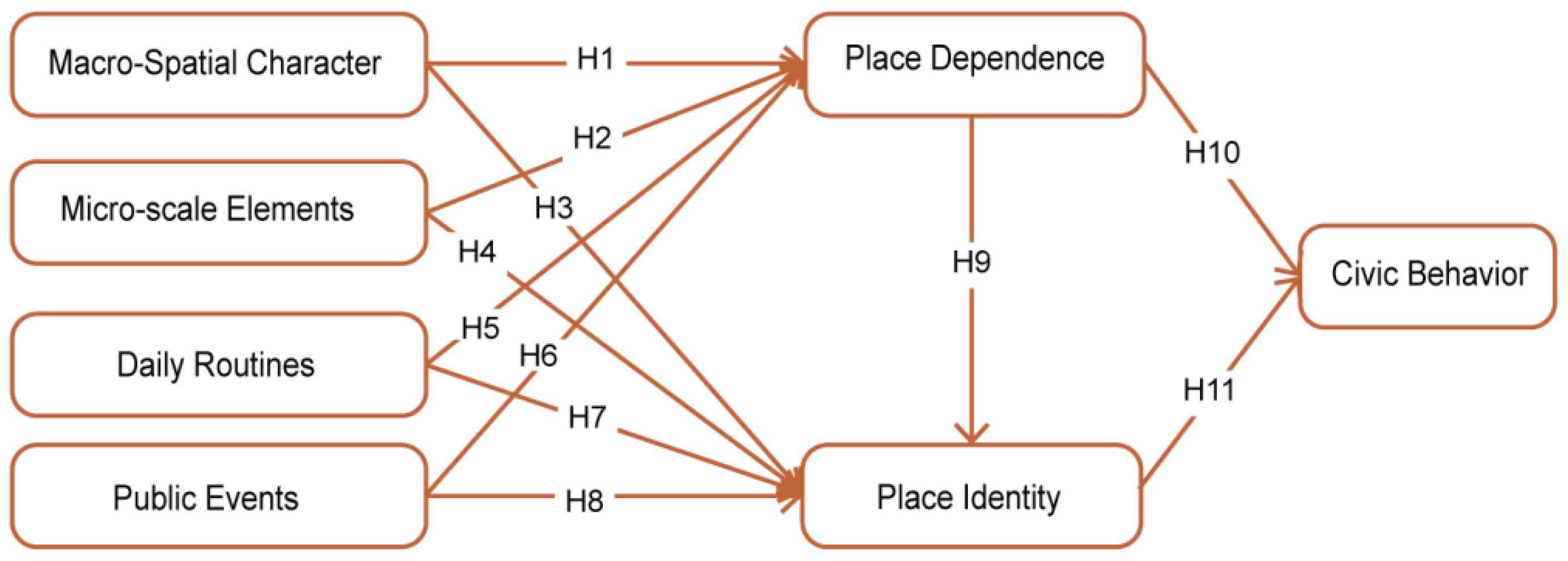
2.1. Stimulus–Organism–Response Model Framework
2.2. Research Hypotheses
3. Research Methods
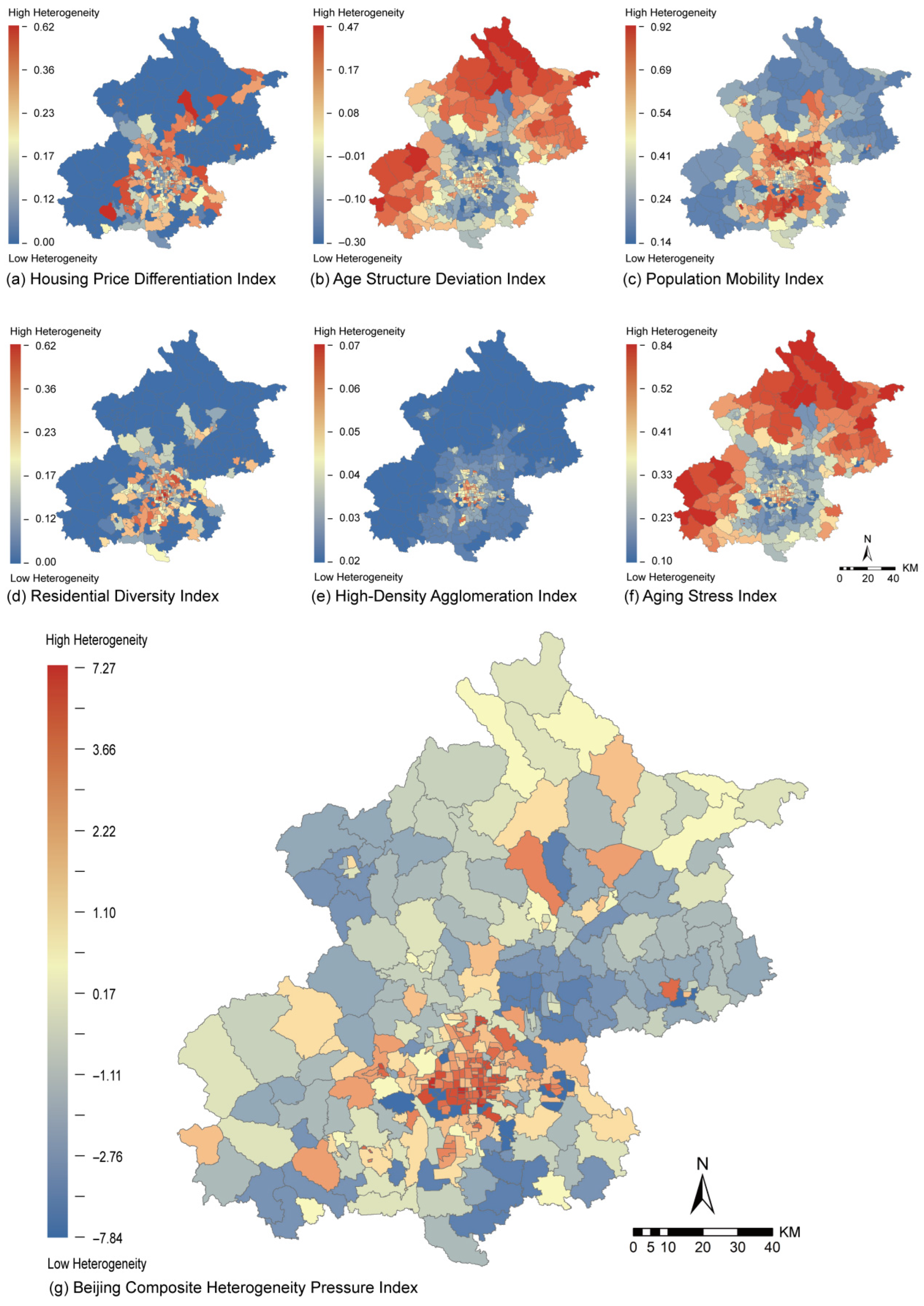
3.1. Study Area
3.2. Screening Green Space Elements and Scale Construction in Heterogeneous Communities
3.3. Pilot Testing and Reliability Verification in Heterogeneous Communities
3.4. Formal Survey and Sampling Strategy of Green Spaces in Heterogeneous Communities
3.5. Workflow
4. Results
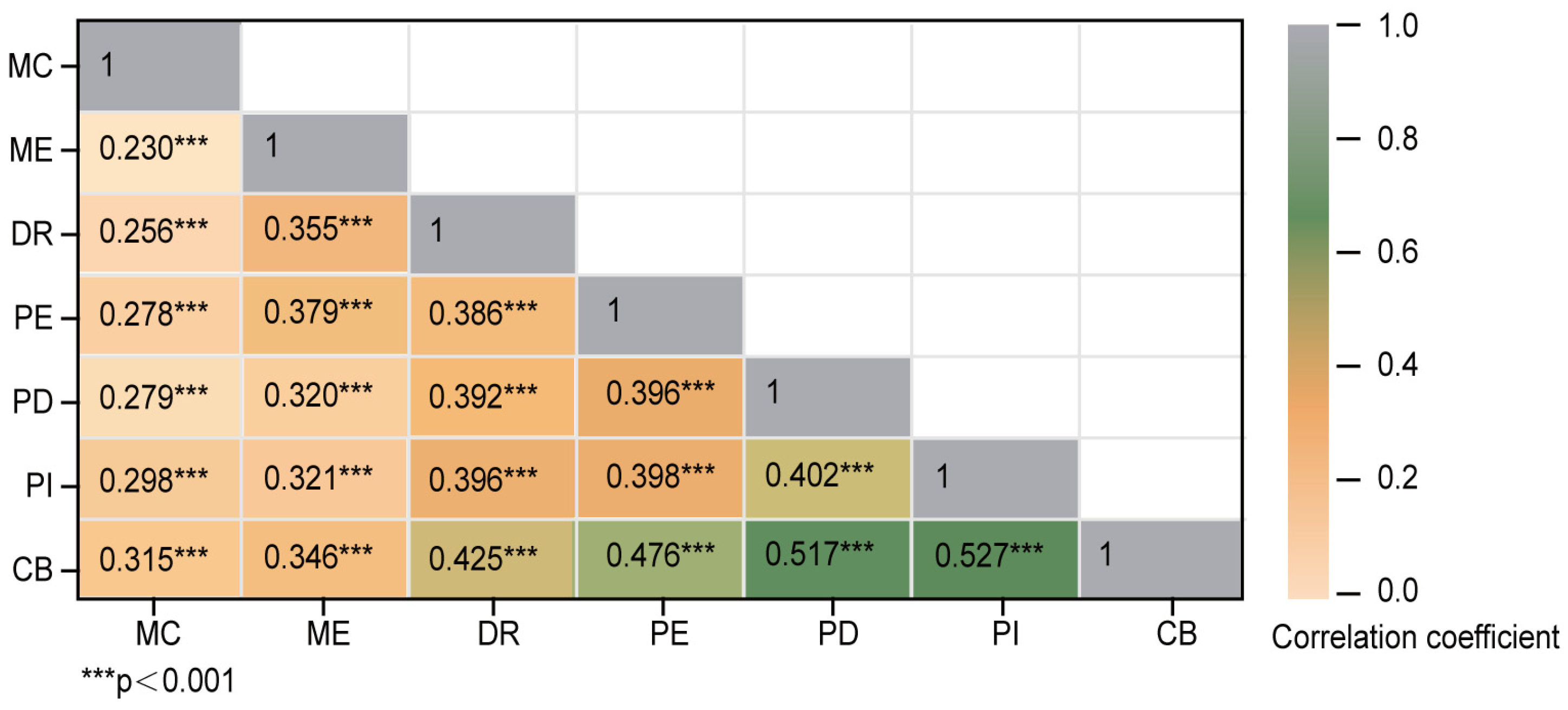
4.1. Descriptive Statistics and Preliminary Data Analysis
4.2. Validation of the Model for Public Green Spaces in Heterogeneous Communities
4.3. Multi-Group Analysis of Heterogeneity: Identity and Generation
5. Discussion
5.1. Distinct Driving Mechanisms of Place Attachment in Heterogeneous Communities
5.2. Disconnecting Emotion from Behavior
5.3. Mechanistic Divergence in Heterogeneous Community Green Spaces
5.4. Theoretical Contributions
5.5. Limitations
6. Conclusions
Author Contributions
Funding
Informed Consent Statement
Data Availability Statement
Acknowledgments
Conflicts of Interest
Abbreviations
| SEM | Structural equation model |
| SOR | Stimulus–organism–response |
| CCB | Community citizenship behaviors |
| EFA | Exploratory factor analysis |
| CFA | Confirmatory factor analysis |
| MGA | Multi-group analysis |
| PCA | Principal component analysis |
| CR | Composite reliability |
| AVE | Average variance extracted |
| C.R. | Critical Ratio |
| CITC | Corrected item-total correlation |
| KMO | Kaiser–Meyer–Olkin |
| ANOVA | Analysis of variance |
| IPA | Importance-performance analysis |
| POEs | Post-occupancy evaluations |
Appendix A

| Definitions | Equation 1 | Notation | ||
|---|---|---|---|---|
| population heterogeneity | age structure deviation index | measures deviation from the citywide age structure; higher values indicate greater demographic imbalance [93] | ID represents the age structure imbalance index; values closer to 1 indicate a more severe imbalance. Pc represents the population aged 0–14; Pe represents the community’s population aged 60 and above | |
| aging stress index | higher values reflect a heavier elderly burden and significant inter-generational demand disparities [94] | Pi represents the proportion of the population belonging to category i out of the total population; k denotes the total number of categories. | ||
| population mobility index | higher ratios of migrant residents indicate a more complex and unfamiliar social composition [95] | represents the proportion of non-local registered residents within the community | ||
| building heterogeneity | high-density agglomeration index 1 | represents the density of residents; higher values imply greater spatial resource intensity | D represents building density; P represents total building footprint area; A represents total street land area. | |
| residential diversity index | measures the richness of mixed building types within a community, such as bungalows, slab buildings, and tower blocks [96] | SHDI measures building typology diversity. Pj represents the proportion of buildings of a given type relative to the total number of buildings in the community; m denotes the total number of building types. | ||
| economic heterogeneity | housing price differentiation index | measures the inequality of housing prices among neighborhoods. A value closer to 1 indicates a larger gap in housing prices [97] | wi represents the number of buildings in the neighborhood. vi denotes the average housing price in the neighborhood; i is the neighborhood index; n is the total number of neighborhoods | |
| Selective Coding | Axial Coding | Initial Code | Source 1 |
|---|---|---|---|
| Objective composition dimension from policy | macro-spatial character | green space accessibility | Reflect the degree of integration between green nodes and multi-functional urban zones [98]; focus on the realization of 15 min community life circles [99]. |
| landscape | Evaluate the aesthetic value of greenway services. emphasize the promotion of healthy lifestyles through landscape quality [100]. | ||
| spatial boundary permeability | Measures the openness of green space boundaries. emphasize the control of development intensity in high-density old districts [101]. | ||
| spatial scale and enclosure | Evaluate the effectiveness of urban acupuncture; focus on the spatial layout of micro-green spaces and pocket parks [102,103,104]. | ||
| micro-scale elements | Ecological natural features | Assess the utilization of local vegetation. Highlight the interaction between ecological services and social values [104]. | |
| landscape landmarks | Identify landscape nodes with distinct cultural characteristics [105]; evaluate the balance between practical functionality and aesthetic appeal [106]. | ||
| garden ornaments | Evaluate the integration of artistic elements into park furniture [107]; focus on the display of local heritage through paving and street facilities [108]. | ||
| Recreational infrastructure | Evaluates the completeness of community-embedded support facilities; it focuses on the accessibility of essential service points [109]. | ||
| daily routines | daily outdoor activities | Capture the distinctiveness of local living environments. reflect the embodiment of tradition in daily use [110]. | |
| social inclusivity | Measure the inclusivity for vulnerable groups [111]; focus on child-friendly and aging-friendly spatial upgrades [112]. | ||
| social bonding | Assess the preservation of existing social networks; emphasize the impact of in situ retention on social capital [102]. | ||
| public events | green space engagement | Reflect the degree of resident participation in space governance. Implement the co-construction and co-sharing model [113] | |
| organized activity | Evaluate the density of cultural facilities such as intangible heritage centers [114]; focus on the provision of immersive cultural exhibitions [115] | ||
| management | Focus on the long-term maintenance mechanisms involving residents [116]. | ||
| Subjective composition dimension from user reviews | place dependence | functional-spatial fit | Assess the degree to which green space layout meets diverse needs for evening strolls and seasonal recreation; emphasize the functional irreplaceability. |
| outdoor lifestyle adaptation | Evaluate the convenience of park access and the familiarity of the environment; focus on the adaptation to reservation-free open spaces. | ||
| physical activity support | Measure the diversity of fitness trails and ball game facilities; assess the capacity of green space to support multi-type sports. | ||
| place identity | place-based collective memory | Capture the historical memory evoked by the oasis environment. reflect the sense of nostalgia and childhood resonance triggered by the space. | |
| perceived openness and inclusiveness | Evaluate the friendliness toward pets and barriers; focus on the sense of ease experienced by children and seniors. | ||
| cultural identity | Assess the resonance with old Beijing’s charm and heritage; focus on the sense of cultural legacy, such as the golden capital history. | ||
| place attachment and resonance | Measure the psychological healing effect of the landscape; reflect the emotional relaxation and self-rediscovery in the urban environment. | ||
| civic behavior | neighborhood mutual support | Assess the spontaneous prosocial behaviors among visitors; focus on mutual assistance during games or recreational activities. | |
| green space co-governance participation | Measure the involvement in traditional festival events; reflect the enthusiasm for interactive community activities. | ||
| public property maintenance willingness | Assess the self-discipline in protecting the green environment; reflect the willingness to discourage uncivilized behaviors. |
References
- Yang, Y.; Bao, W.; Wang, Y.; Liu, Y. Measurement of urban-rural integration level and its spatial differentiation in China in the new century. Habitat Int. 2021, 117, 102420. [Google Scholar] [CrossRef]
- Mehta, V. Public Space: Notes on Why It Matters, What We Should Know, and How to Realize Its Potential; Routledge: New York, NY, USA, 2022. [Google Scholar] [CrossRef]
- Francis, J.; Giles-Corti, B.; Wood, L.; Knuiman, M. Creating sense of community: The role of public space. J. Environ. Psychol. 2012, 32, 401–409. [Google Scholar] [CrossRef]
- Scannell, L.; Gifford, R. Defining place attachment: A tripartite organizing framework. J. Environ. Psychol. 2010, 30, 1–10. [Google Scholar] [CrossRef]
- Altman, I.; Low, S.M. Place Attachment; Springer: Boston, MA, USA, 1992. [Google Scholar] [CrossRef]
- Wang, D.; Li, F.; Chai, Y. Activity spaces and sociospatial segregation in Beijing. Urban Geogr. 2012, 33, 256–277. [Google Scholar] [CrossRef]
- Li, L.; Livy, M.R. Who values urban open spaces? Investigating heterogeneity in the capitalization of open space in New York city. Landsc. Urban Plan. 2025, 255, 105259. [Google Scholar] [CrossRef]
- Relph, E. Prospects for places. In The Urban Design Reader; Larice, M., Macdonald, E., Eds.; Routledge: London, UK, 2013; pp. 266–271. [Google Scholar] [CrossRef]
- Jayakody, D.Y.; Adams, V.M.; Pecl, G.; Lester, E. What makes a place special? Understanding drivers and the nature of place attachment. Appl. Geogr. 2024, 163, 103177. [Google Scholar] [CrossRef]
- Shao, C.; Chung, W. The impact of park environmental characteristics and visitor perceptions on visitor emotions from a cross-cultural perspective. Urban For. Urban Green. 2024, 102, 128575. [Google Scholar] [CrossRef]
- Christou, P.A.; Farmaki, A.; Saveriades, A.; Spanou, E. The “genius loci” of places that experience intense tourism development. Tour. Manag. Perspect. 2019, 30, 19–32. [Google Scholar] [CrossRef]
- Bazrafshan, M.; Spielhofer, R.; Wissen Hayek, U.; Kienast, F.; Grêt-Regamey, A. Greater place attachment to urban parks enhances relaxation: Examining affective and cognitive responses of locals and bi-cultural migrants to virtual park visits. Landsc. Urban Plan. 2023, 232, 104650. [Google Scholar] [CrossRef]
- Hoff, S.C.; Løvoll, H.S. Activities in natural environments as remedy to loneliness: The role of connectedness to nature and place attachment. Health Place 2026, 98, 103617. [Google Scholar] [CrossRef] [PubMed]
- Erfani, G. Reconceptualising sense of place: Towards a conceptual framework for investigating individual-community-place interrelationships. J. Plan. Lit. 2022, 37, 452–466. [Google Scholar] [CrossRef]
- Ramkissoon, H.; Van Der Veen, R.; Salaripour, A.; Seif Reihani, Z.; Aflaki, A. The impact of sensory experiences on place attachment, place loyalty and civic participation: Evidence from Rasht, Iran. City Cult. Soc. 2024, 38, 100592. [Google Scholar] [CrossRef]
- Lewicka, M. Place attachment: How far have we come in the last 40 years? J. Environ. Psychol. 2011, 31, 207–230. [Google Scholar] [CrossRef]
- Mantey, D. The role of public spaces in creating place attachment (example of Zacisze, Warsaw housing estate). Misc. Geogr. 2015, 19, 36–42. [Google Scholar] [CrossRef]
- Liu, T.; Shen, X.; Xia, T. Mediating power of place attachment for urban residents’ well-being in community cohesion. Sustainability 2025, 17, 6756. [Google Scholar] [CrossRef]
- Ratcliffe, E.; Korpela, K.M. Memory and place attachment as predictors of imagined restorative perceptions of favourite places. J. Environ. Psychol. 2016, 48, 120–130. [Google Scholar] [CrossRef]
- Counted, V.; Cowden, R.G.; Ramkissoon, H. Place attachment during the COVID-19 pandemic: A scoping review. In Place and Post-Pandemic Flourishing; Springer: Cham, Switzerland, 2021; pp. 15–32. [Google Scholar] [CrossRef]
- Li, G.; Evensen, D.; Stedman, R. COVID-19’s effects on sense of place and pro-environmental behaviour. Geogr. Res. 2024, 62, 216–232. [Google Scholar] [CrossRef]
- Anton, C.E.; Lawrence, C. Home is where the heart is: The effect of place of residence on place attachment and community participation. J. Environ. Psychol. 2014, 40, 451–461. [Google Scholar] [CrossRef]
- Song, Z.; Soopramanien, D. Types of place attachment and pro-environmental behaviors of urban residents in Beijing. Cities 2019, 84, 112–120. [Google Scholar] [CrossRef]
- Soopramanien, D.; Daryanto, A.; Song, Z. Urban residents’ environmental citizenship behaviour: The roles of place attachment, social norms and perceived environmental responsibility. Cities 2023, 132, 104097. [Google Scholar] [CrossRef]
- Jiao, L.; Ren, Z.; Guo, Z.; Gao, S.; Xu, Y. Individual differences in place attachment and pro-environmental behavior: Pride as an emotional tie. Personal. Individ. Differ. 2023, 214, 112357. [Google Scholar] [CrossRef]
- Dalavong, P.; Im, H.N.; Choi, C.G. In what ways does placeness affect people’s behavior? Focusing on personal place attachment and public place image as connecting parameter. Front. Psychol. 2024, 15, 1394930. [Google Scholar] [CrossRef]
- Gans, H.J. The balanced community: Homogeneity or heterogeneity in residential areas? J. Am. Inst. Plann. 1961, 27, 176–184. [Google Scholar] [CrossRef]
- Putnam, R.D. E pluribus unum: Diversity and community in the twenty-first century the 2006 Johan Skytte Prize Lecture. Scand. Polit. Stud. 2007, 30, 137–174. [Google Scholar] [CrossRef]
- Costa, D.L.; Kahn, M.E. Civic engagement and community heterogeneity: An economist’s perspective. Perspect. Polit. 2003, 1, 103–111. [Google Scholar] [CrossRef]
- Coffé, H. Social capital and community heterogeneity. Soc. Indic. Res. 2009, 91, 155–170. [Google Scholar] [CrossRef]
- Coffé, H.; Geys, B. Community heterogeneity: A burden for the creation of social capital? Soc. Sci. Q. 2006, 87, 1053–1072. [Google Scholar] [CrossRef]
- Xiong, N.; Wei, Y.D.; Wang, Y. Neighborhood intergenerational mobility and population health inequality: Spatial dependency and heterogeneity. Health Place 2025, 92, 103429. [Google Scholar] [CrossRef] [PubMed]
- Alesina, A.; Baqir, R.; Hoxby, C. Political jurisdictions in heterogeneous communities. J. Polit. Econ. 2004, 112, 348–396. [Google Scholar] [CrossRef]
- Jin, X.; Huang, X. Transient migrants’ attachment to the place of destination: A case study of African migrants in Guangzhou China. Popul. Space Place 2026, 32, e70153. [Google Scholar] [CrossRef]
- Mortimer, A.; Davies, K.; Smith, G.; Ahmed, I. How lived experiences of disaster displacement reshape place attachment. J. Environ. Psychol. 2026, 110, 102915. [Google Scholar] [CrossRef]
- Falanga, R. Understanding place attachment through the lens of urban regeneration. Insights from Lisbon. Cities 2022, 122, 103590. [Google Scholar] [CrossRef]
- Ni, H.; Liu, J.; Li, H.; Chen, J.; Li, P.; Li, N. Deciphering socio-spatial integration governance of community regeneration: A multi-dimensional evaluation using GBDT and MGWR to address nonlinear dynamics and spatial heterogeneity in life satisfaction and spatial quality. Buildings 2025, 15, 1740. [Google Scholar] [CrossRef]
- Waite, L.; Cook, J. Belonging among diasporic African communities in the UK: Plurilocal homes and simultaneity of place attachments. Emot. Space Soc. 2011, 4, 238–248. [Google Scholar] [CrossRef]
- Ma, X.; Zhang, Z.; Guo, Q.; Zhao, X.; Wen, C. The impact of neighborhood environment on community attachment in work-unit communities. J. Environ. Psychol. 2025, 107, 102800. [Google Scholar] [CrossRef]
- Hou, W.; Shu, P.; Ren, D.; Liu, R. The multifaceted impact of public spaces, community facilities, and residents’ needs on community participation intentions: A case study of Tianjin, China. Buildings 2025, 15, 1060. [Google Scholar] [CrossRef]
- Lang, J. Urban designing in heterogeneous cities: Issues and responses. Proc. Inst. Civ. Eng. Urban Des. Plan. 2016, 169, 258–267. [Google Scholar] [CrossRef]
- Wykes, T. Reframing social tectonics with the sociology of everyday life: Insights from the public spaces of a mixed housing neighbourhood. Crit. Hous. Anal. 2023, 10, 29–43. [Google Scholar] [CrossRef]
- Qi, J.; Mazumdar, S.; Vasconcelos, A.C. Understanding the relationship between urban public space and social cohesion: A systematic review. Int. J. Community Well-Being 2024, 7, 155–212. [Google Scholar] [CrossRef]
- Silva, K.D.; Fernando, N.A. Theorizing Built Form and Culture: The Legacy of Amos Rapoport; Routledge: London, UK, 2024. [Google Scholar] [CrossRef]
- Jia, J.; Zhang, X.; Zhang, W. Between place attachment and urban planning in Jinan: Does environmental quality affect human perception in a developing country context? Land Use Policy 2025, 148, 107384. [Google Scholar] [CrossRef]
- Chang, J.; Lin, Z.; Vojnovic, I.; Qi, J.; Wu, R.; Xie, D. Social environments still matter: The role of physical and social environments in place attachment in a transitional city, Guangzhou, China. Landsc. Urban Plan. 2023, 232, 104680. [Google Scholar] [CrossRef]
- Tian, E.; Wise, N. Dancing in public squares—Toward a socially synchronous sense of place. Leis. Sci. 2025, 47, 283–303. [Google Scholar] [CrossRef]
- Yang, X.; Li, H. Community attachment in the context of urban settlement regeneration: Mediating role of resident interaction. Cities 2023, 140, 104398. [Google Scholar] [CrossRef]
- Park, K. Satisfied with people or place?: A study of the relationship between social ties, place attachment, and residential satisfaction among relocatees. Cities 2025, 159, 105746. [Google Scholar] [CrossRef]
- Perkins, D.D.; Long, D.A. Neighborhood Sense of Community and Social Capital: A Multi-Level Analysis. In Psychological Sense of Community: Research, Applications, and Implications; Fisher, A.T., Sonn, C.C., Bishop, B.J., Eds.; Kluwer Academic/Plenum Publishers: New York, NY, USA, 2002; pp. 291–318. [Google Scholar] [CrossRef]
- Hashemi, S.; Jasim Mohammed, H.; Singh Dara Singh, K.; Abbasi, G.; Shahreki, J. Exploring the effects of place attachment and positive emotions on place satisfaction and intentional behaviour in Iranian ski resort: A perspective from S-O-R model. J. Sport Tour. 2023, 27, 161–186. [Google Scholar] [CrossRef]
- Scott, N.; Moyle, B.; Campos, A.C.; Skavronskaya, L.; Liu, B. Updating tourism theory: The S-O-R model. In Tourism Social Science Series; Emerald Publishing Limited: Leeds, UK, 2024; pp. 31–43. [Google Scholar] [CrossRef]
- Xie, X.; Wang, Z. The impact of place attachment on the environmentally responsible behavior of residents in National Park gateway communities and the mediating effect of environmental commitment: A case of China National Park. Front. Psychol. 2024, 15, 1386337. [Google Scholar] [CrossRef]
- Chiu, C.-M.; Huang, H.-Y.; Cheng, H.-L.; Sun, P.-C. Understanding online community citizenship behaviors through social support and social identity. Int. J. Inf. Manag. 2015, 35, 504–519. [Google Scholar] [CrossRef]
- Xu, Y.; Wu, D.; Chen, N. Here I belong!: Understanding immigrant descendants’ place attachment and its impact on their community citizenship behaviors in China. J. Environ. Psychol. 2022, 79, 101743. [Google Scholar] [CrossRef]
- Li, H.; Bibi, S.; Kanwel, S.; Khan, A.; Hussain, B. Understanding of cultural heritage tourists’ emotional experiences: How place attachment and satisfaction determine behavioral intentions. Acta Psychol. 2025, 259, 105429. [Google Scholar] [CrossRef]
- Yoon, J.I.; Joo, J.; Lim, S.; Kim, E.S.; Lee, C.M. Climate change perception and pro-environmental behavior among urban park visitors: The mediating role of place attachment. Front. Psychol. 2025, 16, 1685855. [Google Scholar] [CrossRef]
- Massey, D.S.; Denton, N.A. The dimensions of residential segregation. Soc. Forces 1988, 67, 281–315. [Google Scholar] [CrossRef]
- Wu, F. Sociospatial differentiation in urban China: Evidence from Shanghai’s real estate markets. Environ. Plan. Econ. Space 2002, 34, 1591–1615. [Google Scholar] [CrossRef]
- Talen, E. Design for diversity: Evaluating the context of socially mixed neighbourhoods. J. Urban Des. 2006, 11, 1–32. [Google Scholar] [CrossRef]
- Hoyos, M. Tariffs and growth: Heterogeneity by economic structure. J. Comp. Econ. 2025, 54, 99–115. [Google Scholar] [CrossRef]
- Zou, Z.; Zhou, R.; Jiao, K.; Yang, H.; Wu, T.; Hu, C. Economic downturn and climate change: Mapping spatial heterogeneity of socio-economic vulnerability for a complex future scenario. Int. J. Disaster Risk Reduct. 2025, 130, 105875. [Google Scholar] [CrossRef]
- Ru, Y.; Tennant, E.; Matteson, D.S.; Barrett, C.B. Spatial heterogeneity in machine learning-based poverty mapping: Where do models underperform? Geogr. Sustain. 2026, 7, 100413. [Google Scholar] [CrossRef]
- Koch, M.J.; Greve, W. The benefits of cultural confrontation: Does the experience of cultural heterogeneity predict individual differences in accommodative regulation? Int. J. Intercult. Relat. 2024, 102, 102017. [Google Scholar] [CrossRef]
- Li, Z.; Wu, F. Tenure-based residential segregation in post-reform Chinese cities: A case study of Shanghai. Trans. Inst. Br. Geogr. 2008, 33, 404–419. [Google Scholar] [CrossRef]
- Wang, Y.; Kemeny, T. Are mixed neighborhoods more socially cohesive? Evidence from Nanjing, China. Urban Geogr. 2023, 44, 803–823. [Google Scholar] [CrossRef]
- Wu, F. Rediscovering the ‘Gate’ Under Market Transition: From Work-unit Compounds to Commodity Housing Enclaves. Hous. Stud. 2005, 20, 235–254. [Google Scholar] [CrossRef]
- Li, Z.; Wu, F. Socio-spatial Differentiation and Residential Inequalities in Shanghai: A Case Study of Three Neighbourhoods. Hous. Stud. 2006, 21, 695–717. [Google Scholar] [CrossRef]
- Office of the Leading Group of the State Council for the Seventh National Population Census. China Population Census Yearbook 2020; China Statistics Press: Beijing, China, 2022. Available online: http://www.stats.gov.cn/sj/pcsj/rkpc/7rp/zk/indexch.htm (accessed on 20 June 2025).
- Beijing Municipal Bureau of Statistics; NBS Survey Office in Beijing. Beijing Statistical Yearbook 2020; China Statistics Press: Beijing, China, 2020. Available online: https://nj.tjj.beijing.gov.cn/nj/main/2020-tjnj/zk/e/indexch.htm (accessed on 20 June 2025).
- Anjuke. Beijing Real Estate Network. Available online: https://beijing.anjuke.com/ (accessed on 20 June 2025).
- Williams, D.R.; Vaske, J.J. The measurement of place attachment: Validity and generalizability of a psychometric approach. For. Sci. 2003, 49, 830–840. [Google Scholar] [CrossRef]
- Kyle, G.; Graefe, A.; Manning, R. Testing the dimensionality of place attachment in recreational settings. Environ. Behav. 2005, 37, 153–177. [Google Scholar] [CrossRef]
- Wu, J.; Wang, J. Community citizenship behavior in rural tourism destinations: Scale development and validation. Tour. Manag. 2022, 89, 104457. [Google Scholar] [CrossRef]
- Zhang, Z.; Liu, W.; Du, L.; Ding, L. Enhancing place attachment through natural design in sports venues: The roles of nature connectedness and biophilia. Buildings 2025, 15, 2980. [Google Scholar] [CrossRef]
- Memon, M.A.; Ting, H.; Cheah, J.-H.; Thurasamy, R.; Chuah, F.; Cham, T.H. Sample size for survey research: Review and recommendations. J. Appl. Struct. Equ. Model. 2020, 4, i-xx. [Google Scholar] [CrossRef]
- Fan, L.; Xiong, Y.; Peng, Y. Assessing accessible travel satisfaction in old communities: A SEM study. Buildings 2024, 14, 1273. [Google Scholar] [CrossRef]
- Liu, J.; Zhang, S.; Hou, Y.; Xiahou, X.; Li, Q. Analyzing critical influencing factors of the maturity of smart construction site applications. Buildings 2024, 14, 1910. [Google Scholar] [CrossRef]
- He, L.; Mao, Y.; Kinoshita, T. Place attachment among rural migrants and returnees: Case of Shuangfeng County, China. Front. Psychol. 2023, 14, 1279679. [Google Scholar] [CrossRef]
- Qian, J.; Zhu, H. Chinese urban migrants’ sense of place: Emotional attachment, identity formation, and place dependence in the city and community of Guangzhou. Asia Pac. Viewp. 2014, 55, 81–101. [Google Scholar] [CrossRef]
- Dionísio, T.; Bernardo, F.; Dierckx, K.; Loupa-Ramos, I.; Van Eetvelde, V. Understanding place attachment profiles among natives, internal and international migrants. J. Environ. Psychol. 2025, 105, 102665. [Google Scholar] [CrossRef]
- Chung, S.; Kim, M. Age-friendly environment, social support, sense of community, and loneliness among middle-aged and older adults in Korea. Aging Ment. Health 2023, 27, 1352–1359. [Google Scholar] [CrossRef]
- Gautam, V. Examining relationships among festival satisfaction, place attachment, emotional experience, and destination loyalty. Leis. Sci. 2025, 47, 348–365. [Google Scholar] [CrossRef]
- Zhongjun, T.; Maruthaveeran, S.; Shahidan, M.F.; Yanci, X. Older adults’ experiences, needs, and preferences for community park design in China: A reflexive thematic analysis. Urban For. Urban Green. 2025, 112, 128977. [Google Scholar] [CrossRef]
- Wu, F. Neighborhood attachment, social participation, and willingness to stay in China’s low-income communities. Urban Aff. Rev. 2012, 48, 547–570. [Google Scholar] [CrossRef]
- Vaske, J.; Kobrin, K. Place Attachment and Environmentally Responsible Behavior. J. Environ. Educ. 2001, 32, 16–21. [Google Scholar] [CrossRef]
- Carmona, M. Place value: Place quality and its impact on health, social, economic and environmental outcomes. J. Urban Des. 2019, 24, 1–48. [Google Scholar] [CrossRef]
- Kaiser, F.G.; Brüggemann, M. Uncovering the relevance of reasons for behavior: The attitude-behavior gap revisited. J. Environ. Psychol. 2025, 107, 102762. [Google Scholar] [CrossRef]
- Li, D.; Zheng, J.; Loopmans, M. Affect, avoidance and authority: Spaces of encounter in gated social housing estates in Nanjing, China. Cities 2025, 162, 105966. [Google Scholar] [CrossRef]
- Xu, Y.; Xia, F.; Fu, X. The mechanism of stimulating resident tourists’ place attachment via festivals. J. China Tour. Res. 2025, 21, 214–235. [Google Scholar] [CrossRef]
- Low, S.M. Why Public Space Matters; Oxford University Press: New York, NY, USA, 2023. [Google Scholar]
- Anguelovski, I.; Connolly, J.J.T.; Cole, H.; Garcia-Lamarca, M.; Triguero-Mas, M.; Baró, F.; Martin, N.; Conesa, D.; Shokry, G.; Del Pulgar, C.P.; et al. Green gentrification in European and North American cities. Nat. Commun. 2022, 13, 3816. [Google Scholar] [CrossRef]
- Duncan, O.D.; Duncan, B. A methodological analysis of segregation indexes. Am. Sociol. Rev. 1955, 20, 210–217. [Google Scholar] [CrossRef]
- Liu, D.; Li, Z.; Guo, Y. The impacts of neighbourhood governance on residents’ sense of community: A case study of Wuhan, China. Urban Res. Pract. 2023, 16, 732–750. [Google Scholar] [CrossRef]
- Liu, G.; Chen, K.; Huang, J.; Deng, X. Analysis of the spatiotemporal heterogeneity of housing prices’ association in China: An urban agglomeration perspective. Buildings 2022, 12, 972. [Google Scholar] [CrossRef]
- Zhang, J.; Li, J.; Li, M.; Yu, Y. Nonlinear relationships between urban form and street vitality in community-oriented metro station areas: A machine learning approach applied to Beijing. Sustainability 2025, 17, 10278. [Google Scholar] [CrossRef]
- Cowell, F. Measuring Inequality; Oxford University Press: Oxford, UK, 2011. [Google Scholar] [CrossRef]
- Ministry of Natural Resources, People’s Republic of China. Spatial Planning Guidance to Community Life Unit. Available online: http://www.nrsis.org.cn/mnr_kfs/file/read/21d2d1d71032b84e847e2baeb6aaf39c (accessed on 1 February 2026).
- Ministry of Housing and Urban–Rural Development. Notice of the Ministry of Housing and Urban-Rural Development on Preventing Large-Scale Demolition and Construction in Implementing Urban Renewal Actions. Available online: https://www.yw.gov.cn/art/2024/6/6/art_1229452748_1805260.html (accessed on 1 February 2026).
- Ministry of Housing and Urban-Rural Development; National Development and Reform Commission. Notice of the Ministry of Housing and Urban-Rural Development and the National Development and Reform Commission on Issuing the “14th Five-Year” National Urban Infrastructure Construction Plan. Available online: https://www.mohurd.gov.cn/gongkai/zc/wjk/art/2022/art_17339_767388.html (accessed on 1 February 2026).
- National Development and Reform Commission. Notice of the National Development and Reform Commission on Issuing the “Key Tasks for New-Type Urbanization and Integrated Urban-Rural Development in 2022”. Available online: https://www.allbrightlaw.com/CN/10531/2b7f020c28260afa.aspx (accessed on 1 February 2026).
- General Office of the Ministry of Housing and Urban-Rural Development. Notice of the General Office of the Ministry of Housing and Urban-Rural Development on Issuing the First Batch of Replicable Experience and Practices List for the Protection and Utilization of Historic Cultural Blocks. Available online: https://www.hunan.gov.cn/zqt/zcsd/202408/t20240821_33435670.html (accessed on 1 February 2026).
- General Office of the Ministry of Housing and Urban-Rural Development. Notice of the General Office of the Ministry of Housing and Urban-Rural Development on Issuing the First Batch of Typical Urban Renewal Cases. Available online: https://www.mohurd.gov.cn/gongkai/zc/wjk/art/2024/art_17339_776439.html (accessed on 1 February 2026).
- The People’s Government of Beijing Municipality. Notice of the Beijing Municipal People’s Government on Issuing the “Beijing Municipal Urban Renewal Special Plan (Beijing Urban Renewal Plan for the 14th Five-Year Period)”. Available online: https://www.beijing.gov.cn/zhengce/zhengcefagui/202205/t20220518_2715630.html (accessed on 1 February 2026).
- Beijing Municipal Commission of Planning and Natural Resources. Public Notice of “Beijing Street Renewal and Governance Urban Design Guidelines”. Available online: https://www.chinautc.com/templates/H_news/content.aspx?nodeid=1332&page=ContentPage&categoryid=0&contentid=93174 (accessed on 1 February 2026).
- National Development and Reform. Notice on Issuing the Guidelines for the Standardized and Healthy Development of Characteristic Towns Nationwide. Available online: https://www.ndrc.gov.cn/xxgk/zcfb/tz/202109/t20210930_1298529.html?code=&state=123 (accessed on 1 February 2026).
- GB 50180-2018; Ministry of Housing and Urban-Rural Development. Urban Residential District Planning and Design Standard. China Architecture & Building Press: Beijing, China, 2018.
- General Office of the Ministry of Housing and Urban-Rural Development; General Office of the National Development and Reform Commission. Notice of the General Office of the Ministry of Housing and Urban-Rural Development and the General Office of the National Development and Reform Commission on Issuing the “Guidelines for the Construction of Protection and Enhancement Projects for Historic Cultural Cities and Districts (Trial)”. Available online: https://www.mohurd.gov.cn/gongkai/zc/wjk/art/2024/art_17339_776774.html (accessed on 1 February 2026).
- General Office of the State Council. Notice of the General Office of the State Council on Forwarding the “Implementation Plan for the Construction Project of Embedded Service Facilities in Urban Communities” by the National Development and Reform Commission. Available online: https://app.www.gov.cn/govdata/gov/202311/26/509708/article.html (accessed on 1 February 2026).
- Office of the Beijing Municipal Commission for Historical and Cultural City Conservation. Beijing “14th Five-Year” Period Historic Cultural City Protection and Development Plan. Available online: https://fgw.beijing.gov.cn/fgwzwgk/2024zcwj/ghjhwb/wngh/202208/W020240628680440115172.pdf (accessed on 1 February 2026).
- General Office of the Ministry of Housing and Urban-Rural Development; General Office of the National Development and Reform Commission; Office of the National Working Committee on Children and Women. Guidelines for the Construction of Child-Friendly Spaces in Cities (Trial). Available online: https://www.cnstock.com/image/202212/02/20221202185053376.pdf (accessed on 1 February 2026).
- General Office of the National Health Commission. Notice of the General Office of the National Health Commission on Issuing the “Scoring Rules (Trial) for National Model Age-Friendly Communities”. Available online: https://www.nhc.gov.cn/lljks/c100158/202106/da1b136f380a4081879a7fd89a79b5db.shtml (accessed on 1 February 2026).
- General Office of the Ministry of Housing and Urban-Rural Development. Notice of the General Office of the Ministry of Housing and Urban-Rural Development on Issuing the First Batch of Replicable Experience and Practices List for Implementing Urban Renewal Actions. Available online: https://www.hunan.gov.cn/zqt/zcsd/202212/t20221205_29147174.html (accessed on 1 February 2026).
- General Office of the CPC Central Committee; General Office of the State Council. Opinions on Further Strengthening the Protection of Intangible Cultural Heritage. Available online: https://zwgk.mct.gov.cn/zfxxgkml/zcfg/zcjd/202108/t20210812_927117.html (accessed on 1 February 2026).
- Beijing Municipal Commission of Planning and Natural Resources. Beijing Historical and Cultural Heritage Protection and Inheritance System Plan (2023–2035). Available online: https://ghzrzyw.beijing.gov.cn/zhengwuxinxi/ghcg/zxgh/202412/t20241211_3963247.html (accessed on 1 February 2026).
- General Office of the State Council. Guiding Opinions on Comprehensively Promoting the Transformation of Old Urban Residential Communities. Available online: https://www.gjxfj.gov.cn/gjxfj/fgwj/gwywj/webinfo/2020/07/1590610492151166.htm (accessed on 1 February 2026).





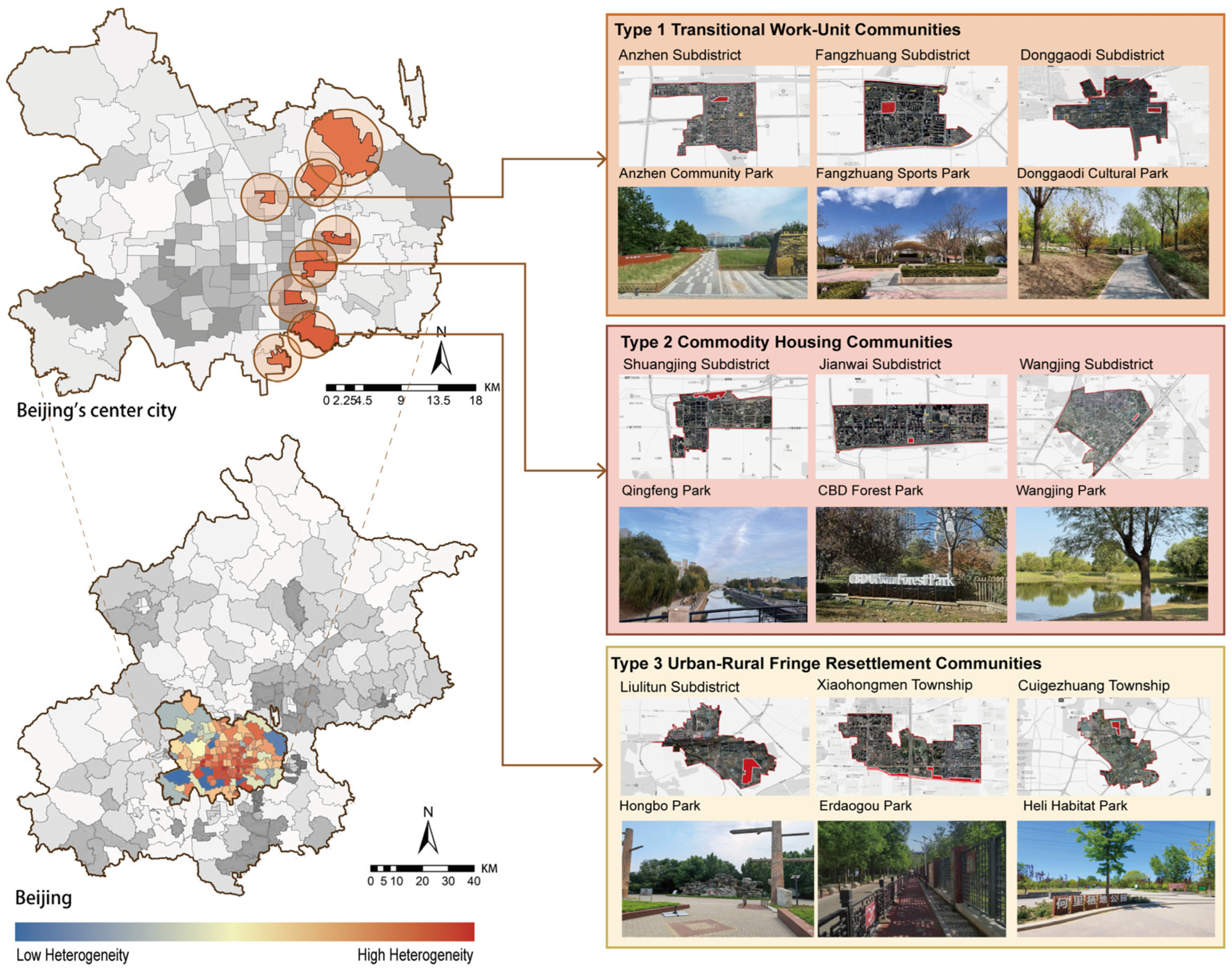
| Neighborhood Typology | Key Characteristics | Location | Heterogeneity Index 1 | Name | Site Code |
|---|---|---|---|---|---|
| transitional work-unit decline communities | pronounced demographic mixing | Anzhen Subdistrict | 3.91 | Anzhen Community Park | T1-A |
| Fangzhuang Subdistrict | 3.78 | Fangzhuang Sports Park | T1-B | ||
| Donggaodi Subdistrict | 3.31 | Donggaodi Cultural Park | T1-C | ||
| commodity housing communities | significant socio-economic stratification | Shuangjing Subdistrict | 3.98 | Qingfeng Park | T2-A |
| Jianwai Subdistrict | 4.67 | CBD Forest Park | T2-B | ||
| Wangjing Subdistrict | 4.14 | Wangjing Park | T2-C | ||
| urban–rural resettlement communities | distinct spatial morphology variation | Liulitun Township | 4.05 | Erdaogou Park | T3-A |
| Xiaohongmen Township | 3.85 | Hongbo Park | T3-B | ||
| Cuigezhuang Township | 4.81 | Heli Habitat Park | T3-C |
| Latent Variables | Observed Variables | Item Code | Measurement Items 1 |
|---|---|---|---|
| macro-spatial character (MC) | green space accessibility | MC1 | The green space is well-integrated into the neighborhood and is easily accessible. |
| landscape visual quality | MC2 | The landscape design effectively reflects the unique geographical and ecological features. | |
| spatial boundary permeability | MC3 | The boundaries of the green space are open and permeable, ensuring natural transitions. | |
| spatial scale and enclosure | MC4 | The spatial scale of the site provides a comfortable sense of enclosure without feeling confined. | |
| micro-scale elements (ME) | ecological and natural features | ME1 | The ecological design details demonstrate a high degree of adaptation to the local environment. |
| landscape landmarks | ME2 | The space features iconic landmarks or structures that are highly representative of the area. | |
| garden ornaments | ME3 | The decorative elements and garden ornaments exhibit distinct cultural characteristics. | |
| recreational infrastructure | ME4 | The recreational infrastructure and facilities align perfectly with residents’ daily lifestyles. | |
| daily routines (DR) | daily outdoor activities | DR1 | The daily outdoor activities in this green space are diverse, vibrant, and well-supported. |
| social inclusive | DR2 | People from diverse age groups and backgrounds can coexist harmoniously in this space. | |
| social interaction and bonding | DR3 | This green space serves as an essential physical platform for maintaining neighborly relationships. | |
| public events (PE) | cultural engagement in green space | PE1 | The space provides high levels of interactivity that encourage active cultural participation. |
| organized activity provision | PE2 | Public events and organized activities are frequently held here to enhance social vitality. | |
| management and maintenance response | PE3 | The management team provides timely and effective responses to maintenance complaints. | |
| place dependence (PD) | functional-spatial fit | PD1 | The functional layout and facilities of this space meet my daily activity needs perfectly. |
| outdoor lifestyle adaptation | PD2 | Utilizing this green space for outdoor activities has become a part of my daily routine. | |
| physical activity support | PD3 | I significantly prefer this specific green space over other alternative locations for my activities. | |
| place identity (PI) | place-based collective memory | PI1 | This environment successfully evokes collective historical memories or personal life experiences. |
| perceived openness and inclusiveness | PI2 | I feel psychologically at ease and comfortable being myself within this inclusive environment. | |
| cultural identity | PI3 | The specific socio-cultural atmosphere of this place provides a strong sense of belonging. | |
| place attachment and resonance | PI4 | I have developed a deep emotional resonance with this space that transcends its physical functions. | |
| civic behavior (CB) | neighborhood mutual support | CB1 | I am proactively inclined to offer assistance to neighbors when interacting in this green space. |
| green space co-governance participation | CB2 | I am willing to participate in public discussions or decision-making regarding space renovation. | |
| public property maintenance willingness | CB3 | I feel a responsibility to discourage any behaviors that might damage the green environment. |
| Observed Variables | Item Code | Factor Loadings | Communality 1 | |||||
|---|---|---|---|---|---|---|---|---|
| 1 | 2 | 3 | 4 | 5 | 6 | |||
| MC1 | 0.840 | 0.780 | ||||||
| MC2 | 0.866 | 0.806 | ||||||
| MC3 | 0.787 | 0.697 | ||||||
| MC4 | 0.797 | 0.740 | ||||||
| ME1 | 0.803 | 0.764 | ||||||
| ME2 | 0.809 | 0.752 | ||||||
| ME3 | 0.849 | 0.783 | ||||||
| DR1 | 0.828 | 0.798 | ||||||
| DR2 | 0.875 | 0.814 | ||||||
| DR3 | 0.828 | 0.801 | ||||||
| PE1 | 0.798 | 0.717 | ||||||
| PE2 | 0.815 | 0.766 | ||||||
| PE3 | 0.812 | 0.768 | ||||||
| PD1 | 0.812 | 0.794 | ||||||
| PD2 | 0.739 | 0.715 | ||||||
| PD3 | 0.832 | 0.8 | ||||||
| PI1 | 0.790 | 0.738 | ||||||
| PI2 | 0.764 | 0.714 | ||||||
| PI3 | 0.785 | 0.753 | ||||||
| PI4 | 0.747 | 0.709 | ||||||
| CB1 | 0.750 | 0.759 | ||||||
| CB2 | 0.783 | 0.746 | ||||||
| CB3 | 0.833 | 0.807 | ||||||
| Path | Indicators | Estimate | S.E. | C.R. | P 1 | Std. Estimate | AVE | CR |
|---|---|---|---|---|---|---|---|---|
| MC | MC1 | 1 | 0.843 | 0.690 | 0.899 | |||
| MC2 | 1.046 | 0.059 | 17.677 | *** | 0.842 | |||
| MC3 | 0.904 | 0.056 | 16.068 | *** | 0.788 | |||
| MC4 | 0.977 | 0.055 | 17.825 | *** | 0.847 | |||
| ME | ME1 | 1 | 0.807 | 0.624 | 0.833 | |||
| ME2 | 0.931 | 0.069 | 13.439 | *** | 0.780 | |||
| ME3 | 0.893 | 0.068 | 13.181 | *** | 0.784 | |||
| DR | DR1 | 1 | 0.801 | 0.703 | 0.876 | |||
| DR2 | 1.116 | 0.071 | 15.738 | *** | 0.839 | |||
| DR3 | 1.145 | 0.071 | 16.175 | *** | 0.874 | |||
| PE | PE1 | 1 | 0.812 | 0.678 | 0.864 | |||
| PE2 | 1.035 | 0.069 | 15.04 | *** | 0.82 | |||
| PE3 | 1.088 | 0.071 | 15.296 | *** | 0.839 | |||
| PD | PD1 | 1 | 0.839 | 0.686 | 0.868 | |||
| PD2 | 0.985 | 0.061 | 16.066 | *** | 0.826 | |||
| PD3 | 0.940 | 0.059 | 15.917 | *** | 0.819 | |||
| PI | PI1 | 1 | 0.805 | 0.686 | 0.897 | |||
| PI2 | 1.091 | 0.063 | 17.242 | *** | 0.863 | |||
| PI3 | 0.995 | 0.062 | 16.099 | *** | 0.818 | |||
| PI4 | 0.960 | 0.059 | 16.278 | *** | 0.825 | |||
| CB | CB1 | 1 | 0.811 | 0.637 | 0.84 | |||
| CB2 | 1.005 | 0.072 | 13.915 | *** | 0.769 | |||
| CB3 | 1.027 | 0.070 | 14.702 | *** | 0.814 |
| MC | ME | DR | PE | PI | PD | CB | |
|---|---|---|---|---|---|---|---|
| MC | 0.83 1 | ||||||
| ME | 0.393 ***1 | 0.79 | |||||
| DR | 0.239 *** | 0.332 *** | 0.838 | ||||
| PE | 0.374 *** | 0.368 *** | 0.239 *** | 0.824 | |||
| PI | 0.362 *** | 0.506 *** | 0.428 *** | 0.424 *** | 0.828 | ||
| PD | 0.313 *** | 0.451 *** | 0.371 *** | 0.249 *** | 0.599 *** | 0.828 | |
| CB | 0.409 *** | 0.527 *** | 0.416 *** | 0.288 *** | 0.659 *** | 0.569 *** | 0.798 |
| Indicator | CMIN/DF | GFI | NFI | RFI | IFI | TLI | CFI | RMSEA |
|---|---|---|---|---|---|---|---|---|
| General Indicator 1 | <3 | >0.9 | >0.9 | >0.9 | >0.9 | >0.9 | >0.9 | <0.08 |
| Measurement Model Fitting Results | 2.194 | 0.940 | 0.944 | 0.934 | 0.969 | 0.963 | 0.969 | 0.044 |
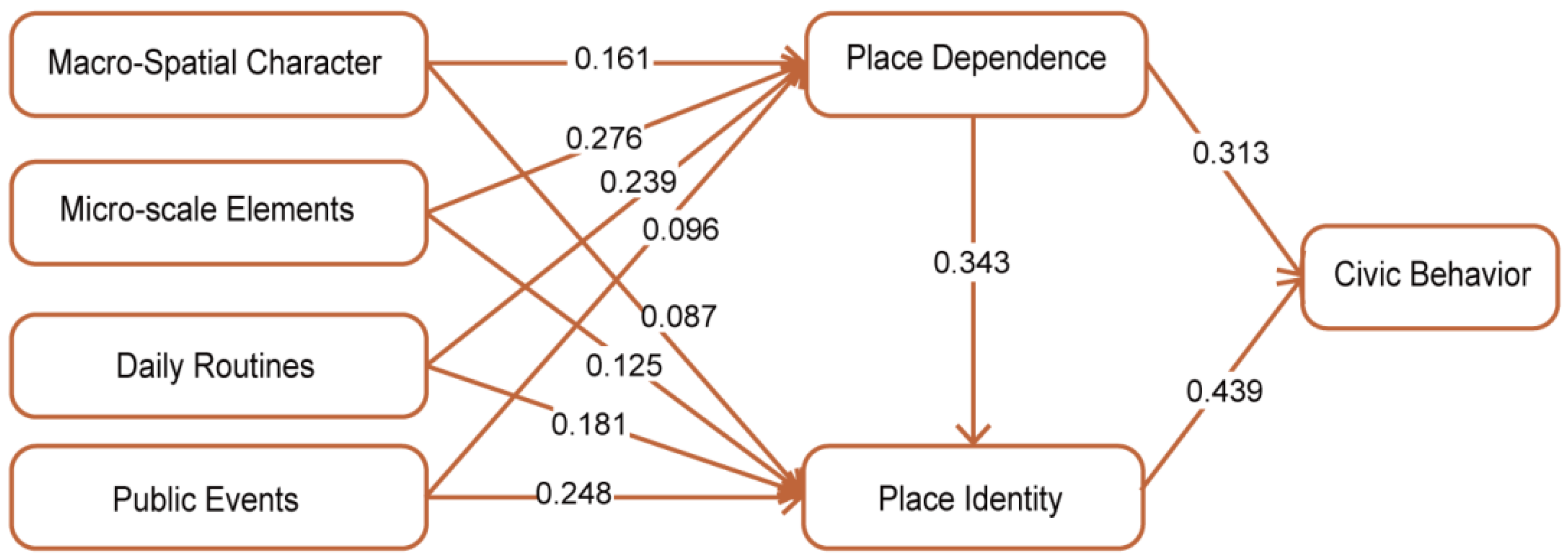
| Path Test | Estimate | S.E. | C.R. | P 1 | STD. Estimate | ||
|---|---|---|---|---|---|---|---|
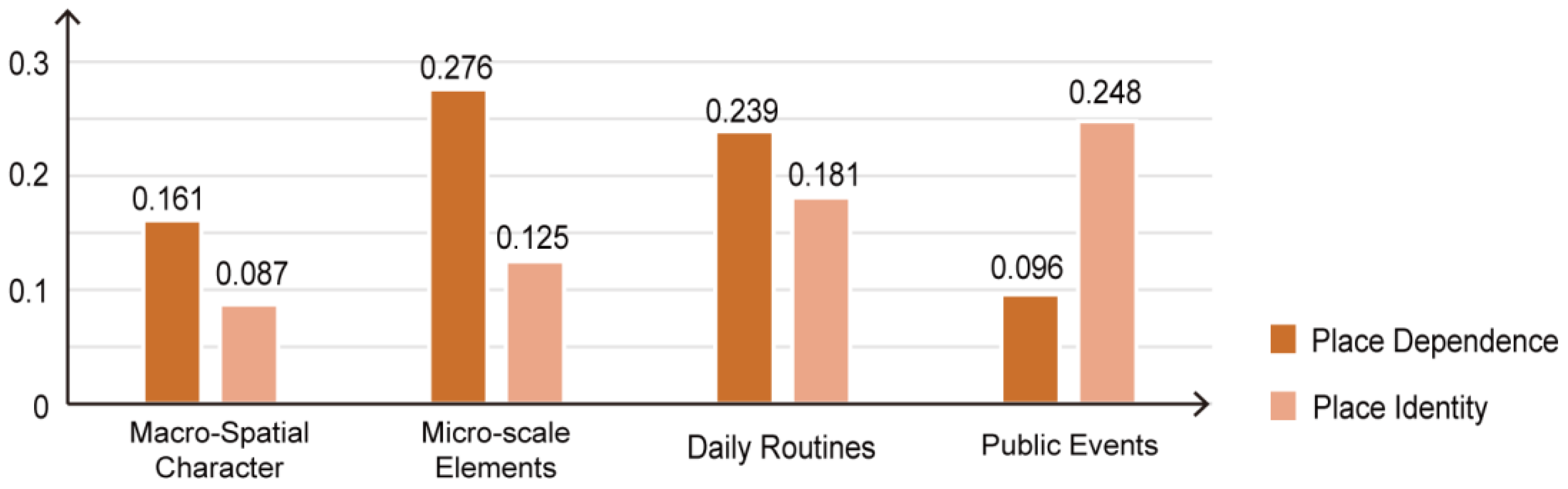
| PD | ← 2 | MC | 0.157 | 0.045 | 3.462 | *** | 0.161 |
| ← | ME | 0.304 | 0.056 | 5.400 | *** | 0.276 | |
| ← | DR | 0.253 | 0.048 | 5.261 | *** | 0.239 | |
| ← | PE | 0.113 | 0.056 | 2.017 | 0.044 * | 0.096 | |
| PI | ← | MC | 0.080 | 0.038 | 2.117 | 0.034 * | 0.087 |
| ← | ME | 0.130 | 0.048 | 2.727 | 0.006 | 0.125 | |
| ← | DR | 0.181 | 0.041 | 4.407 | *** | 0.181 | |
| ← | PE | 0.277 | 0.048 | 5.788 | *** | 0.248 | |
| ← | PD | 0.324 | 0.044 | 7.336 | *** | 0.343 | |
| CB | ← | PD | 0.298 | 0.049 | 6.092 | *** | 0.313 |
| ← | PI | 0.442 | 0.053 | 8.377 | *** | 0.439 | |
| Variable Dimensions | Grouping Category | Sub-Groups | Mean ± SD | F | P 1 |
|---|---|---|---|---|---|
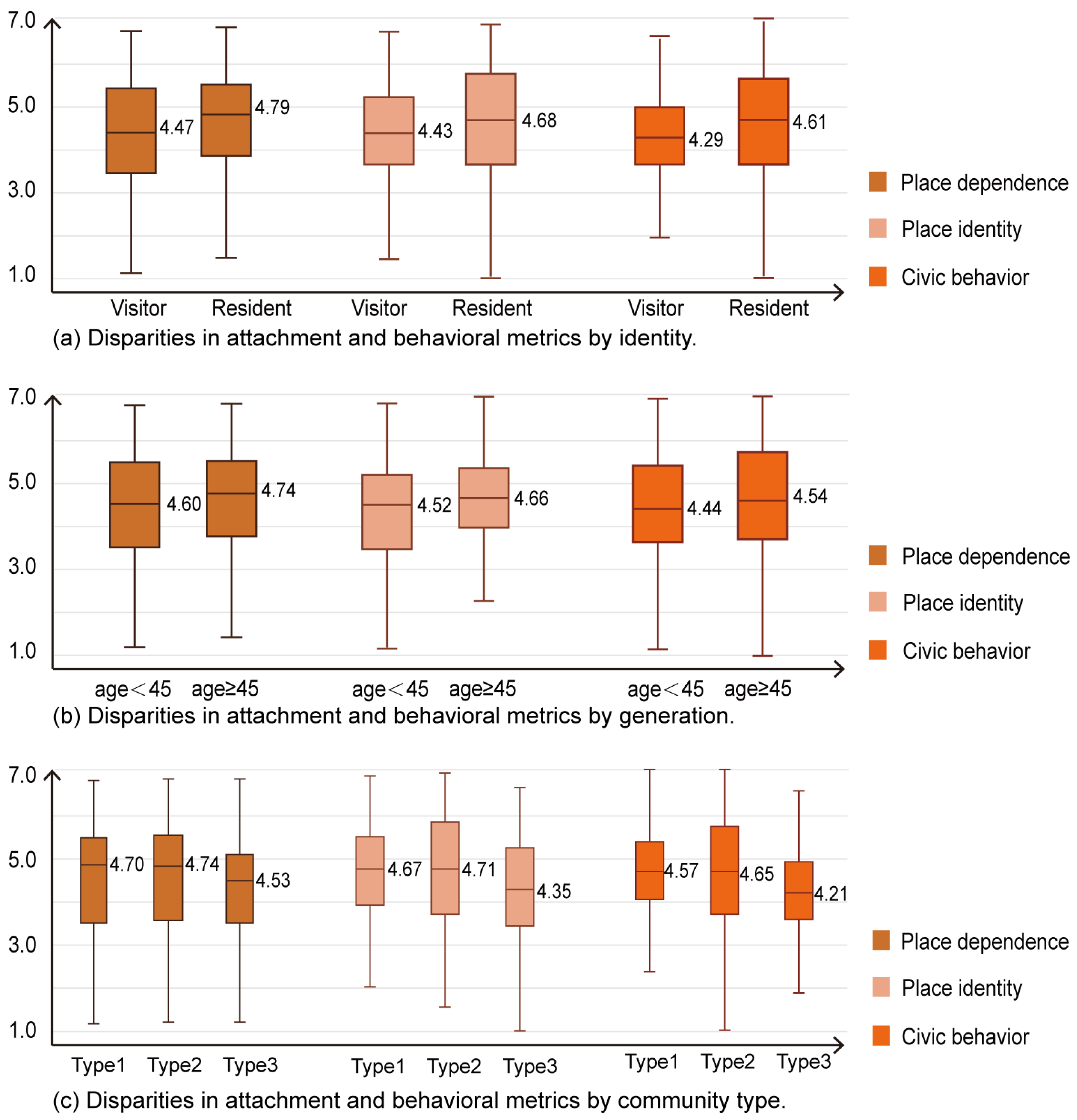
| place dependence | identity | resident | 4.79 ± 1.30 | 8.513 | 0.004 ** |
| visitor | 4.47 ± 1.36 | ||||
| age | <45 | 4.60 ± 1.31 | 1.541 | 0.215 | |
| ≥45 | 4.74 ± 1.37 | ||||
| community type | type 1 | 4.70 ± 1.34 | 1.487 | 0.227 | |
| type 2 | 4.74 ± 1.39 | ||||
| type 3 | 4.53 ± 1.26 | ||||
| place identity | identity | resident | 4.68 ± 1.33 | 5.922 | 0.015 * |
| visitor | 4.43 ± 1.24 | ||||
| age | <45 | 4.52 ± 1.28 | 1.83 | 0.177 | |
| ≥45 | 4.66 ± 1.33 | ||||
| community type | type 1 | 4.67 ± 1.27 | 4.831 | 0.008 ** | |
| type 2 | 4.71 ± 1.36 | ||||
| type 3 | 4.35 ± 1.25 | ||||
| civic behavior | identity | resident | 4.61 ± 1.35 | 9.301 | 0.002 ** |
| visitor | 4.29 ± 1.29 | ||||
| age | <45 | 4.44 ± 1.34 | 0.805 | 0.37 | |
| ≥45 | 4.54 ± 1.32 | ||||
| community type | type 1 | 4.57 ± 1.28 | 6.743 | 0.001 ** | |
| type 2 | 4.65 ± 1.38 | ||||
| type 3 | 4.21 ± 1.30 |
| Difference | Model | DF | CMIN | P 1 | Result |
|---|---|---|---|---|---|
| identity | structural weights | 27 | 58.315 | *** | significant difference |
| age | structural weights | 27 | 39.744 | 0.054 | marginally significant |
| community type | structural weights | 54 | 72.401 | * | significant difference |
| Path | Resident β | Visitor β | |C.R.| 1 |
| DR--->PD | 0.404 *** 2 | 0.040 (NS 3) | 4.042 |
| PE--->PD | −0.064 (NS) | 0.343 *** | 4.127 |
| PD--->CB | 0.420 *** | 0.168 * | 2.612 |
| Path | <45 β | ≥45 β | |C.R.| |
| MC--->PD | 0.330 *** | 0.021 (NS) | 3.134 |
| PD--->PI | 0.207 ** | 0.473 *** | 3.086 |
| Path | Type1 β | Type2 β | |C.R.| |
| DR--->PD | 0.416 *** | 0.026 (NS) | 3.544 |
| Path | Type2 β | Type3 β | |C.R.| |
| MC--->PD | 0.046 (NS) | 0.293 *** | 2.095 |
| DR--->PD | 0.026 (NS) | 0.302 *** | 2.394 |
| PE--->PI | 0.390 *** | 0.131 (NS) | 2.235 |
Disclaimer/Publisher’s Note: The statements, opinions and data contained in all publications are solely those of the individual author(s) and contributor(s) and not of MDPI and/or the editor(s). MDPI and/or the editor(s) disclaim responsibility for any injury to people or property resulting from any ideas, methods, instructions or products referred to in the content. |
© 2026 by the authors. Licensee MDPI, Basel, Switzerland. This article is an open access article distributed under the terms and conditions of the Creative Commons Attribution (CC BY) license.
Share and Cite
Li, J.; Zhang, J.; Shi, Y.; Li, X. Divergent Pathways to Place Attachment: How Heterogeneous Communities Shape Human–Green Space Relationships in Beijing. Land 2026, 15, 471. https://doi.org/10.3390/land15030471
Li J, Zhang J, Shi Y, Li X. Divergent Pathways to Place Attachment: How Heterogeneous Communities Shape Human–Green Space Relationships in Beijing. Land. 2026; 15(3):471. https://doi.org/10.3390/land15030471
Chicago/Turabian StyleLi, Jing, Jian Zhang, Yunze Shi, and Xiuwei Li. 2026. "Divergent Pathways to Place Attachment: How Heterogeneous Communities Shape Human–Green Space Relationships in Beijing" Land 15, no. 3: 471. https://doi.org/10.3390/land15030471
APA StyleLi, J., Zhang, J., Shi, Y., & Li, X. (2026). Divergent Pathways to Place Attachment: How Heterogeneous Communities Shape Human–Green Space Relationships in Beijing. Land, 15(3), 471. https://doi.org/10.3390/land15030471