A GeoDetector–MGWR Framework for Place-Based Cultural Heritage Strategies: Evidence from the Chungcheong Region, South Korea



Abstract
1. Introduction
1.1. Research Background
1.2. Regional Revitalization Through Historical and Cultural Heritage
1.3. Resource-Based Regeneration Research Using Spatial Analytical Methods
1.4. Research Objectives and Scope
2. Research Data and Methods
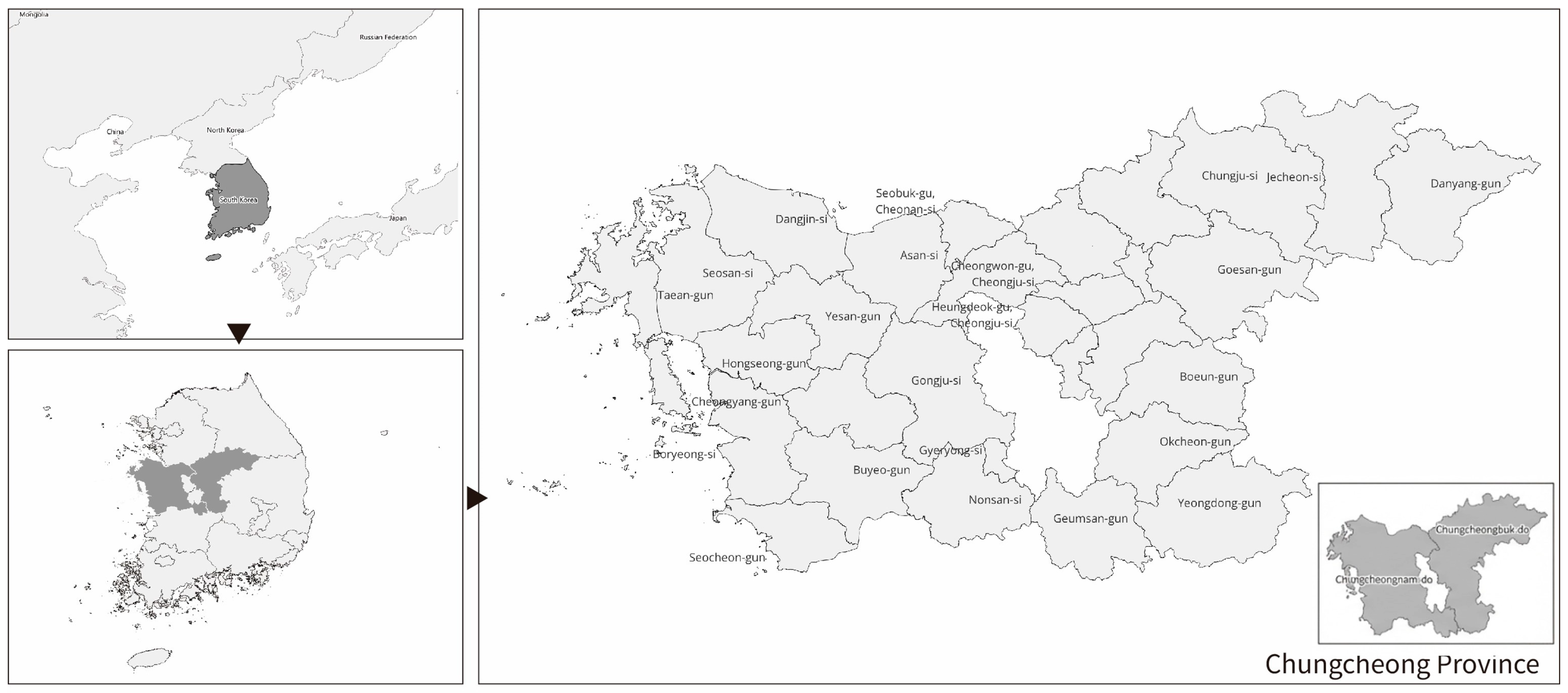
2.1. Study Area and Analytical Overview
2.2. Historical and Cultural Heritage and Socio-Spatial Data
2.3. Analytical Model and Methodology: An Integrated GeoDetector–MGWR Framework
3. Results
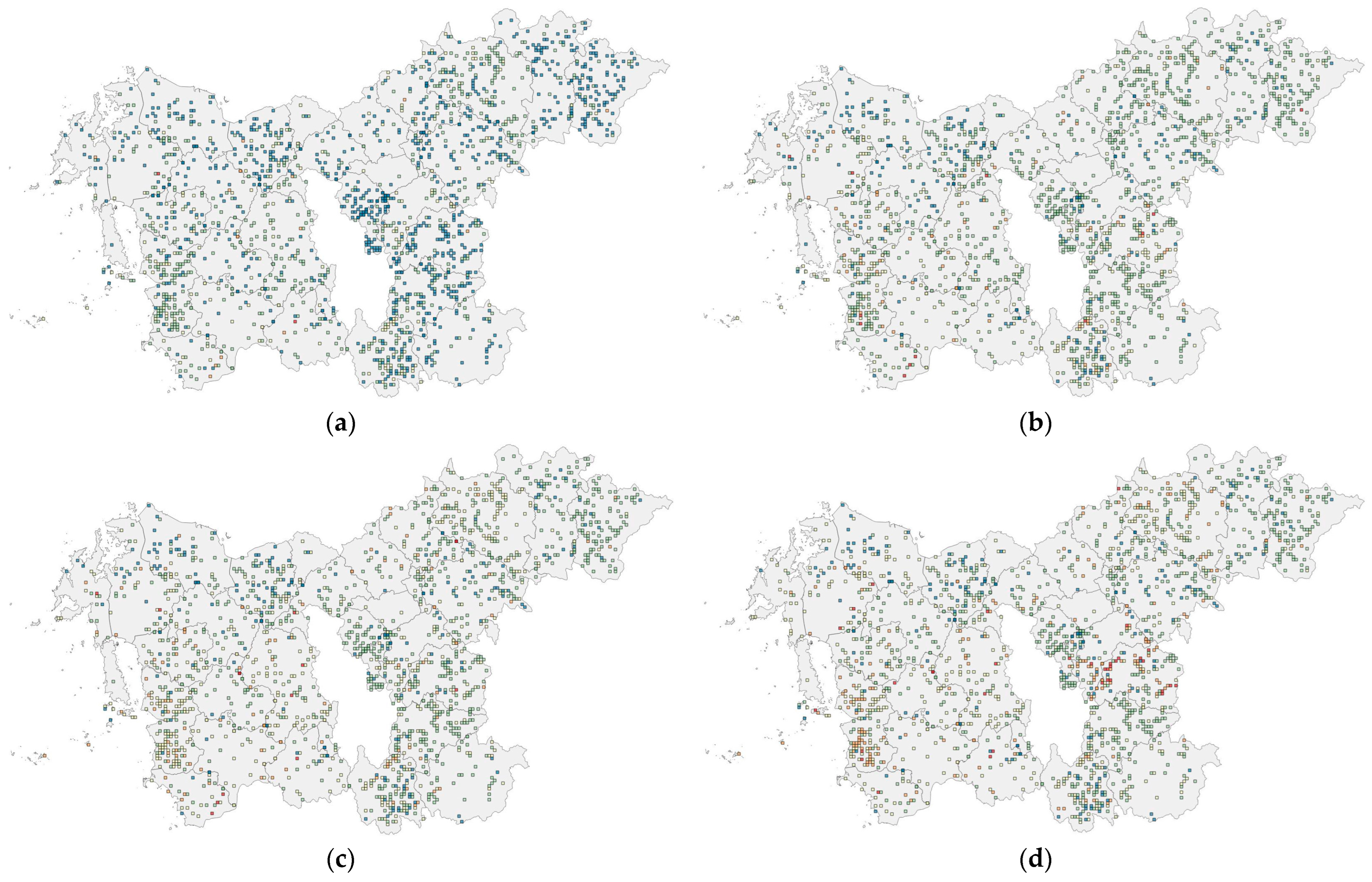
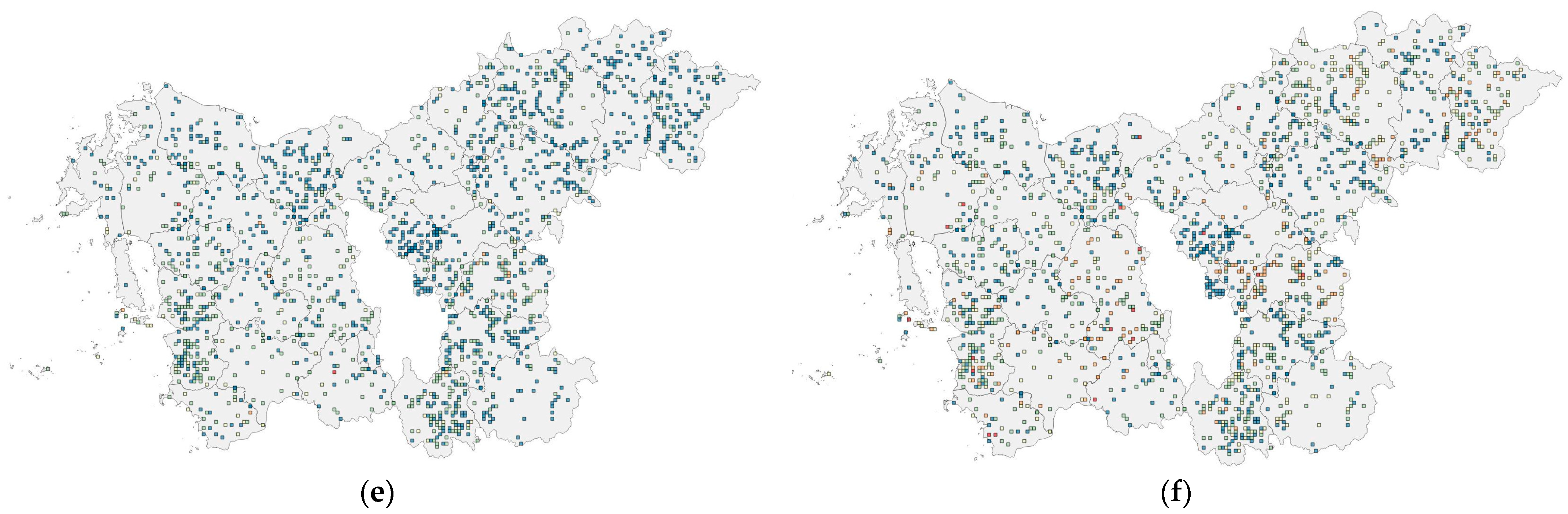
3.1. GeoDetector Results
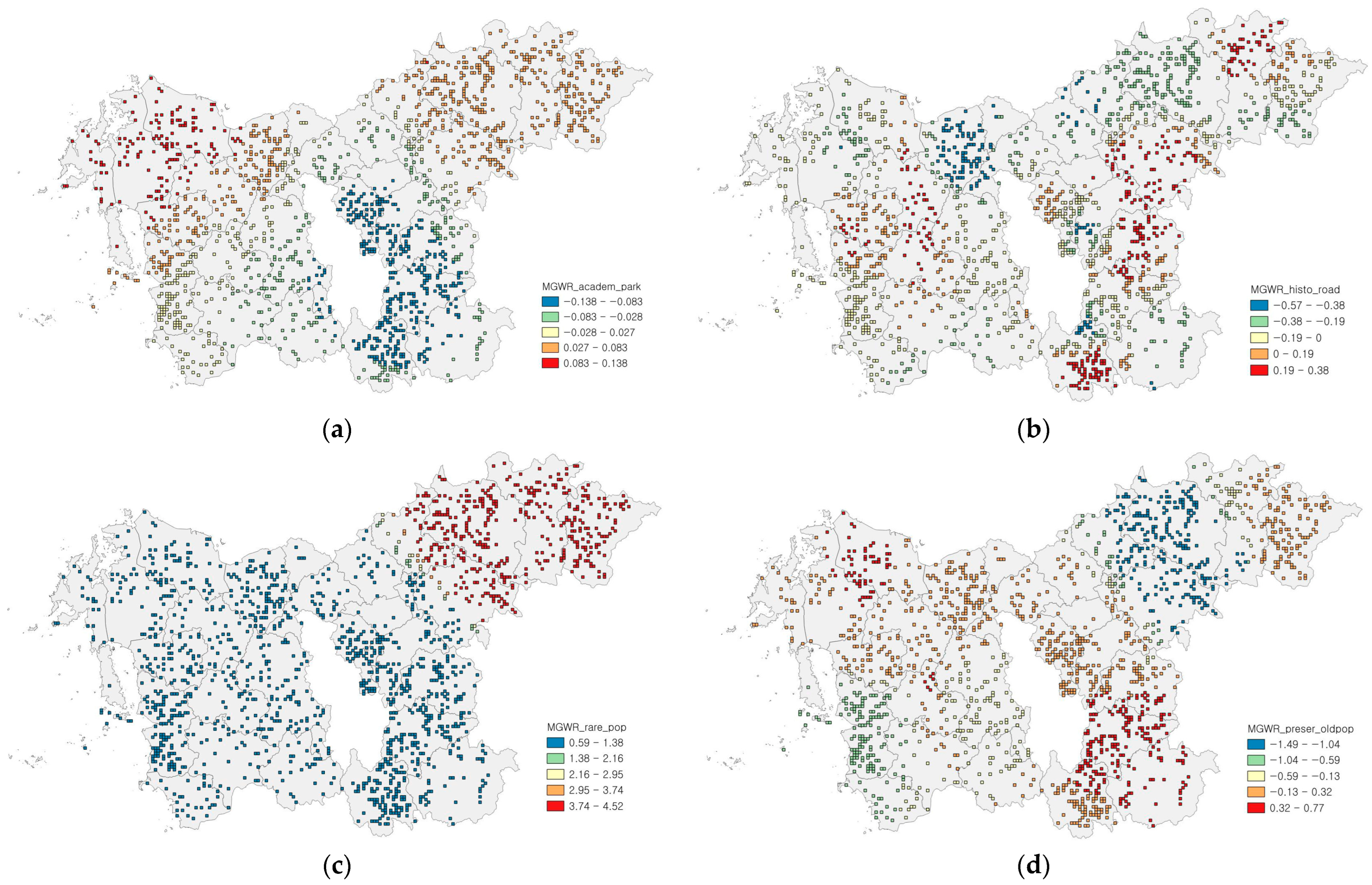
3.2. MGWR Results
4. Discussion
4.1. Interpreting GeoDetector q-Statistics Under Grid-Based Aggregation
4.2. Explaining Sign Patterns in MGWR: Development Pressure and Context Dependence
4.3. From Bandwidths to Decision-Making Scales
4.4. Transferability of the Framework
5. Policy and Strategic Recommendations
5.1. Policy Context and Recent Directions in Chungcheong-Region Heritage Policy
5.2. Policy Foci Suggested by the Analytical Findings
5.3. Implementation Strategies: Data and Governance
5.4. Strategy Pathways by Value Dimension and Operating Scale
6. Conclusions
Author Contributions
Funding
Data Availability Statement
Acknowledgments
Conflicts of Interest
References
- Kim, J.-S.; Jang, J.-H. Cultural Heritage Utilization and Neighborhood Regeneration; Korea Research Institute for Human Settlements (KRIHS): Sejong, Republic of Korea, 2014. (In Korean) [Google Scholar]
- Evans, G. Measure for Measure: Evaluating the Evidence of Culture’s Contribution to Regeneration. Urban Stud. 2005, 42, 959–983. [Google Scholar] [CrossRef] [Scilit]
- UNESCO. Culture: Urban Future. Global Report on Culture for Sustainable Urban Development; UNESCO: Paris, France, 2016; Available online: https://unesdoc.unesco.org/ (accessed on 8 February 2026).
- Burnham, B. A Blended Finance Framework for Heritage-Led Urban Regeneration. Land 2022, 11, 1154. [Google Scholar] [CrossRef] [Scilit]
- Republic of Korea. Framework Act on National Heritage (Act No. 19409; Enacted 16 May 2023; Effective 17 May 2024). Available online: https://www.law.go.kr/lsInfoP.do?lsiSeq=250955 (accessed on 8 February 2026).
- National Heritage Spatial Information Service (Korea). Data Open—Coordinate System (UTM-K). Available online: https://gis-heritage.go.kr/newMap.do (accessed on 8 February 2026).
- Jeong, J.-W.; Han, J.-H. An Importance–Performance Analysis of Urban Regeneration Tourism Destination Attributes Using Historical and Cultural Heritage Resources. Landsc. Geogr. 2021, 31, 15–27. (In Korean) [Google Scholar] [CrossRef]
- Kim, B.; Shon, D. Spatial Distribution of Historical and Cultural Resources and Regional Revitalization Strategies in Chungcheong Province, South Korea. Land 2025, 14, 1167. [Google Scholar] [CrossRef] [Scilit]
- Liang, Y.; Xu, C. Knowledge Diffusion of Geodetector: A Perspective of the Literature Review and Geotree. Heliyon 2023, 9, e19651. [Google Scholar] [CrossRef] [Scilit]
- Wang, J.-F.; Zhang, T.-L.; Fu, B.-J. A Measure of Spatial Stratified Heterogeneity. Ecol. Indic. 2016, 67, 250–256. [Google Scholar] [CrossRef] [Scilit]
- Wang, Q.; Jiang, D.; Gao, Y.; Zhang, Z.; Chang, Q. Examining the Driving Factors of Soil Organic Matter Using a Multi-Scale GWR Model Augmented by Geodetector and GWPCA Analysis. Agronomy 2022, 12, 1697. [Google Scholar] [CrossRef] [Scilit]
- Shi, T.; Hu, Z.; Shi, Z.; Guo, L.; Chen, Y.; Li, Q.; Wu, G. Geo-Detection of Factors Controlling Spatial Patterns of Heavy Metals in Urban Topsoil Using Multi-Source Data. Sci. Total Environ. 2018, 643, 451–459. [Google Scholar] [CrossRef] [Scilit]
- Fotheringham, A.S.; Yang, W.; Kang, W. Multiscale Geographically Weighted Regression (MGWR). Ann. Am. Assoc. Geogr. 2017, 107, 1247–1265. [Google Scholar] [CrossRef] [Scilit]
- Li, Z.; Fotheringham, A.S. Computational Improvements to Multiscale Geographically Weighted Regression. Int. J. Geogr. Inf. Sci. 2020, 34, 1378–1397. [Google Scholar] [CrossRef] [Scilit]
- Oshan, T.M.; Li, Z.; Kang, W.; Wolf, L.J.; Fotheringham, A.S. mgwr: A Python Implementation of Multiscale Geographically Weighted Regression for Investigating Process Spatial Heterogeneity and Scale. ISPRS Int. J. Geo-Inf. 2019, 8, 269. [Google Scholar] [CrossRef] [Scilit]
- Fotheringham, A.S.; Han, Y.; Li, Z. Examining the Influences of Air Quality in China’s Cities Using Multi-Scale Geographically Weighted Regression. Trans. GIS 2019, 23, 1444–1464. [Google Scholar] [CrossRef] [Scilit]
- Mansour, S.; Al Kindi, A.; Al-Said, A.; Al-Said, A.; Atkinson, P. Sociodemographic Determinants of COVID-19 Incidence Rates in Oman: Geospatial Modelling Using Multiscale Geographically Weighted Regression (MGWR). Sustain. Cities Soc. 2021, 65, 102627. [Google Scholar] [CrossRef] [Scilit]
- Cho, E.; Jun, B.-W. Environmental Equity Analysis of Fine Particulate Matter in Daegu Using MGWR and KT Sensor Data. J. Korean Assoc. Geogr. Inf. Stud. 2023, 26, 218–236. (In Korean) [Google Scholar]
- Wang, J.-F.; Xu, C.-D. Geodetector: Principle and Prospective. Acta Geogr. Sin. 2017, 72, 116–134. (In Chinese) [Google Scholar]
- Wang, J.-F.; Li, X.-H.; Christakos, G.; Liao, Y.-L.; Zhang, T.; Gu, X.; Zheng, X. Geographical Detectors-Based Health Risk Assessment and Its Application in the Neural Tube Defects Study of the Heshun Region, China. Int. J. Geogr. Inf. Sci. 2010, 24, 107–127. [Google Scholar] [CrossRef] [Scilit]
- Shen, W.; Chen, Y.; Cao, W.; Yu, R.; Rong, P.; Cheng, J. Spatial pattern and its influencing factors of national-level cultural heritage in China. Herit. Sci. 2024, 12, 384. [Google Scholar] [CrossRef] [Scilit]
- Zhang, Z.; Cui, Z.; Fan, T.; Ruan, S.; Wu, J. Spatial distribution of intangible cultural heritage resources in China and its influencing factors. Sci. Rep. 2024, 14, 4960. [Google Scholar] [CrossRef] [Scilit]
- Wang, F.; Zhang, T.; Zhang, S. MGWR reveals scale heterogeneity shaping intangible cultural heritage distribution in China. npj Herit. Sci. 2025, 13, 367. [Google Scholar] [CrossRef] [Scilit]
- Li, J.; Wu, X.; Du, Y. Reframing Cultural Heritage Policy Through Place-Based Perspectives: The Evolution of China’s ICH Governance Amid Historical Continuity and Global Convergence. Land 2025, 14, 1425. [Google Scholar] [CrossRef] [Scilit]
- National Heritage Administration (Korea). Third-Year Survey of Historical and Cultural Resources and Management Plan Study; National Heritage Portal (Publication); Korea Heritage Service: Daejeon, Republic of Korea, 2023. Available online: https://www.heritage.go.kr/heri/cul/linkSelectEbookDetail.do?nttId=85798 (accessed on 8 February 2026).
- Cultural Heritage Administration. Official Website of the Cultural Heritage Administration of Korea; Cultural Heritage Admin-istration: Daejeon, Republic of Korea. Available online: https://www.cha.go.kr (accessed on 15 May 2025).
- Cultural Heritage Administration. Cultural Heritage Report 2023; Cultural Heritage Administration: Daejeon, Republic of Korea, 2023. [Google Scholar]
- Cultural Heritage Administration. A Comprehensive Survey and Management Plan for Historical and Cultural Resources 2020; Cultural Heritage Administration: Daejeon, Republic of Korea, 2020. [Google Scholar]
- National Geographic Information Institute (NGII), Ministry of Land, Infrastructure and Transport. Statistical Map—Population (20240924) [Data Set]. Public Data Portal. Available online: https://www.data.go.kr/data/15062291/fileData.do (accessed on 8 February 2026).
- Statistics Korea. SGIS Grid Boundary Data (Used: 1 km). Available online: https://sgis.mods.go.kr/view/index (accessed on 8 February 2026).
- O’Brien, R.M. A Caution Regarding Rules of Thumb for Variance Inflation Factors. Qual. Quant. 2007, 41, 673–690. [Google Scholar] [CrossRef] [Scilit]
- National Geographic Information Institute (NGII), Ministry of Land, Infrastructure and Transport. Statistical Map—Land (20240924) [Data Set]. Public Data Portal. Available online: https://www.data.go.kr/data/15062289/fileData.do (accessed on 8 February 2026).
- National Geographic Information Institute (NGII), Ministry of Land, Infrastructure and Transport. Statistical Map—Buildings (20240731) [Data Set]. Public Data Portal. Available online: https://www.data.go.kr/data/15062298/fileData.do (accessed on 8 February 2026).
- National Geographic Information Institute (NGII), Ministry of Land, Infrastructure and Transport. Statistical Map—National Land Indicators (20231231) [Data set]. Public Data Portal. Available online: https://www.data.go.kr/data/15062304/fileData.do (accessed on 8 February 2026).
- National Heritage Administration (Korea). Basic Plan for Preservation, Management, and Utilization of Cultural Heritage (2022–2026). Available online: https://www.heritage.go.kr/ (accessed on 8 February 2026).
- Chungcheongnam-do (Korea). 2025 Implementation Plan for Preservation, Management, and Utilization of Cultural Heritage (Public Notice No. 2025-382). Available online: https://www.chungnam.go.kr/cnportal/province/province/view.do?menuNo=500487&nttId=2152374 (accessed on 8 February 2026).
- Chungcheongnam-do (Korea). Chungnam Digital Cultural Heritage Platform. Available online: https://www.chungnam.go.kr/cnh/cmm/main/mainPageServc.do?utm_source=chatgpt.com (accessed on 8 February 2026).
- Buyeo-gun (Korea). 2026 Buyeo National Heritage Night (Press Release, 19 January 2026). Available online: https://www.buyeo.go.kr/ (accessed on 8 February 2026).
- Chungcheongbuk-do (Korea). 2025 World Heritage Conservation/Management and Utilization Project Plan (Public Notice). Available online: https://www.chungbuk.go.kr/www/selectGosiPblancView.do?key=422&no=62961 (accessed on 8 February 2026).
- Chungcheongbuk-do Provincial Council (Korea). Administrative and Culture Committee Minutes, 420th Session, 2nd Meeting (15 July 2024). Available online: https://council.chungbuk.go.kr/ (accessed on 8 February 2026).
- Chungcheongbuk-do (Korea). Cultural Heritage Division: Major Duties and Information. Available online: https://chungbuk.go.kr/www/selectEmployeeList.do?key=2729&searchDeptCode=6431051 (accessed on 8 February 2026).



| Item | Description |
|---|---|
| Study area & unit | Chungcheong region (Chungcheongnam-do & Chungcheongbuk-do), 1 km × 1 km grid |
| Explanatory variables (X) [25,26,27,28] | Official land price, building density, green area indicator, road accessibility, population density, working-age share, aging rate (value dimensions: 1–5 scale/Survey year: 2022) |
| Dependent variables (Y) [29] | Historic/Artistic/Academic/Social/Rarity/Conservation (each analyzed separately) (value dimensions: 1–5 scale/Points → aggregated to 1 km grid/Base year 2024) |
| GeoDetector objective | Identify key factors (q-statistics) and compare interaction effects by value dimension |
| MGWR objective | Estimate local effects and variable-specific spatial scales (bandwidths) by value dimension |
| Policy relevance | Diagnose imbalances across value dimensions → derive place-based, differentiated strategies |
| Value Dimension | Top Three Factors |
|---|---|
| Historical value | Green space (0.0073), Officially assessed land price (0.0057), Building density (0.0055) |
| Artistic value | Officially assessed land price (0.0119), Total population (0.0094), Green space (0.0091) |
| Academic value | Officially assessed land price (0.0078), Green space (0.0064), Road accessibility (0.0060) |
| social value | Green space (0.0114), Building density (0.0078), Officially assessed land price (0.0072) |
| Rarity value | Green space (0.0128), Officially assessed land price (0.0128), Building density (0.0083) |
| Conservation value | Officially assessed land price (0.0096), Road accessibility (0.0046), Green space (0.0030) |
| Value Dimension | Factor 1 | Factor 2 | Value |
|---|---|---|---|
| Historical value | Road accessibility | Total population | 0.0246 |
| Officially assessed land price | Total population | 0.0224 | |
| Artistic value | Officially assessed land price | Total population | 0.0301 |
| Officially assessed land price | Working-age population | 0.0250 | |
| Academic value | Officially assessed land price | Total population | 0.0292 |
| Officially assessed land price | Road accessibility | 0.0282 | |
| social value | Officially assessed land price | Total population | 0.0273 |
| Green space | Officially assessed land price | 0.0201 | |
| Rarity value | Officially assessed land price | Total population | 0.0291 |
| Officially assessed land price | Working-age population | 0.0266 | |
| Conservation value | Officially assessed land price | Road accessibility | 0.0249 |
| Officially assessed land price | Total population | 0.0214 |
| Value Dimension | Officially Assessed Land Price | Building Density | Road Accessibility | Green Space | Total Population | Working-Age Population | Older Population |
|---|---|---|---|---|---|---|---|
| Historical value | Consistently negative (−) | Partially mixed signs | Partially mixed signs | Mixed signs (±) | Partially mixed signs | Partially mixed signs | Partially mixed signs |
| Artistic value | Consistently negative (−) | Consistently negative (−) | Consistently negative (−) | Partially mixed signs | Consistently positive (+) | Consistently negative (−) | Consistently negative (−) |
| Academic value | Consistently negative (−) | Consistently negative (−) | Consistently negative (−) | Mixed signs (±) | Consistently positive (+) | Consistently negative (−) | Mixed signs (±) |
| social value | Consistently negative (−) | Consistently negative (−) | Consistently negative (−) | Partially mixed signs | Consistently positive (+) | Consistently negative (−) | Partially mixed signs |
| Rarity value | Consistently negative (−) | Consistently negative (−) | Consistently negative (−) | Partially mixed signs | Consistently positive (+) | Consistently negative (−) | Partially mixed signs |
| Conservation value | Consistently negative (−) | Consistently positive (+) | Consistently negative (−) | Partially mixed signs | Partially mixed signs | Partially mixed signs | Mixed signs (±) |
| Panel A. Distribution of Local Coefficients (Median [IQR]; Percentage of Positive (+) Coefficients, %). | ||||||
|---|---|---|---|---|---|---|
| Variable | Historical Value | Artistic Value | Academic Value | Social Value | Rarity | Conservation |
| Officially assessed land price | −0.052(0.000);0 | −0.025(0.001);0 | −0.036(0.001);0 | −0.032(0.003);0 | −0.031(0.002);0 | −0.125(0.002);0 |
| Building density | −0.026(0.018);14.1 | −0.024(0.001);0 | −0.016(0.001);0 | −0.040(0.003);0 | −0.035(0.002);0 | 0.020(0.005);100 |
| Green space | −0.012(0.073);41.3 | −0.017(0.086);35.8 | 0.009(0.139);52.7 | −0.047(0.083);19.6 | −0.039(0.108);36.0 | −0.050(0.131);32.6 |
| Road accessibility | −0.066(0.329);35.5 | −0.021(0.004);0 | −0.021(0.005);0 | −0.025(0.009);0 | −0.062(0.019);0 | −0.075(0.012);0 |
| Total population | 1.553(2.349);83.7 | 0.448(0.002);100 | 0.739(1.249);100 | 2.087(1.980);100 | 0.721(1.003);100 | 1.218(6.728);72.1 |
| Working-age population | −1.565(1.856);18.6 | −0.471(0.001);0 | −0.874(1.464);0 | −2.086(1.909);0 | −0.800(0.760);0 | −1.931(5.570);23.6 |
| Older population | −0.057(0.235);17.0 | −0.027(0.001);0 | 0.009(0.131);58.4 | −0.085(0.156);24.3 | −0.032(0.163);22.1 | 0.004(0.846);51.5 |
| Panel B. Variable-specific bandwidths (number of grid cells; percentage of total, %). | ||||||
| Variable | Historical value | Artistic value | Academic value | social value | Rarity | Conservation |
| Intercept | 258 (14.9%) | 92 (5.3%) | 92 (5.3%) | 51 (2.9%) | 102 (5.9%) | 67 (3.9%) |
| Total population | 237 (13.7%) | 1733 (99.9%) | 291 (16.8%) | 209 (12.1%) | 311 (17.9%) | 155 (8.9%) |
| Older population | 392 (22.6%) | 1733 (99.9%) | 369 (21.3%) | 466 (26.9%) | 376 (21.7%) | 181 (10.4%) |
| Working-age population | 245 (14.1%) | 1733 (99.9%) | 275 (15.9%) | 146 (8.4%) | 303 (17.5%) | 142 (8.2%) |
| Officially assessed land price | 1733 (99.9%) | 1733 (99.9%) | 1733 (99.9%) | 1733 (99.9%) | 1733 (99.9%) | 1733 (99.9%) |
| Road accessibility | 113 (6.5%) | 1733 (99.9%) | 1733 (99.9%) | 1733 (99.9%) | 1733 (99.9%) | 1733 (99.9%) |
| Green space | 943 (54.4%) | 852 (49.1%) | 556 (32.1%) | 852 (49.1%) | 762 (43.9%) | 737 (42.5%) |
| Building density | 620 (35.8%) | 1733 (99.9%) | 1733 (99.9%) | 1733 (99.9%) | 1733 (99.9%) | 1733 (99.9%) |
Disclaimer/Publisher’s Note: The statements, opinions and data contained in all publications are solely those of the individual author(s) and contributor(s) and not of MDPI and/or the editor(s). MDPI and/or the editor(s) disclaim responsibility for any injury to people or property resulting from any ideas, methods, instructions or products referred to in the content. |
© 2026 by the authors. Licensee MDPI, Basel, Switzerland. This article is an open access article distributed under the terms and conditions of the Creative Commons Attribution (CC BY) license.
Share and Cite
Shon, D.; Kim, B.; Lim, E. A GeoDetector–MGWR Framework for Place-Based Cultural Heritage Strategies: Evidence from the Chungcheong Region, South Korea. Land 2026, 15, 384. https://doi.org/10.3390/land15030384
Shon D, Kim B, Lim E. A GeoDetector–MGWR Framework for Place-Based Cultural Heritage Strategies: Evidence from the Chungcheong Region, South Korea. Land. 2026; 15(3):384. https://doi.org/10.3390/land15030384
Chicago/Turabian StyleShon, Donghwa, Byungjin Kim, and Eunteak Lim. 2026. "A GeoDetector–MGWR Framework for Place-Based Cultural Heritage Strategies: Evidence from the Chungcheong Region, South Korea" Land 15, no. 3: 384. https://doi.org/10.3390/land15030384
APA StyleShon, D., Kim, B., & Lim, E. (2026). A GeoDetector–MGWR Framework for Place-Based Cultural Heritage Strategies: Evidence from the Chungcheong Region, South Korea. Land, 15(3), 384. https://doi.org/10.3390/land15030384