1. Introduction
Regional cartography has long been associated with the representation and organization of territorial space [
1,
2]; however, its role within spatial planning systems has undergone a profound transformation over the past decades [
3,
4]. While traditional regional maps primarily served descriptive and administrative purposes, contemporary spatial planning increasingly relies on cartographic frameworks as analytical, communicative, and decision-support tools [
5,
6]. This shift has been widely discussed in the context of the growing emphasis on evidence-based and strategic spatial planning [
7,
8].
The digital turn in geospatial technologies has fundamentally altered the production and use of regional cartography. Geographic Information Systems (GIS), spatial data infrastructures, and advanced geovisualization techniques enable the integration of heterogeneous spatial datasets, the development of indicators, and the monitoring of territorial change across multiple scales [
9,
10]. In this context, cartography functions not merely as a representational output but as a core component of spatial knowledge production supporting evidence-based planning and territorial governance [
6,
11]. This understanding is consistent with broader geospatial data governance approaches, including international frameworks such as the Integrated Geospatial Information Framework (IGIF) developed by the United Nations Committee of Experts on Global Geospatial Information Management [
12], which conceptualize cartographic production as embedded within integrated geoinformation systems encompassing data standards, institutional mandates, and legislative frameworks. While the present study concentrates on the cartographic dimension within spatial planning systems, it recognizes that cartographic practices operate within these wider geospatial policy and data infrastructures. Similar arguments have been advanced in the literature on spatial data infrastructures and geospatial governance, which highlights the infrastructural role of spatial data and geospatial information standards in policy processes [
13,
14].
Despite these advances, the literature remains fragmented with regard to the integration of regional cartography within spatial planning systems. Research on cartography has largely concentrated on methodological questions and geovisualization practices, addressing issues of representation, interaction, and spatial cognition [
10,
15]. In parallel, spatial planning scholarship has extensively examined institutional and procedural aspects of planning, often without explicitly considering the cartographic infrastructures underpinning planning practice [
3,
11]. This disconnect between cartographic research and planning theory has been noted in broader discussions on the separation between analytical innovation and institutional change in planning systems [
16,
17].
Research on planning support systems begins to bridge spatial tools and planning processes by examining how analytical and visual instruments support decision-making [
18,
19]; however, comparatively fewer studies conceptualize regional cartography itself as a structural element shaping planning effectiveness, policy coordination, and implementation capacity. Recent contributions emphasize that planning support tools remain limited in impact when they are not institutionally embedded or aligned with governance structures [
19,
20]. This gap is particularly relevant in multi-level governance contexts, where planning outcomes depend on the consistency, interoperability, and comparability of spatial information across administrative levels [
11]. Comparable concerns have been raised in the literature on European territorial governance, which stresses the need for shared spatial reference frameworks to support coordination across levels [
21].
Within the European context, regional spatial planning has gained renewed significance through territorial cohesion objectives, sustainability agendas, and performance-oriented policy frameworks. Strategic documents such as the Territorial Agenda 2030 emphasize the territorial dimension of development policies and highlight the need for robust spatial evidence to support policy design, monitoring, and evaluation [
22]. At the same time, cohesion policy implementation increasingly relies on spatial indicators, monitoring systems, and geospatial analysis, reinforcing the importance of coherent regional cartographic infrastructures [
7].
This paper argues that regional cartography should be conceptualized as a strategic planning infrastructure rather than a purely technical or representational practice. By examining the evolution from traditional regional mapping to contemporary digital cartographic frameworks, the study highlights how cartography contributes to planning processes such as scenario development, territorial monitoring, and policy communication. Emphasis is placed on the role of cartographic consistency and spatial data integration in supporting effective regional planning under conditions of complexity and governance fragmentation [
3,
23]. This argument builds on institutional and relational approaches to planning, which emphasize the role of shared knowledge frameworks in enabling coordination and collective action [
3,
24].
Using the Greek planning experience as an illustrative case within a broader European perspective, the paper explores how limitations in cartographic integration and spatial data coordination can affect planning outcomes. Rather than focusing on national specificities, the case is employed to reflect broader challenges faced by regional planning systems seeking to operationalize evidence-based and spatially informed policy-making. Comparable implementation challenges have been documented in other European planning systems characterized by complex governance arrangements [
25,
26].
The objectives of this study are threefold: (i) to conceptualize the evolving role of regional cartography within contemporary spatial planning systems; (ii) to examine how digital cartographic frameworks support evidence-based territorial governance; and (iii) to discuss the implications of cartographic integration for the effectiveness of regional spatial planning. By addressing these objectives, the paper contributes to ongoing debates on the role of geospatial tools in shaping resilient, coherent, and policy-relevant spatial development strategies. In doing so, it responds directly to calls in the literature for stronger conceptual links between geospatial analysis, planning theory, and governance practice [
11,
18]. Rather than proposing new cartographic techniques, the paper deliberately focuses on the institutional and governance implications of how cartography is positioned within planning systems. Building on this perspective, the study develops a conceptual model that frames regional cartography as a form of planning infrastructure, linking strategic objectives, institutional coordination, and implementation processes within multi-level spatial planning systems.
2. Materials and Methods
This study adopts a qualitative analytical research design to examine the role of regional cartography within contemporary spatial planning systems. The analysis is grounded in planning and policy research and seeks to clarify how cartographic frameworks are integrated into planning processes and how they contribute to planning coordination and implementation capacity, particularly in multi-level governance contexts.
The methodological approach combines conceptual framework development with systematic document analysis. The document selection followed a purposive institutional strategy rather than a database-driven systematic review. Official policy documents, legislative texts, and strategic frameworks were identified through the formal repositories of European institutions (European Commission, ESPON, INTERACT, OECD) and national legal and planning portals in Greece. The focus was placed on documents with formal institutional status and strategic relevance to spatial planning at the regional scale. This combination allows for the identification of recurring patterns, institutional arrangements, and operational roles associated with the use of regional cartography in spatial planning practice.
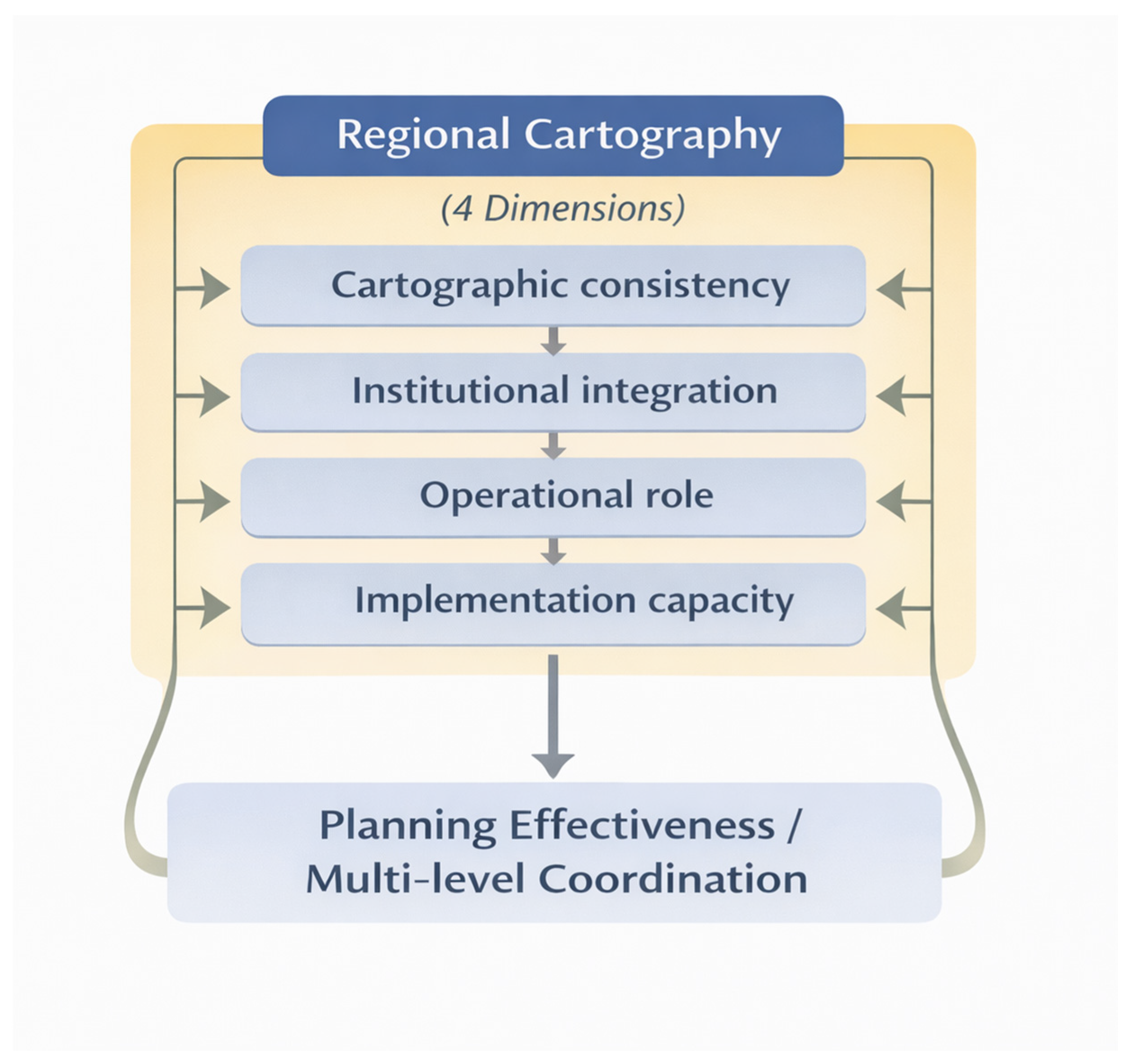
The analysis is structured around an analytical framework that conceptualizes regional cartography as a structural component of spatial planning systems rather than as a purely representational or technical output. The framework comprises four interrelated dimensions:
Cartographic consistency, referring to the coherence of scale, spatial units, and thematic classifications across planning instruments;
Institutional integration, referring to the extent to which cartographic frameworks are embedded within formal planning procedures, regulatory instruments, and policy processes;
Operational role, referring to the use of cartography in analytical functions such as monitoring, evaluation, and scenario development;
Implementation capacity, referring to the contribution of cartographic integration to planning effectiveness, policy coordination, and multi-level coherence.
These dimensions provide a common analytical lens through which planning and policy documents are examined, enabling systematic comparison across governance levels and planning contexts.
The empirical material of the study consists of a purposive selection of European- and national-level planning and policy documents relevant to regional spatial planning and territorial governance. Documents were selected based on three criteria: (i) relevance to the regional scale of planning; (ii) explicit reference to spatial planning, territorial development, or cohesion policy; and (iii) relevance to the use of cartographic representations, spatial indicators, or geospatial analysis. The selected corpus does not aim to be exhaustive but reflects documents with high institutional relevance and strategic influence on spatial planning practice.
An initial pool of relevant strategic and policy documents was reviewed and screened against the predefined selection criteria. More than twenty strategic and policy documents published between 1999 and 2022 were identified through targeted searches of official European Union, national government, and international organization repositories, including EU strategic frameworks, cohesion policy reports, national legislation databases, and analytical reports from international organizations. Documents were included if they addressed regional-scale spatial planning or territorial governance and demonstrated relevance to spatial representations, scale hierarchies, or territorial indicators. Sectoral reports lacking spatial planning scope, as well as purely technical guidelines without institutional or strategic relevance, were excluded from the final corpus. The screening process involved assessing each document against the three predefined criteria, with particular attention to its institutional status and relevance to cartographic or geospatial integration within planning systems. Following this process, eight core documents were retained for in-depth qualitative analysis.
The size of the corpus reflects the study’s focus on high-level strategic and regulatory instruments that shape the institutional architecture of spatial planning systems. The analysis does not seek empirical representativeness or frequency-based generalization but rather examines how regional cartography is positioned within core planning structures. Given this institutional focus, the selected documents are analytically sufficient to capture the structural integration, or lack thereof, of cartographic frameworks within contemporary spatial planning systems.
At the European level, the analysis includes key strategic and policy frameworks shaping territorial development and spatial planning, including:
Territorial Agenda 2030: A Future for All Places and related implementation documents [
22];
Supporting materials developed within the Territorial Package under the Interact programme [
27];
The ESPON Atlas: Territorial Evidence Supporting the Territorial Agenda 2030, which provides harmonized cartographic representations and territorial indicators for monitoring and comparative spatial analysis across European regions [
28];
The European Spatial Development Perspective (ESDP), included to provide historical and conceptual context for European spatial planning [
29].
In addition, documents related to the implementation and monitoring of European Cohesion Policy were examined, given their increasing reliance on spatial indicators, territorial evidence, and multi-level coordination mechanisms.
At the national level, the Greek spatial planning system is examined as an illustrative case. The analysis includes:
Overviews of spatial planning legislation and planning instruments across governance levels, with particular reference to the national legal and strategic planning framework established by Law 4447/2016 and the General Framework for Spatial Planning and Sustainable Development [
30,
31];
National and regional policy documents addressing spatial development and territorial cohesion, examined through their alignment with European strategic priorities and spatial planning objectives [
32];
Analytical reports and working papers produced by international organizations and research projects focusing on cohesion policy implementation and regional development in Greece, providing an external assessment of territorial governance and planning capacity [
33].
The Greek case is used to illustrate how cartographic integration influences planning coordination and implementation within a multi-level governance setting. It is not treated as representative but as a means of highlighting broader structural issues relevant to other planning systems. As shown in
Table 1, the analysis draws on a selected corpus of European and national planning and policy documents that are directly relevant to spatial planning and territorial governance.
The selected documents were examined using qualitative content analysis. The analysis followed a structured and theory-driven qualitative content approach guided by the four dimensions of the analytical framework (cartographic consistency, institutional integration, operational role, and implementation capacity). Each document was systematically examined in relation to these dimensions, and relevant passages were identified and organized in an analytical matrix to ensure consistency and comparability across cases.
For each document, attention was given to both explicit and implicit references to cartographic practices, spatial data use, and geospatial frameworks within planning and policy texts. Implicit references were identified where documents referred to spatial units, territorial indicators, scale hierarchies, monitoring systems, or spatial differentiation without explicitly framing these elements as cartographic practices. Such references were interpreted in light of the analytical framework and assessed through iterative reading and cross-author discussion to ensure conceptual coherence and analytical consistency. The analysis focused on:
The specification and consistency of cartographic scale and spatial units;
The coherence of thematic classifications and spatial representations;
The functional role assigned to maps and spatial data within planning processes;
The linkage between cartographic representations, spatial indicators, and monitoring or evaluation mechanisms;
The extent to which cartographic frameworks support coordination across administrative and governance levels.
Observations were synthesized by identifying recurring patterns and divergences across documents and governance levels. These patterns form the basis of the
Section 3, which reports the analytical findings derived from the application of the framework.
The analysis is based on documentary material and focuses on conceptual, institutional, and operational aspects of regional cartography within spatial planning systems. While the study does not aim to provide causal explanations or to assess cartographic practices in use, it offers analytical insights into the institutional and structural positioning of cartography within spatial planning systems.
The analysis therefore examines how cartographic frameworks are positioned within planning systems at the level of strategic discourse and institutional design, rather than through the empirical observation of day-to-day cartographic practices. This distinction reflects the study’s focus on planning infrastructure as an institutional and structural construct. This approach is well suited to addressing the study’s research objectives and to informing discussions on the role of cartographic frameworks in contemporary spatial planning practice.
Figure 1 illustrates the analytical framework guiding the study and clarifies the interrelationship between its four dimensions (cartographic consistency, institutional integration, operational role, and implementation capacity) within spatial planning systems, highlighting how their alignment supports coordination and planning effectiveness across governance levels.
3. Results
3.1. Cartographic Consistency, Comparability, and Monitoring Functions
European and national policy documents consistently recognize the importance of comparable spatial information and territorial monitoring, yet they operationalize cartographic frameworks in markedly different ways across governance levels.
At the European level, the European Spatial Development Perspective (ESDP) [
29] establishes an early and explicit connection between spatial planning, monitoring, and the availability of comparable territorial data. The document identifies significant gaps in comparable spatial information across Member States and emphasizes the need for standardized criteria, indicators, and reporting structures to support coordinated spatial planning. Within this framework, cartographic representations are positioned as functional components of a broader monitoring architecture rather than as purely illustrative tools.
This orientation persists, albeit in a less formalized manner, in subsequent strategic frameworks. The Territorial Agenda 2030 [
22] explicitly builds on territorial evidence produced through ESPON analytical work, underscoring the relevance of regional-scale spatial information for policy formulation. Crucially, the document avoids defining standardized cartographic scales, spatial units, or thematic structures for implementation and monitoring, thereby reinforcing the treatment of cartography as supporting evidence rather than as a structural planning component. As a result, cartography remains embedded at the level of strategic reference rather than articulated as an operational requirement.
A more explicit treatment of cartographic consistency and comparability is found in the ESPON Atlas: Territorial Evidence Supporting the Territorial Agenda 2030 [
28]. The Atlas provides harmonized cartographic representations based on shared data sources, standardized spatial units, and common methodological choices across European regions. By documenting data origins and spatial definitions, it establishes a coherent analytical basis for cross-regional comparison and monitoring. Nevertheless, this level of cartographic standardization remains confined to the analytical domain and is not formally incorporated into strategic or regulatory planning instruments.
Implementation-oriented guidance, such as the Territorial Package developed under the INTERACT Programme [
27], introduces cartographic practices in a more pragmatic manner. In this context, shared mapping is presented as a tool to support cooperation, policy learning, and coordination across administrative boundaries, particularly within functional and cross-border territories. While this approach strengthens operational collaboration, it does so without establishing formal geospatial data standards or harmonized spatial reference frameworks, thereby prioritizing flexibility over consistency.
At the national level, the Greek spatial planning framework reflects similar dynamics. Law 4447/2016 [
30] defines a hierarchical planning system organized by geographic scale, explicitly recognizing scale as a foundational organizing principle. However, neither the law nor the General Framework for Spatial Planning and Sustainable Development [
31] specifies a unified cartographic structure across planning levels. Consequently, while spatial hierarchy is institutionally defined, the cartographic representation and monitoring of this hierarchy remain fragmented.
These limitations are further underscored by the European Semester 2022: Country Report—Greece [
32], which links implementation capacity to the completion of core cartographic infrastructures, such as cadastral and forest mapping. Such foundational cartographic infrastructures are closely connected to standardized land administration frameworks and data models that structure spatial units, property rights, and territorial information. Although the present study does not examine land administration standards in detail, this connection highlights how cartographic infrastructures operate within broader institutional data architectures that underpin planning, monitoring, and governance functions. The report also incorporates regionally disaggregated indicators for policy assessment, illustrating the growing reliance on regional-scale spatial information in governance processes, despite the absence of an explicit planning-oriented cartographic framework.
3.2. Institutional Integration of Cartographic Frameworks
Across the examined documents, cartographic frameworks are consistently acknowledged as relevant to spatial planning and territorial governance. However, their degree of institutional integration varies substantially between strategic, analytical, and regulatory instruments.
Early European strategic documents, most notably the European Spatial Development Perspective [
29], conceptualize spatial information and cartographic outputs as elements that should support institutional coordination among Member States. The ESDP explicitly associates spatial monitoring and reporting with institutional cooperation and proposes the establishment of permanent observational structures as part of the European planning architecture. In this sense, cartography is conceptually embedded within institutional arrangements, even though concrete implementation mechanisms are not fully specified.
More recent strategic frameworks, including the Territorial Agenda 2030 [
22], reinforce the institutional relevance of territorial evidence by grounding policy objectives in ESPON analytical outputs. This strengthens the link between policy formulation and spatial analysis but leaves the institutional status of cartographic frameworks ambiguous. Cartography functions primarily as supporting evidence rather than as a formally integrated component of planning procedures with clearly assigned responsibilities.
This separation becomes particularly evident in implementation-oriented guidance. The Territorial Package developed under the INTERACT Programme [
27] operationalizes cartography through practices such as shared mapping, designed to facilitate cooperation and learning among territorial actors. In this context, cartography is institutionally embedded through project-based and collaborative arrangements rather than through binding planning instruments, resulting in functional but non-structural integration.
At the national level, the Greek planning framework provides a clearer institutional structure for spatial planning while leaving the role of cartography only partially formalized. Law 4447/2016 [
30] introduces coordination mechanisms and a hierarchical organization of planning instruments, creating a framework within which spatial information could play a central role. However, the absence of mandatory geospatial data standards or harmonized spatial reference specifications, as well as unified spatial datasets across planning levels, means that cartographic integration depends largely on secondary regulations and planning practice.
The General Framework for Spatial Planning and Sustainable Development [
31] reflects this pattern by aligning national planning objectives with European spatial strategies and analytical insights without translating these references into binding cartographic requirements. Similarly, the European Semester 2022: Country Report—Greece [
32] highlights the importance of foundational cartographic infrastructures for governance capacity, while addressing these infrastructures primarily through sectoral reform agendas rather than integrated planning frameworks.
The OECD Territorial Review: Regional Policy for Greece [
33] situates these institutional gaps within a broader governance perspective, noting that despite recent reforms, coordination challenges persist across levels of government. These challenges are closely related to the fragmented institutional embedding of spatial information, where cartographic tools support analysis and evaluation but are not systematically incorporated into planning and decision-making processes.
3.3. Cartography and Multi-Level Coordination
The examined documents consistently frame spatial planning as a multi-level governance process, yet they assign cartographic frameworks a limited and often indirect role within this process. While maps and spatial indicators are widely used to describe territorial patterns and policy challenges, their function as formal coordination mechanisms remains underdeveloped.
At the European level, both the European Spatial Development Perspective [
29] and the Territorial Agenda 2030 [
22] emphasize coordination between European, national, and regional actors. Cartographic representations serve as shared reference points for identifying spatial trends and disparities, but coordination remains largely conceptual. Neither document establishes binding geospatial data standards nor harmonized spatial reference systems to guide implementation across governance levels.
Analytical instruments provide a stronger basis for cross-level coordination. The ESPON Atlas [
28] demonstrates how harmonized spatial units, standardized indicators, and shared data sources can facilitate communication and comparability across regions. By relying on common territorial definitions, the Atlas enables dialogue between European institutions and national or regional actors. However, this coordinating function remains confined to the analytical sphere and is not formally embedded within planning procedures.
Implementation-oriented guidance introduces cartography as a practical coordination tool. The Territorial Package [
27] promotes shared mapping practices to support dialogue and cooperation in functional regions that transcend administrative boundaries. While this enhances coordination in specific contexts, it relies on voluntary participation and project-based initiatives rather than institutionalized planning requirements.
At the national level, Law 4447/2016 [
30] provides an institutional basis for vertical coordination through the hierarchical organization of planning instruments. However, the lack of common geospatial data standards and harmonized spatial reference specifications across these instruments restricts the capacity of maps to function as shared coordination tools. Cartographic representations vary across planning levels, limiting their effectiveness in aligning national strategies with lower-level plans.
The European Semester 2022: Country Report—Greece [
32] further illustrates these coordination challenges. Although the report employs regionally disaggregated indicators and spatially differentiated assessments, these elements are primarily used for evaluation rather than as inputs into coordinated spatial planning processes. The OECD Territorial Review [
33] similarly points to coordination gaps linked to the absence of shared spatial reference frameworks and interoperable cartographic tools.
3.4. Implications for Planning Effectiveness and Implementation Capacity
Taken together, the findings from
Section 3.1,
Section 3.2 and
Section 3.3 reveal structural implications for planning effectiveness and implementation capacity within contemporary spatial planning systems.
The absence of formally defined and consistently applied cartographic frameworks may constrain the ability of planning systems to support systematic monitoring and evaluation. While spatial indicators and territorial evidence are increasingly used in policy documents, the lack of standardized cartographic scales, spatial units, and thematic structures limits comparability across time and governance levels. Analytical tools such as the ESPON Atlas demonstrate the potential of harmonized cartographic frameworks, yet this potential remains largely external to planning practice.
Partial institutional integration appears to limit coordination and implementation. Strategic documents and national legislation acknowledge the importance of spatial evidence, but cartographic requirements are rarely specified as binding elements within planning systems. As a result, cartography functions as a supplementary analytical resource rather than as a core component of planning architecture.
Finally, the limited institutionalization of cartographic frameworks reduces their contribution to multi-level coordination. Shared mapping and spatial indicators facilitate communication and learning, but their impact on implementation depends on voluntary adoption and sector-specific initiatives. This constrains the capacity of cartography to bridge strategic objectives and operational action.
Overall, the analysis indicates that cartography remains positioned at the margins of spatial planning systems, despite its recognized analytical and communicative value. Strengthening its role as a structural component of planning frameworks would enhance monitoring, coordination, and implementation capacity, particularly in multi-level governance contexts.
4. Discussion
The findings highlight a persistent mismatch between the recognized importance of spatial evidence and the structural role assigned to cartographic frameworks within contemporary spatial planning systems. From a broader geospatial governance perspective, this institutional gap resonates with international frameworks such as IGIF [
12], which emphasize the alignment of technical standards, organizational responsibilities, and legislative mandates in the management of geospatial information. While the present study does not assess such frameworks directly, its findings underscore the importance of connecting cartographic infrastructures with wider geoinformation policy structures.
Across European and national policy documents, cartography is consistently acknowledged as essential for territorial analysis, monitoring, and policy evaluation; however, it remains predominantly positioned at the analytical and operational level, with limited institutional embedding within planning systems. This confirms earlier observations in the literature that spatial information and planning instruments often evolve along separate trajectories, resulting in a gap between analytical innovation and institutional change [
3,
7].
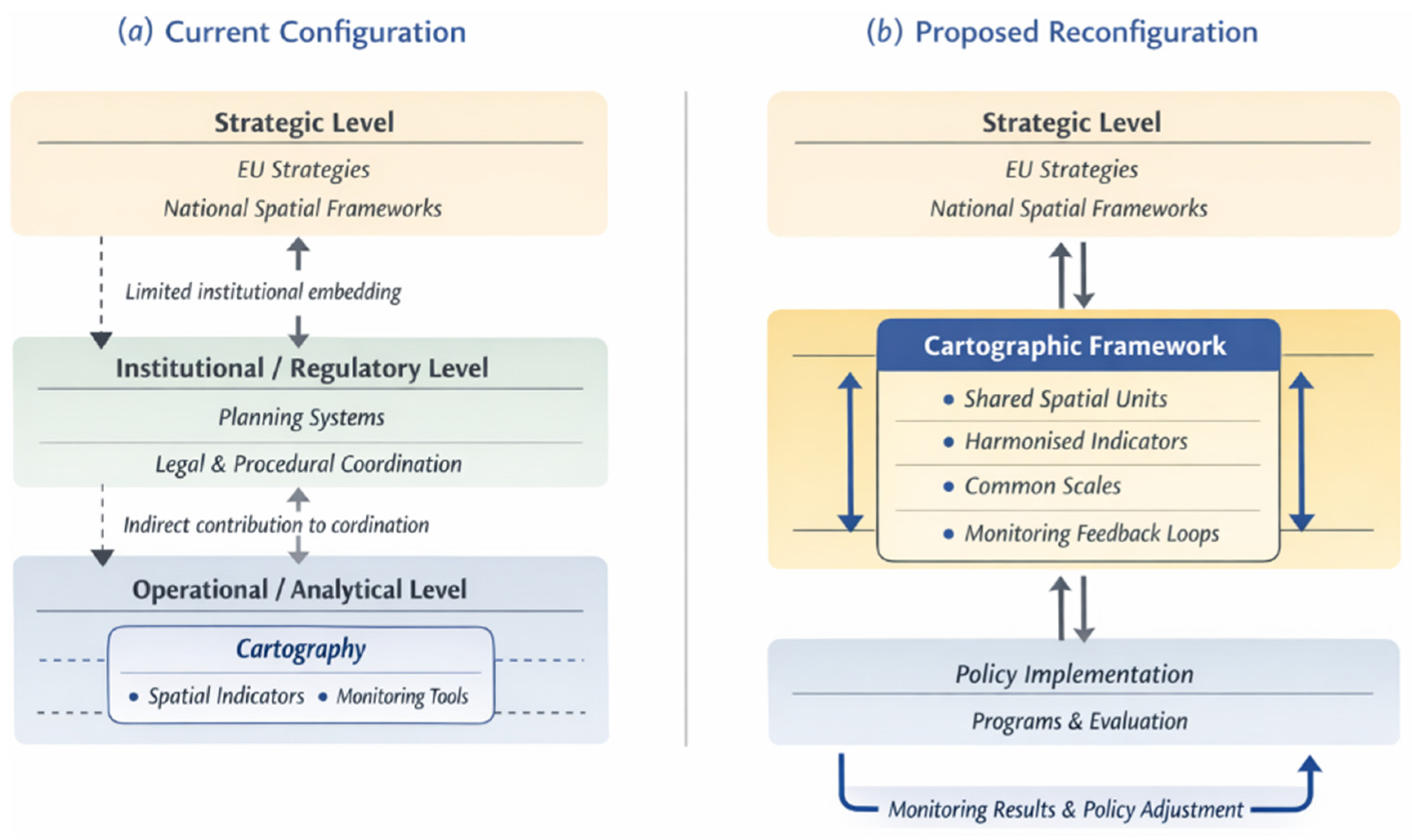
Figure 2 synthesizes this configuration by contrasting the prevailing arrangement of cartographic practices with a proposed reconfiguration derived from the empirical analysis. The figure functions as a conceptual model summarizing the institutional findings of the study, rather than as a representation of a methodological workflow. In the current configuration (
Figure 2a), cartography primarily supports operational and analytical functions, such as the production of spatial indicators and monitoring tools. Strategic frameworks at the European and national levels rely on these outputs as reference material, yet the connection between cartographic practices and institutional or regulatory planning mechanisms remains indirect. As demonstrated in the Results, this pattern is evident in both European strategic documents, such as the Territorial Agenda 2030, and in national planning systems, including the Greek case, where cartographic integration is fragmented despite formally defined planning hierarchies.
The analysis further indicates that analytical initiatives, most notably ESPON atlases and monitoring instruments, demonstrate the technical feasibility and added value of harmonized cartographic frameworks. From a planning-theoretical perspective, this persistent marginalization of cartography should be understood not as a technical shortcoming, but as an institutional choice reflecting how planning systems prioritize certain forms of knowledge over others. Shared spatial units, standardized indicators, and transparent methodological choices enable cross-regional comparison and support multi-level dialogue. Nevertheless, these advances remain largely external to formal planning procedures and regulatory instruments. As a result, the coordinating potential of cartography is realized primarily through voluntary, project-based, or analytical arrangements rather than through binding planning frameworks. This finding resonates with broader discussions on planning support tools, which emphasize that analytical sophistication alone does not guarantee influence on planning outcomes when tools are weakly embedded in governance structures [
19,
20].
The proposed reconfiguration illustrated in
Figure 2b builds directly on these insights. Rather than treating cartography as a downstream technical output, the figure conceptualizes cartographic frameworks as an intermediary planning infrastructure linking strategic objectives, institutional coordination, and policy implementation. In this configuration, shared spatial units, harmonized indicators, and common cartographic scales function as structural elements that translate strategic priorities into operational and evaluative processes. Importantly, the inclusion of monitoring feedback loops highlights how cartographic frameworks can support iterative policy adjustment, thereby strengthening the connection between planning objectives and implementation outcomes.
This reconfiguration has particular relevance in multi-level governance contexts, where planning effectiveness depends on the consistency and interoperability of spatial information across administrative levels. The Results demonstrate that, in the absence of common cartographic reference frameworks, coordination relies heavily on informal practices and sector-specific initiatives. By contrast, a structurally embedded cartographic framework would provide a shared spatial language capable of aligning strategic visions, regulatory instruments, and implementation mechanisms. This perspective aligns with institutional and relational approaches to planning, which stress the importance of shared knowledge frameworks in enabling coordination and collective action across governance arenas [
3,
24].
The Greek case illustrates these dynamics in a particularly clear manner. While recent reforms have strengthened hierarchical coordination and expanded the use of spatial indicators, cartographic integration remains incomplete and uneven across planning levels. The reliance on foundational cartographic infrastructures, such as cadastral and forest mapping, underscores the importance of spatial data for governance capacity, yet these infrastructures are not systematically embedded within planning frameworks. Similar implementation challenges identified in comparative European analyses suggest that this is not a national anomaly but a structural issue affecting multiple planning systems characterized by complex governance arrangements [
25,
26].
The findings indicate that the contribution of regional cartography extends beyond visualization and analytical support, influencing planning effectiveness through its capacity to structure coordination, monitoring, and implementation processes. By repositioning cartography from the margins of planning systems to a central, integrative role, spatial planning can better respond to demands for evidence-based policy-making and territorial coherence. The conceptual model presented in
Figure 2 provides a framework for rethinking this role and offers a basis for future empirical research examining how cartographic integration can be operationalized within different institutional and governance contexts. It should be emphasized that the findings presented here derive from the analysis of strategic and policy documents and therefore reflect institutional framing and formal positioning rather than observed operational performance. The implications discussed concern the structural conditions that may enable or constrain implementation, not direct empirical measurement of planning outcomes.
At a broader theoretical level, these findings point to the need for a more systematic alignment between spatial planning systems and geospatial data governance arrangements. In many contexts, the production and standardization of geospatial information are institutionally separated from formal planning authorities, resulting in parallel knowledge structures that are only partially integrated into regulatory and strategic processes. This institutional fragmentation may limit the capacity of planning systems to fully capitalize on the analytical and monitoring potential of regional cartography.
Reframing cartography as planning infrastructure, therefore, implies not only technical harmonization but also clearer institutional mandates, coordination mechanisms, and accountability structures linking geoinformation management with spatial planning competencies. Comparative research across national planning systems could further investigate how different governance models structure this relationship and under what conditions stronger integration contributes to more coherent territorial policy frameworks.
5. Conclusions
This paper examined the role of regional cartography within contemporary spatial planning systems, arguing that its significance extends beyond technical representation toward a structural planning function. The analysis of European and national planning and policy documents showed that, despite the widespread use of spatial indicators and cartographic tools for analysis and monitoring, their institutional integration within planning systems remains limited and uneven.
The findings indicate that the absence of shared spatial units, harmonized geospatial data standards, and formally embedded cartographic frameworks constrains coordination, comparability, and implementation across governance levels. Conceptualizing cartography as a planning infrastructure highlights its potential to link strategic objectives with monitoring and implementation processes. The Greek planning experience, considered within a broader European context, illustrates that these challenges reflect structural characteristics of multi-level planning systems rather than context-specific conditions.
Although the empirical analysis is grounded in the European planning context, the structural issues identified in this study, particularly the limited institutional embedding of cartographic frameworks and the gap between analytical innovation and regulatory integration, are not unique to Europe. Similar governance dynamics can be observed in other multi-level planning systems, including federal and state-based contexts. This suggests that the conceptualization of regional cartography as planning infrastructure may offer analytical value beyond the European case and provides a basis for future comparative research.