


Abstract
Illegal logging is a major driver of tropical deforestation, accounting for the majority of timber harvested in many tropical countries and degrading many protected areas, due to both weak law enforcement capacity and corruption. Commercial logging is illegal in Peru’s Allpahuayo-Mishana National Reserve, a state protected area, but clandestine logging operations persist and affect its biodiversity, including the endemic bird species associated with its rare Amazonian white-sand forests. We examined the effects of illegal logging operations on white-sand forest understory bird communities as sentinels of biodiversity. We sampled birds with mist nets at 12 study sites in unlogged forest and forest regenerating between 1 and 10 years after timber harvest, capturing and releasing 348 birds representing 54 species in 16 families. Forest structure differed significantly between forest treatments, with canopy cover in logged forest significantly lower than in unlogged forest. All avian foraging guilds tested (including ant followers, other insectivores, frugivores, granivores, and nectarivores) responded significantly to changes in one or more forest structure characteristics we measured. The abundance of ant followers and other insectivores was positively correlated with canopy cover, while granivore abundance was positively correlated with subcanopy cover, and both frugivore and nectarivore abundance was negatively correlated with the numbers of trees in white-forest stands. We also took a rare opportunity to compare avian foraging guilds and relative abundance using capture data collected at the same white-sand forest sites in both 2005 and 2023. Over this 18-year period, the total number of understory birds and ant followers in particular declined, whereas other insectivores increased with time since logging. Our results demonstrate that logging has significant influences on white-sand forest habitat structure and bird community dynamics for decades after logging events. Illegal logging threatens forests and wildlife in many tropical protected areas, and we recommend their managers prioritize both preventing illegal logging and mitigating its negative effects to effectively conserve biodiversity.
1. Introduction
Most of the world’s tropical forests are affected by logging and other human impacts, and all remaining unprotected tropical forests are expected to be logged [1,2]. Approximately 30% of the world’s bird species depend on tropical forests for survival [3] and, in turn, they play critical roles in forest structure and function as pollinators, predators, seed dispersers, and prey for other animals. Half of the world’s remaining tropical forests are in Latin America [4], and logging operations have been recently expanding dramatically in the Amazon region [5]. Illegal logging (defined here as the harvest and removal of trees in violation of national laws) is a major threat to tropical forests worldwide, but its impacts have rarely been quantified [6]. Illegal logging may result in significant deforestation even within protected areas in the tropics [7], and, in particular, an estimated 80% of logging operations in the Amazon region are illegal and poorly executed [8].
Forests growing on white sands are rare and patchily distributed, covering less than 0.1% of the Peruvian Amazon region [9]. White-sand forests tend to be lower in stature and have reduced bird species richness compared to other Amazonian forests in Peru, but they are rich in endemic and range-restricted species [10]. These forests also provide crucial overwintering grounds for long-distance Nearctic–Neotropical migratory birds such as the Gray-cheeked Thrush (Catharus minimus) [11]. One of Peru’s largest known areas of white-sand forest is situated on the north bank of the Amazon near its confluence with the Nanay River [9], where the government of Peru created the 576 km2 Allpahuayo-Mishana National Reserve (AMNR) in 1999, in part to protect a number of recently discovered endemic bird species [12,13].
Illegal logging in the AMNR has been identified as among the main threats to its protection [14,15]. Logging alters the structure, composition, and microclimate of forests, and causes fragmentation and isolation of the remaining fragments, all of which can affect wildlife populations and communities [4]. Following logging operations, species associated with forest gaps and edges, or those that are adapted to disturbance, may increase after logging and become dominant, and species restricted to the forest interior may decline or disappear. Due to the roads and gaps associated with logging operations, logged forests also tend to be characterized by increased vulnerability both to commercial hunting and poaching and to wildfires, which can quickly decimate wildlife populations [5,16]. However, how selective logging impacts any particular taxonomic group depends on multiple factors such as logging intensities, time since logging, any post-logging disturbance, and many other factors [2,17,18].
Understanding how birds respond to logging is a critical part of developing forest management plans that support the long-term protection of biodiversity [2]. Selective logging opens the forest canopy and allows light to reach the forest floor, making the understory hotter and drier and its vegetation denser than that of unlogged forests, with implications for food availability, nesting substrates, and microclimatic conditions. Birds play critical roles in forest structure and function as pollinators, predators, seed dispersers, and prey for other animals. Birds may serve as indicators of environmental change because of their wide ranges, interactions with other organisms, and sensitivity to landscape-scale disturbances [19]. Through their breathtaking beauty, charming behavior, and delightful songs, birds also help garner popular support for conservation.
Many forest understory bird species may be sensitive to forest damage due to logging and may thus serve as indicators of forest damage and/or regeneration [17,20]. For example, logging is known to drive declines in cavity-nesting birds [21], such as woodpeckers [22,23], as well as raptors and other canopy-nesting birds [2,24,25]. In addition to cavity- and canopy-nesting birds, ground-nesting and insectivorous birds in general appear to be particularly vulnerable to the negative effects of logging in mature forests [2,26].
Most studies evaluating the impacts of logging on birds have taken place in temperate and boreal forests, especially in Europe and North America [27,28,29,30]. How logging affects most tropical birds remains poorly understood [4,31], particularly in Amazonia. However, research to date from throughout the tropics suggests that logging may have major impacts on forest bird communities, especially those that forage and breed in forest understories, and that many understory bird populations may decline dramatically or disappear altogether following logging [4,32]. Logging in the tropics has been implicated in the decline of forest bird taxa including generalist understory birds and sallying insectivores [33], as well as hornbills [34], species that forage in the canopy and subcanopy and require large trees for nesting. Forest understory birds, especially insectivores, are particularly sensitive to logging damage due to their foraging and habitat specializations, post-logging impoverishment of arthropod fauna, and high site fidelity, and may thus serve as excellent sentinels of forest health and forest structure change [2,19,33,35]
We examined the effects of illegal logging on understory birds in lowland (elevation 116–148 m) humid tropical white-sand forests that the AMNR was designed to protect. Nearly 500 species of birds have been recorded in the AMNR, of which 32 species have some degree of specialization regarding white-sand forests [12]. This avifauna comprises a number of recently discovered endemic species, including the Iquitos Gnatcatcher (Polioptila clementsi), which has been adopted as the official bird of the nearby city of Iquitos [12,13,14,15]. These forests include over 1900 plant species, of which 110 are range-restricted or endemic to white-sand forests [36]. Distinctive features of white-sand forests include high tree density, low frequency of large emergent trees, lianas or herbs, and a thick humus layer due to low decomposition rates.
Starting in the 1980s, human activities began to encroach on the AMNR due in part to state-sponsored efforts to encourage human settlement in this region [35]. During this time, the AMNR was subjected to decades of uncontrolled exploitation of natural resources in the region associated with the hundreds of thousands of residents of the nearby city of Iquitos [14,35]. Immigration, land clearance for agriculture, and commercial logging have been prohibited in the reserve since 1999, when the AMNR was first designated as a protected area due to the discovery of multiple new bird species [9,12,13]. Here, we investigated the impacts of past illegal logging on bird communities in the reserve, with the following specific objectives: (1) estimate species richness and abundance of understory bird communities in unlogged forests and forests recovering from illegal logging that took place ~1, ~5, and ~9 years after harvest (YAH); (2) test whether bird communities or any measures of vegetation structure differ significantly between treatments, and compare bird community diversity indices between treatments; and (3) estimate how bird foraging guild abundance is influenced by habitat variables. We also took advantage of a rare opportunity to compare bird sampling data collected at the same unlogged and logged forest sites in 2005 and 2023, in order to investigate any changes in understory bird relative abundance or avian foraging guilds over this 18-year period. Finally, we sought to use research findings to make management recommendations to support AMNR’s biodiversity conservation mission.
2. Materials and Methods
2.1. Study Area
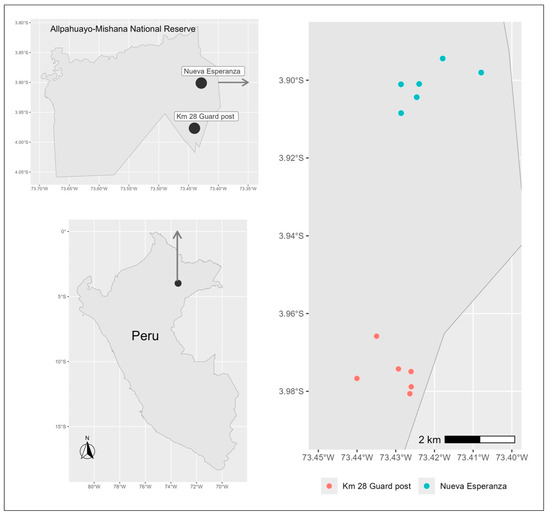
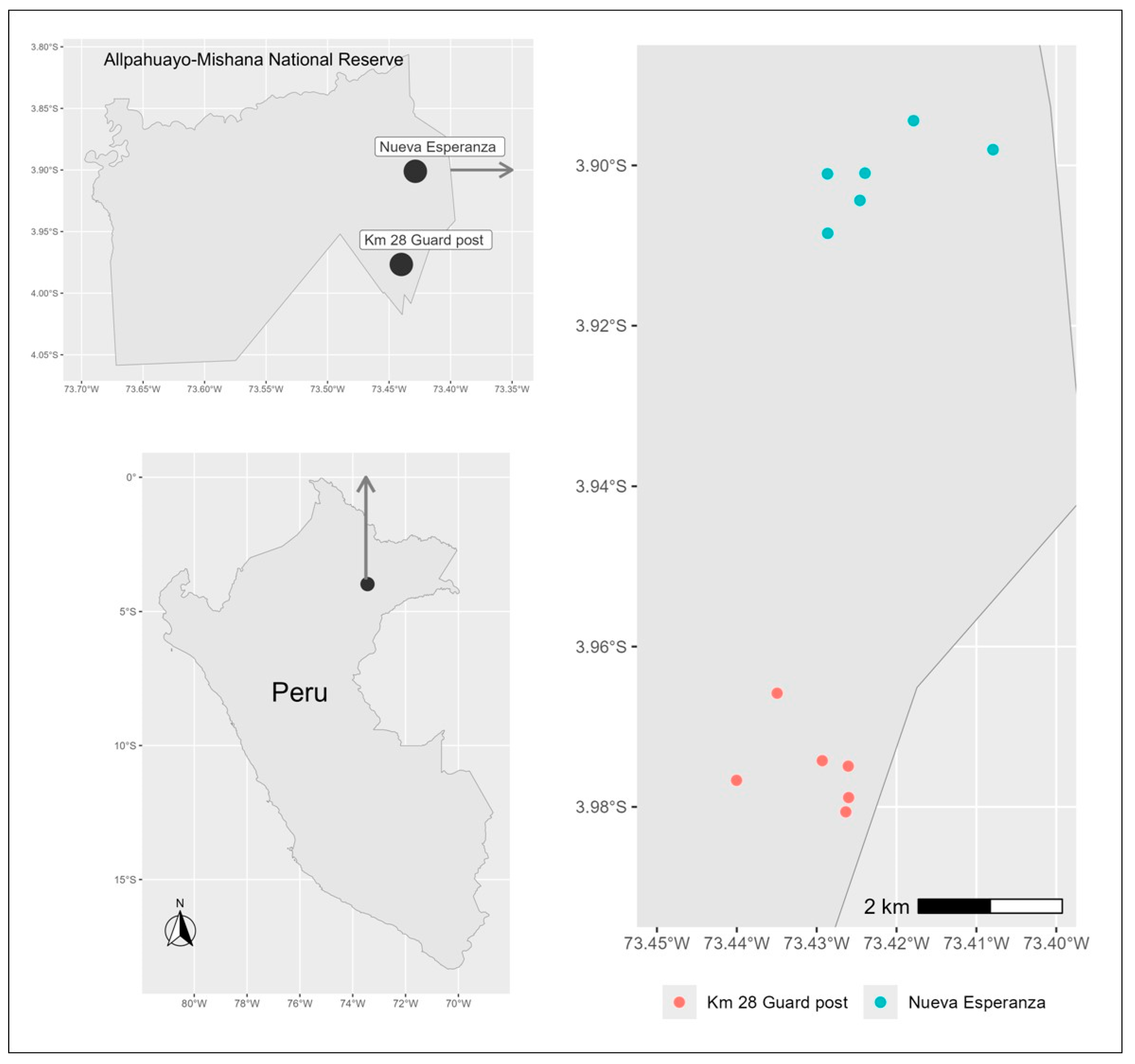
We conducted research in the AMNR (03°58′ S, 73°25′ W; Figure 1), a state-protected area comprising 58,070 ha of tropical forests in the Department of Loreto, northeastern Peru. White-sand forests are distinguished by nutrient-poor sandy soils, high densities of straight, uniform trees with few major branches, and relatively low plant diversity [35]. Dominant plants include the canopy trees Caraipa tereticaulis and C. utilis, and the subcanopy tree Pachira brevipes. White-sand forests host a high number of endemic bird species, such as the Allpahuayo Antbird (Percnostola arenarum; IUCN Vulnerable), White-masked Antbird (Pithys castaneus; IUCN Near Threatened), Iquitos Gnatcatcher, and Mishana Tyrannulet (Zimmerius villarejoi). Other habitat types within AMNR include forests supported by the more common nutrient-rich clay soils and seasonally flooded forests along the banks of the Nanay River [35].
Figure 1.
Study area in the Allpahuayo-Mishana National Reserve, Peru, showing: (1) on the lower left, the location of the AMNR in Peru; (2) on the upper left, the locations of our base camps in the settlement of Nueva Esperanza and the Km 28 guard post, the reserve’s only guard post at the time of our study, situated 28 km southwest of the city of Iquitos on the Iquitos–Nauta highway; and (3) on the right, the locations of our 12 mist-netting sampling sites, including six sites in the vicinity of Nueva Esperanza (green circles) and six sites in the vicinity of the km 28 guard post (red circles). Map created by Alaaeldin Soultan.
White-sand forests tend to be dominated by one or a few tree species, and trees tend to exhibit adaptations to nutrient-poor soils, including long-lived leaves protected by chemical defenses and physical toughness such as a waxy cuticle that appears to minimize the leaching of nutrients by rain [12]. Dominant trees, including C. tereticaulis and C. utilis (hereafter, Caraipa trees), have long straight trunks that are in great demand locally for construction material, firewood, and charcoal [15,37]. Although commercial logging is prohibited in the AMNR, law enforcement capacity is limited. During the time of our field research, there was a single salaried staff member (the reserve director) associated with the reserve, who was aided by one of four unarmed volunteer park rangers taking turns manning the reserve’s only guard post (at km 28 on the Iquitos–Nauta Highway). Unfortunately, logging continued to be undertaken by armed groups and in a clandestine capacity, evading law enforcement.
Protection of the AMNR from illegal human activities is further complicated by the presence of multiple human communities within the reserve that may legally log and hunt for subsistence purposes. Human residents of the area who were already established prior to its designation as a protected area were offered land elsewhere (km ~75 Iquitos–Nauta Highway) if they agreed to move out of the reserve voluntarily; however, they were not offered financial compensation; most chose to stay and instead receive compensation from the government of Peru in return for restrictions on their activities within the reserve. New immigration into the AMNR was prohibited after its designation as a protected area, but immigration has continued, constituting a driving force that generates increasing anthropogenic threats to biodiversity in the AMNR [38]. Human immigration into the reserve continued after its designation as a protected area, apparently in part due to the perception that new immigrants would also receive government subsidies. Paradoxically, protected areas in the tropics tend to attract human settlement that may pose increased threats to biodiversity conservation [39,40,41].
We studied the effects of logging on understory birds in the humid white-sand forest type locally known as varillal, which is typically characterized by 10–25-m-tall trees that form a canopy and a well-developed understory, including palms such as Euterpe catanga [9]. It was not possible to obtain figures on the exact volume of timber extracted from the forest stands we studied because most of the logging that took place in our study area was illegal. However, logging operations typically extract all mature Caraipa trees in a given area; scientists familiar with the reserve estimate that operations typically cut 30–40 trees from a single (~1 ha) forest stand and transport them by footpath, river, or road for sale in Iquitos [42]. This extraction effort is higher than typical logging intensities (1–6 trees/ha) reported for commercial logging operations in the tropics, due in part to the much smaller average size of the trees in white-sand forest and the dominance of Caraipa trees in these forests, such that a majority of trees represent potential timber.
2.2. Bird and Habitat Structure Sampling
We used constant-effort mist netting to sample birds in forest stands logged approximately 1, 5, and 9 years previously and unlogged forest stands as a control. We conducted fieldwork inside the reserve near field camps located at the reserve guard post 28 km from Iquitos (3.58° S, 73.26° W) and the settlement of Nueva Esperanza (3.54° S, 73.25° W) (Figure 1). AMNR includes multiple habitat types, including varillal forests distinguished by nutrient-poor white sandy soils with relatively low plant diversity but high endemism [12], as well as more prevalent arcilla forests on nutrient-rich clay soils [35]; we sampled birds at study sites located in varillal forests in the reserve. We expected that our study area would receive a higher degree of actual protection than forest in most of the reserve, where there were no other guard posts or full-time law enforcement personnel.
We selected three replicate stands in each of four forest treatments, for a total of 12 stands: forest stands ~1 YAH, ~5 YAH, and ~9 YAH, and unlogged forest stands (UL). Sampled forest stands were approximately 0.5 ha in area, and all logged forest stands were surrounded by unlogged forest. Sites were located an average of 631 m apart, and at least 200 m apart (range = 201–1222 m). We found no evidence that the volume of timber extracted varied significantly over the time period covered in this study, and we assumed that forest treatments presented an accurate temporal gradient of post-logging changes in understory bird communities. All bird sampling for this study took place during the same time period, in October and November 2005, in order to avoid any major differences due to weather conditions or seasonality. Bird sampling was conducted using Ecotone nylon mist nets (10 m long × 2.5 m high, 32 mm mesh) manufactured in Poland and distributed by Avinet Research Supplies, Portland, ME, USA. At each site, 10 mist nets were placed in a straight, continuous line comprising 100 m. Nets were opened by dawn, checked every 15–20 min, and closed at approximately 1400 h. Nets were operated for two to three consecutive days at each site, and then transferred to a new location. Captured birds were identified, weighed, measured, photographed, and marked before being released at the site of capture [43]. Birds were marked by clipping 1 cm off the tip of the third right outer tail feather [44]. Recaptured birds were released immediately and excluded from subsequent count data. Capture rates decline after each day of net operation because the proportion of the population captured increases with each passing day, and captured birds tend to avoid mist nets after being caught [45,46,47,48,49,50,51].
Mist netting has played an important role in surveying birds in tropical forests, as they can provide a large amount of quantitatively reliable information in a relatively short period, and the results are repeatable [46,47,48,49,50,51,52,53]. Mist nets are a powerful tool for detecting understory bird species, particularly secretive species or those that vocalize infrequently [48,52,53,54]. Sampling via mist nets avoids the biases of survey methods that rely on the visual and auditory ability of human observers, and it is especially useful in areas with high species richness and where the avifauna is not well-studied [46,47,48,51,52,53,54]. However, birds exhibit capture heterogeneity due to spatial movement patterns, flight behavior, activity level at a given period of time, and other factors influencing their catchability [48]. Unequal detection probabilities produce a negative bias, underestimating the true number of species, which should be addressed through statistical approaches that incorporate capture heterogeneity in order to estimate parameters based on empirical data [50,51].
We quantified vegetation structure using a modified version of a standard, widely used habitat assessment method [49,55]. We randomly selected a 10 m diameter circle at each plot and used a convex mirror densitometer and ocular observations to estimate percent vegetation cover at four levels: canopy (>3 m), subcanopy (2–3 m), breast-height, and ground. We also quantified basal area, including the number and diameter, for all trees >10 cm diameter at breast height in each plot. These measurements allowed us to quantify forest stand horizontal and vertical structure and numbers and sizes of trees, factors which have been identified in previous studies as influential for forest birds [2], in an effort to explore the relationship between forest structure and bird communities in our study area. Finally, we took advantage of a rare opportunity to compare our sampling data from 2005 to data collected at four of the same sampling sites in March–May 2023 [35] to investigate any changes in understory bird relative abundance or avian foraging guilds over time.
2.3. Statistical Analysis
We organized bird data into taxonomic order using available field guides to birds of Peru [9,10]. We standardized capture rates by expressing them in terms of meter-net-hours, which we calculated by multiplying the total number of meters of nets (100 m) by the number of net hours spent capturing birds at each site (mean = 207.9 ± 6.2 net hours/stand). We estimated species richness for each treatment by averaging multiple commonly used indicators, including the first-order jackknife estimator and the bias-corrected Chao1 and abundance-base coverage estimator [50,51,56,57,58,59], as implemented in comparable research studies [58,59] via the R packages ‘ape’ (version 5.8-1) [and ‘SpadeR’ (version 0.1.1) [60,61,62,63,64]. We quantified average bird species richness estimates by forest treatment, comparing unlogged (UL) forest stands with forest stands ~1, ~5, and ~9 years after harvest (~1 YAH, ~5 YAH, and ~9 YAH, respectively). These estimates were calculated together with their respective 95% confidence intervals (95% CIs), which represent the value range expected to include the true value of focal parameters in 95% of cases where repeated sampling efforts are used for study replication, via the ‘SpadeR’ package (version 0.1.1). [61]. Lower confidence intervals (LCIs) and upper confidence intervals (UCIs) did not center around the mean because our count data were not normally distributed.
We used a Shapiro–Wilk test in R [64] to test each variable for normality. Habitat data (canopy cover, soil cover, and average tree diameter) were not normally distributed. We ran a Moran’s I test for spatial autocorrelation using the ‘ape’ package in R. There was no evidence for spatial autocorrelation of observed species richness (p = 0.086) or observed abundance (p = 0.74) among our sites [60,61,62,63,64,65]. We tested for potential differences in bird detectability between treatments, due to canopy openness or understory density, and this was tested through a χ2 test of equal detection probabilities between all sampling treatments, in which each sampled bird community was considered as “closed” during the sampling period [49,50,51]. To test whether changes in bird community composition differed among treatments, we conducted a PERMANOVA (Permutational Multivariate Anova), an appropriate method for analyzing non-normal data. We ran a Principal Coordinates Analysis (PCoA) to investigate the variation in our results [66,67,68,69].
We categorized all bird species captured into one of the following foraging guilds defined by birds’ primary foraging strategies: ant followers, frugivores, granivores, insectivores other than ant followers, nectarivores, and omnivores [9,10,70,71,72,73]. Ant followers include bird species that have evolved foraging strategies in which they accompany army ant swarms to forage on arthropods and small vertebrates as they flee to escape becoming prey to the ants [9,10,73]; frugivores primarily consume fruit, granivores consume seeds, insectivores like ant followers also specialize in arthropod prey, and nectarivores consume flower nectar [68]. To investigate guild-specific associations with habitat structure, we used generalized linear mixed models (GLMMs), which are suitable for data with non-normal distributions and allow for investigation of random effects [74]. We used binomial distributions for granivores and omnivores and Poisson distributions for other foraging guilds. In our GLMMs, we used habitat variables as predictor variables and treatment as a random effect in order to account for any differences in detection rates that may have existed across treatments [61,62].
Finally, we compared avian relative abundance and foraging guilds using our 2005 capture data and data collected at four of the same sites in 2023 [35], including one unlogged site, two sites that had been logged 9 years previous in 2005, and by 2023 had been logged 27 years previously, one site that had been logged 5 years previous in 2005 and by 2023 had been logged 23 years previously. We used an analysis of variance (ANOVA) to test whether understory bird capture rates per meter-net-hour changed at these sites over this 18-year period. We used a PERMANOVA to test whether proportions of avian foraging guilds changed over the same period.
3. Results
Using a total sample effort of 2495 mist net hours, we made a total of 348 captures of 54 species belonging to 16 taxonomic families (Appendix A). The Thamnophilidae (typical antbirds) were the best-represented family in our sample, with 13 species. The three most commonly captured species accounted for 34.4% of our total captures: Wedge-billed Woodcreeper (Glyphorynchus spirurus) (n = 69), Scale-backed Antbird (Hylophylax peocilinotus) (n = 29), and White-plumed Antbird (Pithys albifrons) (n = 22). Rare species, which were defined as those composing less than 2% of total captures, made up the majority (74.1%) of captures. Nearctic–Neotropical migrant species included the Gray-cheeked Thrush (n = 3) and Swainson’s Thrush (Catharus ustulatus) (n = 9).
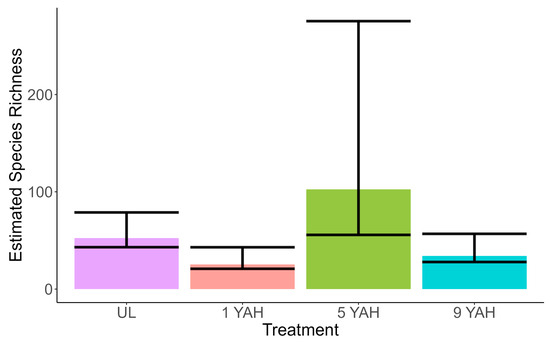
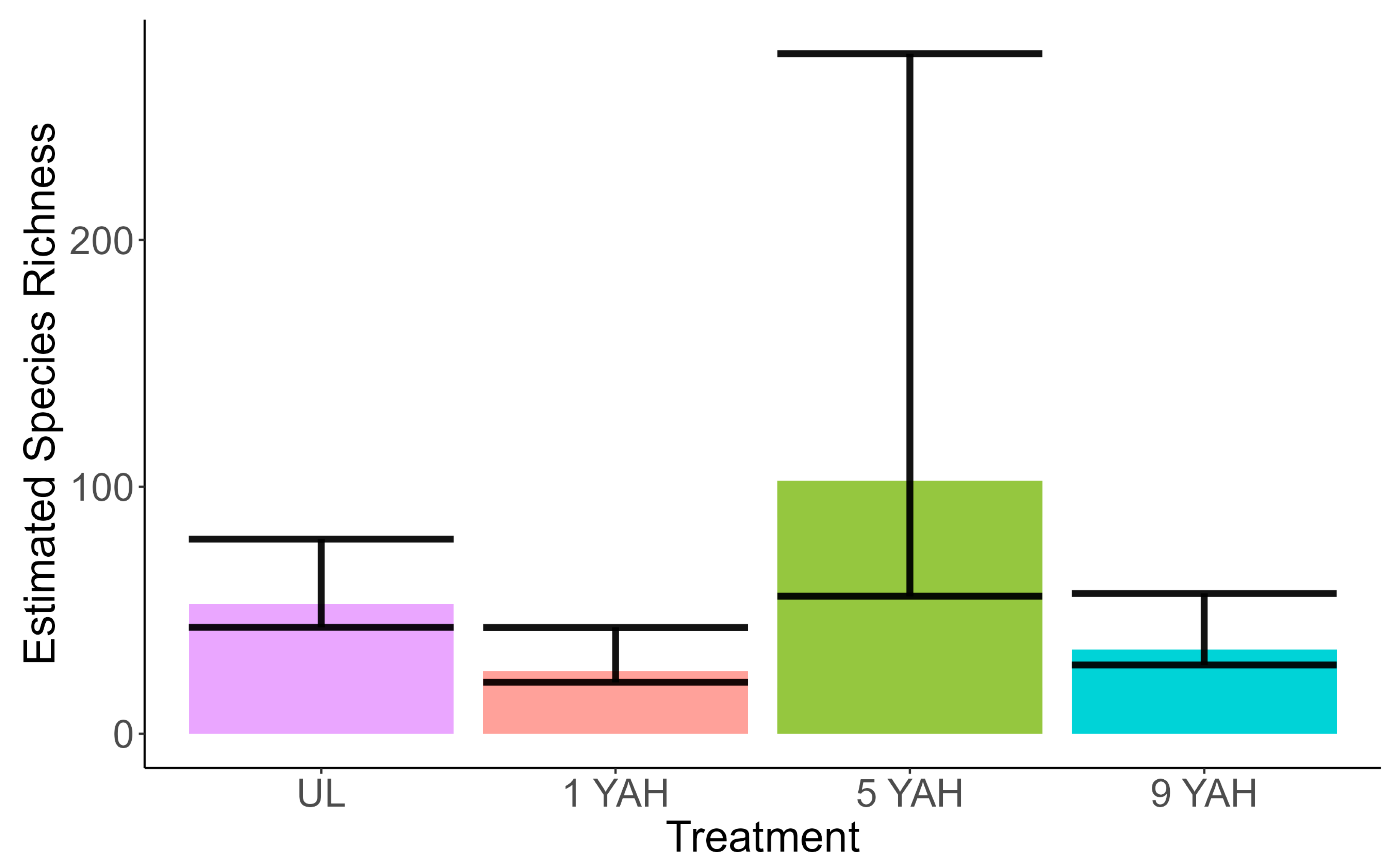
Average bird species richness in UL forest stands was estimated at ~52 species (95% CI: 43–79), whereas bird species richness estimated in forest stands ~1 YAH was less than half of this number, at ~25 species (95% CI: 21–43; Figure 2). By contrast, bird species richness in forest stands ~5 YAH plots was almost twice that of UL forest, with an estimated ~102 species (95% CI: 56–276; Figure 2). Lastly, forest stands ~9 YAH plots hosted an estimated ~34 species (95% CI: 28–57), approximately a third (35%) lower than species richness in UL plots (Figure 2). We found no evidence of statistically significant differences in capture probabilities among treatments (χ2; p > 0.05; 49).
Figure 2.
Average understory bird species richness estimates together with 95% confidence intervals (CIs; black vertical bars) in unlogged (UL) forest stands and forest stands ~1, ~5, and ~9 years after harvest (~1 YAH, ~5 YAH, and ~9 YAH) in Peru’s Allpahuayo-Mishana National Reserve.
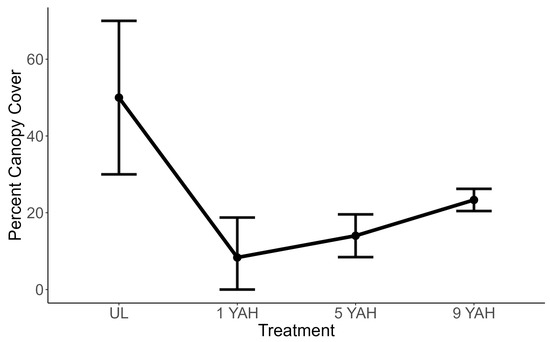
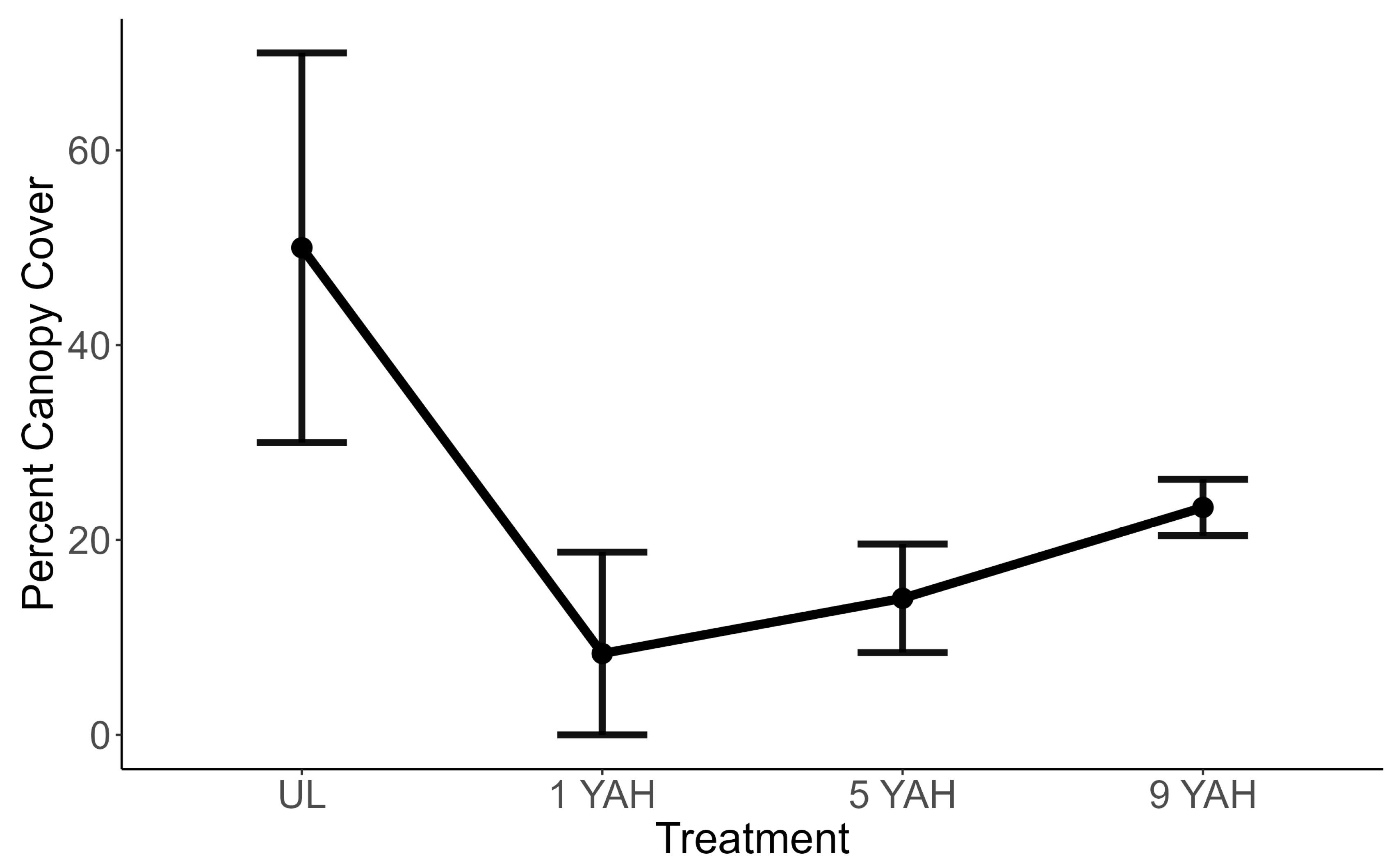
Canopy cover in logged forest was significantly lower than that in unlogged forest (F = 7.5, df = 2, p = 0.01; Figure 3). However, according to the PERMANOVA, changes in bird community composition (F = 0.65; p = 0.92; R2 = 0.2) and other habitat structure parameters (F = 0.999, p = 0.47, and R2 = 0.27) were not statistically significant. The GLMMs showed that all avian foraging guilds responded significantly to at least one or multiple of the forest structure characteristics we measured (Table 1, Figure 4).
Figure 3.
Average percent canopy cover estimates together with 95% confidence intervals (CIs; black vertical bars) in unlogged forest (UL) stands and forest stands ~1, ~5, and ~9 years after harvest (~1 YAH, ~5 YAH, and ~9 YAH) in Peru’s Allpahuayo-Mishana National Reserve.
Table 1.
Significant (p < 0.1) responses by avian foraging guilds to forest habitat structure variables, showing β coefficients and lower and upper 95% confidence intervals (CIs).
Figure 4.
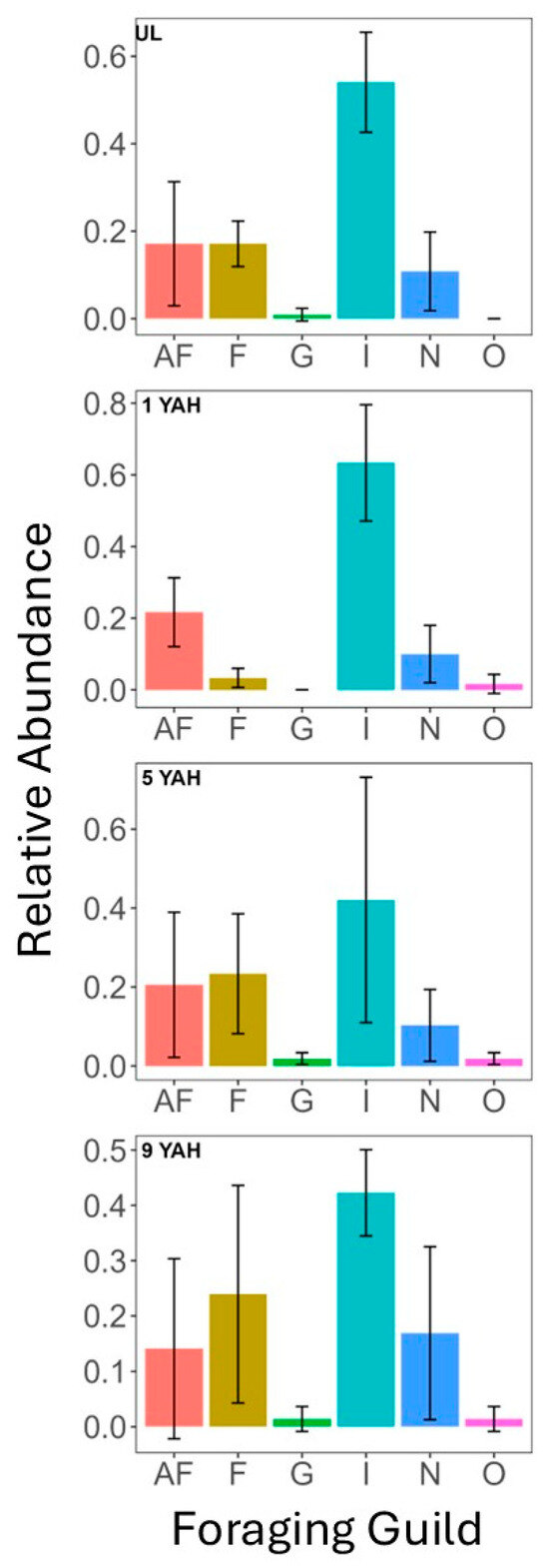
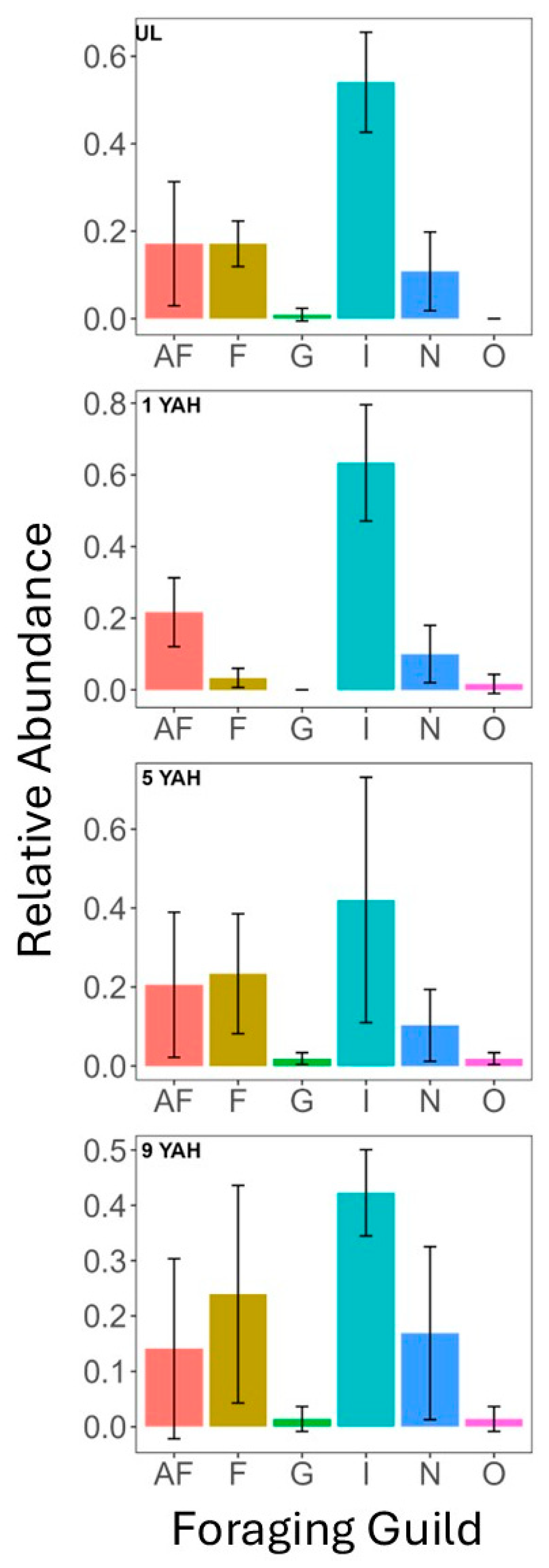
Relative abundance, showing 95% confidence intervals (black bars) of avian foraging guilds in unlogged (UL) forest stands and forest stands ~1, ~5, and ~9 years after harvest (~1 YAH, ~5 YAH, and ~9 YAH) in Peru’s Allpahuayo-Mishana National Reserve. Foraging guilds are designated as follows: ant follower (AF), frugivore (F), granivore (G), insectivore (I), nectarivore (N), and omnivore (O); y-axis scales differ in each panel.
Ant followers demonstrated a negative response to herbaceous ground cover and average tree diameter, and a positive response to leaf litter ground cover, subcanopy cover, and canopy cover. Frugivore abundance decreased with the number of trees and increased with average tree diameter. Granivores demonstrated a positive response to subcanopy cover. Insectivores demonstrated a positive response to canopy cover and a negative response to the number of trees. Nectarivores demonstrated a negative response to subcanopy cover and number of trees, and a positive response to average tree diameter. Frugivores demonstrated the greatest changes in relative abundance following logging, as they significantly declined following logging but increased over time with time since logging, a pattern also demonstrated by nectarivores (Figure 4). None of these foraging guilds showed any significant responses to our measures of soil cover and breast-height vegetation cover.
Finally, we compared relative bird abundance and bird foraging guilds using our capture data from 2005 and data collected at the same previously logged sites in 2023, after 18 years of logged forest regeneration (Figure 5). Site samples in both 2005 and 2023 included one unlogged site, two sites that had been logged 9 years previously in 2005 and by 2023 had been logged 27 years previously, and one site that had been logged 5 years previously in 2005 and by 2023 had been logged 23 years previously.
Figure 5.
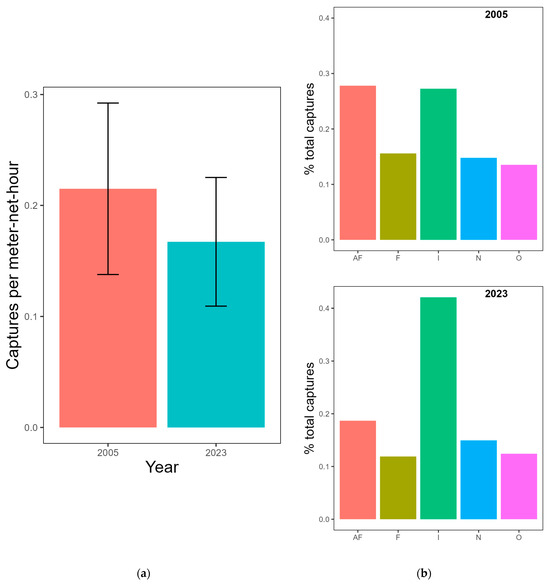
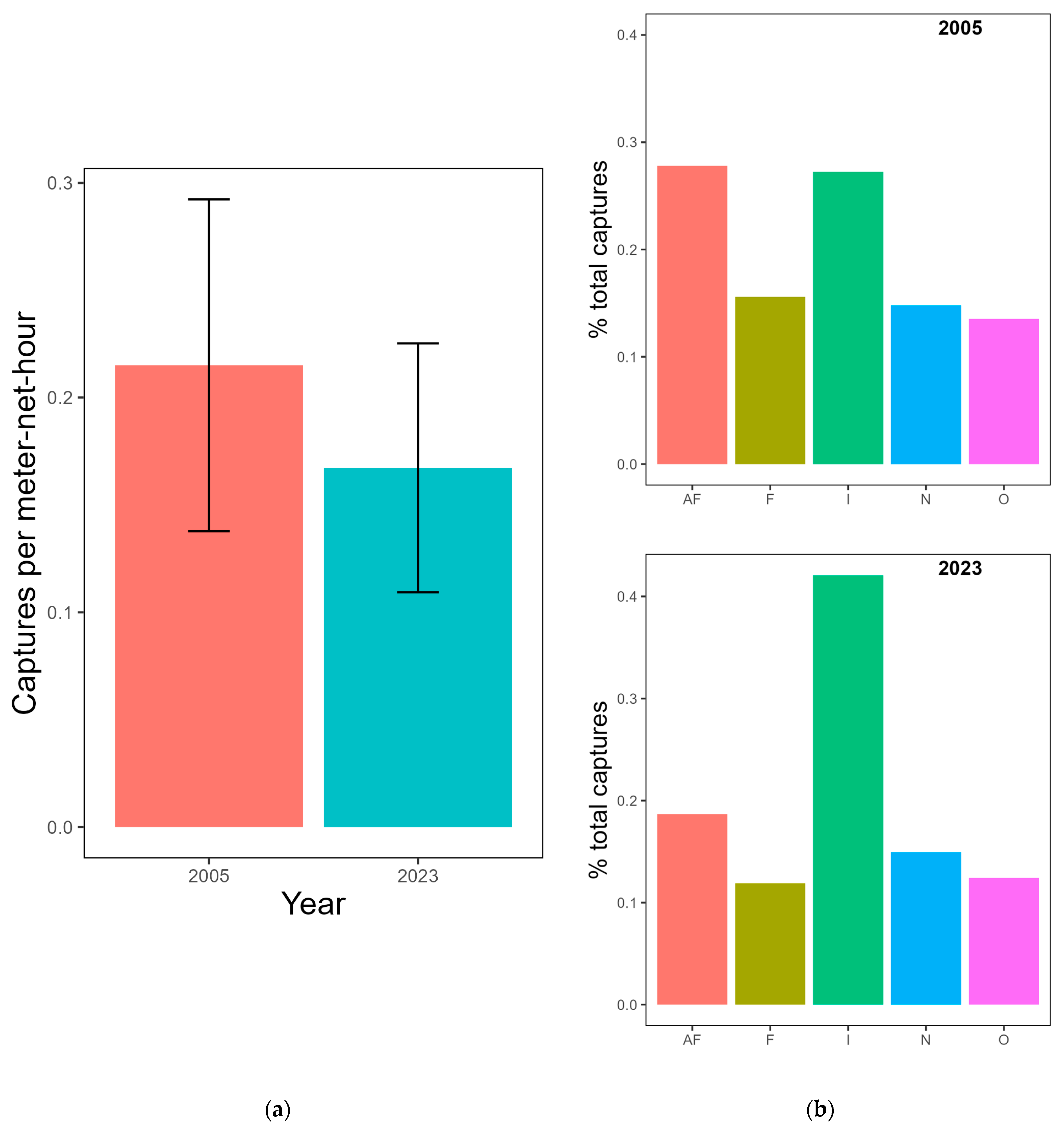
Relative bird abundance (with 95% confidence intervals [black bars]) and avian foraging guilds at four of the same forest sites in the Allpahuayo-Mishana National Reserve in 2005 compared to 2023, including: (a) captures per meter-net-hour; and (b) bird foraging guilds as a proportion of total captures. Foraging guilds are coded as follows: ant follower (AF), frugivore (F), insectivore (I), nectarivore (N), and omnivore (O).
Understory bird capture rates per meter-net-hour were lower in 2023 compared to 2005, although these differences were not statistically significant (ANOVA: F = 0.705, p = 0.433; Figure 5a). Relative numbers of ant followers were also lower in 2023 compared to 2005, while numbers of other insectivores increased over the same period, although these differences were also not statistically significant (PERMANOVA: p = 0.139; Figure 5b). In 2005, ant following specialist birds and other insectivores each made up ~27% of total captures, together accounting for more than half of all captures, whereas by 2023, the numbers of ant followers fell to ~18% of the total while numbers of other insectivores increased to ~43% of total captures (Figure 5b). The proportion of frugivores also decreased by 2023 compared to 2005, whereas other guilds appeared to remain relatively stable (Figure 5b).
Species represented by only one or two captures were classified as “rare” in the context of this study, and included 28 (~52%) of the total 54 species (Appendix A). Nine species (~17% of the total) were captured only in unlogged forest, while eight species (~15% of the total) were captured only in logged forest (Table 2); all 17 were among those classified as “rare” in this study. Birds captured only in unlogged forest (Table 2) may be among those most vulnerable to forest logging damage.
Table 2.
Bird species captured in only one white-sand forest treatment during mist net sampling in Peru’s Allpahuayo-Mishana Forest Reserve.
4. Discussion
4.1. White-Sand Forest Understory Bird Community Species Richness and Abundance
Our results show that past logging has had a significant influence on forest habitat structure and bird community responses in the AMNR, which persist for decades after logging events. Average bird species richness in UL white-sand forest was estimated at ~52 species, whereas in white-sand forest stands ~1 YAH, bird species richness was over 50% less (~25 species). However, in white-sand forest stands ~5 YAH, bird species richness was an estimated ~102 species, nearly twice that in unlogged forest and four times that in white-sand forest stands ~1 YAH. Bird species richness in white-sand forest stands ~9 YAH was estimated at ~34 species (~33% of unlogged forest). The time to the full recovery of logged forest to unlogged forest understory bird community or forest canopy is unknown, as the long-term effects of logging on white-sand forest bird communities will require further field data collection and analysis.
4.2. White-Sand Forest Structure and Understory Bird Communities
Birds captured only in unlogged white-sand forest stands may be among those most vulnerable to forest logging damage and may have life history characteristics that prevent them from persisting in logged forests, at least for the first 10 years after logging at the intensities examined in this study. Inferences that could be made from these data are limited, given the low sample size and the limited range of this study, but it is notable that most of the birds captured only in unlogged forests are interior forest specialists belonging to the typical antbird (Thamnophilidae) and ovenbird (Furnariidae) families. These findings are consistent with previous research on forest understory birds indicating that selective logging may lead to the loss of forest interior-specialist species diversity as logging intensity and its impacts on microclimate increase [75].
However, declines in understory bird species richness due to the loss of interior forest species from logged forests may be masked or offset by influxes of forest habitat generalist bird species into logged areas, which may result in increases rather than decreases in species richness, while forest specialist species decline or disappear [76]. In the AMNR, we expect that illegal logging impacts on birds in the forest stands we studied may have been mitigated by the larger primary forest landscape surrounding logged patches into which birds can seek refuge and the relatively low logging intensities [2,75,76,77]. Our estimates of forest damage caused by logging must be interpreted conservatively, as logged forest patches in this study were small and surrounded by unlogged forest. If larger stands of forest were logged, if logged forest patches were not surrounded by unlogged forest, and/or if a higher proportion of forest stands are logged over time, we would expect the extinction probabilities for birds associated with unlogged forest to further increase and species richness to further decrease.
This study focused on bird community responses to illegal logging in protected white-sand forests for the first 10 years after harvest, but we also took advantage of a rare opportunity to compare relative bird abundance and bird foraging guilds between 2005 and 2023. While this comparison did not reveal statistically significant differences, it highlights some salient trends we hope might be investigated in future studies. Understory bird relative abundance declined by ~20% over this 18-year period, which is consistent with general declines of birds around the world in other studies [78,79] and declines of tropical forest understory birds in particular [33].
Relative numbers of ant following specialists declined by approximately a third over this 18-year period, presumably in relation to decreased army ant activity. Using our findings from this study, we can speculate that these declines may have occurred in association with increased herbaceous ground cover and decreased leaf litter on the ground following post-logging succession. Over the same period, numbers of other insectivores increased by nearly two-thirds, a change possibility facilitated by increased canopy cover. Managing forest stands recovering from logging damage or previous conversion to agriculture in the AMNR by periodically reducing tree density and vegetation ground cover may improve their suitability as habitat for forest interior understory birds, including ant following specialists [35].
4.3. White-Sand Forest Understory Bird Foraging Guilds and Habitat Variables
Research conducted following this study explores links between bird community dynamics and foraging guild responses in relation to forest stands recovering from logging and conversion to agriculture, demonstrating that forest sites subjected to high levels of disturbance had fewer bird species, with ant following birds particularly underrepresented [35], as we found in the comparison between the 2005 and 2023 data. Ant followers demonstrated a negative response to herbaceous ground cover and average tree diameter, and a positive response to leaf litter ground cover, subcanopy cover, and canopy cover, structural traits that may facilitate army ant swarms [73]. Other insectivores increased with canopy cover, but paradoxically appeared to decrease with higher numbers of trees, possibly indicating a preference for more open forest under a closed canopy. Granivores increased with increasing subcanopy cover.
Our findings that both frugivore and nectarivore abundance increased in forest stands with lower numbers of trees are consistent with other tropical research showing higher captures of nectarivores and frugivores in logged forests, presumably as a consequence of post-logging resource blooms [77]. Nectarivores declined with increasing numbers of trees as well as higher subcanopy cover, and increased with average tree diameter, indicating a preference for forest habitat with larger trees. Higher subcanopy may be correlated with fewer flowering plants, while larger trees may be associated with more open subcanopies that allow more sunlight to reach the forest floor and stimulate more plant flowering that in turn provides more food resources for nectarivores. Low-intensity logging is associated with increased flowering and fruiting, supporting resources for frugivores, nectarivores, and generalist species foraging in logged forests [75,76].
Comparing avian foraging guilds in 2005 and 2023 showed a salient contrast to our findings on avian foraging guild changes in the first 10 years after logging compared to unlogged forests. While insectivores made up over ~50% of all captures in unlogged forests, this proportion increased to ~60% in white-sand forest stands ~1 YAH, and then dropped to ~40% in white-sand forest stands ~5 and ~9 YAH. Likewise, ant follower abundance increased in forest stands ~1 and ~5 YAH and declined in forest stands ~9 YAH. Eighteen years later, the proportion of ant followers had declined by a third (33%), from 27% to 18% of total captures, where the proportion of other insectivores in 2023 had increased by nearly two-thirds (64%) compared to 2005, from 27% to 42% of total captures.
How the impacts of logging on particular taxa over time in different habitats are difficult to predict without empirical evidence [18], underlining the importance of ongoing and future research to inform adaptive management and conservation action. These findings suggest that while many insectivorous birds may abundance in white-sand forest stands recovering from logging for decades after logging operations, ant followers may exhibit long-term declines after an initial but temporary increase in abundance white-forest stands that for between five to eight years following logging events. Future studies will ideally examine the mechanisms that could explain such trends and whether these patterns resemble those in other white-sand forests and other tropical forest systems.
4.4. Conservation Implications and Management Recommendations
Continuing illegal activities in white-sand forests may pose threats to birds and other biodiversity in the AMNR, particularly as white-sand forests and associated biodiversity may not be able to fully regenerate following logging, due to the extremely nutrient-poor soils characteristic of white-sand forests [15,80,81]. Weak or absent law enforcement means that despite their protected status in the AMNR, white-sand forests continue to be mined for sand, logged, burned, and cleared for agriculture, and exhibit extremely slow recovery after disturbance [81]. In general, forests on sandy soils recover very slowly after logging operations, and ecosystem dynamics such as soil processes may already be influenced at lower soil compaction levels than those of forests on other soil types [82]. While a growing number of studies are investigating white-sand forest ecology, biodiversity, and responses to human impacts [83], few data have been available on white-sand forest wildlife dynamics in response to logging impacts until now.
The establishment of the AMNR as a protected area has likely helped mitigate deforestation in this part of western Amazonia [14]. However, protected areas vary considerably in the actual protection they provide for biodiversity; effective protection is correlated with the number of paid staff, which may be few or absent in many situations [84,85]. Our findings suggest that concrete conservation actions should include prioritizing law enforcement as part of land-use planning and protected area management. Effective protection of forests in many tropical countries is hindered by corruption and a tendency to prioritize short-term economic gains over conservation [86]. Because governance of protected areas in tropical countries has a high tendency to suffer neglect and/or corruption, conservation within reserves is constantly under threat [41,85,86,87,88,89]. The AMNR is no exception to such threats (e.g., illegal logging, immigration, and exploration).
As a case in point, we found that in Nueva Esperanza, the majority of residents had illegally immigrated within the past several years, well after the area received protected status that legally prohibited most immigration, and that many of these residents were poaching wildlife. Few of these new immigrants demonstrated knowledge of biodiversity or interest in conservation, and many reported that they expected financial help from the reserve administration as a result of their perceived status as residents inside the reserve. The AMNR has provided communities that had been established prior to its designation as a protected area with goods and services to compensate for the loss of livelihoods associated with the strict regulations surrounding resource use in the reserve, but such compensation is denied to new settlers. Nevertheless, illegal settlers demand government provisions and place increasing pressure on resources inside the reserve. Illegal settlements and wildlife poaching pose additional ongoing threats to biodiversity in the AMNR. Indeed, during both our fieldwork periods in 2005 and 2023, we observed evidence of recent illegal logging in the vicinity of Nueva Esperanza.
The effective protection of the AMNR will require more substantive law enforcement than has been provided in the past, including urgent actions to reduce such illegal activities. Oates [39] noted that without organized law enforcement, protected areas may be reduced to “paper parks” that do not adequately protect biodiversity from human impacts. Ferraro et al. [90] showed that an official designation of protected status (e.g., the US Endangered Species Act) was not effective for conservation without substantial funding. Illegal logging drives deforestation and biodiversity loss [33], government revenue losses of billions of dollars, and fosters a vicious cycle in which corrupt individuals gain power and continue increasing their profits through illicit means [83]. However, illegal logging also provides economic and financial benefits to certain groups through converting land to alternative uses such as grazing or agriculture, and may provide benefits to those involved, including the poor and unemployed, as well as networks that run illegal logging operations and that profit from these activities [33,91].
Illegal logging affects forests and wildlife around the world [33]. In Peru, illegal logging is recognized as destroying natural populations of valuable timber trees and negatively affecting indigenous communities but as persisting nevertheless because it is condoned and supported by a corruption [92]. Unfortunately, Peru is subject to one of the world’s highest rates of deforestation, ranking fifth in the world and third in the Americas in tropical rainforest loss; in 2020, approximately 190,000 ha were deforested in Peru, one of the highest annual totals on record [93]. Despite efforts to mitigate it, illegal logging continues to plague Peru [94]. Recent research demonstrated that Peru’s legal logging concession system has enabled widespread illegal logging, with major violations in over two-thirds of logging concessions [94]. Moreover, permits associated with legal concessions are used to harvest trees in unauthorized areas, thus threatening all forested areas and highlighting the need for additional reforms [94,95].
Quantifying and comparing managed areas with each other or the same areas at different times, as we have done in the AMNR, is a recognized strategy to improve management effectiveness in protected areas [96]. Such findings can be used to identify problems and prioritize management actions [96]. For example, the Amazon Protected Areas Program launched by the Brazilian government in 2002 supports 59.2 million ha of protected areas, making it the largest single biodiversity conservation program on earth; however, its success faces challenges, including a lack of human capacity and bureaucratic and financial hurdles [97]. Although local community development can contribute to the effective management and conservation of protected areas [97], community development can also be at odds with biodiversity conservation in areas where people overexploit natural resources.
In the case of the AMNR, there are multiple communities inside the protected area that were established before the area’s designation as a protected area [98]. In the 1980s, the government of Peru initiated efforts to encourage human settlement in this region and the conversion of area forests to agricultural land; however, these efforts were subsequently halted after the discovery of new bird species that resulted in the designation of the AMNR in 2004 [35]. At this point, original residents were permitted to remain, but additional immigration was prohibited. Existing communities in the reserve were allowed to log for subsistence, but not for commercial purposes [49]. Unfortunately, however, illegal logging has persisted in the reserve, for example near the settlement of Nueva Esperanza, as we observed during fieldwork in 2005 and 2023.
Like many other tropical forest countries, Peru has a history of governance failures in the forestry sector, which have promoted norms that undermine sustainable forest management, including ineffective law enforcement that enables violations of government laws [95]. In 2005, the illegal logging we observed appeared to be related to harvesting timber for house construction, and we were approached by residents of Nueva Esperanza who offered to sell us land and wildlife in the reserve; we also spoke with the owner of a property in Nueva Esperanza who had purchased it for use as a hunting retreat; all of these activities were legally prohibited, but the relevant laws were not enforced. Eighteen years later, in 2023, we observed evidence of illegal logging on a larger scale than we observed in 2005, including the recent destruction of at least 50 large trees in the vicinity of a recently established ayahuasca tourism facility near Nueva Esperanza [99,100]. Despite the prohibition on immigration and commercial activities in the reserve, entrepreneurs from other areas of Peru and abroad have developed multiple commercial tourist operations inside the reserve that charge tourists US$140–$300/night [99,100,101,102,103].
Particularly prevalent are commercial enterprises related to the recent, ongoing boom in ayahuasca tourism in the Peruvian Amazon [99,100,101,102,104,105]. The legal status of some such operations inside the reserve appears questionable, and their operations are clearly associated with illegal logging and deforestation for the benefit of private parties, to the detriment of biodiversity conservation in the reserve. A list of authorized tour operators offered on the government’s website for the reserve was not available [106]. On the other hand, in 2012, conservation groups, including ProNaturaleza in collaboration with American Bird Conservancy, organized the purchase of more than 959 ha of private land within the AMNR [107]. This land was, in turn, donated to the Peruvian government agency in charge of managing the reserve, in an effort to mitigate illegal logging, charcoal production, and land clearance for agriculture and to protect the habitat for its threatened wildlife [107]. While this action is a major step forward for conservation in the AMNR, mitigating threats to its wildlife due to illegal activities will require substantial improvements in governance [95], and specifically in law enforcement, park management, and community engagement.
Our findings provide a working example of illegal logging impacts on birds and forest structure in a tropical protected area and also demonstrate the lasting effects logging practices may have on tropical forest understory birds, even when logged forest stands are surrounded by large tracts of unlogged forest. We hope that ongoing and future research in the AMNR will continue to investigate ecological questions associated with understory birds, forest structure, and human impacts in white-sand forests in the AMNR and elsewhere, and that findings will be used to inform park management and improve conservation effectiveness. Protected areas such as the AMNR require substantial investments as well as ongoing monitoring and adaptive management in order to fulfill their goals to protect biodiversity. Additional funding, skilled personnel, and improved infrastructure will be necessary for the successful engagement of communities within the AMNR in biodiversity conservation and for the effective enforcement of laws designed to mitigate negative human impacts on the biodiversity the reserve was designed to protect.
Author Contributions
Conceptualization, N.A.; data curation, N.A.; formal analysis, A.G.; methodology, N.A. and J.S.I.; software, A.G.; visualization, A.G.; investigation, N.A., A.G., J.S.I., and R.J.C.; writing—original draft, N.A.; funding acquisition, N.A. and R.J.C.; supervision, N.A. and R.J.C.; writing—review and editing, N.A. and A.G. All authors have read and agreed to the published version of the manuscript.
Funding
We are grateful for financial support from research grants and fellowships from the Tinker Foundation (2003), the Georgia Ornithological Society (2004, 2005), the Warnell School of Forestry and Natural Resources (2004–2007), the Graduate School at the University of Georgia (2007–2008), and. Donors to the International Bird Conservation Partnership provided funding during the final preparation of this manuscript.
Data Availability Statement
Data presented in this study are available upon request from the corresponding author.
Acknowledgments
Joel Holzman, Alimber Amasifuen, and Eneas Pérez Walter provided crucial field assistance, and N.A. also Oscar Beingolea, José Álvarez Alonso, M. Vásquez, Juan Díaz Alván, Fernando Angulo, and Flor and Jaso Angulo for their help and support in Peru. We thank the Peruvian government for permission to conduct research, especially Jessica Espinoza and Manuel Vásquez of El Servicio Nacional de Áreas Naturales Protegidas por el Estado (SERNANP). We thank the park guards at km 28, including Juan Carlos, Neisser Pinedo, and Alfredo Canaquiri, for their hospitality and assistance. We thank Helena Paredes Muñoz and family for hosting us during our fieldwork in Nueva Esperanza, and all the residents of Nueva Esperanza who facilitated and assisted our research. We thank Zenaida Suarez Taipe of SERNANP for investigating and dealing with incidences of illegal logging reported in Allpahuayo-Mishana National Reserve. NA thanks Alaaeldin Soultan for creating the map, and Brady Mattsson, Michael J. Conroy, Jim Hines, Kirk Stodola, Scott Rush, and Madison O. Sutton for help with statistical analyses on previous versions of this manuscript. We are grateful to Tom Schulenberg and John P. O’Neill for assistance with bird species identification, and Dan Brooks, John Carroll, and Kathy Parker for guidance during her doctoral studies, from which this project emerged. Ruthe J. Smith edited the manuscript, and Ola Svensson provided support throughout the production of this manuscript. We are also very grateful to two anonymous reviewers and the academic editor, whose comments allowed us to substantially improve this manuscript. We dedicate this manuscript to the wonderful avian conservation community and protected area staff in Peru in recognition of their efforts to protect their magnificent avifauna, and in loving memory of la Bióloga, our extraordinary friend and faithful defender of the Allpahuayo-Mishana National Reserve, who dedicated her life to service.
Conflicts of Interest
The authors declare no conflicts of interest.
Abbreviations
The following abbreviations are used in this manuscript:
| AMNR | Allpahuayo-Mishana National Reserve |
| YAH | Years after harvest |
| CI | Confidence interval |
| LCI | Lower confidence interval |
| UCI | Upper confidence interval |
Appendix A
Table A1.
Bird species (n = 54) and guilds [35] captured during mist net sampling for this study in white-sand forests in Peru’s Allpahuayo-Mishana National Reserve. Taxonomy follows that of the South American Classification Committee [108]. * Foraging guilds indicate primary food resources for birds, as follows: ant follower (AF), frugivore (F), granivore (G), insectivore (I), nectarivore (N), and omnivore (O). ** Ten species were represented by >10 individual captures.
References
- FAO. Global Forest Resources Assessment 2010: Main Report; FAO: Rome, Italy, 2010; Available online: https://www.fao.org/3/i1757e/i1757e00.htm (accessed on 1 February 2023).
- Arcilla, N.; Strazds, M. Ten Principles for Bird-Friendly Forestry: Conservation Approaches in Natural Forests Used for Timber Production. Birds 2023, 4, 245–261. [Google Scholar] [CrossRef] [Scilit]
- Myers, N. The Primary Source: Tropical Forests and Our Future; W. W. Norton: New York, NY, USA, 1992. [Google Scholar]
- Mason, D.J.; Thiollay, J. Tropical forestry and the conservation of Neotropical birds. In The Cutting Edge: Conserving Wildlife in Logged Tropical Forest; Fimbel, R.A., Grajal, A., Robinson, J.G., Eds.; Columbia University Press: New York, NY, USA, 2001; pp. 167–176. [Google Scholar]
- Barlow, J.; Peres, C.A.; Henriques, L.M.P.; Stouffer, P.C.; Wunderle, J.M. The responses of understorey birds to forest fragmentation, logging and wildfires: An Amazonian synthesis. Biol. Conserv. 2006, 128, 182–192. [Google Scholar] [CrossRef] [Scilit]
- Gutierrez-Velez, V.H.; MacDicken, K. Quantifying the direct social and governmental costs of illegal logging in the Bolivian, Brazilian, and Peruvian Amazon. For. Policy Econ. 2008, 10, 248–256. [Google Scholar] [CrossRef] [Scilit]
- Curran, L.M.; Trigg, S.N.; McDonald, A.K.; Astiani, D.; Hardiono, Y.M.; Siregar, P.; Caniao, I. Lowland forest loss in protected areas of Indonesian Borneo. Science 2004, 303, 1000–1003. [Google Scholar] [CrossRef] [Scilit]
- Laurance, W.F. A crisis in the making: Responses of Amazonian forests to land use and climate change. Trends Ecol. Evol. 1998, 13, 411–415. [Google Scholar] [CrossRef] [Scilit] [PubMed]
- Shany, N.; Díaz Alván, J.; Álvarez Alonso, J. Finding white-sand forest specialists in Allpahuayo-Mishana Reserve, Peru. Neotrop. Bird. 2007, 2, 60–68. [Google Scholar]
- Schulenberg, T.S.; Stotz, D.F.; Lane, D.F.; O’Neill, J.P.; Parker, T.A., III. Birds of Peru; Princeton University Press: Princeton, NJ, USA, 2007. [Google Scholar]
- Ungvari, J.; Heckscher, C.; Hobson, K. Inter-annual site fidelity and breeding origins of Gray-cheeked Thrushes in white sand forests of the Peruvian Amazon. J. Field Ornithol. 2016, 87, 55–64. [Google Scholar] [CrossRef] [Scilit]
- Álvarez Alonso, J. Characteristic Avifauna of White-Sand Forests in Northern Peruvian Amazonia. Master’s Thesis, Louisiana State University, Baton Rouge, LA, USA, 2002. Available online: https://repository.lsu.edu/cgi/viewcontent.cgi?article=3775&context=gradschool_theses (accessed on 1 February 2026).
- Álvarez Alonso, J.; Whitney, B.M. New distributional records of birds from white-sand forests of the northern Peruvian Amazon, with implications for biogeography of northern South America. Ornithol. Appl. 2003, 105, 552–566. [Google Scholar] [CrossRef]
- Juvonen, S.K.; Álvarez Alonso, J. Allpahuayo-Mishana Reserved Zone: What it takes to make a protected area function in the Peruvian Amazonia? Lyonia 2003, 4, 133–138. [Google Scholar]
- Whitney, B.M.; Álvarez Alonso, J. A new species of gnatcatcher from white-sand forests of northern Amazonian Peru with revision of the Polioptila guianensis complex. Wilson Bull. 2005, 117, 113–127. [Google Scholar] [CrossRef] [Scilit] [PubMed]
- Wilkie, D.S.; Sidle, J.G.; Boundzanga, G.C.; Auzel, P.; Blake, S. Defaunation, not deforestation: Commercial logging and market hunting in northern Congo. In The Cutting Edge: Conserving Wildlife in Logged Tropical Forest; Fimbel, R.A., Grajal, A., Robinson, J.G., Eds.; Columbia University Press: New York, NY, USA, 2001; pp. 375–400. [Google Scholar]
- Whitman, A.A.; Hagan, J.M., III; Brokaw, N.V.L. Effects of selection logging on birds in northern Belize. Biotropica 1998, 30, 449–457. [Google Scholar] [CrossRef] [Scilit]
- White, L.J.T.; Tutin, C.E.G. Why chimpanzees gorillas respond differently to logging: Acautionary tale from Gabon. In African Rain Forest Ecology Conservation: An Interdisciplinary Perspective; Weber, W., White, L.J.T., Vedder, A., Naughton-Treves, L., Eds.; Yale University Press: New Haven, CT, USA, 2001; pp. 449–462. [Google Scholar]
- Furness, R.W.; Greenwood, J.D. Birds as Monitors of Environmental Change; Chapman and Hall: New York, NY, USA, 1993. [Google Scholar]
- Wong, M. Understory birds as indicators of regeneration in a patch of selectively logged west Malaysian rainforest. In Conservation of Tropical Forest Birds; Diamond, A.W., Lovejoy, T.E., Eds.; Technical Publication 4; ICBP: Cambridge, UK, 1985; pp. 249–263. [Google Scholar]
- Politi, N.; Hunter, M.; Rivera, L. Assessing the effects of selective logging on birds in Neotropical piedmont and cloud montane forests. Biodivers. Conserv. 2012, 21, 3131–3155. [Google Scholar] [CrossRef] [Scilit]
- Kelly, J.F.; Pletschet, S.M.; David, M.; Leslie, D.M., Jr. Habitat associations of Red-cockaded Woodpecker cavity trees in an old-growth forest of Oklahoma. J. Wildl. Manag. 1993, 57, 122–128. [Google Scholar] [CrossRef] [Scilit]
- Troy, J.R.; Jones, C.D. The ongoing narrative of Ivory-billed Woodpecker rediscovery and support for declaring the species extinct. Ibis 2023, 165, 340–351. [Google Scholar] [CrossRef] [Scilit]
- Angelstam, P.; Roberge, J.-M.; Lõhmus, A.; Bergmanis, M.; Brazaitis, G.; Dönz-Breuss, M.; Edenius, L.; Kosinski, Z.; Kurlavicius, P.; Lârmanis, V.; et al. Habitat modelling as a tool for landscape-scale conservation—A review of parameters for focal forest birds. Ecol. Bull. 2004, 51, 427–453. Available online: https://www.jstor.org/stable/20113327 (accessed on 6 February 2026).
- Moser, B.; Garton, E. Short-Term Effects of Timber Harvest and Weather on Northern Goshawk Reproduction in Northern Idaho. J. Raptor Res. 2009, 43, 1–10. [Google Scholar] [CrossRef] [Scilit]
- Sallabanks, R.; Arnett, E.B.; Marzluff, J.M. An evaluation of research on the effects of timber harvest on bird populations. Wildl. Soc. Bull. 2000, 28, 1144–1155. [Google Scholar]
- Imbeau, L.; Mönkkönen, M.; Desrochers, A. Long-term effects of forestry on birds of the eastern Canadian boreal forests: A comparison with Fennoscandia. Conserv. Biol. 2001, 15, 1151–1162. [Google Scholar] [CrossRef] [Scilit]
- Martin, J.-L.; Drapeau, P.; Fahrig, L.; Lindsay, K.F.; Kirk, D.A.; Smith, A.C.; Villard, M.-A. Birds in cultural landscapes: Actual and perceived differences between northeastern North America and western Europe. In Birds and Habitat Relationships in Changing Landscapes; Fuller, R.J., Ed.; Cambridge University Press: Cambridge, UK, 2012; pp. 481–515. Available online: https://www.cambridge.org/core/books/abs/birds-and-habitat/birds-in-cultural-landscapes-actual-and-perceived-differences-between-northeastern-north-america-and-western-europe/A894235FF75CDE222618D1A5728830B9 (accessed on 6 February 2026).
- Betts, M.G.; Wolf, C.; Ripple, W.J.; Phalan, B.; Millers, K.A.; Duarte, A.; Butchart, S.H.M.; Levi, T. Global forest loss disproportionately erodes biodiversity in intact landscapes. Nature 2017, 547, 441–444. [Google Scholar] [CrossRef] [Scilit]
- Lehikoinen, A.; Virkkala, R. Population trends and conservation status of forest birds. In Ecology and Conservation of Forest Birds; Mikusiński, G., Roberge, J.-M., Fuller, R.J., Eds.; Cambridge University Press: Cambridge, UK, 2018; pp. 390–426. [Google Scholar]
- Guilherme, E.; Cintra, R. Effects of intensity and age of selective logging and tree girdling on an understory bird community composition in Central Amazonia. Ecotropica 2001, 7, 77–92. [Google Scholar]
- Plumptre, A.J.; Dranzoa, C.; Owiunji, I. Bird communities in logged and unlogged African forests: Lessons from Uganda and beyond. In The Cutting Edge: Conserving Wildlife in Logged Tropical Forest; Fimbel, R.A., Grajal, A., Robinson, J.G., Eds.; Columbia University Press: New York, NY, USA, 2001; pp. 213–238. [Google Scholar]
- Arcilla, N.; Holbech, L.H.; O’Donnell, S. Severe declines of forest understory birds follow illegal logging in Ghana, West Africa. Biol. Conserv. 2015, 188, 41–49. [Google Scholar] [CrossRef] [Scilit]
- Holbech, L.H.; Annorbah, N.N.D.; Phalan, B.; Arcilla, N. Uncontrolled hunting and habitat degradation decimate and extirpate forest hornbills in Ghana, West Africa. Biol. Conserv. 2018, 223, 104–111. [Google Scholar] [CrossRef] [Scilit]
- Glass, A.; Arcilla, N. The Effects of Disturbance Intensity on Tropical Forest Bird Communities and Vegetation Structure after Two Decades of Recovery. Birds 2024, 5, 388–403. [Google Scholar] [CrossRef] [Scilit]
- Delprete, P. Flórula de las Reservas Biológicas de Iquitos, Perú. Brittonia 1999, 51, 113. [Google Scholar] [CrossRef] [Scilit]
- Vásquez, M.; Servicio Nacional de Áreas Naturales Protegidas por el Estado [SERNANP], Iquitos, Loreto, Peru. Personal communication, 2005.
- Salafsky, N.; Relton, C.; Young, B.E.; Lamarre, P.; Böhm, M.; Chénier, M.; Cochrane, E.; Dionne, M.; He, K.K.; Hilton-Taylor, C.; et al. Classification of direct threats to the conservation of ecosystems and species 4.0. Conserv. Biol. 2025, 39, e14434. [Google Scholar] [CrossRef] [Scilit]
- Oates, J. Myth and Reality in the Rain Forest: How Conservation Strategies are Failing in West Africa; University of California Press: Berkeley, CA, USA, 1999. [Google Scholar]
- Wittemyer, G.; Elsen, P.; Bean, W.T.; Coleman, A.; Burton, O.; Brashares, J.S. Accelerated human population growth at protected area edges. Science 2008, 321, 123–126. [Google Scholar] [CrossRef] [Scilit]
- Kaboumba, L.-E.M.; Di Lecce, I.; Afiademanyo, K.M.; Kourdjouak, Y.; Arcilla, N. Assessing Threats to Fazao-Malfakassa National Park, Togo, Using Birds as Indicators of Biodiversity Conservation. Land 2025, 14, 225. [Google Scholar] [CrossRef] [Scilit]
- Díaz Alván, J.; Instituto de Investigaciones de la Amazonía Peruana [IIAP], Iquitos, Loreto, Peru. Personal communication, 2005.
- Ralph, C.J.; Dunn, E.H.; Peach, W.J.; Handel, C.M. Recommendations for the use of mist nets for inventory monitoring of bird populations. In Monitoring Bird Populations Using Mist Nets; Ralph, C.J., Dunn, E.H., Eds.; Studies in Avian Biology; Cooper Ornith. Soc.: Camarillo, CA, USA, 2004; Volume 29, pp. 187–196. [Google Scholar]
- Ralph, C.J. (Department of Biological Sciences, Humboldt State University, Arcata, California, USA). Personal communication, 2004.
- Karr, J.R. Geographical variation in the avifaunas of tropical forest undergrowth. Auk 1980, 97, 283–298. Available online: https://digitalcommons.usf.edu/auk/vol97/iss2/7 (accessed on 6 February 2026).
- Karr, J.R. Surveying birds with mist nets. Stud. Avian Biol. 1981, 6, 62–76. [Google Scholar]
- Sutherland, W.J. (Ed.) Ecological Census Techniques: A Handbook; Cambridge University Press: Cambridge, UK, 2006. [Google Scholar]
- Remsen, J.V., Jr.; Good, D.A. Misuse of data from mist-net captures to assess relative abundance in bird populations. Auk 1996, 113, 381–398. [Google Scholar] [CrossRef] [Scilit]
- Dauphiné, N.S. Bird Ecology, Conservation, and Community Responses to Logging in the Northern Peruvian Amazon. Ph.D. Thesis, University of Georgia, Athens, GA, USA, 2008. Available online: https://openscholar.uga.edu/record/11378?v=pdf (accessed on 6 February 2026).
- Boulinier, T.; Nichols, J.D.; Sauer, J.R.; Hines, E.; Pollock, K.H. Estimating species richness: The importance of heterogeneity in species detectability. Ecology 1998, 79, 1018–1028. [Google Scholar] [CrossRef]
- Williams, B.K.; Nichols, J.D.; Conroy, M.J. Analysis and Management of Animal Populations: Modeling, Estimation, and Decision Making; Academic Press: San Diego, CA, USA, 2002; 817p. [Google Scholar]
- Terborgh, J.; Weske, J.S. Colonization of secondary habitats by Peruvian birds. Ecology 1969, 50, 765–782. [Google Scholar] [CrossRef] [Scilit]
- Mason, D.J. Responses of Venezuelan understory birds to selective logging, enrichment strips, and vine cutting. Biotropica 1996, 28, 296–309. [Google Scholar] [CrossRef] [Scilit]
- Bibby, C.J.; Burgess, N.D.; Hill, D.A.; Mustoe, S.H. Bird Census Techniques, 2nd ed.; Academic Press: London, UK, 2000; p. 302. [Google Scholar]
- James, F.C.; Shugart, H.H. A quantitative method of habitat description. Audubon Field Notes 1970, 24, 727–735. [Google Scholar]
- Burnham, K.P.; Overton, W.S. Estimation of the size of a closed population when capture probabilities vary among animals. Biometrika 1978, 65, 625–633. [Google Scholar] [CrossRef]
- Burnham, K.P.; Overton, W.S. Robust estimation of population size when capture probabilities vary among animals. Ecology 1979, 62, 927–936. [Google Scholar] [CrossRef] [Scilit]
- Castaño-Villa, G.J.; Santisteban-Arenas, R.; Hoyos-Jaramillo, A.; Estévez-Varón, J.V.; Fontúrbel, F.E. Foraging behavioural traits of tropical insectivorous birds lead to dissimilar communities in contrasting forest habitats. Wildl. Biol. 2019, 1, 1–6. [Google Scholar] [CrossRef] [Scilit]
- Roels, S.M.; Hannay, M.B.; Lindell, C.A. Recovery of bird activity and species richness in an early-stage tropical forest restoration. Avian Conserv. Ecol. 2019, 14, 9. [Google Scholar] [CrossRef] [Scilit]
- Paradis, E. Package ‘ape:’ Analyses of Phylogenetics and Evolution in R. Version 5.8-1. 2024. Available online: https://cran.r-project.org/web/packages/ape/ape.pdf (accessed on 9 February 2026).
- Chao, A.; Ma, K.H.; Hsieh, T.C.; Chiu, C.-H. Package ‘SpadeR:’ Species-Richness Prediction and Diversity Estimation with R. Version 0.1.1. 2016. Available online: https://cran.r-project.org/web/packages/SpadeR/SpadeR.pdf (accessed on 9 February 2026).
- Hartig, F. Package ‘DHARMa:’ Residual Diagnostics for Hierarchical (multi-level/mixed) Regression Models R Package. 2017. Available online: https://cran.r-project.org/web/packages/DHARMa/vignettes/DHARMa.html (accessed on 9 February 2026).
- Khan, N.M.; Baldi, I.; Chiaruttini, M.V.; Gregori, D. Residuals and Overdispersion in Generalized Linear Models. In Classical and Bayesian Statistical Approaches in Infectious Disease Data Analysis; Springer Nature: Cham, Switzerland, 2025; pp. 169–190. Available online: https://link.springer.com/chapter/10.1007/978-3-032-06747-0_6 (accessed on 9 February 2026).
- Schielzeth, H.; Dingemanse, N.J.; Nakagawa, S.; Westneat, D.F.; Allegue, H.; Teplitsky, C.; Reale, D.; Dochtermann, N.A.; Garamzegi, L.Z.; Araya-Ajoy, Y.G. Robustness of linear mixed-effects models to violations of distributional assumptions. Methods Ecol. Evolut. 2020, 11, 1141–1152. [Google Scholar] [CrossRef] [Scilit]
- Sierdsema, H.; van Loon, E. Filling the gaps: Using count survey data to predict bird density distribution patterns and estimate population sizes. Rev. Catalana D’ornitologia 2008, 24, 88–99. [Google Scholar]
- Gower, J.C. Some distance properties of latent root and vector methods used in multivariate analysis. Biometrika 1966, 53, 325–338. [Google Scholar] [CrossRef] [Scilit]
- Anderson, D.R. Model Based Inference in the Life Sciences: A Primer on Evidence; Springer Nature: Cham, Switzerland, 2008. [Google Scholar]
- Burnham, K.P.; Anderson, D.R. Model Selection and Inference: A Practical Information-Theoretic Approach; Springer Science + Business Media: New York, NY, USA, 2013; 488p. [Google Scholar]
- Dent, D.H.; Wright, S.J. The future of tropical species in secondary forests: A quantitative review. Biol. Conserv. 2009, 142, 2833–2843. [Google Scholar] [CrossRef] [Scilit]
- Billerman, S.M.; Keeney, B.K.; Kirwan, G.M.; Medrano, F.; Sly, N.D.; Smith, M.G. (Eds.) Birds of the World; Cornell Laboratory of Ornithology: Ithaca, NY, USA, 2026. [Google Scholar] [CrossRef] [Scilit]
- Gray, M.A.; Baldauf, S.L.; Mayhew, P.J.; Hill, J.K. The response of avian feeding guilds to tropical forest disturbance. Conserv. Biol. 2007, 21, 133–141. [Google Scholar] [CrossRef] [Scilit]
- Wang, Y.; Liu, J.; Gao, S.; Tong, S.; Wang, Z.; Li, N. Foraging Guilds of Birds in Continuous and Fragmented Forests of Southeast China. Forests 2025, 16, 861. [Google Scholar] [CrossRef] [Scilit]
- E Martínez, A.; Pollock, H.S.; Rodrigues, P.F.; Touchton, J.M. Army-ant following in Neotropical birds: A review and prospectus. Ornithology 2021, 138, ukaa078. [Google Scholar] [CrossRef] [Scilit]
- Bolker, B.M.; Brooks, M.E.; Clark, C.J.; Geange, S.W.; Poulsen, J.R.; Stevens, M.H.H.; White, J.-S.S. Generalized linear mixed models: A practical guide for ecology and evolution. Trends Ecol. Evol. 2009, 24, 127–135. [Google Scholar] [CrossRef] [Scilit] [PubMed]
- França, F.M.; Beiroz, W.; Andretti, C.B.; Costa, T.V.V.; Vaz-De-Mello, F.Z.; Silveira, J.M.; Louzada, J. Selective logging intensity and time since logging drive tropical bird and dung beetle diversity: A case study from Amazonia. Environ. Conserv. 2024, 51, 112–121. [Google Scholar] [CrossRef] [Scilit]
- Burivalova, Z.; Şekercioğlu, Ç.H.; Koh, L.P. Thresholds of logging intensity to maintain tropical forest biodiversity. Curr. Biol. 2014, 24, 1893–1898. [Google Scholar] [CrossRef] [Scilit]
- Wunderle, J.M.; Henriques, L.M.P.; Willig, M.R. Short-term responses of birds to forest gaps and understory: An assessment of reduced-impact logging in a lowland Amazon forest. Biotropica 2006, 38, 235–255. [Google Scholar] [CrossRef] [Scilit]
- Rosenberg, K.V.; Dokter, A.M.; Blancher, P.J.; Sauer, J.R.; Smith, A.C.; Smith, P.A.; Stanton, J.C.; Panjabi, A.; Helft, L.; Parr, M.; et al. Decline of the North American avifauna. Science 2019, 366, 120–124. [Google Scholar] [CrossRef] [Scilit]
- Lees, A.C.; Haskell, L.; Allinson, T.; Bezeng, S.B.; Burfield, I.J.; Renjifo, L.M.; Rosenberg, K.V.; Viswanathan, A.; Butchart, S.H. State of the World’s Birds. Annu. Rev. Environ. Resour. 2022, 47, 231–260. [Google Scholar] [CrossRef] [Scilit]
- Adeney, J.M.; Christensen, N.L.; Vicentini, A.; Cohn-Haft, M. White-sand ecosystems in Amazonia. Biotropica 2016, 48, 7–23. [Google Scholar] [CrossRef] [Scilit]
- de Oñate-Calvín, R.; San Miguel, A.; Orensanz-García, J.; Roig, S. Amazonian white-sand forest: A black future. Bois Forêts Des. Trop. 2013, 315, 63–72. [Google Scholar] [CrossRef] [Scilit]
- Ampoorter, E.; Goris, R.; Cornelis, W.; Verheyen, K. Impact of mechanized logging on compaction status of sandy forest soils. For. Ecol. Manag. 2007, 241, 162–174. [Google Scholar] [CrossRef] [Scilit]
- Demarchi, L.O.; Scudeller, V.V.; Moura, L.C.; Lopes, A.; Piedade, M.T.F. Logging impact on Amazonian white-sand forests: Perspectives from a sustainable development reserve. Acta Amaz. 2019, 49, 316–323. [Google Scholar] [CrossRef] [Scilit]
- Bruner, A.G.; Gullison, R.E.; Rice, R.E.; da Fonseca, G.A. Effectiveness of parks in protecting tropical biodiversity. Science 2001, 291, 125–128. [Google Scholar] [CrossRef] [Scilit] [PubMed]
- Kayla, D.; Stan, K.D.; Sanchez-Azofeifa, A.; Hamann, H.F. Widespread degradation and limited protection of forests in global tropical dry ecosystems. Biol. Conserv. 2024, 289, 110425. [Google Scholar] [CrossRef] [Scilit]
- Rakotobe, D.J.; Stevens, N.J. Closing staffing gaps in Madagascar’s protected areas to achieve the 30 by 30 conservation target. Conserv. Sci. Pract. 2024, 6, e13118. [Google Scholar] [CrossRef] [Scilit]
- Jachmann, H. Illegal wildlife use and protected area management in Ghana. Biol. Conserv. 2008, 141, 1906–1918. [Google Scholar] [CrossRef] [Scilit]
- Börner, J.; Baylis, K.; Corbera, E.; Ezzine-de-Blas, D.; Ferraro, P.J.; Honey-Rosés, J.; Lapeyre, R.; Persson, U.M.; Wunder, S. Emerging Evidence on the Effectiveness of Tropical Forest Conservation. PLoS ONE 2016, 11, e0159152, Erratum in: PLoS ONE 2024, 19, e0308020. https://doi.org/10.1371/journal.pone.0308020. [Google Scholar] [CrossRef] [Scilit] [PubMed]
- Cisneros, E.; Zhou, S.L.; Börner, J. Naming and Shaming for Conservation: Evidence from the Brazilian Amazon. PLoS ONE 2015, 10, e0136402. [Google Scholar] [CrossRef] [Scilit]
- Ferraro, P.; McIntosh, C.; Ospina, M. The effectiveness of the US endangered species act: An econometric analysis using matching methods. J. Environ. Econ. Manage. 2007, 54, 245–261. [Google Scholar] [CrossRef] [Scilit]
- Tacconi, L. The problem of illegal logging. In Illegal Logging; Routledge: London, UK, 2012; pp. 1–16. Available online: https://www.researchgate.net/profile/Luca-Tacconi/publication/252229213_The_Problem_of_Illegal_Loging/links/5408f7620cf2822fb738bbdd/The-Problem-of-Illegal-Logging.pdf (accessed on 9 February 2026). [CrossRef] [Scilit]
- Winkel, G.; Leipold, S.; Buhmann, K.; Cashore, B.; De Jong, W.; Nathan, I.; Sotirov, M.; Stone, M. Narrating illegal logging across the globe: Between green protectionism and sustainable resource use. Int. For. Rev. 2017, 19, 81–97. [Google Scholar] [CrossRef] [Scilit]
- Smith, J.; Colan, V.; Sabogal, C.; Snook, L. Why policy reforms fail to improve logging practices: The role of governance and norms in Peru. For. Policy Econ. 2006, 8, 458–469. [Google Scholar] [CrossRef] [Scilit]
- Finer, M.; Jenkins, C.N.; Sky, M.A.B.; Pine, J. Logging Concessions Enable Illegal Logging Crisis in the Peruvian Amazon. Sci. Rep. 2014, 4, 4719. [Google Scholar] [CrossRef] [Scilit] [PubMed]
- Gianella, C.; Paredes, M.; Figueroa, L. Corruption, Informality and Power: Explaining the Limits to Institutional Approaches for Tackling Illegal Logging in Peru. 2021. Available online: https://static1.squarespace.com/static/5b7ea2794cde7a79e7c00582/t/6306981634e4db3ded9ffb6b/1661376540223/corruption-informality-and-power.pdf (accessed on 9 February 2026).
- Battisti, C.; Fanelli, G.; Marini, F.; Amori, G.; Luiselli, L. Assessing the Nature Reserve Management Effort Using an Expert-Based Threat Analysis Approach. Diversity 2020, 12, 145. [Google Scholar] [CrossRef] [Scilit]
- da Silva, A.L.; Bueno, M.A.F. The Amazon Protected Areas Program (ARPA): Participation, local development, and governance in the Brazilian Amazon. Biodiversidade Bras. 2017, 7, 122–137. [Google Scholar] [CrossRef] [Scilit]
- Nydia Eléspuru Urro. Preserving Our Forests to Enjoy Their Scenic Beauty: Allpahuayo Mishana National Reserve, Perú. 2024. Available online: https://www.greendestinations.org/wp-content/uploads/2024/09/Top-100-2024-GPS-Allpahuayo-Mishana-National-Reserve.pdf (accessed on 9 February 2026).
- Chris Kilham. 2026. Available online: https://realitysandwich.com/a-woman-shaman-defies-the-odds-and-starts-her-own-healing-center/ (accessed on 9 February 2026).
- Aya Madre. 2026. Available online: https://www.ayamadre.com/the-center (accessed on 9 February 2026).
- Ayahuasca Foundation. 2026. Available online: https://www.ayahuascafoundation.org/ayahuasca-retreats/ayahuasca-retreat-programs/ (accessed on 9 February 2026).
- Casa Chaikoni. Centre Amazonien de Guérison et de Médecine Ancestrale. 2026. Available online: https://www.casachaikoni.com (accessed on 9 February 2026).
- Allpahuayo Mishana Bed & Trees. 2026. Available online: https://allpahuayomishana.com (accessed on 9 February 2026).
- Böschemeier, A.G.E.; Flores, M.E. Ayahuasca Lodges in the Peruvian Amazon: A Valid Alternative for Ethno-development? In Indigenous Amazonia, Regional Development and Territorial Dynamics; Leal Filho, W., King, V., Borges de Lima, I., Eds.; The Latin American Studies Book Series; Springer: Cham, Switzerland, 2020. [Google Scholar] [CrossRef] [Scilit]
- Wolff, T.J. The Touristic Use of Ayahuasca in Peru: Expectations, Experiences, Meanings and Subjective Effects; Springer Nature: Cham, Switzerland, 2020; Available online: https://link.springer.com/book/10.1007/978-3-658-29373-4 (accessed on 9 February 2026).
- Servicio Nacional de Áreas Naturales Protegidas por el Estado (SERNANP). 2026. Available online: https://visitaareasnaturales.sernanp.gob.pe/en/anps/allpahuayto-mishana-national-reserve/ (accessed on 9 February 2026).
- American Bird Conservancy. Imperiled Birds to Benefit from Land Purchase in Key Peruvian National Reserve. 2012. Available online: https://www.outdoorhub.com/news/2012/11/30/imperiled-birds-to-benefit-from-land-purchase-in-key-peruvian-national-reserve/ (accessed on 9 February 2026).
- Remsen, J.V., Jr.; Areta, J.I.; Bonaccorso, E.; Claramunt, S.; Lane, D.F.; Naka, L.N.; Robbins, M.B.; Stiles, F.G.; Zimmer, K.J. Version [6 February 2026]. A Classification of the Bird Species of South America. 2026. Museum of Natural Science, Louisiana State University. Available online: http://www.museum.lsu.edu/~Remsen/SACCBaseline.htm (accessed on 6 February 2026).

Disclaimer/Publisher’s Note: The statements, opinions and data contained in all publications are solely those of the individual author(s) and contributor(s) and not of MDPI and/or the editor(s). MDPI and/or the editor(s) disclaim responsibility for any injury to people or property resulting from any ideas, methods, instructions or products referred to in the content. |
© 2026 by the authors. Licensee MDPI, Basel, Switzerland. This article is an open access article distributed under the terms and conditions of the Creative Commons Attribution (CC BY) license.