Article

Investigating Old-Growth Forests in Tuscany (Italy): Structural Heterogeneity and Plant Diversity Across Forest Types and Novel Candidate Sites for the National Network


Department of Agriculture, Food, Environment and Forestry, PlantDive Lab, University of Florence, Piazzale Delle Cascine 28, 50144 Firenze, Italy
*
Author to whom correspondence should be addressed.
Land 2026, 15(4), 640; https://doi.org/10.3390/land15040640
Submission received: 13 March 2026 / Revised: 8 April 2026 / Accepted: 10 April 2026 / Published: 14 April 2026

Abstract

Old-growth forests play a vital role in the conservation of terrestrial biodiversity, though they are rare and increasingly threatened worldwide. The Mediterranean region hosts notable examples of these ecosystems, but information about their location, structure, and biodiversity is still largely incomplete. In this work, we tested the hypothesis that the region of Tuscany (Italy) harbors forest sites with old-growth characteristics in light of the EU indicators and the Italian ministerial guidelines. Accordingly, data on stand structural and plant diversity variables were collected in 27 plots located in pre-selected sites across different forest types of the region. As a result, 12 sites were inventoried that can be proposed as candidates for the national network of old-growth forests. These were largely unknown, ca. 10–300 ha in surface and encompassing five main forest types across 14 Natura2000 habitats. All stands have reached the mature or nearly senescent stage thanks to natural dynamic processes for over 70 years after the cessation of substantial anthropogenic disturbances. The structural heterogeneity index (SHI), based on living and deadwood biomass variables, was relatively high (66.2–84%). However, structural variables depended on forest type, thus on bioclimatic context and dominant tree species. Stands with beech and mountain conifers showed more pronounced old-growth characteristics than Mediterranean stands due to a faster recovery dynamic after cessation of disturbance. As many as 193 vascular plant taxa were recorded, with 16 species occurring with trees ≥ 50 cm in diameter. Forest specialist taxa, either woody or herbaceous, were prevalent, but numerous generalists also occurred in the gaps. Ancient forest species were also well represented, supporting the long temporal continuity of the forests. This work advances knowledge about forest sites with old-growth characteristics in southern Europe, contributing to the implementation of the national network and the EU Biodiversity Strategy 2030. Strict protection of these sites is necessary to allow the forest stands to fully reach the old-growth stage in the next decades, despite the negative influence of climate change.

1. Introduction

In recent decades, an increasing body of evidence has been provided showing the multiple ecosystem functions and benefits delivered by primary and old-growth forests at the global scale [1,2,3,4]. The key role played by these increasingly rare ecosystems in the conservation of terrestrial biodiversity and as carbon sinks, contrasting climate change, is increasingly recognized [5,6]. On the other hand, their inventorying and identification remain challenging due to either terminological and conceptual inconsistencies between authors from different regions of the world or to the actual scarcity of data about the location of forests with the required structural, dynamic, and compositional characteristics.
In Europe, the EU Biodiversity Strategy for 2030 commits to the strict protection of all remaining old-growth temperate forests across the territories of the Union [7]. To this purpose, defining, mapping, and monitoring these ecosystems are necessary steps to reach this goal. Recently, official documents have been published to clarify conceptual and terminological issues based on scientific evidence in order to improve convergence among authors and overcome previous inconsistencies hampering the process. Definitions and indicators were provided as guidelines to support a common methodological basis for their inventorying and inform policy implementation [8,9]. Main indicators were the presence of native species, large amounts of standing and lying deadwood, and old or large trees, in line with most of the existing literature on the topic [10,11]. Complementary indicators were stand origin (mostly natural, but not exclusively), structural complexity (horizontal and vertical, soil microrelief), the presence of “habitat” trees, and the presence of indicator species of old-growth stages. All three main indicators and at least two complementary indicators should be met to define a forest as old-growth. Due to the broad diversity of forest types on the continent, however, no quantitative measures for these indicators were provided, underscoring the need for regional studies to grasp their variability in local ecological contexts and species assemblages.
A relevant point for the inventorying was that stands with visible signs of past human activities are not excluded from the definition of old-growth forests if these signs are gradually disappearing or too limited to significantly disturb natural processes. In contrast to undisturbed old-growth forests, secondary old-growth forests have therefore recovered the above structural and compositional characteristics thanks to dynamic processes triggered by the cessation of former anthropogenic disturbances, whose signs can still be visible [5]. This definition allows a higher proportion of EU forests to be defined as old-growth, thus helping to reach the goal of the biodiversity strategy of increasing the EU forest surface to be strictly protected. Present evidence, in fact, shows that primary forests in Europe are extremely rare, representing <1% of the forest surface [5,12], while this proportion may significantly increase when including secondary old-growth stands. An effort is therefore needed to identify novel forest sites in the EU member states that can be defined as old-growth based on the above criteria. To this purpose, the probabilistic map by Barredo et al. [5] about the occurrence of old-growth forests in the EU countries is a useful starting point.
In the Mediterranean area, old-growth sites have been studied in the mountains of the southern Balkans, the Iberian Peninsula, the Italian Apennines, and Sicily [12,13,14,15]. Overall, however, this area has been less investigated than other continental and boreal regions and is likely underrepresented in the current old-growth inventories [12]. Identifying stands with old-growth characteristics may be difficult since Mediterranean forests often follow idiosyncratic successional pathways due to specific climatic constraints and disturbance legacies [16]. Moreover, in this region, the dynamics towards old-growthness can be slowed down as climate change intensifies [17]. Hence, a better knowledge of the location of these sites and of their present-day structural and biodiversity components is crucial to allow this progressive dynamic, by preserving them from direct anthropogenic disturbances.
Research on old-growth forests in Italy started nearly 30 years ago, leading to a first idea of a national network [18] and to the preliminary identification of 165 locations across the different regions [19]. The national inventory process was initiated by Decree 34/2018, the “Testo Unico in materia di Foreste e Filiere Forestali (TUFF) [20], which provided the first definition of old-growth forests consistent with European guidelines. This framework was subsequently enacted through the 2021 [21] and 2023 [22] Ministerial decrees. These established the National Network and mandated the Italian regions to identify candidate sites within their territories.
Tuscany is a relevant area for the conservation of the national forest heritage, being one of the most wooded regions in the country [23]. Its richness in different forest types, ranging from coastal Mediterranean sclerophyllous woodlands to mountain coniferous stands, provides an excellent opportunity to evaluate how old-growth attributes emerge across diverse bioclimatic contexts and species assemblages [24,25]. Despite the extensive literature on various aspects of Tuscan forests, information regarding sites with old-growth characteristics is still very scanty. This is due to either the millennial history of anthropogenic exploitation of forest resources [25] or to the complex geomorphology of the region that often hinders the study of wooded lands. Moreover, the lack of attention on this topic until recently explains why the information is currently limited to a few sites in the Apennines of exceptional historical, cultural, and bioecological relevance, such as La Verna and Sassofratino [26,27]. Nevertheless, the socio-economic changes in the last century, leading to the wide abandonment of traditional silvicultural practices over the last 60–70 years [28], suggest that several stands in poorly accessible areas may have secondarily recovered old-growth features. Indeed, the likelihood map of the occurrence of old-growth forests in the EU implemented by Barredo et al. [5] shows various sites (at 250 m grid size) in the Tuscan territory with medium to high probability of hosting these forests. Actually, the sites on the above map may harbor only secondary old-growth forests, since no primary forests can occur in this region [12,13,14,15]. Other sites in the region have been indicated in recent years [19], without, however, specific information about location or other characteristics. Therefore, a comprehensive field-based investigation was necessary to address these gaps and test two main hypotheses: (1) Stands with at least 60 years of non-disturbance exhibit structural attributes consistent with secondary old-growth conditions, according to the national and EU criteria, across different forest types. (2) The degree of old-growthness, in terms of both structural heterogeneity and plant diversity, varies significantly among different forest types, as the dynamic trajectories towards maturity are modulated by dominant tree species and local bioclimatic conditions

2. Materials and Methods

2.1. Study Area

The study was conducted in Tuscany (central-western Italy; 43.4° N, 10.9° E), the fifth largest Italian region (22.985 km2) with ca. 50% of wooded land and 48% of forests based on the National Forest Inventory [24]. These forests are mainly found along the Apennine chain, in the hills of the Antiapennine Tyrrhenian system in CW Tuscany, in the area of Maremma and Monte Amiata in the southern parts of the region [23]. They are located in two biogeographic regions, Mediterranean and Continental [29], and present a wide diversity of structural, functional, and compositional characteristics.

2.2. Field Data Collection

In accordance with our first hypothesis, the search for forests with structural attributes consistent with old-growth conditions was conducted across both biogeographic regions and all main forest types in the study area. The identification of sites followed a two-tier validation protocol based on the criteria established by the Italian Ministerial Decree 2021 [21]: (i) the presence of native species that are consistent with the local biogeographical context; (ii) a biodiversity level resulting from the non-disturbance of the forest for at least 60 years; and (iii) the presence of serial stages allowing the natural regeneration and senescence of the forest. Further conditions to be met are the presence of: (a) structural elements typical of the maturity/senescence of the forest, namely, standing dead trees, and lying dead trees and (b) species of the mature dynamic stages. Finally, it was established that an old-growth forest should be at least 10 ha large and in contact with natural or seminatural forest formations, to allow the complex functional processes of these ecosystems. In the first phase, the requirement for a minimum of 60 years of non-disturbance (criterion ii) was verified through the analysis of official Forest Management Plans and historical archival records. This ensured an objective certification of the cessation of silvicultural activities and the absence of significant anthropogenic disturbances across the timeframe above. Since this criterion explicitly includes stands where signs of past human activities are gradually disappearing, the sites identified in this study are classified as ‘secondary old-growth forests’. For the sake of brevity, they will be hereafter referred to as ‘old-growth forests’. In the second phase, the pre-selected sites were subjected to preliminary field inspections to validate criteria (i) and (iii). Specifically, we assessed the floristic consistency with the local biogeographical context, the presence of all serial stages, and the senescence-related structural elements concerning the living standing trees and deadwood, either standing or lying.
Based on this, we preliminarily selected 17 sites that were surveyed in 2023 and 2024 to collect field data about general characteristics, extent and limits, biodiversity components, and simple structural parameters. This step allowed a preliminary check of the indicators to exclude some sites for further analyses and to plan additional field surveys in the remaining ones.
In spring–summer 2025, these surveys led to gathering more detailed data about structural variables, floristic composition, and diversity. To assess the effect of different forest types on the development of old-growth features, we adopted a stratified sampling design. Within the candidate forests, sampling was carried out using circular plots with a 20 m radius (1256 m2), positioned to reflect the average conditions of the stands. A total of 27 circular plots were established across five main forest types based on the INFC categories: (i) 9 plots in mountain coniferous forests (dominated by Abies alba or Picea abies), (ii) 8 plots in mountain deciduous broadleaved forests (with Fagus sylvatica), (iii) 5 plots in mesophilous deciduous broadleaved forests (with deciduous oaks, hornbeams, and other trees), (iv) 2 plots in hygrophilous broadleaved forests (with Quercus robur and Fraxinus angustifolia), and (v) 3 plots in Mediterranean evergreen broadleaved forests (with Quercus ilex).
At the site level, sampling density depended on the forest extent, the presence of different types, and the internal variability in structural complexity: generally, candidate stands were represented by 2–4 plots; in two sites with limited extent and structural and compositional homogeneity, a single plot was sufficient for an adequate characterization of the forest. While the rarity and varying size of these old-growth candidate sites precluded a more balanced design, this approach guaranteed that either the single forests or the main forest types were objectively assessed according to the ministerial guidelines.
In each plot, all living stems and dead standing trees of at least 7.5 cm diameter at breast height (dbh) were measured and identified at the species level, while the height (H) of one tree for each species occurring in each diameter class of 5 cm was measured using Vertex (Haglöf, Avesta, Sweden). For the remaining trees, the height was estimated with an H = f(dbh) model calculated on the basis of the measured trees. The amount of deadwood lying on the forest floor was estimated in the same area following the Standard 2 described in a recent European handbook [30,31]. Each lying deadwood fragment with length > 1 m and dbh > 7.5 cm intercepted by a linear transect of 50 m centered in the plot was measured for dbh at the intersection point with the line transect; based on a careful visual assessment of wood features, a decay class was assigned to each coarse woody debris according to the five-class system proposed by Hunter [32]. Tree species identity was also recorded whenever possible.
Next, vegetation surveys were conducted in the same plots to assess the whole species composition and diversity. All vascular plant taxa in the tree layer (>3 m), shrub layer (1–3 m), and understory (<1 m) were identified and scored for percentage of ground cover. When necessary, plant specimens were collected to allow later identification, mainly using Flora d’Italia 2nd edition [33].

2.3. Data Analysis

Tree species composition and vegetation data were used to infer the habitat type according to Natura2000 and the classification EUNIS 2021 [34].
To verify the old-growth structural features (first hypothesis), we employed the Structural Heterogeneity Index (SHI). This index, developed by Sabatini et al. [35,36], was recently applied in Mediterranean oak forests by Badalamenti et al. [12] to identify structurally old-growth stands. Specifically, a core set of eight stand structural variables relating to living and deadwood biomass was used to calculate SHI for each plot: (i) volume of growing stock (V liv, m3/ha), (ii) number of trees > 40 cm dbh (N49 liv), (iii) dbh diversity, calculated as the Gini–Simpson index of the frequency of living stems per dbh-classes and expressed as a percentage (Dbh-div, %), (iv) tree height standard deviation (SD H), (v) tree species richness (T SR), calculated as the number of woody species with dbh > 7.5 cm, (vi) total deadwood volume (V DW, m3/ha), (vii) basal area of standing deadwood (BA SDW, m2/ha), and (viii) coarse woody debris index (CWD I, 0–6; [35], Figure S2). For each forest site, the mean value and standard deviation of each variable above were determined based on the plots in that forest; woody species richness was instead determined as the total number of tree and shrub species with dbh > 7.5 cm recorded in all the plots of each forest. Next, the raw values of the 8 variables were transformed into a 1–10 point scale using the regression models by [35] reported in Supplementary Table S1. The final SHI value for each plot was determined as the sum of the standardized scores of each variable, assuming equal weights, and expressed as a percentage of the maximum theoretical score (80). This standardized approach allowed for a direct comparison of structural heterogeneity across different forest types. The stand structure of each plot was further characterized using 16 additional variables relating to either living or deadwood biomass (Table S2).
Next, the level of old-growthness and its effect on biomass accumulation were evaluated by comparing the standing volume (V liv) recorded in the plots with the reference average volumes provided by the INFC for the same forest categories in Tuscany [37].
To test whether structural patterns are mediated by local ecological conditions and dominant species (second hypothesis), plots were grouped by forest type and compared. Differences in the eight structural variables contributing to the SHI were tested using the non-parametric Kruskal–Wallis test, while Principal Component Analysis (PCA) was used to summarize and display the position of the plots across the five forest types in relation to the main stand structural variables. The latter analysis was performed using the stats package (prcomp function) for computation and ggplot2 for biplot visualization and labeling [38].
Concerning plant diversity, the following variables were determined based on vegetation surveys: (i) total number of species per forest site (total species richness), as a proxy of its γ-diversity; (ii) mean species richness per plot as a measure of α-diversity; (iii) number and frequency of woody species occurring with large trees (dbh > 50 cm); (iv) number of species listed in the national red list [39,40] and in the Tuscan Regional Law 56/2000; (v) proportion of European Ancient Forest Species (AFS) calculated using the list provided by Hermy et al. [41,42]; this list represents a widely accepted standard for identifying “specialist” species mainly found in forests with a long temporal continuity in Europe (the list was cross-referenced with our floristic dataset to identify these species at the plot and forest level); (vi) frequency of forest guilds based on the categories proposed by Heinken et al. [43] for the central and northern European forest flora; forest specialists were those in the categories 1.1 (species that can be found mainly in the forest interior) and 1.2 (species that occur predominantly along forest edges and in forest openings), while generalist taxa were those in the categories 2.1 (species that can be equally found in forest as well as open vegetation) and 2.2 (species that can be found mainly in open vegetation, but also in forest); for the 8 mainly south European species not assessed in [42] the category was assigned based on our previous works [42,44] and personal experience. Finally, mean species richness, the proportion of AFS, the frequency of forest specialists (guild 1.1), and the proportion of woody species with DBH > 50 cm were compared across forest types using the Kruskal–Wallis test, followed by Dunn’s post hoc test.
All data analyses were performed in R 4.2.2 (Vienna, Austria) [38].

3. Results

3.1. The Inventoried Forest Sites

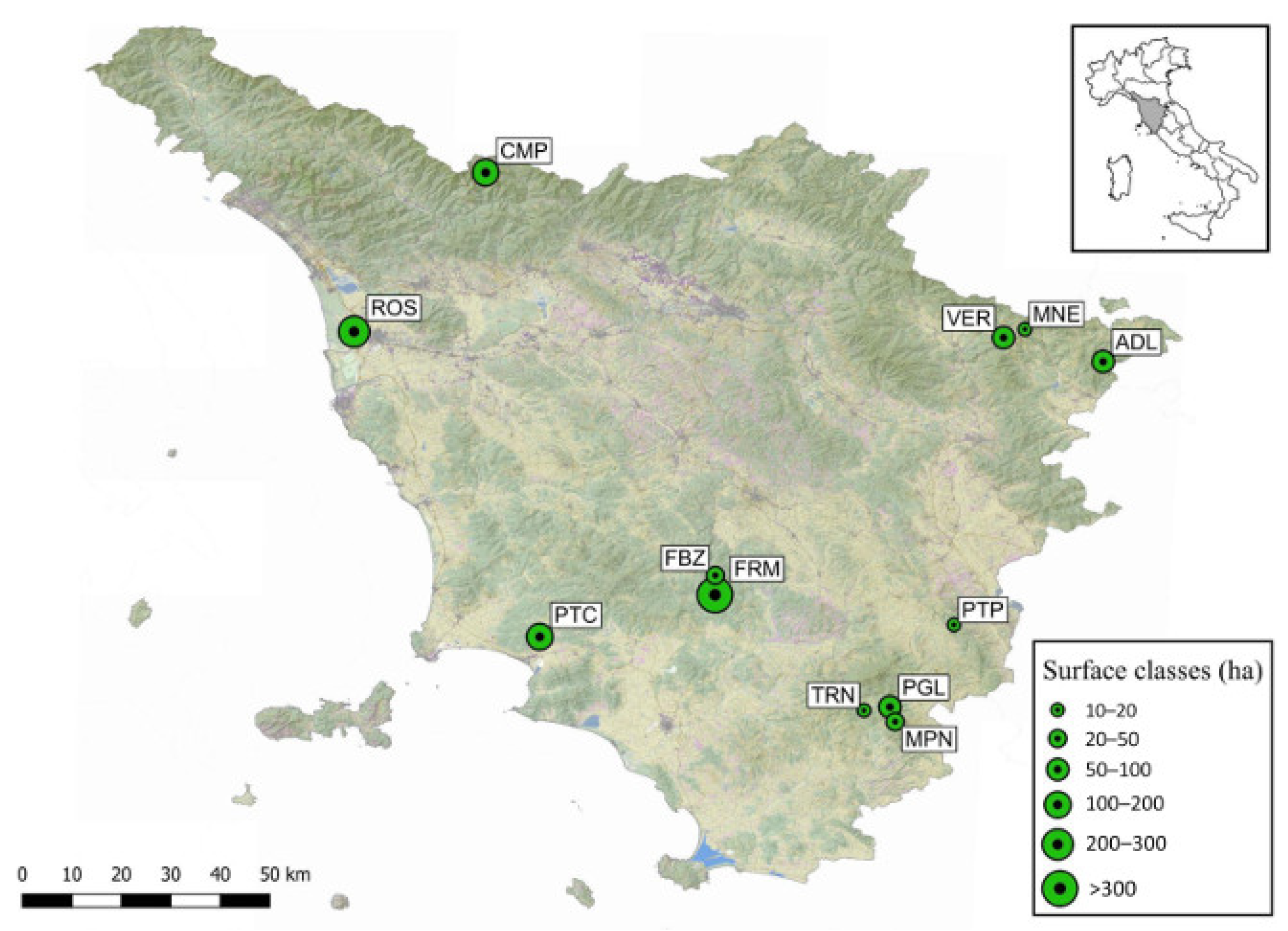
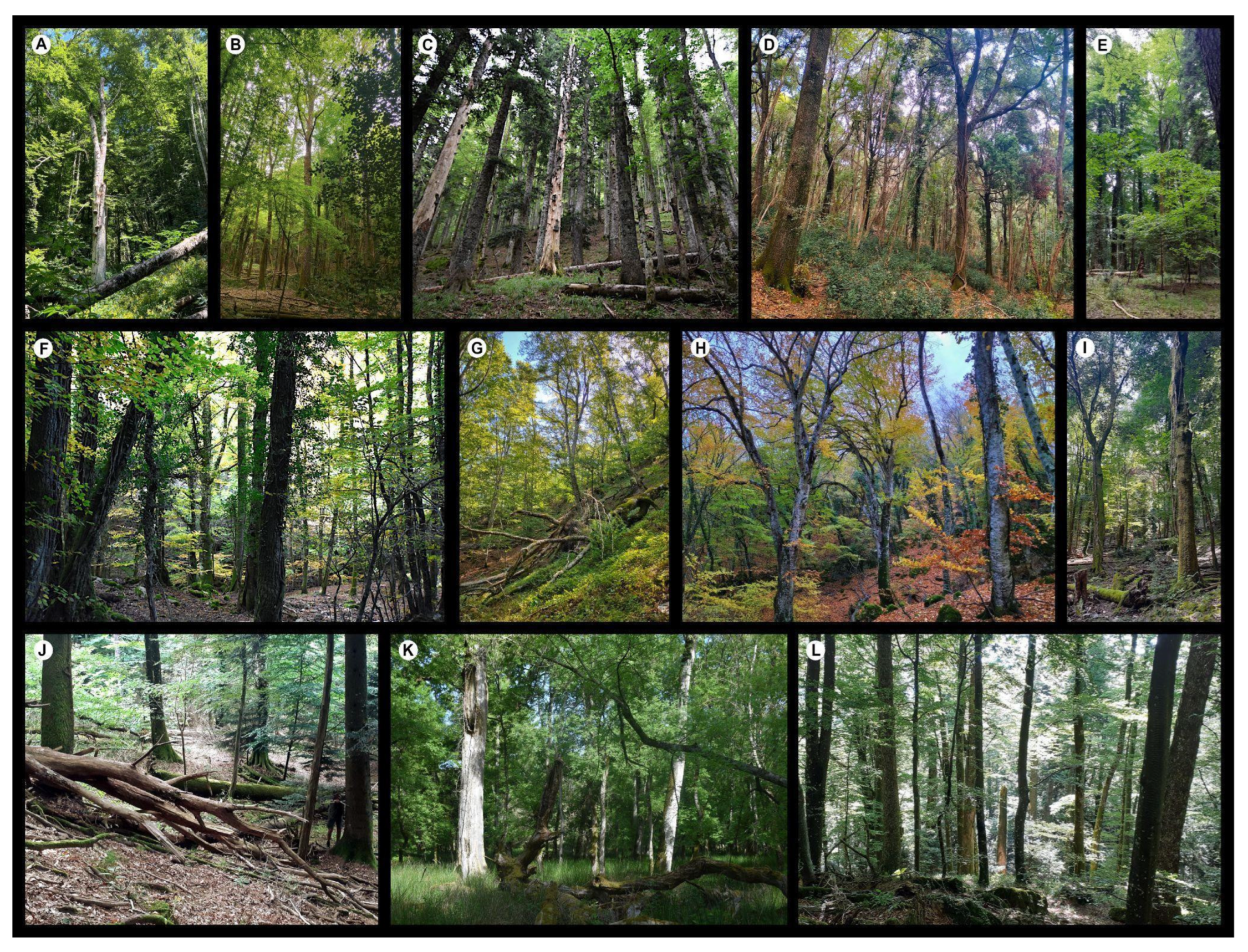
The selection protocol led to the identification of twelve forest sites abandoned since ca. 70 years, largely meeting the EU and Italian ministerial guidelines. The main geographical and environmental characteristics of each site are given in Table 1 and illustrated in Figure 1 and Figure 2. These sites encompassed the broad ecological diversity of Tuscany, representing, with a different frequency, five main forest types in three ecoregions [45,46]: northern Apennines, central Tuscany, and Maremma (Table 2); three sites (FRM, PGL, and ROS) included different forest types. The sites were also representative of 14 EUNIS habitat types and 14 Natura2000 habitats, four of which are of conservation priority (Apennine beech forests with A. alba: 4 sites; Apennine beech forests with Taxus and Ilex: 6 sites; alluvial forests with Alnus glutinosa: 3 sites; and Tilio-Acerion forests of slopes, screes, and ravines: 4 sites). The total surface occupied by these priority habitats is ca. 309 ha (ca. 27.5% of the old-growth surface). As many as nine categories and 18 sub-categories of the Italian National Forest Inventory were represented, of which those with F. sylvatica (19.2%), Quercus ilex (17%), Q. petraea or Q. robur (15.2%), and Q. cerris (14.6%) were the most frequent. The inventoried forests represent advanced dynamic stages of nine vegetation series (“sigmeta”) as recognized and mapped in the vegetation of Italy [47].
The total surface of the selected sites amounts to around 1000 ha, which represents a very minor proportion of the regional forests, even of those on public land (0.10% and 0.73%, respectively). All forests are of natural origin and form a unique body (e.g., they are not discontinuous or fragmented into smaller parts) with a surface ranging from 10 to over 300 hectares (Figure 2); with the exception of ROS, these sites are embedded within a matrix of managed forests that lack old-growth structural characteristics. All sites are included in variously protected areas: those at the national level (state nature reserves and national parks, 5 sites) are subject to stricter conservation than those at the regional level (regional parks and regional nature reserves, 5 sites). The larger site (FRM) is partly included in a state reserve and partly in a regional reserve. Moreover, all sites but one (PTP) are part of the Natura2000 network (Table 1), being classified as SAC (Special Areas of Conservation) or Special Protection Areas (SPA).

3.2. Structural Heterogeneity Indicators and SHI

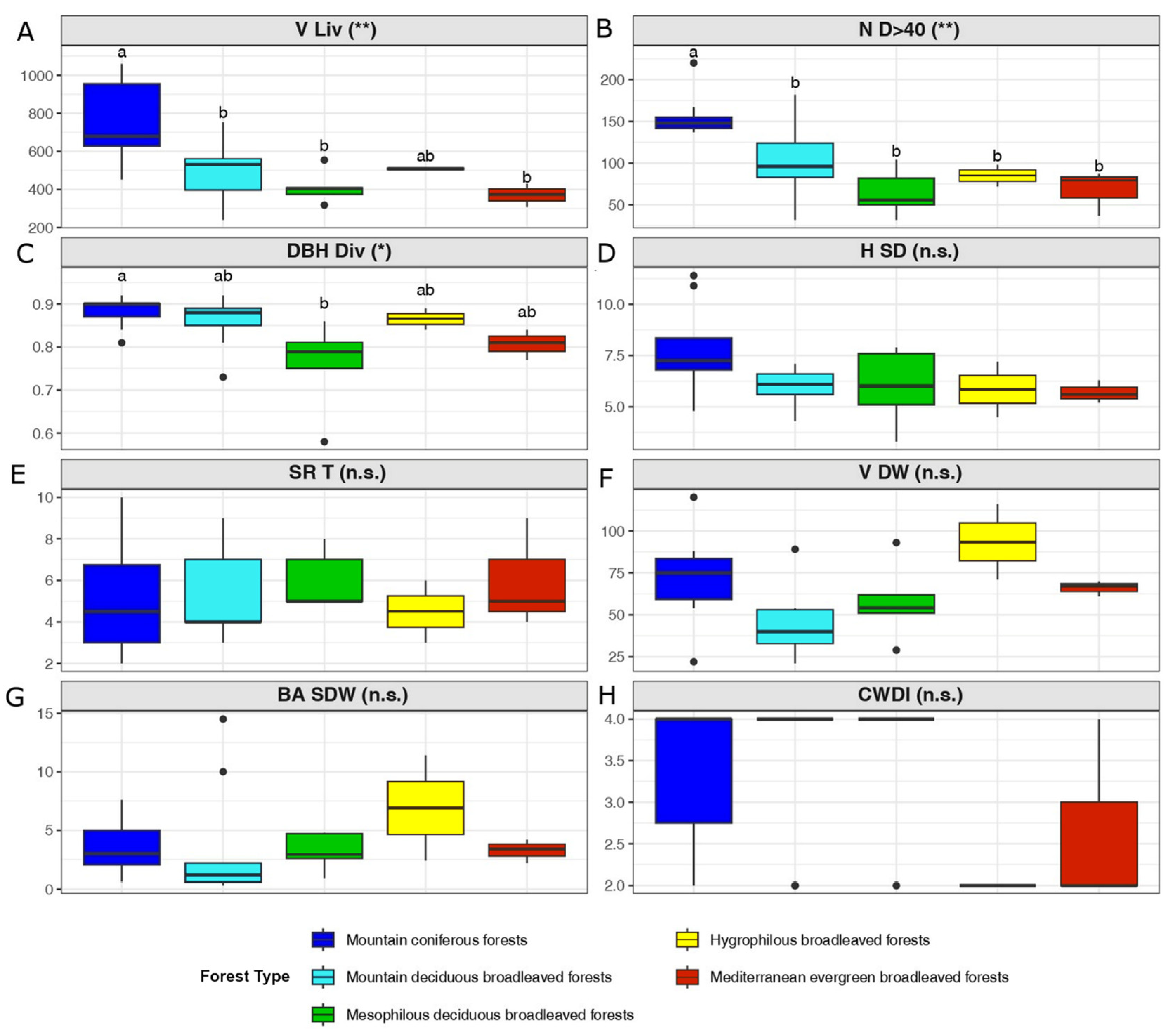
Mean values of the eight main stand structural indicators in the 12 sites are reported in Table 3, while their variation across the five main forest types is shown in Figure 3A–H. The values of the 16 additional variables (both living and deadwood) are given in Supplementary Table S2.
The mean volume of total growing stock (V liv) in mountain plots with A. alba or P. abies (VER, TRN, PGL, and CMP) was significantly higher than in other sites, especially the Mediterranean ones with Q. ilex (PTC; Figure 3A). The density of large trees (N40 liv) was also higher in the conifer-dominated sites (Figure 3B) and in the range of 56 (FRM)–167/ha (PGL and VER). The dbh diversity (Dbh-div) varied from 73% (FRM) to 92% (MNE) and was higher in forests with F. sylvatica or A. alba compared to those with Q. ilex or mesophilous broadleaves (Figure 3C). Frequency distributions by dbh classes (Supplementary Figure S1) showed that most stands with high variation in tree diameter do not clearly match the inverted J-shaped curve. The stands with this diameter distribution model were characterized by higher relative frequencies of small stems, thus decreasing the evenness of frequencies by dbh classes. Within-stand variability in mean tree height (SD H) was in the range of 5 (ROS)–11 m (TRN), being higher in plots with Abies alba (Figure 3D). The total number of species with dbh ≥ 7.5 cm (T SR) ranged from 3 (MNE) to 14 in the FRM site.
Concerning the deadwood variables, the mean total volume (standing and lying, V DW) ranged between 25 (MNE) and 87 m3/ha (VER), with a basal area of the standing trees (BA SDW) from 0.8 to 6.6 m2/ha. Deadwood volume was higher in plots with A. alba or P. abies (Figure 3H); the coarse woody debris index (CWD I) was in the range of 2.0 (TRN)–4.0 (ADL, FRM, MNE, MPN, and VER).
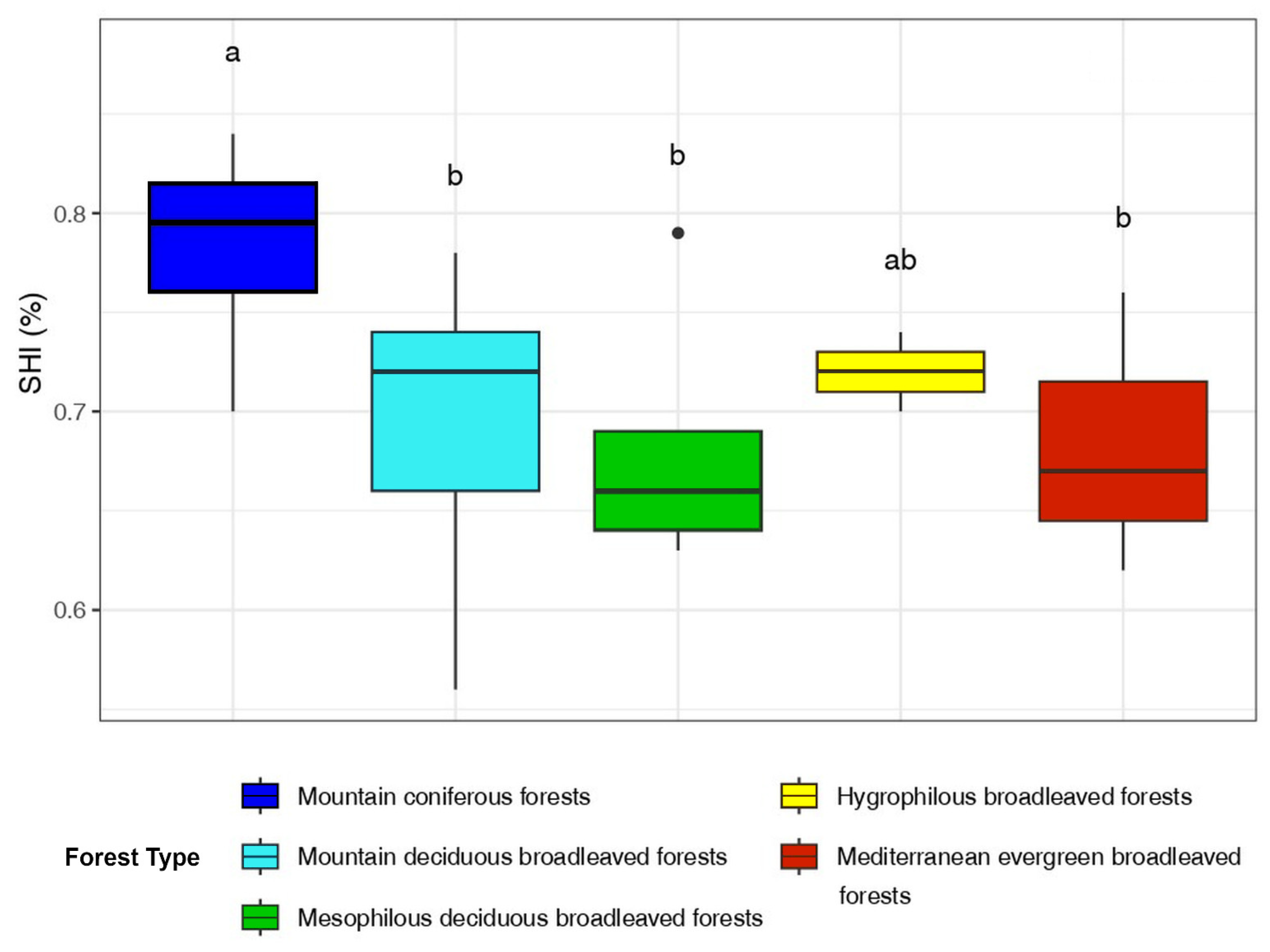
The mean value of the structural heterogeneity index (SHI) across the 12 sites (Table 4) was 74.3%, with relatively wide differences among them. It was highest (>80%) in those dominated by Abies alba (VER, PGL, and TRN; Figure 4) and lowest in the Mediterranean evergreen broadleaved forest, such as PTC (65.2%). The variables Dbh-div, N40 liv, and V DW were those reaching the highest scores (8.9–9.5).
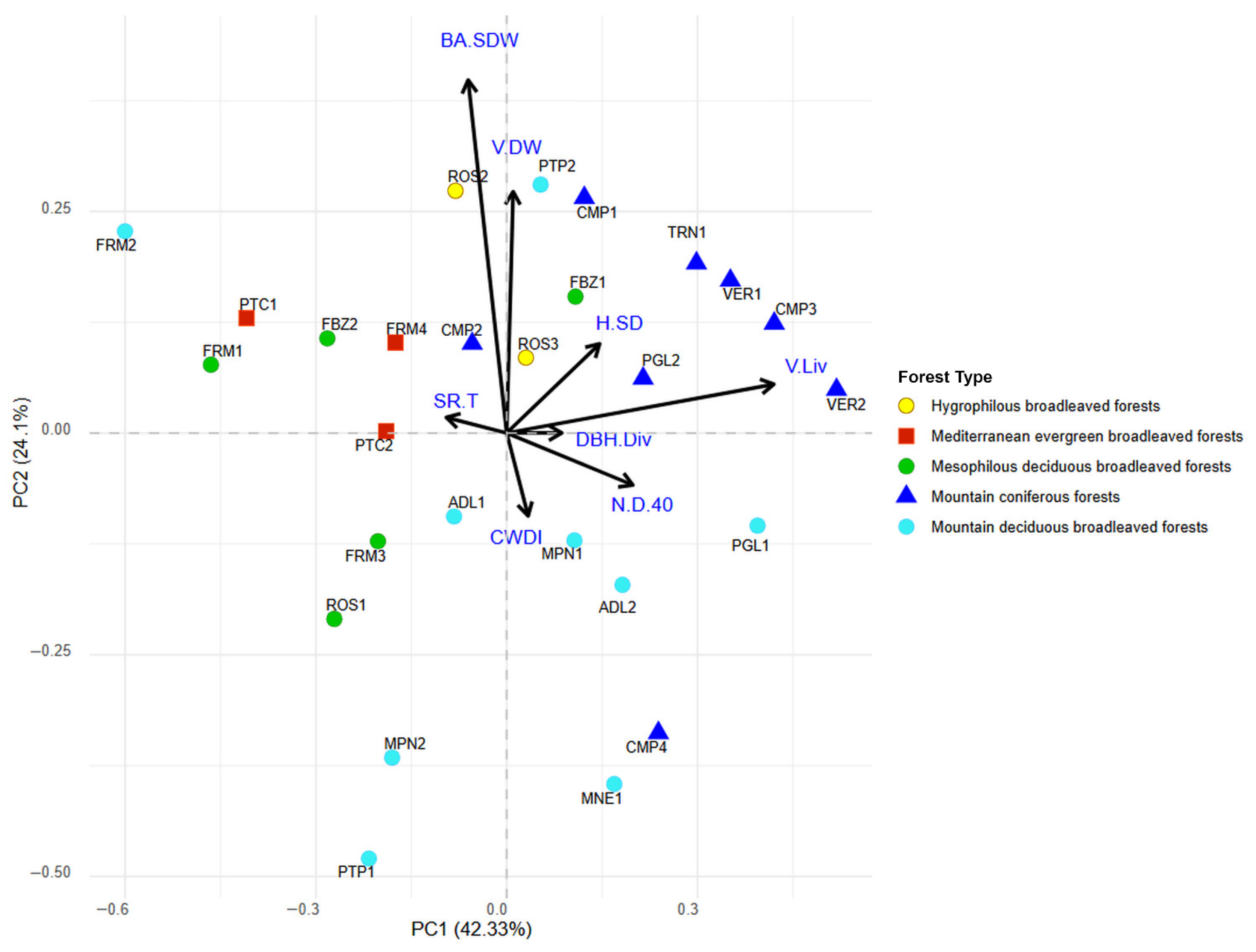
The first two PCA components from the analysis based on the eight main structural indicators accounted for 65.4% of the total variance, allowing for the summary and display of the relationships between variables, plots, and the five main forest types (Figure 5). The first axis (42.3%) was mainly associated with variables concerning living tree size and biomass (V liv, SD H, and N40 liv), while the second (24.1%) was associated with deadwood variables (BA SDW and V DW). Mountain forest plots from different sites, with either conifers or beech, were mostly positioned along the positive part of the first component, while lowland plots with deciduous broadleaves or evergreen oaks were mostly on the negative part because of the lower amount of living volume. Hygrophilous forest plots from the ROS site with Q. robur were on the positive part of the second component, while several plots from different sites with mostly beech and deciduous oaks were on the negative part due to their lower amount of deadwood.

3.3. Floristic Diversity

In total, 193 vascular plant taxa in 69 families and 140 genera were recorded in the 27 plots across the 12 sites (Supplementary Table S3); these included ferns, conifers, eudicot, and monocot angiosperms; the full list of taxa is given in Supplementary Table S4. At the site level, total species richness (including all taxa) was in the range of 21–58, while it was 17–41.5 at the plot level (mean 24.1); no significant differences occurred between forest types (p > 0.05, Supplementary Figure S3).
Overall, 16 species occurring with large trees (>50 cm dbh) were recorded, and these were especially numerous at the PGL and FRM sites (6 and 5, respectively). The number of species occurring with large trees did not depend on forest type (p > 0.05, Supplementary Figure S3).
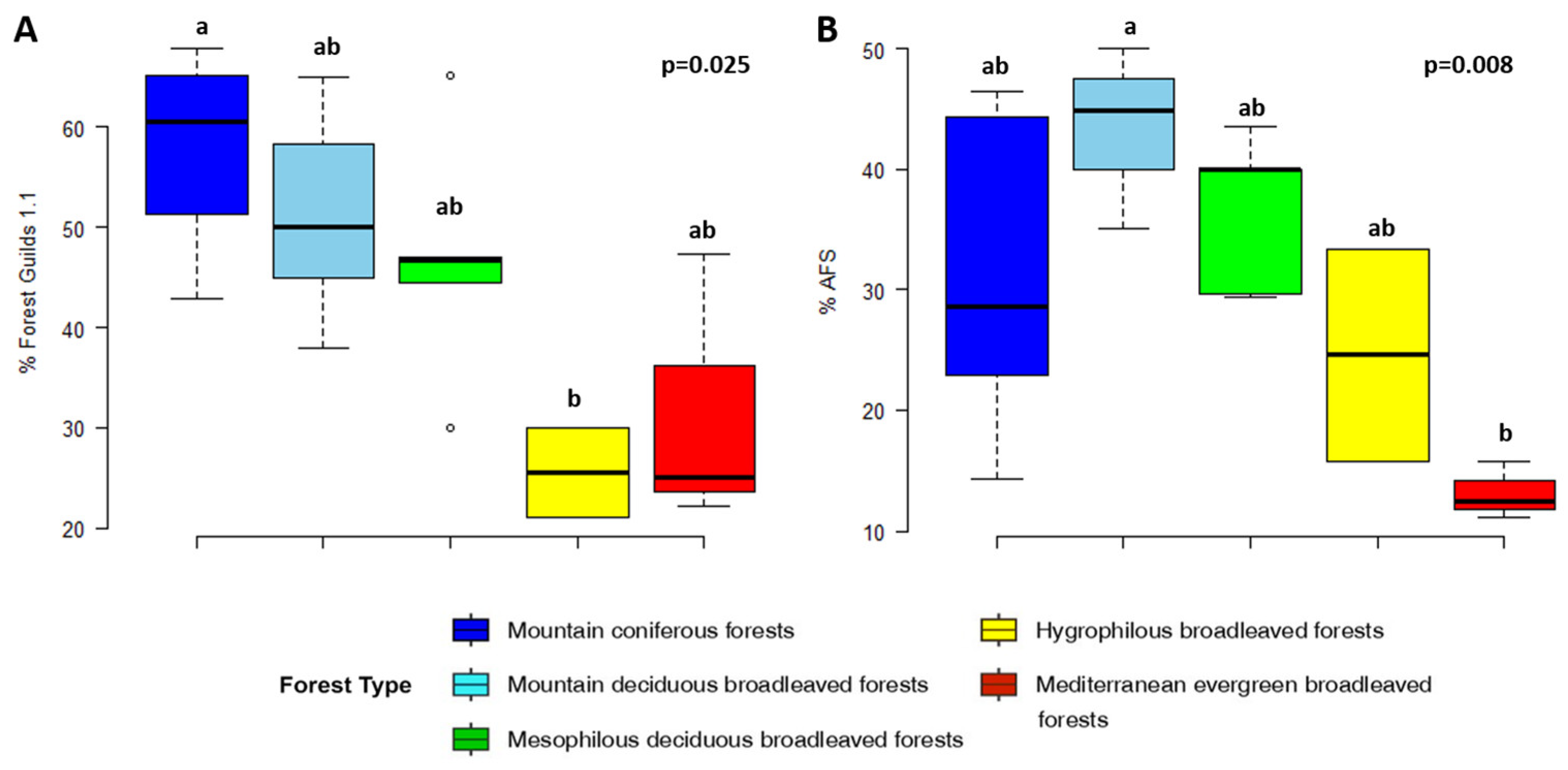
Concerning the ecological profile of the total flora inventoried, forest interior specialists (guild 1.1) were the most represented (44.6%). The proportion of these taxa depended on forest type, being highest in the mountain conifer stands and lowest in the hygrophilous plain forest (p < 0.05; Figure 6A). Species linked to gaps and clearings (guild 1.2) were a minor proportion (11.4%), while generalists (guild 2.1) were well represented (33.7%). The species of mainly open habitats (guild 2.2) were relatively numerous only in the hygrophilous forest (ROS), due to its isolated position in a largely agricultural landscape, frequent gaps, and low canopy cover. This forest was also the only one where an exotic invasive species, Salpichroa origanifolia (Solanaceae), was recorded in the understory. Ancient forest species were 29% of the total flora (range 9.5–51% in PTP and PTC, respectively) and significantly more represented in the mountain stands with F. sylvatica than in the Mediterranean evergreen forest with Q. ilex (p < 0.01; Figure 6B).
The total number of protected species was 38 (19.7%), of which 28 were at the regional level (mostly included in the regional law 56/2000), and 12 were at the national level in the IUCN category LC (least concern). At the site level, ten protected species were recorded in the beech forest site of PTP, but only two in the mountain conifer forest of VER, the broadleaf forest of FBZ, and the evergreen sclerophyllous forest of PTC.

4. Discussion

Results of this investigation support the hypothesis that Tuscany harbors forest sites with old-growth characteristics, despite a long history of anthropogenic use of woods. In light of the EU guidelines [9] and the Italian ministerial criteria and indicators, these sites can be candidates for inclusion in the Italian network. Most of the sites and their features were previously unknown. The existing indications for this region were limited to a probabilistic large-scale map of areas possibly including old-growth forests in Europe [5] and to a map of Italian sites based on literature information [19]. Compared with other Italian regions, however, this information was very scanty since only 4% of the studies dealing with old-growth forests in the country were conducted in Tuscany [19]. Until now, detailed documentation was almost exclusively limited to the mountain forests of Sasso Fratino and La Verna [27,29], leaving the rest of this extensively wooded territory largely unexplored or only known from old and generic indications. Hence, this study contributed to bridging a significant gap in knowledge through a systematic ground-truthing of available information and the collection of additional data on stand structural and plant diversity variables.
In supporting the identification of 12 candidate sites in five forest types and 14 Natura2000 habitats, our findings show that old-growth features in Tuscan forests are less rare and more variable than previously documented. The represented types included not only stands dominated by beech and mountain conifers, as already known [19], but also by deciduous broadleaves or evergreen sclerophylls in lowland areas under the influence of the Mediterranean climate. Thanks to the lack of human management for at least 60 years, all sites include uneven-aged and multiple-layered stands at the mature or incipient senescent stage, including small-scale gaps caused by the natural collapse of dominant trees (Figure 1). This is supported by the main structural indicators, which were comparable to those reported for other old-growth forests in the Italian peninsula. The structural heterogeneity index (SHI) of eight forests (ADL, CMP, FBZ, FRM, PGL, ROS, TRN, and VER) was in the range of the values obtained for various beech stands across the Apennines (71.7–99.9%) and higher than those measured in early-mature to mature managed stands in southern Italy [35]. In line with our second hypothesis, some of the old-growth structural attributes showed a wide variability across the sites, depending on tree species composition and forest type. The strong variability of these indicators across temperate forest ecosystems in different geographical, compositional, and climatic contexts at the global scale has been well described [11]. The SHI values were higher in mountain coniferous forests where A. alba or P. abies are dominant over F. sylvatica (TRN, VER, PGL, and CMP) or other broadleaved species. These observed differences are linked to the species-specific growth rates and tree dimensions, as well as environmental constraints. In mountain environments with a cool climate, the period of non-intervention (at least 70 years in our sites) allowed trees of large-sized conifers such as Abies alba to accumulate significant biomass, resulting in higher standing volume than in the other forest types [48]. In contrast, sclerophyllous and broadleaved forests with lower productivity and growth limited by the Mediterranean climate require a longer time to develop comparable structural features [49]. However, despite this slower accumulation of structural complexity, our findings indicate that the stands in the candidate sites already exhibit structural attributes significantly divergent from the surrounding managed stands. Furthermore, the lower decomposition rates at higher elevation favor a continuous accumulation of deadwood [50], contributing to reaching structural heterogeneity faster than in Mediterranean stands in a given timeframe. Consequently, while the 70-year period of non-intervention can allow mountain stands to develop more typical old-growth features, lowland forests may require longer periods of natural dynamics to achieve comparable levels of structural complexity.
Interestingly, however, the ratio of deadwood:living volume resulted in higher values (>15%) in some of the mesophilous and evergreen forests (e.g., at FBZ, FRM, ROS, PTC) than in the mountain forests. This was mainly due to a lower amount of living biomass and the abundance of small-sized woody debris of relatively small trees of early- and mid-successional species, caused by the interspecific competition during the stand dynamic recovery. Moreover, the strong decline of the sweet chestnut (Castanea sativa) due to pests and, more recently, climate change, contributed to increasing the amount of standing and lying deadwood in some of the lowland broadleaf sites. The average number of decay classes ranged from 2.5 (FBZ, PTC, and ROS) to 3.5 (ADL, MPN, PGL, PTP, and VER), pointing to medium levels of heterogeneity in the decomposition level of the lying deadwood. Decay classes were more numerous in the mountain broadleaved or coniferous forest sites, with a mean number of 3.3, close to that (3.4) reported from the old-growth beech stands of Valle Cervara in the central Apennines [51] and higher than in managed beech stands in similar site conditions (2.4). The presence of lying woody debris contributes significantly to the biodiversity of European forests, being colonized by a large variety of mosses, fungi, and ground-dwelling organisms, also depending on the stage of decay [52,53]. Although the lying deadwood in our sites was generally more abundant than the standing one, dead standing trees were always present, even of large size, in six sites (dbh ≥ 50 cm). The estimated density of large snags was higher in the conifer-rich mountain sites (CMP, VER) (5/ha; Supplementary Table S2) and in line with that reported from forests in the northern Apennine, including VER (2–4/ha; [29]). Presence of dead standing trees is a key indicator of forest maturity, substantial absence of human management, and high biodiversity, as they offer a range of microhabitats to various forest animal specialists, including birds, bats, and small mammals [8,52,53].
Stand maturity and complexity in the sampled stands of the candidate sites are also supported by the comparison of growing stock data with the National Forest Inventory at the regional and national level [24]. The average volume in these stands (541 m3/ha) was over three to four times higher than the average one reported for the same forest types in Tuscany and Italy (128 and 171 m3/ha, respectively; Supplementary Figure S2). The same applies to basal area (40.6 m2/ha vs. 18.5 and 22.0 m2/ha, respectively), despite the lower number of trees per hectare in the candidate sites (440 vs. 1352 and 1275 ha). Differences are more evident for mesophilous and Mediterranean forests than for mountain coniferous forests, likely due to past and current management. In fact, the two former types are included in sites that represent rare exceptions in forest landscapes subject to widespread coppicing [24,28], which keeps the average regional growing stock at low levels. In mountain areas, instead, the prevailing high-forest management allows the maintenance of a growing stock that is already closer to the regional potential of mature stands, thereby reducing the structural contrast with old-growth candidates.
Looking at the floristic components, the remarkable number (16) of large-sized tree species (≥50 cm dbh) across the sites essentially reflected the diversity of the Tuscan woody flora [54], with little dependency on forest type. In all three ecoregions, these trees represent an expression of the advanced stage of forest dynamics free from management, differently contributing to the creation of microhabitats and seed production [55] depending on species identity and age.
The inventoried floristic pools were largely variable from site to site, but species richness at the plot level was not dependent on forest type. Remarkably, the mean number of species per plot across sites and forest types (24.1) was comparable to that in old-growth beech forests in the Apennines (26.1; [15]).
As expected, the shrub layers and the understorey included a significant, albeit largely variable, proportion of forest interior specialists sensu [43]. Among these, two herbs (Galium odoratum and Mycelis muralis) were among the indicator species of the unmanaged old-growth stands with beech of the central Apennines [15]. In the hygrophilous forest (ROS site), interior specialists were significantly less represented than in the other forest types due to the frequent gaps in the canopy and the stronger competition by generalist species of open habitats.
The presence of ancient forest species in all sites also pointed to the temporal continuity of the candidate forests and the conservation of suitable soil and microclimatic conditions for a long time, regardless of former anthropogenic disturbances [41]. AFS proportion depended again on forest types, reflecting different ecological filters and pedoclimatic conditions in the three Tuscan ecoregions, as well as the intensity of past disturbances. While the cool, oceanic climate of mountain beech forests provides optimal conditions for many AFS, the warmer and often drier sites at lower altitudes are less favorable to these plants [41].
The data provided in this study can contribute to further research aimed at testing whether single taxa or combinations of taxa can serve as indicators of the old-growth stage in distinct forest types in Italy. As recently observed, however, using the threshold of 60 years of non-disturbance given in the ministerial decree seems unlikely to favor the identification of these indicator plant taxa [56]. Further research should focus on this question in stands with possibly a longer history of non-disturbance across different habitats and ecoregions. Furthermore, the dependency of floristic composition on the stand structural variables should also be investigated, as this aspect was mostly analyzed in monospecific beech stands of the Apennines [11,15,48,57]. Understanding how the accumulation of deadwood, tree diameter distribution, and other stand indicators influence the understory flora, also in other types of mature forests, will provide key information to set reliable indicators of the old-growth stage in different habitat contexts.
Finally, it should be noted that, other than forest type, site-specific factors might affect the transition towards old-growth conditions at a local scale. Specifically, soil properties and historical land-use legacies—while partially reflected in the current forest types—may also vary at the site level. Due to sampling constraints, it was not possible to individually control for these site-specific aspects, which may represent a limitation of the present study; nevertheless, forest type emerged as the primary determinant of both structural complexity and floristic patterns in our investigation at a broader scale.

5. Conclusions

This work provides novel information about candidate sites for the implementation of the Italian national network of old-growth forests, hence potentially contributing to one of the main targets of the European Biodiversity Strategy 2030. Despite their limited extent, the candidate sites allow for the broadening of the range of forest types, including stands with old-growth characteristics, according to recent EU and Italian guidelines. Hence, not only beech and silver fir forests in mountain areas but also lowland forests under the marked influence of the Mediterranean climate. The observed variability of the structural indicators and floristic composition supports that these characteristics—though potentially influenced by site-specific factors—primarily depend on dominant tree species and bioclimatic contexts, implying different rates of dynamic progression towards the old-growth stage. Since all candidate forests still show signs of past anthropogenic activities, they represent secondary old-growth stands where the absence of disturbance is necessary to allow these characteristics to develop further and be fully recovered in the next decades. To achieve this, the strict protection regime applied to the four forests included in the National State Reserves should be applied to all the other sites. These are currently under different protection regimes, not always effective in ensuring the maintenance of fully natural dynamics. Strict protection will be possible once the sites are formally included in the National Network of Old-Growth Forests, as indicated in the Ministerial Decree. If this goal is achieved, in the next decades the sites will likely represent rare examples of fully old-growth forests, offering opportunities to better comprehend the functioning and dynamics of complex ecosystems under the ongoing climate changes. This is a crucial issue, as the path towards old-growthness in the Mediterranean region is likely to be slowed down as climate change intensifies. Finally, these forests may serve as reference models for applying close-to-nature management in similar ecosystems elsewhere, thus helping to reconcile production with biodiversity conservation.

Supplementary Materials

The following supporting information can be downloaded at: https://www.mdpi.com/article/10.3390/land15040640/s1. Figure S1: Number of trees per classes of diameter; Figure S2: Growing stock in the old-growth candidate sites compared with INFC; Figure S3: Species richness and species with large trees across forest types; Table S1: Scoring models used for the calculation of the Structural Heterogeneity Index (SHI); Table S2: Living biomass variables; Table S3: Plant diversity variables of the 12 candidate old-growth forest sites in Tuscany; Table S4: List of vascular plant taxa.

Author Contributions

Conceptualization, F.S. and M.C.; methodology, F.S. and M.C.; software, E.C.; validation, F.S. and M.C.; formal analysis, M.C. and E.C.; investigation, F.S., M.C., E.C. and G.D.; resources, F.S.; data curation, M.C. and E.C.; writing—original draft preparation, F.S. and M.C.; writing—review and editing, G.D. and E.C.; visualization, M.C.; supervision, F.S.; project administration, F.S.; funding acquisition, F.S. All authors have read and agreed to the published version of the manuscript.

Funding

This work was supported by Regione Toscana, settore Forestazione, with funds from Ministero dell’Agricoltura, della Sovranità alimentare e delle Foreste, and by Ministero della Ricerca e dell’Università, through the National Plan of Recovery and Resilience (NPRR), funded by the European Union-Next GenerationEU; project CN_00000033—National Biodiversity Future Center (NBFC).

Data Availability Statement

The data presented in this study are openly available in Zenodo at https://zenodo.org/records/19469444 (accessed on 8 April 2026).

Acknowledgments

We wish to thank Giovanni Filiani and Elisabetta Gravano (Regional Forest Administration of Tuscany) for their collaboration and support in this research; Marco Landi, Giovanni Quilghini, and Daniela Scopigno (Carabinieri Forestale, Reparto Biodiversità) for their support and for granting the necessary permissions to conduct fieldwork within the National State Nature Reserves; Davide Bettini and Giovanni Iacopetti for their active collaboration during field surveys in the sites; Laura Vivona for the preparation of figures.

Conflicts of Interest

The authors declare no conflicts of interest. The funders had no role in the design of the study; in the collection, analyses, or interpretation of data; in the writing of the manuscript; or in the decision to publish the results.

Abbreviations

The following abbreviations are used in this manuscript:
SHIStructural Heterogeneity Index
dbhdiameter at breast height
Hheight
SD Htree height standard deviation
T SRtotal number of tree species
V DWtotal deadwood volume
BA SDWbasal area of standing deadwood
CWD Icoarse woody debris index

References

  1. Luyssaert, S.; Schulze, E.D. Old-growth forests as global carbon sinks. Nature 2008, 455, 213–215. [Google Scholar] [CrossRef]
  2. Wirth, C.; Gleixner, G.; Heimann, M. Old-Growth Forests: Function, Fate and Value; Springer Science & Business Media: Berlin/Heidelberg, Germany, 2009; ISBN 978-3-540-92706-8. [Google Scholar]
  3. Messier, C.; Posada, J.; Aubin, I.; Beaudet, M. Functional relationships between old-growth forest canopies, understorey light and vegetation dynamics. In Old-Growth Forests; Wirth, C., Gleixner, G., Heimann, M., Eds.; Ecological Studies; Springer: Berlin/Heidelberg, Germany, 2009; Volume 207, pp. 115–139. [Google Scholar] [CrossRef]
  4. Maloof, J. Nature’s Temples: A Natural History of Old-Growth Forests; Princeton University Press, Timber Press: Princeton, NJ, USA, 2023; ISBN 978-0-691-23050-4. [Google Scholar]
  5. Barredo Cano, J.I.; Brailescu, C.; Teller, A.; Sabatini, F.M.; Mauri, A.; Janouskova, K. Mapping and Assessment of Primary and Old-Growth Forests in Europe; EUR 30661 EN; Publications Office of the European Union: Luxembourg, 2021; ISBN 978-92-76-34229-8. [Google Scholar] [CrossRef]
  6. FAO. The State of the World’s Forests. Forests, Biodiversity and People; FAO: Rome, Italy, 2020. [Google Scholar] [CrossRef]
  7. European Commission. EU Biodiversity Strategy 2030; European Commission: Luxembourg, 2021. [Google Scholar]
  8. O’Brien, L.; Schuck, A.; Fraccaroli, C.; Pötzelsberger, E.; Winkel, G.; Lindner, M. Protecting Old-Growth Forests in Europe—A Review of Scientific Evidence to Inform Policy Implementation. Final Report; European Forest Institute: Bonn, Germany, 2021. [Google Scholar] [CrossRef]
  9. European Commission. Guidelines for Defining, Mapping, Monitoring and Strictly Protecting EU Primary and Old-Growth Forests; Publications Office of the European Union: Luxembourg, 2023. [Google Scholar]
  10. Oliver, C.D.; Larson, B.C. Forest Stand Dynamics; John Wiley & Sons: New York, NY, USA, 1996. [Google Scholar]
  11. Burrascano, S.; Keeton, W.S.; Sabatini, F.M.; Blasi, C. Commonality and variability in the structural attributes of moist temperate old-growth forests: A global review. For. Ecol. Manag. 2013, 291, 458–479. [Google Scholar] [CrossRef]
  12. Badalamenti, E.; Veca, D.S.L.M.; Costa, M.; Giardina, G.; La Mantia, T.; Laschi, A.; Maetzke, F.G.; Petroncini, S.; Sala, G.; Bueno, R.S. Old-growthness level assessed by structural heterogeneity indices in Mediterranean Quercus pubescens forests. For. Ecosyst. 2025, 14, 100365. [Google Scholar] [CrossRef]
  13. Sabatini, F.M.; Burrascano, S.; Keeton, W.S.; Levers, C.; Lindner, M.; Pötzschner, F.; Verkerk, P.J.; Bauhus, J.; Buchwald, E.; Chaskovsky, O.; et al. Where are Europe’s last primary forests? Divers. Distrib. 2018, 24, 1426–1439. [Google Scholar] [CrossRef]
  14. Sabatini, F.M.; Burrascano, S.; Keeton, W.S.; Levers, C.; Lindner, M.; Pötzschner, F.; Verkerk, P.J.; Bauhus, J.; Buchwald, E.; Chaskovsky, O.; et al. Protection gaps and restoration opportunities for primary forests in Europe. Divers. Distrib. 2020, 26, 1646–1662. [Google Scholar] [CrossRef]
  15. Burrascano, S.; Rosati, L.; Blasi, C. Plant species diversity in Mediterranean old-growth forests: A case study from central Italy. Plant Biosyst. 2009, 143, 190–200. [Google Scholar] [CrossRef]
  16. Mazzoleni, S.; Di Pasquale, G.; Mulligan, M.; Di Martino, P.; Rego, F.C. Recent Dynamics of the Mediterranean Vegetation and Landscape; John Wiley & Sons: Chichester, UK, 2004. [Google Scholar]
  17. Cos, A.; Retana, J.; Comas, L.; Vayreda, J. The path towards old-growthness of the forests of Spain is slowed down as climate change intensifies. Biol. Conserv. 2026, 313, 111592. [Google Scholar] [CrossRef]
  18. Marchetti, M.; Blasi, C. Old-growth forests in Italy: Towards a first network. L’Italia For. Mont. 2010, 65, 679–698. [Google Scholar] [CrossRef]
  19. Motta, R.; Garbarino, M.; Lingua, E.; Lombardi, F.; Tognetti, R. La ricerca italiana ed il ruolo della comunità scientifica nella realizzazione dell’Albo nazionale delle “Foreste vetuste”. Forest@ 2022, 19, 36–48. [Google Scholar] [CrossRef]
  20. Ministero delle Politiche Agricole e Forestali. Decreto Legislativo 3 Aprile 2018, n. 34: Testo Unico in Materia di Foreste e Filiere Forestali (TUFF); Ministero delle Politiche Agricole e Forestali: Rome, Italy, 2018. [Google Scholar]
  21. Ministero delle Politiche Agricole e Forestali. Decreto Ministeriale 2021: Linee Guida per l’Identificazione, la Gestione e la Tutela Delle Foreste Vetuste; Ministero delle Politiche Agricole e Forestali: Rome, Italy, 2021. [Google Scholar]
  22. Ministero delle Politiche Agricole e Forestali. Decreto Ministeriale 2023: Istituzione Ufficiale della Rete Nazionale delle Foreste Vetuste; Ministero delle Politiche Agricole e Forestali: Rome, Italy, 2023. [Google Scholar]
  23. Arrigoni, P.V. La Vegetazione Forestale. Serie Boschi e Macchie di Toscana; Edizioni Regione Toscana: Firenze, Italy, 1998; Available online: https://hdl.handle.net/2158/637685 (accessed on 22 June 2025).
  24. Gasparini, P.; Di Cosmo, L.; Floris, A.; De Laurentis, D. Italian National Forest Inventory—Methods and Results of the Third Survey Inventario Nazionale delle Foreste e dei Serbatoi Forestali di Carbonio. Metodi e Risultati della Terza Indagine; Springer: Cham, Switzerland, 2022. [Google Scholar] [CrossRef]
  25. Agnoletti, M. Tuscany. In Italian historical Rural Landscapes; Springer: Dordrecht, The Netherlands, 2013. [Google Scholar]
  26. Travaglini, D.; Paffetti, D.; Bianchi, L.; Bottacci, A.; Bottalico, F.; Giovannini, G.; Maltoni, A.; Nocentini, S.; Vettori, C.; Calamini, G. Characterization, structure and genetic dating of an old-growth beech-fir forest in the northern Apennines (Italy). Plant Biosyst. 2012, 146, 175–188. [Google Scholar] [CrossRef]
  27. Motta, R.; Garbarino, M.; Berretti, R.; Bono, A.; Curovic, M.; Dukić, V.; Nola, P. Monastic silviculture legacies and current old-growthness of silver fir (Abies alba) forests in the northern Apennines (Italy). Front. For. Glob. Change 2023, 6, 1252462. [Google Scholar] [CrossRef]
  28. Carrari, E.; Ampoorter, E.; Bottalico, F.; Chirici, G.; Coppi, A.; Travaglini, D.; Verheyen, K.; Selvi, F. The old charcoal kiln sites in Central Italian forest landscapes. Quat. Int. 2017, 458, 214–223. [Google Scholar] [CrossRef]
  29. Cervellini, M.; Zannini, P.; Di Musciano, M.; Fattorini, S.; Jiménez-Alfaro, B.; Rocchini, D.; Field, R.; Vetaas, O.R.; Irl, S.D.; Beierkuhnlein, C.; et al. A grid-based map for the Biogeographical Regions of Europe. Biodivers. Data J. 2020, 8, e53720. [Google Scholar] [CrossRef]
  30. Burrascano, S.; Trentanovi, G.; Paillet, Y.; Heilmann-Clausen, J.; Giordani, P.; Bagella, S.; Bravo-Oviedo, A.; Campagnaro, T.; Campanaro, A.; Chianucci, F.; et al. Handbook of field sampling for multi-taxon biodiversity studies in European forests. Ecol. Indic. 2021, 132, 108266. [Google Scholar] [CrossRef]
  31. Burrascano, S.; Trentanovi, G.; Paillet, Y.; Heilmann-Clausen, J.; Giordani, P.; Bagella, S.; Campagnaro, T.; Campanaro, A.; Chianucci, F.; De Smedt, P.; et al. Handbook of Sampling for Multi-Taxon Biodiversity Studies in European Forests; PM Edizioni: Varazze, Italy, 2022; ISBN 978-88-31222-50-1. [Google Scholar] [CrossRef]
  32. Hunter, M.L., Jr. Wildlife, Forests, and Forestry. Principles of Managing Forests for Biological Diversity; Prentice-Hall: Englewood Cliffs, NJ, USA, 1990. [Google Scholar]
  33. Pignatti, S. Flora d’Italia, 2nd ed.; Edagricole: Milan, Italy, 2017. [Google Scholar]
  34. European Environment Agency. EUNIS Habitat Classification. 2021. Available online: https://eunis.eea.europa.eu/habitats.jsp (accessed on 7 December 2025).
  35. Sabatini, F.M.; Burrascano, S.; Lombardi, F.; Chirici, G.; Blasi, C. An index of structural complexity for Apennine beech forests. iForest 2015, 8, 314–323. [Google Scholar] [CrossRef]
  36. McElhinny, C.; Gibbons, P.; Brack, C. An objective and quantitative methodology for constructing an index of stand structural complexity. For. Ecol. Manag. 2006, 235, 54–71. [Google Scholar] [CrossRef]
  37. Pignatti, S. Guida Alla Classificazione Delle Foreste e dei Serbatoi Forestali di Carbonio—INFC; Ministero per le Politiche Agricole e Forestali: Rome, Italy, 2003. [Google Scholar]
  38. R Core Team. R: A Language and Environment for Statistical Computing; R Foundation for Statistical Computing: Vienna, Austria, 2022. [Google Scholar]
  39. Rossi, G.; Montagnani, C.; Gargano, D.; Peruzzi, L.; Abeli, T.; Ravera, S.; Cogoni, A.; Fenu, G.; Magrini, S.; Gennai, M.; et al. Lista Rossa Della Flora Italiana. 1. Policy Species e Altre Specie Minacciate; Comitato Italiano IUCN e Ministero dell’Ambiente e della Tutela del Territorio e del Mare: Rome, Italy, 2013. [Google Scholar]
  40. Orsenigo, S.; Fenu, G.; Gargano, D.; Montagnani, C.; Abeli, T.; Alessandrini, A.; Bacchetta, G.; Bartolucci, F.; Carta, A.; Castello, M.; et al. Red list of threatened vascular plants in Italy. Plant Biosyst. 2021, 155, 310–335. [Google Scholar] [CrossRef]
  41. Hermy, M.; Honnay, O.; Firbank, L.; Grashof-Bokdam, C.; Lawesson, J.E. An ecological comparison between ancient and other forest plant species of Europe, and the implications for forest conservation. Biol. Conserv. 1999, 91, 9–22. [Google Scholar] [CrossRef]
  42. Selvi, F.; Campetella, G.; Canullo, R.; Chelli, S.; Domina, G.; Farris, E.; Gasperini, C.; Rosati, L.; Wellstein, C.; Carrari, E. The Italian endemic forest plants: An annotated inventory and synthesis of knowledge. Plant Ecol. Evol. 2023, 156, 29–45. [Google Scholar] [CrossRef]
  43. Heinken, T.; Diekmann, M.; Liira, J.; Orczewska, A.; Schmidt, M.; Brunet, J.; Chytrý, M.; Chabrerie, O.; Decocq, G.; De Frenne, P.; et al. The European forest plant species list (EuForPlant): Concept and applications. J. Veg. Sci. 2022, 33, e13132. [Google Scholar] [CrossRef]
  44. Santi, I.; Carrari, E.; De Frenne, P.; Valerio, M.; Gasperini, G.; Cabrucci, M.; Selvi, F. Impact of coppicing on microclimate and understorey vegetation diversity in an ancient Mediterranean oak forest. Sci. Total Environ. 2024, 918, 170531. [Google Scholar] [CrossRef] [PubMed]
  45. Blasi, C.; Capotorti, G.; Copiz, R.; Guida, D.; Mollo, B.; Smiraglia, D.; Zavattero, L. Classification and mapping of the ecoregions of Italy. Plant Biosyst. 2014, 148, 1255–1345. [Google Scholar] [CrossRef]
  46. Blasi, C.; Capotorti, G.; Copiz, R.; Mollo, B. A first revision of the Italian Ecoregion map. Plant Biosyst. 2018, 152, 1201–1204. [Google Scholar] [CrossRef]
  47. Blasi, C. La vegetazione d’Italia; Palombi & Partner: Rome, Italy, 2010. [Google Scholar]
  48. Bonan, G.B. Forests and climate change: Forcings, feedbacks, and the climate benefits of forests. Science 2008, 320, 1444–1449. [Google Scholar] [CrossRef]
  49. Gea-Izquierdo, G.; Cañellas, I. Local climate forces instability in long-term productivity of a Mediterranean oak along climatic gradients. Ecosystems 2014, 17, 228–241. [Google Scholar] [CrossRef]
  50. Herrmann, S. Decomposition Dynamics and Carbon Sequestration of Downed Coarse Woody Debris of Fagus sylvatica, Picea abies and Pinus sylvestris. Ph.D. Thesis, Albert-Ludwigs-Universität Freiburg, Freiburg im Breisgau, Germany, 2017. [Google Scholar]
  51. Burrascano, S.; Lombardi, F.; Marchetti, M. Old-growth forest structure and deadwood: Are they indicators of plant species composition? A case study from central Italy. Plant Biosyst. 2008, 142, 313–323. [Google Scholar] [CrossRef]
  52. Vítková, L.; Bače, R.; Kjučukov, P.; Svoboda, M. Deadwood management in central European forests: Key considerations for practical implementation. For. Ecol. Manag. 2018, 429, 394–405. [Google Scholar] [CrossRef]
  53. Wagenaar, L.F.; Olsson, O.; Stjernman, M.; Smith, H.G. A systematic meta-review: The relationship between forest structures and biodiversity in deciduous forests. For. Ecol. Manag. 2025, 596, 123072. [Google Scholar] [CrossRef]
  54. Roma-Marzio, F.; Bedini, G.; Müller, J.; Peruzzi, L. A critical checklist of the vascular flora of Tuscany (Italy). Phytotaxa 2016, 244, 1–39. [Google Scholar] [CrossRef]
  55. Larrieu, L.; Paillet, Y.; Winter, S.; Bütler, R.; Kraus, D.; Krumm, F.; Lachat, T.; Michel, A.K.; Regnery, B.; Vandekerkhove, K. Tree related microhabitats in temperate and Mediterranean European forests: A hierarchical typology for inventory standardization. Ecol. Indic. 2018, 84, 194–207. [Google Scholar] [CrossRef]
  56. Chelli, S.; Cervellini, M. Verso l’istituzione dell’Albo nazionale delle “Foreste vetuste”: La prospettiva della diversità vegetale del sottobosco. Forest@ 2022, 19, 63–66. [Google Scholar] [CrossRef]
  57. Chelli, S.; Bricca, A.; Cutini, M.; Campetella, G.; Cervellini, M.; Tsakalos, J.L.; Canullo, R. Large standard trees and deadwood promote functional divergence in the understory of beech coppice forests. For. Ecol. Manag. 2021, 494, 119324. [Google Scholar] [CrossRef]
Figure 1. Field photographs of the 12 inventoried forest sites in Tuscany with old-growth characteristics. (A) Alpe della Luna (ADL); (B) Fosso della Bolza (FBZ); (C) Campolino (CMP); (D) Poggio Tre Cancelli (PTC); (E) SS. Trinità (TRN); (F) Monte Penna (MPN); (G) Montenero (MNE); (H) Pietraporciana (PTP); (I) Val di Farma (FRM); (J) Pigelleto (PGL); (K) San Rossore (ROS); (L) La Verna (VER).
Land 15 00640 g001
Figure 2. Map of the 12 inventoried forest sites in Tuscany with old-growth characteristics; the extent is shown in six surface classes (ha).
Land 15 00640 g002
Figure 3. Variation in the main structural indicators across the five main forest types in the 12 inventoried old-growth sites in Tuscany: (A) V liv (volume of growing stock, m3/ha); (B) N D > 40 (number of trees > 40 cm dbh, n/ha); (C) Dbh-div (DBH diversity, %); (D) H SD (tree height standard deviation, m); (E) T SR (total number of woody species > 7.5 cm dbh); (F) V DW (total deadwood volume, m3/ha); (G) BA SDW (basal area of standing deadwood, m2/ha); (H) CWD I (coarse woody debris index, 0–6). The significance of differences among the forest types (in brackets) was determined by means of the Kruskal–Wallis non-parametric test (* p < 0.05; ** p < 0.01); lowercase letters show the results of Dunn’s post hoc test on rank.
Land 15 00640 g003
Figure 4. Variation in the Structural Heterogeneity Index (SHI) across the five main forest types; lowercase letters show statistically different groups at p < 0.05 based on the Kruskal–Wallis non-parametric test followed by Dunn’s post hoc test on rank.
Land 15 00640 g004
Figure 5. Scattergram from Principal Component Analysis based on the eight main structural variables contributing to the Structural Heterogeneity Index (SHI), showing their relationships with the five main forest types represented by the 27 plots across the 12 inventoried sites. Structural variables: total living volume (V.Liv), density of living trees with dbh > 40 cm (N.D.40), Dbh diversity (DBH.Div), tree height standard deviation (H.SD), tree species richness (SR.T), total deadwood volume (V.DW), basal area of total standing deadwood (BA.SDW), coarse woody debris index (CWDI); variable explanation is given in Section 2.
Land 15 00640 g005
Figure 6. Variation in the percentages of (A) species of mainly the forest interior (guild 1.1, based on [43]), and (B) Ancient Forest Species (AFS, based on [41]) across the five main forest types; differences were assessed using the Kruskal–Wallis test, and different lowercase letters indicate statistically significant groups based on Dunn’s post hoc test on rank.
Land 15 00640 g006
Table 1. Inventoried forest sites in Tuscany with old-growth characteristics. Location (latitude N and longitude E of the central point), elevation (min–max), Natura2000 classification of the site including the forest.
CodeForest SiteLat NLong EElevation
(m asl)
Natura2000Protection
Status
ADLAlpe della Luna43.653812.1783880–1310SACRNR
CMPCampolino44.116210.6656140–1750SAC; SPASNR
FBZFosso della Bolza43.131211.2284250–430SACSNR
FRMVal di Farma43.083611.2277190–500SACSNR; RNR
MNEMonte Nero43.733111.98691052–1174SACRNR
MPNMonte Penna42.773411.6689800–1080SACRNR
PGLPigelleto di Piancastagnaio42.809411.656687–957SACRNR
PTCPoggio Tre Cancelli42.980910.7704130–290SPASNR
PTPPietraporciana43.010311.8128730–843-RNR
ROSSan Rossore43.727210.34330–13SAC-SPARP
TRNSS. Trinità42.801111.5924635–725SAC-SPARNR
VERLa Verna43.712511.93441066–1283SACNP
(SAC: Special Area of Conservation; SPA: Special Protection Area), and protection status based on Italian national Law 394/91 are given (NP: National Park; RP: Regional Park; SNR: State Nature Reserve; RNR: Regional Nature Reserve).
Table 2. List of the 12 inventoried forest sites (codes as in Table 1) with ecoregion (after [45,46]), dominant tree species, Natura2000 habitat code (priority habitats marked as *), EUNIS habitat (code 2021), and main forest type derived from the categories of the Italian National Forest Inventory (IFNC [24]).
SiteEcoregionDominant
Tree Species
Natura2000
Habitat
EUNIS
Habitat
Forest Type
ADLTuscany and Emilia Romagna ApennineFagus sylvatica
Acer pseudoplatanus
9210 *T175Mountain deciduous broadleaf
9130T171
9180 *T1F
CMPTuscany and Emilia Romagna ApenninePicea abies
Abies alba
Fagus sylvatica
9410T32Mountain coniferous
9220 *T1751
9110T18
FBZTuscany basinQuercus cerris
Quercus petraea
Carpinus betulus
Alnus glutinosa
91M0T195Mesophilous deciduous broadleaf
91L0T1E18
9210 *T175
91E0 *T12
FRMTuscany basinQuercus cerris
Quercus petraea
Fagus sylvatica
Quercus ilex
Carpinus betulus
Ostrya carpinifolia
91M0T195Mountain deciduous broadleaf
Mesophilous deciduous broadleaf
Mediterranean evergreen broadleaf
91L0T1E18
9210 *T175
9340T21
91F0T13
91E0 *T12
92A0T11
MNETuscany and Emilia Romagna ApennineFagus sylvatica9130T171Mountain deciduous broadleaf
MPNTuscany basinFagus sylvatica
Fraxinus excelsior
Acer obtusatum
Quercus cerris
9150T174Mountain deciduous broadleaved
9180 *T1F
91M0T195
PGLTuscany basinFagus sylvatica
Abies alba
Quercus cerris
9210 *T175Mountain deciduous broadleaf
Mountain coniferous
9220 *T1751
91M0T195
PTCMaremmaQuercus ilex
Quercus cerris
9340T21Mediterranean evergreen broadleaf
91M0T195
PTPTuscany basinFagus sylvatica9150T174Mountain deciduous broadleaf
9130T171
ROSMaremmaQuercus robur
Fraxinus angustifolia
Carpinus betulus
Alnus glutinosa
Quercus ilex
91F0T13Mesophilous deciduous broadleaf
Hygrophilous broadleaf
91B0T14
91E0 *T12
92A0T11
9340T21
TRNTuscany basinAbies alba
Acer pseudoplatanus
Tilia platyphyllos
9220 *T1751Mountain coniferous
9180 *T1F
9210 *T175
VERTuscany and Emilia Romagna ApennineAbies alba
Fagus sylvatica
Acer pseudoplatanus
Fraxinus excelsior
9220 *T1751Mountain coniferous
9130T171
9210 *T175
9180 *T1F
91M0T195
Table 3. Values of the eight stand structural variables used for the calculation of the Structural Heterogeneity Index (SHI) across the 12 forest sites (codes as in Table 1).
SiteN PlotsV Liv
(m3/ha)
N40 Liv (N/ha)Dbh-Div (%)SD H (m)T SRV DW (m3/ha)BA SDW (m2/ha)CWD I
(0–6)
ADL2532 ± 89106 ± 2686 ± 26 ± 11038 ± 31.8 ± 0.64.0 ± 0.0
CMP4656 ± 22161 ± 39 87 ± 57 ± 1564 ± 304.4 ± 3.13.5 ± 1.0
FBZ2465 ± 1380 ± 3478 ± 48 ± 0978 ± 223.7 ± 1.53.0 ± 1.4
FRM4350 ± 8856 ± 28 73 ± 16 ± 01452 ± 176.6 ± 5.34.0 ± 0.0
MNE15601279263250.54.0
MPN2470 ± 1089 ± 9083 ± 46 ± 2843 ± 150.8 ± 0.44.0 ± 0.0
PGL2712 ± 59167 ± 2289 ± 07 ± 01162 ± 231.5 ± 0.53.5 ± 0.7
PTC2340 ± 4762 ± 35 80 ± 56 ± 1564 ± 42.8 ± 0.92.0 ± 0.7
PTP2431 ± 1496 ± 2390 ± 16 ± 1655 ± 485.1 ± 6.82.0 ± 0.0
ROS3474 ± 6073 ± 2486 ± 25 ± 2979 ± 334.9 ± 5.72.7 ± 1.2
TRN168916784119722.82.0
VER21008 ± 74145 ± 991 ± 19 ± 3687 ± 473.3 ± 1.84.0 ± 0.0
Mean 541 ± 205106 ± 4784 ± 77 ± 28 ± 361 ± 263.7 ± 3.13.1 ± 1.0
The variables are: 1. Total living volume (V liv), 2. Density of living trees with dbh > 40 cm (N40 liv), 3. Dbh diversity (Gini-Simpson index of frequencies into dbh classes (Dbh-div), 4. Tree height standard deviation (SD H), 5. Tree species richness (T SR, > 7.5 cm dbh), 6. Total deadwood volume (V DW), 7. Basal area of total standing deadwood (BA SDW), 8. Coarse woody debris index (CWD I, classes 0–6). More details in Section 2.
Table 4. Standardized values of the eight main structural variables (range of variation 1–10) and Structural Heterogeneity Index (SHI) expressed as a percentage; codes of variables as in Table 3.
SiteV LivN40 LivDbh DivH SDCWD IT SR (log)BA SDW (log)V Dw (Sqrt)SHI (%)
ADL6.59.99.96.78.86.54.57.975.8
CMP7.710.09.87.28.13.85.69.076.4
FBZ5.48.78.78.17.56.15.89.975.4
FRM3.67.58.06.38.87.96.68.871.8
MNE6.910.010.06.88.81.82.16.666.2
MPN5.59.79.56.38.85.73.18.370.9
PGL9.410.010.07.58.16.94.29.381.8
PTC3.47.99.06.56.33.85.49.865.2
PTP4.99.610.06.56.34.54.58.168.0
ROS5.68.59.85.87.16.15.59.672.6
TRN9.010.09.610.06.36.15.410.083.0
VER10.010.010.08.88.84.55.69.684.0
Mean6.59.39.57.27.85.34.98.974.3
Disclaimer/Publisher’s Note: The statements, opinions and data contained in all publications are solely those of the individual author(s) and contributor(s) and not of MDPI and/or the editor(s). MDPI and/or the editor(s) disclaim responsibility for any injury to people or property resulting from any ideas, methods, instructions or products referred to in the content.