Article

Assessing the Effectiveness and Driving Forces of the Ecological Conservation Redline in Hainan Island Based on the Multiple Ecosystem Service Landscape Index

1
Key Laboratory of Agro-Forestry Environmental Processes and Ecological Regulation of Hainan Province, School of Environmental Science and Engineering, Hainan University, Haikou 570228, China
2
School of Ecology, Hainan University, Haikou 570228, China
3
College of international Tourism and Public Administration, Hainan University, Haikou 570228, China
*
Author to whom correspondence should be addressed.
Land 2026, 15(2), 355; https://doi.org/10.3390/land15020355
Submission received: 22 January 2026 / Revised: 13 February 2026 / Accepted: 20 February 2026 / Published: 23 February 2026

Abstract

The Ecological Conservation Redline (ECR) is a key spatial policy tool in China’s efforts to protect the Ecosystem Services (ES) of Hainan Island. However, its effectiveness in promoting the coordinated restoration of Hainan Island’s ES remains unclear. This study employs the InVEST model to assess the spatiotemporal dynamics of carbon storage, habitat quality, water yield, and soil retention within the ECR zones of Hainan Island from 1990 to 2020. A Multiple Ecosystem Service Landscape Index (MESLI) was constructed, and Geographically Weighted Regression (GWR) was applied to examine the influence of ECR implementation on ES synergies and the spatial drivers underlying these patterns, aiming to elucidate the complex interactions between conservation policy and ecosystem functioning. The results show that (1) the delineation of the ECR has facilitated ecological restoration in the region. MESLI detrimentally declined before 2010 but positively increased by 12.7% during 2010–2020, indicating an improvement consistent with the period of ECR implementation. Moreover, (2) ESs within the ECR display marked spatial heterogeneity. GWR results reveal that MESLI is positively associated with vegetation cover and slope, and negatively associated with population density, with pronounced disparities in northern and central regions that call for differentiated governance strategies. Finally, (3) constructing a composite evaluation framework based on multiple ESs contributes to optimizing the delineation and management of ECRs, enhancing their scientific support for regional sustainable development. This study provides decision-making guidance for the zoned governance of conservation areas on tropical islands and offers insights for redline management in other ecologically sensitive regions.

1. Introduction

Ecosystem Services (ES) constitute the natural foundation for human survival and development, directly impacting social well-being and ecological security [1,2,3]. With ongoing land use changes and intensified human activities continuously weakening the global supply capacity of ES and exacerbating ecological pattern degradation [4,5,6], establishing protected areas is widely recognized as an effective approach for countries to address this challenge [7,8,9,10,11]. In this context, China established the Ecological Conservation Redline (ECR) in 2011, which designates areas with critical ecological functions and environmental sensitivity for the strictest protection [12,13,14]. Since its implementation, determining how to accurately assess the restoration status of ES in ECR areas and identify ES’ driving factors has become one of the research foci in relevant fields, with the aim of proposing optimization strategies for the spatial adjustment and effectiveness enhancement of the policy [15,16,17,18]. Among mainstream ES assessment models, the InVEST model stands out for supporting parallel assessment of multiple core ES within a unified framework, ensuring result comparability and good compatibility with spatial planning, thus facilitating its widespread use in academic research related to ecological assessment and spatial governance [19,20]. To analyze ES driving factors, the Geographically Weighted Regression (GWR) model excels in capturing spatial heterogeneity, which enhances our understanding of regional heterogeneous ecological drivers, thus establishing itself as a mainstream method [21]. Notably, to overcome the limitation that single ES indicator-based studies cannot fully capture the synergistic restoration effectiveness, some research has introduced the Multiple Ecosystem Services Landscape Index (MESLI), which integrates the synergistic restoration effects of multidimensional ES, thereby enabling a more comprehensive and accurate characterization of the ECR’s ecological restoration performance [22].
Hainan Island, as a forerunner in ecological governance of China, assumes a preeminent status in national ecological governance. It not only pioneered ECR pilots but also was designated as a National Ecological Civilization Pilot Zone, driving its ecological protection status to rise to the national strategic level [23,24]. Such high-level policy prioritization necessitates targeted and independent research on the island. On the other hand, as China’s sole tropical island province, Hainan harbors distinctive ecosystem types not found elsewhere in China [25]. This inherent uniqueness implies that research findings from other regions of China cannot be directly extrapolated to Hainan Island, thereby further underscoring the necessity of region-specific investigations into the effectiveness of ECR on the island. Despite the paramount importance of such research, existing studies still present notable limitations, ultimately rendering the actual effectiveness of Hainan Island’s ECR in facilitating ecological restoration unclear. Firstly, most existing studies focus on individual ES indicators and lack an integrated framework for synthesizing multiple ES [26]. This fragmented research paradigm fails to capture the inherent synergies and trade-offs among different ES, thereby precluding a comprehensive assessment of the ECR’s synergistic restoration effects. Furthermore, findings from single-ES-indicator studies are inconsistent: some confirm that ECR implementation enhances carbon storage (CS) and habitat integrity [27], while others highlight potential risks to ES provision capacity [28]. Such inconsistencies not only impede accurate evaluation of whether Hainan’s ECR has achieved the expected ecological protection goals but also hinder the advancement of subsequent policy optimization efforts. Given this context, there is an urgent need for an integrated research framework to fill this critical gap, a goal that constitutes the core objective of this study.
Building on the aforementioned research context and identified knowledge gaps, this study formulates the following scientific questions: (1) What are the spatiotemporal evolution trajectories and intrinsic driving mechanisms of ES synergy within Hainan Island’s ECR over the past three decades? (2) What is the efficacy of ECR implementation in facilitating the synergistic restoration of multifunctional ES in Hainan Island, and whether such efficacy exhibits regional differentiation? (3) What are the core spatial driving factors regulating the synergistic changes in ES in Hainan Island’s ECR, and what are their heterogeneous operating mechanisms? To address these scientific questions, this study establishes the following research objectives: (1) leveraging the InVEST model, systematically delineate the spatiotemporal dynamic patterns of key ES in Hainan Island’s ECR over 30 years; (2) employing the MESLI, quantitatively evaluate the efficacy of ECR implementation on the synergistic restoration of multifunctional ES and clarify the characteristics of its regional differentiation; and (3) by means of the GWR model, identify the core spatial driving factors governing the synergistic changes in ES in the study area and reveal their heterogeneous operating mechanisms. Upon addressing these scientific questions and achieving the research objectives, this study will further propose targeted optimization strategies for ECR management and ecological restoration in Hainan Island, aiming to provide scientific underpinnings for refining regional ecological governance policies, consolidating Hainan Island’s ecological security pattern, and enriching the theoretical framework of ecological redline assessment in tropical island ecosystems.

2. Materials and Methods

2.1. Study Area

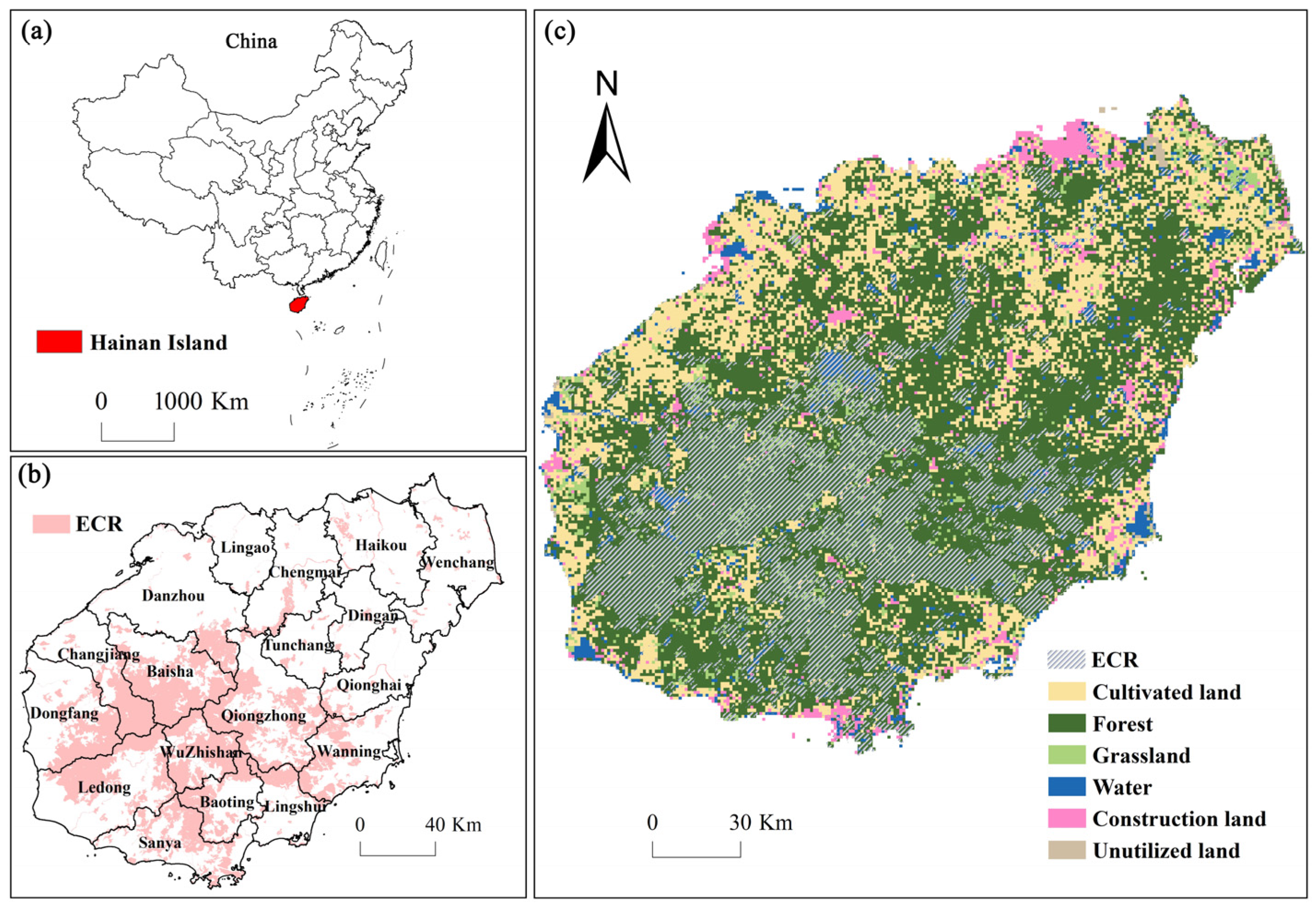
Hainan Island (18.80–0.10° N, 108.37–111.03° E), the southernmost tropical island in China, serves as a flagship region for the implementation of China’s ECR policy. As a National Ecological Civilization Pilot Zone, it takes the lead in innovative ecological governance, with the demarcation and implementation of the ECR serving as a core policy achievement. Covering approximately 35,400 km2, Hainan Island is characterized by a prominent central highland (with a maximum elevation of 1867 m) and concentric zonal distribution of mountains, hills, platforms, and plains. Its 62.1% forestland coverage (supporting a typical tropical rainforest ecosystem) is a key target of the ECR policy [29]. Hainan Island’s terrestrial ECR encompasses 9256.84 km2 (27.3% of the island), strategically delineated to protect the core of its unique tropical maritime monsoon ecosystem. Centered on Qiongzhong, Wuzhishan, Baisha, and Baoting in the center (forming a contiguous core ecological zone), it extends westward to eastern Changjiang, Dongfang, and northern Ledong, eastward to western Wanning and Qionghai, and southward to northern mountainous and southeastern coastal areas of Sanya; northern fragmented patches are scattered in Haikou, Wenchang, Chengmai, Danzhou, and other provinces to safeguard critical ecological security zones. Land cover of the ECR is predominantly forest (core for tropical rainforest protection), with minor components of waters and grasslands interspersed in/along the central core zone (forming regional ecological networks). Limited cultivated land is primarily concentrated in northern areas with higher human activity intensity (Figure 1).

2.2. Data Sources and Preprocessing

2.2.1. Data Sources

This study incorporated multi-source geospatial datasets spanning 1990–2020, including LULC data, Geographical data, Soil data, Meteorological data, Socio-economic data, and Boundary data. Data sources and their descriptions are cataloged in Table 1. The land use classification system in this study refers to the framework proposed by Liu et al. [30], which categorizes land into six first-level types (cultivated land, forest, grassland, water area, construction land, and unused land) and several second-level types.

2.2.2. Preprocessing

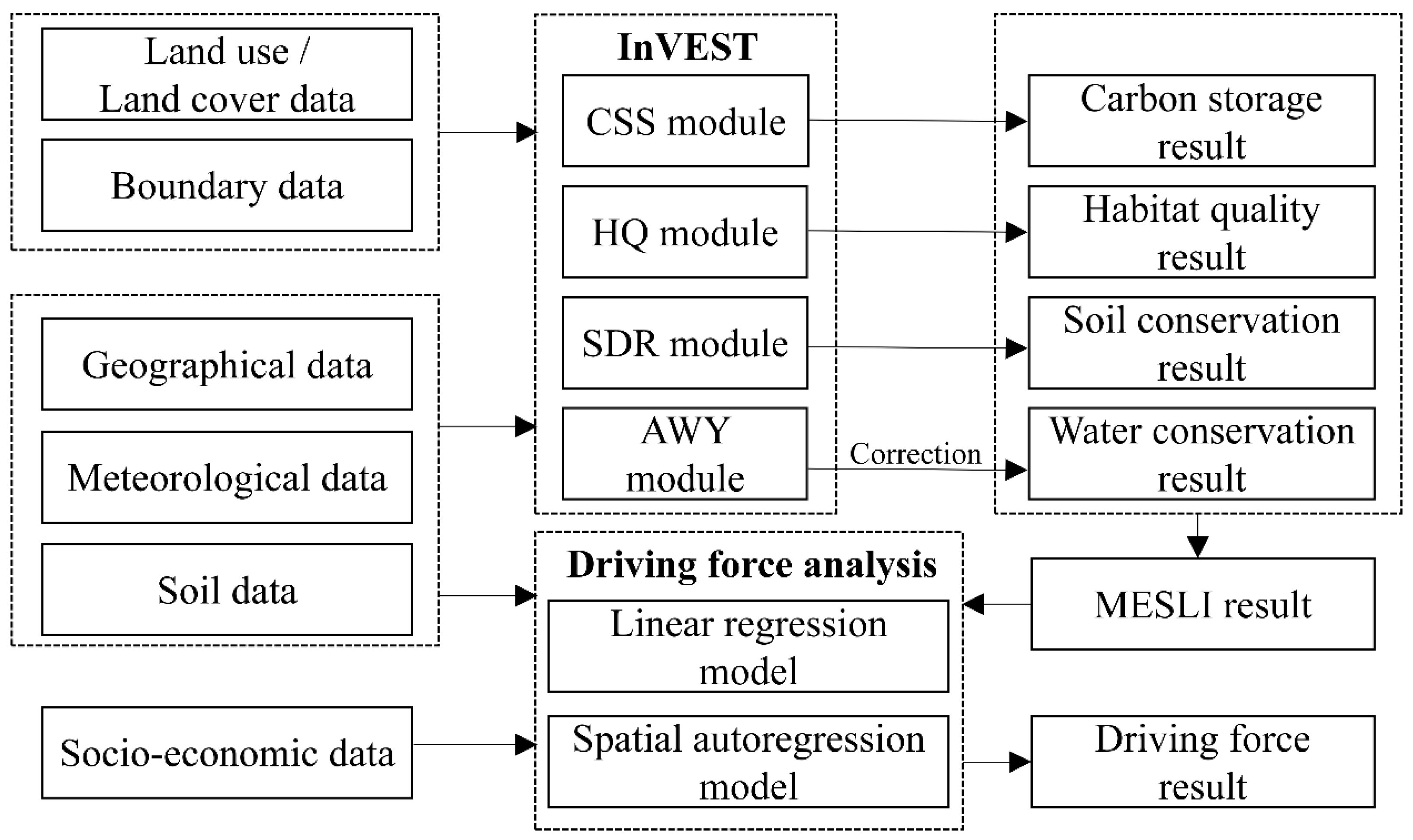
All datasets were standardized to a unified coordinate system and resampled to consistent spatial resolutions of 1 Km × 1 Km using ArcGIS 10.8. Required data were clipped to the study area extent. The detailed workflow and research framework are illustrated in Figure 2.

2.3. Methodologies

2.3.1. Carbon Storage

Carbon Storage (CS) refers to the total accumulation of carbon within a specific geographic region. This study utilized the CS and Sequestration module of the InVEST model to calculate CS. Based on land use/land cover (LULC) data and carbon pool datasets, CS was estimated by integrating 4 carbon pools: aboveground biomass, underground biomass, soil, and dead organic matter. The model assigned these CS densities to LULC raster layers and aggregated them to generate raster map outputs and total CS spatial distribution data [32]. The calculation formula of CS is expressed as [33]:
C t o t a l = C a b o v e + C b e l o w + C s o i l + C d e a d
where Cabove represents carbon in all living plant material above the soil; Cbelow represents carbon in the living root systems of plants; Csoil represents organic carbon within the soil; and Cdead represents carbon in plant litter, and both fallen and standing deadwood. The carbon density table is fine-tuned based on the research of Fang et al. (Table 2) focused on Hainan Island, ensuring the regional applicability of the carbon density data [34].

2.3.2. Habitat Quality

Habitat Quality (HQ) is assessed based on the inherent capacity of an ecosystem to provide suitable conditions for the survival and reproduction of biota within specific spatio-temporal contexts, serving as a critical indicator of biodiversity status [35]. Specifically, this module quantifies habitat degradation caused by threat sources and integrates it with habitat suitability to calculate HQ, with LULC classifications and biodiversity threat parameters as the core input data. This study employed the HQ module of the InVEST model to generate HQ outputs based on LULC classifications and biodiversity threat parameters. The calculation formula is expressed as [36]:
D x j = l r l y ( ω r r = 1 n ω r ) × r y × i r x y × β x × S j r
i r x y = { 1 ( d x y d r max ) ( Linear Decay ) exp [ ( 2.99 d r max ) × d x y ] ( Exponential Decay )
Q x j = H x j × [ 1 ( D x j 2 D x j 2 + k 2 ) ]
Dxj represents habitat degradation; ωr is the weight assigned to each threat factor; ry denotes the intensity of the threat factor; βx indicates the resistance of the habitat to disturbance; Sjr is the relative sensitivity of different habitats to various threat factors; irxy represents the impact of threat factor r in grid cell y on grid cell x, and it can follow either an exponential or linear decay; r is the habitat threat factor; y represents the grid cell containing threat factor r; dxy is the distance between grid cells x and y; drmax denotes the maximum impact range of threat factor r; Qxj refers to the habitat quality of grid cell x within land use type j; and Hxj represents the habitat suitability of grid cell x within land use type j, ranging from [0,1]. Sjr refers to the relative vulnerability of each habitat type to threats. The half-saturation constant k is set to 0.05. Threat sources used in the calculation are presented in Table 3. Habitat suitability and sensitivity of different land use types are shown in Table 4. To ensure the accuracy and regional adaptability of the model, these parameters were selected based on the actual ecological and human activity characteristics of the study area, based on referenced relevant studies [37,38,39].

2.3.3. Soil Conservation

Soil Conservation (SC) denotes the regulatory capacity of ecosystems to mitigate soil erosion and retain sediment. This study employed the Sediment Delivery Ratio module of the InVEST model, applying the Revised Universal Soil Loss Equation to quantify SC as the difference between potential soil erosion under bare-surface conditions and actual soil erosion incorporating vegetation cover and management practices [40]. The formula is expressed as [19,20,41,42,43,44,45]:
A s o i l = A p o t A a c t = R × K × L S × ( 1 C × P )
where Asoil represents SC (t·hm−2·a–1); Apot represents potential soil erosion (t·hm−2·a–1); Aact represents actual soil erosion (t·hm−2·a−1); R represents rainfall erosivity factor (MJ·mm·hm−2·h–1·a–1), calculated using Zhang’s method; K represents soil erodibility factor (t·hm2·h·MJ–1·hm−2·mm–1); LS represents slope length and steepness factor; C represents vegetation cover management factor; and P represents conservation practice factor, calibrated based on prior studies. The biophysical coefficients are detailed in Table 5.

2.3.4. Water Source Conservation

Water Source Conservation (WSC) refers to the capacity of ecosystems to sustain the sustainable provision of water resources through the storage and regulation of hydrological processes. This study utilized the Annual Water Yield module of the InVEST model to calculate water yield for each grid cell, with calibration adjustments applied to derive the final water retention metrics. The formula is expressed as [20,21,44,45]:
r e t e n t i o n = min ( 1 , 249 V e l o c i t y ) × min ( 1 , 0.9 × T I 3 ) × min ( 1 , K s a t 300 ) × Y i e l d
where retention represents WSC (mm); Yield represents the water yield (mm); Ksat represents soil saturated hydraulic conductivity (cm/d); Velocity represents the flow velocity coefficient; and TI represents the topographic index.

2.3.5. Multiple Ecosystem Service Landscape Index

The Multiple Ecosystem Service Landscape Index (MESLI) acts as a robust metric for the holistic evaluation of a region’s capacity to concurrently provide ES. It represents the composite ES performance level, thus effectively reflecting the holistic ecological effects of ECR policy implementation. It is calculated through the aggregation of normalized ES values [21,46]. The formula is expressed as:
M E S L I = i = 1 n x min ( x i ) max ( x i ) min ( x i )
where i represents the type of ES; n represents the number of ES categories; xi represents the observed value of the i-th ES; max(xi) represents the maximum recorded value of the i-th ES; and min(xi) represents the minimum recorded value of the i-th ES.

2.3.6. Geographically Weighted Regression

Geographically Weighted Regression (GWR) is a spatial analytical method used to explore the localized relationships between variables across geographic space. In contrast to global regression models, its primary advantage is that it allows regression coefficients to account for spatial variability, thus capturing spatial heterogeneity in the relationships among selected factors [22]. It is therefore well-suited to identifying the spatial heterogeneity of driving factor impacts and provides robust technical support for elucidating the mechanisms underlying regional differences in ecosystem service changes.
This study selected 8 potential independent variables based on their well-established theoretical and empirical associations with ES provision, as reported in the existing literature [21,22,26,27,28]. These factors collectively represent the key natural environmental determinants and socio-economic pressures shaping the spatial patterns of ES within the ECR. Natural factors include annual average temperature, precipitation, altitude, slope, and TCR. Socio-economic factors include Gross Domestic Product, population, and nightlight intensity. All raster data of these variables were extracted according to the vector boundaries of the 159 towns and sub-districts within the ECR, and the mean value of each variable in every administrative unit was calculated as the input data for the GWR model.

3. Results

3.1. Spatiotemporal Evolution Characteristics of ES

3.1.1. Spatial Distributions

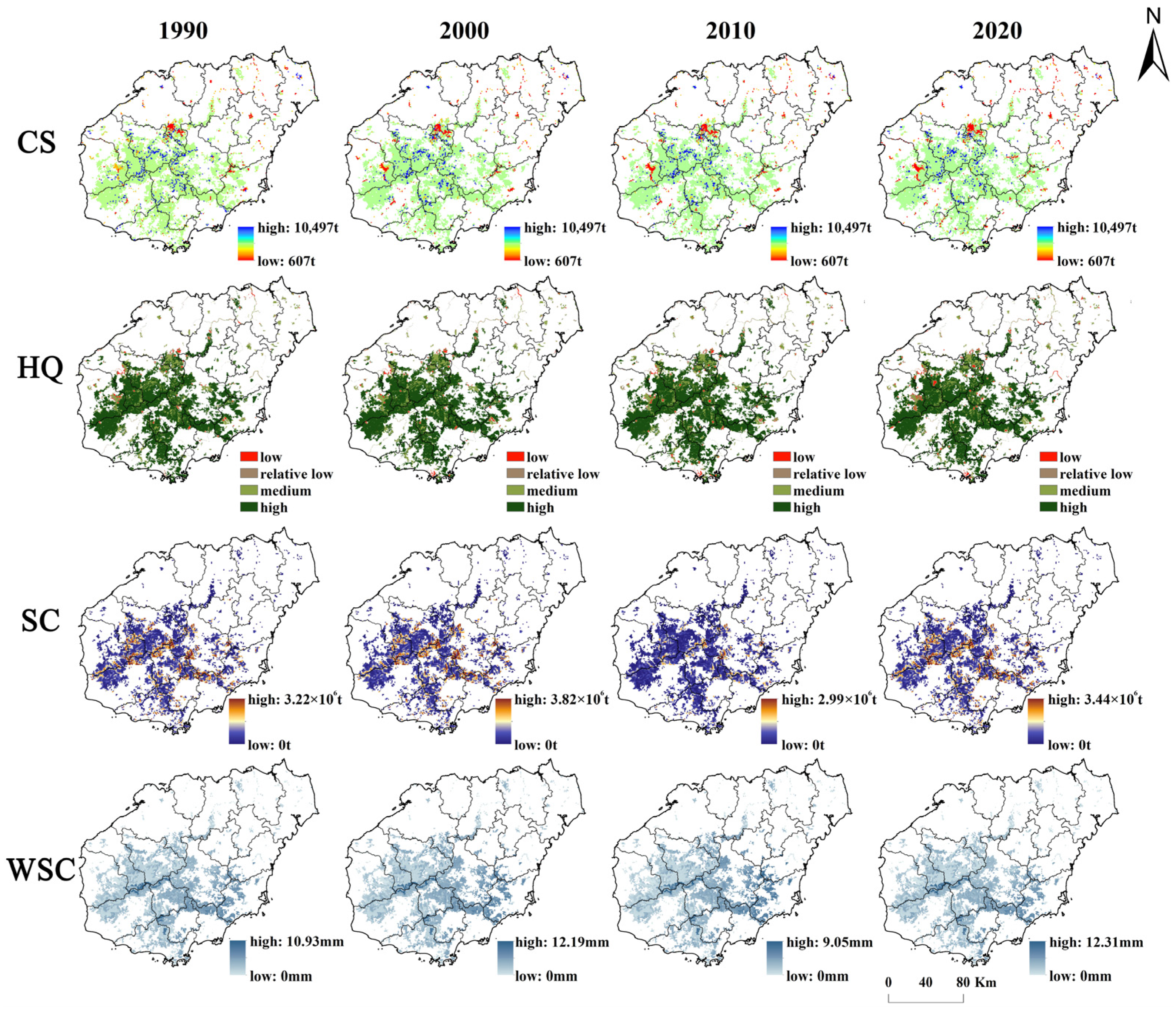
The ES in the ECR of Hainan Island exhibited apparent spatial heterogeneity (Figure 3). CS showed overall stability across the study period. Land cover in the ECR was predominantly forest, which provides moderate carbon stocks that form the foundation for the regional carbon sink. The high-value CS areas are dispersed in Baisha, Wuzhishan, Qiongzhong, and Changjiang, a pattern attributed to the high subsurface carbon stocks in grasslands. In contrast, CS’s low-value areas are concentrated in water body regions in Dongfang and Danzhou.
Consistent with the spatial pattern of CS, HQ maintained stably high values throughout the study period. High-value HQ areas are clustered in core conservation zones of central tropical rainforests. Low-value HQ areas are relatively scattered, primarily concentrated in regions under intense anthropogenic disturbance (urbanized land) in Danzhou, Baisha, Dongfang, Sanya, and Haikou.
High-value SC areas have a relatively limited spatial distribution, primarily concentrated in Baisha, Qiongzhong, Wuzhishan, and Changjiang, corresponding to the steep central mountainous zone of the island. Low-value SC areas were distributed in areas with gentler slopes, where the risk of soil erosion is naturally low.
High-value WSC areas are concentrated in Wanning, Lingshui, and Qiongzhong, a region with relatively high annual precipitation that constitutes the core zone of the island’s maximum WSC capacity. In contrast, low-value WSC areas are located in Baisha, Changjiang, Dongfang, Ledong, and southern Sanya; these areas are characterized by lower annual precipitation and high impervious surface coverage, leading to a significantly lower WSC capacity compared to the mountainous regions of central and eastern Hainan Island.
MESLI is generally at a relatively high level across the ECR, exhibiting distinct spatial differentiation. High-value MESLI areas account for the majority of the total ECR area and are concentrated in the core protected tropical rainforest zone of the central mountains, as well as the contiguous natural forest areas in Qiongzhong and Wuzhishan, extending eastward to the hilly regions of Wanning-Lingshui. Low-value MESLI areas cover a relatively small proportion of the ECR and are scattered in Baisha, Changjiang, Ledong, and Sanya. (Figure 4).

3.1.2. Time Variations

Table 6 presents the interannual variations of ES within the ECR of Hainan Island from 1990 to 2020. HQ remains relatively stable over the study period, indicating the well-preserved structure of the regional ecosystem. CS exhibits a gradual decline, dropping from 5522.09 t∙Km−2 in 1990 to 5380.54 t∙Km−2 in 2020, representing an overall reduction of approximately 2.6%. SC and WSC show significant interannual fluctuations, with both peaking in 2000 and declining in 2010: SC varies from 408,091.56 t∙Km−2 in 1990 to 447,705.92 t∙Km−2 in 2000, and subsequently to 316,735.06 t∙Km−2 in 2010; WSC ranges from 1.91 mm∙Km−2 in 1990 to 2.22 mm∙Km−2 in 2000, and subsequently to 1.40 mm∙Km−2 in 2010. Following the implementation of the ECR in 2011, the functions of SC and WSC exhibit a positive recovery trend near their 2000 peak levels. Meanwhile, the rate of decline in CS slows markedly, with a reduction of only 0.48% from 2010 to 2020. MESLI follows a trend of initial decline and subsequent recovery, which demonstrates the effectiveness of the ECR policy in improving the overall status of regional ES.

3.2. MESLI Variations

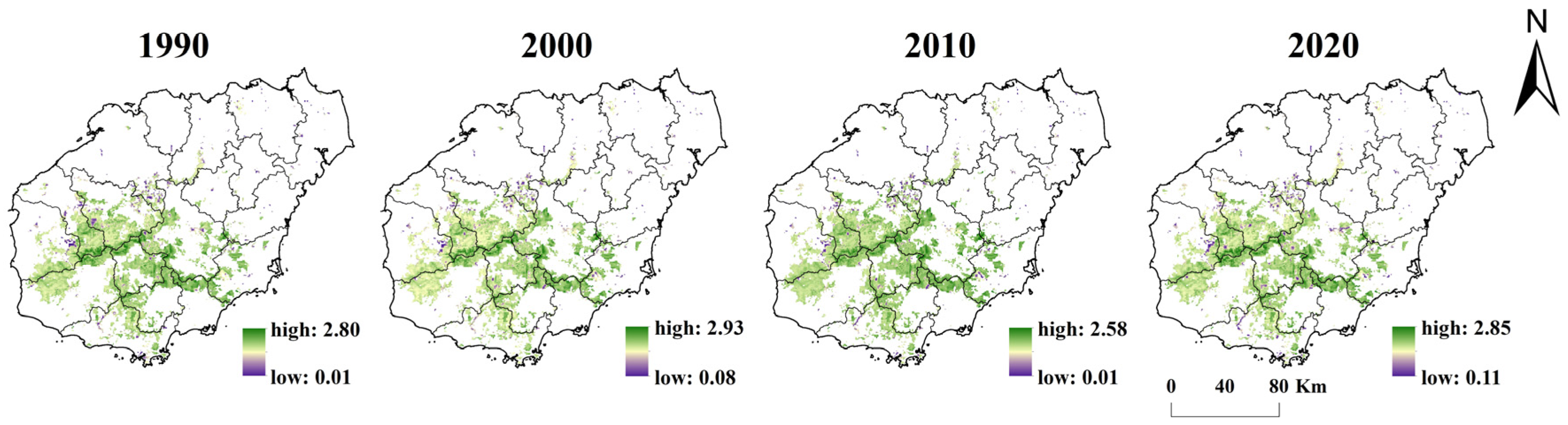
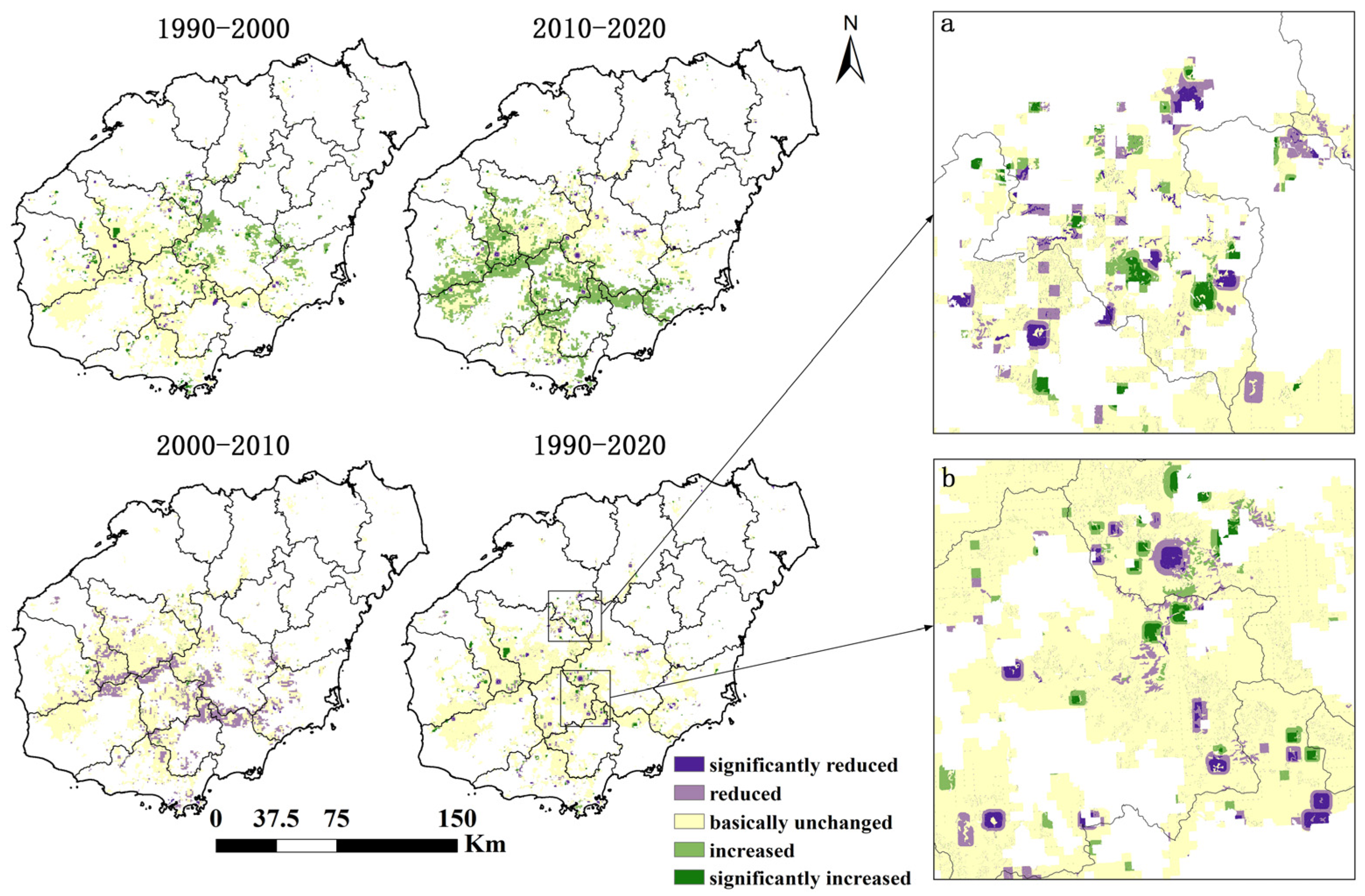
Figure 5 presents the decadal changes in MESLI and its overall variation trends in the ECR from 1990 to 2020. From 1990 to 2000, MESLI exhibits a generally increasing trend, with the rise primarily observed in Qiongzhong and Wanning, while other regions remained essentially unchanged. From 2000 to 2010, MESLI exhibits a decreasing trend, with the decline mainly occurring in Lingshui, Baoting, Wuzhishan, Changjiang, and Baisha. From 2010 to 2020, MESLI displays a general increase; Qiongzhong, Baisha, Danzhou, and Chengmai remain essentially unchanged, while the remaining regions all show an increasing trend. Overall, MESLI in 2020 returns to the 1990 level, and the areas with the most significant fluctuations are mainly distributed at the boundaries of Danzhou and Baisha (Figure 5a) and the junction of Qiongzhong, Wuzhishan, and Baoting (Figure 5b).

3.3. Driving Factors of ES Variation

To explore the driving factors influencing the amount of ES within the ECR range of Hainan Island, this study adopts a GWR model and considers eight potential driving factors. To verify the applicability of the GWR model, the Ordinary Least Squares (OLS) model is first used to conduct regression analysis on the variables, and global spatial autocorrelation analysis is performed on the residuals of the results. The analysis results show that Moran’s I index is approximately 0.28 with a p-value close to 0, indicating significant moderate-intensity positive spatial autocorrelation in the residuals. The GWR model is therefore employed to examine the spatially varying relationships among the variables. Considering the multicollinearity among the independent variables, the exploratory regression function of ArcGIS is first utilized to select the optimal combination of independent variables. Ultimately, TCR, slope, and population are identified as the driving factors of MESLI.
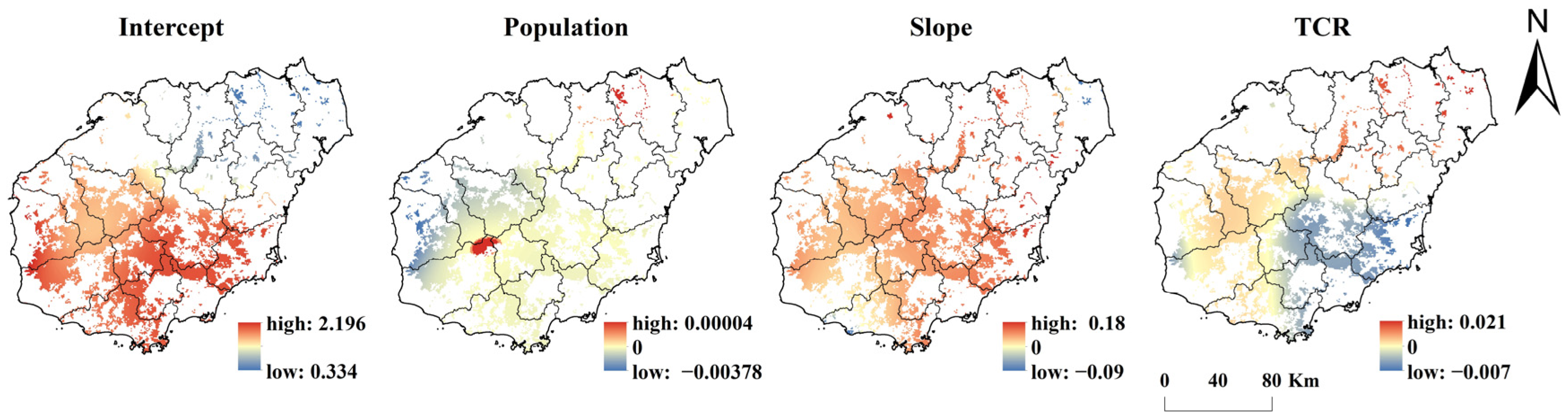
Table 7 presents the calculation results of the GWR model. The results indicate that the R2-Adjusted is 0.78, demonstrating the strong explanatory power of the model. The absolute value of AICc is 35.29, which is significantly lower than the 68.97 of the OLS model, indicating that the fitting performance of the GWR model is markedly superior to that of the OLS model. Population and MESLI were generally negatively correlated. For every 1-person increase in population size, MESLI decreased by approximately 0.00039 on average. TCR and slope were generally positively correlated with MESLI. For every 1-percentage-point rate increase in TCR, MESLI increased by an average of 0.07. For every 1-degree increase in slope, MESLI increases by an average of 0.004.
Figure 6 presents the spatial distribution of MESLI drivers. High-value areas of intercept are concentrated in the central and southern regions, while relatively low values are found in the northern region. TCR exhibits a strong positive correlation with MESLI in the northern and southwestern regions, whereas a weak negative correlation appears in the southeastern direction. Slope is positively correlated with MESLI in most areas, with a negative correlation observed only in Wenchang. Consistent with slope, population is negatively correlated with MESLI in the majority of the ECR, with a positive correlation detected only in northern Ledong.

4. Discussion

4.1. The Effectiveness of ECR in Enhancing Multifunctional ESs

This study reveals a general trend of stabilization–decline–recovery in the ES within Hainan Island’s ECR from 1990 to 2020. In particular, high-value CS and HQ areas have consistently coincided with the core zones of the tropical rainforest in central Hainan, supporting previous findings that ECRs are effective in preserving primary ecological function areas and biodiversity hotspots [47,48]. However, CS continued to decline throughout 1990–2020, albeit at a reduced rate after the implementation of ECR. This suggests that the ECR policy may play a role in mitigating degradation rather than reversing it outright, consistent with Zhang et al. [26], who observed similar attenuation patterns in Hainan. Notably, HQ remained relatively stable but did not significantly improve after ECR implementation and even declined in 2020. This finding echoes Zhang et al. [28], who attributed habitat decline to fragmentation within ECR zones. Our results thus reinforce that ECR alone may not guarantee ecological enhancement if internal connectivity and patch quality are not sufficiently managed. In essence, ECRs have shown effectiveness in preventing further degradation, yet targeted conservation measures are required to achieve improved biodiversity restoration. SC and WSC exhibited greater responsiveness to macro-level policy shocks. During 1990–2000, national programs such as the Natural Forest Protection Program contributed to marked improvements in SC and WSC capacities [49]. However, post-2001 trends were shaped by intensified land use due to China’s WTO accession and pro-growth policies such as the Big Project Drive project (2006) and the International Tourism Island strategy (2009), which accelerated construction and industrial development at the cost of ESs [50]. The 2010–2020 recovery reflects a return to conservation-oriented policy priorities [51].
It should be acknowledged that the ECR policy has coincided spatiotemporally with other environmental policies, including the representative Grain for Green Program and Natural Forest Protection Program. Nevertheless, the ECR policy differs from these policies in its orientation and implementation approach [52]. As a rigid bottom line for ecological space, the ECR aims to maximize the natural restoration capacity within protected areas by demarcating clear spatial access boundaries, with a focus on the synergistic restoration of multiple ES [53]. In contrast, other policies place greater emphasis on the active restoration of a single ES in specific fragmented areas through project-based interventions, with limited consideration for the overall planning and synergistic improvement of ESs across the entire region [54]. Spatially, the MESLI in the core ECR zones has exhibited a more distinct recovery trend compared with the fragmented northern areas. This can be attributed to the integrated and stringent spatial control measures imposed by the ECR, which have maintained the structural connectivity of the tropical rainforest ecosystem. Overall, our MESLI results suggest that the ECR has contributed to halting the long-term decline of multifunctional ESs and enabling partial recovery, particularly in areas where policy, ecological potential, and historical degradation trajectories are well aligned. However, boundary areas and zones near administrative divisions continue to show slow recovery, highlighting limitations of the current administrative jurisdiction-based governance model. Consistent with basin- or landscape-level ecological planning theory, we recommend exploring trans-jurisdictional governance mechanisms (e.g., watershed or mountain-based units) to enhance the ecological effectiveness of future collaborative ECR policies [55].

4.2. Spatial Heterogeneity and Ecological Thresholds: Implications for Zonal Governance

The GWR results reveal considerable spatial heterogeneity in the effects of TCR and population density on MESLI, indicating that the ecological outcomes of ECR implementation are jointly shaped by natural conditions and human pressures. In the Dongzhaigang mangrove area, both TCR and population density show positive correlations with MESLI, suggesting that community-based conservation and natural restoration efforts reinforce one another. This aligns with Liu et al.’s empirical findings on mangrove restoration effectiveness [56]. For this region, further promotion of nature-based solutions—such as ecological corridors and enhanced patch connectivity—is recommended [57]. In contrast, other fragmented northern areas show negative correlations between population density and MESLI, indicating insufficient ecological buffering capacity and inadequate development control. These findings are consistent with Zhang et al.’s [58] assessment of degradation risks in small coastal ecological patches. Thus, stricter watershed pollution control, restrictions on coastal development, and the establishment of ecological transition belts are necessary to reinforce local ecological stability.
In the central mountainous region, TCR exhibits a significant positive correlation with MESLI, while population density shows a weak negative correlation, confirming the crucial role of preserving natural vegetation in enhancing ES synergies [59]. In northern Ledong, however, population density displays a positive correlation with MESLI, suggesting that moderate human activities and community-based governance can generate positive socio-ecological feedback effects. This supports the development of eco-friendly community belts and agro-ecological composite zones [60].
In eastern high-value zones, TCR demonstrates a weakly negative correlation with MESLI, reflecting a saturation effect—where further afforestation may disrupt existing ecological equilibria. This pattern corresponds with findings from other tropical highland ecosystems, where excessive planting can lead to ecological imbalance [61]. Therefore, management should shift from afforestation expansion to ecological asset stabilization by developing cultural ecosystem services such as forest therapy and environmental education [62]. These heterogeneous spatial responses highlight the necessity of transitioning from uniform redline delineation to differentiated, threshold-based zonal governance.

4.3. Optimizing ECR Governance: From Uniform Delineation to Differentiated Zonal Management

This study demonstrates that different functional areas within Hainan Island’s ECR exhibit distinct ecological responses, indicating that a “one-size-fits-all” delineation approach is insufficient for targeted governance. To enhance the ecological performance of the ECR, differentiated management and restoration strategies should be integrated into the existing redline framework.
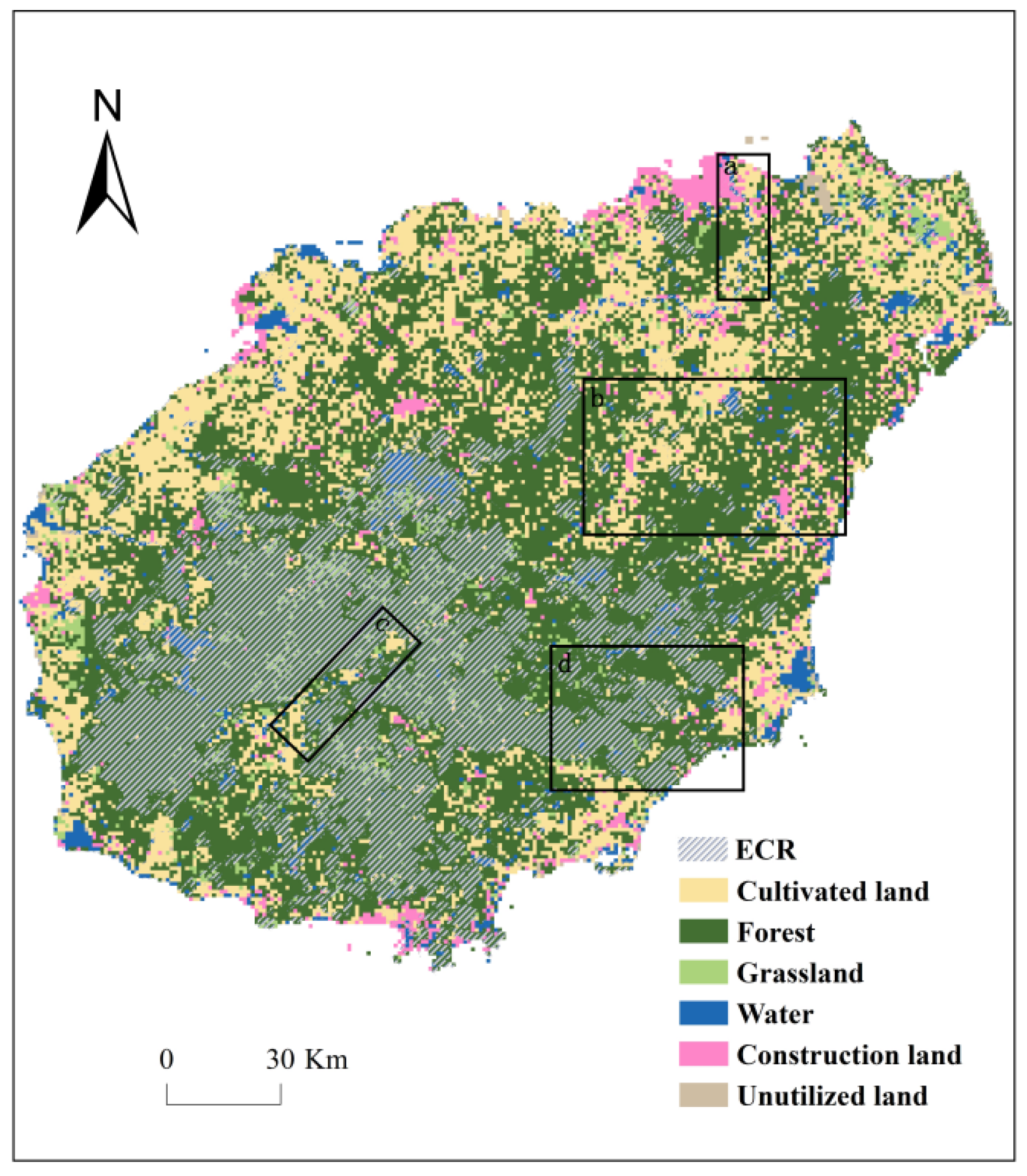
In densely populated regions of the north and southeast, governance should prioritize pollution-source control, restoration of ecological corridors, and coordination of land use. Constructing composite ecological structures—such as “buffer zones + multifunctional ecological corridors”—is essential for improving system stability. In central and southwestern high-value ecological regions, the principle of “minimal intervention + in situ conservation” should be maintained, with a focus on natural regeneration and community co-management. In Ledong, for example, a cooperative ecological stewardship model could be piloted to combine community participation with ecological maintenance. Based on temporal trends and spatial diagnostics, this study proposes developing a mechanism-oriented zonal governance framework that shifts ECR implementation from spatial control to adaptive governance. The three recommended management types are (Figure 7) as follows:
Ecologically fragile and fragmented zones (Figure 7a,b): Consolidate ecological infrastructure, prioritize pollution control and land-use coordination, and construct ecological corridors, riparian buffers, and wetland mosaics [63].
Core ecological zones (Figure 7c): Uphold strict protection with “minimal intervention + in situ conservation,” while introducing “eco-window community” pilots that adopt cooperative-based ecological maintenance models [64].
High-saturation ecological zones (Figure 7d): Shift the focus from afforestation expansion to ecological asset stabilization, supported by soft incentives and the development of cultural ecosystem services [60].
The zonal control scheme proposed in this study aligns closely with the GWR diagnostic results and provides a practical and scalable framework for enhancing ECR performance. Moreover, MESLI can serve as a reliable indicator for identifying zoning units and supporting adaptive performance evaluation.

4.4. Limitations and Future Directions

This study provides insights for the refined zonal governance of ECR in tropical island ecosystems, with the core implications of this refined governance reflected in three interrelated dimensions. Firstly, this study challenges a one-size-fits-all management paradigm by revealing that the influence of key drivers, including tree cover and population, is not uniform but spatially contingent. This necessitates the differentiated, zonal control system proposed in this study. Secondly, this study provided empirical, data-driven insights to guide policy focus: the identified saturation effect in high-coverage areas indicates that further afforestation would be inefficient, while the positive human–ES correlation in Ledong justifies investments in community stewardship programs. Finally, by mapping the spatial heterogeneity of driving mechanisms, this study enables policymakers to move from generic to targeted interventions, thereby enabling the efficacy and cost-effectiveness of future conservation investments on Hainan Island.
This study has several limitations that offer avenues for future research. The 10-year time intervals adopted in this study can reflect the long-term trend of ES change, yet the relatively coarse temporal resolution may hinder the capture of dynamic details and nonlinear change properties during the ES change process. In the future, data from intermediate years can be supplemented to enhance the comprehensiveness of temporal analysis. Furthermore, static parameters (e.g., carbon density coefficients and biophysical coefficients) were adopted in this model, without accounting for the dynamic changes in related parameters. This dynamic variation is a key factor that needs to be incorporated into future research to better elucidate the impacts of natural ecosystem variables and human factors on ES. The analysis of driving factors in this study focuses on natural and socio-economic variables but does not integrate dynamic factors such as climate change and heterogeneity in policy implementation. Multi-dimensional data can be coupled to construct a more holistic driving framework to improve the interpretability of factors in further studies. In addition, this study assigned equal weights to the four selected ecosystem services in MESLI calculation, and future research will explore region-specific differentiated weight assignment based on the ecological characteristics and service importance of Hainan’s tropical rainforest ecosystem to further optimize the MESLI evaluation framework.

5. Conclusions

This study systematically evaluated the spatiotemporal evolution characteristics and driving mechanisms of ES within the ECR range of Hainan Island from 1990 to 2020, clarifying the complex impact of ECR policies on ES. The main research conclusions are as follows:
(1)
The implementation of the ECR effectively facilitated the synergistic restoration of multiple ecosystem services between 2010 and 2020. Following a continuous decline from 1990 to 2010, the MESLI increased by 12.7% within this decade, indicating that the policy measures accompanying the ECR played a key role in curbing the degradation trend.
(2)
The conservation effects of the ECR exhibit significant spatial variations across different regions, service types, and socio-ecological contexts. While CS and habitat quality remained consistently high in the central tropical rainforest area, the restoration effects were limited in the fragmented regions of the north and east, highlighting the regulatory effects of ecological baseline conditions and human pressures.
(3)
The spatial response of ecosystem services is significantly affected by the interaction between natural gradients and human activities. Although the TCR was generally a positive factor, a saturation effect has emerged in high-value areas. The impact of the population factor exhibited context-dependent positive or negative effects, suggesting that management strategies must be tailored to local conditions. A one-size-fits-all management policy is inadequate to address the governance challenges posed by spatial heterogeneity. Based on the mechanisms identified by the GWR model, this study proposes three zoned governance pathways: Ecological Restoration Zones, Community Co-governance Zones, and Ecological Steady-state Maintenance Zones, so as to optimize the implementation effectiveness of the ECR policy.
(4)
In future planning for the demarcation of the ECR, a comprehensive assessment system of ecosystem service indicators should be integrated. Efforts should focus not only on enhancing the functions of specific ecosystems but also on coordinating the synergistic improvement of multiple ecosystem functions, thereby constructing a complete structure and stable function.
The research findings can provide methodological support and practical references for the adaptive governance of the redline policy, national parks, and tropical ecosystem protected areas.

Author Contributions

Conceptualization, C.L. and P.J.; methodology, C.L. and Y.Z.; software, C.L. and Y.Z.; validation, C.L. and P.J.; formal analysis, C.L.; investigation, C.L.; resources, C.L.; data curation, C.L.; writing—original draft preparation, C.L.; writing—review and editing, C.L., Y.Z., and P.J.; visualization, C.L.; supervision, P.J. and D.G.; project administration, P.J. and D.G.; funding acquisition, P.J. All authors have read and agreed to the published version of the manuscript.

Funding

This research was funded by the National Natural Science Foundation of China (No. 42371272) and the National Social Science Fund of China (21XGL019).

Data Availability Statement

The original contributions presented in this study are included in the article. Further inquiries can be directed to the corresponding author.

Acknowledgments

We would like to thank the Hainan Guoyuan Institute of Land and Mineral Survey Planning & Design Co., Ltd for certifying the research data. We also wish to thank anonymous reviewers for their valuable comments and suggestions.

Conflicts of Interest

The authors declare no conflicts of interest. The funders had no role in the design of the study; in the collection, analyses, or interpretation of data; in the writing of the manuscript; or in the decision to publish the results.

Abbreviations

The following abbreviations are used in this manuscript:
ECREcological Conservation Redline
ESEcosystem Services
InVESTIntegrated Valuation of Ecosystem Services and Trade-offs
MESLIMultiple Ecosystem Service Landscape Index
CSCarbon Storage
HQHabitat Quality
SCSoil Conservation
WSCWater Source Conservation
GWRGeographically Weighted Regression
OLSOrdinary Least Square

References

  1. Friedlingstein, P.; Jones, M.W.; O’Sullivan, M.; Andrew, R.M.; Bakker, D.C.E.; Hauck, J.; Le Quéré, C.; Peters, G.P.; Peters, W.; Pongratz, J.; et al. Global carbon budget 2021. Earth Syst. Sci. Data 2022, 14, 1917–2005. [Google Scholar] [CrossRef]
  2. Friedlingstein, P.; O’Sullivan, M.; Jones, M.W.; Andrew, R.M.; Gregor, L.; Hauck, J.; Le Quéré, C.; Luijkx, I.T.; Olsen, A.; Peters, G.P.; et al. Global carbon budget 2022. Earth Syst. Sci. Data 2022, 14, 4811–4900. [Google Scholar] [CrossRef]
  3. Lin, Q.; Eladawy, A.; Sha, J.; Li, X.; Wang, J.; Kurbanov, E.; Thomas, A. Remotely Sensed Ecological Protection Redline and Security Pattern Construction: A Comparative Analysis of Pingtan (China) and Durban (South Africa). Remote Sens. 2021, 13, 2865. [Google Scholar] [CrossRef]
  4. Smit, I.P.J.; Fernández, R.J.; Menvielle, M.F.; Roux, D.J.; Singh, N.; Mabuza, S.; Mthombeni, B.M.; Macgregor, N.A.; Fritz, H.; Gandiwa, E.; et al. From parachuting to partnership: Fostering collaborative research in protected areas. J. Appl. Ecol. 2025, 62, 28–40. [Google Scholar] [CrossRef]
  5. Lloret, J.; Wawrzynkowski, P.; Dominguez-Carrió, C.; Sardá, R.; Molins, C.; Gili, J.M.; Sabatés, A.; Vila-Subirós, J.; Garcia, L.; Solé, J.; et al. Floating offshore wind farms in Mediterranean marine protected areas: A cautionary tale. ICES J. Mar. Sci. 2023, 82, 3. [Google Scholar] [CrossRef]
  6. Rylands, A.B.; Brandon, K. Brazilian protected areas. Conserv. Biol. 2005, 19, 612–618. [Google Scholar] [CrossRef]
  7. Zang, Z.; Zhang, D.; Wang, N.; Du, A.; Kong, L.; Xu, W.; Ouyang, Z. Experiences, achievement, problems and recommendations of the first batch of China’s national park system pilots. Acta Ecol. Sin. 2020, 40, 8839–8850. [Google Scholar]
  8. Ouyang, Z.; Du, A.; Xu, W.H. Research on China’s protected area system classification. Acta Ecol. Sin. 2020, 40, 7207–7215. [Google Scholar]
  9. Yu, C.; Zhang, Z.; Jeppesen, E.; Gao, Y.; Liu, Y.; Liu, Y.; Lu, Q.; Wang, C.; Sun, X. Assessment of the effectiveness of China’s protected areas in enhancing ecosystem services. Ecosyst. Serv. 2024, 65, 101588. [Google Scholar] [CrossRef]
  10. Bai, Y.; Wong, C.P.; Jiang, B.; Hughes, A.C.; Wang, M.; Wang, Q. Developing China’s Ecological Redline Policy using ecosystem services assessments for land use planning. Nat. Commun. 2018, 9, 3034. [Google Scholar] [CrossRef]
  11. He, M.; Cliquet, A. Challenges for Protected Areas Management in China. Sustainability 2020, 12, 5879. [Google Scholar] [CrossRef]
  12. Wang, Z.; Shen, Z. The main systems and characteristics of ecosystem protection in China. Acta Ecol. Sin. 2025, 9, 1–10. [Google Scholar]
  13. Zou, C.; Wang, L.; Liu, J. Classification and management of ecological protection redlines in China. Biodivers. Sci. 2015, 23, 716. [Google Scholar] [CrossRef][Green Version]
  14. Kong, L.; Wang, Y.; Zheng, H.; Xiao, Y.; Xu, W.; Zhang, L.; Xiao, Y.; Ouyang, Z. A method for evaluating ecological space and ecological conservation redlines in river basins: A case of the Yangtze River Basin. Acta Ecol. Sin. 2019, 39, 835–843. [Google Scholar] [CrossRef]
  15. Bai, Y.; Jiang, B.; Wang, M.; Li, H.; Alatalo, J.M.; Huang, S. New ecological redline policy (ERP) to secure ecosystem services in China. Land Use Policy 2016, 55, 348–351. [Google Scholar] [CrossRef]
  16. Lü, Y.; Ma, Z.; Zhang, L.; Fu, B.; Gao, G. Redlines for the greening of China. Environ. Sci. Policy 2013, 33, 346–353. [Google Scholar] [CrossRef]
  17. Liu, J.; Tang, Y.; Han, H.; Wang, J.; Yang, F. Research on the scenario construction of ecological protection red line monitoring and protection effectiveness evaluation in Yunnan. Nat. Resour. Inform. 2024, 6, 117–125. [Google Scholar]
  18. Liu, Y.; Chen, H.; Sun, F.; Dong, X. Evaluation of Effectiveness of Ecological Conservation Redline in Urbanized Areas: A Case Study of Shenzhen. Res. Environ. Sci. 2023, 36, 1329–1339. [Google Scholar]
  19. Yang, Y.; Song, G.; Lu, S. Study on the ecological protection redline (EPR) demarcation process and the ecosystem service value (ESV) of the EPR zone: A case study on the city of Qiqihaer in China. Ecol. Indic. 2020, 109, 105754. [Google Scholar] [CrossRef]
  20. Guo, X.; Zhang, Y.; Guo, D.; Lu, W.; Xu, H. How does ecological protection redline policy affect regional land use and ecosystem services? Environ. Impact Assess. Rev. 2023, 100, 107062. [Google Scholar] [CrossRef]
  21. He, L.; Xie, Z.; Wu, H.; Liu, Z.; Zheng, B.; Wan, W. Exploring the interrelations and driving factors among typical ecosystem services in the Yangtze river economic Belt, China. J. Environ. Manag. 2024, 351, 119794. [Google Scholar] [CrossRef] [PubMed]
  22. Wang, H.; Zhu, Y.; Huang, W.; Yin, J.; Niu, J. Spatio-temporal evolution and driving mechanisms of rural residentials from the perspective of the human–land relationship: A case study from Luoyang, China. Land 2022, 11, 1216. [Google Scholar] [CrossRef]
  23. Liu, J.; Ma, S.; Gao, J.; Zou, C.; Wang, J.; Liu, Z.; Wang, L. Delimiting the ecological conservation redline at regional scale: A case study of Beijing–Tianjin–Hebei region. China Environ. Sci. 2018, 38, 2652–2657. [Google Scholar]
  24. He, H.J.; Wen, J.S.; Zhang, J.W.; Zeng, X.; Li, F. Ecological functions assessment of mangrove wetland in Hainan Province. Ecol. Econ. 2015, 31, 145–149. [Google Scholar]
  25. Li, T.; Hong, X.; Liu, S.; Wu, X.; Fu, S.; Liang, Y.; Li, J.; Li, R.; Zhang, C.; Song, X. Cropland degradation and nutrient overload on Hainan Island: A review and synthesis. Environ. Pollut. 2022, 313, 120100. [Google Scholar] [CrossRef]
  26. Zhang, Z.; Zhu, Y.; Jia, P. Ecological Protection Redlines’ Positive Impact on Terrestrial Carbon Storage in Hainan Island, China. Land 2024, 13, 1292. [Google Scholar] [CrossRef]
  27. Han, N.; Yu, M.; Jia, P.; Zhang, Y.; Hu, K. Influence of Human Activity Intensity on Habitat Quality in Hainan Tropical Rainforest National Park, China. Chin. Geogr. Sci. 2024, 34, 3. [Google Scholar] [CrossRef]
  28. Zhang, X.; Jin, X.; Liang, X.; Shi, X.; Sun, R.; Zhu, W.; Lin, J.; Han, B.; Zhou, Y. Assessment and management for future habitat risks under the implementation of China’s territorial spatial planning: A case study from Hainan Island. Environ. Impact Assess. Rev. 2024, 106, 107474. [Google Scholar] [CrossRef]
  29. Liu, Q.; Yang, Z.; Chen, Y.; Lei, J.; Chen, Z.; Chen, X. Multi-scenario simulation of land use change and its eco-environmental effect in Hainan Island based on CA-Markov model. Ecol. Environ. Sci. 2021, 30, 1522–1531. [Google Scholar]
  30. Liu, J.Y.; Liu, M.L.; Zhuang, D.F.; Zhang, Z.X.; Deng, X.Z. Analysis of the Spatial Pattern of Land-use Change in China. Sci. China Ser. D 2002, 32, 1031–1040. [Google Scholar]
  31. Yan, F.; Shangguan, W.; Zhang, J.; Hu, B. Depth-to-bedrock map of China at a spatial resolution of 100 meters. Sci. Data 2020, 7, 2. [Google Scholar] [CrossRef]
  32. Zhao, M.; He, Z.; Du, J.; Chen, L.; Lin, P.; Fang, S. Assessing the effects of ecological engineering on carbon storage by linking the CA-Markov and InVEST models. Ecol. Indic. 2019, 98, 29–38. [Google Scholar] [CrossRef]
  33. Zhu, Y.; Jia, P.; Zhang, Z.; Cheng, J.; Wang, N. Carbon Storage Assessment under Mangrove Restoration of Dongzhai Harbor in Hainan Island, China. Ecosyst. Health Sustain. 2024, 10, 257. [Google Scholar] [CrossRef]
  34. Fang, Z.; Zhong, C.; Wang, F.; Cheng, C.; Lv, X.; Chen, X. Spatial-temporal Evolution and Prediction of Ecosystem Carbon Storage on Hainan Island by Coupling InVEST and FLUS Models. Bull. Soil Water Conserv. 2023, 43, 320–329. [Google Scholar]
  35. Yuan, H.; Tang, D.; Liu, H.; Liu, A. Spatiotemporal Variation of Land Use and Habitat Quality in Wuling Mountain Area. J. Hubei Minzu Univ. (Nat. Sci. Ed.) 2024, 42, 144–150. [Google Scholar]
  36. Zhu, Y.; Jia, P.; Liu, Y. Spatiotemporal evolution effects of habitat quality with the conservation policies in the Upper Yangtze River, China. Sci. Rep. 2025, 15, 5972. [Google Scholar] [CrossRef]
  37. Zhang, X.R.; Zhou, J.; Li, M.M. Analysis on Spatial and Temporal Changes of Regional Habitat Quality Based on the Spatial Pattern Reconstruction of Land Use. Acta Geogr. Sin. 2020, 75, 160–178. [Google Scholar]
  38. Mengist, W.; Soromessa, T.; Feyisa, G.L. Landscape Change Effects on Habitat Quality in a Forest Biosphere Reserve: Implications for the Conservation of Native Habitats. J. Clean. Prod. 2021, 329, 129778. [Google Scholar] [CrossRef]
  39. Liu, Y.; Zhou, Y.; Du, Y. Study on the Spatio-Temporal Patterns of Habitat Quality and Its Terrain Gradient Effects of the Middle of the Yangtze River Economic Belt Based on InVEST Model. Resour. Environ. Yangtze Basin 2019, 28, 2429–2440. [Google Scholar]
  40. Liu, H.; Tang, D. Ecological zoning and ecosystem management based on landscape ecological risk and ecosystem services: A case study in the Wuling Mountain Area. Ecol. Indic. 2024, 166, 112421. [Google Scholar] [CrossRef]
  41. Rao, E.; Xiao, Y.; Ouyang, Z.; Zheng, H. Spatial characteristics of soil conservation service and its impact factors in Hainan Island. Acta Ecol. Sin. 2013, 33, 746–755. [Google Scholar] [CrossRef]
  42. Gao, J.; Zuo, L.; Liu, W. Environmental determinants impacting the spatial heterogeneity of karst ecosystem services in Southwest China. Land Degrad. Dev. 2021, 32, 1718–1731. [Google Scholar] [CrossRef]
  43. Bao, Y.; Li, T.; Liu, H.; Ma, T.; Wang, H.; Liu, K.; Shen, X.; Liu, X. Spatial and temporal changes of water conservation of Loess Plateau in northern Shaanxi province by InVEST model. Geogr. Res. 2016, 35, 664–676. [Google Scholar]
  44. Liu, J.; Lang, X.; Su, J.; Liu, W.; Liu, H.; Tian, Y. Evaluation of water conservation function in the dry-hot valley area of Jinsha River Basin based on InVEST model. Acta Ecol. Sin. 2021, 41, 8099–8111. [Google Scholar]
  45. Fu, B.; Xu, P.; Wang, Y.; Peng, Y.; Ren, J. Spatial Pattern of Water Retention in Dujiangyan County. Acta Ecol. Sin. 2013, 33, 789–797. [Google Scholar]
  46. Rodríguez-Loinaz, G.; Alday, J.G.; Onaindia, M. Multiple Ecosystem Services Landscape Index: A Tool for Multifunctional Landscapes Conservation. J. Environ. Manag. 2015, 147, 152–163. [Google Scholar] [CrossRef]
  47. Lei, J.; Chen, Y.; Li, L.; Chen, Z.; Chen, X.; Wu, T.; Li, Y. Spatiotemporal change of habitat quality in Hainan Island of China based on changes in land use. Ecol. Indic. 2022, 145, 109707. [Google Scholar] [CrossRef]
  48. Liu, Q.; Yang, D.; Cao, L.; Anderson, B. Assessment and Prediction of Carbon Storage Based on Land Use/Land Cover Dynamics in the Tropics: A Case Study of Hainan Island, China. Land 2022, 11, 244. [Google Scholar] [CrossRef]
  49. Qin, Y.; Zhang, L.; Zhang, Z. The Chinese Paradigm of Protected Areas: 70 Years of Policy Evolution and the Shift to Smart Governance. Natl. Park 2025, 3, 512–521. [Google Scholar] [CrossRef]
  50. Guo, J.C.; Ke, Y.P. Development Strategies for Hainan’s Ecological Industry after WTO Accession. Ecol. Econ. 2003, 10, 64–66. [Google Scholar]
  51. Yao, X.; Zhou, L.; Wu, T.; Yang, X.; Ren, M. Ecosystem services in National Park of Hainan Tropical Rainforest of China: Spatiotemporal dynamics and conservation implications. J. Nat. Conserv. 2024, 80, 126649. [Google Scholar] [CrossRef]
  52. Gao, J.; Wang, Y.; Zou, C.; Xu, D.; Lin, N.; Wang, L.; Zhang, K. China’s Ecological Conservation Redline: A Solution for Future Nature Conservation. Ambio 2020, 49, 1519–1529. [Google Scholar] [CrossRef] [PubMed]
  53. Chen, Y.Q.; Lyu, C.Y.; Zhang, P. The Basic Logic and Implementation Path of Ecological Protection Red Line Regulation. J. Nat. Resour. 2025, 40, 2104–2117. [Google Scholar]
  54. Song, H.F. 75 Years of Environmental Policy in China: Historical Evolution, Driving Forces and Future Trends. J. Fujian Norm. Univ. (Philos. Soc. Sci.) 2024, 91, 171. [Google Scholar]
  55. Wang, W.; Wu, F.; Zhang, F. Assembling state power through rescaling: Inter-jurisdictional development in the Beijing-Tianjin Zhongguancun Tech Town. Polit. Geogr. 2024, 112, 103131. [Google Scholar] [CrossRef]
  56. Zhang, R.; Fan, J. Classification and Carbon-Stock Estimation of Mangroves in Dongzhaigang Based on Multi-Source Remote Sensing Data Using Google Earth Engine. Remote Sens. 2025, 17, 964. [Google Scholar] [CrossRef]
  57. Yu, S.; Jia, M.; Chen, G.; Lu, Y.; Li, Y.; Zhang, B.; Lu, C.; Li, H. A study of the disturbance to mangrove forests in Dongzhaigang, Hainan based on LandTrendr. Remote Sens. Nat. Resour. 2023, 35, 42. [Google Scholar] [CrossRef]
  58. Zhang, M.; Liu, Y.; Wu, J.; Wang, T. Index system of urban resource and environment carrying capacity based on ecological civilization. Environ. Impact Assess. Rev. 2018, 68, 90–97. [Google Scholar] [CrossRef]
  59. Li, S.; Mu, S.; Sui, Y.; Yu, G. Research progress on coordinated development between natural protected areas and communities. Nat. Prot. Areas 2024, 4, 86–100. [Google Scholar]
  60. Guo, J.; Li, W.; Ling, W. Community Construction and Development Path Analysis of Ecological Environment-Friendly Elderly Care Service. J. Environ. Public Health 2023, 2023, 1982767. [Google Scholar] [CrossRef]
  61. Riechers, M.; Balázsi, Á.; García-Llorente, M.; Bieling, C. Linking the nonmaterial dimensions of human-nature relations and human well-being through cultural ecosystem services. Sci. Adv. 2022, 8, eabn8042. [Google Scholar] [CrossRef]
  62. Chen, T.T.; Wang, Y.X.; Zeng, X.L.; Wang, Q. Characteristics and the constraint relationship between ecosystem services and vegetation coverage in the Southwest China. Acta Ecol. Sin. 2023, 43, 2253–2270. [Google Scholar] [CrossRef]
  63. Graziano, M.P.; Deguire, A.K.; Surasinghe, T.D. Riparian buffers as a critical landscape feature: Insights for riverscape conservation and policy renovations. Diversity 2022, 14, 172. [Google Scholar] [CrossRef]
  64. Ebert, A.W.; Garfield, M.P.; Barchenger, D.W.; Diman, N.Z.; Yen, C.-R. A Critical Review of the Current Global Ex Situ Conservation System for Plant Agrobiodiversity. I. History of the Development of the Global System in the Context of the Political/Legal Framework and Its Major Conservation Components. Plants 2021, 10, 1557. [Google Scholar] [CrossRef]
Figure 1. Study area on Hainan Island, China’s southernmost island. (a) Geographical location of Hainan Island within China; (b) ECR overlaid with county-level administrative divisions of Hainan Island; (c) ECR overlaid with Land Use/Land Cover (LULC) types of Hainan Island.
Land 15 00355 g001
Figure 2. Workflow and research framework.
Land 15 00355 g002
Figure 3. Spatial distributions of ES.
Land 15 00355 g003
Figure 4. Spatial distributions of MESLI.
Land 15 00355 g004
Figure 5. MESLI variations of 1990–2020. (a) Areas with the most significant MESLI fluctuations at the boundaries of Danzhou and Baisha; (b) areas with the most significant MESLI fluctuations at the junction of Qiongzhong, Wuzhishan, and Baoting.
Land 15 00355 g005
Figure 6. Spatial distributions of MESLI drivers.
Land 15 00355 g006
Figure 7. Suggestions for zonal control. (a,b) Ecologically fragile and fragmented zones; (c) core ecological zones; (d) high-saturation ecological zones.
Land 15 00355 g007
Table 1. Details of data sources.
Data TypesDescriptionResolutionSources
LULC
data
LULC30 m × 30 mChinese Academy Resource and Environmental Data Platform
https://www.resdc.cn (accessed on 1 April 2025)
Geographical dataDEM100 m × 100 mGeospatial Data Cloud
http://www.gscloud.cn (accessed on 1 April 2025)
Slope
Tree Coverage Rate (TCR)30 m × 30 mZenodo
https://zenodo.org/ (accessed on 1 April 2025)
Soil dataHarmonized World Soil
Database
1 Km × 1 KmFood and Agriculture Organizationof the United Nations
https://www.fao.org/soils-portal/
(accessed on 1 April 2025)
Bedrock depthYan et al. [31] (accessed on 1 April 2025)
Meteorological dataPrecipitation1 Km × 1 KmNational Tibetan Plateau/Third Pole Environment Data Center
https://data.tpdc.ac.cn/ (accessed on 1 April 2025)
Temperature
Potential evapotranspirationhttp://www.ncdc.ac.cn (accessed on 1 April 2025)
Socio-economic dataPopulation1 Km × 1 KmChinese Academy Resource and Environmental Data Platform
https://www.resdc.cn (accessed on 1 April 2025)
Table 2. Carbon density of various parts of different land use types (t·hm−2).
LULC TypeAbove-Ground
Carbon
Below-Ground
Carbon
Soil
Carbon
Dead Organic
Carbon
Cultivated land18.852.8110.840
Forest23.246.0922.572.82
Grassland17.1177.639.990.24
Water area0.351.453.031.24
Construction land13.912.8619.170
Unused land13.182.610.930
Table 3. Threat sources (dimensionless).
Threat FactorMaximum Impact
Distance
WeightSpatial Decay
Type
Paddy fields0.80.2Linear
Dry land10.4Linear
Urban land101Exponential
Rural settlements30.7Exponential
Other construction land10.5Exponential
Table 4. Habitat suitability and sensitivity of different land use types (dimensionless).
LULC TypeHabitat
Suitability
Threat Factors
Paddy FieldsDry LandUrban LandRural SettlementsOther Construction Land
Paddy fields0.6010.50.60.5
Dry land0.3100.60.70.6
Forested land10.60.60.50.40.8
Shrub land0.90.60.70.80.40.7
Sparse forest0.70.60.90.90.80.7
Other forested land0.70.70.70.80.70.7
High-coverage grassland0.80.80.80.40.50.5
Medium-coverage grassland0.70.80.80.60.70.4
Low-coverage grassland0.60.90.70.60.70.4
Rivers0.80.30.20.30.30.6
Lakes0.90.70.70.70.30.5
Reservoirs and ponds0.70.20.20.30.30.4
Mudflats0.70.20.20.70.20.1
Bottom land0.50.30.20.70.20.1
Urban land000000.2
Rural settlements0000.100.7
Other construction land0000.70.60
Sandy land0.200.10.90.70.6
Saline-Alkali land0.200.10.90.70.6
Swamps0.70.20.10.70.70.6
Bare land0.20.10.50.60.90.6
Others0.200.10.90.70.6
Table 5. Biophysical coefficients (dimensionless).
LULC TypeCP
Cultivated land0.220.15
Forest0.061
Grassland0.091
Water area01
Construction land01
Unused land11
Table 6. Time variations of ESs and MESLI.
YearCS/t·Km−2HQSC/t·Km−2WSC/mm·Km−2MESLI
19905522.090.905408,091.561.911.72
20005443.060.910447,705.922.221.76
20105406.660.910316,735.061.401.65
20205380.540.900441,339.862.061.74
Table 7. Calculation results of the GWR model.
InterceptPopulationTCRSlopeR2-AdjustedAICc
Maximum1.90 0.00004 0.18 0.019 0.78−35.29
Minimum0.27 −0.00355 −0.05 −0.006
Average1.24 −0.00039 0.07 0.004
Disclaimer/Publisher’s Note: The statements, opinions and data contained in all publications are solely those of the individual author(s) and contributor(s) and not of MDPI and/or the editor(s). MDPI and/or the editor(s) disclaim responsibility for any injury to people or property resulting from any ideas, methods, instructions or products referred to in the content.