Article

Who Truly Benefits from Community Walkability? Social Differentiation of the Walking Environment in Kunming, China

Faculty of Architecture and City Planning, Kunming University of Science and Technology, Kunming 650500, China
*
Author to whom correspondence should be addressed.
Land 2026, 15(2), 283; https://doi.org/10.3390/land15020283
Submission received: 14 December 2025 / Revised: 31 January 2026 / Accepted: 5 February 2026 / Published: 9 February 2026

Abstract

Inequity in urban walking resources has been garnering increasing scholarly attention. However, there is still no widely accepted tool for assessing walkability, making results difficult to compare across studies. In addition, the ways in which walkability equity is typically defined and measured often overlook China’s local context. Therefore, this study develops a comprehensive walkability evaluation framework for Kunming’s main urban area using open-source data and census information, synthesizing 15 indicators across five dimensions (connectivity, accessibility, suitability, sociability, and aesthetics) analyzed through the Catastrophe Theory models (CT models). Furthermore, spatial autocorrelation, the Concentration Index (CI), and an interpretable machine learning framework (Random Forest-SHAP) are employed to examine the relationships between community walkability disparities and socio-economic factors for a spatial justice assessment. The results show the following: (1) Community walkability in the main urban area of Kunming exhibits a “core–periphery” spatial distribution pattern, where connectivity, accessibility, and sociability follow the general pattern, while suitability and aesthetics display heterogeneous spatial distributions. (2) The social differentiation characteristics of community walkability in Kunming’s main urban area correlate significantly with age structure, hukou registration, and social status, but show limited association with ethnicity and economic status. These findings challenge Western-centric social differentiation paradigms and underscore the context-specific nature of walkability equity in China, thus providing new perspectives for the understanding of built environment justice in the context of Chinese cities.

1. Introduction

The development and promotion of community walking environments is widely recognized as a crucial strategy for addressing global challenges in the environment, health, society, and transport safety [1]. Consequently, the spatial configuration of such resources is increasingly becoming a key issue for urban sustainability and spatial equity worldwide [2]. A high-quality walking environment serves as a primary pathway for residents’ daily commutes, access to essential services (e.g., employment, education, healthcare, and shopping), and participation in community activities. It can effectively reduce transportation costs, mobility barriers, and spatial exclusion for low-income and vulnerable populations, such as the elderly, children, and individuals with disabilities [3,4,5]. Therefore, the equitable provision of walkable community environments is not only a prominent academic issue but also a vital tool in the toolkit of global urban governance. As China’s urbanization process enters its middle and late stages, the central government has introduced the “New-type Urbanization” strategy, marking a profound transformation in urban development paradigms from the growth model centered on economic construction to a people-oriented high-quality development model [6]. This transition not only signifies a fundamental shift in spatial planning paradigms from “grand narratives” to “micro-governance”—a move away from framework development oriented toward urban scale expansion, instead focusing on the refined enhancement of the quality of residents’ daily living spaces—but also drives a fundamental restructuring of the logic of spatial resource allocation. Principles of equity and justice in spatial resource distribution are gradually replacing single-minded economic efficiency metrics as core values of urban governance in the new era. Against this backdrop, as a basic public good that directly impacts the quality of urban residents’ daily living spaces, the equitable provision of walkable community environments has emerged as a pivotal practice in China’s current spatial planning endeavors and a key issue in urban governance.
While there exists a substantial body of research on the equity of community walkability, debates regarding walkability measurement tools and the specific patterns of social differentiation persist. (1) Regarding walkability measurement tools, existing frameworks are often constructed based on different spatial scales, research purposes, and target populations, resulting in significant variations in indicator selection, quantification standards, and weighting schemes [7,8,9]. Such heterogeneity undermines the cross-study comparability of walkability measurements [10,11]. (2) Regarding the patterns of social differentiation in community walkability, findings from European and American cities typically point to factors such as economic status, race, and age structure [5,12,13]. Modern empirical analyses in Chinese cities have largely adopted these European and American analytical frameworks [14,15,16,17], and only a few studies have ventured beyond this scope, suggesting that institutional social differentiation driven by the hukou registration system may be a more significant factor in China [18]. The ongoing debates over these two key issues indicate that research on the social equity of community walkability in China still requires more empirical testing, and the analytical frameworks must take China’s distinctive historical development context and institutional characteristics more fully into account.
Therefore, this study takes Kunming, China as a case study, with two primary objectives: (1) to develop a more generalizable framework for measuring walkability based on a synthesis of existing empirical studies, thereby facilitating comparative research across different national and regional contexts; and (2) to establish an equity analysis framework allowing for examination of the extent of walkability inequality in Chinese cities, adding the dimension of the hukou registration system on the basis of the social spatial differentiation paradigms reported in European and American cities (economic status, race and family life cycle), thus enriching the empirical evidence from the Global South. It should be noted that this analytical approach entails a double inferential step: first, from complex urban qualities to composite walkability indices; and second, from these indices—matched with socio-demographic data derived from China’s Seventh National Population Census—to inferences regarding the social differentiation of walkability. While this approach is theoretically grounded [10,16], it remains partly inferential in nature and should not be read as direct causal mechanisms. The remainder of this paper is organized as follows: Section 2 reviews the literature on walkability and its social equity. Section 3 introduces the research design, including the study area, data sources, and detailed methodology. The results are presented in Section 4, followed by an in-depth discussion in Section 5.

2. Literature Review

Walkability refers to the extent to which the built environment supports pedestrian travel within a given area [7,8,10]. In recent years, the social equity of walkability has become a key issue in urban planning and public health. Extensive research has been conducted on walkability and its equitable measurement, both domestically and internationally. The current status and trends of this research can be summarized in the following three dimensions.

2.1. Walkability Measurement Frameworks and Methodologies

Extensive attention has been given to the construction of walkability evaluation frameworks and the advancement of related methodological approaches. Existing studies in this domain can be grouped into two main categories: those focused on the development of assessment frameworks and methods, and those on the identification and integration of walkability factors.
In terms of assessment frameworks, existing approaches can be broadly categorized into three types: objective frameworks, subjective frameworks, and integrated frameworks that combine both. (1) Objective frameworks formed the basis of early research efforts, using quantifiable built environment indicators that influence walking behaviors. These models emphasize the segmentation and numerical analysis of built environment components. Representative examples include the “3D” framework [19], the “5D” framework [20], and the “7C” framework [21]. (2) Subjective frameworks emerged later, incorporating pedestrian perceptions of the walking environment using expert evaluations or survey-based instruments. These methods capture individual experiences of street-level safety, comfort, sense of place, and legibility [22]. In this context, widely used subjective scales include NEWS and NEWS-A [23]. (3) In response to the increasing availability of big data and open-access digital tools, integrated frameworks have been developed more recently. These combine objective and subjective dimensions of walkability through technologies such as open-source APIs, human–environment interaction data, virtual environmental audits, and machine learning techniques. These methods enable multi-dimensional assessments that account for diverse user perspectives in areas such as China’s dense urban neighborhoods [24,25,26].
In terms of measurement factors, researchers have identified a broad range of built environment attributes that influence walkability. Commonly examined dimensions include street connectivity, destination accessibility, pedestrian infrastructure, traffic safety and congestion, mixed land use, green space availability, and urban aesthetics. These factors have been systematically incorporated into comprehensive quantitative models [27,28,29,30].
Overall, the walkability assessment models currently used in Chinese cities and those used in European and North American cities are broadly aligned in terms of both physical dimensions (e.g., sidewalk width, connectivity, greenery) and non-physical dimensions (e.g., perceived safety, accessibility). The main differences lie in three areas: (1) scale differences, meaning that studies focus on different spatial units (such as streets, neighborhoods, or specific functional zones), which requires adapting measurement boundaries and the level of indicator granularity; (2) contextual interpretation differences, in that different intended uses (for example, academic research related to healthy cities versus commercial applications in real estate marketing) and different target groups (such as older adults, children, or commuters) lead to different understandings of what walkability entails and different choices of key factors; and (3) calibration differences, referring to the adaptive adjustments in indicator quantification standards and weightings for different scales and contexts. Consequently, different assessment models are often built around different scales, intended purposes, and calibration standards [7,8,9], which can result in divergent interpretations of the same phenomenon and undermine the comparability of walkability measurement outcomes.

2.2. Connotation and Measurement of Spatial Distributive Justice

Spatial distributive justice, as the most fundamental and core dimension of the spatial justice theory system, primarily focuses on the fair distribution of urban spatial resources among social groups. This concept originated from social justice theory and, later, through the spatial turn in sociological theory, space became an important dimension of distributive justice. Extensive empirical research had been conducted, initially in Western countries and later spreading to other regions of the world, before entering China around 2010. Its theoretical evolution can be summarized in three stages: (1) The early construction of social justice theory. Rawls argued that the interests of disadvantaged groups should be prioritized in resource allocation, and that overall social fairness could be achieved through compensatory measures for disadvantaged groups, providing a foundational analytical framework for distributive fairness [31]. Young further argued that justice should not be confined to the distributive level, but should also address structural oppression and cultural marginalization. He emphasized the importance of understanding differences in spatial distribution within specific socio-historical contexts, thereby enriching the social dimensions of distributive justice [32]. (2) With the rise of the “spatial turn” in the late 1970s, the neo-Marxist School and the Los Angeles School focused on exploring the absence of spatial justice and attempted to apply the concept of spatial justice to practice. They not only discussed the outcomes of distribution, but also emphasized the process of geographically just distribution. Building upon this foundation, they concentrated on the social production of space, viewing spatialization as a primary structural factor contributing to social injustice. Consequently, eliminating injustice and inequity in cities and regions necessitates structural and institutional reform [33,34,35,36]. (3) In recent years, spatial justice research has shifted toward empirical analysis—particularly quantitative approaches, which primarily involve: ① assessing inequality in the physical distribution of spatial resources through scale-based indicators, employing methods such as per capita resource availability and service area coverage [37]; ② measuring inequality in physical accessibility through metrics reflecting the accessibility of spatial resources [38]; and ③ integrating multidimensional frameworks that simultaneously consider spatial resource distribution and social group attributes, employing methods such as machine learning, big data models, and accessibility simulations to extend the research focus to both objective and subjective equity among social groups [11,39,40]. Additionally, distributive justice in ecological networks and ecosystem services has gradually emerged as a prominent topic in quantitative spatial justice analysis [41,42,43,44].
The measurement of spatial distribution equity primarily encompasses four approaches: (1) Statistical methods based on equity indices—from a statistical perspective, this type of approach uses indices such as the Gini coefficient, the Theil index, and the Lorenz curve to quantify the concentration and imbalance of resource allocation, thereby providing an intuitive evaluation of the alignment between resource distribution and population distribution [45,46,47]; (2) spatial matching methods based on supply—demand relationships—these involve assessing the spatial coverage, balance, and equality of access to education, healthcare, green spaces, parks, transportation, and infrastructure through proximity analysis and coverage equity analysis [48,49]; (3) comparative methods considering multi-population characteristics—using multi-dimensional poverty indices and social vulnerability indices, combined with the distribution of socially vulnerable groups (e.g., low-income individuals, the elderly, immigrants, and people with disabilities), to assess their access to public services [11,50]; and (4) sequential measurement methods considering fair temporal and spatial dynamic processes—through long-term evolutionary analysis of time series data, these methods measure whether changes in resource allocation have expanded or reduced historical inequalities, combined with procedural justice to assess the public’s participation in spatial decision-making processes [51,52]. In recent years, with advances in data and technology, an increasing number of studies have introduced big data such as mobile phone signals and APIs to dynamically capture the travel modes and multi-modal path choices of different groups [53], making measurement of the fairness of spatial resource allocation more precise.
However, existing empirical research has often focused solely on the physical accessibility and the perceived equity of spatial distribution [37,38], while neglecting how structural factors such as specific stages of urban development, power relations, and market filtering mechanisms shape spatial distributive justice. Spatial distributive justice is profoundly constrained by social filtering processes during urban transformation. When market-driven land rent mechanisms lack adequate regulation, the introduction of high-quality resources is often accompanied by gentrification. Improvements in public service facilities drive up surrounding land values and rents, forcing original low-income residents to relocate as they can no longer afford the rising cost of living [54,55,56]. Meanwhile, in the absence of policy intervention, the filtering effect often fails to allow high-quality public service resources to trickle down to disadvantaged groups; instead, it may reinforce residential segregation. This market-driven filtering mechanism means that even when resources are evenly distributed in physical space, low-income groups still struggle to genuinely access these resources over the long-term [57].
In summary, it is worth noting that inequality in spatial distribution does not directly equate to spatial injustice. Spatial distributive injustice is essentially manifested as the systematic exclusion of disadvantaged groups throughout the lifecycle of the built environment [58,59]. Uneven distribution is often merely a descriptive phenomenon; this inequality only rises to the level of spatial injustice when such a distribution is disconnected from the core needs of disadvantaged groups and is driven by imbalanced power structures, policy neglect, or market access barriers. Therefore, inequality in spatial distribution is only meaningful when interpreted within a specific cultural context.

2.3. Measurement and Status of Walkability Equity

Existing research on the measurement of walkability justice has primarily focused on four aspects: Resource allocation justice, spatial locational justice, demand-oriented justice, and multidimensional integration. (1) Early studies focused on the dimension of resource allocation justice, constructing homogenized indicators (e.g., the number and density of pedestrian facilities) and conducting spatial regression analysis in combination with community socio-economic status indices. These studies primarily emphasized the balanced spatial distribution of walkability-related resources [37]. (2) Subsequently, some scholars further developed the measurement perspective of walkability justice from the angle of spatial locational justice. Using improved two-step floating catchment area methods, gravity models, and other accessibility approaches, they systematically evaluated the spatial justice of access to walkability resources for residents in different locations by constructing walking impedance functions and opportunity accumulation models [10,60,61]. (3) Some scholars have also proposed the dimension of demand-oriented justice, developing customized assessment tools that incorporate physiological parameters and sociocultural factors to address the needs of vulnerable groups such as the elderly, children, and people with disabilities. Representative studies include those on the walkability accessibility evaluation framework for low-income communities [62], the walk score algorithm adjusted for elderly walking speed [63], and the safety activity thresholds for children [64]. (4) More recent research has tended toward multidimensional integration, constructing comprehensive evaluation systems that incorporate spatial layout differentiation, group disparities, and human needs, then employing spatial econometric models to reveal the interactions between the built environment for walking and socio-economic factors. At present, the measurement of walkability justice primarily focuses on examining the relationships between the spatial distribution of walkability and the socio-economic attributes of residents.
Despite the methodological advances regarding walkability equity assessment, empirical studies on the current state of walkability equity remain limited; this is especially true in China, where the available literature comprises a small number of city-level case studies. Empirical efforts typically approach walkability from two angles—spatial disparities and social disparities—with findings often diverging between international and Chinese contexts. In the spatial dimension, Chinese cities commonly exhibit a “core–periphery” structure, where high-walkability neighborhoods are concentrated in city centers, while peripheral areas present lower walkability levels [14,60,61,65]. In terms of social differentiation, studies in Europe and North America have revealed systematic patterns of inequality: in most cities, community walkability is characterized by pronounced social injustice, primarily along the dimensions of race, economic status, and age composition. These studies consistently find that ethnic minorities, low-income groups, and the elderly and children are at a distinct disadvantage [10,16]. Building on Euro–American theories and methods, scholars have also conducted empirical studies in mainland Chinese cities such as Hangzhou [15] and Shanghai [18,61], as well as Macau [66] and Taipei [16]. These studies have found that socio-economic inequalities in walkability also exist in Chinese cities; however, some research suggests that the association between walkability and economic status is weak [17], with significant correlations observed only with age structure.

2.4. Summary

Despite considerable progress in research on walkability equity, two core issues remain insufficiently addressed in the existing literature. First, it must be acknowledged that walkability measurement tools themselves exhibit significant non-neutrality. Existing measurement tools often embed specific scale ranges, interest orientations, and intended purposes [7]. Such differences in measurement scales, objectives, and standards result in a lack of comparability across different model outputs, which largely explains the heterogeneity of empirical findings regarding the relationship between walkability and social equity in the existing literature. Second, the available walkability equity measurement frameworks have been predominantly constructed with a focus on European and American urban contexts, lacking systematic revision and localized adaptation to different cultural backgrounds, community values, and historical contexts [16,17,18,58]. This renders the assessment results limited in applicability and explanatory power in other socio-cultural settings, indicating an urgent need for validation and support through empirical research. Therefore, this study is committed to advancing both the issue of universality in walkability measurement tools and the construction of localized contextual frameworks for walkability equity assessment.

3. Materials and Methods

3.1. Study Area and Data Sources

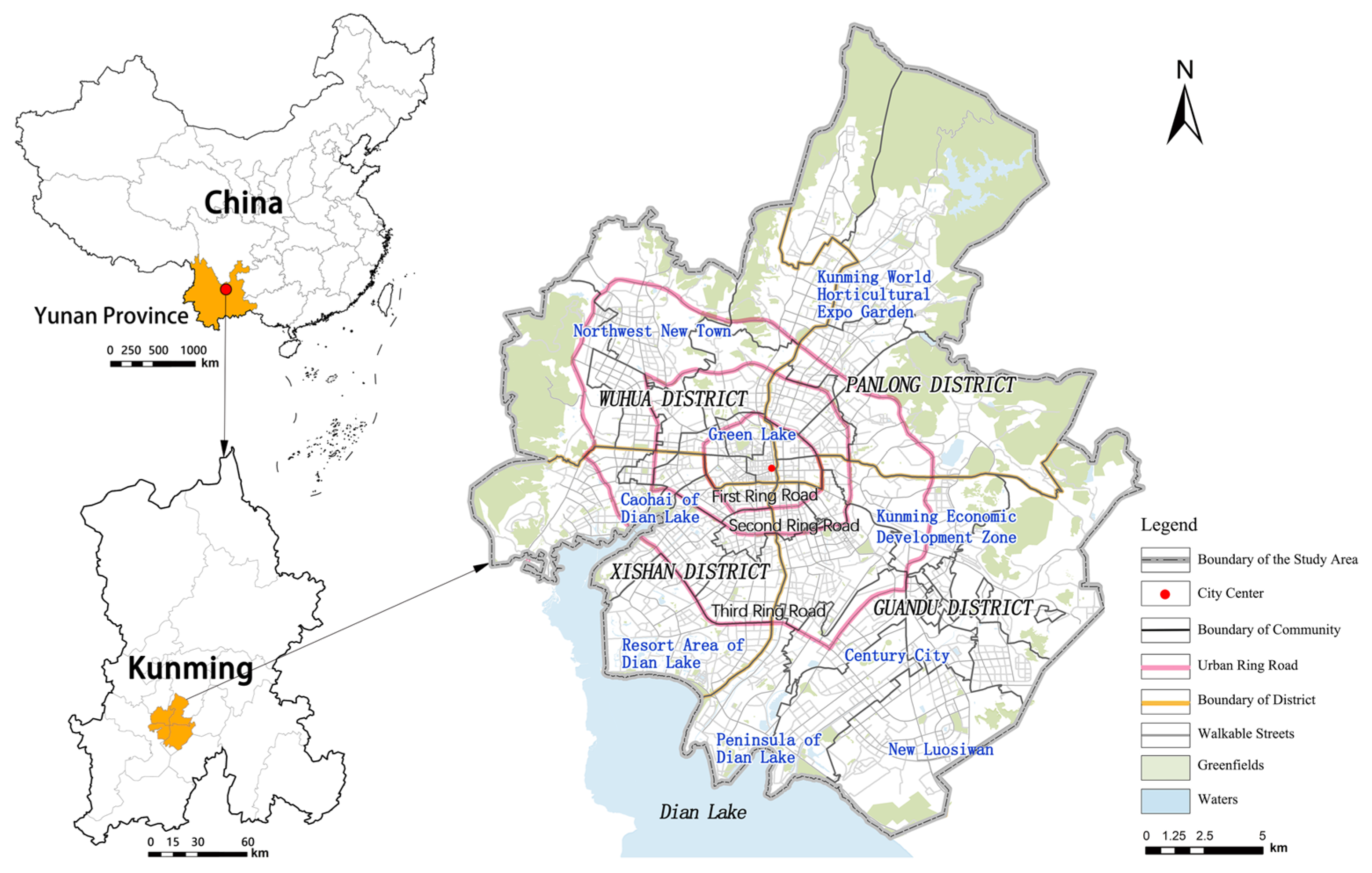
This study takes Kunming as a case study. Located on the Yunnan–Guizhou Plateau, Kunming’s land area is 88% mountains and hills, 10% plains and basins, and 2% lakes and water surfaces. The city is built on the Dianchi Basin, with an average elevation of 1891 m, and is surrounded by mountains on three sides and borders Dianchi Lake to the south. As the capital of Yunnan Province and one of the key central cities in southwest China, Kunming serves as an ideal case for this study for three compelling reasons. First, while most spatial equity research in China has concentrated on coastal first-tier megacities, Kunming represents a typical inland large city. Its developmental trajectory provides a more generalizable template for understanding the spatial equity challenges faced by numerous rapidly expanding inland cities across China. Second, Kunming is also a typical megacity with a concentrated multi-ethnic population. The urban area has a permanent resident population of 4.2984 million, 12.8% of whom are ethnic minorities. This demographic characteristic enables meaningful comparative dialogue with respect to research conducted in European and American cities that emphasizes race as a driving factor of spatial inequality, thereby offering a unique perspective for understanding spatial equity conditions in multi-ethnic cities. Third, although contemporary developmental demands are shifting toward spatial micro-governance and refined enhancement of the quality of residents’ daily living spaces, Kunming’s current spatial planning strategies still predominantly adhere to the growth-oriented paradigm of previous eras, emphasizing urban framework restructuring and scale expansion rather than genuinely responding to the needs of the times. Consequently, research on Kunming can provide policy implications for transforming its urban governance approaches.
The definition of the specific spatial scope of this study refers to the Kunming Territorial Spatial Master Plan (2021–2035) [67] issued by the Kunming Municipal Government, taking the main urban area of Kunming as the boundary—specifically, the area east of the West Third Ring Road and enclosed by the Ring Expressway. This scope covers 150 census communities (including Huashan and Longquan) within the four main urban districts (Panlong, Wuhua, Xishan, and Guandu), with an area of approximately 485.24 square kilometers. This spatial division is illustrated in Figure 1.
Three categories of data are used in this study: built environment data, local socio-economic information, and base maps. Firstly, the built environment dataset includes points of interest (POIs), digital elevation models (DEMs), public transport stations, and street-view imagery. POI and bus/metro station data were obtained in July 2024 from Amap (https://lbs.amap.com/, accessed on 1 July 2024); DEM data with a spatial resolution of 12.5 m were obtained in July 2024 from NASA (https://search.earthdata.nasa.gov/, accessed on 1 August 2024); and Baidu street-view imagery was accessed via the Baidu Panorama Service (https://lbs.baidu.com/, accessed on 1 August 2024). Sampling points were allocated along the vector street network at 100 m intervals, yielding a total of 13,626 panoramic images retrieved in August 2024. The visual elements within these images were quantified using the PSPNet semantic segmentation model (ResNet-50 backbone), pre-trained on the ADE20K dataset; in particular, we directly applied the pretrained model for inference without additional fine-tuning. According to the ADE20K benchmark reported by Zhao et al. (2017), this model achieves a pixel accuracy of ~80.04% and an mIoU of ~41.68% [68]. Secondly, local socio-economic information at the community level was obtained from the Seventh National Population Census of the People’s Republic of China 2020. Any communities located outside the main urban area were excluded from the analysis, resulting in nine indicators for a final sample of 150 census communities. Indicator selection followed three principles: (1) data availability; (2) low redundancy across indicators; and (3) comparability with the existing literature. Table 1 summarizes all socio-demographic variables employed in this study, as well as the general descriptive statistics. Within the selected variables, social class characteristics are categorized into two types: general demographic characteristics and socio-economic status. The former covers age structure, hukou registration, and ethnic composition; specifically, for each census block, we computed the proportions of the elderly (aged 60 and over), child (aged 14 and below), ethnic minority, and migrant populations. In East Asian contexts, race is not typically used as an analytical category; however, age, ethnicity, and hukou registration play important roles in influencing social differentiation in Chinese cities. Age structure is closely related to walking needs, while the hukou registration system has long produced marked differences in access to education, employment, and social services, making it a critical consideration for social equity. Ethnic composition reflects potential cultural or economic differences, and is thus pertinent to understanding social equity in urban China. Socio-economic status is proxied primarily by economic assets and educational/cultural capital. In the absence of direct income data, we used housing assets as a proxy, with the average housing price within each census community serving as the specific indicator. As a rule of thumb, higher-income groups are more likely to purchase high-end commodity housing, whereas lower-income groups tend to reside in lower-end commodity or affordable housing. Additionally, we employed educational attainment as a proxy for social status, as it often shapes individuals’ economic returns, social prestige, and capacity to access resources. Finally, the base maps include the street network and administrative boundaries. The street network was sourced from OpenStreetMap (https://www.openstreetmap.org/, accessed on 1 July 2024), clipped, and cleaned (with elevated roads and other segments that do not provide pedestrian service removed), resulting in 4518 street segments. Buffer zones were created with widths of 50 m for arterial roads, 30 m for collector roads, and 20 m for local roads. Administrative boundary layers were obtained from the Yunnan Provincial Geospatial Information Public Service Platform (https://yunnan.tianditu.gov.cn/, accessed on 1 July 2024).

3.2. Technology Path

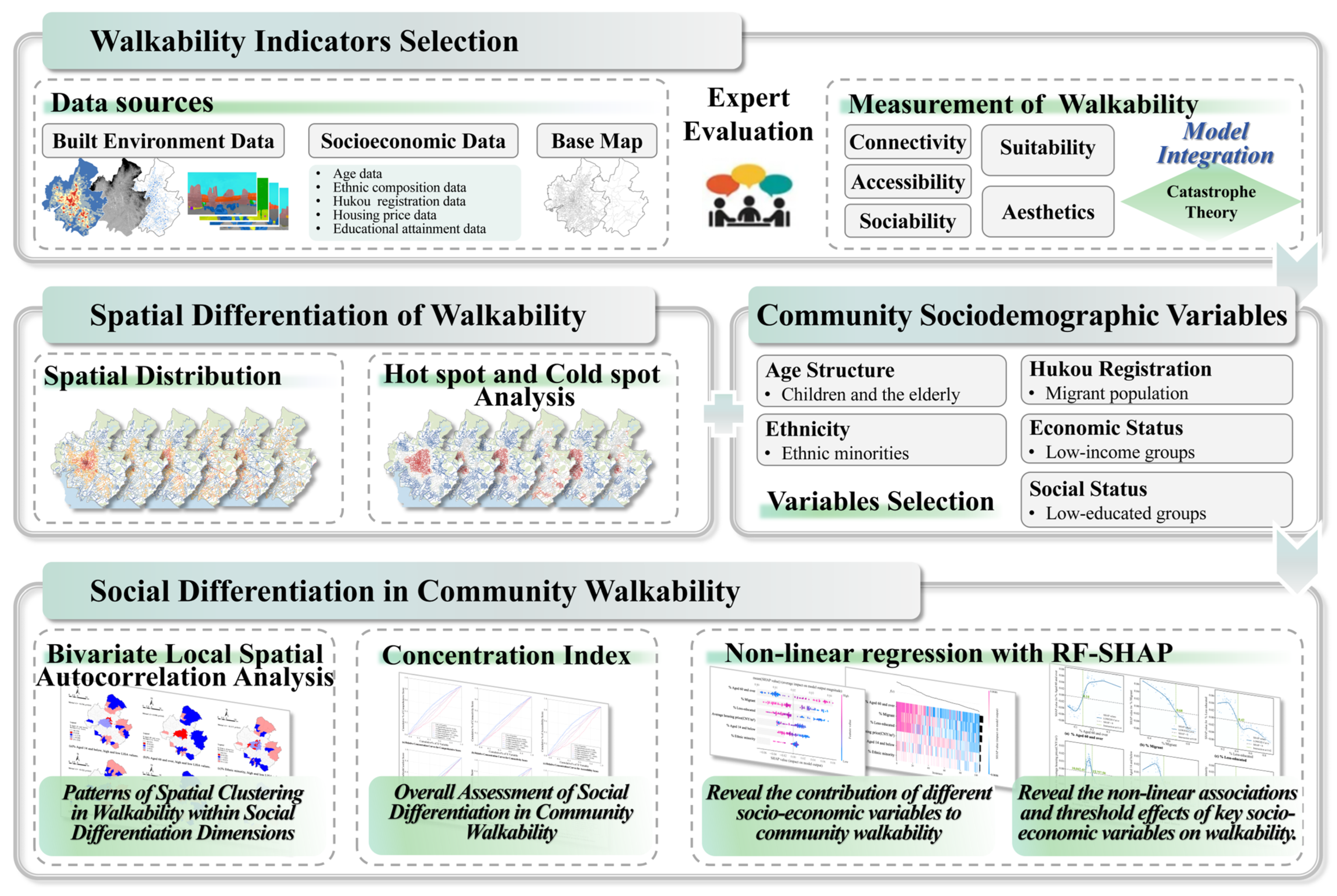
To examine how community walkability inequity aligns with social differentiation in urban China—and given that existing walkability measurement frameworks lack comparability while equity assessment systems are largely transplanted from Euro–American models and may not fully capture China’s institutional context—this study constructs a simple, replicable walkability measurement framework based on open-source data and explicitly incorporates the hukou registration system as a key dimension of social differentiation in community walkability. Generally, our procedure involves three stages: first, across five dimensions—namely, connectivity, accessibility, suitability, sociability, and aesthetics—we selected 15 indicators to construct a street-level walkability evaluation system and applied CT models to obtain a composite assessment; second, based on the evaluation results, we employed hot spot/cold spot analysis and descriptive statistics to characterize the overall spatial distribution of street-level walkability in Kunming’s main urban area; finally, we introduced dimensions of social differentiation to examine the associations between walkability and socio-economic characteristics. Given China’s distinctive institutional background and demographic composition, we operationalized social differentiation into five categories: Age structure, ethnicity, hukou registration, economic status, and social status. On this basis, we used bivariate local indicators of spatial association (LISA) to measure the spatial clustering between these five dimensions and the composite walkability score at the community level. Furthermore, we employed a nonlinear Random Forest-SHAP framework to identify the primary dimensions of social differentiation and analyze the nonlinear associations and threshold effects between key socio-economic variables and walkability, thereby revealing the characteristics of social differentiation in Kunming’s central urban area (Figure 2).

3.3. Research Methods

3.3.1. Measurement of Street Walkability

The walkability index in this study essentially evaluates the “potential capacity of the built environment to support pedestrian activity” [7]. To develop a systematic walkability measurement framework, this study adopts a multi-stage, expert-driven approach. A total of 28 representative evaluation methods were initially identified from studies published in high-impact urban planning and transportation journals in the past 20 years [28,69,70,71,72,73], selected based on criteria such as operability, interpretability, applicability, and multidimensionality. While not exhaustive, these methods reflect the global mainstream trends in walkability measurement. We extracted and standardized 47 unique indicators and their definitions from the identified methods to establish a preliminary indicator pool. To assess the contextual relevance of these indicators for Chinese urban streets, we recruited 20 experts with interdisciplinary backgrounds to ensure a comprehensive perspective. The eligibility criteria for recruitment were as follows: (1) at least five years of relevant research or professional experience; (2) demonstrated academic or practical expertise in built environment research; and (3) familiarity with the local context. By disciplinary background, 55% specialized in urban planning, 25% in urban design, and 20% in human geography. Regarding educational attainment, 70% held a doctoral degree and 30% a master’s degree. By institutional affiliation, 80% were based in academia, 15% in government, and 5% in consulting. This multidisciplinary composition was intended to minimize single-discipline bias and enhance the content validity of the indicators. Each expert rated the applicability of the following indicators on a 5-point Likert scale (1 = “Not Applicable at All” to 5 = “Highly Applicable”): (1) measurability with available open-source data; (2) discriminatory power to differentiate street variations in Kunming; and (3) scale appropriateness for street-level analysis. Indicators with an average score below 2.5, or those flagged as “highly unsuitable” by multiple experts, were discarded. Next, we conducted a three-round Delphi consultation process to refine the selection and categorization of indicators. In the first round, experts suggested preliminary dimension classifications based on their professional judgment. In the second round, indicators with high rating variance (σ2 > 0.20) and contested classifications were discussed, and expert feedback was collected for further refinement. In the third and final round, anonymous feedback and statistical summaries (mean, standard deviation) were provided to the experts to facilitate informed re-evaluation. Indicators were retained if they achieved an average score ≥ 3.5 and a consistency ratio (CR) < 0.10. Upon the conclusion of the Delphi process, the expert panel reached a consensus on 15 core indicators grouped into five dimensions, forming the final street-level walkability measurement framework for this study.
Specifically, the framework encompasses 15 variables in five dimensions, with the latter detailed as follows: Connectivity reflects the topological attributes of the street network, namely, the degree of interconnection among road segments [28,71]. Accessibility indicates how easily residents can reach essential services within a walkable distance threshold [28,70]. Suitability represents the extent to which the physical conditions are conducive to walking [71,72,74]. Sociability measures the extent to which the pedestrian environment supports social interaction and communal activities [72,73]. Aesthetics assesses the visual appeal and environmental aesthetics perceived by pedestrians along the streetscape [73]. The calculation methods and descriptive statistics of the specific indicators are given in Table 2 and Table 3, respectively.
CT models were employed to conduct a comprehensive evaluation of the various dimensions of walkability. The integration of these multi-dimensional indicators into a single composite index presents a methodological challenge: while traditional methods such as weighted averaging or Principal Component Analysis (PCA) are common, they often rely on subjective expert weighting or assume linear relationships among indicators, which may not capture the complex and nonlinear nature of the walking environment. In contrast, the CT model is particularly well-suited for evaluating complex systems, with the primary advantage being that it derives the relative importance of indicators objectively from the internal dynamics and interdependencies of the data, rather than relying on predetermined subjective weights.
Quantitative scores for each dimension were derived using catastrophe membership functions and normalization formulas. A unified aggregation process was then applied to compute normalized and dimensionless values across indicators. Based on the relationships among indicators—whether complementary or non-complementary—a system control variable was calculated to reflect the structural influence within the evaluation framework. Finally, by applying a bottom-up hierarchical calculation process, normalized scores were progressively propagated from the lowest indicators to higher-level dimensions, ultimately leading to the computation of a composite catastrophe membership value representing the overall walkability level [74]. The relevant normalization formula is presented in Table 4:

3.3.2. Dimensions of Social Differentiation

To assess the social equity of walkability, it is essential to link the spatial variation in community walkability to the social differentiation of community populations. In Euro–American urban research contexts, inequalities in walking environments are typically explained by income, race, and age structure [75]; however, Chinese cities exhibit distinctive mechanisms of social differentiation—particularly hukou registration and ethnic diversity—that have profound implications for the spatial opportunity structure and resource allocation [76]. Building on prior studies [10,16,74] and considering the available data, we operationalize five categories of social differentiation at the community level: Age structure, hukou registration, ethnicity, economic status, and social status. Together, these dimensions characterize the potential patterns of social differentiation in walkability across Kunming’s central urban area.
First, age is a core determinant of travel behavior and walking demand. The literature consistently shows that children and older adults rely more heavily on community walking spaces, and that insufficient walking safety or a lack of facilities exacerbates inequalities in health, mobility, and social participation [10,16]. Accordingly, we took the proportions of children (aged 14 and below) and the elderly (aged 60 and above) as indicators of the age dimension.
Second, hukou registration is one of the most institutionalized mechanisms of social differentiation in China, fundamentally shaping access to education, employment, housing and public services [77,78]. Migrants without local urban hukou often face structural disadvantages and constitute a key group in urban social segmentation. We therefore took the proportion of non-local residents to capture hukou-based differentiation.
Third, unlike the emphasis on race in Euro–American urban studies, East Asian countries typically do not operationalize race as an analytical category; instead, ethnicity is systematically recorded and exerts a significant influence on residential spatial patterns [74]. As Yunnan is the Chinese province with the largest ethnic minority population—accounting for more than one-third of the provincial total—Kunming also exhibits certain forms of ethnic clustering. We therefore took the proportion of the ethnic minority population as the indicator of ethnic differentiation.
Fourth, economic resources are pivotal to residents’ housing choices, travel modes, and the quality of their living environments. Existing studies suggest that low-income communities often lack adequate walking facilities and exhibit poorer street connectivity [15,18,61,66]. However, in some Chinese cities, such as Shenzhen, the relationship between income and walkability has been reported as insignificant [17], possibly reflecting the distinctive role of government-led infrastructure provision. In the absence of direct income data, we adopted a proxy indicator: the average housing price. This indicator reflects housing assets and household wealth, thereby profiling residents’ economic status.
Fifth, social status reflects an individual’s position in the labor market and the stratification system, which is commonly measured by educational attainment and occupation. Education and occupation not only influence income but also shape residents’ voice and capacity to access resources in community governance. However, given the lack of community-level occupational data, we took the proportion of the low-education population [10,16,74] to represent the social status dimension.
In summary, through these five dimensions and six indicators, we aim to provide a comprehensive depiction of the potential social differentiation of community walkability in Kunming’s central urban area. These dimensions speak to international concerns regarding age and economic inequality while incorporating institutionalized stratification specific to Chinese cities—namely, hukou registration and ethnicity—thus offering more contextually grounded evidence on the relationship between community walkability and social equity in urban China.

3.3.3. Methods for Measuring Walkability Spatial Distribution

To intuitively capture the spatial clustering characteristics of the composite walkability index and its five component dimensions, we employed the Getis-Ord G i local spatial statistic to identify hot spot and cold spot patterns within the main urban area of Kunming. This method enables the detection of significant local clusters of high or low walkability scores across street-level spatial units. The formula is as follows [79]:
G i = j = 1 n w i , j x j X ¯ j = 1 n w i , j S n j = 1 n w i , j 2 j = 1 n w i , j 2 n 1
where x j represents the attribute value of street segment j , w i j is the spatial weight between street segments i and j , and n is the total number of street segments, with the condition that:
X ¯ = j = 1 n x j n
S = j = 1 n x j 2 n X ¯ 2

3.3.4. Measurement Method of Social Differentiation Pattern

Building on the mean scores of street walkability at the community level, we performed bivariate local spatial autocorrelation analysis (LISA) to assess the spatial clustering of the composite walkability score with the following socio-economic dimensions: Age structure, ethnicity, hukou registration, economic status, and social status. This analysis allowed us to identify whether high or low walkability values are spatially correlated with specific patterns of socio-economic attributes across communities. The statistical computation follows the formulation of the bivariate local Moran’s I [80]:
I i = z i z j 2 j W i j Z j
where z i and z j represent the values deviating from the mean, and W i j is the spatial weight.
Next, the CI was employed to provide an overall assessment of social differentiation in community walkability. While traditionally applied to measure income-related health inequalities, the CI is adapted in this study to quantitatively evaluate the overall inequity in the distribution of walkability resources across different social groups. The CI is calculated as follows [81]:
C I = 2 μ c o v ( h i , r i )
where C I represents the Concentration Index; h i denotes the walkability score of the i -th community; r i is the fractional rank of the community based on the cumulative percentage of the social group in the total population; and μ is the mean walkability score. The value of C I ranges from −1 to 1, where a value of 0 indicates perfect equity, a negative value ( C I < 0 ) implies that walkability resources are disproportionately concentrated among the non-target population, and a positive value ( C I > 0 ) indicates that resources are more concentrated within the target social group.
Finally, to deeply elucidate the social differentiation characteristics of community walkability, the interpretable Random Forest-SHAP machine learning framework was employed. As an ensemble learning algorithm based on Bagging strategies, Random Forest (RF) is distinguished by its superior generalization capabilities and resistance to overfitting compared to traditional linear regression models. It effectively mitigates multicollinearity issues in high-dimensional data and accurately captures complex nonlinear relationships between independent and dependent variables. In this study, we benchmarked the performance of the RF model against other widely used machine learning algorithms, including XGBoost, LightGBM, and Decision Tree. To ensure a fair comparison, identical grid search and 5-fold cross-validation procedures were applied to all models to identify the optimal hyperparameters that minimized the Mean Squared Error. The dataset was randomly partitioned into a training set (70%) and a testing set (30%). The hyperparameter search spaces and the identified optimal combinations for each model were as follows: (1) Random Forest—the search space covered n_estimators (100–300), max_depth (5–10), and min_samples_split (10–20). The optimal combination was identified as n_estimators = 200, max_depth = 5, min_samples_split = 10, and max_features = ‘sqrt’. (2) Decision Tree—The search space included max_depth (2–10) and min_samples_split (5–20). The optimal parameters were max_depth = 3, min_samples_split = 10, and max_features = ‘sqrt’. (3) XGBoost—The search space covered learning_rate (0.01–0.2), n_estimators (10–200), and max_depth (2–5). The optimal parameters were learning_rate = 0.1, n_estimators = 50, max_depth = 3, and subsample = 1.0. (4) LightGBM—The search space included learning_rate (0.01–0.1), n_estimators (100–500), num_leaves (5–30), and max_depth (2–7). The optimal parameters were learning_rate = 0.05, n_estimators = 200, num_leaves = 10, max_depth = 3, and min_child_samples = 20. Following hyperparameter tuning, we comprehensively evaluated the models based on two critical dimensions: prediction accuracy and generalization capability. The comparative results (detailed in Table 5 in the Results section) revealed significant performance disparities among the algorithms. While XGBoost and LightGBM achieved superior scores on the training set, they exhibited limited generalization capabilities. In contrast, Random Forest demonstrated the most robust balance between accuracy and generalization. Consequently, Random Forest was selected as the final regression model.
Subsequently, SHAP (Shapley additive explanations) values were applied to interpret the relative importance and interaction effects of input features. This mechanism enabled us to not only assess the relative contributions of different socio-economic attributes to walkability scores, but also to elucidate the nonlinear associations between key variables and walkability via SHAP dependence plots, identifying critical tipping points and threshold effects that exacerbate social inequities. However, it is important to note that while machine learning models excel at identifying statistical associations between variables, the dependencies they reveal do not necessarily equate to causal mechanisms [82].

4. Results

4.1. Spatial Pattern of Street Walkability in the Main Urban Area of Kunming

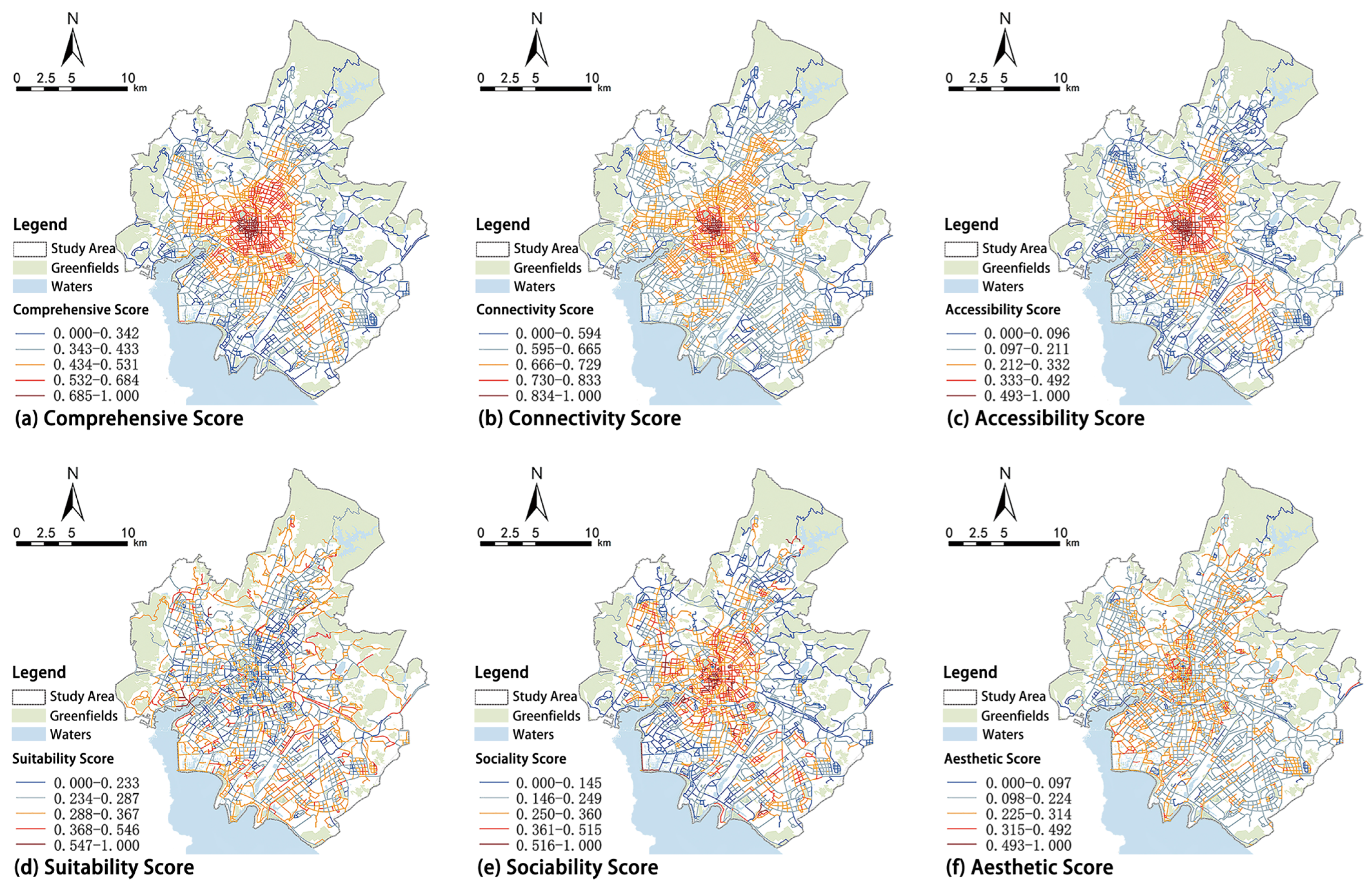
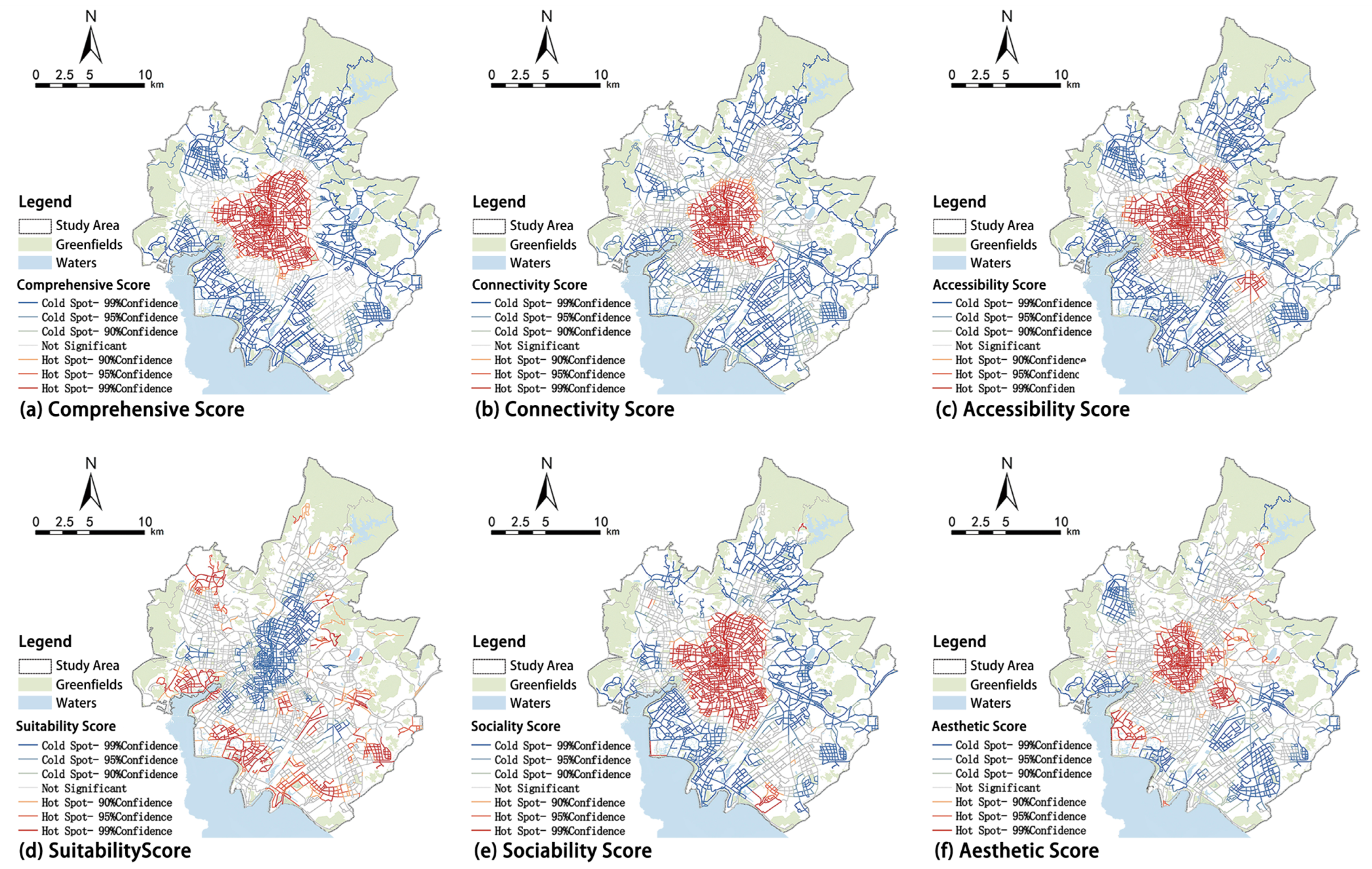
To further reveal the spatial distribution characteristics of walkability in the main urban area of Kunming City, the walkability scores of streets were visualized and hot spot maps (using Formulas (1)–(3)) were constructed to display the comprehensive walkability scores of streets in the main urban area of Kunming City, as well as the spatial distribution and spatial autocorrelation patterns of the five constituent factors (Figure 3 and Figure 4). Based on the comprehensive evaluation scores, the overall walkability of streets in the main urban area of Kunming exhibits a distinct “core–periphery” structure, with walkability decreasing gradually from the old city (The Green Lake District) toward the new urban areas (North Zone, West Zone, East Zone, and South Zone) and their outskirts. The hot spot and cold spot maps provide a more intuitive view, demonstrating that high-value areas are primarily concentrated within the city center, while the urban area periphery forms a ring of cold spots. This pattern aligns closely with Kunming’s urban development history. The Green Lake District is Kunming’s historic urban area. Around the year 2000, Kunming experienced rapid urban expansion, with the North, West, East, and South Zones becoming the core areas of urban development. Over time, these areas have developed into well-established and mature urban environments. Notably, the southeastern edge of the main urban area—the Guandu District—has formed a secondary high-value zone, which may be closely related to the long history of urban development originating from the ancient town of Guandu.
The spatial distribution of the five walkability factors displays notable heterogeneity and can be broadly classified into three distinct patterns: (1) Connectivity, accessibility, and sociability exhibit a spatial pattern that closely mirrors the composite walkability score, forming a clear “core–periphery” structure. This phenomenon can be attributed to two factors. First, under the radial–circular development model of large cities, the transportation location advantages of the central urban core are amplified. Second, municipal governments have historically prioritized investments into the urban core, resulting in more complete infrastructure systems and public service provision in central areas—particularly around the historic city center—compared to peripheral zones. These locational advantages also shape population distribution patterns, which in turn reinforce the observed clustering of sociability in high-accessibility areas. (2) Suitability, in contrast, displays a fragmented and dispersed spatial pattern, diverging completely from the clustering trends of the first three dimensions. Isolated high-value hot spots are primarily located in emerging peripheral areas such as Northwest New Town, Caohai of Dian Lake, Peninsula of Dian Lake, Resort Area of Dian Lake, and New Luosiwan District. In contrast, the historic city center, characterized by aging infrastructure, high population density, and associated urban maladies, demonstrates notably lower suitability levels compared to the newly developed outer zones. (3) Aesthetics occupies a middle ground between the above two patterns. Its distribution is more dispersed than connectivity, accessibility, and sociability, but more clustered than suitability, reflecting a “broad dispersion with localized concentration” pattern. Notably, localized high-value clusters appear both within the city center and along the urban periphery, especially in areas with outstanding landscape or architectural features, such as the Green Lake historic district, the southwestern lakeside zones near Dian Lake, and the northeastern mountainous fringe areas.

4.2. Social Differentiation of Community Walkability in the Main Urban Area of Kunming

4.2.1. Spatial Clustering of Community Walkability Distribution and Social Groups

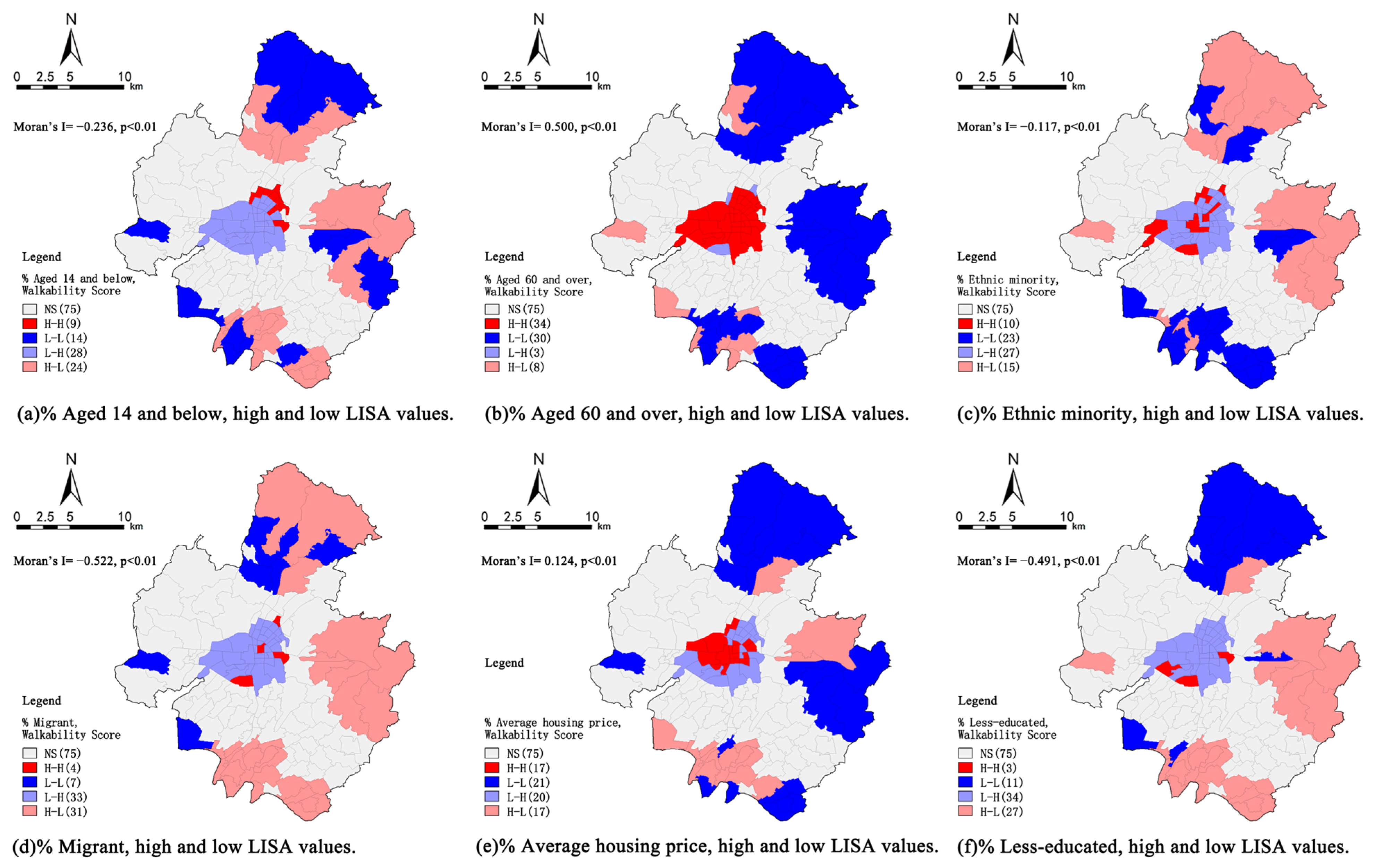
In order to evaluate the spatial clustering between community walkability and the socio-economic characteristics of residents, we first calculated and mapped the spatial clustering of the composite walkability score against five dimensions of social differentiation—namely, age structure, ethnicity, hukou registration, economic status, and social status (Figure 5)—using bivariate local spatial autocorrelation (Formula (4)). In the figures, only the communities that are statistically significant are shaded. The results revealed the following:
(1) With regard to age structure, a significant positive spatial autocorrelation between the proportion of the elderly (aged 60 and over) and walkability was observed. In contrast, there was a significant negative spatial autocorrelation between the proportion of children (aged 14 and below) and walkability. In terms of local clustering, the elderly population and walkability formed “high–high” clusters primarily located within the old town, such as the Green Lake area, and “low–low” clusters concentrated in the peripheral areas of Guandu District in the South Zone. Conversely, the child population and walkability were dominated by mismatched “low–high” (a low proportion of children and high walkability score) and “high–low” (a high proportion of children and low walkability score) clusters. The former were concentrated in the old town, while the latter were mainly situated at the fringes of the South, North, and East Zones.
(2) In terms of ethnicity, the proportion of the ethnic minority population showed a weak negative spatial autocorrelation with walkability. Local clustering showed two main types: “high–low” (a high proportion of ethnic minorities and a low walkability score) and “low–low” clusters. The former were mainly situated at the fringes of the North and East Zones, while the latter were clustered in the Peninsula of Dian Lake and Century City areas on the edge of the South Zone.
(3) The proportion of migrants with hukou registration exhibited a significant negative spatial autocorrelation with walkability. “Low–high” clusters (a low proportion of migrants and high walkability score) were concentrated in the old town, while “high–low” clusters (a high proportion of migrants and low walkability score) were mainly distributed in newly developed peripheral areas, such as the industrial and expansion corridors in the North, South, and East Zones (e.g., New Luosiwan and the Kunming Economic Development Zone).
(4) In terms of economic status, the spatial autocorrelation between the economic status index and walkability was not significant. However, a small number of local clusters could still be observed. “Low–low” clusters were mainly located in new districts on the periphery of the main urban area (such as Northwest New Town), “high–low” clusters were distributed in the Kunming World Horticultural Expo Garden area in the North Zone and the Resort Area of Dian Lake in the south, and “low–high” clusters appeared in the part of the South Zone close to the city center.
(5) The social status index showed a significant positive spatial autocorrelation with walkability. Specifically, “high–high” clusters were predominantly concentrated in the old town surrounding Green Lake, whereas “low–low” clusters were primarily situated in the peripheral areas of the North District. Additionally, “high–low” clusters were distributed in the Kunming Economic Development Zone of the East Zone and the fringes of the South Zone.
Overall, the spatial clustering between community walkability and socio-economic characteristics in Kunming’s main urban area revealed a distinct pattern. The old town (especially the Green Lake area) forms a core of high walkability, which coincides with the “high–high” clustering of the elderly population and higher social status. In contrast, the industrial expansion corridors in the south and east (such as New Luosiwan and the Kunming Economic Development Zone) are more likely to exhibit “high–low” clustering, with high proportions of child, migrant, and less-educated populations, but lower walkability. In comparison, the spatial associations of ethnicity and economic status with walkability were weaker. Several possible explanations could account for these outcomes. The long-term accumulation of high-density mixed land use, mature public services, and a fine-grained street network in the old town has collectively created a pedestrian-friendly environment. In the peripheral new districts, the provision of pedestrian systems and public facilities has lagged behind population inflow during their rapid, industry-oriented expansion. Furthermore, the weak spatial associations observed for ethnicity and economic status may be due to other factors. The general sinofication of ethnic minorities in Kunming has prevented the formation of stable residential clusters. At the same time, high-income groups are more likely to rely on motorized travel and prioritize environmental quality in their housing choices, which could weaken the importance of walkability for these groups.

4.2.2. Characteristics of Social Differentiation in Community Walkability

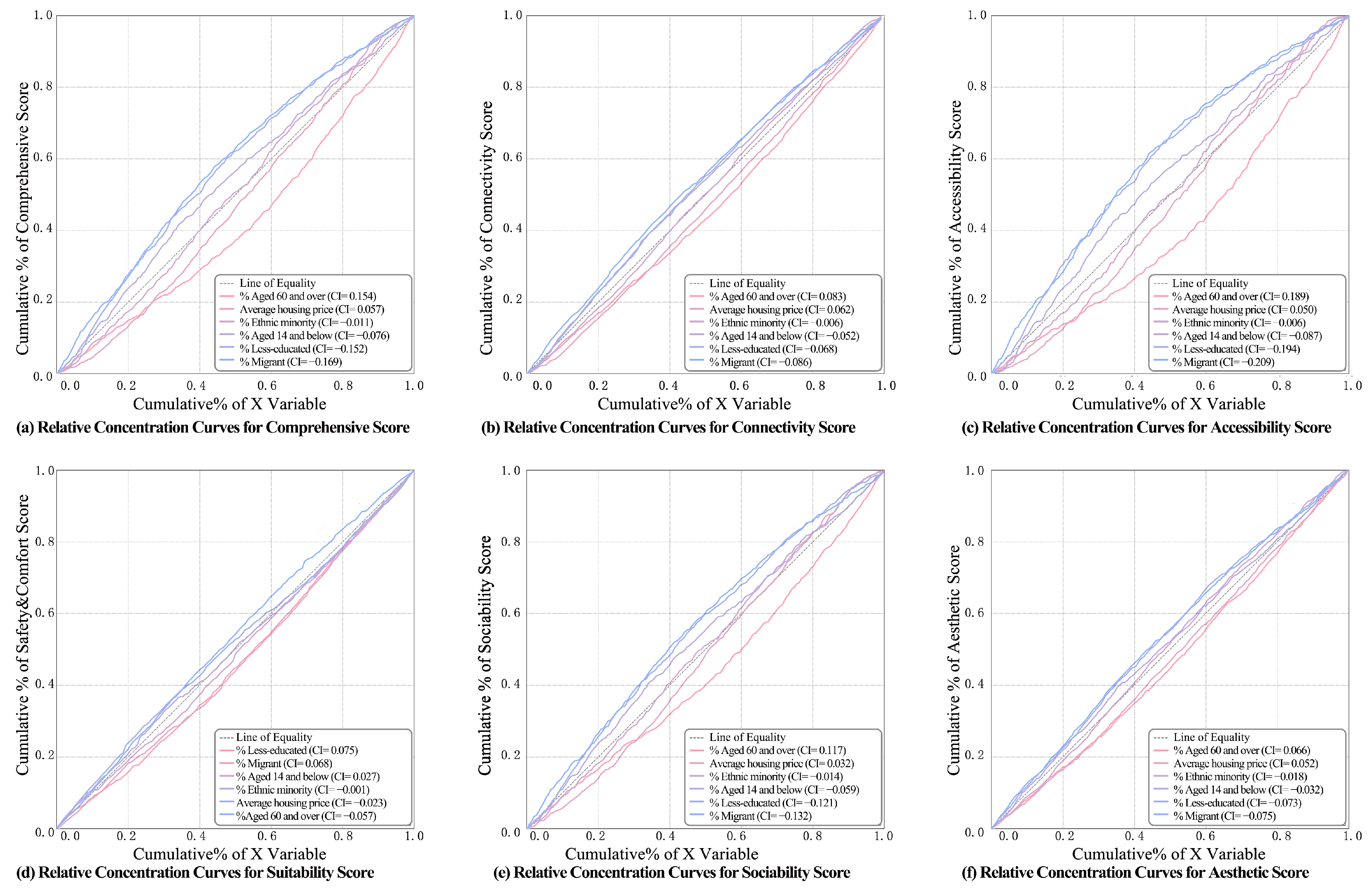
To evaluate the equity of walkability resource distribution among different social groups, the CIwas introduced for global measurement. Figure 6 shows that: (1) In terms of global inequity, the distribution of walkability resources disproportionately favors non-vulnerable groups. The CI values for the migrant population, residents with lower educational attainment, the child population, and ethnic minorities are negative, suggesting that these groups are excluded—to varying degrees—from communities with high walkability. (2) The degree of inequity varies among groups, presenting a clear gradient of inequality. Migrants (CI = −0.169) experience the most severe deprivation, followed by those with lower education (CI = −0.152) and children (CI = 0.076). These findings underscore that the hukou registration system and social status serve as critical thresholds for accessing premium walking environments. While ethnic minorities also showed a negative CI (−0.011), the near-zero value suggests a relatively equitable distribution for this group. Conversely, positive CI values for the elderly (0.154) and average housing prices (0.057) indicate a relative advantage for senior citizens and high-income groups, likely due to their residence in mature historic districts or well-planned developments. (3) While patterns for connectivity, accessibility, sociality, and aesthetics mirror the aggregate findings, the suitability dimension presents a divergence; here, the elderly (CI = −0.057) and high-income groups (CI = −0.023) appear relatively disadvantaged. (4) Among the five sub-dimensions, accessibility emerged as the most significant contributor to social differentiation.
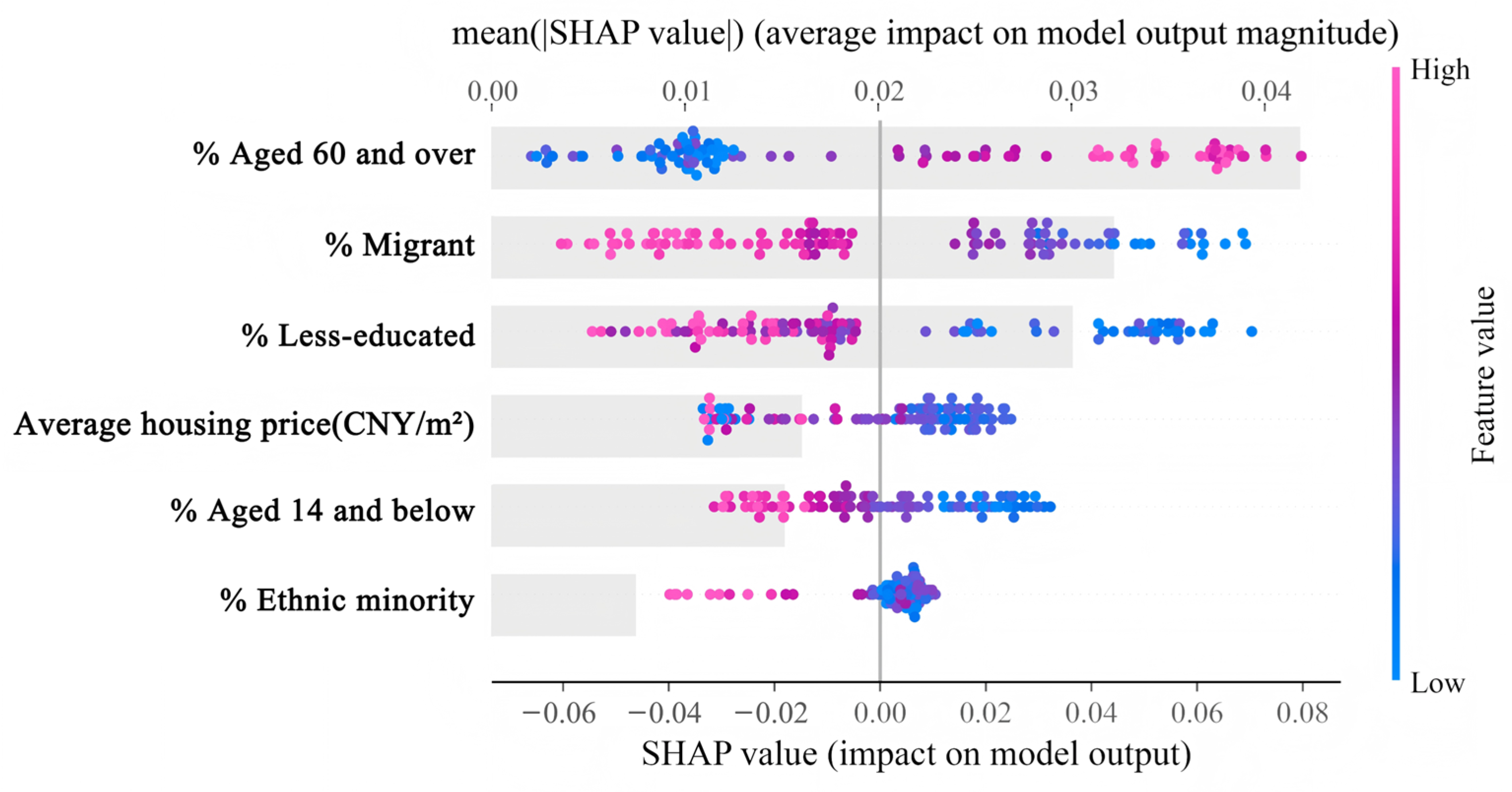
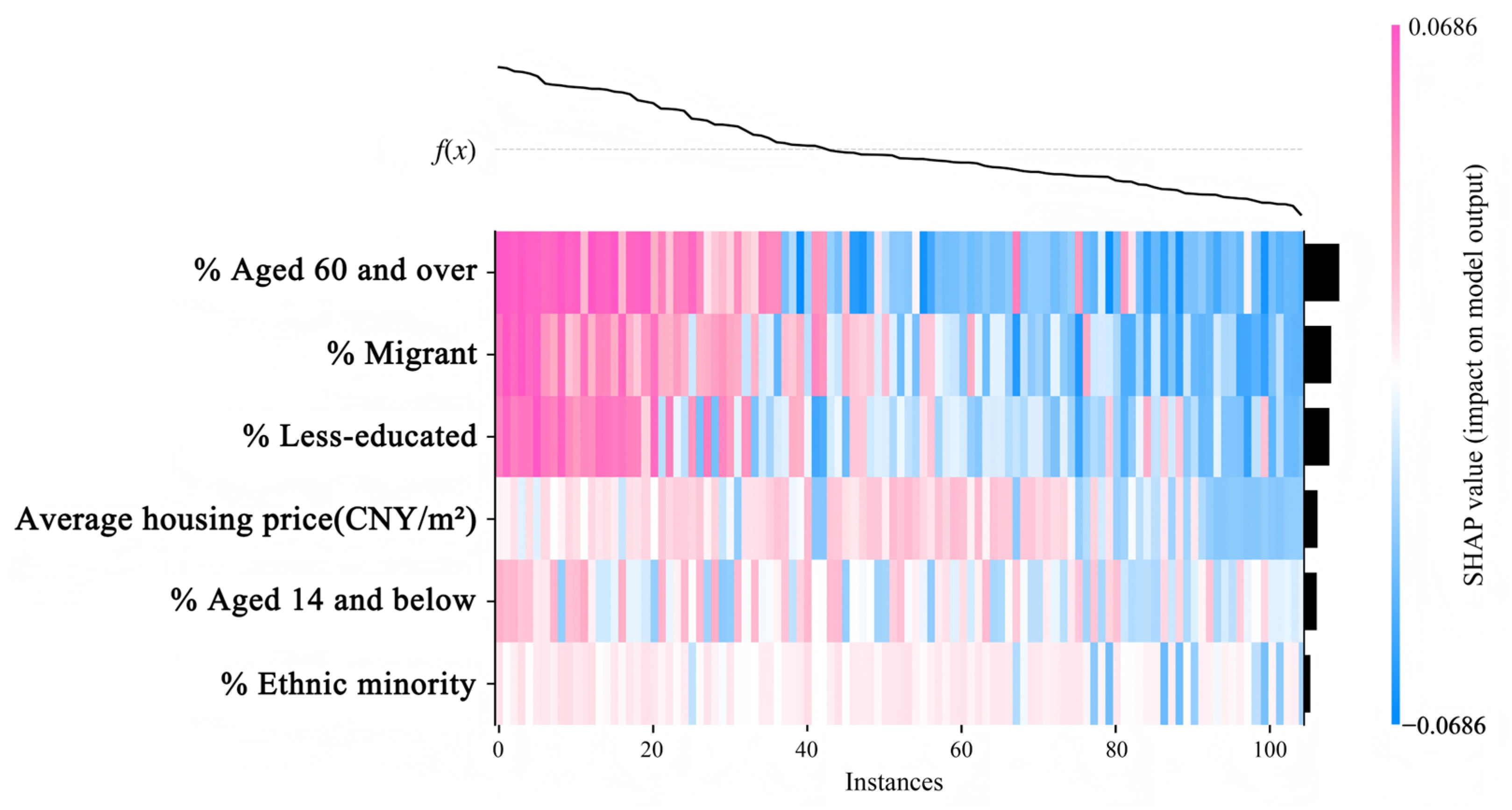
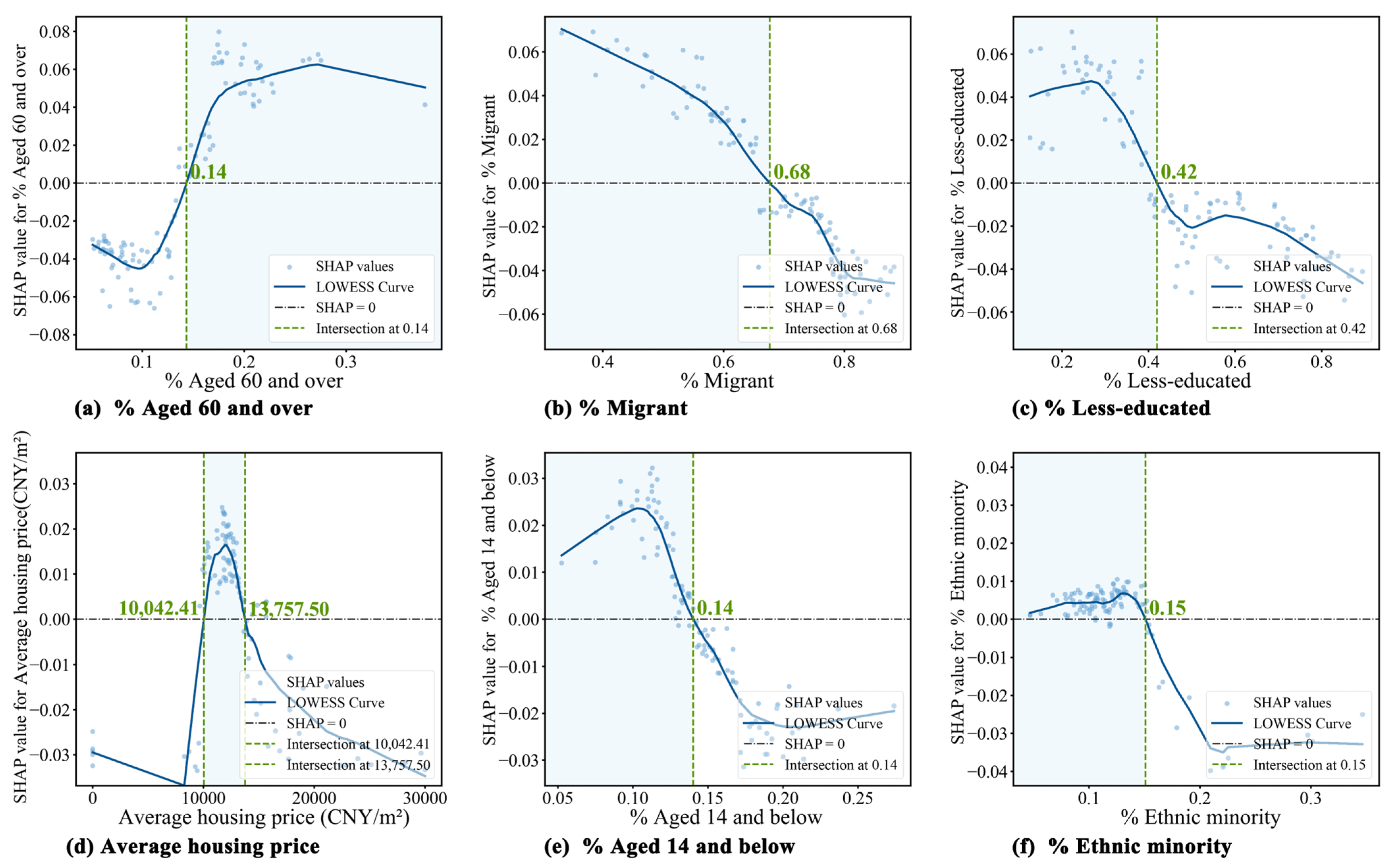
To comprehensively elucidate the social differentiation characteristics of community walkability, this study employed an interpretable machine learning framework. Initially, a comparative analysis was conducted among four common algorithms: Random Forest (RF), XGBoost, Decision Tree (DT), and LightGBM. Following a rigorous hyperparameter tuning process for each model, we evaluated their performance based on both prediction accuracy (RMSE/MAE) and generalization capability (the stability between training and validation performance). Although the boosting algorithms (XGBoost and LightGBM) achieved high accuracy on the training data ( T r a i n   R 2 = 0.9027 and 0.7581, respectively), their evaluation metrics indicated a tendency toward overfitting ( V a l   R 2 = 0.5264 and 0.5268, respectively). In contrast, Random Forest demonstrated the most robust balance between accuracy and generalization (R2gap = 0.1390). Consequently, Random Forest was selected as the final model for the subsequent interpretability analysis. Detailed performance metrics are provided in Table 5. The positive and negative effects, along with the relative contributions of socio-economic factors, are illustrated in Figure 7 and Figure 8.
The results indicate the following: (1) Age structure (specifically the elderly population), hukou registration status, and social status constitute the primary dimensions of the social differentiation of walkability in Kunming’s main urban area, whereas economic and ethnic differentiation exhibit relatively lower significance. In particular, the feature importance ranking identifies “% Age 60 and over” (mean |SHAP| = 0.042) as the dominant driver, followed by “% Migrant” (0.032) and “% Lower education” (0.030). In contrast, the contributions of attributes such as “Average housing price” (0.016), “% Age under 14” (0.015), and “% Ethnic minority” (0.007) are relatively minor.
(2) The SHAP summary plot (Figure 7) reveals distinct mechanistic pathways: the proportion of the elderly population exhibits a significant positive contribution to walkability. Due to long-term living habits, convenient access to resources, and stable social networks, the elderly population has historically concentrated in mature areas such as the old town, thereby enjoying locational dividends and superior walking resources. Conversely, groups such as migrants, populations with lower education, children, and ethnic minorities were generally associated with poorer walkability scores. This indicates that these socially vulnerable groups are systematically marginalized, effectively denying them access to high-quality walking environments. The SHAP heatmap (Figure 8) further corroborates this structural divergence at the individual sample level. The plot reveals a clear dichotomy: high-walkability communities (left side) are characterized by positive SHAP contributions from a high proportion of the elderly (red bands, indicating high feature values), as well as low proportions of migrant and less-educated populations (red bands, indicating low feature values). In contrast, low-walkability communities are dominated by negative contributions stemming from high concentrations of these latter populations. This evidence further confirms the pattern of social differentiation in community walkability within Kunming, with the hukou registration system and social status exclusion serving as the core driving factors.
(3) The SHAP dependence plots (Figure 9) identify critical tipping points that exacerbate spatial inequality: ① In terms of age structure, when the elderly population exceeds 14%, community walkability significantly increases, reflecting the positive correlation between aging communities and mature urban public services. In contrast, communities with a child population exceeding 14% often exhibit declining walkability scores. This trend suggests that young families with children tend to migrate to peripheral new districts, driven by educational resources or housing costs. However, these peripheral areas still lag behind the old town in terms of overall walking environment quality and living amenities, resulting in a negative correlation with the walkability score. ② Simultaneously, the threshold for the ethnic minority population was identified at 15%; beyond this point, walkability declines. However, most ethnic minorities have undergone a process of acculturation and have not formed distinct residential enclaves; thus, communities exceeding this ratio are rare. Consequently, this has not translated into a pronounced inequality in the distribution of walking resources along the ethnic dimension. ③ Walkability scores show a precipitous decline when the proportion of migrants exceeds 68% or when the less-educated population surpasses 42%. These populations are typically clustered in urban fringe areas, such as the Kunming Economic Development Zone and New Luosiwan. To achieve job–housing proximity, they often choose to settle in newly built residential compounds in these peripheral regions. While these areas prioritize modern pedestrian safety and efficiency, characterized by wide roads and standardized sidewalks with guardrails, they often suffer from insufficient investment in daily amenities, public social spaces, and streetscape quality. This implies that communities with high concentrations of these groups face severe deficiencies in walking infrastructure. ④ The impact of average housing price follows an “inverted U-shaped” structure, with a significant positive effect observed only within the range of 10,442–13,757 CNY/m2. This indicates that walkability is maximized in middle-income neighborhoods. In contrast, low-priced communities and high-priced communities possess lower walkability scores. Although high-priced communities tend to invest in internal services and landscape improvements, their excessive prioritization of motorized mobility and enclosed community facilities paradoxically weakens the systemic improvement of overall walkability. Meanwhile, policy interventions in spatial resource allocation have further mitigated the direct impacts of market-driven differentiation.

5. Conclusions and Discussion

5.1. Research Findings

This study investigated social differentiation in walkability across China’s megacities, with a focus on the urban communities in Kunming. Leveraging open-source network data, we evaluated walkability through five dimensions: connectivity, accessibility, suitability, sociability, and aesthetics. Spatial regression models were constructed to analyze how walkability scores correlate with social differentiation factors—including age, ethnicity, hukou registration status, and socio-economic position—according to their bivariate local spatial autocorrelation. The key findings are summarized as follows:
(1)
This study proposed a streamlined, replicable framework for measuring walkability. Relying entirely on open-source data, it enables the evaluation of walkability across five dimensions: connectivity, accessibility, suitability, sociability, and aesthetics. As the data used are publicly available, the approach can be readily applied in other urban contexts, improving the comparability of findings across studies and regions.
(2)
In terms of spatial differentiation, the composite walkability scores of streets in central Kunming exhibited a pronounced core–periphery pattern, with the highest values concentrated within the city center and gradually declining toward the urban periphery. This spatial structure aligns closely with the city’s historical patterns of urban development. At the sub-dimensional level, connectivity, accessibility, and sociability showed spatial patterns consistent with the overall walkability distribution, decreasing progressively from the historic core outward. In contrast, suitability presented a more scattered distribution, highlighting the advantages of recently developed areas in shaping high-quality pedestrian environments. Aesthetics, positioned between the two extremes, exhibited a dual pattern: high values were observed in both the historic urban core and peripheral zones with strong natural environmental attributes.
(3)
Regarding the characteristics of social differentiation, community walkability in Kunming’s main urban area was significantly associated with age structure, the hukou registration system, and social status, whereas it showed limited associations with ethnicity and economic status. At the level of specific indicators, the elderly population is more likely to reside in areas with higher walkability. Conversely, child, migrant, and less-educated populations are more concentrated in areas with poorer walking environments. Meanwhile, the correlations between walkability scores and the proportions of ethnic minorities and low-income groups were relatively weak. This reveals that social inequality in community walkability also exists in Kunming, a Chinese megacity. However, this inequality manifests primarily along the dimensions of age structure, hukou registration, and social status—standing in sharp contrast to the less pronounced disparities observed in ethnic and economic dimensions. This pattern deviates significantly from trends observed in European and American cities.

5.2. Discussion

The empirical results regarding spatial disparities in walkability are broadly consistent with research findings on the spatial distribution of walkability in most cities within China and across European and American contexts [14,60,61]. In Kunming’s central urban area, the spatial heterogeneity of street-level walkability is highly correlated with the urban spatial location, exhibiting a distinct “core–periphery” structure. Similar to empirical findings from other cities, the old urban core demonstrates advantages in walkability due to its well-established infrastructure and service facilities. This corroborates the prevalent spatial differentiation pattern that characterizes urban development in Chinese cities.
However, regarding the social differentiation of community walkability, the present research findings diverge notably from phenomena observed in European and American cities, as well as in some Chinese cities [10,14,18,66]. Introducing multidimensional perspectives, including age structure, ethnic composition, the hukou registration system, and social status, this study supplements and integrates the classic three-factor framework of socio-spatial differentiation in European and American cities—economy, family life cycle, and race—to reflect the social differentiation characteristics present in the current developmental stage of Chinese cities. Obtained through an empirical case study focused on Kunming, the research conclusions do not simply prove or disprove classic European and American socio-spatial differentiation theories; rather, they extend and supplement their applicable boundaries [83].
Specifically, under the neoliberal framework of European and American cities, the mechanism of socio-spatial differentiation originates from the dominant role of capital and markets in urban spatial production. Urban space is capitalized into a commodity, from which rent can be extracted. Through the promotion of touristification and gentrification, capital selectively concentrates investment in high-rent-yielding neighborhoods, forming a fragmented pattern of segregation between high- and low-value areas [54,55,56,57]. Within this framework, urban public goods that should inherently possess universal accessibility—such as walkability, public green spaces, and supporting services—are redefined as capital assets that enhance locational rent premiums. These resources are allocated by the market according to the principle of “rent return maximization” rather than the principle of “equity,” enabling high-consumption and tourism-oriented communities to preferentially obtain high-quality walking resources. Consequently, social differentiation in walkability in European and American cities exhibits pronounced characteristics of economic and racial segregation, representing a concrete projection of capital logic within urban space [84].
In contrast, the socio-spatial differentiation pattern in Chinese cities is shaped by a central government-led urban development model. Local governments function as “state entrepreneurialism” entities that assume the dual roles of planner and operator, achieving capital accumulation and consolidating state power through administrative intervention (e.g., controlling land supply and suppressing demolition costs) and state-led development initiatives (e.g., concentrating infrastructure investment and promoting land use conversion) [85]. By strictly controlling land supply and infrastructure investment, local governments anchor high-quality public goods—such as walkability, education, and healthcare—in specific geographic locations within cities. The hukou registration system, the housing system, and the social welfare systems tied to them enable local hukou holders and groups within the state system to occupy institutionally advantageous locations in core urban areas, thereby effectively monopolizing these premium spatial resources [78]. Meanwhile, migrant populations and young families are channeled toward the urban periphery, where infrastructure remains relatively underdeveloped, due to institutional barriers.
It is worth noting that socio-spatial differentiation in Chinese cities does not follow a singular pattern. The “time–space compression” characteristic of China’s market-oriented transition has resulted in significant variations in the dominant logic of spatial resource differentiation across different regions [86,87,88]. The gradualist nature of reform has placed coastal metropolises at the forefront of transformation. In these regions (such as Shanghai, Hangzhou, and Shenzhen), market mechanisms are not merely spontaneous forces, but are extensively utilized by local governments as primary instruments for achieving strategic development objectives. By deploying market-oriented tools such as land finance and the commercial housing market to allocate resources, the state has objectively reinforced the filtering function of economic capital. Consequently, socio-spatial differentiation in coastal cities is primarily manifested along the economic dimension, exhibiting a market-like filtering logic. Conversely, inland cities, constrained by locational disadvantages and weaker economic foundations, continue to rely on traditional administrative means for resource allocation. This regional variation in socio-spatial differentiation also partly explains why social inequality in walkability exhibits divergent characteristics in China.
These findings underscore the idea that, in order to achieve urban spatial equity, the government must leverage its dominant position to address structural inequalities arising from institutional factors through policy intervention. First, the government needs to adapt to the new developmental stage and emerging trends, shifting its urban spatial planning from a growth-oriented model focused on framework expansion toward inclusive planning centered on refined governance. Second, the fundamental issue lies in dismantling institutional barriers and progressively decoupling access to basic public services from the hukou registration system, thereby ensuring equal urban rights for non-local hukou holders—namely, migrant populations. Finally, through the redistribution of spatial resources, infrastructure investment should be redirected toward underserved peripheral areas to rectify the historical bias of capital accumulation concentrated in core urban areas.
Finally, it must be acknowledged that this study has several limitations. First, regarding research design, this study constructed a composite walkability index using multidimensional network data to characterize the quality of the pedestrian environment at the street level, and further matched it with socio-demographic structural indicators at the community level to delineate the spatial association between pedestrian environment disparities and social differentiation. Although this approach is grounded in established theory and empirical research, the interpretation—from physical environment indicators to social structural differences—still carries an indirect inferential nature and cannot be fully equated with direct causal mechanisms. Second, this study attempted to construct a streamlined and replicable walkability measurement framework based on open-source data, thereby enhancing its transparency, reproducibility, and the potential for cross-case comparison. However, it must be emphasized that replicability does not equate to value neutrality in measurement. The conceptual definition of walkability, indicator selection, and weight assignment inevitably reflect specific research purposes and contextual assumptions. Operationalization differences across measurement tools may lead to inconsistent conclusions regarding walkability equity in the same city, thereby introducing heterogeneity in results. Third, socio-spatial differentiation in Chinese cities is neither static nor monolithic. With the advancement of new-type urbanization, urban renewal, and the evolution of the real estate market, the dominant logic of spatial resource allocation and social differentiation may shift across different cities—or even within the same city across different periods. As this study was based on cross-sectional data from a single city, it is difficult to capture such dynamic processes and their underlying mechanistic variations. Therefore, more in-depth longitudinal research across a broader sample of cities is warranted.

Author Contributions

Conceptualization, S.C. and P.B.; methodology, S.C. and P.B.; formal analysis, S.C.; data curation, S.C.; writing—original draft preparation, S.C. and P.B.; writing—review and editing, S.C., P.B. and Z.X. All authors have read and agreed to the published version of the manuscript.

Funding

This research was funded by the Yunnan Fundamental Research Project (grant number: 202301AT070408; 202301BE070001-066) and the 2022 General Project of the Humanities and Social Sciences Fostering Program of Kunming University of Science and Technology (grant number: PYYB2022007).

Data Availability Statement

The original contributions presented in the study are included in the article; further inquiries can be directed to the corresponding author, because they are part of an ongoing study.

Acknowledgments

We would like to express our heartfelt gratitude to all those who provided valuable guidance and support throughout the course of this research. Their insights and suggestions greatly contributed to the improvement and completion of this study. During the preparation of this work, the authors used ChatGPT 5.2 in order to improve language. After using this tool, the authors reviewed and edited the content as needed and take full responsibility for the content of the publication. All individuals mentioned in this section have provided their consent to be acknowledged.

Conflicts of Interest

The authors declare no conflicts of interest.

References

  1. Aparicio, J.T.; Arsenio, E.; Santos, F.C.; Henriques, R. Walkability defined neighborhoods for sustainable cities. Cities 2024, 149, 104944. [Google Scholar] [CrossRef]
  2. Frank, L.D.; Wali, B. Monitoring changes in walkability over time: An environmental exposure change detection framework with implications for equity and social justice. Sustain. Cities Soc. 2024, 117, 105808. [Google Scholar] [CrossRef]
  3. Kwon, K.; Akar, G. People with disabilities and use of public transit: The role of neighborhood walkability. J. Transp. Geogr. 2022, 100, 103319. [Google Scholar] [CrossRef]
  4. Rosso, A.L.; Harding, A.B.; Clarke, P.J.; Studenski, S.A.; Rosano, C. Associations of neighborhood walkability and walking behaviors by cognitive trajectory in older adults. Gerontologist 2021, 61, 1053–1061. [Google Scholar] [CrossRef] [PubMed]
  5. Dumbaugh, E.; Stiles, J. Social Vulnerability: A review of the literature on pedestrian crash risk in lower-income and minority communities. J. Transp. Land Use 2025, 18, 221–235. [Google Scholar] [CrossRef]
  6. Mingxing, C.; Yuan, Z.; Qing, T.; Ye, L. New-type urbanization, well-being of residents, and the response of land spatial planning. J. Nat. Resour. 2020, 35, 1273–1287. [Google Scholar] [CrossRef]
  7. Shields, R.; Gomes da Silva, E.J.; Lima e Lima, T.; Osorio, N. Walkability: A Review of Trends. J. Urban. Int. Res. Placemak. Urban Sustain. 2023, 16, 19–41. [Google Scholar] [CrossRef]
  8. Ramos, C.D.G.; Mourato, J.; Sousa Vale, D. Uncovering Walkability: A Chronological Literature Review. Transp. Rev. 2026, 46, 109–130. [Google Scholar] [CrossRef]
  9. Venerandi, A.; Mellen, H.; Romice, O.; Porta, S. Walkability Indices—The State of the Art and Future Directions: A Systematic Review. Sustainability 2024, 16, 6730. [Google Scholar] [CrossRef]
  10. Su, S.; Pi, J.; Xie, H.; Cai, Z.; Weng, M. Community deprivation, walkability, and public health: Highlighting the social inequalities in land use planning for health promotion. Land Use Policy 2017, 67, 315–326. [Google Scholar] [CrossRef]
  11. Wei, D.; Chen, J.; Jiang, Y. Examining the Associations between the Built Environment and Older Adults’ Walking Behavior: Spatial and Distributional Heterogeneity. Int. J. Sustain. Transp. 2025, 10, 1–14. [Google Scholar] [CrossRef]
  12. Rajaee, M.; Echeverri, B.; Zuchowicz, Z.; Wiltfang, K.; Lucarelli, J.F. Socioeconomic and racial disparities of sidewalk quality in a traditional rust belt city. SSM—Popul. Health 2021, 16, 100975. [Google Scholar] [CrossRef] [PubMed]
  13. Zandieh, R.; Flacke, J.; Martinez, J.; Jones, P.; Van Maarseveen, M. Do Inequalities in Neighborhood Walkability Drive Disparities in Older Adults’ Outdoor Walking? Int. J. Environ. Res. Public Health 2017, 14, 740. [Google Scholar] [CrossRef] [PubMed]
  14. Yu, P.; Chen, Y.; Xu, Q.; Zhang, S.; Yung, E.H.K.; Chan, E.H.W. Embedding of spatial equity in a rapidly urbanising area: Walkability and air pollution exposure. Cities 2022, 131, 103942. [Google Scholar] [CrossRef]
  15. Wang, Q.; Li, G.; Weng, M. Unraveling the dynamic relationship between neighborhood deprivation and walkability over time: A machine learning approach. Land 2024, 13, 667. [Google Scholar] [CrossRef]
  16. Lu, Y.; Chen, H.M. Using google street view to reveal environmental justice: Assessing public perceived walkability in macroscale city. Landsc. Urban Plan. 2024, 244, 104995. [Google Scholar] [CrossRef]
  17. Zhang, J.; Tan, P.Y.; Zeng, H.; Zhang, Y. Walkability assessment in a rapidly urbanizing city and its relationship with residential estate value. Sustainability 2019, 11, 2205. [Google Scholar] [CrossRef]
  18. Weng, M.; Ding, N.; Li, J.; Jin, X.; Xiao, H.; He, Z.; Su, S. The 15-minute walkable neighborhoods: Measurement, social inequalities and implications for building healthy communities in urban China. J. Transp. Health 2019, 13, 259–273. [Google Scholar] [CrossRef]
  19. Cervero, R.; Kockelman, K. Travel demand and the 3Ds: Density, diversity, and design. Transp. Res. Part D Transp. Environ. 1997, 2, 199–219. [Google Scholar] [CrossRef]
  20. Ewing, R.; Cervero, R. Travel and the built environment: A meta-analysis. J. Am. Plan. Assoc. 2010, 76, 265–294. [Google Scholar] [CrossRef]
  21. Moura, F.; Cambra, P.; Goncalves, A.B. Measuring walkability for distinct pedestrian groups with a participatory assessment method: A case study in Lisbon. Landsc. Urban Plan. 2017, 157, 282–296. [Google Scholar] [CrossRef]
  22. Zacharias, J. Non-motorized transportation in four Shanghai districts. Int. Plan. Stud. 2005, 10, 323–340. [Google Scholar] [CrossRef]
  23. Cerin, E.; Conway, T.L.; Saelens, B.E.; Frank, L.D.; Sallis, J.F. Cross-validation of the factorial structure of the neighborhood environment walkability scale (News) and its abbreviated form (NEWS-a). Int. J. Behav. Nutr. Phys. Act. 2009, 6, 32. [Google Scholar] [CrossRef] [PubMed]
  24. Yoon, J.; Chun, J.; Kim, H. Investigating the relation between walkability and the changes in pedestrian policy through wearable sensing. Sustainability 2020, 12, 10447. [Google Scholar] [CrossRef]
  25. He, X.; He, S.Y. Using open data and deep learning to explore walkability in Shenzhen, China. Transp. Res. Part D Transp. Environ. 2023, 118, 103696. [Google Scholar] [CrossRef]
  26. Huang, X.; Zeng, L.; Liang, H.; Li, D.; Yang, X.; Zhang, B. Comprehensive walkability assessment of urban pedestrian environments using big data and deep learning techniques. Sci. Rep. 2024, 14, 26993. [Google Scholar] [CrossRef]
  27. Saelens, B.E.; Handy, S.L. Built environment correlates of walking: A review. Med. Sci. Sports Exerc. 2008, 40, S550–S566. [Google Scholar] [CrossRef]
  28. Fonseca, F.; Ribeiro, P.J.G.; Conticelli, E.; Jabbari, M.; Papageorgiou, G.; Tondelli, S.; Ramos, R.A.R. Built environment attributes and their influence on walkability. Int. J. Sustain. Transp. 2022, 16, 660–679. [Google Scholar] [CrossRef]
  29. Walia, A.S.; King, A.C.; Campero, M.I.; Garcia, D.M.; Lee, R.E.; Zamora, A.N. Exploring the relationship between built environment attributes and physical activity in lower-income aging adults: Preliminary insights from a multi-level trial. Int. J. Environ. Res. Public Health 2024, 21, 607. [Google Scholar] [CrossRef]
  30. Jardim, B.; De Castro Neto, M.; Barriguinha, A. A street-point method to measure the spatiotemporal relationship between walkability and pedestrian flow. Comput. Environ. Urban Syst. 2023, 104, 101993. [Google Scholar] [CrossRef]
  31. Rawls, J. A Theory of Justice, 1st ed.; Harvard University Press: Cambridge, MA, USA; London, UK, 1971. [Google Scholar] [CrossRef]
  32. Young, I.M. Justice and the politics of difference. In Democracy: A Reader; Blaug, R., Schwarzmantel, J., Eds.; Columbia University Press: New York, NY, USA, 2016; pp. 553–557. [Google Scholar] [CrossRef]
  33. Harvey, D. Social Justice and the City; University of Georgia Press: Athens, GA, USA, 2009. [Google Scholar] [CrossRef]
  34. Soja, E.W. Seeking Spatial Justice; University of Minnesota Press: Minneapolis, MN, USA, 2010. [Google Scholar] [CrossRef]
  35. Fainstein, S.S. The Just City; Cornell University Press: Ithaca, NY, USA, 2011. [Google Scholar] [CrossRef]
  36. Dadashpoor, H.; Alvandipour, N. A Genealogy of the Five Schools of Justice in Planning Thought. Habitat Int. 2020, 101, 102189. [Google Scholar] [CrossRef]
  37. McHenry, R.D.; Leech, C.; Barnard, E.B.G.; Corfield, A.R. Equity in the provision of helicopter emergency medical services in the United Kingdom: A geospatial analysis using indices of multiple deprivation. Scand. J. Trauma Resusc. Emerg. Med. 2024, 32, 73. [Google Scholar] [CrossRef] [PubMed]
  38. Curl, A. The Importance of Understanding Perceptions of Accessibility When Addressing Transport Equity. J. Transp. Land Use 2018, 11, 1147–1162. [Google Scholar] [CrossRef]
  39. Wüstemann, H.; Kalisch, D.; Kolbe, J. Access to urban green space and environmental inequalities in Germany. Landsc. Urban Plan. 2017, 164, 124–131. [Google Scholar] [CrossRef]
  40. Chao, R.; Xue, D.; Wang, B. Evaluating human needs: A study on the spatial justice of medical facility services in social housing communities in Guangzhou. Land 2024, 13, 1109. [Google Scholar] [CrossRef]
  41. Pearsall, H.; Eller, J.K. Locating the green space paradox: A study of gentrification and public green space accessibility in Philadelphia, Pennsylvania. Landsc. Urban Plan. 2020, 195, 103708. [Google Scholar] [CrossRef]
  42. Liu, Q.; Hang, T. Reassessing Urban Heat Exposure Inequity: Bridging Subjective Perception and Objective Conditions for a More Accurate Understanding. Sustain. Cities Soc. 2025, 115, 106657. [Google Scholar] [CrossRef]
  43. Xu, W.; Jiang, B.; Sullivan, W.C.; Webster, C.; Lu, Y.; Chen, N.; Yu, Z.; Chen, B. Racial disparities in environmental exposures and SARS-CoV-2 infection rates: A detailed population-weighted analysis. Sustain. Cities Soc. 2024, 101, 105135. [Google Scholar] [CrossRef]
  44. Xiao, Y.; Wang, Z.; Li, Z.; Tang, Z. An assessment of urban park access in Shanghai—Implications for the social equity in urban China. Landsc. Urban Plan. 2017, 157, 383–393. [Google Scholar] [CrossRef]
  45. Tan, J.; Wang, X.; Pan, J. The effect of population distribution measures on evaluating spatial accessibility of primary health-care institutions: A case study from China. Geospat. Health 2021, 16, 936. [Google Scholar] [CrossRef]
  46. Liu, C.Y.; Painter, G. Immigrant settlement and employment suburbanisation in the US: Is there a spatial mismatch? Urban Stud. 2011, 49, 979–1002. [Google Scholar] [CrossRef]
  47. Roux, A.V.D.; Evenson, K.R.; McGinn, A.P.; Brown, D.G.; Moore, L.; Brines, S.; Jacobs, D.R. Availability of recreational resources and physical activity in adults. Am. J. Public Health 2007, 97, 493–499. [Google Scholar] [CrossRef] [PubMed]
  48. Salze, P.; Banos, A.; Oppert, J.-M.; Charreire, H.; Casey, R.; Simon, C.; Chaix, B.; Badariotti, D.; Weber, C. Estimating spatial accessibility to facilities on the regional scale: An extended commuting-based interaction potential model. Int. J. Health Geogr. 2011, 10, 2. [Google Scholar] [CrossRef] [PubMed]
  49. Cheng, T.; Liu, C.; Yang, H.; Wang, N.; Liu, Y. From service capacity to spatial equity: Exploring a multi-stage decision-making approach for optimizing elderly-care facility distribution in the city centre of Tianjin, China. Sustain. Cities Soc. 2022, 85, 104076. [Google Scholar] [CrossRef]
  50. He, S.; Wu, Y.; Wang, L. Characterizing horizontal and vertical perspectives of spatial equity for various urban green spaces: A case study of Wuhan, China. Front. Public Health 2020, 8, 10. [Google Scholar] [CrossRef]
  51. Li, X.; Yang, Z.; Guo, Y.; Xu, W.; Qian, X. Factoring in temporal variations of public transit-based healthcare accessibility and equity. Int. J. Transp. Sci. Technol. 2024, 13, 186–199. [Google Scholar] [CrossRef]
  52. Peng, L.; Zhang, L.; Li, X.; Wang, P.; Zhao, W.; Wang, Z.; Jiao, L.; Wang, H. Spatio-temporal patterns of ecosystem services provided by urban green spaces and their equity along urban–rural gradients in the Xi’an Metropolitan Area, China. Remote Sens. 2022, 14, 4299. [Google Scholar] [CrossRef]
  53. Qiao, S.; Yeh, A.G.O. Understanding the effects of environmental perceptions on walking behavior by integrating big data with small data. Landsc. Urban Plan. 2023, 240, 104879. [Google Scholar] [CrossRef]
  54. Smith, N. The New Urban Frontier: Gentrification and the Revanchist City; Routledge: London, UK, 1996. [Google Scholar] [CrossRef]
  55. López-Morales, E.; Shin, H.B.; Lees, L. Latin American Gentrifications. Urban Geogr. 2016, 37, 1091–1108. [Google Scholar] [CrossRef]
  56. Smith, M.K.; Egedy, T.; Csizmady, A.; Jancsik, A.; Olt, G.; Michalkó, G. Non-Planning and Tourism Consumption in Budapest’s Inner City. Tour. Geogr. 2018, 20, 524–548. [Google Scholar] [CrossRef]
  57. Been, V.; Ellen, I.G.; O’Regan, K. Supply Skepticism: Housing Supply and Affordability. Hous. Policy Debate 2019, 29, 25–40. [Google Scholar] [CrossRef]
  58. Dadashpoor, H.; Dehghan, R. Defining Spatial Justice: A Review. Habitat Int. 2025, 160, 103387. [Google Scholar] [CrossRef]
  59. Seyedrezaei, M.; Becerik-Gerber, B.; Awada, M.; Contreras, S.; Boeing, G. Equity in the Built Environment: A Systematic Review. Build. Environ. 2023, 245, 110827. [Google Scholar] [CrossRef]
  60. Gu, P.; Han, Z.; Cao, Z.; Chen, Y.; Jiang, Y. Using open source data to measure street walkability and bikeability in China: A case of four cities. Transp. Res. Rec. 2018, 2672, 63–75. [Google Scholar] [CrossRef]
  61. Yang, Y.; Qian, Y.; Zeng, J.; Wei, X.; Yang, M. Walkability measurement of 15-minute community life circle in Shanghai. Land 2023, 12, 153. [Google Scholar] [CrossRef]
  62. Chudyk, A.M.; McKay, H.A.; Winters, M.; Sims-Gould, J.; Ashe, M.C. Neighborhood walkability, physical activity, and walking for transportation: A cross-sectional study of older adults living on low income. BMC Geriatr. 2017, 17, 82. [Google Scholar] [CrossRef]
  63. Horak, J.; Kukuliac, P.; Maresova, P.; Orlikova, L.; Kolodziej, O. Spatial pattern of the walkability index, walk score and walk score modification for elderly. ISPRS Int. J. Geo-Inf. 2022, 11, 279. [Google Scholar] [CrossRef]
  64. Riazi, N.A.; Wunderlich, K.; Yun, L.; Paterson, D.C.; Faulkner, G. Social-ecological correlates of children’s independent mobility: A systematic review. Int. J. Environ. Res. Public Health 2022, 19, 1604. [Google Scholar] [CrossRef]
  65. Cowie, C.T.; Ding, D.; Rolfe, M.I.; Mayne, D.J.; Jalaludin, B.; Bauman, A.; Morgan, G.G. Neighborhood walkability, road density and socio-economic status in Sydney, Australia. Environ. Health 2016, 15, 58. [Google Scholar] [CrossRef]
  66. Zhou, L.; Hsieh, C.M. A multiscale walkability assessment approach creating walkable streets: A case study of high-density city, Macau. Res. Transp. Bus. Manag. 2024, 57, 101217. [Google Scholar] [CrossRef]
  67. Kunming Municipal People’s Government Notice on the Issuance of the “Kunming Territorial Spatial Master Plan (2021–2035)”. Available online: https://www.km.gov.cn/c/2025-04-01/4962267.shtml (accessed on 3 August 2025).
  68. Zhao, H.; Shi, J.; Qi, X.; Wang, X.; Jia, J. Pyramid scene parsing network. In Proceedings of the IEEE Conference on Computer Vision and Pattern Recognition (CVPR), Honolulu, HI, USA, 21–26 July 2017; pp. 2881–2890. [Google Scholar] [CrossRef]
  69. Blečić, I.; Congiu, T.; Fancello, G.; Trunfio, G.A. Planning and design support tools for walkability: A guide for urban analysts. Sustainability 2020, 12, 4405. [Google Scholar] [CrossRef]
  70. Abdullah, W.S. Optimizing social sustainability in walkable university campus: A comparison between the old and new campuses of Sulaimani University. Amaz. Investig. 2020, 9, 44–56. [Google Scholar] [CrossRef]
  71. Al Shammas, T.; Escobar, F. Comfort and time-based walkability index design: A gis-based proposal. Int. J. Environ. Res. Public Health 2019, 16, 2850. [Google Scholar] [CrossRef] [PubMed]
  72. van den Berg, P.E.W.; Liao, B.; Gorissen, S.; van Wesemael, P.J.V.; Arentze, T.A. The relationship between walkability and place attachment and the mediating role of neighborhood-based social interaction. J. Plan. Educ. Res. 2024, 44, 1730–1741. [Google Scholar] [CrossRef]
  73. Hsieh, H.S.; Chuang, M.T. Association of perceived environment walkability with purposive and discursive walking for urban design strategies. J. Transp. Land Use 2021, 14, 1099–1127. [Google Scholar] [CrossRef]
  74. Su, S.; Zhou, H.; Xu, M.; Ru, H.; Wang, W.; Weng, M. Auditing street walkability and associated social inequalities for planning implications. J. Transp. Geogr. 2019, 74, 62–76. [Google Scholar] [CrossRef]
  75. Lucyk, K.; McLaren, L. Taking stock of the social determinants of health: A scoping review. PLoS ONE 2017, 12, e0177306. [Google Scholar] [CrossRef]
  76. Miao, J. Socio-spatial differentiation and residential inequalities in Chinese cities. Sociol. Compass 2024, 18, e13174. [Google Scholar] [CrossRef]
  77. Li, J.; Gu, Y.; Zhang, C. Hukou-based stratification in urban China’s segmented economy. Chin. Sociol. Rev. 2015, 47, 154–176. [Google Scholar] [CrossRef]
  78. Fan, Y.; Li, C. Housing wealth inequality in urban China: The transition from welfare allocation to market differentiation. J. Chin. Sociol. 2020, 7, 16. [Google Scholar] [CrossRef]
  79. Alam, M.S.; Tabassum, N.J. Spatial pattern identification and crash severity analysis of road traffic crash hot spots in Ohio. Heliyon 2023, 9, e16303. [Google Scholar] [CrossRef] [PubMed]
  80. Jiang, Y.; Sun, Z.; Wei, D.; Zhao, P.; Yang, L.; Lu, Y. Revealing the Spatiotemporal Pattern of Urban Vibrancy at the Urban Agglomeration Scale: Evidence from the Pearl River Delta, China. Appl. Geogr. 2025, 181, 103694. [Google Scholar] [CrossRef]
  81. Islam, M.I.; Ormsby, G.M.; Kabir, E.; Khanam, R. Estimating income-related and area-based inequalities in mental health among nationally representative adolescents in Australia: The concentration index approach. PLoS ONE 2021, 16, e0257573. [Google Scholar] [CrossRef] [PubMed]
  82. Han, L.; Yu, B.; Fang, H.; Jiang, Y.; Yang, Y.; Qiu, H. Deciphering the Impact of Waterfront Spatial Environments on Physical Activity Through SHAP: A Tripartite Study of Riverfront, Lakeshore, and Seafront Spaces in Shenzhen. Land 2025, 14, 2424. [Google Scholar] [CrossRef]
  83. Peck, J. Cities Beyond Compare? Reg. Stud. 2015, 49, 160–182. [Google Scholar] [CrossRef]
  84. Zhang, W.; Logan, J.R. The emerging spatial organization of the metropolis: Zones of diversity and minority enclaves in Chicago. Spat. Demogr. 2017, 5, 99–122. [Google Scholar] [CrossRef]
  85. Wu, F.; Zhang, F. Governing Urban Development in China: Critical Urban Studies; Taylor & Francis: London, UK, 2024. [Google Scholar] [CrossRef]
  86. He, S.J.; Wu, F. Socio-Spatial Impacts of Property-Led Redevelopment on China’s Urban Neighborhoods. Cities 2007, 24, 194–208. [Google Scholar] [CrossRef]
  87. Feng, J.; Zhong, Y.C. Restructuring of social space in Beijing from 2000 to 2010. Acta Geogr. Sin. 2018, 73, 711–737. (In Chinese) [Google Scholar]
  88. Zhou, C.S.; Hu, J.C.; Tong, X.M.; Bian, Y. The socio-spatial structure of Guangzhou and its evolution. Acta Geogr. Sin. 2016, 71, 1010–1024. (In Chinese) [Google Scholar]
Figure 1. Study area, as well as the walkable streets and community division within it.
Land 15 00283 g001
Figure 2. Technology path.
Land 15 00283 g002
Figure 3. Spatial pattern of the selected factors for examining street walkability.
Land 15 00283 g003
Figure 4. Hot spot map of the spatial pattern of the selected factors for examining street walkability.
Land 15 00283 g004
Figure 5. LISA map of the comprehensive walkability score and social differentiation dimension.
Land 15 00283 g005
Figure 6. Lorenz curve of the Concentration Index.
Land 15 00283 g006
Figure 7. Positive and negative effects and feature importance ranking of driving factors of walkability. The lower x-axis represents the SHAP value, where positive values indicate a positive impact von the model output, while negative values indicate a negative impact. The upper x-axis denotes the absolute SHAP value, with larger values signifying a greater contribution to the model. The y-axis displays the features ranked by the sum of absolute SHAP values across all samples.
Land 15 00283 g007
Figure 8. SHAP heatmap plot illustrating the heterogeneity of feature impacts across different communities. The x-axis represents individual community samples ordered by their predicted walkability scores, while the y-axis lists the top features. The color intensity reflects the SHAP value: red indicates a positive contribution to walkability, and blue indicates a negative contribution. The hierarchical clustering reveals distinct subgroups of communities driven by different underlying factors. The solid black line at the top represents the model’s predicted values f ( x ) , sorted in descending order. The dashed line indicates the model’s base value (average prediction). The black color blocks on the right side represent the global importance of each feature, calculated as the mean absolute SHAP value.
Land 15 00283 g008
Figure 9. Dependence plot of SHAP values for driving factors of walkability. Points where SHAP equals 0 represent threshold points. Positive or negative SHAP values indicate the positive or negative contribution of the driving factor to the prediction results.
Land 15 00283 g009
Table 1. Descriptive statistics of selected community sociodemographic variables (n = 150).
Social Differentiation DimensionsExploratory VariablesMaximumMinimumMeanStandard Deviation
Age structure% Aged 60 and over 37.744.5413.806.42
% Aged 14 and below27.405.2514.303.52
Ethnicity% Ethnic minority34.644.6912.374.24
Hukou registration% Migrant88.2133.1966.9613.02
Economic statusAverage housing price (CNY/m2)30,0007019.2913,645.134005.16
Social status% Less-educated27.405.2514.303.52
Table 2. Indicator Measurement Methods and Descriptions.
Measurement
Dimensions
IndicatorIndicator Descriptions
ConnectivityStreet Integration IndexCalculated using the sDNA model with a global search radius (n), reflecting network integration and street-level centrality. Formula: N Q P D A ( x ) = y R x p ( y ) d ( x , y ) , where p ( y ) is the node y weight within the search radius R , and d ( x , y ) is the shortest topological distance between nodes.
Public Transport
Accessibility Index
Based on nearest neighbor analysis, measuring the composite distance from street midpoints to the nearest public transit (bus/metro) stations. Reflects access to public transportation.
AccessibilityService Facility DensityThe ratio of the total number of facilities within the street buffer zone to the street length, indicating the overall spatial distribution of public services.
Facility Diversity IndexCalculated using location entropy, measuring the functional diversity within the street segment. Formula: M i = 1 l n A j = 1 A p i j l n p i j , where M i is POI diversity, p i j is the proportion of the i -th POI type, and A is the number of POI types.
Facility Access IndexBased on OD cost matrix analysis, evaluates pedestrian accessibility to various services. Accessibility is weighted by service usage frequency [10]. Walking time is computed assuming an average speed of 80 m/min. Formula:
k = f ( d ) = f x = 1 ,                 d 400 153.6558 x 3 + 419.4604 x 2 395.9706 x + 201.1086 ,                 400 < d 1600 92.8 x 3 + 566.6 x 2 1153.1 x + 786.6 ,   1600   < d 2400 0 ,   d > 2400                                    
where k is the decay coefficient and d is the distance to the facility.
SuitabilityVehicle Interference
Ratio
The ratio of visible motor vehicles to total image pixels in street-view images, indicating the level of vehicular disruption to pedestrian space.
Traffic Safety Facilities RatioThe ratio of barrier/fence elements to total pixels in street-view images, representing the adequacy of pedestrian safety infrastructure.
Street SlopeThe average slope within the street buffer zone, reflecting the topographic conditions of the street.
Relative Walkway WidthThe ratio of pedestrian walkway area to total pixels in street-view images, indicating the perceived walking space.
SociabilityPublic Space IndexThe ratio of public space area within the street buffer zone to the total buffer area, evaluating the availability of spaces for social activity.
Seating Facility IndexThe ratio of visible seating elements to total street-view image pixels, indicating the quantity of resting facilities along the street.
Enclosure RatioThe ratio of the total pixels of buildings, railings, and other elements within a street to the total pixels of a street scene image reflects the degree of enclosure of the street space.
AestheticsSky Openness RatioThe proportion of visible sky in street-view images, indicating openness and vertical visual permeability within the pedestrian space.
Green View IndexThe proportion of green vegetation in street-view images, reflecting the level of urban greenery visibility.
Interface Complexity IndexThe ratio of distinct visible spatial elements to street length, representing the diversity of urban interfaces perceived by pedestrians.
Table 3. Descriptive statistics of selected indicators of walkability (N = 4518).
Walkability Measurement
Dimensions
Exploratory VariablesMaximumMinimumMeanStandard Deviation
ConnectivityStreet Integration Index0.340.000.060.05
Public Transport Accessibility Index1.000.000.910.08
AccessibilityService Facility Density (units/m)1.550.000.070.10
Facility Diversity Index1.630.000.600.43
Facility Access Index100.000.0026.1623.55
SuitabilityVehicle Interference Ratio (%)100.000.0077.1713.18
Traffic safety facilities Ratio (%)18.110.000.711.35
Street Slope37.690.003.834.34
Relative Walkway Width14.470.003.252.34
SociabilityPublic Space Index23.490.0011.362.56
Seating Facility Index5.420.000.020.19
Enclosure Ratio (%)100.000.0027.9815.77
AestheticsSky Openness Ratio (%)83.570.0051.9314.85
Green View Index64.730.009.247.51
Interface Complexity Index65.200.006.446.08
Table 5. Model performance metrics.
Model Train R 2 Val R 2 Train RMSE Val RMSETrain MAEVal MAE
Random Forest0.67710.53810.10240.13390.07790.1045
Decision Tree0.55870.45370.11970.14560.08860.1106
XG Boost0.90270.52640.05620.13560.04060.1024
Light GBM0.75810.52680.08860.13550.06780.1026
Table 4. CT models and normalization formula.
CT ModelsPotential FunctionNormalization Formula
Folding f ( x ) = x 3 + u x x u = u
Cusp f ( x ) = x 4 + u x 3 + v x x u = u , x v = v 3
Swallowtail f ( x ) = x 5 + u x 3 + v x 2 + w x x u = u , x v = v 3 , x w = w 4
Butterfly f ( x ) = x 6 + u x 4 + v x 3 + w x 2 + t x x u = u , x v = v 3 , x w = w 4 , x t = t 5
Shack f ( x ) = x 7 + u x 5 + v x 4 + w x 3 + w x 2 + m x x u = u , x v = v 3 , x w = w 4 , x t = t 5 , x m = m 6
where u , v , w , t , and m represent the system control variables, while x u , x v , x w , x t , and x m represent the catastrophe progression values.
Disclaimer/Publisher’s Note: The statements, opinions and data contained in all publications are solely those of the individual author(s) and contributor(s) and not of MDPI and/or the editor(s). MDPI and/or the editor(s) disclaim responsibility for any injury to people or property resulting from any ideas, methods, instructions or products referred to in the content.