Evaluation of Convenience of 15-Minute Community Life Circle Facilities and Analysis of Non-Linear Influencing Variables from the Perspective of Aging: A Case Study of Shenyang

Abstract
1. Introduction
2. Materials and Methods
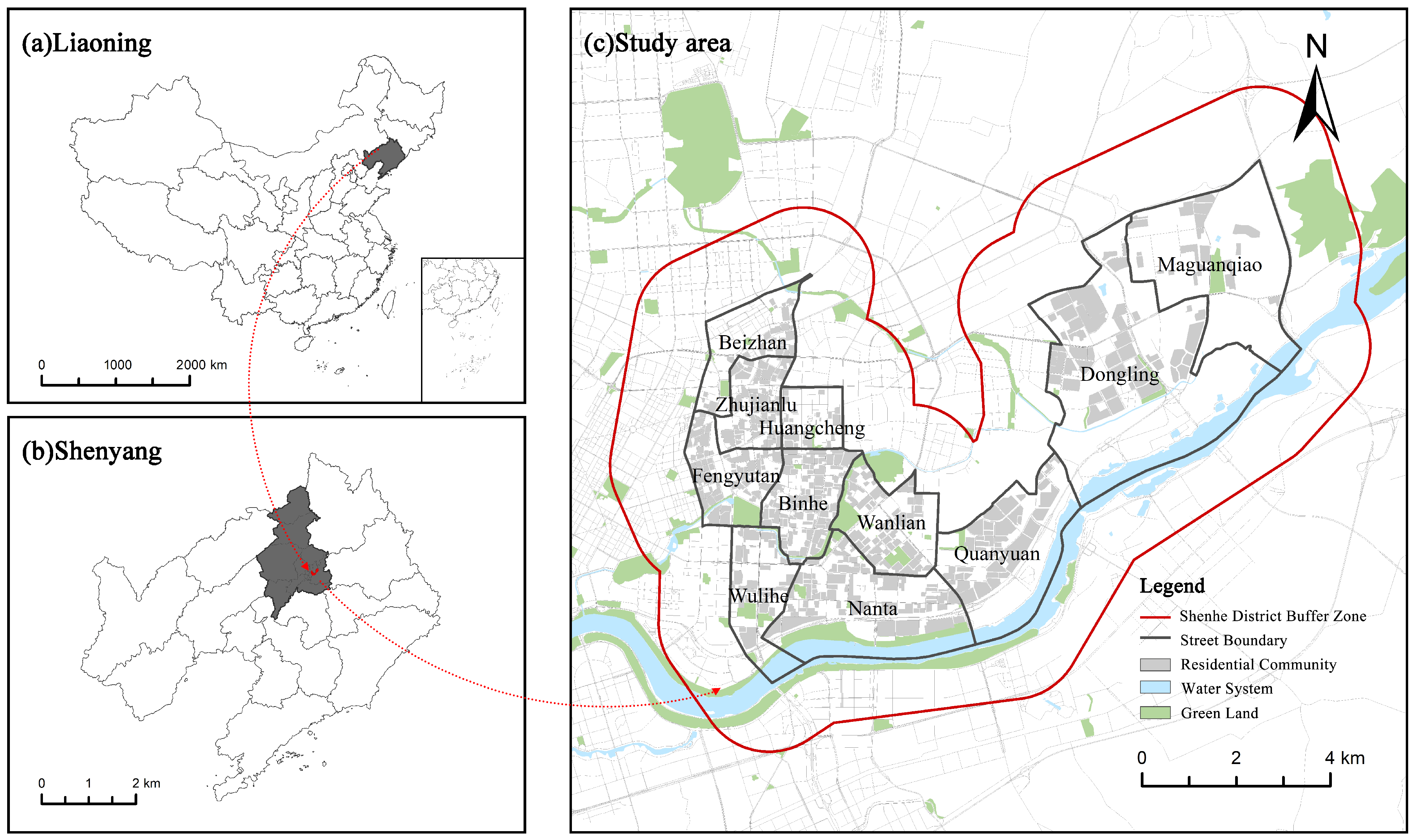
2.1. Study Area and Data
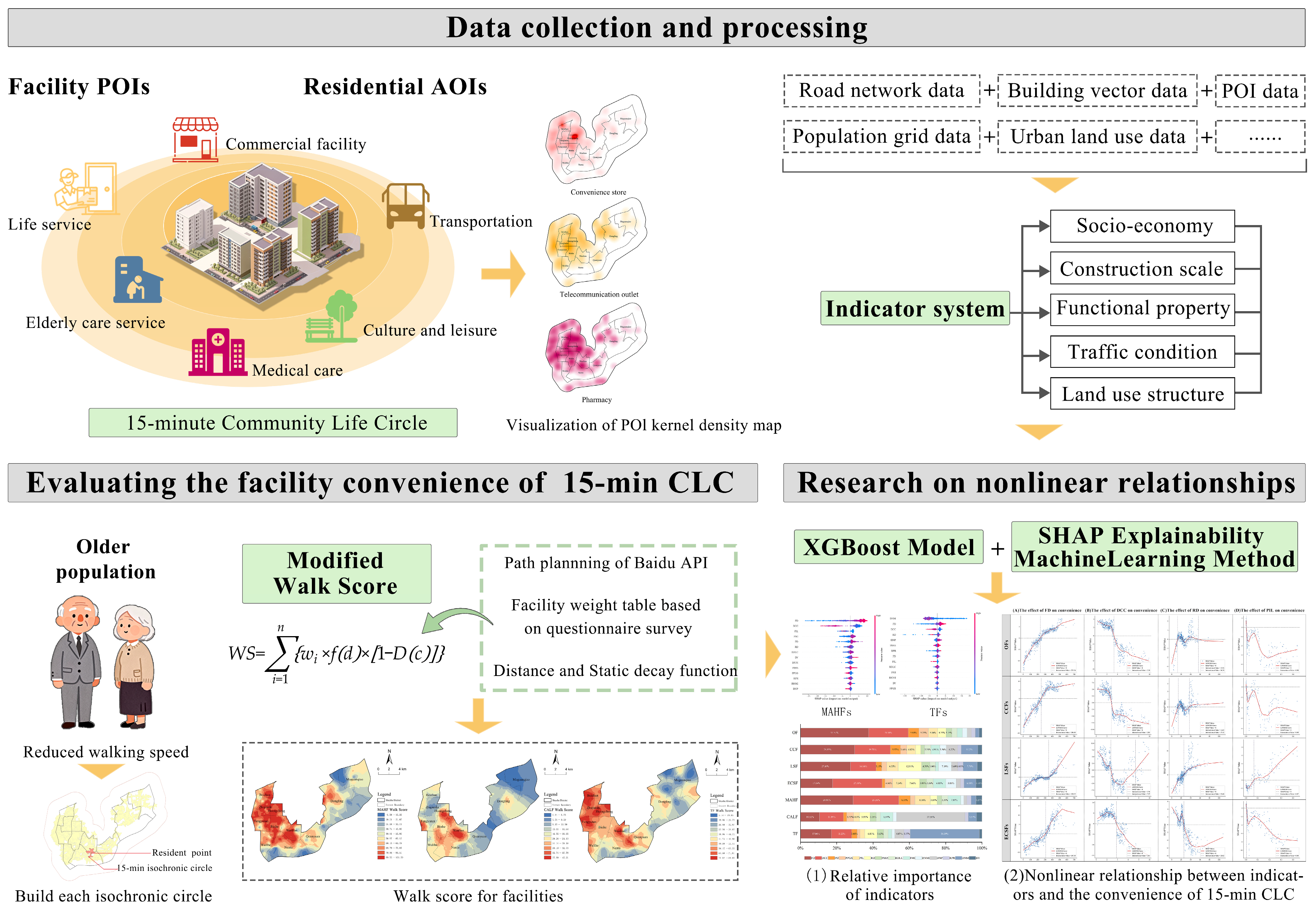
2.2. Research Framework
2.3. Research Methods
2.3.1. Evaluating the Convenience of 15 min CLC Based on Walk Score
- (1)
- Classifying facilities and establishing a weighting scheme
- (2)
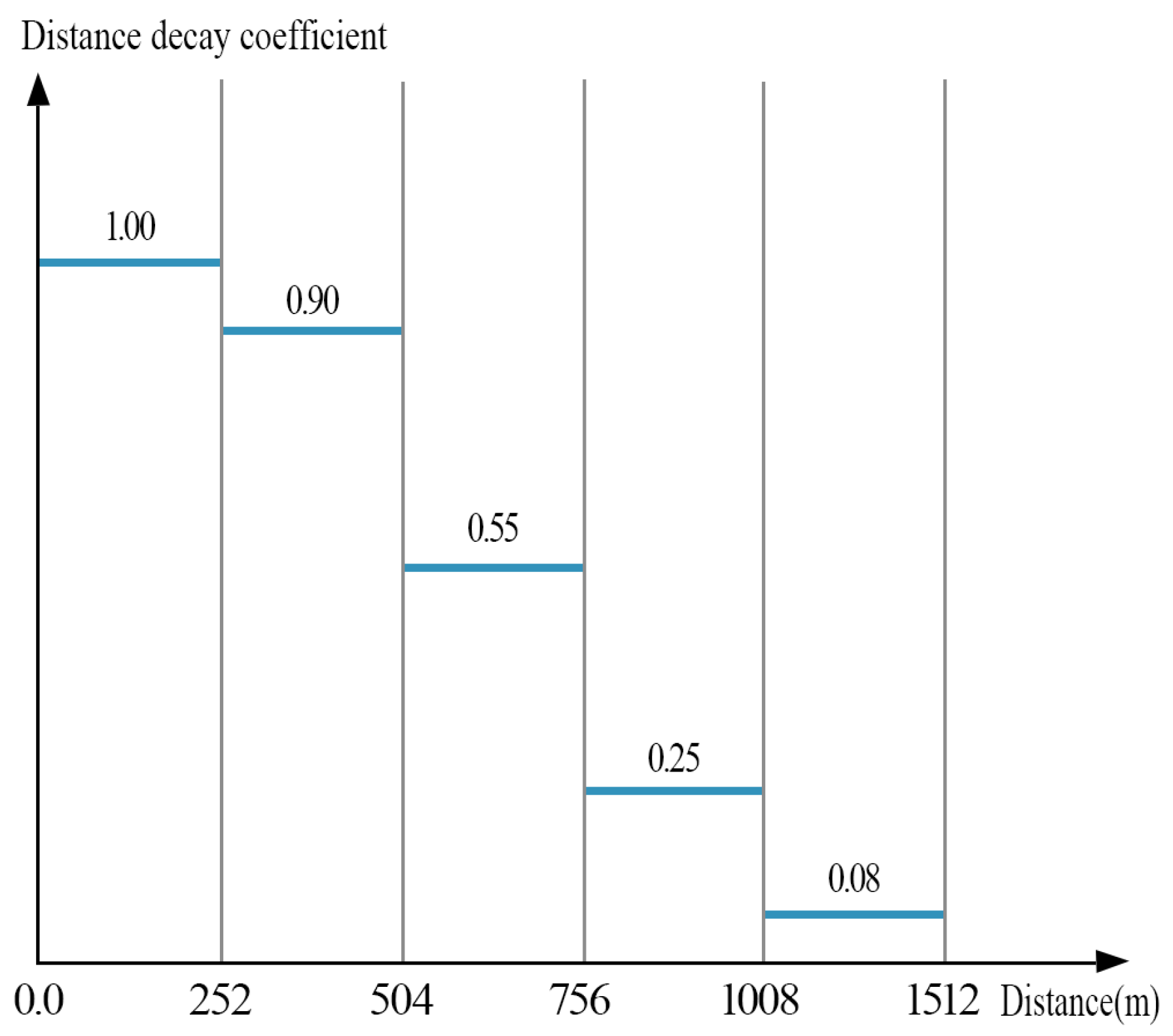
- Calculating the base walk score incorporating distance decay
- (3)
- Deriving the final score by applying attenuation indices for intersection density and block length
2.3.2. Analyzing the Non-linear Influencing Variables Based on XGBoost Model
- (1)
- Selection of influencing variables for the convenience of 15 min CLC
- (2)
- XGBoost model and interpretation methods
3. Results
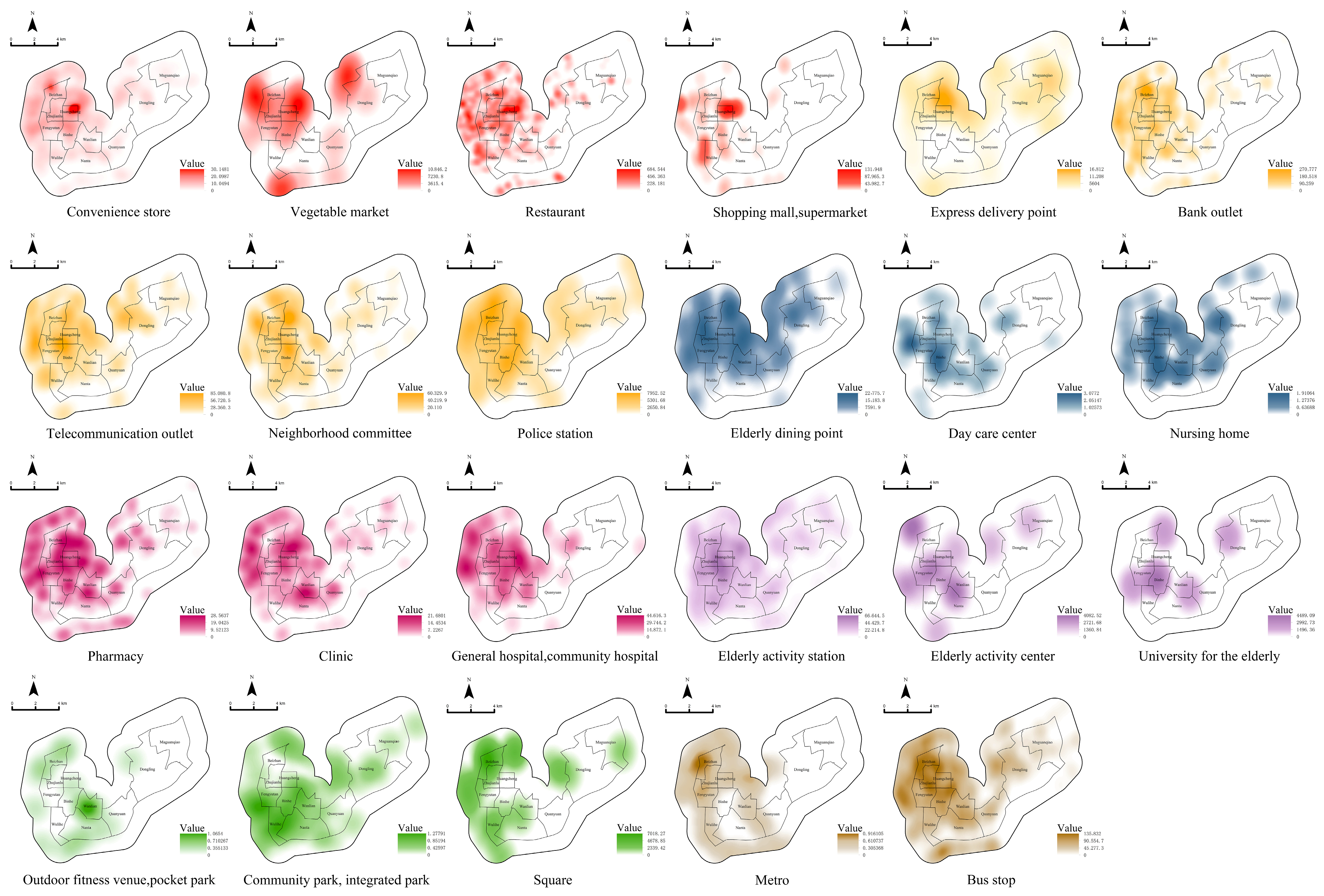
3.1. Results of Spatial Distribution Characteristics of Elderly Service Facilities in Shenhe District
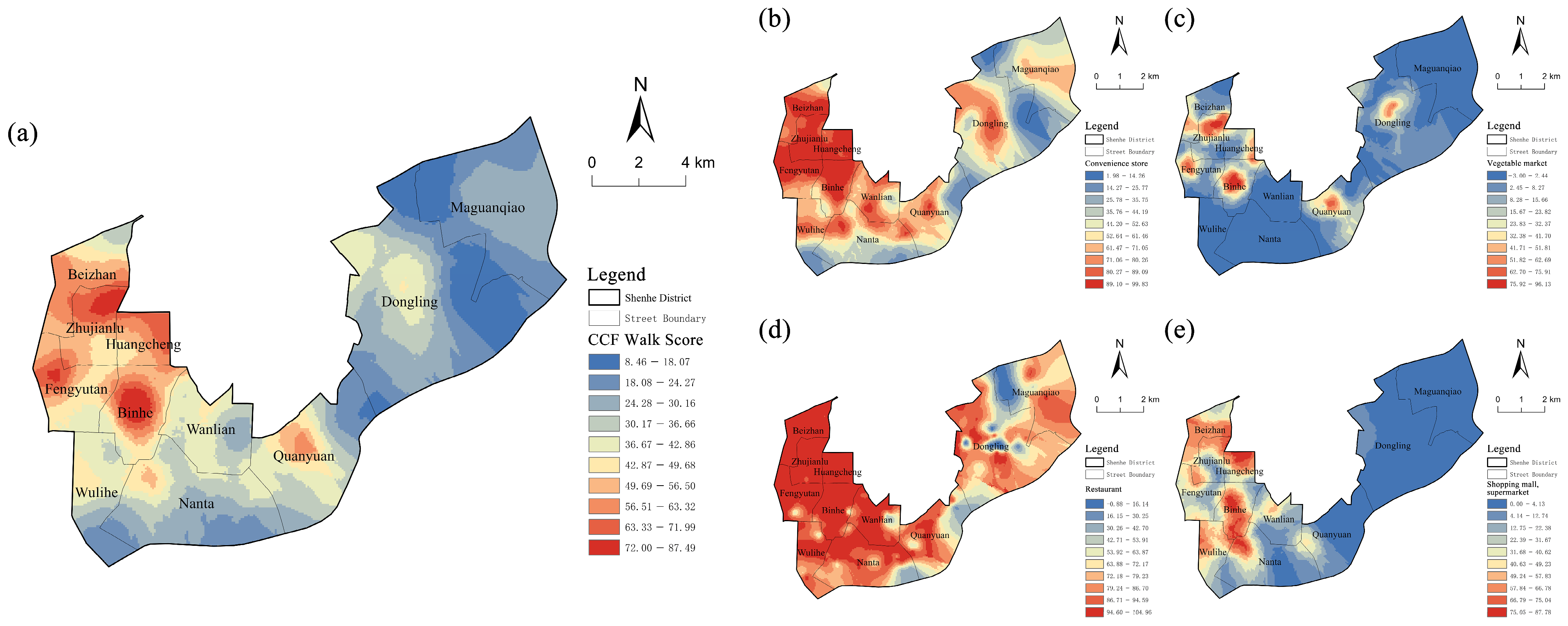
3.2. Analysis of Spatial Differentiation of Convenience in 15 min CLC
3.2.1. Convenience of Categorized Facilities
- (1)
- Convenience commercial facilities
- (2)
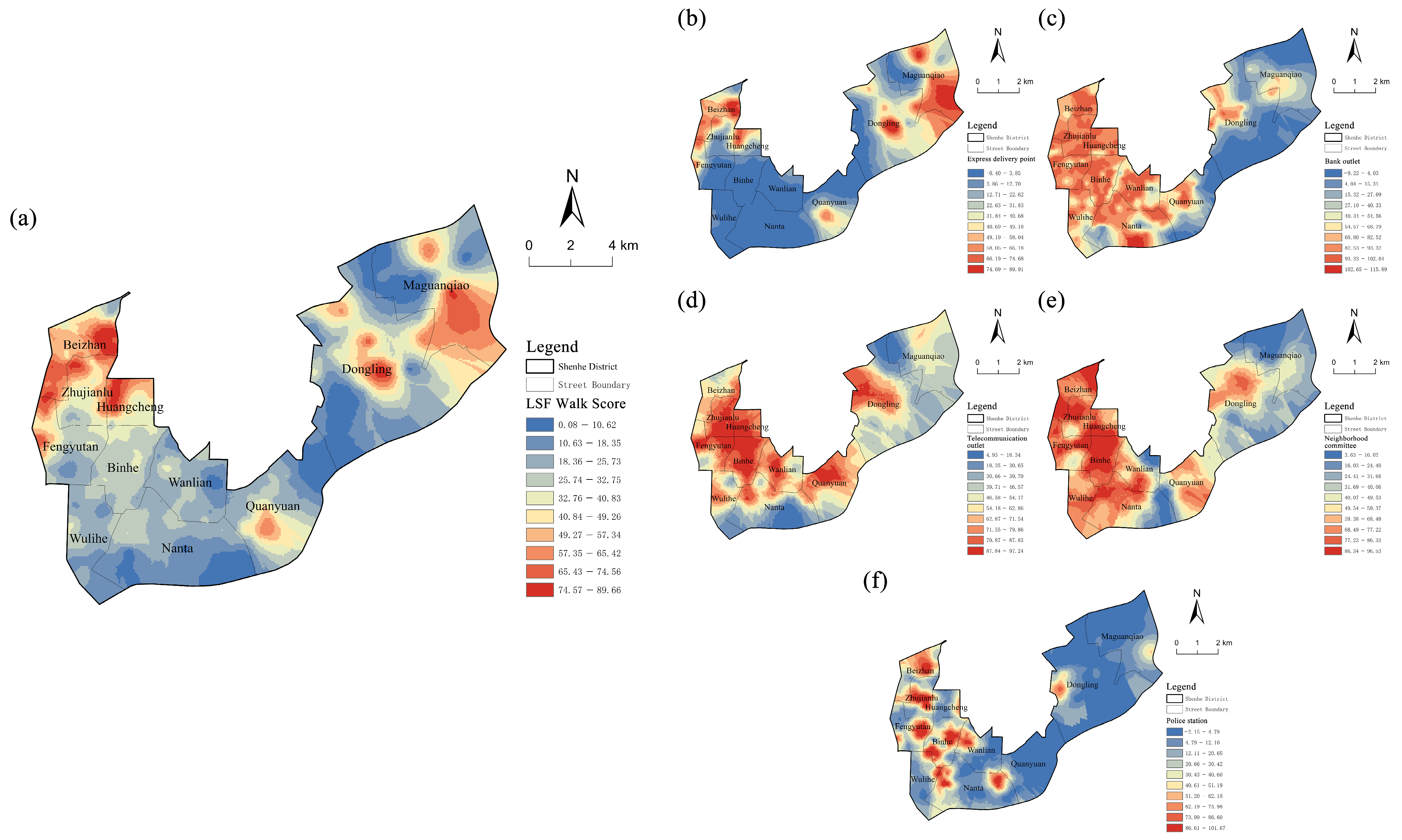
- Life service facilities
- (3)
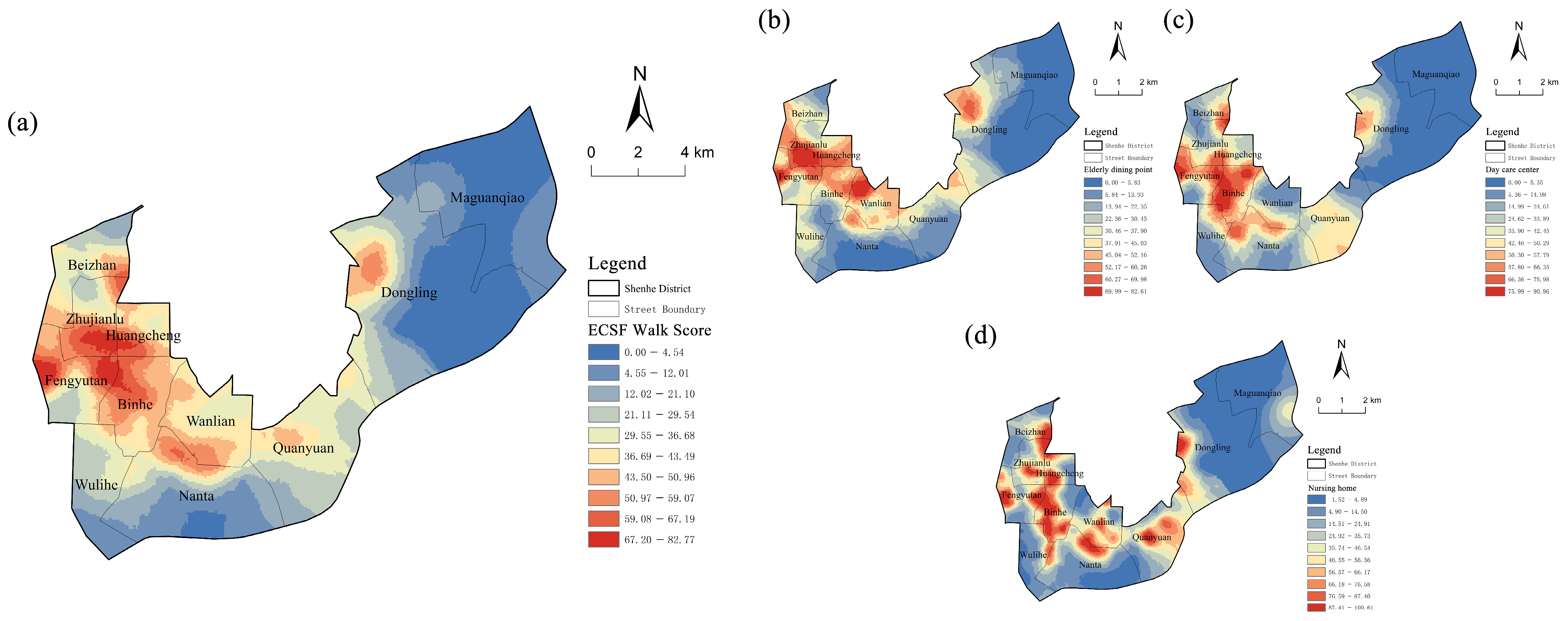
- Elderly care service facilities
- (4)
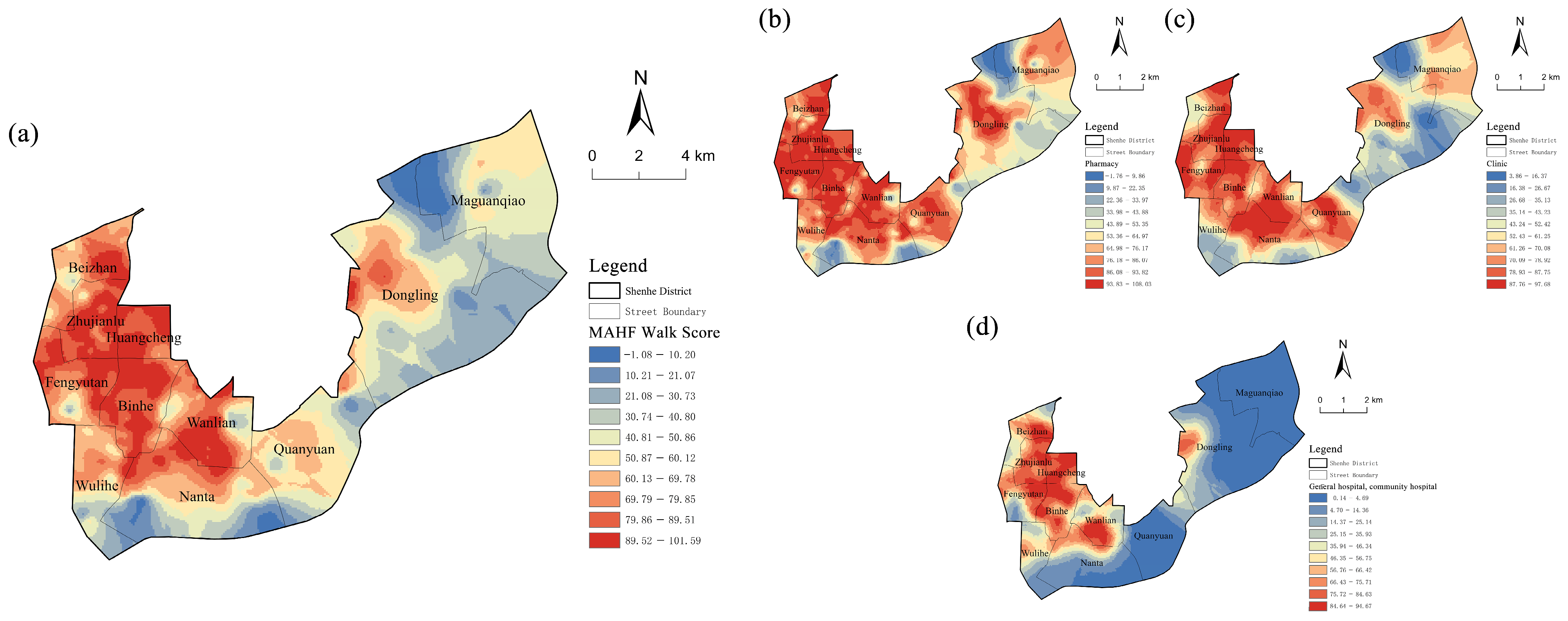
- Medical and health facilities
- (5)
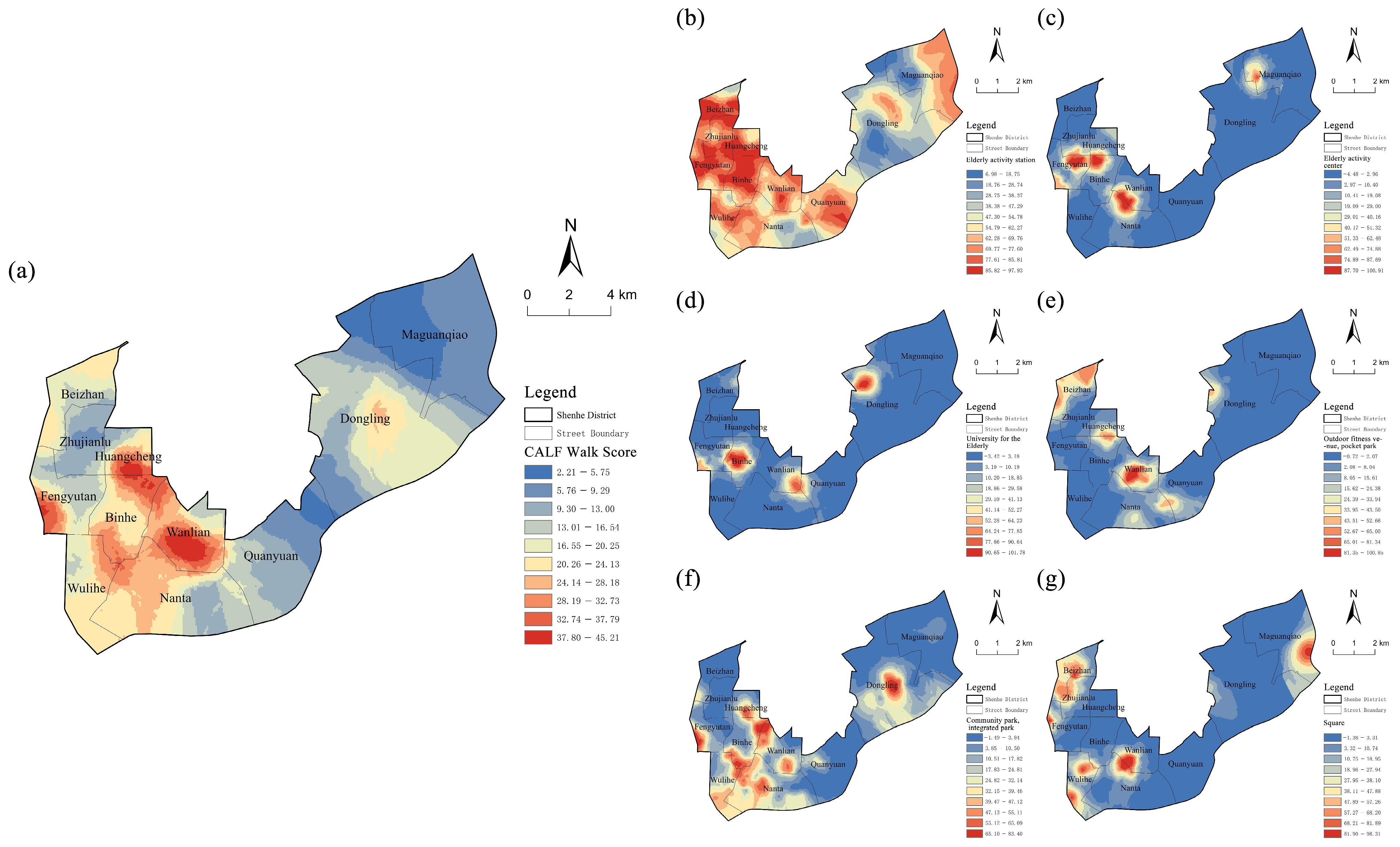
- Cultural and leisure facilities
- (6)
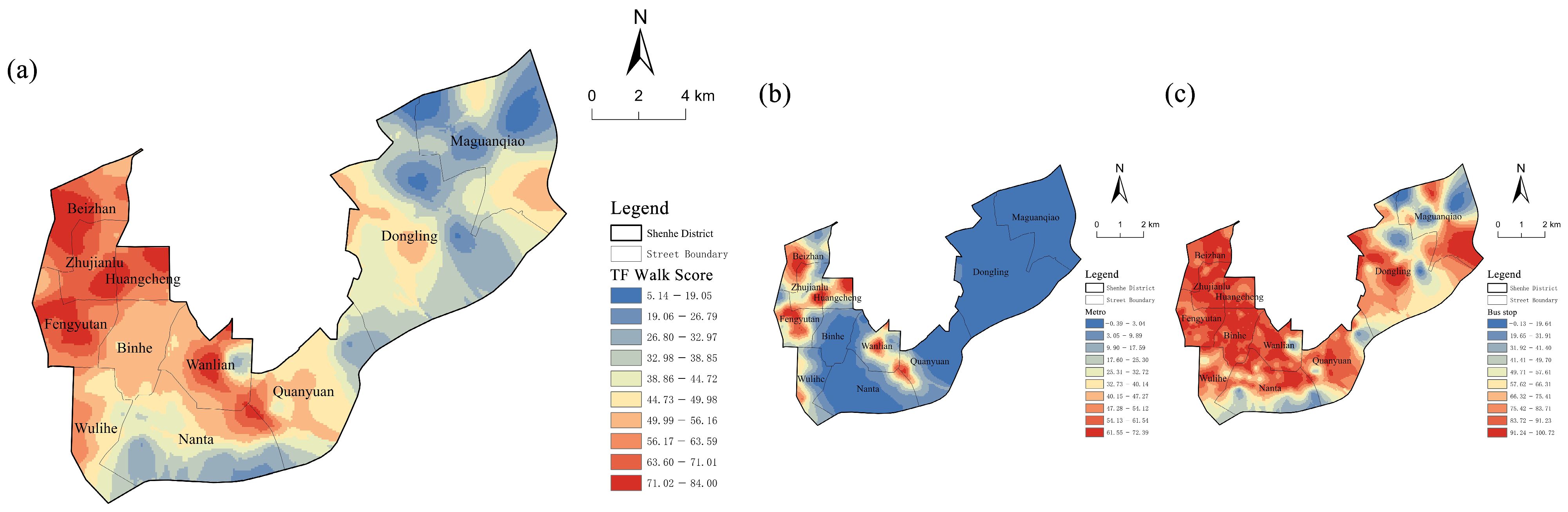
- Transportation facilities
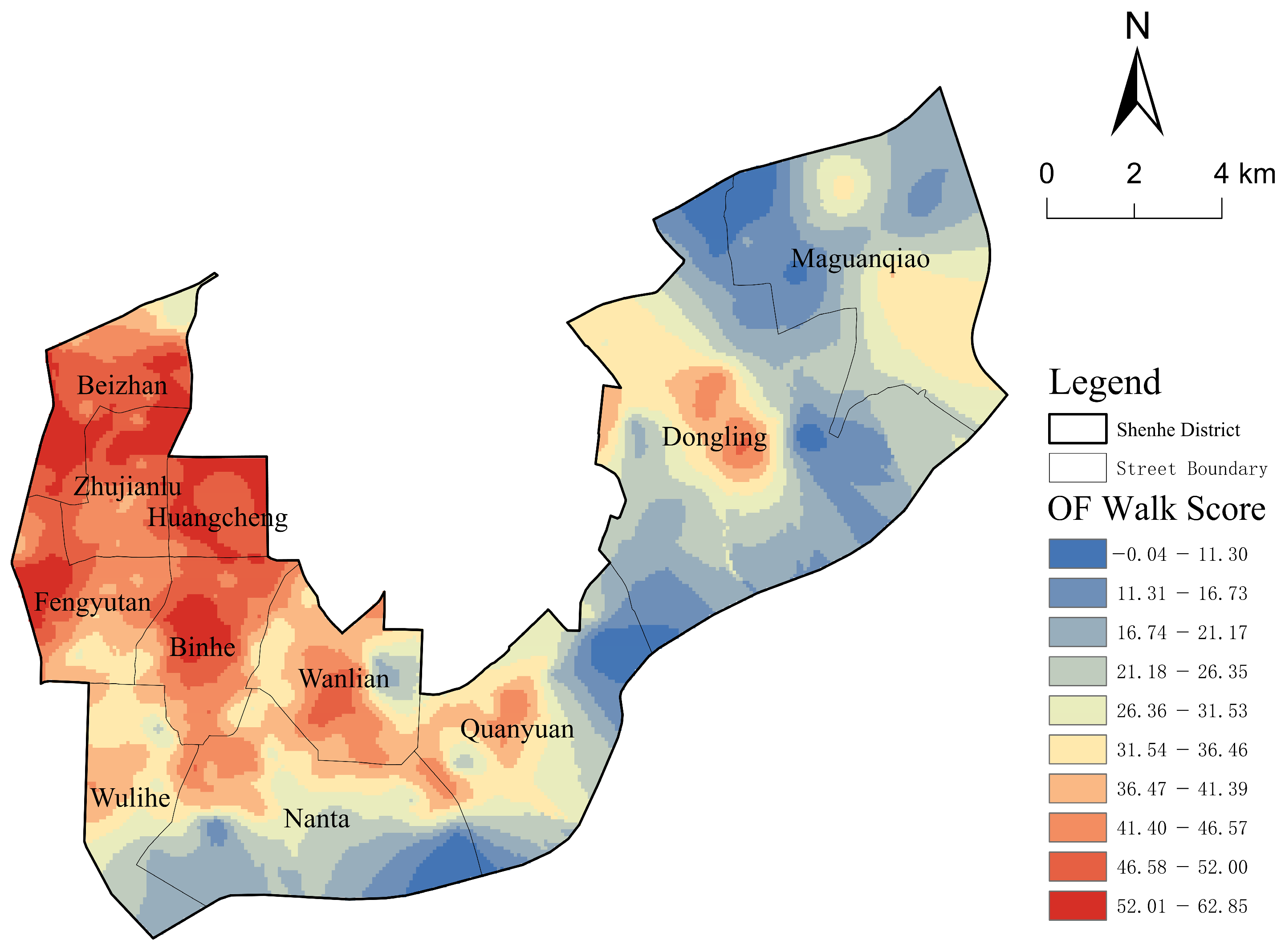
3.2.2. Convenience of Overall Facilities
3.3. Analysis of Non-linear Influencing Variables in 15 min CLC
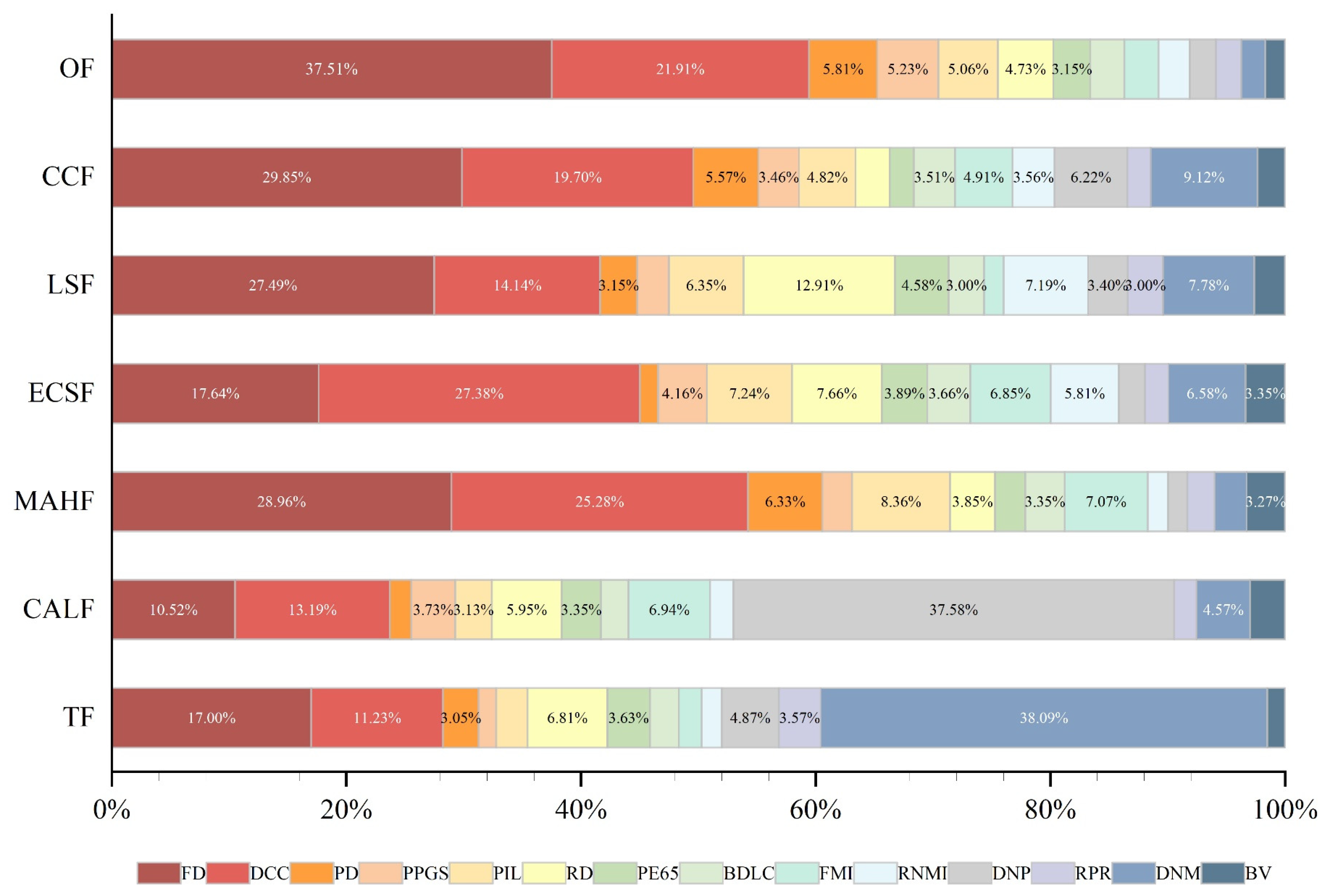
3.3.1. Relative Importance of Influencing Variables
- (1)
- Convenience of overall facilities
- (2)
- Comparative analysis of convenience of overall facilities and categorized facilities
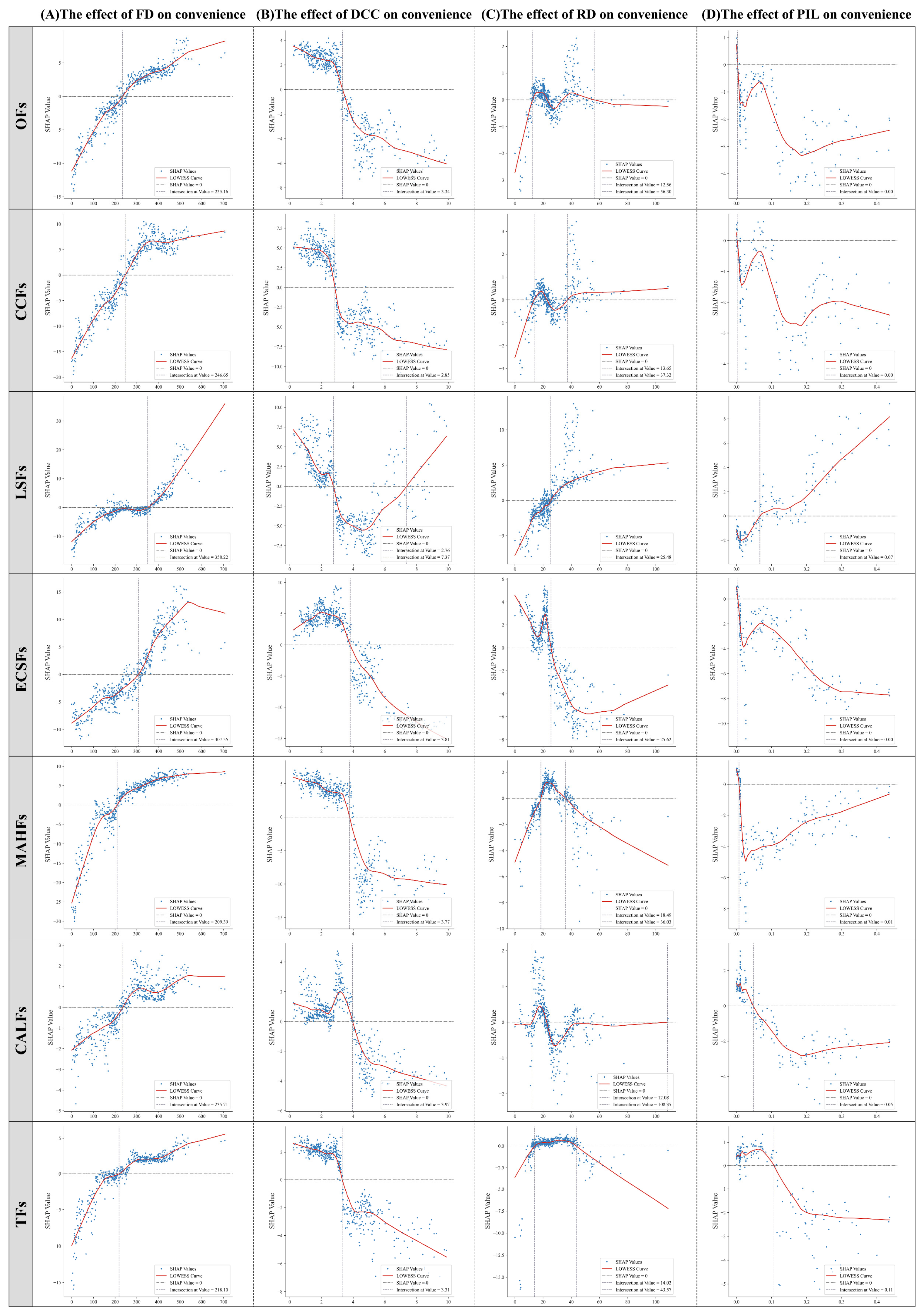
3.3.2. Non-linear Response of Key Influencing Variables and Threshold Effects
- (1)
- Functional density (FD)
- (2)
- Distance from the city center (DCC)
- (3)
- Road network density (RD)
- (4)
- Proportion of industrial land (PIL)
4. Discussion
4.1. Multi-Dimensional Patterns of 15 min CLC Convenience from an Aging Perspective
4.2. Role of Core Influencing Factors and Non-linear Thresholds
4.3. Limitations and Future Research
5. Conclusions
- (1)
- The spatial distribution of elderly services in Shenhe District shows a significant “west-dense, east-sparse” imbalance. This varies by facility type. The most critical shortages are found in vegetable markets, express delivery points, elderly dining points, universities for the elderly, and elderly activity centers.
- (2)
- Life circle construction faces challenges. Convenience follows a distinct “west-high, east-low” pattern. Convenience levels follow this hierarchy: medical and health facilities (MAHFs) > transportation facilities (TFs) > convenience commercial facilities (CCFs) > elderly care service facilities (ECSFs) > life service facilities (LSFs) > cultural and leisure facilities (CALFs). This indicates that medical and transport needs are met. However, support for social interaction and elderly care is severely insufficient.
- (3)
- Machine learning revealed key influencing mechanisms. Functional density and distance from the city center are the strongest predictors. Impacts vary significantly by facility type. For instance, functional mixing is crucial for MAHFs and CALFs, while industrial land has a negative impact on ECSFs. Threshold effects are evident. High FD is generally good but inhibits ECSFs. Road network density has an optimal range for all facilities. DCC shows an “inverted-U” effect on ECSFs. This suggests that planning strategies must be differentiated based on facility type, avoiding homogenized layouts.
Author Contributions
Funding
Data Availability Statement
Conflicts of Interest
Abbreviations
| OF | Overall facility |
| CCF | Convenience commercial facility |
| LSF | Life service facility |
| ECSF | Elderly care service facility |
| MAHF | Medical and health facility |
| CALF | Cultural and leisure facility |
| TF | Transportation facility |
References
- Bloom, D.E.; Canning, D.; Lubet, A. Global population aging: Facts, challenges, solutions & perspectives. Daedalus 2015, 144, 80–92. [Google Scholar] [CrossRef]
- Naja, S.; Makhlouf, M.; Chehab, M.A.H. An ageing world of the 21st century: A literature review. Int. J. Community Med. Public Health 2017, 4, 4363–4369. [Google Scholar] [CrossRef]
- He, W.; Goodkind, D.; Kowal, P.R. An Aging World: 2015; U.S. Census Bureau: Suitland, MD, USA, 2016.
- Alexandratos, N.; Bruinsma, J. World agriculture towards 2030/2050: The 2012 revision. AgEcon Search 2012. [Google Scholar] [CrossRef]
- Gong, J.; Wang, G.; Wang, Y.; Chen, X.; Chen, Y.; Meng, Q.; Yang, P.; Yao, Y.; Zhao, Y. Nowcasting and forecasting the care needs of the older population in China: Analysis of data from the China Health and Retirement Longitudinal Study (CHARLS). Lancet Public Health 2022, 7, e1005–e1013. [Google Scholar] [CrossRef]
- Centers for Disease Control and Prevention (CDC). Public health and aging: Trends in aging—United States and worldwide. MMWR Morb. Mortal. Wkly. Rep. 2003, 52, 101–106. [Google Scholar]
- Soldo, B.J.; Manton, K.G. Changes in the health status and service needs of the oldest old: Current patterns and future trends. Milbank Meml. Fund Q. Health Soc. 1985, 63, 286–319. [Google Scholar] [CrossRef]
- Rosenberg, M.; Everitt, J. Planning for aging populations: Inside or outside the walls. Prog. Plan. 2001, 56, 119–168. [Google Scholar] [CrossRef]
- Laws, G. “The land of old age”: Society’s changing attitudes toward urban built environments for elderly people. Ann. Assoc. Am. Geogr. 1993, 83, 672–693. [Google Scholar] [CrossRef]
- United Nations Human Settlements Programme. Tracking Progress Towards Inclusive, Safe, Resilient and Sustainable Cities and Human Settlements. In SDG 11 Synthesis Report-High Level Political Forum 2018; United Nations Human Settlements Programme: Nairobi, Kenya, 2018. [Google Scholar]
- Boeckxstaens, P.; De Graaf, P. Primary care and care for older persons: Position paper of the European Forum for Primary Care. Qual. Prim. Care 2011, 19, 369. [Google Scholar]
- Marcus, C.C.; Francis, C. People Places: Design Guidlines for Urban Open Space; John Wiley & Sons: Hoboken, NJ, USA, 1997. [Google Scholar]
- Wei, W.; Ren, X.; Guo, S. Evaluation of public service facilities in 19 large cities in China from the perspective of supply and demand. Land 2022, 11, 149. [Google Scholar] [CrossRef]
- Smith, P.C.; Street, A. Measuring the efficiency of public services: The limits of analysis. J. R. Stat. Soc. Ser. A Stat. Soc. 2005, 168, 401–417. [Google Scholar] [CrossRef]
- Reiter, M.; Weichenrieder, A. Are public goods public? A critical survey of the demand estimates for local public services. Finanz. Public Financ. Anal. 1997, 54, 374–408. [Google Scholar]
- Greif, L.; Hauck, S.; Elstermann, M.; Ovtcharova, J. A human-centric analysis of life cycle assessments: Development and validation of a subject-oriented model. Int. J. Prod. Res. 2025, 1–26. [Google Scholar] [CrossRef]
- Song, L.; Kong, X.; Cheng, P. Supply-demand matching assessment of the public service facilities in 15-minute community life circle based on residents’ behaviors. Cities 2024, 144, 104637. [Google Scholar] [CrossRef]
- Flores, R.; Caballer, A.; Alarcón, A. Evaluation of an age-friendly city and its effect on life satisfaction: A two-stage study. Int. J. Environ. Res. Public Health 2019, 16, 5073. [Google Scholar] [CrossRef] [PubMed]
- Liu, T.; Chai, Y. Daily life circle reconstruction: A scheme for sustainable development in urban China. Habitat Int. 2015, 50, 250–260. [Google Scholar] [CrossRef]
- Perry, C.A. City planning for neighborhood life. Soc. Forces 1929, 8, 98–100. [Google Scholar] [CrossRef]
- Jacobs, J. Death and Life of Great American Cities; Vintage: New York, NY, USA, 1992. [Google Scholar]
- Allam, Z.; Bibri, S.E.; Chabaud, D.; Moreno, C. The ‘15-Minute City’concept can shape a net-zero urban future. Humanit. Soc. Sci. Commun. 2022, 9, 126. [Google Scholar] [CrossRef]
- Yang, Y.; Qian, Y.; Zeng, J.; Wei, X.; Yang, M. Walkability measurement of 15-minute community life circle in Shanghai. Land 2023, 12, 153. [Google Scholar] [CrossRef]
- Merlo, L.; Johansson, C.; Nilson, F.; Chapman, D. State of the art for walking as a transport mode within 15-minute cities. Urban Plan. Transp. Res. 2025, 13, 2456186. [Google Scholar] [CrossRef]
- Xiang, L.; Wang, S.; Zou, L. Research on ‘5–10–15 Minutes Life Circle’Planning in Urban Boundary Based on Landscape—Led Method—A Case Study in Beiqiao Town, Xiangcheng District, Suzhou. In Proceedings of the International Conference on Sustainable Buildings and Structures Towards A Carbon Neutral Future, Suzhou, China, 17–20 August 2023; pp. 325–343. [Google Scholar]
- Liu, H.; Remme, R.P.; Hamel, P.; Nong, H.; Ren, H. Supply and demand assessment of urban recreation service and its implication for greenspace planning-A case study on Guangzhou. Landsc. Urban Plan. 2020, 203, 103898. [Google Scholar] [CrossRef]
- Chen, J.; Wang, C.; Zhang, Y.; Li, D. Measuring spatial accessibility and supply-demand deviation of urban green space: A mobile phone signaling data perspective. Front. Public Health 2022, 10, 1029551. [Google Scholar] [CrossRef]
- Daniels, R.; Mulley, C. Explaining walking distance to public transport: The dominance of public transport supply. J. Transp. Land. Use 2013, 6, 5–20. [Google Scholar] [CrossRef]
- Bivina, G.; Gupta, A.; Parida, M. Influence of microscale environmental factors on perceived walk accessibility to metro stations. Transp. Res. Part D Transp. Environ. 2019, 67, 142–155. [Google Scholar] [CrossRef]
- Koohsari, M.J.; Kaczynski, A.T.; Giles-Corti, B.; Karakiewicz, J.A. Effects of access to public open spaces on walking: Is proximity enough? Landsc. Urban Plan. 2013, 117, 92–99. [Google Scholar] [CrossRef]
- Mashhoodi, B.; Berghauser Pont, M. Studying land-use distribution and mixed-use patterns in relation to density, accessibility and urban form. In Proceedings of the 18th International Seminar on Urban Form, Québec City, QC, Canada, 26–29 August 2011; pp. 1–19. [Google Scholar]
- Distefano, N.; Leonardi, S.; Liotta, N.G. Walking for sustainable cities: Factors affecting users’ willingness to walk. Sustainability 2023, 15, 5684. [Google Scholar] [CrossRef]
- Wilkerson, M.L.; Mitchell, M.G.; Shanahan, D.; Wilson, K.A.; Ives, C.D.; Lovelock, C.E.; Rhodes, J.R. The role of socio-economic factors in planning and managing urban ecosystem services. Ecosyst. Serv. 2018, 31, 102–110. [Google Scholar] [CrossRef]
- Wacker, R.R.; Roberto, K.A. Community Resources for Older Adults: Programs and Services in an Era of Change; Sage Publications: Thousand Oaks, CA, USA, 2018. [Google Scholar]
- Adorno, G.; Fields, N.; Cronley, C.; Parekh, R.; Magruder, K. Ageing in a low-density urban city: Transportation mobility as a social equity issue. Ageing Soc. 2018, 38, 296–320. [Google Scholar] [CrossRef]
- Wu, W.; Divigalpitiya, P. Availability and Adequacy of Facilities in 15 Minute Community Life Circle Located in Old and New Communities. Smart Cities 2023, 6, 2176–2195. [Google Scholar] [CrossRef]
- Cox, C.B. Community Care for an Aging Society: Issues, Policies, and Services; Springer Publishing Company: Berlin/Heidelberg, Germany, 2004. [Google Scholar]
- Wu, H.; Wang, L.; Zhang, Z.; Gao, J. Analysis and optimization of 15-minute community life circle based on supply and demand matching: A case study of Shanghai. PLoS ONE 2021, 16, e0256904. [Google Scholar] [CrossRef] [PubMed]
- Jin, Y.; Zhang, G.; Chen, X.; Zhou, Y.; Wei, Y.; Mao, S.; Zhao, H.; Liu, W.; Pan, Z.; An, P. Increasing proportion of mildly aged population in rural mitigates farmland abandonment in the farming-pastoral ecotone of northern China. PLoS ONE 2025, 20, e0328483. [Google Scholar] [CrossRef]
- Aximu, N.; Yimingniyazi, B.; Lin, D.; Zhang, J.; Jiang, M.; Sun, Y. Human resources in long-term care for older adults in China: Challenges amid population aging. BioSci. Trends 2025, 19, 626–640. [Google Scholar] [CrossRef]
- Wang, Z. Research on the Impact Mechanism of Population Aging on China’s Economic Growth and Corresponding Strategies. In Proceedings of the SHS Web of Conferences, Riga, Latvia, 26–28 March 2025; p. 01018. [Google Scholar]
- Somsopon, W.; Kim, S.M.; Nitivattananon, V.; Kusakabe, K.; Nguyen, T.P.L. Issues and needs of elderly in community facilities and services: A case study of urban housing projects in Bangkok, Thailand. Sustainability 2022, 14, 8388. [Google Scholar] [CrossRef]
- Xiang, L.; Yu, A.T.; Tan, Y.; Shan, X.; Shen, Q. Senior citizens’ requirements of services provided by community-based care facilities: A China study. Facilities 2020, 38, 52–71. [Google Scholar] [CrossRef]
- Yang, Y.; Li, C.; Zhou, D. Study on the Characteristics of Community Elderly Care Service Facilities Usage and Optimization Design Based on Life Cycle Theory. Buildings 2024, 14, 3003. [Google Scholar] [CrossRef]
- GB 50180-2018; Standard for Urban Residential Area Planning and Design. Ministry of Housing and Urban-Rural Development of the People’s Republic of China: Beijing, China, 2018. Available online: https://www.mohurd.gov.cn/gongkai/zc/wjk/art/2018/art_17339_238590.html#:~:text=%E7%8E%B0%E6%89%B9%E5%87%86%E3%80%8A%E5%9F%8E%E5%B8%82%E5%B1%85%E4%BD%8F%E5%8C%BA%E8%A7%84%E5%88%92%E8%AE%BE%E8%AE%A1%E6%A0%87%E5%87%86%E3%80%8B%E4%B8%BA%E5%9B%BD%E5%AE%B6%E6%A0%87%E5%87%86%EF%BC%8C%E7%BC%96%E5%8F%B7%E4%B8%BAGB50180-2018%EF%BC%8C%E8%87%AA2018%E5%B9%B412%E6%9C%881%E6%97%A5%E8%B5%B7%E5%AE%9E%E6%96%BD%E3%80%82,%E5%85%B6%E4%B8%AD%EF%BC%8C%E7%AC%AC3.0.2%E3%80%814.0.2%E3%80%814.0.3%E3%80%814.0.4%E3%80%814.0.7%E3%80%814.0.9%E6%9D%A1%E4%B8%BA%E5%BC%BA%E5%88%B6%E6%80%A7%E6%9D%A1%E6%96%87%EF%BC%8C%E5%BF%85%E9%A1%BB%E4%B8%A5%E6%A0%BC%E6%89%A7%E8%A1%8C%E3%80%82%20%E5%8E%9F%E5%9B%BD%E5%AE%B6%E6%A0%87%E5%87%86%E3%80%8A%E5%9F%8E%E5%B8%82%E5%B1%85%E4%BD%8F%E5%8C%BA%E8%A7%84%E5%88%92%E8%AE%BE%E8%AE%A1%E8%A7%84%E8%8C%83%E3%80%8BGB50180-93%E5%90%8C%E6%97%B6%E5%BA%9F%E6%AD%A2%E3%80%82 (accessed on 18 January 2026).
- Dumurgier, J.; Elbaz, A.; Ducimetière, P.; Tavernier, B.; Alpérovitch, A.; Tzourio, C. Slow walking speed and cardiovascular death in well functioning older adults: Prospective cohort study. BMJ 2009, 339, b4460. [Google Scholar] [CrossRef]
- Huijben, B.; Van Schooten, K.; Van Dieën, J.; Pijnappels, M. The effect of walking speed on quality of gait in older adults. Gait Posture 2018, 65, 112–116. [Google Scholar] [CrossRef] [PubMed]
- Duim, E.; Lebrão, M.L.; Antunes, J.L.F. Walking speed of older people and pedestrian crossing time. J. Transp. Health 2017, 5, 70–76. [Google Scholar] [CrossRef]
- Long, Y.; Zhao, J.; Li, S.; Zhou, Y.; Xu, L. The large-scale calculation of “walkscore” of main cities in China. New Arch. 2018, 3, 4–8. [Google Scholar]
- Lu, Y. Walkability evaluation based on people’s use of facilities by walking. Urban Plan. Forum 2013, 5, 113–118. [Google Scholar]
- Zhou, Y.; Long, Y. Large-scale evaluation for street walkability: Methodological improvements and the empirical application in Chengdu. Shanghai Urban Plan. Rev. 2017, 1, 88–93. [Google Scholar]
- Huang, J.; Hu, G.; Li, M. The Allocative Suitability of Community Facilities from the Perspective of the Elderly—Based on Walk Score Method. Urban Plan. Forum 2017, 6, 45–53. [Google Scholar]
- Horak, J.; Kukuliac, P.; Maresova, P.; Orlikova, L.; Kolodziej, O. Spatial Pattern of the Walkability Index, Walk Score and Walk Score Modification for Elderly. ISPRS Int. J. Geo-Inf. 2022, 11, 279. [Google Scholar] [CrossRef]
- Sun, D.-S.; Chai, Y.-W.; Zhang, Y. The definition and measurement of community life circle: A case study of Qinghe area in Beijing. Urban. Dev. Stud. 2016, 23, 1–9. [Google Scholar]
- Yang, W.; Li, T.; Cao, X. The spatial pattern of Community Travel Low Carbon Index (CTLCI) and spatial heterogeneity of the relationship between CTLCI and influencing factors in Guangzhou. Geogr. Res. 2015, 34, 1471–1480. [Google Scholar]
- Ewing, R.; Cervero, R. Travel and the built environment: A meta-analysis. J. Am. Plan. Assoc. 2010, 76, 265–294. [Google Scholar] [CrossRef]
- Luo, X.; Zhang, W.; Chai, Y. Research on threshold effects of built environment settings in 15-minute life-circles. Geogr. Res. 2022, 41, 2155–2170. [Google Scholar]
- Wang, P.; Zhang, N. Decision tree classification algorithm for non-equilibrium data set based on random forests. J. Intell. Fuzzy Syst. 2020, 39, 1639–1648. [Google Scholar] [CrossRef]
- Wu, W.; Zheng, T. Establishing a” dynamic two-step floating catchment area method” to assess the accessibility of urban green space in Shenyang based on dynamic population data and multiple modes of transportation. Urban. For. Urban. Green. 2023, 82, 127893. [Google Scholar] [CrossRef]
- Gilderbloom, J.I.; Riggs, W.W.; Meares, W.L. Does walkability matter? An examination of walkability’s impact on housing values, foreclosures and crime. Cities 2015, 42, 13–24. [Google Scholar] [CrossRef]
- Huang, X.; Gong, P.; White, M. Study on spatial distribution equilibrium of elderly care facilities in downtown Shanghai. Int. J. Environ. Res. Public Health 2022, 19, 7929. [Google Scholar] [CrossRef] [PubMed]
- Jiang, Z.; Wu, C.; Chung, H. The 15-minute community life circle for older people: Walkability measurement based on service accessibility and street-level built environment—A case study of Suzhou, China. Cities 2025, 157, 105587. [Google Scholar] [CrossRef]
- Iamtrakul, P.; Padon, A.; Chayphong, S.; Hayashi, Y. Unlocking urban accessibility: Proximity analysis in Bangkok, Thailand’s mega city. Sustainability 2024, 16, 3137. [Google Scholar] [CrossRef]
- Twardzik, E.; Falvey, J.R.; Clarke, P.J.; Freedman, V.A.; Schrack, J.A. Public transit stop density is associated with walking for exercise among a national sample of older adults. BMC Geriatr. 2023, 23, 596. [Google Scholar] [CrossRef]
- Lam, T.M.; Wang, Z.; Vaartjes, I.; Karssenberg, D.; Ettema, D.; Helbich, M.; Timmermans, E.J.; Frank, L.D.; den Braver, N.R.; Wagtendonk, A.J. Development of an objectively measured walkability index for the Netherlands. Int. J. Behav. Nutr. Phys. Act. 2022, 19, 50. [Google Scholar] [CrossRef]
- Song, S.; Wang, D.; Zhu, W.; Wang, C. Study on the spatial configuration of nursing homes for the elderly people in Shanghai: Based on their choice preference. Technol. Forecast. Soc. Change 2020, 152, 119859. [Google Scholar] [CrossRef]
- Wang, H.; Ye, L.; Fang, N.; Song, W.; Liu, C. Spatial Equity of the 15-Minute Community Life Circle: Public Service Accessibility and Socioeconomic Status in Nanjing. Appl. Spat. Anal. Policy 2025, 18, 146. [Google Scholar] [CrossRef]
- Xiang, X.; Lin, L.; Xu, S.; Huang, T. Examining the Spatial Disequilibrium and Driving Factors of Population Aging and Elderly Service Resource Allocation in Rural Areas: A Case Study of Wenzhou City. Trop. Geogr. 2025, 45, 846. [Google Scholar]
- Zhang, R.; Liu, S.; Li, M.; He, X.; Zhou, C. The effect of high-density built environments on elderly individuals’ physical health: A cross-sectional study in Guangzhou, China. Int. J. Environ. Res. Public Health 2021, 18, 10250. [Google Scholar] [CrossRef]






| Facility Category | Living Circle Hierarchy | Facility Subcategory | Number of Facilities | Stratified Statistics | Total Number |
|---|---|---|---|---|---|
| Convenience commercial facility (CCF) | 5–10 min | Convenience store | 525 | 557 | 11,557 |
| Vegetable market | 32 | ||||
| 15 min | Restaurant | 10,914 | 11,000 | ||
| Shopping mall, supermarket | 86 | ||||
| Life service facility (LSF) | 5–10 min | Express delivery point | 59 | 59 | 1051 |
| 15 min | Bank outlet | 542 | 992 | ||
| Telecommunication outlet | 255 | ||||
| Neighborhood committee | 156 | ||||
| Police station | 39 | ||||
| Elderly care service facility (ECSF) | 5–10 min | Elderly dining point | 94 | 152 | 201 |
| Day care center | 58 | ||||
| 15 min | Nursing home | 49 | 49 | ||
| Medical and health facility (MAHF) | 5–10 min | Pharmacy | 864 | 1378 | 1481 |
| Clinic | 514 | ||||
| 15 min | General hospital, community hospital | 103 | 103 | ||
| Cultural and leisure facility (CALF) | 5–10 min | Elderly activity station | 222 | 238 | 318 |
| Outdoor fitness venue, pocket park | 16 | ||||
| 15 min | Elderly activity center | 12 | 80 | ||
| University for the Elderly | 6 | ||||
| Community park, integrated park | 46 | ||||
| Square | 16 | ||||
| Transportation facility (TF) | 5–10 min | Bus stop | 658 | 658 | 690 |
| 15 min | Metro | 32 | 32 |
| Intersection Density (Intersections per Square Mile) | Attenuation (Penalty %) | Block Length (in Meters) | Attenuation (Penalty %) |
|---|---|---|---|
| >200 | 0 | <120 | 0 |
| 150–200 | 1 | 120–150 | 1 |
| 120–150 | 2 | 150–165 | 2 |
| 90–120 | 3 | 165–180 | 3 |
| 60–90 | 4 | 180–195 | 4 |
| <60 | 5 | >195 | 5 |
| Facility Type | Certain Facilities Numbered from Nearest to Farthest | Value of Diversity (90%) | |||||||||
|---|---|---|---|---|---|---|---|---|---|---|---|
| 1 | 2 | 3 | 4 | 5 | 6 | 7 | 8 | 9 | 10 | ||
| Convenience store | 53.42 | 30.43 | 9.32 | 3.10 | 1.86 | 1.24 | 0.62 | 3 | |||
| Vegetable market | 63.98 | 30.43 | 2.48 | 1.86 | 0.62 | 0.62 | 2 | ||||
| Restaurant | 39.13 | 15.53 | 14.91 | 11.8 | 11.18 | 4.35 | 2.48 | 0.62 | 5 | ||
| Shopping mall, supermarket | 75.78 | 16.15 | 5.59 | 1.24 | 0.62 | 0.62 | 2 | ||||
| Express delivery point | 73.29 | 24.22 | 1.86 | 0.62 | 2 | ||||||
| Bank outlet | 93.79 | 3.73 | 1.24 | 1.24 | 1 | ||||||
| Telecommunication outlet | 98.14 | 1.24 | 0.62 | 1 | |||||||
| Neighborhood committee | 95.65 | 3.10 | 1.24 | 1 | |||||||
| Police station | 97.52 | 1.86 | 0.62 | 1 | |||||||
| Elderly dining point | 55.90 | 38.51 | 2.48 | 1.86 | 1.24 | 2 | |||||
| Day care center | 49.07 | 45.34 | 4.97 | 0.62 | 2 | ||||||
| Nursing home | 91.30 | 6.83 | 1.24 | 0.62 | 1 | ||||||
| Pharmacy | 70.81 | 19.88 | 4.35 | 3.10 | 1.24 | 0.62 | 2 | ||||
| Clinic | 50.31 | 46.58 | 1.86 | 1.24 | 2 | ||||||
| General hospital, community hospital | 91.93 | 6.83 | 0.62 | 0.62 | 1 | ||||||
| Elderly activity station | 63.35 | 32.30 | 3.73 | 0.62 | 2 | ||||||
| Elderly activity center | 95.03 | 3.73 | 1.24 | 1 | |||||||
| University for the elderly | 92.55 | 6.83 | 0.62 | 1 | |||||||
| Outdoor fitness venue, pocket park | 55.28 | 40.37 | 3.73 | 0.62 | 2 | ||||||
| Community park, integrated park | 57.14 | 34.16 | 6.83 | 1.24 | 0.62 | 2 | |||||
| Square | 94.41 | 4.97 | 0.62 | 1 | |||||||
| Metro | 68.32 | 27.33 | 3.10 | 0.62 | 0.62 | 2 | |||||
| Bus stop | 52.80 | 38.51 | 6.21 | 1.24 | 0.62 | 0.62 | 2 | ||||
| Facility Type | Classification Weight | Diversity Number | Diversity Weight | ||||
|---|---|---|---|---|---|---|---|
| Convenience store | 10.85 | 3 | 6.22 | 3.54 | 1.09 | ||
| Vegetable market | 14.05 | 2 | 9.52 | 4.53 | |||
| Restaurant | 3.52 | 5 | 1.49 | 0.59 | 0.57 | 0.45 | 0.43 |
| Shopping mall, supermarket | 5.22 | 2 | 4.30 | 0.92 | |||
| Express delivery point | 9.36 | 2 | 7.04 | 2.32 | |||
| Bank outlet | 1.65 | 1 | 1.65 | ||||
| Telecommunication outlet | 0.92 | 1 | 0.92 | ||||
| Neighborhood committee | 1.83 | 1 | 1.83 | ||||
| Police station | 0.63 | 1 | 0.63 | ||||
| Elderly dining point | 1.80 | 2 | 1.07 | 0.73 | |||
| Day care center | 0.96 | 2 | 0.50 | 0.46 | |||
| Nursing home | 0.88 | 1 | 0.88 | ||||
| Pharmacy | 3.06 | 2 | 2.39 | 0.67 | |||
| Clinic | 0.97 | 2 | 0.50 | 0.47 | |||
| General hospital, community hospital | 1.87 | 1 | 1.87 | ||||
| Elderly activity station | 2.72 | 2 | 1.80 | 0.92 | |||
| Elderly activity center | 1.11 | 1 | 1.11 | ||||
| University for the elderly | 2.65 | 1 | 2.65 | ||||
| Outdoor fitness venue, pocket park | 7.07 | 2 | 4.09 | 2.98 | |||
| Community park, integrated park | 10.95 | 2 | 6.85 | 4.10 | |||
| Square | 1.48 | 1 | 1.48 | ||||
| Metro | 7.25 | 2 | 5.18 | 2.07 | |||
| Bus stop | 9.19 | 2 | 5.31 | 3.87 | |||
| Walk Score | Description |
|---|---|
| 90–100 | Walker’s Paradise: Daily trips can be completely solved by walking. |
| 70–89 | Very Walkable: Most daily trips can be accomplished by walking. |
| 50–69 | Average Walkability: Some facilities are within walking distance. |
| 25–49 | Poor Walkability: There are fewer facilities within walking distance. |
| 0–24 | Car Dependent: Almost all trips depend on cars. |
| Dimension | Influencing Variable | Description of Influencing Variable |
|---|---|---|
| Socio-economy | Population density (PD) | Number of population in residential quarters (units)/ quarter area (km2) |
| Proportion of elderly population over 65 years old (PE65) | Number of people over 65 years old in residential quarters/ total population | |
| Construction scale | Residential plot ratio (RPR) | Total above-ground construction area/ net land area of residential quarters |
| Building density of life circle (BDLC) | Total base area/total land area of life circle buildings | |
| Functional property | Functional density (FD) | Number of POIs in the life circle (pieces)/ area of the life circle (km2) |
| Functional mixing index (FMI) | Shannon diversity index of POI facilities within the life circle | |
| Traffic condition | Road network density (RD) | Total road network length (km)/life circle area (km 2) |
| Border vacuum (BV) | Nearest straight-line distance to a place that impedes walking | |
| Distance from the city center (DCC) | Straight-line distance from geometric centroid of residential quarters to city center | |
| Distance to the nearest park (DNP) | Straight-line distance from the geometric centroid of residential quarters to the nearest park | |
| Distance to the nearest metro (DNM) | Straight-line distance from geometric centroid of residential quarter to nearest subway station | |
| Land use structure | Residential and non-residential mixing index (RNMI) | Degree of balance between residential land and non-residential land |
| Proportion of industrial land (PIL) | Industrial land area/life circle area | |
| Proportion of parks and green spaces (PPGS) | Land area of parks and green spaces/life circle area |
Disclaimer/Publisher’s Note: The statements, opinions and data contained in all publications are solely those of the individual author(s) and contributor(s) and not of MDPI and/or the editor(s). MDPI and/or the editor(s) disclaim responsibility for any injury to people or property resulting from any ideas, methods, instructions or products referred to in the content. |
© 2026 by the authors. Licensee MDPI, Basel, Switzerland. This article is an open access article distributed under the terms and conditions of the Creative Commons Attribution (CC BY) license.
Share and Cite
Lyu, C.; Li, L.; Zhang, J.; Wang, Z.; Gao, Y. Evaluation of Convenience of 15-Minute Community Life Circle Facilities and Analysis of Non-Linear Influencing Variables from the Perspective of Aging: A Case Study of Shenyang. Land 2026, 15, 285. https://doi.org/10.3390/land15020285
Lyu C, Li L, Zhang J, Wang Z, Gao Y. Evaluation of Convenience of 15-Minute Community Life Circle Facilities and Analysis of Non-Linear Influencing Variables from the Perspective of Aging: A Case Study of Shenyang. Land. 2026; 15(2):285. https://doi.org/10.3390/land15020285
Chicago/Turabian StyleLyu, Chang, Li Li, Jin Zhang, Zijing Wang, and Yanpeng Gao. 2026. "Evaluation of Convenience of 15-Minute Community Life Circle Facilities and Analysis of Non-Linear Influencing Variables from the Perspective of Aging: A Case Study of Shenyang" Land 15, no. 2: 285. https://doi.org/10.3390/land15020285
APA StyleLyu, C., Li, L., Zhang, J., Wang, Z., & Gao, Y. (2026). Evaluation of Convenience of 15-Minute Community Life Circle Facilities and Analysis of Non-Linear Influencing Variables from the Perspective of Aging: A Case Study of Shenyang. Land, 15(2), 285. https://doi.org/10.3390/land15020285