Article

Dynamics of Native Forests and Exotic Tree Plantations in Southern Chile

by
Alheli Flores-Ferrer
1,
John Gajardo Valenzuela
2,
Claudio Verdugo Reyes
3,4,
Cristóbal Verdugo Vásquez
1,4 and
Gerardo Acosta-Jamett
1,4,*
1
Instituto de Medicina Preventiva Veterinaria, Facultad de Ciencias Veterinarias, Universidad Austral de Chile, Campus Isla Teja, Valdivia 5090000, Chile
2
Instituto de Bosques y Sociedad, Universidad Austral de Chile, Campus Isla Teja, Valdivia 5090000, Chile
3
Instituto de Patología Animal, Facultad de Ciencias Veterinarias, Universidad Austral de Chile, Campus Isla Teja, Valdivia 5090000, Chile
4
Center for Surveillance and Evolution of Infectious Diseases (CSEID), Facultad de Ciencias Veterinarias, Universidad Austral de Chile, Campus Isla Teja, Valdivia 5090000, Chile
*
Author to whom correspondence should be addressed.
Land 2026, 15(1), 188; https://doi.org/10.3390/land15010188
Submission received: 25 November 2025 / Revised: 12 January 2026 / Accepted: 19 January 2026 / Published: 20 January 2026

Abstract

Assessing the dynamics between native forests and exotic tree plantations is key to understanding the drivers of native forest transformation and conservation challenges. We examined these dynamics across four zones in the Los Ríos and Los Lagos regions of southern Chile: the Coastal Range, Central Valley, Andes, and Chiloé. Changes from 2002–2012 and 2012–2022 were analyzed using satellite image classifications and landscape metrics (total area, mean patch size, number of patches, patch density, mean Euclidean nearest-neighbor distance). In both periods, in zones with strong human influence, such as the Coastal Range and Central Valley, native forest area decreased and became more fragmented, whereas exotic tree plantations initially expanded and then declined, resulting in a net increase. Transitions between native forests and exotic plantations showed strong bidirectional substitutions. In less disturbed zones, such as the Andes and Chiloé, native forests expanded in area and connectivity. Overall, native forest cover increased in the Andes (+12.85 km2) and Chiloé. (+6.19 km2) but declined in the Coastal Range (−0.65 km2) and Central Valley (−7.75 km2), whereas exotic plantations showed a net expansion across all zones. These contrasting trajectories underscore the need for reliable monitoring tools to support effective forest management.

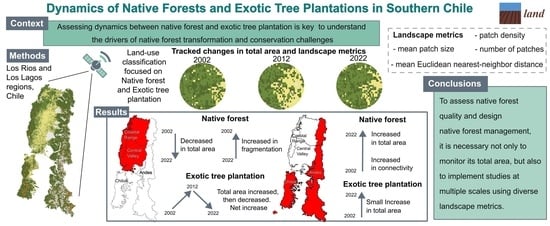
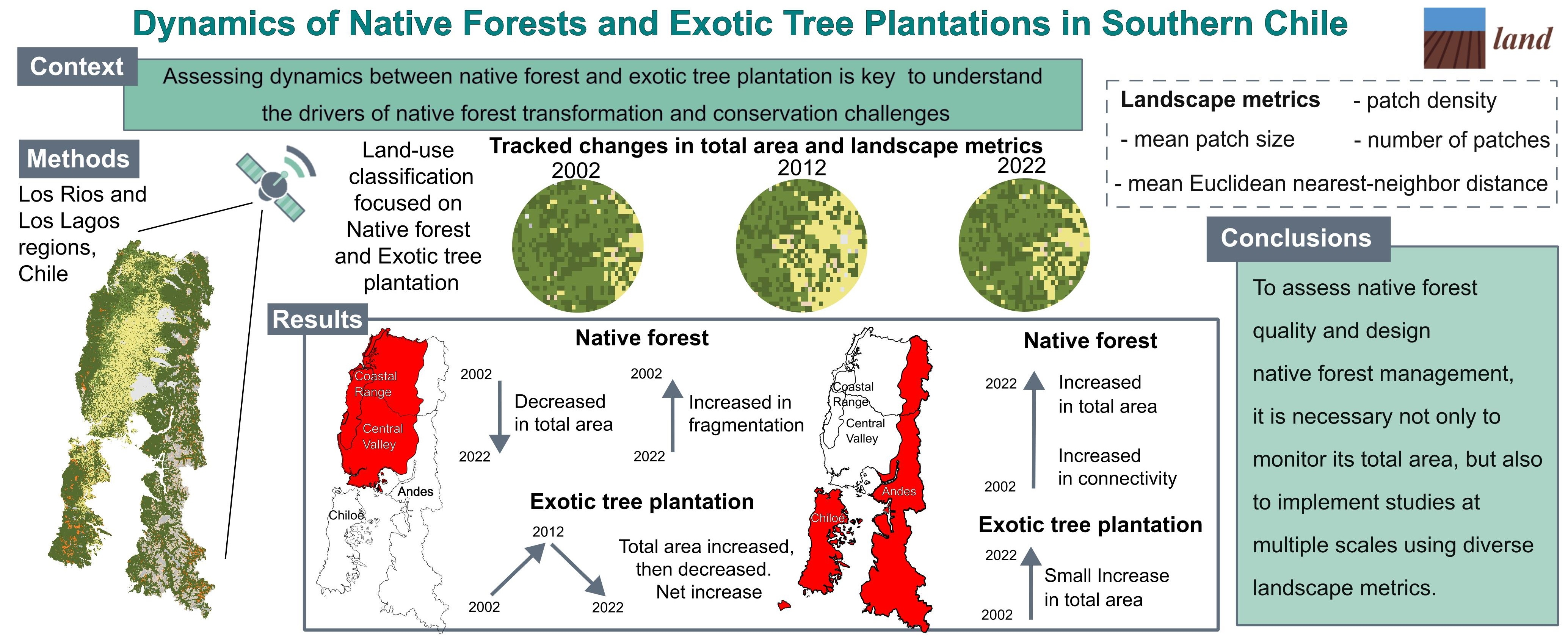
Graphical Abstract

1. Introduction

South America harbors 21% of the world’s forests [1]; however, between 1990 and 2020, it experienced continuous loss of forest cover, while timber extraction increased from 272 million m3 in 1990 to 429 million m3 in 2018 [1]. In Chile, native forests cover 14.7 million hectares [2], while exotic tree plantations, mainly of Pinus radiata and Eucalyptus spp., are estimated to cover 3.1 million hectares [3]. The FAO estimated an annual forest loss rate of 0.85% between 2010 and 2020, reflecting the growing pressure on the region’s forest ecosystems [1].
The temperate Valdivian forests eco-region of southern Chile is one of the global biodiversity hotspots [4], with a high endemism of flora and fauna, and an estimated 4000 species of vascular plants, half of them endemic [5]. However, Valdivian forests are increasingly threatened by climate change, habitat fragmentation, rapid deforestation, and exotic species invasion [6,7,8,9]. Habitat fragmentation reduces landscape connectivity, negatively affects biodiversity, and alters fundamental ecological processes, such as seed dispersal and species population dynamics [8,10,11,12,13,14] This loss of connectivity reduces the possibilities for dispersal and the establishment of new species populations, leading to a decrease in species richness [13,14,15] and an increase in the isolation of habitat fragments, which compromises their capacity to sustain viable populations of forest-specialist species [16,17]. Together with land-use changes, these processes represent significant ecological challenges that undermine the provision of essential ecosystem services, such as biodiversity conservation, protection of water sources, climate and water regulation, oxygen production, maintenance of soil fertility, recreational opportunities, supply of food and medicinal resources, and regulation of pathogen transmission [18,19,20,21,22]. According to the Millennium Ecosystem Assessment [23], land-use changes will be the leading cause of global alterations in ecosystem service provision by 2050. These transformations in land use and landscape structure are recognized as key drivers of ecosystem service loss [24,25,26,27,28].
Since the mid-1970s, forestry development in Chile has been strongly shaped by legal and economic incentives that promoted the establishment and expansion of exotic tree plantations. Government subsidy schemes and liberal forestry policies favored fast-growing exotic species such as Pinus radiata and Eucalyptus spp., contributing to a rapid expansion of plantation forestry, particularly in south-central and southern Chile [29,30]. While these policies supported timber production and export-oriented economic growth, they also played a central role in the replacement and fragmentation of native forests across large areas of the country [8,30].
Exotic tree plantations have become one of the most significant drivers of land-use transformation. Their global expansion, especially in Asia and South America, with Chile standing out due to its notable increase [31,32], has reshaped landscapes, altered biodiversity and ecosystem services, and impacted social and local livelihoods [28,33,34,35,36]. Exotic tree plantations differ substantially from native forests in their contributions to biodiversity conservation, provision of ecosystem services, climate change mitigation, and the social impacts they generate [28,33,34,35,36]. Compared with native forests, exotic plantations typically support lower biodiversity and reduced ecosystem service provision [37,38,39], and this distinction is especially relevant at large scales [40].
In response to increasing concerns about biodiversity loss and ecosystem degradation, Chile introduced regulatory frameworks aimed at native forest protection and sustainable management. Moreover, the enactment of the Native Forest Law (Law 20.283) in 2008 sought to promote the conservation, recovery, and sustainable use of native forests through incentive-based instruments and management regulations [41]. However, several studies have highlighted limitations in the implementation and enforcement of this law, which have constrained its effectiveness in counterbalancing the long-term economic dominance of forestry plantations [18,27,42]. These contrasting policy trajectories, together with the institutional role of state agencies such as the Corporación Nacional Forestal (CONAF), have shaped contemporary forest transition dynamics in Chile and provide the legal and political context motivating the present study.
Within this evolving legal and policy context, long-term spatial analyses are essential to understand how native forests and exotic tree plantations have interacted over time across the heterogeneous landscapes of southern Chile. Accordingly, assessing landscape dynamics requires more than quantifying forest cover alone; it also entails evaluating spatial structure, particularly patch configuration and connectivity, as these attributes are critical for assessing ecological sustainability and ecosystem health [17,24,26,43,44].
The main goal of this study was to analyze two decades (2002–2022) of land-use change between native forests and exotic tree plantations in the Valdivian eco-region of Southern Chile (Los Ríos and Los Lagos regions). We quantified changes in area and landscape structure across four geomorphological zones and described transition dynamics to elucidate how native forests and exotic plantations interact across this vast, ecologically, and socioeconomically diverse region of Southern Chile.

2. Materials and Methods

2.1. Geomorphological Classification of the Los Ríos and Los Lagos Regions, Chile

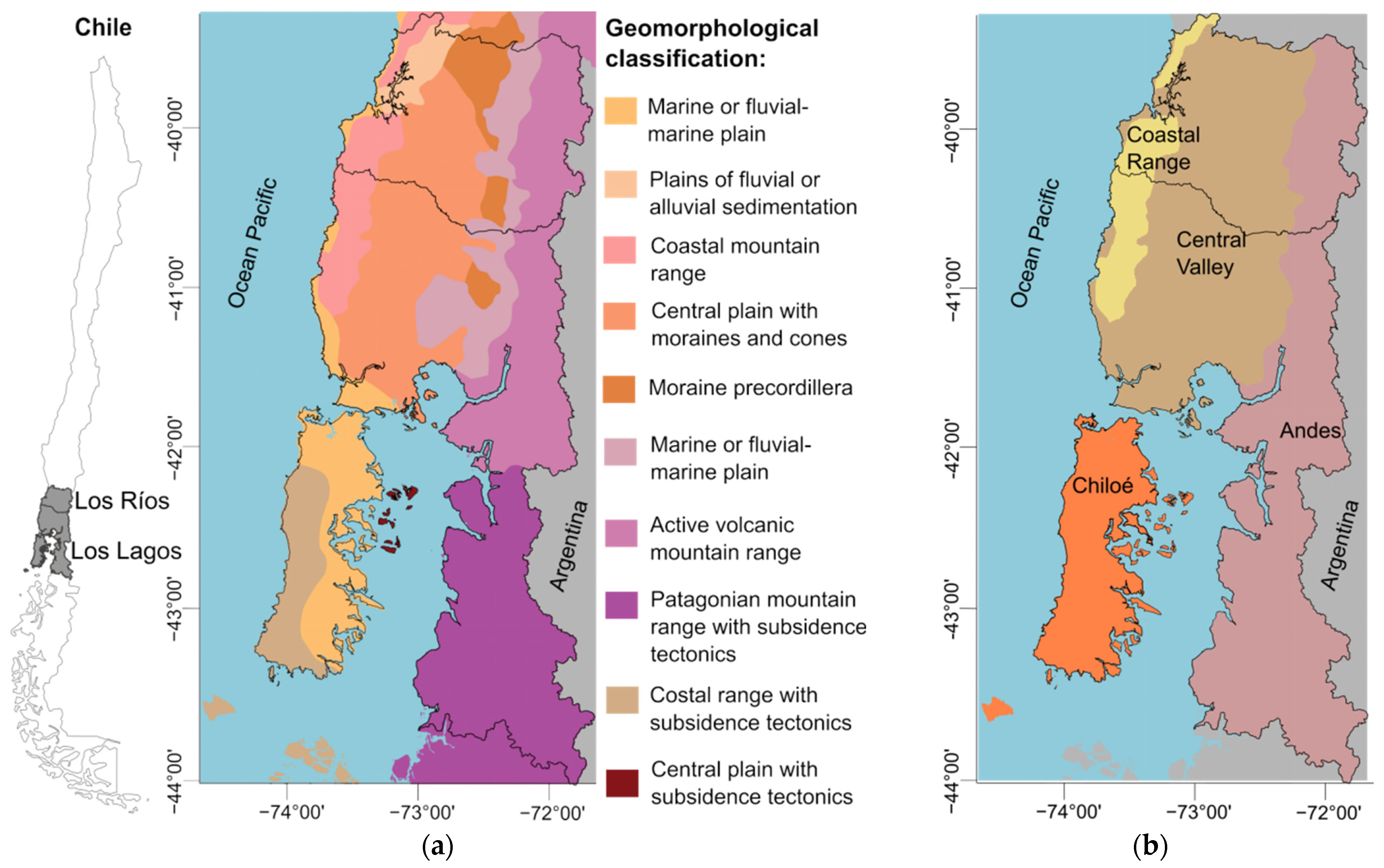
The study area encompasses Los Ríos and Los Lagos Regions, located in southern Chile between 39°15′ and 44°14′ south latitudes. The study area is bounded by the Pacific Ocean to the west and the Argentine border to the east (Figure 1a). The combined area covers approximately 67,000 km2, representing approximately 9% of the national territory. This area is characterized by a temperate, rainy climate with mild seasonal variations and coastal influences, representing a transitional zone between the Mediterranean winter-rainfall climate to the north and the more consistently temperate and rainy climate to the south [45]. The annual rainfall ranges from 680 to 1700 mm [46]. We divided the study area into four distinct zones: the Coastal Range, the Central Valley, the Andes, and Chiloé. Each zone differs in its socioeconomic characteristics and land use, mainly because of its natural geography and boundaries marked by the mountain ranges and the Pacific Ocean. To delimit these zones, we considered the intersections of the study area with the geomorphological regions of Chile [47] (Figure 1a,b). These zones represent different proportions of the study area: the Coastal Range accounts for 6.5%, the Central Valley accounts for 38.7%, the Andes account for 40.5%, and Chiloé accounts for 14.3%.

2.2. Land-Use Classification

We based our land-use analysis on data from the MapBiomas Chile platform (Collection 1.0), which provides land-use classifications for Chile derived from Landsat satellite imagery at a spatial resolution of 30 m (equivalent to 0.0009 km2 per pixel). The thematic accuracy of the MapBiomas Chile land-cover maps (Collection 1.0, Level 1) was evaluated using user’s accuracy (UA) and producer’s accuracy (PA) metrics reported in the official documentation, based on an independent validation dataset comprising approximately 1300 reference points, with around 100 points per land-cover class [48]. Considering all validated classes and years (2002, 2012, and 2022), the mean accuracy values were 82.1% for UA and 81.0% for PA. These values reflect average class-level performance and should not be interpreted as a single overall accuracy metric. The use of class-specific accuracy metrics (user’s and producer’s accuracy) provides a more informative assessment than a single overall accuracy value, particularly in land-cover classifications characterized by strong class imbalance, as is typical of forest-dominated landscapes. Currently, this platform represents the only consistent source of long-term land-use data for Chile, applying standardized classes and a unified methodological framework that distinguishes native forests from exotic tree plantations [49,50,51]. MapBiomas provides annual land-use classifications for the period 2000–2022, distinguishing six Level 1 and fourteen Level 2 classes (Table 1).
Given the data availability, we chose to analyze two periods: from 2002 to 2012 and from 2012 to 2022. We used MapBiomas level-two classes for our classification. The equivalence between the MapBiomas classification and the classes in this study is presented in Table 1. For our analysis, we used only two categories: native forests and exotic tree plantations. Notice that the native forest category is a mix that includes both primary and secondary native forest. Using the MapBiomas classification, secondary native forest can be distinguished only in cases where new native forest cover results from a conversion following a previous land-use change. Although MapBiomas provides additional land-use classes (e.g., agriculture, shrublands, and infrastructure), we restricted the analysis to native forests and exotic tree plantations to specifically characterize forest transition dynamics and plantation–native forest interactions. Consequently, transitions involving agricultural land, built-up areas, roads, and wildfire-related class changes were not explicitly quantified. We eliminated unobserved values and those with non-informed classification; together, they accounted for less than 0.003% of the total number of pixels per year. The study area classification and calculated areas are presented in Supplementary Material Table S1.

2.3. Dynamics of Native Forest and Forest Tree Plantation

To understand the dynamics of native forest and exotic tree plantations, the total area was calculated (in km2) for each 10 years and each zone. Transitions between classes were calculated and used to create maps to spatially illustrate the conversions from exotic tree plantations to native forests (secondary native forest gains) and the conversion of native forests (mix of primary and secondary native forest) to exotic tree plantations (native forest losses). Maps were created using hexagons with a 1 km side. We classified hexagons according to levels of native forest (a mix of primary and secondary native forest) pixels that were converted to exotic tree plantations (native forest losses), pixels converted from exotic tree plantations to native forests (secondary native forest gains), conserved native forest pixels, and exotic tree plantation pixels with no changes between periods.
We constructed Sankey diagrams to represent transitions between native forests and exotic tree plantations, including an aggregated category termed “others” that encompasses all land-use classes other than native forests and exotic tree plantations. This simplification was intentional and aimed at isolating forest-related land-use dynamics. The transitions that involve other land-use categories (e.g., agriculture or shrubland) were aggregated as “others” and not analyzed individually, as reconstructing full successional pathways falls beyond the scope of this regional-scale study.
To understand the landscape structure, we compared the following landscape metrics for native forests and exotic tree plantations: number of patches, patch density, mean patch size, and mean Euclidean nearest-neighbor distance.
We performed our analyses using R (version 4.4.1). For spatial data processing, we used the packages terra (v1.7-78), sf (v1.0-19), and raster (v3.6-30). Patch metrics were calculated with landscapemetrics (v2.1.14).

3. Results

3.1. Land-Use Total Area

Native forests had the largest areas in all zones during both periods (Table 2). Between 2002 and 2012, native forest cover decreased in the Coastal Range by 0.59 km2, and in the Central Valley by 3.71 km2 (Table 2). In contrast, it increased by 3.46 km2 in Chiloé and by 9.27 km2 in the Andes. From 2012 to 2022, native forests continued to decline in the Coastal Range by 0.06 km2 and in the Central Valley by 4.04 km2, while increases persisted in the Andes by 3.58 km2 and in Chiloé by 2.73 km2.
Exotic tree plantations expanded between 2002 and 2012 in all zones: in the Coastal Range by 0.88 km2, in the Central Valley by 8.32 km2, and in the Andes by 0.09 km2. In Chiloé, exotic tree plantations first appeared in 2012, with a value of 0.07 km2. From 2012 to 2022, exotic tree plantations decreased in the Coastal Range by 0.07 km2, in the Central Valley by 0.93 km2 and while continuing to grow in the Andes by 0.05 km2 and in Chiloé by 0.15 km2.

3.2. Land-Use Turnover and Dynamics in Native Forest and Exotic Tree Plantation

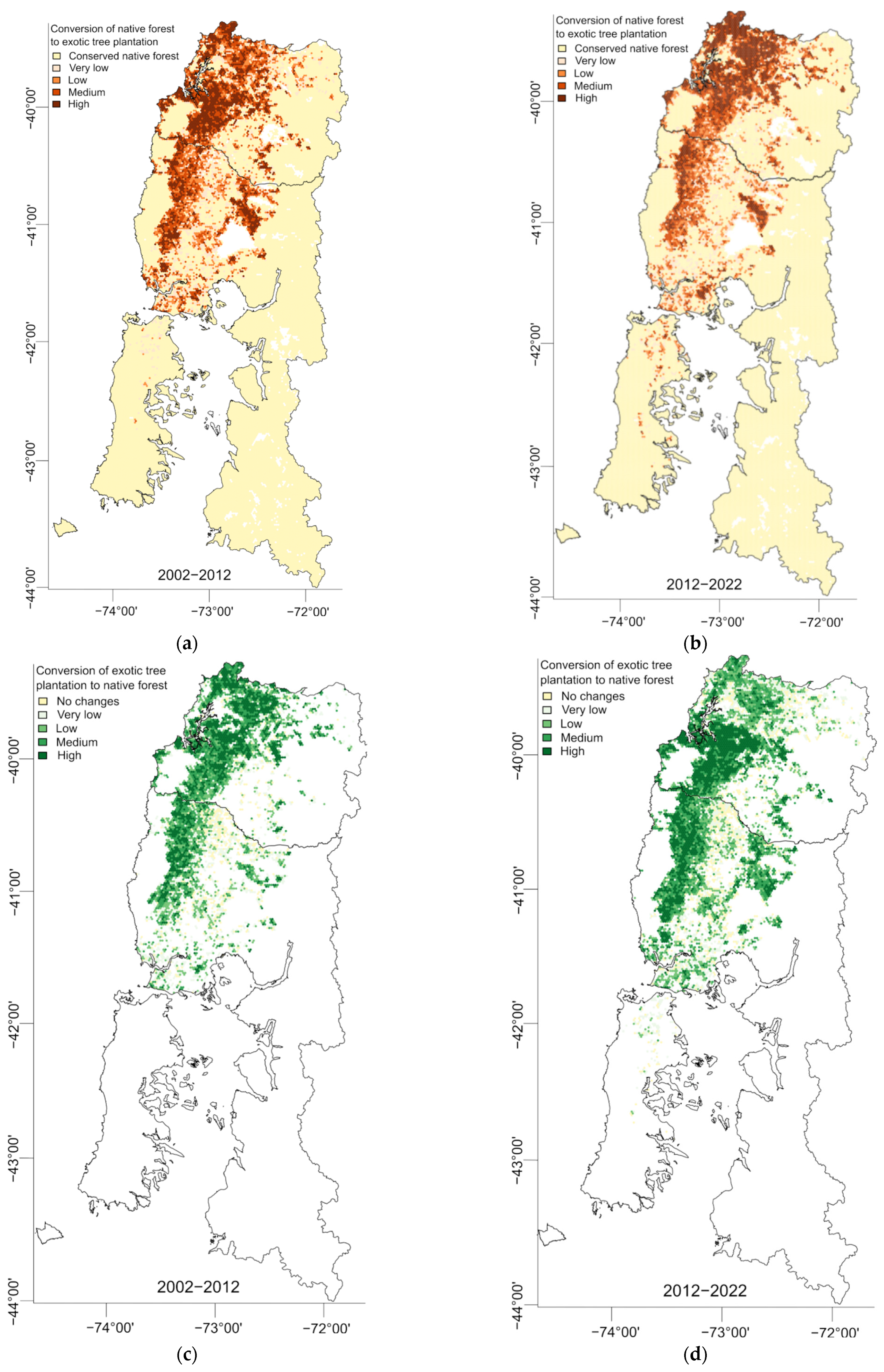
Figure 2a–d shows maps displaying levels of native forest (a mix of primary and secondary native forest) converted to exotic tree plantations (native forest losses), from exotic tree plantations to native forests (secondary native forest gains), conserved native forests, and exotic tree plantations with no changes between periods. The Coastal Range showed few changes in both periods (Figure 2a,b) but had more native forest conversions into exotic tree plantations in the first period and exotic tree plantation conversions in the second period. During the first period, the native forest in the northern and southern parts of the Central Valley exhibited a pattern of scattered gains (secondary native forest) with minor losses (Figure 2a,c). This pattern showed the opposite trend in the second period (Figure 2b,d). The middle part of the Central Valley had the most scattered exotic tree plantation gains (Figure 2c) in the first period, which showed the opposite trend in the second period (Figure 2d). In the Andes, few changes were observed during both periods. Chiloé showed few pixels of native forest conversion to exotic tree plantations in the first period, and in the second period, there were few losses and gains of exotic tree plantations.
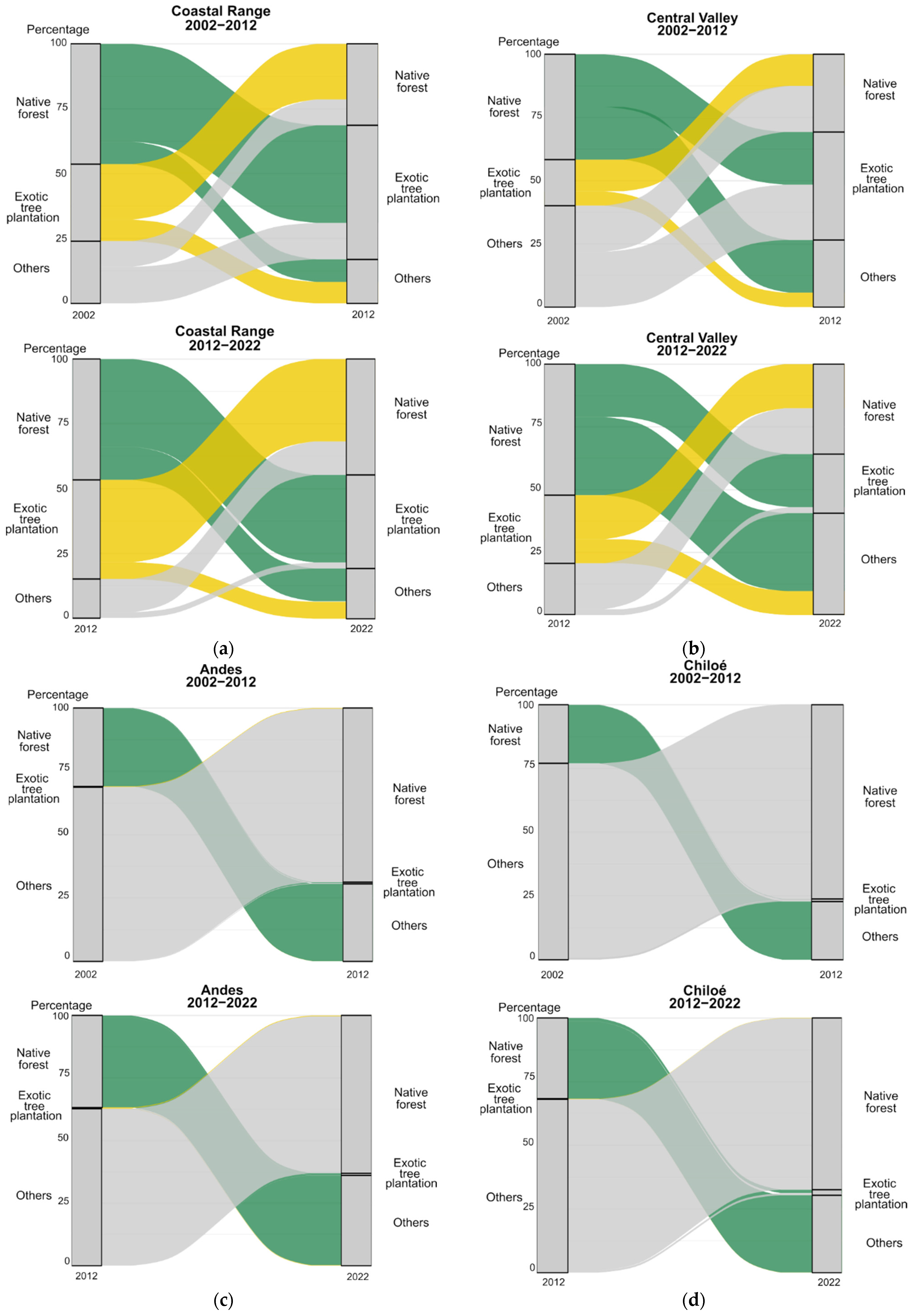
The transitions between land-use classes by zone and period are shown as percentages in Figure 3a–d. In 2002–2012, the Coastal Range exhibited 46.31% (1.84 km2) of transitions starting in native forests, of which 37.60% (1.49 km2) ended in exotic tree plantations and 8.71% (0.35 km2) in others. In the reverse direction, 31.36% (1.24 km2) of transitions ended in native forests (secondary native forest), with 21.40% (0.85 km2) coming from exotic tree plantations and 9.96% (0.40 km2) from others. In 2012–2022, total transitions starting in native forests reached 46.60% (1.39 km2), of which 33.90% (1.01 km2) ended in exotic tree plantations and 12.70% (0.38 km2) in others. In the reverse direction, 44.70% (1.33 km2) of transitions ended in native forests (secondary native forest), from which 31.80% (0.95 km2) originated from exotic tree plantations, and 12.90% (0.39 km2) came from others.
In the Central Valley, during 2002–2012, 41.70% (14.14 km2) of transitions originated in native forests, of which 20.80% (7.06 km2) ended in exotic tree plantations and 20.90% (7.08 km2) in others. In the opposite direction, 30.70% (10.44 km2) of transitions ended in native forests, with 12.50% (4.25 km2) coming from exotic tree plantations and 18.20% (6.19 km2) from others. In 2012–2022, transitions originating in native forests accounted for 52.10% (12.95 km2), of which 21.00% (5.23 km2) ended in exotic tree plantations and 31.10% (7.72 km2) in others. In the opposite direction, 35.90% (8.92 km2) of transitions ended in native forests, with 17.60% (4.37 km2) coming from exotic tree plantations and 18.30% (4.55 km2) from others.
In the Andes, during 2002–2012, 30.9% (7.55 km2) of transitions originated in native forests, with 0.37% (0.09 km2) in exotic tree plantations, and 30.50% (7.46 km2) ending in others. In the reverse direction, 68.85% (16.80 km2) of transitions ended in native forests, with 0.25% (0.06 km2) coming from exotic tree plantations and 68.60% (16.80 km2) coming from others. During 2012–2022, 36.8% (5.01 km2) of transitions originated in native forests, with 0.87% (0.12 km2) ending in exotic tree plantations and 35.90% (4.89 km2) in others. In the reverse direction, 63.01% (8.59 km2) of transitions ended in native forests, with 0.31% (0.04 km2) coming from exotic tree plantations and 62.70% (8.55 km2) coming from others.
In the Chiloé zone during 2002–2012, 22.99% (1.49 km2) of the total transitions originated in native forests, with 0.19% (0.01 km2) ending in exotic tree plantations and 22.80% (1.48 km2) in others. In the opposite direction, 76.20% (4.96 km2) of transitions ended in native forests, coming from others. There were no transitions from exotic tree plantations to native forests. In 2012–2022, of the total transitions, 31.72% (2.42 km2) originated in native forests, with 1.32% (0.10 km2) ending in exotic tree plantations and 30.40% (2.32 km2) ending in others. In the opposite direction, 67.42% (5.15 km2) of transitions ended in native forests, with 0.12% (0.01 km2) coming from exotic tree plantations and 67.30% (5.14 km2) coming from others.

3.3. Landscape Metrics Dynamics

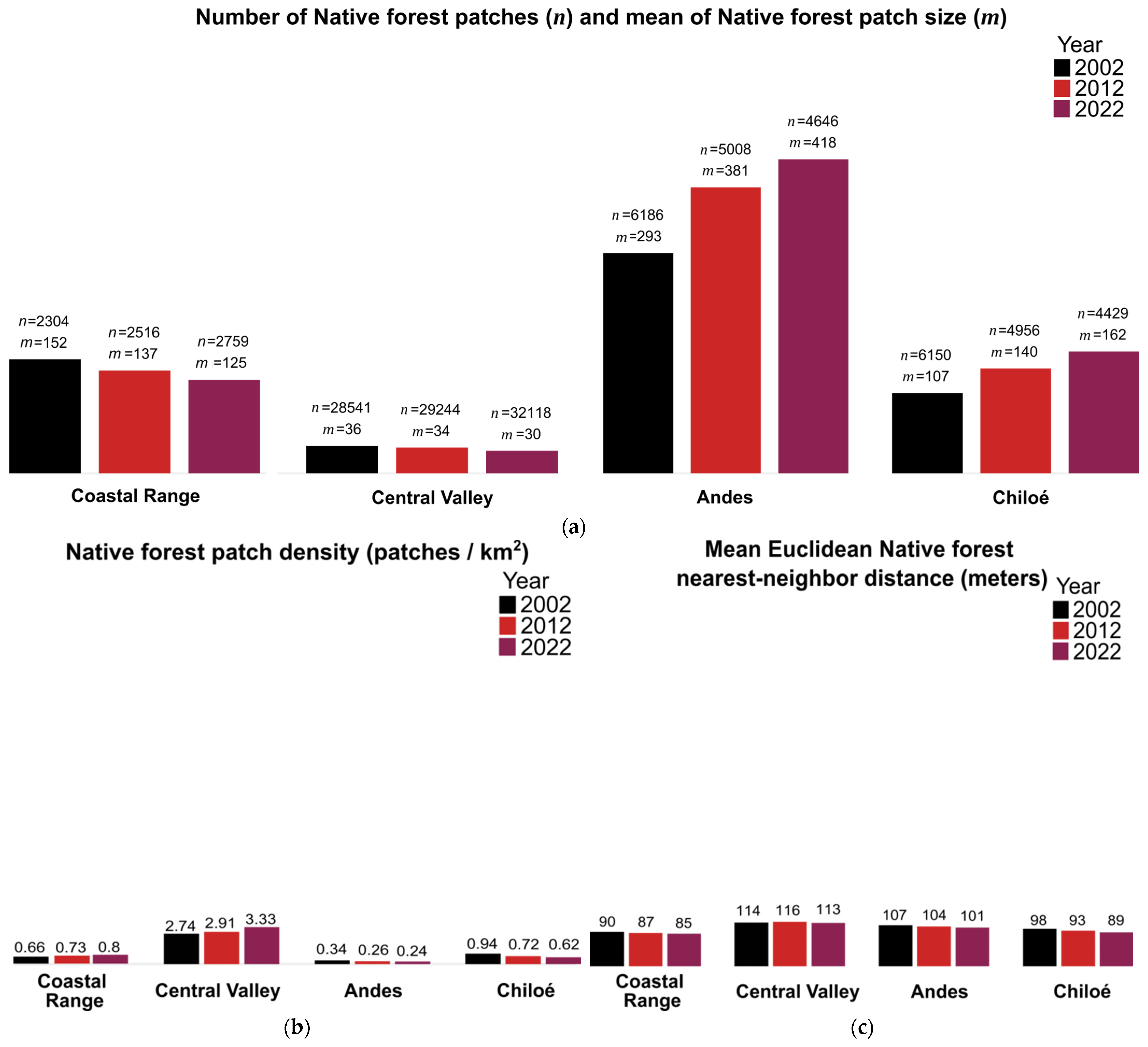
The dynamics of landscape metrics are shown in Figure 4 and Figure 5. For the native forest class, in both periods, the Coastal Range and Central Valley showed a decrease in the mean patch size with an increase in the patch number (Figure 4a) and patch density (Figure 4b). The mean Euclidean nearest-neighbor distance decreased in both periods in the Coastal Range but increased and then decreased in the Central Valley. The Andes and Chiloé zones showed an increase in the mean patch size, accompanied by a decrease in the number of patches (Figure 4a), patch density (Figure 4b), and mean Euclidean nearest-neighbor distance (Figure 4c), respectively.
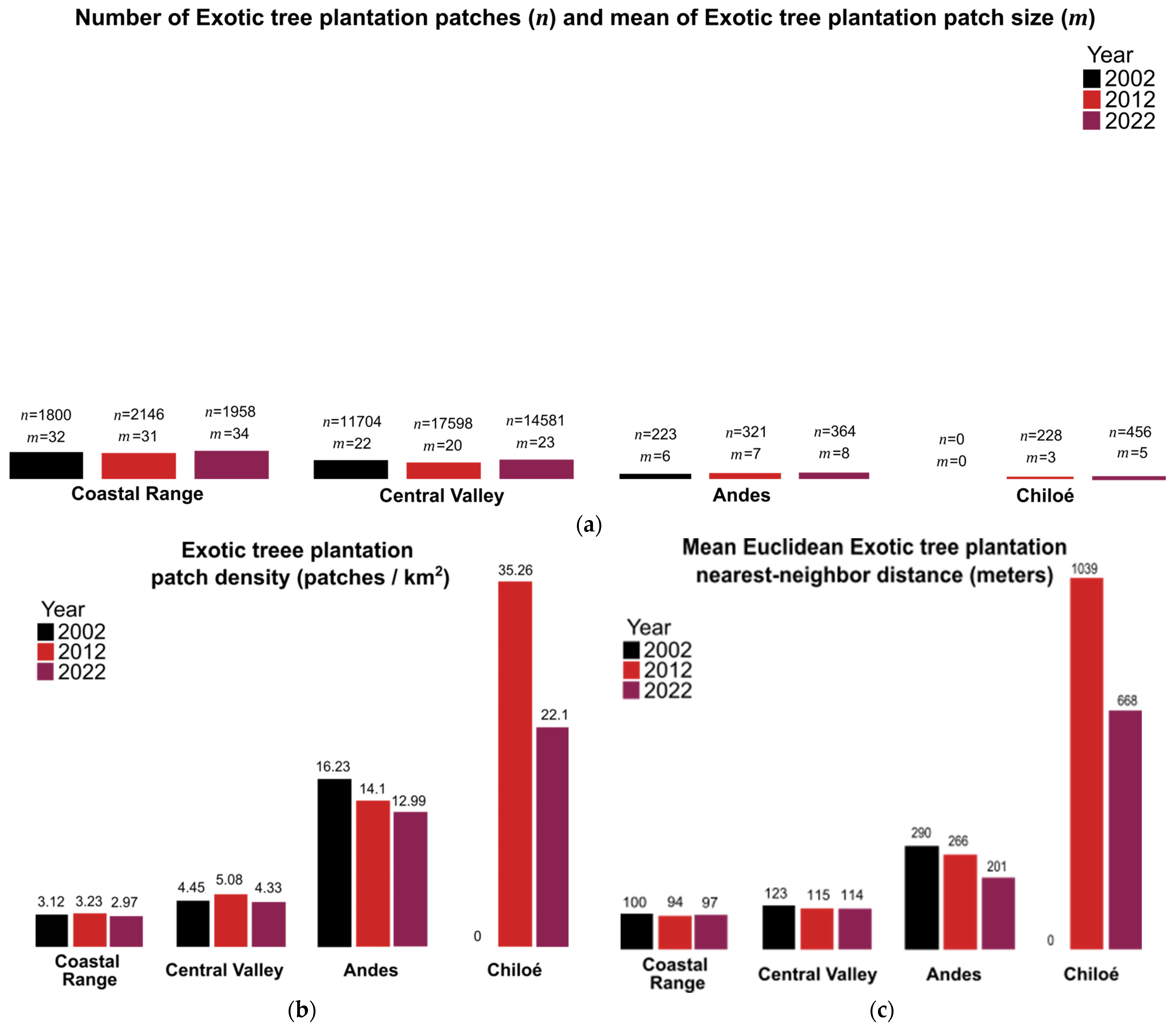
For exotic tree plantations (Figure 5), from 2002 to 2012, in the Coastal Range, the number of patches increased, and the mean patch size decreased (Figure 5a). The patch density increased (Figure 5b) and the mean Euclidean nearest neighbor decreased (Figure 5c). From 2012 to 2022, the number of patches (Figure 5a) decreased, and the mean patch size (Figure 5a) increased. The patch density (Figure 5b) declined, whereas the mean Euclidean nearest-neighbor distance increased. In Central Valley, the number of exotic tree plantation patches increased, the mean patch size decreased (Figure 5a), the patch density increased (Figure 5b), and the mean Euclidean nearest-neighbor distance decreased (Figure 5c). From 2012 to 2022, there was a reduction in the number of patches, with an increase in their mean sizes (Figure 5a). Both the patch density and mean Euclidean nearest-neighbor distance decreased (Figure 5b). In the Andes and Chiloé zones, exotic tree plantations showed small but increasing variations in the number of patches (Figure 5a), mean patch size (Figure 5a), and decreases in patch density (Figure 5b) and mean Euclidean nearest-neighbor distance (Figure 5c).

4. Discussion

This Discussion is structured around the study’s main research objectives, linking observed spatial patterns of land-use change and landscape configuration to forest transition dynamics while situating these patterns within their broader socio-political context, without implying direct causal relationships.

4.1. Spatial Patterns, Transition Dynamics and Landscape Fragmentation

At the regional scale, we observed an overall increase in native forest cover; however, this gain masked strong local declines in specific zones with intense human pressure, such as the Coastal Range and Central Valley. The spatial resolution and scale of the analysis affect landscape metrics and the interpretation of fragmentation and ecological outcomes [53]. Thus, this result highlights the importance of multi-scale spatial analyses, as large-scale patterns may mask local degradation [53,54].
Transitions from exotic tree plantations to areas classified as native forest should be interpreted as secondary forest regeneration processes, rather than the rapid formation of mature native forests. These regenerated stands likely differ in structure, species composition, and ecosystem functioning from old-growth native forests. Nevertheless, such transitions represent an important component of forest transition dynamics, reflecting changes in land use, management practices, and disturbance regimes that favor the recovery of native-dominated vegetation. Transitions between native forests and exotic tree plantations revealed a strong substitution effect in the Central Valley and Coastal Range. These bidirectional transitions suggest secondary native forest recovery processes within a broader forest transition framework, possibly driven by the abandonment of exotic tree plantations following the termination of plantation subsidies in 2012, as documented in previous studies [30,55]; however, this study does not provide a causal assessment of policy impacts. Although forest plantations are rarely maintained beyond approximately 25 years, in some exceptional cases exotic species particularly Pinus radiata and Eucalyptus spp. with rotation periods of 18–35 years may be followed by the establishment of native species such as Nothofagus. These native species, with rotation cycles of approximately 20–25 years, are often considered more compatible with sustainable forest management approaches [30].
Although there is a lack of comprehensive information on the total area of restored native forest in Southern Chile [56], there are some examples, including the restoration of 0.55 km2 of evergreen Nothofagus forest in the Valdivian Coastal Reserve in the Los Ríos region between 2006 and 2011 and the restoration of 0.58 km2 of Andean Fitzroya cupressoides forest in the Los Lagos region in 2000 [57]. Natural or assisted restoration processes in these areas are likely to result in ecological characteristics that differ from those of the old-growth forests.
Intensive native forest substitution has been widely documented in central and southern Chile. Echeverría et al. [8] reported that 67% of the native forest was replaced between 1975 and 2000, and subsequent studies have confirmed this trend across southern Chile [30,58,59]. Nahuelhual et al. [59] identified the conversion of native forests to exotic tree plantations as a direct major driver of deforestation and biodiversity loss, emphasizing the need for stronger, enforceable regulations through land-use management policy instruments that are mandatory rather than merely recommended, accompanied by certification and market incentives. Similarly, Martin-Gallego et al. [30] analyzed 31 years of forest dynamics in the Araucanía regions, revealing strong dynamism between the replacement of exotic plantations of Pinaceae and Eucalyptus spp. and native Nothofagus spp. These conversions seem to be closely linked to economic and policy drivers (mainly related to the importance of forestry exports in Chile and subsidies for plantations), which are influenced by production scale, rotation time, and the type of product to be generated (timber, pulp, or firewood). The same dynamism was observed in the Coastal Range and Central Valley in our study, which is consistent with the reduction in exotic tree plantations in these zones between 2012 and 2022. In the Andes and Chiloé zones, most of the substitution of native forests comes from the other class. In both directions, little substitution between native forests and exotic tree plantations was observed, although it increased during both periods.
The decrease in native forests in the Central Valley and Coastal Range, together with reductions in mean patch size and increases in patch number and density, reflects not only area loss but also structural changes in the landscape configuration. This, accompanied mostly by reductions in the mean Euclidean nearest-neighbor distance, reflects variations in native forest management and external pressures across zones. Connectivity and fragmentation, beyond the total area, have ecological implications, such as the viability of species dependent on continuous habitats and the resilience of these systems in the face of disturbances [10].
In the Andes and Chiloé, the increase in the total native forest area and mean patch size, along with the decrease in the other landscape metrics, suggests that these zones are gaining larger and better-connected native-forest patches. The trend of an increase in native forest mean patch size, together with a decrease in patch density and with little variation in mean Euclidean nearest-neighbor distance, as observed in the Andes and Chiloé, was also found by Zamorano-Elgueta [60] for the period 1999–2011, who analyzed an area of the Los Ríos Region. Furthermore, they found that the natural regeneration of native forests occurred at the expense of shrubland, agricultural land, and pastureland. In other areas of the country, patterns of reduced habitat fragmentation have been observed, as occurred in La Araucanía and Aysén, showing a capacity for habitat regeneration in zones that were mainly disturbed by agricultural land clearing, the establishment of forest plantations, the introduction of invasive species, and wildfires [61].
The dynamics of change in the exotic tree plantations in the Central Valley showed the most significant expansion of plantations in the first period, followed by a reduction in the second. Between 2002 and 2012, the decrease in mean patch size occurred alongside an increase in the number of patches and patch density. In both periods, the mean Euclidean nearest-neighbor distance decreased, indicating that the exotic tree plantations became more closely spaced. This pattern suggests a loss of small patches, possibly due to merging into larger units or abandonment, and may reflect a structural shift aimed at increasing timber production while reducing the management costs. Conversely, trends in the Coastal Range indicate that both the total area of exotic tree plantations and the number of patches have decreased. However, the remaining ones were larger and more widely spaced, suggesting the removal of smaller ones. The abandonment or removal of small stands is linked to the end of forestry subsidies in 2012 [30], without which only large landowners can survive the economic crisis.
The concurrent rise in the number of patches of exotic tree plantations and their mean patch size in the Andes and Chiloé, combined with the decline in the mean Euclidean nearest-neighbor distance, indicates larger total areas, more and larger patches, and closer spacing. This pattern shows continued expansion with improved connectivity, reflecting a trend toward the intensification of exotic tree plantations in these zones [8,58,59,60].

4.2. Policy and Socio-Economic Context as an Interpretative Framework

Chile’s forestry dynamics reflect several shifts in economic incentives for exotic tree plantations and in policy frameworks for native forest conservation. Since 1975, government subsidies and liberal policies have promoted exotic tree plantations [29], signing over 45 free trade agreements that boosted exports and strengthened the forestry sector. Moreover, from 1998 to 2012, subsidies for exotic plantations were further intensified by Law 19.561 [30]. In contrast, in 2008, the Native Forest Law (Law 20.283) sought to encourage sustainable native forest management by introducing subsidies to promote forest conservation and meet environmental policy [41]. Despite efforts to promote its use, the Native Forest Law has faced criticism for legislative gaps that limit its effectiveness [18,27,42]. In this context, conservation policies should prioritize areas under greater human pressure, where native forests remain the most vulnerable.
Managing native forests is particularly challenging in the context of competing interests and constant pressure from economic development, land use, and social demands. These complexities make it difficult to implement conservation and restoration strategies that are both effective and socially acceptable. An illustrative example is provided by Muñoz-Pedreros et al. [62], who monitored 0.28 km2 of native forest on Isla del Rey in the Los Ríos Region over two decades. Their work highlights the opportunity to design native forest protection and restoration projects using a One Health approach that links ecosystem health with human and environmental health. The study combined fire prevention, invasive species control, environmental education, and sustainable resource supply through community collaboration. This model illustrates the potential of interdisciplinary research that combines ecology, sociology, public health, and education to comprehensively address the challenges of conservation and restoration.
Our study has limitations, partly due to spatial resolution and classification errors in the data used. Most available land-use datasets, such as MODIS [63], Copernicus [50], and ESA WorldCover [49], do not distinguish between exotic tree plantations and native forests, restricting the ability to evaluate the conservation status of the native vegetation. It is important to note that the MapBiomas Chile classifications used in this study were validated using an independent reference dataset of approximately 1300 sampling points (around 100 points per class), following a standardized and documented validation protocol. While very high–resolution imagery platforms (e.g., SASPlanet 2025) can support local visual assessments, their use for systematic multi-temporal validation in southern Chile is limited by persistent cloud cover and heterogeneous image availability, which restrict reproducibility at regional scales.
Higher resolution and more frequent monitoring sources are needed to correctly separate the land-cover classes of interest and to detect expansions and contractions over time, as well as the drivers behind them. The official Chilean land-use inventory, the most detailed source, was first produced in 1997 and was updated only four times by 2020. For Los Ríos, the latest version is from 2014, and for Los Lagos, updates are available at varying intervals. Methodologies differ across updates [51], highlighting the need for new methods or customized classifications, as demonstrated by [7]. Moreover, our approach does not explicitly partition land-use changes driven by disturbances (e.g., wildfires) or by non-forest land uses (e.g., agricultural dynamics and infrastructure expansion). While these processes are relevant in the region, our objective was to isolate long-term interactions between native forests and exotic plantations, which are among the dominant and most consequential land-use trajectories in southern Chile. Furthermore, incorporating more specific information about the planted species, rather than grouping them into broad categories, would improve the accuracy and ecological relevance of the analysis. Despite these constraints, systematic monitoring remains essential for territorial planning and ecosystem service conservation, particularly by tracking fragmentation dynamics that directly affect the functionality of native forests.
Our analysis relies on MapBiomas Chile as a harmonized and temporally consistent land-use dataset. While classification uncertainty is inherent to large-scale products, particularly for heterogeneous land-cover types such as shrublands, our study focuses exclusively on native forests and exotic tree plantations, which show relatively high and stable accuracy across validation years. In our study, landscape metrics are interpreted as comparative indicators of spatial structure and fragmentation rather than as absolute values. Thus, although classification errors may affect individual pixel assignments, their influence on relative temporal patterns is expected to be limited. More detailed sensitivity analyses, error propagation assessments, and integration of additional data sources (e.g., higher-resolution imagery or land tenure records) represent important avenues for future research. However, they are beyond the scope of the present study.
In addition, this study does not explicitly incorporate spatial explanatory variables such as topography, distance to roads, or land-ownership patterns. While these factors are known to influence land-use change, our analysis focuses on describing regional-scale forest transition patterns rather than quantifying the drivers underlying these changes.

5. Conclusions

The Native Forest cover increased in the Andes and Chiloé but declined in the Coastal Range and Central Valley. Bidirectional transitions between native forests and exotic tree plantations indicate substitution processes and transitions toward secondary native forest cover. Landscape metrics show greater fragmentation of native forests in the Coastal Range and Central Valley, in contrast to the Andes and Chiloé. By the end of the two periods, exotic tree plantations showed a net increase across all zones, with a spatial configuration characterized by larger and more closely spaced stands. The abandonment of small exotic plantations stands likely reflects the withdrawal of small producers, following the end of subsidies; however, such abandonment does not necessarily imply the recovery of mature native forest conditions or ecological restoration. Reliable, comparable periodic monitoring tools are urgently needed to distinguish exotic plantations from native forests and support effective management. In parallel, multi-scale spatial analysis is essential for targeted conservation and native forest management, integrating secondary forest recovery, active restoration measures (e.g., reforestation with native species), and socio-economic dimensions within policy frameworks that are not merely normative, but also operationally practical in guiding conservation strategies.

Supplementary Materials

The following supporting information can be downloaded at: https://www.mdpi.com/article/10.3390/land15010188/s1, Table S1. Land-use classes area in km2 and the percentage occupied by each class in the study area by year.

Author Contributions

Conceptualization, A.F.-F., G.A.-J., C.V.R. and C.V.V.; methodology, A.F.-F.; validation, G.A.-J., C.V.R., C.V.V. and J.G.V.; formal analysis, A.F.-F.; writing—original draft preparation, A.F.-F.; writing—review and editing, G.A.-J., C.V.R., C.V.V. and J.G.V.; visualization, A.F.-F.; supervision, G.A.-J.; funding acquisition, G.A.-J., C.V.R. and C.V.V. All authors have read and agreed to the published version of the manuscript.

Funding

This research was funded by ANID ANILLO, grant number: ATE220062.

Data Availability Statement

Dataset available on request from the authors.

Acknowledgments

We thank the ANID ANILLO project: ATE220062 for financing this research. We thank Natalia Castro and all EPIWILD team for their invaluable help.

Conflicts of Interest

The authors declare no conflicts of interest.

References

  1. FAO Global Forest Resources Assessment 2020; FAO: Rome, Italy, 2020; ISBN 978-92-5-132974-0.
  2. CONAF Bosque Nativo. CONAF 2025. Available online: https://www.conaf.cl/manejo-de-ecosistemas/bosque-nativo/ (accessed on 28 May 2025).
  3. CONAF Plantaciones Forestales. CONAF 2025. Available online: https://www.conaf.cl/manejo-de-ecosistemas/gestion-forestal-suelos-y-agua/plantaciones-forestales/ (accessed on 28 May 2025).
  4. Mittermeier, R.A.; Turner, W.R.; Larsen, F.W.; Brooks, T.M.; Gascon, C. Global Biodiversity Conservation: The Critical Role of Hotspots. In Biodiversity Hotspots; Zachos, F.E., Habel, J.C., Eds.; Springer: Berlin/Heidelberg, Germany, 2011; pp. 3–22. [Google Scholar] [CrossRef]
  5. Arroyo, M.T.K.; Marquet, P.A.; Marticorena, C.; Simonetti, J.A.; Cavieres, L.A.; Squeo, F.A.; Rozzi, R. Chilean winter rainfall–Valdivian forests. In Hotspots Revisited: Earth’s Biologically Wealthiest and Most Threatened Terrestrial Ecoregions; Mittermeier, R.A., Gil, P.R., Hoffmann, M., Pilgrim, J., Brooks, T., Mittermeier, C.G., Lamoreux, J., da Fonseca, G.A.B., Seligmann, P.A., Ford, H., Eds.; CEMEX: Mexico City, Mexico, 2004; pp. 99–103. [Google Scholar]
  6. Müller, S.; Bahamóndez, C.; Sagardía, R.; Vergara, G.; Reyes, R. Bosques Nativos de Chile: Estado, Presiones e Importancia en una Época de Cambios Santiago de Chile; Instituto Forestal INFOR; Sistema Nacional de Monitoreo e Información Forestal SIMEF; Ministerio de Agricultura: Santiago, Chile, 2021; ISBN 978-956-318-185-2. [Google Scholar]
  7. Bustamante, R.O.; Serey, I.A.; Pickett, S.T.A. Forest Fragmentation, Plant Regeneration and Invasion Processes Across Edges in Central Chile. In How Landscapes Change; Bradshaw, G.A., Marquet, P.A., Eds.; Ecological Studies; Springer: Berlin/Heidelberg, Germany, 2003; Volume 162, pp. 145–160. ISBN 978-3-642-07827-9. [Google Scholar]
  8. Echeverria, C.; Coomes, D.; Salas, J.; Rey-Benayas, J.M.; Lara, A.; Newton, A. Rapid deforestation and fragmentation of Chilean Temperate Forests. Biol. Conserv. 2006, 130, 481–494. [Google Scholar] [CrossRef]
  9. Gómez, P.; Bustamante, R.; San Martín, J.; Hahn, S. Estructura poblacional de Pinus radiata D.Don. en fragmentos de Bosque Maulino en Chile central. Gayana Bot. 2011, 68, 97–101. [Google Scholar] [CrossRef]
  10. Haddad, N.M.; Brudvig, L.A.; Clobert, J.; Davies, K.F.; Gonzalez, A.; Holt, R.D.; Lovejoy, T.E.; Sexton, J.O.; Austin, M.P.; Collins, C.D.; et al. Habitat fragmentation and its lasting impact on Earth’s ecosystems. Sci. Adv. 2015, 1, e1500052. [Google Scholar] [CrossRef]
  11. Niebuhr, B.B.S.; Wosniack, M.E.; Santos, M.C.; Raposo, E.P.; Viswanathan, G.M.; da Luz, M.G.E.; Pie, M.R. Survival in patchy landscapes: The interplay between dispersal, habitat loss and fragmentation. Sci. Rep. 2015, 5, 11898. [Google Scholar] [CrossRef]
  12. Hafner, B.; Meyer, K. Bounding Seed Loss from Isolated Habitat Patches. Bull. Math. Biol. 2024, 86, 141. [Google Scholar] [CrossRef]
  13. Warneke, C.R.; Caughlin, T.T.; Damschen, E.I.; Haddad, N.M.; Levey, D.J.; Brudvig, L.A. Habitat fragmentation alters the distance of abiotic seed dispersal through edge effects and direction of dispersal. Ecology 2022, 103, e03586. [Google Scholar] [CrossRef]
  14. Szitár, K.; Tölgyesi, C.; Deák, B.; Gallé, R.; Korányi, D.; Batáry, P. Connectivity and fragment size drive plant dispersal and persistence traits in forest steppe fragments. Front. Ecol. Evol. 2023, 11, 1155885. [Google Scholar] [CrossRef]
  15. Wang, Z.; Yang, Z.; Shi, H.; Han, L. Effect of forest connectivity on the dispersal of species: A case study in the Bogda World Natural Heritage Site, Xinjiang, China. Ecol. Indic. 2021, 125, 107576. [Google Scholar] [CrossRef]
  16. Fietz, J.; Tomiuk, J.; Loeschcke, V.; Weis-Dootz, T.; Segelbacher, G. Genetic Consequences of Forest Fragmentation for a Highly Specialized Arboreal Mammal--the Edible Dormouse. PLoS ONE 2014, 9, e88092. [Google Scholar] [CrossRef] [PubMed][Green Version]
  17. Fahrig, L. Effects of Habitat Fragmentation on Biodiversity. Annu. Rev. Ecol. Evol. Syst. 2003, 34, 487–515. [Google Scholar] [CrossRef]
  18. Bergh, G.; Promis, A. Conservación de los bosques nativos de Chile—Un análisis al Informe FAO sobre la Evaluación de los Recursos Forestales Nacionales. Rev. Bosque Nativ. 2011, 48, 9–11. [Google Scholar]
  19. Ferraguti, M.; Martínez-de la Puente, J.; Roiz, D.; Ruiz, S.; Soriguer, R.; Figuerola, J. Effects of landscape anthropization on mosquito community composition and abundance. Sci. Rep. 2016, 6, 29002. [Google Scholar] [CrossRef] [PubMed]
  20. Foley, J.; Defries, R.; Asner, G.; Barford, C.; Bonan, G.; Carpenter, S.; Chapin, F.S., III; Coe, M.; Daily, G.; Gibbs, H.; et al. Global Consequences of Land Use. Science 2005, 309, 570–574. [Google Scholar] [CrossRef]
  21. Nahuelhual, L.; Donoso, P.J.; Lara, A.; Núñez, D.; Oyarzún, C.; Neira, E. Valuing Ecosystem Services of Chilean Temperate Rainforests. Environ. Dev. Sustain. 2006, 9, 481–499. [Google Scholar] [CrossRef]
  22. White, R.J.; Razgour, O. Emerging zoonotic diseases originating in mammals: A systematic review of effects of anthropogenic land-use change. Mamm. Rev. 2020, 50, 336–352. [Google Scholar] [CrossRef]
  23. World Resources Institute. Millennium Ecosystem Assessment. In Ecosystems and Human Well-Being: Opportunities and Challenges for Business and Industry; World Resources Institute: Washington, DC, USA, 2005. [Google Scholar]
  24. Field, R.D.; Parrott, L. Mapping the functional connectivity of ecosystem services supply across a regional landscape. eLife 2022, 11, e69395. [Google Scholar] [CrossRef] [PubMed]
  25. Hasan, S.S.; Zhen, L.; Miah, M.G.; Ahamed, T.; Samie, A. Impact of land use change on ecosystem services: A review. Environ. Dev. 2020, 34, 100527. [Google Scholar] [CrossRef]
  26. Lamy, T.; Liss, K.N.; Gonzalez, A.; Bennett, E.M. Landscape structure affects the provision of multiple ecosystem services. Environ. Res. Lett. 2016, 11, 124017. [Google Scholar] [CrossRef]
  27. Lara, A.; Urrutia, R.; Little, C.; Martínez, A. Servicios ecosistémicos y ley de bosque nativo: No basta con definirlos. Bosque Nativo 2010, 47, 3–9. [Google Scholar]
  28. Van Holt, T.V.; Moreno, C.A.; Binford, M.W.; Portier, K.M.; Mulsow, S.; Frazer, T.K. Influence of landscape change on nearshore fisheries in southern Chile. Glob. Chang. Biol. 2012, 18, 2147–2160. [Google Scholar] [CrossRef]
  29. Reyes, R.; Nelson, H. A Tale of Two Forests: Why Forests and Forest Conflicts are Both Growing in Chile. Int. For. Rev. 2014, 16, 379–388. [Google Scholar] [CrossRef]
  30. Martin-Gallego, P.; Marston, C.G.; Altamirano, A.; Pauchard, A.; Aplin, P. Mapping alien and native forest dynamics in Chile using Earth observation time series analysis. For. Ecol. Manag. 2024, 560, 121847. [Google Scholar] [CrossRef]
  31. Peña-Cortés, F.; Vergara-Fernández, C.; Pincheira-Ulbrich, J.; Aguilera-Benavente, F.; Gallardo-Alvarez, N. Location factors and dynamics of tree plantation expansion in two coastal river basins in south-central Chile: Basis for land use planning. J. Land Use Sci. 2021, 16, 159–173. [Google Scholar] [CrossRef]
  32. Payn, T.; Carnus, J.-M.; Freer-Smith, P.; Kimberley, M.; Kollert, W.; Liu, S.; Orazio, C.; Rodriguez, L.C.; Silva, L.; Wingfield, M.J. Changes in planted forests and future global implications. For. Ecol. Manag. 2015, 352, 57–67. [Google Scholar] [CrossRef]
  33. Gamborg, C.; Larsen, J.B. Back to nature—A sustainable future for forestry? For. Ecol. Manag. 2003, 179, 559–571. [Google Scholar] [CrossRef]
  34. Lewis, S.L.; Wheeler, C.E.; Mitchard, E.T.A.; Koch, A. Restoring natural forests is the best way to remove atmospheric carbon. Nature 2019, 568, 25–28. [Google Scholar] [CrossRef] [PubMed]
  35. Van Holt, T.V.; Binford, M.W.; Portier, K.M.; Vergara, R. A stand of trees does not a forest make: Tree plantations and forest transitions. Land Use Policy 2016, 56, 147–157. [Google Scholar] [CrossRef]
  36. Heinrichs, S.; Pauchard, A.; Schall, P. Native Plant Diversity and Composition Across a Pinus radiata D.Don Plantation Landscape in South-Central Chile—The Impact of Plantation Age, Logging Roads and Alien Species. Forests 2018, 9, 567. [Google Scholar] [CrossRef]
  37. Calviño-Cancela, M.; Rubido-Bará, M.; van Etten, E.J.B. Do eucalypt plantations provide habitat for native forest biodiversity? For. Ecol. Manag. 2012, 270, 153–162. [Google Scholar] [CrossRef]
  38. Larsen, J.B. Ecological stability of forests and sustainable silviculture. For. Ecol. Manag. 1995, 73, 85–96. [Google Scholar] [CrossRef]
  39. Newbold, T.; Hudson, L.N.; Hill, S.L.L.; Contu, S.; Lysenko, I.; Senior, R.A.; Börger, L.; Bennett, D.J.; Choimes, A.; Collen, B.; et al. Global effects of land use on local terrestrial biodiversity. Nature 2015, 520, 45–50. [Google Scholar] [CrossRef] [PubMed]
  40. Newbold, T.; Hudson, L.N.; Hill, S.L.L.; Contu, S.; Gray, C.L.; Scharlemann, J.P.W.; Börger, L.; Phillips, H.R.P.; Sheil, D.; Lysenko, I.; et al. Global patterns of terrestrial assemblage turnover within and among land uses. Ecography 2016, 39, 1151–1163. [Google Scholar] [CrossRef]
  41. CONAF Ley N° 20.283 Sobre Recuperación del Bosque Nativo y Fomento Forestal (y sus Reglamentos). Available online: https://www.conaf.cl/centro-documental/ley-n-20-283-sobre-recuperacion-del-bosque-nativo-y-fomento-forestal-y-sus-reglamentos/ (accessed on 29 January 2025).
  42. Reyes, R.; Blanco, G.; Mujica, R.; Bahamiondes, C.; Lagarrigue, A.; Rojas, F. 028/2014 Propietarios y Administradores de Bosque Nativo: ¿Cómo Incide su Contexto Sociocultural y Económico en la Implementación de la Ley 20.283? Instituto Forestal, Universidad Austral de Chile: Valdivia, Chile, 2016. [Google Scholar]
  43. Biswas, G.; Sengupta, A.; Alfaisal, F.M.; Alam, S.; Alharbi, R.S.; Jeon, B.-H. Evaluating the effects of landscape fragmentation on ecosystem services: A three-decade perspective. Ecol. Inform. 2023, 77, 102283. [Google Scholar] [CrossRef]
  44. Karimi, J.D.; Corstanje, R.; Harris, J.A. Understanding the importance of landscape configuration on ecosystem service bundles at a high resolution in urban landscapes in the UK. Landsc. Ecol. 2021, 36, 2007–2024. [Google Scholar] [CrossRef]
  45. Nuestro País—Gob.cl. Gobierno de Chile. Available online: https://www.gob.cl/nuestro-pais/ (accessed on 12 August 2025).
  46. DataClima. Plataformas Climáticas CR2. Available online: https://dataclima.cr2.cl/plataformas/lista?platform_historicPeriod=2&platform_variables=3&platform_spatialUnits=2 (accessed on 10 November 2025).
  47. IDE CIGIDEN. Available online: https://ide-cigiden.hub.arcgis.com/ (accessed on 29 January 2025).
  48. Mapbiomas, C. ATBD_R. Algorithm Theoretical Base Document & Results. In MapBiomas Handbook. Available online: https://brasil.mapbiomas.org/wp-content/uploads/sites/4/2025/08/ATBD-Collection-10-v2.pdf (accessed on 14 October 2025).
  49. WorldCover|WORLDCOVER. Available online: https://esa-worldcover.org/en (accessed on 3 September 2025).
  50. Muñoz Sabater, J. ERA5-Land hourly data from 1950 to present. Copernicus Climate Change Service (C3S) Climate Data Store (CDS). 2019. Available online: https://cds.climate.copernicus.eu/datasets/reanalysis-era5-land?tab=overview (accessed on 14 October 2025).
  51. CONAF Catastros de los Recursos Vegetacionales Nativos de Chile. Actualización al Año 2020. Available online: https://sit.conaf.cl/varios/Catastros_Recursos_Vegetacionales_Nativos_de_Chile_Nov2021.pdf (accessed on 23 July 2025).
  52. MapBiomas Chile. Available online: https://chile.mapbiomas.org/en/mapas-de-la-coleccion/ (accessed on 12 September 2024).
  53. Šímová, P.; Gdulová, K. Landscape indices behavior: A review of scale effects. Appl. Geogr. 2012, 34, 385–394. [Google Scholar] [CrossRef]
  54. Xu, Q.; Zhou, L.; Xia, S.; Zhou, J. Impact of Urbanisation Intensity on Bird Diversity in River Wetlands around Chaohu Lake, China. Animals 2022, 12, 473. [Google Scholar] [CrossRef]
  55. Romero-Mieres, M.; González, M.E.; Lara, A. Recuperación natural del bosque siempreverde afectado por tala rasa y quema en la Reserva Costera Valdiviana, Chile. Bosque 2014, 35, 257–267. [Google Scholar] [CrossRef][Green Version]
  56. Bannister, J.R.; Vargas-Gaete, R.; Ovalle, J.F.; Acevedo, M.; Fuentes-Ramirez, A.; Donoso, P.J.; Promis, A.; Smith-Ramírez, C. Major bottlenecks for the restoration of natural forests in Chile. Restor. Ecol. 2018, 26, 1039–1044. [Google Scholar] [CrossRef]
  57. Donoso, Z.C.; González, C.M.E.; Lara, A.A. Ecología Forestal: Bases Para el Manejo Sustentable y Conservación de los Bosques Nativos de Chile; Ediciones Universidad Austral de Chile: Valdivia, Chile, 2014; ISBN 978-956-9412-06-6. [Google Scholar]
  58. Heilmayr, R.; Echeverría, C.; Fuentes, R.; Lambin, E.F. A plantation-dominated forest transition in Chile. Appl. Geogr. 2016, 75, 71–82. [Google Scholar] [CrossRef]
  59. Nahuelhual, L.; Carmona, A.; Lara, A.; Echeverria, C.; González, M. Land-cover change to forest plantations: Proximate causes and implications for the landscape in south-central Chile. Landsc. Urban. Plan. 2012, 107, 12–20. [Google Scholar] [CrossRef]
  60. Zamorano-Elgueta, C.; Rey Benayas, J.M.; Cayuela, L.; Hantson, S.; Armenteras, D. Native forest replacement by exotic plantations in southern Chile (1985–2011) and partial compensation by natural regeneration. For. Ecol. Manag. 2015, 345, 10–20. [Google Scholar] [CrossRef]
  61. Marquet, P.; Lara, A.; Altamirano, A.; Alaniz, A.; Álvarez, C.; Castillo, M.; Galleguillos, M.; Grez, A.; Gutiérrez, Á.; Hoyos-Santillán, J.; et al. Cambio de uso del Suelo en Chile: Oportunidades de Mitigación ante la Emergencia Climática; Comité Científico COP25; Ministerio de Ciencia, Tecnología, Conocimiento e Innovación; Mesa Biodiversidad: Santiago, Chile, 2019. [Google Scholar] [CrossRef]
  62. Muñoz-Pedreros, A.; Giubergia, A.; Sanhueza, R.; Pantoj, P.; Pantoja, J. Restauración Ecológica de Bosque Nativo en la Cordillera Costera del Sur de Chile: 20 Años de Experiencia; Editorial Universitaria: Santiago, Chile, 2021; pp. 85–98. ISBN 978-956-11-2802-6. [Google Scholar]
  63. MODIS/Terra Land Surface Temperature/Emissivity Daily L3 Global 1km SIN Grid V061 Details. Available online: https://search.earthdata.nasa.gov/search/collection-details?p=C1748058432-LPCLOUD (accessed on 24 September 2024).
Figure 1. Zones of the Study Area. (a) To the left: location of the Los Ríos and Los Lagos regions in Chile (gray area on the national map); to the right: geomorphological regions [47]. (b) The study area zonification: The Coastal Range is shown in yellow, the Central Valley in beige, the Andes in pink, and Chiloé in orange. Borders drawn in both figures correspond to the Los Ríos Region (to the north) and the Los Lagos Region (to the south).
Land 15 00188 g001
Figure 2. Land-use transitions between native forest and exotic tree plantation across two periods. From native forest to exotic tree plantations in (a) 2002–2012; (b) 2012–2022. From exotic tree plantations to native forest in (c) 2002–2012; (d) 2012–2022. Areas not belonging to the classes analyzed are displayed in white.
Land 15 00188 g002
Figure 3. Sankey plots showing land cover transitions between 2002–2012 and 2012–2022. All transitions from categories other than native forest and exotic tree plantation are grouped as “Others”. Initial transitions classified as native forest include a mix of primary and secondary native forest, whereas final transitions ending in the native forest class correspond to secondary native forest. Panels (ad) correspond to: Coastal Range, Central Valley, Andes, and Chiloé. Left bars indicate the initial class, and right bars indicate the final class. Color transitions are coded according to the initial class.
Land 15 00188 g003
Figure 4. Landscape metrics for the native forest by zone and year. Panels correspond to (a) number of patches (n) and patch size (m); (b) patch density (calculated as the number of patches by 1 km2); (c) mean Euclidean nearest-neighbor distance.
Land 15 00188 g004
Figure 5. Landscape metrics for Exotic tree plantation by zone and year. Panels correspond to (a) number of patches (n) and patch size (m); (b) patch density (calculated as the number of patches per 1 km2); (c) mean Euclidean nearest-neighbor distance.
Land 15 00188 g005
Table 1. Land-use classification used in this study and its correspondence with the MapBiomas classification [52].
Mapbiomas
Classification
DescriptionThis Study
ForestPlant formations dominated by native tree species, with an average height of more than 2 m. Includes primary and secondary (renewal) native forest, stunted forest, or Krumholz, of ñirre or lenga.Native forest
Forest plantationForest plantations of exotic tree species of commercial interest. This category includes plantations of Pinus radiata and several species of Eucalyptus (i.e., E. globulus and E. nitens). Exotic tree plantation
Mosaic of agriculture and pastureSet of agricultural and livestock production areas. It includes annual crops, rice fields, fruit orchards, vineyards, fallow lands, and meadows for animal production.Mosaic of agriculture and pasture
WetlandVegetative cover dominated by herbaceous vegetation subject to periodic flooding by fresh and/or salt water.Natural non-forest formation
GrasslandPlant formations with dominant herbaceous species. Those areas where the dominant vegetation was herbaceous, whether natural grasslands or northern grasslands.
ShrublandPlant formations dominated by woody species with an average height of less than 2 m and a diversity of densities, which range from very sparse thorny thickets to dense sclerophyllous thickets.
Beach, dune, and sand spotSectors dominated by sand with little or no vegetation.Non-vegetated areas
Salt flatAreas characterized by large expanses of flat land covered by a layer of salt or mineral salts.
Rocky outcropNaturally exposed rocks without soil cover, often with partial presence of rock vegetation, and on steep slopes.
Other non-vegetated area Areas of bare soil or scarce vegetation, with less than 5% coverage, of natural origin or the product of anthropogenic activities.
InfrastructureUrban areas with a predominance of impermeable surfaces. Includes highways and primary paved roads.Other
River, Lake, and OceanAreas permanently covered with water, of natural or artificial origin.
Ice and snowIce or snow-covered areas.
Table 2. Comparison of native forest and exotic tree plantations total area in km2 by zone in the years 2002, 2012, and 2022.
Coastal RangeCentral ValleyAndesChiloé
Class
name
200220122022200220122022200220122022200220122022
Native
forest
35.0234.4334.37104.16100.4596.41181.49190.76194.3465.6869.1471.87
Exotic
tree
plantation
5.776.656.5826.2934.6133.680.140.230.280.000.070.22
Disclaimer/Publisher’s Note: The statements, opinions and data contained in all publications are solely those of the individual author(s) and contributor(s) and not of MDPI and/or the editor(s). MDPI and/or the editor(s) disclaim responsibility for any injury to people or property resulting from any ideas, methods, instructions or products referred to in the content.