Article

Impact Mechanism on Multi-Party Collaboration Willingness in Urban Regeneration: A Mixed Methods Study from the “Neighborhood BID” Perspective


by
Wenjia Bai
1,
Xinkai Liao
1,
Mingyu Chen
1,
Zhigang Wu
1 and
Fazhong Bai
2,*
1
School of Architecture and Urban-Rural Planning, Fuzhou University, Fuzhou 350108, China
2
Department of the Built Environment, Eindhoven University of Technology, 5600 MB Eindhoven, The Netherlands
*
Author to whom correspondence should be addressed.
Land 2026, 15(1), 189; https://doi.org/10.3390/land15010189
Submission received: 12 December 2025 / Revised: 6 January 2026 / Accepted: 17 January 2026 / Published: 20 January 2026

Abstract

As a neighborhood-scale derivative of the Business Improvement District (BID) model, the Neighborhood Business Improvement District (NBID) represents a collaborative governance framework aimed at fostering spontaneous urban regeneration. Its successful establishment critically depends on building consensus among diverse stakeholders during the preparatory phase. This study addresses a significant gap by investigating the psychological mechanisms that shape stakeholders’ willingness to engage in NBIDs prior to their formation. Employing an exploratory sequential mixed-methods approach, we conducted semi-structured interviews in the Tiyuan North Community (Tianjin) and the Yulin East Road Community (Chengdu). Insights from the qualitative phase informed a subsequent quantitative survey administered to 215 stakeholders in Tianjin. Data were analyzed using regression analysis and Structural Equation Modeling (SEM). The results reveal that stakeholders’ performance expectations and collaborative willingness are significantly influenced by three core confidence factors: “Confidence in Authority Support (AS)” (particularly “Confidence in Council Representation”), “Confidence in Organization Capability (OC)” (especially “Confidence in Coordination Ability”), and “Confidence in Multi-party Collaboration.” Crucially, “Confidence in Enabling collaboration (MC_3)” itself acts as a key mediator, translating institutional trust into performance expectations. This study contributes a novel “Confidence–Expectation” framework to the literature on collective action and offers practical, context-sensitive insights for designing collaborative community governance structures aimed at sustainable urban regeneration in China and beyond.

1. Introduction

Globally, urban regeneration has progressively shifted from a paradigm of large-scale demolition and reconstruction towards more refined, sustainable, and human-centric neighborhood revitalization [1]. In this context, the Business Improvement District (BID) has emerged as a successful model of public–private partnership governance [2,3]. Widely adopted in North America and Europe, BIDs leverage special assessments paid by local businesses and property owners to fund a dedicated management organization tasked with enhancing the environmental quality, economic vitality, and public safety of a defined area [4]. When this model is applied at the neighborhood scale, it evolves into a Neighborhood Business Improvement District (NBID) [5], which places greater emphasis on the broad participation of diverse stakeholders, including residents, business owners, and property owners, aiming to spur urban regeneration and sustainable development through collective action.
China is currently at a critical juncture in its pursuit of high-quality urban development, with a vast number of old neighborhoods grappling with common challenges such as the deterioration of the physical environment, declining commercial vitality, and fragmented community governance [6,7]. Although there are no officially designated BID practices in China yet, local explorations, like the merchants’ alliance in Chengdu’s Yulin East Road Community, demonstrate a pressing need and significant potential for similar collaborative governance models [8]. Consequently, exploring and adapting the NBID model holds substantial practical significance for innovating community governance and stimulating endogenous dynamism within the super-sized cities of China [9]. While the institutional specifics vary, the core challenges that motivate NBID establishment are not unique to China. Globally, many post-industrial or aging urban neighborhoods face a common triad of dilemmas: physical decay, economic stagnation, and fragmented governance. The search for effective, participatory, and financially sustainable models to revitalize such areas is a persistent theme in urban studies and practice worldwide [10,11]. This study, situated in the Chinese context, engages with this global conversation by interrogating a critical yet under-explored phase—the preparatory stage—of one such model. By examining the ‘confidence–expectation’ mechanism among stakeholders, we aim to generate insights that transcend the specifics of Chinese policy and speak to the universal question of how to cultivate collective will for collaborative urban regeneration. However, distinct from the extensive research on the operational performance of established BIDs [12,13], a crucial yet often overlooked phase is the “preparatory stage” of an NBID [14]. The establishment of an NBID is not a unilateral decision made by the government or a handful of businesses; rather, it requires extensive community consultation and the formation of a consensus to proceed [15].
During this process, the willingness of various community stakeholders (residents, business owners, property owners) to participate and their expectations regarding the NBID’s future performance are pivotal determinants of the preparation’s success [16]. Existing research has predominantly focused on the management and practical performance of operational BIDs, leaving a significant gap in understanding the factors that shape community participants’ confidence and expectations during the nascent, preparatory phase [17]. This gap centers on a core question: Why are community stakeholders willing to believe in and support an NBID that does not yet exist? Without a deep understanding of this psychological and behavioral mechanism, policymakers risk failure in the critical early stages of consensus-building [18].
To address this research gap, this study aims to systematically investigate the psychological impact mechanism influencing community stakeholders’ willingness to engage in collaborative NBIDs within the Chinese context. The core research question is: How do the multi-faceted confidence elements of community participants—including their confidence in authoritative support, organizational capacity, and the feasibility of multi-party collaboration—influence their performance expectations of an NBID and, ultimately, their willingness to participate? To answer this, the study employs an exploratory sequential mixed-methods approach [19], focusing on the Tiyuan North community in Tianjin as the primary case study, while also drawing insights from the Yulin East Road community in Chengdu as a reference case. The research first identifies key confidence elements and governance concerns through qualitative interviews. These findings then inform the development of a quantitative research instrument. A survey of 215 stakeholders, coupled with regression analysis and Structural Equation Modeling (SEM), is used to quantitatively verify the pathways through which these confidence elements influence performance expectations [20].
The structure of this paper is as follows: Section 2 presents the literature review and develops an analytical framework based on policy transfer theory [21,22]. Section 3 elaborates on the design of the mixed-methods approach and data sources. Section 4 presents and discusses the findings, including a comparative analysis with local models, theoretical contributions, and practical implications. Finally, Section 5 concludes the paper and suggests directions for future research. This study not only provides a novel “confidence–expectation” theoretical perspective for understanding the logic of collective action in the preparatory stage of NBIDs but also offers critical empirical evidence and strategic recommendations for designing effective collaborative community governance structures in Chinese cities [23].

2. Literature Review and Interview Outline Development

2.1. Theoretical Basis and Global Practice of BID

The Business Improvement District (BID) is an innovative urban governance model originating in North America. Its basic model involves a specific geographical area where benefiting property owners or businesses vote through a democratic process to levy additional taxes or fees on themselves. This establishes a dedicated management body responsible for using these funds to improve public services, environmental quality, and economic vitality within the area, thus forming a typical public–private partnership framework [24,25]. With the evolution and development of this model, its application scale has gradually shifted from large commercial centers and main streets to more community-oriented neighborhood units, giving rise to the concept of the Neighborhood Business Improvement District (NBID) [26]. Compared to traditional BIDs, NBIDs are generally smaller in physical scale and place greater emphasis on the participation of multiple stakeholders, including community residents and small businesses, in the governance process. Their goals are also more closely linked to organic regeneration and sustainable development at the community level [27]. Decades of global practice have shown that successful BIDs can significantly improve the physical environment of their jurisdictions, enhance public safety, promote business prosperity and drive asset value growth [28,29]. Meta-analyses of these success stories have revealed several critical success factors (CSFs). These include a stable and legally mandated funding mechanism, which is the basis for BIDs to provide continuous services [30]; a broadly representative and effectively functioning council to ensure that decisions are made in a way that balances the interests of all parties [31]; professional management and execution capabilities to efficiently implement services and programs [32]; and strong partnerships with city governments and other key public sectors, which provide the necessary legitimacy and policy support for the operation of BIDs [33].
It is worth noting that the success of both the classic BID model and its derivative NBID model ultimately manifests as concrete improvements in spatial quality, such as improved street environments, revitalized public spaces, and coordinated renovations of building facades. These ‘spatial performances’ are the direct drivers of attracting business investment, enhancing resident satisfaction, and realizing asset appreciation. Therefore, research on the ‘confidence’ and ‘expectations’ of NBID participants must logically align with their expectations of improvements in specific spatial elements. This suggests that when exploring the psychological mechanisms driving cooperation, it is necessary to understand them in conjunction with the participants’ perceived spatial goals.

2.2. BID from the Perspective of Policy Transfer

The global diffusion of the BID model is essentially a profound policy transfer process; namely, “knowledge, policies or administrative arrangements in one political system are used for policy development in another political system” [34]. However, policy transfer is not a simple copy and paste. Mossberger and Wolman (2003) [35] pointed out sharply that hastily importing new policies without critical analysis may fail to solve local problems or even exacerbate existing difficulties. They emphasized that successful transfer must carefully assess the differences between the exporting and importing regions in terms of problems, objectives, policy performance, and broader context (including political, economic, and socio-cultural environments).
The transfer of BID from the United States to the United Kingdom provides a classic case for this. Studies have shown that this transfer was not spontaneous but was consciously driven by different types of practitioners (such as planners and architects) through a state-funded economic development network [36]. In this process, British policymakers did not simply adopt the American model wholesale but significantly re-embedded and reshaped it. Cook (2008) [37] further elaborates on this complex process, involving six core aspects: the localization of policy issues, the strategic selection and interpretation of “successful” policies, and the adaptation of models in the new environment. Ward (2010) [17] deconstructs the BID policy tool into four transferable components from an operational perspective: institutional blueprint, relationships with other institutions, strategic scope and type, and performance audit system. These studies all point to the conclusion that the successful transplantation of BID is highly dependent on its deep adaptation to the institutional, economic, and socio-cultural context of the receiving location [38,39]. Rothrock (2008) [18] also confirms this, finding that certain local characteristics make the transfer of BID tools exceptionally difficult. Based on the critical synthesis of the above policy transfer literature, this study extracts eight key aspects that need to be studied and focused on when introducing the NBID model into the new environment of China. These aspects constitute the core analytical dimensions of this study and provide direct theoretical guidance for the design of subsequent qualitative interview outlines, as shown in Table 1 below.

2.3. Potential Compatibility of Community Collaborative Practices in China with NBID

China’s urban development is undergoing a historic transformation from incremental expansion to stock regeneration, and the urban governance model is also evolving from a single government-led approach to collaborative governance by multiple social entities [46,47]. Against this backdrop, many old communities face challenges such as aging physical environments, insufficient commercial vitality, and fragmented community governance, which have created an urgent need for innovative governance models [48].
Although there is no institutionalized BID practice in China, many community co-governance explorations that are highly similar to NBID in concept and function have emerged in various places. A highly representative case is the Yulin East Road Community in Chengdu. By forming a business alliance, introducing professional planning and design institutions and commercial management companies, and under the guidance and coordination of the local government, the community has successfully promoted the overall regeneration of the block and the improvement of commercial vitality, forming a de facto “community co-governance alliance” [49]. This model shows a high degree of similarity to the NBID model in terms of the breadth of community resident participation, the coverage of stakeholders, and the goal of jointly pursuing community development, proving the feasibility and huge potential of the concept of multi-party governance in Chinese urban communities.
However, in-depth comparative analysis also reveals the core differences between local practices and the classic NBID model. First, in terms of funding sources, models such as Yulin East Road mainly rely on government project appropriations and voluntary investment from businesses, lacking the legal, stable, and sustainable mandatory tax mechanism found in the NBID model [50]. Second, in terms of governance structure, local models are more characterized by administrative guidance and project-based systems, and the representativeness, authority, and formalization of their governance institutions are usually lower than those of the BID council and management institutions, which are based on local legislative authorization and have clear powers and responsibilities [51,52]. These differences highlight the key localization challenges faced when introducing the NBID model to China: how to creatively integrate it with China’s policy environment, community traditions, and social capital while absorbing the advantages of its institutional core (stable funding, formal governance).

2.4. Research Gaps

In summary, existing literature provides a solid foundation for understanding the operational mechanisms, global diffusion, and potential dialogue with local practices of Business Areas for Development (BIDs). However, a crucial research gap remains, which forms the core starting point of this study. Existing research, both international and domestic, largely focuses on performance evaluation, experience summarization, or management strategy analysis of established and operational BIDs. In other words, academia has primarily focused on the “operational phase” of the BID lifecycle. However, both international experience and local Chinese governance practices indicate that the most critical and vulnerable stage in determining whether a BID can be established is its “preparatory phase.” During this stage, extensive community consultation and consensus-building are crucial to success or failure. The willingness of all community stakeholders (residents, merchants, owners) to participate and their expectations for the future performance of the BID are the ultimate factors determining whether the plan will fail. Currently, very few studies systematically focus on this early stage. In particular, there is a lack of research exploring, from the psychological and behavioral perspectives of community participants, which pre-existing factors shaped their willingness to support the BID before its inception. We still lack a robust explanatory framework for the core question: “Why are community stakeholders willing to believe in and support a non-existent NBID?” Traditional research often focuses on macro-structural factors such as institutional design, economic interests, or the policy environment, neglecting psychological and cognitive variables at the individual and group levels. These include confidence in government support, trust in the management organization’s capabilities, and confidence in the feasibility of multi-party collaboration. These soft factors may play an equally or even more crucial role during the preparation phase.
Therefore, this study aims to fill this gap. We shift our research focus from the “operational phase” to the “preparation phase.” The core research question is: In the specific context of urban communities in China, what key factors influence the willingness and performance expectations of community stakeholders regarding NBID? By systematically identifying and analyzing these influencing factors, this study will not only provide a new perspective on understanding the collective action logic during the NBID preparation phase but also provide crucial preliminary decision-making basis for designing and promoting feasible community collaborative governance models in the Chinese context.

3. Method and Data Sources

3.1. Integrative Analytical Framework and Study Design

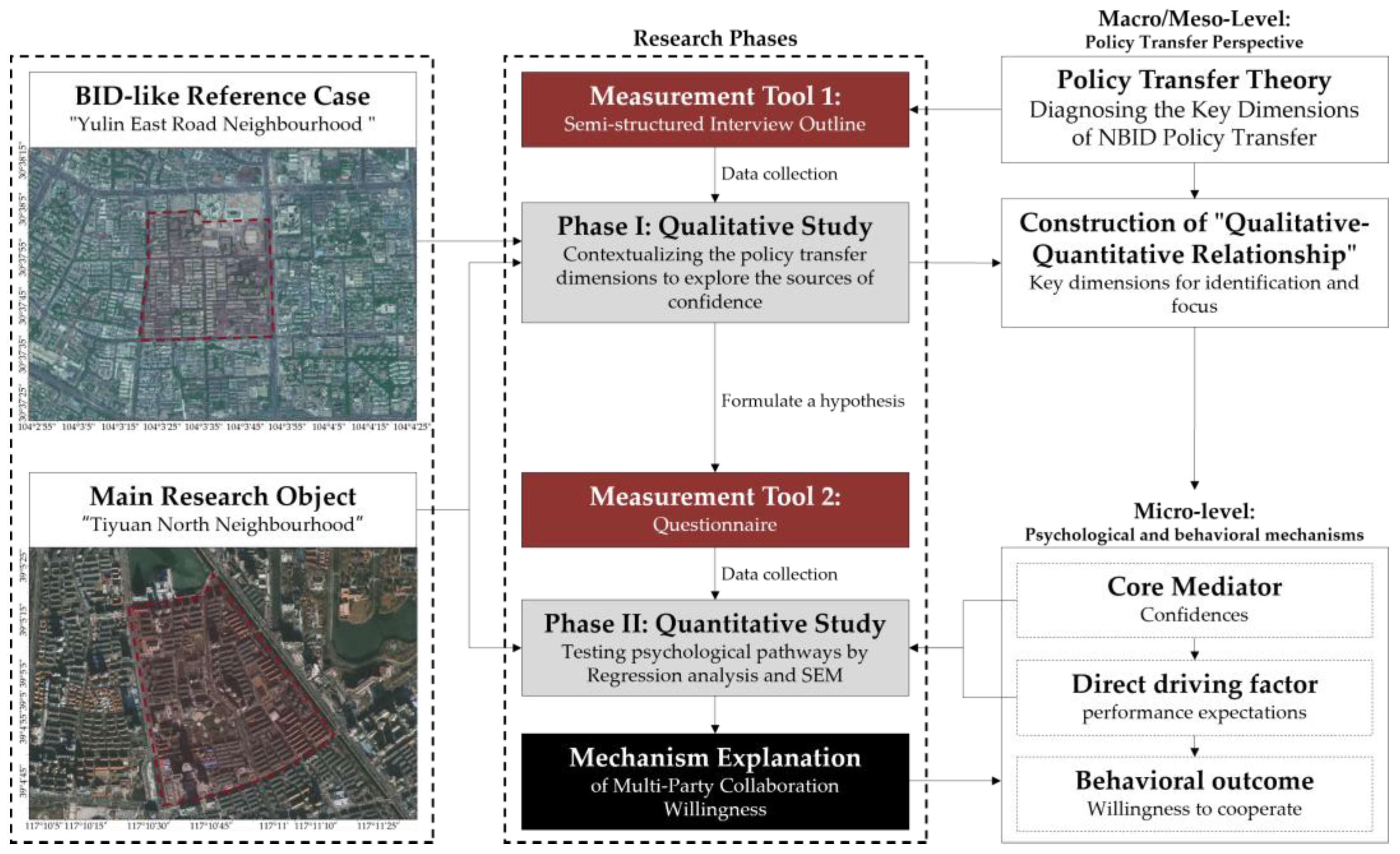
The existing research provides a solid foundation for understanding the operation and transplantation of NBID, but it still lacks in-depth exploration of the psychological mechanisms of participants in the preparatory stage. To systematically fill this gap, this study constructs an integrated analytical framework (as shown in Figure 1), which integrates policy transition theory and the “confidence–expectation” behavioral logic.
First, policy transition theory [32,33] provides macro- and meso-level analytical guidance for this study. As shown in Table 1 of Section 2.2, this theory guides us to focus on the core dimensions that the NBID model must calibrate during the transplantation process, including the government role, funding mechanisms, representativeness of governance structures, and organizational capacity. These dimensions constitute the key situational factors and institutional prerequisites for the successful “embedding” of NBID in a specific institutional environment (such as China). Analyzing them answers the question, “What structural and institutional issues need to be designed and addressed when introducing NBID in China?”
However, no matter how perfect the institutional design, its success ultimately depends on the acceptance and participation of diverse stakeholders in the community. Therefore, this study further introduces the “confidence–expectation” framework as a core explanatory mechanism at the micro-individual level. This framework posits that an individual’s willingness to participate in a collective action (such as NBID) depends on their “confidence” in the likelihood of the action’s success and their “expectation” of the outcomes of participation [based on your theoretical foundation, such as relevant literature on the Theory of Planned Behavior]. In this study, we operationalize the key institutional dimensions identified by policy transfer analysis (such as authority support, organizational capacity, and collaborative feasibility) into specific sources influencing community participants’ “confidence.”
In short, the logical chain of this study is as follows: the institutional design elements of NBID that are crucial in the Chinese context, as revealed by policy transfer theory (such as authority support and organizational capacity), significantly influence the “confidence” levels of various stakeholders in the community regarding these elements; this “confidence” then shapes their “expectation” of the future performance of NBID; ultimately, “expectation” drives them to form specific “willingness to collaborate.” Policy transfer theory defines the core situational variables of the study, while the “confidence–expectation” framework elucidates the psychological mediating pathways linking these situational variables to individual behavioral intentions.
Based on this integrated framework, this study adopts an exploratory sequence mixture approach to gain a deeper understanding of the specific manifestations of these key institutional dimensions in the local context through qualitative research (the “implementation” of policy transfer) and then to examine the psychological mechanisms by which these dimensions influence “expectations” and “willingness” through “confidence” (the “generation” of collective action) through quantitative research. Previous research on NBID has not emphasized collaborative management among multiple participants or stakeholders, a trend likely stemming from the complexity of the research subject. The organizational structures of existing NBIDs abroad are difficult to quantify and categorize due to their complexity and diversity. Furthermore, their size, functions, funding methods, governance types, and management styles vary considerably. Most importantly, the multiple partners and citizens participating in NBIDs represent different interests and expectations. Therefore, using an exploratory sequence mixture approach is crucial for studying innovative NBID organizational structures in new environments.
This study focuses on the “Tiyuan North Community Unit” in Tianjin, China. In the qualitative research, the representative domestic community co-governance model case—the “Chengdu Yulin East Road Community”—is included as a reference research object. Multiple sources are combined to reveal the influencing mechanisms of multi-party participation and collaboration willingness in BIDs, aiming to identify key areas for the regeneration and governance of NBIDs in my country within the context of multi-party co-governance in residential and commercial communities. The researchers in the qualitative study primarily consist of governance participants in the Yulin East Road regeneration process and potential key governance participants in the Tiyuan North Community Unit. The quantitative portion of the study focuses on the Tiyuan North Community, but the selection of participants differs from the qualitative portion. The quantitative portion includes potential stakeholders such as residents, businesses, and property owners. The questionnaire content in the quantitative study serves as an extension of the qualitative results, and the quantitative results, to some extent, echo and validate the findings of the preceding qualitative research. Therefore, the exploratory sequential mixed methodology used in this study combines qualitative unstructured interviews with quantitative questionnaires, supplemented by regression analysis and SEM structural equation modeling to address the research questions, as shown in Figure 1.

3.2. Qualitative: Semi-Structured Interview Method Survey

Based on the topics regarding the organizational structure of the NBID provided in Table 1 of Section 2.2 above for qualitative interviews, and to avoid overlooking other organizational structures relevant to the Chinese context, this study employs a semi-structured interview method for qualitative research. The interview guidelines are shown in Table 2. This interview format falls between structured and semi-structured interviews in terms of its level of structure, offering greater flexibility than structured interviews. Researchers have key research topics and an interview guide, allowing for flexible questioning based on these key points during the interview. Furthermore, new questions can be discussed further. There are no specific requirements regarding the questioning style and order, the interviewee’s response style, or the format of the interview transcript.
The interviews consisted of two main parts. The first part focused on the Chengdu Yulin East Road area mentioned in the previous case study. The Yulin East Road community case, with its community governance model using business alliances and other community co-governance alliances, is highly representative in China. Although the community co-governance alliance model and the NBID model differ in scope and governance framework, they share high similarities in the breadth of resident participation, coverage of interest groups, collaborative development goals, and the challenges faced in community development. The second part focused on Tiyuan North Community, within the scope of this study. The purpose of the interviews with individuals from the former case, which shares similarities with BID, was to analyze the key aspects of NBID in actual operation by inquiring about the experiences of business operators and professionals (such as the Yulin East Road business alliance and architects/planners) regarding local commercial and residential governance and management. These findings can expand the understanding of BID in areas such as urban governance and organic regeneration, provide important guidance for the questionnaire design in the next section, and ultimately promote the survey results in the BID practice.
From March to June 2023, the research team conducted a total of 25 interviews with planning and design experts and the chairman and members of the alliance council from Yulin East Road (11 people), as well as staff, businesses, residents, and owners from the Tiyuan North Community (14 people) (a list of interviewees is shown in Table 2). Each interview lasted an average of 30 min. Most interviews were conducted in private meetings at the interviewees’ offices, shops, or other locations that ensured the comfort of the interviewees and allowed them to provide accurate information in a familiar and comfortable environment. One interview was conducted by telephone (ID-2). The interviews were based on semi-structured interviews, with follow-up questions raised during the interview as needed, based on the actual feedback. All interviews were recorded and transcribed for analysis.

3.3. Quantitative: Questionnaire Survey and Regression Analysis

This study employs a quantitative approach to measure the impact of various confidence factors among community governance participants on their expectations of NBID performance. To understand the concerns of stakeholders and partners, we designed a questionnaire targeting various stakeholders within the Tiyuan North Campus community. The questionnaire included residents, merchants, and property owners—key participants in the potential governance and management of NBID. Apart from an identity verification question used as a control variable, the questionnaire content was summarized from findings in self-reported qualitative research and existing literature. First, we asked respondents about their confidence levels in various aspects of NBID. Then, we asked different groups about their views on NBID goals and performance expectations to measure goal divergence and consistency among partners.
When measuring “performance expectations”, we pay special attention to their connection with spatial regeneration. For example, the measurement the expectation for physical environment performance in the questionnaire implies expectations for specific spatial elements such as street cleanliness, greening quality, and public facilities, while the software-culture and vitality performance is related to non-material spatial dimensions such as the holding of activities in public spaces and the appearance of neighborhoods. This ensures that the ‘expectations’ measured are not abstract concepts but are rooted in the demand for improvement of the physical–spatial environment.
The questionnaire was distributed through field surveys, and differences between different identity groups were compared based on respondents’ sector affiliation. For data analysis, we chose multilevel linear regression and structural equation modeling to analyze the questionnaire data. Traditional single-level regression can only analyze single-individual or environmental levels [53]. This analytical method can capture some non-linear relationships in the data, and by stacking multiple linear layers and activation functions to build more complex models, it can capture high-level features in the data.
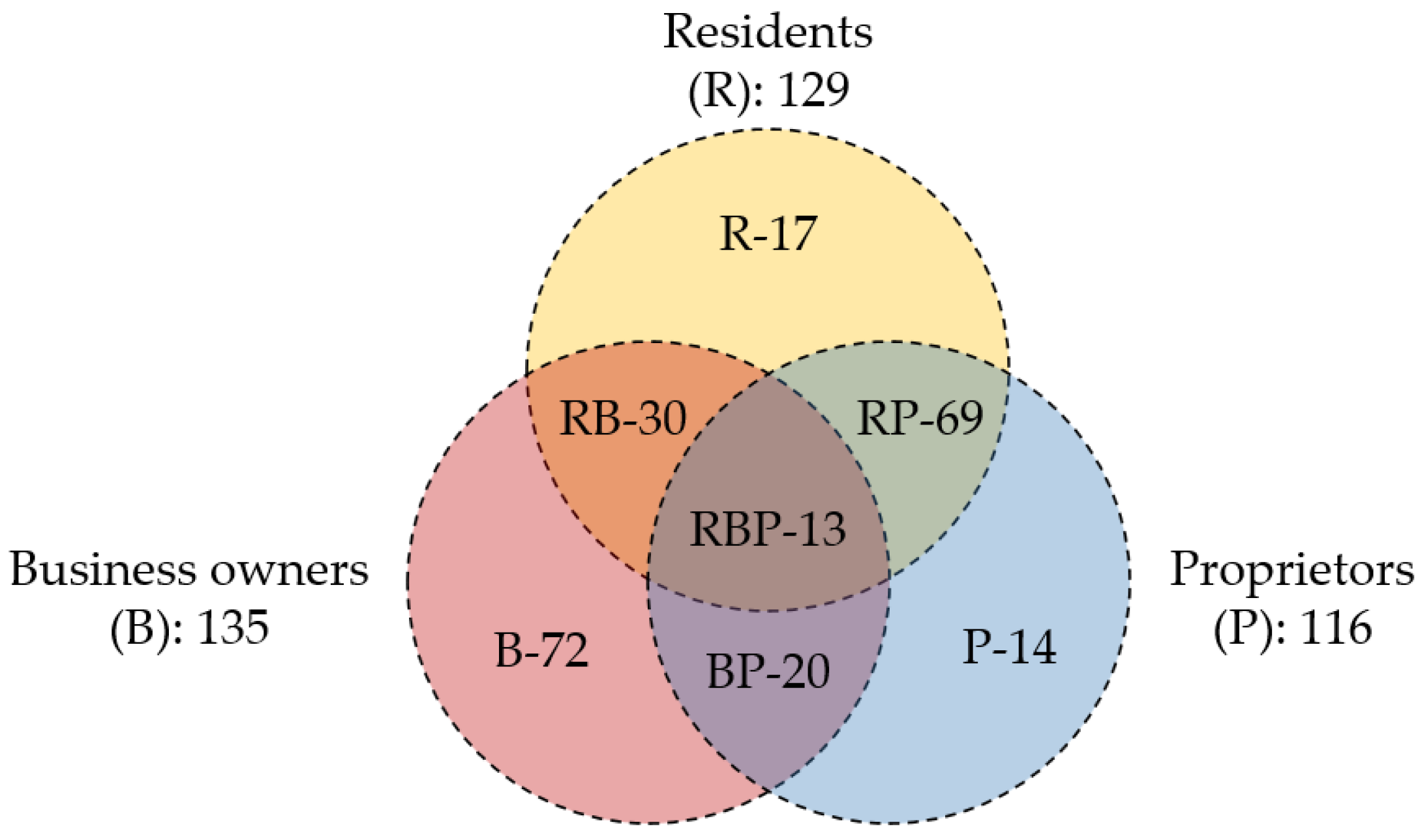
Respondents voluntarily participated in this anonymous survey, resulting in 215 valid questionnaires. The survey period was from June 2023 to May 2024. Many respondents held multiple positions, as shown in Figure 2 and Table 3. This study employed a combination of stratified convenience sampling and snowball sampling to ensure coverage of the three core stakeholders: residents, businesses, and property owners. The specific procedures were as follows: First, resident directories were obtained from the community neighborhood committee, and a random selection of households was visited. Second, all businesses in the community were contacted through street visits and business association directories. Finally, property owners were contacted through property management company information and resident recommendations. According to the latest data provided by the community neighborhood committee and property management company, the Tiyuan North community has approximately 1850 permanent resident households, approximately 210 registered businesses, and approximately 1200 property owners (including non-residential owners). Considering that some respondents held multiple roles (e.g., being both residents and property owners), we used “potential stakeholder individuals” as the survey population, estimating the total size to be approximately 2800 individuals. At a 95% confidence level, the margin of error for this study with an effective sample size (N = 215) is approximately ±5.8% (calculated using the most conservative p = 0.5 and adjusted for finite population size). This margin of error is acceptable for cross-sectional surveys in the social sciences, indicating that the sample is representative to a certain extent. Although the sample size is relatively limited for structural equation modeling (SEM) analysis, existing research indicates that a sample size of around 200 can still yield stable estimates when the model is not overly complex and the ratio of observed variables to sample size is appropriate [54]. In this study, the SEM model has three latent variables and nine observed variables, resulting in a moderate model complexity. To assess the potential impact of sample size on model stability, we will subsequently conduct a robustness test on the path coefficients using the bootstrap method (1000 repeated samplings), and the results will be reported in Section 4.2.3.

4. Experiments and Results

4.1. Conversion of Qualitative Interview Results into Quantitative Tools

4.1.1. Qualitative Interview Results

Qualitative research results indicate that people’s confidence in the success of multi-party collaboration is reflected in several aspects. Respondents generally emphasized the government’s leading role in initiating NBID and the indispensable role of DMC in its operation. Respondents believe that successful collaboration requires not only the efforts of individual partners in many aspects but also multi-faceted support and management capabilities at the organizational level to address concerns about difficulties in obtaining funding and changes in social consumption business models. Meanwhile, respondents expressed that part of the reason influencing their willingness to participate lies in their expectations for NBID’s performance, which can be summarized into three main categories: improvement of the physical environment, enhancement of regional soft power, and increase in overall asset value. The qualitative results are summarized in Table 4 below.

4.1.2. From Hypotheses to Confidence Measurement Questionnaire

This study proposes three hypotheses to summarize and explain respondents’ performance expectations regarding the success of NBID. Numerous studies have demonstrated that people’s willingness to participate in an activity and their expectations of positive outcomes depend on their confidence in the favorable conditions for its success [55,56]. Therefore, to measure the confidence factors related to public performance expectations in NBID, the survey used several confidence questions to measure potential participants’ confidence, each corresponding to a hypothesis summarizing the findings of the self-assessment study.
Hypotheses related to the legitimacy and authority of NBID can be formulated based on interview results. Two questions measuring the level of government and community support may lay the foundation for the authority and stability of NBID, while assuming that council representation can be a measure of good collaborative governance. To measure whether public confidence in authority support from different levels influences performance expectations of NBID, the survey used three questions from the “Confidence in Authority Support (AS)” items shown in Table 5.
Another component influencing public performance expectations of NBID is the management and organizational capacity that NBID possesses, i.e., “Confidence in Organization Capability (OC)”. Beyond “Confidence in Authority Support (AS)”, public confidence in the expertise, engagement, and coordination capabilities of the DMC and the BID Council can also influence public expectations of the NBID’s performance. In terms of collaboration, coordination is crucial for establishing partnerships among multiple stakeholders. The survey used three questions from the “Confidence in Organization Capability (OC)” items shown in Table 5.
In addition to the aforementioned confidence in authority support and organizational capability (AS&OC), factors influencing public expectations of the NBID’s performance include confidence issues related to multi-party collaboration, such as the NBID’s ability to effectively address inconsistencies in the goals of participating parties. Literature and interview results suggest that some individual- or organizational-level variables may be related to people’s confidence in the feasibility of collaboration among stakeholders within the NBID and public expectations of the NBID’s performance. Unlike existing research, this paper attempts to identify and explain the uniqueness of collaboration within the BID. To measure people’s confidence in collaboration within the NBID, this study used three questions from the “Confidence in Multi-party Collaboration (MC)” items shown in Table 5.
The quantitative part of this study explains the public’s performance expectations for NBID from three confidence factors. Therefore, “Confidence in Multi-party Collaboration” is unique compared to the other two. This study not only explores the impact of these three confidence factors on multi-party participation willingness but also explores whether “Confidence in Multi-party Collaboration” directly affects performance expectations. Subsequent quantitative analyses will use regression analysis and structural equation modeling to treat “Confidence in Multi-party Collaboration” as a mediating variable.
The questionnaire scores for the nine questions in Table 5 above were all measured using a 5-point Likert scale, allowing respondents to express a range of opinions—from strongly agreeing to strongly disagreeing—through five answer options, including a neutral option. See Appendix B for the questionnaire details.

4.1.3. The Measurement Content of Goals and Performance Expectations

This study explores the mechanisms by which public expectations of the performance of NBID (Building Information and Development) influence the outcome. Therefore, the public exhibits varying levels of concern regarding the importance of the goals to be achieved by NBID, which may lead to conflicts and challenges in collaboration among different interest groups. To verify the degree of difference among questionnaire participants, 8 questions about the “Importance of Goals (IG)” were asked. These goals were summarized from a literature review and the qualitative interview results shown in Table 4 above. Meanwhile, the purpose of NBID is to revitalize older communities through multi-party collaboration. However, participants may have different expectations for the performance of NBID. To measure public expectations of NBID performance, this study, based on the literature review and qualitative interview results, asked sub-questions on three aspects of “Performance Expectations (PE)”, including “Physical Environment Performance (PE_1)”, “Culture and Vitality Performance (PE_2)” dimensions. Furthermore, the public showed a high level of concern regarding NBID’s ability to enhance “Asset Value Performance (PE_3)”, namely personal assets and community public value.
As with many subjective evaluations, it is difficult to measure public expectations of NBID performance. This study uses the Public Values Scorecard method to measure the sub-items of “Importance of Goals (IG)” and “Performance Expectations (PE)”. Qualitative research results indicate that the public may generally give higher scores to IG, PE, and other related questions. To obtain more accurate “Overall Performance Expectation (OPE)” data, and in order to obtain more accurate data, the Public Values Scorecard, with a value range of 0 to 10, is more accurate than the Likert five-point scale in obtaining relatively accurate data on the following questions. The questionnaire form is detailed in Appendix C.

4.2. Data Analysis of Questionnaire Results

4.2.1. Differences Among Multiple Participants

Due to various pre-existing conditions within the community, respondents from multiple groups, including residents, businesses, and property owners, may prioritize different goals. Table 6 compares the different goal orientations of participants from different interest groups. For example, respondents mentioned potential goal conflicts between different groups. Businesses might need to provide more parking spaces for customers, which could lead to encroachment on residents’ parking spaces. Furthermore, participants may have different goal priorities reflecting the needs of the population they represent. Although the results show differences in goals, the study did not reveal statistically significant differences between different types of participants. Different community participants may successfully establish common goals through NBID, regardless of which interest group they represent. The questionnaire results show significant differences in the level of expectation of different groups regarding the effectiveness of NBID practices. Overall, businesses showed a higher willingness to participate in multi-party collaboration within NBID and higher expectations for various performance indicators compared to the other two interest groups. Residents as a whole scored the second highest, while property owners scored lower than others. There were no statistically significant differences in scores between the groups. Property owners are less sensitive to the performance of the NBID (Building ID Card), possibly because some property owners do not live or operate in the community compared to residents and business owners, and therefore cannot directly enjoy short-term benefits such as street and environmental improvements. They may also be less sensitive to or lack confidence in the long-term benefits of the NBID, such as increased property value. Conversely, businesses may be more satisfied because they believe they can directly benefit from the daily services of the NBID. On a scale of 10, respondents gave an average rating of 7.69 for their overall expectations of the NBID’s performance.

4.2.2. Regression Analysis

To explore the influence mechanism of various public confidence factors on public performance expectations, this study used a regression analysis in the form of ordinary least squares (OLS). It was hypothesized that greater “Confidence in Authority Support” and “Confidence in Organization Capability” among community respondents might lead to higher “Overall performance expectation (OPE)” for the NBID. To differentiate the impact of each factor, as shown in Table 7, one basic model included independent variables related to “Confidence in Authority Support” required for the NBID, such as “Confidence in Government Support (AS_1),” “Confidence in Community Support (AS_2),” and “Confidence in Council Representation (AS_3)”. Another basic model included independent variables related to “Confidence in Organization Capability (OC)” required for the NBID,” such as “Confidence in Professional Competence (OC_1),” “Confidence in Board Ability (OC_2),” and “Confidence in Coordination Ability (OC_3)”.
To control for other factors affecting the dependent variable, the models included demographic control variables (gender, age, education level, annual household income, etc.) mentioned in Table 3 above. To observe the indirect interaction effect of “Confidence in Enabling collaboration (MC_3)” as an interaction term on the outcome variable (OPE), an interaction term was added to the following models.
Table 8 below provides the correlations between various confidence variables and the willingness to participate in multi-party collaboration in the sample. The correlation matrix shows that the cross-correlation between variables is less than 0.8. Collinearity is likely to exist. The variance inflation factor (VIF) was tested to more accurately diagnose collinearity. The results of the VIF test indicate that collinearity is not a problem. “Overall Performance Expectation (OPE)” is positively correlated with “Confidence in Community Support (AS_2)”, “Confidence in Council Representation (AS_3)”, “Confidence in Coordination Ability (OC_3)”, and “Confidence in Enabling collaboration (MC_3)”. The correlation between the dependent variable and “Confidence in Interests Balancing (MC_2)” is not significant.
The regression analysis results without control variables are shown in Table 9. All three variables related to “Confidence in Authority Support (support from the government, support from the community, and representation of the council)” were positively correlated with “Overall Performance Expectation (OPE)”. Among the variables related to “Confidence in Organization Capability” and “Confidence in Multi-party Collaboration”, “Confidence in Coordination Ability (OC_3)” and “Confidence in Enabling collaboration (MC_3)” were positively correlated with OPE and were statistically significant.
The regression analysis results using the “Confidence in Authority Support” variable are shown in Table 10. As predicted by the hypothesis, all three factors were positively correlated with “Overall Performance Expectation (OPE)”. In particular, the effect of “Confidence in Council Representation (AS_3)” on “Operational Performance Expectation (OPE)” was positively correlated and statistically significant. Respondents confident in Council Representativeness showed higher levels of OPE.
Table 10 presents the test of the mediating effect of “Confidence in Multi-party Collaboration”. “Confidence in Enabling collaboration (MC_3)” mediates the effect of “Confidence in Community Support (AS_2)” on OPE. (See models M2-1 and M2-2 in Table 10). This indicates that Community Support Confidence is positively correlated with OPE of “Confidence in Enabling collaboration (MC_3)”. Therefore, efforts to improve operational performance should examine the conditions for enhanced collaboration through community support.
Table 11 below shows the results of the regression analysis. In all models, OPE was positively correlated with “Confidence in Organization Capability (OC)”. This indicates that among the three independent variables of OC, “Confidence in Coordination Ability (OC_3)” is closely related to OPE. These results indicate that participants with higher “Confidence in Organization Capability (OC)” reported higher “Overall Performance Expectations (OPE)” in their NBID. The interaction term “Confidence in Organization Capability × Confidence in Enabling collaboration” represents the indirect effect of “Confidence in Enabling collaboration” on OPE. This suggests that “Confidence in Enabling collaboration (MC_3)” can moderate the impact of the “Confidence in Organization Capability (OC)” variable on OPE. Among the control variables, age was significantly associated with OPE in some models. Other control variables were not statistically significant.
The left part of Table 12 shows the impact of “Confidence in Authority Support (AS)” and control variables on different “Performance Expectation (PE)” sub-items. “Confidence in Government Support (AS_1)” is closely related to expectations of “Physical Environment Performance (PE_1)” and “Asset Value Performance (PE_3)”. “Confidence in Council Representation (AS_3)” is closely related to “Overall Performance Expectation (OPE)”, “Physical Environment Performance (PE_1)”, and “Asset Value Performance (PE_3)”, while “Confidence in Community Support (AS_2)” shows no significant correlation with performance expectations.
The right part of Table 12 shows the impact of “Confidence in Organization Capability (OC)” and control variables on different “Performance Expectations (PE)” sub-items. “Confidence in Coordination Ability (OC_3)” is closely related to “Overall Performance Expectation (OPE)”, “Physical Environment Performance (PE_1)”, and “Asset Value Performance (PE_3)”. Other variables do not show statistical significance.

4.2.3. Structural Equation Model Analysis

The research model was evaluated using structural equation modeling (SEM) with STATA15. SEM is a statistical method based on factor analysis and path analysis, which allows us to simultaneously estimate several latent factors and their associations. This analysis aims to explore the pathways by which multi-faceted confidence factors in the public influence positive performance expectations of NBID.
The SEM analysis in this paper involved three latent variables: “Confidence in Authority Support (AS)”, “Confidence in Organization Capability (OC)”, and “Performance expectations (PE)”. The first premise related to confidence in multi-party collaboration in BID is public “Confidence in Authority Support (AS)”. Three items were used to measure AS, with a Cronbach’s α value of 0.8467, indicating a highly acceptable reliability. Another important premise that can serve as a premise for public confidence in multi-party collaboration is “Confidence in Organization Capability (OC)”. Three items were used to measure OC, with a Cronbach’s α value of 0.7638, indicating a highly acceptable reliability.
Three items were used to measure public “Confidence in Multi-party Collaboration (MC)” in NBID. However, the low Cronbach’s α value (α = 0.5314) for the three items measuring MC indicates that the three items are not correlated with each other. The combined reliability (CR) was below 0.6, and the model fit index was not ideal (χ2/df = 3.82, RMSEA = 0.115, CFI = 0.865), indicating that forcing MC_1, MC_2, and MC_3 into a single unidimensional latent variable model is unacceptable. Therefore, the three items are suitable as independent variables, rather than latent variables, for building MC as a whole (Table 13).
Therefore, we adjusted our analysis strategy. In the SEM models shown below, we no longer constructed the latent variable ‘MC’, but instead included “Confidence in Enabling collaboration (MC_3)” as the core observed variable to directly test its mediating effect. MC_3 was chosen based on: (a) its highest standardized factor loading (0.78), best representing the positive aspect of collaboration confidence; (b) its strongest correlation with OPE (r = 1.332); and (c) its repeated emphasis in qualitative interviews. Meanwhile, we retained the validated and reliable latent variables “Confidence in Authority Support (AS)” and “Confidence in Organization Capability (OC)”.
  • SEM Analysis with MC_1 and MC_2 as Mediators (Additional Models)
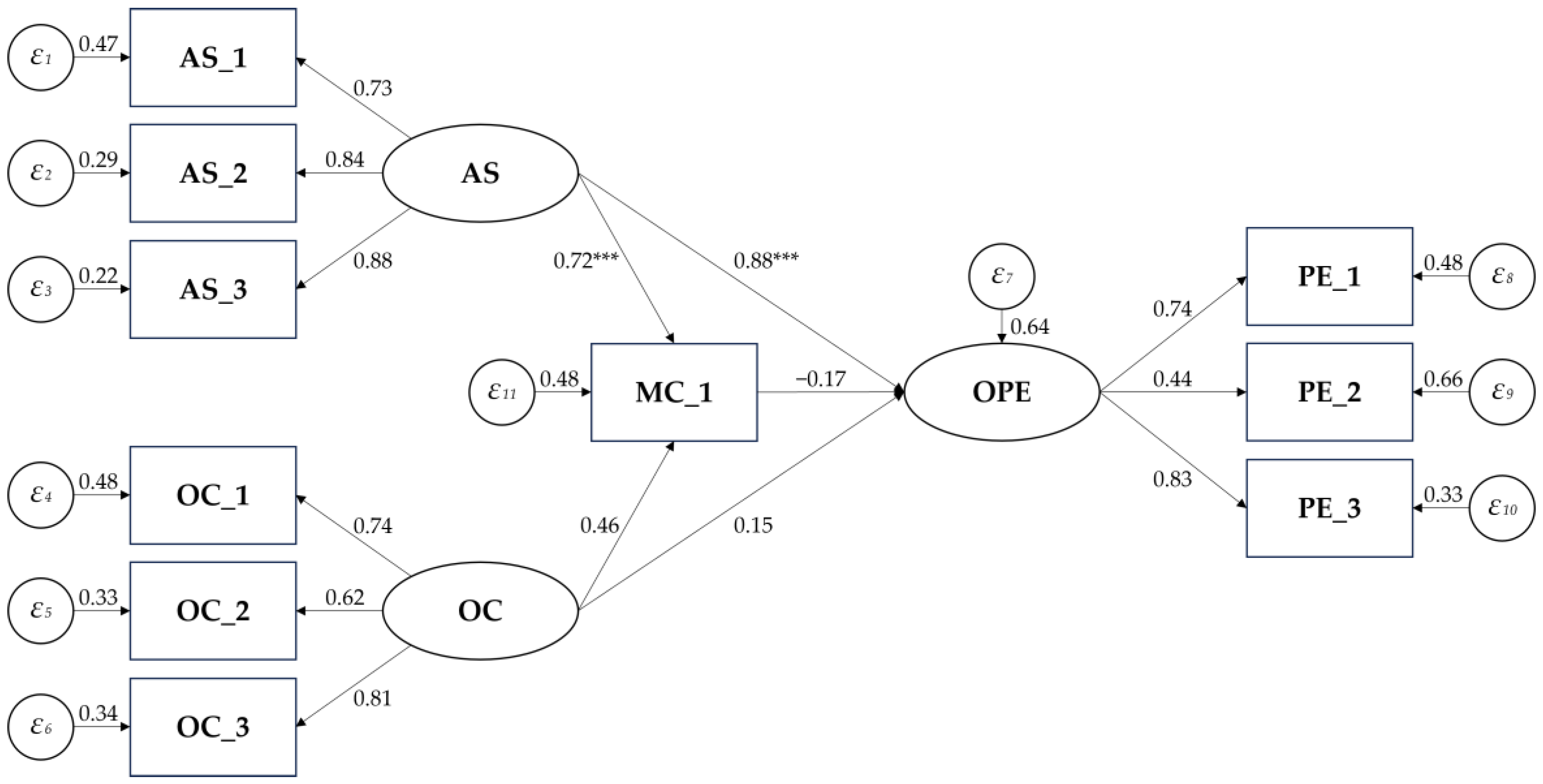
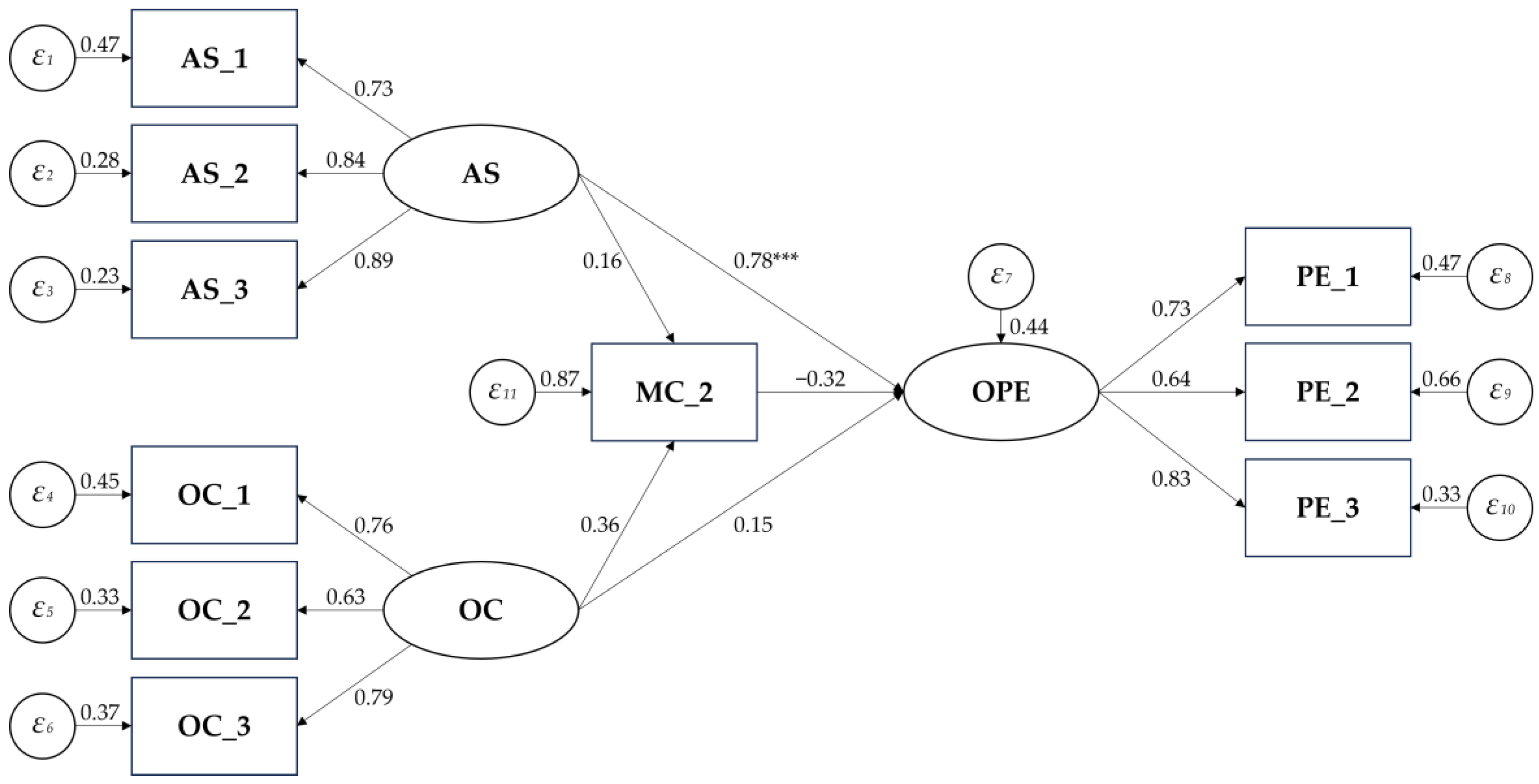
To further understand the distinct roles of different MC items, as shown in Figure 3 and Figure 4, we constructed and tested two additional structural equation models, using MC_1 (Confidence in Goal Alignment) and MC_2 (Confidence in Interest Balancing) as the mediating variables, respectively.
Model with MC_1 as Mediator: This model tested the mediating path: AS and OC → MC_1 → OPE. The model fit indices were unsatisfactory: χ2/df = 4.18, RMSEA = 0.123 (90% CI: 0.112, 0.134), CFI = 0.821, TLI = 0.798, SRMR = 0.068. These values fall outside the recommended thresholds for a good fit (e.g., RMSEA > 0.08, CFI/TLI < 0.90). More critically, the hypothesized path from MC_1 to OPE was not statistically significant (β = −0.17, p = 0.34). While the path from AS (β = 0.72, p < 0.001) was significant, the lack of a downstream effect from MC_1 to OPE indicates that confidence in goal alignment alone does not serve as an effective conduit translating structural confidence into performance expectations within our model.
Model with MC_2 as Mediator: This model explored the path: AS and OC → MC_2 → OPE. The fit was similarly poor: χ2/df = 5.02, RMSEA = 0.138 (90% CI: 0.128, 0.149), CFI = 0.783, TLI = 0.754, SRMR = 0.073. The standardized factor loading for MC_2 on its intended latent construct was notably low (0.26, see Table 13), consistent with its weak item-total correlation. Consequently, the path from MC_2 to OPE was non-significant (β = −0.32, p = 0.52), and the paths from the antecedent variables to MC_2 were either weak (AS to MC_2: β = 0.16, p = 0.25) or non-significant (OC to MC_2: β = 0.36, p = 0.18). This suggests that, in the preparatory stage, stakeholders’ specific concerns about balancing diverse interests (MC_2) may be a perceived challenge or a secondary consideration, rather than a driving mechanism shaping their OPE.
The MC_1 and MC_2 models consistently showed poor fit, and the critical path was not significant. This is not indicative of “Confidence in Goal Alignment (MC_1)” or “Confidence in Interests Balancing (MC_2)” itself, which did not play a key mediating role between institutional confidence factors (AS, OC) and the overall performance expectations (PE) during the NBID preparation phase.
  • Structural Equation Model with MC_3 as the Key Mediator (Final Model)
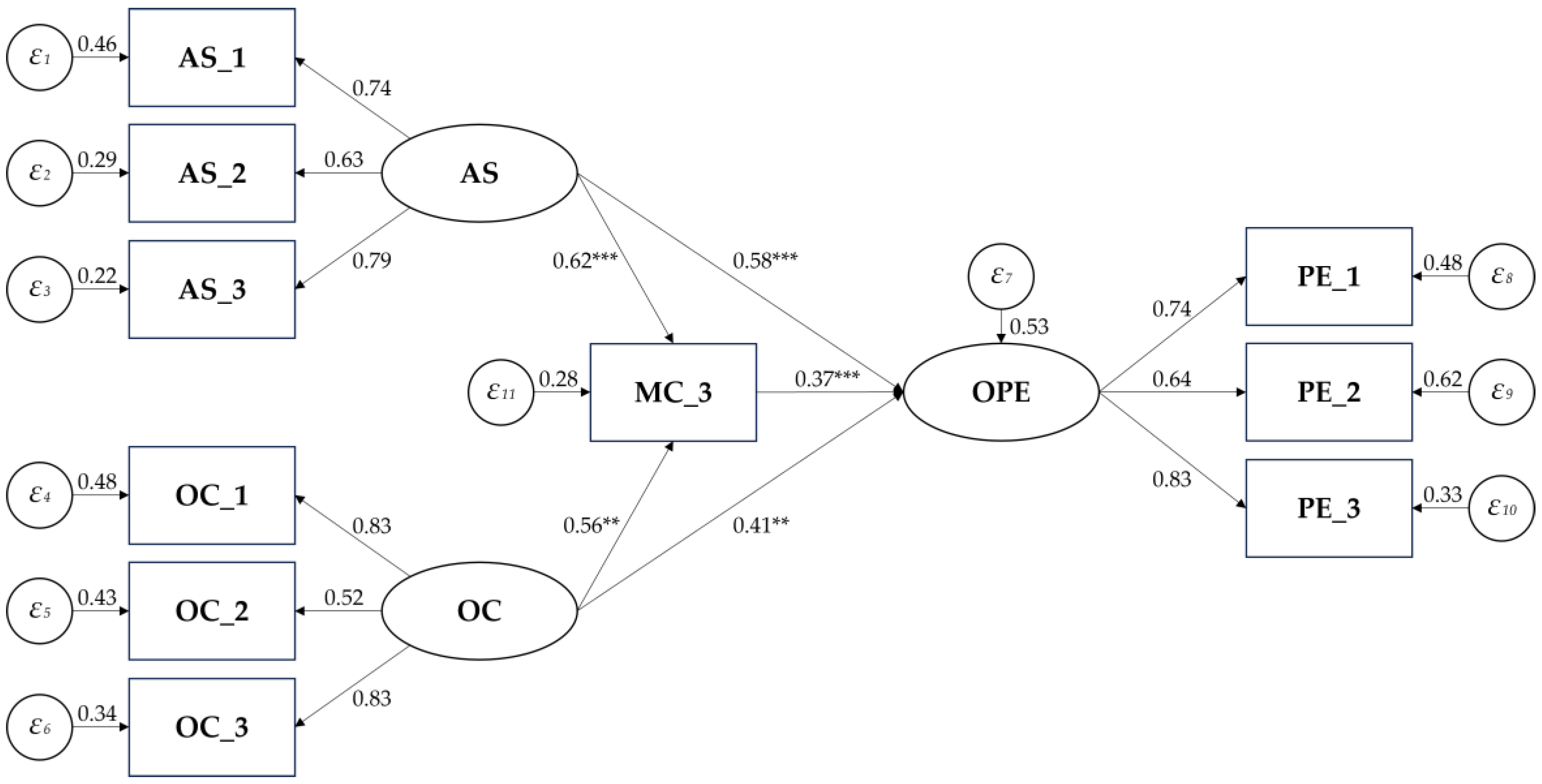
In contrast to the models featuring MC_1 and MC_2, the structural equation model specifying MC_3 (Confidence in Enabling collaboration) as the mediating variable demonstrated a good fit to the data and supported our core hypotheses (Figure 5). This model tested the theoretical pathway: AS and OC → MC_3 → OPE. The model exhibited satisfactory global fit indices: χ2/df = 2.08, RMSEA = 0.071 (90% CI: 0.060, 0.082), CFI = 0.941, TLI = 0.930, SRMR = 0.045. All indices met or exceeded conventional thresholds for good model fit, indicating that the specified relationships among the constructs are consistent with the observed data.
The standardized path coefficients revealed significant and meaningful relationships: Antecedents to MC_3: Both AS (β = 0.62, p < 0.001) and OC (β = 0.56, p < 0.01) exerted strong positive effects on MC_3. This confirms that stakeholders’ confidence in multi-party collaboration is significantly bolstered by their confidence in authority support and organizational capability.
Mediating Path (MC_3 to OPE): MC_3 had a significant direct positive effect on OPE (β = 0.37, p < 0.001), confirming its pivotal role in shaping performance expectations.
Direct Effects: The direct paths from AS (β = 0.58, p < 0.001) and OC (β = 0.41, p < 0.01) to OPE remained significant, suggesting a partial mediation model.
Indirect (Mediation) Effects: To formally test the mediation hypotheses, we employed a bootstrap procedure with 1000 resamples. The results confirmed significant indirect effects: the path from AS to OPE via MC_3 was significant (β = 0.23, 95% CI [0.06, 0.25]); similarly, the indirect path from OC to OPE via MC_3 was also significant (β = 0.21, 95% CI [0.04, 0.20]). The bias-corrected confidence intervals did not include zero, providing robust evidence for the mediating role of MC_3.
  • Conclusion of SEM Analysis
The final model, centered on MC_3, is both statistically sound and theoretically coherent. It robustly demonstrates that confidence in the feasibility of enabling collaboration serves as a critical psychological mechanism, partially translating stakeholders’ confidence in institutional structures (authority and organization) into their expectations for the future performance of an NBID. The stark contrast between the excellent fit of this model and the poor fit of the MC_1 and MC_2 models underscores the unique and central importance of “can we collaborate?” (MC_3) over “can we agree on goals?” (MC_1) or “can we balance interests?” (MC_2) in the formative, pre-establishment phase of such a collaborative governance initiative.

5. Discussion

5.1. Theoretical Contribution: Key Influencing Factors of NBID Participation Willingness

A comprehensive literature review of current research indicates that existing studies on NBID primarily focus on the construction process, performance evaluation, experience summaries, and future development recommendations of established NBIDs. However, research on the willingness of community stakeholders, including residents, business owners, and property owners, to participate in NBID projects and on the feasibility of NBIDs is severely lacking. This study attempts to explore the influence mechanism of public expectations regarding the performance of NBIDs from a confidence perspective. It aims to summarize the characteristics of the organizational structure of NBIDs in the Chinese context, including authoritative support, organizational capacity, and multi-party collaboration. Unlike previous research on multi-party governance in Chinese communities, this study focuses on different participants from various sectors to explore their diverse goals and values. In this sense, this research helps strengthen our understanding of collaborative governance and management in the public administration field using BID tools. This knowledge can provide information and direction for the preparation and actual operation of NBIDs.
Qualitative methods explore the main concerns of various participants from the public and private sectors regarding the creation of public value through multi-party collaboration in NBIDs when applying the NBID model in my country. Previous research has focused on the reasons, conditions, and environments for the creation or disappearance of existing NBID cases, as well as the evaluation of quantifiable performance outcomes. However, when countries or cities with existing NBID models are transferring policies and designing organizational structures, there is currently a lack of research on the factors influencing the performance expectations and willingness to participate of various stakeholders in the community.
The results of this mixed study shown in Table 14 indicate that different participants are highly concerned about the support and constraints provided by the government and public sectors. This is a crucial prerequisite for the public to have confidence in participating in multi-party collaboration within NBID and to hold an optimistic attitude towards its performance. Firstly, authoritative support is key to supporting effective collaborative governance of NBID. Respondents in the co-governance alliance and potential participants in BID believe that strong support from the government and community public sectors, as well as the representativeness of governance institutions, is essential for the success of community co-governance organizations. These factors can enhance the legitimacy and authority of NBID and achieve more efficient and sustainable development of NBID by reducing conflicts among multiple stakeholders. These findings are also consistent with the results of regression analysis.
Secondly, this study discusses the council’s capabilities and the coordination abilities of a successful BID. These management capabilities are essential for implementing day-to-day services and developing collaborative plans on an ad hoc basis. Executive council members should have management experience and provide the council with the necessary knowledge and plans. Furthermore, they need to understand how an NBID can work closely with the government to achieve success. Communicating with multiple stakeholders is an essential skill for collaboration. In addition, council members can bring their expertise to the NBID and contribute to the community.
Thirdly, this study particularly deepens our understanding of the mediating role of “confidence in collaboration.” Although measuring “Confidence in Multi-party Collaboration (MC)” as a whole presents challenges, refined analysis reveals that its core component—“Confidence in Enable Collaboration” (MC_3)—plays a crucial mediating role. Not only is it a transmission path through which “Confidence in Authority Support and Organization Capacity” (AS&OC) influences “Overall Performance Expectations” (OPE), but it also directly contributes to OPE. This suggests that, during the preparatory stage, cultivating concrete confidence among all parties that “collaboration can succeed” is more critical than simply emphasizing the importance of cooperation in general.

5.2. Discussion on the Relationship Between Psychological Mechanisms and Objective Outcomes

This study focuses on exploring the psychological mechanisms underlying the willingness to cooperate during the preparatory stage of NBID (New Urban Development and Regeneration). A crucial methodological and theoretical consideration that follows is understanding the relationship between these subjective psychological constructs (confidence and expectations) and the objective physical space and socio-economic outcomes ultimately pursued by urban regeneration. This consideration guides us to examine the deep connection between psychological mechanisms and specific dimensions of regeneration—especially physical space regeneration.
First, it is essential to reiterate the stage-specific positioning and theoretical value of this study. In the “preparatory stage,” before the objective results of NBID—such as improved physical environment and enhanced business vitality—are apparent, the “perceptions” and “beliefs” of various community stakeholders are key antecedent variables determining whether collective action can be initiated. Therefore, revealing the influence path between “confidence” and “expectations” is fundamentally important for understanding how to “incubate” cooperative governance models within a new institutional environment. It is worth emphasizing that the “performance expectations” measured and manipulated in this study are not an abstract concept. As shown in the questionnaire design (see Section 4.1.3), its three sub-dimensions—hardware (physical environment), software (cultural vitality), and comprehensive asset value—directly correspond to the core spatial, social, and economic goals of community regeneration. Respondents’ expectations for “physical environment performance” (PE_1) essentially embed a latent demand for improvements in specific physical–spatial elements such as street environment, public space quality, and building facades. Therefore, this study’s “confidence–expectation” framework, at the measurement level, has already taken the vision of spatial regeneration as the core object of psychological projection.
However, there is indeed a theoretical and practical translation process that needs to be explained between “collective expectations for spatial improvement” and “coordinated spatial intervention actions.” This raises a deeper issue: how is the willingness to cooperate translated into concrete spatial design and governance actions? Based on the core findings of this study, a key socio-psychological explanation of this transformation process can be provided. Confidence in authoritative support constitutes the social legitimacy prerequisite for obtaining the necessary policy permits and public resources for spatial redevelopment; confidence in organizational capacity (especially coordination capacity OC_3) is key to ensuring that diverse and dispersed interests can be effectively integrated into feasible spatial solutions and implementation plans; and confidence in the feasibility of collaboration is the cornerstone for different property owners to reach operational consensus on specific issues such as facade redevelopment, public space use, and management rules. In other words, the “multidimensional confidence” revealed in this study constitutes the core social capital necessary to initiate any participatory spatial planning, design negotiation, and co-management process.
In summary, the theoretical contribution of this study lies not only in explaining the generation mechanism of cooperative willingness but also in providing crucial precondition analysis for understanding “how willingness may lead to substantive redevelopment action.” A complete and dynamic closed loop for NBID practice and research should be as follows: Effectively cultivate “space-oriented collective confidence and expectations” during the preparatory stage → After the establishment of NBID, translate social consensus into concrete “space improvement priority plans” and “collaborative design guidelines” through institutionalized governance channels (such as establishing a design committee and formulating a joint management convention) → Achieve tangible improvements in spatial quality and vitality through project implementation → This verifies and strengthens the initial confidence of all parties, forming a virtuous cycle of “psychological–social–spatial” interaction. This study aims to deeply analyze the initial stage of this cycle. Its conclusions indicate that any NBID or similar governance mechanism aimed at effectively promoting substantive spatial regeneration must, during its design and initiation stages, highly value and strategically cultivate these psychological and social processes that shape the community’s shared “expectations for the future of space.”

5.3. The Impact on Public Policies and NBID Management

The results of this hybrid study provide suggestions and insights for the organizational structure design of NBIDs in the field of public administration. A well-designed organizational structure for NBIDs is crucial to ensuring their effective operation and achieving their performance goals. First, the hybrid study results provide explanations for the successes and failures of existing community co-governance organizational models. Successful NBID collaboration requires the legitimacy and support of the government and the community, as well as the representativeness of the council—a key difference between existing community co-governance alliances and NBIDs in China. Furthermore, sufficient professional capacity and council capacity are needed to provide services and coordinate with diverse community stakeholders. Second, NBIDs are community initiatives responding to economic and environmental changes. The results indicate that multi-party collaboration in NBIDs requires the active participation of individuals and organizations across various sectors. Multi-party governance structures have advantages in providing specific types of public services, but they require careful planning to balance the needs of the entire community. Third, NBIDs are independent entities operated in cooperation with city governments and various stakeholders. However, BIDs are vulnerable to sudden shifts in the attitudes of multiple partners. Funding participants who pay special assessments or fees for the BID can request its termination if they do not see any economic return. The government may wish to change or terminate the management structure of BID. Therefore, it is necessary to continuously strengthen the legitimacy and authority created through change and community improvement. Furthermore, support or guidance from city governments may help BID reduce trial and error in its initial stages and strengthen accountability mechanisms. Fourth, this study explores public values within the context of operational performance. The public value created through BID needs to encompass multiple aspects.
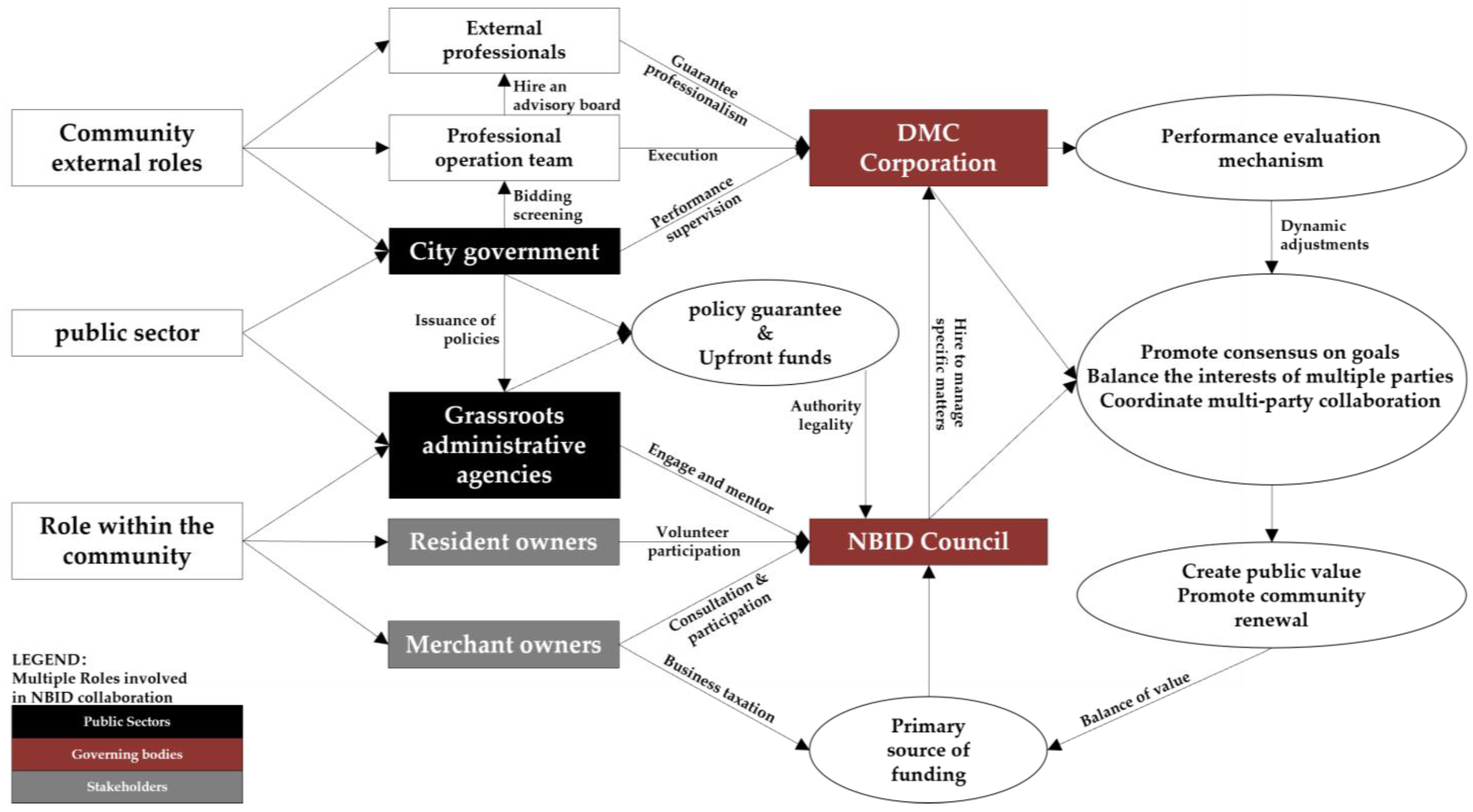
As shown in Figure 6, this study proposes an organizational structure design for NBID in my country’s megacities based on the conclusions of a mixed study. It is worth noting that although some residents mentioned in interviews that they hoped the NBID would play a role similar to a property management company, integrating the property management of older communities, and expressed willingness to provide a small amount of funding to the NBID in the form of property fees, this form of paid participation by residents requires policy support and leadership from public sectors such as the government, and not all older communities are suitable for this form. Therefore, the organizational structure shown in Figure 6, as a basic form, like most existing BIDs abroad, primarily relies on taxing businesses to guarantee basic funding. This research demonstrates that the design of an NBID organizational structure should enable the Business Improvement District (BID) to operate efficiently and transparently, better serving its members and enhancing the overall interests of the area. Through structured management and operation, the BID can more effectively achieve its goals and contribute to the region’s business prosperity and community development.
It is important to be wary that any regeneration aimed at improving business and increasing asset value may harbor the risk of gentrification, leading to rising rents and the forced relocation of local small businesses and indigenous residents. Therefore, a responsible NBID design must ensure the representation of small businesses, tenants, and low-income residents in the council and explicitly incorporate social indicators such as ‘affordability maintenance’ and ‘community network protection’ into the target system, internalizing spatial justice as one of the core values of governance.

5.4. Comparative Analysis with Existing Co-Governance Models

To place the proposed NBID model within the Chinese governance context and gain a deeper understanding of its localization, this study selects a representative domestic community co-governance case—the Chengdu Yulin East Road Community Merchant Alliance—as a comparative object. The Yulin East Road model, through cooperation between the merchant alliance, professional institutions, and government departments, successfully promoted the organic regeneration of the community and enhanced its commercial vitality, showing a high degree of similarity to NBID in terms of goals and participating entities. However, through systematic comparative analysis (as shown in the Table 15 below), this study reveals key differences between the two in terms of organizational structure, operational mechanisms, and core concepts. These differences provide important guidance for innovating the organizational structure of NBID within the Chinese context.
The above comparisons demonstrate that introducing the NBID model to China is not simply about replacing successful local models like Yulin East Road, but rather about institutionalizing and upgrading them. The success of the Yulin model proves the enormous potential and broad development space for multi-party governance in Chinese urban communities. The NBID model provides a framework to institutionalize this successful but potentially opportunistic and personally driven mobilization practice, making it a sustainable, replicable, and more clearly defined long-term governance framework.
Specifically, the findings of this study provide key calibration directions for this “institutionalization” process: 1. The legalization and standardization of funding sources are the primary challenge and breakthrough point, requiring the exploration of a sustainable payment mechanism compatible with China’s fiscal and tax system and legal framework; 2. While emphasizing government guidance, a carefully designed committee structure is crucial to ensuring the democratic and representative nature of governance, which is key to gaining the trust of community stakeholders and mitigating potential “coercive” resistance; 3. Compared to local models, to address the more complex and long-term collaborative management needs, the professional coordination capabilities of the management body (OC_3) need to be placed at the core.
In conclusion, the comparison with the Yulin East Road model not only confirms the key findings of this study regarding confidence in “authoritative support” and “organizational capability,” but also further demonstrates that a balance must be struck between drawing on international experience and respecting local logic when constructing an NBID organizational structure in the Chinese context. Its successful transplantation depends on careful localization design and innovation in a series of key dimensions, such as institutional legitimacy, financial sustainability, governance representation, and professional management capability.

5.5. Limitations and Future Research Directions

This study preliminarily explored the psychological mechanisms of the NBID preparation stage using an exploratory sequence mixture method, constructing and validating a “confidence–expectation” explanatory framework. However, every study has its boundaries, and honestly examining these boundaries is not only a requirement of academic rigor but also paves the way for future research. The limitations of this study mainly stem from its methodological process and focus selection, specifically in the following aspects:
First, there are three constraints at the methodological and research process levels. Firstly, the findings of this study are based on 215 valid questionnaires. Although techniques such as sampling error assessment and bootstrap repeated sampling were used to enhance the robustness of the estimates, the sample size may still limit the statistical power and model complexity of a structural equation model containing multiple latent variables. Secondly, the core variables all come from self-reported data at specific time points. While this is the most direct approach when measuring the community cognition and intentions upon which the yet-to-be-embodied NBID relies, it is difficult to completely avoid common methodological biases, especially in establishing the causal direction between variables in a rigorous sense. More importantly, a gap exists between these self-reported “willingnesses” and “expectations” and the actual collaborative behaviors and ultimately observable objective results that need to be bridged. Thirdly, this gap stems in part from the “preparatory phase” as explicitly defined in this study. The cross-sectional design, like a “static snapshot,” fails to capture the evolutionary trajectory of confidence, expectations, and collaborative patterns in the dynamic and evolving process of community governance, nor does it reveal how initial “confidence” translates into long-term governance actions and outputs. This limitation is due to the lack of readily available practical cases of NBID in China.
Secondly, in terms of analytical dimensions and theoretical depth, this study has several areas that have not been explored in depth. First, the focus on the “physical–spatial dimension” is relatively insufficient. The effectiveness of urban regeneration must ultimately be reflected in the improvement of spatial quality. However, this study failed to closely link participants’ confidence and expectations with their demands for specific material environments, such as public space quality and street vitality, leaving a gap between governance psychology and built environment design. Second, the translation path of governance mechanisms and spatial transformation is still unclear. This study reveals the psychological mechanisms of “why they are willing to cooperate,” but fails to fully explain how these “governance intentions” are transformed into specific “spatial intervention actions” and “management regulations,” i.e., the operationalization process of “knowledge–action transformation” needs to be explored further. Third, the discussion on normative and ethical issues is limited. The study mainly analyzes the willingness to cooperate from an efficiency perspective, failing to fully explore the potential risks of gentrification and exclusion of marginalized groups that may accompany the NBID model, which are key dimensions for assessing its social sustainability.
Finally, the findings of this study are rooted in a specific empirical context, and their extrapolation requires a cautious approach. From a micro-level community-type perspective, the primary quantitative data comes from a mixed-use, older community. The conclusions drawn from this study need to fully consider contextual differences when applied to purely residential communities, historical districts, and other types of communities. From a macro-level institutional perspective, the research is deeply embedded in the strong government governance tradition of China’s megacities. When the conclusions are transferred to other regions or international contexts with vastly different government roles and social capital structures, rigorous contextual adaptation and verification are necessary.
These limitations illuminate the path forward for future research. Subsequent work can conduct large-sample testing in a wider range of communities; longitudinally track the NBID pilot project to connect the complete chain of “psychology–behavior–performance”; conduct cross-institutional comparative studies; and ultimately systematically incorporate spatial elements, operational pathways, and social equity indicators into the analytical framework to explore new, more explanatory, instructive, and inclusive paths for community governance. Furthermore, this study is a cross-sectional design, revealing the status of the preparatory stage. Future research urgently needs to employ longitudinal tracking methods to examine the dynamic co-evolution of confidence, cooperation models, and performance outputs among various parties throughout different stages of the NBID lifecycle (preparation–establishment–operation–evaluation).

6. Conclusions

This study aims to explore the psychological mechanisms influencing the willingness of various community stakeholders to participate in the emerging governance model of Neighborhood Business Improvement Districts (NBIDs) within the context of China’s megacities. Through a mixed-methods study of the Tiyuan North Community in Tianjin, this paper reveals that during the preparatory stage of NBIDs, public expectations regarding performance are profoundly influenced by multiple confidence factors. Based on this, it provides theoretical support and practical insights for the organizational structure design of NBIDs in the Chinese context.
First, this study identifies and verifies three core confidence dimensions influencing NBID performance expectations. Quantitative analysis results show that: 1. Confidence in authority support, especially confidence in the representativeness of the council, is the cornerstone of establishing the legitimacy and fairness of collaboration and has the most stable positive impact on performance expectations; 2. In organizational capability confidence, coordination ability is considered key to connecting all parties and promoting progress, its importance surpassing individual factors such as professional competence and council participation; 3. Confidence in multi-party collaboration, particularly confidence in the “ability to achieve public–private collaboration,” not only directly influences performance expectations but also plays a crucial mediating role in the pathways through which authority support and organizational capability influence performance expectations. These findings clearly demonstrate that the successful preparation of an NBID requires not only hardware investment but also the strategic building and cultivation of positive confidence among all parties regarding its legitimacy, capabilities, and collaborative feasibility.
Secondly, this study deepens the understanding of the governance structure of a localized NBID in China through qualitative comparison and quantitative analysis. A comparison with the Chengdu Yulin East Road Community Co-governance Alliance highlights the potential advantages of the NBID model in terms of the stability of funding sources (such as mandatory tax collection) and the formalization of governance structures. Simultaneously, the study also emphasizes that when introducing the internationally accepted BID model to China, a prudent “policy shift” is necessary. Its organizational structure design must respond to local concerns, namely, attaching great importance to the guiding and supporting role of the government and grassroots community organizations and building a council that can effectively represent and coordinate the interests of merchants, residents, and property owners.
In terms of theoretical contributions, this study shifts the research focus from the performance evaluation of established BIDs to the willingness-forming mechanism during the preparation period, filling a gap in existing literature. By introducing a “confidence–expectation” explanatory framework and conceptualizing “collaborative confidence” as a key mediating variable, this study provides a new theoretical perspective and analytical tool for understanding collective action issues in complex governance contexts. In practical terms, this study offers a clear roadmap for policymakers and community practitioners. The study concludes that, in promoting NBID (Building Institutional Organization), priorities should be given to: 1. Establishing a broadly representative council to gain trust; 2. Ensuring the management body possesses excellent communication and coordination capabilities; 3. Actively demonstrating strong government and community support to establish legitimacy and authority; and 4. Cultivating and consolidating collaborative confidence among all parties through small-scale, successful collaborative projects.
Although this study is rooted in the Chinese context, it also offers insights for international practice. The ‘confidence–expectation’ framework developed in this study offers a portable lens for understanding collective action dilemmas in diverse institutional settings. For international practitioners and policymakers attempting to adapt collaborative models like BIDs/NBIDs, our findings highlight three transferable considerations: First, the primacy of governance legitimacy over mere financial design. Stakeholders’ confidence in representative structures (like councils) proved fundamental, suggesting that transplanting a funding mechanism without an equally robust plan for inclusive governance is likely to falter. Second, the critical role of ‘coordination capacity’ as a linchpin. This factor outweighed technical expertise, underscoring that the managing entity’s core function is often mediation and network-building. Third, the necessity of nurturing ‘collaborative confidence’ as a precursor. Efforts should invest in building small-scale trust through pilot projects before launching large-scale mandatory schemes. While the legal and fiscal instruments will differ across countries, these psychological and organizational preconditions are universal. Therefore, this research contributes not merely a case study of China but a refined set of variables and mechanisms that should be calibrated in any context seeking to foster multi-party neighborhood regeneration.
In conclusion, the successful introduction of NBID as a collaborative governance tool to promote organic community regeneration and sustainable development is not merely a matter of institutional design but a profound process of building confidence. Future efforts should focus on drawing on international experience and local wisdom, effectively cultivating confidence among community stakeholders through carefully designed organizational structures and continuous strategic communication, thereby stimulating their willingness to participate and create public value, ultimately achieving community revitalization and sustainable development.

Author Contributions

Conceptualization, W.B., M.C., Z.W. and F.B.; Methodology, W.B., M.C., Z.W. and F.B.; Software, W.B. and F.B.; Validation, W.B. and M.C.; Formal analysis, W.B. and M.C.; Investigation, W.B., X.L. and F.B.; Resources, W.B., X.L. and F.B.; Data curation, W.B. and F.B.; Writing—original draft, W.B., X.L. and F.B.; Writing—review & editing, W.B.; Visualization, W.B., X.L. and F.B.; Supervision, W.B. and F.B.; Project administration, W.B. and F.B.; Funding acquisition, W.B. All authors have read and agreed to the published version of the manuscript.

Funding

This research was funded by Fujian Province Young and Middle-aged Teachers’ Educational Research Project (Science and Technology Category) (Project Number: JZ240008); Fujian Provincial Natural Science Foundation General Program (Project Number: 2025J01527); Fujian Provincial Social Science Foundation General Project (Project Number: FJ2025B041); Tianjin University–Fuzhou University Independent Innovation Fund Cooperation Project (Project Number: TF2025-8).

Institutional Review Board Statement

The study was conducted in accordance with the Declaration of Helsinki, and the protocol was approved by the Ethics Committee of School of Architecture and Urban & Rural Planning, Fuzhou University in January 2024.

Data Availability Statement

The original contributions presented in the study are included in the article. Further inquiries can be directed to the corresponding author.

Conflicts of Interest

The authors declare no conflicts of interest.

Appendix A. Questionnaire: Personal Information and Identification

Q1. Which of the following categories best describes the social group you represent?Q1a. What factors would motivate you to serve on the Volunteer Council? (Multiple selections possible)Q1b. What is your gender?
□ Non-profit organizations: Community non-profit organizations, volunteers
□ For-profit organizations: Retail business owners, renters, landlords, professionals
□ Public: Government liaisons, business managers
□ Required to provide services
□ Community awareness
□ Concern for citizens
□ Public service awareness
□ Other (please specify)

○ Male

○ Female
Q1c. How old are you?Q1d. What is the highest degree you have completed?Q1e. What is your family’s annual pre-tax income?
○ 18–24 years old
○ 25–34 years old
○ 35–44 years old
○ 45–54 years old
○ 55–64 years old
○ 65 years old and above
○ No primary school diploma
○ Primary school diploma
○ Junior high school diploma
○ High school diploma or equivalent
○ College diploma
○ Bachelor’s degree
○ Master’s degree
○ Doctoral degree
  Less than 30,000
  30,000–59,999
  60,000–149,999
  150,000–299,999
  300,000–499,999
  500,000–999,999
  More than 1,000,000
Q2. What is your role in the community? (Multiple selections allowed)Q2a. How long have you lived, owned property, or conducted business here? (If you have lived and owned business or property in different years, please select the total length of time you have been in this area.)Q2b. If you believe the NBID can succeed, are you willing to pay a special fee for it?Q2c. Do you have tenants?
□ Residents
□ Merchants
□ Property Owners
□ None of the above
○ Less than 1 year
○ Less than 3 years
○ Less than 5 years
○ Less than 10 years
○ More than 10 years

○ Yes

○ No

○ Yes

○ No

Appendix B. Questionnaire Related to Confidence Factors

MC_1We will be able to successfully reach an agreement on common goals.MC_2You believe it will be difficult to balance the different interests in the region.MC_3You believe that collaboration can exist between public and private partners.
  Strongly agree
  Agree a bit
  Neither agree nor oppose
  Disagree a bit
  Strongly disagree
  Strongly agree
  Agree a bit
  Neither agree nor oppose
  Disagree a bit
  Strongly disagree
  Strongly agree
  Agree a bit
  Neither agree nor oppose
  Disagree a bit
  Strongly disagree
AS_1Establishing an NBID in the local area can receive strong support from the local government.AS_2You believe that the community and the subdistrict office will strongly support the NBID and its management organization.AS_3You believe the council can effectively represent stakeholders and the community.
  Strongly agree
  Agree a bit
  Neither agree nor oppose
  Disagree a bit
  Strongly disagree
  Strongly agree
  Agree a bit
  Neither agree nor oppose
  Disagree a bit
  Strongly disagree
  Strongly agree
  Agree a bit
  Neither agree nor oppose
  Disagree a bit
  Strongly disagree
OC_1You believe that the staff managing the organization is capable (in terms of expertise) of achieving success.OC_2You believe that the council members will fulfill their duties and actively participate.OC_3The management organization will be able to effectively coordinate partnerships with multiple stakeholders.
  Strongly agree
  Agree a bit
  Neither agree nor oppose
  Disagree a bit
  Strongly disagree
  Strongly agree
  Agree a bit
  Neither agree nor oppose
  Disagree a bit
  Strongly disagree
  Strongly agree
  Agree a bit
  Neither agree nor oppose
  Disagree a bit
  Strongly disagree

Appendix C. The Measurement Content of Goals and Performance Expectations

Very LowMiddleVery High
IG—The importance of goals in mind012345678910
  • IG_1: Create pedestrian-friendly neighborhoods
  • IG_2: Promote community safety
  • IG_3: Increase parking convenience
  • IG_4: Develop culture and arts
  • IG_5: Establish collaborative partnerships
  • IG_6: Attract investment and development
  • IG_7: Improve the quality of community life
  • IG_8: Effectively coordinate development plans
PE—Expectations for performance in mind012345678910
  • PE_1: Hardware—Physical Environment Performance
  • PE_2: Software—Culture and Vitality Performance
  • PE_3: Overall Asset Value Performance
OPE—Overall performance expectation012345678910

References

  1. Jacobs, J. The Death and Life of Great American Cities; Vintage Books: New York, NY, USA, 1961. [Google Scholar]
  2. Briffault, R. A Government for Our Time? Business Improvement Districts and Urban Governance. Columbia Law Rev. 1999, 99, 365. [Google Scholar] [CrossRef]
  3. Mitchell, J. Business improvement districts and the “new” revitalization of downtown. Econ. Dev. Q. 2001, 15, 115–123. [Google Scholar] [CrossRef]
  4. Hoyt, L. Do business improvement district organizations make a difference? Crime in and around commercial areas in Philadelphia. J. Plan. Educ. Res. 2005, 25, 185–199. [Google Scholar] [CrossRef]
  5. Mitchell, J. Business Improvement Districts and the Shape of American Cities; SUNY Press: Albany, NY, USA, 2009. [Google Scholar]
  6. Urban Renewal Promoting Domestic Circulation; Special Research Report; Urban Renewal Research Center, National Academy of Development and Strategy, Renmin University of China: Beijing, China, 2020.
  7. Long, Y. Research on Urban Community Governance Innovation under the Theory of Polycentric Governance. Soc. Welf. (Theor. Ed.) 2021, 01, 22–27. [Google Scholar]
  8. Planner’s Notes. Chengdu: The Regeneration and Renewal of Yulin East Road Street Under the Background of Multiple Property Rights. Available online: https://mp.weixin.qq.com/s/-4t-na32c62as5v0puX2Xw (accessed on 23 April 2022).
  9. Wei, N. The Governance Model of Urban Communities in China: Evolution and Institutional Innovation. J. Renmin Univ. China 2003, 01, 135–140. [Google Scholar]
  10. Edelenbos, J.; van Meerkerk, I.; Schenk, T. The evolution of community self-organization in interaction with government institutions: Cross-case insights from three countries. Am. Rev. Public Adm. 2018, 48, 52–66. [Google Scholar] [CrossRef]
  11. Vandenbussche, L. Mapping stakeholders’ relating pathways in collaborative planning processes; A longitudinal case study of an urban regeneration partnership. Plan. Theory Pract. 2018, 19, 534–557. [Google Scholar] [CrossRef]
  12. Cook, I.R. Private sector involvement in urban governance: The case of Business Improvement Districts and Town Centre Management partnerships in England. Geoforum 2009, 40, 930–940. [Google Scholar] [CrossRef]
  13. Chen, L.Q. Multi-party Co-governance in Business Improvement Districts. Urban Plan. Int. 2019, 34, 154–158. [Google Scholar] [CrossRef]
  14. Olson, M. The Logic of Collective Action; Harvard University Press: Cambridge, MA, USA, 1965. [Google Scholar]
  15. Brooks, L. Volunteering to Be Taxed: Business Improvement Districts and the Extra-Governmental Provision of Public Safety. J. Public Econ. 2008, 92, 388–406. [Google Scholar] [CrossRef]
  16. Ellen, I.G.; Schwartz, A.E.; Voicu, I.; Brooks, L.; Hoyt, L. The impact of business improvement districts on property values: Evidence from New York City [with comments]. Brook.-Whart. Pap. Urban Aff. 2007, 1–39. [Google Scholar] [CrossRef]
  17. Ward, K. Entrepreneurial urbanism and business improvement districts in the State of Wisconsin: A Cosmopolitan Critique. Ann. Assoc. Am. Geogr. 2010, 100, 1177–1196. [Google Scholar] [CrossRef]
  18. Rothrock, S.A. The Transferability of Business Improvement Districts to Other Contexts. Urban Aff. Rev. 2008, 44, 243–267. [Google Scholar]
  19. Creswell, J.W.; Clark, V.P. Mixed Methods Research; SAGE Publications: Thousand Oaks, CA, USA, 2011. [Google Scholar]
  20. Johnson, R.B.; Onwuegbuzie, A.J. Mixed methods research: A research paradigm whose time has come. Educ. Res. 2004, 33, 14–26. [Google Scholar] [CrossRef]
  21. Dolowitz, D.; Marsh, D. Who Learns What from Whom: A Review of the Policy Transfer Literature. Political Stud. 1996, 44, 343–357. [Google Scholar] [CrossRef]
  22. Stone, D. Learning Lessons and Transferring Policy Across Time, Space and Disciplines. Politics 1999, 19, 51–59. [Google Scholar] [CrossRef]
  23. Zhang, L. Comparison and Transformation Paths of Urban Renewal Governance Models under the “New Normal”. Urban Dev. Stud. 2015, 22, 57–62. [Google Scholar]
  24. Hoyt, L.M. The Business Improvement District: An Internationally Diffused Approach to Revitalization; Department of Urban Studies and Planning, MIT: Cambridge, MA, USA, 2003. [Google Scholar]
  25. Hoyt, L. Collecting private funds for safer public spaces: An empirical examination of the business improvement district concept. Environ. Plan. B Plan. Des. 2004, 31, 367–380. [Google Scholar] [CrossRef]
  26. Ahluwalia, G. The Role of Business Improvement Areas in Community Economic Development: An Exploratory Study of BIAs in Toronto; Queen’s University: Kingston, ON, Canada, 2019. [Google Scholar]
  27. Gross, J.S. Business improvement districts in New York City’s low-income and high-income neighborhoods. Econ. Dev. Q. 2005, 19, 174–189. [Google Scholar] [CrossRef]
  28. Brooks, L.; Brennecke, C. Capitalizing on Collective Action: BIDs and Property Values in Los Angeles; University of Toronto Working Paper; University of Toronto: Toronto, ON, Canada, 2008. [Google Scholar]
  29. Bai, W.; Bai, F.; Huang, J.; Chen, M. The Evolution, Characteristics, and Implications for China of the Spatial Governance Framework in Business Improvement District (BID). In High-Quality, Resilient and Safe Cities: UDCC 2024; He, B., Li, Y., Zeng, P., Chen, T., Zhai, G., Cheshmehzangi, A., Eds.; Lecture Notes in Civil Engineering; Springer: Singapore, 2025; Volume 729. [Google Scholar] [CrossRef]
  30. Billings, S.B.; Leland, S. Examining the Logic Behind the Self-Help, Self-Taxing Movement: Business Improvement District Formation. Public Budg. Financ. 2009, 29, 108–124. [Google Scholar] [CrossRef]
  31. Morçöl, G.; Wolf, J.F. Business Improvement Districts: Research, Theories, and Controversies. Public Adm. Rev. 2010, 70, 1–23. [Google Scholar]
  32. Becker, C.J. Self-Determination, Accountability Mechanisms, and Quasi-Governmental Status of Busines Improvement Districts in the United States. Public Perform. Manag. Rev. 2010, 33, 413–435. [Google Scholar] [CrossRef]
  33. Wolf, J.F. Urban governance and business improvement districts: The Washington, DC BIDs. Int. J. Public Adm. 2006, 29, 53–75. [Google Scholar] [CrossRef]
  34. Bai, W.; Chen, M.; Bai, F.; Huang, J. Priority Intervention Evaluation of Community Regeneration in Megacities Based on the Business Improvement District (BID) Model: A Case Study of Tianjin, China. Buildings 2024, 14, 2263. [Google Scholar] [CrossRef]
  35. Mossberger, K.; Wolman, H. Policy Transfer as a Form of Prospective Policy Evaluation: Challenges and Recommendations. Public Adm. Rev. 2003, 63, 428–440. [Google Scholar] [CrossRef]
  36. Ward, K. ‘Policies in motion’, urban management and state restructuring: The trans-local expansion of business improvement districts. Int. J. Urban Reg. Res. 2006, 30, 54–75. [Google Scholar] [CrossRef]
  37. Cook, I.R. Mobilising Urban Policies: The Policy Transfer of Us Business Improvement Districts to England and Wales. Urban Stud. 2008, 45, 773–795. [Google Scholar] [CrossRef]
  38. Faggio, G. The Impact of Business Improvement Districts on Crime; Department of Economics, University of London: London, UK, 2022. [Google Scholar]
  39. Guimarães, P. Business Improvement Districts: A Systematic Review of an Urban Governance Model towards City Center Revitalization. Land 2021, 10, 922. [Google Scholar] [CrossRef]
  40. Symes, M.; Steel, M. Lessons from America: The role of business improvement districts in town centre management. Prop. Manag. 2003, 21, 259–269. [Google Scholar]
  41. Peel, D.; Lloyd, G. Business Improvement Districts and the Discourse of Contractualism. Eur. Plan. Stud. 2009, 17, 401–422. [Google Scholar] [CrossRef]
  42. Hirao, M. External diseconomies of business improvement districts: Negative impact on residential property values—Evidence from the city of westminster. Int. J. Public Adm. 2021, 44, 648–664. [Google Scholar] [CrossRef]
  43. Jonas, A.E.G.; While, A.H.; Gibbs, D.C. Managing Infrastructural and Service Demands in New Economic Spaces: The New Territorial Politics of Collective Provision. Reg. Stud. 2010, 44, 183–200. [Google Scholar] [CrossRef]
  44. Tallon, A. Urban Regeneration in the UK; Routledge: London, UK, 2013. [Google Scholar]
  45. Hoyt, L.; Gopal-Agge, D. The business improvement district model: A balanced review of contemporary debates. Geogr. Compass 2007, 1, 946–958. [Google Scholar] [CrossRef]
  46. Liu, X.Y.; Shi, Y.; Rong, Y.F. Comparative Study on the Regeneration and Governance Models of Old Communities Based on the Concepts of “Heter-Organization” and “Self-Organization”. J. Beijing Univ. Civ. Eng. Archit. 2022, 38, 39–45. [Google Scholar]
  47. Ma, Q.Z. Research on Community Governance in China: A Recent Review and Analysis. J. Xinjiang Norm. Univ. (Philos. Soc. Sci. Ed.) 2017, 38, 93–104. [Google Scholar]
  48. Zhang, X.E.; Wen, F.H.; Tang, Z.X. How Is It Feasible to Shift from Co-Production to Value Co-Creation in Community Regeneration? A Case Study of the “Jinsong Model” in Beijing. J. Public Manag. 2023, 20, 144–156+175–176. [Google Scholar]
  49. Bai, W.; Bai, F.; Huang, J.; Chen, M. Characteristics of the Spatial Governance Framework of Business Improvement Districts (BID) and Its Implications for Community Regeneration in China. J. Urban Stud. 2025, 3, 99–111. [Google Scholar]
  50. Boehme, R.; Warsewa, G. Urban Improvement Districts as new form of local governance. Urban Res. Pract. 2017, 10, 247–266. [Google Scholar] [CrossRef]
  51. MacDonald, J.M.; Stokes, R.; Bluthenthal, R. The role of community context in busines district revitalization strategies: Business Improvement Districts in Los Angeles. Public Perform. Manag. Rev. 2010, 33, 436–458. [Google Scholar] [CrossRef]
  52. Wilson, J.Q.; Kelling, G.L. The police and neighborhood safety Broken Windows. In Social, Ecological and Environmental Theories of Crime; Routledge: London, UK, 2017; pp. 169–178. [Google Scholar]
  53. Duncan, G.; Yeung, W.-J.; Brooks-Gunn, J.; Smith, J. How Much Does Childhood Poverty Affect the Life Chances of Children? Am. Sociol. Rev. 1998, 63, 406–423. [Google Scholar] [CrossRef]
  54. Kline, R.B. Principles and Practice of Structural Equation Modeling, 5th ed.; Guilford Press: New York, NY, USA, 2023. [Google Scholar]
  55. Bellemare, C.; Sebald, A.; Strobel, M. Measuring the willingness to pay to avoid guilt: Estimation using equilibrium and stated belief models. J. Appl. Econom. 2011, 26, 437–453. [Google Scholar] [CrossRef]
  56. Roosen, J.; Bieberstein, A.; Blanchemanche, S.; Goddard, E.; Marette, S.; Vandermoere, F. Trust and willingness to pay for nanotechnology food. Food Policy 2015, 52, 75–83. [Google Scholar] [CrossRef]
Figure 1. General implementation process of the sequential exploratory mixed-methods research.
Land 15 00189 g001
Figure 2. Representative groups of respondents in the questionnaire at Tiyuan North.
Land 15 00189 g002
Figure 3. Schematic diagram of SEM with MC_1 variable as the mediator (***: p < 0.001).
Land 15 00189 g003
Figure 4. Schematic diagram of SEM with MC_2 variable as the mediator (***: p < 0.001).
Land 15 00189 g004
Figure 5. Schematic diagram of SEM with MC_3 variable as the mediator (**: p < 0.01, ***: p < 0.001).
Land 15 00189 g005
Figure 6. Proposed organizational structure of NBID in China.
Land 15 00189 g006
Table 1. Key Considerations of BID Policy Transfer.
Key Points of Organizational StructureRelevant Literature Sources
The role of the public sectorMossberger & Wolman (2003) [35]; Symes & Steel (2003) [40]; Peel & Lloyd (2009) [41]; Morçöl & Wolf (2010) [31]
Opportunities and scope for initiationPeel & Lloyd (2009) [41]; Symes & Steel (2003) [40]; Rothrock (2008) [18]; Ward (2010) [17]; Guimarães (2021) [39]
Main stakeholdersCook (2008) [37]; Rothrock (2008) [18]; Mossberger & Wolman (2003) [35]; Hirao (2021) [42]; Jonas et al. (2010) [43]
Goals and performance evaluationMossberger & Wolman (2003) [35]; Ward (2010) [17]; Tallon (2013) [44]
Successful collaborative managementSymes & Steel (2003) [40]; Cook (2008) [37]; Ward (2010) [17]; Ward (2006) [36]
Capacity of management agenciesPeel & Lloyd (2009) [41]; Morçöl & Wolf (2010) [31]; Ward (2010) [17]
Sustainable development capabilitiesPeel & Lloyd (2009) [41]; Hoyt (2007) [45]; Jonas et al. (2010) [43]
Opportunities and challenges for collaborationMossberger & Wolman (2003) [35]; Hoyt (2007) [45]; Cook (2008) [37]
Table 2. Interviewee List of Yulin East (upper)/Tiyuan North (bottom).
No.DateIdentityGroup *1Interview Guide
14/21Planner/ArchitectEx[Identity Recognition] *2: Personal identity and participation experience
[Initiation Process]: Starting year and boundaries, participating structure, initiators, and initiation opportunities
[Role of Government and Public Sector]: The role of government in this process
[Key Stakeholders]: How they collaborate, the advantages and challenges of multi-party cooperation;
[Key Objectives and Performance Evaluation]: Objectives, performance, and reasons for success or failure
[Advantages and Challenges of Collaborative Management]: How participants collaborate, key factors for successful collaborative management;
[DMC Performance]: Whether alliance members adequately represent different stakeholders; key factors for DMC success;
[Change/Adaptation]: How adaptable the council and DMC are to change.
[Opportunities and Challenges of Collaboration: Advantages/Failures and Environment]: What do you see as the opportunities and challenges for regional and/or governance-driving agencies? What suggestions do you have for better community governance?
24/25Ex
34/26Council PresidentDMC, B
44/26DMC, B
55/9Council BoardCIC
65/16Coffee ShopB
75/16BarB, R
85/18Barbecue RestaurantB
95/24Clothing StoreB
105/24Japanese RestaurantB, R
115/24Handicraft StoreB, R
(Above are interviewees from
Yulin East Road Community
as a reference case)
125/31Planner/ArchitectEx[Identity Recognition]: Personal identity and participation experience
[Will to Participate]: Willingness to participate; key factors influencing an individual’s willingness to participate in NBID
[Expectations of the Public Sector]: Expectations regarding the role and function of the government and public sector in NBID
[Potential Stakeholders]: Stakeholders who might be involved if NBID is established
[Potential Goals]: Goals expected to be achieved through NBID
[Performance Prediction: Possible Reasons for Success or Failure]: What is your view on the current state of business and community governance in Tiyuan North? What do you think might be the key factors for the success or failure of NBID?
[Expected Collaborative Management Approach]: How do you view the collaborative management of various stakeholders in NBID? What do you consider to be the key factors for successful collaborative management?
[Capacity of Residents’ Committees, Councils, and DMCs]: How influential are various related organizations in community governance?
[Change/Adaptation]: What adaptability should NBID and DMC possess when facing change?
[How to View Potential Multi-Party Collaboration]: How should participants collaborate if NBID is established in Tiyuan North? In your experience, what are the advantages and challenges of having multiple partners involved in area management?
136/1Civil servantNC
146/7NC, R
156/7Catering enterprisesB
166/13B
176/14Private EducationB, R, P
186/15Merchant/StoreB, R
196/16B, R
206/30B
216/7B, R, P
226/16Residents or owners onlyR, P
236/18R
246/26R, P
256/26R, P
(Above are interviewees from
the Tiyuan North Community,
the main subject of this study.)
*1: Ex-Expert, DMC-Destination Management Companies, CIC-City Investment Company, R-Resident, B-Business owner, NC-Neighborhood Committee. *2: Interview prompts.
Table 3. Descriptive statistics of the respondents’ representative group.
Control VariablesDemographicsFrequency%Control VariablesDemographicsFrequency%
total/215100educationNo diploma104.7
Primary school73.3
Middle school2612.1
representative GroupResidents (R)12960.0 High school2310.7
Business Owner (B)13562.8 Junior College7340.0
Property owner (P)11654.0 Bachelor5927.4
-- P with tenants9644.7 Master146.5
genderMale12759.1 Doctor31.4
Female8840.9annual household incomeLess than 30,00010.5
age18–24104.730,000–59,99994.2
25–3483.760,000–149,9995525.6
35–442612.1150,000–299,9996329.3
45–547032.6300,000–499,9994621.4
55–646831.6500,000–999,9993616.7
Above 653315.3More than 100,000 52.3
Table 4. Summary of Qualitative Interview Results.
DimensionCategoryInitial Concept from Original Statement
Basic conditionsThe launch and organizational structure of NBID
-
Local governments were the initial leading force in promoting the establishment of NBIDs.
-
Specialized District Management Companies (DMCs) serve as the organizational form of NBIDs.
Goals and PerformanceNBID’s required performance
-
Hard objectives—physical environment objectives
-
Soft objectives—activities and intellectual property objectives
-
Comprehensive asset benefit objectives
NBID’s service goals
-
Create pedestrian-friendly neighborhoods
-
Promote community safety
-
Increase parking convenience
-
Develop culture and arts
-
Establish collaborative partnerships
-
Attract investment and development
-
Improve the quality of community life
-
Effectively coordinate development plans
Elements required for successful collaborationNBID requires support from multiple parties.
-
Institutional guarantees for government support and funding sources
-
Community support and multi-party participation
-
Representative council composition
Management capabilities required for NBID
-
DMC governance capacity
-
Management capabilities of council members from diverse backgrounds
-
Participation of newly arrived groups
Negative concernsThe main challenges faced by NBID
-
Access to community funding
-
Changes in social consumption business models
-
Community communication and collaboration
Table 5. Hypothesis and corresponding questionnaire measurement content.
HypothesisConfidence Measurement Content
Authority, Stability and FairnessAS—Confidence in Authority Support
H1-1: Strong support from government and community will create a collaborative environment and drive performance by providing legitimacy and authority to BID.AS_1 believes the local government can provide strong support.
H1-2: Collaborative governance will enhance perceptions of performance by increasing representation among multiple stakeholders.AS_2 believes the community can support the NBID and its management organization.
H1-3: By establishing the capabilities of BID, multiple partners across sectors will be associated with its higher degree of public value.AS_3 believes the council can effectively represent stakeholders.
Management abilityOC—Confidence in Organization Capability
H2-1: The executive director’s management capabilities will lead to BID’s success.OC_1 believes that the organization’s regional managers and staff have the competence (expertise) to succeed.
H2-2: The active participation of various partners will be linked to their perceived performance.OC_2 believes that council members are dedicated and actively involved.
H2-3: Coordination capabilities will build partnerships and trust among multiple partners, leading to better performance.OC_3 believes that the organization has the ability to coordinate with multiple partner stakeholders (local government and community).
Disparities on goals and performanceMC—Confidence in Multi-party Collaboration
H3-1: Multiple partners have differing perspectives or priorities on objectives. These conflicts will challenge collaboration and lead to a diminished perception of performance or shared values.MC_1 believes the participating parties can successfully reach an agreement on common goals.
H3-2: Collaboration with multiple partners will be associated with disagreements on objectives or differing perspectives on shared values between the management committee and executive managers.MC_2 believes it will be difficult to balance the different interests in the region.
H3-3: Managing collaboration with multiple partners will incorporate a broader range of shared values than traditional partnerships by integrating management practices from different departments.MC_3 believes a successful public–private partnership involving multiple stakeholders is achievable.
Table 6. Differences among respondents.
ResidentBusiness OwnerProperty
Owner
Mean
Importance
of Goals
(IG)
IG_1Create pedestrian-friendly neighborhoods8.878.298.398.52
IG_2Promote community safety8.538.438.218.40
IG_3Increase parking convenience6.696.54 +6.926.71
IG_4Develop culture and arts7.637.727.227.54
IG_5Establish collaborative partnerships7.897.227.157.43
IG_6Attract investment and development8.768.178.648.51
IG_7Improve the quality of community life8.648.458.688.58
IG_8Effectively coordinate development plans8.148.187.878.07
Performance Expectations
(PE)
PE_1Hardware—Physical Environment Performance6.627.196.856.89
PE_2Software—Culture and Vitality Performance7.257.446.647.13
PE_3Asset Value Performance6.887.597.067.19
OPEOverall performance expectation7.627.887.557.69
N 129135116215
Note: Differences from other groups: + p < 0.1.
Table 7. Regression analysis model.
“Confidence in Authority Support” Variables
Base Model-IY(OPE) = α + β1 AS1 + β2 AS2 + β3 AS3 + controls + ε
Model 1-1Y(OPE) = α + β11 AS1 + controls + ε
Model 1-2Y(OPE) = α + β12 AS1 + β13 (AS1×MC3) + controls + ε
Model 2-1Y(OPE) = α + β21 AS2 + controls + ε
Model 2-2Y(OPE) = α + β22 AS2 + β23(AS2×MC3) + controls + ε
Model 3-1Y(OPE) = α + β31 AS3 + controls + ε
Model 3-2Y(OPE) = α + β32 AS3 + β33(AS3×MC3) + controls + ε
“Confidence in Organization Capability” Variable
Base Model-IIY(OPE) = α + β4 OC1 + β5 OC2 + β6 OC3 + controls + ε
Model 4-1Y(OPE) = α + β41 OC1 + controls + ε
Model 4-2Y(OPE) = α + β42 OC1 + β43(OC1×MC3) + controls + ε
Model 5-1Y(OPE) = α + β51 OC2 + controls + ε
Model 5-2Y(OPE) = α + β52 OC2 + β53(OC2×MC3) + controls + ε
Model 6-1Y(OPE) = α + β61 OC3 + controls + ε
Model 6-2Y(OPE) = α + β62 OC3 + β63(OC3×MC3) + controls + ε
Table 8. Sample descriptive statistical correlation.
OPEAS_1AS_2AS_3OC_1OC_2OC_3MC_1MC_2MC_3
OPE1
AS_10.6563 *1
AS_20.7065 *0.5980 *1
AS_30.7409 *0.6707 *0.7449 *1
OC_10.5974 *0.3803 *0.4526 *0.5184 *1
OC_20.4744 *0.28560.3960 *0.5060 *0.4112 *1
OC_30.7475 *0.7322 *0.6081 *0.7846 *0.6577 *0.4639 *1
MC_10.5631 *0.6023 *0.6123 *0.6996 *0.3791 *0.3663 *0.6996 *1
MC_20.28650.3265 *0.26350.30690.3116 *-0.3399 *-1
MC_30.7289 *0.6620 *0.7119 *0.7248 *0.6708 *0.3453 *0.7792 *0.6197 *-1
Note: * p < 0.05.
Table 9. Stratified regression analysis results of OPE without control variable.
Dependent Variable: Overall Performance Expectation (OPE)
AS—Confidence in
Authority Support
OPEOC—Confidence in Organization CapabilityOPEMC—Confidence in
Multi-party Collaboration
OPE
AS_1 Confidence in Government Support0.459 *
(0.209)
OC_1 Confidence in Professional Competence0.343
(0.244)
MC_1 Confidence in
Goal Alignment
0.311
(0.209)
AS_2 Confidence in Community Support0.628 *
(0.246)
OC_2 Confidence in
Board Ability
0.287
(0.187)
MC_2 Confidence in
Interests Balancing
0.192
(0.133)
AS_3 Confidence in
Council Representation
0.757 **
(0.269)
OC_3 Confidence in Coordination Ability1.180 ***
(0.225)
MC_3 Confidence in
Enabling Collaboration
1.332 ***
(0.238)
_cons−0.206_cons−0.323_cons0.0779
(0.774) (0.921) (0.863)
N215N215N215
adj. R-sq0.631adj. R-sq0.557adj. R-sq0.535
Note: Values are unstandardized coefficients. Standard errors in parentheses, * p < 0.05, ** p < 0.01, *** p < 0.001.
Table 10. Hierarchical regression analysis of OPE using the AS variables.
ModelBase IM1-1M1-2M2-1M2-2M3-1M3-2
ASDependent Variable: Overall Performance Expectation (OPE)
AS_10.2611.134 ***−0.589
(0.273)(0.243)(0.521)
AS_20.586 1.433 ***0.0707
(0.324) (0.265)(0.666)
AS_31.021 ** 1.611 ***0.474
(0.370) (0.251)(0.696)
Interaction Items (AS × MC_3)
AS_1 x MC_3 0.311 ***
(0.0841)
AS_2 x MC_3 0.240 *
(0.110)
AS_3 x MC_3 0.182
(0.104)
Controls
Group−0.295−0.0447−0.3400.109−0.173−0.0456−0.282
(0.560)(0.678)(0.605)(0.621)(0.604)(0.563)(0.566)
Gender0.135−0.492−0.5770.0823−0.1440.306−0.0139
(0.456)(0.591)(0.482)(0.505)(0.491)(0.460)(0.485)
Age0.3910.4920.3950.3940.3570.482 *0.432 *
(0.208)(0.255)(0.219)(0.241)(0.227)(0.212)(0.218)
Education−0.2521.1340.753−0.05890.0161−0.438−0.261
(0.583)(0.610)(0.550)(0.585)(0.563)(0.547)(0.544)
income−0.213−0.135−0.416−0.234−0.330−0.524−0.579
(0.714)(0.874)(0.776)(0.803)(0.771)(0.725)(0.710)
_cons−1.3992.0174.747 **1.1993.403 *−1.2581.378
(1.426)(1.483)(1.489)(1.405)(1.674)(1.471)(2.079)
adj. R-sq0.5830.3610.5120.4510.4890.5550.574
Note: Values are unstandardized coefficients. Standard errors in parentheses, * p < 0.05, ** p < 0.01, *** p < 0.001.
Table 11. Hierarchical regression analysis of OPE using the OC variables.
ModelBase IIM4-1M4-2M5-1M5-2M6-1M6-2
OCDependent Variable: Overall Performance Expectation (OPE)
OC_10.4611.198 ***−0.247
(0.340)(0.257)(0.578)
OC_20.322 0.987 **−0.959 *
(0.247) (0.254)(0.432)
OC_30.851 * 1.329 ***−0.274
(0.353) (0.256)(0.538)
Interaction Items (OC × MC_3)
OC_1 x MC_3 0.257 **
(0.0947)
OC_2 x MC_3 0.339 ***
(0.0711)
OC_3 x MC_3 0.295 **
(0.0988)
Controls
Group0.3231.0540.3861.2880.338−0.208−0.454
(0.666)(0.623)(0.631)(0.683)(0.597)(0.625)(0.589)
Gender−0.145−0.501−0.5830.352−0.233−0.189−0.409
(0.521)(0.541)(0.479)(0.594)(0.488)(0.499)(0.465)
Age0.473 *0.677 **0.512 *0.591 *0.462 *0.4010.353
(0.233)(0.246)(0.236)(0.273)(0.213)(0.234)(0.213)
Education0.131−0.1820.5610.6510.3880.4320.337
(0.589)(0.638)(0.593)(0.662)(0.521)(0.577)(0.515)
income−0.397−0.922−0.755−0.707−0.626−0.196−0.389
(0.787)(0.844)(0.782)(0.927)(0.739)(0.802)(0.739)
_cons−0.3051.1623.854 *1.8725.239 **1.0683.929 *
(1.539)(1.541)(1.733)(1.731)(1.549)(1.412)(1.609)
adj. R-sq0.4880.3830.4660.2590.5310.4520.548
Note: Values are unstandardized coefficients. Standard errors in parentheses, * p < 0.05, ** p < 0.01, *** p < 0.001.
Table 12. Hierarchical regression analysis results of different types of performance expectations.
AS—Confidence of Authority SupportOC—Confidence of Organization Capability
OPEPE_1PE_2EP_3 OPEPE_1PE_2PE_3
AS_10.2610.813 *0.3510.739 *OC_10.4610.3740.5610.165
(0.273)(−0.37)(−0.415)(−0.331) (0.340)−0.359−0.429−0.435
AS_20.5860.2610.2710.185OC_20.3220.261−0.2590.175
(0.324)(−0.428)(−0.495)(−0.388) (0.247)−0.428−0.313−0.334
AS_31.021 **1.219 *0.1890.949 *OC_30.851 *0.879 *0.4241.526 **
(0.370)(−0.478)(−0.552)(−0.432) (0.353)−0.478−0.436−0.468
Group−0.295−1.170.3360.131Group0.323−1.170.42−0.960
(0.560)(−0.739)(−0.863)(−0.683) (0.666)−0.746−0.84−0.902
Gender0.1350.3570.832−0.22Gender−0.1450.3570.3970.301
(0.456)(−0.621)(−0.718)(−0.545) (0.521)−0.621−0.683−0.692
Age0.3910.1410.0920.227Age0.473 *0.1410.08610.136
(0.208)(−0.298)(−0.32)(−0.252) (0.233)−0.284−0.31−0.311
Education−0.252−0.0860.6740.461Education0.131−0.0860.02300.511
(0.583)(−0.775)(−0.896)(−0.763) (0.589)−0.775−0.72−0.794
income−0.2130.5871.385−1.023income−0.3970.5871.864−0.571
(0.714)(0.954)(1.103)(0.847) (0.787)(0.954)−0.980−1.062
_cons−1.399−1.486−1.284−0.335_cons−0.305−1.4861.0660.657
(1.426)(−1.886)(−2.181)(−1.64) (1.539)−1.886−1.94−2.063
adj.R-sq0.5830.3650.2040.523adj.R-sq0.4880.3650.2070.362
Note: Values are unstandardized coefficients. Standard errors in parentheses, * p < 0.05, ** p < 0.01.
Table 13. SEM variable reliability analysis.
Measurement ReliabilityCronbach’s αStandardized Factor Loading
Confidence of Multi-party Collaboration
−3 items
(α = 0.5314)
MC_1. Confidence in Goal AlignmentIndependent variables (low alpha values)0.71
MC_2. Confidence in Interest Balancing Independent variables (low alpha values)0.26
MC_3. Confidence in Enabling collaborationIndependent variables (low alpha values)0.78
Latent variable:
Confidence in Authority Support
(α = 0.8467)
AS_1. Confidence in Government Support 0.71
AS_2. Confidence in Community Support 0.84
AS_3. Confidence in Council Representation 0.88
Latent variable:
Confidence in Organization Capability
(α = 0.7638)
OC_1. Confidence in Professional Competence 0.73
OC_2. Confidence in Board Ability 0.52
OC_3. Confidence in Coordination Ability 0.89
Latent variable: Performance Expectations(α = 0.7884)
PE_1. Physical Environment Performance 0.71
PE_2. Culture and Vitality Performance 0.74
PE_3. Asset Value Performance 0.77
Table 14. Summary Findings of Regression Analysis (+: positive impact).
ModelCodeHypothesesDirectionFindings
Base IAS1Support from government+Not supported
Base IAS2Support from community+Not supported
Base IAS3Representation+Supported
Base IIOC1Capacity of Executive directors+Not supported
Base IIOC2Active participation of Board+Not supported
Base IIOC3Coordinating capacity+Supported
Mediating Effect of Collaboration
M1-1AS1Support from government +Supported
M1-2AS1 × MC3Mediating effect (indirect)+Supported
M2-1AS2Support from community+Supported
M2-2AS2 × MC3Mediating effect (indirect)+Supported
M3-1AS3Representation+Supported
M3-2AS3 × MC3Mediating effect (indirect)+Not supported
M4-1OC1Capacity of Executive directors+Supported
M4-2OC1 × MC3Mediating effect (indirect)+Supported
M5-1OC2Active participation of Board+Supported
M5-2OC2 × MC3Mediating effect (indirect)+Supported
M6-1OC3Coordinating capacity+Supported
M6-2OC3 × MC3Mediating effect (indirect)+Supported
Table 15. Comparative Analysis: NBID vs. Yulin East Road Community Co-governance Model.
Comparative DimensionNBID (Proposed Model)Yulin East Road Community Co-governance Model (Case Study)Core Implications for NBID Localization
Authority Structure and Government RoleEmphasizes statutory authorization and a stable institutional framework. The government acts as a key facilitator and regulator, providing legitimacy.Relies on administrative guidance and project-based cooperation. The government initiates and supports projects through resource allocation and policy support.Transition from project-based to institution-based governance. Requires establishing long-term legal/policy guarantees to reduce uncertainty.
Organization and Funding CoreCore sustainable funding via a mandatory special assessment/fee. Daily operations are managed by a standing professional Destination Management Company (DMC).Funding comes from government project grants, voluntary business contributions, etc. Management relies on a government-backed commercial management company and a volunteer-based alliance council.Institutionalize a stable funding mechanism. This is key for sustained service delivery and independence from ad hoc mobilization.
Collaboration and Participation MechanismConsensus built through statutory consultation and voting procedures. Participation has a degree of obligation (e.g., payment).Relies on social capital such as guanxi mobilization, negotiation, and reputation. Participation is voluntary.Balance mandatory collective action with upfront consensus-building. Enhances equity and sustainability but demands greater initial legitimacy work.
Goals and Performance FocusGoals are broad and balanced, pursuing physical environment (hardware), cultural vitality (software), and asset value (comprehensive) simultaneously.Goals focus more on short-term, visible physical regeneration and cultural branding. Focus on long-term economic performance, like asset value, is relatively indirect.Develop a comprehensive goal system and corresponding performance metrics to meet diverse stakeholder expectations.
RepresentativenessStresses a council formed through elections or appointments that legitimately represents the interests of businesses, residents, and property owners.Representation is strong but stems from participatory enthusiasm and personal influence, with a relatively loose structure.Establish a formal, representative governance council to institutionalize participation and enhance perceived fairness (confidence in representation, AS_3).
Disclaimer/Publisher’s Note: The statements, opinions and data contained in all publications are solely those of the individual author(s) and contributor(s) and not of MDPI and/or the editor(s). MDPI and/or the editor(s) disclaim responsibility for any injury to people or property resulting from any ideas, methods, instructions or products referred to in the content.