Regionalized Life Cycle Analysis of Ecosystem External Cost Associated with Land-Use Change in Photovoltaic Systems


Abstract
1. Introduction
1.1. Aim of the Article
1.2. Definitions and Conceptual Framework
1.3. Literature Review
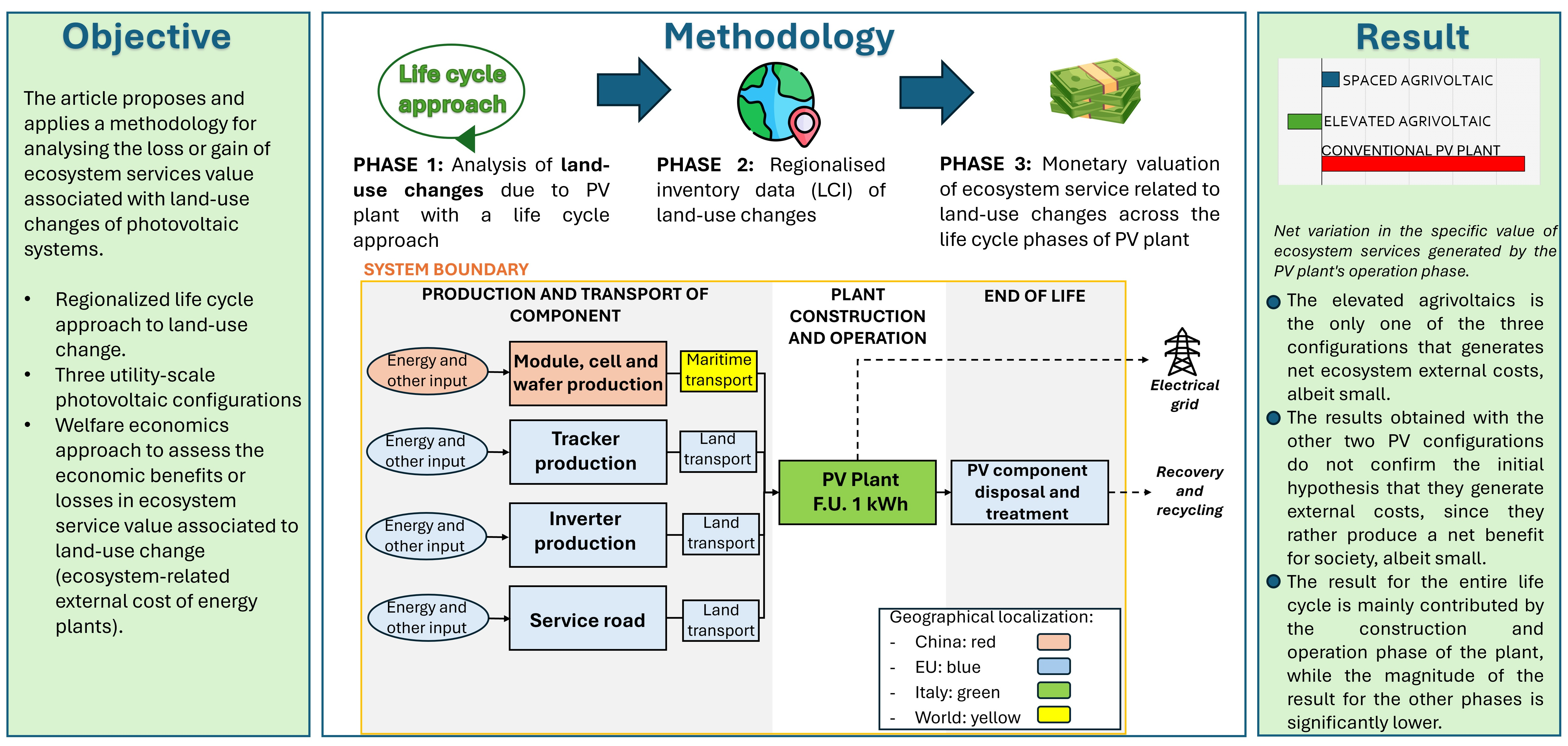
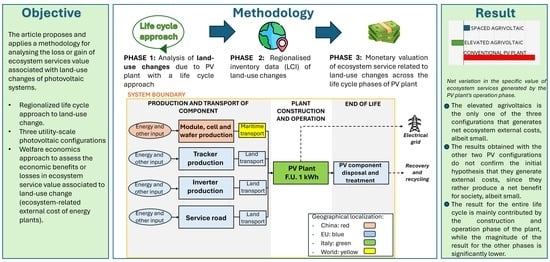
- To develop a regionalized methodology for analyzing ecosystem-related external costs associated with land-use changes induced by renewable energy plants. The methodology is designed to be applicable across the main life cycle phases of a PV system: production, construction, operation, and end of life.
- To apply the proposed methodology to a utility-scale PV system, considering three alternative configurations: a 56 MW ground-mounted plant, an elevated agrivoltaic plant of the same capacity, and a ‘spaced’ agrivoltaic plant with a capacity of 39 MW, occupying the same total area as the other two. The goal is to identify the configurations that minimize the ecosystem external costs in relation to the kWh produced, calculated with a life cycle approach. The technical details of the three configurations were developed based on a project for a new ground-mounted photovoltaic plant in a rural area of central Italy. The exact geographical location of the facility has been anonymized as the project is currently undergoing authorization.
2. Materials and Methods
- It focuses exclusively on ES associated with land-use-change data resulting from the main phases of the PV system life cycle, with information obtained through direct spatial mapping or LCA inventories. Due to the investigative assumptions and the pioneering nature of the methodology, it does not use environmental footprint categories and related impact indicators such as climate change, ecotoxicity, or acidification [79].
- It applies an economic valuation approach to environmental externalities (commonly referred to as ‘monetary LCA’ [11], and sometimes described in the literature as ‘socio-environmental externalities LCA’ [80], to estimate changes in economic well-being associated with specific environmental impact categories. We quantify the negative or positive variation in the economic value of ES resulting from land-use changes across the life cycle phases of PV systems. A reduction in value is classified as an ‘ecosystem external cost,’ while an increase is considered an ‘ecosystem external benefit’. The economic approach is characterized by the aggregation (sum) of the annual value of specific ES (e.g., CO2 removal, erosion mitigation, agricultural pollination) per hectare of ecosystem type, using a monetary unit of measure (e.g., EUR2022/ha-y) that reflects environmental economics methods to elicit people preferences for ES [23,24]. A summary of the main sources of data and economic valuation methods used for each ecosystem service in Italy is provided in Table S22. To obtain differentiated values on a regional scale we used ‘benefit transfer’ techniques, elaborating results of literature studies that applied economic valuation techniques to the benefits provided by different categories of ecosystems to humans in a specific geographical and socio-economic context (e.g., national territory, a region, a rural area, a natural park).
- It refers to the so-called regionalised LCA approach [75], which models the main life cycle phases based on their actual geographic location. In this framework, different ES values are applied to the same amount of land-use change depending on where it occurs, in contrast to traditional LCA methods that use uniform characterization factors globally.
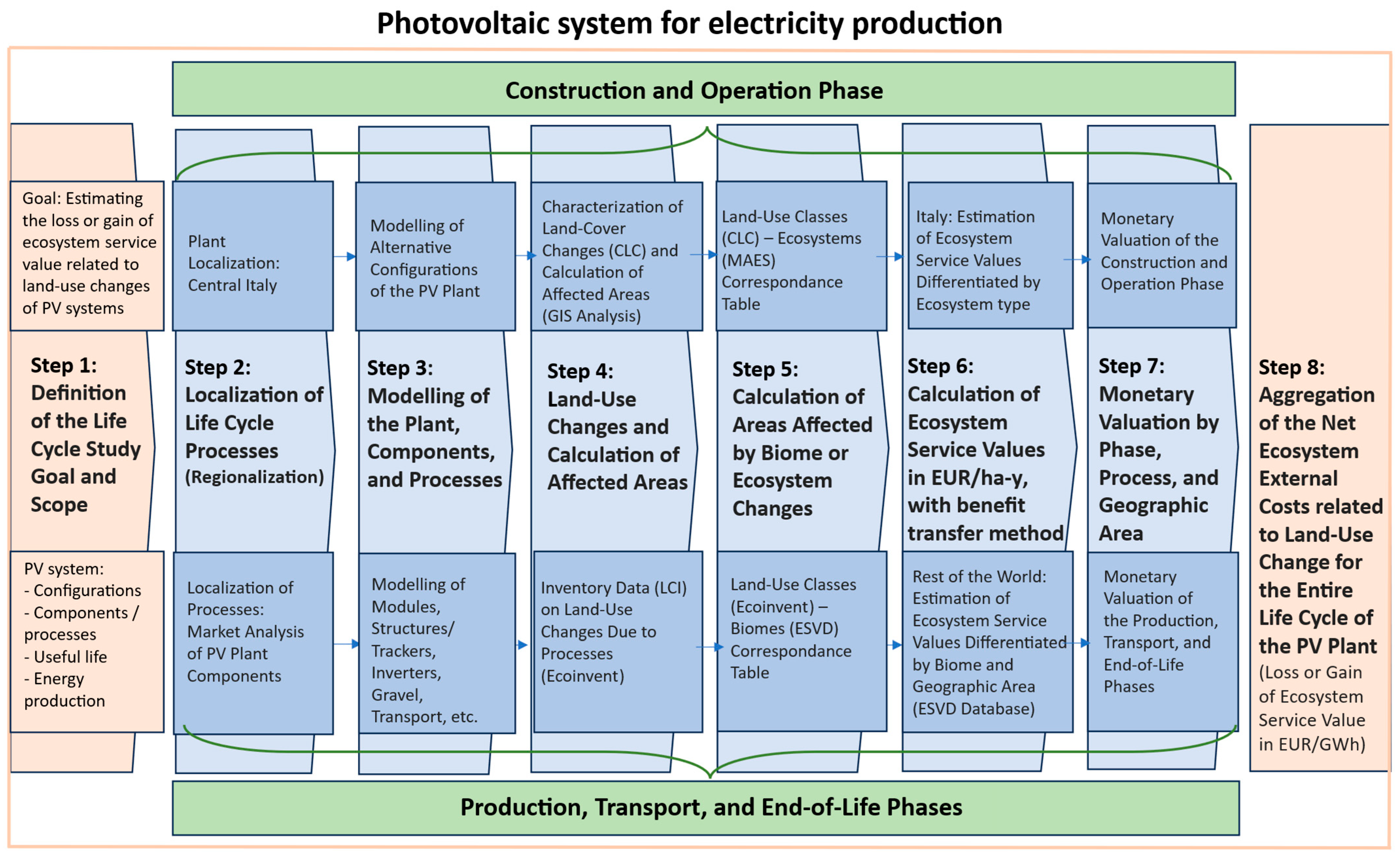
- Definition of the goal of the study and preliminary delimitation of the scope of the life cycle investigation of land-use change with reference to components, processes, useful life, and energy producibility of the PV plant (Step 1 in Figure 1).
- Geographical localisation of life cycle components and processes (Step 2).
- Modelling of the plant, its components, and processes (Step 3).
- Identification of land-use-change classes, estimation of the affected areas by land-use class in each region, and duration of land occupation (Step 4).
- Application of correspondence tables between land-use classes and biome/ecosystem types for calculating the areas of the biome/ecosystem type affected by land-use changes (Step 5).
- Calculation of ecosystem service monetary values per hectare-year using benefit transfer method, differentiated by biome/ecosystem and geographical region (Step 6).
- Use of ecosystem service unit values for the monetary valuation of ES net losses or benefits associated with areas affected by biome/ecosystem changes (by phase, component/process, and geographical area, Step 7).
- Summation of results in EUR/GWh across components/processes and life cycle phases of the photovoltaic plant (Step 8).
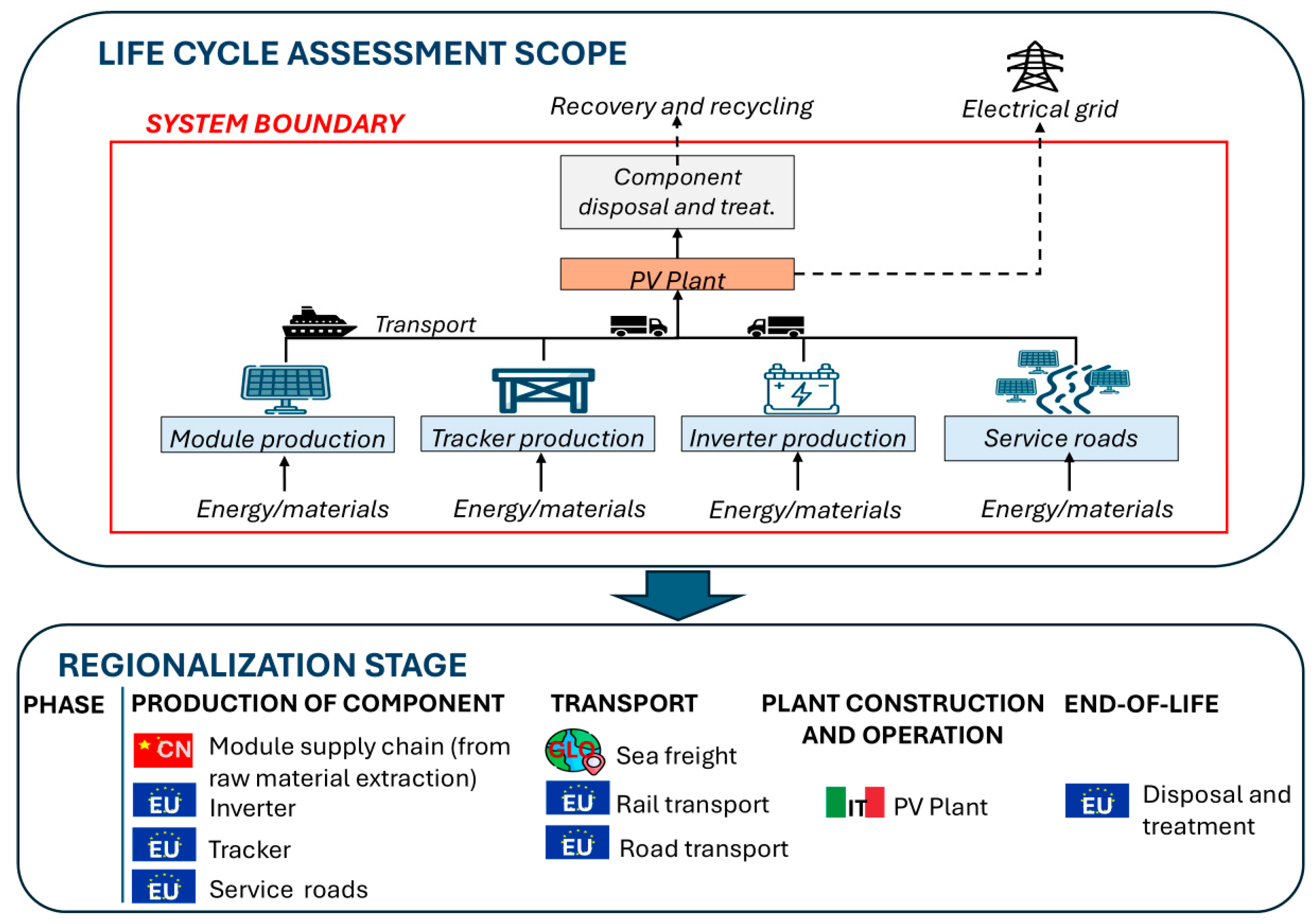
- Modules (56 MW for the reference plant and the elevated agrivoltaics plant, 39.2 MW for the spaced agrivoltaics plant): production and transport.
- Support structure—solar trackers (a total weight of 623 kg is required to support 26 modules in both the reference and spaced agrivoltaic systems, whereas the elevated agrivoltaic system requires 886 kg for every 26 modules): production and transport.
- Inverters (13 inverters of 3437 kW each for the reference plant and the elevated agrivoltaics plant, 9 inverters for the spaced agrivoltaics plant): production and transport.
- Materials for the PV plant’s roads (11,844 m of dirt roads, of which 8568 m for perimeter roads—4 m wide). The modelling of road materials includes the extraction processes and any necessary processing to obtain the final material.
- China, for module production.
- The entire world, for maritime transport services from China to Italy (the route involves three continents and international cargo ships are built in many different world areas).
- The EU for all other components (trackers, inverters, gravel roads) and processes (transport, disposal, and incineration of the PV system components).
- The reports developed by the JRC [25,26,27] with the aim of establishing a system of experimental ecosystem economic accounts at the European Union level, consistent with the United Nations SEEA-EEA methodological standard, which have led to a biophysical and monetary mapping for various types of ES in many member states of the EU (including Italy).
- The methodology developed by ISPRA/SNPA for the monetary evaluation of ecosystem service losses due to land consumption, illustrated in a specific methodological annex of the 2018 report [89].
- is the differential value (net monetary loss or net benefit) of ES associated with land-use changes in the production, transport, and end-of-life phases of the reference PV system.
- is the average land occupation duration, expressed in years, of the production, transport, and end-of-life phases.
- is the value, expressed in EUR/ha-year, of the ES annually provided by land-use class in a given geographical area j.
- is the net balance, for a given land-use class i and a given geographical area j, between the summed area of ‘Transformation to [land-use class i]’ and ‘Transformation from [land-use class i]’ across all processes related to a given geographical area j.
- (a)
- Goal and Scope Definition.
- (b)
- Life Cycle Inventory (LCI).
- (c)
- Life Cycle Impact Assessment (LCIA).
- (d)
- Interpretation.
3. Description of the Case Study
The Reference Plant and Alternative Configurations
4. Results
4.1. Monetary Results
4.1.1. Results for Production, Transport, and End-of-Life Phases
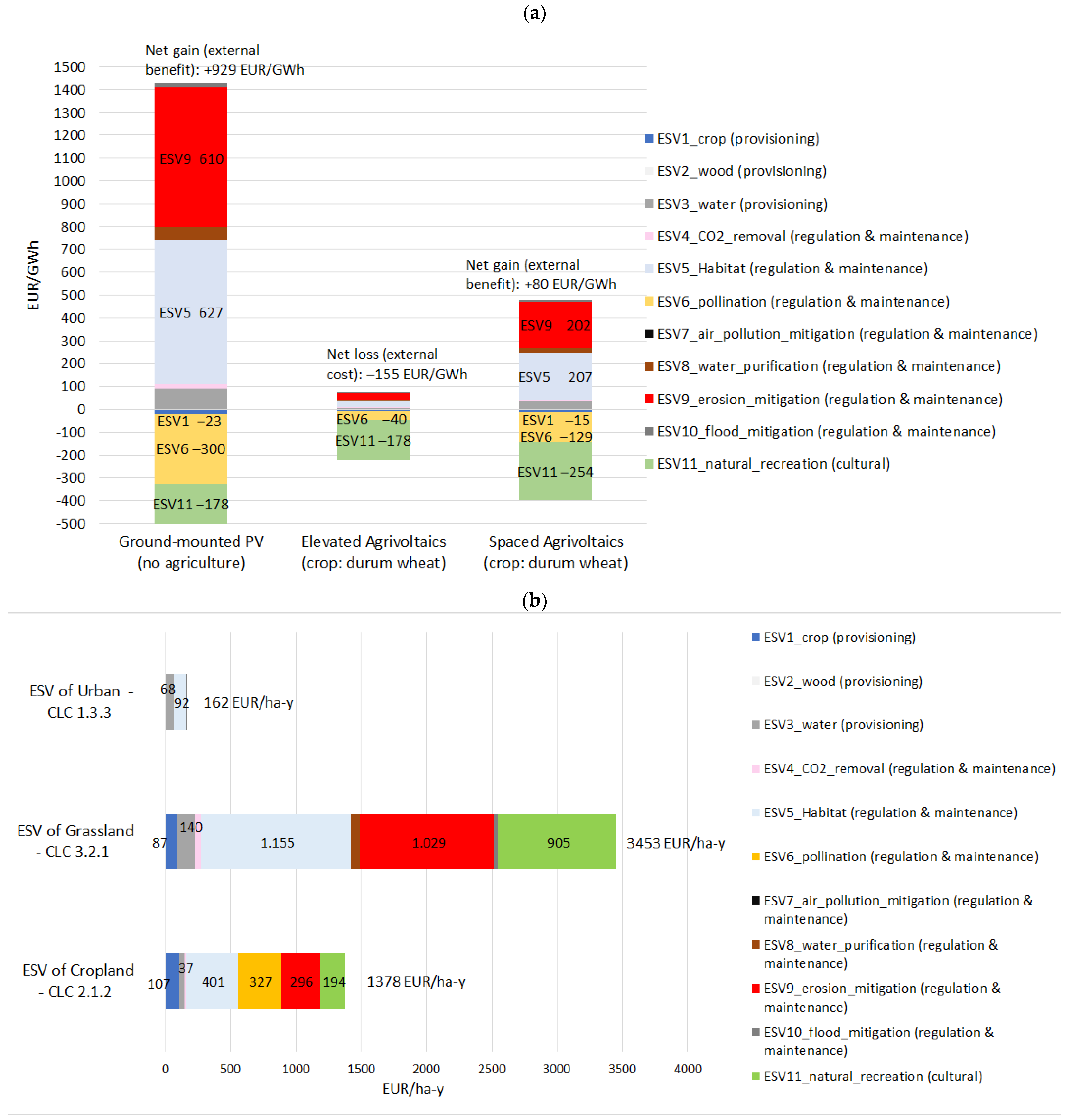
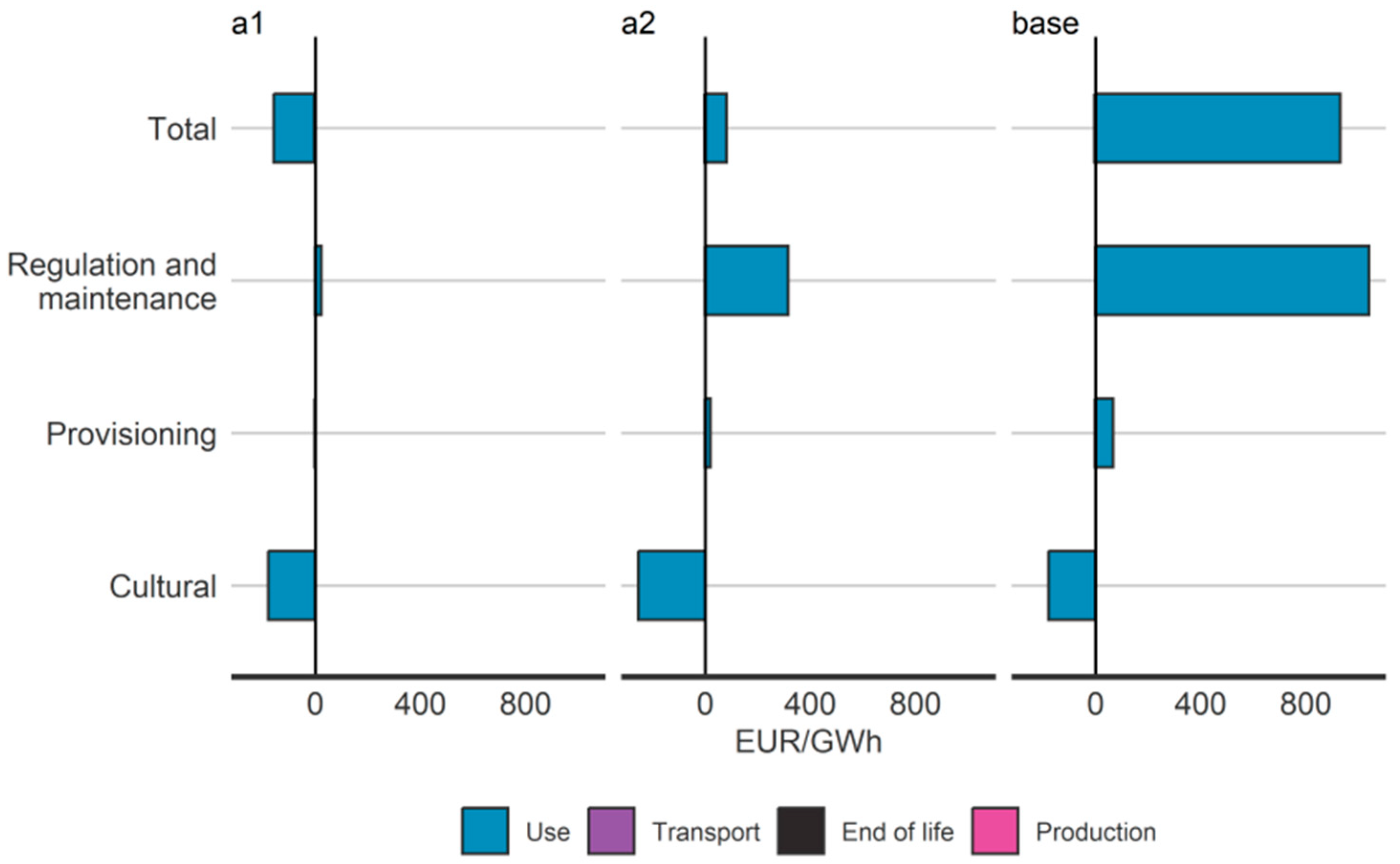
4.1.2. Results for the Building and Operation Phase
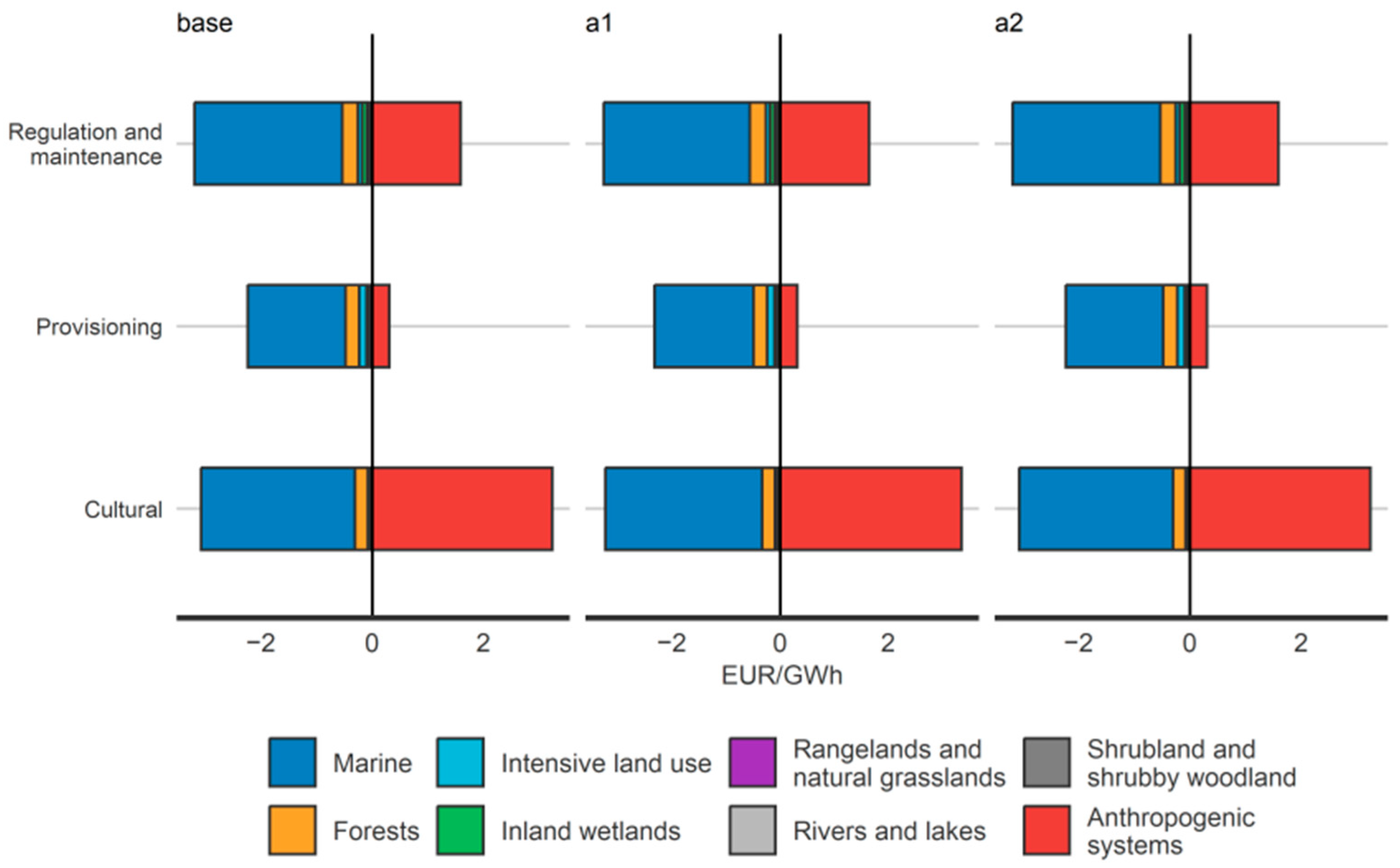
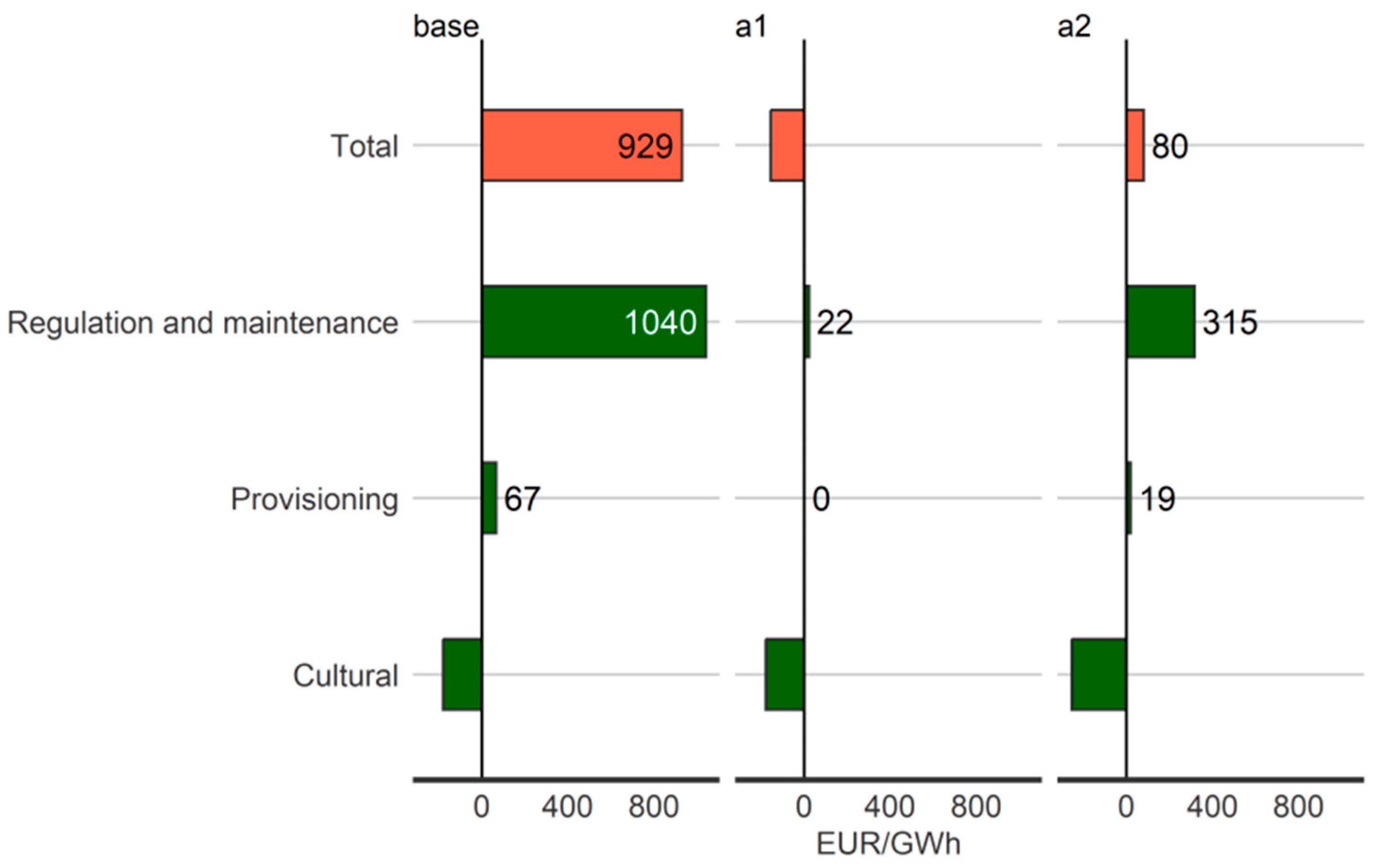
4.1.3. Aggregation of Life Cycle Phases
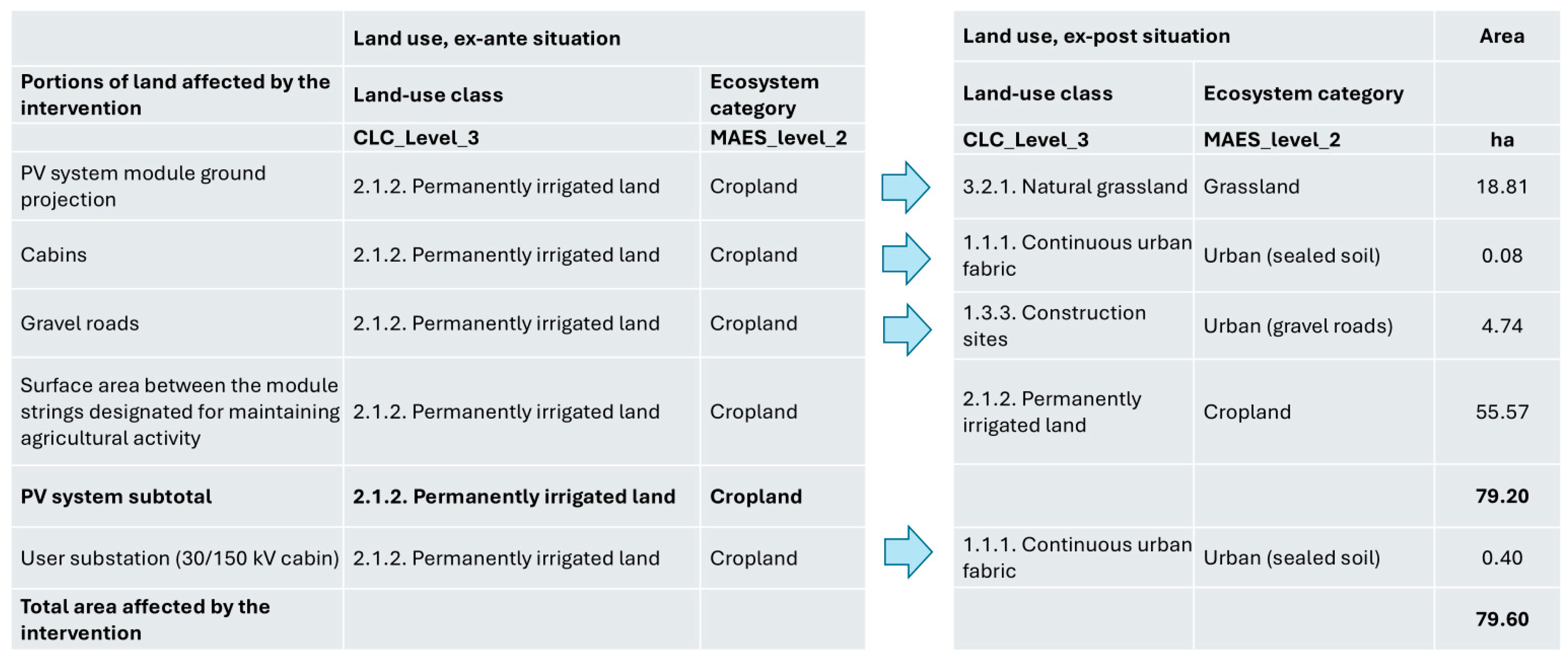
4.2. Inside the Box: Intermediate Results on Land Use and Ecosystem Changes Due to PV Plants
4.2.1. Intermediate Results on Land Use and Ecosystem Changes for Production, Transport, and End-of-Life Phases
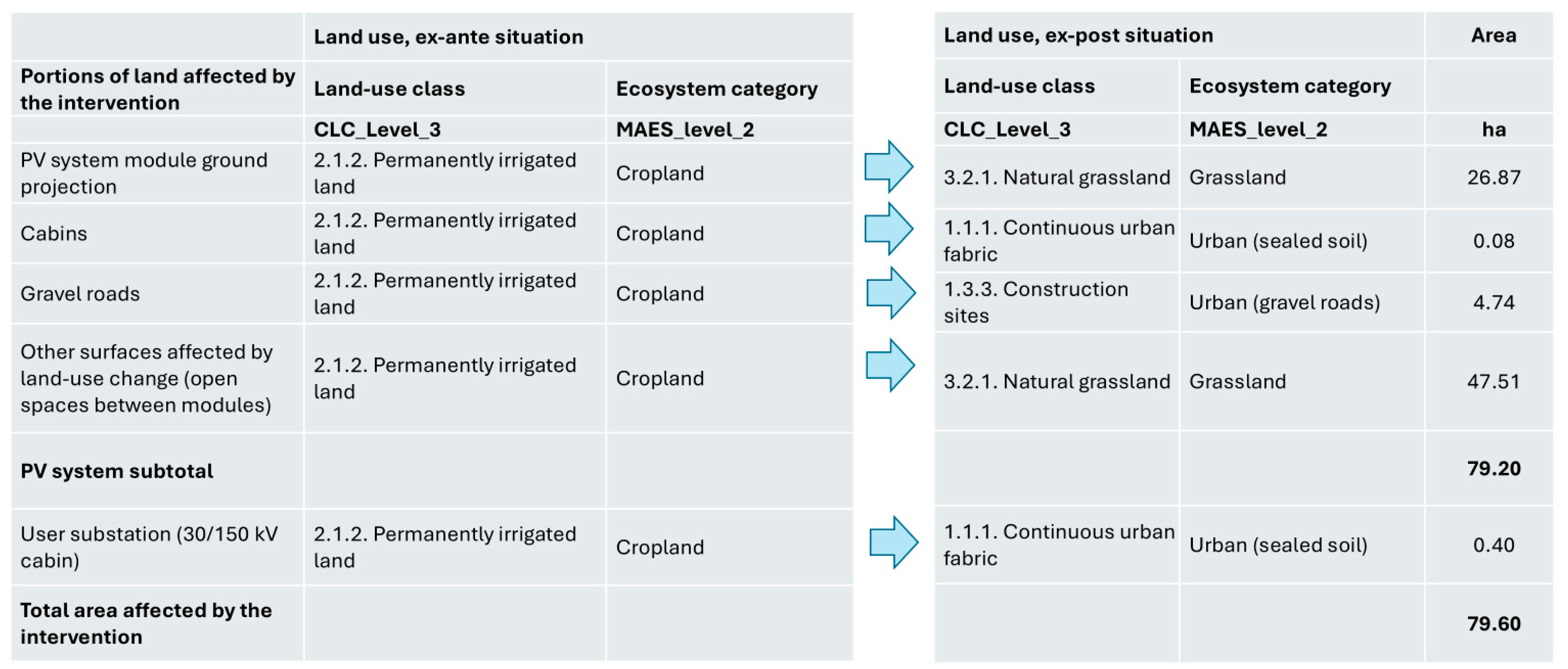
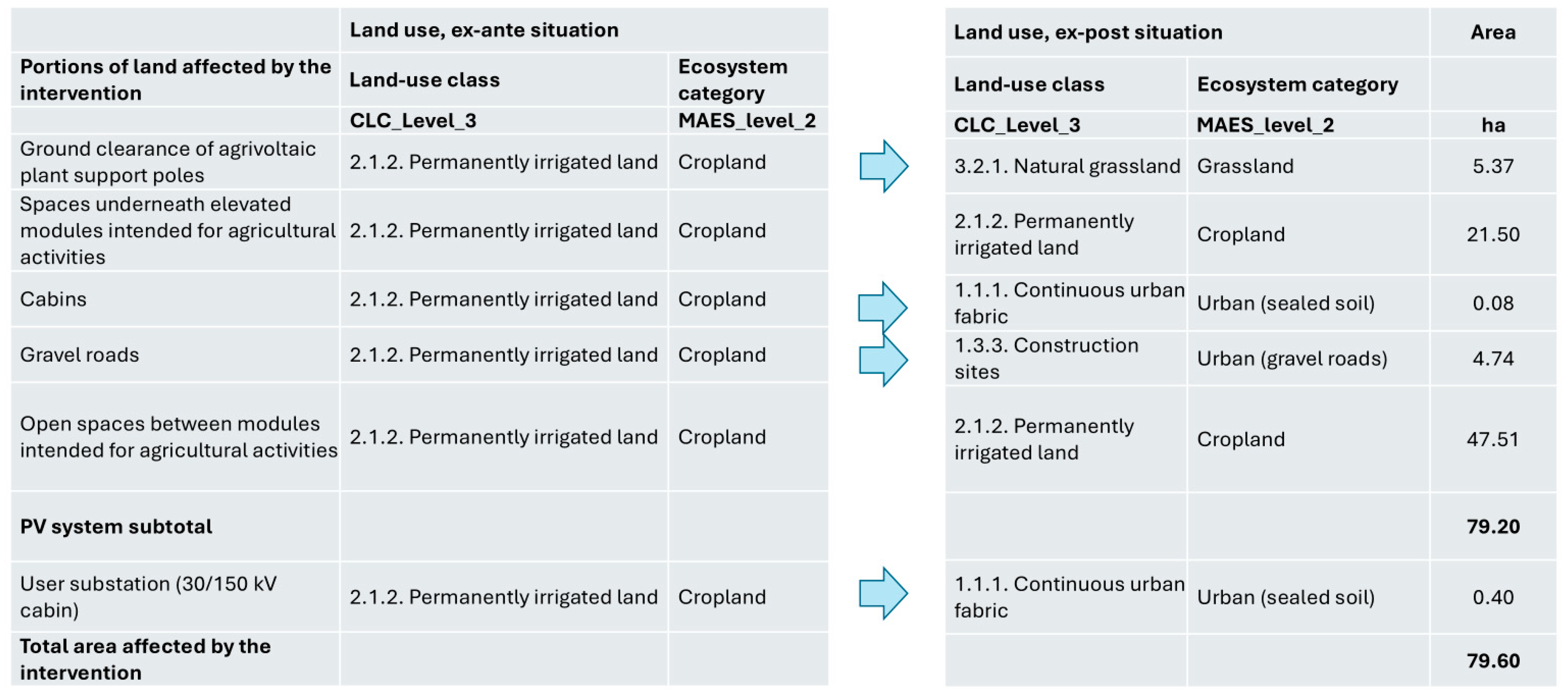
4.2.2. Intermediate Results on Land-Use and Ecosystem Changes—Construction and Operation Phase
5. Discussion
6. Conclusions
- Not all cropland has equal ES value and well-designed ground-mounted PV on intensive arable land can deliver a net ecosystem service benefit. Our results for the ground-mounted conventional PV plant confirm the current approach of the EU Taxonomy (no quantitative DNSH criteria for ecosystem services) while at the same time refuting the ecosystem-based justifications for the recent Italian restrictions on ground-mounted PV in agricultural areas.
- Supply chain ES impacts are comparatively smaller than those related to construction-site land-cover changes; therefore, siting, PV plant design, and Operation and Maintenance (O&M) are decisive for achieving a net positive outcome.
- During the siting process, low ES value areas should be prioritized (e.g., arable land with intensive cereal cropping in non-protected zones or already urbanized/industrial land) to avoid high-value ecosystems (forests, wetlands, natural grasslands).
- Design and vegetation management matter: where trackers are mounted on posts without concrete slabs and spontaneous herbaceous cover is maintained during operation (no herbicides), ES value related to habitat quality, erosion mitigation, and water provisioning increases compared to the ex-ante agricultural situation.
- For policymakers, regulators, and regional planners:Land mapping of ES benefits by land-use class can be used during EIA to prioritize PV plant siting; ES externalities can be integrated into CBA as a decision-making tool; low-impact construction standards can be developed in line with ES (pile-driven posts, minimal road footprints, permeable surfaces, and vegetated inter-row areas); good environmental practices should be encouraged (prohibition of herbicide, managed grazing, and pollinator habitat). Given that ES value for nature-based recreation (ES11) decreases due to fencing, perimeter trails or guided access to preserve some recreational value is recommended. If elevated agrivoltaics is supported to maintain agricultural income, ecological management requirements (e.g., crop rotations, low-input practices, water-saving irrigation, pollinator strips) can be linked to incentives so that regulation and maintenance ES also improve in portions of land where agricultural activities are maintained.
- For developers and engineering companies:They can choose and design configurations to fit the ES context: on low-value arable land, conventional ground-mounted PV with vegetation-positive O&M tends to maximize ES net benefits; where arable crops must be partially maintained, spaced agrivoltaics can balance energy production with ES value better than elevated agrivoltaic; if crop type can be changed to higher-value crops more suitable for the shading features of elevated agrivoltaic, the expected increase in crop provisioning value (ESV1) must compensate for possible negative variations in other ES to maintain a net positive result compared to previous agricultural context.
- For farmers:In ground-mounted PV plants, farmers can explore side revenues (grazing services, honey/pollination partnerships) enabled by PV vegetation management plans. Farmers play an essential role in agrivoltaics. Even though our methodology does not model agricultural practices (as they are outside the scope of the article), other sources have demonstrated that improved crop rotations, reduced use of fertilizers and pesticide (Weißhuhn et al., 2017 [98]), integration of cover crops during fallow periods (Huang et al., 2025 [99]), and precision irrigation (De Francesco et al., 2025 [100]) can positively contribute to —respectively— regulation ES, erosion mitigation, and water provisioning. However, these benefits should be still evaluated in economic terms.
Supplementary Materials
Author Contributions
Funding
Data Availability Statement
Acknowledgments
Conflicts of Interest
Abbreviations
| CBA | Cost–Benefit Analysis |
| CHN | China |
| CICES | Common International Classification of Ecosystem Services |
| CLC | Corine Land Cover |
| DNSH | Do No Significant Harm |
| EC | European Commission |
| EEA | European Environment Agency |
| EIA | Environmental Impact Assessment |
| EoL | End of Life |
| ES | Ecosystem Services |
| ESV | Ecosystem Service Value |
| ESVD | Ecosystem Services Valuation Database |
| EU | European Union |
| KIP-INCA | Knowledge Innovation Project on an Integrated System for Natural Capital Accounting |
| LCA | Life Cycle Assessment |
| LCCA | Life Cycle Cost Analysis |
| LCIA | Life Cycle Impact Assessment |
| MAES | Mapping European Ecosystem and their Services (EC project) |
| PUN | Average National Wholesale Reference Price of Electricity |
| PV | Photovoltaic |
| RSNC | Report on the State of Natural Capital |
| SM | Supplementary Material |
| TEEB | The Economics of Ecosystem and Biodiversity |
| VOLY | Value Of a Life-expectancy Year Lost |
References
- Varun; Bhat, I.K.; Prakash, R. LCA of renewable energy for electricity generation systems—A review. Renew. Sustain. Energy Rev. 2009, 13, 1067–1073. [Google Scholar] [CrossRef]
- Turconi, R.; Boldrin, A.; Astrup, T.F. Life cycle assessment (LCA) of electricity generation technologies: Overview, comparability and limitations. Renew. Sustain. Energy Rev. 2013, 28, 555–565. [Google Scholar] [CrossRef]
- Wang, X.; Guo, L.; Xue, G.; Tan, J.; Niu, W.; Wu, Y. Toward Low Carbon Power Systems: Reviewing Life Cycle Carbon Footprints of Diverse Generation Pathways. Energies 2025, 18, 6413. [Google Scholar] [CrossRef]
- Hernandez, R.R.; Easter, S.B.; Murphy-Mariscal, M.L.; Maestre, F.T.; Tavassoli, M.; Allen, E.B.; Barrows, C.W.; Belnap, J.; Ochoa-Hueso, R.; Ravi, S.; et al. Environmental impacts of utility-scale solar energy. Renew. Sustain. Energy Rev. 2014, 29, 766–779. [Google Scholar] [CrossRef]
- Bigiotti, S.; Santarsiero, M.L.; Costantino, C.; Marucci, A. Photovoltaic Technology and Rural Landscapes: A Systematic Literature Review on Challenges and Sustainable Integration. Energies 2025, 18, 2095. [Google Scholar] [CrossRef]
- Directive 2011/92/EU of the European Parliament and of the Council of 13 December 2011 on the assessment of the effects of certain public and private projects on the environment (codification). EU OJ L 26, 28 January 2012; p. 1–21. Available online: https://eur-lex.europa.eu/eli/dir/2011/92/oj/eng (accessed on 29 December 2025).
- Regulation EU 2020/852 of the European Parliament and of the Council of 18 June 2020 on the establishment of a framework to facilitate sustainable investment, and amending Regulation (EU) 2019/208. EU OJ L 198, 22 June 2020; pp. 13–40. Available online: https://eur-lex.europa.eu/eli/reg/2020/852/oj/eng (accessed on 29 December 2025).
- European Commission. Delegated Regulation 2021/2139 of 4 June 2021 Supplementing Regulation (EU) 2020/852 by Establishing the Technical Screening Criteria for Determining the Conditions Under Which an Econimic Activity Qualifies as Contributing Substantially to Change Mitigation or Adaptation. EU OJ L 442, 9 December 2021. Available online: https://eur-lex.europa.eu/eli/reg_del/2021/2139/oj/eng (accessed on 29 December 2025).
- European Commission. Delegated Regulation (EU) 2023/2486 of 27 June 2023 Establishing the Technical Screening Criteria for Protection of Water and Marine Resources, Circular Economy, Pollution Prevention and Protection and Restoration of Biodiversity and Ecosystems. EU OJ L 2486, 21 November 2023. Available online: https://eur-lex.europa.eu/eli/reg_del/2023/2486/oj/eng (accessed on 29 December 2025).
- Italian Government. Decreto-Legge 15 Maggio 2024, n. 63, Coordinato con la Legge di Conversione 12 Luglio 2024 Disposizioni Urgenti per le Imprese Agricole, della Pesca e Dell’acquacoltura, Nonche’ per le Imprese di Interesse Strategico Nazionale. Gazzetta Ufficiale—Serie Generale, 13 July 2024, no. 163. Available online: https://www.normattiva.it/uri-res/N2Ls?urn:nir:stato:decreto.legge:2024-05-15;63 (accessed on 29 December 2025).
- Amadei, A.; De Laurentiis, V.; Sala, S. A review of monetary valuation in life cycle assessment: State of the art and future needs. J. Clean. Prod. 2021, 329, 129668. [Google Scholar] [CrossRef]
- Pizzol, M.; Weidema, B.; Brandão, M.; Osset, P. Monetary valuation in Life Cycle Assessment: A review. J. Clean. Prod. 2015, 86, 170–179. [Google Scholar] [CrossRef]
- Norris, G.A. Integrating Economic Analysis into LCA. Environ. Qual. Manag. 2001, 10, 59–64. [Google Scholar] [CrossRef]
- Kara, S. Life Cycle Cost. In CIRP Encyclopedia of Production Engineering; Springer: Berlin/Heidelberg, Germany, 2014. [Google Scholar]
- Wernet, G.; Bauer, C.; Steubing, B.; Reinhard, J.; Moreno-Ruiz, E.; Weidema, B. The Ecoinvent database version 3 (part I): Overview and methodology. Int. J. Life Cycle Assess. 2016, 21, 1218–1230. [Google Scholar] [CrossRef]
- Weidema, B.; Bauer, C.; Hischier, R.; Mutel, C.; Nemececk, T.; Vadenbo, C.O.; Wernet, G. Overview of Methodology. Data quality guideline for the ecoinvent data base version 3. In Ecoinvent Report 1(v3); The Ecoinvent Centre: St. Gallen, Switzerland, 2013. [Google Scholar]
- Marmiroli, B.; Carvalho, M.L.; Mela, G.; Molocchi, A.; Girardi, P. Life cycle assessment and evaluation of external costs of the Italian electricity mix (cap. 20). In Proceedings of the 9th International Conference on Energy and the Environment Research (ICEER), Porto, Portugal, 12–16 September 2022; Springer Nature: Cham, Switzerland, 2023; pp. 203–213. [Google Scholar]
- Haines-Young, R.; Potschin, M.B. Common International Classification of Ecosystem Services (CICES) V5.1 and Guidance on the Application of the Revised Structure; Centre for Environmental Management, University of Nottingham: Nottingham, UK, 2018. [Google Scholar]
- Bologna, G. Noi siamo natura. In Un Nuovo Modo di Stare al Mondo; Edizioni Ambiente: Milano, Italy, 2022; p. 365. [Google Scholar]
- Sukhdev, P.; Wittmer, H.; Schröter-Schlaack, C.; Neßhöver, C.; Bishop, J.; Brink, P.T.; Gundimeda, H.; Kumar; Simmons; Neuville. TEEB Synthesis Report. The Economics of Ecosystems and Biodiversity: Mainstreaming the Economics of Nature: A Synthesis of the Approach, Conclusions and Recommendations of TEEB; TEEB: Geneva, Switzerland, 2012. [Google Scholar]
- Comitato per il Capitale Naturale. Primo Rapporto Sullo Stato del Capitale Naturale in Italia; MATTM: Roma, Italy, 2017. [Google Scholar]
- Comitato per il Capitale Naturale. Secondo Rapporto Sullo Stato del Capitale Naturale in Italia; MATTM: Roma, Italy, 2018. [Google Scholar]
- Kumar, P. (Ed.) The Economics of Ecosystems and Biodiversity: Ecological and Economic Foundations; Earthscan: London, UK; Washington, DC, USA, 2010; p. 422. [Google Scholar]
- NCAVES; MAIA. Monetary Valuation of Ecosystem Services and Ecosystem Assets for Ecosystem Accounting: Interim Version, 1st ed.; United Nations Department of Economic and Social Affairs, Statistics Division: New York, NY, USA, 2022. [Google Scholar]
- La Notte, A.; Vallecillo, S.; Garcia-Bendito, E.; Grammatikopoulou, I.; Czùcz, B.; Ferrini, S.; Grizzetti, B.; Rega, C.; Herrando, S.; Villero, D.; et al. Ecosystem Services Accounting. Part III—Pilot Accounts for Habitat and Species Maintenance, on-Site Soil Retention and Water Purification; Publications Office of the European Union: Luxembourg, 2021. [Google Scholar]
- Vallecillo, S.; La Notte, A.; Polce, C.; Zulian, G.; Alexandris, N.; Ferrini, S.; Maes, J. Ecosystem Services Accounting: Part I—Outdoor Recreation and Crop Pollination, EUR 29024 EN; Publications Office of the European: Luxembourg, 2018. [Google Scholar]
- Vallecillo, S.; La Notte, A.; Kakoulaki, G.; Kamberaj, J.; Robert, N.; Dottori, F.; Feyen, L.; Rega, C.; Maes, J. Ecosystem Services Accounting. Part II-Pilot Accounts for Crop and Timber Provision, Global Climate Regulation and Flood Control EUR 29731 EN; Publications Office of the European Union: Luxembourg, 2019. [Google Scholar]
- Pérez-Soba, M.; Elbersen, B.; Braat, L.; Kempen, M.; van der Wijngaart, R.; Staritsky, I.; Rega, C.; Paracchini, M.L. The Emergy Perspective: Natural and Anthropic Energy Flows in Agricultural Biomass Production; Publications Office of the European Union: Luxembourg, 2019; ISBN 978-92-76-02057-8. [Google Scholar]
- CE Delft; TRT; INFRAS; Ricardo. Handbook on the External Costs of Transport; Report Commissioned by DG MOVE of the European Commission; European Commission DG Mobility and Transport: Brussels, Belgium, 2019. [Google Scholar]
- Huang, B.; Wang, Y.; Huang, Y.; Xu, X.; Chen, X.; Duan, L.; Yu, G.; Li, Z.; Liu, H.; Wei, K.H.; et al. Life cycle cost analysis of solar energy via environmental externality monetization. Sci. Total Environ. 2023, 856, 158910. [Google Scholar]
- Rentizelas, A.; Georgakellos, D. Incorporating life cycle external cost in optimization of the electricity generation mix. Energy Policy 2014, 65, 134–149. [Google Scholar] [CrossRef]
- Bickel, P.; Friedrich, R. ExternE—Externalities of Energy, Methodology Update; European Commission: Brussels, Belgium, 2005. [Google Scholar]
- European Commission 1995a: Directorate-General for Research and Innovation. ExternE—Externalities of Energy. Volume 2. Methodology; Publications Office: Brussels, Belgium, 1995.
- European Commission 1995b: Directorate-General for Research and Innovation. ExternE—Externalities of Energy. Volume 4. Oil & Gas; Publications Office: Brussels, Belgium, 1995.
- European Commission 1995c: Directorate-General for Research and Innovation. ExternE—Externalities of Energy, Volume 6. Wind and Hydro; Publications Office: Brussels, Belgium, 1995.
- European Commission—Directorate General of Research Innovation; Bickel, P.; Friedrich, R. (Eds.) Externalities of Energy—Methodology 2005 Update; Office for Official Publications of the European Communities: Luxembourg, 2005. [Google Scholar]
- Schucht, S.; Real, E.; Létinois, L.; Colette, A.; Holland, M.; Spadaro, J.V.; Opie, L.; Brook, R.; Garland, L.; Gibbs, M. Costs of Air Pollution from European Industrial Facilities 2008–2017; EEA—European Topic Centre on Air Pollution, Transport, Noise and Industrial Pollution: Bilthoven, The Netherlands, 2021. [Google Scholar]
- EEA—European Environment Agency. Estimating the Externl Cost of Industrial Air Pollution. Trends 2012–2021. Technical Note on the Methodology and Additional Results from the EEA Briefing 24/2023; EEA: Copenhagen, Denmark, 2024. [Google Scholar]
- Baumgärtner, F.; Letmathe, P. External costs of electricity generation in 27 European countries from 2010–2030: Pathway toward sustainability or business as usual? PLoS ONE 2024, 19, e0294499. [Google Scholar] [CrossRef] [PubMed]
- Streimikiene, D.; Alisauskaite-Seskiene, I. External costs of electricity generation options in Lithuania. Renew. Energy 2014, 64, 215–224. [Google Scholar] [CrossRef]
- Lu, J.; Wang, C.; Zhang, C.; Guan, H.; Skare, M.; Streimikisv, J. Avoided external energy costs due to penetration of renewables: Evidence from Baltic States. J. Environ. Manag. 2021, 296, 113247. [Google Scholar] [CrossRef]
- Molocchi, A.; Recchini, E.; Tudini, A. Polluter Pays Principle in power production to gradually phase-out fossil fuels in Italy. Econ. Policy Energy Environ. (EPEE) 2019, 1, 203–228. [Google Scholar] [CrossRef]
- Daily, G.C. (Ed.) Nature’s Services: Societal Dependence on Natural Ecosystems; Island Press: Washington, DC, USA, 1997; p. 392. [Google Scholar]
- Millennium Ecosystem Assessment. In Ecosystems and Human Well-being: Synthesis; Island Press: Washington, DC, USA, 2005.
- de Groot, R.; Brander, L.; Solomonides, S. Update of Global Ecosystem Service Valuation Database (ESVD); FSD Report; FSD: Wageningen, The Netherlands, 2020. [Google Scholar]
- Costanza, R.; d’Arge, R.; De Groot, R.; Farber, S.; Grasso, M.; Hannon, B.; Limburg, K.; Naeem, S.; O’Neill, R.V.; Paruelo, J.; et al. The value of the world’s ecosystem service and natural capital. Nature 1997, 387, 253–260. [Google Scholar] [CrossRef]
- Costanza, R.; de Groot, R.; Sutton, P.; van der Ploeg, S.; Anderson, S.; Kubiszewski, I.; Farber, S.; Turner, K. Changes in the global value of ecosystem services. Glob. Environ. Change 2014, 26, 152–158. [Google Scholar] [CrossRef]
- Brander, L.M.; de Groot, R.; Guisado Goñi, V.; van’t Hoff, V.; Schägner, P.; Solomonides, S.; McVittie, A.; Eppink, F.; Sposato, M.; Do, L.; et al. Ecosystem Services Valuation Database (ESVD). Foundation for Sustainable Development and Brander Environmental Economics. 2024. Available online: https://www.esvd.net/login/esvd (accessed on 4 September 2024).
- Maes, J.; Teller, A.; Erhard, M.; Condé, S.; Vallecillo, S.; Barredo, J.I.; Paracchini, M.L.; Abdul Malak, D.; Trombetti, M.; Vigiak, O.; et al. Mapping and Assessment of Ecosystems and Their Services: An EU Ecosystem Assessment; Publications Office of the European Union: Luxembourg, 2020. [Google Scholar]
- Capriolo, A.; Boschetto, R.G.; Mascolo, R.A.; Balbi, S.; Villa, F. Biophysical and economic assessment of four ecosystem services for natural capital accounting in Italy. Ecosyst. Serv. 2020, 46, 101207. [Google Scholar] [CrossRef]
- European Commission—Joint Research Center. Welcome to INCA—Integrated System for Natural Capital Accounting, INCA Platform. JRC, 2024. Available online: https://ecosystem-accounts.jrc.ec.europa.eu/ (accessed on 10 November 2024).
- Semeraro, T.; Pomes, A.; del Giudice, C.; Negro, D.; Aretano, R. Planning ground based utility scale solar energy as green infrastructure to enhance ecosystem services. Energy Policy 2018, 117, 218–227. [Google Scholar] [CrossRef]
- Semeraro, T.; Aretano, R.; Barca, A.; Pomes, A.; Del Giudice, C.; Gatto, E.; Lenucci, M.; Buccolieri, R.; Emmanuel, R.; Gao, Z.; et al. A Conceptual Framework to Design Green Infrastructure: Ecosystem Services as an Opportunity for Creating Sharing Value. Land 2020, 9, 238. [Google Scholar] [CrossRef]
- Semeraro, T.; Scarano, A.; Santino, A.; Emmanuel, R.; Lenucci, M. An innovative approach to combine solar photovoltaic gardens with agricultural production and ecosystem services. Ecosyst. Serv. 2022, 56, 101450. [Google Scholar] [CrossRef]
- Hastik, R.; Basso, S.; Geitner, C.; Haida, C.; Poljanec, A.; Portaccio, A.; Vrščaj, B.; Walzer, C. Renewable energies and ecosystem service impacts. Renew. Sustain. Energy Rev. 2015, 48, 608–623. [Google Scholar] [CrossRef]
- Hastik, R.; Walzer, C.; Haida, C.; Garegnani, G.; Pezzutto, S. Using the “Footprint” Approach to Examine the Potentials and Impacts of Renewable Energy Sources in the European Alps. Mt. Res. Dev. (MRD) 2016, 36, 130–140. [Google Scholar] [CrossRef]
- Kienast, F.; Huberb, N.; Hergerta, R.; Bolligera, J.; Segura Moranc, L.; Hersperger, A. Conflicts between decentralized renewable electricity production and landscape services—A spatially-explicit quantitative assessment for Switzerland. Renew. Sustain. Energy 2017, 67, 397–407. [Google Scholar] [CrossRef]
- Scorza, F.; Pilogallo, A.; Saganeiti, L.; Murgante, B.; Pontrandolfi, P. Comparing the territorial performances of renewable energy sources’ plants with an integrated ecosystem services loss assessment: A case study from the Basilicata region (Italy). Sustain. Cities Soc. 2020, 56, 102082. [Google Scholar] [CrossRef]
- Walston, L.J.; Li, Y.; Hartmann, H.M.; Macknick, J.; Hanson, A.; Nootenboom, C.; Lonsdorf, E.; Hellmann, J. Modeling the ecosystem services of native vegetation management practices at solar energy facilities in the Midwestern United States. Ecosyst. Serv. 2021, 47, 101227. [Google Scholar] [CrossRef]
- de Assis Espécie, M.; Ninô de Carvalho, P.; Bacile Pinheiro, M.F.; Mesquita Rosenthal, V.; Ferreira da Silva, L.A.; Rodrigues de Carvalhaes Pinheiro, M.; Andreoli Espig, S.; Fiorillo Mariani, C.; Medeiros de Almeida, E.; Ganança Abreu dos Santos, F.N. Ecosystem services and renewable power generation: A preliminary literature review. Renew. Energy 2019, 140, 39–51. [Google Scholar] [CrossRef]
- Picchi, P.; van Lieropb, M.; Geneletti, D.; Stremke, S. Advancing the relationship between renewable energy and ecosystem services for landscape planning and design: A literature review. Ecosyst. Serv. 2019, 35, 241–259. [Google Scholar] [CrossRef]
- Samadi, S. The Social Costs of Electricity Generation—Categorising Different Types of Costs and Evaluating Their Respective Relevance. Energies 2017, 10, 356. [Google Scholar] [CrossRef]
- Mattmann, M.; Logar, I.; Brouwer, R. Wind power externalities: A meta-analysis. Ecol. Econ. 2016, 127, 23–36. [Google Scholar] [CrossRef]
- Zerrahn, A. Wind Power and Externalities. Ecol. Econ. 2017, 141, 245–260. [Google Scholar] [CrossRef]
- Pilogallo, A.; Saganeiti, L.; Scorza, F.; Murgante, B. Ecosystem Services Approach to Evaluate Renewable Energy Plants Effects. In Computational Science and Its Applications—ICCSA 2019; Misra, S., Gervasi, O., Murgante, B., Stankova, E., Korkhov, V., Torre, C., Rocha, A.M.A.C., Taniar, D., Apduhan, B.O., Tarantino, E., Eds.; Lecture Notes in Computer Science; Springer: Berlin/Heidelberg, Germany, 2019. [Google Scholar]
- Lafitte, A.; Sordello, R.; Ouédraogo, D.Y.; Thierry, C.; Marx, G.; Froidevaux, J.; Schatz, B.; Kerbiriou, C.; Gourdain, P. Existing evidence on the effects of photovoltaic panels on biodiversity: A systematic map with critical appraisal of study validity. Environ. Evid. 2023, 12, 25. [Google Scholar] [CrossRef]
- Mori, K.; Tabata, T. Comprehensive Evaluation of Photovoltaic Solar Plants vs. Natural Ecosystems in Green Conflict Situations. Energies 2020, 13, 6224. [Google Scholar] [CrossRef]
- Caprioli, C.; Dell’Anna, F.; Fiermonte, F. Renewable Energy Sources and Ecosystem Services: Measuring the Impacts of Ground-Mounted Photovoltaic Panels. In Computational Science and Its Applications—ICCSA 2023 Workshops; Springer: Berlin/Heidelberg, Germany, 2023; Volume 14108. [Google Scholar]
- OECD. Cost-Benefit Analysis and the Environment: Further Developments and Policy Use; OECD Publishing: Paris, France, 2018. [Google Scholar]
- Kashi, B.; Simpson, D.; Simón, C. Integrating Ecosystem Values into Cost-Benefit Analysis: Recommendations for USAID and Practitioners; Conservation Strategy Fund: Washington, DC, USA, 2019. [Google Scholar]
- Jordaan, S.M.; Lee, J.; McClung, M.R.; Moran, M.D. Quantifying the ecosystem services values of electricity generation in the US Chihuahuan Desert: A life cycle perspective. J. Ind. Ecol. 2021, 25, 1089–1101. [Google Scholar] [CrossRef]
- Vander Wilde, C.P.; Newell, J.P. Ecosystem services and life cycle assessment: A bibliometric review. Resour. Conserv. Recycl. 2021, 169, 105461. [Google Scholar] [CrossRef]
- Johnston, R.J.; Rolfe, J.; Rosenberger, R.; Brouwer, R. (Eds.) Benefit Transfer of Environmental and Resource Values. Aguide for researchers and practitioners. In The Economics of Non-Market Goods and Resources; Springer: Dordrecht, The Netherlands, 2015; Volume 14. [Google Scholar]
- Molocchi, A.; Mela, G. Elementi Metodologici per la Valutazione Monetaria Delle Esternalità Ecosistemiche Legate ai Cambiamenti di uso e Copertura del Suolo. Rapporto RdS n. 22014464; RSE: Milano, Italy, 2022. [Google Scholar]
- Mutel, C.; Liao, X.; Patouillard, L.; Bare, J.; Fantke, P.; Frischknecht, R.; Hauschild, M.; Jolliet, O.; de Souza, D.M.; Laurent, A.; et al. Overview and recommendations for regionalized life cycle impact assessment. Int. J. Life Cycle Assess. 2019, 24, 856–865. [Google Scholar] [CrossRef]
- Ministero per la Transizione Energetica (MITE). Linee Guida in Materia di Impianti Agrivoltaici. Giugno 2022; MITE: Roma, Italy, 2022. [Google Scholar]
- ISO 14040:2006; Environmental Management—Life Cycle Assessment—Principles and Framework. ISO—International Standard Organisation: Geneva, Switzerland, 2006.
- European Commission-Joint Research Centre—Institute for Environment and Sustainability. ILCD Handbook: Recommendations for Life Cycle Impact Assessment in the European Context, 1st ed.; Publications Office of the European Union: Luxemburg, 2011. [Google Scholar]
- European Commission. 2.0.1.3./.1.7.9./.E.U. Commission Recommendation of 9 April 2013 on the Use of Common Methods to Measure and Communicate the Life Cycle Environmental Performance of Products and Organisations. OJ L 124, 4 May 2013; pp. 1–210. Available online: https://eur-lex.europa.eu/eli/reco/2013/179/oj/eng (accessed on 29 December 2025).
- Garcia-Gusano, D.; Istrate, R.; Iribarren, D. Life–cycle consequences of internalising socio-environmental externalities of power generation. Sci. Total Environ. 2018, 618, 386–391. [Google Scholar] [CrossRef]
- Frischknecht, R.; Stolz, P.; Krebs, R.; de Wild-Scholten, M.; Sinha, P.; Fthenakis, V.; Kim, H.C.; Raugei, M.; Stucki, M. Life Cycle Inventories and Life Cycle Assessment of PV Systems; PVPS Task 12, Report T12-19:2020; International Energy Agency (IEA): Paris, France, 2020. [Google Scholar]
- EPD Italy. Environmental Product Declaration—String Power Inverters SG350HX, SG285HX, SG320HX, SG333HX. Available online: https://www.epditaly.it/epd/string-power-inverters-sg350hx-sg285hx-sg320hx-sg333hx/ (accessed on 4 July 2024).
- Corona, B.; Shen, L.; Reike, D.; Rosales Carreón, J.; Worrell, E. Towards sustainable development through the circular economy—A review and critical assessment on current circularity metrics. Resour. Conserv. Recycl. 2019, 151, 104498. [Google Scholar] [CrossRef]
- Dodd, N.; Espinosa, N.; Van Tichelen, P.; Peeters, K.; Soares, A.M. Preparatory Study for Solar Photovoltaic Modules, Inverters and Systems; Publications Office of the European Union: Luxembourg, 2020. [Google Scholar]
- SimaPro (version 9.5, 2023) [Computer Software]. PRé Sustainability. Amersfoort, The Netherlands. Available online: https://presustainability.com/solutions/tools/simapro/ (accessed on 4 October 2025).
- Brander, L.M.; de Groot, R.; Schägner, J.P.; Guisado-Goñi, V.; van’t Hoff, V.; Solomonides, S.; McVittie, A.; Eppink, F.; Sposato, M.; Do, L.; et al. Economic values for ecosystem services: A global synthesis and way forward. Ecosyst. Serv. 2024, 66, 101606. [Google Scholar] [CrossRef]
- Comitato per il Capitale Naturale. Terzo Rapporto Sullo Stato del Capitale Naturale in Italia; MATTM: Roma, Italy, 2019. [Google Scholar]
- Comitato per il Capitale Naturale. Quarto Rapporto Sullo Stato del Capitale Naturale in Italia; MITE: Roma, Italy, 2021. [Google Scholar]
- Assennato, F.; Braca, G.; Calzolari, C.; Capriolo, A.; di Leginio, M.; Giandon, P.; Marchetti, M.; Marino, D.; Mascolo, R.; Morri, E.; et al. Mappatura e valutazione dell’impatto del consumo di suolo sui servizi ecosistemici: Proposte metodologiche per il rapporto sul consumo di suolo. In Annesso Metodologico al Rapporto sul Consumo di Suolo 2018; ISPRA—SNPA: Roma, Italy, 2018. [Google Scholar]
- Ministero Dell’ambiente e Della Sicurezza Energetica. Valutazioni e Autorizzazioni Ambientali. Progetti—VIA: Ricerca. MASE, 2023. Available online: https://va.mite.gov.it/it-IT/Ricerca/Via (accessed on 29 December 2023).
- European Commission. CORINE Land Cover, Technical Guide; European Commission: Brussels, Belgium, 1994. [Google Scholar]
- Toledo, C.; Scognamiglio, A. Agrivoltaic Systems Design and Assessment: A Critical Review, and a Descriptive Model towards a Sustainable Landscape Vision (Three-Dimensional Agrivoltaic Patterns). Sustainability 2021, 13, 6871. [Google Scholar] [CrossRef]
- ESVD. Our Classifications—Biomes and Ecosystems classifications. ESVD. 2025. Available online: https://www.esvd.info/classifications (accessed on 15 February 2025).
- Committee of Experts on Environmental Economic Accounting, Statistics Division/Department of Economic and Social Affairs, United Nations. Chapter 5: Asset Accounts, in System of Environmental Economic Accounting 2012—Central Framework; United Nations: Geneva, Switzerland, 2014. [Google Scholar]
- GME—Gestore dei Mercati Energetici. Dati di Sintesi Elettrico—Gennaio 2025. 12 February 2025. Available online: https://www.mercatoelettrico.org/Portals/0/Documents/it-IT//202501_Dati_di_sintesi_mensile.pdf (accessed on 5 March 2025).
- Maes, J.; Teller, A.; Erhard, M.; Liquete, C.; Braat, L.; Berry, P.; Egoh, B.; Puydarrieux, P.; Fiorina, C.; Santos, F.; et al. Mapping and Assessment of Ecosystems and Their Services. In An Analytical Framework for Ecosystem Assessmentsunder Action 5 of the EU Biodiversity Strategy to 2020; Publications office of the European Union: Luxembourg, 2013. [Google Scholar]
- Italian Government. DECRETO-LEGGE 24 Gennaio 2012, n. 1, Disposizioni Urgenti per la Concorrenza, lo Sviluppo Delle Infrastrutture e la Competitività, Convertito con Modificazioni Dalla L. 24 Marzo 2012, n. 27. Gazzetta Ufficiale della Rep. Italiana, no. 19—Suppl. ord. n. 18, 24 January 2012. Available online: https://www.normattiva.it/uri-res/N2Ls?urn:nir:stato:decreto.legge:2012-01-24;1 (accessed on 29 December 2025).
- Weißhuhn, P.; Reckling, M.; Stachow, U.; Wiggering, H. Supporting Agricultural Ecosystem Services through the Integration of Perennial Polycultures into Crop Rotations. Sustainability 2017, 9, 2267. [Google Scholar] [CrossRef]
- Huang, W.; Jiang, L.; Zhou, J.; Kim, H.S.; Xiao, J.; Luo, Y. Reduced Erosion Augments Soil Carbon Storage Under Cover Crops. Glob. Change Biol. 2025, 31, e70133. [Google Scholar] [CrossRef] [PubMed]
- De Francesco, C.; Centorame, L.; Toscano, G.; Duca, D. Opportunities, Technological Challenges and Monitoring Approaches in Agrivoltaic Systems for Sustainable Management. Sustainability 2025, 17, 634. [Google Scholar] [CrossRef]
- European Commission—Joint Research Center, Photovoltaic Geographical Information System. JRC. 2025. Available online: https://re.jrc.ec.europa.eu/pvg_tools/en/ (accessed on 4 February 2025).
- Włodarczyk, R. Analysis of the Photovoltaic Waste-Recycling Process in Polish Conditions—A Short Review. Sustainability 2022, 14, 4739. [Google Scholar] [CrossRef]
- EEA—European Environment Agency. Recycling Materials from Green Energy Technology (Signal). 16 April 2024. Available online: https://www.eea.europa.eu/en/european-zero-pollution-dashboards/indicators/recycling-from-green-technology (accessed on 9 March 2025).
- Cerchier, P.; Brunelli, K.; Pezzato, L.; Audoin, C.; Rakotoniaina, J.P.; Sessa, T.; Tammaro, M.; Sabia, G.; Attanasio, A.; Forte, C.; et al. Innovative recycling of end of life silicon PV panels: ReSiELP. Detritus 2021, 16, 41–47. [Google Scholar] [CrossRef]
- D’Adamo, I.; Ferella, F.; Gastaldi, M.; Ippolito, N.M.; Rosa, P. Circular solar: Evaluating the profitability of a photovoltaic panel recycling plant. Waste Manag. Res. 2023, 41, 1144–1154. [Google Scholar] [CrossRef]
- Veolia. Veolia Opens the First European Plant Entirely Dedicated to Recycling Photovoltaic Panels. 5 July 2018. Available online: https://www.veolia.com/en/newsroom/news/recycling-photovoltaic-panels-circular-economy-france (accessed on 9 July 2024).
- Danelli, A.; Brivio, E. Analisi LCA di un Impianto Fotovoltaico Piano con Moduli PERC e Confronto con Altre Tecnologie Innovative; Ricerca di Sistema, RSE, n. 21007437; RSE: Milano, Italy, 2021. [Google Scholar]
- Gerold, A.M.E.; Antrekowitsch, H. Advancements and Challenges in Photovoltaic Cell Recycling: A Comprehensive Review. Sustainability 2024, 16, 2542. [Google Scholar] [CrossRef]
- Danelli, A.; Gargiulo, A. LCA di un Impianto Fotovoltaico Piano con Moduli ad Eterogiunzione; Ricerca di Sistema, RSE, n. 20000493; RSE: Milano, Italy, 2019. [Google Scholar]
- Danelli, A.; Brivio, E.; Girardi, P.; Baggio, N.; Libal, J. Environmental Life Cycle Assessment of Passivated Emitter and Rear Contact (PERC) Photovoltaic Module Technology; PVPS Task 12. IEA; IEA: Paris, France, 2024. [Google Scholar]
- European Commission. Biodiversity Strategy for 2030. Available online: https://environment.ec.europa.eu/strategy/biodiversity-strategy-2030_en (accessed on 18 May 2024).
- Munafò, M. (Ed.) Consumo di Suolo, Dinamiche Territoriali e Servizi Ecosistemici, Rapporti 248/2016; ISPRA–SNPA: Roma Italy, 2016. [Google Scholar]
- Munafò, M. (Ed.) Consumo di Suolo, Dinamiche Territoriali e Servizi Ecosistemici; Edizione 2022, Report SNPA 32/22; Sistema Nazionale per la Protezione dell’Ambiente: Roma, Italy, 2022. [Google Scholar]
- Software InVEST. The Natural Capital Project. Stanford University. 2025. Available online: https://naturalcapitalproject.stanford.edu/software.
- Eurostat. Economic Accounts for Agriculture by NUTS 2 Regions. Eurostat Database Regional Agricultural Statistics. 2022. Available online: https://ec.europa.eu/eurostat/web/regions/data/database.
- RaF Italia. Rapporto Sullo Stato Delle Foreste e del Settore Forestale in Italia; Compagnia delle Foreste: Arezzo, Italy, 2019. [Google Scholar]
- de Groot, R.; Brander, L.; Van Der Ploeg, S.; Costanza, R.; Bernard, F.; Braat, L.; Christie, M.; Crossman, N.; Ghermandi, A.; Hein, L.; et al. Global estimates of the value of ecosystems and their services in monetary units. Ecosyst. Serv. 2012, 1, 50–61. [Google Scholar] [CrossRef]
- EEA—European Environmental Agency. Costs of Air Pollution from European Industrial Facilities 2008–2012—An Updated Assessment; EEA Technical report No 20/2014; EEA: Copenhagen, Denmark, 2014. [Google Scholar]
- Manes, M.; Marando, F.; Capotorti, G.; Blasi, C.; Salvatori, C.; Fusaro, L.; Ciancarella, L.; Mircea, M.; Marchetti, M.; Chirici, G.; et al. Egulating Ecosystem Services of forests in ten Italian Metropolitan Cities: Air quality improvement by PM10 and O3 removal. Ecol. Indic. 2016, 67, 425–440. [Google Scholar] [CrossRef]






| Construction and Operation Phase | Production, Transport, and End of Life of PV Plant Components |
|---|---|
| Ecosystem services (TEEB [45]) | Ecosystem services (CICES macrocategories [21]) |
| ES1 Agricultural supply | Provisioning |
| ES2 Timber supply | |
| ES3 Water supply | |
| ES4 Net carbon removal | Regulation and maintenance |
| ES5 Habitat quality (biodiversity) | |
| ES6 Agricultural pollination | |
| ES7 Air pollution mitigation | |
| ES8 Freshwater purification | |
| ES9 Erosion mitigation | |
| ES10 Flood mitigation | |
| ES11 Nature-based recreation | Cultural |
| Parameter | Reference Plant (Conventional Ground-Mounted) | Alternative Configuration 1 (Elevated Agrivoltaics) | Alternative Configuration 2 (Spaced Agrivoltaics) |
|---|---|---|---|
| Fenced Area Hosting the Plant | 79.2 ha | 79.2 ha | 79.2 ha |
| Total Power | 56.02 MWp | 56.02 MWp | 39.21 MWp |
| Power Density (on fenced area) | 0.71 MWp/ha | 0.71 MWp/ha | 0.52 MWp/ha |
| Number of Modules | 98,280 | 98,280 | 68,796 |
| Module Area | 2.73 m2 | 2.73 m2 | 2.73 m2 |
| Power/Module | 570 Wp | 570 Wp | 570 Wp |
| Modules per Tracker | 78 | 78 | 78 |
| Tracker Length (39 modules) | 45 m | 45 m | 45 m |
| Tracker Width (2 modules) | 4.82 m | 4.82 m | 4.82 m |
| Number of Trackers | 1260 | 1260 | 882 |
| Height of the Tracker Support Structure | 2.59 m | 4.59 m | 2.59 m |
| Distance Between Parallel Rows (between support structure posts) | 9.5 m | 9.5 m | 13.5 m |
| Minimum Distance Between Parallel Rows (between edges of horizontal/zenith panels) | 4.7 m | 4.7 m | 8.7 m |
| Estimated Annual Production | 94.96 GWh/year | 94.96 GWh/year | 66.47 GWh/year |
| Components | Materials | Reference Plant | Alternative Configuration 1 | Alternative Configuration 2 |
|---|---|---|---|---|
| Module | Number of modules | 98,280 | 98,280 | 68,796 |
| Tab ribbon (kg) | 1.37 × 10⁴ | 1.37 × 10⁴ | 9.56 × 10³ | |
| Glass-fibre-reinforced plastic (kg) | 1.43 × 10⁴ | 1.43 × 10⁴ | 1.00 × 10⁴ | |
| Photovoltaic cell, HJT (kg) | 1.97 × 10⁵ | 1.97 × 10⁵ | 1.38 × 10⁵ | |
| Solar glass (kg) | 2.58 × 10⁶ | 2.58 × 10⁶ | 1.81 × 10⁶ | |
| Bus bar + ribbon (kg) | 1.67 × 10³ | 1.67 × 10³ | 1.17 × 10³ | |
| N-olefins (kg) | 7.18 × 10⁴ | 7.18 × 10⁴ | 5.3 × 10⁴ | |
| Anti-reflex coating (kg) | 1.34 × 10² | 1.34 × 10² | 9.4 × 101 | |
| Aluminum alloy (kg) | 3.22 × 10⁵ | 3.22 × 10⁵ | 2.26 × 10⁵ | |
| Tracker | Number of trackers | 1260 | 1260 | 882 |
| Steel, low-alloyed (kg) | 7.75 × 10⁵ | 1.11 × 10⁶ | 5.42 × 10⁵ | |
| Electric motor (kg) | 9.83 × 10³ | 9.83 × 10³ | 6.88 × 10³ | |
| Printed wiring board for tracker (kg) | 7.6 × 101 | 7.6 × 101 | 4.94 × 101 | |
| Cables (kg) | 2.52 × 10³ | 2.52 × 10³ | 1.76 × 10³ | |
| Inverter | Number of inverters | 13 | 13 | 9 |
| Aluminum, cast alloy (kg) | 8.32 × 10³ | 8.32 × 10³ | 5.76 × 10³ | |
| Epoxy resin (kg) | 3.33 × 10³ | 3.33 × 10³ | 2.30 × 10³ | |
| Heat sink in aluminum (kg) | 6.24 × 10³ | 6.24 × 10³ | 4.32 × 10³ | |
| Printed wiring board (kg) | 3.74 × 10³ | 3.74 × 10³ | 2.59 × 10³ | |
| Inductors (kg) | 1.66 × 10⁴ | 1.66 × 10⁴ | 1.15 × 10⁴ | |
| Switches (kg) | 8.32 × 10² | 8.32 × 10² | 5.76 × 10² | |
| Electric connector, peripheral-type buses (kg) | 8.32 × 10² | 8.32 × 10² | 5.76 × 10² | |
| Cables (kg) | 1.66 × 10³ | 1.66 × 10³ | 1.15 × 10³ | |
| TOTAL | (kg) | 4.3 × 10⁶ | 4.36 × 10⁶ | 2.82 × 10⁶ |
| Total | Tracker | Module | Inverter | Tracker Transport | Module Transport | Inverter Transport | Gravel | Module End of Life | Inverter End of Life | Tracker End of Life | |
|---|---|---|---|---|---|---|---|---|---|---|---|
| Components/Region (Columns) Biome Types (Rows) | EU | China | EU | EU | China- Italy | EU | EU | EU | UE | EU | |
| (Aquatic) anthropogenic systems | 4.79 × 10⁻¹¹ | 4.90 × 10⁻¹² | 3.28 × 10⁻¹¹ | 9.02 × 10⁻¹² | 1.20 × 10⁻¹³ | 2.49 × 10⁻¹³ | 4.25 × 10⁻¹⁵ | 5.87 × 10⁻¹³ | 2.00 × 10⁻¹³ | 5.69 × 10⁻¹⁵ | 2.47 × 10⁻¹⁴ |
| Forests | −3.65 × 10⁻¹¹ | −4.27 × 10⁻¹² | −1.99 × 10⁻¹¹ | −8.00 × 10⁻¹² | −5.00 × 10⁻¹³ | −3.05 × 10⁻¹² | −1.77 × 10⁻¹⁴ | 7.87 × 10⁻¹⁴ | −5.82 × 10⁻¹³ | 1.26 × 10⁻¹⁵ | −2.59 × 10⁻¹³ |
| Inland wetlands | −3.25 × 10⁻¹² | −7.15 × 10⁻¹⁴ | −3.08 × 10⁻¹² | −7.26 × 10⁻¹⁴ | −7.60 × 10⁻¹⁵ | −1.26 × 10⁻¹⁴ | −2.69 × 10⁻¹⁶ | −4.23 × 10⁻¹⁶ | −6.58 × 10⁻¹⁵ | −1.11 × 10⁻¹⁶ | −6.17 × 10⁻¹⁶ |
| Intensive land use (cropland) | −2.50 × 10⁻¹² | −4.70 × 10⁻¹² | −3.73 × 10⁻¹² | 6.87 × 10⁻¹² | −2.34 × 10⁻¹³ | −1.82 × 10⁻¹³ | −8.28 × 10⁻¹⁵ | −1.64 × 10⁻¹⁴ | −3.25 × 10⁻¹³ | −8.33 × 10⁻¹⁵ | −1.59 × 10⁻¹³ |
| Marine | −1.45 × 10⁻¹⁰ | −2.01 × 10⁻¹¹ | −8.99 × 10⁻¹¹ | −1.51 × 10⁻¹¹ | −2.68 × 10⁻¹² | −1.15 × 10⁻¹¹ | −9.46 × 10⁻¹⁴ | −1.64 × 10⁻¹³ | −3.66 × 10⁻¹² | −1.32 × 10⁻¹⁴ | −1.37 × 10⁻¹² |
| Rangelands and natural grasslands | −1.77 × 10⁻¹² | −4.30 × 10⁻¹³ | −1.04 × 10⁻¹² | −2.51 × 10⁻¹³ | −8.20 × 10⁻¹⁵ | −2.08 × 10⁻¹⁴ | −2.90 × 10⁻¹⁶ | −4.70 × 10⁻¹⁶ | −1.16 × 10⁻¹⁴ | −1.78 × 10⁻¹⁶ | −8.69 × 10⁻¹⁶ |
| Rivers and lakes | −1.60 × 10⁻¹² | −3.28 × 10⁻¹⁴ | −1.51 × 10⁻¹² | −2.93 × 10⁻¹⁴ | −5.55 × 10⁻¹⁵ | −1.32 × 10⁻¹⁴ | −1.96 × 10⁻¹⁶ | −2.68 × 10⁻¹⁶ | −5.99 × 10⁻¹⁵ | −8.99 × 10⁻¹⁷ | −1.77 × 10⁻¹⁶ |
| Shrubland and shrubby woodland | −5.55 × 10⁻¹² | −6.91 × 10⁻¹³ | −4.22 × 10⁻¹² | −5.88 × 10⁻¹³ | −8.52 × 10⁻¹⁵ | −1.30 × 10⁻¹⁴ | −3.01 × 10⁻¹⁶ | −5.19 × 10⁻¹⁵ | −2.87 × 10⁻¹⁴ | −4.27 × 10⁻¹⁶ | −1.47 × 10⁻¹⁵ |
| Urban areas with artificial cover | 3.77 × 10⁻¹² | 5.30 × 10⁻¹² | 1.20 × 10⁻¹² | −6.95 × 10⁻¹² | 6.45 × 10⁻¹³ | 3.04 × 10⁻¹² | 2.28 × 10⁻¹⁴ | −6.45 × 10⁻¹³ | 7.61 × 10⁻¹³ | 2.19 × 10⁻¹⁵ | 3.96 × 10⁻¹³ |
| Land Cover (Ecosystem Type) | Base Case Ground-Mounted Conventional | Alternative 1 Elevated Agrivoltaics | Alternative 2 Spaced Agrivoltaics | |||
|---|---|---|---|---|---|---|
| ha | ha/kWh | ha | ha/kWh | ha | ha/kWh | |
| Cropland | −79.6 | −2.79 × 10⁻⁸ | −10.6 | −3.72 × 10⁻⁹ | −24.0 | −1.20 × 10⁻⁸ |
| Grassland | 74.4 | 2.61 × 10⁻⁸ | 5.4 | 1.89 × 10⁻⁹ | 18.8 | 9.43 × 10⁻⁹ |
| Urban cover | 5.2 | 1.83 × 10⁻⁹ | 5.2 | 1.83 × 10⁻⁹ | 5.2 | 2.61 × 10⁻⁹ |
| Total variations | 0 | 0 | 0 | 0 | 0 | 0 |
Disclaimer/Publisher’s Note: The statements, opinions and data contained in all publications are solely those of the individual author(s) and contributor(s) and not of MDPI and/or the editor(s). MDPI and/or the editor(s) disclaim responsibility for any injury to people or property resulting from any ideas, methods, instructions or products referred to in the content. |
© 2026 by the authors. Licensee MDPI, Basel, Switzerland. This article is an open access article distributed under the terms and conditions of the Creative Commons Attribution (CC BY) license.
Share and Cite
Molocchi, A.; Mela, G.; Brivio, E.; Girardi, P. Regionalized Life Cycle Analysis of Ecosystem External Cost Associated with Land-Use Change in Photovoltaic Systems. Land 2026, 15, 160. https://doi.org/10.3390/land15010160
Molocchi A, Mela G, Brivio E, Girardi P. Regionalized Life Cycle Analysis of Ecosystem External Cost Associated with Land-Use Change in Photovoltaic Systems. Land. 2026; 15(1):160. https://doi.org/10.3390/land15010160
Chicago/Turabian StyleMolocchi, Andrea, Giulio Mela, Elisabetta Brivio, and Pierpaolo Girardi. 2026. "Regionalized Life Cycle Analysis of Ecosystem External Cost Associated with Land-Use Change in Photovoltaic Systems" Land 15, no. 1: 160. https://doi.org/10.3390/land15010160
APA StyleMolocchi, A., Mela, G., Brivio, E., & Girardi, P. (2026). Regionalized Life Cycle Analysis of Ecosystem External Cost Associated with Land-Use Change in Photovoltaic Systems. Land, 15(1), 160. https://doi.org/10.3390/land15010160