1. Introduction
The compounding pressures of climate change and rapid urbanisation have intensified the constraints on China’s efforts to reduce regional carbon emissions and deliver its “dual-carbon” commitments [
1,
2]. National policy has clarified the pathway to peaking through the Action Plan for Carbon Dioxide Peaking Before 2030 and has further consolidated the overall framework and progress in a recent white paper [
2]. At the urban scale, emission trajectories are not a mechanical outcome of urban expansion; rather, they reflect the joint adjustment of industrial structure, energy use, and evolving development patterns. The Yellow River Basin constitutes a particularly informative case because it combines the functions of a national energy supply base with the mandate of ecological security and has been incorporated into a state-led strategy for ecological protection and high-quality development [
3]. According to the most recent consolidated full-year statistics, the nine provincial-level units in the basin account for approximately 420 million residents—around one-third of China’s total population—and generate about CNY 31.64 trillion in GDP (often rounded to CNY 32 trillion), roughly one-quarter of the national total [
4,
5]. While existing studies have documented pronounced spatial clustering of emissions and heterogeneous drivers within the basin, robust and interpretable evidence remains limited on how these city-level disparities evolve over time and whether, and through what mechanisms, accelerating digital and intelligent transformation reshapes these dynamics. Moreover, decarbonisation is increasingly framed not only as an efficiency issue but also as a governance and rights-based imperative, given the growing recognition of the right to a healthy environment in international climate discourse [
6].
From an international perspective, river-basin urban corridors (e.g., the Danube, Rhine, Mississippi, and Mekong) commonly face a structural tension characterised by linear agglomeration along waterways, cross-jurisdictional externalities, and binding ecological constraints, which makes basin economies a suitable unit for comparative analysis. A complexity-based perspective on environmental governance further suggests that coupled socio-ecological and institutional systems often exhibit nonlinear and threshold-type responses to policy and technological interventions [
7]. In parallel, digital infrastructure and data-driven governance have been integrated into the SDGs agenda and the smart (sustainable) city framework [
8], alongside standardised indicator systems and evaluation toolkits for assessing urban performance [
9]. Relatedly, EU experience shows that green-transition pathways (e.g., bioenergy expansion) are explicitly bounded by sustainability standards and land-use safeguards to prevent unintended environmental externalities [
10]. Against this backdrop, this study focuses on cities in the Yellow River Basin. We measure urban carbon efficiency under a unified accounting approach, construct indicators capturing digital–intelligent transformation, and test the associated pathways within an interpretable econometric framework that explicitly accounts for spatial dependence and heterogeneity. The analysis is intended to generate methodologically transferable evidence for cross-basin and cross-city comparison, while informing coordinated emission reduction and green governance at the basin scale.
In the urban agglomeration along the middle reaches of the Yellow River, provincial capital cities such as Zhengzhou, Taiyuan, Xi’an and Hohhot play a pivotal role in linking high-quality economic growth with low-carbon transition [
11]. These cities are typically resource-based and energy-intensive; their industrial structures rely heavily on coal and heavy manufacturing, the carrying capacity of local environments is relatively limited, and environmental constraints are tightening. The literature reports substantial variation in emissions performance and in the degree of decoupling between economic growth and emissions across urban agglomerations in the Yellow River Basin and highlights the importance of industrial upgrading and cross-regional coordination. However, for these core cities there is still a lack of targeted analysis of how their emissions trajectories have responded to the recent wave of digital–intelligent (shuzhi) development and of the spatial–temporal characteristics and underlying mechanisms of this response [
12,
13].
In recent years, the digital economy—characterised by the expansion of digital infrastructure, data-driven forms of production and intelligent management systems—has become an important driver of China’s green transition. A growing body of empirical work suggests that the development of the digital economy tends to reduce urban carbon emissions or improve emissions efficiency, although the magnitude and channels of these effects vary markedly across regions and city types [
14]. For the middle-reach urban agglomeration, which combines high emissions intensity, strong policy attention and a complex industrial base, a central question is whether, and through what mechanisms, digital–intelligent transformation reshapes urban emissions pathways and mitigation efficiency. Most existing studies are based on national or provincial panels and treat the urban agglomerations of the Yellow River Basin as subsamples rather than primary objects of analysis, so systematic evidence on the mitigation effects and transmission mechanisms of digital–intelligent transformation in key middle-reach cities remains scarce.
At the same time, digital–intelligent governance has been progressively incorporated into the national strategy for ecological protection and high-quality development in the Yellow River Basin. The Digital Twin Yellow River Construction Plan (2022–2025) calls for an integrated basin-wide digital platform to provide data and decision support for river-basin governance [
15]. The 2024 policy document Opinions on Promoting the Construction of New Urban Infrastructure and Building Resilient Cities sets the goal of establishing a group of liveable, resilient and smart cities by 2027, signalling a pathway for using digital–intelligent transformation to support pollution and emissions reduction, ecological restoration, industrial upgrading and infrastructure renewal. The 2024 Opinions on Strengthening Ecological and Environmental Zoning Control further emphasise the need to embed new-generation information technologies and artificial intelligence into ecological and environmental zoning [
16,
17]. Spanning eastern, central and western China and encompassing diverse landforms such as plateaus, the Loess Plateau and alluvial plains, the Yellow River Basin exhibits marked heterogeneity in environmental conditions and socio-economic foundations, combined with a high share of resource-based cities and traditional industrial enterprises and increasing exposure to extreme climate events. Under these conditions, zoned and differentiated governance becomes essential. Comparative evidence also indicates that the effectiveness of environmental rules depends critically on enforcement capacity and civic oversight, as environmental activism and administrative-law mechanisms can shape real-world compliance [
18].
Against this policy and practical backdrop, this study focuses on the core cities of the urban agglomeration in the middle reaches of the Yellow River and asks two related questions. First, how has digital–intelligent transformation affected their carbon-emissions pathways and mitigation efficiency over time? Second, how can an ecological-resilience-oriented zoning governance framework be designed that is compatible with the progress of digital–intelligent transformation and that supports low-carbon and climate-resilient development? Addressing these questions requires, on the one hand, a clear conceptual understanding of the mechanisms through which digitalisation and intelligentisation influence urban emissions and, on the other hand, methodological tools that can capture high-dimensional nonlinear responses while remaining interpretable at the city level.
Against this background, this study focuses on the core cities of the urban agglomeration in the middle reaches of the Yellow River and addresses two related questions. First, how does digital–intelligent development, together with changes in industrial structure, fiscal capacity and environmental governance, shape the evolution of urban carbon-emissions efficiency and broader green development over time? Second, how do these effects differ across city types, and what do they imply for designing differentiated, resilience-oriented governance in a river-basin context? To answer these questions, we construct a city-level panel for 2011–2022 that combines indicators with socio-economic and institutional variables, measures green and conventional production efficiency using super-efficiency DEA, and relates these indicators to digital–intelligent integration and other drivers through a flexible, interpretable non-linear modelling framework, complemented by dynamic and spatial diagnostics. The remainder of the study is organised as follows:
Section 2 reviews the relevant literature and develops the analytical framework;
Section 3 introduces the study area, data and variable design;
Section 4 describes the empirical methods;
Section 5 presents the main results;
Section 6 discusses the findings in light of existing study and basin-wide policy initiatives; and
Section 7 concludes with key policy implications and directions for further research.
2. Literature Review and Analytical Framework
This section situates the study within two closely related strands of research and, on that basis, develops an integrated analytical framework. One strand investigates how digitalisation and intelligentisation shape urban carbon mitigation and green development through shifts in industrial structure, energy use, innovation dynamics, and environmental governance. The other strand focuses on methodological advances—particularly interpretable machine-learning approaches—for identifying high-dimensional, nonlinear drivers of city-level green performance.
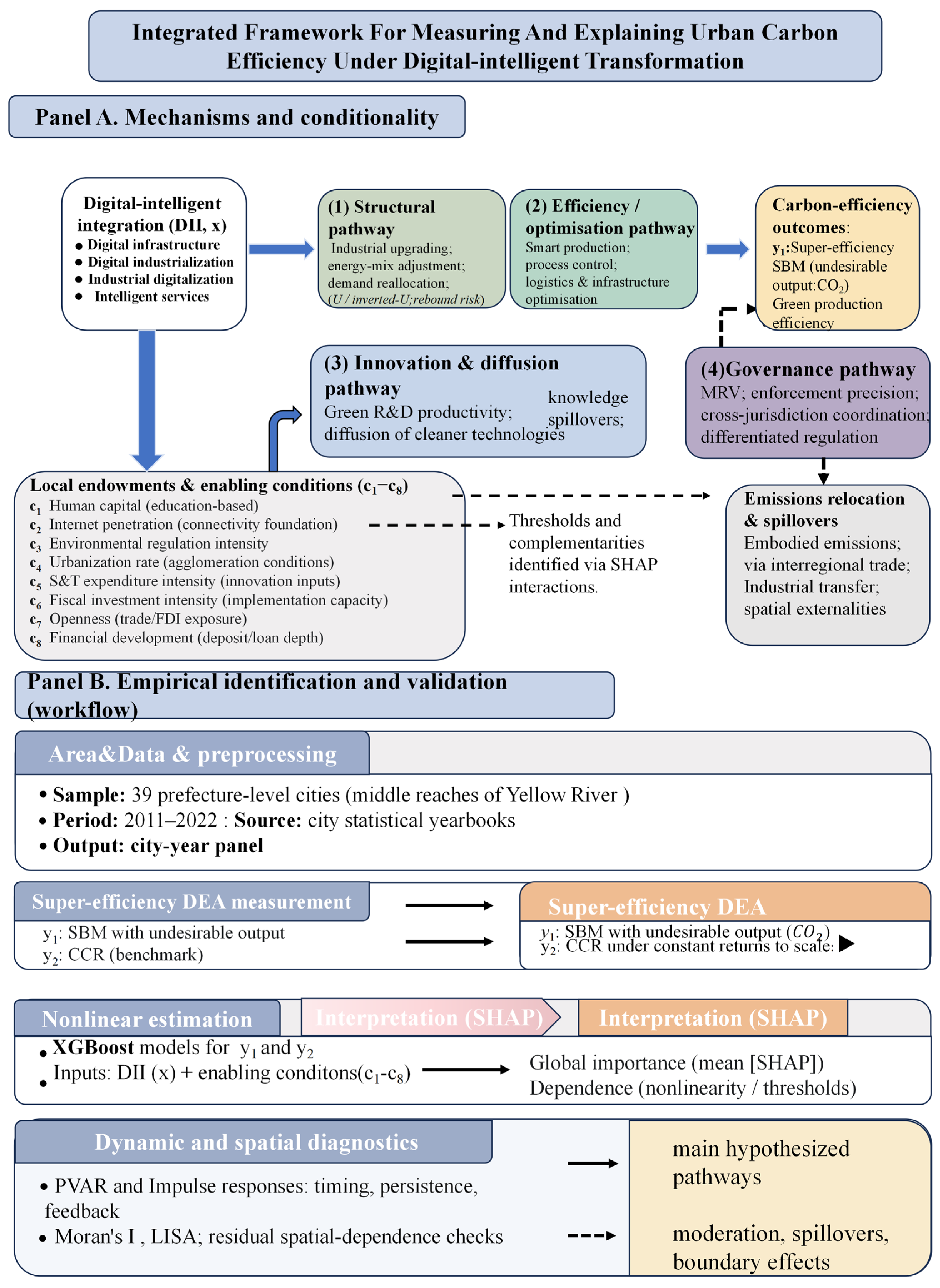
Figure 1 summarises this structure by linking the four transmission channels identified in the literature with the hybrid measurement–modelling approach used in the analysis.
Within the first strand, existing studies point to several pathways through which digital–intelligent transformation can influence urban carbon outcomes and broader green performance. In line with the focus of this paper, four types of effects are particularly relevant: a structural effect, whereby digitalisation reshapes industrial and energy structures; an efficiency effect, through improvements in energy use, production organisation and regulatory performance; an innovation effect, via green technological change and the diffusion of cleaner technologies; and a governance effect, through enhanced monitoring, coordination and differentiated regulation. The following four paragraphs review evidence on each of these channels in turn, before returning to the methodological literature and the implications for the analytical framework.
From a structural perspective, A substantial body of evidence indicates that digital–intelligent integration can accelerate the orderly exit of highly polluting and energy-intensive activities, expand high-end manufacturing and producer services, and facilitate greener manufacturing transformation, sometimes with spillovers to nearby cities [
19,
20,
21]. At the same time, the reported functional form is often nonlinear: U-shaped or inverted-U relationships suggest that carbon outcomes can deteriorate at early stages—when infrastructure build-out, energy demand, and output expansion dominate—before improving once structural upgrading and efficiency gains become sufficiently strong, or conversely improve early and weaken later as marginal returns diminish and rebound pressures rise [
22,
23]. This nonlinear evidence resonates with the broader “decoupling” discussion, where results depend materially on development stage and accounting boundary. Recent studies show that decoupling assessments can diverge across production-based, consumption-based, and income-based perspectives, and that apparent decoupling may be unstable across sectors and periods [
24,
25]. Cross-country historical evidence likewise cautions that “green growth” episodes can be reversible rather than monotonic [
26]. For China, multi-regional input–output analyses highlight sizeable embodied-carbon transfers through interregional trade, implying that local improvements in measured performance may partly reflect geographical reallocation of emissions along supply chains rather than net reductions [
27,
28]. These boundary and transfer issues motivate explicit attention to spatial dependence and basin-scale coordination when interpreting city-level carbon-efficiency outcomes.
Second, from the efficiency perspective, empirical study at both city and firm levels generally finds that intelligent technologies can improve energy efficiency and carbon-emissions efficiency by optimising production processes, reducing input–output distortions, and strengthening process control, thereby allowing higher output under given emissions constraints [
25,
26,
27,
28,
29,
30,
31,
32,
33,
34]. Evidence from new digital infrastructure and big-data pilot initiatives further suggests that digital investments can enhance the joint efficiency of pollution and carbon reduction, although effect sizes vary by region and stage of development [
35,
36]. In this channel, the central issue is not whether optimisation is feasible, but whether digital tools are sufficiently embedded in production organisation and infrastructure operation to deliver persistent efficiency gains rather than one-off improvements.
Regarding the innovation channel, A third line of study treats digital–intelligent transformation as a catalyst for green technological change and the diffusion of cleaner technologies [
37,
38,
39,
40]. From the perspective of innovation-chain governance, digital integration can improve matching between innovation supply and demand, strengthen firms’ absorptive capacity, and reduce information and transaction frictions, thereby raising technology-transfer and commercialisation efficiency [
41,
42]. More broadly, intelligent technologies are often framed as general-purpose technologies that support cross-sector green innovation and deployment of low-carbon solutions through prediction, high-dimensional optimisation, and real-time monitoring [
43]. Compared with short-run efficiency gains, innovation-driven effects are commonly argued to be more durable, provided that cities possess the requisite human capital and innovation inputs [
44].
Fourth, A rapidly expanding literature focuses on governance effects, especially in contexts that require differentiated regulation and resilience-oriented environmental management [
45]. Studies of major river basins and urban agglomerations report that digital–intelligent integration can strengthen coordination of pollution and carbon reduction, improve the timeliness and precision of environmental regulation, and enhance monitoring, early warning, and emergency response capacities [
46,
47]. Quasi-natural experiments based on broadband expansion, smart-city pilots, and big-data comprehensive pilot zones are frequently used to identify these governance effects [
48]. The evidence suggests that such interventions can reduce emissions intensity and improve environmental-welfare performance, often with spatial spillovers that cross administrative borders [
49,
50]. At the same time, governance benefits tend to be conditional: where regulatory credibility, fiscal capacity, or enforcement institutions are weak, digital monitoring alone is less likely to translate into sustained compliance improvements [
51].
The four channels above describe a coupled system rather than separable mechanisms. In practice, digital–intelligent integration can simultaneously reshape industrial structure, improve operational efficiency, enable innovation diffusion, and strengthen governance, with combined impacts that vary sharply across city types and stages of development. Yet much of the existing empirical study relies on national or provincial samples and predominantly linear specifications that examine one or two channels at a time [
52]. As a result, nonlinear responses, threshold effects, and higher-order interactions—especially those tied to local endowments and institutional capacity—remain insufficiently characterised. Moreover, boundary issues such as embodied-emissions transfers imply that city-level performance cannot be fully interpreted without considering interregional linkages and spatial spillovers [
24,
25,
26,
27,
28].
These limitations connect directly to the second strand of research on methods for analysing high-dimensional, nonlinear drivers of green performance. Traditional panel and spatial econometric approaches are well suited to testing targeted hypotheses, but they often struggle to approximate complex response surfaces and interaction structures without strong functional-form assumptions. Machine-learning models can improve predictive performance, yet many are difficult to interpret and therefore provide limited guidance on “why” marginal effects differ across cities and periods. Recent advances in interpretable machine learning help to narrow this gap: gradient-boosted decision trees can flexibly capture nonlinearities in structured data, while SHAP decomposes predictions into feature-level contributions at both global and local levels, enabling city-specific “portraits” and interaction diagnostics.
Figure 1.
Overview of the research workflow: Super-efficiency DEA → XGBoost coupled with SHAP for explanation → PVAR estimation with spatial diagnostic procedures [
48].
Figure 1.
Overview of the research workflow: Super-efficiency DEA → XGBoost coupled with SHAP for explanation → PVAR estimation with spatial diagnostic procedures [
48].
Against this background, the present study develops an integrated framework tailored to the urban agglomerations in the middle reaches of the Yellow River Basin. The design aligns measurement, nonlinear explanation, dynamics, and spatial diagnostics so that cross-sectional interpretability can be connected to time profiles and spatial dependence rather than treated as a purely predictive exercise.
Within this overarching structure, the study contributes in three respects. Substantively, it focuses on the middle reaches of the Yellow River Basin and jointly considers digital–intelligent integration, structural upgrading, and governance capacity in explaining city-level carbon-efficiency performance. Methodologically, it connects DEA-based efficiency measurement (with undesirable outputs) to an interpretable nonlinear model, XGBoost–SHAP, and further embeds dynamic and spatial checks to address time propagation and cross-city dependence. From a policy perspective, city-level profiles and clustered spatial patterns support more differentiated, place-based strategies for digital–intelligent transition and low-carbon governance in river-basin urban systems.
4. Methodology
4.1. Measuring Urban Performance Under Carbon Constraints
To empirically assess how digital–intelligent integration relates to urban development outcomes, we first construct internally consistent measures of city-level production performance. Following
Section 2, urban production performance is evaluated from two complementary perspectives: green (carbon-emission-oriented) production efficiency and conventional production efficiency [
67,
68]. Each prefecture-level city is treated as a decision-making unit (DMU), and the resulting efficiency indicators are used as dependent variables in the subsequent empirical analysis.
Green production efficiency, denoted by y
1it, is measured using a super-efficiency slacks-based measure (SBM) model with undesirable outputs within a non-radial, non-oriented DEA framework [
69,
70]. Consistent with the input–output specification in
Section 3.2, each city is characterised by an input vector consisting of labour, capital, and energy, a desirable output (real GDP), and an undesirable output (city-level CO
2 emissions). Slack variables are introduced to capture input excesses, shortfalls in desirable output, and excesses in undesirable output. Under the super-efficiency setting, the evaluated city is excluded from the reference set when constructing the frontier, allowing efficiency scores greater than one. This feature is crucial for distinguishing among frontier cities and provides a more sensitive measure of performance when carbon constraints are binding.
Conventional production efficiency, denoted by y
2it is obtained from a super-efficiency CCR model under constant returns to scale [
66,
71]. This indicator follows the classical DEA setting with a radial, CRS-based efficiency measure and does not explicitly incorporate undesirable outputs, thereby providing a benchmark measure of conventional technical efficiency that is conceptually distinct from, yet comparable to y
1it. As with the SBM specification, the super-efficiency extension permits scores above unity and thus yields a finer ranking among technically efficient cities along the conventional production dimension. Before entering the subsequent models, both y
1it and y
2it are pre-processed to improve numerical stability and cross-city comparability. Specifically, we mitigate the influence of extreme values using winsorisation, apply a natural logarithmic transformation, and then standardise the transformed series (z-score scaling). This preprocessing reduces undue leverage from outliers and facilitates comparability of the efficiency indicators across cities and years, particularly for the panel-based dynamic analysis implemented in later sections.
4.2. Modelling the Digital–Intelligent Integration–Efficiency Relationship
Given the efficiency measures defined in
Section 4.1, the next step is to examine how they are associated with digital–intelligent integration and structural characteristics of cities. Let denote the digital–intelligent integration index introduced in
Section 3.2, and let c
it = (c
1, …, c
8) collect, respectively, human capital, informatisation level, environmental regulation, urbanisation, science and technology expenditure, fiscal investment intensity, openness to external markets and financial development.
For each efficiency indicator y
k,it(k = 1, 2), we approximate its conditional expectation as
where
is an unknown, potentially non-linear response function,
and
denote city and year effects, and
is an idiosyncratic error term such that
. Here, the objective is associational explanation and prediction rather than causal identification.
City and year effects are implemented as sets of dummy variables and are included directly as features, allowing the model to learn region-specific and period-specific shifts in the efficiency distribution rather than imposing a homogeneous intercept across cities and years.
The theoretical channels discussed in
Section 2 indicate that nonlinearities, threshold effects and interactions among explanatory variables are likely to be important. To accommodate such complexity without committing to a restrictive parametric form,
is approximated by a tree-based ensemble model of the gradient-boosting type. Specifically, we employ Extreme Gradient Boosting (XGBoost), which is well suited to high-dimensional, mixed-scale tabular data and can flexibly approximate complex response surfaces through an additive ensemble of decision trees [
72]. The recursive nature of boosting enables the model to successively capture residual patterns that would be difficult to accommodate in linear or purely additive frameworks [
73].
We adopt XGBoost as the baseline learner because its inductive bias is well matched to structured city-level panel/tabular data and to the mechanism we aim to uncover. In particular, it can accommodate nonlinear responses, high-order interactions, and threshold-like patterns without imposing a priori functional forms, while its built-in regularisation learning-rate shrinkage, row subsampling, and tree-structure constraints helps limit overfitting. Relative to linear fixed-effects or additive specifications, this flexibility is important for capturing piecewise or capacity-contingent relationships that are plausible in urban transition processes.
Building on this modelling framework, we employ SHAP to render the fitted XGBoost model interpretable and to translate the learned nonlinear structure into evidence that can be discussed in mechanism terms. SHAP attribution is implemented using TreeExplainer for tree ensembles. To maintain reproducibility under the installed SHAP environment, summary and dependence graphics are generated through the modern interface when available, with fallbacks to legacy APIs or manual plotting routines if compatibility issues arise. Because region and year encodings are included in estimation to absorb city-invariant heterogeneity and common time shocks, these identifier-type controls are excluded from the reported explanation set; all attributions are therefore presented for substantive covariates only. Global importance is summarised by the mean absolute SHAP value across observations, and observation-level (city–year) attributions are archived to support replication and post hoc analyses. Where supported, we compute SHAP interaction values and summarise complementarities using the mean absolute interaction matrix, visualised as a heatmap with a fixed colour range to facilitate comparisons across runs. For local illustration, we produce force plots for selected cities using the SHAP expected value as the baseline. The representative city–year is chosen from the most recent year as the record whose core index is closest to the city-specific mean, so that the visualisation reflects a typical rather than an extreme profile. The force plot displays contributions for core covariates only (x and c1–c8) for readability, while the prediction shown in the title is computed using the full SHAP decomposition to preserve additivity.
Model hyperparameters are selected using cross-validation constructed to respect the time structure on a training subset. Predictive adequacy is evaluated on a held-out test subset using R2, mean absolute error (MAE), and mean absolute percentage error (MAPE). To assess temporal robustness under evolving structural conditions, we further implement a rolling-origin validation scheme: the model is recursively estimated using data up to year t, and predictions are generated for year t + 1. Averaging MAE and MAPE across all rolling windows yields a conservative measure of out-of-sample performance over time and guards against overfitting to specific subperiods.
4.3. Interpreting Nonlinearities and Complementarities
While the gradient-boosting model provides flexible non-linear approximations of
, it is still necessary to relate these estimates back to the conceptual mechanisms outlined in
Section 2. We therefore complement the predictive exercise with both global and local measures of feature importance in the spirit of recent study on interpretable machine learning [
74,
75]. These measures jointly allow us to identify, first, which variables matter most on average and, second, how they contribute in specific city–year contexts.
4.3.1. Leave-One-Covariate-Out (LOCO) Importance
At the global level, we assess the contribution of each covariate to predictive accuracy using a leave-one-covariate-out (LOCO) analysis. Starting from the full model that includes x
it, c
1,it, …, c
8,it and fixed effects, we sequentially remove one covariate z, re-estimate the model and recompute the out-of-sample MAE. The change in prediction error,
quantifies the marginal contribution of that covariate to overall prediction quality, in line with LOCO-type importance measures based on predictive performance [
76]. Ranking covariates by MAE(z) yields a global ordering of variables in terms of their empirical relevance for green and conventional efficiency, which can be compared with prior expectations concerning the structural, efficiency, innovation and governance channels.
4.3.2. Local Attribution and City-Level Diagnostics
Global importance measures, however, do not reveal how factors combine at the level of individual cities or how their marginal effects vary across the distribution of covariates. To obtain city-specific decompositions of predicted efficiency, we therefore use the SHapley Additive exPlanations (SHAP) framework associated with the XGBoost model [
77,
78]. For each city–year observation, the model prediction can be written as
where
is a baseline prediction (the expected model output for a reference input distribution) and
denotes the contribution of feature j to the prediction for city i in year t. Positive values of
indicate that the corresponding feature pushes the prediction above the baseline, whereas negative values indicate a downward contribution.
These local contributions are visualised using force plots for representative cities, which display how digital–intelligent integration, structural controls and fixed effects jointly move the predicted efficiency away from the baseline. Combined with radar charts of standardised x
it and c
1,it, …, c
8,it, this approach provides a concise yet informative description of each city’s endowment profile and how it translates into higher or lower efficiency within the nonlinear model. Similar combinations of gradient-boosting models and SHAP-based explanations have been shown to be effective in remote-sensing applications, for example, in rapid landslide mapping from high-resolution imagery [
73]. In this way, global and local importance measures together link the empirical model back to city-level mechanisms highlighted in the conceptual framework.
4.4. Dynamic Propagation: PVAR and Impulse Responses
Let z
it denote an L-dimensional vector that includes green and conventional efficiency, digital–intelligent integration and selected structural controls (such as urbanisation and fiscal investment):
where u
it and f
it represent, for example, urbanisation and fiscal investment intensity for city i in year t. A PVAR(P) model for zit is specified as
where A
p(p = 1, …, P) are L × L coefficient matrices, μ
i and τ
t denote city and time effects, respectively, and u
it is a vector of idiosyncratic disturbances. This specification allows for dynamic feedbacks among efficiency, digital–intelligent integration and structural controls while controlling for unobserved heterogeneity across cities and common shocks over time [
79]. The lag order P is selected using standard information criteria and stability diagnostics to ensure that the resulting system is dynamically stable [
80].
Following the panel VAR literature, the system is estimated using a system GMM estimator [
81,
82,
83]. This approach treats lagged endogenous variables as instruments for their own current values in the quasi-differenced equations, combining moment conditions in first differences and in levels to improve efficiency when the time dimension is relatively short [
82,
83]. In particular, suitably lagged levels and differences in z
it are used as instruments to address the endogeneity of lagged dependent variables and to control for the presence of city-specific effects μ
i. Hansen or Sargan-type over-identification tests and Arellano–Bond tests for serial correlation in the residuals are employed to assess the validity of the instruments and the dynamic specification [
82,
83].
On the basis of the estimated PVAR coefficients, we compute orthogonalised impulse–response functions (IRFs) to trace the dynamic effects of shocks. Using a Cholesky decomposition of the residual covariance matrix under a recursive ordering consistent with the theoretical channels, we derive IRFs for one-standard-deviation innovations to x and to each of the selected structural controls [
84]. The resulting IRFs describe the responses of y
1,it and y
2,it over subsequent periods to shocks in digital–intelligent integration and structural variables. To account for sampling uncertainty, we construct bootstrap confidence bands around the IRFs using standard resampling procedures for VAR-type models.
In combination with the static non-linear model in
Section 4.2, these dynamic responses allow us to assess whether digital–intelligent integration primarily affects efficiency contemporaneously or also exerts persistent effects over time. Consistent and statistically significant responses in the PVAR framework provide complementary evidence on the temporal propagation of digital–intelligent shocks through the structural, efficiency, innovation and governance channels identified in
Section 2.
4.5. Spatial Dependence Diagnostics: Moran’s I and LISA
The cities in the study area are embedded in a spatially connected system, and spatial dependence is particularly relevant in a remote sensing context, where many variables are derived from spatially contiguous observations and exhibit strong spatial autocorrelation [
85]. Even after conditioning on a rich set of determinants, residual spatial structure may remain. To evaluate this, we implement two complementary diagnostics: global Moran’s I statistics for model residuals and local LISA statistics for the efficiency indicators themselves, following standard practice in spatial statistics [
85,
86].
First, using a queen-contiguity spatial weights matrix W = (w
ij)—where two cities are treated as neighbours if they share either a common boundary or a common vertex—we compute global Moran’s I for the residuals of the y
1,it and y
2,it models in each year from 2011 to 2022. For a generic residual vector
, Moran’s I is defined as [
84,
86]:
where N is the number of cities,
is the mean residual in year t, and
. The magnitude and statistical significance of Moran’s I—assessed using permutation-based reference distributions or asymptotic normality—indicate whether substantial spatial autocorrelation remains after controlling for digital–intelligent integration, structural covariates and fixed effects [
87]. This provides a diagnostic check on whether the non-linear model has captured the main spatial patterns in the data or whether important spatial processes are left unexplained.
Second, we compute Local Indicators of Spatial Association (LISA) for y
1,it and y
2,it in selected benchmark years (2011, 2017, 2022), following the local Moran’s I framework of Anselin [
85]. For each city, the local indicator decomposes the global Moran’s I into location-specific contributions and allows the identification of local “hot spots” and “cold spots” of efficiency. Cities are classified into High–High, Low–Low, High–Low and Low–High clusters based on the sign of the local statistic and the deviation from the global mean. Monte Carlo permutation tests are used to determine statistical significance at conventional levels, thereby filtering out spurious clusters due to random variation [
85,
88]. The resulting LISA cluster maps, presented in
Section 5, provide a spatially explicit view of how green and conventional efficiency cluster and evolve over time within the study area [
87].
4.6. Robustness and Cross-Agglomeration Validation
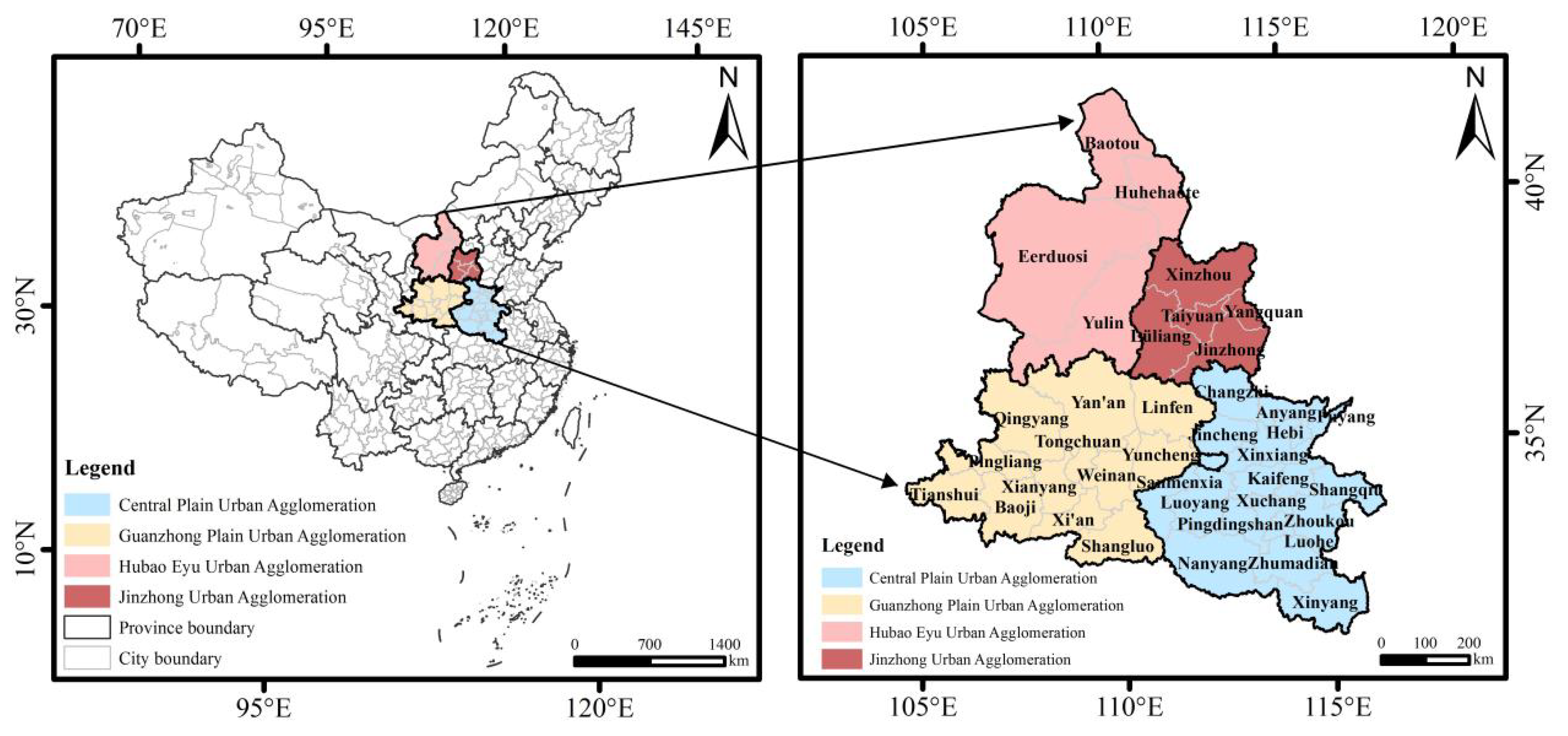
The empirical modelling framework is developed for the urban agglomerations in the middle reaches of the Yellow River as a whole. Within this area, however, the Hohhot–Baotou–Ordos–Yulin (Hubao’e–Yulin) urban agglomeration, the Central Shanxi urban agglomeration, the Guanzhong Plain urban agglomeration and the Central Plains urban agglomeration differ markedly in their industrial structures, policy environments and development trajectories. To examine the external validity and portability of the empirical approach in this heterogeneous setting, we conduct cross-regional robustness checks at the urban-agglomeration scale.
For each of the major urban agglomerations identified in
Section 3.1, we re-estimate the gradient-boosting model using only the corresponding sub-sample of cities. The model specification, hyperparameter selection procedure and evaluation metrics are kept identical to those in
Section 4.2. For each sub-sample, we compute R
2, MAE and MAPE for both y
1,it and y
2,it on out-of-sample observations. Comparing these metrics across urban agglomerations allows us to assess whether the estimated relationships between efficiency, digital–intelligent integration and the control variables are stable across different regional contexts.
Differences in error measures are interpreted jointly with information on the internal structure and development patterns of each urban agglomeration, rather than as evidence against the modelling strategy per se. In particular, moderate variations in performance are expected in regions with pronounced structural specificities. Overall, this set of cross-regional exercises evaluates the suitability of the proposed empirical framework for comparative analysis across urban agglomerations and provides a check on its robustness within the broader Yellow River Basin.
4.7. Summary
This section develops a multi-layered methodological framework that connects the conceptual channels in
Section 2 and the data structure in
Section 3 with the empirical analysis in
Section 5. Super-efficiency SBM models with undesirable outputs and super-efficiency CCR models provide internally consistent measures of green and conventional production efficiency at the city level. These efficiency indicators are then related to digital–intelligent integration and the structural covariates defined in
Section 3.2 through a tree-based gradient-boosting ensemble, whose performance is evaluated using conventional train–test splits, rolling-origin validation and cross-regional robustness checks.
Building on this predictive framework, global and local feature-importance measures—implemented via leave-one-covariate-out analyses and SHAP-based decompositions—together with city-level visualisations such as force plots and radar charts, permit a detailed examination of how digital–intelligent integration and structural characteristics jointly shape efficiency outcomes. A PVAR–IRF set-up is used to characterise the temporal propagation of shocks, while global Moran’s I and local LISA statistics document residual spatial dependence and clustering patterns. Taken together, these components constitute the methodological basis for the empirical results and policy implications presented in
Section 5.
5. Empirical Results
5.1. Overall Predictive Performance of the Hybrid Model
A necessary condition for interpreting the model-based decompositions in later subsections is that the underlying specification reproduces the main spatial and temporal patterns observed in the data. We therefore begin by evaluating the in-sample and out-of-sample performance of the hybrid DEA–gradient-boosting framework for the two efficiency indicators, y
1 (green production efficiency)and y
2 (conventional production efficiency).
Table 3 summarises the key diagnostics.
Using the full panel of 39 prefecture-level cities, the gradient-boosting model attains coefficients of determination of 0.9980 and 0.9971 for y
1 and y
2, respectively. The corresponding in-sample MAE values are 0.0051 and 0.0061, and MAPE values are 1.74% and 1.30%. These figures should be interpreted in the context of the efficiency indices, which are dimensionless. The raw efficiency indices are dimensionless and lie in a relatively narrow band around unity; after the logarithmic transformation and z-score standardisation (
Section 4.1), the model is estimated on centred and scale-normalised outcomes.
A necessary condition for interpreting the model-based decompositions in later subsections is that the underlying specification reproduces the main spatial and temporal patterns observed in the data. We therefore begin by evaluating the in-sample and out-of-sample performance of the hybrid DEA–gradient-boosting framework for the two efficiency indicators, y
1 (green production efficiency)and y
2 (conventional production efficiency).
Table 3 summarises the key diagnostics. Using the full panel of 39 prefecture-level cities, the gradient-boosting model attains very high coefficients of determination for both y
1 and y
2. We interpret these values cautiously and provide several diagnostics. First, the dependent variables are DEA-based efficiency indices constructed from consistently measured inputs/outputs, which reduces measurement noise compared with raw emissions or output series. Second, the sample is a balanced panel with strong temporal persistence in city characteristics so a sizeable share of variation is systematic rather than idiosyncratic. Third, we train the model with time-respecting cross-validation and rolling-origin validation, and we report MAE/MAPE alongside R
2 to avoid over-reliance on a single fit statistic. Moreover, boosted-tree models are less sensitive to classical multicollinearity than linear regressions, but we still limit model complexity through regularisation and show that feature-importance patterns remain stable under alternative hyperparameters and subsamples. Finally, we emphasise that the purpose of the machine-learning stage is to recover flexible associations and conditional patterns, not to claim causal identification.
Against this scale, the in-sample MAE corresponds to less than 2% of the observed range of each index, indicating that the model captures the dominant cross-sectional differences across cities and the inter-annual variation in efficiency levels. This is particularly important given that the explanatory variables combine conventional yearbook statistics with governance- and digitalisation-related indicators that exhibit strong cross-sectional heterogeneity but only moderate inter-annual variation.
To assess temporal robustness and guard against overfitting to specific years, we implement a rolling-origin validation scheme in which the model is repeatedly re-estimated on an expanding window of data and then used to predict the subsequent year (
Section 4.2). As expected, the average MAE and MAPE from this exercise are higher than the in-sample values: the rolling-origin MAE is 0.1624 for y
1 and 0.1643 for y
2, while the corresponding MAPE values are 52.58% and 34.76%. The relatively large MAPE figures mainly reflect the sensitivity of percentage errors when actual efficiency scores are close to one; small absolute deviations in such cases translate into large relative percentages even though the predicted paths remain close to the observed trajectories. The MAE values, which are not affected by this denominator issue, are of a magnitude that is still compatible with regional planning and comparative analysis at the urban-agglomeration scale. Because percentage-based errors can be unstable when the dependent variables are transformed and standardised, we interpret MAPE with caution and primarily rely on MAE (and, where reported, RMSE) for out-of-sample comparisons.
Inspection of the time profile of rolling errors shows that years associated with major macroeconomic or policy shocks exhibit somewhat larger forecast errors. In particular, 2018 when ecological protection and high-quality development in the Yellow River Basin were elevated to a national strategy and 2020 when China’s “dual-carbon” targets were formally announced stand out as periods in which abrupt regime shifts are not fully captured by the smoothly evolving components of the model. This pattern is consistent with the expectation that structural breaks induced by policy announcements or external shocks are difficult to forecast solely from lagged covariates and trend dynamics, and it motivates the complementary dynamic and spatial analyses reported in later subsections.
Residual diagnostics further support the adequacy of the specification. For both y
1 and y
2, the residuals are tightly centred around zero, with mean values effectively equal to zero and standard deviations of 0.0069 and 0.0086, respectively (
Table 3). The dispersion of residuals is small relative to the scale and cross-sectional variation in the dependent variables, and extreme positive or negative residuals are rare. The few observations with relatively large residuals correspond to rapidly transforming cities—typically those undergoing pronounced industrial restructuring or experiencing strong digital–intelligent policy interventions—which are discussed in more detail in
Section 5.4. Overall, the combination of high in-sample fit, acceptable out-of-sample performance under rolling validation, and well-behaved residuals indicates that the hybrid model provides a sufficiently reliable basis for the subsequent analysis of feature contributions, spatial clustering and dynamic responses.
5.2. Cross-Regional Performance Across Urban Agglomerations
The study area comprises four major urban agglomerations that differ markedly in industrial base, policy environment and ecological conditions. Before interpreting model-based results at the basin scale, it is therefore useful to verify whether the estimated relationships between efficiency, digital–intelligent integration and control variables remain stable across these regional contexts. This subsection reports goodness-of-fit indicators for the four agglomerations, estimated separately for each region in line with the cross-regional robustness design in
Section 4.6.
Table 4 and
Table 5, summarise the performance of the hybrid model for green production efficiency (y
1) and conventional production efficiency (y
2) when the sample is restricted to one urban agglomeration at a time. For y
1, the in-sample R
2 values are extremely high and effectively equal to one in all four agglomerations (
Table 4). Given that the dependent variable is an efficiency index bounded around unity and pre-processed through log transformation and standardisation, such high R
2 values are not unexpected and should be interpreted primarily as indicating that the model captures the smooth trend and cross-sectional structure of the data within each region. The more informative statistics for cross-regional comparison are the MAE and MAPE, which remain small in absolute terms but display systematic differences across agglomerations.
For y1, the Hubao–Eyu urban agglomeration (Hohhot–Baotou–Ordos–Yulin), characterised by a relatively stable, energy-oriented industrial base and a comparatively consistent policy environment, shows the smallest absolute and relative errors (MAE = 0.0004; MAPE = 0.11%). The Jinzhong (Central Shanxi) and Guanzhong Plain agglomerations also exhibit low MAE and MAPE, indicating that green production efficiency is well captured in regions where industrial structures and policy settings evolve in a gradual manner. By contrast, the Central Plains agglomeration records somewhat larger MAE and MAPE (0.0013 and 0.44%, respectively), despite an R2 that is essentially identical to the other regions. This pattern is consistent with the fact that the Central Plains has experienced more rapid structural adjustment and frequent policy innovations over the sample period, generating short-term fluctuations in green efficiency that are more difficult to track with a model calibrated on annual data.
The pattern for y
2 is related but not identical (
Table 5). The hybrid model again attains near-perfect R
2 in all agglomerations, confirming that the relationship between the explanatory variables and conventional production efficiency can be approximated accurately in each regional subsample. However, the ranking of error measures changes. Here, the Hubao–Eyu and Central Plains agglomerations display the smallest MAPE (0.07% and 0.10%, respectively), whereas the Guanzhong Plain exhibits the highest MAE and MAPE (0.0020 and 0.40%). These differences are small in absolute magnitude but suggest that conventional production efficiency is particularly predictable in regions with relatively clear and stable production regimes, while areas undergoing more active restructuring or stronger ecological-protection mandates may follow more volatile efficiency trajectories even if the overall fit remains high.
Taken together, the cross-regional results indicate that the proposed modelling framework is highly transferable across urban agglomerations in the middle reaches of the Yellow River: the basic functional relationships estimated at the basin scale remain valid when the model is re-estimated separately for each region. At the same time, the modest but systematic differences in MAE and MAPE across agglomerations point to meaningful variation in predictability that reflects institutional, structural and ecological contrasts. These contrasts provide important context for the spatial clustering results discussed in
Section 5.6 and the differentiated policy implications in
Section 5.7.
5.3. Global Feature Importance
As is shown in
Table 6,for the green-efficiency model y
1, the LOCO results indicate that urbanisation (c
4) and fiscal investment intensity (c
6) produce the largest increases in MAE when removed, suggesting that agglomeration dynamics and public-investment intensity are central to explaining green production efficiency. The digital–intelligent integration index x also yields a sizeable positive ΔMAE, confirming its role as a key correlate of green efficiency alongside conventional development factors. Environmental regulation (c
3), openness (c
7), and financial development (c
8) contribute positively but with smaller marginal effects on prediction accuracy. Notably, several covariates display negative ΔMAE values, implying that removing them slightly improves out-of-sample accuracy. This pattern is consistent with redundancy or noise in the presence of correlated predictors and fixed effects; we therefore interpret LOCO rankings jointly with SHAP-based importance rather than relying on LOCO alone.
For the conventional efficiency model y2, the importance ranking shifts in a manner consistent with its more production-oriented nature. Urbanisation (c4), openness to external markets (c7), science and technology expenditure (c5), and human capital (c1) exhibit the largest LOCO effects, indicating that conventional production efficiency is particularly sensitive to agglomeration forces, external linkages, innovation inputs, and labour-force quality. The digital–intelligent index x remains non-negligible, but its marginal contribution is smaller than in the y1 model, suggesting that digital–intelligent development aligns more strongly with the green-efficiency dimension than with conventional technical efficiency alone.
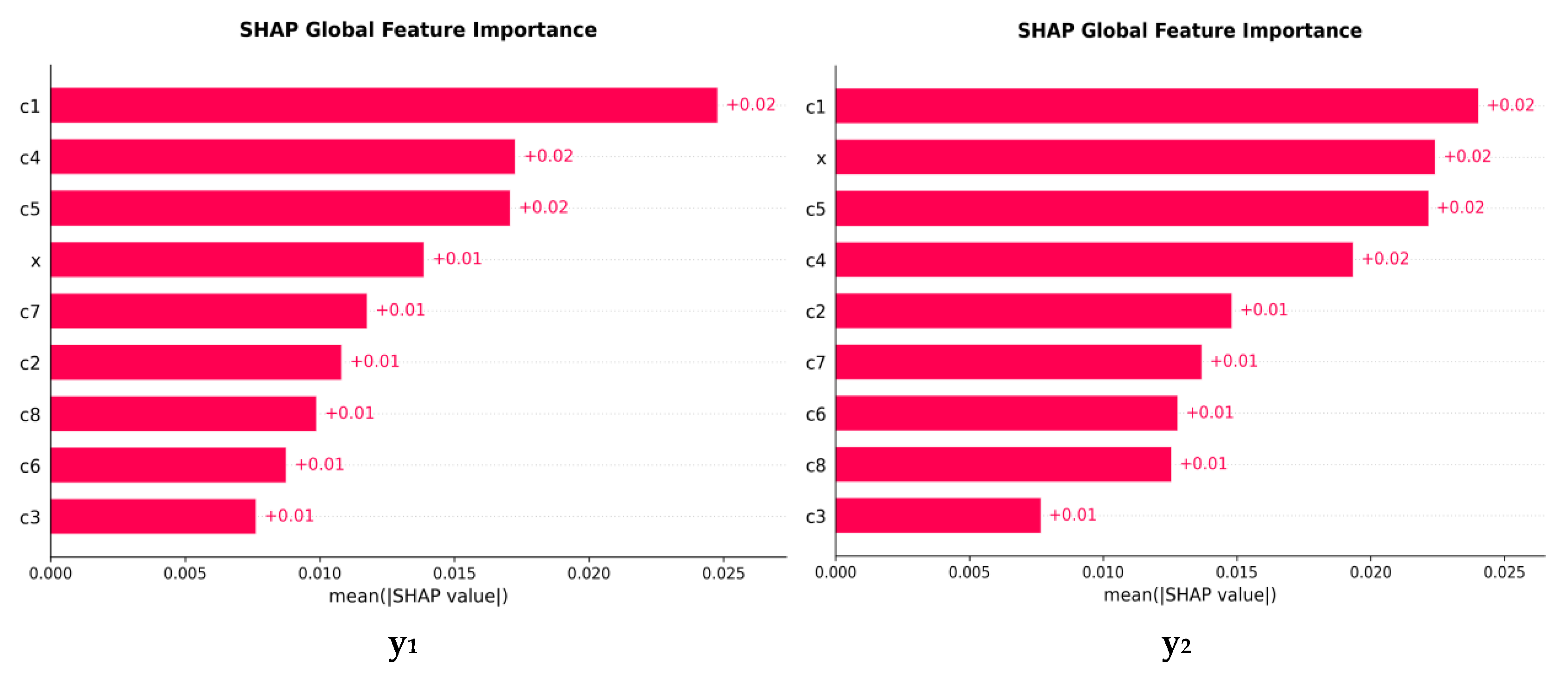
The SHAP-based global importance measures (
Figure 3) reinforce these patterns. Across both y
1 and y
2, a compact set of drivers—urbanisation, public-investment intensity, human capital, science and technology expenditure, openness, financial development, and digital–intelligent integration—accounts for most of the variation in predicted efficiency. The stability of this determinant set across indicators and importance metrics supports the joint analysis of green and conventional efficiency and provides an empirical link between the literature on urban development fundamentals and the emerging evidence on digital–intelligent transformation.
5.4. City-Level Heterogeneity and Representative Cases
Global importance measures summarise average relationships across all cities and years. To examine how different combinations of drivers translate into heterogeneous outcomes at the city scale, we conduct a case-based analysis for four representative provincial capitals Hohhot, Taiyuan, Xi’an, and Zhengzhou which occupy distinct positions within the middle-reach urban agglomerations.
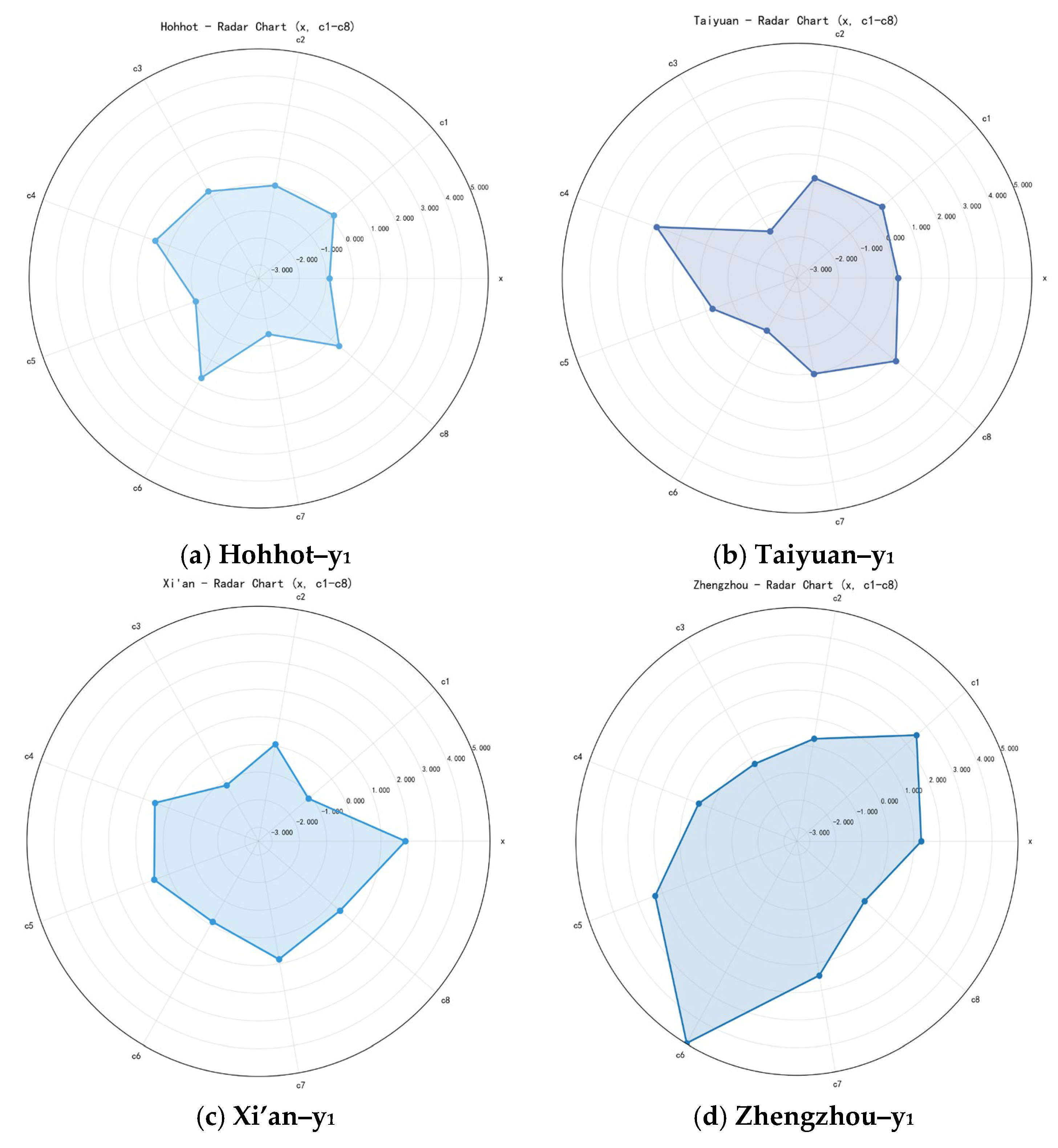
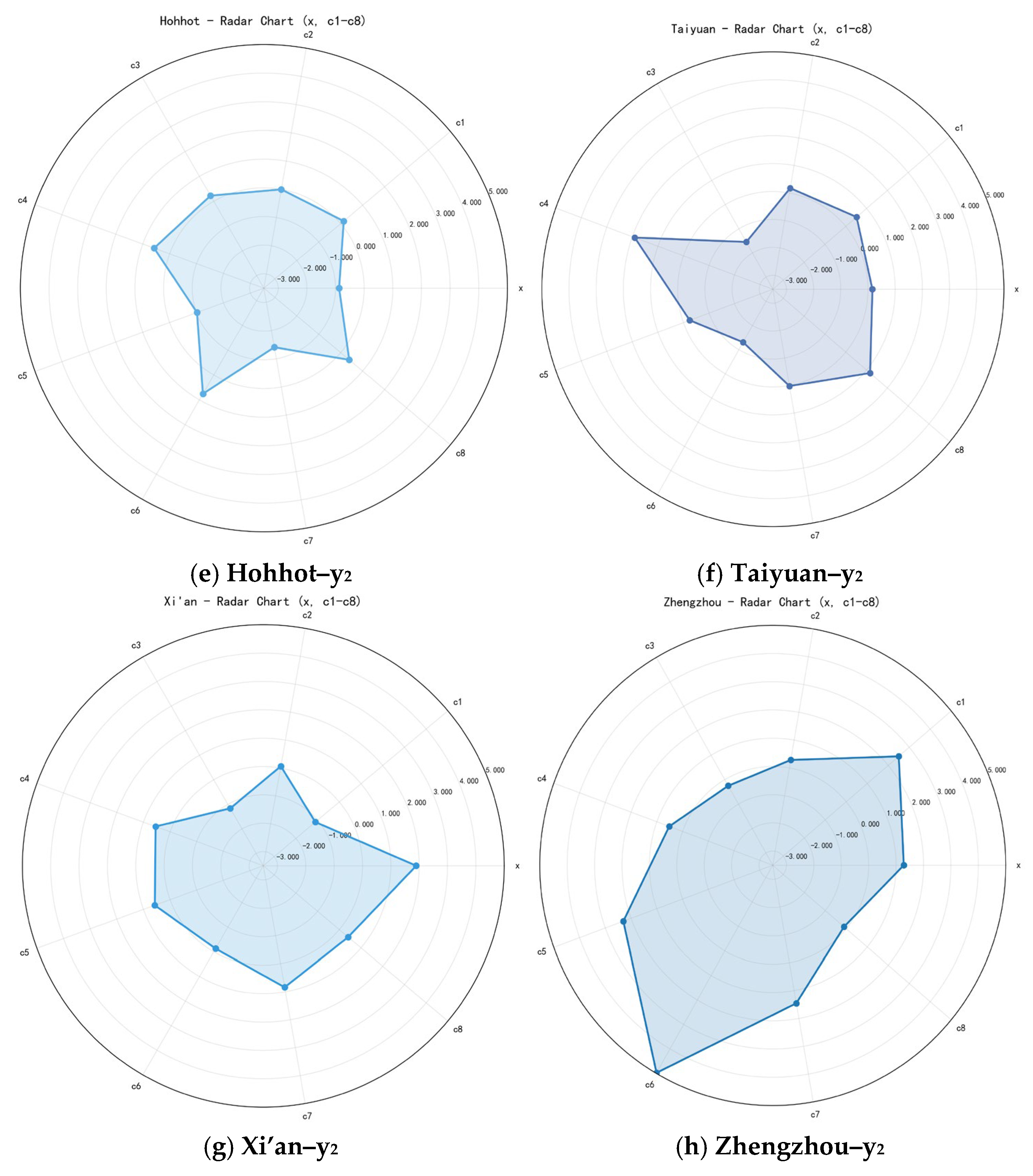
The radar charts in
Figure 4 plot the standardised values of the digital–intelligent index x and the covariates c
1–c
8 for these cities, revealing clearly differentiated development profiles. Hohhot, embedded in a resource-oriented northern agglomeration, shows relatively strong levels of urbanisation (c
4) and fiscal investment intensity (c
6) but comparatively weaker digital–intelligent integration (x) and science and technology expenditure (c
5). Taiyuan exhibits comparatively strong fiscal investment intensity (c
6) and relatively stringent environmental regulation (c
3), alongside a medium level of internet penetration (c
2). Xi’an combines high human capital (c
1) with strong digital–intelligent integration (x) and science and technology expenditure (c
5), while several fiscal- and finance-related indicators are closer to sample averages. Zhengzhou records high values for digitalisation (x), human capital (c
1), and internet penetration (c
2), whereas environmental regulation (c
3) and financial development (c
8) are more moderate.
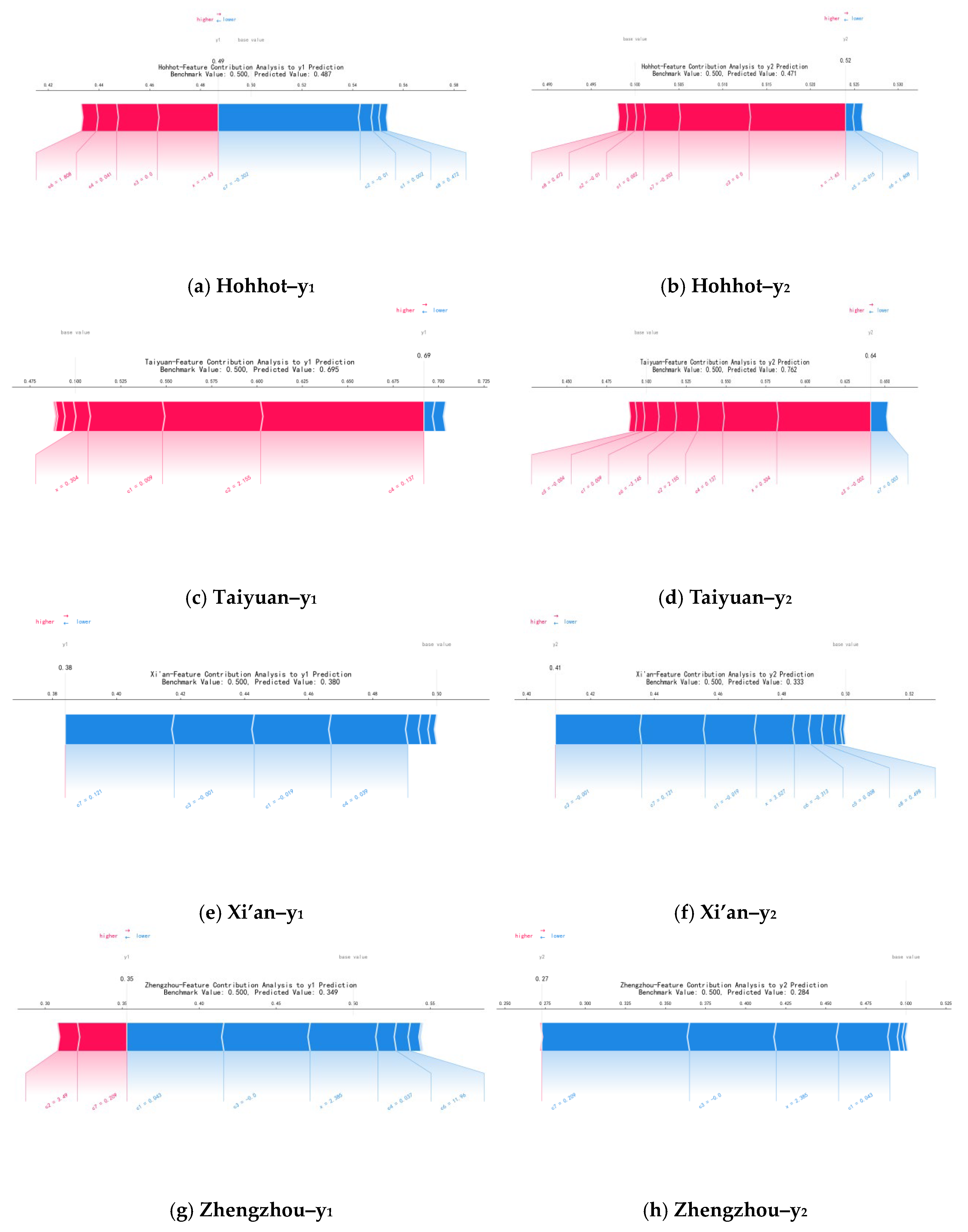
The SHAP force plots in
Figure 5 translate these profiles into local contributions to predicted efficiency. For cities such as Hohhot and Taiyuan, higher fiscal investment intensity and urbanisation-related factors contribute positively in certain periods, while comparatively weaker digital–intelligent integration or innovation inputs contribute less to efficiency gains. In Xi’an, strong human capital, digital integration, and science and technology expenditure generate positive contributions to both green and conventional efficiency. Zhengzhou exhibits a mixed configuration: strengths in digitalisation and human capital raise predicted efficiency, while other constraints limit the extent of gains, particularly for y
1. Overall, the city-level evidence indicates that similar observed efficiency levels can arise from distinct configurations of drivers, and that the effectiveness of a given policy lever depends critically on local development conditions. Recognising this heterogeneity is essential for designing place-based policy measures in the middle reaches of the Yellow River.
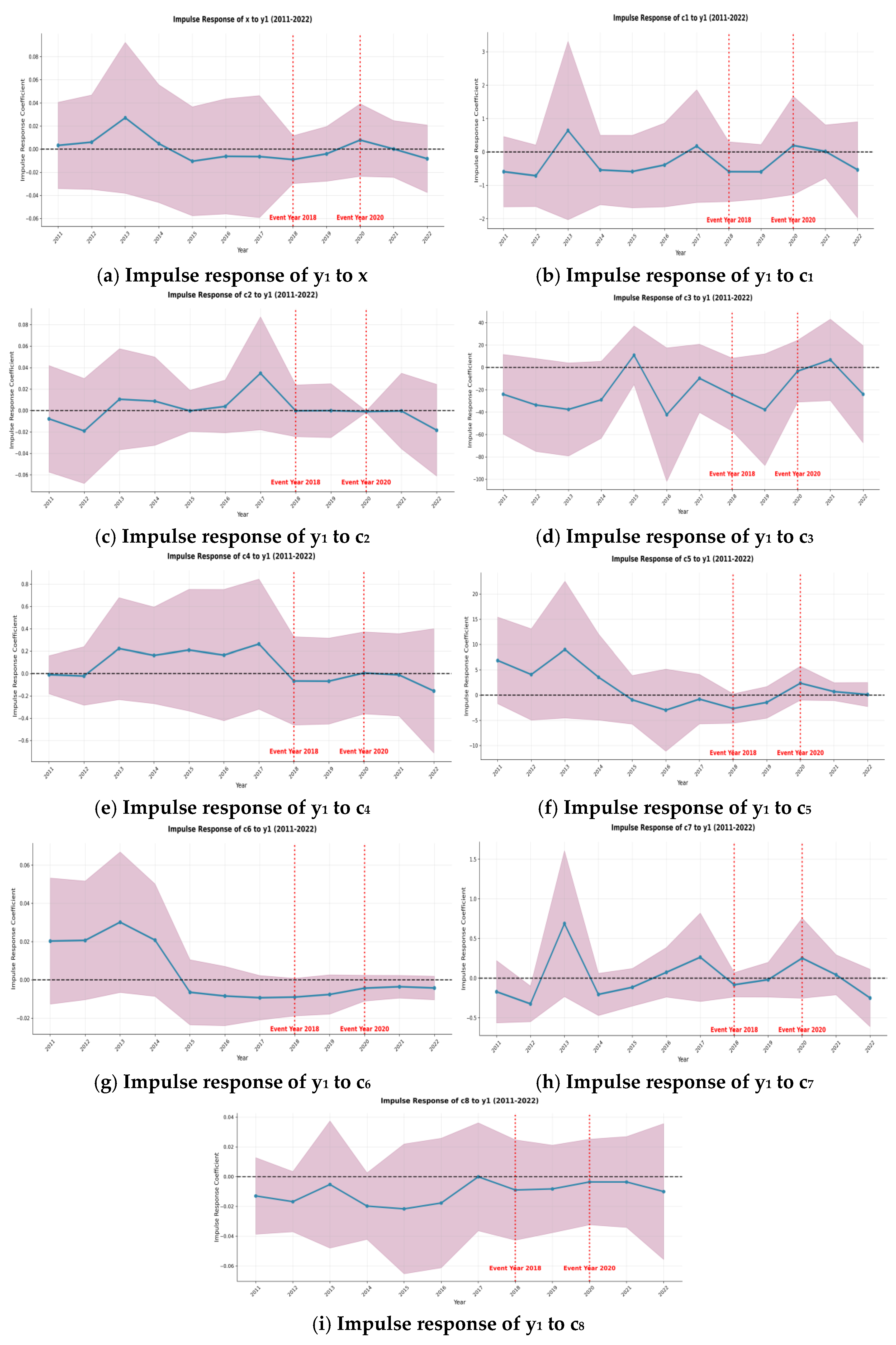
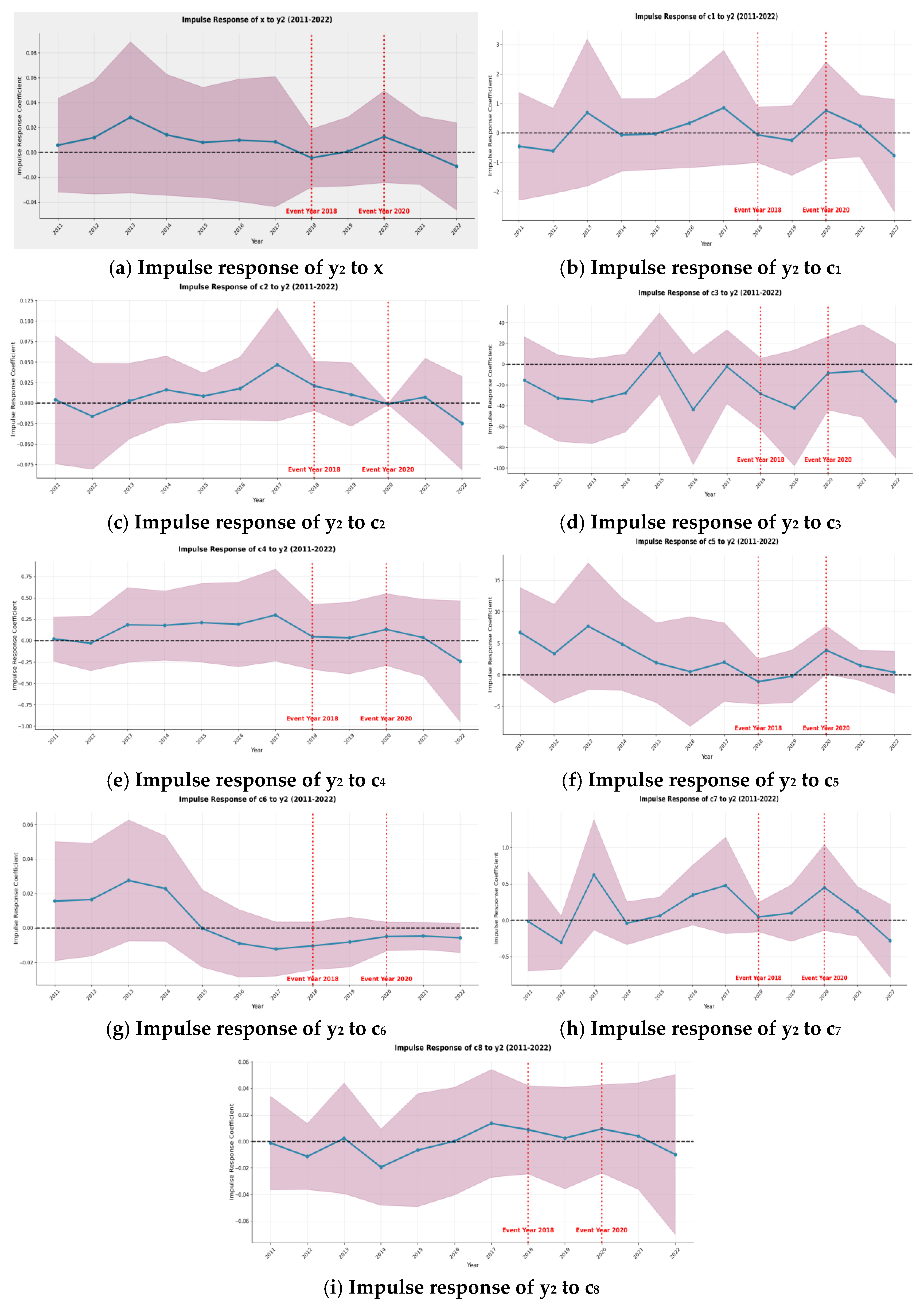
5.5. Dynamic Responses of Green Development to Key Drivers
The static relationships documented above do not reveal how shocks propagate over time or whether the influence of individual drivers remains stable across different phases. To investigate the temporal dimension, we estimate panel VAR systems including y
1, y
2, the digital–intelligent index x, and the full set of controls c
1–c
8, and derive orthogonalised impulse–response functions (IRFs) with respect to one-standard-deviation shocks in each driver (
Figure 6 and
Figure 7).
For green production efficiency y1, the IRFs suggest a relatively front-loaded role for development- and investment-related factors. Shocks to urbanisation (c4) and fiscal investment intensity (c6) are associated with positive responses early in the sample period, with effects that attenuate over time. This pattern is consistent with the view that early-stage agglomeration and infrastructure-driven expansion can generate readily attainable efficiency gains, while later improvements depend more on complementary factors. Science and technology expenditure (c5) often displays hump-shaped responses, with positive effects peaking after several periods and then weakening, consistent with adjustment lags and diminishing marginal returns.
Regulation, finance, and openness exhibit different dynamics. Environmental regulation (c3) shows episodic positive responses during periods of strengthened regulatory effort, indicating that stricter policies can support green-efficiency improvements by accelerating cleaner production and reducing undesirable outputs. The contribution of financial development (c8) tends to strengthen over time, suggesting a gradually increasing role of finance-related support—potentially including the mobilisation of green-oriented financial resources—in facilitating efficiency gains. The digital–intelligent index x exerts a moderate positive effect on y1 in many periods and shows strengthening around 2020, consistent with a transition from extensive digital expansion to a more intensive phase where further gains increasingly depend on organisational, institutional, and complementary-factor adjustments.
For conventional production efficiency y2, the dynamic structure differs in magnitude and timing. Human capital (c1), openness (c7), and science and technology expenditure (c5) tend to play more prominent roles, consistent with channels of technology diffusion, competitive pressure, and productivity-enhancing innovation. Digital–intelligent integration x is predominantly positive in many years and peaks around 2020, coinciding with accelerated deployment of digital monitoring and management platforms (e.g., smart-city data platforms, online reporting systems, and administrative-data-enabled supervision). Taken together, the dynamic results indicate that early improvements in green efficiency are more closely associated with agglomeration and investment dynamics, whereas later-phase gains increasingly rely on regulation, finance, openness, and digital–intelligent tools in combination.
5.6. Spatial Clustering, Residual Moran’s I and Model Adequacy
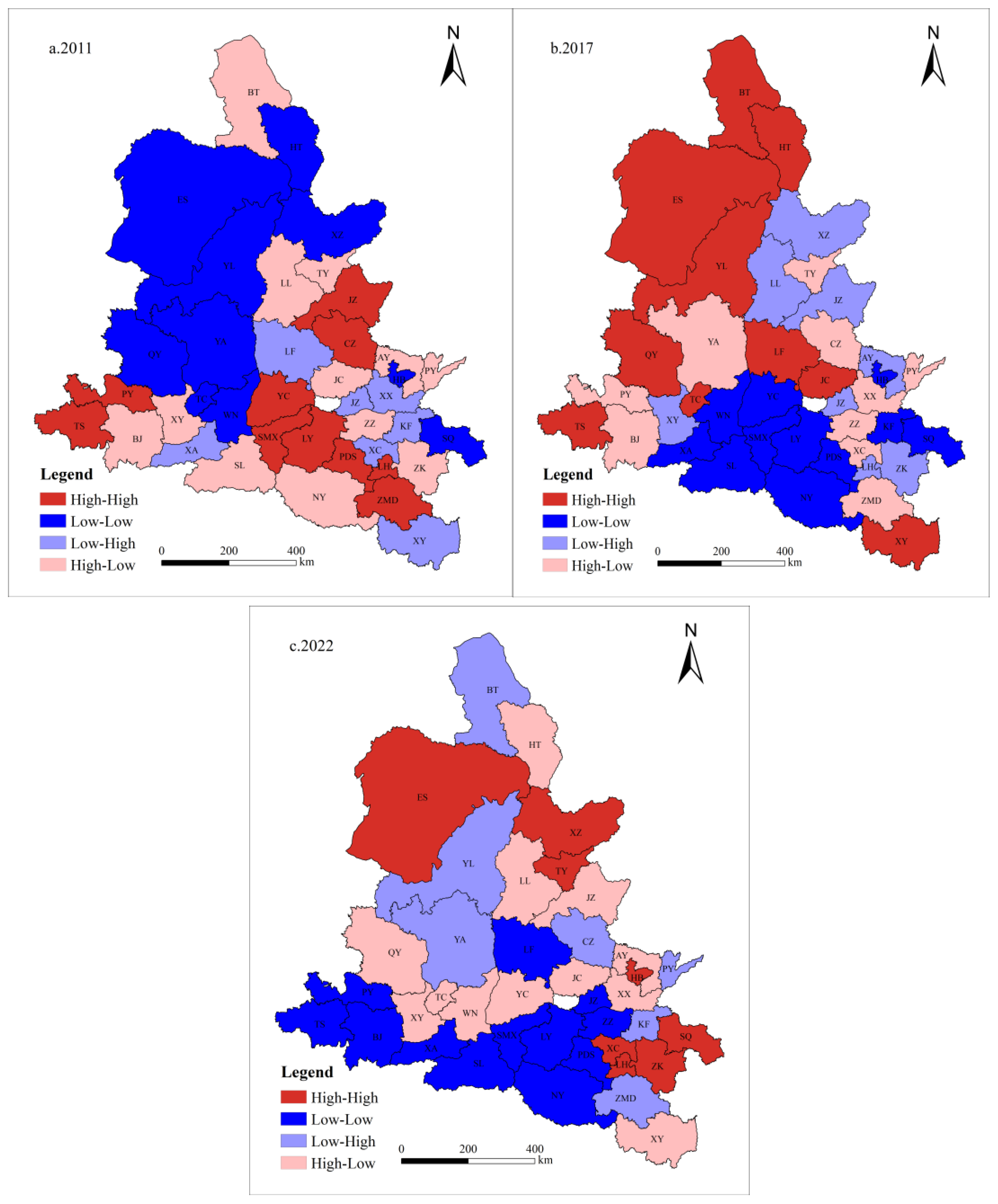
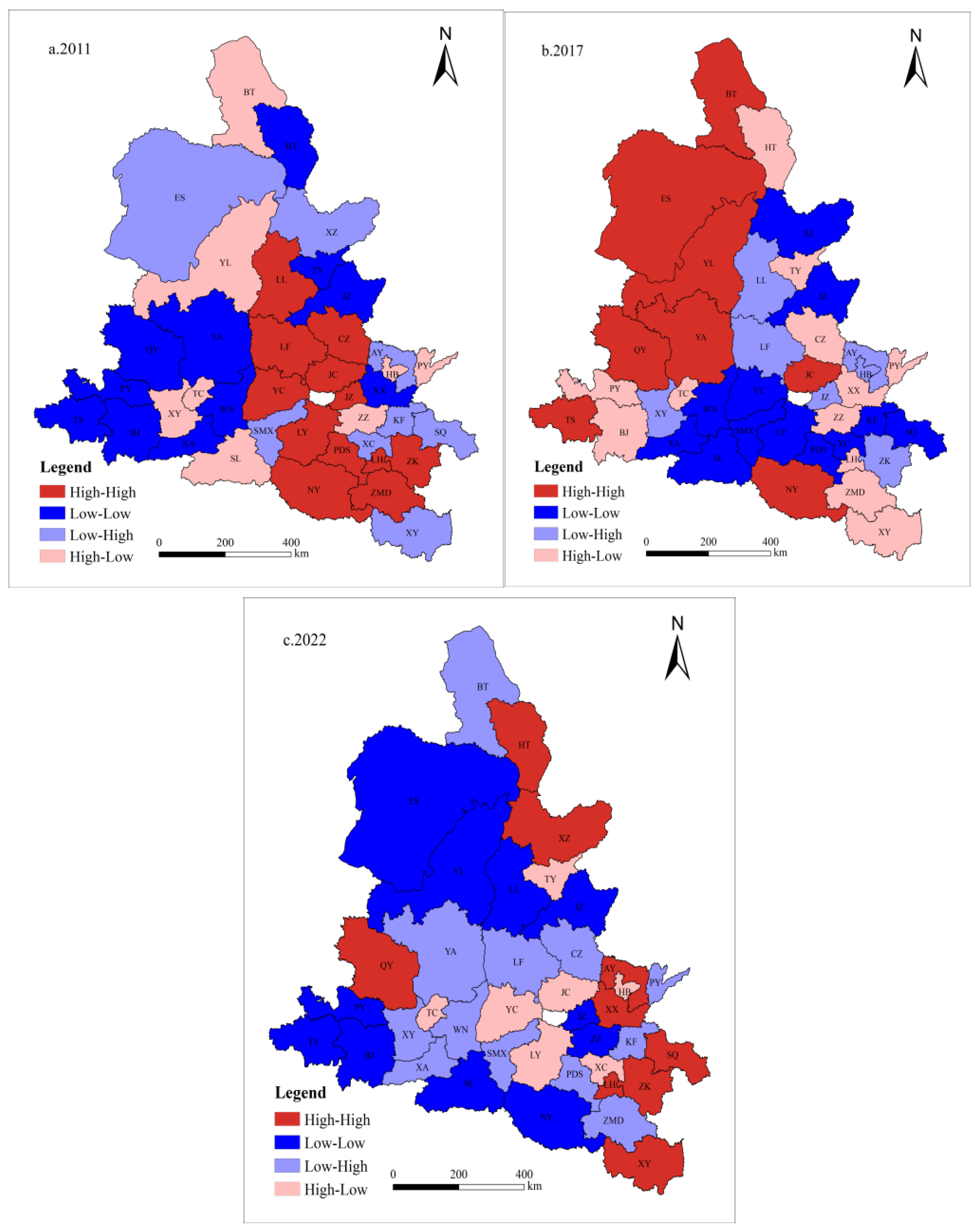
Because cities are embedded in a spatially connected system, it is important to assess whether the model adequately captures spatial processes. To this end, we analyse Local Indicators of Spatial Association (LISA) for y
1 and y
2 and compute global Moran’s I statistics for the corresponding model residuals (
Figure 8 and
Figure 9,
Table 7).
For y1, the LISA maps reveal strong and evolving spatial clustering. In 2011, high–high clusters are mainly concentrated in the southern and south-eastern parts of the study area, whereas a large low–low block covers much of the northern Loess Plateau and core energy base. By 2017, high–high clusters extend northwards and several southern cities shift into the low–low group, suggesting diffusion of efficiency improvements along major corridors alongside emerging within-region disparities. In 2022, the configuration becomes more fragmented, with high–high cities concentrated in parts of the north and reappearing in some eastern prefectures, while low–low belts persist in several southern and south-western areas.
For y2, spatial evolution is related but not identical. High–high clusters expand in some northern areas over time, while low–low clusters become more concentrated in parts of the south-west and central region in later years. This pattern is broadly consistent with the spatial structure of ecological-function zones, river-valley corridors, transport linkages, and inter-city industrial spillovers that jointly shape efficiency outcomes.
Global Moran’s I statistics for residuals (
Table 7) provide a complementary diagnostic. Residual Moran’s I values are consistently negative and moderate in magnitude, and they are frequently statistically significant across years, indicating a mild dispersion-type spatial pattern in the residuals rather than residual clustering. This suggests that the nonlinear hybrid model captures the dominant high–high/low–low structure observed in the raw efficiency indicators, while some systematic cross-border contrasts remain. Importantly, the remaining spatial dependence does not manifest as coherent residual hot spots or cold spots, implying limited scope for residual-driven spatial clustering beyond what is explained by the observed covariates and fixed effects.
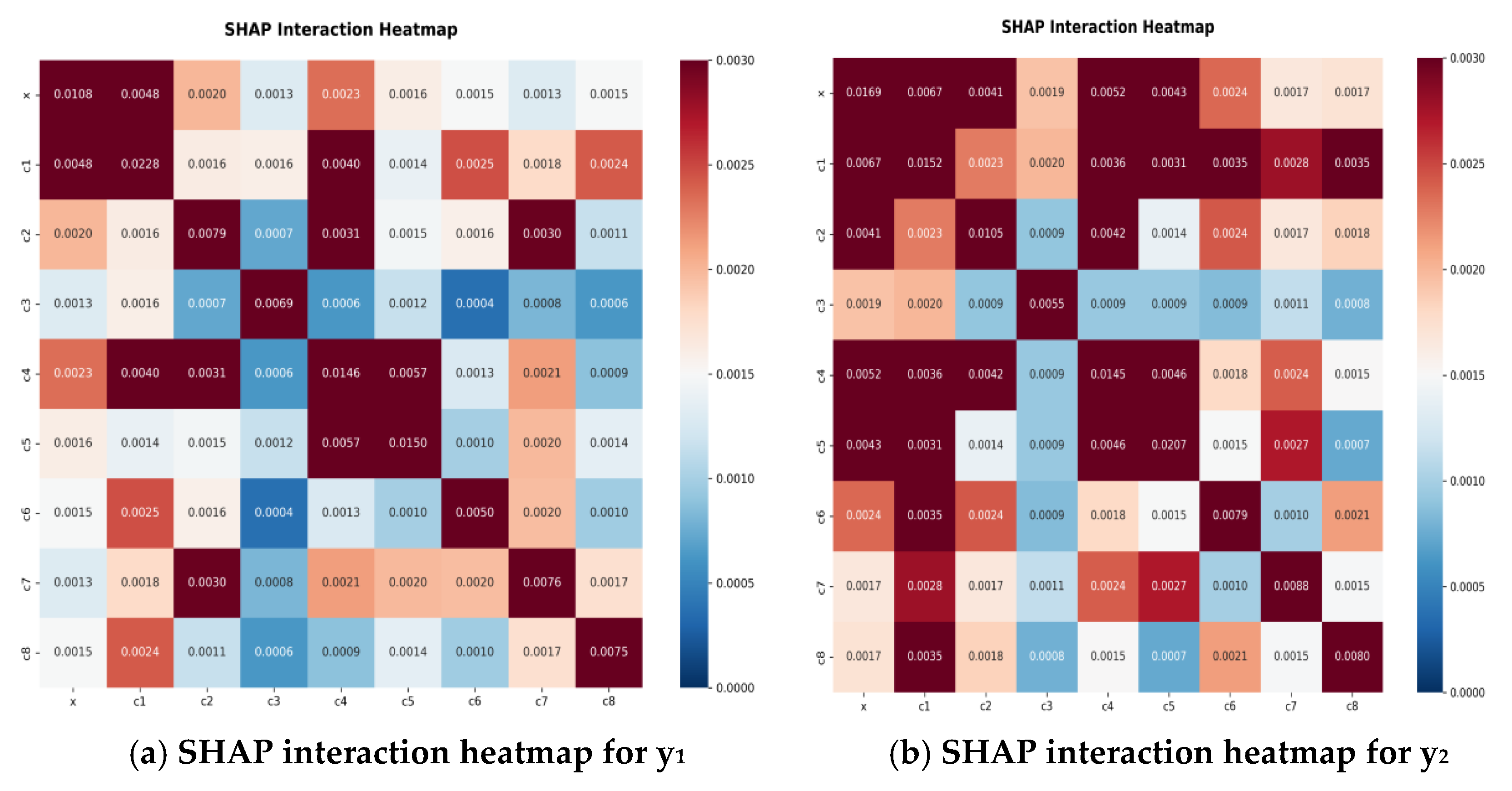
5.7. Interaction Structure Among Drivers and Policy Implications
The analyses above have focused on marginal (ceteris paribus) effects. Yet the contribution of each driver to efficiency may depend on the level of other variables, and policy measures in practice often study through such complementarities. To characterise these patterns, we compute pairwise SHAP interaction values for both efficiency models and summarise them in interaction heatmaps (
Figure 10). Each cell reports the mean absolute interaction between two features, i.e., the extent to which their joint contribution to predicted efficiency deviates from the sum of their individual effects.
Several robust interaction structures emerge. First, the digital–intelligent integration index x exhibits strong interactions with human capital (c1) and urbanisation (c4). This implies that the efficiency gains associated with digital–intelligent development are amplified in cities that already possess a skilled labour force and stronger agglomeration economies. Conversely, where human capital and agglomeration are weaker, the marginal return to additional digital investment is more limited.
Second, the heatmaps highlight interactions between digital–intelligent development and regulation-, investment-, and finance-related variables. In particular, combinations such as x,c3 (environmental regulation), x,c6 (fiscal investment intensity), and x,c8 (financial development) stand out, suggesting that digital–intelligent tools are most effective when complementary regulatory frameworks, public-investment capacity, and financial-market development provide support for implementation and scaling.
Third, there is evidence of complementarity among conventional development drivers. For example, interactions between science and technology expenditure (c5) and human capital (c1), as well as between openness (c7) and innovation-related variables, indicate that innovation inputs and external linkages can reinforce each other in shaping both green and conventional efficiency. These interaction structures argue against single-instrument interventions. Promoting digital transformation in isolation—without parallel progress in human-capital formation, innovation inputs, regulation, and enabling fiscal/financial conditions—is unlikely to unlock the full potential efficiency gains.
From a policy perspective, these results support complementarity-based packages: prioritising digital–intelligent investment where human capital and urbanisation-related scale effects can absorb and diffuse new technologies; coupling digital platforms with environmental regulation to improve implementation capacity and transparency; aligning fiscal investment with innovation-oriented projects that raise efficiency under carbon constraints; and strengthening financial development (including the capacity to mobilise green-oriented financial resources where applicable) to support city-level efficiency improvements. For the middle reaches of the Yellow River—where resource dependence, ecological vulnerability, and digital–intelligent transformation are intertwined—such coordinated strategies are important for achieving simultaneous progress in high-quality growth and carbon-mitigation-oriented efficiency.
7. Conclusions and Policy Implications
7.1. Main Conclusions
Using a framework that combines super-efficiency DEA, a nonlinear ensemble model, panel dynamics and spatial statistics, this study examines city-level performance in the middle reaches of the Yellow River Basin from two complementary dimensions. Green production efficiency is measured by y1, a super-efficiency SBM indicator that evaluates city-level production efficiency while explicitly incorporating undesirable outputs. Conventional production efficiency is measured by y2, a super-efficiency CCR indicator that provides a benchmark efficiency measure without explicitly modelling undesirable outputs. The main conclusions are as follows.
- (1)
The modelling framework explains most observed variation in y1 and y2.
Across the full sample and within each urban agglomeration, the hybrid model reproduces the level and evolution of both efficiency measures with very high goodness-of-fit and small absolute errors. Residual Moran’s I is consistently negative and moderate in magnitude, indicating a mild dispersion-type spatial pattern rather than residual clustering. Thus, the dominant spatial patterns in green and conventional efficiency can largely be attributed to observable differences in development conditions, regulation intensity, fiscal investment, openness, financial development and digital–intelligent integration, rather than being left as unexplained residual hot spots.
- (2)
Digital–intelligent integration matters but operates through complementarities.
The composite index of digital–intelligent integration x is positively associated with both y1 and y2 and ranks among the key predictors. However, it does not replace conventional drivers. Human capital (c1), urbanisation (c4), science and technology expenditure (c5), fiscal investment intensity (c6), environmental regulation (c3), openness (c7) and financial development (c8) remain central determinants. Interaction results indicate that the contribution of x is largest where human capital and agglomeration conditions are stronger and where enabling institutions (regulation, fiscal investment capacity and finance) support implementation and scaling. This pattern suggests that several factors function primarily as moderators: innovation and skills proxy absorptive capacity for adopting general-purpose digital technologies; agglomeration conditions reflect urban-economy mechanisms (matching and learning) that raise returns to data-enabled coordination; and regulation, fiscal capacity and finance constitute institutional complements that allow digital systems to operate as enforceable MRV and investable upgrading projects. In this sense, digital–intelligent integration acts mainly as an enabling input whose effectiveness depends on local capability, sectoral structure and governance capacity.
- (3)
The time profiles of y1 and y2 differ.
Green efficiency y
1 responds more strongly to shocks in urbanisation, innovation expenditure and fiscal investment intensity earlier in the period, with marginal effects weakening later, consistent with diminishing returns and potential redundancy if investment is not matched by higher-quality adjustment [
107]. Conventional efficiency y
2 shows more persistent roles for regulation, openness, finance and digital–intelligent integration, with timing consistent with diffusion and institutional channels that build gradually and then stabilise [
97,
108]. Digital–intelligent development supports both measures, but the timing and strength of impacts depend on the phase of rollout and the degree of integration into organisational and regulatory practice.
- (4)
Spatial heterogeneity implies multiple pathways.
High values of y1 and y2 do not fully overlap in space, and cities with similar efficiency levels can reach those outcomes through different combinations of endowments and institutions. The city profiles of Hohhot, Taiyuan, Xi’an and Zhengzhou illustrate how local conditions shape the configuration of drivers behind y1 and y2 even within a single basin. Multiple viable pathways to green development therefore exist, rather than a single “best practice” model. The spatial non-overlap also accords with differentiated functional roles and constraints within the basin (e.g., resource-dependent energy-base cities versus ecologically constrained areas), implying that evaluation and policy design should be organised at the urban-agglomeration and basin scales rather than inferred from a subset of leading cities.
7.2. Policy Implications
The results yield several policy implications for the middle reaches of the Yellow River Basin. These implications align with China’s dual-carbon roadmap (peaking emissions before 2030 and achieving carbon neutrality before 2060) and, more specifically, with the current configuration of industrial decarbonisation policies that is increasingly organised as a portfolio of pathway-specific instruments. A recent synthesis study characterises China’s industrial decarbonisation framework as exhibiting a “differentiated governance logic”: policy consistency is strongest for direct emission abatement, while linkages to circular-economy integration and socio-economic risk mitigation remain comparatively weaker. This implies that effective implementation depends not only on instrument intensity but also on place-based coordination across pathways and governance capacities [
109]. In this context, digital–intelligent tools should be treated as complements to industrial decarbonisation—strengthening monitoring, reporting and verification (MRV), improving evaluation feedback, and lowering coordination costs for spatially targeted interventions—rather than as stand-alone substitutes for structural reform. Given the basin’s urban-agglomeration structure, policy experiments such as low-carbon city pilots and related green-governance initiatives can serve as practical testbeds for scaling localised digital solutions (e.g., smart energy management, real-time emissions monitoring, and data-enabled industrial upgrading) into basin-wide strategies. Our conditional-effect results further indicate that digital solutions deliver larger gains when they are aligned with local administrative capacity and sectoral structure—consistent with the pathway-based, differentiated governance perspective [
100].
- (1)
Plan digital–intelligent development jointly with structural and institutional reform.
The largest improvements in both y1 and y2 are observed in cities that combine digital–intelligent investment with ongoing industrial upgrading, clearer environmental standards and active use of green-finance instruments. In these settings, digital systems improve monitoring, enforcement and project evaluation. Where such complementary factors are weak, additional digital infrastructure has a more limited effect on green performance. Digital–intelligent initiatives should therefore be designed as part of integrated packages that also address industrial structure, regulatory quality and green finance.
- (2)
Match policy mixes to the position of each city in the y1–y2 space.
Cities with high green production efficiency y1 but weaker ecology-oriented efficiency y2 are often industrial and logistics hubs with strong fiscal revenues and a heavy legacy of historical emissions. For these cities, policy should focus on tightening environmental enforcement, accelerating the phase-out of highly emission-intensive activities and directing finance towards cleaner production and remediation so that structural upgrading does not lock in a new round of high-carbon growth. Cities with comparatively high y2 but modest improvements in y1, typically located in areas with important ecological functions, can place more emphasis on industries and services that are compatible with ecological constraints, using digital tools to generate income from ecological assets while maintaining ecological quality.
- (3)
Consider sequencing: combine early investment with institution-building.
Short-term public investment and fiscal expansion can quickly raise production-related efficiency, especially y
1, but the dynamic analysis suggests that these gains are not sufficient on their own and may fade if they are not accompanied by structural adjustment and stronger institutions. Environmental governance and green-finance development take longer to establish but are associated with more stable improvements in y
2. Policy portfolios should therefore combine early investment with measures that strengthen regulatory and financial frameworks so that y
1 and y
2 move in the same direction over time [
110].
- (4)
Strengthen coordination at urban-agglomeration and basin scales.
The persistence of low–low clusters and the differences between urban agglomerations indicate that governance at the level of individual cities is not sufficient. Industrial links, labour flows and environmental externalities, as well as the indicators used to monitor them, do not follow administrative boundaries. Interpreting the identified clusters alongside existing regional development arrangements (urban-agglomeration strategies, energy-base transition tasks, ecological-function zoning, and policy pilots such as low-carbon city programme and green-finance initiatives) points to clear alignment and misalignment. Persistent low–low clusters are more likely to occur where carbon lock-in is strong but governance and financing complements are weaker, suggesting that basin-scale coordination should link digital rollout with shared MRV standards and data interoperability, targeted fiscal–financial support, and coordinated industrial restructuring to internalise cross-border spillovers. Joint planning of industrial layouts, digital infrastructure and environmental standards at the scale of urban agglomerations and the basin as a whole can help to narrow gaps between core and peripheral cities and align local actions with the objective of high-quality, low-carbon and resilient development in the Yellow River Basin.
7.3. Limitations and Future Research
Several limitations should be noted.
- (1)
Identification and causal inference.
The analysis is based on observational panel data and is designed to describe conditional relationships. The results are robust to alternative specifications and consistent with institutional knowledge of the region, but they do not identify causal effects. Stronger conclusions about the impact of digital–intelligent integration, environmental regulation or green finance on y1 and y2 would require quasi-experimental designs that exploit the timing and spatial distribution of specific policies or infrastructure projects.
- (2)
Spatial and temporal aggregation.
To match the availability of socio-economic and governance indicators, the analysis is conducted at the city–year level, and spatial information is aggregated to the same scale. This aggregation obscures intra-urban differences in land use, digital access and environmental quality. Extending the framework to finer spatial units—such as grid cells or neighbourhoods—would allow high-resolution remote-sensing products to be combined with more detailed statistical or administrative information and would make it possible to examine within-city inequalities in green development.
- (3)
Limited representation of interaction and network effects.
The interaction analysis focuses on pairwise effects between drivers and does not explicitly represent higher-order interactions or network relationships among cities. In practice, competitive and cooperative linkages along supply chains, transport corridors and river systems are likely to influence the diffusion of green technologies and practices. Incorporating measures of connectivity and inter-city dependence into the modelling framework would provide a more complete picture of regional transition processes.
- (4)
Scope of application and period of observation.
The empirical study covers one group of urban agglomerations in the middle reaches of the Yellow River over 2011–2022. Applying and extending the framework to other basins and regions, and to later years as new data become available, would make it possible to test which patterns are specific to the middle reaches of the Yellow River and which generalise to other settings. Comparative analysis across river basins and urban agglomerations with different policy regimes, industrial structures and ecological conditions would also help clarify how these factors mediate the relationship between digital–intelligent integration and the two super-efficiency indicators at the city level.