


Abstract
To combat desertification and land degradation in arid and semi-arid zones, the government has adopted an approach of rehabilitation of pasturelands through forage plantations. This program was launched at the beginning of the 1990s and, to date, there has been no global or national study on the sustainability of the program, particularly its economic profitability. Our work’s principal objective was to perform an economic analysis of the forage plantation program across the different periods since the creation of the program until the year 2020, focusing on the economic evaluation parameters of the projects, such as mean annual net income, net present value, annuity of the net present value, profitability index and payback period, based on the data collected from the official institutions. The results showed that the forage plantation program significantly contributes to sustainable development in steppe areas.
1. Introduction
Agricultural land in Algeria, including crop land and natural steppe, accounts for only 18% of the total national land. In 2019, a little over 8.563 million ha was used for agricultural production, mainly concentrated in the northern regions. The Algerian steppe, as a buffer zone between the Tellian chains to the north and the Sahara Desert to the south, is a pastoral region. Sheep farming is the major agricultural practice of the local population of the steppe. It is the homeland of 80% of the national sheep flock, numbering 29.428 million head in 2019.
Since 1970, the State has been implementing measures to support sheep producers in the area without taking into consideration the operational capacities of pasturelands. The introduction of barley as an alternative food supply to alleviate pressures on the vegetation cover of the steppe has encouraged sheep producers to enlarge their flocks. Consequently, the sheep population has been increasing at an exponential rate despite unfavorable climatic conditions and accelerated steppe degradation. The national sheep flock has increased from one sheep equivalent per four ha steppe in 1968 to one sheep equivalent per 0.78 ha in 2006. This intensive concentrated feeding has promoted sheep flock sizes ten times larger than the capacity of steppe pasture. This, in turn, has resulted in severe overgrazing and an excessive reduction in forage units (FUs) of the steppe [1].
Anthropogenic activities, such as the extension of clearings at the expense of rangelands, poor management of water sources and soil [2,3,4,5,6,7,8], and the frequent drought waves of the last two decades [9,10,11,12,13], have sent steppe plant formations into an extremely worrying phase of degradation. Aidoud et al. [14] and Hasnaoui et al. [15] indicated that Stipa tenacissima and Lygeum spartum have completely disappeared in the steppes of southern Oran. According to the National Bureau of Studies for Rural Development (2010) [16], almost 65% of the total national steppes were classified as highly degraded (Figure 1). These areas showed a dramatic fall in the production of steppe ecosystems from 150 to 30 FUs per year between 1978 and 2006 [1].
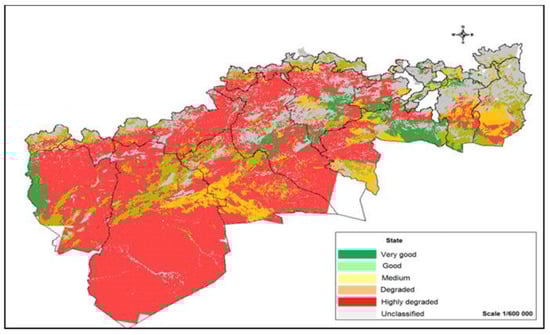
Figure 1.
The degradation state of the steppe region, data source: BNEDER, 2010 [16].
In response to this alarming decline in vegetation cover, the State, through the High Commissariat for the Development of the Steppe (HCDS), has launched measures to rehabilitate the degraded pasturelands. These measures have comprised closure of degraded areas, collection of surface water and spring capture, grazing management through the identification and mapping of potential areas for sheep grazing, and the introduction of fodder shrubs [1]. The HCDS started with shrubs and forage plantation projects in the early 1990s with the rehabilitation of degraded perimeters by introducing species with considerable adaptation and resistance to the bioclimatic conditions of arid and semi-arid regions. In this context, planted species such as Atriplex canescens, Atriplex nummularia, Atriplex vesicaria, Opuntia ficus indica and Medicago have been introduced based on the specific characteristics of each steppe zone [1]. Since the early 1990s, the HCDS has successfully rehabilitated a surface area of 392,874 ha in 22 wilayas, which are classified as pastoral or agro-pastoral vocation areas. This, in turn, has led to an increase in forage supply from 40 to 600 FUs/ha in these wilayas [16].
The implemented measures to mitigate the degradation of the steppe have been subject to several studies investigating their effect on pastoral value, biodiversity, and soil properties [6,7,8,17,18,19]. To the best of our knowledge, there is minimal evidence of the economic viability of the implemented forage plantation program. Our research aimed to analyze the economic impact of the forage plantation program from the period of its initial implementation in 1994 to 2020. This objective has been achieved by focusing mainly on the essential economic evaluation parameters, including mean annual net income (MANI), net present value (NPV), annuity of the net present value (A), profitability index (PI,) and payback period (PP).
2. Methodology
2.1. Steppe Area and Formations
This study covered the entire steppe of Algeria, which stretches over 32 million ha of pastureland, of which 12 million ha is in the pre-Saharan region. It covered 22 wilayas and 440 municipalities (Figure 2).
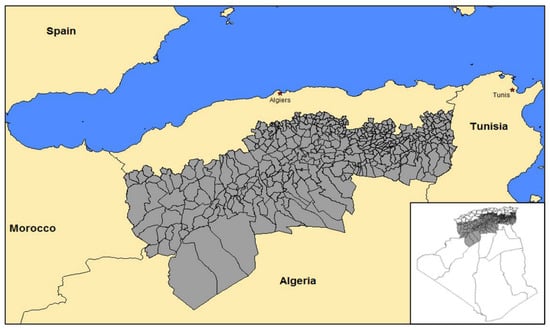
Figure 2.
Study area (440 municipalities), data source: own illustration.
The pastoral potential of the Algerian steppes was clustered according to four vegetation formations and azonal formations: (i) the alfa (Stipa tenacissima), (ii) the Artemisia (Artemisia herba-alba), (iii) the spartum (Lygeum spartum), and (iv) the Arthrophytum scoparium (remt) steppes (Table 1)

Table 1.
Vegetation formations of steppe in Algeria, data source: [1,20].
2.2. Data Sources and Evaluation Methods
To comprehensively capture insights into the economic indicators of the implemented forage plantation program across the country, official data sources were used. Data on the development forage plantation area over the program period in different wilayas, forage units, rental price in planted forage area, annual rental returns, and costs of forage plantation per hectare were obtained from the HCDS database. Government rates of barley grains and the evolution of the interest rates at the national level were acquired from FAOSTAT, and the World Bank, respectively. The study covered a period of 26 years, from the first implementation of the plantation program in 1994 to 2021.
The forage plantation program was economically evaluated based on five indicators:
- The mean annual net income (MANI) was used to evaluate the financial performance of the program. It is the ratio between the total net income, as cash flow sum, and the lifecycle of the investment [21]. MANI was calculated using Equation (1).
- The net present value (NPV) was widely used to evaluate the program’s economic feasibility [21,22,23,24,25,26,27,28]. It presents the cash inflows subtracted by the cash outflows linked to the investment over an observed period. A positive NPV indicates an economically feasible program [29,30]. NPV was calculated according to Equation (2).where i is years, n is the lifecycle of investment, p is the interest rate, CFi is the total cash flow in year i, and Ei is the cost or expense in year i.
- The Annuity (A) was used to represent the payment of invested funds in a fixed income stream for the life period of the investment. [21] indicated that A could replace the actual cash flow without changing its NPV (Equation (3)).
- The profitability index (PI) expresses the overall program profitability by measuring the present value of future cash flows and the initial investment [22,31]. The PI was calculated using Equation (4) [32].
A PI value > 1 indicates a profitable investment; thus, a program is suitable for investigation. A PI value ˂ 1 means the program is a loss-making investment. The lowest acceptable profit for an investment is related to a PI value = 1.
- 5.
- The payback period (PP) refers to the time required for the total initial investment to recover the total savings [33,34]. Therefore, the longer the PP of an investment, the less attractive the investment. The PP was calculated using Equation (5):
3. Results and Discussion
3.1. Returns
Returns were calculated based on the rental price per hectare of forage plantation, which has been fixed by the State at DZD 2000 across all wilayas since the outset of the program. Since the launch of the program until the year 2000, the State has divided the total returns of forage land rental into 50% for the municipality, 30% for the treasury, and 20% for the HCDS. This distribution has been modified since 2001 to be 30% for the treasury and 70% for the municipality, at the same rental price (2000 DZD/ha) (Figure 3).
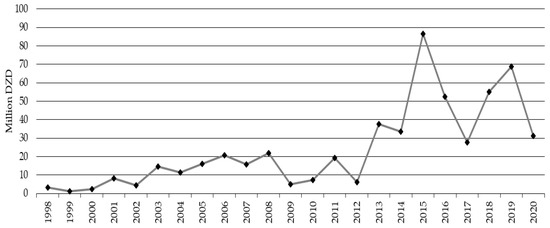
Figure 3.
Rental returns of forage plantation perimeters, data source: HCDS.
In 1998, returns from the rental of forage plantations were recorded at DZD 3.12 million. This rose appreciably between 2001 (DZD 8.24 million) and 2008 (DZD 21.70 million). Following a decline in 2009 and 2012, a peak was reached in 2015 at DZD 86.37 million. The returns were highly impacted by plantations proposed for rent and the total rented plantations over the program period. Table A1 and Table A2 (in Appendix A) provides data on proposed and rented plantations (perimeters and hectares), number of total forage units, and returns for each in 2020.
In 2020, 233 perimeters of forage plantation were proposed for rent with a total area of 15,553 ha, distributed across only 11 wilayas (Figure 4). The value of rented forage plantation in 2020 totaled DZD 31.1 million.
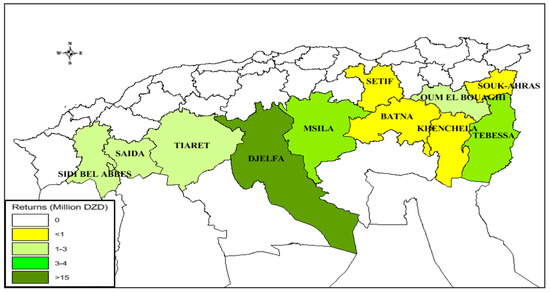
Figure 4.
Forage planting program returns by wilaya in 2020, data source: HCDS (own illustration).
To classify the wilayas in relation to the forage planting program, we used principal component analysis (PCA) based on the following quantitative indicators: the total planted, proposed, and rented area (ha); ratio of the rented to the proposed area; returns million DZD; and number of forage units (million FUs) (Figure 5).
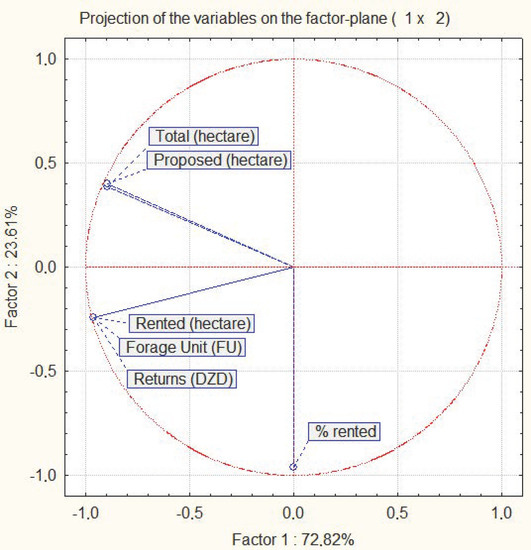
Figure 5.
Projection of variables (PCA).
Figure 6 shows that all the variables were correlated with two axes of the PCA (plan: 1 × 2) with an excellent quality of representation equal to 96.43%.
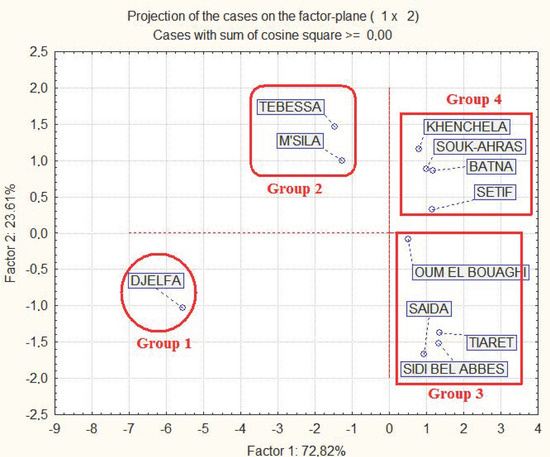
Figure 6.
Typology of wilayas in terms of program results (forage planting).
The results of the principal component analysis revealed four homogeneous groups (Figure 6). Group 1 (Djelfa) was characterized by a large share of rented area (7797 ha), greater than 61% of the proposed area, the highest return (DZD 15.59 million), and forage units equal to 5.06 million. The wilayas of M’Sila and Tebessa ranked second in terms of the total proposed area (M’Sila, 9216 ha; Tebessa, 11,388 ha), rented area (M’Sila, 1932 ha; Tebessa, 1718 ha), returns (M’Sila, DZD 3.864 million; Tebessa, DZD 3.436 million), and number of forage units (M’Sila, 1.2558 million FUs, Tebessa, 1.1167 million FUs). Four wilayas (Oum El Bouaghi, Saida, Sidi Bel Abbes, and Tiaret) were classified third in terms of the observed indicators.
Returns ranged between DZD 2.16 million in Oum El Bouaghi and DZD 1.12 million in Tiaret. The rental rates of the fourth group were relatively low, ranging between 3.13% and 19.73%, which negatively impacted the returns. Such low rental rates were attributed to the demand of sheep farmers and the degradation of the perimeters.
3.2. Forage Units
In 1998, the perimeters of the rented forage plantations at the national level produced the equivalent of 1 million FUs (Figure 7). This number more than doubled in 2001 with 2.68 million FUs, and it reached 4.69 and 28 million FUs in 2003 and 2015, respectively. The unfavorable climate conditions that severely impacted feed production and resulted in higher feed costs (64.43% and 67.09% of total production costs for lambs and young rams, respectively) induced a growing demand for pasturelands [35,36]. The strategy of the stockbreeders was based on the displacement to wilayas where there was the possibility of renting perimeters of forage plantation.
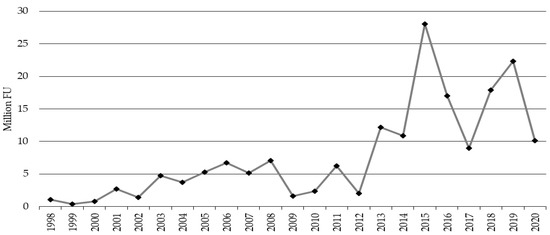
Figure 7.
Forage units produced by the forage plantation program, data source: HCDS.
3.3. Economic Analysis of Forage Plantation Program
3.3.1. Cost of One Hectare
The implementation of the forage plantation program required the mobilization of a qualified labor force consisting of workers (laborers, guardians, and drivers) and a technical-administrative staff (engineers, technicians, and administrative officers) (Figure 8). The evaluation of employment needs was determined on the basis of technical standards resulting from experience with the HCDS and the data below:
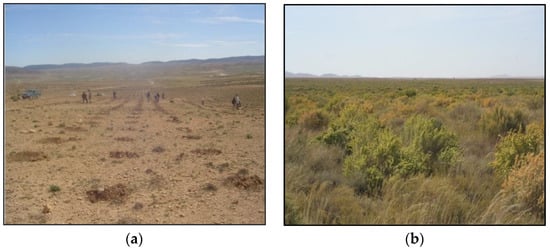
Figure 8.
(a) Forage planting works; (b) perimeter of forage plantation (Atriplex), data source: HCDS.
- 01 worker = 45 plants/day;
- 01 Hectare = 800 plants = 18 working days;
- 01 permanent job equivalent = 240 days.
The plantation perimeters required a permanent guardian; the number of guardians was set at one guardian per 100 ha. In addition, the realization of this project required a technical-administrative staff consisting of different categories of personnel to ensure both technical and management needs as well as administrative supervision. Costs per hectare of forage plantation were structured as described in Table 2.
Table 2.
The cost of a one hectare of forage plantation.
As shown in Figure 9, forage plantation costs were recorded at DZD 68,000 per hectare over the period 2014–2021, up by 566% compared to 1994–2001 levels. This evolution was highly linked with the increase in costs related to labor and forage plants.
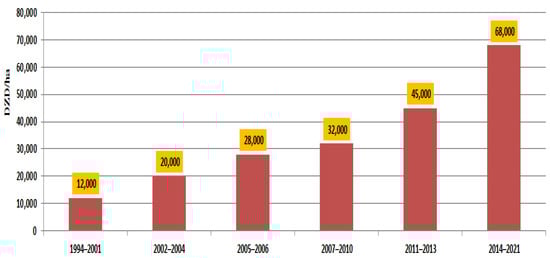
Figure 9.
Cost of forage plantation, data source: HCDS.
Concerning cost structure, Figure 10 shows that the highest cost item was labor (78% of the total forage plantation costs), followed by the purchase of transported forage plants (9%). The unit price of a forage plant transported was DZD 8. Other costs (such as soil preparation, boundary delimitation, technical and administrative supervision, etc.) did not exceed 3.6% of the total costs.
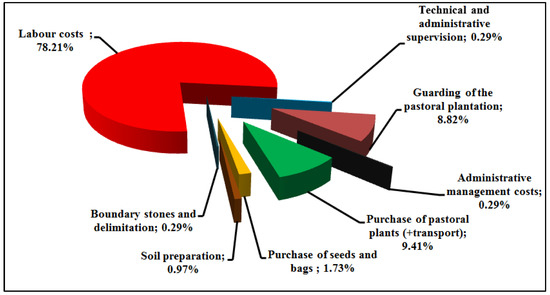
Figure 10.
The structure of cost for one hectare of forage plantation, data source: HCDS.
3.3.2. Economic Parameters
To analyze the economic parameters of the forage plantation program, data on interest rates and barley prices (Figure 11 and Figure 12) were obtained from official institutions (1 FUs = 1 kg of barley).
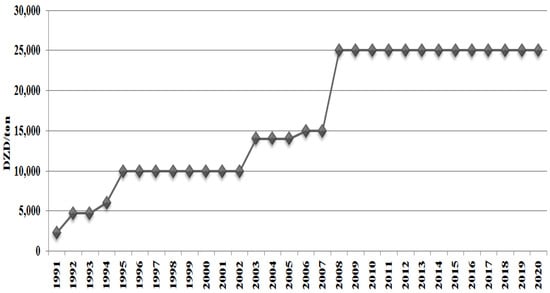
Figure 11.
Barley price as fixed by the State, data source: FAOSTAT.
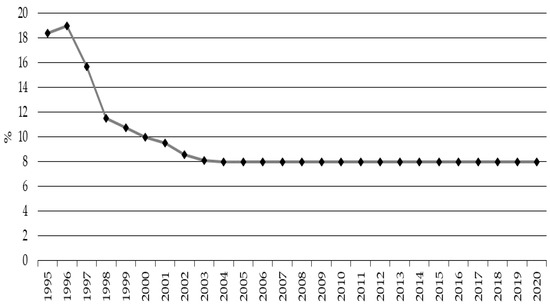
Figure 12.
The interest rates in Algeria, data source: World Bank.
The market price of barley was volatile according to market and climate conditions. However, the government intended to shield farmers from the impacts of price volatility through subsidies, which were insufficient in quantity (Figure 11).
In 1996, the interest rate in Algeria was 19%. It declined during a period of seven years at 8.125% in 2003, then stabilized over the 2004–2020 period at 8%.
Mean Annual Net Income, Net Present Value, and Annuity
The first projects of the forage plantation program (started in 1994) had a mean annual net income of DZD 6676, a net present value (NPV) of DZD 69,118, and an annuity (A) of more than DZD 8745. In 2002, the forage plantation projects reached a mean annual net income of DZD 10,541, an NPV of DZD 103,054 DZD and an annuity (A) of DZD 13,038. These three parameters rose until 2010, due to barley prices and costs of forage plantation (32,000 DZD/ha). By 2011, the net present value (NPV) and annuity (A) fell to DZD 62,127 and 7860, respectively. This was due to the increases in the cost of plantation in 2011 and 2014 (45,000 and 68,000 DZD/ha, respectively).
Profitability Index (PI)
The profitability index values were higher than one over the six analyzed periods, which indicated that the forage plantation projects were profitable (Figure 13). However, the index declined from 4.91 in 1994 to 1.66 in the 2014–2021 period. This was due to the increased cost as well as the low income earned from the rental (the price was fixed since the creation of the program at DZD 2000 per hectare).
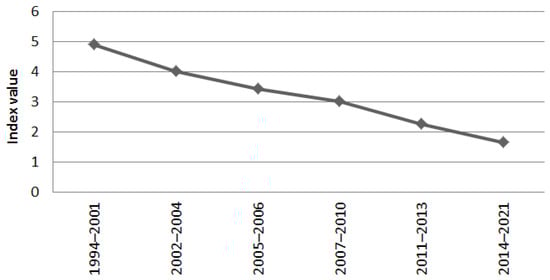
Figure 13.
Profitability indices of the forage plantation program.
Payback Period (PP)
The payback period was strongly correlated to the profitability index. It was noted that this indicator increased from three to eight years (Figure 14). This was linked to the low profitability of new projects compared with previous ones, taking into account that the life duration of the forage plantation projects was 13 years of rent.
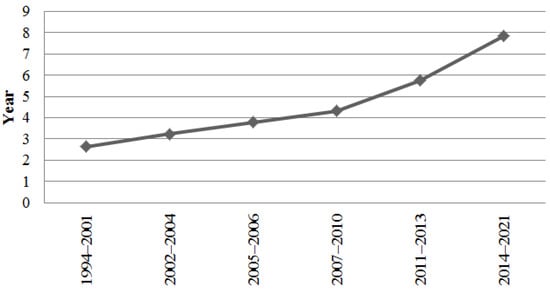
Figure 14.
Payback periods for the forage plantation program.
The success of pastoral development programs requires the coupling of human and natural factors. In Tunisia, despite the ecological and economic importance of steppe rangelands [37], the State has only implemented 908,000 ha between 1990 and 2011, which is disappointing considering that it represents only 25% of the projections made by the technical services concerned [38]. Rangelands in Morocco provide a livelihood for thousands of people and protect Morocco from desertification [39]. Moroccan authorities have only restored 662,000 hectares between 1970 and 2009, when the program to combat desertification was given priority to sylvo-pastoral operations [40,41]. Libyan rangelands are one of the significant pillars of support for the Libyan national economy. Libyan rangelands occupy about 13.3 million hectares [42]. The technical services in Libya have been successful in restoring an area of 928,800 ha of pastoral lands between 1970 and 2008, distributed among Al-Abyar, Al Jabal Al Akhdar, Al-Magron, and Al-Tamimi [43,44].
In Tunisia, the first sylvo-pastoral plantations were begun around 1965. The species that were used included Acacia ligulata, Acacia saligna, and Opuntia ficus indica. From 1980, other species such as Prosopis sp., Atriplex sp., Acacia salicina have been used. At the end of the 1980s, indigenous species, in particular Periploca laevigafa and Rhus tripattitum, were introduced [45]. Zaafouri [46] and Zaafouri et al. [47] evaluated the performance of the introduced species in the pre-Saharan sylvo-pastoral perimeters of Tunisia and estimated that 82.9% of the southern perimeters were located on soils with low potentialities and thus exhibited limited growth. In Algeria and Morocco, the shrub species most used in pastoral development programs include Atriplex sp., Acacia sp., and Opuntia ficus-indica [48,49]. Kaba [50] indicated that plantations with Atriplex showed limited success on less sandy soil types, and natural regeneration was non-existent on calcareous slopes. Kaba [50], Siad and Zaidi [51], and Mulas and Mulas [52] showed that the advanced age of Atriplex plantations had a negative impact on their fodder value due to the lignification phenomenon. For this reason, the plantations must be integrated into the rotation model and access be controlled during exploitation and not stored as standing reserves (lignification). In Algeria, the number of pastoralists who had access to rehabilitated rangelands varied from year to year (Table A3 in Appendix A). In 2019, the number of beneficiaries reached 3705 pastoralists with a total of 1,477,328 sheep, as opposed to 860 pastoralists with 330,308 sheep in 2020. In arid and semi-arid zones, pastoralists typically have to cope with two forms of severe forage scarcity: the cyclic dry season, which can occur during several months of the year, and unpredictable drought periods, which can last years [53]. In the context of climate change, due to the continuous intense pressure exerted by pastoralists and their livestock, and to limit the loss of pastoral species in the steppe, immediate action must be taken by managers of steppe areas to remove the dysfunctional relationship between the three main components of the pastoral system (pastoralists, livestock, and available biomass) [7]. The High Commissariat for the Development of the Steppe (HCDS) has the authority to limit the number of beneficiaries and the duration of the rental period, and these decisions have been based on the reports of their technical services. To ensure the sustainability of these plantations, exploitation by the stockbreeders must be rationally organized. Couplings between human and natural systems vary across space, time, and organizational units. Furthermore, past couplings have legacy effects on present conditions and future possibilities [54]. Today, globalization has an impact on the sustainable use of natural resources for food production [55]. The resource users will never self-organize to maintain their resources. Therefore, governments must impose solutions. Research in multiple disciplines, however, has found that some government policies accelerate resource destruction, whereas some resource users have invested their time and energy to achieve sustainability [56]. In our case, the State has been invested in the forage plantation program with important human and financial resources to combat desertification and to feed the livestock, but the management of the rental of these perimeters remains the major weakness of this program (the rental time, number of heads per hectare, the identification of beneficiaries, etc.).
4. Conclusions
To analyze the economic viability of the forage plantation project, evaluation methods such as the mean annual net income (MANI), net present value (NPV), annuity (A) of NPV, profitability index (PI), and payback period (PP) were implemented. The results showed that the net present value (NPV) values were positive during the whole period from the creation of this project until 2021, and the profitability indexes calculated for the six periods were all superior to one, indicating that the forage plantation project was profitable, with a maximum payback period (PP) of 8 years, which is inferior to the average period of life for the project. In addition to the economic results, the positive environmental and social effects have been confirmed by several authors, illustrating that the project effectively contributed to the sustainable development of steppe areas. It should remain important to invest in forage plantation projects that provide an important economic, social, and environmental dynamic in rural areas.
Author Contributions
Conceptualization, F.A.B., A.B., A.T., A.D. and B.H.; data curation, F.A.B., A.B., A.T. and A.K.; formal analysis, F.A.B. and B.H.; funding acquisition, F.A.B., W.S. and M.I.A.; investigation, A.B., A.T. and B.H.; methodology, F.A.B., A.B., A.T., A.D. and B.H.; resources, A.D., H.B., B.D. and A.K.; supervision, F.A.B., A.B., A.T., A.D., B.H., H.B., E.M., W.S. and M.I.A.; validation, F.A.B., W.S., M.I.A., B.D. and A.K.; writing—original draft, F.A.B., W.S. and M.I.A.; writing—review and editing, F.A.B., W.S. and M.I.A. All authors have read and agreed to the published version of the manuscript.
Funding
This Research was funded by la Direction Générale de la Recherche Scientifique et du Développement Technologique (DGRSDT), CRAPAST, Algeria and the Researchers Supporting Project number (RSP-2021/390), King Saud University, Riyadh, Saudi Arabia.
Institutional Review Board Statement
Not applicable.
Informed Consent Statement
Not applicable.
Data Availability Statement
Not applicable.
Acknowledgments
The authors extend their appreciation to la Direction Générale de la Recherche Scientifique et du Développement Technologique (DGRSDT), Algeria, to Researchers Supporting Project number (RSP-2021/390), King Saud University, Riyadh, Saudi Arabia and to the High Commissariat for the Development of the Steppe (HCDS), Algeria.
Conflicts of Interest
The authors declare no conflict of interest.
Appendix A
Table A1.
Results of the forage planting program in 2020.
Table A1.
Results of the forage planting program in 2020.
| Wilaya | Number of Proposed Perimeters | Number of Rented Perimeters | Total (Hectare) | Proposed (Hectare) | Rented (Hectare) | % Rented | Returns (Million DZD) | Forage Units (Million FUs) |
|---|---|---|---|---|---|---|---|---|
| DJELFA | 44 | 39 | 12,736 | 12,736 | 7797 | 61 | 15,594 | 5.068 |
| TIARET | 2 | 2 | 650 | 650 | 559 | 86 | 1.118 | 0.363 |
| M’SILA | 53 | 18 | 9974 | 9216 | 1932 | 21 | 3.864 | 1.256 |
| SETIF | 18 | 9 | 2238 | 2038 | 402 | 20 | 0.804 | 0.261 |
| TEBESSA | 52 | 27 | 11,388 | 11,388 | 1718 | 15 | 3.436 | 1.117 |
| OUM EL BOUAGHI | 13 | 13 | 3750 | 2843 | 1080 | 38 | 2.160 | 0.702 |
| KHENCHELA | 27 | 3 | 4789 | 4789 | 150 | 3 | 0.300 | 0.098 |
| SOUK-AHRAS | 10 | 4 | 3540 | 3540 | 210 | 6 | 0.420 | 0.137 |
| BATNA | 6 | 2 | 3000 | 3000 | 125 | 4 | 0.250 | 0.0813 |
| SAIDA | 5 | 5 | 2000 | 980 | 980 | 100 | 1.960 | 0.637 |
| SIDI BEL ABBES | 3 | 3 | 650 | 650 | 600 | 92 | 1.200 | 0.390 |
| Total | 233 | 125 | 54,715 | 51,830 | 15,553 | 30 | 31.106 | 10,109 |
Table A2.
Economic parameters of forage plantation program per hectare (1994–2021).
Table A2.
Economic parameters of forage plantation program per hectare (1994–2021).
| 1994–2001 | 2002–2004 | 2005–2006 | 2007–2010 | 2011–2013 | 2014–2021 | |
|---|---|---|---|---|---|---|
| Mean Annual Net Income (MANI) | 6676.78 | 10,541.71 | 11,983.34 | 11,983.34 | 11,983.34 | 11,983.34 |
| Net Present Value (NPV) | 69,118.91 | 103,054.13 | 110,404.78 | 104,291.06 | 86,935.48 | 62,127.58 |
| Annuity (A) of NPV | 8745.05 | 13,038.59 | 13,968.61 | 13,195.09 | 10,999.23 | 7860.49 |
| Profitability Index (PI) | 4.91 | 4.03 | 3.43 | 3.03 | 2.26 | 1.66 |
| Payback Period (PP) (year) | 3 | 4 | 4 | 5 | 6 | 8 |
Table A3.
Number of beneficiaries (2017–2020).
Table A3.
Number of beneficiaries (2017–2020).
| Sheep Breeders | Total Number of Sheep Heads | |
|---|---|---|
| 2020 | 860 | 330,308 |
| 2019 | 3705 | 1,477,328 |
| 2018 | 1717 | 249,042 |
| 2017 | 2027 | 930,683 |
References
- Nedjraoui, D. Country Pasture/Forage Resource Profiles—Algeria; Food and Agriculture Organization of the United Nations (FAO): Rome, Italy, 2006; Available online: https://ees.kuleuven.be/klimos/toolkit/documents/648_Algeria.pdf (accessed on 19 March 2022).
- Boukhobza, M. L’Agropastoralisme Traditionnel en Algérie: De l’Ordre Tribal au Désordre Colonial; OPU: Ben Aknoun, Algeria, 1982; p. 458. [Google Scholar]
- Slimani, H.; Aidoud, A.; Roze, F. 30 Years of protection and monitoring of a steppic rangeland undergoing desertification. J. Arid. Environ. 2010, 74, 685–691. [Google Scholar] [CrossRef]
- Bahlouli, F.Z.; Djabeur, A.; Kefifa, A.; Arfi, F.; Kaid-harche, M. Degradation of Western Algerian Steppes Lands: Monitoring and Assessment. Ind. J. Ecol. 2018, 45, 235–243. [Google Scholar]
- Hadjoune, H.; Kihal, O.; Kaci, A.; Belhouadjeb, F.A. Quel avenir pour la filière huile d’olive fraichement introduite dans une zone steppique? Cas de la région de M’Sila. N. Medit. A Mediterr. J. Econ. Agric. Environ. 2021, 20, 2. [Google Scholar] [CrossRef]
- Boukerker, H.; Boumedjene, M.R.; Doghbage, A.; Belhouadjeb, F.A.; Kherifi, W.; Hecini, L.; Bekiri, F. State of Pastoral Resources in the Algerian Steppe Regions: Main Factors of Degradation and Definition of Preservation and Rehabilitation Actions. Livest. Res. Rural. Develop. 2021, 33, 140. [Google Scholar]
- Yerou, H.; Belgharbi, B.; Homrani, A.; Miloudi, A. 2022. Impact de la restauration par mis en défens sur les potentialités pastorales d’un parcours steppique à dominance d’Artemisia herba alba dans l’Algérie occidentale. Livest. Res. Rural. Dev. 2022, 34, 8. [Google Scholar]
- Boussaada, D.; Yerou, H.; Benabdelli, K.; Djelailia, S. Evaluation des potentialités pastorales des parcours steppiques algériennes cas de M’sila (Algérie). Livest. Res. Rural. Dev. 2022, 34, 4. [Google Scholar]
- Djeddaoui, F.; Chadli, M.; Gloaguen, R. Desertification Susceptibility Mapping Using Logistic Regression Analysis in the Djelfa Area, Algeria. Remote Sens. 2017, 9, 1031. [Google Scholar] [CrossRef] [Green Version]
- Slimani, H.; Aidoud, A. Desertification in the Maghreb: A case study of an Algerian high-plain steppe. In Environmental Challenges in the Mediterranean 2000–2050, Marquina, A., Ed.; Kluwer Academic Publishers: Dordrecht, The Netherlands, 2004; pp. 93–108. [Google Scholar] [CrossRef]
- Meddi, H.; Meddi, M. Study of the persistence of drought in seven Algerian plains using Markov chains (1930–2003). Mail. Knowl. 2009, 9, 39–48. (In French) [Google Scholar]
- Meddi, H.; Meddi, M. Variability of annual rainfall in northwestern Algeria. Sci. Planet. Changes/Drought 2009, 20, 57–65. (In French) [Google Scholar]
- Benabadji, N.; Aboura, R.; Benchouk, F. La régression des steppes méditerranéennes: Le cas d’un faciès à Lygeum spartum L. d’Oranie (Algérie). Ecol. Mediterr. 2009, 35, 75–90. [Google Scholar] [CrossRef]
- Aidoud, A.; Le Floc’h, E.; Le Houérou, H.N. Les steppes arides du nord de l’Afrique. Sécheresse 2006, 17, 19–30. [Google Scholar]
- Hasnaoui, O.; Meziane, H.; Borsali, A.H.; Bouazza, M. Evaluation of Characteristics Floristico-Edaphic of the Steppes at Alfa (Stipa tenacissima L.) in the Saida Region (Western Algeria). Open J. Ecol. 2014, 4, 883–891. [Google Scholar] [CrossRef] [Green Version]
- Bureau National d’Études Pour le Développement Rural (BNEDER). Les Potentialités Agropastorales de la Steppe Algérienne: Requêtes Cartographiques, Analyse et Interprétation de l’information Géographique; Bureau National d’Études pour le Développement Rural (BNEDER): Chéraga, Algeria, 2010. [Google Scholar]
- Benaredj, A.; Mederbal, K.; Benabdeli, K. Remontée biologique du parcours steppique à Lygeum spartum après une durée de mise en défens dans la steppe sudoranaise de Naâma (cas de la station de Touadjeur). Mediterr. Epoca II 2010, 21, 10–48. [Google Scholar]
- Djamel, A.; Abdelkrim, B.; Hafidha, B. The Impact of Exclosure on the Rehabilitation of Steppe Vegetation at Naâma Rangelands in Algeria. J. Rangel. Sci. 2022, 12, 2. [Google Scholar] [CrossRef]
- Oubraham, F.; Bedrani, S.; Belhouadjeb, F.A. Does interest rate subsidy really promote the financing of farms? The case of the wilaya of Laghouat in Algeria. Cah. Agric. 2021, 30, 23. [Google Scholar] [CrossRef]
- Moulay, A.; Benabdeli, K.; Morsli, A. 2012 Quel avenir pour la steppe à Alfa dans le Sud-Ouest algérien? Forêt Méditerr. 2012, 33, 277–286. [Google Scholar]
- Schiberna, E.; Borovics, A.; Benke, A. Economic Modelling of Poplar Short Rotation Coppice Plantations in Hungary. Forests 2021, 12, 623. [Google Scholar] [CrossRef]
- Yoomak, S.; Patcharoen, T.; Ngaopitakkul, A. Performance and Economic Evaluation of Solar Rooftop Systems in Different Regions of Thailand. Sustainability 2019, 11, 6647. [Google Scholar] [CrossRef] [Green Version]
- Battisti, F.; Campo, O. A Methodology for Determining the Profitability Index of Real Estate Initiatives Involving Public–Private Partnerships. A Case Study: The Integrated Intervention Programs in Rome. Sustainability 2019, 11, 1371. [Google Scholar] [CrossRef] [Green Version]
- López-Marín, J.; Gálvez, A.; del Amor, F.M.; Brotons, J.M. The Financial Valuation Risk in Pepper Production: The Use of Decoupled Net Present Value. Mathematics 2021, 9, 13. [Google Scholar] [CrossRef]
- Hirigoyen, A.; Acuna, M.; Rachid-Casnati, C.; Franco, J.; Navarro-Cerrillo, R. Use of Optimization Modeling to Assess the Effect of Timber and Carbon Pricing on Harvest Scheduling, Carbon Sequestration, and Net Present Value of Eucalyptus Plantations. Forests 2021, 12, 651. [Google Scholar] [CrossRef]
- Itaka, S. Economic Analysis of Cedar Plantation Management and Mega-Solar Replacement. Forests 2021, 12, 361. [Google Scholar] [CrossRef]
- Olczak, P.; Olek, M.; Matuszewska, D.; Dyczko, A.; Mania, T. Monofacial and Bifacial Micro PV Installation as Element of Energy Transition—The Case of Poland. Energies 2021, 14, 499. [Google Scholar] [CrossRef]
- Hering, T.; Olbrich, M.; Rapp, D. Net present value, duration, and CAPM in light of investment theory: A comment on Kruk. Q. J. Austrian Econ. 2021, 24, 348–359. [Google Scholar] [CrossRef]
- Gallo, A.A. Refresher on Net Present Value; Harvard Business Review: Brighton, MA, USA, 2014. [Google Scholar]
- Abdelhady, S. Performance and cost evaluation of solar dish power plant: Sensitivity analysis of levelized cost of electricity (LCOE) and net present value (NPV). Renew. Energy 2021, 168, 332–342. [Google Scholar] [CrossRef]
- Coppola, A.; Scardera, A.; Amato, M.; Verneau, F. Income Levels and Farm Economic Viability in Italian Farms: An Analysis of FADN Data. Sustainability 2020, 12, 4898. [Google Scholar] [CrossRef]
- Bhandari, S.B. Discounted Payback Period-Some Extensions. J. Bus. Behav. Sci. 1989, 21, 28–38. [Google Scholar]
- Wong, I.L.; Eames, P.C.; Perera, R.S. A review of transparent insulation systems and the evaluation of payback period for building applications. Solar Energy 2007, 81, 1058–1071. [Google Scholar] [CrossRef]
- Mahlia, T.M.I.; Razak, H.A.; Nursahida, M.A. Life cycle cost analysis and payback period of lighting retrofit at the University of Malaya. Renew. Sustain. Energy Rev. 2011, 15, 1125–1132. [Google Scholar] [CrossRef] [Green Version]
- Belhouadjeb, F.A. Stratégies des Eleveurs Ovins en Milieu Steppique et Contraintes du Marché. Ph.D. Thesis, Ecole Nationale Supérieure Agronomique (ENSA), El-Harrach, Algérie, 2017; p. 147. Available online: http://dspace.ensa.dz:8080/jspui/handle/123456789/1953 (accessed on 2 March 2022).
- Belhouadjeb, F.A. Analyse de la Compétitivité de la Filière Ovine Algérienne. Cas des Eleveurs de la Wilaya de Djelfa; Mémoire de Magister; Ecole Nationale Supérieure Agronomique (ENSA): El-Harrach, Algérie, 2009; p. 86. Available online: http://dspace.ensa.dz:8080/jspui/handle/123456789/315 (accessed on 3 March 2022).
- Gamoun, M.; Louhaichi, M. Botanical Composition and Species Diversity of Arid and Desert Rangelands in Tataouine, Tunisia. Land 2021, 10, 313. [Google Scholar] [CrossRef]
- Abaab, A.; Neffati, M.; Sghaier, M.; Khorchani, T.; Nefzaoui, A.; Frija, A.; Jalouali, S.; Ghoudi, Z.E. L’expérience tunisienne en matière du développement des territoires pastoraux: Acquis, enseignements et orientations stratégiques. Revue Rég. Arides 2020, 47, 7–45. [Google Scholar]
- Mahyou, H.; Tychon, B.; Balaghi, R.; Mimouni, J.; Paul, R. Désertification des parcours arides au Maroc. Tropicultura 2010, 28, 107–114. [Google Scholar]
- Naggar, M. Stratégie sylvopastorale et renouveau des pratiques pastorales en forêt au Maroc. Rev. For. Fr. 2018, 70, 487–501. [Google Scholar] [CrossRef] [Green Version]
- Réquier-Desjardins, M.; Jauffret, S.; Khatra, N.B. Chapitre 4-Lutter contre la désertification. In MediTERRA 2009; Presses de Sciences Po: Paris, France, 2009; pp. 137–182. [Google Scholar]
- Al-Bukhari, A.; Hallett, S.; Brewer, T. A review of potential methods for monitoring rangeland degradation in Libya. Pastoralism 2018, 8, 1–14. [Google Scholar] [CrossRef]
- Gebril, A.O.; Saeid, A.G. Importance of pastoral human factor overloading in land desertification: Case studies in northeastern Libya. World Acad. Sci. Eng. Technol. 2012, 6, 10–26. [Google Scholar]
- Zatout, M.M.M. The Roles of Exotic and Native Tree Species in Preventing Desertification and Enhancing Degraded Land Restoration in the North East of Libya. Reciprocal Effects of Environmental Factors and Plantation Forestry on Each Other, Assessed by Observations on Growth and Reproductive Success of Relevant Tree Species, and Environmental Factors Analysed Using Multivariate Statistics. Ph.D. Thesis, University of Bradford, Bradford, UK, 2013. [Google Scholar]
- Ferchichi, A. Les parcours de la Tunisie présaharienne: Potentialités, état de désertification et problématique d’aménagement. Options Medit. 1999, 39, 137–141. [Google Scholar]
- Zaafouri, M.S. Contraintes du Milieu et Réponses de Quelques Espèces Arbustives Exotiques Introduites en Tunisie Présaharienne. Science Changement Planétaires/Sécher. 1993, 4, 201. [Google Scholar]
- Zaafouri, M.S.; Akrimi, N.; Floret, C.; Le Floc’h, E.; Pontannier, R. Les plantations sylvopastorales en Tunisie présaharienne. Sécheresse 1994, 5, 265–275. [Google Scholar]
- Brouri, L. Problématique et perspective de développement de la steppe Algérienne. In Séminaire sur la Conservation et la Valorisation de la Diversité des Ressources Phylogénétiques du Maghrebe; University of Ghardaia: Ghardaia, Algérie, 1996. [Google Scholar]
- Hachmi, A.; EL Alaoui-Faris, F.E.; Acherkouk, M.; Mahyou, H. Parcours arides du Maroc: Restauration par mise en repos, plantations pastorales et conservation de l’eau et du sol. Geo.-Eco.-Trop. 2015, 39, 185–204. [Google Scholar]
- Kaba, A. Etude de l’Impact d’une Plantation Fourragères à Base d’Atriplex (Atriplex halimus & Atriplex canescens) dans la Région de Zâafrane Wilaya de Djelfa; USTHB: Bab Ezzouar, Algeria, 1996. [Google Scholar]
- Siad, R.; Zaidi, S. Effet de l’Introduction de l’Atriplex Canescens dans l’Amélioration et la Réhabilitation des Parcours des Zones Arides, Cas la Plaine d’Ain Oussera; USTHB: Bab Ezzouar, Algeria, 2001. [Google Scholar]
- Mulas, M.; Mulas, G. Potentialités d’Utilisation Stratégique des Plantes des Genres Atriplex et Opuntia dans la Lutte Contre la Désertification; Université des Etudes de Sassari: Sassari, Italy, 2004. [Google Scholar]
- Genin, D.; Khorchani, T.; Hammadi, M. Improving nutritive value of a North African range grass (Stipa tenacissima): Effect of dung ash and urea treatment on digestion by goats. Anim. Feed. Sci. Technol. 2007, 136, 1–10. [Google Scholar] [CrossRef]
- Liu, J.; Dietz, T.; Carpenter, S.R.; Alberti, M. Complexity of coupled human and natural systems. Science 2007, 317, 1513–1516. [Google Scholar] [CrossRef] [PubMed] [Green Version]
- Tu, C.; Suweis, S.; D’Odorico, P. Impact of globalization on the resilience and sustainability of natural resources. Nat. Sustain. 2019, 2, 283–289. [Google Scholar] [CrossRef]
- Ostrom, E. A general framework for analyzing sustainability of social-ecological systems. Science 2009, 325, 419–422. [Google Scholar] [CrossRef] [PubMed]
Publisher’s Note: MDPI stays neutral with regard to jurisdictional claims in published maps and institutional affiliations. |
© 2022 by the authors. Licensee MDPI, Basel, Switzerland. This article is an open access article distributed under the terms and conditions of the Creative Commons Attribution (CC BY) license (https://creativecommons.org/licenses/by/4.0/).