1. Introduction
The climate is warming at an unprecedented rate. Based on six international datasets, the World Meteorological Organisation has confirmed 2024 as the warmest year on record [
1]. Since the 1980s, the rate of temperature increase in Europe has been approximately twice the global average, making it the fastest-warming continent [
2]. Human-induced climate change is increasingly driving significant changes in river runoff in Europe and worldwide [
3,
4,
5]. Rising temperatures alter precipitation patterns, snow accumulation, and melting, thereby shifting both seasonal and long-term river flow regimes. These processes also lead to changes in the frequency and intensity of hydrological extremes such as floods and droughts [
6,
7,
8,
9,
10,
11].
River floods are complex hydrological phenomena resulting from interactions among three interconnected compartments: the atmosphere, the catchment, and the river system [
9]. Research increasingly focuses on quantifying the physical and climatic drivers of flood generation, magnitude, timing, and frequency, to enhance predictive capabilities and mitigate associated impacts. However, despite extensive research, long observational records, and advances in modelling, the underlying mechanisms of flood occurrence and variability are still not fully understood [
9,
12,
13,
14,
15].
The primary challenge for many researchers is accurately evaluating extreme river discharge events, which are crucial for flood risk management and infrastructure design. These analyses rely on observed streamflow records, which provide valuable insights into changing river flow regimes and are vital for predicting future water availability and extreme hydrological events.
Before analysing the extreme values in the flood series, the variable “flood” must be clearly defined [
16]. There are two primary approaches to practical extreme value analysis for defining flood discharges: the annual maxima series (AMS) and the peaks-over-threshold (POT) method. The first approach involves extracting the largest discharge value from each year of observation. Due to its simplicity, the AMS approach remains the most widely used method for flood trend and flood frequency analysis in many countries [
17,
18,
19,
20,
21,
22]. However, the simplicity of this method comes with certain limitations and drawbacks. The annual maximum peak does not always indicate a major flood, and a single annual value does not necessarily mean that no other extreme events occurred during that year. Alternatively, the second approach, using the peaks-over-threshold values, can be employed in flood statistical analysis. The POT method identifies and analyses all values exceeding a specified threshold, rather than just annual maxima, providing a more comprehensive characterisation of extreme events. By focusing on exceedances, it uses more data points and provides information on flood characteristics such as magnitude, timing, inter-peak intervals, and clustering in time [
23]. The POT approach is considered to offer several advantages in clarifying the relationships between climate and flooding [
24,
25]. The most complex aspect of this approach involves balancing the need for a sufficiently high threshold to uphold model assumptions against the need for a low enough threshold to minimise uncertainty and retain most of the available information [
26].
While numerous flood studies have examined historical trends in annual peak flow series in Lithuanian rivers [
27,
28,
29,
30,
31], no research to date has used peaks-over-threshold (POT) series. Some flood studies based on POT series have been conducted by Polish scientists [
32,
33], but this approach has not been used in the Baltic States. For the first time, daily flow series were used to analyse trends in the magnitude and frequency of floods in Lithuanian river catchments using the peaks-over-threshold approach. This article describes flood trend analysis based on both AMS and POT data.
The objectives of this study were: (a) to identify and evaluate extreme flood thresholds for selected river discharge data using the Peaks-Over-Threshold (POT) approach; (b) to assess long-term trends in flood magnitude and frequency; (c) to determine intra-annual flood frequency characteristics.
2. Data and Methods
2.1. Study Area and Data
This study analyses the maximum discharges of Lithuanian rivers using two methodologies: the annual maximum series (AMS) and the peaks-over-threshold (POT) approach.
According to the Köppen–Geiger classification, Lithuanian rivers are situated in a humid continental climate and lie within a water surplus zone, as the ratio of annual precipitation to evaporation is 1.47 [
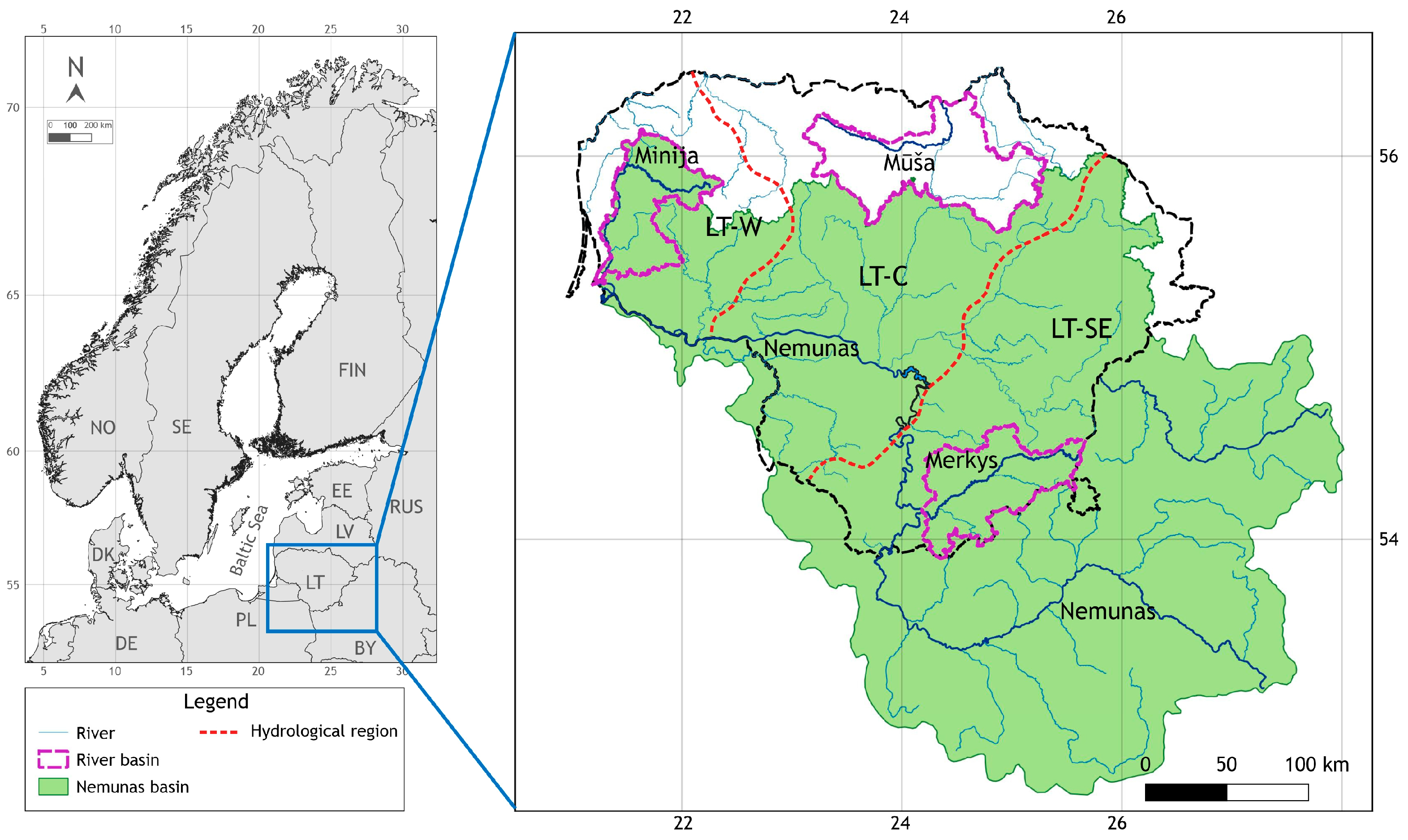
34]. Based on runoff formation conditions, Lithuania is divided into three hydrological regions: western (LT-W), central (LT-C), and southeastern (LT-SE) (
Figure 1) [
35]. The western hydrological region, closest to the Baltic Sea, receives the highest precipitation in the country—up to 850 mm annually. Consequently, rainfall accounts for 53% of the total runoff in this region. Runoff formation is also affected by relatively steep river slopes, which facilitate the rapid transfer of precipitation into river channels.
Moving eastward into the central region (LT-C), annual precipitation gradually decreases to 550–650 mm, the terrain becomes more uniform, and impermeable soils dominate, creating favourable conditions for moisture evaporation. In this hydrological region, snowmelt and rainfall are the primary sources of river feeding, together accounting for up to 84% of the total runoff.
Further east, in the southeastern region (LT-SE), the relief gradually rises, and precipitation increases to 650–750 mm per year. Here, permeable soils predominate, creating favourable conditions for groundwater recharge, which accounts for up to 45% of the runoff in this region.
Given the pronounced differences in runoff formation conditions across Lithuania, it is reasonable to analyse one representative river from each hydrological region when applying different methodologies to determine maximum discharges. Accordingly, three rivers were selected: the Minija from LT-W, the Mūša from LT-C, and the Merkys from LT-SE. In addition, the Nemunas, Lithuania’s largest river, was included, as it drains approximately 72% of the country’s territory and flows through all three hydrological regions. The main characteristics of the selected rivers are presented in
Table 1. Two of the studied rivers, the Nemunas and the Mūša, have upstream hydropower plants (HPPs) with dams. On the Nemunas, the HPP is located 112.4 km upstream of the Smalininkai water gauging station (WGS), whereas on the Mūša, the HPP is situated closer, at a distance of 25.4 km upstream of the Ustukiai WGS. Daily discharge observations from 1958 to 2023, obtained from the Lithuanian Hydrometeorological Service under the Ministry of Environment, were used in this study.
2.2. Methodology
Two approaches have been used to construct a time series of river maximum flows from daily streamflow values. The first data series was traditionally formed by extracting the largest flow each year, i.e., using the Annual Maximum Series (AMS) approach. AMS was used in flood flow magnitude analysis. In the second approach, the Peaks-Over-Threshold (POT), the other extreme flow data series was constructed from large flow values that exceeded a fixed threshold (truncation level). The POT data series was used to analyse the magnitude of defined flow peaks and the number of peak events per selected period (frequency). This approach provides a more comprehensive characterisation of extreme events.
The success of POT analysis depends on two key decisions: selecting an appropriate threshold and ensuring independence between exceedance cases. Available methods for threshold selection are based on different principles, but their common goal is to identify “extreme” events for further analysis. We used the quantile-based method to specify candidate thresholds. A custom R script developed for this study generated the data series. The workflow, executed in RStudio 2025, included threshold selection, flood-peak identification, declustering, statistical summarisation, and final data export. We computed flood flows for a set of percentiles, ranging from the 85th to the 99.9th. For each river, we then estimated quantiles corresponding to POT1, POT2, and POT3; that is, we created flow data samples with, on average, one, two and three peak values per year. In the next step, the declustering procedure was applied to the POT samples to ensure temporal independence between flood flow peaks. Different time spans have been used for this purpose [
16,
33,
36,
37,
38,
39]. We used the formula recommended by the Water Resource Council of the United States, as described in Lang et al. [
18]. This equation separates successive flood events by a sufficient period
θ (in days), which depends on the catchment size
A (km
2):
In this way, the selected flow peaks were separated by 8–10 days.
Mathematically, the threshold must be chosen so that the core model assumptions hold [
18]. Thus, it was also tested whether exceedances above the threshold behaved as independent events and whether their occurrence followed a Poisson process.
Flood peak magnitude trends in the 66-year time series were analysed using the Mann–Kendall test [
40,
41] and Sen’s slope (SS) estimator [
42]. The Mann–Kendall (M–K) test is a widely used non-parametric method among hydrologists and climatologists for detecting trends in long-term time series. This test does not require normality and is less sensitive to outliers. The M–K test statistic
S [
40,
41] is calculated as:
Which shows whether the measurement difference at times
i and
j is positive, negative, or zero. The variance of
S is estimated as:
The normal
Z test statistic [
40,
41] is calculated as:
This equation uses S − 1 if S > 0, S + 1 if S < 0, and Z is 0 if S = 0. A positive value of Z indicates an upward trend, while a negative value indicates a downward trend.
Trends achieving significance at the 95% level (
p-value of 0.05) were designated as statistically strong positive or negative trends. A significance level of 0.05 means there is a 5% chance that the result is not significant, or that it occurred by chance alone. The 95% confidence interval includes the most likely values, while the remaining 5% represents rare or extreme cases. The strength of a significant trend was determined using [
42]:
To detect trends in annual peak counts (frequency) of the peaks-over-threshold series, a chi-squared test based on parametric Poisson regression was used [
43]. The analysis of flood peak counts was conducted in Python 3.14 using the pandas, numpy, statsmodels, and scipy libraries. For each selected variable (POT1, POT2, and POT3), a Poisson regression model was fitted to assess the presence and direction of temporal trends. The statistical significance of the time coefficient was evaluated at the 0.05 level. A significance level of 0.05 was adopted, as this is standard in hydrological and environmental studies, ensuring comparability with previous flood trend analyses while avoiding thresholds that are too strict or too loose. A more stringent level may fail to detect moderate trends, whereas a looser one may increase the risk of spurious detections in short or noisy series. Model adequacy was further assessed using a chi-squared goodness-of-fit test comparing observed and expected frequency distributions. All results, including regression coefficients,
p-values, and model summaries, were automatically compiled and exported to a structured text report.
Maximum discharge anomalies were calculated to assess decadal variability using the following equation:
where
—maximum discharge anomaly,
—10-year average, and
—average for the entire period.
3. Results
3.1. Evaluation of Flood Thresholds
The quantile-based method was used to determine the threshold exceedance frequency and the magnitude of peaks-over-threshold (POT) events in the four selected river catchments (
Figure 1). The POT series was generated using flood flows corresponding to percentiles ranging from the 85th to the 99.9th.
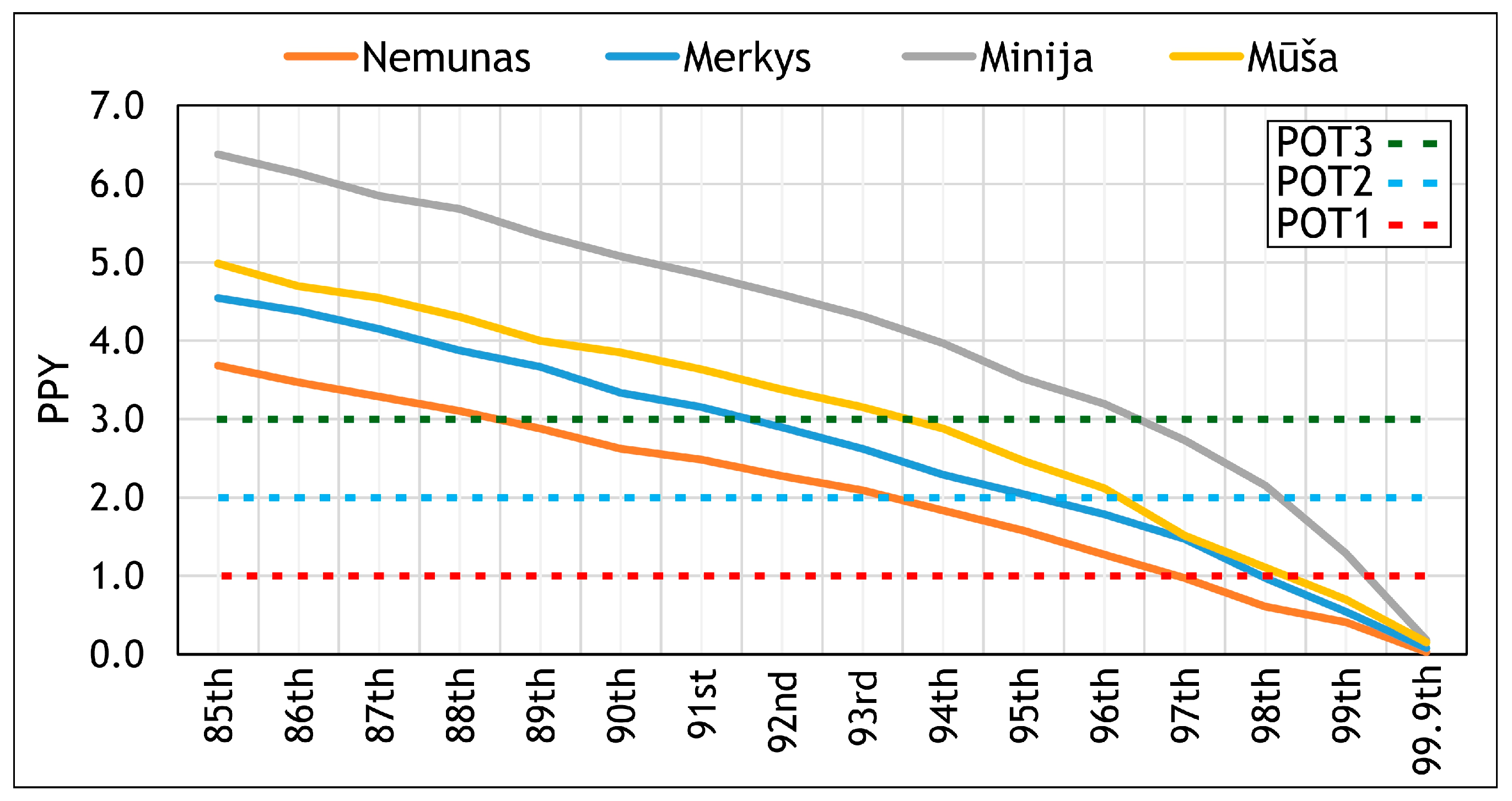
For the investigated rivers, the number of peaks per year (PPY) was calculated for the selected percentiles (
Figure 2). The highest PPY values were found in the Minija River, while the lowest were identified in the Nemunas River across all percentiles from the 85th to the 99.9th. The PPY values for the Merkys and Mūša rivers were intermediate between those of the Minija and Nemunas.
Substantial differences in PPY were determined for the same percentile thresholds. At the 85th percentile, the Minija River exhibited 6.4 peaks per year, compared with 3.8 in the Nemunas River; at the 90th percentile, 5.0 and 2.7; and at the 95th percentile, 3.5 and 1.4, respectively. These large differences in PPY at the same percentile indicate significant variation in flood regimes among the rivers. The Minija River, located in the western hydrological region of Lithuania (
Figure 1), is influenced by maritime climate and receives greater precipitation than rivers situated farther inland. As a result, this river experiences frequent flash floods and relatively small spring floods. In contrast, the Nemunas River, which drains a large portion of Lithuania, is mainly affected by spring floods caused by snowmelt. These hydrological characteristics largely explain the pronounced discrepancies in PPY for identical percentiles.
The Mūša and Merkys rivers, located in central and southeastern Lithuania (
Figure 1), are within a continental climate zone. Consequently, both spring floods and rainfall-induced floods are typical of these catchments.
For further analysis, datasets representing an average of 1, 2, and 3 flood peaks per year (i.e., the POT1, POT2, and POT3 series) were established. Percentile-based thresholds were selected to obtain the appropriate target number of events per year, depending on the chosen PPY level (
Figure 2). The POT series were then derived using these thresholds. Each river was assigned a different threshold that produced the same number of peaks per year (
Table 2). For the POT1 series, the threshold percentile ranged from the 96.9th (Nemunas River) to the 99.25th (Minija River). For the POT3 series, the corresponding percentiles varied from the 88.5th to the 96.45th. This variation in threshold percentiles shows that the selected rivers, located in different hydrological regions of Lithuania, tend to exhibit distinct flood regimes.
In this study, the Poisson distribution was used to model flood occurrence. The results are presented in
Table 3, where a chi-squared test was applied to assess the goodness of fit of the Poisson model. For all selected river catchments, the Poisson distribution could not be rejected (
p-value > 0.05;
Table 3), indicating that it provides an adequate representation of flood occurrence for the POT1, POT2, and POT3 series. These time series were then used to analyse the occurrence of flood peaks.
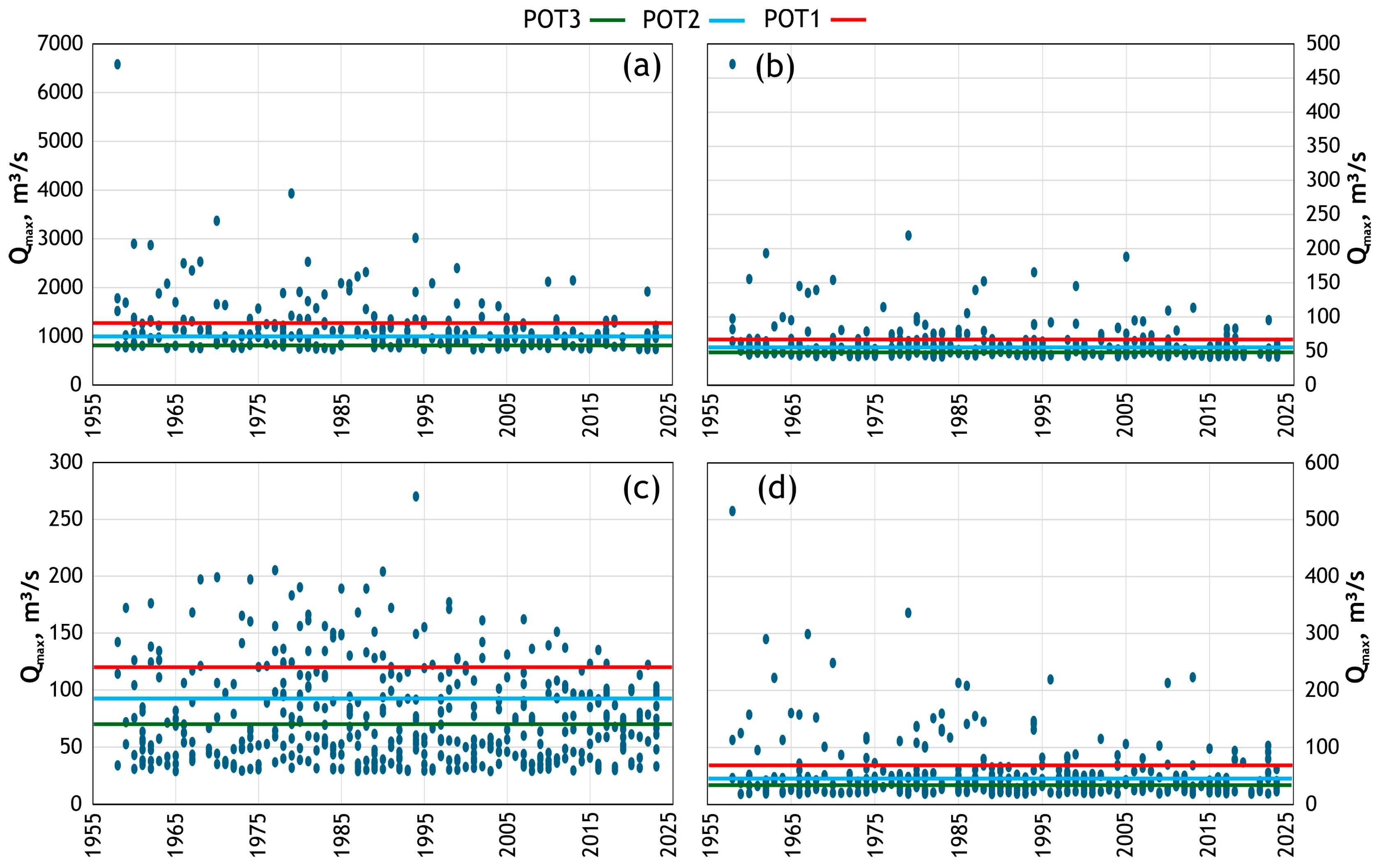
As described, the threshold discharge values were defined using percentiles corresponding to the selected occurrence rates of 1, 2, or 3 flood events per year (
Table 2). The variations in established thresholds differed considerably among the rivers, as did the annual number of peaks-over-threshold events (
Figure 3).
The largest variations between the threshold discharges for the POT3, POT2, and POT1 series were observed for the Minija River (70, 92, and 120 m
3/s, respectively), while the smallest variations were found for the Merkys River (48, 55, and 67 m
3/s) (
Figure 3). Overall, the differences between threshold discharge values determined for the three POT series followed a consistent pattern. Across all rivers, POT2 discharges were 15–34% higher than POT3 discharges, while POT1 discharges exceeded POT2 values by 21–50%.
To better understand the behaviour of the POT series, variation coefficients (CV) were calculated for all selected rivers (
Table 3). Higher CV values (for the Nemunas, Merkys, and especially the Mūša) indicate greater dispersion of data around the mean and therefore higher relative variability. Several major floods, notably those in 1958 and 1979 (
Figure 3), significantly influenced these elevated CV values. In contrast, the lower CV of the Minija River reflects a tighter clustering of flood magnitudes around the mean, which may be attributed to its hydrological regime influenced by both snowmelt-driven spring floods and flash floods.
In the following sections, the prepared POT data series together with annual maximum flow data were analysed to assess the frequency and magnitude patterns of floods in the selected rivers.
3.2. Estimation of Flood Trends
The Mann–Kendall test and Sen’s slope (SS) analysis indicated differences in the trends of maximum discharge magnitudes among the investigated rivers during 1958–2023 (
Table 4). Sen’s slope reflects long-term changes in flood magnitude: positive values indicate increases, while negative values indicate decreases within natural climate variability. The strongest statistically significant negative trends were detected using the AMS method. Similar tendencies were observed across the POT1, POT2, and POT3 series, with the largest changes in POT1 and the smallest in POT3.
When individual rivers were considered, the most pronounced changes in AMS were detected in the Mūša River, followed by somewhat smaller changes in the Minija, and the weakest trends in the Merkys and Nemunas. As previously noted, snowmelt and rainfall account for 84% of total runoff in the Mūša catchment (with snowmelt contributing 43%) and 82% in the Minija catchment (with 29% from snowmelt). These differences can be attributed to climate-driven alterations in river flow regimes, to which rivers respond according to their dominant runoff sources. According to data from the Lithuanian Hydrometeorological Service [
44], the most recent three-decade period has experienced a marked decrease in the number of days with snow cover compared with the previous 30-year interval (a reduction of 20 days), while changes in total precipitation were minimal. These alterations in snow cover likely played a significant role in the observed decline of POT1 floods in the Mūša and Minija rivers. However, the magnitude of the response differed between the two catchments. As snowmelt is a more dominant component of runoff in the Mūša than in the Minija, the decrease in POT1 floods has been correspondingly more pronounced in the Mūša catchment.
In contrast, the Merkys River is primarily recharged by groundwater. Although POT data values also show declining tendencies in the Merkys, the effect of reduced snowmelt is partially offset by groundwater contributions, which are less sensitive to short-term climatic variability. The Nemunas catchment spans all three hydrological regions, and its runoff is influenced by rainfall, snowmelt, and groundwater recharge. Therefore, climate-related changes manifest differently across its sub-catchments. Nevertheless, the overall pattern persists: the strongest significant trends are evident in the POT1 series, and the weakest in POT3, although the differences in trends between POT1, POT2, and POT3 data in the Nemunas are relatively small.
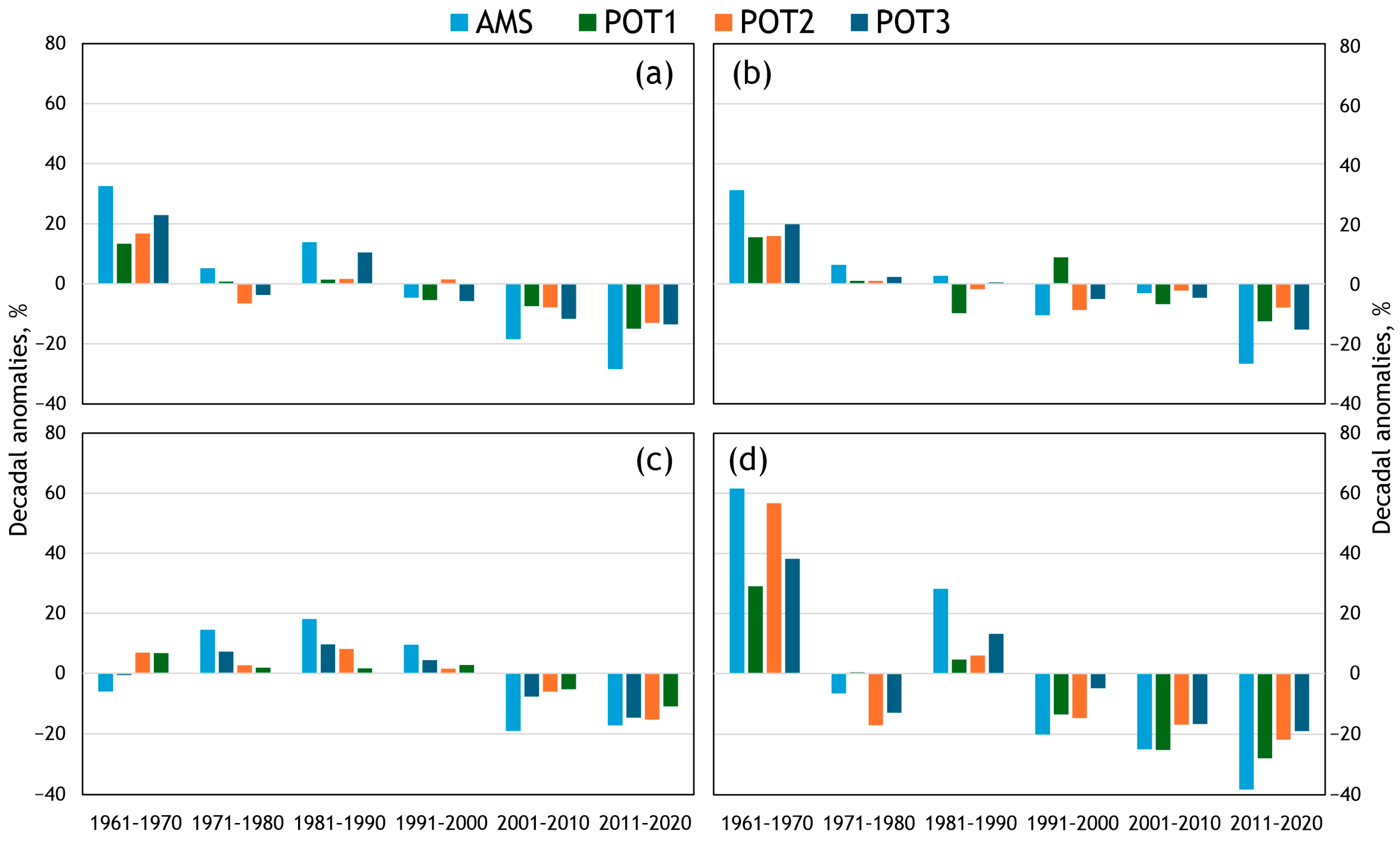
To investigate changes in maximum flows over shorter time scales, we analysed decadal anomalies (
Figure 4). During the first three decades, the calculated anomalies were more frequently positive, whereas in the most recent decades, they became negative in all cases, indicating that floods occurred less frequently on average. The negative anomalies observed during the first two decades of the twenty-first century were consistent with documented changes in key climate indicators. An assessment of climate change in Lithuania comparing the 1961–1990 and 1991–2020 standard climate normals [
44] indicated that major climatic shifts, such as higher mean air temperature, fewer days with sub-zero temperatures, shorter winter seasons, reduced snow cover duration, and reduced snow cover thickness, have created conditions that are increasingly unfavourable for flood generation in Lithuanian lowland rivers. The observed changes in flood peak anomalies are therefore consistent with and support the results of the trend analysis.
The analysis of changes in flood frequency (the number of flood peaks) exceeding selected thresholds over the 66-year study period revealed only a few statistically significant trends (p < 0.05). A significant decrease in the number of flood peaks was identified in the Nemunas River for the POT1 and POT2 series, and in the Merkys River for the POT1 series. Across all POT series, trend significance declined as the threshold was lowered, except for the Minija River. The Minija was the only river that exhibited a statistically insignificant increase in the number of flood peaks in the POT2 and POT3 series, whereas a slight decrease was observed in the POT1 series (p = 0.06).
3.3. Intra-Annual Flood Frequency Characteristics
In this study, flood analysis was performed using a daily discharge time series. Unlike the annual maximum series (AMS), which includes only one extreme flow event per year, typically associated with spring flooding, the peaks-over-threshold (POT) approach yields flood samples that include multiple events within a year. These events are selected independently of seasonality and the underlying flood-generating mechanisms.
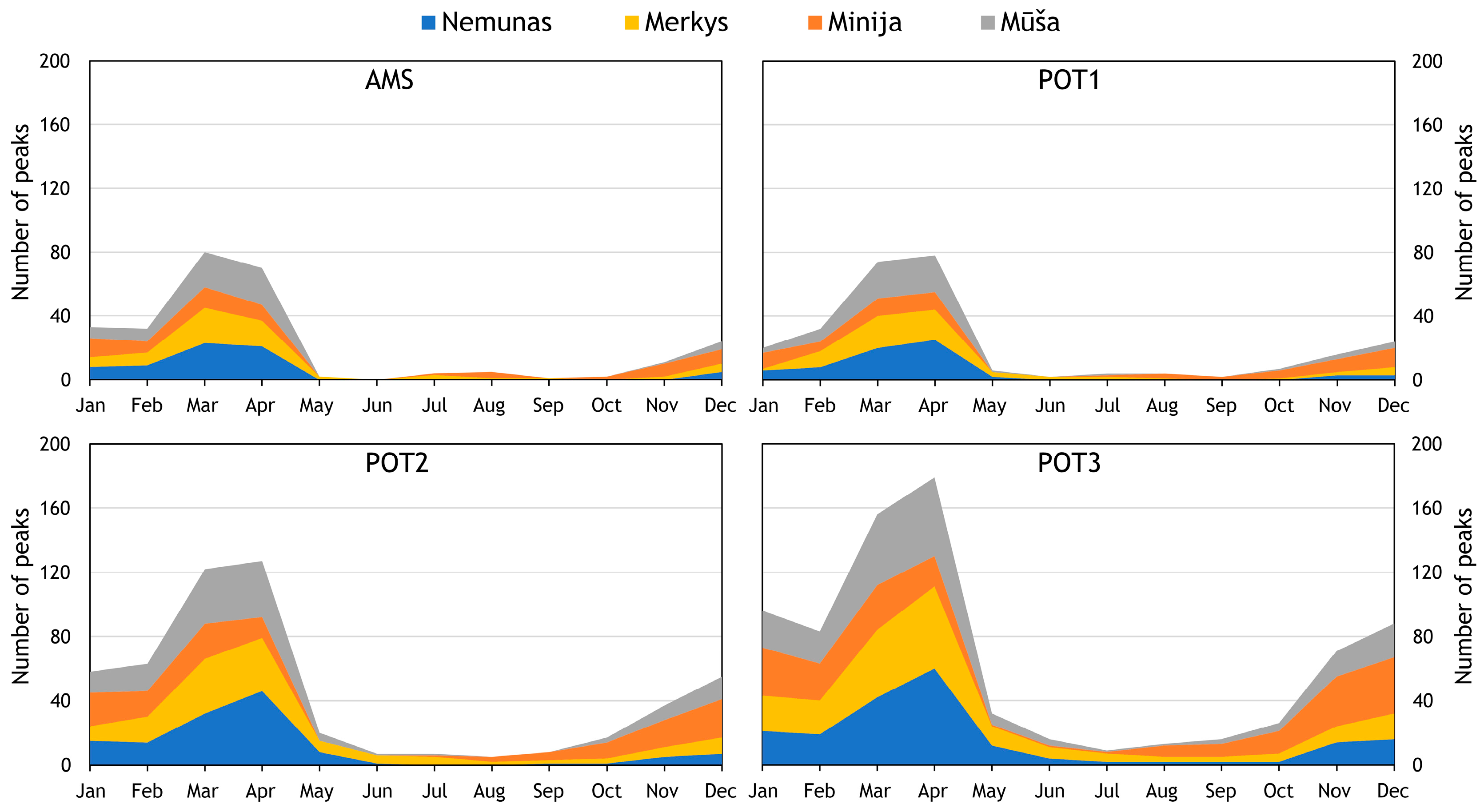
The intra-annual (monthly and seasonal) distribution of flood events was analysed for the period 1958–2023 (
Figure 5) using the POT1, POT2, POT3, and AMS time series. An evaluation of the total number of flood peaks across all studied rivers showed that floods occurred most frequently in spring. According to the AMS, 80 flood peaks were recorded in March, while the POT1, POT2, and POT3 series consisted of 79, 123, and 167 flood peaks, respectively, in April. The lowest flood frequency was observed during the summer season. Based on the AMS and POT1 series, only one flood peak per series was recorded in June, indicating that floods driven by intense rainfall are uncommon in Lithuanian rivers during this month. Meanwhile, a slightly higher number of flood peaks was identified in the POT2 and POT3 series, with four events in August and eight in July, respectively.
The greatest differences in the number of flood peaks according to AMS and POT1 data were observed in January. According to AMS, there were 36 peaks, while according to POT1, there were only 20. These differences highlight that flood analysis based on the POT methodology provides a broader picture of flood assessment, accounting for multiple flood events throughout the entire study period rather than restricting the analysis to a single annual maximum.
Assessing patterns of flood recurrence across rivers and seasons is essential for understanding extreme flood events (
Table 5). In the Nemunas River, spring floods were dominant, occurring on average more than twice as frequently as winter floods. Based on the POT1 and POT3 series, 47 and 114 flood peaks were recorded in spring, compared with 17 and 56 peaks in winter, respectively. No flood peaks were identified during the summer season using either the AMS or POT1 series. Only when applying the peaks-over-threshold approach with three peaks per year (POT3) were summer flood events detected, with eight peaks recorded over the period 1958–2023. A slightly higher flood frequency was observed in autumn, particularly in the POT3 series, where 18 flood peaks were identified.
Similar seasonal flood patterns to those observed in the Nemunas River were also identified in the Mūša and Merkys rivers. In both rivers, flood occurrence during the spring and winter seasons showed comparable behaviour, with approximately two to three times more floods in spring than in winter when evaluated using different POT series. During summer, very few flood peaks were recorded in the Mūša River, with no more than six events identified in the POT3 series. In contrast, a higher number of flood peaks in summer was observed in the Merkys River, where 15 events were recorded in the POT3 series. An opposite pattern emerged in autumn, when flood occurrence was higher in the Merkys River than in the Mūša River, except for the POT1 series.
The seasonality of floods in the Minija River differed markedly from that in the other rivers. Winter floods predominated, with the number of flood peaks identified using the AMS and POT1 series slightly exceeding those recorded in spring. However, according to the POT2 and POT3 series, winter floods occurred approximately twice as often as spring floods. In addition, substantially more flood events were recorded in the Minija River during autumn compared to the other investigated rivers. According to the POT3 series, the number of autumn flood peaks in this river even exceeded the number of spring floods, with 53 and 48 peaks, respectively (
Table 5). The distinct seasonal distribution of floods in the Minija River, located in Lithuania’s western hydrological region, is driven primarily by precipitation. In the western region, the most frequent rains typically occur in autumn, leading to increased rainfall-driven and flash flood events.
4. Discussion
This study contributes to the growing body of research on the impacts of climate change on river extreme events, yet distinguishes itself through its methodological approach. Extreme value analysis is typically based on either the annual maximum series (AMS) or the peaks-over-threshold (POT) approach, with the latter applied far less frequently [
17,
18,
37,
45]. By employing the POT method for the first time in Lithuania, this study provides a more detailed and statistically efficient representation of flood extremes, capturing multiple significant events within a year rather than relying solely on the largest flood event each year.
Determining the optimal threshold is the first step in POT flood series analysis. There is no rule defining which method is most appropriate for selecting a threshold, nor how many peaks per year should be chosen to best reflect the river’s flood pattern; however, a necessary condition is that the selected flood events are independent. In the present study, POT samples averaging 1 (POT1), 2 (POT2), and 3 (POT3) events per year were chosen for maximum flow analysis following the experience of accomplished studies [
23,
37,
46,
47] to support comparative analysis. The POT1 series enabled direct comparison with AMS data, whereas the POT2 and POT3 series represented significant discharge events relevant to both research and flood management [
19,
48]. The use of quantiles as thresholds is common in similar studies [
33,
39,
48].
As expected, rivers from different hydrological regimes exhibited distinct quantiles corresponding to the selected POT values, along with variations in the number of above-threshold events. Among the region representatives, the Minija River had the highest number of exceedances, while the Merkys had the fewest. This may be related to different runoff-generating mechanisms: estimated peaks in the Minija are mainly driven by intense rainfall events throughout the year, whereas in the Merkys, flood peaks are primarily generated by spring snowmelt. In Canada, a lower threshold was considered for hydrometric stations with a mostly nival regime [
45]. Similarly, to capture a larger number of POT events, the threshold was also lowered for some gauges in Poland [
33]. This implies that rivers characterised by a nival regime and lower PPY are likely to derive less benefit from the POT approach [
45].
Using POT samples derived from different exceedance thresholds enabled analysis of a larger number of trends for the same river data series. For both the AMS and POT series, we identified declining trends in flood magnitudes over the period 1958–2023. The strongest and statistically significant decrease was observed in the AMS data. The pronounced decline in flood magnitudes in the Mūša and Minija rivers may indicate that these catchments are the most affected by rising air temperatures and reduced snowmelt contributions, as reflected in differences between the 1961–1990 and 1991–2020 climate normals [
44]. The decadal anomaly results were consistent with those obtained from the trend analysis. These outcomes are in line with other AMS-based studies in Lithuania and the Baltic States [
27,
28,
31]. In the present study, in the analysed POT series, comparable patterns emerged, with the most pronounced changes in POT1 and the weakest in POT3. This suggests the important conclusion that large floods, which typically occur once per year, are declining more rapidly than the more frequent floods, which occur approximately three times per year. The number of flood peaks above the thresholds in the studied rivers also showed a general decrease. Statistically significant negative trends in exceedance counts were identified in the Nemunas for the POT1 and POT2 series (consistent with the behaviour of flood magnitudes), as well as in the Merkys for the POT1 series. In contrast, the Minija was the only river to exhibit indications of increasing flood peak counts in the POT2 and POT3 series. This suggests that in rainfall-dominated rivers, the frequency of flood-peak events may increase even as the peak magnitudes decrease. Therefore, the view that climate change will reduce the number of floods and that there is no need to prepare for such events is incorrect.
A similar study in the Boreal region [
16] also detected a consistent increase in flood frequency, accompanied by a decrease in flood magnitude across all POT series, whereas the AMS did not exhibit a clear spatial pattern in flood magnitude changes. A flood study in Poland [
33] using both AMS and POT data (mostly based on the 97.5th-percentile threshold) found decreasing flood trends in northern river basins and increasing trends in the south. The AMS series exhibited more pronounced trend signals than the POT samples, mirroring the results obtained in the present study. Throughout Germany [
37], numerous gauges showed significant trends in the AMS and POT1 series; in contrast, POT2 exhibited a comparable yet weaker spatial pattern, and POT3 showed almost no significant trends. During the second half of the 20th century, many basins still displayed significant, mostly upward, flood trends, while decreasing trends were rare and not statistically significant. Significant trends in POT3 flood frequency were detected at numerous gauges on German rivers. In Spain [
23], trend analysis indicated an overall decline in AMS flood magnitudes, though the trends became less statistically significant when evaluated using the POT3 series. Additionally, a general decrease in flood-event frequency was observed during the investigated periods.
A key advantage of the peaks-over-threshold approach is its ability to analyse the timing of estimated extreme flow events. The intra-annual flood frequency analysis revealed that flood counts according to the AMS were not always consistent with those based on the POT1 series. In some months, the number of floods detected varied by almost twice as much. For example, in January, 36 peaks were identified using the AMS, compared to only 20 peaks in the POT1 series. This difference suggests that relying solely on the AMS approach may result in biased or incomplete estimates of extreme river flow events. It was also found that the seasonal distribution of maximum discharges strongly depended on the conditions influencing river runoff. In most of the studied rivers (Nemunas, Mūša and Merkys), approximately two to three times more floods occurred in spring than in winter, according to different POT values. Consistent with other analyses, the seasonal flood timing assessment highlighted the distinctive flood regime of the Minija River. This river exhibited the highest number of extreme flow events in winter and a considerable frequency of floods in autumn. These patterns can be attributed to a greater proportion of liquid precipitation in the region this river represents (up to 850 mm, that is, 100–300 mm more than elsewhere).
Pronounced differences were consistently observed in the Minija River catchment throughout the study. The application of the peaks-over-threshold (POT) method enabled clear identification and characterisation of the distinctive features of this river and the western hydrological region it represents. One key conclusion of the study is that the POT method is particularly well suited to analysing extreme discharges in marine climate regions, where river flow regimes are strongly influenced by rainfall and flood events are predominantly triggered by intense precipitation.
While the advantages of this method are well documented, its limitations are also frequently noted. A major limitation is the lack of general guidelines for its application, leaving several aspects unresolved [
18]. Difficulties in selecting an appropriate threshold and ensuring the independence of flood peaks may explain the relatively limited use of the POT model in practice. If the threshold is too low, non-extreme discharge values may be included, whereas if it is too high, the sample size may be insufficient for reliable analysis. An additional source of uncertainty arises from the declustering procedure required to address dependence between successive exceedances. For example, to ensure that only independent flood events exceeding the selected threshold are retained, a dependence criterion ranging from 5 to 30 days may be applied [
33,
37]. Consequently, different choices can lead to different results.
Overall, the outcomes of this study, based on analysis of the POT data series, are partly consistent with previous scientific findings. Instances where the results did not align with other studies may indicate that the analysed floods were driven by different generation mechanisms. The results confirm the existence of distinct flood patterns across hydrological regions and indicate that the selected rivers are suitable representatives of these regions. Nevertheless, it is important to remember that the specific characteristics of each river system can be properly understood only in a local context [
49]. Therefore, expanding the dataset would likely improve the robustness of the results, allowing a more detailed comparison of POT series performance among rivers within the same hydrological region.
The peaks-over-threshold method is a particularly useful tool for supporting flood risk management strategies, as it focuses on multiple extreme events and estimates how often a critical discharge level may be exceeded within a given period. By linking various discharge thresholds to specific impact levels, ranging from bankfull discharge to critical infrastructure flooding, these relationships can then be used to develop risk maps for decision-making.
5. Conclusions
This study presented the first comprehensive characterisation of floods in Lithuanian rivers using the peaks-over-threshold (POT) approach. Four rivers were analysed: three representing distinct hydrological regions of the country and one large river covering all three regions. For each river, three POT series (POT1, POT2, and POT3) were constructed.
For both the annual maximum series (AMS) and POT series, we identified declining trends in flood magnitudes over the period 1958–2023. The strongest statistically significant negative trends were detected using the traditional AMS approach. Similar tendencies were observed across the POT1, POT2, and POT3 series, with the largest changes in POT1 and the smallest in POT3. These findings indicate that large floods, which generally occur about once per year, are decreasing more rapidly than smaller, more frequent floods; therefore, using only annual maxima may lead to subjective or incomplete characterisation of high flow events. The POT-based results complemented the annual maximum series approach by capturing multiple significant flood events within a year as well.
Results obtained from the annual maximum series and three POT samples demonstrated the added value of the POT approach, as it allowed substantially more information on flood magnitude, frequency, and seasonality to be extracted from a single daily discharge time series.
The results of this pilot study confirm the presence of distinct flood patterns across hydrological regions. The POT method proved particularly suitable for analysing significant discharges in the marine climate region, where river flow is predominantly controlled by precipitation, with floods mainly triggered by high-intensity rainfall events. Expanding the data set would improve the reliability of the results.