1. Introduction
Surface water is an indispensable natural resource in coal mining areas and their surrounding regions, fulfilling the dual role of ensuring domestic water security and supporting agricultural irrigation [
1,
2]. However, coal mining activities inevitably pose potential risks to the water quality of both mining and neighbouring areas [
1]. Where surface water bodies serve as sources of drinking water, elevated concentrations of pollutants such as sulphates and fluorides can directly threaten human health [
3]. When used for irrigation, excessive salt content and specific ion concentrations may contribute to soil salinisation, structural degradation, and reduced crop yields [
3,
4]. In this context, systematic assessments of both drinking and irrigation water quality have become an urgent necessity—essential for safeguarding water resources, protecting public health, and ensuring the sustainable development of agriculture in mining regions.
Previous approaches to water quality assessment have included single-factor evaluation, fuzzy comprehensive evaluation, and the analytic hierarchy process. Although these methods are computationally straightforward and easy to understand, they are limited in their ability to quantitatively capture changes in water quality [
5,
6]. In response, scholars have developed a range of novel assessment techniques. Among these, the Water Quality Index (WQI) has attracted considerable attention due to its capacity to reflect overall water quality status [
7]. Nevertheless, the determination of weighting coefficients in WQI relies on expert judgement, which introduces uncertainties and potential informational bias. Even minor variations in assigned weights can lead to inconsistencies in water quality classification [
8,
9]. In contrast, the Entropy Water Quality Index (EWQI), which is based on standard permissible limits, offers a more objective and reliable alternative and has been widely adopted for assessing the suitability of drinking water resources [
10,
11,
12].
In assessing irrigation water quality, scholars have commonly employed a range of established indicators, including the sodium content method (%Na) [
13], Sodium Adsorption Ratio (SAR) [
14], Residual Sodium Carbonate (RSC) [
15], Permeability Index (PI) [
16], and Magnesium Hazard (MH) [
17]. These specialised parameters enable a comprehensive evaluation of water suitability for agricultural use by taking into account salinity, alkalinity, and ionic toxicity. For example, Wei et al. [
18] used the EWQI together with local topographic features to quantitatively evaluate groundwater quality in the Dawen River basin, thereby uncovering anthropogenic impacts on the region’s groundwater. In the context of irrigation suitability, SAR is effective in assessing the risk of reduced soil permeability caused by sodium, while RSC helps determine the potential hazard of excess carbonate to crop growth. MH reflects the risk of soil structural degradation resulting from high magnesium concentrations, and PI indicates whether a water source may lead to surface crusting and diminished infiltration capacity [
19,
20]. Together, these complementary indicators substantially enhance the accuracy and specificity of irrigation water quality evaluations.
Jining City is rich in coal resources and serves as a major coal energy base in Shandong Province, as well as one of China’s eight largest coal production bases. Nevertheless, long-term coal mining has greatly changed the hydrogeological conditions of the area, causing sulfates and potentially toxic elements to seep into both groundwater and surface water. Consequently, local residents face health risks due to water pollution. Moreover, while most researchers have focused on mine water, relatively few studies have examined surface water. As a vital water source for the region, surface water plays a crucial role in residents’ daily lives, particularly for domestic drinking water and agricultural irrigation. To enrich the research in this region, this study utilizes data from both the dry and wet seasons to investigate surface water near the South Four Lakes, systematically analyzing the hydrochemical characteristics and evolutionary patterns under different hydrological conditions. The specific objectives of this study are as follows: (1) to identify and quantify the factors that control surface water characteristics, and to evaluate their contributions to hydrochemical processes; (2) to determine the suitability of surface water for drinking and agricultural uses; and (3) to evaluate the quality of water for both drinking and irrigation purposes by applying the EWQI and the Irrigation Water Quality Index. The results of this study serve as a valuable reference for research on surface water environments in analogous regions across the globe, and provide strong support for the development of water resource protection strategies and pollution control policies.
2. Study Area
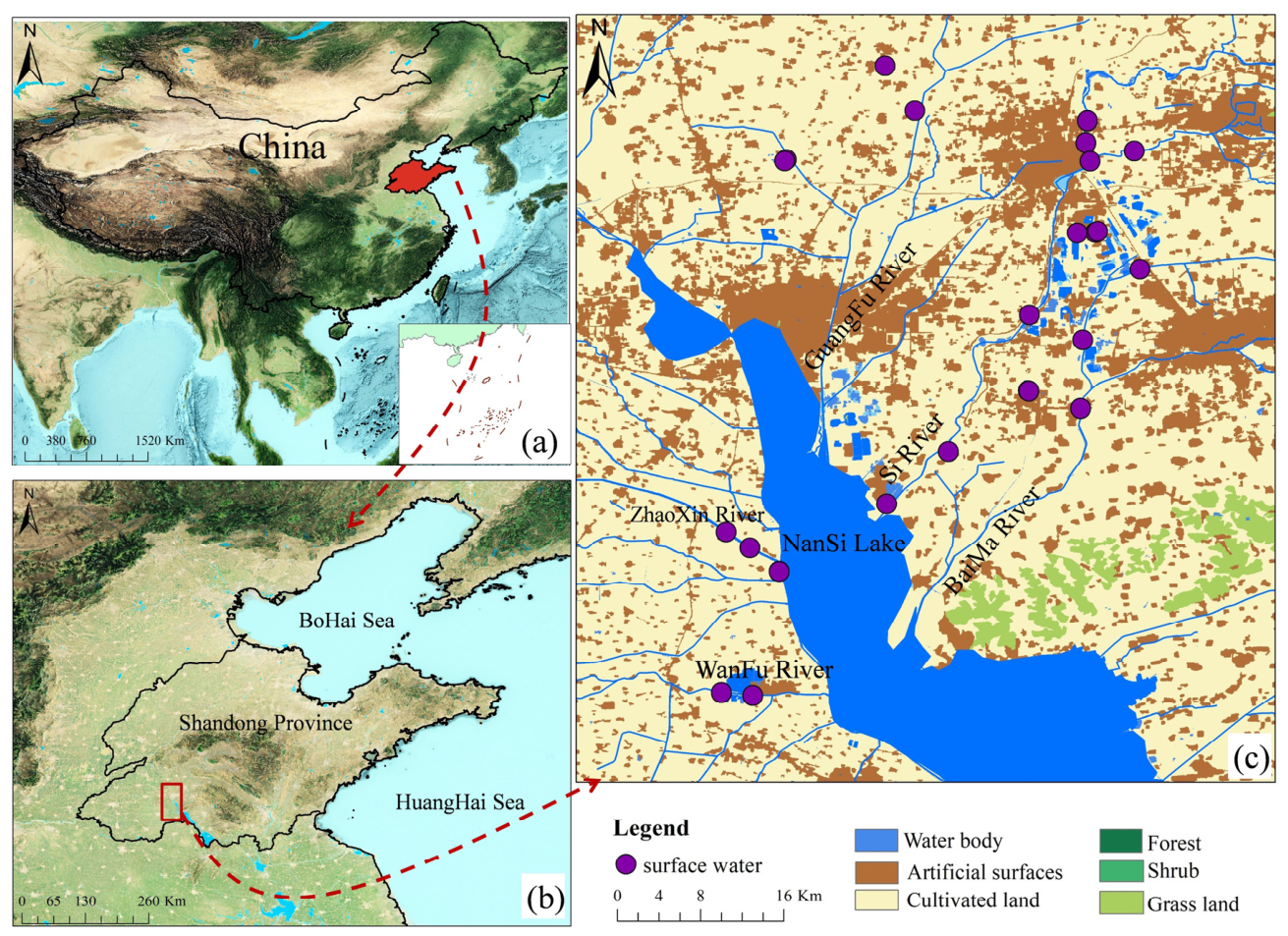
The research area is located in Jining City, Shandong Province, with geographical coordinates of 116°25′42″–116°58′41″ E and 35°02′52″–35°41′51″ N, with a total area of approximately 2192 km2. The study area is located in a warm temperate, semi-humid monsoon climate zone, featuring four distinct seasons. Hot summers bring concentrated rainfall and high humidity, while cold winters are marked by low temperatures, dryness, and minimal snowfall. The mean annual precipitation over the long term is 668.1 mm, with most rain falling in July and August. The region also has abundant sunlight and thermal resources, reflected in a long-term average annual temperature of 13.6 °C.
The main landforms in the research area include erosion hills, intermountain alluvial-floodplain, piedmont alluvial-floodplain, and alluvial-floodplain. From the east of Nansi Lake to the eastern foothills, there is a sub area of alluvial plain in front of the mountain, which slopes from east to west, with a ground elevation of 60–35 m and a ground slope of 1/1000–1/3000. The ground undulates slightly; To the west of Nansi Lake is a relatively flat alluvial and flood plain area, sloping from west to east with a ground elevation of 39–34 m and a ground slope of 1/5000–1/10,000. The terrain is relatively undulating. In addition, the research area exhibits a diverse landscape, including towns, farmland, lakes, and green spaces, with agriculture occupying a significant portion of land use. Residential buildings are mainly concentrated in the mountainous alluvial floodplain in the central and northeastern regions (
Figure 1c).
The study area has a relatively well-developed water system, which is part of the Nansi Lake system within the Huai River Basin. The Beijing-Hangzhou Grand Canal traverses the area from north to south, whereas other rivers flow radially from the surrounding regions toward both the Grand Canal and the Nansi Lake, shaped by the local topography. The main rivers distributed include Sihe River, Guangfu River, Baima River, etc. The lakes in the area consist of Nansi Lake and Xiaobei Lake, while the water conservancy projects are primarily represented by the South-to-North Water Diversion Project. Tectonically, the study area lies within the Jining Stratigraphic Subdistrict of the western Shandong Stratigraphic Division. From oldest to youngest, the strata exposed in the region include the Neoarchean Mount Taishan Group, the Paleoproterozoic Jining Group, the Paleozoic Cambrian–Ordovician Changqing Group, the Jiulong Group, the Majiagou Group, the Carboniferous–Permian Yuemengou Group, the Mesozoic Jurassic Zibo Group and Cretaceous Qingshan Group, as well as the Cenozoic Paleogene Guanzhuang Group and the Quaternary strata. According to the lithology of the aquifer, the occurrence conditions of groundwater, and the water physical properties, the aquifer in the working area can be divided into four aquifer rock groups, namely the loose rock pore aquifer rock group, the clastic rock pore fracture aquifer rock group, the carbonate rock fracture karst aquifer rock group, and the bedrock fracture aquifer rock group. In terms of tectonic location, it is mainly located in the North China Plate (I), the Luxi Uplift Area (II), the Southwest Shandong Subtropical Uplift Area (III), the Heze Yanzhou Subtropical Uplift (IV), the Jining Subtropical Depression, and the Yanzhou Subtropical Uplift (V). The main faults in the research area include the Fushan Fault, Jiaxiang Fault, and Sunshidian Fault. They form the basic framework of the fault structures in this region, controlling the distribution of regional strata, topography, geomorphology, and the morphology and remains of geological relics.
3. Materials and Methods
Statistical analysis of the data was performed using SPSS Statistics 27. Origin 2024 was used to draw box plots, relationship diagrams between main chemical components, Piper plots, correlation analysis plots, and other graphs. ArcGIS 10.8 was then used to create a land use type map and an overview map of the study area.
3.1. Sample Analysis
In 2020, a total of 50 surface water samples were systematically collected from various locations across the study area in different batches, with 25 samples collected during the dry season and 25 samples collected during the wet season.
Figure 1 illustrates the sampling locations, where GPS positioning was used to ensure the accuracy of each sampling point. For water quality sampling, two clean, dry 500 mL plastic bottles were used. Prior to sampling, each bottle was rinsed three times with the water sample to be collected, then filled and emptied, and finally sealed. Surface water, including rivers and lakes, was sampled along the direction of incoming flow at a depth of 10 to 15 cm below the water surface. After collection, the samples were kept refrigerated and transported to the hydrochemical laboratory for quality analysis within one week. On site measurements of temperature and pH were conducted using the HANNA HI 98128 pH analyzer, which has a temperature accuracy of ±0.5 °C and a pH accuracy of ±0.05 pH units. The main chemical properties of the surface water samples, including electrical conductivity (EC), total hardness (TH), total dissolved solids (TDS), and major cations (K
+, Na
+, Ca
2+, and Mg
2+), were determined using an inductively coupled plasma emission spectrometer (ICAP 6300, Thermo Fisher, Waltham, MA, USA) and an ion chromatograph (ICS 600, Thermo Fisher, Waltham, MA, USA). The concentration of HCO
3− was measured via the titration method. After completing the water quality analysis, the charge balance error (CBE) was calculated to verify data reliability. All CBE values fell within ±5%, confirming the trustworthiness of the water quality data.
3.2. Entropy-Weighted Water Quality Index (EWQI)
In this study, the EWQI model based on information entropy theory is used to assess surface water quality in the study area. According to the EWQI classification, water quality is divided into five grades: Excellent (EWQI < 50), Good (50 ≤ EWQI < 100), Moderate (100 ≤ EWQI < 150), Poor (150 ≤ EWQI < 200), and Very Poor (EWQI ≥ 200) [
18]. In line with the “Standards for groundwater quality” (GB/T 14848-2017) [
21] of China, the key indicators selected for this study are TDS, TH, Na
+, Cl
−, SO
42−, NO
3−, and F
− [
18]. The procedure consists of five steps: establishing an initial water quality matrix, normalizing the data, determining weights using the entropy weighting method, setting up quantitative grading criteria, and finally calculating and classifying the water quality index. The EWQI calculation process is as follows:
(1) Create the initial water quality matrix
In this formula, m denotes the number of water samples, and n denotes the number of water chemistry parameters.
(2) Using Formula (2), the obtained eigenvalue matrix is standardized, and the standard evaluation matrix Y is subsequently derived from Formula (3):
Here, max(xj) and min(xj) denote the maximum and minimum values of the same hydrochemical parameter across all samples, respectively, while Yij represents the standardisation process.
(3) Calculate the ratio P
ij and the information entropy e
ij using Formula (4) and Formula (5).
Among these, Pij denotes the parameter value ratio for parameter j in sample i, obtained via Formula (5).
(4) The entropy weight (w
j) for each parameter and the grading index (q
j) for indicator j are calculated using Formulas (6) and (7).
In this formula, c
j represents the measured concentration (in mg/L) of chemical ions in surface water, while s
j denotes the allowable limit for indicator j, which corresponds to the Class III ion concentration specified by the “Standards for groundwater quality” [
21].
(5) Calculate the EWQI according to Formula (8)
3.3. Irrigation Water Quality Assessment
Based on the concentrations of K
+, Na
+, Mg
2+, Ca
2+, and HCO
3−, several irrigation water quality indicators (specifically %Na, SAR, RSC, PI, and MH) were applied to water samples in order to comprehensively assess the suitability of surface water for irrigation in the study area. The corresponding calculation formulas are provided in Equations (9)–(13). According to the five evaluation results, the classification of irrigation suitability levels is based on
Table 1.
4. Results and Discussion
4.1. Characteristics of Surface Water Quality
Statistical analysis is the most commonly used tool for interpreting the hydrochemical characteristics of surface water. It can reveal the basic patterns in hydrochemical data and lay the foundation for a deeper understanding of the formation processes.
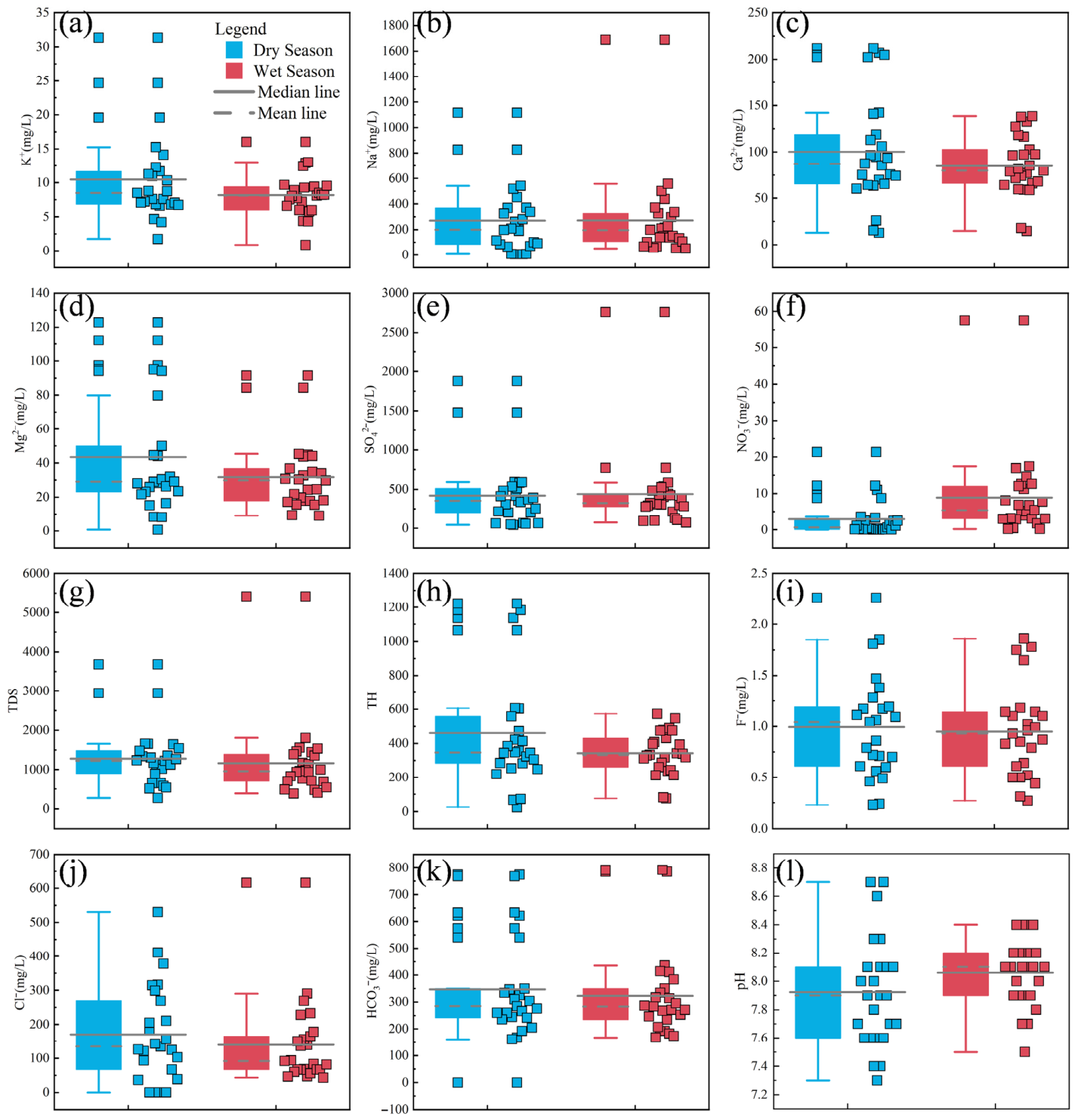
Figure 2 presents the statistical results of the major ionic components in surface water samples collected from the study area during both the dry and wet seasons, with 25 samples obtained in each period. The main cation and anion detected in surface water during the dry season are Na
+ and SO
42−, with average values of 270 mg/L and 418 mg/L, respectively. The abundance order of cations is Na
+ > Ca
2+ > Mg
2+ > K
+, and that of anions is SO
42− > HCO
3− > Cl
− > NO
3− > F
−. TH and TDS are two key indicators for assessing surface water quality. TH levels in surface water range from 25.4 to 1222 mg/L, while TDS levels range from 271 to 3681 mg/L, with mean values of 461 mg/L and 1279 mg/L, respectively. The average pH is 7.9, indicating that the water is generally weakly alkaline.
During the wet season, the primary cation and anion in surface water are Na+ and SO42−, with average concentrations of 271 mg/L and 439 mg/L, respectively. The cations rank in the order Na+ > Ca2+ > Mg2+ > K+, while the anions follow the sequence SO42− > HCO3− > Cl− > NO3− > F−. TH values range from 75.2 to 573 mg/L, and TDS values range from 386 to 5413 mg/L, with mean values of 342 mg/L and 1163 mg/L, respectively. The average pH during the wet season is 8.1, which is slightly higher than that in the dry season, indicating that the water remains generally weakly alkaline.
The coefficient of variation (CV) is a statistical metric used to quantify the degree of data dispersion, reflecting the relative variability of each parameter through the ratio of the standard deviation to the mean. During the dry season, surface water exhibits relatively high CVs for SO42− and NO3−, at 101% and 175%, respectively, suggesting pronounced spatial heterogeneity in their distribution. In the wet season, the CVs for Na+, SO42−and NO3− all exceed 100%, reaching 120%, 116%, and 128%, respectively, indicating considerable spatial variability and instability in the occurrence of these three ions in surface water.
4.2. Piper Diagram
The Piper trilinear diagram [
22] is a classical tool for analyzing the evolution of hydrochemical characteristics in water bodies, as it not only offers an intuitive depiction of water chemistry but also enables the identification of hydrochemical types and the sources of chemical constituents.
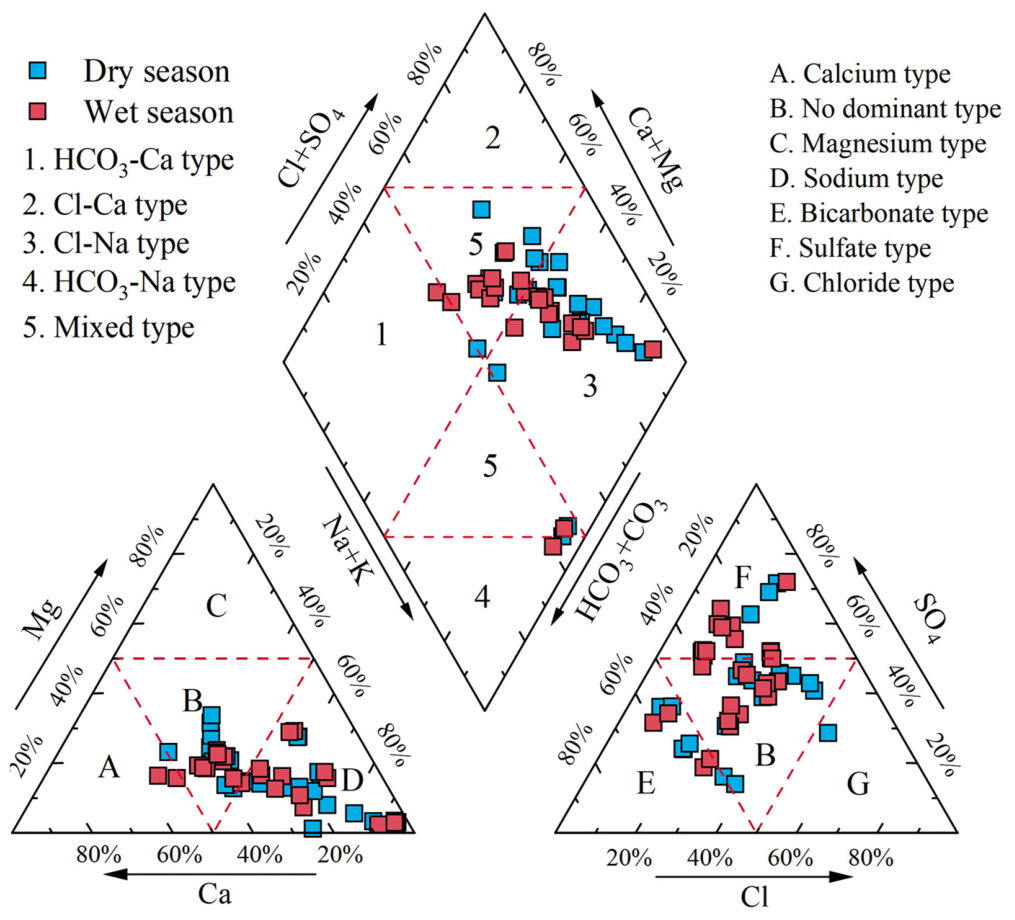
Figure 3 displays the Piper diagram for surface water chemistry in the study area. As shown, the hydrochemical types of surface water in both the dry and wet seasons are fairly consistent, with only slight seasonal differences. In the anion ternary diagram, most surface water samples fall within Zone B, corresponding to the “no dominant type”, followed by Zones E and F, which represent the “bicarbonate type” and “sulphate type”, respectively. The cation ternary diagram indicates that surface water samples are predominantly distributed in the Na
+ region, followed by Zone B, corresponding to the “sodium type” and “no dominant type”, respectively. Based on the combined distribution of anions and cations, the sampling points are primarily concentrated in Zones 5 and 3 of the central diamond, with the dominant hydrochemical facies being mixed water types and Cl–Na type water.
4.3. Analysis of Water Chemistry Control Factors
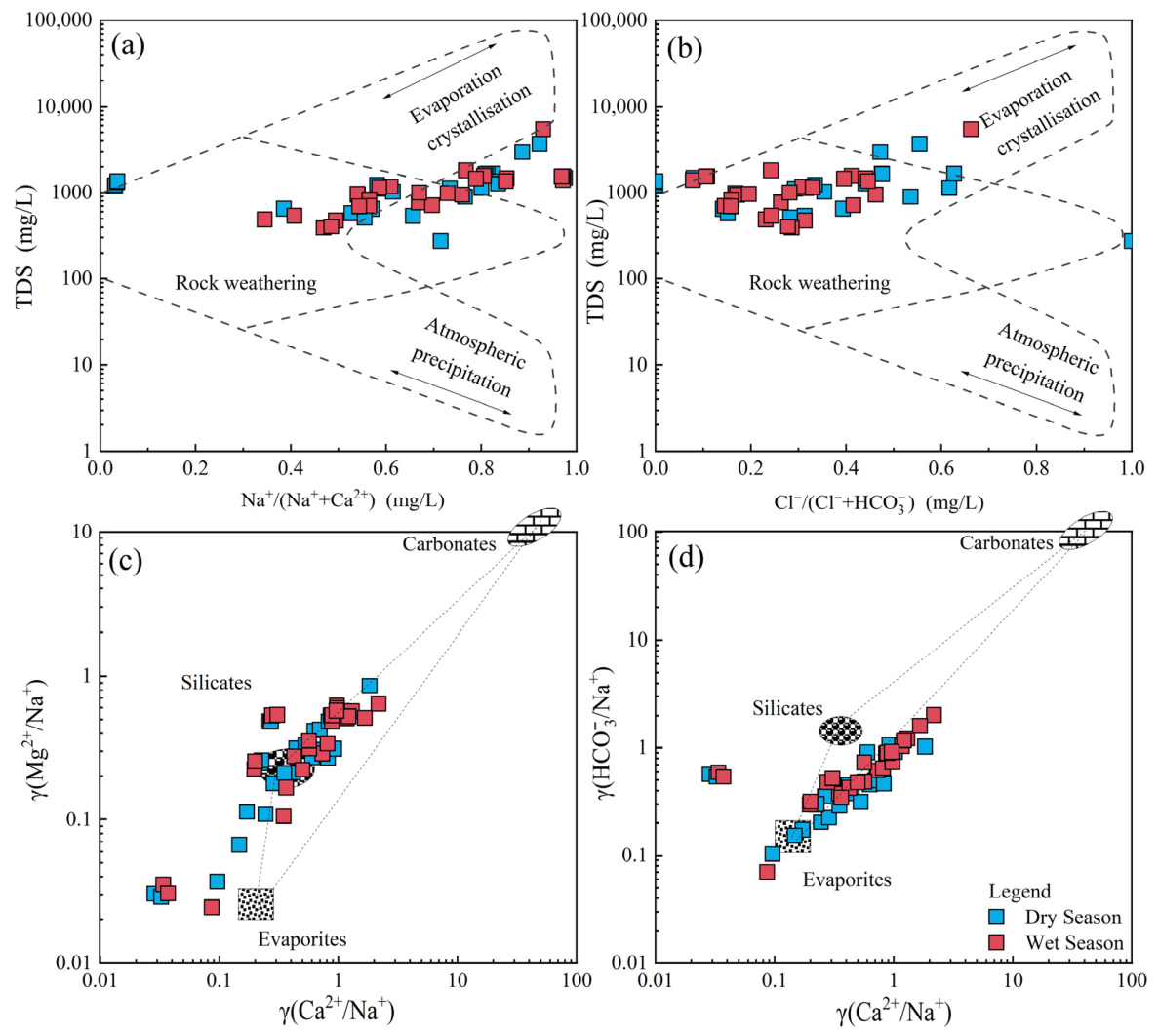
Based on the Gibbs diagram model [
23], the key mechanisms governing the chemical composition of natural waters can be classified into three types: rock weathering-dominated, evaporation-dominated, and atmospheric precipitation-dominated. In this semi-logarithmic diagram, TDS is plotted on the logarithmic vertical axis, while the horizontal axis shows the ionic ratios Na
+/(Na
+ + Ca
2+) and Cl
−/(Cl
− + HCO
3−).
As shown in
Figure 4a,b, surface water samples collected during different periods in the study area mainly lie within the rock weathering-dominated region of the Gibbs diagram, although some samples are located near the boundary of or within the evaporation-dominated region. This pattern indicates that the chemical composition of surface water in the study area is largely controlled by rock weathering, with evaporation and crystallization playing a secondary role.
To further identify the specific lithological sources of dissolved ions in surface water, end-member diagrams of HCO
3−/Na
+ versus Ca
2+/Na
+ and Mg
2+/Na
+ versus Ca
2+/Na
+ were used. These diagrams were proposed by Gaillardet et al. [
24] through the analysis of global river hydrochemical data. The Ca
2+/Na
+, Mg
2+/Na
+, and HCO
3−/Na
+ ratios for carbonate rock end-members are 50, 10, and 120, respectively, while those for silicate rock end-members are 0.35 ± 0.15, 0.24 ± 0.12, and 2 ± 1, respectively. By plotting the surface water samples on the ion ratio end-member diagrams (
Figure 4c,d), it can be observed that most samples lie close to the silicate rock end-members, indicating that the hydrogeochemical composition of surface water in the study area is mainly influenced by silicate rock weathering. Additionally, some samples plot near the evaporite rock end-member, suggesting that evaporite dissolution also contributes to the surface water chemistry.
4.4. Ion Ratio Analysis
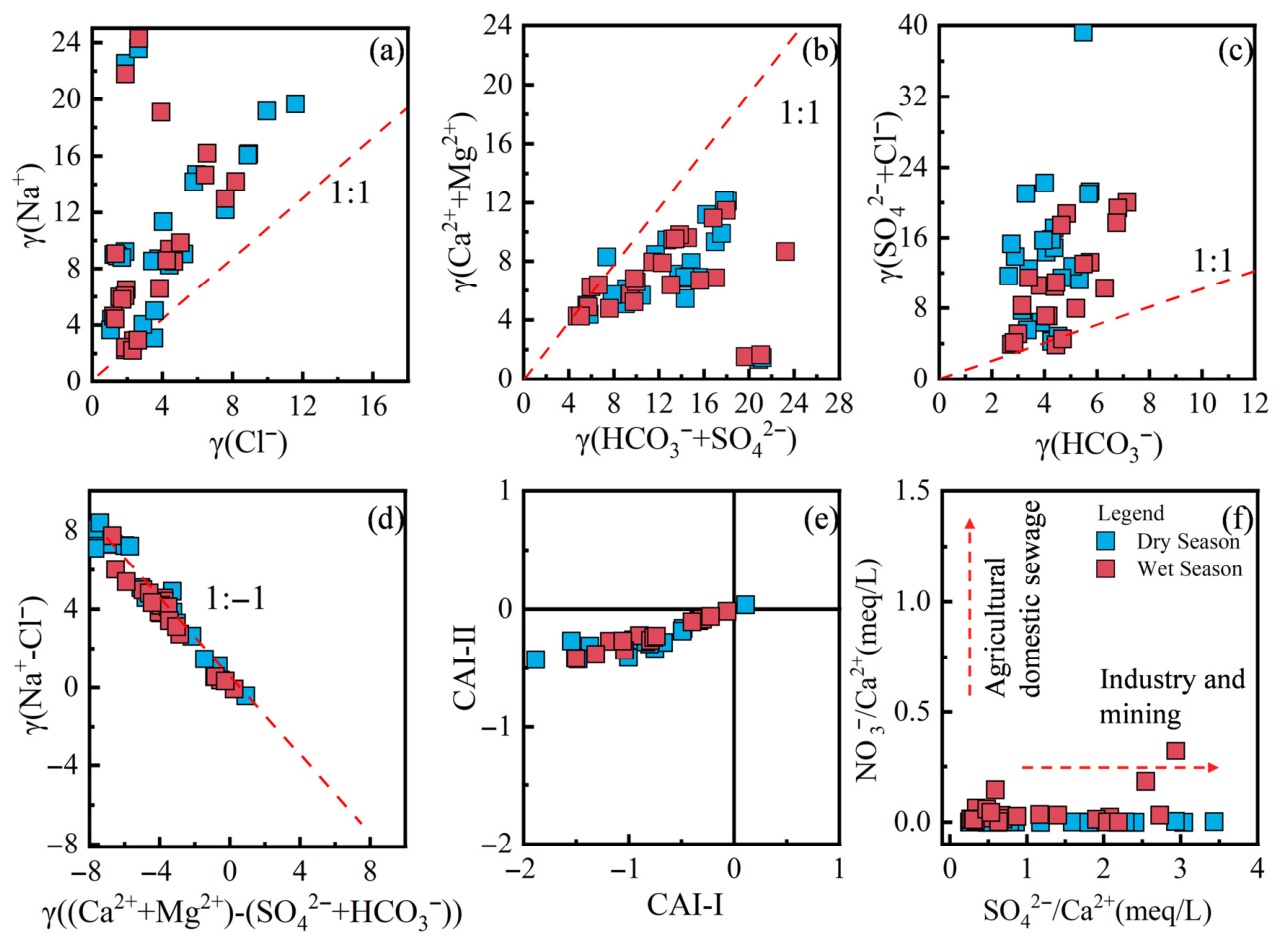
Plotting the milliequivalent ratios of various ions in surface water helps to interpret hydrogeochemical processes and the mechanisms of formation [
25,
26]. Theoretically, if the only source of Na
+ and Cl
− in surface water is the dissolution of salt rocks, then the Na
+/Cl
− ratio ought to be 1.
Figure 5a shows that during both the dry and wet seasons, water samples are primarily distributed above the 1:1 line, indicating an excess of Na
+ in the water and the presence of other anions to balance this excess. This implies that atmospheric precipitation and the weathering dissolution of evaporite rocks are not the dominant sources of ions. Instead, the main source of Na
+ in the study area is the dissolution of salt rock minerals and silicates, and it may also be influenced by cation exchange.
The milliequivalent concentration ratio of (Ca
2+ + Mg
2+)/(HCO
3− + SO
42−) can serve as an indicator of the sources of Ca
2+ and Mg
2+ in water. When this ratio falls along the 1:1 line, it suggests that the dissolution of Ca
2+, Mg
2+, and other minerals derived from carbonates and sulfates is the dominant hydrogeochemical process in surface water systems [
27,
28]. As shown in
Figure 5b, except for a few sampling points during the wet season that lie exactly on the 1:1 line, the majority of points plot below this line, indicating an excess of (HCO
3− + SO
42−). This suggests that the chemical composition of surface water is primarily influenced by the dissolution of silicate minerals or by cation exchange/adsorption processes, in addition to being controlled by carbonates [
29].
Use the ratio of (SO
42− + Cl
−)/HCO
3− milligram equivalent concentration to determine whether the source of hydrochemical components is evaporite or carbonate. As shown in
Figure 5c, a small proportion of the water samples from the study area fall on the 1:1 line, whilst the majority lie above it; this is particularly evident for samples taken during the dry season. The majority of surface water chemical components come from the dissolution of evaporite rocks.
Ion exchange is a very common chemical reaction in water bodies, and the milliequivalent ratio of (Na
+-Cl
−)/((Ca
2+ + Mg
2+)-(SO
42− + HCO
3−)) can further indicate whether cation exchange occurs in surface water [
29,
30]. As shown in
Figure 5d, the sampling points from both the dry and wet seasons are mostly distributed around the –1:1 line, suggesting the presence of cation exchange in the water samples from the study area. To more clearly identify the direction of cation exchange, the Chlor-Alkali Index (CAI) was adopted, and its calculation is presented in Equations 14 and 15 [
31,
32]. When both CAI-I and CAI-II have positive values, reverse cation exchange occurs, that is, Na
+ and K
+ in the water are replaced by Ca
2+ and Mg
2+ from the rock, resulting in a reduction in Na
+ and K
+ concentrations and an increase in Ca
2+ and Mg
2+ levels in the water. Conversely, when both CAI-I and CAI-II are negative, the exchange direction is reversed. As shown in
Figure 5e, the vast majority of sample points fall within the negative region for both CAI-I and CAI-II, indicating forward cation exchange, where Ca
2+ and Mg
2+ in the water exchange with Na
+ and K
+ in the rock, resulting in a decrease in Ca
2+ and Mg
2+ in the water.
Human activities are highly dependent on surface water runoff, and this dependence inevitably affects the hydrochemical evolution of surface water. In regions with intensive human activity, concentrations of NO
3− and SO
42− are often elevated [
27]. As shown in
Figure 5f, the plot of NO
3−/Ca
2+ versus SO
42−/Ca
2+ exhibits a relatively high SO
42−/Ca
2+ ratio. This indicates that human activities, including industrial mining and domestic sewage discharge, are key factors influencing the hydrogeochemical characteristics of surface water in the study area.
4.5. Correlation Analysis
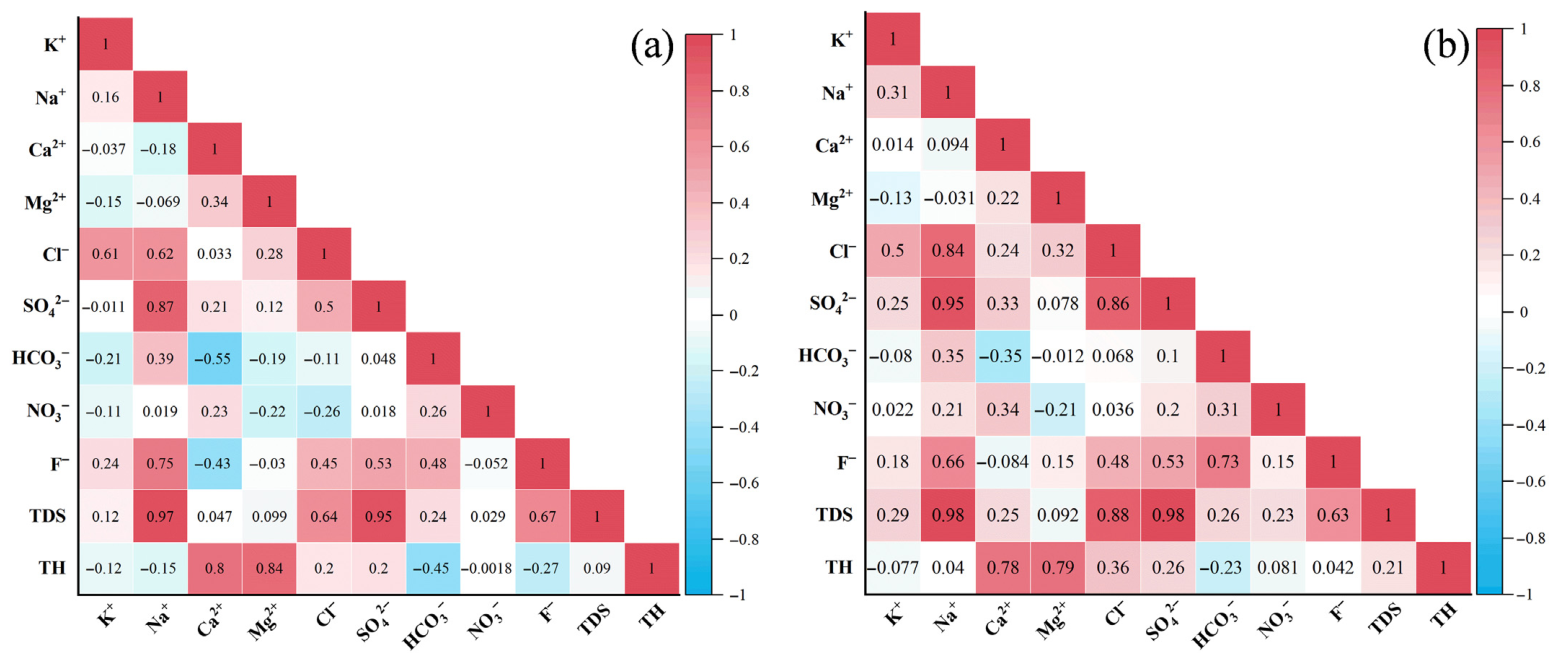
Pearson correlation analysis can quantitatively depict the linear correlation between different hydrochemical parameters, discover the co-directional or anti-directional variation relationships between variables, and further reveal the inherent laws of hydrochemical evolution.
A Pearson correlation analysis was performed, and the resulting correlation matrix is shown in
Figure 6. In both the dry (
Figure 6a) and wet (
Figure 6b) seasons, TDS exhibited a strong positive correlation with Na
+, Cl
−, SO
42− and F
−. Among these, the correlations with Na
+ and SO
42− were the strongest, with correlation coefficients of 0.98 for both ions during the dry season, and 0.97 and 0.95, respectively, during the wet season. This suggests that Na
+ and SO
42− are the main contributors to TDS. In both seasons, TH was strongly correlated with Ca
2+ and Mg
2+, confirming that these two ions are the main contributors to the hardness of the surface water. Regarding inter-ionic relationships, Na
+ was strongly positively correlated with SO
42− in the dry season, indicating a common origin, likely from the dissolution of evaporite minerals or anthropogenic inputs. In the wet season, Na
+ was strongly correlated with Cl
− and F
−, suggesting that these ions may share similar sources during this period. In contrast, NO
3− showed weak correlations with most ions in both seasons, indicating that its source is relatively independent and may be mainly influenced by anthropogenic factors, such as agricultural activities.
4.6. Principal Component Analysis (PCA)
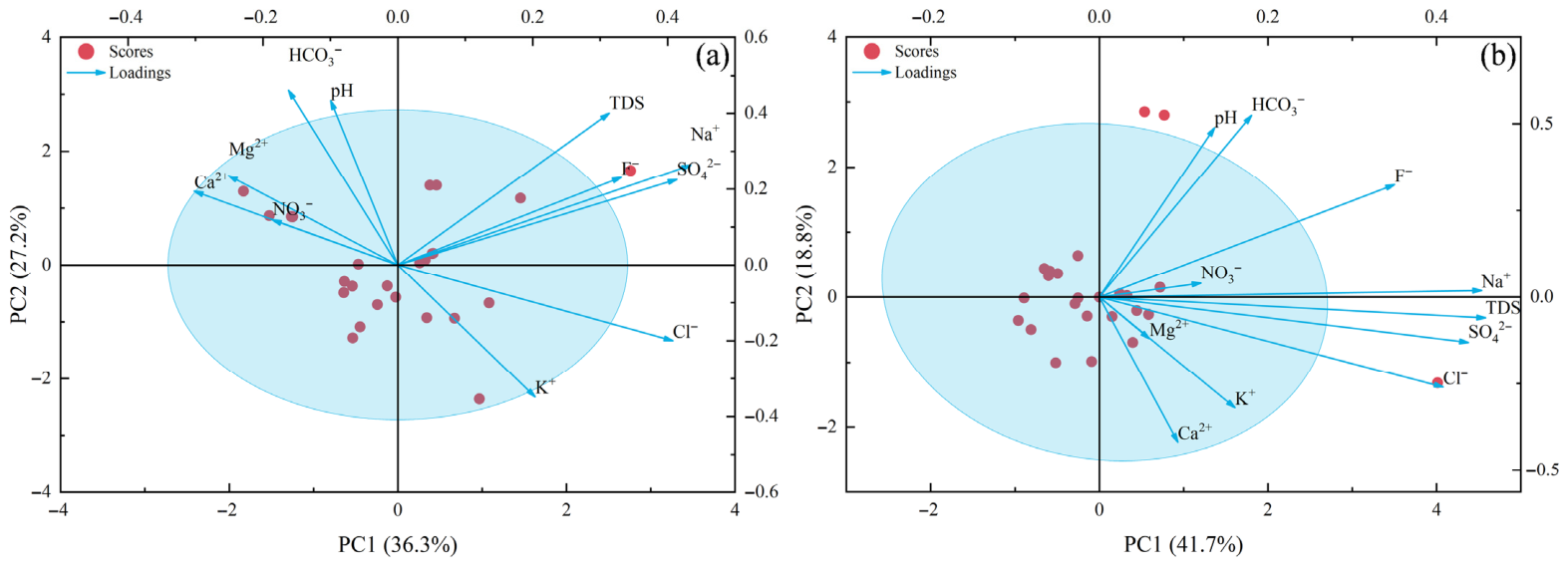
Using principal component analysis to perform dimensionality reduction analysis on surface water data through linear transformation to simplify the data and facilitate observation of distribution and subsequent analysis. During the dry season, four principal components were extracted based on the eigenvalues (
Figure 7a), with a cumulative variance explained of 87.1%. The first principal component (F1) contributed 36.3%, serving as the primary factor controlling the hydrochemistry in the study area. Highly loaded variables for F1 include Na
+ (0.86), Cl
− (0.81), and SO
42− (0.82). Correlation analysis indicated a strong positive correlation between Na
+ and Cl
− (correlation coefficient of 0.62), as well as between Na
+ and SO
42− (correlation coefficient of 0.87). The ratio analysis of Na
+ and Cl
−, representing typical ions, indicated that their sources can be attributed to the dissolution of evaporite rocks. Additionally, anthropogenic activities also affect the concentrations of Na
+, Cl
− and SO
42−. Given that the study area is densely populated with industrial activities, F1 can be interpreted as a combined effect of evaporite rock dissolution and industrial wastewater discharge. The second principal component (F2) contributed 27.2%, primarily driven by HCO
3− (0.79) and pH (0.74), reflecting the acidic and alkaline environments of the water body. The third principal component (F3) contributed 12.8%, with Ca
2+ (0.66) and Mg
2+ (0.61) as the main loadings. Considering the regional geological conditions, it can be interpreted as the dissolution of carbonate rocks. The fourth principal component (F4) contributed 10.8%, primarily controlled by NO
3− (0.78), which typically originates from agricultural inputs. Therefore, F4 can be interpreted as the impact of agricultural activities.
In the wet season, four principal components were likewise extracted based on the eigenvalues (
Figure 7b), together accounting for 84.2% of the cumulative variance. The first principal component (F1) explained 41.7% of the variance, serving as the dominant factor influencing the hydrochemistry of the study area. The high-loading variables of F1 included Na
+ (0.97), Cl
− (0.87), and SO
42− (0.93). Correlation analysis indicated a strong positive correlation between Na
+ and Cl
− (correlation coefficient 0.62) and between Na
+ and SO
42− (correlation coefficient 0.95). The dimensionality reduction results for F1 were strikingly similar to those during the dry season, suggesting a combined effect of evaporite dissolution and industrial wastewater discharge. The second principal component (F2) contributed 18.8%, primarily driven by HCO
3− (0.75) and pH (0.70), reflecting the weakly alkaline environment of the surface water. The third principal component (F3) contributed 11.9%, with Mg
2+ (0.77) as the main loading, which, combined with the ion ratio plot, can be explained by the influence of carbonate rock weathering. The fourth principal component (F4) contributed 11.7%, primarily driven by Ca
2+ (0.67) and NO
3− (0.54). NO
3− showed low correlation with other ions, indicating a relatively independent source. The two high-loading ions in F4 may originate from different input end-members, while NO
3− can promote the dissolution of carbonate rocks, leading to an increase in Ca
2+ concentration. Therefore, F4 can be explained by the combined influence of agricultural activities and carbonate rock dissolution.
4.7. Drinking Water Quality Assessment
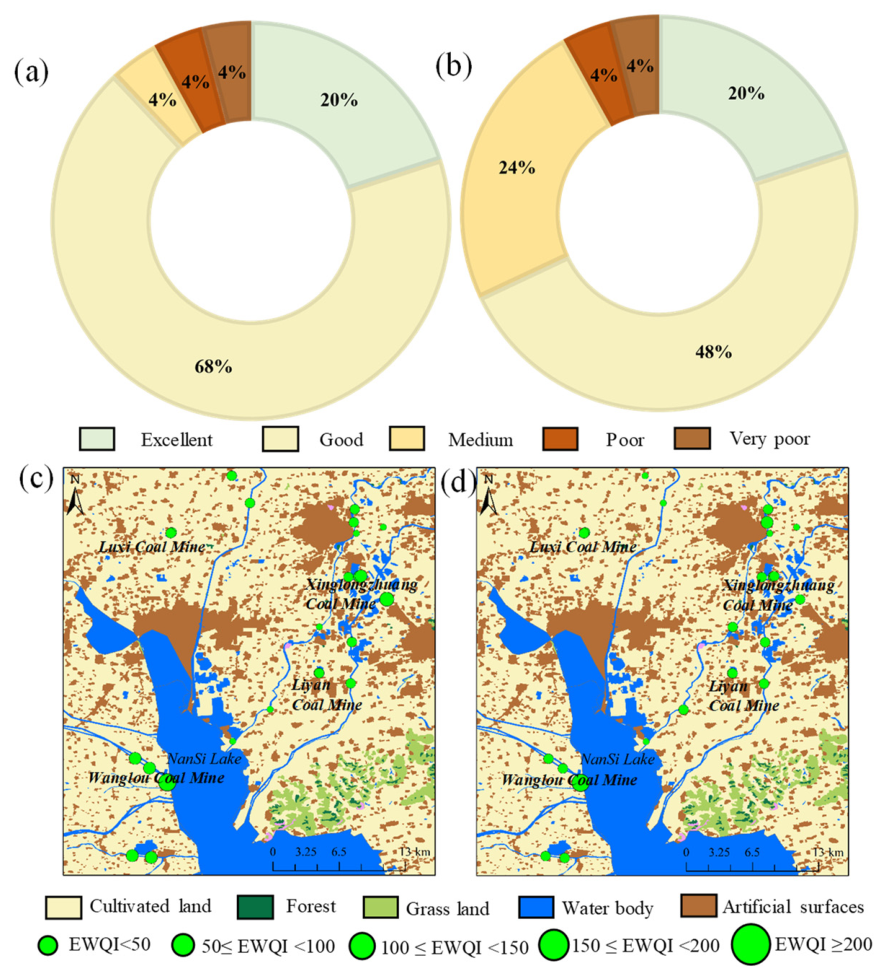
The WQI method, which evaluates overall water quality and drinking suitability based on hydrochemical data and standards, often involves subjective weight allocation for various indicators, potentially obscuring important information. To objectively reflect each indicator’s relative importance, this study adopts the entropy weight method, which determines the entropy index from data dispersion and calculates weights, resulting in the EWQI. This method has been widely applied in drinking water quality evaluation. During the dry season, EWQI values in the study area ranged from 23.7 to 236, with a mean of 77.1; during the wet season, they ranged from 26.2 to 499, with a mean of 93.2. The average EWQI value during the dry season was slightly lower than that in the wet season. As shown in
Figure 8a for the dry season, 20% of the water samples fell into the excellent category and 68% into the good category, indicating that 88% were suitable for direct consumption. Additionally, 4% were of medium quality, and another 4% were deemed unsuitable for direct consumption. In the wet season (
Figure 8b), 20% were excellent and 48% were good, totaling 68% suitable for direct drinking. The proportion of medium-quality samples was 24%, and 4% were unsuitable. As illustrated in
Figure 8c, d, elevated EWQI values during the dry season were mainly concentrated in the Wanglou mining area, whereas in the wet season, higher values appeared in both the Wanglou and Xinglongzhuang mining areas. In contrast, EWQI values for surface water in other parts of the study area remained relatively low. Consequently, these mining areas need to prioritize improvements in drinking water quality.
4.8. Assessment of Irrigation Water Quality
As noted above, Na
+ concentrations in the study area are generally elevated. High salinity levels in irrigation water can lead to soil salinisation, while excessive Na
+ may also induce soil compaction and reduce permeability, ultimately affecting plant growth and crop yield [
33]. The regional climate is characterised by humid and rainy summers, in contrast to relatively dry winters and springs, with agricultural irrigation depending largely on surface water and groundwater resources. In view of this, this study employs multiple indicators (including the %Na, SAR, RSC, PI and MH) to assess the suitability of surface water for irrigation. These indicators, combined with Wilcox and USSL diagrams [
13,
14,
34], comprehensively evaluate the agricultural suitability of water quality from different dimensions, providing a more comprehensive reference for irrigation decision-making.
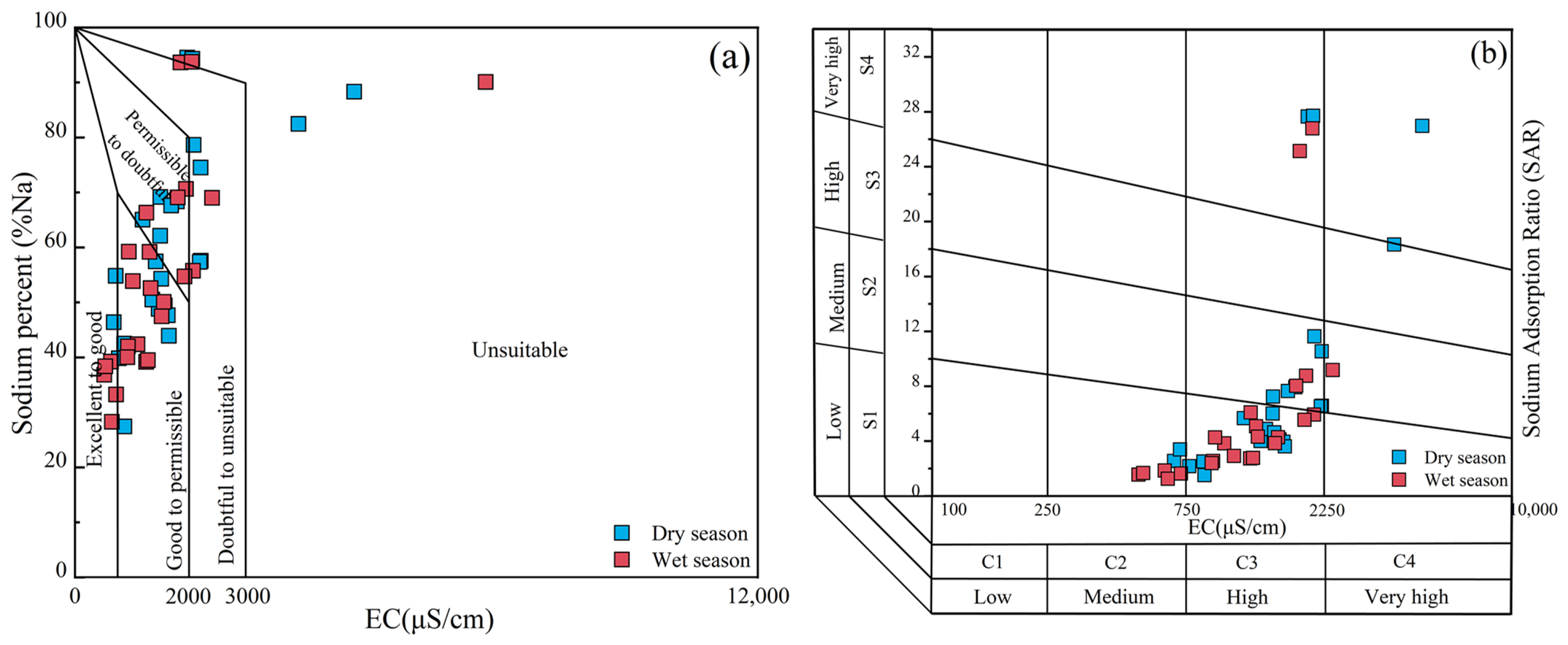
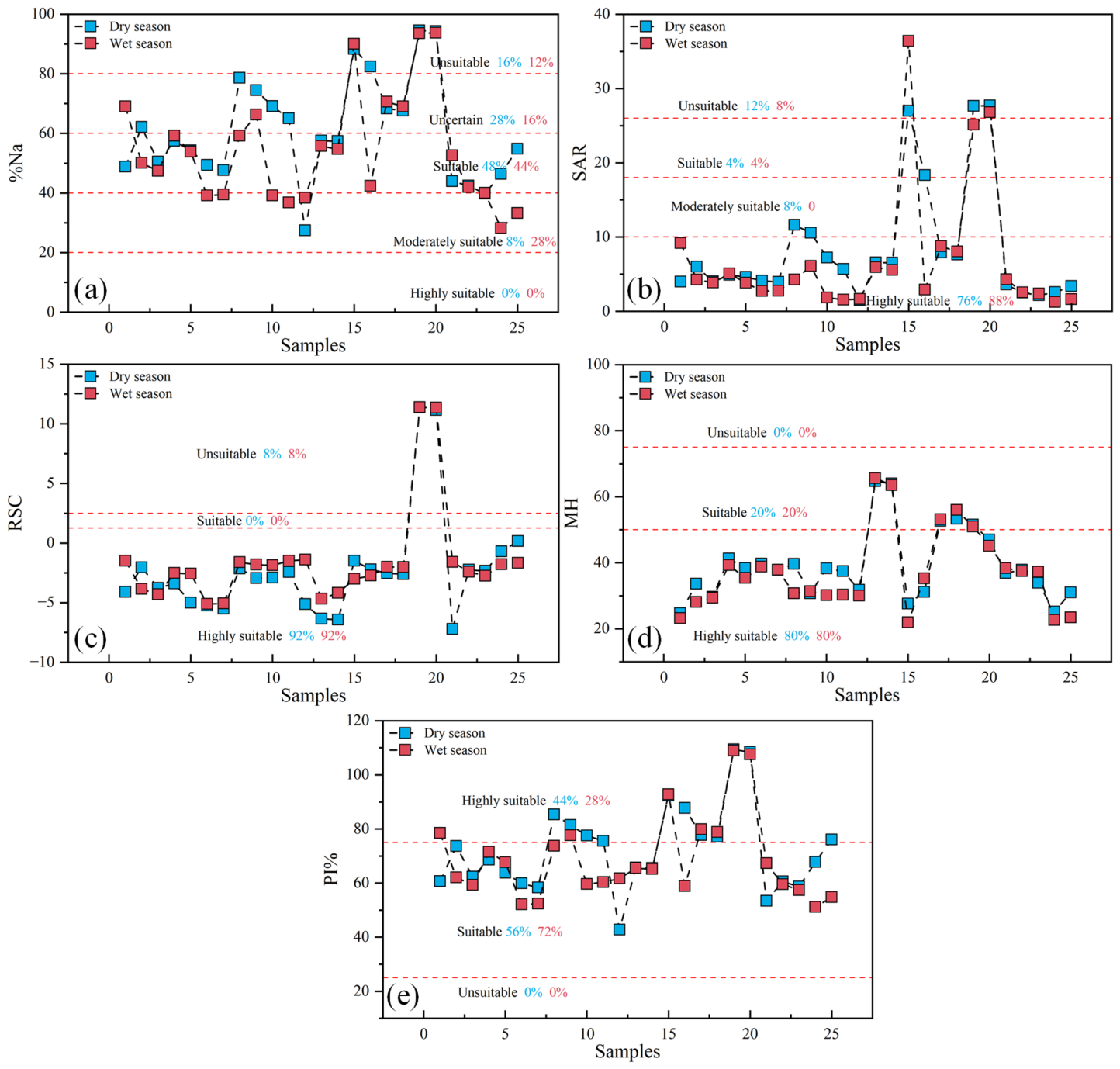
During the dry season, the %Na of surface water in the study area varied between 27.4% and 94.5%, while during the wet season it ranged from 28.2% to 93.7%. About 56% of the samples collected in the dry season were deemed suitable for irrigation, and this proportion rose to 72% in the wet season (
Figure 9a). A more detailed assessment of irrigation suitability can be obtained by examining the relationship between EC and %Na. As shown in
Figure 10a, surface water samples from both seasons were mainly distributed within the “excellent to good” and “good to permissible” categories, indicating that the overall water quality is generally acceptable for irrigation. Nevertheless, a portion of the samples fell into the “doubtful to unsuitable” and “unsuitable” categories, suggesting that elevated salinity and sodium levels may limit their suitability for irrigation in some areas.
During the dry season, SAR values ranged from 1.52 to 27.7, while in the wet season, they varied between 1.25 and 36.4. Overall, the majority of water samples from both periods fell within the range considered suitable for irrigation, with only 12% of dry season samples and 8% of wet season samples classified as unsuitable (
Figure 9b). To further evaluate the potential risk of salinisation, this study employed a USSL diagram integrating EC and SAR values to assess irrigation suitability. As illustrated in
Figure 10b, most samples were concentrated within the C2–C3 and S1–S2 combination zones, indicating irrigation water with moderate salinity and low to medium sodium hazard, which is generally acceptable for most crops. However, a small number of samples fell within the C4 and S3–S4 zones, reflecting high salinity and high sodium levels. These conditions may pose risks to soil structure and crop health, suggesting that such water should either be used with caution under appropriate irrigation management or avoided altogether.
As shown in
Figure 9c, 92% of the water samples from both the dry and wet seasons were suitable for irrigation; only one sample from each season had an RSC value exceeding 2.5, indicating unsuitability for agricultural use. Regarding MH, water samples with MH values below 50 are generally considered suitable for irrigation (
Figure 9d). In this study, 80% of the samples fell below this threshold, suggesting that the majority are appropriate for plant irrigation. Additionally, the PI values for all samples from both seasons fell within the “excellent to good” range, further supporting their suitability for irrigation (
Figure 9e). A comprehensive analysis integrating multiple indicators, including %Na, SAR, RSC, MH, and PI, indicates that the vast majority of surface water samples are suitable for agricultural irrigation, with suitability being slightly higher in the wet season than in the dry season. Nevertheless, certain samples exhibit elevated salinity and sodium levels, which warrant attention in irrigation management to mitigate potential risks to soil structure and crop growth. Overall, the surface water in the study area can be used for irrigation.
5. Limitations of the Evaluation Methods and Management Recommendations
Although the EWQI enables a relatively objective determination of the weights of various evaluation indicators, its weight allocation remains sensitive to the variability of indicator data, thereby retaining certain limitations in comprehensive water quality assessment. Meanwhile, traditional irrigation water quality indices such as %Na, SAR, RSC, PI and MH tend to focus on a single environmental risk, resulting in a relatively narrow evaluation scope. In summary, notwithstanding these limitations, the methods described above remain of considerable referential value for evaluating irrigation water quality in this study area and analogous regions. Moreover, they can serve as a foundation for developing regional policies on water resource protection and pollution control. On the basis of the foregoing analysis, the following recommendations are put forward in this paper:
- (1)
Research indicates that surface waters in the study area have high salinity as well as elevated concentrations of SO42− and Na+ in both the dry and wet seasons. To reduce the entry of high-salinity ions and inorganic pollutants into surface water bodies, it is recommended that oversight of mining activities near the mining area be tightened. This would help lessen the continued influence of human activities on the region’s hydrochemical environment.
- (2)
Some surface water samples exhibited elevated salinity and sodium concentrations. Although the water is generally suitable for irrigation, there remains a potential risk of salinisation. It is recommended that zoned irrigation management be implemented in agricultural production, whereby high-mineralisation water is diluted or used in rotation, and water and fertiliser management measures are appropriately coordinated to prevent the deterioration of soil physicochemical properties and ensure the safety of agricultural production.
- (3)
According to the drinking water quality assessment, surface water in the study area is mostly of good to excellent quality. However, the sources of NO3− are relatively independent and show considerable variability, indicating a certain level of water quality instability. It is recommended to establish a long-term dynamic water quality monitoring network to track changes in water quality, identify major pollution sources and transport pathways, and provide continuous data support for the safe use and protection of regional water resources.
6. Conclusions
Based on 50 sets of surface water sample data collected during different periods in the study area, this study employs methods such as hydrochemical diagrams and mathematical statistics to conduct an in-depth analysis of the hydrochemical characteristics and evolution patterns of surface water in the region, as well as to evaluate its current water quality status. The main conclusions are as follows:
- (1)
The dominant cations and anions in the surface water of the study area during the dry and wet seasons are SO42− and Na+, with average values of 418 mg/L and 270 mg/L, 439 mg/L and 271 mg/L, respectively. The average TDS values were 1279 mg/L and 1163 mg/L, respectively. The coefficient of variation of SO42− and NO3− during the dry season is relatively high, while the coefficient of variation of Na+, SO42−, and NO3− during the wet season is relatively high, all exceeding 100%. The hydrochemical types of surface water are mainly mixed and Cl-Na type water.
- (2)
The hydrochemical characteristics of the study area are primarily governed by rock weathering. According to hydrochemical analyses, both natural geochemical processes and anthropogenic inputs play a decisive role in shaping groundwater composition. Natural geochemistry is mainly controlled by silicate rock weathering, evaporite dissolution, and cation exchange, whereas human influences are derived chiefly from mining and agricultural activities.
- (3)
Pearson correlation analysis in mathematical statistics shows that TDS is significantly positively correlated with Na+ and SO42− during both dry and wet seasons, indicating that they are the main contributing ions to TDS. NO3− has a weak correlation with most ions, indicating that its source is relatively independent. Principal component analysis explained 88.6% and 88.5% of the data during the dry season and wet season, respectively. The main influencing factors of F1, which contributed the most to the data during the dry season, were evaporite rock dissolution and industrial wastewater discharge, while the influencing factors of F1 during the wet season were industrial wastewater.
- (4)
An assessment of drinking water quality showed that the “good” grade accounted for the largest share of samples in both seasons, representing 68% in the dry season and 48% in the wet season. Overall, 88% of the samples from the dry season and 68% from the wet season were considered suitable for direct drinking. The majority of water samples are suitable for use as drinking water. During the dry season, higher EWQI values were mainly distributed in the Wanglou mining area, while in the wet season, elevated values were found in both the Wanglou mining area and the Xinglongzhuang mining area. According to the single-indicator analysis, 92% of surface water samples in both the dry and wet seasons are suitable for irrigation and do not pose any risk of salinization or alkalinization. Nevertheless, some samples exhibit high salinity and high sodium content, which should be given attention in irrigation management.
Author Contributions
M.L.: Supervision, Methodology, Writing—original draft; Y.M.: Formal analysis, Methodology, Investigation, Software, Writing—original draft; X.W.: Conceptualization, Methodology, Writing—review and editing; Y.X.: Software, Methodology, Investigation; B.W.: Conceptualization, Investigation, Software, Methodology; W.L.: Investigation, Software, Methodology; Z.L.: Conceptualization, Investigation, Software; K.Z.: Software, Methodology, Validation; L.Z.: Investigation, Software, Methodology; M.T.: Investigation, Software, Methodology; K.L.: Software, Investigation, Supervision. All authors have read and agreed to the published version of the manuscript.
Funding
This research was funded by the Shandong Institute of Chinese Engineering S&T Strategy for Development grant number 202501SDZD03.
Data Availability Statement
The data presented in this study are available on request from the corresponding author due to privacy restrictions, the data used in this study cannot be made public.
Acknowledgments
We sincerely thank the hard-working editors and meticulous reviewers for their valuable opinions and constructive feedback on this manuscript. We are deeply grateful to the editors and reviewers for their extremely beneficial suggestions regarding this article.
Conflicts of Interest
The authors declare no competing interests.
References
- Kausher, R.; Sinha, A.K.; Singh, R. Chemometric appraisal of groundwater and surface water quality for domestic, irrigation and industrial purposes in the coal mining province of Mahan River catchment area. Desalination Water Treat. 2023, 311, 10–25. [Google Scholar] [CrossRef]
- Wu, J.; Zhou, H.; He, S.; Zhang, Y. Comprehensive understanding of groundwater quality for domestic and agricultural purposes in terms of health risks in a coal mine area of the Ordos basin, north of the Chinese Loess Plateau. Environ. Earth Sci. 2019, 78, 446. [Google Scholar] [CrossRef]
- Bajrovi, H.B.; Tomaevi, V.P.; Raut, J.D. Analysis of the Impact of Mining Activities on Surface Water Quality—Identification of Key Parameters Through Statistical and Chemical Analysis. Pol. J. Environ. Stud. 2025, 34, 2567–2577. [Google Scholar] [CrossRef]
- Khan, A.J.; Akhter, G.; Gabriel, H.F.; Shahid, M. Anthropogenic Effects of Coal Mining on Ecological Resources of the Central Indus Basin, Pakistan. Water Res. 2020, 179, 115867. [Google Scholar]
- Deng, J.; Yang, G.; Yan, X.; Du, J.; Tang, Q.; Yu, C.; Pu, S. Quality evaluation and health risk assessment of karst groundwater in Southwest China. Sci. Total Environ. 2024, 946, 13. [Google Scholar] [CrossRef]
- Han, H.; Li, B.; Zhang, M.B. Construction and application of a composite model for acid mine drainage quality evaluation based on analytic hierarchy process, factor analysis and fuzzy comprehensive evaluation: Guizhou Province, China, as a case. Water Environ. Res. 2024, 96, e10986. [Google Scholar] [CrossRef]
- Zhou, Y.; Wang, X.M.; Li, W.Y.; Zhou, S.Y.; Jiang, L.Z. Water Quality Evaluation and Pollution Source Apportionment of Surface Water in a Major City in Southeast China Using Multi-Statistical Analyses and Machine Learning Models. Int. J. Environ. Res. Public Health 2023, 20, 881. [Google Scholar] [CrossRef]
- Jha, M.K.; Shekhar, A.; Jenifer, M.A. Assessing groundwater quality for drinking water supply using hybrid fuzzy-GIS-based water quality index. Int. J. Environ. Res. Public Health 2020, 179, 115867. [Google Scholar] [CrossRef] [PubMed]
- Oladipo, J.O.; Akinwumiju, A.S.; Aboyeji, O.S.; Adelodun, A.A. Comparison between Fuzzy Logic and Water Quality Index Methods: A Case of Water Quality Assessment in Ikare Community, Southwestern Nigeria. Environ. Chall. 2021, 3, 100308. [Google Scholar] [CrossRef]
- Biswas, T.; Pal, S.C.; Saha, A.; Ruidas, D. Arsenic and fluoride exposure in drinking water caused human health risk in coastal groundwater aquifers. Environ. Res. 2023, 238, 117257. [Google Scholar] [CrossRef]
- Sheng, D.; Meng, X.; Zhou, W.T. Hydrochemical characteristics, quality and health risk assessment of nitrate enriched coastal groundwater in northern China. J. Clean. Prod. 2023, 403, 136872. [Google Scholar] [CrossRef]
- Kumar, A.; Singh, A. Entropy-based groundwater quality evaluation with multivariate analysis and Sobol sensitivity for non-carcinogenic health risks in mid-Gangetic plains, India. Environ. Geochem. Health 2025, 47, 186. [Google Scholar] [CrossRef]
- Wilcox, L.V. Classification and Use of Irrigation Waters; US Department of Agriculture: Washington, DC, USA, 1955.
- Richards, L.A. Diagnosis and Improvement of Saline and Alkali Soils; US Department of Agriculture: Washington, DC, USA, 1954.
- Eaton, F.M. Significance of carbonates in irrigation waters. Soil Sci. 1950, 69, 123–134. [Google Scholar] [CrossRef]
- Allred, E.R.; Machmeter, R. The Quality of Minnesota Waters for Irrigation; Minnesota Agricultural Experiment Station: Falcon Heights, MN, USA, 1961; Available online: http://purl.umn.edu/139554 (accessed on 21 April 2026).
- Szabolcs, I.; Darab, C. The influence of irrigation water of high sodium carbonate content on soils. Akadémiai Kiadó 1964, 13, 237–246. [Google Scholar]
- Wei, S.; Zhang, Y.; Cai, Z.; Bi, D.; Wei, H.; Zheng, X.; Man, X. Evaluation of groundwater quality and health risk assessment in Dawen River Basin, North China. Environ. Res. 2025, 264, 120292. [Google Scholar] [CrossRef]
- Lal, B.; Shukla, A.K.; Kumar, P.; Singh, S.K.; Singh, Y.; Chaturvedi, S.K. Correction: Evaluation of irrigation water quality under newly weathered soil in hot and semihumid region of central India using GIS. Environ. Dev. Sustain. 2024, 26, 12901–12938. [Google Scholar] [CrossRef]
- Rehman, N.U.; Ali, W.; Muhammad, S.; Tepe, Y. Evaluation of drinking and irrigation water quality, and potential risks indices in the Dera Ismail Khan district, Pakistan. Kuwait J. Sci. 2024, 51, 100150. [Google Scholar] [CrossRef]
- GB/T 14848-2017; Standard for Groundwater Quality of China. Ministry of Land and Resources of the People’s Republic of China: Beijing, China, 2017.
- Piper, A. A Graphic Procedure in the Geochemical Interpretation of Water-Analyses. Eos Trans. Am. Geophys. Union 1944, 25, 914–923. [Google Scholar]
- Gibbs, R.J. Mechanisms controlling world water chemistry. Science 1970, 170, 1088–1090. [Google Scholar] [CrossRef]
- Gaillardet, J.; Dupre, B.; Allegre, C.J.; Négrel, P. Chemical and physical denudation in the Amazon River Basin. Chem. Geol. 1997, 142, 141–173. [Google Scholar] [CrossRef]
- Candela, E.G.; Pecoraino, G.; Favara, R.; Morici, S. Hydrogeologic and geochemical survey of aquifers based on chemical and isotopic characterisation of groundwater and rain waters: A case study in the Sisseb el Alem Basin (central-east Tunisia). Environ. Earth Sci. 2019, 78, 346. [Google Scholar] [CrossRef]
- Morici, S.; Candela, E.G.; Favara, R.; Pica, L.L.; Scaletta, C.; Pecoraino, G. Hydrogeochemical characterization of the alluvial aquifer of Catania Plain, Sicily (South Italy). Environ. Earth Sci. 2023, 82, 144. [Google Scholar] [CrossRef]
- Liu, J.T.; Lou, K.X.; Gao, Z.J.; Wang, Y.B.; Li, Q.; Tan, M.H. Comprehending hydrochemical fingerprint, spatial patterns, and driving forces of groundwater in a topical coastal plain of Northern China based on hydrochemical and isotopic evaluations. J. Clean. Prod. 2024, 461, 142640. [Google Scholar] [CrossRef]
- Al-Mashreki, M.H.; Eid, M.H.; Saeed, O.; Székács, A.; Szucs, P.; Gad, M.; Ramadan, H.S. Integration of Geochemical Modeling, Multivariate Analysis, and Irrigation Indices for Assessing Groundwater Quality in the Al-Jawf Basin, Yemen. Water 2023, 15, 1496. [Google Scholar] [CrossRef]
- Wisitthammasri, W.; Chotpantarat, S.; Thitimakorn, T. Multivariate statistical analysis of the hydrochemical characteristics of a volcano sedimentary aquifer in Saraburi Province, Thailand. J. Hydrol.-Reg. Stud. 2020, 32, 100745. [Google Scholar] [CrossRef]
- Toumi, N.; Hussein, B.H.M.; Rafrafi, S.; El Kassas, N. Groundwater quality and hydrochemical properties of Al-Ula Region, Saudi Arabia. Environ. Monit. Assess. 2015, 187, 84. [Google Scholar] [CrossRef]
- Fu, T.F.; Li, C.Z.; Wang, Z.Y.; Qi, C.; Chen, G.Q.; Fu, Y.S.; Su, Q.; Xu, X.Y.; Liu, W.Q.; Yu, H.J. Hydrochemical characteristics and quality assessment of groundwater in Guangxi coastal areas, China. Mar. Pollut. Bull. 2023, 188, 114564. [Google Scholar] [CrossRef] [PubMed]
- Schoeller, H. Groundwater Studies. An International Guide for Research and Practice; UNESCO: Paris, France, 1977. [Google Scholar]
- Saeed, O.; Székács, A.; Jordán, G.; Mörtl, M.; Abukhadra, M.R.; El-Sherbeeny, A.M.; Eid, M.H. Assessing surface water quality in Hungary’s Danube basin using geochemical modeling, multivariate analysis, irrigation indices, and Monte Carlo simulation. Sci. Rep. 2024, 14, 18639. [Google Scholar] [CrossRef] [PubMed]
- Gao, Z.; Li, Q.; Liu, J.; Su, Q.; Tan, M.; Wang, Y. Assessment of Groundwater Hydrogeochemistry, Controlling Factors, Water Quality, and Nitrate-Related Health Risks in the Longkou Bay, North China. Water Air Soil Pollut. 2024, 235, 392. [Google Scholar] [CrossRef]
| Disclaimer/Publisher’s Note: The statements, opinions and data contained in all publications are solely those of the individual author(s) and contributor(s) and not of MDPI and/or the editor(s). MDPI and/or the editor(s) disclaim responsibility for any injury to people or property resulting from any ideas, methods, instructions or products referred to in the content. |